1. Igor, Grand Prince of Kiev died in 945. Another name for Igor was Ingvar.
Research Notes: Source: Wikipedia - Sviatoslav I of Kiev
From Wikipedia - Igor, Grand Prince of Kiev :
Igor (Old East Slavic : , Old Norse : Ingvar, Ukrainian: ) was a Varangian ruler of Kievan Rus from 912 to 945 . Very little is known about him from the Primary Chronicle . It has been speculated that the chroniclers chose not to enlarge on his reign, as the region was dominated by Khazaria at that time. That he was Rurik 's son is also questioned on chronological grounds.
He twice besieged Constantinople , in 941 and 944 , and in spite of his fleet being destroyed by Greek fire , concluded with the Emperor a favourable treaty whose text is preserved in the chronicle. In 913 and 944 , the Rus plundered the Arabs in the Caspian Sea during the Caspian expeditions of the Rus , but it's not clear whether Igor had anything to do with these campaigns.
Drastically revising the chronology of the Primary Chronicle, Constantine Zuckerman argues that Igor actually reigned for three years, between summer 941 and his death in early 945. He explains the epic 33-year span of his reign in the chronicle by its author's faulty interpretation of Byzantine sources.[1] Indeed, none of Igor's activity are recorded in the chronicle prior to 941.
Igor was killed[2] while collecting tribute from the Drevlians in 945 and revenged by his wife, Olga of Kiev . The Primary Chronicle blames his death on his own excessive greed, indicating that he was attempting to collect tribute a second time in a month. As a result, Olga changed the system of tribute gathering (poliudie ) in what may be regarded as the first legal reform recorded in Eastern Europe.
[edit ] References
^ Zuckerman, Constantine. On the Date of the Khazars' Conversion to Judaism and the Chronology of the Kings of the Rus Oleg and Igor. A Study of the Anonymous Khazar Letter from the Genizah of Cairo. // Revue des études byzantines. 1995. 53. Pp. 237-270.
^ Leo the Deacon describes how Igor met his death: "They had bent down two birch trees to the prince's feet and tied them to his legs; then they let the trees straighten again, thus tearing the prince's body apart."[1]
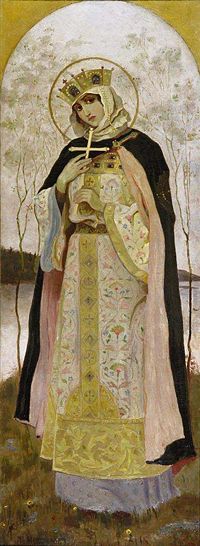
Igor married Olga, of Kiev. Olga was born about 890 and died on 11 Jul 969 in Kiev, Ukraine about age 79. Other names for Olga were Saint Olga of Kiev and Olga Prekrasa.
Research Notes: Source: Wikipedia - Igor, Grand Prince of Kiev
From Wikiepdia - Olga of Kiev :
Saint Olga (Russian and Ukrainian : also called Olga Prekrasa ( or Olga the Beauty, Old Norse : Helga; born c. 890 died July 11 , 969 , Kiev ) was a Pskov woman of Varangian extraction who married the future Igor of Kiev , arguably in 903 . The Primary Chronicle gives 879 as her date of birth, which is rather unlikely, given the fact that her only son was probably born some 65 years after that date. After Igor's death, she ruled Kievan Rus as regent (945 -c. 963 ) for their son, Svyatoslav .
At the start of her reign, Olga spent great effort to avenge her husband's death at the hands of the Drevlians , and succeeded in slaughtering many of them and interring some in a ship burial , while still alive. She is reputed to have scalded captives to death and another, probably apocryphal, story tells of how she destroyed a town hostile to her. She asked that each household present her with a dove as a gift, then tied burning papers to the legs of each dove which she then released to fly back to their homes. Each avian incendiary set fire to the thatched roof of their respective home and the town was destroyed. More importantly in the long term, Olga changed the system of tribute gathering (poliudie ) in what may be regarded as the first legal reform recorded in Eastern Europe.
She was the first Rus ruler to convert to Christianity , either in 945 or in 957 . The ceremonies of her formal reception in Constantinople were minutely described by Emperor Constantine VII in his book De Ceremoniis . Following her baptism she took the Christian name Yelena, after the reigning Empress Helena Lekapena. The Slavonic chronicles add apocryphal details to the account of her baptism, such as the story how she charmed and "outwitted" Constantine and how she spurned his matrimonial proposals. In truth, at the time of her baptism, Olga was an old woman, while Constantine had a wife.
Seven Latin sources document Olga's embassy to Emperor Otto I in 959 . The continuation of Regino of Prüm mentions that the envoys requested the Emperor to appoint a bishop and priests for their nation. The chronicler accuses the envoys of lies, commenting that their trick was not exposed until later. Thietmar of Merseburg says that the first archbishop of Magdeburg , before being promoted to this high rank, was sent by Emperor Otto to the country of the Rus (Rusciae) as a simple bishop but was expelled by pagans. The same data is duplicated in the annals of Quedlinburg and Hildesheim , among others.
Olga was one of the first people of Rus to be proclaimed saint, for her efforts to spread the Christian religion in the country. However, she failed to convert Svyatoslav , and it was left to her grandson and pupil Vladimir I to make Christianity the lasting state religion . During her son's prolonged military campaigns, she remained in charge of Kiev, residing in the castle of Vyshgorod together with her grandsons. She died soon after the city's siege by the Pechenegs in 968 .
The child from this marriage was:
+ 2 M i. Sviatoslav I, of Kiev 1 was born about 942 and died in Mar 972 about age 30.
 Second Generation
2. Sviatoslav I, of Kiev 1 (Igor, Grand Prince of Kiev1) was born about 942 and died in Mar 972 about age 30.
Research Notes: From Wikipedia - Sviatoslav I of Kiev :
Sviatoslav I of Kiev (Old East Slavic : ([1] (Sventoslav Igorevich), Russian : Ukrainian : Bulgarian : Greek : (Sfendoslavos) ) (c. 942 - March 972) was a warrior prince of Kievan Rus' . The son of Igor of Kiev and Olga , Sviatoslav is famous for his incessant campaigns in the east and south, which precipitated the collapse of two great powers of Eastern Europe-Khazaria and the First Bulgarian Empire ; he also subdued the Volga Bulgars , the Alans , and numerous East Slavic tribes, and at times was allied with the Pechenegs and Magyars . His decade-long reign over Rus' was marked by rapid expansion into the Volga River valley, the Pontic steppe and the Balkans . By the end of his short life, Sviatoslav carved out for himself the largest state in Europe , eventually moving his capital from Kiev to Pereyaslavets on the Danube in 969. In contrast with his mother's conversion to Christianity , Sviatoslav remained a staunch pagan all of his life. Due to his abrupt death in combat, Sviatoslav's conquests, for the most part, were not consolidated into a functioning empire, while his failure to establish a stable succession led to civil war among his successors.
Sviatoslav was the first ruler of Kievan Rus' whose name is indisputably Slavic in origin (as opposed to his predecessors, whose names are ultimately derived from Old Norse ). This name is not recorded in other medieval Slavic countries. Even in Rus', it was attested only among the members of the house of Rurik , as were the names of Sviatoslav's immediate successors: Vladimir , Yaroslav , Mstislav ).[2] Some scholars speculate that the name of Sviatoslav, composed of the Slavic roots for "holy" and "glory", was an artificial derivation combining those of his predecessors Oleg and Rurik (they mean "holy" and "glorious" in Old Norse, respectively).[3]
Virtually nothing is known about his childhood and youth, which he spent reigning in Novgorod . Sviatoslav's father, Igor , was killed by the Drevlians around 942 and his mother, Olga , ruled as regent in Kiev until Sviatoslav's majority (ca. 963).[4] His tutor was a Varangian named Asmud . "Quick as a leopard,"[5] Sviatoslav appears to have had little patience for administration. His life was spent with his druzhina (roughly, "troops") in permanent warfare against neighboring states. According to the Primary Chronicle .
" Upon his expeditions he carried with him neither wagons nor kettles, and boiled no meat, but cut off small strips of horseflesh, game or beef, and ate it after roasting it on the coals. Nor did he have a tent, but he spread out a horse-blanket under him, and set his saddle under his head, and all his retinue did likewise.[6] " Sviatoslav was noted by Leo the Deacon to be of average height and build. He shaved his head and his beard (or possibly just had a wispy beard) but wore a bushy mustache and a one or two sidelocks as a sign of his nobility. He preferred to dress in white, and it was noted that his garments were much cleaner than those of his men. He wore a single large gold earring bearing a ruby and two pearls .[7] [8]
His mother converted to Christianity at the court of Byzantine Emperor Constantine Porphyrogenitus in 945 or 957. However,[9] Sviatoslav continued to worship Perun , Veles , Svarog and the other gods and goddesses of the Slavic pantheon . He remained a stubborn pagan for all of his life; according to the Primary Chronicle, he believed that his warriors would lose respect for him and mock him if he became a Christian.[10] The allegiance of his warriors was of paramount importance in his conquest of an empire that stretched from the Volga to the Danube.
Family
Very little is known of Sviatoslav's family life. It is possible that Sviatoslav was not the only (and the eldest) son of his parents. The Russo-Byzantine treaty of 945 mentions a certain Predslava, Volodislav's wife, as the noblest of the Rus' women after Olga. George Vernadsky was among many historians to speculate that Volodislav was Igor's eldest son and heir who died at some point during Olga's regency. At the time of Igor's death, Sviatoslav was still a child and he was raised by his mother or at her instructions. Her influence, however, did not extend to his religious observance.
Sviatoslav, had several children, but the origin of his wives is not specified in the chronicle. By his wives, he had Yaropolk and Oleg .[11] By Malusha , a woman of indeterminate origins,[12] Sviatoslav had Vladimir , who would ultimately break with his father's paganism and convert Rus to Christianity . John Skylitzes reported that Vladimir had a brother named Sfengus ; whether this Sfengus was a son of Sviatoslav, a son of Malusha by a prior or subsequent husband, or an unrelated Rus' nobleman is unclear.[13]
When Sviatoslav went on campaign he left his various relations as regents in the main cities of his realm: his mother Olga and later Yaropolk in Kiev, Vladimir in Novgorod, and Oleg over the Drevlians...
Death and aftermath
Fearing that the peace with Sviatoslav would not endure, the Byzantine emperor induced the Pecheneg khan Kurya to kill Sviatoslav before he reached Kiev. This was in line with the policy outlined by Constantine VII Porphyrogenitus in De Administrando Imperio of fomenting strife between the Rus' and the Pechenegs.[35] According to the Slavic chronicle, Sveneld attempted to warn Sviatoslav to avoid the Dnieper cataracts , but the prince slighted his wise advice and was ambushed and slain by the Pechenegs when he tried to cross the cataracts near Khortitsa early in 972. The Primary Chronicle reports that his skull was made into a chalice by the Pecheneg khan, Kurya.[36]
Following Sviatoslav's death, tensions between his sons grew. A war broke out between Sviatoslav's legitimate sons, Oleg and Yaropolk , in 976, at the conclusion of which Oleg was killed. In 977 Vladimir fled Novgorod to escape Oleg's fate and went to Scandinavia , where he raised an army of Varangians and returned in 980. Yaropolk was killed and Vladimir became the sole ruler of Kievan Rus'.
Notes
^ E.g. in the Primary Chronicle under year 970
^ X-XVI [Choice of personal names for the Russian princes of the 10th-16th centuries.] Moscow: Indrik, 2006. ISBN 5-85759-339-5 . Page 43.
^ See in (Moscow, 1970).
^ If Olga was indeed born in 879, as the Primary Chronicle seems to imply, she should have been about 65 at the time of Svyatoslav's birth. There are clearly some problems with chronology.
^ Primary Chronicle entry for 968
^ Cross and Sherbowitz-Wetzor, Primary Chronicle, p. 84.
^ Vernadsky 276-277. The sidelock is reminiscent of Turkic hairstyles and practices and was later mimicked by Cossacks .
^ For the alternative translations of the same passage of the Greek original that say that Sviatoslav may have not shaven but wispy beard and not one but two sidelocks on each side of his head, see eg. Ian Heath "The Vikings (Elite 3)", Osprey Publishing 1985; ISBN: 9780850455656, p.60 or David Nicolle "Armies of Medieval Russia 750-1250 (Men-at-Arms 333)" Osprey Publishing 1999; ISBN: 9781855328488, p.44
^ Based on his analysis of De Ceremoniis Alexander Nazarenko hypothesizes that Olga hoped to orchestrate a marriage between Svyatoslav and a Byzantine princess. If her proposal was peremptorily declined (as it most certainly would have been), it is hardly surprising that Sviatoslav would look at Byzantium and her Christian culture with suspicion. Nazarenko 302.
^ Primary Chronicle _____.
^ Whether Yaropolk and Oleg were whole or half brothers, and who their mother or mothers were, is a matter hotly debated by historians.
^ She is traditionally identified in Russian historiography as Dobrynya 's sister; for other theories on her identity, see here .
^ Indeed, Franklin and Shepard advanced the hypothesis that Sfengus was identical with Mstislav of Tmutarakan . Franklin and Shepard 200-201.
^ "Rus", Encyclopaedia of Islam
^ Christian 345. It is disputed whether Svyatoslav invaded the land of Vyatichs that year. The only campaign against the Vyatichs explicitly mentioned in the Primary Chronicle is dated to 966.
^ Russian Primary Chronicle ( - 2. - 1908, ) for year 6472. The chronicler may have wished to contrast Sviatoslav's open declaration of war to stealthy tactics employed by many other early medieval conquerors.
^ For Sviatoslav's reliance on nomad cavalry, see, e.g., Franklin and Shepard 149; Christian 298; Pletneva 18.
^ Christian 298. The Primary Chronicle is very succinct about the whole campaign against Khazars, saying only that Sviatoslav "took their city and Belaya Vezha".
^ The town was an important trade center located near the portage between the Volga and Don Rivers . By the early 12th century, however, it had been destroyed by the Kipchaks .
^ See, generally Christian 297-298; Dunlop passim.
^ Logan (1992), p. 202
^ Artamonov 428; Christian 298.
^ The campaign against Ossetians is attested in the Primary Chronicle. The Novgorod First Chronicle specifies that Sviatoslav resettled the Ossetians near Kiev, but Sakharov finds this claim dubitable.
^ The Mandgelis Document refers to a Khazar potentate in the Taman Peninsula around 985, long after Sviatoslav's death. Kedrenos reported that the Byzantines and Rus' collaborated in the conquest of a Khazar kingdom in the Crimea in 1016 and still later, Ibn al-Athir reported an unsuccessful attack by al-Fadl ibn Muhammad against the Khazars in the Caucasus in 1030. For more information on these and other references, see Khazars#Late references to the Khazars .
^ Christian 298.
^ Most historians believe the Greeks were interested in the destruction of Khazaria. Another school of thought essentializes Yahya of Antioch 's report that, prior to the Danube campaign, the Byzantines and the Rus' were at war. See Sakharov, chapter I.
^ The exact date of Sviatoslav's Bulgarian campaign, which likely did not commence until the conclusion of his Khazar campaign, is unknown.
^ Mikhail Tikhomirov and Vladimir Pashuto, among others, assume that the Emperor was interested primarily in diverting Sviatoslav's attention from Chersonesos , a Byzantine possession in the Crimea . Indeed, Leo the Deacon three times mentions that Svyatoslav and his father Igor controlled Cimmerian Bosporus . If so, a conflict of interests in the Crimea was inevitable. The Suzdal Chronicle, though a rather late source, also mentions Sviatoslav's war against Chersonesos. In the peace treaty of 971 , Sviatoslav promised not to wage wars against either Constantinople or Chersonesos. Byzantine sources also report that Kalokyros attempted to persuade Sviatoslav to support Kalokyros in a coup against the reigning Byzantine emperor. As a remuneration for his help, Sviatoslav was supposed to retain a permanent hold on Bulgaria. Modern historians, however, assign little historical importance to this story. Kendrick 157.
^ All figures in this article, including the numbers of Svyatoslav's troops, are based on the reports of Byzantine sources, which may differ from those of the Slavonic chronicles. Greek sources report Khazars and "Turks" in Sviatoslav's army as well as Pechenegs. As used in such Byzantine writings as Constantine Porphyrogenitus' De Administrando Imperio , "Turks" refers to Magyars . The Rus'-Magyar alliance resulted in the Hungarian expedition against the second largest city of the empire, Thessalonika , in 968.
^ Boris II was captured by the Byzantines in 971 and carried off to Constantinople as a prisoner.
^ Kendrick 158
^ Simultaneously, Otto I attacked Byzantine possessions in the south of Italy. This remarkable coincidence may be interpreted as an evidence of the anti-Byzantine German-Russian alliance. See: Manteuffel 41.
^ Grekov 445-446. The Byzantine sources report the enemy casualties to be as high as 20,000, the figure modern historians find to be highly improbable.
^ Franklin and Shepard 149-150
^ Constantine VII pointed out that, by virtue of their controlling the Dnieper cataracts, the Pechenegs may easily attack and destroy the Rus' vessels sailing along the river.
^ The use of a defeated enemy's skull as a drinking vessel is reported by numerous authors through history among various steppe peoples, such as the Scythians . Kurya likely intended this as a compliment to Sviatoslav; sources report that Kurya and his wife drank from the skull and prayed for a son as brave as the deceased Rus' warlord. Christian 344; Pletneva 19; Cross and Sherbowitz-Wetzor 90.
^ E. A Lanceray. "Svyatoslav on the way to Tsargrad .", The Russian History in the Mirror of the Fine Arts (Russian)
^ Cooke, Raymond Cooke. Velimir Khlebnikov: A Critical Study. Cambridge University Press, 1987. Pages 122-123
^ London: Shapiro, Vallentine, 1926
^ (Moscow: Det. lit., 1989).
^
^ "The Federation of Jewish Communities protests against the presence of a Star of David in a new sculpture in Belgorod" , Interfax, November 21, 2005; Kozhevnikova, Galina, "Radical nationalism and efforts to oppose it in Russia in 2005" ; "FJC Russia Appeal Clarifies Situation Over Potentially Anti-Semitic Monument" (Federation of Jewish Communities of the CIS Press Release), November 23, 2005; Dahan, David, "Jews protest trampled Star of David statue", European Jewish Press, November 22, 2005
References
Sviatoslav married Malusha.
Research Notes: Source: Wikipedia - Vladimir I of Kiev
The child from this marriage was:
+ 3 M i. Vladimir I, of Kiev 2 3 was born about 958 and died on 15 Jul 1015 in Berestovo, Ukraine about age 57.
Third Generation 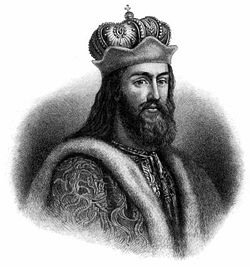
3. Vladimir I, of Kiev 2 3 (Sviatoslav I, of Kiev2, Igor, Grand Prince of Kiev1) was born about 958 and died on 15 Jul 1015 in Berestovo, Ukraine about age 57. Other names for Vladimir were Saint Vladimir of Kiev, Vladimir the Great, and Saint Vladimir Svyatoslavich the Great.
Research Notes: From Wikipedia - Vladimir I of Kiev
Saint Vladimir Svyatoslavich the Great (c. 958 - 15 July 1015 , Berestovo ) was the grand prince of Kiev who converted to Christianity in 988, and proceeded to baptise the whole Kievan Rus . His name may be spelled in different ways: in Old East Slavic as Volodimir (), in modern Ukrainian as Volodymyr (), in Old Church Slavonic and modern Russian as Vladimir (), in Old Norse as Valdamarr and the modern Scandinavian languages as Valdemar.
Way to the throne
Vladimir was the youngest son of Sviatoslav I of Kiev by his housekeeper Malusha , described in the Norse sagas as a prophetess who lived to the age of 100 and was brought from her cave to the palace to predict the future. Malusha's brother Dobrynya was Vladimir's tutor and most trusted advisor. Hagiographic tradition of dubious authenticity also connects his childhood with the name of his grandmother, Olga Prekrasa , who was Christian and governed the capital during Sviatoslav's frequent military campaigns.
Transferring his capital to Preslavets in 969, Sviatoslav designated Vladimir ruler of Novgorod the Great but gave Kiev to his legitimate son Yaropolk . After Sviatoslav's death (972), a fratricidal war erupted (976) between Yaropolk and his younger brother Oleg , ruler of the Drevlians . In 977 Vladimir fled to his kinsmen Haakon Sigurdsson , ruler of Norway in Scandinavia , collecting as many of the Viking warriors as he could to assist him to recover Novgorod, and on his return the next year marched against Yaropolk.
On his way to Kiev he sent ambassadors to Rogvolod (Norse: Ragnvald), prince of Polotsk , to sue for the hand of his daughter Rogneda (Norse: Ragnhild). The well-born princess refused to affiance herself to the son of a bondswoman, but Vladimir attacked Polotsk, slew Rogvolod, and took Ragnhild by force. Actually, Polotsk was a key fortress on the way to Kiev, and the capture of Polotsk and Smolensk facilitated the taking of Kiev (980), where he slew Yaropolk by treachery, and was proclaimed konung , or kagan , of all Kievan Rus .
Years of pagan rule
In addition to his father's extensive domain, Vladimir continued to expand his territories. In 981 he conquered the Cherven cities, the modern Galicia ; in 983 he subdued the Yatvingians , whose territories lay between Lithuania and Poland ; in 985 he led a fleet along the central rivers of Russia to conquer the Bulgars of the Kama , planting numerous fortresses and colonies on his way.
Though Christianity had won many converts since Olga's rule, Vladimir had remained a thorough going pagan, taking eight hundred concubines (besides numerous wives) and erecting pagan statues and shrines to gods. It is argued that he attempted to reform Slavic paganism by establishing thunder-god Perun as a supreme deity.
Baptism of Rus
The Primary Chronicle reports that in the year 987 , as the result of a consultation with his boyars , Vladimir sent envoys to study the religions of the various neighboring nations whose representatives had been urging him to embrace their respective faiths. The result is amusingly described by the chronicler Nestor . Of the Muslim Bulgarians of the Volga the envoys reported there is no gladness among them; only sorrow and a great stench, and that their religion was undesirable due to its taboo against alcoholic beverages and pork ; supposedly, Vladimir said on that occasion: "Drinking is the joy of the Rus'." Russian sources also describe Vladimir consulting with Jewish envoys (who may or may not have been Khazars ), and questioning them about their religion but ultimately rejecting it, saying that their loss of Jerusalem was evidence of their having been abandoned by God . Ultimately Vladimir settled on Christianity . In the churches of the Germans his emissaries saw no beauty; but at Constantinople , where the full festival ritual of the Byzantine Church was set in motion to impress them, they found their ideal: "We no longer knew whether we were in heaven or on earth," they reported, describing a majestic Divine Liturgy in Hagia Sophia , "nor such beauty, and we know not how to tell of it." If Vladimir was impressed by this account of his envoys, he was yet more so by political gains of the Byzantine alliance.
In 988 , having taken the town of Chersonesos in Crimea , he boldly negotiated for the hand of the emperor Basil II 's sister, Anna. Never had a Greek imperial princess, and one "born-in-the-purple" at that, married a barbarian before, as matrimonial offers of French kings and German emperors had been peremptorily rejected. In short, to marry the 27-year-old princess off to a pagan Slav seemed impossible. Vladimir, however, was baptized at Cherson, taking the Christian name of Basil out of compliment to his imperial brother-in-law; the sacrament was followed by his wedding with Anna . Returning to Kiev in triumph, he destroyed pagan monuments and established many churches, starting with the splendid Church of the Tithes (989) and monasteries on Mt. Athos .
Arab sources, both Muslim and Christian, present a different story of Vladimir's conversion. Yahya of Antioch , al-Rudhrawari , al-Makin , al-Dimashki , and ibn al-Athir [1] all give essentially the same account. In 987, Bardas Sclerus and Bardas Phocas revolted against the Byzantine emperor Basil II . Both rebels briefly joined forces, but then Bardas Phocas proclaimed himself emperor on September 14 , 987 . Basil II turned to the Kievan Rus' for assistance, even though they were considered enemies at that time. Vladimir agreed, in exchange for a marital tie; he also agreed to accept Orthodox Christianity as his religion and bring his people to the new faith. When the wedding arrangements were settled, Vladimir dispatched 6,000 troops to the Byzantine Empire and they helped to put down the revolt.[2]
Christian reign
He now formed a great council out of his boyars, and set his twelve sons over his subject principalities. With his neighbors he lived at peace, the incursions of the Pechenegs alone disturbing his tranquillity. After Anna's death, he married again, most likely to a granddaughter of Otto the Great .
He died at Berestovo, near Kiev, while on his way to chastise the insolence of his son, Prince Yaroslav of Novgorod . The various parts of his dismembered body were distributed among his numerous sacred foundations and were venerated as relics . One of the largest Kievan cathedrals is dedicated to him. The University of Kiev was named after the man who both civilized and Christianized Kievan Rus. There is the Order of St. Vladimir in Russia and Saint Vladimir's Orthodox Theological Seminary in the United States . The Roman Catholic and Eastern Orthodox churches celebrate the feast day of St. Vladimir on 15 July .
His memory was also kept alive by innumerable Russian folk ballads and legends, which refer to him as Krasno Solnyshko, that is, the Fair Sun. With him the Varangian period of Eastern Slavic history ceases and the Christian period begins.
-------------
From Wikipedia - Family life and children of Vladimir I :
Until his baptism, Vladimir I of Kiev (c.958 -1015 ) was described by Thietmar of Merseburg as a great profligate (Latin : fornicator maximus). He had a few hundred concubines in Kiev and in the country residence of Berestovo . He also had official pagan wives, the most famous being Rogneda of Polotsk . His other wives are mentioned in the Primary Chronicle , with various children assigned to various wives in the different versions of the document. Hence, speculations abound.
Norse wife
Norse sagas mention that, while ruling in Novgorod in his early days, Vladimir had a Varangian wife named Olava or Allogia. This unusual name is probably a feminine form of Olaf . According to Snorri Sturluson the runaway Olaf Tryggvason was sheltered by Allogia in her house; she also paid a large fine for him.
Several authorities, notably Rydzevskaya ("Ancient Rus and Scandinavia in 9-14 cent.", 1978), hold that later skalds confused Vladimir's wife Olava with his grandmother and tutor Olga , with Allogia being the distorted form of Olga's name. Others postulate Olava was a real person and the mother of Vysheslav, the first of Vladimir's sons to reign in Novgorod, as behooves the eldest son and heir. On the other hand, there is no evidence that the tradition of sending the eldest son of Kievan monarch to Novgorod existed at such an early date.
Those scholars who believe that this early Norse wife was not fictitious, suppose that Vladimir could have married her during his famous exile in Scandinavia in the late 970s. They usually refer an account in Ingvars saga (in a part called Eymund's saga ) which tells that Eric VI of Sweden married his daughter to a 'konung of fjord lying to the East from Holmgard '. This prince may have been Vladimir the Great.
Polotsk wife
Main article: Rogneda of Polotsk
Rogneda of Polotsk is the best known of Vladimir's pagan wives, although her ancestry has fuelled the drollest speculations. See this article for extensive but tenuous arguments for her Yngling royal descent.
The Primary Chronicle mentions three of Rogneda's sons - Izyaslav of Polotsk (+1001), Vsevolod of Volhynia (+ca 995), and Yaroslav the Wise . Following an old Yngling tradition, Izyaslav inherited the lands of his maternal grandfather, i.e., Polotsk . According to the Kievan succession law, his progeny forfeited their rights to the Kievan throne, because their forefather had never ruled in Kiev supreme. They, however, retained the principality of Polotsk and formed a dynasty of local rulers, of which Vseslav the Sorcerer was the most notable.
Greek wife
During his unruly youth, Vladimir begot his eldest son, Sviatopolk , relations with whom would cloud his declining years. His mother was a Greek nun captured by Svyatoslav I in Bulgaria and married to his lawful heir Yaropolk I . Russian historian Vasily Tatischev , invariably erring in the matters of onomastics, gives her the fanciful Roman name of Julia. When Yaropolk was murdered by Vladimir's agents, the new sovereign raped his wife and she soon (some would say, too soon) gave birth to a child. Thus, Sviatopolk was probably the eldest of Vladimir's sons, although the issue of his parentage has been questioned and he has been known in the family as "the son of two fathers".
Bohemian wife
Vladimir apparently had a Czech wife, whose name is given by Vasily Tatishchev as Malfrida. Historians have gone to extremes in order to provide a political rationale behind such an alliance, as the Czech princes are assumed to have backed up Vladimir's brother Yaropolk rather than Vladimir. His children by these marriage were probably Svyatoslav of Smolensk, killed during the 1015 internecine war, and Mstislav of Chernigov . Some chronicles, however, report that Rogneda was Mstislav's mother.
Bulgarian wife
Another wife was a Bulgarian lady, whose name is given by Tatishchev as Adela. Historians have disagreed as to whether she came from Volga Bulgaria or from Bulgaria on the Danube . According to the Primary Chronicle , both Boris and Gleb were her children. This tradition, however, is viewed by most scholars as a product of later hagiographical tendency to merge the identity of both saints. Actually, they were of different age and their names point to different cultural traditions. Judging by his Oriental name, Boris could have been Adela's only offspring.
Anna Porphyrogeneta
Anna Porphyrogeneta, daughter of Emperor Romanos II and Theophano , was the only princess of the Makedones to have been married to a foreigner. The Byzantine emperors regarded the Franks and Russians as barbarians, refusing Hugues Capet 's proposals to marry Anna to his son Robert I , so the Baptism of Kievan Rus was a prerequisite for this marriage. Following the wedding, Vladimir is said to have divorced all his pagan wives, although this claim is disputed. Regarded by later Russians as a saint, Anna was interred with her husband in the Church of the Tithes .
Anna is not known to have had any children. Either her possible barrenness or the Byzantine house rule could account for this. Had she had any progeny, the prestigious and much sought imperial parentage would have certainly been advertised by her descendants. Hagiographic sources, contrary to the Primary Chronicle , posit Boris and Gleb as her offspring, on the understanding that holy brothers should have had a holy mother.
German wife
Anna is known to have predeceased Vladimir by four years. Thietmar of Merseburg , writing from contemporary accounts, mentions that Boleslaw I of Poland captured Vladimir's widow during his raid on Kiev in 1018 . The historians long had no clue as to identity of this wife. The emigre historian Nicholas Baumgarten, however, pointed to the controversial record of the "Genealogia Welforum" and the "Historia Welforum Weingartensis" that one daughter of Count Kuno von Oenningen (future Duke Konrad of Swabia ) by "filia Ottonis Magni imperatoris" (Otto the Great 's daughter; possibly Rechlinda Otona [Regelindis], claimed by some as illegitimate daughter and by others legitimate, born from his first marriage with Edith of Wessex) married "rex Rugorum" (king of Russia). He interpreted this evidence as pertaining to Vladimir's last wife.
It is believed that the only child of this alliance was Dobronega, or Maria, who married Casimir I of Poland between 1038 and 1042 . As her father Vladimir died about 25 years before that marriage and she was still young enough to bear at least five children, including two future Polish dukes (Boleslaw II of Poland , who later became a king, and Wladyslaw Herman ), it is thought probable that she was Vladimir's daughter by the last marriage.
Some sources claimed Agatha , the wife of Edward the Exile of England, was another daughter of this marriage and full-sister of Dobronegra. Their marriage took place by the same time of Dobronegra's wedding (the date of birth of her first child support this) and this maybe because was double wedding of both sisters. This can resolve the question about the conection between Agatha and the Holy Roman Empire claimed by several medieval sources.
Yaroslav's parentage
There is also a case for Yaroslav 's descent from Anna. According to this theory, Nestor the Chronicler deliberately represented Yaroslav as Rogneda's son, because he systematically removed all information concerning Kievan ties with Byzantium , spawning pro-Varangian bias (see Normanist theory for details). Proponents allege that Yaroslav's true age was falsified by Nestor, who attempted to represent him as 10 years older than he actually had been, in order to justify Yaroslav's seizure of the throne at the expense of his older brothers.
The Primary Chronicle , for instance, states that Yaroslav died at the age of 76 in 1054 (thus putting his birth at 978 ), while dating Vladimir's encounter and marriage to Yaroslav's purported mother, Rogneda, to 980 . Elsewhere, speaking about Yaroslav's rule in Novgorod (1016), Nestor says that Yaroslav was 28, thus putting his birth at 988 . The forensic analysis of Yaroslav's skeleton seems to have confirmed these suspicions, estimating Yaroslav's birth at ca. 988-990, after both the Baptism of Kievan Rus and Vladimir's divorce of Rogneda. Consequently, it is assumed that Yaroslav was either Vladimir's natural son born after the latter's baptism or his son by Anna.
Had Yaroslav an imperial Byzantine descent, he likely would not have stinted to advertise it. Some have seen the willingness of European kings to marry Yaroslav's daughters as an indication of this imperial descent. Subsequent Polish chroniclers and historians, in particular, were eager to view Yaroslav as Anna's son. Recent proponents envoke onomastic arguments, which have often proven decisive in the matters of medieval prosopography . It is curious that Yaroslav named his elder son Vladimir (after his own father) and his eldest daughter Anna (as if after his own mother). Also, there is a certain pattern in his sons having Slavic names (as Vladimir), and his daughters having Greek names only (as Anna). However, in the absence of better sources, Anna's maternity remains a pure speculation.
Obscure offspring
Vladimir had several children whose maternity cannot be established with certainty. These include two sons, Stanislav of Smolensk and Sudislav of Pskov, the latter outliving all of his siblings. There is also one daughter, named Predslava, who was captured by Boleslaw I in Kiev and taken with him to Poland as a concubine. Another daughter, Premyslava, is attested in numerous (though rather late) Hungarian sources as the wife of Duke Ladislaus, one of the early Arpadians .
Vladimir married someone.
+ 4 M i. Yaroslav I, of Kiev was born about 978 and died on 20 Feb 1054 in Kiev, Ukraine about age 76.
Fourth Generation 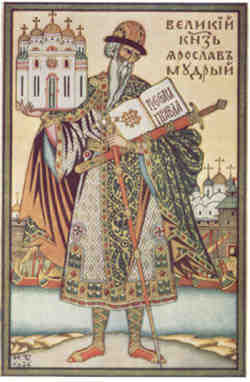
4. Yaroslav I, of Kiev (Vladimir I, of Kiev3, Sviatoslav I, of Kiev2, Igor, Grand Prince of Kiev1) was born about 978 and died on 20 Feb 1054 in Kiev, Ukraine about age 76. Other names for Yaroslav were Jarisleif "the Lame and" Yaroslav I "the Wise" of Kiev.
Research Notes: Possibly not the father of Agatha, the wife of Edward the Exile.
From Wikipedia - Yaroslav I the Wise :
Yaroslav I the Wise (c. 978 , Kiev -20 February 1054 , Kiev ) (East Slavic: ; Christian name: George; Old Norse : Jarizleifr) was thrice Grand Prince of Novgorod and Kiev , uniting the two principalities for a time under his rule. During his lengthy reign, Kievan Rus' reached a zenith of its cultural flowering and military power.
Early years of Yaroslav's life are enshrouded in mystery. He was one of the numerous sons of Vladimir the Great , presumably his second by Rogneda of Polotsk , although his actual age (as stated in the Primary Chronicle and corroborated by the examination of his skeleton in the 1930s) would place him among the youngest children of Vladimir. It has been suggested that he was a child begotten out of wedlock after Vladimir's divorce with Rogneda and his marriage to Anna Porphyrogeneta , or even that he was a child of Anna Porphyrogeneta herself. Yaroslav figures prominently in the Norse Sagas under the name of Jarisleif the Lame; his legendary lameness (probably resulting from an arrow wound) was corroborated by the scientists who examined his relics...
<<b>>Family life and posterity<</B>>
In 1019, Yaroslav married Ingegerd Olofsdotter , daughter of the king of Sweden , and gave Ladoga to her as a marriage gift. There are good reasons to believe that before that time he had been married to a woman named Anna, of disputed extraction.[citation needed ]
In the Saint Sophia Cathedral , one may see a fresco representing the whole family: Yaroslav, Irene (as Ingigerd was known in Rus), their five daughters and five sons. Yaroslav married three of his daughters to foreign princes who lived in exile at his court: Elizabeth to Harald III of Norway (who had attained her hand by his military exploits in the Byzantine Empire ); Anastasia to the future Andrew I of Hungary , and the youngest daughter Anne of Kiev married Henry I of France and was the regent of France during their son's minority. Another daughter may have been the Agatha who married Edward the Exile , heir to the throne of England and was the mother of Edgar Ætheling and St. Margaret of Scotland .
Yaroslav had one son from the first marriage (his Christian name being Ilya), and 6 sons from the second marriage. Apprehending the danger that could ensue from divisions between brothers, he exhorted them to live in peace with each other. The eldest of these, Vladimir of Novgorod , best remembered for building the Saint Sophia Cathedral in Novgorod , predeceased his father. Three other sons-Iziaslav , Sviatoslav , and Vsevolod -reigned in Kiev one after another. The youngest children of Yaroslav were Igor of Volynia and Vyacheslav of Smolensk .
Yaroslav married Ingegerd Olofsdotter, of Sweden,4 5 daughter of Olov II Skotkonung, King of Sweden and Unknown, in 1019. Ingegerd was born about 1001 and died on 10 Feb 1050 about age 49. Other names for Ingegerd were Ingigerd of Sweden and Irina Olofsdotter.
Research Notes: Possibly not the mother of Agatha, the wife of Edward the Exile.
From Wikipedia - Ingegerd Olofsdotter of Sweden :
Princess Ingegerd Olofsdotter of Sweden (1001 - 10 February 1050 ) was a Swedish princess and a Grand Princess of Kiev, the daughter of Swedish King Olof Skötkonung and Estrid of the Obotrites and the consort of Yaroslav I the Wise of Kiev.
Biography
Ingegerd was born in Sigtuna ,[citation needed ] Sweden, and was engaged to be married to Norwegian King Olaf II , but when Sweden and Norway got into a feud, Swedish King Olof Skötkonung wouldn't allow for the marriage to happen.
Instead, Ingegard's father quickly arranged for a marriage to the powerful Yaroslav I the Wise of Novgorod . The marriage took place in 1019. Once in Kiev , her name was changed to the Greek Irene. According to several sagas , she was given as a marriage gift Ladoga and adjacent lands, which later received the name Ingria (arguably a corruption of Ingegerd's name). She set her friend jarl Ragnvald Ulfsson to rule in her stead.
Ingegard initiated the building of the Saint Sophia Cathedral in Kiev that was supervised by her husband, who styled himself tsar . They had six sons and four daughters, the latter of whom became Queens of France , Hungary , Norway , and (arguably) England . The whole family is depicted in one of the frescoes of the Saint Sophia. Upon her death, Ingegard was buried in the same cathedral.
Ingegerd-Irene is sometimes confused with Yaroslav's first wife, whose name was Anna and who was later declared a local saint in Novgorod because of her initiative to build the local version of the Saint Sophia . Her remains were exhumed in the 1930s and examined by Soviet scientists who determined that they belonged to a young woman rather than to Ingigerd, who died at the age of fifty or so.
Children
Ingegerd had the following children
Children from this marriage were:
+ 5 F i. Agatha 6 7 was born about 1020 and died after 1070.
+ 6 F ii. Anne, of Kiev 8 9 was born between 1024 and 1032, died in 1075, and was buried in Villiers Abbey, La-Ferte-Alais, Essonne, (Île-de-France), France.
Fifth Generation 5. Agatha 6 7 (Yaroslav I, of Kiev4, Vladimir I, of Kiev3, Sviatoslav I, of Kiev2, Igor, Grand Prince of Kiev1) was born about 1020 and died after 1070. Another name for Agatha was Agafiia.
Research Notes: Her origins are disputed.
From Wikipedia - Agatha, wife of Edward the Exile :
Agatha was the wife of Edward the Exile (heir to the throne of England ) and mother of Edgar Ætheling , Saint Margaret of Scotland and Cristina of England . Her antecedents are unclear, and subject to much speculation.
Life
Nothing is known of her early life, and what speculation has appeared is inextricably linked to the contentious issue of Agatha's paternity, one of the unresolved questions of medieval genealogy . She came to England with her husband and children in 1057, but she was widowed shortly after her arrival. Following the Norman conquest of England , in 1067 she fled with her children to Scotland , finding refuge under her future son-in-law Malcolm III . While one modern source indicates that she spent her last years as a nun at Newcastle-upon-Tyne , dying before circa 1093 [1] , Simeon of Durham [1] carries what appears to be the last reference to her in 1070. [2]
Origin
Medieval sources
Agatha's origin is alluded to in numerous surviving medieval sources, but the information they provide is sometimes imprecise, often contradictory, and occasionally outright impossible. The earliest surviving source, the Anglo-Saxon Chronicle , along with Florence of Worcester 's Chronicon ex chronicis and Regalis prosapia Anglorum, Simeon of Durham and Ailred of Rievaulx describe Agatha as a kinswoman of "Emperor Henry" (thaes ceseres maga, filia germani imperatoris Henrici). In an earlier entry, the same Ailred of Rievaulx had called her daughter of emperor Henry, as do later sources of dubious credibility such as the Chronicle of Melrose Abbey , while Matthew of Paris calls her the emperor's sister (soror Henrici imperatoris Romani). Geoffrey Gaimar in Lestoire des Engles states that she was daughter of the Hungarian king and queen (Li reis sa fille), although he places the marriage at a time when Edward is thought still to have been in Kiev , while Orderic Vitalis in Historiae Ecclesiasticae is more specific, naming her father as king Solomon (filiam Salomonis Regis Hunorum), actually a contemporary of Agatha's children. William of Malmesbury in De Gestis Regis Anglorum states that Agatha's sister was a Queen of Hungary (reginae sororem) and is echoed in this by Alberic of Trois-Fontaines , while less precisely, Ailred says of Margaret that she was derived from English and Hungarian royal blood (de semine regio Anglorum et Hungariorum extitit oriunda). Finally, Roger of Howden and the anonymous Leges Edwardi Confessoris indicate that while Edward was a guest of Kievan "king Malesclodus" he married a woman of noble birth (nobili progenio), Leges adding that the mother of St. Margaret was of Rus royal blood (ex genere et sanguine regum Rugorum).[3]
German and Hungarian theories
While various sources repeat the claims that Agatha was daughter or sister of either Emperor Henry, it seems unlikely that such a sibling or daughter would have been ignored by the German chroniclers.[4]
The description of Agatha as a blood relative of "Emperor Henry" may be applicable to a niece of either Henry II or Henry III , Holy Roman Emperors (although Florence, in Regalis prosapia Anglorum specifies Henry III). Early attempts at reconstructing the relationship focused on the former. Georgio Pray 1764, Annales Regum Hungariae), O.F. Suhm (1777, Geschichte Dänmarks, Norwegen und Holsteins) and Istvan Katona (1779, Historia Critica Regum Hungariae) each suggested that Agatha was daughter of Henry II's brother Bruno of Augsburg (an ecclesiastic described as beatae memoriae, with no known issue), while Daniel Cornides (1778, Regum Hungariae) tried to harmonise the German and Hungarian claims, making Agatha daughter of Henry II's sister Giselle of Bavaria , wife of Stephen I of Hungary .[5] This solution remained popular among scholars through a good part of twentieth century.[6]
As tempting as it may be to thus view St. Margaret as a granddaughter of another famous saint, Stephen of Hungary, this popular solution fails to explain why Stephen's death triggered a dynastic crisis in Hungary. If St. Stephen and Giselle were indeed Agatha's parents, her offspring might have succeeded to the Hungarian crown and the dynastic strife that followed Stephen's death could have been averted. Actually, there is no indication in Hungarian sources that any of Stephen's children outlived him. Likewise, all of the solutions involving Henry II would seem to make Agatha much older than her husband, and prohibitively old at the time of the birth of her son, Edgar.
Based on a more strict translation of the Latin description used by Florence and others as well as the supposition that Henry III was the Emperor designated in the Anglo-Saxon Chronicle, genealogist Szabolcs de Vajay popularised another idea first suggested in 1939. In that year, Joszef Herzog published an analysis suggesting that Agatha was daughter of one of the half-brothers of Henry III, born to his mother Gisela of Swabia by one of her earlier marriages to Ernest I of Swabia and Bruno of Brunswick , probably the former based on more favourable chronology.[7] De Vajay reevaluated the chronology of the marriages and children of Gisela and concluded that Agatha was the daughter of Henry III's elder (uterine) half-brother, Liudolf, Margrave of Frisia .[8] This theory saw broad acceptance for thirty years [9] until René Jetté resurrected a Kievan solution to the problem,[10] since which time opinion has been divided among several competing possibilities.[11]
Kievan theory
Jetté pointed out that William of Malmesbury in De Gestis Regis Anglorum and several later chronicles unambiguously state that Agatha's sister was a Queen of Hungary. From what we know about the biography of Edward the Exile , he loyally supported Andrew I of Hungary , following him from Kiev to Hungary in 1046 and staying at his court for many years. Andrew's wife and queen was Anastasia, a daughter of Yaroslav the Wise of Kiev by Ingigerd of Sweden . Following Jetté's logic, Edward's wife was another daughter of Yaroslav.
This theory accords with the seemingly incongruous statements of Geoffrey Gaimar and Roger of Howden that, while living in Kiev, Edward took a nativeborn wife "of noble parentage" or that his father-in-law was a "Rus king".[12]
Jetté's theory seems to be supported by an onomastic argument.[13] Among the medieval royalty, Agatha's rare Greek name is first recorded in the Macedonian dynasty of Byzantium ; it was also one of the most frequent feminine names in the Kievan Rurikid dynasty.[14] After Anna of Byzantium married Yaroslav's father, he took the Christian name of the reigning emperor, Basil II , while some members of his family were named after other members of the imperial dynasty. Agatha could have been one of these.[15]
The names of Agatha's immediate descendants-Margaret, Cristina, David , Alexander -were likewise extraordinary for Anglo-Saxon Britain. They may provide a clue to Agatha's origin. The names Margaret and Cristina are today associated with Sweden, the native country of Yaroslav's wife Ingigerd.[16] The name of Margaret's son, David, obviously echoes that of Solomon , the son and heir of Andrew I.[17] Furthermore, the first saint of the Rus (canonized ca. 1073) was Yaroslav's brother Gleb , whose Christian name was David.
The name of Margaret's other son, Alexander, may point to a variety of traditions, both occidental and oriental: the biography of Alexander the Great was one of the most popular books in eleventh-century Kiev.
One inference from the Kievan theory is that Edgar Atheling and St. Margaret were, through their mother, first cousins of Philip I of France . The connection is too notable to be omitted from contemporary sources, yet we have no indication that medieval chroniclers were aware of it. The argumentum ex silentio leads critics of the Kievan theory to search for alternative explanations.
Bulgarian theory
In response to the recent flurry of activity on the subject, Ian Mladjov reevaluated the question and presented a completely novel solution.[18] He dismissed each of the prior theories in turn as insufficiently grounded and incompatible given the historical record, and further suggested that many of the proposed solutions would have resulted in later marriages that fell within the prohibited degrees of kinship. He argued that the documentary testimony of Agatha's origins is tainted or late, and concurred with Humphreys' evaluation that the names of the children and grandchildren of Agatha, so central to prior reevaluations, may have had non-family origins (for example, Pope Alexander II played a critical role in the marriage of Malcolm and Margaret). However, he then focused in on the name of Agatha as being critical to determining her origin. He concluded that of the few contemporary Agathas, only one could possibly have been an ancestor of the wife of Edward the Exile, Agatha,[19] wife of Samuel of Bulgaria . Some of the other names associated with Agatha and used to corroborate theories based in onomastics are also readily available within the Bulgarian ruling family at the time, including Mary and several Davids. Mladjov inferred that Agatha was daughter of Gavril Radomir , Tsar of Bulgaria , Agatha's son, by his first wife, a Hungarian princess thought to have been the daughter of Duke Géza of Hungary . This hypothesis has Agatha born in Hungary after her parents divorced, her mother being pregnant when she left Bulgaria, and naming her daughter after the mother of the prince who had expelled her. Traditional dates of this divorce would seem to preclude the suggested relationship, but the article re-examined some long-standing assumptions about the chronology of Gavril Radomir's marriage to the Hungarian princess, and concludes that its dating to the late 980s is unsupportable, and its dissolution belongs in c. 1009-1014. The argument is based almost exclusively on the onomastic precedent but is said to vindicate the intimate connection between Agatha and Hungary attested in the Medieval sources. Mladjov speculates further that the medieval testimony could largely be harmonized were one to posit that Agatha's mother was the same Hungarian princess who married Samuel Aba of Hungary , his family fleeing to Kiev after his downfall, thereby allowing a Russian marriage for Agatha.
This solution fails to conform with any of the relationships appearing in the primary record. It is inferred that the relative familiarity with Germany and unfamiliarity with Hungary partly distorted the depiction of Agatha in the English sources; her actual position would have been that of a daughter of the (unnamed) sister of the King of Hungary (Stephen I), himself the brother-in-law of the Holy Roman Emperor (Henry II, and therefore kinsman of Henry III).
Other theories
In 2002, in an article meant to refute the Kievan hypothesis, John Carmi Parsons suggested yet another possible origin. He made Agatha daughter of a documented count Cristinus (explaining the name Christina for Agatha's daughter) by Oda of Haldensleben, hypothesized to be maternal granddaughter of Vladimir I of Kiev by a German wife, kinswoman to Emperor Henry III. He also floated the possibility that Edward may have married twice, suggesting that the contradictory primary record may in part reflect the confusion between two distinct wives.[20] Recently, one additional theory has appeared. John P. Ravilious has proposed that she was daughter of Mieszko II Lambert of Poland by his German wife, making her kinswoman of both Emperors Henry, as well as sister of a Hungarian queen, the wife of Béla I .[21]
Agatha married Edward "the Exile", Saxon Prince of England,10 11 son of Edmund II "Ironside", King of England and Ealdgyth, about 1040. Edward was born in 1016 in England and died in Feb 1057 in England at age 41. Another name for Edward was Edward "the Atheling" Saxon Prince of England.
Research Notes: From Wikipedia - Edward the Exile :
Edward the Exile (1016 - February 1057), also called Edward Ætheling, son of King Edmund Ironside and of Ealdgyth , gained the name of "Exile" from his life spent mostly far from the England of his forefathers. After the Danish conquest of England in 1016 Canute had him and his brother, Edmund, exiled to the Continent. Edward was only a few months old when he was brought to the court of Olof Skötkonung , (who was either Canute's half-brother or stepbrother), with instructions to have the child murdered. Instead, Edmund was secretly sent to Kiev , where Olof's daughter Ingigerd was the Queen, and then made his way to Hungary , probably in the retinue of Ingigerd's son-in-law, King András .
On hearing the news of his being alive, Edward the Confessor recalled him to England and made him his heir . Edward offered the last chance of an undisputed succession within the Saxon royal house . News of Edward's existence came at time when the old Anglo-Saxon Monarchy, restored after a long period of Danish domination, was heading for catastrophe. The Confessor, personally devout but politically weak, was unable to make an effective stand against the steady advance of the powerful and ambitious sons of Earl Godwin . From across the Channel William, Duke of Normandy also had an eye on the succession. Edward the Exile appeared at just the right time. Approved by both king and by the Witan , the Council of the Realm, he offered a way out of the impasse, a counter both to the Godwins and to William, and one with a legitimacy that could not be readily challenged.
Edward, who had been in the custody of Henry III , the Holy Roman Emperor, finally came back to England at the end of August 1057. But he died within two days of his arrival. The exact cause of Edward's death remains unclear, but he had many powerful enemies, and there is a strong possibility that he was murdered, although by whom it is not known with any certainty. It is known, though, that his access to the king was blocked soon after his arrival in England for some unexplained reason, at a time when the Godwins, in the person of Harold Godwinson , were once again in the ascendant. This turn of events left the throne of England to be disputed by Earl Harold and Duke William, ultimately leading to the Norman Conquest of England .
Edward's wife was a woman named Agatha , whose origins are disputed. Their children were Edgar Ætheling , Saint Margaret of Scotland and Cristina . Edgar was nominated as heir apparent, but was too young to count for much, and was eventually swept aside by Harold Godwinson.
Noted events in his life were:
• Exiled to Sweden: 1016. to be killed there. Instead, he was sent from there to Kiev , ending up in Hungary .
The child from this marriage was:
+ 7 F i. SaintMargaret, of Scotland 12 13 was born in 1045 in Castle Réka, Mecseknádasd, Southern Transdanubia, Hungary, died on 16 Nov 1093 in St Margaret's Chapel in Edinburgh Castle, Midlothian, Scotland at age 48, and was buried in Dunfermline Abbey, Fife, Scotland.

6. Anne, of Kiev 8 9 (Yaroslav I, of Kiev4, Vladimir I, of Kiev3, Sviatoslav I, of Kiev2, Igor, Grand Prince of Kiev1) was born between 1024 and 1032, died in 1075, and was buried in Villiers Abbey, La-Ferte-Alais, Essonne, (Île-de-France), France. Other names for Anne were Agnes of Kiev, Anna of Kiev, and Anna Yaroslavna.
Death Notes: Ancestral Roots line 241-6 has d. aft. 1075
Research Notes: 3rd wife of Henry I of France.
From Wikipedia - Anne of Kiev :
Anne of Kiev or Anna Yaroslavna (between 1024 and 1032 - 1075 ), daughter of Yaroslav I of Kiev and his wife Ingegerd Olofsdotter , was the queen consort of France as the wife of Henry I , and regent for her son Philip I .
After the death of his first wife, Matilda, King Henry searched the courts of Europe for a suitable bride, but could not locate a princess who was not related to him within illegal degrees of kinship. At last he sent an embassy to distant Kiev , which returned with Anne (also called Agnes or Anna). Anne and Henry were married at the cathedral of Reims on May 19 , 1051 .
They had three sons:
For six years after Henry's death in 1060 , she served as regent for Philip, who was only seven at the time. She was the first queen of France to serve as regent. Her co-regent was Count Baldwin V of Flanders . Anne was a literate woman, rare for the time, but there was some opposition to her as regent on the grounds that her mastery of French was less than fluent.
A year after the king's death, Anne, acting as regent, took a passionate fancy for Count Ralph III of Valois , a man whose political ambition encouraged him to repudiate his wife to marry Anne in 1062 . Accused of adultery, Ralph's wife appealed to Pope Alexander II , who excommunicated the couple. The young king Philip forgave his mother, which was just as well, since he was to find himself in a very similar predicament in the 1090s . Ralph died in September 1074 , at which time Anne returned to the French court. She died in 1075 , was buried at Villiers Abbey , La-Ferte-Alais , Essonne and her obits were celebrated on September 5 .
Sources
Retrieved from ""
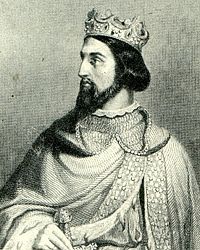
Anne married Henry I, of France,14 15 son of Robert II "the Pious", King of France and Constance, of Provence, on 19 May 1051 in Cathedral de Rheims, Rheims, France. Henry was born on 4 May 1008 in Reims, Marne, Champagne, France, died on 4 Aug 1060 in Vitry-en-Brie, France at age 52, and was buried in St. Denis Basilica, Paris, (Île-de-France), France.
Marriage Notes: Source: Ancestral Roots of Certain American Colonists Who Came to America before 1700 by Frederick Lewis Weis and Walter Lee Sheppard, Jr, ed. by William R. Beall & Kaleen E. Beall, Baltimore, 2008, Line 241-6 has m. 20 Jan 1044 or 1045. Wikipedia has 19 May 1051. Was 1044/45 the betrothal?
Research Notes: From Wikipedia - Henry I of France :
Henry I (4 May 1008 - 4 August 1060 ) was King of France from 1031 to his death. The royal demesne of France reached its lowest point in terms of size during his reign and for this reason he is often seen as emblematic of the weakness of the early Capetians . This is not entirely agreed upon, however, as other historians regard him as a strong but realistic king, who was forced to conduct a policy mindful of the limitations of the French monarchy.
A member of the House of Capet , Henry was born in Reims , the son of King Robert II (972-1031) and Constance of Arles (986-1034). He was crowned King of France at the Cathedral in Reims on May 14 , 1027 , in the Capetian tradition, while his father still lived. He had little influence and power until he became sole ruler on his father's death.
The reign of Henry I, like those of his predecessors, was marked by territorial struggles. Initially, he joined his brother Robert , with the support of their mother, in a revolt against his father (1025 ). His mother, however, supported Robert as heir to the old king, on whose death Henry was left to deal with his rebel sibling. In 1032 , he placated his brother by giving him the duchy of Burgundy which his father had given him in 1016 .
In an early strategic move, Henry came to the rescue of his very young nephew-in-law, the newly appointed Duke William of Normandy (who would go on to become William the Conqueror ), to suppress a revolt by William's vassals. In 1047 , Henry secured the dukedom for William in their decisive victory over the vassals at the Battle of Val-ès-Dunes near Caen .
A few years later, when William, who was cousin to King Edward the Confessor of England (1042-66), married Matilda , the daughter of the count of Flanders , Henry feared William's potential power. In 1054 , and again in 1057 , Henry went to war to try to conquer Normandy from William, but on both occasions he was defeated. Despite his efforts, Henry I's twenty-nine-year reign saw feudal power in France reach its pinnacle.
Henry had three meetings with Henry III, Holy Roman Emperor -all at Ivois . In early 1043 , he met him to discuss the marriage of the emperor with Agnes of Poitou , the daughter of Henry's vassal. In October 1048 , the two Henries met again, but the subject of this meeting eludes us. The final meeting took place in May 1056 . It concerned disputes over Lorraine. The debate over the duchy became so heated that the king of France challenged his German counterpart to single combat. The emperor, however, was not so much a warrior and he fled in the night. But Henry did not get Lorraine.
King Henry I died on August 4 , 1060 in Vitry-en-Brie , France, and was interred in Saint Denis Basilica . He was succeeded by his son, Philip I of France , who was 7 at the time of his death; for six years Henry I's Queen, Anne of Kiev , ruled as regent.
He was also Duke of Burgundy from 1016 to 1032 , when he abdicated the duchy to his brother Robert Capet .
Marriages and family
Henry I was betrothed to Matilda, the daughter of the Emperor Conrad II (1024-39), but she died prematurely in 1034 . Henry I then married Matilda , daughter of Liudolf, Margrave of Frisia, but she died in 1044 , following a Caesarean section. Casting further afield in search of a third wife, Henry I married Anne of Kiev on May 19 , 1051 . They had four children:
Philip I (May 23, 1052 - July 30, 1108)
Emma (1054-?)
Robert (c. 1055-c. 1060)
Hugh the Great (1057-1102)
Noted events in his life were:
• King of France: 1031-1060.
• Count of Paris:
Children from this marriage were:
+ 8 M i. Philip I, of France was born on 23 May 1052 and died on 30 Jul 1108 at age 56.
+ 9 F ii. Emma 16 was born in 1054.
+ 10 M iii. Robert was born about 1055 and died about 1060 about age 5.
+ 11 M iv. Hugh Magnus, of Vermandois and Valois, Duke of France 17 18 was born in 1057 and died on 18 Oct 1102 in Tarsus, Cilicia, (Turkey) at age 45.
Sixth Generation 7. SaintMargaret, of Scotland 12 13 (Agatha5, Yaroslav I, of Kiev4, Vladimir I, of Kiev3, Sviatoslav I, of Kiev2, Igor, Grand Prince of Kiev1) was born in 1045 in Castle Réka, Mecseknádasd, Southern Transdanubia, Hungary, died on 16 Nov 1093 in St Margaret's Chapel in Edinburgh Castle, Midlothian, Scotland at age 48, and was buried in Dunfermline Abbey, Fife, Scotland. Another name for Margaret was Margaret of Scotland.
Research Notes: From Wikipedia - Saint Margaret of Scotland :
Saint Margaret (c. 1045 - 16 November 1093), was the sister of Edgar Ætheling , the short-ruling and uncrowned Anglo-Saxon King of England . She married Malcolm III , King of Scots , becoming his Queen consort .
Early life
Saint Margaret was the daughter of the English prince Edward the Exile , son of Edmund Ironside . She was probably born at Castle Réka, Mecseknádasd , in the region of Southern Transdanubia , Hungary .[citation needed ] The provenance of her mother, Agatha , is disputed.
Margaret had one brother Edgar and one sister Christina.
When her uncle, Saint Edward the Confessor , the French-speaking Anglo-Saxon King of England , died in 1066, she was living in England where her brother, Edgar Ætheling , had decided to make a claim to the vacant throne.
According to tradition, after the conquest of the Kingdom of England by the Normans , the widowed Agatha decided to leave Northumberland with her children and return to the Continent. A storm drove their ship to Scotland , where they sought the protection of King Malcolm III . The spot where she is said to have landed is known today as St. Margaret's Hope, near the village of North Queensferry .
Malcolm was probably a widower , and was no doubt attracted by the prospect of marrying one of the few remaining members of the Anglo-Saxon royal family. The marriage of Malcolm and Margaret soon took place. Malcolm followed it with several invasions of Northumberland by the Scottish king, probably in support of the claims of his brother-in-law Edgar. These, however, had little result beyond the devastation of the province.
Family
Margaret and Malcolm had eight children, six sons and two daughters:
Edward, killed 1093.
Edmund of Scotland
Ethelred , abbot of Dunkeld
King Edgar of Scotland
King Alexander I of Scotland
King David I of Scotland
Edith of Scotland , also called Matilda, married King Henry I of England
Mary of Scotland , married Eustace III of Boulogne
Her husband, Malcolm III, and their eldest son, Edward, were killed in a fight against the English at Alnwick Castle on 13 November 1093. Her son Edmund was left with the task of telling his mother of their deaths. Margaret was ill, and she died on 16 November 1093, three days after the deaths of her husband and eldest son.
Veneration
Saint Margaret was canonised in the year 1250 by Pope Innocent IV in recognition of her personal holiness, fidelity to the Church, work for religious reform, and charity. She attended to charitable works, and personally served orphans and the poor every day before she ate. She rose at midnight to attend church services every night. She was known for her work for religious reform. She was considered to be an exemplar of the "just ruler", and also influenced her husband and children to be just and holy rulers.
The Roman Catholic Church formerly marked the feast of Saint Margaret of Scotland on June 10 , because the feast of "Saint Gertrude, Virgin" was already celebrated on November 16 . In Scotland, she was venerated on November 16, the day of her death.
Per the revision of the Roman Catholic calendar of saints in 1969, the Church transferred her feast day to November 16, the actual day of her death.[1] Traditional Roman Catholics continue to celebrate the feast day of "St Margaret, Queen of Scots, Widow" on June 10 as a Semi-Double feast, or a 3rd Class feast.
Queen Margaret University (founded in 1875), Queen Margaret College (Glasgow) , Queen Margaret Union , Queen Margaret Hospital (just outside Dunfermline ), North Queensferry , South Queensferry , Queen Margaret Academy (Ayr), Queen Margaret College (Wellington) and several streets in Scotland are named after her.
She is also venerated as a saint in the Anglican Church .
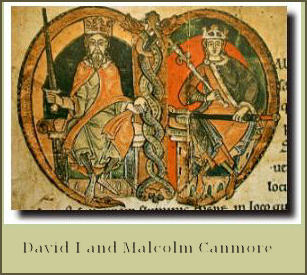
Margaret married Malcolm III Canmore, King of Scots,19 20 son of Duncan I MacCrinan, King of Scots and < >, [Daughter of Siward, Danish Earl of Northumbria], 1068 or 1069 in Dunfermline, Fife, Scotland. Malcolm was born about 1031 and died on 13 Nov 1093 in Alnwick Castle, Alnwick, Northumberland, England about age 62. Other names for Malcolm were Malcolm III King of Scotland, Malcolm III "Canmore" King of Scots, and Máel Coluim mac Donnchada.
Marriage Notes: Source: Ancestral Roots of Certain American Colonists Who Came to America before 1700 by Frederick Lewis Weis and Walter Lee Sheppard, Jr, ed. by William R. Beall & Kaleen E. Beall, Baltimore, 2008, line 170-21 (Malcolm III Canmore) has m. 1068/9 in Dunfermline. St. Margaret was Malcolm's 2nd wife.
Death Notes: Slain while besieging Alnwick Castle.
Research Notes: From Wikipedia - Malcolm III of Scotland :
Máel Coluim mac Donnchada (Modern Gaelic : Maol Chaluim mac Dhonnchaidh),[1] called in most Anglicised regnal lists Malcolm III, and in later centuries nicknamed Canmore, "Big Head"[2][3] or Long-neck [4] (died 13 November 1093), was King of Scots . It has also been argued recently that the real "Malcolm Canmore" was this Malcolm's great-grandson Malcolm IV , who is given this name in the contemporary notice of his death.[5] He was the eldest son of King Duncan I (Donnchad mac Crínáin). Malcolm's long reign, lasting 35 years, preceded the beginning of the Scoto-Norman age.
Malcolm's Kingdom did not extend over the full territory of modern Scotland : the north and west of Scotland remained in Scandinavian , Norse-Gael and Gaelic control, and the areas under the control of the Kings of Scots would not advance much beyond the limits set by Malcolm II (Máel Coluim mac Cináeda) until the 12th century. Malcolm III fought a succession of wars against the Kingdom of England , which may have had as their goal the conquest of the English earldom of Northumbria . However, these wars did not result in any significant advances southwards. Malcolm's main achievement is to have continued a line which would rule Scotland for many years,[6] although his role as "founder of a dynasty" has more to do with the propaganda of his youngest son David, and his descendants, than with any historical reality.[7]
Malcolm's second wife, Saint Margaret of Scotland , was later beatified and is Scotland's only royal saint. However, Malcolm himself gained no reputation for piety. With the notable exception of Dunfermline Abbey he is not definitely associated with major religious establishments or ecclesiastical reforms.
Background
Malcolm's father Duncan I (Donnchad mac Crínáin) became king in late 1034, on the death of Malcolm II (Máel Coluim mac Cináeda), Duncan's maternal grandfather. According to John of Fordun , whose account is the original source of part at least of William Shakespeare 's Macbeth , Malcolm's mother was a niece of Siward, Earl of Northumbria ,[8][9] but an earlier king-list gives her the Gaelic name Suthen.[10]
Duncan's reign was not successful and he was killed by Macbeth (Mac Bethad mac Findlaích) on 15 August 1040. Although Shakespeare's Macbeth presents Malcolm as a grown man and his father as an old one, it appears that Duncan was still young in 1040,[11] and Malcolm and his brother Donalbane (Domnall Bán) were children.[12] Malcolm's family did attempt to overthrow Macbeth in 1045, but Malcolm's grandfather Crínán of Dunkeld was killed in the attempt.[13]
Soon after the death of Duncan his two young sons were sent away for greater safety - exactly where is the subject of debate. According to one version, Malcolm (then aged about 9) was sent to England, and his younger brother Donalbane was sent to the Isles.[14][15] Based on Fordun's account, it was assumed that Malcolm passed most of Macbeth's seventeen year reign in the Kingdom of England at the court of Edward the Confessor .[16][17]
According to an alternative version, Malcolm's mother took both sons into exile at the court of Thorfinn Sigurdsson , Earl of Orkney , an enemy of Macbeth's family, and perhaps Duncan's kinsman by marriage.[18]
An English invasion in 1054, with Earl Siward in command, had as its goal the installation of Máel Coluim , "son of the King of the Cumbrians (i.e. of Strathclyde )". This Máel Coluim, perhaps a son of Owen the Bald , disappears from history after this brief mention. He has been confused with King Malcolm III.[19][20] In 1057 various chroniclers report the death of Macbeth at Malcolm's hand, on 15 August 1057 at Lumphanan in Aberdeenshire .[21][22] Macbeth was succeeded by his stepson Lulach , who was crowned at Scone , probably on 8 September 1057. Lulach was killed by Malcolm, "by treachery",[23] near Huntly on 23 April 1058. After this, Malcolm became king, perhaps being inaugurated on 25 April 1058, although only John of Fordun reports this.[24]
Malcolm and Ingibiorg
If Orderic Vitalis is to be relied upon, one of Malcolm's earliest actions as King may have been to travel south to the court of Edward the Confessor in 1059 to arrange a marriage with Edward's kinswoman Margaret , who had arrived in England two years before from Hungary .[25] If he did visit the English court, he was the first reigning King of Scots to do so in more than eighty years. If a marriage agreement was made in 1059, however, it was not kept, and this may explain the Scots invasion of Northumbria in 1061 when Lindisfarne was plundered.[26] Equally, Malcolm's raids in Northumbria may have been related to the disputed "Kingdom of the Cumbrians", reestablished by Earl Siward in 1054, which was under Malcolm's control by 1070.[27]
The Orkneyinga saga reports that Malcolm married the widow of Thorfinn Sigurdsson, Ingibiorg , a daughter of Finn Arnesson .[28] Although Ingibiorg is generally assumed to have died shortly before 1070, it is possible that she died much earlier, around 1058.[29] The Orkneyinga Saga records that Malcolm and Ingibiorg had a son, Duncan II (Donnchad mac Maíl Coluim), who was later king.[4] Some Medieval commentators, following William of Malmesbury , claimed that Duncan was illegitimate, but this claim is propaganda reflecting the need of Malcolm's descendants by Margaret to undermine the claims of Duncan's descendants, the Meic Uilleim .[30] Malcolm's son Domnall, whose death is reported in 1085, is not mentioned by the author of the Orkneyinga Saga. He is assumed to have been born to Ingibiorg.[31]
Malcolm's marriage to Ingibiorg secured him peace in the north and west. The Heimskringla tells that her father Finn had been an adviser to Harald Hardraade and, after falling out with Harald, was then made an Earl by Sweyn Estridsson , King of Denmark , which may have been another recommendation for the match.[32] Malcolm enjoyed a peaceful relationship with the Earldom of Orkney , ruled jointly by his stepsons, Paul and Erlend Thorfinnsson . The Orkneyinga Saga reports strife with Norway but this is probably misplaced as it associates this with Magnus Barefoot , who became king of Norway only in 1093, the year of Malcolm's death.[33]
Malcolm and Margaret
Although he had given sanctuary to Tostig Godwinson when the Northumbrians drove him out, Malcolm was not directly involved in the ill-fated invasion of England by Harald Hardraade and Tostig in 1066, which ended in defeat and death at the battle of Stamford Bridge .[34] In 1068, he granted asylum to a group of English exiles fleeing from William of Normandy , among them Agatha , widow of Edward the Confessor's nephew Edward the Exile , and her children: Edgar Ætheling and his sisters Margaret and Cristina . They were accompanied by Gospatric, Earl of Northumbria . The exiles were disappointed, however, if they had expected immediate assistance from the Scots.[35]
In 1069 the exiles returned to England, to join a spreading revolt in the north. Even though Gospatric and Siward's son Waltheof submitted by the end of the year, the arrival of a Danish army under Sweyn Estridsson seemed to ensure that William's position remained weak. Malcolm decided on war, and took his army south into Cumbria and across the Pennines , wasting Teesdale and Cleveland then marching north, loaded with loot, to Wearmouth . There Malcolm met Edgar and his family, who were invited to return with him, but did not. As Sweyn had by now been bought off with a large Danegeld , Malcolm took his army home. In reprisal, William sent Gospatric to raid Scotland through Cumbria. In return, the Scots fleet raided the Northumbrian coast where Gospatric's possessions were concentrated.[36] Late in the year, perhaps shipwrecked on their way to a European exile, Edgar and his family again arrived in Scotland, this time to remain. By the end of 1070, Malcolm had married Edgar's sister Margaret, the future Saint Margaret of Scotland .[37]
The naming of their children represented a break with the traditional Scots Regal names such as Malcolm, Cináed and Áed. The point of naming Margaret's sons, Edward after her father Edward the Exile , Edmund for her grandfather Edmund Ironside , Ethelred for her great-grandfather Ethelred the Unready and Edgar for her great-great-grandfather Edgar was unlikely to be missed in England, where William of Normandy's grasp on power was far from secure.[38] Whether the adoption of the classical Alexander for the future Alexander I of Scotland (either for Pope Alexander II or for Alexander the Great ) and the biblical David for the future David I of Scotland represented a recognition that William of Normandy would not be easily removed, or was due to the repetition of Anglo-Saxon Royal name-another Edmund had preceded Edgar-is not known.[39] Margaret also gave Malcolm two daughters, Edith , who married Henry I of England , and Mary, who married Eustace III of Boulogne .
In 1072, with the Harrying of the North completed and his position again secure, William of Normandy came north with an army and a fleet. Malcolm met William at Abernethy and, in the words of the Anglo-Saxon Chronicle "became his man" and handed over his eldest son Duncan as a hostage and arranged peace between William and Edgar.[40] Accepting the overlordship of the king of the English was no novelty, previous kings had done so without result. The same was true of Malcolm; his agreement with the English king was followed by further raids into Northumbria, which led to further trouble in the earldom and the killing of Bishop William Walcher at Gateshead . In 1080, William sent his son Robert Curthose north with an army while his brother Odo punished the Northumbrians. Malcolm again made peace, and this time kept it for over a decade.[41]
Malcolm faced little recorded internal opposition, with the exception of Lulach's son Máel Snechtai . In an unusual entry, for the Anglo-Saxon Chronicle contains little on Scotland, it says that in 1078:
" Malcholom [Máel Coluim] seized the mother of Mælslæhtan [Máel Snechtai] ... and all his treasures, and his cattle; and he himself escaped with difficulty.[42] " Whatever provoked this strife, Máel Snechtai survived until 1085.[43]
Malcolm and William Rufus
When William Rufus became king of England after his father's death, Malcolm did not intervene in the rebellions by supporters of Robert Curthose which followed. In 1091, however, William Rufus confiscated Edgar Ætheling's lands in England, and Edgar fled north to Scotland. In May, Malcolm marched south, not to raid and take slaves and plunder, but to besiege Newcastle , built by Robert Curthose in 1080. This appears to have been an attempt to advance the frontier south from the River Tweed to the River Tees . The threat was enough to bring the English king back from Normandy , where he had been fighting Robert Curthose. In September, learning of William Rufus's approaching army, Malcolm withdrew north and the English followed. Unlike in 1072, Malcolm was prepared to fight, but a peace was arranged by Edgar Ætheling and Robert Curthose whereby Malcolm again acknowledged the overlordship of the English king.[44]
In 1092, the peace began to break down. Based on the idea that the Scots controlled much of modern Cumbria , it had been supposed that William Rufus's new castle at Carlisle and his settlement of English peasants in the surrounds was the cause. However, it is unlikely that Malcolm did control Cumbria, and the dispute instead concerned the estates granted to Malcolm by William Rufus's father in 1072 for his maintenance when visiting England. Malcolm sent messengers to discuss the question and William Rufus agreed to a meeting. Malcolm travelled south to Gloucester , stopping at Wilton Abbey to visit his daughter Edith and sister-in-law Cristina. Malcolm arrived there on 24 August 1093 to find that William Rufus refused to negotiate, insisting that the dispute be judged by the English barons. This Malcolm refused to accept, and returned immediately to Scotland.[45]
It does not appear that William Rufus intended to provoke a war,[46] but, as the Anglo-Saxon Chronicle reports, war came:
" For this reason therefore they parted with great dissatisfaction, and the King Malcolm returned to Scotland. And soon after he came home, he gathered his army, and came harrowing into England with more hostility than behoved him ... " Malcolm was accompanied by Edward, his eldest son by Margaret and probable heir-designate (or tánaiste), and by Edgar.[47] Even by the standards of the time, the ravaging of Northumbria by the Scots was seen as harsh.[48]
Death
While marching north again, Malcolm was ambushed by Robert de Mowbray , Earl of Northumbria, whose lands he had devastated, near Alnwick on 13 November 1093. There he was killed by Arkil Morel, steward of Bamburgh Castle . The conflict became known as the Battle of Alnwick .[49] Edward was mortally wounded in the same fight. Margaret, it is said, died soon after receiving the news of their deaths from Edgar.[50] The Annals of Ulster say:
" Mael Coluim son of Donnchad, over-king of Scotland, and Edward his son, were killed by the French i.e. in Inber Alda in England. His queen, Margaret, moreover, died of sorrow for him within nine days.[51] " Malcolm's body was taken to Tynemouth Priory for burial, where it remains to this day. A body of a local farmer was sent north for burial in Dunfermline Abbey in the reign of his son Alexander or perhaps on Iona .[52]
On 19 June 1250, following the canonisation of Malcolm's wife Margaret by Pope Innocent IV , Margaret's remains were disinterred and placed in a reliquary. Tradition has it that as the reliquary was carried to the high altar of Dunfermline Abbey , past Malcolm's grave, it became too heavy to move. As a result, Malcolm's remains were also disinterred, and buried next to Margaret beside the altar.[53]
Issue
Malcolm and Ingebjorg had a son:
Duncan II of Scotland , suceeded his father as King of Scotland
Malcolm and Margaret had eight children, six sons and two daughters:
Edward, killed 1093.
Edmund of Scotland
Ethelred , abbot of Dunkeld
King Edgar of Scotland
King Alexander I of Scotland
King David I of Scotland
Edith of Scotland , also called Matilda, married King Henry I of England
Mary of Scotland , married Eustace III of Boulogne
Noted events in his life were:
• Crowned: King of Scots, 17 Mar 1057 or 1058, Scone, (Perth and Kinross), Scotland. King of Scots 1058-1093
Children from this marriage were:
+ 12 F i. Matilda, of Scotland was born in 1079 in Dunfermline, Fife, Scotland and died on 1 May 1118 in Westminster Palace, London, England at age 39.
+ 13 M ii. David I "The Saint", King of Scots 21 22 was born about 1083, died on 24 May 1153 in Carlisle about age 70, and was buried in Dunfermline Abbey, Fife, Scotland.
+ 14 F iii. Mary, of Scotland 23 died on 18 Apr 1118.
8. Philip I, of France (Anne, of Kiev6, Yaroslav I, of Kiev4, Vladimir I, of Kiev3, Sviatoslav I, of Kiev2, Igor, Grand Prince of Kiev1) was born on 23 May 1052 and died on 30 Jul 1108 at age 56.
Research Notes: Source: Wikipedia - Anne of Kiev:
Philip (May 23 , 1052 - July 30 , 1108 ) - Anne is credited with bringing the name Philip to Western Europe . She imported this Greek name (Philippos, from philos (love) and hippos (horse), meaning "the one that love horses") from her Eastern Orthodox culture.
9. Emma 16 (Anne, of Kiev6, Yaroslav I, of Kiev4, Vladimir I, of Kiev3, Sviatoslav I, of Kiev2, Igor, Grand Prince of Kiev1) was born in 1054.
10. Robert (Anne, of Kiev6, Yaroslav I, of Kiev4, Vladimir I, of Kiev3, Sviatoslav I, of Kiev2, Igor, Grand Prince of Kiev1) was born about 1055 and died about 1060 about age 5.
Research Notes: Source: Anne of Kiev. Died in childhood
11. Hugh Magnus, of Vermandois and Valois, Duke of France 17 18 (Anne, of Kiev6, Yaroslav I, of Kiev4, Vladimir I, of Kiev3, Sviatoslav I, of Kiev2, Igor, Grand Prince of Kiev1) was born in 1057 and died on 18 Oct 1102 in Tarsus, Cilicia, (Turkey) at age 45. Other names for Hugh were Hugh of Vermandois, Hugues "le Grand" de France, Hugh Magnus, and Hugh de Vermandois.
Death Notes: Died on crusade.
Research Notes: Duke of France and Burgundy, Marquis of Orleans, Count of Amiens, Chaumont, Paris, Valois, and Vermandois. He was a leader of the First Crusade.
First husband of Adelaide de Vermandois.
From Wikipedia - Hugh of Vermandois :
Hugh of Vermandois (1053 - October 18 , 1101 ), was son to King Henry I of France and Anne of Kiev , and the younger brother of King Philip I of France . He was in his own right Count of Vermandois . William of Tyre called him "Hugh Magnus", Hugh the Great, but he was an ineffectual leader and soldier, great only in his boasting. Indeed, Sir Steven Runciman is certain that "Magnus" is a copyist's error, and should be "minus", "the younger" (referring to Hugh as younger brother of the King of France).
In early 1096 Hugh and Philip began discussing the First Crusade after news of the Council of Clermont reached them in Paris . Although Philip could not participate, as he had been excommunicated , Hugh was said to have been influenced to join the Crusade after an eclipse of the moon on February 11 , 1096.
That summer Hugh's army left France for Italy , where they would cross the Adriatic Sea into territory of the Byzantine Empire , unlike the other Crusader armies who were travelling by land. On the way, many of the soldiers led by fellow Crusader Emicho joined Hugh's army after Emicho was defeated by the Hungarians , whose land he had been pillaging. Hugh crossed the Adriatic from Bari in Southern Italy , but many of his ships were destroyed in a storm off the Byzantine port of Dyrrhachium .
Hugh and most of his army was rescued and escorted to Constantinople , where they arrived in November of 1096. Prior to his arrival, Hugh sent an arrogant, insulting letter to Eastern Roman Emperor Alexius I Comnenus , according to the Emperor's biography by his daughter (the Alexiad), demanding that Alexius meet with him:
"Know, O King, that I am King of Kings, and superior to all, who are under the sky. You are now permitted to greet me, on my arrival, and to receive me with magnificence, as befits my nobility."
Alexius was already wary of the armies about to arrive, after the unruly mob led by Peter the Hermit had passed through earlier in the year. Alexius kept Hugh in custody in a monastery until Hugh swore an oath of vassalage to him.
After the Crusaders had successfully made their way across Seljuk territory and, in 1098 , captured Antioch , Hugh was sent back to Constantinople to appeal for reinforcements from Alexius. Alexius was uninterested, however, and Hugh, instead of returning to Antioch to help plan the siege of Jerusalem , went back to France. There he was scorned for not having fulfilled his vow as a Crusader to complete a pilgrimage to Jerusalem, and Pope Paschal II threatened to excommunicate him. He joined the minor Crusade of 1101 , but was wounded in battle with the Turks in September, and died of his wounds in October in Tarsus .
Family and children
He married Adele of Vermandois, the daughter of Herbert IV of Vermandois and Adele of Valois .They had nine children:
Count Raoul I of Vermandois
Henry, senior of Chaumont-en-Vexin , (d. 1130 ).
Simon, Bishop of Noyon
Elizabeth de Vermandois , married
Robert de Beaumont, 1st Earl of Leicester ;
William de Warenne, 2nd Earl of Surrey
Matilde de Vermandois, married Raoul I of Beaugency
Constance de Vermandois, married Godefroy de la Ferte-Gaucher
Agnes de Vermandois, married Margrave Boniface del Vasto . Mother of Adelaide del Vasto .
Beatrix de Vermandois, married Hugh III of Gournay-en-Bray
Emma de Vermandois
Hugh married Adelaide de Vermandois, Countess of Vermandois and Valois,24 25 26 daughter of Herbert IV, Count of Vermandois and Valois and Adela, of Valois and Vexin, before 1080. Adelaide was born about 1065 in <Valois, Île-de-France, France> and died on 28 Sep 1120 in <Vermandois> about age 55. Another name for Adelaide was Adele of Vermandois.
Marriage Notes: After 1067 and before 1080?
FamilySearch has m. abt 1064.
Death Notes: Possibly d. 1124
Research Notes: From Wikipedia - Elizabeth of Vermandois :
[Adele of Vermandois] was the heiress of the county of Vermandois, and descendant of a junior patrilineal line of descent from Charlemagne . The first Count of Vermandois was Pepin of Vermandois . He was a son of Bernard of Italy , grandson of Pippin of Italy and great-grandson of Charlemagne and Hildegard .
As such, Elizabeth had distinguished ancestry and connections. Her father was a younger brother of Philip I of France and her mother was among the last Carolingians . She was also distantly related to the Kings of England , the Dukes of Normandy , the Counts of Flanders and through her Carolingian ancestors to practically every major nobleman in Western Europe .
Children from this marriage were:
+ 15 F i. Isabel de Vermandois, Countess of Leicester 24 27 was born about 1081 in <Valois, Île-de-France, France>, died on 13 Feb 1131 in England about age 50, and was buried in Lewes, Sussex, England.
+ 16 M ii. Raoul I, Count of Vermandois .
+ 17 M iii. Henry, of Chaumont-en-Vexin died in 1130.
+ 18 M iv. Simon, Bishop of Noyon .
+ 19 F v. Matilde de Vermandois .
+ 20 F vi. Constance de Vermandois .
+ 21 F vii. Agnes de Vermandois .
+ 22 F viii. Beatrix de Vermandois .
+ 23 F ix. Emma de Vermandois .
Seventh Generation 12. Matilda, of Scotland (Saint Margaret, of Scotland7, Agatha5, Yaroslav I, of Kiev4, Vladimir I, of Kiev3, Sviatoslav I, of Kiev2, Igor, Grand Prince of Kiev1) was born in 1079 in Dunfermline, Fife, Scotland and died on 1 May 1118 in Westminster Palace, London, England at age 39. Other names for Matilda were Edith of Scotland and Maud of Scotland.
Birth Notes: Place name may be Dermfermline.
Research Notes: Source: Also familysearch.org (Kevin Bradford)
Source: Ancestral Roots of Certain American Colonists Who Came to America before 1700 by Frederick Lewis Weis and Walter Lee Sheppard, Jr, ed. by William R. Beall & Kaleen E. Beall, Baltimore, 2008, Line 1-22
From Wikipedia - Matilda of Scotland :
Matilda of Scotland[1] (born Edith; c. 1080 - 1 May 1118) was the first wife and queen consort of Henry I .
Matilda was born around 1080 in Dunfermline , the daughter of Malcolm III of Scotland and Saint Margaret . She was christened Edith, and Robert Curthose stood as godfather at her christening - the English queen Matilda of Flanders was also present at the font and may have been her godmother.
When she was about six years old, Matilda (or Edith as she was then probably still called) and her sister Mary were sent to Romsey , where their aunt Cristina was abbess. During her stay at Romsey and Wilton , The Scottish princess was much sought-after as a bride; she turned down proposals from both William de Warenne, 2nd Earl of Surrey , and Alan Rufus , Lord of Richmond. Hermann of Tournai even claims that William II Rufus considered marrying her. She was out of the monastery by 1093, when Anselm, Archbishop of Canterbury, wrote to the Bishop of Salisbury ordering that the daughter of the king of Scotland be returned to the monastery that she had left.
After the death of William II Rufus in August 1100, his brother Henry quickly seized the royal treasury and the royal crown. His next task was to marry, and Henry's choice fell on Matilda. Because Matilda had spent most of her life in a nunnery, there was some controversy over whether or not she had been veiled as a nun and would thus be ineligible for marriage. Henry sought permission for the marriage from Archbishop Anselm of Canterbury , who returned to England in September 1100 after a long exile. Professing himself unwilling to decide so weighty a matter on his own, Anselm called a council of bishops in order to determine the legality of the proposed marriage. Matilda testified to the archbishop and the assembled bishops of the realm that she had never taken holy vows. She insisted that her parents had sent her and her sister to England for educational purposes, and that her aunt Cristina had veiled her only to protect her "from the lust of the Normans ." Matilda claimed she had pulled the veil off and stamped on it, and her aunt beat and scolded her most horribly for this. The council concluded that Matilda had never been a nun, nor had her parents intended that she become one, and gave their permission for the marriage.
Matilda and Henry seem to have known one another for some time before their marriage - William of Malmesbury states that Henry had "long been attached" to her, and Orderic Vitalis says that Henry had "long adored" Edith's character. Through her mother she was descended from Edmund Ironside and thus Alfred the Great and the old line of the kings of Wessex; this was very important as Henry wanted to help make himself more popular with the English people and Matilda represented the old English dynasty. In their children the Norman and Anglo-Saxon dynasties would be united. Another benefit of the marriage was that England and Scotland became politically closer; three of her brothers served as kings of Scotland and were unusually friendly to England during this period.
After Matilda and Henry were married on 11 November 1100 at Westminster Abbey by Archbishop Anselm of Canterbury , she was crowned as "Matilda", a fashionable Norman name. She gave birth to a daughter, Matilda, in February 1102, and a son, William, in November 1103. As queen, she maintained her court primarily at Westminster , but accompanied her husband in his travels all across England, and, circa 1106-1107, probably visited Normandy with him. She also served in a vice-regal capacity when Henry was away from court. Her court was filled with musicians and poets; she commissioned a monk, probably Thurgot , to write a biography of her mother, Saint Margaret . She was an active queen, and like her mother was renowned for her devotion to religion and the poor. William of Malmesbury describes her as attending church barefoot at Lent , and washing the feet and kissing the hands of the sick. She also administered extensive dower properties and was known as a patron of the arts, especially music.
After Matilda died on 1 May 1118 at Westminster Palace , she was buried at Westminster Abbey . The death of her only son and Henry's failure to produce a legitimate son from his second marriage led to the succession crisis of The Anarchy .
Matilda married Henry I "Beauclerc", King of England,28 29 son of William the Conqueror, Duke of Normandy, King of England and Matilda, of Flanders, on 11 Nov 1100 in Westminster Abbey, London, Midlesex, England. Henry was born between May 1068 and May 1069 in <Selby, Yorkshire>, England and died on 1 Dec 1135 in St. Denis-le-Fermont, France. Other names for Henry were Henry I King of England and Henry I Beauclerc King of England.
Birth Notes: Ancestral Roots line 124-25 has b. 1070.
Research Notes: Fourth son of William the Conqueror.
From Wikipedia - Henry I of England :
Henry I (c. 1068/1069 - 1 December 1135) was the fourth son of William I the Conqueror . He succeeded his elder brother William II as King of England in 1100 and defeated his eldest brother, Robert Curthose , to become Duke of Normandy in 1106. He was called Beauclerc for his scholarly interests and Lion of Justice for refinements which he brought about in the administrative and legislative machinery of the time.
Henry's reign is noted for its political opportunism. His succession was confirmed while his brother Robert was away on the First Crusade and the beginning of his reign was occupied by wars with Robert for control of England and Normandy. He successfully reunited the two realms again after their separation on his father's death in 1087. Upon his succession he granted the baronage a Charter of Liberties , which formed a basis for subsequent challenges to rights of kings and presaged Magna Carta , which subjected the King to law.
The rest of Henry's reign was filled with judicial and financial reforms. He established the biannual Exchequer to reform the treasury . He used itinerant officials to curb abuses of power at the local and regional level, garnering the praise of the people. The differences between the English and Norman populations began to break down during his reign and he himself married a daughter of the old English royal house. He made peace with the church after the disputes of his brother's reign, but he could not smooth out his succession after the disastrous loss of his eldest son William in the wreck of the White Ship . His will stipulated that he was to be succeeded by his daughter, the Empress Matilda , but his stern rule was followed by a period of civil war known as the Anarchy .
Early life
Henry was born between May 1068 and May 1069, probably in Selby in Yorkshire . His mother, Queen Matilda , was descended from Alfred the Great (but not through the main West Saxon Royal line). Queen Matilda named the infant Prince Henry, after her uncle, Henry I of France . As the youngest son of the family, he was almost certainly expected to become a Bishop and was given rather more extensive schooling than was usual for a young nobleman of that time. The Chronicler William of Malmesbury asserts that Henry once remarked that an illiterate King was a crowned ass. He was certainly the first Norman ruler to be fluent in the English language .
William I's second son Richard was killed in a hunting accident in 1081, so William bequeathed his dominions to his three surviving sons in the following manner:
The Chronicler Orderic Vitalis reports that the old King had declared to Henry: "You in your own time will have all the dominions I have acquired and be greater than both your brothers in wealth and power."
Henry tried to play his brothers off against each other but eventually, wary of his devious manoeuvring, they acted together and signed an Accession Treaty. This sought to bar Prince Henry from both Thrones by stipulating that if either King William or Duke Robert died without an heir, the two dominions of their father would be reunited under the surviving brother.
Seizing the throne of England
When, on 2 August 1100 , William II was killed by an arrow in yet another hunting accident in the New Forest, Duke Robert had not yet returned from the First Crusade . His absence allowed Prince Henry to seize the Royal Treasury at Winchester, Hampshire , where he buried his dead brother. There are suspicions that, on hearing that Robert was returning alive from his crusade with a new bride, Henry decided to act and arranged the murder of William by the French Vexin Walter Tirel .[1] Thus he succeeded to the throne of England, guaranteeing his succession in defiance of William and Robert's earlier agreement. Henry was accepted as King by the leading Barons and was crowned three days later on 5 August at Westminster Abbey . He secured his position among the nobles by an act of political appeasement: he issued a Charter of Liberties which is considered a forerunner of the Magna Carta .
First marriage
On 11 November 1100 Henry married Edith , daughter of King Malcolm III of Scotland. Since Edith was also the niece of Edgar Atheling and the great-granddaughter of Edward the Confessor 's paternal half-brother Edmund Ironside , the marriage united the Norman line with the old English line of Kings. The marriage greatly displeased the Norman Barons, however, and as a concession to their sensibilities Edith changed her name to Matilda upon becoming Queen. The other side of this coin, however, was that Henry, by dint of his marriage, became far more acceptable to the Anglo-Saxon populace.
The chronicler William of Malmesbury described Henry thus: "He was of middle stature, greater than the small, but exceeded by the very tall; his hair was black and set back upon the forehead; his eyes mildly bright; his chest brawny; his body fleshy."
Conquest of Normandy
In the following year, 1101, Robert Curthose , Henry's eldest brother, attempted to seize the crown by invading England. In the Treaty of Alton , Robert agreed to recognise his brother Henry as King of England and return peacefully to Normandy , upon receipt of an annual sum of 2000 silver marks, which Henry proceeded to pay.
In 1105, to eliminate the continuing threat from Robert and the drain on his fiscal resources from the annual payment, Henry led an expeditionary force across the English Channel .
Battle of Tinchebray
On the morning of 28 September 1106, exactly 40 years after William had made his way to England, the decisive battle between his two surviving sons, Robert Curthose and Henry Beauclerc, took place in the small village of Tinchebray. This combat was totally unexpected and unprepared. Henry and his army were marching south from Barfleur on their way to Domfront and Robert was marching with his army from Falaise on their way to Mortain. They met at the crossroads at Tinchebray and the running battle which ensued was spread out over several kilometres. The site where most of the fighting took place is the village playing field today. Towards evening Robert tried to retreat but was captured by Henry's men at a place three kilometres (just under two miles) north of Tinchebray where a farm named "Prise" (taken) stands today on the D22 road. The tombstones of three knights are nearby on the same road.
King of England and Ruler of Normandy
After Henry had defeated his brother's Norman army at Tinchebray he imprisoned Robert, initially in the Tower of London , subsequently at Devizes Castle and later at Cardiff. One day whilst out riding Robert attempted to escape from Cardiff but his horse was bogged down in a swamp and he was recaptured. To prevent further escapes Henry had Robert's eyes burnt out. Henry appropriated the Duchy of Normandy as a possession of the Kingdom of England and reunited his father's dominions. Even after taking control of the Duchy of Normandy he didn't take the title of Duke, he chose to control it as the King of England.
In 1113, Henry attempted to reduce difficulties in Normandy by betrothing his eldest son, William Adelin , to the daughter of Fulk of Jerusalem (also known as Fulk V), Count of Anjou, then a serious enemy. They were married in 1119. Eight years later, after William's untimely death, a much more momentous union was made between Henry's daughter, (the former Empress) Matilda and Fulk's son Geoffrey Plantagenet , which eventually resulted in the union of the two Realms under the Plantagenet Kings.
Activities as a King
Henry's need for finance to consolidate his position led to an increase in the activities of centralized government. As King, Henry carried out social and judicial reforms, including:
Between 1103 and 1107 Henry was involved in a dispute with Anselm , the Archbishop of Canterbury , and Pope Paschal II in the investiture controversy , which was settled in the Concordat of London in 1107. It was a compromise. In England, a distinction was made in the King's chancery between the secular and ecclesiastical powers of the prelates. Employing the distinction, Henry gave up his right to invest his bishops and abbots, but reserved the custom of requiring them to come and do homage for the "temporalities " (the landed properties tied to the episcopate), directly from his hand, after the bishop had sworn homage and feudal vassalage in the ceremony called commendatio, the commendation ceremony , like any secular vassal.
Henry was also known for some brutal acts. He once threw a treacherous burgher named Conan Pilatus from the tower of Rouen; the tower was known from then on as "Conan's Leap". In another instance that took place in 1119, Henry's son-in-law, Eustace de Pacy, and Ralph Harnec, the constable of Ivry , exchanged their children as hostages. When Eustace blinded Harnec's son, Harnec demanded vengeance. King Henry allowed Harnec to blind and mutilate Eustace's two daughters, who were also Henry's own grandchildren. Eustace and his wife, Juliane, were outraged and threatened to rebel. Henry arranged to meet his daughter at a parley at Breteuil, only for Juliane to draw a crossbow and attempt to assassinate her father. She was captured and confined to the castle, but escaped by leaping from a window into the moat below. Some years later Henry was reconciled with his daughter and son-in-law.
Legitimate children
He had two children by Matilda (Edith), who died on 1 May 1118 at the palace of Westminster. She was buried in Westminster Abbey.
Matilda . (c. February 1102 - 10 September 1167 ). She married firstly Henry V, Holy Roman Emperor , and secondly, Geoffrey V, Count of Anjou , having issue by the second.
William Adelin , (5 August 1103 - 25 November 1120 ). He married Matilda (d.1154), daughter of Fulk V, Count of Anjou .
Second marriage
On 29 January 1121 he married Adeliza , daughter of Godfrey I of Leuven , Duke of Lower Lotharingia and Landgrave of Brabant , but there were no children from this marriage. Left without male heirs, Henry took the unprecedented step of making his barons swear to accept his daughter Empress Matilda , widow of Henry V, the Holy Roman Emperor , as his heir.
Death and legacy
Henry visited Normandy in 1135 to see his young grandsons, the children of Matilda and Geoffrey. He took great delight in his grandchildren, but soon quarrelled with his daughter and son-in-law and these disputes led him to tarry in Normandy far longer than he originally planned.
Henry died on 1 December 1135 of food poisoning from eating "a surfeit of lampreys " (of which he was excessively fond) at Saint-Denis-en-Lyons (now Lyons-la-Forêt ) in Normandy. His remains were sewn into the hide of a bull to preserve them on the journey, and then taken back to England and were buried at Reading Abbey , which he had founded fourteen years before. The Abbey was destroyed during the Protestant Reformation . No trace of his tomb has survived, the probable site being covered by St James' School. Nearby is a small plaque and a large memorial cross stands in the adjoining Forbury Gardens .
Although Henry's barons had sworn allegiance to his daughter as their Queen, her gender and her remarriage into the House of Anjou , an enemy of the Normans, allowed Henry's nephew Stephen of Blois , to come to England and claim the throne with popular support.
The struggle between the former Empress and Stephen resulted in a long civil war known as the Anarchy . The dispute was eventually settled by Stephen's naming of Matilda's son, Henry Plantagenet , as his heir in 1153.
Illegitimate children
King Henry is famed for holding the record for the largest number of acknowledged illegitimate children born to any English king, with the number being around 20 or 25. He had many mistresses, and identifying which mistress is the mother of which child is difficult. His illegitimate offspring for whom there is documentation are:
Robert, 1st Earl of Gloucester . Often, said to have been a son of Sybil Corbet.
Maud FitzRoy, married Conan III, Duke of Brittany
Constance FitzRoy, married Richard de Beaumont
Mabel FitzRoy, married William III Gouet
Aline FitzRoy, married Matthieu I of Montmorency
Gilbert FitzRoy, died after 1142. His mother may have been a sister of Walter de Gand.
Emma, born c. 1138; married Gui de Laval, Lord Laval. [Uncertain, born 2 years after Henry died.][2]
With Edith
Matilda, married in 1103 Count Rotrou II of Perche. She perished 25 Nov 1120 in the wreck of the White Ship . She left two daughters; Philippa who married Helie of Anjou (son of Fulk V) and Felice.
With Gieva de Tracy
William de Tracy
With Ansfride
Ansfride was born c. 1070. She was the wife of Anskill of Seacourt, at Wytham in Berkshire (now Oxfordshire ).
Juliane de Fontevrault (born c. 1090); married Eustace de Pacy in 1103. She tried to shoot her father with a crossbow after King Henry allowed her two young daughters to be blinded.
Fulk FitzRoy (born c. 1092); a monk at Abingdon .
Richard of Lincoln (c. 1094 - 25 November 1120 ); perished in the wreck of the White Ship .
With Sybil Corbet
Lady Sybilla Corbet of Alcester was born in 1077 in Alcester in Warwickshire . She married Herbert FitzHerbert, son of Herbert 'the Chamberlain' of Winchester and Emma de Blois. She died after 1157 and was also known as Adela (or Lucia) Corbet. Sybil was definitely mother of Sybil and Rainald, possibly also of William and Rohese. Some sources suggest that there was another daughter by this relationship, Gundred, but it appears that she was thought as such because she was a sister of Reginald de Dunstanville but it appears that that was another person of that name who was not related to this family.
Sybilla de Normandy , married Alexander I of Scotland .
William Constable, born before 1105. Married Alice (Constable); died after 1187.
Reginald de Dunstanville, 1st Earl of Cornwall .
Gundred of England (1114-46), married 1130 Henry de la Pomeroy, son of Joscelin de la Pomerai.
Rohese of England, born 1114; married William de Tracy (b. 1040 in Normandy, France d. 1110 in Barnstaple, Devon, England)son of Turgisus de Tracy. They married in 1075. They had four children 1)Turgisus II de Tracy b. 1066, 2) Henry de Tracy b. 1068, 3) Gieva de Tracy b. 1068 d. 1100, 4)Henry of Barnstaple Tracy b. 1070 d.1170.
With Edith FitzForne
Robert FitzEdith, Lord Okehampton, (1093-1172) married Dame Maud d'Avranches du Sap. They had one daughter, Mary, who married Renaud, Sire of Courtenay (son of Miles, Sire of Courtenay and Ermengarde of Nevers).
Adeliza FitzEdith. Appears in charters with her brother Robert.
With Princess Nest
Nest ferch Rhys was born about 1073 at Dinefwr Castle , Carmarthenshire , the daughter of Prince Rhys ap Tewdwr of Deheubarth and his wife, Gwladys ferch Rhywallon. She married, in 1095, to Gerald de Windsor (aka Geraldus FitzWalter) son of Walter FitzOther, Constable of Windsor Castle and Keeper of the Forests of Berkshire . She had several other liaisons - including one with Stephen of Cardigan, Constable of Cardigan (1136) - and subsequently other illegitimate children. The date of her death is unknown.
Henry FitzRoy , 1103-1158.
With Isabel de Beaumont
Isabel (Elizabeth) de Beaumont (after 1102 - after 1172), daughter of Robert de Beaumont , sister of Robert de Beaumont, 2nd Earl of Leicester . She married Gilbert de Clare, 1st Earl of Pembroke , in 1130. She was also known as Isabella de Meulan.
Isabel Hedwig of England
Matilda FitzRoy , abbess of Montvilliers, also known as Montpiller
Noted events in his life were:
• King of England: 1100-1135.
Children from this marriage were:
+ 24 F i. EmpressMatilda, Countess of Anjou 30 31 was born about 7 Feb 1102 and died on 10 Sep 1167 about age 65.
+ 25 M ii. William Adelin, Duke of Normandy 32 was born in 1103 and died on 25 Nov 1120 at age 17.
Matilda next married someone on 11 Nov 1100.
13. David I "The Saint", King of Scots 21 22 (Saint Margaret, of Scotland7, Agatha5, Yaroslav I, of Kiev4, Vladimir I, of Kiev3, Sviatoslav I, of Kiev2, Igor, Grand Prince of Kiev1) was born about 1083, died on 24 May 1153 in Carlisle about age 70, and was buried in Dunfermline Abbey, Fife, Scotland. Another name for David was Dabíd mac Maíl Choluim.
Research Notes: From Wikipedia - David I of Scotland :
David I or Dabíd mac Maíl Choluim (Modern : Daibhidh I mac [Mhaoil] Chaluim;[1] 1083 x 1085 - 24 May 1153) was a 12th-century ruler who was Prince of the Cumbrians (1113-1124) and later King of the Scots (1124-1153). The youngest son of Malcolm III and Margaret , David spent most of his childhood in Scotland , but was exiled to England temporarily in 1093. Perhaps after 1100, he became a dependent at the court of King Henry I . There he was influenced by the Norman and Anglo-French culture of the court.
When David's brother Alexander I of Scotland died in 1124, David chose, with the backing of Henry I, to take the Kingdom of Scotland (Alba ) for himself. He was forced to engage in warfare against his rival and nephew, Máel Coluim mac Alaxandair . Subduing the latter seems to have taken David ten years, a struggle that involved the destruction of Óengus , Mormaer of Moray . David's victory allowed expansion of control over more distant regions theoretically part of his Kingdom. After the death of his former patron Henry I, David supported the claims of Henry's daughter and his own niece, the former Empress-consort, Matilda , to the throne of England. In the process, he came into conflict with King Stephen and was able to expand his power in northern England, despite his defeat at the Battle of the Standard in 1138.
The term "Davidian Revolution " is used by many scholars to summarise the changes which took place in the Kingdom of Scotland during his reign. These included his foundation of burghs , implementation of the ideals of Gregorian Reform , foundation of monasteries , Normanisation of the Scottish government, and the introduction of feudalism through immigrant French and Anglo-French knights.
Childhood and flight to England
David was born at an unknown point between 1083 and 1085.[2] He was probably the eighth son of King Malcolm III , and certainly the sixth and youngest produced by Malcolm's second marriage to Queen Margaret .[3]
In 1093 King Malcolm and David's brother Edward were killed at the river Aln during an invasion of Northumberland .[4] David and his two brothers Alexander and Edgar , both future kings of Scotland, were probably present when their mother died shortly afterwards.[5] According to later medieval tradition, the three brothers were in Edinburgh when they were besieged by their uncle, Donald Bane .[6]
Donald became King of Scotland.[7] It is not certain what happened next, but an insertion in the Chronicle of Melrose states that Donald forced his three nephews into exile, although he was allied with another of his nephews, Edmund .[8] John of Fordun wrote, centuries later, that an escort into England was arranged for them by their maternal uncle Edgar Ætheling .[9]
Intervention of William Rufus and English exile
William Rufus , King of the English, opposed Donald's accession to the northerly kingdom. He sent the eldest son of Malcolm III, David's half-brother Donnchad , into Scotland with an army. Donnchad was killed within the year,[10] and so in 1097 William sent Donnchad's half-brother Edgar into Scotland. The latter was more successful, and was crowned King by the end of 1097.[11]
During the power struggle of 1093-97, David was in England. In 1093, was probably about nine years old.[12] From 1093 until 1103 David's presence cannot be accounted for in detail, but he appears to have been in Scotland for the remainder of the 1090s. When William Rufus was killed, his brother Henry Beauclerc seized power and married David's sister, Matilda . The marriage made David the brother-in-law of the ruler of England. From that point onwards, David was probably an important figure at the English court.[13] Despite his Gaelic background, by the end of his stay in England, David had become a full-fledged Normanised prince. William of Malmesbury wrote that it was in this period that David "rubbed off all tarnish of Scottish barbarity through being polished by intercourse and friendship with us".[14]
Prince of the Cumbrians, 1113-1124
David's time as Prince of the Cumbrians marks the beginning of his life as a great territorial lord. The year of these beginnings was probably 1113, when Henry I arranged David's marriage to Matilda, Countess of Huntingdon , who was the heiress to the Huntingdon-Northampton lordship. As her husband David used the title of Earl , and there was the prospect that David's children by her would inherit all the honours borne by Matilda's father Waltheof . 1113 is the year when David, for the first time, can be found in possession of territory in what is now Scotland.
Obtaining the inheritance
David's brother, King Edgar, had visited William Rufus in May 1099 and bequeathed to David extensive territory to the south of the river Forth .[15] On 8 January 1107, Edgar died. It has been assumed that David took control of his inheritance , the southern lands bequeathed by Edgar, soon after the latter's death.[16] However, it cannot be shown that he possessed his inheritance until his foundation of Selkirk Abbey late in 1113.[17] According to Richard Oram , it was only in 1113, when Henry returned to England from Normandy, that David was at last in a position to claim his inheritance in southern "Scotland".[18]
King Henry's backing seems to have been enough to force King Alexander to recognise his younger brother's claims. This probably occurred without bloodshed, but through threat of force nonetheless.[19] David's aggression seems to have inspired resentment amongst some native Scots. A Gaelic quatrain from this period complains that:
Olc a ndearna mac Mael Colaim, It's bad what Máel Coluim's son has done;, ar cosaid re hAlaxandir, dividing us from Alexander; do-ní le gach mac rígh romhaind, he causes, like each king's son before; foghail ar faras Albain. the plunder of stable Alba. [20] If "divided from" is anything to go by, this quatrain may have been written in David's new territories in southern "Scotland".[21]
The lands in question consisted of the pre-1975 counties of Roxburghshire , Selkirkshire , Berwickshire , Peeblesshire and Lanarkshire . David, moreover, gained the title princeps Cumbrensis, "Prince of the Cumbrians ", as attested in David's charters from this era.[22] Although this was a large slice of Scotland south of the river Forth, the region of Galloway-proper was entirely outside David's control.[23]
David may perhaps have had varying degrees of overlordship in parts of Dumfriesshire , Ayrshire , Dunbartonshire and Renfrewshire .[24] In the lands between Galloway and the Principality of Cumbria, David eventually set up large-scale marcher lordships, such as Annandale for Robert de Brus, Cunningham for Hugh de Morville, and possibly Strathgryfe for Walter Fitzalan .[25]
In England
In the later part of 1113, King Henry gave David the hand of Matilda of Huntingdon, daughter and heiress of Waltheof, Earl of Northumberland . The marriage brought with it the "Honour of Huntingdon", a lordship scattered through the shires of Northampton , Huntingdon , and Bedford ; within a few years, Matilda de Senlis bore a son, whom David named Henry after his patron.[26]
The new territories which David controlled were a valuable supplement to his income and manpower, increasing his status as one of the most powerful magnates in the Kingdom of the English. Moreover, Matilda's father Waltheof had been Earl of Northumberland , a defunct lordship which had covered the far north of England and included Cumberland and Westmorland , Northumberland -proper, as well as overlordship of the bishopric of Durham. After King Henry's death, David would revive the claim to this earldom for his son Henry.[27]
David's activities and whereabouts after 1114 are not always easy to trace. He spent much of his time outside his principality, in England and in Normandy. Despite the death of his sister on 1 May 1118, David still possessed the favour of King Henry when his brother Alexander died in 1124, leaving Scotland without a king.[28]
Political and military events in Scotland during David's kingship
Michael Lynch and Richard Oram portray David as having little initial connection with the culture and society of the Scots;[29] but both likewise argue that David became increasingly re-Gaelicised in the later stages of his reign.[30] Whatever the case, David's claim to be heir to the Scottish kingdom was doubtful. David was the youngest of eight sons of the fifth from last king. Two more recent kings had produced sons. William fitz Duncan , son of King Donnchad II, and Máel Coluim , son of the last king Alexander, both preceded David in terms of the slowly emerging principles of primogeniture . However, unlike David, neither William nor Máel Coluim had the support of Henry. So when Alexander died in 1124, the aristocracy of Scotland could either accept David as King, or face war with both David and Henry I.[31]
Coronation and struggle for the kingdom
Alexander's son Máel Coluim chose war. Orderic Vitalis reported that Máel Coluim mac Alaxandair "affected to snatch the kingdom from [David], and fought against him two sufficiently fierce battles; but David, who was loftier in understanding and in power and wealth, conquered him and his followers".[32] Máel Coluim escaped unharmed into areas of Scotland not yet under David's control, and in those areas gained shelter and aid.[33]
In either April or May of the same year David was crowned King of Scotland (Gaelic : rí(gh) Alban; Latin : rex Scottorum )[34] at Scone . If later Scottish and Irish evidence can be taken as evidence, the ceremony of coronation was a series of elaborate traditional rituals,[35] of the kind infamous in the Anglo-French world of the 12th century for their "unchristian" elements.[36] Ailred of Rievaulx, friend and one time member of David's court, reported that David "so abhorred those acts of homage which are offered by the Scottish nation in the manner of their fathers upon the recent promotion of their kings, that he was with difficulty compelled by the bishops to receive them".[37]
Outside his "Cumbrian" principality and the southern fringe of Scotland-proper, David exercised little power in the 1120s, and in the words of Richard Oram, was "king of Scots in little more than name".[38] He was probably in that part of Scotland he did rule for most of the time between late 1127 and 1130.[39] However, he was at the court of Henry in 1126 and in early 1127,[40] and returned to Henry's court in 1130, serving as a judge at Woodstock for the treason trial of Geoffrey de Clinton .[39] It was in this year that David's wife, Matilda of Huntingdon, died. Possibly as a result of this,[41] and while David was still in southern England,[42] Scotland-proper rose up in arms against him.
The instigator was, again, his nephew Máel Coluim, who now had the support of Óengus of Moray . King Óengus was David's most powerful "vassal", a man who, as grandson of King Lulach of Scotland , even had his own claim to the kingdom. The rebel Scots had advanced into Angus , where they were met by David's Mercian constable , Edward ; a battle took place at Stracathro near Brechin . According to the Annals of Ulster , 1000 of Edward's army, and 4000 of Óengus' army, including Óengus himself, died.[43]
According to Orderic Vitalis, Edward followed up the killing of Óengus by marching north into Moray itself, which, in Orderic's words, "lacked a defender and lord"; and so Edward, "with God's help obtained the entire duchy of that extensive district".[44] However, this was far from the end of it. Máel Coluim escaped, and four years of continuing "civil war" followed; for David this period was quite simply a "struggle for survival".[45]
It appears that David asked for and obtained extensive military aid from his patron, King Henry. Ailred of Rievaulx related that at this point a large fleet and a large army of Norman knights, including Walter l'Espec, were sent by Henry to Carlisle in order to assist David's attempt to root out his Scottish enemies.[46] The fleet seems to have been used in the Irish Sea , the Firth of Clyde and the entire Argyll coast, where Máel Coluim was probably at large among supporters. In 1134 Máel Coluim was captured and imprisoned in Roxburgh Castle .[47] Since modern historians no longer confuse him with Malcolm MacHeth , it is clear that nothing more is ever heard of Máel Coluim mac Alaxadair, except perhaps that his sons were later allied with Somerled .[48]
Pacification of the west and north
Richard Oram puts forward the suggestion that it was during this period that David granted Walter fitz Alan the kadrez of Strathgryfe , with northern Kyle and the area around Renfrew , forming what would become the "Stewart" lordship of Strathgryfe; he also suggests that Hugh de Morville may have gained the kadrez of Cunningham and the settlement of "Strathyrewen" (i.e. Irvine ). This would indicate that the 1130-34 campaign had resulted in the acquisition of these territories.[49]
How long it took to pacify Moray is not known, but in this period David appointed his nephew William fitz Duncan to succeed Óengus, perhaps in compensation for the exclusion from the succession to the Scottish throne caused by the coming of age of David's son Henry . William may have been given the daughter of Óengus in marriage, cementing his authority in the region. The burghs of Elgin and Forres may have been founded at this point, consolidating royal authority in Moray.[50] David also founded Urquhart Priory , possibly as a "victory monastery", and assigned to it a percentage of his cain (tribute) from Argyll.[51]
During this period too, a marriage was arranged between the son of Matad, Mormaer of Atholl , and the daughter of Haakon Paulsson , Earl of Orkney . The marriage temporarily secured the northern frontier of the Kingdom, and held out the prospect that a son of one of David's Mormaers could gain Orkney and Caithness for the Kingdom of Scotland. Thus, by the time Henry I died on 1 December 1135, David had more of Scotland under his control than ever before.[52]
Dominating the north
While fighting King Stephen and attempting to dominate northern England in the years following 1136, David was continuing his drive for control of the far north of Scotland. In 1139, his cousin, the five year old Harald Maddadsson , was given the title of "Earl" and half the lands of the earldom of Orkney , in addition to Scottish Caithness. Throughout the 1140s Caithness and Sutherland were brought back under the Scottish zone of control.[53] Sometime before 1146 David appointed a native Scot called Aindréas to be the first Bishop of Caithness , a bishopric which was based at Halkirk , near Thurso , in an area which was ethnically Scandinavian.[54]
In 1150, it looked like Caithness and the whole earldom of Orkney were going to come under permanent Scottish control. However, David's plans for the north soon began to encounter problems. In 1151, King Eystein II of Norway put a spanner in the works by sailing through the waterways of Orkney with a large fleet and catching the young Harald unawares in his residence at Thurso. Eystein forced Harald to pay fealty as a condition of his release. Later in the year David hastily responded by supporting the claims to the Orkney earldom of Harald's rival Erlend Haraldsson , granting him half of Caithness in opposition to Harald. King Eystein responded in turn by making a similar grant to this same Erlend, cancelling the effect of David's grant. David's weakness in Orkney was that the Norwegian kings were not prepared to stand back and let him reduce their power.[55]
England
David's relationship with England and the English crown in these years is usually interpreted in two ways. Firstly, his actions are understood in relation to his connections with the King of England. No historian is likely to deny that David's early career was largely manufactured by King Henry I of England. David was the latter's "greatest protégé",[56] one of Henry's "new men".[57] His hostility to Stephen can be interpreted as an effort to uphold the intended inheritance of Henry I, the succession of his daughter, Matilda , the former Empress of the Holy Roman Empire. David carried out his wars in her name, joined her when she arrived in England, and later knighted her son, the future Henry II .[58]
However, David's policy towards England can be interpreted in an additional way. David was the independence-loving king trying to build a "Scoto-Northumbrian" realm by seizing the most northerly parts of the English kingdom. In this perspective, David's support for Matilda is used as a pretext for land-grabbing. David's maternal descent from the House of Wessex and his son Henry's maternal descent from the English Earls of Northumberland is thought to have further encouraged such a project, a project which only came to an end after Henry II ordered David's child successor Máel Coluim IV to hand over the most important of David's gains. It is clear that neither one of these interpretations can be taken without some weight being given to the other.[59]
Usurpation of Stephen and First Treaty of Durham
Henry I had arranged his inheritance to pass to his daughter Empress Matilda . Instead, Stephen , younger brother of Theobald II, Count of Blois , seized the throne.[60] David had been the first lay person to take the oath to uphold the succession of Matilda in 1127, and when Stephen was crowned on 22 December 1135, David decided to make war.[61]
Before December was over, David marched into northern England, and by the end of January he had occupied the castles of Carlisle , Wark , Alnwick , Norham and Newcastle . By February David was at Durham, but an army led by King Stephen met him there. Rather than fight a pitched battle, a treaty was agreed whereby David would retain Carlisle, while David's son Henry was re-granted the title and half the lands of the earldom of Huntingdon, territory which had been confiscated during David's revolt. On Stephen's side he received back the other castles; and while David would do no homage, Stephen was to receive the homage of Henry for both Carlisle and the other English territories. Stephen also gave the rather worthless but for David face-saving promise that if he ever chose to resurrect the defunct earldom of Northumberland, Henry would be given first consideration. Importantly, the issue of Matilda was not mentioned. However, the first Durham treaty quickly broke down after David took insult at the treatment of his son Henry at Stephen's court.[62]
Renewal of war and Clitheroe
When the winter of 1136-37 was over, David again invaded England. The King of the Scots confronted a northern English army waiting for him at Newcastle. Once more pitched battle was avoided, and instead a truce was agreed until November. When November fell, David demanded that Stephen hand over the whole of the old earldom of Northumberland. Stephen's refusal led to David's third invasion, this time in January 1138.[63]
The army which invaded England in the January and February 1138 shocked the English chroniclers. Richard of Hexham called it "an execrable army, savager than any race of heathen yielding honour to neither God nor man" and that it "harried the whole province and slaughtered everywhere folk of either sex, of every age and condition, destroying, pillaging and burning the vills, churches and houses".[64] Several doubtful stories of cannibalism were recorded by chroniclers, and these same chroniclers paint a picture of routine enslavings, as well as killings of churchmen, women and infants.[65]
By February King Stephen marched north to deal with David. The two armies avoided each other, and Stephen was soon on the road south. In the summer David split his army into two forces, sending William fitz Duncan to march into Lancashire , where he harried Furness and Craven . On 10 June, William fitz Duncan met a force of knights and men-at-arms. A pitched battle took place, the battle of Clitheroe , and the English army was routed.[66]
Battle of the Standard and Second Treaty of Durham
By later July, 1138, the two Scottish armies had reunited in "St Cuthbert's land", that is, in the lands controlled by the Bishop of Durham , on the far side of the river Tyne . Another English army had mustered to meet the Scots, this time led by William, Earl of Aumale . The victory at Clitheroe was probably what inspired David to risk battle. David's force, apparently 26,000 strong and several times larger than the English army, met the English on 22 August at Cowdon Moor near Northallerton , North Yorkshire .[67]
The Battle of the Standard , as the encounter came to be called, was unsuccessful for the Scots. Afterwards, David and his surviving notables retired to Carlisle. Although the result was a defeat, it was not by any means decisive. David retained the bulk of his army and thus the power to go on the offensive again. The siege of Wark, for instance, which had been going on since January, continued until it was captured in November. David continued to occupy Cumberland as well as much of Northumberland .[68]
On 26 September Cardinal Alberic , Bishop of Ostia , arrived at Carlisle where David had called together his kingdom's nobles, abbots and bishops. Alberic was there to investigate the controversy over the issue of the Bishop of Glasgow's allegiance or non-allegiance to the Archbishop of York. Alberic played the role of peace-broker, and David agreed to a six week truce which excluded the siege of Wark. On 9 April David and Stephen's wife Matilda of Boulogne met each other at Durham and agreed a settlement. David's son Henry was given the earldom of Northumberland and was restored to the earldom of Huntingdon and lordship of Doncaster ; David himself was allowed to keep Carlisle and Cumberland. King Stephen was to retain possession of the strategically vital castles of Bamburgh and Newcastle. This effectively fulfilled all of David's war aims.[68]
Arrival of Matilda and the renewal of conflict
The settlement with Stephen was not set to last long. The arrival in England of the Empress Matilda gave David an opportunity to renew the conflict with Stephen. In either May or June, David travelled to the south of England and entered Matilda's company; he was present for her expected coronation at Westminster Abbey , though this never took place. David was there until September, when the Empress found herself surrounded at Winchester .[69]
This civil war, or "the Anarchy " as it was later called, enabled David to strengthen his own position in northern England. While David consolidated his hold on his own and his son's newly acquired lands, he also sought to expand his influence. The castles at Newcastle and Bamburgh were again brought under his control, and he attained dominion over all of England north-west of the river Ribble and Pennines , while holding the north-east as far south as the river Tyne, on the borders of the core territory of the bishopric of Durham. While his son brought all the senior barons of Northumberland into his entourage, David rebuilt the fortress of Carlisle. Carlisle quickly replaced Roxburgh as his favoured residence. David's acquisition of the mines at Alston on the South Tyne enabled him to begin minting the Kingdom of Scotland 's first silver coinage. David, meanwhile, issued charters to Shrewsbury Abbey in respect to their lands in Lancashire .[70]
Bishopric of Durham and the Archbishopric of York
However, David's successes were in many ways balanced by his failures. David's greatest disappointment during this time was his inability to ensure control of the bishopric of Durham and the archbishopric of York. David had attempted to appoint his chancellor, William Comyn, to the bishopric of Durham, which had been vacant since the death of Bishop Geoffrey Rufus in 1140. Between 1141 and 1143, Comyn was the de facto bishop, and had control of the bishop's castle; but he was resented by the chapter . Despite controlling the town of Durham, David's only hope of ensuring his election and consecration was gaining the support of the Papal legate, Henry of Blois , Bishop of Winchester and brother of King Stephen. Despite obtaining the support of the Empress Matilda, David was unsuccessful and had given up by the time William de St Barbara was elected to the see in 1143.[71]
David also attempted to interfere in the succession to the archbishopric of York. William FitzHerbert , nephew of King Stephen, found his position undermined by the collapsing political fortune of Stephen in the north of England, and was deposed by the Pope. David used his Cistercian connections to build a bond with Henry Murdac , the new archbishop. Despite the support of Pope Eugenius III , supporters of King Stephen and William FitzHerbert managed to prevent Henry taking up his post at York. In 1149, Henry had sought the support of David. David seized on the opportunity to bring the archdiocese under his control, and marched on the city. However, Stephen's supporters became aware of David's intentions, and informed King Stephen. Stephen therefore marched to the city and installed a new garrison. David decided not to risk such an engagement and withdrew.[72] Richard Oram has conjectured that David's ultimate aim was to bring the whole of the ancient kingdom of Northumbria into his dominion. For Oram, this event was the turning point, "the chance to radically redraw the political map of the British Isles lost forever".[73]
Scottish Church
Historical treatment of David I and the Scottish church usually emphasises David's pioneering role as the instrument of diocesan reorganisation and Norman penetration, beginning with the bishopric of Glasgow while David was Prince of the Cumbrians, and continuing further north after David acceded to the throne of Scotland. Focus too is usually given to his role as the defender of the Scottish church's independence from claims of overlordship by the Archbishop of York and the Archbishop of Canterbury .
Ecclesiastical disputes
One of the first problems David had to deal with as king was an ecclesiastical dispute with the English church. The problem with the English church concerned the subordination of Scottish sees to the archbishops of York and/or Canterbury, an issue which since his election in 1124 had prevented Robert of Scone from being consecrated to the see of St Andrews (Cell Ríghmonaidh). It is likely that since the 11th century the bishopric of St Andrews functioned as a de facto archbishopric. The title of "Archbishop" is accorded in Scottish and Irish sources to Bishop Giric [82] and Bishop Fothad II .[83]
The problem was that this archiepiscopal status had not been cleared with the papacy, opening the way for English archbishops to claim overlordship of the whole Scottish church. The man responsible was the new aggressively assertive Archbishop of York, Thurstan . His easiest target was the bishopric of Glasgow, which being south of the river Forth was not regarded as part of Scotland nor the jurisdiction of St Andrews. In 1125, Pope Honorius II wrote to John, Bishop of Glasgow ordering him to submit to the archbishopric of York.[84] David ordered Bishop John of Glasgow to travel to the Apostolic See in order to secure a pallium which would elevate the bishopric of St Andrews to an archbishopric with jurisdiction over Glasgow.[85]
Thurstan travelled to Rome, as did the Archbishop of Canterbury, William de Corbeil , and both presumably opposed David's request. David however gained the support of King Henry, and the Archbishop of York agreed to a year's postponement of the issue and to consecrate Robert of Scone without making an issue of subordination.[86] York's claim over bishops north of the Forth were in practice abandoned for the rest of David's reign, although York maintained her more credible claims over Glasgow.[87]
In 1151, David again requested a pallium for the Archbishop of St Andrews. Cardinal John Paparo met David at his residence of Carlisle in September 1151. Tantalisingly for David, the Cardinal was on his way to Ireland with four pallia to create four new Irish archbishoprics. When the Cardinal returned to Carlisle, David made the request. In David's plan, the new archdiocese would include all the bishoprics in David's Scottish territory, as well as bishopric of Orkney and the bishopric of the Isles . Unfortunately for David, the Cardinal does not appear to have brought the issue up with the papacy. In the following year the papacy dealt David another blow by creating the archbishopric of Trondheim, a new Norwegian archbishopric embracing the bishoprics of the Isles and Orkney.[88]
Succession and death
Perhaps the greatest blow to David's plans came on 12 July 1152 when Henry, Earl of Northumberland, David's only son and successor, died. He had probably been suffering from some kind of illness for a long time. David had under a year to live, and he may have known that he was not going to be alive much longer. David quickly arranged for his grandson Máel Coluim to be made his successor, and for his younger grandson William to be made Earl of Northumberland. Donnchad I, Mormaer of Fife , the senior magnate in Scotland-proper, was appointed as rector, or regent , and took the 11 year-old Máel Coluim around Scotland-proper on a tour to meet and gain the homage of his future Gaelic subjects. David's health began to fail seriously in the Spring of 1153, and on 24 May 1153, David died.[89] In his obituary in the Annals of Tigernach , he is called Dabíd mac Mail Colaim, rí Alban & Saxan, "David, son of Máel Coluim, King of Scotland and England", a title which acknowledged the importance of the new English part of David's realm.[90]
Monastic patronage
David was one of medieval Scotland's greatest monastic patrons. In 1113, in perhaps David's first act as Prince of the Cumbrians, he founded Selkirk Abbey for the Tironensians .[118] David founded more than a dozen new monasteries in his reign, patronising various new monastic orders.[119]
Not only were such monasteries an expression of David's undoubted piety, but they also functioned to transform Scottish society. Monasteries became centres of foreign influence,, and provided sources of literate men, able to serve the crown's growing administrative needs.[120] These new monasteries, and the Cistercian ones in particular, introduced new agricultural practices.[121] Cistercian labour, for instance, transformed southern Scotland into one of northern Europe's most important sources of sheep wool.[122]
Noted events in his life were:
• Prince of the Cumbrians: 1113-1124.
• Crowned: King of Scots, 23 Apr 1124, Scone, (Perth and Kinross), Scotland. King of Scots 23 Apr. 1124-1153.
David married Maud, of Huntingdon,33 34 35 daughter of Waltheof II, Earl of Northumberland and Judith, of Lens, 1113 or 1114. Maud was born about 1074 and died in 1131 about age 57. Other names for Maud were Matilda of Huntingdon and Maude of Huntingdon.
Research Notes: Widow of Simon de St. Liz.
From Wikipedia - Maud, Countess of Huntingdon :
Maud of Northumbria (1074-1130), countess for the Honour of Huntingdon , was the daughter of Waltheof II, Earl of Northumbria and Judith of Lens , the last of the major Anglo-Saxon earls to remain powerful after the Norman conquest of England in 1066. She inherited her father's earldom of Huntingdon and married twice.
Her mother, Judith, refused to marry Simon I of St Liz, 1st Earl of Northampton . This refusal angered her uncle, King William I of England , who confiscated Judith's estates after she fled the country. Instead her daughter Maud was married to Simon of St Liz in 1090. She had a number of children with St Liz including:
Matilda of St Liz (Maud), married Robert FitzRichard and then Saer de Quincy, 1st Earl of Winchester ..
Simon II de St Liz, 4th Earl of Huntingdon and Northampton .
Saint Walteof de St Liz (1100 - bt 1159 - 1160).
Her first husband died in 1109 and Maud next married King David I of Scotland in 1113. From this marriage she had one son, Henry .
The Scottish House of Dunkeld produced the remaining Earls of Huntingdon of the first creation of the title. She was succeeded to the Earldom of Huntingdon by her son Henry.
According to John of Fordun , she died in 1130 and was buried at Scone, but she appears in a charter dated 1147.
Noted events in her life were:
• Countess of Huntingdon and Northumberland:
The child from this marriage was:
+ 26 M i. Henry, of Huntingdon, Earl of Northumberland & Huntingdon 34 36 was born in 1114 and died on 12 Jun 1152 at age 38.
14. Mary, of Scotland 23 (Saint Margaret, of Scotland7, Agatha5, Yaroslav I, of Kiev4, Vladimir I, of Kiev3, Sviatoslav I, of Kiev2, Igor, Grand Prince of Kiev1) died on 18 Apr 1118. Another name for Mary was Marie of Scotland.
Mary married Eustace III, Count of Boulogne and Lens,37 38 son of Eustace II, Count of Boulogne and Ida, of Lorraine, in 1102. Eustace died after 1125.
Research Notes: From Wikipedia - Eustace III, Count of Boulogne :
Eustace III, was a count of Boulogne , successor to his father Count Eustace II of Boulogne . His mother was Ida of Lorraine .
Eustace appeared at the Battle of Hastings in 1066 as an ally of William the Conqueror , and is listed as a possible killer of Harold II ; he is also believed to have given William his own horse after the duke's was killed under him by Gyrth , brother of Harold.
He succeeded to Count of Boulogne in 1087.[1]
He went on the First Crusade in 1096 with his brothers Godfrey of Bouillon (duke of Lower Lotharingia ) and Baldwin of Boulogne . He soon returned to Europe to administer his domains. He married Mary of Scotland , daughter of King Malcolm III of Scotland , and Saint Margaret of Scotland . Eustace and Mary had one daughter, Matilda of Boulogne .
When his youngest brother king Baldwin I of Jerusalem died in 1118, the elderly Eustace was offered the throne. Eustace was at first uninterested, but was convinced to accept it; he travelled all the way to Apulia before learning that a distant relative, Baldwin of Bourcq , had been crowned in the meantime. Eustace returned to Boulogne and died about 1125.
On his death the county of Boulogne was inherited by his daughter, Matilda, and her husband Stephen de Blois , count of Mortain , afterwards king of England , and at the death of Matilda in 1151 it was inherited by their son, Eustace IV of Boulogne , later their second son William and ultimately by their daughter Marie of Boulogne , since both sons died without children.
Noted events in his life were:
• Crusader:
• Count of Boulogne: 1087-1125.
The child from this marriage was:
+ 27 F i. Matilda, of Boulogne 39 40 was born about 1105 in Boulogne, France, died on 3 Jul 1151 in Hedingham Castle about age 46, and was buried in Faversham Abbey.
15. Isabel de Vermandois, Countess of Leicester 24 27 (Hugh Magnus, of Vermandois and Valois, Duke of France11, Anne, of Kiev6, Yaroslav I, of Kiev4, Vladimir I, of Kiev3, Sviatoslav I, of Kiev2, Igor, Grand Prince of Kiev1) was born about 1081 in <Valois, Île-de-France, France>, died on 13 Feb 1131 in England about age 50, and was buried in Lewes, Sussex, England. Other names for Isabel were Elizabeth de Vermandois, Isabella de Vermandois, and Isabel de Vermandois.
Birth Notes: FamilySearch has b. abt 1085 in Valois, France
Research Notes: From: Wikipedia - Elizabeth of Vermandois :
Elizabeth de Vermandois, or Elisabeth or Isabel de Vermandois (c. 1081 -13 February 1131 ), is a fascinating figure about whose descendants and ancestry much is known and about whose character and life relatively little is known. She was twice married to influential Anglo-Norman magnates, and had several children (among whose descendants are numbered many kings and some queens of England and Scotland). Her Capetian and Carolingian ancestry was a source of much pride for some of these descendants (who included these arms as quarterings in their coats-of-arms[1] ). However, the lady herself led a somewhat controversial life.
Family
Elizabeth de Vermandois was the third daughter of Hugh Magnus and Adele of Vermandois. Her paternal grandparents were Henry I of France and Anne of Kiev . Her maternal grandparents were Herbert IV of Vermandois and Adele of Vexin .
Her mother was the heiress of the county of Vermandois, and descendant of a junior patrilineal line of descent from Charlemagne . The first Count of Vermandois was Pepin of Vermandois . He was a son of Bernard of Italy , grandson of Pippin of Italy and great-grandson of Charlemagne and Hildegard .
As such, Elizabeth had distinguished ancestry and connections. Her father was a younger brother of Philip I of France and her mother was among the last Carolingians . She was also distantly related to the Kings of England , the Dukes of Normandy , the Counts of Flanders and through her Carolingian ancestors to practically every major nobleman in Western Europe .
Countess of Leicester
In 1096, while under age (and probably aged 9 or 11), Elizabeth married Robert de Meulan, 1st Earl of Leicester . Meulan was over 35 years her senior, which was an unusual age difference even for this time period. He was a nobleman of some significance in France, having inherited lands from his maternal uncle Henry, Count of Meulan, and had fought bravely and with distinction at his first battle, the Battle of Hastings in 1066 then aged only 16. His parents Roger de Beaumont , Lord of Beaumont-le-Roger and Pont-Audemar and Adeline of Meulan , heiress of Meulan had died long before; Roger had been a kinsman and close associate of William the Conqueror . Meulan had inherited lands in Normandy after his father died circa 1089, and had also been given lands in the Kingdom of England after his participation in the Norman conquest of England . However, at the time of the marriage, he held no earldom in England while his younger brother was already styled Henry de Beaumont, 1st Earl of Warwick .
Planche states that the bride (Elizabeth) agreed willingly to the marriage, although this means little in the context. Despite the immense age difference, this was a good marriage for its times. Meulan was a respected advisor to three reigning monarchs: William II of England ), Robert Curthose of Normandy and Philip I of France .
According to Middle Ages custom, brides were often betrothed young - 8 being the legal age for betrothal and 12 for marriage (for women). The young betrothed wife would often go to her husband's castle to be raised by his parents or other relatives and to learn the customs and ways of her husband's family. The actual wedding would not take place until much later. Some genealogists speculate that the usual age at which a noble bride could expect the marriage to be consummated would be 14. This is consistent with the date of birth of Elizabeth's first child Emma in 1102 when she would be about 15 to 17.
The marriage produced several children, including most notably two sons who were twins (born 1104 ), and thus remarkable in both surviving and both becoming important noblemen. They are better known to historians of this period as the Beaumont twins, or as Waleran de Beaumont, Count of Meulan and his younger twin Robert Bossu (the Humpback) or Robert de Beaumont, 2nd Earl of Leicester . (Readers of Ellis Peters' Cadfael historical mystery series will find both twins mentioned frequently).
Another notable child of this marriage was Elisabeth or Isabel de Beaumont, one of the youngest mistresses of Henry I of England and later mother (by her first marriage) of Richard Strongbow .
Some contemporaries were surprised that the aging Count of Meulan (b circa 1049/1050) was able to father so many children, given how busy he was with turmoil in England and Normandy from 1102 to 1110 (or later) and acting as Henry I's unofficial minister. One explanation is offered below; another might simply be an indication of his good health and energy (expended mostly in dashing from one troublespot in Normandy to England back to Normandy).
William II of England died suddenly in a purported hunting accident, and was hastily succeeded not by the expected heir but by the youngest brother Henry . This seizure of the throne led to an abortive invasion by the older brother Duke Robert of Normandy, followed by an uneasy truce between the brothers, followed by trouble in both England and Normandy for some time (stirred up by Duke Robert, and by an exiled nobleman Robert of Bellême, 3rd Earl of Shrewsbury ). Finally, Henry invaded Normandy and in the Battle of Tinchebray (September 28 , 1106 ) destroyed organized opposition to his takeover of Normandy and imprisoned his ineffectual older brother for his lifetime. Meulan and his brother Warwick were apparently supporters of Henry during this entire period, and Meulan was rewarded with the earldom of Leicester in 1103 . By 1107, Meulan was in possession of substantial lands in three domains. In 1111, he was able to revenge himself on the attack on his seat Meulan by Louis VI of France . He avenged himself by harrying Paris .
Countess of Surrey
Elizabeth, Countess of Meulan apparently tired of her aging husband at some point during the marriage. The historian Planche says (1874) that the Countess was seduced by or fell in love with a younger nobleman, William de Warenne (c. 1071 -11 May 1138 ) himself the thwarted suitor of Edith of Scotland , Queen consort of Henry I of England. Warenne, whose mother Gundred has been alleged (in modern times) to be the Conqueror's daughter and stepdaughter by some genealogists, was said to want a royal bride, and Elizabeth fitted his requirements, even though she was also another man's wife.
In 1115, the Countess was apparently carried off or abducted by Warenne, which abduction apparently concealed a long-standing affair. There was some kind of separation or divorce between Meulan and his wife, which however did not permit her to marry her lover. The elderly Count of Meulan died, supposedly of chagrin and mortification in being thus publicly humiliated, in the Abbey of Preaux, Normandy on 5 June 1118 , leaving his properties to his two elder sons whom he had carefully educated.
Elizabeth married, secondly, William de Warenne, 2nd Earl of Surrey , sometime after the death of her first husband. By him, it is alleged, she already had several children (all born during her marriage to Meulan). She also had at least one daughter born while she was living out of wedlock with Warenne (1115-1118). It is unclear whether this daughter was Ada de Warenne, wife of Henry of Scotland or Gundrede de Warenne, wife of Roger de Beaumont, 2nd Earl of Warwick (her half-brothers' first cousin).
The later life of Elizabeth de Vermandois is not known. Her sons by her first marriage appear to have a good relationship with their half-brother William de Warenne, 3rd Earl of Surrey although on opposing sides for much of the wars between Stephen and Matilda . Her eldest son Waleran, Count of Meulan was active in supporting the disinherited heir William Clito , son of Robert Curthose until captured by King Henry. He was not released until Clito's death without issue in 1128. Her second son Robert inherited his father's English estates and the earldom of Leicester and married the heiress of the Fitzosbern counts of Breteuil. Her daughter Isabel however became a king's concubine or mistress at a young age; it is unclear whether her mother's own life or her eldest brother's political and personal travails in this period played any part in this decision. Before her mother died, Isabel had become wife of Gilbert de Clare , later (1147) Earl of Pembroke, so had adopted a more conventional life like her mother.
There are no known biographies of Elizabeth de Vermandois, nor any known fictional treatments of her life.
Children and descendants
During her first marriage (1096-1115) to Robert de Beaumont, Count of Meulan (d 5 June 1118), Elizabeth had 3 sons (including twin elder sons) and 6 daughters:
In her second marriage, to William de Warenne, Elizabeth had three sons and two daughters (for a total of fourteen children - nine during her first marriage, and five during her second):
The second earl had married Isabella, daughter of Hugh, Count of Vermandois, widow of Robert de Beaumont, earl of Leicester. The arms of Warenne "checky or and azure" were adopted from the Vermandois coat after this marriage.
The original Vermandois arms were "checky or and sable" but there was no black tincture in early medieval heraldry until sable was discovered, being the crushed fur of this animal. A very deep indigo was used instead which faded into blue so the Vermandois arms becams "checky argent and or".
The Vermandois arms were inherited by the earls of Warenne and Surrey, the Newburgh earls of Warwick, the Beauchamp earls of Warwick and Worcester and the Clifford earls of Cumberland.
Isabel married Sir Robert de Beaumont, 1st Earl of Leicester and Count of Meulan,41 42 43 son of Roger de Beaumont, Lord of Beaumont-le-Roger and Pont-Audemer and Adeline, of Meulan, between 1096 and 1101. The marriage ended in divorce. Robert was born about 1049 in Pont-Audemer, Beaumont, Normandy, France, died on 5 Jun 1118 in Leicestershire, England about age 69, and was buried in Preaux, Normandy, France. Another name for Robert was Robert de Meulan.
Marriage Notes: Source: Ancestral Roots of Certain American Colonists Who Came to America before 1700 by Frederick Lewis Weis and Walter Lee Sheppard, Jr, ed. by William R. Beall & Kaleen E. Beall, Baltimore, 2008, Line 53-24 has m. 1096. Wikipedia has m. abt. 1101.
Noted events in their marriage were:
• Betrothal: to Robert de Meulan, 1096.
Research Notes: First husband of Isabel de Vermandois.
Source: Ancestral Roots of Certain American Colonists Who Came to America before 1700 by Frederick Lewis Weis and Walter Lee Sheppard, Jr, ed. by William R. Beall & Kaleen E. Beall (Baltimore, 2008), Line 50-24 (Isabel de Vermandois) has "b. abt 1049, d. 5 Jun 1118, Lord of Beaumont, Pont-Audemer and Brionne, Count of Meulan, cr. 1st Earl of Leicester, Companion of William the Conqueror at Hastings 1066, son of Roger de Beaumont and Adeline (or Adelise), dau. of Waleran, Count of Meulan..."
From Wikipedia - Robert de Beaumont, 1st Earl of Leicester
Robert de Beaumont, 1st Earl of Leicester and Count of Meulan (1049 - June 5 , 1118 ) was a powerful English and French nobleman, revered as one of the wisest men of his age. Chroniclers speak highly of his eloquence, his learning, and three kings of England valued his counsel.
He accompanied William the Conqueror to England in 1066 , where his service earned him more than 91 lordships and manors. When his mother died in 1081 , Robert inherited the title of Count of Meulan in Normandy , also the title of Viscount Ivry and Lord of Norton. He did homage to Philip I of France for these estates and sat as French Peer in the Parliament held at Poissy .
At the Battle of Hastings Robert was appointed leader of the infantry on the right wing of the army.
He and his brother Henry were members of the Royal hunting party in the New Forest , when William Rufus received his mysterious death wound, 2 August 1100 . He then pledged alligience to William Rufus' brother, Henry I of England , who created him Earl of Leicester in 1107.
On the death of William Rufus, William, Count of Evreux and Ralph de Conches made an incursion into Robert's Norman estates, on the pretence that they had suffered injury through some advice that Robert had given to the King; their raid was very successful for they collected a vast booty.
According to Henry of Huntingdon , Robert died of shame after "a certain earl carried off the lady he had espoused, either by some intrigue or by force and stratagem." His wife Isabella remarried in 1118 to William de Warenne, 2nd Earl of Surrey .
Family and children
He was the eldest son of Roger de Beaumont and Adeline of Meulan , daughter of Waleran III, Count de Meulan , and an older brother of Henry de Beaumont, 1st Earl of Warwick .
In 1096 he married (Isabel) Elizabeth de Vermandois , daughter of Hugh Magnus and a scion of the French royal family. Their children were:
Emma de Beaumont (born 1102 )
Robert de Beaumont, 2nd Earl of Leicester (born 1104 )
Waleran IV de Beaumont, Count of Meulan (born 1104 )
Hugh de Beaumont, 1st Earl of Bedford (born c. 1106 )
Adeline de Beaumont, married two times:
Hugh IV of Montfort-sur-Risle ;
Richard de Granville of Bideford (d. 1147)
Aubree de Beaumont, married Hugh II of Château-neuf-Thimerais.
Maud de Beaumont, married William Lovel. (b. c. 1102)
Isabel de Beaumont, a mistress of King Henry I of England . Married two times:
Gilbert de Clare, 1st Earl of Pembroke ;
Hervé de Montmorency, Constable of Ireland
Sources
Children from this marriage were:
+ 28 F i. Isabel de Beaumont 44 was born between 1100 and 1107 and died after 1172.
+ 29 F ii. Emma de Beaumont was born in 1102.
+ 30 M iii. Sir Robert de Beaumont, 2nd Earl of Leicester 43 45 46 was born in 1104 in <Leicester>, Leicestershire, England, died on 5 Apr 1168 in England at age 64, and was buried in Leicester Abbey, Leicester, Leicestershire, England. (Relationship to Father: Biological, Relationship to Mother: Biological)
+ 31 M iv. Waleran IV de Beaumont, Count of Meulan 47 48 was born in 1104 in <Meulan, Île-de-France>, France, died on 10 Apr 1166 in Preaux Abbey, Preaux, Normandy, France at age 62, and was buried in Preaux Abbey, Preaux, Normandy, France.
+ 32 M v. Hugh de Beaumont, 1st Earl of Bedford was born about 1106.
+ 33 M vi. Adeline de Beaumont 24 was born about 1107.
+ 34 F vii. Aubree de Beaumont 24 was born about 1109.
+ 35 F viii. Maud de Beaumont was born about 1111.
Isabel next married William II de Warenne, 2nd Earl of Surrey,26 34 49 son of William de Warenne, 1st Earl of Surrey and Gundred, Countess of Surrey, after 1118. William was born about 1065 in <Sussex, England>, died on 11 May 1138 in <England> about age 73, and was buried in Lewes Priory, Lewes, Sussex, England. Other names for William were William Earl of Warren and Surrey, William Earl Warenne, and William Earl of Warenne.
Research Notes: From Wikipedia - William de Warenne, 2nd Earl of Surrey
William de Warenne, 2nd Earl of Surrey (died 1138 ), was the son of William de Warenne, 1st Earl of Surrey and his first wife Gundred . He is more often referred to as Earl Warenne or Earl of Warenne than as Earl of Surrey.
Sometime around 1093 he tried to marry Matilda (or Edith) , daughter of king Malcolm III of Scotland . She instead married Henry I of England , and this may be the cause of William's great dislike of Henry I, which was to be his apparent motivator in the following years.
He accompanied Robert Curthose in his 1101 invasion of England , and afterwards lost his English lands and titles and was exiled to Normandy . There he complained to Curthose that he expended great effort on the duke's behalf and had in return lost most of his possessions. Curthose's return to England in 1103 was apparently made to convince his brother to restore William's earldom. This was successful, though Curthose had to give up all he had received after the 1101 invasion, and subsequently
William was loyal to king Henry.
To further insure William's loyalty Henry considered marrying him to one of his many illegitimate daughters. He was however dissuaded by Archbishop Anselm of Canterbury, for any of the daughters would have been within the prohibited degrees of consanguinity . The precise nature of the consanguinous relationship Anselm had in mind has been much debated, but it is most likely he was referring to common descent from the father of duchess Gunnor.
William was one of the commanders on Henry's side (against Robert Curthose) at the Battle of Tinchebray in 1106. Afterwards, with his loyalty thus proven, he became more prominent in Henry's court.
In 1110, Curthose's son William Clito escaped along with Helias of Saint-Saens , and afterwards Warenne received the forfeited Saint-Saens lands, which were very near his own in upper Normandy. By this maneuver king Henry further assured his loyalty, for the successful return of Clito would mean at the very least Warenne's loss of this new territory.
He fought at the Battle of Bremule in 1119, and was at Henry's deathbed in 1135.
Family
In 1118 William acquired the royal-blooded bride he desired when married Elizabeth de Vermandois . She was a daughter of count Hugh of Vermandois , a son of Henry I of France , and was the widow of Robert de Beaumont, 1st Earl of Leicester .
By Elizabeth he had three sons and two daughters:
References
The Ecclesiastical History of Orderic Vitalis, ed. M. Chibnall, vol. 2, p. 264 (Oxford, 1990).
**********
From Wikipedia - Elizabeth of Vermandois :
In her second marriage, to William de Warenne, Elizabeth had three sons and two daughters (for a total of fourteen children - nine during her first marriage, and five during her second):
Children from this marriage were:
+ 36 M i. Sir Robert de Beaumont, 2nd Earl of Leicester 43 45 46 was born in 1104 in <Leicester>, Leicestershire, England, died on 5 Apr 1168 in England at age 64, and was buried in Leicester Abbey, Leicester, Leicestershire, England. (Relationship to Father: Step, Relationship to Mother: Biological)
+ 37 F ii. Gundred de Warenne 50 51 was born about 1117 in Warwick, Warwickshire, England, died after 1166 in Warwickshire, England, and was buried in Kelso, Roxburgh, Scotland.
+ 38 M iii. William de Warenne, 3rd Earl of Surrey and Warenne 52 was born in 1118 and died in 1148 at age 30.
+ 39 F iv. Ada de Warenne 24 34 53 died about 1178.
+ 40 M v. Reginald de Warenne .
+ 41 M vi. Ralph de Warenne .
16. Raoul I, Count of Vermandois (Hugh Magnus, of Vermandois and Valois, Duke of France11, Anne, of Kiev6, Yaroslav I, of Kiev4, Vladimir I, of Kiev3, Sviatoslav I, of Kiev2, Igor, Grand Prince of Kiev1). Another name for Raoul was Count Raoul of Vermandois.
Research Notes: Source: Hugh of Vermandois
17. Henry, of Chaumont-en-Vexin (Hugh Magnus, of Vermandois and Valois, Duke of France11, Anne, of Kiev6, Yaroslav I, of Kiev4, Vladimir I, of Kiev3, Sviatoslav I, of Kiev2, Igor, Grand Prince of Kiev1) died in 1130.
Research Notes: Source: Hugh of Vermandois
18. Simon, Bishop of Noyon (Hugh Magnus, of Vermandois and Valois, Duke of France11, Anne, of Kiev6, Yaroslav I, of Kiev4, Vladimir I, of Kiev3, Sviatoslav I, of Kiev2, Igor, Grand Prince of Kiev1).
Research Notes: Source: Hugh of Vermandois
19. Matilde de Vermandois (Hugh Magnus, of Vermandois and Valois, Duke of France11, Anne, of Kiev6, Yaroslav I, of Kiev4, Vladimir I, of Kiev3, Sviatoslav I, of Kiev2, Igor, Grand Prince of Kiev1).
Research Notes: Source: Hugh of Vermandois
Married Raoul I of Beaugency
20. Constance de Vermandois (Hugh Magnus, of Vermandois and Valois, Duke of France11, Anne, of Kiev6, Yaroslav I, of Kiev4, Vladimir I, of Kiev3, Sviatoslav I, of Kiev2, Igor, Grand Prince of Kiev1).
Research Notes: Source: Hugh of Vermandois
Married Godefroy de la Ferte-Gaoucher
21. Agnes de Vermandois (Hugh Magnus, of Vermandois and Valois, Duke of France11, Anne, of Kiev6, Yaroslav I, of Kiev4, Vladimir I, of Kiev3, Sviatoslav I, of Kiev2, Igor, Grand Prince of Kiev1).
Research Notes: Source: Hugh of Vermandois
Married Margrave Boniface del Vasto. ;Mother of Adelaide del Vasto
22. Beatrix de Vermandois (Hugh Magnus, of Vermandois and Valois, Duke of France11, Anne, of Kiev6, Yaroslav I, of Kiev4, Vladimir I, of Kiev3, Sviatoslav I, of Kiev2, Igor, Grand Prince of Kiev1).
Research Notes: Source: Hugh of Vermandois
Married Hugh III of Gournay-en-Bray
23. Emma de Vermandois (Hugh Magnus, of Vermandois and Valois, Duke of France11, Anne, of Kiev6, Yaroslav I, of Kiev4, Vladimir I, of Kiev3, Sviatoslav I, of Kiev2, Igor, Grand Prince of Kiev1).
Research Notes: Source: Hugh of Vermandois
Eighth Generation 24. EmpressMatilda, Countess of Anjou 30 31 (Matilda, of Scotland12, Saint Margaret, of Scotland7, Agatha5, Yaroslav I, of Kiev4, Vladimir I, of Kiev3, Sviatoslav I, of Kiev2, Igor, Grand Prince of Kiev1) was born about 7 Feb 1102 and died on 10 Sep 1167 about age 65. Other names for Matilda were Mathilda of England, Empress Maud Countess of Anjou, and Maude of England.
Birth Notes: Ancestral Roots Line 1-23 has b. abt. 1102-1104; Line 118-25 has b. 1104.
Some other source has b. Feb 1101
Research Notes: From Wikipedia - Empress Matilda :
Empress Matilda, also known as Matilda of England or Maude (c. 7 February 1102 - 10 September 1167) was the daughter and heir of King Henry I of England . Matilda and her younger brother, William Adelin , were the only legitimate children of King Henry. Her brother died young in the White ship disaster , leaving Matilda as the last heir from the paternal line of her grandfather William the Conqueror .
As a child, Matilda was betrothed and later married to Henry V, Holy Roman Emperor . From her marriage to Henry, she acquired the title Empress. The couple had no known children. When widowed, she was married to the much younger Geoffrey of Anjou , by whom she became the mother of three sons, the eldest of whom became King Henry II of England .
Matilda was the first female ruler of the Kingdom of England . However the length of her effective rule was quite brief - a few months in 1141 - and she was never crowned and failed to consolidate her rule (legally and politically). Because of this she is normally excluded from lists of English monarchs, and her rival (and cousin) Stephen of Blois is routinely listed as monarch for the period 1135-1154. Their warring rivalry for the throne led to years of unrest and civil war in England that have been called The Anarchy . She did secure her inheritance of the Duchy of Normandy - through the military feats of her husband Geoffrey - and she campaigned unstintingly for her oldest son's inheritance, living to see him ascend the throne in 1154.
(In Latin texts Matilda was sometimes called Maude . This is a modernised spelling of the Norman-French form of her name, Mahaut.)
Early life
Matilda was the firstborn of two children to Henry I of England and his wife Matilda of Scotland (also known as Edith). Her maternal grandparents were Malcolm III of Scotland and Saint Margaret of Scotland . Margaret was daughter of Edward the Exile and granddaughter of Edmund II of England . (Most historians believe Matilda was born at Winchester , but one, John Fletcher (1990), argues for the possibility of the royal palace at Sutton Courtenay in Oxfordshire .)
First marriage: Holy Roman Empress
When she was seven years old, Matilda was betrothed to Henry V, Holy Roman Emperor ; at nine, she was sent to the Holy Roman Empire (Germany) to begin training for the life of Empress consort . The royal couple were married at Worms on January 7, 1114, and Matilda accompanied her husband on tours to Rome and Tuscany . After time, the young wife of the Emperor acted as regent , mainly in Italy, in his absence[1]. Emperor Henry died in 1125. The imperial couple had no surviving offspring, but Herman of Tournai states that Matilda bore a son who lived only a short while.
Despite being popularly known by the title "Empress " from her first marriage, Matilda's right to the title was dubious. She was never crowned Holy Roman Empress by a legitimate Pope - which ceremony was normally required to achieve the title; indeed, in later years she encouraged chroniclers to believe she had been crowned by the Pope. Contemporary, she was called German Queen by her husband's bishops, while her formal title was recorded as "Queen of the Romans". Still, "Empress" was arguably an appropriate courtesy title for the wife of an Emperor who had been crowned by the Pope.
In 1120 her brother William Adelin was drowned in the disastrous wreck of the White Ship , which left Matilda as the only legitimate child of her father King Henry . Like Matilda, her cousin Stephen of Blois was a grandchild of William (the Conqueror) of Normandy ; but her paternal line made her senior in right of succession to his maternal line.
Second marriage: Countess of Anjou
Matilda returned to England a young widow, age 23, and dowager "Empress" - a status of considerable pride to her. There Henry named her his heir to both the English throne and his Duchy of Normandy . Henry saw to it that the Anglo-Norman barons (including Stephen of Blois ) were sworn (several times) to accept Matilda as ruler if Henry died without a male heir.
Henry then arranged a second marriage for Matilda; as he aimed to achieve peace between the fractious barons of Normandy and Anjou. On 17 June 1128, Matilda, aged 26, was married to Geoffrey of Anjou , aged 15, who also was Count of Maine and heir apparent to (his father) the Count of Anjou - which title he soon acquired, and by which Matilda became Countess of Anjou. It was a title she rarely used. Geoffrey called himself "Plantagenet " from the broom flower (planta genista) he adopted as his personal emblem. So Plantagenet became the dynastic name of that powerful line of English kings who descended from Matilda and Geoffrey.
Matilda's marriage with Geoffrey was troubled; there were frequent long separations, but they had three sons and she survived him. The eldest son, Henry , was born on 5 March 1133. In 1134, she nearly died in childbirth, following the birth of her second son, Geoffrey, Count of Nantes . A third son, William X, Count of Poitou , was born in 1136.
When her father died in Normandy, on 1 December 1135, Matilda was with her husband, in Anjou ; and, crucially, too far away from events rapidly unfolding in England and Normandy. Stephen of Blois rushed to England upon learning of Henry's death; in London he moved quickly to grasp the crown of England from its appointed heir.
But Matilda was game to contest Stephen in both realms; she and her husband Geoffrey entered Normandy and began military campaigns to claim her inheritance. Progress was uneven at first, but she persevered; even so, it was not until 1139 that Matilda felt secure enough in Normandy to turn her attentions to invading England and fighting Stephen directly.
In Normandy, Geoffrey secured all fiefdoms west and south of the Seine by 1143; in January 1144, he crossed the Seine and took Rouen without resistance. He assumed the title Duke of Normandy , and Matilda became Duchess of Normandy. Geoffrey and Matilda held the duchy conjointly until 1149, then ceded it to their son, Henry, which event was soon ratified by King Louis VII of France .
Struggle for throne of England
On the death of her father, Henry I, in 1135, Matilda expected to succeed to the throne of England , but her cousin, Stephen of Blois , a nephew of Henry I, usurped the throne with the support of most of the barons, breaking the oath he had previously made to defend her rights. The civil war which followed was bitter and prolonged, with neither side gaining the ascendancy for long, but it was not until 1139 that Matilda could command the military strength necessary to challenge Stephen within his own realm. Stephen's wife, the Countess of Boulogne who was also named Matilda , was the Empress's maternal cousin. During the war, Matilda's most loyal and capable supporter was her illegitimate half-brother, Robert, 1st Earl of Gloucester .
Matilda's greatest triumph came in April 1141, when her forces defeated and captured King Stephen at the Battle of Lincoln . He was made a prisoner and effectively deposed.
Her advantage lasted only a few months. When she marched on London , the city was ready to welcome her and support her coronation . She used the title of Lady of the English and planned to assume the title of queen upon coronation (the custom which was followed by her grandsons, Richard and John ).[2] However, she refused the citizens' request to have their taxes halved and, because of her own arrogance [2], she found the gates of London shut and the civil war reignited on 24 June 1141. By November, Stephen was free, having been exchanged for the captured Robert of Gloucester, and a year later, the tables were turned when Matilda was besieged at Oxford but escaped to Wallingford , supposedly by fleeing across the snow-covered land in a white cape. In 1141 she had escaped Devizes in a similarly clever manner, by disguising herself as a corpse and being carried out for burial. In 1148, Matilda and Henry returned to Normandy , following the death of Robert of Gloucester, and the reconquest of that county by her husband. Upon their arrival, Geoffrey turned Normandy over to his son, and retired to his own county of Anjou .
Later life
Matilda's first son, Henry , was showing signs of becoming a successful leader. Although the civil war had been decided in Stephen's favour, his reign was troubled. In 1153, the death of his son Eustace, combined with the arrival of a military expedition led by Henry, led him to acknowledge the latter as his heir by the Treaty of Wallingford .
Matilda retired to Rouen in Normandy during her last years, where she maintained her own court and presided over the government of the duchy in the absence of Henry. She intervened in the quarrels between her eldest son Henry and her second son Geoffrey, but peace between the brothers was brief. Geoffrey rebelled against Henry twice before his sudden death in 1158. Relations between Henry and his youngest brother, William X, Count of Poitou , were more cordial, and William was given vast estates in England. Archbishop Thomas Becket refused to allow William to marry the Countess of Surrey and the young man fled to Matilda's court at Rouen. William, who was his mother's favourite child, died there in January 1164, reportedly of disappointment and sorrow. She attempted to mediate in the quarrel between her son Henry and Becket, but was unsuccessful.
Although she gave up hope of being crowned in 1141, her name always preceded that of her son Henry, even after he became king. Matilda died at Notre Dame du Pré near Rouen and was buried in the Abbey church of Bec-Hellouin, Normandy. Her body was transferred to the Rouen Cathedral in 1847; her epitaph reads: "Great by Birth, Greater by Marriage, Greatest in her Offspring: Here lies Matilda, the daughter, wife, and mother of Henry."
Matilda married Henry V, Holy Roman Emperor, son of Henry IV, Holy Roman Emperor and Bertha, of Savoy, on 7 Jan 1114 in Worms, (Rhine-Palatinate, Germany). Henry was born on 8 Jan 1086 and died on 23 May 1125 at age 39.
Research Notes: Source: Wikipedia - Bertha of Savoy
Matilda next married Geoffrey V Plantagenet, Count of Anjou, Duke of Normandy,54 55 56 son of Fulk V "the Young", Count of Anjou, King of Jerusalem and Erembourg, Countess of Maine, on 22 May 1128 in Le Mans, France. Geoffrey was born on 24 Aug 1113 in Anjou, France, died on 7 Sep 1151 at age 38, and was buried in Le Mans, France. Other names for Geoffrey were Geoffrey V Count of Anjou, Duke of Normandy and Geoffrey 'the Fair' Plantagenet Count of Anjou.
Marriage Notes: Marriage date may have been 3 April 1127 (Ancestral Roots Line 1-23). Line 118-25 (Geoffrey V) has m. 22 May 1127.
Research Notes: Second husband of Matilda.
From http://wc.rootsweb.com/cgi-bin/igm.cgi?op=GET&db=:3174654&id=I593871913 :
'The Fair' Count of Anjou (1129-1151); founder of the Plantagenet dynasty. Geoffey's nickname derived from his physical appearance - he was said to be tall, handsome, graceful and strong. He was also known as Geoffrey Plantagenet, appearantly from the sprig of broom (genet) he wore in his hat. In 1127, aged 14, he was married to Matilda, daughter and heiress of Henry I of England and the widow of the Holy Roman Emperor Henry V. They disliked each other, but maintained an uneasy political alliance and produces three sons, Henry (the future Henry II of England), Geoffrey and William. An illegitimate son, Hamelin became the Duke of Salisbury. Geoffrey spent much of his youth imposing order on his unruly vassals, including his own brother Helias II, Count of Maine, who rebelled against him in 1131; Geoffrey captured Helias and held him prisoner in Tours, Helias died soon after his release from a disease contracted in prison. In 1135 Henry I of England died, and Matilda's cousin Stephen of Blois (RIN # 1643) seized the English throne, together with Normandy, traditionally coveted by the counts of Anjou. Geoffrey laid claim to the duchy in his wife's right. Between 1135-1138 Geoffrey launched four expeditions into Normandy, none of which achieved great success. The expedition in 1137 was striken by dysentery, and forced to return swiftly to Anjou. In 1139 Matilda invaded England, seeking to press her claim to the English throne, and Geoffrey remained in Anjou to continue the war against Normandy. The Morman barons opposed Geoffrey, not through loyalty to Stephen, who had only visited Normandy once, but out of hatred of their traditional enemy, Anjou. However, Norman morale was weakened when Matilda captured Stephen at Lincoln in 1141, and many castles surrendered to Geoffrey, leaving him in control of most of the lands between Bayeux and the Seine. In 1142 he took the Avranchin and Mortain, and in 1143 moved east of the Seine, overunning the Cotentin. He was invested as Duke of Normandy in 144 after the fall of Rouen, and Arques, the last castle opposing him, capitulated in 1145, leaving him unchallenged master of Normandy. After the conquest of Normandy, Geoffrey joined Louis VII of France in the abortive Second Crusade (1147-9), returning in 1149. In 1150 he ceded Normandy to his son Henry, who also inhereted the family claim to the English throne. Geoffrey died in 1151, and was buried in Le Mans Cathedral; founder of a great dynasty of kings through his son, Henry II of England. For more on the Second Crusade, see RIN # 1618.
!The Plantagenet Chronicles: 38-63,80,102,140,154
----
From Wikipedia - Geoffrey Plantagenet, Count of Anjou :
Geoffrey (24 August 1113 - 7 September 1151), called the Handsome (French : le Bel) and Plantagenet, was the Count of Anjou , Touraine , and Maine by inheritance from 1129 and then Duke of Normandy by conquest from 1144. By his marriage to the Empress Matilda , daughter and heiress of Henry I of England , Geoffrey had a son, Henry Curtmantle , who succeeded to the English throne and founded the Plantagenet dynasty to which Geoffrey gave his nickname.
Biography
Geoffrey was the elder son of Fulk V of Anjou and Eremburga of La Flèche , heiress of Elias I of Maine . Geoffrey received his nickname for the yellow sprig of broom blossom (genêt is the French name for the genista, or broom shrub) he wore in his hat as a badge. King Henry I of England, having heard good reports on Geoffrey's talents and prowess, sent his royal legates to Anjou to negotiate a marriage between Geoffrey and his own daughter, Matilda. Consent was obtained from both parties, and on 10 June 1128 the fifteen-year-old Geoffrey was knighted in Rouen by King Henry in preparation for the wedding. Interestingly, there was no opposition to the marriage from the Church, despite the fact that Geoffrey's sister was the widow of Matilda's brother (only son of King Henry) which fact had been used to annul the marriage of another of Geoffrey's sisters to the Norman pretender William Clito .
On 17 June 1128 Geoffrey married Empress Matilda, the daughter and heiress of King Henry I of England by his first wife Edith of Scotland , and widow of Henry V, Holy Roman Emperor . The marriage was meant to seal a peace between England/Normandy and Anjou. She was eleven years older than Geoffrey, very proud of her status as an Empress (as opposed to being a mere Countess). Their marriage was a stormy one with frequent long separations, but she bore him three sons and survived him.
The year after the marriage Geoffrey's father left for Jerusalem (where he was to become king ), leaving Geoffrey behind as count of Anjou. John of Marmoutier describes Geoffrey as handsome, red-headed, jovial, and a great warrior; however, Ralph of Diceto alleges that his charm concealed his cold and selfish character.
When King Henry I died in 1135, Matilda at once entered Normandy to claim her inheritance. The border districts submitted to her, but England chose her cousin Stephen of Blois for its king, and Normandy soon followed suit. The following year, Geoffrey gave Ambrieres, Gorron, and Chatilon-sur-Colmont to Juhel de Mayenne, on condition that he help obtain the inheritance of Geoffrey's wife. In 1139 Matilda landed in England with 140 knights, where she was besieged at Arundel Castle by King Stephen. In the "Anarchy" which ensued, Stephen was captured at Lincoln in February, 1141, and imprisoned at Bristol. A legatine council of the English church held at Winchester in April 1141 declared Stephen deposed and proclaimed Matilda "Lady of the English". Stephen was subsequently released from prison and had himself recrowned on the anniversary of his first coronation.
During 1142 and 1143, Geoffrey secured all of Normandy west and south of the Seine, and, on 14 January 1144, he crossed the Seine and entered Rouen. He assumed the title of Duke of Normandy in the summer of 1144. In 1144, he founded an Augustine priory at Chateau-l'Ermitage in Anjou. Geoffrey held the duchy until 1149, when he and Matilda conjointly ceded it to their son, Henry, which cession was formally ratified by King Louis VII of France the following year.
Geoffrey also put down three baronial rebellions in Anjou, in 1129, 1135, and 1145-1151. He was often at odds with his younger brother, Elias , whom he had imprisoned until 1151. The threat of rebellion slowed his progress in Normandy, and is one reason he could not intervene in England. In 1153, the Treaty of Westminster allowed Stephen should remain King of England for life and that Henry, the son of Geoffrey and Matilda should succeed him.
Geoffrey died suddenly on September 7, 1151. According to John of Marmoutier, Geoffrey was returning from a royal council when he was stricken with fever. He arrived at Château-du-Loir , collapsed on a couch, made bequests of gifts and charities, and died. He was buried at St. Julien's Cathedral in Le Mans France. Geoffrey and Matilda's children were:
Henry II of England (1133-1189)
Geoffrey, Count of Nantes (1 June 1134 Rouen - 26 July 1158 Nantes ) died unmarried and was buried in Nantes
William X, Count of Poitou (1136-1164) died unmarried
Geoffrey also had illegitimate children by an unknown mistress (or mistresses): Hamelin ; Emme, who married Dafydd Ab Owain Gwynedd , Prince of North Wales ; and Mary, who became a nun and Abbess of Shaftesbury and who may be the poetess Marie de France . Adelaide of Angers is sometimes sourced as being the mother of Hamelin.
The first reference to Norman heraldry was in 1128, when Henry I of England knighted his son-in-law Geoffrey and granted him a badge of gold lions (or leopards ) on a blue background. (A gold lion may already have been Henry's own badge.) Henry II used two gold lions and two lions on a red background are still part of the arms of Normandy. Henry's son, Richard I , added a third lion to distinguish the arms of England.
Noted events in his life were:
• Count of Anjou, Touraine and Maine: 1129-1151.
• Duke of Normandy: 1144-1151.
The child from this marriage was:
+ 42 M i. Henry II "Curtmantel", King of England was born on 5 Mar 1132 in Le Mans, France, died on 6 Jul 1189 at age 57, and was buried in Fontévrault Abbey, France.
25. William Adelin, Duke of Normandy 32 (Matilda, of Scotland12, Saint Margaret, of Scotland7, Agatha5, Yaroslav I, of Kiev4, Vladimir I, of Kiev3, Sviatoslav I, of Kiev2, Igor, Grand Prince of Kiev1) was born in 1103 and died on 25 Nov 1120 at age 17. Other names for William were William Ætheling Duke of Normandy and William III Duke of Normandy.
Death Notes: Died in the White Ship tragedy.
26. Henry, of Huntingdon, Earl of Northumberland & Huntingdon 34 36 (David I "The Saint", King of Scots13, Saint Margaret, of Scotland7, Agatha5, Yaroslav I, of Kiev4, Vladimir I, of Kiev3, Sviatoslav I, of Kiev2, Igor, Grand Prince of Kiev1) was born in 1114 and died on 12 Jun 1152 at age 38. Another name for Henry was Henry Prince of Scotland.
Research Notes: Eldest son of David I, King of Scots.
Source: Ancestral Roots of Certain American Colonists Who Came to America before 1700 by Frederick Lewis Weis and Walter Lee Sheppard, Jr, ed. by William R. Beall & Kaleen E. Beall, Baltimore, 2008, Line 170-23
Henry married Ada de Warenne,24 34 53 daughter of William II de Warenne, 2nd Earl of Surrey and Isabel de Vermandois, Countess of Leicester, in 1139. Ada died about 1178. Another name for Ada was Adeline de Warren.
Research Notes: Widow of Conale Petit, Earl of Brittany and Richmond. Sister of William the Lion, King of Scots.
From Wikipedia - Elizabeth of Vermandois :
Ada de Warenne (d. ca. 1178 ), who married Henry of Scotland, 3rd Earl of Huntingdon , younger son of King David I of Scotland , Earl of Huntingdon by his marriage to the heiress Matilda or Maud, 2nd Countess of Huntingdon (herself great-niece of William I of England ) and had issue. They were parents to Malcolm IV of Scotland and William I of Scotland and their youngest son became David of Scotland, 8th Earl of Huntingdon . All Kings of Scotland since 1292 were the descendants of Huntingdon.
The child from this marriage was:
+ 43 F i. Margaret, of Huntingdon 57 died in 1201.
27. Matilda, of Boulogne 39 40 (Mary, of Scotland14, Saint Margaret, of Scotland7, Agatha5, Yaroslav I, of Kiev4, Vladimir I, of Kiev3, Sviatoslav I, of Kiev2, Igor, Grand Prince of Kiev1) was born about 1105 in Boulogne, France, died on 3 Jul 1151 in Hedingham Castle about age 46, and was buried in Faversham Abbey. Other names for Matilda were Matilda I of Boulogne and Maud of Boulogne.
Death Notes: Wikipedia has d. 3 May 1152.
Research Notes: From Wikipedia - Matilda of Boulogne :
Matilda I or Maud (1105? - 3 May, 1152), was suo jure Countess of Boulogne . She was also wife of King Stephen of England and Queen of England .
History
She was born in Boulogne , France , the daughter of Eustace III, Count of Boulogne and his wife Mary of Scotland, daughter of King Malcolm III of Scotland and Saint Margaret of Scotland . Matilda was first cousin of her husband's rival, Empress Matilda . Through her maternal grandmother, Matilda was descended from the pre-Conquest English kings.
In 1125, Matilda married Stephen of Blois , Count of Mortain, who possessed a large honour in England. When Matilda's father abdicated and retired to a monastery the same year, this was joined with Boulogne and the similarly large English honour Matilda inherited. On Eustace III's death, Matilda and her husband became joint rulers of Boulogne. Two children, a son and a daughter, were born to the Countess and Count of Boulogne during the reign of King Henry I , who had granted Stephen and Matilda a residence in London. [1] The son was named Baldwin, after Matilda's uncle, King Baldwin I of Jerusalem . [2] The daughter was named Matilda. Baldwin died in early childhood and the young Matilda is thought to have died during childhood too, although some scholars state that she lived long enough to be espoused to the count of Milan. [3]
On the death of Henry I of England in 1135, Stephen rushed to England, taking advantage of Boulogne's control of the closest seaports, and was crowned king, beating his rival, the Empress Matilda . Matilda was heavily pregnant at that time and crossed the Channel after gaving birth to a son, Eustace , who would one day succeed her as Count of Boulogne. Matilda was crowned queen at Easter - March 22, 1136. [4]
In the civil war that followed, known as the Anarchy , Matilda proved to be her husband's strongest supporter. After he was captured at the Battle of Lincoln she rallied the king's partisans, and raised an army with the help of William of Ypres . Empress Matilda was besieging Stephen's brother Henry of Blois , but she, in turn, besieged the Empress, driving her away and capturing the Empress's brother, Robert of Gloucester .
Around 1125, her father died and she succeeded as Countess of Boulogne. She ruled this area jointly with her husband until 1150, when she reigned alone until 1151, when the County was given to her eldest son Eustace, then her surviving son William inherited it, and then her daughter Marie.
Matilda died of a fever at Hedingham Castle , Essex , England and is buried at Faversham Abbey , which was founded by her and her husband. [5]
Issue
Stephen and Matilda had three sons:
They also had two daughters:
Matilda married Stephen, of Blois, King of England,58 59 son of Stephen, of Blois, Count of Blois and Adela, of Normandy, about 1119. Stephen was born about 1096 in Blois, Loire-et-Cher, France, died on 25 Oct 1154 in Dover Priory, Dover, England about age 58, and was buried in Faversham Abbey. Another name for Stephen was Stephen of England.
Research Notes: From Wikipedia - Stephen of England :
Stephen often known as Stephen of Blois (c. 1096 - 25 October 1154) was a grandson of William the Conqueror . He was the last Norman King of England , from 1135 to his death, and also the Count of Boulogne jure uxoris . His reign was marked by civil war with his rival the Empress Matilda and general chaos, known as The Anarchy . He was succeeded by Matilda's son, Henry II , the first of the Angevin or Plantagenet kings.
Early life
Stephen was born at Blois in France, son of Stephen , Count of Blois , and Adela of England, (daughter of William the Conqueror and Matilda of Flanders ). One of ten children, his surviving brothers were Count Theobald II of Champagne , Henry of Blois , Bishop of Winchester , and William of Sully . He also had four sisters, including Eléonore of Blois .
Stephen was sent to be raised at the English court of his uncle, King Henry I , in 1106. He became Count of Mortain in about 1115, and married Matilda , daughter of the Count of Boulogne , in about 1125, who became Countess of Boulogne. Their marriage was a happy one and his wife was an important supporter during the struggle for the English crown. Stephen became joint ruler of Boulogne in 1128.
Reign
King of England
There were several principal contenders for the succession to Henry I . The least popular was the Empress Matilda , Henry I's only legitimate surviving child, not simply because she was a woman, but because her husband Geoffrey, Count of Anjou was an enemy of the Normans . The other contenders were Robert, Earl of Gloucester , illegitimate son of Henry I, Stephen, and Stephen's older brother, Theobald, Count of Blois . However, Theobald did not want the kingdom, at least not enough to fight for it.[1] Before his death in 1135, Henry I named his daughter Matilda his heir and made the barons of England swear allegiance to her. Stephen was the first baron to do so. However, upon King Henry's death, Stephen claimed the throne, saying Henry had changed his mind on his deathbed and named Stephen as his heir. Once crowned, Stephen gained the support of the majority of the barons as well as Pope Innocent II and the first few years of his reign were peaceful, notwithstanding insurgences by the Welsh, King David I of Scotland , and Baldwin de Redvers.
The Anarchy: War with Matilda
By 1139, Stephen had lost much support and the country sank into a civil war , commonly called The Anarchy . Stephen faced the forces of Empress Matilda at several locations including the Battle of Beverston Castle and the Battle of Lincoln . Bad omens haunted him before the Battle of Lincoln where Stephen faced Matilda's illegitimate brother Robert and Ranulph, Earl of Chester . According to chroniclers, Stephen fought bravely but was captured by a knight named William de Cahaignes (a relative of Ranulph, ancestor of the Keynes family ). Stephen was defeated and brought before his cousin Matilda. He was imprisoned at Bristol .
Stephen's wife rallied support amongst the people from London and the barons. Matilda was, in turn, forced out of London. With the capture of her most able lieutenant, her half-brother the Earl of Gloucester, she was obliged to trade Stephen for him, and Stephen was restored to the throne in November the same year.
In December 1142, the Empress was besieged at Oxford , but managed to escape, dressed in white, across the snow to Wallingford Castle , held by her supporter Brien FitzCount .
In 1147, Empress Matilda's teenage son, the future King Henry II of England , decided to assist in the war effort by raising a small army of mercenaries and invading England. Rumours of this army's size terrified Stephen's retainers, although in truth the force was very small. Having been defeated twice in battle, and with no money to pay his mercenaries, young Henry appealed to his uncle Robert for aid but was turned away. Desperately, and in secret, the boy asked Stephen for help. According to the Gesta Stephani , "On receiving the message, the king...hearkened to the young man..." and bestowed upon him money and other support.
Reconciliation and death
Stephen maintained his precarious hold on the throne for the remainder of his lifetime. However, after a military standoff at Wallingford with Henry, and following the death of his son and heir, Eustace , in 1153, he was persuaded to reach a compromise with Matilda (known as the Treaty of Wallingford or Winchester), whereby Stephen's son William of Blois would be passed over for the English throne, and instead Matilda's son Henry would succeed Stephen.
Stephen died in Dover , at Dover Priory , and was buried in Faversham Abbey , which he had founded with Countess Matilda in 1148.
Besides Eustace, Stephen and Queen Matilda had two other sons, Baldwin (d. before 1135), and William of Blois (Count of Mortain and Boulogne, and Earl of Surrey or Warenne). They also had two daughters, Matilda and Marie of Boulogne . In addition to these children, Stephen fathered at least three illegitimate children , one of whom, Gervase, became Abbot of Westminster .
English royal descendants
Philippa of Hainault , the wife of Edward III , was a descendant of Stephen, and he was thus ancestor of all subsequent kings of England.[3]
Noted events in his life were:
• Count of Mortain: 1115-1154.
• King of England: 1135-1154.
The child from this marriage was:
+ 44 F i. Marie, of Blois, Countess of Boulogne 60 was born in 1136 and died in 1182 at age 46.
28. Isabel de Beaumont 44 (Isabel de Vermandois, Countess of Leicester15, Hugh Magnus, of Vermandois and Valois, Duke of France11, Anne, of Kiev6, Yaroslav I, of Kiev4, Vladimir I, of Kiev3, Sviatoslav I, of Kiev2, Igor, Grand Prince of Kiev1) was born between 1100 and 1107 and died after 1172. Another name for Isabel was Isabella of Meulan.
Research Notes: From thepeerage.com:
Isabella of Meulan was born between 1102 and 1107.1 She was the daughter of Robert de Meulan, 1st Earl of Leicester and Elizabeth de Vermandois.2 She married Gilbert de Clare, 1st Earl of Pembroke, son of Gilbert fitz Richard and Adeliza de Clermont . She died after 1172.2
As a result of her marriage, Isabella of Meulan was styled as Countess of Pembroke.
-----------
From Wikipedia - Elizabeth of Vermandois :
Isabel de Beaumont (b Aft. 1102), a mistress of King Henry I of England . Married two times:
Isabel married Gilbert FitzGilbert de Clare, 1st Earl of Pembroke,61 62 63 son of Gilbert FitzRichard, de Clare and Adelaide de Clermont-en-Beauvaisis,. Gilbert was born about 1100 and died on 6 Jan 1148 about age 48. Another name for Gilbert was Gilbert de Clare 1st Earl of Pembroke.
Research Notes: From thepeerage.com:
Gilbert de Clare, 1st Earl of Pembroke also went by the nick-name of Gilbert 'Strongbow'. He was also known as Gilbert FitzGilbert.2 He was created 1st Earl of Pembroke [England] circa 1138.
29. Emma de Beaumont (Isabel de Vermandois, Countess of Leicester15, Hugh Magnus, of Vermandois and Valois, Duke of France11, Anne, of Kiev6, Yaroslav I, of Kiev4, Vladimir I, of Kiev3, Sviatoslav I, of Kiev2, Igor, Grand Prince of Kiev1) was born in 1102.
Research Notes: Source: Wikipedia - Elizabeth of Vermandois :
Emma de Beaumont (born 1102 ) whose fate is unknown. She was betrothed as an infant to Aumari, nephew of William, Count of Evreux, but the marriage never took place. She probably died young, or entered a convent.[2]
30. Sir Robert de Beaumont, 2nd Earl of Leicester 43 45 46 (Isabel de Vermandois, Countess of Leicester15, Hugh Magnus, of Vermandois and Valois, Duke of France11, Anne, of Kiev6, Yaroslav I, of Kiev4, Vladimir I, of Kiev3, Sviatoslav I, of Kiev2, Igor, Grand Prince of Kiev1) was born in 1104 in <Leicester>, Leicestershire, England, died on 5 Apr 1168 in England at age 64, and was buried in Leicester Abbey, Leicester, Leicestershire, England. Another name for Robert was Robert "Bossu" de Beaumont 2nd Earl of Leicester.
Research Notes: From Wikipedia - Elizabeth of Vermandois -
Younger twin of Waleran IV de Beaumont, Count of Meulan. Nicknamed Robert Bossu (the Humpback).
From Wikipedia - Robert de Beaumont, 2nd Earl of Leicester :
Robert de Beaumont, 2nd Earl of Leicester (1104 - 5 April 1168 ) was Justiciar of England 1155-1168.
The surname "de Beaumont" is given him by genealogists. The only known contemporary surname applied to him is "Robert son of Count Robert". Henry Knighton, the fourteenth-century chronicler notes him as Robert "Le Bossu" (meaning "Robert the Hunchback" in French ).
Early Life and Education
Robert was an English nobleman of Norman-French ancestry. He was the son of Robert de Beaumont, Count of Meulan and 1st Earl of Leicester and Elizabeth de Vermandois . He was the twin brother of Waleran de Beaumont . There is no knowing whether they were identical or fraternal twins, but the fact that they are remarked on by contemporaries as twins indicates that they probably were in fact identical.
The two brothers, Robert and Waleran, were adopted into the royal household shortly after their father's death in June 1118 (upon which Robert inherited his father's second titles of Earl of Leicester). Their lands on either side of the Channel were committed to a group of guardians, led by their stepfather, William earl of Warenne or Surrey . They accompanied King Henry I to Normandy , to meet with Pope Callixtus II in 1119 , when the king incited them to debate philosophy with the cardinals . Both twins were literate, and Abingdon Abbey later claimed to have been Robert's school, but though this is possible, its account is not entirely trustworthy. A surviving treatise on astronomy (British Library ms Royal E xxv) carries a dedication "to Earl Robert of Leicester, that man of affairs and profound learning, most accomplished in matters of law" who can only be this Robert. On his death he left his own psalter to the abbey he founded at Leicester, which was still in its library in the late fifteenth century. The existence of this indicates that like many noblemen of his day, Robert followed the canonical hours in his chapel.
Career at the Norman Court
In 1120 Robert was declared of age and inherited most of his father's lands in England, while his twin brother took the French lands. However in 1121 , royal favour brought Robert the great Norman honors of Breteuil and Pacy-sur-Eure , with his marriage to Amice de Montfort , daughter of a Breton intruder the king had forced on the honor after the forfeiture of the Breteuil family in 1119 . Robert spent a good deal of his time and resources over the next decade integrating the troublesome and independent barons of Breteuil into the greater complex of his estates. He did not join in his brother's great Norman rebellion against King Henry I in 1123 -. He appears fitfully at the royal court despite his brother's imprisonment until 1129 . Thereafter the twins were frequently to be found together at Henry I's court.
Robert held lands throughout the country. In the 1120s and 1130s he tried to rationalise his estates in Leicestershire. Leicestershire estates of the See of Lincoln and the Earl of Chester were seized by force. This enhanced the integrity of Robert's block of estates in the central midlands, bounded by Nuneaton , Loughborough , Melton Mowbray and Market Harborough .
In 1135 , the twins were present at King Henry's deathbed. Robert's actions in the succession period are unknown, but he clearly supported his brother's decision to join the court of the new king Stephen before Easter 1136 . During the first two years of the reign Robert is found in Normandy fighting rival claimants for his honor of Breteuil. Military action allowed him to add the castle of Pont St-Pierre to his Norman estates in June 1136 at the expense of one of his rivals. From the end of 1137 Robert and his brother were increasingly caught up in the politics of the court of King Stephen in England, where Waleran secured an ascendancy which lasted till the beginning of 1141. Robert participated in his brother's political coup against the king's justiciar, Roger of Salisbury (the Bishop of Salisbury ).
...
Family and children
He married after 1120 Amice de Montfort , daughter of Ralph, senior of Gael or Montfort . They had four children:
Hawise, who married William Fitz Robert, 2nd Earl of Gloucester ;
Robert de Beaumont, 3rd Earl of Leicester ;
Isabel, who married with:
Simon II of St Liz, 4th Earl of Huntingdon and Northampton ;
Gervase Paynel of Dudley.
Margaret, who married Ralph V de Toeni
Literary references
He is a minor character in The Holy Thief, one of the Brother Cadfael series by Ellis Peters .
Notes
^ a b c Powicke Handbook of British Chronology p. 69
References
Noted events in his life were:
• Knighted: 1122.
• Justiciar of England: 1155-1168.
Robert married Amice de Gael de Montfort,43 46 64 daughter of Ralph de Gael de Montfort and Unknown, after 1120. Amice was born about 1108 and died 31 Aug 1168 or 1169 about age 60. Other names for Amice were Amice de Gael, Amicia, and Amice de Montfort.
Children from this marriage were:
+ 45 M i. Sir Robert de Beaumont, 3rd Earl of Leicester 43 65 66 was born about 1121 in Beaumont, France and died on 31 Aug 1190 in Durazzo, West Albania about age 69.
+ 46 F ii. Hawise de Beaumont, of Leicester died on 24 Apr 1197.
+ 47 F iii. Isabel de Beaumont .
+ 48 F iv. Margaret de Beaumont .
31. Waleran IV de Beaumont, Count of Meulan 47 48 (Isabel de Vermandois, Countess of Leicester15, Hugh Magnus, of Vermandois and Valois, Duke of France11, Anne, of Kiev6, Yaroslav I, of Kiev4, Vladimir I, of Kiev3, Sviatoslav I, of Kiev2, Igor, Grand Prince of Kiev1) was born in 1104 in <Meulan, Île-de-France>, France, died on 10 Apr 1166 in Preaux Abbey, Preaux, Normandy, France at age 62, and was buried in Preaux Abbey, Preaux, Normandy, France.
Research Notes: Source: Wikipedia - Elizabeth of Vermandois
Younger twin. Twin brother was Robert de Beaumont (aka Robert Bossu).
Waleran married Agnes de Montfort,47 daughter of Amaury de Montfort and Agnes de Garlende, about 1141 in Normandy, France. Agnes was born about 1123 in <Montfort-de-Risle, Eure>, France and died on 15 Dec 1181 about age 58. Another name for Agnes was Elizabeth de Montfort.
The child from this marriage was:
+ 49 M i. Robert de Beaumont, Count of Meulan 47 was born about 1140 in Meulan, Normandy, France and died in Oct 1207 in Palestine about age 67.
32. Hugh de Beaumont, 1st Earl of Bedford (Isabel de Vermandois, Countess of Leicester15, Hugh Magnus, of Vermandois and Valois, Duke of France11, Anne, of Kiev6, Yaroslav I, of Kiev4, Vladimir I, of Kiev3, Sviatoslav I, of Kiev2, Igor, Grand Prince of Kiev1) was born about 1106.
Research Notes: Source: Wikipedia - Elizabeth of Vermandois
33. Adeline de Beaumont 24 (Isabel de Vermandois, Countess of Leicester15, Hugh Magnus, of Vermandois and Valois, Duke of France11, Anne, of Kiev6, Yaroslav I, of Kiev4, Vladimir I, of Kiev3, Sviatoslav I, of Kiev2, Igor, Grand Prince of Kiev1) was born about 1107.
Research Notes: From Wikipedia - Elizabeth of Vermandois :
Adeline de Beaumont (b ca 1107), married two times:
34. Aubree de Beaumont 24 (Isabel de Vermandois, Countess of Leicester15, Hugh Magnus, of Vermandois and Valois, Duke of France11, Anne, of Kiev6, Yaroslav I, of Kiev4, Vladimir I, of Kiev3, Sviatoslav I, of Kiev2, Igor, Grand Prince of Kiev1) was born about 1109.
Research Notes: From Wikipedia - Elizabeth of Vermandois :
Aubree (or Alberee) de Beaumont (b ca 1109), married by her brother Waleran to Hugh II of Châteauneuf-en-Thimerais (possibly son of Hugh I of Châteauneuf-en-Thimerais and his wife Mabille de Montgomerie, 2nd daughter of Roger de Montgomerie, 1st Earl of Shrewsbury )
35. Maud de Beaumont (Isabel de Vermandois, Countess of Leicester15, Hugh Magnus, of Vermandois and Valois, Duke of France11, Anne, of Kiev6, Yaroslav I, of Kiev4, Vladimir I, of Kiev3, Sviatoslav I, of Kiev2, Igor, Grand Prince of Kiev1) was born about 1111.
Research Notes: From Wikipedia - Elizabeth of Vermandois :
Maud de Beaumont (b ca 1111), married by her brother Waleran to William Lovel, or Louvel or Lupel, son of Ascelin Goel, Lord of Ivri.
36. Sir Robert de Beaumont, 2nd Earl of Leicester 43 45 46 (Isabel de Vermandois, Countess of Leicester15, Hugh Magnus, of Vermandois and Valois, Duke of France11, Anne, of Kiev6, Yaroslav I, of Kiev4, Vladimir I, of Kiev3, Sviatoslav I, of Kiev2, Igor, Grand Prince of Kiev1) was born in 1104 in <Leicester>, Leicestershire, England, died on 5 Apr 1168 in England at age 64, and was buried in Leicester Abbey, Leicester, Leicestershire, England. Another name for Robert was Robert "Bossu" de Beaumont 2nd Earl of Leicester.
Research Notes: From Wikipedia - Elizabeth of Vermandois -
Younger twin of Waleran IV de Beaumont, Count of Meulan. Nicknamed Robert Bossu (the Humpback).
From Wikipedia - Robert de Beaumont, 2nd Earl of Leicester :
Robert de Beaumont, 2nd Earl of Leicester (1104 - 5 April 1168 ) was Justiciar of England 1155-1168.
The surname "de Beaumont" is given him by genealogists. The only known contemporary surname applied to him is "Robert son of Count Robert". Henry Knighton, the fourteenth-century chronicler notes him as Robert "Le Bossu" (meaning "Robert the Hunchback" in French ).
Early Life and Education
Robert was an English nobleman of Norman-French ancestry. He was the son of Robert de Beaumont, Count of Meulan and 1st Earl of Leicester and Elizabeth de Vermandois . He was the twin brother of Waleran de Beaumont . There is no knowing whether they were identical or fraternal twins, but the fact that they are remarked on by contemporaries as twins indicates that they probably were in fact identical.
The two brothers, Robert and Waleran, were adopted into the royal household shortly after their father's death in June 1118 (upon which Robert inherited his father's second titles of Earl of Leicester). Their lands on either side of the Channel were committed to a group of guardians, led by their stepfather, William earl of Warenne or Surrey . They accompanied King Henry I to Normandy , to meet with Pope Callixtus II in 1119 , when the king incited them to debate philosophy with the cardinals . Both twins were literate, and Abingdon Abbey later claimed to have been Robert's school, but though this is possible, its account is not entirely trustworthy. A surviving treatise on astronomy (British Library ms Royal E xxv) carries a dedication "to Earl Robert of Leicester, that man of affairs and profound learning, most accomplished in matters of law" who can only be this Robert. On his death he left his own psalter to the abbey he founded at Leicester, which was still in its library in the late fifteenth century. The existence of this indicates that like many noblemen of his day, Robert followed the canonical hours in his chapel.
Career at the Norman Court
In 1120 Robert was declared of age and inherited most of his father's lands in England, while his twin brother took the French lands. However in 1121 , royal favour brought Robert the great Norman honors of Breteuil and Pacy-sur-Eure , with his marriage to Amice de Montfort , daughter of a Breton intruder the king had forced on the honor after the forfeiture of the Breteuil family in 1119 . Robert spent a good deal of his time and resources over the next decade integrating the troublesome and independent barons of Breteuil into the greater complex of his estates. He did not join in his brother's great Norman rebellion against King Henry I in 1123 -. He appears fitfully at the royal court despite his brother's imprisonment until 1129 . Thereafter the twins were frequently to be found together at Henry I's court.
Robert held lands throughout the country. In the 1120s and 1130s he tried to rationalise his estates in Leicestershire. Leicestershire estates of the See of Lincoln and the Earl of Chester were seized by force. This enhanced the integrity of Robert's block of estates in the central midlands, bounded by Nuneaton , Loughborough , Melton Mowbray and Market Harborough .
In 1135 , the twins were present at King Henry's deathbed. Robert's actions in the succession period are unknown, but he clearly supported his brother's decision to join the court of the new king Stephen before Easter 1136 . During the first two years of the reign Robert is found in Normandy fighting rival claimants for his honor of Breteuil. Military action allowed him to add the castle of Pont St-Pierre to his Norman estates in June 1136 at the expense of one of his rivals. From the end of 1137 Robert and his brother were increasingly caught up in the politics of the court of King Stephen in England, where Waleran secured an ascendancy which lasted till the beginning of 1141. Robert participated in his brother's political coup against the king's justiciar, Roger of Salisbury (the Bishop of Salisbury ).
...
Family and children
He married after 1120 Amice de Montfort , daughter of Ralph, senior of Gael or Montfort . They had four children:
Hawise, who married William Fitz Robert, 2nd Earl of Gloucester ;
Robert de Beaumont, 3rd Earl of Leicester ;
Isabel, who married with:
Simon II of St Liz, 4th Earl of Huntingdon and Northampton ;
Gervase Paynel of Dudley.
Margaret, who married Ralph V de Toeni
Literary references
He is a minor character in The Holy Thief, one of the Brother Cadfael series by Ellis Peters .
Notes
^ a b c Powicke Handbook of British Chronology p. 69
References
Noted events in his life were:
• Knighted: 1122.
• Justiciar of England: 1155-1168.
Robert married Amice de Gael de Montfort,43 46 64 daughter of Ralph de Gael de Montfort and Unknown, after 1120. Amice was born about 1108 and died 31 Aug 1168 or 1169 about age 60. Other names for Amice were Amice de Gael, Amicia, and Amice de Montfort.
(Duplicate Line. See Person 30)
37. Gundred de Warenne 50 51 (Isabel de Vermandois, Countess of Leicester15, Hugh Magnus, of Vermandois and Valois, Duke of France11, Anne, of Kiev6, Yaroslav I, of Kiev4, Vladimir I, of Kiev3, Sviatoslav I, of Kiev2, Igor, Grand Prince of Kiev1) was born about 1117 in Warwick, Warwickshire, England, died after 1166 in Warwickshire, England, and was buried in Kelso, Roxburgh, Scotland. Another name for Gundred was Gundrada de Warenne.
Research Notes: From Wikipedia - William de Warenne, 2nd Earl of Surrey:
Gundrada de Warenne , who married first Roger de Beaumont, 2nd Earl of Warwick , and second William, lord of Kendal , and is most remembered for expelling king Stephen 's garrison from Warwick Castle ;
Noted events in her life were:
• Living: 1166.
Gundred married Roger de Beaumont, 2nd Earl of Warwick,67 68 son of Henry de Beaumont, 1st Earl of Warwick and Margaret de Perche, before 1130. Roger was born about 1102 and died on 12 Jun 1153 about age 51.
Research Notes: Elder son of Henry de Beaumont.
From Wikipedia - Roger de Beaumont, 2nd Earl of Warwick :
Roger de Beaumont, 2nd Earl of Warwick (1102 - 12 June 1153 ), was the elder son of Henry de Beaumont, 1st Earl of Warwick and Marguerite, daughter of Geoffrey II of Perche and Beatrix of Montdidier . He was also known as Roger de Newburg.
He was generally considered to have been a devout and pious man; a chronicle of the period, the Gesta Regis Stephani , speaks of him as a "man of gentle disposition". The borough of Warwick remembers him as the founder of the Hospital of S. Michael for lepers which he endowed with the tithes of Wedgnock , and other property; he also endowed the House of the Templars beyond the bridge. In the reign of Stephen he founded a priory dedicated to S. Kenned at Llangennilth, Co. Glamorgan and he attached it as a cell to the Abbey of S. Taurinus at Evreux in Normandy .
Family and children
He married 1130 Gundred de Warenne, daughter of William de Warenne, 2nd Earl of Surrey and Elizabeth de Vermandois and had children:
William de Beaumont, 3rd Earl of Warwick .
Waleran de Beaumont, 4th Earl of Warwick (1153 - 12 December 1204).
Henry de Beaumont, was Dean of Salisbury in 1205.
Agnes de Beaumont, married Geoffrey de Clinton, Chamberlain to the King and son of Geoffrey de Clinton , the founder of Kenilworth Castle and Priory.
Margaret de Beaumont.
Gundred de Beaumont (c.1135-1200), married:
Hugh Bigod, 1st Earl of Norfolk ;
Roger de Glanville.
Noted events in his life were:
• Crusader:
The child from this marriage was:
+ 50 M i. Waleran de Beaumont, 4th Earl of Warwick 69 70 was born before 1153 and died on 24 Dec 1204.
Gundred next married William I de Lancaster, 5th Baron of Kendal of Workington,51 71 son of Gilbert de Lancaster and Godith, after 1153. William was born about 1100 in <Kendal, Westmoreland, England> and died in 1170 about age 70. Another name for William was William de Lancaster.
Research Notes: Name of his first wife is unknown. His second wife was Gundred de Warenne, widow of Roger de Beaumont.
Noted events in his life were:
• Castellan: of William Fitz Duncan's castle of Egremont, 1138.
• Governor: of Castle of Lancaster.
The child from this marriage was:
+ 51 F i. Avice de Lancaster 51 72 was born about 1155 in Cumberland, England and died on 1 Jan 1191 about age 36.
38. William de Warenne, 3rd Earl of Surrey and Warenne 52 (Isabel de Vermandois, Countess of Leicester15, Hugh Magnus, of Vermandois and Valois, Duke of France11, Anne, of Kiev6, Yaroslav I, of Kiev4, Vladimir I, of Kiev3, Sviatoslav I, of Kiev2, Igor, Grand Prince of Kiev1) was born in 1118 and died in 1148 at age 30.
Research Notes: First husband of Ela (Talvas).
From Wikipedia - Elizabeth of Vermandois :
In her second marriage, to William de Warenne, Elizabeth had three sons and two daughters (for a total of fourteen children - nine during her first marriage, and five during her second):
William married Ela Talvas, of Alençon and Ponthieu,73 74 75 daughter of William III Talvas, Count of Alençon & Ponthieu and Hélie, of Burgundy,. Ela was born about 1124 in <Alençon, Normandy>, France, died on 10 Oct 1174 in Bradenstoke Priory, Bradenstoke, Wiltshire, England about age 50, and was buried on 4 Dec 1174. Other names for Ela were Adela Talvaise and Ida Talvaise.
The child from this marriage was:
+ 52 F i. Isabelle de Warenne, Countess of Surrey 76 died on 13 Jul 1199.
39. Ada de Warenne 24 34 53 (Isabel de Vermandois, Countess of Leicester15, Hugh Magnus, of Vermandois and Valois, Duke of France11, Anne, of Kiev6, Yaroslav I, of Kiev4, Vladimir I, of Kiev3, Sviatoslav I, of Kiev2, Igor, Grand Prince of Kiev1) died about 1178. Another name for Ada was Adeline de Warren.
Research Notes: Widow of Conale Petit, Earl of Brittany and Richmond. Sister of William the Lion, King of Scots.
From Wikipedia - Elizabeth of Vermandois :
Ada de Warenne (d. ca. 1178 ), who married Henry of Scotland, 3rd Earl of Huntingdon , younger son of King David I of Scotland , Earl of Huntingdon by his marriage to the heiress Matilda or Maud, 2nd Countess of Huntingdon (herself great-niece of William I of England ) and had issue. They were parents to Malcolm IV of Scotland and William I of Scotland and their youngest son became David of Scotland, 8th Earl of Huntingdon . All Kings of Scotland since 1292 were the descendants of Huntingdon.
Ada married Henry, of Huntingdon, Earl of Northumberland & Huntingdon,34 36 son of David I "The Saint", King of Scots and Maud, of Huntingdon, in 1139. Henry was born in 1114 and died on 12 Jun 1152 at age 38. Another name for Henry was Henry Prince of Scotland.
Research Notes: Eldest son of David I, King of Scots.
Source: Ancestral Roots of Certain American Colonists Who Came to America before 1700 by Frederick Lewis Weis and Walter Lee Sheppard, Jr, ed. by William R. Beall & Kaleen E. Beall, Baltimore, 2008, Line 170-23
(Duplicate Line. See Person 26)
40. Reginald de Warenne (Isabel de Vermandois, Countess of Leicester15, Hugh Magnus, of Vermandois and Valois, Duke of France11, Anne, of Kiev6, Yaroslav I, of Kiev4, Vladimir I, of Kiev3, Sviatoslav I, of Kiev2, Igor, Grand Prince of Kiev1).
Research Notes: From Wikipedia - Elizabeth of Vermandois :
Reginald de Warenne, who inherited his father's property in upper Normandy. He married Adeline, daughter of William, lord of Wormgay in Norfolk, by whom he had a son William, whose daughter and sole heir Beatrice married first Dodo, lord Bardolf, and secondly Hubert de Burgh;
41. Ralph de Warenne (Isabel de Vermandois, Countess of Leicester15, Hugh Magnus, of Vermandois and Valois, Duke of France11, Anne, of Kiev6, Yaroslav I, of Kiev4, Vladimir I, of Kiev3, Sviatoslav I, of Kiev2, Igor, Grand Prince of Kiev1).
Research Notes: Source: Wikipedia - Elizabeth of Vermandois
Ninth Generation 42. Henry II "Curtmantel", King of England (Empress Matilda, Countess of Anjou24, Matilda, of Scotland12, Saint Margaret, of Scotland7, Agatha5, Yaroslav I, of Kiev4, Vladimir I, of Kiev3, Sviatoslav I, of Kiev2, Igor, Grand Prince of Kiev1) was born on 5 Mar 1132 in Le Mans, France, died on 6 Jul 1189 at age 57, and was buried in Fontévrault Abbey, France. Another name for Henry was King Henry II of England.
Research Notes: Source: Ancestral Roots of Certain American Colonists Who Came to America before 1700 by Frederick Lewis Weis and Walter Lee Sheppard, Jr, ed. by William R. Beall & Kaleen E. Beall, Baltimore, 2008, Line 1-24
Henry married Eleanor, of Aquitaine on 18 May 1152 in Bordeaux, France. Eleanor was born about 1124, died on 31 Mar 1204 in Fontevrault about age 80, and was buried in Fontévrault Abbey, France.
Research Notes: Source: Ancestral Roots of Certain American Colonists Who Came to America before 1700 by Frederick Lewis Weis and Walter Lee Sheppard, Jr, ed. by William R. Beall & Kaleen E. Beall, Baltimore, 2008, Line 110-26
Children from this marriage were:
+ 53 F i. Eleanor, of England 77 78 was born on 13 Oct 1162 in Domfront, Normandy and died on 31 Oct 1214 at age 52.
+ 54 M ii. KingJohn "Lackland", of England 79 80 was born on 24 Dec 1167 in Beaumont Palace, Oxford, England, died on 19 Oct 1216 in Newark Castle, Lincolnshire, England at age 48, and was buried in Worcester Cathedral, Worcester, Worcestershire, England.
Henry had a relationship with Ida de Tosny.81 82 This couple did not marry. Another name for Ida was Ida de Toesny.
Research Notes: From Wikipedia - Roger Bigod, 2nd Earl of Norfolk :
Ida de Tosny was a royal ward and mistress of King Henry II, by whom she was mother of a young son William Longespée, 3rd Earl of Salisbury ) (b c. 1176 -March 7 , 1226 ). Ida was not the first English royal ward to be taken as mistress by a King who was her guardian; that honour probably belongs to Isabel de Beaumont (Elizabeth de Beaumont), daughter of Robert de Beaumont, who fought at the Battle of Hastings with the Conqueror. That king's youngest son made Beaumont's daughter his mistress. Ida's ancestry was unknown for many years, but a charter by her eldest (illegitimate) son refers to his mother as the "Countess Ida" which pins her down to the wife of Roger Bigod. For Ida's ancestry, see "Some corrections and additions to the Complete Peerage: Volume 9: Summary" and Marc Morris's The Bigod Earls of Norfolk in the Thirteenth Century
+ 55 M i. William Longspée, 3rd Earl of Salisbury 83 84 was born about 1176 in England, died on 7 Mar 1226 in Salisbury Castle, Salisbury, Wiltshire, England about age 50, and was buried in Salisbury Cathedral, Salisbury, Wiltshire, England.
43. Margaret, of Huntingdon 57 (Henry, of Huntingdon, Earl of Northumberland & Huntingdon26, David I "The Saint", King of Scots13, Saint Margaret, of Scotland7, Agatha5, Yaroslav I, of Kiev4, Vladimir I, of Kiev3, Sviatoslav I, of Kiev2, Igor, Grand Prince of Kiev1) died in 1201.
Research Notes: Second wife of Alan, Lord of Galloway.
Margaret married Humphrey IV de Bohun, Baron de Bohun, Lord of Hereford,85 86 son of Humphrey III de Bohun, Baron de Bohun, Lord of Hereford and Margaret, of Hereford, in 1175. Humphrey died about 1182.
Research Notes: Second husband of Margaret of Huntingdon.
From Magna Charta Barons, p. 81:
Humphrey de Bohun, who was Earl of Hereford and lord high constable of England, in right of is mother. He m. Margaret, daughter of Henry, Earl of Huntingdon and Northumberland, d. v. p. 1152 (and widow of Conale Petit, Earl of Brittany and Richmond, and sister of William the Lion, king of Scots), eldes son of David I., King of Scots, by his wife Matilda, widow of Simon de St. Liz, and daughter of Waltheof, Earl of Northumberland and Northampton, beheaded in 1075, and his wife, a niece of William the conqueror. Lady Margaret's mother, m. 1139, d. 1178, was Ada de Warren, daughter of William, second Earl of Surrey (by his wife, Isabel, or Elizabeth, d. 1131, widow of Robert, Earl of Mellent, and daughter of Hugh the Great, Count de Vermandois, son of Henry I., King of France), the son of William de Warren, Earl of Surrey, by his wife, Gundreda, the reputed daughter of William the Conqueror, or the daughter of his consort, Queen Maud, or Matilda, of Flanders, by Gherbod, advocate of the Abbey of St. Bestin, at St. Omer, before her marriage to William of Normandy. Humphrey de Bohun and Lady Margaret had: Henry de Bohun, eldest son and heir...
Noted events in his life were:
• Hereditary Constable of England:
The child from this marriage was:
+ 56 M i. Henry de Bohun, 5th Earl of Hereford 87 88 was born in 1176 and died on 1 Jun 1220 at age 44.
Margaret next married Alan, Lord of Galloway,89 son of Roland, Lord of Galloway and Elena de Morville, in 1209. Alan was born about 1186 in <Galloway, Wigtownshire, Scotland>, died in 1234 about age 48, and was buried in Abbey of Dundrennan, Kirkcudbright, Kirkcudbrightshire, Scotland. Another name for Alan was Alan de Galloway.
Research Notes: Per Ancestral Roots, "A descendant of the English and Scottish Kings."
Noted events in his life were:
• Constable of Scotland: 1215-1234.
44. Marie, of Blois, Countess of Boulogne 60 (Matilda, of Boulogne27, Mary, of Scotland14, Saint Margaret, of Scotland7, Agatha5, Yaroslav I, of Kiev4, Vladimir I, of Kiev3, Sviatoslav I, of Kiev2, Igor, Grand Prince of Kiev1) was born in 1136 and died in 1182 at age 46. Another name for Marie was Mary of Blois.
Research Notes: Countess of Boulogne in her own right.
Marie married Matthew, of Alsace, Count of Boulogne,90 son of Thierry I, of Lorraine, Count of Flanders and Sybil, of Anjou,.
The child from this marriage was:
+ 57 F i. Mathilde, of Flanders 91 died between 1210 and 1211.
45. Sir Robert de Beaumont, 3rd Earl of Leicester 43 65 66 (Sir Robert de Beaumont, 2nd Earl of Leicester30, Isabel de Vermandois, Countess of Leicester15, Hugh Magnus, of Vermandois and Valois, Duke of France11, Anne, of Kiev6, Yaroslav I, of Kiev4, Vladimir I, of Kiev3, Sviatoslav I, of Kiev2, Igor, Grand Prince of Kiev1) was born about 1121 in Beaumont, France and died on 31 Aug 1190 in Durazzo, West Albania about age 69. Another name for Robert was Robert "Blanchemains" de Harcourt 3rd Earl of Leicester.
Research Notes: From Wikipedia - Robert de Beaumont, 3rd Earl of Leicester
Robert de Beaumont, 3rd Earl of Leicester (died 1190 ) was an English nobleman, one of the principal followers of Henry the Young King in the Revolt of 1173-1174 against his father Henry II . He is also called Robert Blanchemains (meaning "White Hands" in French ).
He was the son of Robert de Beaumont, 2nd Earl of Leicester , a staunch supporter of Henry II, and he inherited from his father large estates in England and Normandy .
When the revolt of the younger Henry broke out in April 1173 , Robert went to his castle at Breteuil in Normandy . The rebels' aim was to take control of the duchy, but Henry II himself led an army to besiege the castle; Robert fled, and the Breteuil was taken on September 25 or 26.
Robert apparently went to Flanders , where he raised a large force of mercenaries, and landed at Walton, Suffolk , on September 29 , 1173. He joined forces with Hugh Bigod, 1st Earl of Norfolk , and the two marched west, aiming to cut England in two across the Midlands and to relieve the king's siege of Robert's castle at Leicester . However, they were intercepted by the king's supporters and defeated in battle at Fornham , near Bury St Edmunds , on October 17 . Robert, along with his wife and many others, was taken prisoner. Henry II took away the earl's lands and titles as well.
He remained in captivity until January 1177 , well after most of the other prisoners had been released. The king was in a strong position and could afford to be merciful; not long after his release Robert's lands and titles were restored, but not his castles. All but two of his castles had been destroyed, and those two (Montsorrel in Leicestershire and Pacy in Normandy) remained in the king's hands.
Robert had little influence in the remaining years of Henry II's reign, but was restored to favor by Richard I . He carried one of the swords of state at Richard's coronation in 1189 . In 1190 Robert went on pilgrimage to Palestine , but he died in Greece on his return journey.
Family
Robert married Pernelle[1], who was either a granddaughter or great-granddaughter of Hugh de Grandmesnil . They had five children:
Noted events in his life were:
• Crusader: 1179.
Robert married Petronilla de Grandmesnil,66 92 93 daughter of Hugh de Grandmesnil and Alice Beaumont, about 1155. Petronilla was born about 1134 in <Leicestershire>, England and died on 1 Apr 1212 in Leicester, Leicestershire, England about age 78. Other names for Petronilla were Pernelle de Grandmesnil, Petronella de Grentemaisnil, and Petronille de Grentmesnil.
Research Notes: Source: Wikipedia - Robert de Beaumont, 3rd Earl of Leicester
Children from this marriage were:
+ 58 F i. Margaret de Beaumont 43 94 95 was born about 1156 in <Hampshire>, England and died about 12 Jan 1235 about age 79.
+ 59 M ii. Robert de Beaumont, 4th Earl of Leicester 96 died about 21 Oct 1204.
+ 60 M iii. Roger de Beaumont, Bishop of St Andrews .
+ 61 M iv. William de Beaumont .
+ 62 F v. Amicia de Beaumont .
46. Hawise de Beaumont, of Leicester (Sir Robert de Beaumont, 2nd Earl of Leicester30, Isabel de Vermandois, Countess of Leicester15, Hugh Magnus, of Vermandois and Valois, Duke of France11, Anne, of Kiev6, Yaroslav I, of Kiev4, Vladimir I, of Kiev3, Sviatoslav I, of Kiev2, Igor, Grand Prince of Kiev1) died on 24 Apr 1197.
Research Notes: Source: Wikipedia - Robert de Beaumont, 2nd Earl of Leicester
Also Source: Ancestral Roots of Certain American Colonists Who Came to America before 1700 by Frederick Lewis Weis and Walter Lee Sheppard, Jr, ed. by William R. Beall & Kaleen E. Beall (Baltimore, 2008), line 63-26
Hawise married William FitzRobert, 2nd Earl of Gloucester, son of Robert de Caen, 1st Earl of Gloucester and Mabel FitzHamon, of Gloucester, about 1150. William was born about 1128 and died on 23 Nov 1183 about age 55.
Research Notes: 2nd Earl of Gloucester, Lord of Tewkesbury and Glamorgan
2nd Earl of Gloucester, Lord of the manor of Glamorgan and of Cardiff Castle
Source: Ancestral Roots of Certain American Colonists Who Came to America before 1700 by Frederick Lewis Weis and Walter Lee Sheppard, Jr, ed. by William R. Beall & Kaleen E. Beall (Baltimore, 2008), line 123-27.
Also line 63-26 (Hawise de Beaumont)
The child from this marriage was:
+ 63 F i. Amice FitzWilliam, Countess of Gloucester 97 98 was born about 1160 and died on 1 Jan 1225 about age 65.
47. Isabel de Beaumont (Sir Robert de Beaumont, 2nd Earl of Leicester30, Isabel de Vermandois, Countess of Leicester15, Hugh Magnus, of Vermandois and Valois, Duke of France11, Anne, of Kiev6, Yaroslav I, of Kiev4, Vladimir I, of Kiev3, Sviatoslav I, of Kiev2, Igor, Grand Prince of Kiev1).
Research Notes: Source: Wikipedia - Robert de Beaumont, 2nd Earl of Leicester
48. Margaret de Beaumont (Sir Robert de Beaumont, 2nd Earl of Leicester30, Isabel de Vermandois, Countess of Leicester15, Hugh Magnus, of Vermandois and Valois, Duke of France11, Anne, of Kiev6, Yaroslav I, of Kiev4, Vladimir I, of Kiev3, Sviatoslav I, of Kiev2, Igor, Grand Prince of Kiev1).
Research Notes: Source: Wikipedia - Robert de Beaumont, 2nd Earl of Leicester
49. Robert de Beaumont, Count of Meulan 47 (Waleran IV de Beaumont, Count of Meulan31, Isabel de Vermandois, Countess of Leicester15, Hugh Magnus, of Vermandois and Valois, Duke of France11, Anne, of Kiev6, Yaroslav I, of Kiev4, Vladimir I, of Kiev3, Sviatoslav I, of Kiev2, Igor, Grand Prince of Kiev1) was born about 1140 in Meulan, Normandy, France and died in Oct 1207 in Palestine about age 67.
Robert married Maud de Dunstanville,47 daughter of Rainald de Dunstanville and Beatrice FitzWilliam, in 1165 in Cornwall, England. Maud was born about 1143 in Dunstanville, Kent, England.
The child from this marriage was:
+ 64 F i. Mabel de Beaumont 47 was born about 1168 in <Meulan, Normandy>, France and died after 1 May 1204.
50. Waleran de Beaumont, 4th Earl of Warwick 69 70 (Gundred de Warenne37, Isabel de Vermandois, Countess of Leicester15, Hugh Magnus, of Vermandois and Valois, Duke of France11, Anne, of Kiev6, Yaroslav I, of Kiev4, Vladimir I, of Kiev3, Sviatoslav I, of Kiev2, Igor, Grand Prince of Kiev1) was born before 1153 and died on 24 Dec 1204. Another name for Waleran was Walerian de Newburg.
Death Notes: Ancestral Roots, Line 84-26, has: "d. 24 Dec. 1203 or bef. 13 Oct. 1204"
Research Notes: From Wikipedia - Waleran de Beaumont, 4th Earl of Warwick :
Waleran de Beaumont, 4th Earl of Warwick (1153 - 12 December 1204 ) was the younger son of Roger de Beaumont, 2nd Earl of Warwick and Gundred de Warrenne , daughter of William de Warenne, 2nd Earl of Surrey and Elizabeth de Vermandois . He was also known as Walerian de Newburg.
After his brother 's death an impostor arose, claiming to be the deceased Earl; he gave Waleran a great deal of trouble in maintaining his claim. He does not appear to have been a great soldier, for he paid scutage money to escape military service in Wales . His position in the Court is attested by his bearing the right hand Sword of State at the Coronation of King John , 27 May 1199 .
He liberally supported the hospital of St. Michael's Hospital, Warwick and gave to the nuns of Pinley land at Claverdon , and land at Brailes to the nuns at Wroxall, Warwickshire .
Family and children
He married first to Margery, daughter of Henry d'Oily and Maud de Bohun and had children:
Henry de Beaumont, 5th Earl of Warwick , his heir.
Waleran de Beaumont of Gretham and Cotismore .
Gundred de Beaumont. She and her cousin Mabel became nuns at the Abbey of Pinley .
His second wife was Alice de Harcourt, widow of John de Limesy, Lord of Cavendish, daughter of Robert de Harcourt and had one child:
Alice de Beaumont (died before 1263), married William de Maudit , Baron of Hanslape , Chamberlain to the King. They children were:
William Maudit, 8th Earl of Warwick ;
Isabel de Maudit , married William de Beauchamp , Baron Emley. Their son was William de Beauchamp, 9th Earl of Warwick .
Waleran married Margery d'Oilly.99
Research Notes: First wife of Waleran de Beaumont
Waleran next married Alice de Harcourt,100 daughter of Robert de Harcourt, of Stanton-Harcourt, Oxfordshire and Isabel Camville, about 1196. Alice died after 1212.
Research Notes: 2nd wife of Waleran de Beaumont; Waleran de Beaumont was her 2nd husband.
The child from this marriage was:
+ 65 F i. Alice de Beaumont 101 died between 1246 and 1263.
51. Avice de Lancaster 51 72 (Gundred de Warenne37, Isabel de Vermandois, Countess of Leicester15, Hugh Magnus, of Vermandois and Valois, Duke of France11, Anne, of Kiev6, Yaroslav I, of Kiev4, Vladimir I, of Kiev3, Sviatoslav I, of Kiev2, Igor, Grand Prince of Kiev1) was born about 1155 in Cumberland, England and died on 1 Jan 1191 about age 36. Another name for Avice was Avicia de Lancaster.
Avice married Richard de Morville, of Lauder in Lauderdale,72 102 son of Hugh de Morville and Beatrice de Beauchamp,. Richard was born about 1143 in <Burgh-by-Sands, Cumberland, England> and died in 1189 about age 46.
Noted events in his life were:
• Constable of Scotland:
Children from this marriage were:
+ 66 F i. Elena de Morville 72 102 was born about 1172 in <Kirkoswald, Cumberland, England>, died on 11 Jun 1217 about age 45, and was buried in Abbey of Dundrennan, Kirkcudbright, Kirkcudbrightshire, Scotland.
+ 67 M ii. William de Morville 72 died in 1196.
52. Isabelle de Warenne, Countess of Surrey 76 (William de Warenne, 3rd Earl of Surrey and Warenne38, Isabel de Vermandois, Countess of Leicester15, Hugh Magnus, of Vermandois and Valois, Duke of France11, Anne, of Kiev6, Yaroslav I, of Kiev4, Vladimir I, of Kiev3, Sviatoslav I, of Kiev2, Igor, Grand Prince of Kiev1) died on 13 Jul 1199. Another name for Isabelle was Isabel de Warenne Countess of Surrey.
Research Notes: From Wikipedia - Elizabeth of Vermandois :
In [Elizabeth's] second marriage, to William de Warenne, Elizabeth had three sons and two daughters (for a total of fourteen children - nine during her first marriage, and five during her second):
Isabelle married William, of Blois, Count of Boulogne. William died in 1159.
Research Notes: Source: Wikipedia - Elizabeth of Vermandois
Also Source: Ancestral Roots of Certain American Colonists Who Came to America before 1700 by Frederick Lewis Weis and Walter Lee Sheppard, Jr, ed. by William R. Beall & Kaleen E. Beall, Baltimore, 2008, Line 83-26 (Isabel de Warenne)
Isabelle next married Hamelin Plantagenet, 5th Earl of Surrey,103 104 105 son of Geoffrey V Plantagenet, Count of Anjou, Duke of Normandy and < >, in Apr 1164. Hamelin was born about 1129, died on 7 May 1202 about age 73, and was buried in Chapter House, Lewes Priory, Surrey, England. Other names for Hamelin were Hamelin Earl of Surrey and Hamelin de Warenne 5th Earl of Surrey.
Research Notes: Natural son of Geoffrey V (Plantagenet). Second husband of Isabel de Warenne.
From http://wc.rootsweb.com/cgi-bin/igm.cgi?op=GET&db=:3174654&id=I593872178 :
Earl of Surrey, Count of Anjou and Maine, Viscount of Touraine and [illegitimate] half-brother of Henry II, King of England. Hamelin supported Henry II against the rebellion by his sons in 1173. In 1176, he escorted Henry's daughter Joan for her marriage to the King of Sicily. Hamelin was present at the Coronation of Richard I and was opposed to the rule of John while Richard was on crusade and later, imprisoned. In 1193, Hamelin was one of the Treasurers for the ransom of the King. Hamelin also attended the Coronation of King John in 1199. Hamelin was the benefactor of quite a number of Abbeys, Priorys and other religious communities in both England and France.
------------
From Wikipedia - Elizabeth of Vermandois:
Isabelle de Warenne, Countess of Surrey married 1stly
From Wikipedia - Hamelin de Warenne, 5th Earl of Surrey :
Hamelin de Warenne[citation needed ] (Plantagenet) 1129 - May 7 , 1202 ) was an English nobleman who was prominent at the courts of the Angevin kings of England , Henry II , Richard I , and John .
He was an illegitimate son of Geoffrey of Anjou , and thus a half-brother of King Henry II , and an uncle of Richard the Lionheart and King John . His half-brother Henry gave him one of the wealthiest heiresses in England, Isabella de Warenne , in her own right Countess of Surrey. She was the widow of William of Blois . Hamelin and Isabella married in April 1164, and after the marriage he was recognized as Comte de Warenne, that being the customary designation for what more technically should be Earl of Surrey . In consequence of the marriage Hamelin took the de Warenne toponymic, as did his descendants. He and Isabella would have four children.
Warenne land in England centered around Conisbrough in Yorkshire , a location in which Hamelin built a powerful castle. He also possessed the third penny (entitlement to one third of the fines levied in the county courts) of County Surrey and held the castles of Mortemer and Bellencombre in Normandy .
Hamelin joined in the denunciations of Thomas Becket in 1164, although after Becket's death he became a great believer in Becket's sainthood, having, the story goes, been cured of blindness by the saint's help. In 1176, he escorted his niece Joan of England to Sicily for her marriage.
He remained loyal to Henry through all the problems of the later part of the king's reign when many nobles deserted him, and continued as a close supporter of his nephew Richard I. During Richard's absence on the Third Crusade , he took the side of the regent William Longchamp . Hamelin appeared in the 2nd coronation of King Richard in 1194 and at King John's coronation in 1199.
He died in 1202 and was buried at the Chapter House at Lewes Priory , in Sussex . He was succeeded by his son William de Warenne, 6th Earl of Surrey . A daughter, named Adela, was the mistress of her cousin King John of England, and by him the mother of Richard Fitz Roy .
Children from this marriage were:
+ 68 F i. Maud de Warenne 106 107 was born about 1162 and died before 13 Dec 1228.
+ 69 M ii. William de Warenne, 6th Earl of Surrey was born about 1174 in Surrey, England, died on 27 May 1240 in London, England about age 66, and was buried in Lewes Priory, Lewes, Sussex, England.
Tenth Generation 53. Eleanor, of England 77 78 (Henry II "Curtmantel", King of England42, Empress Matilda, Countess of Anjou24, Matilda, of Scotland12, Saint Margaret, of Scotland7, Agatha5, Yaroslav I, of Kiev4, Vladimir I, of Kiev3, Sviatoslav I, of Kiev2, Igor, Grand Prince of Kiev1) was born on 13 Oct 1162 in Domfront, Normandy and died on 31 Oct 1214 at age 52. Another name for Eleanor was Leonora of England and Aquitaine.
Birth Notes: Ancestral Roots has b. 1162 and b. 1161
Research Notes: From Wikipedia - Eleanor of England (1162-1214) :
Eleanor of England (known in Castilian as Leonora; 13 October 1162 - 31 October 1214) was Queen of Castile and Toledo as wife of Alfonso VIII of Castile .
She was born in the castle at Domfront , Normandy , and was baptised by Henry of Marcy . She was the sixth child and second daughter of King Henry II of England and his wife Queen Eleanor of Aquitaine . Her godfather was the chronicler Robert of Torigny , who had a special interest in her and recorded her life as best he could. She received her first name as a namesake of her mother, whose name "Eleanor" (or Alienor) had previously been unrecorded though may have been related to the Greek Helen or the Italian Elena . Another view holds that in the Occitan language , Eleanor simply meant "the other Aenor," since Eleanor of Aquitaine was named for her mother, called Aenor .
Eleanor was a younger maternal half-sister of Marie de Champagne and Alix of France . She was a younger sister of William IX, Count of Poitiers , Henry the Young King , Matilda, Duchess of Saxony , Richard I of England and Geoffrey II, Duke of Brittany . She was also an older sister of Joan of Sicily and John of England .
When she was eighteen years old, in September 1180, she was married to Alfonso VIII . The marriage was arranged to secure the Pyrennean border, with Gascony offered as her dowry.
Of all Eleanor of Aquitaine's daughters, her namesake Eleanor best inherited her mother's political influence. She was almost as powerful as her husband, who specified in his will that she was to rule alongside their son in the event of his death. It was she who persuaded him to marry their daughter Berenguela to the king of Leon in the interest of peace.
When Alfonso died, his queen was reportedly so devastated with grief that she was unable to preside over the burial. Their daughter Berenguela instead performed these honors. Leonora then took sick and died only twenty-eight days after her husband, and was buried at Las Huelgas abbey in Burgos.
Children
Eleanor married Alfonso VIII "the Noble", King of Castile,108 109 son of Sancho III, of Castile and Blanca Garcés, of Navarre, in Sep 1180. Alfonso was born on 11 Nov 1155 and died on 5 Oct 1214 at age 58. Other names for Alfonso were Alfonso VIII "the Good" King of Castile and El de las Navas.
Marriage Notes: Ancestral Roots has m. 1177.
Research Notes: From Wikipedia - Alfonso VIII of Castile :
Alfonso VIII (11 November 1155 - 5 October 1214 ), called the Noble or el de las Navas, was the King of Castile from 1158 to his death and King of Toledo [1]. He is most remembered for his part in the Reconquista and the downfall of the Almohad Caliphate . After having suffered a great defeat with his own army at Alarcos against the Almohads, he led the coalition of Christian princes and foreign crusaders who broke the power of the Almohads in the Battle of the Navas de Tolosa in 1212, an event which marked the arrival of an irreversible tide of Christian supremacy on the Iberian peninsula .
His reign saw the domination of Castile over León and, by his alliance with Aragon, he drew those two spheres of Christian Iberia into close connection.
Regency and civil war
Alfonso was born to Sancho III of Castile and Blanca , daughter of García Ramírez of Navarre , in Soria on 11 November 1155. He was named after his grandfather Alfonso VII . His early life resembled that of other medieval kings. His father died in 1158 when his mother was also dead. Though proclaimed king when only three years of age, he was regarded as a mere name by the unruly nobles to whom a minority was convenient. Immediately, Castile was plunged into conflicts between the various noble houses vying for ascendancy in the inevitable regency. The devotion of a squire of his household, who carried him on the pommel of his saddle to the stronghold of San Esteban de Gormaz , saved him from falling into the hands of the contending factions. The noble houses of Lara and Castro both claimed the regency, as did the boy's uncle, Ferdinand II of León . In March 1160 the former two families met at the Battle of Lobregal and the Castro were victorious.
Alfonso was put in the custody of the loyal village Ávila . At barely fifteen, he came forth to do a man's work by restoring his kingdom to order. It was only by a surprise that he recovered his capital Toledo from the hands of the Laras.
[edit ] Reconquista
In 1174, he ceded Uclés to the Order of Santiago and afterwards this became the order's principal seat. From Uclés, he began a campaign which culminated in the reconquest of Cuenca in 1177. The city surrendered on 21 September , the feast of Saint Matthew , ever afterwards celebrated by the citizens of the town.
Alfonso took the initiative to ally all the major Christian kingdoms of the peninsula - Navarre , León , Portugal , and Aragon - against the Almohads . By the Treaty of Cazola of 1179, the zones of expansion of each kingdom were defined.
After founding Plasencia (Cáceres ) in 1186, he embarked on a major initiative to unite the Castilian nobility around the Reconquista. In that year, he recuperated part of La Rioja from the Kingdom of Navarre .
In 1195, after the treaty with the Almohads was broken, he came to the defence of Alarcos on the river Guadiana , then the principal Castilian town in the region. At the subsequent Battle of Alarcos , he was roundly defeated by the caliph Abu Yaqub Yusuf al-Mansur . The reoccupation of the surrounding territory by the Almohads was quickly commenced with Calatrava falling first. For the next seventeen years, the frontier between Moor and Castilian was fixed in the hill country just outside Toledo.
Finally, in 1212, through the mediation of Pope Innocent III , a crusade was called against the Almohads. Castilians under Alfonso, Aragonese and Catalans under Peter II , Navarrese under Sancho VII , and Franks under the archbishop Arnold of Narbonne all flocked to the effort. The military orders also lent their support. Calatrava first, then Alarcos, and finally Benavente were captured before a final battle was fought at Las Navas de Tolosa near Santa Elena on 16 July . The caliph Muhammad an-Nasir was routed and Almohad power broken.
[edit ] Cultural legacy
Tombs of Alfonso and Eleanor
Alfonso was the founder of the first Spanish university, a studium generale at Palencia , which, however, did not survive him. His court also served as an important instrument for Spanish cultural achievement. His marriage (Burgos , September 1180) with Eleanor (Leonora), daughter of Henry II of England and Eleanor of Aquitaine , brought him under the influence of the greatest governing intellect of his time. Troubadours and sages were always present, largely due to the influence of Eleanor.
Alfonso died at Gutierre-Muñoz and was succeeded by his eldest surviving son, Henry I , named after his maternal grandfather.
[edit ] Children
With Eleanor, (Leonora of England ) he had 11 children:
Noted events in his life were:
• King of Castile: 1158-1214.
The child from this marriage was:
+ 70 F i. Blanche, of Castile 110 111 was born on 4 Mar 1188 in Palencia, (Palencia, Castile-Léon), Spain and died on 26 Nov 1252 in Paris, (Île-de-France), France at age 64.
54. KingJohn "Lackland", of England 79 80 (Henry II "Curtmantel", King of England42, Empress Matilda, Countess of Anjou24, Matilda, of Scotland12, Saint Margaret, of Scotland7, Agatha5, Yaroslav I, of Kiev4, Vladimir I, of Kiev3, Sviatoslav I, of Kiev2, Igor, Grand Prince of Kiev1) was born on 24 Dec 1167 in Beaumont Palace, Oxford, England, died on 19 Oct 1216 in Newark Castle, Lincolnshire, England at age 48, and was buried in Worcester Cathedral, Worcester, Worcestershire, England. Other names for John were John King of England and John "Lackland" King of England.
Research Notes: From Wikipedia - John of England :
John (24 December 1166 - 19 October 1216 [1]) reigned as King of England from 6 April 1199 , until his death. He succeeded to the throne as the younger brother of King Richard I (known in later times as "Richard the Lionheart"). John acquired the nicknames of "Lackland" (French : Sans Terre) for his lack of an inheritance as the youngest son and for his loss of territory to France , and of "Soft-sword" for his alleged military ineptitude.[2] He was a Plantagenet or Angevin king.
Apart from entering popular legend as the enemy of the fictional Robin Hood , he is also known for acquiescing to the nobility and signing Magna Carta , a document that limited his power and that is popularly regarded as an early first step in the evolution of modern democracy .
Born at Beaumont Palace , Oxford , John was the fifth son and last of eight children born to Henry II of England and Eleanor of Aquitaine . He was almost certainly born in 1166 instead of 1167, as is sometimes claimed.[3]
He was a younger maternal half-brother of Marie de Champagne and Alix of France , his mother's children by her first marriage to Louis VII of France , which was later annulled. He was a younger brother of William, Count of Poitiers ; Henry the Young King ; Matilda, Duchess of Saxony ; Richard I of England ; Geoffrey II, Duke of Brittany ; Leonora, Queen of Castile ; and Joan, Queen of Sicily
Early life
While John was his father's favourite son, as the youngest he could expect no inheritance . His family life was tumultuous, as his older brothers all became involved in repeated rebellions against Henry . Eleanor was imprisoned by Henry in 1173, when John was a small boy.
As a child, John was betrothed to Alys (pronounced 'Alice'), daughter and heiress of Humbert III of Savoy . It was hoped that by this marriage the Angevin dynasty would extend its influence beyond the Alps , because John was promised the inheritance of Savoy , the Piemonte , Maurienne , and the other possessions of Count Humbert. King Henry promised his young son castles in Normandy which had been previously promised to his brother Geoffrey, which was for some time a bone of contention between King Henry and his son Geoffrey. Alys made the trip over the Alps and joined Henry's court, but she died before being married.
Gerald of Wales relates that King Henry had a curious painting in a chamber of Winchester Castle , depicting an eagle being attacked by three of its chicks, while a fourth chick crouched, waiting for its chance to strike. When asked the meaning of this picture, King Henry said:
The four young ones of the eagle are my four sons, who will not cease persecuting me even unto death. And the youngest, whom I now embrace with such tender affection, will someday afflict me more grievously and perilously than all the others.
Before his accession, John had already acquired a reputation for treachery, having conspired sometimes with and sometimes against his elder brothers, Henry, Richard and Geoffrey. In 1184, John and Richard both claimed that they were the rightful heir to Aquitaine, one of many unfriendly encounters between the two. In 1185, John became the ruler of Ireland , whose people grew to despise him, causing John to leave after only eight months...
Death
Retreating from the French invasion, John took a safe route around the marshy area of the Wash to avoid the rebel held area of East Anglia . His slow baggage train (including the Crown Jewels ), however, took a direct route across it and was lost to the unexpected incoming tide. This dealt John a terrible blow, which affected his health and state of mind. Succumbing to dysentery and moving from place to place, he stayed one night at Sleaford Castle before dying on 18 October (or possibly 19 October ) 1216 , at Newark Castle (then in Lincolnshire , now on Nottinghamshire 's border with that county). Numerous, possibly fictitious, accounts circulated soon after his death that he had been killed by poisoned ale, poisoned plums or a "surfeit of peaches".
He was buried in Worcester Cathedral in the city of Worcester .
His nine-year-old son succeeded him and became King Henry III of England (1216-72), and although Louis continued to claim the English throne, the barons switched their allegiance to the new king, forcing Louis to give up his claim and sign the Treaty of Lambeth in 1217.
Legacy
King John's reign has been traditionally characterised as one of the most disastrous in English history: it began with defeats-he lost Normandy to Philip Augustus of France in his first five years on the throne-and ended with England torn by civil war and himself on the verge of being forced out of power. In 1213, he made England a papal fief to resolve a conflict with the Roman Catholic Church , and his rebellious barons forced him to sign Magna Carta in 1215, the act for which he is best remembered...
Marriage and issue
In 1189, John was married to Isabel of Gloucester , daughter and heiress of William Fitz Robert, 2nd Earl of Gloucester (she is given several alternative names by history, including Avisa, Hawise, Joan, and Eleanor). They had no children, and John had their marriage annulled on the grounds of consanguinity , some time before or shortly after his accession to the throne, which took place on 6 April 1199 , and she was never acknowledged as queen. (She then married Geoffrey FitzGeoffrey de Mandeville, 2nd Earl of Essex as her second husband and Hubert de Burgh as her third).
John remarried, on 24 August 1200 , Isabella of Angoulême , who was twenty years his junior. She was the daughter of Aymer Taillefer , Count of Angouleme. John had kidnapped her from her fiancé, Hugh X of Lusignan .
Isabella bore five children:
John is given a great taste for lechery by the chroniclers of his age, and even allowing some embellishment, he did have many illegitimate children. Matthew Paris accuses him of being envious of many of his barons and kinsfolk, and seducing their more attractive daughters and sisters. Roger of Wendover describes an incident that occurred when John became enamoured of Margaret, the wife of Eustace de Vesci and an illegitimate daughter of King William I of Scotland . Eustace substituted a prostitute in her place when the king came to Margaret's bed in the dark of night; the next morning, when John boasted to Vesci of how good his wife was in bed, Vesci confessed and fled.
John had the following illegitimate children:
By an unknown mistress (or mistresses) John fathered:
(The surname of FitzRoy is Norman-French for son of the king.)
Noted events in his life were:
• Crowned: King of England, 1199. King of England 1199-1216
John married Isabella, of Angoulême, daughter of Aymer Taillifer, de Valence, Count of Angoulême and Alix de Courtenay, on 10 May 1200. Isabella was born about 1186, died on 31 May 1246 in Fontévrault Abbey, France about age 60, and was buried in Fontévrault Abbey, France. Another name for Isabella was Isabella Taillefer of Angoulême.
Marriage Notes: Source: Ancestral Roots of Certain American Colonists Who Came to America before 1700 by Frederick Lewis Weis and Walter Lee Sheppard, Jr, ed. by William R. Beall & Kaleen E. Beall (Baltimore, 2008), line 153A-28 has m. John 10 May 1200, but line 117-27 has m. 24 Aug 1200.
Noted events in their marriage were:
• Marriage: possibly, 24 Aug 1200, Bordeaux, France.
Research Notes: Source: Ancestral Roots of Certain American Colonists Who Came to America before 1700 by Frederick Lewis Weis and Walter Lee Sheppard, Jr, ed. by William R. Beall & Kaleen E. Beall (Baltimore, 2008), line 117-27 has b. abt. 1189, d. 3 or 4 June 1246, but line 153A-28 (new to 8th edition) has b. 1187, d. 31 May 1246.
From Wikipedia - Isabella of Angoulême :
Isabella of Angoulême (Fr. Isabelle d'Angoulême ; c. 1187 - May 31 , 1246 ) was countess of Angoulême and queen consort of England .
She was the only daughter and heir of Aymer Taillifer, Count of Angoulême , by Alix de Courtenay ; her maternal great-grandfather was King Louis VI of France . She became Countess of Angoulême in her own right in 1202 , by which time she was already queen of England. Her marriage to King John took place on August 24 , 1200 , at Bordeaux , a year after he annulled his first marriage. At the time of this marriage Isabella was aged about thirteen, and her beauty was renowned; she is sometimes called the "Helen " of the Middle Ages by historians.
It could not be said to have been a successful marriage, as Isabella was much younger than her husband and had a fiery character to match his. Before their marriage, she had been betrothed to Hugh X of Lusignan [1], son of the then Count of La Marche . As a result of John's temerity in taking her as his second wife, King Philip II of France confiscated all his French lands, and armed conflict ensued.
When John died in 1216 , Isabella was still in her twenties. She returned to France and in 1220 proceeded to marry Hugh X of Lusignan, now Count of La Marche, her former fiancé.
Isabella was accused of plotting against the French king in 1244 ; she fled to Fontevrault Abbey , where she died on May 31 , 1246 , and was buried there. Afterwards most of her many children, having few prospects in France, set sail for England and the court of their half-brother King Henry III.
Issue
King Henry III of England (b. 1207 - d. 1272 )
Richard, Earl of Cornwall and King of the Romans (b. 1209 - d. 1272 )
Joan (b. 1210 - d. 1238 ), the wife of King Alexander II of Scotland
Isabella (b. 1214 - d. 1241 ), the wife of Emperor Frederick II
Eleanor (b. 1215 - d. 1275 ), who would marry William Marshal, 2nd Earl of Pembroke
Hugh XI of Lusignan (b. 1221 - d.1250 ), Count of La Marche and Count of Angoulême
Aymer de Valence (b. 1222 - d. 1260 ), Bishop of Winchester
Agnès de Lusignan (b. 1223 - d. 1269 ), married William II de Chauvigny
Alice de Lusignan (b. 1224 - d. February 9 , 1256 ), married John de Warenne, 7th Earl of Surrey
Guy de Lusignan (b. 1225 ? - d. 1264 ), killed at the Battle of Lewes . (Tufton Beamish maintains that he escaped to France after the Battle of Lewes and died there in 1269)
Geoffrey de Lusignan (b. 1226 ? - d. 1274 ), married in 1259 Jeanne, Viscountess of Châtellerault and had issue
William de Valence, 1st Earl of Pembroke (b. 1228 ? - d. 1296 )
Marguerite de Lusignan (b. 1229 ? - d. 1288 ), married 1243 Raymond VII of Toulouse , married c. 1246 Aimery IX de Thouars, Viscount of Thouars
Isabelle de Lusignan (1234 - January 14 , 1299 ), married Geoffrey de Rancon
References
Children from this marriage were:
+ 71 M i. KingHenry III, of England 112 113 was born on 1 Oct 1207 in Winchester Castle, Winchester, (Hampshire), England, died on 16 Nov 1272 in Westminster Palace, London, England at age 65, and was buried in Westminster Abbey, Westminster, London, Middlesex, England.
+ 72 M ii. Richard, 1st Earl of Cornwall, King of the Romans was born on 5 Jan 1209 and died on 2 Apr 1272 at age 63.
+ 73 F iii. Joan, Queen Consort of Scotland 114 was born in 1210 and died in 1238 at age 28.
+ 74 F iv. Isabella was born in 1214 and died in 1241 at age 27.
+ 75 F v. Eleanor was born in 1215 and died on 13 Apr 1275 at age 60.
John had a relationship with Clemence. This couple did not marry.
Research Notes: Source: Wikipedia - John of England
+ 76 F i. Joan, Princess of Gwynedd 115 116 117 was born before 1200 and died between 30 Mar 1236 and Feb 1237.
55. William Longspée, 3rd Earl of Salisbury 83 84 (Henry II "Curtmantel", King of England42, Empress Matilda, Countess of Anjou24, Matilda, of Scotland12, Saint Margaret, of Scotland7, Agatha5, Yaroslav I, of Kiev4, Vladimir I, of Kiev3, Sviatoslav I, of Kiev2, Igor, Grand Prince of Kiev1) was born about 1176 in England, died on 7 Mar 1226 in Salisbury Castle, Salisbury, Wiltshire, England about age 50, and was buried in Salisbury Cathedral, Salisbury, Wiltshire, England. Another name for William was wILLIAM Longespée 3rd Earl of Salisbury.
Research Notes: Illegitimate son of Henry II, probably through Countess Ida.
From Wikipedia - William Longespée, 3rd Earl of Salisbury :
William Longespée, jure uxoris 3rd Earl of Salisbury (c. 1176 - 7 March 1226 ) was an English noble, primarily remembered for his command of the English forces at the Battle of Damme and for remaining loyal to King John .
He was an illegitimate son of Henry II of England . His mother was unknown for many years, until the discovery of a charter of William mentioning "Comitissa Ida, mater mea" (engl. "Countess Ida, my mother")[2] [3]
This Ida, a member of the prominent Tosny or Toesny family, later (1181) married Roger Bigod, 2nd Earl of Norfolk [4].
King Henry acknowledged William as his son and gave him the Honour of Appleby, Lincolnshire in 1188. Eight years later, his half-brother, King Richard I , married him to a great heiress, Ela, Countess of Salisbury in her own right, and daughter of William of Salisbury, 2nd Earl of Salisbury .
During the reign of King John, Salisbury was at court on several important ceremonial occasions, and held various offices: sheriff of Wiltshire , lieutenant of Gascony , constable of Dover and warden of the Cinque Ports , and later warden of the Welsh Marches . He was a commander in the king's Welsh and Irish expeditions of 1210-1212. The king also granted him the honour of Eye .
In 1213, Salisbury led a large fleet to Flanders , where he seized or destroyed a good part of a French invasion fleet anchored at or near Damme . This ended the invasion threat but not the conflicts between England and France . In 1214, Salisbury was sent to help Otto IV of Germany , an English ally, who was invading France. Salisbury commanded the right wing of the army at their disastrous defeat at the Battle of Bouvines , where he was captured.
By the time he returned to England, revolt was brewing amongst the barons. Salisbury was one of the few who remained loyal to John. In the civil war that took place the year after the signing of the Magna Carta , Salisbury was one of the leaders of the king's army in the south. However, after the French prince Louis (later Louis VIII ) landed as an ally of the rebels, Salisbury went over to his side. Presumably, he thought John's cause was lost.
After John's death and the departure of Louis, Salisbury, along with many other barons, joined the cause of John's young son, now Henry III of England . He held an influential place in the government during the king's minority and fought in Gascony to help secure the remaining part of the English continental possessions. Salisbury's ship was nearly lost in a storm while returning to England in 1225, and he spent some months in refuge at a monastery on the French island of Ré . He died not long after his return to England at Salisbury Castle . Roger of Wendover alleged that he was poisoned by Hubert de Burgh . He was buried at Salisbury Cathedral in Salisbury, Wiltshire, England.
William Longespee's tomb was opened in 1791. Bizarrely, the well-preserved corpse of a rat which carried traces of arsenic [5], was found inside his skull. The rat is now on display in a case at the Salisbury and South Wiltshire Museum.
Family
By his wife Ela, Countess of Salisbury , he had four sons and four daughters [6]:
William married Ela, Countess of Salisbury,84 118 daughter of William FitzPatrick, 2nd Earl of Salisbury and Eléonore de Vitré, in 1196. Ela was born in 1187 in Amesbury, Wiltshire, England, died on 24 Aug 1261 in Lacock Abbey, Lacock, Wiltshire, England at age 74, and was buried in Lacock Abbey, Lacock, Wiltshire, England.
Burial Notes: The incription on her tombstone, originally written in Latin, reads:
Below lie buried the bones of the venerable Ela, who gave this sacred house as a home for the nuns. She also had lived here as holy abbess and Countess of Salisbury, full of good works
Research Notes: Only daughter and heiress of William FitzPatrick, who had no son.
From Wikipedia - Ela, Countess of Salisbury :
Ela, 3rd Countess of Salisbury (1187- 24 August 1261), was a wealthy English heiress and the suo jure Countess of Salisbury, having succeeded to the title in 1196 upon the death of her father, William FitzPatrick, 2nd Earl of Salisbury .[1] Her husband William Longespee , an illegitimate half-brother of kings Richard I of England and John of England assumed the title of 3rd Earl of Salisbury by right of his marriage to Ela, which took place in 1196 when she was nine years old.
Ela became a nun after William's death, then Abbess of Lacock Abbey in Wiltshire which she had founded in 1229. Mary, Queen of Scots , English kings Edward IV and Richard III , and three of the queens consort of King Henry VIII , Anne Boleyn , Jane Seymour , and Catherine Howard were among her many descendants.
Family
Ela was born in Amesbury , Wiltshire in 1187, the only child and heiress of William FitzPatrick, 2nd Earl of Salisbury, Sheriff of Wiltshire and Eléonore de Vitré (c.1164- 1232/1233).[2] Her paternal grandparents were Patrick of Salisbury, 1st Earl of Salisbury and Ela Talvas. Her maternal grandparents were Robert III de Vitré and Emma de Dinan, daughter of Alan de Dinan and Eléonore de Penthievre. In 1196, she succeeded her father as 3rd Countess of Salisbury suo jure. There is a story that immediately following her father's death she was imprisoned in a castle in Normandy by one of her paternal uncles who wished to take her title and enormous wealth for himself.
According to the legend, Ela was eventually rescued by William Talbot, a knight who had gone to France where he sang ballads under windows in all the castles of Normandy until he received a response from Ela.[3]
In 1198, Ela's mother married her fourth husband, Gilbert de Malesmains.
Marriage and children
In 1196, the same year she became countess and inherited her father's numerous estates, Ela married William Longespee, an illegitimate son of King Henry II of England , by his mistress Ida de Tosny, who later married Roger Bigod, 2nd Earl of Norfolk . Longespee became 3rd Earl of Salisbury by right of his wife. The Continuator of Florence recorded that their marriage had been arranged by King Richard I of England , who was William's legitimate half-brother.[1]
Together William and Ela had at least eight or possibly nine children:
Later life
In 1225, Ela's husband William was shipwrecked off the coast of Brittany , upon returning from Gascony. He spent months recovering at a monastery on the Island of Ré in France. He died at Salisbury Castle on 7 March 1226 just several days after arriving in England. Ela held the post of Sheriff of Wiltshire for two years following her husband's death.
Three years later in 1229, Ela founded Lacock Abbey in Wiltshire as a nunnery of the Augustinian order. In 1238, she entered the abbey as a nun ; she was made Abbess of Lacock in 1240, and held the post until 1257. The Book of Lacock recorded that Ela founded the monasteries at Lacock and Henton.[1] During her tenure as abbess, Ela obtained many rights for the abbey and village of Lacock.
Ela, Countess of Salisbury died on 24 August 1261 and was buried in Lacock Abbey. The incription on her tombstone, originally written in Latin, reads:
Below lie buried the bones of the venerable Ela, who gave this sacred house as a home for the nuns. She also had lived here as holy abbess and Countess of Salisbury, full of good works[5]
Her numerous descendants included English kings Edward IV and Richard III, Mary, Queen of Scots, Robert Devereux, 2nd Earl of Essex , Sir Winston Churchill , Diana, Princess of Wales , the Dukes of Norfolk , Mary Boleyn , and queens consort Anne Boleyn, Jane Seymour, and Catherine Howard.
References
^ a b c Charles Cawley, Medieval Lands, England, Earls of Salisbury 1196-1310 (Longespee)
^ The Earls of Salisbury are sometimes mistakenly assigned the surname "d'Evreux", but it is spurious, arising from confusion over the nickname of a fictitious ancestor, Walter le Ewrus (Walter the Fortunate). The family of the Earls of Salisbury never used the name "d'Evreux", they do not descend from the Norman Counts of Evreux, nor do the later Devereux derive from them. See Cokayne, George (1982). The Complete Peerage of England, Scotland, Ireland, Great Britain, and the United Kingdom, Extant, Extinct, or Dormant. XI. Gloucester England: A. Sutton. p. 373, note (b). ISBN 0904387828 .
^ Thomas B. Costain, The Conquering Family, pp.291-92, published by Doubleday and Company, Inc., New York, 1949.
^ This Ida is sometimes confused with another Ida Longespee, who married Sir Walter FitzRobert of Woodham Walter, Essex , by whom she had issue including Ela FitzWalter FitzRobert, wife of William de Odyngsells. This latter Ida Longespee has been given different parents by different genealogists; G. Andrews Moriarty suggested the two Idas were sisters; Gerald Paget suggests the Ida who married Walter FitzRobert may have been the daughter of William Longespee II, Earl of Salisbury, by his wife, Idoine de Camville.
^ History of Chitterne: Ela, Countess of Salibury
Noted events in her life were:
• Founded: Lacock Abbey in Wiltshire, 1229.
• Sheriff of Wiltshire: 1226-1228. Following her husband's death 7 March 1226.
• Entered: Lacock Abbey as a nun, 1238.
• Abbess: of Lacock Abbey, 1240-1257.
The child from this marriage was:
+ 77 M i. William II Longspée 84 119 was born about 1212 in Salisbury, Wiltshire, England, died on 8 Feb 1250 in Al-Mansura, Egypt about age 38, and was buried in Acre, Palestine.
56. Henry de Bohun, 5th Earl of Hereford 87 88 (Margaret, of Huntingdon43, Henry, of Huntingdon, Earl of Northumberland & Huntingdon26, David I "The Saint", King of Scots13, Saint Margaret, of Scotland7, Agatha5, Yaroslav I, of Kiev4, Vladimir I, of Kiev3, Sviatoslav I, of Kiev2, Igor, Grand Prince of Kiev1) was born in 1176 and died on 1 Jun 1220 at age 44.
Death Notes: Died on a pilgrimage to the Holy Land
Research Notes: From Magna Charta Barons, pp. 81-82:
Henry de Bohun, eldest son and heir, who in reality was the first Earl of Hereford of this family, being so created by charter of King John, dated April 28, 1199; but the office of lord high constable he inherited. As he took prominent part with the Barons against the king, his lands were sequestered, but he received them again at the sealing of the Magna Charta. He was elected one of the celebrated twenty-five Sureties for the observance of the Magna Charta, and having been excommunicated by the Pope, with the other Barons, he did not return to his allegiance on the decease of King John, but was one of the commanders in the army of Louis, the Dauphin, at the battle of Lincoln, and was taken prisoner. After this defeat he joined Saher de Quincey, and others, in a pilgrimage to the Holy Land, and c. on the passage, June 1, 1220, 4 Henry III. His body was brought home and buried in the chapter-house of Llanthony Abbey, in Gloucestershire.
He m. Maud, daughter of Geoffrey Fitz-Piers, Baron de Mandeville, created, in 1199, Earl of Essex, Justiciary of England, d. 1212, and eventually heiress of her brother William de Mandeville, last Earl of Essex of that family, by whom he acquired the honor of Essex and many extensive lordships, and sister of Geoffrey de Mandeville, one of the celebrated twenty-five Magna Charta Sureties, and had:
Humphrey de Bohun, second Earl of Hereford and Essex.
Margaret, wife of Waleran de Newburgh, fourth Earl of Warwick.
Ralph de Bohun.
Noted events in his life were:
• Hereditary Constable of England:
• Sheriff of Kent: 1200.
• Magna Charta Surety: 1215.
Henry married Maud FitzGeoffrey, de Mandeville,120 daughter of Geoffrey FitzPeter, 1st Earl of Essex and Beatrice de Say,. Maud died on 27 Aug 1236.
Research Notes: After Henry's death (1220), Countess of Essex
The child from this marriage was:
+ 78 M i. Humphrey V de Bohun, 2nd Earl of Hereford, 7th Earl of Essex 121 122 was born by 1208, died on 24 Sep 1275 in Warwickshire, England at age 67, and was buried in Llanthony Secunda, Gloucester, Gloucestershire, England.
57. Mathilde, of Flanders 91 (Marie, of Blois, Countess of Boulogne44, Matilda, of Boulogne27, Mary, of Scotland14, Saint Margaret, of Scotland7, Agatha5, Yaroslav I, of Kiev4, Vladimir I, of Kiev3, Sviatoslav I, of Kiev2, Igor, Grand Prince of Kiev1) died between 1210 and 1211. Other names for Mathilde were Maud of Flanders and Maud of Boulogne and Alsace.
Mathilde married Henry I, Duke of Lorraine, Louvain and Brabant,123 124 son of Godfrey III, Count of Louvain, Duke of Lorraine and Margaret, of Limbourg, in 1179. Henry was born about 1165 in Leuven, Brabant, Flanders, Belgium and died on 5 Sep 1235 in Cologne, Germany about age 70.
Research Notes: From Wikipedia - Henry I, Duke of Brabant :
Henry I of Brabant (French: Henri I de Brabant, Dutch: Hendrik I van Brabant), named "The Courageous", was (probably) born in 1165 in Leuven and died in the German city of Cologne on September 5 , 1235 . He became Duke of Brabant in 1183/1184 and succeeded his father as Duke of Lower Lotharingia in 1190. He was the son of Godfrey III of Leuven , Duke of Lower Lotharingia and landgrave of Brabant , and Margaret of Limburg .
He married Mathilde of Boulogne (Mathilde of Flanders), daughter of Marie of Boulogne and Matthew of Alsace 1179.
He had six children by his first marriage:
Marie (c. 1190 - May 1260), married in Maastricht after May 19 , 1214 Otto IV, Holy Roman Emperor , married July 1220 Count William I of Holland
Adelaide (b. c. 1190), married 1206 Arnulf, Count of Loos , married February 3 , 1225 William X of Auvergne (c. 1195-1247), married before April 21 , 1251 Arnold van Wesemaele (d. aft. 1288)
Margaret (1192-1231), married January 1206 Gerhard III, Count of Guelders (d. October 22 , 1229 )
Mathilde (c. 1200 - December 22 , 1267 ), married in Aachen in 1212 Henry II, Count Palatine of the Rhine (d. 1214), married on December 6 , 1214 Floris IV, Count of Holland
Henry II of Brabant (1207-1248)
Godfrey (1209 - January 21 , 1254 ), Lord of Gaesbeek, married Marie van Oudenaarde
His second marriage was at April 22 , 1213 in Soissons to Marie, princess of France , daughter of King Philip II of France . They had two children:
Elizabeth (d. October 23 , 1272 ), married in Leuven March 19 , 1233 Count Dietrich of Cleves , Lord of Dinslaken (c. 1214-1244), married 1246 Gerhard II, Count of Wassenberg (d. 1255)
Marie, died young
Under Henry I, there was a town policy and town planning. Henry's attention went out to those regions that lent themselves to the extension of his sovereignty and in some locations he used the creation of a new town as an instrument in the political organisation of the area. Among the towns to which the Duke gave city rights and trade privileges was 's-Hertogenbosch .
He was buried in St. Peter's chapter church at Leuven where you can still see his late romanesque effigy.
Noted events in his life were:
• Duke of Brabant: 1184.
• Duke of Lower Lotharingia: 1190.
The child from this marriage was:
+ 79 M i. Henry II, Duke of Brabant 125 was born in 1207 and died on 1 Feb 1248 in Leuven, Brabant, Flanders, Belgium at age 41.
58. Margaret de Beaumont 43 94 95 (Sir Robert de Beaumont, 3rd Earl of Leicester45, Sir Robert de Beaumont, 2nd Earl of Leicester30, Isabel de Vermandois, Countess of Leicester15, Hugh Magnus, of Vermandois and Valois, Duke of France11, Anne, of Kiev6, Yaroslav I, of Kiev4, Vladimir I, of Kiev3, Sviatoslav I, of Kiev2, Igor, Grand Prince of Kiev1) was born about 1156 in <Hampshire>, England and died about 12 Jan 1235 about age 79. Another name for Margaret was Margaret de Harcourt.
Death Notes: Ancestral Roots, line 53-27 has "d. prob. on 12 Jan. 1234/5 but sh. bef. 12 Feb. 1234/5"
Research Notes: Source: Wikipedia - Hugh de Vere, 4th Earl of Oxford
and
Source: Wikipedia - Robert de Beaumont, 3rd Earl of Leicester
Margaret married Saher IV de Quincy, 1st Earl of Winchester,126 127 son of Robert de Quincy, Lord of Buckley and of Fawside and Orabilis, of Leuchars, before 1173 in England. Saher was born in 1155 and died on 3 Nov 1219 in Palestine at age 64. Other names for Saher were Seer de Quincy, Saher de Quincey Earl of Winchester, Saher de Quincey Earl of Winchester, and Saer de Quincy 1st Earl of Winchester.
Research Notes: From Wikipedia - Saer de Quincy, 1st Earl of Winchester
Saer de Quincy, 1st Earl of Winchester (1155 - 1219 -11-03 ) was one of the leaders of the baronial rebellion against King John of England , and a major figure in both Scotland and England in the decades around the turn of the twelfth and thirteenth centuries.
Saer de Quincy's immediate background was in the Scottish kingdom: his father was a knight in the service of king William the Lion , and his mother was the heiress of the lordship of Leuchars in Fife (see below ). His rise to prominence in England came through his marriage to Margaret, the younger sister of Robert de Beaumont, 4th Earl of Leicester : but it is probably no coincidence that her other brother was the de Quincys' powerful Fife neighbour, Roger de Beaumont , Bishop of St Andrews . In 1204, Earl Robert died, leaving Margaret as co-heiress of the vast earldom along with her elder sister. The estate was split in half, and after the final division was ratified in 1207, de Quincy was made Earl of Winchester .
Following his marriage, de Quincy became a prominent military and diplomatic figure in England. There is no evidence of any close alliance with King John , however, and his rise to importance was probably due to his newly-acquired magnate status and the family connections that underpinned it.
Family
The family of de Quincy had arrived in England after the Norman Conquest , and took their name from Cuinchy in the Arrondissement of Béthune ; the personal name "Saer" was used by them over several generations. Both names are variously spelled in primary sources and older modern works, the first name being sometimes rendered Saher or Seer, and the surname as Quency or Quenci.
The first recorded Saer de Quincy (known to historians as "Saer I") was lord of the manor of Long Buckby in Northamptonshire in the earlier twelfth century, and second husband of Matilda of St Liz , stepdaughter of King David I of Scotland . This marriage produced two sons, Saer II and Robert de Quincy . It was Robert, the younger son, who was the father of the Saer de Quincy who eventually became Earl of Winchester. By her first husband Robert Fitz Richard , Matilda was also the paternal grandmother of Earl Saer's close ally, Robert Fitzwalter.
Robert de Quincy seems to have inherited no English lands from his father, and pursued a knightly career in Scotland, where he is recorded from around 1160 as a close companion of his cousin, King William the Lion . By 1170 he had married Orabilis , heiress of the Scottish lordship of Leuchars and, through her, he became lord of an extensive complex of estates north of the border which included lands in Fife , Strathearn and Lothian .
Saer de Quincy, the son of Robert de Quincy and Orabilis of Leuchars, was raised largely in Scotland. His absence from English records for the first decades of his life has led some modern historians and genealogists to confuse him with his uncle, Saer II, who took part in the rebellion of Henry the Young King in 1173, when the future Earl of Winchester can have been no more than a toddler. Saer II's line ended without direct heirs, and his nephew and namesake would eventually inherit his estate, uniting his primary Scottish holdings with the family's Northamptonshire patrimony, and possibly some lands in France.
By his wife Margaret de Beaumont, Saer de Quincy had three sons and three daughters:
His arms were: Or, a fess gules, in chief a label of seven points azure.
Noted events in his life were:
• Governor of Castle of Ruil: in Normandy, 1203.
• Created: Earl of Winchester, Bef 1210.
• Magna Charta Surety: 1215.
• Crusader: 1218-1219.
• Siege of Damietta: 1219.
Children from this marriage were:
+ 80 F i. Lorette de Quincy .
+ 81 M ii. Robert de Quincy 127 128 died in 1217.
+ 82 M iii. Roger de Quincy, 2nd Earl of Winchester 43 129 130 131 was born about 1174 in <Winchester>, Hampshire, England, died on 25 Apr 1264 in England about age 90, and was buried in Brackley, Aberdeenshire, Scotland.
+ 83 M iv. Robert II de Quincy 132 133 died in 1257 in <Palestine>.
+ 84 F v. Hawise de Quincy .134 135
59. Robert de Beaumont, 4th Earl of Leicester 96 (Sir Robert de Beaumont, 3rd Earl of Leicester45, Sir Robert de Beaumont, 2nd Earl of Leicester30, Isabel de Vermandois, Countess of Leicester15, Hugh Magnus, of Vermandois and Valois, Duke of France11, Anne, of Kiev6, Yaroslav I, of Kiev4, Vladimir I, of Kiev3, Sviatoslav I, of Kiev2, Igor, Grand Prince of Kiev1) died about 21 Oct 1204. Another name for Robert was Robert FitzPernel.
Research Notes: From Wikipedia - Robert de Beaumont, 4th Earl of Leicester :
Robert de Beaumont, 4th Earl of Leicester (died circa 21 October 1204 ) was an English nobleman, the last of the Beaumont earls of Leicester. He is sometimes known as Robert FitzPernel.
Robert was the son of Robert de Beaumont, 3rd Earl of Leicester and Petronilla, who was either a granddaughter or great-granddaughter of Hugh de Grandmesnil . As a young man, he accompanied King Richard I on the Third Crusade , and it was while the crusading forces rested at Messina , Sicily that Robert was invested with the Earldom of Leicester in early 1191 .
Robert's newly-gained estates included a large part of central Normandy . He held castles at Pacy, Pont-Saint-Pierre and Grandmesnil. Earl Robert also was lord of the vast honor of Breteuil, but the family castle there had been dismantled after the 1173-1174 War . On his return from the crusade, he turned his attentions to the defense of Normandy from the French . After defending Rouen from the advances of Philip II of France , he attempted to retake his castle of Pacy. He was captured by forces of the French king and remained imprisoned for 3 years. Later, King John would bestow the new fortress and lordship of Radepont (the land of Radepont was traded to King John by the seigneur du Neubourg for lands and revenues in the pays de Caux) upon the earl.
Sometime after his release in 1196 he married Loretta, daughter of William de Braose, 4th Lord of Bramber . They had no children, and Robert's death in 1204 brought the end of the Beaumont male line.
In the year of his death Normandy was lost to the French; Earl Robert attempted to come to an independent arrangement with King Philip of France, in which he would hold his land in Normandy as a liege-vassal of the Kings of France, and his lands in England as a liege-vassal of the Kings of England. In any event, Robert died that year, but his great English estates were divided between the heirs of his two sisters. The eldest sister, Amicia, had married the French baron Simon de Montfort , and their son, also named Simon de Montfort , inherited half the estate as well as the title of Earl of Leicester. The younger sister, Margaret, had married Saer de Quincy , and they inherited the other half. Three years later Saer was created Earl of Winchester .
Robert married Loretta de Braose after 1196.
Research Notes: Source: Robert de Beaumont, 4th Earl of Leicester
60. Roger de Beaumont, Bishop of St Andrews (Sir Robert de Beaumont, 3rd Earl of Leicester45, Sir Robert de Beaumont, 2nd Earl of Leicester30, Isabel de Vermandois, Countess of Leicester15, Hugh Magnus, of Vermandois and Valois, Duke of France11, Anne, of Kiev6, Yaroslav I, of Kiev4, Vladimir I, of Kiev3, Sviatoslav I, of Kiev2, Igor, Grand Prince of Kiev1).
Research Notes: Source: Wikipedia - Robert de Beaumont, 3rd Earl of Leicester
Noted events in his life were:
• Became: Bishop of St Andrews, 1189.
61. William de Beaumont (Sir Robert de Beaumont, 3rd Earl of Leicester45, Sir Robert de Beaumont, 2nd Earl of Leicester30, Isabel de Vermandois, Countess of Leicester15, Hugh Magnus, of Vermandois and Valois, Duke of France11, Anne, of Kiev6, Yaroslav I, of Kiev4, Vladimir I, of Kiev3, Sviatoslav I, of Kiev2, Igor, Grand Prince of Kiev1).
Research Notes: Source: Wikipedia - Robert de Beaumont, 3rd Earl of Leicester - a leper
62. Amicia de Beaumont (Sir Robert de Beaumont, 3rd Earl of Leicester45, Sir Robert de Beaumont, 2nd Earl of Leicester30, Isabel de Vermandois, Countess of Leicester15, Hugh Magnus, of Vermandois and Valois, Duke of France11, Anne, of Kiev6, Yaroslav I, of Kiev4, Vladimir I, of Kiev3, Sviatoslav I, of Kiev2, Igor, Grand Prince of Kiev1).
Research Notes: Source: Wikipedia - Robert de Beaumont, 3rd Earl of Leicester - Married Simon III de Montfort. Their son Simon subsequently became Earl of Leicester.
63. Amice FitzWilliam, Countess of Gloucester 97 98 (Hawise de Beaumont, of Leicester46, Sir Robert de Beaumont, 2nd Earl of Leicester30, Isabel de Vermandois, Countess of Leicester15, Hugh Magnus, of Vermandois and Valois, Duke of France11, Anne, of Kiev6, Yaroslav I, of Kiev4, Vladimir I, of Kiev3, Sviatoslav I, of Kiev2, Igor, Grand Prince of Kiev1) was born about 1160 and died on 1 Jan 1225 about age 65. Other names for Amice were Amica FitzRobert and Amice FitzRobert Countess of Gloucester.
Death Notes: Ancestral Roots has. d. 1 Jan 1224/1225. Wikipedia has d. 1220.
Research Notes: Second daughter and co-heiress of William FitzRobert.
Source: Ancestral Roots of Certain American Colonists Who Came to America before 1700 by Frederick Lewis Weis and Walter Lee Sheppard, Jr, ed. by William R. Beall & Kaleen E. Beall (Baltimore, 2008), line 63-27
Amice married Richard de Clare, 6th Earl of Clare,97 136 137 son of Roger de Clare, 3rd Earl of Hertford and Maud de St. Hilary, about 1180. Richard was born about 1153 in Tonbridge Castle, Tonbridge, Kent, England, died on 30 Dec 1218 in Oxfordshire, England about age 65, and was buried in Clare or Tunbridge Priory.
Death Notes: Ancestral Roots has. d. 28 Nov 1217. Magna Charta Barons & Wikipedia have 30 Dec 1218.
Research Notes: 4th Earl of Hertford, 6th Earl of Clare, Earl of Gloucester.
Sources are fairly certain that this is the Richard de Clare who was a Magna Charta Surety.
----------
From Wikipedia - Richard de Clare, 4th Earl of Hertford :
Richard de Clare, 4th Earl of Hertford (c.1153[1] - December 30 , 1218 ) was the son of Roger de Clare, 3rd Earl of Hertford and Maud de St. Hilary. More commonly known as the Earl of Clare, he had the moiety of the Giffard estates from his ancestor Rohese. He was present at the coronation of King Richard I at Westminster , 3 September 1189 , and King John on 27 May 1199 . He was also present at the homeage of King William of Scotland at Lincoln.
He married (c. 1172) Amice FitzRobert, Countess of Gloucester (c. 1160-1220), second daughter, and co-heiress, of William Fitz Robert, 2nd Earl of Gloucester , and Hawise de Beaumont.
He sided with the Barons against King John , even though he had previously sworn peace with the King at Northampton , and his castle of Tonbridge was taken. He played a leading part in the negotiations for Magna Carta , being one of the twenty five Barons appointed as guardians. On 9 November 1215 , he was one of the commissioners on the part of the Barons to negotiate the peace with the King. In 1215, his lands in counties Cambridge , Norfolk , Suffolk and Essex were granted to Robert de Betun . He and his son were among the Barons rxcommunicated by the Pope in 1215. Sometime before 1198 Earl Richard and his wife Amice were ordered to separate by the Pope on grounds of consanguinity . They separated for a time because of this order but apparently they reconciled their marriage with the Pope later on.
His own arms were: Or, three chevronels gules.
Noted events in his life were:
• Magna Charta Surety: 1215.
• 4th Earl of Hertford: 1173-1218.
• x:
Children from this marriage were:
+ 85 F i. Isabel de Clare 97 was born in 1178.
+ 86 M ii. Sir Gilbert de Clare, 7th Earl of Clare, Earl of Hertford and Gloucester 138 139 140 was born about 1180 in Hertford, Hertfordshire, England, died on 25 Oct 1230 in Penros, Brittany, France about age 50, and was buried in Tewkesbury Abbey, Tewkesbury, Gloucestershire, England.
+ 87 F iii. Maud de Clare 141 was born in 1184 in Lincoln, Lincolnshire, England and died in 1213 at age 29.
+ 88 M iv. Richard de Clare 97 was born in 1184 in Hertford, Hertfordshire, England and died on 4 Mar 1228 in London, England at age 44.
+ 89 F v. Joan de Clare 97 142 was born in 1184 in Hertford, Hertfordshire, England.
64. Mabel de Beaumont 47 (Robert de Beaumont, Count of Meulan49, Waleran IV de Beaumont, Count of Meulan31, Isabel de Vermandois, Countess of Leicester15, Hugh Magnus, of Vermandois and Valois, Duke of France11, Anne, of Kiev6, Yaroslav I, of Kiev4, Vladimir I, of Kiev3, Sviatoslav I, of Kiev2, Igor, Grand Prince of Kiev1) was born about 1168 in <Meulan, Normandy>, France and died after 1 May 1204. Another name for Mabel was Mabirie de Beaumont.
Mabel married William de Reviers,47 son of Baldwin de Reviers and Adeliza Lucia DeBaalum, about 1189 in France. William was born about 1128 in <Devonshire>, England, died on 10 Sep 1217 about age 89, and was buried in Christ Church, Twynham, Dorset, England. Another name for William was William de Vernon.
Birth Notes: FamilySearch has abt 1128 and abt 1155.
The child from this marriage was:
+ 90 F i. Mary de Reviers 47 was born about 1183 in <Okehampton>, Devonshire, England.
65. Alice de Beaumont 101 (Waleran de Beaumont, 4th Earl of Warwick50, Gundred de Warenne37, Isabel de Vermandois, Countess of Leicester15, Hugh Magnus, of Vermandois and Valois, Duke of France11, Anne, of Kiev6, Yaroslav I, of Kiev4, Vladimir I, of Kiev3, Sviatoslav I, of Kiev2, Igor, Grand Prince of Kiev1) died between 1246 and 1263.
Alice married William Mauduit, Lord of Hanslope & Hartley Mauduit, Bucks.,143 son of Robert Mauduit, Lord of Hanslope, Bucks. and Isabel Basset,. William died in Apr 1257.
Noted events in his life were:
• Chamberlain of the Exchequer:
Children from this marriage were:
+ 91 F i. Isabel Mauduit 144 145 146 was born about 1214, died before 1268, and was buried in Nunnery of Cokehill, Worcestershire, England.
+ 92 M ii. William Mauduit, 8th Earl of Warwick 146 was born about 1220 and died on 8 Jan 1267 about age 47.
66. Elena de Morville 72 102 (Avice de Lancaster51, Gundred de Warenne37, Isabel de Vermandois, Countess of Leicester15, Hugh Magnus, of Vermandois and Valois, Duke of France11, Anne, of Kiev6, Yaroslav I, of Kiev4, Vladimir I, of Kiev3, Sviatoslav I, of Kiev2, Igor, Grand Prince of Kiev1) was born about 1172 in <Kirkoswald, Cumberland, England>, died on 11 Jun 1217 about age 45, and was buried in Abbey of Dundrennan, Kirkcudbright, Kirkcudbrightshire, Scotland. Another name for Elena was Helena de Morville.
Elena married Roland, Lord of Galloway,89 147 son of Uchtred, Lord of Galloway and Gunnild, of Dunbar,. Roland was born about 1164 in <Galloway, Perthshire, Scotland>, died on 19 Dec 1200 in Northamptonshire, England about age 36, and was buried in Abbey of Saint Andrew, Northamptonshire, England. Another name for Roland was Roland of Galloway.
Noted events in his life were:
• Constable of Scotland: 1189-1200.
The child from this marriage was:
+ 93 M i. Alan, Lord of Galloway 89 was born about 1186 in <Galloway, Wigtownshire, Scotland>, died in 1234 about age 48, and was buried in Abbey of Dundrennan, Kirkcudbright, Kirkcudbrightshire, Scotland.
67. William de Morville 72 (Avice de Lancaster51, Gundred de Warenne37, Isabel de Vermandois, Countess of Leicester15, Hugh Magnus, of Vermandois and Valois, Duke of France11, Anne, of Kiev6, Yaroslav I, of Kiev4, Vladimir I, of Kiev3, Sviatoslav I, of Kiev2, Igor, Grand Prince of Kiev1) died in 1196.
68. Maud de Warenne 106 107 (Isabelle de Warenne, Countess of Surrey52, William de Warenne, 3rd Earl of Surrey and Warenne38, Isabel de Vermandois, Countess of Leicester15, Hugh Magnus, of Vermandois and Valois, Duke of France11, Anne, of Kiev6, Yaroslav I, of Kiev4, Vladimir I, of Kiev3, Sviatoslav I, of Kiev2, Igor, Grand Prince of Kiev1) was born about 1162 and died before 13 Dec 1228. Another name for Maud was Mathilde de Warenne.
Death Notes: May have died in 1212.
Maud married Henry, Count of Eu, Lord of Hastings.148 Henry died on 11 Mar 1183. Another name for Henry was Henry d'Eu 7th Comte d'Eu, 3rd Lord of Hastings.
Death Notes: Ancestral Roots has d. 16 or 17 Mar. 1183 and d. 11 Mar. 1183
Wikipedia has d. 11 Mar 1183 or 1191.
The child from this marriage was:
+ 94 F i. Alice d'Eu, Countess of Eu, Lady of Hastings 107 149 was born about 1191 and died on 15 May 1246 in La Mothe-Saint-Heray, Poitou about age 55.
69. William de Warenne, 6th Earl of Surrey (Isabelle de Warenne, Countess of Surrey52, William de Warenne, 3rd Earl of Surrey and Warenne38, Isabel de Vermandois, Countess of Leicester15, Hugh Magnus, of Vermandois and Valois, Duke of France11, Anne, of Kiev6, Yaroslav I, of Kiev4, Vladimir I, of Kiev3, Sviatoslav I, of Kiev2, Igor, Grand Prince of Kiev1) was born about 1174 in Surrey, England, died on 27 May 1240 in London, England about age 66, and was buried in Lewes Priory, Lewes, Sussex, England.
Research Notes: Second husband of Maud Marshal.
From http://wc.rootsweb.com/cgi-bin/igm.cgi?op=GET&db=:3174654&id=I593872177 :
5th Earl of Surrey (1202-1240); warden of the Cinque Ports (1216); named in the Magna Carta. William's estates in Normandy were confiscated in 1204, when Philip II of France (RIN # 4649) seized the duchy. He supported King John of England against the barons and in 1215 acted as one of the king's guarantors for the keeping of the Magna Carta. However, the following year he supported Prince Louis, son of Philip II of France, when he tried to wrest England from John; even so, after the King's death later that year he declared himself a loyal vassal of his infant son and successor, Henry III. His lands were restored in 1221. During the 1220's and 1230's William took an active part in politics, and in 1238 he was appointed a treasurer of royal taxes.
!Chronicles of the Age of Chivalry: 52
To compensate for the loss of his lands in Normandy, King John granted William Grantham and Stamford in Lincolnshire. In 1212, he was committed to the custody of 4 castles, Bamburgh and Newcastle-on-Tyne being two of them. In 1237, William was reprimanded by the Bishop of Lincoln for having mass at his home at Grantham, because it had not been consecrated.
William married Maud Marshal,150 151 152 daughter of Sir William Marshal, 1st Earl of Pembroke and Isabel de Clare, on 13 Oct 1225. Maud was born about 1192 in <Pembroke, Pembrokeshire, Wales>, was christened in Sep 1201, died on 27 Mar 1248 about age 56, and was buried in Tintern Abbey, Chapel Hill, Monmouthshire, Wales. Another name for Maud was Matilda Marshall.
Death Notes: Ancestral Roots also has d. Apr 1248.
Research Notes: 2nd wife of William de Warenne. Widow of Hugh Bigod, 3rd Earl of Norfolk.
The child from this marriage was:
+ 95 M i. John de Warenne, 7th Earl of Surrey 153 154 155 156 was born in 1231 in Surrey, England, died on 27 Dec 1304 in Kennington, Middlesex, England at age 73, and was buried in Lewes, Surrey, England.
11th Generation 
70. Blanche, of Castile 110 111 (Eleanor, of England53, Henry II "Curtmantel", King of England42, Empress Matilda, Countess of Anjou24, Matilda, of Scotland12, Saint Margaret, of Scotland7, Agatha5, Yaroslav I, of Kiev4, Vladimir I, of Kiev3, Sviatoslav I, of Kiev2, Igor, Grand Prince of Kiev1) was born on 4 Mar 1188 in Palencia, (Palencia, Castile-Léon), Spain and died on 26 Nov 1252 in Paris, (Île-de-France), France at age 64. Another name for Blanche was Blanca de Castilla.
Death Notes: Ancestral Roots 113-28 has d. 27 Nov. 1252
Research Notes: From Wikipedia - Blanche of Castile :
Blanche of Castile (Blanca de Castilla in Spanish ; 4 March 1188 - 26 November 1252), wife of Louis VIII of France . She was born in Palencia , Spain , the third daughter of Alfonso VIII , king of Castile , and of Eleanor of England . Eleanor was a daughter of Henry II of England and his Queen consort Eleanor of Aquitaine .
Biography
In consequence of a treaty between Philip Augustus and John of England , Blanche's sister Urraca was betrothed to the former's son, Louis. Their grandmother Eleanor, upon getting acquainted with the two sisters, judged that Blanche's personality was more fit for a queen of France. In the spring of 1200 she brought her to France instead. On 22 May 1200 the treaty was finally signed, John ceding with his niece the fiefs of Issoudun and Gracay , together with those that André de Chauvigny , lord of Châteauroux, held in Berry , of the English crown. The marriage was celebrated the next day, at Portmort on the right bank of the Seine , in John's domains, as those of Philip lay under an interdict.
Blanche first displayed her great qualities in 1216, when Louis, who on the death of John claimed the English crown in her right, invaded England, only to find a united nation against him. Philip Augustus refused to help his son, and Blanche was his sole support. The queen established herself at Calais and organized two fleets, one of which was commanded by Eustace the Monk , and an army under Robert of Courtenay ; but all her resolution and energy were in vain. Although it would seem that her masterful temper exercised a sensible influence upon her husband's gentler character, her role during his reign (1223-1226) is not well known.
Upon his death he left Blanche regent and guardian of his children. Of her twelve or thirteen children, six had died, and Louis, the heir - afterwards the sainted Louis IX - was but twelve years old.
The situation was critical, for the hard-won domains of the house of Capet seemed likely to fall to pieces during a minority. Blanche had to bear the whole burden of affairs alone, to break up a league of the barons (1226), and to repel the attack of the king of England (1230). But her energy and firmness overcame all dangers.
There was an end to the calumnies circulated against her, based on the poetical homage rendered her by Count Theobald IV of Champagne , a.k.a. KingTheobald I of Navarre since 1234, and the prolonged stay in Paris of the papal legate, Romano Bonaventura , cardinal of Sant' Angelo. The nobles were awed by her warlike preparations or won over by adroit diplomacy, and their league was broken up. St Louis owed his realm to his mother, but he himself always remained somewhat under the spell of her imperious personality.
After he came of age, in 1234, aged 20, her influence upon him may still be traced. The same year, he was married, and Blanche became Queen mother . Louis IX married Marguerite of Provence, who was the eldest of four daughters of Ramon, count of Provence, and Beatrice of Savoy. In 1248 Blanche again became Queen regent, during Louis IX's absence on the crusade, a project which she had strongly opposed. In the disasters which followed she maintained peace, while draining the land of men and money to aid her son in the East. At last her strength failed her. She fell ill into a bale of hay at Melun in November 1252, and was taken to Paris , but lived only a few days. She was buried at Maubuisson .
[edit ] Issue
Blanche (1205-1206).
Agnes (b. and d. 1207).
Philippe (9 September 1209 - July 1218), married (or only betrothed) in 1217 to Agnes of Donzy.
Alphonse (b. and d. Lorrez-le-Bocage, 23 January 1213).
John (b. and d. Lorrez-le-Bocage, 23 January 1213), twin of Alphonse.
Louis IX (Poissy, 25 April 1214 - 25 August 1270, Tunis), King of France as successor to his father.
Robert (25 September 1216 - 9 February 1250, killed in battle, Manssurah, Egypt)
Philippe (2 January 1218-1220).
John Tristan (21 July 1219-1232), Count of Anjou and Maine.
Alphonse (Poissy, 11 November 1220 - 21 August 1271, Corneto), Count of Poitou and Auvergne, and by marriage, of Toulouse.
Philippe Dagobert (20 February 1222-1232).
Isabel (14 April 1225 - 23 February 1269).
Charles Etienne (21 March 1226 - 7 January 1285), Count of Anjou and Maine, by marriage Count of Provence and Folcalquier, and King of Sicily.
Blanche married Louis VIII, King of France 157 158 on 23 May 1200. Louis was born on 3 Sep 1187 and died on 8 Nov 1226 in Montpensier, Auvergne, (France) at age 39. Another name for Louis was Louis VIII "the Lion" King of France.
Research Notes: From Wikipedia - Louis VIII of France :
Louis VIII the Lion (5 September 1187 - 8 November 1226) reigned as King of France from 1223 to 1226. He was a member of the House of Capet . Louis VIII was born in Paris , France , the son of Philip II Augustus and Isabelle of Hainaut . He was also Count of Artois from 1190, inheriting the county from his mother.
As Prince Louis
On 23 May 1200, at the age of 12, Louis was married to Blanche of Castile , following prolonged negotiations between Philip Augustus and Blanche's uncle John of England (as represented in William Shakespeare 's historical play King John ).
In 1216, the English barons rebelled in the First Barons' War against the unpopular King John of England (1199-1216) and offered the throne to Prince Louis. Louis and an army landed in England; he was proclaimed King in London in May 1216, although he was not crowned. There was little resistance when the prince entered London. At St Paul's Cathedral , Louis was accepted as ruler with great pomp and celebration in the presence of all of London. Many nobles, as well as King Alexander II of Scotland (1214-49), gathered to give homage. On 14 June 1216, Louis captured Winchester and soon controlled over half of the English kingdom.[1]
After a year and a half of war, King John's death, and his replacement by a regency on behalf of the boy king Henry III (John's son), many of the rebellious barons deserted Louis. When his army was beaten at Lincoln , and his naval forces (led by Eustace the Monk ) were defeated off the coast of Sandwich , he was forced to make peace under English terms.
The principal provisions of the Treaty of Lambeth were an amnesty for English rebels, land possession to return to the status quo ante, the Channel Islands to be returned to the English crown, Louis to undertake not to attack England again, and to attempt to give Normandy back to the English crown, and 10,000 marks to be given to Louis. The effect of the treaty was that Louis agreed he had never been the legitimate king of England.
As King Louis VIII
Louis VIII succeeded his father on 14 July 1223; his coronation took place on 6 August of the same year in the cathedral at Reims . As King, he continued to seek revenge on the Angevins and seized Poitou and Saintonge from them in 1229. There followed the seizure of Avignon and Languedoc .
On 1 November 1223, he issued an ordinance that prohibited his officials from recording debts owed to Jews, thus reversing the policies set by his father Philip II Augustus. Usury (lending money with interest) was illegal for Christians to practice, according to Church law it was seen as a vice in which people profited from others' misfortune (like gambling), and was punishable by excommunication , a severe punishment. However since Jews were not Christian, they could not be excommunicated, and thus fell in to a legal gray area which secular rulers would sometimes exploit by allowing (or requesting) Jews to provide usury services, often for personal gain to the secular ruler, and to the discontent of the Church. Louis VIII's prohibition was one attempt at resolving this legal problem which was a constant source of friction in Church and State courts.
Twenty-six barons accepted, but Theobald IV (1201-53), the powerful Count of Champagne , did not, since he had an agreement with the Jews that guaranteed him extra income through taxation. Theobald IV would become a major opposition force to Capetian dominance, and his hostility was manifest during the reign of Louis VIII. For example, during the siege of Avignon, he performed only the minimum service of 40 days, and left home amid charges of treachery.
In 1225, the council of Bourges excommunicated the Count of Toulouse , Raymond VII , and declared a crusade against the southern barons. Louis happily renewed the conflict in order to enforce his royal rights. Roger Bernard the Great , count of Foix , tried to keep the peace, but the king rejected his embassy and the counts of Foix and Toulouse took up arms against him. The king was largely successful, but he did not complete the work before his death.
While returning to Paris, King Louis VIII became ill with dysentery , and died on 8 November 1226 in the chateau at Montpensier , Auvergne .
The Saint Denis Basilica houses the tomb of Louis VIII. His son, Louis IX (1226-70), succeeded him on the throne.
Ancestry
Marriage and Issue
On 23 May 1200, at the age of twelve, Louis married Blanche of Castile (4 March 1188 - 26 November 1252).
Blanche (1205-1206).
Agnes (b. and d. 1207).
Philippe (9 September 1209 - July 1218), married (or only betrothed) in 1217 to Agnes of Donzy.
Alphonse (b. and d. Lorrez-le-Bocage, 23 January 1213).
John (b. and d. Lorrez-le-Bocage, 23 January 1213), twin of Alphonse.
Louis IX (Poissy, 25 April 1214 - 25 August 1270, Tunis), King of France as successor to his father.
Robert (25 September 1216 - 9 February 1250, killed in Battle of Al Mansurah , Egypt)
Philippe (2 January 1218-1220).
John Tristan (21 July 1219-1232), Count of Anjou and Maine.
Alphonse (Poissy, 11 November 1220 - 21 August 1271, Corneto), Count of Poitou and Auvergne, and by marriage, of Toulouse.
Philippe Dagobert (20 February 1222-1232).
Isabel (14 April 1225 - 23 February 1269).
Charles Etienne (21 March 1226 - 7 January 1285), Count of Anjou and Maine, by marriage Count of Provence and Folcalquier, and King of Sicily.
Noted events in his life were:
• King of France: 1223-1226.
The child from this marriage was:
+ 96 M i. Robert I "the Good", Count of Artois 159 was born in 1216 and died on 8 Feb 1250 at age 34.

71. KingHenry III, of England 112 113 (King John "Lackland", of England54, Henry II "Curtmantel", King of England42, Empress Matilda, Countess of Anjou24, Matilda, of Scotland12, Saint Margaret, of Scotland7, Agatha5, Yaroslav I, of Kiev4, Vladimir I, of Kiev3, Sviatoslav I, of Kiev2, Igor, Grand Prince of Kiev1) was born on 1 Oct 1207 in Winchester Castle, Winchester, (Hampshire), England, died on 16 Nov 1272 in Westminster Palace, London, England at age 65, and was buried in Westminster Abbey, Westminster, London, Middlesex, England.
Research Notes: From Wikipedia - Henry III of England :
Henry III (1 October 1207 - 16 November 1272 ) was the son and successor of John "Lackland" as King of England , reigning for fifty-six years from 1216 to his death. Mediaeval English monarchs did not use numbers after their names, and his contemporaries knew him as Henry of Winchester. He was the first child king in England since the reign of Ethelred the Unready . Despite his long reign, his personal accomplishments were slim and he was a political and military failure. England, however, prospered during his century and his greatest monument is Westminster , which he made the seat of his government and where he expanded the abbey as a shrine to Edward the Confessor .
He assumed the crown under the regency of the popular William Marshal , but the England he inherited had undergone several drastic changes in the reign of his father. He spent much of his reign fighting the barons over the Magna Carta [citation needed ] and the royal rights, and was eventually forced to call the first "parliament " in 1264. He was also unsuccessful on the Continent, where he endeavoured to re-establish English control over Normandy , Anjou , and Aquitaine .
Coronation
Henry III was born in 1207 at Winchester Castle . He was the son of King John and Isabella of Angoulême . After his father's death in 1216, Henry, who was nine at the time, was hastily crowned in Gloucester Cathedral ; he was the first child monarch since the Norman invasion of England in 1066. The coronation was a simple affair, attended by only a handful of noblemen and three bishops. None of his father's executors was present, and in the absence of a crown a simple golden band was placed on the young boy's head, not by the Archbishop of Canterbury (who was at this time supporting Prince Louis of France , the newly-proclaimed king of England) but rather by the Bishop of Gloucester . In 1220, a second coronation was ordered by Pope Honorius III who did not consider that the first had been carried out in accordance with church rites. This occurred on 17 May 1220 in Westminster Abbey .[1]
Under John's rule, the barons had supported an invasion by Prince Louis because they disliked the way that John had ruled the country. However, they quickly saw that the young prince was a safer option. Henry's regents immediately declared their intention to rule by Magna Carta , which they proceeded to do during Henry's minority. Magna Carta was reissued in 1217 as a sign of goodwill to the barons and the country was ruled by regents until 1227...
Death
Henry's reign ended when he died in 1272, after which he was succeeded by his son, Edward I . His body was laid, temporarily, in the tomb of Edward the Confessor while his own sarcophagus was constructed in Westminster Abbey ...
Marriage and children
Married on 14 January 1236 , Canterbury Cathedral , Canterbury , Kent , to Eleanor of Provence , with at least five children born:
Edward I (b. 17 January 1239 - d. 8 July 1307 )
Margaret (b. 29 September 1240 - d. 26 February 1275 ), married King Alexander III of Scotland
Beatrice (b. 25 June 1242 - d. 24 March 1275 ), married to John II, Duke of Brittany
Edmund (16 January 1245 - d. 5 June 1296 )
Katharine (b. 25 November 1253 - d. 3 May 1257 ), deafness was discovered at age 2. [1]
There is reason to doubt the existence of several attributed children of Henry and Eleanor.
Are known only from a 14th century addition made to a manuscript of Flores historiarum , and are nowhere contemporaneously recorded.
Another daughter, Matilda, is found only in the Hayles abbey chronicle, alongside such other fictitious children as a son named William for King John , and a bastard son named John for King Edward I . Matilda's existence is doubtful, at best. For further details, see Margaret Howell, The Children of King Henry III and Eleanor of Provence (1992).
Personal details
Noted events in his life were:
• King of England: 1216-1272.
Henry married Eleanor, of Provence,160 161 daughter of Ramon Berenguer IV, Count of Provence and Forcalquier and Beatrice, of Savoy, on 14 Jan 1237 in Canterbury, Kent, England. Eleanor was born about 1223 and died on 25 Jun 1291 in Amesbury, Wiltshire, England about age 68.
Marriage Notes: Ancestral Roots has m. 14 Jan 1237 and m. 14 Jan 1236
Research Notes: Source: Ancestral Roots of Certain American Colonists Who Came to America before 1700 by Frederick Lewis Weis and Walter Lee Sheppard, Jr, ed. by William R. Beall & Kaleen E. Beall, Baltimore, 2008, Line 111-30.
From Wikipedia - Eleanor of Provence (different dates from above):
Eleanor of Provence (c. 1223 - 26 June 1291 ) was Queen Consort of King Henry III of England .
Born in Aix-en-Provence , she was the daughter of Ramon Berenguer IV, Count of Provence (1198-1245) and Beatrice of Savoy (1206-1266), the daughter of Tomasso, Count of Savoy and his second wife Marguerite of Geneva . All four of their daughters became queens. Like her mother, grandmother, and sisters, Eleanor was renowned for her beauty.[citation needed ] Eleanor was probably born in 1223; Matthew Paris describes her as being "jamque duodennem" (already twelve) when she arrived in the Kingdom of England for her marriage.
Eleanor was married to Henry III, King of England (1207-1272) on January 14 , 1236 . She had never seen him prior to the wedding at Canterbury Cathedral and had never set foot in his impoverished kingdom.[citation needed ] Edmund Rich , Archbishop of Canterbury, officiated.
Eleanor and Henry had five children:
Edward I (1239-1307)
Margaret of England (1240-1275), married King Alexander III of Scotland
Beatrice of England (1242 - 1275), married John II, Duke of Brittany
Edmund Crouchback, 1st Earl of Lancaster (1245-1296)
Katharine (25 November 1253 - 3 May 1257 )
Eleanor seems to have been especially devoted to her eldest son, Edward; when he was deathly ill in 1246, she stayed with him at the abbey at Beaulieu for three weeks, long past the time allowed by monastic rules.[citation needed ] It was because of her influence that King Henry granted the duchy of Gascony to Edward in 1249.[citation needed ] Her youngest child, Katharine, seems to have had a degenerative disease that rendered her deaf. When she died aged four, both her royal parents suffered overwhelming grief.[citation needed ]
She was a confident consort to Henry, but she brought in her retinue a large number of cousins, "the Savoyards," and her influence with the King and her unpopularity with the English barons created friction during Henry's reign.[citation needed ] Eleanor was devoted to her husband's cause, stoutly contested Simon de Montfort , raising troops in France for Henry's cause. On July 13 , 1263 , she was sailing down the Thames on a barge when her barge was attacked by citizens of London. In fear for her life, Eleanor was rescued by Thomas FitzThomas , the mayor of London, and took refuge at the bishop of London's home.
In 1272 Henry died, and her son Edward, 33 years old, became Edward I, King of England . She stayed on in England as Dowager Queen , and raised several of her grandchildren -- Edward's son Henry and daughter Eleanor, and Beatrice's son John . When her grandson Henry died in her care in 1274, Eleanor mourned him and his heart was buried at the priory at Guildford she founded in his memory. Eleanor retired to a convent but remained in touch with her son and her sister, Marguerite.
Eleanor died in 1291 in Amesbury , England .
References
Children from this marriage were:
+ 97 M i. KingEdward I, of England 162 163 was born on 17 Jun 1239 in Westminster Palace, London, England, died on 7 Jul 1307 in Burgh-by-Sands, Cumberland, England at age 68, and was buried in Westminster Abbey, London, Midlesex, England.
+ 98 F ii. Margaret, of England 164 was born on 29 Sep 1240 in Windsor Castle, Windsor, Berkshire, England, died on 26 Feb 1275 in Cupar Castle at age 34, and was buried in Dunfermline Abbey, Fife, Scotland.
+ 99 F iii. Beatrice, of England 165 was born on 25 Jun 1242 in Bordeaux, France and died on 24 Mar 1275 in London, Middlesex, England at age 32.
+ 100 M iv. Edmund "Crouchback", 1st Earl of Lancaster, Earl of Leicester 166 was born on 16 Jan 1245 in London, England, died on 5 Jun 1296 in Bayonne, France at age 51, and was buried on 15 Jul 1296 in Westminster Abbey, London, Midlesex, England.
+ 101 F v. Katharine was born in 1253 and died in 1257 at age 4.
72. Richard, 1st Earl of Cornwall, King of the Romans (King John "Lackland", of England54, Henry II "Curtmantel", King of England42, Empress Matilda, Countess of Anjou24, Matilda, of Scotland12, Saint Margaret, of Scotland7, Agatha5, Yaroslav I, of Kiev4, Vladimir I, of Kiev3, Sviatoslav I, of Kiev2, Igor, Grand Prince of Kiev1) was born on 5 Jan 1209 and died on 2 Apr 1272 at age 63.
Research Notes: Source: Ancestral Roots of Certain American Colonists Who Came to America before 1700 by Frederick Lewis Weis and Walter Lee Sheppard, Jr, ed. by William R. Beall & Kaleen E. Beall (Baltimore, 2008), line 258-27
Source also: Wikipedia - John of England
Richard had a relationship with Joan de Valletort. This couple did not marry.
Research Notes: Source: Ancestral Roots of Certain American Colonists Who Came to America before 1700 by Frederick Lewis Weis and Walter Lee Sheppard, Jr, ed. by William R. Beall & Kaleen E. Beall (Baltimore, 2008), line 258-27 (Richard)
73. Joan, Queen Consort of Scotland 114 (King John "Lackland", of England54, Henry II "Curtmantel", King of England42, Empress Matilda, Countess of Anjou24, Matilda, of Scotland12, Saint Margaret, of Scotland7, Agatha5, Yaroslav I, of Kiev4, Vladimir I, of Kiev3, Sviatoslav I, of Kiev2, Igor, Grand Prince of Kiev1) was born in 1210 and died in 1238 at age 28.
Research Notes: Queen Consort of Alexander II of Scotland
Source: Wikipedia - John of England
74. Isabella (King John "Lackland", of England54, Henry II "Curtmantel", King of England42, Empress Matilda, Countess of Anjou24, Matilda, of Scotland12, Saint Margaret, of Scotland7, Agatha5, Yaroslav I, of Kiev4, Vladimir I, of Kiev3, Sviatoslav I, of Kiev2, Igor, Grand Prince of Kiev1) was born in 1214 and died in 1241 at age 27.
Research Notes: Source: Wikipedia - John of England
75. Eleanor (King John "Lackland", of England54, Henry II "Curtmantel", King of England42, Empress Matilda, Countess of Anjou24, Matilda, of Scotland12, Saint Margaret, of Scotland7, Agatha5, Yaroslav I, of Kiev4, Vladimir I, of Kiev3, Sviatoslav I, of Kiev2, Igor, Grand Prince of Kiev1) was born in 1215 and died on 13 Apr 1275 at age 60. Other names for Eleanor were Eleanor Plantagenet and Elinor Plantagenet.
Research Notes: Source: Ancestral Roots of Certain American Colonists Who Came to America before 1700 by Frederick Lewis Weis and Walter Lee Sheppard, Jr, ed. by William R. Beall & Kaleen E. Beall (Baltimore, 2008), line 260-30
Source also: Wikipedia - John of England
Eleanor married William Marshal, Earl of Pembroke on 23 Apr 1224. William died on 15 Apr 1231.
Research Notes: d.s.p.
Source: Ancestral Roots of Certain American Colonists Who Came to America before 1700 by Frederick Lewis Weis and Walter Lee Sheppard, Jr, ed. by William R. Beall & Kaleen E. Beall (Baltimore, 2008), line 260-30 (Eleanor)
Eleanor next married Simon, de Montfort, Earl of Leicester, son of Simon IV de Montfort l'Aumary and Unknown, 7 Jan 1238 or 1239. Simon was born about 1208 in Normandy, France and died on 4 Aug 1265 in Evesham, Worcestershire, England about age 57. Another name for Simon was Simon III de Montfort Earl of Leicester.
Research Notes: Second husband of Eleanor.
Source: Welsh Settlement of Pennsylvania by Charles H. Browning, Philadelphia, 1912.
Source: Ancestral Roots of Certain American Colonists Who Came to America before 1700 by Frederick Lewis Weis and Walter Lee Sheppard, Jr, ed. by William R. Beall & Kaleen E. Beall (Baltimore, 2008), line 260-30 (Eleanor)
The child from this marriage was:
+ 102 F i. Elinor de Montfort was born about 1252 and died in 1282 about age 30.
76. Joan, Princess of Gwynedd 115 116 117 (King John "Lackland", of England54, Henry II "Curtmantel", King of England42, Empress Matilda, Countess of Anjou24, Matilda, of Scotland12, Saint Margaret, of Scotland7, Agatha5, Yaroslav I, of Kiev4, Vladimir I, of Kiev3, Sviatoslav I, of Kiev2, Igor, Grand Prince of Kiev1) was born before 1200 and died between 30 Mar 1236 and Feb 1237. Other names for Joan were Joan Princess of North Wales, Joanna Lady of Wales, Siwan, and Joan Plantagenet Princess of Gwynedd.
Research Notes: Natural daughter of John, king of England. John had another, legitimate, daughter named Joan, who was Queen Consort of Alexander II of Scotland.
-----
From Ancestral Roots, Line 29A-27:
"JOAN, (nat. dau. by unknown mistress [of John "Lackland"]), Princess of North Wales, b. well bef. 1200, d. 30 Mar. 1236 or Feb. 1237..."
-----------
Source - Wikipedia - John of England and Llywelyn the Great.
From Wikipedia - Llywelyn the Great:
"During Llywelyn's boyhood Gwynedd was ruled by two of his uncles, who had agreed to split the kingdom between them following the death of Llywelyn's grandfather, Owain Gwynedd , in 1170. Llywelyn had a strong claim to be the legitimate ruler and began a campaign to win power at an early age. He was sole ruler of Gwynedd by 1200, and made a treaty with King John of England the same year. Llywelyn's relations with John remained good for the next ten years. He married John's illegitimate daughter Joan , also known as Joanna, in 1205, and when John arrested Gwenwynwyn ab Owain of Powys in 1208 Llywelyn took the opportunity to annex southern Powys. In 1210 relations deteriorated and John invaded Gwynedd in 1211. Llywelyn was forced to seek terms and to give up all his lands east of the River Conwy, but was able to recover these lands the following year in alliance with the other Welsh princes. He allied himself with the barons who forced John to sign Magna Carta in 1215. By 1216 he was the dominant power in Wales, holding a council at Aberdyfi that year to apportion lands to the other princes...
Children
The identity of the mother of some of Llywelyn's children is uncertain. He was survived by nine children, two legitimate, one probably legitimate and six illegitimate. Elen ferch Llywelyn (c.1207-1253), his only certainly legitimate daughter, first married John de Scotia, Earl of Chester. This marriage was childless, and after John's death Elen married Sir Robert de Quincy , the brother of Roger de Quincy, Earl of Winchester . Llywelyn's only legitimate son, Dafydd ap Llywelyn (c.1208-1246), married Isabella de Braose, daughter of William de Braose, 10th Baron Abergavenny , Lord of Abergavenny. William was the son of Reginald de Braose , who married another of Llywelyn's daughters. Dafydd and Isabella may have had one child together, Helen of Wales (1246-1295), but the marriage failed to produce a male heir.
Another daughter, Gwladus Ddu (c.1206-1251), was probably legitimate. Adam of Usk states that she was a legitimate daughter by Joan, although some sources claim that her mother was Llywelyn's mistress, Tangwystl Goch.[64] She first married Reginald de Braose of Brecon and Abergavenny, but had no children by him. After Reginald's death she married Ralph de Mortimer of Wigmore and had several sons.
The mother of most of Llywelyn's illegitimate children is known or assumed to have been Llywelyn's mistress, Tangwystl Goch (c.1168-1198). Gruffydd ap Llywelyn (c.1196-1244) was Llywelyn's eldest son and is known to be the son of Tangwystl. He married Senena, daughter of Caradoc ap Thomas of Anglesey . Their four sons included Llywelyn ap Gruffydd , who for a period occupied a position in Wales comparable to that of his grandfather, and Dafydd ap Gruffydd who ruled Gwynedd briefly after his brother's death. Llywelyn had another son, Tegwared ap Llywelyn, by a woman known only as Crysten.
Marared ferch Llywelyn (c.1198-after 1263) married John de Braose of Gower, a nephew of Reginald de Braose, and after his death married Walter Clifford of Bronllys and Clifford. Other illegitimate daughters were Gwenllian ferch Llywelyn, who married William de Lacey, and Angharad ferch Llywelyn, who married Maelgwn Fychan. Susanna ferch Llywelyn was sent to England as a hostage in 1228, but no further details are known."
Joan married Llywelyn the Great, Prince of Gwynedd, son of Iorwerth Drwyndwn ap Owain Gwynedd, Prince of North Wales and Marared ferch Madog ap Maredudd, in 1205. Llywelyn was born about 1173 in <Dolwyddelan>, Wales, died on 11 Apr 1240 in Cistercian Abbey of Aberconwy, Wales about age 67, and was buried in Llanrwst Parish Church, Wales. Other names for Llywelyn were Llewellyn the Great Prince of Gwynedd, Llywelyn Fawr Prince of Gwynedd, Llywelyn I of Wales, and Llywelyn ap Iorwerth.
Marriage Notes: Source: Ancestral Roots of Certain American Colonists Who Came to America before 1700 by Frederick Lewis Weis and Walter Lee Sheppard, Jr, ed. by William R. Beall & Kaleen E. Beall, Baltimore, 2008, Line 29A-27 has m. 1206. Wikipedia has m. 1205.
Research Notes: Source: Ancestral Roots of Certain American Colonists Who Came to America before 1700 by Frederick Lewis Weis and Walter Lee Sheppard, Jr, ed. by William R. Beall & Kaleen E. Beall, Baltimore, 2008, Line 176B-27. "He had a number of mistresses, one of whom, Tangwystl, was the mother of [28. Gladys Dhu.]"
Source: A History of Wales by John Davies, London, 2007, p.80
From Wikipedia - Llywelyn the Great :
Llywelyn the Great (Welsh Llywelyn Fawr...), full name Llywelyn ab Iorwerth, (c. 1173 - April 11 , 1240 ) was a Prince of Gwynedd in North Wales and eventually de facto ruler over most of Wales. He is occasionally called Llywelyn I of Wales.[1] By a combination of war and diplomacy he dominated Wales for forty years, and was one of only two Welsh rulers to be called 'the Great'. Llywelyn's main home and court throughout his reign was at Garth Celyn on the north coast of Gwynedd, between Bangor and Conwy, overlooking the port of Llanfaes. Throughout the thirteenth century, up to the Edwardian conquest, Garth Celyn, Aber Garth Celyn , was in effect the capital of Wales. (Garth Celyn is now known as Pen y Bryn , Bryn Llywelyn, Abergwyngregyn and parts of the medieval buildings still remain).
During Llywelyn's boyhood Gwynedd was ruled by two of his uncles, who had agreed to split the kingdom between them following the death of Llywelyn's grandfather, Owain Gwynedd , in 1170. Llywelyn had a strong claim to be the legitimate ruler and began a campaign to win power at an early age. He was sole ruler of Gwynedd by 1200, and made a treaty with King John of England the same year. Llywelyn's relations with John remained good for the next ten years. He married John's illegitimate daughter Joan , also known as Joanna, in 1205, and when John arrested Gwenwynwyn ab Owain of Powys in 1208 Llywelyn took the opportunity to annex southern Powys. In 1210 relations deteriorated and John invaded Gwynedd in 1211. Llywelyn was forced to seek terms and to give up all his lands east of the River Conwy, but was able to recover these lands the following year in alliance with the other Welsh princes. He allied himself with the barons who forced John to sign Magna Carta in 1215. By 1216 he was the dominant power in Wales, holding a council at Aberdyfi that year to apportion lands to the other princes.
Following King John's death, Llywelyn concluded the Treaty of Worcester with his successor Henry III in 1218. During the next fifteen years Llywelyn was frequently involved in fighting with Marcher lords and sometimes with the king, but also made alliances with several of the major powers in the Marches. The Peace of Middle in 1234 marked the end of Llywelyn's military career as the agreed truce of two years was extended year by year for the remainder of his reign. He maintained his position in Wales until his death in 1240, and was succeeded by his son Dafydd ap Llywelyn .
Genealogy and early life
Llywelyn was born about 1173, the son of Iorwerth ap Owain and the grandson of Owain Gwynedd , who had been ruler of Gwynedd until his death in 1170. Llywelyn was a descendant of the senior line of Rhodri Mawr and therefore a member of the princely house of Aberffraw.[2] He was probably born at Dolwyddelan though he could not have been born in the present Dolwyddelan castle, which was built by Llywelyn himself. He may have been born in the old castle which occupied a rocky knoll on the valley floor.[3] Little is known about his father, Iorwerth Drwyndwn, who may have died when Llywelyn was an infant. There is no record of Iorwerth having taken part in the power struggle between some of Owain Gwynedd's other sons following Owain's death, although he was the eldest surviving son. There is a tradition that he was disabled or disfigured in some way that excluded him from power.[4]
By 1175 Gwynedd had been divided between two of Llywelyn's uncles. Dafydd ab Owain held the area east of the River Conwy and Rhodri ab Owain held the west. Dafydd and Rhodri were the sons of Owain by his second marriage to Cristin ferch Goronwy. This marriage was not considered valid by the church as Cristin was Owain's first cousin, a degree of relationship which according to Canon law prohibited marriage. Giraldus Cambrensis refers to Iorwerth Drwyndwn as the only legitimate son of Owain Gwynedd.[5] Following Iorwerth's death, Llywelyn was, at least in the eyes of the church, the legitimate claimant to the throne of Gwynedd.[6]
Llywelyn's mother was Marared, sometimes anglicized to Margaret, daughter of Madog ap Maredudd , prince of Powys . There is evidence that after Iorwerth's death Marared married into the Corbet family of Caux in Shropshire , and Llywelyn may have spent part of his boyhood there.[7]...
Marital problems 1230
Following his capture, William de Braose, 10th Baron Abergavenny decided to ally himself to Llywelyn, and a marriage was arranged between his daughter Isabella and Llywelyn's heir, Dafydd ap Llywelyn. At Easter 1230 William visited Llywelyn's court Garth Celyn , Aber Garth Celyn now known as Pen y Bryn , Abergwyngregyn . During this visit he was found in Llywelyn's chamber together with Llywelyn's wife Joan. On 2 May , De Braose was hanged in the marshland under Garth Celyn , the place now remembered as Gwern y Grog, Hanging Marsh, a deliberately humiliating execution for a nobleman, and Joan was placed under house arrest for a year. The Brut y Tywysogion chronicler commented:
" ... that year William de Breos the Younger, lord of Brycheiniog, was hanged by the lord Llywelyn in Gwynedd, after he had been caught in Llywelyn's chamber with the king of England's daughter, Llywelyn's wife.[42] " A letter from Llywelyn to William's wife, Eva de Braose, written shortly after the execution enquires whether she still wishes the marriage between Dafydd and Isabella to take place.[43] The marriage did go ahead, and the following year Joan was forgiven and restored to her position as princess.
Until 1230 Llywelyn had used the title princeps Norwalliæ 'Prince of North Wales', but from that year he changed his title to 'Prince of Aberffraw and Lord of Snowdon', possibly to underline his supremacy over the other Welsh princes.[44] He did not formally style himself 'Prince of Wales ' although as J.E. Lloyd comments "he had much of the power which such a title might imply".[45]...
Arrangements for the succession
In his later years Llywelyn devoted much effort to ensuring that his only legitimate son Dafydd would follow him as ruler of Gwynedd. Dafydd's older but illegitimate brother, Gruffydd , was excluded from the succession. This was a departure from Welsh custom, not as is often stated because the kingdom was not divided between Dafydd and Gruffydd but because Gruffydd was excluded from consideration as a potential heir owing to his illegitimacy. This was contrary to Welsh law which stipulated that illegitimate sons had equal rights with legitimate sons, provided they had been acknowledged by the father.[50]
In 1220 Llywelyn induced the minority government of King Henry to acknowledge Dafydd as his heir.[51] In 1222 he petitioned Pope Honorius III to have Dafydd's succession confirmed. The original petition has not been preserved but the Pope's reply refers to the "destestable custom ... in his land whereby the son of the handmaiden was equally heir with the son of the free woman and illegitimate sons obtained an inheritance as if they were legitimate". The Pope welcomed the fact that Llywelyn was abolishing this custom.[52] In 1226 Llywelyn persuaded the Pope to declare his wife Joan, Dafydd's mother, to be a legitimate daughter of King John, again in order to strengthen Dafydd's position, and in 1229 the English crown accepted Dafydd's homage for the lands he would inherit from his father.[53] In 1238 Llywelyn held a council at Strata Florida Abbey where the other Welsh princes swore fealty to Dafydd.[54] Llywelyn's original intention had been that they should do homage to Dafydd, but the king wrote to the other rulers forbidding them to do homage.[55]
Gruffydd was given an appanage in Meirionnydd and Ardudwy but his rule was said to be oppressive, and in 1221 Llywelyn stripped him of these territories.[56] In 1228 Llywelyn imprisoned him, and he was not released until 1234. On his release he was given part of Ll to rule. His performance this time was apparently more satisfactory and by 1238 he had been given the remainder of Ll and a substantial part of Powys.[57]
Death and the transfer of power
Joan died in 1237 and Llywelyn appears to have suffered a paralytic stroke the same year.[58] From this time on, his heir Dafydd took an increasing part in the rule of the principality. Dafydd deprived his brother Gruffydd of the lands given him by Llywelyn, and later seized him and his eldest son Owain and held them in Criccieth Castle . In 1240 the chronicler of Brut y Tywysogion records:
" ... the lord Llywelyn ap Iorwerth son of Owain Gwynedd, Prince of Wales, a second Achilles , died having taken on the habit of religion at Aberconwy, and was buried honourably.[59] "
Llywelyn died at the Cistercian abbey of Aberconwy , which he had founded, and was buried there. This abbey was later moved to Maenan near Llanrwst , and Llywelyn's stone coffin can now be seen in Llanrwst parish church. Among the poets who lamented his passing was Einion Wan:
"True lord of the land - how strange that today
He rules not o'er Gwynedd;
Lord of nought but the piled up stones of his tomb,
Of the seven-foot grave in which he lies."[60]
Dafydd succeeded Llywelyn as prince of Gwynedd, but King Henry was not prepared to allow him to inherit his father's position in the remainder of Wales. Dafydd was forced to agree to a treaty greatly restricting his power and was also obliged to hand his brother Gruffydd over to the king, who now had the option of using him against Dafydd. Gruffydd was killed attempting to escape from the Tower of London in 1244. This left the field clear for Dafydd, but Dafydd himself died without an heir in 1246 and was eventually succeeded by his nephew, Gruffydd's son, Llywelyn the Last ...
Children
The identity of the mother of some of Llywelyn's children is uncertain. He was survived by nine children, two legitimate, one probably legitimate and six illegitimate. Elen ferch Llywelyn (c.1207-1253), his only certainly legitimate daughter, first married John de Scotia, Earl of Chester. This marriage was childless, and after John's death Elen married Sir Robert de Quincy , the brother of Roger de Quincy, Earl of Winchester . Llywelyn's only legitimate son, Dafydd ap Llywelyn (c.1208-1246), married Isabella de Braose, daughter of William de Braose, 10th Baron Abergavenny , Lord of Abergavenny. William was the son of Reginald de Braose , who married another of Llywelyn's daughters. Dafydd and Isabella may have had one child together, Helen of Wales (1246-1295), but the marriage failed to produce a male heir.
Another daughter, Gwladus Ddu (c.1206-1251), was probably legitimate. Adam of Usk states that she was a legitimate daughter by Joan, although some sources claim that her mother was Llywelyn's mistress, Tangwystl Goch.[64] She first married Reginald de Braose of Brecon and Abergavenny, but had no children by him. After Reginald's death she married Ralph de Mortimer of Wigmore and had several sons.
The mother of most of Llywelyn's illegitimate children is known or assumed to have been Llywelyn's mistress, Tangwystl Goch (c.1168-1198). Gruffydd ap Llywelyn (c.1196-1244) was Llywelyn's eldest son and is known to be the son of Tangwystl. He married Senena, daughter of Caradoc ap Thomas of Anglesey . Their four sons included Llywelyn ap Gruffydd , who for a period occupied a position in Wales comparable to that of his grandfather, and Dafydd ap Gruffydd who ruled Gwynedd briefly after his brother's death. Llywelyn had another son, Tegwared ap Llywelyn, by a woman known only as Crysten.
Marared ferch Llywelyn (c.1198-after 1263) married John de Braose of Gower, a nephew of Reginald de Braose, and after his death married Walter Clifford of Bronllys and Clifford. Other illegitimate daughters were Gwenllian ferch Llywelyn, who married William de Lacey, and Angharad ferch Llywelyn, who married Maelgwn Fychan. Susanna ferch Llywelyn was sent to England as a hostage in 1228, but no further details are known...
References
[edit ] Primary sources
[edit ] Secondary sources
Children from this marriage were:
+ 103 F i. Gwladys "Ddu" verch Llewellyn 167 168 was born about 1206 in Caernarvonshire, Wales and died in 1251 in Windsor, Berkshire, England about age 45.
+ 104 F ii. Elen ferch Llywelyn Fawr 127 169 was born about 1207 and died in 1253 about age 46.
+ 105 M iii. Dafydd ap Llywelyn was born about 1208 and died in 1246 about age 38.
77. William II Longspée 84 119 (William Longspée, 3rd Earl of Salisbury55, Henry II "Curtmantel", King of England42, Empress Matilda, Countess of Anjou24, Matilda, of Scotland12, Saint Margaret, of Scotland7, Agatha5, Yaroslav I, of Kiev4, Vladimir I, of Kiev3, Sviatoslav I, of Kiev2, Igor, Grand Prince of Kiev1) was born about 1212 in Salisbury, Wiltshire, England, died on 8 Feb 1250 in Al-Mansura, Egypt about age 38, and was buried in Acre, Palestine. Another name for William was William II Longespée.
Death Notes: On the Nile
Research Notes: From Wikipedia - William II Longespée :
Sir William II Longespée (c. 1212 - 8 February, 1250) was the son of William Longespée, 3rd Earl of Salisbury , an English noble. His death became of significant importance to the English psyche, having died as a martyr due to the purported mistakes, and arrogance, of the French at the Battle of Mansurah , near Al-Mansurah in Egypt .
Longespee made a pilgrimage to the Holy Land in 1240, and again in 1247. The second time, he proceeded to Rome and made a plea to Pope Innocent IV for support:
"Sir, you see that I am signed with the cross and am on my journey with the King of France to fight in this pilgrimage. My name is great and of note, viz., William Longespee, but my estate is slender, for the King of England , my kinsman and liege lord, hath bereft me of the title of earl and of that estate, but this he did judiciously, and not in displeasure, and by the impulse of his will; therefore I do not blame him for it. Howbeit, I am necessitated to have recourse to your holiness for favour, desiring your assistance in this distress. We see here (quoth he) that Earl Richard (of Cornwall) who, though he is not signed with the cross, yet, through the especial grace of your holiness, he hath got very much money from those who are signed, and therefore, I, who am signed and in want, do intreat the like favour."[1]
Having succeeded in gaining the favour of the Pope, Longespee raised a company of 200 English horse to join with Louis IX on his crusade. To raise funds for his expedition, he sold a charter of liberties to the burgesses of the town of Poole in 1248 for 70 marks .[2] During the Seventh Crusade , Longespee commanded the English forces. He became widely known for his feats of chivalry and his subsequent martyrdom. The circumstances of his death served to fuel growing English animosity toward the French; it is reported that the French Count d'Artois lured Longespee into attacking the Mameluks before the forces of King Louis IX arrived in support. Robert d'Artois, William II Longespee and his men, along with 280 Knights Templar , were killed at this time.
It is said that his mother, Abbess Ela Longespee, had a vision of the martyr being received into heaven by angels just one day prior to his death. In 1252, the Sultan delivered Longespee's remains to a messenger who conveyed them to Acre (Akko ) for burial at the church of St. Cross. However, his effigy is found amongst family members at Salisbury Cathedral , in England.
Marriage and issue
William married Idoine de Camville, daughter of Richard de Camville & Eustacia Basset. They had two sons and two daughters:
William married Idoine de Camville,73 170 daughter of Richard de Camville, of Stratton Audley and Eustacia Basset, in Jun 1226. Idoine was born about 1209 in <Brattleby, Lincolnshire>, England and died on 1 Jan 1251 about age 42.
The child from this marriage was:
+ 106 F i. Ela Longspee 84 171 was born about 1226 in England and died on 22 Nov 1299 about age 73.
78. Humphrey V de Bohun, 2nd Earl of Hereford, 7th Earl of Essex 121 122 (Henry de Bohun, 5th Earl of Hereford56, Margaret, of Huntingdon43, Henry, of Huntingdon, Earl of Northumberland & Huntingdon26, David I "The Saint", King of Scots13, Saint Margaret, of Scotland7, Agatha5, Yaroslav I, of Kiev4, Vladimir I, of Kiev3, Sviatoslav I, of Kiev2, Igor, Grand Prince of Kiev1) was born by 1208, died on 24 Sep 1275 in Warwickshire, England at age 67, and was buried in Llanthony Secunda, Gloucester, Gloucestershire, England.
Research Notes: Source: Ancestral Roots of Certain American Colonists Who Came to America before 1700 by Frederick Lewis Weis and Walter Lee Sheppard, Jr, ed. by William R. Beall & Kaleen E. Beall, Baltimore, 2008, Line 97-28, "2nd Earl of Hereford and after div. of his mother 1236, 7th Earl of Essex, Constable of England, sheriff of Kent."
From A History of Wales by John Davies, London, 2007, p.136:
"In the wake of the dismemberment of the de Breos empire [after the hanging of William de Breos in 1230], the Bohun and Cantelupe families joined the ranks of the leading Marcher Lords..."
--------
From Wikipedia - Humphrey de Bohun, 2nd Earl of Hereford :
Humphrey de Bohun (1208 or bef. 1208 - Warwickshire , 24 September 1275 ) was 2nd Earl of Hereford and 1st Earl of Essex , as well as Constable of England . He was the son of Henry de Bohun, 1st Earl of Hereford and Maud of Essex.
Career
He was one of the nine godfathers of Prince Edward , later to be Edward I of England .
After returning from a pilgrimage to the Holy Land , he was one of the writers of the Provisions of Oxford in 1258.
Marriage and children
He married c. 1236 Mahaut or Maud de Lusignan (c. 1210 - 14 August 1241 , buried at Llanthony, Gloucester ), daughter of Raoul I of Lusignan , Comte d'Eu by marriage, and second wife Alix d'Eu, 8th Comtesse d'Eu and 4th Lady of Hastings, and had issue. Their children were:
Humphrey de Bohun, predeceased his father in 1265.
Alice de Bohun , married Roger V de Toeni
Maud de Bohun , married (1) Anselm Marshal, 6th Earl of Pembroke ; (2) Roger de Quincy, 2nd Earl of Winchester
Death & burial
He died in 1275 and was buried at Llanthony Secunda , Gloucester .
Noted events in his life were:
• 7th Earl of Essex: 1236. After div. of his mother
• Constable of England:
• Sheriff of Kent:
Humphrey married Mahaut de Lusignan,122 172 daughter of Raoul I de Lusignan and Alice d'Eu, Countess of Eu, Lady of Hastings, about 1236. Mahaut was born about 1210, died on 14 Aug 1241 about age 31, and was buried in Llanthony Secunda, Gloucester, Gloucestershire, England. Other names for Mahaut were Maud d'Eu and Maud de Lusignan.
Research Notes: First wife of Humphrey de Bohun, 2nd Earl of Hereford
Source: Ancestral Roots of Certain American Colonists Who Came to America before 1700 by Frederick Lewis Weis and Walter Lee Sheppard, Jr, ed. by William R. Beall & Kaleen E. Beall, Baltimore, 2008, Line 97-28 (Humphrey V de Bohun).
Children from this marriage were:
+ 107 M i. Humphrey VI de Bohun 173 174 died about 4 Aug 1265 in Battle of Evesham, Evesham, Worcestershire, England.
+ 108 F ii. Alice de Bohun .122
+ 109 F iii. Maud de Bohun .122
79. Henry II, Duke of Brabant 125 (Mathilde, of Flanders57, Marie, of Blois, Countess of Boulogne44, Matilda, of Boulogne27, Mary, of Scotland14, Saint Margaret, of Scotland7, Agatha5, Yaroslav I, of Kiev4, Vladimir I, of Kiev3, Sviatoslav I, of Kiev2, Igor, Grand Prince of Kiev1) was born in 1207 and died on 1 Feb 1248 in Leuven, Brabant, Flanders, Belgium at age 41. Other names for Henry were Hendrik II van Brabant and Henri II de Brabant.
Research Notes: Duke of Brabant and Lothier.
From Wikipedia - Henry II, Duke of Brabant :
Henry II of Brabant (French: Henri II de Brabant, Dutch: Hendrik II van Brabant, 1207 - February 1 , 1248 in Leuven ) was Duke of Brabant and Lothier after the death of his father Henry I in 1235. His mother was Mathilde of Flanders
Henry II supported his sister Mathilde's son, William II, Count of Holland , in the latter's bid for election as German King.
Family and children
His first marriage was to Marie of Hohenstaufen (April 3 , 1201 -1235, Leuven), daughter of Philip of Swabia and Irene Angelina . They had six children:
Henry III, Duke of Brabant (d. 1261)
Philip, died young
Matilda of Brabant (1224 - September 29 , 1288 ), married:
in Compiègne June 14 , 1237 to Robert I of Artois ;
before May 31 , 1254 to Guy II of Châtillon , Count of Saint Pol .
Beatrix (1225 - November 11 , 1288 ), married:
at Kreuzburg March 10 , 1241 Heinrich Raspe Landgrave of Thuringia ;
in Leuven November 1247 to William III of Dampierre, Count of Flanders (1224 - June 6 , 1251 ).
Marie of Brabant (c. 1226 - January 18 , 1256 , Donauwörth ), married Louis II, Duke of Upper Bavaria . She was beheaded by her husband on suspicion of infidelity.
Margaret (d. March 14 , 1277 ), Abbess of Herzogenthal .
His second marriage was to Sophie of Thuringia (March 20 , 1224 - May 29 , 1275 ), daughter of Ludwig IV of Thuringia and Elisabeth of Hungary by whom he had two children:
Henry (1244-1308, created Landgrave of Hesse in 1263.
Elizabeth (1243 - October 9 , 1261 ), married in Braunschweig July 13 , 1254 to Albert I, Duke of Brunswick-Lüneburg
Henry married Marie, of Hohenstaufen,175 176 daughter of Philip II, of Swabia, King of Germany and Irene Angelina, before 22 Aug 1215. Marie was born on 3 Apr 1201 in Arezzo, Tuscany, Italy and died on 29 Mar 1235 in Leuven, Brabant, Flanders, Belgium at age 33. Other names for Marie were Marie of Swabia and Mary of Hohenstaufen.
Death Notes: Wikipedia has d. 29 March 1235. Ancestral Roots has d. abt 1240.
Research Notes: First wife of Henry II.
From Wikipedia - Marie of Hohenstaufen :
Marie of Hohenstaufen, Duchess of Brabant (3 April 1201 - 29 March 1235 ) was a member of the powerful Hohenstaufen dynasty. She is also known as Maria of Swabia. She was the third daughter of Philip of Swabia and Irene Angelina of Byzantium . Her husband was Henry II, Duke of Brabant .
Family
Marie of Hohenstaufen was born in Arezzo ,Tuscany , Italy on 3 April 1201. Her paternal grandparents were Frederick I, Holy Roman Emperor and Beatrice I, Countess of Burgundy . Her maternal grandparents were Byzantine Emperor Isaac II Angelos and his first wife Herina Tornikaina[1].
Emperor Frederick II was her first cousin.
In 1208, at the age of seven, Marie was left an orphan by the unexpected deaths of her parents. On 21 June , her father was murdered by Otto of Wittelsbach , and two months later her mother died after giving birth to a daughter, who did not live beyond early infancy. Marie had three surviving sisters.
Siblings
Beatrice of Hohenstaufen (1198-1212, married Otto IV, Holy Roman Emperor . The marriage was childless.
Cunigunde of Hohenstaufen (1200-1248), married in 1228 King Wenceslaus I of Bohemia , by whom she had issue.
Elizabeth of Hohenstaufen (1203- 5 November 1235), married in 1219 King Ferdinand III of Castile , by whom she had issue, including King Alfonso X of Castile . She was his first wife. Ferdinand married his second wife Jeanne de Dammartin, Countess of Ponthieu before August 1237, by whom he had issue, including Eleanor of Castile , Queen consort of King Edward I of England .
Marriage and children
Sometime before 22 August 1215 , she married Henry II, Duke of Brabant in Brabant (present-day Belgium ). Marie was his first wife. They had six children, and through them, Marie is the ancestress of every royal house in Europe :
Death
Marie of Hohenstaufen died on 29 March 1235 in Leuven , Brabant, five days before her thirty-fourth birthday.
In 1240, Henry married his second wife, Sophie of Thuringia , the daughter of Ludwig IV of Thuringia and Elisabeth of Hungary . They had two children: Henry I, Landgrave of Hesse and Elizabeth of Brabant, who married Albert I, Duke of Brunswick-Lüneburg .
The child from this marriage was:
+ 110 F i. Matilda, of Brabant 177 178 was born in 1224 and died on 29 Sep 1288 at age 64.
80. Lorette de Quincy (Margaret de Beaumont58, Sir Robert de Beaumont, 3rd Earl of Leicester45, Sir Robert de Beaumont, 2nd Earl of Leicester30, Isabel de Vermandois, Countess of Leicester15, Hugh Magnus, of Vermandois and Valois, Duke of France11, Anne, of Kiev6, Yaroslav I, of Kiev4, Vladimir I, of Kiev3, Sviatoslav I, of Kiev2, Igor, Grand Prince of Kiev1).
Research Notes: From Wikipedia - Saer de Quincy, 1st Earl of Winchester :
Lorette who married Sir William de Valognes
81. Robert de Quincy 127 128 (Margaret de Beaumont58, Sir Robert de Beaumont, 3rd Earl of Leicester45, Sir Robert de Beaumont, 2nd Earl of Leicester30, Isabel de Vermandois, Countess of Leicester15, Hugh Magnus, of Vermandois and Valois, Duke of France11, Anne, of Kiev6, Yaroslav I, of Kiev4, Vladimir I, of Kiev3, Sviatoslav I, of Kiev2, Igor, Grand Prince of Kiev1) died in 1217.
Research Notes: Eldest son, first son named Robert. (There were two.)
From Wikipedia - Saer de Quincy, 1st Earl of Winchester :
"Robert (d. 1217). Some sources say he married Hawise, sister and co-heiress of Ranulf de Blundeville, earl of Chester . However, it is more likely Hawise married Saer's brother Robert II;"
----------
Ancestral Roots, Line 54-28 (Robert II de Quincy), has "d.v.p. bef. 1232,... m. Hawise of Chester (125-29), b. 1180, d. 1241/3, Countess of Lincoln." The "d.v.p. bef. 1232 makes this one appear to be the first Robert.
----------
From Magna Charta Barons, pp. 121-122 (this could be in error):
Robert de Quincey, who d. in the Holy Land, having issue by his wife Hawyse, daughter of Hugh de Keveliock (or Bohun), Powys, Wales, fifth Earl Palatine of Chester, d. 1181, and his wife Bertred, daughter of Simon, Earl of Evereux, in Normandy, an only daughter, Margaret, wife of John de Lacie, Earl of Lincoln, one of the celebrated twenty-five Magna Charta Sureties.
82. Roger de Quincy, 2nd Earl of Winchester 43 129 130 131 (Margaret de Beaumont58, Sir Robert de Beaumont, 3rd Earl of Leicester45, Sir Robert de Beaumont, 2nd Earl of Leicester30, Isabel de Vermandois, Countess of Leicester15, Hugh Magnus, of Vermandois and Valois, Duke of France11, Anne, of Kiev6, Yaroslav I, of Kiev4, Vladimir I, of Kiev3, Sviatoslav I, of Kiev2, Igor, Grand Prince of Kiev1) was born about 1174 in <Winchester>, Hampshire, England, died on 25 Apr 1264 in England about age 90, and was buried in Brackley, Aberdeenshire, Scotland. Another name for Roger was Roger de Quincey 2nd Earl of Winchester.
Research Notes: From Wikipedia - Saer de Quincy, 1st Earl of Winchester :
Roger , who succeeded his father as earl of Winchester (though he did not take formal possession of the earldom until after his mother's death);
----------
From Magna Charta Barons, p. 122:
Roger de Quincey, second son, who had livery of his father's lands, although his elder brother [Robert] was alive in the Holy Land, and succeeded to the earldom of Winchester, and in right of his first wife, daughter of Alan, lord of Galloway, became lord high constable of Scotland. By this lady he had only three daughters,--Margaret, wife of William de Ferrers, Earl of Derby; Elizabeth, wife of Alexander Comyn, Scotch Earl of Buchan; and Ela, wife of Alan, Baron le Zouche, of Ashby. Earl Roger m. secondly, Maud, daughter of Humphrey de Bohun, Earl of Hereford, and widow of Anselme le Mareschall, Earl of Pembroke, and m. thirdly, Alianore, daughter of William de Ferrers, Earl of Derby, and widow of William, Baron de Vaux, who survived him, and m. Roger de Leybourne. Dugdale states that Earl Roger had a fourth daughter, but by which wife it is unknown, named Isabella, with whom a contract of marriage was made by John, son of Hugh de Nevill, for his son Hugh. His lordship d. 1264, when the earldom became extinct, and his great landed possessions devolved upon his daughters, as coheiresses.
-----------
From Wikipedia - Roger de Quincy, 2nd Earl of Winchester :
Roger de Quincy, 2nd Earl of Winchester (1195? - 25 April 1265 ) was a medieval nobleman who was prominent on both sides of the Anglo-Scottish border , as Earl of Winchester and Constable of Scotland .
He was the second son of Saer de Quincy, 1st Earl of Winchester , and Margaret de Beaumont .
He probably joined his father on the Fifth Crusade in 1219, where the elder de Quincy fell sick and died. His elder brother having died a few years earlier, Roger thus inherited his father's titles and properties. However, he did not take possession of his father's lands until February 1221, probably because he did not return to England from the crusade until then. He did not formally become earl until after the death of his mother in 1235.
Roger married Helen , eldest daughter and co-heiress of Alan, Lord of Galloway . Without legitimate sons to succeed him, Alan's lands and dignities were divided between the husbands of his three daughters, so Roger acquired Alan's position as Constable of Scotland , and one-third of the lordship of Galloway (although the actual title of Lord of Galloway went through Helen's half-sister Devorguilla to her husband John I de Balliol ).
The Galwegians rebelled under Gille Ruadh , not wanting their land divided, but the rebellion was suppressed by Alexander II of Scotland . Roger ruled his portion of Galloway strictly, and the Galwegians revolted again in 1247, forcing Roger to take refuge in a castle. Faced with a siege and little chance of relief, Roger and a few men fought their way out and rode off to seek help from Alexander, who raised forces to again suppress the rebellion.
In the following years Roger was one of the leaders of the baronial opposition to Henry III of England , although he fought for Henry against the Welsh in the 1250s and 1260s.
Following Helen's death in 1245, Roger married Maud de Bohun, daughter of Humphrey de Bohun, 2nd Earl of Hereford , around 1250. Maud died only two years later, and Roger married his third wife, Eleanor Ferrers, daughter of William de Ferrers, 5th Earl of Derby the same year.
Roger had three daughters by his first wife, but no sons. His subsequent marriages produced no issue. After his death his estates were divided between the daughters, and the earldom of Winchester lapsed. The three daughters of Roger and Helen of Galloway were:
Helen (also known as Ela or Elena), who married Alan Baron Zouche of Ashby;
Elizabeth (also known as Isabella), who married Alexander Comyn, 2nd Earl of Buchan ;
Margaret, who married William de Ferrers, 5th Earl of Derby (and was thus stepmother to her own stepmother).
Noted events in his life were:
• Constable of Scotland:
Roger married Helen, of Galloway,89 179 daughter of Alan, Lord of Galloway and Helen de L'Isle,. Helen was born about 1208 in <Carrick, Ayrshire, Scotland> and died on 21 Nov 1245 in England about age 37. Another name for Helen was Elena of Galloway.
Research Notes: First wife of Roger de Quincy.
Children from this marriage were:
+ 111 F i. Margaret de Quincy 43 180 181 was born in 1218 in <Winchester>, Hampshire, England and died on 12 Mar 1280 at age 62.
+ 112 F ii. Elizabeth de Quincey .130
+ 113 F iii. Helen de Quincy, of Brackley 182 183 was born about 1222 in <Winchester, Hampshire>, England and died Sh. Bef. 20 Aug 1296 in England about age 74.
83. Robert II de Quincy 132 133 (Margaret de Beaumont58, Sir Robert de Beaumont, 3rd Earl of Leicester45, Sir Robert de Beaumont, 2nd Earl of Leicester30, Isabel de Vermandois, Countess of Leicester15, Hugh Magnus, of Vermandois and Valois, Duke of France11, Anne, of Kiev6, Yaroslav I, of Kiev4, Vladimir I, of Kiev3, Sviatoslav I, of Kiev2, Igor, Grand Prince of Kiev1) died in 1257 in <Palestine>. Other names for Robert were Robert de Quincey and Robert the Younger de Quincey.
Research Notes: Second son named Robert.
From Wikipedia - Saer de Quincy, 1st Earl of Winchester :
Robert de Quincy (second son of that name; d. 1257) who married Helen , daughter of the Welsh prince Llywelyn the Great ;
"Robert (d. 1217). Some sources say he married Hawise, sister and co-heiress of Ranulf de Blundeville, earl of Chester . However, it is more likely Hawise married Saer's brother Robert II;"
---------
Ancestral Roots, Line 54-28 (Robert II de Quincy), has "d.v.p. bef. 1232,... m. Hawise of Chester (125-29), b. 1180, d. 1241/3, Countess of Lincoln." The "d.v.p. bef. 1232 makes him appear to be the first Robert.
Noted events in his life were:
• Crusader:
Robert married Elen ferch Llywelyn Fawr,127 169 daughter of Llywelyn the Great, Prince of Gwynedd and Joan, Princess of Gwynedd, after 1237. Elen was born about 1207 and died in 1253 about age 46. Other names for Elen were Helene, Elen verch Llywelyn, and Helen verch Llywelyn.
Research Notes: If Robert II de Quincy was the husband of Hawise of Chester, Elen was his second wife. Magna Charta Barons lists only Elen and has her as the mother of his 3 daughters. Magna Charta Barons is not a reliable source.
From Wikipedia - Elen ferch Llywelyn :
Elen ferch Llywelyn (c. 1206 - 1253) was the daughter of Llywelyn the Great of Gwynedd in north Wales .
The records of Llywelyn's family are confusing, and it is not certain which of his children were illegitimate, but Elen appears to have been his legitimate daughter by Joan , illegitimate daughter of King John of England .
Elen married John de Scotia, Earl of Chester , in about 1222. He died aged thirty in 1237, and she re-married, her second husband being Sir Robert de Quincy . Their daughter, Hawise , was married to Baldwin Wake , Lord Wake of Lidel. Hawise and Baldwin's granddaughter, Margaret Wake , was the mother of Joan of Kent , later Princess of Wales. Thus the blood of Llywelyn Fawr passed into the English royal family through King Richard II .
There is also a record of a "Helen" daughter of "Llywelyn of Wales" who married Mormaer Maol Choluim II, Earl of Fife and later married Domhnall I, Earl of Mar . The dates appear to rule out this being Elen, since Maol Chaluim II did not die until 1266 while Elen's death is recorded in 1253. Some genealogists propose the existence of another Elen, an illegitimate daughter born towards the end of Llywelyn's life, but there is no clear evidence for this. Another possibility is that this Helen might have been an illegitimate daughter of Llywelyn the Last born when he was a young man, but there is also no evidence of the theory being true. More likely this lady was Susannah ferch Llywelyn ab Iorwerth , who was sent to England in 1228 and married the earl of Fife in the summer of 1237.[1]
Robert next married Hawise, of Chester, Countess of Lincoln,184 185 daughter of Hugh, of Kevelioc, 5th Earl of Chester and Bertrade de Montfort, of Evreux,. Hawise was born in 1180 and died between 1241 and 1243. Another name for Hawise was Hawyse of Chester.
Research Notes: Sister and coheiress of Ranulph de Meschines, fourth Earl of Chester and Lincoln.
The child from this marriage was:
+ 114 F i. Margaret de Quincy 133 186 was born about 1209 and died in Mar 1266 in Hempstead Marshall, England about age 57.
84. Hawise de Quincy 134 135 (Margaret de Beaumont58, Sir Robert de Beaumont, 3rd Earl of Leicester45, Sir Robert de Beaumont, 2nd Earl of Leicester30, Isabel de Vermandois, Countess of Leicester15, Hugh Magnus, of Vermandois and Valois, Duke of France11, Anne, of Kiev6, Yaroslav I, of Kiev4, Vladimir I, of Kiev3, Sviatoslav I, of Kiev2, Igor, Grand Prince of Kiev1). Another name for Hawise was Hawyse de Quincey.
Research Notes: Source: Wikipedia - Hugh de Vere, 4th Earl of Oxford
Hawise married Hugh de Vere, 4th Earl of Oxford,135 187 188 son of Robert de Vere, 3rd Earl of Oxford and Isabella de Bolebec, after 11 Feb 1223. Hugh was born about 1210 in Oxfordshire, England and died before 23 Dec 1263.
Research Notes: 6th Earl of Oxford and Great Chamberlain of England.
From Wikipedia - Hugh de Vere, 4th Earl of Oxford
Hugh de Vere, 4th Earl of Oxford (c. 1210 - December , 1263 ) was the only child and heir of Robert de Vere, 3rd Earl of Oxford . Hugh was born c. 1210. His father died in 1221, and Hugh made homage for his earldom in 1231. He was knighted around the same time. He supposedly also took part in the Seventh Crusade , in 1248-1254. In 1223, Hugh married Hawise Quincy, daughter of Saer de Quincy, 1st Earl of Winchester , and his wife, Margaret Beaumont. When he died in 1263, he was succeeded by his son Robert de Vere, 5th Earl of Oxford .
Noted events in his life were:
• Hereditary Master Chamberlain of England:
The child from this marriage was:
+ 115 M i. Robert III de Vere, 5th Earl of Oxford 189 190 was born in 1240 in Oxfordshire, England and died on 2 Sep 1296 at age 56.
85. Isabel de Clare 97 (Amice FitzWilliam, Countess of Gloucester63, Hawise de Beaumont, of Leicester46, Sir Robert de Beaumont, 2nd Earl of Leicester30, Isabel de Vermandois, Countess of Leicester15, Hugh Magnus, of Vermandois and Valois, Duke of France11, Anne, of Kiev6, Yaroslav I, of Kiev4, Vladimir I, of Kiev3, Sviatoslav I, of Kiev2, Igor, Grand Prince of Kiev1) was born in 1178.
86. Sir Gilbert de Clare, 7th Earl of Clare, Earl of Hertford and Gloucester 138 139 140 (Amice FitzWilliam, Countess of Gloucester63, Hawise de Beaumont, of Leicester46, Sir Robert de Beaumont, 2nd Earl of Leicester30, Isabel de Vermandois, Countess of Leicester15, Hugh Magnus, of Vermandois and Valois, Duke of France11, Anne, of Kiev6, Yaroslav I, of Kiev4, Vladimir I, of Kiev3, Sviatoslav I, of Kiev2, Igor, Grand Prince of Kiev1) was born about 1180 in Hertford, Hertfordshire, England, died on 25 Oct 1230 in Penros, Brittany, France about age 50, and was buried in Tewkesbury Abbey, Tewkesbury, Gloucestershire, England.
Research Notes: 7th Earl of Clare, Earl of Hertford and Gloucester.
From Wikipedia - Gilbert de Clare, 5th Earl of Hertford :
Gilbert de Clare, 5th Earl of Hertford (1180 - October 25 , 1230 ) was the son of Richard de Clare, 4th Earl of Hertford , from whom he inherited the Clare estates, from his mother, Amice Fitz William, the estates of Gloucester and the honour of St. Hilary, and from Rohese, an ancestor, the moiety of the Giffard estates. In June 1202, he was entrusted with the lands of Harfleur and Montrevillers .
In 1215 Gilbert and his father were two of the barons made Magna Carta sureties and championed Louis "le Dauphin" of France in the First Barons' War , fighting at Lincoln under the baronial banner. He was taken prisoner in 1217 by William Marshal , whose daughter Isabel he later married.
In 1223 he accompanied his brother-in-law, Earl Marshal , in an expedition into Wales. In 1225 he was present at the confirmation of the Magna Carta by Henry III . In 1228 he led an army against the Welsh, capturing Morgan Gam , who was released the next year. He then joined in an expedition to Brittany , but died on his way back to Penrose in that duchy. His body was conveyed home by way of Plymouth and Cranborne to Tewkesbury . His widow Isabel later married Richard Plantagenet, Earl of Cornwall & King of the Romans . His own arms were: Or, three chevronels gules.
Hertford had six children by his wife Isabel , née Marshal:[1]
Noted events in his life were:
• Magna Charta Surety: 1215.
• 5th Earl of Hertford: 1217-1230.
• Earl of Gloucester: 1217-1230.
Gilbert married Isabel Marshal,191 192 daughter of Sir William Marshal, 1st Earl of Pembroke and Isabel de Clare, on 9 Oct 1217. Isabel died on 17 Jan 1240 in Berkhampstead, England. Another name for Isabel was Isabel Marshall.
Research Notes: Co-heiress of Sir William Marshal.
Children from this marriage were:
+ 116 F i. Agnes de Clare 140 was born in 1218.
+ 117 F ii. Amice de Clare 140 was born in 1220 and died in 1287 at age 67.
+ 118 M iii. Sir Richard de Clare, 8th Earl of Clare 139 193 194 was born on 4 Aug 1222, died on 15 Jul 1262 in Asbenfield, Waltham near Canterbury, England at age 39, and was buried in Tewkesbury Abbey, Tewkesbury, Gloucestershire, England.
+ 119 F iv. Isabel de Clare 140 was born on 2 Nov 1226 and died on 10 Jul 1264 at age 37.
+ 120 M v. William de Clare 140 was born in 1228 and died in 1258 at age 30.
87. Maud de Clare 141 (Amice FitzWilliam, Countess of Gloucester63, Hawise de Beaumont, of Leicester46, Sir Robert de Beaumont, 2nd Earl of Leicester30, Isabel de Vermandois, Countess of Leicester15, Hugh Magnus, of Vermandois and Valois, Duke of France11, Anne, of Kiev6, Yaroslav I, of Kiev4, Vladimir I, of Kiev3, Sviatoslav I, of Kiev2, Igor, Grand Prince of Kiev1) was born in 1184 in Lincoln, Lincolnshire, England and died in 1213 at age 29. Another name for Maud was Matilda de Clare.
88. Richard de Clare 97 (Amice FitzWilliam, Countess of Gloucester63, Hawise de Beaumont, of Leicester46, Sir Robert de Beaumont, 2nd Earl of Leicester30, Isabel de Vermandois, Countess of Leicester15, Hugh Magnus, of Vermandois and Valois, Duke of France11, Anne, of Kiev6, Yaroslav I, of Kiev4, Vladimir I, of Kiev3, Sviatoslav I, of Kiev2, Igor, Grand Prince of Kiev1) was born in 1184 in Hertford, Hertfordshire, England and died on 4 Mar 1228 in London, England at age 44.
89. Joan de Clare 97 142 (Amice FitzWilliam, Countess of Gloucester63, Hawise de Beaumont, of Leicester46, Sir Robert de Beaumont, 2nd Earl of Leicester30, Isabel de Vermandois, Countess of Leicester15, Hugh Magnus, of Vermandois and Valois, Duke of France11, Anne, of Kiev6, Yaroslav I, of Kiev4, Vladimir I, of Kiev3, Sviatoslav I, of Kiev2, Igor, Grand Prince of Kiev1) was born in 1184 in Hertford, Hertfordshire, England.
Joan married Rhys Gwyg ap Rhys, Lord of Yestradtywy, son of Rhys ap Gruffudd ap Rhys Tewdwr, Justice of South Wales and Unknown,. Another name for Rhys was Rhys-Gryd Lord of Yestradtywy.
Research Notes: Source: A History of Wales by John Davies, London, 2007
Source: Welsh Settlement of Pennsylvania by Charles H. Browning, Philadelphia, 1912. From that book, p. 281:
"RHY-GRYD, feudal lord of Yestradywy. He m. Lady Joan, daughter of Richard de Clare*, fourth Earl of Hertford, &c., one of the celebrated twenty-five Sureties for the Magna Charta, 1215,..."
From: A History of Wales by John Davies, London, 2007, pp. 130-131:
"In Deheubarth [about 1194], Rhys ap Gruffudd was troubled by the waywardness of his sons, and the agreement between Rhys and the king of England came to an end when Henry II was succeeded by his son, Richard I, in 1189. Rhys died in 1197. His heir was his eldest son, Gruffudd, whom Chronica de Wallia referred to in 1200 as prince, the last of the rulers of Deheubarth to be given that title. Gruffudd was challenged by his brothers, Maelgwn and Rhys Gryg in particular, and following his death in 1201 the authority of his son, Rhys Ieuanc, was restricted to Cantref Mawr, the region between the rivers Tywi and Teifi. In the struggles in Deheubarth, Maelgwn received the support of John who became king of England on the death of his brother, Richard, in 1199. John had direct interests in Wals, for, through his marriage with the heiress of Glamorgan, he was lord of the greatest of the Marcher Lordships. In 1199, John bestowed Ceredigion and Emlyn on Maelgwn through royal grant.."
The child from this marriage was:
+ 121 M i. Rhys-Mechyllt, of Llandovery Castle .
90. Mary de Reviers 47 (Mabel de Beaumont64, Robert de Beaumont, Count of Meulan49, Waleran IV de Beaumont, Count of Meulan31, Isabel de Vermandois, Countess of Leicester15, Hugh Magnus, of Vermandois and Valois, Duke of France11, Anne, of Kiev6, Yaroslav I, of Kiev4, Vladimir I, of Kiev3, Sviatoslav I, of Kiev2, Igor, Grand Prince of Kiev1) was born about 1183 in <Okehampton>, Devonshire, England.
Birth Notes: FamilySearch has both abt. 1196 and abt. 1183. Both say Devonshire.
Mary married Robert de Courtenay,47 son of Renaud de Courtenay and Hawise de Courcy, in 1213. Robert was born in 1170 in <Okehampton, Devonshire>, England, died on 26 Jul 1242 in Iwerne, Dorset, England at age 72, and was buried on 28 Jul 1242 in Ford Abbey, Devonshire, England.
The child from this marriage was:
+ 122 M i. John de Courtenay 47 was born on 26 Jul 1224 in Okehampton, Devonshire, England, died on 3 May 1274 at age 49, and was buried on 5 May 1274 in Ford Abbey, Devonshire, England.
91. Isabel Mauduit 144 145 146 (Alice de Beaumont65, Waleran de Beaumont, 4th Earl of Warwick50, Gundred de Warenne37, Isabel de Vermandois, Countess of Leicester15, Hugh Magnus, of Vermandois and Valois, Duke of France11, Anne, of Kiev6, Yaroslav I, of Kiev4, Vladimir I, of Kiev3, Sviatoslav I, of Kiev2, Igor, Grand Prince of Kiev1) was born about 1214, died before 1268, and was buried in Nunnery of Cokehill, Worcestershire, England.
Research Notes: From William de Beauchamp, 9th Earl of Warwick :
His father was William de Beauchamp of Elmley Castle , his mother, Isabel Mauduit, sister and heiress of William Mauduit, 8th Earl of Warwick .
-----
From William Maudit, 8th Earl of Warwick :
He was the son of Alice de Beaumont (daughter of the 4th Earl) and William de Maudit, and so was the grandson of Waleran de Beaumont, 4th Earl of Warwick . His father was the lord of Hanslape and hereditary chamberlain of the exchequer, a title that went back to another William Maudit who held that office for Henry I .
He died without issue and the estates then passed to his sister Isabel de Maudit who had married William de Beauchamp. She died shortly after Warwick's death and the title passed to their son William .
Isabel married William de Beauchamp, 5th Baron Beauchamp,145 195 196 son of Walter de Beauchamp, of Elmley, Worcestershire and Isabella de Mortimer,. William was born about 1210 and died in 1269 about age 59. Another name for William was William de Beauchamp of Elmley Castle, Worcestershire.
Research Notes: From Wikipedia - William de Beauchamp, 9th Earl of Warwick :
His father was William de Beauchamp of Elmley Castle , his mother, Isabel Mauduit, sister and heiress of William Mauduit, 8th Earl of Warwick .
Noted events in his life were:
• 5th Baron Beauchamp:
• Will: 7 Jan 1269.
The child from this marriage was:
+ 123 M i. William de Beauchamp, 9th Earl of Warwick 145 197 was born about 1237 in Elmley Castle, Worcestershire, England, died on 9 Jun 1298 in Elmley Castle, Worcestershire, England about age 61, and was buried in Grey Friars, Worcestershire, England.
92. William Mauduit, 8th Earl of Warwick 146 (Alice de Beaumont65, Waleran de Beaumont, 4th Earl of Warwick50, Gundred de Warenne37, Isabel de Vermandois, Countess of Leicester15, Hugh Magnus, of Vermandois and Valois, Duke of France11, Anne, of Kiev6, Yaroslav I, of Kiev4, Vladimir I, of Kiev3, Sviatoslav I, of Kiev2, Igor, Grand Prince of Kiev1) was born about 1220 and died on 8 Jan 1267 about age 47.
Research Notes: From Wikipedia - William Maudit, 8th Earl of Warwick :
William Maudit (or Mauduit), 8th Earl of Warwick (abt 1220 - 8 January 1267 ), was an English nobleman and participant in the Barons' War .
He was the son of Alice de Beaumont (daughter of the 4th Earl) and William de Maudit, and so was the grandson of Waleran de Beaumont, 4th Earl of Warwick . His father was the lord of Hanslape and hereditary chamberlain of the exchequer, a title that went back to another William Maudit who held that office for Henry I .
He adhered to Henry III in the wars with the barons . He was surprised in his own castle, Warwick Castle by John Giffard , the governor of Kenilworth Castle . The walls of the castle were destroyed and the countess taken prisoner to Kenilworth, and only released on payment of a ransom nineteen hundred marks.
William Mauduit made the castle in the corner of Portchester Castle (Portus Adurni) for an unknown reason. This was made in 1090 and is a Norman Castle and had palisades on each side of the castle.
He died without issue and the estates then passed to his sister Isabel de Maudit who had married William de Beauchamp. She died shortly after Warwick's death and the title passed to their son William .
93. Alan, Lord of Galloway 89 (Elena de Morville66, Avice de Lancaster51, Gundred de Warenne37, Isabel de Vermandois, Countess of Leicester15, Hugh Magnus, of Vermandois and Valois, Duke of France11, Anne, of Kiev6, Yaroslav I, of Kiev4, Vladimir I, of Kiev3, Sviatoslav I, of Kiev2, Igor, Grand Prince of Kiev1) was born about 1186 in <Galloway, Wigtownshire, Scotland>, died in 1234 about age 48, and was buried in Abbey of Dundrennan, Kirkcudbright, Kirkcudbrightshire, Scotland. Another name for Alan was Alan de Galloway.
Research Notes: Per Ancestral Roots, "A descendant of the English and Scottish Kings."
Noted events in his life were:
• Constable of Scotland: 1215-1234.
• Named: in the Magna Charta.
Alan married Helen de L'Isle,198 199 daughter of Reginald, Lord of the Isles and Fonia, of Moray, about 1205 in Carrick, Ayrshire, Scotland. Helen was born about 1174 in <Galloway, Wigtownshire, Scotland> and died about 1212 about age 38. Another name for Helen was Helen de l'Isle.
Research Notes: Said to be a daughter of Reginald, Lord of the Isles
The child from this marriage was:
+ 124 F i. Helen, of Galloway 89 179 was born about 1208 in <Carrick, Ayrshire, Scotland> and died on 21 Nov 1245 in England about age 37.
Alan next married Margaret, of Huntingdon,57 daughter of Henry, of Huntingdon, Earl of Northumberland & Huntingdon and Ada de Warenne, in 1209. Margaret died in 1201.
Research Notes: Second wife of Alan, Lord of Galloway.
(Duplicate Line. See Person 43)
Alan next married < >,200 daughter of Hugh de Lacy, Earl of Ulster and Unknown, in 1228.
Research Notes: A daughter of Hugh de Lacy, Earl of Ulster.
94. Alice d'Eu, Countess of Eu, Lady of Hastings 107 149 (Maud de Warenne68, Isabelle de Warenne, Countess of Surrey52, William de Warenne, 3rd Earl of Surrey and Warenne38, Isabel de Vermandois, Countess of Leicester15, Hugh Magnus, of Vermandois and Valois, Duke of France11, Anne, of Kiev6, Yaroslav I, of Kiev4, Vladimir I, of Kiev3, Sviatoslav I, of Kiev2, Igor, Grand Prince of Kiev1) was born about 1191 and died on 15 May 1246 in La Mothe-Saint-Heray, Poitou about age 55. Other names for Alice were Alice d'Eu Countess of Eu, Lady of Hastings and Alix d'Eu 8th Comtesse d'Eu & 4th Lady of Hastings.
Alice married Raoul I de Lusignan,201 202 son of Hugh VIII "le Vieux" de Lusignan and Bourgogne de Rancon, in Sep 1213. Raoul was born between 1160 and 1165 in <Lusignan> and died on 1 May 1219 in Melle.
Research Notes: 2nd son of Hugues de Lusignan.
From Wikipedia - Raoul I of Lusignan :
Raoul I of Lusignan or Raoul I de Lusignan (1160 or 1164/1165 - Acre, Palestine , 1217 or Melle , May 1 , 1219 ), was the second son of Hugues de Lusignan, Co-Seigneur de Lusignan in 1164 (c. 1141 - 1169), and wife, married before 1162, Orengarde N, who died in 1169, and grandson of Hugh VIII . He became Seigneur d'Issoudun before 1200, Count of Eu by marriage, Seigneur de Melle, de Chize, de Civray and de La Mothe. He was buried at the Priory of Fontblanche, in Exoudun .
He married firstly c. 1210 (annulled before 1213) Marguerite de Courtenay (1194 - Marienthal , July 17 , 1270 and buried there), Dame de Chateauneuf-sur-Cher and Margravine of Namur (1229-1237), daughter of Peter II of Courtenay and second wife Yolande of Namur, Margravine of Namur , without issue. He later married secondly in September, 1213 Alix d'Eu, 8th Countess of Eu and 4th Lady of Hastings (c. 1191 - La Mothe-Saint-Heray, Poitou , May 14 or 15, 1246), daughter of Henri d'Eu (d. by March 17 , 1183 or 1190/1191), 7th Comte d'Eu and 3rd Lord of Hastings and wife as her first husband Mathilde or Maud de Warenne (c. 1162 - c. 1212 or by December 13 , 1228 ), and had two children:
Noted events in his life were:
• Comte d'Eu: by marriage
The child from this marriage was:
+ 125 F i. Mahaut de Lusignan 122 172 was born about 1210, died on 14 Aug 1241 about age 31, and was buried in Llanthony Secunda, Gloucester, Gloucestershire, England.
95. John de Warenne, 7th Earl of Surrey 153 154 155 156 (William de Warenne, 6th Earl of Surrey69, Isabelle de Warenne, Countess of Surrey52, William de Warenne, 3rd Earl of Surrey and Warenne38, Isabel de Vermandois, Countess of Leicester15, Hugh Magnus, of Vermandois and Valois, Duke of France11, Anne, of Kiev6, Yaroslav I, of Kiev4, Vladimir I, of Kiev3, Sviatoslav I, of Kiev2, Igor, Grand Prince of Kiev1) was born in 1231 in Surrey, England, died on 27 Dec 1304 in Kennington, Middlesex, England at age 73, and was buried in Lewes, Surrey, England.
Research Notes: From http://wc.rootsweb.com/cgi-bin/igm.cgi?op=GET&db=:3174654&id=I593872173 :
Name Suffix: Earl of Surrey
REFN: 1019
6th Earl of Surrey (1240-1304); styled Earl of Sussex (1282); warden of Scotland (1296-1297). A ward of Henry III of England after his father's death in 1240, John supported the King against his rebellious barons in 1258. He aided the barons from about 1260 to 1263, but rejoined Henry and fought for him at Lewes in 1264 (see RIN # 669). The King was captured during the battle and John fled to France. He returned to England with the future Edward I in 1265, and freed Henry at the battle of Evesham (see RIN # 3867). In 1282 he assumed the title of Earl of Sussex but his claim was uncertain. He joined Edward I's invasion of Scotland in 1296, took Dunbar castle in April that year and became warden of Scotland in August. On 11 September 1297 his troops were routed by William Wallace at Stirling Bridge, but the following year he helped Edward defeat Wallace at Falkirk.
!Chronciles of the Age of Chivalry: 142, 144
-------
From http://www.wrexham.gov.uk/english/heritage/holt_castle.htm (Holt Castle) :
Following the defeat of Llywelyn ap Gruffydd, the last independent Prince of Wales in 1282, Edward I gave John de Warenne, Earl of Surrey, the lordship of Bromfield and Yale. To secure his newly gained lands, John built Holt Castle, also known as Lion's Castle, to control a nearby strategic ford across the River Dee. John de Warenne's successor, also John, was leader of the English forces in Scotland. In 1296 he defeated the Red Comyn and the Scottish forces at the Battle of Dunbar and deposed the Scottish King John Balliol. Edward I made de Warenne Regent of Scotland. It was a job that only brought him trouble. William Wallace led a revolt and defeated de Warenne and the English at the Battle of Stirling Bridge on September 11th 1296. De Warenne was forced to flee the field of battle and make his excuses to Edward I "Longshanks".
--------
From History of the Princes, the Lords Marcher, and the Ancient Nobility of Powys Fadog, 1881, Vol. I, p. 389:
"John, Earl of Warren and Surrey, acquired the lordships of Maelor Gymraeg (Bromfield), Chirk, and Iâl, by assassinating the two infant Princes of Powys, Madog and Llywelyn, in 1281."
Noted events in his life were:
• Lord of Bromfield (Wrexham): 7 Oct 1282. Granted by Edward I after the defeat of Llywelyn ap Gruffydd. Bromfield was also known as Maelor Gymraeg at that time.
• Lord of Yale: 1282. Yale was also known as Iâl at that time.
• Granted: Castle of Dinas Bran, 7 Oct 1282. by Edward I.
• Constructed: Castle Leonis (Holt Castle), Betw 1282 and 1304, Villa Leonis (Holt), (Wrexham), Wales. in conjunction with Edward I. It is possible, however, that construction began after this John's death.
John married someone in Aug 1247.
John married Alice de Lusignan,203 daughter of Hugh X de Lusignan, Count of la Marche and of Angoulême and Isabella, of Angoulême, in Aug 1247. Alice died on 9 Feb 1256. Another name for Alice was Alfais de Lusignan.
Children from this marriage were:
+ 126 F i. Eleanor de Warenne was born in 1251.
+ 127 M ii. Sir William de Warenne, Earl of Surrey 204 205 was born in Feb 1256 in Surrey, England and died on 15 Dec 1286 in Croyden, Middlesex, England at age 30.
+ 128 M iii. John de Warenne .155
12th Generation 96. Robert I "the Good", Count of Artois 159 (Blanche, of Castile70, Eleanor, of England53, Henry II "Curtmantel", King of England42, Empress Matilda, Countess of Anjou24, Matilda, of Scotland12, Saint Margaret, of Scotland7, Agatha5, Yaroslav I, of Kiev4, Vladimir I, of Kiev3, Sviatoslav I, of Kiev2, Igor, Grand Prince of Kiev1) was born in 1216 and died on 8 Feb 1250 at age 34.
Research Notes: First husband of Matilda of Brabant.
Wikipedia (Robert I of Artois):
Robert I "the Good" (1216 - February 8 , 1250 ) was Count of Artois . He was the third (and second surviving) son of King Louis VIII of France and Blanche of Castile .
On June 14 , 1237 , Robert married Matilda of Brabant, daughter of Henry II, Duke of Brabant , and they had two children:
Blanche of Artois (1248 -1302 )
Robert II of Artois (1250 -1302), Count of Artois
He was killed in Egypt during the Seventh Crusade of his brother Louis IX of France , while leading a reckless attack on Al Mansurah . He and the Templars accompanying the expedition charged into the town and became trapped in the narrow streets. According to Jean de Joinville , he defended himself for some time in a house there, but was at last overpowered and killed.
Robert married Matilda, of Brabant,177 178 daughter of Henry II, Duke of Brabant and Marie, of Hohenstaufen, on 14 Jun 1237. Matilda was born in 1224 and died on 29 Sep 1288 at age 64.
Birth Notes: Wikipedia (Marie of Hohenstaufen) has b. 1224. Ancestral Roots has b. 1196.
Research Notes: Wikipedia (Henry II, Duke of Brabant)
Children from this marriage were:
+ 129 F i. Blanche, of Artois 206 was born between 1245 and 1250 and died on 2 May 1302 in Paris, (Île-de-France), France.
+ 130 M ii. Robert II, of Artois, Count of Artois .
97. KingEdward I, of England 162 163 (King Henry III, of England71, King John "Lackland", of England54, Henry II "Curtmantel", King of England42, Empress Matilda, Countess of Anjou24, Matilda, of Scotland12, Saint Margaret, of Scotland7, Agatha5, Yaroslav I, of Kiev4, Vladimir I, of Kiev3, Sviatoslav I, of Kiev2, Igor, Grand Prince of Kiev1) was born on 17 Jun 1239 in Westminster Palace, London, England, died on 7 Jul 1307 in Burgh-by-Sands, Cumberland, England at age 68, and was buried in Westminster Abbey, London, Midlesex, England. Other names for Edward were Edward I "Hammer of the Scots and" Edward I "Longshanks" King of England.
Research Notes: From Wikipedia - Edward I of England :
Edward I (17 June 1239 - 7 July 1307 ), popularly known as Longshanks[1], also as "Edward the Lawgiver" or "the English Justinian" because of his legal reforms, and as "Hammer of the Scots",[2] achieved fame as the monarch who conquered Wales and tried (but failed) to do the same to Scotland . He reigned from 1272 to 1307, ascending the throne of England on 20 November 1272 after the death of his father, King Henry III . His mother was queen consort Eleanor of Provence .
As regnal post-nominal numbers were a Norman (as opposed to English) custom, Edward Longshanks is known as Edward I, even though he is the fourth King Edward, following Edward the Elder , Edward the Martyr , and Edward the Confessor ....
Childhood and marriage to Eleanor
Edward was born at the Palace of Westminster on the evening of 17 June 1239 .[3] He was an older brother of Beatrice of England , Margaret of England and Edmund Crouchback, 1st Earl of Lancaster . He was named after Edward the Confessor . [4] From 1239 to 1246 Edward was in the care of Hugh Giffard (the son of Godfrey Giffard ) and his wife, Sybil, who had been one of the midwives at Edward's birth. On Giffard's death in 1246, Bartholomew Pecche took over. Early grants of land to Edward included Gascony , but Simon de Montfort, 6th Earl of Leicester had been appointed by Henry to seven years as royal lieutenant in Gascony in 1248, a year before the grant to Edward, so in practice Edward derived neither authority nor revenue from the province.
Edward's first marriage (age 15) was arranged in 1254 by his father and Alfonso X of Castile . Alfonso had insisted that Edward receive grants of land worth 15,000 marks a year and also asked to knight him; Henry had already planned a knighthood ceremony for Edward but conceded. Edward crossed the Channel in June, and was knighted by Alfonso and married to Eleanor of Castile (age 13) on 1 November 1254 in the monastery of Las Huelgas .
Eleanor and Edward would go on to have sixteen children, and her death in 1290 affected Edward deeply. He displayed his grief by erecting the Eleanor crosses , one at each place where her funeral cortège stopped for the night. His second marriage, (age 60) at Canterbury on September 10 , 1299 , to Marguerite of France , (age 17) (known as the "Pearl of France" by her English subjects), the daughter of King Philip III of France (Phillip the Bold) and Maria of Brabant , produced three children...
Welsh Wars
Edward I depicted in Cassell's History of England (1902 )
One of King Edward's early moves was the conquest of Wales . Under the 1267 Treaty of Montgomery , Llywelyn ap Gruffydd had extended Welsh territories southwards into what had been the lands of the English Marcher Lords , and gained the title of Prince of Wales although he still owed homage to the English monarch as overlord. King Edward refused to recognize this Treaty - which had been concluded by his father - and in 1275, pirates in King Edward's pay intercepted a ship carrying Eleanor de Montfort , Simon de Montfort's only daughter, from France to Wales , where she expected to marry Llywelyn. Edward then imprisoned her at Windsor . After Llywelyn repeatedly refused to pay homage to Edward in 1274-1275, Edward raised an army and launched his first campaign against the Welsh prince in 1276-1277. After this campaign, Llywelyn was forced to pay homage to Edward and was stripped of all but a rump of territory in Gwynedd . But Edward allowed Llywelyn to retain the title of Prince of Wales , and the marriage with Eleanor de Montfort went ahead.
Llywelyn's younger brother, Dafydd (who had briefly been an ally of the English) started another rebellion in 1282. But Edward quickly destroyed the remnants of resistance, capturing, brutally torturing, and executing Dafydd in the following year. To consolidate his conquest, he commenced the construction of a string of massive stone castles encircling the principality, of which Caernarfon Castle provides a notable surviving example.
Wales became incorporated into England under the Statute of Rhuddlan in 1284, and in 1301, Edward dubbed his eldest son Edward first Prince of Wales , since which time the eldest son of most English monarchs have borne the same title, the only exception being Edward III .
Scottish Wars
Hommage of Edward I (kneeling), to the Philippe le Bel (seated). As Duke of Aquitaine , Edward was a vassal to the French king.
Edward then turned his attentions to Scotland. He had planned to marry off his son and heir Edward , to the heiress Margaret, the Maid of Norway , but when Margaret died with no clear successor, the Scottish Guardians invited Edward's arbitration, to prevent the country from descending into dynastic war. Before the process got underway Edward insisted that he be recognized as Lord Paramount of Scotland, the feudal superior of the realm and, after some initial resistance, this precondition was finally accepted.
Edward presided over a feudal court held at the castle of Berwick-upon-Tweed in November 1292, where judgment was given in favour of John Balliol over other candidates . Balliol was chosen as the candidate with the strongest claim in feudal law, but Edward subsequently used the concessions he had gained to undermine the authority of the new king even summoning Balliol to do homage to him in Westminster in 1293. Edward also made it clear he expected John's military and financial support against France. This was too much for Balliol, who concluded a pact with France and prepared an army to invade England.
In response Edward gathered his largest army yet (25,000) and razed Berwick , massacring almost the whole population of 11,000 inhabitants. During the Scottish campaign, he made extensive use of a large trebuchet called the Warwolf .
After Berwick, he proceeded to Dunbar and Edinburgh , also removing the Stone of Destiny from Perth to Westminster Abbey. Balliol renounced the crown and was imprisoned in the Tower of London for three years before withdrawing to his estates in France. All freeholders in Scotland were required to swear an oath of homage to Edward, and he ruled Scotland like a province through English viceroys .
Opposition sprang up (see Wars of Scottish Independence ), and Edward executed the focus of discontent, William Wallace , on 23 August 1305 , having earlier defeated him at the Battle of Falkirk (1298) .
Edward was known to be fond of falconry and horse riding . The names of his horses have survived: Lyard, his war horse; Ferrault his hunting horse; and his favourite, Bayard. At the Siege of Berwick, Edward is said to have led the assault personally, using Bayard to leap over the earthen defences of the city.
Later career and death
Edward's later life was fraught with difficulty, as he lost his beloved first wife Eleanor and his heir failed to develop the expected kingly character.
Edward's plan to conquer Scotland never came to fruition during his lifetime, however, as he died in 1307 at Burgh-by-Sands , Cumberland on the Scottish border, while on his way to wage another campaign against the Scots under the leadership of Robert the Bruce . According to chroniclers, Edward desired to have his bones carried on Scottish military campaigns, and that his heart be taken to the Holy Land. Against his wishes, Edward was buried in Westminster Abbey in a plain black marble tomb, which in later years was painted with the words Scottorum malleus, Latin for Hammer of the Scots.[7] He was buried in a lead casket wishing to be moved to the usual regal gold casket only when Scotland was fully conquered and part of the Kingdom of England.
On 2 January 1774 , the Society of Antiquaries opened the coffin and discovered that his body had been perfectly preserved for 467 years. His body was measured to be 6 feet 2 inches (188 cm).[8]
To this day he still lies in the lead casket - although the thrones of Scotland and England were united in 1603 following the death of Elizabeth I and the accession of James VI of Scotland to the English throne, and the Kingdom of Great Britain was created in 1707 by the Acts of Union 1707 , uniting Scotland and England in an incorporating union, the conquest Edward envisaged was never completed. His son, King Edward II of England , succeeded him...
Issue
Children of Edward and Eleanor:
Eleanor , born ca. 17 June 1264 (or possibly as late as 1269, although the issue rolls of 1302 describe her as Edward's eldest daughter) and died 12 October 1298 . She was long betrothed to Alfonso III of Aragon , who died in 1291 before the marriage could take place, and on 20 September 1293 she married Count Henry III of Bar .
Joan, born Summer 1265, either in Paris, or perhaps at Abbeville, Ponthieu. She died in France but was buried at Westminster Abbey before September 7 , 1265 .
John, born at either Windsor or Kenilworth Castle June or July 10 , 1266 , died August 1 or 1271 at Wallingford , in the custody of his granduncle, Richard, Earl of Cornwall . Buried at Westminster Abbey .
Henry , born on July 13 1267/8 at Windsor Castle, died October 14 , 1274 either at Merton, Surrey, or at Guildford Castle.
Alice, born at Woodstock Palace, Oxon, but the date of her birth is unknown. May have died at the age of twelve. Sometimes identified with the child, Isabella, born in March 1279 , but this cannot be correct, as that infant's funeral took place during the same year.
Juliana (also known as Katherine) born at Acre, Palestine, in 1271, and died there on 28 May or 5 September 1271
Joan of Acre . Born at Acre in Spring 1272 and died at her manor of Clare, Suffolk on April 23 , 1307 and was buried in the priory church of the Austin friars, Clare, Suffolk. She married (1) Gilbert de Clare, 7th Earl of Hertford , (2) Ralph de Monthermer, 1st Baron Monthermer .
Alphonso, Earl of Chester , born either at Bayonne, at Bordeaux, Gascony or at Maine 24 November 1273 , died 14 or 19 August 1284 , at Windsor Castle, buried in Westminster Abbey .
Margaret , born September 11 , 1275 at Windsor Castle and died in 1318, being buried in the Collegiate Church of St. Gudule, Brussels. She married John II of Brabant .
Berengaria (also known as Berenice), born 1 May 1276 at Kempton Palace, Surrey and died on June 27 , 1278 , buried in Westminster Abbey .
Mary, born 11 March or 22 April 1278 at Windsor Castle and died 8 July 1332 , a nun in Amesbury , Wiltshire , England.
Isabella, born on 12 March 1279 , either at Woodstock Palace, Oxon, at Windsor Castle or at Marlbourgh Castle Wiltshire, she died in 1279, and was buried in Westminster Abbey.
Elizabeth of Rhuddlan , born August 1282 at Rhuddlan Castle, Flintshire, Wales, died c.5 May 1316 at Quendon, Essex, in childbirth, and was buried in Walden Abbey, Essex. She married (1) John I, Count of Holland , (2) Humphrey de Bohun, 4th Earl of Hereford & 3rd Earl of Essex .
Edward II of England , also known as Edward of Caernarvon , born 25 April 1284 at Caernarvon Castle, Wales, murdered 21 September 1327 at Berkeley Castle, Gloucestershire, buried in Gloucester Cathedral. He married Isabella of France .
Beatrice born after 12 August 1286 either in Gascony or in Aquitaine. She died young.
Blanche born in 1289/90 and died young.
Children of Edward and Marguerite:
Thomas of Brotherton, 1st Earl of Norfolk born 1 June 1300 at Brotherton, Yorkshire, died between the 4 August and 20 September 1338, was buried in the abbey of Bury-St.-Edmunds, married (1) Alice Hayles, with issue; (2) Mary Brewes, with issue.
Edmund of Woodstock, 1st Earl of Kent , 5 August 1301 at Woodstock Palace, Oxon, married Margaret Wake, 3rd Baroness Wake of Liddell with issue. Executed by Isabella of France and Roger Mortimer on the 19 March 1330 following the overthrow of Edward II.
Eleanor, born 4 May 1306 at Winchester, died in 1311 at Amesbury Abbey, Wiltshire, buried in Beaulieu Abbey, Hants.
References
Noted events in his life were:
• King of England: 1272-1307.
Edward married Eleanor, of Castile, Countess of Ponthieu,207 208 daughter of Fernando III of Castile, King of Castile and Leon and Jeanne, de Dammartin, on 18 Oct 1254 in Monastery of Las Huelgas. Eleanor was born in 1241 in Castile, Spain, died on 28 Nov 1290 in Harby, Nottinghamshire, England at age 49, and was buried in Westminster Abbey, London, Midlesex, England. Other names for Eleanor were Alianor, Alienor, and Leonor.
Marriage Notes: Wikipedia has m. 1 Nov 1254. Source: Ancestral Roots of Certain American Colonists Who Came to America before 1700 by Frederick Lewis Weis and Walter Lee Sheppard, Jr, ed. by William R. Beall & Kaleen E. Beall, Baltimore, 2008, Line 1-27 has m. 18 Oct 1254.
Research Notes: From Wikipedia - Eleanor of Castile :
Eleanor of Castile (1241 - 28 November 1290 ) was the first Queen consort of Edward I of England .
Birth
Eleanor was born in Castile , Spain , daughter of Fernando III , King of Castile and Leon and his second wife, Jeanne, Countess of Ponthieu . Her Castilian name, Leonor, became Alienor or Alianor in England, and Eleanor in modern English. She was the second of five children born to Fernando and Jeanne. Her elder brother Fernando was born in 1239/40, her younger brother Louis in 1242/43; two sons born after Louis died young. For the ceremonies in 1291 marking the first anniversary of Eleanor's death, 49 candlebearers were paid to walk in the public procession to commemorate each year of her life. This would date her birth to the year 1241. Since her parents were apart from each other for thirteen months while King Ferdinand conducted a military campaign in Andalusia from which he returned to the north of Spain only in February 1241, Eleanor was probably born toward the end of that year.
Prospective bride to Theobald II of Navarre
Eleanor's marriage in 1254 to the future Edward I of England was not the first marriage her family planned for her. The kings of Castile had long claimed to be paramount lords of the Kingdom of Navarre in the Pyrenees , and from 1250 Ferdinand III and his heir, Eleanor's half-brother Alfonso X of Castile , hoped she would marry Theobald II of Navarre . To avoid Castilian control, Margaret of Bourbon (mother to Theobald II) in 1252 allied with James I of Aragon instead, and as part of that treaty solemnly promised that Theobald would never marry Eleanor.
Marriage
Then, in 1252, Alfonso X resurrected flimsy ancestral claims to the duchy of Gascony , in the south of Aquitaine , last possession of the Kings of England in France. Henry III of England swiftly countered Alfonso's claims with both diplomatic and military moves. Early in 1254 the two kings began to negotiate; after haggling over the financial provision for Eleanor, Henry and Alfonso agreed she would marry Henry's son Edward, and Alfonso would transfer his Gascon claims to Edward. Henry was so anxious for the marriage to take place that he willingly abandoned elaborate preparations already made for Edward's knighting in England, and agreed that Alfonso would knight Edward before the wedding took place.
The young couple married at the monastery of Las Huelgas , Burgos on 1 November 1254. Henry III took pride in resolving the Gascon crisis so decisively, but his English subjects feared that the marriage would bring Eleanor's kinfolk and countrymen to live off Henry's ruinous generosity. Several of her relatives did come to England soon after her marriage. She was too young to stop them or prevent Henry III paying for them, but she was blamed anyway and her marriage was unpopular...
Queen consort of England
Arranged royal marriages in the Middle Ages were not always happy, but available evidence indicates that Eleanor and Edward were devoted to each other. Edward is among the few medieval English kings not known to have conducted extramarital affairs or fathered children out of wedlock. The couple were rarely apart; she accompanied him on military campaigns in Wales , famously giving birth to their son Edward on 25 April 1284 in a temporary dwelling erected for her amid the construction of Caernarfon Castle .
Their household records witness incidents that imply a comfortable, even humorous, relationship. Each year on Easter Monday, Edward let Eleanor's ladies trap him in his bed and paid them a token ransom so he could go to her bedroom on the first day after Lent ; so important was this custom to him that in 1291, on the first Easter Monday after Eleanor's death, he gave her ladies the money he would have given them had she been alive. Edward disliked ceremonies and in 1290 refused to attend the marriage of Earl Marshal Roger Bigod, 5th Earl of Norfolk ; Eleanor thoughtfully (or resignedly) paid minstrels to play for him while he sat alone during the wedding.
That Edward remained single until he wed Marguerite of France in 1299 is often cited to prove he cherished Eleanor's memory. In fact he considered a second marriage as early as 1293, but this does not mean he did not mourn Eleanor. Eloquent testimony is found in his letter to the abbot of Cluny in France (January 1291), seeking prayers for the soul of the wife "whom living we dearly cherished, and whom dead we cannot cease to love." In her memory, Edward ordered the construction of twelve elaborate stone crosses (of which three survive) between 1291 and 1294, marking the route of her funeral procession between Lincoln and London. (The story that the name "Charing" is from the French chère reine or "dear Queen" is mere legend, as is the name's supposed derivation from "char ring," allegedly referring to a circular roadway in which the nobles' carriages (chars) waited while their owners attended court. The name Charing is found for that part of London in the 1250s and probably existed long before that.)
However, only one of Eleanor's five sons survived childhood and, even before she died, Edward worried over the succession: if that son died, their daughters' husbands might cause a succession war. Despite personal grief, Edward faced his duty and married again. He delighted in the sons his new wife bore, but attended memorial services for Eleanor to the end of his life, Marguerite at his side on at least one occasion...
Death
Further information: Eleanor cross
In the autumn of 1290, news reached Edward that Margaret, the Maid of Norway , heiress of Scotland, had died. He had just held a parliament at Clipstone in Nottinghamshire , and continued to linger in those parts, presumably to await news of further developments in Scotland. Eleanor followed him at a leisurely pace as she was unwell with a feverish illness, probably a quartan fever first reported in 1287. After the couple left Clipstone they travelled slowly toward the city of Lincoln, a destination Eleanor would never reach.
Her condition worsened when they reached the village of Harby, Nottinghamshire , less than 10 miles (16 km) from Lincoln [citation needed ]). The journey was abandoned, and the queen was lodged in the house of Richard de Weston, the foundations of which can still be seen near Harby's parish church. After piously receiving the Church's last rites, she died there on the evening of the 28th of November 1290, aged 49 and after 36 years of marriage. Edward was at her bedside to hear her final requests...
Legacy
Eleanor of Castile's queenship is significant in English history for the evolution of a stable financial system for the king's wife, and for the honing this process gave the queen-consort's prerogatives. The estates Eleanor assembled became the nucleus for dower assignments made to later queens of England into the 15th century , and her involvement in this process solidly established a queen-consort's freedom to engage in such transactions. Few later queens exerted themselves in economic activity to the extent Eleanor did, but their ability to do so rested on the precedents settled in her lifetime...
Children of Queen Eleanor and King Edward I
The Northampton Cross
Daughter, stillborn in May 1255 in Bordeaux, France .
Katherine, (before June 17 , 1264 - September 5 , 1264 ) and buried at Westminster Abbey .
Joan, born January 1265, buried at Westminster Abbey before September 7 , 1265 .
John, (13 July 1266 - August 3 , 1271 ) at Wallingford , in the custody of his granduncle, Richard, Earl of Cornwall . Buried at Westminster Abbey .
Henry of England , (before 6 May 1268 - October 16 , 1274 ).
Eleanor , (18 June 1269 - 29 August 1298 ). Buried 12 October 1298 . She was long betrothed to Alfonso III of Aragon , who died in 1291 before the marriage could take place, and in 1293 she married Count Henry III of Bar , by whom she had one son and one daughter.
Daughter, (28 May 1271 Palestine - 5 September 1271 ). Some sources call her Juliana, but there is no contemporary evidence for her name.
Joan of Acre . (April 1272 - April 7 , 1307 ). She married (1) in 1290 Gilbert de Clare, 7th Earl of Hertford , who died in 1295, and (2) in 1297 Ralph Morthermer, 1st Baron Monthermer . She had four children by each marriage.
Alphonso, Earl of Chester , born 24 November 1273 , died 19 August 1284 , buried in Westminster Abbey .
Margaret Plantagenet , (15 March 1275 - after 1333). In 1290 she married John II of Brabant , who died in 1318. They had one son.
Berengaria, (1 May 1276 - before 27 June 1278 ), buried in Westminster Abbey .
Daughter, died shortly after birth at Westminster, on or about3 January 1278 . There is no contemporary evidence for her name.
Mary, (11 March 1279 - 29 May 1332 ), a Benedictine nun in Amesbury , Wiltshire (England), where she was probably buried.
A son, born in 1280 or 1281 who died very shortly after birth. There is no contemporary evidence for his name.
Elizabeth of Rhuddlan , (7 August 1282 - 5 May 1316 ). She married (1)in 1297 John I, Count of Holland , (2) in 1302 Humphrey de Bohun, 4th Earl of Hereford & 3rd Earl of Essex . The first marriage was childless; by Bohun, Elizabeth had ten children.
Edward II of England , also known as Edward of Caernarvon , (25 April 1284 - 21 September 1327 ). In 1308 he married Isabella of France .
Children from this marriage were:
+ 131 F i. Eleanor, of England was born on 18 Jun 1269, died on 29 Aug 1298 at age 29, and was buried in Westminster Abbey, London, Midlesex, England.
+ 132 F ii. Joan, of Acre 209 210 was born in 1272 in Acre, Syria and died on 23 Apr 1307 at age 35.
+ 133 F iii. Margaret Plantagenet was born on 15 Mar 1275 and died in 1318 at age 43.
+ 134 F iv. Elizabeth, of Rhuddlan, Princess of England 211 212 213 was born on 7 Aug 1282 in Rhuddlan Castle, Rhuddlan, Denbighshire, Wales, died on 5 May 1316 in Quendon, Essex, England at age 33, and was buried in Waltham Abbey, Essex, England.
+ 135 M v. KingEdward II, of England 214 215 was born on 25 Apr 1284 in Caernarfon Castle, Caernarfonshire, Gwynedd, Wales, died on 21 Sep 1327 in <Berkeley Castle, > near Gloucester, Gloucestershire, England at age 43, and was buried in Gloucester Cathedral, Gloucester, Gloucestershire, England.
Edward next married Marguerite, of France,216 daughter of Philip III "the Bold", King of France and Marie, of Brabant, on 8 Sep 1299 in Canterbury Cathedral, Canterbury, Kent, England. Marguerite was born about 1275 and died from 14 Feb 1317 to 1318 in Marlborough Castle, Marlborough, Wiltshire, England about age 42.
Research Notes: Source: Ancestral Roots of Certain American Colonists Who Came to America before 1700 by Frederick Lewis Weis and Walter Lee Sheppard, Jr, ed. by William R. Beall & Kaleen E. Beall, Baltimore, 2008, Line 155-30.
The child from this marriage was:
+ 136 M i. Thomas, of Brotherton, Earl of Norfolk was born on 1 Jun 1300 and died in 1338 at age 38.
98. Margaret, of England 164 (King Henry III, of England71, King John "Lackland", of England54, Henry II "Curtmantel", King of England42, Empress Matilda, Countess of Anjou24, Matilda, of Scotland12, Saint Margaret, of Scotland7, Agatha5, Yaroslav I, of Kiev4, Vladimir I, of Kiev3, Sviatoslav I, of Kiev2, Igor, Grand Prince of Kiev1) was born on 29 Sep 1240 in Windsor Castle, Windsor, Berkshire, England, died on 26 Feb 1275 in Cupar Castle at age 34, and was buried in Dunfermline Abbey, Fife, Scotland.
Research Notes: From Wikipedia - Margaret of England :
Margaret of England (29 September 1240 - 26 February 1275) was a medieval English princess who became Queen of Scots . A daughter of the Plantagenet king Henry III of England and his queen, Eleanor of Provence , she was Queen consort to Alexander III "the Glorious" , King of the Scots .
She was the second child of Henry III of England and his wife, Eleanor of Provence , and was born at Windsor Castle .
Margaret was married on 26 December 1251, at York Minster , to King Alexander III of Scotland , with whom she had three children:
Children
Death & Burial
She died 26 February 1275, at Cupar Castle, and was buried at Dunfermline Abbey , Fife .
99. Beatrice, of England 165 (King Henry III, of England71, King John "Lackland", of England54, Henry II "Curtmantel", King of England42, Empress Matilda, Countess of Anjou24, Matilda, of Scotland12, Saint Margaret, of Scotland7, Agatha5, Yaroslav I, of Kiev4, Vladimir I, of Kiev3, Sviatoslav I, of Kiev2, Igor, Grand Prince of Kiev1) was born on 25 Jun 1242 in Bordeaux, France and died on 24 Mar 1275 in London, Middlesex, England at age 32.
Research Notes: From Wikipedia - Beatrice of England :
"Beatrice of England", also known as "Beatrice de Dreux" (born 25 June 1242-1275) Born in Bordeaux, France. She was the second daughter of King Henry III of England and Eleanor of Provence , and sister of Edward I of England , Margaret, Queen of Scotland , Edmund Crouchback, 1st Earl of Lancaster , Richard of England, John of England, Katherine of England, William of England, and Henry of England. She and her family were members of the Royal house of Plantagenet , which first ruled in the 12th century and was founded by Henry II of England .
Tragedy plagued Beatrice's childhood. Her oldest brother Edward became deathly ill when she was very young. Though he recovered, Beatrice's younger siblings Richard, Henry, William, Katharine, and John died at very young ages, leaving Beatrice's parents grief-stricken. Eleanor was especially upset about the death of her youngest daughter Katharine, who possibly had a degenerative disease that had caused her to become deaf and eventually die at the age of three.
Beatrice's childhood was also marred by the stresses of her father's reign. The English were unhappy with King Henry III owing to the influence that Eleanor and her Savoyard kinsmen exercised on the monarchy, and the Barons demanded more power. In 1263, Eleanor was sailing on a barge that was attacked by London citizens. This harsh, bitter, dislike created several problems for Henry III and his family. On the other hand, Eleanor and Henry enjoyed a happy marriage, and Beatrice grew up in a loving environment, close to her siblings.
Adult life
At one point, Henry conducted negotiations for Beatrice to marry the king of France and also rejected a proposal that she should wed the son of the King of Norway. When she was eighteen she married John II, Duke of Brittany . Beatrice later changed her name to Beatrice de Dreux, and she and John II had seven children:
Arthur II, Duke of Brittany
John de Bretagne, 1st Earl of Richmond
Marie de Dreux , wife of Guy III of Châtillon (1268-1339)
Pierre, Viscount de Leon (1269-1312)
Blanche de Dreux , wife of Philip of Artois (1271-1327)
Eleonore, Abbess of Fontevrault (1274-1329)
Death
Beatrice died on 24 March 1275 in London , England . Her death was once said to have occurred in childbirth, but the dates do not bear out this theory, which has been disproved in several articles. John II honored his wife with a chantry , an institutional chapel on private land or within a greater church, which was to be finished when he died, so that he and Beatrice would be together again. Beatrice was buried at Grey Friars Church in Greenwich , London.
100. Edmund "Crouchback", 1st Earl of Lancaster, Earl of Leicester 166 (King Henry III, of England71, King John "Lackland", of England54, Henry II "Curtmantel", King of England42, Empress Matilda, Countess of Anjou24, Matilda, of Scotland12, Saint Margaret, of Scotland7, Agatha5, Yaroslav I, of Kiev4, Vladimir I, of Kiev3, Sviatoslav I, of Kiev2, Igor, Grand Prince of Kiev1) was born on 16 Jan 1245 in London, England, died on 5 Jun 1296 in Bayonne, France at age 51, and was buried on 15 Jul 1296 in Westminster Abbey, London, Midlesex, England.
Research Notes: Source: Ancestral Roots of Certain American Colonists Who Came to America before 1700 by Frederick Lewis Weis and Walter Lee Sheppard, Jr, ed. by William R. Beall & Kaleen E. Beall, Baltimore, 2008, Line 17-28
Wikipedia:
"...soon after the forfeiture of Simon de Montfort, 6th Earl of Leicester in 1265, Edmund received the Earldom of Leicester and of Lancaster and also the honour of the Stewardship of England and the lands of Nicolas de Segrave.
"In 1271 he accompanied his elder brother Edward [I Longshanks] on the Ninth Crusade to Palestine. It was because of this he received the nickname Crouchback (or cross back) indicating that he was entitled to wear a cross on his back."
Much more info in Wikipedia & other sources.
Noted events in his life were:
• Created: Earl of Leicester, 1265.
• Created: Earl of Lancaster, 1267.
Edmund married Blanche, of Artois,206 daughter of Robert I "the Good", Count of Artois and Matilda, of Brabant, on 29 Oct 1276 in Paris, (Île-de-France), France. Blanche was born between 1245 and 1250 and died on 2 May 1302 in Paris, (Île-de-France), France. Another name for Blanche was Blanche de Navarre.
Marriage Notes: Wikipedia has m. 3 Feb 1276.
Ancestral Roots, line 17-28, has m. bet. 18 Dec. 1275 and 19 Jan 1275/1276
Research Notes: Widow of Henry I of Navarre. Second wife of Henry III. Second wife of Edmund "Crouchback."
Source: Ancestral Roots of Certain American Colonists Who Came to America before 1700 by Frederick Lewis Weis and Walter Lee Sheppard, Jr, ed. by William R. Beall & Kaleen E. Beall, Baltimore, 2008, Line 45-30
Wikipedia
Children from this marriage were:
+ 137 M i. Thomas Plantagenet, 2nd Earl of Lancaster was born in 1278.
+ 138 M ii. Henry, 3rd Earl of Lancaster, Earl of Leicester 217 218 was born about 1281 in Grosmont Castle, Monmouthshire, England, died on 25 Mar 1345 in Canons Monastery, England about age 64, and was buried in Newark Abbey, Leicestershire, England.
+ 139 M iii. John Plantagenet, Lord of Beaufort was born before 1286.
+ 140 F iv. Mary Plantagenet .
101. Katharine (King Henry III, of England71, King John "Lackland", of England54, Henry II "Curtmantel", King of England42, Empress Matilda, Countess of Anjou24, Matilda, of Scotland12, Saint Margaret, of Scotland7, Agatha5, Yaroslav I, of Kiev4, Vladimir I, of Kiev3, Sviatoslav I, of Kiev2, Igor, Grand Prince of Kiev1) was born in 1253 and died in 1257 at age 4.
102. Elinor de Montfort (Eleanor75, King John "Lackland", of England54, Henry II "Curtmantel", King of England42, Empress Matilda, Countess of Anjou24, Matilda, of Scotland12, Saint Margaret, of Scotland7, Agatha5, Yaroslav I, of Kiev4, Vladimir I, of Kiev3, Sviatoslav I, of Kiev2, Igor, Grand Prince of Kiev1) was born about 1252 and died in 1282 about age 30. Another name for Elinor was Eleanor de Montfort.
Research Notes: Source: Welsh Settlement of Pennsylvania by Charles H. Browning, Philadelphia, 1912.
Source: Collections Historical & Archaeological Relating to Montgomeryshire, and its Borders, Vol. XIII, Issued by the Powys-Land Club for the Use of Its Members, London, 1880, p. 122 has "Eleanor, dau. to Simon Mountford, Earl of Leicester."
Source: Ancestral Roots of Certain American Colonists Who Came to America before 1700 by Frederick Lewis Weis and Walter Lee Sheppard, Jr, ed. by William R. Beall & Kaleen E. Beall, Baltimore, 2008, line 260-31, has "b. abt. Michaelmas 1252, d. 1282; m. 13 Oct. 1278, Llywelyn ap Gruffydd, son of Gruffydd ap Llywelyn, d. 1 Mar. 1244, the son of LLYWELYN AP IORWERTH (176B-27), by Senena, perh. of Man."
Elinor married Llywelyn II, Prince of North Wales, son of Gruffydd ap Llywelyn and Senena verch Caradoc, on 13 Oct 1278 in Worcester Cathedral, Worcester, Worcestershire, England. Llywelyn was born about 29 Sep 1252 and died on 11 Dec 1282 in Brecon, (Breconshire), Powys, (Wales) about age 30. Other names for Llywelyn were Llewelin ap Griffith Prince of North Wales and Llywelyn ap Gruffydd ap Llywelyn Mawr.
Marriage Notes: From: A History of Wales by John Davies, London, 2007, p. 153: "[By] 1280, Edward [I] was firmly in control of his Welsh territories, which were far more extensive than those of any previous occupant of the throne of England. Llywelyn's behaviour toward the king was punctiliously correct; he made homage to Edward in December 1277; he married Elinor in the king's presence at Worcester Cathedral in October 1278; he propmptly paid the sums due from him under the Treaty of Aberconwy and in his letters he fully acknowledged Edward's suzerainty."
Noted events in their marriage were:
• Marriage by Proxy: to Llywelyn II, 1275. From: A History of Wales by John Davies, London, 2007, pp. 130-150: "After Dafydd's defection [in 1274], and possibly as a reaction to it, a plan, perhaps originally aired in 1265, was resurrected--marriage between Llywelyn and Elinor, a daughter of Simon de Montfort. Elinor's lineage was highly distinguished; among her uncles were a king of England, a king of France and a Holy Roman Emperor. Nevertheless, by 1275, when a proxy marriage took place, there was no political advantage to the union, for the opposition movement which her father had led was moribund. The king of England took the view that the marriage was a plot to rekindle dissension within his kingdom, and such a notion may also have been present in Llywelyn's mind. Elinor sailed from France to Wales in 1275, but the seizure of her ship led to her imprisonment at Windsor [where she was to remain until her release after Llywelyn paid homage to Edward I in December 1277]."
Death Notes: Slain by Adam Fauclon
Research Notes: Last soverign prince of all Wales.
Source: Wikipedia - Llywelyn the Great
See also A History of Wales by John Davies, London, 2007
From Welsh Settlement of Pennsylvania by Charles H. Browning, Philadelphia, 1912, pp. 289-290: "LADY ELEANOR DE MONTFORT, who m. Llewellyn Gryffyth, Prince of North Wales, and the last sovereign Prince of all Wales, killed on 11 Dec. 1232, son of Llewellyn the Great"
Source: Collections Historical & Archaeological Relating to Montgomeryshire, and its Borders, Vol. XIII, Issued by the Powys-Land Club for the Use of Its Members, London, 1880, p. 122 has "Llewelin ap Griffith was slain by Adam Frauclon, 12 King Ed. I. He was Prince of North Wales."
Source: Ancestral Roots of Certain American Colonists Who Came to America before 1700 by Frederick Lewis Weis and Walter Lee Sheppard, Jr, ed. by William R. Beall & Kaleen E. Beall, Baltimore, 2008, line 260-31 (Eleanor de Montfort), has "b. abt. Michaelmas 1252, d. 1282; m. 13 Oct. 1278, Llywelyn ap Gruffydd, son of Gruffydd ap Llywelyn, d. 1 Mar. 1244, the son of LLYWELYN AP IORWERTH (176B-27), by Senena, perh. of Man."
------
From "Dafydd Goch ap Dafydd - His Real Ancestry" by Darrell Wolcott (http://www.ancientwalesstudies.org/id51.html):
"The intentions of King Edward I in 1283 seem clear enough; he was intent on total extermination of the Gwynedd princely family which had long resisted his authority over Wales. When Llewelyn ap Gruffudd was finally killed in Brecon, his brother Dafydd had taken up the fallen crown... [Dafydd's] youngest son, Owain, was taken in his father [in late June 1283]. About a week later, his eldest son Llewelyn was found and both boys were taken to the prison in Bristol. Not finished yet, the king sent the young unmarried daughters of both Llewelyn the Last and Dafydd ap Gruffudd to involuntary seclusion for training as nuns. Gwenllian ferch Llewelyn ap Gruffudd was sent to the Gilbertine nunnery at Sempringham, while the unnamed daughter or daughters of Dafydd ap Grufudd were sent to the priory at Sixhills. This insured they would never bear sons to become a future problem for the crown of England; the family had thus been made extinct."
Noted events in his life were:
• Marriage by Proxy: to Eleanor de Montfort.
Children from this marriage were:
+ 141 F i. Catherine verch Llewellyn Gryffyth .
+ 142 F ii. Gwenllian ferch Llewelyn ap Gruffudd .
103. Gwladys "Ddu" verch Llewellyn 167 168 (Joan, Princess of Gwynedd76, King John "Lackland", of England54, Henry II "Curtmantel", King of England42, Empress Matilda, Countess of Anjou24, Matilda, of Scotland12, Saint Margaret, of Scotland7, Agatha5, Yaroslav I, of Kiev4, Vladimir I, of Kiev3, Sviatoslav I, of Kiev2, Igor, Grand Prince of Kiev1) was born about 1206 in Caernarvonshire, Wales and died in 1251 in Windsor, Berkshire, England about age 45. Other names for Gwladys were Gladys Dhu and Gwladus Ddu.
Research Notes: Widow of Reynold de Braose
From Wikipedia - Llywelyn the Great :
Another daughter, Gwladus Ddu (c.1206-1251), was probably legitimate. Adam of Usk states that she was a legitimate daughter by Joan, although some sources claim that her mother was Llywelyn's mistress, Tangwystl Goch.[64] She first married Reginald de Braose of Brecon and Abergavenny, but had no children by him. After Reginald's death she married Ralph de Mortimer of Wigmore and had several sons.
Gwladys married Reynold de Braose,183 219 son of William de Braose, 5th Lord de Braose and Maud de St. Valerie, of Haie, before 1221 in Wales. Reynold was born about 1178 in <Bramber, Sussex>, England, died on 9 Jun 1228 in Brecon, Breconshire, Wales about age 50, and was buried in Priory Church, Brecon, Breconshire, Wales. Another name for Reynold was Reginald de Braose.
Research Notes: Source: Ancestral Roots of Certain American Colonists Who Came to America before 1700 by Frederick Lewis Weis and Walter Lee Sheppard, Jr, ed. by William R. Beall & Kaleen E. Beall (Baltimore, 2008), line 176B-28 (Gladys Dhu)
Gwladys next married Ralph de Mortimer, Lord Mortimer of Wigmore,167 220 son of Roger de Mortimer, of Wigmore and Isabel de Ferrieres, in 1230. Ralph was born about 1190 in <Wigmore, Herefordshire>, England, died on 6 Aug 1246 in Wigmore, Herefordshire, England about age 56, and was buried in Wigmore, Herefordshire, England.
Research Notes: Source: Ancestral Roots of Certain American Colonists Who Came to America before 1700 by Frederick Lewis Weis and Walter Lee Sheppard, Jr, ed. by William R. Beall & Kaleen E. Beall (Baltimore, 2008), line 132C-29 and 176B-28 (Gladys Dhu)
The child from this marriage was:
+ 143 M i. Roger de Mortimer, of Wigmore, 1st Baron Mortimer 167 221 222 was born about 1231 in Cwmaron Castle, Radnorshire, Wales and died on 27 Oct 1282 in Kingsland, Herefordshire, England about age 51.
104. Elen ferch Llywelyn Fawr 127 169 (Joan, Princess of Gwynedd76, King John "Lackland", of England54, Henry II "Curtmantel", King of England42, Empress Matilda, Countess of Anjou24, Matilda, of Scotland12, Saint Margaret, of Scotland7, Agatha5, Yaroslav I, of Kiev4, Vladimir I, of Kiev3, Sviatoslav I, of Kiev2, Igor, Grand Prince of Kiev1) was born about 1207 and died in 1253 about age 46. Other names for Elen were Helene, Elen verch Llywelyn, and Helen verch Llywelyn.
Research Notes: If Robert II de Quincy was the husband of Hawise of Chester, Elen was his second wife. Magna Charta Barons lists only Elen and has her as the mother of his 3 daughters. Magna Charta Barons is not a reliable source.
From Wikipedia - Elen ferch Llywelyn :
Elen ferch Llywelyn (c. 1206 - 1253) was the daughter of Llywelyn the Great of Gwynedd in north Wales .
The records of Llywelyn's family are confusing, and it is not certain which of his children were illegitimate, but Elen appears to have been his legitimate daughter by Joan , illegitimate daughter of King John of England .
Elen married John de Scotia, Earl of Chester , in about 1222. He died aged thirty in 1237, and she re-married, her second husband being Sir Robert de Quincy . Their daughter, Hawise , was married to Baldwin Wake , Lord Wake of Lidel. Hawise and Baldwin's granddaughter, Margaret Wake , was the mother of Joan of Kent , later Princess of Wales. Thus the blood of Llywelyn Fawr passed into the English royal family through King Richard II .
There is also a record of a "Helen" daughter of "Llywelyn of Wales" who married Mormaer Maol Choluim II, Earl of Fife and later married Domhnall I, Earl of Mar . The dates appear to rule out this being Elen, since Maol Chaluim II did not die until 1266 while Elen's death is recorded in 1253. Some genealogists propose the existence of another Elen, an illegitimate daughter born towards the end of Llywelyn's life, but there is no clear evidence for this. Another possibility is that this Helen might have been an illegitimate daughter of Llywelyn the Last born when he was a young man, but there is also no evidence of the theory being true. More likely this lady was Susannah ferch Llywelyn ab Iorwerth , who was sent to England in 1228 and married the earl of Fife in the summer of 1237.[1]
Elen married Robert II de Quincy,132 133 son of Saher IV de Quincy, 1st Earl of Winchester and Margaret de Beaumont, after 1237. Robert died in 1257 in <Palestine>. Other names for Robert were Robert de Quincey and Robert the Younger de Quincey.
Research Notes: Second son named Robert.
From Wikipedia - Saer de Quincy, 1st Earl of Winchester :
Robert de Quincy (second son of that name; d. 1257) who married Helen , daughter of the Welsh prince Llywelyn the Great ;
"Robert (d. 1217). Some sources say he married Hawise, sister and co-heiress of Ranulf de Blundeville, earl of Chester . However, it is more likely Hawise married Saer's brother Robert II;"
---------
Ancestral Roots, Line 54-28 (Robert II de Quincy), has "d.v.p. bef. 1232,... m. Hawise of Chester (125-29), b. 1180, d. 1241/3, Countess of Lincoln." The "d.v.p. bef. 1232 makes him appear to be the first Robert.
Noted events in his life were:
• Crusader:
(Duplicate Line. See Person 83)
105. Dafydd ap Llywelyn (Joan, Princess of Gwynedd76, King John "Lackland", of England54, Henry II "Curtmantel", King of England42, Empress Matilda, Countess of Anjou24, Matilda, of Scotland12, Saint Margaret, of Scotland7, Agatha5, Yaroslav I, of Kiev4, Vladimir I, of Kiev3, Sviatoslav I, of Kiev2, Igor, Grand Prince of Kiev1) was born about 1208 and died in 1246 about age 38.
Research Notes: Source: Wikipedia - Llywelyn the Great
106. Ela Longspee 84 171 (William II Longspée77, William Longspée, 3rd Earl of Salisbury55, Henry II "Curtmantel", King of England42, Empress Matilda, Countess of Anjou24, Matilda, of Scotland12, Saint Margaret, of Scotland7, Agatha5, Yaroslav I, of Kiev4, Vladimir I, of Kiev3, Sviatoslav I, of Kiev2, Igor, Grand Prince of Kiev1) was born about 1226 in England and died on 22 Nov 1299 about age 73.
Research Notes: Great-great granddaughter of Henry II.
Ela married James de Aldithley 171 in 1244 in Salisbury, Wiltshire, England. James was born about 1225 in Audley, Staffordshire, England. Other names for James were James of Audley and James of Aldithley.
The child from this marriage was:
+ 144 M i. Hugh I de Audley 84 171 was born about 1250 in Audley, Staffordshire, England and died about 1336 about age 86.
107. Humphrey VI de Bohun 173 174 (Humphrey V de Bohun, 2nd Earl of Hereford, 7th Earl of Essex78, Henry de Bohun, 5th Earl of Hereford56, Margaret, of Huntingdon43, Henry, of Huntingdon, Earl of Northumberland & Huntingdon26, David I "The Saint", King of Scots13, Saint Margaret, of Scotland7, Agatha5, Yaroslav I, of Kiev4, Vladimir I, of Kiev3, Sviatoslav I, of Kiev2, Igor, Grand Prince of Kiev1) died about 4 Aug 1265 in Battle of Evesham, Evesham, Worcestershire, England.
Death Notes: Predeceased his father. Ancestral Roots Line 68-29 and 97-29 give d.v.p. 27 Aug. 1267. Wikipedia has 1265.
Research Notes: Source: Ancestral Roots of Certain American Colonists Who Came to America before 1700 by Frederick Lewis Weis and Walter Lee Sheppard, Jr, ed. by William R. Beall & Kaleen E. Beall, Baltimore, 2008, Line 97-29 has d.v.p. 27 Oct. 1265
-----------
From A History of Wales by John Davies, London, 2007, p.136:
"In the wake of the dismemberment of the de Breos empire [after the hanging of William de Breos in 1230], the Bohun and Cantelupe families joined the ranks of the leading Marcher Lords..."
Humphrey married Eleanor de Braose,223 daughter of William de Braose, , 6th Lord de Braose, 10th Baron Abergavenny and Eve Marshal, after Aug 1241 in Brecknock, Breconshire, Wales. Eleanor was born about 1228 in Brecknock, Breconshire, Wales, died in 1251 about age 23, and was buried in Llanthony Priory, Monmouthshire, Wales.
Research Notes: First wife of Humphrey (VI) de Bohun. Co-heiress of William de Braose.
From Wikipedia - Eleanor de Braose :
Eleanor de Braose (c.1228- 1251) was a Cambro-Norman noblewoman and a wealthy co-heiress of her father, who was the powerful Marcher lord William de Braose, 10th Baron Abergavenny , and her mother, Eva Marshal , a granddaughter of Strongbow . Her husband was Humphrey de Bohun, by whom she had three children, including Humphrey de Bohun, 3rd Earl of Hereford .
Family
Eleanor was born in Brecknock , Breconshire , Wales in about 1228, the youngest daughter and co-heiress of the powerful Marcher lord William de Braose, 10th Baron Abergavenny, and Eva Marshal, both of whom owned considerable lordships and domains in the Welsh Marches and Ireland. She had three older sisters, Isabella de Braose , Maud de Braose, Baroness Wigmore , and Eve de Braose, wife of William de Cantelou. A manuscript which narrates the descent of the founders of Llanthony Abbey names Isabella, Matildis, Eve et Alianore as the four daughters of Willielmis de Brews quartus and his wife Evam filiam domini Willielmis Mareschalli.[1] The document clearly shows that Eleanor was the youngest of the four girls.
Her paternal grandparents were Reginald de Braose, 9th Baron Abergavenny and Grecia de Briwere. Her maternal grandparents were William Marshal, 1st Earl of Pembroke and Isabel de Clare, 4th Countess of Pembroke , daughter of Strongbow and Aoife of Leinster .
When Eleanor was about two years old her father, known to the Welsh as Gwilym Ddu (Black William), was hanged by the orders of Llewelyn the Great , Prince of Wales for alleged adultery with the latter's wife, Joan, Lady of Wales . Following the execution, her mother held de Braose lands and castles in her own right.
Marriage and children
On an unknown date after August 1241, at Brecknock, Breconshire, Eleanor married as his first wife,[2] Humphrey de Bohun, the son of Humphrey de Bohun, 2nd Earl of Hereford and Maud de Lusignan. The marriage took place after the death of Humphrey's mother, Maud.
Together Humphrey and Eleanor had three children:
Eleanor died in 1251 and was buried at Llanthony Priory . A manuscript names Elinor of Brewis, Ladi and heire of the land of Bricon among those buried at the priory of Llanthony.[4] Her husband married secondly Joan de Quincy, by whom he had a son, John de Bohun of Haresfield. He died on 37 October 1265.
Children from this marriage were:
+ 145 M i. Humphrey VII de Bohun, 3rd Earl of Hereford & 2nd Earl of Essex 224 225 was born about 1249 and died on 31 Dec 1298 in Pleshey Castle, Essex, England about age 49.
+ 146 F ii. Alianore de Bohun 226 died on 20 Feb 1314.
108. Alice de Bohun 122 (Humphrey V de Bohun, 2nd Earl of Hereford, 7th Earl of Essex78, Henry de Bohun, 5th Earl of Hereford56, Margaret, of Huntingdon43, Henry, of Huntingdon, Earl of Northumberland & Huntingdon26, David I "The Saint", King of Scots13, Saint Margaret, of Scotland7, Agatha5, Yaroslav I, of Kiev4, Vladimir I, of Kiev3, Sviatoslav I, of Kiev2, Igor, Grand Prince of Kiev1).
109. Maud de Bohun 122 (Humphrey V de Bohun, 2nd Earl of Hereford, 7th Earl of Essex78, Henry de Bohun, 5th Earl of Hereford56, Margaret, of Huntingdon43, Henry, of Huntingdon, Earl of Northumberland & Huntingdon26, David I "The Saint", King of Scots13, Saint Margaret, of Scotland7, Agatha5, Yaroslav I, of Kiev4, Vladimir I, of Kiev3, Sviatoslav I, of Kiev2, Igor, Grand Prince of Kiev1).
110. Matilda, of Brabant 177 178 (Henry II, Duke of Brabant79, Mathilde, of Flanders57, Marie, of Blois, Countess of Boulogne44, Matilda, of Boulogne27, Mary, of Scotland14, Saint Margaret, of Scotland7, Agatha5, Yaroslav I, of Kiev4, Vladimir I, of Kiev3, Sviatoslav I, of Kiev2, Igor, Grand Prince of Kiev1) was born in 1224 and died on 29 Sep 1288 at age 64.
Birth Notes: Wikipedia (Marie of Hohenstaufen) has b. 1224. Ancestral Roots has b. 1196.
Research Notes: Wikipedia (Henry II, Duke of Brabant)
Matilda married Robert I "the Good", Count of Artois,159 son of Louis VIII, King of France and Blanche, of Castile, on 14 Jun 1237. Robert was born in 1216 and died on 8 Feb 1250 at age 34.
Research Notes: First husband of Matilda of Brabant.
Wikipedia (Robert I of Artois):
Robert I "the Good" (1216 - February 8 , 1250 ) was Count of Artois . He was the third (and second surviving) son of King Louis VIII of France and Blanche of Castile .
On June 14 , 1237 , Robert married Matilda of Brabant, daughter of Henry II, Duke of Brabant , and they had two children:
Blanche of Artois (1248 -1302 )
Robert II of Artois (1250 -1302), Count of Artois
He was killed in Egypt during the Seventh Crusade of his brother Louis IX of France , while leading a reckless attack on Al Mansurah . He and the Templars accompanying the expedition charged into the town and became trapped in the narrow streets. According to Jean de Joinville , he defended himself for some time in a house there, but was at last overpowered and killed.
(Duplicate Line. See Person 96)
111. Margaret de Quincy 43 180 181 (Roger de Quincy, 2nd Earl of Winchester82, Margaret de Beaumont58, Sir Robert de Beaumont, 3rd Earl of Leicester45, Sir Robert de Beaumont, 2nd Earl of Leicester30, Isabel de Vermandois, Countess of Leicester15, Hugh Magnus, of Vermandois and Valois, Duke of France11, Anne, of Kiev6, Yaroslav I, of Kiev4, Vladimir I, of Kiev3, Sviatoslav I, of Kiev2, Igor, Grand Prince of Kiev1) was born in 1218 in <Winchester>, Hampshire, England and died on 12 Mar 1280 at age 62.
Research Notes: 2nd wife of William de Ferrers.
Margaret married Sir William de Ferrers, 5th Earl of Derby,47 181 227 son of William de Ferrers, 4th Earl of Derby and Agnes, of Chester, Lady of Chartley, about 1238. William was born about 1193 in <Derbyshire>, England, died on 28 Mar 1254 in Evington, Leicestershire, England about age 61, and was buried on 31 Mar 1254 in Merevale Abbey, Merevale, Warwickshire, England.
Birth Notes: FamilySearch has b. abt 1200
Death Notes: FamilySearch has d. 24 Mar 1254
Research Notes: From Wikipedia - William de Ferrers, 5th Earl of Derby :
William III de Ferrers, 5th Earl of Derby (1193 - 28 March 1254), was an English nobleman and head of a family which controlled a large part of Derbyshire including an area known as Duffield Frith .
He was born in Derbyshire , England, the son of William de Ferrers, 4th Earl of Derby and Agnes of Chester , a daughter of Hugh of Kevelioc , Earl of Chester and Bertrada de Montfort. He succeeded to the title in 1247, on the death of his father and, after doing homage to King Henry III , he had livery of Chartley Castle and other lands of his mother's inheritance. He had accompanied King Henry to France in 1230 and sat in parliament in London in the same year.
He had many favours granted to him by the king, among them the right of free warren in Beaurepair (Belper ), Makeney , Winleigh (Windley ), Holbrooke , Siward (Southwood near Coxbench), Heyhegh (Heage ) Cortelegh (Corkley, in the parish of Muggington ), Ravensdale , Holland (Hulland ), and many other places,[1]
Like his father, he suffered from gout from youth, and always traveled in a litter. He was accidentally thrown from his litter into water, while crossing a bridge, at St Neots , in Huntingdon and although he escaped immediate death, yet he never recovered from the effects of the accident. He died on 28 March 1254, after only seven years, and was succeeded by his son Robert de Ferrers, 6th Earl of Derby .
Earl William Ferrers' effigy in Merevale Abbey
William de Ferrers is buried at Merevere Abbey , Warwickshire , England. His widow died on 12 March 1280.
Family and Children
William Ferrers married Sibyl Marshal , one of the daughters and co-heirs of William Marshal, 1st Earl of Pembroke . They had seven daughters:
Agnes Ferrers (died 11 May 1290), married William de Vesci.
Isabel Ferrers (died before 26 November 1260), married (1) Gilbert Basset, of Wycombe, and (2) Reginald de Mohun
Maud Ferrers (died 12 March 1298), married (1) Simon de Kyme, and (2) William de Vivonia, and (3) Amaury IX of Rochechouart.
Sibyl Ferrers, married Sir Francis or Franco de Bohun, an ancestor of Daniel Boone. (it is her aunt Sibyl, sister of William, who married John de Vipont , Lord of Appleby)
Joan Ferrers (died 1267), married to:
John de Mohun;
Robert Aguillon
Agatha Ferrers (died May 1306), married Hugh Mortimer, of Chelmarsh .
Eleanor Ferrers (died 16 October 1274), married to:
William de Vaux;
Roger de Quincy, Earl of Winchester ;
Roger de Leybourne, but had no issue
In 1238, he married Margaret de Quincy (born 1218), daughter of Roger de Quincy, 2nd Earl of Winchester and Helen of Galloway . Bizarrely, Margaret was both the stepmother and stepdaughter of William's daughter, Eleanor. The earl and Margaret had the following children:
Robert de Ferrers, 6th Earl of Derby , his successor. He married:
Mary de Lusignan, daughter of Hugh XI of Lusignan , Count of Angoulême , and niece of King Henry III , by whom he had no issue;
Alianore de Bohun, daughter of Humphrey VI de Bohun , per Ancestral Roots of Certain American Colonists Who Came to America Before 1700 by Frederick Lewis Weis, Lines 57-30 & 68-29.
William Ferrers obtained, by gift of Margaret, his mother, the manor of Groby in Leicestershire , assuming the arms of the family of De Quincy. He married:
Anne Durward , daughter of Alan Durward [2]; their son was William de Ferrers, 1st Baron Ferrers of Groby .
Eleanor, daughter of Matthew Lovaine.
Joan Ferrers (died 19 March 1309) married Thomas de Berkeley, 1st Baron Berkeley .
Agnes Ferrers married Sir Robert de Muscegros (aka Robert de Musgrove ), Lord of Kemerton , Boddington & Deerhurst .
Elizabeth Ferrers , married to:
William Marshal , 2nd Baron Marshal;
Prince Dafydd ap Gruffydd
Children from this marriage were:
+ 147 F i. Agnes de Ferrers 228 died after 9 May 1281.
+ 148 M ii. Robert de Ferrers, 6th Earl of Derby 229 was born in 1239 and died in 1279 at age 40.
+ 149 F iii. Joan de Ferrers 43 181 was born about 1248 in Derbyshire, England, died on 19 Mar 1309 in Berkeley Castle, Berkeley, Gloucestershire, England about age 61, and was buried in St. Augustine's, Bristol, Gloucestershire, England.
112. Elizabeth de Quincey 130 (Roger de Quincy, 2nd Earl of Winchester82, Margaret de Beaumont58, Sir Robert de Beaumont, 3rd Earl of Leicester45, Sir Robert de Beaumont, 2nd Earl of Leicester30, Isabel de Vermandois, Countess of Leicester15, Hugh Magnus, of Vermandois and Valois, Duke of France11, Anne, of Kiev6, Yaroslav I, of Kiev4, Vladimir I, of Kiev3, Sviatoslav I, of Kiev2, Igor, Grand Prince of Kiev1). Another name for Elizabeth was Elisabeth de Quincy.
Research Notes: 2nd daughter, and coheiress, of Roger de Quincy.
Elizabeth married Alexander Comyn, 2nd Earl of Buchan.230 Alexander died in 1289.
Research Notes: From Wikipedia - Alexander Comyn, Earl of Buchan :
Alexander Comyn, Earl of Buchan (died 1289) was a Scoto-Norman magnate who was one of the most important figures in the 13th century Kingdom of Scotland . He was the son of William Comyn, jure uxoris Earl of Buchan , and Marjory, Countess of Buchan , the heiress of the last native Scottish Mormaer of Buchan , Fergus . During his long career, Alexander was Justiciar of Scotia (1258-89), Constable of Scotland (1275-89), Sheriff of Wigtown (1263-66), Sheriff of Dingwall (1264-66), Ballie of Inverie (in Knoydart ) and finally, Guardian of Scotland (1286-89) during the first interregnum following the death of King Alexander III . He died sometime after July 10 , 1289 .
Alexander had at least nine children with his wife, Elisabeth, daughter of Roger de Quincy, 2nd Earl of Winchester :
Noted events in his life were:
• Justiciar and Constable of Scotland:
Children from this marriage were:
+ 150 M i. John Comyn, Earl of Buchan 230 died in Dec 1308 in England.
+ 151 M ii. Roger Comyn .230
+ 152 M iii. Alexander Comyn .230
113. Helen de Quincy, of Brackley 182 183 (Roger de Quincy, 2nd Earl of Winchester82, Margaret de Beaumont58, Sir Robert de Beaumont, 3rd Earl of Leicester45, Sir Robert de Beaumont, 2nd Earl of Leicester30, Isabel de Vermandois, Countess of Leicester15, Hugh Magnus, of Vermandois and Valois, Duke of France11, Anne, of Kiev6, Yaroslav I, of Kiev4, Vladimir I, of Kiev3, Sviatoslav I, of Kiev2, Igor, Grand Prince of Kiev1) was born about 1222 in <Winchester, Hampshire>, England and died Sh. Bef. 20 Aug 1296 in England about age 74. Other names for Helen were Ela de Quincey, Elena de Quincy of Brackley, and Ellen de Quincy.
Research Notes: 3rd daughter, and coheiress, of Roger de Quincy.
Helen married Sir Alan La Zouche,183 231 232 son of Roger La Zouche and Margaret, before 1242. Alan was born about 1203 in <Ashby-de-la-Zouche, Leicestershire>, England and died on 10 Aug 1270 in England about age 67. Another name for Alan was Alan II de La Zouche.
Death Notes: According to Wikipedia: "As the result of a quarrel over some lands with John de Warenne, 7th Earl of Surrey , he was seriously injured in Westminster Hall by the earl and his retainers, and died on August 10 , 1270 ."
Research Notes: Eldest son and heir of Roger la Zouche.
From Wikipedia - Baron Zouche :
Roger La Zouche became the father of Alan la Zouche (1205-1270) and Eudo La Zouche. [1] Alan was justice of Chester and justice of Ireland under Henry III of England . He was loyal to the king during the struggle with the barons, fought at the Battle of Lewes and helped to arrange the peace of Kenilworth . As the result of a quarrel over some lands with John de Warenne, 7th Earl of Surrey , he was seriously injured in Westminster Hall by the earl and his retainers, and died on August 10 , 1270 .
Noted events in his life were:
• Constable of the Tower of London:
• Justice: of Chester. under Henry III
• Justice: of Ireland. under Henry III
Children from this marriage were:
+ 153 M i. Eudo La Zouche 183 was born about 1244 in <Ashby, Leicestershire, England> and died before 25 Jun 1279.
+ 154 F ii. Margery La Zouche 84 was born about 1251 in <Clavering, Essex>, England.
114. Margaret de Quincy 133 186 (Robert II de Quincy83, Margaret de Beaumont58, Sir Robert de Beaumont, 3rd Earl of Leicester45, Sir Robert de Beaumont, 2nd Earl of Leicester30, Isabel de Vermandois, Countess of Leicester15, Hugh Magnus, of Vermandois and Valois, Duke of France11, Anne, of Kiev6, Yaroslav I, of Kiev4, Vladimir I, of Kiev3, Sviatoslav I, of Kiev2, Igor, Grand Prince of Kiev1) was born about 1209 and died in Mar 1266 in Hempstead Marshall, England about age 57. Another name for Margaret was Margaret de Quincey.
Research Notes: Second wife of John de Lacie.
Ancestral Roots, line 54-29 states, "(sole surv. dau. of Hawise, yngst sis. and eventual coh. of Ranulf III, Earl of Cheater and Lincoln)... It is doubtful that she ever m. (3) Richard of Wiltshire, attributed to her in some sources.)
From Magna Charta Barons, p. 102:
"John de Lacie, Earl of Lincoln... m. secondly, after his marked gallantry at the siege of Damietta, Margaret, the only daughter and heiress of Robert de Quincey, a fellow-crusader, who died in the Holy Land, eldest son of Saier de Quincey, Earl of Winchester, one of the twenty-five Sureties for the Magna Charta. Her mother was Hawqyse, a sister and coheiress of Ranulph de Meschines, fourth Earl of Chester and Lincoln, and daughter of Hugh, third Earl of Chester. Earl Ranulph, by a formal charter, granted the earldom of Lincoln to said Hawyse, so that she could be a countess and that her heirs might enjoy the earldom, which grant was confirmed by the king, and at the especial request of the Countess of Lincoln, John de Lacie, her son-in-law, was created Earl of Lincoln, in 1232. John, Earl of Lincoln, had by Lady Margaret, who survived him, and m. secondly, William Marshall, Earl of Pembroke: Edmund de Lacie..."
Margaret married John de Lacy, 1st Earl of Lincoln,233 234 235 son of Roger de Lacy, 7th Baron of Halton and Maud de Clere, before 21 Jun 1221. John was born in 1192 in Lincoln, Lincolnshire, England, died on 22 Jul 1240 at age 48, and was buried in Stanlaw Abbey, Chester, England. Another name for John was John de Lacie 1st Earl of Lincoln.
Research Notes: Eldest son and heir of Roger de Lacy and Maud de Clere.
From Wikipedia - John de Lacy, 1st Earl of Lincoln [needs additional citations for verification] :
John de Lacy (c. 1192 - 1240) was the 1st Earl of Lincoln , of the fifth creation. He was the eldest son and heir of Roger de Lacy and his wife, Maud or Matilda de Clere (not of the de Clare family).[1] In 1221 he married Margaret de Lacy, daughter of Robert de Quincy and niece of Ranulph de Blondeville through her mother Hawise. Through this marriage John was in 1232 allowed to succeeded de Blondeville as earl of Lincoln .[1] He was one of twenty-five barons charged with overseeing the observance of Magna Carta in 1215.[2]
He was hereditary constable of Chester and,in the 15th year of King John, undertook the payment of 7,000 marks to the crown, in the space of four years, for livery of the lands of his inheritance, and to be discharged of all his father's debts due to the exchequer, further obligating himself by oath, that in case he should ever swerve from his allegiance, and adhere to the king's enemies, all of his possessions should devolve upon the crown, promising also, that he would not marry without the king's license. By this agreement it was arranged that the king should retain the castles of Pontefract and Dunnington, still in his own hands; and that he, the said John, should allow 40 pounds per year, for the custody of those fortresses. But the next year he had Dunnington restored to him, upon hostages. About this period he joined the baronial standard, and was one of the celebrated twenty-five barons, one of the Sureties, appointed to enforce the observance of the Magna Charta. But the next year, he obtained letters of safe conduct to come to the king to make his peace, and he had similar letters, upon the accession of Henry III., in the second year of which monarch's reign, he went with divers other noblemen into the Holy Land.
John de Lacy (Lacie), 7th Baron of Halton Castle, and hereditary constable of Chester, was one of the earliest who took up arms at the time of the Magna Charta, and was appointed to see that the new statutes were properly carried into effect and observed in the counties of York and Nottingham. He was excommunicated by the Pope. Upon the accession of King Henry III. he joined a party of noblemen and made a pilgrimage to the Holy Land, and did good service at the siege of Damietta. In 1232 he was made Earl of Lincoln and in 1240, governor of Chester and Beeston Castles. He died July 22, 1240, and was buried at the Cisterian Abbey of Stanlaw, in co. Chester. The monk Matthew Paris, records: "On the 22nd day of July, in the year 1240, which was St. Magdalen's Day, John, Earl of Lincoln, after suffering from a long illness went the way of all flesh." He married (1) Alice, daughter of Gilbert de Aquila, but by her had no issue. She died in 1215 and, after his marked gallantry at the siege of Damietta, he married (2) Margaret Quincy only daughter and heir of Robert de Quincy, Earl of Winchester, by Hawyse, 4th sister and co-heir of Ranulph de Mechines, Earl of Chester and Lincoln , which Ranulph, by a formal charter under his seal, granted the Earldom of Lincoln, that is, so much as he could grant thereof, to the said Hawyse, "to the end that she might be countess, and that her heirs might also enjoy the earldom;" which grant was confirmed by the king, and at the especial request of the countess, this John de Lacy, constable of Chester, was created by charter, dated Northampton, November 23, 1232, Earl of Lincoln, with remainder to the heirs of his body, by his wife, the above-mentioned Margaret. In the contest which occurred during the same year, between the king and Richard Marshal, Earl of Pembroke, Earl Marshal, Matthew Paris states that the Earl of Lincoln was brought over to the king's party, with John le Scot, Earl of Chester, by Peter de Rupibus, Bishop of Winchester, for a bribe of 1,000 marks. In 1237, his lordship was one of those appointed to prohibit Oto, the pope's prelate, from establishing anything derogatory to the king's crown and dignity, in the council of prelates then assembled; and the same year he had a grant of the sheriffalty of Cheshire, being likewise constituted Governor of the castle of Chester. The earl died in 1240, leaving Margaret, his wife, surviving, who remarried Walter Marshal, 5th Earl of Pembroke.
Noted events in his life were:
• 7th Baron of Halton Castle:
• Hereditary Constable of Chester:
• Magna Charta Surety: 1215.
• Created: 1st Earl of Lincoln of the fifth creation, 23 Nov 1232. Succeeded Ranulph de Blondeville, who was the uncle of Margaret de Lacy through her mother Hawise.
• Governor of Chester and Beeston castles: 1240.
Children from this marriage were:
+ 155 F i. Maud de Lacy, Countess of Lincoln 236 237 238 was born on 25 Jan 1223 and died before 10 Mar 1289.
+ 156 M ii. Edmund de Lacy, 2nd Earl of Lincoln died in 1257.
Margaret next married Walter Marshall, Earl of Pembroke. Walter died in 1245.
Research Notes: 2nd husband of Margaret de Quincy.
115. Robert III de Vere, 5th Earl of Oxford 189 190 (Hawise de Quincy84, Margaret de Beaumont58, Sir Robert de Beaumont, 3rd Earl of Leicester45, Sir Robert de Beaumont, 2nd Earl of Leicester30, Isabel de Vermandois, Countess of Leicester15, Hugh Magnus, of Vermandois and Valois, Duke of France11, Anne, of Kiev6, Yaroslav I, of Kiev4, Vladimir I, of Kiev3, Sviatoslav I, of Kiev2, Igor, Grand Prince of Kiev1) was born in 1240 in Oxfordshire, England and died on 2 Sep 1296 at age 56. Another name for Robert was Robert de Vere.
Death Notes: Ancestral Roots has d. bef 7 Sept. 1296
Research Notes: 6th Earl of Oxford and great Chamberlain of England.
Noted events in his life were:
• Member of Parliament: 1283, 1295-1296.
Robert married Alice de Sanford,239 daughter of Gilbert de Sanford and Loretta La Zouche, by 22 feb 1252. Alice died before 9 Sep 1312.
The child from this marriage was:
+ 157 F i. Joan de Vere 240 241 was born about 1258 in Oxford, Oxfordshire, England, died on 23 Nov 1293 about age 35, and was buried in Lewes, Surrey, England.
116. Agnes de Clare 140 (Sir Gilbert de Clare, 7th Earl of Clare, Earl of Hertford and Gloucester86, Amice FitzWilliam, Countess of Gloucester63, Hawise de Beaumont, of Leicester46, Sir Robert de Beaumont, 2nd Earl of Leicester30, Isabel de Vermandois, Countess of Leicester15, Hugh Magnus, of Vermandois and Valois, Duke of France11, Anne, of Kiev6, Yaroslav I, of Kiev4, Vladimir I, of Kiev3, Sviatoslav I, of Kiev2, Igor, Grand Prince of Kiev1) was born in 1218.
117. Amice de Clare 140 (Sir Gilbert de Clare, 7th Earl of Clare, Earl of Hertford and Gloucester86, Amice FitzWilliam, Countess of Gloucester63, Hawise de Beaumont, of Leicester46, Sir Robert de Beaumont, 2nd Earl of Leicester30, Isabel de Vermandois, Countess of Leicester15, Hugh Magnus, of Vermandois and Valois, Duke of France11, Anne, of Kiev6, Yaroslav I, of Kiev4, Vladimir I, of Kiev3, Sviatoslav I, of Kiev2, Igor, Grand Prince of Kiev1) was born in 1220 and died in 1287 at age 67.
118. Sir Richard de Clare, 8th Earl of Clare 139 193 194 (Sir Gilbert de Clare, 7th Earl of Clare, Earl of Hertford and Gloucester86, Amice FitzWilliam, Countess of Gloucester63, Hawise de Beaumont, of Leicester46, Sir Robert de Beaumont, 2nd Earl of Leicester30, Isabel de Vermandois, Countess of Leicester15, Hugh Magnus, of Vermandois and Valois, Duke of France11, Anne, of Kiev6, Yaroslav I, of Kiev4, Vladimir I, of Kiev3, Sviatoslav I, of Kiev2, Igor, Grand Prince of Kiev1) was born on 4 Aug 1222, died on 15 Jul 1262 in Asbenfield, Waltham near Canterbury, England at age 39, and was buried in Tewkesbury Abbey, Tewkesbury, Gloucestershire, England.
Research Notes: From Magna Charta Barons, pp. 83-84:
Richard de Clare, Earl of Hertford and Gloucester [was] in his minority at the death of his father, and his wardship was granted to the celebrated Hubert de Burgh, Earl of Kent, Justiciary of England, whose daughter Margaret, to the great displeasure of King Henry III., he afterwards clandestinely married, but from whom he was probably divorced, as the king married him the next year to Maud, daughter of John de Lacie, Earl of Lincoln, in consideration whereof the Earl of Lincoln paid to the crown five thousand marks and remitted a debt of two thousand more. This Richard de Clare was a very distinguished personage in the reign of Henry III., and was one of the noblemen present in Westminster Hall, 40 Henry III., when Boniface, Archbishop of Canterbury, pronounced a solemn curse from the altar against all those who should thenceforth violate the Magna Charta.
-----------
From Wikipedia - Richard de Clare, 6th Earl of Hertford :
Richard de Clare, 6th Earl of Hertford (August 4 , 1222 - July 15 , 1262 ) was son of Gilbert de Clare, 5th Earl of Hertford and Isabel Marshall , daughter of William Marshal, 1st Earl of Pembroke and Isabel de Clare, the 17-year-old daughter of Strongbow .
A year after he became of age, he was in an expedition against the Welsh . Through his mother he inherited a fifth part of the Marshall estates, including Kilkenny and other lordships in Ireland . In 1232 Richard was secretly married to Margaret (Megotta) de Burgh, daughter of Hubert de Burgh, 1st Earl of Kent and Margaret of Scotland . Both bride and groom were aged about ten. Megotta died in November 1237. Before she had even died, the earl of Lincoln offered 5,000 marks to King Henry to secure Richard for his own daughter. This offer was accepted, and Richard was married secondly, on or before 25 January 1238, to Maud de Lacy , daughter of the Surety John de Lacy and Margaret Quincy .
He joined in the Barons' letter to the Pope in 1246 against the exactions of the Curia in England. He was among those in opposition to the King's half-brothers, who in 1247 visited England , where they were very unpopular, but afterwards he was reconciled to them.
On April 1248, he had letters of protection for going over seas on a pilgrimage . At Christmas 1248, he kept his Court with great splendor on the Welsh border. In the next year he went on a pilgrimage to St. Edmund at Pontigny , returning in June. In 1252 he observed Easter at Tewkesbury , and then went across the seas to restore the honor of his brother William, who had been badly worsted in a tournament and had lost all his arms and horses. The Earl is said to have succeeded in recovering all, and to have returned home with great credit, and in September he was present at the Round Table tournament at Walden.
In August 1252/3 the King crossed over to Gascony with his army, and to his great indignation the Earl refused to accompany him and went to Ireland instead. In August 1255 he and John Maunsel were sent to Edinburgh by the King to find out the truth regarding reports which had reached the King that his son-in-law, Alexander , King of Scotland , was being coerced by Robert de Roos and John Baliol . If possible, they were to bring the young King and Queen to him. The Earl and his companion, pretending to be the two of Roos's knights, obtained entry to Edinburgh Castle , and gradually introduced their attendants, so that they had a force sufficient for their defense. They gained access to the Scottish Queen, who made her complaints to them that she and her husband had been kept apart. They threatened Roos with dire punishments, so that he promised to go to the King.
Meanwhile the Scottish magnates, indignant at their castle of Edinburgh's being in English hands, proposed to besiege it, but they desisted when they found they would be besieging their King and Queen. The King of Scotland apparently traveled South with the Earl, for on 24 September they were with King Henry III at Newminster, Northumberland . In July 1258 he fell ill, being poisoned with his brother William, as it was supposed, by his steward, Walter de Scotenay. He recovered but his brother died.
Richard died at John de Griol's manor of Asbenfield in Waltham, near Canterbury , 15 July 1262 , it being rumored that he had been poisoned at the table of Piers of Savoy . On the following Monday he was carried to Canterbury where a mass for the dead was sung, after which his body was taken to the canon's church at Tonbridge and interred in the choir. Thence it was taken to Tewkesbury Abbey and buried 28 July 1262, with great solemnity in the presence of two bishops and eight abbots in the presbytery at his father's right hand. Richard's own arms were: Or, three chevronels gules.
Noted events in his life were:
• 6th Earl of Hertford:
• 2nd Earl of Gloucester:
Richard married Maud de Lacy, Countess of Lincoln,236 237 238 daughter of John de Lacy, 1st Earl of Lincoln and Margaret de Quincy, on 25 Jan 1238. Maud was born on 25 Jan 1223 and died before 10 Mar 1289.
Marriage Notes: http://www.smokykin.com/ged/f002/f48/a0024834.htm has m. 2 Feb 1238
Research Notes: Eldest daughter of John de Lacy. "The most litigious woman of the 13th century."
From Wikipedia - Maud de Lacy :
Maud de Lacy, Countess of Lincoln, Countess of Hertford and Gloucester (25 January 1223- 1287/10 March 1289), was an English noblewoman, being the eldest child of John de Lacy, 1st Earl of Lincoln , and the wife of Richard de Clare, 6th Earl of Hertford , 2nd Earl of Gloucester. Her son was Gilbert de Clare, 7th Earl of Hertford , 3rd Earl of Gloucester, a powerful noble during the reigns of kings Henry III of England and Edward I .
Family
Maud was born on 25 January 1223 in Lincoln , Lincolnshire , England, the eldest child of John de Lacy, 1st Earl of Lincoln, a Magna Carta Surety, and Margaret de Quincy (1206- 30 March 1266). Maud had a younger brother Edmund de Lacy, 2nd Earl of Lincoln who married in 1247 Alasia of Saluzzo, by whom he had three children.
Maud was styled as the Countess of Lincoln, however, she never held that title suo jure .
Her paternal grandparents were Roger de Lacy and Maud de Clare. Her maternal grandparents were Robert de Quincy and Hawise of Chester, Countess of Lincoln.[1]
Maud and her mother, Margaret were never close; in point of fact, relations between the two women were described as strained. Throughout Maud's marriage, the only interactions between Maud and her mother were on a financial level, pertaining to the substantial Marshal family property Margaret owned and controlled due to the latter's second marriage on 6 January 1242 to Walter Marshal, 5th Earl of Pembroke (1196- 24 November 1245) almost two years after the death of Maud's father, John de Lacy in 1240.[2] Margaret married her third husband, Richard of Wiltshire before 7 June 1252.
Marriage and children
On 25 January 1238 which was her fifteenth birthday, Maud married Richard de Clare, 6th Earl of Hertford, and 2nd Earl of Gloucester, son of Gilbert de Clare, 5th Earl of Hertford , 1st Earl of Gloucester, and Isabel Marshal . Maud was his second wife; his first marriage, which was made clandestinely, to Megotta de Burgh had been annulled. Maud's parents paid King Henry III the enormous sum of 5,000 pounds to obtain his agreement to the marriage. The King supplied her dowry which consisted of the castle of Usk , the manor of Clere, as well as other lands and manors.[2]
Together Richard and Maud had seven children:[3]
Death of Richard de Clare
On 15 July 1262, her husband died near Canterbury . Maud designed and commissioned a magnificent tomb for him at Tewkesbury Abbey where he was buried. She also donated the manor of Sydinghowe to the priory of Legh, Devonshire for the soul of Richard, formerly her husband, earl of Gloucester and Hertford by charter dated to 1280.[3] Their eldest son Gilbert succeeded Richard as the 7th Earl of Hertford and 3rd Earl of Gloucester. Maud carefully arranged the marriages of her daughters; however, the King owned her sons' marriage rights.[2] She was involved in numerous lawsuits and litigations with her tenants and neighbours, as a result she was known as the most litigious woman in the 13th century.[2]
Maud herself died sometime between 1287 and 10 March 1289. Her numerous descendants included Anne Boleyn and Catherine Howard , both Queens consort of Henry VIII ; and the Dukes of Norfolk .
***********
From Magna Charta Barons, p. 103:
"Maud, wife of Richard de Clare, Earl of Gloucester. John, Earl of Lincoln, was promised the marriage of his eldest daughter to Richard de Clare, in the event of the king not marrying him to a daughter of the Earl of March, and for this grant he engaged to pay five thousand marks. This agreement, having been made without the consent of the Barons, excited considerable dissatisfaction, especially in the elder de Clare."
Children from this marriage were:
+ 158 M i. Sir Gilbert de Clare, 9th Earl of Clare, 7th Earl of Hertford 43 242 243 was born on 2 Sep 1243 in Christchurch, Hampshire (Dorset), England, died on 7 Dec 1295 in Monmouth Castle, Monmouthshire, Wales at age 52, and was buried on 22 Dec 1295 in Tewkesbury Abbey, Tewkesbury, Gloucestershire, England.
+ 159 M ii. Thomas de Clare, Lord of Inchiquin and Yougal 244 245 was born about 1245 and died on 29 Aug 1287 about age 42.
119. Isabel de Clare 140 (Sir Gilbert de Clare, 7th Earl of Clare, Earl of Hertford and Gloucester86, Amice FitzWilliam, Countess of Gloucester63, Hawise de Beaumont, of Leicester46, Sir Robert de Beaumont, 2nd Earl of Leicester30, Isabel de Vermandois, Countess of Leicester15, Hugh Magnus, of Vermandois and Valois, Duke of France11, Anne, of Kiev6, Yaroslav I, of Kiev4, Vladimir I, of Kiev3, Sviatoslav I, of Kiev2, Igor, Grand Prince of Kiev1) was born on 2 Nov 1226 and died on 10 Jul 1264 at age 37. Other names for Isabel were Isabella of Gloucester and Hertford and Isobel de Clare.
Research Notes: Mother of Robert the Bruce (Robert de Brus, 6th Lord of Annandale).
From Wikipedia - Isabella of Gloucester and Hertford :
Isabella of Gloucester and Hertford (2 November 1226- 10 July 1264), was the daughter of Gilbert de Clare, 5th Earl of Hertford and 1st Earl of Gloucester and Isabel Marshal . She is also known as Isabel de Clare...
Family
Isabella's maternal grandparents were William Marshal, 1st Earl of Pembroke and his wife Isabel de Clare, 4th Countess of Pembroke . Isabella's paternal grandparents were Richard de Clare, 4th Earl of Hertford and Amice FitzRobert . [1]
Isabella was the four of six children, her brother was Richard de Clare, 6th Earl of Hertford . Her sister, Amice de Clare married Baldwin de Redvers, 6th Earl of Devon and was mother of Baldwin de Redvers, 7th Earl of Devon and Isabella de Fortibus, Countess of Devon .
Marriage
Isabella married on 12 May 1240 [2] to Robert de Brus, 5th Lord of Annandale , Isabella brought to him, the village of Ripe, in Sussex . Her husband was a candidate to become King of Scotland , after the death of the young Margaret, Maid of Norway . Her husband did not however succeed, Robert's rival, John Balliol was elected King of Scotland in 1292. [3]
Robert and Isabella had at least three children:
1. Isabella Bruce (b. 1249 - c1284), married (as his first wife) Sir John FitzMarmaduke, Knt., of Horden, Eighton, Lamesley, Ravensholm, and Silksworth, county Durham, Sheriff of North Durham, and Joint Warden beyond the Scottish Sea between the Forth and Orkney . He fought on the English side at the Battle of Falkirk , July 22 , 1298 , and was present at the Siege of Caerlaverock Castle in 1300. In 1307 he was commanded to assist the Earl of Richmond in expelling Robert de Brus and the Scottish rebels from Galloway . In 1309 his armour and provisions in a vessel bound for Perth were arrested off Great Yarmouth . He was governor of St. John's Town (Perth) in 1310 until his death. Isabel was buried at Easington , county Durham.[4]
2. Robert VI the Bruce, Earl of Carrick (1253 - 1304)
3. Constance Bruce (b. 1251), married Sir William Scot de Calverley and had daughter, Clarissa Scott (m. Sir John Fairfax)
John Balliol's time as King of Scotland did not last long, he died in 1314. Isabella's grandson, Robert the Bruce became King of Scotland . Isabella did not however get to see this day, she died in 1264, aged thirty seven. Her husband married a second time, to Christina de Ireby , this marriage produced at least one daughter, Christina.
Isabel married Robert de Brus, 5th Lord of Annandale 246 247 on 12 May 1240. Robert was born about 1215, died on 31 Mar 1295 about age 80, and was buried in Gisborough Priory, Guisborough, North Yorkshire, England. Other names for Robert were Robert Bruce Earl of Annandale and Robert de Bruce 5th Lord of Annandale.
The child from this marriage was:
+ 160 M i. Robert de Brus, 6th Lord of Annandale 248 was born in Jul 1243 and died in Mar 1304 at age 60.
120. William de Clare 140 (Sir Gilbert de Clare, 7th Earl of Clare, Earl of Hertford and Gloucester86, Amice FitzWilliam, Countess of Gloucester63, Hawise de Beaumont, of Leicester46, Sir Robert de Beaumont, 2nd Earl of Leicester30, Isabel de Vermandois, Countess of Leicester15, Hugh Magnus, of Vermandois and Valois, Duke of France11, Anne, of Kiev6, Yaroslav I, of Kiev4, Vladimir I, of Kiev3, Sviatoslav I, of Kiev2, Igor, Grand Prince of Kiev1) was born in 1228 and died in 1258 at age 30.
121. Rhys-Mechyllt, of Llandovery Castle (Joan de Clare89, Amice FitzWilliam, Countess of Gloucester63, Hawise de Beaumont, of Leicester46, Sir Robert de Beaumont, 2nd Earl of Leicester30, Isabel de Vermandois, Countess of Leicester15, Hugh Magnus, of Vermandois and Valois, Duke of France11, Anne, of Kiev6, Yaroslav I, of Kiev4, Vladimir I, of Kiev3, Sviatoslav I, of Kiev2, Igor, Grand Prince of Kiev1).
Research Notes: Source: Welsh Settlement of Pensylvania by Charles H. Browning (Philadelphia, 1912), p. 281.
Rhys-Mechyllt married someone.
+ 161 M i. Rhys-Vaughn, Lord of Yestradtywy .
122. John de Courtenay 47 (Mary de Reviers90, Mabel de Beaumont64, Robert de Beaumont, Count of Meulan49, Waleran IV de Beaumont, Count of Meulan31, Isabel de Vermandois, Countess of Leicester15, Hugh Magnus, of Vermandois and Valois, Duke of France11, Anne, of Kiev6, Yaroslav I, of Kiev4, Vladimir I, of Kiev3, Sviatoslav I, of Kiev2, Igor, Grand Prince of Kiev1) was born on 26 Jul 1224 in Okehampton, Devonshire, England, died on 3 May 1274 at age 49, and was buried on 5 May 1274 in Ford Abbey, Devonshire, England.
John married Isabel de Vere 47 about 1249. Isabel was born about 1228 in <Totnes, Devonshire>, England, died on 11 Aug 1300 about age 72, and was buried in Church of Black Friars, Exeter, England.
The child from this marriage was:
+ 162 M i. Hugh de Courtenay 47 was born on 25 Mar 1250 in Okehampton, Devonshire, England, died on 3 Mar 1291 in Cullicomb, Devonshire, England at age 40, and was buried in Cowick, Devonshire, England.
123. William de Beauchamp, 9th Earl of Warwick 145 197 (Isabel Mauduit91, Alice de Beaumont65, Waleran de Beaumont, 4th Earl of Warwick50, Gundred de Warenne37, Isabel de Vermandois, Countess of Leicester15, Hugh Magnus, of Vermandois and Valois, Duke of France11, Anne, of Kiev6, Yaroslav I, of Kiev4, Vladimir I, of Kiev3, Sviatoslav I, of Kiev2, Igor, Grand Prince of Kiev1) was born about 1237 in Elmley Castle, Worcestershire, England, died on 9 Jun 1298 in Elmley Castle, Worcestershire, England about age 61, and was buried in Grey Friars, Worcestershire, England.
Birth Notes: FamilySearch has b. abt 1227.
Research Notes: Second husband of Maud FitzJohn (Maud FitzGeoffrey).
From Wikipedia - William de Beauchamp, 9th Earl of Warwick :
William de Beauchamp, 9th Earl of Warwick (1237 -1298 ) was an English nobleman and soldier, described as a "vigorous and innovative military commander"[1]. He was active in the field against the Welsh for many years, and at the end of his life campaigned against the Scots.
Soldier
He was a close friend of Edward I of England , and was an important leader in Edward's invasion of Wales in 1277.[2][3] In 1294 he raised the siege of Conwy Castle , where the King had been penned in[4], crossing the estuary[5]. He was victorious on March 5, 1295 at the battle of Maes Madog , against Madog ap Llywelyn [6]. In a night attack on the Welsh infantry, he used cavalry to drive them into compact formations, which were then shot up by his archers, and charged[7].
Family
His father was William de Beauchamp of Elmley, his mother Isabel Mauduit, sister and heiress of William Mauduit, 8th Earl of Warwick .
He married Maud FitzGeoffrey. His children included:
William married Maud FitzGeoffrey,249 250 251 daughter of John FitzGeoffrey, of Fambridge, Essex and Isabel Bigod, before 1270 in Worcestershire, England. Maud was born about 1237 in Shere, Surrey, England, died on 16 Apr 1301 in <Grey Friars>, Worcestershire, England about age 64, and was buried on 7 May 1301 in Grey Friars, Worcestershire, England. Another name for Maud was Maud FitzJohn.
Burial Notes: House of the Friars Minor, Worcester, Worcestershire, England.
Research Notes: Eldest daughter of John FitzGeoffrey
Wikipedia - John FitzGeoffrey has d. 16/18 Apr 1301. Married firstly to Gerard de Furnivalle, Lord of Hallamshire (?-1261). Married secondly to William de Beauchamp, 9th Earl of Warwick, son of William de Beauchamp of Elmley, Worcestershire & his wife Isabel Mauduit.
From Wikipedia - Maud FitzJohn :
Maud FitzJohn, Countess of Warwick (died 16/18 April 1301), was an English noblewoman and the eldest daughter of John FitzGeoffrey , Lord of Shere. Her second husband was William de Beauchamp, 9th Earl of Warwick , a celebrated soldier. Through her daughter, Isabella , Maud was the maternal grandmother of Hugh the younger Despenser , the unpopular favourite of King Edward II of England , who was executed in 1326.
Family
Maud was born in Shere, Surrey, England on an unknown date, the eldest daughter of John FitzGeoffrey , Lord of Shere, Justiciar of Ireland , and Isabel Bigod , a descendant of Strongbow and Aoife of Leinster . Maud had two brothers, Richard FitzJohn of Shere and John FitzJohn of Shere, and three younger sisters, Aveline FitzJohn, Joan FitzJohn, and Isabel FitzJohn. She also had a half-brother, Walter de Lacy, and two half-sisters, Margery de Lacy, and Maud de Lacy, Baroness Geneville , from her mother's first marriage to Gilbert de Lacy of Ewyas Lacy. The chronicle of Tintern Abbey in Monmouthshire names Matilda uxor Guidono comitis Warwici as the eldest daughter of Johanni Fitz-Geffrey and Isabella Bygod.[1] Her paternal grandparents were Geoffrey Fitzpeter, 1st Earl of Essex and Aveline de Clare. Her maternal grandparents were Hugh Bigod, 3rd Earl of Norfolk and Maud Marshal .
Marriages and children
Maud married her first husband, Gerald de Furnivalle, Lord Hallamshire on an unknown date. Sometime after his death in 1261, Maud married her second husband, the celebrated soldier, William de Beauchamp, 9th Earl of Warwick. Upon their marriage, Maud was styled as Countess of Warwick.
Together William and Maud had at least two children:[2]
Maud died between 16 and 18 April 1301. She was buried at the house of the Friars Minor in Worcester .
Children from this marriage were:
+ 163 F i. Isabella de Beauchamp 197 252 253 was born about 1252 in <Warwick>, Warwickshire, England and died before 30 May 1306 in Elmley Castle, Worchestershire, England.
+ 164 F ii. Sarah de Beauchamp .
+ 165 M iii. Guy de Beauchamp, Earl of Warwick 254 255 256 was born in 1272 in <Elmley Castle, Elmley>, Worcestershire, England, died on 12 Aug 1315 in Warwick, Warwickshire, England at age 43, and was buried in Bordesley Abbey, Worcestershire, England.
124. Helen, of Galloway 89 179 (Alan, Lord of Galloway93, Elena de Morville66, Avice de Lancaster51, Gundred de Warenne37, Isabel de Vermandois, Countess of Leicester15, Hugh Magnus, of Vermandois and Valois, Duke of France11, Anne, of Kiev6, Yaroslav I, of Kiev4, Vladimir I, of Kiev3, Sviatoslav I, of Kiev2, Igor, Grand Prince of Kiev1) was born about 1208 in <Carrick, Ayrshire, Scotland> and died on 21 Nov 1245 in England about age 37. Another name for Helen was Elena of Galloway.
Research Notes: First wife of Roger de Quincy.
Helen married Roger de Quincy, 2nd Earl of Winchester,43 129 130 131 son of Saher IV de Quincy, 1st Earl of Winchester and Margaret de Beaumont,. Roger was born about 1174 in <Winchester>, Hampshire, England, died on 25 Apr 1264 in England about age 90, and was buried in Brackley, Aberdeenshire, Scotland. Another name for Roger was Roger de Quincey 2nd Earl of Winchester.
Research Notes: From Wikipedia - Saer de Quincy, 1st Earl of Winchester :
Roger , who succeeded his father as earl of Winchester (though he did not take formal possession of the earldom until after his mother's death);
----------
From Magna Charta Barons, p. 122:
Roger de Quincey, second son, who had livery of his father's lands, although his elder brother [Robert] was alive in the Holy Land, and succeeded to the earldom of Winchester, and in right of his first wife, daughter of Alan, lord of Galloway, became lord high constable of Scotland. By this lady he had only three daughters,--Margaret, wife of William de Ferrers, Earl of Derby; Elizabeth, wife of Alexander Comyn, Scotch Earl of Buchan; and Ela, wife of Alan, Baron le Zouche, of Ashby. Earl Roger m. secondly, Maud, daughter of Humphrey de Bohun, Earl of Hereford, and widow of Anselme le Mareschall, Earl of Pembroke, and m. thirdly, Alianore, daughter of William de Ferrers, Earl of Derby, and widow of William, Baron de Vaux, who survived him, and m. Roger de Leybourne. Dugdale states that Earl Roger had a fourth daughter, but by which wife it is unknown, named Isabella, with whom a contract of marriage was made by John, son of Hugh de Nevill, for his son Hugh. His lordship d. 1264, when the earldom became extinct, and his great landed possessions devolved upon his daughters, as coheiresses.
-----------
From Wikipedia - Roger de Quincy, 2nd Earl of Winchester :
Roger de Quincy, 2nd Earl of Winchester (1195? - 25 April 1265 ) was a medieval nobleman who was prominent on both sides of the Anglo-Scottish border , as Earl of Winchester and Constable of Scotland .
He was the second son of Saer de Quincy, 1st Earl of Winchester , and Margaret de Beaumont .
He probably joined his father on the Fifth Crusade in 1219, where the elder de Quincy fell sick and died. His elder brother having died a few years earlier, Roger thus inherited his father's titles and properties. However, he did not take possession of his father's lands until February 1221, probably because he did not return to England from the crusade until then. He did not formally become earl until after the death of his mother in 1235.
Roger married Helen , eldest daughter and co-heiress of Alan, Lord of Galloway . Without legitimate sons to succeed him, Alan's lands and dignities were divided between the husbands of his three daughters, so Roger acquired Alan's position as Constable of Scotland , and one-third of the lordship of Galloway (although the actual title of Lord of Galloway went through Helen's half-sister Devorguilla to her husband John I de Balliol ).
The Galwegians rebelled under Gille Ruadh , not wanting their land divided, but the rebellion was suppressed by Alexander II of Scotland . Roger ruled his portion of Galloway strictly, and the Galwegians revolted again in 1247, forcing Roger to take refuge in a castle. Faced with a siege and little chance of relief, Roger and a few men fought their way out and rode off to seek help from Alexander, who raised forces to again suppress the rebellion.
In the following years Roger was one of the leaders of the baronial opposition to Henry III of England , although he fought for Henry against the Welsh in the 1250s and 1260s.
Following Helen's death in 1245, Roger married Maud de Bohun, daughter of Humphrey de Bohun, 2nd Earl of Hereford , around 1250. Maud died only two years later, and Roger married his third wife, Eleanor Ferrers, daughter of William de Ferrers, 5th Earl of Derby the same year.
Roger had three daughters by his first wife, but no sons. His subsequent marriages produced no issue. After his death his estates were divided between the daughters, and the earldom of Winchester lapsed. The three daughters of Roger and Helen of Galloway were:
Helen (also known as Ela or Elena), who married Alan Baron Zouche of Ashby;
Elizabeth (also known as Isabella), who married Alexander Comyn, 2nd Earl of Buchan ;
Margaret, who married William de Ferrers, 5th Earl of Derby (and was thus stepmother to her own stepmother).
Noted events in his life were:
• Constable of Scotland:
(Duplicate Line. See Person 82)
125. Mahaut de Lusignan 122 172 (Alice d'Eu, Countess of Eu, Lady of Hastings94, Maud de Warenne68, Isabelle de Warenne, Countess of Surrey52, William de Warenne, 3rd Earl of Surrey and Warenne38, Isabel de Vermandois, Countess of Leicester15, Hugh Magnus, of Vermandois and Valois, Duke of France11, Anne, of Kiev6, Yaroslav I, of Kiev4, Vladimir I, of Kiev3, Sviatoslav I, of Kiev2, Igor, Grand Prince of Kiev1) was born about 1210, died on 14 Aug 1241 about age 31, and was buried in Llanthony Secunda, Gloucester, Gloucestershire, England. Other names for Mahaut were Maud d'Eu and Maud de Lusignan.
Research Notes: First wife of Humphrey de Bohun, 2nd Earl of Hereford
Source: Ancestral Roots of Certain American Colonists Who Came to America before 1700 by Frederick Lewis Weis and Walter Lee Sheppard, Jr, ed. by William R. Beall & Kaleen E. Beall, Baltimore, 2008, Line 97-28 (Humphrey V de Bohun).
Mahaut married Humphrey V de Bohun, 2nd Earl of Hereford, 7th Earl of Essex,121 122 son of Henry de Bohun, 5th Earl of Hereford and Maud FitzGeoffrey, de Mandeville, about 1236. Humphrey was born by 1208, died on 24 Sep 1275 in Warwickshire, England at age 67, and was buried in Llanthony Secunda, Gloucester, Gloucestershire, England.
Research Notes: Source: Ancestral Roots of Certain American Colonists Who Came to America before 1700 by Frederick Lewis Weis and Walter Lee Sheppard, Jr, ed. by William R. Beall & Kaleen E. Beall, Baltimore, 2008, Line 97-28, "2nd Earl of Hereford and after div. of his mother 1236, 7th Earl of Essex, Constable of England, sheriff of Kent."
From A History of Wales by John Davies, London, 2007, p.136:
"In the wake of the dismemberment of the de Breos empire [after the hanging of William de Breos in 1230], the Bohun and Cantelupe families joined the ranks of the leading Marcher Lords..."
--------
From Wikipedia - Humphrey de Bohun, 2nd Earl of Hereford :
Humphrey de Bohun (1208 or bef. 1208 - Warwickshire , 24 September 1275 ) was 2nd Earl of Hereford and 1st Earl of Essex , as well as Constable of England . He was the son of Henry de Bohun, 1st Earl of Hereford and Maud of Essex.
Career
He was one of the nine godfathers of Prince Edward , later to be Edward I of England .
After returning from a pilgrimage to the Holy Land , he was one of the writers of the Provisions of Oxford in 1258.
Marriage and children
He married c. 1236 Mahaut or Maud de Lusignan (c. 1210 - 14 August 1241 , buried at Llanthony, Gloucester ), daughter of Raoul I of Lusignan , Comte d'Eu by marriage, and second wife Alix d'Eu, 8th Comtesse d'Eu and 4th Lady of Hastings, and had issue. Their children were:
Humphrey de Bohun, predeceased his father in 1265.
Alice de Bohun , married Roger V de Toeni
Maud de Bohun , married (1) Anselm Marshal, 6th Earl of Pembroke ; (2) Roger de Quincy, 2nd Earl of Winchester
Death & burial
He died in 1275 and was buried at Llanthony Secunda , Gloucester .
Noted events in his life were:
• 7th Earl of Essex: 1236. After div. of his mother
• Constable of England:
• Sheriff of Kent:
(Duplicate Line. See Person 78)
126. Eleanor de Warenne (John de Warenne, 7th Earl of Surrey95, William de Warenne, 6th Earl of Surrey69, Isabelle de Warenne, Countess of Surrey52, William de Warenne, 3rd Earl of Surrey and Warenne38, Isabel de Vermandois, Countess of Leicester15, Hugh Magnus, of Vermandois and Valois, Duke of France11, Anne, of Kiev6, Yaroslav I, of Kiev4, Vladimir I, of Kiev3, Sviatoslav I, of Kiev2, Igor, Grand Prince of Kiev1) was born in 1251.
Research Notes: Source: Ancestral Roots of Certain American Colonists Who Came to America before 1700 by Frederick Lewis Weis and Walter Lee Sheppard, Jr, ed. by William R. Beall & Kaleen E. Beall (Baltimore, 2008), line 153A-30
Eleanor married Sir Henry de Percy on 8 Sep 1268 in York, Yorkshire, England. Henry was born about 1235 and died on 29 Aug 1272 about age 37.
Research Notes: Source: Ancestral Roots of Certain American Colonists Who Came to America before 1700 by Frederick Lewis Weis and Walter Lee Sheppard, Jr, ed. by William R. Beall & Kaleen E. Beall (Baltimore, 2008), line 153A-30 (Eleanor de Warenne)
127. Sir William de Warenne, Earl of Surrey 204 205 (John de Warenne, 7th Earl of Surrey95, William de Warenne, 6th Earl of Surrey69, Isabelle de Warenne, Countess of Surrey52, William de Warenne, 3rd Earl of Surrey and Warenne38, Isabel de Vermandois, Countess of Leicester15, Hugh Magnus, of Vermandois and Valois, Duke of France11, Anne, of Kiev6, Yaroslav I, of Kiev4, Vladimir I, of Kiev3, Sviatoslav I, of Kiev2, Igor, Grand Prince of Kiev1) was born in Feb 1256 in Surrey, England and died on 15 Dec 1286 in Croyden, Middlesex, England at age 30.
Death Notes: Killed in a tournament
Research Notes: From http://wc.rootsweb.com/cgi-bin/igm.cgi?op=GET&db=:3174654&id=I593871749:
"William was the hier to the Earldom of Surrey, but died before his father; having been killed in a tournament at Croyden 'ambushed and cruelly slain by his rivals'. William was knighted at Winchester in 1285."
Noted events in his life were:
• Sub-granted for life: Bromfield and Yale, castle of Dinas Bran, 1284. by his father, John de Warenne. Castle Leonis (Holt Castle) was undoubtedly still under construction at that time.
• Knighted: 1285, Winchester Castle, Winchester, (Hampshire), England.
William married Joan de Vere,240 241 daughter of Robert III de Vere, 5th Earl of Oxford and Alice de Sanford, about 1285. Joan was born about 1258 in Oxford, Oxfordshire, England, died on 23 Nov 1293 about age 35, and was buried in Lewes, Surrey, England. Another name for Joan was Joan De Vere.
Marriage Notes: Source: Ancestral Roots of Certain American Colonists Who Came to America before 1700 by Frederick Lewis Weis and Walter Lee Sheppard, Jr, ed. by William R. Beall & Kaleen E. Beall, Baltimore, 2008, Line 83-29 has m. abt. 1285
Children from this marriage were:
+ 166 F i. Alice de Warenne 257 died before 23 May 1338.
+ 167 M ii. John de Warenne, 8th Earl of Surrey 258 259 was born about 30 Jun 1286 and died on 29 Jun 1347 about age 60.
+ 168 F iii. Angharad de Warenne, of Warren Hall, Salop 260 261 was born about 1294.
128. John de Warenne 155 (John de Warenne, 7th Earl of Surrey95, William de Warenne, 6th Earl of Surrey69, Isabelle de Warenne, Countess of Surrey52, William de Warenne, 3rd Earl of Surrey and Warenne38, Isabel de Vermandois, Countess of Leicester15, Hugh Magnus, of Vermandois and Valois, Duke of France11, Anne, of Kiev6, Yaroslav I, of Kiev4, Vladimir I, of Kiev3, Sviatoslav I, of Kiev2, Igor, Grand Prince of Kiev1).
Research Notes: From http://www.wrexham.gov.uk/english/heritage/holt_castle.htm :
John de Warenne's successor, also John, was leader of the English forces in Scotland. In 1296 he defeated the Red Comyn and the Scottish forces at the Battle of Dunbar and deposed the Scottish King John Balliol. Edward I made de Warenne Regent of Scotland. It was a job that only brought him trouble. William Wallace led a revolt and defeated de Warenne and the English at the Battle of Stirling Bridge on September 11th 1296. De Warenne was forced to flee the field of battle and make his excuses to Edward I "Longshanks".
Noted events in his life were:
• Regent of Scotland: 1296. by Edward I
• Defeated: by William Wallace, 11 Sep 1296, Battle of Sterling Bridge.
13th Generation 129. Blanche, of Artois 206 (Robert I "the Good", Count of Artois96, Blanche, of Castile70, Eleanor, of England53, Henry II "Curtmantel", King of England42, Empress Matilda, Countess of Anjou24, Matilda, of Scotland12, Saint Margaret, of Scotland7, Agatha5, Yaroslav I, of Kiev4, Vladimir I, of Kiev3, Sviatoslav I, of Kiev2, Igor, Grand Prince of Kiev1) was born between 1245 and 1250 and died on 2 May 1302 in Paris, (Île-de-France), France. Another name for Blanche was Blanche de Navarre.
Research Notes: Widow of Henry I of Navarre. Second wife of Henry III. Second wife of Edmund "Crouchback."
Source: Ancestral Roots of Certain American Colonists Who Came to America before 1700 by Frederick Lewis Weis and Walter Lee Sheppard, Jr, ed. by William R. Beall & Kaleen E. Beall, Baltimore, 2008, Line 45-30
Wikipedia
Blanche married Henry III, Count of Champagne and Brie, King of Navarre 262 in 1259. Henry died on 22 Jul 1274.
Research Notes: Source: Ancestral Roots of Certain American Colonists Who Came to America before 1700 by Frederick Lewis Weis and Walter Lee Sheppard, Jr, ed. by William R. Beall & Kaleen E. Beall (Baltimore, 2008), line 45-30 (Blanche of Artois)
The child from this marriage was:
+ 169 F i. Jeanne, of Navarre 263 was born in Jan 1272 and died on 2 Apr 1305 at age 33.
Blanche next married Edmund "Crouchback", 1st Earl of Lancaster, Earl of Leicester,166 son of King Henry III, of England and Eleanor, of Provence, on 29 Oct 1276 in Paris, (Île-de-France), France. Edmund was born on 16 Jan 1245 in London, England, died on 5 Jun 1296 in Bayonne, France at age 51, and was buried on 15 Jul 1296 in Westminster Abbey, London, Midlesex, England.
Marriage Notes: Wikipedia has m. 3 Feb 1276.
Ancestral Roots, line 17-28, has m. bet. 18 Dec. 1275 and 19 Jan 1275/1276
Research Notes: Source: Ancestral Roots of Certain American Colonists Who Came to America before 1700 by Frederick Lewis Weis and Walter Lee Sheppard, Jr, ed. by William R. Beall & Kaleen E. Beall, Baltimore, 2008, Line 17-28
Wikipedia:
"...soon after the forfeiture of Simon de Montfort, 6th Earl of Leicester in 1265, Edmund received the Earldom of Leicester and of Lancaster and also the honour of the Stewardship of England and the lands of Nicolas de Segrave.
"In 1271 he accompanied his elder brother Edward [I Longshanks] on the Ninth Crusade to Palestine. It was because of this he received the nickname Crouchback (or cross back) indicating that he was entitled to wear a cross on his back."
Much more info in Wikipedia & other sources.
Noted events in his life were:
• Created: Earl of Leicester, 1265.
• Created: Earl of Lancaster, 1267.
(Duplicate Line. See Person 100)
130. Robert II, of Artois, Count of Artois (Robert I "the Good", Count of Artois96, Blanche, of Castile70, Eleanor, of England53, Henry II "Curtmantel", King of England42, Empress Matilda, Countess of Anjou24, Matilda, of Scotland12, Saint Margaret, of Scotland7, Agatha5, Yaroslav I, of Kiev4, Vladimir I, of Kiev3, Sviatoslav I, of Kiev2, Igor, Grand Prince of Kiev1).
131. Eleanor, of England (King Edward I, of England97, King Henry III, of England71, King John "Lackland", of England54, Henry II "Curtmantel", King of England42, Empress Matilda, Countess of Anjou24, Matilda, of Scotland12, Saint Margaret, of Scotland7, Agatha5, Yaroslav I, of Kiev4, Vladimir I, of Kiev3, Sviatoslav I, of Kiev2, Igor, Grand Prince of Kiev1) was born on 18 Jun 1269, died on 29 Aug 1298 at age 29, and was buried in Westminster Abbey, London, Midlesex, England. Another name for Eleanor was Eleanor Plantagenet.
Research Notes: From Wikipedia - Eleanor of England (1269-1298) :
Eleanor of England (18 June 1269 - 29 August 1298 ), was the eldest surviving daughter of Edward I of England and his first wife, Eleanor of Castile .
For a long period she was betrothed to King Alphonso III of Aragon (d. 18 June 1291 ). However, Alphonso's death occurred before the marriage could take place.
Eleanor subsequently married the French nobleman, Henry III, Count of Bar in 1293, as a means of allying Bar and England against the Kings of France. Eleanor and Henry had three surviving children:
Eleanor pre-deceased her husband and was buried 12 October 1298 in Westminster Abbey .
Eleanor married Henry III, Count of Bar on 20 Sep 1283 in Bristol, England. Henry was born in 1259 in Naples, Italy and died in Sep 1302 at age 43.
Research Notes: From Wikipedia - Henry III, Count of Bar :
Henry III of Bar (Henri III de Bar, 1259 -Naples , September 1302 ) was Count of Bar from 1291 to 1302. He was son of Thibault II of Bar and Jeanne de Toucy.
Life
His introduction to military life came as he was made a knight in a conflict between his father and the Bishop of Metz . He then served Ferry III of Lorraine . He was preparing to go on crusade when his father died.
In 1284 Jeanne de Navarre , countess of Champagne, had married the future Philip IV of France , making the county of Bar adjacent to the French royal domain. Henry's reaction was a marriage to Eleanor , daughter of Edward I of England . When war broke out in short order between France and England, Henry was drawn in. The fighting ceased after the 1301 Treaty of Bruges . Under its terms, Henry gave up some fortresses and paid homage to Philip for part of his lands, then called the Barrois mouvant . He also undertook to fight in Cyprus against the Muslim forces.
Henry therefore made his way to the Kingdom of Naples . In assisting Charles II of Naples against the invading forces of Frederick I of Sicily , he was wounded in fighting, and died soon afterwards.
Family
He married at Bristol on 20 September 1283 Eleanor of England (1269-1298) , daughter of Edward I of England , and Eleanor of Castile . Their children were :
Source
Children from this marriage were:
+ 170 M i. Edward I, of Bar, Comte de Bar was born in 1284 and died in 1336 at age 52.
+ 171 F ii. Eleanor was born in 1285.
+ 172 F iii. Jeanne was born in 1295 and died in 1361 at age 66.
132. Joan, of Acre 209 210 (King Edward I, of England97, King Henry III, of England71, King John "Lackland", of England54, Henry II "Curtmantel", King of England42, Empress Matilda, Countess of Anjou24, Matilda, of Scotland12, Saint Margaret, of Scotland7, Agatha5, Yaroslav I, of Kiev4, Vladimir I, of Kiev3, Sviatoslav I, of Kiev2, Igor, Grand Prince of Kiev1) was born in 1272 in Acre, Syria and died on 23 Apr 1307 at age 35. Another name for Joan was Joanna of Acre.
Research Notes: Second wife of Sir Gilbert de Clare.
From Wikipedia - Joan of Acre :
Joan of Acre (April 1272 - April 23 , 1307 ) was the daughter of King Edward I of England and Queen Eleanor . She is most notable for her marriage to Ralph de Monthermer and the claim that miracles have allegedly taken place at her grave. She is also notable for the multiple references of her in literature.
Birth and Childhood
Joan, or Joanna, of Acre as she is sometimes referred to, was born in the spring of 1272 in Syria, while her parents, King Edward I and Queen Eleanor of Castille, were on the crusade .[2] She was the only English princess to be born outside of her native land, in the city of Acre, where her name derives from.[3] Her parents departed from Acre shortly after her birth, traveling to Sicily and Spain[4] before leaving Joan with her grandmother in Ponthieu, France.[5] Joan lived for several years in France where she spent her time being educated by a bishop and "being thoroughly spoiled by an indulgent grandmother."[6] Joan was free to play among the "vine clad hills and sunny vales"[7] surrounding her grandmother's home, although she required "judicious surveillance."[8]
As Joan was growing up with her grandmother, her father was back in England, already arranging marriages for his daughter. He wanted to gain both political power and more wealth with his daughter, so he conducted the arrangement in a very "business like style".[9] He finally found a man suitable to marry Joan (aged 5 at the time), Hartman, son of King Rudoph I, of Germany. Edward then brought her home from France for the first time to meet him.[10] As she had spent her entire life away from Edward and Eleanor, when she returned she "stood in no awe of her parents"[11] and had a fairly distanced relationship with them.
Unfortunately for King Edward, his daughter's suitor died before he was able to meet or marry Joan. The news reported that Hartman had fallen through a patch of shallow ice while "amusing himself in skating" while a letter sent to the King himself stated that Hartman had set out on a boat to visit his father amidst a terrible fog and the boat had smashed into a rock, drowning him.[12]
First Marriage
Edward arranged a second marriage almost immediately after the death of Hartman.[13] Gilbert de Clare, earl of Gloucester, who was almost thirty years older than Joan and newly divorced was his first choice.[14] The earl resigned his lands to Edward upon agreeing to get them back when he married Joan, as well as agreed on a dower of two thousand silver marks.[15] By the time all of these negotiations were finished, Joan was twelve years old.[16] Gilbert de Clare became very enamored with Joan, and even though she had to marry him regardless of how she felt, he still tried to woo her.[17] He bought her expensive gifts and clothing to try to win favor with her.[18] The couple were married on April 30th, 1290 at Westminster Abbey, and had four children together.[19]
They were:
Gilbert de Clare, 8th Earl of Hertford
Eleanor de Clare
Margaret de Clare
Elizabeth de Clare
Joan's first husband, Gilbert de Clare died on December 7th, 1295.[20]
Secret Second Marriage
Joan had been a widow for only a little over a year when she caught the eye of Ralph de Monthermer , a squire in Joan's father's household.[21] Joan fell in love and convinced her father to have Monthermer knighted. It was unheard of in European royalty for one in power to even converse with a man who had not won or acquired importance in the household. However, in January during the year of 1297, the couple was secretly married.[22] Ralph de Monthermer, 1st Baron Monthermer, and Joan of Acre blind-sided her father with this secret while he was already planning another marriage for his daughter to Amadeus V, Count of Savoy.[23] The arrangements for this marriage were quickly made through written letters. The date was to be March 16th, 1297. Joan of Acre was in dangerous predicament, as she was already a wedded wife, unbeknownst to her father. She sent her son and little daughters over to Edward I, their grandfather, in hopes that their sweetness would serve in her favor. However, her plan did not work.[24] He soon found out the intentions his daughter had, but did not realize she had already committed them.[25]
Upon finding out, he took all of Joan's lands into his own hands and continued on with his planning of the arranged marriage between Joan and Amadeus of Savoy.[26]
Soon after the seizure of her lands, Joan told her father of the official marriage between her and Monthermer. He was enraged and retaliated by immediately throwing Monthermer in prison at Bristol Castle .[27] The people of the land had differing opinions on the princess' matter, however, and has been argued that ones who were most upset were those who wanted Joan's hand in marriage.[28]
With regard to the matter, Joan famously said, "It is not considered ignominious, nor disgraceful for a great earl to take a poor and mean woman to wife; neither, on the other hand, is it worthy of blame, or too difficult a thing to promote to honor a gallant youth."[29] It is said that not only this claim, but the possibility of the appearance of a pregnant stomach seemed to soften Edward's attitude towards the situation.[30]
At last, her father relented for the sake of his daughter and released Monthermer from prison in August 1297.[31] Monthermer paid homage August 2nd and getting the title of Earl of Gloucester and Earl of Hertford , rose to favor with the King during Joan's lifetime. [32]. Monthermer and Joan had four children:
Mary de Monthermer, born October 1297. In 1306 her grandfather King Edward I arranged for her to wed Duncan Macduff, 8th Earl of Fife .
Joan de Monthermer, born 1299, became a nun at Amesbury .
Thomas de Monthermer , 2nd Baron Monthermer, born 1301.
Edward de Monthermer, born 1304 and died 1339.
Relationship With Family
Acre was the seventh child of Edward I and Eleanor's fourteen children. Most of her older siblings died before the age of seven, and many of her younger siblings died before adulthood.[33] Of the survivors, included were Joan, four of her sisters, and her younger brother, Edward (later Edward II , King of England). [34]
Acre, like her siblings, was raised outside her family's household. She lived with her grandmother while her parents were on the crusade.[35] Edward I did not have a close relationship with most of his children while they were growing up, yet "he seemed fonder of his daughters than his sons."[36] In fact, most of the children who made it to adulthood were Edward's daughters.[37]
However, Acre's independent nature caused numerous conflicts between her and her father. Her father disapproved of her leaving court after her marriage to the Earl of Gloucester, and in turn "seized seven robes that had been made for her."[38] He also strongly disapproved of her second marriage to Ralph de Monthermer, a squire in her household, even to the point of attempting to force her to marry someone else.[39][40] While Edward ultimately developed a cordial relationship with Monthermer, even giving him the title of Earl [41], there appears to have been a notable difference in the Edward's treatment of Joan as compared to the treatment of the rest of her siblings. For instance, her father famously paid messengers substantially when they brought news of the birth of grandchildren, but did not do this upon birth of Acre's daughter.[42]
In terms of her siblings, Acre kept a fairly tight bond. She and Monthermer both maintained a close relationship with her brother, Edward II, which was maintained through letters. After Edward II became estranged from his parents and lost his royal seal, "Joan offered to lend him her seal" instead.[43]
Death
Joan of Acre died on April 23, 1307.[44] The cause of her death remains unclear, though one popular theory is that she died during childbirth, a common cause of death at the time. However, historians have not confirmed this to be her cause of death.[45]
Less than four months after her death, Joan's father, Edward I died. Ralph de Monthermer was stripped of his title of Earl soon after the deaths of his wife and father in law, and the title was given to Joan's son from her first marriage, Gilbert.[46]
Joan's burial place has been the cause of some interest and debate. Allegedly, in 1357, Joan's daughter, Elizabeth De Burgh, claimed to have "inspected her mother's body and found the corpse to be intact,"[47]an indication of sanctity. Some sources claim that miracles have taken place at her tomb, from a cure of the toothache to the fever, which was often fatal at the time. [48]
Joan married Sir Gilbert de Clare, 9th Earl of Clare, 7th Earl of Hertford,43 242 243 son of Sir Richard de Clare, 8th Earl of Clare and Maud de Lacy, Countess of Lincoln, about 30 Apr 1290 in Westminster Abbey, London, Midlesex, England. Gilbert was born on 2 Sep 1243 in Christchurch, Hampshire (Dorset), England, died on 7 Dec 1295 in Monmouth Castle, Monmouthshire, Wales at age 52, and was buried on 22 Dec 1295 in Tewkesbury Abbey, Tewkesbury, Gloucestershire, England. Another name for Gilbert was Gilbert "the Red" de Clare 9th Earl of Clare.
Research Notes: First husband of Joan of Acre.
From Wikipedia - Gilbert de Clare, 7th Earl of Hertford :
Gilbert de Clare, 7th Earl of Hertford and 3rd Earl of Gloucester (2 September 1243 , at Christchurch , Hampshire - 7 December 1295 ) was a powerful English noble. Also known as "Red" Gilbert de Clare, probably because of his hair colour.
Lineage
Gilbert de Clare was the son of Richard de Clare, Earl of Gloucester and Hertford, and Maud de Lacy , Countess of Lincoln , daughter of John de Lacy and Margaret de Quincy . Gilbert inherited his father's estates in 1262. He took on the titles, including Lord of Glamorgan , from 1263.
Being under age at his father's death, he was made a ward of Humphrey de Bohun, 2nd Earl of Hereford .
Massacre of the Jews at Canterbury
In April 1264, Gilbert de Clare led the massacre of the Jews at Canterbury [1], as Simon de Montfort had done in Leicester .
Gilbert de Clare's castles of Kingston and Tonbridge were taken by the King, Henry III . However, the King allowed de Clare's Countess Alice de Lusignan , who was in the latter, to go free because she was his niece; but on 12 May de Clare and de Montfort were denounced as traitors.
The Battle of Lewes
Two days later, just before the Battle of Lewes , on 14 May , Simon de Montfort knighted the Earl and his brother Thomas. The Earl commanded the second line of the battle and took the King prisoner, having hamstrung his horse. As Prince Edward had also been captured, Montfort and the Earl were now supreme and de Montfort in effect de facto King of England.
Excommunication
On 20 October 1264 , de Gilbert and his associates were excommunicated by Guy Foulques , and his lands placed under an interdict .
In the following month, by which time they had obtained possession of Gloucester and Bristol , the Earl was proclaimed to be a rebel. However at this point he changed sides as he fell out with de Montfort and the Earl, in order to prevent de Montfort's escape, destroyed ships at the port of Bristol and the bridge over the River Severn at Gloucester .
Having changed sides, de Clare shared the Prince's victory at Kenilworth on 16 July , and in the Battle of Evesham , 4 August , in which de Montfort was slain, he commanded the second division and contributed largely to the victory.
On 24 June 1268 he took the Cross at Northampton in repentance and contrition for his past misdeeds.
Activities as a Marcher Lord
In October 1265, as a reward for supporting Prince Edward, Gilbert was given the castle and title of Abergavenny and honour and castle of Brecknock .
At Michaelmas his disputes with Llewelyn the Last were submitted to arbitration, but without a final settlement. Meanwhile he was building Caerphilly Castle into a fortress. At the end of the year 1268 he refused to obey the King's summons to attend parliament, alleging that, owing to the constant inroads of Llewelyn the Last , his Welsh estates needed his presence for their defence.
At the death of Henry III , 16 November 1272 , the Earl took the lead in swearing fealty to Edward I , who was then in Sicily on his return from the Crusade . The next day, with the Archbishop of York , he entered London and proclaimed peace to all, Christians and Jews , and for the first time, secured the acknowledgment of the right of the King's eldest son to succeed to the throne immediately.
Thereafter he was joint Guardian of England, during the King's absence, and on the new King's arrival in England, in August 1274, entertained him at Tonbridge Castle .
The Welsh war in 1282
During Llywelyn the Last 's Welsh rebellion in 1282, de Clare insisted on leading an attack into southern Wales. King Edward thus made de Clare the commander of the southern army invading Wales. However de Clare's army faced disaster after being heavily defeated at the Battle of Llandeilo Fawr . Following this defeat, de Clare was relieved of his position as the southern commander and was replaced by William de Valence, 1st Earl of Pembroke (who's son had died during the battle).
Marriage and succession
Gilbert's first marriage was to Alice de Lusignan , also known as Alice de Valence, the daughter of Hugh XI of Lusignan and of the family that had now succeeded the Marshal family to the title of the Earl of Pembroke in the person of William de Valence, 1st Earl of Pembroke. They were married in 1253, when Gilbert was ten-years-old. She was of high birth, being a niece of King Henry , but the marriage floundered.
Gilbert and Alice separated in 1267; allegedly, Alice's affections lay with her cousin, Prince Edward . Previous to this, Gilbert and Alice had produced two daughters:
Isabel de Clare (10 March 1262 -1333), married (1) Guy de Beauchamp, 10th Earl of Warwick ; (2) Maurice de Berkeley, 2nd Baron Berkeley
Joan de Clare (1264-after 1302), married (1) Duncan Macduff, 7th Earl of Fife ; (2) Gervase Avenel
After his marriage to Alice de Lusignan was finally annulled in 1285, Gilbert was to be married to Joan of Acre , a daughter of King Edward I of England and his first wife Eleanor of Castile . King Edward sought to bind de Clare, and his assets, more closely to the Crown by this means. By the provisions of the marriage contract, their joint possessions and de Clare's extensive lands could only be inherited by a direct descendant, i.e. close to the Crown, and if the marriage proved childless the lands would pass to any children Joan may have by further marriage.
On 3 July 1290 the Earl gave a great banquet at Clerkenwell to celebrate his marriage of 30 April 1290 with Joan of Acre (1272 - 23 April 1307 ). The delay was in getting the Pope to facilitate and agree the arrangement.
Thereafter Gilbert and Joan are said to have taken the Cross and set out for the Holy Land , but in September he signed the Barons' letter to the Pope, and on 2 November surrendered to the King his claim to the advowson of the Bishopric of Llandaff .
Gilbert and Joan had one son - his successor Gilbert, Earl of Gloucester (1291-1314) who was killed at Bannockburn, and 3 daughters: Eleanor (1292-1337) who married firstly Hugh Despencer (The Younger, favourite of her uncle Edward II)-he was executed in 1326, and she married secondly William de la Zouche; Margaret (1293-1342) who married firstly Piers Gaveston (executed in 1312) and then Hugh Audeley; and the youngest Elizabeth de Clare (16 Sep 1295 -04 Nov 1360), who married John de Burgh , 30th Sept 1308, Waltham Abbey, Essex, England, then Theobald of Verdun in 1316, and finally Roger Damory in 1317. Each marriage was brief, produced one child (a son by the 1st, daughters by the 2nd and 3rd), and left her a widow.
Private Marcher War
In the next year, 1291, he quarrelled with the Earl of Hereford , Humphrey de Bohun, 3rd Earl of Hereford , grandson of his onetime guardian, about the Lordship of Brecknock , where de Bohun accused de Clare of building a castle on his land culminated in a private war between them. Although it was a given right for Marcher Lords to wage private war the King tested this right in this case, first calling them before a court of their Marcher peers, then realising the outcome would be coloured by their likely avoidance of prejudicing one of their greatest rights they were both called before the superior court, the Kings own. At this both were imprisoned by the King, both sentenced to having their lands forfeit for life and de Clare, the Earl of Gloucester , as the aggressor, was fined 10,000 marks, and the Earl of Hereford 1,000 marks.
They were released almost immediately and both of their lands completely restored to them - however they had both been taught a very public lesson and their prestige diminished and the King's authority shown for all.
Death & Burial
He died at Monmouth Castle on 7 December 1295 , and was buried at Tewkesbury Abbey , on the left side of his grandfather Gilbert de Clare .
His extensive lands were enjoyed by his surviving wife Joan of Acre until her death in 1307. Gilbert and Joan had a descendant named Ursula Hildyard of Yorkshire, who in 1596 married (Sir) Richard Jackson of Killingwoldgraves, near Beverley in the East Riding. Jackson died in 1610 and was interred at Bishop Burton. In 1613, James posthumously awarded a coat of arms and a knighthood to Richard for meretorious military service in the Lowlands of Scotland.
Noted events in his life were:
• 3rd Earl of Gloucester:
• 7th Earl of Hertford:
• Knighted: 14 May 1264.
The child from this marriage was:
+ 173 F i. Eleanor de Clare 43 264 265 was born on 3 Oct 1292 in Caerphilly, Glamorgan, Wales, died on 30 Jun 1337 at age 44, and was buried in Tewkesbury, Wiltshire, England.
133. Margaret Plantagenet (King Edward I, of England97, King Henry III, of England71, King John "Lackland", of England54, Henry II "Curtmantel", King of England42, Empress Matilda, Countess of Anjou24, Matilda, of Scotland12, Saint Margaret, of Scotland7, Agatha5, Yaroslav I, of Kiev4, Vladimir I, of Kiev3, Sviatoslav I, of Kiev2, Igor, Grand Prince of Kiev1) was born on 15 Mar 1275 and died in 1318 at age 43.
Research Notes: Source: Wikipedia - Edward I of England
134. Elizabeth, of Rhuddlan, Princess of England 211 212 213 (King Edward I, of England97, King Henry III, of England71, King John "Lackland", of England54, Henry II "Curtmantel", King of England42, Empress Matilda, Countess of Anjou24, Matilda, of Scotland12, Saint Margaret, of Scotland7, Agatha5, Yaroslav I, of Kiev4, Vladimir I, of Kiev3, Sviatoslav I, of Kiev2, Igor, Grand Prince of Kiev1) was born on 7 Aug 1282 in Rhuddlan Castle, Rhuddlan, Denbighshire, Wales, died on 5 May 1316 in Quendon, Essex, England at age 33, and was buried in Waltham Abbey, Essex, England. Other names for Elizabeth were Elizabeth Princess of England, Elizabeth of England, and Elizabeth Plantagenet of Rhuddlan.
Birth Notes: Wikipedia or some other source has b. 7 Aug 1282 or 1281. Reifsnyder-Gillam Ancestry, Edited by Thomas Allen Glenn at the request of Howard Reifsnyder, privately printed, Philadelphia, 1902, provided by http://books.google.com, p. 31 has b. 1284.
Death Notes: Per Wikipedia, died in childbirth
Research Notes: From Reifsnyder-Gillam Ancestry, p. 49:
"I. THE PRINCESS ELIZABETH PLANTAGENET, daughter of Edward I by his first wife, Eleanor of Castile, was born at Rudlan Castle, in Flintshire, 1284. She married, first, in London, John, Earl of Holland, who died without issue two years after his marriage; and secondly, Humphrey de Bohun, Earl of Hereford and Lord High Constable of England. By her second husband she had a son: William de Bohun.
---------
From Wikipedia - Elizabeth of Rhuddlan :
Elizabeth of Rhuddlan (Elizabeth Plantagenet) (7 August 1282 Rhuddlan Castle - 5 May 1316 Quendon )
Born the eighth daughter of Edward I of England and Eleanor of Castile . Of all her siblings, she was closest to her younger brother Edward II of England , as they were only two years apart in age.
In April 1285 there were negotiations with Floris V for Elizabeth's betrothal to his son John I, Count of Holland . The offer was accepted and John was sent to England to be educated. On 8 January 1297 Elizabeth was married to John at Ipswich . In attendance at the marriage were Elizabeth's sister Margaret , her father, Edward I of England , her brother Edward , and Humphrey de Bohun . After the wedding Elizabeth was expected to go to Holland with her husband, but did not wish to go, leaving her husband to go alone.
After some time travelling England , it was decided Elizabeth should follow her husband. Her father accompanied her, travelling through Antwerp , Malines , Louvain and Brussels , before ending up in Ghent . There they remained for a few months, spending Christmas with her two sister's Eleanor of England, Countess of Bar and Margaret Plantagenet . On 10 November 1299 , John died of dysentery , though there were rumours of his being murdered. No children had been born from the marriage.
On her return trip to England , Elizabeth went through Brabant to see her sister Margaret. When she arrived in England , she met her step mother Margaret of France , whom Edward had married whilst she was in Holland . Reportedly, they became inseparable. On 14 November 1302 Elizabeth was married to Humphrey de Bohun, 4th Earl of Hereford , 3rd of Essex, also Constable of England , at Westminster Abbey .
During Christmas 1315 Elizabeth, who was pregnant with her 10th child, was visited by her sister-in-law Isabella of France . This was a great honour, but the stress of it may have caused unknown health problems that later contributed to Elizabeth's death in childbirth. On 5 May 1316 she went into labour, giving birth to her daughter Isabella. Both Elizabeth and Isabella died shortly after the birthing, and were buried together in Waltham Abbey .
The children of Elizabeth and Humphrey de Bohun, 4th Earl of Hereford are:
Hugh de Bohun (September 1303 - 1305 )
Eleanor de Bohun (October 1304 - 1363 ), married James Butler, 1st Earl of Ormonde and Thomas Dagworth , 1st Baron Dagworth.
Humphrey de Bohun (b&d 1305 )
John de Bohun, 5th Earl of Hereford (23 November 1306 - 1335 )
Agnes de Bohun, (November 1309 - ), married Robert de Ferrers, Earl of Chartley
Humphrey de Bohun, 6th Earl of Hereford (6 December about 1309 - 1361 )
Margaret de Bohun (3 April 1311 - 1391 ), married Hugh Courtenay, 2nd Earl of Devon
William de Bohun, 1st Earl of Northampton (1312 - 1360 ). Twin of Edward. Married Elizabeth de Badlesmere.
Edward de Bohun (1312 - 1334 ). Twin of William.
Eneas de Bohun, (1314 - after 1322 ), when he's mentioned in his father's will.
Isabel de Bohun (b&d 5 May 1316 )
Elizabeth married John, Count of Holland and Zealand.
Death Notes: Died two years after his marriage to Elizabeth of Rhuddlan, without issue.
Research Notes: Source: Ancestral Roots of Certain American Colonists Who Came to America before 1700 by Frederick Lewis Weis and Walter Lee Sheppard, Jr, ed. by William R. Beall & Kaleen E. Beall, Baltimore, 2008, Line 7-29 (Elizabeth)
Elizabeth next married Humphrey VIII de Bohun, 4th Earl of Hereford & 3rd Earl of Essex,266 267 son of Humphrey VII de Bohun, 3rd Earl of Hereford & 2nd Earl of Essex and Maud de Fiennes, on 14 Nov 1302 in Westminster Palace, London, England. Humphrey was born about 1276 in Pleshey Castle, Essex, England and died on 16 Mar 1322 in Boroughbridge, Yorkshire, England about age 46. Another name for Humphrey was Humphrey VIII de Bohun 4th Earl of Hereford.
Death Notes: At the Battle of Boroughbridge, murdered in an ambush by the Welsh.
Research Notes: Ancestral Roots, Line 97-31 has b. abt 1276, slain at Boroughbridge, 16 Mar 1321/2, 4th Earl of Hereford and Essex, Lord High Constable of England.
----------
From Wikipedia - Humphrey de Bohun, 4th Earl of Hereford
Humphrey VIII de Bohun, 4th Earl of Hereford (1276 - March 16 , 1321 /1322 ) was a member of an important Anglo-Norman family of the Welsh Marches and was one of the Ordainers who opposed Edward II 's excesses.
Family Background
Humphrey de Bohun's birth year is uncertain although several contemporary sources indicate that it was 1276. His father was Humphrey de Bohun, 3rd Earl of Hereford and his mother was Maud de Fiennes , daughter of Enguerrand II de Fiennes . He was born at Pleshey Castle located in Essex , England.
Humphrey de Bohun VIII succeeded his father as Earl of Hereford and Earl of Essex , and Constable of England (later called Lord High Constable ). Humphrey held the title of Bearer of the Swan Badge, a heraldic device passed down in the de Bohun family. This device did not appear on their coat of arms, (az, a bend ar cotised or, between 6 lioncels or) nor their crest (gu, doubled erm, a lion gardant crowned), but it does appear on his personal seal.
Scotland
Humphrey was one of several earls and barons under Edward I who laid siege to Caerlaverock Castle in Scotland in 1300 and later took part in many campaigns in Scotland. He also loved tourneying and gained a reputation as an "elegant" fop. In one of the campaigns in Scotland Humphrey evidently grew bored and departed England for a tournament along with Piers Gaveston and other young barons and knights. On return all of them fell under Edward I's wrath for desertion, but were forgiven. It is probable that Gaveston's friend, Edward (the future Edward II) had given them permission to depart.
Later Humphrey became one of Gaveston's and Edward II's bitterest opponents. He would also have been associating with young Robert Bruce during the early campaigns in Scotland, since Bruce, like many other Scots and Border men, moved back and forth from English allegiance to Scottish. (NOTE: Robert Bruce, King Robert I of Scotland, is closely connected to de Bohun. Between the time that he swore his last fealty to Edward I in 1302 and his defection four years later, Bruce stayed for the most part in Annandale , rebuilding his castle of Lochmaben in stone, making use of its natural moat. Rebelling and taking the crown of Scotland in February, 1306, Bruce was forced to fight a war against England which went poorly for him at first, while Edward I still lived. After nearly all his family were killed or captured he had to flee to the isle of Rathlin , Ireland. His properties in England and Scotland were confiscated.)
Humphrey de Bohun received many of Robert Bruce's forfeited properties. It is unknown whether Humphrey was a long-time friend or enemy of Robert Bruce, but they were nearly the same age and the lands of the two families in Essex and Middlesex lay very close to each other. After Bruce's self-exile, de Bohun took Lochmaben and Edward I awarded him Annandale and the castle. During this period of chaos Bruce's queen, Elizabeth de Burgh , daughter of the Earl of Ulster, was captured by Edward I and taken prisoner, and Hereford and his wife Elizabeth later became her custodians. She was exchanged for Humphrey after Bannockburn in 1314. Lochmaben was from time to time retaken by the Scots but remained in the de Bohun family for many years, in the hands of Humphrey's son William, Earl of Northampton , who held and defended it until his death in 1360...
...Ordainer
Like his father, grandfather, and great-great-grandfather, this Humphrey de Bohun was careful to insist that the king obey Magna Carta , Habeas Corpus , and the other baronially-established safeguards against monarchic tyranny. He was a leader of the reform movements that promulgated the Ordinances of 1311 and fought to insure their execution.
The subsequent revival of royal authority and the ascendancy of the Despensers (Hugh the elder and younger ) led de Bohun and other barons to rebel against the king again in 1322. De Bohun had special reason for opposing the Despensers, for he had lost some of his estates in the Welsh Marches to their rapacity.
Death at Boroughbridge
The rebel forces were halted by loyalist troops at the wooden bridge at Boroughbridge , Yorkshire, where Humphrey de Bohun, leading an attempt to storm the bridge, met his death on March 16, 1322.
Although the details have been called into question by a few historians, his death may have been particularly gory. As recounted in The Greatest Traitor by Ian Mortimer, page 124:
"[The 4th Earl of] Hereford led the fight on the bridge, but he and his men were caught in the arrow fire. Then one of de Harclay's pikemen, concealed beneath the bridge, thrust upwards between the planks and skewered the Earl of Hereford through the anus, twisting the head of the iron pike into his intestines. His dying screams turned the advance into a panic."'
Humphrey de Bohun may have contributed to the failure of the reformers' aims. There is evidence that he suffered for some years, especially after his countess's death in 1316, from clinical depression. [1]
Marriage and children
His marriage to Elizabeth of Rhuddlan (Elizabeth Plantagenet), daughter of King Edward I of England and his first Queen consort Eleanor of Castile , on November 14 , 1302 , at Westminster gained him the lands of Berkshire.
Elizabeth had an unknown number of children, probably ten, by Humphrey de Bohun.
Until the earl's death the boys of the family, possibly the girls, were given a classical education under the tutelage of a Sicilian Greek, Master "Digines" (Diogenes), who may have been Humphrey de Bohun's boyhood tutor. He was evidently well-educated, a book collector and scholar, interests his son Humphrey and daughter Margaret (Courtenay) inherited.
Mary or Margaret (the first-born Margaret) and the first-born Humphrey were lost in infancy and are buried in the same sarcophagus in Westminster Abbey. Since fraternal twins were known in the Castilian royal family of Elizabeth Bohun, who gave birth to a pair who lived to manhood, Mary (Margaret?) and Humphrey, see next names, may have been twins, but that is uncertain. The name of a possible lost third child, if any, is unknown--and unlikely.
Hugh de Bohun? This name appears only in one Medieval source which gives Bohun names (see Flores Historiarum) and was a probably a copyist error for "Humphrey". It was never used by the main branch of the Bohuns in England. (Le Melletier, q.v., 16-17, 38-45, 138, in his comprehensive research into this family, cites no one named Hugh Bohun.) Date unknown, but after 1302 since she and Humphrey did not marry until late in 1302.
Humphrey de Bohun (birth and death dates unknown. Buried in Westminster Abbey with Mary or Margaret) Infant.
Mary or Margaret de Bohun (birth and death dates unknown. Buried in Westminster Abbey with Humphrey) Infant.
John de Bohun, 5th Earl of Hereford (About 1307 - 1336 )
Humphrey de Bohun, 6th Earl of Hereford (About 1309 to 1311 - 1361 ).
Margaret de Bohun (About 1308-1310 - 1391), married Hugh Courtenay, 2nd Earl of Devon Gave birth to about 16 to 18 children (including an Archbishop, a sea commander and pirate, and more than one Knight of the Garter) and died in her eighties.
William de Bohun, 1st Earl of Northampton (About 1310-1312 -1360 ). Twin of Edward.
Edward de Bohun (About 1310-1312 -1334 ). Twin of William. Married Margaret, daughter of William de Ros, 2nd Baron de Ros , but they had no children. He served in his ailing elder brother's stead as Constable of England. He was close friend of young Edward III, and died a heroic death attempting to rescue a drowning man-at-arms from a Scottish river while on campaign.
Eleanor de Bohun (birth date unknown, could have been as late as 1314 or 15 - 1363 ) [2], married James Butler, 1st Earl of Ormonde and Thomas Dagworth , 1st Baron Dagworth.
Eneas de Bohun, (Birth date unknown, died after 1322, when he's mentioned in his father's will). Nothing known of him. Name may reflect his father's classical education or the Earl's Welsh connections; could be either.
Isabel de Bohun (b. May ? , 1316 ). Elizabeth died in childbirth, and this child died on that day or very soon after. Buried with her mother in Waltham Abbey, Essex.
Children from this marriage were:
+ 174 F i. Eleanor de Bohun 268 was born in Oct 1304 and died on 7 Oct 1363 at age 59.
+ 175 M ii. John de Bohun, 5th Earl of Hereford was born on 23 Nov 1306 and died in 1335 at age 29.
+ 176 F iii. Agnes de Bohun was born in Nov 1309.
+ 177 M iv. Humphrey de Bohun, 6th Earl of Hereford 269 was born on 6 Dec 1309, died on 15 Oct 1361 in Pleshey Castle, Essex, England at age 51, and was buried in Friars Augustine, London.
+ 178 F v. Margaret de Bohun 47 270 was born on 3 Apr 1311 in Caldecote, Northamptonshire, England, died on 16 Dec 1391 in Exeter, Devonshire, England at age 80, and was buried in Exeter Cathedral, Devonshire, England.
+ 179 M vi. Sir William de Bohun, K.G., 1st Earl of Northampton 271 272 was born about 1311 and died on 16 Sep 1360 about age 49.
+ 180 M vii. Edward de Bohun 267 was born in 1312 and died in 1334 at age 22.
+ 181 M viii. Eneas de Bohun was born about 1313 and died after 1322.
135. KingEdward II, of England 214 215 (King Edward I, of England97, King Henry III, of England71, King John "Lackland", of England54, Henry II "Curtmantel", King of England42, Empress Matilda, Countess of Anjou24, Matilda, of Scotland12, Saint Margaret, of Scotland7, Agatha5, Yaroslav I, of Kiev4, Vladimir I, of Kiev3, Sviatoslav I, of Kiev2, Igor, Grand Prince of Kiev1) was born on 25 Apr 1284 in Caernarfon Castle, Caernarfonshire, Gwynedd, Wales, died on 21 Sep 1327 in <Berkeley Castle, > near Gloucester, Gloucestershire, England at age 43, and was buried in Gloucester Cathedral, Gloucester, Gloucestershire, England. Another name for Edward was Edward of Caenarvon.
Research Notes: From Wikipedia - Edward II of England :
Edward II, (April 25 , 1284 - September 21 , 1327 ) of Caernarfon , was King of England from 1307 until deposed in January 1327. His tendency to ignore his nobility in favour of low-born favourites led to constant political unrest and his eventual deposition. Edward is perhaps best remembered for his murder and his alleged homosexuality .
Edward II was the first monarch to establish colleges in the universities of Oxford and Cambridge ; he founded Cambridge's King's Hall in 1317 and gave Oxford's Oriel College its royal charter in 1326. Both colleges received the favour of Edward's son, Edward III , who confirmed Oriel's charter in 1327 and refounded King's Hall in 1337.
Prince of Wales
The fourth son of Edward I of England by his first wife Eleanor of Castile , Edward II was born at Caernarfon Castle . He was the first English prince to hold the title of the Prince of Wales , which was formalized by the Lincoln Parliament of February 7 , 1301 .
The story that his father presented Edward II as a newborn to the Welsh as their future native prince is unfounded (the Welsh would have asked the King to give them a prince that spoke Welsh , and he would have answered he would give them a prince that spoke no English at all); the story first appeared in the work of 16th century Welsh "antiquary " David Powel [citation needed ].
Edward became heir at just a few months old, following the death of his elder brother Alphonso . His father, a notable military leader, trained his heir in warfare and statecraft starting in his childhood, yet the young Edward preferred boating and craftsman work - activities thought beneath kings at the time...
On January 25 , 1308 , Edward married Isabella of France , the daughter of King Philip IV of France , "Philip the Fair," and sister to three French kings. The marriage was doomed to failure almost from the beginning. Isabella was frequently neglected by her husband, who spent much of his time conspiring with his favourites regarding how to limit the powers of the Peerage in order to consolidate his father's legacy for himself. Nevertheless, their marriage produced two sons, Edward (1312-1377), who would succeed his father on the throne as Edward III, and John of Eltham, Earl of Cornwall (1316-1336), and two daughters, Eleanor (1318-1355) and Joanna (1321-1362), wife of David II of Scotland . Edward had also fathered at least one illegitimate son, Adam FitzRoy , who accompanied his father in the Scottish campaigns of 1322 and died on 18 September 1322 .
[edit ] War with the Barons
When Edward travelled to the northern French city of Boulogne to marry Isabella, he left his friend and counsellor Gaveston to act as regent. Gaveston also received the earldom of Cornwall and the hand of the king's niece, Margaret of Gloucester; these proved to be costly honours.
Various barons grew resentful of Gaveston, and insisted on his banishment through the Ordinances of 1311 . Edward recalled his friend, but in 1312, Gaveston was executed by the Earl of Lancaster and his allies, who claimed that Gaveston led the king to folly. (Gaveston was run through and beheaded on Blacklow Hill, outside the small village of Leek Wootton , where a monument called Gaveston's Cross still stands today).
Immediately following, Edward focused on the destruction of those who had betrayed him, while the barons themselves lost impetus (with Gaveston dead, they saw little need to continue). By mid-July, Aymer de Valence, 2nd Earl of Pembroke was advising the king to make war on the barons who, unwilling to risk their lives, entered negotiations in September 1312. In October, the Earls of Lancaster, Warwick, Arundel and Hereford begged Edward's pardon.
[edit ] Conflict with Scotland
During this period, Robert the Bruce was steadily re-conquering Scotland . Each campaign begun by Edward, from 1307 to 1314, ended in Robert's clawing back more of the land that Edward I had taken during his long reign. Robert's military successes against Edward II were due to a number of factors, not the least of which was the Scottish King's strategy. He used small forces to trap an invading English army, he took castles by stealth to preserve his troops and he used the land itself as a weapon against Edward by attacking quickly and then disappearing into the hills before facing the superior numbers of the English. Castle by castle, Robert the Bruce rebuilt Scotland and united the country against its common enemy. Indeed, Robert is quoted as saying that he feared more the dead Edward I than the living Edward II. Thus, by June 1314, only Stirling Castle and Berwick remained under English control.
On 23 June 1314 , Edward and his army of 20,000 foot soldiers and 3000 cavalry faced Robert and his army of foot soldiers and farmers wielding 14 foot long pikes. Edward knew he had to keep the critical stronghold of Stirling Castle if there was to be any chance for English military success. The castle, however, was under a constant state of siege, and the English commander, Sir Phillip de Mowbray, had advised Edward that he would surrender the castle to the Scots unless Edward arrived by June 24 , 1314 , to relieve the siege. Edward could not afford to lose his last forward castle in Scotland. He decided therefore to gamble his entire army to break the siege and force the Scots to a final battle by putting its army into the field.
However, Edward had made a serious mistake in thinking that his vastly superior numbers alone would provide enough of a strategic advantage to defeat the Scots. Robert not only had the advantage of prior warning, as he knew the actual day that Edward would come north and fight, he also had the time to choose the field of battle most advantageous to the Scots and their style of combat. As Edward moved forward on the main road to Stirling, Robert placed his army on either side of the road north, one in the dense woods and the other placed on a bend on the river, a spot hard for the invading army to see. Robert also ordered his men to dig potholes and cover them with bracken in order to help break any cavalry charge.
By contrast, Edward did not issue his writs of service, calling upon 21,540 men, until May 27 , 1314 . Worse, his army was ill-disciplined and had seen little success in eight years of campaigns. On the eve of battle, he decided to move his entire army at night and placed it in a marshy area, with its cavalry laid out in nine squadrons in front of the foot soldiers. The following battle, the Battle of Bannockburn , is considered by contemporary scholars to be the worst defeat sustained by the English since the Battle of Hastings in 1066.
Tactics similar to Robert's were employed by victorious English armies against the French in later centuries, partly as a direct result of the enduring decisiveness of the Scots' victory. A young Henry V of England would use this exact tactic against French cavalry in a key battle on the fields of Agincourt in 1415, winning the day and the war against France.[citation needed ]...
[edit ] End of the Despensers
Reprisals against Edward's allies began immediately thereafter. The Earl of Arundel, an old enemy of Roger Mortimer, was beheaded; this was followed by the trial and execution of Despenser.
Despenser was brutally executed and a huge crowd gathered in anticipation at seeing him die. They dragged him from his horse, stripped him, and scrawled Biblical verses against corruption and arrogance on his skin. They then led him into the city, presenting him in the market square to Roger, Isabella, and the Lancastrians. He was then condemned to hang as a thief, be castrated , and then be drawn and quartered as a traitor, his quarters to be dispersed through England.
[edit ] Abdication
With the King imprisoned, Mortimer and the Queen faced the problem of what to do with him. The simplest solution would be execution: his titles would then pass to Edward of Windsor, whom Isabella could control, while it would also prevent the possibility of his being restored. Execution would require the King to be tried and convicted of treason: and while most Lords agreed that Edward had failed to show due attention to his country, several Prelates argued that, appointed by God, the King could not be legally deposed or executed; if this happened, they said, God would punish the country. Thus, at first, it was decided to have Edward imprisoned for life instead.
However, the fact remained that the legality of power still lay with the King. Isabella had been given the Great Seal, and was using it to rule in the names of the King, herself, and their son as appropriate; nonetheless, these actions were illegal, and could at any moment be challenged.
In these circumstances, Parliament chose to act as an authority above the King. Representatives of the House of Commons were summoned, and debates began. The Archbishop of York and others declared themselves fearful of the London mob, loyal to Roger Mortimer. Others wanted the King to speak in Parliament and openly abdicate , rather than be deposed by the Queen and her General. Mortimer responded by commanding the Mayor of London , Richard de Bethune, to write to Parliament, asking them to go to the Guildhall to swear an oath to protect the Queen and Prince Edward, and to depose the King. Mortimer then called the great lords to a secret meeting that night, at which they gave their unanimous support to the deposition of the King.
Eventually Parliament agreed to remove the King. However, for all that Parliament had agreed that the King should no longer rule, they had not deposed him. Rather, their decision made, Edward was asked to accept it.
On January 20, Edward II was informed at Kenilworth Castle of the charges brought against him. The King was guilty of incompetence; allowing others to govern him to the detriment of the people and Church; not listening to good advice and pursuing occupations unbecoming to a monarch; having lost Scotland and lands in Gascony and Ireland through failure of effective governance; damaging the Church , and imprisoning its representatives; allowing nobles to be killed, disinherited, imprisoned and exiled; failing to ensure fair justice, instead governing for profit and allowing others to do likewise; and of fleeing in the company of a notorious enemy of the realm, leaving it without government, and thereby losing the faith and trust of his people. Edward, profoundly shocked by this judgement, wept while listening. He was then offered a choice: he might abdicate in favour of his son; or he might resist, and relinquish the throne to one not of royal blood, but experienced in government - this, presumably, being Roger Mortimer. The King, lamenting that his people had so hated his rule, agreed that if the people would accept his son, he would abdicate in his favour. The lords, through the person of Sir William Trussel, then renounced their homage to him, and the reign of Edward II ended.
The abdication was announced and recorded in London on January 24, and the following day was proclaimed the first of the reign of Edward III - who, at 14, was still controlled by Isabella and Mortimer. The former King Edward remained imprisoned.
Death
Edward II's tomb at Gloucester Cathedral
The government of Isabella and Mortimer was so precarious that they dared not leave the deposed king in the hands of their political enemies. On April 3, Edward II was removed from Kenilworth and entrusted to the custody of two dependents of Mortimer, then later imprisoned at Berkeley Castle in Gloucestershire where, it is generally believed, he was murdered by an agent of Isabella and Mortimer...
Following the public announcement of the king's death, the rule of Isabella and Mortimer did not last long. Mortimer and Isabella made peace with the Scots in the Treaty of Northampton , but this move was highly unpopular. Consequently, when Edward III came of age in 1330, he executed Roger Mortimer on fourteen charges of treason, most significantly the murder of Edward II (thereby removing any public doubt about his father's survival). Edward III spared his mother and gave her a generous allowance, but ensured that she retired from public life for several years. She died at Hertford on August 23 , 1358 .
Noted events in his life were:
• King of England: 1307-1327.
Edward married Isabella, of France,273 274 daughter of Philip IV, King of France and Jeanne, of Navarre, on 25 Jan 1308 in Boulogne-sur-Mer, France. Isabella was born about 1295 in Paris, (Île-de-France), France and died on 22 Aug 1358 about age 63.
Research Notes: Source: Ancestral Roots of Certain American Colonists Who Came to America before 1700 by Frederick Lewis Weis and Walter Lee Sheppard, Jr, ed. by William R. Beall & Kaleen E. Beall, Baltimore, 2008, Line 101-31 has b. 1292, d. 27 Aug 1357, m. Boulogne, 28 Jan 1308. But see "Notes" from Wikipedia below.
From Wikipedia - Isabella of France :
Isabella of France (c.1295 - August 22 , 1358 ), Queen consort of England, known as the She-Wolf of France,[1] was the Queen consort of Edward II of England . She was a member of the House of Capet .
Biography
Isabella was born in Paris on an uncertain date - probably between May and November 1295 [2] - the daughter of King Philip IV of France and Queen Jeanne of Navarre , and the sister of three French kings. While still an infant, her father had promised her in marriage to Edward II to resolve the conflicts between France and England over the latter's continental possession of Gascony and claims to Anjou, Normandy and Aquitaine. Pope Boniface VIII had urged the marriage as early as 1298 but was delayed by wrangling over the terms of the marriage contract. The English king, Edward I had also attempted to break the engagement several times. Only after he died in 1307 did the wedding go forward.
Her groom, the new King Edward II , looked the part of a Plantagenet king to perfection. He was tall and athletic, and wildly popular at the beginning of his reign. She married Edward at Boulogne-sur-Mer on January 25 , 1308 . Since he had ascended the throne the previous year, Isabella never was titled Princess of Wales...
Edward and Isabella produced four children, and she suffered at least one miscarriage . The itineraries of Edward II and Queen Isabella also show that they were together 9 months prior to the births of all four surviving offspring. Their children were:
Edward of Windsor , born 1312
John of Eltham , born 1316
Eleanor of Woodstock , born 1318, married Reinoud II of Guelders
Joan of the Tower , born 1321, married David II of Scotland
... When her brother, King Charles IV of France , seized Edward's French possessions in 1325, she returned to France, initially as a delegate of the King charged with negotiating a peace treaty between the two countries. However, her presence in France became a focal point for the many nobles opposed to Edward's reign and she gathered an army to oppose Edward, in alliance with Roger Mortimer, 1st Earl of March , who had become her lover. Enraged by this, Edward demanded that Isabella return to England. Her brother, King Charles, replied, "The queen has come of her own will and may freely return if she wishes. But if she prefers to remain here, she is my sister and I refuse to expel her."
Despite this public show of support by the King of France, Isabella and Mortimer left the French court in summer 1326 and went to William I, Count of Hainaut in Holland (his wife was Isabella's cousin). William provided them with eight men of war (ships) in return for a marriage contract between his daughter Philippa and Isabella's son, Edward . On September 21 , 1326 Isabella and Mortimer landed in Suffolk with an army (most of whom were mercenaries ). King Edward offered a reward for their deaths, and is rumoured to have even carried a knife in his hose with which to kill his wife. Isabella responded by offering twice as much money for the head of Hugh the younger Despenser (this reward was issued from Wallingford Castle ).
The invasion by Isabella and Mortimer was successful: King Edward's few allies deserted him without a battle; the Despensers were killed, and Edward himself was captured and forced to abdicate in favour of his eldest son, Edward III of England . Since the young king was only fourteen when he was crowned on 1 February 1327 , Isabella and Mortimer ruled as regents in his place.
... When Edward III attained his majority (at the age of 18) he, and a few trusted companions, staged a coup on October 19, 1330 and had both Isabella and Mortimer taken prisoner. Despite Isabella's cries of "Fair son, have pity on gentle Mortimer", Mortimer was executed for treason one month later in November of 1330.
Isabella's life was spared by her son and she was allowed to retire to Castle Rising in Norfolk . She did not, as legend would have it, go insane; she enjoyed a comfortable retirement and made many visits to her son's court, doting on her grandchildren. Isabella took the habit of the Poor Clares before she died on August 22 , 1358 , and her body was returned to London for burial at the Franciscan church at Newgate . She was buried in her wedding dress, with Edward's heart interred with her.
[edit ] Notes
^ A sobriquet appropriated from Shakespeare's Henry VI, Part 3 , where it is used to refer to Henry 's Queen, Margaret of Anjou
^ She is referred to as born in 1292 in the Annals of Wigmore, and Piers Langtoft agrees, claiming that she was 7 years old in 1299. The French chronicler Guillaume de Nangis and Thomas Walsingham describe her as 12 years old at the time of her marriage in January 1308, placing her birth between the January of 1295 and of 1296. A Papal dispensation by Clement V in November 1305 permits her to marry by proxy immediately, despite not having reached age 12, and only being 10 years old - suggesting a birth-date between November 1294 and November 1295. Since she had to reach the canonical age of 7 before her betrothal in May 1303, and that of 12 before her marriage in January 1308, the above evidence suggests that she was born between May and November 1295. See Weir, Alison, Isabella
[edit ] Sources
Children from this marriage were:
+ 182 M i. Edward III, King of England 275 276 277 was born on 13 Nov 1312 in Windsor Castle, Windsor, Berkshire, England and died on 21 Jun 1377 in Sheen Palace, Richmond, Surrey, England at age 64.
+ 183 M ii. John, of Eltham, Earl of Cornwall was born in 1316.
+ 184 F iii. Eleanor, Countess of Guelders was born in 1318.
+ 185 F iv. Joan, Queen of Scots was born in 1321.
136. Thomas, of Brotherton, Earl of Norfolk (King Edward I, of England97, King Henry III, of England71, King John "Lackland", of England54, Henry II "Curtmantel", King of England42, Empress Matilda, Countess of Anjou24, Matilda, of Scotland12, Saint Margaret, of Scotland7, Agatha5, Yaroslav I, of Kiev4, Vladimir I, of Kiev3, Sviatoslav I, of Kiev2, Igor, Grand Prince of Kiev1) was born on 1 Jun 1300 and died in 1338 at age 38.
Research Notes: Source: Ancestral Roots of Certain American Colonists Who Came to America before 1700 by Frederick Lewis Weis and Walter Lee Sheppard, Jr, ed. by William R. Beall & Kaleen E. Beall, Baltimore, 2008, Line 16-29
Thomas married Alice Hales, daughter of Sir Roger Hales, of Harwich and Unknown, after 1316. Alice died after 8 May 1316.
Research Notes: Source: Ancestral Roots of Certain American Colonists Who Came to America before 1700 by Frederick Lewis Weis and Walter Lee Sheppard, Jr, ed. by William R. Beall & Kaleen E. Beall, Baltimore, 2008, Line 16-29 (Thomas of Brotherton)
The child from this marriage was:
+ 186 F i. Margaret, Duchess of Norfolk died on 24 Mar 1399.
137. Thomas Plantagenet, 2nd Earl of Lancaster (Edmund "Crouchback", 1st Earl of Lancaster, Earl of Leicester100, King Henry III, of England71, King John "Lackland", of England54, Henry II "Curtmantel", King of England42, Empress Matilda, Countess of Anjou24, Matilda, of Scotland12, Saint Margaret, of Scotland7, Agatha5, Yaroslav I, of Kiev4, Vladimir I, of Kiev3, Sviatoslav I, of Kiev2, Igor, Grand Prince of Kiev1) was born in 1278.
Research Notes: Wikipedia (Edmund Crouchback)
138. Henry, 3rd Earl of Lancaster, Earl of Leicester 217 218 (Edmund "Crouchback", 1st Earl of Lancaster, Earl of Leicester100, King Henry III, of England71, King John "Lackland", of England54, Henry II "Curtmantel", King of England42, Empress Matilda, Countess of Anjou24, Matilda, of Scotland12, Saint Margaret, of Scotland7, Agatha5, Yaroslav I, of Kiev4, Vladimir I, of Kiev3, Sviatoslav I, of Kiev2, Igor, Grand Prince of Kiev1) was born about 1281 in Grosmont Castle, Monmouthshire, England, died on 25 Mar 1345 in Canons Monastery, England about age 64, and was buried in Newark Abbey, Leicestershire, England. Other names for Henry were Henry of Lancaster, Earl of Lancaster, Earl of Leicester, Henry Plantagenet Earl of Leicester, 3rd Earl of Lancaster, and Henry "Tortcol" Plantagenet.
Death Notes: Ancestral Roots, line 17-29, has d. 22 Sept. 1345, bur. Neward Abbey, co. Leics.
Wikipedia has d. 25 March 1345.
Research Notes: One of the principals behind the deposition of King Edward II.
Some data from Albert Doublass Hart, Jr ("Our Folk" - de Chaworth Family Genealogy). Albert has death date as 22 Sep 1345 in Cannons Monastery, England.
------
From Wikipedia - Henry, 3rd Earl of Lancaster :
Henry Plantagenet, 3rd Earl of Lancaster (1281 - March 25 , 1345 ) was an English nobleman, one of the principals behind the deposition of Edward II.
Lineage
He was the younger son of Blanche of Artois and Edmund Crouchback, 1st Earl of Lancaster , Earl of Leicester , who was a son of Henry III of England and Eleanor of Provence .
Henry's elder brother Thomas, 2nd Earl of Lancaster succeeded their father in 1296 , but Henry was summoned to Parliament on February 6 , 1298 /99 by writ directed Henrico de Lancastre nepoti Regis, by which he is held to have become Lord Lancaster. He took part in the siege of Carlaverock in July 1300 .
Petition for succession and inheritance
Thomas was convicted of treason, executed and his lands and titles forfeited in 1322 . But Henry, who had not participated in his brother's rebellion, petitioned for his brother's lands and titles, and on March 29 , 1324 he was invested as Earl of Leicester , and a few years later the earldom of Lancaster was also restored to him.
Revenge
On the Queen's return to England with Roger Mortimer, 1st Earl of March in September 1326 , Henry joined her party against King Edward II, which led to a general desertion of the King's cause and overturned the power of Hugh le Despenser, 1st Earl of Winchester and his namesake son Hugh the younger Despenser .
He was sent in pursuit and captured the king at Neath in South Wales. He was appointed to take charge of the King, and was responsible for his custody at Kenilworth Castle .
Full restoration and reward
After Edward II's death Henry was appointed guardian of the new king Edward III of England , and was also appointed captain-general of all the King's forces in the Scottish Marches .
Loss of sight
In about the year 1330 , he became blind .
Succession
He was succeeded as Earl of Lancaster and Leicester by his eldest son, Henry of Grosmont , who subsequently became Duke of Lancaster.
Family
He married Maud Chaworth , before 2 March 1296 /1297 .
Henry and Maud had seven children:
Henry married Maud de Chaworth, Countess of Lancaster & Countess of Leicester,278 279 280 daughter of Sir Patrick de Chaworth, 5th Baron of Chaworth, Lord of Kidwelly and Isabella de Beauchamp, before 2 Mar 1297 in Kidwelly, Carmarthenshire, Wales. Maud was born on 2 Feb 1282 in <Kidwelly, Carmarthenshire>, Wales and died before 3 Dec 1322. Other names for Maud were Matilda de Chaworth and Maud Chaworth.
Marriage Notes: Marriage year could be 1296
Research Notes: From Wikipedia - Maud Chaworth :
Maud de Chaworth (2 February 1282 - 1322), was an English noblewoman and wealthy heiress. She was the only child of Patrick de Chaworth . Sometime before 2 March 1297, she married Henry Plantagenet, 3rd Earl of Lancaster , by whom she had seven children. Although the exact date of her death is unknown, it is estimated that she must have died sometime before 3 December 1322.
Parents
Maud was the daughter and only child of Sir Patrick de Chaworth ,Lord of Kidwelly, in Carmarthenshire, South Wales, and Isabella de Beauchamp . Her maternal grandfather was William de Beauchamp, 9th Earl of Warwick . Her father, Patrick de Chaworth died on 7 July 1283. He was thought to be 30 years old. Approximately, three years later, in 1286, Isabella de Beauchamp married Hugh Despenser the Elder and had two sons and four daughters by him. This made Maud the half-sister of Hugh the younger Despenser . Her mother, Isabella de Beauchamp, died in 1306.
Childhood
When her father died, Maud was only a year old and his death left her a wealthy heiress. However, because she was an infant, she became a ward of Eleanor of Castile , Queen consort of King Edward I of England . Upon Queen Eleanor's death in 1290, her husband, King Edward I, granted Maud's marriage to his brother Edmund Plantagenet, Earl of Lancaster on 30 December 1292.
Edmund Crouchback, 1st Earl of Lancaster , Earl of Leicester was the son of Eleanor of Provence and Henry III of England . He first married Aveline de Forz, Countess of Albemarle, in 1269. Later, in Paris on 3 February 1276, he married Blanche of Artois who is niece of Louis IX and Queen of Navarre by association with her first marriage. Blanche and Edmund had four children together, one of whom was Henry Plantagenet, who would later become 3rd Earl of Leicester and Maud Chaworth's husband.
[edit ] Marriage and Children
Although sources say that Edmund was married to Maud, it has been suggested that Maud was betrothed to Edmund and his son Henry Plantagenet, 3rd Earl of Lancaster [1] together, to ensure that she married into the family even if Edmund were to die. Therefore, when Edmund did pass away, Henry and Maud were bonded in holy matrimony sometime before 2 March 1297. Henry was supposedly born between the years 1280 and 1281, making him somewhat older than Maud, but not by much since they were either fourteen or fifteen-years-old.
Since Maud inherited her father's property, Henry also acquired this property through the rights of marriage. Some of that property was of the following: Hampshire, Glamorgan, Wiltshire, and Carmarthenshire. Henry was the nephew to the King of England, as well as being closely associated with the French royal family line. Henry's half-sister Jeanne (or Juana) was given the title Queen of Navarre in her own right, and married Philip IV of France. Not only that, but Henry was the uncle of King Edward II 's Queen Isabella and of three Kings of France. He was also the younger brother of Thomas (Earl of Lancaster) and first cousin of Edward II.
Maud is very often described as the "Countess of Leicester" or "Countess of Lancaster" but she never bore the titles as she died before her husband received them. Henry was only named "Earl of Leicester" in 1324 and "Earl of Lancaster" in 1327, both after her death. Henry never remarried and died on 22 September 1345 when he would have been in his mid-sixties. All but one of his seven children with Maud outlived him.
Maud and Henry had seven children:
Children from this marriage were:
+ 187 F i. Blanche, of Lancaster 281 was born about 1305 and died before 12 Jul 1380.
+ 188 M ii. Henry of, Grosmont, 1st Duke of Lancaster 282 was born about 1310 and died on 23 Mar 1361 about age 51.
+ 189 F iii. Maud, of Lancaster 281 was born about 1310 and died about 1377 about age 67.
+ 190 F iv. Joan, of Lancaster 283 was born about 1312 and died on 7 Jul 1345 in Yorkshire, England about age 33.
+ 191 F v. Isabel, of Lancaster, Abess of Ambresbury was born about 1317 and died after 1347.
+ 192 F vi. Eleanor, of Lancaster 284 285 was born about 1318 in England, died on 11 Jan 1372 in Arundel Castle, West Sussex, England about age 54, and was buried in Lewes Priory, Lewes, Sussex, England.
+ 193 F vii. Mary, of Lancaster 281 was born about 1320 and died on 1 Sep 1362 about age 42.
Henry next married Alix de Geneville.286 Alix died on 19 Apr 1336.
Research Notes: Widow of Jean d'Arcis, d. 1307.
139. John Plantagenet, Lord of Beaufort (Edmund "Crouchback", 1st Earl of Lancaster, Earl of Leicester100, King Henry III, of England71, King John "Lackland", of England54, Henry II "Curtmantel", King of England42, Empress Matilda, Countess of Anjou24, Matilda, of Scotland12, Saint Margaret, of Scotland7, Agatha5, Yaroslav I, of Kiev4, Vladimir I, of Kiev3, Sviatoslav I, of Kiev2, Igor, Grand Prince of Kiev1) was born before 1286.
Research Notes: Wikipedia (Edmund Crouchback)
140. Mary Plantagenet (Edmund "Crouchback", 1st Earl of Lancaster, Earl of Leicester100, King Henry III, of England71, King John "Lackland", of England54, Henry II "Curtmantel", King of England42, Empress Matilda, Countess of Anjou24, Matilda, of Scotland12, Saint Margaret, of Scotland7, Agatha5, Yaroslav I, of Kiev4, Vladimir I, of Kiev3, Sviatoslav I, of Kiev2, Igor, Grand Prince of Kiev1).
Research Notes: Wikipedia (Edmund Crouchback)
141. Catherine verch Llewellyn Gryffyth (Elinor de Montfort102, Eleanor75, King John "Lackland", of England54, Henry II "Curtmantel", King of England42, Empress Matilda, Countess of Anjou24, Matilda, of Scotland12, Saint Margaret, of Scotland7, Agatha5, Yaroslav I, of Kiev4, Vladimir I, of Kiev3, Sviatoslav I, of Kiev2, Igor, Grand Prince of Kiev1).
Research Notes: Source: Welsh Settlement of Pennsylvania by Charles H. Browning, Philadelphia, 1912, p. 290.
Catherine married Philip ap Ifor, Lord of Is Coed, son of Ifor and Unknown,. Another name for Philip was Philip ap Ivor Lord of Iscoed.
Research Notes: Source: Ancestral Roots of Certain American Colonists Who Came to America before 1700 by Frederick Lewis Weis and Walter Lee Sheppard, Jr, ed. by William R. Beall & Kaleen E. Beall, Baltimore, 2008, Line 254-33 (Thomas ap Llewellyn)
The child from this marriage was:
+ 194 F i. Eleanor ferch Philip ap Ifor was born in 1318.
142. Gwenllian ferch Llewelyn ap Gruffudd (Elinor de Montfort102, Eleanor75, King John "Lackland", of England54, Henry II "Curtmantel", King of England42, Empress Matilda, Countess of Anjou24, Matilda, of Scotland12, Saint Margaret, of Scotland7, Agatha5, Yaroslav I, of Kiev4, Vladimir I, of Kiev3, Sviatoslav I, of Kiev2, Igor, Grand Prince of Kiev1).
Research Notes: From "Dafydd Goch ap Dafydd - His Real Ancestry" by Darrell Wolcott (http://www.ancientwalesstudies.org/id51.html):
"The intentions of King Edward I in 1283 seem clear enough; he was intent on total extermination of the Gwynedd princely family which had long resisted his authority over Wales. When Llewelyn ap Gruffudd was finally killed in Brecon, his brother Dafydd had taken up the fallen crown... [Dafydd's] youngest son, Owain, was taken in his father [in late June 1283]. About a week later, his eldest son Llewelyn was found and both boys were taken to the prison in Bristol. Not finished yet, the king sent the young unmarried daughters of both Llewelyn the Last and Dafydd ap Gruffudd to involuntary seclusion for training as nuns. Gwenllian ferch Llewelyn ap Gruffudd was sent to the Gilbertine nunnery at Sempringham, while the unnamed daughter or daughters of Dafydd ap Grufudd were sent to the priory at Sixhills. This insured they would never bear sons to become a future problem for the crown of England; the family had thus been made extinct."
143. Roger de Mortimer, of Wigmore, 1st Baron Mortimer 167 221 222 (Gwladys "Ddu" verch Llewellyn103, Joan, Princess of Gwynedd76, King John "Lackland", of England54, Henry II "Curtmantel", King of England42, Empress Matilda, Countess of Anjou24, Matilda, of Scotland12, Saint Margaret, of Scotland7, Agatha5, Yaroslav I, of Kiev4, Vladimir I, of Kiev3, Sviatoslav I, of Kiev2, Igor, Grand Prince of Kiev1) was born about 1231 in Cwmaron Castle, Radnorshire, Wales and died on 27 Oct 1282 in Kingsland, Herefordshire, England about age 51.
Birth Notes: FamilySearch has b. 1221, Cwmaron Castle, Radnorshire, Wales
Research Notes: Source: Ancestral Roots of Certain American Colonists Who Came to America before 1700 by Frederick Lewis Weis and Walter Lee Sheppard, Jr, ed. by William R. Beall & Kaleen E. Beall (Baltimore, 2008), Line 28-29 and 176B-29
From Wikipedia - Roger Mortimer, 1st Baron Mortimer :
Roger Mortimer (1231- 30 October 1282), 1st Baron Mortimer , was a famous and honoured knight from Wigmore Castle in Herefordshire . He was a loyal ally of King Henry III of England . He was at times an enemy, at times an ally, of the Welsh prince, Llywelyn the Last .
Early career
Born in 1231, Roger was the son of Ralph de Mortimer and his Welsh wife, Princess Gwladys Ddu , daughter of Llywelyn ab Iorwerth .
In 1256 Roger went to war with Llywelyn ap Gruffydd when the latter invaded his lordship of Gwrtheyrnion or Rhayader . This war would continue intermittently until the death of both Roger and Llywelyn in 1282. They were both grandsons of Llywelyn ab Iorwerth .
Mortimer fought for the King against the rebel Simon de Montfort, 6th Earl of Leicester , and almost lost his life in 1264 at the Battle of Lewes fighting Montfort's men. In 1265 Mortimer's wife, Maud de Braose helped rescue Prince Edward ; and Mortimer and the Prince made an alliance against de Montfort.
Victor at Evesham
In August 1265, de Montfort's army was surrounded by the River Avon on three sides, and Prince Edward's army on the fourth. Mortimer had sent his men to block the only possible escape route, at the Bengeworth bridge. The Battle of Evesham began in earnest. A storm roared above the battle field. Montfort's Welsh soldiers broke and ran for the bridge, where they were slaughtered by Mortimer's men. Mortimer himself killed Simon de Montfort, 6th Earl of Leicester in crushing Montfort's army. Mortimer was awarded Montfort's severed head and other parts of his anatomy, which he sent home to Wigmore Castle as a gift for his wife, Lady Mortimer.
Marriage and children
Lady Mortimer was Maud de Braose , daughter of William de Braose, Lord of Abergavenny by Eva Marshal . Roger Mortimer had married her in 1247. She was, like him, a scion of a Welsh Marches family. Their children were:
Ralph Mortimer, died 1276.
Edmund Mortimer, 2nd Baron Mortimer (1251-1304), married Margaret de Fiennes , the daughter of William II de Fiennes and Blanche de Brienne . Had issue, including Roger Mortimer, 1st Earl of March
Isabella Mortimer , died 1292. She married (1) John Fitzalan, 7th Earl of Arundel , (2) Robert de Hastings
Margaret Mortimer , died 1297. She married Robert de Vere, 6th Earl of Oxford
Roger Mortimer of Chirk , died 1326.
Geoffrey Mortimer , a knight
William Mortimer , a knight
Their eldest son, Ralph, was a famed knight but died in his youth. The second son, Edmund, was recalled from Oxford University and appointed his father's heir.
Epitaph
Roger Mortimer died on 30 October 1282, and was buried at Wigmore Abbey , where his tombstone read:
"Here lies buried, glittering with praise, Roger the pure, Roger Mortimer the second, called Lord of Wigmore by those who held him dear. While he lived all Wales feared his power, and given as a gift to him all Wales remained his. It knew his campaigns, he subjected it to torment."
Roger married Maud de Braose,167 287 288 daughter of William de Braose, , 6th Lord de Braose, 10th Baron Abergavenny and Eve Marshal, in 1247. Maud was born in 1224 in <Gower, Glamorganshire>, Wales, died before 23 Mar 1301 in Herefordshire, England, and was buried in Wigmore Abbey, Wigmore, Herefordshire, England.
Research Notes: 2nd daughter and co-heiress of William de Braose and Eve Marshall.
Source: Ancestral Roots of Certain American Colonists Who Came to America before 1700 by Frederick Lewis Weis and Walter Lee Sheppard, Jr, ed. by William R. Beall & Kaleen E. Beall (Baltimore, 2008), line 67-29
-------
From Wikipedia - Maud de Braose, Baroness Wigmore :
Maud de Braose, Baroness Wigmore (1224- 1300/23 March 1301)[1] was a noble heiress and a member of the powerful de Braose family which held many lordships and domains in the Welsh Marches . She was the wife of Roger Mortimer, 1st Baron Wigmore , a celebrated soldier and Marcher baron. A staunch Royalist during the Second Barons' War , it was she who devised the plan to rescue Prince Edward (the future King Edward I of England ) from the custody of Simon de Montfort, 6th Earl of Leicester .[2]
Family
Maud was born in Wales in 1224, the second eldest daughter and co-heiress of Marcher lord William de Braose, 10th Baron Abergavenny and Eva Marshal .
Maud had three sisters, Isabella , wife of Prince Dafydd ap Llywelyn ; Eleanor , wife of Humphrey de Bohun; and Eve, wife of William de Cantelou.
Her paternal grandparents were Reginald de Braose, 9th Baron Abergavenny and Grecia de Briwere. Her maternal grandparents were William Marshal, 1st Earl of Pembroke and Isabel de Clare, 4th Countess of Pembroke , daughter of Strongbow and Aoife of Leinster .
On 2 May 1230, when Maud was just six years old, her father was hanged by orders of Llewelyn the Great , Prince of Wales for alleged adultery with the latter's wife, Joan, Lady of Wales .
Marriage and children
In 1247[3] Maud married Roger Mortimer of Wigmore. As the eldest son of Ralph de Mortimer and his Welsh wife, Princess Gwladys Ddu , Roger was himself a scion of another important Marcher family, and had succeeded his father in 1246, upon the latter's death. He was created 1st Baron Wigmore on an unknown date. Maud was seven years his senior, and they had been betrothed since childhood. On the occasion of their marriage, the honour of Radnor passed from the de Braose to the Mortimer family.[4] Her marriage portion was some land at Tetbury which she inherited from her grandfather, Reginald de Braose.[5]She also had inherited the Manor of Charlton sometime before her marriage.[6] Roger and Maud's principal residence was the Mortimers' family seat, Wigmore Castle in Herefordshire .
Roger and Maud together had seven children:[7]
Rescue of Prince Edward
Maud was described as beautiful and nimble-witted.[9]During the Second Barons' War , she also proved to be a staunch Royalist. It was Maud herself who devised a plan for the escape of Prince Edward after he had been taken hostage by Simon de Montfort, 6th Earl of Leicester following the Battle of Lewes . On 28 May 1265, when the Prince was held in custody at Hereford Castle , Maud sent a party of horsemen to spirit him away to Wigmore Castle while he was out in the open fields, some distance from the castle, taking exercise by racing horses with his unsuspecting guardians as she had instructed him to do in the messages she had smuggled to him previously. At a signal from one of the horsemen, Edward galloped off to join the party of his liberators, where they escorted him to Wigmore Castle, twenty miles away, where Maud was waiting. She gave the Prince refreshments before sending him on to Ludlow Castle [10]where he met up with the Earl of Gloucester who had defected to the side of the King .
At the Battle of Evesham on 4 August 1265, Maud's husband Roger fought on the side of Prince Edward, and personally killed Simon de Montfort. As a reward, Roger was given de Montfort's severed head and other parts of his anatomy. Roger sent these gruesome trophies home to Wigmore Castle as a gift to Maud.[11]She held a great feast that very night to celebrate the victory. De Montfort's head was raised in the Great Hall, still attached to the point of the lance.[12]
Descendants
In 1300, Maud is recorded as having presented to a vacant benefice in the Stoke Bliss parish church in Herefordshire , its advowson having originally belonged to the Mortimers, but was bequeathed to Limebrook Priory by Roger.[13] Maud died on an unknown date sometime between 1300 and 23 March 1301. She was buried in Wigmore Abbey . Her husband Roger had died on 30 October 1282.
All the monarchs of England from 1413, as well as Mary, Queen of Scots , were directly descended from Maud, as is the current British Royal Family . Queen consorts Anne Boleyn and Catherine Howard were also notable descendants of Maud de Braose through the latter's daughter Isabella, Countess of Arundel.
Children from this marriage were:
+ 195 F i. Isabella de Mortimer 43 289 died before 1 Apr 1292.
+ 196 M ii. Sir Edmund de Mortimer, 7th Baron Mortimer of Wigmore 290 291 was born in 1261 in <Wigmore, Herefordshire>, England, died on 17 Jul 1304 in Wigmore, Herefordshire, England at age 43, and was buried in Wigmore, Herefordshire, England.
144. Hugh I de Audley 84 171 (Ela Longspee106, William II Longspée77, William Longspée, 3rd Earl of Salisbury55, Henry II "Curtmantel", King of England42, Empress Matilda, Countess of Anjou24, Matilda, of Scotland12, Saint Margaret, of Scotland7, Agatha5, Yaroslav I, of Kiev4, Vladimir I, of Kiev3, Sviatoslav I, of Kiev2, Igor, Grand Prince of Kiev1) was born about 1250 in Audley, Staffordshire, England and died about 1336 about age 86. Another name for Hugh was Hugh de Aldithley.
Research Notes: From Wikipedia - Hugh I de Audley :
Hugh de Audley (ca. 1250 - ca. 1336) was a member of the Audley-Stanley family and the father of Hugh de Audley, 1st Earl of Gloucester .
Lineage
He was born in Audley in the English County of Staffordshire , the son of James of Aldithley (born c. 1225 in Audley , Staffordshire ) and Ela Longspee (daughter of William II Longespee , and his great great grandfather was therefore Henry II , King of England.
Family
He married Isolda de Mortimer , the daughter of Edmund Mortimer, 2nd Baron Mortimer , and had 3 children:
Hugh married Isolde de Mortimer,291 daughter of Sir Edmund de Mortimer, 7th Baron Mortimer of Wigmore and Margaret de Fiennes, in Wigmore, Herefordshire, England. Isolde was born about 1270 in <Wigmore, Herefordshire>, England and died in 1328 about age 58. Other names for Isolde were Iseulde de Mortimer and Iswolde de Mortimer.
The child from this marriage was:
+ 197 F i. Alice Audley 84 was born about 1304 in Hadley, Staffordshire, England, died on 11 Jan 1374 in Greystoke, Northumberland, England about age 70, and was buried in Durham Cathedral, Durham, Durham, England.
145. Humphrey VII de Bohun, 3rd Earl of Hereford & 2nd Earl of Essex 224 225 (Humphrey VI de Bohun107, Humphrey V de Bohun, 2nd Earl of Hereford, 7th Earl of Essex78, Henry de Bohun, 5th Earl of Hereford56, Margaret, of Huntingdon43, Henry, of Huntingdon, Earl of Northumberland & Huntingdon26, David I "The Saint", King of Scots13, Saint Margaret, of Scotland7, Agatha5, Yaroslav I, of Kiev4, Vladimir I, of Kiev3, Sviatoslav I, of Kiev2, Igor, Grand Prince of Kiev1) was born about 1249 and died on 31 Dec 1298 in Pleshey Castle, Essex, England about age 49.
Research Notes: Source: Ancestral Roots of Certain American Colonists Who Came to America before 1700 by Frederick Lewis Weis and Walter Lee Sheppard, Jr, ed. by William R. Beall & Kaleen E. Beall, Baltimore, 2008, Line 97-30 has b. abt 1249, d. Pleshey, 31 Dec. 1298, 3rd Earl of Hereford and Essex, Constable of England.
-------------
From Wikipedia - Humphrey de Bohun, 3rd Earl of Hereford:
"Humphrey de Bohun, 3rd Earl of Hereford and 2nd Earl of Essex (1249 - December 31 , 1297 ) was one of several noblemen of the same name to have held the earldom of Hereford, and a key figure in the Norman conquest of Wales .
"He was the son of Humphrey de Bohun, by Eleanor de Braose, a daughter of William de Braose, Lord of Abergavenny and Eve Marshall. His mother died in 1251 ; his father died in 1265 of wounds sustained at the Battle of Evesham . He succeeded his grandfather, Humphrey de Bohun, 2nd Earl of Hereford , in 1275 as Earl of Hereford and Essex and Lord High Constable .
"Humphrey de Bohun took part in Roger Mortimer 's war against the Welsh, and was present at the defeat at Cefnllys in November, 1262 , by Llywelyn ap Gruffydd . Around 1264 , he was made Lord Warden of the Cinque Ports .
"He also participated in the campaigns against the Gaules and Scots. He refused to pay tribute to Edward I of England and convened an army at Worcester on 24 Jun 1277. In the campaign he commanded the nobles of Marhces and recovered the land of Brecon. He was later imprisoned but freed by a ransom of 10,000 marcs.
"In 1294, Humprhey fought (again) against Edward at Gallois along with Roger Bigod, 5th Earl of Norfolk and other barons. Ultimately, Humphrey regained the royal favor in Scotland on the side of Edward I, and won the victory at Falkirk on 22 July 1298. He died in Pleshley Castle, Essex on 31 December 1298 or 1 Jan 1299 and was buried with his wife at Walden Abbey in Essex, founded by Geoffrey de Mandeville "
-------------
From A History of Wales by John Davies, London, 2007, p.150:
"From 1272 onwards, Bohun and Mortimer redoubled their efforts to repossess the Marcher Lordships granted to Llywelyn under the Treaty of Montgomery. In 1274, there was a dramatic addition to the ranks of the prince's enemies when his brother, Dafydd, and his chief vassal, Gruffudd ap Gwenwynwyn, fled to England, leaving behind them evidence of a plot to kill him."
Noted events in his life were:
• Constable of England:
Humphrey married Maud de Fiennes,225 292 daughter of Ingelram II de Fiennes and Isabel de Conde, on 17 Jul 1275. Maud was born between 1236 and 1259 and died before 31 Dec 1298. Another name for Maud was Mahaud de Fiennes.
Research Notes: Source: Ancestral Roots of Certain American Colonists Who Came to America before 1700 by Frederick Lewis Weis and Walter Lee Sheppard, Jr, ed. by William R. Beall & Kaleen E. Beall, Baltimore, 2008, Line 158C-29.
Also Wikipedia (Humphrey de Bohun, 3rd Earl of Hereford)
The child from this marriage was:
+ 198 M i. Humphrey VIII de Bohun, 4th Earl of Hereford & 3rd Earl of Essex 266 267 was born about 1276 in Pleshey Castle, Essex, England and died on 16 Mar 1322 in Boroughbridge, Yorkshire, England about age 46.
146. Alianore de Bohun 226 (Humphrey VI de Bohun107, Humphrey V de Bohun, 2nd Earl of Hereford, 7th Earl of Essex78, Henry de Bohun, 5th Earl of Hereford56, Margaret, of Huntingdon43, Henry, of Huntingdon, Earl of Northumberland & Huntingdon26, David I "The Saint", King of Scots13, Saint Margaret, of Scotland7, Agatha5, Yaroslav I, of Kiev4, Vladimir I, of Kiev3, Sviatoslav I, of Kiev2, Igor, Grand Prince of Kiev1) died on 20 Feb 1314.
Research Notes: Second wife of Robert de Ferrers.
Alianore married Robert de Ferrers, 6th Earl of Derby,229 son of Sir William de Ferrers, 5th Earl of Derby and Margaret de Quincy, on 26 Jun 1269. Robert was born in 1239 and died in 1279 at age 40.
The child from this marriage was:
+ 199 M i. Sir John de Ferrers, of Southoe and Keyston 293 was born on 30 Jun 1271 in Cardiff and died in Aug 1312 in Gascony at age 41.
147. Agnes de Ferrers 228 (Margaret de Quincy111, Roger de Quincy, 2nd Earl of Winchester82, Margaret de Beaumont58, Sir Robert de Beaumont, 3rd Earl of Leicester45, Sir Robert de Beaumont, 2nd Earl of Leicester30, Isabel de Vermandois, Countess of Leicester15, Hugh Magnus, of Vermandois and Valois, Duke of France11, Anne, of Kiev6, Yaroslav I, of Kiev4, Vladimir I, of Kiev3, Sviatoslav I, of Kiev2, Igor, Grand Prince of Kiev1) died after 9 May 1281.
Agnes married Sir Robert de Muscegros, of Charlton, Somerset,294 295 son of Sir John de Muscegros, of Charlton and Cecily Avenal,. Robert was born about 1252 and died on 27 Dec 1280 about age 28.
The child from this marriage was:
+ 200 F i. Hawise de Muscegros, of Charlton 296 was born on 21 Dec 1276 and died After Jun 1340 By Dec 1350.
148. Robert de Ferrers, 6th Earl of Derby 229 (Margaret de Quincy111, Roger de Quincy, 2nd Earl of Winchester82, Margaret de Beaumont58, Sir Robert de Beaumont, 3rd Earl of Leicester45, Sir Robert de Beaumont, 2nd Earl of Leicester30, Isabel de Vermandois, Countess of Leicester15, Hugh Magnus, of Vermandois and Valois, Duke of France11, Anne, of Kiev6, Yaroslav I, of Kiev4, Vladimir I, of Kiev3, Sviatoslav I, of Kiev2, Igor, Grand Prince of Kiev1) was born in 1239 and died in 1279 at age 40.
Robert married Alianore de Bohun,226 daughter of Humphrey VI de Bohun and Eleanor de Braose, on 26 Jun 1269. Alianore died on 20 Feb 1314.
Research Notes: Second wife of Robert de Ferrers.
(Duplicate Line. See Person 146)
149. Joan de Ferrers 43 181 (Margaret de Quincy111, Roger de Quincy, 2nd Earl of Winchester82, Margaret de Beaumont58, Sir Robert de Beaumont, 3rd Earl of Leicester45, Sir Robert de Beaumont, 2nd Earl of Leicester30, Isabel de Vermandois, Countess of Leicester15, Hugh Magnus, of Vermandois and Valois, Duke of France11, Anne, of Kiev6, Yaroslav I, of Kiev4, Vladimir I, of Kiev3, Sviatoslav I, of Kiev2, Igor, Grand Prince of Kiev1) was born about 1248 in Derbyshire, England, died on 19 Mar 1309 in Berkeley Castle, Berkeley, Gloucestershire, England about age 61, and was buried in St. Augustine's, Bristol, Gloucestershire, England.
Joan married Thomas de Berkeley, 1st Baron Berkeley 297 in 1267. Thomas was born in 1245 and died on 23 Jul 1321 in Berkeley Castle, Berkeley, Gloucestershire, England at age 76.
Research Notes: From Wikipedia - Thomas de Berkeley, 1st Baron Berkeley :
Thomas de Berkeley aka The Wise (1245 - 23 July 1321 ), 1st Baron Berkeley, was an English baron , soldier and diplomat .
Thomas was born in 1245 at Berkeley Castle in the English county of Gloucestershire , the son of Sir Maurice de Berkeley and Isabel FitzRoy . In 1267, he married Joan de Ferrers, the daughter of William de Ferrers, 5th Earl of Derby and Margaret de Quinci, and was succeeded by his son Maurice de Berkeley II .
Berkeley fought in the Battle of Evesham . He inherited the title of Baron de Berkeley [feudal baron] in 1281 and was created 1st Baron Berkeley [England by writ] on 28 June 1283 . He was a commissioner to examine the claims to the crown of Scotland in June 1292.
He was on an embassy to France in January 1296 and held the office of Vice-Constable of England in 1297. He fought in the Battle of Falkirk on 22 July 1298 and fought in the siege of Caerlaverock in July 1300. He was on an embassy to Pope Clement V in July 1307. He fought in the Battle of Bannockburn on 24 June 1314 , where he was taken prisoner, and paid a large sum for his ransom. He died at Berkeley on 23 July 1321 .
The child from this marriage was:
+ 201 M i. Maurice de Berkeley 43 was born in Apr 1271 in <Berkeley Castle, > near Gloucester, Gloucestershire, England, died on 31 May 1326 in Wallingford Castle, Wallingford, Berkshire (Oxfordshire), England at age 55, and was buried in St. Augustine's, Bristol, Gloucestershire, England.
150. John Comyn, Earl of Buchan 230 (Elizabeth de Quincey112, Roger de Quincy, 2nd Earl of Winchester82, Margaret de Beaumont58, Sir Robert de Beaumont, 3rd Earl of Leicester45, Sir Robert de Beaumont, 2nd Earl of Leicester30, Isabel de Vermandois, Countess of Leicester15, Hugh Magnus, of Vermandois and Valois, Duke of France11, Anne, of Kiev6, Yaroslav I, of Kiev4, Vladimir I, of Kiev3, Sviatoslav I, of Kiev2, Igor, Grand Prince of Kiev1) died in Dec 1308 in England.
Research Notes: Died childless.
John married Isabelle MacDuff.298
151. Roger Comyn 230 (Elizabeth de Quincey112, Roger de Quincy, 2nd Earl of Winchester82, Margaret de Beaumont58, Sir Robert de Beaumont, 3rd Earl of Leicester45, Sir Robert de Beaumont, 2nd Earl of Leicester30, Isabel de Vermandois, Countess of Leicester15, Hugh Magnus, of Vermandois and Valois, Duke of France11, Anne, of Kiev6, Yaroslav I, of Kiev4, Vladimir I, of Kiev3, Sviatoslav I, of Kiev2, Igor, Grand Prince of Kiev1).
152. Alexander Comyn 230 (Elizabeth de Quincey112, Roger de Quincy, 2nd Earl of Winchester82, Margaret de Beaumont58, Sir Robert de Beaumont, 3rd Earl of Leicester45, Sir Robert de Beaumont, 2nd Earl of Leicester30, Isabel de Vermandois, Countess of Leicester15, Hugh Magnus, of Vermandois and Valois, Duke of France11, Anne, of Kiev6, Yaroslav I, of Kiev4, Vladimir I, of Kiev3, Sviatoslav I, of Kiev2, Igor, Grand Prince of Kiev1).
Noted events in his life were:
• Sheriff of Aberdeen:
Alexander married Joan le Latimer,230 daughter of William le Latimer and Alicia Ledet,.
Research Notes: Sister of William le Latimer
Children from this marriage were:
+ 202 F i. Alice Comyn 298 was born in 1289 in Aberdeenshire, Scotland and died on 3 Jul 1349 at age 60.
+ 203 F ii. Margaret Comyn .298
153. Eudo La Zouche 183 (Helen de Quincy, of Brackley113, Roger de Quincy, 2nd Earl of Winchester82, Margaret de Beaumont58, Sir Robert de Beaumont, 3rd Earl of Leicester45, Sir Robert de Beaumont, 2nd Earl of Leicester30, Isabel de Vermandois, Countess of Leicester15, Hugh Magnus, of Vermandois and Valois, Duke of France11, Anne, of Kiev6, Yaroslav I, of Kiev4, Vladimir I, of Kiev3, Sviatoslav I, of Kiev2, Igor, Grand Prince of Kiev1) was born about 1244 in <Ashby, Leicestershire, England> and died before 25 Jun 1279. Another name for Eudo was Eon La Zouche.
Eudo married Millicent de Cantelou,183 daughter of William de Cantelou, Baron Abergavenny and Eve de Braose, of Abergavenny, before 1273 in Abergavenny, Monmouthshire, England. Millicent was born about 1250 in <Calne, Wiltshire>, England and died before 7 Jan 1299 in Harringworth, Northamptonshire, England. Other names for Millicent were Millicent de Cantilou, Millicent de Cantilupe, and Millicent de Cauntelo.
The child from this marriage was:
+ 204 F i. Eve La Zouche 183 was born about 1281 in <Harringworth, Northamptonshire>, England, died on 5 Dec 1314 about age 33, and was buried in Church, Portbury, Somersetshire, England.
154. Margery La Zouche 84 (Helen de Quincy, of Brackley113, Roger de Quincy, 2nd Earl of Winchester82, Margaret de Beaumont58, Sir Robert de Beaumont, 3rd Earl of Leicester45, Sir Robert de Beaumont, 2nd Earl of Leicester30, Isabel de Vermandois, Countess of Leicester15, Hugh Magnus, of Vermandois and Valois, Duke of France11, Anne, of Kiev6, Yaroslav I, of Kiev4, Vladimir I, of Kiev3, Sviatoslav I, of Kiev2, Igor, Grand Prince of Kiev1) was born about 1251 in <Clavering, Essex>, England. Another name for Margery was Mary La Zouche.
Margery married Robert FitzRoger Clavering,299 son of Roger FitzJohn Clavering, de Baliol and Isabel, about 1265. Robert was born about 1247 in <Clavering, Essex>, England and died on 29 Apr 1310 about age 63.
The child from this marriage was:
+ 205 F i. Eupheme FitzRoger Clavering 299 was born about 1267 in <Warkworth, Northumberland>, England, was christened in Clavering, Essex, England, died in 1329 in Warkworth, Northumberland, England about age 62, and was buried in Staindrop, Durham, England.
155. Maud de Lacy, Countess of Lincoln 236 237 238 (Margaret de Quincy114, Robert II de Quincy83, Margaret de Beaumont58, Sir Robert de Beaumont, 3rd Earl of Leicester45, Sir Robert de Beaumont, 2nd Earl of Leicester30, Isabel de Vermandois, Countess of Leicester15, Hugh Magnus, of Vermandois and Valois, Duke of France11, Anne, of Kiev6, Yaroslav I, of Kiev4, Vladimir I, of Kiev3, Sviatoslav I, of Kiev2, Igor, Grand Prince of Kiev1) was born on 25 Jan 1223 and died before 10 Mar 1289.
Research Notes: Eldest daughter of John de Lacy. "The most litigious woman of the 13th century."
From Wikipedia - Maud de Lacy :
Maud de Lacy, Countess of Lincoln, Countess of Hertford and Gloucester (25 January 1223- 1287/10 March 1289), was an English noblewoman, being the eldest child of John de Lacy, 1st Earl of Lincoln , and the wife of Richard de Clare, 6th Earl of Hertford , 2nd Earl of Gloucester. Her son was Gilbert de Clare, 7th Earl of Hertford , 3rd Earl of Gloucester, a powerful noble during the reigns of kings Henry III of England and Edward I .
Family
Maud was born on 25 January 1223 in Lincoln , Lincolnshire , England, the eldest child of John de Lacy, 1st Earl of Lincoln, a Magna Carta Surety, and Margaret de Quincy (1206- 30 March 1266). Maud had a younger brother Edmund de Lacy, 2nd Earl of Lincoln who married in 1247 Alasia of Saluzzo, by whom he had three children.
Maud was styled as the Countess of Lincoln, however, she never held that title suo jure .
Her paternal grandparents were Roger de Lacy and Maud de Clare. Her maternal grandparents were Robert de Quincy and Hawise of Chester, Countess of Lincoln.[1]
Maud and her mother, Margaret were never close; in point of fact, relations between the two women were described as strained. Throughout Maud's marriage, the only interactions between Maud and her mother were on a financial level, pertaining to the substantial Marshal family property Margaret owned and controlled due to the latter's second marriage on 6 January 1242 to Walter Marshal, 5th Earl of Pembroke (1196- 24 November 1245) almost two years after the death of Maud's father, John de Lacy in 1240.[2] Margaret married her third husband, Richard of Wiltshire before 7 June 1252.
Marriage and children
On 25 January 1238 which was her fifteenth birthday, Maud married Richard de Clare, 6th Earl of Hertford, and 2nd Earl of Gloucester, son of Gilbert de Clare, 5th Earl of Hertford , 1st Earl of Gloucester, and Isabel Marshal . Maud was his second wife; his first marriage, which was made clandestinely, to Megotta de Burgh had been annulled. Maud's parents paid King Henry III the enormous sum of 5,000 pounds to obtain his agreement to the marriage. The King supplied her dowry which consisted of the castle of Usk , the manor of Clere, as well as other lands and manors.[2]
Together Richard and Maud had seven children:[3]
Death of Richard de Clare
On 15 July 1262, her husband died near Canterbury . Maud designed and commissioned a magnificent tomb for him at Tewkesbury Abbey where he was buried. She also donated the manor of Sydinghowe to the priory of Legh, Devonshire for the soul of Richard, formerly her husband, earl of Gloucester and Hertford by charter dated to 1280.[3] Their eldest son Gilbert succeeded Richard as the 7th Earl of Hertford and 3rd Earl of Gloucester. Maud carefully arranged the marriages of her daughters; however, the King owned her sons' marriage rights.[2] She was involved in numerous lawsuits and litigations with her tenants and neighbours, as a result she was known as the most litigious woman in the 13th century.[2]
Maud herself died sometime between 1287 and 10 March 1289. Her numerous descendants included Anne Boleyn and Catherine Howard , both Queens consort of Henry VIII ; and the Dukes of Norfolk .
***********
From Magna Charta Barons, p. 103:
"Maud, wife of Richard de Clare, Earl of Gloucester. John, Earl of Lincoln, was promised the marriage of his eldest daughter to Richard de Clare, in the event of the king not marrying him to a daughter of the Earl of March, and for this grant he engaged to pay five thousand marks. This agreement, having been made without the consent of the Barons, excited considerable dissatisfaction, especially in the elder de Clare."
Maud married Sir Richard de Clare, 8th Earl of Clare,139 193 194 son of Sir Gilbert de Clare, 7th Earl of Clare, Earl of Hertford and Gloucester and Isabel Marshal, on 25 Jan 1238. Richard was born on 4 Aug 1222, died on 15 Jul 1262 in Asbenfield, Waltham near Canterbury, England at age 39, and was buried in Tewkesbury Abbey, Tewkesbury, Gloucestershire, England.
Marriage Notes: http://www.smokykin.com/ged/f002/f48/a0024834.htm has m. 2 Feb 1238
Research Notes: From Magna Charta Barons, pp. 83-84:
Richard de Clare, Earl of Hertford and Gloucester [was] in his minority at the death of his father, and his wardship was granted to the celebrated Hubert de Burgh, Earl of Kent, Justiciary of England, whose daughter Margaret, to the great displeasure of King Henry III., he afterwards clandestinely married, but from whom he was probably divorced, as the king married him the next year to Maud, daughter of John de Lacie, Earl of Lincoln, in consideration whereof the Earl of Lincoln paid to the crown five thousand marks and remitted a debt of two thousand more. This Richard de Clare was a very distinguished personage in the reign of Henry III., and was one of the noblemen present in Westminster Hall, 40 Henry III., when Boniface, Archbishop of Canterbury, pronounced a solemn curse from the altar against all those who should thenceforth violate the Magna Charta.
-----------
From Wikipedia - Richard de Clare, 6th Earl of Hertford :
Richard de Clare, 6th Earl of Hertford (August 4 , 1222 - July 15 , 1262 ) was son of Gilbert de Clare, 5th Earl of Hertford and Isabel Marshall , daughter of William Marshal, 1st Earl of Pembroke and Isabel de Clare, the 17-year-old daughter of Strongbow .
A year after he became of age, he was in an expedition against the Welsh . Through his mother he inherited a fifth part of the Marshall estates, including Kilkenny and other lordships in Ireland . In 1232 Richard was secretly married to Margaret (Megotta) de Burgh, daughter of Hubert de Burgh, 1st Earl of Kent and Margaret of Scotland . Both bride and groom were aged about ten. Megotta died in November 1237. Before she had even died, the earl of Lincoln offered 5,000 marks to King Henry to secure Richard for his own daughter. This offer was accepted, and Richard was married secondly, on or before 25 January 1238, to Maud de Lacy , daughter of the Surety John de Lacy and Margaret Quincy .
He joined in the Barons' letter to the Pope in 1246 against the exactions of the Curia in England. He was among those in opposition to the King's half-brothers, who in 1247 visited England , where they were very unpopular, but afterwards he was reconciled to them.
On April 1248, he had letters of protection for going over seas on a pilgrimage . At Christmas 1248, he kept his Court with great splendor on the Welsh border. In the next year he went on a pilgrimage to St. Edmund at Pontigny , returning in June. In 1252 he observed Easter at Tewkesbury , and then went across the seas to restore the honor of his brother William, who had been badly worsted in a tournament and had lost all his arms and horses. The Earl is said to have succeeded in recovering all, and to have returned home with great credit, and in September he was present at the Round Table tournament at Walden.
In August 1252/3 the King crossed over to Gascony with his army, and to his great indignation the Earl refused to accompany him and went to Ireland instead. In August 1255 he and John Maunsel were sent to Edinburgh by the King to find out the truth regarding reports which had reached the King that his son-in-law, Alexander , King of Scotland , was being coerced by Robert de Roos and John Baliol . If possible, they were to bring the young King and Queen to him. The Earl and his companion, pretending to be the two of Roos's knights, obtained entry to Edinburgh Castle , and gradually introduced their attendants, so that they had a force sufficient for their defense. They gained access to the Scottish Queen, who made her complaints to them that she and her husband had been kept apart. They threatened Roos with dire punishments, so that he promised to go to the King.
Meanwhile the Scottish magnates, indignant at their castle of Edinburgh's being in English hands, proposed to besiege it, but they desisted when they found they would be besieging their King and Queen. The King of Scotland apparently traveled South with the Earl, for on 24 September they were with King Henry III at Newminster, Northumberland . In July 1258 he fell ill, being poisoned with his brother William, as it was supposed, by his steward, Walter de Scotenay. He recovered but his brother died.
Richard died at John de Griol's manor of Asbenfield in Waltham, near Canterbury , 15 July 1262 , it being rumored that he had been poisoned at the table of Piers of Savoy . On the following Monday he was carried to Canterbury where a mass for the dead was sung, after which his body was taken to the canon's church at Tonbridge and interred in the choir. Thence it was taken to Tewkesbury Abbey and buried 28 July 1262, with great solemnity in the presence of two bishops and eight abbots in the presbytery at his father's right hand. Richard's own arms were: Or, three chevronels gules.
Noted events in his life were:
• 6th Earl of Hertford:
• 2nd Earl of Gloucester:
(Duplicate Line. See Person 118)
156. Edmund de Lacy, 2nd Earl of Lincoln (Margaret de Quincy114, Robert II de Quincy83, Margaret de Beaumont58, Sir Robert de Beaumont, 3rd Earl of Leicester45, Sir Robert de Beaumont, 2nd Earl of Leicester30, Isabel de Vermandois, Countess of Leicester15, Hugh Magnus, of Vermandois and Valois, Duke of France11, Anne, of Kiev6, Yaroslav I, of Kiev4, Vladimir I, of Kiev3, Sviatoslav I, of Kiev2, Igor, Grand Prince of Kiev1) died in 1257. Another name for Edmund was Edmund de Lacie 2nd Earl of Lincoln.
Research Notes: Commonly called the "second Earl of Lincoln," although he died before his mother and therefore did not actually inherit the title.
From Magna Charta Barons, pp. 102-103:
Edmund de Lacie, second Earl of Lincoln, d. 1257. He is called the second Earl, although the title was never attributed to him in any charter, by reason that he died before his mother, through whom the dignity came. Dugdale states that he married, in 1247, 'an outlandish lady from the parts of Savoy, brought over purposely for him by Peter de Savoy, uncle to the queen, which occasioned much discontent amongst the nobles of England.' This lady was Alice, daughter of the Marquess of Saluces, in Italy, and a cousin of the queen."
157. Joan de Vere 240 241 (Robert III de Vere, 5th Earl of Oxford115, Hawise de Quincy84, Margaret de Beaumont58, Sir Robert de Beaumont, 3rd Earl of Leicester45, Sir Robert de Beaumont, 2nd Earl of Leicester30, Isabel de Vermandois, Countess of Leicester15, Hugh Magnus, of Vermandois and Valois, Duke of France11, Anne, of Kiev6, Yaroslav I, of Kiev4, Vladimir I, of Kiev3, Sviatoslav I, of Kiev2, Igor, Grand Prince of Kiev1) was born about 1258 in Oxford, Oxfordshire, England, died on 23 Nov 1293 about age 35, and was buried in Lewes, Surrey, England. Another name for Joan was Joan De Vere.
Joan married Sir William de Warenne, Earl of Surrey,204 205 son of John de Warenne, 7th Earl of Surrey and Alice de Lusignan, about 1285. William was born in Feb 1256 in Surrey, England and died on 15 Dec 1286 in Croyden, Middlesex, England at age 30.
Marriage Notes: Source: Ancestral Roots of Certain American Colonists Who Came to America before 1700 by Frederick Lewis Weis and Walter Lee Sheppard, Jr, ed. by William R. Beall & Kaleen E. Beall, Baltimore, 2008, Line 83-29 has m. abt. 1285
Death Notes: Killed in a tournament
Research Notes: From http://wc.rootsweb.com/cgi-bin/igm.cgi?op=GET&db=:3174654&id=I593871749:
"William was the hier to the Earldom of Surrey, but died before his father; having been killed in a tournament at Croyden 'ambushed and cruelly slain by his rivals'. William was knighted at Winchester in 1285."
Noted events in his life were:
• Sub-granted for life: Bromfield and Yale, castle of Dinas Bran, 1284. by his father, John de Warenne. Castle Leonis (Holt Castle) was undoubtedly still under construction at that time.
• Knighted: 1285, Winchester Castle, Winchester, (Hampshire), England.
(Duplicate Line. See Person 127)
158. Sir Gilbert de Clare, 9th Earl of Clare, 7th Earl of Hertford 43 242 243 (Sir Richard de Clare, 8th Earl of Clare118, Sir Gilbert de Clare, 7th Earl of Clare, Earl of Hertford and Gloucester86, Amice FitzWilliam, Countess of Gloucester63, Hawise de Beaumont, of Leicester46, Sir Robert de Beaumont, 2nd Earl of Leicester30, Isabel de Vermandois, Countess of Leicester15, Hugh Magnus, of Vermandois and Valois, Duke of France11, Anne, of Kiev6, Yaroslav I, of Kiev4, Vladimir I, of Kiev3, Sviatoslav I, of Kiev2, Igor, Grand Prince of Kiev1) was born on 2 Sep 1243 in Christchurch, Hampshire (Dorset), England, died on 7 Dec 1295 in Monmouth Castle, Monmouthshire, Wales at age 52, and was buried on 22 Dec 1295 in Tewkesbury Abbey, Tewkesbury, Gloucestershire, England. Another name for Gilbert was Gilbert "the Red" de Clare 9th Earl of Clare.
Research Notes: First husband of Joan of Acre.
From Wikipedia - Gilbert de Clare, 7th Earl of Hertford :
Gilbert de Clare, 7th Earl of Hertford and 3rd Earl of Gloucester (2 September 1243 , at Christchurch , Hampshire - 7 December 1295 ) was a powerful English noble. Also known as "Red" Gilbert de Clare, probably because of his hair colour.
Lineage
Gilbert de Clare was the son of Richard de Clare, Earl of Gloucester and Hertford, and Maud de Lacy , Countess of Lincoln , daughter of John de Lacy and Margaret de Quincy . Gilbert inherited his father's estates in 1262. He took on the titles, including Lord of Glamorgan , from 1263.
Being under age at his father's death, he was made a ward of Humphrey de Bohun, 2nd Earl of Hereford .
Massacre of the Jews at Canterbury
In April 1264, Gilbert de Clare led the massacre of the Jews at Canterbury [1], as Simon de Montfort had done in Leicester .
Gilbert de Clare's castles of Kingston and Tonbridge were taken by the King, Henry III . However, the King allowed de Clare's Countess Alice de Lusignan , who was in the latter, to go free because she was his niece; but on 12 May de Clare and de Montfort were denounced as traitors.
The Battle of Lewes
Two days later, just before the Battle of Lewes , on 14 May , Simon de Montfort knighted the Earl and his brother Thomas. The Earl commanded the second line of the battle and took the King prisoner, having hamstrung his horse. As Prince Edward had also been captured, Montfort and the Earl were now supreme and de Montfort in effect de facto King of England.
Excommunication
On 20 October 1264 , de Gilbert and his associates were excommunicated by Guy Foulques , and his lands placed under an interdict .
In the following month, by which time they had obtained possession of Gloucester and Bristol , the Earl was proclaimed to be a rebel. However at this point he changed sides as he fell out with de Montfort and the Earl, in order to prevent de Montfort's escape, destroyed ships at the port of Bristol and the bridge over the River Severn at Gloucester .
Having changed sides, de Clare shared the Prince's victory at Kenilworth on 16 July , and in the Battle of Evesham , 4 August , in which de Montfort was slain, he commanded the second division and contributed largely to the victory.
On 24 June 1268 he took the Cross at Northampton in repentance and contrition for his past misdeeds.
Activities as a Marcher Lord
In October 1265, as a reward for supporting Prince Edward, Gilbert was given the castle and title of Abergavenny and honour and castle of Brecknock .
At Michaelmas his disputes with Llewelyn the Last were submitted to arbitration, but without a final settlement. Meanwhile he was building Caerphilly Castle into a fortress. At the end of the year 1268 he refused to obey the King's summons to attend parliament, alleging that, owing to the constant inroads of Llewelyn the Last , his Welsh estates needed his presence for their defence.
At the death of Henry III , 16 November 1272 , the Earl took the lead in swearing fealty to Edward I , who was then in Sicily on his return from the Crusade . The next day, with the Archbishop of York , he entered London and proclaimed peace to all, Christians and Jews , and for the first time, secured the acknowledgment of the right of the King's eldest son to succeed to the throne immediately.
Thereafter he was joint Guardian of England, during the King's absence, and on the new King's arrival in England, in August 1274, entertained him at Tonbridge Castle .
The Welsh war in 1282
During Llywelyn the Last 's Welsh rebellion in 1282, de Clare insisted on leading an attack into southern Wales. King Edward thus made de Clare the commander of the southern army invading Wales. However de Clare's army faced disaster after being heavily defeated at the Battle of Llandeilo Fawr . Following this defeat, de Clare was relieved of his position as the southern commander and was replaced by William de Valence, 1st Earl of Pembroke (who's son had died during the battle).
Marriage and succession
Gilbert's first marriage was to Alice de Lusignan , also known as Alice de Valence, the daughter of Hugh XI of Lusignan and of the family that had now succeeded the Marshal family to the title of the Earl of Pembroke in the person of William de Valence, 1st Earl of Pembroke. They were married in 1253, when Gilbert was ten-years-old. She was of high birth, being a niece of King Henry , but the marriage floundered.
Gilbert and Alice separated in 1267; allegedly, Alice's affections lay with her cousin, Prince Edward . Previous to this, Gilbert and Alice had produced two daughters:
Isabel de Clare (10 March 1262 -1333), married (1) Guy de Beauchamp, 10th Earl of Warwick ; (2) Maurice de Berkeley, 2nd Baron Berkeley
Joan de Clare (1264-after 1302), married (1) Duncan Macduff, 7th Earl of Fife ; (2) Gervase Avenel
After his marriage to Alice de Lusignan was finally annulled in 1285, Gilbert was to be married to Joan of Acre , a daughter of King Edward I of England and his first wife Eleanor of Castile . King Edward sought to bind de Clare, and his assets, more closely to the Crown by this means. By the provisions of the marriage contract, their joint possessions and de Clare's extensive lands could only be inherited by a direct descendant, i.e. close to the Crown, and if the marriage proved childless the lands would pass to any children Joan may have by further marriage.
On 3 July 1290 the Earl gave a great banquet at Clerkenwell to celebrate his marriage of 30 April 1290 with Joan of Acre (1272 - 23 April 1307 ). The delay was in getting the Pope to facilitate and agree the arrangement.
Thereafter Gilbert and Joan are said to have taken the Cross and set out for the Holy Land , but in September he signed the Barons' letter to the Pope, and on 2 November surrendered to the King his claim to the advowson of the Bishopric of Llandaff .
Gilbert and Joan had one son - his successor Gilbert, Earl of Gloucester (1291-1314) who was killed at Bannockburn, and 3 daughters: Eleanor (1292-1337) who married firstly Hugh Despencer (The Younger, favourite of her uncle Edward II)-he was executed in 1326, and she married secondly William de la Zouche; Margaret (1293-1342) who married firstly Piers Gaveston (executed in 1312) and then Hugh Audeley; and the youngest Elizabeth de Clare (16 Sep 1295 -04 Nov 1360), who married John de Burgh , 30th Sept 1308, Waltham Abbey, Essex, England, then Theobald of Verdun in 1316, and finally Roger Damory in 1317. Each marriage was brief, produced one child (a son by the 1st, daughters by the 2nd and 3rd), and left her a widow.
Private Marcher War
In the next year, 1291, he quarrelled with the Earl of Hereford , Humphrey de Bohun, 3rd Earl of Hereford , grandson of his onetime guardian, about the Lordship of Brecknock , where de Bohun accused de Clare of building a castle on his land culminated in a private war between them. Although it was a given right for Marcher Lords to wage private war the King tested this right in this case, first calling them before a court of their Marcher peers, then realising the outcome would be coloured by their likely avoidance of prejudicing one of their greatest rights they were both called before the superior court, the Kings own. At this both were imprisoned by the King, both sentenced to having their lands forfeit for life and de Clare, the Earl of Gloucester , as the aggressor, was fined 10,000 marks, and the Earl of Hereford 1,000 marks.
They were released almost immediately and both of their lands completely restored to them - however they had both been taught a very public lesson and their prestige diminished and the King's authority shown for all.
Death & Burial
He died at Monmouth Castle on 7 December 1295 , and was buried at Tewkesbury Abbey , on the left side of his grandfather Gilbert de Clare .
His extensive lands were enjoyed by his surviving wife Joan of Acre until her death in 1307. Gilbert and Joan had a descendant named Ursula Hildyard of Yorkshire, who in 1596 married (Sir) Richard Jackson of Killingwoldgraves, near Beverley in the East Riding. Jackson died in 1610 and was interred at Bishop Burton. In 1613, James posthumously awarded a coat of arms and a knighthood to Richard for meretorious military service in the Lowlands of Scotland.
Noted events in his life were:
• 3rd Earl of Gloucester:
• 7th Earl of Hertford:
• Knighted: 14 May 1264.
Gilbert married Joan, of Acre,209 210 daughter of King Edward I, of England and Eleanor, of Castile, Countess of Ponthieu, about 30 Apr 1290 in Westminster Abbey, London, Midlesex, England. Joan was born in 1272 in Acre, Syria and died on 23 Apr 1307 at age 35. Another name for Joan was Joanna of Acre.
Research Notes: Second wife of Sir Gilbert de Clare.
From Wikipedia - Joan of Acre :
Joan of Acre (April 1272 - April 23 , 1307 ) was the daughter of King Edward I of England and Queen Eleanor . She is most notable for her marriage to Ralph de Monthermer and the claim that miracles have allegedly taken place at her grave. She is also notable for the multiple references of her in literature.
Birth and Childhood
Joan, or Joanna, of Acre as she is sometimes referred to, was born in the spring of 1272 in Syria, while her parents, King Edward I and Queen Eleanor of Castille, were on the crusade .[2] She was the only English princess to be born outside of her native land, in the city of Acre, where her name derives from.[3] Her parents departed from Acre shortly after her birth, traveling to Sicily and Spain[4] before leaving Joan with her grandmother in Ponthieu, France.[5] Joan lived for several years in France where she spent her time being educated by a bishop and "being thoroughly spoiled by an indulgent grandmother."[6] Joan was free to play among the "vine clad hills and sunny vales"[7] surrounding her grandmother's home, although she required "judicious surveillance."[8]
As Joan was growing up with her grandmother, her father was back in England, already arranging marriages for his daughter. He wanted to gain both political power and more wealth with his daughter, so he conducted the arrangement in a very "business like style".[9] He finally found a man suitable to marry Joan (aged 5 at the time), Hartman, son of King Rudoph I, of Germany. Edward then brought her home from France for the first time to meet him.[10] As she had spent her entire life away from Edward and Eleanor, when she returned she "stood in no awe of her parents"[11] and had a fairly distanced relationship with them.
Unfortunately for King Edward, his daughter's suitor died before he was able to meet or marry Joan. The news reported that Hartman had fallen through a patch of shallow ice while "amusing himself in skating" while a letter sent to the King himself stated that Hartman had set out on a boat to visit his father amidst a terrible fog and the boat had smashed into a rock, drowning him.[12]
First Marriage
Edward arranged a second marriage almost immediately after the death of Hartman.[13] Gilbert de Clare, earl of Gloucester, who was almost thirty years older than Joan and newly divorced was his first choice.[14] The earl resigned his lands to Edward upon agreeing to get them back when he married Joan, as well as agreed on a dower of two thousand silver marks.[15] By the time all of these negotiations were finished, Joan was twelve years old.[16] Gilbert de Clare became very enamored with Joan, and even though she had to marry him regardless of how she felt, he still tried to woo her.[17] He bought her expensive gifts and clothing to try to win favor with her.[18] The couple were married on April 30th, 1290 at Westminster Abbey, and had four children together.[19]
They were:
Gilbert de Clare, 8th Earl of Hertford
Eleanor de Clare
Margaret de Clare
Elizabeth de Clare
Joan's first husband, Gilbert de Clare died on December 7th, 1295.[20]
Secret Second Marriage
Joan had been a widow for only a little over a year when she caught the eye of Ralph de Monthermer , a squire in Joan's father's household.[21] Joan fell in love and convinced her father to have Monthermer knighted. It was unheard of in European royalty for one in power to even converse with a man who had not won or acquired importance in the household. However, in January during the year of 1297, the couple was secretly married.[22] Ralph de Monthermer, 1st Baron Monthermer, and Joan of Acre blind-sided her father with this secret while he was already planning another marriage for his daughter to Amadeus V, Count of Savoy.[23] The arrangements for this marriage were quickly made through written letters. The date was to be March 16th, 1297. Joan of Acre was in dangerous predicament, as she was already a wedded wife, unbeknownst to her father. She sent her son and little daughters over to Edward I, their grandfather, in hopes that their sweetness would serve in her favor. However, her plan did not work.[24] He soon found out the intentions his daughter had, but did not realize she had already committed them.[25]
Upon finding out, he took all of Joan's lands into his own hands and continued on with his planning of the arranged marriage between Joan and Amadeus of Savoy.[26]
Soon after the seizure of her lands, Joan told her father of the official marriage between her and Monthermer. He was enraged and retaliated by immediately throwing Monthermer in prison at Bristol Castle .[27] The people of the land had differing opinions on the princess' matter, however, and has been argued that ones who were most upset were those who wanted Joan's hand in marriage.[28]
With regard to the matter, Joan famously said, "It is not considered ignominious, nor disgraceful for a great earl to take a poor and mean woman to wife; neither, on the other hand, is it worthy of blame, or too difficult a thing to promote to honor a gallant youth."[29] It is said that not only this claim, but the possibility of the appearance of a pregnant stomach seemed to soften Edward's attitude towards the situation.[30]
At last, her father relented for the sake of his daughter and released Monthermer from prison in August 1297.[31] Monthermer paid homage August 2nd and getting the title of Earl of Gloucester and Earl of Hertford , rose to favor with the King during Joan's lifetime. [32]. Monthermer and Joan had four children:
Mary de Monthermer, born October 1297. In 1306 her grandfather King Edward I arranged for her to wed Duncan Macduff, 8th Earl of Fife .
Joan de Monthermer, born 1299, became a nun at Amesbury .
Thomas de Monthermer , 2nd Baron Monthermer, born 1301.
Edward de Monthermer, born 1304 and died 1339.
Relationship With Family
Acre was the seventh child of Edward I and Eleanor's fourteen children. Most of her older siblings died before the age of seven, and many of her younger siblings died before adulthood.[33] Of the survivors, included were Joan, four of her sisters, and her younger brother, Edward (later Edward II , King of England). [34]
Acre, like her siblings, was raised outside her family's household. She lived with her grandmother while her parents were on the crusade.[35] Edward I did not have a close relationship with most of his children while they were growing up, yet "he seemed fonder of his daughters than his sons."[36] In fact, most of the children who made it to adulthood were Edward's daughters.[37]
However, Acre's independent nature caused numerous conflicts between her and her father. Her father disapproved of her leaving court after her marriage to the Earl of Gloucester, and in turn "seized seven robes that had been made for her."[38] He also strongly disapproved of her second marriage to Ralph de Monthermer, a squire in her household, even to the point of attempting to force her to marry someone else.[39][40] While Edward ultimately developed a cordial relationship with Monthermer, even giving him the title of Earl [41], there appears to have been a notable difference in the Edward's treatment of Joan as compared to the treatment of the rest of her siblings. For instance, her father famously paid messengers substantially when they brought news of the birth of grandchildren, but did not do this upon birth of Acre's daughter.[42]
In terms of her siblings, Acre kept a fairly tight bond. She and Monthermer both maintained a close relationship with her brother, Edward II, which was maintained through letters. After Edward II became estranged from his parents and lost his royal seal, "Joan offered to lend him her seal" instead.[43]
Death
Joan of Acre died on April 23, 1307.[44] The cause of her death remains unclear, though one popular theory is that she died during childbirth, a common cause of death at the time. However, historians have not confirmed this to be her cause of death.[45]
Less than four months after her death, Joan's father, Edward I died. Ralph de Monthermer was stripped of his title of Earl soon after the deaths of his wife and father in law, and the title was given to Joan's son from her first marriage, Gilbert.[46]
Joan's burial place has been the cause of some interest and debate. Allegedly, in 1357, Joan's daughter, Elizabeth De Burgh, claimed to have "inspected her mother's body and found the corpse to be intact,"[47]an indication of sanctity. Some sources claim that miracles have taken place at her tomb, from a cure of the toothache to the fever, which was often fatal at the time. [48]
(Duplicate Line. See Person 132)
Gilbert next married Alice de Lusignan,203 daughter of Hugh X de Lusignan, Count of la Marche and of Angoulême and Isabella, of Angoulême, on 2 Feb 1253. The marriage ended in divorce. Alice died on 9 Feb 1256. Another name for Alice was Alfais de Lusignan.
159. Thomas de Clare, Lord of Inchiquin and Yougal 244 245 (Sir Richard de Clare, 8th Earl of Clare118, Sir Gilbert de Clare, 7th Earl of Clare, Earl of Hertford and Gloucester86, Amice FitzWilliam, Countess of Gloucester63, Hawise de Beaumont, of Leicester46, Sir Robert de Beaumont, 2nd Earl of Leicester30, Isabel de Vermandois, Countess of Leicester15, Hugh Magnus, of Vermandois and Valois, Duke of France11, Anne, of Kiev6, Yaroslav I, of Kiev4, Vladimir I, of Kiev3, Sviatoslav I, of Kiev2, Igor, Grand Prince of Kiev1) was born about 1245 and died on 29 Aug 1287 about age 42.
Death Notes: Another source has d. Feb 1288.
Research Notes: 2nd son of Maud de Lacy and Sir Richard de Clare. First husband of Juliana FitzGerald.
From Wikipedia - Juliana FitzGerald :
In February 1275, at the age of about twelve years, Juliana married her first husband, Thomas de Clare, Lord of Inchiquin and Yougal. He was the second eldest son of Richard de Clare, 6th Earl of Hertford , 2nd Earl of Gloucester and Maud de Lacy . Thomas was a friend of King Edward I of England , with whom he went on a Crusade . He held many important posts including the Office of Governor of Colchester Castle (1266), Governor of the City of London (1273). He was also the commander of the English forces in Munster , Ireland , and in 1276, he was granted the lordship of Thomond . He was born in 1245, which made him about eighteen years older than Juliana.
Juliana and her husband Thomas resided at Bunratty Castle , which Thomas constructed in stone replacing the earlier wooden structure. Together Thomas and Juliana had four children:[3]
Life at Bunratty Castle was marked by unrest and strife as civil war was waged between rival factions of the powerful O'Brien clan. In 1277, Juliana's husband had his former ally Brian Ruad , the deposed King of Thomond, hanged for treason at Bunratty.[4]
Thomas died on 29 August 1287.
Noted events in his life were:
• Governor of Colchester Castle: 1266.
• Governor of the City of London: 1273.
• Lord of Thomand: 1276.
• Lord of Inchequin and Yougha:
Thomas married Juliana FitzGerald, of Offaly,245 300 daughter of Maurice FitzMaurice FitzGerald, 3rd Lord of Offaly and Maud de Prendergast, in Feb 1275. Juliana was born about 1263 in Dublin, Dublin, Ireland and died in 1300 about age 37. Other names for Juliana were Juliana FitzMaurice of Offaly and Juliane FitzMaurice.
Research Notes: From Wikipedia - Juliana FitzGerald :
Juliana FitzGerald, Lady Thomond (c.1263- 1300), was a Norman -Irish noblewoman, the daughter of Maurice FitzGerald , 3rd Lord of Offaly , and the wife of Thomas de Clare, Lord of Thomond , a powerful Anglo-Norman baron in Ireland, who was a younger brother of Gilbert de Clare, 7th Earl of Hertford . Juliana had a total of three husbands; Thomas was her first. He was the father of her four children.
She is sometimes referred to as Juliane FitzMaurice.
Family
Juliana FitzGerald was born in about 1263 in Dublin , Ireland the eldest daughter of Maurice FitzGerald, 3rd Lord of Offaly, Justiciar of Ireland (1238- 1287) and his first wife, Maud de Prendergast (born 17 March 1243).[1]She had a younger sister Amabel who died childless. Her first cousin was John FitzGerald, 1st Earl of Kildare . Her paternal grandparents were Maurice FitzGerald, 2nd Lord of Offaly (1190- 1257) and Juliana. Her maternal grandparents were Gerald de Prendergast and the unnamed daughter of Richard Mor de Burgh , Lord of Connacht and Egidia de Lacy . Juliana's maternal ancestors included Brian Boru , Dermot McMurrough , and Maud de Braose .
Juliana's mother Maud died on an unknown date. Her father married secondly in 1273, Emmeline Longespee, but fathered no children by her.[2]
Marriages and children
In February 1275, at the age of about twelve years, Juliana married her first husband, Thomas de Clare, Lord of Inchiquin and Yougal. He was the second eldest son of Richard de Clare, 6th Earl of Hertford , 2nd Earl of Gloucester and Maud de Lacy . Thomas was a friend of King Edward I of England , with whom he went on a Crusade . He held many important posts including the Office of Governor of Colchester Castle (1266), Governor of the City of London (1273). He was also the commander of the English forces in Munster , Ireland , and in 1276, he was granted the lordship of Thomond . He was born in 1245, which made him about eighteen years older than Juliana.
Juliana and her husband Thomas resided at Bunratty Castle , which Thomas constructed in stone replacing the earlier wooden structure. Together Thomas and Juliana had four children:[3]
Life at Bunratty Castle was marked by unrest and strife as civil war was waged between rival factions of the powerful O'Brien clan. In 1277, Juliana's husband had his former ally Brian Ruad , the deposed King of Thomond, hanged for treason at Bunratty.[4]
Thomas died on 29 August 1287, leaving Juliana a widow at the age of twenty-four with four small children; the youngest, Margaret was not quite five months old. On an unknown date she married her second husband, Nicholas Avenel. He presumably died before 1292, as that was the year she married her third husband, Adam de Cretynges.
Juliana died in 1300. Her numerous descendants included English kings Henry V , Edward IV , Richard III , Mary, Queen of Scots , Anne Boleyn , Mary Boleyn , and Diana, Princess of Wales . The current British Royal Family directly descend from her, as do most of the other European royal families.
The child from this marriage was:
+ 206 F i. Margaret de Clare 301 302 303 304 was born about 1 Apr 1287 in Bunratty Castle, Thomond, Ireland and died between 22 Oct 1333 and 8 Jan 1334.
160. Robert de Brus, 6th Lord of Annandale 248 (Isabel de Clare119, Sir Gilbert de Clare, 7th Earl of Clare, Earl of Hertford and Gloucester86, Amice FitzWilliam, Countess of Gloucester63, Hawise de Beaumont, of Leicester46, Sir Robert de Beaumont, 2nd Earl of Leicester30, Isabel de Vermandois, Countess of Leicester15, Hugh Magnus, of Vermandois and Valois, Duke of France11, Anne, of Kiev6, Yaroslav I, of Kiev4, Vladimir I, of Kiev3, Sviatoslav I, of Kiev2, Igor, Grand Prince of Kiev1) was born in Jul 1243 and died in Mar 1304 at age 60. Another name for Robert was Robert Bruce 6th Lord of Annandale.
Robert married someone.
+ 207 M i. Robert Bruce, King of Scotland
161. Rhys-Vaughn, Lord of Yestradtywy (Rhys-Mechyllt, of Llandovery Castle121, Joan de Clare89, Amice FitzWilliam, Countess of Gloucester63, Hawise de Beaumont, of Leicester46, Sir Robert de Beaumont, 2nd Earl of Leicester30, Isabel de Vermandois, Countess of Leicester15, Hugh Magnus, of Vermandois and Valois, Duke of France11, Anne, of Kiev6, Yaroslav I, of Kiev4, Vladimir I, of Kiev3, Sviatoslav I, of Kiev2, Igor, Grand Prince of Kiev1).
Research Notes: Source: Welsh Settlement of Pensylvania by Charles H. Browning (Philadelphia, 1912), p. 281.
Rhys-Vaughn married someone.
+ 208 M i. Rhys-Gloff, Lord of Cymcydmaen .
162. Hugh de Courtenay 47 (John de Courtenay122, Mary de Reviers90, Mabel de Beaumont64, Robert de Beaumont, Count of Meulan49, Waleran IV de Beaumont, Count of Meulan31, Isabel de Vermandois, Countess of Leicester15, Hugh Magnus, of Vermandois and Valois, Duke of France11, Anne, of Kiev6, Yaroslav I, of Kiev4, Vladimir I, of Kiev3, Sviatoslav I, of Kiev2, Igor, Grand Prince of Kiev1) was born on 25 Mar 1250 in Okehampton, Devonshire, England, died on 3 Mar 1291 in Cullicomb, Devonshire, England at age 40, and was buried in Cowick, Devonshire, England.
Hugh married Eleanor Le Despencer,47 daughter of Hugh le Despencer, 1st Baron le Despencer and Aline Bassett, Countess of Norfolk, about 1274 in Devonshire, England. Eleanor was born about 1252 in <Ryhall, Rutland>, England, died on 30 Sep 1328 in London, Middlesex, England about age 76, and was buried on 1 Oct 1328 in Cowick, Devonshire, England. Another name for Eleanor was Eleanor Le Despencer.
The child from this marriage was:
+ 209 M i. Hugh de Courtenay 47 was born on 14 Sep 1273 in Okehampton, Devonshire, England, died on 23 Dec 1340 in Exeter, Devonshire, England at age 67, and was buried on 5 Feb 1341 in Cowick, Exeter, Devonshire, England.
163. Isabella de Beauchamp 197 252 253 (William de Beauchamp, 9th Earl of Warwick123, Isabel Mauduit91, Alice de Beaumont65, Waleran de Beaumont, 4th Earl of Warwick50, Gundred de Warenne37, Isabel de Vermandois, Countess of Leicester15, Hugh Magnus, of Vermandois and Valois, Duke of France11, Anne, of Kiev6, Yaroslav I, of Kiev4, Vladimir I, of Kiev3, Sviatoslav I, of Kiev2, Igor, Grand Prince of Kiev1) was born about 1252 in <Warwick>, Warwickshire, England and died before 30 May 1306 in Elmley Castle, Worchestershire, England. Another name for Isabella was Isabel de Beauchamp.
Research Notes: FamilySearch lists 4 husbands:
William Blount of Belton, Rutland, England, m. abt 1261
Patrick de Chaworth, m. abt 1281
Hugh le Despencer, m. bef 1286
Henry Lovet
From Wikipedia - Isabella de Beauchamp :
Isabella de Beauchamp, Lady Kidwelly, Lady Despenser (died before 30 May 1306), was an English noblewoman and wealthy heiress. She married twice; firstly to Sir Patrick de Chaworth, Lord of Kidwelly, by whom she had a daughter, Maud Chaworth . Her second husband was Hugh le Despenser, Earl of Winchester , by whom she had four children, including Hugh the younger Despenser .[1] Her second husband and eldest son were both executed in 1326 by the orders of Roger Mortimer, 1st Earl of March , and his mistress, Isabella of France , Queen-consort of King Edward II . The couple were de facto rulers of England at the time. Isabella de Beauchamp had been dead for over twenty years at the time of their executions.
Family
Isabella was born on an unknown date in Warwickshire , England. She was the only daughter of William de Beauchamp, 9th Earl of Warwick and Maud FitzJohn . She had a brother, Guy de Beauchamp, 10th Earl of Warwick who married Alice de Toeni , by whom he had seven children. Her paternal grandparents were William de Beauchamp of Elmley Castle and Isabel Maudit. Her maternal grandparents were Sir John FitzGeoffrey , Lord of Shere, and Isabel Bigod .
Marriages and children
Sometime before 1281, she married firstly Sir Patrick de Chaworth, Lord of Kidwelly in Carmarthenshire , South Wales. The marriage produced one daughter:
Following Patrick's death in 1286, Isabella had in her possession four manors in Wiltshire and two manors in Berkshire , assigned to her until her dowry should be set forth along with the livery of Chedworth in Gloucestershire and the Hampshire manor of Hartley Mauditt which had been granted to her and Sir Patrick in frankmarriage by her father.[2]
That same year 1286, she married secondly Sir Hugh le Despenser without the King's licence for which Hugh had to pay a fine of 2000 marks .[2] He was created Lord Despenser by writ of summons to Parliament in 1295, thereby making Isabella Lady Despenser.
Together Hugh and Isabella had four children:[3]
Isabella died sometime before 30 May 1306. Twenty years later, her husband and eldest son, favourites of King Edward II , were both executed by the orders of Roger Mortimer, 1st Earl of March and Queen Isabella. The couple were by that time the de facto rulers of England, and along with most of the people in the kingdom, they had resented the power both Despensers wielded over the King.
As her husband had been made Earl of Winchester in 1322, Isabella was never styled as the Countess of Winchester.
Isabella married William Blount, of Belton, Rutland 197 about 1261. William was born in England.
Isabella next married Sir Patrick de Chaworth, 5th Baron of Chaworth, Lord of Kidwelly,279 305 son of Patrick de Chaworth, of Kempsford and Hawise de London, before 1281. Patrick was born about 1260 and died on 7 Jul 1283 in <Kidwelly, > Carmarthenshire, Wales about age 23.
Research Notes: Source: Ancestral Roots of Certain American Colonists Who Came to America before 1700 by Frederick Lewis Weis and Walter Lee Sheppard, Jr, ed. by William R. Beall & Kaleen E. Beall, Baltimore, 2008.
The child from this marriage was:
+ 210 F i. Maud de Chaworth, Countess of Lancaster & Countess of Leicester 278 279 280 was born on 2 Feb 1282 in <Kidwelly, Carmarthenshire>, Wales and died before 3 Dec 1322.
Isabella next married Sir Hugh le Despenser, 1st Earl of Winchester,306 307 308 son of Hugh le Despencer, 1st Baron le Despencer and Aline Bassett, Countess of Norfolk, in 1286. Hugh was born on 1 Mar 1260 and died on 27 Oct 1326 in Bristol, Gloucestershire, England at age 66. Another name for Hugh was Hugh "the Elder" le Despenser Sir.
Birth Notes: FamilySearch has Of, Winchester, Hampshire, England Or Louchborough, Leicestershire, England
Death Notes: Hanged
Research Notes: 3rd husband of Isabella de Beauchamp.
From Wikipedia - Hugh le Despenser, 1st Earl of Winchester :
Hugh le Despenser (1262 - October 27 , 1326 ), sometimes referred to as "the elder Despenser", was for a time the chief adviser to King Edward II of England .
He was the son of Hugh le Despencer, 1st Baron le Despencer (or Despenser), and Aliva Basset, sole daughter and heiress of Philip Basset . His father was killed at Evesham when Hugh was just a boy, but Hugh's patrimony was saved through the influence of his maternal grandfather (who had been loyal to the king).[1]
He married Isabel de Beauchamp, daughter of William de Beauchamp, 9th Earl of Warwick and Maud FitzJohn.
He was created a baron by writ of summons to Parliament in 1295. He was one of the few barons to remain loyal to Edward during the controversy regarding Piers Gaveston . Despenser became Edward's loyal servant and chief administrator after Gaveston was executed in 1312, but the jealousy of other barons - and, more importantly, his own corruption and unjust behaviour - led to his being exiled along with his son Hugh Despenser the younger in 1321, when Edmund de Woodstoke replaced him as Lord Warden of the Cinque Ports.
Edward found it difficult to manage without them, and recalled them to England a year later, an action which enraged the queen, Isabella , the more so when Despenser was created Earl of Winchester . When Isabella and her lover, Roger Mortimer , led a rebellion against the king, both Despensers were captured and executed. Queen Isabella interceded for him, but his enemies, notably Roger Mortimer and Henry, Earl of Lancaster, insisted that he should face trial and execution. The elder Despenser was hanged at Bristol on October 27, 1326.
References
Noted events in his life were:
• Baron le Despenser: 1265-1326.
• Justice in Eyre: sourth of the Trent, 1296-1307.
• Justice in Eyre: south of the Trent, 1307-1311.
• Justice in Eyre: south of the Trent, 1312-1314.
• Lord Wardens of the Cinque Ports: 1320.
• Earl of Winchester: 1322-1326.
• Justice in Eyre: south of the Trent, 1324-1326.
Children from this marriage were:
+ 211 M i. Sir Hugh le Despenser, Baron Despenser 308 309 310 was born in 1286, died on 24 Nov 1326 in Hereford, Herefordshire, England at age 40, and was buried after 15 Dec 1330 in Tewkesbury Abbey, Tewkesbury, Gloucestershire, England.
+ 212 M ii. Sir Edward Despenser 311 died on 30 Sep 1342.
164. Sarah de Beauchamp (William de Beauchamp, 9th Earl of Warwick123, Isabel Mauduit91, Alice de Beaumont65, Waleran de Beaumont, 4th Earl of Warwick50, Gundred de Warenne37, Isabel de Vermandois, Countess of Leicester15, Hugh Magnus, of Vermandois and Valois, Duke of France11, Anne, of Kiev6, Yaroslav I, of Kiev4, Vladimir I, of Kiev3, Sviatoslav I, of Kiev2, Igor, Grand Prince of Kiev1).
Research Notes: Source: Wikipedia - William de Beauchamp, 9th Earl of Warwick
165. Guy de Beauchamp, Earl of Warwick 254 255 256 (William de Beauchamp, 9th Earl of Warwick123, Isabel Mauduit91, Alice de Beaumont65, Waleran de Beaumont, 4th Earl of Warwick50, Gundred de Warenne37, Isabel de Vermandois, Countess of Leicester15, Hugh Magnus, of Vermandois and Valois, Duke of France11, Anne, of Kiev6, Yaroslav I, of Kiev4, Vladimir I, of Kiev3, Sviatoslav I, of Kiev2, Igor, Grand Prince of Kiev1) was born in 1272 in <Elmley Castle, Elmley>, Worcestershire, England, died on 12 Aug 1315 in Warwick, Warwickshire, England at age 43, and was buried in Bordesley Abbey, Worcestershire, England.
Guy married Alice de Toeni,254 daughter of Ralph de Toeni and Mary, on 10 Aug 1315 in Warwick Castle, Warwickshire, England. Alice was born in 1284 in <Flamsted, Hertfordshire>, England and died on 1 Jan 1324 at age 40.
The child from this marriage was:
+ 213 M i. Thomas de Beauchamp 254 was born on 14 Feb 1314 in <Warwick Castle, Warwickshire>, England, died on 13 Nov 1369 in Calais, Pas-de-Calais, France at age 55, and was buried in Saint Mary's, Warwick, Warwickshire, England.
166. Alice de Warenne 257 (Sir William de Warenne, Earl of Surrey127, John de Warenne, 7th Earl of Surrey95, William de Warenne, 6th Earl of Surrey69, Isabelle de Warenne, Countess of Surrey52, William de Warenne, 3rd Earl of Surrey and Warenne38, Isabel de Vermandois, Countess of Leicester15, Hugh Magnus, of Vermandois and Valois, Duke of France11, Anne, of Kiev6, Yaroslav I, of Kiev4, Vladimir I, of Kiev3, Sviatoslav I, of Kiev2, Igor, Grand Prince of Kiev1) died before 23 May 1338.
Alice married Sir Edmund FitzAlan, 9th Earl of Arundel,312 313 son of Sir Richard FitzAlan, 8th Earl of Arundel and Alasia, di Saluzzo, in 1305. Edmund was born on 1 May 1285 and died on 17 Nov 1326 in Hereford, Herefordshire, England at age 41. Other names for Edmund were Edmund FitzAlan d'Arundel and Sir Edmund FitzAlan d'Arundel.
Death Notes: Beheaded
Research Notes: From Wikipedia - Edmund FitzAlan, 9th Earl of Arundel :
Edmund FitzAlan, 9th Earl of Arundel (8th Earl of Arundel per Ancestral Roots) (1 May 1285 - 17 November 1326).
Lineage
Born in the Castle of Marlborough in Wiltshire . He was the son of Richard FitzAlan, 8th Earl of Arundel (7th Earl of Arundel per Ancestral Roots) and Alice of Saluzzo (also known as Alesia di Saluzzo), daughter of Thomas I of Saluzzo in Italy . He succeeded to his father's estates and titles on his death in 1302.
Prominent Nobleman
Edmund was an English nobleman prominent in the contention between Edward II and his Barons and second de facto Earl of Arundel of the FitzAlan line.
He was summoned to Parliament, 9 November 1306, as Earl of Arundel , and took part in the Scottish wars of that year.
Coronation duty
Arundel bore the Royal robes at Edward II's coronation, but he soon fell out with the King's favorite Piers Gaveston . In 1310 he was one of the Lords Ordainers , and he was one of the 5 Earls who allied in 1312 to oust Gaveston. Arundel resisted reconciling with the King after Gaveston's death, and in 1314 he along with some other Earls refused to help the King's Scottish campaign, which contributed in part to the English defeat at Bannockburn .
Allied to the Despensers
A few years later Arundel allied with King Edward's new favorites, Hugh le Despenser and his son of the same name, and had his son and heir, Richard, married to a daughter of the younger Hugh le Despenser. He reluctantly consented to the Despenser's banishment in 1321, and joined the King's efforts to restore them in 1321. Over the following years Arundel was one of the King's principal supporters, and after the capture of Roger Mortimer in 1322 he received a large part of the forfeited Mortimer estates. He also held the two great offices governing Wales, becoming Justice of Wales in 1322 and Warden of the Welsh Marches , responsible for the array in Wales, in 1325 and Constable of Montgomery Castle , his official base.
Loyalty
After Mortimer's escape from prison and invasion of England in 1326, amongst the Barons only Arundel and his brother-in-law John de Warenne remained loyal to the King.
Capture & execution
Their defensive efforts were ineffective, and Arundel was captured and executed at the behest of Queen Isabella .
Estates Forfeited
His estates and titles were forfeited when he was executed, but they were eventually restored to his eldest son Richard FitzAlan, 10th Earl of Arundel .
Marriage and issue
In 1305, Edmund married Alice de Warenne (June1287-23 May 1338) sister and eventual heiress of John de Warenne , 8th Earl of Surrey , daughter of William de Warenne and Joan de Vere . Their children included:
References
Noted events in his life were:
• Knighted: 22 May 1306.
• Member: of Parliament, 1306.
The child from this marriage was:
+ 214 M i. Sir Richard "Copped Hat" FitzAlan, 10th Earl of Arundel and Warenne 314 315 316 was born about 1313, died on 24 Jan 1376 in Arundel, West Sussex, England about age 63, and was buried in Lewes Priory, Lewes, Sussex, England.
167. John de Warenne, 8th Earl of Surrey 258 259 (Sir William de Warenne, Earl of Surrey127, John de Warenne, 7th Earl of Surrey95, William de Warenne, 6th Earl of Surrey69, Isabelle de Warenne, Countess of Surrey52, William de Warenne, 3rd Earl of Surrey and Warenne38, Isabel de Vermandois, Countess of Leicester15, Hugh Magnus, of Vermandois and Valois, Duke of France11, Anne, of Kiev6, Yaroslav I, of Kiev4, Vladimir I, of Kiev3, Sviatoslav I, of Kiev2, Igor, Grand Prince of Kiev1) was born about 30 Jun 1286 and died on 29 Jun 1347 about age 60. Another name for John was John II de Warenne.
Research Notes: May have built, or finished building, Holt Castle before his death. There is a record of officers of the Prince of Wales staying at Castrum Leonum (Holt) from 9th July to 6th August, 1347. It is unclear which of the Warennes commenced the building of the castle.
Noted events in his life were:
• Succeeded: to lordships of Bromfield (Wrexham) and Yale, 27 Sep 1304. upon the death of his grandfather, John de Warenne, 7th Earl of Surrey.
• Inherited: Castle Lions (Holt Castle) and Castle Dinas Bran, 27 Sep 1304.
• Granted: all his lands, including castles Holt and Dinas Bran, to king Edward II, 29 Jun 1316.
John married Joan de Barre.317 They had no children.
John next married Isabel de Howland.317 They had no children.
Research Notes: Second wife of John II de Warenne
168. Angharad de Warenne, of Warren Hall, Salop 260 261 (Sir William de Warenne, Earl of Surrey127, John de Warenne, 7th Earl of Surrey95, William de Warenne, 6th Earl of Surrey69, Isabelle de Warenne, Countess of Surrey52, William de Warenne, 3rd Earl of Surrey and Warenne38, Isabel de Vermandois, Countess of Leicester15, Hugh Magnus, of Vermandois and Valois, Duke of France11, Anne, of Kiev6, Yaroslav I, of Kiev4, Vladimir I, of Kiev3, Sviatoslav I, of Kiev2, Igor, Grand Prince of Kiev1) was born about 1294. Another name for Angharad was Angreta de Warren of Warren Hall, Salop.
Research Notes: From Annals and Antiquities of the Counties and County Families of Wales, Vol. I, p. 455: "Sir Richard de Pyvelisdon, or Puleston, Kt., of Emral, who m. Angharad (whom Dwnn modifies from the Latin into Angreta), dau. of a Warren of Warren Hall, Salop, and had by her eight sons and a dau. william, the eldest, d. s. p., and the succession was in the wne son,--Sir Roger Puleston, Kt., of Emral..."
Angharad married Sir Richard Puleston, of Emral, son of Sir Roger Puleston, of Emral, Maelor Saesneg, Flintshire and Jane le Clerk, of Malpas,. Richard was born about 1281. Another name for Richard was Sir Richard de Pyvelisdon of Emral.
Research Notes: http://wc.rootsweb.com/cgi-bin/igm.cgi?op=GET&db=:3174654&id=I593881439
Source: Annals and Antiquities of the Counties and County Families of Wales by Thomas Nicholas, Vol. I, London, 1872, p. 455, which has "Sir Richard de Pyvelisdon, or Puleston, Kt., of Emral, who m. Angharad (whom Dwnn modifies from the Latin into Angreta), dau. of a Warren of Warren Hall, Salop, and had by her eight sons and a dau. William, the eldest, d. s. p., and the succession was in the 2nd son,--Sir Roger Puleston, Kt., of Emral..."
The child from this marriage was:
+ 215 M i. Sir Roger Puleston, of Emral 261 318 319 320 was born about 1308.
14th Generation 169. Jeanne, of Navarre 263 (Blanche, of Artois129, Robert I "the Good", Count of Artois96, Blanche, of Castile70, Eleanor, of England53, Henry II "Curtmantel", King of England42, Empress Matilda, Countess of Anjou24, Matilda, of Scotland12, Saint Margaret, of Scotland7, Agatha5, Yaroslav I, of Kiev4, Vladimir I, of Kiev3, Sviatoslav I, of Kiev2, Igor, Grand Prince of Kiev1) was born in Jan 1272 and died on 2 Apr 1305 at age 33. Another name for Jeanne was Jeanne de Navarre.
Research Notes: Source: Wikipedia - Isabella of France.
Source: Ancestral Roots of Certain American Colonists Who Came to America before 1700 by Frederick Lewis Weis and Walter Lee Sheppard, Jr, ed. by William R. Beall & Kaleen E. Beall (Baltimore, 2008), line 45-31.
Jeanne married Philip IV, King of France 321 on 16 Aug 1284 in Paris, (Île-de-France), France. Philip was born in 1268 in Fontainebleau and died on 29 Nov 1314 at age 46. Another name for Philip was Philip "the Fair" King of France.
Research Notes: Source: Wikipedia - Edward II of England
Source: Ancestral Roots of Certain American Colonists Who Came to America before 1700 by Frederick Lewis Weis and Walter Lee Sheppard, Jr, ed. by William R. Beall & Kaleen E. Beall (Baltimore, 2008), line 101-30
Noted events in his life were:
• Crowned: King of France, 1285.
Children from this marriage were:
+ 216 F i. Isabella, of France 273 274 was born about 1295 in Paris, (Île-de-France), France and died on 22 Aug 1358 about age 63.
+ 217 M ii. Charles IV, of France .
170. Edward I, of Bar, Comte de Bar (Eleanor, of England131, King Edward I, of England97, King Henry III, of England71, King John "Lackland", of England54, Henry II "Curtmantel", King of England42, Empress Matilda, Countess of Anjou24, Matilda, of Scotland12, Saint Margaret, of Scotland7, Agatha5, Yaroslav I, of Kiev4, Vladimir I, of Kiev3, Sviatoslav I, of Kiev2, Igor, Grand Prince of Kiev1) was born in 1284 and died in 1336 at age 52.
Research Notes: Source: Wikipedia - Eleanor of England (1269-1298)
171. Eleanor (Eleanor, of England131, King Edward I, of England97, King Henry III, of England71, King John "Lackland", of England54, Henry II "Curtmantel", King of England42, Empress Matilda, Countess of Anjou24, Matilda, of Scotland12, Saint Margaret, of Scotland7, Agatha5, Yaroslav I, of Kiev4, Vladimir I, of Kiev3, Sviatoslav I, of Kiev2, Igor, Grand Prince of Kiev1) was born in 1285.
Research Notes: Source: Wikipedia - Eleanor of England (1269-1298)
Eleanor married Llywelyn ap Owain ap Maredudd, son of Owain ap Maredudd ap Owain, of Cardigan and Angharad ferch Owain ap Maredudd,. Llywelyn died in 1309. Another name for Llywelyn was Llewellyn ap Owain ap Maredudd.
Research Notes: Source: Ancestral Roots of Certain American Colonists Who Came to America before 1700 by Frederick Lewis Weis and Walter Lee Sheppard, Jr, ed. by William R. Beall & Kaleen E. Beall, Baltimore, 2008, Line 254-32 - "Llewellyn Ap Owain, lord of a moiety of Gwynnionith and of Caerwedros"
Source: A History of Wales by John Davies, London, 2007, p. 80
172. Jeanne (Eleanor, of England131, King Edward I, of England97, King Henry III, of England71, King John "Lackland", of England54, Henry II "Curtmantel", King of England42, Empress Matilda, Countess of Anjou24, Matilda, of Scotland12, Saint Margaret, of Scotland7, Agatha5, Yaroslav I, of Kiev4, Vladimir I, of Kiev3, Sviatoslav I, of Kiev2, Igor, Grand Prince of Kiev1) was born in 1295 and died in 1361 at age 66.
Research Notes: Source: Wikipedia - Eleanor of England (1269-1298)
173. Eleanor de Clare 43 264 265 (Joan, of Acre132, King Edward I, of England97, King Henry III, of England71, King John "Lackland", of England54, Henry II "Curtmantel", King of England42, Empress Matilda, Countess of Anjou24, Matilda, of Scotland12, Saint Margaret, of Scotland7, Agatha5, Yaroslav I, of Kiev4, Vladimir I, of Kiev3, Sviatoslav I, of Kiev2, Igor, Grand Prince of Kiev1) was born on 3 Oct 1292 in Caerphilly, Glamorgan, Wales, died on 30 Jun 1337 at age 44, and was buried in Tewkesbury, Wiltshire, England. Other names for Eleanor were Alianore de Clare and Eleanore de Clare.
Research Notes: Wikipedia - Eleanor de Clare :
Eleanor de Clare (3 October 1292 - June 30 , 1337 ) was the wife of the powerful Hugh Despenser the younger . She was born in 1292 at Caerphilly in Glamorgan , Wales . She was the eldest daughter of Gilbert de Clare, 7th Earl of Hertford and 3rd Earl of Gloucester , and Joan of Acre , daughter of Edward I and Eleanor of Castile ; thus she was a granddaughter to Edward I of England . With her sisters, Elizabeth de Clare and Margaret de Clare , she inherited her father's estates after the death of her brother, Gilbert de Clare, 4th Earl of Gloucester at Bannockburn in 1314.
Marriage to Hugh Desepenser the younger
In May 1306 at Westminster , Eleanor married Hugh Despenser the younger , the son of Hugh le Despenser, Earl of Winchester and Isabel Beauchamp , daughter of William de Beauchamp, 9th Earl of Warwick . Her grandfather, King Edward I of England , granted Eleanor a maritagium of 2,000 pounds sterling. Eleanor and Hugh had nine children:
Hugh le Despenser III (1308-1349)
Gilbert le Despenser , (1309- 1381).
Edward le Despenser , (1310 - 1342), soldier, killed at the siege of Vannes [1]; father of Edward II le Despenser , Knight of the Garter
John le Despenser , (1311 - June 1366).
Isabel le Despenser (1312-1356), married Richard Fitzalan, 10th Earl of Arundel
Eleanor le Despenser , (c. 1315 - 1351), nun at Sempringham Priory
Joan le Despenser , (c. 1317 - 1384), nun at Shaftesbury Abbey
Margaret le Despenser , (c. 1319 - 1337, nun at Whatton Priory
Elizabeth le Despenser , born 1325, died July 13 , 1389 , married Maurice de Berkeley, 4th Baron Berkeley .
Eleanor's husband rose to prominence as the new favourite of her uncle, King Edward II of England . The king strongly favoured Hugh and Eleanor, visiting them often and granting them many gifts. One foreign chronicler even alleged that Edward was involved in a ménage à trois with his niece and her husband. Whatever the truth, Eleanor's fortunes changed drastically after the invasion of Isabella of France and Roger Mortimer . Hugh le Despenser was gruesomely executed.
Imprisonment
In November 1326, Eleanor was confined to the Tower of London . The Despenser family's fortunes also suffered with the executions of Eleanor's husband and father-in-law. Eleanor and Hugh's eldest son, another Hugh, who held Caerphilly Castle against the queen's forces until the spring of 1327, was spared his life when he surrendered the castle but remained a prisoner until July 1331, after which he was slowly restored to royal favor. Three of Eleanor's daughters were forcibly veiled as nuns. Only the eldest daughter, Isabel, and the youngest daughter, Elizabeth, escaped the nunnery, Isabel because she was already married and Elizabeth on account of her infancy.
In February 1328 Eleanor was freed from imprisonment. In April 1328, she was allowed possession of her own lands, for which she did homage.
Marriage to William de la Zouche
Eleanor was abducted from Hanley Castle in January, 1329, by William de la Zouche , who had been one of her husband's captors and who had led the siege of Caerphilly Castle. The abduction may in fact have been an elopement; in any case, Eleanor's lands were seized by the King, Edward III , and the couple was ordered to be arrested. At the same time, Eleanor was accused of stealing jewels from the Tower. Sometime after February 1329, she was imprisoned a second time in the Tower of London; later, she was moved to Devizes Castle . In January 1330, she was released and pardoned after agreeing to sign away the most valuable part of her share of the lucrative Clare inheritance to the crown. She could recover her lands only on the condition that she pay the enormous sum of 50,000 pounds in a single day.
Within the year, however, the young Edward III overthrew Queen Isabella's paramour, Roger Mortimer, 1st Earl of March, and had him executed. Eleanor was among those who benefited from the fall of Mortimer and Isabella. She petitioned Edward III for the restoration of her lands, claiming that she had signed them away after being threatened by Roger Mortimer that she would never be freed if she did not. In 1331, Edward III granted her petition "to ease the king's conscience" and allowed her to recover the lands on the condition that she pay a fine of 10,000 pounds, later reduced to 5,000 pounds, in installments. Eleanor made payments on the fine, but the bulk of it was outstanding at the time of her death.
Eleanor's troubles were by no means over, however. After Eleanor's marriage to Zouche, Sir John Grey, 1st Baron Grey claimed that he had married her first. Grey was still attempting to claim Eleanor in 1333; the case was appealed to the Pope several times. Ultimately, Zouche won the dispute. Eleanor remained with him until his death in February 1337, only a few months before Eleanor's own death. Eleanor and William had children:
William de la Zouche, born 1330, died after 1360, a monk at Glastonbury Abbey .
Joyce Zouche, born 1331, died after 4 May 1372 , married John de Botetourt, 2nd Lord Botetourt.
Tewkesbury Abbey Renovations
Hugh le Despenser the younger and Eleanor are generally credited with beginning the renovations to Tewkesbury Abbey that transformed it into the fine example of the decorated style of architecture that it is today. The famous fourteenth-century stained-glass windows in the choir, which include the armor-clad figures of Eleanor's ancestors, brother, and two husbands, were most likely Eleanor's own contribution, although she probably did not live to see them put in place. The nude, kneeling woman watching the Last Judgment in the choir's east window may represent Eleanor.
Eleanor married Sir Hugh le Despenser, Baron Despenser,308 309 310 son of Sir Hugh le Despenser, 1st Earl of Winchester and Isabella de Beauchamp, after 14 Jun 1306. Hugh was born in 1286, died on 24 Nov 1326 in Hereford, Herefordshire, England at age 40, and was buried after 15 Dec 1330 in Tewkesbury Abbey, Tewkesbury, Gloucestershire, England. Another name for Hugh was Hugh "the Younger" le Despenser Baron Despenser.
Death Notes: Hanged and quartered for teason
Research Notes: From Wikipedia - Hugh Despenser the Younger :
Hugh Despenser, 1st Lord Despenser (1286 - 24 November 1326 , sometimes referred to as "the younger Despenser", was the son and heir of Hugh le Despenser, Earl of Winchester , by Isabel Beauchamp, daughter of William de Beauchamp, 9th Earl of Warwick .
Background
He was knight of Hanley Castle , Worcestershire , King's Chamberlain , Constable of Odiham Castle , Keeper of the castle and town of Portchester , Keeper of the castle, town and barton of Bristol and, in Wales , Keeper of the castle and town of Dryslwyn , and the region of Cantref Mawr , Carmarthenshire . Also in Wales , he was Keeper of the castles, manor, and lands of Brecknock , Hay , Cantref Selyf, etc., in County Brecon , and, in England of Huntington , Herefordshire . He was given Wallingford Castle although this had previously been given to Queen Isabella for life.
Marriage
In May 1306 Hugh was knighted, and that summer he married Eleanor de Clare , daughter of Gilbert de Clare , 9th Lord of Clare and 7th Earl of Hertford and Joan of Acre . Eleanor's grandfather, Edward I , owed Hugh's father vast sums of money, and the marriage was intended as a payment of these debts. When Eleanor's brother was killed at the Battle of Bannockburn , she unexpectedly became one of the three co-heiresses to the rich Gloucester earldom, and in her right Hugh inherited Glamorgan and other properties. In just a few short years Hugh went from a landless knight to one of the wealthiest magnates in the kingdom.
Eleanor was also the niece of the new king, Edward II of England , and this connection brought Hugh closer to the English royal court. He joined the baronial opposition to Piers Gaveston , the king's favourite , and Hugh's brother-in-law, as Gaveston was married to Eleanor's sister. Eager for power and wealth, Hugh seized Tonbridge Castle in 1315. In 1318 he murdered Llywelyn Bren , a Welsh hostage in his custody.
Eleanor and Hugh had nine children:
Hugh le Despenser III (1308-1349)
Gilbert le Despenser , (1309- 1381).
Edward le Despenser , (1310 - 1342), soldier, killed at the siege of Vannes [1]; father of Edward II le Despenser , Knight of the Garter
John le Despenser , (1311 - June 1366).
Isabel le Despenser, Countess of Arundel (1312-1356), married Richard Fitzalan, 10th Earl of Arundel
Eleanor le Despenser , (c. 1315 - 1351), nun at Sempringham Priory
Joan le Despenser , (c. 1317 - 1384), nun at Shaftesbury Abbey
Margaret le Despenser , (c. 1319 - 1337, nun at Whatton Priory
Elizabeth le Despenser , born 1325, died July 13 , 1389 , married Maurice de Berkeley, 4th Baron Berkeley .
Political Manoeuvrings
Hugh became royal chamberlain in 1318. As a royal courtier , Hugh manoeuvred into the affections of King Edward, displacing the previous favourite, Roger d'Amory . This was much to the dismay of the baronage as they saw him both taking their rightful places at court and being a worse version of Gaveston. By 1320 his greed was running free. Hugh seized the Welsh lands of his wife's inheritance, ignoring the claims of his two brothers-in-law. He forced Alice de Lacy, Countess of Lincoln , to give up her lands, cheated his sister-in-law Elizabeth de Clare out of Gower and Usk , and allegedly had Lady Baret's arms and legs broken until she went insane. He also supposedly vowed to be revenged on Roger Mortimer because Mortimer's grandfather had murdered Hugh's grandfather, and once stated (though probably in jest) that he regretted he could not control the wind. By 1321 he had earned many enemies in every stratum of society, from Queen Isabella to the barons to the common people. There was even a bizarre plot to kill Hugh by sticking pins in a wax likeness of him.
Finally the barons prevailed upon King Edward and forced Hugh and his father into exile in 1321. His father fled to Bordeaux , and Hugh became a pirate in the English Channel , "a sea monster, lying in wait for merchants as they crossed his path". Following the exile of the Despensers, the barons who opposed them fell out among themselves. The following year, King Edward took advantage of these divisions to secure the defeat and execution of the Earl of Lancaster, and the surrender of Roger Mortimer, the Despensers' chief opponents. The pair returned and King Edward quickly reinstated Hugh as royal favourite. His time in exile had done nothing to quell his greed, his rashness, or his ruthlessness. The time from the Despensers' return from exile until the end of Edward II's reign was a time of uncertainty in England. With the main baronial opposition leaderless and weak, having been defeated at the Battle of Boroughbridge , and Edward willing to let them do as they pleased, the Despensers were left unchecked. They grew rich from their administration and corruption. This period is sometimes referred to as the "Tyranny". This maladministration caused hostile feeling for them and, by proxy, Edward II. Hugh repeatedly pressed King Edward to execute Mortimer, who had been held prisoner in the Tower of London, following his surrender. However, Mortimer escaped from the Tower and fled to France.
Relationship with Edward and Isabella
Queen Isabella had a special dislike for the man. Various historians have suggested, and it is commonly believed, that he and Edward had an ongoing sexual relationship. (Froissart states "he was a sodomite, even it is said, with the King.") Some speculate it was this relationship that caused the Queen's dislike of him.[citation needed ] Others, noting that her hatred for him was far greater than for any other favourite of her husband, suggest that his behaviour towards herself and the nation served to excite her particular disgust. Alison Weir , in her 2005 book, Queen Isabella: Treachery, Adultery, and Murder in Medieval England, speculates that he had raped Isabella and that was the source of her hatred. While Isabella was in France to negotiate between her husband and the French king, she formed a liaison with Roger Mortimer and began planning an invasion. Hugh supposedly tried to bribe French courtiers to assassinate Isabella, sending barrels of silver as payment. Roger Mortimer and the Queen invaded England in October 1326. Their forces only numbered about 1,500 mercenaries to begin with, but the majority of the nobility rallied to them throughout October and November. By contrast, very few people were prepared to fight for Edward II, mainly because of the hatred which the Despensers had aroused. The Despensers fled West with the King, with a sizable sum from the treasury. The escape was unsuccessful. Separated from the elder Despenser, the King and the younger Hugh were deserted by most of their followers, and were captured near Neath in mid-November. King Edward was placed in captivity and later deposed. Hugh the father (the elder Despenser) was hanged at Bristol on 27 October 1326, and Hugh the son was brought to trial.
Trial and Execution
Hugh tried to starve himself before his trial, but face trial he did on 24 November 1326 , in Hereford , before Mortimer and the Queen. He was judged a traitor and a thief, and sentenced to public execution by hanging, as a thief, and drawing and quartering , as a traitor. Additionally, he was sentenced to be disembowelled for having procured discord between the King and Queen, and to be beheaded, for returning to England after having been banished. Treason had also been the grounds for Gaveston's execution; the belief was that these men had misled the King rather than the King himself being guilty of folly. Immediately after the trial, he was dragged behind four horses to his place of execution, where a great fire was lit. He was stripped naked, and biblical verses denouncing arrogance and evil were written on his skin. He was then hanged from a gallows 50 ft (15 m) high, but cut down before he could choke to death, and was tied to a ladder, in full view of the crowd. The executioner climbed up beside him, and sliced off his penis and testicles which were burnt before him, while he was still alive and conscious; (although castration was not formally part of the sentence imposed on Despenser, it was typically practised on convicted traitors). Subsequently, the executioner slit open his abdomen, and slowly pulled out, and cut out, his entrails and, finally, his heart, which were likewise thrown into the fire. The executioner would have sought to keep him alive as long as possible, while disembowelling him. The burning of his entrails would, in all likelihood, have been the last sight that he witnessed. Just before he died, it is recorded that he let out a "ghastly inhuman howl," much to the delight and merriment of the spectators. Finally, his corpse was beheaded, his body cut into four pieces, and his head was mounted on the gates of London. Mortimer and Isabella feasted with their chief supporters, as they watched the execution...
After his death, his widow asked to be given the body so she could bury it at the family's Gloucestershire estate, but only the head, a thigh bone and a few vertebrae were returned to her.[2]
Children from this marriage were:
+ 218 M i. Philip Le Despenser, of Stoke, Gloucestershire 308 was born about 1244 in <Gloucestershire, > England and died on 24 Sep 1313 about age 69.
+ 219 F ii. Isabel le Despenser 322 323 was born in 1312 and died in 1356 at age 44.
Eleanor next married William La Zouche 324 in 1327. William died in 1337. Another name for William was William de Mortimer.
174. Eleanor de Bohun 268 (Elizabeth, of Rhuddlan, Princess of England134, King Edward I, of England97, King Henry III, of England71, King John "Lackland", of England54, Henry II "Curtmantel", King of England42, Empress Matilda, Countess of Anjou24, Matilda, of Scotland12, Saint Margaret, of Scotland7, Agatha5, Yaroslav I, of Kiev4, Vladimir I, of Kiev3, Sviatoslav I, of Kiev2, Igor, Grand Prince of Kiev1) was born in Oct 1304 and died on 7 Oct 1363 at age 59. Another name for Eleanor was Alianore de Bohun.
Research Notes: Source: Ancestral Roots of Certain American Colonists Who Came to America before 1700 by Frederick Lewis Weis and Walter Lee Sheppard, Jr, ed. by William R. Beall & Kaleen E. Beall, Baltimore, 2008, Line 7-30
Also Source: Wikipedia - Elizabeth of Rhuddlan
Eleanor married James le Botiller, 1st Earl of Ormond,325 son of Edmund Botiller, Justiciar and Governor of Ireland and Joan FitzGerald, in 1327. James was born about 1305 and died on 6 Jan 1338 about age 33. Another name for James was James Butler Earl of Ormond.
Children from this marriage were:
+ 220 M i. James Botiller, 2nd Earl of Ormond was born on 4 Oct 1331 in Kilkenny, Ireland and died in 1382 at age 51.
+ 221 F ii. Petronilla Botiller 326 died about 1368.
175. John de Bohun, 5th Earl of Hereford (Elizabeth, of Rhuddlan, Princess of England134, King Edward I, of England97, King Henry III, of England71, King John "Lackland", of England54, Henry II "Curtmantel", King of England42, Empress Matilda, Countess of Anjou24, Matilda, of Scotland12, Saint Margaret, of Scotland7, Agatha5, Yaroslav I, of Kiev4, Vladimir I, of Kiev3, Sviatoslav I, of Kiev2, Igor, Grand Prince of Kiev1) was born on 23 Nov 1306 and died in 1335 at age 29.
176. Agnes de Bohun (Elizabeth, of Rhuddlan, Princess of England134, King Edward I, of England97, King Henry III, of England71, King John "Lackland", of England54, Henry II "Curtmantel", King of England42, Empress Matilda, Countess of Anjou24, Matilda, of Scotland12, Saint Margaret, of Scotland7, Agatha5, Yaroslav I, of Kiev4, Vladimir I, of Kiev3, Sviatoslav I, of Kiev2, Igor, Grand Prince of Kiev1) was born in Nov 1309.
Research Notes: Source: Wikipedia - Elizabeth of Rhuddlan
177. Humphrey de Bohun, 6th Earl of Hereford 269 (Elizabeth, of Rhuddlan, Princess of England134, King Edward I, of England97, King Henry III, of England71, King John "Lackland", of England54, Henry II "Curtmantel", King of England42, Empress Matilda, Countess of Anjou24, Matilda, of Scotland12, Saint Margaret, of Scotland7, Agatha5, Yaroslav I, of Kiev4, Vladimir I, of Kiev3, Sviatoslav I, of Kiev2, Igor, Grand Prince of Kiev1) was born on 6 Dec 1309, died on 15 Oct 1361 in Pleshey Castle, Essex, England at age 51, and was buried in Friars Augustine, London.
Research Notes: From Wikipedia - Humphrey de Bohun, 6th Earl of Hereford :
Humphrey de Bohun, 6th Earl of Hereford, 5th Earl of Essex (6 December 1309 - 15 October 1361 ) was a Lord High Constable of England.
Lineage
He was born to Humphrey de Bohun, 4th Earl of Hereford and Elizabeth Plantagenet and a younger brother of John de Bohun, 5th Earl of Hereford . He succeeded his elder brother as Earl of Hereford and Essex upon his death on 20 January 1336. He also succeeded John as the Lord High Constable of England , the seventh highest office of the State.
Death & Burial
After his death in Pleshey , Essex he was buried in Friars Augustine , London . The Earldoms of Hereford and Essex were passed to his nephew, Humphrey de Bohun, 7th Earl of Hereford , the son of his younger brother William de Bohun, 1st Earl of Northampton , who predeceased him.
178. Margaret de Bohun 47 270 (Elizabeth, of Rhuddlan, Princess of England134, King Edward I, of England97, King Henry III, of England71, King John "Lackland", of England54, Henry II "Curtmantel", King of England42, Empress Matilda, Countess of Anjou24, Matilda, of Scotland12, Saint Margaret, of Scotland7, Agatha5, Yaroslav I, of Kiev4, Vladimir I, of Kiev3, Sviatoslav I, of Kiev2, Igor, Grand Prince of Kiev1) was born on 3 Apr 1311 in Caldecote, Northamptonshire, England, died on 16 Dec 1391 in Exeter, Devonshire, England at age 80, and was buried in Exeter Cathedral, Devonshire, England.
Research Notes: From Wikipedia - Margaret de Bohun, 2nd Countess of Devon :
Margaret de Bohun, 2nd Countess of Devon (3 April 1311 - 16 December 1391 ) was an English noblewoman of the fourteenth century who lived most of her life in the county of Devonshire . She was a granddaughter of King Edward I of England and Eleanor of Castile . Her eighteen children included an Archbishop of Canterbury and six knights.
Family and marriage
Lady Margaret de Bohun was born on 3 April 1311 at Caldecote, Northampton , the third daughter and sixth child of Humphrey de Bohun, 4th Earl of Hereford , Lord Constable of England and Elizabeth of Rhuddlan . Her paternal grandparents were Humphrey de Bohun, 3rd Earl of Hereford and Maud de Fiennes , and her maternal grandparents were King Edward I of England and Eleanor of Castile .
Margaret was left an orphan shortly before her tenth birthday. On 16 March 1321 at The Battle of Boroughbridge , her father was brutally murdered in an ambush by the Welsh. Her mother had died five years previously in childbirth.
She, along with her siblings, received a classical education under a Sicilian Greek, Master Diogenes. As a result, Margaret became a lifelong scholar, and avid book collector.
At the age of fourteen, on 11 August 1325 Lady Margaret married Hugh Courtenay, 2nd Earl of Devon (12 July 1303 - 2 May 1377 ). She had been betrothed to him since 27 September 1314 . He was the son of Hugh Courtenay, 1st Earl of Devon and Agnes St.John. Part of her dowry was the manor of Powderham, near Exeter . Margaret assumed the title of 2nd Countess of Devon on 23 December 1340 .
Her eldest brother John de Bohun (23 November 1306 -20 January 1336 ) succeeded as 5th Earl of Hereford in 1326, having married Alice Fitzalan of Arundel in 1325. She had a younger brother William de Bohun (1312- 1360), who was created 1st Earl of Northampton in 1337 by King Edward III . He married Elizabeth de Badlesmere , by whom he had two children. Margaret's elder sister Lady Eleanor de Bohun (17 October 1304 -7 October 1363 ), married in 1327, her first husband, James Butler, 1st Earl of Ormonde . They were the ancestors of Anne Boleyn .
Hugh and Margaret had a total of eighteen children. More than half reached adulthood. Their notable descendants include Charles, Prince of Wales , and British Prime Minister , Sir Winston Churchill .
List of Children
Sir Hugh Courtenay KG (22 March 1327 Tiverton Castle, Devon -2 September 1349 ), married 1341 Lady Elizabeth Brian (died 23 September 1375 , daughter of Guy Brian, Lord of Tor-Brian. Together they had one son, Hugh.(Born 1343).
Sir Edward Courtenay of Godlington.(1329- 1372), married in 1356 Emmeline Dauney, by whom he had issue.
Margaret Courtenay.(1328 - 2 August 1385 ), married John Cobham, 3rd Lord Cobham by whom she had issue.
Sir Thomas Courtenay (1331- before 1374)
Sir Phillip Courtenay of Powderham, Lord Deputy of Ireland . (1340 - 29 July 1406 ), married Anne Wake by whom he had issue, including Richard Courtenay, Bishop of Norwich .
Elizabeth Courtenay. (c.1333- 7 August 1395 ), married firstly, John de Vere (1335-1350); she married secondly in 1359, Sir Andrew Luttrell by whom she had issue.
Catherine Courtenay.(1335-31 December 1399. She was married three times: William Mohun , Thomas Engain , and Lord William Harrington
Joan Courtenay. (born 1337), married John Chiverton
Matilda Courtenay (born 1339)
Eleanor Courtenay
Guinora Courtenay (born 1348)
Isabel Courtenay (born 1353)
Philippa Courtenay (born 1357)
William Courtenay (1342 St. Martin's, Exeter- 31 July 1396), Archbishop of Canterbury, and previously of London (1381-1396)
John Courtenay (born 1346)
Sir Peter Courtenay, Constable of Windsor(1349 -2 February 1404 ), married Margaret Clyveden
Sir Humphrey Courtenay (born c.1355)
Anne Courtenay (born 1351), died unmarried.
Death
Margaret died on 16 December 1391 at the age of eighty. She is buried in Exeter Cathedral .
Margaret married Hugh de Courtenay,47 son of Hugh de Courtenay and Agnes Saint John, on 11 Aug 1325. Hugh was born on 12 Jul 1303 in Okehampton, Devonshire, England, died on 2 May 1377 in Exeter, Devonshire, England at age 73, and was buried in Exeter Cathedral, Devonshire, England.
The child from this marriage was:
+ 222 F i. Margaret Courtenay 47 was born about 1326 in <Exeter, Devonshire>, England, died on 2 Aug 1385 about age 59, and was buried on 2 Aug 1385 in Cobham, Kent, England.
179. Sir William de Bohun, K.G., 1st Earl of Northampton 271 272 (Elizabeth, of Rhuddlan, Princess of England134, King Edward I, of England97, King Henry III, of England71, King John "Lackland", of England54, Henry II "Curtmantel", King of England42, Empress Matilda, Countess of Anjou24, Matilda, of Scotland12, Saint Margaret, of Scotland7, Agatha5, Yaroslav I, of Kiev4, Vladimir I, of Kiev3, Sviatoslav I, of Kiev2, Igor, Grand Prince of Kiev1) was born about 1311 and died on 16 Sep 1360 about age 49.
Research Notes: He was the twin of Edward de Bohun.
From Wikipedia - William de Bohun, 1st Earl of Northampton:
He was the fifth son of Humphrey de Bohun, 4th Earl of Hereford and Elizabeth of Rhuddlan . He had a twin brother, Edward. His maternal grandparents were Edward I of England and his first Queen consort Eleanor of Castile .
In 1332 he received many new properties: Hinton and Spaine in Berkshire; Hasley, Ascot, Dedington, Pyrton and Kirklington in Oxfordshire; Wincomb in Buckinghamshire; Longbenington in Lincolnshire; Kneesol in Bottinghamshire; Newnsham in Gloucestershire, Wix in Essex, and Bosham in Sussex. He was created Earl of Northampton in 1337 , adding to the titles of Count of Hereford and Essex.
In 1339 he accompanied the King to Flanders. He served variously in Brittany and in Scotland , and was present at the great English victories at Sluys and was a commander at Crécy .
In addition to being a warrior, William was also a renowned diplomat. He negotiated two treaties with France, one in 1343 and one in 1350. He was also charged with negotiating in Scotland for the freedom of David Bruce, prisoner of the English.
De Bohun was succeeded by his son Humphrey , who also succeeded his uncle and became 7th earl of Hereford. His daughter Elizabeth de Bohun was married to Richard Fitzalan, 11th Earl of Arundel .
Noted events in his life were:
• 6th Earl of Northampton: 16 Mar 1337.
William married Elizabeth de Badlesmere,302 327 328 329 daughter of Bartholomew de Badlesmere, of Badlesmere & Chilham Castle, Kent and Margaret de Clare,. Elizabeth was born about 1313 in Castle Badlesmere, Kent, England, died on 8 Jun 1356 about age 43, and was buried in Walden Abbey, Essex, England. Another name for Elizabeth was Elizabeth de Badelsmer.
Death Notes: Wikipedia (or some other source) has d. 8 Jun 1356. This contradicts Reifsnyder-Gillam Ancestry, Edited by Thomas Allen Glenn at the request of Howard Reifsnyder, privately printed, Philadelphia, 1902, provided by http://books.google.com, pp. 49, which has 5 Jun 1378, taken from the inscription on a table in Black Friars church, London.
Research Notes: From Reifsnyder-Gillam Ancestry, pp. 49-50:
"II WILLIAM DE BOHUN, Earl of Northampton and Knight of the Garter, who died 1360. He married Elizabeth, daughter of Bartholomew de Badelsmer--Lord Badelsmer, of Leeds Castle, County Kent, who was beheaded at Canterbury, 1322. The will of this Elizabeth is dated 1356, being executed prior to her husband's decease, but she did not die until 1378, as appears by the following inscription on a tablet erected to her memory in Black Friars, London:
"'Here lieth the body of Lady Elizabeth, the daughter of Sir Bartholomew Balitismer, wife of William Bohun, Earl of Northampton, and mother of the Earles of March and Northampton, and of Elizabeth, Countess of Arundell. She died 5id of June, anno Christi, 1378.' She was interred before the high altar..
--Weever's Funeral Monuments, page 77].
"Her will was as follows:
'I, Elizabeth de Bohun, Countess of Northampton, on the last day of May 1356, with the leave of my husband to make this my will. My body to be buried in the choir of the Church of the Friar preachers, London: to that church C. Marks sterling, and also the cross made of the very wood of our Saviour's Cross, which I was wont to carry about me, and wherein is contained one of the thorns of his crown; also I bequeath to the said Church two fine acton clothes of one suit, two of cloth of gold, one chalice, one missal, one graile, and one silver bell, likewise thirty-one ells of linen cloth for making of abes, on pulpitary, one portfory, and an holy water pot of silver; to the Friars Preachers of Oxford one hundred marks, two cloths of gold of one suit and one chalice; to the Friars Preachers of Cambridge, fifty pounds; to those of Chelmsford, twenty pounds; to those of Exeter, twenty pounds; also I will that one hundred and fifty marks be distributed to several other convents of Friar Preachers, in such manner as Friar David de Stirington shall think best, for my soul's health; to the Grey Friars in London, five marks; to the Augustines, five marks; to the Churches of Rochford, one pair of vestments which I used on holidays in my own Chapel; to the Earl of Hereford, my lord, a tablet of gold with the form of a crucifix thereon; to Humphrey, my son, a cup of silver, gilt with two basons and one ewer of silver; to Elizabeth, my daughter, a bed of Red Worsted embroided; to my sister, the Countess of Oxford, a black horse and a nonche; to my sister, Roos, a set of beads of gold and jet, with a firmaile.' [Testamenta Vetusta, Nichol. Page 60: et Dugdale, Vol. I., page 180.] William de Bohun and Elizabeth, his wife, had issue: [Lady Elizabeth de Bohun]"
--------
From Wikipedia - Elizabeth de Badlesmere :
Elizabeth de Badlesmere, Countess of Northampton (1313- 8 June 1356) was the wife of two English noblemen, Sir Edmund Mortimer and William de Bohun, 1st Earl of Northampton . She was a co-heiress of her brother Giles de Badlesmere, 2nd Baron Badlesmere .
Family
Elizabeth was born at Castle Badlesmere , Kent , England in 1313 to Bartholomew de Badlesmere, 1st Baron Badlesmere and Margaret de Clare . She was the third of four daughters. She had one younger brother Giles de Badlesmere, 2nd Baron Badlesmere (18 October 1314- 7 June 1338) who married Elizabeth Montagu, by whom he had four daughters.
Her paternal grandparents were Guncelin de Badlesmere and Joan FitzBernard. Her maternal grandparents were Thomas de Clare, Lord of Thomond and Juliana FitzGerald of Offaly .
Elizabeth's father was hanged on 14 April 1322 for treason against King Edward II of England , and her mother imprisoned in the Tower of London until 3 November 1322. She had been arrested the previous October for refusing Queen Isabella admittance to Leeds Castle , where Lord Badlesmere held the post of castellan .[1]
In 1328, Elizabeth's brother Giles obtained a reversal of his father's attainder , and he succeeded to the barony as the 2nd Baron Badlesmere. Elizabeth, along with her three sisters, was a co-heiress of Giles who had no male issue. Upon his death in 1338, the barony fell fell into abeyance. The Badlesmere estates were divided between the four sisters.
Marriages and children
On 27 June 1316, when she was just three years old, Elizabeth married her first husband Sir Edmund Mortimer (1310- 16 December 1331)[2] son of Roger Mortimer, 1st Earl of March and Joan de Geneville . The marriage produced two sons:
Roger Mortimer, 2nd Earl of March (11 November 1328 Ludlow Castle - 26 February 1360), married Philippa Montacute, daughter of William Montacute, 1st Earl of Salisbury and Catherine Grandison , by whom he had issue, including Edmund Mortimer, 3rd Earl of March ).
John Mortimer (died young)
In 1335, just over three years after the death of Edmund Mortimer, Elizabeth married secondly William de Bohun, 1st Earl of Northampton (1312- 1360), fifth son of Humphrey de Bohun, 4th Earl of Hereford and Elizabeth of Rhuddlan . He was a renowned military commander and diplomat.
By her second marriage, Elizabeth had two more children:[3]
Humphrey de Bohun, 7th Earl of Hereford 6th Earl of Essex, 2nd Earl of Northampton (24 March 1342- 16 January 1373), after 9 September 1359, married Joan Fitzalan , by whom he had two daughters, Eleanor de Bohun Duchess of Gloucester, and Mary de Bohun , wife of Henry of Bolingbroke (who later reigned as King Henry IV ).
Elizabeth de Bohun (c.1350- 3 April 1385), on 28 September 1359, married Richard Fitzalan, 11th Earl of Arundel , by whom she had seven children including Thomas Fitzalan, 12th Earl of Arundel , Elizabeth FitzAlan and Lady Joan FitzAlan , Baroness Bergavenny.
Death
Elizabeth de Badlesmere died on 8 June 1356. She was about forty-three years old. She was buried in Walden Abbey , Essex . Her many descendants included Kings Henry V of England and Edward IV of England , Anne Mortimer , Anne Boleyn , Mary Boleyn , and Diana, Princess of Wales .
Children from this marriage were:
+ 223 M i. Humphrey de Bohun, 7th Earl of Hereford, Earl of Essex & Northampton 330 331 was born in 1342, died on 16 Jan 1373 at age 31, and was buried in Walden Abbey, Essex, England.
+ 224 F ii. Elizabeth de Bohun, Countess of Arundel 332 333 334 was born about 1350 and died on 3 Apr 1385 about age 35.
180. Edward de Bohun 267 (Elizabeth, of Rhuddlan, Princess of England134, King Edward I, of England97, King Henry III, of England71, King John "Lackland", of England54, Henry II "Curtmantel", King of England42, Empress Matilda, Countess of Anjou24, Matilda, of Scotland12, Saint Margaret, of Scotland7, Agatha5, Yaroslav I, of Kiev4, Vladimir I, of Kiev3, Sviatoslav I, of Kiev2, Igor, Grand Prince of Kiev1) was born in 1312 and died in 1334 at age 22.
Research Notes: Twin of William de Bohun
181. Eneas de Bohun (Elizabeth, of Rhuddlan, Princess of England134, King Edward I, of England97, King Henry III, of England71, King John "Lackland", of England54, Henry II "Curtmantel", King of England42, Empress Matilda, Countess of Anjou24, Matilda, of Scotland12, Saint Margaret, of Scotland7, Agatha5, Yaroslav I, of Kiev4, Vladimir I, of Kiev3, Sviatoslav I, of Kiev2, Igor, Grand Prince of Kiev1) was born about 1313 and died after 1322.
Death Notes: Sources have varying death dates. One has aft 1322. Another has 1343.
Research Notes: Source: Wikipedia - Elizabeth of Rhuddlan
182. Edward III, King of England 275 276 277 (King Edward II, of England135, King Edward I, of England97, King Henry III, of England71, King John "Lackland", of England54, Henry II "Curtmantel", King of England42, Empress Matilda, Countess of Anjou24, Matilda, of Scotland12, Saint Margaret, of Scotland7, Agatha5, Yaroslav I, of Kiev4, Vladimir I, of Kiev3, Sviatoslav I, of Kiev2, Igor, Grand Prince of Kiev1) was born on 13 Nov 1312 in Windsor Castle, Windsor, Berkshire, England and died on 21 Jun 1377 in Sheen Palace, Richmond, Surrey, England at age 64. Another name for Edward was Edward of Windsor.
Research Notes: From Wikipedia - Edward III of England :
Edward III (13 November 1312 - 21 June 1377) was one of the most successful English monarchs of the Middle Ages . Restoring royal authority after the disastrous reign of his father, Edward II , Edward III went on to transform the Kingdom of England into the most efficient military power in Europe. His reign saw vital developments in legislature and government-in particular the evolution of the English parliament-as well as the ravages of the Black Death . He remained on the throne for 50 years; no English monarch had reigned for as long since Henry III , and none would again until George III , as King of the United Kingdom .
Edward was crowned at the age of fourteen, following the deposition of his father. When he was only seventeen years old, he led a coup against his regent , Roger Mortimer , and began his personal reign. After defeating, but not subjugating, the Kingdom of Scotland , he declared himself rightful heir to the French throne in 1338, starting what would be known as the Hundred Years' War . Following some initial setbacks, the war went exceptionally well for England; the victories of Crécy and Poitiers led up to the highly favourable Treaty of Brétigny . Edward's later years, however, were marked by international failure and domestic strife, largely as a result of his inertia and eventual bad health.
Edward III was a temperamental man, but also capable of great clemency. He was, in most ways, a conventional king, mainly interested in warfare. Highly revered in his own time and for centuries after, Edward was denounced as an irresponsible adventurer by later Whig historians . This view has turned, and modern historiography credits him with many achievements[citation needed ].
Biography
Early life
Edward was born at Windsor on 13 November 1312, and was called "Edward of Windsor" in his early years. The reign of his father, Edward II , was fraught with military defeat, rebellious barons and corrupt courtiers, but the birth of a male heir in 1312 temporarily strengthened Edward II's position on the throne.[1] To further this end, in what was probably an attempt by his father to shore up royal supremacy after years of discontent, Edward was created Earl of Chester at the age of only twelve days, and less than two months later, his father gave him a full household of servants for his court, so he could live independently as if he were a full adult Nobleman.[2]
On 20 January 1327, when the young Edward was fourteen years old his mother the queen Isabella , and her lover Roger Mortimer deposed the king. Edward, now Edward III, was crowned on 1 February, with Isabella and Mortimer as regents . Mortimer, the de facto ruler of England, subjected the young king to constant disrespect and humiliation. On 24 January 1328 the fifteen year old king married sixteen year old Philippa of Hainault at York Minster .[3]
Mortimer knew his position was precarious, especially after Philippa had a son on 15 June 1330.[4] Mortimer used his power to acquire noble estates and titles, many of them belonging to Edmund FitzAlan, 9th Earl of Arundel . FitzAlan, who had remained loyal to Edward II in his struggle with Isabella and Mortimer, had been executed on 17 November 1326. However Mortimer's greed and arrogance caused many of the other nobles to hate him; all this was not lost on the young king.
The young, headstrong King had never forgotten the fate of his father, or how he himself had been treated as a child. At almost 18 years old, Edward was ready to take his revenge. On the 19 October 1330, Mortimer and Isabella were sleeping at Nottingham Castle . Under the cover of night, a group loyal to Edward entered the fortress through a secret passageway and burst into Mortimer's quarters. Those conducting the coup arrested Mortimer in the name of the King and he was taken to the Tower of London . Stripped of his land and titles, he was hauled before the 17 year-old King and accused of assuming royal authority over England. Edward's mother-presumably pregnant with Mortimer's child-begged her son for mercy to no avail. Without trial, Edward sentenced Mortimer to death one month after the coup. As Mortimer was executed, Edward's mother was exiled in Castle Rising where she reportedly miscarried. By his 18th birthday, Edward's vengeance was complete and he became de facto ruler of England.
Early reign
Edward chose to renew the military conflict with the Kingdom of Scotland in which his father and grandfather had engaged with varying success. Edward repudiated the Treaty of Northampton that had been signed during the regency, thus renewing claims of English sovereignty over Scotland and resulting in the Second War of Scottish Independence .
Intending to regain what the English had conceded, he won back control of Berwick and secured a decisive English victory at the Battle of Halidon Hill in 1333 against the forces of the boy-king David II of Scotland . Edward III was now in a position to put Edward Balliol on the throne of Scotland and claim a reward of 2,000 librates of land in the southern counties - the Lothians, Roxburghshire, Berwickshire, Dumfriesshire, Lanarkshire and Peebleshire. Despite the victories of Dupplin and Halidon, the Bruce party soon started to recover and by the close of 1335 and the Battle of Culblean , the Plantagenet occupation was in difficulties and the Balliol party was fast losing ground.
At this time, in 1336, Edward III's brother John of Eltham, Earl of Cornwall died. John of Fordun 's Gesta Annalia is alone in claiming that Edward killed his brother in a quarrel at Perth .
Although Edward III committed very large armies to Scottish operations, by 1337 the vast majority of Scotland had been recovered by the forces of David II, leaving only a few castles such as Edinburgh, Roxburgh and Stirling in Plantagenet possession. These installations were not adequate to impose Edward's rule and by 1338/9 Edward had moved from a policy of conquest to one of containment.
Edward faced military problems on two fronts; the challenge from the French monarchy was of no less concern. The French represented a problem in three areas: first, they provided constant support to the Scottish through the Franco-Scottish alliance . Philip VI protected David II in exile, and supported Scottish raids in Northern England . Second, the French attacked several English coastal towns, leading to rumours in England of a full-scale invasion.[5] Finally, the English king's possessions in France were under threat-in 1337, Philip VI confiscated the duchy of Aquitaine and the county of Ponthieu .
Instead of seeking a peaceful solution to the conflict by paying homage to the French king, Edward laid claim to the French crown as the only living male descendant of his deceased maternal grandfather, Philip IV . The French, however, invoked the Salic law of succession and rejected the claim, pronouncing Philip IV's nephew, Philip VI, the true heir (see below ) and thereby setting the stage for the Hundred Years' War , by incorporating England's coat of arms, rampant lions, and France's coat of arms, the fleurs de lys, and he, in so doing, declared himself king of both England and France.[6]
In the war against France, Edward built alliances and fought by proxy through minor French princes. In 1338, Louis IV named him vicar-general of the Holy Roman Empire , and promised his support. These measures, however, produced few results; the only major military gain made in this phase of the war was the English naval victory at Sluys on 24 June 1340, where 16,000 French soldiers and sailors died.
Meanwhile, the fiscal pressure on the kingdom caused by Edward's expensive alliances led to discontent at home. In response he returned unannounced on 30 November 1340. Finding the affairs of the realm in disorder, he purged the royal administration.[7] These measures did not bring domestic stability, however, and a standoff ensued between the king and John de Stratford , the Archbishop of Canterbury .
Edward, at the Parliament of England of April 1341, was forced to accept severe limitations to his financial and administrative prerogatives. Yet, in October of the same year, the king repudiated this statute, and Archbishop Stratford was politically ostracised. The extraordinary circumstances of the 1341 parliament had forced the king into submission, but under normal circumstances the powers of the king in medieval England were virtually unlimited, and Edward took advantage of this.[8]
Fortunes of war
After much inconclusive campaigning in Continental Europe , Edward decided to stage a major offensive in 1346, sailing for Normandy with a force of 15,000 men.[9] His army sacked the city of Caen and marched across northern France. On 26 August he met the French king's forces in pitched battle at Crécy and won a decisive victory. Meanwhile, back home, William Zouche , the Archbishop of York mobilized an army to oppose David II, who had returned, defeating and capturing him at the Battle of Neville's Cross on 17 October. With his northern border having been secured, Edward felt free to continue his major offensive against France, laying siege to the town of Calais , which fell after almost a year-probably the greatest single military operation undertaken by the English state in the Middle Ages[citation needed ]-in August of 1347.
After the death of the Holy Roman Emperor Louis IV in October of 1347, his son Louis V, Duke of Bavaria negotiated with Edward to compete against the new German king Charles IV , but Edward finally decided in May 1348 not to run for the German crown.
In 1348, the Black Death struck Europe with full force, killing a third or more of England's population.[10] This loss of manpower meant a halt to major campaigning. The great landowners struggled with the shortage of manpower and the resulting inflation in labor cost. Attempting to cap wages, the king and parliament responded with the Ordinance of Labourers (1349) and the Statute of Labourers (1351). The plague did not, however, lead to a full-scale breakdown of government and society, and recovery was remarkably swift.[11]
In 1356, Edward's oldest son, the Black Prince , won a great victory at the battle of Poitiers . The greatly outnumbered English forces not only routed the French but captured the French king, John II . After a succession of victories, the English held great possessions in France, the French king was in English custody, and the French central government had almost totally collapsed. Whether Edward's claim to the French crown originally was genuine or just a political ploy,[12] it now seemed to be within reach. Yet a campaign in 1359, meant to complete the undertaking, was inconclusive. In 1360, therefore, Edward accepted the Treaty of Brétigny , whereby he renounced his claims to the French throne but secured his extended French possessions in full sovereignty.
Later reign
While Edward's early reign had been energetic and successful, his later years were marked by inertia, military failure and political strife. The day-to-day affairs of the state had less appeal to Edward than military campaigning, so during the 1360s Edward increasingly relied on the help of his subordinates, in particular William Wykeham . A relative upstart, Wykeham was made Lord Privy Seal in 1363 and Lord Chancellor in 1367, though due to political difficulties connected with his inexperience, the Parliament forced him to resign the chancellorship in 1371.[13]
Compounding Edward's difficulties were the deaths of his most trusted men, some from the 1361-62 recurrence of the plague. William Montacute , Edward's companion in the 1330 coup, was dead by 1344. William de Clinton , who had also been with the king at Nottingham, died in 1354. One of the earls of 1337, William de Bohun , died in 1360, and the next year Henry of Grosmont , perhaps the greatest of Edward's captains, succumbed to what was probably plague. Their deaths left the majority of the magnates younger and more naturally aligned to the princes than to the king himself.
The king's second son, Lionel of Antwerp , attempted to subdue by force the largely autonomous Anglo-Irish lords in Ireland . The venture failed, and the only lasting mark he left were the suppressive Statutes of Kilkenny in 1366.[14]
In France, meanwhile, the decade following the Treaty of Brétigny was one of relative tranquillity, but on 8 April 1364 John II died in captivity in England, after unsuccessfully trying to raise his own ransom at home. He was followed by the vigorous Charles V , who enlisted the help of the capable Constable Bertrand du Guesclin .[15] In 1369, the French war started anew, and Edward's younger son John of Gaunt was given the responsibility of a military campaign. The effort failed, and with the Treaty of Bruges in 1375, the great English possessions in France were reduced to only the coastal towns of Calais, Bordeaux and Bayonne.[16]
Military failure abroad and the associated fiscal pressure of campaigning led to political discontent at home. The problems came to a head in the parliament of 1376, the so-called Good Parliament . The parliament was called to grant taxation, but the House of Commons took the opportunity to address specific grievances. In particular, criticism was directed at some of the king's closest advisors. Lord Chamberlain William Latimer and Lord Steward John Neville, 3rd Baron Neville de Raby were dismissed from their positions. Edward's mistress, Alice Perrers , who was seen to hold far too much power over the aging king, was banished from court.[17]
Yet the real adversary of the Commons, supported by powerful men such as Wykeham and Edmund de Mortimer, 3rd Earl of March , was John of Gaunt. Both the king and the Black Prince were by this time incapacitated by illness, leaving Gaunt in virtual control of government. Gaunt was forced to give in to the demands of parliament, but by its next convocation, in 1377, most of the achievements of the Good Parliament were reversed.[18]
Edward himself, however, did not have much to do with any of this; after around 1375 he played a limited role in the government.[19] Around 29 September 1376 he fell ill with a large abscess . After a brief period of recovery in February, the king died of a stroke (some sources say gonorrhea [20]) at Sheen on 21 June.[19] He was succeeded by his ten-year-old grandson, King Richard II , son of the Black Prince, since the Black Prince himself had died on 8 June 1376.
Noted events in his life were:
• King of England: 1327-1377.
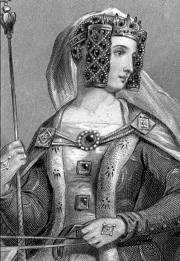
Edward married Philippa, of Hainault,277 335 daughter of William, Count of Hainaut, Holland & Zeeland and Joan, on 24 Jan 1328 in York, Yorkshire, England. Philippa was born on 24 Jun 1311 and died on 15 Aug 1369 in Windsor Castle, Windsor, Berkshire, England at age 58. Another name for Philippa was Philippa of Hainaut.
Death Notes: Died from the Black Death
The child from this marriage was:
+ 225 M i. Edmund, of Langley, 1st Duke of York 277 was born on 5 Jun 1341 in Kings Langley, Hertfordshire, England and died on 1 Aug 1402 in Kings Langley, Hertfordshire, England at age 61.
183. John, of Eltham, Earl of Cornwall (King Edward II, of England135, King Edward I, of England97, King Henry III, of England71, King John "Lackland", of England54, Henry II "Curtmantel", King of England42, Empress Matilda, Countess of Anjou24, Matilda, of Scotland12, Saint Margaret, of Scotland7, Agatha5, Yaroslav I, of Kiev4, Vladimir I, of Kiev3, Sviatoslav I, of Kiev2, Igor, Grand Prince of Kiev1) was born in 1316.
Research Notes: Source: Wikipedia - Edward II of England & Isabella of France
184. Eleanor, Countess of Guelders (King Edward II, of England135, King Edward I, of England97, King Henry III, of England71, King John "Lackland", of England54, Henry II "Curtmantel", King of England42, Empress Matilda, Countess of Anjou24, Matilda, of Scotland12, Saint Margaret, of Scotland7, Agatha5, Yaroslav I, of Kiev4, Vladimir I, of Kiev3, Sviatoslav I, of Kiev2, Igor, Grand Prince of Kiev1) was born in 1318. Another name for Eleanor was Eleanor of Woodstock.
Research Notes: Source: Wikipedia - Edward II of England & Isabella of France
Eleanor married Reinoud II, of Guelders.
Research Notes: Source: Wikipedia - Isabella of France
185. Joan, Queen of Scots (King Edward II, of England135, King Edward I, of England97, King Henry III, of England71, King John "Lackland", of England54, Henry II "Curtmantel", King of England42, Empress Matilda, Countess of Anjou24, Matilda, of Scotland12, Saint Margaret, of Scotland7, Agatha5, Yaroslav I, of Kiev4, Vladimir I, of Kiev3, Sviatoslav I, of Kiev2, Igor, Grand Prince of Kiev1) was born in 1321. Another name for Joan was Joan of the Tower.
Research Notes: Source: Wikipedia - Edward II of England & Isabella of France
Joan married David II, of Scotland.
Research Notes: Source: Wikipedia - Isabella of France
186. Margaret, Duchess of Norfolk (Thomas, of Brotherton, Earl of Norfolk136, King Edward I, of England97, King Henry III, of England71, King John "Lackland", of England54, Henry II "Curtmantel", King of England42, Empress Matilda, Countess of Anjou24, Matilda, of Scotland12, Saint Margaret, of Scotland7, Agatha5, Yaroslav I, of Kiev4, Vladimir I, of Kiev3, Sviatoslav I, of Kiev2, Igor, Grand Prince of Kiev1) died on 24 Mar 1399.
Research Notes: Source: Ancestral Roots of Certain American Colonists Who Came to America before 1700 by Frederick Lewis Weis and Walter Lee Sheppard, Jr, ed. by William R. Beall & Kaleen E. Beall, Baltimore, 2008, Line 16-30
Margaret married John de Segrave, 4th Lord Segrave. John died on 20 Mar 1353.
Research Notes: Source: Ancestral Roots of Certain American Colonists Who Came to America before 1700 by Frederick Lewis Weis and Walter Lee Sheppard, Jr, ed. by William R. Beall & Kaleen E. Beall, Baltimore, 2008, Line 16-30 (Margaret)
The child from this marriage was:
+ 226 F i. Elizabeth de Segrave, 5th Baroness Segrave was born on 25 Oct 1338 in Croxton Abbey, Leicestershire, England and died before 1368.
Margaret next married Walter Manny, 1st Lord Manny after 30 May 1354.
Research Notes: Source: Ancestral Roots of Certain American Colonists Who Came to America before 1700 by Frederick Lewis Weis and Walter Lee Sheppard, Jr, ed. by William R. Beall & Kaleen E. Beall, Baltimore, 2008, Line 16-30 (Margaret)
187. Blanche, of Lancaster 281 (Henry, 3rd Earl of Lancaster, Earl of Leicester138, Edmund "Crouchback", 1st Earl of Lancaster, Earl of Leicester100, King Henry III, of England71, King John "Lackland", of England54, Henry II "Curtmantel", King of England42, Empress Matilda, Countess of Anjou24, Matilda, of Scotland12, Saint Margaret, of Scotland7, Agatha5, Yaroslav I, of Kiev4, Vladimir I, of Kiev3, Sviatoslav I, of Kiev2, Igor, Grand Prince of Kiev1) was born about 1305 and died before 12 Jul 1380.
Research Notes: From Wikipedia - Maud Chaworth :
Blanche of Lancaster , (about 1302/05-1380); Maud's eldest daughter was probably born between 1302 and 1305, and was named after her father's mother Blanche of Artois . Around 9 October 1316, she married Thomas Wake , the second baron of Liddell. Blanch was about forty-five when Thomas died and lived as a widow for more than thirty years. She was one of the executers of her brother Henry's will when he died in 1361. Blanche outlived all her siblings, dying shortly before 12 July 1380 in her mid to late seventies. Born in the reign of Edward I, she survived all the way into the reign of his great grandson Richard II.
188. Henry of, Grosmont, 1st Duke of Lancaster 282 (Henry, 3rd Earl of Lancaster, Earl of Leicester138, Edmund "Crouchback", 1st Earl of Lancaster, Earl of Leicester100, King Henry III, of England71, King John "Lackland", of England54, Henry II "Curtmantel", King of England42, Empress Matilda, Countess of Anjou24, Matilda, of Scotland12, Saint Margaret, of Scotland7, Agatha5, Yaroslav I, of Kiev4, Vladimir I, of Kiev3, Sviatoslav I, of Kiev2, Igor, Grand Prince of Kiev1) was born about 1310 and died on 23 Mar 1361 about age 51. Another name for Henry was Henry of Grosmont 1st Duke of Lancaster.
Research Notes: From Wikipedia - Alice Comyn :
Isabel de Beaumont (c.1320- 1361), married in 1337 Henry of Grosmont, 1st Duke of Lancaster , by whom she had two daughters, Maud, Countess of Leicester and Blanche of Lancaster .
-----
From Wikipedia - Henry of Grosmont, 1st Duke of Lancaster :
Henry of Grosmont, Duke of Lancaster[a] (c.1310 - 23 March 1361), also Earl of Derby and Leicester, was a member of the English nobility in the 14th century, and a prominent English diplomat , politician , and soldier . The son and heir of Henry Plantagenet, 3rd Earl of Lancaster and Maud Chaworth , he became one of Edward III 's most trusted Captains in the early phases of the Hundred Years' War , and distinguished himself with victory in the Battle of Auberoche . He was a founding member of the Order of the Garter , and in 1351 was promoted to the title of duke. Grosmont was also the author of the book Livre de seyntz medicines; a highly personal devotional treatise. He is remembered as one of the founders and early patrons of Corpus Christi College, Cambridge , which was established by two of the guilds of the town in 1352.
Family background and early life
Grosmont's uncle, Thomas of Lancaster , was the son and heir of Edward I 's brother Edmund Crouchback . Through his inheritance and a fortunate marriage, Thomas became the wealthiest peer in England, but constant quarrels with King Edward II led to his execution in 1322.[1] Having no heir, Thomas's possessions and titles went to his younger brother Henry - Grosmont's father. Earl Henry of Lancaster assented to the deposition of Edward II in 1327, but did not long stay in favour with the regency of Queen Isabella and Roger Mortimer . When Edward III took personal control of the government in 1330, relations with the Crown got better, but by this time the older Henry was already struggling with poor health and blindness.[2]
Little is known of Grosmont's early years, but it seems clear that he was born at the castle of Grosmont in Monmouthshire , and that he was born c.1310, not around the turn of the century as previously held.[3] According to his own memoirs he was better at the martial arts than at academic subjects, and did not learn to read until later in life.[4] In 1330 he was knighted, and represented his father in parliament . The next year he is recorded as participating in a Royal tournament , at Cheapside .[3]
In 1333 he took part in Edward's Scottish campaign, though it is unclear whether he was present at the great English victory at the Battle of Halidon Hill .[5] After further service in the north , he was appointed the King's lieutenant in Scotland in 1336.[3] The next year he was one of the six men Edward III promoted to the higher levels of the peerage. One of his father's lesser titles, that of Earl of Derby , was bestowed upon Grosmont.[6]
Service in France
With the outbreak of the Hundred Years' War in 1337, Grosmont's attention was turned towards France . He took part in several diplomatic missions and minor campaigns, and was present at the great English victory in the naval battle of Sluys in 1340.[7] Later the same year, he was required to commit himself as hostage in the Low Countries for the king's considerable debts. He remained hostage until the next year, and had to pay a large ransom for his own release.[8] On his return he was made the king's lieutenant in the north, and stayed at Roxburgh until 1342. The next years he spent in diplomatic negotiations in the Low Countries, Castile and Avignon .[3]
In 1345 Edward III was planning a major assault on France. A three-pronged attack would have the Earl of Northampton attacking from Brittany , the King himself from Flanders , while Grosmont was dispatched to Aquitaine to prepare a campaign in the south.[3] Moving rapidly through the country he confronted the comte d'Isle at Auberoche on 21 October , and here achieved a victory described as 'the greatest single achievement of Lancaster's entire military career'.[9] The ransom from the prisoners has been estimated at £50,000.[10] The next year, while Edward was carrying out his Crécy campaign, Grosmont laid siege to, and captured, Poitiers , before returning home to England in 1347.[3]
Duke of Lancaster
In 1345, while Grosmont was in France, his father died. The younger Henry was now Earl of Lancaster - the wealthiest and most powerful peer of the realm. After participating in the siege of Calais in 1347, the king honoured Lancaster by including him as a founding knight of the Order of the Garter in 1348.[11] A few years later, in 1351, Edward bestowed an even greater honour on Lancaster, when he created him Duke of Lancaster . The title of duke was of relatively new origin in England; only one other ducal title existed prior.[b] In addition to this, Lancaster was given palatinate status for the county of Lancashire , which entailed a separate administration independent of the crown.[12] This grant was quite exceptional in English history; only two other counties palatine existed: Durham , which was an ancient ecclesiastical palatinate, and Chester , which was crown property. It is a sign of Edward's high regard for Lancaster that he would bestow such extensive privileges on him. The two men were also second cousins, through their great-grandfather Henry III , and practically coeval (Edward was born in 1312), so it is natural to assume that a strong sense of camaraderie existed between them. Another factor that might have influenced the king's decision was the fact that Henry had no male heir, so the grant was made for the Earl's lifetime only, and not intended to be hereditary.[3]
Further prestige
Lancaster spent the 1350s intermittently campaigning and negotiating peace treaties with the French. In 1350 he was present at the naval victory at Winchelsea , where he allegedly saved the lives of the Black Prince and John of Gaunt .[13] The years 1351-2 he spent on crusade in Prussia . It was here that a quarrel with Otto, Duke of Brunswick , almost led to a duel between the two men, narrowly averted by the intervention of the French King, Jean II .[14] In the later half of the decade campaigning in France resumed. After a chevauchée in Normandy in 1356 and the siege of Rennes in 1358, Lancaster participated in the last great offensive of the first phase of the Hundred Years' War: the Rheims campaign of 1359-60. Then he was appointed principal negotiator for the treaty of Brétigny , where the English achieved very favourable terms.[3]
Returning to England in November 1360 he fell ill early the next year, and died at Leicester Castle on 23 March . It is likely that the cause of death was the plague , which that year was making a second visitation of England.[15]
Private life
Lancaster was married to Isabella, daughter of Henry, Lord Beaumont , in 1330. The two had no sons, but two daughters: Maude and Blanche . While Maude was married to the Duke of Bavaria , Blanche married Edward III's younger son, John of Gaunt . Gaunt ended up inheriting Lancaster's possessions and ducal title, but it was not until 1377, when the dying King Edward III was largely incapacitated, that he was able to restore the palatinate rights for the county of Lancaster. When Gaunt's son Henry of Bolingbroke usurped the crown in 1399 and became Henry IV, the vast Lancaster inheritance was merged with the crown as the Duchy of Lancaster .[16]
We know more of Lancaster's character than of most of his contemporaries, through his memoirs the Livre de seyntz medicines (Book of the Holy Doctors). This book is a highly personal treatise on matters of religion and piety, but it also contains details of historical interest. It is, among other things, revealed that Lancaster, at the age of 44 when he wrote the book in 1354, suffered from gout .[3] The book is primarily a devotional work though; it is organized around seven wounds which Henry claims to have, representing the seven sins. Lancaster confesses to his sins, explains various real and mythical medical remedies in terms of their theological symbolism, and exhorts the reader to greater morality.[17]
Henry married Isabel de Beaumont,298 daughter of Henry Beaumont, 4th Earl of Buchan and Alice Comyn, in 1337.298 Isabel was born about 1320 and died in 1361 about age 41.
Research Notes: 10th child of Henry Beaumont and Alice Comyn.
189. Maud, of Lancaster 281 (Henry, 3rd Earl of Lancaster, Earl of Leicester138, Edmund "Crouchback", 1st Earl of Lancaster, Earl of Leicester100, King Henry III, of England71, King John "Lackland", of England54, Henry II "Curtmantel", King of England42, Empress Matilda, Countess of Anjou24, Matilda, of Scotland12, Saint Margaret, of Scotland7, Agatha5, Yaroslav I, of Kiev4, Vladimir I, of Kiev3, Sviatoslav I, of Kiev2, Igor, Grand Prince of Kiev1) was born about 1310 and died about 1377 about age 67.
Research Notes: From Wikipedia - Maud Chaworth :
Maud of Lancaster, (about 1310-1345)There is some discrepancy as to when Maud died. Another possible date of her death is 1377[3]
married William de Burgh, 3rd Earl of Ulster in 1327. They bore one child, Elizabeth de Burgh who was born 6 July 1332. Eleven months after the birth of their child, Earl William was murdered at "Le Ford" in Belfast, apparently by some of his own men. The countess Maud fled to England with her baby and stayed with the royal family. In 1337, Maud of Lancaster managed to ensure that the Justiciar of Ireland was forbidden to pardon her husband's killers. She fought for her dower rights and exerted some influence there. She remarried in 1344 to Ralph Ufford and returned to Ireland where she had another daughter, Maud. After her second husband fell ill in 1346, she again returned to England. Maud of Lancaster died on May 5, 1345/77.
190. Joan, of Lancaster 283 (Henry, 3rd Earl of Lancaster, Earl of Leicester138, Edmund "Crouchback", 1st Earl of Lancaster, Earl of Leicester100, King Henry III, of England71, King John "Lackland", of England54, Henry II "Curtmantel", King of England42, Empress Matilda, Countess of Anjou24, Matilda, of Scotland12, Saint Margaret, of Scotland7, Agatha5, Yaroslav I, of Kiev4, Vladimir I, of Kiev3, Sviatoslav I, of Kiev2, Igor, Grand Prince of Kiev1) was born about 1312 and died on 7 Jul 1345 in Yorkshire, England about age 33. Another name for Joan was Joan Plantagenet.
Death Notes: Died of the plague
Research Notes: From Wikipedia - Joan of Lancaster :
Joan of Lancaster (c. 1310 - 7 July 1345) is also called Joan Plantagenet after her family's name. She married John de Mowbray, 3rd Baron Mowbray on 28 February 1326 or 1327, then died in Yorkshire , England, of the plague.[1]
-------
From Wikipedia - Maud Chaworth :
Joan of Lancaster , (about 1312-1345); married between February 28 and June 4, 1327 to John, Lord Mowbray . John's father was horribly executed for reasons unknown and young John was imprisoned in the Tower of London along with his mother Alice de Braose, until late 1326. A large part of his inheritance was granted to Hugh Despenser the Younger, who was his future wife's uncle; however he was set free in 1327 before the marriage. Joan of Lancaster probably died in her early thirties, sometime before August 1344.
191. Isabel, of Lancaster, Abess of Ambresbury (Henry, 3rd Earl of Lancaster, Earl of Leicester138, Edmund "Crouchback", 1st Earl of Lancaster, Earl of Leicester100, King Henry III, of England71, King John "Lackland", of England54, Henry II "Curtmantel", King of England42, Empress Matilda, Countess of Anjou24, Matilda, of Scotland12, Saint Margaret, of Scotland7, Agatha5, Yaroslav I, of Kiev4, Vladimir I, of Kiev3, Sviatoslav I, of Kiev2, Igor, Grand Prince of Kiev1) was born about 1317 and died after 1347.
192. Eleanor, of Lancaster 284 285 (Henry, 3rd Earl of Lancaster, Earl of Leicester138, Edmund "Crouchback", 1st Earl of Lancaster, Earl of Leicester100, King Henry III, of England71, King John "Lackland", of England54, Henry II "Curtmantel", King of England42, Empress Matilda, Countess of Anjou24, Matilda, of Scotland12, Saint Margaret, of Scotland7, Agatha5, Yaroslav I, of Kiev4, Vladimir I, of Kiev3, Sviatoslav I, of Kiev2, Igor, Grand Prince of Kiev1) was born about 1318 in England, died on 11 Jan 1372 in Arundel Castle, West Sussex, England about age 54, and was buried in Lewes Priory, Lewes, Sussex, England. Another name for Eleanor was Eleanor Plantagenet.
Research Notes: Second wife of Richard (FitzAlan) d'Arundel.
From Wikipedia - Eleanor of Lancaster :
Eleanor of Lancaster (sometimes called Eleanor Plantagenet 1) (about 1315 - 11 January 1372 ) was born as the fifth daughter of Henry, Earl of Lancaster (c. 1281-1345) and his wife Maud Chaworth (1282-1322).
First marriage and offspring
Sometime between September 1 and November 6 , 1330 , she married John de Beaumont, 2nd Lord Beaumont , son of Henry Beaumont, 4th Earl of Buchan (c. 1288 - 1340) and his wife Alice Comyn (c. 1291-1349). They had two children:
Henry Beaumont, 3rd Lord Beaumont , born 1340
Matilda Beaumont (died July 1467), married Hugh de Courtenay
Eleanor was a lady-in-waiting to Queen Philippa , and was in service to her in Ghent when her son Henry was born. John de Beaumont died in a tournament on 14 April 1342 .
Second marriage
On 5 February 1344 at Ditton Church , Stoke Poges , Buckinghamshire , she married Richard Fitzalan, 10th Earl of Arundel (9th Earl of Arundel per Ancestral Roots), 4th Earl of Surrey, known by the soubriquet of "Copped Hat", Justiciar of North Wales, Governor of Carnarvon Castle, Admiral of the West.2
His previous marriage, to Isabel le Despenser , had taken place when they were children. It was annulled by Papal mandate as she, since her father's attainder and execution, had ceased to be of any importance to him. Pope Clement VI obligingly annulled the marriage, bastardized the issue, and provided a dispensation for his second marriage to the woman with whom he had been living in adultery (the dispensation, dated 4 March 1344 /1345 , was required because his first and second wives were first cousins).
The children of Eleanor's second marriage were:
Richard (1346-1397), who succeeded as Earl of Arundel
John Fitzalan (bef 1349-1379)
Thomas Arundel , Archbishop of York (c. 1345-February 19 , 1413 )
Joan Fitzalan (bef. 1351-April 17 , 1419 ), married Humphrey de Bohun, 7th Earl of Hereford
Alice Fitzalan (1352 -March 17 , 1416 ), married Thomas Holland, 2nd Earl of Kent (Thomas Holand)
Eleanor died at Arundel and was buried at Lewes Priory in Lewes , Sussex , England. Her husband was buried beside her; in his will Richard requests to be buried "near to the tomb of Eleanor de Lancaster, my wife; and I desire that my tomb be no higher than hers, that no men at arms, horses, hearse, or other pomp, be used at my funeral, but only five torches...as was about the corpse of my wife, be allowed."
Sources
Notes
Eleanor married John de Beaumont, Earl of Buchan, 2nd Lord Beaumont,336 337 son of Henry Beaumont, 4th Earl of Buchan and Alice Comyn, on 6 Nov 1330.298 John was born in 1318 and died on 14 Apr 1342 at age 24.
Research Notes: First husband of Eleanor of Lancaster.
Source: Ancestral Roots of Certain American Colonists Who Came to America before 1700 by Frederick Lewis Weis and Walter Lee Sheppard, Jr, ed. by William R. Beall & Kaleen E. Beall, Baltimore, 2008, Line 17-30 (Eleanor of Lancaster). Has d. bet 24 Feb 1342 and 25 May 1342.
Source: Wikipedia - Eleanor of Lancaster has d. in a tournament on 14 Apr 1342.
Children from this marriage were:
+ 227 M i. Henry Beaumont, 3rd Lord Beaumont was born in 1340.
+ 228 F ii. Matilda Beaumont died in Jul 1467.
Eleanor next married Sir Richard "Copped Hat" FitzAlan, 10th Earl of Arundel and Warenne,314 315 316 son of Sir Edmund FitzAlan, 9th Earl of Arundel and Alice de Warenne, on 5 Feb 1345 in Ditton Church, Stokes Poges, Buckinghamshire, England. Richard was born about 1313, died on 24 Jan 1376 in Arundel, West Sussex, England about age 63, and was buried in Lewes Priory, Lewes, Sussex, England. Other names for Richard were Richard of Arundel, Sir Richard de Arundel, and Richard FitzAlan d'Arundel 9th Ear;l of Arundel.
Marriage Notes: Wikipedia
Research Notes: When John II de Warenne died without legal issue on 29 June 1347, Richard FitzAlan, Earl of Arundel, was the next heir in blood through his mother, Alice de Warenne, John's sister.
-----
From Wikipedia - Richard FitzAlan, 10th Earl of Arundel :
Richard FitzAlan, 10th Earl of Arundel (c. 1307 - January 24, 1376) was an English nobleman and military leader.
Fitzalan was the eldest son of Edmund FitzAlan, 9th Earl of Arundel, and Alice Warenne. His maternal grandparents were William de Warenne, 8th Earl of Surrey and Joan de Vere. William was the only son of John de Warenne, 7th Earl of Surrey.
His birthdate is uncertain, but could not have been before 1307. Around 1321, FitzAlan's father allied with King Edward II's (also an ancestor) favorites, the Hugh le Despenser, 1st Earl of Winchester (also an ancestor) and his namesake son, and Richard was married to Isabel le Despenser, daughter of Hugh the Younger. Fortune turned against the Despenser party, and in 1326, FitzAlan's father was executed, and he did not succeed to his father's estates or titles.
However, political conditions had changed by 1330, and over the next few years Richard was gradually able to reacquire the Earldom of Arundel as well as the great estates his father had held in Sussex and in the Welsh Marches. Beyond this, in 1334 he was made justice of North Wales (later his term in this office was made for life), sheriff for life of Caernarvonshire, and governor of Caernarfon Castle.
His daughter Joan was the mother of Mary de Bohun who would marry King of England Henry IV.
Noted events in his life were:
• Earl of Arundel: 1331.
• Lord of Bromfield (Wrexham) and Yale: 30 Jun 1347. upon the death of his uncle, John II de Warenne.
• Inherited: castles of Caerleon (Holt) and Dinas Bran, 30 Jun 1347.
• Did homage: to Edward III, 24 Oct 1353. for Bromfield and Yale as immediately subject to the Crown.
Children from this marriage were:
+ 229 M i. Sir Richard FitzAlan, 11th Earl of Arundel & 10th Earl of Surrey 333 338 339 340 was born in 1346 in <Arundel, West Sussex>, England and died on 21 Sep 1397 in Cheapside, London, England at age 51.
+ 230 M ii. John FitzAlan, 1st Baron Arundel and Lord Maltravers 341 342 was born about 1348 in Etchingham, Sussex, England and died on 16 Dec 1379 about age 31.
+ 231 F iii. Joan FitzAlan 343 was born about 1348, died on 17 Apr 1419 about age 71, and was buried in Walden Abbey, Essex, England.
+ 232 M iv. Thomas Arundel, Archbishop of York 284 was born about 1350 and died on 19 Feb 1413 about age 63.
+ 233 F v. Alice FitzAlan 284 was born in 1350 and died on 17 Mar 1416 at age 66.
193. Mary, of Lancaster 281 (Henry, 3rd Earl of Lancaster, Earl of Leicester138, Edmund "Crouchback", 1st Earl of Lancaster, Earl of Leicester100, King Henry III, of England71, King John "Lackland", of England54, Henry II "Curtmantel", King of England42, Empress Matilda, Countess of Anjou24, Matilda, of Scotland12, Saint Margaret, of Scotland7, Agatha5, Yaroslav I, of Kiev4, Vladimir I, of Kiev3, Sviatoslav I, of Kiev2, Igor, Grand Prince of Kiev1) was born about 1320 and died on 1 Sep 1362 about age 42.
Research Notes: From Wikipedia - Maud Chaworth :
Mary of Lancaster, (about 1320-1362); married Henry, Lord Percy before September 4, 1334 who fought at the battle of Crecy in 1346, and served in Gascony under the command of his brother in law Henry of Grosmont. Their son was Henry Percy, 1st Earl of Northumberland . Mary of Lancaster died on 1 September 1362, the year after her brother Henry.
194. Eleanor ferch Philip ap Ifor (Catherine verch Llewellyn Gryffyth141, Elinor de Montfort102, Eleanor75, King John "Lackland", of England54, Henry II "Curtmantel", King of England42, Empress Matilda, Countess of Anjou24, Matilda, of Scotland12, Saint Margaret, of Scotland7, Agatha5, Yaroslav I, of Kiev4, Vladimir I, of Kiev3, Sviatoslav I, of Kiev2, Igor, Grand Prince of Kiev1) was born in 1318. Another name for Eleanor was Eleanor Goch verch Philip.
Research Notes: Source: Ancestral Roots of Certain American Colonists Who Came to America before 1700 by Frederick Lewis Weis and Walter Lee Sheppard, Jr, ed. by William R. Beall & Kaleen E. Beall (Baltimore, 2008)., Line 254-33 (Thomas ap Llewellyn)
RootsWeb - Celtic Royal Genealogy - has b. 1318.
Eleanor married Thomas ap Llywelyn ap Owain, of Iscoed Uch Hirwen, Cardiganshire,344 345 son of Llywelyn ap Owain ap Maredudd and < > de Vale,. Thomas was born before 14 Aug 1343 and died in Iscoed Uch Hirwen, Cardiganshire, Wales. Other names for Thomas were Thomas ap Llewellyn ap Owain of Iscoed Uch Hirwen, Cardiganshire, Thomas ap Llewellyn Owen of Trefgarned, Lord of South Wales, and Thomas ap Llywelyn Arglwydd Iscoed.
Research Notes: From Wikipedia - Gruffydd Fychan II :
"Gruffydd Fychan II was married to Elen, daughter of Thomas ap Llwelyn lord of half the of commote Iscoed Uch Hirwen and of quarter of Gwynonydd , both in Cardiganshire."
Children from this marriage were:
+ 234 F i. Elen verch Thomas ap Llewellyn Owen was born about 1337.
+ 235 F ii. Margaret verch Thomas ap Llywelyn Owain .346
195. Isabella de Mortimer 43 289 (Roger de Mortimer, of Wigmore, 1st Baron Mortimer143, Gwladys "Ddu" verch Llewellyn103, Joan, Princess of Gwynedd76, King John "Lackland", of England54, Henry II "Curtmantel", King of England42, Empress Matilda, Countess of Anjou24, Matilda, of Scotland12, Saint Margaret, of Scotland7, Agatha5, Yaroslav I, of Kiev4, Vladimir I, of Kiev3, Sviatoslav I, of Kiev2, Igor, Grand Prince of Kiev1) died before 1 Apr 1292. Other names for Isabella were Isabel de Mortimer and Joane de Mortimer.
Death Notes: Wikipedia has d. 1292.
Research Notes: Source: Ancestral Roots of Certain American Colonists Who Came to America before 1700 by Frederick Lewis Weis and Walter Lee Sheppard, Jr, ed. by William R. Beall & Kaleen E. Beall, Baltimore, 2008, Line 28-30
Isabella married John FitzAlan, Lord of Clun and Oswestry,347 348 son of John FitzAlan, Lord of Clun and Oswestry and Maud le Boteler,. John was born on 14 Sep 1246 and died 18 Mar 1271 or 1302 at age 24.
Research Notes: From Wikipedia - John FitzAlan, 7th Earl of Arundel :
John FitzAlan, 7th Earl of Arundel (14 September 1246 - 18 March 1272 ) was an English nobleman. He was also feudal Lord of Clun and Oswestry in the Welsh Marches .
Family
He was the son of John FitzAlan, 6th Earl of Arundel (d. 1267), and Maud le Boteler , daughter of Theobald le Botiller (or Boteler) and Rohese (or Rohesia) de Verdun. His paternal grandparents were John Fitzalan, Lord of Oswestry and Isabel d'Aubigny. Through his father, FitzAlan was also descended from Alan fitzFlaad , and Llywelyn the Great [citation needed ].
Marriage
Lord Arundel married Isabella Mortimer (died 1292), daughter of Roger Mortimer, 1st Baron Wigmore and Maud de Braose in 1260. They had a son Richard FitzAlan, 8th Earl of Arundel .
References
Noted events in his life were:
• 7th Earl of Arundel:
The child from this marriage was:
+ 236 M i. Sir Richard FitzAlan, 8th Earl of Arundel 349 350 was born from 1207 to 3 Feb 1266 and died on 9 Mar 1302 at age 95.
Isabella next married Walter de Beauchamp, of Elmley, Worcestershire,197 son of Walter de Beauchamp, of Elmley, Worcestershire and Bertha de Braose, in 1212 in Elmley, Worcestershire, England. Walter was born about 1184 in Elmley, Worcestershire, England and died on 14 Apr 1236 about age 52. Another name for Walter was Walcheline de Beauchamp.
The child from this marriage was:
+ 237 M i. William de Beauchamp, 5th Baron Beauchamp 145 195 196 was born about 1210 and died in 1269 about age 59.
196. Sir Edmund de Mortimer, 7th Baron Mortimer of Wigmore 290 291 (Roger de Mortimer, of Wigmore, 1st Baron Mortimer143, Gwladys "Ddu" verch Llewellyn103, Joan, Princess of Gwynedd76, King John "Lackland", of England54, Henry II "Curtmantel", King of England42, Empress Matilda, Countess of Anjou24, Matilda, of Scotland12, Saint Margaret, of Scotland7, Agatha5, Yaroslav I, of Kiev4, Vladimir I, of Kiev3, Sviatoslav I, of Kiev2, Igor, Grand Prince of Kiev1) was born in 1261 in <Wigmore, Herefordshire>, England, died on 17 Jul 1304 in Wigmore, Herefordshire, England at age 43, and was buried in Wigmore, Herefordshire, England.
Birth Notes: FamilySearch has b. 1252
Research Notes: Source: Ancestral Roots of Certain American Colonists Who Came to America before 1700 by Frederick Lewis Weis and Walter Lee Sheppard, Jr, ed. by William R. Beall & Kaleen E. Beall (Baltimore, 2008), line 176B-30
Edmund married Margaret de Fiennes,291 351 daughter of William de Fiennes and Blanche de Brienne, Lady of Loupeland, about 1280. Margaret was born about 1262 in <Wigmore, Herefordshire>, England and died on 7 Feb 1334 about age 72. Another name for Margaret was Margaret de Fenlis.
Research Notes: Source: Ancestral Roots of Certain American Colonists Who Came to America before 1700 by Frederick Lewis Weis and Walter Lee Sheppard, Jr, ed. by William R. Beall & Kaleen E. Beall (Baltimore, 2008), line 176B-30 (Sir Edmund de Mortimer)
Children from this marriage were:
+ 238 F i. Isolde de Mortimer 291 was born about 1270 in <Wigmore, Herefordshire>, England and died in 1328 about age 58.
+ 239 M ii. Sir Roger de Mortimer, 8th Baron Mortimer of Wigmore, 1st Earl of March was born on 25 Apr 1287 and died on 29 Nov 1330 at age 43.
197. Alice Audley 84 (Hugh I de Audley144, Ela Longspee106, William II Longspée77, William Longspée, 3rd Earl of Salisbury55, Henry II "Curtmantel", King of England42, Empress Matilda, Countess of Anjou24, Matilda, of Scotland12, Saint Margaret, of Scotland7, Agatha5, Yaroslav I, of Kiev4, Vladimir I, of Kiev3, Sviatoslav I, of Kiev2, Igor, Grand Prince of Kiev1) was born about 1304 in Hadley, Staffordshire, England, died on 11 Jan 1374 in Greystoke, Northumberland, England about age 70, and was buried in Durham Cathedral, Durham, Durham, England.
Alice married Ralph Neville,152 son of Randolf de Neville and Eupheme FitzRoger Clavering, on 14 Jan 1326 in Stratton Audley, Oxfordshire, England. Ralph was born about 1290 in <Raby>, Durham, England, died on 5 Aug 1367 in Durham, England about age 77, and was buried in Cathedral Church, Durham, Durham, England.
Marriage Notes: by Royal license
The child from this marriage was:
+ 240 M i. John Neville 152 was born about 1328 in <Raby With Keverstone>, Durham, England and died on 17 Oct 1388 in Newcastle Upon Tyne, Northumberland, England about age 60.
198. Humphrey VIII de Bohun, 4th Earl of Hereford & 3rd Earl of Essex 266 267 (Humphrey VII de Bohun, 3rd Earl of Hereford & 2nd Earl of Essex145, Humphrey VI de Bohun107, Humphrey V de Bohun, 2nd Earl of Hereford, 7th Earl of Essex78, Henry de Bohun, 5th Earl of Hereford56, Margaret, of Huntingdon43, Henry, of Huntingdon, Earl of Northumberland & Huntingdon26, David I "The Saint", King of Scots13, Saint Margaret, of Scotland7, Agatha5, Yaroslav I, of Kiev4, Vladimir I, of Kiev3, Sviatoslav I, of Kiev2, Igor, Grand Prince of Kiev1) was born about 1276 in Pleshey Castle, Essex, England and died on 16 Mar 1322 in Boroughbridge, Yorkshire, England about age 46. Another name for Humphrey was Humphrey VIII de Bohun 4th Earl of Hereford.
Death Notes: At the Battle of Boroughbridge, murdered in an ambush by the Welsh.
Research Notes: Ancestral Roots, Line 97-31 has b. abt 1276, slain at Boroughbridge, 16 Mar 1321/2, 4th Earl of Hereford and Essex, Lord High Constable of England.
----------
From Wikipedia - Humphrey de Bohun, 4th Earl of Hereford
Humphrey VIII de Bohun, 4th Earl of Hereford (1276 - March 16 , 1321 /1322 ) was a member of an important Anglo-Norman family of the Welsh Marches and was one of the Ordainers who opposed Edward II 's excesses.
Family Background
Humphrey de Bohun's birth year is uncertain although several contemporary sources indicate that it was 1276. His father was Humphrey de Bohun, 3rd Earl of Hereford and his mother was Maud de Fiennes , daughter of Enguerrand II de Fiennes . He was born at Pleshey Castle located in Essex , England.
Humphrey de Bohun VIII succeeded his father as Earl of Hereford and Earl of Essex , and Constable of England (later called Lord High Constable ). Humphrey held the title of Bearer of the Swan Badge, a heraldic device passed down in the de Bohun family. This device did not appear on their coat of arms, (az, a bend ar cotised or, between 6 lioncels or) nor their crest (gu, doubled erm, a lion gardant crowned), but it does appear on his personal seal.
Scotland
Humphrey was one of several earls and barons under Edward I who laid siege to Caerlaverock Castle in Scotland in 1300 and later took part in many campaigns in Scotland. He also loved tourneying and gained a reputation as an "elegant" fop. In one of the campaigns in Scotland Humphrey evidently grew bored and departed England for a tournament along with Piers Gaveston and other young barons and knights. On return all of them fell under Edward I's wrath for desertion, but were forgiven. It is probable that Gaveston's friend, Edward (the future Edward II) had given them permission to depart.
Later Humphrey became one of Gaveston's and Edward II's bitterest opponents. He would also have been associating with young Robert Bruce during the early campaigns in Scotland, since Bruce, like many other Scots and Border men, moved back and forth from English allegiance to Scottish. (NOTE: Robert Bruce, King Robert I of Scotland, is closely connected to de Bohun. Between the time that he swore his last fealty to Edward I in 1302 and his defection four years later, Bruce stayed for the most part in Annandale , rebuilding his castle of Lochmaben in stone, making use of its natural moat. Rebelling and taking the crown of Scotland in February, 1306, Bruce was forced to fight a war against England which went poorly for him at first, while Edward I still lived. After nearly all his family were killed or captured he had to flee to the isle of Rathlin , Ireland. His properties in England and Scotland were confiscated.)
Humphrey de Bohun received many of Robert Bruce's forfeited properties. It is unknown whether Humphrey was a long-time friend or enemy of Robert Bruce, but they were nearly the same age and the lands of the two families in Essex and Middlesex lay very close to each other. After Bruce's self-exile, de Bohun took Lochmaben and Edward I awarded him Annandale and the castle. During this period of chaos Bruce's queen, Elizabeth de Burgh , daughter of the Earl of Ulster, was captured by Edward I and taken prisoner, and Hereford and his wife Elizabeth later became her custodians. She was exchanged for Humphrey after Bannockburn in 1314. Lochmaben was from time to time retaken by the Scots but remained in the de Bohun family for many years, in the hands of Humphrey's son William, Earl of Northampton , who held and defended it until his death in 1360...
...Ordainer
Like his father, grandfather, and great-great-grandfather, this Humphrey de Bohun was careful to insist that the king obey Magna Carta , Habeas Corpus , and the other baronially-established safeguards against monarchic tyranny. He was a leader of the reform movements that promulgated the Ordinances of 1311 and fought to insure their execution.
The subsequent revival of royal authority and the ascendancy of the Despensers (Hugh the elder and younger ) led de Bohun and other barons to rebel against the king again in 1322. De Bohun had special reason for opposing the Despensers, for he had lost some of his estates in the Welsh Marches to their rapacity.
Death at Boroughbridge
The rebel forces were halted by loyalist troops at the wooden bridge at Boroughbridge , Yorkshire, where Humphrey de Bohun, leading an attempt to storm the bridge, met his death on March 16, 1322.
Although the details have been called into question by a few historians, his death may have been particularly gory. As recounted in The Greatest Traitor by Ian Mortimer, page 124:
"[The 4th Earl of] Hereford led the fight on the bridge, but he and his men were caught in the arrow fire. Then one of de Harclay's pikemen, concealed beneath the bridge, thrust upwards between the planks and skewered the Earl of Hereford through the anus, twisting the head of the iron pike into his intestines. His dying screams turned the advance into a panic."'
Humphrey de Bohun may have contributed to the failure of the reformers' aims. There is evidence that he suffered for some years, especially after his countess's death in 1316, from clinical depression. [1]
Marriage and children
His marriage to Elizabeth of Rhuddlan (Elizabeth Plantagenet), daughter of King Edward I of England and his first Queen consort Eleanor of Castile , on November 14 , 1302 , at Westminster gained him the lands of Berkshire.
Elizabeth had an unknown number of children, probably ten, by Humphrey de Bohun.
Until the earl's death the boys of the family, possibly the girls, were given a classical education under the tutelage of a Sicilian Greek, Master "Digines" (Diogenes), who may have been Humphrey de Bohun's boyhood tutor. He was evidently well-educated, a book collector and scholar, interests his son Humphrey and daughter Margaret (Courtenay) inherited.
Mary or Margaret (the first-born Margaret) and the first-born Humphrey were lost in infancy and are buried in the same sarcophagus in Westminster Abbey. Since fraternal twins were known in the Castilian royal family of Elizabeth Bohun, who gave birth to a pair who lived to manhood, Mary (Margaret?) and Humphrey, see next names, may have been twins, but that is uncertain. The name of a possible lost third child, if any, is unknown--and unlikely.
Hugh de Bohun? This name appears only in one Medieval source which gives Bohun names (see Flores Historiarum) and was a probably a copyist error for "Humphrey". It was never used by the main branch of the Bohuns in England. (Le Melletier, q.v., 16-17, 38-45, 138, in his comprehensive research into this family, cites no one named Hugh Bohun.) Date unknown, but after 1302 since she and Humphrey did not marry until late in 1302.
Humphrey de Bohun (birth and death dates unknown. Buried in Westminster Abbey with Mary or Margaret) Infant.
Mary or Margaret de Bohun (birth and death dates unknown. Buried in Westminster Abbey with Humphrey) Infant.
John de Bohun, 5th Earl of Hereford (About 1307 - 1336 )
Humphrey de Bohun, 6th Earl of Hereford (About 1309 to 1311 - 1361 ).
Margaret de Bohun (About 1308-1310 - 1391), married Hugh Courtenay, 2nd Earl of Devon Gave birth to about 16 to 18 children (including an Archbishop, a sea commander and pirate, and more than one Knight of the Garter) and died in her eighties.
William de Bohun, 1st Earl of Northampton (About 1310-1312 -1360 ). Twin of Edward.
Edward de Bohun (About 1310-1312 -1334 ). Twin of William. Married Margaret, daughter of William de Ros, 2nd Baron de Ros , but they had no children. He served in his ailing elder brother's stead as Constable of England. He was close friend of young Edward III, and died a heroic death attempting to rescue a drowning man-at-arms from a Scottish river while on campaign.
Eleanor de Bohun (birth date unknown, could have been as late as 1314 or 15 - 1363 ) [2], married James Butler, 1st Earl of Ormonde and Thomas Dagworth , 1st Baron Dagworth.
Eneas de Bohun, (Birth date unknown, died after 1322, when he's mentioned in his father's will). Nothing known of him. Name may reflect his father's classical education or the Earl's Welsh connections; could be either.
Isabel de Bohun (b. May ? , 1316 ). Elizabeth died in childbirth, and this child died on that day or very soon after. Buried with her mother in Waltham Abbey, Essex.
Humphrey married Elizabeth, of Rhuddlan, Princess of England,211 212 213 daughter of King Edward I, of England and Eleanor, of Castile, Countess of Ponthieu, on 14 Nov 1302 in Westminster Palace, London, England. Elizabeth was born on 7 Aug 1282 in Rhuddlan Castle, Rhuddlan, Denbighshire, Wales, died on 5 May 1316 in Quendon, Essex, England at age 33, and was buried in Waltham Abbey, Essex, England. Other names for Elizabeth were Elizabeth Princess of England, Elizabeth of England, and Elizabeth Plantagenet of Rhuddlan.
Birth Notes: Wikipedia or some other source has b. 7 Aug 1282 or 1281. Reifsnyder-Gillam Ancestry, Edited by Thomas Allen Glenn at the request of Howard Reifsnyder, privately printed, Philadelphia, 1902, provided by http://books.google.com, p. 31 has b. 1284.
Death Notes: Per Wikipedia, died in childbirth
Research Notes: From Reifsnyder-Gillam Ancestry, p. 49:
"I. THE PRINCESS ELIZABETH PLANTAGENET, daughter of Edward I by his first wife, Eleanor of Castile, was born at Rudlan Castle, in Flintshire, 1284. She married, first, in London, John, Earl of Holland, who died without issue two years after his marriage; and secondly, Humphrey de Bohun, Earl of Hereford and Lord High Constable of England. By her second husband she had a son: William de Bohun.
---------
From Wikipedia - Elizabeth of Rhuddlan :
Elizabeth of Rhuddlan (Elizabeth Plantagenet) (7 August 1282 Rhuddlan Castle - 5 May 1316 Quendon )
Born the eighth daughter of Edward I of England and Eleanor of Castile . Of all her siblings, she was closest to her younger brother Edward II of England , as they were only two years apart in age.
In April 1285 there were negotiations with Floris V for Elizabeth's betrothal to his son John I, Count of Holland . The offer was accepted and John was sent to England to be educated. On 8 January 1297 Elizabeth was married to John at Ipswich . In attendance at the marriage were Elizabeth's sister Margaret , her father, Edward I of England , her brother Edward , and Humphrey de Bohun . After the wedding Elizabeth was expected to go to Holland with her husband, but did not wish to go, leaving her husband to go alone.
After some time travelling England , it was decided Elizabeth should follow her husband. Her father accompanied her, travelling through Antwerp , Malines , Louvain and Brussels , before ending up in Ghent . There they remained for a few months, spending Christmas with her two sister's Eleanor of England, Countess of Bar and Margaret Plantagenet . On 10 November 1299 , John died of dysentery , though there were rumours of his being murdered. No children had been born from the marriage.
On her return trip to England , Elizabeth went through Brabant to see her sister Margaret. When she arrived in England , she met her step mother Margaret of France , whom Edward had married whilst she was in Holland . Reportedly, they became inseparable. On 14 November 1302 Elizabeth was married to Humphrey de Bohun, 4th Earl of Hereford , 3rd of Essex, also Constable of England , at Westminster Abbey .
During Christmas 1315 Elizabeth, who was pregnant with her 10th child, was visited by her sister-in-law Isabella of France . This was a great honour, but the stress of it may have caused unknown health problems that later contributed to Elizabeth's death in childbirth. On 5 May 1316 she went into labour, giving birth to her daughter Isabella. Both Elizabeth and Isabella died shortly after the birthing, and were buried together in Waltham Abbey .
The children of Elizabeth and Humphrey de Bohun, 4th Earl of Hereford are:
Hugh de Bohun (September 1303 - 1305 )
Eleanor de Bohun (October 1304 - 1363 ), married James Butler, 1st Earl of Ormonde and Thomas Dagworth , 1st Baron Dagworth.
Humphrey de Bohun (b&d 1305 )
John de Bohun, 5th Earl of Hereford (23 November 1306 - 1335 )
Agnes de Bohun, (November 1309 - ), married Robert de Ferrers, Earl of Chartley
Humphrey de Bohun, 6th Earl of Hereford (6 December about 1309 - 1361 )
Margaret de Bohun (3 April 1311 - 1391 ), married Hugh Courtenay, 2nd Earl of Devon
William de Bohun, 1st Earl of Northampton (1312 - 1360 ). Twin of Edward. Married Elizabeth de Badlesmere.
Edward de Bohun (1312 - 1334 ). Twin of William.
Eneas de Bohun, (1314 - after 1322 ), when he's mentioned in his father's will.
Isabel de Bohun (b&d 5 May 1316 )
(Duplicate Line. See Person 134)
199. Sir John de Ferrers, of Southoe and Keyston 293 (Alianore de Bohun146, Humphrey VI de Bohun107, Humphrey V de Bohun, 2nd Earl of Hereford, 7th Earl of Essex78, Henry de Bohun, 5th Earl of Hereford56, Margaret, of Huntingdon43, Henry, of Huntingdon, Earl of Northumberland & Huntingdon26, David I "The Saint", King of Scots13, Saint Margaret, of Scotland7, Agatha5, Yaroslav I, of Kiev4, Vladimir I, of Kiev3, Sviatoslav I, of Kiev2, Igor, Grand Prince of Kiev1) was born on 30 Jun 1271 in Cardiff and died in Aug 1312 in Gascony at age 41.
Noted events in his life were:
• 1st Lord Ferrers: of Chartley, Staffordshire.
John married Hawise de Muscegros, of Charlton,296 daughter of Sir Robert de Muscegros, of Charlton, Somerset and Agnes de Ferrers, between 2 Feb 1298 and 13 Sep 1300. Hawise was born on 21 Dec 1276 and died After Jun 1340 By Dec 1350. Another name for Hawise was Hawyse de Muscegros of Charlton.
The child from this marriage was:
+ 241 F i. Eleanor de Ferrers .352
200. Hawise de Muscegros, of Charlton 296 (Agnes de Ferrers147, Margaret de Quincy111, Roger de Quincy, 2nd Earl of Winchester82, Margaret de Beaumont58, Sir Robert de Beaumont, 3rd Earl of Leicester45, Sir Robert de Beaumont, 2nd Earl of Leicester30, Isabel de Vermandois, Countess of Leicester15, Hugh Magnus, of Vermandois and Valois, Duke of France11, Anne, of Kiev6, Yaroslav I, of Kiev4, Vladimir I, of Kiev3, Sviatoslav I, of Kiev2, Igor, Grand Prince of Kiev1) was born on 21 Dec 1276 and died After Jun 1340 By Dec 1350. Another name for Hawise was Hawyse de Muscegros of Charlton.
Hawise married Sir John de Ferrers, of Southoe and Keyston,293 son of Robert de Ferrers, 6th Earl of Derby and Alianore de Bohun, Betw 2 Feb 1298 and 13 Sep 1300. John was born on 30 Jun 1271 in Cardiff and died in Aug 1312 in Gascony at age 41.
Noted events in his life were:
• 1st Lord Ferrers: of Chartley, Staffordshire.
(Duplicate Line. See Person 199)
201. Maurice de Berkeley 43 (Joan de Ferrers149, Margaret de Quincy111, Roger de Quincy, 2nd Earl of Winchester82, Margaret de Beaumont58, Sir Robert de Beaumont, 3rd Earl of Leicester45, Sir Robert de Beaumont, 2nd Earl of Leicester30, Isabel de Vermandois, Countess of Leicester15, Hugh Magnus, of Vermandois and Valois, Duke of France11, Anne, of Kiev6, Yaroslav I, of Kiev4, Vladimir I, of Kiev3, Sviatoslav I, of Kiev2, Igor, Grand Prince of Kiev1) was born in Apr 1271 in <Berkeley Castle, > near Gloucester, Gloucestershire, England, died on 31 May 1326 in Wallingford Castle, Wallingford, Berkshire (Oxfordshire), England at age 55, and was buried in St. Augustine's, Bristol, Gloucestershire, England. Another name for Maurice was Maurice "the Magnanimous" de Berkeley.
Birth Notes: May have been April 1281.
Maurice married Eve La Zouche,183 daughter of Eudo La Zouche and Millicent de Cantelou, in 1289 in Berkeley Castle, Berkeley, Gloucestershire, England. Eve was born about 1281 in <Harringworth, Northamptonshire>, England, died on 5 Dec 1314 about age 33, and was buried in Church, Portbury, Somersetshire, England.
The child from this marriage was:
+ 242 F i. Isabel Berkeley 43 was born about 1307 in <Berkeley Castle, > near Gloucester, Gloucestershire, England and died on 25 Jul 1362 in Hartley Castle, Kirkeby Stephen, Westmoreland, England about age 55.
202. Alice Comyn 298 (Alexander Comyn152, Elizabeth de Quincey112, Roger de Quincy, 2nd Earl of Winchester82, Margaret de Beaumont58, Sir Robert de Beaumont, 3rd Earl of Leicester45, Sir Robert de Beaumont, 2nd Earl of Leicester30, Isabel de Vermandois, Countess of Leicester15, Hugh Magnus, of Vermandois and Valois, Duke of France11, Anne, of Kiev6, Yaroslav I, of Kiev4, Vladimir I, of Kiev3, Sviatoslav I, of Kiev2, Igor, Grand Prince of Kiev1) was born in 1289 in Aberdeenshire, Scotland and died on 3 Jul 1349 at age 60.
Research Notes: From Wikipedia - Alice Comyn :
Alice Comyn, Lady Beaumont, Countess of Buchan (1289- 3 Jul 1349), was a Norman-Scottish noblewoman, being a member of the powerful Comyn family that supported the Balliols , who were claimants to the disputed Scottish throne against their rivals, the Bruces . She was the niece of John Comyn, Earl of Buchan to whom she was also heiress. The Earldom of Buchan, however, was later claimed by Alice's husband Henry de Beaumont , Earl of Buchan by right of his wife.
Alice was the maternal grandmother of Blanche of Lancaster , and thus great-grandmother of King Henry IV of England .
It was her husband's continued struggle to claim her inherited title of Buchan which was one of the causes of the Second War of Scottish Independence .
Family
Alice was born in Aberdeenshire , Scotland in 1289, the eldest daughter of Alexander Comyn, Sheriff of Aberdeen and Joan le Latimer. She had a younger sister, Margaret who would later marry firstly Sir John Ross; and secondly, Sir William Lindsay, Lord of Symertoun.[1]
Alice's paternal grandparents were Alexander Comyn , 2nd Earl of Buchan, Justiciar and Constable of Scotland, and Elizabeth de Quincy . Alice's maternal grandparents were William le Latimer and Alicia Ledet. Alice's uncle was John Comyn, Earl of Buchan, one of the most powerful nobles in Scotland. The earl, who died in December 1308, was married to Isabella MacDuff , but the marriage was childless. Alice was John Comyn's heiress to the title of Countess of Buchan, although the earldom had been forfeited to the crown prior to her uncle's death in England to where he had gone as a fugitive.
Marriage and children
Shortly before 14 July 1310, Alice married Henry de Beaumont, Lord Beaumont, the son of Louis de Brienne, Viscount de Beaumont and Agnes, Viscountess de Beaumont. Upon her marriage she was styled as Lady Beaumont. Henry was a key figure in the Anglo-Scottish wars of the 13th and 14th centuries. (See main article: Wars of Scottish Independence ) As a consequence of her marriage to Henry, Alice had become, in Scottish eyes, irretrievably English, therefore the Scots recognised her sister Margaret's right to the Earldom of Buchan rather than her own. [2]
The marriage produced ten children:[3]
In April 1313, Isabella MacDuff, the widow of Alice's uncle John Comyn, was placed into the custody of the Beaumonts, following her release from her harsh imprisonment. She had been confined in a cage for four years in Berwick , England by the orders of King Edward I after she crowned Robert the Bruce king of Scotland at Scone in March 1306. In 1310, she was sent to a convent, and three years later was ordered to one of the Beaumont manors where she died on an unknown date.
In 1314, Henry de Beaumont fought at the Battle of Bannockburn on the side of the English.
Sometime between 1317 and 1321, Alice succeeded to the English estates of her younger sister, Margaret. On 22 January 1334, Alice's husband Henry was summoned to Parliament as the Earl of Buchan. He was recognised as earl from that until 16 November 1339. On 10 February 1334, he sat in the Scottish Parliament bearing the same title. It was Henry's relentless pursuit of the earldom of Buchan which was one of the factors that lead to the Second War of Scottish Independence between the Comyns and their ancient rivals, the Bruces .
Alice died on 3 July 1349 at the age of sixty. Her husband Henry had died in 1340 in the Low Countries where he had gone with King Edward III of England . With the death of Alice, the earldom of Buchan forever passed out of the Comyn family.
Alice's numerous descendants included, Kings Henry IV of England and Henry V of England , Philippa of Lancaster , Queen of Portugal, Anne Boleyn , and Humphrey Kynaston , the English highwayman .
Alice married Henry Beaumont, 4th Earl of Buchan, son of Louis de Brienne, Viscount of Beaumont and Agnes, before 14 Jul 1310. Henry was born about 1288 and died in 1340 about age 52.
Research Notes: Source: Wikipedia - Eleanor of Lancaster
Children from this marriage were:
+ 243 M i. John de Beaumont, Earl of Buchan, 2nd Lord Beaumont 336 337 was born in 1318 and died on 14 Apr 1342 at age 24.
+ 244 F ii. Isabel de Beaumont 298 was born about 1320 and died in 1361 about age 41.
203. Margaret Comyn 298 (Alexander Comyn152, Elizabeth de Quincey112, Roger de Quincy, 2nd Earl of Winchester82, Margaret de Beaumont58, Sir Robert de Beaumont, 3rd Earl of Leicester45, Sir Robert de Beaumont, 2nd Earl of Leicester30, Isabel de Vermandois, Countess of Leicester15, Hugh Magnus, of Vermandois and Valois, Duke of France11, Anne, of Kiev6, Yaroslav I, of Kiev4, Vladimir I, of Kiev3, Sviatoslav I, of Kiev2, Igor, Grand Prince of Kiev1).
204. Eve La Zouche 183 (Eudo La Zouche153, Helen de Quincy, of Brackley113, Roger de Quincy, 2nd Earl of Winchester82, Margaret de Beaumont58, Sir Robert de Beaumont, 3rd Earl of Leicester45, Sir Robert de Beaumont, 2nd Earl of Leicester30, Isabel de Vermandois, Countess of Leicester15, Hugh Magnus, of Vermandois and Valois, Duke of France11, Anne, of Kiev6, Yaroslav I, of Kiev4, Vladimir I, of Kiev3, Sviatoslav I, of Kiev2, Igor, Grand Prince of Kiev1) was born about 1281 in <Harringworth, Northamptonshire>, England, died on 5 Dec 1314 about age 33, and was buried in Church, Portbury, Somersetshire, England.
Eve married Maurice de Berkeley,43 son of Thomas de Berkeley, 1st Baron Berkeley and Joan de Ferrers, in 1289 in Berkeley Castle, Berkeley, Gloucestershire, England. Maurice was born in Apr 1271 in <Berkeley Castle, > near Gloucester, Gloucestershire, England, died on 31 May 1326 in Wallingford Castle, Wallingford, Berkshire (Oxfordshire), England at age 55, and was buried in St. Augustine's, Bristol, Gloucestershire, England. Another name for Maurice was Maurice "the Magnanimous" de Berkeley.
Birth Notes: May have been April 1281.
(Duplicate Line. See Person 201)
205. Eupheme FitzRoger Clavering 299 (Margery La Zouche154, Helen de Quincy, of Brackley113, Roger de Quincy, 2nd Earl of Winchester82, Margaret de Beaumont58, Sir Robert de Beaumont, 3rd Earl of Leicester45, Sir Robert de Beaumont, 2nd Earl of Leicester30, Isabel de Vermandois, Countess of Leicester15, Hugh Magnus, of Vermandois and Valois, Duke of France11, Anne, of Kiev6, Yaroslav I, of Kiev4, Vladimir I, of Kiev3, Sviatoslav I, of Kiev2, Igor, Grand Prince of Kiev1) was born about 1267 in <Warkworth, Northumberland>, England, was christened in Clavering, Essex, England, died in 1329 in Warkworth, Northumberland, England about age 62, and was buried in Staindrop, Durham, England.
Eupheme married Randolf de Neville,152 son of Robert de Neville and Mary FitzRandolph, about 1282 in Warkworth, Northumberland, England. Randolf was born on 18 Oct 1262 in <Raby>, Durham, England and died on 18 Apr 1332 at age 69.
The child from this marriage was:
+ 245 M i. Ralph Neville 152 was born about 1290 in <Raby>, Durham, England, died on 5 Aug 1367 in Durham, England about age 77, and was buried in Cathedral Church, Durham, Durham, England.
206. Margaret de Clare 301 302 303 304 (Thomas de Clare, Lord of Inchiquin and Yougal159, Sir Richard de Clare, 8th Earl of Clare118, Sir Gilbert de Clare, 7th Earl of Clare, Earl of Hertford and Gloucester86, Amice FitzWilliam, Countess of Gloucester63, Hawise de Beaumont, of Leicester46, Sir Robert de Beaumont, 2nd Earl of Leicester30, Isabel de Vermandois, Countess of Leicester15, Hugh Magnus, of Vermandois and Valois, Duke of France11, Anne, of Kiev6, Yaroslav I, of Kiev4, Vladimir I, of Kiev3, Sviatoslav I, of Kiev2, Igor, Grand Prince of Kiev1) was born about 1 Apr 1287 in Bunratty Castle, Thomond, Ireland and died between 22 Oct 1333 and 8 Jan 1334.
Research Notes: Youngest of 4 children.
"Heiress to her nephew Thomas de Clare, son of Richard de Clare, 2nd son of Thomas and Juliane... She was therefore sister to Richard, 2nd son, and to Thomas, 1st son..." -- Ancestral Roots, Line 54-32.
Also www.thepeerage.com
------
From Wikipedia - Margaret de Clare, Lady Badlesmere :
Margaret de Clare (c.1 April 1287 - 22 October 1333/ 3 January 1334) was a Norman -Irish noblewoman and the wife of Bartholomew de Badlesmere, 1st Lord Badlesmere .[1]In 1321, she was arrested and imprisoned in the Tower of London for refusing Isabella of France , Queen consort of King Edward II , admittance to Leeds Castle of which her husband, Lord Badlesmere, was castellan .
Family
Margaret was born at Bunratty Castle in Thomond , Ireland on or about 1 April 1287, the youngest child of Thomas de Clare , Lord of Thomond and Juliana FitzGerald of Offaly . Her paternal grandparents were Richard de Clare, 6th Earl of Hertford, 2nd Earl of Gloucester and Maud de Lacy . Her maternal grandparents were Maurice FitzGerald, 3rd Lord of Offaly and Maud de Prendergast (born 17 March 1243), daughter of Gerald de Prendergast and a de Burgh daughter whose first name is not known. Margaret's maternal ancestors included Brian Boru , Dermot McMurrough , and Maud de Braose .
Margaret had an elder sister, Maud and two brothers, Richard de Clare, 1st Lord Clare , who was killed at the Battle of Dysert O'Dea in 1318, and Gilbert de Clare, Lord of Thomond.[2]
On 29 August 1287, when she was almost five months of age, her father died. Her mother married her second husband, Nicholas Avenel sometime afterwards.
Margaret was co-heiress to her nephew Thomas de Clare, son of her brother Richard, by which she inherited the manors of Plashes in Standon, Hertfordshire and lands in Thomond, Limerick and Cork in 1321 upon the death of Thomas.[3]
Marriages
Before 1303, she married firstly, Gilbert de Umfraville, son of Gilbert de Umphraville, Earl of Angus, and Elizabeth Comyn. Upon their marriage, the Earl of Angus granted Gilbert and Margaret the manors of Hambleton and Market Overton. When Gilbert died childless, sometime before 1307, the manors passed to Margaret.
Sometime before 30 June 1308, she married secondly, Bartholomew de Badlesmere, 1st Lord Badlesmere ,(1275 -14 April 1322 ) an English baron and Governor of Bristol Castle, by whom she had five children.[4] She was styled as Lady Badlesmere on 26 October 1309 , and henceforth known by that title.[5]
Leeds Castle
Lord Badlesmere was appointed castellan of the Royal Castle of Leeds in Kent , by Thomas, 2nd Earl of Lancaster , Regent of King Edward II . In October 1321, the queen consort Isabella of France went on a pilgrimage to the shrine of St. Thomas at Canterbury . She decided to break her journey by stopping at Leeds Castle, which was given to her as part of her dowry[6] Bartholomew was away at the time leaving Margaret in charge of the castle. Due to her dislike of Isabella as well as her own belligerent character, she refused the Queen admittance, and subsequently ordered her archers to fire upon Queen Isabella when she approached the outer barbican . When King Edward heard of the treatment meted out to his consort by Margaret, he sent an expeditionary force to the castle. After a successful assault of the castle, with the King's troops using ballistas , the defenders surrendered, and Margaret was seized and sent to the Tower of London .[7]
As a result of Margaret's arrest, Lord Badlesmere joined Lancaster's rebellion and fought in the Battle of Boroughbridge on 16 March 1322. He was arrested and afterward hanged for treason on 14 April 1322. Margaret remained imprisoned in the Tower until 3 November 1322.[2] She was released from the Tower, due to the successful mediation, on her behalf, of her son-in-law William de Ros. She retired to the convent house of the Minorite Sisters, outside Aldgate .[8]
In 1328, her son Giles obtained a reversal of his father's attainder and succeeded to the barony as the 2nd Baron Badlesmere.
Margaret died between 22 October 1333 and 3 January 1334.[9]
List of children
Margery de Badlesmere (1308/1309- 18 October 1363), married before 25 November 1316, William de Ros, 3rd Baron de Ros of Hamlake. (c.1290- 3 February 1343[10]), by whom she had six children.
Maud de Badlesmere (1310- 24 May 1366), married firstly Robert FitzPayn, and secondly, John de Vere, 7th Earl of Oxford . By her second marriage, Maud had seven children.
Elizabeth de Badlesmere (1313- 8 June 1356), married firstly Sir Edmund Mortimer , and secondly, William de Bohun, 1st Earl of Northampton . Both marriages produced children.
Giles de Badlesmere, 2nd Baron Badlesmere (18 October 1314 - 7 June 1338 , married Elizabeth Montagu, by whom he had four daughters.
Margaret de Badlesmere (born 1315), married John Tiptoft, 2nd Lord Tiptoft, by whom she had one son, Robert Tiptoft.
Margaret married Gilbert d' Umfreville, Earl of Angus,353 son of Gilbert d' Umfreville and Maud, in 1289. Gilbert was born in 1244 and died before 13 Oct 1307.
Research Notes: 1st husband of Margaret de Clare.
Margaret next married Bartholomew de Badlesmere, of Badlesmere & Chilham Castle, Kent,302 354 355 son of Sir Guncelin de Badlesmere, of Badlesmere, Kent and Joan FitzBernard, before 30 Jun 1308. Bartholomew was born about 1275 and died on 14 Apr 1322 in Canterbury, Kent, England about age 47. Another name for Bartholomew was Bartholomew de Badelsmer of Leeds Castle.
Death Notes: Hanged for treason against King Edward II of England
Research Notes: 2nd husband of Margaret de Clare.
From Wikipedia - Bartholomew de Badlesmere, 1st Baron Badlesmere :
Bartholomew Badlesmere (1275 - 14 April 1322 ), English nobleman, was the son and heir of Gunselm de Badlesmere (died 1301), and fought in the English army both in France and Scotland during the later years of the reign of Edward I of England .
Life
In 1307 he became governor of Bristol Castle . Edward II appointed him steward of his household. Badlesmere made a compact with some other noblemen to gain supreme influence in the royal council. Although very hostile to Thomas, Earl of Lancaster , Badlesmere helped to make peace between the king and the earl in 1318, and was a member of the middle party which detested alike Edward's minions, like the Despensers , and his violent enemies like Lancaster.
The king's conduct, however, drew him to the side of the earl, and he had already joined Edward's enemies when, in October 1321, his wife, Margaret de Clare, Lady Badlesmere refused to admit Queen Isabella to her husband's castle at Leeds in Kent . The king assaulted and captured the castle, seized and imprisoned Lady Badlesmere, and civil war began.
After the defeat of the Earl of Lancaster at the Battle of Boroughbridge , Badlesmere was captured, attainted, and hanged at Blean near Canterbury on April 14 , 1322 . His head was displayed on the Burgh Gate at Canterbury. His son and heir, Giles, died in 1338 leaving four daughters, but no sons.
Family
His son and heir, Giles, died in 1338 leaving four daughters, but no sons. His daughter Elizabeth de Badlesmere (1313-8 June 1356), was married firstly (27 June 1316) to the Hon. Edmund Mortimer, 1st Baron Mortimer (1302-17 December 1331), Lord Mortimer, eldest son of Roger Mortimer, 1st Earl of March and Joan de Geneville, Baroness Geneville . Both were the parents of Roger Mortimer, 2nd Earl of March .
See also the history of Chilham Castle , which was held from time to time by his descendants until the reign of King Henry VIII .
----------
From www.thepeerage.com:
Bartholomew Badlesmere (1275 - 14 April 1322), English nobleman, was the son and heir of Gunselm de Badlesmere (died 1301), and fought in the English army both in France and Scotland during the later years of the reign of Edward I of England. In 1307 he became governor of Bristol Castle. Edward II appointed him steward of his household. Badlesmere made a compact with some other noblemen to gain supreme influence in the royal council. Although very hostile to Thomas, Earl of Lancaster, Badlesmere helped to make peace between the king and the earl in 1318, and was a member of the middle party which detested alike Edward's minions, like the Despensers, and his violent enemies like Lancaster. The king's conduct, however, drew him to the side of the earl, and he had already joined Edward's enemies when, in October 1321, his wife, Margaret de Clare, refused to admit Queen Isabella to her husband's castle at Leeds in Kent. The king assaulted and captured the castle, seized and imprisoned Lady Badlesmere, and civil war began. After the defeat of the Earl of Lancaster at the Battle of Boroughbridge, Badlesmere was captured and hanged at Canterbury on April 14, 1322. His son and heir, Giles, died without children in 1338. His daughter Elizabeth Badlesmere, 3rd Baroness Badlesmere (1313-8 June 1356), was married (27 June 1316) to the Hon. Edmund Mortimer, 1st Baron Mortimer (1302-17 December 1331), Lord Mortimer, eldest son of Roger Mortimer, 1st Earl of March and Joane de Geneville, Baroness Geneville. Both were the parents of Roger Mortimer, 2nd Earl of March.
Noted events in his life were:
• 1st Lord Badlesmere:
• Steward of the King's household:
• Ambassador to France, Savoy, and the Pope:
Children from this marriage were:
+ 246 F i. Margery de Badlesmere 356 was born in 1306 and died on 18 Oct 1363 at age 57.
+ 247 F ii. Elizabeth de Badlesmere 302 327 328 329 was born about 1313 in Castle Badlesmere, Kent, England, died on 8 Jun 1356 about age 43, and was buried in Walden Abbey, Essex, England.
+ 248 F iii. < > de Badlesmere, Countess of Oxford .
+ 249 F iv. Roos de Badlesmere .
207. Robert Bruce, King of Scotland (Robert de Brus, 6th Lord of Annandale160, Isabel de Clare119, Sir Gilbert de Clare, 7th Earl of Clare, Earl of Hertford and Gloucester86, Amice FitzWilliam, Countess of Gloucester63, Hawise de Beaumont, of Leicester46, Sir Robert de Beaumont, 2nd Earl of Leicester30, Isabel de Vermandois, Countess of Leicester15, Hugh Magnus, of Vermandois and Valois, Duke of France11, Anne, of Kiev6, Yaroslav I, of Kiev4, Vladimir I, of Kiev3, Sviatoslav I, of Kiev2, Igor, Grand Prince of Kiev1)
208. Rhys-Gloff, Lord of Cymcydmaen (Rhys-Vaughn, Lord of Yestradtywy161, Rhys-Mechyllt, of Llandovery Castle121, Joan de Clare89, Amice FitzWilliam, Countess of Gloucester63, Hawise de Beaumont, of Leicester46, Sir Robert de Beaumont, 2nd Earl of Leicester30, Isabel de Vermandois, Countess of Leicester15, Hugh Magnus, of Vermandois and Valois, Duke of France11, Anne, of Kiev6, Yaroslav I, of Kiev4, Vladimir I, of Kiev3, Sviatoslav I, of Kiev2, Igor, Grand Prince of Kiev1).
Research Notes: Source: Welsh Settlement of Pensylvania by Charles H. Browning (Philadelphia, 1912), p. 281.
Rhys-Gloff married someone.
+ 250 M i. Madoc ap Rhys-Gloff .
209. Hugh de Courtenay 47 (Hugh de Courtenay162, John de Courtenay122, Mary de Reviers90, Mabel de Beaumont64, Robert de Beaumont, Count of Meulan49, Waleran IV de Beaumont, Count of Meulan31, Isabel de Vermandois, Countess of Leicester15, Hugh Magnus, of Vermandois and Valois, Duke of France11, Anne, of Kiev6, Yaroslav I, of Kiev4, Vladimir I, of Kiev3, Sviatoslav I, of Kiev2, Igor, Grand Prince of Kiev1) was born on 14 Sep 1273 in Okehampton, Devonshire, England, died on 23 Dec 1340 in Exeter, Devonshire, England at age 67, and was buried on 5 Feb 1341 in Cowick, Exeter, Devonshire, England.
Hugh married Agnes Saint John,47 daughter of John Saint John and Alice FitzPiers, in 1292. Agnes was born about 1275 in <Basing, Hampshire>, England, died on 11 Jun 1345 in Exeter, Devonshire, England about age 70, and was buried on 27 Jun 1345 in Cowick, Devonshire, England.
The child from this marriage was:
+ 251 M i. Hugh de Courtenay 47 was born on 12 Jul 1303 in Okehampton, Devonshire, England, died on 2 May 1377 in Exeter, Devonshire, England at age 73, and was buried in Exeter Cathedral, Devonshire, England.
210. Maud de Chaworth, Countess of Lancaster & Countess of Leicester 278 279 280 (Isabella de Beauchamp163, William de Beauchamp, 9th Earl of Warwick123, Isabel Mauduit91, Alice de Beaumont65, Waleran de Beaumont, 4th Earl of Warwick50, Gundred de Warenne37, Isabel de Vermandois, Countess of Leicester15, Hugh Magnus, of Vermandois and Valois, Duke of France11, Anne, of Kiev6, Yaroslav I, of Kiev4, Vladimir I, of Kiev3, Sviatoslav I, of Kiev2, Igor, Grand Prince of Kiev1) was born on 2 Feb 1282 in <Kidwelly, Carmarthenshire>, Wales and died before 3 Dec 1322. Other names for Maud were Matilda de Chaworth and Maud Chaworth.
Research Notes: From Wikipedia - Maud Chaworth :
Maud de Chaworth (2 February 1282 - 1322), was an English noblewoman and wealthy heiress. She was the only child of Patrick de Chaworth . Sometime before 2 March 1297, she married Henry Plantagenet, 3rd Earl of Lancaster , by whom she had seven children. Although the exact date of her death is unknown, it is estimated that she must have died sometime before 3 December 1322.
Parents
Maud was the daughter and only child of Sir Patrick de Chaworth ,Lord of Kidwelly, in Carmarthenshire, South Wales, and Isabella de Beauchamp . Her maternal grandfather was William de Beauchamp, 9th Earl of Warwick . Her father, Patrick de Chaworth died on 7 July 1283. He was thought to be 30 years old. Approximately, three years later, in 1286, Isabella de Beauchamp married Hugh Despenser the Elder and had two sons and four daughters by him. This made Maud the half-sister of Hugh the younger Despenser . Her mother, Isabella de Beauchamp, died in 1306.
Childhood
When her father died, Maud was only a year old and his death left her a wealthy heiress. However, because she was an infant, she became a ward of Eleanor of Castile , Queen consort of King Edward I of England . Upon Queen Eleanor's death in 1290, her husband, King Edward I, granted Maud's marriage to his brother Edmund Plantagenet, Earl of Lancaster on 30 December 1292.
Edmund Crouchback, 1st Earl of Lancaster , Earl of Leicester was the son of Eleanor of Provence and Henry III of England . He first married Aveline de Forz, Countess of Albemarle, in 1269. Later, in Paris on 3 February 1276, he married Blanche of Artois who is niece of Louis IX and Queen of Navarre by association with her first marriage. Blanche and Edmund had four children together, one of whom was Henry Plantagenet, who would later become 3rd Earl of Leicester and Maud Chaworth's husband.
[edit ] Marriage and Children
Although sources say that Edmund was married to Maud, it has been suggested that Maud was betrothed to Edmund and his son Henry Plantagenet, 3rd Earl of Lancaster [1] together, to ensure that she married into the family even if Edmund were to die. Therefore, when Edmund did pass away, Henry and Maud were bonded in holy matrimony sometime before 2 March 1297. Henry was supposedly born between the years 1280 and 1281, making him somewhat older than Maud, but not by much since they were either fourteen or fifteen-years-old.
Since Maud inherited her father's property, Henry also acquired this property through the rights of marriage. Some of that property was of the following: Hampshire, Glamorgan, Wiltshire, and Carmarthenshire. Henry was the nephew to the King of England, as well as being closely associated with the French royal family line. Henry's half-sister Jeanne (or Juana) was given the title Queen of Navarre in her own right, and married Philip IV of France. Not only that, but Henry was the uncle of King Edward II 's Queen Isabella and of three Kings of France. He was also the younger brother of Thomas (Earl of Lancaster) and first cousin of Edward II.
Maud is very often described as the "Countess of Leicester" or "Countess of Lancaster" but she never bore the titles as she died before her husband received them. Henry was only named "Earl of Leicester" in 1324 and "Earl of Lancaster" in 1327, both after her death. Henry never remarried and died on 22 September 1345 when he would have been in his mid-sixties. All but one of his seven children with Maud outlived him.
Maud and Henry had seven children:
Maud married Henry, 3rd Earl of Lancaster, Earl of Leicester,217 218 son of Edmund "Crouchback", 1st Earl of Lancaster, Earl of Leicester and Blanche, of Artois, before 2 Mar 1297 in Kidwelly, Carmarthenshire, Wales. Henry was born about 1281 in Grosmont Castle, Monmouthshire, England, died on 25 Mar 1345 in Canons Monastery, England about age 64, and was buried in Newark Abbey, Leicestershire, England. Other names for Henry were Henry of Lancaster, Earl of Lancaster, Earl of Leicester, Henry Plantagenet Earl of Leicester, 3rd Earl of Lancaster, and Henry "Tortcol" Plantagenet.
Marriage Notes: Marriage year could be 1296
Death Notes: Ancestral Roots, line 17-29, has d. 22 Sept. 1345, bur. Neward Abbey, co. Leics.
Wikipedia has d. 25 March 1345.
Research Notes: One of the principals behind the deposition of King Edward II.
Some data from Albert Doublass Hart, Jr ("Our Folk" - de Chaworth Family Genealogy). Albert has death date as 22 Sep 1345 in Cannons Monastery, England.
------
From Wikipedia - Henry, 3rd Earl of Lancaster :
Henry Plantagenet, 3rd Earl of Lancaster (1281 - March 25 , 1345 ) was an English nobleman, one of the principals behind the deposition of Edward II.
Lineage
He was the younger son of Blanche of Artois and Edmund Crouchback, 1st Earl of Lancaster , Earl of Leicester , who was a son of Henry III of England and Eleanor of Provence .
Henry's elder brother Thomas, 2nd Earl of Lancaster succeeded their father in 1296 , but Henry was summoned to Parliament on February 6 , 1298 /99 by writ directed Henrico de Lancastre nepoti Regis, by which he is held to have become Lord Lancaster. He took part in the siege of Carlaverock in July 1300 .
Petition for succession and inheritance
Thomas was convicted of treason, executed and his lands and titles forfeited in 1322 . But Henry, who had not participated in his brother's rebellion, petitioned for his brother's lands and titles, and on March 29 , 1324 he was invested as Earl of Leicester , and a few years later the earldom of Lancaster was also restored to him.
Revenge
On the Queen's return to England with Roger Mortimer, 1st Earl of March in September 1326 , Henry joined her party against King Edward II, which led to a general desertion of the King's cause and overturned the power of Hugh le Despenser, 1st Earl of Winchester and his namesake son Hugh the younger Despenser .
He was sent in pursuit and captured the king at Neath in South Wales. He was appointed to take charge of the King, and was responsible for his custody at Kenilworth Castle .
Full restoration and reward
After Edward II's death Henry was appointed guardian of the new king Edward III of England , and was also appointed captain-general of all the King's forces in the Scottish Marches .
Loss of sight
In about the year 1330 , he became blind .
Succession
He was succeeded as Earl of Lancaster and Leicester by his eldest son, Henry of Grosmont , who subsequently became Duke of Lancaster.
Family
He married Maud Chaworth , before 2 March 1296 /1297 .
Henry and Maud had seven children:
(Duplicate Line. See Person 138)
211. Sir Hugh le Despenser, Baron Despenser 308 309 310 (Isabella de Beauchamp163, William de Beauchamp, 9th Earl of Warwick123, Isabel Mauduit91, Alice de Beaumont65, Waleran de Beaumont, 4th Earl of Warwick50, Gundred de Warenne37, Isabel de Vermandois, Countess of Leicester15, Hugh Magnus, of Vermandois and Valois, Duke of France11, Anne, of Kiev6, Yaroslav I, of Kiev4, Vladimir I, of Kiev3, Sviatoslav I, of Kiev2, Igor, Grand Prince of Kiev1) was born in 1286, died on 24 Nov 1326 in Hereford, Herefordshire, England at age 40, and was buried after 15 Dec 1330 in Tewkesbury Abbey, Tewkesbury, Gloucestershire, England. Another name for Hugh was Hugh "the Younger" le Despenser Baron Despenser.
Death Notes: Hanged and quartered for teason
Research Notes: From Wikipedia - Hugh Despenser the Younger :
Hugh Despenser, 1st Lord Despenser (1286 - 24 November 1326 , sometimes referred to as "the younger Despenser", was the son and heir of Hugh le Despenser, Earl of Winchester , by Isabel Beauchamp, daughter of William de Beauchamp, 9th Earl of Warwick .
Background
He was knight of Hanley Castle , Worcestershire , King's Chamberlain , Constable of Odiham Castle , Keeper of the castle and town of Portchester , Keeper of the castle, town and barton of Bristol and, in Wales , Keeper of the castle and town of Dryslwyn , and the region of Cantref Mawr , Carmarthenshire . Also in Wales , he was Keeper of the castles, manor, and lands of Brecknock , Hay , Cantref Selyf, etc., in County Brecon , and, in England of Huntington , Herefordshire . He was given Wallingford Castle although this had previously been given to Queen Isabella for life.
Marriage
In May 1306 Hugh was knighted, and that summer he married Eleanor de Clare , daughter of Gilbert de Clare , 9th Lord of Clare and 7th Earl of Hertford and Joan of Acre . Eleanor's grandfather, Edward I , owed Hugh's father vast sums of money, and the marriage was intended as a payment of these debts. When Eleanor's brother was killed at the Battle of Bannockburn , she unexpectedly became one of the three co-heiresses to the rich Gloucester earldom, and in her right Hugh inherited Glamorgan and other properties. In just a few short years Hugh went from a landless knight to one of the wealthiest magnates in the kingdom.
Eleanor was also the niece of the new king, Edward II of England , and this connection brought Hugh closer to the English royal court. He joined the baronial opposition to Piers Gaveston , the king's favourite , and Hugh's brother-in-law, as Gaveston was married to Eleanor's sister. Eager for power and wealth, Hugh seized Tonbridge Castle in 1315. In 1318 he murdered Llywelyn Bren , a Welsh hostage in his custody.
Eleanor and Hugh had nine children:
Hugh le Despenser III (1308-1349)
Gilbert le Despenser , (1309- 1381).
Edward le Despenser , (1310 - 1342), soldier, killed at the siege of Vannes [1]; father of Edward II le Despenser , Knight of the Garter
John le Despenser , (1311 - June 1366).
Isabel le Despenser, Countess of Arundel (1312-1356), married Richard Fitzalan, 10th Earl of Arundel
Eleanor le Despenser , (c. 1315 - 1351), nun at Sempringham Priory
Joan le Despenser , (c. 1317 - 1384), nun at Shaftesbury Abbey
Margaret le Despenser , (c. 1319 - 1337, nun at Whatton Priory
Elizabeth le Despenser , born 1325, died July 13 , 1389 , married Maurice de Berkeley, 4th Baron Berkeley .
Political Manoeuvrings
Hugh became royal chamberlain in 1318. As a royal courtier , Hugh manoeuvred into the affections of King Edward, displacing the previous favourite, Roger d'Amory . This was much to the dismay of the baronage as they saw him both taking their rightful places at court and being a worse version of Gaveston. By 1320 his greed was running free. Hugh seized the Welsh lands of his wife's inheritance, ignoring the claims of his two brothers-in-law. He forced Alice de Lacy, Countess of Lincoln , to give up her lands, cheated his sister-in-law Elizabeth de Clare out of Gower and Usk , and allegedly had Lady Baret's arms and legs broken until she went insane. He also supposedly vowed to be revenged on Roger Mortimer because Mortimer's grandfather had murdered Hugh's grandfather, and once stated (though probably in jest) that he regretted he could not control the wind. By 1321 he had earned many enemies in every stratum of society, from Queen Isabella to the barons to the common people. There was even a bizarre plot to kill Hugh by sticking pins in a wax likeness of him.
Finally the barons prevailed upon King Edward and forced Hugh and his father into exile in 1321. His father fled to Bordeaux , and Hugh became a pirate in the English Channel , "a sea monster, lying in wait for merchants as they crossed his path". Following the exile of the Despensers, the barons who opposed them fell out among themselves. The following year, King Edward took advantage of these divisions to secure the defeat and execution of the Earl of Lancaster, and the surrender of Roger Mortimer, the Despensers' chief opponents. The pair returned and King Edward quickly reinstated Hugh as royal favourite. His time in exile had done nothing to quell his greed, his rashness, or his ruthlessness. The time from the Despensers' return from exile until the end of Edward II's reign was a time of uncertainty in England. With the main baronial opposition leaderless and weak, having been defeated at the Battle of Boroughbridge , and Edward willing to let them do as they pleased, the Despensers were left unchecked. They grew rich from their administration and corruption. This period is sometimes referred to as the "Tyranny". This maladministration caused hostile feeling for them and, by proxy, Edward II. Hugh repeatedly pressed King Edward to execute Mortimer, who had been held prisoner in the Tower of London, following his surrender. However, Mortimer escaped from the Tower and fled to France.
Relationship with Edward and Isabella
Queen Isabella had a special dislike for the man. Various historians have suggested, and it is commonly believed, that he and Edward had an ongoing sexual relationship. (Froissart states "he was a sodomite, even it is said, with the King.") Some speculate it was this relationship that caused the Queen's dislike of him.[citation needed ] Others, noting that her hatred for him was far greater than for any other favourite of her husband, suggest that his behaviour towards herself and the nation served to excite her particular disgust. Alison Weir , in her 2005 book, Queen Isabella: Treachery, Adultery, and Murder in Medieval England, speculates that he had raped Isabella and that was the source of her hatred. While Isabella was in France to negotiate between her husband and the French king, she formed a liaison with Roger Mortimer and began planning an invasion. Hugh supposedly tried to bribe French courtiers to assassinate Isabella, sending barrels of silver as payment. Roger Mortimer and the Queen invaded England in October 1326. Their forces only numbered about 1,500 mercenaries to begin with, but the majority of the nobility rallied to them throughout October and November. By contrast, very few people were prepared to fight for Edward II, mainly because of the hatred which the Despensers had aroused. The Despensers fled West with the King, with a sizable sum from the treasury. The escape was unsuccessful. Separated from the elder Despenser, the King and the younger Hugh were deserted by most of their followers, and were captured near Neath in mid-November. King Edward was placed in captivity and later deposed. Hugh the father (the elder Despenser) was hanged at Bristol on 27 October 1326, and Hugh the son was brought to trial.
Trial and Execution
Hugh tried to starve himself before his trial, but face trial he did on 24 November 1326 , in Hereford , before Mortimer and the Queen. He was judged a traitor and a thief, and sentenced to public execution by hanging, as a thief, and drawing and quartering , as a traitor. Additionally, he was sentenced to be disembowelled for having procured discord between the King and Queen, and to be beheaded, for returning to England after having been banished. Treason had also been the grounds for Gaveston's execution; the belief was that these men had misled the King rather than the King himself being guilty of folly. Immediately after the trial, he was dragged behind four horses to his place of execution, where a great fire was lit. He was stripped naked, and biblical verses denouncing arrogance and evil were written on his skin. He was then hanged from a gallows 50 ft (15 m) high, but cut down before he could choke to death, and was tied to a ladder, in full view of the crowd. The executioner climbed up beside him, and sliced off his penis and testicles which were burnt before him, while he was still alive and conscious; (although castration was not formally part of the sentence imposed on Despenser, it was typically practised on convicted traitors). Subsequently, the executioner slit open his abdomen, and slowly pulled out, and cut out, his entrails and, finally, his heart, which were likewise thrown into the fire. The executioner would have sought to keep him alive as long as possible, while disembowelling him. The burning of his entrails would, in all likelihood, have been the last sight that he witnessed. Just before he died, it is recorded that he let out a "ghastly inhuman howl," much to the delight and merriment of the spectators. Finally, his corpse was beheaded, his body cut into four pieces, and his head was mounted on the gates of London. Mortimer and Isabella feasted with their chief supporters, as they watched the execution...
After his death, his widow asked to be given the body so she could bury it at the family's Gloucestershire estate, but only the head, a thigh bone and a few vertebrae were returned to her.[2]
Hugh married Eleanor de Clare,43 264 265 daughter of Sir Gilbert de Clare, 9th Earl of Clare, 7th Earl of Hertford and Joan, of Acre, after 14 Jun 1306. Eleanor was born on 3 Oct 1292 in Caerphilly, Glamorgan, Wales, died on 30 Jun 1337 at age 44, and was buried in Tewkesbury, Wiltshire, England. Other names for Eleanor were Alianore de Clare and Eleanore de Clare.
Research Notes: Wikipedia - Eleanor de Clare :
Eleanor de Clare (3 October 1292 - June 30 , 1337 ) was the wife of the powerful Hugh Despenser the younger . She was born in 1292 at Caerphilly in Glamorgan , Wales . She was the eldest daughter of Gilbert de Clare, 7th Earl of Hertford and 3rd Earl of Gloucester , and Joan of Acre , daughter of Edward I and Eleanor of Castile ; thus she was a granddaughter to Edward I of England . With her sisters, Elizabeth de Clare and Margaret de Clare , she inherited her father's estates after the death of her brother, Gilbert de Clare, 4th Earl of Gloucester at Bannockburn in 1314.
Marriage to Hugh Desepenser the younger
In May 1306 at Westminster , Eleanor married Hugh Despenser the younger , the son of Hugh le Despenser, Earl of Winchester and Isabel Beauchamp , daughter of William de Beauchamp, 9th Earl of Warwick . Her grandfather, King Edward I of England , granted Eleanor a maritagium of 2,000 pounds sterling. Eleanor and Hugh had nine children:
Hugh le Despenser III (1308-1349)
Gilbert le Despenser , (1309- 1381).
Edward le Despenser , (1310 - 1342), soldier, killed at the siege of Vannes [1]; father of Edward II le Despenser , Knight of the Garter
John le Despenser , (1311 - June 1366).
Isabel le Despenser (1312-1356), married Richard Fitzalan, 10th Earl of Arundel
Eleanor le Despenser , (c. 1315 - 1351), nun at Sempringham Priory
Joan le Despenser , (c. 1317 - 1384), nun at Shaftesbury Abbey
Margaret le Despenser , (c. 1319 - 1337, nun at Whatton Priory
Elizabeth le Despenser , born 1325, died July 13 , 1389 , married Maurice de Berkeley, 4th Baron Berkeley .
Eleanor's husband rose to prominence as the new favourite of her uncle, King Edward II of England . The king strongly favoured Hugh and Eleanor, visiting them often and granting them many gifts. One foreign chronicler even alleged that Edward was involved in a ménage à trois with his niece and her husband. Whatever the truth, Eleanor's fortunes changed drastically after the invasion of Isabella of France and Roger Mortimer . Hugh le Despenser was gruesomely executed.
Imprisonment
In November 1326, Eleanor was confined to the Tower of London . The Despenser family's fortunes also suffered with the executions of Eleanor's husband and father-in-law. Eleanor and Hugh's eldest son, another Hugh, who held Caerphilly Castle against the queen's forces until the spring of 1327, was spared his life when he surrendered the castle but remained a prisoner until July 1331, after which he was slowly restored to royal favor. Three of Eleanor's daughters were forcibly veiled as nuns. Only the eldest daughter, Isabel, and the youngest daughter, Elizabeth, escaped the nunnery, Isabel because she was already married and Elizabeth on account of her infancy.
In February 1328 Eleanor was freed from imprisonment. In April 1328, she was allowed possession of her own lands, for which she did homage.
Marriage to William de la Zouche
Eleanor was abducted from Hanley Castle in January, 1329, by William de la Zouche , who had been one of her husband's captors and who had led the siege of Caerphilly Castle. The abduction may in fact have been an elopement; in any case, Eleanor's lands were seized by the King, Edward III , and the couple was ordered to be arrested. At the same time, Eleanor was accused of stealing jewels from the Tower. Sometime after February 1329, she was imprisoned a second time in the Tower of London; later, she was moved to Devizes Castle . In January 1330, she was released and pardoned after agreeing to sign away the most valuable part of her share of the lucrative Clare inheritance to the crown. She could recover her lands only on the condition that she pay the enormous sum of 50,000 pounds in a single day.
Within the year, however, the young Edward III overthrew Queen Isabella's paramour, Roger Mortimer, 1st Earl of March, and had him executed. Eleanor was among those who benefited from the fall of Mortimer and Isabella. She petitioned Edward III for the restoration of her lands, claiming that she had signed them away after being threatened by Roger Mortimer that she would never be freed if she did not. In 1331, Edward III granted her petition "to ease the king's conscience" and allowed her to recover the lands on the condition that she pay a fine of 10,000 pounds, later reduced to 5,000 pounds, in installments. Eleanor made payments on the fine, but the bulk of it was outstanding at the time of her death.
Eleanor's troubles were by no means over, however. After Eleanor's marriage to Zouche, Sir John Grey, 1st Baron Grey claimed that he had married her first. Grey was still attempting to claim Eleanor in 1333; the case was appealed to the Pope several times. Ultimately, Zouche won the dispute. Eleanor remained with him until his death in February 1337, only a few months before Eleanor's own death. Eleanor and William had children:
William de la Zouche, born 1330, died after 1360, a monk at Glastonbury Abbey .
Joyce Zouche, born 1331, died after 4 May 1372 , married John de Botetourt, 2nd Lord Botetourt.
Tewkesbury Abbey Renovations
Hugh le Despenser the younger and Eleanor are generally credited with beginning the renovations to Tewkesbury Abbey that transformed it into the fine example of the decorated style of architecture that it is today. The famous fourteenth-century stained-glass windows in the choir, which include the armor-clad figures of Eleanor's ancestors, brother, and two husbands, were most likely Eleanor's own contribution, although she probably did not live to see them put in place. The nude, kneeling woman watching the Last Judgment in the choir's east window may represent Eleanor.
(Duplicate Line. See Person 173)
212. Sir Edward Despenser 311 (Isabella de Beauchamp163, William de Beauchamp, 9th Earl of Warwick123, Isabel Mauduit91, Alice de Beaumont65, Waleran de Beaumont, 4th Earl of Warwick50, Gundred de Warenne37, Isabel de Vermandois, Countess of Leicester15, Hugh Magnus, of Vermandois and Valois, Duke of France11, Anne, of Kiev6, Yaroslav I, of Kiev4, Vladimir I, of Kiev3, Sviatoslav I, of Kiev2, Igor, Grand Prince of Kiev1) died on 30 Sep 1342.
213. Thomas de Beauchamp 254 (Guy de Beauchamp, Earl of Warwick165, William de Beauchamp, 9th Earl of Warwick123, Isabel Mauduit91, Alice de Beaumont65, Waleran de Beaumont, 4th Earl of Warwick50, Gundred de Warenne37, Isabel de Vermandois, Countess of Leicester15, Hugh Magnus, of Vermandois and Valois, Duke of France11, Anne, of Kiev6, Yaroslav I, of Kiev4, Vladimir I, of Kiev3, Sviatoslav I, of Kiev2, Igor, Grand Prince of Kiev1) was born on 14 Feb 1314 in <Warwick Castle, Warwickshire>, England, died on 13 Nov 1369 in Calais, Pas-de-Calais, France at age 55, and was buried in Saint Mary's, Warwick, Warwickshire, England.
Thomas married someone.
+ 252 F i. Maud de Beauchamp 254 was born about 1335 in <Warwick, Warwickshire>, England and died in Jan 1403 about age 68.
214. Sir Richard "Copped Hat" FitzAlan, 10th Earl of Arundel and Warenne 314 315 316 (Alice de Warenne166, Sir William de Warenne, Earl of Surrey127, John de Warenne, 7th Earl of Surrey95, William de Warenne, 6th Earl of Surrey69, Isabelle de Warenne, Countess of Surrey52, William de Warenne, 3rd Earl of Surrey and Warenne38, Isabel de Vermandois, Countess of Leicester15, Hugh Magnus, of Vermandois and Valois, Duke of France11, Anne, of Kiev6, Yaroslav I, of Kiev4, Vladimir I, of Kiev3, Sviatoslav I, of Kiev2, Igor, Grand Prince of Kiev1) was born about 1313, died on 24 Jan 1376 in Arundel, West Sussex, England about age 63, and was buried in Lewes Priory, Lewes, Sussex, England. Other names for Richard were Richard of Arundel, Sir Richard de Arundel, and Richard FitzAlan d'Arundel 9th Ear;l of Arundel.
Research Notes: When John II de Warenne died without legal issue on 29 June 1347, Richard FitzAlan, Earl of Arundel, was the next heir in blood through his mother, Alice de Warenne, John's sister.
-----
From Wikipedia - Richard FitzAlan, 10th Earl of Arundel :
Richard FitzAlan, 10th Earl of Arundel (c. 1307 - January 24, 1376) was an English nobleman and military leader.
Fitzalan was the eldest son of Edmund FitzAlan, 9th Earl of Arundel, and Alice Warenne. His maternal grandparents were William de Warenne, 8th Earl of Surrey and Joan de Vere. William was the only son of John de Warenne, 7th Earl of Surrey.
His birthdate is uncertain, but could not have been before 1307. Around 1321, FitzAlan's father allied with King Edward II's (also an ancestor) favorites, the Hugh le Despenser, 1st Earl of Winchester (also an ancestor) and his namesake son, and Richard was married to Isabel le Despenser, daughter of Hugh the Younger. Fortune turned against the Despenser party, and in 1326, FitzAlan's father was executed, and he did not succeed to his father's estates or titles.
However, political conditions had changed by 1330, and over the next few years Richard was gradually able to reacquire the Earldom of Arundel as well as the great estates his father had held in Sussex and in the Welsh Marches. Beyond this, in 1334 he was made justice of North Wales (later his term in this office was made for life), sheriff for life of Caernarvonshire, and governor of Caernarfon Castle.
His daughter Joan was the mother of Mary de Bohun who would marry King of England Henry IV.
Noted events in his life were:
• Earl of Arundel: 1331.
• Lord of Bromfield (Wrexham) and Yale: 30 Jun 1347. upon the death of his uncle, John II de Warenne.
• Inherited: castles of Caerleon (Holt) and Dinas Bran, 30 Jun 1347.
• Did homage: to Edward III, 24 Oct 1353. for Bromfield and Yale as immediately subject to the Crown.
Richard married Isabel le Despenser,322 323 daughter of Sir Hugh le Despenser, Baron Despenser and Eleanor de Clare, on 9 Feb 1321. Marriage status: annulment in Dec 1344. Isabel was born in 1312 and died in 1356 at age 44. Another name for Isabel was Isabel Despenser.
Research Notes: From Wikipedia - Isabel le Despenser, Countess of Arundel :
Isabel le Despenser (1312 - 1356) was the eldest daughter of Hugh the younger Despenser and Eleanor de Clare . Her father is famous for being the favorite of Edward II of England .
Early Life
After their father was executed for treason in 1326, Isabel and her youngest sister Elizabeth le Despenser were the only daughters of Hugh the Younger to escape being confined in nunneries, Isabel because she was already married and Elizabeth because of her youth.
Marriage and Annulment
On 9 February 1321 Isabel was married to Richard Fitzalan , the heir to the earldom of Arundel.
Richard and Isabel had one son, Edmund Fitzalan, born in 1327, and in 1331 Isabel's husband became earl of Arundel . However in December 1344 Richard Fitzalan had their marriage annulled on the grounds that he had never freely consented to marry Isabel. Isabel retired to several manors in Essex that were given to her by her ex-husband.
Richard and Isabel's only child, Edmund Fitzalan, was rendered illegitimate by this annulment and so was unable to inherit his father's earldom. When his father died in 1376 Edmund quarrelled with his half-siblings, the children of his father's second marriage, over inheritance rights. Edmund was imprisoned in the Tower of London until he was released in 1377 by request of his brothers-in-law.
The child from this marriage was:
+ 253 F i. Isabel FitzAlan 357 died on 29 Aug 1396.
Richard next married Eleanor, of Lancaster,284 285 daughter of Henry, 3rd Earl of Lancaster, Earl of Leicester and Maud de Chaworth, Countess of Lancaster & Countess of Leicester, on 5 Feb 1345 in Ditton Church, Stokes Poges, Buckinghamshire, England. Eleanor was born about 1318 in England, died on 11 Jan 1372 in Arundel Castle, West Sussex, England about age 54, and was buried in Lewes Priory, Lewes, Sussex, England. Another name for Eleanor was Eleanor Plantagenet.
Marriage Notes: Wikipedia
Research Notes: Second wife of Richard (FitzAlan) d'Arundel.
From Wikipedia - Eleanor of Lancaster :
Eleanor of Lancaster (sometimes called Eleanor Plantagenet 1) (about 1315 - 11 January 1372 ) was born as the fifth daughter of Henry, Earl of Lancaster (c. 1281-1345) and his wife Maud Chaworth (1282-1322).
First marriage and offspring
Sometime between September 1 and November 6 , 1330 , she married John de Beaumont, 2nd Lord Beaumont , son of Henry Beaumont, 4th Earl of Buchan (c. 1288 - 1340) and his wife Alice Comyn (c. 1291-1349). They had two children:
Henry Beaumont, 3rd Lord Beaumont , born 1340
Matilda Beaumont (died July 1467), married Hugh de Courtenay
Eleanor was a lady-in-waiting to Queen Philippa , and was in service to her in Ghent when her son Henry was born. John de Beaumont died in a tournament on 14 April 1342 .
Second marriage
On 5 February 1344 at Ditton Church , Stoke Poges , Buckinghamshire , she married Richard Fitzalan, 10th Earl of Arundel (9th Earl of Arundel per Ancestral Roots), 4th Earl of Surrey, known by the soubriquet of "Copped Hat", Justiciar of North Wales, Governor of Carnarvon Castle, Admiral of the West.2
His previous marriage, to Isabel le Despenser , had taken place when they were children. It was annulled by Papal mandate as she, since her father's attainder and execution, had ceased to be of any importance to him. Pope Clement VI obligingly annulled the marriage, bastardized the issue, and provided a dispensation for his second marriage to the woman with whom he had been living in adultery (the dispensation, dated 4 March 1344 /1345 , was required because his first and second wives were first cousins).
The children of Eleanor's second marriage were:
Richard (1346-1397), who succeeded as Earl of Arundel
John Fitzalan (bef 1349-1379)
Thomas Arundel , Archbishop of York (c. 1345-February 19 , 1413 )
Joan Fitzalan (bef. 1351-April 17 , 1419 ), married Humphrey de Bohun, 7th Earl of Hereford
Alice Fitzalan (1352 -March 17 , 1416 ), married Thomas Holland, 2nd Earl of Kent (Thomas Holand)
Eleanor died at Arundel and was buried at Lewes Priory in Lewes , Sussex , England. Her husband was buried beside her; in his will Richard requests to be buried "near to the tomb of Eleanor de Lancaster, my wife; and I desire that my tomb be no higher than hers, that no men at arms, horses, hearse, or other pomp, be used at my funeral, but only five torches...as was about the corpse of my wife, be allowed."
Sources
Notes
(Duplicate Line. See Person 192)
215. Sir Roger Puleston, of Emral 261 318 319 320 (Angharad de Warenne, of Warren Hall, Salop168, Sir William de Warenne, Earl of Surrey127, John de Warenne, 7th Earl of Surrey95, William de Warenne, 6th Earl of Surrey69, Isabelle de Warenne, Countess of Surrey52, William de Warenne, 3rd Earl of Surrey and Warenne38, Isabel de Vermandois, Countess of Leicester15, Hugh Magnus, of Vermandois and Valois, Duke of France11, Anne, of Kiev6, Yaroslav I, of Kiev4, Vladimir I, of Kiev3, Sviatoslav I, of Kiev2, Igor, Grand Prince of Kiev1) was born about 1308.
Research Notes: Second son of Sir Richard Puleston of Emral. He was the first to marry a Welsh lady.
The History of the Princes, the Lords Marcher, and the Ancient Nobility of Powys Fadog, and the Ancient Lords of Arwystli, Cedewen, and Meirionydd , Vol. II has from Cae Cyriog M.S.; Lewys Dwnn, vol ii: "Madog of Bers, 2nd son of Robert Puleston of Emrall, ab Richard ab Sir Roger Puleston."
----
From Annals and Antiquities of the Counties and County Families of Wales, Vol. I,p. 455:
"Sir Roger Puleston, Kt., of Emral, who was the first to marry a Welsh lady. His wife was Margaret, dau. of Gruffydd ap Llewelyn ab Ynyr of Iâl, and by her he had three sons. The eldest, John, d. s. p., and was succeeded by the 2nd son,--Richard Puleston, Esq., of Emral, who by his wife Lleiky, or Lucy, dau. of Madog Voel ap Ievan, had several children."
------------
From The Cambrian Quarterly Magazine and Celtic Repertory, Vol. II., p.171:
"In the reign of Edward I., one of [John Puleston's] ancestors, Sir Roger Puleston, was roughly handled by the insurgent Welsh, at Caernarvon."
Roger married Margaret verch Gruffydd ap Llewelyn, of Iâl,261 daughter of Gruffydd ap Llewelyn ap Ynyr and Unknown,.
Research Notes: From Annals and Antiquities of the Counties and County Families of Wales, Vol. I, p. 455:
"Sir Roger Puleston, Kt., of Emral, who was the first to marry a Welsh lady. His wife was Margaret, dau. of Gruffydd ap Llewelyn ab Ynyr of Iâl, and by her he had three sons. The eldest, John, d. s. p., and was succeeded by the 2nd son,--Richard Puleston, Esq., of Emral, who by his wife Lleiky, or Lucy, dau. of Madog Voel ap Ievan, had several children."
Children from this marriage were:
+ 254 M i. Richard Puleston, Esq. of Emral was born about 1322 in Emral, Flintshire, Wales and died about 1388 about age 66.
+ 255 M ii. John Puleston .
15th Generation
216. Isabella, of France 273 274 (Jeanne, of Navarre169, Blanche, of Artois129, Robert I "the Good", Count of Artois96, Blanche, of Castile70, Eleanor, of England53, Henry II "Curtmantel", King of England42, Empress Matilda, Countess of Anjou24, Matilda, of Scotland12, Saint Margaret, of Scotland7, Agatha5, Yaroslav I, of Kiev4, Vladimir I, of Kiev3, Sviatoslav I, of Kiev2, Igor, Grand Prince of Kiev1) was born about 1295 in Paris, (Île-de-France), France and died on 22 Aug 1358 about age 63.
Research Notes: Source: Ancestral Roots of Certain American Colonists Who Came to America before 1700 by Frederick Lewis Weis and Walter Lee Sheppard, Jr, ed. by William R. Beall & Kaleen E. Beall, Baltimore, 2008, Line 101-31 has b. 1292, d. 27 Aug 1357, m. Boulogne, 28 Jan 1308. But see "Notes" from Wikipedia below.
From Wikipedia - Isabella of France :
Isabella of France (c.1295 - August 22 , 1358 ), Queen consort of England, known as the She-Wolf of France,[1] was the Queen consort of Edward II of England . She was a member of the House of Capet .
Biography
Isabella was born in Paris on an uncertain date - probably between May and November 1295 [2] - the daughter of King Philip IV of France and Queen Jeanne of Navarre , and the sister of three French kings. While still an infant, her father had promised her in marriage to Edward II to resolve the conflicts between France and England over the latter's continental possession of Gascony and claims to Anjou, Normandy and Aquitaine. Pope Boniface VIII had urged the marriage as early as 1298 but was delayed by wrangling over the terms of the marriage contract. The English king, Edward I had also attempted to break the engagement several times. Only after he died in 1307 did the wedding go forward.
Her groom, the new King Edward II , looked the part of a Plantagenet king to perfection. He was tall and athletic, and wildly popular at the beginning of his reign. She married Edward at Boulogne-sur-Mer on January 25 , 1308 . Since he had ascended the throne the previous year, Isabella never was titled Princess of Wales...
Edward and Isabella produced four children, and she suffered at least one miscarriage . The itineraries of Edward II and Queen Isabella also show that they were together 9 months prior to the births of all four surviving offspring. Their children were:
Edward of Windsor , born 1312
John of Eltham , born 1316
Eleanor of Woodstock , born 1318, married Reinoud II of Guelders
Joan of the Tower , born 1321, married David II of Scotland
... When her brother, King Charles IV of France , seized Edward's French possessions in 1325, she returned to France, initially as a delegate of the King charged with negotiating a peace treaty between the two countries. However, her presence in France became a focal point for the many nobles opposed to Edward's reign and she gathered an army to oppose Edward, in alliance with Roger Mortimer, 1st Earl of March , who had become her lover. Enraged by this, Edward demanded that Isabella return to England. Her brother, King Charles, replied, "The queen has come of her own will and may freely return if she wishes. But if she prefers to remain here, she is my sister and I refuse to expel her."
Despite this public show of support by the King of France, Isabella and Mortimer left the French court in summer 1326 and went to William I, Count of Hainaut in Holland (his wife was Isabella's cousin). William provided them with eight men of war (ships) in return for a marriage contract between his daughter Philippa and Isabella's son, Edward . On September 21 , 1326 Isabella and Mortimer landed in Suffolk with an army (most of whom were mercenaries ). King Edward offered a reward for their deaths, and is rumoured to have even carried a knife in his hose with which to kill his wife. Isabella responded by offering twice as much money for the head of Hugh the younger Despenser (this reward was issued from Wallingford Castle ).
The invasion by Isabella and Mortimer was successful: King Edward's few allies deserted him without a battle; the Despensers were killed, and Edward himself was captured and forced to abdicate in favour of his eldest son, Edward III of England . Since the young king was only fourteen when he was crowned on 1 February 1327 , Isabella and Mortimer ruled as regents in his place.
... When Edward III attained his majority (at the age of 18) he, and a few trusted companions, staged a coup on October 19, 1330 and had both Isabella and Mortimer taken prisoner. Despite Isabella's cries of "Fair son, have pity on gentle Mortimer", Mortimer was executed for treason one month later in November of 1330.
Isabella's life was spared by her son and she was allowed to retire to Castle Rising in Norfolk . She did not, as legend would have it, go insane; she enjoyed a comfortable retirement and made many visits to her son's court, doting on her grandchildren. Isabella took the habit of the Poor Clares before she died on August 22 , 1358 , and her body was returned to London for burial at the Franciscan church at Newgate . She was buried in her wedding dress, with Edward's heart interred with her.
[edit ] Notes
^ A sobriquet appropriated from Shakespeare's Henry VI, Part 3 , where it is used to refer to Henry 's Queen, Margaret of Anjou
^ She is referred to as born in 1292 in the Annals of Wigmore, and Piers Langtoft agrees, claiming that she was 7 years old in 1299. The French chronicler Guillaume de Nangis and Thomas Walsingham describe her as 12 years old at the time of her marriage in January 1308, placing her birth between the January of 1295 and of 1296. A Papal dispensation by Clement V in November 1305 permits her to marry by proxy immediately, despite not having reached age 12, and only being 10 years old - suggesting a birth-date between November 1294 and November 1295. Since she had to reach the canonical age of 7 before her betrothal in May 1303, and that of 12 before her marriage in January 1308, the above evidence suggests that she was born between May and November 1295. See Weir, Alison, Isabella
[edit ] Sources
Isabella married King Edward II, of England,214 215 son of King Edward I, of England and Eleanor, of Castile, Countess of Ponthieu, on 25 Jan 1308 in Boulogne-sur-Mer, France. Edward was born on 25 Apr 1284 in Caernarfon Castle, Caernarfonshire, Gwynedd, Wales, died on 21 Sep 1327 in <Berkeley Castle, > near Gloucester, Gloucestershire, England at age 43, and was buried in Gloucester Cathedral, Gloucester, Gloucestershire, England. Another name for Edward was Edward of Caenarvon.
Research Notes: From Wikipedia - Edward II of England :
Edward II, (April 25 , 1284 - September 21 , 1327 ) of Caernarfon , was King of England from 1307 until deposed in January 1327. His tendency to ignore his nobility in favour of low-born favourites led to constant political unrest and his eventual deposition. Edward is perhaps best remembered for his murder and his alleged homosexuality .
Edward II was the first monarch to establish colleges in the universities of Oxford and Cambridge ; he founded Cambridge's King's Hall in 1317 and gave Oxford's Oriel College its royal charter in 1326. Both colleges received the favour of Edward's son, Edward III , who confirmed Oriel's charter in 1327 and refounded King's Hall in 1337.
Prince of Wales
The fourth son of Edward I of England by his first wife Eleanor of Castile , Edward II was born at Caernarfon Castle . He was the first English prince to hold the title of the Prince of Wales , which was formalized by the Lincoln Parliament of February 7 , 1301 .
The story that his father presented Edward II as a newborn to the Welsh as their future native prince is unfounded (the Welsh would have asked the King to give them a prince that spoke Welsh , and he would have answered he would give them a prince that spoke no English at all); the story first appeared in the work of 16th century Welsh "antiquary " David Powel [citation needed ].
Edward became heir at just a few months old, following the death of his elder brother Alphonso . His father, a notable military leader, trained his heir in warfare and statecraft starting in his childhood, yet the young Edward preferred boating and craftsman work - activities thought beneath kings at the time...
On January 25 , 1308 , Edward married Isabella of France , the daughter of King Philip IV of France , "Philip the Fair," and sister to three French kings. The marriage was doomed to failure almost from the beginning. Isabella was frequently neglected by her husband, who spent much of his time conspiring with his favourites regarding how to limit the powers of the Peerage in order to consolidate his father's legacy for himself. Nevertheless, their marriage produced two sons, Edward (1312-1377), who would succeed his father on the throne as Edward III, and John of Eltham, Earl of Cornwall (1316-1336), and two daughters, Eleanor (1318-1355) and Joanna (1321-1362), wife of David II of Scotland . Edward had also fathered at least one illegitimate son, Adam FitzRoy , who accompanied his father in the Scottish campaigns of 1322 and died on 18 September 1322 .
[edit ] War with the Barons
When Edward travelled to the northern French city of Boulogne to marry Isabella, he left his friend and counsellor Gaveston to act as regent. Gaveston also received the earldom of Cornwall and the hand of the king's niece, Margaret of Gloucester; these proved to be costly honours.
Various barons grew resentful of Gaveston, and insisted on his banishment through the Ordinances of 1311 . Edward recalled his friend, but in 1312, Gaveston was executed by the Earl of Lancaster and his allies, who claimed that Gaveston led the king to folly. (Gaveston was run through and beheaded on Blacklow Hill, outside the small village of Leek Wootton , where a monument called Gaveston's Cross still stands today).
Immediately following, Edward focused on the destruction of those who had betrayed him, while the barons themselves lost impetus (with Gaveston dead, they saw little need to continue). By mid-July, Aymer de Valence, 2nd Earl of Pembroke was advising the king to make war on the barons who, unwilling to risk their lives, entered negotiations in September 1312. In October, the Earls of Lancaster, Warwick, Arundel and Hereford begged Edward's pardon.
[edit ] Conflict with Scotland
During this period, Robert the Bruce was steadily re-conquering Scotland . Each campaign begun by Edward, from 1307 to 1314, ended in Robert's clawing back more of the land that Edward I had taken during his long reign. Robert's military successes against Edward II were due to a number of factors, not the least of which was the Scottish King's strategy. He used small forces to trap an invading English army, he took castles by stealth to preserve his troops and he used the land itself as a weapon against Edward by attacking quickly and then disappearing into the hills before facing the superior numbers of the English. Castle by castle, Robert the Bruce rebuilt Scotland and united the country against its common enemy. Indeed, Robert is quoted as saying that he feared more the dead Edward I than the living Edward II. Thus, by June 1314, only Stirling Castle and Berwick remained under English control.
On 23 June 1314 , Edward and his army of 20,000 foot soldiers and 3000 cavalry faced Robert and his army of foot soldiers and farmers wielding 14 foot long pikes. Edward knew he had to keep the critical stronghold of Stirling Castle if there was to be any chance for English military success. The castle, however, was under a constant state of siege, and the English commander, Sir Phillip de Mowbray, had advised Edward that he would surrender the castle to the Scots unless Edward arrived by June 24 , 1314 , to relieve the siege. Edward could not afford to lose his last forward castle in Scotland. He decided therefore to gamble his entire army to break the siege and force the Scots to a final battle by putting its army into the field.
However, Edward had made a serious mistake in thinking that his vastly superior numbers alone would provide enough of a strategic advantage to defeat the Scots. Robert not only had the advantage of prior warning, as he knew the actual day that Edward would come north and fight, he also had the time to choose the field of battle most advantageous to the Scots and their style of combat. As Edward moved forward on the main road to Stirling, Robert placed his army on either side of the road north, one in the dense woods and the other placed on a bend on the river, a spot hard for the invading army to see. Robert also ordered his men to dig potholes and cover them with bracken in order to help break any cavalry charge.
By contrast, Edward did not issue his writs of service, calling upon 21,540 men, until May 27 , 1314 . Worse, his army was ill-disciplined and had seen little success in eight years of campaigns. On the eve of battle, he decided to move his entire army at night and placed it in a marshy area, with its cavalry laid out in nine squadrons in front of the foot soldiers. The following battle, the Battle of Bannockburn , is considered by contemporary scholars to be the worst defeat sustained by the English since the Battle of Hastings in 1066.
Tactics similar to Robert's were employed by victorious English armies against the French in later centuries, partly as a direct result of the enduring decisiveness of the Scots' victory. A young Henry V of England would use this exact tactic against French cavalry in a key battle on the fields of Agincourt in 1415, winning the day and the war against France.[citation needed ]...
[edit ] End of the Despensers
Reprisals against Edward's allies began immediately thereafter. The Earl of Arundel, an old enemy of Roger Mortimer, was beheaded; this was followed by the trial and execution of Despenser.
Despenser was brutally executed and a huge crowd gathered in anticipation at seeing him die. They dragged him from his horse, stripped him, and scrawled Biblical verses against corruption and arrogance on his skin. They then led him into the city, presenting him in the market square to Roger, Isabella, and the Lancastrians. He was then condemned to hang as a thief, be castrated , and then be drawn and quartered as a traitor, his quarters to be dispersed through England.
[edit ] Abdication
With the King imprisoned, Mortimer and the Queen faced the problem of what to do with him. The simplest solution would be execution: his titles would then pass to Edward of Windsor, whom Isabella could control, while it would also prevent the possibility of his being restored. Execution would require the King to be tried and convicted of treason: and while most Lords agreed that Edward had failed to show due attention to his country, several Prelates argued that, appointed by God, the King could not be legally deposed or executed; if this happened, they said, God would punish the country. Thus, at first, it was decided to have Edward imprisoned for life instead.
However, the fact remained that the legality of power still lay with the King. Isabella had been given the Great Seal, and was using it to rule in the names of the King, herself, and their son as appropriate; nonetheless, these actions were illegal, and could at any moment be challenged.
In these circumstances, Parliament chose to act as an authority above the King. Representatives of the House of Commons were summoned, and debates began. The Archbishop of York and others declared themselves fearful of the London mob, loyal to Roger Mortimer. Others wanted the King to speak in Parliament and openly abdicate , rather than be deposed by the Queen and her General. Mortimer responded by commanding the Mayor of London , Richard de Bethune, to write to Parliament, asking them to go to the Guildhall to swear an oath to protect the Queen and Prince Edward, and to depose the King. Mortimer then called the great lords to a secret meeting that night, at which they gave their unanimous support to the deposition of the King.
Eventually Parliament agreed to remove the King. However, for all that Parliament had agreed that the King should no longer rule, they had not deposed him. Rather, their decision made, Edward was asked to accept it.
On January 20, Edward II was informed at Kenilworth Castle of the charges brought against him. The King was guilty of incompetence; allowing others to govern him to the detriment of the people and Church; not listening to good advice and pursuing occupations unbecoming to a monarch; having lost Scotland and lands in Gascony and Ireland through failure of effective governance; damaging the Church , and imprisoning its representatives; allowing nobles to be killed, disinherited, imprisoned and exiled; failing to ensure fair justice, instead governing for profit and allowing others to do likewise; and of fleeing in the company of a notorious enemy of the realm, leaving it without government, and thereby losing the faith and trust of his people. Edward, profoundly shocked by this judgement, wept while listening. He was then offered a choice: he might abdicate in favour of his son; or he might resist, and relinquish the throne to one not of royal blood, but experienced in government - this, presumably, being Roger Mortimer. The King, lamenting that his people had so hated his rule, agreed that if the people would accept his son, he would abdicate in his favour. The lords, through the person of Sir William Trussel, then renounced their homage to him, and the reign of Edward II ended.
The abdication was announced and recorded in London on January 24, and the following day was proclaimed the first of the reign of Edward III - who, at 14, was still controlled by Isabella and Mortimer. The former King Edward remained imprisoned.
Death
Edward II's tomb at Gloucester Cathedral
The government of Isabella and Mortimer was so precarious that they dared not leave the deposed king in the hands of their political enemies. On April 3, Edward II was removed from Kenilworth and entrusted to the custody of two dependents of Mortimer, then later imprisoned at Berkeley Castle in Gloucestershire where, it is generally believed, he was murdered by an agent of Isabella and Mortimer...
Following the public announcement of the king's death, the rule of Isabella and Mortimer did not last long. Mortimer and Isabella made peace with the Scots in the Treaty of Northampton , but this move was highly unpopular. Consequently, when Edward III came of age in 1330, he executed Roger Mortimer on fourteen charges of treason, most significantly the murder of Edward II (thereby removing any public doubt about his father's survival). Edward III spared his mother and gave her a generous allowance, but ensured that she retired from public life for several years. She died at Hertford on August 23 , 1358 .
Noted events in his life were:
• King of England: 1307-1327.
(Duplicate Line. See Person 135)
217. Charles IV, of France (Jeanne, of Navarre169, Blanche, of Artois129, Robert I "the Good", Count of Artois96, Blanche, of Castile70, Eleanor, of England53, Henry II "Curtmantel", King of England42, Empress Matilda, Countess of Anjou24, Matilda, of Scotland12, Saint Margaret, of Scotland7, Agatha5, Yaroslav I, of Kiev4, Vladimir I, of Kiev3, Sviatoslav I, of Kiev2, Igor, Grand Prince of Kiev1).
Research Notes: Source: Wikipedia - Isabella of France
218. Philip Le Despenser, of Stoke, Gloucestershire 308 (Eleanor de Clare173, Joan, of Acre132, King Edward I, of England97, King Henry III, of England71, King John "Lackland", of England54, Henry II "Curtmantel", King of England42, Empress Matilda, Countess of Anjou24, Matilda, of Scotland12, Saint Margaret, of Scotland7, Agatha5, Yaroslav I, of Kiev4, Vladimir I, of Kiev3, Sviatoslav I, of Kiev2, Igor, Grand Prince of Kiev1) was born about 1244 in <Gloucestershire, > England and died on 24 Sep 1313 about age 69.
Philip married Margaret de Goushill,43 daughter of Ralph de Gousille, of Goxhill, Lincolnshire and Hawise FitzWarine,. Margaret was born on 12 May 1294 in <Whittingdon>, Shropshire, England, was christened in Whittingdon, Shropshire, England, and died on 29 Jul 1349 at age 55.
The child from this marriage was:
+ 256 M i. Philip Le Despenser, of Camoys Manor, Toppesfield, Essex was born on 6 Apr 1313 in Goxhill, Lincolnshire, England and died on 23 Aug 1349 at age 36.
219. Isabel le Despenser 322 323 (Eleanor de Clare173, Joan, of Acre132, King Edward I, of England97, King Henry III, of England71, King John "Lackland", of England54, Henry II "Curtmantel", King of England42, Empress Matilda, Countess of Anjou24, Matilda, of Scotland12, Saint Margaret, of Scotland7, Agatha5, Yaroslav I, of Kiev4, Vladimir I, of Kiev3, Sviatoslav I, of Kiev2, Igor, Grand Prince of Kiev1) was born in 1312 and died in 1356 at age 44. Another name for Isabel was Isabel Despenser.
Research Notes: From Wikipedia - Isabel le Despenser, Countess of Arundel :
Isabel le Despenser (1312 - 1356) was the eldest daughter of Hugh the younger Despenser and Eleanor de Clare . Her father is famous for being the favorite of Edward II of England .
Early Life
After their father was executed for treason in 1326, Isabel and her youngest sister Elizabeth le Despenser were the only daughters of Hugh the Younger to escape being confined in nunneries, Isabel because she was already married and Elizabeth because of her youth.
Marriage and Annulment
On 9 February 1321 Isabel was married to Richard Fitzalan , the heir to the earldom of Arundel.
Richard and Isabel had one son, Edmund Fitzalan, born in 1327, and in 1331 Isabel's husband became earl of Arundel . However in December 1344 Richard Fitzalan had their marriage annulled on the grounds that he had never freely consented to marry Isabel. Isabel retired to several manors in Essex that were given to her by her ex-husband.
Richard and Isabel's only child, Edmund Fitzalan, was rendered illegitimate by this annulment and so was unable to inherit his father's earldom. When his father died in 1376 Edmund quarrelled with his half-siblings, the children of his father's second marriage, over inheritance rights. Edmund was imprisoned in the Tower of London until he was released in 1377 by request of his brothers-in-law.
Isabel married Sir Richard "Copped Hat" FitzAlan, 10th Earl of Arundel and Warenne,314 315 316 son of Sir Edmund FitzAlan, 9th Earl of Arundel and Alice de Warenne, on 9 Feb 1321. Marriage status: annulment in Dec 1344. Richard was born about 1313, died on 24 Jan 1376 in Arundel, West Sussex, England about age 63, and was buried in Lewes Priory, Lewes, Sussex, England. Other names for Richard were Richard of Arundel, Sir Richard de Arundel, and Richard FitzAlan d'Arundel 9th Ear;l of Arundel.
Research Notes: When John II de Warenne died without legal issue on 29 June 1347, Richard FitzAlan, Earl of Arundel, was the next heir in blood through his mother, Alice de Warenne, John's sister.
-----
From Wikipedia - Richard FitzAlan, 10th Earl of Arundel :
Richard FitzAlan, 10th Earl of Arundel (c. 1307 - January 24, 1376) was an English nobleman and military leader.
Fitzalan was the eldest son of Edmund FitzAlan, 9th Earl of Arundel, and Alice Warenne. His maternal grandparents were William de Warenne, 8th Earl of Surrey and Joan de Vere. William was the only son of John de Warenne, 7th Earl of Surrey.
His birthdate is uncertain, but could not have been before 1307. Around 1321, FitzAlan's father allied with King Edward II's (also an ancestor) favorites, the Hugh le Despenser, 1st Earl of Winchester (also an ancestor) and his namesake son, and Richard was married to Isabel le Despenser, daughter of Hugh the Younger. Fortune turned against the Despenser party, and in 1326, FitzAlan's father was executed, and he did not succeed to his father's estates or titles.
However, political conditions had changed by 1330, and over the next few years Richard was gradually able to reacquire the Earldom of Arundel as well as the great estates his father had held in Sussex and in the Welsh Marches. Beyond this, in 1334 he was made justice of North Wales (later his term in this office was made for life), sheriff for life of Caernarvonshire, and governor of Caernarfon Castle.
His daughter Joan was the mother of Mary de Bohun who would marry King of England Henry IV.
Noted events in his life were:
• Earl of Arundel: 1331.
• Lord of Bromfield (Wrexham) and Yale: 30 Jun 1347. upon the death of his uncle, John II de Warenne.
• Inherited: castles of Caerleon (Holt) and Dinas Bran, 30 Jun 1347.
• Did homage: to Edward III, 24 Oct 1353. for Bromfield and Yale as immediately subject to the Crown.
(Duplicate Line. See Person 214)
220. James Botiller, 2nd Earl of Ormond (Eleanor de Bohun174, Elizabeth, of Rhuddlan, Princess of England134, King Edward I, of England97, King Henry III, of England71, King John "Lackland", of England54, Henry II "Curtmantel", King of England42, Empress Matilda, Countess of Anjou24, Matilda, of Scotland12, Saint Margaret, of Scotland7, Agatha5, Yaroslav I, of Kiev4, Vladimir I, of Kiev3, Sviatoslav I, of Kiev2, Igor, Grand Prince of Kiev1) was born on 4 Oct 1331 in Kilkenny, Ireland and died in 1382 at age 51. Another name for James was James Butler 2nd Earl of Ormond.
Research Notes: Source: Ancestral Roots of Certain American Colonists Who Came to America before 1700 by Frederick Lewis Weis and Walter Lee Sheppard, Jr, ed. by William R. Beall & Kaleen E. Beall, Baltimore, 2008, Line 7-31
James married Elizabeth Darcy, daughter of Sir John Darcy, of Knaith and Joan de Burgh, about 1346. Elizabeth died 24 Mar 1389 or 1390. Another name for Elizabeth was Anne Darcy.
Research Notes: Source: Ancestral Roots of Certain American Colonists Who Came to America before 1700 by Frederick Lewis Weis and Walter Lee Sheppard, Jr, ed. by William R. Beall & Kaleen E. Beall, Baltimore, 2008, Line 7-31 (James Botiller) - m. (disp. 15 May 1346)
The child from this marriage was:
+ 257 M i. James Botiller, 3rd Earl of Ormond was born after 1361 and died in Sep 1405.
221. Petronilla Botiller 326 (Eleanor de Bohun174, Elizabeth, of Rhuddlan, Princess of England134, King Edward I, of England97, King Henry III, of England71, King John "Lackland", of England54, Henry II "Curtmantel", King of England42, Empress Matilda, Countess of Anjou24, Matilda, of Scotland12, Saint Margaret, of Scotland7, Agatha5, Yaroslav I, of Kiev4, Vladimir I, of Kiev3, Sviatoslav I, of Kiev2, Igor, Grand Prince of Kiev1) died about 1368. Other names for Petronilla were Pernel Butler, Petronella Butler, and Petronilla Butler.
Noted events in her life were:
• Living: 28 May 1365.
Petronilla married Gilbert Talbot, 3rd Lord Talbot 358 on 8 Sep 1352. Gilbert was born about 1332 and died on 24 Apr 1387 about age 55.
Noted events in his life were:
• Member of Parliament: 1362.
Children from this marriage were:
+ 258 M i. Sir Richard Talbot, Lord Talbot 359 was born about 1361 and died about 7 Sep 1396 about age 35.
+ 259 F ii. Mary Talbot 360 died on 13 Apr 1434.
222. Margaret Courtenay 47 (Margaret de Bohun178, Elizabeth, of Rhuddlan, Princess of England134, King Edward I, of England97, King Henry III, of England71, King John "Lackland", of England54, Henry II "Curtmantel", King of England42, Empress Matilda, Countess of Anjou24, Matilda, of Scotland12, Saint Margaret, of Scotland7, Agatha5, Yaroslav I, of Kiev4, Vladimir I, of Kiev3, Sviatoslav I, of Kiev2, Igor, Grand Prince of Kiev1) was born about 1326 in <Exeter, Devonshire>, England, died on 2 Aug 1385 about age 59, and was buried on 2 Aug 1385 in Cobham, Kent, England.
Margaret married John de Cobham,361 son of John de Cobham and Joan Beauchamp, between 1332 and 1334 in Cobham, Kent, England. John was born about 1321 in <Cobham, Kent>, England, died on 10 Jan 1407 in Cobham, Kent, England about age 86, and was buried in Grey Friars, London, Middlesex, England.
The child from this marriage was:
+ 260 F i. Joan de Cobham 361 was born about 1340 in <Cobham, Kent>, England, died about 1388 in Chrishall, Essex, England about age 48, and was buried in Chrishall, Essex, England.
223. Humphrey de Bohun, 7th Earl of Hereford, Earl of Essex & Northampton 330 331 (Sir William de Bohun, K.G., 1st Earl of Northampton179, Elizabeth, of Rhuddlan, Princess of England134, King Edward I, of England97, King Henry III, of England71, King John "Lackland", of England54, Henry II "Curtmantel", King of England42, Empress Matilda, Countess of Anjou24, Matilda, of Scotland12, Saint Margaret, of Scotland7, Agatha5, Yaroslav I, of Kiev4, Vladimir I, of Kiev3, Sviatoslav I, of Kiev2, Igor, Grand Prince of Kiev1) was born in 1342, died on 16 Jan 1373 at age 31, and was buried in Walden Abbey, Essex, England.
Research Notes: 7th Earl of Hereford, 6th Earl of Essex and 2nd Earl of Northampton.
From Wikipedia - Humphrey de Bohun, 7th Earl of Hereford :
Humphrey de Bohun, 7th Earl of Hereford, 6th Earl of Essex and 2nd Earl of Northampton (1342 - 16 January 1373 ) was an important medieval English noble during the reign of King Edward III of England .
Lineage
He was the son of William de Bohun, 1st Earl of Northampton , and Elizabeth de Badlesmere . His paternal grandparents were Humphrey de Bohun, 4th Earl of Hereford and Elizabeth of Rhuddlan , daughter of King Edward I . His maternal grandparents were Bartholomew de Badlesmere, 1st Baron Badlesmere and Margaret de Clare . He was the last of this de Bohun line, but his titles should have been passed to his successor who was his second cousin.
Inheritance
On his death, his great estates were divided between his two surviving daughters: Mary de Bohun , who married Henry Bolingbroke, the future Henry IV and Eleanor de Bohun , who married Thomas of Woodstock . His third daughter, Elizabeth, had died young.
His wife and the mother of his daughters was Joan Fitzalan , daughter of Richard Fitzalan, 10th Earl of Arundel and Eleanor of Lancaster , whom he married after 9 September 1359.
These estates went to the husbands of the daughters of Humphrey even though there was a male heir alive in Hereford until 1381 - his name is Gilbert de Bohun - who married Margaret Wastney, great-granddaughter of Robert Fitzrobert, and they had a daughter called Joan who married Walter Weaver in 1362 and had male issue.
Henry IV was created Duke of Hereford before he usurped the throne.
Humphrey married Joan FitzAlan,343 daughter of Sir Richard "Copped Hat" FitzAlan, 10th Earl of Arundel and Warenne and Eleanor, of Lancaster,. Joan was born about 1348, died on 17 Apr 1419 about age 71, and was buried in Walden Abbey, Essex, England.
Research Notes: From Wikipedia - Joan Fitzalan :
Lady Joan Fitzalan, Countess of Hereford, Essex, and Northampton (1347/1348- 7 April 1419), was the wife of Humphrey de Bohun, 7th Earl of Hereford , 6th Earl of Essex, and 2nd Earl of Northampton. Joan was the mother of Mary de Bohun , the first wife of Henry of Bolingbroke who later reigned as King Henry IV of England , and Eleanor de Bohun , Duchess of Gloucester. She was the maternal grandmother of King Henry V of England .
Family
Lady Joan was born in about 1347 or 1348 at Arundel Castle , Sussex , one of seven children, and the eldest daughter of Richard Fitzalan, 10th Earl of Arundel and his second wife Eleanor of Lancaster .[1] Her paternal grandparents were Edmund Fitzalan, 9th Earl of Arundel and Alice de Warenne . Her maternal grandparents were Henry, 3rd Earl of Lancaster and Maud Chaworth .
List of siblings
Richard Fitzalan, 11th Earl of Arundel (1346- 21 September 1397 Tower Hill, Cheapside, London), married firstly Elizabeth de Bohun , sister of Humphrey de Bohun, by whom he had seven children, and secondly Philippa Mortimer. He was beheaded on charges of high treason against King Richard II of England .
John Fitzalan 1st baron of Arundel, 1st Baron Maltravers (1351-16 December 1379), married Eleanor Maltravers, by whom he had issue. He drowned in the Irish Sea, having been shipwrecked after defeating the French off the Cornish coast.
Alice Fitzalan (1350- 17 March 1416), married Thomas Holland, 2nd Earl of Kent , by whom she had issue.
Thomas Arundel Archbishop of Canterbury (1352- 19 February 1414)
Mary Fitzalan (died 29 August 1396), married John Le Strange, 4th Baron Strange of Blackmere, by whom she had issue, including Ankaret Le Strange who married Richard Talbot, 4th Baron Talbot. These were the parents of John Talbot, 1st Earl of Shrewsbury
Eleanor Fitzalan (1356- before 1366)
J
oan had a half-brother from her father's first marriage to Isabel le Despenser :
Edmund of Arundel (1327- after 1377), he was bastardised by his parents annulment. He married Sybil Montagu, by whom he had two daughters.
Joan had two uterine half-siblings from her mother's first marriage to John de Beaumont, 2nd Lord Beaumont (died 14 April 1342):
Henry de Beaumont, 3rd Lord Beaumont (4 April 1340- 17 June 1369), married as her first husband Margaret de Vere (died 15 June 1398), by whom he had issue.
Matilda de Beaumont (died July 1367), married Hugh de Courtney.
Marriage and children
Sometime after 9 September 1359, Joan married Humphrey de Bohun , one of the most powerful noblemen in the kingdom. His titles included 7th Earl of Hereford, 6th Earl of Essex, 2nd Earl of Northampton, and he was the hereditary Constable of England. He was the son of William de Bohun, 1st Earl of Northampton and Elizabeth de Badlesmere . The marriage produced two daughters, whom upon the death of their father, divided his vast estates between them:
Eleanor de Bohun (c.1360- 3 October 1399), co-heiress of her father. In 1376 she married Thomas of Woodstock , 1st Duke of Gloucester, the youngest son of King Edward III of England and Philippa of Hainault . The marriage produced five children, including Anne of Gloucester . Eleanor died as a nun at Barking Abbey.
Mary de Bohun (1369- 4 June 1394), co-heiress of her father. On 27 July 1380 she married Henry of Bolingbroke, who would later be crowned King Henry IV. She died before he ascended the throne. The marriage produced six chidren including King Henry V of England .
Execution of John Holland, 1st Duke of Exeter
In 1397, Joan's brother Richard Fitzalan, 11th Earl of Arundel and a Lord Appellant was executed on Tower Hill for his opposition to King Richard II of England . The king's half-brother John Holland, 1st Duke of Exeter , Earl of Huntingdon accompanied him to the scaffold, as one of King Richard's representatives. Less than three years later in 1400, when Holland joined a conspiracy to murder the new king Henry IV, and was captured near Joan's principal residence Pleshy Castle in Essex , he was turned over to her for punishment. Described as having possessed a "stern character",[2] she showed him no mercy, and swiftly gave orders for his execution by decapitation , after summoning the children of her dead brother to witness the deed. Following the beheading, which was performed without benefit of a trial, she ordered that Holland's severed head be raised on the end of a pike, which was placed upon the battlements of Pleshy Castle.
Death
Lady Joan Fitzalan died on 7 April 1419 and was buried in Walden Abbey with her husband who had died in 1373.
Children from this marriage were:
+ 261 F i. Mary de Bohun
+ 262 F ii. Eleanor de Bohun died in 1399.
224. Elizabeth de Bohun, Countess of Arundel 332 333 334 (Sir William de Bohun, K.G., 1st Earl of Northampton179, Elizabeth, of Rhuddlan, Princess of England134, King Edward I, of England97, King Henry III, of England71, King John "Lackland", of England54, Henry II "Curtmantel", King of England42, Empress Matilda, Countess of Anjou24, Matilda, of Scotland12, Saint Margaret, of Scotland7, Agatha5, Yaroslav I, of Kiev4, Vladimir I, of Kiev3, Sviatoslav I, of Kiev2, Igor, Grand Prince of Kiev1) was born about 1350 and died on 3 Apr 1385 about age 35.
Research Notes: From Reifsnyder-Gillam Ancestry, p. 50:
"III LADY ELIZABETH DE BOHUN, who married Richard Fitz Alan, Earl of Arundel and Surrey, who was beheaded on Tower Hill, September, 1397. Elizabeth died during her husband's life-time, prior to 15 Richard II., for in that year the Earl of Arundel paid a fine to the king for marrying (the second time) without a license. [Dugdale]. His second wife survived him."
--------
From Wikipedia - Elizabeth de Bohun :
Elizabeth de Bohun, Countess of Arundel, Countess of Surrey (c.1350- 3 April 1385), was the first wife of Richard Fitzalan, 11th Earl of Arundel , Earl of Surrey, (1346- 21 September 1397 Tower Hill, Cheapside, London), a powerful English nobleman and military commander in the reigns of Edward III and Richard II . She was the mother of his seven children.
Family and lineage
Lady Elizabeth de Bohun was born around 1350, the daughter of William de Bohun, 1st Earl of Northampton and Elizabeth de Badlesmere . Her older brother Humphrey de Bohun, 7th Earl of Hereford married Joan Fitzalan , a sister of the 11th Earl of Arundel, by whom he had two daughters. Elizabeth had a half-brother Roger Mortimer, 2nd Earl of March by her mother's first marriage to Sir Edmund Mortimer.
Her paternal grandparents were Humphrey de Bohun, 4th Earl of Hereford and Elizabeth of Rhuddlan , daughter of King Edward I of England and Eleanor of Castile . Her maternal grandparents were Bartholomew de Badlesmere, 1st Baron Badlesmere and Margaret de Clare .
Lady Elizabeth's parents both died when she was young, her mother having died in 1356, and her father in 1360.
Marriage and children
On 28 September 1359, by Papal dispensation,[1] Elizabeth married Richard Fitzalan, who succeeded to the earldoms of Arundel and Surrey upon the death of his father, Richard Fitzalan, 10th Earl of Arundel .
At the coronation of King Richard II, Richard carried the crown. In the same year, 1377, he was made Admiral of the South and West. The following year, 1378, he attacked Harfleur , but was repelled by the French.
Fitzalan allied himself with the King's uncle Thomas of Woodstock, Duke of Gloucester , who was married to Fitzalan's niece Eleanor de Bohun , who was also his wife's niece. The two men eventually became members of the Council of Regency, and formed a strong and virulent opposition to the King. This would later prove fatal to both men.
Richard and Elizabeth had seven children:[2]
Thomas Fitzalan, 12th Earl of Arundel , Earl of Surrey KG (13 October 1381- 13 October 1415), married 26 November 1405, Beatrice, illegitimate daughter of King John I of Portugal and Inez Perez Esteves.[3] The marriage was childless.
Lady Eleanor Fitzalan (c.1365- 1375), on 28 October 1371, at the age of about six, married Robert de Ufford. Died childless.
Lady Elizabeth FitzAlan (1366- 8 July 1425), married firstly before 1378, Sir William de Montagu, secondly in 1384, Thomas Mowbray, 1st Duke of Norfolk , by whom she had four children, thirdly before 19 August 1401, Sir Robert Goushill, by whom she had two daughters, and fourthly before 1411, Sir Gerard Afflete. The Howard Dukes of Norfolk descend from her daughter Margaret Mowbray who married Sir Robert Howard .
Lady Joan FitzAlan (1375- 14 November 1435), married William de Beauchamp, 1st Baron Bergavenny , by whom she had a son, Richard de Beauchamp, 1st Earl of Worcester and a daughter Joan de Beauchamp , wife of James Butler , 4th Earl of Ormond .
Lady Alice Fitzalan (1378- before October 1415), married before March 1392, John Cherlton, Lord Cherlton. Had an affair with Cardinal Henry Beaufort , by whom she had an illegitimate daughter, Jane Beaufort.[4]
Lady Margaret Fitzalan (1382- after 1423), married Sir Rowland Lenthall, of Hampton Court, Herefordshire, by whom she had two sons.
Son Fitzalan (his name is given as either Richard or William).
Death
Elizabeth de Bohun died on 3 April 1385 at the age of about thirty- five. She was buried at Lewes in Sussex. Her husband married secondly Philippa Mortimer on 15 August 1390, by whom he had a son John Fitzalan (1394- after 1397).
Richard Fitzalan was executed by decapitation on 21 September 1397 at Tower Hill Cheapside , London for having committed high treason against King Richard.[5] His titles and estates were attainted until October 1400, when they were restored to his son and heir Thomas Fitzalan, 12th Earl of Arundel by the new king Henry IV who had ascended to the English throne upon the deposition of King Richard in 1399.
Elizabeth married Sir Richard FitzAlan, 11th Earl of Arundel & 10th Earl of Surrey,333 338 339 340 son of Sir Richard "Copped Hat" FitzAlan, 10th Earl of Arundel and Warenne and Eleanor, of Lancaster, about 28 Sep 1359. Richard was born in 1346 in <Arundel, West Sussex>, England and died on 21 Sep 1397 in Cheapside, London, England at age 51.
Marriage Notes: Wikipedia
Death Notes: Condemned and beheaded on Tower Hill by Richard II
Research Notes: From Wikipedia - 11th Earl of Arundel and 10th Earl of Surrey.
"In 1377 he was Admiral of the West and South, and in 1386 Admiral of all England. In this capacity he defeated a combined Franco-Spanish-Flemish fleet off of Margate in 1387. The following year he was one of the Lords Appellant to Richard II. In 1397 he was arrested for his opposition to Richard II, and then attainted and beheaded 21 September 1397."
-----------
From Wikipedia - Richard FitzAlan, 11th Earl of Arundel :
Richard FitzAlan, 11th Earl of Arundel and 10th Earl of Surrey (1346 - September 21, 1397, beheaded) was an English nobleman and military commander.
He was the son of Richard FitzAlan, 10th Earl of Arundel and Eleanor of Lancaster.
In 1377 he was Admiral of the West and South, and in 1386 Admiral of all England. In this capacity he defeated a combined Franco-Spanish-Flemish fleet off of Margate in 1387. The following year he was one of the Lords Appellant to Richard II. In 1397 he was arrested for his opposition to Richard II, and then attainted and beheaded.
Arundel married twice. His first wife was Elizabeth de Bohun, daughter of William de Bohun, 1st Earl of Northampton. They married around September 28, 1359 and had four children.
***********
From Reifsnyder-Gillam Ancestry, p. 50:
"III LADY ELIZABETH DE BOHUN, who married Richard Fitz Alan, Earl of Arundel and Surrey, who was beheaded on Tower Hill, September, 1397. Elizabeth died during her husband's life-time, prior to 15 Richard II., for in that year the Earl of Arundel paid a fine to the king for marrying (the second time) without a license. [Dugdale]. His second wife survived him.
"His will is as follows:
'I, Richard, Earl of Arundel and Surrey, March 4, 1392, 16 Richard II. in my Castle of Philipp. My body to be buried in the Priory of Lewis, in a place behind the high altar, which I have shewn to my beloved in God Danz John Chierlien, Prior, and frere Thomas Asshebourne, my confessor. In case my dear wife E., on whom God have mercy, be not there interred by me, I charge my executors that they cause my said wife to be conveyed from her present tomb to the said place with the same form as the body of my most honored lord and father was buried. If I die in England I desire to have my corpse privately conveyed to the said Priory, and I forbid armed men, or to her pomp, attendant at my burial.
.... My manors of Angermeryn, Wepham, Warnecamp, Soucstoke, Tothungton, Upinerdon, and Pyperyng...
'My most dear [second] wife Philippa... My sons [in law] the Earl Marshall, Lord Charlton, and William Beauchamp... My son Richard a standing bed called Clove also a bed of silk, embroidered with the arms of Arundel and Warren quarterly... to my dear son Thomas, from the day of my death C L annually in aid of his maintenance, also the Manors of Begenever, Sullynton, and Schapewyk... My dear daughter Charlton; to my daughter Elizabeth a nounce with lions and crowns which was give me by my dear son her husband.' [Testamenta Vetusta, p. 129.]
"The Earl of Arundel had issue by his first wife Elizabeth:
1. Richard, d. S. P.
2. Thomas, who died S. P. and whose title passed to his kinsman, but whose lands descended to his sisters.
3. Alice married John de Charlton prior 1392; died before 1415, S. P.
4. Alianora, who had Royal License 28 Oct. 1371, to marry Robert de Ufford, son of William Earl of Suffolk. [Notes from the Patent Rolls Inq. etc.]; but is said in 'Williamson's Evidences' to have died unmarried, p. 30.] [Hist. Cheshire, Ormerod, p. 38.]
5. Elizabeth, of whom hereafter.
6. Joane, married before 1392, William Beauchamp of Abergavenny. She died 14 Nov. 1435.
7. Margaret, married Sir Rowland Lenthall."
Noted events in his life were:
• Succeeded: to the lordships of Bromfield (Wrexham) and Yale, 24 Jan 1376. upon the death of his father.
• Inherited: Castrum Leonis (Holt Castle) and Dynas Bran and lands in Wrightesham (Wrexham), 24 Jan 1376.
• "Wonderful Parliament": 1388. He was one of the five lords appellant.
• Built: a stone bridge between Bromfield and Chirk, 1392.
Children from this marriage were:
+ 263 F i. Alice FitzAlan 362 was born about 1374 and died before 1415.
+ 264 F ii. Joane FitzAlan 333 339 363 was born in 1375 and died on 14 Nov 1453 at age 78.
+ 265 F iii. Elizabeth FitzAlan, d'Arundelle 364 365 was born on 8 Jul 1379 in Derbyshire, England and died on 8 Jul 1425 in Hoveringham, England at age 46.
+ 266 M iv. Richard FitzAlan .
+ 267 M v. Thomas FitzAlan, 12th Earl of Arundel, Earl of Surrey 334 366 367 368 was born on 13 Oct 1381 and died on 13 Oct 1415 at age 34.
+ 268 F vi. Alianora FitzAlan .
+ 269 F vii. Margaret FitzAlan 334 363 366 was born in 1382 and died after 1423.
225. Edmund, of Langley, 1st Duke of York 277 (Edward III, King of England182, King Edward II, of England135, King Edward I, of England97, King Henry III, of England71, King John "Lackland", of England54, Henry II "Curtmantel", King of England42, Empress Matilda, Countess of Anjou24, Matilda, of Scotland12, Saint Margaret, of Scotland7, Agatha5, Yaroslav I, of Kiev4, Vladimir I, of Kiev3, Sviatoslav I, of Kiev2, Igor, Grand Prince of Kiev1) was born on 5 Jun 1341 in Kings Langley, Hertfordshire, England and died on 1 Aug 1402 in Kings Langley, Hertfordshire, England at age 61.
Research Notes:
Edmund married Isabella, of Castile, Duchess of York,277 daughter of Peter I "the Cruel", King of Castile and Maria, de Padilla, in 1372. Isabella was born about 1355, died on 23 Dec 1392 in Kings Langley, Hertfordshire, England about age 37, and was buried in Kings Langley, Hertfordshire, England.
Research Notes:
The child from this marriage was:
+ 270 F i. Constance, of York 277 was born about 1374, died on 29 Nov 1416 about age 42, and was buried in Reading Abbey, Reading, Berkshire, England.
226. Elizabeth de Segrave, 5th Baroness Segrave (Margaret, Duchess of Norfolk186, Thomas, of Brotherton, Earl of Norfolk136, King Edward I, of England97, King Henry III, of England71, King John "Lackland", of England54, Henry II "Curtmantel", King of England42, Empress Matilda, Countess of Anjou24, Matilda, of Scotland12, Saint Margaret, of Scotland7, Agatha5, Yaroslav I, of Kiev4, Vladimir I, of Kiev3, Sviatoslav I, of Kiev2, Igor, Grand Prince of Kiev1) was born on 25 Oct 1338 in Croxton Abbey, Leicestershire, England and died before 1368.
Research Notes: Source: Ancestral Roots of Certain American Colonists Who Came to America before 1700 by Frederick Lewis Weis and Walter Lee Sheppard, Jr, ed. by William R. Beall & Kaleen E. Beall, Baltimore, 2008, Line 16-31
Elizabeth married John de Mowbray, 4th Lord Mowbray on 25 Mar 1349. John was born on 13 Sep 1340 in Bretby, Derby, England and died on 9 Oct 1368 near Constantinople (Istanbul), (Turkey) at age 28.
Marriage Notes: by Papal dispensation
Death Notes: Slain by Saracens
Research Notes: Source: Ancestral Roots of Certain American Colonists Who Came to America before 1700 by Frederick Lewis Weis and Walter Lee Sheppard, Jr, ed. by William R. Beall & Kaleen E. Beall, Baltimore, 2008, Line 18A-31. Crusader.
The child from this marriage was:
+ 271 M i. Sir Thomas de Mowbray, 6th Lord Mowbray, 1st Duke of Norfolk 369 370 was born on 22 Mar 1366 and died on 22 Sep 1399 in Venice, Italy at age 33.
227. Henry Beaumont, 3rd Lord Beaumont (Eleanor, of Lancaster192, Henry, 3rd Earl of Lancaster, Earl of Leicester138, Edmund "Crouchback", 1st Earl of Lancaster, Earl of Leicester100, King Henry III, of England71, King John "Lackland", of England54, Henry II "Curtmantel", King of England42, Empress Matilda, Countess of Anjou24, Matilda, of Scotland12, Saint Margaret, of Scotland7, Agatha5, Yaroslav I, of Kiev4, Vladimir I, of Kiev3, Sviatoslav I, of Kiev2, Igor, Grand Prince of Kiev1) was born in 1340.
Research Notes: Source: Wikipedia - Eleanor of Lancaster
228. Matilda Beaumont (Eleanor, of Lancaster192, Henry, 3rd Earl of Lancaster, Earl of Leicester138, Edmund "Crouchback", 1st Earl of Lancaster, Earl of Leicester100, King Henry III, of England71, King John "Lackland", of England54, Henry II "Curtmantel", King of England42, Empress Matilda, Countess of Anjou24, Matilda, of Scotland12, Saint Margaret, of Scotland7, Agatha5, Yaroslav I, of Kiev4, Vladimir I, of Kiev3, Sviatoslav I, of Kiev2, Igor, Grand Prince of Kiev1) died in Jul 1467.
Research Notes: Source: Wikipedia - Eleanor of Lancaster
229. Sir Richard FitzAlan, 11th Earl of Arundel & 10th Earl of Surrey 333 338 339 340 (Eleanor, of Lancaster192, Henry, 3rd Earl of Lancaster, Earl of Leicester138, Edmund "Crouchback", 1st Earl of Lancaster, Earl of Leicester100, King Henry III, of England71, King John "Lackland", of England54, Henry II "Curtmantel", King of England42, Empress Matilda, Countess of Anjou24, Matilda, of Scotland12, Saint Margaret, of Scotland7, Agatha5, Yaroslav I, of Kiev4, Vladimir I, of Kiev3, Sviatoslav I, of Kiev2, Igor, Grand Prince of Kiev1) was born in 1346 in <Arundel, West Sussex>, England and died on 21 Sep 1397 in Cheapside, London, England at age 51.
Death Notes: Condemned and beheaded on Tower Hill by Richard II
Research Notes: From Wikipedia - 11th Earl of Arundel and 10th Earl of Surrey.
"In 1377 he was Admiral of the West and South, and in 1386 Admiral of all England. In this capacity he defeated a combined Franco-Spanish-Flemish fleet off of Margate in 1387. The following year he was one of the Lords Appellant to Richard II. In 1397 he was arrested for his opposition to Richard II, and then attainted and beheaded 21 September 1397."
-----------
From Wikipedia - Richard FitzAlan, 11th Earl of Arundel :
Richard FitzAlan, 11th Earl of Arundel and 10th Earl of Surrey (1346 - September 21, 1397, beheaded) was an English nobleman and military commander.
He was the son of Richard FitzAlan, 10th Earl of Arundel and Eleanor of Lancaster.
In 1377 he was Admiral of the West and South, and in 1386 Admiral of all England. In this capacity he defeated a combined Franco-Spanish-Flemish fleet off of Margate in 1387. The following year he was one of the Lords Appellant to Richard II. In 1397 he was arrested for his opposition to Richard II, and then attainted and beheaded.
Arundel married twice. His first wife was Elizabeth de Bohun, daughter of William de Bohun, 1st Earl of Northampton. They married around September 28, 1359 and had four children.
***********
From Reifsnyder-Gillam Ancestry, p. 50:
"III LADY ELIZABETH DE BOHUN, who married Richard Fitz Alan, Earl of Arundel and Surrey, who was beheaded on Tower Hill, September, 1397. Elizabeth died during her husband's life-time, prior to 15 Richard II., for in that year the Earl of Arundel paid a fine to the king for marrying (the second time) without a license. [Dugdale]. His second wife survived him.
"His will is as follows:
'I, Richard, Earl of Arundel and Surrey, March 4, 1392, 16 Richard II. in my Castle of Philipp. My body to be buried in the Priory of Lewis, in a place behind the high altar, which I have shewn to my beloved in God Danz John Chierlien, Prior, and frere Thomas Asshebourne, my confessor. In case my dear wife E., on whom God have mercy, be not there interred by me, I charge my executors that they cause my said wife to be conveyed from her present tomb to the said place with the same form as the body of my most honored lord and father was buried. If I die in England I desire to have my corpse privately conveyed to the said Priory, and I forbid armed men, or to her pomp, attendant at my burial.
.... My manors of Angermeryn, Wepham, Warnecamp, Soucstoke, Tothungton, Upinerdon, and Pyperyng...
'My most dear [second] wife Philippa... My sons [in law] the Earl Marshall, Lord Charlton, and William Beauchamp... My son Richard a standing bed called Clove also a bed of silk, embroidered with the arms of Arundel and Warren quarterly... to my dear son Thomas, from the day of my death C L annually in aid of his maintenance, also the Manors of Begenever, Sullynton, and Schapewyk... My dear daughter Charlton; to my daughter Elizabeth a nounce with lions and crowns which was give me by my dear son her husband.' [Testamenta Vetusta, p. 129.]
"The Earl of Arundel had issue by his first wife Elizabeth:
1. Richard, d. S. P.
2. Thomas, who died S. P. and whose title passed to his kinsman, but whose lands descended to his sisters.
3. Alice married John de Charlton prior 1392; died before 1415, S. P.
4. Alianora, who had Royal License 28 Oct. 1371, to marry Robert de Ufford, son of William Earl of Suffolk. [Notes from the Patent Rolls Inq. etc.]; but is said in 'Williamson's Evidences' to have died unmarried, p. 30.] [Hist. Cheshire, Ormerod, p. 38.]
5. Elizabeth, of whom hereafter.
6. Joane, married before 1392, William Beauchamp of Abergavenny. She died 14 Nov. 1435.
7. Margaret, married Sir Rowland Lenthall."
Noted events in his life were:
• Succeeded: to the lordships of Bromfield (Wrexham) and Yale, 24 Jan 1376. upon the death of his father.
• Inherited: Castrum Leonis (Holt Castle) and Dynas Bran and lands in Wrightesham (Wrexham), 24 Jan 1376.
• "Wonderful Parliament": 1388. He was one of the five lords appellant.
• Built: a stone bridge between Bromfield and Chirk, 1392.
Richard married Elizabeth de Bohun, Countess of Arundel,332 333 334 daughter of Sir William de Bohun, K.G., 1st Earl of Northampton and Elizabeth de Badlesmere, about 28 Sep 1359. Elizabeth was born about 1350 and died on 3 Apr 1385 about age 35.
Marriage Notes: Wikipedia
Research Notes: From Reifsnyder-Gillam Ancestry, p. 50:
"III LADY ELIZABETH DE BOHUN, who married Richard Fitz Alan, Earl of Arundel and Surrey, who was beheaded on Tower Hill, September, 1397. Elizabeth died during her husband's life-time, prior to 15 Richard II., for in that year the Earl of Arundel paid a fine to the king for marrying (the second time) without a license. [Dugdale]. His second wife survived him."
--------
From Wikipedia - Elizabeth de Bohun :
Elizabeth de Bohun, Countess of Arundel, Countess of Surrey (c.1350- 3 April 1385), was the first wife of Richard Fitzalan, 11th Earl of Arundel , Earl of Surrey, (1346- 21 September 1397 Tower Hill, Cheapside, London), a powerful English nobleman and military commander in the reigns of Edward III and Richard II . She was the mother of his seven children.
Family and lineage
Lady Elizabeth de Bohun was born around 1350, the daughter of William de Bohun, 1st Earl of Northampton and Elizabeth de Badlesmere . Her older brother Humphrey de Bohun, 7th Earl of Hereford married Joan Fitzalan , a sister of the 11th Earl of Arundel, by whom he had two daughters. Elizabeth had a half-brother Roger Mortimer, 2nd Earl of March by her mother's first marriage to Sir Edmund Mortimer.
Her paternal grandparents were Humphrey de Bohun, 4th Earl of Hereford and Elizabeth of Rhuddlan , daughter of King Edward I of England and Eleanor of Castile . Her maternal grandparents were Bartholomew de Badlesmere, 1st Baron Badlesmere and Margaret de Clare .
Lady Elizabeth's parents both died when she was young, her mother having died in 1356, and her father in 1360.
Marriage and children
On 28 September 1359, by Papal dispensation,[1] Elizabeth married Richard Fitzalan, who succeeded to the earldoms of Arundel and Surrey upon the death of his father, Richard Fitzalan, 10th Earl of Arundel .
At the coronation of King Richard II, Richard carried the crown. In the same year, 1377, he was made Admiral of the South and West. The following year, 1378, he attacked Harfleur , but was repelled by the French.
Fitzalan allied himself with the King's uncle Thomas of Woodstock, Duke of Gloucester , who was married to Fitzalan's niece Eleanor de Bohun , who was also his wife's niece. The two men eventually became members of the Council of Regency, and formed a strong and virulent opposition to the King. This would later prove fatal to both men.
Richard and Elizabeth had seven children:[2]
Thomas Fitzalan, 12th Earl of Arundel , Earl of Surrey KG (13 October 1381- 13 October 1415), married 26 November 1405, Beatrice, illegitimate daughter of King John I of Portugal and Inez Perez Esteves.[3] The marriage was childless.
Lady Eleanor Fitzalan (c.1365- 1375), on 28 October 1371, at the age of about six, married Robert de Ufford. Died childless.
Lady Elizabeth FitzAlan (1366- 8 July 1425), married firstly before 1378, Sir William de Montagu, secondly in 1384, Thomas Mowbray, 1st Duke of Norfolk , by whom she had four children, thirdly before 19 August 1401, Sir Robert Goushill, by whom she had two daughters, and fourthly before 1411, Sir Gerard Afflete. The Howard Dukes of Norfolk descend from her daughter Margaret Mowbray who married Sir Robert Howard .
Lady Joan FitzAlan (1375- 14 November 1435), married William de Beauchamp, 1st Baron Bergavenny , by whom she had a son, Richard de Beauchamp, 1st Earl of Worcester and a daughter Joan de Beauchamp , wife of James Butler , 4th Earl of Ormond .
Lady Alice Fitzalan (1378- before October 1415), married before March 1392, John Cherlton, Lord Cherlton. Had an affair with Cardinal Henry Beaufort , by whom she had an illegitimate daughter, Jane Beaufort.[4]
Lady Margaret Fitzalan (1382- after 1423), married Sir Rowland Lenthall, of Hampton Court, Herefordshire, by whom she had two sons.
Son Fitzalan (his name is given as either Richard or William).
Death
Elizabeth de Bohun died on 3 April 1385 at the age of about thirty- five. She was buried at Lewes in Sussex. Her husband married secondly Philippa Mortimer on 15 August 1390, by whom he had a son John Fitzalan (1394- after 1397).
Richard Fitzalan was executed by decapitation on 21 September 1397 at Tower Hill Cheapside , London for having committed high treason against King Richard.[5] His titles and estates were attainted until October 1400, when they were restored to his son and heir Thomas Fitzalan, 12th Earl of Arundel by the new king Henry IV who had ascended to the English throne upon the deposition of King Richard in 1399.
(Duplicate Line. See Person 224)
Richard next married Philippa.
230. John FitzAlan, 1st Baron Arundel and Lord Maltravers 341 342 (Eleanor, of Lancaster192, Henry, 3rd Earl of Lancaster, Earl of Leicester138, Edmund "Crouchback", 1st Earl of Lancaster, Earl of Leicester100, King Henry III, of England71, King John "Lackland", of England54, Henry II "Curtmantel", King of England42, Empress Matilda, Countess of Anjou24, Matilda, of Scotland12, Saint Margaret, of Scotland7, Agatha5, Yaroslav I, of Kiev4, Vladimir I, of Kiev3, Sviatoslav I, of Kiev2, Igor, Grand Prince of Kiev1) was born about 1348 in Etchingham, Sussex, England and died on 16 Dec 1379 about age 31. Another name for John was Sir John d'Arundel 1st Lord Arundel.
Research Notes: 1st Lord Arundel, Marshal of England, Lord Mautravers
Noted events in his life were:
• Member of Parliament: 1377-1379.
John married Eleanor Maltravers,341 371 daughter of John Maltravers, Lord Maltravers and Unknown, on 17 Feb 1358. Eleanor was born in 1345 and died on 10 Jan 1405 at age 60. Another name for Eleanor was Eleanor Mautravers.
Research Notes: Source: Wikipedia - John FitzAlan, 1st Baron Arundel
Children from this marriage were:
+ 272 F i. Margaret FitzAlan .
+ 273 M ii. Sir John FitzAlan, Lord of Arundel 372 was born on 30 Nov 1364 and died on 14 Aug 1390 at age 25.
231. Joan FitzAlan 343 (Eleanor, of Lancaster192, Henry, 3rd Earl of Lancaster, Earl of Leicester138, Edmund "Crouchback", 1st Earl of Lancaster, Earl of Leicester100, King Henry III, of England71, King John "Lackland", of England54, Henry II "Curtmantel", King of England42, Empress Matilda, Countess of Anjou24, Matilda, of Scotland12, Saint Margaret, of Scotland7, Agatha5, Yaroslav I, of Kiev4, Vladimir I, of Kiev3, Sviatoslav I, of Kiev2, Igor, Grand Prince of Kiev1) was born about 1348, died on 17 Apr 1419 about age 71, and was buried in Walden Abbey, Essex, England.
Research Notes: From Wikipedia - Joan Fitzalan :
Lady Joan Fitzalan, Countess of Hereford, Essex, and Northampton (1347/1348- 7 April 1419), was the wife of Humphrey de Bohun, 7th Earl of Hereford , 6th Earl of Essex, and 2nd Earl of Northampton. Joan was the mother of Mary de Bohun , the first wife of Henry of Bolingbroke who later reigned as King Henry IV of England , and Eleanor de Bohun , Duchess of Gloucester. She was the maternal grandmother of King Henry V of England .
Family
Lady Joan was born in about 1347 or 1348 at Arundel Castle , Sussex , one of seven children, and the eldest daughter of Richard Fitzalan, 10th Earl of Arundel and his second wife Eleanor of Lancaster .[1] Her paternal grandparents were Edmund Fitzalan, 9th Earl of Arundel and Alice de Warenne . Her maternal grandparents were Henry, 3rd Earl of Lancaster and Maud Chaworth .
List of siblings
Richard Fitzalan, 11th Earl of Arundel (1346- 21 September 1397 Tower Hill, Cheapside, London), married firstly Elizabeth de Bohun , sister of Humphrey de Bohun, by whom he had seven children, and secondly Philippa Mortimer. He was beheaded on charges of high treason against King Richard II of England .
John Fitzalan 1st baron of Arundel, 1st Baron Maltravers (1351-16 December 1379), married Eleanor Maltravers, by whom he had issue. He drowned in the Irish Sea, having been shipwrecked after defeating the French off the Cornish coast.
Alice Fitzalan (1350- 17 March 1416), married Thomas Holland, 2nd Earl of Kent , by whom she had issue.
Thomas Arundel Archbishop of Canterbury (1352- 19 February 1414)
Mary Fitzalan (died 29 August 1396), married John Le Strange, 4th Baron Strange of Blackmere, by whom she had issue, including Ankaret Le Strange who married Richard Talbot, 4th Baron Talbot. These were the parents of John Talbot, 1st Earl of Shrewsbury
Eleanor Fitzalan (1356- before 1366)
J
oan had a half-brother from her father's first marriage to Isabel le Despenser :
Edmund of Arundel (1327- after 1377), he was bastardised by his parents annulment. He married Sybil Montagu, by whom he had two daughters.
Joan had two uterine half-siblings from her mother's first marriage to John de Beaumont, 2nd Lord Beaumont (died 14 April 1342):
Henry de Beaumont, 3rd Lord Beaumont (4 April 1340- 17 June 1369), married as her first husband Margaret de Vere (died 15 June 1398), by whom he had issue.
Matilda de Beaumont (died July 1367), married Hugh de Courtney.
Marriage and children
Sometime after 9 September 1359, Joan married Humphrey de Bohun , one of the most powerful noblemen in the kingdom. His titles included 7th Earl of Hereford, 6th Earl of Essex, 2nd Earl of Northampton, and he was the hereditary Constable of England. He was the son of William de Bohun, 1st Earl of Northampton and Elizabeth de Badlesmere . The marriage produced two daughters, whom upon the death of their father, divided his vast estates between them:
Eleanor de Bohun (c.1360- 3 October 1399), co-heiress of her father. In 1376 she married Thomas of Woodstock , 1st Duke of Gloucester, the youngest son of King Edward III of England and Philippa of Hainault . The marriage produced five children, including Anne of Gloucester . Eleanor died as a nun at Barking Abbey.
Mary de Bohun (1369- 4 June 1394), co-heiress of her father. On 27 July 1380 she married Henry of Bolingbroke, who would later be crowned King Henry IV. She died before he ascended the throne. The marriage produced six chidren including King Henry V of England .
Execution of John Holland, 1st Duke of Exeter
In 1397, Joan's brother Richard Fitzalan, 11th Earl of Arundel and a Lord Appellant was executed on Tower Hill for his opposition to King Richard II of England . The king's half-brother John Holland, 1st Duke of Exeter , Earl of Huntingdon accompanied him to the scaffold, as one of King Richard's representatives. Less than three years later in 1400, when Holland joined a conspiracy to murder the new king Henry IV, and was captured near Joan's principal residence Pleshy Castle in Essex , he was turned over to her for punishment. Described as having possessed a "stern character",[2] she showed him no mercy, and swiftly gave orders for his execution by decapitation , after summoning the children of her dead brother to witness the deed. Following the beheading, which was performed without benefit of a trial, she ordered that Holland's severed head be raised on the end of a pike, which was placed upon the battlements of Pleshy Castle.
Death
Lady Joan Fitzalan died on 7 April 1419 and was buried in Walden Abbey with her husband who had died in 1373.
Joan married Humphrey de Bohun, 7th Earl of Hereford, Earl of Essex & Northampton,330 331 son of Sir William de Bohun, K.G., 1st Earl of Northampton and Elizabeth de Badlesmere,. Humphrey was born in 1342, died on 16 Jan 1373 at age 31, and was buried in Walden Abbey, Essex, England.
Research Notes: 7th Earl of Hereford, 6th Earl of Essex and 2nd Earl of Northampton.
From Wikipedia - Humphrey de Bohun, 7th Earl of Hereford :
Humphrey de Bohun, 7th Earl of Hereford, 6th Earl of Essex and 2nd Earl of Northampton (1342 - 16 January 1373 ) was an important medieval English noble during the reign of King Edward III of England .
Lineage
He was the son of William de Bohun, 1st Earl of Northampton , and Elizabeth de Badlesmere . His paternal grandparents were Humphrey de Bohun, 4th Earl of Hereford and Elizabeth of Rhuddlan , daughter of King Edward I . His maternal grandparents were Bartholomew de Badlesmere, 1st Baron Badlesmere and Margaret de Clare . He was the last of this de Bohun line, but his titles should have been passed to his successor who was his second cousin.
Inheritance
On his death, his great estates were divided between his two surviving daughters: Mary de Bohun , who married Henry Bolingbroke, the future Henry IV and Eleanor de Bohun , who married Thomas of Woodstock . His third daughter, Elizabeth, had died young.
His wife and the mother of his daughters was Joan Fitzalan , daughter of Richard Fitzalan, 10th Earl of Arundel and Eleanor of Lancaster , whom he married after 9 September 1359.
These estates went to the husbands of the daughters of Humphrey even though there was a male heir alive in Hereford until 1381 - his name is Gilbert de Bohun - who married Margaret Wastney, great-granddaughter of Robert Fitzrobert, and they had a daughter called Joan who married Walter Weaver in 1362 and had male issue.
Henry IV was created Duke of Hereford before he usurped the throne.
(Duplicate Line. See Person 223)
232. Thomas Arundel, Archbishop of York 284 (Eleanor, of Lancaster192, Henry, 3rd Earl of Lancaster, Earl of Leicester138, Edmund "Crouchback", 1st Earl of Lancaster, Earl of Leicester100, King Henry III, of England71, King John "Lackland", of England54, Henry II "Curtmantel", King of England42, Empress Matilda, Countess of Anjou24, Matilda, of Scotland12, Saint Margaret, of Scotland7, Agatha5, Yaroslav I, of Kiev4, Vladimir I, of Kiev3, Sviatoslav I, of Kiev2, Igor, Grand Prince of Kiev1) was born about 1350 and died on 19 Feb 1413 about age 63.
233. Alice FitzAlan 284 (Eleanor, of Lancaster192, Henry, 3rd Earl of Lancaster, Earl of Leicester138, Edmund "Crouchback", 1st Earl of Lancaster, Earl of Leicester100, King Henry III, of England71, King John "Lackland", of England54, Henry II "Curtmantel", King of England42, Empress Matilda, Countess of Anjou24, Matilda, of Scotland12, Saint Margaret, of Scotland7, Agatha5, Yaroslav I, of Kiev4, Vladimir I, of Kiev3, Sviatoslav I, of Kiev2, Igor, Grand Prince of Kiev1) was born in 1350 and died on 17 Mar 1416 at age 66.
Alice married Thomas Holland, 2nd Earl of Kent. Another name for Thomas was Thomas Holand 2nd Earl of Kent.
Research Notes: Source: Wikipedia - Eleanor of Lancaster
234. Elen verch Thomas ap Llewellyn Owen (Eleanor ferch Philip ap Ifor194, Catherine verch Llewellyn Gryffyth141, Elinor de Montfort102, Eleanor75, King John "Lackland", of England54, Henry II "Curtmantel", King of England42, Empress Matilda, Countess of Anjou24, Matilda, of Scotland12, Saint Margaret, of Scotland7, Agatha5, Yaroslav I, of Kiev4, Vladimir I, of Kiev3, Sviatoslav I, of Kiev2, Igor, Grand Prince of Kiev1) was born about 1337. Other names for Elen were Eleanor Llwellyn, Elen Llwellyn, Ellen verch Thomas ap Llewellin, Eleanor verch Thomas ap Llewellyn Owen, and Helen verch Thomas ap Llwellyn.
Research Notes: Source: Ancestral Roots of Certain American Colonists Who Came to America before 1700 by Frederick Lewis Weis and Walter Lee Sheppard, Jr, ed. by William R. Beall & Kaleen E. Beall (Baltimore, 2008)., Line 254-34
Source: http://www.varrall.net/pafg60.htm#1202
Also Wikipedia (Gruffydd Fychan II)
Source: Collections Historical & Archaeological Relating to Montgomeryshire, and its Borders, Vol. XIII, Issued by the Powys-Land Club for the Use of Its Members, London, 1880, p. 123 has "Ellen, dau. and coheir of Thomas ap Llewellin. (Gu., within a bordure or, a lion ramp. of the last.)"
Source: Rootsweb - Celtic Royal Genealogy has b. abt 1337
Elen married Gruffydd Fychan II ap Gruffydd ap Madog, of Rhuddallt, Baron of Glyndyfrdwy, son of Gruffydd ap Madog ap Gruffudd Fychan, of Rhuddallt and Elizabeth le Strange,. Gruffydd was born before 1330 and died in 1369. Other names for Gruffydd were Gruffydd Fychan II Lord of Glyndyfrdwy & Cynllaith Owain, Griffith Fychan Lord of Glyndwrdwy, co. Merioneth, Griffith Vychan ap Griffith ap Kuddall, and Gruffydd Vychan.
Research Notes: Baron of Glyndyfrdwy, Lord of Cynllaith Owain
Source: Ancestral Roots of Certain American Colonists Who Came to America before 1700 by Frederick Lewis Weis and Walter Lee Sheppard, Jr, ed. by William R. Beall & Kaleen E. Beall, Baltimore, 2008, Line 249-34 - Gruffydd Fychan ap Gruffydd, of Rhuddallt, Baron of Glyndyfrdwy, Lord of Cynllaith Owain
Wikipedia (Gruffydd Fychan II):
Gruffydd Fychan II was Lord of Glyndyfrdwy and Lord of Cynllaith Owain c.1330 -1369 . He was also the hereditary prince of Powys Fadog . His genealogy is uncertain and several tables convey conflicting data. It has been thought that he was the son of Madog Crypl who died in 1304 . However, for him to inherit the throne then and to rule until 1369 seems unlikely. Other tables suggest his father was Gruffydd ap Madog Fychan a son of Madog Fychan .
Gruffydd Fychan II was married to Elen daughter of Thomas ap Llwelyn, of Iscoed and had issue
Source: Collections Historical & Archaeological Relating to Montgomeryshire, and its Borders, Vol. XIII, Issued by the Powys-Land Club for the Use of Its Members, London, 1880, p. 123 has "Griffith Vychan ap Griffith ap Kuddall. (The like.)"
Children from this marriage were:
+ 274 M i. Owain Glyn Dwr ap Gruffudd, of Glyndyfrdwy and Sycharth was born about 1354.
+ 275 F ii. Isabel Fychan .
+ 276 M iii. Tudor ap Gruffydd Fychan, Lord of Gwyddelwern 373 was born about 1365 and died on 15 May 1405 in Pwll Melyn (Usk), (Monmouthshire), (Wales) about age 40.
+ 277 F iv. Lowry Fychan verch Gruffydd Fychan was born about 1367.
235. Margaret verch Thomas ap Llywelyn Owain 346 (Eleanor ferch Philip ap Ifor194, Catherine verch Llewellyn Gryffyth141, Elinor de Montfort102, Eleanor75, King John "Lackland", of England54, Henry II "Curtmantel", King of England42, Empress Matilda, Countess of Anjou24, Matilda, of Scotland12, Saint Margaret, of Scotland7, Agatha5, Yaroslav I, of Kiev4, Vladimir I, of Kiev3, Sviatoslav I, of Kiev2, Igor, Grand Prince of Kiev1).
236. Sir Richard FitzAlan, 8th Earl of Arundel 349 350 (Isabella de Mortimer195, Roger de Mortimer, of Wigmore, 1st Baron Mortimer143, Gwladys "Ddu" verch Llewellyn103, Joan, Princess of Gwynedd76, King John "Lackland", of England54, Henry II "Curtmantel", King of England42, Empress Matilda, Countess of Anjou24, Matilda, of Scotland12, Saint Margaret, of Scotland7, Agatha5, Yaroslav I, of Kiev4, Vladimir I, of Kiev3, Sviatoslav I, of Kiev2, Igor, Grand Prince of Kiev1) was born from 1207 to 3 Feb 1266 and died on 9 Mar 1302 at age 95.
Research Notes: From Wikipedia - Richard FitzAlan, 8th Earl of Arundel :
Richard FitzAlan, 8th Earl of Arundel (7th Earl of Arundel per Ancestral Roots) (February 3 1266/7 - March 9 1301/2 ) was an English Norman medieval nobleman.
Lineage
He was the son of John FitzAlan, 7th Earl of Arundel (6th Earl of Arundel per Ancestral Roots) and Isabella Mortimer, daughter of Roger Mortimer, 1st Baron Wigmore and Maud de Braose . His paternal grandparents were John Fitzalan, 6th Earl of Arundel and Maud le Botiller.
Titles
Richard was feudal Lord of Clun and Oswestry in the Welsh Marches . After attaining his majority in 1289 he became the 8th Earl of Arundel , by being summoned to Parliament by a writ directed to the Earl of Arundel.
Knighted by King Edward I
He was knighted by King Edward I of England in 1289.
Fought in Wales, Gascony & Scotland
He fought in the Welsh wars, 1288 to 1294, when the Welsh castle of Castell y Bere (near modern day Towyn ) was besieged by Madog ap Llywelyn . He commanded the force sent to relieve the siege and he also took part in many other campaigns in Wales ; also in Gascony 1295-97; and furthermore in the Scottish wars, 1298-1300.
Marriage & Issue
He married sometime before 1285, Alice of Saluzzo (also known as Alesia di Saluzzo), daughter of Thomas I of Saluzzo in Italy.
Their children were:
Edmund FitzAlan, 9th Earl of Arundel .
John, a priest
Alice FitzAlan , married Stephen de Segrave, 3rd Lord Segrave
Margaret FitzAlan , married William le Botiller (or Butler)
Conjecture:
Eleanor FitzAlan , married Henry de Percy, 1st Baron Percy
References
Richard married Alasia, di Saluzzo,374 daughter of Thomas I, di Saluzzo, Marquis of Saluzzo and Luisa, di Ceva, before 1285. Alasia died on 25 Sep 1292.
The child from this marriage was:
+ 278 M i. Sir Edmund FitzAlan, 9th Earl of Arundel 312 313 was born on 1 May 1285 and died on 17 Nov 1326 in Hereford, Herefordshire, England at age 41.
237. William de Beauchamp, 5th Baron Beauchamp 145 195 196 (Isabella de Mortimer195, Roger de Mortimer, of Wigmore, 1st Baron Mortimer143, Gwladys "Ddu" verch Llewellyn103, Joan, Princess of Gwynedd76, King John "Lackland", of England54, Henry II "Curtmantel", King of England42, Empress Matilda, Countess of Anjou24, Matilda, of Scotland12, Saint Margaret, of Scotland7, Agatha5, Yaroslav I, of Kiev4, Vladimir I, of Kiev3, Sviatoslav I, of Kiev2, Igor, Grand Prince of Kiev1) was born about 1210 and died in 1269 about age 59. Another name for William was William de Beauchamp of Elmley Castle, Worcestershire.
Research Notes: From Wikipedia - William de Beauchamp, 9th Earl of Warwick :
His father was William de Beauchamp of Elmley Castle , his mother, Isabel Mauduit, sister and heiress of William Mauduit, 8th Earl of Warwick .
Noted events in his life were:
• 5th Baron Beauchamp:
• Will: 7 Jan 1269.
William married Isabel Mauduit,144 145 146 daughter of William Mauduit, Lord of Hanslope & Hartley Mauduit, Bucks. and Alice de Beaumont,. Isabel was born about 1214, died before 1268, and was buried in Nunnery of Cokehill, Worcestershire, England.
Research Notes: From William de Beauchamp, 9th Earl of Warwick :
His father was William de Beauchamp of Elmley Castle , his mother, Isabel Mauduit, sister and heiress of William Mauduit, 8th Earl of Warwick .
-----
From William Maudit, 8th Earl of Warwick :
He was the son of Alice de Beaumont (daughter of the 4th Earl) and William de Maudit, and so was the grandson of Waleran de Beaumont, 4th Earl of Warwick . His father was the lord of Hanslape and hereditary chamberlain of the exchequer, a title that went back to another William Maudit who held that office for Henry I .
He died without issue and the estates then passed to his sister Isabel de Maudit who had married William de Beauchamp. She died shortly after Warwick's death and the title passed to their son William .
(Duplicate Line. See Person 91)
William next married Maud de Braose,167 287 288 daughter of William de Braose, , 6th Lord de Braose, 10th Baron Abergavenny and Eve Marshal, in 1151 in Gower, Glamorganshire, Wales. Maud was born in 1224 in <Gower, Glamorganshire>, Wales, died before 23 Mar 1301 in Herefordshire, England, and was buried in Wigmore Abbey, Wigmore, Herefordshire, England.
Research Notes: 2nd daughter and co-heiress of William de Braose and Eve Marshall.
Source: Ancestral Roots of Certain American Colonists Who Came to America before 1700 by Frederick Lewis Weis and Walter Lee Sheppard, Jr, ed. by William R. Beall & Kaleen E. Beall (Baltimore, 2008), line 67-29
-------
From Wikipedia - Maud de Braose, Baroness Wigmore :
Maud de Braose, Baroness Wigmore (1224- 1300/23 March 1301)[1] was a noble heiress and a member of the powerful de Braose family which held many lordships and domains in the Welsh Marches . She was the wife of Roger Mortimer, 1st Baron Wigmore , a celebrated soldier and Marcher baron. A staunch Royalist during the Second Barons' War , it was she who devised the plan to rescue Prince Edward (the future King Edward I of England ) from the custody of Simon de Montfort, 6th Earl of Leicester .[2]
Family
Maud was born in Wales in 1224, the second eldest daughter and co-heiress of Marcher lord William de Braose, 10th Baron Abergavenny and Eva Marshal .
Maud had three sisters, Isabella , wife of Prince Dafydd ap Llywelyn ; Eleanor , wife of Humphrey de Bohun; and Eve, wife of William de Cantelou.
Her paternal grandparents were Reginald de Braose, 9th Baron Abergavenny and Grecia de Briwere. Her maternal grandparents were William Marshal, 1st Earl of Pembroke and Isabel de Clare, 4th Countess of Pembroke , daughter of Strongbow and Aoife of Leinster .
On 2 May 1230, when Maud was just six years old, her father was hanged by orders of Llewelyn the Great , Prince of Wales for alleged adultery with the latter's wife, Joan, Lady of Wales .
Marriage and children
In 1247[3] Maud married Roger Mortimer of Wigmore. As the eldest son of Ralph de Mortimer and his Welsh wife, Princess Gwladys Ddu , Roger was himself a scion of another important Marcher family, and had succeeded his father in 1246, upon the latter's death. He was created 1st Baron Wigmore on an unknown date. Maud was seven years his senior, and they had been betrothed since childhood. On the occasion of their marriage, the honour of Radnor passed from the de Braose to the Mortimer family.[4] Her marriage portion was some land at Tetbury which she inherited from her grandfather, Reginald de Braose.[5]She also had inherited the Manor of Charlton sometime before her marriage.[6] Roger and Maud's principal residence was the Mortimers' family seat, Wigmore Castle in Herefordshire .
Roger and Maud together had seven children:[7]
Rescue of Prince Edward
Maud was described as beautiful and nimble-witted.[9]During the Second Barons' War , she also proved to be a staunch Royalist. It was Maud herself who devised a plan for the escape of Prince Edward after he had been taken hostage by Simon de Montfort, 6th Earl of Leicester following the Battle of Lewes . On 28 May 1265, when the Prince was held in custody at Hereford Castle , Maud sent a party of horsemen to spirit him away to Wigmore Castle while he was out in the open fields, some distance from the castle, taking exercise by racing horses with his unsuspecting guardians as she had instructed him to do in the messages she had smuggled to him previously. At a signal from one of the horsemen, Edward galloped off to join the party of his liberators, where they escorted him to Wigmore Castle, twenty miles away, where Maud was waiting. She gave the Prince refreshments before sending him on to Ludlow Castle [10]where he met up with the Earl of Gloucester who had defected to the side of the King .
At the Battle of Evesham on 4 August 1265, Maud's husband Roger fought on the side of Prince Edward, and personally killed Simon de Montfort. As a reward, Roger was given de Montfort's severed head and other parts of his anatomy. Roger sent these gruesome trophies home to Wigmore Castle as a gift to Maud.[11]She held a great feast that very night to celebrate the victory. De Montfort's head was raised in the Great Hall, still attached to the point of the lance.[12]
Descendants
In 1300, Maud is recorded as having presented to a vacant benefice in the Stoke Bliss parish church in Herefordshire , its advowson having originally belonged to the Mortimers, but was bequeathed to Limebrook Priory by Roger.[13] Maud died on an unknown date sometime between 1300 and 23 March 1301. She was buried in Wigmore Abbey . Her husband Roger had died on 30 October 1282.
All the monarchs of England from 1413, as well as Mary, Queen of Scots , were directly descended from Maud, as is the current British Royal Family . Queen consorts Anne Boleyn and Catherine Howard were also notable descendants of Maud de Braose through the latter's daughter Isabella, Countess of Arundel.
238. Isolde de Mortimer 291 (Sir Edmund de Mortimer, 7th Baron Mortimer of Wigmore196, Roger de Mortimer, of Wigmore, 1st Baron Mortimer143, Gwladys "Ddu" verch Llewellyn103, Joan, Princess of Gwynedd76, King John "Lackland", of England54, Henry II "Curtmantel", King of England42, Empress Matilda, Countess of Anjou24, Matilda, of Scotland12, Saint Margaret, of Scotland7, Agatha5, Yaroslav I, of Kiev4, Vladimir I, of Kiev3, Sviatoslav I, of Kiev2, Igor, Grand Prince of Kiev1) was born about 1270 in <Wigmore, Herefordshire>, England and died in 1328 about age 58. Other names for Isolde were Iseulde de Mortimer and Iswolde de Mortimer.
Isolde married Hugh I de Audley,84 171 son of James de Aldithley and Ela Longspee, in Wigmore, Herefordshire, England. Hugh was born about 1250 in Audley, Staffordshire, England and died about 1336 about age 86. Another name for Hugh was Hugh de Aldithley.
Research Notes: From Wikipedia - Hugh I de Audley :
Hugh de Audley (ca. 1250 - ca. 1336) was a member of the Audley-Stanley family and the father of Hugh de Audley, 1st Earl of Gloucester .
Lineage
He was born in Audley in the English County of Staffordshire , the son of James of Aldithley (born c. 1225 in Audley , Staffordshire ) and Ela Longspee (daughter of William II Longespee , and his great great grandfather was therefore Henry II , King of England.
Family
He married Isolda de Mortimer , the daughter of Edmund Mortimer, 2nd Baron Mortimer , and had 3 children:
(Duplicate Line. See Person 144)
239. Sir Roger de Mortimer, 8th Baron Mortimer of Wigmore, 1st Earl of March (Sir Edmund de Mortimer, 7th Baron Mortimer of Wigmore196, Roger de Mortimer, of Wigmore, 1st Baron Mortimer143, Gwladys "Ddu" verch Llewellyn103, Joan, Princess of Gwynedd76, King John "Lackland", of England54, Henry II "Curtmantel", King of England42, Empress Matilda, Countess of Anjou24, Matilda, of Scotland12, Saint Margaret, of Scotland7, Agatha5, Yaroslav I, of Kiev4, Vladimir I, of Kiev3, Sviatoslav I, of Kiev2, Igor, Grand Prince of Kiev1) was born on 25 Apr 1287 and died on 29 Nov 1330 at age 43.
Research Notes: 8th Baron Mortimer of Wigmore, 1st Earl of March, Lord of Leix, Ireland.
Created Earl of March, October 1328.
Granted seisin of lands in Ireland, 1308, by Joan's grandfather, Geoffrey.
Source: Ancestral Roots of Certain American Colonists Who Came to America before 1700 by Frederick Lewis Weis and Walter Lee Sheppard, Jr, ed. by William R. Beall & Kaleen E. Beall (Baltimore, 2008), line 176B-31 and 71A-32 (Joan de Geneville)
Roger married Joan de Geneville, daughter of Sir Piers de Geneville, Lord of Walterstone-Saunton-Lacy and Jeanne de Lusignan, de la Marche, before 6 Oct 1306. Joan was born 2 Feb 1285 or 1286 and died on 19 Oct 1356 at age 71.
Research Notes: Source: Ancestral Roots of Certain American Colonists Who Came to America before 1700 by Frederick Lewis Weis and Walter Lee Sheppard, Jr, ed. by William R. Beall & Kaleen E. Beall (Baltimore, 2008), line 120-33 (Roger de Mortimer) and line 176B-31 (Roger de Mortimer)
240. John Neville 152 (Alice Audley197, Hugh I de Audley144, Ela Longspee106, William II Longspée77, William Longspée, 3rd Earl of Salisbury55, Henry II "Curtmantel", King of England42, Empress Matilda, Countess of Anjou24, Matilda, of Scotland12, Saint Margaret, of Scotland7, Agatha5, Yaroslav I, of Kiev4, Vladimir I, of Kiev3, Sviatoslav I, of Kiev2, Igor, Grand Prince of Kiev1) was born about 1328 in <Raby With Keverstone>, Durham, England and died on 17 Oct 1388 in Newcastle Upon Tyne, Northumberland, England about age 60.
John married someone.
+ 279 M i. Ralph de Neville 152 was born in 1364 in <Castle Raby>, Raby With Keverstone, Durham, England, died on 21 Oct 1426 in Castle Raby, Raby With Keverstone, Durham, England at age 62, and was buried in Oct 1426 in Collegiate Church, Staindrop, Durham, England.
241. Eleanor de Ferrers 352 (Sir John de Ferrers, of Southoe and Keyston199, Alianore de Bohun146, Humphrey VI de Bohun107, Humphrey V de Bohun, 2nd Earl of Hereford, 7th Earl of Essex78, Henry de Bohun, 5th Earl of Hereford56, Margaret, of Huntingdon43, Henry, of Huntingdon, Earl of Northumberland & Huntingdon26, David I "The Saint", King of Scots13, Saint Margaret, of Scotland7, Agatha5, Yaroslav I, of Kiev4, Vladimir I, of Kiev3, Sviatoslav I, of Kiev2, Igor, Grand Prince of Kiev1).
Eleanor married Thomas de Lathom, of Lathom and Knowsley, Lancastershire,375 son of Sir Robert de Lathom, of Lathom and Katherine, before 21 May 1329. Thomas was born in 1300 and died on 17 Sep 1370 at age 70.
The child from this marriage was:
+ 280 M i. Sir Thomas de Lathom, of Lathom, Lancashire 352 376 died before 20 Mar 1382.
242. Isabel Berkeley 43 (Maurice de Berkeley201, Joan de Ferrers149, Margaret de Quincy111, Roger de Quincy, 2nd Earl of Winchester82, Margaret de Beaumont58, Sir Robert de Beaumont, 3rd Earl of Leicester45, Sir Robert de Beaumont, 2nd Earl of Leicester30, Isabel de Vermandois, Countess of Leicester15, Hugh Magnus, of Vermandois and Valois, Duke of France11, Anne, of Kiev6, Yaroslav I, of Kiev4, Vladimir I, of Kiev3, Sviatoslav I, of Kiev2, Igor, Grand Prince of Kiev1) was born about 1307 in <Berkeley Castle, > near Gloucester, Gloucestershire, England and died on 25 Jul 1362 in Hartley Castle, Kirkeby Stephen, Westmoreland, England about age 55.
Isabel married Robert II de Clifford,377 son of Robert I de Clifford and Unknown,. Robert was born on 5 Nov 1305 in Clifford Castle, Clifford, Hereford, England and died on 20 May 1344 in Shap Abbey, Shap, Westmoreland, England at age 38.
Research Notes: 4th Baron de Clifford.
http://worldconnect.rootsweb.com/cgi-bin/igm.cgi?op=GET&db=mjr6387&id=I78532
Robert de Clifford, b. 1305, d. 20 May, 1344. He m. 1328, Isabel, dau. of Maurice, Lord Berke ley, and had issue four sons, Robert, Roger, John, and Thomas. [Sir Bernard Burke, Dormant, A beyant, Forfeited, and Extinct Peerages, Burke's Peerage, Ltd., London, 1883, p. 122, Cliffor d, Earls of Cumberland and Barons Clifford]
Robert m. Eufamia, dau. of Radolphus, Lord Nevill, of Meddleham, and d. s. p. [Sir Bernard Bu rke, Dormant, Abeyant, Forfeited, and Extinct Peerages, Burke's Peerage, Ltd., London, 1883 , p. 122, Clifford, Earls of Cumberland and Barons Clifford]
Also Wikipedia "Baron de Clifford"
The child from this marriage was:
+ 281 M i. Baron Roger de Clifford, Lord of Appleby and Cumberland 43 378 was born on 10 Jul 1333 in <Cumberland>, England, died on 13 Jul 1390 in Brough Castle, Under Stainmoor Brough, Westmorland, England at age 57, and was buried in Shap Abbey, Westmorland, England.
243. John de Beaumont, Earl of Buchan, 2nd Lord Beaumont 336 337 (Alice Comyn202, Alexander Comyn152, Elizabeth de Quincey112, Roger de Quincy, 2nd Earl of Winchester82, Margaret de Beaumont58, Sir Robert de Beaumont, 3rd Earl of Leicester45, Sir Robert de Beaumont, 2nd Earl of Leicester30, Isabel de Vermandois, Countess of Leicester15, Hugh Magnus, of Vermandois and Valois, Duke of France11, Anne, of Kiev6, Yaroslav I, of Kiev4, Vladimir I, of Kiev3, Sviatoslav I, of Kiev2, Igor, Grand Prince of Kiev1) was born in 1318 and died on 14 Apr 1342 at age 24.
Research Notes: First husband of Eleanor of Lancaster.
Source: Ancestral Roots of Certain American Colonists Who Came to America before 1700 by Frederick Lewis Weis and Walter Lee Sheppard, Jr, ed. by William R. Beall & Kaleen E. Beall, Baltimore, 2008, Line 17-30 (Eleanor of Lancaster). Has d. bet 24 Feb 1342 and 25 May 1342.
Source: Wikipedia - Eleanor of Lancaster has d. in a tournament on 14 Apr 1342.
John married Eleanor, of Lancaster,284 285 daughter of Henry, 3rd Earl of Lancaster, Earl of Leicester and Maud de Chaworth, Countess of Lancaster & Countess of Leicester, on 6 Nov 1330.298 Eleanor was born about 1318 in England, died on 11 Jan 1372 in Arundel Castle, West Sussex, England about age 54, and was buried in Lewes Priory, Lewes, Sussex, England. Another name for Eleanor was Eleanor Plantagenet.
Research Notes: Second wife of Richard (FitzAlan) d'Arundel.
From Wikipedia - Eleanor of Lancaster :
Eleanor of Lancaster (sometimes called Eleanor Plantagenet 1) (about 1315 - 11 January 1372 ) was born as the fifth daughter of Henry, Earl of Lancaster (c. 1281-1345) and his wife Maud Chaworth (1282-1322).
First marriage and offspring
Sometime between September 1 and November 6 , 1330 , she married John de Beaumont, 2nd Lord Beaumont , son of Henry Beaumont, 4th Earl of Buchan (c. 1288 - 1340) and his wife Alice Comyn (c. 1291-1349). They had two children:
Henry Beaumont, 3rd Lord Beaumont , born 1340
Matilda Beaumont (died July 1467), married Hugh de Courtenay
Eleanor was a lady-in-waiting to Queen Philippa , and was in service to her in Ghent when her son Henry was born. John de Beaumont died in a tournament on 14 April 1342 .
Second marriage
On 5 February 1344 at Ditton Church , Stoke Poges , Buckinghamshire , she married Richard Fitzalan, 10th Earl of Arundel (9th Earl of Arundel per Ancestral Roots), 4th Earl of Surrey, known by the soubriquet of "Copped Hat", Justiciar of North Wales, Governor of Carnarvon Castle, Admiral of the West.2
His previous marriage, to Isabel le Despenser , had taken place when they were children. It was annulled by Papal mandate as she, since her father's attainder and execution, had ceased to be of any importance to him. Pope Clement VI obligingly annulled the marriage, bastardized the issue, and provided a dispensation for his second marriage to the woman with whom he had been living in adultery (the dispensation, dated 4 March 1344 /1345 , was required because his first and second wives were first cousins).
The children of Eleanor's second marriage were:
Richard (1346-1397), who succeeded as Earl of Arundel
John Fitzalan (bef 1349-1379)
Thomas Arundel , Archbishop of York (c. 1345-February 19 , 1413 )
Joan Fitzalan (bef. 1351-April 17 , 1419 ), married Humphrey de Bohun, 7th Earl of Hereford
Alice Fitzalan (1352 -March 17 , 1416 ), married Thomas Holland, 2nd Earl of Kent (Thomas Holand)
Eleanor died at Arundel and was buried at Lewes Priory in Lewes , Sussex , England. Her husband was buried beside her; in his will Richard requests to be buried "near to the tomb of Eleanor de Lancaster, my wife; and I desire that my tomb be no higher than hers, that no men at arms, horses, hearse, or other pomp, be used at my funeral, but only five torches...as was about the corpse of my wife, be allowed."
Sources
Notes
(Duplicate Line. See Person 192)
244. Isabel de Beaumont 298 (Alice Comyn202, Alexander Comyn152, Elizabeth de Quincey112, Roger de Quincy, 2nd Earl of Winchester82, Margaret de Beaumont58, Sir Robert de Beaumont, 3rd Earl of Leicester45, Sir Robert de Beaumont, 2nd Earl of Leicester30, Isabel de Vermandois, Countess of Leicester15, Hugh Magnus, of Vermandois and Valois, Duke of France11, Anne, of Kiev6, Yaroslav I, of Kiev4, Vladimir I, of Kiev3, Sviatoslav I, of Kiev2, Igor, Grand Prince of Kiev1) was born about 1320 and died in 1361 about age 41.
Research Notes: 10th child of Henry Beaumont and Alice Comyn.
Isabel married Henry of, Grosmont, 1st Duke of Lancaster,282 son of Henry, 3rd Earl of Lancaster, Earl of Leicester and Maud de Chaworth, Countess of Lancaster & Countess of Leicester, in 1337.298 Henry was born about 1310 and died on 23 Mar 1361 about age 51. Another name for Henry was Henry of Grosmont 1st Duke of Lancaster.
Research Notes: From Wikipedia - Alice Comyn :
Isabel de Beaumont (c.1320- 1361), married in 1337 Henry of Grosmont, 1st Duke of Lancaster , by whom she had two daughters, Maud, Countess of Leicester and Blanche of Lancaster .
-----
From Wikipedia - Henry of Grosmont, 1st Duke of Lancaster :
Henry of Grosmont, Duke of Lancaster[a] (c.1310 - 23 March 1361), also Earl of Derby and Leicester, was a member of the English nobility in the 14th century, and a prominent English diplomat , politician , and soldier . The son and heir of Henry Plantagenet, 3rd Earl of Lancaster and Maud Chaworth , he became one of Edward III 's most trusted Captains in the early phases of the Hundred Years' War , and distinguished himself with victory in the Battle of Auberoche . He was a founding member of the Order of the Garter , and in 1351 was promoted to the title of duke. Grosmont was also the author of the book Livre de seyntz medicines; a highly personal devotional treatise. He is remembered as one of the founders and early patrons of Corpus Christi College, Cambridge , which was established by two of the guilds of the town in 1352.
Family background and early life
Grosmont's uncle, Thomas of Lancaster , was the son and heir of Edward I 's brother Edmund Crouchback . Through his inheritance and a fortunate marriage, Thomas became the wealthiest peer in England, but constant quarrels with King Edward II led to his execution in 1322.[1] Having no heir, Thomas's possessions and titles went to his younger brother Henry - Grosmont's father. Earl Henry of Lancaster assented to the deposition of Edward II in 1327, but did not long stay in favour with the regency of Queen Isabella and Roger Mortimer . When Edward III took personal control of the government in 1330, relations with the Crown got better, but by this time the older Henry was already struggling with poor health and blindness.[2]
Little is known of Grosmont's early years, but it seems clear that he was born at the castle of Grosmont in Monmouthshire , and that he was born c.1310, not around the turn of the century as previously held.[3] According to his own memoirs he was better at the martial arts than at academic subjects, and did not learn to read until later in life.[4] In 1330 he was knighted, and represented his father in parliament . The next year he is recorded as participating in a Royal tournament , at Cheapside .[3]
In 1333 he took part in Edward's Scottish campaign, though it is unclear whether he was present at the great English victory at the Battle of Halidon Hill .[5] After further service in the north , he was appointed the King's lieutenant in Scotland in 1336.[3] The next year he was one of the six men Edward III promoted to the higher levels of the peerage. One of his father's lesser titles, that of Earl of Derby , was bestowed upon Grosmont.[6]
Service in France
With the outbreak of the Hundred Years' War in 1337, Grosmont's attention was turned towards France . He took part in several diplomatic missions and minor campaigns, and was present at the great English victory in the naval battle of Sluys in 1340.[7] Later the same year, he was required to commit himself as hostage in the Low Countries for the king's considerable debts. He remained hostage until the next year, and had to pay a large ransom for his own release.[8] On his return he was made the king's lieutenant in the north, and stayed at Roxburgh until 1342. The next years he spent in diplomatic negotiations in the Low Countries, Castile and Avignon .[3]
In 1345 Edward III was planning a major assault on France. A three-pronged attack would have the Earl of Northampton attacking from Brittany , the King himself from Flanders , while Grosmont was dispatched to Aquitaine to prepare a campaign in the south.[3] Moving rapidly through the country he confronted the comte d'Isle at Auberoche on 21 October , and here achieved a victory described as 'the greatest single achievement of Lancaster's entire military career'.[9] The ransom from the prisoners has been estimated at £50,000.[10] The next year, while Edward was carrying out his Crécy campaign, Grosmont laid siege to, and captured, Poitiers , before returning home to England in 1347.[3]
Duke of Lancaster
In 1345, while Grosmont was in France, his father died. The younger Henry was now Earl of Lancaster - the wealthiest and most powerful peer of the realm. After participating in the siege of Calais in 1347, the king honoured Lancaster by including him as a founding knight of the Order of the Garter in 1348.[11] A few years later, in 1351, Edward bestowed an even greater honour on Lancaster, when he created him Duke of Lancaster . The title of duke was of relatively new origin in England; only one other ducal title existed prior.[b] In addition to this, Lancaster was given palatinate status for the county of Lancashire , which entailed a separate administration independent of the crown.[12] This grant was quite exceptional in English history; only two other counties palatine existed: Durham , which was an ancient ecclesiastical palatinate, and Chester , which was crown property. It is a sign of Edward's high regard for Lancaster that he would bestow such extensive privileges on him. The two men were also second cousins, through their great-grandfather Henry III , and practically coeval (Edward was born in 1312), so it is natural to assume that a strong sense of camaraderie existed between them. Another factor that might have influenced the king's decision was the fact that Henry had no male heir, so the grant was made for the Earl's lifetime only, and not intended to be hereditary.[3]
Further prestige
Lancaster spent the 1350s intermittently campaigning and negotiating peace treaties with the French. In 1350 he was present at the naval victory at Winchelsea , where he allegedly saved the lives of the Black Prince and John of Gaunt .[13] The years 1351-2 he spent on crusade in Prussia . It was here that a quarrel with Otto, Duke of Brunswick , almost led to a duel between the two men, narrowly averted by the intervention of the French King, Jean II .[14] In the later half of the decade campaigning in France resumed. After a chevauchée in Normandy in 1356 and the siege of Rennes in 1358, Lancaster participated in the last great offensive of the first phase of the Hundred Years' War: the Rheims campaign of 1359-60. Then he was appointed principal negotiator for the treaty of Brétigny , where the English achieved very favourable terms.[3]
Returning to England in November 1360 he fell ill early the next year, and died at Leicester Castle on 23 March . It is likely that the cause of death was the plague , which that year was making a second visitation of England.[15]
Private life
Lancaster was married to Isabella, daughter of Henry, Lord Beaumont , in 1330. The two had no sons, but two daughters: Maude and Blanche . While Maude was married to the Duke of Bavaria , Blanche married Edward III's younger son, John of Gaunt . Gaunt ended up inheriting Lancaster's possessions and ducal title, but it was not until 1377, when the dying King Edward III was largely incapacitated, that he was able to restore the palatinate rights for the county of Lancaster. When Gaunt's son Henry of Bolingbroke usurped the crown in 1399 and became Henry IV, the vast Lancaster inheritance was merged with the crown as the Duchy of Lancaster .[16]
We know more of Lancaster's character than of most of his contemporaries, through his memoirs the Livre de seyntz medicines (Book of the Holy Doctors). This book is a highly personal treatise on matters of religion and piety, but it also contains details of historical interest. It is, among other things, revealed that Lancaster, at the age of 44 when he wrote the book in 1354, suffered from gout .[3] The book is primarily a devotional work though; it is organized around seven wounds which Henry claims to have, representing the seven sins. Lancaster confesses to his sins, explains various real and mythical medical remedies in terms of their theological symbolism, and exhorts the reader to greater morality.[17]
(Duplicate Line. See Person 188)
245. Ralph Neville 152 (Eupheme FitzRoger Clavering205, Margery La Zouche154, Helen de Quincy, of Brackley113, Roger de Quincy, 2nd Earl of Winchester82, Margaret de Beaumont58, Sir Robert de Beaumont, 3rd Earl of Leicester45, Sir Robert de Beaumont, 2nd Earl of Leicester30, Isabel de Vermandois, Countess of Leicester15, Hugh Magnus, of Vermandois and Valois, Duke of France11, Anne, of Kiev6, Yaroslav I, of Kiev4, Vladimir I, of Kiev3, Sviatoslav I, of Kiev2, Igor, Grand Prince of Kiev1) was born about 1290 in <Raby>, Durham, England, died on 5 Aug 1367 in Durham, England about age 77, and was buried in Cathedral Church, Durham, Durham, England.
Ralph married Alice Audley,84 daughter of Hugh I de Audley and Isolde de Mortimer, on 14 Jan 1326 in Stratton Audley, Oxfordshire, England. Alice was born about 1304 in Hadley, Staffordshire, England, died on 11 Jan 1374 in Greystoke, Northumberland, England about age 70, and was buried in Durham Cathedral, Durham, Durham, England.
Marriage Notes: by Royal license
(Duplicate Line. See Person 197)
246. Margery de Badlesmere 356 (Margaret de Clare206, Thomas de Clare, Lord of Inchiquin and Yougal159, Sir Richard de Clare, 8th Earl of Clare118, Sir Gilbert de Clare, 7th Earl of Clare, Earl of Hertford and Gloucester86, Amice FitzWilliam, Countess of Gloucester63, Hawise de Beaumont, of Leicester46, Sir Robert de Beaumont, 2nd Earl of Leicester30, Isabel de Vermandois, Countess of Leicester15, Hugh Magnus, of Vermandois and Valois, Duke of France11, Anne, of Kiev6, Yaroslav I, of Kiev4, Vladimir I, of Kiev3, Sviatoslav I, of Kiev2, Igor, Grand Prince of Kiev1) was born in 1306 and died on 18 Oct 1363 at age 57. Another name for Margery was Margaret de Badlesmere.
Margery married John Tybotot 43 before 24 Jul 1337 in Castle Badlesmere, Kent, England. John was born on 20 Jul 1313 in <Berwick-upon-Tweed, Northumberland>, England and died on 13 Apr 1367 at age 53. Another name for John was John de Tiptoft.
The child from this marriage was:
+ 282 M i. Robert Tiptoft 43 was born about 1340 in <Nettlestead, Suffolk>, England, was christened on 11 Jun 1341 in Nettlestead, Suffolk, England, and died on 13 Apr 1372 about age 32.
Margery next married William de Ros, 2nd Lord Ros of Helmsley 379 before 25 Nov 1326. William died on 3 Feb 1343.
Noted events in his life were:
• Member of Parliament: 1317-1340.
• Served: in Scotland, 1316-1335.
247. Elizabeth de Badlesmere 302 327 328 329 (Margaret de Clare206, Thomas de Clare, Lord of Inchiquin and Yougal159, Sir Richard de Clare, 8th Earl of Clare118, Sir Gilbert de Clare, 7th Earl of Clare, Earl of Hertford and Gloucester86, Amice FitzWilliam, Countess of Gloucester63, Hawise de Beaumont, of Leicester46, Sir Robert de Beaumont, 2nd Earl of Leicester30, Isabel de Vermandois, Countess of Leicester15, Hugh Magnus, of Vermandois and Valois, Duke of France11, Anne, of Kiev6, Yaroslav I, of Kiev4, Vladimir I, of Kiev3, Sviatoslav I, of Kiev2, Igor, Grand Prince of Kiev1) was born about 1313 in Castle Badlesmere, Kent, England, died on 8 Jun 1356 about age 43, and was buried in Walden Abbey, Essex, England. Another name for Elizabeth was Elizabeth de Badelsmer.
Death Notes: Wikipedia (or some other source) has d. 8 Jun 1356. This contradicts Reifsnyder-Gillam Ancestry, Edited by Thomas Allen Glenn at the request of Howard Reifsnyder, privately printed, Philadelphia, 1902, provided by http://books.google.com, pp. 49, which has 5 Jun 1378, taken from the inscription on a table in Black Friars church, London.
Research Notes: From Reifsnyder-Gillam Ancestry, pp. 49-50:
"II WILLIAM DE BOHUN, Earl of Northampton and Knight of the Garter, who died 1360. He married Elizabeth, daughter of Bartholomew de Badelsmer--Lord Badelsmer, of Leeds Castle, County Kent, who was beheaded at Canterbury, 1322. The will of this Elizabeth is dated 1356, being executed prior to her husband's decease, but she did not die until 1378, as appears by the following inscription on a tablet erected to her memory in Black Friars, London:
"'Here lieth the body of Lady Elizabeth, the daughter of Sir Bartholomew Balitismer, wife of William Bohun, Earl of Northampton, and mother of the Earles of March and Northampton, and of Elizabeth, Countess of Arundell. She died 5id of June, anno Christi, 1378.' She was interred before the high altar..
--Weever's Funeral Monuments, page 77].
"Her will was as follows:
'I, Elizabeth de Bohun, Countess of Northampton, on the last day of May 1356, with the leave of my husband to make this my will. My body to be buried in the choir of the Church of the Friar preachers, London: to that church C. Marks sterling, and also the cross made of the very wood of our Saviour's Cross, which I was wont to carry about me, and wherein is contained one of the thorns of his crown; also I bequeath to the said Church two fine acton clothes of one suit, two of cloth of gold, one chalice, one missal, one graile, and one silver bell, likewise thirty-one ells of linen cloth for making of abes, on pulpitary, one portfory, and an holy water pot of silver; to the Friars Preachers of Oxford one hundred marks, two cloths of gold of one suit and one chalice; to the Friars Preachers of Cambridge, fifty pounds; to those of Chelmsford, twenty pounds; to those of Exeter, twenty pounds; also I will that one hundred and fifty marks be distributed to several other convents of Friar Preachers, in such manner as Friar David de Stirington shall think best, for my soul's health; to the Grey Friars in London, five marks; to the Augustines, five marks; to the Churches of Rochford, one pair of vestments which I used on holidays in my own Chapel; to the Earl of Hereford, my lord, a tablet of gold with the form of a crucifix thereon; to Humphrey, my son, a cup of silver, gilt with two basons and one ewer of silver; to Elizabeth, my daughter, a bed of Red Worsted embroided; to my sister, the Countess of Oxford, a black horse and a nonche; to my sister, Roos, a set of beads of gold and jet, with a firmaile.' [Testamenta Vetusta, Nichol. Page 60: et Dugdale, Vol. I., page 180.] William de Bohun and Elizabeth, his wife, had issue: [Lady Elizabeth de Bohun]"
--------
From Wikipedia - Elizabeth de Badlesmere :
Elizabeth de Badlesmere, Countess of Northampton (1313- 8 June 1356) was the wife of two English noblemen, Sir Edmund Mortimer and William de Bohun, 1st Earl of Northampton . She was a co-heiress of her brother Giles de Badlesmere, 2nd Baron Badlesmere .
Family
Elizabeth was born at Castle Badlesmere , Kent , England in 1313 to Bartholomew de Badlesmere, 1st Baron Badlesmere and Margaret de Clare . She was the third of four daughters. She had one younger brother Giles de Badlesmere, 2nd Baron Badlesmere (18 October 1314- 7 June 1338) who married Elizabeth Montagu, by whom he had four daughters.
Her paternal grandparents were Guncelin de Badlesmere and Joan FitzBernard. Her maternal grandparents were Thomas de Clare, Lord of Thomond and Juliana FitzGerald of Offaly .
Elizabeth's father was hanged on 14 April 1322 for treason against King Edward II of England , and her mother imprisoned in the Tower of London until 3 November 1322. She had been arrested the previous October for refusing Queen Isabella admittance to Leeds Castle , where Lord Badlesmere held the post of castellan .[1]
In 1328, Elizabeth's brother Giles obtained a reversal of his father's attainder , and he succeeded to the barony as the 2nd Baron Badlesmere. Elizabeth, along with her three sisters, was a co-heiress of Giles who had no male issue. Upon his death in 1338, the barony fell fell into abeyance. The Badlesmere estates were divided between the four sisters.
Marriages and children
On 27 June 1316, when she was just three years old, Elizabeth married her first husband Sir Edmund Mortimer (1310- 16 December 1331)[2] son of Roger Mortimer, 1st Earl of March and Joan de Geneville . The marriage produced two sons:
Roger Mortimer, 2nd Earl of March (11 November 1328 Ludlow Castle - 26 February 1360), married Philippa Montacute, daughter of William Montacute, 1st Earl of Salisbury and Catherine Grandison , by whom he had issue, including Edmund Mortimer, 3rd Earl of March ).
John Mortimer (died young)
In 1335, just over three years after the death of Edmund Mortimer, Elizabeth married secondly William de Bohun, 1st Earl of Northampton (1312- 1360), fifth son of Humphrey de Bohun, 4th Earl of Hereford and Elizabeth of Rhuddlan . He was a renowned military commander and diplomat.
By her second marriage, Elizabeth had two more children:[3]
Humphrey de Bohun, 7th Earl of Hereford 6th Earl of Essex, 2nd Earl of Northampton (24 March 1342- 16 January 1373), after 9 September 1359, married Joan Fitzalan , by whom he had two daughters, Eleanor de Bohun Duchess of Gloucester, and Mary de Bohun , wife of Henry of Bolingbroke (who later reigned as King Henry IV ).
Elizabeth de Bohun (c.1350- 3 April 1385), on 28 September 1359, married Richard Fitzalan, 11th Earl of Arundel , by whom she had seven children including Thomas Fitzalan, 12th Earl of Arundel , Elizabeth FitzAlan and Lady Joan FitzAlan , Baroness Bergavenny.
Death
Elizabeth de Badlesmere died on 8 June 1356. She was about forty-three years old. She was buried in Walden Abbey , Essex . Her many descendants included Kings Henry V of England and Edward IV of England , Anne Mortimer , Anne Boleyn , Mary Boleyn , and Diana, Princess of Wales .
Elizabeth married Edmund de Mortimer, of Wigmore. Edmund died in 1331.
Research Notes: Source: Ancestral Roots of Certain American Colonists Who Came to America before 1700 by Frederick Lewis Weis and Walter Lee Sheppard, Jr, ed. by William R. Beall & Kaleen E. Beall (Baltimore, 2008), Line 65-34 (Elizabeth de Badlesmere) and 29-32.
Elizabeth next married Sir William de Bohun, K.G., 1st Earl of Northampton,271 272 son of Humphrey VIII de Bohun, 4th Earl of Hereford & 3rd Earl of Essex and Elizabeth, of Rhuddlan, Princess of England,. William was born about 1311 and died on 16 Sep 1360 about age 49.
Research Notes: He was the twin of Edward de Bohun.
From Wikipedia - William de Bohun, 1st Earl of Northampton:
He was the fifth son of Humphrey de Bohun, 4th Earl of Hereford and Elizabeth of Rhuddlan . He had a twin brother, Edward. His maternal grandparents were Edward I of England and his first Queen consort Eleanor of Castile .
In 1332 he received many new properties: Hinton and Spaine in Berkshire; Hasley, Ascot, Dedington, Pyrton and Kirklington in Oxfordshire; Wincomb in Buckinghamshire; Longbenington in Lincolnshire; Kneesol in Bottinghamshire; Newnsham in Gloucestershire, Wix in Essex, and Bosham in Sussex. He was created Earl of Northampton in 1337 , adding to the titles of Count of Hereford and Essex.
In 1339 he accompanied the King to Flanders. He served variously in Brittany and in Scotland , and was present at the great English victories at Sluys and was a commander at Crécy .
In addition to being a warrior, William was also a renowned diplomat. He negotiated two treaties with France, one in 1343 and one in 1350. He was also charged with negotiating in Scotland for the freedom of David Bruce, prisoner of the English.
De Bohun was succeeded by his son Humphrey , who also succeeded his uncle and became 7th earl of Hereford. His daughter Elizabeth de Bohun was married to Richard Fitzalan, 11th Earl of Arundel .
Noted events in his life were:
• 6th Earl of Northampton: 16 Mar 1337.
(Duplicate Line. See Person 179)
248. < > de Badlesmere, Countess of Oxford (Margaret de Clare206, Thomas de Clare, Lord of Inchiquin and Yougal159, Sir Richard de Clare, 8th Earl of Clare118, Sir Gilbert de Clare, 7th Earl of Clare, Earl of Hertford and Gloucester86, Amice FitzWilliam, Countess of Gloucester63, Hawise de Beaumont, of Leicester46, Sir Robert de Beaumont, 2nd Earl of Leicester30, Isabel de Vermandois, Countess of Leicester15, Hugh Magnus, of Vermandois and Valois, Duke of France11, Anne, of Kiev6, Yaroslav I, of Kiev4, Vladimir I, of Kiev3, Sviatoslav I, of Kiev2, Igor, Grand Prince of Kiev1).
249. Roos de Badlesmere (Margaret de Clare206, Thomas de Clare, Lord of Inchiquin and Yougal159, Sir Richard de Clare, 8th Earl of Clare118, Sir Gilbert de Clare, 7th Earl of Clare, Earl of Hertford and Gloucester86, Amice FitzWilliam, Countess of Gloucester63, Hawise de Beaumont, of Leicester46, Sir Robert de Beaumont, 2nd Earl of Leicester30, Isabel de Vermandois, Countess of Leicester15, Hugh Magnus, of Vermandois and Valois, Duke of France11, Anne, of Kiev6, Yaroslav I, of Kiev4, Vladimir I, of Kiev3, Sviatoslav I, of Kiev2, Igor, Grand Prince of Kiev1).
250. Madoc ap Rhys-Gloff (Rhys-Gloff, Lord of Cymcydmaen208, Rhys-Vaughn, Lord of Yestradtywy161, Rhys-Mechyllt, of Llandovery Castle121, Joan de Clare89, Amice FitzWilliam, Countess of Gloucester63, Hawise de Beaumont, of Leicester46, Sir Robert de Beaumont, 2nd Earl of Leicester30, Isabel de Vermandois, Countess of Leicester15, Hugh Magnus, of Vermandois and Valois, Duke of France11, Anne, of Kiev6, Yaroslav I, of Kiev4, Vladimir I, of Kiev3, Sviatoslav I, of Kiev2, Igor, Grand Prince of Kiev1).
Research Notes: Source: Welsh Settlement of Pensylvania by Charles H. Browning (Philadelphia, 1912), p. 281.
Madoc married someone.
+ 283 M i. Trahairn Goch ap Madoc ap Rhys-Gloff, Lord of Llyn, Grainianoc and Penllech .
251. Hugh de Courtenay 47 (Hugh de Courtenay209, Hugh de Courtenay162, John de Courtenay122, Mary de Reviers90, Mabel de Beaumont64, Robert de Beaumont, Count of Meulan49, Waleran IV de Beaumont, Count of Meulan31, Isabel de Vermandois, Countess of Leicester15, Hugh Magnus, of Vermandois and Valois, Duke of France11, Anne, of Kiev6, Yaroslav I, of Kiev4, Vladimir I, of Kiev3, Sviatoslav I, of Kiev2, Igor, Grand Prince of Kiev1) was born on 12 Jul 1303 in Okehampton, Devonshire, England, died on 2 May 1377 in Exeter, Devonshire, England at age 73, and was buried in Exeter Cathedral, Devonshire, England.
Hugh married Margaret de Bohun,47 270 daughter of Humphrey VIII de Bohun, 4th Earl of Hereford & 3rd Earl of Essex and Elizabeth, of Rhuddlan, Princess of England, on 11 Aug 1325. Margaret was born on 3 Apr 1311 in Caldecote, Northamptonshire, England, died on 16 Dec 1391 in Exeter, Devonshire, England at age 80, and was buried in Exeter Cathedral, Devonshire, England.
Research Notes: From Wikipedia - Margaret de Bohun, 2nd Countess of Devon :
Margaret de Bohun, 2nd Countess of Devon (3 April 1311 - 16 December 1391 ) was an English noblewoman of the fourteenth century who lived most of her life in the county of Devonshire . She was a granddaughter of King Edward I of England and Eleanor of Castile . Her eighteen children included an Archbishop of Canterbury and six knights.
Family and marriage
Lady Margaret de Bohun was born on 3 April 1311 at Caldecote, Northampton , the third daughter and sixth child of Humphrey de Bohun, 4th Earl of Hereford , Lord Constable of England and Elizabeth of Rhuddlan . Her paternal grandparents were Humphrey de Bohun, 3rd Earl of Hereford and Maud de Fiennes , and her maternal grandparents were King Edward I of England and Eleanor of Castile .
Margaret was left an orphan shortly before her tenth birthday. On 16 March 1321 at The Battle of Boroughbridge , her father was brutally murdered in an ambush by the Welsh. Her mother had died five years previously in childbirth.
She, along with her siblings, received a classical education under a Sicilian Greek, Master Diogenes. As a result, Margaret became a lifelong scholar, and avid book collector.
At the age of fourteen, on 11 August 1325 Lady Margaret married Hugh Courtenay, 2nd Earl of Devon (12 July 1303 - 2 May 1377 ). She had been betrothed to him since 27 September 1314 . He was the son of Hugh Courtenay, 1st Earl of Devon and Agnes St.John. Part of her dowry was the manor of Powderham, near Exeter . Margaret assumed the title of 2nd Countess of Devon on 23 December 1340 .
Her eldest brother John de Bohun (23 November 1306 -20 January 1336 ) succeeded as 5th Earl of Hereford in 1326, having married Alice Fitzalan of Arundel in 1325. She had a younger brother William de Bohun (1312- 1360), who was created 1st Earl of Northampton in 1337 by King Edward III . He married Elizabeth de Badlesmere , by whom he had two children. Margaret's elder sister Lady Eleanor de Bohun (17 October 1304 -7 October 1363 ), married in 1327, her first husband, James Butler, 1st Earl of Ormonde . They were the ancestors of Anne Boleyn .
Hugh and Margaret had a total of eighteen children. More than half reached adulthood. Their notable descendants include Charles, Prince of Wales , and British Prime Minister , Sir Winston Churchill .
List of Children
Sir Hugh Courtenay KG (22 March 1327 Tiverton Castle, Devon -2 September 1349 ), married 1341 Lady Elizabeth Brian (died 23 September 1375 , daughter of Guy Brian, Lord of Tor-Brian. Together they had one son, Hugh.(Born 1343).
Sir Edward Courtenay of Godlington.(1329- 1372), married in 1356 Emmeline Dauney, by whom he had issue.
Margaret Courtenay.(1328 - 2 August 1385 ), married John Cobham, 3rd Lord Cobham by whom she had issue.
Sir Thomas Courtenay (1331- before 1374)
Sir Phillip Courtenay of Powderham, Lord Deputy of Ireland . (1340 - 29 July 1406 ), married Anne Wake by whom he had issue, including Richard Courtenay, Bishop of Norwich .
Elizabeth Courtenay. (c.1333- 7 August 1395 ), married firstly, John de Vere (1335-1350); she married secondly in 1359, Sir Andrew Luttrell by whom she had issue.
Catherine Courtenay.(1335-31 December 1399. She was married three times: William Mohun , Thomas Engain , and Lord William Harrington
Joan Courtenay. (born 1337), married John Chiverton
Matilda Courtenay (born 1339)
Eleanor Courtenay
Guinora Courtenay (born 1348)
Isabel Courtenay (born 1353)
Philippa Courtenay (born 1357)
William Courtenay (1342 St. Martin's, Exeter- 31 July 1396), Archbishop of Canterbury, and previously of London (1381-1396)
John Courtenay (born 1346)
Sir Peter Courtenay, Constable of Windsor(1349 -2 February 1404 ), married Margaret Clyveden
Sir Humphrey Courtenay (born c.1355)
Anne Courtenay (born 1351), died unmarried.
Death
Margaret died on 16 December 1391 at the age of eighty. She is buried in Exeter Cathedral .
(Duplicate Line. See Person 178)
252. Maud de Beauchamp 254 (Thomas de Beauchamp213, Guy de Beauchamp, Earl of Warwick165, William de Beauchamp, 9th Earl of Warwick123, Isabel Mauduit91, Alice de Beaumont65, Waleran de Beaumont, 4th Earl of Warwick50, Gundred de Warenne37, Isabel de Vermandois, Countess of Leicester15, Hugh Magnus, of Vermandois and Valois, Duke of France11, Anne, of Kiev6, Yaroslav I, of Kiev4, Vladimir I, of Kiev3, Sviatoslav I, of Kiev2, Igor, Grand Prince of Kiev1) was born about 1335 in <Warwick, Warwickshire>, England and died in Jan 1403 about age 68.
Maud married Baron Roger de Clifford, Lord of Appleby and Cumberland,43 378 son of Robert II de Clifford and Isabel Berkeley, about 1356 in Ravensworth, Yorkshire, England. Roger was born on 10 Jul 1333 in <Cumberland>, England, died on 13 Jul 1390 in Brough Castle, Under Stainmoor Brough, Westmorland, England at age 57, and was buried in Shap Abbey, Westmorland, England.
Research Notes: 5th Baron de Clifford
http://worldconnect.rootsweb.com/cgi-bin/igm.cgi?op=GET&db=mjr6387&id=I58877
OCCUPATION: Lord Clifford, Sheriff of Cumberland, Governor of Carlisle Castle, 1377Roger d e Clifford, Lord of Westmoreland, m. Maud, dau. of Thomas Beauchamp, 3rd Earl of Warwick, an d d. 13 July, 1390, having had, with four daus., three sons, Thomas, his heir, William, and L ewis. [Sir Bernard Burke, Dormant, Abeyant, Forfeited, and Extinct Peerages, Burke's Peerage , Ltd., London, 1883, p. 122, Clifford, Earls of Cumberland and Barons Clifford
Also Wikipedia "Baron de Clifford"
The child from this marriage was:
+ 284 M i. Baron Thomas de Clifford 43 380 was born in 1363 in Brough Castle, Under Stainmoor Brough, Westmorland, England and died on 18 Aug 1391 in Clifford Castle, Clifford, Hereford, England at age 28.
253. Isabel FitzAlan 357 (Sir Richard "Copped Hat" FitzAlan, 10th Earl of Arundel and Warenne214, Alice de Warenne166, Sir William de Warenne, Earl of Surrey127, John de Warenne, 7th Earl of Surrey95, William de Warenne, 6th Earl of Surrey69, Isabelle de Warenne, Countess of Surrey52, William de Warenne, 3rd Earl of Surrey and Warenne38, Isabel de Vermandois, Countess of Leicester15, Hugh Magnus, of Vermandois and Valois, Duke of France11, Anne, of Kiev6, Yaroslav I, of Kiev4, Vladimir I, of Kiev3, Sviatoslav I, of Kiev2, Igor, Grand Prince of Kiev1) died on 29 Aug 1396.
Isabel married John le Strange, 4th Baron Strange of Blackmere,381 son of John le Strange, 2nd Baron Strange of Blackmere and Unknown,. John was born in 1322 and died on 12 May 1361 at age 39.
Birth Notes: Wikipedia - Baron Strange of Blackmere- has b. 1332.
Children from this marriage were:
+ 285 M i. John le Strange, 5th Baron Strange of Blackmere 382 was born in 1353 and died in 1375 at age 22.
+ 286 F ii. Ankaret le Strange, 7th Baroness Strange of Blackmere 382 383 was born in 1361 and died in 1413 at age 52.
+ 287 F iii. Elizabeth le Strange, 6th Baroness Strange of Blackmere 382 died in 1383.
254. Richard Puleston, Esq. of Emral (Sir Roger Puleston, of Emral215, Angharad de Warenne, of Warren Hall, Salop168, Sir William de Warenne, Earl of Surrey127, John de Warenne, 7th Earl of Surrey95, William de Warenne, 6th Earl of Surrey69, Isabelle de Warenne, Countess of Surrey52, William de Warenne, 3rd Earl of Surrey and Warenne38, Isabel de Vermandois, Countess of Leicester15, Hugh Magnus, of Vermandois and Valois, Duke of France11, Anne, of Kiev6, Yaroslav I, of Kiev4, Vladimir I, of Kiev3, Sviatoslav I, of Kiev2, Igor, Grand Prince of Kiev1) was born about 1322 in Emral, Flintshire, Wales and died about 1388 about age 66.
Research Notes: 2nd son of Sir Roger Puleston of Emral.
Source: The History of the Princes, the Lords Marcher, and the Ancient Nobility of Powys Fadog, and the Ancient Lords of Arwystli, Cedewen, and Meirionydd by J. Y. W. Lloyd, Vol. II (London, 1882) has from Cae Cyriog M.S.; Lewys Dwnn, vol ii: "Madog of Bers, 2nd son of Robert Puleston of Emrall, ab Richard ab Sir Roger Puleston."
Source: Ancestral Roots of Certain American Colonists Who Came to America before 1700 by Frederick Lewis Weis and Walter Lee Sheppard, Jr, ed. by William R. Beall & Kaleen E. Beall (Baltimore, 2008)., Line 249-35 (Lowri ferch Gruffydd Fychan).
Source: http://www.varrall.net/pafg60.htm#1200
&
http://wc.rootsweb.com/cgi-bin/igm.cgi?op=GET&db=:3174654&id=I593881436
Sources vary in birthdate - abt 1322 or abt 1330
From Welsh Biography Online - http://yba.llgc.org.uk/en/s-PULE-EST-1283.html :
"ROBERT PULESTON, son of Richard Puleston of Emral (alive 1382/3 - B. M. Harley MS. 1971), was a witness in the celebrated Scrope-Grosvenor trial of 1836, together with Owain Glyn Dwr (q.v.) , whose sister Lowry he married. For his part in the rebellion Robert's estates in the counties of Chester, Salop, and Flint were forfeited (Cal. Pat. Rolls, Henry IV, 1399-1401, 370), but were later restored. "
Noted events in his life were:
• Alive: 1383. B.M. Harley MS. 1971
Richard married Lleiky ferch Madog Foel ap Iefan,261 384 385 daughter of Madog Foel ap Iefan and Efa verch Yr Hên Dafydd,. Other names for Lleiky were Lenki Foel, Lucy verch Madoc Voel, Lleucu verch Madog Foel, and Lleiky ferch Madog Voel.
The child from this marriage was:
+ 288 M i. Robert Puleston, Esq., of Emral 261 318 384 386 387 388 389 was born about 1358 in Emral, Flintshire, Wales and died after 1415.
255. John Puleston (Sir Roger Puleston, of Emral215, Angharad de Warenne, of Warren Hall, Salop168, Sir William de Warenne, Earl of Surrey127, John de Warenne, 7th Earl of Surrey95, William de Warenne, 6th Earl of Surrey69, Isabelle de Warenne, Countess of Surrey52, William de Warenne, 3rd Earl of Surrey and Warenne38, Isabel de Vermandois, Countess of Leicester15, Hugh Magnus, of Vermandois and Valois, Duke of France11, Anne, of Kiev6, Yaroslav I, of Kiev4, Vladimir I, of Kiev3, Sviatoslav I, of Kiev2, Igor, Grand Prince of Kiev1).
Research Notes: Source: Annals and Antiquities of the Counties and County Families of Wales by Thomas Nicholas, Vol. I, London, 1872, p. 455
16th Generation 256. Philip Le Despenser, of Camoys Manor, Toppesfield, Essex (Philip Le Despenser, of Stoke, Gloucestershire218, Eleanor de Clare173, Joan, of Acre132, King Edward I, of England97, King Henry III, of England71, King John "Lackland", of England54, Henry II "Curtmantel", King of England42, Empress Matilda, Countess of Anjou24, Matilda, of Scotland12, Saint Margaret, of Scotland7, Agatha5, Yaroslav I, of Kiev4, Vladimir I, of Kiev3, Sviatoslav I, of Kiev2, Igor, Grand Prince of Kiev1) was born on 6 Apr 1313 in Goxhill, Lincolnshire, England and died on 23 Aug 1349 at age 36.
Philip married Joan de Cobham,43 daughter of John de Cobham and Joan Beauchamp,. Joan was born about 1316 in <Cobham>, Kent, England and died before 13 May 1357. Another name for Joan was Joan Lestrange de Cobham.
The child from this marriage was:
+ 289 M i. Philip Le Despenser, of Gedney, Lincolnshire 308 was born on 18 Oct 1342 in <Gedney, Lincolnshire>, England, was christened on 18 Oct 1342 in Gedney, Lincolnshire, England, and died on 4 Aug 1401 in Goxhill, Lincolnshire, England at age 58.
257. James Botiller, 3rd Earl of Ormond (James Botiller, 2nd Earl of Ormond220, Eleanor de Bohun174, Elizabeth, of Rhuddlan, Princess of England134, King Edward I, of England97, King Henry III, of England71, King John "Lackland", of England54, Henry II "Curtmantel", King of England42, Empress Matilda, Countess of Anjou24, Matilda, of Scotland12, Saint Margaret, of Scotland7, Agatha5, Yaroslav I, of Kiev4, Vladimir I, of Kiev3, Sviatoslav I, of Kiev2, Igor, Grand Prince of Kiev1) was born after 1361 and died in Sep 1405. Another name for James was James Butler 3rd Earl of Ormond.
Research Notes: Source: Ancestral Roots of Certain American Colonists Who Came to America before 1700 by Frederick Lewis Weis and Walter Lee Sheppard, Jr, ed. by William R. Beall & Kaleen E. Beall, Baltimore, 2008, Line 7-32
James married Anne Welles, daughter of John de Welles and Maud de Ros, before 17 Jun 1386. Anne died before 13 Nov 1405.
Research Notes: Source: Ancestral Roots of Certain American Colonists Who Came to America before 1700 by Frederick Lewis Weis and Walter Lee Sheppard, Jr, ed. by William R. Beall & Kaleen E. Beall, Baltimore, 2008, Line 7-32 (James Botiller)
The child from this marriage was:
+ 290 M i. James Botiller, 4th Earl of Ormond was born in 1391 and died on 23 Aug 1452 at age 61.
258. Sir Richard Talbot, Lord Talbot 359 (Petronilla Botiller221, Eleanor de Bohun174, Elizabeth, of Rhuddlan, Princess of England134, King Edward I, of England97, King Henry III, of England71, King John "Lackland", of England54, Henry II "Curtmantel", King of England42, Empress Matilda, Countess of Anjou24, Matilda, of Scotland12, Saint Margaret, of Scotland7, Agatha5, Yaroslav I, of Kiev4, Vladimir I, of Kiev3, Sviatoslav I, of Kiev2, Igor, Grand Prince of Kiev1) was born about 1361 and died about 7 Sep 1396 about age 35.
Noted events in his life were:
• Baron Talbot de Blackmere:
• Member of Parliament: 1384.
Richard married Ankaret le Strange, 7th Baroness Strange of Blackmere,382 383 daughter of John le Strange, 4th Baron Strange of Blackmere and Isabel FitzAlan, before 23 Aug 1383. Ankaret was born in 1361 and died in 1413 at age 52. Another name for Ankaret was Ankaret Talbot 7th Baroness Strange of Blackmere.
259. Mary Talbot 360 (Petronilla Botiller221, Eleanor de Bohun174, Elizabeth, of Rhuddlan, Princess of England134, King Edward I, of England97, King Henry III, of England71, King John "Lackland", of England54, Henry II "Curtmantel", King of England42, Empress Matilda, Countess of Anjou24, Matilda, of Scotland12, Saint Margaret, of Scotland7, Agatha5, Yaroslav I, of Kiev4, Vladimir I, of Kiev3, Sviatoslav I, of Kiev2, Igor, Grand Prince of Kiev1) died on 13 Apr 1434.
260. Joan de Cobham 361 (Margaret Courtenay222, Margaret de Bohun178, Elizabeth, of Rhuddlan, Princess of England134, King Edward I, of England97, King Henry III, of England71, King John "Lackland", of England54, Henry II "Curtmantel", King of England42, Empress Matilda, Countess of Anjou24, Matilda, of Scotland12, Saint Margaret, of Scotland7, Agatha5, Yaroslav I, of Kiev4, Vladimir I, of Kiev3, Sviatoslav I, of Kiev2, Igor, Grand Prince of Kiev1) was born about 1340 in <Cobham, Kent>, England, died about 1388 in Chrishall, Essex, England about age 48, and was buried in Chrishall, Essex, England.
Joan married John de la Pole,361 son of William de la Pole and Margaret Peverel, on 21 Oct 1362. John was born about 1335 in <Chrishall, Essex>, England and died before 1389 in Chrishall, Essex, England. Another name for John was John De la Pole.
The child from this marriage was:
+ 291 F i. Joan de la Pole 361 was born about 1372 in <Chrishall, Essex>, England, died on 13 Jan 1434 in Cobham, Kent, England about age 62, and was buried in Mary Magdalen, Cobham, Kent, England.
261. Mary de Bohun (Humphrey de Bohun, 7th Earl of Hereford, Earl of Essex & Northampton223, Sir William de Bohun, K.G., 1st Earl of Northampton179, Elizabeth, of Rhuddlan, Princess of England134, King Edward I, of England97, King Henry III, of England71, King John "Lackland", of England54, Henry II "Curtmantel", King of England42, Empress Matilda, Countess of Anjou24, Matilda, of Scotland12, Saint Margaret, of Scotland7, Agatha5, Yaroslav I, of Kiev4, Vladimir I, of Kiev3, Sviatoslav I, of Kiev2, Igor, Grand Prince of Kiev1)
262. Eleanor de Bohun (Humphrey de Bohun, 7th Earl of Hereford, Earl of Essex & Northampton223, Sir William de Bohun, K.G., 1st Earl of Northampton179, Elizabeth, of Rhuddlan, Princess of England134, King Edward I, of England97, King Henry III, of England71, King John "Lackland", of England54, Henry II "Curtmantel", King of England42, Empress Matilda, Countess of Anjou24, Matilda, of Scotland12, Saint Margaret, of Scotland7, Agatha5, Yaroslav I, of Kiev4, Vladimir I, of Kiev3, Sviatoslav I, of Kiev2, Igor, Grand Prince of Kiev1) died in 1399.
Research Notes: Source: Ancestral Roots of Certain American Colonists Who Came to America before 1700 by Frederick Lewis Weis and Walter Lee Sheppard, Jr, ed. by William R. Beall & Kaleen E. Beall, Baltimore, 2008, Line 97-34
263. Alice FitzAlan 362 (Elizabeth de Bohun, Countess of Arundel224, Sir William de Bohun, K.G., 1st Earl of Northampton179, Elizabeth, of Rhuddlan, Princess of England134, King Edward I, of England97, King Henry III, of England71, King John "Lackland", of England54, Henry II "Curtmantel", King of England42, Empress Matilda, Countess of Anjou24, Matilda, of Scotland12, Saint Margaret, of Scotland7, Agatha5, Yaroslav I, of Kiev4, Vladimir I, of Kiev3, Sviatoslav I, of Kiev2, Igor, Grand Prince of Kiev1) was born about 1374 and died before 1415.
Research Notes: From the book Reifsnyder-Gillam Ancestry, edited by Thomas Allen Glenn (Philadelphia, 1902), provided by books.google.com, p. 51:
"The Earl of Arundel had issue by his first wife Elizabeth:...
3. Alice married John de Charlton prior 1392; died before 1415, S. P."
---------------
From Ancestral Roots, Line 234-31 :
"Henry Beaufort, Bishop of Lincoln, Bishop of Winchester, Cardinal of St. Eusebius,... in his youth had an affair with Lady Alice Fitz Alan, b. abt. 1373/5, d.s.p. legit. bef the death of her bro., Thomas Fitz Alan in 1415, dau. of Sir Richard Fitz Alan. (60-32, 20-31). Alice m. by Mar. 1392, John Cherleton, 4th Lord Cherleton, feudal Lord of Powis, d.s.p. 1401."
Alice married John Cherleton, 4th Lord Cherleton 390 by Mar 1392. John died in 1401. Another name for John was John de Charlton Lord Cherleton.
Death Notes: d.s.p. according to Ancestral Roots.
Noted events in his life were:
• Feudal lord of Powis:
The child from this marriage was:
+ 292 M i. Sir Edward Cherleton, K.G., Lord of Cherleton 391 was born about 1371 and died 14 Mar 1420 or 1421 about age 49.
264. Joane FitzAlan 333 339 363 (Elizabeth de Bohun, Countess of Arundel224, Sir William de Bohun, K.G., 1st Earl of Northampton179, Elizabeth, of Rhuddlan, Princess of England134, King Edward I, of England97, King Henry III, of England71, King John "Lackland", of England54, Henry II "Curtmantel", King of England42, Empress Matilda, Countess of Anjou24, Matilda, of Scotland12, Saint Margaret, of Scotland7, Agatha5, Yaroslav I, of Kiev4, Vladimir I, of Kiev3, Sviatoslav I, of Kiev2, Igor, Grand Prince of Kiev1) was born in 1375 and died on 14 Nov 1453 at age 78. Another name for Joane was Joan FitzAlan.
Death Notes: Wikipedia http://en.wikipedia.org/wiki/Richard_FitzAlan%2C_11th_Earl_of_Arundel has death date 14 Nov 1453. Reifsnyder-Gillam Ancestry, has 14 Nov 1435. Which is right?
Research Notes: From Reifsnyder-Gillam Ancestry, p. 50:
"The Earl of Arundel had issue by his first wife Elizabeth:...
6. Joane, married before 1392, William Beauchamp of Abergavenny. She died 14 Nov. 1435..."
-------
From Archæologia Cambrensis, Vol. VII, 6th Series, 1907, pp. 16-17:
"...As Thomas Earl of Arundel died without heirs male surviving, his estates were divided, subject to the aforesaid dower, among his three sisters, or among their children or grandchildren in right of them. These sisters were Elizabeth, wife of Thomas Mowbray, Duke of Norfolk; Joan, wife of William Beauchamp, Lord Abergavenny; and Margaret, wife of Sir Roland Lenthall, knight, all of whom were still living on the 20th July, 1416. The inheritors of the three portions after the death of the Countess Beatrix [25 October 1447] were (1) John Mowbray, son of Thomas Mowbray, Duke of Norfolk; (2) Elizabeth, wife of Sir Edward Neville, and daughter of Richard, Earl of Worcester, who was the son of Joan, Lady Abergavenny; and (3) Edmund, son of Sir Roland and Margaret Lenthall."
Joane married William Beauchamp, Lord Abergavenny 366 392 before 1392. William was born about 1343 and died on 8 May 1411 about age 68.
Research Notes: From Wikipedia - William Beauchamp, 1st Baron Bergavenny :
William Beauchamp, 1st Baron Bergavenny , K.G. (b.circa 1343 - 8 May 1411 ) was an English Peer.
The son of Thomas de Beauchamp, 11th Earl of Warwick , he was created 1st Baron Bergavenny on 23rd July 1392. This was the second creation of the title.
Marriage and heirs
He married Joan FitzAlan , daughter of Sir Richard FitzAlan, 11th Earl of Arundel , and they had the following children:
Noted events in his life were:
• Created: Baron Bergavenny, 23 Jul 1392.
265. Elizabeth FitzAlan, d'Arundelle 364 365 (Elizabeth de Bohun, Countess of Arundel224, Sir William de Bohun, K.G., 1st Earl of Northampton179, Elizabeth, of Rhuddlan, Princess of England134, King Edward I, of England97, King Henry III, of England71, King John "Lackland", of England54, Henry II "Curtmantel", King of England42, Empress Matilda, Countess of Anjou24, Matilda, of Scotland12, Saint Margaret, of Scotland7, Agatha5, Yaroslav I, of Kiev4, Vladimir I, of Kiev3, Sviatoslav I, of Kiev2, Igor, Grand Prince of Kiev1) was born on 8 Jul 1379 in Derbyshire, England and died on 8 Jul 1425 in Hoveringham, England at age 46. Another name for Elizabeth was Elizabeth D'Arundelle FitzAlan.
Birth Notes: Glenda Turcks http://wc.rootsweb.com/cgi-bin/igm.cgi?op=DESC&db=nanatea&id=I33919 has b. 8 Jul 1379.
Wikipedia or some other source has abt 1366 in Derbyshire, England.
Reifsnyder-Gillam Ancestry, Edited by Thomas Allen Glenn at the request of Howard Reifsnyder, privately printed, Philadelphia, 1902, provided by http://books.google.com, p. 51 has b. 1376.
Research Notes: 4rh wife of Sir Robert Goushill
Source: Ancestral Roots of Certain American Colonists Who Came to America before 1700 by Frederick Lewis Weis and Walter Lee Sheppard, Jr, ed. by William R. Beall & Kaleen E. Beall (Baltimore, 2008), Line 20-32
See also Wikipedia (Lady Elizabeth FitzAlan)
From the book Reifsnyder-Gillam Ancestry, edited by Thomas Allen Glenn (Philadelphia, 1902), provided by books.google.com, p. 51-52:
"IV. LADY ELIZABETH FITZ ALAN, was born 1376, and died 8 Jul 1425. She married, first, before 1 December 1378, William de Montacute, son of William Earl of Salisbury, who died 6 August, 1383. She married, secondly, 1386, as his second wife, Thomas K. G. 7th Lord Mowbray Earl Marshall of England, 1st duke of Norfolk, and Earl of Nottingham, who died 22 September, 1399. She married, thirdly on or before the 1 September, 1401, Sir Robert Goushill, Knight, of Haveringham in the county of Nottingham, and Lord of Hault Hucknall Manor in Berbyshire. He had been Esquire to the duke of Norfolk her former husband. She married, fourthly, Sir Gerard Ufflete, Knight, of Wigmore, Yorkshire, but retained the title of Dowager Duchess of Norfolk until her death. The following letter written by her in 1421-2 is extant. The William Troutbeck there referred to was the grandfather of the William Troutbeck mentioned later.
"The letter is as follows:
'The Duchuse of Norff.
'Right dere and well beloved, we grete you well, and alsmycull as we have given under oure great seale of armes, unto oure servante Norman Babyngton, and Margaret his wife, and unto the heires of Norman, the third part of the manoirs of Staune Dunham and Troughford, with the app' tenuz, of which, William Troutbeck holds of us the third part t' me of his life yielding to us yerely a certayne rent, as the said William Troutbeck can declare you more pleyneley, we pray you with all oure hert, that ye make fine to be rered before you of the third part of the ad manoirs, and also of the third part of the ferme, the which the ad Troutbeck yeilds to us and oure sisters, unto the heres of Norman, and with warrantie, writen under oure greate seale at Annesley, xx May (1421-1422).
'To oure dere and right well beloved Peirs of Poole, Justice of Chester.'
"Seal of arms two and a half inches in diameter, bearing arms of England, with a label of three points impaling a shield blazoned, quarterly, 1st and 4th, checquey, 2nd and 3d, a lion rampant, Circumscriberd: 'x Sigillum d'ni Elizabeth ... Norforthie : comitisse : marchli : .. redby : de Knapp .. (Hist. Ches. Ormerod.)
"By her 3d husband, Sir Robert Goushill, Knight:
Joan Goushill, d. and heiress, of whom presently."
-----------
From "GOUSHILL FITZ-ALAN TOMB AT HOVERINGHAM
" (http://sites.google.com/site/goushilltomb/goushill-tomb/) :
ELIZABETH FITZ-ALAN: Elizabeth was the eldest daughter of Richard Fitz-Alan the 11th Earl of Arundel and his wife Elizabeth de Bohun. Both the Fitz-Alan and Bohun family lines were among the highest in the peerage of medieval England. Elizabeth Fitz-Alan had a double line of direct descent from the Plantagenet Kings of England. Through her mother's Bohun line she was a direct descendant of King Edward I and Eleanor of Castile, and through her Fitz-Alan ancestry a direct descendant of King Henry III and Eleanor of Provence. She was also related by cousinship to both King Henry IV and to his first wife Mary Bohun. Elizabeth was born before 1372, (in 1415 she was given as aged 40 or more), and a best estimate would be closer to 1367. By December of 1378 she would be married to her first husband William de Montagu, son of the Earl of Salisbury. This marriage for Elizabeth would certainly have been in her childhood. William de Montagu was killed in a tilting match at Windsor in 1382. Elizabeth Fitz-Alan would marry as her 2nd husband Thomas Mowbray, the Earl of Nottingham and later the Duke of Norfolk, in July of 1384. This marriage would last for 15 years until Thomas Mowbray's death in Venice on September 22, 1399. Elizabeth would have 2 sons and 2 daughters during her marriage with Thomas Mowbray. The sons were Thomas Mowbray 1385-1405 and John Mowbray 1390-1432, (both of these sons would assume the title Earl of Nottingham), the 2 daughters were Margaret who married Sir Robert Howard, and Isabel who married Henry Ferrers. In 1397 Thomas Mowbray was among those who accused and condemed Elizabeth's father Richard Fitz-Alan, the Earl of Arundel. Richard Fitz-Alan was found guilty of treason and be-headed at Cheapside on September 21, 1397. One apocryphal rumor even had Thomas Mowbray as the actual executioner of his father-in-law Richard Fitz-Alan. The now twice widowed Duchess of Norfolk would next marry Sir Robert Goushill as previously discussed in length. After the death of Sir Robert Goushill at Shrewsbury in 1403, she would marry Sir Gerald Usflete of Yorkshire as her fourth husband before April 18, 1411. Sir Gerald Usflete was the steward of the Duchy of Lancaster in Lincolnshire. Elizabeth Fitz-Alan would become a co-heiress of her brother Thomas, Earl of Arundel and Surrey, in 1415. (Thomas had died sans progeny on October 13, 1415, and his sisters had become his heirs). Sir Gerald Usflete died by Feb. 1420/21, having written his will on September 13, 1420. No children were born to Elizabeth Fitz-Alan and Gerald Usflete.
Elizabeth Fitz-Alan would live on after the death of her fourth husband Gerald Usflete until her own death on July 8, 1425. It is believed that she returned to Hoveringham in her final years. Born in the reign of King Edward III, she would live through the reigns of Richard II, Henry IV, Henry V, and into the reign of Henry VI. Through blood and marriage, Elizabeth Fitz-Alan would be closely touched by nearly all of the events in this period of turbulence, violence, and political turmoil in English history.
-----------
From Archæologia Cambrensis, Vol. VII, 6th Series, 1907, pp. 16-17:
"...As Thomas Earl of Arundel died without heirs male surviving, his estates were divided, subject to the aforesaid dower, among his three sisters, or among their children or grandchildren in right of them. These sisters were Elizabeth, wife of Thomas Mowbray, Duke of Norfolk; Joan, wife of William Beauchamp, Lord Abergavenny; and Margaret, wife of Sir Roland Lenthall, knight, all of whom were still living on the 20th July, 1416. The inheritors of the three portions after the death of the Countess Beatrix [25 October 1447] were (1) John Mowbray, son of Thomas Mowbray, Duke of Norfolk; (2) Elizabeth, wife of Sir Edward Neville, and daughter of Richard, Earl of Worcester, who was the son of Joan, Lady Abergavenny; and (3) Edmund, son of Sir Roland and Margaret Lenthall."
Noted events in her life were:
• Granted: the remaining goods of the late Duke of Norfolk by King Henry IV, 23 Feb 1400.
Elizabeth married Sir William de Montacute,393 394 395 son of William Montacute, 2nd Earl of Salisbury and Unknown,. William was born about 1360 and died on 6 Aug 1383 about age 23. Another name for William was John Montague.
Death Notes: Killed in a tournament (per Wikipedia)
Research Notes: From Reifsnyder-Gillam Ancestry, p. 51 :
"IV. LADY ELIZABETH FITZ ALAN, was born 1376, and died 8 Jul 1425. She married, first, before 1 December 1378, William de Montacute, son of William Earl of Salisbury, who died 6 August, 1383. "
---------
From Wikipedia - William Montacute, 2nd Earl of Salisbury (this William's father) :
"In 1392 , [the 2nd Earl] sold the Lordship of the Isle of Man to William le Scrope of Bolton. He married Elizabeth, daughter of John de Mohun, 9th Lord de Mohun of Dunster. The two lived at Bisham Manor in Berkshire and had a son and two daughters. The son, Sir William Montacute, married Lady Elizabeth FitzAlan , daughter of Richard Fitzalan, 11th Earl of Arundel , but was killed in a tournament in 1383, leaving no children. When the elder William Montacute died in 1397 the earldom was inherited by his nephew John Montacute, 3rd Earl of Salisbury . One of William's sisters, Philippa (d. January 5, 1382), married Roger Mortimer, 2nd Earl of March ."
Elizabeth next married Sir Thomas de Mowbray, 6th Lord Mowbray, 1st Duke of Norfolk,369 370 son of John de Mowbray, 4th Lord Mowbray and Elizabeth de Segrave, 5th Baroness Segrave, in Jul 1384. Thomas was born on 22 Mar 1366 and died on 22 Sep 1399 in Venice, Italy at age 33.
Death Notes: Died from the Plague
Research Notes: From Wikipedia - Thomas de Mowbray, 1st Duke of Norfolk
Thomas de Mowbray, 1st Duke of Norfolk (22 March 1366 - 22 September 1399 ) was an English nobleman.
On 10 February 1382 , he succeeded his brother John as 6th Baron Mowbray and 7th Baron Segrave, and soon afterwards was created Earl of Nottingham, a title that had also been created for his elder brother. Three years later he was appointed Earl Marshal of England , and in that capacity he fought against the Scots and then against the French .
Lord Nottingham was one of the Lords Appellant to King Richard II who deposed some of King Richard's court favorites in 1387 . The King's uncle, Thomas of Woodstock, 1st Duke of Gloucester , was imprisoned at Calais, where Nottingham was Captain. When Gloucester was killed in 1397 , it was probably at the King's orders and probably with Nottingham's involvement. A few weeks later he was created Duke of Norfolk . His aged grandmother, the Countess of Norfolk, was still alive; she was created Duchess of Norfolk for life. When she died the next year he also became 3rd Earl of Norfolk.
Later, in 1398 , Norfolk quarrelled with Henry of Bolingbroke, 1st Duke of Hereford (later King Henry IV), apparently due to mutual suspicions stemming from their roles in the conspiracy against the Duke of Gloucester. The King banished them both. After Hereford returned and usurped the throne, Norfolk was stripped of the Dukedom of Norfolk, though he retained his other titles. He died of the plague in Venice , on 22 September 1399 .[citation needed ]
The matter of Norfolk's quarrel and subsequent banishment is depicted at the beginning of Shakespeare 's Richard II .
Norfolk had no children by his first wife, Elizabeth le Strange, suo jure 3rd Baroness Strange , daughter and heiress of John le Strange, 2nd Baron Strange . He had two sons by his second wife, Lady Elizabeth FitzAlan , daughter of Richard FitzAlan, 11th Earl of Arundel : Thomas , later 4th Earl of Norfolk; and John , later 5th Earl of Norfolk, later restored as 2nd Duke of Norfolk.
Family
Mowbray was the son of John de Mowbray, 4th Baron Mowbray (died 1368 ), and Elizabeth Segrave, Baroness Mowbray and suo jure 5th Baroness Segrave (died 1375 ). His mother was the eldest daughter of John de Segrave, 4th Baron Segrave and Margaret Plantagenet, Duchess of Norfolk , who was the eldest daughter of Thomas of Brotherton, 1st Earl of Norfolk , a son of Edward I of England and his second Queen consort Marguerite of France . Thus Mowbray was a great-great-grandson of King Edward I.
Noted events in his life were:
• 1st Duke of Norfolk: 1397.
• Banished: by King Richard II, 1398.
Children from this marriage were:
+ 293 M i. Thomas de Mowbray, 4th Earl of Norfolk 396 was born in 1385 and died on 8 Jun 1405 at age 20.
+ 294 M ii. John de Mowbray, Duke of Norfolk 397 was born in 1392 and died on 19 Oct 1432 in Epworth at age 40.
+ 295 F iii. Margaret de Mowbray .
Elizabeth next married Sir Robert Goushill, of Hoveringham, Lord of Hault Hucknall Manor,365 398 399 400 401 son of Sir Nicholas Goushill, of Hoveringham and Unknown, before 19 Aug 1401. Robert was born about 1363 in <Hoveringham, Nottinghamshire, England> and died before 1414 in <Hoveringham, Nottinghamshire, England>. Another name for Robert was Sir Robert Gousell.
Marriage Notes: Married without license. On August 19, 1401, King Henry IV seized the lands of Elizabeth, late widow of Thomas Mowbray, for marrying Robert Goushill without license. On September 28, 1401, Henry IV would pardon Robert Goushill esquire and Elizabeth, late wife of Thomas, duke of Norfolk, for their trespass for inter-marrying without license and that they shall have restitution of all lands assigned to her in dower with the issues from the time of their marriage.
402
Research Notes: Sir Robert Goushill, Knight, of Haveringham in the county of Nottingham, and Lord of Hault Hucknall Manor in Derbyshire.
-------------
According to Welsh Settlement of Pennsylvania by Charles H. Browning, Philadelphia, 1912, p. 285, Sir Robert was of Hault Hucknell manor, Derbyshire.
----------
From the book Reifsnyder-Gillam Ancestry, edited by Thomas Allen Glenn (Philadelphia, 1902), provided by books.google.com, p. 51-52:
"IV. LADY ELIZABETH FITZ ALAN, was born 1376, and died 8 Jul 1425. She married, first, before 1 December 1378, William de Montacute, son of William Earl of Salisbury, who died 6 August, 1383. She married, secondly, 1386, as his second wife, Thomas K. G. 7th Lord Mowbray Earl Marshall of England, 1st duke of Norfolk, and Earl of Nottingham, who died 22 September, 1399. She married, thirdly on or before the 1 September, 1401, Sir Robert Goushill, Knight, of Haveringham in the county of Nottingham, and Lord of Hault Hucknall Manor in Derbyshire. He had been Esquire to the duke of Norfolk her former husband. She married, fourthly, Sir Gerard Ufflete, Knight, of Wigmore, Yorkshire, but retained the title of Dowager Duchess of Norfolk until her death. The following letter written by her in 1421-2 is extant. The William Troutbeck there referred to was the grandfather of the William Troutbeck mentioned later.
"The letter is as follows:
'The Duchuse of Norff.
'Right dere and well beloved, we grete you well, and alsmycull as we have given under oure great seale of armes, unto oure servante Norman Babyngton, and Margaret his wife, and unto the heires of Norman, the third part of the manoirs of Staune Dunham and Troughford, with the app' tenuz, of which, William Troutbeck holds of us the third part t' me of his life yielding to us yerely a certayne rent, as the said William Troutbeck can declare you more pleyneley, we pray you with all oure hert, that ye make fine to be rered before you of the third part of the ad manoirs, and also of the third part of the ferme, the which the ad Troutbeck yeilds to us and oure sisters, unto the heres of Norman, and with warrantie, writen under oure greate seale at Annesley, xx May (1421-1422).
'To oure dere and right well beloved Peirs of Poole, Justice of Chester.'
"Seal of arms two and a half inches in diameter, bearing arms of England, with a label of three points impaling a shield blazoned, quarterly, 1st and 4th, checquey, 2nd and 3d, a lion rampant, Circumscriberd: 'x Sigillum d'ni Elizabeth ... Norforthie : comitisse : marchli : .. redby : de Knapp .. (Hist. Ches. Ormerod.)
"By her 3d husband, Sir Robert Goushill, Knight:
Joan Goushill, d. and heiress, of whom presently."
-------
From "GOUSHILL FITZ-ALAN TOMB AT HOVERINGHAM
" (http://sites.google.com/site/goushilltomb/goushill-tomb/) :
SIR ROBERT GOUSHILL: Sir Robet Goushill was knighted by King Henry IV at the battle of Shrewsbury on July 21,1403. At the Battle of Shrewsbury the loyalist forces of Henry IV were opposed by the rebel army of Henry Percy (Hotspur). The army of King Henry IV won the day with the killing of Hotspur during the conflict. Casulties on both sides were high with estimates of 3000 killed or wounded on each side. Sir Robert Goushill was knighted the day of the battle for his gallantry, but was badly wounded in the side. Found lying wounded by his servant on the eve of the battle, Goushill asked that his armor be removed and a note sent to his wife Elizabeth in case of his death. The servant then stabbed and murdered Sir Robert Goushill and made off with his purse and ring. Another wounded man lying nearby recognized the servant, and he was later caught and hanged for the crime. The arms of Sir Robert Goushill would be placed in the Shrewsbury Battlefield Church erected as a memorial by King Henry IV.
Robert Goushill was the son and heir of Sir Nicholas Goushill of Hoveringham. The date of his birth is unknown, but can be estimated to be circa 1360-1365. Likewise, the name of his mother also remains unknown. The Goushill family had held extensive lands in Nottinghamshire and Derbyshire since the 13th century. Walter Goushill, an early ancestor in the direct line, gained a number of these considerable holdings for the Goushills through his marriage to Maud (Matilda) Hathersage, the co-heiress of Mathew Hathersage in Derbyshire. (The early pedigree of the Goushill family of Hoveringham can be found in the History of Nottinghamshire by Dr. Robert Thoroton). In the calendar of patent rolls of Richard II on March 12, 1386, the King orders the arrest of Sir Nicholas Goushill the elder and his son Robert Goushill to answer the suit brought by William Birkes accusing the Goushills of threatning him with the loss of life and limb that he dare go about his business. On July 16, 1385, Sir Nicholas Goushill received the King's pardon. During 1387, Nicholas Goushill knight of Hoveringham and his son Robert Goushill are found in the chancery records to owe a debt of 22 pounds to Robert Wells of London. The next mention of Robert Goushill occurs in 1390 when he receives the King's pardon for alleged outlawry and other felonies through the supplication of Thomas Mowbray. Thomas Mowbray was at that time Earl of Nottingham and later would become the Duke of Norfolk. This evidences that Robert Goushill was already a supporter of Thomas Mowbray of whom he would be an employee of for the next decade. It is interesting to note that Elizabeth Fitz-Alan, the future wife of Robert Goushill, had been the wife of Mowbray since 1384.
During the 1390's, Robert Goushill would be in the retinue of Thomas Mowbray, Earl of Nottingham, Marshal of England, and Duke of Norfolk, serving as Mowbray's esquire and attorney. When Thomas Mowbray received his ducal elevation in 1397, he gave to his esquire Robert Goushill a 20 pound annuity for life from his manor at Willington. This grant was confirmed by Henry IV in November of 1399. In 1398, after the Duke of Norfolk was banished by Richard II, Robert Goushill was appointed one of the attorneys for Mowbray. At the coronation of King Edward IV on October 13, 1399, Robert Goushill would make a plea for the return of the banished Duke of Norfolk as Earl Marshall, not knowing Mowbray had already died of the plague in Venice, Italy on September 22, 1399. In the mid 1390's, Robert Goushill had married as a first wife Joan Bracebrugge, who was the widow of Sir Ralph Bracebrugge of Kingsbury, Warwickshire. Joan (maiden name unknown) had married Ralph Bracebrugge in 1380 and his death occured in August, 1395. The marriage of Robert Goushill and Joan Bracebrugge likely was in 1396, and Joan would die early in the year 1400. (IPM Henry IV, 1-6). In 1397 Richard II appointed Sir William Bagot and Robert Goushill to seize into his hands the goods and chattels of Thomas the late Earl of Warwick. (Goushill served as Warwickshire sheriff in 1396/97). After Richard II was deposed, the new King Henry IV made a grant on Feb. 23, 1400 to his kinswoman Elizabeth, the wife of the late Duke of Norfolk, of the remaining goods of the late Duke as well as clearing the debts that the Duke had owed to the deposed Richard II. Others stated to share in the remaining goods of the deceased Duke of Norfolk included Robert Goushill.
Robert Goushill would marry the widowed Elizabeth Fitz-Alan, Duchess of Norfolk, in the latter part of 1400 or early 1401 without license. On August 19, 1401, King Henry IV seized the lands of Elizabeth, late widow of Thomas Mowbray, for marrying Robert Goushill without license. On September 28, 1401, Henry IV would pardon Robert Goushill esquire and Elizabeth, late wife of Thomas, duke of Norfolk, for their trespass for inter-marrying without license and that they shall have restitution of all lands assigned to her in dower with the issues from the time of their marriage. Joan Goushill, the 1st daughter of Robert and Elizabeth, would be born in 1401, and a 2nd daughter Elizabeth Goushill would be born in 1402. Many present day descendants of these two daughters trace their ancestry to the Plantagenet Kings of England through Joan Goushill who married Sir Thomas Stanley, 1st Baron Stanley, and Elizabeth Goushill who married Sir Robert Wingfield of Letheringham, Suffolk. (My own descent is through the Goushill-Wingfield marriage). A 3rd daughter named Joyce is now credited to Robert and Elizabeth. She was found in a 1407 lawsuit being named after older daughters Joan and Elizabeth. As she is not named in Robert Goushill's Inq. Post Mortum of 1403, she would certainly seem to have been born after Robert Goushill's death. No futher trace of Joyce Goushill has been found. After the tragic death of Sir Robert Goushill at the battle of Shrewsbury on July 21, 1403, his Inquisition Post Mortum was held August 6, 1403. His heirs are given as his daughters Joan and Elizabeth, aged two years and one year respectively. A final thought regarding the pedigree of the Goushill family of Hoveringham as given by Thoroton: the pedigree lists the Sir Nicholas Goushill dying in 1393 as the grandfather of Robert Goushill and Robert's father as another Nicholas Goushill. This 2nd Nicholas Goushill listed in the pedigree was very likely confused with the Sir Nicholas Goushill of Barlborough, Derbyshire who was also at the battle of Shrewsbury. He was certainly a relative and contemporary of Robert Goushill and either brother or first cousin, but not his father. The first 1380's records that mention Robert Goushill appear with Sir Nicholas Goushill the ELDER given as the father of Robert Goushill. I believe the evidence stongly suggests that the father of Robert Goushill was the Sir Nicholas Goushill who died in 1393 and was buried at St. Michael's church at Hoveringham.
---------
From Wikipedia - Hoveringham :
Hoveringham is a small village in Nottinghamshire about 10 miles (16 km) northeast of Nottingham and on the west side of the River Trent , just off the A612 trunk road to Southwell . The adjacent area has extensive sand and gravel deposits which have been quarried there for many years.
Historical
Hoveringham "is a pleasant village and parish near the Trent , between Nottingham and Newark , five miles (8 km) south by west of Southwell . Its parish comprises 361 inhabitants and 850 acres (3.4 km2) of land. Near the village there was once a ferry across the Trent to Kneeton . In the reign on Henry III it was possessed by Hugh de Hoveringham , and afterwards passed to the Goushill family, by whom a great part of the estate was given to Thurgarton Priory, from which it passed to Trinity College, Cambridge , which has since received other lands in lieu of the tithes. This parish was tithe free for upwards of 70 years until 1851, when four shillings per acre was laid on as tithe, but it is the opinion of all the freeholders that it is not legal. In 1795, many old writings and documents which were deposited in the church were destroyed by the great flood. It is supposed that the writings belonging to the land which was set apart in lieu of the tithes were amongst them. Sir Richard Sutton, Bart., is lessee of the manorial rights, and of 647 acres (2.62 km2) of college land, which was held by the Cooper family, from the time of the Reformation till 1830. There are about 20 freeholders in the parish.The church is a small, ancient structure, dedicated to St. Michael , and is in the patronage of the same college. It is a perpetual curacy, was valued at £60, and is annexed to that of Thurgarton ."[2]
Noted events in his life were:
• Sheriff of Warwickshire: 1397.
• Knighted: by King Henry IV, 21 Jul 1403, at the Battle of Shrewsbury.
Children from this marriage were:
+ 296 M i. Robert Goushill 403 was born about 1401 and died about 1415 about age 14.
+ 297 F ii. Joan Goushill 404 405 406 407 was born about 1402 in <Hoveringham, Nottinghamshire>, England and died after 1460.
+ 298 F iii. Elizabeth Goushill 401 was born about 1403.
+ 299 F iv. Joyce Goushill .401
Elizabeth next married Sir Gerard Usflete 365 408 before 3 Jul 1414. Another name for Gerard was Sir Gerard Ufflete of Wigmore.
Research Notes: From Reifsnyder-Gillam Ancestry, pp. 51-52:
"IV. LADY ELIZABETH FITZ ALAN, was born 1376, and died 8 Jul 1425. She married, first, before 1 December 1378, William de Montacute, son of William Earl of Salisbury, who died 6 August, 1383. She married, secondly, 1386, as his second wife, Thomas K. G. 7th Lord Mowbray Earl Marshall of England, 1st duke of Norfolk, and Earl of Nottingham, who died 22 September, 1399. She married, thirdly on or before the 1 September, 1401, Sir Robert Goushill, Knight, of Haveringham in the county of Nottingham, and Lord of Hault Hucknall Manor in Berbyshire. He had been Esquire to the duke of Norfolk her former husband. She married, fourthly, Sir Gerard Ufflete, Knight, of Wigmore, Yorkshire, but retained the title of Dowager Duchess of Norfolk until her death. The following letter written by her in 1421-2 is extant. The William Troutbeck there referred to was the grandfather of the William Troutbeck mentioned later.
"The letter is as follows:
'The Duchuse of Norff.
'Right dere and well beloved, we grete you well, and alsmycull as we have given under oure great seale of armes, unto oure servante Norman Babyngton, and Margaret his wife, and unto the heires of Norman, the third part of the manoirs of Staune Dunham and Troughford, with the app' tenuz, of which, William Troutbeck holds of us the third part t' me of his life yielding to us yerely a certayne rent, as the said William Troutbeck can declare you more pleyneley, we pray you with all oure hert, that ye make fine to be rered before you of the third part of the ad manoirs, and also of the third part of the ferme, the which the ad Troutbeck yeilds to us and oure sisters, unto the heres of Norman, and with warrantie, writen under oure greate seale at Annesley, xx May (1421-1422).
'To oure dere and right well beloved Peirs of Poole, Justice of Chester.'
"Seal of arms two and a half inches in diameter, bearing arms of England, with a label of three points impaling a shield blazoned, quarterly, 1st and 4th, checquey, 2nd and 3d, a lion rampant, Circumscriberd: 'x Sigillum d'ni Elizabeth ... Norforthie : comitisse : marchli : .. redby : de Knapp .. (Hist. Ches. Ormerod.)
"By her 3d husband, Sir Robert Goushill, Knight:
Joan Goushill, d. and heiress, of whom presently."
266. Richard FitzAlan (Elizabeth de Bohun, Countess of Arundel224, Sir William de Bohun, K.G., 1st Earl of Northampton179, Elizabeth, of Rhuddlan, Princess of England134, King Edward I, of England97, King Henry III, of England71, King John "Lackland", of England54, Henry II "Curtmantel", King of England42, Empress Matilda, Countess of Anjou24, Matilda, of Scotland12, Saint Margaret, of Scotland7, Agatha5, Yaroslav I, of Kiev4, Vladimir I, of Kiev3, Sviatoslav I, of Kiev2, Igor, Grand Prince of Kiev1).
Research Notes: d.s.p.
Source: Reifsnyder-Gillam Ancestry, edited by Thomas Allen Glenn (Philadelphia, 1902), provided by books.google.com, p. 51
267. Thomas FitzAlan, 12th Earl of Arundel, Earl of Surrey 334 366 367 368 (Elizabeth de Bohun, Countess of Arundel224, Sir William de Bohun, K.G., 1st Earl of Northampton179, Elizabeth, of Rhuddlan, Princess of England134, King Edward I, of England97, King Henry III, of England71, King John "Lackland", of England54, Henry II "Curtmantel", King of England42, Empress Matilda, Countess of Anjou24, Matilda, of Scotland12, Saint Margaret, of Scotland7, Agatha5, Yaroslav I, of Kiev4, Vladimir I, of Kiev3, Sviatoslav I, of Kiev2, Igor, Grand Prince of Kiev1) was born on 13 Oct 1381 and died on 13 Oct 1415 at age 34.
Research Notes: From Reifsnyder-Gillam Ancestry, p. 51:
"The Earl of Arundel had issue by his first wife Elizabeth...
2. Thomas, who died S. P. and whose title passed to his kinsman, but whose lands descended to his sisters..."
-------
From Wikipedia - Elizabeth de Bohun :
Thomas Fitzalan, 12th Earl of Arundel , Earl of Surrey KG (13 October 1381- 13 October 1415), married 26 November 1405, Beatrice, illegitimate daughter of King John I of Portugal and Inez Perez Esteves.[3] The marriage was childless.
---------
From Archæologia Cambrensis, Vol. VII, 6th series, 1907, p. 16 :
"He had a rather troublous time, many of his tenants having joined Owen Glyndwr, for which tenants he afterwards procured a pardon from the King. Moreover, it would seem that in his manor of Hewlington, just outside the franchise of Holt, now part of the township of the same, and certainly elsewhere within his lordship of Bromfield [Wrexham] and Yale, the country was wasted by Owen's adherents, and houses were destroyed; so that the stewards had to grant the lands to such as would take them at a lower rant than was formerly paid for the same...
"Altogether, we get the impression that Earl Thomas was a very fine sort of a man compared with the ordinary Lord Marcher of the time. He died without children surviving, and Henry V assigned to his widow, Beatrix of Portugal, as dower, certain possessions of the deceased lord."
-------
From Wikipedia - Thomas FitzAlan, 12th Earl of Arundel :
Thomas Fitzalan, 12th Earl of Arundel KG (13 October 1381 - 13 October 1415) was an English nobleman, one of the principals of the deposition of Richard II , and a major figure during the reign of Henry IV .
Lineage
He was the only surviving son of Richard Fitzalan, 11th Earl of Arundel and his first wife, Elizabeth de Bohun . When he was 16 his father was executed and his lands and titles forfeited. Thomas was given as ward to the King's half-brother John Holland, 1st Duke of Exeter , along with a large part of the Arundel estates. Holland greatly mistreated him, a matter Thomas was to cruelly repay many years later.
Escape and exile
Eventually Thomas escaped from his guardian and joined his uncle Thomas Arundel , the deposed Archbishop of Canterbury , in exile. The two eventually joined with another exile, the King's cousin Henry Bolingbroke .
The return of Bolingbroke and Restoration
Thomas followed Henry in his return to England in July 1399, and in the following events which led to the deposition of King Richard and Henry's crowning as King Henry IV. He was butler at the coronation, and shortly afterward the new King restored him to his titles and estates. These included two notable Earldoms; those of Earl of Arundel and Earl of Surrey , and large estates in the Welsh Marches .
The Epiphany Rising
Early the next year a group of Barons who had been close to the deposed King Richard II revolted-known as the Epiphany Rising -amongst them Thomas' former guardian John Holland. The latter was captured by followers of Thomas's aunt Joan, Countess of Hereford , and at Thomas' behest was soon executed (some claim he was tortured first).
The rebellion of Owain Glyndwr in Wales
The next few years Thomas was much occupied by events in the Welsh marches, where he had to help deal with the revolt of Owain Glyndwr which ran in full from 1400 to maybe 1412 but gained a great deal of early momentum until 1405. After the Battle of Shrewsbury in 1403 he was appointed to defend the Marches from further attacks along its full length and then focused on defeating Glyndwr in the northern March adjacent to North Wales.
Revolt in the North
In 1405 there was a revolt in the north of England, led by the Archbishop of York , Richard le Scrope , and the 2nd Duke of Norfolk , John Mowbray . Thomas was the head of the Commission which condemned the pair to death. This apparently led to a falling out between Thomas and his uncle, Archbishop Thomas Arundel, who objected to the execution of a fellow prelate.
Portuguese alliance and marriages
King Henry's sister, Philippa of Lancaster , had married King John I of Portugal , and to further cement the alliance between England and Portugal, Thomas married Beatrice , the illegitimate daughter of King John. The wedding took place in London on 26 November 1405 , with King Henry IV in attendance.
Further Welsh conflict
In the following years Thomas again had to help suppress revolts in Wales and the Welsh Marches .
Alliance with Burgundy
Politically Thomas allied himself with the King's half-brothers the Beauforts, and when Thomas Beaufort, 1st Duke of Exeter was appointed Chancellor in 1410, Arundel became one of the King's principal councillors. Beaufort favored an alliance with Burgundy , and Arundel was one of the leaders of those sent to help fight the rival Armagnac faction in France. Sometime in this period Arundel was made a Knight of the Garter .
Death of King Henry IV
In 1412 the Beauforts lost power, and Arundel retired to his estates until the next year, when King Henry IV died. Of course his son, King Henry V restored Arundel to a place of influence, immediately appointing him Lord Treasurer, as well as constable of Dover Castle and Warden of the Cinque Ports .
French focus
Arundel was one of the initial commanders of Henry V's 1415 French campaign, but at the siege of Harfleur he, along with many others, fell ill and had to return to England.
Death
He never recovered, and died not long afterwards.
Succession
Arundel left no children. The castle and lordship of Arundel was inherited by his cousin John Fitzalan, 13th Earl of Arundel . The Earldom of Surrey fell into abeyance (or went extinct; authorities differ on this matter). The rest of his property was split amongst his three surviving sisters.
Noted events in his life were:
• Restored: to the estates of his father, including Holt Castle, 1399 or 1400. by Henry IV, becoming Lord of Bromfield (Wrexham), Yale, Chirk, Oswestry, Clun, etc.
• Lord of Bromfield (Wrexham) and Yale: 1399 or 1400.
• Lord of Chirk, Oswestry and Clun: 1399 or 1400.
• Indentured: to serve Henry, Prince of Wales, 20 Feb 1408. 409 and afterwards Henry V, for life, by sea and by land, in peace and in war, receiving for such service 250 marks yearly.
• Granted: a charter to the burgesses of Holt, Nov 1411. 410
Thomas married Beatrix, of Portugal,411 412 daughter of John I, King of Portugal and the Algarve and Inês Pires Estevez, on 26 Nov 1405 in London, England. Beatrix was born about 1386 in <Portugal> and died on 25 Oct 1437 in Bordeaux, France about age 51. Other names for Beatrix were Beatrice of Portugal and Beatriz of Portugal.
Marriage Notes: King Henry IV was in attendance.
Death Notes: Died from the Black Death.
Research Notes: Illegitimate daughter of King John I of Portugal.
From Archæologia Cambrensis, Vol. VII, 6th Series, 1907, pp. 16-17:
"[Earl Thomas] died without children surviving, and Henry V assigned to his widow, Beatrix of Portugal, as dower, certain possessions of the deceased lord. We learn what these lands were from the inquisition taken in Pentecost week, in the eighteenth year of Henry VI, after the death of Beatrix, on 23rd October, 1437. This inquisition has been printed in pp. 385-388, vol. i, of Powys Fadog, and I extract therefrom all that concerns Holt, Hewlington, and what is now the parish of Isycoed. The said Countess Beatrix had, among other things, 'a third of the gaol within the Castle Leonis, by the name of the Castle of Holt, with free ingress and egress, and safe custody of prisoners, and also the third part of a house called 'The Chekers' [the Exchequer Tower] within the said Castle; also the third part of all houses outside the ward of the Castle. Also l l l a certain stable for five horses next the court-house and near the ditch of the said Castle; also the third part of a garden, together with a pasture called 'Le Quarrer' [the quarry forming part of the moat whence the stone was hewed to build the Castle] adjoining the same; also the manor of Hewlington, the ringildry of Iscoed, and the park of Merseley.'
"...As Thomas Earl of Arundel died without heirs male surviving, his estates were divided, subject to the aforesaid dower, among his three sisters, or among their children or grandchildren in right of them. These sisters were Elizabeth, wife of Thomas Mowbray, Duke of Norfolk; Joan, wife of William Beauchamp, Lord Abergavenny; and Margaret, wife of Sir Roland Lenthall, knight, all of whom were still living on the 20th July, 1416. The inheritors of the three portions after the death of the Countess Beatrix were (1) John Mowbray, son of Thomas Mowbray, Duke of Norfolk; (2) Elizabeth, wife of Sir Edward Neville, and daughter of Richard, Earl of Worcester, who was the son of Joan, Lady Abergavenny; and (3) Edmund, son of Sir Roland and Margaret Lenthall."
----------
From Wikipedia - Beatriz, Countess of Arundel :
Beatriz of Portugal (Portuguese pronunciation: [bi?'t?i?] ; c. 1386 - 1447), LG (English : Beatrice or Beatrix) was a natural daughter of John I of Portugal and Inês Pires . She was a sister of Afonso, Duke of Braganza and half-sister of Edward of Portugal , Infante Pedro, Duke of Coimbra , Henry the Navigator , Isabella of Portugal , Infante João, Lord of Reguengos and Fernando, the Saint Prince (the so called Ínclita Geração ).
Beatrice was born c. 1386 perhaps in Veiros , Alentejo and married Thomas Fitzalan, 12th Earl of Arundel on November 26 , 1405 in London , with King Henry IV in attendance. Thomas died on October 13 , 1415 ; she may have married John Holland, Earl of Huntingdon in 1432.
She died in Bordeaux , of black death in October 25 , 1447 .
She is sometimes confused with another Portuguese lady, Beatrice, wife of Gilbert Talbot, 5th Baron Talbot and subsequently of his steward, Thomas Fettiplace of East Shefford in Berkshire .
Noted events in her life were:
• Assigned, as dower,: certain possessions of her deceased husband by Henry V, Abt Oct 1415.
268. Alianora FitzAlan (Elizabeth de Bohun, Countess of Arundel224, Sir William de Bohun, K.G., 1st Earl of Northampton179, Elizabeth, of Rhuddlan, Princess of England134, King Edward I, of England97, King Henry III, of England71, King John "Lackland", of England54, Henry II "Curtmantel", King of England42, Empress Matilda, Countess of Anjou24, Matilda, of Scotland12, Saint Margaret, of Scotland7, Agatha5, Yaroslav I, of Kiev4, Vladimir I, of Kiev3, Sviatoslav I, of Kiev2, Igor, Grand Prince of Kiev1).
Research Notes: From the book Reifsnyder-Gillam Ancestry, edited by Thomas Allen Glenn (Philadelphia, 1902), provided by books.google.com, p. 50:
"The Earl of Arundel had issue by his first wife Elizabeth:...
4. Alianora, who had Royal License 28 Oct. 1371, to marry Robert de Ufford, son of William Earl of Suffolk. [Notes from the Patent Rolls Inq. etc.]; but is said in 'Williamson's Evidences' to have died unmarried, p. 30.] [Hist. Cheshire, Ormerod, p. 38.]..."
269. Margaret FitzAlan 334 363 366 (Elizabeth de Bohun, Countess of Arundel224, Sir William de Bohun, K.G., 1st Earl of Northampton179, Elizabeth, of Rhuddlan, Princess of England134, King Edward I, of England97, King Henry III, of England71, King John "Lackland", of England54, Henry II "Curtmantel", King of England42, Empress Matilda, Countess of Anjou24, Matilda, of Scotland12, Saint Margaret, of Scotland7, Agatha5, Yaroslav I, of Kiev4, Vladimir I, of Kiev3, Sviatoslav I, of Kiev2, Igor, Grand Prince of Kiev1) was born in 1382 and died after 1423.
Research Notes: From Wikipedia - Elizabeth de Bohun :
Lady Margaret Fitzalan (1382- after 1423), married Sir Rowland Lenthall, of Hampton Court, Herefordshire, by whom she had two sons.
--------
From Archæologia Cambrensis, Vol. VII, 6th Series, 1907, pp. 16-17:
"...As Thomas Earl of Arundel died without heirs male surviving, his estates were divided, subject to the aforesaid dower, among his three sisters, or among their children or grandchildren in right of them. These sisters were Elizabeth, wife of Thomas Mowbray, Duke of Norfolk; Joan, wife of William Beauchamp, Lord Abergavenny; and Margaret, wife of Sir Roland Lenthall, knight, all of whom were still living on the 20th July, 1416. The inheritors of the three portions after the death of the Countess Beatrix [25 October 1447] were (1) John Mowbray, son of Thomas Mowbray, Duke of Norfolk; (2) Elizabeth, wife of Sir Edward Neville, and daughter of Richard, Earl of Worcester, who was the son of Joan, Lady Abergavenny; and (3) Edmund, son of Sir Roland and Margaret Lenthall."
Margaret married Sir Rowhall Lenthall, of Hampton Court, Herefordshire.333 334
Research Notes: From Reifsnyder-Gillam Ancestry, p. 50:
"The Earl of Arundel had issue by his first wife Elizabeth:...
7. Margaret, married Sir Rowland Lenthall."
270. Constance, of York 277 (Edmund, of Langley, 1st Duke of York225, Edward III, King of England182, King Edward II, of England135, King Edward I, of England97, King Henry III, of England71, King John "Lackland", of England54, Henry II "Curtmantel", King of England42, Empress Matilda, Countess of Anjou24, Matilda, of Scotland12, Saint Margaret, of Scotland7, Agatha5, Yaroslav I, of Kiev4, Vladimir I, of Kiev3, Sviatoslav I, of Kiev2, Igor, Grand Prince of Kiev1) was born about 1374, died on 29 Nov 1416 about age 42, and was buried in Reading Abbey, Reading, Berkshire, England.
Research Notes: Married 1st husband, Thomas le Despenser (22 Sep 1373-16 Jan 1400) about 7 Nov 1379. He would eventually be beheaded at Bristol.
She was involved in an affair with Edmund Holland and had a daughter by him, Eleanor de Holand.
Her daughter Isabel le Despenser (by first husband) married Richard de Beauchamp, 13th Earl of Warwick. They were parents to Henry de Beauchamp, 1st Duke of Warwick, and Anne Beauchamp.;
Constance had a relationship with Edmund Holland, 4th Earl of Kent. This couple did not marry. Edmund was born on 6 Jan 1383 and died on 15 Sep 1407 at age 24.
Birth Notes: Uncertain of birth year.
Death Notes: Uncertain of death year
Research Notes: Wikipedia. Had an affair with Constance of York and fathered illegitimately Eleanor de Holland.
+ 300 F i. Eleanor de Holland 277 413 was born about 1406.
271. Sir Thomas de Mowbray, 6th Lord Mowbray, 1st Duke of Norfolk 369 370 (Elizabeth de Segrave, 5th Baroness Segrave226, Margaret, Duchess of Norfolk186, Thomas, of Brotherton, Earl of Norfolk136, King Edward I, of England97, King Henry III, of England71, King John "Lackland", of England54, Henry II "Curtmantel", King of England42, Empress Matilda, Countess of Anjou24, Matilda, of Scotland12, Saint Margaret, of Scotland7, Agatha5, Yaroslav I, of Kiev4, Vladimir I, of Kiev3, Sviatoslav I, of Kiev2, Igor, Grand Prince of Kiev1) was born on 22 Mar 1366 and died on 22 Sep 1399 in Venice, Italy at age 33.
Death Notes: Died from the Plague
Research Notes: From Wikipedia - Thomas de Mowbray, 1st Duke of Norfolk
Thomas de Mowbray, 1st Duke of Norfolk (22 March 1366 - 22 September 1399 ) was an English nobleman.
On 10 February 1382 , he succeeded his brother John as 6th Baron Mowbray and 7th Baron Segrave, and soon afterwards was created Earl of Nottingham, a title that had also been created for his elder brother. Three years later he was appointed Earl Marshal of England , and in that capacity he fought against the Scots and then against the French .
Lord Nottingham was one of the Lords Appellant to King Richard II who deposed some of King Richard's court favorites in 1387 . The King's uncle, Thomas of Woodstock, 1st Duke of Gloucester , was imprisoned at Calais, where Nottingham was Captain. When Gloucester was killed in 1397 , it was probably at the King's orders and probably with Nottingham's involvement. A few weeks later he was created Duke of Norfolk . His aged grandmother, the Countess of Norfolk, was still alive; she was created Duchess of Norfolk for life. When she died the next year he also became 3rd Earl of Norfolk.
Later, in 1398 , Norfolk quarrelled with Henry of Bolingbroke, 1st Duke of Hereford (later King Henry IV), apparently due to mutual suspicions stemming from their roles in the conspiracy against the Duke of Gloucester. The King banished them both. After Hereford returned and usurped the throne, Norfolk was stripped of the Dukedom of Norfolk, though he retained his other titles. He died of the plague in Venice , on 22 September 1399 .[citation needed ]
The matter of Norfolk's quarrel and subsequent banishment is depicted at the beginning of Shakespeare 's Richard II .
Norfolk had no children by his first wife, Elizabeth le Strange, suo jure 3rd Baroness Strange , daughter and heiress of John le Strange, 2nd Baron Strange . He had two sons by his second wife, Lady Elizabeth FitzAlan , daughter of Richard FitzAlan, 11th Earl of Arundel : Thomas , later 4th Earl of Norfolk; and John , later 5th Earl of Norfolk, later restored as 2nd Duke of Norfolk.
Family
Mowbray was the son of John de Mowbray, 4th Baron Mowbray (died 1368 ), and Elizabeth Segrave, Baroness Mowbray and suo jure 5th Baroness Segrave (died 1375 ). His mother was the eldest daughter of John de Segrave, 4th Baron Segrave and Margaret Plantagenet, Duchess of Norfolk , who was the eldest daughter of Thomas of Brotherton, 1st Earl of Norfolk , a son of Edward I of England and his second Queen consort Marguerite of France . Thus Mowbray was a great-great-grandson of King Edward I.
Noted events in his life were:
• 1st Duke of Norfolk: 1397.
• Banished: by King Richard II, 1398.
Thomas married Elizabeth Strange. Elizabeth died on 23 Aug 1283.
Research Notes: Source: Ancestral Roots of Certain American Colonists Who Came to America before 1700 by Frederick Lewis Weis and Walter Lee Sheppard, Jr, ed. by William R. Beall & Kaleen E. Beall, Baltimore, 2008, Line 18A-32 (Sir Thomas de Mowbray)
Thomas next married Elizabeth FitzAlan, d'Arundelle,364 365 daughter of Sir Richard FitzAlan, 11th Earl of Arundel & 10th Earl of Surrey and Elizabeth de Bohun, Countess of Arundel, in Jul 1384. Elizabeth was born on 8 Jul 1379 in Derbyshire, England and died on 8 Jul 1425 in Hoveringham, England at age 46. Another name for Elizabeth was Elizabeth D'Arundelle FitzAlan.
Birth Notes: Glenda Turcks http://wc.rootsweb.com/cgi-bin/igm.cgi?op=DESC&db=nanatea&id=I33919 has b. 8 Jul 1379.
Wikipedia or some other source has abt 1366 in Derbyshire, England.
Reifsnyder-Gillam Ancestry, Edited by Thomas Allen Glenn at the request of Howard Reifsnyder, privately printed, Philadelphia, 1902, provided by http://books.google.com, p. 51 has b. 1376.
Research Notes: 4rh wife of Sir Robert Goushill
Source: Ancestral Roots of Certain American Colonists Who Came to America before 1700 by Frederick Lewis Weis and Walter Lee Sheppard, Jr, ed. by William R. Beall & Kaleen E. Beall (Baltimore, 2008), Line 20-32
See also Wikipedia (Lady Elizabeth FitzAlan)
From the book Reifsnyder-Gillam Ancestry, edited by Thomas Allen Glenn (Philadelphia, 1902), provided by books.google.com, p. 51-52:
"IV. LADY ELIZABETH FITZ ALAN, was born 1376, and died 8 Jul 1425. She married, first, before 1 December 1378, William de Montacute, son of William Earl of Salisbury, who died 6 August, 1383. She married, secondly, 1386, as his second wife, Thomas K. G. 7th Lord Mowbray Earl Marshall of England, 1st duke of Norfolk, and Earl of Nottingham, who died 22 September, 1399. She married, thirdly on or before the 1 September, 1401, Sir Robert Goushill, Knight, of Haveringham in the county of Nottingham, and Lord of Hault Hucknall Manor in Berbyshire. He had been Esquire to the duke of Norfolk her former husband. She married, fourthly, Sir Gerard Ufflete, Knight, of Wigmore, Yorkshire, but retained the title of Dowager Duchess of Norfolk until her death. The following letter written by her in 1421-2 is extant. The William Troutbeck there referred to was the grandfather of the William Troutbeck mentioned later.
"The letter is as follows:
'The Duchuse of Norff.
'Right dere and well beloved, we grete you well, and alsmycull as we have given under oure great seale of armes, unto oure servante Norman Babyngton, and Margaret his wife, and unto the heires of Norman, the third part of the manoirs of Staune Dunham and Troughford, with the app' tenuz, of which, William Troutbeck holds of us the third part t' me of his life yielding to us yerely a certayne rent, as the said William Troutbeck can declare you more pleyneley, we pray you with all oure hert, that ye make fine to be rered before you of the third part of the ad manoirs, and also of the third part of the ferme, the which the ad Troutbeck yeilds to us and oure sisters, unto the heres of Norman, and with warrantie, writen under oure greate seale at Annesley, xx May (1421-1422).
'To oure dere and right well beloved Peirs of Poole, Justice of Chester.'
"Seal of arms two and a half inches in diameter, bearing arms of England, with a label of three points impaling a shield blazoned, quarterly, 1st and 4th, checquey, 2nd and 3d, a lion rampant, Circumscriberd: 'x Sigillum d'ni Elizabeth ... Norforthie : comitisse : marchli : .. redby : de Knapp .. (Hist. Ches. Ormerod.)
"By her 3d husband, Sir Robert Goushill, Knight:
Joan Goushill, d. and heiress, of whom presently."
-----------
From "GOUSHILL FITZ-ALAN TOMB AT HOVERINGHAM
" (http://sites.google.com/site/goushilltomb/goushill-tomb/) :
ELIZABETH FITZ-ALAN: Elizabeth was the eldest daughter of Richard Fitz-Alan the 11th Earl of Arundel and his wife Elizabeth de Bohun. Both the Fitz-Alan and Bohun family lines were among the highest in the peerage of medieval England. Elizabeth Fitz-Alan had a double line of direct descent from the Plantagenet Kings of England. Through her mother's Bohun line she was a direct descendant of King Edward I and Eleanor of Castile, and through her Fitz-Alan ancestry a direct descendant of King Henry III and Eleanor of Provence. She was also related by cousinship to both King Henry IV and to his first wife Mary Bohun. Elizabeth was born before 1372, (in 1415 she was given as aged 40 or more), and a best estimate would be closer to 1367. By December of 1378 she would be married to her first husband William de Montagu, son of the Earl of Salisbury. This marriage for Elizabeth would certainly have been in her childhood. William de Montagu was killed in a tilting match at Windsor in 1382. Elizabeth Fitz-Alan would marry as her 2nd husband Thomas Mowbray, the Earl of Nottingham and later the Duke of Norfolk, in July of 1384. This marriage would last for 15 years until Thomas Mowbray's death in Venice on September 22, 1399. Elizabeth would have 2 sons and 2 daughters during her marriage with Thomas Mowbray. The sons were Thomas Mowbray 1385-1405 and John Mowbray 1390-1432, (both of these sons would assume the title Earl of Nottingham), the 2 daughters were Margaret who married Sir Robert Howard, and Isabel who married Henry Ferrers. In 1397 Thomas Mowbray was among those who accused and condemed Elizabeth's father Richard Fitz-Alan, the Earl of Arundel. Richard Fitz-Alan was found guilty of treason and be-headed at Cheapside on September 21, 1397. One apocryphal rumor even had Thomas Mowbray as the actual executioner of his father-in-law Richard Fitz-Alan. The now twice widowed Duchess of Norfolk would next marry Sir Robert Goushill as previously discussed in length. After the death of Sir Robert Goushill at Shrewsbury in 1403, she would marry Sir Gerald Usflete of Yorkshire as her fourth husband before April 18, 1411. Sir Gerald Usflete was the steward of the Duchy of Lancaster in Lincolnshire. Elizabeth Fitz-Alan would become a co-heiress of her brother Thomas, Earl of Arundel and Surrey, in 1415. (Thomas had died sans progeny on October 13, 1415, and his sisters had become his heirs). Sir Gerald Usflete died by Feb. 1420/21, having written his will on September 13, 1420. No children were born to Elizabeth Fitz-Alan and Gerald Usflete.
Elizabeth Fitz-Alan would live on after the death of her fourth husband Gerald Usflete until her own death on July 8, 1425. It is believed that she returned to Hoveringham in her final years. Born in the reign of King Edward III, she would live through the reigns of Richard II, Henry IV, Henry V, and into the reign of Henry VI. Through blood and marriage, Elizabeth Fitz-Alan would be closely touched by nearly all of the events in this period of turbulence, violence, and political turmoil in English history.
-----------
From Archæologia Cambrensis, Vol. VII, 6th Series, 1907, pp. 16-17:
"...As Thomas Earl of Arundel died without heirs male surviving, his estates were divided, subject to the aforesaid dower, among his three sisters, or among their children or grandchildren in right of them. These sisters were Elizabeth, wife of Thomas Mowbray, Duke of Norfolk; Joan, wife of William Beauchamp, Lord Abergavenny; and Margaret, wife of Sir Roland Lenthall, knight, all of whom were still living on the 20th July, 1416. The inheritors of the three portions after the death of the Countess Beatrix [25 October 1447] were (1) John Mowbray, son of Thomas Mowbray, Duke of Norfolk; (2) Elizabeth, wife of Sir Edward Neville, and daughter of Richard, Earl of Worcester, who was the son of Joan, Lady Abergavenny; and (3) Edmund, son of Sir Roland and Margaret Lenthall."
Noted events in her life were:
• Granted: the remaining goods of the late Duke of Norfolk by King Henry IV, 23 Feb 1400.
(Duplicate Line. See Person 265)
272. Margaret FitzAlan (John FitzAlan, 1st Baron Arundel and Lord Maltravers230, Eleanor, of Lancaster192, Henry, 3rd Earl of Lancaster, Earl of Leicester138, Edmund "Crouchback", 1st Earl of Lancaster, Earl of Leicester100, King Henry III, of England71, King John "Lackland", of England54, Henry II "Curtmantel", King of England42, Empress Matilda, Countess of Anjou24, Matilda, of Scotland12, Saint Margaret, of Scotland7, Agatha5, Yaroslav I, of Kiev4, Vladimir I, of Kiev3, Sviatoslav I, of Kiev2, Igor, Grand Prince of Kiev1). Another name for Margaret was Margaret d'Arundel.
Research Notes: Source: Wikipedia - William de Ros, 7th Baron de Ros
Margaret married William de Ros, 7th Baron de Ros on 9 Oct 1394. William was born in 1369 and died on 1 Sep 1414 at age 45.
Research Notes: Source: Wikipedia - William de Ros, 7th Baron de Ros
The child from this marriage was:
+ 301 F i. Margaret de Ros died after 1423.
273. Sir John FitzAlan, Lord of Arundel 372 (John FitzAlan, 1st Baron Arundel and Lord Maltravers230, Eleanor, of Lancaster192, Henry, 3rd Earl of Lancaster, Earl of Leicester138, Edmund "Crouchback", 1st Earl of Lancaster, Earl of Leicester100, King Henry III, of England71, King John "Lackland", of England54, Henry II "Curtmantel", King of England42, Empress Matilda, Countess of Anjou24, Matilda, of Scotland12, Saint Margaret, of Scotland7, Agatha5, Yaroslav I, of Kiev4, Vladimir I, of Kiev3, Sviatoslav I, of Kiev2, Igor, Grand Prince of Kiev1) was born on 30 Nov 1364 and died on 14 Aug 1390 at age 25.
274. Owain Glyn Dwr ap Gruffudd, of Glyndyfrdwy and Sycharth (Elen verch Thomas ap Llewellyn Owen234, Eleanor ferch Philip ap Ifor194, Catherine verch Llewellyn Gryffyth141, Elinor de Montfort102, Eleanor75, King John "Lackland", of England54, Henry II "Curtmantel", King of England42, Empress Matilda, Countess of Anjou24, Matilda, of Scotland12, Saint Margaret, of Scotland7, Agatha5, Yaroslav I, of Kiev4, Vladimir I, of Kiev3, Sviatoslav I, of Kiev2, Igor, Grand Prince of Kiev1) was born about 1354. Other names for Owain were Owen Glendower, Owain Glyndwr, Owen Glyndwr, and Owain ap Gruffydd.
Research Notes: Wikipedia (Gruffydd Fychan II)
275. Isabel Fychan (Elen verch Thomas ap Llewellyn Owen234, Eleanor ferch Philip ap Ifor194, Catherine verch Llewellyn Gryffyth141, Elinor de Montfort102, Eleanor75, King John "Lackland", of England54, Henry II "Curtmantel", King of England42, Empress Matilda, Countess of Anjou24, Matilda, of Scotland12, Saint Margaret, of Scotland7, Agatha5, Yaroslav I, of Kiev4, Vladimir I, of Kiev3, Sviatoslav I, of Kiev2, Igor, Grand Prince of Kiev1).
276. Tudor ap Gruffydd Fychan, Lord of Gwyddelwern 373 (Elen verch Thomas ap Llewellyn Owen234, Eleanor ferch Philip ap Ifor194, Catherine verch Llewellyn Gryffyth141, Elinor de Montfort102, Eleanor75, King John "Lackland", of England54, Henry II "Curtmantel", King of England42, Empress Matilda, Countess of Anjou24, Matilda, of Scotland12, Saint Margaret, of Scotland7, Agatha5, Yaroslav I, of Kiev4, Vladimir I, of Kiev3, Sviatoslav I, of Kiev2, Igor, Grand Prince of Kiev1) was born about 1365 and died on 15 May 1405 in Pwll Melyn (Usk), (Monmouthshire), (Wales) about age 40. Another name for Tudor was Twdr ap Gruffydd Fychan.
Death Notes: Killed in battle at Pwll Melyn (Usk)
Research Notes: Source: Welsh Settlement of Pennsylvania by Charles H. Browning, Philadelphia, 1912, p. 290.
Source: Ancestral Roots of Certain American Colonists Who Came to America before 1700 by Frederick Lewis Weis and Walter Lee Sheppard, Jr, ed. by William R. Beall & Kaleen E. Beall, Baltimore, 2008, line 251-35. "He was ae. 24+ at Scrope-Grosvenor trial [1385-1390], see 1400, killed in battle, May 1405, at Pwll Melyn."
Tudor married Maud verch Ienaf ap Adda.
Research Notes: Source: Ancestral Roots of Certain American Colonists Who Came to America before 1700 by Frederick Lewis Weis and Walter Lee Sheppard, Jr, ed. by William R. Beall & Kaleen E. Beall, Baltimore, 2008, line 251-35 (Tudor ap Gruffydd Fychan)
The child from this marriage was:
+ 302 F i. Lowri verch Twdr .414
277. Lowry Fychan verch Gruffydd Fychan (Elen verch Thomas ap Llewellyn Owen234, Eleanor ferch Philip ap Ifor194, Catherine verch Llewellyn Gryffyth141, Elinor de Montfort102, Eleanor75, King John "Lackland", of England54, Henry II "Curtmantel", King of England42, Empress Matilda, Countess of Anjou24, Matilda, of Scotland12, Saint Margaret, of Scotland7, Agatha5, Yaroslav I, of Kiev4, Vladimir I, of Kiev3, Sviatoslav I, of Kiev2, Igor, Grand Prince of Kiev1) was born about 1367. Other names for Lowry were Lowry Fychan, Lowrie verch Griffith Vychan, Lowri ferch Gruffydd Fychan, Lowry Vaughan, and Lowry Vychan.
Research Notes: Source: http://www.varrall.net/pafg60.htm#1198 has b. abt 1367.
Rootsweb Celtic Royal Genealogy has b. abt 1362.
Also familysearch.org (Kevin Bradford) has b. abt. 1360.
From Welsh Settlement of Pennsylvania by Charles H. Browning, Philadelphia, 1912, p. 800-801:
"LOWRY VAUGHAN, sister to the celebrated Owen Glendower. She m. Robert Pyllesdon, or Puleston, lord of Emral manor, Caernarvonshire, and had, JOHN PULESTON..."
Source: Collections Historical & Archaeological Relating to Montgomeryshire, and its Borders, Vol. XIII, Issued by the Powys-Land Club for the Use of Its Members, London, 1880, p. 123 has "Lowry, dau. of Griffith. (Paly of 8 ar. and gu., a lion ramp. sa.)"
Source: Ancestral Roots of Certain American Colonists Who Came to America before 1700 by Frederick Lewis Weis and Walter Lee Sheppard, Jr, ed. by William R. Beall & Kaleen E. Beall, Baltimore, 2008, Line 249-365 has Lowri ferch Gruffydd Fychan
Lowry married Robert Puleston, Esq., of Emral,261 318 384 386 387 388 389 son of Richard Puleston, Esq. of Emral and Lleiky ferch Madog Foel ap Iefan,. Robert was born about 1358 in Emral, Flintshire, Wales and died after 1415. Another name for Robert was Robert Pyllesdon Lord of Emral manor, Caernarvonshire.
Research Notes: Eldest son of Richard Puleston of Emral.
Emral is sometimes spelled Emrall or Emrell.
From Annals and Antiquities of the Counties and County Families of Wales, Vol. I, p. 455: "Robert Puleston, Esq., of Emral, who m. Lowri, dau. of Gruffydd Vychan ap Gruffydd of Rhuddallt (sister of Owen Glyndwr). Robert Puleston became a strong supporter of the insurrection headed by the heroic Owen, his brother-in-law..., in consequence of which his estates were imperilled. By his wife Lowri he was father of--1. John Puleston, Esq., of Emral. 2 Madog, who m. Angharad, dau. and co-h. of David ap Gronwy (some say David ap Llewelyn--Dwnn, ii, 151), and became the progenitor of the Pulestons of Havodywern, Bersham (Dwnn, ii, 359), Llwynycnotie (ibid., 361) and Carnarvon (ibid., 150)...."
-------
From Ancestral Roots, Line 249-35 (Lowri ferch Gruffydd Fychan) "Proceedings at Scrope-Grosvenor trial show Puleston was Owen Glendower's brother-in-law."
-------
From Collections Historical & Archaeological Relating to Montgomeryshire, and its Borders, Vol. XIII, p. 123 has "Robert Puleston of Emrall, in the co. of Flint. (Sa., three mullets or.)"
----------
From Wikipedia - Robert Puleston :
Robert Puleston was a brother-in-law and supporter of Owain Glyndwr , at the time of his rebellion against King Henry IV of England in the early 1400s and afterwards.
Lineage
He was from a well established Welsh Marcher family [1]. Pulestons had settled during the reign of King Henry III in Newport, Shropshire initially, in Pilston village and manor, from where they derive their surname.
A Sir Roger de Puleston (died 1294) established himself at Emral in Maelor Saesneg , and was appointed the first Sheriff of Anglesey by King Edward I in 1293. His first task there was to impose the new English taxes (one fifteenth of all moveables) that unsurprisingly led to the revolt of Madog ap Llywelyn , at the height of which the Welsh mob seized the Sheriff and hanged him following a raid on Caernarvon borough.
Another Puleston, Richard de Puleston, was at this time King Edward's Sheriff in Caernarvonshire and had been appointed the same date as Sir Roger, so is very likely to have been a close relation, probably a brother.
Career
Robert Puleston was son of Richard Puleston. He was a witness in the Scrope v. Grosvenor Trial at Chester in 1386, alongside another witness Owain Glynd trial was to settle a dispute between Sir Richard le Scrope of Bolton and Sir Robert Grosvenor of Hulme concerning ownership of a coat of arms. During King Richard II 's military campaign in Scotland in 1385 three knights had borne the same coat of arms. Also involved was Carminow of Cornwall .
The Court was presided over by the Duke of Gloucester as Constable of England who also adjudicated on the eveidence presented by each party and their many witnesses. The trial was to run for five years.
Glynd gave evidence on behalf of Grosvenor saying he had seen Grosvenor bear the arms and that in the counties of Flintshire , Chester and Denbighshire they were accepted as being his rightfully. Glynd younger brother Tudur also testified to this, as did Puleston. However, eventually Scrope won.
Puleston later took part in Glynd rebellion and his extensive lands in the county of Chester , in Shropshire and Flintshire were declared forfeit before 1401. However as part of the programme of Royal Pardons meted out by the new King Henry V he received his old lands back, restored to him after the rebellion had petered out around 1415.
Marriage and issue
Robert Puleston married Owain Glynd's younger sister, Lowry. They had a son called John Puleston, whose will was proved in 1444. He married Angharad, a daughter of Griffith Hanmer, of the same family as Owain Glynd wife, Margaret Hanmer . Angharad was a granddaughter of Gronw ap Tudor of Anglesey . Another son, Roger Puleston (died 1469), who was a staunch ally of Jasper Tudor , Earl of Pembroke holding Denbigh Castle as Deputy Constable to Jasper Tudor in 1460 and 1461.
---------
From Welsh Biography Online - http://yba.llgc.org.uk/en/s-PULE-EST-1283.html :
PULESTON family, of Emral , Plas-ym-mers , Hafod-y-wern , Llwynycnotiau , Caernarvon , etc.
(1) The Pulestons derived their name from the vill or manor of Pilston or Puleston, near Newport, Salop, where they were settled in the reign of Henry III, and continued to hold land at least until 1433. Sir ROGER DE PULESTON (d. 1294) is believed to have been the first to establish himself at Emral in Maelor Saesneg; he is described as 'de Embers-hall' in 1283; and the following year 'foresta domini Rogeri de Pyvylston' occurs as a boundary in a deed of sale of lands in Gwillington (Arch. Camb., 1888, 32, 293). On 20 March 1293/4 he was appointed by Edward I the first sheriff of Anglesey (Cal. Welsh Rolls, 283), and as such was responsible for levying the odious tax of a fifteenth on moveables which precipitated the revolt led by Madog ap Llywelyn (q.v.) in the autumn of 1294. At the height of the rising the hated sheriff was seized and hanged by the Anglesey Welshmen during a sudden raid on the borough of Caernarvon. In all probability Master Richard de Puleston, who was sheriff of Caernarvonshire, 1284-95 (he was appointed on the same day as Sir Roger), was of the same family, although the pedigrees do not help to establish his exact identity. ROBERT PULESTON, son of Richard Puleston of Emral (alive 1382/3 - B. M. Harley MS. 1971), was a witness in the celebrated Scrope-Grosvenor trial of [1386], together with Owain Glyn Dwr (q.v.) , whose sister Lowry he married. For his part in the rebellion Robert's estates in the counties of Chester, Salop, and Flint were forfeited (Cal. Pat. Rolls, Henry IV, 1399-1401, 370), but were later restored. Robert's grandson, ROGER PULESTON (d. 1469), whose father, JOHN PULESTON (will proved 17 April 1444), had m. Angharad, daughter of Griffith Hanmer and grand-daughter of Tudur ap Gronwy of Anglesey, was a staunch Lancastrian and held Denbigh castle as deputy-constable to his kinsman, Jasper, earl of Pembroke during the campaign of 1460-1.
Noted events in his life were:
• Witnessed a charter: in Scrope-Grosvenor trial, 1386.
Children from this marriage were:
+ 303 F i. Angharad Puleston 415 416 417 418 419 was born about 1384 and died in 1448 about age 64.
+ 304 M ii. John Puleston, Esq., of Emral was born about 1380 and died before 17 Apr 1444.
+ 305 M iii. Madog Puleston, of Bers was born about 1390 in Emral, Flintshire, Wales.
+ 306 M iv. Roger Puleston 420 died in 1469.
278. Sir Edmund FitzAlan, 9th Earl of Arundel 312 313 (Sir Richard FitzAlan, 8th Earl of Arundel236, Isabella de Mortimer195, Roger de Mortimer, of Wigmore, 1st Baron Mortimer143, Gwladys "Ddu" verch Llewellyn103, Joan, Princess of Gwynedd76, King John "Lackland", of England54, Henry II "Curtmantel", King of England42, Empress Matilda, Countess of Anjou24, Matilda, of Scotland12, Saint Margaret, of Scotland7, Agatha5, Yaroslav I, of Kiev4, Vladimir I, of Kiev3, Sviatoslav I, of Kiev2, Igor, Grand Prince of Kiev1) was born on 1 May 1285 and died on 17 Nov 1326 in Hereford, Herefordshire, England at age 41. Other names for Edmund were Edmund FitzAlan d'Arundel and Sir Edmund FitzAlan d'Arundel.
Death Notes: Beheaded
Research Notes: From Wikipedia - Edmund FitzAlan, 9th Earl of Arundel :
Edmund FitzAlan, 9th Earl of Arundel (8th Earl of Arundel per Ancestral Roots) (1 May 1285 - 17 November 1326).
Lineage
Born in the Castle of Marlborough in Wiltshire . He was the son of Richard FitzAlan, 8th Earl of Arundel (7th Earl of Arundel per Ancestral Roots) and Alice of Saluzzo (also known as Alesia di Saluzzo), daughter of Thomas I of Saluzzo in Italy . He succeeded to his father's estates and titles on his death in 1302.
Prominent Nobleman
Edmund was an English nobleman prominent in the contention between Edward II and his Barons and second de facto Earl of Arundel of the FitzAlan line.
He was summoned to Parliament, 9 November 1306, as Earl of Arundel , and took part in the Scottish wars of that year.
Coronation duty
Arundel bore the Royal robes at Edward II's coronation, but he soon fell out with the King's favorite Piers Gaveston . In 1310 he was one of the Lords Ordainers , and he was one of the 5 Earls who allied in 1312 to oust Gaveston. Arundel resisted reconciling with the King after Gaveston's death, and in 1314 he along with some other Earls refused to help the King's Scottish campaign, which contributed in part to the English defeat at Bannockburn .
Allied to the Despensers
A few years later Arundel allied with King Edward's new favorites, Hugh le Despenser and his son of the same name, and had his son and heir, Richard, married to a daughter of the younger Hugh le Despenser. He reluctantly consented to the Despenser's banishment in 1321, and joined the King's efforts to restore them in 1321. Over the following years Arundel was one of the King's principal supporters, and after the capture of Roger Mortimer in 1322 he received a large part of the forfeited Mortimer estates. He also held the two great offices governing Wales, becoming Justice of Wales in 1322 and Warden of the Welsh Marches , responsible for the array in Wales, in 1325 and Constable of Montgomery Castle , his official base.
Loyalty
After Mortimer's escape from prison and invasion of England in 1326, amongst the Barons only Arundel and his brother-in-law John de Warenne remained loyal to the King.
Capture & execution
Their defensive efforts were ineffective, and Arundel was captured and executed at the behest of Queen Isabella .
Estates Forfeited
His estates and titles were forfeited when he was executed, but they were eventually restored to his eldest son Richard FitzAlan, 10th Earl of Arundel .
Marriage and issue
In 1305, Edmund married Alice de Warenne (June1287-23 May 1338) sister and eventual heiress of John de Warenne , 8th Earl of Surrey , daughter of William de Warenne and Joan de Vere . Their children included:
References
Noted events in his life were:
• Knighted: 22 May 1306.
• Member: of Parliament, 1306.
Edmund married Alice de Warenne,257 daughter of Sir William de Warenne, Earl of Surrey and Joan de Vere, in 1305. Alice died before 23 May 1338.
(Duplicate Line. See Person 166)
279. Ralph de Neville 152 (John Neville240, Alice Audley197, Hugh I de Audley144, Ela Longspee106, William II Longspée77, William Longspée, 3rd Earl of Salisbury55, Henry II "Curtmantel", King of England42, Empress Matilda, Countess of Anjou24, Matilda, of Scotland12, Saint Margaret, of Scotland7, Agatha5, Yaroslav I, of Kiev4, Vladimir I, of Kiev3, Sviatoslav I, of Kiev2, Igor, Grand Prince of Kiev1) was born in 1364 in <Castle Raby>, Raby With Keverstone, Durham, England, died on 21 Oct 1426 in Castle Raby, Raby With Keverstone, Durham, England at age 62, and was buried in Oct 1426 in Collegiate Church, Staindrop, Durham, England.
Ralph married someone.
+ 307 M i. John de Neville 152 was born about 1387 in <Raby, Durham>, England and died before 20 Mar 1420.
Ralph next married someone.
+ 308 F i. Catherine Neville .421
280. Sir Thomas de Lathom, of Lathom, Lancashire 352 376 (Eleanor de Ferrers241, Sir John de Ferrers, of Southoe and Keyston199, Alianore de Bohun146, Humphrey VI de Bohun107, Humphrey V de Bohun, 2nd Earl of Hereford, 7th Earl of Essex78, Henry de Bohun, 5th Earl of Hereford56, Margaret, of Huntingdon43, Henry, of Huntingdon, Earl of Northumberland & Huntingdon26, David I "The Saint", King of Scots13, Saint Margaret, of Scotland7, Agatha5, Yaroslav I, of Kiev4, Vladimir I, of Kiev3, Sviatoslav I, of Kiev2, Igor, Grand Prince of Kiev1) died before 20 Mar 1382. Other names for Thomas were Sir Thomas Latham Lord of Latham, Thomas de Leatham of Leatham and Lancashire.
Research Notes: Source: The Baronetage of England by E. Kimber and R. Johnson, London, 1771, vol. 2 (courtesy of books.google.com), p. 206 has "Thomas de Leatham, Knt. (lord of Leatham in Lancashire)"
Thomas married someone.
+ 309 F i. Isabel Lathom 422 423 was born about 1364 and died on 26 Oct 1414 about age 50.
281. Baron Roger de Clifford, Lord of Appleby and Cumberland 43 378 (Isabel Berkeley242, Maurice de Berkeley201, Joan de Ferrers149, Margaret de Quincy111, Roger de Quincy, 2nd Earl of Winchester82, Margaret de Beaumont58, Sir Robert de Beaumont, 3rd Earl of Leicester45, Sir Robert de Beaumont, 2nd Earl of Leicester30, Isabel de Vermandois, Countess of Leicester15, Hugh Magnus, of Vermandois and Valois, Duke of France11, Anne, of Kiev6, Yaroslav I, of Kiev4, Vladimir I, of Kiev3, Sviatoslav I, of Kiev2, Igor, Grand Prince of Kiev1) was born on 10 Jul 1333 in <Cumberland>, England, died on 13 Jul 1390 in Brough Castle, Under Stainmoor Brough, Westmorland, England at age 57, and was buried in Shap Abbey, Westmorland, England.
Research Notes: 5th Baron de Clifford
http://worldconnect.rootsweb.com/cgi-bin/igm.cgi?op=GET&db=mjr6387&id=I58877
OCCUPATION: Lord Clifford, Sheriff of Cumberland, Governor of Carlisle Castle, 1377Roger d e Clifford, Lord of Westmoreland, m. Maud, dau. of Thomas Beauchamp, 3rd Earl of Warwick, an d d. 13 July, 1390, having had, with four daus., three sons, Thomas, his heir, William, and L ewis. [Sir Bernard Burke, Dormant, Abeyant, Forfeited, and Extinct Peerages, Burke's Peerage , Ltd., London, 1883, p. 122, Clifford, Earls of Cumberland and Barons Clifford
Also Wikipedia "Baron de Clifford"
Roger married Maud de Beauchamp,254 daughter of Thomas de Beauchamp and Unknown, about 1356 in Ravensworth, Yorkshire, England. Maud was born about 1335 in <Warwick, Warwickshire>, England and died in Jan 1403 about age 68.
(Duplicate Line. See Person 252)
282. Robert Tiptoft 43 (Margery de Badlesmere246, Margaret de Clare206, Thomas de Clare, Lord of Inchiquin and Yougal159, Sir Richard de Clare, 8th Earl of Clare118, Sir Gilbert de Clare, 7th Earl of Clare, Earl of Hertford and Gloucester86, Amice FitzWilliam, Countess of Gloucester63, Hawise de Beaumont, of Leicester46, Sir Robert de Beaumont, 2nd Earl of Leicester30, Isabel de Vermandois, Countess of Leicester15, Hugh Magnus, of Vermandois and Valois, Duke of France11, Anne, of Kiev6, Yaroslav I, of Kiev4, Vladimir I, of Kiev3, Sviatoslav I, of Kiev2, Igor, Grand Prince of Kiev1) was born about 1340 in <Nettlestead, Suffolk>, England, was christened on 11 Jun 1341 in Nettlestead, Suffolk, England, and died on 13 Apr 1372 about age 32.
Robert married Margaret Deincourt,43 daughter of William Deincourt and Margaret Welles,. Margaret was born about 1353 in Northumberland, England.
The child from this marriage was:
+ 310 F i. Elizabeth Tiptoft 43 was born about 1370 in <Nettlestead, Suffolk>, England, died on 20 Apr 1478 about age 108, and was buried in Grey Friars, Ipswich, Suffolk, England.
283. Trahairn Goch ap Madoc ap Rhys-Gloff, Lord of Llyn, Grainianoc and Penllech (Madoc ap Rhys-Gloff250, Rhys-Gloff, Lord of Cymcydmaen208, Rhys-Vaughn, Lord of Yestradtywy161, Rhys-Mechyllt, of Llandovery Castle121, Joan de Clare89, Amice FitzWilliam, Countess of Gloucester63, Hawise de Beaumont, of Leicester46, Sir Robert de Beaumont, 2nd Earl of Leicester30, Isabel de Vermandois, Countess of Leicester15, Hugh Magnus, of Vermandois and Valois, Duke of France11, Anne, of Kiev6, Yaroslav I, of Kiev4, Vladimir I, of Kiev3, Sviatoslav I, of Kiev2, Igor, Grand Prince of Kiev1).
Research Notes: Source: Welsh Settlement of Pensylvania by Charles H. Browning (Philadelphia, 1912), p. 281.
Trahairn married someone.
+ 311 M i. David Goch ap Trahairn Goch, Lord of Penllech .
284. Baron Thomas de Clifford 43 380 (Maud de Beauchamp252, Thomas de Beauchamp213, Guy de Beauchamp, Earl of Warwick165, William de Beauchamp, 9th Earl of Warwick123, Isabel Mauduit91, Alice de Beaumont65, Waleran de Beaumont, 4th Earl of Warwick50, Gundred de Warenne37, Isabel de Vermandois, Countess of Leicester15, Hugh Magnus, of Vermandois and Valois, Duke of France11, Anne, of Kiev6, Yaroslav I, of Kiev4, Vladimir I, of Kiev3, Sviatoslav I, of Kiev2, Igor, Grand Prince of Kiev1) was born in 1363 in Brough Castle, Under Stainmoor Brough, Westmorland, England and died on 18 Aug 1391 in Clifford Castle, Clifford, Hereford, England at age 28.
Research Notes: 6th Baron de Clifford
http://worldconnect.rootsweb.com/cgi-bin/igm.cgi?op=GET&db=mjr6387&id=I70289
OCCUPATION: Lord Clifford, Sheriff of Westmoreland, Governor of Carlisle Castle.Thomas de Cl ifford d. abroad 15th Richard II [1392], leaving by Elizabeth his wife, dau. of Thomas, Lor d Ros of Hamlake, an only son and heir, John de Clifford, Lord Clifford and Westmoreland. [Si r Bernard Burke, Dormant, Abeyant, Forfeited and Extinct Peerages, Burke's Peerage, Ltd., Lon don, England, 1883, p. 123, Clifford, Earls of Cumberland and Barons Clifford]
Also Wikipedia "Baron de Clifford"
Thomas married someone.
+ 312 M i. John Clifford 43 was born about 1388 in <Appleby>, Westmoreland, England, was christened on 23 Apr 1389, died on 13 Mar 1422 in Meaux, Seine-et-Marne, France about age 34, and was buried in Friars Minor, Ipswich, Suffolk, England.
285. John le Strange, 5th Baron Strange of Blackmere 382 (Isabel FitzAlan253, Sir Richard "Copped Hat" FitzAlan, 10th Earl of Arundel and Warenne214, Alice de Warenne166, Sir William de Warenne, Earl of Surrey127, John de Warenne, 7th Earl of Surrey95, William de Warenne, 6th Earl of Surrey69, Isabelle de Warenne, Countess of Surrey52, William de Warenne, 3rd Earl of Surrey and Warenne38, Isabel de Vermandois, Countess of Leicester15, Hugh Magnus, of Vermandois and Valois, Duke of France11, Anne, of Kiev6, Yaroslav I, of Kiev4, Vladimir I, of Kiev3, Sviatoslav I, of Kiev2, Igor, Grand Prince of Kiev1) was born in 1353 and died in 1375 at age 22.
286. Ankaret le Strange, 7th Baroness Strange of Blackmere 382 383 (Isabel FitzAlan253, Sir Richard "Copped Hat" FitzAlan, 10th Earl of Arundel and Warenne214, Alice de Warenne166, Sir William de Warenne, Earl of Surrey127, John de Warenne, 7th Earl of Surrey95, William de Warenne, 6th Earl of Surrey69, Isabelle de Warenne, Countess of Surrey52, William de Warenne, 3rd Earl of Surrey and Warenne38, Isabel de Vermandois, Countess of Leicester15, Hugh Magnus, of Vermandois and Valois, Duke of France11, Anne, of Kiev6, Yaroslav I, of Kiev4, Vladimir I, of Kiev3, Sviatoslav I, of Kiev2, Igor, Grand Prince of Kiev1) was born in 1361 and died in 1413 at age 52. Another name for Ankaret was Ankaret Talbot 7th Baroness Strange of Blackmere.
Ankaret married Sir Richard Talbot, Lord Talbot,359 son of Gilbert Talbot, 3rd Lord Talbot and Petronilla Botiller, before 23 Aug 1383. Richard was born about 1361 and died about 7 Sep 1396 about age 35.
Noted events in his life were:
• Baron Talbot de Blackmere:
• Member of Parliament: 1384.
(Duplicate Line. See Person 258)
287. Elizabeth le Strange, 6th Baroness Strange of Blackmere 382 (Isabel FitzAlan253, Sir Richard "Copped Hat" FitzAlan, 10th Earl of Arundel and Warenne214, Alice de Warenne166, Sir William de Warenne, Earl of Surrey127, John de Warenne, 7th Earl of Surrey95, William de Warenne, 6th Earl of Surrey69, Isabelle de Warenne, Countess of Surrey52, William de Warenne, 3rd Earl of Surrey and Warenne38, Isabel de Vermandois, Countess of Leicester15, Hugh Magnus, of Vermandois and Valois, Duke of France11, Anne, of Kiev6, Yaroslav I, of Kiev4, Vladimir I, of Kiev3, Sviatoslav I, of Kiev2, Igor, Grand Prince of Kiev1) died in 1383. Another name for Elizabeth was Elizabeth Mowbray 6th Baroness Strange.
288. Robert Puleston, Esq., of Emral 261 318 384 386 387 388 389 (Richard Puleston, Esq. of Emral254, Sir Roger Puleston, of Emral215, Angharad de Warenne, of Warren Hall, Salop168, Sir William de Warenne, Earl of Surrey127, John de Warenne, 7th Earl of Surrey95, William de Warenne, 6th Earl of Surrey69, Isabelle de Warenne, Countess of Surrey52, William de Warenne, 3rd Earl of Surrey and Warenne38, Isabel de Vermandois, Countess of Leicester15, Hugh Magnus, of Vermandois and Valois, Duke of France11, Anne, of Kiev6, Yaroslav I, of Kiev4, Vladimir I, of Kiev3, Sviatoslav I, of Kiev2, Igor, Grand Prince of Kiev1) was born about 1358 in Emral, Flintshire, Wales and died after 1415. Another name for Robert was Robert Pyllesdon Lord of Emral manor, Caernarvonshire.
Research Notes: Eldest son of Richard Puleston of Emral.
Emral is sometimes spelled Emrall or Emrell.
From Annals and Antiquities of the Counties and County Families of Wales, Vol. I, p. 455: "Robert Puleston, Esq., of Emral, who m. Lowri, dau. of Gruffydd Vychan ap Gruffydd of Rhuddallt (sister of Owen Glyndwr). Robert Puleston became a strong supporter of the insurrection headed by the heroic Owen, his brother-in-law..., in consequence of which his estates were imperilled. By his wife Lowri he was father of--1. John Puleston, Esq., of Emral. 2 Madog, who m. Angharad, dau. and co-h. of David ap Gronwy (some say David ap Llewelyn--Dwnn, ii, 151), and became the progenitor of the Pulestons of Havodywern, Bersham (Dwnn, ii, 359), Llwynycnotie (ibid., 361) and Carnarvon (ibid., 150)...."
-------
From Ancestral Roots, Line 249-35 (Lowri ferch Gruffydd Fychan) "Proceedings at Scrope-Grosvenor trial show Puleston was Owen Glendower's brother-in-law."
-------
From Collections Historical & Archaeological Relating to Montgomeryshire, and its Borders, Vol. XIII, p. 123 has "Robert Puleston of Emrall, in the co. of Flint. (Sa., three mullets or.)"
----------
From Wikipedia - Robert Puleston :
Robert Puleston was a brother-in-law and supporter of Owain Glyndwr , at the time of his rebellion against King Henry IV of England in the early 1400s and afterwards.
Lineage
He was from a well established Welsh Marcher family [1]. Pulestons had settled during the reign of King Henry III in Newport, Shropshire initially, in Pilston village and manor, from where they derive their surname.
A Sir Roger de Puleston (died 1294) established himself at Emral in Maelor Saesneg , and was appointed the first Sheriff of Anglesey by King Edward I in 1293. His first task there was to impose the new English taxes (one fifteenth of all moveables) that unsurprisingly led to the revolt of Madog ap Llywelyn , at the height of which the Welsh mob seized the Sheriff and hanged him following a raid on Caernarvon borough.
Another Puleston, Richard de Puleston, was at this time King Edward's Sheriff in Caernarvonshire and had been appointed the same date as Sir Roger, so is very likely to have been a close relation, probably a brother.
Career
Robert Puleston was son of Richard Puleston. He was a witness in the Scrope v. Grosvenor Trial at Chester in 1386, alongside another witness Owain Glynd trial was to settle a dispute between Sir Richard le Scrope of Bolton and Sir Robert Grosvenor of Hulme concerning ownership of a coat of arms. During King Richard II 's military campaign in Scotland in 1385 three knights had borne the same coat of arms. Also involved was Carminow of Cornwall .
The Court was presided over by the Duke of Gloucester as Constable of England who also adjudicated on the eveidence presented by each party and their many witnesses. The trial was to run for five years.
Glynd gave evidence on behalf of Grosvenor saying he had seen Grosvenor bear the arms and that in the counties of Flintshire , Chester and Denbighshire they were accepted as being his rightfully. Glynd younger brother Tudur also testified to this, as did Puleston. However, eventually Scrope won.
Puleston later took part in Glynd rebellion and his extensive lands in the county of Chester , in Shropshire and Flintshire were declared forfeit before 1401. However as part of the programme of Royal Pardons meted out by the new King Henry V he received his old lands back, restored to him after the rebellion had petered out around 1415.
Marriage and issue
Robert Puleston married Owain Glynd's younger sister, Lowry. They had a son called John Puleston, whose will was proved in 1444. He married Angharad, a daughter of Griffith Hanmer, of the same family as Owain Glynd wife, Margaret Hanmer . Angharad was a granddaughter of Gronw ap Tudor of Anglesey . Another son, Roger Puleston (died 1469), who was a staunch ally of Jasper Tudor , Earl of Pembroke holding Denbigh Castle as Deputy Constable to Jasper Tudor in 1460 and 1461.
---------
From Welsh Biography Online - http://yba.llgc.org.uk/en/s-PULE-EST-1283.html :
PULESTON family, of Emral , Plas-ym-mers , Hafod-y-wern , Llwynycnotiau , Caernarvon , etc.
(1) The Pulestons derived their name from the vill or manor of Pilston or Puleston, near Newport, Salop, where they were settled in the reign of Henry III, and continued to hold land at least until 1433. Sir ROGER DE PULESTON (d. 1294) is believed to have been the first to establish himself at Emral in Maelor Saesneg; he is described as 'de Embers-hall' in 1283; and the following year 'foresta domini Rogeri de Pyvylston' occurs as a boundary in a deed of sale of lands in Gwillington (Arch. Camb., 1888, 32, 293). On 20 March 1293/4 he was appointed by Edward I the first sheriff of Anglesey (Cal. Welsh Rolls, 283), and as such was responsible for levying the odious tax of a fifteenth on moveables which precipitated the revolt led by Madog ap Llywelyn (q.v.) in the autumn of 1294. At the height of the rising the hated sheriff was seized and hanged by the Anglesey Welshmen during a sudden raid on the borough of Caernarvon. In all probability Master Richard de Puleston, who was sheriff of Caernarvonshire, 1284-95 (he was appointed on the same day as Sir Roger), was of the same family, although the pedigrees do not help to establish his exact identity. ROBERT PULESTON, son of Richard Puleston of Emral (alive 1382/3 - B. M. Harley MS. 1971), was a witness in the celebrated Scrope-Grosvenor trial of [1386], together with Owain Glyn Dwr (q.v.) , whose sister Lowry he married. For his part in the rebellion Robert's estates in the counties of Chester, Salop, and Flint were forfeited (Cal. Pat. Rolls, Henry IV, 1399-1401, 370), but were later restored. Robert's grandson, ROGER PULESTON (d. 1469), whose father, JOHN PULESTON (will proved 17 April 1444), had m. Angharad, daughter of Griffith Hanmer and grand-daughter of Tudur ap Gronwy of Anglesey, was a staunch Lancastrian and held Denbigh castle as deputy-constable to his kinsman, Jasper, earl of Pembroke during the campaign of 1460-1.
Noted events in his life were:
• Witnessed a charter: in Scrope-Grosvenor trial, 1386.
Robert married Lowry Fychan verch Gruffydd Fychan, daughter of Gruffydd Fychan II ap Gruffydd ap Madog, of Rhuddallt, Baron of Glyndyfrdwy and Elen verch Thomas ap Llewellyn Owen,. Lowry was born about 1367. Other names for Lowry were Lowry Fychan, Lowrie verch Griffith Vychan, Lowri ferch Gruffydd Fychan, Lowry Vaughan, and Lowry Vychan.
Research Notes: Source: http://www.varrall.net/pafg60.htm#1198 has b. abt 1367.
Rootsweb Celtic Royal Genealogy has b. abt 1362.
Also familysearch.org (Kevin Bradford) has b. abt. 1360.
From Welsh Settlement of Pennsylvania by Charles H. Browning, Philadelphia, 1912, p. 800-801:
"LOWRY VAUGHAN, sister to the celebrated Owen Glendower. She m. Robert Pyllesdon, or Puleston, lord of Emral manor, Caernarvonshire, and had, JOHN PULESTON..."
Source: Collections Historical & Archaeological Relating to Montgomeryshire, and its Borders, Vol. XIII, Issued by the Powys-Land Club for the Use of Its Members, London, 1880, p. 123 has "Lowry, dau. of Griffith. (Paly of 8 ar. and gu., a lion ramp. sa.)"
Source: Ancestral Roots of Certain American Colonists Who Came to America before 1700 by Frederick Lewis Weis and Walter Lee Sheppard, Jr, ed. by William R. Beall & Kaleen E. Beall, Baltimore, 2008, Line 249-365 has Lowri ferch Gruffydd Fychan
(Duplicate Line. See Person 277)
17th Generation 289. Philip Le Despenser, of Gedney, Lincolnshire 308 (Philip Le Despenser, of Camoys Manor, Toppesfield, Essex256, Philip Le Despenser, of Stoke, Gloucestershire218, Eleanor de Clare173, Joan, of Acre132, King Edward I, of England97, King Henry III, of England71, King John "Lackland", of England54, Henry II "Curtmantel", King of England42, Empress Matilda, Countess of Anjou24, Matilda, of Scotland12, Saint Margaret, of Scotland7, Agatha5, Yaroslav I, of Kiev4, Vladimir I, of Kiev3, Sviatoslav I, of Kiev2, Igor, Grand Prince of Kiev1) was born on 18 Oct 1342 in <Gedney, Lincolnshire>, England, was christened on 18 Oct 1342 in Gedney, Lincolnshire, England, and died on 4 Aug 1401 in Goxhill, Lincolnshire, England at age 58.
Philip married Elizabeth.43 Elizabeth was born about 1350 in <Nettlestead, Suffolk>, England and was buried in Newhouse Abbey, Lincolnshire, England.
The child from this marriage was:
+ 313 M i. Philip Despenser, of Nettlestead, Suffolk 308 was born about 1366 and died on 20 Jun 1424 about age 58.
290. James Botiller, 4th Earl of Ormond (James Botiller, 3rd Earl of Ormond257, James Botiller, 2nd Earl of Ormond220, Eleanor de Bohun174, Elizabeth, of Rhuddlan, Princess of England134, King Edward I, of England97, King Henry III, of England71, King John "Lackland", of England54, Henry II "Curtmantel", King of England42, Empress Matilda, Countess of Anjou24, Matilda, of Scotland12, Saint Margaret, of Scotland7, Agatha5, Yaroslav I, of Kiev4, Vladimir I, of Kiev3, Sviatoslav I, of Kiev2, Igor, Grand Prince of Kiev1) was born in 1391 and died on 23 Aug 1452 at age 61. Another name for James was James Butler 4th Earl of Ormond.
Research Notes: Source: Ancestral Roots of Certain American Colonists Who Came to America before 1700 by Frederick Lewis Weis and Walter Lee Sheppard, Jr, ed. by William R. Beall & Kaleen E. Beall, Baltimore, 2008, Line 7-33
James married Joan de Beauchamp about 28 Aug 1413. Joan died in Aug 1430.
Research Notes: Source: Ancestral Roots of Certain American Colonists Who Came to America before 1700 by Frederick Lewis Weis and Walter Lee Sheppard, Jr, ed. by William R. Beall & Kaleen E. Beall, Baltimore, 2008, Line 7-33 (James Botiller)
The child from this marriage was:
+ 314 F i. Elizabeth Botiller was born in 1420 and died on 8 Sep 1473 at age 53.
291. Joan de la Pole 361 (Joan de Cobham260, Margaret Courtenay222, Margaret de Bohun178, Elizabeth, of Rhuddlan, Princess of England134, King Edward I, of England97, King Henry III, of England71, King John "Lackland", of England54, Henry II "Curtmantel", King of England42, Empress Matilda, Countess of Anjou24, Matilda, of Scotland12, Saint Margaret, of Scotland7, Agatha5, Yaroslav I, of Kiev4, Vladimir I, of Kiev3, Sviatoslav I, of Kiev2, Igor, Grand Prince of Kiev1) was born about 1372 in <Chrishall, Essex>, England, died on 13 Jan 1434 in Cobham, Kent, England about age 62, and was buried in Mary Magdalen, Cobham, Kent, England. Another name for Joan was Joan De la Pole.
Joan married Reginald Braybrooke,424 son of Gerard de Braybrooke and Isabella Dakeney, about 1392 in Cobham, Kent, England. Reginald was born about 1344 in <Colmworth, Bedfordshire>, England, died on 20 Sep 1405 in <Spmsmiddlebury, On The Scheldt, Flanders> about age 61, and was buried in Cobham Church, Cobham, Kent, England. Another name for Reginald was Reynold Braybrooke.
The child from this marriage was:
+ 315 F i. Joan Braybrooke 424 was born about 1395 in <Cobham, Kent>, England and died on 25 Nov 1442 about age 47.
292. Sir Edward Cherleton, K.G., Lord of Cherleton 391 (Alice FitzAlan263, Elizabeth de Bohun, Countess of Arundel224, Sir William de Bohun, K.G., 1st Earl of Northampton179, Elizabeth, of Rhuddlan, Princess of England134, King Edward I, of England97, King Henry III, of England71, King John "Lackland", of England54, Henry II "Curtmantel", King of England42, Empress Matilda, Countess of Anjou24, Matilda, of Scotland12, Saint Margaret, of Scotland7, Agatha5, Yaroslav I, of Kiev4, Vladimir I, of Kiev3, Sviatoslav I, of Kiev2, Igor, Grand Prince of Kiev1) was born about 1371 and died 14 Mar 1420 or 1421 about age 49.
293. Thomas de Mowbray, 4th Earl of Norfolk 396 (Elizabeth FitzAlan, d'Arundelle265, Elizabeth de Bohun, Countess of Arundel224, Sir William de Bohun, K.G., 1st Earl of Northampton179, Elizabeth, of Rhuddlan, Princess of England134, King Edward I, of England97, King Henry III, of England71, King John "Lackland", of England54, Henry II "Curtmantel", King of England42, Empress Matilda, Countess of Anjou24, Matilda, of Scotland12, Saint Margaret, of Scotland7, Agatha5, Yaroslav I, of Kiev4, Vladimir I, of Kiev3, Sviatoslav I, of Kiev2, Igor, Grand Prince of Kiev1) was born in 1385 and died on 8 Jun 1405 at age 20.
Research Notes: From Wikipedia - Thomas de Mowbray, 4th Earl of Norfolk :
Thomas de Mowbray, 4th Earl of Norfolk and 2nd Earl of Nottingham (1385 - June 8 , 1405 ), English nobleman and rebel, was the son of Thomas de Mowbray, 1st Duke of Norfolk and Lady Elizabeth FitzAlan .
Upon the death of his father in Venice , he was allowed to succeed him as Earl of Norfolk and Nottingham , but not as Duke of Norfolk . He also received his father's title of Earl Marshal , but on a strictly honorary basis, the military rank being held by Ralph Neville, 1st Earl of Westmorland as the Marshal of England. He was betrothed to Constance Holland , daughter of John Holland, 1st Duke of Exeter , then a child, but the marriage was never consummated.
A quarrel over precedence with Richard de Beauchamp, 13th Earl of Warwick supposedly led to his estrangement from the court of Henry IV . Disaffected, he became involved with the latest rebellion of the Percies in the north, and raised an army with Richard le Scrope , Archbishop of York . Deserted by the Earl of Northumberland , Norfolk and Scrope were brought to book on Shipton Moor by a large royal army under John of Lancaster and the Earl of Westmorland. Seeking a parley, they were arrested as soon as they disbanded their followers. When Chief Justice Sir William Gascoigne refused to pass sentence upon them before they were tried by their peers, Henry had both summarily beheaded, without color of law, in York on June 8 , 1405 . This conspiracy is the main historical context for Shakespeare 's Henry IV, part 2 , and the execution is described with the words "so much for Lancaster".
294. John de Mowbray, Duke of Norfolk 397 (Elizabeth FitzAlan, d'Arundelle265, Elizabeth de Bohun, Countess of Arundel224, Sir William de Bohun, K.G., 1st Earl of Northampton179, Elizabeth, of Rhuddlan, Princess of England134, King Edward I, of England97, King Henry III, of England71, King John "Lackland", of England54, Henry II "Curtmantel", King of England42, Empress Matilda, Countess of Anjou24, Matilda, of Scotland12, Saint Margaret, of Scotland7, Agatha5, Yaroslav I, of Kiev4, Vladimir I, of Kiev3, Sviatoslav I, of Kiev2, Igor, Grand Prince of Kiev1) was born in 1392 and died on 19 Oct 1432 in Epworth at age 40.
Research Notes: From Wikipedia - John de Mowbray, 2nd Duke of Norfolk :
John de Mowbray, 2nd Duke of Norfolk (1392 - 19 October 1432 ) was an English nobleman .
He was the younger son of Thomas de Mowbray, 1st Duke of Norfolk , and succeeded his elder brother Thomas as 5th Earl of Norfolk and 3rd Earl of Nottingham in 1405 . He was appointed Earl Marshal of England in 1412 and in 1415 sat in judgment on Richard of Conisburgh, 3rd Earl of Cambridge . In 1425 he was restored to his father's confiscated Dukedom of Norfolk .
He married Lady Katherine Neville , daughter of Ralph Neville, 1st Earl of Westmorland , and had only one son, John , later 3rd Duke of Norfolk.
He went to France with King Henry V and took part in the siege of Harfleur .
He was too ill to fight at Agincourt .
He died in 1432 at Epworth , where his father had founded a monastery.
-----------
From Archæologia Cambrensis, Vol. VII, 6th Series, 1907, pp. 16-17:
"...As Thomas Earl of Arundel died without heirs male surviving, his estates were divided, subject to the aforesaid dower, among his three sisters, or among their children or grandchildren in right of them. These sisters were Elizabeth, wife of Thomas Mowbray, Duke of Norfolk; Joan, wife of William Beauchamp, Lord Abergavenny; and Margaret, wife of Sir Roland Lenthall, knight, all of whom were still living on the 20th July, 1416. The inheritors of the three portions after the death of the Countess Beatrix [25 October 1447] were (1) John Mowbray, son of Thomas Mowbray, Duke of Norfolk; (2) Elizabeth, wife of Sir Edward Neville, and daughter of Richard, Earl of Worcester, who was the son of Joan, Lady Abergavenny; and (3) Edmund, son of Sir Roland and Margaret Lenthall."
Noted events in his life were:
• Lord Mowbray and Segrave:
• 5th Earl of Norfolk: 1405.
• 3rd Earl of Nottingham: 1405.
• Earl Marshal of England: 1412.
John married Catherine Neville,421 daughter of Ralph de Neville and Unknown, on 12 Jan 1412.
The child from this marriage was:
+ 316 M i. John de Mowbray, 3rd Duke of Norfolk 425 was born on 12 Sep 1415 and died on 6 Nov 1461 at age 46.
295. Margaret de Mowbray (Elizabeth FitzAlan, d'Arundelle265, Elizabeth de Bohun, Countess of Arundel224, Sir William de Bohun, K.G., 1st Earl of Northampton179, Elizabeth, of Rhuddlan, Princess of England134, King Edward I, of England97, King Henry III, of England71, King John "Lackland", of England54, Henry II "Curtmantel", King of England42, Empress Matilda, Countess of Anjou24, Matilda, of Scotland12, Saint Margaret, of Scotland7, Agatha5, Yaroslav I, of Kiev4, Vladimir I, of Kiev3, Sviatoslav I, of Kiev2, Igor, Grand Prince of Kiev1).
Research Notes: Source: Ancestral Roots of Certain American Colonists Who Came to America before 1700 by Frederick Lewis Weis and Walter Lee Sheppard, Jr, ed. by William R. Beall & Kaleen E. Beall, Baltimore, 2008, Line 16-33
296. Robert Goushill 403 (Elizabeth FitzAlan, d'Arundelle265, Elizabeth de Bohun, Countess of Arundel224, Sir William de Bohun, K.G., 1st Earl of Northampton179, Elizabeth, of Rhuddlan, Princess of England134, King Edward I, of England97, King Henry III, of England71, King John "Lackland", of England54, Henry II "Curtmantel", King of England42, Empress Matilda, Countess of Anjou24, Matilda, of Scotland12, Saint Margaret, of Scotland7, Agatha5, Yaroslav I, of Kiev4, Vladimir I, of Kiev3, Sviatoslav I, of Kiev2, Igor, Grand Prince of Kiev1) was born about 1401 and died about 1415 about age 14.
Research Notes: Died in childhood.
297. Joan Goushill 404 405 406 407 (Elizabeth FitzAlan, d'Arundelle265, Elizabeth de Bohun, Countess of Arundel224, Sir William de Bohun, K.G., 1st Earl of Northampton179, Elizabeth, of Rhuddlan, Princess of England134, King Edward I, of England97, King Henry III, of England71, King John "Lackland", of England54, Henry II "Curtmantel", King of England42, Empress Matilda, Countess of Anjou24, Matilda, of Scotland12, Saint Margaret, of Scotland7, Agatha5, Yaroslav I, of Kiev4, Vladimir I, of Kiev3, Sviatoslav I, of Kiev2, Igor, Grand Prince of Kiev1) was born about 1402 in <Hoveringham, Nottinghamshire>, England and died after 1460. Another name for Joan was Joan Gousell.
Birth Notes: Glenda Turcks http://wc.rootsweb.com/cgi-bin/igm.cgi?op=DESC&db=nanatea&id=I33919 has b. abt 1402
Death Notes: Glenda Turcks http://wc.rootsweb.com/cgi-bin/igm.cgi?op=DESC&db=nanatea&id=I33919 has d. Feb 1457 or 1458.
Wikipedia has d. 1459.
Research Notes: Only daughter, and heiress, of Sir Robert Goushill.
Primary source: Wikipedia, ref. The Complete Peerage, Vol XII/1, pg 249-252; Rolls of Parliament, vol. v. pp 279, 312b, and 348; British Queens and Kings, Mike Ashley Name spelled Gousell or Goushill.
----
From Reifsnyder-Gillam Ancestry, , p. 52-53:
"V. LADY JOAN GOUSHILL, daughter and heiress of Sir Robert Goushill, by Elizabeth Fitz Alan, married Sir Thomas Stanley, 1st Lord Stanley, Knight of the Garter, who died 37 Henry VI. [Dugdale II. p. 248]. [E. Stemmate,--Ece. 37. H. 6]. 'Who being a Knight in 9 Henry 6 was constituted Lieutenant of Ireland, for the term of six years, and in 27 Henry 6 (with John Viscount Beaumont and others) was one of the Commissioners appointed to treat with the Scots for a truce between both Relms. In 28 Henry 6 (with James Earl of Wiltshire and others) he was put in commission for the defence of the Town and Castle of Calais; and also of the meedes adjacent, and Toure of Kirfbank, for the term of five years. He was likewise Chamberlain to the King; and in 30 Henry 6 was again constituted a Commissioner, to treat with James Earl of Douglass upon those articles which had been formerly signed by him.'
"He had issue by Joan Goushill, his wife:
1. Thomas Stanley, Earl of Derby.
2. Sir William Stanley, of Holt, who crowned Henry VII. on Boxworth field; Chamberlain to the King. Beheaded 1494.
3. John Stanley, of Weever, Cheshire.
4. James Stanley, Archdeacon of Chester.
5. Margaret, married Sir William Troutbeck, of whom presently.
6. Elizabeth, married Sir Richard Molineux, Knt.
7. Katherine, married Sir John Savage."
Noted events in her life were:
• Living: 1460.

Joan married Sir Thomas de Stanley, K.G., 1st Baron Stanley, Lord Lt. of Ireland,404 406 426 427 428 429 430 son of Sir John de Stanley, King & Lord of the Isle of Man and the Isles, K.G. and Isabel Harrington, about 1427.431 Thomas was born in 1406 in Lathom, Ormskirk, Lancashire, England and died on 11 Feb 1459 in Knowsley, Lancashire, England at age 53. Other names for Thomas were Thomas Stanley Baron Stanley and Thomas de Stanley Lord Stanley.
Birth Notes: Glenda Turcks http://wc.rootsweb.com/cgi-bin/igm.cgi?op=DESC&db=nanatea&id=I33919 has b. abt 1388.
http://stanleyroots.co.uk/thenorthwest.htm has b. 1405
Death Notes: Glenda Turcks http://wc.rootsweb.com/cgi-bin/igm.cgi?op=DESC&db=nanatea&id=I33919 has d. 11 Feb 1458 or 1459
According to http://wc.rootsweb.ancestry.com/cgi-bin/igm.cgi?op=GET&db=:3143362&id=I653270085, he died on 11 Feb 1459 in Knowlesley, Lancashire, England.
Ancestral Roots (Line 57-36) has 20 Feb 1459 - Burial date?
Research Notes: Knight of the Garter, Lord of Lathom and Knowsley, 1st Baron Stanley, Lord Lieutenant of Ireland, King's Chamberlain, Justice of the Counties of chester, Flint and North Wales.
-------------------
From The History of the House of Stanley from the Conquest to the Death of the Right Honourable Edward, Late Earl of Derby, in 1776, p. 229:
"Sir Thomas Stanley, Knt. Comptroller of the Household to King Henry VI, who created him the first Baron Stanley. Of this Thomas are the Earls of Derby, the Lord Monteagle, and the Stanleys of Lancashire."
-------------
Per Wikipedia (Thomas Stanley, 1st Earl of Derby), d. 1459. Per Wikipedia, was a maternal ancestor of John Lennon.
--------------
From Reifsnyder-Gillam Ancestry, pp. 52-53:
"V. LADY JOAN GOUSHILL, daughter and heiress of Sir Robert Goushill, by Elizabeth Fitz Alan, married Sir Thomas Stanley, 1st Lord Stanley, Knight of the Garter, who died 37 Henry VI. [Dugdale II. p. 248]. [E. Stemmate,--Ece. 37. H. 6]. 'Who being a Knight in 9 Henry 6 was constituted Lieutenant of Ireland, for the term of six years, and in 27 Henry 6 (with John Viscount Beaumont and others) was one of the Commissioners appointed to treat with the Scots for a truce between both Relms. In 28 Henry 6 (with James Earl of Wiltshire and others) he was put in commission for the defence of the Town and Castle of Calais; and also of the meedes adjacent, and Toure of Kirfbank, for the term of five years. He was likewise Chamberlain to the King; and in 30 Henry 6 was again constituted a Commissioner, to treat with James Earl of Douglass upon those articles which had been formerly signed by him.'
"He had issue by Joan Goushill, his wife:
1. Thomas Stanley, Earl of Derby.
2. Sir William Stanley, of Holt, who crowned Henry VII. on Boxworth field; Chamberlain to the King. Beheaded 1494.
3. John Stanley, of Weever, Cheshire.
4. James Stanley, Archdeacon of Chester.
5. Margaret, married Sir William Troutbeck, of whom presently.
6. Elizabeth, married Sir Richard Molineux, Knt.
7. Katherine, married Sir John Savage."
----------
From Wikipedia - Thomas Stanley, 1st Baron Stanley :
Thomas Stanley, 1st Baron Stanley KG (c. 1405 -20 February 1459 ), was an English politician.
Stanley was the son of Sir John Stanley and Isabell Harington , daughter of Robert de Harington and Isabel Loring . He served as Lord Lieutenant of Ireland from 1431 to 1436 and also represented Lancashire in the House of Commons between 1447 and 1451 and 1453 and 1454. In 1456 he was summoned to the House of Lords as Lord Stanley. A year later he was further honoured when he was made a Knight of the Garter .
Lord Stanley married Joan Goushill , the only daughter and heiress of Sir Robert Goushill and Elizabeth FitzAlan , daughter of Richard Fitzalan, 11th Earl of Arundel . They had six children, three sons, Thomas, William, and John and three daughters. He died in February 1459 and was succeeded in the barony by his eldest son Thomas , who was created Earl of Derby in 1485. His third son the Hon. Sir John Stanley was the ancestor of the Barons Stanley of Alderley .
Noted events in his life were:
• Created: Baron, 1456.
Children from this marriage were:
+ 317 F i. Elizabeth Stanley 432 433 was born about 1429 in Lathom (Latham), Ormskirk, Lancashire, England.434
+ 318 F ii. Margaret Stanley 435 436 437 was born about 1433 in Lathom, Ormskirk, Lancashire, England.431
+ 319 M iii. Thomas Stanley, 1st Earl of Derby 432 438 439 was born in 1435 and died on 29 Jul 1504 in Lathom (Latham), Ormskirk, Lancashire, England at age 69.
+ 320 M iv. Sir William Stanley, of Holt, K.G. 432 439 440 441 442 was born about 1435 in Lathom, Ormskirk, Lancashire, England and died on 16 Feb 1495 about age 60.
+ 321 M v. Sir John Stanley, of Weever, Cheshire .432 433
+ 322 M vi. James Stanley, Archdeacon of Chester .
+ 323 F vii. Katherine Stanley .400 432
298. Elizabeth Goushill 401 (Elizabeth FitzAlan, d'Arundelle265, Elizabeth de Bohun, Countess of Arundel224, Sir William de Bohun, K.G., 1st Earl of Northampton179, Elizabeth, of Rhuddlan, Princess of England134, King Edward I, of England97, King Henry III, of England71, King John "Lackland", of England54, Henry II "Curtmantel", King of England42, Empress Matilda, Countess of Anjou24, Matilda, of Scotland12, Saint Margaret, of Scotland7, Agatha5, Yaroslav I, of Kiev4, Vladimir I, of Kiev3, Sviatoslav I, of Kiev2, Igor, Grand Prince of Kiev1) was born about 1403.
299. Joyce Goushill 401 (Elizabeth FitzAlan, d'Arundelle265, Elizabeth de Bohun, Countess of Arundel224, Sir William de Bohun, K.G., 1st Earl of Northampton179, Elizabeth, of Rhuddlan, Princess of England134, King Edward I, of England97, King Henry III, of England71, King John "Lackland", of England54, Henry II "Curtmantel", King of England42, Empress Matilda, Countess of Anjou24, Matilda, of Scotland12, Saint Margaret, of Scotland7, Agatha5, Yaroslav I, of Kiev4, Vladimir I, of Kiev3, Sviatoslav I, of Kiev2, Igor, Grand Prince of Kiev1).
300. Eleanor de Holland 277 413 (Constance, of York270, Edmund, of Langley, 1st Duke of York225, Edward III, King of England182, King Edward II, of England135, King Edward I, of England97, King Henry III, of England71, King John "Lackland", of England54, Henry II "Curtmantel", King of England42, Empress Matilda, Countess of Anjou24, Matilda, of Scotland12, Saint Margaret, of Scotland7, Agatha5, Yaroslav I, of Kiev4, Vladimir I, of Kiev3, Sviatoslav I, of Kiev2, Igor, Grand Prince of Kiev1) was born about 1406. Another name for Eleanor was Alianore de Holand.
Research Notes: From Wikipedia - Eleanor de Holland :
Eleanor de Holland (b. c. 1406 ) was the illegitimate daughter of Constance of York and Edmund Holland, 4th Earl of Kent (Rixford, 2002).
She married (unknown date) James Tuchet, 5th Baron Audley , son of John Tuchet, 4th Baron Audley and his wife Isabel.
Her children were as follows:
References
Eleanor married James Touchet, 5th Baron Audley,277 443 444 son of Sir John Tuchet, 4th Baron Audley, Lord Audley and Isabel,. James was born about 1398, died on 23 Sep 1459 in Battle of Blore Heath, Blore Heath, Staffordshire, England about age 61, and was buried in Darley Abbey, north of Derby, Derbyshire, East Midlands, England. Other names for James were Tuchet James 5th Baron Audley, James Touchet Lord Audley, and James Touchett.
Research Notes: From Wikipedia - James Touchet, 5th Baron Audley :
James Touchet, 5th Baron Audley, son of John Tuchet , 4th Baron Audley and his wife Isabel, was a distinguished veteran of the Hundred Years' War . In the opening phase of the Wars of the Roses he raised troops from his estates in Cheshire , Shropshire ,Staffordshire and Derbyshire and commanded the Lancastrian force that moved to block the Yorkist Earl of Salisbury's route to Ludlow where he intended linking up with the rest of the Yorkist army. The two forces clashed in the Battle of Blore Heath on 23rd September 1459 and Audley was killed, possibly by Sir Roger Kynaston of Stocks near Ellesmere . After the battle (Kynaston incorporated emblems of the Audley coat-of-arms into his own). Audley's Cross still stands on the battlefield to this day, and marks the spot where he died. Audley was buried in Darley Abbey, north of Derby , about 40 miles away from Blore Heath. Unfortunately, the Abbey no longer stands, so his final resting place is no longer marked.
Marriages and children
Audley was first married on February 24 , 1414 /1415 to Margaret, daughter to William de Ros, 7th Baron de Ros and Margaret Fitzalan and Margaret, daughter to John Fitzalan and Eleanor Maltravers . They were parents to three children:
Audley was married second to Eleanor de Holland , an illegitimate daughter to Edmund Holland, 4th Earl of Kent and his mistress, Constance of York , daughter of Edmund of Woodstock, Duke of York . They were parents to at least seven children:
Descendants
Descendants of Lord Audley include U.S. Presidents Thomas Jefferson , Millard Fillmore , and Warren G. Harding and the late Diana, Princess of Wales .
Noted events in his life were:
• Member: of Parliament, Betw 1421 and 1455.
Children from this marriage were:
+ 324 M i. Humphrey Audley, 5th Baron Audley was born after 1430 and died on 6 May 1471.
+ 325 M ii. Edmund Touchett, Bishop of Salisbury was born about 1432 and died on 23 Aug 1524 about age 92.
+ 326 M iii. Thomas Touchett was born about 1435 and died in Jun 1507 about age 72.
+ 327 M iv. Henry Touchett was born about 1437.
+ 328 F v. Margaret Touchett was born about 1438 and died before 2 Feb 1481.
+ 329 F vi. Anne Touchett was born about 1440.
+ 330 F vii. Constance Touchet 277 445 446 was born about 1443 in Heleigh, Staffordshire, England.
301. Margaret de Ros (Margaret FitzAlan272, John FitzAlan, 1st Baron Arundel and Lord Maltravers230, Eleanor, of Lancaster192, Henry, 3rd Earl of Lancaster, Earl of Leicester138, Edmund "Crouchback", 1st Earl of Lancaster, Earl of Leicester100, King Henry III, of England71, King John "Lackland", of England54, Henry II "Curtmantel", King of England42, Empress Matilda, Countess of Anjou24, Matilda, of Scotland12, Saint Margaret, of Scotland7, Agatha5, Yaroslav I, of Kiev4, Vladimir I, of Kiev3, Sviatoslav I, of Kiev2, Igor, Grand Prince of Kiev1) died after 1423.
Research Notes: Source: Wikipedia - James Touchet, 5th Baron Audley
Source: Ancestral Roots of Certain American Colonists Who Came to America before 1700 by Frederick Lewis Weis and Walter Lee Sheppard, Jr, ed. by William R. Beall & Kaleen E. Beall (Baltimore, 2008), line 176B-36 (James Tuchet)
Margaret married James Touchet, 5th Baron Audley,277 443 444 son of Sir John Tuchet, 4th Baron Audley, Lord Audley and Isabel, on 24 Feb 1415. James was born about 1398, died on 23 Sep 1459 in Battle of Blore Heath, Blore Heath, Staffordshire, England about age 61, and was buried in Darley Abbey, north of Derby, Derbyshire, East Midlands, England. Other names for James were Tuchet James 5th Baron Audley, James Touchet Lord Audley, and James Touchett.
Research Notes: From Wikipedia - James Touchet, 5th Baron Audley :
James Touchet, 5th Baron Audley, son of John Tuchet , 4th Baron Audley and his wife Isabel, was a distinguished veteran of the Hundred Years' War . In the opening phase of the Wars of the Roses he raised troops from his estates in Cheshire , Shropshire ,Staffordshire and Derbyshire and commanded the Lancastrian force that moved to block the Yorkist Earl of Salisbury's route to Ludlow where he intended linking up with the rest of the Yorkist army. The two forces clashed in the Battle of Blore Heath on 23rd September 1459 and Audley was killed, possibly by Sir Roger Kynaston of Stocks near Ellesmere . After the battle (Kynaston incorporated emblems of the Audley coat-of-arms into his own). Audley's Cross still stands on the battlefield to this day, and marks the spot where he died. Audley was buried in Darley Abbey, north of Derby , about 40 miles away from Blore Heath. Unfortunately, the Abbey no longer stands, so his final resting place is no longer marked.
Marriages and children
Audley was first married on February 24 , 1414 /1415 to Margaret, daughter to William de Ros, 7th Baron de Ros and Margaret Fitzalan and Margaret, daughter to John Fitzalan and Eleanor Maltravers . They were parents to three children:
Audley was married second to Eleanor de Holland , an illegitimate daughter to Edmund Holland, 4th Earl of Kent and his mistress, Constance of York , daughter of Edmund of Woodstock, Duke of York . They were parents to at least seven children:
Descendants
Descendants of Lord Audley include U.S. Presidents Thomas Jefferson , Millard Fillmore , and Warren G. Harding and the late Diana, Princess of Wales .
Noted events in his life were:
• Member: of Parliament, Betw 1421 and 1455.
302. Lowri verch Twdr 414 (Tudor ap Gruffydd Fychan, Lord of Gwyddelwern276, Elen verch Thomas ap Llewellyn Owen234, Eleanor ferch Philip ap Ifor194, Catherine verch Llewellyn Gryffyth141, Elinor de Montfort102, Eleanor75, King John "Lackland", of England54, Henry II "Curtmantel", King of England42, Empress Matilda, Countess of Anjou24, Matilda, of Scotland12, Saint Margaret, of Scotland7, Agatha5, Yaroslav I, of Kiev4, Vladimir I, of Kiev3, Sviatoslav I, of Kiev2, Igor, Grand Prince of Kiev1).
Research Notes: Only daughter and heir
Lowri married Gruffydd ap Einion ap Gruffydd, of Cors y Gedol,447 son of Einion ap Gruffydd, of Cors y Gedol and Unknown,.
303. Angharad Puleston 415 416 417 418 419 (Lowry Fychan verch Gruffydd Fychan277, Elen verch Thomas ap Llewellyn Owen234, Eleanor ferch Philip ap Ifor194, Catherine verch Llewellyn Gryffyth141, Elinor de Montfort102, Eleanor75, King John "Lackland", of England54, Henry II "Curtmantel", King of England42, Empress Matilda, Countess of Anjou24, Matilda, of Scotland12, Saint Margaret, of Scotland7, Agatha5, Yaroslav I, of Kiev4, Vladimir I, of Kiev3, Sviatoslav I, of Kiev2, Igor, Grand Prince of Kiev1) was born about 1384 and died in 1448 about age 64.
Angharad married Edwart Trevor ap Daffyd ap Ednyfed Gam, of Bryncinallt, son of Daffyd ap Ednyfed Gam ap Iorwerth Voel and Gwenhwyfar verch Adda Goch,. Edwart was born about 1382 and died in 1448 about age 66. Other names for Edwart were Edwart ap Daffyd of Bryncinallt, Iorwerth Trevor ap Daffyd ap Ednyfed Gam of Bryncinallt, Edward ap David ap Ednyfed Gam of Brynkynallt, co. Denbigh, and Edward Trevor of Bryncinallt.
Research Notes: Source: Ancestral Roots of Certain American Colonists Who Came to America before 1700 by Frederick Lewis Weis and Walter Lee Sheppard, Jr, ed. by William R. Beall & Kaleen E. Beall, Baltimore, 2008, Line 249-36 (Angharad Puleston).
Also Source: http://wc.rootsweb.com/cgi-bin/igm.cgi?op=GET&db=:3174654&id=I593872118
From A Genealogical and Heraldic Dictionary of the Landed Gentry of Great Britain & Ireland" by John Burke & John Bernard Burke, vol. I (London, 1847), p. 506 "EDWARD AP DAVID, who m. Angharad, dau. (by Lowrie, sister of OWEN GLENDOWER, and dau. of Griffith Vychan, Lord of Glyndwrdwy, co. Merioneth; see HUGHES or GWERCLAS) of Roibert Puleston, of Emrall, co. Flint, Esq. (see BURKE'S Peerage and Baronetage, PULESTON or EMRALL,) and dying in 1448, had issue, I. JOHN, II. Richard-Trevor, progenitor of the TREVORS OF OSWESTRY, co. Salop.
Children from this marriage were:
+ 331 M i. John ap Edward ap David, of Brynkynallt, co. Denbigh
+ 332 M ii. Richard-Trevor ap Edward ap David
+ 333 F iii. Rose Trevor ferch Edwart ap Daffyd .
304. John Puleston, Esq., of Emral (Lowry Fychan verch Gruffydd Fychan277, Elen verch Thomas ap Llewellyn Owen234, Eleanor ferch Philip ap Ifor194, Catherine verch Llewellyn Gryffyth141, Elinor de Montfort102, Eleanor75, King John "Lackland", of England54, Henry II "Curtmantel", King of England42, Empress Matilda, Countess of Anjou24, Matilda, of Scotland12, Saint Margaret, of Scotland7, Agatha5, Yaroslav I, of Kiev4, Vladimir I, of Kiev3, Sviatoslav I, of Kiev2, Igor, Grand Prince of Kiev1) was born about 1380 and died before 17 Apr 1444.
Research Notes: First son of Robert Puleston of Emral
RootsWeb - Celtic Royal Genealogy - has b. abt 1380, d. 1444
Source: Annals and Antiquities of the Counties and County Families of Wales by Thomas Nicholas, Vol. I, (London, 1872), p. 455
From Wikipedia - Robert Puleston :
"Robert Puleston married Owain Glynd younger sister, Lowry. They had a son called John Puleston, whose will was proved in 1444. He married Angharad, a daughter of Griffith Hanmer, of the same family as Owain Glynd wife, Margaret Hanmer . Angharad was a granddaughter of Gronw ap Tudor of Anglesey ."
From Welsh Settlement of Pennsylvania by Charles H. Browning, Philadelphia, 1912, pp. 800-801:
"LOWRY VAUGHAN, sister to the celebrated Owen Glendower. She m. Robert Pyllesdon, or Puleston, lord of Emral manor, Caernarvonshire, and had, JOHN PULESTON, of Emral, heir, who.m. Angharad, dau. of Griffith de Hanmer, and had, MARGARET PULESTON..."
From Annals and Antiquities of the Counties and County Families of Wales by Thomas Nicholas, Vol. I, London, 1872, p. 455:
"Sir John, the first son [of Robert Puleston], m. Angharad, dau. and h. of Gruffydd Hanmer, Esq., of Hanmer, Flintshire, and had issue, besides Catherine, who d. s. p., a son,--Sir Roger Puleston..."
From Annals and Antiquities of the Counties and County Families of Wales by Thomas Nicholas, Vol. I (London, 1872), p. 455: "Robert Puleston, Esq., of Emral... By his wife Lowri he was father of--1. John Puleston, Esq., of Emral. 2 Madog, who m. Angharad, dau. and co-h. of David ap Gronwy (some say David ap Llewelyn--Dwnn, ii, 151), and became the progenitor of the Pulestons of Havodywern, Bersham (Dwnn, ii, 359), Llwynycnotie (ibid., 361) and Carnarvon (ibid., 150)...."
From Welsh Biography Online - http://yba.llgc.org.uk/en/s-PULE-EST-1283.html
"Robert's grandson, ROGER PULESTON (d. 1469), whose father, JOHN PULESTON (will proved 17 April 1444), had m. Angharad, daughter of Griffith Hanmer and grand-daughter of Tudur ap Gronwy of Anglesey, was a staunch Lancastrian and held Denbigh castle as deputy-constable to his kinsman, Jasper, earl of Pembroke during the campaign of 1460-1. "
Noted events in his life were:
• Will proved: 17 Apr 1444.
John married Angharad verch Gruffydd Hanmer, of Hanmer, Flintshire, daughter of Gruffydd Hanmer, Esq., of Hanmer, Flintshire and Angharad verch Tudur,. Angharad was born about 1380. Another name for Angharad was Angharad Hanmer.
Research Notes: From Annals and Antiquities of the Counties and County Families of Wales by Thomas Nicholas, Vol. I, London, 1872, p. 455:
"Sir John, the first son [of Robert Puleston], m. Angharad, dau. and h. of Gruffydd Hanmer, Esq., of Hanmer, Flintshire, and had issue, besides Catherine, who d. s. p., a son,--Sir Roger Puleston..."
RootsWeb - Celtic Royal Genealogy - has b. abt 1380
The child from this marriage was:
+ 334 M i. Sir Roger Puleston, of Emral was born about 1426 and died on 4 Oct 1489 about age 63.
305. Madog Puleston, of Bers (Lowry Fychan verch Gruffydd Fychan277, Elen verch Thomas ap Llewellyn Owen234, Eleanor ferch Philip ap Ifor194, Catherine verch Llewellyn Gryffyth141, Elinor de Montfort102, Eleanor75, King John "Lackland", of England54, Henry II "Curtmantel", King of England42, Empress Matilda, Countess of Anjou24, Matilda, of Scotland12, Saint Margaret, of Scotland7, Agatha5, Yaroslav I, of Kiev4, Vladimir I, of Kiev3, Sviatoslav I, of Kiev2, Igor, Grand Prince of Kiev1) was born about 1390 in Emral, Flintshire, Wales. Another name for Madog was Madoc Puleston of Bersham.
Birth Notes: Sources differ in approximate birth year from abt 1390 to abt 1414. This source, http://wc.rootsweb.ancestry.com/cgi-bin/igm.cgi?op=GET&db=youngwolf&id=I786, has b. 1414 in Emrell, Wales. Another source has b. abt 1390 in Bersham, [Wrexham, ] Denbighshire, Wales. Since he was Robert Puleston's second son, he was probably born after 1380, but not as late as 1414.
Research Notes: Second son of Robert Puleston of Emral
Source: http://www.varrall.net/pafg60.htm#1197
Source: The History of the Princes, the Lords Marcher, and the Ancient Nobility of Powys Fadog, and the Ancient Lords of Arwystli, Cedewen, and Meirionydd by J. Y. W. Lloyd, Vol. II (London, 1882) has from Cae Cyriog M.S.; Lewys Dwnn, vol ii: "John Puleston of Bers and Havod y Wern, son of Madog of Bers, 2nd son of Robert Puleston of Emrall, ab Richard ab Sir Roger Puleston. Argent on a bend sable, three mullets of the field for Madog Puleston."
From Annals and Antiquities of the Counties and County Families of Wales by Thomas Nicholas, Vol. I (London, 1872), p. 455: "Robert Puleston, Esq., of Emral... By his wife Lowri he was father of--1. John Puleston, Esq., of Emral. 2 Madog, who m. Angharad, dau. and co-h. of David ap Gronwy (some say David ap Llewelyn--Dwnn, ii, 151), and became the progenitor of the Pulestons of Havodywern, Bersham (Dwnn, ii, 359), Llwynycnotie (ibid., 361) and Carnarvon (ibid., 150)...."
Source: Collections Historical & Archaeological Relating to Montgomeryshire, and its Borders, Vol. XIII. (London, 1880), "The Tanat Pedigree", p. 123 - "Madoc Puleston of Havolywerne, 2nd son. (The like diff. with a crescent.) = Ankarett, dau. and co-heir of David ap Grono ap Ierwerth. (Vert, a lion ramp. or.)
Madog married Angharad verch Dafydd ap Gronwy,261 388 448 daughter of Dafydd ap Goronwy and Unknown,. Angharad was born in 1392 in Burton, <Somerset>, England. Other names for Angharad were Angharad verch David and Ankarett verch David ap Grono.
Research Notes: From Annals and Antiquities, Vol. I, p. 455:
"Madog, who m. Angharad, dau. and co-h. of David ap Gronwy (some say David ap Llewelyn--Dwnn, ii., 151), and became the progenitor of the Pulestons of Havodywern, Bersham (Dwnn, ii, 359), Llwynycuotie (ibid., 361), and Carnarvon (ibid., 150)."
From Collections Historical & Archaeological Relating to Montgomeryshire, and its Borders, Vol. XIII, "The Tanat Pedigree", p. 123 - "Madoc Puleston of Havolywerne, 2nd son. (The like diff. with a crescent.) = Ankarett, dau. and co-heir of David ap Grono ap Ierwerth. (Vert, a lion ramp. or.)
Children from this marriage were:
+ 335 M i. John Puleston, of Bers and Hafod y Wern 318 389 was born circa 1425 in Hafod-y-Wern, Berse (Bersham), (Wrexham, Denbighshire), Wales and died in 1461 at age 36.
+ 336 F ii. Angharad Puleston .
+ 337 M iii. Edward Puleston .
306. Roger Puleston 420 (Lowry Fychan verch Gruffydd Fychan277, Elen verch Thomas ap Llewellyn Owen234, Eleanor ferch Philip ap Ifor194, Catherine verch Llewellyn Gryffyth141, Elinor de Montfort102, Eleanor75, King John "Lackland", of England54, Henry II "Curtmantel", King of England42, Empress Matilda, Countess of Anjou24, Matilda, of Scotland12, Saint Margaret, of Scotland7, Agatha5, Yaroslav I, of Kiev4, Vladimir I, of Kiev3, Sviatoslav I, of Kiev2, Igor, Grand Prince of Kiev1) died in 1469.
Research Notes: From Wikipedia - Robert Puleston :
Marriage and issue
Robert Puleston married Owain Glynd's younger sister, Lowry. They had a son called John Puleston, whose will was proved in 1444. He married Angharad, a daughter of Griffith Hanmer, of the same family as Owain Glynd wife, Margaret Hanmer . Angharad was a granddaughter of Gronw ap Tudor of Anglesey . Another son, Roger Puleston (died 1469), who was a staunch ally of Jasper Tudor , Earl of Pembroke holding Denbigh Castle as Deputy Constable to Jasper Tudor in 1460 and 1461.
307. John de Neville 152 (Ralph de Neville279, John Neville240, Alice Audley197, Hugh I de Audley144, Ela Longspee106, William II Longspée77, William Longspée, 3rd Earl of Salisbury55, Henry II "Curtmantel", King of England42, Empress Matilda, Countess of Anjou24, Matilda, of Scotland12, Saint Margaret, of Scotland7, Agatha5, Yaroslav I, of Kiev4, Vladimir I, of Kiev3, Sviatoslav I, of Kiev2, Igor, Grand Prince of Kiev1) was born about 1387 in <Raby, Durham>, England and died before 20 Mar 1420.
John married someone.
+ 338 M i. John Neville 152 was born about 1410 in <Raby, Durham>, England and died on 29 Mar 1461 in Battle Of Towtown, Yorkshire, England about age 51.
308. Catherine Neville 421 (Ralph de Neville279, John Neville240, Alice Audley197, Hugh I de Audley144, Ela Longspee106, William II Longspée77, William Longspée, 3rd Earl of Salisbury55, Henry II "Curtmantel", King of England42, Empress Matilda, Countess of Anjou24, Matilda, of Scotland12, Saint Margaret, of Scotland7, Agatha5, Yaroslav I, of Kiev4, Vladimir I, of Kiev3, Sviatoslav I, of Kiev2, Igor, Grand Prince of Kiev1).
Catherine married John de Mowbray, Duke of Norfolk,397 son of Sir Thomas de Mowbray, 6th Lord Mowbray, 1st Duke of Norfolk and Elizabeth FitzAlan, d'Arundelle, on 12 Jan 1412. John was born in 1392 and died on 19 Oct 1432 in Epworth at age 40.
Research Notes: From Wikipedia - John de Mowbray, 2nd Duke of Norfolk :
John de Mowbray, 2nd Duke of Norfolk (1392 - 19 October 1432 ) was an English nobleman .
He was the younger son of Thomas de Mowbray, 1st Duke of Norfolk , and succeeded his elder brother Thomas as 5th Earl of Norfolk and 3rd Earl of Nottingham in 1405 . He was appointed Earl Marshal of England in 1412 and in 1415 sat in judgment on Richard of Conisburgh, 3rd Earl of Cambridge . In 1425 he was restored to his father's confiscated Dukedom of Norfolk .
He married Lady Katherine Neville , daughter of Ralph Neville, 1st Earl of Westmorland , and had only one son, John , later 3rd Duke of Norfolk.
He went to France with King Henry V and took part in the siege of Harfleur .
He was too ill to fight at Agincourt .
He died in 1432 at Epworth , where his father had founded a monastery.
-----------
From Archæologia Cambrensis, Vol. VII, 6th Series, 1907, pp. 16-17:
"...As Thomas Earl of Arundel died without heirs male surviving, his estates were divided, subject to the aforesaid dower, among his three sisters, or among their children or grandchildren in right of them. These sisters were Elizabeth, wife of Thomas Mowbray, Duke of Norfolk; Joan, wife of William Beauchamp, Lord Abergavenny; and Margaret, wife of Sir Roland Lenthall, knight, all of whom were still living on the 20th July, 1416. The inheritors of the three portions after the death of the Countess Beatrix [25 October 1447] were (1) John Mowbray, son of Thomas Mowbray, Duke of Norfolk; (2) Elizabeth, wife of Sir Edward Neville, and daughter of Richard, Earl of Worcester, who was the son of Joan, Lady Abergavenny; and (3) Edmund, son of Sir Roland and Margaret Lenthall."
Noted events in his life were:
• Lord Mowbray and Segrave:
• 5th Earl of Norfolk: 1405.
• 3rd Earl of Nottingham: 1405.
• Earl Marshal of England: 1412.
(Duplicate Line. See Person 294)
309. Isabel Lathom 422 423 (Sir Thomas de Lathom, of Lathom, Lancashire280, Eleanor de Ferrers241, Sir John de Ferrers, of Southoe and Keyston199, Alianore de Bohun146, Humphrey VI de Bohun107, Humphrey V de Bohun, 2nd Earl of Hereford, 7th Earl of Essex78, Henry de Bohun, 5th Earl of Hereford56, Margaret, of Huntingdon43, Henry, of Huntingdon, Earl of Northumberland & Huntingdon26, David I "The Saint", King of Scots13, Saint Margaret, of Scotland7, Agatha5, Yaroslav I, of Kiev4, Vladimir I, of Kiev3, Sviatoslav I, of Kiev2, Igor, Grand Prince of Kiev1) was born about 1364 and died on 26 Oct 1414 about age 50. Other names for Isabel were Isabel Latham, Isabel de Lathom, and Isabella de Lathom.
Birth Notes: Glenda Turcks http://wc.rootsweb.com/cgi-bin/igm.cgi?op=DESC&db=nanatea&id=I33919 has b. abt 1364
Death Notes: Glenda Turcks http://wc.rootsweb.com/cgi-bin/igm.cgi?op=DESC&db=nanatea&id=I33919 has d. 26 Oct 1414
Research Notes: www.whitneygen.org/archives/biography/princewm.html
Source: Ancestral Roots of Certain American Colonists Who Came to America before 1700 by Frederick Lewis Weis and Walter Lee Sheppard, Jr, ed. by William R. Beall & Kaleen E. Beall (Baltimore, 2008), line 37-34. Daughter of Sir Thomas de Lathom, probably by his first wife. His second wife was Joan.
Isabel married Sir John de Stanley, Lord Lieutenant of Ireland and Lord of Man,376 406 439 449 450 son of William de Stanlegh, Lord of Stanlegh and Storeton and Cecily Congleton, in or bef 1385. John was born in 1340, died 6 Jan 1413 or 1414 in Ardee, Ireland at age 73, and was buried Jan 1413 or 1414 in Burscough Priory near Ormskirk, Lancashire, England. Another name for John was John I Stanley Lord Lieutenant of Ireland & King of Mann.
Birth Notes: Glenda Turcks http://wc.rootsweb.com/cgi-bin/igm.cgi?op=DESC&db=nanatea&id=I33919 has b. abt 1356.
http://stanleyroots.co.uk/thenorthwest.htm has b. 1340, d. 1414
Death Notes: Glenda Turcks http://wc.rootsweb.com/cgi-bin/igm.cgi?op=DESC&db=nanatea&id=I33919 has d. 6 Jan 1414 or 1415
http://stanleyroots.co.uk/thenorthwest.htm has b. 1340, d. 1414.
Burial Notes: Died in Ireland. His body was returned to Lathom (England) and buried in Burscough Priory near Ormskirk.
Research Notes: From Wikipedia - John II Stanley of the Isle of Man :
Sir John Stanley, K.G. (c. 1350 - 1414 ), was Lord Lieutenant of Ireland and titular King of Mann , the first of that name. The Stanley family later became the Earls of Derby and remained prominent in English history into modern times.
In 1405 he was granted the tenure of the Isle of Man by Henry IV , which had been confiscated from the rebellious Henry Percy, 1st Earl of Northumberland .
He held the following offices:-
He was granted the Isle, Castle, peel and Lordship of Mann, by King Henry IV of England
----------
From The Baronetage of England, p. 206:
"William, his son, lord of Stanley, &c. living 26 Edw. III, married Alicia, daughter of Hugh Massey, de Timperly, sister to Sir Hamond Massey, Knt. and had issue by her William de Stanley, lord of Stanley, &c. living 10 Rich. II. Henry, Matildes, and John... John, the younger brother of William aforesaid, married Isabella, daughter and heir of Thomas de Leatham, Knt. (lord of Leatham in Lancashire); from whence are descended the earls of Derby, who have so worthily exerted themselves for their King and country, as is evident in the history of England."
---------
From http://stanleyroots.co.uk/thenorthwest.htm
"William the Elder's younger brother Sir John de Stanleigh (1340-1414) may also have had other 'younger' sons such as Robert Stanley of Cheshire (see Peter E. Stanley's 'House of Stanley' p.501 & 505), who in 1398 was granted land in Surrey (Patent Rolls). In 1413, the king's esquire Robert de Stanley was granted £20 from customs in the port of London, by Henry V; he was on the Agincourt campaign in 1415, and was again mentioned in letters patent in 1422 (Patent Rolls)..."
"The Stanleys of Lathom and Knowsley in Lancashire
The landowning Stanleys of Stanley in Staffordshire and Stourton in Cheshire established a branch in Lancashire after 1400. In 1385 Sir John de Stanleigh (1340-1414) married the heiress Isabel de Lathom, bringing into his possession in 1406 the estates of Lathom and Knowsley in Lancashire. Having served in Ireland, Sir John was created Ruler of the Isle of Man in 1405. It was his great-grandson, Sir Thomas Stanley, who was created 1st Earl of Derby in 1485, for his famous assistance to Henry Tudor at the Battle of Bosworth."
----------
From Manx Note Book
http://www.isle-of-man.com/manxnotebook/people/lords/john1.htm
"Sir John was second son of William Stanley of Storeton, Master Forester of Wirral - he was a soldier with an exceptional military record and confident of Richard II who had appointed him deputy to Robert de Vere Lord Lieutenant of Ireland. He married Isabel of Lathom, in 1385, when he was 40 and, due to unexpected deaths of various closer heirs, received from her large estates in southwest Lancashire and Cheshire.
"The Stanleys were adroit at joining the winning side and thus in 1399 he had joined Henry of Lancaster against Richard and, after Henry was crowned King, received several more estates in Cheshire.
"In 1405 he was granted the Lordship of Man in return for his help in suppressing the rebellion in Wales led by the Percies. Legally this was not yet Henry's to give as the current Lord, Henry de Percy, had not yet been attainted - he actually had avoided being at Shrewsbury due to illness and managed to apologise his way out, saving his head but still losing the Island!. This legal error was to cause much trouble during the disputed inheritance of 1594 and the Island was re-assigned to the Stanleys in 1610.
"Initially the grant of the Lordship was for his lifetime only, but in 1406 on payment of 1,300 marks (1 mark = 13s 4d - or for those younger than 40 £0.67) Henry granted it for posterity throwing in the captaincy of Castle Rushen , patronage of the bishropric of Sodor and Man as well as the various royalties etc. then worth some £400 per year for good measure!
"In 1408 he was sent, as Lord Lieutanant, back to Ireland where he died in 1414. His body was returned to Lathom and buried in Burscough Priory near Ormskirk."
----------
From http://www.isle-of-man.com/manxnotebook/people/lords/stanleys.htm
"A brief biography, concentrating on their role in Manx affairs, is given under their separate headings; however Robertson in his Tour of 1794 makes the following, rather typical, comment concerning the Stanleys:
"'it may not be improper to observe, that their personal history, except in a few instances, is unconnected with the public transactions of the Island. Being Subjects of England, they generally resided in that country; and so long as their Lieutenants remitted the revenues of the kingdom,they supinely acquiesced in their administration. For more than three centuries this family enjoyed the regal government of Man; yet in so long a period few of them possessed the ambition or generosity to visit their subjects: and when they conferred this honour, either their interests in the Island were threatened, or their personal safety in England endangered.'
"There is a fair amount of truth in this - the Island would appear to have contributed around 20 to 25% of the Derby revenues (figures averaged from those quoted by Coward) and any political activity required them to remain either in London or more usually their Lancashire stronghold."
---------------
From Manx Note Book
http://www.isle-of-man.com/manxnotebook/fulltext/hist1900/ch21.htm:
Sir John Stanley, K.G. (b. 1350? d. 1414), 1 the first of the Stanley family who ruled in Man, does not seem to have visited the island. Sir John, who in his youth had served in Aquitaine, held important posts in Ireland between 1386 and 1391, and on the Welsh and Scottish borders. We have already seen 2 how his services to Henry IV. in 1405 were rewarded. In 1409, he was made Constable of Windsor, and Henry V. sent him, in 1413, to govern Ireland, where he died in the following year. His eldest son, John (d. 1432?),3 by Isabel, daughter of Sir Thomas Latham, visited Man in his father's lifetime, when the " Barrons of Man " and the " worthiest Men and Commons " did " faith and fealtie " to him as " Heyre Apparent."4
Footnotes
1 The information about the Stanleys is taken, for the most part, from Seacome, the family historian, and the Dictionary of National Biography.
2 P. 197.
3 This is the date given by Seacome (edition of 1821, p. 41), but the Dict. of Nat. Biog. (quoting Ormerod, ii. 412; and Collins, Ed. Brydges, iii. 54) gives it as 1437.
4 Statutes, vol. i. p. 4
In 1408, some question seems to have arisen with regard to a claim made on behalf of Stephen, " heir of William Lestroppe his brother, formerly Lord of Man," against which the bishop, abbot, and clergy protested, but nothing is known of the result (Add. Chart. Manx Soc., vol. vii. pp. 247-50 ).
Noted events in his life were:
• Made: Lord Lieutenant of Ireland, 1385.
• Made: Lord of Man by Henry IV, 1405. in return for his help in suppressing the Percy Rebellion in Wales, although it was not technically Henry's to give.
• Sent to Ireland: as Lord Lieutenant, 1408.
Children from this marriage were:
+ 339 M i. Sir John de Stanley, King & Lord of the Isle of Man and the Isles, K.G. 423 451 452 was born in 1390 in <Lathom, Lancashire>, England and died on 27 Nov 1437 in Anglesey, Wales at age 47.
+ 340 M ii. Henry Stanley was born about 1391.
+ 341 M iii. Thomas Stanley was born about 1392 and died about 1463 about age 71.
+ 342 M iv. Ralph Stanley was born about 1393.
+ 343 F v. Margaret Stanley was born about 1395.
310. Elizabeth Tiptoft 43 (Robert Tiptoft282, Margery de Badlesmere246, Margaret de Clare206, Thomas de Clare, Lord of Inchiquin and Yougal159, Sir Richard de Clare, 8th Earl of Clare118, Sir Gilbert de Clare, 7th Earl of Clare, Earl of Hertford and Gloucester86, Amice FitzWilliam, Countess of Gloucester63, Hawise de Beaumont, of Leicester46, Sir Robert de Beaumont, 2nd Earl of Leicester30, Isabel de Vermandois, Countess of Leicester15, Hugh Magnus, of Vermandois and Valois, Duke of France11, Anne, of Kiev6, Yaroslav I, of Kiev4, Vladimir I, of Kiev3, Sviatoslav I, of Kiev2, Igor, Grand Prince of Kiev1) was born about 1370 in <Nettlestead, Suffolk>, England, died on 20 Apr 1478 about age 108, and was buried in Grey Friars, Ipswich, Suffolk, England.
Elizabeth married Philip Despenser, of Nettlestead, Suffolk,308 son of Philip Le Despenser, of Gedney, Lincolnshire and Elizabeth,. Philip was born about 1366 and died on 20 Jun 1424 about age 58.
The child from this marriage was:
+ 344 F i. Margaret Despenser, of Nettlestead, Suffolk 308 was born in 1397 and died on 20 Apr 1478 at age 81.
311. David Goch ap Trahairn Goch, Lord of Penllech (Trahairn Goch ap Madoc ap Rhys-Gloff, Lord of Llyn, Grainianoc and Penllech283, Madoc ap Rhys-Gloff250, Rhys-Gloff, Lord of Cymcydmaen208, Rhys-Vaughn, Lord of Yestradtywy161, Rhys-Mechyllt, of Llandovery Castle121, Joan de Clare89, Amice FitzWilliam, Countess of Gloucester63, Hawise de Beaumont, of Leicester46, Sir Robert de Beaumont, 2nd Earl of Leicester30, Isabel de Vermandois, Countess of Leicester15, Hugh Magnus, of Vermandois and Valois, Duke of France11, Anne, of Kiev6, Yaroslav I, of Kiev4, Vladimir I, of Kiev3, Sviatoslav I, of Kiev2, Igor, Grand Prince of Kiev1).
Research Notes: Source: Welsh Settlement of Pensylvania by Charles H. Browning (Philadelphia, 1912), p. 282
David married someone.
+ 345 M i. Ievan ap David Goch, Lord of Grainianoc and Penllech .
312. John Clifford 43 (Baron Thomas de Clifford284, Maud de Beauchamp252, Thomas de Beauchamp213, Guy de Beauchamp, Earl of Warwick165, William de Beauchamp, 9th Earl of Warwick123, Isabel Mauduit91, Alice de Beaumont65, Waleran de Beaumont, 4th Earl of Warwick50, Gundred de Warenne37, Isabel de Vermandois, Countess of Leicester15, Hugh Magnus, of Vermandois and Valois, Duke of France11, Anne, of Kiev6, Yaroslav I, of Kiev4, Vladimir I, of Kiev3, Sviatoslav I, of Kiev2, Igor, Grand Prince of Kiev1) was born about 1388 in <Appleby>, Westmoreland, England, was christened on 23 Apr 1389, died on 13 Mar 1422 in Meaux, Seine-et-Marne, France about age 34, and was buried in Friars Minor, Ipswich, Suffolk, England.
Death Notes: Was killed during the Siege of Meaux
Research Notes: 7th Baron de Clifford.
http://worldconnect.rootsweb.com/cgi-bin/igm.cgi?op=GET&db=mjr6387&id=I78555
Member Parliment 1411-21; 7th Lord Clifford, Sheriff of Westmoreland
See Wikipedia "Baron de Clifford"
John married someone.
+ 346 F i. Mary Clifford 43 was born about 1416 in <Appleby>, Westmoreland, England, died on 4 Oct 1478 about age 62, and was buried in Friars Minor, Ipswich, Suffolk, England.
+ 347 M ii. Thomas de Clifford, 8th Lord/Sheriff Westmore was born on 26 Mar 1414 in Westmoreland, England and died on 22 May 1455 in St. Alban's, Hertfordshire, England at age 41.
+ 348 F iii. Alice de Clifford .
18th Generation 313. Philip Despenser, of Nettlestead, Suffolk 308 (Philip Le Despenser, of Gedney, Lincolnshire289, Philip Le Despenser, of Camoys Manor, Toppesfield, Essex256, Philip Le Despenser, of Stoke, Gloucestershire218, Eleanor de Clare173, Joan, of Acre132, King Edward I, of England97, King Henry III, of England71, King John "Lackland", of England54, Henry II "Curtmantel", King of England42, Empress Matilda, Countess of Anjou24, Matilda, of Scotland12, Saint Margaret, of Scotland7, Agatha5, Yaroslav I, of Kiev4, Vladimir I, of Kiev3, Sviatoslav I, of Kiev2, Igor, Grand Prince of Kiev1) was born about 1366 and died on 20 Jun 1424 about age 58.
Philip married Elizabeth Tiptoft,43 daughter of Robert Tiptoft and Margaret Deincourt,. Elizabeth was born about 1370 in <Nettlestead, Suffolk>, England, died on 20 Apr 1478 about age 108, and was buried in Grey Friars, Ipswich, Suffolk, England.
(Duplicate Line. See Person 310)
314. Elizabeth Botiller (James Botiller, 4th Earl of Ormond290, James Botiller, 3rd Earl of Ormond257, James Botiller, 2nd Earl of Ormond220, Eleanor de Bohun174, Elizabeth, of Rhuddlan, Princess of England134, King Edward I, of England97, King Henry III, of England71, King John "Lackland", of England54, Henry II "Curtmantel", King of England42, Empress Matilda, Countess of Anjou24, Matilda, of Scotland12, Saint Margaret, of Scotland7, Agatha5, Yaroslav I, of Kiev4, Vladimir I, of Kiev3, Sviatoslav I, of Kiev2, Igor, Grand Prince of Kiev1) was born in 1420 and died on 8 Sep 1473 at age 53. Other names for Elizabeth were Elizabeth Boteler and Elizabeth Butler.
Research Notes: Source:Ancestral Roots of Certain American Colonists Who Came to America before 1700 by Frederick Lewis Weis and Walter Lee Sheppard, Jr, ed. by William R. Beall & Kaleen E. Beall, Baltimore, 2008, Line 7-34.
Elizabeth married Sir John Talbot, K.G., 2nd Earl of Shrewsbury,453 son of Sir John Talbot, K.G., 1st Earl of Shrewsbury and Maude Neville, Baroness Furnivalle, before Mar 1445. John was born about 1413 and died on 10 Jul 1460 about age 47.
Noted events in his life were:
• Lord Treasurer of England:
The child from this marriage was:
+ 349 M i. Sir Gilbert Talbot, K.G., of Grafton, co. Worcester was born in 1452 and died on 16 Aug 1517 at age 65.
315. Joan Braybrooke 424 (Joan de la Pole291, Joan de Cobham260, Margaret Courtenay222, Margaret de Bohun178, Elizabeth, of Rhuddlan, Princess of England134, King Edward I, of England97, King Henry III, of England71, King John "Lackland", of England54, Henry II "Curtmantel", King of England42, Empress Matilda, Countess of Anjou24, Matilda, of Scotland12, Saint Margaret, of Scotland7, Agatha5, Yaroslav I, of Kiev4, Vladimir I, of Kiev3, Sviatoslav I, of Kiev2, Igor, Grand Prince of Kiev1) was born about 1395 in <Cobham, Kent>, England and died on 25 Nov 1442 about age 47.
Joan married Thomas Brooke,424 son of Thomas Brooks and Johanna Hanap, on 20 Feb 1409 in Cooling Castle, Cobham, Kent, England. Thomas was born in 1392 in <Brooke, Somersetshire>, England, was christened in 1392, died on 12 Aug 1439 in Thorncombe, Devon, England at age 47, and was buried in Thorncombe, Devon, England.
The child from this marriage was:
+ 350 M i. Edward Brooke 424 was born about 1411 in <Brooke, Somersetshire>, England, died on 6 Jun 1464 in Cobham, Kent, England about age 53, and was buried on 29 May 1465 in Cobham, Kent, England.
316. John de Mowbray, 3rd Duke of Norfolk 425 (John de Mowbray, Duke of Norfolk294, Elizabeth FitzAlan, d'Arundelle265, Elizabeth de Bohun, Countess of Arundel224, Sir William de Bohun, K.G., 1st Earl of Northampton179, Elizabeth, of Rhuddlan, Princess of England134, King Edward I, of England97, King Henry III, of England71, King John "Lackland", of England54, Henry II "Curtmantel", King of England42, Empress Matilda, Countess of Anjou24, Matilda, of Scotland12, Saint Margaret, of Scotland7, Agatha5, Yaroslav I, of Kiev4, Vladimir I, of Kiev3, Sviatoslav I, of Kiev2, Igor, Grand Prince of Kiev1) was born on 12 Sep 1415 and died on 6 Nov 1461 at age 46.
Noted events in his life were:
• 9th Duke of Norfolk:
John married Eleanor Bourchier 454 in 1444. Eleanor died in 1474.
The child from this marriage was:
+ 351 M i. John de Mowbray, Earl of Nottingham, Duke of Norfolk 455 was born on 18 Oct 1444 and died on 17 Jan 1476 at age 31.
317. Elizabeth Stanley 432 433 (Joan Goushill297, Elizabeth FitzAlan, d'Arundelle265, Elizabeth de Bohun, Countess of Arundel224, Sir William de Bohun, K.G., 1st Earl of Northampton179, Elizabeth, of Rhuddlan, Princess of England134, King Edward I, of England97, King Henry III, of England71, King John "Lackland", of England54, Henry II "Curtmantel", King of England42, Empress Matilda, Countess of Anjou24, Matilda, of Scotland12, Saint Margaret, of Scotland7, Agatha5, Yaroslav I, of Kiev4, Vladimir I, of Kiev3, Sviatoslav I, of Kiev2, Igor, Grand Prince of Kiev1) was born about 1429 in Lathom (Latham), Ormskirk, Lancashire, England.434
Research Notes: From Wikipedia - Joan Goushill :
Elizabeth Stanley, who married Thomas le Stange, and Sir Richard Molyneux.
Elizabeth married Sir Richard Molineux.433 456 Richard died on 23 Sep 1459. Another name for Richard was Sir Richard Molyneux.
Death Notes: Died at the Battle of Blore Heath.
318. Margaret Stanley 435 436 437 (Joan Goushill297, Elizabeth FitzAlan, d'Arundelle265, Elizabeth de Bohun, Countess of Arundel224, Sir William de Bohun, K.G., 1st Earl of Northampton179, Elizabeth, of Rhuddlan, Princess of England134, King Edward I, of England97, King Henry III, of England71, King John "Lackland", of England54, Henry II "Curtmantel", King of England42, Empress Matilda, Countess of Anjou24, Matilda, of Scotland12, Saint Margaret, of Scotland7, Agatha5, Yaroslav I, of Kiev4, Vladimir I, of Kiev3, Sviatoslav I, of Kiev2, Igor, Grand Prince of Kiev1) was born about 1433 in Lathom, Ormskirk, Lancashire, England.431
Research Notes: Ancestral Roots , Line 20-34 has m. (1) Sir William Troutbeck 1459 [probably should be 1449-see below], (2) Sir John Boteler 1460, (3) Lord Grey of Codnor.
---------
From the book Reifsnyder-Gillam Ancestry, edited by Thomas Allen Glenn (Philadelphia, 1902), provided by books.google.com, p. 53-56:
"VI. LADY MARGARET STANLEY, eldest daughter of Thomas, Lord Stanley, married Sir William Troutbeck, of Pryns Castle in Worrill, Cheshire, Lord of Dunham. Sir William Troutbeck, Knight, was son and heir of Sir John Troutbeck, Knight, of Dunham, Chamberlain of Chester, and was aged 23 years in 37 Henry VI. (1458), and was therefore born 1434-5. The following Inq. P. M. is proof of his birth and age:
'Inq. P. M. (37, not) 38, H. VI. John Troutbek held (no lands of the King or Prince on his decease) in demesne, as of fee (but by his charter of 22 Feby., 35 Hen. VI., had granted to Johi Comiti Arondel, Johi Beamond, Vicund de Beamond, John Sutton dno de Dudley, Thomas Stanley, Thome Parre, Rico Turnstall, Thome de Convey, Militibz, Petro de Ardern Justic dni Regis de coi Banco, Gilbto Parre, Johi Pulesdon, Rico Pulesdon, Mag'ro Andree Holes, Clico, Hugoni Pembton, Rico Asshawe, Thome Bellamond, Clico, and others)--the manors of Brinstath, Dunham, Troghford, and Budworth, cum pert. with lands in Carnesdale, Barneston, Oxton, Tranmore, Upton, Raby, L. Newton, Hergreave, Newton in Wirrill, Chester, Handbridge, Woodchurch, Christelton, Ledsham, Pickmere, Moberley, Newton Juxta le Midelwich, and the avowson (of the Church) of Moberley for use for life. Ob. die Sabbi px post festum Sci Bartholomei Apli ultimo, Wills Troutbeck filius & heres, aet. 23, ann. in festo Sce Margarete Virginis ultimo).'
Sir William Troutbeck was married in the year 1449, when aged only about fourteen years, to the Lady Margaret Stanley, and was slain at the battle of Blore-Heath on the 23d September, 1459, fighting under the command of Lord Auderley, in the Lancasterian cause. He was buried in the Troutbeck Chapel in St. Mary's, Chester. A tomb was erected there to his memory, and is thus described: 'It was a faire tombe of one of the Troutbecks. The man all in riche armour, with a riche border of pearles, and stones, about his head, on the helmet. On the front of the helmet, over his forehead, was graven Jeshu Nazarenus Rex. All the plates and edges of his armour curiously wrought, as it were imbracery, with a collar of S.S. about his neck, of gold, one gauntlet in his hand, and his wife's hand in the other. Under his feet a lion couchant; under his head, a helmet mantled, having on it a wreath of trouts and a moores head. She hath her head richly attired, with a veil over her head, with a blue gown, and a short surcoat of black. At her feet a lamb, and two angels supporting the cushions under her head.'
"The Troutbeck Aisle of Chapel, which was built in the reign of Henry VI., by William Troutbeck, fell down not many years after the pulication of the 'Vale Royal,' by King, and destroyed the tombs. The third Randal Holmes says, that for the fineness of the work, the monuments of the Troutbecks were thought to exceed anything of that kind in England. (Harl. MS. 2151, fo. 16b.)
"The battle of Blore-Heath was fought on St. Tecla's Day, 23 September, 1459, was fatal to the men of Cheshire. Among those left dead upon the field were Sir Thomas Button, Sir John Done, Sir Hugh Venables, Sir Richard Monineux, Sir William Troutbeck, Sir John Leigh, and Sir John Egerton. (Records Corporation of Macclesfield.)
"The following is proof of the death of the said William Troutbeck, and as it gives the age of his eldest son, fixes the date of his marriage:
'Inq. M. (b. de mand.) 4 Edw. Iv. Sir William Troutbek, knight, held the manors of Great Troughford, Dunham, and Hole from Henry, late King of France, "et non de jure Rege Angliae sexto,' with lands therein, valued at XL marks per annum. Also the manors and advowsons of Moberley, the manors of Brunstath, Raby and Budworth, half of L. Neston, and one-fifth of Hargreave; (the manors of Elton and Oxton, and a moiety of the ville of Pykmere;) with lands in Hargreave, Barneston, Carnesdale, Ledsham, Woodchurch, Eccleston, Chester Hulme, Kinderton, Bereton, Newton, Cogshull, Xtlton, Tattenhall, Bridge Troughford, Elton, Oxton, Pickmere, Thingwall, Tranmere, Upton, and Wirswall. William Troutbek, son and heir, (aet. 15 ann. et maritatus Johanne filie Johis. Botiller Militis, and ward of the latter by grant of the King, 8 Jan. 2 Edw. IV).'
"For evidences of the marriage of Sir William Troutbeck and Margaret Stanley, see Dougdale, vol. II., page 248, (et E. Stemmate) wherein he states that Sir Thomas, Lord Stanley, left 'issue" three sons, Thomas, William and John; and two daughters, Margaret, married to Sir William Troutbeck, Knight, and Elizabeth to Sir Richard Molineux, Knight' See also Collins' Peerage of England, vol. III., page 40, etc. Edition 1779, London, Pedigree of Troutbeck of Dunham, by Robert Glover, Somerset Herald, for William Flower, Nortry King-at-arms; visitations of Cheshire, 1580 (Harl. MS. 1424, fo. 1287). Printed Edition, London, 1882, by John Paul Rylands, F.S.A.--Also, Harl. MS. 1424, fo. 136b, Pedigree of Troutbeck of Dunham, by William Beaumont, Esq. of Oxford Hall (see Hist. Cheshire, by George Ormerod, Revised Edition). Also visitations of Wales by Lewis Dwnn, Penrhyn Pedigree. The best evidence, however, is the Dispensation, dated 23 January, 1459 (O. S.) (or 1460, N.S.) to Margaret, widow of William Troutbeck and daughter of Thomas Lord Stanley, deceased, to marry Sir John Botler, Knight, which marriage took place in 1460, and the said Sir John, dying 26 February, 1463, the said Margaret married, thirdly, 2 October, 1465, Lord Grey, of Codnor.
"It should be remembered that the month of January, 1459, is four months after September, and not prior to it, the year not beginning then until March.
"The children of Sir William Troutbeck and the Lady Margaret were:
1. William Troutbeck 'aet. 15 years, 4 Edw. IV., ward of Sir John Botler, alias Butler, by grant of the King, 8 January, 2 Edw. IV.,' married to Johannes, daughter of the said Sir John. No issue.
2. Adam Troutbeck; his heiress married John Talbot, ancestor of the Earls of Shrewsbury.
3. Thomas Troutbeck.
4. Alice Troutbeck.
5. Jane Troutbeck, married 1st, Sir William Botler, of Bewsey, Knight, and 2ndly, Sir William Griffith, of Penrhyn, Knight; of whom presently.
6. Elizabeth Troutbeck, married Sir Alexander Houghton, Knight."
Noted events in her life were:
• Dispensation: to marry Sir John Boteler, 1459.
Margaret married Sir William Troutbeck, of Pyrns Castle in Worrill, Lord of Dunham,435 436 457 458 son of Sir John Troutbeck, of Dunham, Camberlain of Chester and Margaret Hulse, in 1449. William was born 1434 or 1435 in Dunham-on-the-Hill, Chester, Cheshire, England, died on 23 Sep 1459 in Battle of Blore Heath, Blore Heath, Staffordshire, England at age 25, and was buried in Troutbeck Chapel in St. Mary-on-the-Hill, Chester, Cheshire, England. Another name for William was Sir William Troutbek.
Birth Notes: According to Reifsnyder-Gilliam Ancestry, "[William Troutbeck] was aged 23 years in 37 Henry VI. (1458), and was therefore born 1434-5. "
Another source has b. abt 1432.
Death Notes: Per Wikipedia (Joan Gousell), killed in the Battle of Blore Heath on 23 September 1459
Research Notes: First husband of Margaret Stanley.
From Welsh Settlement of Pennsylvania, p. 286: "Sir William Troutbeck, lord of Prynes Castle, Cheshire, who was slain in the battle of Bloreheath". What is the correct spelling of the castle?
----
From Reifsnyder-Gillam Ancestry, pp. 53-56:
"VI. LADY MARGARET STANLEY, eldest daughter of Thomas, Lord Stanley, married Sir William Troutbeck, of Pryns Castle in Worrill, Cheshire, Lord of Dunham. Sir William Troutbeck, Knight, was son and heir of Sir John Troutbeck, Knight, of Dunham, Chamberlain of Chester, and was aged 23 years in 37 Henry VI. (1458), and was therefore born 1434-5. The following Inq. P. M. is proof of his birth and age:
'Inq. P. M. (37, not) 38, H. VI. John Troutbek held (no lands of the King or Prince on his decease) in demesne, as of fee (but by his charter of 22 Feby., 35 Hen. VI., had granted to Johi Comiti Arondel, Johi Beamond, Vicund de Beamond, John Sutton dno de Dudley, Thomas Stanley, Thome Parre, Rico Turnstall, Thome de Convey, Militibz, Petro de Ardern Justic dni Regis de coi Banco, Gilbto Parre, Johi Pulesdon, Rico Pulesdon, Mag'ro Andree Holes, Clico, Hugoni Pembton, Rico Asshawe, Thome Bellamond, Clico, and others)--the manors of Brinstath, Dunham, Troghford, and Budworth, cum pert. with lands in Carnesdale, Barneston, Oxton, Tranmore, Upton, Raby, L. Newton, Hergreave, Newton in Wirrill, Chester, Handbridge, Woodchurch, Christelton, Ledsham, Pickmere, Moberley, Newton Juxta le Midelwich, and the avowson (of the Church) of Moberley for use for life. Ob. die Sabbi px post festum Sci Bartholomei Apli ultimo, Wills Troutbeck filius & heres, aet. 23, ann. in festo Sce Margarete Virginis ultimo).'
Sir William Troutbeck was married in the year 1449, when aged only about fourteen years, to the Lady Margaret Stanley, and was slain at the battle of Blore-Heath on the 23d September, 1459, fighting under the command of Lord Auderley, in the Lancasterian cause. He was buried in the Troutbeck Chapel in St. Mary's, Chester. A tomb was erected there to his memory, and is thus described: 'It was a faire tombe of one of the Troutbecks. The man all in riche armour, with a riche border of pearles, and stones, about his head, on the helmet. On the front of the helmet, over his forehead, was graven Jeshu Nazarenus Rex. All the plates and edges of his armour curiously wrought, as it were imbracery, with a collar of S.S. about his neck, of gold, one gauntlet in his hand, and his wife's hand in the other. Under his feet a lion couchant; under his head, a helmet mantled, having on it a wreath of trouts and a moores head. She hath her head richly attired, with a veil over her head, with a blue gown, and a short surcoat of black. At her feet a lamb, and two angels supporting the cushions under her head.'
"The Troutbeck Aisle or Chapel, which was built in the reign of Henry VI., by William Troutbeck, fell down not many years after the pulication of the 'Vale Royal,' by King, and destroyed the tombs. The third Randal Holmes says, that for the fineness of the work, the monuments of the Troutbecks were thought to exceed anything of that kind in England. (Harl. MS. 2151, fo. 16b.)
"The battle of Blore-Heath was fought on St. Tecla's Day, 23 September, 1459, was fatal to the men of Cheshire. Among those left dead upon the field were Sir Thomas Button, Sir John Done, Sir Hugh Venables, Sir Richard Monineux, Sir William Troutbeck, Sir John Leigh, and Sir John Egerton. (Records Corporation of Macclesfield.)
"The following is proof of the death of the said William Troutbeck, and as it gives the age of his eldest son, fixes the date of his marriage:
'Inq. M. (b. de mand.) 4 Edw. Iv. Sir William Troutbek, knight, held the manors of Great Troughford, Dunham, and Hole from Henry, late King of France, "et non de jure Rege Angliae sexto,' with lands therein, valued at XL marks per annum. Also the manors and advowsons of Moberley, the manors of Brunstath, Raby and Budworth, half of L. Neston, and one-fifth of Hargreave; (the manors of Elton and Oxton, and a moiety of the ville of Pykmere;) with lands in Hargreave, Barneston, Carnesdale, Ledsham, Woodchurch, Eccleston, Chester Hulme, Kinderton, Bereton, Newton, Cogshull, Xtlton, Tattenhall, Bridge Troughford, Elton, Oxton, Pickmere, Thingwall, Tranmere, Upton, and Wirswall. William Troutbek, son and heir, (aet. 15 ann. et maritatus Johanne filie Johis. Botiller Militis, and ward of the latter by grant of the King, 8 Jan. 2 Edw. IV).'
"For evidences of the marriage of Sir William Troutbeck and Margaret Stanley, see Dougdale, vol. II., page 248, (et E. Stemmate) wherein he states that Sir Thomas, Lord Stanley, left 'issue" three sons, Thomas, William and John; and two daughters, Margaret, married to Sir William Troutbeck, Knight, and Elizabeth to Sir Richard Molineux, Knight' See also Collins' Peerage of England, vol. III., page 40, etc. Edition 1779, London, Pedigree of Troutbeck of Dunham, by Robert Glover, Somerset Herald, for William Flower, Nortry King-at-arms; visitations of Cheshire, 1580 (Harl. MS. 1424, fo. 1287). Printed Edition, London, 1882, by John Paul Rylands, F.S.A.--Also, Harl. MS. 1424, fo. 136b, Pedigree of Troutbeck of Dunham, by William Beaumont, Esq. of Oxford Hall (see Hist. Cheshire, by George Ormerod, Revised Edition). Also visitations of Wales by Lewis Dwnn, Penrhyn Pedigree. The best evidence, however, is the Dispensation, dated 23 January, 1459 (O. S.) (or 1460, N.S.) to Margaret, widow of William Troutbeck and daughter of Thomas Lord Stanley, deceased, to marry Sir John Botler, Knight, which marriage took place in 1460, and the said Sir John, dying 26 February, 1463, the said Margaret married, thirdly, 2 October, 1465, Lord Grey, of Codnor.
"It should be remembered that the month of January, 1459, is four months after September, and not prior to it, the year not beginning then until March.
"The children of Sir William Troutbeck and the Lady Margaret were:
1. William Troutbeck 'aet. 15 years, 4 Edw. IV., ward of Sir John Botler, alias Butler, by grant of the King, 8 January, 2 Edw. IV.,' married to Johannes, daughter of the said Sir John. No issue.
2. Adam Troutbeck; his heiress married John Talbot, ancestor of the Earls of Shrewsbury.
3. Thomas Troutbeck.
4. Alice Troutbeck.
5. Jane Troutbeck, married 1st, Sir William Botler, of Bewsey, Knight, and 2ndly, Sir William Griffith, of Penrhyn, Knight; of whom presently.
6. Elizabeth Troutbeck, married Sir Alexander Houghton, Knight."
Children from this marriage were:
+ 352 M i. Sir William Troutbeck was born about 1444.
+ 353 F ii. Joan Troutbeck was born about 1457 in Mobberly, Dunham, Cheshire, England and died from about 1485 to 1489 about age 28.
+ 354 M iii. Adam Troutbeck, of Mobberly 406 459 460 died before 1510 in <Mobberly, Chester, England>.
+ 355 M iv. Thomas Troutbeck .
+ 356 F v. Alice Troutbeck .
+ 357 F vi. Elizabeth Troutbeck .
Margaret next married Sir John Botler, Baron of Warrington 461 in 1460. John was born on 24 Aug 1429 and died on 26 Feb 1463 at age 33.
Research Notes: Source: Ancestral Roots of Certain American Colonists Who Came to America before 1700 by Frederick Lewis Weis and Walter Lee Sheppard, Jr, ed. by William R. Beall & Kaleen E. Beall, Baltimore, 2008, Line 46-36
Margaret next married Lord < > Grey, of Codnor on 2 Oct 1465.
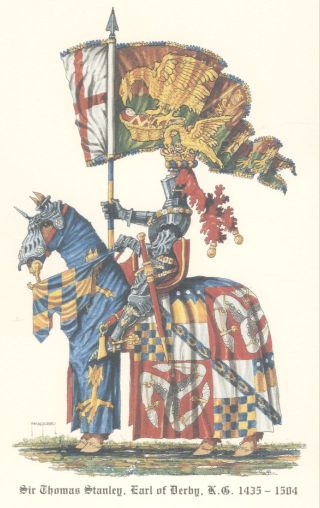
319. Thomas Stanley, 1st Earl of Derby 432 438 439 (Joan Goushill297, Elizabeth FitzAlan, d'Arundelle265, Elizabeth de Bohun, Countess of Arundel224, Sir William de Bohun, K.G., 1st Earl of Northampton179, Elizabeth, of Rhuddlan, Princess of England134, King Edward I, of England97, King Henry III, of England71, King John "Lackland", of England54, Henry II "Curtmantel", King of England42, Empress Matilda, Countess of Anjou24, Matilda, of Scotland12, Saint Margaret, of Scotland7, Agatha5, Yaroslav I, of Kiev4, Vladimir I, of Kiev3, Sviatoslav I, of Kiev2, Igor, Grand Prince of Kiev1) was born in 1435 and died on 29 Jul 1504 in Lathom (Latham), Ormskirk, Lancashire, England at age 69.
Research Notes: Stepfather to King Henry VII of England.
Wikipedia (Thomas Stanley, 1st Earl of Derby), Thomas Stanley, 1st Earl of Derby was a maternal ancestor of John Lennon.
----------------
From http://stanleyroots.co.uk/thenorthwest.htm :
"Since 1200 the Stanleys had become important landowners and administrators in north-west England (especially Cheshire and Lancashire), and in 1485 the two brothers Sir Thomas Stanley and Sir William Stanley played a decisive role in winning the Battle of Bosworth for Henry Tudor and therefore in establishing the Tudor dynasty - a feat for which Thomas was created 1st Earl of Derby in 1485. Thereafter, the Earls of Derby were a prominent political force in north-west England for the next four centuries, with the 14th earl becoming Prime Minister three times, in 1852, 1858 and 1866...
"Sir Thomas was 2nd Baron Stanley (his father had been created 1st Baron in 1456), so he is also referred to as Lord Stanley before his creation as Earl of Derby in 1485.
"There had been earlier Earls of Derby (from other families) from 1138 to 1266 and 1337 to 1399, whose title was based on Derby in Derbyshire. Thomas Stanley's title in 1485 therefore had the ring of antiquity, but was based not on Derby but on West Derby, near to the family's estates at Lathom and Knowsley in Lancashire. Lathom House near Ormskirk (Lancashire)(SD4609) was the family's main residence from around 1400 until 1644, when it was largely destroyed by Sir Thomas Fairfax and his Parliamentary forces after a four-month siege during the English Civil War (the Stanleys of Lancashire were Royalists and had been holding out against the dominant Parliamentary forces)."
From Volume 11 of Manx Note Book - http://www.isle-of-man.com/manxnotebook/manxnb/v11p101.htm
THOMAS II. AFTERWARDS THE FIRST EARL OF DERBY, ELDEST SON OF THOMAS I., BARON STANLEY, BY HIS WIFE JOAN, ONLY DAUGHTER AND HEIRESS OF SIR ROBERT GOUSHILL, succeeded his father in 1460. He was summoned to Parliament in the first year of Edward IV. (1461), and in 1472 he was made Judge of Chester. In the Civil war he did good service for the Yorkist cause, his most conspicuous feat being the taking of Berwick by assault. During the greater part of his reign he was steward of the Royal Household, and, having been one of Edward's most devoted adherents, he naturally transferred his allegiance to his son Edward the fifth. When Edward the fourth died, Richard Duke of Gloucester, who was plotting to supplant his nephew on the throne, saw that Stanley would be one of the chief obstacles in his way, and so he contrived to get rid of him by having him arrested on a charge of treason.
When, however, he had succeeded in ascending the throne, he decided that his best policy would be, if possible, to purchase Lord Stanley's allegiance, which he endeavoured to accomplish by making him Constable of England for life and conferring upon him the Order of the Garter. It is well known that this scheme failed and that Lord Stanley largely contributed to Richmond's success at the battle of Bosworth field, after which he is said to have placed the dead Richard's crown on his head,* and to have proclaimed him king as Henry VII. The new king shortly afterwards created him Earl of Derby, and constituted him one of the Lord's Commissioners for executing the office of Lord High Steward at his coronation. In 1486 he was made Constable of England for life. In 1487 he was one of the godfathers of Prince Arthur, Henry VII.'s eldest son.
He took a prominent part in arranging the treaty of Etaples between England and France in 1492. It would seem that he used his wealth nobly, both in relieving the burdens of his people and in promoting public works such as the bridges at Garstang and Warrington, for their welfare. He was the builder of Latham House which became famous through its defence by the 7th Earl's noble consort 150 years later.
Lord Stanley married, firstly, Eleanor 4th daughter of Richard Nevill, Earl of Salisbury, and sister to the Earl of Warwick, the famous " king-maker, " and secondly, Margaret, daughter of the Duke of Somerset and Dowager-Duchess of Richmond, who was King Henry VII.'s mother. By his first wife he had issue 6 sons and 4. daughters, by his second, there was no issue. He died in 1504. It does not appear that he ever visited the Isle of Man, and during his reign the Statute book is a blank.
*It is not certain whether the crown was placed on Henry's head by Lord Stanley or by his brother Sir William Stanley
Noted events in his life were:
• Battle: of Bosworth Field, 1485.
• Created: 1st Earl of Derby, 1485. by Henry Tudor
• Summoned: to Parliament, 1461. in the first year of Edward IV.
• Made: Judge of Chester, 1472.
• Made: Constable of England for life, 1486.
Thomas married Eleanor Neville,406 462 daughter of Richard Neville, Earl of Salisbury and Alice Montagu, Countess of Salisbury, in 1459. Eleanor was born before 1447 and died before Nov 1482.
Research Notes: 4th daughter of Richard Nevill, Earl of Salisbury.
From Manx Note Book Volume 11 http://www.isle-of-man.com/manxnotebook/manxnb/v11p101.htm
Lord Stanley married, firstly, Eleanor 4th daughter of Richard Nevill, Earl of Salisbury, and sister to the Earl of Warwick, the famous " king-maker, " and secondly, Margaret, daughter of the Duke of Somerset and Dowager-Duchess of Richmond, who was King Henry VII.'s mother. By his first wife he had issue 6 sons and 4. daughters, by his second, there was no issue. He died in 1504. It does not appear that he ever visited the Isle of Man, and during his reign the Statute book is a blank.
Children from this marriage were:
+ 358 M i. Sir George Stanley, 9th Lord Strange of Knockyn 463 was born about 1460 in Knowsley, Lancashire, England, died on 5 Dec 1503 in Derby House, St Paul's Wharf, London, England about age 43, and was buried in Church of St James Garlickhythe, London, England.
+ 359 M ii. Edward Stanley
Thomas next married Lady Margaret Beaufort.464
Research Notes: From Wikipedia - Lady Margaret Beaufort :
"Henry [VII] derived his claim to the English throne from his mother Margaret, and England did not bar women from inheriting the kingship, it is arguably she and not her son who should have claimed the crown. Margaret did not contest Henry's right to rule; however, she occasionally used the signature Margaret R, a form limited to queens regnant . (See discussion below.)
Margaret was twelve when she married Edmund on 1 November 1455 . Edmund died the following November, leaving a thirteen year old widow who was seven months pregnant with their child, Henry. Margaret and her son retired to Pembroke when the wars between Lancaster and York broke out and remained there until the Yorkist triumphs of 1461. The readeption of 1470 saw her return to court but her son fled to Brittany with his uncle, Jasper Tudor .[1]
Margaret was to marry twice more after Edmund's death:
She had no children with either, and it has been suggested by historians that the birth of her son Henry when she was only thirteen years old was difficult enough to render her infertile.
[edit ] The King's Mother
Margaret was instrumental in secretly conspiring against King Richard III with the Dowager Queen Consort, Elizabeth Woodville , whose sons, the Princes in the Tower , were presumed murdered. They were aided by the fact that Margaret's third husband, Thomas Stanley, had switched sides because Richard III held captive his eldest son, George Stanley (styled Lord Strange by marriage to the female holder of that hereditary lordship). George was Thomas Stanley's son by his first wife, Eleanor Neville, whose brother, Richard Neville was very active in the Wars of the Roses. Margaret was Thomas Stanley's second wife.
At the end of the Battle of Bosworth Field in 1485, it was Thomas Stanley who placed the crown on his stepson's - Henry VII's - head. Stanley was later made Earl of Derby, which made Margaret Countess of Derby, but she was styled "The Countess of Richmond and Derby."
With her son winning the crown at Bosworth Field, Margaret was now referred to in court as "My Lady the King's Mother." However, Margaret was reluctant to accept a lower status than the dowager queen consort Elizabeth Woodville or even her daughter-in-law, Elizabeth of York , the current queen consort . She wore robes of the same quality as the queen consort and walked only half a pace behind her.
Margaret sometimes signed herself Margaret R, the form of signature used by English queens regnant to indicate the title "Regina," the feminine form of "Rex." This referenced Margaret's own potential claim to the English throne, which would have had precedence over her son's claim, though she never asserted it. Had she successfully done so, she would have been a queen regnant - ruling in her own right, not through marriage - and entitled her to sign documents with the suffix "Regina." (See "Marriages" above for more on Margaret's own right to the English throne.)
Many historians believe the banishment of Woodville in 1487 by Henry VII of England was partly at the behest of his influential mother. Margaret was known for her education and her piety, and her son is said to have been devoted to her."
320. Sir William Stanley, of Holt, K.G. 432 439 440 441 442 (Joan Goushill297, Elizabeth FitzAlan, d'Arundelle265, Elizabeth de Bohun, Countess of Arundel224, Sir William de Bohun, K.G., 1st Earl of Northampton179, Elizabeth, of Rhuddlan, Princess of England134, King Edward I, of England97, King Henry III, of England71, King John "Lackland", of England54, Henry II "Curtmantel", King of England42, Empress Matilda, Countess of Anjou24, Matilda, of Scotland12, Saint Margaret, of Scotland7, Agatha5, Yaroslav I, of Kiev4, Vladimir I, of Kiev3, Sviatoslav I, of Kiev2, Igor, Grand Prince of Kiev1) was born about 1435 in Lathom, Ormskirk, Lancashire, England and died on 16 Feb 1495 about age 60.
Death Notes: Executed on Tower Hill, 16 February 1494/5.
Per Wikipedia, beheaded for an alleged share in the Perkin Warbeck conspiracy in 1495.
Per Reifsnyder-Gilliam Ancestry, beheaded in 1494.
Research Notes: Knight of the Garter 1487. Beheaded for an alleged share in the Perkin Warbeck conspiracy in 1495.
Sir William Stanley ( ? - 1495) was the younger brother of Thomas Stanley, 1st Earl of Derby . Stanley fought with his troops in several battles of the Wars of the Roses .
--------
From Wikipedia - William Stanley :
"He is best known for actions in the Battle of Bosworth Field , where he changed sides, securing Henry VII's victory and crown.After the Battle of Tewkesbury, it was he who captured Queen Margaret(Margaret of Anjou ). For his intervention, the new king bestowed many favors on him. However, in 1495 Stanley was convicted of treason and executed for his support of the pretender Perkin Warbeck .He readily admitted to the crime as he thought that through a full confession he would escape execution. Indeed the King might have granted this, partly through mercy and partly to avoid upsetting Thomas Earl of Derby. However, the King feared that by doing this he would be putting himself in danger by encouraging others to undertake a similar act of folly. William was condemned and a few days later beheaded."
------
From http://stanleyroots.co.uk/thenorthwest.htm :
Since 1200 the Stanleys had become important landowners and administrators in north-west England (especially Cheshire and Lancashire), and in 1485 the two brothers Sir Thomas Stanley and Sir William Stanley played a decisive role in winning the Battle of Bosworth for Henry Tudor and therefore in establishing the Tudor dynasty - a feat for which Thomas was created 1st Earl of Derby in 1485. Thereafter, the Earls of Derby were a prominent political force in north-west England for the next four centuries, with the 14th earl becoming Prime Minister three times, in 1852, 1858 and 1866.
------
From Archæologia Cambrensis, Vol. VII, 6th Series, 1907, p. 18:
"On the fourth day of the Parliament of 17 Edward IV (1477), it was declared that Richard, the King's second son, was to be Duke of York and Norfolk, Earl Marshal, Warrenne, and Nottingham, and to marry Anne, daughter and heir to John late Duke of Norfolk, the said Anne being then but six years old; and if she should die without issue, the said Richard, Duke of Norfolk, should have, by consent of Elizabeth, Duchess of Norfolk (widow of the said John, Duke of Norfolk), 'for the terme of his life, the halvendale (that is, the moiety) of the Castell, Towne, Lordship and Maners of Dynesbran [of the] Castell, Lordshipp, and Towne of Lyons [and of] the Lordship, Maners, and Londes of Heulyngton, Bromefield, Yale, Wraxham, and Almore, with their appurtenaunces, in the Marche of Wales,' etc.
"This Richard, Duke of York, was one of the two young princes afterwards murdered in the Tower. His marriage was never consummated, and one of the above-named moieties, or 'halvendales,' of Bromfield and Yale became vested in the Crown. At a date which I cannot specify with precision, the other moiety--that of the Nevilles--became vested in the Crown also.
"Certain it is that on the 10th December, 1484, the whole of Bromfield and Yale, 'late of John, Duke of Norfolk, and Sir George Neville, knight,' was granted by Richard III to Sir William Stanley (see the grant set out in Arch. Camb., 1882, pp. 150 and 151). Nevertheless, in the fourth year of Henry VII (1488), Sir William Stanley only petitioned to continue to enjoy what was practically the moiety of the lordship, although he seems to have been allowed to retain the whole."
-------------
From Archæologia Cambrensis, 1907, p. 22 :
"This splendid knight, as is well known, decided the issue of the battle of Bosworth, placing the crown upon the head of Henry, Earl of Richmond, and practically making him Henry VII of England. Many of his followers, or brothers-in-arms, were doubtless men from this neighbourhood. John ap Elis Eyton, whose tomb still stands in Ruabon church, was certainly at Bosworth. The Chevalier Lloyd and others assert that the new king granted Bromfield, Yale, and Chirland, to Sir William for his achievement, or (must we say?) treachery at the famous battle above-names; but the knight of Holt had, as we have seen, Bromfield and Yale, at any rate, before. He enriched Holt Castle, it is said, with the spoils of Bosworth field; but, however that may be, he was one of the richest subjects in the kingdom, and thus excited the envy and suspicion of the King, whose meanness saw in the splendour of Sir William a pretext for getting rid of one to whom he stood under such inconvenient obligations; so he was charged with being in active sympathy with Perkin Warbeck, was convicted, and executed on Tower Hill, 16th February, 1494/5, all his possessions escheating to the king...
"The arms borne by Sir William Stanley, of Holt, were these:--1, argent, on a bend azure, three bucks' heads caboshed or (Stanley); 2 or on a chief indented azure, three plates (Lathom); barry of six or and azure, a canton ermine (Goushill); and 4 gules, a lion rampant or (Fitzalan)."
-----------
From http://www.thornber.net/cheshire/htmlfiles/aldford.html (by Craig Thornber) :
Sir William Stanley of Holt in Denbighshire was the second son of Thomas the 1st Baron Stanley (1405-59). His elder brother was Thomas (1432-1504) who became the 2nd Baron Stanley and then the 1st Earl of Derby in 1485. Sir William supported the house of York in the Battle of Blore Heath in 1459. In 1461, Edward IV made Sir William Stanley the Chamberlain of Chester and Sheriff of Flintshire. He fought for the Yorkists at Hexham in 1466 and was given the Lordship and Castle of Skipton in Yorkshire which he subsequently exchanged for Chirk. He obtained additional land following the battle of Towton. After the battle of Tewkesbury in 1471 he took the news to Queen Margaret of her son's death and then took her to Coventry.
Edward IV's successor, Richard III, courted Sir William's support by various grants of manors and by appointing him Chief Justice for North Wales and Chief Commissioner for Shropshire. Sir William was suspicious of Richard because of the disappearance of the two princes and changed his allegiance to Henry Tudor. At the Battle of Bosworth Field, Sir William Stanley rescued Henry Tudor at a critical moment in the battle, struck down the King and is said to have found his crown in a thorn bush. He handed the crown to his elder brother Thomas who put it on the head of Henry Tudor. Henry VII appointed Sir William Stanley the Lord Chamberlain and Knight of the Garter and granted him additional lands that made him the richest commoner in England. Sir William's wealth and power inevitably attracted enemies and he was disappointed that his services had not led to a peerage. In 1489 he became Constable of Caernarvon and Beaumaris, and in 1490 Henry VII gave him the Lordships of Bromfield, Chirk and the castles of Dinas Bran, Holt and Chirk in confirmation of earlier grants of the latter two by Richard III.
Sir William as Lord Chancellor was arbitrator in the dispute between Sir John Stanley of Elford and his half-brother Sir Humphrey, mentioned above. He then bought the manors of Aldford and Nether Alderley in Cheshire from Sir John. Sir William was arrested and imprisoned in the Tower of London in 1494, on suspicion of being involved in the rebellion of Perkin Warbeck, who claimed to be the younger of the "princes in the tower" and therefore heir to Edward IV. At that time it was not known that the sons of Edward IV had both been murdered. Although Sir William had helped put Henry VII on the throne he was known to have been a strong supporter of Edward IV. He was quoted as saying that if Perkin Warbeck was the son of Edward IV he would not fight against him. This, and his unwillingness to confirm or deny his guilt, was sufficient to see him executed at the Tower on 16 February 1495. Below we look briefly at Sir William's heirs as they involve some other well-known families in Cheshire as indicated in the emboldening in the chart below.
Sources:
An Introduction to Aldford and Its Church, a pamphlet available in the church for 25 pence in 2002.
The History of the County Palatine and City of Chester, incorporated with a republication of King's Vale Royal and Leycester's Cheshire Antiquities, 2nd Ed., revised and enlarged by Thomas Helsby, Esq., published by George Routledge and sons, Ludgate Hill, London, 1882. This is now available from the Family History Society of Cheshire on CD ROM. A reprint of the work was published by Eric Morten of Didsbury.
The House of Stanley from the 12th Century, by Peter Edmund Stanley, published by Pentland Press in 1998.
Noted events in his life were:
• Steward: to household of the Prince of Wales [Edward V], 1473.
• Lord of Ridley, Cheshire:
• Chamberlain of Chester:
• Constable of North Wales:
• Appointed: Chief Justice of North Wales by Richard III, 12 Nov 1483.
• Granted: the whole of Bromfield and Yale by Richard III, 10 Dec 1484.
• Battle: of Bosworth Field, 1485.
William married Joan Beaumont 465 before 1466. Joan died in Aug 1466.
William next married Elizabeth Hopton,466 467 daughter of Sir Thomas Hopton, of Hopton and Unknown, in 1471 in <Moreton Corbet, Shropshire>, England. Elizabeth was born about 1427 in Hopton Castle, Shropshire, England and died on 22 Jun 1498 about age 71.
Marriage Notes: According to http://wc.rootsweb.ancestry.com/cgi-bin/igm.cgi?op=GET&db=:3143362&id=I653270083, they were married before 1463.
Research Notes: Second wife of Sir William Stanley of Holt.
Children from this marriage were:
+ 360 F i. Jane Stanley 468 was born about 1463 in Holt Castle, Cheshire (Wrexham), Wales and died about 1525 about age 62.
+ 361 M ii. William Stanley 465 467 was born about 1472 in Holt Castle, Cheshire (Wrexham), Wales and died in 1498 about age 26.
+ 362 F iii. Catherine Stanley .465
321. Sir John Stanley, of Weever, Cheshire 432 433 (Joan Goushill297, Elizabeth FitzAlan, d'Arundelle265, Elizabeth de Bohun, Countess of Arundel224, Sir William de Bohun, K.G., 1st Earl of Northampton179, Elizabeth, of Rhuddlan, Princess of England134, King Edward I, of England97, King Henry III, of England71, King John "Lackland", of England54, Henry II "Curtmantel", King of England42, Empress Matilda, Countess of Anjou24, Matilda, of Scotland12, Saint Margaret, of Scotland7, Agatha5, Yaroslav I, of Kiev4, Vladimir I, of Kiev3, Sviatoslav I, of Kiev2, Igor, Grand Prince of Kiev1).
Research Notes:
322. James Stanley, Archdeacon of Chester (Joan Goushill297, Elizabeth FitzAlan, d'Arundelle265, Elizabeth de Bohun, Countess of Arundel224, Sir William de Bohun, K.G., 1st Earl of Northampton179, Elizabeth, of Rhuddlan, Princess of England134, King Edward I, of England97, King Henry III, of England71, King John "Lackland", of England54, Henry II "Curtmantel", King of England42, Empress Matilda, Countess of Anjou24, Matilda, of Scotland12, Saint Margaret, of Scotland7, Agatha5, Yaroslav I, of Kiev4, Vladimir I, of Kiev3, Sviatoslav I, of Kiev2, Igor, Grand Prince of Kiev1).
Research Notes: Source: Reifsnyder-Gillam Ancestry, edited by Thomas Allen Glenn (Philadelphia, 1902), provided by books.google.com, p. 53.
323. Katherine Stanley 400 432 (Joan Goushill297, Elizabeth FitzAlan, d'Arundelle265, Elizabeth de Bohun, Countess of Arundel224, Sir William de Bohun, K.G., 1st Earl of Northampton179, Elizabeth, of Rhuddlan, Princess of England134, King Edward I, of England97, King Henry III, of England71, King John "Lackland", of England54, Henry II "Curtmantel", King of England42, Empress Matilda, Countess of Anjou24, Matilda, of Scotland12, Saint Margaret, of Scotland7, Agatha5, Yaroslav I, of Kiev4, Vladimir I, of Kiev3, Sviatoslav I, of Kiev2, Igor, Grand Prince of Kiev1).
Research Notes: From Wikipedia - Joan Gousell :
Katherine Stanley married Sir John Savage of Clifton, England. Sir John Savage was the commander of the left wing of Henry Tudor's army at Bosworth.
Katherine married Sir John Savage.
Research Notes: Source: Reifsnyder-Gillam Ancestry, edited by Thomas Allen Glenn (Philadelphia, 1902), provided by books.google.com, p. 53.
Was he the brother of Mary Savage?
324. Humphrey Audley, 5th Baron Audley (Eleanor de Holland300, Constance, of York270, Edmund, of Langley, 1st Duke of York225, Edward III, King of England182, King Edward II, of England135, King Edward I, of England97, King Henry III, of England71, King John "Lackland", of England54, Henry II "Curtmantel", King of England42, Empress Matilda, Countess of Anjou24, Matilda, of Scotland12, Saint Margaret, of Scotland7, Agatha5, Yaroslav I, of Kiev4, Vladimir I, of Kiev3, Sviatoslav I, of Kiev2, Igor, Grand Prince of Kiev1) was born after 1430 and died on 6 May 1471.
Research Notes: Source: Wikipedia (Eleanor de Holland)
325. Edmund Touchett, Bishop of Salisbury (Eleanor de Holland300, Constance, of York270, Edmund, of Langley, 1st Duke of York225, Edward III, King of England182, King Edward II, of England135, King Edward I, of England97, King Henry III, of England71, King John "Lackland", of England54, Henry II "Curtmantel", King of England42, Empress Matilda, Countess of Anjou24, Matilda, of Scotland12, Saint Margaret, of Scotland7, Agatha5, Yaroslav I, of Kiev4, Vladimir I, of Kiev3, Sviatoslav I, of Kiev2, Igor, Grand Prince of Kiev1) was born about 1432 and died on 23 Aug 1524 about age 92. Another name for Edmund was Edmund Audley.
Research Notes: Catholic.
From Wikipedia - Edmund Audley :
Edmund Touchet or Touchett, also Edmund Audley (died 1524), was Bishop of Rochester , Bishop of Hereford and Bishop of Salisbury .
Life
He graduated B.A. in 1463 at University College, Oxford . He was nominated to the bishop of Rochester on July 7 , 1480 , and consecrated on October 1 , 1480 .[1] He was then translated to be bishop of Hereford on June 22 , 1492 .[2][3] He was then translated to become bishop of Salisbury on January 10 , 1502 .[4][5][6] He died on August 23 , 1524 .[4]
He was the son of Eleanor Holand [7]. He is buried in a chapel of Salisbury Cathedral [8].
326. Thomas Touchett (Eleanor de Holland300, Constance, of York270, Edmund, of Langley, 1st Duke of York225, Edward III, King of England182, King Edward II, of England135, King Edward I, of England97, King Henry III, of England71, King John "Lackland", of England54, Henry II "Curtmantel", King of England42, Empress Matilda, Countess of Anjou24, Matilda, of Scotland12, Saint Margaret, of Scotland7, Agatha5, Yaroslav I, of Kiev4, Vladimir I, of Kiev3, Sviatoslav I, of Kiev2, Igor, Grand Prince of Kiev1) was born about 1435 and died in Jun 1507 about age 72.
Research Notes: Source: Wikipedia (Eleanor de Holland)
327. Henry Touchett (Eleanor de Holland300, Constance, of York270, Edmund, of Langley, 1st Duke of York225, Edward III, King of England182, King Edward II, of England135, King Edward I, of England97, King Henry III, of England71, King John "Lackland", of England54, Henry II "Curtmantel", King of England42, Empress Matilda, Countess of Anjou24, Matilda, of Scotland12, Saint Margaret, of Scotland7, Agatha5, Yaroslav I, of Kiev4, Vladimir I, of Kiev3, Sviatoslav I, of Kiev2, Igor, Grand Prince of Kiev1) was born about 1437.
Research Notes: Source: Wikipedia (Eleanor de Holland)
328. Margaret Touchett (Eleanor de Holland300, Constance, of York270, Edmund, of Langley, 1st Duke of York225, Edward III, King of England182, King Edward II, of England135, King Edward I, of England97, King Henry III, of England71, King John "Lackland", of England54, Henry II "Curtmantel", King of England42, Empress Matilda, Countess of Anjou24, Matilda, of Scotland12, Saint Margaret, of Scotland7, Agatha5, Yaroslav I, of Kiev4, Vladimir I, of Kiev3, Sviatoslav I, of Kiev2, Igor, Grand Prince of Kiev1) was born about 1438 and died before 2 Feb 1481.
Research Notes: Source: Wikipedia (Eleanor de Holland)
329. Anne Touchett (Eleanor de Holland300, Constance, of York270, Edmund, of Langley, 1st Duke of York225, Edward III, King of England182, King Edward II, of England135, King Edward I, of England97, King Henry III, of England71, King John "Lackland", of England54, Henry II "Curtmantel", King of England42, Empress Matilda, Countess of Anjou24, Matilda, of Scotland12, Saint Margaret, of Scotland7, Agatha5, Yaroslav I, of Kiev4, Vladimir I, of Kiev3, Sviatoslav I, of Kiev2, Igor, Grand Prince of Kiev1) was born about 1440.
Research Notes: Source: Wikipedia (Eleanor de Holland)
330. Constance Touchet 277 445 446 (Eleanor de Holland300, Constance, of York270, Edmund, of Langley, 1st Duke of York225, Edward III, King of England182, King Edward II, of England135, King Edward I, of England97, King Henry III, of England71, King John "Lackland", of England54, Henry II "Curtmantel", King of England42, Empress Matilda, Countess of Anjou24, Matilda, of Scotland12, Saint Margaret, of Scotland7, Agatha5, Yaroslav I, of Kiev4, Vladimir I, of Kiev3, Sviatoslav I, of Kiev2, Igor, Grand Prince of Kiev1) was born about 1443 in Heleigh, Staffordshire, England. Other names for Constance were Constance Touchett and Constance Tuchet.
Constance married Sir Robert Whitney,277 446 son of Eustace Whitney and Jennet Russell, about 1460. Robert was born about 1436 in Whitney, Herefordshire, England and died after 1473 in Whitney, Herefordshire, England. Other names for Robert were Robert [V] de Whitney and Sir Robert [V] Whyteney Lord of Whyteney.
Research Notes: According to www.whitneygen.org/archives/biography/rmnixon.html, President Richard Milhous Nixon was a descendant of John Puleston (1485-1523) and Eleanor Whitney (1467-).
Children from this marriage were:
+ 363 M i. James Whitney was born in 1465.
+ 364 F ii. Eleanor Whitney 469 470 471 472 was born about 1467 in Whitney, Herefordshire, England.
+ 365 F iii. Joan Whitney was born in 1469.
331. John ap Edward ap David, of Brynkynallt, co. Denbigh (Angharad Puleston303, Lowry Fychan verch Gruffydd Fychan277, Elen verch Thomas ap Llewellyn Owen234, Eleanor ferch Philip ap Ifor194, Catherine verch Llewellyn Gryffyth141, Elinor de Montfort102, Eleanor75, King John "Lackland", of England54, Henry II "Curtmantel", King of England42, Empress Matilda, Countess of Anjou24, Matilda, of Scotland12, Saint Margaret, of Scotland7, Agatha5, Yaroslav I, of Kiev4, Vladimir I, of Kiev3, Sviatoslav I, of Kiev2, Igor, Grand Prince of Kiev1)
John married Agnes Cambre, of Poole.
332. Richard-Trevor ap Edward ap David (Angharad Puleston303, Lowry Fychan verch Gruffydd Fychan277, Elen verch Thomas ap Llewellyn Owen234, Eleanor ferch Philip ap Ifor194, Catherine verch Llewellyn Gryffyth141, Elinor de Montfort102, Eleanor75, King John "Lackland", of England54, Henry II "Curtmantel", King of England42, Empress Matilda, Countess of Anjou24, Matilda, of Scotland12, Saint Margaret, of Scotland7, Agatha5, Yaroslav I, of Kiev4, Vladimir I, of Kiev3, Sviatoslav I, of Kiev2, Igor, Grand Prince of Kiev1)
333. Rose Trevor ferch Edwart ap Daffyd (Angharad Puleston303, Lowry Fychan verch Gruffydd Fychan277, Elen verch Thomas ap Llewellyn Owen234, Eleanor ferch Philip ap Ifor194, Catherine verch Llewellyn Gryffyth141, Elinor de Montfort102, Eleanor75, King John "Lackland", of England54, Henry II "Curtmantel", King of England42, Empress Matilda, Countess of Anjou24, Matilda, of Scotland12, Saint Margaret, of Scotland7, Agatha5, Yaroslav I, of Kiev4, Vladimir I, of Kiev3, Sviatoslav I, of Kiev2, Igor, Grand Prince of Kiev1).
Research Notes: Source: Ancestral Roots of Certain American Colonists Who Came to America before 1700 by Frederick Lewis Weis and Walter Lee Sheppard, Jr, ed. by William R. Beall & Kaleen E. Beall (Baltimore, 2008), line 249-37
Rose married Otewell Worsley, of Calais about 1435. Otewell was born about 1435 and died on 24 Mar 1470 about age 35.
Research Notes: Source: Ancestral Roots of Certain American Colonists Who Came to America before 1700 by Frederick Lewis Weis and Walter Lee Sheppard, Jr, ed. by William R. Beall & Kaleen E. Beall (Baltimore, 2008), line 249-37 (Rose Trevor ferch Edwart ap Daffyd)
334. Sir Roger Puleston, of Emral (John Puleston, Esq., of Emral304, Lowry Fychan verch Gruffydd Fychan277, Elen verch Thomas ap Llewellyn Owen234, Eleanor ferch Philip ap Ifor194, Catherine verch Llewellyn Gryffyth141, Elinor de Montfort102, Eleanor75, King John "Lackland", of England54, Henry II "Curtmantel", King of England42, Empress Matilda, Countess of Anjou24, Matilda, of Scotland12, Saint Margaret, of Scotland7, Agatha5, Yaroslav I, of Kiev4, Vladimir I, of Kiev3, Sviatoslav I, of Kiev2, Igor, Grand Prince of Kiev1) was born about 1426 and died on 4 Oct 1489 about age 63.
Death Notes: Death date needs confirmation.
Welsh Biography Online (http://yba.llgc.org.uk/en/s-PULE-EST-1283.html) has d. 1469, but there are typos in that website and this could be in error.
Research Notes: Source: Archaeologia Cambrensis, The Journal of the Cambrian Archaeological Association, Vol. VII. 5th Series (London, 1890), p. 124.
Also RootsWeb - Celtic Royal Genealogy
Source: Annals and Antiquities of the Counties and County Families of Wales by Thomas Nicholas, Vol. I, (London, 1872), p. 455
Noted events in his life were:
• Deputy-Constable: to Jasper, Earl of Pembroke, Betw 1460 and 1461, Denbigh Castle, Denbighshire, Wales.
Roger married Janet Bulkeley, daughter of Thomas Bulkeley, Esq., of Eaton and Unknown, in 1468. Another name for Janet was Jonet Bulkeley.
Research Notes: 2nd wife of Sir Roger Puleston
RootsWeb - Celtic Royal Genealogy
There is a Jonet Bulkeley who married Hugh Llewelyn - parents of Alice Lewis, who married John Puleston of Hafod y Wern (b. abt 1450). Is this the same person?
Source: Archaeologia Cambrensis, The Journal of the Cambrian Archaeological Association, Vol. VII. 5th Series (London, 1890), p. 124 has "Janet, daughter of Thomas Bulkeley, Esq."
Annals and Antiquities of the Counties and County Families of Wales by Thomas Nicholas, Vol. I, (London, 1872), p. 455, "Janet, dau. and h. of Thomas Bulkeley, Esq., of Eaton, whose marriage settlement is dated 1468 (note on Dwnn), and had issue by her, besides three sons, John, Philip, Thomas, who all d. s. p., a 4th son--Sir Roger Puleston, Kt., of Emral"
Children from this marriage were:
+ 366 M i. Sir Roger Puleston, of Emral was born about 1470 and died 18 Jan 1544 or 1545 about age 74.
+ 367 M ii. Thomas Puleston .
+ 368 M iii. Philip Puleston .
+ 369 M iv. John Puleston .
335. John Puleston, of Bers and Hafod y Wern 318 389 (Madog Puleston, of Bers305, Lowry Fychan verch Gruffydd Fychan277, Elen verch Thomas ap Llewellyn Owen234, Eleanor ferch Philip ap Ifor194, Catherine verch Llewellyn Gryffyth141, Elinor de Montfort102, Eleanor75, King John "Lackland", of England54, Henry II "Curtmantel", King of England42, Empress Matilda, Countess of Anjou24, Matilda, of Scotland12, Saint Margaret, of Scotland7, Agatha5, Yaroslav I, of Kiev4, Vladimir I, of Kiev3, Sviatoslav I, of Kiev2, Igor, Grand Prince of Kiev1) was born circa 1425 in Hafod-y-Wern, Berse (Bersham), (Wrexham, Denbighshire), Wales and died in 1461 at age 36. Other names for John were John Puleston of Plas-ym-mers and John ap Madog Puleston of Bers and Havod-y-wern.
Birth Notes: Sources differ in birthdate from abt 1425 to abt 1438. This source http://wc.rootsweb.ancestry.com/cgi-bin/igm.cgi?op=GET&db=youngwolf&id=I783 has b. abt 1438, with his father (Madoc Puleston) b. abt 1414. The 1414 date for Madoc is probably too late (see Madog Puleston).
Research Notes: Eldest son of Madog Puleston.
Source: http://www.varrall.net/pafg56.htm#1141.
Wikipedia (List of baronetcies in the Baronetage of the United Kingdom) has:
Title: Puleston of Emral created 1813 surname: Puleston extinct 1896
Source: The History of the Princes, the Lords Marcher, and the Ancient Nobility of Powys Fadog, and the Ancient Lords of Arwystli, Cedewen, and Meirionydd by J. Y. W. Lloyd, Vol. II (London, 1882) has from Cae Cyriog M.S.; Lewys Dwnn, vol ii: "John Puleston of Bers and Havod y Wern, son of Madog of Bers, 2nd son of Robert Puleston of Emrall, ab Richard ab Sir Roger Puleston. Argent on a bend sable, three mullets of the field for Madog Puleston."
The following has been disputed:
From Annals and Antiquities of the Counties and County Families of Wales by Thomas Nicholas, Vol. I, London, 1872, p. 455:
"Sir John, the first son [of Madog Puleston], m. Angharad, dau. and h. of Gruffydd Hanmer, Esq., of Hanmer, Flintshire, and had issue, besides Catherine, who d. s. p., a son,--Sir Roger Puleston..."
---------
From Welsh Biography Online (http://yba.llgc.org.uk/en/s-PULE-EST-1283.html) :
"(2) Before the middle of the 15th cent. a branch of the family had settled at Berse, near Wrexham, and by the end of that century Hafod-y-wern, in the same area, had come into possession of the Pulestons through the marriage of JOHN PULESTON of Plas-ym-mers, a grandson of the Robert and Lowry, previously mentioned, and Alswn, daughter and heiress of Hywel ap Ieuan ap Gruffydd of Hafod-y-wern. JOHN PULESTON ('HEN'), of Hafod-y-wern, the eldest son of this John Puleston, fought at Bosworth, and for his services on that occasion received a grant for life from Henry VII of an annuity of twenty marks out of the tithes of the lordship of Denbigh (6th Report Royal Commission on Historical MSS., 421), and was appointed a gentleman usher of the king's chamber. In 1502 he was made deputy-lieutenant to the chief steward of Bromfield and Yale (ibid.), and seven years later, in 1509, Henry VIII granted him the receivership of the town of Ruthin and the lordship of Dyffryn Clwyd (Cal. L. & P. Henry VIII, i, 1, 67), and in 1519 that of the lordship of Denbigh and Denbighland (ibid., iii, 1, 146). Like his kinsman, Sir Roger Puleston, he served in the French campaign of 1513, as also did his two sons, both named John, the one by his first, and the other by his second marriage. JOHN PULESTON, of Hafod-y-wern ('John Puleston of Tir Môn,' as he is sometimes described), son of John Puleston ('Hen') by his second wife, Alice, daughter of Hugh Lewis of Presaddfed, was sheriff of Denbighshire, 1543-4. During the latter years of Elizabeth I, two of these Pulestons were presented for recusancy at the Denbighshire Great Sessions: EDWARD PULESTON, of Hafod-y-wern, in 1585, 1588, and 1592, and Anne, wife of JOHN PULESTON, of Berse, in 1587. The last of the Hafod-y-wern family was Frances, daughter of PHILIP PULESTON (d. 1776); she m., in 1786, Bryan Cooke, of Ouston, Yorks (see Davies-Cooke, Gwysaney ). "
John married Alswn Fychan ferch Hywel ap Ieuan, of Havod y Wern, Bersham, Co. Denbigh,318 473 474 475 daughter of Hywel ap Ieuan ap Gruffudd, of Bersham and Alswn ferch Hywel ap Gronwy, of Hafod-y-Wern, about 1461. Alswn died in <Hafod-y-Wern, (Bersham, Wrexham, Denbighshire), Wales>. Other names for Alswn were Alswn Vechan verch Howel ap Evan of Bersham, Co. Denbigh, Alson verch Howel ap Ieuan of Havod y Wern, Alician Vychan verch Howell, Alsion verch Howell ap Ievan of Hafod-y-Wern, and Alswn "Fechan" ferch Hywel.
Research Notes: Heiress of Hafod-y-Wern.
From History of the Town of Wrexham, pp. 137-138:
"Hywel ap Goronwy ... left two daughters, of whom Alswn (the Welsh form of Alice) had Hafod y wern for her portion, and married Hywel ap Ieuan ap Gruffydd, of Bersham (living in 1467), by whom she had one daughter, Alswn, sole heiress of Hafod y wern, who married John Puleston, Esq., of Bers (Plas ym Mhers, now called 'Upper Berse'), eldest son of Madoc Puleston, Esq. It was in this way that the Pulestons came into possession of Hafod y wern, but they still continued for a time to live at Bers."
-----
From The History of the Princes, the Lords Marcher, Vol. II : from Cae Cyriog M.S.; Lewys Dwnn, vol ii:
"Alson, heiress of Havod y Wern, and dau. of Howel ab Ieuan ab Gruffydd of Bersham, and Alson, his second wife, d. and heiress of Howel ab Goronwy of Havod y Wern."
----
From The History of the Gwydir Family, Table II. [following p. 28] - "Alician vân, wife of John ab Madog Puleston: from whom are descended the Pulestons of Emeral and Havod-y wern"
The child from this marriage was:
+ 370 M i. John Hên Puleston, of Hafod-y-Wern, Constable of Caernarfon Castle 389 470 476 477 was born about 1462 in Hafod-y-Wern, Berse (Bersham), (Wrexham, Denbighshire), Wales and died about 1544 about age 82.
336. Angharad Puleston (Madog Puleston, of Bers305, Lowry Fychan verch Gruffydd Fychan277, Elen verch Thomas ap Llewellyn Owen234, Eleanor ferch Philip ap Ifor194, Catherine verch Llewellyn Gryffyth141, Elinor de Montfort102, Eleanor75, King John "Lackland", of England54, Henry II "Curtmantel", King of England42, Empress Matilda, Countess of Anjou24, Matilda, of Scotland12, Saint Margaret, of Scotland7, Agatha5, Yaroslav I, of Kiev4, Vladimir I, of Kiev3, Sviatoslav I, of Kiev2, Igor, Grand Prince of Kiev1). Another name for Angharad was Angharad verch Madog Puleston.
Research Notes: 2nd wife of Elis Eyton
Source: The History of the Princes, the Lords Marcher, and the Ancient Nobility of Powys Fadog, and the Ancient Lords of Arwystli, Cedewen, and Meirionydd by J. Y. W. Lloyd, Vol. II (London, 1882), p. 175
Angharad married Elis Eyton, of Rhiwabon, son of John Eyton, of Eyton and Unknown,.
Research Notes: Source: The History of the Princes, the Lords Marcher, and the Ancient Nobility of Powys Fadog, and the Ancient Lords of Arwystli, Cedewen, and Meirionydd by J. Y. W. Lloyd, Vol. II (London, 1882), p. 175
337. Edward Puleston (Madog Puleston, of Bers305, Lowry Fychan verch Gruffydd Fychan277, Elen verch Thomas ap Llewellyn Owen234, Eleanor ferch Philip ap Ifor194, Catherine verch Llewellyn Gryffyth141, Elinor de Montfort102, Eleanor75, King John "Lackland", of England54, Henry II "Curtmantel", King of England42, Empress Matilda, Countess of Anjou24, Matilda, of Scotland12, Saint Margaret, of Scotland7, Agatha5, Yaroslav I, of Kiev4, Vladimir I, of Kiev3, Sviatoslav I, of Kiev2, Igor, Grand Prince of Kiev1). Another name for Edward was Edward ap Madog Puleston.
Research Notes: Source: http://wc.rootsweb.ancestry.com/cgi-bin/igm.cgi?op=GET&db=:1034016&id=I73600
338. John Neville 152 (John de Neville307, Ralph de Neville279, John Neville240, Alice Audley197, Hugh I de Audley144, Ela Longspee106, William II Longspée77, William Longspée, 3rd Earl of Salisbury55, Henry II "Curtmantel", King of England42, Empress Matilda, Countess of Anjou24, Matilda, of Scotland12, Saint Margaret, of Scotland7, Agatha5, Yaroslav I, of Kiev4, Vladimir I, of Kiev3, Sviatoslav I, of Kiev2, Igor, Grand Prince of Kiev1) was born about 1410 in <Raby, Durham>, England and died on 29 Mar 1461 in Battle Of Towtown, Yorkshire, England about age 51.
John married someone.
+ 371 M i. Ralph Nevill, Earl of Westmorland 152 478 was born about 1456 in <Raby, Durham>, England, died on 6 Feb 1499 in Hornby Castle, North Riding, Yorkshire, England about age 43, and was buried in Hornby Castle, North Riding, Yorkshire, England.
339. Sir John de Stanley, King & Lord of the Isle of Man and the Isles, K.G. 423 451 452 (Isabel Lathom309, Sir Thomas de Lathom, of Lathom, Lancashire280, Eleanor de Ferrers241, Sir John de Ferrers, of Southoe and Keyston199, Alianore de Bohun146, Humphrey VI de Bohun107, Humphrey V de Bohun, 2nd Earl of Hereford, 7th Earl of Essex78, Henry de Bohun, 5th Earl of Hereford56, Margaret, of Huntingdon43, Henry, of Huntingdon, Earl of Northumberland & Huntingdon26, David I "The Saint", King of Scots13, Saint Margaret, of Scotland7, Agatha5, Yaroslav I, of Kiev4, Vladimir I, of Kiev3, Sviatoslav I, of Kiev2, Igor, Grand Prince of Kiev1) was born in 1390 in <Lathom, Lancashire>, England and died on 27 Nov 1437 in Anglesey, Wales at age 47. Other names for John were Sir John Stanleigh, Sir John Stanley II, King and Lord of Man and the Isles, and John Stanley.
Birth Notes: Glenda Turcks http://wc.rootsweb.com/cgi-bin/igm.cgi?op=DESC&db=nanatea&id=I33919 has b. abt 1385.
http://stanleyroots.co.uk/thenorthwest.htm has b. 1390, d. 1437
Manx Note Book http://www.isle-of-man.com/manxnotebook/people/lords/stanleys.htm has b. abt 1386, d. 1437.
Death Notes: Source: http://wc.rootsweb.ancestry.com/cgi-bin/igm.cgi?op=GET&db=:3143362&id=I653270087
Glenda Turcks http://wc.rootsweb.com/cgi-bin/igm.cgi?op=DESC&db=nanatea&id=I33919 has d. 27 Nov 1437.
Research Notes: of Knowsley and Lathom, co. Lancaster.
----
www.whitneygen.org/archives/biography/princewm.html says this is Sir Thomas' father (mother = Isabel Harrington).
-----------
From Wikipedia - if John [III] Stanley of the Isle of Man is Sir Thomas' father (likely):
"Sir John Stanley (c. 1386 - 1437 ), was Knight Sheriff of Anglesey , Constable of Carnarvon , Justice of Chester , Steward of Macclesfield and titular King of Mann , the second of that name.
His father Sir John Stanley , Lord Lieutenant of Ireland , had been granted the tenure of the Isle of Man by Henry IV , and the younger Sir John succeeded to the Kingdom in 1414 ."
His father Sir John de Stanley , Lord Lieutenant of Ireland , had been granted the tenure of the Isle of Man under the title of King by Henry IV , and the younger Sir John succeeded to the Kingdom in 1414 .
-------------
Per Manx Note Book (http://www.isle-of-man.com/manxnotebook/people/lords/stanleys.htm) , responsible for codifying Manx law.
----------
Source: The History of the House of Stanley from the Conquest to the Death of the Right Honourable Edward, Late Earl of Derby, in 1776 by John Seacomb (Manchester, 1821) [courtesy of books.google.com], p. 229 has "JOHN Stanleigh, Knt. Steward of the Household to King Henry IV."
-----------------
Noted events in his life were:
• Knight of the Shire of Lancaster: 1415.
• Justice of Chester: 1426-1427.
• Sheriff of Anglesey, Constable of Caernarvon Castle: 1427.
John married Isabel Harrington,427 479 daughter of Sir Nicholas Harrington, of Farelton and Unknown,. Isabel was born about 1390 in Hornby, Lancashire, England. Other names for Isabel were Isabel de Harington, Isabell Harington, and Elizabeth Harrington.
Birth Notes: Source: http://wc.rootsweb.ancestry.com/cgi-bin/igm.cgi?op=GET&db=:3143362&id=I653270088
Research Notes: Source: Ancestral Roots of Certain American Colonists Who Came to America before 1700 by Frederick Lewis Weis and Walter Lee Sheppard, Jr, ed. by William R. Beall & Kaleen E. Beall (Baltimore, 2008), Line 40-33 gives her father as Sir John Harington, Lord Harington of Aldingham (1328-1363) and her name as Isabel. She was "of Hornby, co. Lancaster"
This makes her the sister of Sir Robert Harington, K.B. (1356-1406).
-----------
The Manx Note Book http://www.isle-of-man.com/manxnotebook/people/lords/stanleys.htm gives her father as Sir Nicholas Harrington of Farelton. Is this more likely than Sir John Harrington?
---------------
Source: The History of the House of Stanley from the Conquest to the Death of the Right Honourable Edward, Late Earl of Derby, in 1776 by John Seacomb (Manchester, 1821) [courtesy of books.google.com], p. 229, has "ELIZABETH, the sister of Sir William Harrington, Knight."
It is all quite a muddle.
Children from this marriage were:
+ 372 F i. Isabel Stanley was born about 1398.
+ 373 M ii. Sir Thomas de Stanley, K.G., 1st Baron Stanley, Lord Lt. of Ireland 404 406 426 427 428 429 430 was born in 1406 in Lathom, Ormskirk, Lancashire, England and died on 11 Feb 1459 in Knowsley, Lancashire, England at age 53.
+ 374 M iii. Richard Stanley was born about 1412.
+ 375 M iv. Edward Stanley was born about 1414.
+ 376 F v. Alice Stanley was born about 1416 and died on 26 Nov 1477 about age 61.
340. Henry Stanley (Isabel Lathom309, Sir Thomas de Lathom, of Lathom, Lancashire280, Eleanor de Ferrers241, Sir John de Ferrers, of Southoe and Keyston199, Alianore de Bohun146, Humphrey VI de Bohun107, Humphrey V de Bohun, 2nd Earl of Hereford, 7th Earl of Essex78, Henry de Bohun, 5th Earl of Hereford56, Margaret, of Huntingdon43, Henry, of Huntingdon, Earl of Northumberland & Huntingdon26, David I "The Saint", King of Scots13, Saint Margaret, of Scotland7, Agatha5, Yaroslav I, of Kiev4, Vladimir I, of Kiev3, Sviatoslav I, of Kiev2, Igor, Grand Prince of Kiev1) was born about 1391.
Research Notes: Source: Glenda Turcks http://wc.rootsweb.com/cgi-bin/igm.cgi?op=DESC&db=nanatea&id=I33919
341. Thomas Stanley (Isabel Lathom309, Sir Thomas de Lathom, of Lathom, Lancashire280, Eleanor de Ferrers241, Sir John de Ferrers, of Southoe and Keyston199, Alianore de Bohun146, Humphrey VI de Bohun107, Humphrey V de Bohun, 2nd Earl of Hereford, 7th Earl of Essex78, Henry de Bohun, 5th Earl of Hereford56, Margaret, of Huntingdon43, Henry, of Huntingdon, Earl of Northumberland & Huntingdon26, David I "The Saint", King of Scots13, Saint Margaret, of Scotland7, Agatha5, Yaroslav I, of Kiev4, Vladimir I, of Kiev3, Sviatoslav I, of Kiev2, Igor, Grand Prince of Kiev1) was born about 1392 and died about 1463 about age 71.
Research Notes: Source: Glenda Turcks http://wc.rootsweb.com/cgi-bin/igm.cgi?op=DESC&db=nanatea&id=I33919
Thomas married Maude Arderne. Maude was born about 1398 and died after 1425.
Research Notes: Source: Glenda Turcks http://wc.rootsweb.com/cgi-bin/igm.cgi?op=DESC&db=nanatea&id=I33919
Children from this marriage were:
+ 377 M i. John Stanley was born about 1423 and died about 1474 about age 51.
+ 378 F ii. Anne Stanley was born about 1425 and died about 1481 about age 56.
Thomas next married Elizabeth Waller.
Research Notes: Source: Glenda Turcks http://wc.rootsweb.com/cgi-bin/igm.cgi?op=DESC&db=nanatea&id=I33919
The child from this marriage was:
+ 379 M i. George Stanley was born about 1450.
342. Ralph Stanley (Isabel Lathom309, Sir Thomas de Lathom, of Lathom, Lancashire280, Eleanor de Ferrers241, Sir John de Ferrers, of Southoe and Keyston199, Alianore de Bohun146, Humphrey VI de Bohun107, Humphrey V de Bohun, 2nd Earl of Hereford, 7th Earl of Essex78, Henry de Bohun, 5th Earl of Hereford56, Margaret, of Huntingdon43, Henry, of Huntingdon, Earl of Northumberland & Huntingdon26, David I "The Saint", King of Scots13, Saint Margaret, of Scotland7, Agatha5, Yaroslav I, of Kiev4, Vladimir I, of Kiev3, Sviatoslav I, of Kiev2, Igor, Grand Prince of Kiev1) was born about 1393.
Research Notes: Source: Glenda Turcks http://wc.rootsweb.com/cgi-bin/igm.cgi?op=DESC&db=nanatea&id=I33919
343. Margaret Stanley (Isabel Lathom309, Sir Thomas de Lathom, of Lathom, Lancashire280, Eleanor de Ferrers241, Sir John de Ferrers, of Southoe and Keyston199, Alianore de Bohun146, Humphrey VI de Bohun107, Humphrey V de Bohun, 2nd Earl of Hereford, 7th Earl of Essex78, Henry de Bohun, 5th Earl of Hereford56, Margaret, of Huntingdon43, Henry, of Huntingdon, Earl of Northumberland & Huntingdon26, David I "The Saint", King of Scots13, Saint Margaret, of Scotland7, Agatha5, Yaroslav I, of Kiev4, Vladimir I, of Kiev3, Sviatoslav I, of Kiev2, Igor, Grand Prince of Kiev1) was born about 1395.
Research Notes: Source: Glenda Turcks http://wc.rootsweb.com/cgi-bin/igm.cgi?op=DESC&db=nanatea&id=I33919
344. Margaret Despenser, of Nettlestead, Suffolk 308 (Elizabeth Tiptoft310, Robert Tiptoft282, Margery de Badlesmere246, Margaret de Clare206, Thomas de Clare, Lord of Inchiquin and Yougal159, Sir Richard de Clare, 8th Earl of Clare118, Sir Gilbert de Clare, 7th Earl of Clare, Earl of Hertford and Gloucester86, Amice FitzWilliam, Countess of Gloucester63, Hawise de Beaumont, of Leicester46, Sir Robert de Beaumont, 2nd Earl of Leicester30, Isabel de Vermandois, Countess of Leicester15, Hugh Magnus, of Vermandois and Valois, Duke of France11, Anne, of Kiev6, Yaroslav I, of Kiev4, Vladimir I, of Kiev3, Sviatoslav I, of Kiev2, Igor, Grand Prince of Kiev1) was born in 1397 and died on 20 Apr 1478 at age 81. Another name for Margaret was Margery Despenser of Nettlestead, Suffolk.
Margaret married Roger Wentworth, of Nettlestead, Suffolk,308 son of John Wentworth, of Elmshall, Yorkshire and < > Beaumont, of Whitby Hall, Yorkshire, in Jun 1423 in Nettlestead, Suffolk, England. Roger was born about 1395 and died on 24 Oct 1452 in Nettlestead, Suffolk, England about age 57.
Research Notes: First husband of Margaret Despenser
The child from this marriage was:
+ 380 M i. Philip Wentworth, of Nettlestead, Suffolk 308 was born about 1424, died on 18 May 1464 about age 40, and was buried in New Sarum Abbey, Wiltshire, England.
345. Ievan ap David Goch, Lord of Grainianoc and Penllech (David Goch ap Trahairn Goch, Lord of Penllech311, Trahairn Goch ap Madoc ap Rhys-Gloff, Lord of Llyn, Grainianoc and Penllech283, Madoc ap Rhys-Gloff250, Rhys-Gloff, Lord of Cymcydmaen208, Rhys-Vaughn, Lord of Yestradtywy161, Rhys-Mechyllt, of Llandovery Castle121, Joan de Clare89, Amice FitzWilliam, Countess of Gloucester63, Hawise de Beaumont, of Leicester46, Sir Robert de Beaumont, 2nd Earl of Leicester30, Isabel de Vermandois, Countess of Leicester15, Hugh Magnus, of Vermandois and Valois, Duke of France11, Anne, of Kiev6, Yaroslav I, of Kiev4, Vladimir I, of Kiev3, Sviatoslav I, of Kiev2, Igor, Grand Prince of Kiev1).
Research Notes: Source: Welsh Settlement of Pensylvania by Charles H. Browning (Philadelphia, 1912), p. 282
Ievan married someone.
+ 381 M i. Madoc ap Ievan ap David Goch, Lord of Grainianoc .
346. Mary Clifford 43 (John Clifford312, Baron Thomas de Clifford284, Maud de Beauchamp252, Thomas de Beauchamp213, Guy de Beauchamp, Earl of Warwick165, William de Beauchamp, 9th Earl of Warwick123, Isabel Mauduit91, Alice de Beaumont65, Waleran de Beaumont, 4th Earl of Warwick50, Gundred de Warenne37, Isabel de Vermandois, Countess of Leicester15, Hugh Magnus, of Vermandois and Valois, Duke of France11, Anne, of Kiev6, Yaroslav I, of Kiev4, Vladimir I, of Kiev3, Sviatoslav I, of Kiev2, Igor, Grand Prince of Kiev1) was born about 1416 in <Appleby>, Westmoreland, England, died on 4 Oct 1478 about age 62, and was buried in Friars Minor, Ipswich, Suffolk, England.
Mary married Philip Wentworth, of Nettlestead, Suffolk,308 son of Roger Wentworth, of Nettlestead, Suffolk and Margaret Despenser, of Nettlestead, Suffolk, in 1447 in Skelton, North Yorkshire, England. Philip was born about 1424, died on 18 May 1464 about age 40, and was buried in New Sarum Abbey, Wiltshire, England.
The child from this marriage was:
+ 382 M i. Henry Wentworth, of Nettlestead, Suffolk 308 was born about 1450, died on 1 Aug 1499 about age 49, and was buried in Newson Abbey, Lincolnshire, England.
347. Thomas de Clifford, 8th Lord/Sheriff Westmore (John Clifford312, Baron Thomas de Clifford284, Maud de Beauchamp252, Thomas de Beauchamp213, Guy de Beauchamp, Earl of Warwick165, William de Beauchamp, 9th Earl of Warwick123, Isabel Mauduit91, Alice de Beaumont65, Waleran de Beaumont, 4th Earl of Warwick50, Gundred de Warenne37, Isabel de Vermandois, Countess of Leicester15, Hugh Magnus, of Vermandois and Valois, Duke of France11, Anne, of Kiev6, Yaroslav I, of Kiev4, Vladimir I, of Kiev3, Sviatoslav I, of Kiev2, Igor, Grand Prince of Kiev1) was born on 26 Mar 1414 in Westmoreland, England and died on 22 May 1455 in St. Alban's, Hertfordshire, England at age 41.
Death Notes: in battle
Research Notes: http://worldconnect.rootsweb.com/cgi-bin/igm.cgi?op=GET&db=mjr6387&id=I96342
OCCUPATION: 8th Lord Clifford, sheriff of Westmorland, member Parliment 1436-1453.
348. Alice de Clifford (John Clifford312, Baron Thomas de Clifford284, Maud de Beauchamp252, Thomas de Beauchamp213, Guy de Beauchamp, Earl of Warwick165, William de Beauchamp, 9th Earl of Warwick123, Isabel Mauduit91, Alice de Beaumont65, Waleran de Beaumont, 4th Earl of Warwick50, Gundred de Warenne37, Isabel de Vermandois, Countess of Leicester15, Hugh Magnus, of Vermandois and Valois, Duke of France11, Anne, of Kiev6, Yaroslav I, of Kiev4, Vladimir I, of Kiev3, Sviatoslav I, of Kiev2, Igor, Grand Prince of Kiev1).
Alice married Sir Richard Dalton, of Apthorp, Northants., son of Sir John Dalton and Unknown,. Richard was born about 1350 in Althorp, Northampton, England.
Research Notes: http://worldconnect.rootsweb.com/cgi-bin/igm.cgi?op=GET&db=mjr6387&id=I64504
Source: Ancestral Roots of Certain American Colonists Who Came to America before 1700 by Frederick Lewis Weis and Walter Lee Sheppard, Jr, ed. by William R. Beall & Kaleen E. Beall, Baltimore, 2008, line 199-35 (Joan Troutbeck)
19th Generation 349. Sir Gilbert Talbot, K.G., of Grafton, co. Worcester (Elizabeth Botiller314, James Botiller, 4th Earl of Ormond290, James Botiller, 3rd Earl of Ormond257, James Botiller, 2nd Earl of Ormond220, Eleanor de Bohun174, Elizabeth, of Rhuddlan, Princess of England134, King Edward I, of England97, King Henry III, of England71, King John "Lackland", of England54, Henry II "Curtmantel", King of England42, Empress Matilda, Countess of Anjou24, Matilda, of Scotland12, Saint Margaret, of Scotland7, Agatha5, Yaroslav I, of Kiev4, Vladimir I, of Kiev3, Sviatoslav I, of Kiev2, Igor, Grand Prince of Kiev1) was born in 1452 and died on 16 Aug 1517 at age 65.
Research Notes: Source: Ancestral Roots of Certain American Colonists Who Came to America before 1700 by Frederick Lewis Weis and Walter Lee Sheppard, Jr, ed. by William R. Beall & Kaleen E. Beall, Baltimore, 2008, Line 7-35
Gilbert married Audrey Cotton, daughter of Sir William Cotton, of Landwade, co. Cambridge and Alice Abbott,.
Research Notes: Source: Ancestral Roots of Certain American Colonists Who Came to America before 1700 by Frederick Lewis Weis and Walter Lee Sheppard, Jr, ed. by William R. Beall & Kaleen E. Beall, Baltimore, 2008, Line 7-35 (Sir Gilbert Talbot, K.G.)
The child from this marriage was:
+ 383 M i. Sir John Talbot, of Grafton, sheriff of Shropshire was born in 1485 and died on 10 Sep 1549 at age 64.
350. Edward Brooke 424 (Joan Braybrooke315, Joan de la Pole291, Joan de Cobham260, Margaret Courtenay222, Margaret de Bohun178, Elizabeth, of Rhuddlan, Princess of England134, King Edward I, of England97, King Henry III, of England71, King John "Lackland", of England54, Henry II "Curtmantel", King of England42, Empress Matilda, Countess of Anjou24, Matilda, of Scotland12, Saint Margaret, of Scotland7, Agatha5, Yaroslav I, of Kiev4, Vladimir I, of Kiev3, Sviatoslav I, of Kiev2, Igor, Grand Prince of Kiev1) was born about 1411 in <Brooke, Somersetshire>, England, died on 6 Jun 1464 in Cobham, Kent, England about age 53, and was buried on 29 May 1465 in Cobham, Kent, England.
Edward married someone.
+ 384 M i. John Brooke 424 was born on 10 Dec 1447 in Cowling, Kent, England, died on 9 Mar 1512 at age 64, and was buried on 9 Mar 1512 in Colegiate Church, Cobham, Kent, England.
351. John de Mowbray, Earl of Nottingham, Duke of Norfolk 455 (John de Mowbray, 3rd Duke of Norfolk316, John de Mowbray, Duke of Norfolk294, Elizabeth FitzAlan, d'Arundelle265, Elizabeth de Bohun, Countess of Arundel224, Sir William de Bohun, K.G., 1st Earl of Northampton179, Elizabeth, of Rhuddlan, Princess of England134, King Edward I, of England97, King Henry III, of England71, King John "Lackland", of England54, Henry II "Curtmantel", King of England42, Empress Matilda, Countess of Anjou24, Matilda, of Scotland12, Saint Margaret, of Scotland7, Agatha5, Yaroslav I, of Kiev4, Vladimir I, of Kiev3, Sviatoslav I, of Kiev2, Igor, Grand Prince of Kiev1) was born on 18 Oct 1444 and died on 17 Jan 1476 at age 31.
Noted events in his life were:
• Lord Mowbray and Segrave:
John married Elizabeth Talbot,480 daughter of Sir John Talbot, K.G., 1st Earl of Shrewsbury and Maude Neville, Baroness Furnivalle, before 20 Oct 1462.
Research Notes: From Archæologia Cambrensis, Vol. VII, 6th Series, 1907, p. 18:
"On the fourth day of the Parliament of 17 Edward IV (1477), it was declared that Richard, the King's second son, was to be Duke of York and Norfolk, Earl Marshal, Warrenne, and Nottingham, and to marry Anne, daughter and heir to John late Duke of Norfolk, the said Anne being then but six years old; and if she should die without issue, the said Richard, Duke of Norfolk, should have, by consent of Elizabeth, Duchess of Norfolk (widow of the said John, Duke of Norfolk), 'for the terme of his life, the halvendale (that is, the moiety) of the Castell, Towne, Lordship and Maners of Dynesbran [of the] Castell, Lordshipp, and Towne of Lyons [and of] the Lordship, Maners, and Londes of Heulyngton, Bromefield, Yale, Wraxham, and Almore, with their appurtenaunces, in the Marche of Wales,' etc.
"This Richard, Duke of York, was one of the two young princes afterwards murdered in the Tower. His marriage was never consummated, and one of the above-named moieties, or 'halvendales,' of Bromfield and Yale became vested in the Crown. At a date which I cannot specify with precision, the other moiety--that of the Nevilles--became vested in the Crown also.
"Certain it is that on the 10th December, 1484, the whole of Bromfield and Yale, 'late of John, Duke of Norfolk, and Sir George Neville, knight,' was granted by Richard III to Sir William Stanley."
The child from this marriage was:
+ 385 F i. Ann de Mowbray, 11th Baroness Mowbray, 12th Baroness Segrave 481 482 was born about 1472 and died in 1481 about age 9.
352. Sir William Troutbeck (Margaret Stanley318, Joan Goushill297, Elizabeth FitzAlan, d'Arundelle265, Elizabeth de Bohun, Countess of Arundel224, Sir William de Bohun, K.G., 1st Earl of Northampton179, Elizabeth, of Rhuddlan, Princess of England134, King Edward I, of England97, King Henry III, of England71, King John "Lackland", of England54, Henry II "Curtmantel", King of England42, Empress Matilda, Countess of Anjou24, Matilda, of Scotland12, Saint Margaret, of Scotland7, Agatha5, Yaroslav I, of Kiev4, Vladimir I, of Kiev3, Sviatoslav I, of Kiev2, Igor, Grand Prince of Kiev1) was born about 1444.
Research Notes: From the book Reifsnyder-Gillam Ancestry, edited by Thomas Allen Glenn (Philadelphia, 1902), provided by books.google.com, p. 55:
"The following is proof of the death of the said William Troutbeck [the elder], and as it gives the age of his eldest son, fixes the date of his marriage:
'Inq. M. (b. de mand.) 4 Edw. Iv. Sir William Troutbek, knight, held the manors of Great Troughford, Dunham, and Hole from Henry, late King of France, "et non de jure Rege Angliae sexto,' with lands therein, valued at XL marks per annum. Also the manors and advowsons of Moberley, the manors of Brunstath, Raby and Budworth, half of L. Neston, and one-fifth of Hargreave; (the manors of Elton and Oxton, and a moiety of the ville of Pykmere;) with lands in Hargreave, Barneston, Carnesdale, Ledsham, Woodchurch, Eccleston, Chester Hulme, Kinderton, Bereton, Newton, Cogshull, Xtlton, Tattenhall, Bridge Troughford, Elton, Oxton, Pickmere, Thingwall, Tranmere, Upton, and Wirswall. William Troutbek, son and heir, (aet. 15 ann. et maritatus Johanne filie Jois. Botiller Militis, and ward of the latter by grant of the King, 8 Jan. 2 Edw. IV).'
And from p. 56:
"The children of Sir William Troutbeck and the Lady Margaret were:
1. William Troutbeck 'aet. 15 years, 4 Edw. IV., ward of Sir John Botler, alias Butler, by grant of the King, 8 Janurary, 2 Edw. IV.,' married to Johannes, daughter of the said Sir John. No issue...."
William married Johanne filie Johis, daughter of Sir John Botler, Baron of Warrington and Unknown,.
Research Notes: Source: Reifsnyder-Gillam Ancestry, Edited by Thomas Allen Glenn at the request of Howard Reifsnyder, privately printed, Philadelphia, 1902, provided by http://books.google.com, p. 55
353. Joan Troutbeck (Margaret Stanley318, Joan Goushill297, Elizabeth FitzAlan, d'Arundelle265, Elizabeth de Bohun, Countess of Arundel224, Sir William de Bohun, K.G., 1st Earl of Northampton179, Elizabeth, of Rhuddlan, Princess of England134, King Edward I, of England97, King Henry III, of England71, King John "Lackland", of England54, Henry II "Curtmantel", King of England42, Empress Matilda, Countess of Anjou24, Matilda, of Scotland12, Saint Margaret, of Scotland7, Agatha5, Yaroslav I, of Kiev4, Vladimir I, of Kiev3, Sviatoslav I, of Kiev2, Igor, Grand Prince of Kiev1) was born about 1457 in Mobberly, Dunham, Cheshire, England and died from about 1485 to 1489 about age 28. Another name for Joan was Jane Troutbeck.
Birth Notes: Glenda Turcks http://wc.rootsweb.com/cgi-bin/igm.cgi?op=DESC&db=nanatea&id=I33919 has b. abt 1459.
Death Notes: Glenda Turcks http://wc.rootsweb.com/cgi-bin/igm.cgi?op=DESC&db=nanatea&id=I33919 has d. abt 1485 thru 1489.
Research Notes: Source: http://www.varrall.net/pafg55.htm#1122 has b Dunham, Ches
Rootsweb(?) has b. c. 1457 Mobberly, Cheshire, Eng.
Source: Ancestral Roots of Certain American Colonists Who Came to America before 1700 by Frederick Lewis Weis and Walter Lee Sheppard, Jr, ed. by William R. Beall & Kaleen E. Beall, Baltimore, 2008, Line 20-35 has "JOAN TROUTBECK, b. 1459, m. (2) Sir William Griffith d. by 1509/10, of Penrhyn, co. Carnarvon, Chamberlain of North Wales, son of Fychan ap Gwilym and Alice Dalton, dau. of Sir Richard Dalton of co. Northampton. (Dwnn II: 167-168)."
From the book Reifsnyder-Gillam Ancestry, edited by Thomas Allen Glenn (Philadelphia, 1902), provided by books.google.com, p. 57-58:
"VII. LADY JANE TROUTBECK, daughter of Sir William Troutbeck, married Sir William Griffith, Knight, of Penrhyn, in the county of Caernarvon, as appear of record in the Visitations of Lewis Dwnn, II, 154-5, Harl. MSS. No. 1424, fo. 135b., also MS. of the celebrated antiquary, Robert Vaughan, of Hengwrt, Known as the Hengwrt MS. 96, p. 603 (vide Montgomeryshire Collections, by the Powysland Club), vol XXV., page 98. The translation of this MS. is as follows:
'Wm. Vaughan (Vychan) Chamberlain of No. Wales (son of Gwilym ab Gruffydd ab Gullym ab Gruffydd ab Heilen, by his 2d wife Sioned (Jonet) D. of Sir W. Stanley of Hooton, Chamberlain of No. Wales and Chester), and had all the land of his father, and the lands also of Paris, (from whom Paris Mountain), by his mother's influence, and in the 18th year of Henry VI. (1440) he got himself made a denizen of England, under covenant that he should not marry any Welsh woman, so he married Alice, dau. and heir of Sir Richard Dalton, kt., by a daughter of Lord Clifford, his wife. Their son, Sir William Griffith, Hael (the Liberal), m. Jane, dau. of Sir Wm. Troutbeck, Kt., by his wife, a sister to Sir Thomas Stanley.'"
-------
From Welsh Biography Online (http://yba.llgc.org.uk/en/s1-GRIF-PEN-1300.html) :
"[Sir William Griffith] m. (1) Joan Troutbeck, widow of Sir William Butler of Bewsey, Ches.; her mother was Margaret, daughter of Sir Thomas Stanley (c. 1406-1459), first baron Stanley; William Griffith was therefore nephew by marriage to Thomas, first earl of Derby (1435-1504) - another confirmation of the Stanley connection (Dwnn, Visitations, ii, 167; Penrhyn MSS. 12; D.N.B., liv., 76; Ormerod, Cheshire, ii, 42)."
Joan married Sir William Griffith, Lord of Penrhyn Castle, Chamberlain of North Wales,428 459 483 484 485 486 487 son of Sir William Griffith, of Penrhyn, Chamberlain of North Wales and Alice Dalton, in Caernarfon, Caernarfonshire, Wales. William was born about 1445 in Penrhyn Castle, Llandegai, (Bangor), Caernarfonshire, (Gwynedd), Wales and died about 1539 in Penrhyn Castle, Llandegai, (Bangor), Caernarfonshire, (Gwynedd), Wales about age 94. Other names for William were Sir William Griffith Hael (the Liberal), Sir William Gruffydd of Penrhyn and Chamberlain of North Wales.
Death Notes: At least one source says he died 1506 in Penrhyn, but according to the Reifsnyder-Gilliam Ancestry, he was still living in 1520 and "survived, however, for many years, or until about 1539-40..."
Research Notes: 2nd Chamberlain of North Wales
From Ancestral Roots of Certain American Colonists Who Came to America before 1700, Line 20-35 :
"JOAN TROUTBECK, b. 1459, m. (2) Sir William Griffith d. by 1509/10, of Penrhyn, co. Carnarvon, Chamberlain of North Wales, son of Fychan ap Gwilym and Alice Dalton, dau. of Sir Richard Dalton of co. Northampton. (Dwnn II: 167-168)."
---------
From Reifsnyder-Gillam Ancestry, p. 57-58:
"VII. LADY JANE TROUTBECK, daughter of Sir William Troutbeck, married Sir William Griffith, Knight, of Penrhyn, in the county of Caernarvon, as appear of record in the Visitations of Lewis Dwnn, II, 154-5, Harl. MSS. No. 1424, fo. 135b., also MS. of the celebrated antiquary, Robert Vaughan, of Hengwrt, Known as the Hengwrt MS. 96, p. 603 (vide Montgomeryshire Collections, by the Powysland Club), vol XXV., page 98. The translation of this MS. is as follows:
'Wm. Vaughan (Vychan) Chamberlain of No. Wales (son of Gwilym ab Gruffydd ab Gwilym ab Gruffydd ab Heilen, by his 2d wife Sioned (Jonet) D. of Sir W. Stanley of Hooton, Chamberlain of No. Wales and Chester), and had all the land of his father, and the lands also of Paris, (from whom Paris Mountain), by his mother's influence, and in the 18th year of Henry VI. (1440) he got himself made a denizen of England, under covenant that he should not marry any Welsh woman, so he married Alice, dau. and heir of Sir Richard Dalton, kt., by a daughter of Lord Clifford, his wife. Their son, Sir william Griffith, Hael (the Liberal), m. Jane, dau. of Sir Wm. Troutbeck, Kt., by his wife, a sister to Sir Thomas Stanley.'
"Sir William Griffith must, therefore, have been born subsequent to the year 1440, and succeeded his father as Chamberlain of North Wales, some time after 10th of August , 1466, for his said father was alive upon the last mentioned day.
"He was created a Knight of the Bath 1489. The record therefore being as follows:
'These XXI. followinge were made Knightes of the Bathe at the Creation of Prince Arthur and of his Bayne on St. Andrew's Eve in anno quinto of the king'
"Sir William Griffith was living 12 Henry VIII., 1520, and was then Chamberlain of North Wales. He survived, however, for many years, or until about 1539-40; he is mentioned in the Welsh records as Captain or Constable of Caernarvon Castle, and he is remembered by antiquarians on account of the pains he took to collect and preserve the official archives and records and manuscripts relating to Wales. There are some fine verses extant addressed to him by the leading Bards of his day.
"The Griffiths of Penrhyn were the owners of immense estates in Caernarvonshire, and had their seat at Penrhyn Castle, which then was, and continues to be, one of the finest seates in the Principality. At the time of Henry VII., and Henry VIII., they reached a height of splendor and power second only, perhaps, in Wales, to the family of Sir Rhys ap Thomas, of Dynevor.
"Their entertainments at Penrhyn were magnificent, especially at those times when the King tarried there; their retainers, a small army, and their tenants, bound by feudal tenure, placed an armed force at their command, at all times ready for instant service in the field. He had Issue:
"VIII. SIR WILLIAM GRIFFITH..."
------
From Welsh Biography Online (http://yba.llgc.org.uk/en/s1-GRIF-PEN-1300.html):
"His son and heir by the first marriage, WILLIAM GRIFFITH (c. 1445-1505/6), is not always easy to distinguish from his father. He m. (1) Joan Troutbeck, widow of Sir William Butler of Bewsey, Ches.; her mother was Margaret, daughter of Sir Thomas Stanley (c. 1406-1459), first baron Stanley; William Griffith was therefore nephew by marriage to Thomas, first earl of Derby (1435-1504) - another confirmation of the Stanley connection (Dwnn, Visitations, ii, 167; Penrhyn MSS. 12; D.N.B., liv., 76; Ormerod, Cheshire, ii, 42). In 1476 he is described as 'king's servant' and 'marshall of the King's Hall' (an office held by his father) in a grant to him by Edward IV of an annuity of £18 5s.; the annuity was renewed by Richard III in March 1484 (Cal. Pat. Rolls, 1476-85, 18, 418). At Michaelmas 1483 he was appointed chamberlain of North Wales by Richard III; the appointment was confirmed by Henry VII within a month of Bosworth (Davies, Conway and Menai Ferries, 48; Owen , Manuscripts rel. to Wales in the Brit. Mus., ii, 147; Cal. Pat. Rolls, 1485-94, 5). His record suggests that he followed very closely the lead of his kinsman, the time-serving earl of Derby, and a poem by Lewis Môn (q.v.) proves that immediately before Bosworth he shared with lord Strange, Derby's heir, his perilous imprisonment at Nottingham as hostage for his father's all-too-uncertain loyalty; presumably, he shared, too, the same narrow escape from death on the eve of the battle. Tudur Aled (q.v.) also refers, more obscurely, to this crisis in William Griffith's career. (Gairdner, Richard III, ed. 1898, 227-38; Mostyn MSS. 148, 467; Gwaith Tudur Aled, ed. T. Gwynn Jones , i, 143.) His influential connections were not confined to the Stanleys.
"He appears to have m., as his second wife, Elizabeth Grey, grand-daughter of Reginald, 3rd baron Grey of Ruthin (the enemy of Owain Glyndwr ) and first cousin to John Grey, lord Ferrers of Groby (1432-1461) who was the first husband of Elizabeth Woodville, later queen of Edward IV. (D.N.B., xxiii, 193, 197; Williams , Observations on the Snowdon Mountains, 1802, 174.) The marriage must have brought him into personal contact with the powerful Greys and Woodvilles and it would explain the presence of a William Griffith as member of Edward IV's council on 8 Aug. 1482. (Gairdner, op. cit., 338-9.)
"Under Henry VII he continued to hold the chamberlainship of North Wales until 1490 when he was replaced by Sir Richard Pole (Davies, Conway and Menai Ferries, 48, 68.) He was knighted when Arthur was created prince of Wales in 1489 and he continued to serve on a number of North Wales commissions. (Cal. Pat. Rolls, 1485-94, 86, 354.) He d. 1505/6. (Penrhyn MSS. 44-5.) Among poets (qq.v.) who sang to him are Tudur Penllyn , Dafydd Pennant , Dafydd Llwyd ap Llywelyn , Lewis Môn , and Tudur Aled . (Mostyn MSS. 148, 467, 504, 532, 535; Gwaith Tudur Aled, ed. T. Gwynn Jones , i, 142.)"
Noted events in his life were:
• Created: Knight of the Bath, 1489. From Welsh Settlement of Pennsylvania by Charles H. Browning, Philadelphia, 1912, p. 286, "made a Knight of the Bath on St. Andrew's Eve, 1489, at the coronation of Prince Arthur, and of his Bayne,"...
Children from this marriage were:
+ 386 M i. Sir William Griffith, Lord of Penrhyn, Chamberlain of North Wales 428 486 487 488 489 490 was born about 1480 in Penrhyn, <Llandegai, > Caernarfonshire, Wales and died in 1531 about age 51.
+ 387 M ii. Edmund Griffith was born about 1480.
+ 388 F iii. Alice Griffith was born about 1482 in Penrhyn Castle, Llandegai, (Bangor), Caernarfonshire, (Gwynedd), Wales.
Joan next married Sir William Botler, of Bewsey, Cheshire. Another name for William was Sir William Butler of Bewsey, Cheshire.
Research Notes: From the book Reifsnyder-Gillam Ancestry, Edited by Thomas Allen Glenn at the request of Howard Reifsnyder, privately printed, Philadelphia, 1902, provided by http://books.google.com, p. 56
"The children of Sir William Troutbeck and the Lady Margaret were:
1. William Troutbeck 'aet. 15 years, 4 Edw. IV., ward of Sir John Botler, alias Butler, by grant of the King, 8 Janurary, 2 Edw. IV.,' married to Johannes, daughter of the said Sir John. No issue.
2. Adam Troutbeck; his heiress married John Talbot, ancestor of the Earls of Shrewsbury.
3. Thomas Troutbeck.
4. Alice Troutbeck.
5. Jane Troutbeck, married 1st, Sir William Botler, of Bewsey, Knight, and 2ndly, Sir William Griffith, of Penrhyn, Knight; of whom presently.
6. Elizabeth Troutbeck, married Sir Alexander Houghton, Knight."
354. Adam Troutbeck, of Mobberly 406 459 460 (Margaret Stanley318, Joan Goushill297, Elizabeth FitzAlan, d'Arundelle265, Elizabeth de Bohun, Countess of Arundel224, Sir William de Bohun, K.G., 1st Earl of Northampton179, Elizabeth, of Rhuddlan, Princess of England134, King Edward I, of England97, King Henry III, of England71, King John "Lackland", of England54, Henry II "Curtmantel", King of England42, Empress Matilda, Countess of Anjou24, Matilda, of Scotland12, Saint Margaret, of Scotland7, Agatha5, Yaroslav I, of Kiev4, Vladimir I, of Kiev3, Sviatoslav I, of Kiev2, Igor, Grand Prince of Kiev1) died before 1510 in <Mobberly, Chester, England>.
Research Notes: From Reifsnyder-Gillam Ancestry, p. 56:
"The children of Sir William Troutbeck and the Lady Margaret were:
1. William Troutbeck 'aet. 15 years, 4 Edw. IV., ward of Sir John Botler, alias Butler, by grant of the King, 8 Janurary, 2 Edw. IV.,' married to Johannes, daughter of the said Sir John. No issue.
2. Adam Troutbeck; his heiress married John Talbot, ancestor of the Earls of Shrewsbury..."
Adam married Margaret Boteler, of Warrington, Co. Lancashire,491 daughter of Sir John Boteler, of Bewsey in Warrington, Lancaster and Unknown,. Another name for Margaret was Margaret Butler.
Research Notes: Source: Ancestral Roots of Certain American Colonists Who Came to America before 1700 by Frederick Lewis Weis and Walter Lee Sheppard, Jr, ed. by William R. Beall & Kaleen E. Beall, Baltimore, 2008, Line 20-35 (Adam Troutbeck)
www.whitneygen.org/archives/biography/princewm.html has name as Margaret Butler.
The child from this marriage was:
+ 389 F i. Margaret Troutbeck 460 492 was born in 1492 and died after 1521.
355. Thomas Troutbeck (Margaret Stanley318, Joan Goushill297, Elizabeth FitzAlan, d'Arundelle265, Elizabeth de Bohun, Countess of Arundel224, Sir William de Bohun, K.G., 1st Earl of Northampton179, Elizabeth, of Rhuddlan, Princess of England134, King Edward I, of England97, King Henry III, of England71, King John "Lackland", of England54, Henry II "Curtmantel", King of England42, Empress Matilda, Countess of Anjou24, Matilda, of Scotland12, Saint Margaret, of Scotland7, Agatha5, Yaroslav I, of Kiev4, Vladimir I, of Kiev3, Sviatoslav I, of Kiev2, Igor, Grand Prince of Kiev1).
Research Notes: Source: Reifsnyder-Gillam Ancestry, edited by Thomas Allen Glenn (Philadelphia, 1902), provided by books.google.com, p. 56.
356. Alice Troutbeck (Margaret Stanley318, Joan Goushill297, Elizabeth FitzAlan, d'Arundelle265, Elizabeth de Bohun, Countess of Arundel224, Sir William de Bohun, K.G., 1st Earl of Northampton179, Elizabeth, of Rhuddlan, Princess of England134, King Edward I, of England97, King Henry III, of England71, King John "Lackland", of England54, Henry II "Curtmantel", King of England42, Empress Matilda, Countess of Anjou24, Matilda, of Scotland12, Saint Margaret, of Scotland7, Agatha5, Yaroslav I, of Kiev4, Vladimir I, of Kiev3, Sviatoslav I, of Kiev2, Igor, Grand Prince of Kiev1).
Research Notes: Source: Reifsnyder-Gillam Ancestry, edited by Thomas Allen Glenn (Philadelphia, 1902), provided by books.google.com, p. 56.
357. Elizabeth Troutbeck (Margaret Stanley318, Joan Goushill297, Elizabeth FitzAlan, d'Arundelle265, Elizabeth de Bohun, Countess of Arundel224, Sir William de Bohun, K.G., 1st Earl of Northampton179, Elizabeth, of Rhuddlan, Princess of England134, King Edward I, of England97, King Henry III, of England71, King John "Lackland", of England54, Henry II "Curtmantel", King of England42, Empress Matilda, Countess of Anjou24, Matilda, of Scotland12, Saint Margaret, of Scotland7, Agatha5, Yaroslav I, of Kiev4, Vladimir I, of Kiev3, Sviatoslav I, of Kiev2, Igor, Grand Prince of Kiev1).
Research Notes: Source: Reifsnyder-Gillam Ancestry, edited by Thomas Allen Glenn (Philadelphia, 1902), provided by books.google.com, p. 56:
"The children of Sir William Troutbeck and the Lady Margaret were:...
6. Elizabeth Troutbeck, married Sir Alexander Houghton, Knight."
Elizabeth married Sir Alexander Houghton.
Research Notes: Source: Reifsnyder-Gillam Ancestry, edited by Thomas Allen Glenn (Philadelphia, 1902), provided by books.google.com, p. 56
358. Sir George Stanley, 9th Lord Strange of Knockyn 463 (Thomas Stanley, 1st Earl of Derby319, Joan Goushill297, Elizabeth FitzAlan, d'Arundelle265, Elizabeth de Bohun, Countess of Arundel224, Sir William de Bohun, K.G., 1st Earl of Northampton179, Elizabeth, of Rhuddlan, Princess of England134, King Edward I, of England97, King Henry III, of England71, King John "Lackland", of England54, Henry II "Curtmantel", King of England42, Empress Matilda, Countess of Anjou24, Matilda, of Scotland12, Saint Margaret, of Scotland7, Agatha5, Yaroslav I, of Kiev4, Vladimir I, of Kiev3, Sviatoslav I, of Kiev2, Igor, Grand Prince of Kiev1) was born about 1460 in Knowsley, Lancashire, England, died on 5 Dec 1503 in Derby House, St Paul's Wharf, London, England about age 43, and was buried in Church of St James Garlickhythe, London, England.
Death Notes: Allegedly died of poison following a banquet.
Research Notes: Eldest son of Thomas Stanley and Eleanor Neville. Stepbrother of Henry Tudor, later King Henry VII.
www.thepeerage.com & www.whitneygen.org
Excerpt from The House of Stanley from the 12th Century by Peter Stanley as published in
http://freepages.genealogy.rootsweb.com/~ourpage/history.htm
"Both the Earl's sons were prominent soldiers: George Stanley fought in the Battle of Stoke in 1487, and Edward Stanley was created 1st Baron Monteagle for his bravery against the Scots at the Battle of Flodden Field in 1513."
-----
From Wikipedia - George Stanley, 9th Baron Strange :
George Stanley, 9th Lord Strange of Knockyn (1460-1503) was an English nobleman and heir of Thomas Stanley, 1st Earl of Derby . Despite predeceasing his father in 1503, he was nevertheless a considerable soldier and aristocrat in his own right and held a number of senior offices of state.
He was born about 1460 in Knowsley , Lancashire, England, the eldest son of Thomas Stanley and his first wife Eleanor, sister of Richard Neville, Earl of Warwick , known as Warwick the Kingmaker . On his father's second marriage to Lady Margaret Beaufort , Countess of Richmond he became stepbrother to her son, Henry Tudor, later King Henry VII .
He was invested as a Knight of the Order of the Bath in 1475 by King Edward IV . He held the offices of Constable of Pontefract Castle and Constable of Knaresborough Castle in 1485. He was present at the battle of Bosworth Field , but was held captive by Richard III because of his father's actions. He held the office of Constable of Wicklow Castle in 1486 and became Chief Justice of the Duchy of Lancaster in 1486. In 1487 he was invested with the Order of the Garter and made a Privy Counsellor .
He was married in 1482 to Joan L'Estrange , daughter of John L'Estrange and Jacquetta Woodville (daughter of Jacquetta of Luxembourg ), thereby becoming 9th Baron Strange de jure uxoris (in the right of his wife) and was summoned to Parliament in this role.
Their children were: John Stanley, (d. 1503); Thomas Stanley, who following the premature death of his father, succeeded his grandfather as Thomas Stanley, 2nd Earl of Derby (1485-1521); James Stanley, Knight (1486-1562), who founded the branch of the family known as the 'Stanleys of Bickerstaffe', from which the 11th Earl of Derby and all subsequent Earls descend; George Stanley; Jane Stanley; Elizabeth Stanley and Margaret Stanley.
He died in Derby House , St Paul's Wharf, London over 4-5 December 1503, allegedly of poison following a banquet. He was buried in the London church of St James Garlickhythe nearby.
Noted events in his life were:
• Invested: as a Knight of the Order of the Bath, 1475. by King Edward IV.
• Constable: of Pontefract Castle, 1485.
• Constable: of Knaresborough Castle, 1485.
• Constable: of Wicklow Castle, 1486.
• Chief Justice: of the Duchy of Lancaster, 1486.
• Fought: in Battle of Stoke, 1487.
• Invested: with the Order of the Garter, 1487.
• Privy Councillor: 1487.
• Lord Strange: 1482. in right of his wife.
George married Joan L'Estrange,406 493 daughter of John L'Estrange and Jacquetta Woodville, in 1482. Another name for Joan was Johanna Lestrange.
Noted events in her life were:
• 9th Baroness Strange:
• 5th Baroness Mohun:
Children from this marriage were:
+ 390 M i. Thomas Stanley, 2nd Earl of Derby 493 was born about 1477 and died on 23 May 1521 about age 44.
+ 391 M ii. John Stanley 463 died in 1503.
+ 392 M iii. Sir James Stanley, of Cross Hall 493 494 was born in 1486 in <Knockyn> and died in 1562 at age 76.
+ 393 M iv. George Stanley
+ 394 F v. Jane Stanley
+ 395 F vi. Elizabeth Stanley
+ 396 F vii. Margaret Stanley
359. Edward Stanley (Thomas Stanley, 1st Earl of Derby319, Joan Goushill297, Elizabeth FitzAlan, d'Arundelle265, Elizabeth de Bohun, Countess of Arundel224, Sir William de Bohun, K.G., 1st Earl of Northampton179, Elizabeth, of Rhuddlan, Princess of England134, King Edward I, of England97, King Henry III, of England71, King John "Lackland", of England54, Henry II "Curtmantel", King of England42, Empress Matilda, Countess of Anjou24, Matilda, of Scotland12, Saint Margaret, of Scotland7, Agatha5, Yaroslav I, of Kiev4, Vladimir I, of Kiev3, Sviatoslav I, of Kiev2, Igor, Grand Prince of Kiev1)
360. Jane Stanley 468 (Sir William Stanley, of Holt, K.G.320, Joan Goushill297, Elizabeth FitzAlan, d'Arundelle265, Elizabeth de Bohun, Countess of Arundel224, Sir William de Bohun, K.G., 1st Earl of Northampton179, Elizabeth, of Rhuddlan, Princess of England134, King Edward I, of England97, King Henry III, of England71, King John "Lackland", of England54, Henry II "Curtmantel", King of England42, Empress Matilda, Countess of Anjou24, Matilda, of Scotland12, Saint Margaret, of Scotland7, Agatha5, Yaroslav I, of Kiev4, Vladimir I, of Kiev3, Sviatoslav I, of Kiev2, Igor, Grand Prince of Kiev1) was born about 1463 in Holt Castle, Cheshire (Wrexham), Wales and died about 1525 about age 62.
Jane married Sir John Warburton, Knight,495 son of Piers Warburton, of Warburton and Arley, Esq. and Ellen Savage, about 1487 in Arley, Cheshire, England. John was born about 1459 in Arley Hall, Great Budworth, Cheshire, England and died in 1525 about age 66.
Children from this marriage were:
+ 397 F i. Blanche Warburton 496 was born about 1496 in Arley Hall, Great Budworth, Cheshire, England.
+ 398 M ii. John Warburton was born about 1490 in Arley Hall, Arley, Cheshire, England and died in Dec 1572 about age 82.
+ 399 F iii. Dowce Warburton was born about 1492 in Arley Hall, Arley, Cheshire, England.
+ 400 F iv. Ann Warburton 497 was born about 1494 in Arley Hall, Arley, Cheshire, England.
+ 401 F v. Margaret Ellen Warburton was born about 1495 in Arley Hall, Arley, Cheshire, England.
+ 402 F vi. Elizabeth Warburton was born about 1498 in Arley Hall, Arley, Cheshire, England.
+ 403 F vii. Jean Warburton was born about 1500 in Arley Hall, Arley, Cheshire, England.
+ 404 M viii. William Warburton was born about 1502 in Arley Hall, Arley, Cheshire, England.
+ 405 M ix. Peter Warburton was born about 1504 in Arley Hall, Arley, Cheshire, England and died in Jun 1550 in Arley, Cheshire, England about age 46.
361. William Stanley 465 467 (Sir William Stanley, of Holt, K.G.320, Joan Goushill297, Elizabeth FitzAlan, d'Arundelle265, Elizabeth de Bohun, Countess of Arundel224, Sir William de Bohun, K.G., 1st Earl of Northampton179, Elizabeth, of Rhuddlan, Princess of England134, King Edward I, of England97, King Henry III, of England71, King John "Lackland", of England54, Henry II "Curtmantel", King of England42, Empress Matilda, Countess of Anjou24, Matilda, of Scotland12, Saint Margaret, of Scotland7, Agatha5, Yaroslav I, of Kiev4, Vladimir I, of Kiev3, Sviatoslav I, of Kiev2, Igor, Grand Prince of Kiev1) was born about 1472 in Holt Castle, Cheshire (Wrexham), Wales and died in 1498 about age 26.
Research Notes: Following his father's execution in 1495, he lost his lands and offices that he had from his father.
Noted events in his life were:
• Constable: of Holt Castle, 1489.
William married Joan Massie,498 daughter of Jeffrey Massie, of Tatton and Unknown,. Joan was born in <Tatton, Cheshire>, England.
362. Catherine Stanley 465 (Sir William Stanley, of Holt, K.G.320, Joan Goushill297, Elizabeth FitzAlan, d'Arundelle265, Elizabeth de Bohun, Countess of Arundel224, Sir William de Bohun, K.G., 1st Earl of Northampton179, Elizabeth, of Rhuddlan, Princess of England134, King Edward I, of England97, King Henry III, of England71, King John "Lackland", of England54, Henry II "Curtmantel", King of England42, Empress Matilda, Countess of Anjou24, Matilda, of Scotland12, Saint Margaret, of Scotland7, Agatha5, Yaroslav I, of Kiev4, Vladimir I, of Kiev3, Sviatoslav I, of Kiev2, Igor, Grand Prince of Kiev1).
363. James Whitney (Constance Touchet330, Eleanor de Holland300, Constance, of York270, Edmund, of Langley, 1st Duke of York225, Edward III, King of England182, King Edward II, of England135, King Edward I, of England97, King Henry III, of England71, King John "Lackland", of England54, Henry II "Curtmantel", King of England42, Empress Matilda, Countess of Anjou24, Matilda, of Scotland12, Saint Margaret, of Scotland7, Agatha5, Yaroslav I, of Kiev4, Vladimir I, of Kiev3, Sviatoslav I, of Kiev2, Igor, Grand Prince of Kiev1) was born in 1465.
James married Blanche Milbourne.
Research Notes: www.whitneygen.org/archives/biography/princewm.html
The child from this marriage was:
+ 406 F i. Elizabeth Whitney
364. Eleanor Whitney 469 470 471 472 (Constance Touchet330, Eleanor de Holland300, Constance, of York270, Edmund, of Langley, 1st Duke of York225, Edward III, King of England182, King Edward II, of England135, King Edward I, of England97, King Henry III, of England71, King John "Lackland", of England54, Henry II "Curtmantel", King of England42, Empress Matilda, Countess of Anjou24, Matilda, of Scotland12, Saint Margaret, of Scotland7, Agatha5, Yaroslav I, of Kiev4, Vladimir I, of Kiev3, Sviatoslav I, of Kiev2, Igor, Grand Prince of Kiev1) was born about 1467 in Whitney, Herefordshire, England. Other names for Eleanor were Elen Whitney, Elin Whitney, and Ellen Whitney.
Research Notes: First wife of John Hên Puleston.
The History of the Princes, the Lords Marcher, and the Ancient Nobility of Powys Fadog, and the Ancient Lords of Arwystli, Cedewen, and Meirionydd, Vol. II, p. 138, lists as wives of John Puleston "of Havod y Wern and Bers" (from Cae Cyriog M.S.; Lewys Dwnn, vol ii):
1 Elen, d. of Robert Whitney ab Sir Robert Whitney, Knt.
2 Alice, d. of Hugh Lewis of Persaddfed in Tir Mon ab Llywelyn ab Hwlcyn.
Mother probably Constance Touchet, but also sometimes listed as daughter of his first wife, Alice Vaughan, according to Robert L. Ward and the Whitney Research Group 2006. Has birthplace as Whitney, Herefordshire and has husband as Thomas Vaughan of Bredwardine.
According to www.whitneygen.org/archives/biography/rmnixon.html, President Richard Milhous Nixon was a descendant of John Puleston (1485-1523) and Eleanor Whitney (1467-).
From Reifsnyder-Gillam Ancestry, p. 58:
"The wife of John Puleston was descended from Edward III, King of England."
Eleanor married John Hên Puleston, of Hafod-y-Wern, Constable of Caernarfon Castle,389 470 476 477 son of John Puleston, of Bers and Hafod y Wern and Alswn Fychan ferch Hywel ap Ieuan, of Havod y Wern, Bersham, Co. Denbigh,. John was born about 1462 in Hafod-y-Wern, Berse (Bersham), (Wrexham, Denbighshire), Wales and died about 1544 about age 82. Other names for John were John Puleston of Bers, and Havod, y Wern, High Sheriff of Carnar, John "Hen" Puleston of Hafod-y-Wern, Constable of Caernarfon Castle, John "the Elder" Puleston of Hafod-y-Wern, and Constable of Caernarfon Castle.
Birth Notes: Sources differ in approximate birthdate. Some have abt 1449, others abt 1462, etc. This source: http://wc.rootsweb.ancestry.com/cgi-bin/igm.cgi?op=GET&db=youngwolf&id=I778 has abt 1462. If his father died about 1461, however, a birth date of 1462 seems questionable.
Death Notes: Per Reifsnyder-Gillam Ancestry d. abt 1544. Another source says aft. 1519. The earlier year (1519) may have been his father.
Research Notes: From The Dictionary of Welsh Biography Online - http://yba.llgc.org.uk/en/s-PULE-EST-1283.html :
Before the middle of the 15th cent. a branch of the family had settled at Berse, near Wrexham, and by the end of that century Hafod-y-wern, in the same area, had come into possession of the Pulestons through the marriage of JOHN PULESTON of Plas-y-mers, a grandson of the Robert and Lowry, previously mentioned, and Alswn, daughter and heiress of Hywel ap Ieuan ap Gruffydd of Hafod-y-wern.
JOHN PULESTON ('HEN'), of Hafod-y-wern, the eldest son of this John Puleston, fought at Bosworth, and for his services on that occasion received a grant for life from Henry VII of an annuity of twenty marks out of the tithes of the lordship of Denbigh (6th Report Royal Commission on Historical MSS., 421), and was appointed a gentleman usher of the king's chamber. In 1502 he was made deputy-lieutenant to the chief steward of Bromfield and Yale (ibid.), and seven years later, in 1509, Henry VIII granted him the receivership of the town of Ruthin and the lordship of Dyffryn Clwyd (Cal. L. & P. Henry VIII, i, 1, 67), and in 1519 that of the lordship of Denbigh and Denbighland (ibid., iii, 1, 146). Like his kinsman, Sir Roger Puleston, he served in the French campaign of 1513, as also did his two sons, both named John, the one by his first, and the other by his second marriage.
JOHN PULESTON, of Hafod-y-wern ('John Puleston of Tir Môn,' as he is sometimes described), son of John Puleston ('Hen') by his second wife, Alice, daughter of Hugh Lewis of Presaddfed, was sheriff of Denbighshire, 1543-4. During the latter years of Elizabeth I, two of these Pulestons were presented for recusancy at the Denbighshire Great Sessions: EDWARD PULESTON, of Hafod-y-wern, in 1585, 1588, and 1592, and Anne, wife of JOHN PULESTON, of Berse, in 1587. The last of the Hafod-y-wern family was Frances, daughter of PHILIP PULESTON (d. 1776); she m., in 1786, Bryan Cooke, of Ouston, Yorks (see Davies-Cooke, Gwysaney ).
-------------
Source: The History of the Princes, the Lords Marcher, and the Ancient Nobility of Powys Fadog, and the Ancient Lords of Arwystli, Cedewen, and Meirionydd by J. Y. W. Lloyd, Vol. II (London, 1882), p. 138, lists as wives of John Puleston "of Havod y Wern and Bers" (from Cae Cyriog M.S.; Lewys Dwnn, vol ii):
1 Elen, d. of Robert Whitney ab Sir Robert Whitney, Knt.
2 Alice, d. of Hugh Lewis of Persaddfed in Tir Mon ab Llywelyn ab Hwlcyn.
Source: The Seize Quartiers of the Family of Bryan Cooke, Esq. of Owston, Hafod-y-Wern, and Gwysaney, and of Frances his Wife, Daughter and Heir of Philip Puleston, Esq. of Hafod-y-Wern, by Mary his Wife, Sister and Coheir of John Davies, Esq. of Gwysaney and Llanerch, London, 1857, has "John Puleston of Hafod-y-Wern, Esq., High-Sheriff of the County of Denbigh, A.D. 1544..." If this is so, he died after 1544.
From the book Reifsnyder-Gillam Ancestry, edited by Thomas Allen Glenn (Philadelphia, 1902), provided by books.google.com, p. 58:
"[Sir William Griffith] married, secondly (marriage settlement 2 August, 1522), Jane, widow of Robert Meredith and daughter of John Puleston, of Bers, and Havod y Wern, Caernarvonshire, constable of Caernarvon Castle, 16 April, 1506, 30 July, 1509, 1 October, 1423 [1523], Chamberlain of North Wales, High Sheriff of Caernarvonshire, 1544; died about this date."
Source: The Cambrian Quarterly Magazine and Celtic Repertory, Vol. II., (London, 1830), p.171, "[Sir Roger Puleston's] descendant, John Puleston Hen, (senior,) chamberlain of North Wales, was more popular, and a great favorite with the bards: one of them must have flattered him by saying, in his complimentary ode: "Di waed sais ydyw Sion," John has not a drop of Saxon blood in him."
Source: The History of the Princes, the Lords Marcher, and the Ancient Nobility of Powys Fadog, and the Ancient Lords of Arwystli, Cedewen, and Meirionydd by J. Y. W. Lloyd, Vol. IV, London, 1884, p. 342.
"Argent, on a band sable, three mullets of the field."
The book Welsh Settlement of Pennsylvania by Charles H. Browning, Philadelphia, 1912, p. 286, calls him "lord of Caernarvan Castle," but that appears to be in error.
Source: History of the Town of Wrexham, Its Houses, Streets, Fields, and Old Families by Alfred Neobard Palmer (Wrexham, 1893), pp. 137-138:
"It is true that in the Puleston pedigree at Gwysaney, compiled in 1665, John Puleston, the grandson of Madoc Puleston, is described as of Hafod y wern, but I have almost invariably found this John Puleston's son (also called John Puleston), described as of Tir Môn, and his grandson, Piers Puleston, as of Burras. There is no doubt, however, that Piers Puleston's son and successor, John Puleston, not merely owned Hafod y wern, but lived there. And as to John Puleston Tir Môn himself, he is described in the marriage settlement, dated October 31st, 1541/2, of his daughter Jane, as 'John Puleston, the elder, esquire, of Wrexham.'..."
---
From Welsh Biography Online (
"[The death of William Griffith in 1540] precipitated a long dispute between RHYS GRIFFITH his younger brother, who claimed the estates as heir male, and John Puleston, Edward Griffith's father-in-law, acting for his daughter and her three children (Jane, Catherine, and Ellen). Puleston asked Cromwell for the wardship of the children, and offered him £40 for his good offices; Rhys Griffith complained that during his absence in Ireland 'on the king's service,' his sister-in-law and her father had ransacked Penrhyn, leaving 'nothing but the bare walls.' The lord chancellor and the master of the court of wards made an arbitration in 1542, but the problems involved were still unsettled in 1559. Even after the death of Rhys Griffith in 1580, Sir Edward Bagnall, who had m. one of Edward Griffith's daughters, was still pursuing his wife's claims in the court of wards. (Penrhyn MSS. 50, 2197; N.L.W. Jnl., iii, 40; Lewis , Early Chancery Procs., 21, 22, 288, 290; Lewis and Davies, Augmentation Recs., 51; L. and P. Henry VIII, v, no. 724 (10), xv, 433, 661, xvii, 466, xix 812 (16), Addenda, i, part ii, 1462; Cal. Pat. Rolls, Edward VI, iv, 36; Acts Privy Council, 1580-1, 289; P.R.O., Court of Requests Procs., bundle iv, no. 258; bundle vi, no 210.)"
Children from this marriage were:
+ 407 F i. Jane Puleston, of Bers and Hafod y Wern 487 489 499 was born about 1479 in Bersham, (Denbighshire), Wales.
+ 408 M ii. Sir John Puleston, of Bers, Chamberlain of North Wales 261 318 389 487 was born about 1483 in Hafod-y-Wern, Bersham, (Wrexham) Denbighshire, Wales and died in 1551 in Bersham, Denbighshire (Wrexham), Wales about age 68.
+ 409 M iii. Hugh Puleston, Vicar of Wrexham was born in Hafod-y-Wern, Bersham, Wrexham, Denbighshire, Wales.
+ 410 M iv. Richard Puleston .
+ 411 M v. Lancelot Puleston was born in Hafod-y-Wern, Bersham, Wrexham, Denbighshire, Wales.
365. Joan Whitney (Constance Touchet330, Eleanor de Holland300, Constance, of York270, Edmund, of Langley, 1st Duke of York225, Edward III, King of England182, King Edward II, of England135, King Edward I, of England97, King Henry III, of England71, King John "Lackland", of England54, Henry II "Curtmantel", King of England42, Empress Matilda, Countess of Anjou24, Matilda, of Scotland12, Saint Margaret, of Scotland7, Agatha5, Yaroslav I, of Kiev4, Vladimir I, of Kiev3, Sviatoslav I, of Kiev2, Igor, Grand Prince of Kiev1) was born in 1469.
366. Sir Roger Puleston, of Emral (Sir Roger Puleston, of Emral334, John Puleston, Esq., of Emral304, Lowry Fychan verch Gruffydd Fychan277, Elen verch Thomas ap Llewellyn Owen234, Eleanor ferch Philip ap Ifor194, Catherine verch Llewellyn Gryffyth141, Elinor de Montfort102, Eleanor75, King John "Lackland", of England54, Henry II "Curtmantel", King of England42, Empress Matilda, Countess of Anjou24, Matilda, of Scotland12, Saint Margaret, of Scotland7, Agatha5, Yaroslav I, of Kiev4, Vladimir I, of Kiev3, Sviatoslav I, of Kiev2, Igor, Grand Prince of Kiev1) was born about 1470 and died 18 Jan 1544 or 1545 about age 74.
Research Notes: 4th son of Sir Roger Puleston and Janet Bulkeley, whose first 3 sons d. s. p.
RootsWeb - Celtic Royal Genealogy
Source: Archaeologia Cambrensis, The Journal of the Cambrian Archaeological Association, Vol. VII. 5th Series (London, 1890), p. 124
From Annals and Antiquities of the Counties and County Families of Wales by Thomas Nicholas, Vol. I (London, 1872), p. 455: "Sir Roger Puleston, Kt., of Emral, who m. 1st, Jane, dau. and h. of William Hanmer, Esq., of Hanmer, and had by her, besides Roger, Margaret, and Maud, an eldest son--Sir Richard Puleston"
From Welsh Briography Online (http://yba.llgc.org.uk/en/s-PULE-EST-1283.html) :
"Under the Tudors, four members of the family played a leading part in the county administration of Flintshire. Sir ROGER PULESTON (d. 1545?), who in 1513 served in the campaign in France (see Cal. L. & P. Henry VIII, i, 2, 1097), was sheriff, 1540-1;"
Roger married Jane Hanmer, daughter of William Hanmer and Unknown,. Jane was born about 1470.
Research Notes: Daughter and heir of William Hanmer, Esq., of Hanmer.
From Annals and Antiquities of the Counties and County Families of Wales by Thomas Nicholas, Vol. I (London, 1872), p. 455: "Sir Roger Puleston, Kt., of Emral, who m. 1st, Jane, dau. and h. of William Hanmer, Esq., of Hanmer, and had by her, besides Roger, Margaret, and Maud, an eldest son--Sir Richard Puleston, Kt..."
Also RootsWeb - Celtic Royal Genealogy
Children from this marriage were:
+ 412 M i. Sir Richard Puleston, of Emral
+ 413 M ii. Roger Puleston
+ 414 F iii. Margaret Puleston
+ 415 F iv. Maud Puleston
+ 416 M v. Edward Puleston was born about 1500 and died in 1567 about age 67.
367. Thomas Puleston (Sir Roger Puleston, of Emral334, John Puleston, Esq., of Emral304, Lowry Fychan verch Gruffydd Fychan277, Elen verch Thomas ap Llewellyn Owen234, Eleanor ferch Philip ap Ifor194, Catherine verch Llewellyn Gryffyth141, Elinor de Montfort102, Eleanor75, King John "Lackland", of England54, Henry II "Curtmantel", King of England42, Empress Matilda, Countess of Anjou24, Matilda, of Scotland12, Saint Margaret, of Scotland7, Agatha5, Yaroslav I, of Kiev4, Vladimir I, of Kiev3, Sviatoslav I, of Kiev2, Igor, Grand Prince of Kiev1).
Research Notes: d.s.p.
Source: Annals and Antiquities of the Counties and County Families of Wales by Thomas Nicholas, Vol. I, (London, 1872)
Source: Archaeologia Cambrensis, The Journal of the Cambrian Archaeological Association, Vol. VII. 5th Series (London, 1890), p. 124
368. Philip Puleston (Sir Roger Puleston, of Emral334, John Puleston, Esq., of Emral304, Lowry Fychan verch Gruffydd Fychan277, Elen verch Thomas ap Llewellyn Owen234, Eleanor ferch Philip ap Ifor194, Catherine verch Llewellyn Gryffyth141, Elinor de Montfort102, Eleanor75, King John "Lackland", of England54, Henry II "Curtmantel", King of England42, Empress Matilda, Countess of Anjou24, Matilda, of Scotland12, Saint Margaret, of Scotland7, Agatha5, Yaroslav I, of Kiev4, Vladimir I, of Kiev3, Sviatoslav I, of Kiev2, Igor, Grand Prince of Kiev1).
Research Notes: d.s.p.
Source: Annals and Antiquities of the Counties and County Families of Wales by Thomas Nicholas, Vol. I, (London, 1872), p. 455.
Source: Archaeologia Cambrensis, The Journal of the Cambrian Archaeological Association, Vol. VII. 5th Series (London, 1890), p. 124
Philip married Ellen verch David ap Rhys, of Bradenheath, daughter of David ap Rhys ap David, of Bradenheath and Unknown,.
Research Notes:
Source: Archaeologia Cambrensis, The Journal of the Cambrian Archaeological Association, Vol. VII. 5th Series (London, 1890), p. 124
The child from this marriage was:
+ 417 M i. John Puleston, of Bradenheath and Pickhill .
369. John Puleston (Sir Roger Puleston, of Emral334, John Puleston, Esq., of Emral304, Lowry Fychan verch Gruffydd Fychan277, Elen verch Thomas ap Llewellyn Owen234, Eleanor ferch Philip ap Ifor194, Catherine verch Llewellyn Gryffyth141, Elinor de Montfort102, Eleanor75, King John "Lackland", of England54, Henry II "Curtmantel", King of England42, Empress Matilda, Countess of Anjou24, Matilda, of Scotland12, Saint Margaret, of Scotland7, Agatha5, Yaroslav I, of Kiev4, Vladimir I, of Kiev3, Sviatoslav I, of Kiev2, Igor, Grand Prince of Kiev1).
Research Notes: d. s. p.
Source: Annals and Antiquities of the Counties and County Families of Wales by Thomas Nicholas, Vol. I, (London, 1872), p. 455
370. John Hên Puleston, of Hafod-y-Wern, Constable of Caernarfon Castle 389 470 476 477 (John Puleston, of Bers and Hafod y Wern335, Madog Puleston, of Bers305, Lowry Fychan verch Gruffydd Fychan277, Elen verch Thomas ap Llewellyn Owen234, Eleanor ferch Philip ap Ifor194, Catherine verch Llewellyn Gryffyth141, Elinor de Montfort102, Eleanor75, King John "Lackland", of England54, Henry II "Curtmantel", King of England42, Empress Matilda, Countess of Anjou24, Matilda, of Scotland12, Saint Margaret, of Scotland7, Agatha5, Yaroslav I, of Kiev4, Vladimir I, of Kiev3, Sviatoslav I, of Kiev2, Igor, Grand Prince of Kiev1) was born about 1462 in Hafod-y-Wern, Berse (Bersham), (Wrexham, Denbighshire), Wales and died about 1544 about age 82. Other names for John were John Puleston of Bers, and Havod, y Wern, High Sheriff of Carnar, John "Hen" Puleston of Hafod-y-Wern, Constable of Caernarfon Castle, John "the Elder" Puleston of Hafod-y-Wern, and Constable of Caernarfon Castle.
Birth Notes: Sources differ in approximate birthdate. Some have abt 1449, others abt 1462, etc. This source: http://wc.rootsweb.ancestry.com/cgi-bin/igm.cgi?op=GET&db=youngwolf&id=I778 has abt 1462. If his father died about 1461, however, a birth date of 1462 seems questionable.
Death Notes: Per Reifsnyder-Gillam Ancestry d. abt 1544. Another source says aft. 1519. The earlier year (1519) may have been his father.
Research Notes: From The Dictionary of Welsh Biography Online - http://yba.llgc.org.uk/en/s-PULE-EST-1283.html :
Before the middle of the 15th cent. a branch of the family had settled at Berse, near Wrexham, and by the end of that century Hafod-y-wern, in the same area, had come into possession of the Pulestons through the marriage of JOHN PULESTON of Plas-y-mers, a grandson of the Robert and Lowry, previously mentioned, and Alswn, daughter and heiress of Hywel ap Ieuan ap Gruffydd of Hafod-y-wern.
JOHN PULESTON ('HEN'), of Hafod-y-wern, the eldest son of this John Puleston, fought at Bosworth, and for his services on that occasion received a grant for life from Henry VII of an annuity of twenty marks out of the tithes of the lordship of Denbigh (6th Report Royal Commission on Historical MSS., 421), and was appointed a gentleman usher of the king's chamber. In 1502 he was made deputy-lieutenant to the chief steward of Bromfield and Yale (ibid.), and seven years later, in 1509, Henry VIII granted him the receivership of the town of Ruthin and the lordship of Dyffryn Clwyd (Cal. L. & P. Henry VIII, i, 1, 67), and in 1519 that of the lordship of Denbigh and Denbighland (ibid., iii, 1, 146). Like his kinsman, Sir Roger Puleston, he served in the French campaign of 1513, as also did his two sons, both named John, the one by his first, and the other by his second marriage.
JOHN PULESTON, of Hafod-y-wern ('John Puleston of Tir Môn,' as he is sometimes described), son of John Puleston ('Hen') by his second wife, Alice, daughter of Hugh Lewis of Presaddfed, was sheriff of Denbighshire, 1543-4. During the latter years of Elizabeth I, two of these Pulestons were presented for recusancy at the Denbighshire Great Sessions: EDWARD PULESTON, of Hafod-y-wern, in 1585, 1588, and 1592, and Anne, wife of JOHN PULESTON, of Berse, in 1587. The last of the Hafod-y-wern family was Frances, daughter of PHILIP PULESTON (d. 1776); she m., in 1786, Bryan Cooke, of Ouston, Yorks (see Davies-Cooke, Gwysaney ).
-------------
Source: The History of the Princes, the Lords Marcher, and the Ancient Nobility of Powys Fadog, and the Ancient Lords of Arwystli, Cedewen, and Meirionydd by J. Y. W. Lloyd, Vol. II (London, 1882), p. 138, lists as wives of John Puleston "of Havod y Wern and Bers" (from Cae Cyriog M.S.; Lewys Dwnn, vol ii):
1 Elen, d. of Robert Whitney ab Sir Robert Whitney, Knt.
2 Alice, d. of Hugh Lewis of Persaddfed in Tir Mon ab Llywelyn ab Hwlcyn.
Source: The Seize Quartiers of the Family of Bryan Cooke, Esq. of Owston, Hafod-y-Wern, and Gwysaney, and of Frances his Wife, Daughter and Heir of Philip Puleston, Esq. of Hafod-y-Wern, by Mary his Wife, Sister and Coheir of John Davies, Esq. of Gwysaney and Llanerch, London, 1857, has "John Puleston of Hafod-y-Wern, Esq., High-Sheriff of the County of Denbigh, A.D. 1544..." If this is so, he died after 1544.
From the book Reifsnyder-Gillam Ancestry, edited by Thomas Allen Glenn (Philadelphia, 1902), provided by books.google.com, p. 58:
"[Sir William Griffith] married, secondly (marriage settlement 2 August, 1522), Jane, widow of Robert Meredith and daughter of John Puleston, of Bers, and Havod y Wern, Caernarvonshire, constable of Caernarvon Castle, 16 April, 1506, 30 July, 1509, 1 October, 1423 [1523], Chamberlain of North Wales, High Sheriff of Caernarvonshire, 1544; died about this date."
Source: The Cambrian Quarterly Magazine and Celtic Repertory, Vol. II., (London, 1830), p.171, "[Sir Roger Puleston's] descendant, John Puleston Hen, (senior,) chamberlain of North Wales, was more popular, and a great favorite with the bards: one of them must have flattered him by saying, in his complimentary ode: "Di waed sais ydyw Sion," John has not a drop of Saxon blood in him."
Source: The History of the Princes, the Lords Marcher, and the Ancient Nobility of Powys Fadog, and the Ancient Lords of Arwystli, Cedewen, and Meirionydd by J. Y. W. Lloyd, Vol. IV, London, 1884, p. 342.
"Argent, on a band sable, three mullets of the field."
The book Welsh Settlement of Pennsylvania by Charles H. Browning, Philadelphia, 1912, p. 286, calls him "lord of Caernarvan Castle," but that appears to be in error.
Source: History of the Town of Wrexham, Its Houses, Streets, Fields, and Old Families by Alfred Neobard Palmer (Wrexham, 1893), pp. 137-138:
"It is true that in the Puleston pedigree at Gwysaney, compiled in 1665, John Puleston, the grandson of Madoc Puleston, is described as of Hafod y wern, but I have almost invariably found this John Puleston's son (also called John Puleston), described as of Tir Môn, and his grandson, Piers Puleston, as of Burras. There is no doubt, however, that Piers Puleston's son and successor, John Puleston, not merely owned Hafod y wern, but lived there. And as to John Puleston Tir Môn himself, he is described in the marriage settlement, dated October 31st, 1541/2, of his daughter Jane, as 'John Puleston, the elder, esquire, of Wrexham.'..."
---
From Welsh Biography Online (
"[The death of William Griffith in 1540] precipitated a long dispute between RHYS GRIFFITH his younger brother, who claimed the estates as heir male, and John Puleston, Edward Griffith's father-in-law, acting for his daughter and her three children (Jane, Catherine, and Ellen). Puleston asked Cromwell for the wardship of the children, and offered him £40 for his good offices; Rhys Griffith complained that during his absence in Ireland 'on the king's service,' his sister-in-law and her father had ransacked Penrhyn, leaving 'nothing but the bare walls.' The lord chancellor and the master of the court of wards made an arbitration in 1542, but the problems involved were still unsettled in 1559. Even after the death of Rhys Griffith in 1580, Sir Edward Bagnall, who had m. one of Edward Griffith's daughters, was still pursuing his wife's claims in the court of wards. (Penrhyn MSS. 50, 2197; N.L.W. Jnl., iii, 40; Lewis , Early Chancery Procs., 21, 22, 288, 290; Lewis and Davies, Augmentation Recs., 51; L. and P. Henry VIII, v, no. 724 (10), xv, 433, 661, xvii, 466, xix 812 (16), Addenda, i, part ii, 1462; Cal. Pat. Rolls, Edward VI, iv, 36; Acts Privy Council, 1580-1, 289; P.R.O., Court of Requests Procs., bundle iv, no. 258; bundle vi, no 210.)"
John married Eleanor Whitney,469 470 471 472 daughter of Sir Robert Whitney and Constance Touchet,. Eleanor was born about 1467 in Whitney, Herefordshire, England. Other names for Eleanor were Elen Whitney, Elin Whitney, and Ellen Whitney.
Research Notes: First wife of John Hên Puleston.
The History of the Princes, the Lords Marcher, and the Ancient Nobility of Powys Fadog, and the Ancient Lords of Arwystli, Cedewen, and Meirionydd, Vol. II, p. 138, lists as wives of John Puleston "of Havod y Wern and Bers" (from Cae Cyriog M.S.; Lewys Dwnn, vol ii):
1 Elen, d. of Robert Whitney ab Sir Robert Whitney, Knt.
2 Alice, d. of Hugh Lewis of Persaddfed in Tir Mon ab Llywelyn ab Hwlcyn.
Mother probably Constance Touchet, but also sometimes listed as daughter of his first wife, Alice Vaughan, according to Robert L. Ward and the Whitney Research Group 2006. Has birthplace as Whitney, Herefordshire and has husband as Thomas Vaughan of Bredwardine.
According to www.whitneygen.org/archives/biography/rmnixon.html, President Richard Milhous Nixon was a descendant of John Puleston (1485-1523) and Eleanor Whitney (1467-).
From Reifsnyder-Gillam Ancestry, p. 58:
"The wife of John Puleston was descended from Edward III, King of England."
(Duplicate Line. See Person 364)
John next married Alice Lewis, of Persaddfed in Tir Môn, daughter of Hugh Lewis ap Llywelyn ap Hwlcyn, of Persaddfed in Tir Môn and Jonet Bulkeley,. Alice was born about 1450 in Presaddfed, Bodedern, Anglesey, Wales and died in 1480 about age 30. Other names for Alice were Alice verch Hugh Lewis of Persaddfed in Tir Môn and Alice verch Huw Lewis.
Research Notes: Source: The History of the Princes, the Lords Marcher, and the Ancient Nobility of Powys Fadog, and the Ancient Lords of Arwystli, Cedewen, and Meirionydd by J. Y. W. Lloyd, Vol. II (London, 1882), p. 138, lists as wives of John Puleston "of Havod y Wern and Bers" (from Cae Cyriog M.S.; Lewys Dwnn, vol ii):
1 Elen, d. of Robert Whitney ab Sir robert Whitney, Knt.
2 Alice, d. of Hugh Lewis of Persaddfed in Tir Môn ab Llywelyn ab Hwlcyn.
Dates from RootsWeb World Connect (Linda Neely)
Children from this marriage were:
+ 418 M i. Sir John Puleston, of Tir Môn and Havod y Wern 389 473 500 was born about 1480 in Hafod-y-Wern, Bersham, Wrexham, Denbighshire, Wales and died in 1551 about age 71.
+ 419 M ii. Robert Puleston, Vicar of Gresford
371. Ralph Nevill, Earl of Westmorland 152 478 (John Neville338, John de Neville307, Ralph de Neville279, John Neville240, Alice Audley197, Hugh I de Audley144, Ela Longspee106, William II Longspée77, William Longspée, 3rd Earl of Salisbury55, Henry II "Curtmantel", King of England42, Empress Matilda, Countess of Anjou24, Matilda, of Scotland12, Saint Margaret, of Scotland7, Agatha5, Yaroslav I, of Kiev4, Vladimir I, of Kiev3, Sviatoslav I, of Kiev2, Igor, Grand Prince of Kiev1) was born about 1456 in <Raby, Durham>, England, died on 6 Feb 1499 in Hornby Castle, North Riding, Yorkshire, England about age 43, and was buried in Hornby Castle, North Riding, Yorkshire, England. Another name for Ralph was Ralph Neville Earl of Westmorland.
Ralph married someone.
+ 420 F i. Anne Nevill 152 501 was born about 1476 in <Raby, Durham>, England.
372. Isabel Stanley (Sir John de Stanley, King & Lord of the Isle of Man and the Isles, K.G.339, Isabel Lathom309, Sir Thomas de Lathom, of Lathom, Lancashire280, Eleanor de Ferrers241, Sir John de Ferrers, of Southoe and Keyston199, Alianore de Bohun146, Humphrey VI de Bohun107, Humphrey V de Bohun, 2nd Earl of Hereford, 7th Earl of Essex78, Henry de Bohun, 5th Earl of Hereford56, Margaret, of Huntingdon43, Henry, of Huntingdon, Earl of Northumberland & Huntingdon26, David I "The Saint", King of Scots13, Saint Margaret, of Scotland7, Agatha5, Yaroslav I, of Kiev4, Vladimir I, of Kiev3, Sviatoslav I, of Kiev2, Igor, Grand Prince of Kiev1) was born about 1398.
Research Notes: Source: Glenda Turcks http://wc.rootsweb.com/cgi-bin/igm.cgi?op=DESC&db=nanatea&id=I33919
Isabel married John Warren.
Research Notes: Source: Glenda Turcks http://wc.rootsweb.com/cgi-bin/igm.cgi?op=DESC&db=nanatea&id=I33919
Isabel next married Sir Richard Dalton, of Apthorp, Northants., son of Sir John Dalton and Unknown,. Richard was born about 1350 in Althorp, Northampton, England.
Research Notes: http://worldconnect.rootsweb.com/cgi-bin/igm.cgi?op=GET&db=mjr6387&id=I64504
Source: Ancestral Roots of Certain American Colonists Who Came to America before 1700 by Frederick Lewis Weis and Walter Lee Sheppard, Jr, ed. by William R. Beall & Kaleen E. Beall, Baltimore, 2008, line 199-35 (Joan Troutbeck)
The child from this marriage was:
+ 421 F i. Alice Dalton 487 502 503 504 was born about 1425 in Apethorpe, Northamptonshire, England and died in 1483 about age 58.
373. Sir Thomas de Stanley, K.G., 1st Baron Stanley, Lord Lt. of Ireland 404 406 426 427 428 429 430 (Sir John de Stanley, King & Lord of the Isle of Man and the Isles, K.G.339, Isabel Lathom309, Sir Thomas de Lathom, of Lathom, Lancashire280, Eleanor de Ferrers241, Sir John de Ferrers, of Southoe and Keyston199, Alianore de Bohun146, Humphrey VI de Bohun107, Humphrey V de Bohun, 2nd Earl of Hereford, 7th Earl of Essex78, Henry de Bohun, 5th Earl of Hereford56, Margaret, of Huntingdon43, Henry, of Huntingdon, Earl of Northumberland & Huntingdon26, David I "The Saint", King of Scots13, Saint Margaret, of Scotland7, Agatha5, Yaroslav I, of Kiev4, Vladimir I, of Kiev3, Sviatoslav I, of Kiev2, Igor, Grand Prince of Kiev1) was born in 1406 in Lathom, Ormskirk, Lancashire, England and died on 11 Feb 1459 in Knowsley, Lancashire, England at age 53. Other names for Thomas were Thomas Stanley Baron Stanley and Thomas de Stanley Lord Stanley.
Birth Notes: Glenda Turcks http://wc.rootsweb.com/cgi-bin/igm.cgi?op=DESC&db=nanatea&id=I33919 has b. abt 1388.
http://stanleyroots.co.uk/thenorthwest.htm has b. 1405
Death Notes: Glenda Turcks http://wc.rootsweb.com/cgi-bin/igm.cgi?op=DESC&db=nanatea&id=I33919 has d. 11 Feb 1458 or 1459
According to http://wc.rootsweb.ancestry.com/cgi-bin/igm.cgi?op=GET&db=:3143362&id=I653270085, he died on 11 Feb 1459 in Knowlesley, Lancashire, England.
Ancestral Roots (Line 57-36) has 20 Feb 1459 - Burial date?
Research Notes: Knight of the Garter, Lord of Lathom and Knowsley, 1st Baron Stanley, Lord Lieutenant of Ireland, King's Chamberlain, Justice of the Counties of chester, Flint and North Wales.
-------------------
From The History of the House of Stanley from the Conquest to the Death of the Right Honourable Edward, Late Earl of Derby, in 1776, p. 229:
"Sir Thomas Stanley, Knt. Comptroller of the Household to King Henry VI, who created him the first Baron Stanley. Of this Thomas are the Earls of Derby, the Lord Monteagle, and the Stanleys of Lancashire."
-------------
Per Wikipedia (Thomas Stanley, 1st Earl of Derby), d. 1459. Per Wikipedia, was a maternal ancestor of John Lennon.
--------------
From Reifsnyder-Gillam Ancestry, pp. 52-53:
"V. LADY JOAN GOUSHILL, daughter and heiress of Sir Robert Goushill, by Elizabeth Fitz Alan, married Sir Thomas Stanley, 1st Lord Stanley, Knight of the Garter, who died 37 Henry VI. [Dugdale II. p. 248]. [E. Stemmate,--Ece. 37. H. 6]. 'Who being a Knight in 9 Henry 6 was constituted Lieutenant of Ireland, for the term of six years, and in 27 Henry 6 (with John Viscount Beaumont and others) was one of the Commissioners appointed to treat with the Scots for a truce between both Relms. In 28 Henry 6 (with James Earl of Wiltshire and others) he was put in commission for the defence of the Town and Castle of Calais; and also of the meedes adjacent, and Toure of Kirfbank, for the term of five years. He was likewise Chamberlain to the King; and in 30 Henry 6 was again constituted a Commissioner, to treat with James Earl of Douglass upon those articles which had been formerly signed by him.'
"He had issue by Joan Goushill, his wife:
1. Thomas Stanley, Earl of Derby.
2. Sir William Stanley, of Holt, who crowned Henry VII. on Boxworth field; Chamberlain to the King. Beheaded 1494.
3. John Stanley, of Weever, Cheshire.
4. James Stanley, Archdeacon of Chester.
5. Margaret, married Sir William Troutbeck, of whom presently.
6. Elizabeth, married Sir Richard Molineux, Knt.
7. Katherine, married Sir John Savage."
----------
From Wikipedia - Thomas Stanley, 1st Baron Stanley :
Thomas Stanley, 1st Baron Stanley KG (c. 1405 -20 February 1459 ), was an English politician.
Stanley was the son of Sir John Stanley and Isabell Harington , daughter of Robert de Harington and Isabel Loring . He served as Lord Lieutenant of Ireland from 1431 to 1436 and also represented Lancashire in the House of Commons between 1447 and 1451 and 1453 and 1454. In 1456 he was summoned to the House of Lords as Lord Stanley. A year later he was further honoured when he was made a Knight of the Garter .
Lord Stanley married Joan Goushill , the only daughter and heiress of Sir Robert Goushill and Elizabeth FitzAlan , daughter of Richard Fitzalan, 11th Earl of Arundel . They had six children, three sons, Thomas, William, and John and three daughters. He died in February 1459 and was succeeded in the barony by his eldest son Thomas , who was created Earl of Derby in 1485. His third son the Hon. Sir John Stanley was the ancestor of the Barons Stanley of Alderley .
Noted events in his life were:
• Created: Baron, 1456.
Thomas married Joan Goushill,404 405 406 407 daughter of Sir Robert Goushill, of Hoveringham, Lord of Hault Hucknall Manor and Elizabeth FitzAlan, d'Arundelle, about 1427.431 Joan was born about 1402 in <Hoveringham, Nottinghamshire>, England and died after 1460. Another name for Joan was Joan Gousell.
Birth Notes: Glenda Turcks http://wc.rootsweb.com/cgi-bin/igm.cgi?op=DESC&db=nanatea&id=I33919 has b. abt 1402
Death Notes: Glenda Turcks http://wc.rootsweb.com/cgi-bin/igm.cgi?op=DESC&db=nanatea&id=I33919 has d. Feb 1457 or 1458.
Wikipedia has d. 1459.
Research Notes: Only daughter, and heiress, of Sir Robert Goushill.
Primary source: Wikipedia, ref. The Complete Peerage, Vol XII/1, pg 249-252; Rolls of Parliament, vol. v. pp 279, 312b, and 348; British Queens and Kings, Mike Ashley Name spelled Gousell or Goushill.
----
From Reifsnyder-Gillam Ancestry, , p. 52-53:
"V. LADY JOAN GOUSHILL, daughter and heiress of Sir Robert Goushill, by Elizabeth Fitz Alan, married Sir Thomas Stanley, 1st Lord Stanley, Knight of the Garter, who died 37 Henry VI. [Dugdale II. p. 248]. [E. Stemmate,--Ece. 37. H. 6]. 'Who being a Knight in 9 Henry 6 was constituted Lieutenant of Ireland, for the term of six years, and in 27 Henry 6 (with John Viscount Beaumont and others) was one of the Commissioners appointed to treat with the Scots for a truce between both Relms. In 28 Henry 6 (with James Earl of Wiltshire and others) he was put in commission for the defence of the Town and Castle of Calais; and also of the meedes adjacent, and Toure of Kirfbank, for the term of five years. He was likewise Chamberlain to the King; and in 30 Henry 6 was again constituted a Commissioner, to treat with James Earl of Douglass upon those articles which had been formerly signed by him.'
"He had issue by Joan Goushill, his wife:
1. Thomas Stanley, Earl of Derby.
2. Sir William Stanley, of Holt, who crowned Henry VII. on Boxworth field; Chamberlain to the King. Beheaded 1494.
3. John Stanley, of Weever, Cheshire.
4. James Stanley, Archdeacon of Chester.
5. Margaret, married Sir William Troutbeck, of whom presently.
6. Elizabeth, married Sir Richard Molineux, Knt.
7. Katherine, married Sir John Savage."
Noted events in her life were:
• Living: 1460.
(Duplicate Line. See Person 297)
374. Richard Stanley (Sir John de Stanley, King & Lord of the Isle of Man and the Isles, K.G.339, Isabel Lathom309, Sir Thomas de Lathom, of Lathom, Lancashire280, Eleanor de Ferrers241, Sir John de Ferrers, of Southoe and Keyston199, Alianore de Bohun146, Humphrey VI de Bohun107, Humphrey V de Bohun, 2nd Earl of Hereford, 7th Earl of Essex78, Henry de Bohun, 5th Earl of Hereford56, Margaret, of Huntingdon43, Henry, of Huntingdon, Earl of Northumberland & Huntingdon26, David I "The Saint", King of Scots13, Saint Margaret, of Scotland7, Agatha5, Yaroslav I, of Kiev4, Vladimir I, of Kiev3, Sviatoslav I, of Kiev2, Igor, Grand Prince of Kiev1) was born about 1412.
Research Notes: Source: Glenda Turcks http://wc.rootsweb.com/cgi-bin/igm.cgi?op=DESC&db=nanatea&id=I33919
375. Edward Stanley (Sir John de Stanley, King & Lord of the Isle of Man and the Isles, K.G.339, Isabel Lathom309, Sir Thomas de Lathom, of Lathom, Lancashire280, Eleanor de Ferrers241, Sir John de Ferrers, of Southoe and Keyston199, Alianore de Bohun146, Humphrey VI de Bohun107, Humphrey V de Bohun, 2nd Earl of Hereford, 7th Earl of Essex78, Henry de Bohun, 5th Earl of Hereford56, Margaret, of Huntingdon43, Henry, of Huntingdon, Earl of Northumberland & Huntingdon26, David I "The Saint", King of Scots13, Saint Margaret, of Scotland7, Agatha5, Yaroslav I, of Kiev4, Vladimir I, of Kiev3, Sviatoslav I, of Kiev2, Igor, Grand Prince of Kiev1) was born about 1414.
Research Notes: Source: Glenda Turcks http://wc.rootsweb.com/cgi-bin/igm.cgi?op=DESC&db=nanatea&id=I33919
376. Alice Stanley (Sir John de Stanley, King & Lord of the Isle of Man and the Isles, K.G.339, Isabel Lathom309, Sir Thomas de Lathom, of Lathom, Lancashire280, Eleanor de Ferrers241, Sir John de Ferrers, of Southoe and Keyston199, Alianore de Bohun146, Humphrey VI de Bohun107, Humphrey V de Bohun, 2nd Earl of Hereford, 7th Earl of Essex78, Henry de Bohun, 5th Earl of Hereford56, Margaret, of Huntingdon43, Henry, of Huntingdon, Earl of Northumberland & Huntingdon26, David I "The Saint", King of Scots13, Saint Margaret, of Scotland7, Agatha5, Yaroslav I, of Kiev4, Vladimir I, of Kiev3, Sviatoslav I, of Kiev2, Igor, Grand Prince of Kiev1) was born about 1416 and died on 26 Nov 1477 about age 61.
Research Notes: Source: Glenda Turcks http://wc.rootsweb.com/cgi-bin/igm.cgi?op=DESC&db=nanatea&id=I33919
377. John Stanley (Thomas Stanley341, Isabel Lathom309, Sir Thomas de Lathom, of Lathom, Lancashire280, Eleanor de Ferrers241, Sir John de Ferrers, of Southoe and Keyston199, Alianore de Bohun146, Humphrey VI de Bohun107, Humphrey V de Bohun, 2nd Earl of Hereford, 7th Earl of Essex78, Henry de Bohun, 5th Earl of Hereford56, Margaret, of Huntingdon43, Henry, of Huntingdon, Earl of Northumberland & Huntingdon26, David I "The Saint", King of Scots13, Saint Margaret, of Scotland7, Agatha5, Yaroslav I, of Kiev4, Vladimir I, of Kiev3, Sviatoslav I, of Kiev2, Igor, Grand Prince of Kiev1) was born about 1423 and died about 1474 about age 51.
Research Notes: Source: Glenda Turcks http://wc.rootsweb.com/cgi-bin/igm.cgi?op=DESC&db=nanatea&id=I33919
378. Anne Stanley (Thomas Stanley341, Isabel Lathom309, Sir Thomas de Lathom, of Lathom, Lancashire280, Eleanor de Ferrers241, Sir John de Ferrers, of Southoe and Keyston199, Alianore de Bohun146, Humphrey VI de Bohun107, Humphrey V de Bohun, 2nd Earl of Hereford, 7th Earl of Essex78, Henry de Bohun, 5th Earl of Hereford56, Margaret, of Huntingdon43, Henry, of Huntingdon, Earl of Northumberland & Huntingdon26, David I "The Saint", King of Scots13, Saint Margaret, of Scotland7, Agatha5, Yaroslav I, of Kiev4, Vladimir I, of Kiev3, Sviatoslav I, of Kiev2, Igor, Grand Prince of Kiev1) was born about 1425 and died about 1481 about age 56.
Research Notes: Source: Glenda Turcks http://wc.rootsweb.com/cgi-bin/igm.cgi?op=DESC&db=nanatea&id=I33919
379. George Stanley (Thomas Stanley341, Isabel Lathom309, Sir Thomas de Lathom, of Lathom, Lancashire280, Eleanor de Ferrers241, Sir John de Ferrers, of Southoe and Keyston199, Alianore de Bohun146, Humphrey VI de Bohun107, Humphrey V de Bohun, 2nd Earl of Hereford, 7th Earl of Essex78, Henry de Bohun, 5th Earl of Hereford56, Margaret, of Huntingdon43, Henry, of Huntingdon, Earl of Northumberland & Huntingdon26, David I "The Saint", King of Scots13, Saint Margaret, of Scotland7, Agatha5, Yaroslav I, of Kiev4, Vladimir I, of Kiev3, Sviatoslav I, of Kiev2, Igor, Grand Prince of Kiev1) was born about 1450.
Research Notes: Source: Glenda Turcks http://wc.rootsweb.com/cgi-bin/igm.cgi?op=DESC&db=nanatea&id=I33919
380. Philip Wentworth, of Nettlestead, Suffolk 308 (Margaret Despenser, of Nettlestead, Suffolk344, Elizabeth Tiptoft310, Robert Tiptoft282, Margery de Badlesmere246, Margaret de Clare206, Thomas de Clare, Lord of Inchiquin and Yougal159, Sir Richard de Clare, 8th Earl of Clare118, Sir Gilbert de Clare, 7th Earl of Clare, Earl of Hertford and Gloucester86, Amice FitzWilliam, Countess of Gloucester63, Hawise de Beaumont, of Leicester46, Sir Robert de Beaumont, 2nd Earl of Leicester30, Isabel de Vermandois, Countess of Leicester15, Hugh Magnus, of Vermandois and Valois, Duke of France11, Anne, of Kiev6, Yaroslav I, of Kiev4, Vladimir I, of Kiev3, Sviatoslav I, of Kiev2, Igor, Grand Prince of Kiev1) was born about 1424, died on 18 May 1464 about age 40, and was buried in New Sarum Abbey, Wiltshire, England.
Philip married Mary Clifford,43 daughter of John Clifford and Unknown, in 1447 in Skelton, North Yorkshire, England. Mary was born about 1416 in <Appleby>, Westmoreland, England, died on 4 Oct 1478 about age 62, and was buried in Friars Minor, Ipswich, Suffolk, England.
(Duplicate Line. See Person 346)
381. Madoc ap Ievan ap David Goch, Lord of Grainianoc (Ievan ap David Goch, Lord of Grainianoc and Penllech345, David Goch ap Trahairn Goch, Lord of Penllech311, Trahairn Goch ap Madoc ap Rhys-Gloff, Lord of Llyn, Grainianoc and Penllech283, Madoc ap Rhys-Gloff250, Rhys-Gloff, Lord of Cymcydmaen208, Rhys-Vaughn, Lord of Yestradtywy161, Rhys-Mechyllt, of Llandovery Castle121, Joan de Clare89, Amice FitzWilliam, Countess of Gloucester63, Hawise de Beaumont, of Leicester46, Sir Robert de Beaumont, 2nd Earl of Leicester30, Isabel de Vermandois, Countess of Leicester15, Hugh Magnus, of Vermandois and Valois, Duke of France11, Anne, of Kiev6, Yaroslav I, of Kiev4, Vladimir I, of Kiev3, Sviatoslav I, of Kiev2, Igor, Grand Prince of Kiev1).
Research Notes: or Grainoc
Source: Welsh Settlement of Pensylvania by Charles H. Browning (Philadelphia, 1912), p. 282
Madoc married someone.
+ 422 M i. Deikws Ddu ap Madoc ap Ievan .
382. Henry Wentworth, of Nettlestead, Suffolk 308 (Mary Clifford346, John Clifford312, Baron Thomas de Clifford284, Maud de Beauchamp252, Thomas de Beauchamp213, Guy de Beauchamp, Earl of Warwick165, William de Beauchamp, 9th Earl of Warwick123, Isabel Mauduit91, Alice de Beaumont65, Waleran de Beaumont, 4th Earl of Warwick50, Gundred de Warenne37, Isabel de Vermandois, Countess of Leicester15, Hugh Magnus, of Vermandois and Valois, Duke of France11, Anne, of Kiev6, Yaroslav I, of Kiev4, Vladimir I, of Kiev3, Sviatoslav I, of Kiev2, Igor, Grand Prince of Kiev1) was born about 1450, died on 1 Aug 1499 about age 49, and was buried in Newson Abbey, Lincolnshire, England.
Henry married someone.
+ 423 F i. Elizabeth Wentworth, of Nettlestead, Suffolk 308 was born about 1476 and died about 1542 about age 66.
20th Generation 383. Sir John Talbot, of Grafton, sheriff of Shropshire (Sir Gilbert Talbot, K.G., of Grafton, co. Worcester349, Elizabeth Botiller314, James Botiller, 4th Earl of Ormond290, James Botiller, 3rd Earl of Ormond257, James Botiller, 2nd Earl of Ormond220, Eleanor de Bohun174, Elizabeth, of Rhuddlan, Princess of England134, King Edward I, of England97, King Henry III, of England71, King John "Lackland", of England54, Henry II "Curtmantel", King of England42, Empress Matilda, Countess of Anjou24, Matilda, of Scotland12, Saint Margaret, of Scotland7, Agatha5, Yaroslav I, of Kiev4, Vladimir I, of Kiev3, Sviatoslav I, of Kiev2, Igor, Grand Prince of Kiev1) was born in 1485 and died on 10 Sep 1549 at age 64.
Research Notes: Source: Ancestral Roots of Certain American Colonists Who Came to America before 1700 by Frederick Lewis Weis and Walter Lee Sheppard, Jr, ed. by William R. Beall & Kaleen E. Beall, Baltimore, 2008, Line 7-36: "b. 1485, d. 10 Sept. 1549, of Albrighton, co. Salop, and Grafton, co. Worcester, sheriff of Shropshire, 1527-1537, 1541"
www.whitneygen.org/archives/biography/princewm.html
John married Margaret Troutbeck,460 492 daughter of Adam Troutbeck, of Mobberly and Margaret Boteler, of Warrington, Co. Lancashire,. Margaret was born in 1492 and died after 1521.
Research Notes: Source: Ancestral Roots of Certain American Colonists Who Came to America before 1700 by Frederick Lewis Weis and Walter Lee Sheppard, Jr, ed. by William R. Beall & Kaleen E. Beall, Baltimore, 2008, Line 20-36.
www.whitneygen.org/archives/biography/princewm.html
From the book Reifsnyder-Gillam Ancestry, Edited by Thomas Allen Glenn at the request of Howard Reifsnyder, privately printed, Philadelphia, 1902, provided by http://books.google.com, p. 56:
"The children of Sir William Troutbeck and the Lady Margaret were:
1. William Troutbeck 'aet. 15 years, 4 Edw. IV., ward of Sir John Botler, alias Butler, by grant of the King, 8 Janurary, 2 Edw. IV.,' married to Johannes, daughter of the said Sir John. No issue.
2. Adam Troutbeck; his heiress married John Talbot, ancestor of the Earls of Shrewsbury.
3. Thomas Troutbeck.
4. Alice Troutbeck.
5. Jane Troutbeck, married 1st, Sir William Botler, of Bewsey, Knight, and 2ndly, Sir William Griffith, of Penrhyn, Knight; of whom presently.
6. Elizabeth Troutbeck, married Sir Alexander Houghton, Knight."
Children from this marriage were:
+ 424 F i. Jane Talbot
+ 425 F ii. Anne Talbot was born in 1515.
384. John Brooke 424 (Edward Brooke350, Joan Braybrooke315, Joan de la Pole291, Joan de Cobham260, Margaret Courtenay222, Margaret de Bohun178, Elizabeth, of Rhuddlan, Princess of England134, King Edward I, of England97, King Henry III, of England71, King John "Lackland", of England54, Henry II "Curtmantel", King of England42, Empress Matilda, Countess of Anjou24, Matilda, of Scotland12, Saint Margaret, of Scotland7, Agatha5, Yaroslav I, of Kiev4, Vladimir I, of Kiev3, Sviatoslav I, of Kiev2, Igor, Grand Prince of Kiev1) was born on 10 Dec 1447 in Cowling, Kent, England, died on 9 Mar 1512 at age 64, and was buried on 9 Mar 1512 in Colegiate Church, Cobham, Kent, England.
John married someone.
+ 426 M i. Thomas Brooke 424 was born about 1465 in Cowling, Kent, England, died on 19 Jul 1529 about age 64, and was buried on 19 Jul 1529 in Cobham, Kent, England.
385. Ann de Mowbray, 11th Baroness Mowbray, 12th Baroness Segrave 481 482 (John de Mowbray, Earl of Nottingham, Duke of Norfolk351, John de Mowbray, 3rd Duke of Norfolk316, John de Mowbray, Duke of Norfolk294, Elizabeth FitzAlan, d'Arundelle265, Elizabeth de Bohun, Countess of Arundel224, Sir William de Bohun, K.G., 1st Earl of Northampton179, Elizabeth, of Rhuddlan, Princess of England134, King Edward I, of England97, King Henry III, of England71, King John "Lackland", of England54, Henry II "Curtmantel", King of England42, Empress Matilda, Countess of Anjou24, Matilda, of Scotland12, Saint Margaret, of Scotland7, Agatha5, Yaroslav I, of Kiev4, Vladimir I, of Kiev3, Sviatoslav I, of Kiev2, Igor, Grand Prince of Kiev1) was born about 1472 and died in 1481 about age 9. Another name for Ann was Anne de Mowbray.
Research Notes: Married at age 5, died at age 8.
From Archæologia Cambrensis, Vol. VII, 6th Series, 1907, p. 18:
"On the fourth day of the Parliament of 17 Edward IV (1477), it was declared that Richard, the King's second son, was to be Duke of York and Norfolk, Earl Marshal, Warrenne, and Nottingham, and to marry Anne, daughter and heir to John late Duke of Norfolk, the said Anne being then but six years old; and if she should die without issue, the said Richard, Duke of Norfolk, should have, by consent of Elizabeth, Duchess of Norfolk (widow of the said John, Duke of Norfolk), 'for the terme of his life, the halvendale (that is, the moiety) of the Castell, Towne, Lordship and Maners of Dynesbran [of the] Castell, Lordshipp, and Towne of Lyons [and of] the Lordship, Maners, and Londes of Heulyngton, Bromefield, Yale, Wraxham, and Almore, with their appurtenaunces, in the Marche of Wales,' etc.
"This Richard, Duke of York, was one of the two young princes afterwards murdered in the Tower. His marriage was never consummated, and one of the above-named moieties, or 'halvendales,' of Bromfield and Yale became vested in the Crown. At a date which I cannot specify with precision, the other moiety--that of the Nevilles--became vested in the Crown also."
granted by Richard III to Sir William Stanley."
Noted events in her life were:
• Countess of York: 15 Jan 1476.
386. Sir William Griffith, Lord of Penrhyn, Chamberlain of North Wales 428 486 487 488 489 490 (Joan Troutbeck353, Margaret Stanley318, Joan Goushill297, Elizabeth FitzAlan, d'Arundelle265, Elizabeth de Bohun, Countess of Arundel224, Sir William de Bohun, K.G., 1st Earl of Northampton179, Elizabeth, of Rhuddlan, Princess of England134, King Edward I, of England97, King Henry III, of England71, King John "Lackland", of England54, Henry II "Curtmantel", King of England42, Empress Matilda, Countess of Anjou24, Matilda, of Scotland12, Saint Margaret, of Scotland7, Agatha5, Yaroslav I, of Kiev4, Vladimir I, of Kiev3, Sviatoslav I, of Kiev2, Igor, Grand Prince of Kiev1) was born about 1480 in Penrhyn, <Llandegai, > Caernarfonshire, Wales and died in 1531 about age 51. Another name for William was Sir William Gruffydd of Penrhyn, Chamberlain of North Wales.
Research Notes: Descended from Ednyfed Fychan, forebear of the TUDOR dynasty
From http://www.rootsweb.com/~wlsccaer/hall.html :
"This Sir William Griffith was, I think, the third in succession in the office of Chamberlain of North Wales from the appointment to it of his grandfather, Sir William Griffith, a gentleman whose name has become famous in the history of the country for his contentions with John ap Meredydd of Istumcegid, chief of the descendants of Owen Gwynedd. The Sir William whose monument we are now viewing was married twice, had nineteen children, and died in 1587. His first wife was Jane, the daughter of Sir Thomas Stradling of St Donats Castle in Glamorganshire; the second was Jane, the daughter of John Puleston, Esqr., Chamberlain of North Wales. By his numerous children the family became connected with the Stanleys of Hooton, the Bulkeley family, with the Phillips of Picton Castle, with the Mostyns, with the Myttons and the Thelwalls, besides numerous other families."
------
From Reifsnyder-Gillam Ancestry, p. 58:
"VII. SIR WILLIAM GRIFFITH, Knight, of Penrhyn, eldest son and heir. He was of the Court of Henry VIII, and accompanied the King into France, where he distinguished himself at the siege of Tourraine, where he was knighted, 25 December 5 Henry VIII, and was Chamberlain of North Wales. He married, secondly (marriage settlement 2 August, 1522), Jane, widow of Robert Meredith and daughter of John Puleston, of Bers, and Havod, y Wern, Caernarvonshire, constable of Caernarvon Castle, 16 April, 1506, 30 July, 1509, 1 October, 1423, Chamberlain of North Wales, High Sheriff of Caernarvonshire, 1544; died about this date.
"The wife of John Puleston was descended from Edward III, King of England. Sir William Griffith had issue by Jane, his second wife:
"IX SIBELL GRIFFITH..."
----
From Welsh Biography Online (http://yba.llgc.org.uk/en/s1-GRIF-PEN-1300.html) :
"His son, WILLIAM GRIFFITH (c. 1480-1531), does not appear in office until 1508 when he was described as 'King's Servant' and 'squire for the body,' and appointed chamberlain of North Wales; he continued to hold the office until his death, with the exception of a short break in 1509 when he made way for Charles Brandon, later duke of Suffolk. (Cal. Pat. Rolls, 1494-1509, 569; Davies, Conway and Menai Ferries, 57; L. and P. Henry VIII, vol. I, part i, 257, 78, and vol. IV, part i, 1941; D.N.B., vi, 218.) There is some evidence of personal links between the two men. Both were squires of the body at the same time, and in 1516 Brandon appointed Griffith as one of his deputy justices of North Wales, describing him in the instrument of appointment as his 'blood relation.' (Penrhyn MSS. 48.) Griffith served under Brandon in the French campaign of 1513; he was at the siege of Thérouanne, the battle of the Spurs, and the siege of Tournai in Aug. 1513, and was knighted at Tournai 25 Sept. 1513. (L. and P. Henry VIII, vol. I, part i, 1176, 1496, part ii, 2301, 2480, 2575.) Poems by Lewis Môn , Huw Llwyd ap Dafydd , Tudur Aled , and Gruffydd ap Tudur ap Hywel (qq.v.) refer to his part in the campaign. (Mostyn MSS. 148, 233, 520, 523, 537, 585; Cardiff MSS. 2, 103; Gwaith Tudur Aled, ed. T. Gwynn Jones , i, 146.) He appears also to have maintained close relationships with Sir Rhys ap Thomas of Dynevor (q.v.) . His first wife was Jane, daughter of Sir Thomas Stradling of S. Donats, Glam. , and his wife, Joan, daughter of Thomas Mathew of Radyr, Glam. Sir Thomas Stradling d., 1480, and his widow m. shortly after Sir Rhys ap Thomas , as his second wife. Poems to William Griffith by Lewis Môn emphasize the links between him and Sir Rhys , whose son, Griffith ap Rhys (b. c. 1480 - see under Rice ) was a contemporary of William Griffith at Court. A Griffith of Penrhyn (almost certainly William Griffith) was present at the tournament held by Sir Rhys at Carew in 1507 (see articles Stradling and Mathew ; Mostyn MSS. 148, 470, 581; Cambrian Register, 1795, 49-144). His second wife was Jane, daughter of John Puleston 'Hen' (the Old) of Bersham (see article Puleston family ); William, his eldest son by this marriage, founded the family of Griffith of Trefarthen (Griffith , Pedigrees, 125, 185, and article Griffith, John, 16th cent. ). Apart from those named, the following poets (qq.v.) wrote to him: Mathew Brwmffild , Dafydd Pennant , Ifan Dylyniwr , Dafydd Trefor , Ifan ap Madog , Lewis Daron , and Tudur Aled . (Mostyn MSS. 148, 529, 532, 556, 559, 562, 566, 569, 572, 575; Cynfeirdd Lleyn, ed. Myrddin Fardd , 195; Gwaith Tudur Aled, ed. T. Gwynn Jones , i, 145.) He was one of three squires who were concerned with the Caerwys eisteddfod in 1523. (Llên Cymru, ii, 130.)"
Noted events in his life were:
• Knighted: 25 Dec 1513, Touraine, France. From Welsh Settlement of Pennsylvania by Charles H. Browning, Philadelphia, 1912, p. 286: "knighted at Touraine, Christmas, 1513, 'after the king came from mass, under the banner in the church'"
• Made: Chamberlain of North Wales, 1520.
William married Jane Stradling, of St. Donat's, daughter of Sir Thomas Stradling, of S. Donats, Glam. and Joan Mathew, of Radyr, Glam.,.
Research Notes: Source: Ancestral Roots of Certain American Colonists Who Came to America before 1700 by Frederick Lewis Weis and Walter Lee Sheppard, Jr, ed. by William R. Beall & Kaleen E. Beall, Baltimore, 2008, Line 199-36 (Sir William Griffith). She was the first wife of Sir William Griffith.
-------
From Welsh Biography Online (http://yba.llgc.org.uk/en/s1-GRIF-PEN-1300.html) :
"His first wife was Jane, daughter of Sir Thomas Stradling of S. Donats, Glam. , and his wife, Joan, daughter of Thomas Mathew of Radyr, Glam. Sir Thomas Stradling d., 1480, and his widow m. shortly after Sir Rhys ap Thomas , as his second wife. Poems to William Griffith by Lewis Môn emphasize the links between him and Sir Rhys , whose son, Griffith ap Rhys (b. c. 1480 - see under Rice ) was a contemporary of William Griffith at Court. A Griffith of Penrhyn (almost certainly William Griffith) was present at the tournament held by Sir Rhys at Carew in 1507 (see articles Stradling and Mathew ; Mostyn MSS. 148, 470, 581; Cambrian Register, 1795, 49-144). "
The child from this marriage was:
+ 427 F i. Dorothy Griffith
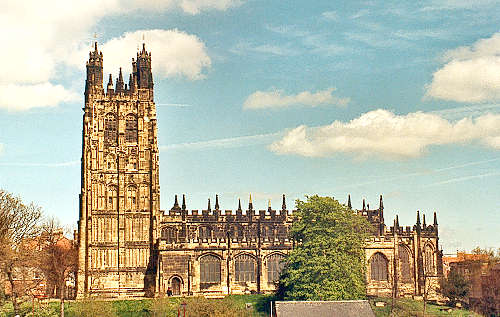
William next married Jane Puleston, of Bers and Hafod y Wern,487 489 499 daughter of John Hên Puleston, of Hafod-y-Wern, Constable of Caernarfon Castle and Eleanor Whitney, on 2 Aug 1522 in <Penrhyn, Llandegai, Caernarfonshire, > Wales. Jane was born about 1479 in Bersham, (Denbighshire), Wales.
Research Notes: 2nd wife of Sir William Griffith (c. 1480-1531).
From: http://www.rootsweb.com/~wlsccaer/hall.html
"...I return to what is undoubtedly the glory of the church, the alabaster monument of Sir William Griffith and his lady. The tomb upon which the figures are recumbent as large as life is raised about three feet above the two steps, or rather plinths, upon which it stands. They lie on a mat of very good execution, one end of which is rolled up in several convolutions to serve as pillows for the lady and the knight. The same is done, with some variety of shape, at the latter's feet, which rest upon it, while those of the former repose against a lion couchant. At the west end of the tomb three compartments are distinguished, divided by pilasters, and have a sort of architrave about. Five groups of figures facing each other and in the attitude of prayer are seen with much blazonry, among which, as might be expected in the Griffith family, are the Saxons' heads and the heads of stags caboshed. A cross, a crescent and a spear's head were, however, new to me in their combinations with the other bearings. I venture to suppose them the arms of Sir William's first wife, a South Walian. On the north of the tomb are three groups of females praying, all facing towards the east, and these are again separated from each other by the three lions passant and the three eagles in fess, each being twice and in alternate order exhibited upon the pilasters. On the south side we have three compartments separated by four coats on as many pilasters. The 1st compartment shows a warrior armed and one in the weeds of peace, the second a warrior and a lady, the 3d a priest and, I think, two females. All these figures, which are in tolerable preservation and execution, are in prayer and looking towards the east. the arms are' in the following order: 1, Saxons' heads; 2, stags' heads caboshed; 3, three mullets; and 4, stags' heads caboshed with a chevron between. the knight is fully armed, except that he is bare headed and has his hand clasped upon his breast; but these have been broken off. Upon the whole, however, we may feel obliged to the barbarism of the country (some few degrees less, it must be confessed, than that of the English) for having left us so much of this most precious remain without doubt (at least in my opinion) within the country.
"This Sir William Griffith was, I think, the third in succession in the office of Chamberlain of North Wales from the appointment to it of his grandfather, Sir William Griffith, a gentleman whose name has become famous in the history of the country for his contentions with John ap Meredydd of Istumcegid, chief of the descendants of Owen Gwynedd. The Sir William whose monument we are now viewing was married twice, had nineteen children, and died in 1587. His first wife was Jane, the daughter of Sir Thomas Stradling of St Donats Castle in Glamorganshire; the second was Jane, the daughter of John Puleston, Esqr., Chamberlain of North Wales. By his numerous children the family became connected with the Stanleys of Hooton, the Bulkeley family, with the Phillips of Picton Castle, with the Mostyns, with the Myttons and the Thelwalls, besides numerous other families."
---
From Welsh Biography Online (http://yba.llgc.org.uk/en/s1-GRIF-PEN-1300.html) :
"His second wife was Jane, daughter of John Puleston 'Hen' (the Old) of Bersham (see article Puleston family ); William, his eldest son by this marriage, founded the family of Griffith of Trefarthen (Griffith , Pedigrees, 125, 185, and article Griffith, John, 16th cent. ). Apart from those named, the following poets (qq.v.) wrote to him: Mathew Brwmffild , Dafydd Pennant , Ifan Dylyniwr , Dafydd Trefor , Ifan ap Madog , Lewis Daron , and Tudur Aled . (Mostyn MSS. 148, 529, 532, 556, 559, 562, 566, 569, 572, 575; Cynfeirdd Lleyn, ed. Myrddin Fardd , 195; Gwaith Tudur Aled, ed. T. Gwynn Jones , i, 145.) He was one of three squires who were concerned with the Caerwys eisteddfod in 1523. (Llên Cymru, ii, 130.)"
Children from this marriage were:
+ 428 M i. William Griffith .487
+ 429 F ii. Elizabeth Gruffydd was born circa 1508 in <Penrhyn, Caernarfonshire, > Wales.
+ 430 M iii. Edward Griffith was born on 18 May 1511 and died on 11 Mar 1540 in Dublin, Leinster, Ireland at age 28.
+ 431 M iv. Sir Rhys Griffith, of Penrhyn, High Sheriff for Caernarvon died on 30 Jul 1580.
+ 432 F v. Sibill Griffith was born about 1530 in <Penrhyn, Llandegai, Caernarfonshire, > Wales and died about 1580 about age 50.
387. Edmund Griffith (Joan Troutbeck353, Margaret Stanley318, Joan Goushill297, Elizabeth FitzAlan, d'Arundelle265, Elizabeth de Bohun, Countess of Arundel224, Sir William de Bohun, K.G., 1st Earl of Northampton179, Elizabeth, of Rhuddlan, Princess of England134, King Edward I, of England97, King Henry III, of England71, King John "Lackland", of England54, Henry II "Curtmantel", King of England42, Empress Matilda, Countess of Anjou24, Matilda, of Scotland12, Saint Margaret, of Scotland7, Agatha5, Yaroslav I, of Kiev4, Vladimir I, of Kiev3, Sviatoslav I, of Kiev2, Igor, Grand Prince of Kiev1) was born about 1480.
Research Notes: First husband of Jonet verch Meredith ap Jevan. Source: Source: The History of the Gwydir Family by Sir John Wynne (Oswestry, 1878), p. 85.
Rootsweb (?) AFN 18GQ-P8B
Edmund married Janet verch Maredydd ap Ieuan,318 389 505 daughter of Meredydd ap Ieuan ap Robert, of Keselgyfarch Gwedir, Carnarvonshire and Alice verch William Griffith ap Robin, of Cochwillan,. Other names for Janet were Jonet verch Meredith and Sioned verch Meredydd ap Ieuan ap Robert.
Research Notes: 2nd wife of Sir John Puleston of Bers.
The History of the Princes, the Lords Marcher, and the Ancient Nobility of Powys Fadog, and the Ancient Lords of Arwystli, Cedewen, and Meirionydd, Vol. II lists two wives for Sir John Puleston of Bers:
1 Gaynor, d. of Robert ab Maredudd ab Hwlcyn Llwyd of Glyn Llifon.
2 Janet, d. of Maredydd ab Ieuan ab Robert of Cesail Gyfarch, who purchased Gwydir.
-------
From Welsh Biography Online (http://yba.llgc.org.uk/en/s-PULE-EST-1283.html) :
"(3) A cadet branch of the Pulestons of Hafod-y-wern flourished at Caernarvon for part of the 16th cent., its founder being the son by his first marriage (to Elin, daughter of Robert Whitney), of John Puleston ('Hen'), Sir JOHN PULESTON (d. 1551), who was sheriff of Caernarvonshire, 1543-4, Member of Parliament for Caernarvon, 1541-4, and for Caernarvonshire, 1545-7 and 1547-51, chamberlain of North Wales, 1547, and constable of Caernarvon castle, 1523-51. He m. (1) Gaynor, daughter of Robert ap Meredydd ap Hwlcyn Llwyd of Glynllifon , and (2) Sioned, daughter of Meredydd ap Ieuan ap Robert, of Cesail Gyfarch and Gwydir . From HUGH PULESTON, his son by his second wife, who m. Margaret, daughter and heiress of Hugh Lloyd, of Llwynycnotiau, near Wrexham, were descended the Pulestons of that place. "
---------
From The History of the Gwydir Family, p. 85:
"VI. Jonet, wife first of Edmund Gruffith, son of Sir William Gruffith the elder Knight, after him of Sir John Puleston, Knight."
388. Alice Griffith (Joan Troutbeck353, Margaret Stanley318, Joan Goushill297, Elizabeth FitzAlan, d'Arundelle265, Elizabeth de Bohun, Countess of Arundel224, Sir William de Bohun, K.G., 1st Earl of Northampton179, Elizabeth, of Rhuddlan, Princess of England134, King Edward I, of England97, King Henry III, of England71, King John "Lackland", of England54, Henry II "Curtmantel", King of England42, Empress Matilda, Countess of Anjou24, Matilda, of Scotland12, Saint Margaret, of Scotland7, Agatha5, Yaroslav I, of Kiev4, Vladimir I, of Kiev3, Sviatoslav I, of Kiev2, Igor, Grand Prince of Kiev1) was born about 1482 in Penrhyn Castle, Llandegai, (Bangor), Caernarfonshire, (Gwynedd), Wales.
Research Notes: Rootsweb AFNB: IXVT-LH9
389. Margaret Troutbeck 460 492 (Adam Troutbeck, of Mobberly354, Margaret Stanley318, Joan Goushill297, Elizabeth FitzAlan, d'Arundelle265, Elizabeth de Bohun, Countess of Arundel224, Sir William de Bohun, K.G., 1st Earl of Northampton179, Elizabeth, of Rhuddlan, Princess of England134, King Edward I, of England97, King Henry III, of England71, King John "Lackland", of England54, Henry II "Curtmantel", King of England42, Empress Matilda, Countess of Anjou24, Matilda, of Scotland12, Saint Margaret, of Scotland7, Agatha5, Yaroslav I, of Kiev4, Vladimir I, of Kiev3, Sviatoslav I, of Kiev2, Igor, Grand Prince of Kiev1) was born in 1492 and died after 1521.
Research Notes: Source: Ancestral Roots of Certain American Colonists Who Came to America before 1700 by Frederick Lewis Weis and Walter Lee Sheppard, Jr, ed. by William R. Beall & Kaleen E. Beall, Baltimore, 2008, Line 20-36.
www.whitneygen.org/archives/biography/princewm.html
From the book Reifsnyder-Gillam Ancestry, Edited by Thomas Allen Glenn at the request of Howard Reifsnyder, privately printed, Philadelphia, 1902, provided by http://books.google.com, p. 56:
"The children of Sir William Troutbeck and the Lady Margaret were:
1. William Troutbeck 'aet. 15 years, 4 Edw. IV., ward of Sir John Botler, alias Butler, by grant of the King, 8 Janurary, 2 Edw. IV.,' married to Johannes, daughter of the said Sir John. No issue.
2. Adam Troutbeck; his heiress married John Talbot, ancestor of the Earls of Shrewsbury.
3. Thomas Troutbeck.
4. Alice Troutbeck.
5. Jane Troutbeck, married 1st, Sir William Botler, of Bewsey, Knight, and 2ndly, Sir William Griffith, of Penrhyn, Knight; of whom presently.
6. Elizabeth Troutbeck, married Sir Alexander Houghton, Knight."
Margaret married Sir John Talbot, of Grafton, sheriff of Shropshire, son of Sir Gilbert Talbot, K.G., of Grafton, co. Worcester and Audrey Cotton,. John was born in 1485 and died on 10 Sep 1549 at age 64.
Research Notes: Source: Ancestral Roots of Certain American Colonists Who Came to America before 1700 by Frederick Lewis Weis and Walter Lee Sheppard, Jr, ed. by William R. Beall & Kaleen E. Beall, Baltimore, 2008, Line 7-36: "b. 1485, d. 10 Sept. 1549, of Albrighton, co. Salop, and Grafton, co. Worcester, sheriff of Shropshire, 1527-1537, 1541"
www.whitneygen.org/archives/biography/princewm.html
(Duplicate Line. See Person 383)
390. Thomas Stanley, 2nd Earl of Derby 493 (Sir George Stanley, 9th Lord Strange of Knockyn358, Thomas Stanley, 1st Earl of Derby319, Joan Goushill297, Elizabeth FitzAlan, d'Arundelle265, Elizabeth de Bohun, Countess of Arundel224, Sir William de Bohun, K.G., 1st Earl of Northampton179, Elizabeth, of Rhuddlan, Princess of England134, King Edward I, of England97, King Henry III, of England71, King John "Lackland", of England54, Henry II "Curtmantel", King of England42, Empress Matilda, Countess of Anjou24, Matilda, of Scotland12, Saint Margaret, of Scotland7, Agatha5, Yaroslav I, of Kiev4, Vladimir I, of Kiev3, Sviatoslav I, of Kiev2, Igor, Grand Prince of Kiev1) was born about 1477 and died on 23 May 1521 about age 44.
Research Notes: Eldest son of George Stanley.
From Wikipedia - Thomas Stanley, 2nd Earl of Derby :
Thomas Stanley, 2nd Earl of Derby (c. 1477-23 May 1521 ), was an English peer.
Derby was the eldest son of George Stanley (jure uxoris 9th Baron Strange ) and Joan Strange, 9th Baroness Strange and 5th Baroness Mohun. Thomas Stanley, 1st Earl of Derby was his grandfather. His father had been summoned to Parliament as Lord Strange in 1482 in right of his wife, but predeceased his father. Derby succeeded his grandfather in the earldom and barony of Stanley in 1504, and in 1514, he also inherited the baronies of Strange and Mohun from his mother. He married Anne Hastings-daughter of Edward Hastings, 2nd Baron Hastings-in about 1507. Lord Derby died in May 1521 and was succeeded in his titles by his son Edward . His line of the Stanley family failed on the death of James Stanley, 10th Earl of Derby in 1736, when the earldom passed on to a descendant of his younger brother, Sir James Stanley, who founded the branch of the family known as the "Stanleys of Bickerstaffe."
Noted events in his life were:
• Earl and Baron of Stanley: 1504.
• Baron Strange: 1514.
• Baron Mohun: 1514.
Thomas married Anne Hastings 493 in 1507.
391. John Stanley 463 (Sir George Stanley, 9th Lord Strange of Knockyn358, Thomas Stanley, 1st Earl of Derby319, Joan Goushill297, Elizabeth FitzAlan, d'Arundelle265, Elizabeth de Bohun, Countess of Arundel224, Sir William de Bohun, K.G., 1st Earl of Northampton179, Elizabeth, of Rhuddlan, Princess of England134, King Edward I, of England97, King Henry III, of England71, King John "Lackland", of England54, Henry II "Curtmantel", King of England42, Empress Matilda, Countess of Anjou24, Matilda, of Scotland12, Saint Margaret, of Scotland7, Agatha5, Yaroslav I, of Kiev4, Vladimir I, of Kiev3, Sviatoslav I, of Kiev2, Igor, Grand Prince of Kiev1) died in 1503.
392. Sir James Stanley, of Cross Hall 493 494 (Sir George Stanley, 9th Lord Strange of Knockyn358, Thomas Stanley, 1st Earl of Derby319, Joan Goushill297, Elizabeth FitzAlan, d'Arundelle265, Elizabeth de Bohun, Countess of Arundel224, Sir William de Bohun, K.G., 1st Earl of Northampton179, Elizabeth, of Rhuddlan, Princess of England134, King Edward I, of England97, King Henry III, of England71, King John "Lackland", of England54, Henry II "Curtmantel", King of England42, Empress Matilda, Countess of Anjou24, Matilda, of Scotland12, Saint Margaret, of Scotland7, Agatha5, Yaroslav I, of Kiev4, Vladimir I, of Kiev3, Sviatoslav I, of Kiev2, Igor, Grand Prince of Kiev1) was born in 1486 in <Knockyn> and died in 1562 at age 76.
Birth Notes: May have been born in 1491
Research Notes: Founded the branch of the family known as the "Stanleys of Bickerstaffe," from which the 11th Earl of Derby and subsequent earls descend.
Noted events in his life were:
• Earl of Derby:
• Esquire Marshall of Ireland:
James married someone.
+ 433 M i. Sir Henry Stanley 494 was born in 1515 in Cross Hall, Aughton, England and died on 23 Jul 1595 in Bickerstaffe at age 80.
393. George Stanley (Sir George Stanley, 9th Lord Strange of Knockyn358, Thomas Stanley, 1st Earl of Derby319, Joan Goushill297, Elizabeth FitzAlan, d'Arundelle265, Elizabeth de Bohun, Countess of Arundel224, Sir William de Bohun, K.G., 1st Earl of Northampton179, Elizabeth, of Rhuddlan, Princess of England134, King Edward I, of England97, King Henry III, of England71, King John "Lackland", of England54, Henry II "Curtmantel", King of England42, Empress Matilda, Countess of Anjou24, Matilda, of Scotland12, Saint Margaret, of Scotland7, Agatha5, Yaroslav I, of Kiev4, Vladimir I, of Kiev3, Sviatoslav I, of Kiev2, Igor, Grand Prince of Kiev1)
394. Jane Stanley (Sir George Stanley, 9th Lord Strange of Knockyn358, Thomas Stanley, 1st Earl of Derby319, Joan Goushill297, Elizabeth FitzAlan, d'Arundelle265, Elizabeth de Bohun, Countess of Arundel224, Sir William de Bohun, K.G., 1st Earl of Northampton179, Elizabeth, of Rhuddlan, Princess of England134, King Edward I, of England97, King Henry III, of England71, King John "Lackland", of England54, Henry II "Curtmantel", King of England42, Empress Matilda, Countess of Anjou24, Matilda, of Scotland12, Saint Margaret, of Scotland7, Agatha5, Yaroslav I, of Kiev4, Vladimir I, of Kiev3, Sviatoslav I, of Kiev2, Igor, Grand Prince of Kiev1)
395. Elizabeth Stanley (Sir George Stanley, 9th Lord Strange of Knockyn358, Thomas Stanley, 1st Earl of Derby319, Joan Goushill297, Elizabeth FitzAlan, d'Arundelle265, Elizabeth de Bohun, Countess of Arundel224, Sir William de Bohun, K.G., 1st Earl of Northampton179, Elizabeth, of Rhuddlan, Princess of England134, King Edward I, of England97, King Henry III, of England71, King John "Lackland", of England54, Henry II "Curtmantel", King of England42, Empress Matilda, Countess of Anjou24, Matilda, of Scotland12, Saint Margaret, of Scotland7, Agatha5, Yaroslav I, of Kiev4, Vladimir I, of Kiev3, Sviatoslav I, of Kiev2, Igor, Grand Prince of Kiev1)
396. Margaret Stanley (Sir George Stanley, 9th Lord Strange of Knockyn358, Thomas Stanley, 1st Earl of Derby319, Joan Goushill297, Elizabeth FitzAlan, d'Arundelle265, Elizabeth de Bohun, Countess of Arundel224, Sir William de Bohun, K.G., 1st Earl of Northampton179, Elizabeth, of Rhuddlan, Princess of England134, King Edward I, of England97, King Henry III, of England71, King John "Lackland", of England54, Henry II "Curtmantel", King of England42, Empress Matilda, Countess of Anjou24, Matilda, of Scotland12, Saint Margaret, of Scotland7, Agatha5, Yaroslav I, of Kiev4, Vladimir I, of Kiev3, Sviatoslav I, of Kiev2, Igor, Grand Prince of Kiev1)
397. Blanche Warburton 496 (Jane Stanley360, Sir William Stanley, of Holt, K.G.320, Joan Goushill297, Elizabeth FitzAlan, d'Arundelle265, Elizabeth de Bohun, Countess of Arundel224, Sir William de Bohun, K.G., 1st Earl of Northampton179, Elizabeth, of Rhuddlan, Princess of England134, King Edward I, of England97, King Henry III, of England71, King John "Lackland", of England54, Henry II "Curtmantel", King of England42, Empress Matilda, Countess of Anjou24, Matilda, of Scotland12, Saint Margaret, of Scotland7, Agatha5, Yaroslav I, of Kiev4, Vladimir I, of Kiev3, Sviatoslav I, of Kiev2, Igor, Grand Prince of Kiev1) was born about 1496 in Arley Hall, Great Budworth, Cheshire, England.
Blanche married William Davenport,506 son of William Davenport and Margery Legh, about 1520 in Arley, Cheshire, England. William was born in 1472 in Bromhall, Cheshire, England and died in 1541 at age 69.
Children from this marriage were:
+ 434 M i. William Davenport was born in 1521 in Bramhall, Cheshire, England and died on 13 Sep 1576 in Bramhall, Cheshire, England at age 55.
+ 435 M ii. John Davenport was born in 1523 in Bramhall, Cheshire, England, died in Feb 1608 in Stockport, Cheshire, England at age 85, and was buried on 14 Feb 1608 in Stockport, Cheshire, England.
+ 436 F iii. Jane Davenport 507 was born in 1525 in Bromhall, Cheshire, England.
+ 437 M iv. Humphrey Davenport was born about 1525 in Bramhall, Cheshire, England, died in Dec 1588 in Northenden, Cheshire, England about age 63, and was buried on 19 Dec 1588 in Northenden, Cheshire, England.
+ 438 F v. Ellen Davenport was born about 1529 in Bramhall, Cheshire, England.
+ 439 F vi. Margery Davenport was born about 1531 in Bramhall, Cheshire, England.
+ 440 F vii. Katherine Davenport was born about 1533 in Bramhall, Cheshire, England.
398. John Warburton (Jane Stanley360, Sir William Stanley, of Holt, K.G.320, Joan Goushill297, Elizabeth FitzAlan, d'Arundelle265, Elizabeth de Bohun, Countess of Arundel224, Sir William de Bohun, K.G., 1st Earl of Northampton179, Elizabeth, of Rhuddlan, Princess of England134, King Edward I, of England97, King Henry III, of England71, King John "Lackland", of England54, Henry II "Curtmantel", King of England42, Empress Matilda, Countess of Anjou24, Matilda, of Scotland12, Saint Margaret, of Scotland7, Agatha5, Yaroslav I, of Kiev4, Vladimir I, of Kiev3, Sviatoslav I, of Kiev2, Igor, Grand Prince of Kiev1) was born about 1490 in Arley Hall, Arley, Cheshire, England and died in Dec 1572 about age 82.
Research Notes: Source: http://wc.rootsweb.ancestry.com/cgi-bin/igm.cgi?op=GET&db=:3143362&id=I653650832
399. Dowce Warburton (Jane Stanley360, Sir William Stanley, of Holt, K.G.320, Joan Goushill297, Elizabeth FitzAlan, d'Arundelle265, Elizabeth de Bohun, Countess of Arundel224, Sir William de Bohun, K.G., 1st Earl of Northampton179, Elizabeth, of Rhuddlan, Princess of England134, King Edward I, of England97, King Henry III, of England71, King John "Lackland", of England54, Henry II "Curtmantel", King of England42, Empress Matilda, Countess of Anjou24, Matilda, of Scotland12, Saint Margaret, of Scotland7, Agatha5, Yaroslav I, of Kiev4, Vladimir I, of Kiev3, Sviatoslav I, of Kiev2, Igor, Grand Prince of Kiev1) was born about 1492 in Arley Hall, Arley, Cheshire, England. Another name for Dowce was Douce Warburton.
Research Notes: Source: http://wc.rootsweb.ancestry.com/cgi-bin/igm.cgi?op=GET&db=:3143362&id=I653650833
400. Ann Warburton 497 (Jane Stanley360, Sir William Stanley, of Holt, K.G.320, Joan Goushill297, Elizabeth FitzAlan, d'Arundelle265, Elizabeth de Bohun, Countess of Arundel224, Sir William de Bohun, K.G., 1st Earl of Northampton179, Elizabeth, of Rhuddlan, Princess of England134, King Edward I, of England97, King Henry III, of England71, King John "Lackland", of England54, Henry II "Curtmantel", King of England42, Empress Matilda, Countess of Anjou24, Matilda, of Scotland12, Saint Margaret, of Scotland7, Agatha5, Yaroslav I, of Kiev4, Vladimir I, of Kiev3, Sviatoslav I, of Kiev2, Igor, Grand Prince of Kiev1) was born about 1494 in Arley Hall, Arley, Cheshire, England. Another name for Ann was Agnes Warburton.
401. Margaret Ellen Warburton (Jane Stanley360, Sir William Stanley, of Holt, K.G.320, Joan Goushill297, Elizabeth FitzAlan, d'Arundelle265, Elizabeth de Bohun, Countess of Arundel224, Sir William de Bohun, K.G., 1st Earl of Northampton179, Elizabeth, of Rhuddlan, Princess of England134, King Edward I, of England97, King Henry III, of England71, King John "Lackland", of England54, Henry II "Curtmantel", King of England42, Empress Matilda, Countess of Anjou24, Matilda, of Scotland12, Saint Margaret, of Scotland7, Agatha5, Yaroslav I, of Kiev4, Vladimir I, of Kiev3, Sviatoslav I, of Kiev2, Igor, Grand Prince of Kiev1) was born about 1495 in Arley Hall, Arley, Cheshire, England.
Research Notes: Source: http://wc.rootsweb.ancestry.com/cgi-bin/igm.cgi?op=GET&db=:3143362&id=I653650834
402. Elizabeth Warburton (Jane Stanley360, Sir William Stanley, of Holt, K.G.320, Joan Goushill297, Elizabeth FitzAlan, d'Arundelle265, Elizabeth de Bohun, Countess of Arundel224, Sir William de Bohun, K.G., 1st Earl of Northampton179, Elizabeth, of Rhuddlan, Princess of England134, King Edward I, of England97, King Henry III, of England71, King John "Lackland", of England54, Henry II "Curtmantel", King of England42, Empress Matilda, Countess of Anjou24, Matilda, of Scotland12, Saint Margaret, of Scotland7, Agatha5, Yaroslav I, of Kiev4, Vladimir I, of Kiev3, Sviatoslav I, of Kiev2, Igor, Grand Prince of Kiev1) was born about 1498 in Arley Hall, Arley, Cheshire, England.
Research Notes: Source: http://wc.rootsweb.ancestry.com/cgi-bin/igm.cgi?op=GET&db=:3143362&id=I653650836
403. Jean Warburton (Jane Stanley360, Sir William Stanley, of Holt, K.G.320, Joan Goushill297, Elizabeth FitzAlan, d'Arundelle265, Elizabeth de Bohun, Countess of Arundel224, Sir William de Bohun, K.G., 1st Earl of Northampton179, Elizabeth, of Rhuddlan, Princess of England134, King Edward I, of England97, King Henry III, of England71, King John "Lackland", of England54, Henry II "Curtmantel", King of England42, Empress Matilda, Countess of Anjou24, Matilda, of Scotland12, Saint Margaret, of Scotland7, Agatha5, Yaroslav I, of Kiev4, Vladimir I, of Kiev3, Sviatoslav I, of Kiev2, Igor, Grand Prince of Kiev1) was born about 1500 in Arley Hall, Arley, Cheshire, England.
Research Notes: Source: http://wc.rootsweb.ancestry.com/cgi-bin/igm.cgi?op=GET&db=:3143362&id=I653650837
404. William Warburton (Jane Stanley360, Sir William Stanley, of Holt, K.G.320, Joan Goushill297, Elizabeth FitzAlan, d'Arundelle265, Elizabeth de Bohun, Countess of Arundel224, Sir William de Bohun, K.G., 1st Earl of Northampton179, Elizabeth, of Rhuddlan, Princess of England134, King Edward I, of England97, King Henry III, of England71, King John "Lackland", of England54, Henry II "Curtmantel", King of England42, Empress Matilda, Countess of Anjou24, Matilda, of Scotland12, Saint Margaret, of Scotland7, Agatha5, Yaroslav I, of Kiev4, Vladimir I, of Kiev3, Sviatoslav I, of Kiev2, Igor, Grand Prince of Kiev1) was born about 1502 in Arley Hall, Arley, Cheshire, England.
Research Notes: Source: http://wc.rootsweb.ancestry.com/cgi-bin/igm.cgi?op=GET&db=:3143362&id=I653650838
405. Peter Warburton (Jane Stanley360, Sir William Stanley, of Holt, K.G.320, Joan Goushill297, Elizabeth FitzAlan, d'Arundelle265, Elizabeth de Bohun, Countess of Arundel224, Sir William de Bohun, K.G., 1st Earl of Northampton179, Elizabeth, of Rhuddlan, Princess of England134, King Edward I, of England97, King Henry III, of England71, King John "Lackland", of England54, Henry II "Curtmantel", King of England42, Empress Matilda, Countess of Anjou24, Matilda, of Scotland12, Saint Margaret, of Scotland7, Agatha5, Yaroslav I, of Kiev4, Vladimir I, of Kiev3, Sviatoslav I, of Kiev2, Igor, Grand Prince of Kiev1) was born about 1504 in Arley Hall, Arley, Cheshire, England and died in Jun 1550 in Arley, Cheshire, England about age 46. Another name for Peter was Piers Warburton.
Research Notes: Source: http://wc.rootsweb.ancestry.com/cgi-bin/igm.cgi?op=GET&db=:3143362&id=I653650840
406. Elizabeth Whitney (James Whitney363, Constance Touchet330, Eleanor de Holland300, Constance, of York270, Edmund, of Langley, 1st Duke of York225, Edward III, King of England182, King Edward II, of England135, King Edward I, of England97, King Henry III, of England71, King John "Lackland", of England54, Henry II "Curtmantel", King of England42, Empress Matilda, Countess of Anjou24, Matilda, of Scotland12, Saint Margaret, of Scotland7, Agatha5, Yaroslav I, of Kiev4, Vladimir I, of Kiev3, Sviatoslav I, of Kiev2, Igor, Grand Prince of Kiev1)
Elizabeth married Thomas Morgan.
The child from this marriage was:
+ 441 F i. Anne Morgan
407. Jane Puleston, of Bers and Hafod y Wern 487 489 499 (Eleanor Whitney364, Constance Touchet330, Eleanor de Holland300, Constance, of York270, Edmund, of Langley, 1st Duke of York225, Edward III, King of England182, King Edward II, of England135, King Edward I, of England97, King Henry III, of England71, King John "Lackland", of England54, Henry II "Curtmantel", King of England42, Empress Matilda, Countess of Anjou24, Matilda, of Scotland12, Saint Margaret, of Scotland7, Agatha5, Yaroslav I, of Kiev4, Vladimir I, of Kiev3, Sviatoslav I, of Kiev2, Igor, Grand Prince of Kiev1) was born about 1479 in Bersham, (Denbighshire), Wales.
Research Notes: 2nd wife of Sir William Griffith (c. 1480-1531).
From: http://www.rootsweb.com/~wlsccaer/hall.html
"...I return to what is undoubtedly the glory of the church, the alabaster monument of Sir William Griffith and his lady. The tomb upon which the figures are recumbent as large as life is raised about three feet above the two steps, or rather plinths, upon which it stands. They lie on a mat of very good execution, one end of which is rolled up in several convolutions to serve as pillows for the lady and the knight. The same is done, with some variety of shape, at the latter's feet, which rest upon it, while those of the former repose against a lion couchant. At the west end of the tomb three compartments are distinguished, divided by pilasters, and have a sort of architrave about. Five groups of figures facing each other and in the attitude of prayer are seen with much blazonry, among which, as might be expected in the Griffith family, are the Saxons' heads and the heads of stags caboshed. A cross, a crescent and a spear's head were, however, new to me in their combinations with the other bearings. I venture to suppose them the arms of Sir William's first wife, a South Walian. On the north of the tomb are three groups of females praying, all facing towards the east, and these are again separated from each other by the three lions passant and the three eagles in fess, each being twice and in alternate order exhibited upon the pilasters. On the south side we have three compartments separated by four coats on as many pilasters. The 1st compartment shows a warrior armed and one in the weeds of peace, the second a warrior and a lady, the 3d a priest and, I think, two females. All these figures, which are in tolerable preservation and execution, are in prayer and looking towards the east. the arms are' in the following order: 1, Saxons' heads; 2, stags' heads caboshed; 3, three mullets; and 4, stags' heads caboshed with a chevron between. the knight is fully armed, except that he is bare headed and has his hand clasped upon his breast; but these have been broken off. Upon the whole, however, we may feel obliged to the barbarism of the country (some few degrees less, it must be confessed, than that of the English) for having left us so much of this most precious remain without doubt (at least in my opinion) within the country.
"This Sir William Griffith was, I think, the third in succession in the office of Chamberlain of North Wales from the appointment to it of his grandfather, Sir William Griffith, a gentleman whose name has become famous in the history of the country for his contentions with John ap Meredydd of Istumcegid, chief of the descendants of Owen Gwynedd. The Sir William whose monument we are now viewing was married twice, had nineteen children, and died in 1587. His first wife was Jane, the daughter of Sir Thomas Stradling of St Donats Castle in Glamorganshire; the second was Jane, the daughter of John Puleston, Esqr., Chamberlain of North Wales. By his numerous children the family became connected with the Stanleys of Hooton, the Bulkeley family, with the Phillips of Picton Castle, with the Mostyns, with the Myttons and the Thelwalls, besides numerous other families."
---
From Welsh Biography Online (http://yba.llgc.org.uk/en/s1-GRIF-PEN-1300.html) :
"His second wife was Jane, daughter of John Puleston 'Hen' (the Old) of Bersham (see article Puleston family ); William, his eldest son by this marriage, founded the family of Griffith of Trefarthen (Griffith , Pedigrees, 125, 185, and article Griffith, John, 16th cent. ). Apart from those named, the following poets (qq.v.) wrote to him: Mathew Brwmffild , Dafydd Pennant , Ifan Dylyniwr , Dafydd Trefor , Ifan ap Madog , Lewis Daron , and Tudur Aled . (Mostyn MSS. 148, 529, 532, 556, 559, 562, 566, 569, 572, 575; Cynfeirdd Lleyn, ed. Myrddin Fardd , 195; Gwaith Tudur Aled, ed. T. Gwynn Jones , i, 145.) He was one of three squires who were concerned with the Caerwys eisteddfod in 1523. (Llên Cymru, ii, 130.)"
Jane married Robert ap Maredydd ap Hwlcyn Llwyd, of Glyn llufon.472 508 Another name for Robert was Robert Meredith.
Jane next married Sir William Griffith, Lord of Penrhyn, Chamberlain of North Wales,428 486 487 488 489 490 son of Sir William Griffith, Lord of Penrhyn Castle, Chamberlain of North Wales and Joan Troutbeck, on 2 Aug 1522 in <Penrhyn, Llandegai, Caernarfonshire, > Wales. William was born about 1480 in Penrhyn, <Llandegai, > Caernarfonshire, Wales and died in 1531 about age 51. Another name for William was Sir William Gruffydd of Penrhyn, Chamberlain of North Wales.
Marriage Notes: Verify marriage date. Varies from 1505 to 1520. According to Ancestral Roots of Certain American Colonists Who Came to America before 1700, they were married in 1520. (Dwnn II: 154-159)
Research Notes: Descended from Ednyfed Fychan, forebear of the TUDOR dynasty
From http://www.rootsweb.com/~wlsccaer/hall.html :
"This Sir William Griffith was, I think, the third in succession in the office of Chamberlain of North Wales from the appointment to it of his grandfather, Sir William Griffith, a gentleman whose name has become famous in the history of the country for his contentions with John ap Meredydd of Istumcegid, chief of the descendants of Owen Gwynedd. The Sir William whose monument we are now viewing was married twice, had nineteen children, and died in 1587. His first wife was Jane, the daughter of Sir Thomas Stradling of St Donats Castle in Glamorganshire; the second was Jane, the daughter of John Puleston, Esqr., Chamberlain of North Wales. By his numerous children the family became connected with the Stanleys of Hooton, the Bulkeley family, with the Phillips of Picton Castle, with the Mostyns, with the Myttons and the Thelwalls, besides numerous other families."
------
From Reifsnyder-Gillam Ancestry, p. 58:
"VII. SIR WILLIAM GRIFFITH, Knight, of Penrhyn, eldest son and heir. He was of the Court of Henry VIII, and accompanied the King into France, where he distinguished himself at the siege of Tourraine, where he was knighted, 25 December 5 Henry VIII, and was Chamberlain of North Wales. He married, secondly (marriage settlement 2 August, 1522), Jane, widow of Robert Meredith and daughter of John Puleston, of Bers, and Havod, y Wern, Caernarvonshire, constable of Caernarvon Castle, 16 April, 1506, 30 July, 1509, 1 October, 1423, Chamberlain of North Wales, High Sheriff of Caernarvonshire, 1544; died about this date.
"The wife of John Puleston was descended from Edward III, King of England. Sir William Griffith had issue by Jane, his second wife:
"IX SIBELL GRIFFITH..."
----
From Welsh Biography Online (http://yba.llgc.org.uk/en/s1-GRIF-PEN-1300.html) :
"His son, WILLIAM GRIFFITH (c. 1480-1531), does not appear in office until 1508 when he was described as 'King's Servant' and 'squire for the body,' and appointed chamberlain of North Wales; he continued to hold the office until his death, with the exception of a short break in 1509 when he made way for Charles Brandon, later duke of Suffolk. (Cal. Pat. Rolls, 1494-1509, 569; Davies, Conway and Menai Ferries, 57; L. and P. Henry VIII, vol. I, part i, 257, 78, and vol. IV, part i, 1941; D.N.B., vi, 218.) There is some evidence of personal links between the two men. Both were squires of the body at the same time, and in 1516 Brandon appointed Griffith as one of his deputy justices of North Wales, describing him in the instrument of appointment as his 'blood relation.' (Penrhyn MSS. 48.) Griffith served under Brandon in the French campaign of 1513; he was at the siege of Thérouanne, the battle of the Spurs, and the siege of Tournai in Aug. 1513, and was knighted at Tournai 25 Sept. 1513. (L. and P. Henry VIII, vol. I, part i, 1176, 1496, part ii, 2301, 2480, 2575.) Poems by Lewis Môn , Huw Llwyd ap Dafydd , Tudur Aled , and Gruffydd ap Tudur ap Hywel (qq.v.) refer to his part in the campaign. (Mostyn MSS. 148, 233, 520, 523, 537, 585; Cardiff MSS. 2, 103; Gwaith Tudur Aled, ed. T. Gwynn Jones , i, 146.) He appears also to have maintained close relationships with Sir Rhys ap Thomas of Dynevor (q.v.) . His first wife was Jane, daughter of Sir Thomas Stradling of S. Donats, Glam. , and his wife, Joan, daughter of Thomas Mathew of Radyr, Glam. Sir Thomas Stradling d., 1480, and his widow m. shortly after Sir Rhys ap Thomas , as his second wife. Poems to William Griffith by Lewis Môn emphasize the links between him and Sir Rhys , whose son, Griffith ap Rhys (b. c. 1480 - see under Rice ) was a contemporary of William Griffith at Court. A Griffith of Penrhyn (almost certainly William Griffith) was present at the tournament held by Sir Rhys at Carew in 1507 (see articles Stradling and Mathew ; Mostyn MSS. 148, 470, 581; Cambrian Register, 1795, 49-144). His second wife was Jane, daughter of John Puleston 'Hen' (the Old) of Bersham (see article Puleston family ); William, his eldest son by this marriage, founded the family of Griffith of Trefarthen (Griffith , Pedigrees, 125, 185, and article Griffith, John, 16th cent. ). Apart from those named, the following poets (qq.v.) wrote to him: Mathew Brwmffild , Dafydd Pennant , Ifan Dylyniwr , Dafydd Trefor , Ifan ap Madog , Lewis Daron , and Tudur Aled . (Mostyn MSS. 148, 529, 532, 556, 559, 562, 566, 569, 572, 575; Cynfeirdd Lleyn, ed. Myrddin Fardd , 195; Gwaith Tudur Aled, ed. T. Gwynn Jones , i, 145.) He was one of three squires who were concerned with the Caerwys eisteddfod in 1523. (Llên Cymru, ii, 130.)"
Noted events in his life were:
• Knighted: 25 Dec 1513, Touraine, France. From Welsh Settlement of Pennsylvania by Charles H. Browning, Philadelphia, 1912, p. 286: "knighted at Touraine, Christmas, 1513, 'after the king came from mass, under the banner in the church'"
• Made: Chamberlain of North Wales, 1520.
(Duplicate Line. See Person 386)
408. Sir John Puleston, of Bers, Chamberlain of North Wales 261 318 389 487 (Eleanor Whitney364, Constance Touchet330, Eleanor de Holland300, Constance, of York270, Edmund, of Langley, 1st Duke of York225, Edward III, King of England182, King Edward II, of England135, King Edward I, of England97, King Henry III, of England71, King John "Lackland", of England54, Henry II "Curtmantel", King of England42, Empress Matilda, Countess of Anjou24, Matilda, of Scotland12, Saint Margaret, of Scotland7, Agatha5, Yaroslav I, of Kiev4, Vladimir I, of Kiev3, Sviatoslav I, of Kiev2, Igor, Grand Prince of Kiev1) was born about 1483 in Hafod-y-Wern, Bersham, (Wrexham) Denbighshire, Wales and died in 1551 in Bersham, Denbighshire (Wrexham), Wales about age 68. Another name for John was Sir John Puleston of Bersham.
Research Notes: Constable of Carnarvon Castle and Chamberlain of North Wales. Son of John Puleston of Havod y Wern and Bers by his first wife, Eleanor Whitney. Second husband of Jonet verch Meredith.
From Annals and Antiquities of the Counties and County Families of Wales, p. 455:
Great greandson of Madog Puleston, Constable of Carnarvon Castle and Chamberlain of North Wales.
From The History of the Princes, the Lords Marcher, and the Ancient Nobility of Powys Fadog, and the Ancient Lords of Arwystli, Cedewen, and Meirionydd, Vol. II:
From Cae Cyriog M.S.; Lewys Dwnn, vol ii: "Sir John Puleston of Bers, Knt., Chamberlain of North Wales, and Constable of Caernarvon Castle, ob. 1551." This source lists two wives for Sir John:
1 Gaynor, d. of Robert ab Maredudd ab Hwlcyn Llwyd of Glyn Llifon.
2 Janet, d. of Maredydd ab Ieuan ab Robert of Cesail Gyfarch, who purchased Gwydir.
-----------
From The Dictionary of Welsh Biography Online - http://yba.llgc.org.uk/en/s-PULE-EST-1283.html :
"(3) A cadet branch of the Pulestons of Hafod-y-wern flourished at Caernarvon for part of the 16th cent., its founder being the son by his first marriage (to Elin, daughter of Robert Whitney), of John Puleston ('Hen'), Sir JOHN PULESTON (d. 1551), who was sheriff of Caernarvonshire, 1543-4, Member of Parliament for Caernarvon, 1541-4, and for Caernarvonshire, 1545-7 and 1547-51, chamberlain of North Wales, 1547, and constable of Caernarvon castle, 1523-51. He m. (1) Gaynor, daughter of Robert ap Meredydd ap Hwlcyn Llwyd of Glynllifon , and (2) Sioned, daughter of Meredydd ap Ieuan ap Robert, of Cesail Gyfarch and Gwydir . From HUGH PULESTON, his son by his second wife, who m. Margaret, daughter and heiress of Hugh Lloyd, of Llwynycnotiau, near Wrexham, were descended the Pulestons of that place. There is evidence that the Rev. EDWARD PULESTON (d. 1621/2), second son of this Hugh, who became rector of Burton Latimer, Northants, in 1592, and ultimately inherited Llwynycnotiau from his childless elder brother, was a confidant of captain John Salisbury of Rûg (see Salusbury of Rûg ), one of the principal conspirators in the Essex revolt of 1601; while his younger brother, RICHARD PULESTON, had served under the captain in Ireland. On the death, without issue, March 1677/8, of Edward's grandson, JOHN PULESTON, Llwynycnotiau came into possession of his wife's brother, Simon Thelwall, of Plas-y-ward (see Thelwall of Plas-y-ward ), by virtue of a settlement made in 1672. "
-------
From Welsh Biography Online (http://yba.llgc.org.uk/en/s1-GRIF-PEN-1300.html) :
"[Edward Griffith] m. Jane, daughter of Sir John Puleston of Bersham . (L. and P. Henry VIII, viii, 122, 644, 925, xii, part i, 539 (14), 655, 1154, xiii, part i, 384 (91), 1289, xiv, part i, 732, 802, 803, 816, part ii, 40, 616, 759, 782, 1539; xv, 74, 82, 199, 327, 342, 355.) His death precipitated a long dispute between RHYS GRIFFITH his younger brother, who claimed the estates as heir male, and John Puleston, Edward Griffith's father-in-law, acting for his daughter and her three children (Jane, Catherine, and Ellen). Puleston asked Cromwell for the wardship of the children, and offered him £40 for his good offices; Rhys Griffith complained that during his absence in Ireland 'on the king's service,' his sister-in-law and her father had ransacked Penrhyn, leaving 'nothing but the bare walls.' The lord chancellor and the master of the court of wards made an arbitration in 1542, but the problems involved were still unsettled in 1559. Even after the death of Rhys Griffith in 1580, Sir Edward Bagnall, who had m. one of Edward Griffith's daughters, was still pursuing his wife's claims in the court of wards. (Penrhyn MSS. 50, 2197; N.L.W. Jnl., iii, 40; Lewis , Early Chancery Procs., 21, 22, 288, 290; Lewis and Davies, Augmentation Recs., 51; L. and P. Henry VIII, v, no. 724 (10), xv, 433, 661, xvii, 466, xix 812 (16), Addenda, i, part ii, 1462; Cal. Pat. Rolls, Edward VI, iv, 36; Acts Privy Council, 1580-1, 289; P.R.O., Court of Requests Procs., bundle iv, no. 258; bundle vi, no 210.)"
Noted events in his life were:
• Served as: Constable of Caernarvon Castle, 1 Oct 1523 to 8 Jul 1550.
• Served as: M.P. for Carnarvonshire, 1541-1544.
• Appointed: High Sheriff of Denbig, 1543.
• Appointed: High Sheriff of Carnarvonshire, 1544.
• Elected: M.P. for Carnarvonshire, 7 Jan 1545.
• Served as: High Sheriff of Carnarvonshire, 1545-1547.
• Knighted: Betw 1545 and 1547.
• Appointed: Chamberlain of North Wales, 1547.
• Elected: M.P. for Carnarvonshire, 12 Oct 1547.
• Died in office: M.P. for Carnarvonshire, 1550 or 1551.
John married Gaynor verch Robert ab Maredudd, daughter of Robert ap Meredydd ap Hwlcyn and Unknown,. Gaynor was born about 1487 in Glynllifon, Llandwrog, Caernarfonshire (Gwynedd), Wales. Another name for Gaynor was Gaenor verch Robert ap Meredith.
Research Notes: First wife of Sir Robert Puleston of Bers.
Source: The History of the Princes, the Lords Marcher, and the Ancient Nobility of Powys Fadog, and the Ancient Lords of Arwystli, Cedewen, and Meirionydd by J. Y. W. Lloyd, Vol. II (London, 1882) has from Cae Cyriog M.S.; Lewys Dwnn, vol ii lists two wives for Sir John Puleston of Bers:
1 Gaynor, d. of Robert ab Maredudd ab Hwlcyn Llwyd of Glyn Llifon.
2 Janet, d. of Maredydd ab Ieuan ab Robert of Cesail Gyfarch, who purchased Gwydir.
Also Source: RootsWeb Williams Latham Tomlin Charlier (Kenneth Williams) (from J. E. Griffiths - Pedigrees of Anglesey and Caernarvonshire Families)
Children from this marriage were:
+ 442 M i. Robert Puleston, of Bers was born in Wrexham, Denbighshire, Wales.
+ 443 M ii. Rowland Puleston was born in Caernarfon, Gwynedd, Wales and died between 1588 and 1604.
+ 444 F iii. Jane Puleston was born about 1520 in Bersham, (Denbighshire), Wales.
+ 445 M iv. John Puleston .
+ 446 M v. William Puleston .
+ 447 F vi. Elizabeth Puleston was born in Bersham, Denbighshire, Wales.
+ 448 F vii. Sybil Puleston was born in Bersham, Denbighshire, Wales.
+ 449 F viii. Elin Puleston, of Bers was born in Bersham, Denbighshire, Wales.
John next married Janet verch Maredydd ap Ieuan,318 389 505 daughter of Meredydd ap Ieuan ap Robert, of Keselgyfarch Gwedir, Carnarvonshire and Alice verch William Griffith ap Robin, of Cochwillan,. Other names for Janet were Jonet verch Meredith and Sioned verch Meredydd ap Ieuan ap Robert.
Research Notes: 2nd wife of Sir John Puleston of Bers.
The History of the Princes, the Lords Marcher, and the Ancient Nobility of Powys Fadog, and the Ancient Lords of Arwystli, Cedewen, and Meirionydd, Vol. II lists two wives for Sir John Puleston of Bers:
1 Gaynor, d. of Robert ab Maredudd ab Hwlcyn Llwyd of Glyn Llifon.
2 Janet, d. of Maredydd ab Ieuan ab Robert of Cesail Gyfarch, who purchased Gwydir.
-------
From Welsh Biography Online (http://yba.llgc.org.uk/en/s-PULE-EST-1283.html) :
"(3) A cadet branch of the Pulestons of Hafod-y-wern flourished at Caernarvon for part of the 16th cent., its founder being the son by his first marriage (to Elin, daughter of Robert Whitney), of John Puleston ('Hen'), Sir JOHN PULESTON (d. 1551), who was sheriff of Caernarvonshire, 1543-4, Member of Parliament for Caernarvon, 1541-4, and for Caernarvonshire, 1545-7 and 1547-51, chamberlain of North Wales, 1547, and constable of Caernarvon castle, 1523-51. He m. (1) Gaynor, daughter of Robert ap Meredydd ap Hwlcyn Llwyd of Glynllifon , and (2) Sioned, daughter of Meredydd ap Ieuan ap Robert, of Cesail Gyfarch and Gwydir . From HUGH PULESTON, his son by his second wife, who m. Margaret, daughter and heiress of Hugh Lloyd, of Llwynycnotiau, near Wrexham, were descended the Pulestons of that place. "
---------
From The History of the Gwydir Family, p. 85:
"VI. Jonet, wife first of Edmund Gruffith, son of Sir William Gruffith the elder Knight, after him of Sir John Puleston, Knight."
The child from this marriage was:
+ 450 M i. Hugh Puleston, of Bers .389 470
409. Hugh Puleston, Vicar of Wrexham (Eleanor Whitney364, Constance Touchet330, Eleanor de Holland300, Constance, of York270, Edmund, of Langley, 1st Duke of York225, Edward III, King of England182, King Edward II, of England135, King Edward I, of England97, King Henry III, of England71, King John "Lackland", of England54, Henry II "Curtmantel", King of England42, Empress Matilda, Countess of Anjou24, Matilda, of Scotland12, Saint Margaret, of Scotland7, Agatha5, Yaroslav I, of Kiev4, Vladimir I, of Kiev3, Sviatoslav I, of Kiev2, Igor, Grand Prince of Kiev1) was born in Hafod-y-Wern, Bersham, Wrexham, Denbighshire, Wales.
Research Notes: Source: RootsWeb Williams Latham Tomlin Charlier (Kenneth Williams)
410. Richard Puleston (Eleanor Whitney364, Constance Touchet330, Eleanor de Holland300, Constance, of York270, Edmund, of Langley, 1st Duke of York225, Edward III, King of England182, King Edward II, of England135, King Edward I, of England97, King Henry III, of England71, King John "Lackland", of England54, Henry II "Curtmantel", King of England42, Empress Matilda, Countess of Anjou24, Matilda, of Scotland12, Saint Margaret, of Scotland7, Agatha5, Yaroslav I, of Kiev4, Vladimir I, of Kiev3, Sviatoslav I, of Kiev2, Igor, Grand Prince of Kiev1).
Research Notes: Source: RootsWeb Williams Latham Tomlin Charlier (Kenneth Williams)
411. Lancelot Puleston (Eleanor Whitney364, Constance Touchet330, Eleanor de Holland300, Constance, of York270, Edmund, of Langley, 1st Duke of York225, Edward III, King of England182, King Edward II, of England135, King Edward I, of England97, King Henry III, of England71, King John "Lackland", of England54, Henry II "Curtmantel", King of England42, Empress Matilda, Countess of Anjou24, Matilda, of Scotland12, Saint Margaret, of Scotland7, Agatha5, Yaroslav I, of Kiev4, Vladimir I, of Kiev3, Sviatoslav I, of Kiev2, Igor, Grand Prince of Kiev1) was born in Hafod-y-Wern, Bersham, Wrexham, Denbighshire, Wales.
Research Notes: Source: RootsWeb Williams Latham Tomlin Charlier (Kenneth Williams)
412. Sir Richard Puleston, of Emral (Sir Roger Puleston, of Emral366, Sir Roger Puleston, of Emral334, John Puleston, Esq., of Emral304, Lowry Fychan verch Gruffydd Fychan277, Elen verch Thomas ap Llewellyn Owen234, Eleanor ferch Philip ap Ifor194, Catherine verch Llewellyn Gryffyth141, Elinor de Montfort102, Eleanor75, King John "Lackland", of England54, Henry II "Curtmantel", King of England42, Empress Matilda, Countess of Anjou24, Matilda, of Scotland12, Saint Margaret, of Scotland7, Agatha5, Yaroslav I, of Kiev4, Vladimir I, of Kiev3, Sviatoslav I, of Kiev2, Igor, Grand Prince of Kiev1)
Richard married Ermine Hanmer, daughter of Richard Hanmer and Margaret Kynaston,. Ermine was born about 1500.
Research Notes: RootsWeb - Celtic Royal Genealogy
413. Roger Puleston (Sir Roger Puleston, of Emral366, Sir Roger Puleston, of Emral334, John Puleston, Esq., of Emral304, Lowry Fychan verch Gruffydd Fychan277, Elen verch Thomas ap Llewellyn Owen234, Eleanor ferch Philip ap Ifor194, Catherine verch Llewellyn Gryffyth141, Elinor de Montfort102, Eleanor75, King John "Lackland", of England54, Henry II "Curtmantel", King of England42, Empress Matilda, Countess of Anjou24, Matilda, of Scotland12, Saint Margaret, of Scotland7, Agatha5, Yaroslav I, of Kiev4, Vladimir I, of Kiev3, Sviatoslav I, of Kiev2, Igor, Grand Prince of Kiev1)
414. Margaret Puleston (Sir Roger Puleston, of Emral366, Sir Roger Puleston, of Emral334, John Puleston, Esq., of Emral304, Lowry Fychan verch Gruffydd Fychan277, Elen verch Thomas ap Llewellyn Owen234, Eleanor ferch Philip ap Ifor194, Catherine verch Llewellyn Gryffyth141, Elinor de Montfort102, Eleanor75, King John "Lackland", of England54, Henry II "Curtmantel", King of England42, Empress Matilda, Countess of Anjou24, Matilda, of Scotland12, Saint Margaret, of Scotland7, Agatha5, Yaroslav I, of Kiev4, Vladimir I, of Kiev3, Sviatoslav I, of Kiev2, Igor, Grand Prince of Kiev1)
415. Maud Puleston (Sir Roger Puleston, of Emral366, Sir Roger Puleston, of Emral334, John Puleston, Esq., of Emral304, Lowry Fychan verch Gruffydd Fychan277, Elen verch Thomas ap Llewellyn Owen234, Eleanor ferch Philip ap Ifor194, Catherine verch Llewellyn Gryffyth141, Elinor de Montfort102, Eleanor75, King John "Lackland", of England54, Henry II "Curtmantel", King of England42, Empress Matilda, Countess of Anjou24, Matilda, of Scotland12, Saint Margaret, of Scotland7, Agatha5, Yaroslav I, of Kiev4, Vladimir I, of Kiev3, Sviatoslav I, of Kiev2, Igor, Grand Prince of Kiev1)
416. Edward Puleston (Sir Roger Puleston, of Emral366, Sir Roger Puleston, of Emral334, John Puleston, Esq., of Emral304, Lowry Fychan verch Gruffydd Fychan277, Elen verch Thomas ap Llewellyn Owen234, Eleanor ferch Philip ap Ifor194, Catherine verch Llewellyn Gryffyth141, Elinor de Montfort102, Eleanor75, King John "Lackland", of England54, Henry II "Curtmantel", King of England42, Empress Matilda, Countess of Anjou24, Matilda, of Scotland12, Saint Margaret, of Scotland7, Agatha5, Yaroslav I, of Kiev4, Vladimir I, of Kiev3, Sviatoslav I, of Kiev2, Igor, Grand Prince of Kiev1) was born about 1500 and died in 1567 about age 67.
Research Notes: RootsWeb - Celtic Royal Genealogy has his mother as Jane Hanmer. This source does not list him:
From Annals and Antiquities of the Counties and County Families of Wales by Thomas Nicholas, Vol. I (London, 1872), p. 455: "Sir Roger Puleston, Kt., of Emral, who m. 1st, Jane, dau. and h. of William Hanmer, Esq., of Hanmer, and had by her, besides Roger, Margaret, and Maud, an eldest son--Sir Richard Puleston, Kt..."
Was Edward a son by a 2nd wife??
417. John Puleston, of Bradenheath and Pickhill (Philip Puleston368, Sir Roger Puleston, of Emral334, John Puleston, Esq., of Emral304, Lowry Fychan verch Gruffydd Fychan277, Elen verch Thomas ap Llewellyn Owen234, Eleanor ferch Philip ap Ifor194, Catherine verch Llewellyn Gryffyth141, Elinor de Montfort102, Eleanor75, King John "Lackland", of England54, Henry II "Curtmantel", King of England42, Empress Matilda, Countess of Anjou24, Matilda, of Scotland12, Saint Margaret, of Scotland7, Agatha5, Yaroslav I, of Kiev4, Vladimir I, of Kiev3, Sviatoslav I, of Kiev2, Igor, Grand Prince of Kiev1).
Research Notes: Source: Archaeologia Cambrensis, The Journal of the Cambrian Archaeological Association, Vol. VII. 5th Series (London, 1890), p. 124
John married Ermin verch Robert ap Madoc, of Pickhill, daughter of Robert ap Madoc, of Pickhill and Unknown,.
Research Notes: Source: Archaeologia Cambrensis, The Journal of the Cambrian Archaeological Association, Vol. VII. 5th Series (London, 1890), p. 124
The child from this marriage was:
+ 451 M i. Thomas Puleston died about 1688.
418. Sir John Puleston, of Tir Môn and Havod y Wern 389 473 500 (John Hên Puleston, of Hafod-y-Wern, Constable of Caernarfon Castle370, John Puleston, of Bers and Hafod y Wern335, Madog Puleston, of Bers305, Lowry Fychan verch Gruffydd Fychan277, Elen verch Thomas ap Llewellyn Owen234, Eleanor ferch Philip ap Ifor194, Catherine verch Llewellyn Gryffyth141, Elinor de Montfort102, Eleanor75, King John "Lackland", of England54, Henry II "Curtmantel", King of England42, Empress Matilda, Countess of Anjou24, Matilda, of Scotland12, Saint Margaret, of Scotland7, Agatha5, Yaroslav I, of Kiev4, Vladimir I, of Kiev3, Sviatoslav I, of Kiev2, Igor, Grand Prince of Kiev1) was born about 1480 in Hafod-y-Wern, Bersham, Wrexham, Denbighshire, Wales and died in 1551 about age 71.
Research Notes: Dates from RootsWeb World Connect (Linda Neely) - b. abt 1480, d. 1551.
Source: History of the Town of Wrexham, Its Houses, Streets, Fields, and Old Families by Alfred Neobard Palmer (Wrexham, 1893), pp. 137-138:
"It is true that in the Puleston pedigree at Gwysaney, compiled in 1665, John Puleston, the grandson of Madoc Puleston, is described as of Hafod y wern, but I have almost invariably found this John Puleston's son (also called John Puleston), described as of Tir Môn, and his grandson, Piers Puleston, as of Burras. There is no doubt, however, that Piers Puleston's son and successor, John Puleston, not merely owned Hafod y wern, but lived there. And as to John Puleston Tir Môn himself, he is described in the marriage settlement, dated October 31st, 1541/2, of his daughter Jane, as 'John Puleston, the elder, esquire, of Wrexham.'.As the provisions of the marriage settlement... are very peculiar, it may be well to summarize, and in part, quote them. The agreement is between John ap David ap Howel (son and heir of David ap Howel, of Bersham), gent, and the above named John Puleston, Esq., in anticipation of the marriage of the said John ap David with Jane Puleston, daughter of the said John Puleston. 'The said John Puleston covenaunteth and graunteth to brynge the said Jane his dochter to the churche dure in ye same state as she is nowe, and ther wed and take to her husband the said John ap David and also to arey hir to hir wedyng accordyng to hir degree, and also to pay the said John ap David the somme of six and thirtty poundes xiiis iiiid. . . . and also to fynd the said John ap David and Jane his wiffe meates and drinkes and logyng the space of oon yere immedyatly following the marriage, and at the yeres yende to delyver and geve to the said John and Jane reasonable Beddyng' (Arch Camb. 1878 vol., p. 70). Mr. John Puleston ( the son of Mr. Piers Puleston), indubitably lived at Hafod y wern, and was followed by his son Robert Puleston, who was succeeded by his son of the same name, as the annexed pedigree shows."
----------
From The Dictionary of Welsh Biography Online - http://yba.llgc.org.uk/en/s-PULE-EST-1283.html :
Before the middle of the 15th cent. a branch of the family had settled at Berse, near Wrexham, and by the end of that century Hafod-y-wern, in the same area, had come into possession of the Pulestons through the marriage of JOHN PULESTON of Plas-y-mers, a grandson of the Robert and Lowry, previously mentioned, and Alswn, daughter and heiress of Hywel ap Ieuan ap Gruffydd of Hafod-y-wern.
JOHN PULESTON ('HEN'), of Hafod-y-wern, the eldest son of this John Puleston, fought at Bosworth, and for his services on that occasion received a grant for life from Henry VII of an annuity of twenty marks out of the tithes of the lordship of Denbigh (6th Report Royal Commission on Historical MSS., 421), and was appointed a gentleman usher of the king's chamber. In 1502 he was made deputy-lieutenant to the chief steward of Bromfield and Yale (ibid.), and seven years later, in 1509, Henry VIII granted him the receivership of the town of Ruthin and the lordship of Dyffryn Clwyd (Cal. L. & P. Henry VIII, i, 1, 67), and in 1519 that of the lordship of Denbigh and Denbighland (ibid., iii, 1, 146). Like his kinsman, Sir Roger Puleston, he served in the French campaign of 1513, as also did his two sons, both named John, the one by his first, and the other by his second marriage.
JOHN PULESTON, of Hafod-y-wern ('John Puleston of Tir Môn,' as he is sometimes described), son of John Puleston ('Hen') by his second wife, Alice, daughter of Hugh Lewis of Presaddfed, was sheriff of Denbighshire, 1543-4. During the latter years of Elizabeth I, two of these Pulestons were presented for recusancy at the Denbighshire Great Sessions: EDWARD PULESTON, of Hafod-y-wern, in 1585, 1588, and 1592, and Anne, wife of JOHN PULESTON, of Berse, in 1587. The last of the Hafod-y-wern family was Frances, daughter of PHILIP PULESTON (d. 1776); she m., in 1786, Bryan Cooke, of Ouston, Yorks (see Davies-Cooke, Gwysaney ).
John married Catherine Stanley, daughter of Piers Stanley and Unknown, in 1510 in Denbighshire, Wales. Catherine was born in Ewlo Castle, Flintshire, Wales.
Research Notes: http://wc.rootsweb.ancestry.com/cgi-bin/igm.cgi?op=GET&db=aet-t&id=I79893
Children from this marriage were:
+ 452 M i. Piers Puleston, of Burras was born about 1510 in Ynys Môn (Anglesey), Wales and died after 1554.
+ 453 F ii. Jane Puleston 473 was born in Hafod-y-Wern, Bersham, Wrexham, Denbighshire, Wales.
+ 454 F iii. Elin Puleston, of Hafod y Wern
+ 455 M iv. Richard Puleston
+ 456 M v. Roger Puleston
+ 457 F vi. Elizabeth Puleston
+ 458 F vii. Lili Puleston
+ 459 F viii. Emmeline Puleston
+ 460 F ix. Catherine Puleston
419. Robert Puleston, Vicar of Gresford (John Hên Puleston, of Hafod-y-Wern, Constable of Caernarfon Castle370, John Puleston, of Bers and Hafod y Wern335, Madog Puleston, of Bers305, Lowry Fychan verch Gruffydd Fychan277, Elen verch Thomas ap Llewellyn Owen234, Eleanor ferch Philip ap Ifor194, Catherine verch Llewellyn Gryffyth141, Elinor de Montfort102, Eleanor75, King John "Lackland", of England54, Henry II "Curtmantel", King of England42, Empress Matilda, Countess of Anjou24, Matilda, of Scotland12, Saint Margaret, of Scotland7, Agatha5, Yaroslav I, of Kiev4, Vladimir I, of Kiev3, Sviatoslav I, of Kiev2, Igor, Grand Prince of Kiev1)
420. Anne Nevill 152 501 (Ralph Nevill, Earl of Westmorland371, John Neville338, John de Neville307, Ralph de Neville279, John Neville240, Alice Audley197, Hugh I de Audley144, Ela Longspee106, William II Longspée77, William Longspée, 3rd Earl of Salisbury55, Henry II "Curtmantel", King of England42, Empress Matilda, Countess of Anjou24, Matilda, of Scotland12, Saint Margaret, of Scotland7, Agatha5, Yaroslav I, of Kiev4, Vladimir I, of Kiev3, Sviatoslav I, of Kiev2, Igor, Grand Prince of Kiev1) was born about 1476 in <Raby, Durham>, England. Another name for Anne was Anne Neville.
Anne married William Conyers, Lord Conyers,152 son of John Conyers and Alice Fauconberg,. William was born on 21 Dec 1468 in <Hornby Castle, North Riding>, Yorkshire, England and died in 1524 at age 56.
Research Notes: From A History of the County of York North Riding: Volume 1 (British History Online):
"Sir John Conyers, (fn. 33) who married Alice the daughter and co-heir of William Lord Fauconberg, predeceased him, (fn. 34) and on his death in 1490 he was succeeded by his grandson and heir William, (fn. 35) created Lord Conyers in 1506 or 1507. (fn. 36) He married Anne daughter of Ralph Nevill Earl of Westmorland, and had a son and heir Christopher. (fn. 37) "
Noted events in his life were:
• Created: Lord Conyers, Abt 1507.
The child from this marriage was:
+ 461 M i. Christopher Robert Conyers, 2nd Baron Conyers 152 509 was born about 1491 in <Hornby Castle, North Riding>, Yorkshire, England and died on 14 Jun 1538 about age 47.
421. Alice Dalton 487 502 503 504 (Isabel Stanley372, Sir John de Stanley, King & Lord of the Isle of Man and the Isles, K.G.339, Isabel Lathom309, Sir Thomas de Lathom, of Lathom, Lancashire280, Eleanor de Ferrers241, Sir John de Ferrers, of Southoe and Keyston199, Alianore de Bohun146, Humphrey VI de Bohun107, Humphrey V de Bohun, 2nd Earl of Hereford, 7th Earl of Essex78, Henry de Bohun, 5th Earl of Hereford56, Margaret, of Huntingdon43, Henry, of Huntingdon, Earl of Northumberland & Huntingdon26, David I "The Saint", King of Scots13, Saint Margaret, of Scotland7, Agatha5, Yaroslav I, of Kiev4, Vladimir I, of Kiev3, Sviatoslav I, of Kiev2, Igor, Grand Prince of Kiev1) was born about 1425 in Apethorpe, Northamptonshire, England and died in 1483 about age 58. Another name for Alice was Ales Dalton.
Birth Notes: Glenda Turcks http://wc.rootsweb.com/cgi-bin/igm.cgi?op=DESC&db=nanatea&id=I33919 has b. abt 1428.
Research Notes: From History of the Princes, the Lords Marcher<</i>>, Vol. IV, London, 1884, p. 342. "Alice, d. and heiress of Sir Richard Dalton, Knt., ab Sir John ab Sir John ab Sir John Dalton ab Sir Robert Dalton, Knt. (azure, a lion rampant in an orle of eight cross crosslets argent). Her mother was Isabel, daughter and heiress of John Stanley, Esq. (argent, on a band azure, three stag's heads caboshed or)."
-----
From Welsh Biography Online (http://yba.llgc.org.uk/en/s1-GRIF-PEN-1300.html) :
"[Gwilym Fychan] m., before 1447, Ales, daughter and heiress of Sir Richard Dalton of Apthorp, Northants.; the marriage almost certainly reflects the Stanley connection, for Ales Dalton was grand-daughter by her second marriage of Isabel de Pilkington whose daughter by Thomas de Lathom, her first husband, brought Lathom and Knowsley to the Stanleys. (Dwnn, Visitations, ii, 155; Penrhyn MSS. 1-4, 7-9, 13; G.E.C., Complete Peerage, iv, 205 n. c.; D.N.B., liv., 75.)"
Alice married Sir William Griffith, of Penrhyn, Chamberlain of North Wales,428 488 504 510 511 512 513 son of Gwilym ap Gruffydd, Lord of Penrhyn and Jonet Stanley, of Hooton, in 1444 in Apthorp, Northamptonshire, England. William was born about 1420 in Penrhyn Castle, Llandegai, (Bangor), Caernarfonshire, (Gwynedd), Wales and died in 1483 in Austria-Hungary about age 63. Other names for William were William Griffith Fychan, Gwilym Fychan ap Gwilym ap Gruffydd, William Fychan ap Gwilym of Penrhyn, 1st Chamberlain of North Wales, William Vaughan ab Gwilym Chamberlain of North Wales, Gwilym Fychan ap Gwilym ap Gruffydd of Penrhyn, 1st Chamberlain of North Wales, and William Vaughan 1st Chamberlain of North Wales.
Birth Notes: Glenda Turcks http://wc.rootsweb.com/cgi-bin/igm.cgi?op=DESC&db=nanatea&id=I33919 has b. abt 1420, as does Welsh Biography Online. Another source has 1415.
Research Notes: From The History of the Princes, the Lords Marcher, and the Ancient Nobility of Powys Fadog, and the Ancient Lords of Arwystli, Cedewen, and Meirionydd, Vol. IV, p. 342:
"William Fychan of Penrhyn, Chamberlain of North Wales. He was made a denizen of England, 18 Henry VI, upon the condition of his not marrying a Welshwoman. He was living 10th August 1466."
---------
From Annals and Antiquities of the Counties and County Families of Wales, Vol. I, p. 362:
"William Gruffydd, or Gwilym Vychan, ancestor of the Griffiths of Penrhyn, Plasnewydd, Carreglwyd, Pencraig, and Carnarvon."
--------------
From Reifsnyder-Gillam Ancestry, pp. 57-58:
"VII. LADY JANE TROUTBECK, daughter of Sir William Troutbeck, married Sir William Griffith, Knight, of Penrhyn, in the county of Caernarvon, as appear of record in the Visitations of Lewis Dwnn, II, 154-5, Harl. MSS. No. 1424, fo. 135b., also MS. of the celebrated antiquary, Robert Vaughan, of Hengwrt, Known as the Hengwrt MS. 96, p. 603 (vide Montgomeryshire Collections, by the Powysland Club), vol XXV., page 98. The translation of this MS. is as follows:
'Wm. Vaughan (Vychan) Chamberlain of No. Wales (son of Gwilym ab Gruffydd ab Gullym ab Gruffydd ab Heilen, by his 2d wife Sioned (Jonet) D. of Sir W. Stanley of Hooton, Chamberlain of No. Wales and Chester), and had all the land of his father, and the lands also of Paris, (from whom Paris Mountain), by his mother's influence, and in the 18th year of Henry VI. (1440) he got himself made a denizen of England, under covenant that he should not marry any Welsh woman, so he married Alice, dau. and heir of Sir Richard Dalton, kt., by a daughter of Lord Clifford, his wife. Their son, Sir william Griffith, Hael (the Liberal), m. Jane, dau. of Sir Wm. Troutbeck, Kt., by his wife, a sister to Sir Thomas Stanley.'
"Sir William Griffith must, therefore, have been born subsequent to the year 1440, and succeeded his father as Chamberlain of North Wales, some time after 10th of August , 1466, for his said father was alive upon the last mentioned day."
-----
From Welsh Biography Online (http://yba.llgc.org.uk/en/s1-GRIF-PEN-1300.html) :
"Some time after 1405 he m. Joan, daughter of Sir William Stanley of Hooton, Ches., thus beginning a long and profitable connexion with the rising star of that family. His son by his first wife inherited only his mother's property at Penmynydd, and he was the ancestor of the later Theodores of that place (see Tudor family, of Penmynydd ). Gwilym ap Griffith d. in 1431, leaving his great possessions in Anglesey and Caernarvonshire to his son by the second marriage. (Penrhyn manuscripts, passim; Trans. Angl. Antiq. Soc., 1951, 34-72; J. R. Jones, 'The development of the Penrhyn estate to 1431', University of Wales M.A. thesis, unpublished.)
"From 1431 to 1531 the son, grandson, and great-grandson of Gwilym ap Griffith (each named Gwilym) held the estate and added to it. (During the 15th cent. the surname 'Griffith' became established and 'Gwilym' became 'William' in non-Welsh records.) All three showed outstanding skill in steering a safe and profitable course through the dangerous waters of 15th cent. politics; in particular, they allied themselves with prominent English houses, especially the pliant Stanleys - a process which began with the marriage of Gwilym ap Griffith to Joan Stanley of Hooton. The son of that marriage, GWILYM FYCHAN (c. 1420-1483), was under the tutelage of his Stanley kinsmen until he came of age (Penrhyn MSS. 17-18). In 1440 he received letters of denization, freeing him from the operation of the penal laws passed against Welshmen during the Glynd revolt, on condition that he did not marry a Welsh-woman or hold office; the ban on holding office was raised in 1443 on the ground that his mother was a Stanley (Cal. Pat. Rolls, 1436-41 (416), 1441-6 (164). He m., before 1447, Ales, daughter and heiress of Sir Richard Dalton of Apthorp, Northants.; the marriage almost certainly reflects the Stanley connection, for Ales Dalton was grand-daughter by her second marriage of Isabel de Pilkington whose daughter by Thomas de Lathom, her first husband, brought Lathom and Knowsley to the Stanleys. (Dwnn, Visitations, ii, 155; Penrhyn MSS. 1-4, 7-9, 13; G.E.C., Complete Peerage, iv, 205 n. c.; D.N.B., liv., 75.) He m. (2) Gwenllian, daughter of Iorwerth ap David; ROBERT, his eldest son by this marriage, was the ancestor of the family of Griffith of Plasnewydd, Anglesey, and Llanfairis-gaer, Caerns.; EDMUND, the second son, founded the estate of Carreg-lwyd, Anglesey . See Griffith , Pedigrees, 47, 56, 57, and articles Griffith of Carreg-lwyd and Griffith, George, 1601-1666 . In 1451 he was member of a commission appointed to examine the reasons why the revenues of Merioneth were in arrear (Cal. Pat. Rolls, 1446-52, 480) and between 1457 and 1463 he was deputy to various chamberlains of North Wales (Davies, Conway and Menai Ferries, 47; P.R.O. Min. Acc., 1154/3, 1180/3). He does not appear to have held the office of chamberlain. He was probably the William Griffith who, as 'marshall of the King's Hall,' received grants from Edward IV in 1462 and 1464, and he served on a number of North Wales commissions during Edward's reign (Cal. Pat. Rolls, 1461-7 (117, 293, 329), 1467-77 (54, 490), 1476-85 (121)). He was d. by 13 Sept. 1483 (Penrhyn MSS. 38-9). A number of contemporary poets (qq.v.) sang his praises - Cynwrig ap Dafydd Goch , Dafydd ab Edmwnd , Guto'r Glyn , Rhys Goch Eryri , and Robin Ddu (Mostyn MSS. 148, 493, 495, 498, 542; Llanst. MSS. 118, 78; Gwaith Dafydd ab Edmwnd (ed. T. Roberts ), 107; Gwaith Guto'r Glyn (ed. J. Ll. Williams and I. Williams ), 52, 55; Iolo Goch ac Eraill (ed. H. Lewis , T. Roberts and I. Williams ), 307; H. T. Evans , Wales and the Wars of the Roses, 14)."
Noted events in his life were:
• Appointed: Chamberlain of North Wales, 1439.
Children from this marriage were:
+ 462 M i. Sir William Griffith, Lord of Penrhyn Castle, Chamberlain of North Wales 428 459 483 484 485 486 487 was born about 1445 in Penrhyn Castle, Llandegai, (Bangor), Caernarfonshire, (Gwynedd), Wales and died about 1539 in Penrhyn Castle, Llandegai, (Bangor), Caernarfonshire, (Gwynedd), Wales about age 94.
+ 463 F ii. Janet Griffith was born in <Penrhyn, Llandegai, Caernarfonshire, > Wales.
422. Deikws Ddu ap Madoc ap Ievan (Madoc ap Ievan ap David Goch, Lord of Grainianoc381, Ievan ap David Goch, Lord of Grainianoc and Penllech345, David Goch ap Trahairn Goch, Lord of Penllech311, Trahairn Goch ap Madoc ap Rhys-Gloff, Lord of Llyn, Grainianoc and Penllech283, Madoc ap Rhys-Gloff250, Rhys-Gloff, Lord of Cymcydmaen208, Rhys-Vaughn, Lord of Yestradtywy161, Rhys-Mechyllt, of Llandovery Castle121, Joan de Clare89, Amice FitzWilliam, Countess of Gloucester63, Hawise de Beaumont, of Leicester46, Sir Robert de Beaumont, 2nd Earl of Leicester30, Isabel de Vermandois, Countess of Leicester15, Hugh Magnus, of Vermandois and Valois, Duke of France11, Anne, of Kiev6, Yaroslav I, of Kiev4, Vladimir I, of Kiev3, Sviatoslav I, of Kiev2, Igor, Grand Prince of Kiev1).
Research Notes: Source: Welsh Settlement of Pensylvania by Charles H. Browning (Philadelphia, 1912), p. 282
Deikws married someone.
+ 464 M i. Einion ap Deikws Ddu ap Madoc, Lord of Grainoc .
423. Elizabeth Wentworth, of Nettlestead, Suffolk 308 (Henry Wentworth, of Nettlestead, Suffolk382, Mary Clifford346, John Clifford312, Baron Thomas de Clifford284, Maud de Beauchamp252, Thomas de Beauchamp213, Guy de Beauchamp, Earl of Warwick165, William de Beauchamp, 9th Earl of Warwick123, Isabel Mauduit91, Alice de Beaumont65, Waleran de Beaumont, 4th Earl of Warwick50, Gundred de Warenne37, Isabel de Vermandois, Countess of Leicester15, Hugh Magnus, of Vermandois and Valois, Duke of France11, Anne, of Kiev6, Yaroslav I, of Kiev4, Vladimir I, of Kiev3, Sviatoslav I, of Kiev2, Igor, Grand Prince of Kiev1) was born about 1476 and died about 1542 about age 66.
Elizabeth married Roger Darcy, of Danbury, Essex,514 son of Thomas Darcy, of Little Malden, Essex and Margaret Harleston, of Bardwell, Suffolk,. Roger was born in 1478 and died on 30 Sep 1508 in Maldon, Essex, England at age 30.
Research Notes: First husband of Elizabeth Wentworth
The child from this marriage was:
+ 465 M i. Thomas Darcy 515 was born in 1506, died on 28 Jun 1558 in Wyvenhoe, Essex, England at age 52, and was buried in St. Osith's Priory, Essex, England.
21st Generation 424. Jane Talbot (Sir John Talbot, of Grafton, sheriff of Shropshire383, Sir Gilbert Talbot, K.G., of Grafton, co. Worcester349, Elizabeth Botiller314, James Botiller, 4th Earl of Ormond290, James Botiller, 3rd Earl of Ormond257, James Botiller, 2nd Earl of Ormond220, Eleanor de Bohun174, Elizabeth, of Rhuddlan, Princess of England134, King Edward I, of England97, King Henry III, of England71, King John "Lackland", of England54, Henry II "Curtmantel", King of England42, Empress Matilda, Countess of Anjou24, Matilda, of Scotland12, Saint Margaret, of Scotland7, Agatha5, Yaroslav I, of Kiev4, Vladimir I, of Kiev3, Sviatoslav I, of Kiev2, Igor, Grand Prince of Kiev1)
Jane married George [I] Bowes, of Streatlam.
The child from this marriage was:
+ 466 F i. Anne Bowes
425. Anne Talbot (Sir John Talbot, of Grafton, sheriff of Shropshire383, Sir Gilbert Talbot, K.G., of Grafton, co. Worcester349, Elizabeth Botiller314, James Botiller, 4th Earl of Ormond290, James Botiller, 3rd Earl of Ormond257, James Botiller, 2nd Earl of Ormond220, Eleanor de Bohun174, Elizabeth, of Rhuddlan, Princess of England134, King Edward I, of England97, King Henry III, of England71, King John "Lackland", of England54, Henry II "Curtmantel", King of England42, Empress Matilda, Countess of Anjou24, Matilda, of Scotland12, Saint Margaret, of Scotland7, Agatha5, Yaroslav I, of Kiev4, Vladimir I, of Kiev3, Sviatoslav I, of Kiev2, Igor, Grand Prince of Kiev1) was born in 1515.
Research Notes: Source: Ancestral Roots of Certain American Colonists Who Came to America before 1700 by Frederick Lewis Weis and Walter Lee Sheppard, Jr, ed. by William R. Beall & Kaleen E. Beall, Baltimore, 2008, Line 7-37
Anne married Thomas Needham, of Shenton in Adderley, co. Salop. Thomas died in 1556.
Research Notes: Source: Ancestral Roots of Certain American Colonists Who Came to America before 1700 by Frederick Lewis Weis and Walter Lee Sheppard, Jr, ed. by William R. Beall & Kaleen E. Beall, Baltimore, 2008, LIne 7-37 (Anne Talbot)
426. Thomas Brooke 424 (John Brooke384, Edward Brooke350, Joan Braybrooke315, Joan de la Pole291, Joan de Cobham260, Margaret Courtenay222, Margaret de Bohun178, Elizabeth, of Rhuddlan, Princess of England134, King Edward I, of England97, King Henry III, of England71, King John "Lackland", of England54, Henry II "Curtmantel", King of England42, Empress Matilda, Countess of Anjou24, Matilda, of Scotland12, Saint Margaret, of Scotland7, Agatha5, Yaroslav I, of Kiev4, Vladimir I, of Kiev3, Sviatoslav I, of Kiev2, Igor, Grand Prince of Kiev1) was born about 1465 in Cowling, Kent, England, died on 19 Jul 1529 about age 64, and was buried on 19 Jul 1529 in Cobham, Kent, England.
Thomas married someone.
+ 467 F i. Elizabeth Brooke 424 was born in 1503 in <Cobham Hall, Kent>, England and died about 1560 in England about age 57.
427. Dorothy Griffith (Sir William Griffith, Lord of Penrhyn, Chamberlain of North Wales386, Joan Troutbeck353, Margaret Stanley318, Joan Goushill297, Elizabeth FitzAlan, d'Arundelle265, Elizabeth de Bohun, Countess of Arundel224, Sir William de Bohun, K.G., 1st Earl of Northampton179, Elizabeth, of Rhuddlan, Princess of England134, King Edward I, of England97, King Henry III, of England71, King John "Lackland", of England54, Henry II "Curtmantel", King of England42, Empress Matilda, Countess of Anjou24, Matilda, of Scotland12, Saint Margaret, of Scotland7, Agatha5, Yaroslav I, of Kiev4, Vladimir I, of Kiev3, Sviatoslav I, of Kiev2, Igor, Grand Prince of Kiev1)
428. William Griffith 487 (Sir William Griffith, Lord of Penrhyn, Chamberlain of North Wales386, Joan Troutbeck353, Margaret Stanley318, Joan Goushill297, Elizabeth FitzAlan, d'Arundelle265, Elizabeth de Bohun, Countess of Arundel224, Sir William de Bohun, K.G., 1st Earl of Northampton179, Elizabeth, of Rhuddlan, Princess of England134, King Edward I, of England97, King Henry III, of England71, King John "Lackland", of England54, Henry II "Curtmantel", King of England42, Empress Matilda, Countess of Anjou24, Matilda, of Scotland12, Saint Margaret, of Scotland7, Agatha5, Yaroslav I, of Kiev4, Vladimir I, of Kiev3, Sviatoslav I, of Kiev2, Igor, Grand Prince of Kiev1).
Research Notes: Eldest son of Sir William Griffith and Jane Puleston.
From Welsh Biography Online (http://yba.llgc.org.uk/en/s1-GRIF-PEN-1300.html) :
"William, his eldest son by this marriage, founded the family of Griffith of Trefarthen (Griffith , Pedigrees, 125, 185, and article Griffith, John, 16th cent. ). Apart from those named, the following poets (qq.v.) wrote to him: Mathew Brwmffild , Dafydd Pennant , Ifan Dylyniwr , Dafydd Trefor , Ifan ap Madog , Lewis Daron , and Tudur Aled . (Mostyn MSS. 148, 529, 532, 556, 559, 562, 566, 569, 572, 575; Cynfeirdd Lleyn, ed. Myrddin Fardd , 195; Gwaith Tudur Aled, ed. T. Gwynn Jones , i, 145.) He was one of three squires who were concerned with the Caerwys eisteddfod in 1523. (Llên Cymru, ii, 130.)
His eldest son, William, d. young and he was succeeded by his second son, EDWARD GRIFFITH, b. 18 May 1511 (P.R.O. Min. Acc., 4948),"
429. Elizabeth Gruffydd (Sir William Griffith, Lord of Penrhyn, Chamberlain of North Wales386, Joan Troutbeck353, Margaret Stanley318, Joan Goushill297, Elizabeth FitzAlan, d'Arundelle265, Elizabeth de Bohun, Countess of Arundel224, Sir William de Bohun, K.G., 1st Earl of Northampton179, Elizabeth, of Rhuddlan, Princess of England134, King Edward I, of England97, King Henry III, of England71, King John "Lackland", of England54, Henry II "Curtmantel", King of England42, Empress Matilda, Countess of Anjou24, Matilda, of Scotland12, Saint Margaret, of Scotland7, Agatha5, Yaroslav I, of Kiev4, Vladimir I, of Kiev3, Sviatoslav I, of Kiev2, Igor, Grand Prince of Kiev1) was born circa 1508 in <Penrhyn, Caernarfonshire, > Wales.
Research Notes: Source: http://www.varrall.net/pafg26.htm#620. Married Sir John Phillips about 1528 in Picton Castle.
Elizabeth married Sir John Philipps about 1528 in Picton Castle, Pembrokeshire, Wales. John was born about 1502 in Kidwelly, Carmarthenshire, Wales and died on 4 Apr 1562 in Ballocksey Milton, Hertfordshire, England about age 60.
Children from this marriage were:
+ 468 M i. John Philipps was born about 1530 in Harewood, Hertfordshire, England.
+ 469 F ii. Jane Philipps was born about 1534 in Picton Castle, Pembrokeshire, Wales.
+ 470 M iii. Richard Philipps was born about 1535.
+ 471 M iv. Thomas Philipps was born on 2 Jan 1538 in Pencombe, Hertfordshire, England.
+ 472 M v. William Philipps .
+ 473 M vi. Morgan Philipps .
+ 474 M vii. Robert Philipps .
+ 475 M viii. Roger Philipps was born on 31 Dec 1551 in Pencombe, Hertfordshire, England.
430. Edward Griffith (Sir William Griffith, Lord of Penrhyn, Chamberlain of North Wales386, Joan Troutbeck353, Margaret Stanley318, Joan Goushill297, Elizabeth FitzAlan, d'Arundelle265, Elizabeth de Bohun, Countess of Arundel224, Sir William de Bohun, K.G., 1st Earl of Northampton179, Elizabeth, of Rhuddlan, Princess of England134, King Edward I, of England97, King Henry III, of England71, King John "Lackland", of England54, Henry II "Curtmantel", King of England42, Empress Matilda, Countess of Anjou24, Matilda, of Scotland12, Saint Margaret, of Scotland7, Agatha5, Yaroslav I, of Kiev4, Vladimir I, of Kiev3, Sviatoslav I, of Kiev2, Igor, Grand Prince of Kiev1) was born on 18 May 1511 and died on 11 Mar 1540 in Dublin, Leinster, Ireland at age 28.
Death Notes: Died "of the flux."
Research Notes: From Welsh Biography Online (http://yba.llgc.org.uk/en/s1-GRIF-PEN-1300.html) :
"[William Griffth's] eldest son, William, d. young and he was succeeded by his second son, EDWARD GRIFFITH, b. 18 May 1511 (P.R.O. Min. Acc., 4948), he was a correspondent of Thomas Cromwell, mainly in connection with his feud with Richard Bulkeley of Beaumaris (see under Bulkeley family ); he paid Cromwell an annuity of ten marks for some years and attempted, unsuccessfully, to gain possession of the Dominican friary at Bangor after its dissolution. He was probably the Edward Griffith who, as yeoman of the guard, was granted a water-mill in the lordship of Denbigh in 1537. He was acting on a number of commissions in North Wales until April of 1539, but in Oct. of that year he was sent with Sir William Brereton (D.N.B. Suppt., i, 264) to Ireland; his command (two grand captains, three petty captains, 250 archers, three priests, and two minstrels) was equivalent to that of Brereton and he was a member of the Irish privy council. He d. of 'the flux' at Dublin 11 March 1540. He [Edward] m. Jane, daughter of Sir John Puleston of Bersham . (L. and P. Henry VIII, viii, 122, 644, 925, xii, part i, 539 (14), 655, 1154, xiii, part i, 384 (91), 1289, xiv, part i, 732, 802, 803, 816, part ii, 40, 616, 759, 782, 1539; xv, 74, 82, 199, 327, 342, 355.) His death precipitated a long dispute between RHYS GRIFFITH his younger brother, who claimed the estates as heir male, and John Puleston, Edward Griffith's father-in-law, acting for his daughter and her three children (Jane, Catherine, and Ellen). Puleston asked Cromwell for the wardship of the children, and offered him £40 for his good offices; Rhys Griffith complained that during his absence in Ireland 'on the king's service,' his sister-in-law and her father had ransacked Penrhyn, leaving 'nothing but the bare walls.' The lord chancellor and the master of the court of wards made an arbitration in 1542, but the problems involved were still unsettled in 1559. Even after the death of Rhys Griffith in 1580, Sir Edward Bagnall, who had m. one of Edward Griffith's daughters, was still pursuing his wife's claims in the court of wards. (Penrhyn MSS. 50, 2197; N.L.W. Jnl., iii, 40; Lewis , Early Chancery Procs., 21, 22, 288, 290; Lewis and Davies, Augmentation Recs., 51; L. and P. Henry VIII, v, no. 724 (10), xv, 433, 661, xvii, 466, xix 812 (16), Addenda, i, part ii, 1462; Cal. Pat. Rolls, Edward VI, iv, 36; Acts Privy Council, 1580-1, 289; P.R.O., Court of Requests Procs., bundle iv, no. 258; bundle vi, no 210.)"
Edward married Jane Puleston, daughter of Sir John Puleston, of Bers, Chamberlain of North Wales and Gaynor verch Robert ab Maredudd,. Jane was born about 1520 in Bersham, (Denbighshire), Wales.
Research Notes: Heir to her 2nd brother, Rowland Puleston.
Source: RootsWeb Williams Latham Tomlin Charlier (Kenneth Williams)
Source: The Parliamentary History of the Principality of Wales from the Earliest Times to the Present Day 1541-1895, by W. R. Williams (Brecknock, 1895), p. 58.
---------
From Welsh Biography Online (http://yba.llgc.org.uk/en/s1-GRIF-PEN-1300.html) :
"[Edward Griffith] m. Jane, daughter of Sir John Puleston of Bersham . (L. and P. Henry VIII, viii, 122, 644, 925, xii, part i, 539 (14), 655, 1154, xiii, part i, 384 (91), 1289, xiv, part i, 732, 802, 803, 816, part ii, 40, 616, 759, 782, 1539; xv, 74, 82, 199, 327, 342, 355.) His death precipitated a long dispute between RHYS GRIFFITH his younger brother, who claimed the estates as heir male, and John Puleston, Edward Griffith's father-in-law, acting for his daughter and her three children (Jane, Catherine, and Ellen). Puleston asked Cromwell for the wardship of the children, and offered him £40 for his good offices; Rhys Griffith complained that during his absence in Ireland 'on the king's service,' his sister-in-law and her father had ransacked Penrhyn, leaving 'nothing but the bare walls.' The lord chancellor and the master of the court of wards made an arbitration in 1542, but the problems involved were still unsettled in 1559. Even after the death of Rhys Griffith in 1580, Sir Edward Bagnall, who had m. one of Edward Griffith's daughters, was still pursuing his wife's claims in the court of wards. (Penrhyn MSS. 50, 2197; N.L.W. Jnl., iii, 40; Lewis , Early Chancery Procs., 21, 22, 288, 290; Lewis and Davies, Augmentation Recs., 51; L. and P. Henry VIII, v, no. 724 (10), xv, 433, 661, xvii, 466, xix 812 (16), Addenda, i, part ii, 1462; Cal. Pat. Rolls, Edward VI, iv, 36; Acts Privy Council, 1580-1, 289; P.R.O., Court of Requests Procs., bundle iv, no. 258; bundle vi, no 210.)"
Children from this marriage were:
+ 476 F i. Jane Griffith
+ 477 F ii. Catherine Griffith
+ 478 F iii. Ellen Griffith
431. Sir Rhys Griffith, of Penrhyn, High Sheriff for Caernarvon (Sir William Griffith, Lord of Penrhyn, Chamberlain of North Wales386, Joan Troutbeck353, Margaret Stanley318, Joan Goushill297, Elizabeth FitzAlan, d'Arundelle265, Elizabeth de Bohun, Countess of Arundel224, Sir William de Bohun, K.G., 1st Earl of Northampton179, Elizabeth, of Rhuddlan, Princess of England134, King Edward I, of England97, King Henry III, of England71, King John "Lackland", of England54, Henry II "Curtmantel", King of England42, Empress Matilda, Countess of Anjou24, Matilda, of Scotland12, Saint Margaret, of Scotland7, Agatha5, Yaroslav I, of Kiev4, Vladimir I, of Kiev3, Sviatoslav I, of Kiev2, Igor, Grand Prince of Kiev1) died on 30 Jul 1580.
Research Notes: Source: The History of the Princes, the Lords Marcher, and the Ancient Nobility of Powys Fadog, and the Ancient Lords of Arwystli, Cedewen, and Meirionydd by J. Y. W. Lloyd, Vol. IV, London, 1884, p. 342.
-----
From Welsh Biography Online (http://yba.llgc.org.uk/en/s1-GRIF-PEN-1300.html) :
"His eldest son, William, d. young and he was succeeded by his second son, EDWARD GRIFFITH, b. 18 May 1511 (P.R.O. Min. Acc., 4948), he was a correspondent of Thomas Cromwell, mainly in connection with his feud with Richard Bulkeley of Beaumaris (see under Bulkeley family ); he paid Cromwell an annuity of ten marks for some years and attempted, unsuccessfully, to gain possession of the Dominican friary at Bangor after its dissolution. He was probably the Edward Griffith who, as yeoman of the guard, was granted a water-mill in the lordship of Denbigh in 1537. He was acting on a number of commissions in North Wales until April of 1539, but in Oct. of that year he was sent with Sir William Brereton (D.N.B. Suppt., i, 264) to Ireland; his command (two grand captains, three petty captains, 250 archers, three priests, and two minstrels) was equivalent to that of Brereton and he was a member of the Irish privy council. He d. of 'the flux' at Dublin 11 March 1540. He m. Jane, daughter of Sir John Puleston of Bersham . (L. and P. Henry VIII, viii, 122, 644, 925, xii, part i, 539 (14), 655, 1154, xiii, part i, 384 (91), 1289, xiv, part i, 732, 802, 803, 816, part ii, 40, 616, 759, 782, 1539; xv, 74, 82, 199, 327, 342, 355.) His death precipitated a long dispute between RHYS GRIFFITH his younger brother, who claimed the estates as heir male, and John Puleston, Edward Griffith's father-in-law, acting for his daughter and her three children (Jane, Catherine, and Ellen). Puleston asked Cromwell for the wardship of the children, and offered him £40 for his good offices; Rhys Griffith complained that during his absence in Ireland 'on the king's service,' his sister-in-law and her father had ransacked Penrhyn, leaving 'nothing but the bare walls.' The lord chancellor and the master of the court of wards made an arbitration in 1542, but the problems involved were still unsettled in 1559. Even after the death of Rhys Griffith in 1580, Sir Edward Bagnall, who had m. one of Edward Griffith's daughters, was still pursuing his wife's claims in the court of wards. (Penrhyn MSS. 50, 2197; N.L.W. Jnl., iii, 40; Lewis , Early Chancery Procs., 21, 22, 288, 290; Lewis and Davies, Augmentation Recs., 51; L. and P. Henry VIII, v, no. 724 (10), xv, 433, 661, xvii, 466, xix 812 (16), Addenda, i, part ii, 1462; Cal. Pat. Rolls, Edward VI, iv, 36; Acts Privy Council, 1580-1, 289; P.R.O., Court of Requests Procs., bundle iv, no. 258; bundle vi, no 210.)
"Poems by William Cynwal and Siôn Brwynog (qq.v.) refer to the prowess of Rhys Griffith (d. 1580) in the Irish wars, while Siôn Tudur (q.v.) implies that he had spent much of his earlier life in London. (Mostyn MSS. 1, 159; Llên Cymru, ii, 88-9.) He m. (1) c. 1526, Margaret, daughter of Morris ap John of Clenennau (see under Maurice and Owen of Clenennau ); by this marriage there were five sons and two daughters. (2) c. 1551, Jane, daughter of Dafydd ap William ap Griffith of Cochwillan . (3) c. 1566, Catherine, daughter of Piers Mostyn of Talacre (see under Mostyn of Talacre ); by this marriage there were two sons, Piers and William (Griffith , Pedigrees, 185 is inaccurate on these marriages; for the second marriage, see Penrhyn MSS. 58-61.) He was knighted at the coronation of Edward VI (1547) and on the accession of Mary was recommended by Nicholas Heath, archbishop of York and president of Wales, as a suitable member of parliament for Caernarvonshire. He was not elected, but was Member of Parliament for the borough of Caernarvon in 1555 and high sheriff of Caernarvonshire in 1566-7. (Cal. Wynn Papers, 19; Williams , Parl. Hist. Wales, 65; Breeze , Kalendars, 52.) He d. 30 July 1580 (Penrhyn MSS: 78-82) and was succeeded by Pirs Griffith (q.v.) , his eldest son by the third marriage. During his lifetime the estate passed by purchase into the possession of John Williams (1582-1650) (q.v.) of the kindred house of Williams of Cochwillan (see Williams family of Cochwillan )."
Rhys married Catherine, of Talacre, daughter of Pyers Mostyn, of Talacre and Unknown, about 1566.
Research Notes: Source: The History of the Princes, the Lords Marcher, and the Ancient Nobility of Powys Fadog, and the Ancient Lords of Arwystli, Cedewen, and Meirionydd by J. Y. W. Lloyd, Vol. IV (London, 1884), P. 342
Children from this marriage were:
+ 479 M i. Pyers Gruffydd, of Penrhyn was buried in Westminster Abbey, London, Midlesex, England.
+ 480 M ii. William Griffith
432. Sibill Griffith (Sir William Griffith, Lord of Penrhyn, Chamberlain of North Wales386, Joan Troutbeck353, Margaret Stanley318, Joan Goushill297, Elizabeth FitzAlan, d'Arundelle265, Elizabeth de Bohun, Countess of Arundel224, Sir William de Bohun, K.G., 1st Earl of Northampton179, Elizabeth, of Rhuddlan, Princess of England134, King Edward I, of England97, King Henry III, of England71, King John "Lackland", of England54, Henry II "Curtmantel", King of England42, Empress Matilda, Countess of Anjou24, Matilda, of Scotland12, Saint Margaret, of Scotland7, Agatha5, Yaroslav I, of Kiev4, Vladimir I, of Kiev3, Sviatoslav I, of Kiev2, Igor, Grand Prince of Kiev1) was born about 1530 in <Penrhyn, Llandegai, Caernarfonshire, > Wales and died about 1580 about age 50. Other names for Sibill were Sibell Griffith, Sibyl Griffith, and Sybil (Isabel) Griffith.
Birth Notes: Birthdate given variously by different sources: abt 1510, abt 1520, abt 1530.
Research Notes: 2nd wife of Owen ap Hugh.
Where does Aberffraw come in? Was she born there or in Penrhyn or somewhere else?
Source: FamilySearch.org AFN: 1N83-QGB & AFN: 1VGP-2MF 1510? 1530?
Also Compact Disc #94 Pin #174742 b. abt. 1520? + parents
Per http://www.varrall.net/pafg12.htm#612 born c. 1530 in Penrhyn, died about 1580. 13 children.
From the book Reifsnyder-Gillam Ancestry, edited by Thomas Allen Glenn (Philadelphia, 1902), provided by books.google.com, p. 47:
"[Hugh Gwyn married] Jane, daughter of Owen ap Hugh, of Bodeon, Anglesey [see footnote 5, p. 47], and sister unto Sir Hugh Owen, Barrister-at-Law and Recorder of Caermarthen, ancestor to the Owens, Baronets, of Orielton, Pembrokeshire. Hugh Gwyn was High Sheriff of Caernarvonshire from 2 December 1599-1600, and was commissioned one of the Justices of the Peace for that county, 11 May, 1611.
"Owen ap Hugh, of Bodeon, Anglesey, was High Sheriff of Anglesey, 30 November, 1562-63, 1579-80 (30 November), and died 1613. His second wife, mother of Jane, who married Hugh Gwyn, was Sibill, youngest daughter of Sir William Griffith, Knt., of Penrhyn, Caernarvonshire, Chamberlain of North Wales, by his second wife, Jane, daughter of John Puleston, of Bers and Havod y Wern."
Footnote 5, p. 47:
"The MS. Pedigree of Rowland Ellis, by mistake, makes her daughter instead of sister of Sir Hugh Owen. She was daughter of Owen ap Hugh, as above. Dwnn II, 199, 205."
From pp. 58-59:
"IX SIBELL GRIFFITH, youngest daughter, who married (as his second wife) Owen ap Hugh, Esquire, of Bodeon, Anglesey, High Sheriff of Anglesey, 30 November 1562-63; 1579-80 (30 November), and died 1613. They had a daughter:
"X. JANE OWEN..."
Sibill married Owen Ap Hugh Owen, of Bodeon, High Sheriff of Anglesey,516 517 518 519 520 521 son of Hugh Ap Owen and Gwenllian Maurice, about 1563. Owen was born about 1518 in Bodowen (Bodeon), Llangadwaladr, Anglesey, Wales and died in 1613 about age 95. Another name for Owen was Owen Ap Hugh.
Research Notes:
Per http://www.varrall.net/pafg12.htm#293
Born 1518 in Bodowen (Bodeon), died 1613. Bodowen was the orig name of Bodeon, so this may be the most authoritative source.
Notes:
Elected MP for Newborough.
High Sheriff 1563 and 1580 [or see below]
JP
------
Archives Network Wales (www.archivesnetworkwales.com) lists Poole, solicitors, of Caernarfon, papers GS 0219 X/POOLE & states "...Poole acted as agents in North Wales for the Owen family of Orielton, Pembrokeshire, and Bodeon, Llangadwaladr, Anglesey." This was in reference to papers of Sir Hugh Owen (1550-1614), who is a son of Owen Ap Hugh.
-----------
From the book Reifsnyder-Gillam Ancestry, p. 47:
"[Hugh Gwyn married] Jane, daughter of Owen ap Hugh, of Bodeon, Anglesey [see footnote 5, p. 47], and sister unto Sir Hugh Owen, Barrister-at-Law and Recorder of Caermarthen, ancestor to the Owens, Baronets, of Orielton, Pembrokeshire. Hugh Gwyn was High Sheriff of Caernarvonshire from 2 December 1599-1600, and was commissioned one of the Justices of the Peace for that county, 11 May, 1611.
"Owen ap Hugh, of Bodeon, Anglesey, was High Sheriff of Anglesey, 30 November, 1562-63, 1579-80 (30 November), and died 1613. His second wife, mother of Jane, who married Hugh Gwyn, was Sibill, youngest daughter of Sir William Griffith, Knt., of Penrhyn, Caernarvonshire, Chamberlain of North Wales, by his second wife, Jane, daughter of John Puleston, of Bers and Havod y Wern."
Footnote 5, p. 47:
"The MS. Pedigree of Rowland Ellis, by mistake, makes her daughter instead of sister of Sir Hugh Owen. She was daughter of Owen ap Hugh, as above. Dwnn II, 199, 205."
From pp. 58-59:
"IX SIBELL GRIFFITH, youngest daughter, who married (as his second wife) Owen ap Hugh, Esquire, of Bodeon, Anglesey, High Sheriff of Anglesey, 30 November 1562-63; 1579-80 (30 November), and died 1613. They had a daughter:
"X. JANE OWEN..."
-----
From Welsh Settlement of Pennsylvania by Charles H. Browning, Philadelphia, 1912, p. 286, " Owen ap Hugh, of Bodeon, high sheriff of Anglesea in 1563, and 1580, d. 1613"
---------
From Welsh Biography Online (http://yba.llgc.org.uk/en/s-OWEN-BOD-1545.html) :
"OWEN family, of Bodeon (Bodowen ), Anglesey . Bodeon stands in the parish of Llangadwaladr, Anglesey, within easy distance of the mansion of Bodorgan. There was at times much political affinity between the two families but (curiously enough) hardly any marriage alliances. OWEN AP HUGH of Bodeon was quite a prominent man in Anglesey in the early age of Elizabeth, sheriff twice, and Member of Parliament in 1545 for Newborough (according to the old order)."
-----------
From GenUKI - http://www.genuki.org.uk/big/wal/AGY/Llangadwaladr/index.html :
"LLANGADWALADR, (or Eglwysael), a parish in the hundred of Malltraeth, county Anglesey, 2 miles E. of Aberf-Fraw, its post town, 4 N.W. of Newborough, and 1 mile from the Bodorgan railway station. It is situated within a short distance of the S. coast. The village, which is small, is wholly agricultural. The principal residences are Bodowen, an ancient seat of the Owens, and Bodorgan, the seat of F. O. Meyrick, Esq., which at one period was celebrated for possessing the finest gardens in Wales. The living is a rectory* in the diocese of Bangor, value £245, in the patronage of the lord chancellor. The church, dedicated to St. Cadwaladr, stands on the site of one built in the 7th century, and was formerly a sanctuary. Over the S. doorway is a very ancient inscribed stone, which has been thus deciphered: "Catamanus Rex sapientissimus opinatissimus omnium regum;" and in the church is a punning monument to Owen Wood. Adjoining the church are the Owen and Meyrick chapels, with an E. window of stained glass. A full account of this window, which has been restored by Wilmeshurst, is given by Browne Willis, in his History of Bangor Cathedral. The parochial charities produce about £16 per annum. There is a village school." [From The National Gazetteer of Great Britain and Ireland (1868) - Transcribed by Colin Hinson ©2003]
Noted events in his life were:
• Member of Parliament: 1545. for Newborough
Children from this marriage were:
+ 481 F i. Jane verch Owen ap Hugh Owen was born between 1538 and 1550 in Bodowen (Bodeon), Llangadwaladr, Anglesey, Wales.
+ 482 M ii. Sir Hugh Owen, Recorder of Caermarthen was born in 1550 in Orielton, Pembroke, Pembrokeshire, Wales, died on 8 Feb 1614 at age 64, and was buried in Monkton Church, [Orielton, Pembs?].
+ 483 M iii. William Owen .
+ 484 M iv. John Owen .
+ 485 M v. Jasper Owen .
+ 486 M vi. Randle Owen .
+ 487 M vii. Rowland Owen .
+ 488 M viii. Morris Owen .
+ 489 M ix. Edward Owen .
+ 490 M x. Robert Owen .
+ 491 F xi. Gwen Owen .
+ 492 F xii. Elin Owen was born circa 1560 in Anglesey, Wales.
+ 493 F xiii. Catherine Owen .
433. Sir Henry Stanley 494 (Sir James Stanley, of Cross Hall392, Sir George Stanley, 9th Lord Strange of Knockyn358, Thomas Stanley, 1st Earl of Derby319, Joan Goushill297, Elizabeth FitzAlan, d'Arundelle265, Elizabeth de Bohun, Countess of Arundel224, Sir William de Bohun, K.G., 1st Earl of Northampton179, Elizabeth, of Rhuddlan, Princess of England134, King Edward I, of England97, King Henry III, of England71, King John "Lackland", of England54, Henry II "Curtmantel", King of England42, Empress Matilda, Countess of Anjou24, Matilda, of Scotland12, Saint Margaret, of Scotland7, Agatha5, Yaroslav I, of Kiev4, Vladimir I, of Kiev3, Sviatoslav I, of Kiev2, Igor, Grand Prince of Kiev1) was born in 1515 in Cross Hall, Aughton, England and died on 23 Jul 1595 in Bickerstaffe at age 80.
Death Notes: May have died on 23 July 1598
Henry married someone.
+ 494 M i. Edward Stanley, 1st Baronet of Bickerstaffe 494 was born in 1576 in Ormskirk, West Lancashire, England and died on 2 May 1640 at age 64.
434. William Davenport (Blanche Warburton397, Jane Stanley360, Sir William Stanley, of Holt, K.G.320, Joan Goushill297, Elizabeth FitzAlan, d'Arundelle265, Elizabeth de Bohun, Countess of Arundel224, Sir William de Bohun, K.G., 1st Earl of Northampton179, Elizabeth, of Rhuddlan, Princess of England134, King Edward I, of England97, King Henry III, of England71, King John "Lackland", of England54, Henry II "Curtmantel", King of England42, Empress Matilda, Countess of Anjou24, Matilda, of Scotland12, Saint Margaret, of Scotland7, Agatha5, Yaroslav I, of Kiev4, Vladimir I, of Kiev3, Sviatoslav I, of Kiev2, Igor, Grand Prince of Kiev1) was born in 1521 in Bramhall, Cheshire, England and died on 13 Sep 1576 in Bramhall, Cheshire, England at age 55.
Research Notes: Source: http://wc.rootsweb.ancestry.com/cgi-bin/igm.cgi?op=GET&db=:3143362&id=I653270066
435. John Davenport (Blanche Warburton397, Jane Stanley360, Sir William Stanley, of Holt, K.G.320, Joan Goushill297, Elizabeth FitzAlan, d'Arundelle265, Elizabeth de Bohun, Countess of Arundel224, Sir William de Bohun, K.G., 1st Earl of Northampton179, Elizabeth, of Rhuddlan, Princess of England134, King Edward I, of England97, King Henry III, of England71, King John "Lackland", of England54, Henry II "Curtmantel", King of England42, Empress Matilda, Countess of Anjou24, Matilda, of Scotland12, Saint Margaret, of Scotland7, Agatha5, Yaroslav I, of Kiev4, Vladimir I, of Kiev3, Sviatoslav I, of Kiev2, Igor, Grand Prince of Kiev1) was born in 1523 in Bramhall, Cheshire, England, died in Feb 1608 in Stockport, Cheshire, England at age 85, and was buried on 14 Feb 1608 in Stockport, Cheshire, England.
Research Notes: Source: http://wc.rootsweb.ancestry.com/cgi-bin/igm.cgi?op=GET&db=:3143362&id=I653270069
436. Jane Davenport 507 (Blanche Warburton397, Jane Stanley360, Sir William Stanley, of Holt, K.G.320, Joan Goushill297, Elizabeth FitzAlan, d'Arundelle265, Elizabeth de Bohun, Countess of Arundel224, Sir William de Bohun, K.G., 1st Earl of Northampton179, Elizabeth, of Rhuddlan, Princess of England134, King Edward I, of England97, King Henry III, of England71, King John "Lackland", of England54, Henry II "Curtmantel", King of England42, Empress Matilda, Countess of Anjou24, Matilda, of Scotland12, Saint Margaret, of Scotland7, Agatha5, Yaroslav I, of Kiev4, Vladimir I, of Kiev3, Sviatoslav I, of Kiev2, Igor, Grand Prince of Kiev1) was born in 1525 in Bromhall, Cheshire, England.
Jane married Robert Hyde,522 son of Hamnet Hyde and Margaret Warren,. Robert was born in 1522 in Norbury, Cheshire, England and died in 1571 in Norbury, Cheshire, England at age 49.
Children from this marriage were:
+ 495 M i. Robert Hyde, Jr. 523 was born in 1543 in Norbury, Cheshire, England and died in 1614 at age 71.
+ 496 M ii. Hamon Hyde was born about 1545 in Norbury, Cheshire, England.
+ 497 M iii. William Hyde was born about 1547 in Norbury, Cheshire, England.
+ 498 F iv. Dorothy Hyde was born about 1548 in Norbury, Cheshire, England, died in May 1593 in Prestbury, Cheshire, England about age 45, and was buried on 14 May 1593 in Prestbury, Cheshire, England.
+ 499 M v. Edward Hyde was born about 1549 in Norbury, Cheshire, England.
+ 500 M vi. Thomas Hyde was born about 1551 in Norbury, Cheshire, England, died in Dec 1618 in Salisbury, Wiltshire, England about age 67, and was buried on 9 Dec 1618 in Salisbury, Wiltshire, England.
+ 501 M vii. Richard Hyde was born about 1553 in Norbury, Cheshire, England.
+ 502 M viii. Randall Hyde was born about 1555 in Norbury, Cheshire, England.
+ 503 F ix. Anne Hyde was born about 1559 in Norbury, Cheshire, England.
+ 504 F x. Ellin Hyde was born about 1561 in Norbury, Cheshire, England.
437. Humphrey Davenport (Blanche Warburton397, Jane Stanley360, Sir William Stanley, of Holt, K.G.320, Joan Goushill297, Elizabeth FitzAlan, d'Arundelle265, Elizabeth de Bohun, Countess of Arundel224, Sir William de Bohun, K.G., 1st Earl of Northampton179, Elizabeth, of Rhuddlan, Princess of England134, King Edward I, of England97, King Henry III, of England71, King John "Lackland", of England54, Henry II "Curtmantel", King of England42, Empress Matilda, Countess of Anjou24, Matilda, of Scotland12, Saint Margaret, of Scotland7, Agatha5, Yaroslav I, of Kiev4, Vladimir I, of Kiev3, Sviatoslav I, of Kiev2, Igor, Grand Prince of Kiev1) was born about 1525 in Bramhall, Cheshire, England, died in Dec 1588 in Northenden, Cheshire, England about age 63, and was buried on 19 Dec 1588 in Northenden, Cheshire, England.
Research Notes: Source: http://wc.rootsweb.ancestry.com/cgi-bin/igm.cgi?op=GET&db=:3143362&id=I653270070
438. Ellen Davenport (Blanche Warburton397, Jane Stanley360, Sir William Stanley, of Holt, K.G.320, Joan Goushill297, Elizabeth FitzAlan, d'Arundelle265, Elizabeth de Bohun, Countess of Arundel224, Sir William de Bohun, K.G., 1st Earl of Northampton179, Elizabeth, of Rhuddlan, Princess of England134, King Edward I, of England97, King Henry III, of England71, King John "Lackland", of England54, Henry II "Curtmantel", King of England42, Empress Matilda, Countess of Anjou24, Matilda, of Scotland12, Saint Margaret, of Scotland7, Agatha5, Yaroslav I, of Kiev4, Vladimir I, of Kiev3, Sviatoslav I, of Kiev2, Igor, Grand Prince of Kiev1) was born about 1529 in Bramhall, Cheshire, England.
Research Notes: Source: http://wc.rootsweb.ancestry.com/cgi-bin/igm.cgi?op=GET&db=:3143362&id=I653270072
439. Margery Davenport (Blanche Warburton397, Jane Stanley360, Sir William Stanley, of Holt, K.G.320, Joan Goushill297, Elizabeth FitzAlan, d'Arundelle265, Elizabeth de Bohun, Countess of Arundel224, Sir William de Bohun, K.G., 1st Earl of Northampton179, Elizabeth, of Rhuddlan, Princess of England134, King Edward I, of England97, King Henry III, of England71, King John "Lackland", of England54, Henry II "Curtmantel", King of England42, Empress Matilda, Countess of Anjou24, Matilda, of Scotland12, Saint Margaret, of Scotland7, Agatha5, Yaroslav I, of Kiev4, Vladimir I, of Kiev3, Sviatoslav I, of Kiev2, Igor, Grand Prince of Kiev1) was born about 1531 in Bramhall, Cheshire, England.
Research Notes: Source: http://wc.rootsweb.ancestry.com/cgi-bin/igm.cgi?op=GET&db=:3143362&id=I653270074
440. Katherine Davenport (Blanche Warburton397, Jane Stanley360, Sir William Stanley, of Holt, K.G.320, Joan Goushill297, Elizabeth FitzAlan, d'Arundelle265, Elizabeth de Bohun, Countess of Arundel224, Sir William de Bohun, K.G., 1st Earl of Northampton179, Elizabeth, of Rhuddlan, Princess of England134, King Edward I, of England97, King Henry III, of England71, King John "Lackland", of England54, Henry II "Curtmantel", King of England42, Empress Matilda, Countess of Anjou24, Matilda, of Scotland12, Saint Margaret, of Scotland7, Agatha5, Yaroslav I, of Kiev4, Vladimir I, of Kiev3, Sviatoslav I, of Kiev2, Igor, Grand Prince of Kiev1) was born about 1533 in Bramhall, Cheshire, England.
Research Notes: Source: http://wc.rootsweb.ancestry.com/cgi-bin/igm.cgi?op=GET&db=:3143362&id=I653270076
441. Anne Morgan (Elizabeth Whitney406, James Whitney363, Constance Touchet330, Eleanor de Holland300, Constance, of York270, Edmund, of Langley, 1st Duke of York225, Edward III, King of England182, King Edward II, of England135, King Edward I, of England97, King Henry III, of England71, King John "Lackland", of England54, Henry II "Curtmantel", King of England42, Empress Matilda, Countess of Anjou24, Matilda, of Scotland12, Saint Margaret, of Scotland7, Agatha5, Yaroslav I, of Kiev4, Vladimir I, of Kiev3, Sviatoslav I, of Kiev2, Igor, Grand Prince of Kiev1)
Anne married Henry Carey, Lord Hunsdon.
The child from this marriage was:
+ 505 F i. Hon. Catherine Carey
442. Robert Puleston, of Bers (Sir John Puleston, of Bers, Chamberlain of North Wales408, Eleanor Whitney364, Constance Touchet330, Eleanor de Holland300, Constance, of York270, Edmund, of Langley, 1st Duke of York225, Edward III, King of England182, King Edward II, of England135, King Edward I, of England97, King Henry III, of England71, King John "Lackland", of England54, Henry II "Curtmantel", King of England42, Empress Matilda, Countess of Anjou24, Matilda, of Scotland12, Saint Margaret, of Scotland7, Agatha5, Yaroslav I, of Kiev4, Vladimir I, of Kiev3, Sviatoslav I, of Kiev2, Igor, Grand Prince of Kiev1) was born in Wrexham, Denbighshire, Wales.
Research Notes: Source: The History of the Princes, the Lords Marcher, and the Ancient Nobility of Powys Fadog, and the Ancient Lords of Arwystli, Cedewen, and Meirionydd by J. Y. W. Lloyd, Vol. II (London, 1882), p. 138 has from Cae Cyriog M.S.; Lewys Dwnn, vol ii: "Robert Puleston of Bers, ancestor of the Pulestons of Bers."
Also Source: RootsWeb Williams Latham Tomlin Charlier (Kenneth Williams)
443. Rowland Puleston (Sir John Puleston, of Bers, Chamberlain of North Wales408, Eleanor Whitney364, Constance Touchet330, Eleanor de Holland300, Constance, of York270, Edmund, of Langley, 1st Duke of York225, Edward III, King of England182, King Edward II, of England135, King Edward I, of England97, King Henry III, of England71, King John "Lackland", of England54, Henry II "Curtmantel", King of England42, Empress Matilda, Countess of Anjou24, Matilda, of Scotland12, Saint Margaret, of Scotland7, Agatha5, Yaroslav I, of Kiev4, Vladimir I, of Kiev3, Sviatoslav I, of Kiev2, Igor, Grand Prince of Kiev1) was born in Caernarfon, Gwynedd, Wales and died between 1588 and 1604.
Research Notes: Source: RootsWeb Williams Latham Tomlin Charlier (Kenneth Williams)
Source: The Parliamentary History of the Principality of Wales from the Earliest Times to the Present Day 1541-1895, by W. R. Williams (Brecknock, 1895), p. 58 - Implies that his mother was Gaenor
Source: Annals and Antiquities of the Counties and County Families of Wales by Thomas Nicholas, Vol. I (London, 1872), p. 455 - Does not specify mother
Noted events in his life were:
• Served as: High Sheriff of Carnarvonshire, 1575.
Rowland married Agnes verch Rowland Griffith.524 Agnes was born in <Plas Newydd>, Wales. Other names for Agnes were Agnes Griffith and Annes verch Griffith.
The child from this marriage was:
+ 506 F i. Jane Puleston
444. Jane Puleston (Sir John Puleston, of Bers, Chamberlain of North Wales408, Eleanor Whitney364, Constance Touchet330, Eleanor de Holland300, Constance, of York270, Edmund, of Langley, 1st Duke of York225, Edward III, King of England182, King Edward II, of England135, King Edward I, of England97, King Henry III, of England71, King John "Lackland", of England54, Henry II "Curtmantel", King of England42, Empress Matilda, Countess of Anjou24, Matilda, of Scotland12, Saint Margaret, of Scotland7, Agatha5, Yaroslav I, of Kiev4, Vladimir I, of Kiev3, Sviatoslav I, of Kiev2, Igor, Grand Prince of Kiev1) was born about 1520 in Bersham, (Denbighshire), Wales.
Research Notes: Heir to her 2nd brother, Rowland Puleston.
Source: RootsWeb Williams Latham Tomlin Charlier (Kenneth Williams)
Source: The Parliamentary History of the Principality of Wales from the Earliest Times to the Present Day 1541-1895, by W. R. Williams (Brecknock, 1895), p. 58.
---------
From Welsh Biography Online (http://yba.llgc.org.uk/en/s1-GRIF-PEN-1300.html) :
"[Edward Griffith] m. Jane, daughter of Sir John Puleston of Bersham . (L. and P. Henry VIII, viii, 122, 644, 925, xii, part i, 539 (14), 655, 1154, xiii, part i, 384 (91), 1289, xiv, part i, 732, 802, 803, 816, part ii, 40, 616, 759, 782, 1539; xv, 74, 82, 199, 327, 342, 355.) His death precipitated a long dispute between RHYS GRIFFITH his younger brother, who claimed the estates as heir male, and John Puleston, Edward Griffith's father-in-law, acting for his daughter and her three children (Jane, Catherine, and Ellen). Puleston asked Cromwell for the wardship of the children, and offered him £40 for his good offices; Rhys Griffith complained that during his absence in Ireland 'on the king's service,' his sister-in-law and her father had ransacked Penrhyn, leaving 'nothing but the bare walls.' The lord chancellor and the master of the court of wards made an arbitration in 1542, but the problems involved were still unsettled in 1559. Even after the death of Rhys Griffith in 1580, Sir Edward Bagnall, who had m. one of Edward Griffith's daughters, was still pursuing his wife's claims in the court of wards. (Penrhyn MSS. 50, 2197; N.L.W. Jnl., iii, 40; Lewis , Early Chancery Procs., 21, 22, 288, 290; Lewis and Davies, Augmentation Recs., 51; L. and P. Henry VIII, v, no. 724 (10), xv, 433, 661, xvii, 466, xix 812 (16), Addenda, i, part ii, 1462; Cal. Pat. Rolls, Edward VI, iv, 36; Acts Privy Council, 1580-1, 289; P.R.O., Court of Requests Procs., bundle iv, no. 258; bundle vi, no 210.)"
Jane married Edward Griffith, son of Sir William Griffith, Lord of Penrhyn, Chamberlain of North Wales and Jane Puleston, of Bers and Hafod y Wern,. Edward was born on 18 May 1511 and died on 11 Mar 1540 in Dublin, Leinster, Ireland at age 28.
Death Notes: Died "of the flux."
Research Notes: From Welsh Biography Online (http://yba.llgc.org.uk/en/s1-GRIF-PEN-1300.html) :
"[William Griffth's] eldest son, William, d. young and he was succeeded by his second son, EDWARD GRIFFITH, b. 18 May 1511 (P.R.O. Min. Acc., 4948), he was a correspondent of Thomas Cromwell, mainly in connection with his feud with Richard Bulkeley of Beaumaris (see under Bulkeley family ); he paid Cromwell an annuity of ten marks for some years and attempted, unsuccessfully, to gain possession of the Dominican friary at Bangor after its dissolution. He was probably the Edward Griffith who, as yeoman of the guard, was granted a water-mill in the lordship of Denbigh in 1537. He was acting on a number of commissions in North Wales until April of 1539, but in Oct. of that year he was sent with Sir William Brereton (D.N.B. Suppt., i, 264) to Ireland; his command (two grand captains, three petty captains, 250 archers, three priests, and two minstrels) was equivalent to that of Brereton and he was a member of the Irish privy council. He d. of 'the flux' at Dublin 11 March 1540. He [Edward] m. Jane, daughter of Sir John Puleston of Bersham . (L. and P. Henry VIII, viii, 122, 644, 925, xii, part i, 539 (14), 655, 1154, xiii, part i, 384 (91), 1289, xiv, part i, 732, 802, 803, 816, part ii, 40, 616, 759, 782, 1539; xv, 74, 82, 199, 327, 342, 355.) His death precipitated a long dispute between RHYS GRIFFITH his younger brother, who claimed the estates as heir male, and John Puleston, Edward Griffith's father-in-law, acting for his daughter and her three children (Jane, Catherine, and Ellen). Puleston asked Cromwell for the wardship of the children, and offered him £40 for his good offices; Rhys Griffith complained that during his absence in Ireland 'on the king's service,' his sister-in-law and her father had ransacked Penrhyn, leaving 'nothing but the bare walls.' The lord chancellor and the master of the court of wards made an arbitration in 1542, but the problems involved were still unsettled in 1559. Even after the death of Rhys Griffith in 1580, Sir Edward Bagnall, who had m. one of Edward Griffith's daughters, was still pursuing his wife's claims in the court of wards. (Penrhyn MSS. 50, 2197; N.L.W. Jnl., iii, 40; Lewis , Early Chancery Procs., 21, 22, 288, 290; Lewis and Davies, Augmentation Recs., 51; L. and P. Henry VIII, v, no. 724 (10), xv, 433, 661, xvii, 466, xix 812 (16), Addenda, i, part ii, 1462; Cal. Pat. Rolls, Edward VI, iv, 36; Acts Privy Council, 1580-1, 289; P.R.O., Court of Requests Procs., bundle iv, no. 258; bundle vi, no 210.)"
(Duplicate Line. See Person 430)
445. John Puleston (Sir John Puleston, of Bers, Chamberlain of North Wales408, Eleanor Whitney364, Constance Touchet330, Eleanor de Holland300, Constance, of York270, Edmund, of Langley, 1st Duke of York225, Edward III, King of England182, King Edward II, of England135, King Edward I, of England97, King Henry III, of England71, King John "Lackland", of England54, Henry II "Curtmantel", King of England42, Empress Matilda, Countess of Anjou24, Matilda, of Scotland12, Saint Margaret, of Scotland7, Agatha5, Yaroslav I, of Kiev4, Vladimir I, of Kiev3, Sviatoslav I, of Kiev2, Igor, Grand Prince of Kiev1).
Research Notes: Source: RootsWeb Williams Latham Tomlin Charlier (Kenneth Williams)
446. William Puleston (Sir John Puleston, of Bers, Chamberlain of North Wales408, Eleanor Whitney364, Constance Touchet330, Eleanor de Holland300, Constance, of York270, Edmund, of Langley, 1st Duke of York225, Edward III, King of England182, King Edward II, of England135, King Edward I, of England97, King Henry III, of England71, King John "Lackland", of England54, Henry II "Curtmantel", King of England42, Empress Matilda, Countess of Anjou24, Matilda, of Scotland12, Saint Margaret, of Scotland7, Agatha5, Yaroslav I, of Kiev4, Vladimir I, of Kiev3, Sviatoslav I, of Kiev2, Igor, Grand Prince of Kiev1).
Research Notes: Source: RootsWeb Williams Latham Tomlin Charlier (Kenneth Williams)
447. Elizabeth Puleston (Sir John Puleston, of Bers, Chamberlain of North Wales408, Eleanor Whitney364, Constance Touchet330, Eleanor de Holland300, Constance, of York270, Edmund, of Langley, 1st Duke of York225, Edward III, King of England182, King Edward II, of England135, King Edward I, of England97, King Henry III, of England71, King John "Lackland", of England54, Henry II "Curtmantel", King of England42, Empress Matilda, Countess of Anjou24, Matilda, of Scotland12, Saint Margaret, of Scotland7, Agatha5, Yaroslav I, of Kiev4, Vladimir I, of Kiev3, Sviatoslav I, of Kiev2, Igor, Grand Prince of Kiev1) was born in Bersham, Denbighshire, Wales.
Research Notes: Source: RootsWeb Williams Latham Tomlin Charlier (Kenneth Williams)
Source: The Parliamentary History of the Principality of Wales from the Earliest Times to the Present Day 1541-1895, by W. R. Williams (Brecknock, 1895), p. 58 - Married John Wynn of Bodfel, eldest son of Hugh ap Sion ap Madoc.
448. Sybil Puleston (Sir John Puleston, of Bers, Chamberlain of North Wales408, Eleanor Whitney364, Constance Touchet330, Eleanor de Holland300, Constance, of York270, Edmund, of Langley, 1st Duke of York225, Edward III, King of England182, King Edward II, of England135, King Edward I, of England97, King Henry III, of England71, King John "Lackland", of England54, Henry II "Curtmantel", King of England42, Empress Matilda, Countess of Anjou24, Matilda, of Scotland12, Saint Margaret, of Scotland7, Agatha5, Yaroslav I, of Kiev4, Vladimir I, of Kiev3, Sviatoslav I, of Kiev2, Igor, Grand Prince of Kiev1) was born in Bersham, Denbighshire, Wales.
Research Notes: Source: RootsWeb Williams Latham Tomlin Charlier (Kenneth Williams)
449. Elin Puleston, of Bers (Sir John Puleston, of Bers, Chamberlain of North Wales408, Eleanor Whitney364, Constance Touchet330, Eleanor de Holland300, Constance, of York270, Edmund, of Langley, 1st Duke of York225, Edward III, King of England182, King Edward II, of England135, King Edward I, of England97, King Henry III, of England71, King John "Lackland", of England54, Henry II "Curtmantel", King of England42, Empress Matilda, Countess of Anjou24, Matilda, of Scotland12, Saint Margaret, of Scotland7, Agatha5, Yaroslav I, of Kiev4, Vladimir I, of Kiev3, Sviatoslav I, of Kiev2, Igor, Grand Prince of Kiev1) was born in Bersham, Denbighshire, Wales.
Research Notes: Source: RootsWeb Williams Latham Tomlin Charlier (Kenneth Williams)
450. Hugh Puleston, of Bers 389 470 (Sir John Puleston, of Bers, Chamberlain of North Wales408, Eleanor Whitney364, Constance Touchet330, Eleanor de Holland300, Constance, of York270, Edmund, of Langley, 1st Duke of York225, Edward III, King of England182, King Edward II, of England135, King Edward I, of England97, King Henry III, of England71, King John "Lackland", of England54, Henry II "Curtmantel", King of England42, Empress Matilda, Countess of Anjou24, Matilda, of Scotland12, Saint Margaret, of Scotland7, Agatha5, Yaroslav I, of Kiev4, Vladimir I, of Kiev3, Sviatoslav I, of Kiev2, Igor, Grand Prince of Kiev1).
Research Notes: From Welsh Biography Online (http://yba.llgc.org.uk/en/s-PULE-EST-1283.html) :
"(3) A cadet branch of the Pulestons of Hafod-y-wern flourished at Caernarvon for part of the 16th cent., its founder being the son by his first marriage (to Elin, daughter of Robert Whitney), of John Puleston ('Hen'), Sir JOHN PULESTON (d. 1551), who was sheriff of Caernarvonshire, 1543-4, Member of Parliament for Caernarvon, 1541-4, and for Caernarvonshire, 1545-7 and 1547-51, chamberlain of North Wales, 1547, and constable of Caernarvon castle, 1523-51. He m. (1) Gaynor, daughter of Robert ap Meredydd ap Hwlcyn Llwyd of Glynllifon , and (2) Sioned, daughter of Meredydd ap Ieuan ap Robert, of Cesail Gyfarch and Gwydir . From HUGH PULESTON, his son by his second wife, who m. Margaret, daughter and heiress of Hugh Lloyd, of Llwynycnotiau, near Wrexham, were descended the Pulestons of that place. There is evidence that the Rev. EDWARDPULESTON (d. 1621/2), second son of this Hugh, who became rector of Burton Latimer, Northants, in 1592, and ultimately inherited Llwynycnotiau from his childless elder brother, was a confidant of captain John Salisbury of Rûg (see Salusbury of Rûg ), one of the principal conspirators in the Essex revolt of 1601; while his younger brother, RICHARD PULESTON, had served under the captain in Ireland. On the death, without issue, March 1677/8, of Edward's grandson, JOHN PULESTON, Llwynycnotiau came into possession of his wife's brother, Simon Thelwall, of Plas-y-ward (see Thelwall of Plas-y-ward ), by virtue of a settlement made in 1672. "
Hugh married Margaret verch Hugh Lloyd, of Llwyn y Cnotiau, daughter of Hugh Lloyd, of Llwyn y Cnotiau, near Wrexham and Unknown,.
Research Notes: Source: The History of the Princes, the Lords Marcher, and the Ancient Nobility of Powys Fadog, and the Ancient Lords of Arwystli, Cedewen, and Meirionydd by J. Y. W. Lloyd, Vol. II (London, 1882), p. 138
Source also: Welsh Biography Online (http://yba.llgc.org.uk/en/s-PULE-EST-1283.html)
Children from this marriage were:
+ 507 M i. John Puleston, of Llwyn y Cnotiau .
+ 508 M ii. Edward Puleston .
+ 509 M iii. Robert Puleston .
+ 510 M iv. Roger Puleston .
+ 511 M v. Richard Puleston .
+ 512 M vi. William Puleston .
+ 513 F vii. Jane Puleston .
+ 514 F viii. Alice Puleston .
+ 515 F ix. Margaret Anne Puleston .
451. Thomas Puleston (John Puleston, of Bradenheath and Pickhill417, Philip Puleston368, Sir Roger Puleston, of Emral334, John Puleston, Esq., of Emral304, Lowry Fychan verch Gruffydd Fychan277, Elen verch Thomas ap Llewellyn Owen234, Eleanor ferch Philip ap Ifor194, Catherine verch Llewellyn Gryffyth141, Elinor de Montfort102, Eleanor75, King John "Lackland", of England54, Henry II "Curtmantel", King of England42, Empress Matilda, Countess of Anjou24, Matilda, of Scotland12, Saint Margaret, of Scotland7, Agatha5, Yaroslav I, of Kiev4, Vladimir I, of Kiev3, Sviatoslav I, of Kiev2, Igor, Grand Prince of Kiev1) died about 1688.
Research Notes: Source: Archaeologia Cambrensis, The Journal of the Cambrian Archaeological Association, Vol. VII. 5th Series (London, 1890), p. 124
Thomas married Elizabeth Salusbury, of Erbistock, daughter of Unknown and Thomas Salusbury, of Erbistock,.
Research Notes: Source: Archaeologia Cambrensis, The Journal of the Cambrian Archaeological Association, Vol. VII. 5th Series (London, 1890), p. 124, "Elizabeth, d. of Thomas Salusbury, Esq., of Erbistock, the genealogist"
Children from this marriage were:
+ 516 M i. John Puleston died on 14 Jan 1722 and was buried in Farndon, England.
+ 517 F ii. Ermin Puleston .
+ 518 F iii. Margaret Puleston .
+ 519 F iv. Elizabeth Puleston .
452. Piers Puleston, of Burras (Sir John Puleston, of Tir Môn and Havod y Wern418, John Hên Puleston, of Hafod-y-Wern, Constable of Caernarfon Castle370, John Puleston, of Bers and Hafod y Wern335, Madog Puleston, of Bers305, Lowry Fychan verch Gruffydd Fychan277, Elen verch Thomas ap Llewellyn Owen234, Eleanor ferch Philip ap Ifor194, Catherine verch Llewellyn Gryffyth141, Elinor de Montfort102, Eleanor75, King John "Lackland", of England54, Henry II "Curtmantel", King of England42, Empress Matilda, Countess of Anjou24, Matilda, of Scotland12, Saint Margaret, of Scotland7, Agatha5, Yaroslav I, of Kiev4, Vladimir I, of Kiev3, Sviatoslav I, of Kiev2, Igor, Grand Prince of Kiev1) was born about 1510 in Ynys Môn (Anglesey), Wales and died after 1554.
Research Notes: Source: History of the Town of Wrexham, Its Houses, Streets, Fields, and Old Families by Alfred Neobard Palmer (Wrexham, 1893), pp. 137-138:
"It is true that in the Puleston pedigree at Gwysaney, compiled in 1665, John Puleston, the grandson of Madoc Puleston, is described as of Hafod y wern, but I have almost invariably found this John Puleston's son (also called John Puleston), described as of Tir Môn, and his grandson, Piers Puleston, as of Burras. There is no doubt, however, that Piers Puleston's son and successor, John Puleston, not merely owned Hafod y wern, but lived there. And as to John Puleston Tir Môn himself, he is described in the marriage settlement, dated October 31st, 1541/2, of his daughter Jane, as 'John Puleston, the elder, esquire, of Wrexham.'"
Dates from RootsWeb World Connect (Linda Neely)
Source: RootsWeb Williams Latham Tomlin Charlier (Kenneth Williams) has b. in Ynys Mon, Cymru
Piers married Catherine Hanmer in 1531 in Denbighshire, Wales. Catherine was born about 1510.
Research Notes: RootsWeb World Connect (Linda Neely)
Children from this marriage were:
+ 520 M i. John Puleston, of Hafod y wern was born about 1540 in Hafod-y-Wern, Bersham, Wrexham, Denbighshire, Wales.
+ 521 M ii. Edward Puleston
+ 522 M iii. Nicholas Puleston
+ 523 M iv. Roger Puleston
+ 524 M v. Harri Puleston was born about 1550 in Hafod-y-Wern, Bersham, Wrexham, Denbighshire, Wales.
+ 525 M vi. William Puleston
+ 526 F vii. Ellen Puleston was born about 1570 in Hafod-y-Wern, Bersham, Wrexham, Denbighshire, Wales.
+ 527 F viii. Margaret Puleston
+ 528 F ix. Jane Puleston
+ 529 F x. Dorothy Puleston
453. Jane Puleston 473 (Sir John Puleston, of Tir Môn and Havod y Wern418, John Hên Puleston, of Hafod-y-Wern, Constable of Caernarfon Castle370, John Puleston, of Bers and Hafod y Wern335, Madog Puleston, of Bers305, Lowry Fychan verch Gruffydd Fychan277, Elen verch Thomas ap Llewellyn Owen234, Eleanor ferch Philip ap Ifor194, Catherine verch Llewellyn Gryffyth141, Elinor de Montfort102, Eleanor75, King John "Lackland", of England54, Henry II "Curtmantel", King of England42, Empress Matilda, Countess of Anjou24, Matilda, of Scotland12, Saint Margaret, of Scotland7, Agatha5, Yaroslav I, of Kiev4, Vladimir I, of Kiev3, Sviatoslav I, of Kiev2, Igor, Grand Prince of Kiev1) was born in Hafod-y-Wern, Bersham, Wrexham, Denbighshire, Wales. Another name for Jane was Jonet Puleston.
Research Notes: From History of the Town of Wrexham, pp. 137-138:
"It is true that in the Puleston pedigree at Gwysaney, compiled in 1665, John Puleston, the grandson of Madoc Puleston, is described as of Hafod y wern, but I have almost invariably found this John Puleston's son (also called John Puleston), described as of Tir Môn, and his grandson, Piers Puleston, as of Burras. There is no doubt, however, that Piers Puleston's son and successor, John Puleston, not merely owned Hafod y wern, but lived there. And as to John Puleston Tir Môn himself, he is described in the marriage settlement, dated October 31st, 1541/2, of his daughter Jane, as 'John Puleston, the elder, esquire, of Wrexham.'.As the provisions of the marriage settlement... are very peculiar, it may be well to summarize, and in part, quote them. The agreement is between John ap David ap Howel (son and heir of David ap Howel, of Bersham), gent, and the above named John Puleston, Esq., in anticipation of the marriage of the said John ap David with Jane Puleston, daughter of the said John Puleston. 'The said John Puleston covenaunteth and graunteth to brynge the said Jane his dochter to the churche dure in ye same state as she is nowe, and ther wed and take to her husband the said John ap David and also to arey hir to hir wedyng accordyng to hir degree, and also to pay the said John ap David the somme of six and thirtty poundes xiiis iiiid. . . . and also to fynd the said John ap David and Jane his wiffe meates and drinkes and logyng the space of oon yere immedyatly following the marriage, and at the yeres yende to delyver and geve to the said John and Jane reasonable Beddyng' (Arch Camb. 1878 vol., p. 70). Mr. John Puleston ( the son of Mr. Piers Puleston), indubitably lived at Hafod y wern, and was followed by his son Robert Puleston, who was succeeded by his son of the same name, as the annexed pedigree shows."
Jane married John ap David ap Howel, of Bersham, son of David ap Howel, of Bersham and Unknown, 31 Oct 1541 or 1542.
Research Notes: Source: History of the Town of Wrexham, Its Houses, Streets, Fields, and Old Families by Alfred Neobard Palmer (Wrexham, 1893), pp. 138
454. Elin Puleston, of Hafod y Wern (Sir John Puleston, of Tir Môn and Havod y Wern418, John Hên Puleston, of Hafod-y-Wern, Constable of Caernarfon Castle370, John Puleston, of Bers and Hafod y Wern335, Madog Puleston, of Bers305, Lowry Fychan verch Gruffydd Fychan277, Elen verch Thomas ap Llewellyn Owen234, Eleanor ferch Philip ap Ifor194, Catherine verch Llewellyn Gryffyth141, Elinor de Montfort102, Eleanor75, King John "Lackland", of England54, Henry II "Curtmantel", King of England42, Empress Matilda, Countess of Anjou24, Matilda, of Scotland12, Saint Margaret, of Scotland7, Agatha5, Yaroslav I, of Kiev4, Vladimir I, of Kiev3, Sviatoslav I, of Kiev2, Igor, Grand Prince of Kiev1)
Elin married William Coetmor. William died after 2 Jan 1538.
Research Notes: Source: The History of the Princes, the Lords Marcher, and the Ancient Nobility of Powys Fadog, and the Ancient Lords of Arwystli, Cedewen, and Meirionydd by J. Y. W. Lloyd, Vol. VI (London, 1887), p. 200
The child from this marriage was:
+ 530 M i. William Coetmor, of Coetmore
455. Richard Puleston (Sir John Puleston, of Tir Môn and Havod y Wern418, John Hên Puleston, of Hafod-y-Wern, Constable of Caernarfon Castle370, John Puleston, of Bers and Hafod y Wern335, Madog Puleston, of Bers305, Lowry Fychan verch Gruffydd Fychan277, Elen verch Thomas ap Llewellyn Owen234, Eleanor ferch Philip ap Ifor194, Catherine verch Llewellyn Gryffyth141, Elinor de Montfort102, Eleanor75, King John "Lackland", of England54, Henry II "Curtmantel", King of England42, Empress Matilda, Countess of Anjou24, Matilda, of Scotland12, Saint Margaret, of Scotland7, Agatha5, Yaroslav I, of Kiev4, Vladimir I, of Kiev3, Sviatoslav I, of Kiev2, Igor, Grand Prince of Kiev1)
456. Roger Puleston (Sir John Puleston, of Tir Môn and Havod y Wern418, John Hên Puleston, of Hafod-y-Wern, Constable of Caernarfon Castle370, John Puleston, of Bers and Hafod y Wern335, Madog Puleston, of Bers305, Lowry Fychan verch Gruffydd Fychan277, Elen verch Thomas ap Llewellyn Owen234, Eleanor ferch Philip ap Ifor194, Catherine verch Llewellyn Gryffyth141, Elinor de Montfort102, Eleanor75, King John "Lackland", of England54, Henry II "Curtmantel", King of England42, Empress Matilda, Countess of Anjou24, Matilda, of Scotland12, Saint Margaret, of Scotland7, Agatha5, Yaroslav I, of Kiev4, Vladimir I, of Kiev3, Sviatoslav I, of Kiev2, Igor, Grand Prince of Kiev1)
457. Elizabeth Puleston (Sir John Puleston, of Tir Môn and Havod y Wern418, John Hên Puleston, of Hafod-y-Wern, Constable of Caernarfon Castle370, John Puleston, of Bers and Hafod y Wern335, Madog Puleston, of Bers305, Lowry Fychan verch Gruffydd Fychan277, Elen verch Thomas ap Llewellyn Owen234, Eleanor ferch Philip ap Ifor194, Catherine verch Llewellyn Gryffyth141, Elinor de Montfort102, Eleanor75, King John "Lackland", of England54, Henry II "Curtmantel", King of England42, Empress Matilda, Countess of Anjou24, Matilda, of Scotland12, Saint Margaret, of Scotland7, Agatha5, Yaroslav I, of Kiev4, Vladimir I, of Kiev3, Sviatoslav I, of Kiev2, Igor, Grand Prince of Kiev1)
458. Lili Puleston (Sir John Puleston, of Tir Môn and Havod y Wern418, John Hên Puleston, of Hafod-y-Wern, Constable of Caernarfon Castle370, John Puleston, of Bers and Hafod y Wern335, Madog Puleston, of Bers305, Lowry Fychan verch Gruffydd Fychan277, Elen verch Thomas ap Llewellyn Owen234, Eleanor ferch Philip ap Ifor194, Catherine verch Llewellyn Gryffyth141, Elinor de Montfort102, Eleanor75, King John "Lackland", of England54, Henry II "Curtmantel", King of England42, Empress Matilda, Countess of Anjou24, Matilda, of Scotland12, Saint Margaret, of Scotland7, Agatha5, Yaroslav I, of Kiev4, Vladimir I, of Kiev3, Sviatoslav I, of Kiev2, Igor, Grand Prince of Kiev1)
459. Emmeline Puleston (Sir John Puleston, of Tir Môn and Havod y Wern418, John Hên Puleston, of Hafod-y-Wern, Constable of Caernarfon Castle370, John Puleston, of Bers and Hafod y Wern335, Madog Puleston, of Bers305, Lowry Fychan verch Gruffydd Fychan277, Elen verch Thomas ap Llewellyn Owen234, Eleanor ferch Philip ap Ifor194, Catherine verch Llewellyn Gryffyth141, Elinor de Montfort102, Eleanor75, King John "Lackland", of England54, Henry II "Curtmantel", King of England42, Empress Matilda, Countess of Anjou24, Matilda, of Scotland12, Saint Margaret, of Scotland7, Agatha5, Yaroslav I, of Kiev4, Vladimir I, of Kiev3, Sviatoslav I, of Kiev2, Igor, Grand Prince of Kiev1)
460. Catherine Puleston (Sir John Puleston, of Tir Môn and Havod y Wern418, John Hên Puleston, of Hafod-y-Wern, Constable of Caernarfon Castle370, John Puleston, of Bers and Hafod y Wern335, Madog Puleston, of Bers305, Lowry Fychan verch Gruffydd Fychan277, Elen verch Thomas ap Llewellyn Owen234, Eleanor ferch Philip ap Ifor194, Catherine verch Llewellyn Gryffyth141, Elinor de Montfort102, Eleanor75, King John "Lackland", of England54, Henry II "Curtmantel", King of England42, Empress Matilda, Countess of Anjou24, Matilda, of Scotland12, Saint Margaret, of Scotland7, Agatha5, Yaroslav I, of Kiev4, Vladimir I, of Kiev3, Sviatoslav I, of Kiev2, Igor, Grand Prince of Kiev1)
461. Christopher Robert Conyers, 2nd Baron Conyers 152 509 (Anne Nevill420, Ralph Nevill, Earl of Westmorland371, John Neville338, John de Neville307, Ralph de Neville279, John Neville240, Alice Audley197, Hugh I de Audley144, Ela Longspee106, William II Longspée77, William Longspée, 3rd Earl of Salisbury55, Henry II "Curtmantel", King of England42, Empress Matilda, Countess of Anjou24, Matilda, of Scotland12, Saint Margaret, of Scotland7, Agatha5, Yaroslav I, of Kiev4, Vladimir I, of Kiev3, Sviatoslav I, of Kiev2, Igor, Grand Prince of Kiev1) was born about 1491 in <Hornby Castle, North Riding>, Yorkshire, England and died on 14 Jun 1538 about age 47.
Research Notes: From Wikipedia - Christopher Conyers :
Christopher Conyers, 2nd Baron Conyers (died 1538) was a British aristocrat.
Personal life
Conyers married Anne Dacre on 28 September 1514 with whom he had one child:
Titles
Conyers succeeded to the title of Baron Conyers upon his father's death in 1524, with his wife becoming Lady Conyers and his son The Hon. John Conyers.
This title passed to his son, John, upon his own death in 1538.[1]
References
^ thePeerage.com - http://www.thepeerage.com/p1628.htm#i16274
-----
From A History of the County of York North Riding: Volume 1 (British History Online):
"Sir John Conyers, (fn. 33) who married Alice the daughter and co-heir of William Lord Fauconberg, predeceased him, (fn. 34) and on his death in 1490 he was succeeded by his grandson and heir William, (fn. 35) created Lord Conyers in 1506 or 1507. (fn. 36) He married Anne daughter of Ralph Nevill Earl of Westmorland, and had a son and heir Christopher. (fn. 37) "
Christopher married someone.
+ 531 M i. John Conyers, 3rd Baron Conyers 152 525 was born about 1524 in <Hornby Castle, North Riding>, Yorkshire, England and died in Jun 1557 about age 33.
462. Sir William Griffith, Lord of Penrhyn Castle, Chamberlain of North Wales 428 459 483 484 485 486 487 (Alice Dalton421, Isabel Stanley372, Sir John de Stanley, King & Lord of the Isle of Man and the Isles, K.G.339, Isabel Lathom309, Sir Thomas de Lathom, of Lathom, Lancashire280, Eleanor de Ferrers241, Sir John de Ferrers, of Southoe and Keyston199, Alianore de Bohun146, Humphrey VI de Bohun107, Humphrey V de Bohun, 2nd Earl of Hereford, 7th Earl of Essex78, Henry de Bohun, 5th Earl of Hereford56, Margaret, of Huntingdon43, Henry, of Huntingdon, Earl of Northumberland & Huntingdon26, David I "The Saint", King of Scots13, Saint Margaret, of Scotland7, Agatha5, Yaroslav I, of Kiev4, Vladimir I, of Kiev3, Sviatoslav I, of Kiev2, Igor, Grand Prince of Kiev1) was born about 1445 in Penrhyn Castle, Llandegai, (Bangor), Caernarfonshire, (Gwynedd), Wales and died about 1539 in Penrhyn Castle, Llandegai, (Bangor), Caernarfonshire, (Gwynedd), Wales about age 94. Other names for William were Sir William Griffith Hael (the Liberal), Sir William Gruffydd of Penrhyn and Chamberlain of North Wales.
Death Notes: At least one source says he died 1506 in Penrhyn, but according to the Reifsnyder-Gilliam Ancestry, he was still living in 1520 and "survived, however, for many years, or until about 1539-40..."
Research Notes: 2nd Chamberlain of North Wales
From Ancestral Roots of Certain American Colonists Who Came to America before 1700, Line 20-35 :
"JOAN TROUTBECK, b. 1459, m. (2) Sir William Griffith d. by 1509/10, of Penrhyn, co. Carnarvon, Chamberlain of North Wales, son of Fychan ap Gwilym and Alice Dalton, dau. of Sir Richard Dalton of co. Northampton. (Dwnn II: 167-168)."
---------
From Reifsnyder-Gillam Ancestry, p. 57-58:
"VII. LADY JANE TROUTBECK, daughter of Sir William Troutbeck, married Sir William Griffith, Knight, of Penrhyn, in the county of Caernarvon, as appear of record in the Visitations of Lewis Dwnn, II, 154-5, Harl. MSS. No. 1424, fo. 135b., also MS. of the celebrated antiquary, Robert Vaughan, of Hengwrt, Known as the Hengwrt MS. 96, p. 603 (vide Montgomeryshire Collections, by the Powysland Club), vol XXV., page 98. The translation of this MS. is as follows:
'Wm. Vaughan (Vychan) Chamberlain of No. Wales (son of Gwilym ab Gruffydd ab Gwilym ab Gruffydd ab Heilen, by his 2d wife Sioned (Jonet) D. of Sir W. Stanley of Hooton, Chamberlain of No. Wales and Chester), and had all the land of his father, and the lands also of Paris, (from whom Paris Mountain), by his mother's influence, and in the 18th year of Henry VI. (1440) he got himself made a denizen of England, under covenant that he should not marry any Welsh woman, so he married Alice, dau. and heir of Sir Richard Dalton, kt., by a daughter of Lord Clifford, his wife. Their son, Sir william Griffith, Hael (the Liberal), m. Jane, dau. of Sir Wm. Troutbeck, Kt., by his wife, a sister to Sir Thomas Stanley.'
"Sir William Griffith must, therefore, have been born subsequent to the year 1440, and succeeded his father as Chamberlain of North Wales, some time after 10th of August , 1466, for his said father was alive upon the last mentioned day.
"He was created a Knight of the Bath 1489. The record therefore being as follows:
'These XXI. followinge were made Knightes of the Bathe at the Creation of Prince Arthur and of his Bayne on St. Andrew's Eve in anno quinto of the king'
"Sir William Griffith was living 12 Henry VIII., 1520, and was then Chamberlain of North Wales. He survived, however, for many years, or until about 1539-40; he is mentioned in the Welsh records as Captain or Constable of Caernarvon Castle, and he is remembered by antiquarians on account of the pains he took to collect and preserve the official archives and records and manuscripts relating to Wales. There are some fine verses extant addressed to him by the leading Bards of his day.
"The Griffiths of Penrhyn were the owners of immense estates in Caernarvonshire, and had their seat at Penrhyn Castle, which then was, and continues to be, one of the finest seates in the Principality. At the time of Henry VII., and Henry VIII., they reached a height of splendor and power second only, perhaps, in Wales, to the family of Sir Rhys ap Thomas, of Dynevor.
"Their entertainments at Penrhyn were magnificent, especially at those times when the King tarried there; their retainers, a small army, and their tenants, bound by feudal tenure, placed an armed force at their command, at all times ready for instant service in the field. He had Issue:
"VIII. SIR WILLIAM GRIFFITH..."
------
From Welsh Biography Online (http://yba.llgc.org.uk/en/s1-GRIF-PEN-1300.html):
"His son and heir by the first marriage, WILLIAM GRIFFITH (c. 1445-1505/6), is not always easy to distinguish from his father. He m. (1) Joan Troutbeck, widow of Sir William Butler of Bewsey, Ches.; her mother was Margaret, daughter of Sir Thomas Stanley (c. 1406-1459), first baron Stanley; William Griffith was therefore nephew by marriage to Thomas, first earl of Derby (1435-1504) - another confirmation of the Stanley connection (Dwnn, Visitations, ii, 167; Penrhyn MSS. 12; D.N.B., liv., 76; Ormerod, Cheshire, ii, 42). In 1476 he is described as 'king's servant' and 'marshall of the King's Hall' (an office held by his father) in a grant to him by Edward IV of an annuity of £18 5s.; the annuity was renewed by Richard III in March 1484 (Cal. Pat. Rolls, 1476-85, 18, 418). At Michaelmas 1483 he was appointed chamberlain of North Wales by Richard III; the appointment was confirmed by Henry VII within a month of Bosworth (Davies, Conway and Menai Ferries, 48; Owen , Manuscripts rel. to Wales in the Brit. Mus., ii, 147; Cal. Pat. Rolls, 1485-94, 5). His record suggests that he followed very closely the lead of his kinsman, the time-serving earl of Derby, and a poem by Lewis Môn (q.v.) proves that immediately before Bosworth he shared with lord Strange, Derby's heir, his perilous imprisonment at Nottingham as hostage for his father's all-too-uncertain loyalty; presumably, he shared, too, the same narrow escape from death on the eve of the battle. Tudur Aled (q.v.) also refers, more obscurely, to this crisis in William Griffith's career. (Gairdner, Richard III, ed. 1898, 227-38; Mostyn MSS. 148, 467; Gwaith Tudur Aled, ed. T. Gwynn Jones , i, 143.) His influential connections were not confined to the Stanleys.
"He appears to have m., as his second wife, Elizabeth Grey, grand-daughter of Reginald, 3rd baron Grey of Ruthin (the enemy of Owain Glyndwr ) and first cousin to John Grey, lord Ferrers of Groby (1432-1461) who was the first husband of Elizabeth Woodville, later queen of Edward IV. (D.N.B., xxiii, 193, 197; Williams , Observations on the Snowdon Mountains, 1802, 174.) The marriage must have brought him into personal contact with the powerful Greys and Woodvilles and it would explain the presence of a William Griffith as member of Edward IV's council on 8 Aug. 1482. (Gairdner, op. cit., 338-9.)
"Under Henry VII he continued to hold the chamberlainship of North Wales until 1490 when he was replaced by Sir Richard Pole (Davies, Conway and Menai Ferries, 48, 68.) He was knighted when Arthur was created prince of Wales in 1489 and he continued to serve on a number of North Wales commissions. (Cal. Pat. Rolls, 1485-94, 86, 354.) He d. 1505/6. (Penrhyn MSS. 44-5.) Among poets (qq.v.) who sang to him are Tudur Penllyn , Dafydd Pennant , Dafydd Llwyd ap Llywelyn , Lewis Môn , and Tudur Aled . (Mostyn MSS. 148, 467, 504, 532, 535; Gwaith Tudur Aled, ed. T. Gwynn Jones , i, 142.)"
Noted events in his life were:
• Created: Knight of the Bath, 1489. From Welsh Settlement of Pennsylvania by Charles H. Browning, Philadelphia, 1912, p. 286, "made a Knight of the Bath on St. Andrew's Eve, 1489, at the coronation of Prince Arthur, and of his Bayne,"...
William married Joan Troutbeck, daughter of Sir William Troutbeck, of Pyrns Castle in Worrill, Lord of Dunham and Margaret Stanley, in Caernarfon, Caernarfonshire, Wales. Joan was born about 1457 in Mobberly, Dunham, Cheshire, England and died from about 1485 to 1489 about age 28. Another name for Joan was Jane Troutbeck.
Birth Notes: Glenda Turcks http://wc.rootsweb.com/cgi-bin/igm.cgi?op=DESC&db=nanatea&id=I33919 has b. abt 1459.
Death Notes: Glenda Turcks http://wc.rootsweb.com/cgi-bin/igm.cgi?op=DESC&db=nanatea&id=I33919 has d. abt 1485 thru 1489.
Research Notes: Source: http://www.varrall.net/pafg55.htm#1122 has b Dunham, Ches
Rootsweb(?) has b. c. 1457 Mobberly, Cheshire, Eng.
Source: Ancestral Roots of Certain American Colonists Who Came to America before 1700 by Frederick Lewis Weis and Walter Lee Sheppard, Jr, ed. by William R. Beall & Kaleen E. Beall, Baltimore, 2008, Line 20-35 has "JOAN TROUTBECK, b. 1459, m. (2) Sir William Griffith d. by 1509/10, of Penrhyn, co. Carnarvon, Chamberlain of North Wales, son of Fychan ap Gwilym and Alice Dalton, dau. of Sir Richard Dalton of co. Northampton. (Dwnn II: 167-168)."
From the book Reifsnyder-Gillam Ancestry, edited by Thomas Allen Glenn (Philadelphia, 1902), provided by books.google.com, p. 57-58:
"VII. LADY JANE TROUTBECK, daughter of Sir William Troutbeck, married Sir William Griffith, Knight, of Penrhyn, in the county of Caernarvon, as appear of record in the Visitations of Lewis Dwnn, II, 154-5, Harl. MSS. No. 1424, fo. 135b., also MS. of the celebrated antiquary, Robert Vaughan, of Hengwrt, Known as the Hengwrt MS. 96, p. 603 (vide Montgomeryshire Collections, by the Powysland Club), vol XXV., page 98. The translation of this MS. is as follows:
'Wm. Vaughan (Vychan) Chamberlain of No. Wales (son of Gwilym ab Gruffydd ab Gullym ab Gruffydd ab Heilen, by his 2d wife Sioned (Jonet) D. of Sir W. Stanley of Hooton, Chamberlain of No. Wales and Chester), and had all the land of his father, and the lands also of Paris, (from whom Paris Mountain), by his mother's influence, and in the 18th year of Henry VI. (1440) he got himself made a denizen of England, under covenant that he should not marry any Welsh woman, so he married Alice, dau. and heir of Sir Richard Dalton, kt., by a daughter of Lord Clifford, his wife. Their son, Sir William Griffith, Hael (the Liberal), m. Jane, dau. of Sir Wm. Troutbeck, Kt., by his wife, a sister to Sir Thomas Stanley.'"
-------
From Welsh Biography Online (http://yba.llgc.org.uk/en/s1-GRIF-PEN-1300.html) :
"[Sir William Griffith] m. (1) Joan Troutbeck, widow of Sir William Butler of Bewsey, Ches.; her mother was Margaret, daughter of Sir Thomas Stanley (c. 1406-1459), first baron Stanley; William Griffith was therefore nephew by marriage to Thomas, first earl of Derby (1435-1504) - another confirmation of the Stanley connection (Dwnn, Visitations, ii, 167; Penrhyn MSS. 12; D.N.B., liv., 76; Ormerod, Cheshire, ii, 42)."
(Duplicate Line. See Person 353)
William next married Elizabeth Grey 487 after 1489.
Marriage Notes: Second wife of Sir William Griffith (1445-1539)
Research Notes: From Welsh Biography Online (http://yba.llgc.org.uk/en/s1-GRIF-PEN-1300.html) :
"[Sir William Griffith] appears to have m., as his second wife, Elizabeth Grey, grand-daughter of Reginald, 3rd baron Grey of Ruthin (the enemy of Owain Glyndwr ) and first cousin to John Grey, lord Ferrers of Groby (1432-1461) who was the first husband of Elizabeth Woodville, later queen of Edward IV. (D.N.B., xxiii, 193, 197; Williams , Observations on the Snowdon Mountains, 1802, 174.) The marriage must have brought him into personal contact with the powerful Greys and Woodvilles and it would explain the presence of a William Griffith as member of Edward IV's council on 8 Aug. 1482. (Gairdner, op. cit., 338-9.)"
463. Janet Griffith (Alice Dalton421, Isabel Stanley372, Sir John de Stanley, King & Lord of the Isle of Man and the Isles, K.G.339, Isabel Lathom309, Sir Thomas de Lathom, of Lathom, Lancashire280, Eleanor de Ferrers241, Sir John de Ferrers, of Southoe and Keyston199, Alianore de Bohun146, Humphrey VI de Bohun107, Humphrey V de Bohun, 2nd Earl of Hereford, 7th Earl of Essex78, Henry de Bohun, 5th Earl of Hereford56, Margaret, of Huntingdon43, Henry, of Huntingdon, Earl of Northumberland & Huntingdon26, David I "The Saint", King of Scots13, Saint Margaret, of Scotland7, Agatha5, Yaroslav I, of Kiev4, Vladimir I, of Kiev3, Sviatoslav I, of Kiev2, Igor, Grand Prince of Kiev1) was born in <Penrhyn, Llandegai, Caernarfonshire, > Wales. Other names for Janet were Jonet verch William Griffith and Jonet vz William Griffith.
Research Notes: http://www.penrose.org/getperson.php?personID=I72045&tree=penrose
Source: The History of the Princes, the Lords Marcher, and the Ancient Nobility of Powys Fadog, and the Ancient Lords of Arwystli, Cedewen, and Meirionydd by J. Y. W. Lloyd, Vol. II (London, 1882), p. 333
Janet married Sir Thomas Salusbury. Thomas died in 1505.
Research Notes: Source: The History of the Princes, the Lords Marcher, and the Ancient Nobility of Powys Fadog, and the Ancient Lords of Arwystli, Cedewen, and Meirionydd by J. Y. W. Lloyd, Vol. II (London, 1882), p. 333
Children from this marriage were:
+ 532 M i. John Salusbury, Chamberlain of North Wales
+ 533 M ii. Sir Roger Salusbury was buried in Eglwys Wen, Denbigh, Wales.
+ 534 M iii. Ffoulke Salusbury, Dean of St. Asaph died after 1532 and was buried in Eglwys Wen, Denbigh, Wales.
+ 535 M iv. Thomas Salusbury, of Flint
464. Einion ap Deikws Ddu ap Madoc, Lord of Grainoc (Deikws Ddu ap Madoc ap Ievan422, Madoc ap Ievan ap David Goch, Lord of Grainianoc381, Ievan ap David Goch, Lord of Grainianoc and Penllech345, David Goch ap Trahairn Goch, Lord of Penllech311, Trahairn Goch ap Madoc ap Rhys-Gloff, Lord of Llyn, Grainianoc and Penllech283, Madoc ap Rhys-Gloff250, Rhys-Gloff, Lord of Cymcydmaen208, Rhys-Vaughn, Lord of Yestradtywy161, Rhys-Mechyllt, of Llandovery Castle121, Joan de Clare89, Amice FitzWilliam, Countess of Gloucester63, Hawise de Beaumont, of Leicester46, Sir Robert de Beaumont, 2nd Earl of Leicester30, Isabel de Vermandois, Countess of Leicester15, Hugh Magnus, of Vermandois and Valois, Duke of France11, Anne, of Kiev6, Yaroslav I, of Kiev4, Vladimir I, of Kiev3, Sviatoslav I, of Kiev2, Igor, Grand Prince of Kiev1).
Research Notes: Source: Welsh Settlement of Pensylvania by Charles H. Browning (Philadelphia, 1912), p. 282
Einion married someone.
+ 536 M i. Howel ap Einion ap Deikws Ddu .
465. Thomas Darcy 515 (Elizabeth Wentworth, of Nettlestead, Suffolk423, Henry Wentworth, of Nettlestead, Suffolk382, Mary Clifford346, John Clifford312, Baron Thomas de Clifford284, Maud de Beauchamp252, Thomas de Beauchamp213, Guy de Beauchamp, Earl of Warwick165, William de Beauchamp, 9th Earl of Warwick123, Isabel Mauduit91, Alice de Beaumont65, Waleran de Beaumont, 4th Earl of Warwick50, Gundred de Warenne37, Isabel de Vermandois, Countess of Leicester15, Hugh Magnus, of Vermandois and Valois, Duke of France11, Anne, of Kiev6, Yaroslav I, of Kiev4, Vladimir I, of Kiev3, Sviatoslav I, of Kiev2, Igor, Grand Prince of Kiev1) was born in 1506, died on 28 Jun 1558 in Wyvenhoe, Essex, England at age 52, and was buried in St. Osith's Priory, Essex, England. Another name for Thomas was Thomas D'Arcy of St. Osith's, Essex.
Thomas married someone.
+ 537 M i. John Darcy, of Chiche, Essex 515 was born in 1532, died on 3 Mar 1580 in England at age 48, and was buried in St. Osith's Priory, Essex, England.
22nd Generation 466. Anne Bowes (Jane Talbot424, Sir John Talbot, of Grafton, sheriff of Shropshire383, Sir Gilbert Talbot, K.G., of Grafton, co. Worcester349, Elizabeth Botiller314, James Botiller, 4th Earl of Ormond290, James Botiller, 3rd Earl of Ormond257, James Botiller, 2nd Earl of Ormond220, Eleanor de Bohun174, Elizabeth, of Rhuddlan, Princess of England134, King Edward I, of England97, King Henry III, of England71, King John "Lackland", of England54, Henry II "Curtmantel", King of England42, Empress Matilda, Countess of Anjou24, Matilda, of Scotland12, Saint Margaret, of Scotland7, Agatha5, Yaroslav I, of Kiev4, Vladimir I, of Kiev3, Sviatoslav I, of Kiev2, Igor, Grand Prince of Kiev1)
Anne married Thomas Hilton.
The child from this marriage was:
+ 538 F i. Jane Hilton
467. Elizabeth Brooke 424 (Thomas Brooke426, John Brooke384, Edward Brooke350, Joan Braybrooke315, Joan de la Pole291, Joan de Cobham260, Margaret Courtenay222, Margaret de Bohun178, Elizabeth, of Rhuddlan, Princess of England134, King Edward I, of England97, King Henry III, of England71, King John "Lackland", of England54, Henry II "Curtmantel", King of England42, Empress Matilda, Countess of Anjou24, Matilda, of Scotland12, Saint Margaret, of Scotland7, Agatha5, Yaroslav I, of Kiev4, Vladimir I, of Kiev3, Sviatoslav I, of Kiev2, Igor, Grand Prince of Kiev1) was born in 1503 in <Cobham Hall, Kent>, England and died about 1560 in England about age 57. Another name for Elizabeth was Elizabeth Brooks.
Elizabeth married Thomas Wyatt,424 son of Sir Henry Wyatt and Anne Skinner, in 1521 in England. Thomas was born in 1503 in Arlington Castle, Boxley, Kent, England and died on 10 Oct 1542 in Allington Castle, Sherborne, Dorset, England at age 39.
The child from this marriage was:
+ 539 M i. Sir Thomas Wyatt 424 was born in 1521 in Arlington Castle, Kent, England, was christened in 1523 in Arlington Castle, Kent, England, and died on 11 Apr 1554 in London Tower, London, Middlesex, England at age 33.
468. John Philipps (Elizabeth Gruffydd429, Sir William Griffith, Lord of Penrhyn, Chamberlain of North Wales386, Joan Troutbeck353, Margaret Stanley318, Joan Goushill297, Elizabeth FitzAlan, d'Arundelle265, Elizabeth de Bohun, Countess of Arundel224, Sir William de Bohun, K.G., 1st Earl of Northampton179, Elizabeth, of Rhuddlan, Princess of England134, King Edward I, of England97, King Henry III, of England71, King John "Lackland", of England54, Henry II "Curtmantel", King of England42, Empress Matilda, Countess of Anjou24, Matilda, of Scotland12, Saint Margaret, of Scotland7, Agatha5, Yaroslav I, of Kiev4, Vladimir I, of Kiev3, Sviatoslav I, of Kiev2, Igor, Grand Prince of Kiev1) was born about 1530 in Harewood, Hertfordshire, England.
469. Jane Philipps (Elizabeth Gruffydd429, Sir William Griffith, Lord of Penrhyn, Chamberlain of North Wales386, Joan Troutbeck353, Margaret Stanley318, Joan Goushill297, Elizabeth FitzAlan, d'Arundelle265, Elizabeth de Bohun, Countess of Arundel224, Sir William de Bohun, K.G., 1st Earl of Northampton179, Elizabeth, of Rhuddlan, Princess of England134, King Edward I, of England97, King Henry III, of England71, King John "Lackland", of England54, Henry II "Curtmantel", King of England42, Empress Matilda, Countess of Anjou24, Matilda, of Scotland12, Saint Margaret, of Scotland7, Agatha5, Yaroslav I, of Kiev4, Vladimir I, of Kiev3, Sviatoslav I, of Kiev2, Igor, Grand Prince of Kiev1) was born about 1534 in Picton Castle, Pembrokeshire, Wales.
Research Notes: Rootsweb?
Jane married George Wyrriot, of Orielton. George was born in Orielton, Pembroke, Pembrokeshire, Wales and died about 1599. Another name for George was George Wirriott of Orielton.
Research Notes: From Welsh Biography Online (http://yba.llgc.org.uk/en/s-OWEN-ORI-1571.html) :
"OWEN family of Orielton, Pembs. The Owen of Orielton family played a prominent part in the history of Pembrokeshire for nearly three centuries. The estate of Orielton in Castlemartin came into the possession of the Owen family by the marriage of HUGH ab OWEN to Elizabeth Wirriot in 1571."
The child from this marriage was:
+ 540 F i. Elizabeth Wyrriot was born in 1551 in Orielton, Pembroke, Pembrokeshire, Wales and died in 1599 at age 48.
470. Richard Philipps (Elizabeth Gruffydd429, Sir William Griffith, Lord of Penrhyn, Chamberlain of North Wales386, Joan Troutbeck353, Margaret Stanley318, Joan Goushill297, Elizabeth FitzAlan, d'Arundelle265, Elizabeth de Bohun, Countess of Arundel224, Sir William de Bohun, K.G., 1st Earl of Northampton179, Elizabeth, of Rhuddlan, Princess of England134, King Edward I, of England97, King Henry III, of England71, King John "Lackland", of England54, Henry II "Curtmantel", King of England42, Empress Matilda, Countess of Anjou24, Matilda, of Scotland12, Saint Margaret, of Scotland7, Agatha5, Yaroslav I, of Kiev4, Vladimir I, of Kiev3, Sviatoslav I, of Kiev2, Igor, Grand Prince of Kiev1) was born about 1535.
471. Thomas Philipps (Elizabeth Gruffydd429, Sir William Griffith, Lord of Penrhyn, Chamberlain of North Wales386, Joan Troutbeck353, Margaret Stanley318, Joan Goushill297, Elizabeth FitzAlan, d'Arundelle265, Elizabeth de Bohun, Countess of Arundel224, Sir William de Bohun, K.G., 1st Earl of Northampton179, Elizabeth, of Rhuddlan, Princess of England134, King Edward I, of England97, King Henry III, of England71, King John "Lackland", of England54, Henry II "Curtmantel", King of England42, Empress Matilda, Countess of Anjou24, Matilda, of Scotland12, Saint Margaret, of Scotland7, Agatha5, Yaroslav I, of Kiev4, Vladimir I, of Kiev3, Sviatoslav I, of Kiev2, Igor, Grand Prince of Kiev1) was born on 2 Jan 1538 in Pencombe, Hertfordshire, England.
472. William Philipps (Elizabeth Gruffydd429, Sir William Griffith, Lord of Penrhyn, Chamberlain of North Wales386, Joan Troutbeck353, Margaret Stanley318, Joan Goushill297, Elizabeth FitzAlan, d'Arundelle265, Elizabeth de Bohun, Countess of Arundel224, Sir William de Bohun, K.G., 1st Earl of Northampton179, Elizabeth, of Rhuddlan, Princess of England134, King Edward I, of England97, King Henry III, of England71, King John "Lackland", of England54, Henry II "Curtmantel", King of England42, Empress Matilda, Countess of Anjou24, Matilda, of Scotland12, Saint Margaret, of Scotland7, Agatha5, Yaroslav I, of Kiev4, Vladimir I, of Kiev3, Sviatoslav I, of Kiev2, Igor, Grand Prince of Kiev1).
473. Morgan Philipps (Elizabeth Gruffydd429, Sir William Griffith, Lord of Penrhyn, Chamberlain of North Wales386, Joan Troutbeck353, Margaret Stanley318, Joan Goushill297, Elizabeth FitzAlan, d'Arundelle265, Elizabeth de Bohun, Countess of Arundel224, Sir William de Bohun, K.G., 1st Earl of Northampton179, Elizabeth, of Rhuddlan, Princess of England134, King Edward I, of England97, King Henry III, of England71, King John "Lackland", of England54, Henry II "Curtmantel", King of England42, Empress Matilda, Countess of Anjou24, Matilda, of Scotland12, Saint Margaret, of Scotland7, Agatha5, Yaroslav I, of Kiev4, Vladimir I, of Kiev3, Sviatoslav I, of Kiev2, Igor, Grand Prince of Kiev1).
474. Robert Philipps (Elizabeth Gruffydd429, Sir William Griffith, Lord of Penrhyn, Chamberlain of North Wales386, Joan Troutbeck353, Margaret Stanley318, Joan Goushill297, Elizabeth FitzAlan, d'Arundelle265, Elizabeth de Bohun, Countess of Arundel224, Sir William de Bohun, K.G., 1st Earl of Northampton179, Elizabeth, of Rhuddlan, Princess of England134, King Edward I, of England97, King Henry III, of England71, King John "Lackland", of England54, Henry II "Curtmantel", King of England42, Empress Matilda, Countess of Anjou24, Matilda, of Scotland12, Saint Margaret, of Scotland7, Agatha5, Yaroslav I, of Kiev4, Vladimir I, of Kiev3, Sviatoslav I, of Kiev2, Igor, Grand Prince of Kiev1).
475. Roger Philipps (Elizabeth Gruffydd429, Sir William Griffith, Lord of Penrhyn, Chamberlain of North Wales386, Joan Troutbeck353, Margaret Stanley318, Joan Goushill297, Elizabeth FitzAlan, d'Arundelle265, Elizabeth de Bohun, Countess of Arundel224, Sir William de Bohun, K.G., 1st Earl of Northampton179, Elizabeth, of Rhuddlan, Princess of England134, King Edward I, of England97, King Henry III, of England71, King John "Lackland", of England54, Henry II "Curtmantel", King of England42, Empress Matilda, Countess of Anjou24, Matilda, of Scotland12, Saint Margaret, of Scotland7, Agatha5, Yaroslav I, of Kiev4, Vladimir I, of Kiev3, Sviatoslav I, of Kiev2, Igor, Grand Prince of Kiev1) was born on 31 Dec 1551 in Pencombe, Hertfordshire, England.
476. Jane Griffith (Edward Griffith430, Sir William Griffith, Lord of Penrhyn, Chamberlain of North Wales386, Joan Troutbeck353, Margaret Stanley318, Joan Goushill297, Elizabeth FitzAlan, d'Arundelle265, Elizabeth de Bohun, Countess of Arundel224, Sir William de Bohun, K.G., 1st Earl of Northampton179, Elizabeth, of Rhuddlan, Princess of England134, King Edward I, of England97, King Henry III, of England71, King John "Lackland", of England54, Henry II "Curtmantel", King of England42, Empress Matilda, Countess of Anjou24, Matilda, of Scotland12, Saint Margaret, of Scotland7, Agatha5, Yaroslav I, of Kiev4, Vladimir I, of Kiev3, Sviatoslav I, of Kiev2, Igor, Grand Prince of Kiev1)
477. Catherine Griffith (Edward Griffith430, Sir William Griffith, Lord of Penrhyn, Chamberlain of North Wales386, Joan Troutbeck353, Margaret Stanley318, Joan Goushill297, Elizabeth FitzAlan, d'Arundelle265, Elizabeth de Bohun, Countess of Arundel224, Sir William de Bohun, K.G., 1st Earl of Northampton179, Elizabeth, of Rhuddlan, Princess of England134, King Edward I, of England97, King Henry III, of England71, King John "Lackland", of England54, Henry II "Curtmantel", King of England42, Empress Matilda, Countess of Anjou24, Matilda, of Scotland12, Saint Margaret, of Scotland7, Agatha5, Yaroslav I, of Kiev4, Vladimir I, of Kiev3, Sviatoslav I, of Kiev2, Igor, Grand Prince of Kiev1)
478. Ellen Griffith (Edward Griffith430, Sir William Griffith, Lord of Penrhyn, Chamberlain of North Wales386, Joan Troutbeck353, Margaret Stanley318, Joan Goushill297, Elizabeth FitzAlan, d'Arundelle265, Elizabeth de Bohun, Countess of Arundel224, Sir William de Bohun, K.G., 1st Earl of Northampton179, Elizabeth, of Rhuddlan, Princess of England134, King Edward I, of England97, King Henry III, of England71, King John "Lackland", of England54, Henry II "Curtmantel", King of England42, Empress Matilda, Countess of Anjou24, Matilda, of Scotland12, Saint Margaret, of Scotland7, Agatha5, Yaroslav I, of Kiev4, Vladimir I, of Kiev3, Sviatoslav I, of Kiev2, Igor, Grand Prince of Kiev1)
479. Pyers Gruffydd, of Penrhyn (Sir Rhys Griffith, of Penrhyn, High Sheriff for Caernarvon431, Sir William Griffith, Lord of Penrhyn, Chamberlain of North Wales386, Joan Troutbeck353, Margaret Stanley318, Joan Goushill297, Elizabeth FitzAlan, d'Arundelle265, Elizabeth de Bohun, Countess of Arundel224, Sir William de Bohun, K.G., 1st Earl of Northampton179, Elizabeth, of Rhuddlan, Princess of England134, King Edward I, of England97, King Henry III, of England71, King John "Lackland", of England54, Henry II "Curtmantel", King of England42, Empress Matilda, Countess of Anjou24, Matilda, of Scotland12, Saint Margaret, of Scotland7, Agatha5, Yaroslav I, of Kiev4, Vladimir I, of Kiev3, Sviatoslav I, of Kiev2, Igor, Grand Prince of Kiev1) was buried in Westminster Abbey, London, Midlesex, England. Another name for Pyers was Piers Griffith.
Research Notes: From The History of the Princes, the Lords Marcher, and the Ancient Nobility of Powys Fadog, and the Ancient Lords of Arwystli, Cedewen, and Meirionydd by J. Y. W. Lloyd, Vol. IV (London, 1884), p. 342:
"He married Margaret, d. of Sir Thomas Mostyn of Mostyn, Knt. He bought and fitted out a ship at his own expense, and was present at the defeat of the Spanish Armada. He also accompanied Drake and Raleigh in a subsequent expedition against the Spaniards, and was subsequently obliged to mortgage his estate of Penrhyn, which was sold to the mortgagees in 1616. In 1622 it was purchased by his cousin, John Williams, Archbishop of York, Lord Keeper of the Great Seal in 1620, a descendant, through a female, from its former possessors. Pyers Gruffydd was buried in Westminster Abbey. The mortgagees were Ieuan Lloyd, Esq., and Sir Richard Trevor."
480. William Griffith (Sir Rhys Griffith, of Penrhyn, High Sheriff for Caernarvon431, Sir William Griffith, Lord of Penrhyn, Chamberlain of North Wales386, Joan Troutbeck353, Margaret Stanley318, Joan Goushill297, Elizabeth FitzAlan, d'Arundelle265, Elizabeth de Bohun, Countess of Arundel224, Sir William de Bohun, K.G., 1st Earl of Northampton179, Elizabeth, of Rhuddlan, Princess of England134, King Edward I, of England97, King Henry III, of England71, King John "Lackland", of England54, Henry II "Curtmantel", King of England42, Empress Matilda, Countess of Anjou24, Matilda, of Scotland12, Saint Margaret, of Scotland7, Agatha5, Yaroslav I, of Kiev4, Vladimir I, of Kiev3, Sviatoslav I, of Kiev2, Igor, Grand Prince of Kiev1)
481. Jane verch Owen ap Hugh Owen (Sibill Griffith432, Sir William Griffith, Lord of Penrhyn, Chamberlain of North Wales386, Joan Troutbeck353, Margaret Stanley318, Joan Goushill297, Elizabeth FitzAlan, d'Arundelle265, Elizabeth de Bohun, Countess of Arundel224, Sir William de Bohun, K.G., 1st Earl of Northampton179, Elizabeth, of Rhuddlan, Princess of England134, King Edward I, of England97, King Henry III, of England71, King John "Lackland", of England54, Henry II "Curtmantel", King of England42, Empress Matilda, Countess of Anjou24, Matilda, of Scotland12, Saint Margaret, of Scotland7, Agatha5, Yaroslav I, of Kiev4, Vladimir I, of Kiev3, Sviatoslav I, of Kiev2, Igor, Grand Prince of Kiev1) was born between 1538 and 1550 in Bodowen (Bodeon), Llangadwaladr, Anglesey, Wales. Another name for Jane was Jane Owen.
Research Notes: Source: FamilySearch.org AFN: FJH2-8Q & AFN: 1VGP-2NM
Verified: http://www.varrall.net/pafg26.htm#629. However, this source has no children listed for Hugh Gwyn and Jane Owen. (??)
Archives Network Wales (www.archivesnetworkwales.com) lists Poole, solicitors, of Caernarfon, papers GS 0219 X/POOLE & states "...Poole acted as agents in North Wales for the Owen family of Orielton, Pembrokeshire, and Bodeon, Llangadwaladr, Anglesey."
From the book Reifsnyder-Gillam Ancestry, Edited by Thomas Allen Glenn at the request of Howard Reifsnyder, privately printed, Philadelphia, 1902, provided by http://books.google.com, p. 59:
"X. JANE OWEN, who married Hugh Gwyn, of Peniarth, High Sheriff of Caernarvonshire from 2 December, 1599-1600, and Justice of the Peace 11 May, 1611. Their daughter, Sibill (XI), married John Powell, of Gadfa, Llanwddyn, Montygomeryshire, and had Elizabeth (XII), who married Humphrey ap Hugh, of Llwyn du (see page 47)."
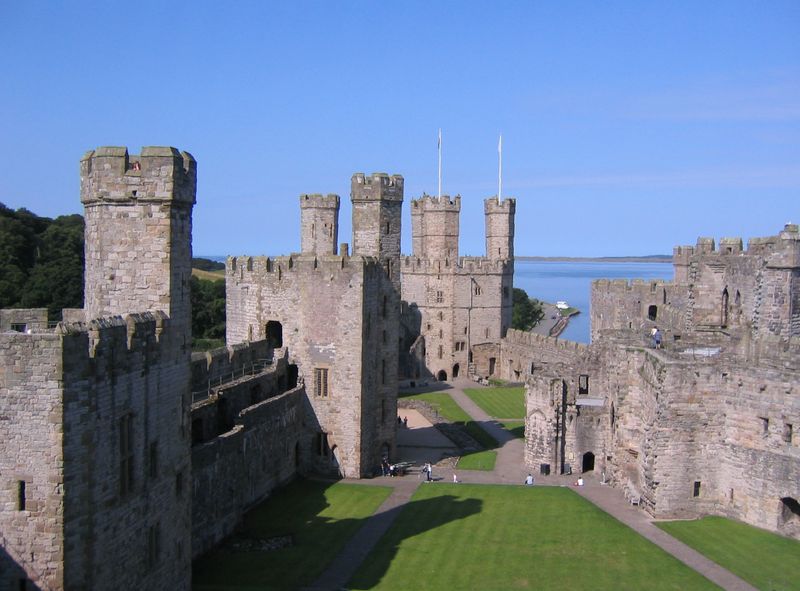
Jane married Hugh Gwyn, of Peniarth, High Sheriff of Carnaerfonshire,526 527 son of John Wynne ap William and Jonet ferch Gruffudd, in 1565 in Peniarth, Caernarfon, Caernarfonshire, Wales. Hugh was born in 1538, was christened in 1538, and died after 1611. Other names for Hugh were Hugh Gwyn of Bodvel, Hugh ap Gwyn of Peniarth., High Sheriff of Carnaerfonshire, Hugh Gwynn, and Hugh Gwyn ap John Wynne ap Williams of Pennardd.
Research Notes: Source: FamilySearch.org AFN: 1VXC-6QS (11/10/06) has b. and christened 1538.
--------
From the bookReifsnyder-Gillam Ancestry, edited by Thomas Allen Glenn (Philadelphia, 1902), provided by books.google.com, p. 47:
"[John Powell, aka John ap Howell Gôch] married Sibill, daughter (seventh child) of Hugh Gwyn, Esquire, of Peniarth, Caernarvonshire, by Jane, daughter of Owen ap Hugh, of Bodeon, Anglesey [see footnote 5, p. 47], and sister unto Sir Hugh Owen, Barrister-at-Law and Recorder of Caermarthen, ancestor to the Owens, Baronets, of Orielton, Pembrokeshire. Hugh Gwyn [see footnote 6, p. 47] was High Sheriff of Caernarvonshire from 2 December 1599-1600, and was commissioned one of the Justices of the Peace for that county, 11 May, 1611.
"Owen ap Hugh, of Bodeon, Anglesey, was High Sheriff of Anglesey, 30 November, 1562-63, 1579-80 (30 November), and died 1613. His second wife, mother of Jane, who married Hugh Gwyn, was Sibill, youngest daughter of Sir William Griffith, Knt., of Penrhyn, Caernarvonshire, Chamberlain of North Wales, by his second wife, Jane, daughter of John Puleston, of Bers and Havod y Wern."
From p. 59:
"X. JANE OWEN, who married Hugh Gwyn, of Peniarth, High Sheriff of Caernarvonshire from 2 December, 1599-1600, and Justice of the Peace 11 May, 1611. Their daughter, Sibill (XI), married John Powell, of Gadfa, Llanwddyn, Montygomeryshire, and had Elizabeth (XII), who married Humphrey ap Hugh, of Llwyn du (see page 47)."
----
From The History of the Gwydir Family by Sir John Wynne (Oswestry, 1878), p. 78 :
"...in Evioneth of old there were two sects or kindred, the one lineally descended of Owen Gwynedd, Prince of Wales, consisting then and now of four houses, viz. Keselgyfarch, y Llys ynghefn y fann, now called Ystimkegid, Clenenny, and Brynkir, Glasfrin or Cwmstrallyn; the other sect descended of Collwyn, whereof are five houses or more; viz. Whelog, Bron y foel, Berkin, Gwnfryn, Talhenbont, and the house of Hugh Gwyn ap John Wynne ap William called Pennardd, all descended of their common ancestor, Jevan ap Einion ap Gruffith."
Noted events in his life were:
• Appointed: High Sheriff of Caernarvonshire, 2 Dec 1599 or 1600.
• Appointed: Justice of the Peace, 11 May 1611.
Children from this marriage were:
+ 541 F i. Sibill verch Hugh Gwyn, of Peniarth was born between 1566 and 1575 in Peniarth, Caernarfon, Caernarfonshire, Wales and died in Gadfa, Rhiwargor, Llanwyddn, Montgomeryshire, Wales.
+ 542 F ii. Eleanor verch Hugh Gwyn, of Peniarth died after 1646.
482. Sir Hugh Owen, Recorder of Caermarthen (Sibill Griffith432, Sir William Griffith, Lord of Penrhyn, Chamberlain of North Wales386, Joan Troutbeck353, Margaret Stanley318, Joan Goushill297, Elizabeth FitzAlan, d'Arundelle265, Elizabeth de Bohun, Countess of Arundel224, Sir William de Bohun, K.G., 1st Earl of Northampton179, Elizabeth, of Rhuddlan, Princess of England134, King Edward I, of England97, King Henry III, of England71, King John "Lackland", of England54, Henry II "Curtmantel", King of England42, Empress Matilda, Countess of Anjou24, Matilda, of Scotland12, Saint Margaret, of Scotland7, Agatha5, Yaroslav I, of Kiev4, Vladimir I, of Kiev3, Sviatoslav I, of Kiev2, Igor, Grand Prince of Kiev1) was born in 1550 in Orielton, Pembroke, Pembrokeshire, Wales, died on 8 Feb 1614 at age 64, and was buried in Monkton Church, [Orielton, Pembs?]. Another name for Hugh was Hugh ap Owen Recorder of Caermarthen.
Research Notes: FamilySearch.org Compact Disc #94 Pin #361176
http://www.varrall.net/pafn12.htm#290
Notes: Called to the bar from Grays Inn, Practised on the Carmarthen Circuit of Great Sessions. In 1574 was elected Recorder of Carmarthen.
Inherited the Orielton estates by way of his marriage to Elizabeth Wyrriot. Orielton remained the main residence and seat of the Owen family until it's sale in the 1850's.
Knighted 1608.
High Sheriff of Pembrokeshire in 1583
-----------
From Welsh Biography Online (http://yba.llgc.org.uk/en/s-OWEN-BOD-1545.html) :
"OWEN AP HUGH of Bodeon was quite a prominent man in Anglesey in the early age of Elizabeth, sheriff twice, and Member of Parliament in 1545 for Newborough (according to the old order). His son, the first Sir HUGH OWEN, was a man of law, and recorder of the town of Carmarthen; this position enabled him to win the hand of Elizabeth, daughter and heiress of George Wirriott of Orielton in Pembroke (see Owen of Orielton ). When the Civil War broke out the attitude of the family, both in Anglesey and Pembroke, was indeterminate and non-committal; he would be a clever man who could say whether the second Sir Hugh favoured the king or the Parliament, so taciturn was he, and so close he kept his secrets."
Hugh married Elizabeth Wyrriot, daughter of George Wyrriot, of Orielton and Jane Philipps, on 13 May 1571 in Bodowen (Bodeon), Llangadwaladr, Anglesey, Wales. Elizabeth was born in 1551 in Orielton, Pembroke, Pembrokeshire, Wales and died in 1599 at age 48. Other names for Elizabeth were Elizabeth Werriot and Elizabeth Wirriott.
Research Notes: From Welsh Biography Online (http://yba.llgc.org.uk/en/s-OWEN-ORI-1571.html) :
"OWEN family of Orielton, Pembs. The Owen of Orielton family played a prominent part in the history of Pembrokeshire for nearly three centuries. The estate of Orielton in Castlemartin came into the possession of the Owen family by the marriage of HUGH ab OWEN to Elizabeth Wirriot in 1571."
Children from this marriage were:
+ 543 F i. Sybil Owen
+ 544 F ii. Ann Owen
+ 545 F iii. Jane Owen
+ 546 M iv. Sir John Owen
+ 547 M v. William Owen
+ 548 M vi. Francis Owen
+ 549 M vii. Morris Owen was born in 1588 in Orielton, Pembroke, Pembrokeshire, Wales.
+ 550 F viii. Janet Owen
483. William Owen (Sibill Griffith432, Sir William Griffith, Lord of Penrhyn, Chamberlain of North Wales386, Joan Troutbeck353, Margaret Stanley318, Joan Goushill297, Elizabeth FitzAlan, d'Arundelle265, Elizabeth de Bohun, Countess of Arundel224, Sir William de Bohun, K.G., 1st Earl of Northampton179, Elizabeth, of Rhuddlan, Princess of England134, King Edward I, of England97, King Henry III, of England71, King John "Lackland", of England54, Henry II "Curtmantel", King of England42, Empress Matilda, Countess of Anjou24, Matilda, of Scotland12, Saint Margaret, of Scotland7, Agatha5, Yaroslav I, of Kiev4, Vladimir I, of Kiev3, Sviatoslav I, of Kiev2, Igor, Grand Prince of Kiev1).
Research Notes: Source: http://www.varrall.net/pafn12.htm#621 Notes: Doctor of Divinity
Chancellor of the diocese of Bangor
484. John Owen (Sibill Griffith432, Sir William Griffith, Lord of Penrhyn, Chamberlain of North Wales386, Joan Troutbeck353, Margaret Stanley318, Joan Goushill297, Elizabeth FitzAlan, d'Arundelle265, Elizabeth de Bohun, Countess of Arundel224, Sir William de Bohun, K.G., 1st Earl of Northampton179, Elizabeth, of Rhuddlan, Princess of England134, King Edward I, of England97, King Henry III, of England71, King John "Lackland", of England54, Henry II "Curtmantel", King of England42, Empress Matilda, Countess of Anjou24, Matilda, of Scotland12, Saint Margaret, of Scotland7, Agatha5, Yaroslav I, of Kiev4, Vladimir I, of Kiev3, Sviatoslav I, of Kiev2, Igor, Grand Prince of Kiev1).
Research Notes: Source: http://www.varrall.net/pafn12.htm#622 Note: Royal Exchange, London
485. Jasper Owen (Sibill Griffith432, Sir William Griffith, Lord of Penrhyn, Chamberlain of North Wales386, Joan Troutbeck353, Margaret Stanley318, Joan Goushill297, Elizabeth FitzAlan, d'Arundelle265, Elizabeth de Bohun, Countess of Arundel224, Sir William de Bohun, K.G., 1st Earl of Northampton179, Elizabeth, of Rhuddlan, Princess of England134, King Edward I, of England97, King Henry III, of England71, King John "Lackland", of England54, Henry II "Curtmantel", King of England42, Empress Matilda, Countess of Anjou24, Matilda, of Scotland12, Saint Margaret, of Scotland7, Agatha5, Yaroslav I, of Kiev4, Vladimir I, of Kiev3, Sviatoslav I, of Kiev2, Igor, Grand Prince of Kiev1).
Research Notes: Source: http://www.varrall.net/pafn12.htm#623 Note: M.A.
486. Randle Owen (Sibill Griffith432, Sir William Griffith, Lord of Penrhyn, Chamberlain of North Wales386, Joan Troutbeck353, Margaret Stanley318, Joan Goushill297, Elizabeth FitzAlan, d'Arundelle265, Elizabeth de Bohun, Countess of Arundel224, Sir William de Bohun, K.G., 1st Earl of Northampton179, Elizabeth, of Rhuddlan, Princess of England134, King Edward I, of England97, King Henry III, of England71, King John "Lackland", of England54, Henry II "Curtmantel", King of England42, Empress Matilda, Countess of Anjou24, Matilda, of Scotland12, Saint Margaret, of Scotland7, Agatha5, Yaroslav I, of Kiev4, Vladimir I, of Kiev3, Sviatoslav I, of Kiev2, Igor, Grand Prince of Kiev1).
Research Notes: Source: http://www.varrall.net/pafg26.htm#624. Notes: (Golden Grove MSS) Lived in Puncheston, Pembs.
487. Rowland Owen (Sibill Griffith432, Sir William Griffith, Lord of Penrhyn, Chamberlain of North Wales386, Joan Troutbeck353, Margaret Stanley318, Joan Goushill297, Elizabeth FitzAlan, d'Arundelle265, Elizabeth de Bohun, Countess of Arundel224, Sir William de Bohun, K.G., 1st Earl of Northampton179, Elizabeth, of Rhuddlan, Princess of England134, King Edward I, of England97, King Henry III, of England71, King John "Lackland", of England54, Henry II "Curtmantel", King of England42, Empress Matilda, Countess of Anjou24, Matilda, of Scotland12, Saint Margaret, of Scotland7, Agatha5, Yaroslav I, of Kiev4, Vladimir I, of Kiev3, Sviatoslav I, of Kiev2, Igor, Grand Prince of Kiev1).
Research Notes: Source: http://www.varrall.net/pafg12.htm#290
488. Morris Owen (Sibill Griffith432, Sir William Griffith, Lord of Penrhyn, Chamberlain of North Wales386, Joan Troutbeck353, Margaret Stanley318, Joan Goushill297, Elizabeth FitzAlan, d'Arundelle265, Elizabeth de Bohun, Countess of Arundel224, Sir William de Bohun, K.G., 1st Earl of Northampton179, Elizabeth, of Rhuddlan, Princess of England134, King Edward I, of England97, King Henry III, of England71, King John "Lackland", of England54, Henry II "Curtmantel", King of England42, Empress Matilda, Countess of Anjou24, Matilda, of Scotland12, Saint Margaret, of Scotland7, Agatha5, Yaroslav I, of Kiev4, Vladimir I, of Kiev3, Sviatoslav I, of Kiev2, Igor, Grand Prince of Kiev1).
Research Notes: Source: http://www.varrall.net/pafg12.htm#290
489. Edward Owen (Sibill Griffith432, Sir William Griffith, Lord of Penrhyn, Chamberlain of North Wales386, Joan Troutbeck353, Margaret Stanley318, Joan Goushill297, Elizabeth FitzAlan, d'Arundelle265, Elizabeth de Bohun, Countess of Arundel224, Sir William de Bohun, K.G., 1st Earl of Northampton179, Elizabeth, of Rhuddlan, Princess of England134, King Edward I, of England97, King Henry III, of England71, King John "Lackland", of England54, Henry II "Curtmantel", King of England42, Empress Matilda, Countess of Anjou24, Matilda, of Scotland12, Saint Margaret, of Scotland7, Agatha5, Yaroslav I, of Kiev4, Vladimir I, of Kiev3, Sviatoslav I, of Kiev2, Igor, Grand Prince of Kiev1).
Research Notes: Source: http://www.varrall.net/pafg12.htm#290
490. Robert Owen (Sibill Griffith432, Sir William Griffith, Lord of Penrhyn, Chamberlain of North Wales386, Joan Troutbeck353, Margaret Stanley318, Joan Goushill297, Elizabeth FitzAlan, d'Arundelle265, Elizabeth de Bohun, Countess of Arundel224, Sir William de Bohun, K.G., 1st Earl of Northampton179, Elizabeth, of Rhuddlan, Princess of England134, King Edward I, of England97, King Henry III, of England71, King John "Lackland", of England54, Henry II "Curtmantel", King of England42, Empress Matilda, Countess of Anjou24, Matilda, of Scotland12, Saint Margaret, of Scotland7, Agatha5, Yaroslav I, of Kiev4, Vladimir I, of Kiev3, Sviatoslav I, of Kiev2, Igor, Grand Prince of Kiev1).
Research Notes: Source: http://www.varrall.net/pafg12.htm#290. Notes: (Golden grove MSS) lived in Carmarthenshire
491. Gwen Owen (Sibill Griffith432, Sir William Griffith, Lord of Penrhyn, Chamberlain of North Wales386, Joan Troutbeck353, Margaret Stanley318, Joan Goushill297, Elizabeth FitzAlan, d'Arundelle265, Elizabeth de Bohun, Countess of Arundel224, Sir William de Bohun, K.G., 1st Earl of Northampton179, Elizabeth, of Rhuddlan, Princess of England134, King Edward I, of England97, King Henry III, of England71, King John "Lackland", of England54, Henry II "Curtmantel", King of England42, Empress Matilda, Countess of Anjou24, Matilda, of Scotland12, Saint Margaret, of Scotland7, Agatha5, Yaroslav I, of Kiev4, Vladimir I, of Kiev3, Sviatoslav I, of Kiev2, Igor, Grand Prince of Kiev1).
Research Notes: Source: http://www.varrall.net/pafg12.htm#290
492. Elin Owen (Sibill Griffith432, Sir William Griffith, Lord of Penrhyn, Chamberlain of North Wales386, Joan Troutbeck353, Margaret Stanley318, Joan Goushill297, Elizabeth FitzAlan, d'Arundelle265, Elizabeth de Bohun, Countess of Arundel224, Sir William de Bohun, K.G., 1st Earl of Northampton179, Elizabeth, of Rhuddlan, Princess of England134, King Edward I, of England97, King Henry III, of England71, King John "Lackland", of England54, Henry II "Curtmantel", King of England42, Empress Matilda, Countess of Anjou24, Matilda, of Scotland12, Saint Margaret, of Scotland7, Agatha5, Yaroslav I, of Kiev4, Vladimir I, of Kiev3, Sviatoslav I, of Kiev2, Igor, Grand Prince of Kiev1) was born circa 1560 in Anglesey, Wales.
Research Notes: Source: http://www.varrall.net/pafg26.htm#631. Married Henry Bowen.
493. Catherine Owen (Sibill Griffith432, Sir William Griffith, Lord of Penrhyn, Chamberlain of North Wales386, Joan Troutbeck353, Margaret Stanley318, Joan Goushill297, Elizabeth FitzAlan, d'Arundelle265, Elizabeth de Bohun, Countess of Arundel224, Sir William de Bohun, K.G., 1st Earl of Northampton179, Elizabeth, of Rhuddlan, Princess of England134, King Edward I, of England97, King Henry III, of England71, King John "Lackland", of England54, Henry II "Curtmantel", King of England42, Empress Matilda, Countess of Anjou24, Matilda, of Scotland12, Saint Margaret, of Scotland7, Agatha5, Yaroslav I, of Kiev4, Vladimir I, of Kiev3, Sviatoslav I, of Kiev2, Igor, Grand Prince of Kiev1).
Research Notes: Source: http://www.varrall.net/pafg26.htm#632. Married Thomas Vaughan.
494. Edward Stanley, 1st Baronet of Bickerstaffe 494 (Sir Henry Stanley433, Sir James Stanley, of Cross Hall392, Sir George Stanley, 9th Lord Strange of Knockyn358, Thomas Stanley, 1st Earl of Derby319, Joan Goushill297, Elizabeth FitzAlan, d'Arundelle265, Elizabeth de Bohun, Countess of Arundel224, Sir William de Bohun, K.G., 1st Earl of Northampton179, Elizabeth, of Rhuddlan, Princess of England134, King Edward I, of England97, King Henry III, of England71, King John "Lackland", of England54, Henry II "Curtmantel", King of England42, Empress Matilda, Countess of Anjou24, Matilda, of Scotland12, Saint Margaret, of Scotland7, Agatha5, Yaroslav I, of Kiev4, Vladimir I, of Kiev3, Sviatoslav I, of Kiev2, Igor, Grand Prince of Kiev1) was born in 1576 in Ormskirk, West Lancashire, England and died on 2 May 1640 at age 64.
Edward married someone.
+ 551 M i. Sir Thomas Stanley, 2nd Baronet of Bickerstaffe 494 was born on 22 Oct 1616 and died in May 1653 at age 36.
495. Robert Hyde, Jr. 523 (Jane Davenport436, Blanche Warburton397, Jane Stanley360, Sir William Stanley, of Holt, K.G.320, Joan Goushill297, Elizabeth FitzAlan, d'Arundelle265, Elizabeth de Bohun, Countess of Arundel224, Sir William de Bohun, K.G., 1st Earl of Northampton179, Elizabeth, of Rhuddlan, Princess of England134, King Edward I, of England97, King Henry III, of England71, King John "Lackland", of England54, Henry II "Curtmantel", King of England42, Empress Matilda, Countess of Anjou24, Matilda, of Scotland12, Saint Margaret, of Scotland7, Agatha5, Yaroslav I, of Kiev4, Vladimir I, of Kiev3, Sviatoslav I, of Kiev2, Igor, Grand Prince of Kiev1) was born in 1543 in Norbury, Cheshire, England and died in 1614 at age 71.
Robert married Beatrice Calvery.528 Beatrice was born in 1557 in Calvery, Yorkshire, England and died in 1624 at age 67.
The child from this marriage was:
+ 552 F i. Mary Hyde 529 was born about 1586 in Stockport, Cheshire, England.
496. Hamon Hyde (Jane Davenport436, Blanche Warburton397, Jane Stanley360, Sir William Stanley, of Holt, K.G.320, Joan Goushill297, Elizabeth FitzAlan, d'Arundelle265, Elizabeth de Bohun, Countess of Arundel224, Sir William de Bohun, K.G., 1st Earl of Northampton179, Elizabeth, of Rhuddlan, Princess of England134, King Edward I, of England97, King Henry III, of England71, King John "Lackland", of England54, Henry II "Curtmantel", King of England42, Empress Matilda, Countess of Anjou24, Matilda, of Scotland12, Saint Margaret, of Scotland7, Agatha5, Yaroslav I, of Kiev4, Vladimir I, of Kiev3, Sviatoslav I, of Kiev2, Igor, Grand Prince of Kiev1) was born about 1545 in Norbury, Cheshire, England.
Research Notes: Source: http://wc.rootsweb.ancestry.com/cgi-bin/igm.cgi?op=GET&db=:3143362&id=I653270090
497. William Hyde (Jane Davenport436, Blanche Warburton397, Jane Stanley360, Sir William Stanley, of Holt, K.G.320, Joan Goushill297, Elizabeth FitzAlan, d'Arundelle265, Elizabeth de Bohun, Countess of Arundel224, Sir William de Bohun, K.G., 1st Earl of Northampton179, Elizabeth, of Rhuddlan, Princess of England134, King Edward I, of England97, King Henry III, of England71, King John "Lackland", of England54, Henry II "Curtmantel", King of England42, Empress Matilda, Countess of Anjou24, Matilda, of Scotland12, Saint Margaret, of Scotland7, Agatha5, Yaroslav I, of Kiev4, Vladimir I, of Kiev3, Sviatoslav I, of Kiev2, Igor, Grand Prince of Kiev1) was born about 1547 in Norbury, Cheshire, England.
Research Notes: Source: http://wc.rootsweb.ancestry.com/cgi-bin/igm.cgi?op=GET&db=:3143362&id=I653270091
498. Dorothy Hyde (Jane Davenport436, Blanche Warburton397, Jane Stanley360, Sir William Stanley, of Holt, K.G.320, Joan Goushill297, Elizabeth FitzAlan, d'Arundelle265, Elizabeth de Bohun, Countess of Arundel224, Sir William de Bohun, K.G., 1st Earl of Northampton179, Elizabeth, of Rhuddlan, Princess of England134, King Edward I, of England97, King Henry III, of England71, King John "Lackland", of England54, Henry II "Curtmantel", King of England42, Empress Matilda, Countess of Anjou24, Matilda, of Scotland12, Saint Margaret, of Scotland7, Agatha5, Yaroslav I, of Kiev4, Vladimir I, of Kiev3, Sviatoslav I, of Kiev2, Igor, Grand Prince of Kiev1) was born about 1548 in Norbury, Cheshire, England, died in May 1593 in Prestbury, Cheshire, England about age 45, and was buried on 14 May 1593 in Prestbury, Cheshire, England.
Research Notes: Source: http://wc.rootsweb.ancestry.com/cgi-bin/igm.cgi?op=GET&db=:3143362&id=I653270092
499. Edward Hyde (Jane Davenport436, Blanche Warburton397, Jane Stanley360, Sir William Stanley, of Holt, K.G.320, Joan Goushill297, Elizabeth FitzAlan, d'Arundelle265, Elizabeth de Bohun, Countess of Arundel224, Sir William de Bohun, K.G., 1st Earl of Northampton179, Elizabeth, of Rhuddlan, Princess of England134, King Edward I, of England97, King Henry III, of England71, King John "Lackland", of England54, Henry II "Curtmantel", King of England42, Empress Matilda, Countess of Anjou24, Matilda, of Scotland12, Saint Margaret, of Scotland7, Agatha5, Yaroslav I, of Kiev4, Vladimir I, of Kiev3, Sviatoslav I, of Kiev2, Igor, Grand Prince of Kiev1) was born about 1549 in Norbury, Cheshire, England.
Research Notes: Source: http://wc.rootsweb.ancestry.com/cgi-bin/igm.cgi?op=GET&db=:3143362&id=I653270095
500. Thomas Hyde (Jane Davenport436, Blanche Warburton397, Jane Stanley360, Sir William Stanley, of Holt, K.G.320, Joan Goushill297, Elizabeth FitzAlan, d'Arundelle265, Elizabeth de Bohun, Countess of Arundel224, Sir William de Bohun, K.G., 1st Earl of Northampton179, Elizabeth, of Rhuddlan, Princess of England134, King Edward I, of England97, King Henry III, of England71, King John "Lackland", of England54, Henry II "Curtmantel", King of England42, Empress Matilda, Countess of Anjou24, Matilda, of Scotland12, Saint Margaret, of Scotland7, Agatha5, Yaroslav I, of Kiev4, Vladimir I, of Kiev3, Sviatoslav I, of Kiev2, Igor, Grand Prince of Kiev1) was born about 1551 in Norbury, Cheshire, England, died in Dec 1618 in Salisbury, Wiltshire, England about age 67, and was buried on 9 Dec 1618 in Salisbury, Wiltshire, England.
Research Notes: Source: http://wc.rootsweb.ancestry.com/cgi-bin/igm.cgi?op=GET&db=:3143362&id=I653270096
501. Richard Hyde (Jane Davenport436, Blanche Warburton397, Jane Stanley360, Sir William Stanley, of Holt, K.G.320, Joan Goushill297, Elizabeth FitzAlan, d'Arundelle265, Elizabeth de Bohun, Countess of Arundel224, Sir William de Bohun, K.G., 1st Earl of Northampton179, Elizabeth, of Rhuddlan, Princess of England134, King Edward I, of England97, King Henry III, of England71, King John "Lackland", of England54, Henry II "Curtmantel", King of England42, Empress Matilda, Countess of Anjou24, Matilda, of Scotland12, Saint Margaret, of Scotland7, Agatha5, Yaroslav I, of Kiev4, Vladimir I, of Kiev3, Sviatoslav I, of Kiev2, Igor, Grand Prince of Kiev1) was born about 1553 in Norbury, Cheshire, England.
Research Notes: Source: http://wc.rootsweb.ancestry.com/cgi-bin/igm.cgi?op=GET&db=:3143362&id=I653270098
502. Randall Hyde (Jane Davenport436, Blanche Warburton397, Jane Stanley360, Sir William Stanley, of Holt, K.G.320, Joan Goushill297, Elizabeth FitzAlan, d'Arundelle265, Elizabeth de Bohun, Countess of Arundel224, Sir William de Bohun, K.G., 1st Earl of Northampton179, Elizabeth, of Rhuddlan, Princess of England134, King Edward I, of England97, King Henry III, of England71, King John "Lackland", of England54, Henry II "Curtmantel", King of England42, Empress Matilda, Countess of Anjou24, Matilda, of Scotland12, Saint Margaret, of Scotland7, Agatha5, Yaroslav I, of Kiev4, Vladimir I, of Kiev3, Sviatoslav I, of Kiev2, Igor, Grand Prince of Kiev1) was born about 1555 in Norbury, Cheshire, England.
Research Notes: Source: http://wc.rootsweb.ancestry.com/cgi-bin/igm.cgi?op=GET&db=:3143362&id=I653270099
503. Anne Hyde (Jane Davenport436, Blanche Warburton397, Jane Stanley360, Sir William Stanley, of Holt, K.G.320, Joan Goushill297, Elizabeth FitzAlan, d'Arundelle265, Elizabeth de Bohun, Countess of Arundel224, Sir William de Bohun, K.G., 1st Earl of Northampton179, Elizabeth, of Rhuddlan, Princess of England134, King Edward I, of England97, King Henry III, of England71, King John "Lackland", of England54, Henry II "Curtmantel", King of England42, Empress Matilda, Countess of Anjou24, Matilda, of Scotland12, Saint Margaret, of Scotland7, Agatha5, Yaroslav I, of Kiev4, Vladimir I, of Kiev3, Sviatoslav I, of Kiev2, Igor, Grand Prince of Kiev1) was born about 1559 in Norbury, Cheshire, England.
Research Notes: Source: http://wc.rootsweb.ancestry.com/cgi-bin/igm.cgi?op=GET&db=:3143362&id=I653270101
504. Ellin Hyde (Jane Davenport436, Blanche Warburton397, Jane Stanley360, Sir William Stanley, of Holt, K.G.320, Joan Goushill297, Elizabeth FitzAlan, d'Arundelle265, Elizabeth de Bohun, Countess of Arundel224, Sir William de Bohun, K.G., 1st Earl of Northampton179, Elizabeth, of Rhuddlan, Princess of England134, King Edward I, of England97, King Henry III, of England71, King John "Lackland", of England54, Henry II "Curtmantel", King of England42, Empress Matilda, Countess of Anjou24, Matilda, of Scotland12, Saint Margaret, of Scotland7, Agatha5, Yaroslav I, of Kiev4, Vladimir I, of Kiev3, Sviatoslav I, of Kiev2, Igor, Grand Prince of Kiev1) was born about 1561 in Norbury, Cheshire, England.
Research Notes: Source: http://wc.rootsweb.ancestry.com/cgi-bin/igm.cgi?op=GET&db=:3143362&id=I653270103
505. Hon. Catherine Carey (Anne Morgan441, Elizabeth Whitney406, James Whitney363, Constance Touchet330, Eleanor de Holland300, Constance, of York270, Edmund, of Langley, 1st Duke of York225, Edward III, King of England182, King Edward II, of England135, King Edward I, of England97, King Henry III, of England71, King John "Lackland", of England54, Henry II "Curtmantel", King of England42, Empress Matilda, Countess of Anjou24, Matilda, of Scotland12, Saint Margaret, of Scotland7, Agatha5, Yaroslav I, of Kiev4, Vladimir I, of Kiev3, Sviatoslav I, of Kiev2, Igor, Grand Prince of Kiev1)
Catherine married Charles Howard.
The child from this marriage was:
+ 553 M i. William Howard, Lord Howard
506. Jane Puleston (Rowland Puleston443, Sir John Puleston, of Bers, Chamberlain of North Wales408, Eleanor Whitney364, Constance Touchet330, Eleanor de Holland300, Constance, of York270, Edmund, of Langley, 1st Duke of York225, Edward III, King of England182, King Edward II, of England135, King Edward I, of England97, King Henry III, of England71, King John "Lackland", of England54, Henry II "Curtmantel", King of England42, Empress Matilda, Countess of Anjou24, Matilda, of Scotland12, Saint Margaret, of Scotland7, Agatha5, Yaroslav I, of Kiev4, Vladimir I, of Kiev3, Sviatoslav I, of Kiev2, Igor, Grand Prince of Kiev1)
Jane married Sir Thomas Jones.530
The child from this marriage was:
+ 554 F i. Elizabeth Jones
507. John Puleston, of Llwyn y Cnotiau (Hugh Puleston, of Bers450, Sir John Puleston, of Bers, Chamberlain of North Wales408, Eleanor Whitney364, Constance Touchet330, Eleanor de Holland300, Constance, of York270, Edmund, of Langley, 1st Duke of York225, Edward III, King of England182, King Edward II, of England135, King Edward I, of England97, King Henry III, of England71, King John "Lackland", of England54, Henry II "Curtmantel", King of England42, Empress Matilda, Countess of Anjou24, Matilda, of Scotland12, Saint Margaret, of Scotland7, Agatha5, Yaroslav I, of Kiev4, Vladimir I, of Kiev3, Sviatoslav I, of Kiev2, Igor, Grand Prince of Kiev1).
Research Notes: Source: The History of the Princes, the Lords Marcher, and the Ancient Nobility of Powys Fadog, and the Ancient Lords of Arwystli, Cedewen, and Meirionydd by J. Y. W. Lloyd, Vol. II (London, 1882), p. 138
John married Maudlen Hanmer, daughter of Sir Thomas Hanmer and Unknown,.
Research Notes: Source: The History of the Princes, the Lords Marcher, and the Ancient Nobility of Powys Fadog, and the Ancient Lords of Arwystli, Cedewen, and Meirionydd by J. Y. W. Lloyd, Vol. II (London, 1882), p. 138
508. Edward Puleston (Hugh Puleston, of Bers450, Sir John Puleston, of Bers, Chamberlain of North Wales408, Eleanor Whitney364, Constance Touchet330, Eleanor de Holland300, Constance, of York270, Edmund, of Langley, 1st Duke of York225, Edward III, King of England182, King Edward II, of England135, King Edward I, of England97, King Henry III, of England71, King John "Lackland", of England54, Henry II "Curtmantel", King of England42, Empress Matilda, Countess of Anjou24, Matilda, of Scotland12, Saint Margaret, of Scotland7, Agatha5, Yaroslav I, of Kiev4, Vladimir I, of Kiev3, Sviatoslav I, of Kiev2, Igor, Grand Prince of Kiev1).
Research Notes: Source: The History of the Princes, the Lords Marcher, and the Ancient Nobility of Powys Fadog, and the Ancient Lords of Arwystli, Cedewen, and Meirionydd by J. Y. W. Lloyd, Vol. II (London, 1882), p. 138
Edward married Margaret verch Owen ap Owen.
Research Notes: Source: The History of the Princes, the Lords Marcher, and the Ancient Nobility of Powys Fadog, and the Ancient Lords of Arwystli, Cedewen, and Meirionydd by J. Y. W. Lloyd, Vol. II (London, 1882), p. 138
Children from this marriage were:
+ 555 M i. John Puleston
+ 556 F ii. Margaret Puleston
509. Robert Puleston (Hugh Puleston, of Bers450, Sir John Puleston, of Bers, Chamberlain of North Wales408, Eleanor Whitney364, Constance Touchet330, Eleanor de Holland300, Constance, of York270, Edmund, of Langley, 1st Duke of York225, Edward III, King of England182, King Edward II, of England135, King Edward I, of England97, King Henry III, of England71, King John "Lackland", of England54, Henry II "Curtmantel", King of England42, Empress Matilda, Countess of Anjou24, Matilda, of Scotland12, Saint Margaret, of Scotland7, Agatha5, Yaroslav I, of Kiev4, Vladimir I, of Kiev3, Sviatoslav I, of Kiev2, Igor, Grand Prince of Kiev1).
Research Notes: Source: The History of the Princes, the Lords Marcher, and the Ancient Nobility of Powys Fadog, and the Ancient Lords of Arwystli, Cedewen, and Meirionydd by J. Y. W. Lloyd, Vol. II (London, 1882), p. 138
510. Roger Puleston (Hugh Puleston, of Bers450, Sir John Puleston, of Bers, Chamberlain of North Wales408, Eleanor Whitney364, Constance Touchet330, Eleanor de Holland300, Constance, of York270, Edmund, of Langley, 1st Duke of York225, Edward III, King of England182, King Edward II, of England135, King Edward I, of England97, King Henry III, of England71, King John "Lackland", of England54, Henry II "Curtmantel", King of England42, Empress Matilda, Countess of Anjou24, Matilda, of Scotland12, Saint Margaret, of Scotland7, Agatha5, Yaroslav I, of Kiev4, Vladimir I, of Kiev3, Sviatoslav I, of Kiev2, Igor, Grand Prince of Kiev1).
Research Notes: Source: The History of the Princes, the Lords Marcher, and the Ancient Nobility of Powys Fadog, and the Ancient Lords of Arwystli, Cedewen, and Meirionydd by J. Y. W. Lloyd, Vol. II (London, 1882), p. 138
511. Richard Puleston (Hugh Puleston, of Bers450, Sir John Puleston, of Bers, Chamberlain of North Wales408, Eleanor Whitney364, Constance Touchet330, Eleanor de Holland300, Constance, of York270, Edmund, of Langley, 1st Duke of York225, Edward III, King of England182, King Edward II, of England135, King Edward I, of England97, King Henry III, of England71, King John "Lackland", of England54, Henry II "Curtmantel", King of England42, Empress Matilda, Countess of Anjou24, Matilda, of Scotland12, Saint Margaret, of Scotland7, Agatha5, Yaroslav I, of Kiev4, Vladimir I, of Kiev3, Sviatoslav I, of Kiev2, Igor, Grand Prince of Kiev1).
Research Notes: Source: The History of the Princes, the Lords Marcher, and the Ancient Nobility of Powys Fadog, and the Ancient Lords of Arwystli, Cedewen, and Meirionydd by J. Y. W. Lloyd, Vol. II (London, 1882), p. 138
512. William Puleston (Hugh Puleston, of Bers450, Sir John Puleston, of Bers, Chamberlain of North Wales408, Eleanor Whitney364, Constance Touchet330, Eleanor de Holland300, Constance, of York270, Edmund, of Langley, 1st Duke of York225, Edward III, King of England182, King Edward II, of England135, King Edward I, of England97, King Henry III, of England71, King John "Lackland", of England54, Henry II "Curtmantel", King of England42, Empress Matilda, Countess of Anjou24, Matilda, of Scotland12, Saint Margaret, of Scotland7, Agatha5, Yaroslav I, of Kiev4, Vladimir I, of Kiev3, Sviatoslav I, of Kiev2, Igor, Grand Prince of Kiev1).
Research Notes: Source: The History of the Princes, the Lords Marcher, and the Ancient Nobility of Powys Fadog, and the Ancient Lords of Arwystli, Cedewen, and Meirionydd by J. Y. W. Lloyd, Vol. II (London, 1882), p. 138
513. Jane Puleston (Hugh Puleston, of Bers450, Sir John Puleston, of Bers, Chamberlain of North Wales408, Eleanor Whitney364, Constance Touchet330, Eleanor de Holland300, Constance, of York270, Edmund, of Langley, 1st Duke of York225, Edward III, King of England182, King Edward II, of England135, King Edward I, of England97, King Henry III, of England71, King John "Lackland", of England54, Henry II "Curtmantel", King of England42, Empress Matilda, Countess of Anjou24, Matilda, of Scotland12, Saint Margaret, of Scotland7, Agatha5, Yaroslav I, of Kiev4, Vladimir I, of Kiev3, Sviatoslav I, of Kiev2, Igor, Grand Prince of Kiev1).
Research Notes: Source: The History of the Princes, the Lords Marcher, and the Ancient Nobility of Powys Fadog, and the Ancient Lords of Arwystli, Cedewen, and Meirionydd by J. Y. W. Lloyd, Vol. II (London, 1882), p. 138
Jane married John Eyton, of Eyton.
Research Notes: Source: The History of the Princes, the Lords Marcher, and the Ancient Nobility of Powys Fadog, and the Ancient Lords of Arwystli, Cedewen, and Meirionydd by J. Y. W. Lloyd, Vol. II (London, 1882), p. 138 and 175
514. Alice Puleston (Hugh Puleston, of Bers450, Sir John Puleston, of Bers, Chamberlain of North Wales408, Eleanor Whitney364, Constance Touchet330, Eleanor de Holland300, Constance, of York270, Edmund, of Langley, 1st Duke of York225, Edward III, King of England182, King Edward II, of England135, King Edward I, of England97, King Henry III, of England71, King John "Lackland", of England54, Henry II "Curtmantel", King of England42, Empress Matilda, Countess of Anjou24, Matilda, of Scotland12, Saint Margaret, of Scotland7, Agatha5, Yaroslav I, of Kiev4, Vladimir I, of Kiev3, Sviatoslav I, of Kiev2, Igor, Grand Prince of Kiev1).
Research Notes: Source: The History of the Princes, the Lords Marcher, and the Ancient Nobility of Powys Fadog, and the Ancient Lords of Arwystli, Cedewen, and Meirionydd by J. Y. W. Lloyd, Vol. II (London, 1882), p. 138
Alice married Thomas Jones.
Research Notes: Source: The History of the Princes, the Lords Marcher, and the Ancient Nobility of Powys Fadog, and the Ancient Lords of Arwystli, Cedewen, and Meirionydd by J. Y. W. Lloyd, Vol. II (London, 1882), p. 138
515. Margaret Anne Puleston (Hugh Puleston, of Bers450, Sir John Puleston, of Bers, Chamberlain of North Wales408, Eleanor Whitney364, Constance Touchet330, Eleanor de Holland300, Constance, of York270, Edmund, of Langley, 1st Duke of York225, Edward III, King of England182, King Edward II, of England135, King Edward I, of England97, King Henry III, of England71, King John "Lackland", of England54, Henry II "Curtmantel", King of England42, Empress Matilda, Countess of Anjou24, Matilda, of Scotland12, Saint Margaret, of Scotland7, Agatha5, Yaroslav I, of Kiev4, Vladimir I, of Kiev3, Sviatoslav I, of Kiev2, Igor, Grand Prince of Kiev1).
Research Notes: Source: The History of the Princes, the Lords Marcher, and the Ancient Nobility of Powys Fadog, and the Ancient Lords of Arwystli, Cedewen, and Meirionydd by J. Y. W. Lloyd, Vol. II (London, 1882), p. 138
516. John Puleston (Thomas Puleston451, John Puleston, of Bradenheath and Pickhill417, Philip Puleston368, Sir Roger Puleston, of Emral334, John Puleston, Esq., of Emral304, Lowry Fychan verch Gruffydd Fychan277, Elen verch Thomas ap Llewellyn Owen234, Eleanor ferch Philip ap Ifor194, Catherine verch Llewellyn Gryffyth141, Elinor de Montfort102, Eleanor75, King John "Lackland", of England54, Henry II "Curtmantel", King of England42, Empress Matilda, Countess of Anjou24, Matilda, of Scotland12, Saint Margaret, of Scotland7, Agatha5, Yaroslav I, of Kiev4, Vladimir I, of Kiev3, Sviatoslav I, of Kiev2, Igor, Grand Prince of Kiev1) died on 14 Jan 1722 and was buried in Farndon, England.
Research Notes: Source: Archaeologia Cambrensis, The Journal of the Cambrian Archaeological Association, Vol. VII. 5th Series (London, 1890), p. 124
John married Anne Alport, of Overton, Cheshire, daughter of Richard Alport, of Overton, Cheshire and Unknown,. Anne died on 14 Aug 1715.
Research Notes: 2nd daughter of Richard Alport, Esq. of Overton, Cheshire.
Source: Archaeologia Cambrensis, The Journal of the Cambrian Archaeological Association, Vol. VII. 5th Series (London, 1890), p. 124
Children from this marriage were:
+ 557 F i. Elizabeth Puleston was christened on 5 Apr 1681.
+ 558 F ii. Anne Puleston was christened on 26 Oct 1682 in Bangor, Wales.
+ 559 M iii. John Puleston was christened on 5 Mar 1685 in Bangor, Wales.
+ 560 F iv. Hester Puleston was christened on 9 May 1688 in Bangor, Wales and died on 12 Oct 1732 at age 44.
517. Ermin Puleston (Thomas Puleston451, John Puleston, of Bradenheath and Pickhill417, Philip Puleston368, Sir Roger Puleston, of Emral334, John Puleston, Esq., of Emral304, Lowry Fychan verch Gruffydd Fychan277, Elen verch Thomas ap Llewellyn Owen234, Eleanor ferch Philip ap Ifor194, Catherine verch Llewellyn Gryffyth141, Elinor de Montfort102, Eleanor75, King John "Lackland", of England54, Henry II "Curtmantel", King of England42, Empress Matilda, Countess of Anjou24, Matilda, of Scotland12, Saint Margaret, of Scotland7, Agatha5, Yaroslav I, of Kiev4, Vladimir I, of Kiev3, Sviatoslav I, of Kiev2, Igor, Grand Prince of Kiev1).
Research Notes: Source: Archaeologia Cambrensis, The Journal of the Cambrian Archaeological Association, Vol. VII. 5th Series (London, 1890), p. 124
Ermin married David Madocks, of Fron Yw, son of John Madocks, of Bodfari and Unknown,.
Research Notes: Eldest son of John Madocks of Bodfari
Source: Archaeologia Cambrensis, The Journal of the Cambrian Archaeological Association, Vol. VII. 5th Series (London, 1890), p. 124
The child from this marriage was:
+ 561 M i. William Madocks, of Ruthin and Llai was christened on 9 Aug 1686.
518. Margaret Puleston (Thomas Puleston451, John Puleston, of Bradenheath and Pickhill417, Philip Puleston368, Sir Roger Puleston, of Emral334, John Puleston, Esq., of Emral304, Lowry Fychan verch Gruffydd Fychan277, Elen verch Thomas ap Llewellyn Owen234, Eleanor ferch Philip ap Ifor194, Catherine verch Llewellyn Gryffyth141, Elinor de Montfort102, Eleanor75, King John "Lackland", of England54, Henry II "Curtmantel", King of England42, Empress Matilda, Countess of Anjou24, Matilda, of Scotland12, Saint Margaret, of Scotland7, Agatha5, Yaroslav I, of Kiev4, Vladimir I, of Kiev3, Sviatoslav I, of Kiev2, Igor, Grand Prince of Kiev1).
Research Notes: Source: Archaeologia Cambrensis, The Journal of the Cambrian Archaeological Association, Vol. VII. 5th Series (London, 1890), p. 124
Margaret married John Price, of Sweeney on 29 Sep 1657.
Research Notes: Source: Archaeologia Cambrensis, The Journal of the Cambrian Archaeological Association, Vol. VII. 5th Series (London, 1890), p. 124
519. Elizabeth Puleston (Thomas Puleston451, John Puleston, of Bradenheath and Pickhill417, Philip Puleston368, Sir Roger Puleston, of Emral334, John Puleston, Esq., of Emral304, Lowry Fychan verch Gruffydd Fychan277, Elen verch Thomas ap Llewellyn Owen234, Eleanor ferch Philip ap Ifor194, Catherine verch Llewellyn Gryffyth141, Elinor de Montfort102, Eleanor75, King John "Lackland", of England54, Henry II "Curtmantel", King of England42, Empress Matilda, Countess of Anjou24, Matilda, of Scotland12, Saint Margaret, of Scotland7, Agatha5, Yaroslav I, of Kiev4, Vladimir I, of Kiev3, Sviatoslav I, of Kiev2, Igor, Grand Prince of Kiev1).
Research Notes: Source: Archaeologia Cambrensis, The Journal of the Cambrian Archaeological Association, Vol. VII. 5th Series (London, 1890), p. 124
Elizabeth married Thomas Hughes, of Worthenbury on 22 Jun 1699 in Bangor, Wales.
Research Notes: Source: Archaeologia Cambrensis, The Journal of the Cambrian Archaeological Association, Vol. VII. 5th Series (London, 1890), p. 124
520. John Puleston, of Hafod y wern (Piers Puleston, of Burras452, Sir John Puleston, of Tir Môn and Havod y Wern418, John Hên Puleston, of Hafod-y-Wern, Constable of Caernarfon Castle370, John Puleston, of Bers and Hafod y Wern335, Madog Puleston, of Bers305, Lowry Fychan verch Gruffydd Fychan277, Elen verch Thomas ap Llewellyn Owen234, Eleanor ferch Philip ap Ifor194, Catherine verch Llewellyn Gryffyth141, Elinor de Montfort102, Eleanor75, King John "Lackland", of England54, Henry II "Curtmantel", King of England42, Empress Matilda, Countess of Anjou24, Matilda, of Scotland12, Saint Margaret, of Scotland7, Agatha5, Yaroslav I, of Kiev4, Vladimir I, of Kiev3, Sviatoslav I, of Kiev2, Igor, Grand Prince of Kiev1) was born about 1540 in Hafod-y-Wern, Bersham, Wrexham, Denbighshire, Wales.
Research Notes: Source: History of the Town of Wrexham, Its Houses, Streets, Fields, and Old Families by Alfred Neobard Palmer (Wrexham, 1893), pp. 137-138:
"There is no doubt, however, that Piers Puleston's son and successor, John Puleston, not merely owned Hafod y wern, but lived there."
John married someone.
+ 562 M i. Robert Puleston, of Hafod y wern was buried on 21 Nov 1621 in Wrexham, Denbighshire, Wales.
521. Edward Puleston (Piers Puleston, of Burras452, Sir John Puleston, of Tir Môn and Havod y Wern418, John Hên Puleston, of Hafod-y-Wern, Constable of Caernarfon Castle370, John Puleston, of Bers and Hafod y Wern335, Madog Puleston, of Bers305, Lowry Fychan verch Gruffydd Fychan277, Elen verch Thomas ap Llewellyn Owen234, Eleanor ferch Philip ap Ifor194, Catherine verch Llewellyn Gryffyth141, Elinor de Montfort102, Eleanor75, King John "Lackland", of England54, Henry II "Curtmantel", King of England42, Empress Matilda, Countess of Anjou24, Matilda, of Scotland12, Saint Margaret, of Scotland7, Agatha5, Yaroslav I, of Kiev4, Vladimir I, of Kiev3, Sviatoslav I, of Kiev2, Igor, Grand Prince of Kiev1)
522. Nicholas Puleston (Piers Puleston, of Burras452, Sir John Puleston, of Tir Môn and Havod y Wern418, John Hên Puleston, of Hafod-y-Wern, Constable of Caernarfon Castle370, John Puleston, of Bers and Hafod y Wern335, Madog Puleston, of Bers305, Lowry Fychan verch Gruffydd Fychan277, Elen verch Thomas ap Llewellyn Owen234, Eleanor ferch Philip ap Ifor194, Catherine verch Llewellyn Gryffyth141, Elinor de Montfort102, Eleanor75, King John "Lackland", of England54, Henry II "Curtmantel", King of England42, Empress Matilda, Countess of Anjou24, Matilda, of Scotland12, Saint Margaret, of Scotland7, Agatha5, Yaroslav I, of Kiev4, Vladimir I, of Kiev3, Sviatoslav I, of Kiev2, Igor, Grand Prince of Kiev1)
523. Roger Puleston (Piers Puleston, of Burras452, Sir John Puleston, of Tir Môn and Havod y Wern418, John Hên Puleston, of Hafod-y-Wern, Constable of Caernarfon Castle370, John Puleston, of Bers and Hafod y Wern335, Madog Puleston, of Bers305, Lowry Fychan verch Gruffydd Fychan277, Elen verch Thomas ap Llewellyn Owen234, Eleanor ferch Philip ap Ifor194, Catherine verch Llewellyn Gryffyth141, Elinor de Montfort102, Eleanor75, King John "Lackland", of England54, Henry II "Curtmantel", King of England42, Empress Matilda, Countess of Anjou24, Matilda, of Scotland12, Saint Margaret, of Scotland7, Agatha5, Yaroslav I, of Kiev4, Vladimir I, of Kiev3, Sviatoslav I, of Kiev2, Igor, Grand Prince of Kiev1)
524. Harri Puleston (Piers Puleston, of Burras452, Sir John Puleston, of Tir Môn and Havod y Wern418, John Hên Puleston, of Hafod-y-Wern, Constable of Caernarfon Castle370, John Puleston, of Bers and Hafod y Wern335, Madog Puleston, of Bers305, Lowry Fychan verch Gruffydd Fychan277, Elen verch Thomas ap Llewellyn Owen234, Eleanor ferch Philip ap Ifor194, Catherine verch Llewellyn Gryffyth141, Elinor de Montfort102, Eleanor75, King John "Lackland", of England54, Henry II "Curtmantel", King of England42, Empress Matilda, Countess of Anjou24, Matilda, of Scotland12, Saint Margaret, of Scotland7, Agatha5, Yaroslav I, of Kiev4, Vladimir I, of Kiev3, Sviatoslav I, of Kiev2, Igor, Grand Prince of Kiev1) was born about 1550 in Hafod-y-Wern, Bersham, Wrexham, Denbighshire, Wales.
Research Notes: RootsWeb World Connect (Linda Neely)
525. William Puleston (Piers Puleston, of Burras452, Sir John Puleston, of Tir Môn and Havod y Wern418, John Hên Puleston, of Hafod-y-Wern, Constable of Caernarfon Castle370, John Puleston, of Bers and Hafod y Wern335, Madog Puleston, of Bers305, Lowry Fychan verch Gruffydd Fychan277, Elen verch Thomas ap Llewellyn Owen234, Eleanor ferch Philip ap Ifor194, Catherine verch Llewellyn Gryffyth141, Elinor de Montfort102, Eleanor75, King John "Lackland", of England54, Henry II "Curtmantel", King of England42, Empress Matilda, Countess of Anjou24, Matilda, of Scotland12, Saint Margaret, of Scotland7, Agatha5, Yaroslav I, of Kiev4, Vladimir I, of Kiev3, Sviatoslav I, of Kiev2, Igor, Grand Prince of Kiev1)
526. Ellen Puleston (Piers Puleston, of Burras452, Sir John Puleston, of Tir Môn and Havod y Wern418, John Hên Puleston, of Hafod-y-Wern, Constable of Caernarfon Castle370, John Puleston, of Bers and Hafod y Wern335, Madog Puleston, of Bers305, Lowry Fychan verch Gruffydd Fychan277, Elen verch Thomas ap Llewellyn Owen234, Eleanor ferch Philip ap Ifor194, Catherine verch Llewellyn Gryffyth141, Elinor de Montfort102, Eleanor75, King John "Lackland", of England54, Henry II "Curtmantel", King of England42, Empress Matilda, Countess of Anjou24, Matilda, of Scotland12, Saint Margaret, of Scotland7, Agatha5, Yaroslav I, of Kiev4, Vladimir I, of Kiev3, Sviatoslav I, of Kiev2, Igor, Grand Prince of Kiev1) was born about 1570 in Hafod-y-Wern, Bersham, Wrexham, Denbighshire, Wales.
Research Notes: RootsWeb World Connect (Linda Neely)
527. Margaret Puleston (Piers Puleston, of Burras452, Sir John Puleston, of Tir Môn and Havod y Wern418, John Hên Puleston, of Hafod-y-Wern, Constable of Caernarfon Castle370, John Puleston, of Bers and Hafod y Wern335, Madog Puleston, of Bers305, Lowry Fychan verch Gruffydd Fychan277, Elen verch Thomas ap Llewellyn Owen234, Eleanor ferch Philip ap Ifor194, Catherine verch Llewellyn Gryffyth141, Elinor de Montfort102, Eleanor75, King John "Lackland", of England54, Henry II "Curtmantel", King of England42, Empress Matilda, Countess of Anjou24, Matilda, of Scotland12, Saint Margaret, of Scotland7, Agatha5, Yaroslav I, of Kiev4, Vladimir I, of Kiev3, Sviatoslav I, of Kiev2, Igor, Grand Prince of Kiev1)
528. Jane Puleston (Piers Puleston, of Burras452, Sir John Puleston, of Tir Môn and Havod y Wern418, John Hên Puleston, of Hafod-y-Wern, Constable of Caernarfon Castle370, John Puleston, of Bers and Hafod y Wern335, Madog Puleston, of Bers305, Lowry Fychan verch Gruffydd Fychan277, Elen verch Thomas ap Llewellyn Owen234, Eleanor ferch Philip ap Ifor194, Catherine verch Llewellyn Gryffyth141, Elinor de Montfort102, Eleanor75, King John "Lackland", of England54, Henry II "Curtmantel", King of England42, Empress Matilda, Countess of Anjou24, Matilda, of Scotland12, Saint Margaret, of Scotland7, Agatha5, Yaroslav I, of Kiev4, Vladimir I, of Kiev3, Sviatoslav I, of Kiev2, Igor, Grand Prince of Kiev1)
529. Dorothy Puleston (Piers Puleston, of Burras452, Sir John Puleston, of Tir Môn and Havod y Wern418, John Hên Puleston, of Hafod-y-Wern, Constable of Caernarfon Castle370, John Puleston, of Bers and Hafod y Wern335, Madog Puleston, of Bers305, Lowry Fychan verch Gruffydd Fychan277, Elen verch Thomas ap Llewellyn Owen234, Eleanor ferch Philip ap Ifor194, Catherine verch Llewellyn Gryffyth141, Elinor de Montfort102, Eleanor75, King John "Lackland", of England54, Henry II "Curtmantel", King of England42, Empress Matilda, Countess of Anjou24, Matilda, of Scotland12, Saint Margaret, of Scotland7, Agatha5, Yaroslav I, of Kiev4, Vladimir I, of Kiev3, Sviatoslav I, of Kiev2, Igor, Grand Prince of Kiev1)
530. William Coetmor, of Coetmore (Elin Puleston, of Hafod y Wern454, Sir John Puleston, of Tir Môn and Havod y Wern418, John Hên Puleston, of Hafod-y-Wern, Constable of Caernarfon Castle370, John Puleston, of Bers and Hafod y Wern335, Madog Puleston, of Bers305, Lowry Fychan verch Gruffydd Fychan277, Elen verch Thomas ap Llewellyn Owen234, Eleanor ferch Philip ap Ifor194, Catherine verch Llewellyn Gryffyth141, Elinor de Montfort102, Eleanor75, King John "Lackland", of England54, Henry II "Curtmantel", King of England42, Empress Matilda, Countess of Anjou24, Matilda, of Scotland12, Saint Margaret, of Scotland7, Agatha5, Yaroslav I, of Kiev4, Vladimir I, of Kiev3, Sviatoslav I, of Kiev2, Igor, Grand Prince of Kiev1)
531. John Conyers, 3rd Baron Conyers 152 525 (Christopher Robert Conyers, 2nd Baron Conyers461, Anne Nevill420, Ralph Nevill, Earl of Westmorland371, John Neville338, John de Neville307, Ralph de Neville279, John Neville240, Alice Audley197, Hugh I de Audley144, Ela Longspee106, William II Longspée77, William Longspée, 3rd Earl of Salisbury55, Henry II "Curtmantel", King of England42, Empress Matilda, Countess of Anjou24, Matilda, of Scotland12, Saint Margaret, of Scotland7, Agatha5, Yaroslav I, of Kiev4, Vladimir I, of Kiev3, Sviatoslav I, of Kiev2, Igor, Grand Prince of Kiev1) was born about 1524 in <Hornby Castle, North Riding>, Yorkshire, England and died in Jun 1557 about age 33. Another name for John was John Lord Conyers.
Research Notes: From Wikipedia - John Conyers, 3rd Baron Conyers :
John Conyers, 3rd Baron Conyers (born before 1538-13 June 1557 ) was a British aristocrat, and the son of Christopher Conyers, 2nd Baron Conyers .
Personal life
Conyers married Lady Maud Clifford, daughter of the Earl of Cumberland and had one child - Elizabeth Conyers; later The Hon. Elizabeth Conyers.
Titles
Conyers inherited the title of Baron Conyers upon his father's death in 1538. His wife thus became Lady Conyers and his daughter The Hon. Elizabeth Conyers.[1]. However, since Lord Conyers did not produce a male heir, the title Baron Conyers fell into abeyance upon his death in 1557. It was brought out of abeyance by his grandson, Conyers Darcy , some time between 1641 and 1644.
This grandson is the son of his daughter, Elizabeth , and her husband, Thomas Darcy.
References
^ thePeerage.com - http://www.thepeerage.com/p2928.htm#i29276
----------
From A History of the County of York North Riding: Volume 1 (British History Online):
"John Lord Conyers, son and heir of Christopher, died in 1556, and his property was inherited by his four surviving daughters, Margaret, who died unmarried in 1560, (fn. 38) Anne the wife of Anthony Kempe, Elizabeth, who married Thomas Darcy, and Katherine, afterwards wife of John Atherton. (fn. 39) "
John married someone.
+ 563 F i. Elizabeth Conyers 152 531 was born about 1545 in Hornby Castle, North Riding, Yorkshire, England and died on 6 Jun 1572 in Hornby Castle, North Riding, Yorkshire, England about age 27.
532. John Salusbury, Chamberlain of North Wales (Janet Griffith463, Alice Dalton421, Isabel Stanley372, Sir John de Stanley, King & Lord of the Isle of Man and the Isles, K.G.339, Isabel Lathom309, Sir Thomas de Lathom, of Lathom, Lancashire280, Eleanor de Ferrers241, Sir John de Ferrers, of Southoe and Keyston199, Alianore de Bohun146, Humphrey VI de Bohun107, Humphrey V de Bohun, 2nd Earl of Hereford, 7th Earl of Essex78, Henry de Bohun, 5th Earl of Hereford56, Margaret, of Huntingdon43, Henry, of Huntingdon, Earl of Northumberland & Huntingdon26, David I "The Saint", King of Scots13, Saint Margaret, of Scotland7, Agatha5, Yaroslav I, of Kiev4, Vladimir I, of Kiev3, Sviatoslav I, of Kiev2, Igor, Grand Prince of Kiev1)
533. Sir Roger Salusbury (Janet Griffith463, Alice Dalton421, Isabel Stanley372, Sir John de Stanley, King & Lord of the Isle of Man and the Isles, K.G.339, Isabel Lathom309, Sir Thomas de Lathom, of Lathom, Lancashire280, Eleanor de Ferrers241, Sir John de Ferrers, of Southoe and Keyston199, Alianore de Bohun146, Humphrey VI de Bohun107, Humphrey V de Bohun, 2nd Earl of Hereford, 7th Earl of Essex78, Henry de Bohun, 5th Earl of Hereford56, Margaret, of Huntingdon43, Henry, of Huntingdon, Earl of Northumberland & Huntingdon26, David I "The Saint", King of Scots13, Saint Margaret, of Scotland7, Agatha5, Yaroslav I, of Kiev4, Vladimir I, of Kiev3, Sviatoslav I, of Kiev2, Igor, Grand Prince of Kiev1) was buried in Eglwys Wen, Denbigh, Wales.
Research Notes: Source: The History of the Princes, the Lords Marcher, and the Ancient Nobility of Powys Fadog, and the Ancient Lords of Arwystli, Cedewen, and Meirionydd by J. Y. W. Lloyd, Vol. II (London, 1882), p. 333
534. Ffoulke Salusbury, Dean of St. Asaph (Janet Griffith463, Alice Dalton421, Isabel Stanley372, Sir John de Stanley, King & Lord of the Isle of Man and the Isles, K.G.339, Isabel Lathom309, Sir Thomas de Lathom, of Lathom, Lancashire280, Eleanor de Ferrers241, Sir John de Ferrers, of Southoe and Keyston199, Alianore de Bohun146, Humphrey VI de Bohun107, Humphrey V de Bohun, 2nd Earl of Hereford, 7th Earl of Essex78, Henry de Bohun, 5th Earl of Hereford56, Margaret, of Huntingdon43, Henry, of Huntingdon, Earl of Northumberland & Huntingdon26, David I "The Saint", King of Scots13, Saint Margaret, of Scotland7, Agatha5, Yaroslav I, of Kiev4, Vladimir I, of Kiev3, Sviatoslav I, of Kiev2, Igor, Grand Prince of Kiev1) died after 1532 and was buried in Eglwys Wen, Denbigh, Wales.
Research Notes: Source: The History of the Princes, the Lords Marcher, and the Ancient Nobility of Powys Fadog, and the Ancient Lords of Arwystli, Cedewen, and Meirionydd by J. Y. W. Lloyd, Vol. II (London, 1882), p. 333
535. Thomas Salusbury, of Flint (Janet Griffith463, Alice Dalton421, Isabel Stanley372, Sir John de Stanley, King & Lord of the Isle of Man and the Isles, K.G.339, Isabel Lathom309, Sir Thomas de Lathom, of Lathom, Lancashire280, Eleanor de Ferrers241, Sir John de Ferrers, of Southoe and Keyston199, Alianore de Bohun146, Humphrey VI de Bohun107, Humphrey V de Bohun, 2nd Earl of Hereford, 7th Earl of Essex78, Henry de Bohun, 5th Earl of Hereford56, Margaret, of Huntingdon43, Henry, of Huntingdon, Earl of Northumberland & Huntingdon26, David I "The Saint", King of Scots13, Saint Margaret, of Scotland7, Agatha5, Yaroslav I, of Kiev4, Vladimir I, of Kiev3, Sviatoslav I, of Kiev2, Igor, Grand Prince of Kiev1)
536. Howel ap Einion ap Deikws Ddu (Einion ap Deikws Ddu ap Madoc, Lord of Grainoc464, Deikws Ddu ap Madoc ap Ievan422, Madoc ap Ievan ap David Goch, Lord of Grainianoc381, Ievan ap David Goch, Lord of Grainianoc and Penllech345, David Goch ap Trahairn Goch, Lord of Penllech311, Trahairn Goch ap Madoc ap Rhys-Gloff, Lord of Llyn, Grainianoc and Penllech283, Madoc ap Rhys-Gloff250, Rhys-Gloff, Lord of Cymcydmaen208, Rhys-Vaughn, Lord of Yestradtywy161, Rhys-Mechyllt, of Llandovery Castle121, Joan de Clare89, Amice FitzWilliam, Countess of Gloucester63, Hawise de Beaumont, of Leicester46, Sir Robert de Beaumont, 2nd Earl of Leicester30, Isabel de Vermandois, Countess of Leicester15, Hugh Magnus, of Vermandois and Valois, Duke of France11, Anne, of Kiev6, Yaroslav I, of Kiev4, Vladimir I, of Kiev3, Sviatoslav I, of Kiev2, Igor, Grand Prince of Kiev1).
Research Notes: Source: Welsh Settlement of Pensylvania by Charles H. Browning (Philadelphia, 1912), p. 282
Howel married someone.
+ 564 M i. Griffith ap Howel ap Einion .
537. John Darcy, of Chiche, Essex 515 (Thomas Darcy465, Elizabeth Wentworth, of Nettlestead, Suffolk423, Henry Wentworth, of Nettlestead, Suffolk382, Mary Clifford346, John Clifford312, Baron Thomas de Clifford284, Maud de Beauchamp252, Thomas de Beauchamp213, Guy de Beauchamp, Earl of Warwick165, William de Beauchamp, 9th Earl of Warwick123, Isabel Mauduit91, Alice de Beaumont65, Waleran de Beaumont, 4th Earl of Warwick50, Gundred de Warenne37, Isabel de Vermandois, Countess of Leicester15, Hugh Magnus, of Vermandois and Valois, Duke of France11, Anne, of Kiev6, Yaroslav I, of Kiev4, Vladimir I, of Kiev3, Sviatoslav I, of Kiev2, Igor, Grand Prince of Kiev1) was born in 1532, died on 3 Mar 1580 in England at age 48, and was buried in St. Osith's Priory, Essex, England. Another name for John was John D'Arcy of Chiche, Essex.
John married someone.
+ 565 M i. Thomas Darcy, of Hornby, Yorkshire 514 532 was born on 5 Jul 1565, was christened in 1565, died on 6 Nov 1605 in London, Middlesex, England at age 40, and was buried in Trinity Church, Colchester, Essex, England.
23rd Generation 538. Jane Hilton (Anne Bowes466, Jane Talbot424, Sir John Talbot, of Grafton, sheriff of Shropshire383, Sir Gilbert Talbot, K.G., of Grafton, co. Worcester349, Elizabeth Botiller314, James Botiller, 4th Earl of Ormond290, James Botiller, 3rd Earl of Ormond257, James Botiller, 2nd Earl of Ormond220, Eleanor de Bohun174, Elizabeth, of Rhuddlan, Princess of England134, King Edward I, of England97, King Henry III, of England71, King John "Lackland", of England54, Henry II "Curtmantel", King of England42, Empress Matilda, Countess of Anjou24, Matilda, of Scotland12, Saint Margaret, of Scotland7, Agatha5, Yaroslav I, of Kiev4, Vladimir I, of Kiev3, Sviatoslav I, of Kiev2, Igor, Grand Prince of Kiev1)
Jane married Ralph Delaval.
The child from this marriage was:
+ 566 F i. Mary Delaval
539. Sir Thomas Wyatt 424 (Elizabeth Brooke467, Thomas Brooke426, John Brooke384, Edward Brooke350, Joan Braybrooke315, Joan de la Pole291, Joan de Cobham260, Margaret Courtenay222, Margaret de Bohun178, Elizabeth, of Rhuddlan, Princess of England134, King Edward I, of England97, King Henry III, of England71, King John "Lackland", of England54, Henry II "Curtmantel", King of England42, Empress Matilda, Countess of Anjou24, Matilda, of Scotland12, Saint Margaret, of Scotland7, Agatha5, Yaroslav I, of Kiev4, Vladimir I, of Kiev3, Sviatoslav I, of Kiev2, Igor, Grand Prince of Kiev1) was born in 1521 in Arlington Castle, Kent, England, was christened in 1523 in Arlington Castle, Kent, England, and died on 11 Apr 1554 in London Tower, London, Middlesex, England at age 33.
Thomas married someone.
+ 567 M i. George Wyatt 424 was born in 1550 in Arlington Castle, Kent, England, died on 16 Sep 1623 in Ireland at age 73, and was buried in Boxley Abbey, Boxley, Kent, England.
540. Elizabeth Wyrriot (Jane Philipps469, Elizabeth Gruffydd429, Sir William Griffith, Lord of Penrhyn, Chamberlain of North Wales386, Joan Troutbeck353, Margaret Stanley318, Joan Goushill297, Elizabeth FitzAlan, d'Arundelle265, Elizabeth de Bohun, Countess of Arundel224, Sir William de Bohun, K.G., 1st Earl of Northampton179, Elizabeth, of Rhuddlan, Princess of England134, King Edward I, of England97, King Henry III, of England71, King John "Lackland", of England54, Henry II "Curtmantel", King of England42, Empress Matilda, Countess of Anjou24, Matilda, of Scotland12, Saint Margaret, of Scotland7, Agatha5, Yaroslav I, of Kiev4, Vladimir I, of Kiev3, Sviatoslav I, of Kiev2, Igor, Grand Prince of Kiev1) was born in 1551 in Orielton, Pembroke, Pembrokeshire, Wales and died in 1599 at age 48. Other names for Elizabeth were Elizabeth Werriot and Elizabeth Wirriott.
Research Notes: From Welsh Biography Online (http://yba.llgc.org.uk/en/s-OWEN-ORI-1571.html) :
"OWEN family of Orielton, Pembs. The Owen of Orielton family played a prominent part in the history of Pembrokeshire for nearly three centuries. The estate of Orielton in Castlemartin came into the possession of the Owen family by the marriage of HUGH ab OWEN to Elizabeth Wirriot in 1571."
Elizabeth married Sir Hugh Owen, Recorder of Caermarthen, son of Owen Ap Hugh Owen, of Bodeon, High Sheriff of Anglesey and Sibill Griffith, on 13 May 1571 in Bodowen (Bodeon), Llangadwaladr, Anglesey, Wales. Hugh was born in 1550 in Orielton, Pembroke, Pembrokeshire, Wales, died on 8 Feb 1614 at age 64, and was buried in Monkton Church, [Orielton, Pembs?]. Another name for Hugh was Hugh ap Owen Recorder of Caermarthen.
Research Notes: FamilySearch.org Compact Disc #94 Pin #361176
http://www.varrall.net/pafn12.htm#290
Notes: Called to the bar from Grays Inn, Practised on the Carmarthen Circuit of Great Sessions. In 1574 was elected Recorder of Carmarthen.
Inherited the Orielton estates by way of his marriage to Elizabeth Wyrriot. Orielton remained the main residence and seat of the Owen family until it's sale in the 1850's.
Knighted 1608.
High Sheriff of Pembrokeshire in 1583
-----------
From Welsh Biography Online (http://yba.llgc.org.uk/en/s-OWEN-BOD-1545.html) :
"OWEN AP HUGH of Bodeon was quite a prominent man in Anglesey in the early age of Elizabeth, sheriff twice, and Member of Parliament in 1545 for Newborough (according to the old order). His son, the first Sir HUGH OWEN, was a man of law, and recorder of the town of Carmarthen; this position enabled him to win the hand of Elizabeth, daughter and heiress of George Wirriott of Orielton in Pembroke (see Owen of Orielton ). When the Civil War broke out the attitude of the family, both in Anglesey and Pembroke, was indeterminate and non-committal; he would be a clever man who could say whether the second Sir Hugh favoured the king or the Parliament, so taciturn was he, and so close he kept his secrets."
(Duplicate Line. See Person 482)
541. Sibill verch Hugh Gwyn, of Peniarth (Jane verch Owen ap Hugh Owen481, Sibill Griffith432, Sir William Griffith, Lord of Penrhyn, Chamberlain of North Wales386, Joan Troutbeck353, Margaret Stanley318, Joan Goushill297, Elizabeth FitzAlan, d'Arundelle265, Elizabeth de Bohun, Countess of Arundel224, Sir William de Bohun, K.G., 1st Earl of Northampton179, Elizabeth, of Rhuddlan, Princess of England134, King Edward I, of England97, King Henry III, of England71, King John "Lackland", of England54, Henry II "Curtmantel", King of England42, Empress Matilda, Countess of Anjou24, Matilda, of Scotland12, Saint Margaret, of Scotland7, Agatha5, Yaroslav I, of Kiev4, Vladimir I, of Kiev3, Sviatoslav I, of Kiev2, Igor, Grand Prince of Kiev1) was born between 1566 and 1575 in Peniarth, Caernarfon, Caernarfonshire, Wales and died in Gadfa, Rhiwargor, Llanwyddn, Montgomeryshire, Wales. Other names for Sibill were Sibyl Gwynn, Sibill Hugh, Sybil Hugh, and Sybil verch Hugh ap Gwyn.
Research Notes: 7th child of Hugh Gwyn.
Source: FamilySearch.org AFN: FJH2-6D & AFN: 1VGP-2Q2 has b. 1566-1575 in Penarth, died in Gadfa.
From the book Reifsnyder-Gillam Ancestry, edited by Thomas Allen Glenn (Philadelphia, 1902), provided by books.google.com, pp. 46-47:
"[John ap Howell Gôch] married Sibill, daughter (seventh child) of Hugh Gwyn, Esquire, of Peniarth, Caernarvonshire, by Jane, daughter of Owen ap Hugh, of Bodeon, Anglesey [see footnote 5, p. 47], and sister unto Sir Hugh Owen, Barrister-at-Law and Recorder of Caermarthen, ancestor to the Owens, Baronets, of Orielton, Pembrokeshire. Hugh Gwyn [see footnote 6, p. 47] was High Sheriff of Caernarvonshire from 2 December 1599-1600, and was commissioned one of the Justices of the Peace for that county, 11 May, 1611."
Sibill married John Powell, of Gadfa, Llanwddyn, Montgomeryshire,533 son of Howell Gôch ap Meredith ap Bedo, of Gadfa and Margaret Evan, before 20 Sep 1588 in Llanwyddn, Montgomeryshire, Wales. John was born about 1567 in Gadfa, Rhiwargor, Llanwyddn, Montgomeryshire, Wales and was buried on 24 Jul 1636 in Llanwddyn Parish Church, Montgomeryshire, Wales. Other names for John were John ap Howell and John ap Howell Gôch of Gadfa.
Birth Notes: Birth year around 1567 or 1568
Research Notes: Source: FamilySearch.org AFN: FJH2-57 & AFN: 1VGP-2PT (11/10/06) has b. abt 1567, d. 24 Jul 1636.
From the book Reifsnyder-Gillam Ancestry, edited by Thomas Allen Glenn (Philadelphia, 1902), provided by books.google.com, pp. 46-48:
"Humphrey ap Hugh married, circa 1624-1625, Elizabeth, daughter of John Powell (otherwise called John ap Howell Gôch), of Gadfa, a large farm (then considered quite a good estate), in the township of Rhiwargor, in the parish of Llanwddyn, Montgomeryshire. John ap Howell was taxed as a land owner in Llanwddyn, in a Lay Subsidy of 39 Elizabeth, 1596-7 [according to the Subsidy Rolls for Montgomeryshire], and was buried at Llanwddyn Parish Church, 24 July, 1636. He was the son of Howell Gôch, of Gadfa, ap Meredith ap Bedo ap Jenkin, of Caer Einion [see footnote 3, p. 47], and he married Sibill, daughter (seventh child) of Hugh Gwyn, Esquire, of Peniarth, Caernarvonshire, by Jane, daughter of Owen ap Hugh, of Bodeon, Anglesey [see footnote 5, p. 47], and sister unto Sir Hugh Owen, Barrister-at-Law and Recorder of Caermarthen, ancestor to the Owens, Baronets, of Orielton, Pembrokeshire. Hugh Gwyn [see footnote 6, p. 47] was High Sheriff of Caernarvonshire from 2 December 1599-1600, and was commissioned one of the Justices of the Peace for that county, 11 May, 1611."
The child from this marriage was:
+ 568 F i. Elizabeth verch John Powell, of Gadfa, Rhiwargor was born from 1593 to 1607 in Gadfa, Rhiwargor, Llanwyddn, Montgomeryshire, Wales.
542. Eleanor verch Hugh Gwyn, of Peniarth (Jane verch Owen ap Hugh Owen481, Sibill Griffith432, Sir William Griffith, Lord of Penrhyn, Chamberlain of North Wales386, Joan Troutbeck353, Margaret Stanley318, Joan Goushill297, Elizabeth FitzAlan, d'Arundelle265, Elizabeth de Bohun, Countess of Arundel224, Sir William de Bohun, K.G., 1st Earl of Northampton179, Elizabeth, of Rhuddlan, Princess of England134, King Edward I, of England97, King Henry III, of England71, King John "Lackland", of England54, Henry II "Curtmantel", King of England42, Empress Matilda, Countess of Anjou24, Matilda, of Scotland12, Saint Margaret, of Scotland7, Agatha5, Yaroslav I, of Kiev4, Vladimir I, of Kiev3, Sviatoslav I, of Kiev2, Igor, Grand Prince of Kiev1) died after 1646. Another name for Eleanor was Ellen verch Hugh Gwyn.
Research Notes: From the book Reifsnyder-Gillam Ancestry, Edited by Thomas Allen Glenn at the request of Howard Reifsnyder, privately printed, Philadelphia, 1902, provided by http://books.google.com, p. 47, footnote 6:
"Eleanor, or Ellen, another daughter of Hugh Gwyn, married Rev. Richard Nanney, Rector of Llangelynin and Vicar of Towyn. She was living 16 June, 1646, in Llwyngwrill, and her son was named Richard Nanney."
Eleanor married Rev. Richard Nanney, Rector of Llangelynin.
The child from this marriage was:
+ 569 M i. Richard Nanney, of Llwyngwril
543. Sybil Owen (Sir Hugh Owen, Recorder of Caermarthen482, Sibill Griffith432, Sir William Griffith, Lord of Penrhyn, Chamberlain of North Wales386, Joan Troutbeck353, Margaret Stanley318, Joan Goushill297, Elizabeth FitzAlan, d'Arundelle265, Elizabeth de Bohun, Countess of Arundel224, Sir William de Bohun, K.G., 1st Earl of Northampton179, Elizabeth, of Rhuddlan, Princess of England134, King Edward I, of England97, King Henry III, of England71, King John "Lackland", of England54, Henry II "Curtmantel", King of England42, Empress Matilda, Countess of Anjou24, Matilda, of Scotland12, Saint Margaret, of Scotland7, Agatha5, Yaroslav I, of Kiev4, Vladimir I, of Kiev3, Sviatoslav I, of Kiev2, Igor, Grand Prince of Kiev1)
544. Ann Owen (Sir Hugh Owen, Recorder of Caermarthen482, Sibill Griffith432, Sir William Griffith, Lord of Penrhyn, Chamberlain of North Wales386, Joan Troutbeck353, Margaret Stanley318, Joan Goushill297, Elizabeth FitzAlan, d'Arundelle265, Elizabeth de Bohun, Countess of Arundel224, Sir William de Bohun, K.G., 1st Earl of Northampton179, Elizabeth, of Rhuddlan, Princess of England134, King Edward I, of England97, King Henry III, of England71, King John "Lackland", of England54, Henry II "Curtmantel", King of England42, Empress Matilda, Countess of Anjou24, Matilda, of Scotland12, Saint Margaret, of Scotland7, Agatha5, Yaroslav I, of Kiev4, Vladimir I, of Kiev3, Sviatoslav I, of Kiev2, Igor, Grand Prince of Kiev1)
545. Jane Owen (Sir Hugh Owen, Recorder of Caermarthen482, Sibill Griffith432, Sir William Griffith, Lord of Penrhyn, Chamberlain of North Wales386, Joan Troutbeck353, Margaret Stanley318, Joan Goushill297, Elizabeth FitzAlan, d'Arundelle265, Elizabeth de Bohun, Countess of Arundel224, Sir William de Bohun, K.G., 1st Earl of Northampton179, Elizabeth, of Rhuddlan, Princess of England134, King Edward I, of England97, King Henry III, of England71, King John "Lackland", of England54, Henry II "Curtmantel", King of England42, Empress Matilda, Countess of Anjou24, Matilda, of Scotland12, Saint Margaret, of Scotland7, Agatha5, Yaroslav I, of Kiev4, Vladimir I, of Kiev3, Sviatoslav I, of Kiev2, Igor, Grand Prince of Kiev1)
546. Sir John Owen (Sir Hugh Owen, Recorder of Caermarthen482, Sibill Griffith432, Sir William Griffith, Lord of Penrhyn, Chamberlain of North Wales386, Joan Troutbeck353, Margaret Stanley318, Joan Goushill297, Elizabeth FitzAlan, d'Arundelle265, Elizabeth de Bohun, Countess of Arundel224, Sir William de Bohun, K.G., 1st Earl of Northampton179, Elizabeth, of Rhuddlan, Princess of England134, King Edward I, of England97, King Henry III, of England71, King John "Lackland", of England54, Henry II "Curtmantel", King of England42, Empress Matilda, Countess of Anjou24, Matilda, of Scotland12, Saint Margaret, of Scotland7, Agatha5, Yaroslav I, of Kiev4, Vladimir I, of Kiev3, Sviatoslav I, of Kiev2, Igor, Grand Prince of Kiev1)
547. William Owen (Sir Hugh Owen, Recorder of Caermarthen482, Sibill Griffith432, Sir William Griffith, Lord of Penrhyn, Chamberlain of North Wales386, Joan Troutbeck353, Margaret Stanley318, Joan Goushill297, Elizabeth FitzAlan, d'Arundelle265, Elizabeth de Bohun, Countess of Arundel224, Sir William de Bohun, K.G., 1st Earl of Northampton179, Elizabeth, of Rhuddlan, Princess of England134, King Edward I, of England97, King Henry III, of England71, King John "Lackland", of England54, Henry II "Curtmantel", King of England42, Empress Matilda, Countess of Anjou24, Matilda, of Scotland12, Saint Margaret, of Scotland7, Agatha5, Yaroslav I, of Kiev4, Vladimir I, of Kiev3, Sviatoslav I, of Kiev2, Igor, Grand Prince of Kiev1)
548. Francis Owen (Sir Hugh Owen, Recorder of Caermarthen482, Sibill Griffith432, Sir William Griffith, Lord of Penrhyn, Chamberlain of North Wales386, Joan Troutbeck353, Margaret Stanley318, Joan Goushill297, Elizabeth FitzAlan, d'Arundelle265, Elizabeth de Bohun, Countess of Arundel224, Sir William de Bohun, K.G., 1st Earl of Northampton179, Elizabeth, of Rhuddlan, Princess of England134, King Edward I, of England97, King Henry III, of England71, King John "Lackland", of England54, Henry II "Curtmantel", King of England42, Empress Matilda, Countess of Anjou24, Matilda, of Scotland12, Saint Margaret, of Scotland7, Agatha5, Yaroslav I, of Kiev4, Vladimir I, of Kiev3, Sviatoslav I, of Kiev2, Igor, Grand Prince of Kiev1)
549. Morris Owen (Sir Hugh Owen, Recorder of Caermarthen482, Sibill Griffith432, Sir William Griffith, Lord of Penrhyn, Chamberlain of North Wales386, Joan Troutbeck353, Margaret Stanley318, Joan Goushill297, Elizabeth FitzAlan, d'Arundelle265, Elizabeth de Bohun, Countess of Arundel224, Sir William de Bohun, K.G., 1st Earl of Northampton179, Elizabeth, of Rhuddlan, Princess of England134, King Edward I, of England97, King Henry III, of England71, King John "Lackland", of England54, Henry II "Curtmantel", King of England42, Empress Matilda, Countess of Anjou24, Matilda, of Scotland12, Saint Margaret, of Scotland7, Agatha5, Yaroslav I, of Kiev4, Vladimir I, of Kiev3, Sviatoslav I, of Kiev2, Igor, Grand Prince of Kiev1) was born in 1588 in Orielton, Pembroke, Pembrokeshire, Wales.
550. Janet Owen (Sir Hugh Owen, Recorder of Caermarthen482, Sibill Griffith432, Sir William Griffith, Lord of Penrhyn, Chamberlain of North Wales386, Joan Troutbeck353, Margaret Stanley318, Joan Goushill297, Elizabeth FitzAlan, d'Arundelle265, Elizabeth de Bohun, Countess of Arundel224, Sir William de Bohun, K.G., 1st Earl of Northampton179, Elizabeth, of Rhuddlan, Princess of England134, King Edward I, of England97, King Henry III, of England71, King John "Lackland", of England54, Henry II "Curtmantel", King of England42, Empress Matilda, Countess of Anjou24, Matilda, of Scotland12, Saint Margaret, of Scotland7, Agatha5, Yaroslav I, of Kiev4, Vladimir I, of Kiev3, Sviatoslav I, of Kiev2, Igor, Grand Prince of Kiev1)
551. Sir Thomas Stanley, 2nd Baronet of Bickerstaffe 494 (Edward Stanley, 1st Baronet of Bickerstaffe494, Sir Henry Stanley433, Sir James Stanley, of Cross Hall392, Sir George Stanley, 9th Lord Strange of Knockyn358, Thomas Stanley, 1st Earl of Derby319, Joan Goushill297, Elizabeth FitzAlan, d'Arundelle265, Elizabeth de Bohun, Countess of Arundel224, Sir William de Bohun, K.G., 1st Earl of Northampton179, Elizabeth, of Rhuddlan, Princess of England134, King Edward I, of England97, King Henry III, of England71, King John "Lackland", of England54, Henry II "Curtmantel", King of England42, Empress Matilda, Countess of Anjou24, Matilda, of Scotland12, Saint Margaret, of Scotland7, Agatha5, Yaroslav I, of Kiev4, Vladimir I, of Kiev3, Sviatoslav I, of Kiev2, Igor, Grand Prince of Kiev1) was born on 22 Oct 1616 and died in May 1653 at age 36.
Thomas married someone.
+ 570 M i. Sir Edward Stanley, 3rd Baronet of Bickerstaffe 494 was born in 1643 in Preston, England and died on 16 Oct 1671 at age 28.
552. Mary Hyde 529 (Robert Hyde, Jr.495, Jane Davenport436, Blanche Warburton397, Jane Stanley360, Sir William Stanley, of Holt, K.G.320, Joan Goushill297, Elizabeth FitzAlan, d'Arundelle265, Elizabeth de Bohun, Countess of Arundel224, Sir William de Bohun, K.G., 1st Earl of Northampton179, Elizabeth, of Rhuddlan, Princess of England134, King Edward I, of England97, King Henry III, of England71, King John "Lackland", of England54, Henry II "Curtmantel", King of England42, Empress Matilda, Countess of Anjou24, Matilda, of Scotland12, Saint Margaret, of Scotland7, Agatha5, Yaroslav I, of Kiev4, Vladimir I, of Kiev3, Sviatoslav I, of Kiev2, Igor, Grand Prince of Kiev1) was born about 1586 in Stockport, Cheshire, England.
Mary married John Nuthall, Jr., son of John Nuthall, Sr. and Jane Newport, about 1600 in Norbury, Cheshire, England. John was born about 1577 in Cottonhall, Chester, England and died after 1658 in London, England.
Research Notes: From: http://wc.rootsweb.ancestry.com/cgi-bin/igm.cgi?op=GET&db=:3143362&id=I631844502 :
John and his wife were apparently living in London as late as Aug 1644, and could possibly have died in the Great Fire of London in 1666.
Children from this marriage were:
+ 571 M i. Thomas Nuthall was born in 1600 in Hockley, Rochford, Essex, England.
+ 572 M ii. James Nuthall was born in 1602 in Hockley, Rochford, Essex, England.
+ 573 F iii. Mary Nuthall was born in 1603 in Hockley, Rochford, Essex, England.
+ 574 M iv. Charles Nuthall was born in 1608 in Hockley, Rochford, Essex, England.
+ 575 F v. Martha Nuthall was born in 1613 in Hockley, Rochford, Essex, England.
+ 576 F vi. Frances Nuthall was born in 1614 in Hockley, Rochford, Essex, England.
+ 577 M vii. John Nuthall III 534 was born in 1620 in London, England and died in 1667 in St. Mary's Co., Maryland, (United States) at age 47.
553. William Howard, Lord Howard (Hon. Catherine Carey505, Anne Morgan441, Elizabeth Whitney406, James Whitney363, Constance Touchet330, Eleanor de Holland300, Constance, of York270, Edmund, of Langley, 1st Duke of York225, Edward III, King of England182, King Edward II, of England135, King Edward I, of England97, King Henry III, of England71, King John "Lackland", of England54, Henry II "Curtmantel", King of England42, Empress Matilda, Countess of Anjou24, Matilda, of Scotland12, Saint Margaret, of Scotland7, Agatha5, Yaroslav I, of Kiev4, Vladimir I, of Kiev3, Sviatoslav I, of Kiev2, Igor, Grand Prince of Kiev1)
William married Anne St. John.
The child from this marriage was:
+ 578 F i. Elizabeth Howard
554. Elizabeth Jones (Jane Puleston506, Rowland Puleston443, Sir John Puleston, of Bers, Chamberlain of North Wales408, Eleanor Whitney364, Constance Touchet330, Eleanor de Holland300, Constance, of York270, Edmund, of Langley, 1st Duke of York225, Edward III, King of England182, King Edward II, of England135, King Edward I, of England97, King Henry III, of England71, King John "Lackland", of England54, Henry II "Curtmantel", King of England42, Empress Matilda, Countess of Anjou24, Matilda, of Scotland12, Saint Margaret, of Scotland7, Agatha5, Yaroslav I, of Kiev4, Vladimir I, of Kiev3, Sviatoslav I, of Kiev2, Igor, Grand Prince of Kiev1)
555. John Puleston (Edward Puleston508, Hugh Puleston, of Bers450, Sir John Puleston, of Bers, Chamberlain of North Wales408, Eleanor Whitney364, Constance Touchet330, Eleanor de Holland300, Constance, of York270, Edmund, of Langley, 1st Duke of York225, Edward III, King of England182, King Edward II, of England135, King Edward I, of England97, King Henry III, of England71, King John "Lackland", of England54, Henry II "Curtmantel", King of England42, Empress Matilda, Countess of Anjou24, Matilda, of Scotland12, Saint Margaret, of Scotland7, Agatha5, Yaroslav I, of Kiev4, Vladimir I, of Kiev3, Sviatoslav I, of Kiev2, Igor, Grand Prince of Kiev1)
556. Margaret Puleston (Edward Puleston508, Hugh Puleston, of Bers450, Sir John Puleston, of Bers, Chamberlain of North Wales408, Eleanor Whitney364, Constance Touchet330, Eleanor de Holland300, Constance, of York270, Edmund, of Langley, 1st Duke of York225, Edward III, King of England182, King Edward II, of England135, King Edward I, of England97, King Henry III, of England71, King John "Lackland", of England54, Henry II "Curtmantel", King of England42, Empress Matilda, Countess of Anjou24, Matilda, of Scotland12, Saint Margaret, of Scotland7, Agatha5, Yaroslav I, of Kiev4, Vladimir I, of Kiev3, Sviatoslav I, of Kiev2, Igor, Grand Prince of Kiev1)
557. Elizabeth Puleston (John Puleston516, Thomas Puleston451, John Puleston, of Bradenheath and Pickhill417, Philip Puleston368, Sir Roger Puleston, of Emral334, John Puleston, Esq., of Emral304, Lowry Fychan verch Gruffydd Fychan277, Elen verch Thomas ap Llewellyn Owen234, Eleanor ferch Philip ap Ifor194, Catherine verch Llewellyn Gryffyth141, Elinor de Montfort102, Eleanor75, King John "Lackland", of England54, Henry II "Curtmantel", King of England42, Empress Matilda, Countess of Anjou24, Matilda, of Scotland12, Saint Margaret, of Scotland7, Agatha5, Yaroslav I, of Kiev4, Vladimir I, of Kiev3, Sviatoslav I, of Kiev2, Igor, Grand Prince of Kiev1) was christened on 5 Apr 1681.
Research Notes: Source: Archaeologia Cambrensis, The Journal of the Cambrian Archaeological Association, Vol. VII. 5th Series (London, 1890), p. 124
Elizabeth married John Massie, of Coddington, son of Roger Massie and Unknown,. John was born about 1649.
Research Notes: Source: Archaeologia Cambrensis, The Journal of the Cambrian Archaeological Association, Vol. VII. 5th Series (London, 1890), p. 124
558. Anne Puleston (John Puleston516, Thomas Puleston451, John Puleston, of Bradenheath and Pickhill417, Philip Puleston368, Sir Roger Puleston, of Emral334, John Puleston, Esq., of Emral304, Lowry Fychan verch Gruffydd Fychan277, Elen verch Thomas ap Llewellyn Owen234, Eleanor ferch Philip ap Ifor194, Catherine verch Llewellyn Gryffyth141, Elinor de Montfort102, Eleanor75, King John "Lackland", of England54, Henry II "Curtmantel", King of England42, Empress Matilda, Countess of Anjou24, Matilda, of Scotland12, Saint Margaret, of Scotland7, Agatha5, Yaroslav I, of Kiev4, Vladimir I, of Kiev3, Sviatoslav I, of Kiev2, Igor, Grand Prince of Kiev1) was christened on 26 Oct 1682 in Bangor, Wales.
Research Notes: Married her cousin William
Source: Archaeologia Cambrensis, The Journal of the Cambrian Archaeological Association, Vol. VII. 5th Series (London, 1890), p. 124
Anne married William Madocks, of Ruthin and Llai, son of David Madocks, of Fron Yw and Ermin Puleston, on 20 Apr 1722 in Bangor, Wales. William was christened on 9 Aug 1686.
Research Notes: Married his cousin Anne.
Source: Archaeologia Cambrensis, The Journal of the Cambrian Archaeological Association, Vol. VII. 5th Series (London, 1890), p. 124
559. John Puleston (John Puleston516, Thomas Puleston451, John Puleston, of Bradenheath and Pickhill417, Philip Puleston368, Sir Roger Puleston, of Emral334, John Puleston, Esq., of Emral304, Lowry Fychan verch Gruffydd Fychan277, Elen verch Thomas ap Llewellyn Owen234, Eleanor ferch Philip ap Ifor194, Catherine verch Llewellyn Gryffyth141, Elinor de Montfort102, Eleanor75, King John "Lackland", of England54, Henry II "Curtmantel", King of England42, Empress Matilda, Countess of Anjou24, Matilda, of Scotland12, Saint Margaret, of Scotland7, Agatha5, Yaroslav I, of Kiev4, Vladimir I, of Kiev3, Sviatoslav I, of Kiev2, Igor, Grand Prince of Kiev1) was christened on 5 Mar 1685 in Bangor, Wales.
Research Notes: Source: Archaeologia Cambrensis, The Journal of the Cambrian Archaeological Association, Vol. VII. 5th Series (London, 1890), p. 124
John married Eleanor Bayley, of Wirtarton, Cheshire, daughter of James Bayley, of Wirtarton, Cheshire and Unknown,.
560. Hester Puleston (John Puleston516, Thomas Puleston451, John Puleston, of Bradenheath and Pickhill417, Philip Puleston368, Sir Roger Puleston, of Emral334, John Puleston, Esq., of Emral304, Lowry Fychan verch Gruffydd Fychan277, Elen verch Thomas ap Llewellyn Owen234, Eleanor ferch Philip ap Ifor194, Catherine verch Llewellyn Gryffyth141, Elinor de Montfort102, Eleanor75, King John "Lackland", of England54, Henry II "Curtmantel", King of England42, Empress Matilda, Countess of Anjou24, Matilda, of Scotland12, Saint Margaret, of Scotland7, Agatha5, Yaroslav I, of Kiev4, Vladimir I, of Kiev3, Sviatoslav I, of Kiev2, Igor, Grand Prince of Kiev1) was christened on 9 May 1688 in Bangor, Wales and died on 12 Oct 1732 at age 44.
Research Notes: Source: Archaeologia Cambrensis, The Journal of the Cambrian Archaeological Association, Vol. VII. 5th Series (London, 1890), p. 124
Hester married Rev. Thomas Janns, Rector of Hordley, Salop.
561. William Madocks, of Ruthin and Llai (Ermin Puleston517, Thomas Puleston451, John Puleston, of Bradenheath and Pickhill417, Philip Puleston368, Sir Roger Puleston, of Emral334, John Puleston, Esq., of Emral304, Lowry Fychan verch Gruffydd Fychan277, Elen verch Thomas ap Llewellyn Owen234, Eleanor ferch Philip ap Ifor194, Catherine verch Llewellyn Gryffyth141, Elinor de Montfort102, Eleanor75, King John "Lackland", of England54, Henry II "Curtmantel", King of England42, Empress Matilda, Countess of Anjou24, Matilda, of Scotland12, Saint Margaret, of Scotland7, Agatha5, Yaroslav I, of Kiev4, Vladimir I, of Kiev3, Sviatoslav I, of Kiev2, Igor, Grand Prince of Kiev1) was christened on 9 Aug 1686.
Research Notes: Married his cousin Anne.
Source: Archaeologia Cambrensis, The Journal of the Cambrian Archaeological Association, Vol. VII. 5th Series (London, 1890), p. 124
William married Anne Puleston, daughter of John Puleston and Anne Alport, of Overton, Cheshire, on 20 Apr 1722 in Bangor, Wales. Anne was christened on 26 Oct 1682 in Bangor, Wales.
Research Notes: Married her cousin William
Source: Archaeologia Cambrensis, The Journal of the Cambrian Archaeological Association, Vol. VII. 5th Series (London, 1890), p. 124
(Duplicate Line. See Person 558)
562. Robert Puleston, of Hafod y wern (John Puleston, of Hafod y wern520, Piers Puleston, of Burras452, Sir John Puleston, of Tir Môn and Havod y Wern418, John Hên Puleston, of Hafod-y-Wern, Constable of Caernarfon Castle370, John Puleston, of Bers and Hafod y Wern335, Madog Puleston, of Bers305, Lowry Fychan verch Gruffydd Fychan277, Elen verch Thomas ap Llewellyn Owen234, Eleanor ferch Philip ap Ifor194, Catherine verch Llewellyn Gryffyth141, Elinor de Montfort102, Eleanor75, King John "Lackland", of England54, Henry II "Curtmantel", King of England42, Empress Matilda, Countess of Anjou24, Matilda, of Scotland12, Saint Margaret, of Scotland7, Agatha5, Yaroslav I, of Kiev4, Vladimir I, of Kiev3, Sviatoslav I, of Kiev2, Igor, Grand Prince of Kiev1) was buried on 21 Nov 1621 in Wrexham, Denbighshire, Wales.
Research Notes: Source: History of the Town of Wrexham, Its Houses, Streets, Fields, and Old Families by Alfred Neobard Palmer (Wrexham, 1893), pp. 139
Robert married someone.
+ 579 M i. Robert Puleston, of Hafod y wern
563. Elizabeth Conyers 152 531 (John Conyers, 3rd Baron Conyers531, Christopher Robert Conyers, 2nd Baron Conyers461, Anne Nevill420, Ralph Nevill, Earl of Westmorland371, John Neville338, John de Neville307, Ralph de Neville279, John Neville240, Alice Audley197, Hugh I de Audley144, Ela Longspee106, William II Longspée77, William Longspée, 3rd Earl of Salisbury55, Henry II "Curtmantel", King of England42, Empress Matilda, Countess of Anjou24, Matilda, of Scotland12, Saint Margaret, of Scotland7, Agatha5, Yaroslav I, of Kiev4, Vladimir I, of Kiev3, Sviatoslav I, of Kiev2, Igor, Grand Prince of Kiev1) was born about 1545 in Hornby Castle, North Riding, Yorkshire, England and died on 6 Jun 1572 in Hornby Castle, North Riding, Yorkshire, England about age 27.
Research Notes: From A History of the County of York North Riding: Volume 1 (British History Online):
"Thomas de Hornby was the chief tenant [of Hornby Castle, North Riding, Yorkshire] in 1316 (fn. 21) and Robert de Hornby in 1327. (fn. 22) Four years later mills and tenements in Hornby were settled on Robert and his wife Christina and their issue, with contingent remainder to Thomas St. Quintin and his heirs. (fn. 23) In 1332 Christina, widow of Robert, and Thomas St. Quintin were holding jointly. (fn. 24) At her death the manor came into the sole possession of the family of St. Quintin, a younger branch of the St. Quintins of Harpham. (fn. 25)
Thomas was succeeded by his nephew William, who had a son and heir John. (fn. 26) Anthony son of John died at the end of the 14th century, and left a daughter and heir Margaret, whose wardship and marriage belonged to Richard Lord Scrope. (fn. 27) He married Margaret St. Quintin to John Conyers, 'a servant of his own,' (fn. 28) who became the ancestor of the Conyers of Hornby.
He was succeeded by a son and heir Christopher, who purchased more lands in Hornby. (fn. 29) Christopher was alive in 1459, (fn. 30) and was succeeded by his son John, (fn. 31) who became Sheriff of Yorkshire 'at the king's special request,' but received none of the accustomed issues and profits. As a reward he had a pardon of all offences committed by him and all accounts due to the king. (fn. 32)
His son Sir John Conyers, (fn. 33) who married Alice the daughter and co-heir of William Lord Fauconberg, predeceased him, (fn. 34) and on his death in 1490 he was succeeded by his grandson and heir William, (fn. 35) created Lord Conyers in 1506 or 1507. (fn. 36) He married Anne daughter of Ralph Nevill Earl of Westmorland, and had a son and heir Christopher. (fn. 37)
John Lord Conyers, son and heir of Christopher, died in 1556, and his property was inherited by his four surviving daughters, Margaret, who died unmarried in 1560, (fn. 38) Anne the wife of Anthony Kempe, Elizabeth, who married Thomas Darcy, and Katherine, afterwards wife of John Atherton. (fn. 39)
The heirs of Thomas Darcy and his wife, in whom the barony of Conyers became vested by the failure of heirs to the other two surviving sisters, (fn. 40) acquired by purchase their two-thirds of Hornby. John Atherton, son of Katherine, and his wife Anne quitclaimed their third of the manor to Conyers Darcy, son of Thomas, in 1611, (fn. 41) and their daughter Anne and her husband, Sir William Pennyman, did the same in 1630. (fn. 42) "
Elizabeth married Thomas Darcy, of Hornby, Yorkshire,514 532 son of John Darcy, of Chiche, Essex and Unknown, about 1569 in <Yorkshire>, England. Thomas was born on 5 Jul 1565, was christened in 1565, died on 6 Nov 1605 in London, Middlesex, England at age 40, and was buried in Trinity Church, Colchester, Essex, England.
The child from this marriage was:
+ 580 M i. Edward Darcy, [uncertain] 514 was born about 1590 in England.
564. Griffith ap Howel ap Einion (Howel ap Einion ap Deikws Ddu536, Einion ap Deikws Ddu ap Madoc, Lord of Grainoc464, Deikws Ddu ap Madoc ap Ievan422, Madoc ap Ievan ap David Goch, Lord of Grainianoc381, Ievan ap David Goch, Lord of Grainianoc and Penllech345, David Goch ap Trahairn Goch, Lord of Penllech311, Trahairn Goch ap Madoc ap Rhys-Gloff, Lord of Llyn, Grainianoc and Penllech283, Madoc ap Rhys-Gloff250, Rhys-Gloff, Lord of Cymcydmaen208, Rhys-Vaughn, Lord of Yestradtywy161, Rhys-Mechyllt, of Llandovery Castle121, Joan de Clare89, Amice FitzWilliam, Countess of Gloucester63, Hawise de Beaumont, of Leicester46, Sir Robert de Beaumont, 2nd Earl of Leicester30, Isabel de Vermandois, Countess of Leicester15, Hugh Magnus, of Vermandois and Valois, Duke of France11, Anne, of Kiev6, Yaroslav I, of Kiev4, Vladimir I, of Kiev3, Sviatoslav I, of Kiev2, Igor, Grand Prince of Kiev1).
Research Notes: Source: Welsh Settlement of Pensylvania by Charles H. Browning (Philadelphia, 1912), p. 282
Griffith married someone.
+ 581 M i. Lewis ap Griffith ap Howel, Lord of Yshute .
565. Thomas Darcy, of Hornby, Yorkshire 514 532 (John Darcy, of Chiche, Essex537, Thomas Darcy465, Elizabeth Wentworth, of Nettlestead, Suffolk423, Henry Wentworth, of Nettlestead, Suffolk382, Mary Clifford346, John Clifford312, Baron Thomas de Clifford284, Maud de Beauchamp252, Thomas de Beauchamp213, Guy de Beauchamp, Earl of Warwick165, William de Beauchamp, 9th Earl of Warwick123, Isabel Mauduit91, Alice de Beaumont65, Waleran de Beaumont, 4th Earl of Warwick50, Gundred de Warenne37, Isabel de Vermandois, Countess of Leicester15, Hugh Magnus, of Vermandois and Valois, Duke of France11, Anne, of Kiev6, Yaroslav I, of Kiev4, Vladimir I, of Kiev3, Sviatoslav I, of Kiev2, Igor, Grand Prince of Kiev1) was born on 5 Jul 1565, was christened in 1565, died on 6 Nov 1605 in London, Middlesex, England at age 40, and was buried in Trinity Church, Colchester, Essex, England.
Thomas married Elizabeth Conyers,152 531 daughter of John Conyers, 3rd Baron Conyers and Unknown, about 1569 in <Yorkshire>, England. Elizabeth was born about 1545 in Hornby Castle, North Riding, Yorkshire, England and died on 6 Jun 1572 in Hornby Castle, North Riding, Yorkshire, England about age 27.
Research Notes: From A History of the County of York North Riding: Volume 1 (British History Online):
"Thomas de Hornby was the chief tenant [of Hornby Castle, North Riding, Yorkshire] in 1316 (fn. 21) and Robert de Hornby in 1327. (fn. 22) Four years later mills and tenements in Hornby were settled on Robert and his wife Christina and their issue, with contingent remainder to Thomas St. Quintin and his heirs. (fn. 23) In 1332 Christina, widow of Robert, and Thomas St. Quintin were holding jointly. (fn. 24) At her death the manor came into the sole possession of the family of St. Quintin, a younger branch of the St. Quintins of Harpham. (fn. 25)
Thomas was succeeded by his nephew William, who had a son and heir John. (fn. 26) Anthony son of John died at the end of the 14th century, and left a daughter and heir Margaret, whose wardship and marriage belonged to Richard Lord Scrope. (fn. 27) He married Margaret St. Quintin to John Conyers, 'a servant of his own,' (fn. 28) who became the ancestor of the Conyers of Hornby.
He was succeeded by a son and heir Christopher, who purchased more lands in Hornby. (fn. 29) Christopher was alive in 1459, (fn. 30) and was succeeded by his son John, (fn. 31) who became Sheriff of Yorkshire 'at the king's special request,' but received none of the accustomed issues and profits. As a reward he had a pardon of all offences committed by him and all accounts due to the king. (fn. 32)
His son Sir John Conyers, (fn. 33) who married Alice the daughter and co-heir of William Lord Fauconberg, predeceased him, (fn. 34) and on his death in 1490 he was succeeded by his grandson and heir William, (fn. 35) created Lord Conyers in 1506 or 1507. (fn. 36) He married Anne daughter of Ralph Nevill Earl of Westmorland, and had a son and heir Christopher. (fn. 37)
John Lord Conyers, son and heir of Christopher, died in 1556, and his property was inherited by his four surviving daughters, Margaret, who died unmarried in 1560, (fn. 38) Anne the wife of Anthony Kempe, Elizabeth, who married Thomas Darcy, and Katherine, afterwards wife of John Atherton. (fn. 39)
The heirs of Thomas Darcy and his wife, in whom the barony of Conyers became vested by the failure of heirs to the other two surviving sisters, (fn. 40) acquired by purchase their two-thirds of Hornby. John Atherton, son of Katherine, and his wife Anne quitclaimed their third of the manor to Conyers Darcy, son of Thomas, in 1611, (fn. 41) and their daughter Anne and her husband, Sir William Pennyman, did the same in 1630. (fn. 42) "
(Duplicate Line. See Person 563)
24th Generation 566. Mary Delaval (Jane Hilton538, Anne Bowes466, Jane Talbot424, Sir John Talbot, of Grafton, sheriff of Shropshire383, Sir Gilbert Talbot, K.G., of Grafton, co. Worcester349, Elizabeth Botiller314, James Botiller, 4th Earl of Ormond290, James Botiller, 3rd Earl of Ormond257, James Botiller, 2nd Earl of Ormond220, Eleanor de Bohun174, Elizabeth, of Rhuddlan, Princess of England134, King Edward I, of England97, King Henry III, of England71, King John "Lackland", of England54, Henry II "Curtmantel", King of England42, Empress Matilda, Countess of Anjou24, Matilda, of Scotland12, Saint Margaret, of Scotland7, Agatha5, Yaroslav I, of Kiev4, Vladimir I, of Kiev3, Sviatoslav I, of Kiev2, Igor, Grand Prince of Kiev1)
Mary married George Bowes.406
The child from this marriage was:
+ 582 F i. Anne Bowes
567. George Wyatt 424 (Sir Thomas Wyatt539, Elizabeth Brooke467, Thomas Brooke426, John Brooke384, Edward Brooke350, Joan Braybrooke315, Joan de la Pole291, Joan de Cobham260, Margaret Courtenay222, Margaret de Bohun178, Elizabeth, of Rhuddlan, Princess of England134, King Edward I, of England97, King Henry III, of England71, King John "Lackland", of England54, Henry II "Curtmantel", King of England42, Empress Matilda, Countess of Anjou24, Matilda, of Scotland12, Saint Margaret, of Scotland7, Agatha5, Yaroslav I, of Kiev4, Vladimir I, of Kiev3, Sviatoslav I, of Kiev2, Igor, Grand Prince of Kiev1) was born in 1550 in Arlington Castle, Kent, England, died on 16 Sep 1623 in Ireland at age 73, and was buried in Boxley Abbey, Boxley, Kent, England.
George married someone.
+ 583 M i. Haute Wyatt 424 was born on 4 Jun 1594 in Boxley Manor, Maidstone, Kent, England, was christened on 4 Jun 1594 in Kerstenings, Berkshire, England, died on 31 Jul 1638 in Boxley Manor, Maidstone, Kent, England at age 44, and was buried on 1 Aug 1638 in Chancel-Boxley, Maidstone, Kent, England.

568. Elizabeth verch John Powell, of Gadfa, Rhiwargor (Sibill verch Hugh Gwyn, of Peniarth541, Jane verch Owen ap Hugh Owen481, Sibill Griffith432, Sir William Griffith, Lord of Penrhyn, Chamberlain of North Wales386, Joan Troutbeck353, Margaret Stanley318, Joan Goushill297, Elizabeth FitzAlan, d'Arundelle265, Elizabeth de Bohun, Countess of Arundel224, Sir William de Bohun, K.G., 1st Earl of Northampton179, Elizabeth, of Rhuddlan, Princess of England134, King Edward I, of England97, King Henry III, of England71, King John "Lackland", of England54, Henry II "Curtmantel", King of England42, Empress Matilda, Countess of Anjou24, Matilda, of Scotland12, Saint Margaret, of Scotland7, Agatha5, Yaroslav I, of Kiev4, Vladimir I, of Kiev3, Sviatoslav I, of Kiev2, Igor, Grand Prince of Kiev1) was born from 1593 to 1607 in Gadfa, Rhiwargor, Llanwyddn, Montgomeryshire, Wales. Other names for Elizabeth were Elizabeth verch John ap Howel and Elizabeth Powell.
Research Notes: Source: FamilySearch.org AFN: FJH1-X2
(11/10/06)
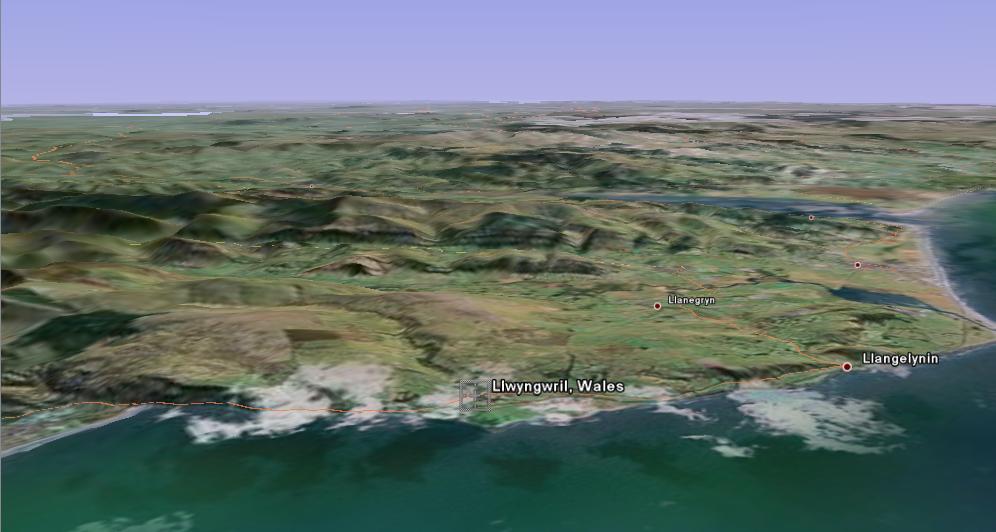
Elizabeth married Humphrey ap Hugh, of Llwyn du, son of Hugh ap David, of Llwyn du, Llwyngwrill, Llangelynin, Talybont and Catherine verch Rhydderch ap Sion, of Abergynolwyn, about 1624-1625 in Llangelynin, Talybont, Merionethshire, Wales. Humphrey was born between 1600 and 1603 in Llwyn du, Llwyngwrill, Llangelynin, Merionethshire, Wales, was christened in Llwyngwril, Llangelynin, Merionethshire, Wales, and died in 1664 in Llwyn du, Llwyngwrill, Llangelynin, Merionethshire, Wales. Other names for Humphrey were Humffrey ap Hugh of Llwyngwrill and Humphrey ap Hugh Howel.
Marriage Notes: Source: FamilySearch.org (11/10/06) has m. circa 1620-1628 in Llangelynin, Merionethshire.
Reifsnyder-Gillam Ancestry, Edited by Thomas Allen Glenn at the request of Howard Reifsnyder, privately printed, Philadelphia, 1902, provided by http://books.google.com, pp. 46 has:
"Humphrey ap Hugh married, circa 1624-1625, Elizabeth, daughter of John Powell (otherwise called John ap Howell Gôch), of Gadfa..."
Death Notes: Source: FamilySearch.org AFN: FJH1-WV (11/10/06) has b. 1592-1603 in Llwyn du, Llangelynin and d. 21 Sep 1697 in Llwyn du.
Reifsnyder-Gillam Ancestry, Edited by Thomas Allen Glenn at the request of Howard Reifsnyder, privately printed, Philadelphia, 1902, provided by http://books.google.com, pp. 46 has "He was living at Llwyn du 1662, but died in or before 1664, having been a Justice of the Peace for his county."
Research Notes: Source: FamilySearch.org AFN: FJH1-WV (11/10/06) has b. 1592-1603 in Llwyn du, Llangelynin and d. 21 Sep 1697 in Llwyn du.
From the book Reifsnyder-Gillam Ancestry, edited by Thomas Allen Glenn (Philadelphia, 1902), provided by books.google.com, pp. 46-48:
"XI. HUMPHREY AP HUGH, of LLwyn du, in the township of Llwyngwrill, parish of Llangelynin, Talybont, Merionethshire, was born circa 1600-1603. He is named as a party to the deed of marriage settlement made at the time of the marriage of his daughter Anne to Ellis Rees, and dated 1 January 1649, wherein he is described as: 'Humffrey ap Hugh of Llwyngwril in the sayd Com. of Merioneth, gentleman.' [see footnote 3, p. 46] He was living at Llwyn du 1662 [according to the Diary of Richard Davies, of Welshpoole, the Quaker], but died in or before 1664 [according to deeds relative to Quaker Burial Ground at Llwyn du], having been a Justice of the Peace for his county.
"Humphrey ap Hugh married, circa 1624-1625, Elizabeth, daughter of John Powell (otherwise called John ap Howell Gôch), of Gadfa, a large farm (then considered quite a good estate), in the township of Rhiwargor, in the parish of Llanwddyn, Montgomeryshire. John ap Howell was taxed as a land owner in Llanwddyn, in a Lay Subsidy of 39 Elizabeth, 1596-7 [according to the Subsidy Rolls for Montgomeryshire], and was buried at Llanwddyn Parish Church, 24 July, 1636. He was the son of Howell Gôch, of Gadfa, ap Meredith ap Bedo ap Jenkin, of Caer Einion [see footnote 3, p. 47], and he married Sibill, daughter (seventh child) of Hugh Gwyn, Esquire, of Peniarth, Caernarvonshire, by Jane, daughter of Owen ap Hugh, of Bodeon, Anglesey [see footnote 5, p. 47], and sister unto Sir Hugh Owen, Barrister-at-Law and Recorder of Caermarthen, ancestor to the Owens, Baronets, of Orielton, Pembrokeshire. Hugh Gwyn [see footnote 6, p. 47] was High Sheriff of Caernarvonshire from 2 December 1599-1600, and was commissioned one of the Justices of the Peace for that county, 11 May, 1611.
"Owen ap Hugh, of Bodeon, Anglesey, was High Sheriff of Anglesey, 30 November, 1562-63, 1579-80 (30 November), and died 1613. His second wife, mother of Jane, who married Hugh Gwyn, was Sibill, youngest daughter of Sir William Griffith, Knt., of Penrhyn, Caernarvonshire, Chamberlain of North Wales, by his second wife, Jane, daughter of John Puleston, of Bers and Havod y Wern.
"Issue:
1. ANNE, bapt._____, m. 1649-50 ELLIS AP REES [see footnote 2, p. 48], of Bryn Mawr, Dôlgelly, gentleman, and had: ROWLAND ELLIS.
2. Hugh, bapt. in Llangelynin Church, 7 April, 1628; bur 22 May, 1628.
3. Owen, bapt. in Llangelynin Church, 13 April, 1629; of whom presently [see footnote 3, p. 48].
4. Catherine, bapt. in Llangelynin Church, 15 November 1631; bur. 29 November, 1631.
5. John, bapt. in Llangelynin Church, 16 November, 1632; m. Joan, sister of one Richard Humphrey. They both died in Pennsylvania.
6. Samuel, bapt. in Llangelynin Church, 22 January 1635 [see footnote 4, p. 48]
7. ______, dau., bapt.________.
8. ______, dau., bapt.________."
Footnote 3, p. 46:
"This Indenture is now owned by a descendant, Edward Griffith, Esq., of Springfield, Dôlgelly, Merionethshire, Wales. It is dated 1 January, 1649, the parties thereto being Rees Lewis ap John Griffith, of Dyffrydan, in the County of Merioneth, gentleman; Humffrey ap Hugh, of Llwyngwrill, in said county, gentleman; Richard Nanney, of Llwyngwrill, and David Ellis, of Gwanas, gentlemen. It recites that a marriage is intended between Anne, one of the daughters of said Humffrey ap Hugh, and Ellis Rees, second son of said Rees Lewis. Richard Nanney and David Ellis are Trustees. It was witnessed 21 January, 1649, by John ap William ap Humphrey, David John Hugh, Griffith ap Rees Lewis, Tudor Vaughan and John ap Hugh. Rowland Ellis, who compiled the pedigree of 1697, was the only issue of this marriage."
Footnote 5, p. 47:
"The MS. Pedigree of Rowland Ellis, by mistake, makes her daughter instead of sister of Sir Hugh Owen. She was daughter of Owen ap Hugh, as above. Dwnn II, 199, 205."
Footnote 6, p. 47:
"Eleanor, or Ellen, another daughter of Hugh Gwyn, married Rev. Richard Nanney, Rector of Llangelynin and Vicar of Towyn. She was living 16 June, 1646, in Llwyngwrill, and her son was named Richard Nanney."
Footnote 2, p. 48:
"See Deed of Marriage Settlement, 1 January, 1649 (1649-50), cited supra. Their only child, Rowland Ellis, was born 1650, and died in Pennsylvania; he compiled the pedigree of 1697, which is in his own handwriting."
Footnote 3, p. 48:
"Owen Humphrey, second son and heir of Humphrey ap Hugh, inherited Llwyn du. He married Margaret, daughter of ______, and had, among other issue, some of whom removed to Pennsylvania, a daughter, Rebecca, who married, 1678, Robert Owen, of Fron Gôch, near Bala, in the Comôt of Penllyn, Merionethshire. Robert and Rebecca Owen removed to Pennsylvania in 1690 and settled in Merion Township, where they died 1697, leaving besides daughters, male issue as follows: Evan Owen, Provincial Councillor, Judge of Court of Common Pleas, etc.; Owen Owen, High Sheriff of Philadelphia County and Coroner; John Owen, High Sheriff of the County of Chester, Member of Assembly and Trustee of the Loan Office; and Robert Owen, who married Susanna, daughter of William Hudson, Mayor of Philadelphia. The second Robert Owen's daughter, Hannah, married, first, John Ogden, by whom she had a son, William Ogden, who left issue, and secondly, Joseph Wharton, of Walnut Grove, by whom she had, besides other children, Robert Wharton, Mayor of Philadelphia, Captain of First Troop Philadelphia City Cavalry."
Footnote 4, p. 48:
"Samuel Humphrey, a celebrated Quaker, died in Merionethshire, but his widow, Elizabeth, daughter of Rees Hugh, with their children, removed to Pennsylvania, 1683. The children of Samuel Humphrey took the surname of 'Humphreys,' which they have since retained. From Samuel Humphrey descended Joshua Humphreys, Naval Constructor, called the Father of the American Navy, and the late General Humphreys, of Pennsylvania, distinguished in the War of the Rebellion, and whose son is now an officer in the United States Army."
Children from this marriage were:
+ 584 M i. Owen Humphrey, of Llwyn du 535 536 was born in 1625 in <Llwyn du>, Llangelynin Parish, Talybont, Merionethshire, Wales, was christened on 13 Apr 1629 in Llangelynin Parish, Talybont, Merionethshire, Wales, and died in 1699 in Llangelynin Parish, Talybont, Merionethshire, Wales at age 74.
+ 585 M ii. Samuel ap Humphrey, of Portheven, Merionethshire was born about 1627 in Merionethshire, Wales and died in Portheven, Merionethshire, Wales.
+ 586 F iii. Anne Humphrey was born from 1627 to 1634 in <Llwyn du>, Llangelynin, Talybont, Merionethshire , Wales and died after 1650.
+ 587 M iv. Hugh Humphrey was born on 7 Apr 1628 in Llangelynin, Talybont, Merionethshire, Wales, was christened on 7 Apr 1628 in Llangelynin Church, Talybont, Merionethshire, Wales, died on 22 May 1628 in Llangelynin, Talybont, Merionethshire, Wales, and was buried on 22 May 1628.
+ 588 F v. Catherine Humphrey was born about 1631, was christened on 15 Nov 1631 in Llangelynin Church, Talybont, Merionethshire, Wales, died about Nov 1631 in Llangelynin, Talybont, Merionethshire, Wales, and was buried on 29 Nov 1631.
+ 589 M vi. John Humphrey, of Llanwddyn 536 537 was born in 1632, was christened on 16 Nov 1632 in Llangelynin Church, Talybont, Merionethshire, Wales, and died in Pennsylvania, (United States).
+ 590 M vii. Samuel Humphrey 536 538 was born about 1635, was christened on 22 Jan 1635 in Llangelynin, Talybont, Merionethshire, Wales, and died before 1683 in Merionethshire, Wales.
569. Richard Nanney, of Llwyngwril (Eleanor verch Hugh Gwyn, of Peniarth542, Jane verch Owen ap Hugh Owen481, Sibill Griffith432, Sir William Griffith, Lord of Penrhyn, Chamberlain of North Wales386, Joan Troutbeck353, Margaret Stanley318, Joan Goushill297, Elizabeth FitzAlan, d'Arundelle265, Elizabeth de Bohun, Countess of Arundel224, Sir William de Bohun, K.G., 1st Earl of Northampton179, Elizabeth, of Rhuddlan, Princess of England134, King Edward I, of England97, King Henry III, of England71, King John "Lackland", of England54, Henry II "Curtmantel", King of England42, Empress Matilda, Countess of Anjou24, Matilda, of Scotland12, Saint Margaret, of Scotland7, Agatha5, Yaroslav I, of Kiev4, Vladimir I, of Kiev3, Sviatoslav I, of Kiev2, Igor, Grand Prince of Kiev1)
570. Sir Edward Stanley, 3rd Baronet of Bickerstaffe 494 (Sir Thomas Stanley, 2nd Baronet of Bickerstaffe551, Edward Stanley, 1st Baronet of Bickerstaffe494, Sir Henry Stanley433, Sir James Stanley, of Cross Hall392, Sir George Stanley, 9th Lord Strange of Knockyn358, Thomas Stanley, 1st Earl of Derby319, Joan Goushill297, Elizabeth FitzAlan, d'Arundelle265, Elizabeth de Bohun, Countess of Arundel224, Sir William de Bohun, K.G., 1st Earl of Northampton179, Elizabeth, of Rhuddlan, Princess of England134, King Edward I, of England97, King Henry III, of England71, King John "Lackland", of England54, Henry II "Curtmantel", King of England42, Empress Matilda, Countess of Anjou24, Matilda, of Scotland12, Saint Margaret, of Scotland7, Agatha5, Yaroslav I, of Kiev4, Vladimir I, of Kiev3, Sviatoslav I, of Kiev2, Igor, Grand Prince of Kiev1) was born in 1643 in Preston, England and died on 16 Oct 1671 at age 28.
Edward married someone.
+ 591 M i. Sir Thomas Stanley, 4th Baronet of Bickerstaffe 494 was born on 27 Sep 1670 in Preston, England and died on 7 May 1714 in Hanover, Virginia, (United States) at age 43.
571. Thomas Nuthall (Mary Hyde552, Robert Hyde, Jr.495, Jane Davenport436, Blanche Warburton397, Jane Stanley360, Sir William Stanley, of Holt, K.G.320, Joan Goushill297, Elizabeth FitzAlan, d'Arundelle265, Elizabeth de Bohun, Countess of Arundel224, Sir William de Bohun, K.G., 1st Earl of Northampton179, Elizabeth, of Rhuddlan, Princess of England134, King Edward I, of England97, King Henry III, of England71, King John "Lackland", of England54, Henry II "Curtmantel", King of England42, Empress Matilda, Countess of Anjou24, Matilda, of Scotland12, Saint Margaret, of Scotland7, Agatha5, Yaroslav I, of Kiev4, Vladimir I, of Kiev3, Sviatoslav I, of Kiev2, Igor, Grand Prince of Kiev1) was born in 1600 in Hockley, Rochford, Essex, England.
Research Notes: Source: http://wc.rootsweb.ancestry.com/cgi-bin/igm.cgi?op=GET&db=:3143362&id=I631846374
572. James Nuthall (Mary Hyde552, Robert Hyde, Jr.495, Jane Davenport436, Blanche Warburton397, Jane Stanley360, Sir William Stanley, of Holt, K.G.320, Joan Goushill297, Elizabeth FitzAlan, d'Arundelle265, Elizabeth de Bohun, Countess of Arundel224, Sir William de Bohun, K.G., 1st Earl of Northampton179, Elizabeth, of Rhuddlan, Princess of England134, King Edward I, of England97, King Henry III, of England71, King John "Lackland", of England54, Henry II "Curtmantel", King of England42, Empress Matilda, Countess of Anjou24, Matilda, of Scotland12, Saint Margaret, of Scotland7, Agatha5, Yaroslav I, of Kiev4, Vladimir I, of Kiev3, Sviatoslav I, of Kiev2, Igor, Grand Prince of Kiev1) was born in 1602 in Hockley, Rochford, Essex, England.
Research Notes: Source: http://wc.rootsweb.ancestry.com/cgi-bin/igm.cgi?op=GET&db=:3143362&id=I631846375
573. Mary Nuthall (Mary Hyde552, Robert Hyde, Jr.495, Jane Davenport436, Blanche Warburton397, Jane Stanley360, Sir William Stanley, of Holt, K.G.320, Joan Goushill297, Elizabeth FitzAlan, d'Arundelle265, Elizabeth de Bohun, Countess of Arundel224, Sir William de Bohun, K.G., 1st Earl of Northampton179, Elizabeth, of Rhuddlan, Princess of England134, King Edward I, of England97, King Henry III, of England71, King John "Lackland", of England54, Henry II "Curtmantel", King of England42, Empress Matilda, Countess of Anjou24, Matilda, of Scotland12, Saint Margaret, of Scotland7, Agatha5, Yaroslav I, of Kiev4, Vladimir I, of Kiev3, Sviatoslav I, of Kiev2, Igor, Grand Prince of Kiev1) was born in 1603 in Hockley, Rochford, Essex, England.
Research Notes: Source: http://wc.rootsweb.ancestry.com/cgi-bin/igm.cgi?op=GET&db=:3143362&id=I631846376
574. Charles Nuthall (Mary Hyde552, Robert Hyde, Jr.495, Jane Davenport436, Blanche Warburton397, Jane Stanley360, Sir William Stanley, of Holt, K.G.320, Joan Goushill297, Elizabeth FitzAlan, d'Arundelle265, Elizabeth de Bohun, Countess of Arundel224, Sir William de Bohun, K.G., 1st Earl of Northampton179, Elizabeth, of Rhuddlan, Princess of England134, King Edward I, of England97, King Henry III, of England71, King John "Lackland", of England54, Henry II "Curtmantel", King of England42, Empress Matilda, Countess of Anjou24, Matilda, of Scotland12, Saint Margaret, of Scotland7, Agatha5, Yaroslav I, of Kiev4, Vladimir I, of Kiev3, Sviatoslav I, of Kiev2, Igor, Grand Prince of Kiev1) was born in 1608 in Hockley, Rochford, Essex, England.
Research Notes: Source: http://wc.rootsweb.ancestry.com/cgi-bin/igm.cgi?op=GET&db=:3143362&id=I631846379
575. Martha Nuthall (Mary Hyde552, Robert Hyde, Jr.495, Jane Davenport436, Blanche Warburton397, Jane Stanley360, Sir William Stanley, of Holt, K.G.320, Joan Goushill297, Elizabeth FitzAlan, d'Arundelle265, Elizabeth de Bohun, Countess of Arundel224, Sir William de Bohun, K.G., 1st Earl of Northampton179, Elizabeth, of Rhuddlan, Princess of England134, King Edward I, of England97, King Henry III, of England71, King John "Lackland", of England54, Henry II "Curtmantel", King of England42, Empress Matilda, Countess of Anjou24, Matilda, of Scotland12, Saint Margaret, of Scotland7, Agatha5, Yaroslav I, of Kiev4, Vladimir I, of Kiev3, Sviatoslav I, of Kiev2, Igor, Grand Prince of Kiev1) was born in 1613 in Hockley, Rochford, Essex, England.
Research Notes: Source: http://wc.rootsweb.ancestry.com/cgi-bin/igm.cgi?op=GET&db=:3143362&id=I631846380
576. Frances Nuthall (Mary Hyde552, Robert Hyde, Jr.495, Jane Davenport436, Blanche Warburton397, Jane Stanley360, Sir William Stanley, of Holt, K.G.320, Joan Goushill297, Elizabeth FitzAlan, d'Arundelle265, Elizabeth de Bohun, Countess of Arundel224, Sir William de Bohun, K.G., 1st Earl of Northampton179, Elizabeth, of Rhuddlan, Princess of England134, King Edward I, of England97, King Henry III, of England71, King John "Lackland", of England54, Henry II "Curtmantel", King of England42, Empress Matilda, Countess of Anjou24, Matilda, of Scotland12, Saint Margaret, of Scotland7, Agatha5, Yaroslav I, of Kiev4, Vladimir I, of Kiev3, Sviatoslav I, of Kiev2, Igor, Grand Prince of Kiev1) was born in 1614 in Hockley, Rochford, Essex, England.
Research Notes: Source: http://wc.rootsweb.ancestry.com/cgi-bin/igm.cgi?op=GET&db=:3143362&id=I631846381
577. John Nuthall III 534 (Mary Hyde552, Robert Hyde, Jr.495, Jane Davenport436, Blanche Warburton397, Jane Stanley360, Sir William Stanley, of Holt, K.G.320, Joan Goushill297, Elizabeth FitzAlan, d'Arundelle265, Elizabeth de Bohun, Countess of Arundel224, Sir William de Bohun, K.G., 1st Earl of Northampton179, Elizabeth, of Rhuddlan, Princess of England134, King Edward I, of England97, King Henry III, of England71, King John "Lackland", of England54, Henry II "Curtmantel", King of England42, Empress Matilda, Countess of Anjou24, Matilda, of Scotland12, Saint Margaret, of Scotland7, Agatha5, Yaroslav I, of Kiev4, Vladimir I, of Kiev3, Sviatoslav I, of Kiev2, Igor, Grand Prince of Kiev1) was born in 1620 in London, England and died in 1667 in St. Mary's Co., Maryland, (United States) at age 47.
Research Notes: From: http://wc.rootsweb.ancestry.com/cgi-bin/igm.cgi?op=GET&db=:3143362&id=I631844490 :
As John Nuthall (variously spelled) was not listed among those "Inhabitants in Virginia, living and dead", in the Musters of 1624/1625, but is known to have been there ante 1630, we may safely assume that he arrived during the period 1626 to 1629, and that he was little more than a child, if not a child, upon his arrival. Since there are absolutely no records indicating other persons of the name in Virginia at that early date, we may also safely assume that the boy John Nuthall, arrived in America sans parents.
What would make a young boy sail away, on his own, from his homeland in England to the then wilds of America. While we shall probably never know the facts, we may certainly speculate that young John was either a runaway who perhaps stowed away on the ship which brought him to America; or, that he may have signed on as a cabin-boy, and later jumped ship once in the new land; or, that he was one of those unfortunate children who, kidnapped from the streets of an English city, by a hard-bitten ship's captain, was later sold by the captain, as a servant in Virginia.
During this period, and for many years thereafter, the only method of obtaining land in the new world, was through the transportation into one of England's Colonies, of oneself or ones family or servants, provided only that the cost of transportation was paid by oneself. Many persons, including servants, whose transportation was originally paid for by someone else, later paid for the transportation of others, and many persons made fairly frequent trips back and forth between England and the colonies, and had the right to claim additional land each time they re-entered the latter; thus, among the old land patents, one may often run across the record of a man who claimed land "for transporting himself 3 times", or "5 times", etc. (The term "servant" did not then have the same connotation that it does today, for many of the early "servants" who were transported, were virtually on an equal social footing with their "masters", or very soon attained such.)
While there is no extant record for anyone having claimed land for the transportation into Virginia of John Nuthall, we do have proof that he was the servant of Hugh Hays, of Accovmacke Co., Va., sometime before 1630...ran away from his said master.. .lived with the Indians (probably in what is now the Eastern Shore of Maryland)...was found there by one William Jones, who paid the Indians "a hoe" for the boy, and who then returned young John to Hugh Hays, "well strapped with yehallyards".
Whatever John Nuthall's life in England had been, it's clear that he came of sturdy, intelligent and industrious stock, and his early years of hardship in Virginia only served to prepare him well for the life he led in his adult years. How or when he obtained his education, we don't know, but we know that he could read and write. We have found no record of John's activities between the late 1620's and 1640... his "growing-up years", (and indeed he may have spent part of the time back in England), but by 1643, he was referred to as "Mr.", a term reserved for the most highly respected, and leading citizens of the colony, and generally, only for those who served His Majestie's government in some capacity.
And only a few months later, or about Jan 1644, he married the widow, Elizabeth (Bacon) Holloway, a "person of quality".
It is certainly apparent that John Nuthall had learned the Indian tongue quite probably at the time he lived among them, for during most of his adult years, and in addition to whatever else he did, he was a trader and merchant. In the latter capacity, he made numerous trips to London and back. We have reference to about five or six such trips, and he may actually have been going over every year or so.
As further evidence of the high degree of respect and trust he was accorded, we note that he was frequently appointed the "attorney" of his friends and acquaintances. While we cannot be certain on John's parents, we do know that John's father, mother and sister were living, and apparently in London, at least as late as August, 1644.
7 Jan 1644 granted 250 acres of land to Mr. John Nuthall and Elizabeth his wife. 27 Jul 1645 300 acres in Northampton Co to John Nuthall and Eliza his wife. Nov 1651 John Nuthall about to transport his wife and himself to England.
Although he was termed "Mr." as early as 1643, the first actual record we've discovered of John's serving as "Commissioner" (same as "Justice", and which office entitled the holder to be called "Mr."), was in Northampton County, VA, in Jul 1653. However, he was one of those leading citizens who, on 25 Mar 1651, signed the "Submission to Parliament", from Northampton County, which leads one to believe he may have been serving as one of the Commissioners at that date, if not before.
John Nuthall was a signer of the Northampton Protest or Instructions to the Virginia House of Burgesses. Whatever may be the claims of other sections of the country to being the first in protesting against Great Britain in the next century, the first organized remonstration against our mother county in the form of protest against taxation without representation was made by the people of Northampton County on 30 Mar 1652.
John's wife, Elizabeth, who by her first marriage was the mother of one child, a daughter, Priscilla Holloway, was several years John's senior, as her age was listed as "26", when on 10 Aug 1635, she embarked from England for Virginia, on the "Safety". After their marriage, Elizabeth made one or more trips back to England with John. While we know that she pre-deceased him, and apparently died before John settled in Maryland about 1661, we do not know exactly when Elizabeth died, but the last record we've discovered in which she was mentioned, was in Northampton County, VA, on 27 Jul 1653.
When in England in 1661, John Nuthall purchased from Thomas Cornwalleys , 4,200 acres of land in Maryland, consisting of the Manors of "Cornwal leys Cross" and "St. Elizabeth's", and additional land, and he automaticaly became the owner of the handsome brick "manor house" at "Cross Manor" built by Corwalleys in 1642 and upon seating himself in MD lived in the house and a few years later, died there. This gracious old home, although having under-gone some alterations and additions in the intervening 300 years, is said to not only standing, but also be occupied.
After John's removal to Maryland, he served as Commissioner of St. Mary's County from at least Oct 1663 through 1664, and during which period he was also referred to as "Justice of the Peace and Quorum". He was several times referred to in the records as "Gentleman" (which title of courtesy was extended him through his service as one of the Commissioners).
In Sept 1668, the Council ordered that the personal estate of John Nuthall, who died intestate, be divided among his three children, John, James and Eleanor, who married, 1667, Thomas Sprigg.
John married Elizabeth Bacon,539 daughter of Nathaniel Bacon and Elizabeth Kingsmill, in Jan 1644 in Northampton Co., Virginia, (United States). Elizabeth was born about 1609 in Burgate, Suffolk, England and died after 27 Jul 1653 in Northampton Co., Virginia, (United States). Another name for Elizabeth was Elizabeth Bacon Holloway.
Children from this marriage were:
+ 592 F i. Eleanor Nuthall 540 was born in 1645 in Northampton Co., Virginia, (United States) and died on 16 Mar 1701 in Prince George's Co., Maryland, (United States) at age 56.
+ 593 M ii. John Nuthall IV was born in Mar 1648 in Northampton Co., Virginia, (United States).
+ 594 M iii. James Nuthall was born in 1650 in Northampton Co., Virginia, (United States) and died in 1685 at age 35.
John next married Jane Johnson on 12 Sep 1660 in Hungar's Parish, Northampton, Virginia (United States). Jane died before 1663.
Research Notes: Source: http://wc.rootsweb.ancestry.com/cgi-bin/igm.cgi?op=GET&db=:3143362&id=I631844498
578. Elizabeth Howard (William Howard, Lord Howard553, Hon. Catherine Carey505, Anne Morgan441, Elizabeth Whitney406, James Whitney363, Constance Touchet330, Eleanor de Holland300, Constance, of York270, Edmund, of Langley, 1st Duke of York225, Edward III, King of England182, King Edward II, of England135, King Edward I, of England97, King Henry III, of England71, King John "Lackland", of England54, Henry II "Curtmantel", King of England42, Empress Matilda, Countess of Anjou24, Matilda, of Scotland12, Saint Margaret, of Scotland7, Agatha5, Yaroslav I, of Kiev4, Vladimir I, of Kiev3, Sviatoslav I, of Kiev2, Igor, Grand Prince of Kiev1)
Elizabeth married John [I] Mordaunt.
The child from this marriage was:
+ 595 M i. Sir John [II] Mordaunt
579. Robert Puleston, of Hafod y wern (Robert Puleston, of Hafod y wern562, John Puleston, of Hafod y wern520, Piers Puleston, of Burras452, Sir John Puleston, of Tir Môn and Havod y Wern418, John Hên Puleston, of Hafod-y-Wern, Constable of Caernarfon Castle370, John Puleston, of Bers and Hafod y Wern335, Madog Puleston, of Bers305, Lowry Fychan verch Gruffydd Fychan277, Elen verch Thomas ap Llewellyn Owen234, Eleanor ferch Philip ap Ifor194, Catherine verch Llewellyn Gryffyth141, Elinor de Montfort102, Eleanor75, King John "Lackland", of England54, Henry II "Curtmantel", King of England42, Empress Matilda, Countess of Anjou24, Matilda, of Scotland12, Saint Margaret, of Scotland7, Agatha5, Yaroslav I, of Kiev4, Vladimir I, of Kiev3, Sviatoslav I, of Kiev2, Igor, Grand Prince of Kiev1)
580. Edward Darcy, [uncertain] 514 (Elizabeth Conyers563, John Conyers, 3rd Baron Conyers531, Christopher Robert Conyers, 2nd Baron Conyers461, Anne Nevill420, Ralph Nevill, Earl of Westmorland371, John Neville338, John de Neville307, Ralph de Neville279, John Neville240, Alice Audley197, Hugh I de Audley144, Ela Longspee106, William II Longspée77, William Longspée, 3rd Earl of Salisbury55, Henry II "Curtmantel", King of England42, Empress Matilda, Countess of Anjou24, Matilda, of Scotland12, Saint Margaret, of Scotland7, Agatha5, Yaroslav I, of Kiev4, Vladimir I, of Kiev3, Sviatoslav I, of Kiev2, Igor, Grand Prince of Kiev1) was born about 1590 in England.
Edward married someone.
+ 596 M i. Edward Darcy, "the Colonist" 514 541 542 543 544 545 546 547 was born about 1615 in <Hockley, Middlesex, England>, was christened in 1619 in <England>,548 died before Nov 1670 in <Maryland>, (United States), and was buried in Virginia, (United States).
581. Lewis ap Griffith ap Howel, Lord of Yshute (Griffith ap Howel ap Einion564, Howel ap Einion ap Deikws Ddu536, Einion ap Deikws Ddu ap Madoc, Lord of Grainoc464, Deikws Ddu ap Madoc ap Ievan422, Madoc ap Ievan ap David Goch, Lord of Grainianoc381, Ievan ap David Goch, Lord of Grainianoc and Penllech345, David Goch ap Trahairn Goch, Lord of Penllech311, Trahairn Goch ap Madoc ap Rhys-Gloff, Lord of Llyn, Grainianoc and Penllech283, Madoc ap Rhys-Gloff250, Rhys-Gloff, Lord of Cymcydmaen208, Rhys-Vaughn, Lord of Yestradtywy161, Rhys-Mechyllt, of Llandovery Castle121, Joan de Clare89, Amice FitzWilliam, Countess of Gloucester63, Hawise de Beaumont, of Leicester46, Sir Robert de Beaumont, 2nd Earl of Leicester30, Isabel de Vermandois, Countess of Leicester15, Hugh Magnus, of Vermandois and Valois, Duke of France11, Anne, of Kiev6, Yaroslav I, of Kiev4, Vladimir I, of Kiev3, Sviatoslav I, of Kiev2, Igor, Grand Prince of Kiev1).
Research Notes: Source: Welsh Settlement of Pensylvania by Charles H. Browning (Philadelphia, 1912), p. 282
Lewis married someone.
+ 597 M i. Robert ap Lewis ap Griffith, Lord of Rhiwlas .
25th Generation 582. Anne Bowes (Mary Delaval566, Jane Hilton538, Anne Bowes466, Jane Talbot424, Sir John Talbot, of Grafton, sheriff of Shropshire383, Sir Gilbert Talbot, K.G., of Grafton, co. Worcester349, Elizabeth Botiller314, James Botiller, 4th Earl of Ormond290, James Botiller, 3rd Earl of Ormond257, James Botiller, 2nd Earl of Ormond220, Eleanor de Bohun174, Elizabeth, of Rhuddlan, Princess of England134, King Edward I, of England97, King Henry III, of England71, King John "Lackland", of England54, Henry II "Curtmantel", King of England42, Empress Matilda, Countess of Anjou24, Matilda, of Scotland12, Saint Margaret, of Scotland7, Agatha5, Yaroslav I, of Kiev4, Vladimir I, of Kiev3, Sviatoslav I, of Kiev2, Igor, Grand Prince of Kiev1)
Anne married Francis Blakiston.
The child from this marriage was:
+ 598 F i. Elizabeth Blakiston
583. Haute Wyatt 424 (George Wyatt567, Sir Thomas Wyatt539, Elizabeth Brooke467, Thomas Brooke426, John Brooke384, Edward Brooke350, Joan Braybrooke315, Joan de la Pole291, Joan de Cobham260, Margaret Courtenay222, Margaret de Bohun178, Elizabeth, of Rhuddlan, Princess of England134, King Edward I, of England97, King Henry III, of England71, King John "Lackland", of England54, Henry II "Curtmantel", King of England42, Empress Matilda, Countess of Anjou24, Matilda, of Scotland12, Saint Margaret, of Scotland7, Agatha5, Yaroslav I, of Kiev4, Vladimir I, of Kiev3, Sviatoslav I, of Kiev2, Igor, Grand Prince of Kiev1) was born on 4 Jun 1594 in Boxley Manor, Maidstone, Kent, England, was christened on 4 Jun 1594 in Kerstenings, Berkshire, England, died on 31 Jul 1638 in Boxley Manor, Maidstone, Kent, England at age 44, and was buried on 1 Aug 1638 in Chancel-Boxley, Maidstone, Kent, England. Another name for Haute was Hawte Wyatt.
Haute married someone.
+ 599 M i. Nicholas Wyatt 545 549 550 551 was born about 1620 in <Virginia, (United States)>, was christened in 1620 in <Virginia, (United States)>, and died on 22 Jan 1673 in Anne Arundel Co., Maryland, (United States) about age 53.
584. Owen Humphrey, of Llwyn du 535 536 (Elizabeth verch John Powell, of Gadfa, Rhiwargor568, Sibill verch Hugh Gwyn, of Peniarth541, Jane verch Owen ap Hugh Owen481, Sibill Griffith432, Sir William Griffith, Lord of Penrhyn, Chamberlain of North Wales386, Joan Troutbeck353, Margaret Stanley318, Joan Goushill297, Elizabeth FitzAlan, d'Arundelle265, Elizabeth de Bohun, Countess of Arundel224, Sir William de Bohun, K.G., 1st Earl of Northampton179, Elizabeth, of Rhuddlan, Princess of England134, King Edward I, of England97, King Henry III, of England71, King John "Lackland", of England54, Henry II "Curtmantel", King of England42, Empress Matilda, Countess of Anjou24, Matilda, of Scotland12, Saint Margaret, of Scotland7, Agatha5, Yaroslav I, of Kiev4, Vladimir I, of Kiev3, Sviatoslav I, of Kiev2, Igor, Grand Prince of Kiev1) was born in 1625 in <Llwyn du>, Llangelynin Parish, Talybont, Merionethshire, Wales, was christened on 13 Apr 1629 in Llangelynin Parish, Talybont, Merionethshire, Wales, and died in 1699 in Llangelynin Parish, Talybont, Merionethshire, Wales at age 74. Another name for Owen was Humphrey Owen of Llwyn du.
Research Notes: 2nd son and heir of Humphrey ap Hugh.
From Welsh Settlement of Pensylvania, p. 151:
"[John Humphrey and Samuel Humphrey] were brothers to Owen Humphrey, of Llwyn du, 1625-1695, a J. P. in Merioneth, and a prominent Friend, who was the father of Rebecca, wife of Robert Owen, of Merion [Pennsylvania], and Elizabeth, wife of John Roberts..."
-------------
From Reifsnyder-Gillam Ancestry, p. 48:
"Issue [of Humphrey ap Hugh]:...
3. Owen, bapt. in Llangelynin Church, 13 April, 1629; of whom presently [see footnote 3, p. 48]..."
Footnote 3, p. 48:
"Owen Humphrey, second son and heir of Humphrey ap Hugh, inherited Llwyn du. He married Margaret, daughter of ______________, and had, among other issue, some of whom removed to Pennsylvania, a daughter, Rebecca, who married, 1678, Robert Owen, of Fron Gôch, near Bala, in the Comôt of Pennlyn, Merionethshire. Robert and Rebecca Owen removed to Pennsylvania in 1690 and settled in Merion Township, where they died 1697, leaving besides daughters, male issue as follows; Evan Owen, Provincial Councillor, Judge of Court of Common Pleas, etc.; Owen Owen, High Sheriff of Philadelphia County and Coroner; John Owen High Sheriff of the County of Chester, Member of Assembly and Trustee of the Loan Office; and Robert Owen, who married Susanna, daughter of William Hudson, Mayor of Philadelphia. The second Robert Owen's daughter, Hannah, married, first, John Ogden, by whom she had a son, William Ogden, who left issue, and, secondly, Joseph Wharton, of Walnut Grove, by whom she had, besides other children, Robert Wharton, Mayor of Philadelphia, Captain of First Troop Philadelphia City Cavalry."
Noted events in his life were:
• Justice: 1678.

Owen married Margaret Vaughan,515 552 daughter of Captain Rowland Vaughan, of Caer-gai, Merioneth and Jane Price, Heiress of Trev Brysg, in 1681 in London, England. Margaret was born in 1630 in Llangelynn <Llanuwchllyn>, Montgomeryshire, Wales, was christened in Llanwdhlyn <Llanuwchllyn> Parish, Merionethshire, Wales, and died on 22 Sep 1699 in Llwyngwril, Llangelynin, Merionethshire, Wales at age 69.
Marriage Notes: Source:
http://genforum.genealogy.com/owings/messages/604.html - Marsha Barnes
Children from this marriage were:
+ 600 M i. John Owen was born about 1653 in <Llanllugan, > Merionethshire, Wales, was christened in Feb 1653, and died in Feb 1653 in Wales.
+ 601 M ii. Joshua Owen was born about 1659 in Llangelynn <Llanllugan?>, Montgomeryshire, Wales and died on 14 Mar 1728 about age 69.
+ 602 M iii. Captain Richard Owings, "the Settler" 553 554 555 was born on 7 Mar 1659 in <Llwyn du>, Llanllugan, Montgomeryshire, Wales and died on 14 Nov 1716 in Baltimore Co., Maryland, (United States) at age 57.
+ 603 M iv. Owen Owen was born about 1661 in Llangelynn <Llanllugan?>, Montgomeryshire, Wales.
+ 604 F v. Margaret Owen was born 1662 ? in Merionethshire, Wales and died before 1688.
+ 605 F vi. Rebecca Owen 536 556 557 was born about 1663 in Llwyn du, Llwyngwrill, Llangelynin, Merionethshire, Wales and died on 23 Aug 1697 in Merion Twp, Philadelphia, Pennsylvania, United States about age 34.
+ 606 M vii. Henry Owen was born 1670 ? in Merionethshire, Wales.
+ 607 F viii. Elizabeth Owen .
Owen next married Elizabeth Thomas.515 Elizabeth was born about 1631 in <Llangelynn, Montgomeryshire, Wales>.
Research Notes: FamilySearch.org AFN: 1THC-G7
Owen next married Jane.558
The child from this marriage was:
+ 608 F i. Rebecca Humphrey
585. Samuel ap Humphrey, of Portheven, Merionethshire (Elizabeth verch John Powell, of Gadfa, Rhiwargor568, Sibill verch Hugh Gwyn, of Peniarth541, Jane verch Owen ap Hugh Owen481, Sibill Griffith432, Sir William Griffith, Lord of Penrhyn, Chamberlain of North Wales386, Joan Troutbeck353, Margaret Stanley318, Joan Goushill297, Elizabeth FitzAlan, d'Arundelle265, Elizabeth de Bohun, Countess of Arundel224, Sir William de Bohun, K.G., 1st Earl of Northampton179, Elizabeth, of Rhuddlan, Princess of England134, King Edward I, of England97, King Henry III, of England71, King John "Lackland", of England54, Henry II "Curtmantel", King of England42, Empress Matilda, Countess of Anjou24, Matilda, of Scotland12, Saint Margaret, of Scotland7, Agatha5, Yaroslav I, of Kiev4, Vladimir I, of Kiev3, Sviatoslav I, of Kiev2, Igor, Grand Prince of Kiev1) was born about 1627 in Merionethshire, Wales and died in Portheven, Merionethshire, Wales. Another name for Samuel was Samuel Humphrey of Portheven.
Research Notes: From Welsh Settlement of Pennsylvania by Charles H. Browning, Philadelphia, 1912, p. 287: "SAMUEL HUMPHREY, of Portheven, Merionethshire, who bought land in Haverford [Pennsylvania] and removed here in 1683, but died in Wales. He m. in 1658, Elizabeth Rees, and had eight children* who settled in Haverford with their mother."
From the book Reifsnyder-Gillam Ancestry, edited by Thomas Allen Glenn (Philadelphia, 1902), provided by books.google.com, p. 48, Footnote 4:
"Samuel Humphrey, a celebrated Quaker, died in Merionethshire, but his widow, Elizabeth, daughter of Rees Hugh, with their children, removed to Pennsylvania, 1683. The children of Samuel Humphrey took the surname of 'Humphreys,' which they have since retained. From Samuel Humphrey descended Joshua Humphreys, Naval Constructor, called the Father of the American Navy, and the late General Humphreys, of Pennsylvania, distinguished in the War of the Rebellion, and whose son is now an officer in the United States Army."
Noted events in his life were:
• Removed to: Haverford, Pennsylvania, 1683.
Samuel married Elizabeth verch Rees Hugh, daughter of Rees Hugh and Unknown,.
Research Notes: From the book Reifsnyder-Gillam Ancestry, edited by Thomas Allen Glenn (Philadelphia, 1902), provided by books.google.com, p. 48, Footnote 4:
"Samuel Humphrey, a celebrated Quaker, died in Merionethshire, but his widow, Elizabeth, daughter of Rees Hugh, with their children, removed to Pennsylvania, 1683. The children of Samuel Humphrey took the surname of 'Humphreys,' which they have since retained. From Samuel Humphrey descended Joshua Humphreys, Naval Constructor, called the Father of the American Navy, and the late General Humphreys, of Pennsylvania, distinguished in the War of the Rebellion, and whose son is now an officer in the United States Army."
Noted events in her life were:
• Removed to: Pennsylvania, 1683.
Children from this marriage were:
+ 609 M i. Daniel Humphrey
+ 610 M ii. Benjamin Humphrey
586. Anne Humphrey (Elizabeth verch John Powell, of Gadfa, Rhiwargor568, Sibill verch Hugh Gwyn, of Peniarth541, Jane verch Owen ap Hugh Owen481, Sibill Griffith432, Sir William Griffith, Lord of Penrhyn, Chamberlain of North Wales386, Joan Troutbeck353, Margaret Stanley318, Joan Goushill297, Elizabeth FitzAlan, d'Arundelle265, Elizabeth de Bohun, Countess of Arundel224, Sir William de Bohun, K.G., 1st Earl of Northampton179, Elizabeth, of Rhuddlan, Princess of England134, King Edward I, of England97, King Henry III, of England71, King John "Lackland", of England54, Henry II "Curtmantel", King of England42, Empress Matilda, Countess of Anjou24, Matilda, of Scotland12, Saint Margaret, of Scotland7, Agatha5, Yaroslav I, of Kiev4, Vladimir I, of Kiev3, Sviatoslav I, of Kiev2, Igor, Grand Prince of Kiev1) was born from 1627 to 1634 in <Llwyn du>, Llangelynin, Talybont, Merionethshire , Wales and died after 1650. Another name for Anne was Ann Humphrey.
Research Notes: From the book Reifsnyder-Gillam Ancestry, edited by Thomas Allen Glenn (Philadelphia, 1902), provided by books.google.com, pp. 46-48:
"Issue:
1. ANNE, bapt._____, m. 1649-50 ELLIS AP REES [see footnote 2, p. 48], of Bryn Mawr, Dôlgelly, gentleman, and had: ROWLAND ELLIS."
Footnote 2, p. 48:
"See Deed of Marriage Settlement, 1 January, 1649 (1649-50), cited supra. Their only child, Rowland Ellis, was born 1650, and died in Pennsylvania; he compiled the pedigree of 1697, which is in his own handwriting."
Source also: The History of the Princes, the Lords Marcher, and the Ancient Nobility of Powys Fadog, and the Ancient Lords of Arwystli, Cedewen, and Meirionydd by J. Y. W. Lloyd, Vol. IV, London, 1884, p. 180.
Anne married Ellis ap Rees, of Bryn Mawr, Dôlgelly,559 560 son of Rees ap Lewis, of Nannau and Unknown, on 1 Jan 1649. Ellis died after 1678. Other names for Ellis were Ellis Price, Ellis Rees ap Lewis of Bryn Mawr, and Ellis ap Reese.
Marriage Notes: From the book Reifsnyder-Gillam Ancestry, Edited by Thomas Allen Glenn at the request of Howard Reifsnyder, privately printed, Philadelphia, 1902, provided by http://books.google.com, pp.30-31:
"The title papers to this property [Tythyn Bryn Mawr in Merionethshire] are now in possession of Edward Griffith, Esp. of Springfield, near Dôlgelly, a descendant of Ann, eldest daughter of Rowland Ellis by his first wife. Amongst these old documents is the original marriage contract and settlement made upon the marriage of Ellis Price and Anne Humphrey, the parents of Rowland Ellis, in 1649. The parties to this settlement were: Humphrey (Humffrey) ap Hugh, of Llwyngwril, gentleman, father of Anne Humphrey, Rees Lewis ap John Griffith, of Dyffrydan, gentleman, father of Ellis Price, who was his second son, and Richard Nanney, of Llwyngwril, and David Ellis, of Gwanas, gentlemen, who were to act as trustees. Richard Nanney was cousin to Anne, his father, the Rector of Llangelynin having married one of the daughters of Hugh Gwyn, of Peniarth. David Ellis was brother-in-law to Rees Lewis, the latter having married his sister Catherine.
"The witnesses to this document were: John ap William ap Humffrey, David John Hugh, Griffith ap Rees Lewis, Edward Vaughn and John ap Hugh. Rowland Ellis, born in 1650, was the only child of Ellis Price (alias ap Rees) and Anne Humphrey, and therefore inherited Bryn Mawr under this settlement and continued to live there until his permanent removal to Pennsylvania in 1696; when he sold the place to Lewis Owen, of Tyddyn y Garreg, his kinsman, to whom he was indebted."
From p. 46:
"[Humphrey ap Hugh] is named as a party to the deed of marriage settlement made at the time of the marriage of his daughter Anne to Ellis Rees, and dated 1 January 1649..."
Footnote 2, p. 48:
"See Deed of Marriage Settlement, 1 January, 1649 (1649-50), cited supra. Their only child, Rowland Ellis, was born 1650, and died in Pennsylvania; he compiled the pedigree of 1697, which is in his own handwriting."
Death Notes: "Living 1678" per Reifsnyder-Gillam Ancestry, Edited by Thomas Allen Glenn at the request of Howard Reifsnyder, privately printed, Philadelphia, 1902, provided by http://books.google.com
Research Notes: From Reifsnyder-Gillam Ancestry, p. 31:
"The title papers to this property [Tythyn Bryn Mawr in Merionethshire] are now in possession of Edward Griffith, Esq., of Springfield, near Dôlgelly, a descendant of Ann, eldest daughter of Rowland Ellis by his first wife. Amongst these old documents is the original marriage contract and settlement made upon the marriage of Ellis Price [Ellis ap Rees] and Anne Humphrey, the parents of Rowland Ellis, in 1649. The parties to this settlement were: Humphrey (Humffrey) ap Hugh, of Llwyngwril, gentleman, father of Anne Humphrey, Rees Lewis ap John Griffith, of Dyffrydan, gentleman, father of Ellis Price, who was his second son, and Richard Nanney, of Llwyngwril, and David Ellis, of Gwanas, gentlemen, who were to act as trustees. Richard Nanney was cousin to Anne, his father, the Rector of Llangelynin having married one of the daughters of Hugh Gwyn, of Peniarth. David Ellis was brother-in-law to Rees Lewis, the latter having married his sister Catherine.
"The witnesses to this document were: John ap William ap Humffrey, David John Hugh, Griffith ap Rees Lewis, Edward Vaughn and John ap Hugh. Rowland Ellis, born in 1650, was the only child of Ellis Price (alias ap Rees) and Anne Humphrey, and therefore inherited Bryn Mawr under this settlement and continued to live there until his permanent removal to Pennsylvania in 1696; when he sold the place to Lewis Owen, of Tyddyn y Garreg, his kinsman, to whom he was indebted."
The child from this marriage was:
+ 611 M i. Rowland Ellis, of Bryn Mawr farm, Merion, Pennsylvania 559 was born in 1650 in <Dolgellau>, Merionethshire, Wales and died in 1729 at age 79.
587. Hugh Humphrey (Elizabeth verch John Powell, of Gadfa, Rhiwargor568, Sibill verch Hugh Gwyn, of Peniarth541, Jane verch Owen ap Hugh Owen481, Sibill Griffith432, Sir William Griffith, Lord of Penrhyn, Chamberlain of North Wales386, Joan Troutbeck353, Margaret Stanley318, Joan Goushill297, Elizabeth FitzAlan, d'Arundelle265, Elizabeth de Bohun, Countess of Arundel224, Sir William de Bohun, K.G., 1st Earl of Northampton179, Elizabeth, of Rhuddlan, Princess of England134, King Edward I, of England97, King Henry III, of England71, King John "Lackland", of England54, Henry II "Curtmantel", King of England42, Empress Matilda, Countess of Anjou24, Matilda, of Scotland12, Saint Margaret, of Scotland7, Agatha5, Yaroslav I, of Kiev4, Vladimir I, of Kiev3, Sviatoslav I, of Kiev2, Igor, Grand Prince of Kiev1) was born on 7 Apr 1628 in Llangelynin, Talybont, Merionethshire, Wales, was christened on 7 Apr 1628 in Llangelynin Church, Talybont, Merionethshire, Wales, died on 22 May 1628 in Llangelynin, Talybont, Merionethshire, Wales, and was buried on 22 May 1628.
Research Notes: From the book Reifsnyder-Gillam Ancestry, edited by Thomas Allen Glenn (Philadelphia, 1902), provided by books.google.com, p. 48:
"Issue [of Humphrey ap Hugh]:...
2. Hugh, bapt. in Llangelynin Church, 7 April, 1628; bur 22 May, 1628..."
588. Catherine Humphrey (Elizabeth verch John Powell, of Gadfa, Rhiwargor568, Sibill verch Hugh Gwyn, of Peniarth541, Jane verch Owen ap Hugh Owen481, Sibill Griffith432, Sir William Griffith, Lord of Penrhyn, Chamberlain of North Wales386, Joan Troutbeck353, Margaret Stanley318, Joan Goushill297, Elizabeth FitzAlan, d'Arundelle265, Elizabeth de Bohun, Countess of Arundel224, Sir William de Bohun, K.G., 1st Earl of Northampton179, Elizabeth, of Rhuddlan, Princess of England134, King Edward I, of England97, King Henry III, of England71, King John "Lackland", of England54, Henry II "Curtmantel", King of England42, Empress Matilda, Countess of Anjou24, Matilda, of Scotland12, Saint Margaret, of Scotland7, Agatha5, Yaroslav I, of Kiev4, Vladimir I, of Kiev3, Sviatoslav I, of Kiev2, Igor, Grand Prince of Kiev1) was born about 1631, was christened on 15 Nov 1631 in Llangelynin Church, Talybont, Merionethshire, Wales, died about Nov 1631 in Llangelynin, Talybont, Merionethshire, Wales, and was buried on 29 Nov 1631.
Christening Notes: Another source has baptism on 15 Apr 1631.
Research Notes: From the book Reifsnyder-Gillam Ancestry, Edited by Thomas Allen Glenn at the request of Howard Reifsnyder, privately printed, Philadelphia, 1902, provided by http://books.google.com, p. 48:
"Issue [of Humphrey ap Hugh]:
1. ANNE, bapt._____, m. 1649-50 ELLIS AP REES, of Bryn Mawr, Dôlgelly, gentleman, and had: ROWLAND ELLIS.
2. Hugh, bapt. in Llangelynin Church, 7 April, 1628; bur 22 May, 1628.
3. Owen, bapt. in Llangelynin Church, 13 April, 1629; of whom presently [see footnote 3, p. 48].
4. Catherine, bapt. in Llangelynin Church, 15 November 1631; bur. 29 November, 1631.
5. John, bapt. in Llangelynin Church, 16 November, 1632; m. Joan, sister of one Richard Humphrey. They both died in Pennsylvania.
6. Samuel, bapt. in Llangelynin Church, 22 January 1635 [see footnote 4, p. 48]
7. ______, dau., bapt.________.
8. ______, dau., bapt.________."
589. John Humphrey, of Llanwddyn 536 537 (Elizabeth verch John Powell, of Gadfa, Rhiwargor568, Sibill verch Hugh Gwyn, of Peniarth541, Jane verch Owen ap Hugh Owen481, Sibill Griffith432, Sir William Griffith, Lord of Penrhyn, Chamberlain of North Wales386, Joan Troutbeck353, Margaret Stanley318, Joan Goushill297, Elizabeth FitzAlan, d'Arundelle265, Elizabeth de Bohun, Countess of Arundel224, Sir William de Bohun, K.G., 1st Earl of Northampton179, Elizabeth, of Rhuddlan, Princess of England134, King Edward I, of England97, King Henry III, of England71, King John "Lackland", of England54, Henry II "Curtmantel", King of England42, Empress Matilda, Countess of Anjou24, Matilda, of Scotland12, Saint Margaret, of Scotland7, Agatha5, Yaroslav I, of Kiev4, Vladimir I, of Kiev3, Sviatoslav I, of Kiev2, Igor, Grand Prince of Kiev1) was born in 1632, was christened on 16 Nov 1632 in Llangelynin Church, Talybont, Merionethshire, Wales, and died in Pennsylvania, (United States).
Research Notes: From Welsh Settlement of Pennsylvania, p. 287:
"JOHN HUMPHREY, WHO m. his cousin, Jane [Joan] Humphrey (sister to Richard Humphrey, who was a Haverford [Pennsylvania] land owner), and bought land in Haverford, and removed to it."
From Welsh Settlement of Pensylvania, pp. 150-152:
Two brothers, JOHN HUMPHREY, of Llanwddyn, and SAMUEL HUMPHREY, were Haverford [Pennsylvania] land owners, and their cousin RICHARD HUMPHREY, a purchaser from "Richard Davis Co. No. 7." John and Richard, came over in the "Morning Star," with Hugh Roberts, in 1683, as mentioned.
John and Samuel were sons of Humphrey ap Hugh, of Llwyngrill (1662), and "late of Llwyn du," in Merioneth, d. about 1664-5, by his wife, Elizabeth Powel, daughter of John ap Howel (or Powel, who was buried in the parish church of Llanwddyn, in Montgomeryshire, 24 July, 1636), and his wife, Sibill v. Hugh Gwyn, of Penarth.
They were uncles of Rowland Ellis, of "Bryn Mawr," Merion [Pennsylvania], (whose land adjoined Benjamin Humphrey's land), and also of Robert Owen's wife, Rebecca, (whose farm lay to the eastward on both sides of Montgomery avenue, between Ardmore and Wynnewood), and of John Owen and Josehua Owen, of Merion (1683), (whose property adjoined that of Humphrey), and of Elizabeth, wife of "John Roberts, of the Mill," and "of Wayn Mill," who came from Pen y Chyd, in Denbighshire (whose estate was northward of Humphrey). They were brothers to Owen Humphrey, of Llwyn du, 1625-1695, a J. P. in Merioneth, and a prominent Friend, who was the father of Rebecca, wife of Robert Owen, of Merion, and Elizabeth, wife of John Roberts, aforesaid.
"JOHN HUMPHREY, of Llanwddyn, gent," purchased 312-1/2 acres of the Lloyd & Davies land [in Pennsylvania], by deed dated 24 April, 1683, and witnessed by Thomas Lloyd, Richard Davies, Richard Owen, Amos Davies, Rowland Ellis, David Davies, and Solomon Jones. By deed dated 1. 7mo. 1697, John conveyed 100 acres of this tract to his nephew, Joshua Owen, and by will bequeathed the balance to his nephew, Benjamin Humphrey. He married his cousin, Jane Humphrey (sister to Richard Humphrey, aforesaid).
In 1698-9, John Humphrey was one of the attorneys for Richard Davies, one of the purchasers of Welsh Tract land. His will, signed 22. 7mo. 1699, witnessed by John Rob erts and David Llewellyn, was proved at Philadelphia 31 Aug. 1700. He named as executors his nephew, Benjamin Humphrey, his wife Mary, and son John; named friends Rowland Ellis , Sr., and his daughter Jane, Joshua Owen, John Owen, John Robert's children, Robert Owen's son John; cousin Tabitha, Ann, and Joseph Humphrey.
He said, "I give and bequeathe £10 towards putting in the Press the Testimony of the Twelve Patriarchs, in the Welsh tongue, if conveniences can be had for the same in these America pts." Otherwise, he desired this oney should be used for the charities of the Haverford Monthly Meeting. This English work, which was to be a reprint in Welsh, was probably never so printed...
John Humphrey, "of Llwundu," and his wife, Joan, brought their certificate, filed with the Haverford, or Radnor Monthly Meeting, from the Quarterly Heeting at Dolyserrey, dated 27. 5mo. 1683, signed by Robert Humphrey and Richard Owen, Griffith and Owen Lewis, John Evans, Hugh Reese, Amos Davies, William Thomas, William, Evan and Rowland Ellis, Ellis Morris, Evan Harry, and Evan Rees.
-----------
From Reifsnyder-Gillam Ancestry, p. 48:
"Issue [of Humphrey ap Hugh]:
1. ANNE, bapt._____, m. 1649-50 ELLIS AP REES [see footnote 2, p. 48], of Bryn Mawr, Dôlgelly, gentleman, and had: ROWLAND ELLIS.
2. Hugh, bapt. in Llangelynin Church, 7 April, 1628; bur 22 May, 1628.
3. Owen, bapt. in Llangelynin Church, 13 April, 1629; of whom presently [see footnote 3, p. 48].
4. Catherine, bapt. in Llangelynin Church, 15 November 1631; bur. 29 November, 1631.
5. John, bapt. in Llangelynin Church, 16 November, 1632; m. Joan, sister of one Richard Humphrey. They both died in Pennsylvania.
6. Samuel, bapt. in Llangelynin Church, 22 January 1635 [see footnote 4, p. 48]
7. ______, dau., bapt.________.
8. ______, dau., bapt.________."
Noted events in his life were:
• Removed to: Pennsylvania from Wales, 1683. with Hugh Roberts
John married Joan Humphrey. Another name for Joan was Jane Humphrey.
Research Notes: John Humphrey's cousin, sister of Richard Humphrey.
590. Samuel Humphrey 536 538 (Elizabeth verch John Powell, of Gadfa, Rhiwargor568, Sibill verch Hugh Gwyn, of Peniarth541, Jane verch Owen ap Hugh Owen481, Sibill Griffith432, Sir William Griffith, Lord of Penrhyn, Chamberlain of North Wales386, Joan Troutbeck353, Margaret Stanley318, Joan Goushill297, Elizabeth FitzAlan, d'Arundelle265, Elizabeth de Bohun, Countess of Arundel224, Sir William de Bohun, K.G., 1st Earl of Northampton179, Elizabeth, of Rhuddlan, Princess of England134, King Edward I, of England97, King Henry III, of England71, King John "Lackland", of England54, Henry II "Curtmantel", King of England42, Empress Matilda, Countess of Anjou24, Matilda, of Scotland12, Saint Margaret, of Scotland7, Agatha5, Yaroslav I, of Kiev4, Vladimir I, of Kiev3, Sviatoslav I, of Kiev2, Igor, Grand Prince of Kiev1) was born about 1635, was christened on 22 Jan 1635 in Llangelynin, Talybont, Merionethshire, Wales, and died before 1683 in Merionethshire, Wales.
Christening Notes: Another source has baptized 22 Jan 1635.as well.
Research Notes: From t Reifsnyder-Gillam Ancestry, p. 48:
"Issue [of Humphrey ap Hugh]:
1. ANNE, bapt._____, m. 1649-50 ELLIS AP REES [see footnote 2, p. 48], of Bryn Mawr, Dôlgelly, gentleman, and had: ROWLAND ELLIS.
2. Hugh, bapt. in Llangelynin Church, 7 April, 1628; bur 22 May, 1628.
3. Owen, bapt. in Llangelynin Church, 13 April, 1629; of whom presently [see footnote 3, p. 48].
4. Catherine, bapt. in Llangelynin Church, 15 November 1631; bur. 29 November, 1631.
5. John, bapt. in Llangelynin Church, 16 November, 1632; m. Joan, sister of one Richard Humphrey. They both died in Pennsylvania.
6. Samuel, bapt. in Llangelynin Church, 22 January 1635 [see footnote 4, p. 48]
7. ______, dau., bapt.________.
8. ______, dau., bapt.________."
Footnote 4, p. 48:
"Samuel Humphrey, a celebrated Quaker, died in Merionethshire, but his widow, Elizabeth, daughter of Rees Hugh, with their children, removed to Pennsylvania, 1683. The children of Samuel Humphrey took the surname of 'Humphreys,' which they have since retained. From Samuel Humphrey descended Joshua Humphreys, Naval Constructor, called the Father of the American Navy, and the late General Humphreys, of Pennsylvania, distinguished in the War of the Rebellion, and whose son is now an officer in the United States Army."
----------
From Welsh Settlement of Pensylvania, pp. 150-152:
Two brothers, JOHN HUMPHREY, of Llanwddyn, and SAMUEL HUMPHREY, were Haverford [Pennsylvania] land owners, and their cousin RICHARD HUMPHREY, a purchaser from "Richard Davis Co. No. 7." John and Richard, came over in the "Morning Star," with Hugh Roberts, in 1683, as mentioned.
John and Samuel were sons of Humphrey ap Hugh, of Llwyngrill (1662), and "late of Llwyn du," in Merioneth, d. about 1664-5, by his wife, Elizabeth Powel, daughter of John ap Howel (or Powel, who was buried in the parish church of Llanwddyn, in Montgomeryshire, 24 July, 1636), and his wife, Sibill v. Hugh Gwyn, of Penarth.
They were uncles of Rowland Ellis, of "Bryn Mawr," Merion [Pennsylvania], (whose land adjoined Benjamin Humphrey's land), and also of Robert Owen's wife, Rebecca, (whose farm lay to the eastward on both sides of Montgomery avenue, between Ardmore and Wynnewood), and of John Owen and Josehua Owen, of Merion (1683), (whose property adjoined that of Humphrey), and of Elizabeth, wife of "John Roberts, of the Mill," and "of Wayn Mill," who came from Pen y Chyd, in Denbighshire (whose estate was northward of Humphrey). They were brothers to Owen Humphrey, of Llwyn du, 1625-1695, a J. P. in Merioneth, and a prominent Friend, who was the father of Rebecca, wife of Robert Owen, of Merion, and Elizabeth, wife of John Roberts, aforesaid.
SAMUEL HUMPHREY,... died in Wales. He was married to Elizabeth Rees, on 20. 2mo. 1658, by Morris Wynne and Robert Owen, both justices of the peace, by Friends' ceremony, and it is believed that this was the first marriage of this kind. They had 8 children. His relict and children removed to Haverford.
Samuel married Elizabeth Rees, daughter of Rees Hugh and Unknown, on 20 Feb 1658.
Research Notes: From the book Reifsnyder-Gillam Ancestry, Edited by Thomas Allen Glenn at the request of Howard Reifsnyder, privately printed, Philadelphia, 1902, provided by http://books.google.com
Footnote 4, p. 48:
"Samuel Humphrey, a celebrated Quaker, died in Merionethshire, but his widow, Elizabeth, daughter of Rees Hugh, with their children, removed to Pennsylvania, 1683. The children of Samuel Humphrey took the surname of 'Humphreys,' which they have since retained. From Samuel Humphrey descended Joshua Humphreys, Naval Constructor, called the Father of the American Navy, and the late General Humphreys, of Pennsylvania, distinguished in the War of the Rebellion, and whose son is now an officer in the United States Army."
Children from this marriage were:
+ 612 M i. Benjamin Humphrey .
+ 613 M ii. Daniel Humphrey .
+ 614 F iii. Anne Humphrey .
+ 615 F iv. Lydia Humphrey .
+ 616 F v. Rebecca Humphrey .
+ 617 F vi. Elizabeth Humphrey .
591. Sir Thomas Stanley, 4th Baronet of Bickerstaffe 494 (Sir Edward Stanley, 3rd Baronet of Bickerstaffe570, Sir Thomas Stanley, 2nd Baronet of Bickerstaffe551, Edward Stanley, 1st Baronet of Bickerstaffe494, Sir Henry Stanley433, Sir James Stanley, of Cross Hall392, Sir George Stanley, 9th Lord Strange of Knockyn358, Thomas Stanley, 1st Earl of Derby319, Joan Goushill297, Elizabeth FitzAlan, d'Arundelle265, Elizabeth de Bohun, Countess of Arundel224, Sir William de Bohun, K.G., 1st Earl of Northampton179, Elizabeth, of Rhuddlan, Princess of England134, King Edward I, of England97, King Henry III, of England71, King John "Lackland", of England54, Henry II "Curtmantel", King of England42, Empress Matilda, Countess of Anjou24, Matilda, of Scotland12, Saint Margaret, of Scotland7, Agatha5, Yaroslav I, of Kiev4, Vladimir I, of Kiev3, Sviatoslav I, of Kiev2, Igor, Grand Prince of Kiev1) was born on 27 Sep 1670 in Preston, England and died on 7 May 1714 in Hanover, Virginia, (United States) at age 43.
Research Notes: From Dr. Stanley Klein:
"The 11th Earl of Derby, Edward Stanley (1689-1776) was Thomas's brother, whose descendent, Lord Edward Stanley served as the UK Prime Minister 3 times. It is Edward's line from which Frederick Arthur Stanley descended (1841-1908), and for whom the Stanley Cup was named."
Thomas married someone.
+ 618 M i. Thomas Stanley, Jr. 494 was born on 23 Oct 1689 in New Kent, Virginia, (United States) and died on 7 Aug 1754 in Hanover, Virginia, (United States) at age 64.
592. Eleanor Nuthall 540 (John Nuthall III577, Mary Hyde552, Robert Hyde, Jr.495, Jane Davenport436, Blanche Warburton397, Jane Stanley360, Sir William Stanley, of Holt, K.G.320, Joan Goushill297, Elizabeth FitzAlan, d'Arundelle265, Elizabeth de Bohun, Countess of Arundel224, Sir William de Bohun, K.G., 1st Earl of Northampton179, Elizabeth, of Rhuddlan, Princess of England134, King Edward I, of England97, King Henry III, of England71, King John "Lackland", of England54, Henry II "Curtmantel", King of England42, Empress Matilda, Countess of Anjou24, Matilda, of Scotland12, Saint Margaret, of Scotland7, Agatha5, Yaroslav I, of Kiev4, Vladimir I, of Kiev3, Sviatoslav I, of Kiev2, Igor, Grand Prince of Kiev1) was born in 1645 in Northampton Co., Virginia, (United States) and died on 16 Mar 1701 in Prince George's Co., Maryland, (United States) at age 56.
Eleanor married Thomas Sprigg, Lord of Northhampton Manor, son of Thomas Sprigg and Ann, on 1 Sep 1668 in Kettering, Northamptonshire, England. Thomas was born in 1630 in Kettering, Northamptonshire, England and died on 29 Dec 1704 in Prince George's Co., Maryland, (United States) at age 74.
Research Notes: From: http://wc.rootsweb.ancestry.com/cgi-bin/igm.cgi?op=GET&db=:3143362&id=I631844474 :
Thomas Sprigg, a well to-do planter, arrived in America in about 1650.
On 18 Jan 1658, a patent was issued to Thomas Sprigg who had transported to Maryland "Himself, Catherine, his wife, Verlinda Roger, Edward Bushell, Nathaiel Sprigge and Hugh Johnson." The patent was for a tract of 600 acres, called "Sprigley," on Chester River. Thomas Sprigg called one of the tracts he took up "Kittering" and another "Northampton." Ultimately, Thomas Sprigg owned nearly 1000 acres of land and is considered instrumental in developing Prince George County, MD.
His year of birth has been placed based on a deposition made in 1665 in which he gave his age as 35 years. Another deposition made in 1694 gave his age as 64 years.
His first wife, Kathryn, was living on 17 Aug 1661; she was probably a sister of Governor Stone of Maryland, who in his will, dated 3 Dec 1659 and proved 21 Dec 1660, mentions "my brother Sprigg;" and Thomas Stone, son of the governor, executes an assignment, 3 Aug 1662, 'to my uncle Thomas Sprigg."
In 1651 Thomas Sprigg was living in Northampton County, VA, but by 1660-61 he had settled in Calvert County, MD, on or near "Resurrection Manor," and later at "Northampton," Prince George County. In 1661 he and John Nuthall signed the "Submission to Parliament."
Thomas Sprigg fought against the Nanticoke Indians. He was Justice of the Peace and of the Quorum for Calvert County in 1658-67-68-69-70-74. Com. High Sheriff of Calvert County, 1 Apr 1664 to May 1665; he was also one of the first gentlemen to be made Justice of the Peace and Gentleman Justice of the Quorum for Prince George County, 1696.
"Lt." Thomas Sprigg was a signer of the Association Address to King William III congratulating him upon his escape from "Conspiracy and Assassination."
In 1696 he endorsed a round-robin letter from ship-owners and commanders of the fleet excusing delay in sailing to England on the ground of "illness among the men, backward crops, and desertions to Penna."
Maryland Calendar of Wills: Volume 3, pg 48
Sprigg, Thomas, Sr.,Prince George's Co., dated 9 May 1704;
Proved 29 Dec 1704.
To son Thomas, ex., plantation and land of Northamton and Kellering, which have not been disposed of; also 1/3 of patent 500 A. in manor of Colington.
To dau. Martha Prather and hrs., 1/3 of residue of 500 A. lying near Jonathan Prather's.
To dau. Oliver Nutthall, residue of afsd. patent lying near Jonathan Prather's.
To Thomas Stockett, grandson Thomas Stockett, Oliver Stockett, and each of sd. Thos. Stockett's child.,
To daus. Elizabeth Wade and her child., Ann Gittens and her child., Oliver Nutthall and her child., and Martha Prather and her child., personalty.
To daus. afsd., residue of estate; division to be made by Sam'l Magruder, Sr., Edward Willett and John Smith at Mattapany.
In event of death of son Thomas, sons-in-law Robert Wade, Phillip Gittens and Thomas Prather to assume executorship.
Test: Thomas Lucas, Sr., Thomas Lucas, Jr., Dorothy Lucas. 3. 443.
==
Thomas Shepard 19,139 1 PG £3,2.8 Mar 16 1698 Apr 6 1699
Appraisers: Thomas Sprigg, William Affotts.
List of debts: James Beale.
Administrator: James Beale,
===
Coughing, Thomas, (nunc. ) 15th Aug., 1662;
27th Oct., 1662.
Character of estate not shown.
Exs.: Matthew Stone, Thos. Sprigg, Thos. Trueman.
Test: Wm. Calvert. 1. 161
Children from this marriage were:
+ 619 M i. Thomas Sprigg was born about 1669 and died in 1736 about age 67.
+ 620 F ii. Martha Sprigg 561 562 563 was born in 1677 in Calvert, Maryland, (United States) and died on 13 Nov 1742 in Charles Co., Maryland, (United States) at age 65.
+ 621 F iii. Ann Sprigg 564 was born in 1679 and died before 1780.
+ 622 F iv. Elizabeth Sprigg .
+ 623 M v. Oliver Sprigg .
593. John Nuthall IV (John Nuthall III577, Mary Hyde552, Robert Hyde, Jr.495, Jane Davenport436, Blanche Warburton397, Jane Stanley360, Sir William Stanley, of Holt, K.G.320, Joan Goushill297, Elizabeth FitzAlan, d'Arundelle265, Elizabeth de Bohun, Countess of Arundel224, Sir William de Bohun, K.G., 1st Earl of Northampton179, Elizabeth, of Rhuddlan, Princess of England134, King Edward I, of England97, King Henry III, of England71, King John "Lackland", of England54, Henry II "Curtmantel", King of England42, Empress Matilda, Countess of Anjou24, Matilda, of Scotland12, Saint Margaret, of Scotland7, Agatha5, Yaroslav I, of Kiev4, Vladimir I, of Kiev3, Sviatoslav I, of Kiev2, Igor, Grand Prince of Kiev1) was born in Mar 1648 in Northampton Co., Virginia, (United States).
Research Notes: Source: http://wc.rootsweb.ancestry.com/cgi-bin/igm.cgi?op=GET&db=:3143362&id=I631844496
594. James Nuthall (John Nuthall III577, Mary Hyde552, Robert Hyde, Jr.495, Jane Davenport436, Blanche Warburton397, Jane Stanley360, Sir William Stanley, of Holt, K.G.320, Joan Goushill297, Elizabeth FitzAlan, d'Arundelle265, Elizabeth de Bohun, Countess of Arundel224, Sir William de Bohun, K.G., 1st Earl of Northampton179, Elizabeth, of Rhuddlan, Princess of England134, King Edward I, of England97, King Henry III, of England71, King John "Lackland", of England54, Henry II "Curtmantel", King of England42, Empress Matilda, Countess of Anjou24, Matilda, of Scotland12, Saint Margaret, of Scotland7, Agatha5, Yaroslav I, of Kiev4, Vladimir I, of Kiev3, Sviatoslav I, of Kiev2, Igor, Grand Prince of Kiev1) was born in 1650 in Northampton Co., Virginia, (United States) and died in 1685 at age 35.
Research Notes: Source: http://wc.rootsweb.ancestry.com/cgi-bin/igm.cgi?op=GET&db=:3143362&id=I631844497
595. Sir John [II] Mordaunt (Elizabeth Howard578, William Howard, Lord Howard553, Hon. Catherine Carey505, Anne Morgan441, Elizabeth Whitney406, James Whitney363, Constance Touchet330, Eleanor de Holland300, Constance, of York270, Edmund, of Langley, 1st Duke of York225, Edward III, King of England182, King Edward II, of England135, King Edward I, of England97, King Henry III, of England71, King John "Lackland", of England54, Henry II "Curtmantel", King of England42, Empress Matilda, Countess of Anjou24, Matilda, of Scotland12, Saint Margaret, of Scotland7, Agatha5, Yaroslav I, of Kiev4, Vladimir I, of Kiev3, Sviatoslav I, of Kiev2, Igor, Grand Prince of Kiev1)
John married Elizabeth Carey.
The child from this marriage was:
+ 624 M i. Charles Mordaunt, 3rd Earl of Peterborough
596. Edward Darcy, "the Colonist" 514 541 542 543 544 545 546 547 (Edward Darcy, [uncertain]580, Elizabeth Conyers563, John Conyers, 3rd Baron Conyers531, Christopher Robert Conyers, 2nd Baron Conyers461, Anne Nevill420, Ralph Nevill, Earl of Westmorland371, John Neville338, John de Neville307, Ralph de Neville279, John Neville240, Alice Audley197, Hugh I de Audley144, Ela Longspee106, William II Longspée77, William Longspée, 3rd Earl of Salisbury55, Henry II "Curtmantel", King of England42, Empress Matilda, Countess of Anjou24, Matilda, of Scotland12, Saint Margaret, of Scotland7, Agatha5, Yaroslav I, of Kiev4, Vladimir I, of Kiev3, Sviatoslav I, of Kiev2, Igor, Grand Prince of Kiev1) was born about 1615 in <Hockley, Middlesex, England>, was christened in 1619 in <England>,548 died before Nov 1670 in <Maryland>, (United States), and was buried in Virginia, (United States). Other names for Edward were Edward D'Arcy and Edward Dorsey.
Birth Notes: Some sources have b. abt 1619
Christening Notes: Some source has him christened in 1619 in Queen Caroline Parish-Elk Ridge, Anne Arundel, but this is unlikely for two reasons:
1) He was not yet in North America in 1619
2) Queen Caroline Parish did not exist until 1728
Death Notes: Supposed to have drowned with several other people in a shipwreck off the Isle of Kent in the Chesapeake Bay on 2 August 1659. However, some researchers have argued that either a different Edward Darcy drowned or this Edward survived the shipwreck, as land transactions and other documents seem to indicate that he was living until at least 1667, but was deceased in November 1670.
From http://freepages.family.rootsweb.ancestry.com/~rawl/corneliuslloyd.html:
He [Edward Dorsey] died on 2 Aug 1659 in Chesapeake Bay. Edward Dorsey drowned in Chesapeake Bay, off the Isle of Kent, Maryland.
A petition in the Court records from Prov. Ct. Rec. S.I. f.282 the following: "At a Court holden in Anarundel County on Tuesday August 2nd, 1659: Whereas Thomas Hinson hath petitioned this Court, Showing the hee having taken up the Boate wherein Edward Doarcy and some others drowned, near the Isle of Kent, being desyred by the said Darcy's Overseer to take up the same, which he did, delivering the same Boate to the chiefe in Authority taking a discharge upon the Anarundell and now by his Petition craving for his paynes taken therein, as the Court now sitting shall adjudge him. It is ordered that the said Thomas Hinson have one hundred pounds of Tobacco payd him for the said paynes and Care, by those (Whoever they be) that possesse and enjoy the sd Boate."
Research Notes: The pedigree of Edward Darcy, the colonist, is uncertain. Recent DNA evidence points to an Irish, rather than Norman, heritage. The ancestors given here are those found in "traditional" sources, prior to any DNA research.
-----------
From Genealogical and Memorial Encyclopedia of the State of Maryland, pp. 610-611:
"The name Dorsey, was pronounced as if spelt 'Dossy,' and in fact it appears, at times, so recorded. It was also written 'Darcy,' from which circumstance a French origin has been claimed for the family; but there is evidence to indicate that the Maryland Dorseys had been located for a time, at least, in Ireland, prior to their arrival in America. That the family bore arms is proved by the seal to the original will (dated January 7, 1742), of Caleb Dorsey, of Anne Arundel county, which displays: 'on a fess between three wolf heads, a lion passant, guardant.'
"Edward Dorsey, also called 'Edward Darcy, Gentleman,' received in 1650 a warrant for two hundred acres of land in Anne Arundel county, Maryland, and a grant was issued to him on February 23, 1651, for two hundred acres additional... Edward Dorsey died prior to 1681, for on December 6th of that year, Edward Dorsey of Anne Arundel county, Gent., son of Edward Dorsey, late of said county, deceased, conveys his interest in 'Hockley-in-the-Hole' to his brother John Dorsey..."
-----
http://www.rootsweb.com/~mdannear/firstfam/dorsey/index.htm has d. 1659 in Chesapeake Bay, off Kent Island MD. According to the above, that would mean that his son, Edward Jr., arrived in 1661after the original Edward Darcy was deceased. This source states that Edward Darcy was born in England.
---------
From http://www.rootsweb.ancestry.com/~mdannear/firstfam/dorsey/index.htm:
"Descendants of Edward DORSEY,
boatwright of Lower Norfolk Co. VA and Anne Arundel Co., MD
"Edward Dorsey was among the first settlers of Anne Arundel Co. in 1649, coming from Lower Norfolk Co.,VA with other Puritans and Independents. His ancestry has been the subject of much debate over the last 80 years. Some of this debate can be read in the 1997 issues of the Maryland Genealogical Society Bulletin. There are several genealogies on the family of Edward Dorsey. Among these are The Dorsey Family by Dorsey, Dorsey & Ball; Anne Arundel Gentry (first Edition), by Harry C. Newman, Anne Arundel Gentry Volume 2 by Harry C. Newman. Information on the family is also in The Founders of Anne Arundel and Howard Counties Maryland by J. D. Warfield (1905). I also believe there is a book about the Georgia desendants of Edward Dorsey. A couple of articles on Edward Dorsey's family have also appeared over the years in the Maryland Historical Magazine. There have also been some Dorsey newsletters including Dorsey Dreams which was published by Mrs. Lois Colette Bennington, and The Dorsey Project that was published quarterly by Mr. Donavon Dorsey of Benton City, Wash. I would recommend that people interested in this family to obtain copies of the above listed books for much in-depth material on the families.>/P>
"While, there is much controversy over the ancestry of Edward Dorsey, recent DNA testing seems to rule out claimed relations to the family of Thomas, Lord D-Arcy. However there are a few facts that should be considered with the history of the time and places. Edward Dorsey was in Lower Norfolk Co VA by 1642, when Cornelius Lloyd claimed land for transporting him to the colony. (The 1642 date is the claim for head rights to receive land for transporation of persons into Virginia, and not necessarily the date the person arrived in Virginia.) Edward Dorsey bought 200 acres in Elizabeth River Parish; in 1642 he bought cattle there (3 head of cattle from John Browne of the Elizabeth River District of Lower Norfolk Co., In the Cort Records B book of Lower Norfolk Co.; 15 April 1648: Henry Nichxxx appointed constable for the head of Eastern Branch beginning at Edward DORSEYS and so Upwards on both sides of said River including Richard Woodman's Plantation. On 20 Oct 1649 Robert Taylor sold Edward DORSEY 200 acres. This land is described by a deed dated 19 October 1647 recorded 31 Oct 1649: William Julian selling 200 acres of land to Robert Taylor of Elizabeth River, Planter, which is part of a patent of 500 Acres as being a Neck of land upon the south turning of ye Said River, East upon a creeke and South upon upon a creek north into ye woods as is bounded in the patent bearing date 22 July 1634, witnesss: Abraham Weekes and William Hancock. He witnessed by Edward E.D Dorsey. quit-claim deed Oct 1649 to Virginia land executed by Thomas Tod (Todd). This deed he signed Edward E D Dorsey
"Edward Darcy granted in November 1650 a warrant for 200 acres of land. & another 200 acres in 1651, half of a warrant for 400 acres he shared with John Norwood (Patents 11/folio 98)
"A little history of Virginia shows that Cornelius Lloyd and his brother Edward Lloyd were involved with Richard Bennet who was a puritan and advocate of the independent church, and endevored to establish a purtian settlement on the south shore of the James River in the late 1630s and early 1640s. It was among these Puritans or memeber of the Independent church with which Edward Dorsey associated. Given that we find Edward buying cattle in 1642, it is doubtful if he was an indentured servant. Rather, I suspect he was among young men and families (including college graduates) that were recruited for the Puritan settlement on the south shore of the James River. At this time England was in the early stages of the English Civil War, with King Charles I taking a hardline stance against the Indendent/Putitan and other sects that were not outside the Church of England.
"The provinical court records tell us of Edward Dorsey's death. 'Att a Court hoden in Anarundel County on tuesday August 2nd 1659: Whereas Thomas Hinson hath petitioned this Court, Showing that hee hauing taken up the Boate wherein Edward Doarcy & some others drowned, neare the Isle of Kent, being desyred by the sd Darcys overseer to take up the same, wch he did, delivering the same Boate to the chiefe in Authority taking a discharge upon the Anarundell & now by his Petn craving for his paynes taking therein, as the Court now sitting shall adjudege him. It is ordered that the sd. Thomas Hinson have one hundd pounds of Tob. payd him for the sd paynes and Care, by those (Whoever they bee) that possesse & enjoy the sd Boate.'
"In addition to the information on this site, I know of several people who have created their own web sites with Dorsey Genealogical Information. On the Internet there is a Dorsey Genealogy mailing list at rootsweb.com. The information on this website has been extensively updated in Feb 2009 . It presents material on 8 generations of Dorsey descendants including data from church records, census, graveyards, marriage licenses, and genealogies. The data is not complete. There are Dorseys that seem to belong to this family that have not been connected to Edward Dorsey's lineage. It is also noted that there is another early Dorsey family in Maryland which settled mostly in Calvert Co. and the Eastern Shore, at times this family used the spelling of Dossey as well as Dorsey. This family's progenitors were James, Ralph, and John D-arcy or Dorsey, kinsmen of Richard Preston of the Clifts in Calvert Co. MD. "
Op. cit.:
"Edward Dorsey was among the first settlers of Anne Arundel Co. in 1649, coming from Lower Norfolk Co.,VA with other Puritans and Independents. His ancestry has been the subject of much debate over the last 60 years. Some of this debate can be read in the 1997 issues of the Maryland Genealogical Society Bulletin. There are several genealogies on the family of Edward Dorsey. Among these are The Dorsey Family by Dorsey, Dorsey & Ball; Anne Arundel Gentry (first Edition), by Harry C. Newman, Anne Arundel Gentry Volume 2 by Harry C. Newman. Information on the family is also in The Founders of Anne Arundel and Howard Counties Maryland by J. D. Warfield (1905). I also believe there is a book about the Georgia desendants of Edward Dorsey. A couple of articles on Edward Dorsey's family have also appeared over the years in the Maryland Historical Magazine. There have also been some Dorsey newsletters including Dorsey Dreams which was published by Mrs. Lois Colette Bennington, and The Dorsey Project being published quarterly by Mr. Donavon Dorsey of Benton City, Wash. I would recommend that people interested in this family to obtain copies of the above listed books for much in-depth material on the families
"In addition to the information on this site, I know of several people who have created their own web sites with Dorsey Genealogical Information. Patricia Summers Smith has placed her lineage on line as has David Dorsey . On the Internet there is a Dorsey Genealogy mailing list at rootsweb.com
"The information on this website has been extensively updated in December 1999. It presents material on 7 generations of Dorsey descendants including data from church records, census, graveyards, marriage licenses, and genealogies. The data is not complete. There are Dorseys that seem to belong to this family that have not been connected to Edward Dorsey's lineage. It is also acknowledged that there is another early Dorsey family in Maryland which settled mostly in Calvert Co. and the Eastern Shore, at times this family used the spelling of Dossey as well as Dorsey."
-------
From Side-Lights on Maryland History, Vol. 2, pp. 87-91:
"Dorseys of Hockley
"Of all the distinguished officials whose presence with their families and retainers lent luster to the ancient capital [of Baltimore], none are more indelibly impressed upon the history of the Province than the early Dorsey brothers, sons of Edward Darcy who received his first warrant for land from the Lord Proprietary in the year 1650.
"In that year Edward Darcy, the original progenitor of the Hockley branch of the Dorseys of Maryland, received another grant for land adjoining his original warrant, the latter patented in connection with Captain John Norwood.
"These lands were in the year 1667 assigned to George Yate, Edward Darcy having in 1661 been granted a valuable estate in that part of St. Mary's County which in 1663 became a part of the newly erected County of Calvert. This was Teobush Manning patented to Edward Darcy and Thomas Manning, as shown in the Land Warrants, but incorrectly entered in Lord Baltimore's Rent Rolls for Calvert County, as belonging to 'Edward Darby.'
"Hockley-in-the-Hole, originally taken up by Edward Darcy, was in 1664 patented to his sons Edward, Joshua and John, the original patent bearing date August 20, 1664, being still in the possession of the present owner of Hockley, Miss Anne Elizabeth Dorsey, lineal descendant of all three of the original patentees. In the year 1681 'Edward Dorsey, Gent. of Ann Arundell County, Son and heir of Edward Dorsey late of said County deceased' assigned his right to his brother John. The parchment document granting Hockley to the three Dorsey brothers bears the autograph of Charles, third Lord Baltimore, and was given under the Great Seal of the Province."
------------
From The Founders of Anne Arundel and Howard Counties, Maryland, p. 30:
"South-side Severn settlements were increased in 1662. Matthew Howard, who had come up from Lower Norfolk, Virginia, in 1650, with his neighbor and relative, Edward Lloyd, had died before 1659, but his five sons now came. They were Captain Cornelius Howard, of 'Howard's Heirship and Chance'; Samuel Howard, of 'Howard's Hope'; John Howard, of 'Howard's Interest'' all adjoining near Round Bay. Philip and Matthew were on North Severn. In 1664, the three sons of Edward Dorsey, the immigrant of 1650--relatives of the Howards--took up and patented their father's survey of 'Hockley-in-the-Hole.' They were Colonel Edward Dorsey, Joshua and Hon. John Dorsey, prominent leaders in political movements and representatives in legislative measures."
Ibid., pp. 55-56:
"In the Land Office of Annapolis, may be seen the following warrant, which explains itself:
"'Warrant MDCL, granted to Edward Dorsey, of Anne Arundel Co., for 200 acres of land, which he assigns as followeth; as also 200 acres more, part of a warrant for 400 acres, granted John Norwood and the said Dorsey, dated XXIII of Feb., MDCLI. Know all men by these presents that I, Edward Dorsey, of the County of Anne Arundel, boatwright, have granted, bargained and sold, for a valuable consideration, already received, all my right, title, interest of and in a warrant for 200 acres, bearing date 1650, and also 200 acres more, being half of a warrant of 400 acres--the one half belonging to Captain Norwood, bearing date, 1651, both of which assigned to George Yate.--Edward Dorsey, Sealed.'
"Signed in the presence of Cornelius Howard, John Howard, Oct. 22nd, MDCLXVII, (1667).
"That same year the same Edward Dorsey assigned to Cornelius Howard, his right for land for transporting seven persons into the province. Edward Dorsey and Thomas Manning held a certificate from Thomas Marsh, for 600 acres adjoining Captain Norwood. 'Norwood's Fancy,' held by Captain Norwood, was near Round Bay. 'Dorsey,' held by Edward Dorsey, gave the name to 'Dorsey's Creek,' upon which was located Thomas Gates, whose will of 1659, reads: 'I give to Michael Bellott and John Holloway my plantation. I desire that they give to Edward Dorsey's children free outlet to the woods and spring as formally I have given them.'"
-----------
Ibid., p. 56:
"The following record is taken from 'Our Early Settlers.'--A list of our early arrivels up to 1680.
"'Robert Bullen demands lands for bringing over a number of passengers, amongst whom was Edward Dorsey, in 1661.'
"The same record adds, 'Aug. 25th, 1664, patented to him, John and Joshua Dorsey, a plantation called "Hockley-in-the-Hole," four hundred acres.'
"In 1683, this land was resurveyed for John Dorsey, and found to contain 843 acres. 400 acres first surveyed being old rents remaining new, whole now in the possession of Caleb Dorsey.
"Such is the record of 'Hockley' upon our Rent Rolls, at Annapolis."
----
Ibid., p. 11:
[Around 1650] Nicholas Wyatt surveyed 'Wyatt's Harbor' and 'Wyatt's Hills,' upon which 'Belvoir' now stands, just south of, and in sight of Round Bay. Adjoining it was Thomas Gates, upon 'Dorsey's Creek,' near 'Dorsey,' taken up by the first Edward Dorsey, in partnership with Captain John Norwood."
----------
From http://genforum.genealogy.com/norwood/messages/1247.html:
From Lee Garlock:
Edward DORSEY/D'ARCY died in 1659 in Chesapeake Bay, off Kent Island MD. He was born in England. Was in Lower Norfolk Co VA by 1642, when Cornelius Lloyd claimed land for transporting him to the colony.
From Anne Arundel Gentry:
1642 - He bought 200 acres in Elizabeth River Parish; bought cattle there (3 head of cattle from John Browne of the Elizabeth River District of Lower Norfolk Co. [Lower Norfolk County Recrds, Book A, part III, page 36, source cited in Maryland Genealogies.]
From Maryland Genealogies, p. 387: Cites proof that Cornelius Lloyd used Edward Dorsey's headright as early as December 15, 1642.
Anne Arundel Gentry:
October 1649 - Witnessed by mark E.D. a quit-claim deed to Virginia land executed by Thomas Tod (Todd) in favor of James Allard, Abraham Parrott and Alexander Hall.. This deed he signed Edward E D Dorsey [Lower Norfolk County Records, Book B, page 134, source cited in Maryland Genealogies . All this suggests that Edward Dorsey was in Virginia for the seven years between the 1642 purchase from Browne and the 1649 quit claim.]
November 1650 - Edward Darcy granted a warrant for 200 acres of land and another 200 acres in 1651, half of a warrant for 400 acres he shared with John Norwood (Patents 11/folio 98)
1658 - Robert Clarkson, a Quaker convert, states in a letter of Ann Dorsey and her husband, both Converts (to Quakerism), Ann had abundant grace, but he doubted that her husband would stick to the faith. According to Newman, a letter of Thomas Hart dated 28 of the 2nd inst 1658 London, in which is embodied a letter of Robert Clarkson dtd. 14 of ye 11 mo. 1657 (which would be February) "..& likewise Ann Dorsey in a more larger measure, hir husband I hope abideth faithfull in his measure.."
1659 - Edward drowned off Kent Island. In Anne Arundel Court on 2 Aug. 1659, one
Thomas Hinson petitioned "for compensation for having taken up the boate wherein Edward Darcy and some otheres were drowned neare the Isle of Kent, being desyred by the said Darcy Overseer to take up the same which he did deliuery the same Boate to the chiefe in Authority. . . ." So unsure if the Edward mentioned above may be his son from Prov. Ct. Rec. S.I. f.282 "Att a Court hoden in Anarundel County on tuesday August 2nd 1659: Whereas Thomas Hinson hath petitioned this Court, Shewing that hee hauing taken up the Boate wherein Edward Doarcy & some others drowned, neare the Isle of Kent, being desyred by the sd Darcys overseer to take up the same, wch he did, delivering the same Boate to the chiefe in Authority taking a discharge upon the deliuery of same attAnarundell & now by his Petn craving for his paynes taking therein, as the Court now sitting shall adjudege him. It is ordered that the sd. Thomas Hinson have one hundd pounds of Tob. payd him for the sd paynes and Care, by those (Whoever they bee) that possesse & enjoy the sd Boate." [Maryland Archives, Vo. 4, p. 314]
--------
From http://wc.rootsweb.ancestry.com/cgi-bin/igm.cgi?op=GET&db=adgedge&id=I41174:
! Birth: (1d,e) Edward DORSEY was claimed by some as being descended from Sir Norman D'ARCIE cousin of William the Conqueror, and from the Lord D'ARCY family of Hornby Castle. DNA evidence has proven that theory to be incorrect, showing that Edward DORSEY is not related to those families. (1f) The latest DNA results would indicate a likely Irish origin for Edward DORSEY. (2) 1619. England.
Marriage to Ann __: (1a) Ann DORSEY and "hir husband" [not named] mentioned in a 1658 letter. Edward DORSEY was the only DORSEY in Anne Arundel Co., MD at that time who was married. (1b) Some researchers have inaccurately listed her as Ann, daughter of Matthew HOWARD. While Matthew HOWARD did have a daughter named Ann, there is record of her husband being James GRENEFFE, who mentions wife Ann, "brother John HOWARD" and "brother Samuel HOWARD" in his will. (1c) She may have been the daughter of Humphrey BACHE of London, and the aunt of Elizabeth HARRIS, of Quaker fame. (2) Bef. 1646. England.
Death: (1g) Drowned near the Isle of Kent in 1659. (2) 2 Aug 1659. Near Isle of Kent, Anne Arundel Co., MD.
----------
From http://www.eskimo.com/~bgudgel/gudgarc1 :
36. Edward DORSEY24 was born before 1620 in England.20 He is believed to have been the son of Thomas D'Arcy. He immigrated in 1642 to State of Virginia.25 Edward Darcy/Dorsey lived several years in Virginia. On December 15, 1642, Cornelius Lloyd received a grant of land for bringing 60 persons into the colony of Virginia. Among those named was Edw: _orsey, the first letter of the last name is obliterated. (Minute Book, f 160) (New Eng Hist Gen Vol 47, f 63). On October 7, 1646, Thomas Brown was given 240 acres in Lower Norfolk County due by assignment of the right of 5 persons transported by Cornelius Lloyd, among them Edward Dorsey. (Patents 2, State of Virginia f. 113). He died on Aug 2 1659 in Chesapeake Bay.20 Edward Dorsey drowned in Chesapeake Bay, off the Isle of Kent, Maryland. A petition in the Court records from Prov. Ct. Rec. S.I. f.282 the following: "At a Court holden in Anarundel County on Tuesday August 2nd, 1659: Whereas Thomas Hinson hath petitioned this Court, Showing the hee having taken up the Boate wherein Edward Doarcy and some others drowned, near the Isle of Kent, being desyred by the said Darcy's Overseer to take up the same, which he did, delivering the same Boate to the chiefe in Authority taking a discharge upon the Anarundell and now by his Petition craving for his paynes taken therein, as the Court now sitting shall adjudge him. It is ordered that the said Thomas Hinson have one hundred pounds of Tobacco payd him for the said paynes and Care, by those (Whoever they be) that possesse and enjoy the sd Boate." Edward Dorsey, the immigrant, was gentleman and settler, first in Virginia and later in Anne Arundel County, Maryland. At a County Court held on November 3, 1645, at the home of William Shipp, it was recorded tat John Browne of Elizabeth River in the County of Lower Norfolk, VA, planter, had on the 11th of February, 1642 sold unto Edward Darsey of the county aforesaid, planter, three head of Cattle (Vixt) one Cowe aged about seaven yeares of a brinded coulor and marked with a cropp on the right eare and the left eare whole, and a steare of a color as aforesaid aged about one yeare and a halfe and marked with a cropp on the left eare and the right eare slitt allsoe, one heifar calfe brinded as aforesaid aged about three quarters of a yeare and marked with a cropp on both eares and a slitt in one and doe by these presents give graunt, bargaine and sell unto the said Edward Darsey his heirs and ecut(rs) administrator and assignes for ever for a valuable consideration pt in hand paid. Dated the 11th of February, 1642. (Minute Book A.f. 293, Lower Norfolk Co., Portsmouth, VA.) By 1650 Edward Darcy was in Anne Arundel County, Maryland where he was granted a warrent for 200 acres of land and another 200 acres in 1651, half warrent for 400 acres he purchased in partnership with John Norwood. (Patents 11; folio 98). In April 1657 Edward Darcy, (he refers to himself in this document as a "boatwright of Anne Arundel County"), sold to George Yate 200 acres granted to him in November of 1650 and half a warrent of 40 acres granted to himself and Capt. Norwood in February, 1651. In August 1668, Yates re-assigned to Edward Dorsey (son of Edward) 68 acres of above tract and later in the year assigned 60 additional acres called "Darsy." Edward bought 300 acres of land in 1655 from Thomas Marsh or March. By 1658 Edward Dorsey had land in the Province of Maryland. On February 27, 1658, Ensign Thomas Gates, who transported himself into the Province in 1649 was granted a parcell of land called "Gatenby" lying on the west side of the Chesapeake Bay, on the south side of the Severn River and north side of Darcy's Creek. In the will of Thomas Gates made May 2, 1659 he indicates that the Dorsey family was living on a nearby tract of land and desired and willed that his heirs "shall give to Edward Darcey's children a free outlet to the woods and also to the spring an inlet for their cattle as formerly they had in my time (Wills 1, f.105). Due to failure to obtain patents, carelessness of clerks and fire which destoyed early records at Annapolis, it has become virtually impossible to locate the land of Edward Darcy/Dorsey. (Arch of Md, 111, f 250) Descriptions of surveys which were recorded after the fire of 1706, however, show that Thomas Todd was located on the south side of the Severn River between Todd's Creek (later Spa Creek) and Deep Cove Creek which was known as Darcy's Creek in the 1658 surveys. The name of the creek was later changed to Sprigg's Creek, then to Graveyard Creek and finally to College Creek. Information regarding the names of these creeks was furnished by Mr. Trader of the Land Commissioner's Office, Annapolis, Md. To the west and north across Darcy's Creek, which no doubt bears the name of the immigrant, were the tracts taken up by Edward Dorsey and Capt. John Norwood, with the land of Nicholas Wyatt lying between them. Farther up the Severn River near Marshes Creek, later called Hockley Creek, was the land taken up by Matthew Howard. Adjoining this land on the south was the tract called "Wyatt", laid out for Nicholas Wyatt. Nearby was Hockley-in-ye-Hole, taken up by Edward Dorsey and later patented by his three sons, Edward, Joshua, and John Dorsey. The date of the original grant for "Hockley" in ye Hole" (Hole being Old English for Valley) was 1664 and wassigned and sealed by Charles, third Lord Baltimore. That grant was in possession of a descendant having been handed down with the land to the eighth generation. He was married to Ann ---- before 1648.20,26 In 1658 the Quakers came into Maryland spreading their religion among the settlers, claiming as converts, Nicholas Wyatt, Edward Dorsey and Ann, his wife and many others. A letter written by Robert Clarkson, a Quaker convert, to Elizabeth Harris, then in England shows that the Dorseys did embrace the faith. He writes that Ann Dorsey had abundant grace, but he seemed doubtful that her husband would stick to the faith. (MD Hist Mag XXXII, 47). "Quakers in the Founding of Anne Arundel County, Maryland" states that, "Ann and Edward Dorsey, mentioned by Clarkson as 'convinced Quakers' were founders of the Dorsey family of Maryland. Their sons were Edward, Joshua, and John. Edward Dorsey's land, 'Dorsey' was on Dorsey, now College, Creek. He surveyed 'Hockley in Ye Hole,' which was granted to his three sons on January 27, 1663 (Patents, Liber 7 f.378) after his death by drowning. (Dorsey Book)" The list of those convinced of the truth of Quakerism includes, "founding settlers and leading citizens of the county, and some were of armorial families. The list constitutes a high tribute to the labors of Elizabeth Harris, Maryland's first Publisher of Truth." There was an apparent attempt to restrict the activities of Friends in the Province of Maryland. Sometime around 1658 Edward Dorsey took up a tract of land containing 400 acres, lying in Anne Arundel County on the south side of the Severn River and or a branch of Broad Creek. This tract was later patented by his three sons. See Patents 7, f.378.
---------
From http://freepages.genealogy.rootsweb.ancestry.com/~paxson/southern/dorsey.html:
"Most of the older Dorsey genealogies assume that our immigrant Edward is descended from the Norman D'Arcy family. I must confess to jumping on that bandwagon myself. But new genetic research tosses this out the window. A Dorsey family DNA project that started in 2002 has resulted in an excellent web page <http://www.contexo.info/DorseyDNA/LineageI.htm> that points strongly to an Irish branch of the family that has had no "paper trail" documenting a link to our Maryland emigrant, Edward Dorsey. The Irish cousins date from the nineteenth century, so there must be an older common ancestor from the early seventeenth century, or still farther back. The Anglo-Norman D'Arcy/Dorsey men who have participated in a DNA project are clearly of a quite different genetic stock from Edward and the Irish cousins. My thanks to Rick Saunders, who brought this to my attention. As he explains, "If you go to the Results page <http://www.contexo.info/DorseyDNA/Results800.htm> you can compare the lines of Edward DORSEY, and the French-Norman DARCY line more readily. Not only are the results not close, but their haplotypes (R1b and E3b) are different."[1]
"Of the seven references in sixteenth and seventeenth century British records to Edward Dorsey (with nearly as many spellings), the only one that is at all likely to be our ancestor is No. 16 in the Exchequer Record of the King's Remembrancer: "Edward Darcie -- lycensed April 18th 1632, aged thirteen, to go with his master Richard Gips to Berghen." Translated, this means the young teenager had permission to leave England with Richard Gips, or GIBBS, either as an apprentice, servant, or ward, probably to Bergen op Zoom in the Netherlands. It was easier to get a license to go to Europe than to the new world. It would be relatively easy to travel from the Netherlands to Virginia, perhaps by way of Barbados.[2] However, there is as yet no proof that this is our man. I am unaware of any research of Irish records of the period, looking for an Edward Dorsey.
"One way or another, Edward Dorsey1 managed to emigrate from the British Isles (exactly where, Ireland or England, is unclear) to Virginia. Perhaps he came via by a circuitous route through The Netherlands, or more possibly, he was transported by Cornelius LLOYD (see below). So far I have found no record of when he married his wife, Ann. A common assumption is that she was Ann BACHE, since Ann Do?y was mentioned in the 1662 will of her brother Humphrey Bache, a Londoner who became a Quaker. Humphrey's daughter Elizabeth married William HARRIS in 1649 in St. Mary's Abchurch.[3] Elizabeth Harris became a well-travelled and well-known Friends minister. However, a direct descendant named Edward Dorsey has examined the probate record of Humphrey Bache. He concludes: "The reference to his sister Anne lists her last name as Do?y where the "?" could be a "u" or "n" (quill pens were not reliable) -- but, comparing the letter to others in the document, I can't see how it could be much else."[3a] While misspellings and mis-translations were not uncommon in probate records it seems a bit of stretch to get Dorsey from Douy or Dony.
"In May 1638 another pair of our ancestors, Matthew HOWARD <../southern/howard.html> and his wife Ann, were granted land in Lower Norfolk County, Virginia, on the western branch of the Elizabeth River, south of Broad Creek. In the immediate vacinity were grants to Robert TAYLOR, Edward LLOYD, Richard OWEN, and Cornelius LLOYD. The year before, Matthew Howard had with him "two persons unnamed", one of whom might have been 17- or 18-year old Edward Dorsey. Although a male could own land at the age of 16, obviously Edward did not. In fact, throughout his life he seemed to be curiously careless about registering his land. This may have been because an oath was required, and he may have early felt a scruple against swearing that would eventually find full fruition in the Quaker testimony. It is suggested that young Edward was in Virginia by 1636, or even as early as 1635, and he stayed near Richard Owen and John Howard.[4] For three generations these families stayed together and intermarried.
"There is a 1642 contract for Edward's purchase of three cattle (a cow, steer, and calf), with descriptions of each animal, indicating that he had some disposable wealth and was not indentured. When the County Court met 15 December 1645, at the house of William SHIPP, it ordered Thomas TOD to pay Edward "Darcy" and Thomas HALL forty pounds of tobacco apiece "for theire tyme and charge in attendance of the Court for two days." On 10 December 1649 Edward witnessed a quit-claim deed executed by Thomas Tod; his signature reads "E D: Dorsy".[5]
"References to Edward Dorsey, with a variety of spellings, are found in the land records of Lower Norfolk County, Virginia, between 1642 and 1648. On 7 October 1646 Thomas BROWN was given 240 acres in Lower Norfolk County due by assignment of the rights of five persons transported by Cornelius LLOYD, including Edward Dorsey. On 15 December 1642 Cornelius Lloyd received a grant of land for bringing sixty people to the colony, including "Edw:_orsey" -- the first letter is illegible. Edward bought 200 acres in Lower Norfolk County on "a neck of land upon the south turning" of the Elizabeth River. The boundaries were further delimited: going "east upon a creek, and south upon a creek, and north into the woods". Dorsey's tract was on the point of land at the foot of present day Chestnut Street, and on it in the 1930s were the ruins of an old Marine Hospital. The land lies on Ferry Point and was once offered to the fledgling United States as a site for its capital. Dorsey styled himself a "boatwright" (i.e. involved in naval stores, perhaps, rather than actually building ships) and was probably in business with and for his near neighbor, Thomas TOD.[6]
"Apparently a number of settlers in Lower Norfolk County were not members of the established church, but were a variety of dissenters or nonconformists; some were Puritans. A ten-year controversy had raged between Governor BERKELEY and the more vocal Puritans that was both political and religious. When a few Roman Catholics immigrated into the colony in 1642 Berkeley saw his chance. The colony decreed that no "popish recusants" could hold any office. It also decreed that anyone holding office and refusing to take the "oath of allegiance and supremacy" should be dismissed from office and fined 1,000 pounds of tobacco. The following year it was enacted that all ministers must be conformed to the Church of England, and any nonconformists should be compelled to leave the colony.[7]
"Meanwhile farther up the Chesapeake Bay in 1637, Maryland forces had taken over Kent Island, which had originally been an outpost of Virginia. Lord Baltimore gave the settlers full civil and religious rights. In 1648 he specifically invited disgruntled dissenters to move from Virginia to his colony. He appointed the Virginia Protestant, William STONE, (apparently no relation to our William Stone) as his governor. Baltimore patronized the newly settled Protestants, who quickly moved into important political posts in both local and provincial government.[8]
"The lack of freedom of religion in Virginia, coupled with an invitation to move north, led between 400 and 600 settlers to migrate to Maryland, mostly to Anne Arundel and Calvert Counties. The larger group of immigrants, whose religious affiliations are not known, included Edward Dorsey, John NORWOOD <../southern/norwood.html>, Matthew HOWARD <../southern/howard.html>, Thomas TODD, and Nicholas WYATT and their families who settled in and around Annapolis. They had owned land near each other in Lower Norfolk County, Virginia, and soon acquired tracts near each other along the Severn River in Maryland; their children and grandchildren intermarried. However, 15 November 1652 Edward and four others returned to Virginia where Francis FLEETWOOD got a grant of land for their transportation.[9] They soon returned to Maryland.
"In November 1650 Edward Dorsey was granted a warrant for 200 acres in Maryland, and in 1651 for another 200 acres. Lord Baltimore had instituted the English practice of granting and patenting tracts of land under proper names. Acreages named "Norwood", "Howard", "Todd", and "Wyatt" were laid out for other members of the group, with their locations specified in the records. Unfortunately, the location of Dorsey's land was not specified. Before 1655 Edward Dorsey, together with Thomas MANNING bought 600 acre "Theobush Manning" on the west side of Chesapeake Bay, south of Norwood's, north of the Bay. Perhaps because it was incorrectly entered on Lord Baltimore's Rent Rolls as belonging to Edward "Darby", the patent was not issued until 1661. Whenever he acquired it, eventually Edward Dorsey owned land that is now occupied by part of the Naval Academy and Bloomsbury Square in Annapolis.[10]
"In 1655 or 1556 Elizabeth (Bache) HARRIS, a British Friend, came to Maryland and found a receptive audience among the community of dissenters settled along the Severn and Patuxent Rivers, and among the unchurched folks on Kent Island. Many who heard her and worshipped with her were convicted inwardly and convinced of the Truth Friends proclaimed. She was followed in 1657-1658 by Josiah COALE from Bristol, Thomas THURSTON from Gloucestershire, and Thomas CHAPMAN. Among the new Friends in Maryland were Thomas MEARS, Nicholas WYATT, Edward and Ann DORSEY, Robert CLARKSON and his wife, John BALDWIN, Henry CAPLIN, Charles BALYE, Elizabeth BEASLEY, William FULLER, William DURAND, Thomas and William COLE, Henry WOOLCHURCH, and others.[11]
"A letter from Robert CLARKSON, member of the House of Burgesses from Anne Arundel County, to Elizabeth HARRIS, back in England, summarized Elizabeth's work and reported on the condition of local Friends:[12]
'Elizabeth Harris, Dear Heart, I salute thee in the tender love of the Father, which moved thee toward us and I do own thee to have been a minister by the will of God to bear the outward testimony to the inward word of truth in me and others. Of which word of life God hath made my wife a partaker with me and hath established our hearts in His fear, and likewise Ann Dorsey in a more large measure; her husband I hope abides faithful . . .
'We have disposed of the most part of the books which were sent, so that all parts where there are Friends are furnished and every one that desires may have benefit of them; at Herring Creek, Rhoad River, South River, all about Severn, the Brand Neck, and thereabouts the Seven Mountains and Kent. . . . '
"Echoing the political events in England, there had been a coup in Maryland against Lord Baltimore in 1654. But many dissenters, especially in Anne Arundel and Calvert Counties, and on Kent Island, were more loyal to Baltimore than to the new Puritan regime. William FULLER, acting governor after 1654, was convinced upon hearing Elizabeth HARRIS, and became a Friend. By 1658 definitely five, and perhaps as many as eleven of the 24 commissioners had become Quakers. Others had close ties with Friends.[13]
"Then Edward Dorsey was drowned with several other people off the Isle of Kent. On 2 August 1659 the Court paid Thomas HINSON 100 pounds of tobacco for raising the boat in which they had drowned, as desired by Dorsey's overseer. But was this our ancestor? Although the Dorsey family historians assume it was, genealogist Caroline BULKLEY thinks it was some other person with the same name. She discovered a 1667 deed referring to Edward Dorsey, boatwright, a designation never used by his son. Descendant Ed Dorsey, who examined the bill of sale, notes that "the seller declares himself to BE Edward Dorsey but did not use the word 'said' that was typically used when repeating a previous reference (to the purchaser). So we have to conclude that it really was the immigrant OR it was his son (after all they really were both Edward Dorsey). He does not specify that he is heir which he did with later documents. So either the immigrant was the seller OR, more likely, his son impersonated him." Another "curious case was the sale, again by the son, in 1664 of other property owned by his father which he just didn't get around to recording until November of 1670 (six years?). He then calls himself heir of the 'late' Edward Dorsey. So it appears to me that the immigrant was alive in 1667 but had died by November 1670."[13a] More conclusive, perhaps, was a reference by Edward Jr. to land "my father Edward Dorsey [had] from Thomas MARSH in 1661". Edward Jr. stated that his father was living in 1667, but by the time Edward Jr. transferred "Hockley-in-the-Hole" to his brother John in 1681, their father was dead. Edward Dorsey, either father or son, appraised the estate of Thomas TODD 12 May 1677.[14] Thomas was the old companion from Virginia with whom the elder Dorsey had worked on ships.
"The Dorsey family chroniclers found no further records of Ann Dorsey. They assumed she returned to Virginia. I assume she remained in Maryland near her children. Unfortunately the West River Friends minutes do not begin until 1671. Family historian Ed Dorsey thinks she went back to England with the immigrant Edward Dorsey.[15]
------------
From http://wc.rootsweb.ancestry.com/cgi-bin/igm.cgi?op=GET&db=adgedge&id=I41174:
(1) Some researchers have attributed a daughter to Edward DORSEY a daughter Ann who married Nicholas GREENBERRY. There is no evidence that Edward DORSEY had a daughter named Ann. While Nicholas GREENBERRY's wife was named Ann, she could not have been a daughter of Edward DORSEY. Nicholas GREENBERRY did not emigrate from England to Maryland until 1674, at which time he arrived with his wife and two children. (Maryland Patent Liber 18 (Vol. 21):160 FHL microfilm 0,013,071.) Land was claimed in 1674 for Nicholas GREENBERRY, wife, and two children (not named) who were on the ship "Constant Friendship." His wife could not have been the daughter of Edward DORSEY, who had been living in the colonies for over 25 years.
---------
From http://genforum.genealogy.com/norwood/messages/1247.html:
April 1667 - Edward Darcy, of the County of Anne Arundell, boatwright, sold to George Yate 200 acres granted to Darcy in Nov 1650 and half a warrant of four hundred acres granted to him and Capt. Norwood in Feb. 1651. In Aug 1668, Yates reassigned to Dorsey 68 acres of above tract and later in the year assigned 60 more acres called "Darsy." Edward bought 300 acres of land in 1655 from Thomas Marsh/March. His son Edward sold this tract Nov 6, 1670 to Thomas Manniage of the Cliffs.
A question arises as to whether the Edward Darcy who signed the paper in 1667 was the Edward Darcy who bought and sold land in the 1650s. Caroline Kemper assumes that it is the same person and that a different, unrelated Edward Dorsey died in a boating accident in 1659. Other historians think that Edward Dorsey one bought and sold the property in the 1650s but that his son signed the papers in the 1670s.
From Maryland Genealogies, "The Identity of Edward Dorsey I," by Caroline Kemper Bulkley, 1938, pp. 398-399:
The record in the Land Office (Liber II, [Margin Liber G G] (98)) reads: '(125) Edward Dorsey assigns to George Yate 400 acres: Warrant XI November M.D.C.L. (1650); to Edward Dorsey for 200 acres of land the which he assigned away as followeth; as also 200 acres more part of a warrant for 400 acres granted John Norwood and Edward Dorsey dated xxiiij February MDCLi (1651); said Dorsey of County of Ann [sic] Arundell, Boatwright, consideration already received, all my right, title, interest, claim and demand of an--in a warrant for 200 acres of land bearing date sixteen hundred and fifty [so written out] and also to 200 acres more being the one half of a warrant for 400 acres, the one half belong to Capt. Norwood bearing date one thousand six hundred fifty one unto George Yate, etc.'"
The date of this assignment, duly signed and sealed, is April 23, 1667, and the witness is John Howard, eldest son of the Virginia Matthew and Ann Howard. A year later (August 24, 1668) there is a deed filed from Yate to Dorsey for sixty-eight acres of the above "Dorsey" tract. In the same year one James Connoway assigned back the "right for 1000 acres" to George Yate, who transfers sixty acres to "Darsy." . . . .
It is contended that the Edward Dorsey who signed the records of 1667-1668 may have been the son Edward. This is highly improbable, since Edward Dorsey the younger could not have had land in his own rights from warrants cited of 1650 and 1651, nor did he ever name himself as "boatwright" in the documents known to bear his signature.
Those who deny that the record quoted was signed by Edward Dorsey, Senior, argue from the story many times repeated that he was drowned in 1659. No evidence has ever been produced to prove this: there is an authentic record of an Edward Dorsey who was drowned, but who the person was, or whether the name may be mistakenly recorded cannot be determined.
It is clear that the signer of the 1667-1668 deeds was the father Edward Dorsey, and as further testimony that he was alive after 1659 is a document assigning land--the Bush-Manning tract-- bought by "My father Edward Dorsey from Thomas Marsh in 1661." This same land is later confirmed to Manning in a warrant and power of attorney to Sheriff Stockett from Colonel Edward Dorsey, the son, giving these facts.
Noted events in his life were:
• Transported: to Virginia by Cornelius Lloyd, Bef 15 Dec 1642. 565 From http://freepages.family.rootsweb.ancestry.com/~rawl/corneliuslloyd.html:
"On December 15, 1642, Cornelius Lloyd received a grant of land for bringing 60 persons into the colony. Among the list of names was that of Edw: _orsey, the first letter of the name obliterated. (Minute book A, f. 160, Lower Norfolk Co., Portmouth, Va.) (New Eng. Hist. Gen. Reg. Vol. 47, f 63)"
• Purchased: 200 acres on 'a neck of land upon the south turning' of the Elizabeth River, 1642, Lower Norfolk Co., Virginia, (United States).
• Bought: 3 head of cattle from John Browne, 1642, Elizabeth River District, Lower Norfolk Co., Virginia, (United States).
• Occupation: Boatwright, Lower Norfolk Co., Virginia, United States.
• Purchased: 200 acres from Robert Taylor, 20 Oct 1649, Elizabeth River District, Lower Norfolk Co., Virginia, (United States). 566 This land is described by a deed dated 19 October 1647 recorded 31 Oct 1649: William Julian selling 200 acres of land to Robert Taylor of Elizabeth River, Planter, which is part of a patent of 500 Acres as being a Neck of land upon the south turning of ye Said River, East upon a creeke and South upon upon a creek north into ye woods as is bounded in the patent bearing date 22 July 1634, witnesss: Abraham Weekes and William Hancock.
• Witness: Quit-claim deed executed by Thomas Tod (Todd), Oct 1649, Virginia, (United States). 566 Edward signed his name Edward E D Dorsey.
• Relocated: From Virginia to Maryland, 1649, Anne Arundel Co., Maryland, United States. Edward Dorsey was among the first settlers of Anne Arundel Co. in 1649, coming from Lower Norfolk Co.,VA with other Puritans and Independents.
• Occupation: Boatwright, Anne Arundel Co., Maryland, United States.
• Was granted: a warrant for 200 acres from the Lord Proprietary, Nov 1650, Anne Arundel Co., Maryland, (United States). This land, plus the 200 acres added to it in 1651, may have eventually been acquired by Edward Darcy's three sons Edward, Joshua and John on 20 August 1664 and named "Hockley-in-the-Hole."
From http://www.rootsweb.ancestry.com/~mdannear/firstfam/dorsey/index.htm:
"Edward Darcy granted in November 1650 a warrant for 200 acres of land. & another 200 acres in 1651, half of a warrant for 400 acres he shared with John Norwood (Patents 11/folio 98)."
• Was granted: an additional 200 acres adjoining the original warrant, 23 Feb 1651, Anne Arundel Co., Maryland, (United States). This was half a warrant of 400 acres. The other 200 acres were granted to Captain John Norwood.
• Purchased: "Bush Manning," 600 acres on the west side of Chesapeake Bay, south of Norwood's, in partnership with Thomas Manning, from Thomas Marsh, Bef 1655, St. Mary's Co., Maryland, (United States). The patent for this land was not issued until 1661. The land is now occupied by part of the Naval Academy and Bloomsbury Square in Annapolis. It is called variously "Theobush Manning" and "Bush-Manning."
• Purchased: 300 acres from Thomas Marsh/March, 1655, <Anne Arundel>, Maryland, (United States).
• Converted: to Quakerism, Abt 1657. He and his wife, Ann, converted, along with many other dissenters along the Severn and Patuxent, after Elizabeth (Bache) Harris came to Maryland in 1655 or 1656. She was followed by Josiah Coale from Bristol, Thomas Thurston from Gloucestershire and Thomas Chapman in 1657 and 1658.
• Acquired: 400 acres on the south side of the Severn, possibly on a branch of Broad Creek, Abt 1658, Anne Arundel Co., Maryland, (United States).
• Patented: "Bush Manning", 1661. If this is the Edward Dorsey who patented Theobush Manning with Thomas Manning in 1661, he did not die in the Kent Island shipwreck on 2 August 1659. Further, there is a document from his son Edward assigning this tract bought by "My father Edward Dorsey from Thomas Marsh in 1661."
This land was purchased from Thomas Marsh before 1655, but patented in 1661. It comprised at least 600 acres on the west side of Chesapeake Bay, south of Norwood's. The land is now occupied by part of the Naval Academy and Bloomsbury Square in Annapolis. It is called variously "Theobush Manning" and "Bush-Manning."
• Assigned: his right to land to Cornelius Howard for transporting seven persons into the Province, 1667. This land transfer may have been done by his son Major Edward Dorsey if this Edward Darcy was already deceased. (He may have died after this date.)
• Sold: 200 acres granted to him in November 1650 and 200 acres from February 1651 to George Yate, Apr 1667, Anne Arundel Co., Maryland, (United States).
• Bought back: 68 acres of the land he sold to George Yate in April 1667, Aug 1668, Anne Arundel Co., Maryland, (United States).
• Bought: 60 more acres called "Darsy" from George Yate, Abt Sep 1668, Anne Arundel Co., Maryland, (United States).
Edward married Ann about 1638 in <Virginia, (United States)>. Ann was born about 1609 and died on 21 Jan 1690 in Anne Arundel Co., Maryland, (United States)567 about age 81.
Research Notes: Not to be confused with Ann Howard, daughter of Matthew Howard and Anne Hall, as the dates make such a relationship impossible.
From http://wc.rootsweb.ancestry.com/cgi-bin/igm.cgi?op=GET&db=adgedge&id=I41174:
Some researchers have inaccurately listed her as Ann, daughter of Matthew HOWARD. While Matthew HOWARD did have a daughter named Ann, there is record of her husband being James GRENEFFE, who mentions wife Ann, "brother John HOWARD" and "brother Samuel HOWARD" in his will. (1c) She may have been the daughter of Humphrey BACHE of London, and the aunt of Elizabeth HARRIS, of Quaker fame. (2) Bef. 1646. England.
-----------
From http://www.eskimo.com/~bgudgel/gudgarc1 :
37. Ann ---- was Quaker in 1658 in State of Virginia.27 A letter from 1658 "for Elizabeth Harris signifieing, a good fruite of hir labours there for the Lord, wch heare ensueth:" Elizabeth Harris, Deare hearte; I salute thee in ye tender love of the father wch mooved in thee towards ye goode of god in us wch had longe leynn hid and bin made a pray upon by the dragon (who) first made ware with ye lambes and by his subteleties overcame but when ye apoynted time of the father was come he fulfiled the good word of his grace wch he spake by his sperit concereining his sonn, yt he would not leave his soule in grave nor suffer his holy one to see corruption it being impossible yet he could be houlden under of deth but by the powre of his resurreccion in mee, hee hath brocken those bonds and hath manifested that blessed life in his son whome hee hath raysed from the ded, wherein the second deth has no powre..." The writer of the letter goes on ..."God hath made my wife partakers with mee and haith established our heartes in his feare, & likewise Ann Dorsey in a more larger measure, hir husband I hope abideth faithfull in his measure likewise." [P15] An (Ann) Dorcey had apparently been requested to "visett An James." [P16] "We read every particuler, thy letter & the rest of the letters from the others of our friends therein att ye reading where of the measures of God in us who were together then present who were Edward Dorcy & his wife..." Ann Dorsey, wife of Edward is thought to have outlived her husband, and to have returned to their former home in Virginia, for no further record is found of her in Maryland. It seems reasonable to suppose that their children were born in Virginia. Edward DORSEY and Ann ----
Noted events in her life were:
• Converted: to Quakerism, Abt 1658.
Children from this marriage were:
+ 625 M i. Major Edward Dorsey, [Jr.] of "Dorsey" 542 543 545 547 551 568 569 570 571 was born about 1640 in <Lower Norfolk, Virginia>, (United States), died after 26 Oct 1704 in <Major's Choice>, Baltimore Co., Maryland, (United States), and was buried in <Major's Choice, Baltimore Co.>, Maryland, (United States).
+ 626 M ii. Honorable Capt. John Dorsey, of "Hockley-in-the-Hole" 542 545 547 572 573 574 575 576 was born about 1645 in Lower Norfolk Co., Virginia, (United States) and died on 11 Mar 1715 in Baltimore Co., Maryland, (United States) about age 70.
+ 627 M iii. Joshua Dorsey, of "Hockley" 577 578 was born about 1646 in Virginia, United States and died in 1688 in Anne Arundel Co., Maryland, United States about age 42.
+ 628 F iv. Ann Dorsey, [uncertain] 579 was born about 1649, died on 27 Apr 1698 in "Greenberry Point", Anne Arundel Co., Maryland, (United States) about age 49, and was buried in St. Anne's Episcopal Church, Annapolis, Anne Arundel Co., Maryland, (United States).
+ 629 F v. Sarah Dorsey 580 was born about 1650 in Virginia, United States and died before Oct 1691 in Anne Arundel Co., Maryland, (United States).
597. Robert ap Lewis ap Griffith, Lord of Rhiwlas (Lewis ap Griffith ap Howel, Lord of Yshute581, Griffith ap Howel ap Einion564, Howel ap Einion ap Deikws Ddu536, Einion ap Deikws Ddu ap Madoc, Lord of Grainoc464, Deikws Ddu ap Madoc ap Ievan422, Madoc ap Ievan ap David Goch, Lord of Grainianoc381, Ievan ap David Goch, Lord of Grainianoc and Penllech345, David Goch ap Trahairn Goch, Lord of Penllech311, Trahairn Goch ap Madoc ap Rhys-Gloff, Lord of Llyn, Grainianoc and Penllech283, Madoc ap Rhys-Gloff250, Rhys-Gloff, Lord of Cymcydmaen208, Rhys-Vaughn, Lord of Yestradtywy161, Rhys-Mechyllt, of Llandovery Castle121, Joan de Clare89, Amice FitzWilliam, Countess of Gloucester63, Hawise de Beaumont, of Leicester46, Sir Robert de Beaumont, 2nd Earl of Leicester30, Isabel de Vermandois, Countess of Leicester15, Hugh Magnus, of Vermandois and Valois, Duke of France11, Anne, of Kiev6, Yaroslav I, of Kiev4, Vladimir I, of Kiev3, Sviatoslav I, of Kiev2, Igor, Grand Prince of Kiev1). Another name for Robert was Robert Lewis Lord of Rhiwlas.
Research Notes: Source: Welsh Settlement of Pensylvania by Charles H. Browning (Philadelphia, 1912), p. 282
Robert married someone.
+ 630 M i. Evan ap Robert Lewis, of Vron Gôch farm, Lord of Rhiwlas 581 582 was born about 1585.
26th Generation 598. Elizabeth Blakiston (Anne Bowes582, Mary Delaval566, Jane Hilton538, Anne Bowes466, Jane Talbot424, Sir John Talbot, of Grafton, sheriff of Shropshire383, Sir Gilbert Talbot, K.G., of Grafton, co. Worcester349, Elizabeth Botiller314, James Botiller, 4th Earl of Ormond290, James Botiller, 3rd Earl of Ormond257, James Botiller, 2nd Earl of Ormond220, Eleanor de Bohun174, Elizabeth, of Rhuddlan, Princess of England134, King Edward I, of England97, King Henry III, of England71, King John "Lackland", of England54, Henry II "Curtmantel", King of England42, Empress Matilda, Countess of Anjou24, Matilda, of Scotland12, Saint Margaret, of Scotland7, Agatha5, Yaroslav I, of Kiev4, Vladimir I, of Kiev3, Sviatoslav I, of Kiev2, Igor, Grand Prince of Kiev1)
Elizabeth married William Bowes, of Streatlam Castle.
The child from this marriage was:
+ 631 M i. George [III] Bowes
599. Nicholas Wyatt 545 549 550 551 (Haute Wyatt583, George Wyatt567, Sir Thomas Wyatt539, Elizabeth Brooke467, Thomas Brooke426, John Brooke384, Edward Brooke350, Joan Braybrooke315, Joan de la Pole291, Joan de Cobham260, Margaret Courtenay222, Margaret de Bohun178, Elizabeth, of Rhuddlan, Princess of England134, King Edward I, of England97, King Henry III, of England71, King John "Lackland", of England54, Henry II "Curtmantel", King of England42, Empress Matilda, Countess of Anjou24, Matilda, of Scotland12, Saint Margaret, of Scotland7, Agatha5, Yaroslav I, of Kiev4, Vladimir I, of Kiev3, Sviatoslav I, of Kiev2, Igor, Grand Prince of Kiev1) was born about 1620 in <Virginia, (United States)>, was christened in 1620 in <Virginia, (United States)>, and died on 22 Jan 1673 in Anne Arundel Co., Maryland, (United States) about age 53.
Research Notes: From The Founders of Anne Arundel and Howard Counties, Maryland by J. D. Warfield (Baltimore, 1905), pp. 57-58:
"Major Edward Dorsey married, first, Sarah, daughter of Nicholas Wyatt, the pioneer surveyor of the Severn, who had come up from Virginia with his wife, Damaris, and her daughter, Mary, afterward the wife of Major John Welsh. She was the half-sister of Sarah (Wyatt) Dorsey. Upon the death of Nicholas Wyatt, in 1673, he left a will made in 1671, in which Mrs. Wyatt was made executrix. Upon her subsequent marriage to Thomas Bland, the attorney, there was a contest in chancery, in which Major Edward Dorsey, as the representative of his wife, the heir, contended for the administration of the estate, on the ground of a subsequent revocation of the will of 1671. From that case in chancery, a view of Nicholas Wyatt's neighbors is given.
"Captain Cornelius Howard wrote the will, and testified that the testator did not appear to be in condition at that time, to remember what he owned. He stated that Richard Warfield and Edward Dorsey knew more than he did of the revocation. Thomas Bland asked for a 'Commission to Samuel Chew to call before him Captain Cornelius Howard, Robert Gudgeon, Nicholas Shepher, Richard and Ellen Warfield, John Watkins, Mary Evans, Sarah Cooper, Benjamin Stringer, Guy Meeke, Johanna Sewell, John and Mary Welsh and Maurice Baker; and that they be cross-examined concerning the revocation, or confirmation of the said deceased.' The case, after an extended discussion by both leading lawyers, in which Major Dorsey contended that 'the heir, not the administrator can alone make good the warranty,' was decided in favor of Major Dorsey, who administered."
Ibid., p. 11:
[Around 1650] Nicholas Wyatt surveyed 'Wyatt's Harbor' and 'Wyatt's Hills,' upon which 'Belvoir' now stands, just south of, and in sight of Round Bay. Adjoining it was Thomas Gates, upon 'Dorsey's Creek,' near 'Dorsey,' taken up by the first Edward Dorsey, in partnership with Captain John Norwood."
Ibid., p. 30:
"South-side Severn settlements were increased in 1662... In 1664, the three sons of Edward Dorsey, the immigrant of 1650--relatives of the Howards--took up and patented their father's survey of 'Hockley-in-the-Hole.' They were Colonel Edward Dorsey, Joshua and Hon. John Dorsey, prominent leaders in political movements and representatives in legislative measures.
"Adjoining these, Nicholas Wyatt extended his surveys of 'Wayfield,' which was bought by Richard Warfield. Henry Sewell surveyed 'Hope' and 'Increase.' General John Hammond held a large estate east of the Howards. James Warner adjoined them in 'Warner's Neck.' John Mackubin surveyed 'Timber Neck,' on Broad Creek. Henry Pierpoint's 'Diamond' adjoined Nicholas Wyatt, Richard Warfield and Thomas Brown. These surveys were nine miles west of Annapolis."
----------
From http://wc.rootsweb.ancestry.com/cgi-bin/igm.cgi?op=GET&db=adgedge&id=I41176:
(1b) Nicholas WYATT was granted Wyatts Ridge of 450 acres by survey returned 16 Dec 1664. One half, 225 acres "became the right of Sarah WYATT who intermarried Edwd DORSEY of the County, Gent."
----------
From http://genforum.genealogy.com/norwood/messages/1247.html:
Notes for Nicholas Wyatt:
[Ancestors of Abednego Baker by Muriel Schulz.ged]
A Nicholas Wyatt, MD, 1664, is mentioned in Skourdos, Early Settlers of Maryland, p. 522.
22 Nov. 1651 - He received a grant for 90 acres of land in Anne Arundel Co.
Additional land grants to Nicholas Wyatt in Anne Arundel Co. MD
16 Dec 1662 "Wyatt's Ridge" 450 acres
17 Oct 1664 "Wyatt's Hills" 60 acres
21 Oct 1664 "Wayfields" 100 acres
24 Oct 1664 "Beaver ridge" 175 acres.
William Petticoat was bound to serve Nicholas Wyatt of VA for 4 years for his transport (from the English records), but Nicholas's friend and neighbor Cornelius Howard got head rights for transporting William Petticoat into MD. I don't know if (1) Nicholas Wyatt claimed headrights in VA for William Peddicort and then sent him to MD (he assumes one could claim headrights for transport/immigrating from VA to MD back then) or (2) Nicholas transferred his rights to Cornelius Howard. It is possible these guys had a racket going to get land for multiple transports. Nicholas died a very wealthy Quaker, but his origins in VA before 1650 are open to debate. There seem to have been multiple Nicholas Wyatts in the mid 1600s in VA. One was an indentured servant in the 1640s.
Cornelius Howard and Nicholas Wyatt were neighbors and very close friends. There was a dispute over Nicholas Wyatt's will, and Cornelius Howard was one of the witnesses. He discussed how he had questioned Nicholas about certain provisions in his will. (Lee Garlock)
The inventory of Nicholas Wyatt's estate was taken by Cornelius Howard and Matthew Howard and filed 25 Sept 1676 (l.2/f.263). The administrative account of his estate was filed in Liber 2 folio 246. The administrative account mentions 3 servants: Mary Evans, John Mallet, and Edward Morgan.
From Anne Arundel Gentry:
At this death the personal estate alone was appraised at 65,788 pounds. His will was dated Dec. 10, 1671, and was written by Cornelius Howard, Gent. After probation [Jan. 22, 1673/74] Cornelius Howard testified that Wyatt could not remember "all what he had." Plantations were left to his minor son Samuel, who died soon thereafter, and to his daughter Sarah, with his wife Damaris as the residuary heir. [Wills, Liber , folio 596]
The inventory was taken room by room which indicated the pretentiousness of Wyatt's estate. Cornelius Howard and Mathew Howard took the inventory, and reported personalty at the Outward Plantation, in the hall at the Lower Plantation, in the parlour, in the hall chamber, in the porch chamber, in the kitchin loft, in the kitchin, in the quarters, in the milk house, in the celler, in the cellar loft, in the kitchin buttry, and at the Landing. [their spelling]
There were books, framed pictures, silver plate, servants, a slave, several boats.
[12] The widow married shortly after the death of her husband, Thomas Bland, Gent., an attorney. [15] After the death of Samuel Wyatt, the only son and heir of Nicholas, Edward Dorsey claimed his estate by rights of his wife, as sole-heiress. A battled ensued with Thomas Bland, who had married Damaris, step-mother of Sarah Wyatt Dorsey. Edward Dorsey had Bland arrested and caused him to be kept a prisoner at the Public Ordinary for several days. Thomas Bland petitioned the Provincial Court, swearing that in July 1677 he delivered to Mr. Edward Dorsey all the real and personal estate of the late Nicholas Wyatt, but Dorsey entered upon it and with force carried away three servants which were Bland's property and whom he had purchased with his own resources. Furthermore, John Booth one of the servants was so ill-treated by Dorsey that he ran away and Alice, another servant, was so misused that she was "brought to a dangerous sickness." [Md. Archives, vol. 67, p. 420]
From Founders of Anne Arundel & Howard Counties, p. 58:
Major Edward Dorsey, as the representative of his wife, contended for the administration of the estate on the ground of a subsequent revocation of the 18ll of 1671. From that case in chancery, a view of Nicholas Wyatt's neighbors is given.
Captain Cornelius Howard wrote the will of Nicholas Wyatt and testified that the testator did not appear to be in condition at that time to remember what he owned. He stated that Richard Warfield and Edward Dorsey knew more than he did of the revocation. Thomas Bland asked for a "Commission to Samuel Chew to call before him Captain Cornelius Howard, Robert Gudgeon, Nicholas Shepherd, Richard and Ellen Warfield, John Watkins, Mary Evans, Sarah Cooper, Benjamin Stringer, Guy Meeke, Johanna Sewell, John and Mary Welsh, and Maurice Baker; and that they be cross-examined concerning the revocation, or confirmation of the said deceased.
More About Nicholas Wyatt:
Fact 1: 10 Dec 1671, Will made; named Damaris executrix (see Notes)111,112
Fact 2: A Puritan in Lower Norfolk Co., VA.113,114
Fact 3: 1650, Moved to Providence, AA Co., MD115,116
Fact 4: One of the wealthiest men of his time in AA Co.117,118
Noted events in his life were:
• Religion: Quaker, Abt 1658. Converted, along with many other dissenters along the Severn and Patuxent, after Elizabeth (Bache) Harris came to Maryland in 1655 or 1656. She was followed by Josiah Coale from Bristol, Thomas Thurston from Gloucestershire and Thomas Chapman in 1657 and 1658.
Nicholas married Damaris Stockett.545 583 Damaris died after 1673 in <Anne Arundel, Maryland, (United States)>.
Research Notes: Stockett may be the surname of her first husband, the father of Mary.
Children from this marriage were:
+ 632 F i. Sarah Wyatt 549 584 was born in 1657 in <Providence (Anne Arundel), Maryland, (United States)>, died in 1690 in Annapolis, Anne Arundel, Maryland, (United States) at age 33, and was buried in 1692 in Virginia, (United States).
+ 633 F ii. Mary .583 (Relationship to Father: Step, Relationship to Mother: Biological)
600. John Owen (Owen Humphrey, of Llwyn du584, Elizabeth verch John Powell, of Gadfa, Rhiwargor568, Sibill verch Hugh Gwyn, of Peniarth541, Jane verch Owen ap Hugh Owen481, Sibill Griffith432, Sir William Griffith, Lord of Penrhyn, Chamberlain of North Wales386, Joan Troutbeck353, Margaret Stanley318, Joan Goushill297, Elizabeth FitzAlan, d'Arundelle265, Elizabeth de Bohun, Countess of Arundel224, Sir William de Bohun, K.G., 1st Earl of Northampton179, Elizabeth, of Rhuddlan, Princess of England134, King Edward I, of England97, King Henry III, of England71, King John "Lackland", of England54, Henry II "Curtmantel", King of England42, Empress Matilda, Countess of Anjou24, Matilda, of Scotland12, Saint Margaret, of Scotland7, Agatha5, Yaroslav I, of Kiev4, Vladimir I, of Kiev3, Sviatoslav I, of Kiev2, Igor, Grand Prince of Kiev1) was born about 1653 in <Llanllugan, > Merionethshire, Wales, was christened in Feb 1653, and died in Feb 1653 in Wales.
601. Joshua Owen (Owen Humphrey, of Llwyn du584, Elizabeth verch John Powell, of Gadfa, Rhiwargor568, Sibill verch Hugh Gwyn, of Peniarth541, Jane verch Owen ap Hugh Owen481, Sibill Griffith432, Sir William Griffith, Lord of Penrhyn, Chamberlain of North Wales386, Joan Troutbeck353, Margaret Stanley318, Joan Goushill297, Elizabeth FitzAlan, d'Arundelle265, Elizabeth de Bohun, Countess of Arundel224, Sir William de Bohun, K.G., 1st Earl of Northampton179, Elizabeth, of Rhuddlan, Princess of England134, King Edward I, of England97, King Henry III, of England71, King John "Lackland", of England54, Henry II "Curtmantel", King of England42, Empress Matilda, Countess of Anjou24, Matilda, of Scotland12, Saint Margaret, of Scotland7, Agatha5, Yaroslav I, of Kiev4, Vladimir I, of Kiev3, Sviatoslav I, of Kiev2, Igor, Grand Prince of Kiev1) was born about 1659 in Llangelynn <Llanllugan?>, Montgomeryshire, Wales and died on 14 Mar 1728 about age 69.
602. Captain Richard Owings, "the Settler" 553 554 555 (Owen Humphrey, of Llwyn du584, Elizabeth verch John Powell, of Gadfa, Rhiwargor568, Sibill verch Hugh Gwyn, of Peniarth541, Jane verch Owen ap Hugh Owen481, Sibill Griffith432, Sir William Griffith, Lord of Penrhyn, Chamberlain of North Wales386, Joan Troutbeck353, Margaret Stanley318, Joan Goushill297, Elizabeth FitzAlan, d'Arundelle265, Elizabeth de Bohun, Countess of Arundel224, Sir William de Bohun, K.G., 1st Earl of Northampton179, Elizabeth, of Rhuddlan, Princess of England134, King Edward I, of England97, King Henry III, of England71, King John "Lackland", of England54, Henry II "Curtmantel", King of England42, Empress Matilda, Countess of Anjou24, Matilda, of Scotland12, Saint Margaret, of Scotland7, Agatha5, Yaroslav I, of Kiev4, Vladimir I, of Kiev3, Sviatoslav I, of Kiev2, Igor, Grand Prince of Kiev1) was born on 7 Mar 1659 in <Llwyn du>, Llanllugan, Montgomeryshire, Wales and died on 14 Nov 1716 in Baltimore Co., Maryland, (United States) at age 57. Other names for Richard were Captain Richard Owen and Richard Owens.
Birth Notes: Most sources give Richard's birth date as 1660, but it may have been 7 Mar 1658/59 and in Wales.
Death Notes: Died intestate.
Research Notes: Did Richard Owings have two wives? If so, it might be thus:
1) Racheal Roberts, m. abt 1682 in England or Wales. She was daughter of Robert Pugh (Pugh Roberts/Robert Pugh/Robert ap Hugh)
2) Rachel Beale/Beall, m. 4 Apr 1698 in Dorchester, Massachusetts.
This scenario would make Racheal Roberts the mother of the first set of children (Rachel Owings, Catherine Owings and possibly Richard Owings (Jr.), depending upon when he was born, etc.). Rachel Beale would be the mother of all the others.
As far as I can determine, researchers are not in agreement about which Rachel was Richard Owings' wife. Most researchers assume that there was only one woman named Rachel. I am taking a more creative approach, as yet not disproven, and am proposing that there were two women who happened to have the same first name. It makes a better story. If it was so, all that is in question is the timing of marriages & births.
--Karen (Johnson Fish), 1 May 2008
Source http://wc.rootsweb.ancestry.com/cgi-bin/igm.cgi?op=GET&db=:a41513&id=I0192 lists two wives:
1) Rachel Roberts m. 1682
2) Rachel Beale b. 1662, England, m. 1690 in Maryland
------------
From http://www.angelfire.com/wa2/Gsows/Owens.html :
A : Richard Owen\\Owings, born in Llanllugan, Montgomeryshire, Wales in 1659, Carpenter, Capt, Md Militia 1695, died in Baltimore City, Md, the 14 November 1716, married Rachel Robert, in 1682 in Wales (born in 1663 in Llwyn-dedwydd, Wales and died in 1729 in Baltimore Co., Md).
(Notes : Although it is unclear as to absolute proof pertaining to Richard's Father; I believe it to be Owen Humphrey of Lwynn-du, Merionethshire, Wales. The evidence is circumstantial, however there is a great deal of it.) He had 8 children :
B.1 : Rachel Owings, born in Wales in 1683, died in Baltimore County, Md in May 1761.
B.2 : Richard Owings 2, born in Baltimore County, Md 1688, died in Anne Arundel Co., Md in 1736.
B.3 : Henry Owings, born in Anne Arundel Co, Md in 1690, Carpenter,Planter, died in poss A. A. co., Md6 1764, married Helen Stinchcomb, in 1718 in Balt. Co. Md (born in 1696 in Balt. Co. Md and died 20 in Md, daughter of Nathaniel Stinchcomb and Hannah Randall). He had 7 children. His eldest son Elijah is my line.
C.3.1 : Elijah Owings, born in Long Acre, Balt, Md in 1719, died in Rowan Nc in January 1805, married Hannah Stinchcomb, in 1757 in Baltimore Co. Md (born the 10 January in St. Pauls Parish, Baltimore, M and died in 1810 in Rowan, Nc, daughter of John Stinchcomb and Catherine Mclean). He had 9 children : John is eldest and also my line.
------------
Excerpt from http://freepages.genealogy.rootsweb.ancestry.com/~paxson/southern/owings.html - M.J.P. Grundy, 26 Jul 2008:
"Our Richard Owen1 identified himself as a carpenter, first of Anne Arundel County, then of Baltimore County. One source says he was born in Virginia and died before 11 February 1726/7. He was married to Rachel (__) by 1701/2.[1]
"As with most of our colonial Maryland ancestors, we find traces of them in legal records of various kinds. For example, Richard had borrowed considerable money from Christopher RANDALL , that was listed in the latter's estate inventory 20 Mar. 1684/5. I don't know if the loans were in order to purchase real estate, or for some other reason. Richard made several real estate transactions. On 12 September 1685 he bought the tract "Range" from Thomas LIGHTFOOT and his wife Rebecca. It was in Anne Arundel County about a mile from the head of the Anne Arundel River, by the line of Richard WARFIELD's land, by a tract called the "Marsh". The next fall Richard sold 384 acres to Jabez PIERPONT, a planter of Baltimore County, for 4,500 pounds of tobacco. Richard's wife released her dower right in it. On 10 October 1694 Richard had surveyed for him 450 acres on the west side of the Patapasco, north side of Col. TAYLOR's land. On 13 March (or August) 1704 Richard conveyed 225 acres out of the total 450 acre "Owen's Adventure" to Col. Edward DORSEY for £40. The tract had originally been patented 10 November 1695. On 1 June 1708 Richard sold another 100 acres from "Owings Adventure" [notice the spelling variations as officially recorded] to Richard ACTON, planter. This tract had been granted to Richard by Lord Baltimore 3 April 1700. Richard's wife, Rachel, gave her consent. On 1 June 1708 Richard owens of Baltimore County, carpenter, conveyed 100 acres, which was part of a larger tract, with Rachel's consent, to Richard ACTON, planter. Another land grant was made to Capt. Richard Owings on 10 September 1725 consisting of 480 acres in Baltimore County named "Owens Outland Plains".[2]
On 16 October 1697 the Assembly passed an "Act appointing Rangers for the defence of this Province". It decreed that fifteen men be raised "to strengthen the Garrison and frontiers at Potomak". They were to be raised proportionately from Anne Arundel, Calvert, St. Mary's, and Charles Counties. The colonels were to "impress them, but if Volunteers can be afterwards procured" the draftees could be released. Richard Owen of Anne Arundel County was made Captain over the new recruits, with Giles HILL of St. Mary's County, the Lieutenant. Two weeks later Richard signed a receipt for arms and equipment received from the Governor: 1 brass "lanthorne", 2 carbines and belts, 2 bayonettes and belts, 2 pair of pistols, 1 brass compass, 1 "prospective" glass, 30 flints, 2 Bibles, 1 Whole Duty of Man, 5 "Catuch boxes" and belts, and $1.00.[3]
"That was not the extent of Richard's military career. He also appeared on a list of soldiers under the command of Col. Ninian BEALE from 6 February 1699 to 6 May 1700. For this he was paid at 3/4d per day, for a total of £15.03.04.[4]
"The only other fact about Richard of which we can be sure, is that he and Rachel were the parents of Samuel, because Samuel had this information entered in the St. Thomas parish register, Garrison Forest, Baltimore County. St. Paul's was the first parish in Baltimore County, and there are four Owings marriages in the St. Paul's Parish register, that let us infer they are all siblings: Robert, Samuel, Joshua, and Ruth. Later, St. Thomas was set off from St. Paul. The web site of "First Families of Anne Arundel County" lists additional children. Some may be conflated from other families.
------------
From http://wc.rootsweb.ancestry.com/cgi-bin/igm.cgi?op=GET&db=:2492193&id=I2555:
Captain Richard Owings, The Settler
Richard Owings, was born Richard Owen, or perhaps Richard ab Owain, at about the time of the restoration of the Stewarts. The place of his birth was probably in the parish of Llanllugan, in the central part of County Montgomery, North Wales. For it is here we find that Cwn Owain or Valley of Owen whose name he was to give to one of his plantations. It lies in the southwestern portion of the parish among the upper waters of the southern branch of the Rhiw.
Of Richard Owings' parents we no nothing, but we may infer that they were yeomen or small gentlefolk, a class then numerous in Wales, and he himself was bred to the trade of carpenter. The origins of his wife, Rachel, are likewise uncertain, but one may suppose that they were married about 1682, for their eldest surviving child, a daughter, was born in the following year. In 1684 they removed to Anne Arundel County, Maryland, and there settled in Middle Neck Hundred, between the Severn and the South Rivers. They may have had relatives in this vicinity, or they may have been attracted to it by the familiar name of its principal river.
Richard Owings probably began in his new home by practicing his trade, but he seems later to have turned more and more to planting. On 12 September 1685, he purchased of Thomas Lightfoot "The Range," 384 acres, which on 9 November 1686 he sold to Jabez Pierpont. On 15 February 1688/9 he surveyed a second tract, near or contiguous to the former, called "Owings' Range" and embracing 162 acres, which he sold on 5 August 1690 to Ambrose Nelson. Both plantations were in Middle Neck Hundred a little to the west of the present Crownsville. Very probably he continued to occupy one or the other until his removal to Baltimore County in 1701-2. Meantime he had surveyed a third tract of land, 10 May 1688, called "Locust Thicket," 384 acres, which lay up south of the Patapsco, on Elk Ridge, in Broad Neck Hundred of Anne Arundel County, near what is now Shipley Station. This he sold, prior to April 1698, to Col. William Holland.
From 18 October 1697 until their disbandment in May 1701 Richard Owings served with the rank of Captain as commander of the mounted rangers enforced at the Little Falls of the Potomac. This was in New Scotland Hundred of Prince George's County, but it is now within the limits of Georgetown, District of Columbia. He and his men were to range the woods in this frontier area, looking out for possibly hostile "foreign Indians." They were to keep liaison with another Maryland garrison, north of the Patapsco, and with a Virginia garrison across the Potomac.
On his retirement Captain Owings settled, prior to Midsummer, 1702, in the Upper Part, North Patapsco Hundred, Baltimore County, where he had previously surveyed, on 10 October 1694, two neighboring plantations. These were "Long Acre", 225 acres, on the north bank of the Patapsco, halfway between Elk Ridge Landing and the present Ellicott City, and "Owings' Adventure," 450 acres, directly back in the woods and at or near the southeast corner of what is now Catonsville. On the former tract he built a small frame dwelling with brick chimneys at either end, a separate kitchen house, several tobacco barns, and other structures. Of the latter tract, he sold the northwest half to Col. Edward Dorsey, 13 August 1704.
After May 1727 this area was a part of Anne Arundel County. Captain Owings died, shortly before 14 November 1716, seized of all "Long Acre," 125 acres of "Owings' Adventure," and all of "The Valley of Owen." His widow occupied the dwelling plantation until her own death a little before 27 May 1729.
Richard Owings, Sr. served as Captain of the Rangers on the Potomac River from October 18, 1697 to May 16, 1701 when the Rangers were disbanded. He was known the rest of his life as Captain Richard Owings.
OWINGS
Richard Owings, born c 1662 in Wales, died intestate 1716 in Baltimore County., is placed as the 4th son of Owen ap Humphrey of Llwyn-du Co., Merionethshire, Wales. He marrried 1682 Rachel ap Robert, daughter of Robert ap Pugh of Llywn-dedwydd. They settled first in the Welsh Tract in Pennsylvania and before 1688 in Anne Arundel County. His widow Rachel Owings died testate 1729 in Baltimore County. From "Maryland Genealogies, A Consolidation of Articles from the Maryland Historical Magazine", page 133.
Noted events in his life were:
• May have settled: first in the Welsh Tract in Pennsylvania, Bef 1685, Pennsylvania, (United States). This is not verified. They may have settled originally in Anne Arundel County, Maryland.
• Occupation: Carpenter.
• Emigrated: to Anne Arundel Co., Maryland, Bef Mar 1685, Middle Neck Hundred, Anne Arundel, Maryland, (United States). with his wife and daughter Rachel. They settled between the Severn and the South rivers.
• Borrowed: from Christopher Randall, Bef 20 Mar 1685. A considerable amount owed by Richard Owings was listed in the estate inventory of Christopher Randall.
• Purchased: "The Range," 384 acres, from Thomas Lightfoot and his wife Rebecca, 12 Sep 1685, Middle Neck Hundred, Anne Arundel, Maryland, (United States). "The Range" was about a mile from the head of the Anne Arundel River, by the line of Richard Warfield's land, by a tract called the "Marsh."
• Sold: "The Range," 384 acres, to Jabez Pierpont for 4500 pounds of tobacco, 9 Nov 1686, Middle Neck Hundred, Anne Arundel, Maryland, (United States). Richard's wife released her dower right in it. Jabez Pierpont was a planter of Baltimore County.
• Surveyed: "Locust Thicket," 384 acres south of the Patapsco on Elk Ridge, 10 May 1688, Broad Neck Hundred, Anne Arundel, Maryland, (United States). This land lay near what is now Shipley Station.
• Surveyed: "Owings' Range, 162 acres near or contiguous to "The Range", 15 Feb 1689, Middle Neck Hundred, Anne Arundel, Maryland, (United States).
• Sold: "Owings' Range," 162 acres, to Ambrose Nelson, 5 Aug 1690, Middle Neck Hundred, Anne Arundel, Maryland, (United States).
• Surveyed: "Owings' Adventure", 10 Oct 1694, North Patapsco Hundred, Baltimore (Anne Arundel), Maryland, (United States). This was 450 acres on the west side of the Patapsco, on the north side of Col. Taylor's land, directly back in the woods and at or near the southeast corner of what is now Catonsville. The tract was patented 10 November 1695. After May 1727 this area was a part of Anne Arundel County.
• Surveyed: "Long Acre," 225 acres on the north bank of the Patapsco, 10 Oct 1694, North Patapsco Hundred, Baltimore (Anne Arundel), Maryland, (United States). "Long Acre" was in the Upper Part of the North Patapsco Hundred, halfway between Elk Ridge Landing and the present Ellicott City. After May 1727 this area was a part of Anne Arundel County.
• Patented: "Owings' Adventure," 450 acres on the west side of the Patapsco River, north side of Col. Taylor's land, 10 Nov 1695, Baltimore Co. (Anne Arundel), Maryland, (United States). Subsequently sold the northwest half to Col. Edward Dorsey on 13 August 1704.
• Appointed: Captain of Rangers for the defence of Maryland Province, Abt 18 Oct 1697. Fifteen men were raised "to strengthen the Garrison and frontiers at Potomak."
• Served: with the rank of Captain as commander of the mounted rangers enforced at the Little Falls of the Potomac, From 18 Oct 1697 to May 1701, New Scotland Hundred, Prince George's Co., Maryland, (United States). The New Scotland Hundred is now within the limits of Georgetown, District of Columbia, since 1791.
• Signed: Receipt for arms and equipment received from the Governor, Abt 30 Oct 1697.
• Sold: "Locust Thicket," 384 acres on Elk Ridge, to Col. William Holland, Bef Apr 1698, Broad Neck Hundred, Baltimore (Anne Arundel), Maryland, (United States).
• Served: as a soldier under the command of Col. Ninian Beale, From 6 Feb 1699 to 6 May 1700, <Anne Arundel>, Maryland, (United States). Paid 3/4d per day, for a total of £15.03.04.
• Patented: "Owings' Adventure," 450 acres on the west side of the Patapsco., 3 Apr 1700, North Patapsco Hundred, Baltimore (Anne Arundel), Maryland, (United States). Granted to Richard by Lord Baltimore. An alternate spelling of this tract was "Owens' Adventure." After May 1727 this area was a part of Anne Arundel County.
• Moved: Bef Aug 1702, North Patapsco Hundred, Baltimore (Anne Arundel), Maryland, (United States). Settled in the Upper Part, North Patapsco Hundred on his retirement from the mounted rangers. After May 1727 this area was a part of Anne Arundel County.
• Sold: 225 acres out of the 450 in "Owings' Adventure" to Col. Edward Dorsey for £40, 13 Aug 1704, North Patapsco Hundred, Baltimore (Anne Arundel), Maryland, (United States). Transaction may have taken place in March 1704.
• Carpenter: 1 Jun 1708.
• Sold: 100 acres from "Owing's Adventure" to Richard Acton, planter, 1 Jun 1708, North Patapsco Hundred, Baltimore (Anne Arundel), Maryland, (United States). Richard's wife, Rachel, gave her consent.
Richard married Rachel Roberts, daughter of Robert ap Hugh, of Llwyn Dedwydd and Gwen John Evan, in 1682 in Wales. Rachel was born in 1660 in Llwyn Dedwydd, Rhos-y-Maen-brych, Llangwm-Dinmael, Denbighshire, Wales and died before 27 May 1729 in Baltimore Co., Maryland, (United States). Other names for Rachel were Rachel Robert and Racheal Roberts.
Marriage Notes: May have been married in England.
http://wc.rootsweb.ancestry.com/cgi-bin/igm.cgi?op=GET&db=:3152036&id=I608808754 has m. 1682 in Wales.
http://www.owingsstone.com/getperson.php?personID=I270&tree=owingsstone has m. 1683 in Great Britain.
Birth Notes: May have been born in 1663.
Research Notes: Marsha Barnes wrote in GenForum on 25 Oct 2006:
"There is some confusion on who Captain Richard was married to. Richard was married to Rachel ROBERTS in Llwyb-Dedwydd, Wales. Abt 1665. She died in Baltimore, Co. MD Bef. 27 May, 1729. They had a daughter named Rachel born 1683 she was the first of 10 children they had. Captain Richard Owings father was Owen Humprey Owings of Llwyngwril, Merioneth, Wales born 1629, and his mother was Margaret Vaughn of Llangelynin, Montgomeryshire Wales. Born 1630 I could go on if you want more info."
-----
Very likely the first wife of Richard Owings, if Richard remarried after this Rachel died. If so, his second wife may have been Rachel Beale. It is important to know Rachel Roberts' death date, as well as the birthdates of her (?) children.
-------
FamilySearch.org AFN: 9BXQ-BM (b. England 1662?) & AFN: LVJL-1P
(b. Wales 1660), daughter of Pugh Roberts, which makes no sense. First husband? Or was Robert ap Hugh her GRANDfather?
----
Source: http://homepages.rootsweb.ancestry.com/~digging/index.html has Racheal Roberts, daughter of Robert Pugh (m. abt 1682 in England)
FamilySearch.org AFN: 9BXQ-BM (b. England 1662?) & AFN: LVJL-1P
(b. Wales 1660), daughter of Pugh Roberts.
Re. son Richard Owings, Jr. -
http://wc.rootsweb.ancestry.com/cgi-bin/igm.cgi?op=GET&db=intellectkeep&id=I651 has b. aft Jun 1688, mother Racheal Roberts.
http://www.owingsstone.com/getperson.php?personID=I270&tree=owingsstone has b. 1688, mother Rachel Robert.
http://wc.rootsweb.ancestry.com/cgi-bin/igm.cgi?op=GET&db=:a41513&id=I0192 has b. bef 1687 (mother Rachel Roberts).
Children from this marriage were:
+ 634 M i. Henry Owings 585 586 was born in 1696 in Anne Arundel Co., Maryland, (United States) and died 1763 or 1764 in Baltimore Co., Maryland, (United States) at age 67.
+ 635 F ii. Rachel Owings was born in 1683 in England and died about 1729 in Baltimore Co., Maryland, (United States) about age 46.
+ 636 F iii. Catherine Owings was born in 1686 in Anne Arundel Co., Maryland, (United States) and died after 1730.
+ 637 M iv. Richard Owings, Jr. was born before 1687 in Anne Arundel Co., Maryland, (United States) and died in 1736 in Baltimore Co., Maryland, (United States).
+ 638 M v. Lewis Owings was born about 1692 in Anne Arundel Co., Maryland, (United States) and died on 27 Aug 1721 about age 29.
+ 639 F vi. Ruth Owings was born about 1696 in Anne Arundel Co., Maryland, (United States) and died in Apr 1732 in Baltimore Co., Maryland, (United States) about age 36.
Richard next married Rachel Beale,587 daughter of Colonel Ninian Beale and Ruth Polly Moore, Bef Fall 1686 in Dorchester, Maryland, (United States). Rachel was born about 1662 in England and died before 27 May 1729 in Baltimore Co., Maryland, (United States). Other names for Rachel were Rachel Bale and Rachel Beall.
Marriage Notes: M.J.P. Grundy found that Richard's wife released her dower right in 384 acres in Anne Arundel County that Richard sold to Jabez Pierpont in fall 1686. This would place the marriage date before that time. Do not know her surname.
Research Notes: Rachel Beale may not have been the daughter of Col. Ninian Beale. She is not mentioned in The Founders of Anne Arundel and Howard Counties, Maryland by J. D. Warfield (Baltimore, 1905), pp. 101-103, where his other descendents are discussed. In addition, sources vary in the spelling: Beale, Beall, Bale.
Alternate bio FamilySearch.org AFN: HXNG-DH:
Born 1679 Prince Georges, Montgomery, Maryland
Christened 1679
Died Jun 1761 Prince Georges, Montgomery, Maryland
If these are correct, then parents are:
Ninian Beall or Bell AFN:1XDX-VJ
Ruth (Polly) Moore AFN: FPP6-3D
Children from this marriage were:
+ 640 M i. Richard Owings, Jr. was born before 1687 in Anne Arundel Co., Maryland, (United States) and died in 1736 in Baltimore Co., Maryland, (United States).
+ 641 M ii. Lewis Owings was born about 1692 in Anne Arundel Co., Maryland, (United States) and died on 27 Aug 1721 about age 29.
+ 642 M iii. John Owings 588 589 590 was born in 1694 in Anne Arundel Co., Maryland, (United States) and died in Oct 1765 in Baltimore Co., Maryland, (United States) at age 71.
+ 643 F iv. Rachel Owings 588 was born in 1694 in Baltimore Co., Maryland, (United States) and died in May 1761 in Baltimore Co., Maryland, (United States) at age 67.
+ 644 M v. Henry Owings 585 586 was born in 1696 in Anne Arundel Co., Maryland, (United States) and died 1763 or 1764 in Baltimore Co., Maryland, (United States) at age 67.
+ 645 M vi. Robert Owings was born on 15 Mar 1699 in Anne Arundel Co., Maryland, (United States) and died on 9 Sep 1759 in York, Pennsylvania, (United States) at age 60.
+ 646 M vii. Samuel Owings, [Sr.] 585 591 was born on 1 Apr 1702 in Green Spring Valley, St. Thomas' Parish, Baltimore, Maryland, (United States) and died on 6 Apr 1775 in Baltimore Co., Maryland, (United States) at age 73.
+ 647 M viii. Joshua Owings 585 586 592 was born on 5 Apr 1704 in Baltimore Co., Maryland, (United States) and died on 11 Apr 1785 in Baltimore Co., Maryland, United States at age 81.
+ 648 F ix. Ellenor Owings was born in 1706 in <Baltimore Co., Maryland, (United States)>.
+ 649 F x. Ruth Owings was born in 1708 in <Baltimore Co., Maryland, (United States)>.
603. Owen Owen (Owen Humphrey, of Llwyn du584, Elizabeth verch John Powell, of Gadfa, Rhiwargor568, Sibill verch Hugh Gwyn, of Peniarth541, Jane verch Owen ap Hugh Owen481, Sibill Griffith432, Sir William Griffith, Lord of Penrhyn, Chamberlain of North Wales386, Joan Troutbeck353, Margaret Stanley318, Joan Goushill297, Elizabeth FitzAlan, d'Arundelle265, Elizabeth de Bohun, Countess of Arundel224, Sir William de Bohun, K.G., 1st Earl of Northampton179, Elizabeth, of Rhuddlan, Princess of England134, King Edward I, of England97, King Henry III, of England71, King John "Lackland", of England54, Henry II "Curtmantel", King of England42, Empress Matilda, Countess of Anjou24, Matilda, of Scotland12, Saint Margaret, of Scotland7, Agatha5, Yaroslav I, of Kiev4, Vladimir I, of Kiev3, Sviatoslav I, of Kiev2, Igor, Grand Prince of Kiev1) was born about 1661 in Llangelynn <Llanllugan?>, Montgomeryshire, Wales.
604. Margaret Owen (Owen Humphrey, of Llwyn du584, Elizabeth verch John Powell, of Gadfa, Rhiwargor568, Sibill verch Hugh Gwyn, of Peniarth541, Jane verch Owen ap Hugh Owen481, Sibill Griffith432, Sir William Griffith, Lord of Penrhyn, Chamberlain of North Wales386, Joan Troutbeck353, Margaret Stanley318, Joan Goushill297, Elizabeth FitzAlan, d'Arundelle265, Elizabeth de Bohun, Countess of Arundel224, Sir William de Bohun, K.G., 1st Earl of Northampton179, Elizabeth, of Rhuddlan, Princess of England134, King Edward I, of England97, King Henry III, of England71, King John "Lackland", of England54, Henry II "Curtmantel", King of England42, Empress Matilda, Countess of Anjou24, Matilda, of Scotland12, Saint Margaret, of Scotland7, Agatha5, Yaroslav I, of Kiev4, Vladimir I, of Kiev3, Sviatoslav I, of Kiev2, Igor, Grand Prince of Kiev1) was born 1662 ? in Merionethshire, Wales and died before 1688.
605. Rebecca Owen 536 556 593 (Owen Humphrey, of Llwyn du584, Elizabeth verch John Powell, of Gadfa, Rhiwargor568, Sibill verch Hugh Gwyn, of Peniarth541, Jane verch Owen ap Hugh Owen481, Sibill Griffith432, Sir William Griffith, Lord of Penrhyn, Chamberlain of North Wales386, Joan Troutbeck353, Margaret Stanley318, Joan Goushill297, Elizabeth FitzAlan, d'Arundelle265, Elizabeth de Bohun, Countess of Arundel224, Sir William de Bohun, K.G., 1st Earl of Northampton179, Elizabeth, of Rhuddlan, Princess of England134, King Edward I, of England97, King Henry III, of England71, King John "Lackland", of England54, Henry II "Curtmantel", King of England42, Empress Matilda, Countess of Anjou24, Matilda, of Scotland12, Saint Margaret, of Scotland7, Agatha5, Yaroslav I, of Kiev4, Vladimir I, of Kiev3, Sviatoslav I, of Kiev2, Igor, Grand Prince of Kiev1) was born about 1663 in Llwyn du, Llwyngwrill, Llangelynin, Merionethshire, Wales and died on 23 Aug 1697 in Merion Twp, Philadelphia, Pennsylvania, United States about age 34.
Research Notes: Wife of Robert Owen, of Merion.
Source: Welsh Settlement of Pennsylvania by Charles H. Browning, Philadelphia, 1912, p. 151.
From the book Reifsnyder-Gillam Ancestry, edited by Thomas Allen Glenn (Philadelphia, 1902), provided by books.google.com, p. 48, Footnote 3:
"Owen Humphrey, second son and heir of Humphrey ap Hugh, inherited Llwyn du. He married Margaret, daughter of ______________, and had, among other issue, some of whom removed to Pennsylvania, a daughter, Rebecca, who married, 1678, Robert Owen, of Fron Gôch, near Bala, in the Comôt of Pennlyn, Merionethshire. Robert and Rebecca Owen removed to Pennsylvania in 1690 and settled in Merion Township, where they died 1697, leaving besides daughters, male issue as follows; Evan Owen, Provincial Councillor, Judge of Court of Common Pleas, etc.; Owen Owen, High Sheriff of Philadelphia County and Coroner; John Owen High Sheriff of the County of Chester, Member of Assembly and Trustee of the Loan Office; and Robert Owen, who married Susanna, daughter of William Hudson, Mayor of Philadelphia. The second Robert Owen's daughter, Hannah, married, first, John Ogden, by whom she had a son, William Ogden, who left issue, and, secondly, Joseph Wharton, of Walnut Grove, by whom she had, besides other children, Robert Wharton, Mayor of Philadelphia, Captain of First Troop Philadelphia City Cavalry."
Rebecca married Robert Owen, of Fron Gôch near Bala,536 594 595 son of Owen ap Evan, of Vron Gôch farm and Gainor John, in 1678. Robert was born in 1657 in <Fron Gôch, Penllyn, Merionethshire, Wales> and died in 1697 at age 40.
Research Notes: Married Rebecca Humphrey in 1678
Source: Welsh Settlement of Pensylvania by Charles H. Browning (Philadelphia, 1912), p. 283
From the book Reifsnyder-Gillam Ancestry, edited by Thomas Allen Glenn (Philadelphia, 1902), provided by books.google.com, p. 48, Footnote 3:
"Owen Humphrey, second son and heir of Humphrey ap Hugh, inherited Llwyn du. He married Margaret, daughter of ______________, and had, among other issue, some of whom removed to Pennsylvania, a daughter, Rebecca, who married, 1678, Robert Owen, of Fron Gôch, near Bala, in the Comôt of Pennlyn, Merionethshire. Robert and Rebecca Owen removed to Pennsylvania in 1690 and settled in Merion Township, where they died 1697, leaving besides daughters, male issue as follows; Evan Owen, Provincial Councillor, Judge of Court of Common Pleas, etc.; Owen Owen, High Sheriff of Philadelphia County and Coroner; John Owen High Sheriff of the County of Chester, Member of Assembly and Trustee of the Loan Office; and Robert Owen, who married Susanna, daughter of William Hudson, Mayor of Philadelphia. The second Robert Owen's daughter, Hannah, married, first, John Ogden, by whom she had a son, William Ogden, who left issue, and, secondly, Joseph Wharton, of Walnut Grove, by whom she had, besides other children, Robert Wharton, Mayor of Philadelphia, Captain of First Troop Philadelphia City Cavalry."
Noted events in his life were:
• Removed to: Merion, Pennsylvania, 1690.
Children from this marriage were:
+ 650 M i. Evan Owen 596 was born in 1683 in Merionethshire, Wales and died in 1727 in Philadelphia, Philadelphia, Pennsylvania, (United States) at age 44.
+ 651 F ii. Gainor Owen 597 was born about 1686 in Merionethshire, Wales and died after 1720 in Pennsylvania, (United States).
+ 652 F iii. Elizabeth Owen 598 was born about 1688 in Merionethshire, Wales and died on 22 Oct 1753 in Philadelphia, Philadelphia, Pennsylvania, (United States) about age 65.
+ 653 M iv. Owen Owen 599 was born on 21 Dec 1690 and died on 5 Aug 1741 in Philadelphia, Philadelphia, Pennsylvania, (United States) at age 50.
+ 654 M v. John Owen 600 was born on 26 Dec 1692 in Merion Twp, Philadelphia, Pennsylvania, (United States) and died in 1752 in Chester Co., <Pennsylvania, > (United States) at age 60.
+ 655 M vi. Robert Owen 601 was born on 27 Jul 1695 in Merion Twp, Philadelphia, Pennsylvania, (United States) and died about 1730 about age 35.
606. Henry Owen (Owen Humphrey, of Llwyn du584, Elizabeth verch John Powell, of Gadfa, Rhiwargor568, Sibill verch Hugh Gwyn, of Peniarth541, Jane verch Owen ap Hugh Owen481, Sibill Griffith432, Sir William Griffith, Lord of Penrhyn, Chamberlain of North Wales386, Joan Troutbeck353, Margaret Stanley318, Joan Goushill297, Elizabeth FitzAlan, d'Arundelle265, Elizabeth de Bohun, Countess of Arundel224, Sir William de Bohun, K.G., 1st Earl of Northampton179, Elizabeth, of Rhuddlan, Princess of England134, King Edward I, of England97, King Henry III, of England71, King John "Lackland", of England54, Henry II "Curtmantel", King of England42, Empress Matilda, Countess of Anjou24, Matilda, of Scotland12, Saint Margaret, of Scotland7, Agatha5, Yaroslav I, of Kiev4, Vladimir I, of Kiev3, Sviatoslav I, of Kiev2, Igor, Grand Prince of Kiev1) was born 1670 ? in Merionethshire, Wales.
607. Elizabeth Owen (Owen Humphrey, of Llwyn du584, Elizabeth verch John Powell, of Gadfa, Rhiwargor568, Sibill verch Hugh Gwyn, of Peniarth541, Jane verch Owen ap Hugh Owen481, Sibill Griffith432, Sir William Griffith, Lord of Penrhyn, Chamberlain of North Wales386, Joan Troutbeck353, Margaret Stanley318, Joan Goushill297, Elizabeth FitzAlan, d'Arundelle265, Elizabeth de Bohun, Countess of Arundel224, Sir William de Bohun, K.G., 1st Earl of Northampton179, Elizabeth, of Rhuddlan, Princess of England134, King Edward I, of England97, King Henry III, of England71, King John "Lackland", of England54, Henry II "Curtmantel", King of England42, Empress Matilda, Countess of Anjou24, Matilda, of Scotland12, Saint Margaret, of Scotland7, Agatha5, Yaroslav I, of Kiev4, Vladimir I, of Kiev3, Sviatoslav I, of Kiev2, Igor, Grand Prince of Kiev1).
Research Notes: Wife of John Roberts
Source: Welsh Settlement of Pensylvania by Charles H. Browning, Philadelphia, 1912, p. 151.
Elizabeth married John Roberts. John died after 1704.
Research Notes: Source: The History of the Princes, the Lords Marcher, and the Ancient Nobility of Powys Fadog, and the Ancient Lords of Arwystli, Cedewen, and Meirionydd by J. Y. W. Lloyd, Vol. IV, London, 1884, pp. 179-180. "...John Roberts married here [in Pennsylvania] a few years after coming over, it is said, Elizabeth Owen, a niece of Owen Humphreys (ap Hugh), of Llwyn du, in Merionethshire, and it has been printed that he was then 60 years old, and the bride was only 16. His will, signed 18. 12mo. 1703-4, witnessed by James Thomas, Nathan Thomas and John Roberts, Jr., was proved at Philadelphia 18 March following. He names sons John and Matthew Roberts, and daughter Rebecca; nephews Robert, Joseph and Edward Roberts, brothers Edward and Matthew Roberts, and John Owen, his brother-in-law, to be executors, and appointed friends Thomas, John, and Benjamin Humphrey, and brother-in-law Joshua Owen,* overseers of his will."
608. Rebecca Humphrey (Owen Humphrey, of Llwyn du584, Elizabeth verch John Powell, of Gadfa, Rhiwargor568, Sibill verch Hugh Gwyn, of Peniarth541, Jane verch Owen ap Hugh Owen481, Sibill Griffith432, Sir William Griffith, Lord of Penrhyn, Chamberlain of North Wales386, Joan Troutbeck353, Margaret Stanley318, Joan Goushill297, Elizabeth FitzAlan, d'Arundelle265, Elizabeth de Bohun, Countess of Arundel224, Sir William de Bohun, K.G., 1st Earl of Northampton179, Elizabeth, of Rhuddlan, Princess of England134, King Edward I, of England97, King Henry III, of England71, King John "Lackland", of England54, Henry II "Curtmantel", King of England42, Empress Matilda, Countess of Anjou24, Matilda, of Scotland12, Saint Margaret, of Scotland7, Agatha5, Yaroslav I, of Kiev4, Vladimir I, of Kiev3, Sviatoslav I, of Kiev2, Igor, Grand Prince of Kiev1)
609. Daniel Humphrey (Samuel ap Humphrey, of Portheven, Merionethshire585, Elizabeth verch John Powell, of Gadfa, Rhiwargor568, Sibill verch Hugh Gwyn, of Peniarth541, Jane verch Owen ap Hugh Owen481, Sibill Griffith432, Sir William Griffith, Lord of Penrhyn, Chamberlain of North Wales386, Joan Troutbeck353, Margaret Stanley318, Joan Goushill297, Elizabeth FitzAlan, d'Arundelle265, Elizabeth de Bohun, Countess of Arundel224, Sir William de Bohun, K.G., 1st Earl of Northampton179, Elizabeth, of Rhuddlan, Princess of England134, King Edward I, of England97, King Henry III, of England71, King John "Lackland", of England54, Henry II "Curtmantel", King of England42, Empress Matilda, Countess of Anjou24, Matilda, of Scotland12, Saint Margaret, of Scotland7, Agatha5, Yaroslav I, of Kiev4, Vladimir I, of Kiev3, Sviatoslav I, of Kiev2, Igor, Grand Prince of Kiev1)
610. Benjamin Humphrey (Samuel ap Humphrey, of Portheven, Merionethshire585, Elizabeth verch John Powell, of Gadfa, Rhiwargor568, Sibill verch Hugh Gwyn, of Peniarth541, Jane verch Owen ap Hugh Owen481, Sibill Griffith432, Sir William Griffith, Lord of Penrhyn, Chamberlain of North Wales386, Joan Troutbeck353, Margaret Stanley318, Joan Goushill297, Elizabeth FitzAlan, d'Arundelle265, Elizabeth de Bohun, Countess of Arundel224, Sir William de Bohun, K.G., 1st Earl of Northampton179, Elizabeth, of Rhuddlan, Princess of England134, King Edward I, of England97, King Henry III, of England71, King John "Lackland", of England54, Henry II "Curtmantel", King of England42, Empress Matilda, Countess of Anjou24, Matilda, of Scotland12, Saint Margaret, of Scotland7, Agatha5, Yaroslav I, of Kiev4, Vladimir I, of Kiev3, Sviatoslav I, of Kiev2, Igor, Grand Prince of Kiev1)

611. Rowland Ellis, of Bryn Mawr farm, Merion, Pennsylvania 559 (Anne Humphrey586, Elizabeth verch John Powell, of Gadfa, Rhiwargor568, Sibill verch Hugh Gwyn, of Peniarth541, Jane verch Owen ap Hugh Owen481, Sibill Griffith432, Sir William Griffith, Lord of Penrhyn, Chamberlain of North Wales386, Joan Troutbeck353, Margaret Stanley318, Joan Goushill297, Elizabeth FitzAlan, d'Arundelle265, Elizabeth de Bohun, Countess of Arundel224, Sir William de Bohun, K.G., 1st Earl of Northampton179, Elizabeth, of Rhuddlan, Princess of England134, King Edward I, of England97, King Henry III, of England71, King John "Lackland", of England54, Henry II "Curtmantel", King of England42, Empress Matilda, Countess of Anjou24, Matilda, of Scotland12, Saint Margaret, of Scotland7, Agatha5, Yaroslav I, of Kiev4, Vladimir I, of Kiev3, Sviatoslav I, of Kiev2, Igor, Grand Prince of Kiev1) was born in 1650 in <Dolgellau>, Merionethshire, Wales and died in 1729 at age 79. Another name for Rowland was Rowland ap Ellis of Bryn Mawr, Merion, Pennsylvania.
Birth Notes: From Reifsnyder-Gillam Ancestry, Edited by Thomas Allen Glenn at the request of Howard Reifsnyder, privately printed, Philadelphia, 1902, provided by http://books.google.com, p. 31:
"Rowland Ellis, born in 1650, was the only child of Ellis Price (alias ap Rees) and Anne Humphrey..."
Research Notes: From Reifsnyder-Gillam Ancestry, p. 31:
"Rowland Ellis, born in 1650, was the only child of Ellis Price (alias ap Rees) and Anne Humphrey, and therefore inherited Bryn Mawr [in Merionethshire] under this settlement [marriage contract in 1649] and continued to live there until his permanent removal to Pennsylvania in 1696; when he sold the place to Lewis Owen, of Tyddyn y Garreg, his kinsman, to whom he was indebted."
This book contains a facsimile "Pedigree of Rowland Ellis, in his own handwriting. Original in possession of one of his descendants."
Also from Reifsnyder-Gillam Ancestry:
"A memorial of Rowland Ellis says:
'Rowland Ellis was a man of note in the neighborhood in which he resided and had a competent estate. In the year 1686, the subject of a removal to Pennsylvania pressing on his mind, he concluded to visit the province and make such arrangements as might be best for the accommodation of his family when the time should fully come for transporting them there.' He sailed from Milford Haven 16th of 8th month, 1686, bringing with him his eldest son, Rowland. The ship was twenty-four weeks reaching Philadelphia, arriving, after a great deal of suffering, about the beginning of the second month, 1687. He remained about nine months, when he returned to Wales, leaving his son with his nephew, John Humphrey. He did not return to Pennsylvania until 1697, when he brought his entire family, except Ann, who had married Re. Johnson, Rector of Dôlgelly. He settled at Bryn Mawr, but, having sold that plantation, removed to Plymouth, and died at the house of his son-in-law, John Evans, of Gwynedd, 7th month, 1731. He was a member of Assembly 1700, and was a Justice of the Peace. Rowland Ellis married, first, Margaret, daughter and heiress of Ellis Morris, of Golgun; and secondly, Margaret, daughter of Robert ap Owen ap Lewis, of Dyffryddan, his cousin, who died 1730."
----------
From Wikipedia - Dolgellau :
"After a visit by George Fox in 1657, many inhabitants of Dolgellau converted to Quakerism . Persecution led a large number of them to emigrate to Pennsylvania in 1686, under the leadership of Rowland Ellis , a local gentleman-famer. The Pennsylvanian town of Bryn Mawr , home to an Ivy-League women's liberal arts college , is named after Ellis's farm near Dolgellau."
Rowland married Margaret verch Ellis Morris, daughter of Ellis Morris, of Dolgun and Unknown,. Another name for Margaret was Margaret Morris.
Children from this marriage were:
+ 656 F i. Ann Ellis . (Relationship to Father: Biological, Relationship to Mother: Biological)
+ 657 F ii. Jane Ellis
Rowland next married Margaret verch Robert ap Owen ap Lewis, of Dyffryddan. Margaret died in 1730.
Children from this marriage were:
+ 658 F i. Ann Ellis . (Relationship to Father: Biological, Relationship to Mother: Step)
+ 659 F ii. Jane Ellis
+ 660 F iii. Elizabeth Ellis
+ 661 M iv. Rowland Ellis, Jr. was born before 1686. (Relationship to Father: Biological, Relationship to Mother: Biological)
+ 662 M v. Robert Ellis
+ 663 F vi. Ellin Ellis was born before 1696.
+ 664 F vii. Catherine Ellis was born in 1697. (Relationship to Father: Biological, Relationship to Mother: Biological)
612. Benjamin Humphrey (Samuel Humphrey590, Elizabeth verch John Powell, of Gadfa, Rhiwargor568, Sibill verch Hugh Gwyn, of Peniarth541, Jane verch Owen ap Hugh Owen481, Sibill Griffith432, Sir William Griffith, Lord of Penrhyn, Chamberlain of North Wales386, Joan Troutbeck353, Margaret Stanley318, Joan Goushill297, Elizabeth FitzAlan, d'Arundelle265, Elizabeth de Bohun, Countess of Arundel224, Sir William de Bohun, K.G., 1st Earl of Northampton179, Elizabeth, of Rhuddlan, Princess of England134, King Edward I, of England97, King Henry III, of England71, King John "Lackland", of England54, Henry II "Curtmantel", King of England42, Empress Matilda, Countess of Anjou24, Matilda, of Scotland12, Saint Margaret, of Scotland7, Agatha5, Yaroslav I, of Kiev4, Vladimir I, of Kiev3, Sviatoslav I, of Kiev2, Igor, Grand Prince of Kiev1).
Research Notes: Source: Welsh Settlement of Pennsylvania by Charles H. Browning, Philadelphia, 1912, p. 153.
Benjamin married Mary Llewellyn, of Haverford in 1694.
Research Notes: Source: Welsh Settlement of Pennsylvania by Charles H. Browning, Philadelphia, 1912, p. 153
613. Daniel Humphrey (Samuel Humphrey590, Elizabeth verch John Powell, of Gadfa, Rhiwargor568, Sibill verch Hugh Gwyn, of Peniarth541, Jane verch Owen ap Hugh Owen481, Sibill Griffith432, Sir William Griffith, Lord of Penrhyn, Chamberlain of North Wales386, Joan Troutbeck353, Margaret Stanley318, Joan Goushill297, Elizabeth FitzAlan, d'Arundelle265, Elizabeth de Bohun, Countess of Arundel224, Sir William de Bohun, K.G., 1st Earl of Northampton179, Elizabeth, of Rhuddlan, Princess of England134, King Edward I, of England97, King Henry III, of England71, King John "Lackland", of England54, Henry II "Curtmantel", King of England42, Empress Matilda, Countess of Anjou24, Matilda, of Scotland12, Saint Margaret, of Scotland7, Agatha5, Yaroslav I, of Kiev4, Vladimir I, of Kiev3, Sviatoslav I, of Kiev2, Igor, Grand Prince of Kiev1).
Research Notes: Source: Welsh Settlement of Pennsylvania by Charles H. Browning, Philadelphia, 1912, p. 153
Daniel married Hannah Wynne about 1695.
Research Notes: Source: Welsh Settlement of Pennsylvania by Charles H. Browning, Philadelphia, 1912, p. 153
614. Anne Humphrey (Samuel Humphrey590, Elizabeth verch John Powell, of Gadfa, Rhiwargor568, Sibill verch Hugh Gwyn, of Peniarth541, Jane verch Owen ap Hugh Owen481, Sibill Griffith432, Sir William Griffith, Lord of Penrhyn, Chamberlain of North Wales386, Joan Troutbeck353, Margaret Stanley318, Joan Goushill297, Elizabeth FitzAlan, d'Arundelle265, Elizabeth de Bohun, Countess of Arundel224, Sir William de Bohun, K.G., 1st Earl of Northampton179, Elizabeth, of Rhuddlan, Princess of England134, King Edward I, of England97, King Henry III, of England71, King John "Lackland", of England54, Henry II "Curtmantel", King of England42, Empress Matilda, Countess of Anjou24, Matilda, of Scotland12, Saint Margaret, of Scotland7, Agatha5, Yaroslav I, of Kiev4, Vladimir I, of Kiev3, Sviatoslav I, of Kiev2, Igor, Grand Prince of Kiev1).
Research Notes: Source: Welsh Settlement of Pennsylvania by Charles H. Browning, Philadelphia, 1912, p. 154
Anne married Edward Roberts, of Merion in 1699.
Research Notes: Source: Welsh Settlement of Pennsylvania by Charles H. Browning, Philadelphia, 1912, p. 154
615. Lydia Humphrey (Samuel Humphrey590, Elizabeth verch John Powell, of Gadfa, Rhiwargor568, Sibill verch Hugh Gwyn, of Peniarth541, Jane verch Owen ap Hugh Owen481, Sibill Griffith432, Sir William Griffith, Lord of Penrhyn, Chamberlain of North Wales386, Joan Troutbeck353, Margaret Stanley318, Joan Goushill297, Elizabeth FitzAlan, d'Arundelle265, Elizabeth de Bohun, Countess of Arundel224, Sir William de Bohun, K.G., 1st Earl of Northampton179, Elizabeth, of Rhuddlan, Princess of England134, King Edward I, of England97, King Henry III, of England71, King John "Lackland", of England54, Henry II "Curtmantel", King of England42, Empress Matilda, Countess of Anjou24, Matilda, of Scotland12, Saint Margaret, of Scotland7, Agatha5, Yaroslav I, of Kiev4, Vladimir I, of Kiev3, Sviatoslav I, of Kiev2, Igor, Grand Prince of Kiev1).
Research Notes: Source: Welsh Settlement of Pennsylvania by Charles H. Browning, Philadelphia, 1912, p. 154
Lydia married Ellis Ellis, of Haverford in 1706.
Research Notes: Source: Welsh Settlement of Pennsylvania by Charles H. Browning, Philadelphia, 1912, p. 154
616. Rebecca Humphrey (Samuel Humphrey590, Elizabeth verch John Powell, of Gadfa, Rhiwargor568, Sibill verch Hugh Gwyn, of Peniarth541, Jane verch Owen ap Hugh Owen481, Sibill Griffith432, Sir William Griffith, Lord of Penrhyn, Chamberlain of North Wales386, Joan Troutbeck353, Margaret Stanley318, Joan Goushill297, Elizabeth FitzAlan, d'Arundelle265, Elizabeth de Bohun, Countess of Arundel224, Sir William de Bohun, K.G., 1st Earl of Northampton179, Elizabeth, of Rhuddlan, Princess of England134, King Edward I, of England97, King Henry III, of England71, King John "Lackland", of England54, Henry II "Curtmantel", King of England42, Empress Matilda, Countess of Anjou24, Matilda, of Scotland12, Saint Margaret, of Scotland7, Agatha5, Yaroslav I, of Kiev4, Vladimir I, of Kiev3, Sviatoslav I, of Kiev2, Igor, Grand Prince of Kiev1).
Research Notes: Source: Welsh Settlement of Pennsylvania by Charles H. Browning, Philadelphia, 1912, p. 154
Rebecca married Edward Rees, of Merion in 1713.
Research Notes: Source: Welsh Settlement of Pennsylvania by Charles H. Browning, Philadelphia, 1912, p. 154. Rebecca Humphrey was his second wife.
617. Elizabeth Humphrey (Samuel Humphrey590, Elizabeth verch John Powell, of Gadfa, Rhiwargor568, Sibill verch Hugh Gwyn, of Peniarth541, Jane verch Owen ap Hugh Owen481, Sibill Griffith432, Sir William Griffith, Lord of Penrhyn, Chamberlain of North Wales386, Joan Troutbeck353, Margaret Stanley318, Joan Goushill297, Elizabeth FitzAlan, d'Arundelle265, Elizabeth de Bohun, Countess of Arundel224, Sir William de Bohun, K.G., 1st Earl of Northampton179, Elizabeth, of Rhuddlan, Princess of England134, King Edward I, of England97, King Henry III, of England71, King John "Lackland", of England54, Henry II "Curtmantel", King of England42, Empress Matilda, Countess of Anjou24, Matilda, of Scotland12, Saint Margaret, of Scotland7, Agatha5, Yaroslav I, of Kiev4, Vladimir I, of Kiev3, Sviatoslav I, of Kiev2, Igor, Grand Prince of Kiev1).
Research Notes: Source: Welsh Settlement of Pennsylvania by Charles H. Browning, Philadelphia, 1912, p. 154
Elizabeth married Thomas Abel, of Haverford in 1693.
Research Notes: Source: Welsh Settlement of Pennsylvania by Charles H. Browning, Philadelphia, 1912, p. 154
618. Thomas Stanley, Jr. 494 (Sir Thomas Stanley, 4th Baronet of Bickerstaffe591, Sir Edward Stanley, 3rd Baronet of Bickerstaffe570, Sir Thomas Stanley, 2nd Baronet of Bickerstaffe551, Edward Stanley, 1st Baronet of Bickerstaffe494, Sir Henry Stanley433, Sir James Stanley, of Cross Hall392, Sir George Stanley, 9th Lord Strange of Knockyn358, Thomas Stanley, 1st Earl of Derby319, Joan Goushill297, Elizabeth FitzAlan, d'Arundelle265, Elizabeth de Bohun, Countess of Arundel224, Sir William de Bohun, K.G., 1st Earl of Northampton179, Elizabeth, of Rhuddlan, Princess of England134, King Edward I, of England97, King Henry III, of England71, King John "Lackland", of England54, Henry II "Curtmantel", King of England42, Empress Matilda, Countess of Anjou24, Matilda, of Scotland12, Saint Margaret, of Scotland7, Agatha5, Yaroslav I, of Kiev4, Vladimir I, of Kiev3, Sviatoslav I, of Kiev2, Igor, Grand Prince of Kiev1) was born on 23 Oct 1689 in New Kent, Virginia, (United States) and died on 7 Aug 1754 in Hanover, Virginia, (United States) at age 64. Another name for Thomas was Thomas Standley.
Research Notes: From Dr. Stanley Klein:
"Also, it has been reported that the 'd' was injected into the Stanley name as a protest for: 'Damn the King.'"
Thomas married someone.
+ 665 M i. Pleasant Stanley 494 was born on 25 Jun 1733 and died about 1763 in <Hanover, Virginia>, (United States) about age 30.
619. Thomas Sprigg (Eleanor Nuthall592, John Nuthall III577, Mary Hyde552, Robert Hyde, Jr.495, Jane Davenport436, Blanche Warburton397, Jane Stanley360, Sir William Stanley, of Holt, K.G.320, Joan Goushill297, Elizabeth FitzAlan, d'Arundelle265, Elizabeth de Bohun, Countess of Arundel224, Sir William de Bohun, K.G., 1st Earl of Northampton179, Elizabeth, of Rhuddlan, Princess of England134, King Edward I, of England97, King Henry III, of England71, King John "Lackland", of England54, Henry II "Curtmantel", King of England42, Empress Matilda, Countess of Anjou24, Matilda, of Scotland12, Saint Margaret, of Scotland7, Agatha5, Yaroslav I, of Kiev4, Vladimir I, of Kiev3, Sviatoslav I, of Kiev2, Igor, Grand Prince of Kiev1) was born about 1669 and died in 1736 about age 67.
Research Notes: From http://wc.rootsweb.ancestry.com/cgi-bin/igm.cgi?op=GET&db=:3143362&id=I631844480 :
Mr. Thomas Sprigg, Sr. 26,72 A £311,11.0 £8,6,8 Aug 5 1706
Received from: Capt. John Hyde.
Payments to: Margrett Kelleck, Robert Wheeler,
Administrators; Mr, Robert Wade, Mr. Phillip Gettings, Thomas Prather.
===
Thomas Clarke 1.437 I #18905 Aug 12 1675 Sep 30 1675
Servants mentioned: Mary Warde (aged 6).
Appraisers; Thomas Sprigg, John Halles.
List of debts: Richard Painter, Thomas Richards,
===
John Gent 36C.164 I PG £31.18.6 Feb 6 1715
Appraisers: Charles Williams, John Green.
Approvers: Thomas Sprigg.
===
Jenifer, Michael, St. Mary's Co., 10th July, 1726
2nd Sept., 1728
To wife Mary, extx., 550 A, dwell. plan. [unnamed] bou. Of Col. Thomas Sprigg, and 190 A. [unnamed] bou. of William Hutchins, during life; at her decease to pass to son Michael Parker Jenifer and hrs.; he dying without issue, or during his minority, the same to pass to son Daniel and hrs.
To son Michael afsd., personalty, some of which bou. of Mr. Low.
To son Daniel and hrs., 202 A. "Turvey," where Christopher Orrell now lives, 350 A. "Forrest of Harvey" (both tracts bou. of Wm. Maria Farthing); and personalty, some of which bou. of Mrs. Osborn.
To godsons George Read, Clark Read, John Mollone and Fran. Hutchins, personalty, to be applied toward education.
Bro. Daniel to have charge of tuition of child. and of their estates, shd. wife refuse extx. Residue of estate to be divided as law directs; to be buried at the Chappell.
Test: John Read, James Smith, Ignatius Fenwick. 19,488,
620. Martha Sprigg 561 562 563 (Eleanor Nuthall592, John Nuthall III577, Mary Hyde552, Robert Hyde, Jr.495, Jane Davenport436, Blanche Warburton397, Jane Stanley360, Sir William Stanley, of Holt, K.G.320, Joan Goushill297, Elizabeth FitzAlan, d'Arundelle265, Elizabeth de Bohun, Countess of Arundel224, Sir William de Bohun, K.G., 1st Earl of Northampton179, Elizabeth, of Rhuddlan, Princess of England134, King Edward I, of England97, King Henry III, of England71, King John "Lackland", of England54, Henry II "Curtmantel", King of England42, Empress Matilda, Countess of Anjou24, Matilda, of Scotland12, Saint Margaret, of Scotland7, Agatha5, Yaroslav I, of Kiev4, Vladimir I, of Kiev3, Sviatoslav I, of Kiev2, Igor, Grand Prince of Kiev1) was born in 1677 in Calvert, Maryland, (United States) and died on 13 Nov 1742 in Charles Co., Maryland, (United States) at age 65.
Martha married Thomas MacKay Prather,602 son of Jonathan Prather and Lyle Jane McKay, about 1698 in Prince George's Co., Maryland, (United States). Thomas was born in 1673 in Calvert, Maryland, (United States) and died in 1712 in "Orphan's Gift", Prince George's, Maryland, (United States) at age 39.
Research Notes: From http://wc.rootsweb.ancestry.com/cgi-bin/igm.cgi?op=GET&db=:3143362&id=I631750828 :
"Thomas lived in Prince George's County, Maryland where he married Martha Sprigg, daughter of Thomas Sprigg of Northampton. Thomas and Martha settled on the 'Northampton Plantation'."
Also: http://wc.rootsweb.ancestry.com/cgi-bin/igm.cgi?op=GET&db=fhc3337847&id=I1967
--------
From http://www.combs-families.org/combs/records/md/princegeorges/:
Will of Thomas PRATHER of Prince George's Co., MD. 13th Dec., 1711; 15th Mch., 1711-12.
To son Aaron and hrs., 150 A., plantation part of "Orphan's Gift" and 56 A., part of "Andrew" at decease of wife, and personalty at 18 yrs.
To son Thomas and hrs., 166 A., part of "Sprig's Request" at 18 yrs. of age and personalty at decease of his mother.
To son John Smith (PRATHER), at 18 yrs., and hrs., 166 A., part of "Sprig's Request."
To Philip PRATHER and hrs., 166 A., residue of "Sprig's Request."
To daus. Elinor and Rachel (PRATHER), personalty.
To wife Martha, extx., life interest in lands afsd. devised son Aaron, and residuary legatee. Test: Philip GITTINGS, Jr., Weldon JEFFERSON, Jno. BANKS.
(13. 379 Maryland Calendar of Wills: Volume 3).
Noted events in his life were:
• Inherited: [part of] "Orphan's Gift" from his step-father, John Smith, 13 Oct 1707, Prince George's Co., Maryland, (United States).
• Will: 13 Dec 1711, Prince George's Co., Maryland, (United States).
• Probate: 15 Mar 1712, Prince George's Co., Maryland, (United States).
Children from this marriage were:
+ 666 F i. Eleanor Prather was born in 1700 in Maryland, (United States).
+ 667 M ii. Col. Thomas MacKay Sprigg Prather 604 was born between 1702 and 1704 in Prince George's Co., Maryland, (United States) and died on 24 Jul 1785 in Washington Co., Maryland, United States.
+ 668 M iii. John Smith Prather 605 was born about 1706 in Prince George's Co., Maryland, (United States) and died about 1763 in Bladensburg, Prince George's, Maryland, (United States) about age 57.
+ 669 M iv. Phillip Prather was born about 1707 in Prince George's Co., Maryland, (United States) and died about 1758 in Orange, North Carolina, (United States) about age 51.
+ 670 F v. Rachael Prather was born about 1708 in Prince George's Co., Maryland, (United States) and died in 1763 about age 55.
+ 671 M vi. Aaron Prather 606 was born on 10 Oct 1710 in Prince George's Co., Maryland, (United States) and died on 27 Nov 1797 in Frederick Co., Maryland, United States at age 87.
+ 672 F vii. Mary Prather .
+ 673 F viii. Elizabeth Prather .
+ 674 F ix. Anne Prather .
621. Ann Sprigg 564 (Eleanor Nuthall592, John Nuthall III577, Mary Hyde552, Robert Hyde, Jr.495, Jane Davenport436, Blanche Warburton397, Jane Stanley360, Sir William Stanley, of Holt, K.G.320, Joan Goushill297, Elizabeth FitzAlan, d'Arundelle265, Elizabeth de Bohun, Countess of Arundel224, Sir William de Bohun, K.G., 1st Earl of Northampton179, Elizabeth, of Rhuddlan, Princess of England134, King Edward I, of England97, King Henry III, of England71, King John "Lackland", of England54, Henry II "Curtmantel", King of England42, Empress Matilda, Countess of Anjou24, Matilda, of Scotland12, Saint Margaret, of Scotland7, Agatha5, Yaroslav I, of Kiev4, Vladimir I, of Kiev3, Sviatoslav I, of Kiev2, Igor, Grand Prince of Kiev1) was born in 1679 and died before 1780.
622. Elizabeth Sprigg (Eleanor Nuthall592, John Nuthall III577, Mary Hyde552, Robert Hyde, Jr.495, Jane Davenport436, Blanche Warburton397, Jane Stanley360, Sir William Stanley, of Holt, K.G.320, Joan Goushill297, Elizabeth FitzAlan, d'Arundelle265, Elizabeth de Bohun, Countess of Arundel224, Sir William de Bohun, K.G., 1st Earl of Northampton179, Elizabeth, of Rhuddlan, Princess of England134, King Edward I, of England97, King Henry III, of England71, King John "Lackland", of England54, Henry II "Curtmantel", King of England42, Empress Matilda, Countess of Anjou24, Matilda, of Scotland12, Saint Margaret, of Scotland7, Agatha5, Yaroslav I, of Kiev4, Vladimir I, of Kiev3, Sviatoslav I, of Kiev2, Igor, Grand Prince of Kiev1).
Research Notes: Source: http://wc.rootsweb.ancestry.com/cgi-bin/igm.cgi?op=GET&db=:3143362&id=I631844475
623. Oliver Sprigg (Eleanor Nuthall592, John Nuthall III577, Mary Hyde552, Robert Hyde, Jr.495, Jane Davenport436, Blanche Warburton397, Jane Stanley360, Sir William Stanley, of Holt, K.G.320, Joan Goushill297, Elizabeth FitzAlan, d'Arundelle265, Elizabeth de Bohun, Countess of Arundel224, Sir William de Bohun, K.G., 1st Earl of Northampton179, Elizabeth, of Rhuddlan, Princess of England134, King Edward I, of England97, King Henry III, of England71, King John "Lackland", of England54, Henry II "Curtmantel", King of England42, Empress Matilda, Countess of Anjou24, Matilda, of Scotland12, Saint Margaret, of Scotland7, Agatha5, Yaroslav I, of Kiev4, Vladimir I, of Kiev3, Sviatoslav I, of Kiev2, Igor, Grand Prince of Kiev1).
Research Notes: Source: http://wc.rootsweb.ancestry.com/cgi-bin/igm.cgi?op=GET&db=:3143362&id=I631844475
624. Charles Mordaunt, 3rd Earl of Peterborough (Sir John [II] Mordaunt595, Elizabeth Howard578, William Howard, Lord Howard553, Hon. Catherine Carey505, Anne Morgan441, Elizabeth Whitney406, James Whitney363, Constance Touchet330, Eleanor de Holland300, Constance, of York270, Edmund, of Langley, 1st Duke of York225, Edward III, King of England182, King Edward II, of England135, King Edward I, of England97, King Henry III, of England71, King John "Lackland", of England54, Henry II "Curtmantel", King of England42, Empress Matilda, Countess of Anjou24, Matilda, of Scotland12, Saint Margaret, of Scotland7, Agatha5, Yaroslav I, of Kiev4, Vladimir I, of Kiev3, Sviatoslav I, of Kiev2, Igor, Grand Prince of Kiev1)
Charles married Carey Fraser.
The child from this marriage was:
+ 675 F i. Henrietta Mordaunt
625. Major Edward Dorsey, [Jr.] of "Dorsey" 542 543 545 547 551 568 569 570 571 (Edward Darcy, "the Colonist"596, Edward Darcy, [uncertain]580, Elizabeth Conyers563, John Conyers, 3rd Baron Conyers531, Christopher Robert Conyers, 2nd Baron Conyers461, Anne Nevill420, Ralph Nevill, Earl of Westmorland371, John Neville338, John de Neville307, Ralph de Neville279, John Neville240, Alice Audley197, Hugh I de Audley144, Ela Longspee106, William II Longspée77, William Longspée, 3rd Earl of Salisbury55, Henry II "Curtmantel", King of England42, Empress Matilda, Countess of Anjou24, Matilda, of Scotland12, Saint Margaret, of Scotland7, Agatha5, Yaroslav I, of Kiev4, Vladimir I, of Kiev3, Sviatoslav I, of Kiev2, Igor, Grand Prince of Kiev1) was born about 1640 in <Lower Norfolk, Virginia>, (United States), died after 26 Oct 1704 in <Major's Choice>, Baltimore Co., Maryland, (United States), and was buried in <Major's Choice, Baltimore Co.>, Maryland, (United States). Another name for Edward was Colonel Edward Dorsey of "Dorsey."
Birth Notes: Some sources have b. abt 1646 in Virginia
Death Notes: At the time of his death he was living on "Major's Choice," [now in Howard County?], Maryland.
Research Notes: Patented "Hockley-in-the-Hole" on the south side of the Severn with his brothers John and Joshua.
From Side-Lights on Maryland History, Vol. 2, pp. 87-91:
"Hockley-in-the-Hole, originally taken up by Edward Darcy, was in 1664 patented to his sons Edward, Joshua and John, the original patent bearing date August 20, 1664, being still in the possession of the present owner of Hockley, Miss Anne Elizabeth Dorsey, lineal descendant of all three of the original patentees. In the year 1681 'Edward Dorsey, Gent. of Ann Arundell County, Son and heir of Edward Dorsey late of said County deceased' assigned his right to his brother John. The parchment document granting Hockley to the three Dorsey brothers bears the autograph of Charles, third Lord Baltimore, and was given under the Great Seal of the Province.
"Major Edward Dorsey, later known as Colonel, Judge in the High Court of Chancery, and Keeper of the Great Seal, was active in military affairs, and was also a Gentleman Justice of Anne Arundel County. His house on Prince George's Street, Annapolis, was probably built when he disposed of his interest in Hockley to his youngest brother the 'Honorable John Dorsey.'
"Colonel Edward Dorsey's house in the ancient city was the largest mansion there when upon the removal of the capital from St. Mary's the seat of government was changed to what is now Annapolis, and so it became the home of the Royal Governor Sir Francis Nicholson, and the meeting place of the Assembly until permanent public buildings could be erected.
"...It was at the house on Prince George's Street that Major Edward Dorsey lived during the lifetime of his first wife, Sarah Wyatt, while the Honorable John Dorsey, captain of the Baltimore County militia in later years, took possession of Hockley, three miles from Annapolis, over which his wife, Madam Pleasance Ely, presided, of whom it has been noted--perhaps as a warning to her descendants, that her name was in no sense suggestive of her disposition.
"Certain it is that the amiable Sarah, wife of Major Edward Dorsey, died, after bearing six sons and two daughters to her liege lord, while 'Pleasance,' of austere memory, buried the 'Honorable John,' and was led a second time to the altar by Thomas Wainwright. Upon the death of Sarah Wyatt, his wife, Major Edward Dorsey keeper of the Great Seal, wooed and won young Margarey Larkin, who became the mother of four sons and one daughter.
"In the year 1692 Major Edward Dorsey was one of the committee appointed to read and inspect the laws of the Province, and a few years later we find him a commissioner in Chancery.
"He was one of the first to contribute to the fund for establishing free schools in Maryland, was a trustee of King William and Mary School, and was given authority to conduct the arrangements for the building of St. Anne's Church, of which he was a vestryman. On account of the inability to secure workmen he resigned the latter commission.
"Although referred to as Major in the Archives, the title of 'Colonel' is given Edward Dorsey in the settlement of his estate, indicating that he attained the higher military honor before his death.
"The inventory of Colonel Edward Dorsey's estate bears evidence of his manner of life, for the bequests of silver tankards and cordial cups, silver-hilted swords, chafing dish and other evidences of the convenience and elegancies, indicate that he kept up the dignity incident to a Provincial Justice and Keeper of the Great Seal and field officer of the Colonial troops in his county. His seal gold ring, which was left to his son, Edward, was probably the one used later by Edward and Joshua in sealing a joint deed. The impression of these seals has caused no little conuecture, because of the device and motto which must have belonged to a maternal line. The small shield has in the center a hand holding an upright unsheathed sword, with the motto 'An Por Peth' surrounding it. As both Breek scholars and those versed in old Gaelic have found this too hard a problem to solve, I give it as interesting study to the many who spring from the early Dorseys.
"...The Dorsey men have largely inclined to the law, and several of the descendants of the distinguished Judge of the High Court of Chancery, Major Edward Dorsey, have occupied seats on the Maryland bench..."
------
From Genealogical and Memorial Encyclopedia of the State of Maryland, p. 610-611:
"In 1667, Edward Dorsey [Jr.] assigned to Cornelius Howard his right to land for transporting seven persons into the Province. 'Dorsey,' held by Edward Dorsey, gave the name to Dorsey's creek, upon which was located Thomas Gates, whose will of 1659 provided that 'Edward Dorsey's children shall have free outlet to the woods and spring, as formerly I have given them.' He therefore had children, although it is not known whether they followed him to the Province or traveled between the Province and England; but an early record read: 'Robert Bullen demands lands for bringing a number of passengers, amongst whom was Edward Dorsey, in 1661.' The record continues: 'August 24, 1664, patented to him (Edward Dorsey, Jr.) and to John and Joshua Dorsey, a plantation called "Hockley-in-the-Hole," originally 400 acres (later resurvey, 842 acres), near the site of Annapolis.' Edward Dorsey died prior to 1681, for on December 6th of that year, Edward Dorsey of Anne Arundel county, Gent., son of Edward Dorsey, late of said county, deceased, conveys his interest in 'Hockley-in-the-Hole' to his brother John Dorsey...
"Colonel Edward Dorsey, son of Edward Dorsey, the American ancestor, came to Maryland before 1664. He is doubtless the Edward Dorsey brought over by Robert Bullen in 1661; but whether this was his first trip across the sea is not known. He was a Justice for the County of Anne Arundel in 1679, again in 1686, and again in 1689; was styled 'Captain' in 1686, 'Major' in 1687; commissioned Major of Horse, of Anne Arundel county, September 4, 1689; Major of Anne Arundel county, October 9, 1694; was commissioned Associate Commissioner in Chancery, October 17, 1694; Burgess of Anne Arundel county in 1694, again in 1695, 1696, 1697, and for Baltimore county, 1701-1705. He was Commissioner, also Judge of High court of Chancery, March 2, 1695-96; and was styled 'Colonel' in 1702; was one of the committee in 1694 to lay out town lots and a common for Annapolis, Trustee of King William and Mary School in 1696, and a Commissioner for the erection of St. Anne's Church, Annapolis. The first session of the Legislature in Annapolis was held at the house of Major Edward Dorsey, commencing February 28, 1694-95. Prior to 1700, and after his marriage to his second wife, Margaret Larkin, Colonel Edward Dorsey removed from Annapolis to 'Major's Choice,' west of Waterloo, and north of the Old Brick Church. Colonel Dorsey's sons by Sarah Wyatt, his first wife, were located near him upon 'Long Beach' and Major's Choice.' Colonel Dorsey owned landed estates not only in Anne Arundel county, but also in Baltimore county. Colonel Edward Dorsey died at 'Major's Choice' (now Howard county), in 1705. His will is dated October 26, 1704, and was proved December 31, 1705...."
------------
From The Founders of Anne Arundel and Howard Counties, p. 30:
"South-side Severn settlements were increased in 1662. Matthew Howard, who had come up from Lower Norfolk, Virginia, in 1650, with his neighbor and relative, Edward Lloyd, had died before 1659, but his five sons now came. They were Captain Cornelius Howard, of 'Howard's Heirship and Chance'; Samuel Howard, of 'Howard's Hope'; John Howard, of 'Howard's Interest'' all adjoining near Round Bay. Philip and Matthew were on North Severn. In 1664, the three sons of Edward Dorsey, the immigrant of 1650--relatives of the Howards--took up and patented their father's survey of 'Hockley-in-the-Hole.' They were Colonel Edward Dorsey, Joshua and Hon. John Dorsey, prominent leaders in political movements and representatives in legislative measures."
Ibid., p. 57:
"From 1680 to 1705, Major Dorsey was in every movement looking to the development of the colony. From 1694 to 1696 he was Judge of the High Court of Chancery, during which time he was commissioned to hold the Great Seal. In 1694, he was a member of the House of Burgesses for Anne Arundel, and from 1697 to his death, in 1705, was a member from Baltimore County (now Howard). He was one of the subscribers and treasurer of the fund for building St. Anne's church, and a free school for the province also received his aid. He signed the protestant address from Baltimore County to the King's most gracious Majestie, upon the succession of King William III--an appeal in behalf of Charles Lord Baron of Baltimore, whose proprietary government had been wrested from the family through the influence of Captain John Coode. Though a Protestant, he was found in support of a government which left religious faith untouched."
Ibid., p. 58:
"As Major of the Horse, he joined Captain Edward Burgess, in asking for additional arms and ammunition for defense.
"In 1694, Major Dorsey was upon the committee with Major John Hammond, Hon. John Dorsey, Captain Philip Howard, Major Nicholas Greenberry and John Bennett, to layout town lots and a town common for 'the town of Proctor,' or Annapolis. In 1705, he sold a row of houses upon Bloomsbury Square, Annapolis, which had been entailed to his children, but which, for want of tenants, had greatly depreciated.
"At the time of his death, he was living on 'Major's Choice,' now Howard County."
----------
From http://wc.rootsweb.ancestry.com/cgi-bin/igm.cgi?op=GET&db=adgedge&id=I41176:
(1a) 1681, 6 Dec: Edward DORSY, "Son and heir of Edward DORSY late of the County of Ann Arundell" sold the parcel Hockley in the Hole granted to "the said Edward DORSY, Joshua DORSY and John DORSEY my brothers" on 20 Aug. 1664.
-----------
From http://genforum.genealogy.com/norwood/messages/1247.html:
130. Colonel Col. Edward Dorsey, born 1646 in Virginia25,26; died [estate probated] 31 Dec 1705 in Major's Choice, Baltimore Co., MD26. He was the son of 260. Edward D'Arcy and 261. Anne Howard. He married 131. Sarah Wyatt Bef. 1670 in Anne Arundel Co., MD27,28.
131. Sarah Wyatt28, born 1657 in Anne Arundel Co., Maryland29,30; died 1690 in Anne Arundel Co., Maryland31,32. She was the daughter of 262. Nicholas Wyatt and 263. Damaris Stockett.
Notes for Colonel Col. Edward Dorsey:
[Ancestors of Abednego Baker by Muriel Schulz.ged]
Anne Arimde Gentry, pp. 11ff]: January 4, 1700/01: [Provincial Court, Liber TL no. 2, folios 169, 279]
Edward Dorsey, of Baltimore County, and Margaret his wife, "for disposing of goods and chattels for advancement of our children after death" assigned to his "well-beloved friends, Major John Hammond, Captain Charles Hammond and my oldest son Edward Dorsey" four plantations bordering his dwelling-plantation at Elk Ridge and one on the south side of the Patapsco a little beyond the Falls with Negroes, livestock, household furniture whereon in trust for his five sons, that is, Samuel, Joshua, John, Nicholas, and Benjamin.
To son Samuel the Patapsco plantation with three Negroes and other personalty.
To son Joshua the plantation "where Black Dick lives" with 100 adjoining acres, Negroes, and other personalty.
[13] To son John plantation that Negro Bacon "now lives on" with 100 acres, Negroes.
To son Nicholas the plantation "that Negro Tom lives on" with 100 acres.
To son Benjamin piece of land between Dick and Bacon.
In the event that any of the said sons died without issue then their estates were to be divided equally among their lawful heirs, but if any son proved "rudely," then the trustees had the power to bind him to a trade.
On June 25, 1702, Edward Dorsey for 90 lbs. bought of Colonel John Larkin and Thomas Larkin, of Anne Arundel, a portion of "United Friendship" on the north side of the Patapsco in Baltimore County as laid out for 350 acres. [Testamentary Proceedings, Liber 6, folio 613]
1679 - Made a Justice of the Peace for Anne Arundel Co. And a Gentleman Justice of the Quorum. Continued to serve for several years.
1681 - Petitioned the Commissioner of Accounts to pay him for 15 days of service to the Province. Also received at one time 375 lbs. Tobacco and at another 390 lbs.
1683 - Placed on the Commission for the advancement of trade and for the laying out of ports in AA Co. Also was on a committee with Henry Ridgely, Nicholas Gassaway, and William Richardson to erect a building for the Courts and Assembly of the Province, and for the keeping of records of the Secretary's Office.
1686 - Styled Captain of His Lordship's Army; Gentleman Justice of the Quorum.
Later rose to Colonel of His Lordship's Army.
1694 - Entered the General Assembly as a delegate from Anne Arundel Co. And served in all succeeding sessions of the Lower House until his death. [14] As Major Dorsey was on the Commission to erect the court house and the free school for Anne Arundel Towne.
1695 - [13] Made a keeper of the Great Seal of the Province.
[14]
1696 - Granted the contract for the erection of the first church of St. Anne. Ultimately fined for failure to complete by the allotted date. [Extended discussion on page 14 of Anne Arundel Gentry.]
Nov. 28, 1689, he with other prominent men endorsed a petition to the "Most Gracious Majesty King William III" setting forth the privileges which they had received under the deposed Charles, Lord Baron of Baltimore, and protested against the intrigue of John Coode who with others undermined the Proprietary Government. [Document is in the London Public Records Office.]
He was a Jacobean and a supporter of the House of Stuart.
Probably his house at Annapolis no longer exists. Although the DAR has placed a plaque on a house alleged to have been his, it was built after his death.
[15] In 1698, Major Dorsey was on the commission to settle the boundary between Baltimore and Anne Arundel Counties.
1694 - One of the first subscribers for the founding of a free school in the province. Subscribed 2000 lbs. of tobacco and was made a trustee of the system.
1704 - After the state house, built in 1696, burnt, the General Assembly held its sessions in a house rented from Col. Edward Dorsey.
1705 - Sold 3 houses on "Bloomsbury Square" to Lord Baltimore for the storing of arms and ammunition.
26 Oct. 1704 - will dated, on file in Annapolis.
Witnessed by Katherine Organ, John Huntsmen, John Dorsey, and John Ball.
27 Dec. 1705 - Probated in Baltimore County.
The inventory and appraisement of Edward Dorsey's personal estate was made by Thomas Hammond and William Talbott. The inventory was taken at the "seated plantation," and also at the Upper Plantation, Elk Ridge Quarters, the Round Bay Plantation, in the Store House and in the Little Flat House. There were books, a gold seal ring, a silver seal ring, an ivory headed can, silver tobacco box, silver hilted sword, silver plate, and surveying chain. His wearing apparel was appraised at &7/10/- lbs. There were also 13 Negro slaves and 2 white indentured servants. Samuel Dorsey, the eldest surviving son, approved the valuation of 528/8/11 lbs. It was filed at court on April 1, 1706. [Wills, Liber 3, folio 725]
By Feb. 15, 1706/07 the widow had married John Israel. Both filed accounts on that date.
An account filed by John Israel on Oct. 24, 1710 reported that 8 Negroes had been given to Col. Dorsey's children in his lifetime.
From Lee Garlock:
Col Edward DORSEY was born about 1640 in Virginia. He died after 26 Oct 1704 in Anne Arundel Co., MD. In the estate of Thomas Chandler (Inn keeper of Anne Arundel Co) 2 Dec 1675, Edward Darsey is listed in the list of debts due estate. He was married to Sarah WYATT before Nov 1670 in Anne Arundel Co., MD.
Edward Dorsey practiced law and was a Justice of Anne Arundel Co from 1679 to 1685. In 1686, he was appointed Captain in the Militia. He was promoted to Major in 1687, served as field officer of Calvert Co in 1694, and was promoted to Colonel in 1702. He was Judge of the High Court of Chancery and Keeper of the Great Seal from 1695 to 1697. He was a member of the House of Burgesses from Anne Arundel Co from 1694 to 1697 and from Baltimore Co from 1701 to 1704. (KG Lindsay, 'Grandpas, Inlaws & Outlaws')
More About Colonel Col. Edward Dorsey:
Fact 1: Ship Builder during part of his life.33,34
Fact 2: A member of Jacobite Party.35,36
Fact 3: 1681, Hockley Deed - See notes for brother John36
Fact 4: 1689, Signed petition to King Wm. III supporting Lord Baltimore.37,38
Fact 5: 28 Feb 1694/95, First Assembly of MD met in his house.39,40
Fact 6: Bet. 1699 - 1705, Census - Tax Rolls41,42
---------
Confusion on the part of researchers about the death date of Edward Darcy, the colonist, and whether it was he or his son, Major Edward Dorsey, in a number of transactions and records after the shipwreck in 1659, in which an "Edward Darcy" drowned. Edward Darcy was a shipwright. His son Edward may have been one as well.
From http://genforum.genealogy.com/norwood/messages/1247.html:
April 1667 - Edward Darcy, of the County of Anne Arundell, boatwright, sold to George Yate 200 acres granted to Darcy in Nov 1650 and half a warrant of four hundred acres granted to him and Capt. Norwood in Feb. 1651. In Aug 1668, Yates reassigned to Dorsey 68 acres of above tract and later in the year assigned 60 more acres called "Darsy." Edward bought 300 acres of land in 1655 from Thomas Marsh/March. His son Edward sold this tract Nov 6, 1670 to Thomas Manniage of the Cliffs.
"A question arises as to whether the Edward Darcy who signed the paper in 1667 was the Edward Darcy who bought and sold land in the 1650s. Caroline Kemper assumes that it is the same person and that a different, unrelated Edward Dorsey died in a boating accident in 1659. Other historians think that Edward Dorsey one bought and sold the property in the 1650s but that his son signed the papers in the 1670s.
"From Maryland Genealogies, "The Identity of Edward Dorsey I," by Caroline Kemper Bulkley, 1938, pp. 398-399:
"The record in the Land Office (Liber II, [Margin Liber G G] (98)) reads: '(125) Edward Dorsey assigns to George Yate 400 acres: Warrant XI November M.D.C.L. (1650); to Edward Dorsey for 200 acres of land the which he assigned away as followeth; as also 200 acres more part of a warrant for 400 acres granted John Norwood and Edward Dorsey dated xxiiij February MDCLi (1651); said Dorsey of County of Ann [sic] Arundell, Boatwright, consideration already received, all my right, title, interest, claim and demand of an--in a warrant for 200 acres of land bearing date sixteen hundred and fifty [so written out] and also to 200 acres more being the one half of a warrant for 400 acres, the one half belong to Capt. Norwood bearing date one thousand six hundred fifty one unto George Yate, etc.'"
"The date of this assignment, duly signed and sealed, is April 23, 1667, and the witness is John Howard, eldest son of the Virginia Matthew and Ann Howard. A year later (August 24, 1668) there is a deed filed from Yate to Dorsey for sixty-eight acres of the above "Dorsey" tract. In the same year one James Connoway assigned back the "right for 1000 acres" to George Yate, who transfers sixty acres to "Darsy." . . . .
"It is contended that the Edward Dorsey who signed the records of 1667-1668 may have been the son Edward. This is highly improbable, since Edward Dorsey the younger could not have had land in his own rights from warrants cited of 1650 and 1651, nor did he ever name himself as "boatwright" in the documents known to bear his signature.
"Those who deny that the record quoted was signed by Edward Dorsey, Senior, argue from the story many times repeated that he was drowned in 1659. No evidence has ever been produced to prove this: there is an authentic record of an Edward Dorsey who was drowned, but who the person was, or whether the name may be mistakenly recorded cannot be determined.
"It is clear that the signer of the 1667-1668 deeds was the father Edward Dorsey, and as further testimony that he was alive after 1659 is a document assigning land--the Bush-Manning tract-- bought by "My father Edward Dorsey from Thomas Marsh in 1661." This same land is later confirmed to Manning in a warrant and power of attorney to Sheriff Stockett from Colonel Edward Dorsey, the son, giving these facts.
--------
From Founders of Anne Arundel and Howard Counties, pp. 193-194:
In 1694 Governor Nicholson met in Council at the Court House in Anne Arundel Town and issued an order for the removal of the records from the city of St. Mary's to Anne Arundel Town, to be conveyed in good, strong bags, to be secured with cordage and hides, and well packed, with guards to attend them night and day, and to be delivered to the Sheriff of Anne Arundel County, at Anne Arundel Town. This removal took place in the winter of 1694-5.
The first Assembly was held in a house of Major Edward Dorsey on 28th February 1694, O. S., and in 1695, the town became Annapolis, with a resident naval officer and a public ferry across the Severn...
The foundation of the first State House was laid April 30, 1696. In June, 1697, the building was so well advanced as to be set apart for public use... Struck by lightning in 1699 and entirely consumed by fire in 1704, the first State House had but a brief existence. This gav e Governor Seymour occasion to say, "I never saw any public building left solely to Providence but in Maryland."
Major Dorsey's house was again rented for the Assembly Hall until a new State House could be built...
A Commission, consisting of Major John Hammond, Major Edward Dorsey, Mr. John Bennett, Hon. John Dorsey, Mr. Andrew Norwood, Captain Philip Howard, Mr. James Saunders and Colonel Nicholas Greenberry laid out the town. Four of these were property holders on the North Severn side and four were residents of Middle Nick. They were authorized to buy, or condemn, all that parcel of land within the present Grave Yard Creek and Spa Creek, to be fenced in and called the Town Common, or Pasture; Governor Nicholson's lot was within this enclosure, which ran along East Street to State House Circle...
A picture is extant of a house, No. 83 Prince George Street, Anapolis, which tradition decides is a part of the house owned by Major Edward Dorsey, which became the first Governor's mansion, being later occupied by Governor Nicholson. The house is well preserved and is of solid architecture [as of 1905]....
In 1696 the Assembly of Annapolis appointed His Excellency, Sir Francis Nicholson, Sir Thomas Lawrence, Hon. Nicholas Greenberry, Hon. Thomas Tench, Major Hammond, Major Edward Dorsey, Mr. James Saunders and Captain Richard Hill a Commission "for keeping good rules and orders," making them a body corporate for the new capital. Mr. Richard Beard, surveyor, made a map of the place...
"That part of the land which lye on ye creeke by Major Dorsey's house, whereby His Excellency at present lives, to be sett aside for public buildings, and if in case the same happen to come within any of ye said Major's lotts--we proposed that land be given him elsewhere for it."
A forty-foot water front for warehouses was reserved, and a committee was appointed to consider the erection of a church. Major Edward Dorsey, of that committee, reported a fund already in "banck" amounting to £458. The carpenter's estimate was £250; brick maker, £90; bricklayer, having all stuff upon the place, £220. The entire charge would amount to £1,200. The Assembly imposed a three-pence tax on tobacco to be continued until May 12, 1698, to be appied to building a church at Annapolis...
----------------
From http://www.eskimo.com/~bgudgel/gudgarc1 :
i. Col. Edward DORSEY was born about 1662 in State of Virginia.20 He served in the military in 1686 in Anne Arundel Co, MD. He was Captain of the Militia of AA County. He was Major Dorsey in 1687. He was recommissioned major on September 4, 1689 and again October 9, 1694. He held office Member of the House of Burgesses representing Anne Arundel County, MD in 1694 in Anne Arundel Co, MD.28,29 "Major Edward Dorsey, by act of the Assembly in 1694, was appointed one of the first commissioners for the 'Town Land at Proctor,' now Annapolis." "It was at the house of Major Edward Dorsey that the first Assembly of Maryland held in the new capital of the Province met on February 28, 1695. The major was an avowed supporter of Charles, Third Lord Baltimore. In 1689 he signed a petition to King William III endorsed by many prominent men of Maryland, 'setting forth the privileges which they had received under the deposed Lord Baltimore and protested against the intrigue of John Coode who, with others, undermined the Proprietary Government.' He was a member of the Jacobite Party, and other accused Jacobites were Colonel Henry Darnall, a Roman Catholic, Samuel Chew II, a Quaker, and Mareen Duval, a Protestant." (Anne Arundel Gentry) He died in 1705 in State of Maryland.20 At the time of his death he was residing on "Major's Choice" (now in Howard County). His will is recorded both at Annapolis and at Baltimore. It mentions various tracts of land; Hockley on the Patapsco Falls, land on the north side of the Patapsco River, Barnes Folly, Major's Choice, Long Reach at Elkridge, and two other sections by the same name. There were also slaves and personal estate mentioned. His executrix was "My beloved wife, Margaret"... of whom he left five minor children, Charles, Larkin, Francis, Edward and Ann, also mentioned in his will. He held office Justice of Anne Arundel County, Maryland 1679 to 1685. He held office Member of House of Burgesses representing Howard County, Maryland 1679 to 1705. He held office Keeper of the Great Seal of the Province of Maryland 1681 and 1696. He held office Judge of the High Court of Chancery 1694 to 1698 in Anne Arundel Co, MD. He Migrated to Maryland.20 Major Edward Dorsey came up with his wife and family from Virginia to Maryland. Edward Dorsey was a man with many irons in the fire; he was a planter, boatwright, builder, lawyer and was much involved in the governmental affairs of the colony. He was a member of a committee commissioned to lay out town lots and a common and to build the court house and free school in Annapolis in 1694. Edward contributed 2,000 pounds of tobacco for the founding of the free-school in Annapolis. The school, then called "King William's School" was later to be known as St. John's College, one of the three oldest colleges in America. According to the records of the Archives of Maryland, Edward Dorsey represented Anne Arundel County rom 1694-1697 at the House of Burgesses, first legislative body for America convened at Jamestown in 1691. The first session of the Legislature in Annapolis was held in the home of Major Edward Dorsey, beginning February 28, 1694/95. From 1701-1705 he represented Baltimore County. He was a delegate to the Maryland Assembly from 1696 to 1704. He was active in military affairs rising through the ranks. In 1686 he was Captain of the Militia, a major in 1687, field officer in 1694, and colonel in 1702. (Maryland Archives Volumes, 5, 13-15, 19-20, 24, 26). He had large land holdings in both Anne Arundel and Baltimore Counties, some of which he had inherited from his father, including "Hockley-in-the-Hole" and "Major's Choice." These two parcels were handed down through many generations in the Dorsey line. He also owned "Major's Fancy," "Long Reach," "United Friendship," and "Owen's Adventure." In addition he held several parcels of land in and around the Port of Annapolis. His home in Annapolis was built of brick and materials from England. In its day this house was considered large and spacious, rising to two levels. Fine English gardens sloped down in the back to Prince George's Creek. It stands today on Prince George Street. The family lived prior to the building of the Annapolis home on the plantation at Elk Ridge in Baltimore County, located midway between Baltimore and Annapolis on a deep-water inlet at the mouth of the Patspsco River. Edward was a vestryman at St. Anne's Parish. He was a subscriber to and treasurer of the fund for building St. Anne's Church and was given authority to conduct arrangements for the building of the church but resigned due to inability to find workmen. In politics Edward Dorsey was a supporter of the Stuart Kings and the Jacobean Party. Once William of Orange dethroned the Stuart King, Dorsey was recommended in a letter written by Michajoh Perry to John Povey in London 17 Oct 1691. It says that Perry had met "a gentleman, one M. John Hammond, who presented him a list of Gentlemen in Maryland; good, honest, substantial Protestants, who are well affected." The list recommended "to be of their Majesty's Council...Major Edward Dorsey and Thomas Lawrence." (Maryland Archives Liber 8, folio 283-285). Edward was a Protestant but held in great esteem the Government that respected religious liberty. He was one of the signers of the Protestant Address from Baltimore County to King William III, an appeal on behalf of Charles, Lord Baron of Baltimore, the proprietary government having been siezed from the Calvert family through the influence of Capt. John Coode.
-----------
From http://freepages.genealogy.rootsweb.ancestry.com/~paxson/southern/dorsey.html:
"Although Edward was raised a Quaker, he was listed as "Protestant" as an adult. He was a planter, merchant, and contractor. After Edward sold his share of "Hockley-in-the-Hole" to his brother John, Edward probably built a large home on Prince George's Street in Annapolis; there is confusion over whether it became the home of Gov. Sir Francis NICKOLSON, where the Assembly met for a while. Edward was a judge in the Chancery court. His strong support of Lord Baltimore brought his dismissal from the bench and from the militia after 1689. He went to England to testify against the Protestant Associators in 1690. Two years later he was accused of being a Jacobite. He was quite active politically; referred to first as Col., more usually as Major. Edward was involved in contesting the will of Nicholas WYATT, father of his first wife, Sarah, in 1673. Edward was one of the original trustees for King William's School in Annapolis, founded in 1696. His estate inventory was valued at £721.9.8 sterling, and included 13 enslaved people and 2 servants.[16]"
Noted events in his life were:
• Religion: Protestant, Abt 1661. He was raised as a Quaker but identified himself as a "Protestant" as an adult.
• Demand: for lands by Robert Bullen for bringing a number of passengers, one of whom was Edward Dorsey, 1661, Maryland, (United States). This is undoubtedly the Edward Dorsey whom Robert Bullen transported. It is unknown whether this was his first trip, however. It is also unclear whether the demand for lands was made to this Edward Dorsey (now about 21 years of age) or his father (who may have died in the shipwrect in 1659).
• Patented: "Theobush Manning," 300 or 600 acres inherited from his father, 1661, Anne Arundel Co., Maryland, (United States). According to one source, before 1655 Edward Darcy and Thomas Manning purchased 600-acre "Theobush Manning" in an area of St. Mary's County that became part of the newly-erected Calvert County in 1663. This does not sound like the right location, as compared to other sources, which place it in Anne Arundel County. The land is now occupied by part of the Naval Academy and Bloomsbury Square in Annapolis (Anne Arundel County in 1661). It was not patented until 1661, by which time the "Edward Dorsey" in the patent may have been Major Edward Dorsey, son of Edward Darcy the colonist.
• Removed to: Maryland, Bef 1664.
• Patented: "Hockley-in-the-Hole" on the south side of the Severn with his brothers John and Joshua, 20 Aug 1664, Anne Arundel Co., Maryland, (United States). The entire "Hockley" grant may have consisted of 2,000 acres. It was near the site of Annapolis, on Cabin Neck Brook, a tributary of the Severn River.
• Assigned: his right to land to Cornelius Howard for transporting seven persons into the Province, 1667.
• Sold: 200 acres granted to his father in November 1650 and 200 acres granted to him in February 1651 to George Yate, Apr 1667. A total of 400 acres were sold to George Yate. Whether the Edward Darcy of Anne Arundel County was Edward Darcy, the colonist, or his son Edward is in dispute, as the father may have drowned in 1659.
• Assigned: his original 400 acres [Theobush Manning?] to George Yate, 22 Oct 1667, <Calvert>, Maryland, (United States).
• Acquired: "Long Reach" at Elk Ridge, Baltimore (Howard), Maryland, (United States). "Long Reach" was near "Major's Choice."
• Purchased: "Dorsey," 60 acres on Dorsey's Creek from George Yate, Abt Sep 1668, Anne Arundel Co., Maryland, (United States). Thomas Gates gave Edward and his children free outlet to the woods and spring across his land.
• Acquired: "Barnes Folly."
• Sold: 300 acres to Thomas Manniage of the Cliffs, 6 Nov 1670, <Anne Arundel>, Maryland, (United States). His father had purchased this tract from Thomas Marsh/March in 1655.
• Appointed: as a Justice of the Peace for the County and a Gentleman Justice of the Quorum, 1679, Anne Arundel Co., Maryland, (United States). He served for several years.
• Transferred: his right in "Hockley-in-the-Hole" to his brother John Dorsey, 1681, Anne Arundel Co., Maryland, (United States). From Side-Lights on Maryland History, Vol. 2, p. 91:
"Hockley-in-the-Hole, originally taken up by Edward Darcy, was in 1664 patented to his sons Edward, Joshua and John, the original patent bearing date August 20, 1664, being still in the possession of the present owner of Hockley, Miss Anne Elizabeth Dorsey, lineal descendant of all three of the original patentees. In the year 1681 'Edward Dorsey, Gent. of Ann Arundell County, Son and heir of Edward Dorsey late of said County deceased' assigned his right to his brother John. The parchment document granting Hockley to the three Dorsey brothers bears the autograph of Charles, third Lord Baltimore, and was given under the Great Seal of the Province."
• Built: house on Prince George's Street, Abt 1681, Annapolis, Anne Arundel, Maryland, (United States). He lived there with his wife Sarah during her life, and he may have remained there after her death in 1690.
• Styled: Captain of His Lordship's Army, 1686.
• Served: as a Justice for the County, 1686, Anne Arundel Co., Maryland, (United States).
• Styled: "Major", 1687.
• Acquired: "Major's Choice", 12 Jun 1688, Baltimore (Howard), Maryland, (United States). This property was located west of Waterloo, north of the Old Brick Church. Major Dorsey removed there from Annapolis after the death of his first wife, Sarah Wyatt, in 1690 and before his marriage to his second wife, Margaret Larkin, about 1693
• Served: as a Justice for the County, 1689, Anne Arundel Co., Maryland, (United States).
• Commissioned: Major of the Horse, 4 Sep 1689, Anne Arundel Co., Maryland, (United States).
• Relocated: to "Major's Choice" from Annapolis, Betw 1690 and 1693, Anne Arundel (Howard), Maryland, (United States). This property was located west of Waterloo, north of the Old Brick Church. Major Dorsey removed there from Annapolis after the death of his first wife, Sarah Wyatt, in 1690 and before his marriage to his second wife, Margaret Larkin, about 1693
• Party: Jacobite and a supporter of the House of Stuart.
• Signed: a petition to King William III in support of Lord Baltimore, 28 Nov 1689, Maryland, (United States).
• x:
• Served: as a member of the Maryland House of Burgesses for Anne Arundel, 1694-1697, Maryland, (United States). Entered the General Assembly in 1694 as a delegate from Anne Arundel Co., and served in all succeeding sessions of the Lower House until his death. After 1701 he represented Baltimore County.
• Served: as Judge of the High Court of Chancery, 1694-1696, Anne Arundel Co., Maryland, (United States). Commissioned to hold the Great Seal
• Served: on the committee to lay out town lots and a common for the town of "Proctor" (now Annapolis), 1694, Anne Arundel Co., Maryland, (United States).
• Served: as Major, 9 Oct 1694, Anne Arundel Co., Maryland, (United States).
• Commissioned: Associate Commissioner in Chancery, 17 Oct 1694, Anne Arundel Co., Maryland, (United States).
• Provided: his house for the first session of the Assembly of Maryland, 28 Feb 1695, Anne Arundel Town (Annapolis), Anne Arundel, Maryland, (United States). Anne Arundel Town was renamed Annapolis some time in 1695. The house no longer exists.
• Served: as Keeper of the Great Seal, 1695-1697, Maryland, (United States).
• Served: as a Trustee of King William and Mary School, 1696, Anne Arundel Co., Maryland, (United States).
• Appointed: Commissioner and Judge of the High Court of Chancery, 2 Mar 1696, Anne Arundel Co., Maryland, (United States).
• Served: as a Commissioner for the erection of St. Anne's Church, Abt 1696, Annapolis, Anne Arundel, Maryland, (United States).
• Assigned: part of 4 plantations bordering his own on Elk Ridge to his "well-beloved" friend Major John Hammond, 4 Jan 1701, Baltimore (Anne Arundel then Howard), Maryland, (United States). "for disposing of goods and chattels for advancement of our children after death"
• Assigned: part of 4 plantations bordering his own on Elk Ridge to his "well-beloved" friend Captain Charles Hammond, 4 Jan 1701, Baltimore (Anne Arundel then Howard), Maryland, (United States). "for disposing of goods and chattels for advancement of our children after death"
• Assigned: part of 4 plantations bordering his own on Elk Ridge to his eldest son Edward, 4 Jan 1701, Baltimore (Anne Arundel then Howard), Maryland, (United States).
• Assigned: a plantation on the south side of the Patapsco a little beyond the Falls to John Hammond, Charles Hammond and his eldest son, Edward, 4 Jan 1701, Baltimore (Anne Arundel then Howard), Maryland, (United States). This plantation was to be held in trust for his five sons Samuel, Joshua, John, Nicholas and Benjamin.
• Served: as a member of the Maryland House of Burgesses for Baltimore County, 1701-1705, Maryland, (United States).
• Styled: "Colonel", 1702.
• Purchased: a portion of "United Friendship," 350 acres on the north side of Patapsco River, 25 Jun 1702, Baltimore Co., Maryland, (United States). Deeded to him by Colonel John Larken and Thomas Larkin for £90. This may have been "Hockley" on the Patapsco Falls.
• Purchased: 225 acres of 450-acre "Owings' Adventure" from Capt. Richard Owings for £40, 13 Mar 1704, Anne Arundel Co., Maryland, (United States). "Owings' Adventure" (aka "Owens' Adventure") was located on the west side of the Patapsco, to the north of Col. Taylor's land. Major Edward bought the northwest half. The date may have been 13 Aug 1704.
• Will: 26 Oct 1704, <Baltimore City>, Baltimore, Maryland, (United States). From Founders of Anne Arundel and Howard Counties, pp. 58-59:
To my son Lacon, my tract "Hockley," on the Patapsco Falls. To sons Charles, Lacon, Francis and Edward, my lands on the north side of Patapsco River. (These were deeded to him by John and Thomas Larkin, 1702). To my beloved wife, Margaret, my personal estate. To my daughter, Ann, a lot of negroes. To Joshua, "Barnes Folly." To Samuel, "Major's Choice." To Nicholas, "Long Reach," at Elk Ridge. To Benjamin, "Long Reach." To son John, all the remaining part of "Long Reach" and a lot of silver spoons, to be delivered at the age of sixteen. All the remaining portion of my estate to my wife and exectrix. -- EDWARD DORSEY. (Seal.)
• Sold: three houses on Bloomsbury Square to Lord Baltimore for storage of arms and ammunition, 1705, Annapolis, Anne Arundel, Maryland, (United States).
• Probate: 27 Dec 1705, <Baltimore Co.>, Maryland, (United States). The will may have been probated on 31 December 1705.
• Inventory: and appraisal of his estate were made by Thomas Hammond and William Talbott, 1 Apr 1706, <Baltimore Co.>, Maryland, (United States).
Edward married Sarah Wyatt,549 584 daughter of Nicholas Wyatt and Damaris Stockett, on 12 Oct 1671 in Anne Arundel Co., Maryland, United States. Sarah was born in 1657 in <Providence (Anne Arundel), Maryland, (United States)>, died in 1690 in Annapolis, Anne Arundel, Maryland, (United States) at age 33, and was buried in 1692 in Virginia, (United States).
Marriage Notes: Some sources have m. before November 1670.
Research Notes: From The Founders of Anne Arundel and Howard Counties, pp. 57-58:
"Major Edward Dorsey married, first, Sarah, daughter of Nicholas Wyatt, the pioneer surveyor of the Severn, who had come up from Virginia with his wife, Damaris, and her daughter, Mary, afterward the wife of Major John Welsh. She was the half-sister of Sarah (Wyatt) Dorsey. Upon the death of Nicholas Wyatt, in 1673, he left a will made in 1671, in which Mrs. Wyatt was made executrix. Upon her subsequent marriage to Thomas Bland, the attorney, there was a contest in chancery, in which Major Edward Dorsey, as the representative of his wife, the heir, contended for the administration of the estate, on the ground of a subsequent revocation of the will of 1671. From that case in chancery, a view of Nicholas Wyatt's neighbors is given."
Children from this marriage were:
+ 676 M i. Edward Dorsey 607 608 died before 1704.
+ 677 M ii. Samuel Dorsey, [Major Edward] 609 610 611 was born about 1682 and died on 14 Feb 1725 about age 43.
+ 678 M iii. Captain Joshua Dorsey 545 610 612 613 was born in 1686 in Anne Arundel Co., Maryland, (United States) and died on 28 Nov 1747 in Queen Caroline Parish, Anne Arundel, Maryland, (United States) at age 61.
+ 679 M iv. John Dorsey, [of Major Edward] 514 610 614 615 616 was born on 15 Jun 1688 in Annapolis, Anne Arundel, Maryland, (United States), died on 13 Nov 1764 in Anne Arundel Co., Maryland, (United States) at age 76, and was buried in 1764 in "First Discovery", Anne Arundel (Howard), Maryland, (United States).
+ 680 M v. Nicholas Dorsey, [son of Col. Edward] 610 615 617 was born about 1690, died before 25 Sep 1717 in Baltimore Co., Maryland, (United States), and was buried on 25 Sep 1717 in All Hallows Parish, Anne Arundel, Maryland, (United States).
+ 681 M vi. Benjamin Dorsey 610 618 was born before 1715.
+ 682 F vii. Hannah Dorsey .
+ 683 F viii. Sarah Dorsey .547 610
Edward next married Margaret Ruth Larkin,515 619 daughter of John Larkin and Unknown, about 1693 in Anne Arundel Co., Maryland, (United States). Margaret was born in 1643 in Anne Arundel Co., Maryland, (United States), died in 1707 in <Anne Arundel, Maryland>, (United States) at age 64, and was buried in 1707 in Virginia, (United States). Another name for Margaret was Margarey Larkin.
Research Notes: 2nd wife of Colonel Edward Dorsey (son and heir of Edward Dorsey, the immigrant).
From The Founders of Anne Arundel and Howard Counties, Maryland, p. 56:
"Colonel Edward Dorsey, son and heir of Edward Dorsey, the immigrant, held [the] tract of 'Dorsey' during life. It was sold by his widow, Margaret, the wife of John Israel, in 1706, to Wm. Bladen, of Annapolis."
Children from this marriage were:
+ 684 M i. Larkin Dorsey 515 571 610 615 was born about 1694 in "Major's Choice", Baltimore Co., Maryland, (United States) and died in 1712 in Baltimore Co., Maryland, (United States) about age 18.
+ 685 M ii. Charles Dorsey, [son of Major Edward] .545 610 615
+ 686 M iii. Francis Dorsey 607 610 615 620 was born about 1696 and died before 17 Feb 1750 in <Baltimore Co., Maryland, (United States)>.
+ 687 M iv. Edward Dorsey, the Younger 515 545 610 615 621 was born about 1700 in "Major's Choice", Baltimore Co., Maryland, (United States) and died before 15 Mar 1753 in Anne Arundel Co., Maryland, (United States).
+ 688 F v. Ann Dorsey .610 615

626. Honorable Capt. John Dorsey, of "Hockley-in-the-Hole" 542 545 547 572 573 574 575 576 (Edward Darcy, "the Colonist"596, Edward Darcy, [uncertain]580, Elizabeth Conyers563, John Conyers, 3rd Baron Conyers531, Christopher Robert Conyers, 2nd Baron Conyers461, Anne Nevill420, Ralph Nevill, Earl of Westmorland371, John Neville338, John de Neville307, Ralph de Neville279, John Neville240, Alice Audley197, Hugh I de Audley144, Ela Longspee106, William II Longspée77, William Longspée, 3rd Earl of Salisbury55, Henry II "Curtmantel", King of England42, Empress Matilda, Countess of Anjou24, Matilda, of Scotland12, Saint Margaret, of Scotland7, Agatha5, Yaroslav I, of Kiev4, Vladimir I, of Kiev3, Sviatoslav I, of Kiev2, Igor, Grand Prince of Kiev1) was born about 1645 in Lower Norfolk Co., Virginia, (United States) and died on 11 Mar 1715 in Baltimore Co., Maryland, (United States) about age 70. Other names for John were Honorable John Dorsey of "Hockley-in-the-Hole and" Captain John Dorsey of "Hockley-in-the-Hole."
Death Notes: 1714/15.
Research Notes: Youngest son of Edward, the colonist. Patented "Hockley-in-the-Hole" on the south side of the Severn with his brothers Edward and Joshua in 1664. Acquired "Troy" around 1699.
--------
From Side-Lights on Maryland History, Vol. 2, pp. 87-91:
"Hockley-in-the-Hole, originally taken up by Edward Darcy, was in 1664 patented to his sons Edward, Joshua and John, the original patent bearing date August 20, 1664, being still in the possession of the present owner of Hockley, Miss Anne Elizabeth Dorsey, lineal descendant of all three of the original patentees. In the year 1681 'Edward Dorsey, Gent. of Ann Arundell County, Son and heir of Edward Dorsey late of said County deceased' assigned his right to his brother John. The parchment document granting Hockley to the three Dorsey brothers bears the autograph of Charles, third Lord Baltimore, and was given under the Great Seal of the Province.
"[Major Edward Dorsey's] house on Prince George's Street, Annapolis, was probably built when he disposed of his interest in Hockley to his youngest brother the 'Honorable John Dorsey.'
"... the Honorable John Dorsey, captain of the Baltimore County militia in later years, took possession of Hockley, three miles from Annapolis, over which his wife, Madam Pleasance Ely, presided, of whom it has been noted--perhaps as a warning to her descendants, that her name was in no sense suggestive of her disposition."
-------
From The Founders of Anne Arundel and Howard Counties, Maryland, p. 56:
"The following record is taken from 'Our Early Settlers.'--A list of our early arrivels [sic] up to 1680.
"'Robert Bullen demands lands for bringing over a number of passengers, amongst whom was Edward Dorsey, in 1661.'
"The same record adds, 'Aug. 25th [20th], 1664, patented to him, John and Joshua Dorsey, a plantation called "Hockley-in-the-Hole," four hundred acres.'
"In 1683, this land was resurveyed for John Dorsey, and found to contain 843 acres. 400 acres first surveyed being old rents remaining new, whole now in the possession of Caleb Dorsey.
"Such is the record of 'Hockley' upon our Rent Rolls, at Annapolis."
Ibid., p. 30:
"In 1664, the three sons of Edward Dorsey, the immigrant of 1650--relatives of the Howards--took up and patented their father's survey of 'Hockley-in-the-Hole.' They were Colonel Edward Dorsey, Joshua and Hon. John Dorsey, prominent leaders in political movements and representatives in legislative measures."
Ibid., pp. 61-62:
"HON. JOHN DORSEY, OF 'HOCKLEY.'
"Coming into possession of 'Hockley,' in 1683, Hon. John Dorsey married Plesance Ely, who later took up a tract of land on Elk Ridge, which she named 'The Isle of Ely.' In 1694, Hon. John Dorsey, was a commissioner for the development of Annapolis. He was upon many important committees during his service in the Lower House of the Assembly. In 1711, he was advanced to the Upper House, and there remained until his death in 1714. During his life-time he was a surveyor of a vast estate of valuable lands. He left an exceedingly intelligent will of entail, which gives a summary of his large estate. It reads: 'My wife, Plesance, is to have one-third of my estate, and also the choice of my estate on South River, or my now dwelling place on Elk Ridge [Troy]. To my grandson, John Dorsey, son of my son, Edward Dorsey, deceased, my Patuxent plantation and lands thereunto adjoining called 'Dorsey's Search,' lying in Baltimore County. If no issue, to go to the three youngest grandchildren of my daughter, Deborah
'I give to my grandson, Edward Dorsey, son of my son, Edward Dorsey, de ceased, "Dorsey's Adventure" and "Whitaker's Purchase" adjoining it. If he leave no issue, then to John, of Edward, and if he leave none, then as above, to Deborah's youngest three children. To my grandsons, Charles and William Ridgely, of Deborah, my tract called "White Wine and Claret," south side of the middle branch of the Patuxent. If they leave no issue, to go to Martha, Elinor and Edward Clagett.
'I give to my two grandsons, Samuel and Richard, of Caleb, my son, my plantation on South River, called "South River Quarter," it being the remainder of a tract given to my son, Caleb. In case of no issue, the same to go to granddaughters, Achsah and Sophia of Caleb.
'To grandson, Basil, of Caleb, my plantation on Elk Ridge, called "Troy." If no issue, to my grandsons, John and Caleb, of Caleb. My son, Caleb, to be my administrator.--JOHN DORSEY. (Seal.'
"Mrs. Plesance Dorsey became Mrs Robert Wainwright. Her tract, 'The Isle of Ely,' was sold by her grandson, 'Patuxent John Dorsey,' to Basil Dorsey, of Caleb, whose homestead, 'Troy Hill,' was the former residence of Hon. John Dorsey."
---------
From http://genforum.genealogy.com/norwood/messages/1247.html:
Notes for Captain John Dorsey:
[Ancestors of Abednego Baker by Muriel Schulz.ged]
From Anne Arundel Gentry, p. 10:
Edward Dorsey II before 1683 assigned to his brother, John, his portion of 400 acres for 24,000 lbs. Tobacco. Joshua, the second son, had conveyed his portion of "Hockley" for 8,000 lbs. Tobacco. In 1685 Caleb Dorsey, son of John, had the plantation resurveyed and found that it contained 843 acres instead of the original 400.
[Page 10]: 1681 - Deed from Edward Dorsey II, to John Dorsey:
Edward Dorsey of the County of Anne Arundel Gent son and heir of Edward Dorsey late of the County of Anne Arundel . . . deceased. . . whereas the Rt. Honorable Cecillius Lord Baron of Baltimore by his pattent bearing date the twentieth day of August one thousand six hundred and sixty four for ye Consideration therein mentioned Grant unto the said Edward Dorsey, Joshua Dorsey and John Dorsey my brothers a parcell of land Called Hockley in ye Hole lying in Anne Arundel County aforesaid on ye South side Seaverne River in ye Woods beginning at a marke Oake being a bound tree of the land of Cornelius and Samuell Howard . . . . the said four hundred Acres of land unto the said Edward Dorsey, John Dorsey and Joshua Dorsey . . . . Now know ye that I the said Edward Dorsey for & in consideration of Twenty four Thousand pounds of good sound merchantable leafe tobacco to me in hand paid by my said Brother John Dorsey the receipt whereof I do hereby acknowledge and thereof of every part & parcell thereof do acquitt and discharge the said John Dorsey . . . . . and quit claim unto my said brother John Dorsey now in possession of the said four hundred Acres of land . . . . by virtue of ye aforesaid pattent or grant of ye sa Lord Baltemore to me the said Edward Josua and John Dorsey in Joynt tenancy as aforesaid or by virtue of any with Same or demand that may or might demand or accrue from my said father Edward Dorsey deceased . . . . Sixth day of December in ye Yeare of our Lord One thousand Six hundred Eighty one."
The indenture was witnessed by Richard Hill and Nicholas Greenbury. Ref. A.A. Co. Deeds, Liber IH:, No. 3, folio 62-63, Hall of Records, Annapolis.
The inventory of his personal estate was taken on April 25, 1715 and filed by his son and executor, Caleb Dorsey. At the home-plantation there were 11 slaves and in "ye new Roome" were books and a pair of spectacles. His quarters at Elk Ridge had five slaves, the Patuxent Quarters four slaves, but none was listed at the South River Quarters. The entire estate was appraised at 1440/3/9 with credit due from merchants in London. Richard Clagett and John Dorsey approved as the next of kin.
He apparently had a state funeral and certainly one in which the mourners and friends enjoyed traditional Maryland hospitality. At an account filed on April 11, 1716, 10 gallons of rum and 30 gallons of cider were consumed as well as cakes costing 2 lbs. The Rev. Williams Tebbs who preached the funeral sermon was given 2 lbs. At that time the widow was allotted her third, that is 321/8/3 plus 4/154 lbs. tobacco.
------------
From http://www.eskimo.com/~bgudgel/gudgarc1 :
Sometime around 1658 Edward Dorsey took up a tract of land containing 400 acres, lying in Anne Arundel County on the south side of the Severn River and or a branch of Broad Creek. This tract was later patented by his three sons. See Patents 7, f.378. In the year 1664 there was granted to Edward, Joshua and John Dorsey, 2,000 acres of land lying on the Severn River, not far from where the city of Annapolis now stands. A part of this, called "Hockley-in-ye-Hole" (hole meaning valley) which remained interminably in the hands of the descendants of John Dorsey to the present time. In 1681, Major Edward Dorsey transferred his interest in Hockley-in-the-Hole to his brother John. The transfer reads: "To all Christian People To Whom This Writing Shall Come, be Heard or Seen: I, Edward Dorsey, of the county of Anne Arundel, son and heir of the late Edward Dorsey, gentleman, deceased, for the consideration of 24,000 pounds of good merchantable tobacco, transfer my right in a tract of land called "Hockley-in-the- Hole" granted to Edward, Joshua and John Dorsey in 1664 to my brother, John Dorsey; and I further covenant to guarantee his right to said land against any demand that may descend from my said Father, Edward Dorsey, for or by reason of any right due to him in his lifetime or by reason of any survey by him made, or warrant returned, or for any other reason or any other matter." "Hockley" in the valley had pleasant environments. To the east, toward Annapolis, was the Carroll estates; to the north was the home of Gen. John Hammond; to the northwest were the lands of Cornelius, Samuel and John Howard; to the southwest was "Todd's Gap" through which the road to Lancelot Todd's led, and to the south the ancient Dorsey "God's Acre" which has since been abandoned for the family burial spot within the charming gardens of "Hockley" itself.
----
From http://wc.rootsweb.ancestry.com/cgi-bin/igm.cgi?op=GET&db=mrmarsha&id=I36906:
Dorsey, John, Honorable,Balto. Co.,26th Nov., 1714; 22nd Mch., 1714-15.
To wife Pleasance, 1/3 of estate, real and personal, she to make choice of plantation -- , on South R., or dwelling plantation -- , on Elk Ridge.
To grandson John, son of son Edward, deceased, and his hrs., the Patuxent plantation "Dorsey's Search," in Balto. Co.; he dying without issue, to pass to grandson Edward, son of son Edward, and he dying without issue, to 3 young. child., -- , of dau. Deborah Clegat.
To grandson Edward afsd., and hrs., plantation "Dorsey's Adventure" on Elk Ridge, Balto. County, also "Whiteaker's Purchase," bought of James Barley; He dying without issue, sd. land to pass to grandson John afsd. and hrs., and then to child. of dau. Deborah as afsd.
To grandsons Charles and Wm. Ridgley, sons of dau. Deborah, equally, and their hrs., "White Wine and Claret," on s. side Patuxent R., in Balto Co.; they dying without issue, sd. tract to pass to Martha, Elinor and Edward Clegatt, child. of dau. Deborah, and hrs.
To grandsons Sam'll and Rich'd Dorsey, sons of son Caleb, and hrs., plantation "South River Quarter," being residue of a tract given by deed of gift to son Caleb. Sd. land to be in possession of wife during life as afsd. should she so select; and should grandsons afsd. die without issue, to pass to granddaus. Acksah and Sophia and their hrs.
To grandson Bazill and hrs., son of son Caleb, plantation "Troy," in Balto. Co.; he dying without issue, to pass to grandsons Jno. and Caleb Dorsey, sons of son Caleb afsd.
To grandson John, son of Edward, deceased, personalty, to be held by his mother, -- , until he is 21 yrs. of age; and to grandchild. Charles, Ridgely, 2nd son of dau. Deborah, and other grandchild. afsd., personalty. Boys to receive their estate at 21 yrs.
To dau. Deborah Clegatt, personalty.
Son Caleb, ex. and residuary legatee of estate.
Test: Joseph Howard, Thos. Higgens, Sam'll Dorsey, Thos. Rogers, Jno. Beale, Vachel Denton. 14. 26.
----------
From http://freepages.genealogy.rootsweb.ancestry.com/~paxson/southern/dorsey.html:
John Dorsey2, was born ca. 1645 in Lower Norfolk County, Virginia, the son of Edward and his wife Ann, and died in 1715 in Maryland. He emigrated with his family in 1649 to Anne Arundel County, Maryland. John married in 1684 Pleasance ELY . One source identifies her as the step-daughter of Thomas WAINWRIGHT (d. 1729), while another states Thomas was her second husband. John is usually referred to in the records as "Hon." or Captain, a rank he held from 1695 until his death in 1714/5. Although raised as a Friend, he was later identified as Protestant, meaning neither Quaker or Anglican.[19]
"In 1663 John was living with his brothers at "Hockley in the Hole", Anne Arundel County, because it was surveyed for them on 27 January that year. This 400 acre plot had been taken up by their father sometime before 1658, on the south side of the Severn "and or a branch of Broad Creek". In 1681 John bought out his brothers' rights to it. He paid Edward 24,000 pounds of tobacco for it and additional land Edward had bought, and paid 8,000 pounds to Joshua. When it was resurveyed in 1683 (or 1685) it was found to contain 842 (or 843) acres (or resurveyed in 1685 and contained 1,842 acres).[20] The secondary accounts of the original records are a little hard to interpret in large part because they don't always differentiate among the multiplicity of bureaucratic steps necessary to secure title to a tract of land. The original patent was in the possession of a descendent, Anne Elizabeth Dorsey, who was still living in the old homestead in 1913. A photo of that date shows a relatively small house with two dormers on the roof, one chimney at the left end of the photo, and a narrow porch with a roof two storeys high suported on thin columns. The house was nearly obscured with shrubbery.[21] When we went to find it in April 2004, there was a white historical marker on the road, but the two houses that might conceivably have been a remnant of the old homestead both looked twentieth century, to me.
"John purchased significant amounts of land during his life. A list of them, by their names, includes:[22]
"Howard's Heirship" (150 acres) purchased from Cornelius and Elizabeth HOWARD on 4 August 1679; they were the brother and sister-in-law of our John Howard ;
"Hockley in the Hole", purchased Edward's and Joshua's rights in 1681; resurveyed in 1683 and found to contain 842 acres (see above);
"Orphan's Addition", near "Hockley in the Hole", on 10 March 1697, which he gave to his son Caleb on 6 August 1702;
"Dorsey's Adventure" (400 acres on Elk Ridge between the Patuxent and Patapsco) on 30 Feb [sic: perhaps April?] 1688; this tract with the next one were called "Patuxent Plantation", and were bequeathed to John's grandson, John Dorsey;
"Dorsey's Search" (479 acres) purchased on 6 December 1694 from James BAYLEY;
"Troy" (763 acres) on 12 October 1694;
"White Wine and Claret" (1,400 acres) on 6 January 1702;
"Whitaker's Purchase" (79 acres) in 1704;
"Roper's Increase" (100 acres) obtained on 14 February 1705 from Cornelius and Mary HOWARD;
"Mt. Gilboa" (245 acres) in 1706, which he conveyed the next year to Richard COLEGATE.
"On 12 June 1688 John and his brother Edward acquired land in what was then Baltimore County (now Howard County). Edward settled on his "Major's Choice", but John did not build on his "Dorsey's Adventure". Instead John commissioned surveyors to "go beyond Richard Warfield" in upper Anne Arundel County. There on 10 November 1695 he patented "Troy", 736 acres, between the present towns of Elkridge and Guilford, where he built his home. He also patented "Isle of Ely", named for his wife's family, and "Dorsey's Search". Another source says that Pleasance herself took up the tract after John's death, which she named "The Isle of Ely". The tax return of 1695 recorded, "John Dawsey's Quarter, on Elke Ridge, etc.", so John had a house there by that year. This makes "Troy" the oldest remaining house in Howard County, although it has been greatly altered. Originally "Troy" was a one-storey house with a front porch devoid of any ornamentation other than a simple ballustrade. Other floors were added later. The interior and exterior walls were about two feet thick. The old family burial ground was on one side of the house. The front porch now overlooks Meadowridge Cemetery (once part of the Dorsey estate) and route I-95. The entrance is from route 1 north of Dorsey Road.[23]
"John, like his brothers, probably opposed the Revolution of 1689. He gained his first appointed office from Governor Francis NICHOLSON who was sympathetic to the proprietor. From then on John had an active public career. He was appointed Justice of the Peace in Anne Arundel County in 1694 and 1696. In 1694 he was appointed to a commission charged with laying out the town and port of Anne Arundel in the County of the same name. On 17 May 1695 he petitioned the Assembly for a boat to carry the Burgesses of Anne Arundel County to St. Mary's. He was Captain in the Baltimore County militia in 1696. John served on a commission to oversee and direct construction of a Provincial prison in Annapolis. He was named to another commission to report on repairs to a house (purchased from his cousin Major Edward Dorsey) for the storage of public arms.[24]
"In 1692, after the consolidation of the reign of William and Mary in England, a new government was elected in Maryland that was very unsympathetic to Friends. They required an oath of allegiance in order to sit in the Assembly, and four Friends were immediately dismissed. The lower house tried to substitute an affirmation, but Governor Lionel COPLEY insisted on conforming to English practice. That year the Church of England was established, with a compulsary poll tax of forty pounds of tobacco. There were renewed efforts to force Friends to serve in the militia. The following year Friends were not permitted to give evidence in court unless they gave an oath. John Dorsey served as a member of the lower House of Assembly in 1692-93, and again in 1701-04 when a modified bill, rewritten by the Privy Council to meet some of the objections of Friends, was passed. It retained the 40 lb. tax to support the established church, and Friends continued up until the Revolution to suffer distraint of goods for refusing to pay it. In 1704 a bill was passed stipulating again that all office-holders must swear an oath.[25] I do not know how John felt about these attacks on his family's faith.
"John sat in the Lower House for Anne Arundel County in 1692-93 and 1701-04. He was appointed to the Provincial Council where he served from 1710/1 to 1714/5. On 18 January 1714 he described himself as "being lame and indisposed" and asked to be excused from the Council meeting. The following year the Council was said to consist of twelve "of the most able and discreet gentlemen" of the Province, including "John Dorsey, Esq., lately deceased."[26]
"John was a planter and merchant, somewhat more prosperous and less controversial than his older brother Edward. At the time of his first election, in 1692, John owned 1,242 acres. By 1696 he owned 2,484. In 1699 he was listed among the taxables on the South side of Patapsco, owning five slaves. Shortly thereafter he moved his family to "Troy", 763 acres at Elk Ridge, Baltimore County, which had been surveyed 12 October 1694. He took up 1,400 acres called "White Wine and Claret" between the present towns of Simpsonville and Clarksville in Howard County on 6 January 1702. The story goes that he sent out the surveyors with an ample supply of those liquid refreshments; when they returned with crooked lines, John figured that was the cause, and kept the name. The tax lists for Baltimore County sometimes indicate the number of slaves he owned at various plantations. In 1699 he had five on South Side Patapsco; in 1702 four, and in 1703 ten at Elk Ridge.[27]
"A few Friends were exercised about the institution of slavery, citing Jesus' injunction to do unto others as you would have them do unto you. But nothing was done at this time to rid the Society of Friends of this blemish. A few Friends were also exercised about the excessive use of tobacco. Hardshaw Monthly Meeting in Lancashire, Old England, minuted this advice 14 Fourth Month [June] 1691:
'It being considered that the too frequent use of smoking Tobacco is inconsistent with friends holy profession, it is desired that such as have occasion to make use thereof take it privately, neither too publicly in their own houses, nor by the highways, streets, or in alehouses or elsewhere, tending to the abetting the common excess.[27a]'
"Most Maryland Friends were oblivious of these movements that would impact so heavily on their economic and social well being.
"John signed his will in Baltimore County on 26 November 1714; it was witnessed by six men, one of whom signed with a mark. It was probated 22 March 1714/5. He left one third of his real and personal estate, after the payment of his debts, to his wife Pleasance as full payment of her dower. She was to be given her choice of either the plantation on South River or "my own dwelling plantation" on Elk Ridge. Her share of the estate included four human beings: Jacob and his wife Jenny, and two other Negro men, Lyman and Sambo. John's extensive real estate holdings and the remaining slaves were carefully apportioned to his grandchildren, with instructions for their further disposal if a given grandchild died with no heirs. His daughter Deborah was to be given £50, doled out at the rate of £8 per year "for her support", but no real estate. Her children were the third back-up to inherit if other grandchildren died without heirs. The residue went to his son Caleb, who was named executor. Nathaniell and Thomasin STINCHCOMB owed money to him.[28]
"An inventory of John's property was taken on 25 April 1715 by Thomas HAMMOND and John ISRAEL. The only values given in the Dorsey Family's copy were for the seventeen enslaved people. An odd assortment of items were listed "At the Home Plantation", "In the New Room", and "in the Kitchen". They included one silver tankard and one silver spoon; a dozen old leather chairs, six new leather chairs, and 4 "Turkey workt" chairs; an old sealskin trunk; a gun and 1/4 lb. of gunpowder; a small looking glass; one feather bed with canvas tick[ing], rug blanket, sheets, bedstead, and pillows; another feather bed and furniture, curtains and "vallens" [valence]; one pair Taylors Shears; a pair of money scales and weights; one parcel of new books; a pair of spectacles and case; 8 small brushes, 3 old combs, 3 pair sissors; 1 parcel of spice. There were lots of shoes, indicating the kind of merchandize with which John dealt: 2 dozen and 10 pair men's shoes, 3 pair women's shoes, 21 pair men's shoes. To go with them, 13 pair "large wove" stockings, 1 pair motheaten stockings, 20 pair of 4-thread hose, 5 pair women's thread stockings, 8 pair men's worsted hose, 1 pair large wove stockings. Then there was thread: 6.5 lbs. colored, 3 lbs. "Whited brown, coarse", 2 lbs. finer, 1 lb. brown, 1.5 lb. White and Brown, .5 lb. fine white, and about 1 lb. silk. John also had 6 gross Coat buttons and 6.5 gross Vest buttons, and about 5 gross fine thread [buttons?]. The only food mentioned was 1,692 lbs. of bacon. Negroes were listed "in the Kitchen": 2-year-old girl Beck; 6-year-old boy Sambo; 4-year-old boy Roger; 10-year-old girl Sarah, "much hurt by fire"; a "dropsical man" Jack; men named Jack and Tom, and one without a name; a woman, Beck, and young (unnamed) girl with child. The total value of these ten people was a mere £163 and 10d. At the Elk Ridge House there was ten lbs. of old pewter, a punch bowl, and more enslaved people: men named Simon, Sambo, Jack, and Toby; a woman named Jenny, a one-year old girl named Hagar and another girl (age not listed) named Juno. They were valued at £157. Other, unspecified items were at "Pattuxant Quarter", at South River, and at the "New Design". He probably owned about 5,000 acres; his estate was valued at £2,752.11.1.[29]
"Pleasance, "of austere memory" was described in family records: "between her name and her disposition there was no similarity." She married a second time, on 30 November 1722, Thomas WAINWRIGHT. With this marriage, "Troy" passed to her grandson Basil Dorsey, son of Caleb. Thomas died in 1729, leaving Pleasance the greater part of his estate. Pleasance apparently used her wealth to invest in land. A warrant was made out for her 17 December 1717 for 200 acres called "Isle of Ely" adjacent to "Troy". That year she also bought 100 acre "Oldman's Folly". In 1720 she bought 200 acre "Roper's Increase" (perhaps part of the original of which her husband had bought 79 acres in 1705), 50 acre "Howard's Addition", and 120 acre "Poplar Spring Garden" in Baltimore County at the head of the Patapsco River, adjacent to "Howard's Ridge".[30]
"Pleasance died in 1734. Her estate was appraised 14 August 1734, by Benjamin HOWARD and John HAMMOND, son of Charles. Her possessions included some items that had been in her first husband's inventory. Pleasance had wearing apparel, a silver tankard and cups, a silver spoon, thimble, and buckles, 3 silk handkerchiefs, taylor's shears, 2 small punch bowls, 4 ivory handled knives and forks, a pepper box, 1 caster, 1 tin baster, 1 flesh fork, 1 cutting knife and 1 pen knife, 2 chests, a pair of spectacles, 2 "Turkey-workt" chairs, 6 old books (unspecified), furniture and kitchen utensils, stock and feed, one old Negro man named Tom, one old Negro woman named Beck, and one Negro lad named George.[31]
Noted events in his life were:
• Religion: raised a Quaker.
• Surveyed: "Hockley-in-the-Hole," on the south side of the Severn, owned by his father, Edward Darcy, 27 Jan 1664, Anne Arundel Co., Maryland, (United States). The entire "Hockley" grant may have ultimately consisted of 2,000 acres. It was near the site of Annapolis, on Cabin Neck Brook, a tributary of the Severn River, between Hockley Creek and Underwoods Creek.
• Patented: 400 acres 3 miles from Annapolis called "Hockley-in-the-Hole" with his brothers Edward and Joshua, 20 Aug 1664, Anne Arundel Co., Maryland, (United States). "Hockley-in-the-Hole" was located on Cabin Neck Brook, which fed Underwoods Creek, a tributary of the Severn.
• Purchased: "Howard's Heirship," 150 acres, from Cornelius and Elizabeth Howard, 4 Aug 1679.
• Purchased: his brother Joshua's right in "Hockley-in-the-Hole", Bef Dec 1681, Anne Arundel Co., Maryland, (United States). for 8,000 lbs. of tobacco.
• Purchased: his brother Edward's right in "Hockley-in-the-Hole", 6 Dec 1681, Anne Arundel Co., Maryland, (United States). for 24,000 lbs. of tobacco
• Resurveyed: Hockley plantation, 1683, Anne Arundel Co., Maryland, (United States). and found it to contain 843 acres instead of the 400 acres first surveyed.
• Purchased: "Dorsey's Adventure," 400 acres on Elk Ridge between the Patuxent and Patapsco rivers, 29 Feb 1688, Baltimore (Howard), Maryland, (United States). This tract, with the one next to it, were called "Patuxent Plantation" and bequeathed to John's grandson, John Dorsey ("Patuxent John" Dorsey).
• Purchased: "Troy," 763 acres on Elk Ridge, 12 Oct 1694, Baltimore (Howard), Maryland, (United States). "Troy" was located between the present towns of Elkridge and Guilford. [It may have been only 736 acres.]
• Purchased: "Dorsey's Search," 479 acres, from James Bayley, 6 Dec 1694, Baltimore (Howard), Maryland, (United States). This estate was on both sides of the north branch of the Patuxent. He bequeathed it to his grandson "Patuxent John" Dorsey.
• Served: as a commissioner for the development of the town and port of Annapolis, 1694, Anne Arundel Co., Maryland, (United States).
• Served: in the Lower House of the Assembly for Anne Arundel County, from abt 1694 to 1711, Maryland, (United States).
• Served: as Justice of the Peace, 1694, Anne Arundel Co., Maryland, (United States).
• Residence: on "Troy Hill", by 1695, Anne Arundel (Howard), Maryland, (United States). From http://freepages.genealogy.rootsweb.ancestry.com/~paxson/southern/dorsey.html:
"John commissioned surveyors to 'go beyond Richard Warfield' in upper Anne Arundel County. There on 10 November 1695 he patented 'Troy', 736 acres, between the present towns of Elkridge and Guilford, where he built his home... The tax return of 1695 recorded, 'John Dawsey's Quarter, on Elke Ridge, etc.', so John had a house there by that year. This makes 'Troy' the oldest remaining house in Howard County, although it has been greatly altered. Originally 'Troy' was a one-storey house with a front porch devoid of any ornamentation other than a simple ballustrade. Other floors were added later. The interior and exterior walls were about two feet thick. The old family burial ground was on one side of the house. The front porch now overlooks Meadowridge Cemetery (once part of the Dorsey estate) and route I-95."
• Served: as Justice of the Peace, 1696, Anne Arundel Co., Maryland, (United States).
• Served: as Captain in the Baltimore County Militia, 1696, Baltimore Co., Maryland, (United States).
• Purchased: "Orphan's Addition" near "Hockley in the Hole", 10 Mar 1697, Anne Arundel Co., Maryland, (United States).
• Built: his residence "Troy Hill" in his homestead "Troy" on Elk Ridge, by 1699, Baltimore (Howard), Maryland, (United States).
• Moved: to his plantation called "Troy" on Elk Ridge, 1699, Baltimore (Howard), Maryland, (United States).
• Acquired: "South River Quarter," a plantation on the South River, Anne Arundel Co., Maryland, (United States).
• Purchased: "White Wine and Claret," 1400 acres on the south side of the middle branch of the Patuxent, 6 Jan 1702, Anne Arundel (Howard), Maryland, (United States). The estate was located between the present towns of Simpsonville and Clarksville in Howard County.
• Gave: "Hockley-in-the-Hole" and "Orphan's Addition" to his son Caleb, 6 Aug 1702, Anne Arundel Co., Maryland, (United States).
• Acquired: "Whitaker's Purchase," 79 acres adjoining "Dorsey's Adventure" on Elk Ridge, 1704, Baltimore (Howard), Maryland, (United States).
• Purchased: "Roper's Increase," 100 acres, from Cornelius and Mary Howard, 14 Feb 1705.
• Purchased: "Mt. Gilboa," 246 acres, 1706.
• Conveyed: "Mt. Gilboa" to Richard Colegate, 1707.
• Served: in the Provincial Council, 1711-1715.
• Served: in the Upper House of the Assembly, From 1711 to 1714, Maryland, (United States).
• Will: 26 Nov 1714, Baltimore Co., Maryland, (United States).
• Probate: 22 Mar 1715.
• Inventory: of his estate was taken by Thomas Hammond and John Israel, 25 Apr 1715, Baltimore Co., Maryland, (United States). Among the holdings were 17 slaves, at least 7 of whom were young children.
• Funeral: 11 Apr 1716.
John married Pleasance Ely,547 622 623 daughter of Edward Ely and Unknown, in 1683 in <Anne Arundel>, Maryland, (United States). Pleasance was born about 1660 in Maryland, (United States) and died before 14 Aug 1734 in Baltimore Co., Maryland, (United States). Another name for Pleasance was Pleasence Ely.
Birth Notes: FamilySearch.org AFN: 1563-GQC b. 1650? MD.
Wikipedia - Charles Ridgely II - has (ca. 1660-1734).
Death Notes: http://www.srdunn.net/Steve%20Dunn.pdf has d. 1733 in Baltimore Co., MD.
http://www.rootsweb.com/~mdannear/firstfam/dorsey/d221.htm#P221 has d. before 14 Aug 1734.
Wikipedia - Charles Ridgely II - has (ca. 1660-1734).
Research Notes: From http://freepages.genealogy.rootsweb.ancestry.com/~paxson/southern/dorsey.html
"Pleasance, "of austere memory" was described in family records: "between her name and her disposition there was no similarity." She married a second time, on 30 November 1722, Thomas WAINWRIGHT. With this marriage, "Troy" passed to her grandson Basil Dorsey, son of Caleb. Thomas died in 1729, leaving Pleasance the greater part of his estate. Pleasance apparently used her wealth to invest in land. A warrant was made out for her 17 December 1717 for 200 acres called "Isle of Ely" adjacent to "Troy". That year she also bought 100 acre "Oldman's Folly". In 1720 she bought 200 acre "Roper's Increase" (perhaps part of the original of which her husband had bought 79 acres in 1705), 50 acre "Howard's Addition", and 120 acre "Poplar Spring Garden" in Baltimore County at the head of the Patapsco River, adjacent to "Howard's Ridge".[30]
"Pleasance died in 1734. Her estate was appraised 14 August 1734, by Benjamin HOWARD and John HAMMOND, son of Charles. Her possessions included some items that had been in her first husband's inventory. Pleasance had wearing apparel, a silver tankard and cups, a silver spoon, thimble, and buckles, 3 silk handkerchiefs, taylor's shears, 2 small punch bowls, 4 ivory handled knives and forks, a pepper box, 1 caster, 1 tin baster, 1 flesh fork, 1 cutting knife and 1 pen knife, 2 chests, a pair of spectacles, 2 "Turkey-workt" chairs, 6 old books (unspecified), furniture and kitchen utensils, stock and feed, one old Negro man named Tom, one old Negro woman named Beck, and one Negro lad named George.[31]"
-------------
From Side-Lights on Maryland History, vol. 2, pp. 212-213:
"This Charles Ridgely married Deborah Dorsey, the daughter of Honorable John Dorsey and Pleasance Ely. Of this lady the family records say between her name and her disposition there was no similarity."
Ibid., pp. 87-91:
"...It was at the house on Prince George's Street that Major Edward Dorsey lived during the lifetime of his first wife, Sarah Wyatt, while the Honorable John Dorsey, captain of the Baltimore County militia in later years, took possession of Hockley, three miles from Annapolis, over which his wife, Madam Pleasance Ely, presided, of whom it has been noted--perhaps as a warning to her descendants, that her name was in no sense suggestive of her disposition.
"Certain it is that the amiable Sarah, wife of Major Edward Dorsey, died, after bearing six sons and two daughters to her liege lord, while 'Pleasance,' of austere memory, buried the 'Honorable John,' and was led a second time to the altar by Thomas Wainwright."
-----------
From The Founders of Anne Arundel and Howard Counties, Maryland, pp. 61-62:
"Coming into possession of 'Hockley,' in 1683, Hon. John Dorsey married Plesance Ely, who later took up a tract of land on Elk Ridge, which she named 'The Isle of Ely.'... He left an exceedingly intelligent will of entail, which gives a summary of his large estate. It reads: 'My wife, Plesance, is to have one-third of my estate, and also the choice of my estate on South River, or my now dwelling place on Elk Ridge...
"Mrs. Plesance Dorsey became Mrs Robert Wainwright. Her tract, 'The Isle of Ely,' was sold by her grandson, 'Patuxent John Dorsey,' to Basil Dorsey, of Caleb, whose homestead, 'Troy Hill,' was the former residence of Hon. John Dorsey."
Noted events in her life were:
• Inherited: One-third of Hon. John Dorsey's estate, 1715, Baltimore Co., Maryland, (United States).
• Inherited: Hon. John Dorsey's estate "Troy" on the South River or "Troy Hill" on Elk Ridge, 1715, <Anne Arundel>, Maryland, (United States). This estate passed to her grandson Basil Dorsey, son of Caleb, upon her marriage to Thomas Wainwright on 30 November 1722.
• Acquired: "The Isle of Ely," 200 acres on Elk Ridge adjacent to "Troy", 17 Dec 1717, <Anne Arundel (Howard)>, Maryland, (United States).
• Purchased: "Oldman's Folly," 100 acres, 1717.
• Purchased: "Roper's Increase," 200 acres, 1720.
• Purchased: "Howard's Addition," 50 acres, 1720.
• Purchased: "Poplar Spring Garden," 120 acres at the head of the Patapsco River, adjacent to "Howard's Ridge", 1720, Baltimore Co., Maryland, (United States).
• Conveyed: her inherited Dorsey holdings to her grandson Basil Dorsey upon her marriage to Thomas Wainwright, 30 Nov 1722.
• Appraisal: of her estate by Benjamin Howard and John Hammond, son of Charles, 14 Aug 1734.
Children from this marriage were:
+ 689 M i. Edward Dorsey 624 625 was born about 1678 in Anne Arundel Co., Maryland, (United States) and died in 1701 in South Patapsco Hundred, Baltimore (Anne Arundel), Maryland, (United States) about age 23.
+ 690 F ii. Deborah Dorsey 547 626 627 628 was born about 1685 and died before 1752.
+ 691 M iii. Caleb Dorsey, of Hockley in the Hole [son of Capt. John] 576 629 630 631 632 was born on 11 Nov 1685 in Anne Arundel Co., Maryland, (United States) and died in 1742 in "Hockley-in-the-Hole", St. Anne's Parish, Anne Arundel (Howard), Maryland, (United States) at age 57.
627. Joshua Dorsey, of "Hockley" 577 578 (Edward Darcy, "the Colonist"596, Edward Darcy, [uncertain]580, Elizabeth Conyers563, John Conyers, 3rd Baron Conyers531, Christopher Robert Conyers, 2nd Baron Conyers461, Anne Nevill420, Ralph Nevill, Earl of Westmorland371, John Neville338, John de Neville307, Ralph de Neville279, John Neville240, Alice Audley197, Hugh I de Audley144, Ela Longspee106, William II Longspée77, William Longspée, 3rd Earl of Salisbury55, Henry II "Curtmantel", King of England42, Empress Matilda, Countess of Anjou24, Matilda, of Scotland12, Saint Margaret, of Scotland7, Agatha5, Yaroslav I, of Kiev4, Vladimir I, of Kiev3, Sviatoslav I, of Kiev2, Igor, Grand Prince of Kiev1) was born about 1646 in Virginia, United States and died in 1688 in Anne Arundel Co., Maryland, United States about age 42.
Research Notes: Patented "Hockley-in-the-Hole" on the south side of the Severn with his brothers John and Edward.
From The Founders of Anne Arundel and Howard Counties, Maryland, p. 56:
"The following record is taken from 'Our Early Settlers.'--A list of our early arrivels up to 1680.
"'Robert Bullen demands lands for bringing over a number of passengers, amongst whom was Edward Dorsey, in 1661.'
"The same record adds, 'Aug. 25th, 1664, patented to him, John and Joshua Dorsey, a plantation called "Hockley-in-the-Hole," four hundred acres.'
"In 1683, this land was resurveyed for John Dorsey, and found to contain 843 acres. 400 acres first surveyed being old rents remaining new, whole now i the possession of Caleb Dorsey.
"Such is the record of 'Hockley' upon our Rent Rolls, at Annapolis."
Ibid., p. 30:
"South-side Severn settlements were increased in 1662. Matthew Howard, who had come up from Lower Norfolk, Virginia, in 1650, with his neighbor and relative, Edward Lloyd, had died before 1659, but his five sons now came. They were Captain Cornelius Howard, of 'Howard's Heirship and Chance'; Samuel Howard, of 'Howard's Hope'; John Howard, of 'Howard's Interest'' all adjoining near Round Bay. Philip and Matthew were on North Severn. In 1664, the three sons of Edward Dorsey, the immigrant of 1650--relatives of the Howards--took up and patented their father's survey of 'Hockley-in-the-Hole.' They were Colonel Edward Dorsey, Joshua and Hon. John Dorsey, prominent leaders in political movements and representatives in legislative measures."
------
From http://wc.rootsweb.ancestry.com/cgi-bin/igm.cgi?op=GET&db=adgedge&id=I41179:
(1a) 1681, 6 Dec: Edward DORSY, "Son and heir of Edward DORSY late of the County of Ann Arundell" sold the parcel Hockley in the Hole granted to "the said Edward DORSY, Joshua DORSY and John DORSEY my brothers" on 20 Aug. 1664. (2) 1681: Edward DORSEY of Anne Arundel Co., son and heir of the late Edward DORSEY, gentleman, deceased, transfered to my brother John DORSEY, for 24,000 pounds of tobacco, my right in a tract of land called "Hockley-in-the-Hole," granted to Edward, Joshua, and John DORSEY in 1664. Joshua DORSEY deeded to his brother John DORSEY, for 8,000 pounds of tobacco, his right in the same tract.
(2) He located upon "Taunton," a tract taken up by Lawrence RICHARDSON and left by him to his sons, one of whom, Lawrence Jr., conveyed his interest to Joshua DORSEY.
(1b) 1687, 20 Feb: (2) 1687/8: (1b,2) Joshua DORSEY made his will. (1b) Made bequests to his "cousins" John, Samuel and Matthew HOWARD. (1) Though not stated, these were children of Matthew HOWARD, Jr. [who married Joshua's sister Sarah DORSEY]. (2) Granted one third of his estate to his widow, Sarah DORSEY, and made his brothers Edward and John DORSEY guardians for the education of his son John DORSEY, to whom he left his estate. Gave to loving cousin John HOWARD a grey gelding; to cousin Samuel HOWARD, two hogsheads of tobacco. Gave to cousin Sarah DORSEY 20 shillings to buy her a ring.
(1c) 1688, 3 May: John ACTON made his will. Sarah DORSEY called widow and relict of Joshua DORSEY.
Noted events in his life were:
• Patented: 400 acres 3 miles from Annapolis called "Hockley-in-the-Hole" with his brothers Edward and John, 20 Aug 1664, Anne Arundel Co., Maryland, (United States). The entire "Hockley" grant may have consisted of 2,000 acres.
• Deeded: his interest in "Hockley" to his brother John, 1681.
• Located: upon "Taunton", 1681, Maryland, (United States). "Taunton" was a tract taken up by Lawrence Richardson and left by him to his sons, one of whom, Lawrence, Jr., conveyed his interest to Joshua Dorsey.
• Will: Signed will, 20 Apr 1688. From Founders of Anne Arundel and Howard Counties, p. 59:
Joshua Dorsey's will, of 1687-8, granted one-third of his estate to his widow, Sarah Dorsey, and made his brothers, Edward and John, guardians for the education of his son, John Dorsey, to whom he left his estate. His will further reads:
"To my loving cousin, John Howard, a grey gelding; to cousin Samuel Howard, two hogsheads of tobacco. I bequeath to my cousin, Sarah Dorsey, twenty shillings, to buy her a ring."
• Probate: Estate probated, 21 Jun 1688, Anne Arundel Co., Maryland, United States.
Joshua married Sarah Richardson,578 daughter of Lawrence Richardson and Unknown,. Sarah died in 1705.
Research Notes: With her two brothers, John and Lawrence Richardson, inherited her fathers land upon the Severn. After becoming the wife of Joshua Dorsey of "Hockley," Joshua sold his interest to his brother, Hon. John Dorsey, and removed to the estate of his wife.
Children from this marriage were:
+ 692 M i. Col. John Dorsey, [son of Joshua] 583 633 was born about 1688 in Anne Arundel Co., Maryland, United States and died after 1735.
+ 693 F ii. <Mary> Dorsey
628. Ann Dorsey, [uncertain] 579 (Edward Darcy, "the Colonist"596, Edward Darcy, [uncertain]580, Elizabeth Conyers563, John Conyers, 3rd Baron Conyers531, Christopher Robert Conyers, 2nd Baron Conyers461, Anne Nevill420, Ralph Nevill, Earl of Westmorland371, John Neville338, John de Neville307, Ralph de Neville279, John Neville240, Alice Audley197, Hugh I de Audley144, Ela Longspee106, William II Longspée77, William Longspée, 3rd Earl of Salisbury55, Henry II "Curtmantel", King of England42, Empress Matilda, Countess of Anjou24, Matilda, of Scotland12, Saint Margaret, of Scotland7, Agatha5, Yaroslav I, of Kiev4, Vladimir I, of Kiev3, Sviatoslav I, of Kiev2, Igor, Grand Prince of Kiev1) was born about 1649, died on 27 Apr 1698 in "Greenberry Point", Anne Arundel Co., Maryland, (United States) about age 49, and was buried in St. Anne's Episcopal Church, Annapolis, Anne Arundel Co., Maryland, (United States).
Research Notes: From http://wc.rootsweb.ancestry.com/cgi-bin/igm.cgi?op=GET&db=adgedge&id=I41174:
(1) Some researchers have attributed a daughter to Edward DORSEY a daughter Ann who married Nicholas GREENBERRY. There is no evidence that Edward DORSEY had a daughter named Ann. While Nicholas GREENBERRY's wife was named Ann, she could not have been a daughter of Edward DORSEY. Nicholas GREENBERRY did not emigrate from England to Maryland until 1674, at which time he arrived with his wife and two children. (Maryland Patent Liber 18 (Vol. 21):160 FHL microfilm 0,013,071.) Land was claimed in 1674 for Nicholas GREENBERRY, wife, and two children (not named) who were on the ship "Constant Friendship." His wife could not have been the daughter of Edward DORSEY, who had been living in the colonies for over 25 years.
629. Sarah Dorsey 580 (Edward Darcy, "the Colonist"596, Edward Darcy, [uncertain]580, Elizabeth Conyers563, John Conyers, 3rd Baron Conyers531, Christopher Robert Conyers, 2nd Baron Conyers461, Anne Nevill420, Ralph Nevill, Earl of Westmorland371, John Neville338, John de Neville307, Ralph de Neville279, John Neville240, Alice Audley197, Hugh I de Audley144, Ela Longspee106, William II Longspée77, William Longspée, 3rd Earl of Salisbury55, Henry II "Curtmantel", King of England42, Empress Matilda, Countess of Anjou24, Matilda, of Scotland12, Saint Margaret, of Scotland7, Agatha5, Yaroslav I, of Kiev4, Vladimir I, of Kiev3, Sviatoslav I, of Kiev2, Igor, Grand Prince of Kiev1) was born about 1650 in Virginia, United States and died before Oct 1691 in Anne Arundel Co., Maryland, (United States). Another name for Sarah was Sarah Darcy.
Research Notes: http://www.rootsweb.com/~mdannear/firstfam/dorsey/d4320.htm#P4320:
From Side-Lights on Maryland History with Sketches of Early Maryland Families by Hester Dorsey Richard, Baltimore, Maryland, 1918, vol. 2, p. 91:
"Sarah Dorsey, the only sister of the three brothers of Hockley, married Matthew Howard, one of the original five Howards who came to Maryland in 1650, the same year in which Edward Darcy patented his first land. The sons and daughters of all the early Dorseys married the representatives of Colonial worthies of prominence and influence until it is almost impossible to name an early notable from whom the later generations do not descend, or a persn of eminence in Maryland and many out of the State who do not with pride claim their Dorsey forbears."
Sarah married Matthew Howard, Jr.,515 634 635 636 son of Matthew Howard and Anne Hall, before May 1667 in <Maryland, (United States)>. Matthew was born about 1641, was christened in 1643 in Lower Norfolk Co., Virginia, (United States), and died on 12 Jan 1692 in Anne Arundel Co., Maryland, (United States) about age 51.
Research Notes: From Founders of Anne Arundel and Howard Counties, p. 29:
"The impetus of immigration, after 1660, was distinctly shown upon the Rent Rolls of the county. Upon Broad Neck Hundred additional surveys reached up to the Magothy. Thomas Homewood, William Hopkins, and Richard Young, were near the Magothy.
"Matthew Howard resurveyed 'Howard's Inheritance,' adjoining William Hopkins. Thomas Underwood located upon Ferry Creek. Thomas Turner settled as a neighbor of Edward Lloyd and Richard Young."
Ibid., p. 30:
"South-side Severn settlements were increased in 1662. Matthew Howard, who had come up from Lower Norfolk, Virginia, in 1650, with his neighbor and relative, Edward Lloyd, had died before 1659, but his five sons now came. They were Captain Cornelius Howard, of 'Howard's Heirship and Chance'; Samuel Howard, of 'Howard's Hope'; John Howard, of 'Howard's Interest'' all adjoining near Round Bay. Philip and Matthew were on North Severn. In 1664, the three sons of Edward Dorsey, the immigrant of 1650--relatives of the Howards--took up and patented their father's survey of 'Hockley-in-the-Hole.' They were Colonel Edward Dorsey, Joshua and Hon. John Dorsey, prominent leaders in political movements and representatives in legislative measures."
-----------
From http://wc.rootsweb.ancestry.com/cgi-bin/igm.cgi?op=GET&db=adgedge&id=I41172:
(1) 1645: Matthew HOWARD was executor of the will of Richard HALL, a merchant of VA, who, in 1610, was one of the "Grocers Court" of England which contributed 100 pounds toward the plantation in VA. Col. Cornelius LLOYD was a witness to the will. The testator's property was left to Ann, Elizabeth, John, Samuel, Matthew and Cornelius HOWARD, children of Matthew and Ann HOWARD.
(1) 1661: Henry CATLIN assigned his estate to Matthew HOWARD Jr., who resurveyed it as "Howard's Inheritance" adjoining William HOPKINS, and added it with "Hopkins Plantation", Anne Arundel Co., MD.
(1) 1662: The five sons of Matthew HOWARD came to the Severn in MD and seated themselves near their father's surveys. Surveyed and bought extensively upon the neck of the Severn and Magothy Rivers and lived on North Severn. John, Samuel, Matthew, Cornelius and Philip HOWARD had 900 acres granted to them as brothers.
(1) 1667, 7 May: Matthew HOWARD demanded land for transporting Sarah DARCY, his wife, John PINE, Thomas GLEVE, Thomas MADLOE, Wm. COOKE, Joseph WINDOES, Sarah DRIVEN, Elizabeth WARRENTON, Samuel DOYLE, Joane GARNISH. Warrant then issued in the same of Matthew HOWARD for 500 acres of land due him.
(1) Was an Associate Justice of Anne Arundel Co.
(1) Served on a committee of the port of entry.
(1) 1683: Henry HOWARD of Anne Arundel Co., MD made his will. Left to John HOWARD his wearing apparel, and to John HOWARD and Matthew HOWARD of Anne Arundel Co. each a silver seal ring. Left to John BENNETT and Sarah his wife a seal ring with the coat of arms and a hooked ring with the initials "F.C." Left to Sarah DASEY, wife of John DASEY, 200 acres of land upon the Gunpowder. His personal estate was granted to Edward SKIDMORE, Elizabeth SKIDMORE, and Michael SKIDMORE. To Theophilus HACKETT, his administrator, he left a pair of silk stockings and 1600 pounds of tobacco. Wits. Richard HOWARD.
Noted events in his life were:
• Patented: land on the North Severn, Abt 1662, Anne Arundel Co., Maryland, (United States).
• Elected: to the Lower House of the Maryland Assembly.
Children from this marriage were:
+ 694 F i. Sarah Howard 637 638 died on 21 Dec 1726 in Anne Arundel Co., Maryland, (United States) and was buried in Westminster Parish, Anne Arundel Co., Maryland, (United States).
+ 695 M ii. John Howard 639 died on 6 Dec 1702 in Anne Arundel Co., Maryland, (United States) and was buried in St. Margaret's, Westminster Parish, Anne Arundel Co., Maryland, (United States).
+ 696 M iii. Samuel Howard 640 died between 1687 and 1691 in Anne Arundel Co., Maryland, (United States).
+ 697 M iv. Matthew Howard 641 died about 1700 in Anne Arundel Co., Maryland, (United States).
630. Evan ap Robert Lewis, of Vron Gôch farm, Lord of Rhiwlas 581 582 (Robert ap Lewis ap Griffith, Lord of Rhiwlas597, Lewis ap Griffith ap Howel, Lord of Yshute581, Griffith ap Howel ap Einion564, Howel ap Einion ap Deikws Ddu536, Einion ap Deikws Ddu ap Madoc, Lord of Grainoc464, Deikws Ddu ap Madoc ap Ievan422, Madoc ap Ievan ap David Goch, Lord of Grainianoc381, Ievan ap David Goch, Lord of Grainianoc and Penllech345, David Goch ap Trahairn Goch, Lord of Penllech311, Trahairn Goch ap Madoc ap Rhys-Gloff, Lord of Llyn, Grainianoc and Penllech283, Madoc ap Rhys-Gloff250, Rhys-Gloff, Lord of Cymcydmaen208, Rhys-Vaughn, Lord of Yestradtywy161, Rhys-Mechyllt, of Llandovery Castle121, Joan de Clare89, Amice FitzWilliam, Countess of Gloucester63, Hawise de Beaumont, of Leicester46, Sir Robert de Beaumont, 2nd Earl of Leicester30, Isabel de Vermandois, Countess of Leicester15, Hugh Magnus, of Vermandois and Valois, Duke of France11, Anne, of Kiev6, Yaroslav I, of Kiev4, Vladimir I, of Kiev3, Sviatoslav I, of Kiev2, Igor, Grand Prince of Kiev1) was born about 1585. Another name for Evan was Evan Robert Lewis.
Research Notes: Source: Welsh Settlement of Pensylvania by Charles H. Browning (Philadelphia, 1912), p. 282
Evan married Jane.
Research Notes: Source: Welsh Settlement of Pensylvania by Charles H. Browning (Philadelphia, 1912), p. 282
Children from this marriage were:
+ 698 M i. Owen ap Evan, of Vron Gôch farm 581 642 was born before 1636 in <Fron Gôch, Penllyn, Merionethshire, Wales> and died in 1669 in Fron Gôch, Penllyn, Merionethshire, Wales.
+ 699 M ii. Evan ap Evan, of Vron Gôch farm, Merionethshire 643 644 was born in <Vron Gôch, Penllyn, Merionethshire, Wales>.
+ 700 M iii. John ap Evan .642
27th Generation 631. George [III] Bowes (Elizabeth Blakiston598, Anne Bowes582, Mary Delaval566, Jane Hilton538, Anne Bowes466, Jane Talbot424, Sir John Talbot, of Grafton, sheriff of Shropshire383, Sir Gilbert Talbot, K.G., of Grafton, co. Worcester349, Elizabeth Botiller314, James Botiller, 4th Earl of Ormond290, James Botiller, 3rd Earl of Ormond257, James Botiller, 2nd Earl of Ormond220, Eleanor de Bohun174, Elizabeth, of Rhuddlan, Princess of England134, King Edward I, of England97, King Henry III, of England71, King John "Lackland", of England54, Henry II "Curtmantel", King of England42, Empress Matilda, Countess of Anjou24, Matilda, of Scotland12, Saint Margaret, of Scotland7, Agatha5, Yaroslav I, of Kiev4, Vladimir I, of Kiev3, Sviatoslav I, of Kiev2, Igor, Grand Prince of Kiev1)
George married Mary Gilbert.
The child from this marriage was:
+ 701 F i. Mary Eleanore Bowes
632. Sarah Wyatt 549 584 (Nicholas Wyatt599, Haute Wyatt583, George Wyatt567, Sir Thomas Wyatt539, Elizabeth Brooke467, Thomas Brooke426, John Brooke384, Edward Brooke350, Joan Braybrooke315, Joan de la Pole291, Joan de Cobham260, Margaret Courtenay222, Margaret de Bohun178, Elizabeth, of Rhuddlan, Princess of England134, King Edward I, of England97, King Henry III, of England71, King John "Lackland", of England54, Henry II "Curtmantel", King of England42, Empress Matilda, Countess of Anjou24, Matilda, of Scotland12, Saint Margaret, of Scotland7, Agatha5, Yaroslav I, of Kiev4, Vladimir I, of Kiev3, Sviatoslav I, of Kiev2, Igor, Grand Prince of Kiev1) was born in 1657 in <Providence (Anne Arundel), Maryland, (United States)>, died in 1690 in Annapolis, Anne Arundel, Maryland, (United States) at age 33, and was buried in 1692 in Virginia, (United States).
Research Notes: From The Founders of Anne Arundel and Howard Counties, pp. 57-58:
"Major Edward Dorsey married, first, Sarah, daughter of Nicholas Wyatt, the pioneer surveyor of the Severn, who had come up from Virginia with his wife, Damaris, and her daughter, Mary, afterward the wife of Major John Welsh. She was the half-sister of Sarah (Wyatt) Dorsey. Upon the death of Nicholas Wyatt, in 1673, he left a will made in 1671, in which Mrs. Wyatt was made executrix. Upon her subsequent marriage to Thomas Bland, the attorney, there was a contest in chancery, in which Major Edward Dorsey, as the representative of his wife, the heir, contended for the administration of the estate, on the ground of a subsequent revocation of the will of 1671. From that case in chancery, a view of Nicholas Wyatt's neighbors is given."
Sarah married Major Edward Dorsey, [Jr.] of "Dorsey",542 543 545 547 551 568 569 570 571 son of Edward Darcy, "the Colonist" and Ann, on 12 Oct 1671 in Anne Arundel Co., Maryland, United States. Edward was born about 1640 in <Lower Norfolk, Virginia>, (United States), died after 26 Oct 1704 in <Major's Choice>, Baltimore Co., Maryland, (United States), and was buried in <Major's Choice, Baltimore Co.>, Maryland, (United States). Another name for Edward was Colonel Edward Dorsey of "Dorsey."
Marriage Notes: Some sources have m. before November 1670.
Birth Notes: Some sources have b. abt 1646 in Virginia
Death Notes: At the time of his death he was living on "Major's Choice," [now in Howard County?], Maryland.
Research Notes: Patented "Hockley-in-the-Hole" on the south side of the Severn with his brothers John and Joshua.
From Side-Lights on Maryland History, Vol. 2, pp. 87-91:
"Hockley-in-the-Hole, originally taken up by Edward Darcy, was in 1664 patented to his sons Edward, Joshua and John, the original patent bearing date August 20, 1664, being still in the possession of the present owner of Hockley, Miss Anne Elizabeth Dorsey, lineal descendant of all three of the original patentees. In the year 1681 'Edward Dorsey, Gent. of Ann Arundell County, Son and heir of Edward Dorsey late of said County deceased' assigned his right to his brother John. The parchment document granting Hockley to the three Dorsey brothers bears the autograph of Charles, third Lord Baltimore, and was given under the Great Seal of the Province.
"Major Edward Dorsey, later known as Colonel, Judge in the High Court of Chancery, and Keeper of the Great Seal, was active in military affairs, and was also a Gentleman Justice of Anne Arundel County. His house on Prince George's Street, Annapolis, was probably built when he disposed of his interest in Hockley to his youngest brother the 'Honorable John Dorsey.'
"Colonel Edward Dorsey's house in the ancient city was the largest mansion there when upon the removal of the capital from St. Mary's the seat of government was changed to what is now Annapolis, and so it became the home of the Royal Governor Sir Francis Nicholson, and the meeting place of the Assembly until permanent public buildings could be erected.
"...It was at the house on Prince George's Street that Major Edward Dorsey lived during the lifetime of his first wife, Sarah Wyatt, while the Honorable John Dorsey, captain of the Baltimore County militia in later years, took possession of Hockley, three miles from Annapolis, over which his wife, Madam Pleasance Ely, presided, of whom it has been noted--perhaps as a warning to her descendants, that her name was in no sense suggestive of her disposition.
"Certain it is that the amiable Sarah, wife of Major Edward Dorsey, died, after bearing six sons and two daughters to her liege lord, while 'Pleasance,' of austere memory, buried the 'Honorable John,' and was led a second time to the altar by Thomas Wainwright. Upon the death of Sarah Wyatt, his wife, Major Edward Dorsey keeper of the Great Seal, wooed and won young Margarey Larkin, who became the mother of four sons and one daughter.
"In the year 1692 Major Edward Dorsey was one of the committee appointed to read and inspect the laws of the Province, and a few years later we find him a commissioner in Chancery.
"He was one of the first to contribute to the fund for establishing free schools in Maryland, was a trustee of King William and Mary School, and was given authority to conduct the arrangements for the building of St. Anne's Church, of which he was a vestryman. On account of the inability to secure workmen he resigned the latter commission.
"Although referred to as Major in the Archives, the title of 'Colonel' is given Edward Dorsey in the settlement of his estate, indicating that he attained the higher military honor before his death.
"The inventory of Colonel Edward Dorsey's estate bears evidence of his manner of life, for the bequests of silver tankards and cordial cups, silver-hilted swords, chafing dish and other evidences of the convenience and elegancies, indicate that he kept up the dignity incident to a Provincial Justice and Keeper of the Great Seal and field officer of the Colonial troops in his county. His seal gold ring, which was left to his son, Edward, was probably the one used later by Edward and Joshua in sealing a joint deed. The impression of these seals has caused no little conuecture, because of the device and motto which must have belonged to a maternal line. The small shield has in the center a hand holding an upright unsheathed sword, with the motto 'An Por Peth' surrounding it. As both Breek scholars and those versed in old Gaelic have found this too hard a problem to solve, I give it as interesting study to the many who spring from the early Dorseys.
"...The Dorsey men have largely inclined to the law, and several of the descendants of the distinguished Judge of the High Court of Chancery, Major Edward Dorsey, have occupied seats on the Maryland bench..."
------
From Genealogical and Memorial Encyclopedia of the State of Maryland, p. 610-611:
"In 1667, Edward Dorsey [Jr.] assigned to Cornelius Howard his right to land for transporting seven persons into the Province. 'Dorsey,' held by Edward Dorsey, gave the name to Dorsey's creek, upon which was located Thomas Gates, whose will of 1659 provided that 'Edward Dorsey's children shall have free outlet to the woods and spring, as formerly I have given them.' He therefore had children, although it is not known whether they followed him to the Province or traveled between the Province and England; but an early record read: 'Robert Bullen demands lands for bringing a number of passengers, amongst whom was Edward Dorsey, in 1661.' The record continues: 'August 24, 1664, patented to him (Edward Dorsey, Jr.) and to John and Joshua Dorsey, a plantation called "Hockley-in-the-Hole," originally 400 acres (later resurvey, 842 acres), near the site of Annapolis.' Edward Dorsey died prior to 1681, for on December 6th of that year, Edward Dorsey of Anne Arundel county, Gent., son of Edward Dorsey, late of said county, deceased, conveys his interest in 'Hockley-in-the-Hole' to his brother John Dorsey...
"Colonel Edward Dorsey, son of Edward Dorsey, the American ancestor, came to Maryland before 1664. He is doubtless the Edward Dorsey brought over by Robert Bullen in 1661; but whether this was his first trip across the sea is not known. He was a Justice for the County of Anne Arundel in 1679, again in 1686, and again in 1689; was styled 'Captain' in 1686, 'Major' in 1687; commissioned Major of Horse, of Anne Arundel county, September 4, 1689; Major of Anne Arundel county, October 9, 1694; was commissioned Associate Commissioner in Chancery, October 17, 1694; Burgess of Anne Arundel county in 1694, again in 1695, 1696, 1697, and for Baltimore county, 1701-1705. He was Commissioner, also Judge of High court of Chancery, March 2, 1695-96; and was styled 'Colonel' in 1702; was one of the committee in 1694 to lay out town lots and a common for Annapolis, Trustee of King William and Mary School in 1696, and a Commissioner for the erection of St. Anne's Church, Annapolis. The first session of the Legislature in Annapolis was held at the house of Major Edward Dorsey, commencing February 28, 1694-95. Prior to 1700, and after his marriage to his second wife, Margaret Larkin, Colonel Edward Dorsey removed from Annapolis to 'Major's Choice,' west of Waterloo, and north of the Old Brick Church. Colonel Dorsey's sons by Sarah Wyatt, his first wife, were located near him upon 'Long Beach' and Major's Choice.' Colonel Dorsey owned landed estates not only in Anne Arundel county, but also in Baltimore county. Colonel Edward Dorsey died at 'Major's Choice' (now Howard county), in 1705. His will is dated October 26, 1704, and was proved December 31, 1705...."
------------
From The Founders of Anne Arundel and Howard Counties, p. 30:
"South-side Severn settlements were increased in 1662. Matthew Howard, who had come up from Lower Norfolk, Virginia, in 1650, with his neighbor and relative, Edward Lloyd, had died before 1659, but his five sons now came. They were Captain Cornelius Howard, of 'Howard's Heirship and Chance'; Samuel Howard, of 'Howard's Hope'; John Howard, of 'Howard's Interest'' all adjoining near Round Bay. Philip and Matthew were on North Severn. In 1664, the three sons of Edward Dorsey, the immigrant of 1650--relatives of the Howards--took up and patented their father's survey of 'Hockley-in-the-Hole.' They were Colonel Edward Dorsey, Joshua and Hon. John Dorsey, prominent leaders in political movements and representatives in legislative measures."
Ibid., p. 57:
"From 1680 to 1705, Major Dorsey was in every movement looking to the development of the colony. From 1694 to 1696 he was Judge of the High Court of Chancery, during which time he was commissioned to hold the Great Seal. In 1694, he was a member of the House of Burgesses for Anne Arundel, and from 1697 to his death, in 1705, was a member from Baltimore County (now Howard). He was one of the subscribers and treasurer of the fund for building St. Anne's church, and a free school for the province also received his aid. He signed the protestant address from Baltimore County to the King's most gracious Majestie, upon the succession of King William III--an appeal in behalf of Charles Lord Baron of Baltimore, whose proprietary government had been wrested from the family through the influence of Captain John Coode. Though a Protestant, he was found in support of a government which left religious faith untouched."
Ibid., p. 58:
"As Major of the Horse, he joined Captain Edward Burgess, in asking for additional arms and ammunition for defense.
"In 1694, Major Dorsey was upon the committee with Major John Hammond, Hon. John Dorsey, Captain Philip Howard, Major Nicholas Greenberry and John Bennett, to layout town lots and a town common for 'the town of Proctor,' or Annapolis. In 1705, he sold a row of houses upon Bloomsbury Square, Annapolis, which had been entailed to his children, but which, for want of tenants, had greatly depreciated.
"At the time of his death, he was living on 'Major's Choice,' now Howard County."
----------
From http://wc.rootsweb.ancestry.com/cgi-bin/igm.cgi?op=GET&db=adgedge&id=I41176:
(1a) 1681, 6 Dec: Edward DORSY, "Son and heir of Edward DORSY late of the County of Ann Arundell" sold the parcel Hockley in the Hole granted to "the said Edward DORSY, Joshua DORSY and John DORSEY my brothers" on 20 Aug. 1664.
-----------
From http://genforum.genealogy.com/norwood/messages/1247.html:
130. Colonel Col. Edward Dorsey, born 1646 in Virginia25,26; died [estate probated] 31 Dec 1705 in Major's Choice, Baltimore Co., MD26. He was the son of 260. Edward D'Arcy and 261. Anne Howard. He married 131. Sarah Wyatt Bef. 1670 in Anne Arundel Co., MD27,28.
131. Sarah Wyatt28, born 1657 in Anne Arundel Co., Maryland29,30; died 1690 in Anne Arundel Co., Maryland31,32. She was the daughter of 262. Nicholas Wyatt and 263. Damaris Stockett.
Notes for Colonel Col. Edward Dorsey:
[Ancestors of Abednego Baker by Muriel Schulz.ged]
Anne Arimde Gentry, pp. 11ff]: January 4, 1700/01: [Provincial Court, Liber TL no. 2, folios 169, 279]
Edward Dorsey, of Baltimore County, and Margaret his wife, "for disposing of goods and chattels for advancement of our children after death" assigned to his "well-beloved friends, Major John Hammond, Captain Charles Hammond and my oldest son Edward Dorsey" four plantations bordering his dwelling-plantation at Elk Ridge and one on the south side of the Patapsco a little beyond the Falls with Negroes, livestock, household furniture whereon in trust for his five sons, that is, Samuel, Joshua, John, Nicholas, and Benjamin.
To son Samuel the Patapsco plantation with three Negroes and other personalty.
To son Joshua the plantation "where Black Dick lives" with 100 adjoining acres, Negroes, and other personalty.
[13] To son John plantation that Negro Bacon "now lives on" with 100 acres, Negroes.
To son Nicholas the plantation "that Negro Tom lives on" with 100 acres.
To son Benjamin piece of land between Dick and Bacon.
In the event that any of the said sons died without issue then their estates were to be divided equally among their lawful heirs, but if any son proved "rudely," then the trustees had the power to bind him to a trade.
On June 25, 1702, Edward Dorsey for 90 lbs. bought of Colonel John Larkin and Thomas Larkin, of Anne Arundel, a portion of "United Friendship" on the north side of the Patapsco in Baltimore County as laid out for 350 acres. [Testamentary Proceedings, Liber 6, folio 613]
1679 - Made a Justice of the Peace for Anne Arundel Co. And a Gentleman Justice of the Quorum. Continued to serve for several years.
1681 - Petitioned the Commissioner of Accounts to pay him for 15 days of service to the Province. Also received at one time 375 lbs. Tobacco and at another 390 lbs.
1683 - Placed on the Commission for the advancement of trade and for the laying out of ports in AA Co. Also was on a committee with Henry Ridgely, Nicholas Gassaway, and William Richardson to erect a building for the Courts and Assembly of the Province, and for the keeping of records of the Secretary's Office.
1686 - Styled Captain of His Lordship's Army; Gentleman Justice of the Quorum.
Later rose to Colonel of His Lordship's Army.
1694 - Entered the General Assembly as a delegate from Anne Arundel Co. And served in all succeeding sessions of the Lower House until his death. [14] As Major Dorsey was on the Commission to erect the court house and the free school for Anne Arundel Towne.
1695 - [13] Made a keeper of the Great Seal of the Province.
[14]
1696 - Granted the contract for the erection of the first church of St. Anne. Ultimately fined for failure to complete by the allotted date. [Extended discussion on page 14 of Anne Arundel Gentry.]
Nov. 28, 1689, he with other prominent men endorsed a petition to the "Most Gracious Majesty King William III" setting forth the privileges which they had received under the deposed Charles, Lord Baron of Baltimore, and protested against the intrigue of John Coode who with others undermined the Proprietary Government. [Document is in the London Public Records Office.]
He was a Jacobean and a supporter of the House of Stuart.
Probably his house at Annapolis no longer exists. Although the DAR has placed a plaque on a house alleged to have been his, it was built after his death.
[15] In 1698, Major Dorsey was on the commission to settle the boundary between Baltimore and Anne Arundel Counties.
1694 - One of the first subscribers for the founding of a free school in the province. Subscribed 2000 lbs. of tobacco and was made a trustee of the system.
1704 - After the state house, built in 1696, burnt, the General Assembly held its sessions in a house rented from Col. Edward Dorsey.
1705 - Sold 3 houses on "Bloomsbury Square" to Lord Baltimore for the storing of arms and ammunition.
26 Oct. 1704 - will dated, on file in Annapolis.
Witnessed by Katherine Organ, John Huntsmen, John Dorsey, and John Ball.
27 Dec. 1705 - Probated in Baltimore County.
The inventory and appraisement of Edward Dorsey's personal estate was made by Thomas Hammond and William Talbott. The inventory was taken at the "seated plantation," and also at the Upper Plantation, Elk Ridge Quarters, the Round Bay Plantation, in the Store House and in the Little Flat House. There were books, a gold seal ring, a silver seal ring, an ivory headed can, silver tobacco box, silver hilted sword, silver plate, and surveying chain. His wearing apparel was appraised at &7/10/- lbs. There were also 13 Negro slaves and 2 white indentured servants. Samuel Dorsey, the eldest surviving son, approved the valuation of 528/8/11 lbs. It was filed at court on April 1, 1706. [Wills, Liber 3, folio 725]
By Feb. 15, 1706/07 the widow had married John Israel. Both filed accounts on that date.
An account filed by John Israel on Oct. 24, 1710 reported that 8 Negroes had been given to Col. Dorsey's children in his lifetime.
From Lee Garlock:
Col Edward DORSEY was born about 1640 in Virginia. He died after 26 Oct 1704 in Anne Arundel Co., MD. In the estate of Thomas Chandler (Inn keeper of Anne Arundel Co) 2 Dec 1675, Edward Darsey is listed in the list of debts due estate. He was married to Sarah WYATT before Nov 1670 in Anne Arundel Co., MD.
Edward Dorsey practiced law and was a Justice of Anne Arundel Co from 1679 to 1685. In 1686, he was appointed Captain in the Militia. He was promoted to Major in 1687, served as field officer of Calvert Co in 1694, and was promoted to Colonel in 1702. He was Judge of the High Court of Chancery and Keeper of the Great Seal from 1695 to 1697. He was a member of the House of Burgesses from Anne Arundel Co from 1694 to 1697 and from Baltimore Co from 1701 to 1704. (KG Lindsay, 'Grandpas, Inlaws & Outlaws')
More About Colonel Col. Edward Dorsey:
Fact 1: Ship Builder during part of his life.33,34
Fact 2: A member of Jacobite Party.35,36
Fact 3: 1681, Hockley Deed - See notes for brother John36
Fact 4: 1689, Signed petition to King Wm. III supporting Lord Baltimore.37,38
Fact 5: 28 Feb 1694/95, First Assembly of MD met in his house.39,40
Fact 6: Bet. 1699 - 1705, Census - Tax Rolls41,42
---------
Confusion on the part of researchers about the death date of Edward Darcy, the colonist, and whether it was he or his son, Major Edward Dorsey, in a number of transactions and records after the shipwreck in 1659, in which an "Edward Darcy" drowned. Edward Darcy was a shipwright. His son Edward may have been one as well.
From http://genforum.genealogy.com/norwood/messages/1247.html:
April 1667 - Edward Darcy, of the County of Anne Arundell, boatwright, sold to George Yate 200 acres granted to Darcy in Nov 1650 and half a warrant of four hundred acres granted to him and Capt. Norwood in Feb. 1651. In Aug 1668, Yates reassigned to Dorsey 68 acres of above tract and later in the year assigned 60 more acres called "Darsy." Edward bought 300 acres of land in 1655 from Thomas Marsh/March. His son Edward sold this tract Nov 6, 1670 to Thomas Manniage of the Cliffs.
"A question arises as to whether the Edward Darcy who signed the paper in 1667 was the Edward Darcy who bought and sold land in the 1650s. Caroline Kemper assumes that it is the same person and that a different, unrelated Edward Dorsey died in a boating accident in 1659. Other historians think that Edward Dorsey one bought and sold the property in the 1650s but that his son signed the papers in the 1670s.
"From Maryland Genealogies, "The Identity of Edward Dorsey I," by Caroline Kemper Bulkley, 1938, pp. 398-399:
"The record in the Land Office (Liber II, [Margin Liber G G] (98)) reads: '(125) Edward Dorsey assigns to George Yate 400 acres: Warrant XI November M.D.C.L. (1650); to Edward Dorsey for 200 acres of land the which he assigned away as followeth; as also 200 acres more part of a warrant for 400 acres granted John Norwood and Edward Dorsey dated xxiiij February MDCLi (1651); said Dorsey of County of Ann [sic] Arundell, Boatwright, consideration already received, all my right, title, interest, claim and demand of an--in a warrant for 200 acres of land bearing date sixteen hundred and fifty [so written out] and also to 200 acres more being the one half of a warrant for 400 acres, the one half belong to Capt. Norwood bearing date one thousand six hundred fifty one unto George Yate, etc.'"
"The date of this assignment, duly signed and sealed, is April 23, 1667, and the witness is John Howard, eldest son of the Virginia Matthew and Ann Howard. A year later (August 24, 1668) there is a deed filed from Yate to Dorsey for sixty-eight acres of the above "Dorsey" tract. In the same year one James Connoway assigned back the "right for 1000 acres" to George Yate, who transfers sixty acres to "Darsy." . . . .
"It is contended that the Edward Dorsey who signed the records of 1667-1668 may have been the son Edward. This is highly improbable, since Edward Dorsey the younger could not have had land in his own rights from warrants cited of 1650 and 1651, nor did he ever name himself as "boatwright" in the documents known to bear his signature.
"Those who deny that the record quoted was signed by Edward Dorsey, Senior, argue from the story many times repeated that he was drowned in 1659. No evidence has ever been produced to prove this: there is an authentic record of an Edward Dorsey who was drowned, but who the person was, or whether the name may be mistakenly recorded cannot be determined.
"It is clear that the signer of the 1667-1668 deeds was the father Edward Dorsey, and as further testimony that he was alive after 1659 is a document assigning land--the Bush-Manning tract-- bought by "My father Edward Dorsey from Thomas Marsh in 1661." This same land is later confirmed to Manning in a warrant and power of attorney to Sheriff Stockett from Colonel Edward Dorsey, the son, giving these facts.
--------
From Founders of Anne Arundel and Howard Counties, pp. 193-194:
In 1694 Governor Nicholson met in Council at the Court House in Anne Arundel Town and issued an order for the removal of the records from the city of St. Mary's to Anne Arundel Town, to be conveyed in good, strong bags, to be secured with cordage and hides, and well packed, with guards to attend them night and day, and to be delivered to the Sheriff of Anne Arundel County, at Anne Arundel Town. This removal took place in the winter of 1694-5.
The first Assembly was held in a house of Major Edward Dorsey on 28th February 1694, O. S., and in 1695, the town became Annapolis, with a resident naval officer and a public ferry across the Severn...
The foundation of the first State House was laid April 30, 1696. In June, 1697, the building was so well advanced as to be set apart for public use... Struck by lightning in 1699 and entirely consumed by fire in 1704, the first State House had but a brief existence. This gav e Governor Seymour occasion to say, "I never saw any public building left solely to Providence but in Maryland."
Major Dorsey's house was again rented for the Assembly Hall until a new State House could be built...
A Commission, consisting of Major John Hammond, Major Edward Dorsey, Mr. John Bennett, Hon. John Dorsey, Mr. Andrew Norwood, Captain Philip Howard, Mr. James Saunders and Colonel Nicholas Greenberry laid out the town. Four of these were property holders on the North Severn side and four were residents of Middle Nick. They were authorized to buy, or condemn, all that parcel of land within the present Grave Yard Creek and Spa Creek, to be fenced in and called the Town Common, or Pasture; Governor Nicholson's lot was within this enclosure, which ran along East Street to State House Circle...
A picture is extant of a house, No. 83 Prince George Street, Anapolis, which tradition decides is a part of the house owned by Major Edward Dorsey, which became the first Governor's mansion, being later occupied by Governor Nicholson. The house is well preserved and is of solid architecture [as of 1905]....
In 1696 the Assembly of Annapolis appointed His Excellency, Sir Francis Nicholson, Sir Thomas Lawrence, Hon. Nicholas Greenberry, Hon. Thomas Tench, Major Hammond, Major Edward Dorsey, Mr. James Saunders and Captain Richard Hill a Commission "for keeping good rules and orders," making them a body corporate for the new capital. Mr. Richard Beard, surveyor, made a map of the place...
"That part of the land which lye on ye creeke by Major Dorsey's house, whereby His Excellency at present lives, to be sett aside for public buildings, and if in case the same happen to come within any of ye said Major's lotts--we proposed that land be given him elsewhere for it."
A forty-foot water front for warehouses was reserved, and a committee was appointed to consider the erection of a church. Major Edward Dorsey, of that committee, reported a fund already in "banck" amounting to £458. The carpenter's estimate was £250; brick maker, £90; bricklayer, having all stuff upon the place, £220. The entire charge would amount to £1,200. The Assembly imposed a three-pence tax on tobacco to be continued until May 12, 1698, to be appied to building a church at Annapolis...
----------------
From http://www.eskimo.com/~bgudgel/gudgarc1 :
i. Col. Edward DORSEY was born about 1662 in State of Virginia.20 He served in the military in 1686 in Anne Arundel Co, MD. He was Captain of the Militia of AA County. He was Major Dorsey in 1687. He was recommissioned major on September 4, 1689 and again October 9, 1694. He held office Member of the House of Burgesses representing Anne Arundel County, MD in 1694 in Anne Arundel Co, MD.28,29 "Major Edward Dorsey, by act of the Assembly in 1694, was appointed one of the first commissioners for the 'Town Land at Proctor,' now Annapolis." "It was at the house of Major Edward Dorsey that the first Assembly of Maryland held in the new capital of the Province met on February 28, 1695. The major was an avowed supporter of Charles, Third Lord Baltimore. In 1689 he signed a petition to King William III endorsed by many prominent men of Maryland, 'setting forth the privileges which they had received under the deposed Lord Baltimore and protested against the intrigue of John Coode who, with others, undermined the Proprietary Government.' He was a member of the Jacobite Party, and other accused Jacobites were Colonel Henry Darnall, a Roman Catholic, Samuel Chew II, a Quaker, and Mareen Duval, a Protestant." (Anne Arundel Gentry) He died in 1705 in State of Maryland.20 At the time of his death he was residing on "Major's Choice" (now in Howard County). His will is recorded both at Annapolis and at Baltimore. It mentions various tracts of land; Hockley on the Patapsco Falls, land on the north side of the Patapsco River, Barnes Folly, Major's Choice, Long Reach at Elkridge, and two other sections by the same name. There were also slaves and personal estate mentioned. His executrix was "My beloved wife, Margaret"... of whom he left five minor children, Charles, Larkin, Francis, Edward and Ann, also mentioned in his will. He held office Justice of Anne Arundel County, Maryland 1679 to 1685. He held office Member of House of Burgesses representing Howard County, Maryland 1679 to 1705. He held office Keeper of the Great Seal of the Province of Maryland 1681 and 1696. He held office Judge of the High Court of Chancery 1694 to 1698 in Anne Arundel Co, MD. He Migrated to Maryland.20 Major Edward Dorsey came up with his wife and family from Virginia to Maryland. Edward Dorsey was a man with many irons in the fire; he was a planter, boatwright, builder, lawyer and was much involved in the governmental affairs of the colony. He was a member of a committee commissioned to lay out town lots and a common and to build the court house and free school in Annapolis in 1694. Edward contributed 2,000 pounds of tobacco for the founding of the free-school in Annapolis. The school, then called "King William's School" was later to be known as St. John's College, one of the three oldest colleges in America. According to the records of the Archives of Maryland, Edward Dorsey represented Anne Arundel County rom 1694-1697 at the House of Burgesses, first legislative body for America convened at Jamestown in 1691. The first session of the Legislature in Annapolis was held in the home of Major Edward Dorsey, beginning February 28, 1694/95. From 1701-1705 he represented Baltimore County. He was a delegate to the Maryland Assembly from 1696 to 1704. He was active in military affairs rising through the ranks. In 1686 he was Captain of the Militia, a major in 1687, field officer in 1694, and colonel in 1702. (Maryland Archives Volumes, 5, 13-15, 19-20, 24, 26). He had large land holdings in both Anne Arundel and Baltimore Counties, some of which he had inherited from his father, including "Hockley-in-the-Hole" and "Major's Choice." These two parcels were handed down through many generations in the Dorsey line. He also owned "Major's Fancy," "Long Reach," "United Friendship," and "Owen's Adventure." In addition he held several parcels of land in and around the Port of Annapolis. His home in Annapolis was built of brick and materials from England. In its day this house was considered large and spacious, rising to two levels. Fine English gardens sloped down in the back to Prince George's Creek. It stands today on Prince George Street. The family lived prior to the building of the Annapolis home on the plantation at Elk Ridge in Baltimore County, located midway between Baltimore and Annapolis on a deep-water inlet at the mouth of the Patspsco River. Edward was a vestryman at St. Anne's Parish. He was a subscriber to and treasurer of the fund for building St. Anne's Church and was given authority to conduct arrangements for the building of the church but resigned due to inability to find workmen. In politics Edward Dorsey was a supporter of the Stuart Kings and the Jacobean Party. Once William of Orange dethroned the Stuart King, Dorsey was recommended in a letter written by Michajoh Perry to John Povey in London 17 Oct 1691. It says that Perry had met "a gentleman, one M. John Hammond, who presented him a list of Gentlemen in Maryland; good, honest, substantial Protestants, who are well affected." The list recommended "to be of their Majesty's Council...Major Edward Dorsey and Thomas Lawrence." (Maryland Archives Liber 8, folio 283-285). Edward was a Protestant but held in great esteem the Government that respected religious liberty. He was one of the signers of the Protestant Address from Baltimore County to King William III, an appeal on behalf of Charles, Lord Baron of Baltimore, the proprietary government having been siezed from the Calvert family through the influence of Capt. John Coode.
-----------
From http://freepages.genealogy.rootsweb.ancestry.com/~paxson/southern/dorsey.html:
"Although Edward was raised a Quaker, he was listed as "Protestant" as an adult. He was a planter, merchant, and contractor. After Edward sold his share of "Hockley-in-the-Hole" to his brother John, Edward probably built a large home on Prince George's Street in Annapolis; there is confusion over whether it became the home of Gov. Sir Francis NICKOLSON, where the Assembly met for a while. Edward was a judge in the Chancery court. His strong support of Lord Baltimore brought his dismissal from the bench and from the militia after 1689. He went to England to testify against the Protestant Associators in 1690. Two years later he was accused of being a Jacobite. He was quite active politically; referred to first as Col., more usually as Major. Edward was involved in contesting the will of Nicholas WYATT, father of his first wife, Sarah, in 1673. Edward was one of the original trustees for King William's School in Annapolis, founded in 1696. His estate inventory was valued at £721.9.8 sterling, and included 13 enslaved people and 2 servants.[16]"
Noted events in his life were:
• Religion: Protestant, Abt 1661. He was raised as a Quaker but identified himself as a "Protestant" as an adult.
• Demand: for lands by Robert Bullen for bringing a number of passengers, one of whom was Edward Dorsey, 1661, Maryland, (United States). This is undoubtedly the Edward Dorsey whom Robert Bullen transported. It is unknown whether this was his first trip, however. It is also unclear whether the demand for lands was made to this Edward Dorsey (now about 21 years of age) or his father (who may have died in the shipwrect in 1659).
• Patented: "Theobush Manning," 300 or 600 acres inherited from his father, 1661, Anne Arundel Co., Maryland, (United States). According to one source, before 1655 Edward Darcy and Thomas Manning purchased 600-acre "Theobush Manning" in an area of St. Mary's County that became part of the newly-erected Calvert County in 1663. This does not sound like the right location, as compared to other sources, which place it in Anne Arundel County. The land is now occupied by part of the Naval Academy and Bloomsbury Square in Annapolis (Anne Arundel County in 1661). It was not patented until 1661, by which time the "Edward Dorsey" in the patent may have been Major Edward Dorsey, son of Edward Darcy the colonist.
• Removed to: Maryland, Bef 1664.
• Patented: "Hockley-in-the-Hole" on the south side of the Severn with his brothers John and Joshua, 20 Aug 1664, Anne Arundel Co., Maryland, (United States). The entire "Hockley" grant may have consisted of 2,000 acres. It was near the site of Annapolis, on Cabin Neck Brook, a tributary of the Severn River.
• Assigned: his right to land to Cornelius Howard for transporting seven persons into the Province, 1667.
• Sold: 200 acres granted to his father in November 1650 and 200 acres granted to him in February 1651 to George Yate, Apr 1667. A total of 400 acres were sold to George Yate. Whether the Edward Darcy of Anne Arundel County was Edward Darcy, the colonist, or his son Edward is in dispute, as the father may have drowned in 1659.
• Assigned: his original 400 acres [Theobush Manning?] to George Yate, 22 Oct 1667, <Calvert>, Maryland, (United States).
• Acquired: "Long Reach" at Elk Ridge, Baltimore (Howard), Maryland, (United States). "Long Reach" was near "Major's Choice."
• Purchased: "Dorsey," 60 acres on Dorsey's Creek from George Yate, Abt Sep 1668, Anne Arundel Co., Maryland, (United States). Thomas Gates gave Edward and his children free outlet to the woods and spring across his land.
• Acquired: "Barnes Folly."
• Sold: 300 acres to Thomas Manniage of the Cliffs, 6 Nov 1670, <Anne Arundel>, Maryland, (United States). His father had purchased this tract from Thomas Marsh/March in 1655.
• Appointed: as a Justice of the Peace for the County and a Gentleman Justice of the Quorum, 1679, Anne Arundel Co., Maryland, (United States). He served for several years.
• Transferred: his right in "Hockley-in-the-Hole" to his brother John Dorsey, 1681, Anne Arundel Co., Maryland, (United States). From Side-Lights on Maryland History, Vol. 2, p. 91:
"Hockley-in-the-Hole, originally taken up by Edward Darcy, was in 1664 patented to his sons Edward, Joshua and John, the original patent bearing date August 20, 1664, being still in the possession of the present owner of Hockley, Miss Anne Elizabeth Dorsey, lineal descendant of all three of the original patentees. In the year 1681 'Edward Dorsey, Gent. of Ann Arundell County, Son and heir of Edward Dorsey late of said County deceased' assigned his right to his brother John. The parchment document granting Hockley to the three Dorsey brothers bears the autograph of Charles, third Lord Baltimore, and was given under the Great Seal of the Province."
• Built: house on Prince George's Street, Abt 1681, Annapolis, Anne Arundel, Maryland, (United States). He lived there with his wife Sarah during her life, and he may have remained there after her death in 1690.
• Styled: Captain of His Lordship's Army, 1686.
• Served: as a Justice for the County, 1686, Anne Arundel Co., Maryland, (United States).
• Styled: "Major", 1687.
• Acquired: "Major's Choice", 12 Jun 1688, Baltimore (Howard), Maryland, (United States). This property was located west of Waterloo, north of the Old Brick Church. Major Dorsey removed there from Annapolis after the death of his first wife, Sarah Wyatt, in 1690 and before his marriage to his second wife, Margaret Larkin, about 1693
• Served: as a Justice for the County, 1689, Anne Arundel Co., Maryland, (United States).
• Commissioned: Major of the Horse, 4 Sep 1689, Anne Arundel Co., Maryland, (United States).
• Relocated: to "Major's Choice" from Annapolis, Betw 1690 and 1693, Anne Arundel (Howard), Maryland, (United States). This property was located west of Waterloo, north of the Old Brick Church. Major Dorsey removed there from Annapolis after the death of his first wife, Sarah Wyatt, in 1690 and before his marriage to his second wife, Margaret Larkin, about 1693
• Party: Jacobite and a supporter of the House of Stuart.
• Signed: a petition to King William III in support of Lord Baltimore, 28 Nov 1689, Maryland, (United States).
• x:
• Served: as a member of the Maryland House of Burgesses for Anne Arundel, 1694-1697, Maryland, (United States). Entered the General Assembly in 1694 as a delegate from Anne Arundel Co., and served in all succeeding sessions of the Lower House until his death. After 1701 he represented Baltimore County.
• Served: as Judge of the High Court of Chancery, 1694-1696, Anne Arundel Co., Maryland, (United States). Commissioned to hold the Great Seal
• Served: on the committee to lay out town lots and a common for the town of "Proctor" (now Annapolis), 1694, Anne Arundel Co., Maryland, (United States).
• Served: as Major, 9 Oct 1694, Anne Arundel Co., Maryland, (United States).
• Commissioned: Associate Commissioner in Chancery, 17 Oct 1694, Anne Arundel Co., Maryland, (United States).
• Provided: his house for the first session of the Assembly of Maryland, 28 Feb 1695, Anne Arundel Town (Annapolis), Anne Arundel, Maryland, (United States). Anne Arundel Town was renamed Annapolis some time in 1695. The house no longer exists.
• Served: as Keeper of the Great Seal, 1695-1697, Maryland, (United States).
• Served: as a Trustee of King William and Mary School, 1696, Anne Arundel Co., Maryland, (United States).
• Appointed: Commissioner and Judge of the High Court of Chancery, 2 Mar 1696, Anne Arundel Co., Maryland, (United States).
• Served: as a Commissioner for the erection of St. Anne's Church, Abt 1696, Annapolis, Anne Arundel, Maryland, (United States).
• Assigned: part of 4 plantations bordering his own on Elk Ridge to his "well-beloved" friend Major John Hammond, 4 Jan 1701, Baltimore (Anne Arundel then Howard), Maryland, (United States). "for disposing of goods and chattels for advancement of our children after death"
• Assigned: part of 4 plantations bordering his own on Elk Ridge to his "well-beloved" friend Captain Charles Hammond, 4 Jan 1701, Baltimore (Anne Arundel then Howard), Maryland, (United States). "for disposing of goods and chattels for advancement of our children after death"
• Assigned: part of 4 plantations bordering his own on Elk Ridge to his eldest son Edward, 4 Jan 1701, Baltimore (Anne Arundel then Howard), Maryland, (United States).
• Assigned: a plantation on the south side of the Patapsco a little beyond the Falls to John Hammond, Charles Hammond and his eldest son, Edward, 4 Jan 1701, Baltimore (Anne Arundel then Howard), Maryland, (United States). This plantation was to be held in trust for his five sons Samuel, Joshua, John, Nicholas and Benjamin.
• Served: as a member of the Maryland House of Burgesses for Baltimore County, 1701-1705, Maryland, (United States).
• Styled: "Colonel", 1702.
• Purchased: a portion of "United Friendship," 350 acres on the north side of Patapsco River, 25 Jun 1702, Baltimore Co., Maryland, (United States). Deeded to him by Colonel John Larken and Thomas Larkin for £90. This may have been "Hockley" on the Patapsco Falls.
• Purchased: 225 acres of 450-acre "Owings' Adventure" from Capt. Richard Owings for £40, 13 Mar 1704, Anne Arundel Co., Maryland, (United States). "Owings' Adventure" (aka "Owens' Adventure") was located on the west side of the Patapsco, to the north of Col. Taylor's land. Major Edward bought the northwest half. The date may have been 13 Aug 1704.
• Will: 26 Oct 1704, <Baltimore City>, Baltimore, Maryland, (United States). From Founders of Anne Arundel and Howard Counties, pp. 58-59:
To my son Lacon, my tract "Hockley," on the Patapsco Falls. To sons Charles, Lacon, Francis and Edward, my lands on the north side of Patapsco River. (These were deeded to him by John and Thomas Larkin, 1702). To my beloved wife, Margaret, my personal estate. To my daughter, Ann, a lot of negroes. To Joshua, "Barnes Folly." To Samuel, "Major's Choice." To Nicholas, "Long Reach," at Elk Ridge. To Benjamin, "Long Reach." To son John, all the remaining part of "Long Reach" and a lot of silver spoons, to be delivered at the age of sixteen. All the remaining portion of my estate to my wife and exectrix. -- EDWARD DORSEY. (Seal.)
• Sold: three houses on Bloomsbury Square to Lord Baltimore for storage of arms and ammunition, 1705, Annapolis, Anne Arundel, Maryland, (United States).
• Probate: 27 Dec 1705, <Baltimore Co.>, Maryland, (United States). The will may have been probated on 31 December 1705.
• Inventory: and appraisal of his estate were made by Thomas Hammond and William Talbott, 1 Apr 1706, <Baltimore Co.>, Maryland, (United States).
(Duplicate Line. See Person 625)
633. Mary 583 (Nicholas Wyatt599, Haute Wyatt583, George Wyatt567, Sir Thomas Wyatt539, Elizabeth Brooke467, Thomas Brooke426, John Brooke384, Edward Brooke350, Joan Braybrooke315, Joan de la Pole291, Joan de Cobham260, Margaret Courtenay222, Margaret de Bohun178, Elizabeth, of Rhuddlan, Princess of England134, King Edward I, of England97, King Henry III, of England71, King John "Lackland", of England54, Henry II "Curtmantel", King of England42, Empress Matilda, Countess of Anjou24, Matilda, of Scotland12, Saint Margaret, of Scotland7, Agatha5, Yaroslav I, of Kiev4, Vladimir I, of Kiev3, Sviatoslav I, of Kiev2, Igor, Grand Prince of Kiev1).
Research Notes: Her surname may have been Stockett. Daughter of Damaris Stocket by her first husband, step-daughter of Major John Welsh.
Mary married Major John Welsh.583
The child from this marriage was:
+ 702 F i. Elizabeth Welsh was born in <Anne Arundel, Maryland, (United States)>.
634. Henry Owings 585 586 (Captain Richard Owings, "the Settler"602, Owen Humphrey, of Llwyn du584, Elizabeth verch John Powell, of Gadfa, Rhiwargor568, Sibill verch Hugh Gwyn, of Peniarth541, Jane verch Owen ap Hugh Owen481, Sibill Griffith432, Sir William Griffith, Lord of Penrhyn, Chamberlain of North Wales386, Joan Troutbeck353, Margaret Stanley318, Joan Goushill297, Elizabeth FitzAlan, d'Arundelle265, Elizabeth de Bohun, Countess of Arundel224, Sir William de Bohun, K.G., 1st Earl of Northampton179, Elizabeth, of Rhuddlan, Princess of England134, King Edward I, of England97, King Henry III, of England71, King John "Lackland", of England54, Henry II "Curtmantel", King of England42, Empress Matilda, Countess of Anjou24, Matilda, of Scotland12, Saint Margaret, of Scotland7, Agatha5, Yaroslav I, of Kiev4, Vladimir I, of Kiev3, Sviatoslav I, of Kiev2, Igor, Grand Prince of Kiev1) was born in 1696 in Anne Arundel Co., Maryland, (United States) and died 1763 or 1764 in Baltimore Co., Maryland, (United States) at age 67. Another name for Henry was Henry Owens.
Birth Notes: May have been born in 1690.
Death Notes: May have died in Anne Arundel Co.
Research Notes: Is this the Henry Owings in all the following entries?
From the book Inhabitants of Baltimore County 1763-1774 by Henry C. Peden, Jr. (Westminster, Maryland, 1989), pp. 1-2:
"A List of Taxables in St. Thomas Parish in the Year 1763
The Tax List of 1763 for St. Thomas Parish was found by William N. Wilkins in 1959 in the Harford County Historical records on loan at the Maryland Historical Society. (Harford County was part of Baltimore County until 1773.) ... This 1763 tax ledger shows the names of the various parties against whom charges were made for apparent church and county support and other sundry charges... The notation 'run' meant that the person named had left before paying his full charges.
Soldiers Delight Hundred, 1763
[Among those listed are:]
Owings, Thomas
Owings, Joshua
Owings, Joshua Jr.
Owings, Stephen
Owings, Henry
Stinchcomb, John
Stinchcomb, Nathaniel
Wells, Thomas
Wells, John
Wells, Benjamin
Wells, Charles
From the book Inhabitants of Baltimore County 1763-1774 by Henry C. Peden, Jr., Westminster, Maryland, 1989, pp. 89-105:
"TAXABLES IN ST. PAUL'S PARISH, BALTIMORE COUNTY, IN 1774
"This list of taxables is recorded in Reverend Ethan Allen's book entitled Historical Sketches of St. Paul's Parish in Baltimore County, Maryland which he compiled in 1855. A copy is available in the Maryland Historical Society Library in Baltimore...
"WESTMINSTER HUNDRED, 1774
"...*Col. John Dorsey,...William Richardson, carpenter, acct., Charles Ridgely, Jr. - 3,... Ridgely & Nicholson, acct., William Robinson - 0,...
"PATAPSCO UPPER HUNDRED IN 1774
"...Dorsey's Forge - 25,... *Edward Dorsey. ...Elizabeth Owings - 1, Henry Owings ('taken before') - 2, Meshack Owings - 5, Caleb Owings - 3,... *Joshua Owings of John. ... Charles Ridgely of William - 10,... Benjamin Wells, Jr. - 3,... *John Wells, ... *Captain Charles Wells,...
Noted events in his life were:
• Probate: of will, 25 Feb 1764, Baltimore Co., Maryland, (United States).
• Occupation: Carpenter, planter.
Henry married Helen Stinchcombe,645 daughter of Nathaniel Stinchcomb, [Jr.] and Hannah Randall, in 1718 in Baltimore, Baltimore Co., Maryland, United States. Helen was born in 1700 in Baltimore Co., Maryland, (United States), died in May 1784 in Baltimore Co., Maryland, United States at age 84, and was buried in 1784 in Baltimore Co., Maryland, United States. Another name for Helen was Helen Stinchcomb.
Birth Notes: FamilySearch.org AFN: GH3L-2M) has b. 1700.
http://www.fmoran.com/owens.html has b. 1718.
Children from this marriage were:
+ 703 M i. Elijah Owings 646 647 was born in 1719 in "Long Acre", Baltimore, Maryland, (United States) and died in Jan 1805 in Rowan, North Carolina, United States at age 86.
+ 704 M ii. Bazaleel Owings was born in 1721 in Baltimore Co., Maryland, (United States) and died in 1790 in Baltimore Co., Maryland, United States at age 69.
+ 705 F iii. Michal Owings was born in 1723 in Baltimore Co., Maryland, (United States) and died in 1787 at age 64.
+ 706 M iv. Henry Owings was born in 1729 in Baltimore Co., Maryland, (United States) and died in Dec 1813 in Baltimore Co., Maryland, United States at age 84.
+ 707 M v. Nathaniel Owings was born in 1731 in Baltimore Co., Maryland, (United States) and died on 4 Nov 1788 in Queen Anne Parish, Prince George's Co., Maryland, (United States) at age 57.
+ 708 F vi. Leah Owings was born in 1735 in Baltimore Co., Maryland, United States and died on 20 Jan 1815 in Steubenville, Jefferson, Ohio, United States at age 80.
+ 709 F vii. Helen Owings was born in 1737 in Baltimore Co., Maryland, (United States).
635. Rachel Owings (Captain Richard Owings, "the Settler"602, Owen Humphrey, of Llwyn du584, Elizabeth verch John Powell, of Gadfa, Rhiwargor568, Sibill verch Hugh Gwyn, of Peniarth541, Jane verch Owen ap Hugh Owen481, Sibill Griffith432, Sir William Griffith, Lord of Penrhyn, Chamberlain of North Wales386, Joan Troutbeck353, Margaret Stanley318, Joan Goushill297, Elizabeth FitzAlan, d'Arundelle265, Elizabeth de Bohun, Countess of Arundel224, Sir William de Bohun, K.G., 1st Earl of Northampton179, Elizabeth, of Rhuddlan, Princess of England134, King Edward I, of England97, King Henry III, of England71, King John "Lackland", of England54, Henry II "Curtmantel", King of England42, Empress Matilda, Countess of Anjou24, Matilda, of Scotland12, Saint Margaret, of Scotland7, Agatha5, Yaroslav I, of Kiev4, Vladimir I, of Kiev3, Sviatoslav I, of Kiev2, Igor, Grand Prince of Kiev1) was born in 1683 in England and died about 1729 in Baltimore Co., Maryland, (United States) about age 46.
Research Notes: May be the same person as Rachel Owings who has Rachel Beale as mother in this database.
Which daughter Rachel married John Willmott Jr. and had 8 children?
Did Richard Owings have two daughters named Rachel? Did they have different mothers?
If there were two daughters named Rachel, this one may have died in 1729, the other (younger) may have died in 1761.
May have died in 1729 in Baltimore Co. Maryland (http://wc.rootsweb.ancestry.com/cgi-bin/igm.cgi?op=GET&db=intellectkeep&id=I651)
Source: http://www.familysearch.org/Eng/Search/AF/family_group_record.asp?familyid=5426141&frompage=99 has b. 1683 in Anne Arundel, d. May 1761, mother Rachel Roberts. This birthdate is earlier than Richard Owings' arrival in Maryland in March 1685.
http://www.owingsstone.com/getperson.php?personID=I270&tree=owingsstone has b. 1683, mother Rachel Robert.
Another source has born 1685 in England. The place makes more sense, date less so.
636. Catherine Owings (Captain Richard Owings, "the Settler"602, Owen Humphrey, of Llwyn du584, Elizabeth verch John Powell, of Gadfa, Rhiwargor568, Sibill verch Hugh Gwyn, of Peniarth541, Jane verch Owen ap Hugh Owen481, Sibill Griffith432, Sir William Griffith, Lord of Penrhyn, Chamberlain of North Wales386, Joan Troutbeck353, Margaret Stanley318, Joan Goushill297, Elizabeth FitzAlan, d'Arundelle265, Elizabeth de Bohun, Countess of Arundel224, Sir William de Bohun, K.G., 1st Earl of Northampton179, Elizabeth, of Rhuddlan, Princess of England134, King Edward I, of England97, King Henry III, of England71, King John "Lackland", of England54, Henry II "Curtmantel", King of England42, Empress Matilda, Countess of Anjou24, Matilda, of Scotland12, Saint Margaret, of Scotland7, Agatha5, Yaroslav I, of Kiev4, Vladimir I, of Kiev3, Sviatoslav I, of Kiev2, Igor, Grand Prince of Kiev1) was born in 1686 in Anne Arundel Co., Maryland, (United States) and died after 1730.
Research Notes: May not have been the daughter of Capt. Richard Owings.
Source:
http://www.familysearch.org/Eng/Search/AF/family_group_record.asp?familyid=5426141&frompage=99 has b. 1686, d. aft 1730, mother Rachel Roberts.
Also http://www.owingsstone.com/getperson.php?personID=I270&tree=owingsstone
637. Richard Owings, Jr. (Captain Richard Owings, "the Settler"602, Owen Humphrey, of Llwyn du584, Elizabeth verch John Powell, of Gadfa, Rhiwargor568, Sibill verch Hugh Gwyn, of Peniarth541, Jane verch Owen ap Hugh Owen481, Sibill Griffith432, Sir William Griffith, Lord of Penrhyn, Chamberlain of North Wales386, Joan Troutbeck353, Margaret Stanley318, Joan Goushill297, Elizabeth FitzAlan, d'Arundelle265, Elizabeth de Bohun, Countess of Arundel224, Sir William de Bohun, K.G., 1st Earl of Northampton179, Elizabeth, of Rhuddlan, Princess of England134, King Edward I, of England97, King Henry III, of England71, King John "Lackland", of England54, Henry II "Curtmantel", King of England42, Empress Matilda, Countess of Anjou24, Matilda, of Scotland12, Saint Margaret, of Scotland7, Agatha5, Yaroslav I, of Kiev4, Vladimir I, of Kiev3, Sviatoslav I, of Kiev2, Igor, Grand Prince of Kiev1) was born before 1687 in Anne Arundel Co., Maryland, (United States) and died in 1736 in Baltimore Co., Maryland, (United States). Another name for Richard was Richard Owen.
Birth Notes: May have been born in Baltimore Co.
Death Notes: May have died in Anne Arundel Co.
Research Notes: As yet unable to determine a) whether Capt. Richard Owings had two wives named Rachel and, if he did, 2) whether he had two sons named Richard. If one son named Richard, which/who was the mother, and when and where was the son born? Sources do not agree. Compare date to birthdate of the son Richard Owen/Owings.
Source: http://freepages.genealogy.rootsweb.snacestry.com/~paxson/southern/owings.html has b. before 1687 in Anne Arundel.
Source: http://www.familysearch.org/Eng/Search/AF/family_group_record.asp?familyid=1811568&frompage=99 - has b. 1692, d. 1736 with mother Rachel Beale
but
http://www.familysearch.org/Eng/Search/AF/family_group_record.asp?familyid=5426141&frompage=99 has b. 1692, mother Rachel Roberts.
http://wc.rootsweb.ancestry.com/cgi-bin/igm.cgi?op=GET&db=intellectkeep&id=I651 has b. aft Jun 1688, mother Racheal Roberts.
http://www.owingsstone.com/getperson.php?personID=I270&tree=owingsstone has b. 1688, mother Rachel Robert.
http://wc.rootsweb.ancestry.com/cgi-bin/igm.cgi?op=GET&db=:2223166&id=I121481232 has b. 1688 but mother Rachel Beale.
http://wc.rootsweb.ancestry.com/cgi-bin/igm.cgi?op=GET&db=:a41513&id=I0192 has b. bef 1687 (mother Rachel Roberts).
Noted events in his life were:
• Patented: "Owens Outland Plains," 480 acres, 10 Sep 1725, Baltimore Co., Maryland, (United States). Granted to Captain Richard Owings, who was already deceased at this date.
• Deed of Gift: of "Owings Addition" to Richard's sister Ruth Norwood, 3 Nov 1729.
• Conveyed: "Owings Adventure" to William Richardson, 30 Sep 1731. Richard's wife Sarah consented to the transaction.
Richard married Sarah Hart, daughter of Stephen Hart and Catherine, before 1709 in Baltimore Co., Maryland, (United States). Sarah was born about 1690 and died in 1769 about age 79.
Research Notes: Source: http://www.fmoran.com/owens.html
Children from this marriage were:
+ 710 M i. Richard Owings
+ 711 F ii. Ruth Owings
+ 712 M iii. Stephen Hart Owings
+ 713 F iv. Catharine Owings
+ 714 M v. John Owings
638. Lewis Owings (Captain Richard Owings, "the Settler"602, Owen Humphrey, of Llwyn du584, Elizabeth verch John Powell, of Gadfa, Rhiwargor568, Sibill verch Hugh Gwyn, of Peniarth541, Jane verch Owen ap Hugh Owen481, Sibill Griffith432, Sir William Griffith, Lord of Penrhyn, Chamberlain of North Wales386, Joan Troutbeck353, Margaret Stanley318, Joan Goushill297, Elizabeth FitzAlan, d'Arundelle265, Elizabeth de Bohun, Countess of Arundel224, Sir William de Bohun, K.G., 1st Earl of Northampton179, Elizabeth, of Rhuddlan, Princess of England134, King Edward I, of England97, King Henry III, of England71, King John "Lackland", of England54, Henry II "Curtmantel", King of England42, Empress Matilda, Countess of Anjou24, Matilda, of Scotland12, Saint Margaret, of Scotland7, Agatha5, Yaroslav I, of Kiev4, Vladimir I, of Kiev3, Sviatoslav I, of Kiev2, Igor, Grand Prince of Kiev1) was born about 1692 in Anne Arundel Co., Maryland, (United States) and died on 27 Aug 1721 about age 29.
Research Notes: http://www.familysearch.org/Eng/Search/AF/family_group_record.asp?familyid=1811568&frompage=99 b. abt 1692, mother Rachel Beale.
http://www.owingsstone.com/getperson.php?personID=I270&tree=owingsstone has b. 1692, mother Rachel Robert.
639. Ruth Owings (Captain Richard Owings, "the Settler"602, Owen Humphrey, of Llwyn du584, Elizabeth verch John Powell, of Gadfa, Rhiwargor568, Sibill verch Hugh Gwyn, of Peniarth541, Jane verch Owen ap Hugh Owen481, Sibill Griffith432, Sir William Griffith, Lord of Penrhyn, Chamberlain of North Wales386, Joan Troutbeck353, Margaret Stanley318, Joan Goushill297, Elizabeth FitzAlan, d'Arundelle265, Elizabeth de Bohun, Countess of Arundel224, Sir William de Bohun, K.G., 1st Earl of Northampton179, Elizabeth, of Rhuddlan, Princess of England134, King Edward I, of England97, King Henry III, of England71, King John "Lackland", of England54, Henry II "Curtmantel", King of England42, Empress Matilda, Countess of Anjou24, Matilda, of Scotland12, Saint Margaret, of Scotland7, Agatha5, Yaroslav I, of Kiev4, Vladimir I, of Kiev3, Sviatoslav I, of Kiev2, Igor, Grand Prince of Kiev1) was born about 1696 in Anne Arundel Co., Maryland, (United States) and died in Apr 1732 in Baltimore Co., Maryland, (United States) about age 36.
Research Notes: May be the same person as Ruth Owings listed here with Rachel Beale as her mother. Sources list two different individuals as husband of Ruth Owings -- John Norwood and Edward Norwood. One could be in error. The "other" Ruth Owings married Edward Oursler.
----------
http://www.familysearch.org/Eng/Search/AF/family_group_record.asp?familyid=1811568&frompage=99 - b. 1696, d. Apr 1732, mother Rachel Beale.
but
http://www.familysearch.org/Eng/Search/AF/family_group_record.asp?familyid=5426141&frompage=99 b. 1696, d. Apr 1732 & has her mother as Rachel Roberts.
http://www.owingsstone.com/getperson.php?personID=I270&tree=owingsstone has Ruth Owings b. 1696, mother Rachel Robert.
Source: http://www.familysearch.org/Eng/Search/AF/family_group_record.asp?familyid=1811568&frompage=99 lists two daughters named Ruth Owings, one born in 1696, d. 1732, the other born 1708.
Were there really two? That would eliminate some of this confusion - two mothers, two daughters.
Were there two mothers named Rachel, each with a daughter named Ruth??
The case for two daughters named Ruth:
Source: http://freepages.genealogy.rootsweb.snacestry.com/~paxson/southern/owings.html (compiled by MJP Grundy, 2002): "On 3 Nov. 1729 Richard [Owings, Jr.] and his wife Sarah made a deed of gift of 'Owings Addition' to his sister Ruth NORWOOD, and on 24 May 1732 they gave Ruth, identified as 'spinster', for her 'natural life' 32 acres of 'Owings Addition' also to her."
Ruth married Edward Norwood,648 son of Edward Norwood and Unknown,. Edward was born about 1685 and died by 1729 about age 44.
Research Notes: Ruth was widowed in 1729 when deeded "Owings Addition" by her brother Richard.
640. Richard Owings, Jr. (Captain Richard Owings, "the Settler"602, Owen Humphrey, of Llwyn du584, Elizabeth verch John Powell, of Gadfa, Rhiwargor568, Sibill verch Hugh Gwyn, of Peniarth541, Jane verch Owen ap Hugh Owen481, Sibill Griffith432, Sir William Griffith, Lord of Penrhyn, Chamberlain of North Wales386, Joan Troutbeck353, Margaret Stanley318, Joan Goushill297, Elizabeth FitzAlan, d'Arundelle265, Elizabeth de Bohun, Countess of Arundel224, Sir William de Bohun, K.G., 1st Earl of Northampton179, Elizabeth, of Rhuddlan, Princess of England134, King Edward I, of England97, King Henry III, of England71, King John "Lackland", of England54, Henry II "Curtmantel", King of England42, Empress Matilda, Countess of Anjou24, Matilda, of Scotland12, Saint Margaret, of Scotland7, Agatha5, Yaroslav I, of Kiev4, Vladimir I, of Kiev3, Sviatoslav I, of Kiev2, Igor, Grand Prince of Kiev1) was born before 1687 in Anne Arundel Co., Maryland, (United States) and died in 1736 in Baltimore Co., Maryland, (United States). Another name for Richard was Richard Owen.
Birth Notes: May have been born in Baltimore Co.
Death Notes: May have died in Anne Arundel Co.
Research Notes: As yet unable to determine a) whether Capt. Richard Owings had two wives named Rachel and, if he did, 2) whether he had two sons named Richard. If one son named Richard, which/who was the mother, and when and where was the son born? Sources do not agree. Compare date to birthdate of the son Richard Owen/Owings.
Source: http://freepages.genealogy.rootsweb.snacestry.com/~paxson/southern/owings.html has b. before 1687 in Anne Arundel.
Source: http://www.familysearch.org/Eng/Search/AF/family_group_record.asp?familyid=1811568&frompage=99 - has b. 1692, d. 1736 with mother Rachel Beale
but
http://www.familysearch.org/Eng/Search/AF/family_group_record.asp?familyid=5426141&frompage=99 has b. 1692, mother Rachel Roberts.
http://wc.rootsweb.ancestry.com/cgi-bin/igm.cgi?op=GET&db=intellectkeep&id=I651 has b. aft Jun 1688, mother Racheal Roberts.
http://www.owingsstone.com/getperson.php?personID=I270&tree=owingsstone has b. 1688, mother Rachel Robert.
http://wc.rootsweb.ancestry.com/cgi-bin/igm.cgi?op=GET&db=:2223166&id=I121481232 has b. 1688 but mother Rachel Beale.
http://wc.rootsweb.ancestry.com/cgi-bin/igm.cgi?op=GET&db=:a41513&id=I0192 has b. bef 1687 (mother Rachel Roberts).
Noted events in his life were:
• Patented: "Owens Outland Plains," 480 acres, 10 Sep 1725, Baltimore Co., Maryland, (United States). Granted to Captain Richard Owings, who was already deceased at this date.
• Deed of Gift: of "Owings Addition" to Richard's sister Ruth Norwood, 3 Nov 1729.
• Conveyed: "Owings Adventure" to William Richardson, 30 Sep 1731. Richard's wife Sarah consented to the transaction.
Richard married Sarah Hart, daughter of Stephen Hart and Catherine, before 1709 in Baltimore Co., Maryland, (United States). Sarah was born about 1690 and died in 1769 about age 79.
Research Notes: Source: http://www.fmoran.com/owens.html
(Duplicate Line. See Person 637)
641. Lewis Owings (Captain Richard Owings, "the Settler"602, Owen Humphrey, of Llwyn du584, Elizabeth verch John Powell, of Gadfa, Rhiwargor568, Sibill verch Hugh Gwyn, of Peniarth541, Jane verch Owen ap Hugh Owen481, Sibill Griffith432, Sir William Griffith, Lord of Penrhyn, Chamberlain of North Wales386, Joan Troutbeck353, Margaret Stanley318, Joan Goushill297, Elizabeth FitzAlan, d'Arundelle265, Elizabeth de Bohun, Countess of Arundel224, Sir William de Bohun, K.G., 1st Earl of Northampton179, Elizabeth, of Rhuddlan, Princess of England134, King Edward I, of England97, King Henry III, of England71, King John "Lackland", of England54, Henry II "Curtmantel", King of England42, Empress Matilda, Countess of Anjou24, Matilda, of Scotland12, Saint Margaret, of Scotland7, Agatha5, Yaroslav I, of Kiev4, Vladimir I, of Kiev3, Sviatoslav I, of Kiev2, Igor, Grand Prince of Kiev1) was born about 1692 in Anne Arundel Co., Maryland, (United States) and died on 27 Aug 1721 about age 29.
Research Notes: http://www.familysearch.org/Eng/Search/AF/family_group_record.asp?familyid=1811568&frompage=99 b. abt 1692, mother Rachel Beale.
http://www.owingsstone.com/getperson.php?personID=I270&tree=owingsstone has b. 1692, mother Rachel Robert.
642. John Owings 588 589 590 (Captain Richard Owings, "the Settler"602, Owen Humphrey, of Llwyn du584, Elizabeth verch John Powell, of Gadfa, Rhiwargor568, Sibill verch Hugh Gwyn, of Peniarth541, Jane verch Owen ap Hugh Owen481, Sibill Griffith432, Sir William Griffith, Lord of Penrhyn, Chamberlain of North Wales386, Joan Troutbeck353, Margaret Stanley318, Joan Goushill297, Elizabeth FitzAlan, d'Arundelle265, Elizabeth de Bohun, Countess of Arundel224, Sir William de Bohun, K.G., 1st Earl of Northampton179, Elizabeth, of Rhuddlan, Princess of England134, King Edward I, of England97, King Henry III, of England71, King John "Lackland", of England54, Henry II "Curtmantel", King of England42, Empress Matilda, Countess of Anjou24, Matilda, of Scotland12, Saint Margaret, of Scotland7, Agatha5, Yaroslav I, of Kiev4, Vladimir I, of Kiev3, Sviatoslav I, of Kiev2, Igor, Grand Prince of Kiev1) was born in 1694 in Anne Arundel Co., Maryland, (United States) and died in Oct 1765 in Baltimore Co., Maryland, (United States) at age 71.
Noted events in his life were:
• Probate: of estate, 30 Oct 1765, Anne Arundel Co., Maryland, (United States).
John married Hannah Stinchcomb,649 daughter of Nathaniel Stinchcomb, [Jr.] and Hannah Randall, in 1726 in Baltimore Co., Maryland, (United States). Hannah was born about 1706 in Baltimore Co., Maryland, (United States) and died on 22 Jan 1738 about age 32. Another name for Hannah was Hannah Stinchcombe.
Birth Notes:
Source: http://freepages.genealogy.rootsweb.ancestry.com/~paxson/southern/owings.html has b. abt. 1706, d. 22 Jan 1739.
FamilySearch.org AFN: GH3L-2M) has b. 1700.
http://www.fmoran.com/owens.html has b. 1718.
Research Notes: First wife of John Owings.
Children from this marriage were:
+ 715 F i. Sophia Owings 586 650 was born on 12 May 1727 in Baltimore Co., Maryland, (United States).
+ 716 F ii. Hannah Owings 586 651 was born on 2 Dec 1729 in Baltimore Co., Maryland, (United States).
+ 717 M iii. Caleb Owings 586 652 was born on 18 Mar 1731 in Baltimore Co., Maryland, (United States) and died on 26 Feb 1816 at age 84.
+ 718 M iv. John Owings 586 653 was born on 25 Jan 1734 in Baltimore Co., Maryland, (United States) and died in Jul 1781 at age 47.
+ 719 F v. Rachel Owings 586 654 655 was born on 11 Nov 1737 in Baltimore Co., Maryland, (United States) and died after Aug 1813 in Bourbon Co., Kentucky.
John next married Asenath.588 Asenath died in Apr 1792.
Children from this marriage were:
+ 720 F i. Asenath Owings 588 656 was born in 1744 in Baltimore Co., Maryland, (United States).
+ 721 M ii. Lancelott Owings 588 657 was born in 1746 in Baltimore Co., Maryland, (United States) and died in 1791 at age 45.
+ 722 F iii. Sarah Owings 588 658 was born in 1748 in Baltimore Co., Maryland, (United States) and died in 1830 in Washington Co., Tennessee, United States at age 82.
+ 723 F iv. Ann Owings 588 659 was born in 1750.
+ 724 F v. Ruth Owings 588 660 was born in 1752.
643. Rachel Owings 588 (Captain Richard Owings, "the Settler"602, Owen Humphrey, of Llwyn du584, Elizabeth verch John Powell, of Gadfa, Rhiwargor568, Sibill verch Hugh Gwyn, of Peniarth541, Jane verch Owen ap Hugh Owen481, Sibill Griffith432, Sir William Griffith, Lord of Penrhyn, Chamberlain of North Wales386, Joan Troutbeck353, Margaret Stanley318, Joan Goushill297, Elizabeth FitzAlan, d'Arundelle265, Elizabeth de Bohun, Countess of Arundel224, Sir William de Bohun, K.G., 1st Earl of Northampton179, Elizabeth, of Rhuddlan, Princess of England134, King Edward I, of England97, King Henry III, of England71, King John "Lackland", of England54, Henry II "Curtmantel", King of England42, Empress Matilda, Countess of Anjou24, Matilda, of Scotland12, Saint Margaret, of Scotland7, Agatha5, Yaroslav I, of Kiev4, Vladimir I, of Kiev3, Sviatoslav I, of Kiev2, Igor, Grand Prince of Kiev1) was born in 1694 in Baltimore Co., Maryland, (United States) and died in May 1761 in Baltimore Co., Maryland, (United States) at age 67.
Birth Notes: May have been born in Wales in 1683.
Research Notes: May be the same person as Rachel Owings who has Rachel Roberts (b. 1694) as her mother in this database.
Did Richard Owings have two daughters named Rachel? Did they have different mothers? Which one married John Wilmott, Jr.? If two, when did each die?
Source: http://www.angelfire.com/wa2/Gsows/Owens.html has born in Wales in 1683, died in Baltimore County, Md in May 1761.
Source: http://www.familysearch.org/Eng/Search/AF/family_group_record.asp?familyid=1811568&frompage=99 has b. 1694, d. May 1761 with mother as Rachel Beale.
Rachel married John Wilmott, Jr.
Research Notes: Source: http://freepages.genealogy.rootsweb.ancestry.com/~paxson/southern/owings.html
--------
Is this either John Wilmott in the following lists?
From the book Inhabitants of Baltimore County 1763-1774 by Henry C. Peden, Jr., Westminster, Maryland, 1989, pp. 50-54:
"A LIST OF TAXABLES IN BACK RIVER UPPER HUNDRED IN 1773 TAKEN BY WILLIAM HUTSON"
[Among households and garrisons(?) listed are:]
Willmott, Robert; John Willmott; Negroes: Jim, Jack, Easter, Fanny, Passure
Willmott, John Sr.; Aquila Willmott; Negroes: George, Pompy, Hannah, Comfort, Lucy
Willmott, John Jr.; Richard Nesbit
Children from this marriage were:
+ 725 M i. Richard Wilmott
+ 726 M ii. Robert Wilmott
+ 727 F iii. Ruth Wilmott
+ 728 M iv. John Wilmott
+ 729 F v. Constant Wilmott
+ 730 F vi. Rachel Wilmott
+ 731 F vii. Dinah Wilmott
+ 732 F viii. Hannah Wilmott
644. Henry Owings 585 586 (Captain Richard Owings, "the Settler"602, Owen Humphrey, of Llwyn du584, Elizabeth verch John Powell, of Gadfa, Rhiwargor568, Sibill verch Hugh Gwyn, of Peniarth541, Jane verch Owen ap Hugh Owen481, Sibill Griffith432, Sir William Griffith, Lord of Penrhyn, Chamberlain of North Wales386, Joan Troutbeck353, Margaret Stanley318, Joan Goushill297, Elizabeth FitzAlan, d'Arundelle265, Elizabeth de Bohun, Countess of Arundel224, Sir William de Bohun, K.G., 1st Earl of Northampton179, Elizabeth, of Rhuddlan, Princess of England134, King Edward I, of England97, King Henry III, of England71, King John "Lackland", of England54, Henry II "Curtmantel", King of England42, Empress Matilda, Countess of Anjou24, Matilda, of Scotland12, Saint Margaret, of Scotland7, Agatha5, Yaroslav I, of Kiev4, Vladimir I, of Kiev3, Sviatoslav I, of Kiev2, Igor, Grand Prince of Kiev1) was born in 1696 in Anne Arundel Co., Maryland, (United States) and died 1763 or 1764 in Baltimore Co., Maryland, (United States) at age 67. Another name for Henry was Henry Owens.
Birth Notes: May have been born in 1690.
Death Notes: May have died in Anne Arundel Co.
Research Notes: Is this the Henry Owings in all the following entries?
From the book Inhabitants of Baltimore County 1763-1774 by Henry C. Peden, Jr. (Westminster, Maryland, 1989), pp. 1-2:
"A List of Taxables in St. Thomas Parish in the Year 1763
The Tax List of 1763 for St. Thomas Parish was found by William N. Wilkins in 1959 in the Harford County Historical records on loan at the Maryland Historical Society. (Harford County was part of Baltimore County until 1773.) ... This 1763 tax ledger shows the names of the various parties against whom charges were made for apparent church and county support and other sundry charges... The notation 'run' meant that the person named had left before paying his full charges.
Soldiers Delight Hundred, 1763
[Among those listed are:]
Owings, Thomas
Owings, Joshua
Owings, Joshua Jr.
Owings, Stephen
Owings, Henry
Stinchcomb, John
Stinchcomb, Nathaniel
Wells, Thomas
Wells, John
Wells, Benjamin
Wells, Charles
From the book Inhabitants of Baltimore County 1763-1774 by Henry C. Peden, Jr., Westminster, Maryland, 1989, pp. 89-105:
"TAXABLES IN ST. PAUL'S PARISH, BALTIMORE COUNTY, IN 1774
"This list of taxables is recorded in Reverend Ethan Allen's book entitled Historical Sketches of St. Paul's Parish in Baltimore County, Maryland which he compiled in 1855. A copy is available in the Maryland Historical Society Library in Baltimore...
"WESTMINSTER HUNDRED, 1774
"...*Col. John Dorsey,...William Richardson, carpenter, acct., Charles Ridgely, Jr. - 3,... Ridgely & Nicholson, acct., William Robinson - 0,...
"PATAPSCO UPPER HUNDRED IN 1774
"...Dorsey's Forge - 25,... *Edward Dorsey. ...Elizabeth Owings - 1, Henry Owings ('taken before') - 2, Meshack Owings - 5, Caleb Owings - 3,... *Joshua Owings of John. ... Charles Ridgely of William - 10,... Benjamin Wells, Jr. - 3,... *John Wells, ... *Captain Charles Wells,...
Noted events in his life were:
• Probate: of will, 25 Feb 1764, Baltimore Co., Maryland, (United States).
• Occupation: Carpenter, planter.
Henry married Helen Stinchcombe,645 daughter of Nathaniel Stinchcomb, [Jr.] and Hannah Randall, in 1718 in Baltimore, Baltimore Co., Maryland, United States. Helen was born in 1700 in Baltimore Co., Maryland, (United States), died in May 1784 in Baltimore Co., Maryland, United States at age 84, and was buried in 1784 in Baltimore Co., Maryland, United States. Another name for Helen was Helen Stinchcomb.
Birth Notes: FamilySearch.org AFN: GH3L-2M) has b. 1700.
http://www.fmoran.com/owens.html has b. 1718.
(Duplicate Line. See Person 634)
645. Robert Owings (Captain Richard Owings, "the Settler"602, Owen Humphrey, of Llwyn du584, Elizabeth verch John Powell, of Gadfa, Rhiwargor568, Sibill verch Hugh Gwyn, of Peniarth541, Jane verch Owen ap Hugh Owen481, Sibill Griffith432, Sir William Griffith, Lord of Penrhyn, Chamberlain of North Wales386, Joan Troutbeck353, Margaret Stanley318, Joan Goushill297, Elizabeth FitzAlan, d'Arundelle265, Elizabeth de Bohun, Countess of Arundel224, Sir William de Bohun, K.G., 1st Earl of Northampton179, Elizabeth, of Rhuddlan, Princess of England134, King Edward I, of England97, King Henry III, of England71, King John "Lackland", of England54, Henry II "Curtmantel", King of England42, Empress Matilda, Countess of Anjou24, Matilda, of Scotland12, Saint Margaret, of Scotland7, Agatha5, Yaroslav I, of Kiev4, Vladimir I, of Kiev3, Sviatoslav I, of Kiev2, Igor, Grand Prince of Kiev1) was born on 15 Mar 1699 in Anne Arundel Co., Maryland, (United States) and died on 9 Sep 1759 in York, Pennsylvania, (United States) at age 60.
Research Notes: Source: http://freepages.genealogy.rootsweb.ancestry.com/~paxson/southern/owings.html
Source: http://www.familysearch.org/Eng/Search/AF/family_group_record.asp?familyid=1811568&frompage=99 has 15 May 1698.
http://wc.rootsweb.ancestry.com/cgi-bin/igm.cgi?op=GET&db=:a41513&id=I0192 has 15 May 1698.
http://www.owingsstone.com/getperson.php?personID=I270&tree=owingsstone has b. 15 Mar 1698/99.
http://wc.rootsweb.ancestry.com/cgi-bin/igm.cgi?op=GET&db=intellectkeep&id=I651 has b. 15 Mar 1699.
Which is right?
Robert married Hannah Farquher, daughter of Allen Farquehar, of York Co., Pennsylvania and Unknown, on 23 Dec 1730 in <Baltimore Co., Maryland>, (United States). Other names for Hannah were Hannah Farquehar and Hannah Forquer.
Marriage Notes: Married in York Co., Pennsylvania. Marriage recorded in St. Paul's Parish, Baltimore Co., Maryland.
Research Notes: Source: http://freepages.genealogy.rootsweb.ancestry.com/~paxson/southern/owings.html
http://www.fmoran.com/owens.html
Children from this marriage were:
+ 733 F i. Rachel Owings
+ 734 F ii. Susannah Owings
+ 735 M iii. Robert Owings 586 661 was born on 9 Mar 1736 in Baltimore Co., Maryland, (United States) and died on 15 Nov 1815 in McSherrytown, Berks, Pennsylvania at age 79.
+ 736 F iv. Mary Owings
+ 737 M v. William Owings 586 662 was born in 1741 in Baltimore Co., Maryland, (United States) and died on 7 Mar 1800 in Adams Co., Pennsylvania at age 59.
+ 738 M vi. Thomas Owings 588 663 was born in 1743 in Baltimore Co., Maryland, (United States) and died on 29 Jul 1804 in <Pennsylvania> at age 61.
+ 739 M vii. Joshua Owings 586 664 was born about 1745 in Baltimore Co., Maryland, (United States) and died in Sep 1781 in York, Pennsylvania, (United States) about age 36.
+ 740 M viii. John Owings 586 665 was born in 1747 in Baltimore Co., Maryland, (United States) and died on 25 Jul 1780 in York, Pennsylvania, (United States) at age 33.
+ 741 M ix. Charles Owings 586 666 was born in 1749 in Baltimore Co., Maryland, (United States) and died on 26 Sep 1797 at age 48.
+ 742 F x. Hannah Owings
646. Samuel Owings, [Sr.] 585 591 (Captain Richard Owings, "the Settler"602, Owen Humphrey, of Llwyn du584, Elizabeth verch John Powell, of Gadfa, Rhiwargor568, Sibill verch Hugh Gwyn, of Peniarth541, Jane verch Owen ap Hugh Owen481, Sibill Griffith432, Sir William Griffith, Lord of Penrhyn, Chamberlain of North Wales386, Joan Troutbeck353, Margaret Stanley318, Joan Goushill297, Elizabeth FitzAlan, d'Arundelle265, Elizabeth de Bohun, Countess of Arundel224, Sir William de Bohun, K.G., 1st Earl of Northampton179, Elizabeth, of Rhuddlan, Princess of England134, King Edward I, of England97, King Henry III, of England71, King John "Lackland", of England54, Henry II "Curtmantel", King of England42, Empress Matilda, Countess of Anjou24, Matilda, of Scotland12, Saint Margaret, of Scotland7, Agatha5, Yaroslav I, of Kiev4, Vladimir I, of Kiev3, Sviatoslav I, of Kiev2, Igor, Grand Prince of Kiev1) was born on 1 Apr 1702 in Green Spring Valley, St. Thomas' Parish, Baltimore, Maryland, (United States) and died on 6 Apr 1775 in Baltimore Co., Maryland, (United States) at age 73.
Research Notes: Had 12 children.
From http://freepages.genealogy.rootsweb.ancestry.com/~paxson/southern/owings.html :
Samuel Owings2, the son of Richard and Rachel, was born 1 April 1702 in St. Thomas parish, Garrison Forest, Baltimore County, and died 6 April 1775 in Baltimore County. On 1 January 1729/30 at St. Thomas Parish he married Urath RANDALL , daughter of Thomas and Hannah (BALE) Randall . She was born 1 January 1713 in St. Thomas parish, and died 15 December 1793 in Baltimore County.[14]
They resided at "Green Spring Punch", a 286 acre plantation in Green Spring Valley, Baltimore County that Rachel brought with her when she married. Their children were born in a stone house of two rooms on the first and two on the second floors, known by the same name. It had been inherited by Urath's mother Hannah from her brother, Thomas BALE. The cottage was home to Owings from 1700 to 1870, and has been enlarged and altered over time. Some of the buildings on the farm were still in existence in the 1930s.[15]
On 20 May 1734 Samuel and Christopher Randall (probably Samuel's brother-in-law) agreed to divide "Green Spring". Eight days later Christopher sold 100 acres of his part.[15a]
In addition to "Green Spring Punch", by 1750 Samuel also owned "Addition" (150 acres), "Severn" (100 acres), "Timber Level" (350 acres), "Come by Chance" (50 acres) and other lands. In all he owned about 2,800 acres, of which 2,165 were acquired by patent and about 35 by purchase. He was styled "Gentleman". Between 1764 and 1769 he bought an additional 487 acres in Baltimore County, and sold 48. In 1770 he bought 162 acres in Frederick County and gave 200 acres in Baltimore County to his son Thomas.[16]
Samuel was Anglican, and served in St. Paul's Parish Vestry (Baltimore County) in 1735-38 and 1744-45. Then later he served in the St. Thomas Parish Vestry from 1750 to 1752. He was appointed to a commission along with Christopher RANDALL, William HAMILTON, and Nicholas HAILE to select and purchase a site, and receive subscriptions to build a chapel of ease for the parish in 1741. On 4 July Christopher GIST, with his wife Sarah's consent, conveyed 2 acres of "Adventure" to them for that purpose.
Samuel began his public career as a justice in Baltimore County, serving terms from 1744 to 1757, 1758 to 1764 (part of the quorum in 1750-57 and 1758-64). Then he served as justice in the Especial Court of Oyer, Terminer, and Gaol Delivery in Baltimore County from 1753 to 1761, and in 1763 (quorum both terms).[18]
In 1757 Samuel was elected to the Lower House of the Maryland Assembly, where he served two terms: 1757-58 and 1758-61.[19]
By 1763 Samuel was known as "Esq.". Although his main source of income was as a planter, he also owned a saw mill.[20]
Samuel was listed for Back River Upper Hundred tax list in 1767. Others in the same Hundred that year were his son Bale Owings, nephew Bazil Owings, and Charles Ridgely Sr . and Jr.[20a]
Samuel made his will in 1772 and began distributing his Baltimore County land to his children--not always according to what had been written in his will. Within the year he gave 250 acres to his son Samuel, 223 acres to Hannah, 400 acres to Christopher, 90 to Bale, and 257 to daughter Urath. He died at 2:00 a.m. on 6 April 1775 at the age of 73. His estate inventory was filed 8 May 1776 by Edward COCKEY and George RISTEAU. It included fifteen enslaved humans, one indentured servant, books, plate valued at £13.8.0, millstones, and oak plank. He owned about 2,000 acres in Baltimore and Frederick Counties. The final administration was filed 21 June 1776 at a value of £1,533.13.11 current money. Creditors John Cockey and Rau HULSE and kinsmen Samuel and Thomas Owings approved it. Executor was his son Bale Owings. He bequeathed Urath seven Negroes, a life interest in his "dwelling plantation", and one tenth of his money, stock and personalty as long as she remained a widow. At her death the personalty was to be divided equally among their chilren. Any land not specifically bequeathed was to be divided equally between Urath, Richard, and Rebecca. The residue of the estate was to be divided equally among all nine children.[21]
Samuel Jr. bought the rights to "Green Spring Punch" in 1790, but gave his mother a life estate in the property. Urath died 15 December 1793. In her will, signed 26 November 1792 she gave her son Samuel his father's cane, and her grand daughter Urath Owings twelve pictures. She mentioned her children: Samuel, Thomas, Richard, Rachel STEVENSON, Urath LAWRENCE, and Hannah STONE; and her grandchildren: Urath CROMWELL, Urath Owings, Ruth Owings (widow of Samuel), Urath Stevenson, Elizabeth Lawrence, Deborah Howard, and Beal Owings (son of Christopher). A codicil added granddaughter Martha Stone 6 January 1793.[22]
---------------
This is most likely the Samuel Owings in the following lists from the book Inhabitants of Baltimore County 1763-1774 by Henry C. Peden, Jr., Westminster, Maryland, 1989, p. 4:
"ACCOUNT OF JEREMIAH JOHNSON, DEPUTY SHERIFF, 1764-1771
"Various items of debit and credit found in the account of JEREMIAH JOHNSON, DEPUTY SHERIFF UNDER A. HALL. ITEMS, NOT VERY MANY, RUN FROM THE YEAR 1764 TO 1771. Among names shown in these items are:
"... YEAR 1765: S. Owings, Jr., John Belt, Samuel Owings, John Evans,... Samuel Cox, ... Edward Butler..."
Ibid., pp. 5-6:
"BACK RIVER UPPER HUNDRED, 1763"
[Among those listed are:]
Cockey, Edward
Cockey, Thomas
Cole, William (Britton Ridge)
Cole, Samuel
Cockey, John
Cockey, Joshua
Cockey, William
Deye, Penelope
Deye, Thomas Cockey
Owings, Samuel
Owings, Beal
Owings, Bazil
Ridgley, Charles Sr.
Ridgley, Charles Jr.
Talbot, Edward
Wells, Francis
Ibid., p. 11:
"LIST OF CREDITORS OF SAMUEL HYDE, 1764
"The following notice appeared in The Maryland Gazette on September 13, 1764: 'Pursuant to a letter, which I received lately from John Hyde, Esq., of London, I hereby give notice to those persons who were creditors of his brother Samuel Hyde, of London, Merchant, for the sums affixed to their respective names mentioned in the following list, or to their representatives, that the subscriber will attend at the house of Mrs. Orrick, in Baltimore-Town, the sixth day of November, to pay the said sums to the perons, on their appying to him at that time and place; but if any whose names are insterted, did proceed by way of attachment against the effects of said Samuel Hyde, so as to run him or his estate to any costs, they need not apply; for payments are only intended for those who did not proceed o recover their debts, or those who may have proceeded and did not recover without burdening him or his effects with costs. Signed: Charles Ridgely, Jr.'
"The list contains 186 names of persons residing in Anne Arundel, Baltimore, Patowmack, Patuxent, Herring Bay and the Clifts. The highest amount owed to one creditor was seven pouds, sixteen shillings (7.16), with the average being around two pounds. The fifty creditors who lived in Anne Arundel and Baltimore were grouped together and separated from the rest, as shown in the following list:"
[Among those listed are:]
Colegate, Benjamin 0.18
Day, Edward 5.2
Dyer, Penelope 1.5
hammond, Col. Charles 2.10
Hall, William 0.17
Owings, Samuel 0.5
Day, John Jr. 7.14
Ibid., p. 25:
"PETITION OF SOME GERMAN INHABITANTS OF BALTIMORE, 1767
"On April 15, 1767, several German inhabitants of Baltimore petitioned the Governor of Maryland and complained that they were being charged exorbitant fees when having business with any of his Lordship's Justices in Baltimore County, simply because they were at a loss in understanding the English language. The Justices named in the petition were Nicholas Ruxton Gay, Benjamin Rogers, William Aisquith, Samuel Owings, and Richard Richards. The German inhabitants 'being all naturalized agreeable to the Act of Parliamant' request relief from the Governor in this matter. (Archives of Maryland, 32:194-195)"
Ibid., pp. 27-41:
"SIGNERS FOR THE REMOVAL OF THE COUNTY SEAT TO BALTIMORE TOWN (1768)...
"...Thomas Cockey...Joshua Owings...Charles Ridgely... Samuel Owings... John Cockey... Benjamin Wells, Charles Wells... George Wells... Caleb Warfield, Nathaniel Stinchcomb... William Coale...Christopher Randall, Jr.... J. Cockey Owings... William Wells, Jr.... William Wells...Edward Talbott... Edward Cockey... Benjamin Talbott... Charles Ridgely (son William)... Elisha Dorsey... Alexander Wells, Nathaniel Owings...Nathaniel Stinchcomb, Sr....Lott Owings... Anthony Arnold... Richard Owings... William Cockey... John Talbott (son Edward)... Richard Owings... William Slade... Edward Talbot... Vachel Dorsey... Christopher Owings, Richard Owings... Edward Dorsey (son John)... Lancelott Dorsey, Charles Dorsey (son Nathan), Ely Dorsey... Henry Dorsey...Samuel Dorsey, Jr.... Joshua Owings, Jr.... Samuel Owings... John Wells... Thomas Owings... Henry Butler... George Dorsey.
Ibid., pp. 50-54:
"A LIST OF TAXABLES IN BACK RIVER UPPER HUNDRED IN 1773 TAKEN BY WILLIAM HUTSON"
[Among households and garrisons(?) listed are:]
Owings, Samuel Sr.; 7 negroes
Owings, Bale; John Seapler, Negroes: Wilks, Rachel
Owings, John Cockey; Richard Atkins; John Taylor; Paul Bess; Negroes: Jack, Jenny
Noted events in his life were:
• Purchased: Two acres of ground, part of "Adventure," from Christopher Gist, 4 Jul 1743, Baltimore Co., Maryland, (United States). According to this deed, the parties of the second part [William Hamilton, Samuel Owings, Christopher Randall and Nicholas Haile] had been empowered by the Act of Assembly dated September 21, 1742 to purchase land "and thereupon erect a chapell of ease for the forest inhabitants of St. Paul's Parish," and by the same Act of Assembly, it was provided that on the death of the then incombent of St. Paul's Parish the hundreds of Soldiers Delight and Back River Neck were to be separated from St. Paul's Parish and erected into a new parish called St. Thomas Parish. Source: Inhabitants of Baltimore County, p. 8.
• Listed: in the Index to Aquila Hall's Assessment Ledger, 1762-1765.
• Listed: as a creditor of Samuel Hyde, 13 Sep 1764. in a notice in the Maryland Gazette signed by Charles Ridgely, Jr.
• Listed: in Account of Jeremiah Johnson, Deputy Sheriff, 1765. List of debits and credits.
• Signed: Petition of some German inhabitants of Baltimore, 15 Apr 1767.
• Signed: Petition for the Removal of the County Seat to Baltimore Town, 1768.
• Listed: in Taxables in Baltimore Town West Hundred, 1773.
Samuel married Urath Randall, daughter of Justice Thomas Randall and Hannah Bale, on 1 Jan 1730 in St. Thomas Parish, Baltimore Co., Maryland, (United States). Urath was born in 1713 and died in 1793 at age 80. Other names for Urath were Ruth Urath Randall and Ruth Urath.
Marriage Notes: Two sources says married at St. Thomas church or parish in Baltimore. Another says St. Paul's Parish. Which was it? Was St. Paul's the one that was subdivided (or vice versa)?
Research Notes: http://www.fmoran.com/owens.html has name as Urath Randall.
Familysearch has name as Ruth Urath Randall.
http://freepages.genealogy.rootsweb.ancestry.com/~paxson/southern/owings.html has Urath Randall.
Children from this marriage were:
+ 743 M i. Bale Owings 586 was born on 9 May 1731, was christened in St. Paul's Church, Baltimore Co., Maryland, (United States), and died on 30 Dec 1781 at age 50.
+ 744 M ii. Samuel Owings, Jr. 586 667 was born on 17 Aug 1733, was christened in St. Paul's Church, Baltimore Co., Maryland, (United States), and died on 11 Jun 1803 in <Owings Mills>, Maryland, United States at age 69.
+ 745 F iii. Rachel Owings 586 was born on 2 May 1736 and was christened in St. Paul's Church, Baltimore Co., Maryland, (United States).
+ 746 F iv. Urath Owings 586 was born on 26 Jun 1738, was christened on 7 Jul 1738 in St. Paul's Church, Baltimore Co., Maryland, (United States), died on 17 Sep 1807 at age 69, and was buried in Lawrence Family Cemetery, Hurstbourne, Jefferson, Kentucky, United States.668
+ 747 M v. Thomas Owings 586 was born on 18 Oct 1740, was christened in St. Paul's Church, Baltimore Co., Maryland, (United States), and died on 23 Aug 1822 at age 81.
+ 748 F vi. Hannah Owings 586 was born on 17 Apr 1743 in Baltimore Co., Maryland, (United States), was christened in St. Paul's Church, Baltimore Co., Maryland, (United States), died on 26 Jan 1745 in Baltimore Co., Maryland, (United States) at age 1, and was buried in St. Thomas Cemetery, Milford Mill, Baltimore, Maryland, United States.669
+ 749 M vii. Christopher Owings 586 was born on 16 Feb 1745 and died on 12 Jan 1783 at age 37.
+ 750 M viii. Richard Owings 586 was born on 26 Aug 1746, died on 28 Sep 1747 at age 1, and was buried in St. Thomas Cemetery, Milford Mill, Baltimore, Maryland, United States.670
+ 751 F ix. Helen Owings 588 was born in 1747 and died in 1747.
+ 752 M x. Richard Owings 586 was born on 16 Jul 1749 and died on 20 Jan 1819 at age 69.
+ 753 F xi. Hannah Owings 586 was born on 27 Jan 1751.
+ 754 F xii. Rebecca Owings 586 was born on 21 Oct 1755 and was christened in St. Thomas Church, Baltimore, Baltimore, Maryland, (United States).
647. Joshua Owings 585 586 592 (Captain Richard Owings, "the Settler"602, Owen Humphrey, of Llwyn du584, Elizabeth verch John Powell, of Gadfa, Rhiwargor568, Sibill verch Hugh Gwyn, of Peniarth541, Jane verch Owen ap Hugh Owen481, Sibill Griffith432, Sir William Griffith, Lord of Penrhyn, Chamberlain of North Wales386, Joan Troutbeck353, Margaret Stanley318, Joan Goushill297, Elizabeth FitzAlan, d'Arundelle265, Elizabeth de Bohun, Countess of Arundel224, Sir William de Bohun, K.G., 1st Earl of Northampton179, Elizabeth, of Rhuddlan, Princess of England134, King Edward I, of England97, King Henry III, of England71, King John "Lackland", of England54, Henry II "Curtmantel", King of England42, Empress Matilda, Countess of Anjou24, Matilda, of Scotland12, Saint Margaret, of Scotland7, Agatha5, Yaroslav I, of Kiev4, Vladimir I, of Kiev3, Sviatoslav I, of Kiev2, Igor, Grand Prince of Kiev1) was born on 5 Apr 1704 in Baltimore Co., Maryland, (United States) and died on 11 Apr 1785 in Baltimore Co., Maryland, United States at age 81.
Research Notes: First cousin of Mary Cockey according to http://wc.rootsweb.ancestry.com/cgi-bin/igm.cgi?op=GET&db=:1840939&id=I468. I have not yet found the connection. kjf 12/1/09.
-----------
From http://wc.rootsweb.ancestry.com/cgi-bin/igm.cgi?op=GET&db=pprokasy&id=I10961:
"Joshua was one of the first vestrymen of St. Thomas Church and was later one of the first converts to Methodism."
----
From Inhabitants of Baltimore County 1763-1774, pp. 1-2:
"A List of Taxables in St. Thomas Parish in the Year 1763
The Tax List of 1763 for St. Thomas Parish was found by William N. Wilkins in 1959 in the Harford County Historical records on loan at the Maryland Historical Society. (Harford County was part of Baltimore County until 1773.) ... This 1763 tax ledger shows the names of the various parties against whom charges were made for apparent church and county support and other sundry charges... The notation 'run' meant that the person named had left before paying his full charges.
Soldiers Delight Hundred, 1763
[Among those listed are:]
Owings, Thomas
Owings, Joshua
Owings, Joshua Jr.
Owings, Stephen
Owings, Henry
Stinchcomb, John
Stinchcomb, Nathaniel
Wells, Thomas
Wells, John
Wells, Benjamin
Wells, Charles
Ibid., pp. 16-23:
"INDEX TO AQUILA HALL'S ASSESSMENT LEDGER, 1762-1765
Aquila Hall was High Sheriff of Baltimore County and after Harford County separated from Baltimore County in 1773 he was appointed Colonel of Militia and one of the Lord Justices of the new county of Harford from 1774 to 1779. While serving as Sheriff of Baltimore County he compiled a tax assessment ledger of 145 pages which named 1,380 persons, their land tracts, and their assessments... Its index contains the following names...
"William Cockey,... Joshua Cockey,... Edward Cockey,... John Hammond Dorsey,... Caleb Dorsey, Bazil Dorsey, Edward Dorsey,... Caleb Dorsey,... Richard Dorsey,...John Dorsey,...Samuel Owings,... John Owings, Joshua Owings,... Sarah Owings,... Stephen Owings,... Samuel Owings,... Elijah Owings,... Henry Owings,... Christopher Randell,... John Ridgley,... Charles Ridgley, Jr.,... Capt. John Stinchcombe,... Nathan Stinchcombe,... Edmund Talbott, Thomas Talbott,... Philip Thomas,... Edward Talbott,... Samuel Underwood,... Benjamin Wells,... James Wells,... William Wells, James Wells, Jr.,... Charles Wells,... Elex Wells..."
Ibid., pp. 27-41:
"JOPPA COURTHOUSE PETITION OF 1768
"The petitions for and against the removal of the county seat of Baltimore County from Joppa to Baltimore Town in 1768 are discussed at length in the Archives of Maryland, Vol. 61 (Appendix). Notices were posted in January, 1768 at the door of the courthouse in Joppa, at the church door of St. Paul's Parish, at the church door of St. Thomas' Parish, at the church door of St. John's Parish, at the church door of St. George's Parish, at the door of the chapel of St. George's Parish, at the door of the chapel of St. John's Parish, and at the house called St. Thomas' Chapel in St. Thomas' Parish, by Absalom Butler and sworn to before the Honorable Benjamin Rogers. Notices were printed in English and German. Tabulations indicate that 2,271 voted for the removal of the courthouse, and 901 voted against it. (It should be noted that some signatures are missing due to the disintegration of the paper, and there also appears to be some who signed more than once.) Five years later, Harford County separated from Baltimore County and set up its court house at Bush (Harford Town) in 1774 and at Bel Air in 1782.
"SIGNERS FOR THE REMOVAL OF THE COUNTY SEAT TO BALTIMORE TOWN (1768)...
"...Thomas Cockey...Joshua Owings...Charles Ridgely... Samuel Owings... John Cockey... Benjamin Wells, Charles Wells... George Wells... Caleb Warfield, Nathaniel Stinchcomb... William Coale...Christopher Randall, Jr.... J. Cockey Owings... William Wells, Jr.... William Wells...Edward Talbott... Edward Cockey... Benjamin Talbott... Charles Ridgely (son William)... Elisha Dorsey... Alexander Wells, Nathaniel Owings...Nathaniel Stinchcomb, Sr....Lott Owings... Anthony Arnold... Richard Owings... William Cockey... John Talbott (son Edward)... Richard Owings... William Slade... Edward Talbot... Vachel Dorsey... Christopher Owings, Richard Owings... Edward Dorsey (son John)... Lancelott Dorsey, Charles Dorsey (son Nathan), Ely Dorsey... Henry Dorsey...Samuel Dorsey, Jr.... Joshua Owings, Jr.... Samuel Owings... John Wells... Thomas Owings... Henry Butler... George Dorsey...
"SIGNERS AGAINST THE REMOVAL OF THE COUNTY SEAT TO BALTIMORE TOWN (1768)...
Greenbury Dorsey, Jr....William Wells..."
Joshua married Mary Cockey, daughter of Capt. John Cockey and Elizabeth Slade, on 9 Mar 1736 in St. Paul's Parish, Baltimore Co., Maryland, (United States). Mary was born on 10 Dec 1716 in Baltimore, Baltimore, Maryland, (United States), was christened on 10 Dec 1719 in St. Paul's Church, Baltimore Co., Maryland, (United States), and died on 10 Dec 1768 in Baltimore Co., Maryland, (United States) at age 52.
Marriage Notes: Source: http://freepages.genealogy.rootsweb.ancestry.com/~paxson/southern/owings.html has m. 9 Mar. 1735 in St. Paul's Parish. Same date in http://wc.rootsweb.ancestry.com/cgi-bin/igm.cgi?op=GET&db=pprokasy&id=I10961.
Source: FamilySearch.org. Married in St. Paul's Church, Baltimore, MD 9 Mar 1736.
Research Notes: FamilySearch.org AFN: GH42-1C
Children from this marriage were:
+ 755 M i. John Cockey Owings 585 671 672 673 was born on 11 Jan 1736 in Baltimore Co., Maryland, (United States) and died on 3 Feb 1810 in Cockeysville, Baltimore, Maryland, United States at age 74.
+ 756 M ii. Rev. Richard Owings 585 674 675 676 was born on 13 Nov 1738 in Baltimore Co., Maryland, (United States), died on 7 Oct 1786 in Leesburg, Loudoun, Virginia, United States at age 47, and was buried in Old Stone Methodist Church Cemetery, Leesburg, Loudoun, Virginia, United States.677
+ 757 M iii. Joshua Owings, Jr. 678 679 680 was born on 22 Mar 1740 in Baltimore Co., Maryland, (United States), was christened in St. Thomas Church, Baltimore Co., Maryland, (United States), and died on 7 Jan 1804 in Baltimore Co., Maryland, United States at age 63.
+ 758 M iv. Edward Owings 585 679 681 was born on 1 Nov 1743 in Baltimore Co., Maryland, (United States), died on 2 Jun 1815 in Baltimore Co., Maryland, United States at age 71, and was buried in St. Thomas Cemetery, Milford Mill, Baltimore, Maryland, United States.
+ 759 F v. Michal Owings 682 was born on 12 Feb 1745 in Baltimore Co., Maryland, (United States) and died on 17 May 1783 in <Ohio (Brooke), (West) Virginia>, United States at age 38.
+ 760 F vi. Marcella Owings 683 684 685 686 was born on 5 Jul 1748 in Baltimore Co., Maryland, (United States) and died on 27 Apr 1842 in Baltimore Co., Maryland, United States at age 93.
+ 761 M vii. George Owings 684 687 was born on 14 Mar 1750 and died on 20 Oct 1832 at age 82.
+ 762 F viii. Rebecca Owings 687 688 was born on 27 Jan 1752 in Baltimore Co., Maryland, (United States).
+ 763 F ix. Elizabeth Owings 684 687 689 was born on 14 Jul 1753 in Baltimore Co., Maryland, (United States) and died on 9 Dec 1783 in Baltimore, Maryland, United States at age 30.
+ 764 F x. Rachel Owings 687 690 was born on 22 Mar 1756 in Baltimore Co., Maryland, (United States) and died after 1782 in New Market, Frederick, Maryland, United States.691
+ 765 M xi. Ephraim Owings 588 687 692 was born in 1758 in Baltimore Co., Maryland, (United States) and died in Oct 1784 at age 26.
648. Ellenor Owings (Captain Richard Owings, "the Settler"602, Owen Humphrey, of Llwyn du584, Elizabeth verch John Powell, of Gadfa, Rhiwargor568, Sibill verch Hugh Gwyn, of Peniarth541, Jane verch Owen ap Hugh Owen481, Sibill Griffith432, Sir William Griffith, Lord of Penrhyn, Chamberlain of North Wales386, Joan Troutbeck353, Margaret Stanley318, Joan Goushill297, Elizabeth FitzAlan, d'Arundelle265, Elizabeth de Bohun, Countess of Arundel224, Sir William de Bohun, K.G., 1st Earl of Northampton179, Elizabeth, of Rhuddlan, Princess of England134, King Edward I, of England97, King Henry III, of England71, King John "Lackland", of England54, Henry II "Curtmantel", King of England42, Empress Matilda, Countess of Anjou24, Matilda, of Scotland12, Saint Margaret, of Scotland7, Agatha5, Yaroslav I, of Kiev4, Vladimir I, of Kiev3, Sviatoslav I, of Kiev2, Igor, Grand Prince of Kiev1) was born in 1706 in <Baltimore Co., Maryland, (United States)>.
Research Notes: Source: http://www.familysearch.org/Eng/Search/AF/family_group_record.asp?familyid=1811568&frompage=99 has b. 1706
649. Ruth Owings (Captain Richard Owings, "the Settler"602, Owen Humphrey, of Llwyn du584, Elizabeth verch John Powell, of Gadfa, Rhiwargor568, Sibill verch Hugh Gwyn, of Peniarth541, Jane verch Owen ap Hugh Owen481, Sibill Griffith432, Sir William Griffith, Lord of Penrhyn, Chamberlain of North Wales386, Joan Troutbeck353, Margaret Stanley318, Joan Goushill297, Elizabeth FitzAlan, d'Arundelle265, Elizabeth de Bohun, Countess of Arundel224, Sir William de Bohun, K.G., 1st Earl of Northampton179, Elizabeth, of Rhuddlan, Princess of England134, King Edward I, of England97, King Henry III, of England71, King John "Lackland", of England54, Henry II "Curtmantel", King of England42, Empress Matilda, Countess of Anjou24, Matilda, of Scotland12, Saint Margaret, of Scotland7, Agatha5, Yaroslav I, of Kiev4, Vladimir I, of Kiev3, Sviatoslav I, of Kiev2, Igor, Grand Prince of Kiev1) was born in 1708 in <Baltimore Co., Maryland, (United States)>.
Research Notes: May be the same person as Ruth Owings listed here with Rachel Roberts as her mother.
Source: http://www.familysearch.org/Eng/Search/AF/family_group_record.asp?familyid=1811568&frompage=99 lists two daughters named Ruth Owings, one born in 1696, d. 1732, the other born 1708. Were there really two?
Were there two mothers named Rachel, each with a daughter named Ruth??
The case for two daughters named Ruth:
Source: http://freepages.genealogy.rootsweb.snacestry.com/~paxson/southern/owings.html (compiled by MJP Grundy, 2002): "On 3 Nov. 1729 Richard [Owings, Jr.] and his wife Sarah made a deed of gift of 'Owings Addition' to his sister Ruth NORWOOD, and on 24 May 1732 they gave Ruth, identified as 'spinster', for her 'natural life' 32 acres of 'Owings Addition' also to her."
Ruth married Edward Oursler on 21 Mar 1735 in St. Paul's Parish, Baltimore Co., Maryland, (United States).
Research Notes: Source: http://freepages.genealogy.rootsweb.ancestry.com/~paxson/southern/owings.html
Children from this marriage were:
+ 766 F i. Mary Oursler
+ 767 F ii. Elizabeth Oursler
+ 768 M iii. Eli Oursler
+ 769 F iv. Margaret Oursler
650. Evan Owen 596 (Rebecca Owen605, Owen Humphrey, of Llwyn du584, Elizabeth verch John Powell, of Gadfa, Rhiwargor568, Sibill verch Hugh Gwyn, of Peniarth541, Jane verch Owen ap Hugh Owen481, Sibill Griffith432, Sir William Griffith, Lord of Penrhyn, Chamberlain of North Wales386, Joan Troutbeck353, Margaret Stanley318, Joan Goushill297, Elizabeth FitzAlan, d'Arundelle265, Elizabeth de Bohun, Countess of Arundel224, Sir William de Bohun, K.G., 1st Earl of Northampton179, Elizabeth, of Rhuddlan, Princess of England134, King Edward I, of England97, King Henry III, of England71, King John "Lackland", of England54, Henry II "Curtmantel", King of England42, Empress Matilda, Countess of Anjou24, Matilda, of Scotland12, Saint Margaret, of Scotland7, Agatha5, Yaroslav I, of Kiev4, Vladimir I, of Kiev3, Sviatoslav I, of Kiev2, Igor, Grand Prince of Kiev1) was born in 1683 in Merionethshire, Wales and died in 1727 in Philadelphia, Philadelphia, Pennsylvania, (United States) at age 44.
651. Gainor Owen 597 (Rebecca Owen605, Owen Humphrey, of Llwyn du584, Elizabeth verch John Powell, of Gadfa, Rhiwargor568, Sibill verch Hugh Gwyn, of Peniarth541, Jane verch Owen ap Hugh Owen481, Sibill Griffith432, Sir William Griffith, Lord of Penrhyn, Chamberlain of North Wales386, Joan Troutbeck353, Margaret Stanley318, Joan Goushill297, Elizabeth FitzAlan, d'Arundelle265, Elizabeth de Bohun, Countess of Arundel224, Sir William de Bohun, K.G., 1st Earl of Northampton179, Elizabeth, of Rhuddlan, Princess of England134, King Edward I, of England97, King Henry III, of England71, King John "Lackland", of England54, Henry II "Curtmantel", King of England42, Empress Matilda, Countess of Anjou24, Matilda, of Scotland12, Saint Margaret, of Scotland7, Agatha5, Yaroslav I, of Kiev4, Vladimir I, of Kiev3, Sviatoslav I, of Kiev2, Igor, Grand Prince of Kiev1) was born about 1686 in Merionethshire, Wales and died after 1720 in Pennsylvania, (United States).
652. Elizabeth Owen 598 (Rebecca Owen605, Owen Humphrey, of Llwyn du584, Elizabeth verch John Powell, of Gadfa, Rhiwargor568, Sibill verch Hugh Gwyn, of Peniarth541, Jane verch Owen ap Hugh Owen481, Sibill Griffith432, Sir William Griffith, Lord of Penrhyn, Chamberlain of North Wales386, Joan Troutbeck353, Margaret Stanley318, Joan Goushill297, Elizabeth FitzAlan, d'Arundelle265, Elizabeth de Bohun, Countess of Arundel224, Sir William de Bohun, K.G., 1st Earl of Northampton179, Elizabeth, of Rhuddlan, Princess of England134, King Edward I, of England97, King Henry III, of England71, King John "Lackland", of England54, Henry II "Curtmantel", King of England42, Empress Matilda, Countess of Anjou24, Matilda, of Scotland12, Saint Margaret, of Scotland7, Agatha5, Yaroslav I, of Kiev4, Vladimir I, of Kiev3, Sviatoslav I, of Kiev2, Igor, Grand Prince of Kiev1) was born about 1688 in Merionethshire, Wales and died on 22 Oct 1753 in Philadelphia, Philadelphia, Pennsylvania, (United States) about age 65.
653. Owen Owen 599 (Rebecca Owen605, Owen Humphrey, of Llwyn du584, Elizabeth verch John Powell, of Gadfa, Rhiwargor568, Sibill verch Hugh Gwyn, of Peniarth541, Jane verch Owen ap Hugh Owen481, Sibill Griffith432, Sir William Griffith, Lord of Penrhyn, Chamberlain of North Wales386, Joan Troutbeck353, Margaret Stanley318, Joan Goushill297, Elizabeth FitzAlan, d'Arundelle265, Elizabeth de Bohun, Countess of Arundel224, Sir William de Bohun, K.G., 1st Earl of Northampton179, Elizabeth, of Rhuddlan, Princess of England134, King Edward I, of England97, King Henry III, of England71, King John "Lackland", of England54, Henry II "Curtmantel", King of England42, Empress Matilda, Countess of Anjou24, Matilda, of Scotland12, Saint Margaret, of Scotland7, Agatha5, Yaroslav I, of Kiev4, Vladimir I, of Kiev3, Sviatoslav I, of Kiev2, Igor, Grand Prince of Kiev1) was born on 21 Dec 1690 and died on 5 Aug 1741 in Philadelphia, Philadelphia, Pennsylvania, (United States) at age 50.
654. John Owen 600 (Rebecca Owen605, Owen Humphrey, of Llwyn du584, Elizabeth verch John Powell, of Gadfa, Rhiwargor568, Sibill verch Hugh Gwyn, of Peniarth541, Jane verch Owen ap Hugh Owen481, Sibill Griffith432, Sir William Griffith, Lord of Penrhyn, Chamberlain of North Wales386, Joan Troutbeck353, Margaret Stanley318, Joan Goushill297, Elizabeth FitzAlan, d'Arundelle265, Elizabeth de Bohun, Countess of Arundel224, Sir William de Bohun, K.G., 1st Earl of Northampton179, Elizabeth, of Rhuddlan, Princess of England134, King Edward I, of England97, King Henry III, of England71, King John "Lackland", of England54, Henry II "Curtmantel", King of England42, Empress Matilda, Countess of Anjou24, Matilda, of Scotland12, Saint Margaret, of Scotland7, Agatha5, Yaroslav I, of Kiev4, Vladimir I, of Kiev3, Sviatoslav I, of Kiev2, Igor, Grand Prince of Kiev1) was born on 26 Dec 1692 in Merion Twp, Philadelphia, Pennsylvania, (United States) and died in 1752 in Chester Co., <Pennsylvania, > (United States) at age 60.
655. Robert Owen 601 (Rebecca Owen605, Owen Humphrey, of Llwyn du584, Elizabeth verch John Powell, of Gadfa, Rhiwargor568, Sibill verch Hugh Gwyn, of Peniarth541, Jane verch Owen ap Hugh Owen481, Sibill Griffith432, Sir William Griffith, Lord of Penrhyn, Chamberlain of North Wales386, Joan Troutbeck353, Margaret Stanley318, Joan Goushill297, Elizabeth FitzAlan, d'Arundelle265, Elizabeth de Bohun, Countess of Arundel224, Sir William de Bohun, K.G., 1st Earl of Northampton179, Elizabeth, of Rhuddlan, Princess of England134, King Edward I, of England97, King Henry III, of England71, King John "Lackland", of England54, Henry II "Curtmantel", King of England42, Empress Matilda, Countess of Anjou24, Matilda, of Scotland12, Saint Margaret, of Scotland7, Agatha5, Yaroslav I, of Kiev4, Vladimir I, of Kiev3, Sviatoslav I, of Kiev2, Igor, Grand Prince of Kiev1) was born on 27 Jul 1695 in Merion Twp, Philadelphia, Pennsylvania, (United States) and died about 1730 about age 35.
656. Ann Ellis (Rowland Ellis, of Bryn Mawr farm, Merion, Pennsylvania611, Anne Humphrey586, Elizabeth verch John Powell, of Gadfa, Rhiwargor568, Sibill verch Hugh Gwyn, of Peniarth541, Jane verch Owen ap Hugh Owen481, Sibill Griffith432, Sir William Griffith, Lord of Penrhyn, Chamberlain of North Wales386, Joan Troutbeck353, Margaret Stanley318, Joan Goushill297, Elizabeth FitzAlan, d'Arundelle265, Elizabeth de Bohun, Countess of Arundel224, Sir William de Bohun, K.G., 1st Earl of Northampton179, Elizabeth, of Rhuddlan, Princess of England134, King Edward I, of England97, King Henry III, of England71, King John "Lackland", of England54, Henry II "Curtmantel", King of England42, Empress Matilda, Countess of Anjou24, Matilda, of Scotland12, Saint Margaret, of Scotland7, Agatha5, Yaroslav I, of Kiev4, Vladimir I, of Kiev3, Sviatoslav I, of Kiev2, Igor, Grand Prince of Kiev1).
Ann married Rev. Richard Johnston in 1696.
Marriage Notes: From the book Reifsnyder-Gillam Ancestry, Edited by Thomas Allen Glenn at the request of Howard Reifsnyder, privately printed, Philadelphia, 1902, provided by http://books.google.com, p. 31:
"The deed made by Rowland Ellis at this time [when Rowland Ellis removed to Pennsylvania in 1696] for the property [Tythyn Bryn Mawr in Merionethshire] is in the possession of Mr. [Edward] Griffith, who also has the marriage settlement made by Rowland Ellis in 1696 on the marriage of his daughter, Ann, to Rev. Richard Johnston, an Episcopal Clergyman."
657. Jane Ellis (Rowland Ellis, of Bryn Mawr farm, Merion, Pennsylvania611, Anne Humphrey586, Elizabeth verch John Powell, of Gadfa, Rhiwargor568, Sibill verch Hugh Gwyn, of Peniarth541, Jane verch Owen ap Hugh Owen481, Sibill Griffith432, Sir William Griffith, Lord of Penrhyn, Chamberlain of North Wales386, Joan Troutbeck353, Margaret Stanley318, Joan Goushill297, Elizabeth FitzAlan, d'Arundelle265, Elizabeth de Bohun, Countess of Arundel224, Sir William de Bohun, K.G., 1st Earl of Northampton179, Elizabeth, of Rhuddlan, Princess of England134, King Edward I, of England97, King Henry III, of England71, King John "Lackland", of England54, Henry II "Curtmantel", King of England42, Empress Matilda, Countess of Anjou24, Matilda, of Scotland12, Saint Margaret, of Scotland7, Agatha5, Yaroslav I, of Kiev4, Vladimir I, of Kiev3, Sviatoslav I, of Kiev2, Igor, Grand Prince of Kiev1)
658. Ann Ellis (Rowland Ellis, of Bryn Mawr farm, Merion, Pennsylvania611, Anne Humphrey586, Elizabeth verch John Powell, of Gadfa, Rhiwargor568, Sibill verch Hugh Gwyn, of Peniarth541, Jane verch Owen ap Hugh Owen481, Sibill Griffith432, Sir William Griffith, Lord of Penrhyn, Chamberlain of North Wales386, Joan Troutbeck353, Margaret Stanley318, Joan Goushill297, Elizabeth FitzAlan, d'Arundelle265, Elizabeth de Bohun, Countess of Arundel224, Sir William de Bohun, K.G., 1st Earl of Northampton179, Elizabeth, of Rhuddlan, Princess of England134, King Edward I, of England97, King Henry III, of England71, King John "Lackland", of England54, Henry II "Curtmantel", King of England42, Empress Matilda, Countess of Anjou24, Matilda, of Scotland12, Saint Margaret, of Scotland7, Agatha5, Yaroslav I, of Kiev4, Vladimir I, of Kiev3, Sviatoslav I, of Kiev2, Igor, Grand Prince of Kiev1).
Ann married Rev. Richard Johnston in 1696.
Marriage Notes: From the book Reifsnyder-Gillam Ancestry, Edited by Thomas Allen Glenn at the request of Howard Reifsnyder, privately printed, Philadelphia, 1902, provided by http://books.google.com, p. 31:
"The deed made by Rowland Ellis at this time [when Rowland Ellis removed to Pennsylvania in 1696] for the property [Tythyn Bryn Mawr in Merionethshire] is in the possession of Mr. [Edward] Griffith, who also has the marriage settlement made by Rowland Ellis in 1696 on the marriage of his daughter, Ann, to Rev. Richard Johnston, an Episcopal Clergyman."
(Duplicate Line. See Person 656)
659. Jane Ellis (Rowland Ellis, of Bryn Mawr farm, Merion, Pennsylvania611, Anne Humphrey586, Elizabeth verch John Powell, of Gadfa, Rhiwargor568, Sibill verch Hugh Gwyn, of Peniarth541, Jane verch Owen ap Hugh Owen481, Sibill Griffith432, Sir William Griffith, Lord of Penrhyn, Chamberlain of North Wales386, Joan Troutbeck353, Margaret Stanley318, Joan Goushill297, Elizabeth FitzAlan, d'Arundelle265, Elizabeth de Bohun, Countess of Arundel224, Sir William de Bohun, K.G., 1st Earl of Northampton179, Elizabeth, of Rhuddlan, Princess of England134, King Edward I, of England97, King Henry III, of England71, King John "Lackland", of England54, Henry II "Curtmantel", King of England42, Empress Matilda, Countess of Anjou24, Matilda, of Scotland12, Saint Margaret, of Scotland7, Agatha5, Yaroslav I, of Kiev4, Vladimir I, of Kiev3, Sviatoslav I, of Kiev2, Igor, Grand Prince of Kiev1)
660. Elizabeth Ellis (Rowland Ellis, of Bryn Mawr farm, Merion, Pennsylvania611, Anne Humphrey586, Elizabeth verch John Powell, of Gadfa, Rhiwargor568, Sibill verch Hugh Gwyn, of Peniarth541, Jane verch Owen ap Hugh Owen481, Sibill Griffith432, Sir William Griffith, Lord of Penrhyn, Chamberlain of North Wales386, Joan Troutbeck353, Margaret Stanley318, Joan Goushill297, Elizabeth FitzAlan, d'Arundelle265, Elizabeth de Bohun, Countess of Arundel224, Sir William de Bohun, K.G., 1st Earl of Northampton179, Elizabeth, of Rhuddlan, Princess of England134, King Edward I, of England97, King Henry III, of England71, King John "Lackland", of England54, Henry II "Curtmantel", King of England42, Empress Matilda, Countess of Anjou24, Matilda, of Scotland12, Saint Margaret, of Scotland7, Agatha5, Yaroslav I, of Kiev4, Vladimir I, of Kiev3, Sviatoslav I, of Kiev2, Igor, Grand Prince of Kiev1)
661. Rowland Ellis, Jr. (Rowland Ellis, of Bryn Mawr farm, Merion, Pennsylvania611, Anne Humphrey586, Elizabeth verch John Powell, of Gadfa, Rhiwargor568, Sibill verch Hugh Gwyn, of Peniarth541, Jane verch Owen ap Hugh Owen481, Sibill Griffith432, Sir William Griffith, Lord of Penrhyn, Chamberlain of North Wales386, Joan Troutbeck353, Margaret Stanley318, Joan Goushill297, Elizabeth FitzAlan, d'Arundelle265, Elizabeth de Bohun, Countess of Arundel224, Sir William de Bohun, K.G., 1st Earl of Northampton179, Elizabeth, of Rhuddlan, Princess of England134, King Edward I, of England97, King Henry III, of England71, King John "Lackland", of England54, Henry II "Curtmantel", King of England42, Empress Matilda, Countess of Anjou24, Matilda, of Scotland12, Saint Margaret, of Scotland7, Agatha5, Yaroslav I, of Kiev4, Vladimir I, of Kiev3, Sviatoslav I, of Kiev2, Igor, Grand Prince of Kiev1) was born before 1686.
662. Robert Ellis (Rowland Ellis, of Bryn Mawr farm, Merion, Pennsylvania611, Anne Humphrey586, Elizabeth verch John Powell, of Gadfa, Rhiwargor568, Sibill verch Hugh Gwyn, of Peniarth541, Jane verch Owen ap Hugh Owen481, Sibill Griffith432, Sir William Griffith, Lord of Penrhyn, Chamberlain of North Wales386, Joan Troutbeck353, Margaret Stanley318, Joan Goushill297, Elizabeth FitzAlan, d'Arundelle265, Elizabeth de Bohun, Countess of Arundel224, Sir William de Bohun, K.G., 1st Earl of Northampton179, Elizabeth, of Rhuddlan, Princess of England134, King Edward I, of England97, King Henry III, of England71, King John "Lackland", of England54, Henry II "Curtmantel", King of England42, Empress Matilda, Countess of Anjou24, Matilda, of Scotland12, Saint Margaret, of Scotland7, Agatha5, Yaroslav I, of Kiev4, Vladimir I, of Kiev3, Sviatoslav I, of Kiev2, Igor, Grand Prince of Kiev1)
663. Ellin Ellis (Rowland Ellis, of Bryn Mawr farm, Merion, Pennsylvania611, Anne Humphrey586, Elizabeth verch John Powell, of Gadfa, Rhiwargor568, Sibill verch Hugh Gwyn, of Peniarth541, Jane verch Owen ap Hugh Owen481, Sibill Griffith432, Sir William Griffith, Lord of Penrhyn, Chamberlain of North Wales386, Joan Troutbeck353, Margaret Stanley318, Joan Goushill297, Elizabeth FitzAlan, d'Arundelle265, Elizabeth de Bohun, Countess of Arundel224, Sir William de Bohun, K.G., 1st Earl of Northampton179, Elizabeth, of Rhuddlan, Princess of England134, King Edward I, of England97, King Henry III, of England71, King John "Lackland", of England54, Henry II "Curtmantel", King of England42, Empress Matilda, Countess of Anjou24, Matilda, of Scotland12, Saint Margaret, of Scotland7, Agatha5, Yaroslav I, of Kiev4, Vladimir I, of Kiev3, Sviatoslav I, of Kiev2, Igor, Grand Prince of Kiev1) was born before 1696. Another name for Ellin was Eleanor Ellis.
Ellin married John Evans, of Gwynedd.
664. Catherine Ellis (Rowland Ellis, of Bryn Mawr farm, Merion, Pennsylvania611, Anne Humphrey586, Elizabeth verch John Powell, of Gadfa, Rhiwargor568, Sibill verch Hugh Gwyn, of Peniarth541, Jane verch Owen ap Hugh Owen481, Sibill Griffith432, Sir William Griffith, Lord of Penrhyn, Chamberlain of North Wales386, Joan Troutbeck353, Margaret Stanley318, Joan Goushill297, Elizabeth FitzAlan, d'Arundelle265, Elizabeth de Bohun, Countess of Arundel224, Sir William de Bohun, K.G., 1st Earl of Northampton179, Elizabeth, of Rhuddlan, Princess of England134, King Edward I, of England97, King Henry III, of England71, King John "Lackland", of England54, Henry II "Curtmantel", King of England42, Empress Matilda, Countess of Anjou24, Matilda, of Scotland12, Saint Margaret, of Scotland7, Agatha5, Yaroslav I, of Kiev4, Vladimir I, of Kiev3, Sviatoslav I, of Kiev2, Igor, Grand Prince of Kiev1) was born in 1697.
665. Pleasant Stanley 494 (Thomas Stanley, Jr.618, Sir Thomas Stanley, 4th Baronet of Bickerstaffe591, Sir Edward Stanley, 3rd Baronet of Bickerstaffe570, Sir Thomas Stanley, 2nd Baronet of Bickerstaffe551, Edward Stanley, 1st Baronet of Bickerstaffe494, Sir Henry Stanley433, Sir James Stanley, of Cross Hall392, Sir George Stanley, 9th Lord Strange of Knockyn358, Thomas Stanley, 1st Earl of Derby319, Joan Goushill297, Elizabeth FitzAlan, d'Arundelle265, Elizabeth de Bohun, Countess of Arundel224, Sir William de Bohun, K.G., 1st Earl of Northampton179, Elizabeth, of Rhuddlan, Princess of England134, King Edward I, of England97, King Henry III, of England71, King John "Lackland", of England54, Henry II "Curtmantel", King of England42, Empress Matilda, Countess of Anjou24, Matilda, of Scotland12, Saint Margaret, of Scotland7, Agatha5, Yaroslav I, of Kiev4, Vladimir I, of Kiev3, Sviatoslav I, of Kiev2, Igor, Grand Prince of Kiev1) was born on 25 Jun 1733 and died about 1763 in <Hanover, Virginia>, (United States) about age 30.
Pleasant married someone.
+ 770 M i. George W. Stanley 494 was born in 1762 and died in Jun 1843 at age 81.
666. Eleanor Prather (Martha Sprigg620, Eleanor Nuthall592, John Nuthall III577, Mary Hyde552, Robert Hyde, Jr.495, Jane Davenport436, Blanche Warburton397, Jane Stanley360, Sir William Stanley, of Holt, K.G.320, Joan Goushill297, Elizabeth FitzAlan, d'Arundelle265, Elizabeth de Bohun, Countess of Arundel224, Sir William de Bohun, K.G., 1st Earl of Northampton179, Elizabeth, of Rhuddlan, Princess of England134, King Edward I, of England97, King Henry III, of England71, King John "Lackland", of England54, Henry II "Curtmantel", King of England42, Empress Matilda, Countess of Anjou24, Matilda, of Scotland12, Saint Margaret, of Scotland7, Agatha5, Yaroslav I, of Kiev4, Vladimir I, of Kiev3, Sviatoslav I, of Kiev2, Igor, Grand Prince of Kiev1) was born in 1700 in Maryland, (United States).
Research Notes: Source: http://wc.rootsweb.ancestry.com/cgi-bin/igm.cgi?op=GET&db=:3143362&id=I631750842
667. Col. Thomas MacKay Sprigg Prather 604 (Martha Sprigg620, Eleanor Nuthall592, John Nuthall III577, Mary Hyde552, Robert Hyde, Jr.495, Jane Davenport436, Blanche Warburton397, Jane Stanley360, Sir William Stanley, of Holt, K.G.320, Joan Goushill297, Elizabeth FitzAlan, d'Arundelle265, Elizabeth de Bohun, Countess of Arundel224, Sir William de Bohun, K.G., 1st Earl of Northampton179, Elizabeth, of Rhuddlan, Princess of England134, King Edward I, of England97, King Henry III, of England71, King John "Lackland", of England54, Henry II "Curtmantel", King of England42, Empress Matilda, Countess of Anjou24, Matilda, of Scotland12, Saint Margaret, of Scotland7, Agatha5, Yaroslav I, of Kiev4, Vladimir I, of Kiev3, Sviatoslav I, of Kiev2, Igor, Grand Prince of Kiev1) was born between 1702 and 1704 in Prince George's Co., Maryland, (United States) and died on 24 Jul 1785 in Washington Co., Maryland, United States.
Birth Notes: The part of Prince Georges County in which he was born became Frederick County in 1749 and is now Montgomery County, Maryland. (See sources http://wc.rootsweb.ancestry.com/cgi-bin/igm.cgi?op=GET&db=fhc3337847&id=I2577 and http://wc.rootsweb.ancestry.com/cgi-bin/igm.cgi?op=GET&db=takeapart&id=I18328.)
An equal number of sources say Prince Georges County.
Another says born in Conococheague Manor, Washington Co., Maryland, but that may not be so (http://wc.rootsweb.ancestry.com/cgi-bin/igm.cgi?op=GET&db=:1817077&id=I736).
Research Notes: FamilySearch.org AFN: 25M1-P4
and
http://wc.rootsweb.ancestry.com/cgi-bin/igm.cgi?op=GET&db=fhc3337847&id=I2577
From http://wc.rootsweb.ancestry.com/cgi-bin/igm.cgi?op=GET&db=:3143362&id=I631750796 :
"Colonel Thomas M. Sprigg Prather was an ardent Indian fighter - fought in the French and Indian War - he was sheriff and held many important posts - one of which was the First Justice of the newly formed Frederick County in 1749 (Maryland). In the Revolutionary War he was commander of the forces in that county. He lived at Conegochaegue Manor Plantation. His first wife was from the Weston Manor Plantation where the Clagett's lived for generations and still live today. He was also an Episcopal clergyman in Williamsport, Maryland."
Noted events in his life were:
• Inherited: 166 acres, a part of "Spring's Request" from his father, Mar 1712, Prince George's Co., Maryland, (United States). when he came of age (18 years old).
Thomas married Elizabeth Clagett,693 694 daughter of Captain Thomas Clagett, Jr. and Mary Keene, on 10 Jun 1725 in Weston, Prince George's, Maryland, (United States). Elizabeth was born about 1708 in Prince George's Co., Maryland, (United States) and died in 1767 in All Saints, Frederick Co., Maryland, (United States) about age 59.
Children from this marriage were:
+ 771 M i. Thomas Prather was born on 9 May 1726.
+ 772 M ii. Richard Prather was born on 1 Aug 1727 and died in 1789 at age 62.
+ 773 F iii. Margaret Prather was born about 1728.
+ 774 F iv. Mary Prather was born on 6 Jan 1729 in Collington, Prince George's, Maryland, (United States).
+ 775 M v. William Prather was born on 3 May 1731.
+ 776 M vi. Henry Abram Prather was born on 14 Sep 1732.
+ 777 F vii. Eleanor Prather was born on 15 Mar 1733.
+ 778 F viii. Martha Sprigg Prather was born on 15 Mar 1733.
+ 779 M ix. Charles Prather 695 was born on 18 Sep 1735 in Prince George's Co., Maryland, (United States), died on 25 Sep 1810 in Wellsburg, Brooke, (West) Virginia, United States at age 75, and was buried in Wellsburg, Brooke, (West) Virginia, United States.
+ 780 M x. James Prather was born on 27 Jan 1737.
+ 781 F xi. Sarah Prather was born on 2 Feb 1739.
+ 782 F xii. Anne Prather was born on 1 Jan 1740.
+ 783 F xiii. Elizabeth Prather was born on 10 Jan 1743.
668. John Smith Prather 605 (Martha Sprigg620, Eleanor Nuthall592, John Nuthall III577, Mary Hyde552, Robert Hyde, Jr.495, Jane Davenport436, Blanche Warburton397, Jane Stanley360, Sir William Stanley, of Holt, K.G.320, Joan Goushill297, Elizabeth FitzAlan, d'Arundelle265, Elizabeth de Bohun, Countess of Arundel224, Sir William de Bohun, K.G., 1st Earl of Northampton179, Elizabeth, of Rhuddlan, Princess of England134, King Edward I, of England97, King Henry III, of England71, King John "Lackland", of England54, Henry II "Curtmantel", King of England42, Empress Matilda, Countess of Anjou24, Matilda, of Scotland12, Saint Margaret, of Scotland7, Agatha5, Yaroslav I, of Kiev4, Vladimir I, of Kiev3, Sviatoslav I, of Kiev2, Igor, Grand Prince of Kiev1) was born about 1706 in Prince George's Co., Maryland, (United States) and died about 1763 in Bladensburg, Prince George's, Maryland, (United States) about age 57.
Noted events in his life were:
• Inherited: 166 acres, a part of "Sprig's Request" from his father, Mar 1712. when he came of age (18 years old) around 1724.
John married Elizabeth Nuthall.
Research Notes: Source: http://wc.rootsweb.ancestry.com/cgi-bin/igm.cgi?op=GET&db=:3143362&id=I631750844
669. Phillip Prather (Martha Sprigg620, Eleanor Nuthall592, John Nuthall III577, Mary Hyde552, Robert Hyde, Jr.495, Jane Davenport436, Blanche Warburton397, Jane Stanley360, Sir William Stanley, of Holt, K.G.320, Joan Goushill297, Elizabeth FitzAlan, d'Arundelle265, Elizabeth de Bohun, Countess of Arundel224, Sir William de Bohun, K.G., 1st Earl of Northampton179, Elizabeth, of Rhuddlan, Princess of England134, King Edward I, of England97, King Henry III, of England71, King John "Lackland", of England54, Henry II "Curtmantel", King of England42, Empress Matilda, Countess of Anjou24, Matilda, of Scotland12, Saint Margaret, of Scotland7, Agatha5, Yaroslav I, of Kiev4, Vladimir I, of Kiev3, Sviatoslav I, of Kiev2, Igor, Grand Prince of Kiev1) was born about 1707 in Prince George's Co., Maryland, (United States) and died about 1758 in Orange, North Carolina, (United States) about age 51. Another name for Phillip was Philomen Gittins Prather.
Research Notes: From http://wc.rootsweb.ancestry.com/cgi-bin/igm.cgi?op=GET&db=:3143362&id=I631750847 :
Phillip had a second wife, Margery - she was probably Catherine's sister or cousin. Different accounts of the family show approximately eight children listed within different family groups with Catherine or Margery as the mother. His third wife administered his Will at Enoree River, North Carolina. Phillip lived on his plantation in Canton County, Maryland for many years before he sold it and moved to Virginia, Florida, and then settling in Enoree River, North Carolina where he died. His plantation in Maryland was part of "Spriggs Request Plantation".
Noted events in his life were:
• Inherited: 166 acres, residue of "Sprig's Request" from his father, Mar 1712, Prince George's Co., Maryland, (United States). when he came of age (18 years old).
670. Rachael Prather (Martha Sprigg620, Eleanor Nuthall592, John Nuthall III577, Mary Hyde552, Robert Hyde, Jr.495, Jane Davenport436, Blanche Warburton397, Jane Stanley360, Sir William Stanley, of Holt, K.G.320, Joan Goushill297, Elizabeth FitzAlan, d'Arundelle265, Elizabeth de Bohun, Countess of Arundel224, Sir William de Bohun, K.G., 1st Earl of Northampton179, Elizabeth, of Rhuddlan, Princess of England134, King Edward I, of England97, King Henry III, of England71, King John "Lackland", of England54, Henry II "Curtmantel", King of England42, Empress Matilda, Countess of Anjou24, Matilda, of Scotland12, Saint Margaret, of Scotland7, Agatha5, Yaroslav I, of Kiev4, Vladimir I, of Kiev3, Sviatoslav I, of Kiev2, Igor, Grand Prince of Kiev1) was born about 1708 in Prince George's Co., Maryland, (United States) and died in 1763 about age 55.
Research Notes: Source: http://wc.rootsweb.ancestry.com/cgi-bin/igm.cgi?op=GET&db=:3143362&id=I631750849
671. Aaron Prather 606 (Martha Sprigg620, Eleanor Nuthall592, John Nuthall III577, Mary Hyde552, Robert Hyde, Jr.495, Jane Davenport436, Blanche Warburton397, Jane Stanley360, Sir William Stanley, of Holt, K.G.320, Joan Goushill297, Elizabeth FitzAlan, d'Arundelle265, Elizabeth de Bohun, Countess of Arundel224, Sir William de Bohun, K.G., 1st Earl of Northampton179, Elizabeth, of Rhuddlan, Princess of England134, King Edward I, of England97, King Henry III, of England71, King John "Lackland", of England54, Henry II "Curtmantel", King of England42, Empress Matilda, Countess of Anjou24, Matilda, of Scotland12, Saint Margaret, of Scotland7, Agatha5, Yaroslav I, of Kiev4, Vladimir I, of Kiev3, Sviatoslav I, of Kiev2, Igor, Grand Prince of Kiev1) was born on 10 Oct 1710 in Prince George's Co., Maryland, (United States) and died on 27 Nov 1797 in Frederick Co., Maryland, United States at age 87.
Research Notes: Married his first cousin, Jane Prather.
Noted events in his life were:
• Inherited: 150 acres, plantation part of "Orphan's Gift" from his father, Mar 1712, Prince George's Co., Maryland, (United States). when he came of age (18 years old) in October 1728.
• Inherited: 56 acres, a part of "Andrew" from his father, Mar 1712. when he came of age (18 years old) in October 1728.
Aaron married Jane Prather,696 daughter of Jonathan Prather, Jr. and Elizabeth Bigger,.
672. Mary Prather (Martha Sprigg620, Eleanor Nuthall592, John Nuthall III577, Mary Hyde552, Robert Hyde, Jr.495, Jane Davenport436, Blanche Warburton397, Jane Stanley360, Sir William Stanley, of Holt, K.G.320, Joan Goushill297, Elizabeth FitzAlan, d'Arundelle265, Elizabeth de Bohun, Countess of Arundel224, Sir William de Bohun, K.G., 1st Earl of Northampton179, Elizabeth, of Rhuddlan, Princess of England134, King Edward I, of England97, King Henry III, of England71, King John "Lackland", of England54, Henry II "Curtmantel", King of England42, Empress Matilda, Countess of Anjou24, Matilda, of Scotland12, Saint Margaret, of Scotland7, Agatha5, Yaroslav I, of Kiev4, Vladimir I, of Kiev3, Sviatoslav I, of Kiev2, Igor, Grand Prince of Kiev1).
Research Notes: Source: http://wc.rootsweb.ancestry.com/cgi-bin/igm.cgi?op=GET&db=:3143362&id=I631750854
673. Elizabeth Prather (Martha Sprigg620, Eleanor Nuthall592, John Nuthall III577, Mary Hyde552, Robert Hyde, Jr.495, Jane Davenport436, Blanche Warburton397, Jane Stanley360, Sir William Stanley, of Holt, K.G.320, Joan Goushill297, Elizabeth FitzAlan, d'Arundelle265, Elizabeth de Bohun, Countess of Arundel224, Sir William de Bohun, K.G., 1st Earl of Northampton179, Elizabeth, of Rhuddlan, Princess of England134, King Edward I, of England97, King Henry III, of England71, King John "Lackland", of England54, Henry II "Curtmantel", King of England42, Empress Matilda, Countess of Anjou24, Matilda, of Scotland12, Saint Margaret, of Scotland7, Agatha5, Yaroslav I, of Kiev4, Vladimir I, of Kiev3, Sviatoslav I, of Kiev2, Igor, Grand Prince of Kiev1).
Research Notes: Source: http://wc.rootsweb.ancestry.com/cgi-bin/igm.cgi?op=GET&db=:3143362&id=I631750856
674. Anne Prather (Martha Sprigg620, Eleanor Nuthall592, John Nuthall III577, Mary Hyde552, Robert Hyde, Jr.495, Jane Davenport436, Blanche Warburton397, Jane Stanley360, Sir William Stanley, of Holt, K.G.320, Joan Goushill297, Elizabeth FitzAlan, d'Arundelle265, Elizabeth de Bohun, Countess of Arundel224, Sir William de Bohun, K.G., 1st Earl of Northampton179, Elizabeth, of Rhuddlan, Princess of England134, King Edward I, of England97, King Henry III, of England71, King John "Lackland", of England54, Henry II "Curtmantel", King of England42, Empress Matilda, Countess of Anjou24, Matilda, of Scotland12, Saint Margaret, of Scotland7, Agatha5, Yaroslav I, of Kiev4, Vladimir I, of Kiev3, Sviatoslav I, of Kiev2, Igor, Grand Prince of Kiev1).
Research Notes: Source: http://wc.rootsweb.ancestry.com/cgi-bin/igm.cgi?op=GET&db=:3143362&id=I631750857
675. Henrietta Mordaunt (Charles Mordaunt, 3rd Earl of Peterborough624, Sir John [II] Mordaunt595, Elizabeth Howard578, William Howard, Lord Howard553, Hon. Catherine Carey505, Anne Morgan441, Elizabeth Whitney406, James Whitney363, Constance Touchet330, Eleanor de Holland300, Constance, of York270, Edmund, of Langley, 1st Duke of York225, Edward III, King of England182, King Edward II, of England135, King Edward I, of England97, King Henry III, of England71, King John "Lackland", of England54, Henry II "Curtmantel", King of England42, Empress Matilda, Countess of Anjou24, Matilda, of Scotland12, Saint Margaret, of Scotland7, Agatha5, Yaroslav I, of Kiev4, Vladimir I, of Kiev3, Sviatoslav I, of Kiev2, Igor, Grand Prince of Kiev1)
Henrietta married Alexander Gordon, 2nd Duke of Gordon, 5th Marquess of Huntly.
The child from this marriage was:
+ 784 M i. Cosmo-George Gordon, 3rd Duke of Gordon, 6th Marquess of Huntly
676. Edward Dorsey 607 608 (Major Edward Dorsey, [Jr.] of "Dorsey"625, Edward Darcy, "the Colonist"596, Edward Darcy, [uncertain]580, Elizabeth Conyers563, John Conyers, 3rd Baron Conyers531, Christopher Robert Conyers, 2nd Baron Conyers461, Anne Nevill420, Ralph Nevill, Earl of Westmorland371, John Neville338, John de Neville307, Ralph de Neville279, John Neville240, Alice Audley197, Hugh I de Audley144, Ela Longspee106, William II Longspée77, William Longspée, 3rd Earl of Salisbury55, Henry II "Curtmantel", King of England42, Empress Matilda, Countess of Anjou24, Matilda, of Scotland12, Saint Margaret, of Scotland7, Agatha5, Yaroslav I, of Kiev4, Vladimir I, of Kiev3, Sviatoslav I, of Kiev2, Igor, Grand Prince of Kiev1) died before 1704.
Research Notes: Predeceased his father, dying intestate.
From http://genforum.genealogy.com/norwood/messages/1247.html:
Edward Dorsey Jr. predeceased his father. Died intestate without children. An inventory May 14, 1702, taken by Samuel Young and Cornelius Howard, listed books, 2 white servants, 3 Negroes, and 130 gallons of cider. On April 1, 1708, during a session of the court, John Israel, Gent., the d.b.n. administrator of Col. Edw. Dorsey, deceased, who was the administrator of Edward Dorsey Jr., declared "whereas Col. Edward Dorsey in his life time paid large sums of money out of the said Edward Dorsey's estate, nevertheless there appears nothing thereof upon the record of the Court." The court issued citation to the heirs; thereupon,
[After April 1, 1708] John Petticourt appeared at court and acknowledged the receipt of &37/1/10 from his brother Edward Jr's estate.
[After April 1, 1708] Joseph Howard acknowledged receipt of &44/5/- from his brother Edward Jr.'s estate.
[After April 1, 1708] The guardian of John Dorsey (Edward's brother) acknowledged receipt of &37/5/- from his brother Edward Jr.'s estate.
[After April 1, 1708] Samuel Dorsey acknowledged receipt of &88/44/10 from his brother Edward Jr.'s estate.
[After April 1, 1708] Joshua Dorsey acknowledged receipt of &64/13/2 from his brother Edward Jr.'s estate.
[After April 1, 1708] The guardian of Nicholas Dorsey acknowledged receipt of &30/-/- from his brother Edward, Jr.'s estate.
Noted events in his life were:
• Received: part of 4 plantations bordering his father's dwelling-plantation on Elk Ridge from his father, 4 Jan 1701, Baltimore (Anne Arundel then Howard), Maryland, (United States). These 4 plantations were apparently to be held jointly by Major John Hammond, Captain Charles Hammond and Edward Dorsey.
677. Samuel Dorsey, [Major Edward] 609 610 611 (Major Edward Dorsey, [Jr.] of "Dorsey"625, Edward Darcy, "the Colonist"596, Edward Darcy, [uncertain]580, Elizabeth Conyers563, John Conyers, 3rd Baron Conyers531, Christopher Robert Conyers, 2nd Baron Conyers461, Anne Nevill420, Ralph Nevill, Earl of Westmorland371, John Neville338, John de Neville307, Ralph de Neville279, John Neville240, Alice Audley197, Hugh I de Audley144, Ela Longspee106, William II Longspée77, William Longspée, 3rd Earl of Salisbury55, Henry II "Curtmantel", King of England42, Empress Matilda, Countess of Anjou24, Matilda, of Scotland12, Saint Margaret, of Scotland7, Agatha5, Yaroslav I, of Kiev4, Vladimir I, of Kiev3, Sviatoslav I, of Kiev2, Igor, Grand Prince of Kiev1) was born about 1682 and died on 14 Feb 1725 about age 43.
Research Notes: From Founders of Anne Arundel and Howard Counties, p. 59:
"Samuel exchanged with his brother, Joshua, his interest in 'Major's Choice' [after 1705], and held the lands of his mother, upon 'Wyatt's Hill,' on the Severn. His wife was Jane Dorsey. Their daughter, Patience--Samuel Howard, of Philip, in 1740.
"After the death of Colonel [Edward] Dorsey, Samuel contested the sale of Bloomsbury Square [in 1705], on the ground that it was entailed property, and though he was of age at the time of sale, he was not consulted by his father. The title remained in the purchaser."
Noted events in his life were:
• Inherited: "Major's Choice" from his father, Abt 1705.
Samuel married Jane <Dorsey>.610 611
678. Captain Joshua Dorsey 545 610 612 613 (Major Edward Dorsey, [Jr.] of "Dorsey"625, Edward Darcy, "the Colonist"596, Edward Darcy, [uncertain]580, Elizabeth Conyers563, John Conyers, 3rd Baron Conyers531, Christopher Robert Conyers, 2nd Baron Conyers461, Anne Nevill420, Ralph Nevill, Earl of Westmorland371, John Neville338, John de Neville307, Ralph de Neville279, John Neville240, Alice Audley197, Hugh I de Audley144, Ela Longspee106, William II Longspée77, William Longspée, 3rd Earl of Salisbury55, Henry II "Curtmantel", King of England42, Empress Matilda, Countess of Anjou24, Matilda, of Scotland12, Saint Margaret, of Scotland7, Agatha5, Yaroslav I, of Kiev4, Vladimir I, of Kiev3, Sviatoslav I, of Kiev2, Igor, Grand Prince of Kiev1) was born in 1686 in Anne Arundel Co., Maryland, (United States) and died on 28 Nov 1747 in Queen Caroline Parish, Anne Arundel, Maryland, (United States) at age 61.
Research Notes: From Founders of Anne Arundel and Howard Counties, p. 59:
"Samuel exchanged with his brother, Joshua, his interest in 'Major's Choice' [after 1705], and held the lands of his mother, upon 'Wyatt's Hill,' on the Severn."
---------
From http://genforum.genealogy.com/norwood/messages/1247.html:
Notes for Capt Joshua Dorsey:
[Ancestors of Abednego Baker by Muriel Schulz.ged]
From Anne Arundel Gentry, pp. 57-58:
When not more than 18 years of age, he with his brother Samuel and Cousin Edward Dorsey were apprenticed on British merchant ships. He, however, relinquished the sea-faring life and settled at "Major's Choice," the parental estate which had been devised to his brother, Samuel. The plantation lay on one of the branches or falls of the Patapsco in what was known as Huntington Hundred, which later fell into Queen Caroline Parish at its organization.
Joshua Dorsey was a communicant of Queen Caroline Parish and occupied pew number one in Christ Church with his brother-in-law, Colonel Henry Ridgely. In October 1711, he was commissioned a Justice of the Peace for Anne Arundel County. He was Captain of the Provincial Militia and when Elk Ridge was organized into a township in 1732, he as Captain Joshua Dorsey of the Elk Ridge Company was made one of the Commissioners. During October 1742 the Lower House sitting in session at Annapolis conducted an inventory of the Powder House and recorded the issuance of certain instruments by the Armourer to several officers. Captain Joshua Dorsey had received "one Trumpet." [Md. Archives, vol. 29, p. 16; vol. 39, p. 125; vol. 42, p. 369.]
His will, written in the presence of Henry Ridgely, Basil Dorsey, Richard Simpson, Elizabeth Ridgely, Ephraim Howard, and Henry Howard, was probated in AA Co., Feb. 6, 1747/8. [Wills, Libert 25, Folio 315.]
To wife Anne during life the dwellng-planation "Major's Choice" of 250 acres, negroes and other personalty.
To son Henry "Dorsey's Angle" of 200 acres and "Dorsey's Hills" 200 acres.
To son Philemon "Brother's Partnership" taken up jointly by the testator's brother John.
To son Joshua "Locust Thickett" of 250 acres, personalty.
To son Nicholas "Huntingtown Quartet" of 250 acres and personalty.
To daughter Rachel Warfield 20 shillings.
To daughter Elizabeth Dorsey 20 lbs.
To daughter Ann Dorsey negroes and other personalty.
To daughter Sarah Dorsey negroes and other personalty.
To son Charles dwelling-plantation at decease of his mother, negroes and other personalty.
Executors - wife and sons Henry and Philemon.
The testator also mentioned his brother-in-law, Henry Ridgely, and his younger sons Nicholas and Charles.
His personal estate was appraised at 1,263/9/6 pounds, including among other personalty a library and 18 slaves. John Dorsey of Edward and Edward Dorsey approved as the kinsmen. An additional inventory was filed at court in Anne Arundel on March 12, 1752, recording a value of 129/4/2 pounds, with Anne Dorsey, Henry Dorsey, and Philemon Dorsey as the executors. It was approved by E. Dorsey and Henry Ridgely "as husband of one of the decease's daughters." [Inventories, Liber 36; Liber 48, folio 234.]
See Anne's Notes for her will.
[Brøderbund Family Archive #310, Ed. 1, Census Index: Colonial America, 1607-1789, Date of Import: Jul 2, 1997]
Individual: Dorsey, Joshua
County/State: Baltimore Co., MD
Location: Elk Ridge Hundred
Year: 1702
Census type code: Tax List
Individual: Dorsey, Joshua
County/State: Baltimore Co., MD
Location: N Side Patapsco Hu
Year: 1703
Noted events in his life were:
• Inherited: "Barnes Folly" from his father, Abt 1705.
Joshua married Ann Ridgely,613 daughter of Captain Henry Ridgely III and Catherine Greenberry, on 16 May 1711 in Queen Caroline Parish, Anne Arundel, Maryland, (United States). Ann died in 1771.
Noted events in her life were:
• Will: 17 Oct 1771.
• Probate: of her estate, 11 Dec 1771, Anne Arundel Co., Maryland, (United States).
Children from this marriage were:
+ 785 M i. Joshua Dorsey, [son of Capt. Joshua] 613 was born on 6 Mar 1712 in Christ Church, Queen Caroline Parish, Anne Arundel, Maryland, (United States) and died in Feb 1790 at age 77.
+ 786 M ii. Colonel Henry Dorsey 585 697 698 was born on 8 Nov 1712 in Christ Church, Queen Caroline Parish, Anne Arundel, Maryland, (United States) and died on 14 Feb 1770 in Anne Arundel Co., Maryland, (United States) at age 57.
+ 787 M iii. Captain Philemon Dorsey 699 700 was born on 20 Jan 1715 in Christ Church, Queen Caroline Parish, Anne Arundel, Maryland, (United States) and died on 7 Apr 1772 in "Brothers' Partnership", Anne Arundel, Maryland, (United States) at age 57.
+ 788 F iv. Rachel Dorsey 701 was born on 6 Jul 1717 in Christ Church, Queen Caroline Parish, Anne Arundel, Maryland, (United States) and died on 14 Dec 1775 in Christ Church, Queen Caroline Parish, Anne Arundel, Maryland, (United States) at age 58.
+ 789 F v. Elizabeth Dorsey was born on 6 Mar 1720 in Anne Arundel Co., Maryland, (United States), was christened in Christ Church, Queen Caroline Parish, Anne Arundel, Maryland, (United States), died in Dec 1803 in Montgomery Co, Maryland, United States at age 83, and was buried on 8 Dec 1803 in Montgomery Co, Maryland, United States.
+ 790 M vi. Nicholas Dorsey, [of Capt. Joshua] 702 703 was born on 2 Jun 1725 in Queen Caroline Parish, Anne Arundel, Maryland, (United States) and died on 9 Oct 1792 in Elk Ridge, Anne Arundel (Howard), Maryland, United States at age 67.
+ 791 F vii. Catharine Dorsey 613 was born on 21 Dec 1727 in Christ Church, Queen Caroline Parish, Anne Arundel, Maryland, (United States) and died on 20 Apr 1746 in Christ Church, Queen Caroline Parish, Anne Arundel, Maryland, (United States) at age 18.
+ 792 F viii. Anne Dorsey 704 705 was born on 15 Oct 1730 in Christ Church, Queen Caroline Parish, Anne Arundel, Maryland, (United States) and died on 15 Sep 1767 in Queen Caroline Parish, Anne Arundel, Maryland, (United States) at age 36.
+ 793 F ix. Sarah Dorsey, [dau. of Capt. Joshua] 706 was born on 27 May 1733 in Christ Church, Queen Caroline Parish, Anne Arundel, Maryland, (United States).
+ 794 M x. Charles Dorsey 613 was born on 11 Nov 1736 in Christ Church, Queen Caroline Parish, Anne Arundel, Maryland, (United States).
679. John Dorsey, [of Major Edward] 514 610 614 615 616 (Major Edward Dorsey, [Jr.] of "Dorsey"625, Edward Darcy, "the Colonist"596, Edward Darcy, [uncertain]580, Elizabeth Conyers563, John Conyers, 3rd Baron Conyers531, Christopher Robert Conyers, 2nd Baron Conyers461, Anne Nevill420, Ralph Nevill, Earl of Westmorland371, John Neville338, John de Neville307, Ralph de Neville279, John Neville240, Alice Audley197, Hugh I de Audley144, Ela Longspee106, William II Longspée77, William Longspée, 3rd Earl of Salisbury55, Henry II "Curtmantel", King of England42, Empress Matilda, Countess of Anjou24, Matilda, of Scotland12, Saint Margaret, of Scotland7, Agatha5, Yaroslav I, of Kiev4, Vladimir I, of Kiev3, Sviatoslav I, of Kiev2, Igor, Grand Prince of Kiev1) was born on 15 Jun 1688 in Annapolis, Anne Arundel, Maryland, (United States), died on 13 Nov 1764 in Anne Arundel Co., Maryland, (United States) at age 76, and was buried in 1764 in "First Discovery", Anne Arundel (Howard), Maryland, (United States).
Research Notes: From Historic Graves of Maryland, pp. 156-157:
"On September 27, 1727, the freeholders of Queen Caroline parish, then a part of Anne Arundel county, met at the parish church and 'made choice' of Henry Ridgely and John Howard as churchwardens; Thomas Wainright, John Dorsey son of Edward, John Hammond son of Charles, Orland Griffith, Richard Davis and Robert Shipley as vestrymen. ...[M]ost of these worthies were landowners in this section..."
Noted events in his life were:
• Inherited: part of "Long Reach" from his father, Abt 1705, Maryland, (United States).
John married Honor Elder,549 610 616 daughter of John Elder and Unknown, on 8 Apr 1708 in St. Anne's Episcopal Church, (Annapolis), Anne Arundel, Maryland, (United States). Honor was born on 12 Oct 1689 in Anne Arundel Co., Maryland, (United States) and died after 1756 in Anne Arundel Co., Maryland, (United States). Other names for Honor were Honour Elder and Honour Stafford.
Children from this marriage were:
+ 795 F i. Hannah Dorsey 707 was born on 26 Aug 1709 and died in 1789 in "Dorsey's Grove", Anne Arundel (Howard), Maryland, United States at age 80.
+ 796 F ii. Ruth Dorsey 708 was born on 15 Oct 1710.
+ 797 M iii. Michael Dorsey 667 709 710 was born on 15 Mar 1713 and died on 20 Dec 1776 in Queen Caroline Parish, Anne Arundel, Maryland, (United States) at age 63.
+ 798 F iv. Sarah Dorsey 568 591 was born on 15 Oct 1715 in Elk Ridge, Anne Arundel (Howard), Maryland, (United States) and died on 4 Mar 1790 in Anne Arundel Co., Maryland, (United States) at age 74.
+ 799 F v. Susannah Dorsey 591 711 was born on 12 Dec 1717 in Anne Arundel Co., Maryland, (United States) and died in 1769 in "Dorsey's Grove", Anne Arundel (Howard), Maryland, United States at age 52.
+ 800 M vi. Vachel Dorsey 585 709 712 713 714 was born on 20 Oct 1726 in Queen Caroline Parish, Anne Arundel, Maryland, (United States) and died on 9 Mar 1798 in Anne Arundel Co., Maryland, United States at age 71.
+ 801 M vii. Edward Dorsey, (of John) 715 was born on 25 Oct 1728 in Elk Ridge, Anne Arundel (Howard), Maryland, (United States) and died in 1788 in <Anne Arundel>, Maryland, United States at age 60.
680. Nicholas Dorsey, [son of Col. Edward] 610 615 617 (Major Edward Dorsey, [Jr.] of "Dorsey"625, Edward Darcy, "the Colonist"596, Edward Darcy, [uncertain]580, Elizabeth Conyers563, John Conyers, 3rd Baron Conyers531, Christopher Robert Conyers, 2nd Baron Conyers461, Anne Nevill420, Ralph Nevill, Earl of Westmorland371, John Neville338, John de Neville307, Ralph de Neville279, John Neville240, Alice Audley197, Hugh I de Audley144, Ela Longspee106, William II Longspée77, William Longspée, 3rd Earl of Salisbury55, Henry II "Curtmantel", King of England42, Empress Matilda, Countess of Anjou24, Matilda, of Scotland12, Saint Margaret, of Scotland7, Agatha5, Yaroslav I, of Kiev4, Vladimir I, of Kiev3, Sviatoslav I, of Kiev2, Igor, Grand Prince of Kiev1) was born about 1690, died before 25 Sep 1717 in Baltimore Co., Maryland, (United States), and was buried on 25 Sep 1717 in All Hallows Parish, Anne Arundel, Maryland, (United States).
Noted events in his life were:
• Inherited: "Long Reach" at Elk Ridge from his father, Abt 1705, <Baltimore (Anne Arundel)>, Maryland, (United States).
• Probate: 13 Feb 1718, Baltimore Co., Maryland, (United States).
Nicholas married Frances Hughes 610 617 on 20 Dec 1709. Frances was born on 18 May 1692 in St. Anne's Parish, Anne Arundel, Maryland, (United States) and died about 1717 about age 25.
The child from this marriage was:
+ 802 M i. Nicholas Dorsey, Jr. 585 703 709 716 was born about 1713 in <Anne Arundel>, Maryland, (United States) and died before 28 May 1780 in Baltimore Co., Maryland, (United States).
681. Benjamin Dorsey 610 618 (Major Edward Dorsey, [Jr.] of "Dorsey"625, Edward Darcy, "the Colonist"596, Edward Darcy, [uncertain]580, Elizabeth Conyers563, John Conyers, 3rd Baron Conyers531, Christopher Robert Conyers, 2nd Baron Conyers461, Anne Nevill420, Ralph Nevill, Earl of Westmorland371, John Neville338, John de Neville307, Ralph de Neville279, John Neville240, Alice Audley197, Hugh I de Audley144, Ela Longspee106, William II Longspée77, William Longspée, 3rd Earl of Salisbury55, Henry II "Curtmantel", King of England42, Empress Matilda, Countess of Anjou24, Matilda, of Scotland12, Saint Margaret, of Scotland7, Agatha5, Yaroslav I, of Kiev4, Vladimir I, of Kiev3, Sviatoslav I, of Kiev2, Igor, Grand Prince of Kiev1) was born before 1715.
Research Notes: From The Founders of Anne Arundel and Howard Counties, p. 530:
"John Talbott, above, surveyed in 1732 'Talbott's Last Shift.' This is on the Patapsco, adjoining 'Moores Morning Choice,' 'Chews Vineyard' and Edward Dorsey's estate, near Columbia. It contained 1,120 acres. He sold it to Edward Talbott, Richard Talbott, Richard Galloway and George Ellicott.
"The Ellicott part was bought by Benjamin Dorsey, in 1741."
Noted events in his life were:
• Inherited: "Long Reach" from his father, Abt 1705, Maryland, (United States).
682. Hannah Dorsey (Major Edward Dorsey, [Jr.] of "Dorsey"625, Edward Darcy, "the Colonist"596, Edward Darcy, [uncertain]580, Elizabeth Conyers563, John Conyers, 3rd Baron Conyers531, Christopher Robert Conyers, 2nd Baron Conyers461, Anne Nevill420, Ralph Nevill, Earl of Westmorland371, John Neville338, John de Neville307, Ralph de Neville279, John Neville240, Alice Audley197, Hugh I de Audley144, Ela Longspee106, William II Longspée77, William Longspée, 3rd Earl of Salisbury55, Henry II "Curtmantel", King of England42, Empress Matilda, Countess of Anjou24, Matilda, of Scotland12, Saint Margaret, of Scotland7, Agatha5, Yaroslav I, of Kiev4, Vladimir I, of Kiev3, Sviatoslav I, of Kiev2, Igor, Grand Prince of Kiev1).
Research Notes: Source: Genealogical and Memorial Encyclopedia of the State of Maryland: A Record of the Achievements of Her People in the Making of a Commonwealth and the Founding of a Nation, edited by Richard Henry Spencer, New York, 1919, p. 612
Hannah married Samuel Howard.610
683. Sarah Dorsey 547 610 (Major Edward Dorsey, [Jr.] of "Dorsey"625, Edward Darcy, "the Colonist"596, Edward Darcy, [uncertain]580, Elizabeth Conyers563, John Conyers, 3rd Baron Conyers531, Christopher Robert Conyers, 2nd Baron Conyers461, Anne Nevill420, Ralph Nevill, Earl of Westmorland371, John Neville338, John de Neville307, Ralph de Neville279, John Neville240, Alice Audley197, Hugh I de Audley144, Ela Longspee106, William II Longspée77, William Longspée, 3rd Earl of Salisbury55, Henry II "Curtmantel", King of England42, Empress Matilda, Countess of Anjou24, Matilda, of Scotland12, Saint Margaret, of Scotland7, Agatha5, Yaroslav I, of Kiev4, Vladimir I, of Kiev3, Sviatoslav I, of Kiev2, Igor, Grand Prince of Kiev1).
Research Notes: May have had two husbands, both named John:
John Norwood - m. 1695 (http://freepages.genealogy.rootsweb.ancestry.com/~paxson/southern/dorsey.html)
and/or
John Petticord (Genealogical and Memorial Encyclopedia of the State of Maryland, p. 612)
Sarah married John Petticord. Other names for John were John Peddicord and John Petticoat.
Research Notes: Source: Genealogical and Memorial Encyclopedia of the State of Maryland: A Record of the Achievements of Her People in the Making of a Commonwealth and the Founding of a Nation, edited by Richard Henry Spencer, New York, 1919, p. 612.
684. Larkin Dorsey 515 571 610 615 (Major Edward Dorsey, [Jr.] of "Dorsey"625, Edward Darcy, "the Colonist"596, Edward Darcy, [uncertain]580, Elizabeth Conyers563, John Conyers, 3rd Baron Conyers531, Christopher Robert Conyers, 2nd Baron Conyers461, Anne Nevill420, Ralph Nevill, Earl of Westmorland371, John Neville338, John de Neville307, Ralph de Neville279, John Neville240, Alice Audley197, Hugh I de Audley144, Ela Longspee106, William II Longspée77, William Longspée, 3rd Earl of Salisbury55, Henry II "Curtmantel", King of England42, Empress Matilda, Countess of Anjou24, Matilda, of Scotland12, Saint Margaret, of Scotland7, Agatha5, Yaroslav I, of Kiev4, Vladimir I, of Kiev3, Sviatoslav I, of Kiev2, Igor, Grand Prince of Kiev1) was born about 1694 in "Major's Choice", Baltimore Co., Maryland, (United States) and died in 1712 in Baltimore Co., Maryland, (United States) about age 18. Another name for Larkin was Lacon Dorsey.
Research Notes: Died a minor.
Noted events in his life were:
• Inherited: "Hockley" on the Patapsco Falls, Abt 1705, Maryland, (United States).
• Inherited: his father's lands on the north side of Patapsco River, Abt 1705, Maryland, (United States). jointly with his brothers Charles, Francis and Edward.
685. Charles Dorsey, [son of Major Edward] 545 610 615 (Major Edward Dorsey, [Jr.] of "Dorsey"625, Edward Darcy, "the Colonist"596, Edward Darcy, [uncertain]580, Elizabeth Conyers563, John Conyers, 3rd Baron Conyers531, Christopher Robert Conyers, 2nd Baron Conyers461, Anne Nevill420, Ralph Nevill, Earl of Westmorland371, John Neville338, John de Neville307, Ralph de Neville279, John Neville240, Alice Audley197, Hugh I de Audley144, Ela Longspee106, William II Longspée77, William Longspée, 3rd Earl of Salisbury55, Henry II "Curtmantel", King of England42, Empress Matilda, Countess of Anjou24, Matilda, of Scotland12, Saint Margaret, of Scotland7, Agatha5, Yaroslav I, of Kiev4, Vladimir I, of Kiev3, Sviatoslav I, of Kiev2, Igor, Grand Prince of Kiev1).
Research Notes: From http://genforum.genealogy.com/norwood/messages/1247.html:
On June 10, 1728, Francis Dorsey and Edward Dorsey of Baltimore Co. Assigned their portions of "United Friendship" and "Owings' Adventure" to their brother Charles. Francis made a large "F" for his mark. Charles made a large "D." On the same day Francis Dorsey and Edward Dorsey conveyed to Hyde Hoxton of Baltimore Co., Gent., for 160 lbs. A portion of "United Friendship" of 45 acres. Elizabeth, wife of Francis Dorsey waived her legal third, but no wife of Edward was listed. [Baltimore Co. Deeds, Libert IS, no I, folios 139, 149, 156]
Noted events in his life were:
• Inherited: his father's lands on the north side of Patapsco River, Abt 1705, Maryland, (United States). jointly with his brothers Larkin, Francis and Edward.
686. Francis Dorsey 607 610 615 620 (Major Edward Dorsey, [Jr.] of "Dorsey"625, Edward Darcy, "the Colonist"596, Edward Darcy, [uncertain]580, Elizabeth Conyers563, John Conyers, 3rd Baron Conyers531, Christopher Robert Conyers, 2nd Baron Conyers461, Anne Nevill420, Ralph Nevill, Earl of Westmorland371, John Neville338, John de Neville307, Ralph de Neville279, John Neville240, Alice Audley197, Hugh I de Audley144, Ela Longspee106, William II Longspée77, William Longspée, 3rd Earl of Salisbury55, Henry II "Curtmantel", King of England42, Empress Matilda, Countess of Anjou24, Matilda, of Scotland12, Saint Margaret, of Scotland7, Agatha5, Yaroslav I, of Kiev4, Vladimir I, of Kiev3, Sviatoslav I, of Kiev2, Igor, Grand Prince of Kiev1) was born about 1696 and died before 17 Feb 1750 in <Baltimore Co., Maryland, (United States)>.
Research Notes: From http://genforum.genealogy.com/norwood/messages/1247.html :
On June 10, 1728, Francis Dorsey and Edward Dorsey of Baltimore Co. Assigned their portions of "United Friendship" and "Owings' Adventure" to their brother Charles. Francis made a large "F" for his mark. Charles made a large "D." On the same day Francis Dorsey and Edward Dorsey conveyed to Hyde Hoxton of Baltimore Co., Gent., for 160 lbs. A portion of "United Friendship" of 45 acres. Elizabeth, wife of Francis Dorsey waived her legal third, but no wife of Edward was listed. [Baltimore Co. Deeds, Libert IS, no I, folios 139, 149, 156]
Noted events in his life were:
• Inherited: his father's lands on the north side of Patapsco River, Abt 1705, Maryland, (United States). jointly with his brothers Charles, Larkin and Edward.
• Probate: of his estate, 17 Feb 1750, Baltimore Co., Maryland, (United States).
• Will:
Francis married Elizabeth Baker 620 in 1723 in Maryland, (United States). Elizabeth was born about 1706 in Baltimore Co., Maryland, (United States) and died in 1747 about age 41.
Children from this marriage were:
+ 803 F i. Priscilla Dorsey 717 was born on 22 Mar 1726 in St. Paul's Parish, Baltimore Co., Maryland, (United States).
+ 804 F ii. Venetia Dorsey 718 was born on 16 Oct 1728 in St. Paul's Parish, Baltimore Co., Maryland, (United States).
+ 805 F iii. Sarah Dorsey, [dau. of Francis] 719 720 was born on 28 Jan 1731 in St. Paul's Parish, Baltimore Co., Maryland, (United States) and died in 1786 in Ohio Indian Territory [west of Washington Co.], Pennsylvania, (United States) at age 55.
+ 806 F iv. Elizabeth Dorsey, [dau. of Francis] 721 was born on 16 Aug 1733 in St. Paul's Parish, Baltimore Co., Maryland, (United States).
+ 807 F v. Kezia Dorsey 620 was born on 25 Apr 1736 in St. Paul's Parish, Baltimore Co., Maryland, (United States).
+ 808 F vi. Margaret Dorsey 620 was born on 18 Jan 1739 in St. Paul's Parish, Baltimore Co., Maryland, (United States).
+ 809 M vii. Francis Dorsey, [Jr.] 722 was born on 23 Jun 1741 in St. Paul's Parish, Baltimore Co., Maryland, (United States) and died before 5 Sep 1769 in Baltimore Co., Maryland, (United States).
+ 810 M viii. Larkin Dorsey, [son of Francis] 585 723 724 725 was born on 15 Feb 1747 in St. Thomas Parish, Baltimore Co., Maryland, (United States) and died <1838> at age 91.
687. Edward Dorsey, the Younger 515 545 610 615 621 (Major Edward Dorsey, [Jr.] of "Dorsey"625, Edward Darcy, "the Colonist"596, Edward Darcy, [uncertain]580, Elizabeth Conyers563, John Conyers, 3rd Baron Conyers531, Christopher Robert Conyers, 2nd Baron Conyers461, Anne Nevill420, Ralph Nevill, Earl of Westmorland371, John Neville338, John de Neville307, Ralph de Neville279, John Neville240, Alice Audley197, Hugh I de Audley144, Ela Longspee106, William II Longspée77, William Longspée, 3rd Earl of Salisbury55, Henry II "Curtmantel", King of England42, Empress Matilda, Countess of Anjou24, Matilda, of Scotland12, Saint Margaret, of Scotland7, Agatha5, Yaroslav I, of Kiev4, Vladimir I, of Kiev3, Sviatoslav I, of Kiev2, Igor, Grand Prince of Kiev1) was born about 1700 in "Major's Choice", Baltimore Co., Maryland, (United States) and died before 15 Mar 1753 in Anne Arundel Co., Maryland, (United States). Another name for Edward was Edward Dorsey Jr.
Research Notes: From http://genforum.genealogy.com/norwood/messages/1247.html:
On June 10, 1728, Francis Dorsey and Edward Dorsey of Baltimore Co. Assigned their portions of "United Friendship" and "Owings' Adventure" to their brother Charles. Francis made a large "F" for his mark. Charles made a large "D." On the same day Francis Dorsey and Edward Dorsey conveyed to Hyde Hoxton of Baltimore Co., Gent., for 160 lbs. A portion of "United Friendship" of 45 acres. Elizabeth, wife of Francis Dorsey waived her legal third, but no wife of Edward was listed. [Baltimore Co. Deeds, Libert IS, no I, folios 139, 149, 156]
Noted events in his life were:
• Inherited: his father's lands on the north side of Patapsco River, Abt 1705, Maryland, (United States). jointly with his brothers Charles, Larkin and Francis.
• Will: 13 Jan 1753.
• Probate: of his estate, 15 Mar 1753, Anne Arundel Co., Maryland, (United States).
Edward married Phoebe 515 621 about 1722. Another name for Phoebe was Phebe.
The child from this marriage was:
+ 811 M i. Larkin Dorsey, [son of Edward] 515 726 727 was born on 17 Aug 1744 in Anne Arundel Co., Maryland, (United States) and died on 22 Feb 1822 in Flemingsburg, Fleming, Kentucky at age 77.
688. Ann Dorsey 610 615 (Major Edward Dorsey, [Jr.] of "Dorsey"625, Edward Darcy, "the Colonist"596, Edward Darcy, [uncertain]580, Elizabeth Conyers563, John Conyers, 3rd Baron Conyers531, Christopher Robert Conyers, 2nd Baron Conyers461, Anne Nevill420, Ralph Nevill, Earl of Westmorland371, John Neville338, John de Neville307, Ralph de Neville279, John Neville240, Alice Audley197, Hugh I de Audley144, Ela Longspee106, William II Longspée77, William Longspée, 3rd Earl of Salisbury55, Henry II "Curtmantel", King of England42, Empress Matilda, Countess of Anjou24, Matilda, of Scotland12, Saint Margaret, of Scotland7, Agatha5, Yaroslav I, of Kiev4, Vladimir I, of Kiev3, Sviatoslav I, of Kiev2, Igor, Grand Prince of Kiev1).
Noted events in her life were:
• Inherited: "a lot of negroes" from her father, Abt 1705.
Ann married John Hammond.610 615
Research Notes: I am assuming that "Major John Hammond" is this individual. Needs verification.
From Historic Graves of Maryland, pp. 156-157:
"On September 27, 1727, the freeholders of Queen Caroline parish, then a part of Anne Arundel county, met at the parish church and 'made choice' of Henry Ridgely and John Howard as churchwardens; Thomas Wainright, John Dorsey son of Edward, John Hammond son of Charles, Orland Griffith, Richard Davis and Robert Shipley as vestrymen. ...[M]ost of these worthies were landowners in this section..."
---------
From Founders of Anne Arundel and Howard Counties, p. 58:
"In 1694, Major Dorsey was upon the committee with Major John Hammond, Hon. John Dorsey, Captain Philip Howard, Major Nicholas Greenberry and John Bennett, to layout town lots and a town common for 'the town of Proctor,' or Annapolis."
Noted events in his life were:
• Received: part of 4 plantations bordering his own dwelling-plantation on Elk Ridge from Major Edward Dorsey, 4 Jan 1701, Baltimore (Anne Arundel then Howard), Maryland, (United States). "…for disposing of goods and chattels for advancement of our children after death." These 4 plantations were apparently to be held jointly by Major John Hammond, Captain Charles Hammond and Edward Dorsey.
689. Edward Dorsey 624 625 (Honorable Capt. John Dorsey, of "Hockley-in-the-Hole"626, Edward Darcy, "the Colonist"596, Edward Darcy, [uncertain]580, Elizabeth Conyers563, John Conyers, 3rd Baron Conyers531, Christopher Robert Conyers, 2nd Baron Conyers461, Anne Nevill420, Ralph Nevill, Earl of Westmorland371, John Neville338, John de Neville307, Ralph de Neville279, John Neville240, Alice Audley197, Hugh I de Audley144, Ela Longspee106, William II Longspée77, William Longspée, 3rd Earl of Salisbury55, Henry II "Curtmantel", King of England42, Empress Matilda, Countess of Anjou24, Matilda, of Scotland12, Saint Margaret, of Scotland7, Agatha5, Yaroslav I, of Kiev4, Vladimir I, of Kiev3, Sviatoslav I, of Kiev2, Igor, Grand Prince of Kiev1) was born about 1678 in Anne Arundel Co., Maryland, (United States) and died in 1701 in South Patapsco Hundred, Baltimore (Anne Arundel), Maryland, (United States) about age 23.
Research Notes: Predeceased his father.
From The Founders of Anne Arundel and Howard Counties, Maryland, p. 400:
"Patuxent John Dorsey's father was Edward Dorsey, oldest son of Hon. John and Pleasance Ely. In 1694 he [Edward] was a mariner upon board of 'The Good Hope,' under the command of Captain Richard Hill. His wife Ruth was unknown, but she may have been the traditional 'Lady Hill'--daughter of Captain Richard. Edward and Ruth had only two sons."
Noted events in his life were:
• Mariner: upon 'The Good Hope' under Capt. Richard Hill, 1694.
Edward married Ruth Hill,573 624 daughter of Captain Richard Hill and Unknown, in 1698 in Maryland, United States. Ruth was born about 1681 in Maryland, (United States) and died in 1747 in Anne Arundel Co., Maryland, (United States) about age 66.
Research Notes: http://www.srdunn.net/Steve%20Dunn.pdf has d. Aug 1747 in Anne Arundel Co., MD.
From The Founders of Anne Arundel and Howard Counties, p. 400:
"Patuxent John Dorsey's father was Edward Dorsey, oldest son of Hon. John and Pleasance Ely. In 1694 he was a mariner upon board of 'The Good Hope,' under the command of Captain Richard Hill. His wife Ruth was unknown, but she may have been the traditional 'Lady Hill'--daughter of Captain Richard. Edward and Ruth had only two sons."
Children from this marriage were:
+ 812 M i. Captain John "Patuxent John" Dorsey, of Dorsey's Search 515 728 729 730 was born about 1695 in Anne Arundel Co., Maryland, (United States) and died about Aug 1761 in "Dorsey's Search", (Ellicott City), Anne Arundel (Howard), Maryland, (United States) about age 66.
+ 813 M ii. Captain Edward Dorsey 585 623 731 732 was born about 1701 and died before 11 Nov 1767 in "Dorsey's Inheritance", Anne Arundel (Howard), Maryland, (United States).
690. Deborah Dorsey 547 626 627 628 (Honorable Capt. John Dorsey, of "Hockley-in-the-Hole"626, Edward Darcy, "the Colonist"596, Edward Darcy, [uncertain]580, Elizabeth Conyers563, John Conyers, 3rd Baron Conyers531, Christopher Robert Conyers, 2nd Baron Conyers461, Anne Nevill420, Ralph Nevill, Earl of Westmorland371, John Neville338, John de Neville307, Ralph de Neville279, John Neville240, Alice Audley197, Hugh I de Audley144, Ela Longspee106, William II Longspée77, William Longspée, 3rd Earl of Salisbury55, Henry II "Curtmantel", King of England42, Empress Matilda, Countess of Anjou24, Matilda, of Scotland12, Saint Margaret, of Scotland7, Agatha5, Yaroslav I, of Kiev4, Vladimir I, of Kiev3, Sviatoslav I, of Kiev2, Igor, Grand Prince of Kiev1) was born about 1685 and died before 1752.
Research Notes: From Side-Lights on Maryland History, vol. 2, pp. 212-213:
"This Charles Ridgely married Deborah Dorsey, the daughter of Honorable John Dorsey and Pleasance Ely. Of this lady the family records say between her name and her disposition there was no similarity."
--------
From Wikipedia - Charles Ridgely II :
"Charles II, was the son of Charles Ridgely I , "Charles The Planter" (ca. 1670-1705) and Deborah Dorsey (ca. 1685-1752)."
----------
From http://freepages.genealogy.rootsweb.ancestry.com/~paxson/southern/dorsey.html:
"Deborah Dorsey3, only daughter of John and Pleasance (Ely) Dorsey, was born in the 1680s. She married first Charles RIDGELY , and they lived in Prince George's County. Charles died in 1705 leaving her with two young sons. The three of them went to live with Deborah's parents in Baltimore County. She filed the administration of her late husband's estate on 14 October 1705.[35]
"In 1706/7 Deborah married Richard CLAGETT (1681-1752).[36] They resided at his plantation "Croome", a large estate in Prince George's County, which he had inherited from his father, Captain Thomas Clagett (d. 1703). Thomas had married Sarah PATTERSON of London, who may have been the sister of Martha Patterson, the mother of Charles Ridgely. Thomas and Sarah Clagett were appointed guardians 12/1692 for Martha Ridgely, Jr., Charles's sister. Thomas had emigrated from England by 1670 to Calvert County, then by 1699 resided in Prince George's County. Thomas was a Captain in the militia, owned over 2,000 acres, and opposed the Revolution in 1689.[37]
"Richard a Land Commissioner for Prince George's County.[38]
"Richard's will was dated 27 October 1752 and proved 7 December 1752. As he did not mention Deborah, she probably predeceased him.[39]
"Children of Deborah and her first husband, Charles Ridgely:[40]
Charles Ridgely4, b. ca. 1700/1; m. (1) Rachel HOWARD ; m. (2) Elizabeth (__); m (3) Lydia (WARFIELD) STRINGER, widow of Samuel. Inherited the Negro boy Saxon from his grandfather, John Dorsey. He also was to receive 4 cows and calves and £30 sterling when he reached the age of 21.
William Ridgely, b. ca. 1702/3; m. Elizabeth DUVALL. He and his brother inherited from their grandfather, John Dorsey, "White Wine and Claret" on the south side of the middle branch of the Patuxent in Baltimore County. He also inherited from his grandfather, John Dorsey, the Negro girl Juno, and was to receive 4 cows and calves and £30 sterling when he reached the age of 21.
"Children of Deborah and her second husband, Richard CLAGETT:[41]
Martha Clagett, b. before 1714; d. before 1752; m. __ TUBMAN of St. Mary's Co. Inherited the Negro girl Sarah from her grandfather, John Dorsey.
Elinor Clagett, b. before 1714; m. 9 May 1730 Rev. John EVERSFIELD. He was b. in Eng., educated at Oxford, ordained, came to Md. where Lord Baltimore gave him parish of St. Paul's in what is now Prince George's Co. He was rector there for nearly 50 years, and oversaw construction of the present brick building, St. Thomas's. Elinor inherited the Negro girl Hagar from her grandfather, John Dorsey.
Edward Clagett, b. ca. 1706; m. Eleanor (Bowie) BROOKE, daughter of John BOWIE, Sr., and widow of Benjamin Brooke, son of Col. Thomas and his second wife, Barbara (Dent) . Eleanor m(3) __ SKINNER of Baltimore Co.[42] Inherited the Negro girl Beck from his grandfather, John Dorsey.
Richard Clagett, b. after 1714; d. before 7 Dec. 1752[43]; m. Lucy KEENE, daughter of Richard.
[the Rev.] Samuel Clagett, b. after 1714; m. (1) Elizabeth GANTT; their son Richard Dorsey Clagett was b. 24 Apr. 1749; Samuel m. (2) Ann BROWN, daughter of Gustavus Brown of Port Tobacco, Charles Co.
Mary Clagett, b. after 1714; d. 15 Oct. 1792; m. Jeremiah BERRY, b. 1712, son of Benjamin and Mary (HILLEARY). Jeremiah d. 3 Apr. 1769. They resided at "Marlborough Plains" near Upper Marlborough. 5 sons and 2 daughters.[44]"
Deborah married Charles Ridgely, "the Planter", son of Honorable Robert Ridgely, of St. Inigoe's Creek and Martha Darnall,. Charles was born about 1670 in St. Inigoes, St. Mary's Co., Maryland, (United States) and died in 1705 in Prince George's Co., Maryland, (United States) about age 35. Another name for Charles was Charles "the Planter" Ridgely I.
Research Notes: http://www.rootsweb.com/~mdannear/firstfam/dorsey/d8018.htm#P8018 has b. abt 1678.
From Side-Lights on Maryland History with Sketches of Early Maryland Families by Hester Dorsey Richard, Baltimore, Maryland, 1918, vol. 2, pp. 212-213:
"To his second son, Charles, [Robert Ridgely] left the Gentleman's Gift and Timberly, at the head of the Patuxent River, in Calvert County. This land after the erection of Prince George's County was on that side of the division. He lived in Baltimore County at the time of his death, in 1705.
"This Charles Ridgely married Deborah Dorsey, the daughter of Honorable John Dorsey and Pleasance Ely. Of this lady the family records say between her name and her disposition there was no similarity."
Additional Sources:
Familysearch.org AFN: G8X9-K3 - Gives parents as either Robert Ridgely and Mrs. Martha Ridgely or Henry Ridgely and Katherine Greenberry. What was Henry's relationship?
From Wikipedia - Charles Ridgely II :
"Charles II, was the son of Charles Ridgely I , "Charles The Planter" (ca. 1670-1705) and Deborah Dorsey (ca. 1685-1752)."
Children from this marriage were:
+ 814 M i. Colonel Charles Ridgely II 515 585 623 628 was born in 1702 in Prince George's Co., Maryland, (United States), died in 1772 in "Northampton" near Towson, Baltimore Co., Maryland, (United States) at age 70, and was buried in "Hampton", Baltimore Co., Maryland, (United States).
+ 815 M ii. William Ridgely 733 was born in 1702 in Anne Arundel Co., Maryland, (United States) and died before 11 Nov 1759 in Anne Arundel Co., Maryland, (United States).
691. Caleb Dorsey, of Hockley in the Hole [son of Capt. John] 576 629 630 631 632 (Honorable Capt. John Dorsey, of "Hockley-in-the-Hole"626, Edward Darcy, "the Colonist"596, Edward Darcy, [uncertain]580, Elizabeth Conyers563, John Conyers, 3rd Baron Conyers531, Christopher Robert Conyers, 2nd Baron Conyers461, Anne Nevill420, Ralph Nevill, Earl of Westmorland371, John Neville338, John de Neville307, Ralph de Neville279, John Neville240, Alice Audley197, Hugh I de Audley144, Ela Longspee106, William II Longspée77, William Longspée, 3rd Earl of Salisbury55, Henry II "Curtmantel", King of England42, Empress Matilda, Countess of Anjou24, Matilda, of Scotland12, Saint Margaret, of Scotland7, Agatha5, Yaroslav I, of Kiev4, Vladimir I, of Kiev3, Sviatoslav I, of Kiev2, Igor, Grand Prince of Kiev1) was born on 11 Nov 1685 in Anne Arundel Co., Maryland, (United States) and died in 1742 in "Hockley-in-the-Hole", St. Anne's Parish, Anne Arundel (Howard), Maryland, (United States) at age 57.
Death Notes: Source: The Dorsey Family by Maxwell J. Dorsey, Jean Muir Dorsey and Nannie Ball Nimmo,2006, p. 152
Research Notes: From Genealogical and Memorial Encyclopedia of the State of Maryland, p. 610:
"The name Dorsey, was pronounced as if spelt 'Dossy,' and in fact it appears, at times, so recorded. It was also written 'Darcy,' from which circumstance a French origin has been claimed for the family; but there is evidence to indicate that the Maryland Dorseys had been located for a time, at least, in Ireland, prior to their arrival in America. That the family bore arms is proved by the seal to the original will (dated January 7, 1742), of Caleb Dorsey, of Anne Arundel county, which displays: 'on a fess between three wolf heads, a lion passant, guardant.'"
---------
From The Founders of Anne Arundel and Howard Counties, Maryland by J. D. Warfield (Baltimore, 1905), pp. 61-62:
[The will of Hon. John Dorsey reads in part:]
'I give to my two grandsons, Samuel and Richard, of Caleb, my son, my plantation on South River, called "South River Quarter," it being the remainder of a tract given to my son, Caleb. In case of no issue, the same to go to granddaughters, Achsah and Sophia of Caleb.
'To grandson, Basil, of Caleb, my plantation on Elk Ridge, called "Troy." If no issue, to my grandsons, John and Caleb, of Caleb. My son, Caleb, to be my administrator.--JOHN DORSEY. (Seal).'
"Mrs. Pleasance Dorsey became Mrs Robert Wainwright. Her tract, 'The Isle of Ely,' was sold by her grandson, 'Patuxent John Dorsey,' to Basil Dorsey, of Caleb, whose homestead, 'Troy Hill,' was the former residence of Hon. John Dorsey."
Noted events in his life were:
• Resurveyed: "Hockley-in-the-Hole", 1685, Anne Arundel Co., Maryland, (United States).
• Received: "Hockley-in-the-Hole" from his father, 1702, Anne Arundel Co., Maryland, (United States).
Caleb married Elinor Warfield, daughter of Captain Richard Warfield and Elinor Browne, on 24 Aug 1704 in St. Anne's Parish, Anne Arundel, Maryland, United States. Elinor was born on 10 Jul 1683 and died in 1752 at age 69. Another name for Elinor was Eleanor Warfield.
Research Notes: http://www.rootsweb.com/~mdannear/firstfam/dorsey/d7431.htm#P7431
From Wikipedia - Charles Ridgely II :
1. John Ridgely, Sr. (ca. 1723-1771), who married Mary Dorsey (1725-1786), daughter of Caleb Dorsey (1685-1742) and Elinor Warfield (1683-1752).
Children from this marriage were:
+ 816 F i. Achseh Dorsey 734 735 was born on 25 Jul 1704 in St. Anne's Parish, Anne Arundel, Maryland, (United States) and died in 1741 at age 37.
+ 817 M ii. Capt. Basil Dorsey, (of Caleb) 734 736 was born on 25 Jul 1705 in St. Anne's Parish, Anne Arundel, Maryland, (United States) and died on 20 Aug 1763 at age 58.
+ 818 F iii. Sophia Dorsey was born on 20 Mar 1707 in St. Anne's Parish, Anne Arundel, Maryland, (United States).
+ 819 M iv. John Dorsey, (son of Caleb) of "New Year's Gift" 737 738 was born on 7 Oct 1708 in St. Anne's Parish, Anne Arundel, Maryland, (United States), died on 22 Jul 1765 in "New Year's Gift", Anne Arundel, Maryland, (United States) at age 56, and was buried in Christ Church, Queen Caroline Parish, Anne Arundel, Maryland, (United States).
+ 820 M v. Caleb Dorsey, Jr. of "Belmont" 628 739 740 was born on 18 Jul 1710 in St. Anne's Parish, Anne Arundel, Maryland, (United States), died on 28 Jun 1772 in Anne Arundel Co., Maryland, (United States) at age 61, and was buried in "Belmont", Anne Arundel (Howard), Maryland, (United States).
+ 821 M vi. Samuel Dorsey, [of Caleb] 623 734 741 was born in Mar 1712 in St. Anne's Parish, Anne Arundel, Maryland, (United States) and died in 1739 at age 27.
+ 822 M vii. Richard Dorsey 734 742 was born on 10 Jun 1714 in St. Anne's Parish, Anne Arundel, Maryland, United States and died on 7 Sep 1760 in Anne Arundel Co., Maryland, United States at age 46.
+ 823 F viii. Elinor Dorsey, of Hockley was born on 4 Mar 1715 in St. Anne's Parish, Anne Arundel, Maryland, United States and died on 6 Oct 1760 at age 45.
+ 824 M ix. Edward Dorsey 585 591 743 was born on 1 Sep 1718 in St. Anne's Parish, Anne Arundel, Maryland, (United States) and died in 1760 at age 42.
+ 825 M x. Joshua Dorsey was born on 13 Jul 1720 in St. Anne's Parish, Anne Arundel, Maryland, (United States) and died in 1744 at age 24.
+ 826 F xi. Deborah Dorsey 734 744 was born on 25 Nov 1722 in St. Anne's Parish, Anne Arundel, Maryland, (United States) and died before 21 May 1807.
+ 827 F xii. Mary Dorsey was born on 18 May 1725 in St. Anne's Parish, Anne Arundel, Maryland, (United States) and died in 1786 at age 61.
+ 828 M xiii. Thomas Beale Dorsey 576 734 745 746 was born on 18 Jan 1727 in "Hockley-in-the-Hole", St. Anne's Parish, Anne Arundel (Howard), Maryland, (United States) and died in 1771 in <Wyatt's Harbour>, Anne Arundel, Maryland, (United States) at age 44.
692. Col. John Dorsey, [son of Joshua] 583 633 (Joshua Dorsey, of "Hockley"627, Edward Darcy, "the Colonist"596, Edward Darcy, [uncertain]580, Elizabeth Conyers563, John Conyers, 3rd Baron Conyers531, Christopher Robert Conyers, 2nd Baron Conyers461, Anne Nevill420, Ralph Nevill, Earl of Westmorland371, John Neville338, John de Neville307, Ralph de Neville279, John Neville240, Alice Audley197, Hugh I de Audley144, Ela Longspee106, William II Longspée77, William Longspée, 3rd Earl of Salisbury55, Henry II "Curtmantel", King of England42, Empress Matilda, Countess of Anjou24, Matilda, of Scotland12, Saint Margaret, of Scotland7, Agatha5, Yaroslav I, of Kiev4, Vladimir I, of Kiev3, Sviatoslav I, of Kiev2, Igor, Grand Prince of Kiev1) was born about 1688 in Anne Arundel Co., Maryland, United States and died after 1735.
Research Notes: Only son of Joshua Dorsey of Hockley. Inherited the land on the Severn that came to him through his mother. He later sold that land to Amos Garret.
John married Comfort Stimpson, daughter of Thomas Stimpson and Rachel Beard,.
693. <Mary> Dorsey (Joshua Dorsey, of "Hockley"627, Edward Darcy, "the Colonist"596, Edward Darcy, [uncertain]580, Elizabeth Conyers563, John Conyers, 3rd Baron Conyers531, Christopher Robert Conyers, 2nd Baron Conyers461, Anne Nevill420, Ralph Nevill, Earl of Westmorland371, John Neville338, John de Neville307, Ralph de Neville279, John Neville240, Alice Audley197, Hugh I de Audley144, Ela Longspee106, William II Longspée77, William Longspée, 3rd Earl of Salisbury55, Henry II "Curtmantel", King of England42, Empress Matilda, Countess of Anjou24, Matilda, of Scotland12, Saint Margaret, of Scotland7, Agatha5, Yaroslav I, of Kiev4, Vladimir I, of Kiev3, Sviatoslav I, of Kiev2, Igor, Grand Prince of Kiev1)
<Mary> married William Gudgeon.
694. Sarah Howard 637 638 (Sarah Dorsey629, Edward Darcy, "the Colonist"596, Edward Darcy, [uncertain]580, Elizabeth Conyers563, John Conyers, 3rd Baron Conyers531, Christopher Robert Conyers, 2nd Baron Conyers461, Anne Nevill420, Ralph Nevill, Earl of Westmorland371, John Neville338, John de Neville307, Ralph de Neville279, John Neville240, Alice Audley197, Hugh I de Audley144, Ela Longspee106, William II Longspée77, William Longspée, 3rd Earl of Salisbury55, Henry II "Curtmantel", King of England42, Empress Matilda, Countess of Anjou24, Matilda, of Scotland12, Saint Margaret, of Scotland7, Agatha5, Yaroslav I, of Kiev4, Vladimir I, of Kiev3, Sviatoslav I, of Kiev2, Igor, Grand Prince of Kiev1) died on 21 Dec 1726 in Anne Arundel Co., Maryland, (United States) and was buried in Westminster Parish, Anne Arundel Co., Maryland, (United States).
Research Notes: From http://wc.rootsweb.ancestry.com/cgi-bin/igm.cgi?op=GET&db=adgedge&id=I41196:
(1) Inherited a large portion of her father's Severn estate, Anne Arundel Co., MD. By her two marriages to John WORTHINGTON and John BRICE she held all of the estate.
(1) 1703: Samuel HOWARD made his will. Gave to cousin Sarah BRICE 20 pounds.
(1) Nicholas RIDGELY of Cecil Co., MD sold "Wyatt's Ridge" to his brother-in-law John WORTHINGTON Jr. and his wife's inheritance on the Severn to her mother Mrs.Sarah BRICE.
(2) 1725: Mrs. BRICE made her will. Gave to her granddaughter Rebecca RIDGELY "one quart silver tankard, one dozen silver spoons, and L50 in money." Similar legacies were given to her sisters.
Sarah married Captain John Worthington.638 John was born in 1650 in England, died on 9 Apr 1701 at age 51, and was buried in St. Anne's in the Circle Cemetery, Anne Arundel, Maryland, (United States).747
Burial Notes: From Historic Graves of Maryland, p. 144:
"[Samuel Worthington] was the grandson of Capt. John Worthington, who lies buried, on what was his home place, opposite Annapolis."
Ibid., p. 16:
"In the third election district of Anne Arundel county, is a farm known as 'Pendennis' belonging to the estate of the late Tilghman Brice. About 100 feet north of the house, which stands on a hill across the Severn Bridge, is the tomb of the founder of the Worthington family, inscribed as follows:
"Here lyeth the body of Captain John Worthington who departed this life the 9 day of April 1701, aged 51 years."
He is buried in the churchyard of St. Anne's in the Circle.
Research Notes: Source: Side-Lights on Maryland History with Sketches of Early Maryland Families by Hester Dorsey Richardson, Vol. 2 (Baltimore, 1913), pp. 255-256
From http://usgwarchives.net/md/annearundel/tsimages/stanne/circle.html (St. Anne's in the Circle Cemetery, Anne Arundel Co., MD):
Here lyeth interred the body of, departed this life age 51
The child from this marriage was:
+ 829 M i. Thomas Worthington .748
695. John Howard 639 (Sarah Dorsey629, Edward Darcy, "the Colonist"596, Edward Darcy, [uncertain]580, Elizabeth Conyers563, John Conyers, 3rd Baron Conyers531, Christopher Robert Conyers, 2nd Baron Conyers461, Anne Nevill420, Ralph Nevill, Earl of Westmorland371, John Neville338, John de Neville307, Ralph de Neville279, John Neville240, Alice Audley197, Hugh I de Audley144, Ela Longspee106, William II Longspée77, William Longspée, 3rd Earl of Salisbury55, Henry II "Curtmantel", King of England42, Empress Matilda, Countess of Anjou24, Matilda, of Scotland12, Saint Margaret, of Scotland7, Agatha5, Yaroslav I, of Kiev4, Vladimir I, of Kiev3, Sviatoslav I, of Kiev2, Igor, Grand Prince of Kiev1) died on 6 Dec 1702 in Anne Arundel Co., Maryland, (United States) and was buried in St. Margaret's, Westminster Parish, Anne Arundel Co., Maryland, (United States).
696. Samuel Howard 640 (Sarah Dorsey629, Edward Darcy, "the Colonist"596, Edward Darcy, [uncertain]580, Elizabeth Conyers563, John Conyers, 3rd Baron Conyers531, Christopher Robert Conyers, 2nd Baron Conyers461, Anne Nevill420, Ralph Nevill, Earl of Westmorland371, John Neville338, John de Neville307, Ralph de Neville279, John Neville240, Alice Audley197, Hugh I de Audley144, Ela Longspee106, William II Longspée77, William Longspée, 3rd Earl of Salisbury55, Henry II "Curtmantel", King of England42, Empress Matilda, Countess of Anjou24, Matilda, of Scotland12, Saint Margaret, of Scotland7, Agatha5, Yaroslav I, of Kiev4, Vladimir I, of Kiev3, Sviatoslav I, of Kiev2, Igor, Grand Prince of Kiev1) died between 1687 and 1691 in Anne Arundel Co., Maryland, (United States).
697. Matthew Howard 641 (Sarah Dorsey629, Edward Darcy, "the Colonist"596, Edward Darcy, [uncertain]580, Elizabeth Conyers563, John Conyers, 3rd Baron Conyers531, Christopher Robert Conyers, 2nd Baron Conyers461, Anne Nevill420, Ralph Nevill, Earl of Westmorland371, John Neville338, John de Neville307, Ralph de Neville279, John Neville240, Alice Audley197, Hugh I de Audley144, Ela Longspee106, William II Longspée77, William Longspée, 3rd Earl of Salisbury55, Henry II "Curtmantel", King of England42, Empress Matilda, Countess of Anjou24, Matilda, of Scotland12, Saint Margaret, of Scotland7, Agatha5, Yaroslav I, of Kiev4, Vladimir I, of Kiev3, Sviatoslav I, of Kiev2, Igor, Grand Prince of Kiev1) died about 1700 in Anne Arundel Co., Maryland, (United States).
Research Notes: From http://wc.rootsweb.ancestry.com/cgi-bin/igm.cgi?op=GET&db=adgedge&id=I41195:
(2a) Joshua DORSEY made bequests to "cousins" (i.e. nephews) John, Samuel and Matthew HOWARD, [children of Matthew HOWARD.]
(1) 1692: By the will of his father, he held "Hopkins Plantation", "Poplar Plains", and "The Adventure" on the Patuxent, MD.
(1) 1728: He sold "Poplar Plains" to Anne PRICE.
(1) Matthew HOWARD of Frederick Co. sold lands to Edward DORSEY, the attorney of Annapolis, MD. There was also a Matthew HOWARD of Kent Co., MD, who left a considerable estate to his heirs and named in his will several tracts in Anne Arundel Co., MD.
698. Owen ap Evan, of Vron Gôch farm 581 642 (Evan ap Robert Lewis, of Vron Gôch farm, Lord of Rhiwlas630, Robert ap Lewis ap Griffith, Lord of Rhiwlas597, Lewis ap Griffith ap Howel, Lord of Yshute581, Griffith ap Howel ap Einion564, Howel ap Einion ap Deikws Ddu536, Einion ap Deikws Ddu ap Madoc, Lord of Grainoc464, Deikws Ddu ap Madoc ap Ievan422, Madoc ap Ievan ap David Goch, Lord of Grainianoc381, Ievan ap David Goch, Lord of Grainianoc and Penllech345, David Goch ap Trahairn Goch, Lord of Penllech311, Trahairn Goch ap Madoc ap Rhys-Gloff, Lord of Llyn, Grainianoc and Penllech283, Madoc ap Rhys-Gloff250, Rhys-Gloff, Lord of Cymcydmaen208, Rhys-Vaughn, Lord of Yestradtywy161, Rhys-Mechyllt, of Llandovery Castle121, Joan de Clare89, Amice FitzWilliam, Countess of Gloucester63, Hawise de Beaumont, of Leicester46, Sir Robert de Beaumont, 2nd Earl of Leicester30, Isabel de Vermandois, Countess of Leicester15, Hugh Magnus, of Vermandois and Valois, Duke of France11, Anne, of Kiev6, Yaroslav I, of Kiev4, Vladimir I, of Kiev3, Sviatoslav I, of Kiev2, Igor, Grand Prince of Kiev1) was born before 1636 in <Fron Gôch, Penllyn, Merionethshire, Wales> and died in 1669 in Fron Gôch, Penllyn, Merionethshire, Wales.
Research Notes: The children of Owen ap Evan assumed the surname of Owen.
Owen married Gainor John.581 749 Gainor died about 1682.
Children from this marriage were:
+ 830 F i. Jane Owen 750 was born in 1654 in Fron Gôch, Penllyn, Merionethshire, Wales and died on 1 Jul 1686 in Merion Twp, Philadelphia, Pennsylvania, United States at age 32.
+ 831 M ii. Robert Owen, of Fron Gôch near Bala 536 594 595 was born in 1657 in <Fron Gôch, Penllyn, Merionethshire, Wales> and died in 1697 at age 40.
+ 832 F iii. Ellin Owen 751 was born about 1660 in Fron Gôch, Penllyn, Merionethshire, Wales and died after 1689 in Merionethshire, Wales.
+ 833 M iv. Evan Owen .
+ 834 M v. Owen Owen .
699. Evan ap Evan, of Vron Gôch farm, Merionethshire 643 644 (Evan ap Robert Lewis, of Vron Gôch farm, Lord of Rhiwlas630, Robert ap Lewis ap Griffith, Lord of Rhiwlas597, Lewis ap Griffith ap Howel, Lord of Yshute581, Griffith ap Howel ap Einion564, Howel ap Einion ap Deikws Ddu536, Einion ap Deikws Ddu ap Madoc, Lord of Grainoc464, Deikws Ddu ap Madoc ap Ievan422, Madoc ap Ievan ap David Goch, Lord of Grainianoc381, Ievan ap David Goch, Lord of Grainianoc and Penllech345, David Goch ap Trahairn Goch, Lord of Penllech311, Trahairn Goch ap Madoc ap Rhys-Gloff, Lord of Llyn, Grainianoc and Penllech283, Madoc ap Rhys-Gloff250, Rhys-Gloff, Lord of Cymcydmaen208, Rhys-Vaughn, Lord of Yestradtywy161, Rhys-Mechyllt, of Llandovery Castle121, Joan de Clare89, Amice FitzWilliam, Countess of Gloucester63, Hawise de Beaumont, of Leicester46, Sir Robert de Beaumont, 2nd Earl of Leicester30, Isabel de Vermandois, Countess of Leicester15, Hugh Magnus, of Vermandois and Valois, Duke of France11, Anne, of Kiev6, Yaroslav I, of Kiev4, Vladimir I, of Kiev3, Sviatoslav I, of Kiev2, Igor, Grand Prince of Kiev1) was born in <Vron Gôch, Penllyn, Merionethshire, Wales>.
Evan married someone.
+ 835 M i. Thomas Evans was born in 1651 and died in 1738 at age 87.
+ 836 M ii. Robert Evans died in 1738.
+ 837 M iii. Owen Evans was born in 1659 and died in 1723 at age 64.
+ 838 M iv. Cadwalader Evans was born in 1664 and died in 1745 at age 81.
700. John ap Evan 642 (Evan ap Robert Lewis, of Vron Gôch farm, Lord of Rhiwlas630, Robert ap Lewis ap Griffith, Lord of Rhiwlas597, Lewis ap Griffith ap Howel, Lord of Yshute581, Griffith ap Howel ap Einion564, Howel ap Einion ap Deikws Ddu536, Einion ap Deikws Ddu ap Madoc, Lord of Grainoc464, Deikws Ddu ap Madoc ap Ievan422, Madoc ap Ievan ap David Goch, Lord of Grainianoc381, Ievan ap David Goch, Lord of Grainianoc and Penllech345, David Goch ap Trahairn Goch, Lord of Penllech311, Trahairn Goch ap Madoc ap Rhys-Gloff, Lord of Llyn, Grainianoc and Penllech283, Madoc ap Rhys-Gloff250, Rhys-Gloff, Lord of Cymcydmaen208, Rhys-Vaughn, Lord of Yestradtywy161, Rhys-Mechyllt, of Llandovery Castle121, Joan de Clare89, Amice FitzWilliam, Countess of Gloucester63, Hawise de Beaumont, of Leicester46, Sir Robert de Beaumont, 2nd Earl of Leicester30, Isabel de Vermandois, Countess of Leicester15, Hugh Magnus, of Vermandois and Valois, Duke of France11, Anne, of Kiev6, Yaroslav I, of Kiev4, Vladimir I, of Kiev3, Sviatoslav I, of Kiev2, Igor, Grand Prince of Kiev1).
John married someone.
+ 839 M i. Griffith John, of Merion
+ 840 M ii. William John, of Gwynedd
28th Generation 701. Mary Eleanore Bowes (George [III] Bowes631, Elizabeth Blakiston598, Anne Bowes582, Mary Delaval566, Jane Hilton538, Anne Bowes466, Jane Talbot424, Sir John Talbot, of Grafton, sheriff of Shropshire383, Sir Gilbert Talbot, K.G., of Grafton, co. Worcester349, Elizabeth Botiller314, James Botiller, 4th Earl of Ormond290, James Botiller, 3rd Earl of Ormond257, James Botiller, 2nd Earl of Ormond220, Eleanor de Bohun174, Elizabeth, of Rhuddlan, Princess of England134, King Edward I, of England97, King Henry III, of England71, King John "Lackland", of England54, Henry II "Curtmantel", King of England42, Empress Matilda, Countess of Anjou24, Matilda, of Scotland12, Saint Margaret, of Scotland7, Agatha5, Yaroslav I, of Kiev4, Vladimir I, of Kiev3, Sviatoslav I, of Kiev2, Igor, Grand Prince of Kiev1)
Mary married John Bowes-Lyon.
The child from this marriage was:
+ 841 M i. Thomas Lyon-Bowes, 11th Earl of Strathmore and Kinghorne
702. Elizabeth Welsh (Mary633, Nicholas Wyatt599, Haute Wyatt583, George Wyatt567, Sir Thomas Wyatt539, Elizabeth Brooke467, Thomas Brooke426, John Brooke384, Edward Brooke350, Joan Braybrooke315, Joan de la Pole291, Joan de Cobham260, Margaret Courtenay222, Margaret de Bohun178, Elizabeth, of Rhuddlan, Princess of England134, King Edward I, of England97, King Henry III, of England71, King John "Lackland", of England54, Henry II "Curtmantel", King of England42, Empress Matilda, Countess of Anjou24, Matilda, of Scotland12, Saint Margaret, of Scotland7, Agatha5, Yaroslav I, of Kiev4, Vladimir I, of Kiev3, Sviatoslav I, of Kiev2, Igor, Grand Prince of Kiev1) was born in <Anne Arundel, Maryland, (United States)>.
Research Notes: Source: Side-Lights on Maryland History with Sketches of Early Maryland Families by Hester Dorsey Richardson, Vol. 2 (Baltimore, 1913), p. 429
Elizabeth married Daniel Richardson,752 753 son of William Richardson and Elizabeth E. Ewen,. Daniel was born about 1670 in <Anne Arundel, Maryland, (United States)>.
Research Notes: Second husband of Ruth Ball. Owned parts of "Hickory Hill" with his brother Joseph.
Children from this marriage were:
+ 842 M i. John Richardson 754 was born on 30 Sep 1692 and died about Jan 1693.
+ 843 F ii. Leurania Richardson 754 was born on 22 Jan 1694 in Anne Arundel Co., Maryland, (United States).
+ 844 M iii. Daniel Richardson 754 was born on 3 Mar 1696 in <Anne Arundel, Maryland, (United States)>.
+ 845 M iv. John Richardson 755 was born on 7 Mar 1698 and died on 12 Apr 1722 at age 24.
+ 846 M v. William Richardson 756 757 was born about 1695 and died in 1761 in <Talbot Co., Maryland, > (United States) about age 66.
703. Elijah Owings 646 647 (Henry Owings634, Captain Richard Owings, "the Settler"602, Owen Humphrey, of Llwyn du584, Elizabeth verch John Powell, of Gadfa, Rhiwargor568, Sibill verch Hugh Gwyn, of Peniarth541, Jane verch Owen ap Hugh Owen481, Sibill Griffith432, Sir William Griffith, Lord of Penrhyn, Chamberlain of North Wales386, Joan Troutbeck353, Margaret Stanley318, Joan Goushill297, Elizabeth FitzAlan, d'Arundelle265, Elizabeth de Bohun, Countess of Arundel224, Sir William de Bohun, K.G., 1st Earl of Northampton179, Elizabeth, of Rhuddlan, Princess of England134, King Edward I, of England97, King Henry III, of England71, King John "Lackland", of England54, Henry II "Curtmantel", King of England42, Empress Matilda, Countess of Anjou24, Matilda, of Scotland12, Saint Margaret, of Scotland7, Agatha5, Yaroslav I, of Kiev4, Vladimir I, of Kiev3, Sviatoslav I, of Kiev2, Igor, Grand Prince of Kiev1) was born in 1719 in "Long Acre", Baltimore, Maryland, (United States) and died in Jan 1805 in Rowan, North Carolina, United States at age 86.
Research Notes: Source: LittleWells-L Archives and WELLS-L Archives on RootsWeb 1999-2001.
Elijah married Hannah Stinchcomb,647 daughter of John Stinchcomb and Catherine McLean, in 1757 in Baltimore Co., Maryland, (United States). Hannah was born in St. Paul's Parish, Baltimore Co., Maryland, (United States) and died in 1810 in Rowan, North Carolina, United States.
704. Bazaleel Owings (Henry Owings634, Captain Richard Owings, "the Settler"602, Owen Humphrey, of Llwyn du584, Elizabeth verch John Powell, of Gadfa, Rhiwargor568, Sibill verch Hugh Gwyn, of Peniarth541, Jane verch Owen ap Hugh Owen481, Sibill Griffith432, Sir William Griffith, Lord of Penrhyn, Chamberlain of North Wales386, Joan Troutbeck353, Margaret Stanley318, Joan Goushill297, Elizabeth FitzAlan, d'Arundelle265, Elizabeth de Bohun, Countess of Arundel224, Sir William de Bohun, K.G., 1st Earl of Northampton179, Elizabeth, of Rhuddlan, Princess of England134, King Edward I, of England97, King Henry III, of England71, King John "Lackland", of England54, Henry II "Curtmantel", King of England42, Empress Matilda, Countess of Anjou24, Matilda, of Scotland12, Saint Margaret, of Scotland7, Agatha5, Yaroslav I, of Kiev4, Vladimir I, of Kiev3, Sviatoslav I, of Kiev2, Igor, Grand Prince of Kiev1) was born in 1721 in Baltimore Co., Maryland, (United States) and died in 1790 in Baltimore Co., Maryland, United States at age 69. Another name for Bazaleel was Bazaleel Owens.
Research Notes: Source: LittleWells-L Archives and WELLS-L Archives on RootsWeb 1999-2001.
Bazaleel married someone between 1787 and 1789 in Burke, North Carolina, United States.
+ 847 M i. Edward Owings 645 758 was born in 1766 in Baltimore Co., Maryland, (United States) and died on 23 Oct 1857 in Roane Co., Tennessee, United States at age 91.
705. Michal Owings (Henry Owings634, Captain Richard Owings, "the Settler"602, Owen Humphrey, of Llwyn du584, Elizabeth verch John Powell, of Gadfa, Rhiwargor568, Sibill verch Hugh Gwyn, of Peniarth541, Jane verch Owen ap Hugh Owen481, Sibill Griffith432, Sir William Griffith, Lord of Penrhyn, Chamberlain of North Wales386, Joan Troutbeck353, Margaret Stanley318, Joan Goushill297, Elizabeth FitzAlan, d'Arundelle265, Elizabeth de Bohun, Countess of Arundel224, Sir William de Bohun, K.G., 1st Earl of Northampton179, Elizabeth, of Rhuddlan, Princess of England134, King Edward I, of England97, King Henry III, of England71, King John "Lackland", of England54, Henry II "Curtmantel", King of England42, Empress Matilda, Countess of Anjou24, Matilda, of Scotland12, Saint Margaret, of Scotland7, Agatha5, Yaroslav I, of Kiev4, Vladimir I, of Kiev3, Sviatoslav I, of Kiev2, Igor, Grand Prince of Kiev1) was born in 1723 in Baltimore Co., Maryland, (United States) and died in 1787 at age 64.
Research Notes: Source: LittleWells-L Archives and WELLS-L Archives on RootsWeb 1999-2001.
706. Henry Owings (Henry Owings634, Captain Richard Owings, "the Settler"602, Owen Humphrey, of Llwyn du584, Elizabeth verch John Powell, of Gadfa, Rhiwargor568, Sibill verch Hugh Gwyn, of Peniarth541, Jane verch Owen ap Hugh Owen481, Sibill Griffith432, Sir William Griffith, Lord of Penrhyn, Chamberlain of North Wales386, Joan Troutbeck353, Margaret Stanley318, Joan Goushill297, Elizabeth FitzAlan, d'Arundelle265, Elizabeth de Bohun, Countess of Arundel224, Sir William de Bohun, K.G., 1st Earl of Northampton179, Elizabeth, of Rhuddlan, Princess of England134, King Edward I, of England97, King Henry III, of England71, King John "Lackland", of England54, Henry II "Curtmantel", King of England42, Empress Matilda, Countess of Anjou24, Matilda, of Scotland12, Saint Margaret, of Scotland7, Agatha5, Yaroslav I, of Kiev4, Vladimir I, of Kiev3, Sviatoslav I, of Kiev2, Igor, Grand Prince of Kiev1) was born in 1729 in Baltimore Co., Maryland, (United States) and died in Dec 1813 in Baltimore Co., Maryland, United States at age 84.
Research Notes: Source: LittleWells-L Archives and WELLS-L Archives on RootsWeb 1999-2001.
----
Is this the Henry Owings in the following lists?
From the book Inhabitants of Baltimore County 1763-1774 by Henry C. Peden, Jr., Westminster, Maryland, 1989, pp.102-104:
"PATAPSCO UPPER HUNDRED IN 1774"
[Among those listed are:]
…Dorsey's Forge - 25…*Edward Dorsey.
Asenath Owings, acct.; Elizabeth Owings - 1, Henry Owings ("taken before") - 2, Meshack Owings - 5, Caleb Owings - 3, John Oram - 2. *Zacheus Onion, *Joshua Owings of John.
…Charles Ridgely of William - 10,…Aquilla Stinchcomb - 1, … *John Stinchcomb, Sr., *McLane Stinchcomb….
…Benjamin Wells, Jr. - 3, … *John Wells, *Mary Williams, *Richard Walls, *Captain Charles Wells, * Walter Young, *John Young."
707. Nathaniel Owings (Henry Owings634, Captain Richard Owings, "the Settler"602, Owen Humphrey, of Llwyn du584, Elizabeth verch John Powell, of Gadfa, Rhiwargor568, Sibill verch Hugh Gwyn, of Peniarth541, Jane verch Owen ap Hugh Owen481, Sibill Griffith432, Sir William Griffith, Lord of Penrhyn, Chamberlain of North Wales386, Joan Troutbeck353, Margaret Stanley318, Joan Goushill297, Elizabeth FitzAlan, d'Arundelle265, Elizabeth de Bohun, Countess of Arundel224, Sir William de Bohun, K.G., 1st Earl of Northampton179, Elizabeth, of Rhuddlan, Princess of England134, King Edward I, of England97, King Henry III, of England71, King John "Lackland", of England54, Henry II "Curtmantel", King of England42, Empress Matilda, Countess of Anjou24, Matilda, of Scotland12, Saint Margaret, of Scotland7, Agatha5, Yaroslav I, of Kiev4, Vladimir I, of Kiev3, Sviatoslav I, of Kiev2, Igor, Grand Prince of Kiev1) was born in 1731 in Baltimore Co., Maryland, (United States) and died on 4 Nov 1788 in Queen Anne Parish, Prince George's Co., Maryland, (United States) at age 57.
Research Notes: Source: LittleWells-L Archives and WELLS-L Archives on RootsWeb 1999-2001.
708. Leah Owings (Henry Owings634, Captain Richard Owings, "the Settler"602, Owen Humphrey, of Llwyn du584, Elizabeth verch John Powell, of Gadfa, Rhiwargor568, Sibill verch Hugh Gwyn, of Peniarth541, Jane verch Owen ap Hugh Owen481, Sibill Griffith432, Sir William Griffith, Lord of Penrhyn, Chamberlain of North Wales386, Joan Troutbeck353, Margaret Stanley318, Joan Goushill297, Elizabeth FitzAlan, d'Arundelle265, Elizabeth de Bohun, Countess of Arundel224, Sir William de Bohun, K.G., 1st Earl of Northampton179, Elizabeth, of Rhuddlan, Princess of England134, King Edward I, of England97, King Henry III, of England71, King John "Lackland", of England54, Henry II "Curtmantel", King of England42, Empress Matilda, Countess of Anjou24, Matilda, of Scotland12, Saint Margaret, of Scotland7, Agatha5, Yaroslav I, of Kiev4, Vladimir I, of Kiev3, Sviatoslav I, of Kiev2, Igor, Grand Prince of Kiev1) was born in 1735 in Baltimore Co., Maryland, United States and died on 20 Jan 1815 in Steubenville, Jefferson, Ohio, United States at age 80.
Research Notes: FamilySearch.org AFN: LVJK-LH
Leah married <Captain> Alexander <W.> Wells, [Sr.],585 759 760 761 son of James Wells, [Jr.] and Ann Stevenson, on 12 Jul 1753 in St. Thomas Church, Garrison Forest (Owings Mills), Baltimore, Maryland. Alexander was born on 12 Mar 1727 in Baltimore, Baltimore Co., Maryland, United States, was christened in St. Paul's Church, Baltimore Co., Maryland, (United States), and died on 9 Dec 1813 in Wellsburg, Brooke, (West) Virginia, United States at age 86.
Marriage Notes: Source: LittleWells-L Archives 1999-05/0926669253 14 May 1999
Birth Notes: May have been born 12 March 1726.
Research Notes: "Little Wells" family line.
----
From Inhabitants of Baltimore County 1763-1774, pp. 27-41:
"JOPPA COURTHOUSE PETITION OF 1768
"The petitions for and against the removal of the county seat of Baltimore County from Joppa to Baltimore Town in 1768 are discussed at length in the Archives of Maryland, Vol. 61 (Appendix). Notices were posted in January, 1768 at the door of the courthouse in Joppa, at the church door of St. Paul's Parish, at the church door of St. Thomas' Parish, at the church door of St. John's Parish, at the church door of St. George's Parish, at the door of the chapel of St. George's Parish, at the door of the chapel of St. John's Parish, and at the house called St. Thomas' Chapel in St. Thomas' Parish, by Absalom Butler and sworn to before the Honorable Benjamin Rogers. Notices were printed in English and German. Tabulations indicate that 2,271 voted for the removal of the courthouse, and 901 voted against it. (It should be noted that some signatures are missing due to the disintegration of the paper, and there also appears to be some who signed more than once.) Five years later, Harford County separated from Baltimore County and set up its court house at Bush (Harford Town) in 1774 and at Bel Air in 1782.
"SIGNERS FOR THE REMOVAL OF THE COUNTY SEAT TO BALTIMORE TOWN (1768)...
"...Thomas Cockey...Joshua Owings...Charles Ridgely... Samuel Owings... John Cockey... Benjamin Wells, Charles Wells... George Wells... Caleb Warfield, Nathaniel Stinchcomb... William Coale...Christopher Randall, Jr.... J. Cockey Owings... William Wells, Jr.... William Wells...Edward Talbott... Edward Cockey... Benjamin Talbott... Charles Ridgely (son William)... Elisha Dorsey... Alexander Wells, Nathaniel Owings,... Stephen Hart Owings,... (Petition endorsed by Alexander Wells)....Nathaniel Stinchcomb, Sr....Lott Owings... Anthony Arnold... Richard Owings... William Cockey... John Talbott (son Edward)... Richard Owings... William Slade... Edward Talbot... Vachel Dorsey... Christopher Owings, Richard Owings... Edward Dorsey (son John)... Lancelott Dorsey, Charles Dorsey (son Nathan), Ely Dorsey... Henry Dorsey...Samuel Dorsey, Jr.... Joshua Owings, Jr.... Samuel Owings... John Wells... Thomas Owings... Henry Butler... George Dorsey.
--------
The "Elex Wells" below may be a different individual:
Ibid., p. 16-23:
"INDEX TO AQUILA HALL'S ASSESSMENT LEDGER, 1762-1765
Aquila Hall was High Sheriff of Baltimore County and after Harford County separated from Baltimore County in 1773 he was appointed Colonel of Militia and one of the Lord Justices of the new county of Harford from 1774 to 1779. While serving as Sheriff of Baltimore County he compiled a tax assessment ledger of 145 pages which named 1,380 persons, their land tracts, and their assessments... Its index contains the following names...
"William Cockey,... Joshua Cockey,... Edward Cockey,... John Hammond Dorsey,... Caleb Dorsey, Bazil Dorsey, Edward Dorsey,... Caleb Dorsey,... Richard Dorsey,...John Dorsey,...Samuel Owings,... John Owings, Joshua Owings,... Sarah Owings,... Stephen Owings,... Samuel Owings,... Elijah Owings,... Henry Owings,... Christopher Randell,... John Ridgley,... Charles Ridgley, Jr.,... Capt. John Stinchcombe,... Nathan Stinchcombe,... Edmund Talbott, Thomas Talbott,... Philip Thomas,... Edward Talbott,... Samuel Underwood,... Benjamin Wells,... James Wells,... William Wells, James Wells, Jr.,... Charles Wells,... Elex Wells..."
Noted events in his life were:
• Settled: 1774, Washington Co, Pennsylvania, (United States).
• Moved: 1798, Ohio (Brooke), (West) Virginia, United States.
• Served: as a Captain in the Balimore militia during the Revolutionary War.
Children from this marriage were:
+ 848 M i. Henry Wells was born on 7 Sep 1754 in Garrison Forest, Baltimore Co., Maryland, (United States) and died on 27 Aug 1814 in Wellsburg, Brooke, (West) Virginia, United States at age 59.
+ 849 M ii. Alexander Wells, [Jr.] was born on 6 Mar 1756 in Garrison Forest, Baltimore Co., Maryland, (United States) and died in Harrison, Ohio, United States.
+ 850 F iii. Anne Wells was born on 12 Jan 1758 in Garrison Forest, Baltimore Co., Maryland, (United States).
+ 851 F iv. Michal Wells 762 763 was born on 12 Mar 1759 in Baltimore Co., Maryland, (United States), died on 20 Jun 1831 in Wellsburg, Brooke, (West) Virginia, United States at age 72, and was buried in Brooke Cemetery, Wellsburg, Brooke, West Virginia, United States.
+ 852 M v. Nathaniel Wells 764 765 766 was born on 1 Apr 1761 in Garrison Forest, Baltimore Co., Maryland, (United States), was christened on 1 Apr 1762 in St. Thomas Church, Baltimore, Baltimore, Maryland, (United States), and died in 1789 in Washington Co, Pennsylvania, United States at age 28.
+ 853 M vi. Bazaleel Wells was born on 28 Jan 1763 in Garrison Forest, Baltimore Co., Maryland, (United States) and died on 11 Aug 1846 in Steubenville, Jefferson, Ohio, United States at age 83.
+ 854 M vii. Richard Wells 767 768 was born about 1765 in Baltimore Co., Maryland, (United States) and died in Sep 1824 in Seneca Twp, Monroe, Ohio, United States about age 59.
+ 855 M viii. James Wells 769 770 was born about 1766 in Baltimore Co., Maryland, (United States) and died about 1847 in Bourbon Co., Kentucky, United States about age 81.
+ 856 F ix. Helen Wells was born on 25 Jul 1775 in Baltimore Co., Maryland, (United States).
709. Helen Owings (Henry Owings634, Captain Richard Owings, "the Settler"602, Owen Humphrey, of Llwyn du584, Elizabeth verch John Powell, of Gadfa, Rhiwargor568, Sibill verch Hugh Gwyn, of Peniarth541, Jane verch Owen ap Hugh Owen481, Sibill Griffith432, Sir William Griffith, Lord of Penrhyn, Chamberlain of North Wales386, Joan Troutbeck353, Margaret Stanley318, Joan Goushill297, Elizabeth FitzAlan, d'Arundelle265, Elizabeth de Bohun, Countess of Arundel224, Sir William de Bohun, K.G., 1st Earl of Northampton179, Elizabeth, of Rhuddlan, Princess of England134, King Edward I, of England97, King Henry III, of England71, King John "Lackland", of England54, Henry II "Curtmantel", King of England42, Empress Matilda, Countess of Anjou24, Matilda, of Scotland12, Saint Margaret, of Scotland7, Agatha5, Yaroslav I, of Kiev4, Vladimir I, of Kiev3, Sviatoslav I, of Kiev2, Igor, Grand Prince of Kiev1) was born in 1737 in Baltimore Co., Maryland, (United States).
Research Notes: Source: LittleWells-L Archives and WELLS-L Archives on RootsWeb 1999-2001.
710. Richard Owings (Richard Owings, Jr.637, Captain Richard Owings, "the Settler"602, Owen Humphrey, of Llwyn du584, Elizabeth verch John Powell, of Gadfa, Rhiwargor568, Sibill verch Hugh Gwyn, of Peniarth541, Jane verch Owen ap Hugh Owen481, Sibill Griffith432, Sir William Griffith, Lord of Penrhyn, Chamberlain of North Wales386, Joan Troutbeck353, Margaret Stanley318, Joan Goushill297, Elizabeth FitzAlan, d'Arundelle265, Elizabeth de Bohun, Countess of Arundel224, Sir William de Bohun, K.G., 1st Earl of Northampton179, Elizabeth, of Rhuddlan, Princess of England134, King Edward I, of England97, King Henry III, of England71, King John "Lackland", of England54, Henry II "Curtmantel", King of England42, Empress Matilda, Countess of Anjou24, Matilda, of Scotland12, Saint Margaret, of Scotland7, Agatha5, Yaroslav I, of Kiev4, Vladimir I, of Kiev3, Sviatoslav I, of Kiev2, Igor, Grand Prince of Kiev1)
711. Ruth Owings (Richard Owings, Jr.637, Captain Richard Owings, "the Settler"602, Owen Humphrey, of Llwyn du584, Elizabeth verch John Powell, of Gadfa, Rhiwargor568, Sibill verch Hugh Gwyn, of Peniarth541, Jane verch Owen ap Hugh Owen481, Sibill Griffith432, Sir William Griffith, Lord of Penrhyn, Chamberlain of North Wales386, Joan Troutbeck353, Margaret Stanley318, Joan Goushill297, Elizabeth FitzAlan, d'Arundelle265, Elizabeth de Bohun, Countess of Arundel224, Sir William de Bohun, K.G., 1st Earl of Northampton179, Elizabeth, of Rhuddlan, Princess of England134, King Edward I, of England97, King Henry III, of England71, King John "Lackland", of England54, Henry II "Curtmantel", King of England42, Empress Matilda, Countess of Anjou24, Matilda, of Scotland12, Saint Margaret, of Scotland7, Agatha5, Yaroslav I, of Kiev4, Vladimir I, of Kiev3, Sviatoslav I, of Kiev2, Igor, Grand Prince of Kiev1)
712. Stephen Hart Owings (Richard Owings, Jr.637, Captain Richard Owings, "the Settler"602, Owen Humphrey, of Llwyn du584, Elizabeth verch John Powell, of Gadfa, Rhiwargor568, Sibill verch Hugh Gwyn, of Peniarth541, Jane verch Owen ap Hugh Owen481, Sibill Griffith432, Sir William Griffith, Lord of Penrhyn, Chamberlain of North Wales386, Joan Troutbeck353, Margaret Stanley318, Joan Goushill297, Elizabeth FitzAlan, d'Arundelle265, Elizabeth de Bohun, Countess of Arundel224, Sir William de Bohun, K.G., 1st Earl of Northampton179, Elizabeth, of Rhuddlan, Princess of England134, King Edward I, of England97, King Henry III, of England71, King John "Lackland", of England54, Henry II "Curtmantel", King of England42, Empress Matilda, Countess of Anjou24, Matilda, of Scotland12, Saint Margaret, of Scotland7, Agatha5, Yaroslav I, of Kiev4, Vladimir I, of Kiev3, Sviatoslav I, of Kiev2, Igor, Grand Prince of Kiev1)
713. Catharine Owings (Richard Owings, Jr.637, Captain Richard Owings, "the Settler"602, Owen Humphrey, of Llwyn du584, Elizabeth verch John Powell, of Gadfa, Rhiwargor568, Sibill verch Hugh Gwyn, of Peniarth541, Jane verch Owen ap Hugh Owen481, Sibill Griffith432, Sir William Griffith, Lord of Penrhyn, Chamberlain of North Wales386, Joan Troutbeck353, Margaret Stanley318, Joan Goushill297, Elizabeth FitzAlan, d'Arundelle265, Elizabeth de Bohun, Countess of Arundel224, Sir William de Bohun, K.G., 1st Earl of Northampton179, Elizabeth, of Rhuddlan, Princess of England134, King Edward I, of England97, King Henry III, of England71, King John "Lackland", of England54, Henry II "Curtmantel", King of England42, Empress Matilda, Countess of Anjou24, Matilda, of Scotland12, Saint Margaret, of Scotland7, Agatha5, Yaroslav I, of Kiev4, Vladimir I, of Kiev3, Sviatoslav I, of Kiev2, Igor, Grand Prince of Kiev1)
714. John Owings (Richard Owings, Jr.637, Captain Richard Owings, "the Settler"602, Owen Humphrey, of Llwyn du584, Elizabeth verch John Powell, of Gadfa, Rhiwargor568, Sibill verch Hugh Gwyn, of Peniarth541, Jane verch Owen ap Hugh Owen481, Sibill Griffith432, Sir William Griffith, Lord of Penrhyn, Chamberlain of North Wales386, Joan Troutbeck353, Margaret Stanley318, Joan Goushill297, Elizabeth FitzAlan, d'Arundelle265, Elizabeth de Bohun, Countess of Arundel224, Sir William de Bohun, K.G., 1st Earl of Northampton179, Elizabeth, of Rhuddlan, Princess of England134, King Edward I, of England97, King Henry III, of England71, King John "Lackland", of England54, Henry II "Curtmantel", King of England42, Empress Matilda, Countess of Anjou24, Matilda, of Scotland12, Saint Margaret, of Scotland7, Agatha5, Yaroslav I, of Kiev4, Vladimir I, of Kiev3, Sviatoslav I, of Kiev2, Igor, Grand Prince of Kiev1)
715. Sophia Owings 586 650 (John Owings642, Captain Richard Owings, "the Settler"602, Owen Humphrey, of Llwyn du584, Elizabeth verch John Powell, of Gadfa, Rhiwargor568, Sibill verch Hugh Gwyn, of Peniarth541, Jane verch Owen ap Hugh Owen481, Sibill Griffith432, Sir William Griffith, Lord of Penrhyn, Chamberlain of North Wales386, Joan Troutbeck353, Margaret Stanley318, Joan Goushill297, Elizabeth FitzAlan, d'Arundelle265, Elizabeth de Bohun, Countess of Arundel224, Sir William de Bohun, K.G., 1st Earl of Northampton179, Elizabeth, of Rhuddlan, Princess of England134, King Edward I, of England97, King Henry III, of England71, King John "Lackland", of England54, Henry II "Curtmantel", King of England42, Empress Matilda, Countess of Anjou24, Matilda, of Scotland12, Saint Margaret, of Scotland7, Agatha5, Yaroslav I, of Kiev4, Vladimir I, of Kiev3, Sviatoslav I, of Kiev2, Igor, Grand Prince of Kiev1) was born on 12 May 1727 in Baltimore Co., Maryland, (United States).
716. Hannah Owings 586 651 (John Owings642, Captain Richard Owings, "the Settler"602, Owen Humphrey, of Llwyn du584, Elizabeth verch John Powell, of Gadfa, Rhiwargor568, Sibill verch Hugh Gwyn, of Peniarth541, Jane verch Owen ap Hugh Owen481, Sibill Griffith432, Sir William Griffith, Lord of Penrhyn, Chamberlain of North Wales386, Joan Troutbeck353, Margaret Stanley318, Joan Goushill297, Elizabeth FitzAlan, d'Arundelle265, Elizabeth de Bohun, Countess of Arundel224, Sir William de Bohun, K.G., 1st Earl of Northampton179, Elizabeth, of Rhuddlan, Princess of England134, King Edward I, of England97, King Henry III, of England71, King John "Lackland", of England54, Henry II "Curtmantel", King of England42, Empress Matilda, Countess of Anjou24, Matilda, of Scotland12, Saint Margaret, of Scotland7, Agatha5, Yaroslav I, of Kiev4, Vladimir I, of Kiev3, Sviatoslav I, of Kiev2, Igor, Grand Prince of Kiev1) was born on 2 Dec 1729 in Baltimore Co., Maryland, (United States).
717. Caleb Owings 586 652 (John Owings642, Captain Richard Owings, "the Settler"602, Owen Humphrey, of Llwyn du584, Elizabeth verch John Powell, of Gadfa, Rhiwargor568, Sibill verch Hugh Gwyn, of Peniarth541, Jane verch Owen ap Hugh Owen481, Sibill Griffith432, Sir William Griffith, Lord of Penrhyn, Chamberlain of North Wales386, Joan Troutbeck353, Margaret Stanley318, Joan Goushill297, Elizabeth FitzAlan, d'Arundelle265, Elizabeth de Bohun, Countess of Arundel224, Sir William de Bohun, K.G., 1st Earl of Northampton179, Elizabeth, of Rhuddlan, Princess of England134, King Edward I, of England97, King Henry III, of England71, King John "Lackland", of England54, Henry II "Curtmantel", King of England42, Empress Matilda, Countess of Anjou24, Matilda, of Scotland12, Saint Margaret, of Scotland7, Agatha5, Yaroslav I, of Kiev4, Vladimir I, of Kiev3, Sviatoslav I, of Kiev2, Igor, Grand Prince of Kiev1) was born on 18 Mar 1731 in Baltimore Co., Maryland, (United States) and died on 26 Feb 1816 at age 84.
718. John Owings 586 653 (John Owings642, Captain Richard Owings, "the Settler"602, Owen Humphrey, of Llwyn du584, Elizabeth verch John Powell, of Gadfa, Rhiwargor568, Sibill verch Hugh Gwyn, of Peniarth541, Jane verch Owen ap Hugh Owen481, Sibill Griffith432, Sir William Griffith, Lord of Penrhyn, Chamberlain of North Wales386, Joan Troutbeck353, Margaret Stanley318, Joan Goushill297, Elizabeth FitzAlan, d'Arundelle265, Elizabeth de Bohun, Countess of Arundel224, Sir William de Bohun, K.G., 1st Earl of Northampton179, Elizabeth, of Rhuddlan, Princess of England134, King Edward I, of England97, King Henry III, of England71, King John "Lackland", of England54, Henry II "Curtmantel", King of England42, Empress Matilda, Countess of Anjou24, Matilda, of Scotland12, Saint Margaret, of Scotland7, Agatha5, Yaroslav I, of Kiev4, Vladimir I, of Kiev3, Sviatoslav I, of Kiev2, Igor, Grand Prince of Kiev1) was born on 25 Jan 1734 in Baltimore Co., Maryland, (United States) and died in Jul 1781 at age 47.
719. Rachel Owings 586 654 655 (John Owings642, Captain Richard Owings, "the Settler"602, Owen Humphrey, of Llwyn du584, Elizabeth verch John Powell, of Gadfa, Rhiwargor568, Sibill verch Hugh Gwyn, of Peniarth541, Jane verch Owen ap Hugh Owen481, Sibill Griffith432, Sir William Griffith, Lord of Penrhyn, Chamberlain of North Wales386, Joan Troutbeck353, Margaret Stanley318, Joan Goushill297, Elizabeth FitzAlan, d'Arundelle265, Elizabeth de Bohun, Countess of Arundel224, Sir William de Bohun, K.G., 1st Earl of Northampton179, Elizabeth, of Rhuddlan, Princess of England134, King Edward I, of England97, King Henry III, of England71, King John "Lackland", of England54, Henry II "Curtmantel", King of England42, Empress Matilda, Countess of Anjou24, Matilda, of Scotland12, Saint Margaret, of Scotland7, Agatha5, Yaroslav I, of Kiev4, Vladimir I, of Kiev3, Sviatoslav I, of Kiev2, Igor, Grand Prince of Kiev1) was born on 11 Nov 1737 in Baltimore Co., Maryland, (United States) and died after Aug 1813 in Bourbon Co., Kentucky.
Birth Notes: Birthdate may have been 4 November 1737.
Death Notes: Source http://wc.rootsweb.ancestry.com/cgi-bin/igm.cgi?op=GET&db=pprokasy&id=I12706 has death in August 1812.
Research Notes: From http://wc.rootsweb.ancestry.com/cgi-bin/igm.cgi?op=GET&db=txgirl&id=I623:
February 5th 1815 Court
Page 389 & 390
Emancipation of Bill and Easter by Rachel Owings (Daughter of John Owings dec'd)
An instrument in writing given under the hand and seal of Rachel Owings emancipating and setting at liberty two negro slaves named Bill and Easter was this day produced into court, proved by the oath of Cathrine and James Wills witnesses thereto to be act & deed of said Rachel and ordered to be recorded as follows to wit After a duly consideration of my deceased husbands Will and agreeably to his Will by Richard Owings which is my deceased husband, I do freely and voluntarily after my death agreeable to my Dec'd husband Richard Owings Will set free two negroes namely Bill and Easter, which I beg and crave that no other instrument of writing hereafter should be of any effect except this alone also that I desire and request that the same may be recorded and the same to forever to stand stable and strong Given under my hand and seal this third day of January 1805 signed sealed and delivered in the presence of us "Signed" Rachel her X mark Owings [seal] \endash Saml Cartwright \endash tet Wm Phillips. Catherine Wills James Wills \endash Whereupon it is ordered that the said negro slave Esther be emancipated and set free \endash James Wills __ and acknowledged bond in the penalty of two hundred dollars \endash conditioned to prevent said slave from becoming chargeable to this county
(Source: Bourbon County, Kentucky Court Records)
Rachel married Rev. Richard Owings,585 674 675 676 son of Joshua Owings and Mary Cockey, in 1759. Richard was born on 13 Nov 1738 in Baltimore Co., Maryland, (United States), died on 7 Oct 1786 in Leesburg, Loudoun, Virginia, United States at age 47, and was buried in Old Stone Methodist Church Cemetery, Leesburg, Loudoun, Virginia, United States.677
Death Notes: May have died in Rochester, Delaware (http://wc.rootsweb.ancestry.com/cgi-bin/igm.cgi?op=GET&db=pprokasy&id=I10965).
Burial Notes: Memorial plaque inscription:
In Memory of
Richard Owings
First native born Methodist local preacher, born November 13, 1738, Baltimore county, Maryland. Died October 7, 1786, Leesburg, Virginia and was buried on this spot.
He was converted under the ministry of Robert Strawbridge and received on trial in 1775.
He served Baltimore Circuit, 1775 and was a local preacher in Maryland, 1776-1786.
As a local preacher he travelled extensively in the fall of 1783. He was the first Methodist preacher to cross the entire range of the Allegheny Mountains, unfurling the standard of the cross in Redstone, Pennsylvania and gathering a class which became the Redstone Circuit.
Ordained deacon in 1786. He served Fairfax Circuit May 21, 1786 to October 7, 1786, during which time he was pastor of the "Old Stone" Methodist Church which stood within the bounds of this cemetery.
Erected by Virginia Methodist Historical Society May 1, 1968
Research Notes: From Inhabitants of Baltimore County 1763-1774, pp. 27-41:
"SIGNERS FOR THE REMOVAL OF THE COUNTY SEAT TO BALTIMORE TOWN (1768)...
"...Thomas Cockey...Joshua Owings...Charles Ridgely... Samuel Owings... John Cockey... Thomas Gist, Jr….Benjamin Wells, Charles Wells... George Wells... (Petition endorsed by Benjamin Rogers)…
"…Caleb Warfield, Nathaniel Stinchcomb... William Coale...Christopher Randall, Jr.... J. Cockey Owings... William Wells, Jr.... Amon Butler…John Colegate…Absalom Butler…William Wells...Samuel Coale…Thomas Stansbury…John Stinchcome…(Petition endorsed by Benjamin Rogers)
"…Richard Colegate…Thomas Stansbury, Thomas Cole, Jr….(Petition endorsed by John Hall and John Merryman, Sr.)
"…Edward Talbott... John Stinchcomb, Edward Cockey... Benjamin Talbott... Thomas Cole…(Petition endorsed by Andrew Buchanan)
"…Edward Owings…Charles Ridgely (son William)... (Petition endorsed by Jonathan Plowman)
"Elisha Dorsey... (Petition endorsed by Charles Rogers)
"…Alexander Wells, Nathaniel Owings...Stephen Hart Owings…(Petition endorsed by Alexander Wells)
"…Nathaniel Stinchcomb, Sr., Thomas Wells…Richard Wells…(Petition endorsed by Dr. William Lyon)
"...Lott Owings... Anthony Arnold... John Calvert (Petition endorsed by William Lux and Benjamin Rogers)
"…Richard Owings... William Cockey.(Petition endorsed by Joseph Cromwell, Sr.)
"... John Talbott (son Edward)... William Worthington…Larkin Randall…Bale Owings…John Fishpaw…Richard Cole…(Petition endorsed by John Merryman, Jr. and John Leet)
"…Edward Dorsey (of BC), Nicholas Dorsey, Jr….Edward Talbot… Vachel Dorsey... Christopher Owings, Richard Owings... William Arnold… Edward Dorsey (son John)... Lancelott Dorsey, Charles Dorsey (son Nathan), Ely Dorsey... Henry Dorsey... James Dorsey… Charles Dorsey… Nicholas Dorsey, Sr…. (Petition endorsed by George Ogg)
"…Edmund Talbott… (Petition endorsed by Thomas Jones)
"… Samuel Owings (of Thomas)… (Petition endorsed by Abraham Walker and Benjamin Rogers)
"… Samuel Dorsey, Jr.... (Petition endorsed by Moses Galloway)
"… Joshua Owings, Jr.... (Petition not endorsed)
"… Samuel Owings... John Wells... (Petition endorsed by Daniel Bowers)
"… Thomas Owings… (Petition endorsed by George Risteau and Benjamin Rogers)
Children from this marriage were:
+ 857 M i. George Owings 771 was born in 1760.
+ 858 M ii. John Owings 772 was born in 1762.
+ 859 M iii. Joshua Owings 773 was born in 1764.
+ 860 F iv. Mary Owings 774 was born in 1766.
+ 861 F v. Catherine Owings 775 was born in 1768 in Anne Arundel Co., Maryland, (United States).
720. Asenath Owings 588 656 (John Owings642, Captain Richard Owings, "the Settler"602, Owen Humphrey, of Llwyn du584, Elizabeth verch John Powell, of Gadfa, Rhiwargor568, Sibill verch Hugh Gwyn, of Peniarth541, Jane verch Owen ap Hugh Owen481, Sibill Griffith432, Sir William Griffith, Lord of Penrhyn, Chamberlain of North Wales386, Joan Troutbeck353, Margaret Stanley318, Joan Goushill297, Elizabeth FitzAlan, d'Arundelle265, Elizabeth de Bohun, Countess of Arundel224, Sir William de Bohun, K.G., 1st Earl of Northampton179, Elizabeth, of Rhuddlan, Princess of England134, King Edward I, of England97, King Henry III, of England71, King John "Lackland", of England54, Henry II "Curtmantel", King of England42, Empress Matilda, Countess of Anjou24, Matilda, of Scotland12, Saint Margaret, of Scotland7, Agatha5, Yaroslav I, of Kiev4, Vladimir I, of Kiev3, Sviatoslav I, of Kiev2, Igor, Grand Prince of Kiev1) was born in 1744 in Baltimore Co., Maryland, (United States).
721. Lancelott Owings 588 657 (John Owings642, Captain Richard Owings, "the Settler"602, Owen Humphrey, of Llwyn du584, Elizabeth verch John Powell, of Gadfa, Rhiwargor568, Sibill verch Hugh Gwyn, of Peniarth541, Jane verch Owen ap Hugh Owen481, Sibill Griffith432, Sir William Griffith, Lord of Penrhyn, Chamberlain of North Wales386, Joan Troutbeck353, Margaret Stanley318, Joan Goushill297, Elizabeth FitzAlan, d'Arundelle265, Elizabeth de Bohun, Countess of Arundel224, Sir William de Bohun, K.G., 1st Earl of Northampton179, Elizabeth, of Rhuddlan, Princess of England134, King Edward I, of England97, King Henry III, of England71, King John "Lackland", of England54, Henry II "Curtmantel", King of England42, Empress Matilda, Countess of Anjou24, Matilda, of Scotland12, Saint Margaret, of Scotland7, Agatha5, Yaroslav I, of Kiev4, Vladimir I, of Kiev3, Sviatoslav I, of Kiev2, Igor, Grand Prince of Kiev1) was born in 1746 in Baltimore Co., Maryland, (United States) and died in 1791 at age 45. Other names for Lancelott were Lot Owings and Lott Owings.
722. Sarah Owings 588 658 (John Owings642, Captain Richard Owings, "the Settler"602, Owen Humphrey, of Llwyn du584, Elizabeth verch John Powell, of Gadfa, Rhiwargor568, Sibill verch Hugh Gwyn, of Peniarth541, Jane verch Owen ap Hugh Owen481, Sibill Griffith432, Sir William Griffith, Lord of Penrhyn, Chamberlain of North Wales386, Joan Troutbeck353, Margaret Stanley318, Joan Goushill297, Elizabeth FitzAlan, d'Arundelle265, Elizabeth de Bohun, Countess of Arundel224, Sir William de Bohun, K.G., 1st Earl of Northampton179, Elizabeth, of Rhuddlan, Princess of England134, King Edward I, of England97, King Henry III, of England71, King John "Lackland", of England54, Henry II "Curtmantel", King of England42, Empress Matilda, Countess of Anjou24, Matilda, of Scotland12, Saint Margaret, of Scotland7, Agatha5, Yaroslav I, of Kiev4, Vladimir I, of Kiev3, Sviatoslav I, of Kiev2, Igor, Grand Prince of Kiev1) was born in 1748 in Baltimore Co., Maryland, (United States) and died in 1830 in Washington Co., Tennessee, United States at age 82.
723. Ann Owings 588 659 (John Owings642, Captain Richard Owings, "the Settler"602, Owen Humphrey, of Llwyn du584, Elizabeth verch John Powell, of Gadfa, Rhiwargor568, Sibill verch Hugh Gwyn, of Peniarth541, Jane verch Owen ap Hugh Owen481, Sibill Griffith432, Sir William Griffith, Lord of Penrhyn, Chamberlain of North Wales386, Joan Troutbeck353, Margaret Stanley318, Joan Goushill297, Elizabeth FitzAlan, d'Arundelle265, Elizabeth de Bohun, Countess of Arundel224, Sir William de Bohun, K.G., 1st Earl of Northampton179, Elizabeth, of Rhuddlan, Princess of England134, King Edward I, of England97, King Henry III, of England71, King John "Lackland", of England54, Henry II "Curtmantel", King of England42, Empress Matilda, Countess of Anjou24, Matilda, of Scotland12, Saint Margaret, of Scotland7, Agatha5, Yaroslav I, of Kiev4, Vladimir I, of Kiev3, Sviatoslav I, of Kiev2, Igor, Grand Prince of Kiev1) was born in 1750.
724. Ruth Owings 588 660 (John Owings642, Captain Richard Owings, "the Settler"602, Owen Humphrey, of Llwyn du584, Elizabeth verch John Powell, of Gadfa, Rhiwargor568, Sibill verch Hugh Gwyn, of Peniarth541, Jane verch Owen ap Hugh Owen481, Sibill Griffith432, Sir William Griffith, Lord of Penrhyn, Chamberlain of North Wales386, Joan Troutbeck353, Margaret Stanley318, Joan Goushill297, Elizabeth FitzAlan, d'Arundelle265, Elizabeth de Bohun, Countess of Arundel224, Sir William de Bohun, K.G., 1st Earl of Northampton179, Elizabeth, of Rhuddlan, Princess of England134, King Edward I, of England97, King Henry III, of England71, King John "Lackland", of England54, Henry II "Curtmantel", King of England42, Empress Matilda, Countess of Anjou24, Matilda, of Scotland12, Saint Margaret, of Scotland7, Agatha5, Yaroslav I, of Kiev4, Vladimir I, of Kiev3, Sviatoslav I, of Kiev2, Igor, Grand Prince of Kiev1) was born in 1752.
725. Richard Wilmott (Rachel Owings643, Captain Richard Owings, "the Settler"602, Owen Humphrey, of Llwyn du584, Elizabeth verch John Powell, of Gadfa, Rhiwargor568, Sibill verch Hugh Gwyn, of Peniarth541, Jane verch Owen ap Hugh Owen481, Sibill Griffith432, Sir William Griffith, Lord of Penrhyn, Chamberlain of North Wales386, Joan Troutbeck353, Margaret Stanley318, Joan Goushill297, Elizabeth FitzAlan, d'Arundelle265, Elizabeth de Bohun, Countess of Arundel224, Sir William de Bohun, K.G., 1st Earl of Northampton179, Elizabeth, of Rhuddlan, Princess of England134, King Edward I, of England97, King Henry III, of England71, King John "Lackland", of England54, Henry II "Curtmantel", King of England42, Empress Matilda, Countess of Anjou24, Matilda, of Scotland12, Saint Margaret, of Scotland7, Agatha5, Yaroslav I, of Kiev4, Vladimir I, of Kiev3, Sviatoslav I, of Kiev2, Igor, Grand Prince of Kiev1)
726. Robert Wilmott (Rachel Owings643, Captain Richard Owings, "the Settler"602, Owen Humphrey, of Llwyn du584, Elizabeth verch John Powell, of Gadfa, Rhiwargor568, Sibill verch Hugh Gwyn, of Peniarth541, Jane verch Owen ap Hugh Owen481, Sibill Griffith432, Sir William Griffith, Lord of Penrhyn, Chamberlain of North Wales386, Joan Troutbeck353, Margaret Stanley318, Joan Goushill297, Elizabeth FitzAlan, d'Arundelle265, Elizabeth de Bohun, Countess of Arundel224, Sir William de Bohun, K.G., 1st Earl of Northampton179, Elizabeth, of Rhuddlan, Princess of England134, King Edward I, of England97, King Henry III, of England71, King John "Lackland", of England54, Henry II "Curtmantel", King of England42, Empress Matilda, Countess of Anjou24, Matilda, of Scotland12, Saint Margaret, of Scotland7, Agatha5, Yaroslav I, of Kiev4, Vladimir I, of Kiev3, Sviatoslav I, of Kiev2, Igor, Grand Prince of Kiev1)
727. Ruth Wilmott (Rachel Owings643, Captain Richard Owings, "the Settler"602, Owen Humphrey, of Llwyn du584, Elizabeth verch John Powell, of Gadfa, Rhiwargor568, Sibill verch Hugh Gwyn, of Peniarth541, Jane verch Owen ap Hugh Owen481, Sibill Griffith432, Sir William Griffith, Lord of Penrhyn, Chamberlain of North Wales386, Joan Troutbeck353, Margaret Stanley318, Joan Goushill297, Elizabeth FitzAlan, d'Arundelle265, Elizabeth de Bohun, Countess of Arundel224, Sir William de Bohun, K.G., 1st Earl of Northampton179, Elizabeth, of Rhuddlan, Princess of England134, King Edward I, of England97, King Henry III, of England71, King John "Lackland", of England54, Henry II "Curtmantel", King of England42, Empress Matilda, Countess of Anjou24, Matilda, of Scotland12, Saint Margaret, of Scotland7, Agatha5, Yaroslav I, of Kiev4, Vladimir I, of Kiev3, Sviatoslav I, of Kiev2, Igor, Grand Prince of Kiev1)
728. John Wilmott (Rachel Owings643, Captain Richard Owings, "the Settler"602, Owen Humphrey, of Llwyn du584, Elizabeth verch John Powell, of Gadfa, Rhiwargor568, Sibill verch Hugh Gwyn, of Peniarth541, Jane verch Owen ap Hugh Owen481, Sibill Griffith432, Sir William Griffith, Lord of Penrhyn, Chamberlain of North Wales386, Joan Troutbeck353, Margaret Stanley318, Joan Goushill297, Elizabeth FitzAlan, d'Arundelle265, Elizabeth de Bohun, Countess of Arundel224, Sir William de Bohun, K.G., 1st Earl of Northampton179, Elizabeth, of Rhuddlan, Princess of England134, King Edward I, of England97, King Henry III, of England71, King John "Lackland", of England54, Henry II "Curtmantel", King of England42, Empress Matilda, Countess of Anjou24, Matilda, of Scotland12, Saint Margaret, of Scotland7, Agatha5, Yaroslav I, of Kiev4, Vladimir I, of Kiev3, Sviatoslav I, of Kiev2, Igor, Grand Prince of Kiev1)
729. Constant Wilmott (Rachel Owings643, Captain Richard Owings, "the Settler"602, Owen Humphrey, of Llwyn du584, Elizabeth verch John Powell, of Gadfa, Rhiwargor568, Sibill verch Hugh Gwyn, of Peniarth541, Jane verch Owen ap Hugh Owen481, Sibill Griffith432, Sir William Griffith, Lord of Penrhyn, Chamberlain of North Wales386, Joan Troutbeck353, Margaret Stanley318, Joan Goushill297, Elizabeth FitzAlan, d'Arundelle265, Elizabeth de Bohun, Countess of Arundel224, Sir William de Bohun, K.G., 1st Earl of Northampton179, Elizabeth, of Rhuddlan, Princess of England134, King Edward I, of England97, King Henry III, of England71, King John "Lackland", of England54, Henry II "Curtmantel", King of England42, Empress Matilda, Countess of Anjou24, Matilda, of Scotland12, Saint Margaret, of Scotland7, Agatha5, Yaroslav I, of Kiev4, Vladimir I, of Kiev3, Sviatoslav I, of Kiev2, Igor, Grand Prince of Kiev1)
730. Rachel Wilmott (Rachel Owings643, Captain Richard Owings, "the Settler"602, Owen Humphrey, of Llwyn du584, Elizabeth verch John Powell, of Gadfa, Rhiwargor568, Sibill verch Hugh Gwyn, of Peniarth541, Jane verch Owen ap Hugh Owen481, Sibill Griffith432, Sir William Griffith, Lord of Penrhyn, Chamberlain of North Wales386, Joan Troutbeck353, Margaret Stanley318, Joan Goushill297, Elizabeth FitzAlan, d'Arundelle265, Elizabeth de Bohun, Countess of Arundel224, Sir William de Bohun, K.G., 1st Earl of Northampton179, Elizabeth, of Rhuddlan, Princess of England134, King Edward I, of England97, King Henry III, of England71, King John "Lackland", of England54, Henry II "Curtmantel", King of England42, Empress Matilda, Countess of Anjou24, Matilda, of Scotland12, Saint Margaret, of Scotland7, Agatha5, Yaroslav I, of Kiev4, Vladimir I, of Kiev3, Sviatoslav I, of Kiev2, Igor, Grand Prince of Kiev1)
731. Dinah Wilmott (Rachel Owings643, Captain Richard Owings, "the Settler"602, Owen Humphrey, of Llwyn du584, Elizabeth verch John Powell, of Gadfa, Rhiwargor568, Sibill verch Hugh Gwyn, of Peniarth541, Jane verch Owen ap Hugh Owen481, Sibill Griffith432, Sir William Griffith, Lord of Penrhyn, Chamberlain of North Wales386, Joan Troutbeck353, Margaret Stanley318, Joan Goushill297, Elizabeth FitzAlan, d'Arundelle265, Elizabeth de Bohun, Countess of Arundel224, Sir William de Bohun, K.G., 1st Earl of Northampton179, Elizabeth, of Rhuddlan, Princess of England134, King Edward I, of England97, King Henry III, of England71, King John "Lackland", of England54, Henry II "Curtmantel", King of England42, Empress Matilda, Countess of Anjou24, Matilda, of Scotland12, Saint Margaret, of Scotland7, Agatha5, Yaroslav I, of Kiev4, Vladimir I, of Kiev3, Sviatoslav I, of Kiev2, Igor, Grand Prince of Kiev1)
732. Hannah Wilmott (Rachel Owings643, Captain Richard Owings, "the Settler"602, Owen Humphrey, of Llwyn du584, Elizabeth verch John Powell, of Gadfa, Rhiwargor568, Sibill verch Hugh Gwyn, of Peniarth541, Jane verch Owen ap Hugh Owen481, Sibill Griffith432, Sir William Griffith, Lord of Penrhyn, Chamberlain of North Wales386, Joan Troutbeck353, Margaret Stanley318, Joan Goushill297, Elizabeth FitzAlan, d'Arundelle265, Elizabeth de Bohun, Countess of Arundel224, Sir William de Bohun, K.G., 1st Earl of Northampton179, Elizabeth, of Rhuddlan, Princess of England134, King Edward I, of England97, King Henry III, of England71, King John "Lackland", of England54, Henry II "Curtmantel", King of England42, Empress Matilda, Countess of Anjou24, Matilda, of Scotland12, Saint Margaret, of Scotland7, Agatha5, Yaroslav I, of Kiev4, Vladimir I, of Kiev3, Sviatoslav I, of Kiev2, Igor, Grand Prince of Kiev1)
733. Rachel Owings (Robert Owings645, Captain Richard Owings, "the Settler"602, Owen Humphrey, of Llwyn du584, Elizabeth verch John Powell, of Gadfa, Rhiwargor568, Sibill verch Hugh Gwyn, of Peniarth541, Jane verch Owen ap Hugh Owen481, Sibill Griffith432, Sir William Griffith, Lord of Penrhyn, Chamberlain of North Wales386, Joan Troutbeck353, Margaret Stanley318, Joan Goushill297, Elizabeth FitzAlan, d'Arundelle265, Elizabeth de Bohun, Countess of Arundel224, Sir William de Bohun, K.G., 1st Earl of Northampton179, Elizabeth, of Rhuddlan, Princess of England134, King Edward I, of England97, King Henry III, of England71, King John "Lackland", of England54, Henry II "Curtmantel", King of England42, Empress Matilda, Countess of Anjou24, Matilda, of Scotland12, Saint Margaret, of Scotland7, Agatha5, Yaroslav I, of Kiev4, Vladimir I, of Kiev3, Sviatoslav I, of Kiev2, Igor, Grand Prince of Kiev1)
734. Susannah Owings (Robert Owings645, Captain Richard Owings, "the Settler"602, Owen Humphrey, of Llwyn du584, Elizabeth verch John Powell, of Gadfa, Rhiwargor568, Sibill verch Hugh Gwyn, of Peniarth541, Jane verch Owen ap Hugh Owen481, Sibill Griffith432, Sir William Griffith, Lord of Penrhyn, Chamberlain of North Wales386, Joan Troutbeck353, Margaret Stanley318, Joan Goushill297, Elizabeth FitzAlan, d'Arundelle265, Elizabeth de Bohun, Countess of Arundel224, Sir William de Bohun, K.G., 1st Earl of Northampton179, Elizabeth, of Rhuddlan, Princess of England134, King Edward I, of England97, King Henry III, of England71, King John "Lackland", of England54, Henry II "Curtmantel", King of England42, Empress Matilda, Countess of Anjou24, Matilda, of Scotland12, Saint Margaret, of Scotland7, Agatha5, Yaroslav I, of Kiev4, Vladimir I, of Kiev3, Sviatoslav I, of Kiev2, Igor, Grand Prince of Kiev1)
735. Robert Owings 586 661 (Robert Owings645, Captain Richard Owings, "the Settler"602, Owen Humphrey, of Llwyn du584, Elizabeth verch John Powell, of Gadfa, Rhiwargor568, Sibill verch Hugh Gwyn, of Peniarth541, Jane verch Owen ap Hugh Owen481, Sibill Griffith432, Sir William Griffith, Lord of Penrhyn, Chamberlain of North Wales386, Joan Troutbeck353, Margaret Stanley318, Joan Goushill297, Elizabeth FitzAlan, d'Arundelle265, Elizabeth de Bohun, Countess of Arundel224, Sir William de Bohun, K.G., 1st Earl of Northampton179, Elizabeth, of Rhuddlan, Princess of England134, King Edward I, of England97, King Henry III, of England71, King John "Lackland", of England54, Henry II "Curtmantel", King of England42, Empress Matilda, Countess of Anjou24, Matilda, of Scotland12, Saint Margaret, of Scotland7, Agatha5, Yaroslav I, of Kiev4, Vladimir I, of Kiev3, Sviatoslav I, of Kiev2, Igor, Grand Prince of Kiev1) was born on 9 Mar 1736 in Baltimore Co., Maryland, (United States) and died on 15 Nov 1815 in McSherrytown, Berks, Pennsylvania at age 79.
736. Mary Owings (Robert Owings645, Captain Richard Owings, "the Settler"602, Owen Humphrey, of Llwyn du584, Elizabeth verch John Powell, of Gadfa, Rhiwargor568, Sibill verch Hugh Gwyn, of Peniarth541, Jane verch Owen ap Hugh Owen481, Sibill Griffith432, Sir William Griffith, Lord of Penrhyn, Chamberlain of North Wales386, Joan Troutbeck353, Margaret Stanley318, Joan Goushill297, Elizabeth FitzAlan, d'Arundelle265, Elizabeth de Bohun, Countess of Arundel224, Sir William de Bohun, K.G., 1st Earl of Northampton179, Elizabeth, of Rhuddlan, Princess of England134, King Edward I, of England97, King Henry III, of England71, King John "Lackland", of England54, Henry II "Curtmantel", King of England42, Empress Matilda, Countess of Anjou24, Matilda, of Scotland12, Saint Margaret, of Scotland7, Agatha5, Yaroslav I, of Kiev4, Vladimir I, of Kiev3, Sviatoslav I, of Kiev2, Igor, Grand Prince of Kiev1)
737. William Owings 586 662 (Robert Owings645, Captain Richard Owings, "the Settler"602, Owen Humphrey, of Llwyn du584, Elizabeth verch John Powell, of Gadfa, Rhiwargor568, Sibill verch Hugh Gwyn, of Peniarth541, Jane verch Owen ap Hugh Owen481, Sibill Griffith432, Sir William Griffith, Lord of Penrhyn, Chamberlain of North Wales386, Joan Troutbeck353, Margaret Stanley318, Joan Goushill297, Elizabeth FitzAlan, d'Arundelle265, Elizabeth de Bohun, Countess of Arundel224, Sir William de Bohun, K.G., 1st Earl of Northampton179, Elizabeth, of Rhuddlan, Princess of England134, King Edward I, of England97, King Henry III, of England71, King John "Lackland", of England54, Henry II "Curtmantel", King of England42, Empress Matilda, Countess of Anjou24, Matilda, of Scotland12, Saint Margaret, of Scotland7, Agatha5, Yaroslav I, of Kiev4, Vladimir I, of Kiev3, Sviatoslav I, of Kiev2, Igor, Grand Prince of Kiev1) was born in 1741 in Baltimore Co., Maryland, (United States) and died on 7 Mar 1800 in Adams Co., Pennsylvania at age 59.
738. Thomas Owings 588 663 (Robert Owings645, Captain Richard Owings, "the Settler"602, Owen Humphrey, of Llwyn du584, Elizabeth verch John Powell, of Gadfa, Rhiwargor568, Sibill verch Hugh Gwyn, of Peniarth541, Jane verch Owen ap Hugh Owen481, Sibill Griffith432, Sir William Griffith, Lord of Penrhyn, Chamberlain of North Wales386, Joan Troutbeck353, Margaret Stanley318, Joan Goushill297, Elizabeth FitzAlan, d'Arundelle265, Elizabeth de Bohun, Countess of Arundel224, Sir William de Bohun, K.G., 1st Earl of Northampton179, Elizabeth, of Rhuddlan, Princess of England134, King Edward I, of England97, King Henry III, of England71, King John "Lackland", of England54, Henry II "Curtmantel", King of England42, Empress Matilda, Countess of Anjou24, Matilda, of Scotland12, Saint Margaret, of Scotland7, Agatha5, Yaroslav I, of Kiev4, Vladimir I, of Kiev3, Sviatoslav I, of Kiev2, Igor, Grand Prince of Kiev1) was born in 1743 in Baltimore Co., Maryland, (United States) and died on 29 Jul 1804 in <Pennsylvania> at age 61.
739. Joshua Owings 586 664 (Robert Owings645, Captain Richard Owings, "the Settler"602, Owen Humphrey, of Llwyn du584, Elizabeth verch John Powell, of Gadfa, Rhiwargor568, Sibill verch Hugh Gwyn, of Peniarth541, Jane verch Owen ap Hugh Owen481, Sibill Griffith432, Sir William Griffith, Lord of Penrhyn, Chamberlain of North Wales386, Joan Troutbeck353, Margaret Stanley318, Joan Goushill297, Elizabeth FitzAlan, d'Arundelle265, Elizabeth de Bohun, Countess of Arundel224, Sir William de Bohun, K.G., 1st Earl of Northampton179, Elizabeth, of Rhuddlan, Princess of England134, King Edward I, of England97, King Henry III, of England71, King John "Lackland", of England54, Henry II "Curtmantel", King of England42, Empress Matilda, Countess of Anjou24, Matilda, of Scotland12, Saint Margaret, of Scotland7, Agatha5, Yaroslav I, of Kiev4, Vladimir I, of Kiev3, Sviatoslav I, of Kiev2, Igor, Grand Prince of Kiev1) was born about 1745 in Baltimore Co., Maryland, (United States) and died in Sep 1781 in York, Pennsylvania, (United States) about age 36.
740. John Owings 586 665 (Robert Owings645, Captain Richard Owings, "the Settler"602, Owen Humphrey, of Llwyn du584, Elizabeth verch John Powell, of Gadfa, Rhiwargor568, Sibill verch Hugh Gwyn, of Peniarth541, Jane verch Owen ap Hugh Owen481, Sibill Griffith432, Sir William Griffith, Lord of Penrhyn, Chamberlain of North Wales386, Joan Troutbeck353, Margaret Stanley318, Joan Goushill297, Elizabeth FitzAlan, d'Arundelle265, Elizabeth de Bohun, Countess of Arundel224, Sir William de Bohun, K.G., 1st Earl of Northampton179, Elizabeth, of Rhuddlan, Princess of England134, King Edward I, of England97, King Henry III, of England71, King John "Lackland", of England54, Henry II "Curtmantel", King of England42, Empress Matilda, Countess of Anjou24, Matilda, of Scotland12, Saint Margaret, of Scotland7, Agatha5, Yaroslav I, of Kiev4, Vladimir I, of Kiev3, Sviatoslav I, of Kiev2, Igor, Grand Prince of Kiev1) was born in 1747 in Baltimore Co., Maryland, (United States) and died on 25 Jul 1780 in York, Pennsylvania, (United States) at age 33.
741. Charles Owings 586 666 (Robert Owings645, Captain Richard Owings, "the Settler"602, Owen Humphrey, of Llwyn du584, Elizabeth verch John Powell, of Gadfa, Rhiwargor568, Sibill verch Hugh Gwyn, of Peniarth541, Jane verch Owen ap Hugh Owen481, Sibill Griffith432, Sir William Griffith, Lord of Penrhyn, Chamberlain of North Wales386, Joan Troutbeck353, Margaret Stanley318, Joan Goushill297, Elizabeth FitzAlan, d'Arundelle265, Elizabeth de Bohun, Countess of Arundel224, Sir William de Bohun, K.G., 1st Earl of Northampton179, Elizabeth, of Rhuddlan, Princess of England134, King Edward I, of England97, King Henry III, of England71, King John "Lackland", of England54, Henry II "Curtmantel", King of England42, Empress Matilda, Countess of Anjou24, Matilda, of Scotland12, Saint Margaret, of Scotland7, Agatha5, Yaroslav I, of Kiev4, Vladimir I, of Kiev3, Sviatoslav I, of Kiev2, Igor, Grand Prince of Kiev1) was born in 1749 in Baltimore Co., Maryland, (United States) and died on 26 Sep 1797 at age 48.
742. Hannah Owings (Robert Owings645, Captain Richard Owings, "the Settler"602, Owen Humphrey, of Llwyn du584, Elizabeth verch John Powell, of Gadfa, Rhiwargor568, Sibill verch Hugh Gwyn, of Peniarth541, Jane verch Owen ap Hugh Owen481, Sibill Griffith432, Sir William Griffith, Lord of Penrhyn, Chamberlain of North Wales386, Joan Troutbeck353, Margaret Stanley318, Joan Goushill297, Elizabeth FitzAlan, d'Arundelle265, Elizabeth de Bohun, Countess of Arundel224, Sir William de Bohun, K.G., 1st Earl of Northampton179, Elizabeth, of Rhuddlan, Princess of England134, King Edward I, of England97, King Henry III, of England71, King John "Lackland", of England54, Henry II "Curtmantel", King of England42, Empress Matilda, Countess of Anjou24, Matilda, of Scotland12, Saint Margaret, of Scotland7, Agatha5, Yaroslav I, of Kiev4, Vladimir I, of Kiev3, Sviatoslav I, of Kiev2, Igor, Grand Prince of Kiev1)
743. Bale Owings 586 (Samuel Owings, [Sr.]646, Captain Richard Owings, "the Settler"602, Owen Humphrey, of Llwyn du584, Elizabeth verch John Powell, of Gadfa, Rhiwargor568, Sibill verch Hugh Gwyn, of Peniarth541, Jane verch Owen ap Hugh Owen481, Sibill Griffith432, Sir William Griffith, Lord of Penrhyn, Chamberlain of North Wales386, Joan Troutbeck353, Margaret Stanley318, Joan Goushill297, Elizabeth FitzAlan, d'Arundelle265, Elizabeth de Bohun, Countess of Arundel224, Sir William de Bohun, K.G., 1st Earl of Northampton179, Elizabeth, of Rhuddlan, Princess of England134, King Edward I, of England97, King Henry III, of England71, King John "Lackland", of England54, Henry II "Curtmantel", King of England42, Empress Matilda, Countess of Anjou24, Matilda, of Scotland12, Saint Margaret, of Scotland7, Agatha5, Yaroslav I, of Kiev4, Vladimir I, of Kiev3, Sviatoslav I, of Kiev2, Igor, Grand Prince of Kiev1) was born on 9 May 1731, was christened in St. Paul's Church, Baltimore Co., Maryland, (United States), and died on 30 Dec 1781 at age 50.
Research Notes: Unmarried.
From http://freepages.genealogy.rootsweb.ancestry.com/~paxson/southern/owings.html :
Bale Owings3, b. Sunday, 9 May 1731, at 8 p.m., christened at St. Paul's; d. 30 Dec. 1781; unmarried; received 90 ac. in Balt. Co. from his father in 1772-73. Named executor for his father's estate, he inherited "Severn", "Come by Chance", "Owing's Traverse", 20 ac. of "Rich Meadow", and one Negro.
744. Samuel Owings, Jr. 586 667 (Samuel Owings, [Sr.]646, Captain Richard Owings, "the Settler"602, Owen Humphrey, of Llwyn du584, Elizabeth verch John Powell, of Gadfa, Rhiwargor568, Sibill verch Hugh Gwyn, of Peniarth541, Jane verch Owen ap Hugh Owen481, Sibill Griffith432, Sir William Griffith, Lord of Penrhyn, Chamberlain of North Wales386, Joan Troutbeck353, Margaret Stanley318, Joan Goushill297, Elizabeth FitzAlan, d'Arundelle265, Elizabeth de Bohun, Countess of Arundel224, Sir William de Bohun, K.G., 1st Earl of Northampton179, Elizabeth, of Rhuddlan, Princess of England134, King Edward I, of England97, King Henry III, of England71, King John "Lackland", of England54, Henry II "Curtmantel", King of England42, Empress Matilda, Countess of Anjou24, Matilda, of Scotland12, Saint Margaret, of Scotland7, Agatha5, Yaroslav I, of Kiev4, Vladimir I, of Kiev3, Sviatoslav I, of Kiev2, Igor, Grand Prince of Kiev1) was born on 17 Aug 1733, was christened in St. Paul's Church, Baltimore Co., Maryland, (United States), and died on 11 Jun 1803 in <Owings Mills>, Maryland, United States at age 69.
Research Notes: From http://freepages.genealogy.rootsweb.ancestry.com/~paxson/southern/owings.html :
Samuel Owings, Jr., b. Friday, 17 Aug. 1733, at 12:00, christened at St. Paul's; d. 11 June 1803; m. 6 Oct. 1765 Deborah Todd LYNCH (d. 1810), daughter of William Lynch (d. 1751) and neice of Edward Dorsey (1718-1760), son of Caleb Dorsey; received 250 ac. in Balt. Co. from his father in 1772-73; res at "Ulm" near Reisterstown Rd (now Owings Mills), St. Thomas Parish, Balt. Co. Inherited, in addition, "Lewis's Fancy", 150 ac. of "Timbered Level", 50 ac. of "Pleasant Garden", and personalty. Samuel was Anglican, a miller, planter, merchant, and land speculator. He was lauded as the "hydraulic expert of his time" and built at least 3 mills at Gwynn's Falls in Balt. Co. Served in the Lower House 1771, and 1786-87. His estate included 24 slaves, 248 oz. of plate, 177 chocolate pans, saw mills, grist mills, coopers' houses and shops, warehouses, bank stock, land along the Ohio River, and at least 5,200 acres in Balt. Co. Had children: William, Urath, Samuel, Eleanor, Sarah, Rebecca (b. 12 Jan. 1776; d. 12 Aug. 1828), Deborah, Frances, Mary, Ann, and Beal.
Noted events in his life were:
• of: Owings Mills.
Samuel married Deborah Todd Lynch,591 daughter of William Lynch and Elinor Dorsey, of Hockley, on 6 Oct 1765. Deborah died in 1810.
Research Notes: Niece of Edward Dorsey (1718-1760), the son of Caleb Dorsey.
Children from this marriage were:
+ 862 M i. William Owings
+ 863 M ii. Urath Owings
+ 864 M iii. Samuel Owings, [III]
+ 865 F iv. Eleanor Owings
+ 866 F v. Sarah Owings
+ 867 F vi. Rebecca Owings 591 was born on 12 Jan 1776 and died on 12 Aug 1828 at age 52.
+ 868 F vii. Deborah Owings
+ 869 F viii. Frances Owings
+ 870 F ix. Mary Owings
+ 871 F x. Ann Owings
+ 872 M xi. Beal Owings
745. Rachel Owings 586 (Samuel Owings, [Sr.]646, Captain Richard Owings, "the Settler"602, Owen Humphrey, of Llwyn du584, Elizabeth verch John Powell, of Gadfa, Rhiwargor568, Sibill verch Hugh Gwyn, of Peniarth541, Jane verch Owen ap Hugh Owen481, Sibill Griffith432, Sir William Griffith, Lord of Penrhyn, Chamberlain of North Wales386, Joan Troutbeck353, Margaret Stanley318, Joan Goushill297, Elizabeth FitzAlan, d'Arundelle265, Elizabeth de Bohun, Countess of Arundel224, Sir William de Bohun, K.G., 1st Earl of Northampton179, Elizabeth, of Rhuddlan, Princess of England134, King Edward I, of England97, King Henry III, of England71, King John "Lackland", of England54, Henry II "Curtmantel", King of England42, Empress Matilda, Countess of Anjou24, Matilda, of Scotland12, Saint Margaret, of Scotland7, Agatha5, Yaroslav I, of Kiev4, Vladimir I, of Kiev3, Sviatoslav I, of Kiev2, Igor, Grand Prince of Kiev1) was born on 2 May 1736 and was christened in St. Paul's Church, Baltimore Co., Maryland, (United States).
Research Notes: From http://freepages.genealogy.rootsweb.ancestry.com/~paxson/southern/owings.html :
Rachel Owings, b. Sunday, 2 May 1736 at midnight, christened at St. Paul's; m. 16 Dec. 1762 Henry STEVENSON (27 June 1737-1816), a merchant in Balt. Co., son of Edward Stevenson (ca. 1703-1760). Henry's brother John (ca. 1739-1804) probably a planter in Balt. Co., was active in the Lower House during the Revolution. Rachel inherited from her father part of "Rich Meadow" and part of "Pigeon Hill", for a total of 140 ac.
Rachel married Henry Stevenson,591 son of Edward Stevenson and Unknown, on 16 Dec 1762. Henry was born on 27 Jun 1737 and died in 1816 at age 79.
746. Urath Owings 586 (Samuel Owings, [Sr.]646, Captain Richard Owings, "the Settler"602, Owen Humphrey, of Llwyn du584, Elizabeth verch John Powell, of Gadfa, Rhiwargor568, Sibill verch Hugh Gwyn, of Peniarth541, Jane verch Owen ap Hugh Owen481, Sibill Griffith432, Sir William Griffith, Lord of Penrhyn, Chamberlain of North Wales386, Joan Troutbeck353, Margaret Stanley318, Joan Goushill297, Elizabeth FitzAlan, d'Arundelle265, Elizabeth de Bohun, Countess of Arundel224, Sir William de Bohun, K.G., 1st Earl of Northampton179, Elizabeth, of Rhuddlan, Princess of England134, King Edward I, of England97, King Henry III, of England71, King John "Lackland", of England54, Henry II "Curtmantel", King of England42, Empress Matilda, Countess of Anjou24, Matilda, of Scotland12, Saint Margaret, of Scotland7, Agatha5, Yaroslav I, of Kiev4, Vladimir I, of Kiev3, Sviatoslav I, of Kiev2, Igor, Grand Prince of Kiev1) was born on 26 Jun 1738, was christened on 7 Jul 1738 in St. Paul's Church, Baltimore Co., Maryland, (United States), died on 17 Sep 1807 at age 69, and was buried in Lawrence Family Cemetery, Hurstbourne, Jefferson, Kentucky, United States.668
Birth Notes: Birthdate may have been 28 June 1738.
Burial Notes: Inscription (very worn):
Urath Lawrence: Died 17 Sept 1807. Age 69 years 2 months.
Research Notes: From http://freepages.genealogy.rootsweb.ancestry.com/~paxson/southern/owings.html :
Urath Owings, b. Monday, 26 June 1738 at 3 p.m., christened at St. Paul's 7 July that year; d. 17 Sept. 1807; m. 28 Jan. 1762 Benjamin LAWRENCE (son of Levin LAWRENCE and Susannah DORSEY) on 28 Jan 1762 in St Thomas Parish, Baltimore Co., MD. Benjamin was born on 17 May 1741. Urath received 257 ac. in Balt. Co. from her father in 1772-73. She inherited "Millplace", two parts of "Rich Meadow", 81 ac. of "Strawberry Patch", and 104 more ac. that didn't seem to have a name. Had 7 children: Samuel d.y.; Samuel (1764-1822); Mary (b. 1767); Susanna LAWRENCE (1769-1818) m. Edward DORSEY (1762-1804); Rebecca (1777-1822); Levin (d. 1846); Elizabeth (d. 1814). The grave of Urath Owings Lawrence is one of two box graves at "Eden", the Lawrence Grave yard, now owned by the Cooke Bros. auto dealers in Louisville, Ky.
Urath married Lt. Benjamin Lawrence,591 776 777 son of Levin Lawrence and Susannah Dorsey, on 28 Jan 1762 in St. Thomas Parish, Baltimore Co., Maryland, (United States). Benjamin was born on 17 May 1741 in St. Thomas Parish, Garrison Forest, Baltimore Co., Maryland, (United States), died on 5 Mar 1814 in Jefferson Co., Kentucky at age 72, and was buried in Lawrence Family Cemetery, Hurstbourne, Jefferson, Kentucky, United States.
Birth Notes: May have been born or 12 May 1741
Research Notes: From http://www.findagrave.com/cgi-bin/fg.cgi?page=gr&GScid=2197150&GRid=16698911& :
The Courier Journal
Wednesday, November 15, 2006
Revolutionary War soldier gets his due
Grave site cleaned up at Shelby Campus
By Martha Elson
melson@courier-journal.com
The Courier-Journal
Nearly 200 years after Revolutionary War soldier Benjamin Lawrence was buried in eastern Jefferson County, he has been rediscovered by a Desert Storm veteran who is making sure Lawrence is honored.
The family cemetery in which Lawrence was buried is near the back entrance to the University of Louisville's Shelby Campus off Whipps Mills Road, next to homes in Bellemeade. It is encircled by an old stone wall and an 8-foot-tall, locked chain-link fence.
Navy veteran Ken Nichter of Fern Creek, a U of L hazardous-materials technician and a Cub Scout leader, happened upon the site during a geocaching hunt at the campus last summer.
He and a colleague were looking for a film canister stashed in a tree next to the cemetery during a scavenger hunt-type game played with portable global positioning system devices.
Nichter suggested a cleanup at the cemetery for an Eagle Scout project.
The cleanup has been completed, and on Saturday a new bronze "Patriot Marker" in the shape of an eight-pointed star will be installed at Lawrence's grave site by the Sons of the American Revolution.
"Working here at U of L, I was utterly ashamed to see a cemetery on our property in this bad of shape," Nichter said. The weeds were waist high and it was full of trash, he said. "To me that's disrespectful."
Nichter, a Cub Scout leader with Troop 56 at Fern Creek United Methodist Church, suggested the Eagle project to a Boy Scout with the troop, Ben Watson, 14, of Greenville, Ind.
On a recent Saturday, Ben and other Scouts and family members raked leaves and removed tree limbs from the cemetery. It was one of several Saturdays they worked there.
Ben said he was motivated by respect for Lawrence. "He's an important part of the history of Louisville," Ben said.
Nichter asked university library archivists for information about Lawrence and the cemetery. They found a 1978 article in a university publication written by John A. Dillon Jr., former vice president for academic affairs. He died last year.
Dillon wrote that the Daughters of the American Revolution had placed a name plaque on Lawrence's grave during the country's bicentennial in 1976.
The article said Lawrence was born in Maryland in 1741 and died in 1814. He came to Kentucky in 1798 and in 1800 purchased 377 acres in the area of today's Shelby Campus.
Dillon said Lawrence's children married into other leading families of the region, including that of Edward Dorsey Hobbs, founder of Anchorage.
"The ravages of time, of stone decay and especially of vandals have destroyed or obliterated most of the markings on the approximately 30 graves," Dillon wrote.
But he said he hoped the cemetery could be made presentable: "If one inherits a piece of the past as we did … it seems only right to attempt to maintain it for … future generations."
A parent in the troop is paying the $102 for the bronze marker, which will be put in the ground Saturday by Forrest Chilton of Middletown, president of the Sons of the American Revolution's Gov. Isaac Shelby Chapter in Shelbyville and a member of the group's Louisville-Thruston chapter.
"We're enjoying freedoms today that that gentleman helped make possible," Chilton said. He said he has marked about 30 graves in the state in the past 10 years, including one on the Fourth of July at a Lutheran cemetery off Watterson Trail in Jeffersontown.
Lucian Young, grounds superintendent for U of L, said that he didn't know a Revolutionary War soldier was buried in the cemetery and that he will try to improve its maintenance.
Noted events in his life were:
• Served: as a Lieutenant in the Maryland Militia during the Revolutionary War.
Children from this marriage were:
+ 873 M i. Samuel Lawrence .588
+ 874 M ii. Samuel Lawrence 591 778 was born on 28 Sep 1764 in Baltimore Co., Maryland, (United States) and died on 7 Sep 1822 near Middletown, Jefferson, Kentucky at age 57.
+ 875 F iii. Mary Lawrence 591 was born in 1767.
+ 876 F iv. Susanna Lawrence 591 was born in 1769 and died in 1818 at age 49.
+ 877 M v. Leaven Lawrence 591 779 was born on 8 Apr 1774, died on 27 Jul 1846 at age 72, and was buried in Lawrence Family Cemetery, Hurstbourne, Jefferson, Kentucky, United States.
+ 878 F vi. Rebecca Lawrence 591 was born in 1777 and died in 1822 at age 45.
+ 879 F vii. Elizabeth Lawrence 591 died in 1814.
747. Thomas Owings 586 (Samuel Owings, [Sr.]646, Captain Richard Owings, "the Settler"602, Owen Humphrey, of Llwyn du584, Elizabeth verch John Powell, of Gadfa, Rhiwargor568, Sibill verch Hugh Gwyn, of Peniarth541, Jane verch Owen ap Hugh Owen481, Sibill Griffith432, Sir William Griffith, Lord of Penrhyn, Chamberlain of North Wales386, Joan Troutbeck353, Margaret Stanley318, Joan Goushill297, Elizabeth FitzAlan, d'Arundelle265, Elizabeth de Bohun, Countess of Arundel224, Sir William de Bohun, K.G., 1st Earl of Northampton179, Elizabeth, of Rhuddlan, Princess of England134, King Edward I, of England97, King Henry III, of England71, King John "Lackland", of England54, Henry II "Curtmantel", King of England42, Empress Matilda, Countess of Anjou24, Matilda, of Scotland12, Saint Margaret, of Scotland7, Agatha5, Yaroslav I, of Kiev4, Vladimir I, of Kiev3, Sviatoslav I, of Kiev2, Igor, Grand Prince of Kiev1) was born on 18 Oct 1740, was christened in St. Paul's Church, Baltimore Co., Maryland, (United States), and died on 23 Aug 1822 at age 81.
Research Notes: From http://freepages.genealogy.rootsweb.ancestry.com/~paxson/southern/owings.html :
Thomas Owings, b. Saturday, 18 Oct. 1740 at 8 a.m., christened at St. Paul's; d. 23 Aug. 1822; m. 27 Nov. 1760 in St. Thomas Parish Ruth LAWRENCE, daughter of Levin Lawrence, Jr. Ruth d. 27 July 1827. Thomas was given "Timber Level" by his father, and resided in his house there, called "The Meadows", in Soldiers' Delight Hundred, Balt. Co. Inherited 200 ac. of "Timbered Level", "Sapling Hill", and 50 ac. of "Pleasant Garden". Had a fulling mill in the Garrison Forest, one mile from Owings' Mill. On 6 June 1776 he was commissioned a first lieutenant in Capt. Alexander Well's Battalion of Soldiers' Delight Militia. In Aug. 1777 he was promoted to Capt. He is said to have been at the Battle of Brandywine and at Valley Forge. They had 12 children: Levin Lawrence, Samuel, Thomas Beal, Betsey, Isaac, David (b. 8 Apr. 1773; d. 12 Jul. 1778), Susanna, Ruth, Jesse, Ann, Levi, Herod (b. 2 Oct. 1786; d. 6 Sept. 1798), Matilda.
Thomas married Ruth Lawrence 591 on 27 Nov 1760 in St. Thomas Parish, Baltimore Co., Maryland, (United States). Ruth died on 27 Jul 1827.
The child from this marriage was:
+ 880 M i. Samuel Owings 780 was born on 12 Jun 1773 in St. Thomas Parish, Baltimore Co., Maryland, (United States) and died on 18 Sep 1833 at age 60.
748. Hannah Owings 586 (Samuel Owings, [Sr.]646, Captain Richard Owings, "the Settler"602, Owen Humphrey, of Llwyn du584, Elizabeth verch John Powell, of Gadfa, Rhiwargor568, Sibill verch Hugh Gwyn, of Peniarth541, Jane verch Owen ap Hugh Owen481, Sibill Griffith432, Sir William Griffith, Lord of Penrhyn, Chamberlain of North Wales386, Joan Troutbeck353, Margaret Stanley318, Joan Goushill297, Elizabeth FitzAlan, d'Arundelle265, Elizabeth de Bohun, Countess of Arundel224, Sir William de Bohun, K.G., 1st Earl of Northampton179, Elizabeth, of Rhuddlan, Princess of England134, King Edward I, of England97, King Henry III, of England71, King John "Lackland", of England54, Henry II "Curtmantel", King of England42, Empress Matilda, Countess of Anjou24, Matilda, of Scotland12, Saint Margaret, of Scotland7, Agatha5, Yaroslav I, of Kiev4, Vladimir I, of Kiev3, Sviatoslav I, of Kiev2, Igor, Grand Prince of Kiev1) was born on 17 Apr 1743 in Baltimore Co., Maryland, (United States), was christened in St. Paul's Church, Baltimore Co., Maryland, (United States), died on 26 Jan 1745 in Baltimore Co., Maryland, (United States) at age 1, and was buried in St. Thomas Cemetery, Milford Mill, Baltimore, Maryland, United States.669
Research Notes: Hannah Owings #1 - Died at age 2.
749. Christopher Owings 586 (Samuel Owings, [Sr.]646, Captain Richard Owings, "the Settler"602, Owen Humphrey, of Llwyn du584, Elizabeth verch John Powell, of Gadfa, Rhiwargor568, Sibill verch Hugh Gwyn, of Peniarth541, Jane verch Owen ap Hugh Owen481, Sibill Griffith432, Sir William Griffith, Lord of Penrhyn, Chamberlain of North Wales386, Joan Troutbeck353, Margaret Stanley318, Joan Goushill297, Elizabeth FitzAlan, d'Arundelle265, Elizabeth de Bohun, Countess of Arundel224, Sir William de Bohun, K.G., 1st Earl of Northampton179, Elizabeth, of Rhuddlan, Princess of England134, King Edward I, of England97, King Henry III, of England71, King John "Lackland", of England54, Henry II "Curtmantel", King of England42, Empress Matilda, Countess of Anjou24, Matilda, of Scotland12, Saint Margaret, of Scotland7, Agatha5, Yaroslav I, of Kiev4, Vladimir I, of Kiev3, Sviatoslav I, of Kiev2, Igor, Grand Prince of Kiev1) was born on 16 Feb 1745 and died on 12 Jan 1783 at age 37.
Research Notes: From http://freepages.genealogy.rootsweb.ancestry.com/~paxson/southern/owings.html :
Christopher Owings, b. Saturday, 16 Feb. 1744/5, ca. 9 a.m.; d. 12 Jan. 1783; m. Elizabeth "Bessy" LAWRENCE, daughter of Levin Lawrence, Jr. and sister of Thomas Owings' wife; 400 ac. in Balt. Co. from his father in 1772-73. Inherited part of "Rich Meadow" and another 400 ac.[30] Elected to represent Soldiers' Delight Hundred on the Balt. Co. Committee of Correspondence on 16 Jan. 1775. On June 1776 commissioned Capt. in Soldiers' Delight Battalion of Militia. They had children: Beal (aka Bale), Samuel, Levin, Urath, Christopher, Susanna, and Elizabeth "Betsey".
Christopher married Elizabeth Lawrence.591 Another name for Elizabeth was Bessy Lawrence.
The child from this marriage was:
+ 881 M i. Beall Owings 781 was born before 1770 in Baltimore Co., Maryland, (United States) and died on 25 Dec 1821 in Baltimore Co., Maryland, United States.
750. Richard Owings 586 (Samuel Owings, [Sr.]646, Captain Richard Owings, "the Settler"602, Owen Humphrey, of Llwyn du584, Elizabeth verch John Powell, of Gadfa, Rhiwargor568, Sibill verch Hugh Gwyn, of Peniarth541, Jane verch Owen ap Hugh Owen481, Sibill Griffith432, Sir William Griffith, Lord of Penrhyn, Chamberlain of North Wales386, Joan Troutbeck353, Margaret Stanley318, Joan Goushill297, Elizabeth FitzAlan, d'Arundelle265, Elizabeth de Bohun, Countess of Arundel224, Sir William de Bohun, K.G., 1st Earl of Northampton179, Elizabeth, of Rhuddlan, Princess of England134, King Edward I, of England97, King Henry III, of England71, King John "Lackland", of England54, Henry II "Curtmantel", King of England42, Empress Matilda, Countess of Anjou24, Matilda, of Scotland12, Saint Margaret, of Scotland7, Agatha5, Yaroslav I, of Kiev4, Vladimir I, of Kiev3, Sviatoslav I, of Kiev2, Igor, Grand Prince of Kiev1) was born on 26 Aug 1746, died on 28 Sep 1747 at age 1, and was buried in St. Thomas Cemetery, Milford Mill, Baltimore, Maryland, United States.670
Research Notes: There were apparently two children named Richard Owings, this one, who died in infancy (born 26 Aug 1746) and another born 16 Jul 1749. To confuse matters, according to FindaGrave.com, the Richard Owings born on 26 Aug 1746 (death date unknown) married Ruth Warfield. That information is probably erroneous.
751. Helen Owings 588 (Samuel Owings, [Sr.]646, Captain Richard Owings, "the Settler"602, Owen Humphrey, of Llwyn du584, Elizabeth verch John Powell, of Gadfa, Rhiwargor568, Sibill verch Hugh Gwyn, of Peniarth541, Jane verch Owen ap Hugh Owen481, Sibill Griffith432, Sir William Griffith, Lord of Penrhyn, Chamberlain of North Wales386, Joan Troutbeck353, Margaret Stanley318, Joan Goushill297, Elizabeth FitzAlan, d'Arundelle265, Elizabeth de Bohun, Countess of Arundel224, Sir William de Bohun, K.G., 1st Earl of Northampton179, Elizabeth, of Rhuddlan, Princess of England134, King Edward I, of England97, King Henry III, of England71, King John "Lackland", of England54, Henry II "Curtmantel", King of England42, Empress Matilda, Countess of Anjou24, Matilda, of Scotland12, Saint Margaret, of Scotland7, Agatha5, Yaroslav I, of Kiev4, Vladimir I, of Kiev3, Sviatoslav I, of Kiev2, Igor, Grand Prince of Kiev1) was born in 1747 and died in 1747.
752. Richard Owings 586 (Samuel Owings, [Sr.]646, Captain Richard Owings, "the Settler"602, Owen Humphrey, of Llwyn du584, Elizabeth verch John Powell, of Gadfa, Rhiwargor568, Sibill verch Hugh Gwyn, of Peniarth541, Jane verch Owen ap Hugh Owen481, Sibill Griffith432, Sir William Griffith, Lord of Penrhyn, Chamberlain of North Wales386, Joan Troutbeck353, Margaret Stanley318, Joan Goushill297, Elizabeth FitzAlan, d'Arundelle265, Elizabeth de Bohun, Countess of Arundel224, Sir William de Bohun, K.G., 1st Earl of Northampton179, Elizabeth, of Rhuddlan, Princess of England134, King Edward I, of England97, King Henry III, of England71, King John "Lackland", of England54, Henry II "Curtmantel", King of England42, Empress Matilda, Countess of Anjou24, Matilda, of Scotland12, Saint Margaret, of Scotland7, Agatha5, Yaroslav I, of Kiev4, Vladimir I, of Kiev3, Sviatoslav I, of Kiev2, Igor, Grand Prince of Kiev1) was born on 16 Jul 1749 and died on 20 Jan 1819 at age 69.
Research Notes: There may have been two children named Richard Owings, one who died in infancy (born 26 Aug 1746) and this one, apparently born on 16 Jul 1749. To confuse matters, according to FindaGrave.com, the Richard Owings born on 26 Aug 1746 (death date unknown) married Ruth Warfield. Until I learn otherwise, I am keeping this Richard Owings with b. 16 Jul 1749.
-------
From http://freepages.genealogy.rootsweb.ancestry.com/~paxson/southern/owings.html :
Richard Owings, b. Saturday, 16 July 1749 at 8 a.m.; d. 20 Jan. 1819; m. 1774 Ruth Howard WARFIELD (18 June 1756-25 May 1830), daughter of Dr. Joshua Warfield (d. 1769) a "practioner of physic" and mill owner and his wife Rachel (HOWARD) (1732-1792), sister of Ephraim Howard, apparently no relation to our Howards, but children of Henry Howard (1707-1773) and his wife Sarah DORSEY (daughter of John Dorsey who d. 1761). Richard inherited from his father 207 ac. of "Rich Meadow", "Robert's Chance", part of "Baker's Discovery" in Balt. Co., and 162 ac. "Mount Pleasant" and 33 ac. of "Strawberry Patch" in Frederick Co.[33] Richard was a farmer, miller, and merchant who took over the Warfield mill after Joshua's death. Holland says he bought his father-in-law's mill at Simpsonville in 1795 and changed its name to Owings Mill on the Middle Patuxent River. The village became known as Owingsville. His house, built in 1776, still stands. Richard signed the oath of fidelity 6 June 1776 and was appointed Capt. of Soldiers' Delight Battalion of the Baltimore Co. Militia, fought in the Revolution, and resigned 1779. Richard served in the Lower House in 1789 and 1790. His estate was valued at $69,139.08 and included 25 slaves, $52 worth of silver, over $1000 worth of flour at the mills. The estate was not settled until 1842, with a final balance of $10,468.33, not including his wife's estate and various bequests that were paid out.
Children: Beal, Mary "Polly", Samuel, James (b. 1780; d. 1 May 1859), Richard, Thomas, Joshua Warfield, Ann, Basil, and (Maj.) Henry Howard.
Richard married Ruth Howard Warfield,591 daughter of Dr. Joshua Warfield and Rachel Howard, in 1774. Ruth was born on 18 Jun 1756 and died on 25 May 1830 at age 73.
753. Hannah Owings 586 (Samuel Owings, [Sr.]646, Captain Richard Owings, "the Settler"602, Owen Humphrey, of Llwyn du584, Elizabeth verch John Powell, of Gadfa, Rhiwargor568, Sibill verch Hugh Gwyn, of Peniarth541, Jane verch Owen ap Hugh Owen481, Sibill Griffith432, Sir William Griffith, Lord of Penrhyn, Chamberlain of North Wales386, Joan Troutbeck353, Margaret Stanley318, Joan Goushill297, Elizabeth FitzAlan, d'Arundelle265, Elizabeth de Bohun, Countess of Arundel224, Sir William de Bohun, K.G., 1st Earl of Northampton179, Elizabeth, of Rhuddlan, Princess of England134, King Edward I, of England97, King Henry III, of England71, King John "Lackland", of England54, Henry II "Curtmantel", King of England42, Empress Matilda, Countess of Anjou24, Matilda, of Scotland12, Saint Margaret, of Scotland7, Agatha5, Yaroslav I, of Kiev4, Vladimir I, of Kiev3, Sviatoslav I, of Kiev2, Igor, Grand Prince of Kiev1) was born on 27 Jan 1751.
Research Notes: Hannah Owings #2 (her sister died in infancy).
From http://freepages.genealogy.rootsweb.ancestry.com/~paxson/southern/owings.html :
Hannah Owings , b. Sunday, 27 Jan. 1750/1 at midnight; m(1) 30 June 1771 William COCKEY; m (2) 18 April 1778 Capt. William STONE; received 223 ac. in Balt. Co. from her father in 1772-73. Inherited part of "Urath's Fancy", part of "Owing's Traverse", and 232 3/4 ac. bounded by a tract named "Lifford".
Hannah married William Cockey, Jr.,515 585 son of William Cockey and Constant Ashman, on 30 Jun 1771. William was born in 1746 in Baltimore Co., Maryland, (United States) and died in Feb 1775 at age 29.
Research Notes: This is probably the William Cockey in the following lists:
From Inhabitants of Baltimore County 1763-1774, pp. 5-6:
"BACK RIVER UPPER HUNDRED, 1763"
[Among those listed are:]
Cockey, Edward
Cockey, Thomas
Cole, William (Britton Ridge)
Cole, Samuel
Cockey, John
Cockey, Joshua
Cockey, William
Deye, Penelope
Deye, Thomas Cockey
Owings, Samuel
Owings, Beal
Owings, Bazil
Ridgley, Charles Sr.
Ridgley, Charles Jr.
Talbot, Edward
Wells, Francis
Ibid., pp. 16-23:
"INDEX TO AQUILA HALL'S ASSESSMENT LEDGER, 1762-1765
Aquila Hall was High Sheriff of Baltimore County and after Harford County separated from Baltimore County in 1773 he was appointed Colonel of Militia and one of the Lord Justices of the new county of Harford from 1774 to 1779. While serving as Sheriff of Baltimore County he compiled a tax assessment ledger of 145 pages which named 1,380 persons, their land tracts, and their assessments... Its index contains the following names...
"William Cockey,... Joshua Cockey,... Edward Cockey,... John Hammond Dorsey,... Caleb Dorsey, Bazil Dorsey, Edward Dorsey,... Caleb Dorsey,... Richard Dorsey,...John Dorsey,.….. William Lux, Esq.,… Darby Lux,… Samuel Owings,... John Owings, Joshua Owings,... Sarah Owings,... Stephen Owings,... Samuel Owings,... Elijah Owings,... Henry Owings,... Christopher Randell,... John Ridgley,... Charles Ridgley, Jr.,... Capt. John Stinchcombe,... Nathan Stinchcombe,... Edmund Talbott, Thomas Talbott,... Philip Thomas,... Edward Talbott,... Samuel Underwood,... Benjamin Wells,... James Wells,... William Wells, James Wells, Jr.,... Charles Wells,... Elex Wells..."
Ibid., pp. 27-41:
"SIGNERS FOR THE REMOVAL OF THE COUNTY SEAT TO BALTIMORE TOWN (1768)...
"...Thomas Cockey...Joshua Owings...Charles Ridgely... Samuel Owings... John Cockey... Benjamin Wells, Charles Wells... George Wells... Caleb Warfield, Nathaniel Stinchcomb... William Coale...Christopher Randall, Jr.... J. Cockey Owings... William Wells, Jr.... William Wells...Edward Talbott... Edward Cockey... Benjamin Talbott... Charles Ridgely (son William)... Elisha Dorsey... Alexander Wells, Nathaniel Owings...Nathaniel Stinchcomb, Sr....Lott Owings... Anthony Arnold... Richard Owings... William Cockey... John Talbott (son Edward)... Richard Owings... William Slade... Edward Talbot... Vachel Dorsey... Christopher Owings, Richard Owings... Edward Dorsey (son John)... Lancelott Dorsey, Charles Dorsey (son Nathan), Ely Dorsey... Henry Dorsey...Samuel Dorsey, Jr.... Joshua Owings, Jr.... Samuel Owings... John Wells... Thomas Owings... Henry Butler... George Dorsey.
Ibid., pp. 50-54:
"A LIST OF TAXABLES IN BACK RIVER UPPER HUNDRED IN 1773 TAKEN BY WILLIAM HUTSON"
[Among households and garrisons(?) listed are:]
Cockey, John; Thomas Webster; Thomas Hersy; Thomas Draper; Edward Night; William Collins; Negro Nan
Cockey, William; Edward Flannagan; Rowland Bates; Negroes: Jack, Sam, Ja, Bett
Cockey, Edward, Joshua Cockey; Negroes: Easter, Juday
Cockey, Thomas Sr.; Thomas Cockey; James Space; Negroes: Jonathan, Boson, Burnam, (unclear), Haly(?), Cook, Jack
Owings, Samuel Sr.; 7 negroes
754. Rebecca Owings 586 (Samuel Owings, [Sr.]646, Captain Richard Owings, "the Settler"602, Owen Humphrey, of Llwyn du584, Elizabeth verch John Powell, of Gadfa, Rhiwargor568, Sibill verch Hugh Gwyn, of Peniarth541, Jane verch Owen ap Hugh Owen481, Sibill Griffith432, Sir William Griffith, Lord of Penrhyn, Chamberlain of North Wales386, Joan Troutbeck353, Margaret Stanley318, Joan Goushill297, Elizabeth FitzAlan, d'Arundelle265, Elizabeth de Bohun, Countess of Arundel224, Sir William de Bohun, K.G., 1st Earl of Northampton179, Elizabeth, of Rhuddlan, Princess of England134, King Edward I, of England97, King Henry III, of England71, King John "Lackland", of England54, Henry II "Curtmantel", King of England42, Empress Matilda, Countess of Anjou24, Matilda, of Scotland12, Saint Margaret, of Scotland7, Agatha5, Yaroslav I, of Kiev4, Vladimir I, of Kiev3, Sviatoslav I, of Kiev2, Igor, Grand Prince of Kiev1) was born on 21 Oct 1755 and was christened in St. Thomas Church, Baltimore, Baltimore, Maryland, (United States).
Research Notes: From http://freepages.genealogy.rootsweb.ancestry.com/~paxson/southern/owings.html :
Rebecca Owings, b. Tuesday, 21 Oct. 1755 at 4 p.m., christened at St. Thomas; m. ca. 1775 Joshua A. HOWARD, son of Henry and Sarah (DORSEY) Howard.[36] She inherited 200 ac of "Rich Meadow", part of "Strawberry Patch", "Goswich's Chance" in Frederick Co., another 30 ac., and a Negro. They had children: Sarah Howard, Mary Howard, Rachel Howard, Samuel Howard, Joseph Howard, Beale Howard, Deborah Howard, Joshua Howard, and Henry Howard.
755. John Cockey Owings 585 671 672 673 (Joshua Owings647, Captain Richard Owings, "the Settler"602, Owen Humphrey, of Llwyn du584, Elizabeth verch John Powell, of Gadfa, Rhiwargor568, Sibill verch Hugh Gwyn, of Peniarth541, Jane verch Owen ap Hugh Owen481, Sibill Griffith432, Sir William Griffith, Lord of Penrhyn, Chamberlain of North Wales386, Joan Troutbeck353, Margaret Stanley318, Joan Goushill297, Elizabeth FitzAlan, d'Arundelle265, Elizabeth de Bohun, Countess of Arundel224, Sir William de Bohun, K.G., 1st Earl of Northampton179, Elizabeth, of Rhuddlan, Princess of England134, King Edward I, of England97, King Henry III, of England71, King John "Lackland", of England54, Henry II "Curtmantel", King of England42, Empress Matilda, Countess of Anjou24, Matilda, of Scotland12, Saint Margaret, of Scotland7, Agatha5, Yaroslav I, of Kiev4, Vladimir I, of Kiev3, Sviatoslav I, of Kiev2, Igor, Grand Prince of Kiev1) was born on 11 Jan 1736 in Baltimore Co., Maryland, (United States) and died on 3 Feb 1810 in Cockeysville, Baltimore, Maryland, United States at age 74.
Death Notes: May have died in Bourbon Co., Kentucky.
Research Notes: From http://wc.rootsweb.ancestry.com/cgi-bin/igm.cgi?op=GET&db=pprokasy&id=I10962:
"A John C. Owings was living in The Back River Upper Hundred, Baltimore County, MD, at the time of the 1790 census."
-----
From Inhabitants of Baltimore County 1763-1774, pp. 13-16:
"AN INDEX OF SOME BALTIMORE RESIDENTS IN 1765
The following index was found in the Maryland Historical Society Library's Manuscript Division (MS. 1711) and, even though there is nothing to indicate what the purpose of the index, it was determined that those listed were Baltimore residents circa 1765. This determination was made from the compiler's familiarity with Baltimore families prior to the Revolution and also because this index was found with the remnants of a Baltimore Debt Book for 1765 and 1766. This is not an index to the debt book because the highest page number in the book is 109 while the highest page number in the index is 58. The index is, nonetheless, a 'finding list' for early Baltimore."
[Among those listed are:]
Nicholas Clagett
Nathan Dorsey
Leakin Dorsey
Joshua Lynch
William Lynch
John Merryman
Joseph Merryman
Samuel Merryman
John C. Owings
James Richard
Christopher Randall & Bond
Larkin Randall
Ecan Thomas
Frederick Thomas
Edward Talbott
George Wells
John Wells
Joseph Wells
Thomas Wells
John Worthington
Thomas Worthington (Baltimore Town)
William Worthington
Charles Worthington
Ibid., pp. 27-41:
"JOPPA COURTHOUSE PETITION OF 1768
"The petitions for and against the removal of the county seat of Baltimore County from Joppa to Baltimore Town in 1768 are discussed at length in the Archives of Maryland, Vol. 61 (Appendix). Notices were posted in January, 1768 at the door of the courthouse in Joppa, at the church door of St. Paul's Parish, at the church door of St. Thomas' Parish, at the church door of St. John's Parish, at the church door of St. George's Parish, at the door of the chapel of St. George's Parish, at the door of the chapel of St. John's Parish, and at the house called St. Thomas' Chapel in St. Thomas' Parish, by Absalom Butler and sworn to before the Honorable Benjamin Rogers. Notices were printed in English and German. Tabulations indicate that 2,271 voted for the removal of the courthouse, and 901 voted against it. (It should be noted that some signatures are missing due to the disintegration of the paper, and there also appears to be some who signed more than once.) Five years later, Harford County separated from Baltimore County and set up its court house at Bush (Harford Town) in 1774 and at Bel Air in 1782.
"SIGNERS FOR THE REMOVAL OF THE COUNTY SEAT TO BALTIMORE TOWN (1768)...
"...Thomas Cockey...Joshua Owings...Charles Ridgely... Samuel Owings... John Cockey... Benjamin Wells, Charles Wells... George Wells... Caleb Warfield, Nathaniel Stinchcomb... William Coale...Christopher Randall, Jr.... J. Cockey Owings... William Wells, Jr.... William Wells...Edward Talbott... Edward Cockey... Benjamin Talbott... Charles Ridgely (son William)... Elisha Dorsey... Alexander Wells, Nathaniel Owings...Nathaniel Stinchcomb, Sr....Lott Owings... Anthony Arnold... Richard Owings... William Cockey... John Talbott (son Edward)... Richard Owings... William Slade... Edward Talbot... Vachel Dorsey... Christopher Owings, Richard Owings... Edward Dorsey (son John)... Lancelott Dorsey, Charles Dorsey (son Nathan), Ely Dorsey... Henry Dorsey...Samuel Dorsey, Jr.... Joshua Owings, Jr.... Samuel Owings... John Wells... Thomas Owings... Henry Butler... George Dorsey.
Ibid., pp. 50-54:
"A LIST OF TAXABLES IN BACK RIVER UPPER HUNDRED IN 1773 TAKEN BY WILLIAM HUTSON"
[Among households and garrisons(?) listed are:]
Owings, Caleb (of Stephen)
Owings, Samuel Sr.; 7 negroes
Owings, Bale; John Seapler, Negroes: Wilks, Rachel
Owings, John Cockey; Richard Atkins; John Taylor; Paul Bess; Negroes: Jack, Jenny
John married Colgate Deye Colgate 782 on 15 Mar 1772 in St. Thomas Anglican Church, Garrison, Baltimore, Maryland, (United States). Colgate was born on 6 May 1754 in Baltimore Co., Maryland, (United States) and died on 1 Mar 1828 in Cockeysville, Baltimore, Maryland, United States at age 73.
Research Notes: From http://wc.rootsweb.ancestry.com/cgi-bin/igm.cgi?op=GET&db=pprokasy&id=I12677:
"Baltimore County Families, 1659-1759, p. 487 has the first name as Colgate, while p. 125 has it as Cockey. The 1820 census has Colgate Deye Owings as head of household in Baltimore County, MD."
756. Rev. Richard Owings 585 674 675 676 (Joshua Owings647, Captain Richard Owings, "the Settler"602, Owen Humphrey, of Llwyn du584, Elizabeth verch John Powell, of Gadfa, Rhiwargor568, Sibill verch Hugh Gwyn, of Peniarth541, Jane verch Owen ap Hugh Owen481, Sibill Griffith432, Sir William Griffith, Lord of Penrhyn, Chamberlain of North Wales386, Joan Troutbeck353, Margaret Stanley318, Joan Goushill297, Elizabeth FitzAlan, d'Arundelle265, Elizabeth de Bohun, Countess of Arundel224, Sir William de Bohun, K.G., 1st Earl of Northampton179, Elizabeth, of Rhuddlan, Princess of England134, King Edward I, of England97, King Henry III, of England71, King John "Lackland", of England54, Henry II "Curtmantel", King of England42, Empress Matilda, Countess of Anjou24, Matilda, of Scotland12, Saint Margaret, of Scotland7, Agatha5, Yaroslav I, of Kiev4, Vladimir I, of Kiev3, Sviatoslav I, of Kiev2, Igor, Grand Prince of Kiev1) was born on 13 Nov 1738 in Baltimore Co., Maryland, (United States), died on 7 Oct 1786 in Leesburg, Loudoun, Virginia, United States at age 47, and was buried in Old Stone Methodist Church Cemetery, Leesburg, Loudoun, Virginia, United States.677
Death Notes: May have died in Rochester, Delaware (http://wc.rootsweb.ancestry.com/cgi-bin/igm.cgi?op=GET&db=pprokasy&id=I10965).
Burial Notes: Memorial plaque inscription:
In Memory of
Richard Owings
First native born Methodist local preacher, born November 13, 1738, Baltimore county, Maryland. Died October 7, 1786, Leesburg, Virginia and was buried on this spot.
He was converted under the ministry of Robert Strawbridge and received on trial in 1775.
He served Baltimore Circuit, 1775 and was a local preacher in Maryland, 1776-1786.
As a local preacher he travelled extensively in the fall of 1783. He was the first Methodist preacher to cross the entire range of the Allegheny Mountains, unfurling the standard of the cross in Redstone, Pennsylvania and gathering a class which became the Redstone Circuit.
Ordained deacon in 1786. He served Fairfax Circuit May 21, 1786 to October 7, 1786, during which time he was pastor of the "Old Stone" Methodist Church which stood within the bounds of this cemetery.
Erected by Virginia Methodist Historical Society May 1, 1968
Research Notes: From Inhabitants of Baltimore County 1763-1774, pp. 27-41:
"SIGNERS FOR THE REMOVAL OF THE COUNTY SEAT TO BALTIMORE TOWN (1768)...
"...Thomas Cockey...Joshua Owings...Charles Ridgely... Samuel Owings... John Cockey... Thomas Gist, Jr….Benjamin Wells, Charles Wells... George Wells... (Petition endorsed by Benjamin Rogers)…
"…Caleb Warfield, Nathaniel Stinchcomb... William Coale...Christopher Randall, Jr.... J. Cockey Owings... William Wells, Jr.... Amon Butler…John Colegate…Absalom Butler…William Wells...Samuel Coale…Thomas Stansbury…John Stinchcome…(Petition endorsed by Benjamin Rogers)
"…Richard Colegate…Thomas Stansbury, Thomas Cole, Jr….(Petition endorsed by John Hall and John Merryman, Sr.)
"…Edward Talbott... John Stinchcomb, Edward Cockey... Benjamin Talbott... Thomas Cole…(Petition endorsed by Andrew Buchanan)
"…Edward Owings…Charles Ridgely (son William)... (Petition endorsed by Jonathan Plowman)
"Elisha Dorsey... (Petition endorsed by Charles Rogers)
"…Alexander Wells, Nathaniel Owings...Stephen Hart Owings…(Petition endorsed by Alexander Wells)
"…Nathaniel Stinchcomb, Sr., Thomas Wells…Richard Wells…(Petition endorsed by Dr. William Lyon)
"...Lott Owings... Anthony Arnold... John Calvert (Petition endorsed by William Lux and Benjamin Rogers)
"…Richard Owings... William Cockey.(Petition endorsed by Joseph Cromwell, Sr.)
"... John Talbott (son Edward)... William Worthington…Larkin Randall…Bale Owings…John Fishpaw…Richard Cole…(Petition endorsed by John Merryman, Jr. and John Leet)
"…Edward Dorsey (of BC), Nicholas Dorsey, Jr….Edward Talbot… Vachel Dorsey... Christopher Owings, Richard Owings... William Arnold… Edward Dorsey (son John)... Lancelott Dorsey, Charles Dorsey (son Nathan), Ely Dorsey... Henry Dorsey... James Dorsey… Charles Dorsey… Nicholas Dorsey, Sr…. (Petition endorsed by George Ogg)
"…Edmund Talbott… (Petition endorsed by Thomas Jones)
"… Samuel Owings (of Thomas)… (Petition endorsed by Abraham Walker and Benjamin Rogers)
"… Samuel Dorsey, Jr.... (Petition endorsed by Moses Galloway)
"… Joshua Owings, Jr.... (Petition not endorsed)
"… Samuel Owings... John Wells... (Petition endorsed by Daniel Bowers)
"… Thomas Owings… (Petition endorsed by George Risteau and Benjamin Rogers)
Richard married Rachel Owings,586 654 655 daughter of John Owings and Hannah Stinchcomb, in 1759. Rachel was born on 11 Nov 1737 in Baltimore Co., Maryland, (United States) and died after Aug 1813 in Bourbon Co., Kentucky.
Birth Notes: Birthdate may have been 4 November 1737.
Death Notes: Source http://wc.rootsweb.ancestry.com/cgi-bin/igm.cgi?op=GET&db=pprokasy&id=I12706 has death in August 1812.
Research Notes: From http://wc.rootsweb.ancestry.com/cgi-bin/igm.cgi?op=GET&db=txgirl&id=I623:
February 5th 1815 Court
Page 389 & 390
Emancipation of Bill and Easter by Rachel Owings (Daughter of John Owings dec'd)
An instrument in writing given under the hand and seal of Rachel Owings emancipating and setting at liberty two negro slaves named Bill and Easter was this day produced into court, proved by the oath of Cathrine and James Wills witnesses thereto to be act & deed of said Rachel and ordered to be recorded as follows to wit After a duly consideration of my deceased husbands Will and agreeably to his Will by Richard Owings which is my deceased husband, I do freely and voluntarily after my death agreeable to my Dec'd husband Richard Owings Will set free two negroes namely Bill and Easter, which I beg and crave that no other instrument of writing hereafter should be of any effect except this alone also that I desire and request that the same may be recorded and the same to forever to stand stable and strong Given under my hand and seal this third day of January 1805 signed sealed and delivered in the presence of us "Signed" Rachel her X mark Owings [seal] \endash Saml Cartwright \endash tet Wm Phillips. Catherine Wills James Wills \endash Whereupon it is ordered that the said negro slave Esther be emancipated and set free \endash James Wills __ and acknowledged bond in the penalty of two hundred dollars \endash conditioned to prevent said slave from becoming chargeable to this county
(Source: Bourbon County, Kentucky Court Records)
(Duplicate Line. See Person 719)
757. Joshua Owings, Jr. 678 679 680 (Joshua Owings647, Captain Richard Owings, "the Settler"602, Owen Humphrey, of Llwyn du584, Elizabeth verch John Powell, of Gadfa, Rhiwargor568, Sibill verch Hugh Gwyn, of Peniarth541, Jane verch Owen ap Hugh Owen481, Sibill Griffith432, Sir William Griffith, Lord of Penrhyn, Chamberlain of North Wales386, Joan Troutbeck353, Margaret Stanley318, Joan Goushill297, Elizabeth FitzAlan, d'Arundelle265, Elizabeth de Bohun, Countess of Arundel224, Sir William de Bohun, K.G., 1st Earl of Northampton179, Elizabeth, of Rhuddlan, Princess of England134, King Edward I, of England97, King Henry III, of England71, King John "Lackland", of England54, Henry II "Curtmantel", King of England42, Empress Matilda, Countess of Anjou24, Matilda, of Scotland12, Saint Margaret, of Scotland7, Agatha5, Yaroslav I, of Kiev4, Vladimir I, of Kiev3, Sviatoslav I, of Kiev2, Igor, Grand Prince of Kiev1) was born on 22 Mar 1740 in Baltimore Co., Maryland, (United States), was christened in St. Thomas Church, Baltimore Co., Maryland, (United States), and died on 7 Jan 1804 in Baltimore Co., Maryland, United States at age 63. Another name for Joshua was Joshua Cockey Owings.
Death Notes: Source http://wc.rootsweb.ancestry.com/cgi-bin/igm.cgi?op=GET&db=pprokasy&id=I10966 has died 7 Jan 1807 in Kentucky.
Research Notes: From Inhabitants of Baltimore County 1763-1774 , pp. 27-41:
"SIGNERS FOR THE REMOVAL OF THE COUNTY SEAT TO BALTIMORE TOWN (1768)...
"...Thomas Cockey...Joshua Owings...Charles Ridgely... Samuel Owings... John Cockey... Benjamin Wells, Charles Wells... George Wells... Caleb Warfield, Nathaniel Stinchcomb... William Coale...Christopher Randall, Jr.... J. Cockey Owings... William Wells, Jr.... William Wells...Edward Talbott... Edward Cockey... Benjamin Talbott... Charles Ridgely (son William)... Elisha Dorsey... Alexander Wells, Nathaniel Owings...Nathaniel Stinchcomb, Sr....Lott Owings... Anthony Arnold... Richard Owings... William Cockey... John Talbott (son Edward)... Richard Owings... William Slade... Edward Talbot... Vachel Dorsey... Christopher Owings, Richard Owings... Edward Dorsey (son John)... Lancelott Dorsey, Charles Dorsey (son Nathan), Ely Dorsey... Henry Dorsey...Samuel Dorsey, Jr.... Joshua Owings, Jr.... Samuel Owings... John Wells... Thomas Owings... Henry Butler... George Dorsey.
Joshua married Elizabeth Howe 680 783 in 1766 in Baltimore Co., Maryland, (United States). Elizabeth was born about 1750 in Baltimore Co., Maryland, (United States) and died in 1792 in Kentucky, United States about age 42.
Children from this marriage were:
+ 882 M i. Elihu Owings 784 was born on 5 Jan 1767 in Baltimore Co., Maryland, (United States) and died on 13 Aug 1840 in Locust Green, Bath, Kentucky, United States at age 73.
+ 883 M ii. Thomas Cockey Owings 785 was born in Kentucky, (United States) and died in Apr 1831.
+ 884 M iii. Joshua Owings 786 was born in 1769 in Bath, Kentucky, (United States) and died in Jun 1811 in Bath, Kentucky, United States at age 42.
+ 885 M iv. Richard Howe Owings 787 was born in Kentucky, (United States) and died in 1848.
+ 886 M v. Mordecai Owings 788 was born in 1771 in Bath, Kentucky, (United States) and died in Sep 1833 in Winchester, (Scott), Illinois, United States at age 62.
+ 887 F vi. Sarah Owings 789 was born in 1773 in Maryland, (United States).
+ 888 F vii. Mary Owings 790 was born in 1776 in Maryland, (United States).
+ 889 F viii. Michal Owings 791 was born in 1778 in Maryland, United States.
+ 890 M ix. Samuel Owings 792 was born in 1780 in Bath, Kentucky, United States and died in 1829 in Nicholas, Kentucky, United States at age 49.
+ 891 M x. Edward Cockey Owings 793 was born in 1783 in Maryland, United States and died in Aug 1822 at age 39.
+ 892 M xi. John Owings 794 was born in 1786 in Bath, Kentucky, United States.
758. Edward Owings 585 679 681 (Joshua Owings647, Captain Richard Owings, "the Settler"602, Owen Humphrey, of Llwyn du584, Elizabeth verch John Powell, of Gadfa, Rhiwargor568, Sibill verch Hugh Gwyn, of Peniarth541, Jane verch Owen ap Hugh Owen481, Sibill Griffith432, Sir William Griffith, Lord of Penrhyn, Chamberlain of North Wales386, Joan Troutbeck353, Margaret Stanley318, Joan Goushill297, Elizabeth FitzAlan, d'Arundelle265, Elizabeth de Bohun, Countess of Arundel224, Sir William de Bohun, K.G., 1st Earl of Northampton179, Elizabeth, of Rhuddlan, Princess of England134, King Edward I, of England97, King Henry III, of England71, King John "Lackland", of England54, Henry II "Curtmantel", King of England42, Empress Matilda, Countess of Anjou24, Matilda, of Scotland12, Saint Margaret, of Scotland7, Agatha5, Yaroslav I, of Kiev4, Vladimir I, of Kiev3, Sviatoslav I, of Kiev2, Igor, Grand Prince of Kiev1) was born on 1 Nov 1743 in Baltimore Co., Maryland, (United States), died on 2 Jun 1815 in Baltimore Co., Maryland, United States at age 71, and was buried in St. Thomas Cemetery, Milford Mill, Baltimore, Maryland, United States.
Birth Notes: FindaGrave has b. 1 Sep 1743. Another source has b. 1 Nov 1743. No image of gravestone available. It's likely that the confusion was caused by "9th month," which in 1743 meant November.
Death Notes: FindaGrave has d. 2 Jun 1810. Another source has d. 2 Jun 1815.
Research Notes: Birth: Sep. 1, 1743
Baltimore County
Maryland, USA Death: Jun. 2, 1810
Baltimore city
Maryland, USA
Son of Joshua Owings and Mary Cockey. Husband of Charlotte Colegate.
-------------
From Inhabitants of Baltimore County 1763-1774, pp. 27-41:
"JOPPA COURTHOUSE PETITION OF 1768
"The petitions for and against the removal of the county seat of Baltimore County from Joppa to Baltimore Town in 1768 are discussed at length in the Archives of Maryland, Vol. 61 (Appendix). Notices were posted in January, 1768 at the door of the courthouse in Joppa, at the church door of St. Paul's Parish, at the church door of St. Thomas' Parish, at the church door of St. John's Parish, at the church door of St. George's Parish, at the door of the chapel of St. George's Parish, at the door of the chapel of St. John's Parish, and at the house called St. Thomas' Chapel in St. Thomas' Parish, by Absalom Butler and sworn to before the Honorable Benjamin Rogers. Notices were printed in English and German. Tabulations indicate that 2,271 voted for the removal of the courthouse, and 901 voted against it. (It should be noted that some signatures are missing due to the disintegration of the paper, and there also appears to be some who signed more than once.) Five years later, Harford County separated from Baltimore County and set up its court house at Bush (Harford Town) in 1774 and at Bel Air in 1782.
"SIGNERS FOR THE REMOVAL OF THE COUNTY SEAT TO BALTIMORE TOWN (1768)...
"…Edward Owings…Charles Ridgely (son William)... (Petition endorsed by Jonathan Plowman)"
Ibid., pp. 89, 95-96:
"TAXABLES IN ST. PAUL'S PARISH, BALTIMORE COUNTY, IN 1774
"This list of taxables is recorded in Reverend Ethan Allen's book entitled Historical Sketches of St. Paul's Parish in Baltimore County, Maryland which he compiled in 1855. A copy is available in the Maryland Historical Society Library in Baltimore. Each person named therein is followed by a number which represents the number of taxables in his house. This list, in 1774, ony gives the household head by name. The list also contains names of persons in Rev. Dr. West's list in the year 1786/7, and these names (marked with an * asterisk) appear to have been in St. Paul's in 1774 as well...
"DEPTFORD HUNDRED [1774]
"...*Edward Owings… *Philip Thomas,..."
Edward married Charlotte Deye Colegate 795 on 29 Sep 1774 in Baltimore Co., Maryland, (United States). Charlotte was born on 16 Aug 1751 in Baltimore Co., Maryland, (United States),796 died on 2 Feb 1856 in Baltimore Co., Maryland, United States at age 104, and was buried in St. Thomas Cemetery, Milford Mill, Baltimore, Maryland, United States.
Birth Notes: FindaGrave has b. 16 Aug 1751, Baltimore Co. Another source has b. 15 Jul 1751.
Death Notes: FindaGrave has d. 2 Feb 1826. Another source has d. 2 Feb 1856. Probably a worn gravestone causing difficulty.
759. Michal Owings 682 (Joshua Owings647, Captain Richard Owings, "the Settler"602, Owen Humphrey, of Llwyn du584, Elizabeth verch John Powell, of Gadfa, Rhiwargor568, Sibill verch Hugh Gwyn, of Peniarth541, Jane verch Owen ap Hugh Owen481, Sibill Griffith432, Sir William Griffith, Lord of Penrhyn, Chamberlain of North Wales386, Joan Troutbeck353, Margaret Stanley318, Joan Goushill297, Elizabeth FitzAlan, d'Arundelle265, Elizabeth de Bohun, Countess of Arundel224, Sir William de Bohun, K.G., 1st Earl of Northampton179, Elizabeth, of Rhuddlan, Princess of England134, King Edward I, of England97, King Henry III, of England71, King John "Lackland", of England54, Henry II "Curtmantel", King of England42, Empress Matilda, Countess of Anjou24, Matilda, of Scotland12, Saint Margaret, of Scotland7, Agatha5, Yaroslav I, of Kiev4, Vladimir I, of Kiev3, Sviatoslav I, of Kiev2, Igor, Grand Prince of Kiev1) was born on 12 Feb 1745 in Baltimore Co., Maryland, (United States) and died on 17 May 1783 in <Ohio (Brooke), (West) Virginia>, United States at age 38. Other names for Michal were Owings Michel and Michael Owings.
Death Notes: She died two months after the birth of her 10th child.
Some sources state that she died in Brooke Co. (West) Virginia; others have Baltimore Co., Maryland.
Research Notes: Charles Wells' first wife. Mother of 10 children.
Michal married <Captain> Charles Wells,515 585 797 son of Benjamin Wells and Temperance Butler, on 27 Dec 1764 in St. Thomas Church, Baltimore, Baltimore, Maryland, United States. Charles was born on 6 Apr 1745 in Baltimore Co., Maryland, (United States), died on 16 Apr 1815 in (Sistersville, ) Tyler, (West) Virginia, United States at age 70, and was buried in Wells Cemetery, Sistersville, Tyler, West Virginia, United States.
Marriage Notes: Source: FamilySearch.org - St. Thomas Church, Baltimore
Burial Notes: Grave inscription reads:
"Charles Wells, born April 6, 1745; died April 6, 1815: aged 70 years. and ten days; a native of Baltimore County Maryland; immigrated to Ohio County, Virginia, 1776. He was a practical farmer and the father of twenty-two children, two wives, ten by the first and twelve by the second."
Research Notes: "Big Wells" line
---------
The town of Wellsburg, West Virginia, was named after Charles Wells. Its name was originally Charlestown, after Charles Prather.
-----------
From http://wc.rootsweb.ancestry.com/cgi-bin/igm.cgi?op=GET&db=pprokasy&id=I11032:
"Charles and Michal moved to Ohio County in Virginia (which became Brooke County in West Virginia) later to Tyler County, WV. He was a patriot who took the Oath of Allegiance and Fidelity and is listed in D.A.R. Patriot Index, Patriotic Service, Virginia. After the death of Michal, Charles married Elizabeth Prater and, with her, had thirteen more children."
---------
From RootsWeb.com, William Akin, 7/25/2006 :
Charles Wells (1745-1815)
Charles Wells, born 06 Apr 1745 son of Benjamin Wells and Temperance Butler, married 27 Dec 1764 Michal Owings who died on 17 May 1783, two months after the birth of her 10th child. He then married 24 Jul 1784 Elizabeth Prather, daughter of Charles Prather and Ruth Tannehill. They had 12 children making a total of 22 for Charles. The 20th was named "Twenty Wells" b: 23 Nov 1798 and was described in her father's will. (also mentioned below) as "a helpless child". His 3rd child, Temperance Wells b: 01 Sep 1769 m: 1) Nathaniel Wells (b: 01 Apr 1762) and thus formed one of the Big Wells-Little Wells family bonds. Nathaniel Wells was a son of Alexander Wells and Leah Owings.
Sistersville [West Virginia]
"Charles Wells also had his ties with a town called Sistersville. The exact year that Charles Wells, the first settler of prominence, arrived in the area which is now called Sistersville, is not known. In 1800, he had surveyed a tract of 200 acres on the Ohio River. Charles Wells was a man of prominence, who was involved with the Virginia State Legislature between 1789 and 1810. Sometime around 1802, Wells left Wellsburg in a flatboat and floated down the Ohio River to settle one mile below where Sistersville now exists. In his cargo was the machinery for a horse mill which he established. He built a log cabin just south of where the Sistersville Golf Course is today.
"On May 9, 1813, he acquired four hundred acres of land on which Sistersville and close residential area is located. Soon after the first court of Tyler county was held in his home, Charles Wells died in 1815. His grave has this inscription: "Charles Wells, born April 6, 1745; died April 6, 1815: aged 70 yrs. and ten days; a native of Baltimore County Maryland; immigrated to Ohio County, Virginia, 1776. He was a practical farmer and the father of twenty-two children, two wives, ten by the first and twelve by the second."
"His will provided for each living member of his family. In 1815, the Wells sisters, (Sarah and Delilah Wells Grier) laid out the town on the land which they had inherited. Sistersville hence got its name from the seventeenth and eighteenth children of Charles Wells. The town was incorporated Feb. 2, 1839, under the name Sistersville and in 1845, the municipal government was established.
"Charles died April 16,1815 in Baltimore County, MD."
From the same source:
Charles Wells' Last Will
Tyler Co., W.VA.
Will Book 1, p. 8
Dec. 13, 1814
IN THE NAME OF GOD AMEN - I, Charles Wells of Tyler County in the state of Virginia do hereby make this my Last Will and Testament in form, and manner following to wit - After my decease and the payment of all my just debts and funeral charges I do desire the following. I do also leave to my said wife Elizabeth the Mansion House in which we now live with the farm thereto annexed (to wit)-
Beginning at the mouth of Wittens Run, thence with the wagon road leading to the Jug Handle Mill to the upper corner of the Tanyard lot, thence with the Run to the back line, thence with the lines of the Survey that includes said farm to the beginning; with all and singular the appurtenance thereunto belonging; with the rents, issues, and profits thereof, during her continuance of Widowhood as aforesaid.
Item 2. To my son Charles P. Wells he being already provided for, it is my will that he have nothing of my estate either real or personal, except whatever after my decease my said wife may gratuously give him out of the part intrusted to her disposal.
Item 3. To my son Nicholas Wells, he being already provided for, it is my will that he have nothing more of my estate either real or personal except whatever after my decease my said wife may gratuously give him of the part intrusted to her disposal.
Item 4. To my son Peregrine Wells I bequeath the two Tracts of Land I purchased from John and Ezekiel Clemons lying on the Long Reach; one adjoining the lands of William Johnson and Thomas Cochran, and the other the Lands of William John
-------
From Inhabitants of Baltimore County 1763-1774, pp. 16-23:
"INDEX TO AQUILA HALL'S ASSESSMENT LEDGER, 1762-1765
Aquila Hall was High Sheriff of Baltimore County and after Harford County separated from Baltimore County in 1773 he was appointed Colonel of Militia and one of the Lord Justices of the new county of Harford from 1774 to 1779. While serving as Sheriff of Baltimore County he compiled a tax assessment ledger of 145 pages which named 1,380 persons, their land tracts, and their assessments... Its index contains the following names...
"William Cockey,... Joshua Cockey,... Edward Cockey,... John Hammond Dorsey,... Caleb Dorsey, Bazil Dorsey, Edward Dorsey,... Caleb Dorsey,... Richard Dorsey,...John Dorsey,...Samuel Owings,... John Owings, Joshua Owings,... Sarah Owings,... Stephen Owings,... Samuel Owings,... Elijah Owings,... Henry Owings,... Christopher Randell,... John Ridgley,... Charles Ridgley, Jr.,... Capt. John Stinchcombe,... Nathan Stinchcombe,... Edmund Talbott, Thomas Talbott,... Philip Thomas,... Edward Talbott,... Samuel Underwood,... Benjamin Wells,... James Wells,... William Wells, James Wells, Jr.,... Charles Wells,... Elex Wells..."
Ibid., p. 1-3:
"A List of Taxables in St. Thomas Parish in the Year 1763
The Tax List of 1763 for St. Thomas Parish was found by William N. Wilkins in 1959 in the Harford County Historical records on loan at the Maryland Historical Society. (Harford County was part of Baltimore County until 1773.) ... This 1763 tax ledger shows the names of the various parties against whom charges were made for apparent church and county support and other sundry charges... The notation 'run' meant that the person named had left before paying his full charges.
Soldiers Delight Hundred, 1763
[Among those listed are:]
Owings, Thomas
Owings, Joshua
Owings, Joshua Jr.
Owings, Stephen
Owings, Henry
Stinchcomb, John
Stinchcomb, Nathaniel
Wells, Thomas
Wells, John
Wells, Benjamin
Wells, Charles
Ibid., pp. 27-41:
"JOPPA COURTHOUSE PETITION OF 1768
"The petitions for and against the removal of the county seat of Baltimore County from Joppa to Baltimore Town in 1768 are discussed at length in the Archives of Maryland, Vol. 61 (Appendix). Notices were posted in January, 1768 at the door of the courthouse in Joppa, at the church door of St. Paul's Parish, at the church door of St. Thomas' Parish, at the church door of St. John's Parish, at the church door of St. George's Parish, at the door of the chapel of St. George's Parish, at the door of the chapel of St. John's Parish, and at the house called St. Thomas' Chapel in St. Thomas' Parish, by Absalom Butler and sworn to before the Honorable Benjamin Rogers. Notices were printed in English and German. Tabulations indicate that 2,271 voted for the removal of the courthouse, and 901 voted against it. (It should be noted that some signatures are missing due to the disintegration of the paper, and there also appears to be some who signed more than once.) Five years later, Harford County separated from Baltimore County and set up its court house at Bush (Harford Town) in 1774 and at Bel Air in 1782.
"SIGNERS FOR THE REMOVAL OF THE COUNTY SEAT TO BALTIMORE TOWN (1768)...
"...Thomas Cockey...Joshua Owings...Charles Ridgely... Samuel Owings... John Cockey... Benjamin Wells, Charles Wells... George Wells... Caleb Warfield, Nathaniel Stinchcomb... William Coale...Christopher Randall, Jr.... J. Cockey Owings... William Wells, Jr.... William Wells...Edward Talbott... Edward Cockey... Benjamin Talbott... Charles Ridgely (son William)... Elisha Dorsey... Alexander Wells, Nathaniel Owings...Nathaniel Stinchcomb, Sr....Lott Owings... Anthony Arnold... Richard Owings... William Cockey... John Talbott (son Edward)... Richard Owings... William Slade... Edward Talbot... Vachel Dorsey... Christopher Owings, Richard Owings... Edward Dorsey (son John)... Lancelott Dorsey, Charles Dorsey (son Nathan), Ely Dorsey... Henry Dorsey...Samuel Dorsey, Jr.... Joshua Owings, Jr.... Samuel Owings... John Wells... Thomas Owings... Henry Butler... George Dorsey...
"SIGNERS AGAINST THE REMOVAL OF THE COUNTY SEAT TO BALTIMORE TOWN (1768)...
Greenbury Dorsey, Jr....William Wells..."
Ibid., pp. 89-93:
"TAXABLES IN ST. PAUL'S PARISH, BALTIMORE COUNTY, IN 1774
"This list of taxables is recorded in Reverend Ethan Allen's book entitled Historical Sketches of St. Paul's Parish in Baltimore County, Maryland which he compiled in 1855. A copy is available in the Maryland Historical Society Library in Baltimore. Each person named therein is followed by a number which represents the number of taxables in his house. This list, in 1774, ony gives the household head by name. The list also contains names of persons in Rev. Dr. West's list in the year 1786/7, and these names (marked with an * asterisk) appear to have been in St. Paul's in 1774 as well.
"BALTIMORE WEST HUNDRED [in 1774]
"James Marshall, drayman - 1,...Philip Thomas, bricklayer - 1,... Capt. Charles Wells - 1,...
Ibid., p. 104:
"PATAPSCO UPPER HUNDRED IN 1774
"...Dorsey's Forge - 25,... *Edward Dorsey. ...Elizabeth Owings - 1, Henry Owings ('taken before') - 2, Meshack Owings - 5, Caleb Owings - 3,... *Joshua Owings of John. ... Charles Ridgely of William - 10,... Benjamin Wells, Jr. - 3,... *John Wells, ... *Captain Charles Wells,...
------------
The "Charles Wells" below may be a different individual:
Ibid., pp. 62-65:
"LIST OF TAXABLES IN GUNPOWDER UPPER HUNDRED, BALTIMORE COUNTY, TAKEN BY SUTTON GUDGEON, 1773
[Among those listed are:]
Dulany, Walter, at Qtr. and Charles Wells, Overseer; Samuel Chuen; Joseph West; Peter Hickby; Negroes: Simon, Punch, Cesar, Joe, Will, John, Jack, Phil, Dol, Rachel, Bec, Hegar, Sal
Ridgly, Charles (Qtr); Robert Shaw; William Taylor; Timothy Wren; George Ogle; William Gilburn; Richard Harvey; Negroes: Ben, London, Cesar, Farar"
Noted events in his life were:
• Occupation: Farmer.
• Emigrated: from Baltimore County, Maryland to Virginia, 1776, Ohio Co., (West) Virginia, (United States).
• Served: in the Virginia State Legislature, Betw 1789 and 1810, (West) Virginia, United States.
• Surveyed: a tract of 200 acres on the Ohio River, 1800, (West) Virginia, United States. The area is now called Sistersville, West Virginia.
• Relocated: from Wellsburg to the area on the Ohio where Sistersville now exists, 1802, (Sistersville), (West) Virginia, United States. Travelled by flatboat down the Ohio River.
• Settled: on the Ohio River 1 mile below where Sistersville now stands, 1802, Tyler Co., (West) Virginia, United States.
• Purchased: two tracts of Land from John and Ezekiel Clemons, lying on the Long Reach, Abt 1812, <Tyler Co.>, (West) Virginia, United States.
• Purchased: 400 acres on which Sistersville is located, 9 May 1813, Tyler Co., (West) Virginia, United States.
• Will: 13 Dec 1814, Tyler Co., (West) Virginia, United States.
Children from this marriage were:
+ 893 F i. Rebecca Wells 798 was born on 19 Oct 1765 in Baltimore Co., Maryland, (United States)799 and died on 28 Aug 1794 at age 28.
+ 894 M ii. Joshua Wells 800 was born on 7 Nov 1767 in Baltimore Co., Maryland, (United States)801 and died on 19 Feb 1800 at age 32.
+ 895 F iii. Temperance Wells was born on 1 Jul 1769 in Baltimore Co., Maryland, (United States), died on 23 Sep 1830 in Monroe Co., Ohio, United States at age 61, and was buried in Carson Cemetery, Grandview Twp, New Matamoras, Washington, Ohio, United States. (Relationship to Father: Biological, Relationship to Mother: Biological)
+ 896 M iv. Benedict Wells 757 802 was born on 19 Apr 1771 in Baltimore Co., Maryland, (United States) and died about 1861 about age 90.
+ 897 M v. Absalom Wells was born on 3 Oct 1774 in Baltimore Co., Maryland, (United States) and died on 13 Nov 1856 in Wellsburg, (West) Virginia, United States at age 82.
+ 898 F vi. Mary Wells was born on 16 Sep 1776 in Ohio (Brooke), (West) Virginia, United States and died on 19 Aug 1849 in Brooke, (West) Virginia, United States at age 72.
+ 899 F vii. Elizabeth Wells was born on 27 Apr 1779 in Ohio, (West) Virginia, (United States) and died in 1817 in <Tyler>, (West) Virginia, United States at age 38.
+ 900 M viii. Ephraim Wells was born on 28 Apr 1781 in Ohio, (West) Virginia, (United States) and died on 24 Oct 1808 in (Cairo), Randolph (Alexander), Illinois, United States at age 27.
+ 901 F ix. Michal Wells was born on 15 Mar 1783 in Ohio (Brooke), (West) Virginia, United States803 and died on 6 Jun 1802 in (Brooke), West Virginia, United States at age 19.
760. Marcella Owings 683 684 685 686 (Joshua Owings647, Captain Richard Owings, "the Settler"602, Owen Humphrey, of Llwyn du584, Elizabeth verch John Powell, of Gadfa, Rhiwargor568, Sibill verch Hugh Gwyn, of Peniarth541, Jane verch Owen ap Hugh Owen481, Sibill Griffith432, Sir William Griffith, Lord of Penrhyn, Chamberlain of North Wales386, Joan Troutbeck353, Margaret Stanley318, Joan Goushill297, Elizabeth FitzAlan, d'Arundelle265, Elizabeth de Bohun, Countess of Arundel224, Sir William de Bohun, K.G., 1st Earl of Northampton179, Elizabeth, of Rhuddlan, Princess of England134, King Edward I, of England97, King Henry III, of England71, King John "Lackland", of England54, Henry II "Curtmantel", King of England42, Empress Matilda, Countess of Anjou24, Matilda, of Scotland12, Saint Margaret, of Scotland7, Agatha5, Yaroslav I, of Kiev4, Vladimir I, of Kiev3, Sviatoslav I, of Kiev2, Igor, Grand Prince of Kiev1) was born on 5 Jul 1748 in Baltimore Co., Maryland, (United States) and died on 27 Apr 1842 in Baltimore Co., Maryland, United States at age 93. Other names for Marcella were Marchella Owings and Marcilla Owings.
Research Notes: Second wife of Thomas Worthington.
Marcella married Thomas Worthington 687 804 on 5 Apr 1786 in Baltimore Co., Maryland, United States. Thomas was born on 2 May 1739 in St. Anne's Parish, Anne Arundel, Maryland, (United States) and died on 16 Mar 1821 in Baltimore Co., Maryland, United States at age 81.
Research Notes: http://www.sladegenealogy.net/us/md/WmSlade5gen.pdf
----
Is this the Thomas Worthington listed in this source?
From the book Inhabitants of Baltimore County 1763-1774 by Henry C. Peden, Jr., Westminster, Maryland, 1989, pp. 13-16:
"AN INDEX OF SOME BALTIMORE RESIDENTS IN 1765
The following index was found in the Maryland Historical Society Library's Manuscript Division (MS. 1711) and, even though there is nothing to indicate what the purpose of the index, it was determined that those listed were Baltimore residents circa 1765. This determination was made from the compiler's familiarity with Baltimore families prior to the Revolution and also because this index was found with the remnants of a Baltimore Debt Book for 1765 and 1766. This is not an index to the debt book because the highest page number in the book is 109 while the highest page number in the index is 58. The index is, nonetheless, a 'finding list' for early Baltimore."
[Among those listed are:]
Nicholas Clagett
Nathan Dorsey
Leakin Dorsey
Joshua Lynch
William Lynch
John Merryman
Joseph Merryman
Samuel Merryman
John C. Owings.
James Richard
Christopher Randall & Bond
Larkin Randall
Ecan Thomas
Frederick Thomas
Edward Talbott
George Wells
John Wells
Joseph Wells
Thomas Wells
John Worthington
Thomas Worthington (Baltimore Town)
William Worthington
Charles Worthington
The child from this marriage was:
+ 902 M i. Rezin Hammond Worthington 805 was born on 28 Jun 1794 in Maryland, United States and died in 1881 in Baltimore Co., Maryland, United States at age 87.
761. George Owings 684 687 (Joshua Owings647, Captain Richard Owings, "the Settler"602, Owen Humphrey, of Llwyn du584, Elizabeth verch John Powell, of Gadfa, Rhiwargor568, Sibill verch Hugh Gwyn, of Peniarth541, Jane verch Owen ap Hugh Owen481, Sibill Griffith432, Sir William Griffith, Lord of Penrhyn, Chamberlain of North Wales386, Joan Troutbeck353, Margaret Stanley318, Joan Goushill297, Elizabeth FitzAlan, d'Arundelle265, Elizabeth de Bohun, Countess of Arundel224, Sir William de Bohun, K.G., 1st Earl of Northampton179, Elizabeth, of Rhuddlan, Princess of England134, King Edward I, of England97, King Henry III, of England71, King John "Lackland", of England54, Henry II "Curtmantel", King of England42, Empress Matilda, Countess of Anjou24, Matilda, of Scotland12, Saint Margaret, of Scotland7, Agatha5, Yaroslav I, of Kiev4, Vladimir I, of Kiev3, Sviatoslav I, of Kiev2, Igor, Grand Prince of Kiev1) was born on 14 Mar 1750 and died on 20 Oct 1832 at age 82.
Research Notes: He did not marry.
762. Rebecca Owings 687 688 (Joshua Owings647, Captain Richard Owings, "the Settler"602, Owen Humphrey, of Llwyn du584, Elizabeth verch John Powell, of Gadfa, Rhiwargor568, Sibill verch Hugh Gwyn, of Peniarth541, Jane verch Owen ap Hugh Owen481, Sibill Griffith432, Sir William Griffith, Lord of Penrhyn, Chamberlain of North Wales386, Joan Troutbeck353, Margaret Stanley318, Joan Goushill297, Elizabeth FitzAlan, d'Arundelle265, Elizabeth de Bohun, Countess of Arundel224, Sir William de Bohun, K.G., 1st Earl of Northampton179, Elizabeth, of Rhuddlan, Princess of England134, King Edward I, of England97, King Henry III, of England71, King John "Lackland", of England54, Henry II "Curtmantel", King of England42, Empress Matilda, Countess of Anjou24, Matilda, of Scotland12, Saint Margaret, of Scotland7, Agatha5, Yaroslav I, of Kiev4, Vladimir I, of Kiev3, Sviatoslav I, of Kiev2, Igor, Grand Prince of Kiev1) was born on 27 Jan 1752 in Baltimore Co., Maryland, (United States).
Rebecca married Samuel Mummy 806 in 1774.
763. Elizabeth Owings 684 687 689 (Joshua Owings647, Captain Richard Owings, "the Settler"602, Owen Humphrey, of Llwyn du584, Elizabeth verch John Powell, of Gadfa, Rhiwargor568, Sibill verch Hugh Gwyn, of Peniarth541, Jane verch Owen ap Hugh Owen481, Sibill Griffith432, Sir William Griffith, Lord of Penrhyn, Chamberlain of North Wales386, Joan Troutbeck353, Margaret Stanley318, Joan Goushill297, Elizabeth FitzAlan, d'Arundelle265, Elizabeth de Bohun, Countess of Arundel224, Sir William de Bohun, K.G., 1st Earl of Northampton179, Elizabeth, of Rhuddlan, Princess of England134, King Edward I, of England97, King Henry III, of England71, King John "Lackland", of England54, Henry II "Curtmantel", King of England42, Empress Matilda, Countess of Anjou24, Matilda, of Scotland12, Saint Margaret, of Scotland7, Agatha5, Yaroslav I, of Kiev4, Vladimir I, of Kiev3, Sviatoslav I, of Kiev2, Igor, Grand Prince of Kiev1) was born on 14 Jul 1753 in Baltimore Co., Maryland, (United States) and died on 9 Dec 1783 in Baltimore, Maryland, United States at age 30.
Research Notes:
764. Rachel Owings 687 690 (Joshua Owings647, Captain Richard Owings, "the Settler"602, Owen Humphrey, of Llwyn du584, Elizabeth verch John Powell, of Gadfa, Rhiwargor568, Sibill verch Hugh Gwyn, of Peniarth541, Jane verch Owen ap Hugh Owen481, Sibill Griffith432, Sir William Griffith, Lord of Penrhyn, Chamberlain of North Wales386, Joan Troutbeck353, Margaret Stanley318, Joan Goushill297, Elizabeth FitzAlan, d'Arundelle265, Elizabeth de Bohun, Countess of Arundel224, Sir William de Bohun, K.G., 1st Earl of Northampton179, Elizabeth, of Rhuddlan, Princess of England134, King Edward I, of England97, King Henry III, of England71, King John "Lackland", of England54, Henry II "Curtmantel", King of England42, Empress Matilda, Countess of Anjou24, Matilda, of Scotland12, Saint Margaret, of Scotland7, Agatha5, Yaroslav I, of Kiev4, Vladimir I, of Kiev3, Sviatoslav I, of Kiev2, Igor, Grand Prince of Kiev1) was born on 22 Mar 1756 in Baltimore Co., Maryland, (United States) and died after 1782 in New Market, Frederick, Maryland, United States.691
Rachel married Samuel Chew 807 in 1774. Samuel was born in 1751 in Maryland, (United States) and died on 17 Feb 1775 in <Maryland, (United States)> at age 24.
The child from this marriage was:
+ 903 F i. Cassandra Chew 808 was born on 4 Mar 1775 in Maryland, (United States).
765. Ephraim Owings 588 687 692 (Joshua Owings647, Captain Richard Owings, "the Settler"602, Owen Humphrey, of Llwyn du584, Elizabeth verch John Powell, of Gadfa, Rhiwargor568, Sibill verch Hugh Gwyn, of Peniarth541, Jane verch Owen ap Hugh Owen481, Sibill Griffith432, Sir William Griffith, Lord of Penrhyn, Chamberlain of North Wales386, Joan Troutbeck353, Margaret Stanley318, Joan Goushill297, Elizabeth FitzAlan, d'Arundelle265, Elizabeth de Bohun, Countess of Arundel224, Sir William de Bohun, K.G., 1st Earl of Northampton179, Elizabeth, of Rhuddlan, Princess of England134, King Edward I, of England97, King Henry III, of England71, King John "Lackland", of England54, Henry II "Curtmantel", King of England42, Empress Matilda, Countess of Anjou24, Matilda, of Scotland12, Saint Margaret, of Scotland7, Agatha5, Yaroslav I, of Kiev4, Vladimir I, of Kiev3, Sviatoslav I, of Kiev2, Igor, Grand Prince of Kiev1) was born in 1758 in Baltimore Co., Maryland, (United States) and died in Oct 1784 at age 26.
Research Notes: He did not marry.
766. Mary Oursler (Ruth Owings649, Captain Richard Owings, "the Settler"602, Owen Humphrey, of Llwyn du584, Elizabeth verch John Powell, of Gadfa, Rhiwargor568, Sibill verch Hugh Gwyn, of Peniarth541, Jane verch Owen ap Hugh Owen481, Sibill Griffith432, Sir William Griffith, Lord of Penrhyn, Chamberlain of North Wales386, Joan Troutbeck353, Margaret Stanley318, Joan Goushill297, Elizabeth FitzAlan, d'Arundelle265, Elizabeth de Bohun, Countess of Arundel224, Sir William de Bohun, K.G., 1st Earl of Northampton179, Elizabeth, of Rhuddlan, Princess of England134, King Edward I, of England97, King Henry III, of England71, King John "Lackland", of England54, Henry II "Curtmantel", King of England42, Empress Matilda, Countess of Anjou24, Matilda, of Scotland12, Saint Margaret, of Scotland7, Agatha5, Yaroslav I, of Kiev4, Vladimir I, of Kiev3, Sviatoslav I, of Kiev2, Igor, Grand Prince of Kiev1)
767. Elizabeth Oursler (Ruth Owings649, Captain Richard Owings, "the Settler"602, Owen Humphrey, of Llwyn du584, Elizabeth verch John Powell, of Gadfa, Rhiwargor568, Sibill verch Hugh Gwyn, of Peniarth541, Jane verch Owen ap Hugh Owen481, Sibill Griffith432, Sir William Griffith, Lord of Penrhyn, Chamberlain of North Wales386, Joan Troutbeck353, Margaret Stanley318, Joan Goushill297, Elizabeth FitzAlan, d'Arundelle265, Elizabeth de Bohun, Countess of Arundel224, Sir William de Bohun, K.G., 1st Earl of Northampton179, Elizabeth, of Rhuddlan, Princess of England134, King Edward I, of England97, King Henry III, of England71, King John "Lackland", of England54, Henry II "Curtmantel", King of England42, Empress Matilda, Countess of Anjou24, Matilda, of Scotland12, Saint Margaret, of Scotland7, Agatha5, Yaroslav I, of Kiev4, Vladimir I, of Kiev3, Sviatoslav I, of Kiev2, Igor, Grand Prince of Kiev1)
768. Eli Oursler (Ruth Owings649, Captain Richard Owings, "the Settler"602, Owen Humphrey, of Llwyn du584, Elizabeth verch John Powell, of Gadfa, Rhiwargor568, Sibill verch Hugh Gwyn, of Peniarth541, Jane verch Owen ap Hugh Owen481, Sibill Griffith432, Sir William Griffith, Lord of Penrhyn, Chamberlain of North Wales386, Joan Troutbeck353, Margaret Stanley318, Joan Goushill297, Elizabeth FitzAlan, d'Arundelle265, Elizabeth de Bohun, Countess of Arundel224, Sir William de Bohun, K.G., 1st Earl of Northampton179, Elizabeth, of Rhuddlan, Princess of England134, King Edward I, of England97, King Henry III, of England71, King John "Lackland", of England54, Henry II "Curtmantel", King of England42, Empress Matilda, Countess of Anjou24, Matilda, of Scotland12, Saint Margaret, of Scotland7, Agatha5, Yaroslav I, of Kiev4, Vladimir I, of Kiev3, Sviatoslav I, of Kiev2, Igor, Grand Prince of Kiev1)
769. Margaret Oursler (Ruth Owings649, Captain Richard Owings, "the Settler"602, Owen Humphrey, of Llwyn du584, Elizabeth verch John Powell, of Gadfa, Rhiwargor568, Sibill verch Hugh Gwyn, of Peniarth541, Jane verch Owen ap Hugh Owen481, Sibill Griffith432, Sir William Griffith, Lord of Penrhyn, Chamberlain of North Wales386, Joan Troutbeck353, Margaret Stanley318, Joan Goushill297, Elizabeth FitzAlan, d'Arundelle265, Elizabeth de Bohun, Countess of Arundel224, Sir William de Bohun, K.G., 1st Earl of Northampton179, Elizabeth, of Rhuddlan, Princess of England134, King Edward I, of England97, King Henry III, of England71, King John "Lackland", of England54, Henry II "Curtmantel", King of England42, Empress Matilda, Countess of Anjou24, Matilda, of Scotland12, Saint Margaret, of Scotland7, Agatha5, Yaroslav I, of Kiev4, Vladimir I, of Kiev3, Sviatoslav I, of Kiev2, Igor, Grand Prince of Kiev1)
770. George W. Stanley 494 (Pleasant Stanley665, Thomas Stanley, Jr.618, Sir Thomas Stanley, 4th Baronet of Bickerstaffe591, Sir Edward Stanley, 3rd Baronet of Bickerstaffe570, Sir Thomas Stanley, 2nd Baronet of Bickerstaffe551, Edward Stanley, 1st Baronet of Bickerstaffe494, Sir Henry Stanley433, Sir James Stanley, of Cross Hall392, Sir George Stanley, 9th Lord Strange of Knockyn358, Thomas Stanley, 1st Earl of Derby319, Joan Goushill297, Elizabeth FitzAlan, d'Arundelle265, Elizabeth de Bohun, Countess of Arundel224, Sir William de Bohun, K.G., 1st Earl of Northampton179, Elizabeth, of Rhuddlan, Princess of England134, King Edward I, of England97, King Henry III, of England71, King John "Lackland", of England54, Henry II "Curtmantel", King of England42, Empress Matilda, Countess of Anjou24, Matilda, of Scotland12, Saint Margaret, of Scotland7, Agatha5, Yaroslav I, of Kiev4, Vladimir I, of Kiev3, Sviatoslav I, of Kiev2, Igor, Grand Prince of Kiev1) was born in 1762 and died in Jun 1843 at age 81.
George married someone.
+ 904 M i. Pleasant M. Stanley 494 was born on 13 Nov 1798 and died on 14 Dec 1873 in Bedford, Virginia, United States at age 75.
771. Thomas Prather (Col. Thomas MacKay Sprigg Prather667, Martha Sprigg620, Eleanor Nuthall592, John Nuthall III577, Mary Hyde552, Robert Hyde, Jr.495, Jane Davenport436, Blanche Warburton397, Jane Stanley360, Sir William Stanley, of Holt, K.G.320, Joan Goushill297, Elizabeth FitzAlan, d'Arundelle265, Elizabeth de Bohun, Countess of Arundel224, Sir William de Bohun, K.G., 1st Earl of Northampton179, Elizabeth, of Rhuddlan, Princess of England134, King Edward I, of England97, King Henry III, of England71, King John "Lackland", of England54, Henry II "Curtmantel", King of England42, Empress Matilda, Countess of Anjou24, Matilda, of Scotland12, Saint Margaret, of Scotland7, Agatha5, Yaroslav I, of Kiev4, Vladimir I, of Kiev3, Sviatoslav I, of Kiev2, Igor, Grand Prince of Kiev1) was born on 9 May 1726.
Research Notes: Source: http://wc.rootsweb.ancestry.com/cgi-bin/igm.cgi?op=GET&db=:3143362&id=I631750805
772. Richard Prather (Col. Thomas MacKay Sprigg Prather667, Martha Sprigg620, Eleanor Nuthall592, John Nuthall III577, Mary Hyde552, Robert Hyde, Jr.495, Jane Davenport436, Blanche Warburton397, Jane Stanley360, Sir William Stanley, of Holt, K.G.320, Joan Goushill297, Elizabeth FitzAlan, d'Arundelle265, Elizabeth de Bohun, Countess of Arundel224, Sir William de Bohun, K.G., 1st Earl of Northampton179, Elizabeth, of Rhuddlan, Princess of England134, King Edward I, of England97, King Henry III, of England71, King John "Lackland", of England54, Henry II "Curtmantel", King of England42, Empress Matilda, Countess of Anjou24, Matilda, of Scotland12, Saint Margaret, of Scotland7, Agatha5, Yaroslav I, of Kiev4, Vladimir I, of Kiev3, Sviatoslav I, of Kiev2, Igor, Grand Prince of Kiev1) was born on 1 Aug 1727 and died in 1789 at age 62.
Research Notes: From http://wc.rootsweb.ancestry.com/cgi-bin/igm.cgi?op=GET&db=:3143362&id=I631750807 :
Sons Thomas and Samuel are appointed Executors of Richard Prather's last will and testament.
773. Margaret Prather (Col. Thomas MacKay Sprigg Prather667, Martha Sprigg620, Eleanor Nuthall592, John Nuthall III577, Mary Hyde552, Robert Hyde, Jr.495, Jane Davenport436, Blanche Warburton397, Jane Stanley360, Sir William Stanley, of Holt, K.G.320, Joan Goushill297, Elizabeth FitzAlan, d'Arundelle265, Elizabeth de Bohun, Countess of Arundel224, Sir William de Bohun, K.G., 1st Earl of Northampton179, Elizabeth, of Rhuddlan, Princess of England134, King Edward I, of England97, King Henry III, of England71, King John "Lackland", of England54, Henry II "Curtmantel", King of England42, Empress Matilda, Countess of Anjou24, Matilda, of Scotland12, Saint Margaret, of Scotland7, Agatha5, Yaroslav I, of Kiev4, Vladimir I, of Kiev3, Sviatoslav I, of Kiev2, Igor, Grand Prince of Kiev1) was born about 1728.
Research Notes: Source: http://wc.rootsweb.ancestry.com/cgi-bin/igm.cgi?op=GET&db=:3143362&id=I631750808
774. Mary Prather (Col. Thomas MacKay Sprigg Prather667, Martha Sprigg620, Eleanor Nuthall592, John Nuthall III577, Mary Hyde552, Robert Hyde, Jr.495, Jane Davenport436, Blanche Warburton397, Jane Stanley360, Sir William Stanley, of Holt, K.G.320, Joan Goushill297, Elizabeth FitzAlan, d'Arundelle265, Elizabeth de Bohun, Countess of Arundel224, Sir William de Bohun, K.G., 1st Earl of Northampton179, Elizabeth, of Rhuddlan, Princess of England134, King Edward I, of England97, King Henry III, of England71, King John "Lackland", of England54, Henry II "Curtmantel", King of England42, Empress Matilda, Countess of Anjou24, Matilda, of Scotland12, Saint Margaret, of Scotland7, Agatha5, Yaroslav I, of Kiev4, Vladimir I, of Kiev3, Sviatoslav I, of Kiev2, Igor, Grand Prince of Kiev1) was born on 6 Jan 1729 in Collington, Prince George's, Maryland, (United States).
Research Notes: Source: http://wc.rootsweb.ancestry.com/cgi-bin/igm.cgi?op=GET&db=:3143362&id=I631750725
775. William Prather (Col. Thomas MacKay Sprigg Prather667, Martha Sprigg620, Eleanor Nuthall592, John Nuthall III577, Mary Hyde552, Robert Hyde, Jr.495, Jane Davenport436, Blanche Warburton397, Jane Stanley360, Sir William Stanley, of Holt, K.G.320, Joan Goushill297, Elizabeth FitzAlan, d'Arundelle265, Elizabeth de Bohun, Countess of Arundel224, Sir William de Bohun, K.G., 1st Earl of Northampton179, Elizabeth, of Rhuddlan, Princess of England134, King Edward I, of England97, King Henry III, of England71, King John "Lackland", of England54, Henry II "Curtmantel", King of England42, Empress Matilda, Countess of Anjou24, Matilda, of Scotland12, Saint Margaret, of Scotland7, Agatha5, Yaroslav I, of Kiev4, Vladimir I, of Kiev3, Sviatoslav I, of Kiev2, Igor, Grand Prince of Kiev1) was born on 3 May 1731.
Research Notes: Source: http://wc.rootsweb.ancestry.com/cgi-bin/igm.cgi?op=GET&db=:3143362&id=I631750809
776. Henry Abram Prather (Col. Thomas MacKay Sprigg Prather667, Martha Sprigg620, Eleanor Nuthall592, John Nuthall III577, Mary Hyde552, Robert Hyde, Jr.495, Jane Davenport436, Blanche Warburton397, Jane Stanley360, Sir William Stanley, of Holt, K.G.320, Joan Goushill297, Elizabeth FitzAlan, d'Arundelle265, Elizabeth de Bohun, Countess of Arundel224, Sir William de Bohun, K.G., 1st Earl of Northampton179, Elizabeth, of Rhuddlan, Princess of England134, King Edward I, of England97, King Henry III, of England71, King John "Lackland", of England54, Henry II "Curtmantel", King of England42, Empress Matilda, Countess of Anjou24, Matilda, of Scotland12, Saint Margaret, of Scotland7, Agatha5, Yaroslav I, of Kiev4, Vladimir I, of Kiev3, Sviatoslav I, of Kiev2, Igor, Grand Prince of Kiev1) was born on 14 Sep 1732.
Research Notes: Source: http://wc.rootsweb.ancestry.com/cgi-bin/igm.cgi?op=GET&db=:3143362&id=I631750810
777. Eleanor Prather (Col. Thomas MacKay Sprigg Prather667, Martha Sprigg620, Eleanor Nuthall592, John Nuthall III577, Mary Hyde552, Robert Hyde, Jr.495, Jane Davenport436, Blanche Warburton397, Jane Stanley360, Sir William Stanley, of Holt, K.G.320, Joan Goushill297, Elizabeth FitzAlan, d'Arundelle265, Elizabeth de Bohun, Countess of Arundel224, Sir William de Bohun, K.G., 1st Earl of Northampton179, Elizabeth, of Rhuddlan, Princess of England134, King Edward I, of England97, King Henry III, of England71, King John "Lackland", of England54, Henry II "Curtmantel", King of England42, Empress Matilda, Countess of Anjou24, Matilda, of Scotland12, Saint Margaret, of Scotland7, Agatha5, Yaroslav I, of Kiev4, Vladimir I, of Kiev3, Sviatoslav I, of Kiev2, Igor, Grand Prince of Kiev1) was born on 15 Mar 1733.
Research Notes: Source: http://wc.rootsweb.ancestry.com/cgi-bin/igm.cgi?op=GET&db=:3143362&id=I631750811
778. Martha Sprigg Prather (Col. Thomas MacKay Sprigg Prather667, Martha Sprigg620, Eleanor Nuthall592, John Nuthall III577, Mary Hyde552, Robert Hyde, Jr.495, Jane Davenport436, Blanche Warburton397, Jane Stanley360, Sir William Stanley, of Holt, K.G.320, Joan Goushill297, Elizabeth FitzAlan, d'Arundelle265, Elizabeth de Bohun, Countess of Arundel224, Sir William de Bohun, K.G., 1st Earl of Northampton179, Elizabeth, of Rhuddlan, Princess of England134, King Edward I, of England97, King Henry III, of England71, King John "Lackland", of England54, Henry II "Curtmantel", King of England42, Empress Matilda, Countess of Anjou24, Matilda, of Scotland12, Saint Margaret, of Scotland7, Agatha5, Yaroslav I, of Kiev4, Vladimir I, of Kiev3, Sviatoslav I, of Kiev2, Igor, Grand Prince of Kiev1) was born on 15 Mar 1733. Another name for Martha was Martha Spring Prather.
Research Notes: Source: http://wc.rootsweb.ancestry.com/cgi-bin/igm.cgi?op=GET&db=:3143362&id=I631750812
779. Charles Prather 695 (Col. Thomas MacKay Sprigg Prather667, Martha Sprigg620, Eleanor Nuthall592, John Nuthall III577, Mary Hyde552, Robert Hyde, Jr.495, Jane Davenport436, Blanche Warburton397, Jane Stanley360, Sir William Stanley, of Holt, K.G.320, Joan Goushill297, Elizabeth FitzAlan, d'Arundelle265, Elizabeth de Bohun, Countess of Arundel224, Sir William de Bohun, K.G., 1st Earl of Northampton179, Elizabeth, of Rhuddlan, Princess of England134, King Edward I, of England97, King Henry III, of England71, King John "Lackland", of England54, Henry II "Curtmantel", King of England42, Empress Matilda, Countess of Anjou24, Matilda, of Scotland12, Saint Margaret, of Scotland7, Agatha5, Yaroslav I, of Kiev4, Vladimir I, of Kiev3, Sviatoslav I, of Kiev2, Igor, Grand Prince of Kiev1) was born on 18 Sep 1735 in Prince George's Co., Maryland, (United States), died on 25 Sep 1810 in Wellsburg, Brooke, (West) Virginia, United States at age 75, and was buried in Wellsburg, Brooke, (West) Virginia, United States.
Burial Notes: On A Knoll 600 Ft. SW of his home
Research Notes: Charlestown, Virginia, was named after Charles Prather. The town's name was later changed to Wellsburg after Charles Wells.
Charles married Ruth Tannehill. Ruth was born in 1732 in <(West) Virginia, (United States)>, died on 7 Oct 1807 in Wellsburg, Brooke, (West) Virginia, United States at age 75, and was buried in Prather Family Cemetery on Steubenville Rd., <Wellsburg, Brooke, (West) Virginia>, United States. Another name for Ruth was Ruth Tannehill Redford.
Research Notes: FamilySearch.org AFN: 1MPS-5P1
The child from this marriage was:
+ 905 F i. Elizabeth Prather 515 was born on 1 Jul 1765 in Frederick Co., Maryland, (United States), died on 20 Apr 1845 in Tyler Co., (West) Virginia, United States at age 79, and was buried in Wells Cemetery, Sistersville, Tyler, (West) Virginia, United States.
780. James Prather (Col. Thomas MacKay Sprigg Prather667, Martha Sprigg620, Eleanor Nuthall592, John Nuthall III577, Mary Hyde552, Robert Hyde, Jr.495, Jane Davenport436, Blanche Warburton397, Jane Stanley360, Sir William Stanley, of Holt, K.G.320, Joan Goushill297, Elizabeth FitzAlan, d'Arundelle265, Elizabeth de Bohun, Countess of Arundel224, Sir William de Bohun, K.G., 1st Earl of Northampton179, Elizabeth, of Rhuddlan, Princess of England134, King Edward I, of England97, King Henry III, of England71, King John "Lackland", of England54, Henry II "Curtmantel", King of England42, Empress Matilda, Countess of Anjou24, Matilda, of Scotland12, Saint Margaret, of Scotland7, Agatha5, Yaroslav I, of Kiev4, Vladimir I, of Kiev3, Sviatoslav I, of Kiev2, Igor, Grand Prince of Kiev1) was born on 27 Jan 1737.
Research Notes: Source: http://wc.rootsweb.ancestry.com/cgi-bin/igm.cgi?op=GET&db=:3143362&id=I631750817
781. Sarah Prather (Col. Thomas MacKay Sprigg Prather667, Martha Sprigg620, Eleanor Nuthall592, John Nuthall III577, Mary Hyde552, Robert Hyde, Jr.495, Jane Davenport436, Blanche Warburton397, Jane Stanley360, Sir William Stanley, of Holt, K.G.320, Joan Goushill297, Elizabeth FitzAlan, d'Arundelle265, Elizabeth de Bohun, Countess of Arundel224, Sir William de Bohun, K.G., 1st Earl of Northampton179, Elizabeth, of Rhuddlan, Princess of England134, King Edward I, of England97, King Henry III, of England71, King John "Lackland", of England54, Henry II "Curtmantel", King of England42, Empress Matilda, Countess of Anjou24, Matilda, of Scotland12, Saint Margaret, of Scotland7, Agatha5, Yaroslav I, of Kiev4, Vladimir I, of Kiev3, Sviatoslav I, of Kiev2, Igor, Grand Prince of Kiev1) was born on 2 Feb 1739.
Research Notes: Source: http://wc.rootsweb.ancestry.com/cgi-bin/igm.cgi?op=GET&db=:3143362&id=I631750819
782. Anne Prather (Col. Thomas MacKay Sprigg Prather667, Martha Sprigg620, Eleanor Nuthall592, John Nuthall III577, Mary Hyde552, Robert Hyde, Jr.495, Jane Davenport436, Blanche Warburton397, Jane Stanley360, Sir William Stanley, of Holt, K.G.320, Joan Goushill297, Elizabeth FitzAlan, d'Arundelle265, Elizabeth de Bohun, Countess of Arundel224, Sir William de Bohun, K.G., 1st Earl of Northampton179, Elizabeth, of Rhuddlan, Princess of England134, King Edward I, of England97, King Henry III, of England71, King John "Lackland", of England54, Henry II "Curtmantel", King of England42, Empress Matilda, Countess of Anjou24, Matilda, of Scotland12, Saint Margaret, of Scotland7, Agatha5, Yaroslav I, of Kiev4, Vladimir I, of Kiev3, Sviatoslav I, of Kiev2, Igor, Grand Prince of Kiev1) was born on 1 Jan 1740.
Research Notes: Source: http://wc.rootsweb.ancestry.com/cgi-bin/igm.cgi?op=GET&db=:3143362&id=I631750821
783. Elizabeth Prather (Col. Thomas MacKay Sprigg Prather667, Martha Sprigg620, Eleanor Nuthall592, John Nuthall III577, Mary Hyde552, Robert Hyde, Jr.495, Jane Davenport436, Blanche Warburton397, Jane Stanley360, Sir William Stanley, of Holt, K.G.320, Joan Goushill297, Elizabeth FitzAlan, d'Arundelle265, Elizabeth de Bohun, Countess of Arundel224, Sir William de Bohun, K.G., 1st Earl of Northampton179, Elizabeth, of Rhuddlan, Princess of England134, King Edward I, of England97, King Henry III, of England71, King John "Lackland", of England54, Henry II "Curtmantel", King of England42, Empress Matilda, Countess of Anjou24, Matilda, of Scotland12, Saint Margaret, of Scotland7, Agatha5, Yaroslav I, of Kiev4, Vladimir I, of Kiev3, Sviatoslav I, of Kiev2, Igor, Grand Prince of Kiev1) was born on 10 Jan 1743.
Research Notes: Source: http://wc.rootsweb.ancestry.com/cgi-bin/igm.cgi?op=GET&db=:3143362&id=I631750823
784. Cosmo-George Gordon, 3rd Duke of Gordon, 6th Marquess of Huntly (Henrietta Mordaunt675, Charles Mordaunt, 3rd Earl of Peterborough624, Sir John [II] Mordaunt595, Elizabeth Howard578, William Howard, Lord Howard553, Hon. Catherine Carey505, Anne Morgan441, Elizabeth Whitney406, James Whitney363, Constance Touchet330, Eleanor de Holland300, Constance, of York270, Edmund, of Langley, 1st Duke of York225, Edward III, King of England182, King Edward II, of England135, King Edward I, of England97, King Henry III, of England71, King John "Lackland", of England54, Henry II "Curtmantel", King of England42, Empress Matilda, Countess of Anjou24, Matilda, of Scotland12, Saint Margaret, of Scotland7, Agatha5, Yaroslav I, of Kiev4, Vladimir I, of Kiev3, Sviatoslav I, of Kiev2, Igor, Grand Prince of Kiev1)
Cosmo-George married Catherine.
The child from this marriage was:
+ 906 M i. Alexander Gordon, 4th Duke of Gordon
785. Joshua Dorsey, [son of Capt. Joshua] 613 (Captain Joshua Dorsey678, Major Edward Dorsey, [Jr.] of "Dorsey"625, Edward Darcy, "the Colonist"596, Edward Darcy, [uncertain]580, Elizabeth Conyers563, John Conyers, 3rd Baron Conyers531, Christopher Robert Conyers, 2nd Baron Conyers461, Anne Nevill420, Ralph Nevill, Earl of Westmorland371, John Neville338, John de Neville307, Ralph de Neville279, John Neville240, Alice Audley197, Hugh I de Audley144, Ela Longspee106, William II Longspée77, William Longspée, 3rd Earl of Salisbury55, Henry II "Curtmantel", King of England42, Empress Matilda, Countess of Anjou24, Matilda, of Scotland12, Saint Margaret, of Scotland7, Agatha5, Yaroslav I, of Kiev4, Vladimir I, of Kiev3, Sviatoslav I, of Kiev2, Igor, Grand Prince of Kiev1) was born on 6 Mar 1712 in Christ Church, Queen Caroline Parish, Anne Arundel, Maryland, (United States) and died in Feb 1790 at age 77.
Noted events in his life were:
• Will: 4 Feb 1790.
• Probate: of his estate, 4 Mar 1790.
786. Colonel Henry Dorsey 585 697 698 (Captain Joshua Dorsey678, Major Edward Dorsey, [Jr.] of "Dorsey"625, Edward Darcy, "the Colonist"596, Edward Darcy, [uncertain]580, Elizabeth Conyers563, John Conyers, 3rd Baron Conyers531, Christopher Robert Conyers, 2nd Baron Conyers461, Anne Nevill420, Ralph Nevill, Earl of Westmorland371, John Neville338, John de Neville307, Ralph de Neville279, John Neville240, Alice Audley197, Hugh I de Audley144, Ela Longspee106, William II Longspée77, William Longspée, 3rd Earl of Salisbury55, Henry II "Curtmantel", King of England42, Empress Matilda, Countess of Anjou24, Matilda, of Scotland12, Saint Margaret, of Scotland7, Agatha5, Yaroslav I, of Kiev4, Vladimir I, of Kiev3, Sviatoslav I, of Kiev2, Igor, Grand Prince of Kiev1) was born on 8 Nov 1712 in Christ Church, Queen Caroline Parish, Anne Arundel, Maryland, (United States) and died on 14 Feb 1770 in Anne Arundel Co., Maryland, (United States) at age 57.
Research Notes: The following may not be this Henry Dorsey:
From Inhabitants of Baltimore County 1763-1774, pp. 27-41:
"SIGNERS FOR THE REMOVAL OF THE COUNTY SEAT TO BALTIMORE TOWN (1768)...
"...Thomas Cockey...Joshua Owings...Charles Ridgely... Samuel Owings... John Cockey... Benjamin Wells, Charles Wells... George Wells... Caleb Warfield, Nathaniel Stinchcomb... William Coale...Christopher Randall, Jr.... J. Cockey Owings... William Wells, Jr.... William Wells...Edward Talbott... Edward Cockey... Benjamin Talbott... Charles Ridgely (son William)... Elisha Dorsey... Alexander Wells, Nathaniel Owings...Nathaniel Stinchcomb, Sr....Lott Owings... Anthony Arnold... Richard Owings... William Cockey... John Talbott (son Edward)... Richard Owings... William Slade... Edward Talbot... Vachel Dorsey... Christopher Owings, Richard Owings... Edward Dorsey (son John)... Lancelott Dorsey, Charles Dorsey (son Nathan), Ely Dorsey... Henry Dorsey...Samuel Dorsey, Jr.... Joshua Owings, Jr.... Samuel Owings... John Wells... Thomas Owings... Henry Butler... George Dorsey.
Noted events in his life were:
• Will: 12 Feb 1770, Anne Arundel Co., Maryland, (United States).
• Probate: of his estate, 14 Jun 1770, Anne Arundel Co., Maryland, (United States).
Henry married Elizabeth Worthington,698 748 daughter of Thomas Worthington and Elizabeth Ridgely, on 31 Jul 1735 in Christ Church, Queen Caroline Parish, Anne Arundel, Maryland, (United States). Elizabeth was born on 6 Oct 1717 in Anne Arundel Co., Maryland, (United States) and died in Jan 1776 at age 58.
Noted events in her life were:
• Will: 2 Oct 1775.
• Probate: of her estate, 19 Feb 1776, Anne Arundel Co., Maryland, (United States).
Children from this marriage were:
+ 907 M i. Lt. Joshua Dorsey, Sr. 809 810 was born on 8 Jul 1736 in Christ Church, Queen Caroline Parish, Anne Arundel, Maryland, (United States) and died in 1799 at age 63.
+ 908 M ii. Thomas Dorsey 714 811 812 was born on 15 Mar 1737 in Christ Church, Queen Caroline Parish, Anne Arundel, Maryland, (United States) and died in 1790 in Elk Ridge, Anne Arundel (Howard), Maryland, (United States) at age 53.
+ 909 M iii. Henry Dorsey 813 was born on 22 Feb 1740 in Christ Church, Queen Caroline Parish, Anne Arundel, Maryland, (United States) and died on 3 Mar 1761 in Christ Church, Queen Caroline Parish, Anne Arundel, Maryland, (United States) at age 21.
+ 910 F iv. Anne Dorsey 814 was born on 7 Feb 1742.
+ 911 F v. Elizabeth Dorsey 815 was born on 15 Feb 1744 in Christ Church, Queen Caroline Parish, Anne Arundel, Maryland, (United States) and died in 1776 at age 32.
+ 912 F vi. Sarah Dorsey 697 816 was born on 22 Apr 1746 in Christ Church, Queen Caroline Parish, Anne Arundel, Maryland, (United States).
+ 913 M vii. Nicholas Dorsey, [of Henry] 703 817 was born on 8 Jan 1750 in Queen Caroline Parish, Anne Arundel, Maryland, (United States) and died on 7 Oct 1788 in Poplar Spring District, Anne Arundel, Maryland, United States at age 38.
+ 914 M viii. Charles Dorsey 813 was born on 20 Oct 1752 in Christ Church, Queen Caroline Parish, Anne Arundel, Maryland, (United States) and died in 1776 at age 24.
+ 915 F ix. Arianna Dorsey 818 was born on 24 Feb 1755 in Christ Church, Queen Caroline Parish, Anne Arundel, Maryland, (United States).
+ 916 M x. Vachel Dorsey, (of Col. Henry) 714 819 was born on 15 Mar 1758 in Christ Church, Queen Caroline Parish, Anne Arundel, Maryland, (United States) and died before Dec 1805.
787. Captain Philemon Dorsey 699 700 (Captain Joshua Dorsey678, Major Edward Dorsey, [Jr.] of "Dorsey"625, Edward Darcy, "the Colonist"596, Edward Darcy, [uncertain]580, Elizabeth Conyers563, John Conyers, 3rd Baron Conyers531, Christopher Robert Conyers, 2nd Baron Conyers461, Anne Nevill420, Ralph Nevill, Earl of Westmorland371, John Neville338, John de Neville307, Ralph de Neville279, John Neville240, Alice Audley197, Hugh I de Audley144, Ela Longspee106, William II Longspée77, William Longspée, 3rd Earl of Salisbury55, Henry II "Curtmantel", King of England42, Empress Matilda, Countess of Anjou24, Matilda, of Scotland12, Saint Margaret, of Scotland7, Agatha5, Yaroslav I, of Kiev4, Vladimir I, of Kiev3, Sviatoslav I, of Kiev2, Igor, Grand Prince of Kiev1) was born on 20 Jan 1715 in Christ Church, Queen Caroline Parish, Anne Arundel, Maryland, (United States) and died on 7 Apr 1772 in "Brothers' Partnership", Anne Arundel, Maryland, (United States) at age 57.
Birth Notes: May have been born on 10 January 1714/15.
Research Notes: From http://wc.rootsweb.ancestry.com/cgi-bin/igm.cgi?op=GET&db=mrmarsha&id=I19988:
DORSEY, JOSHUA, Anne Arundel Co. 14 Nov, 1747 6 Feb, 1747
To wife Anne,250 A., my dwelling plantation called "Major's Choice.
To son HENRY DORSEY, my 2 tracts, one called "Dorsey's Anglis, 200 A., the other called Dorsey's Hills," 200 A., both tracts lying in the county.
To son PHILEMON DORSEY, 1/2 tract called Brothers' Partnership," taken up jointly bet. my bro. JOHN DORSEY, and myself, 632 A.
To son JOSHUA DORSEY, 250 A.
To son NICHOLAS DORSEY, tract 'Huntingstowne Quarters,' 266 A., original tract was some years ago resurveyed by my bro.-in-law HENRY RIDGEBY.
To dau. RACHEL WARFIELD, 20 s. sterl.
To dau . ELIZABETH DORSEY, 20 pounds.
To dau. ANNE DORSEY, slaves.
To dau. SARAH DORSEY, 1 slave.
To son CHARLES DORSEY, my dwelling plantation and 250 A.
Mentions his young. child., and to support NICHOLAS and CHARLES with provision at their own stock.
Wife and 2 eld. sons, exs.
Wit: Henry Ridgely, Basil Dorsey, Richard Simpson, Elizabeth Ridgely, Ephraim Howard, Henry Howard. 25. 315 - 318
Noted events in his life were:
• Will: 1 Dec 1771.
• Probate: of his estate, 7 Apr 1772, Anne Arundel Co., Maryland, (United States).
Philemon married Catherine Ridgely,699 daughter of Henry Ridgely III and Elizabeth Warfield, on 19 Feb 1739 in Anne Arundel Co., Maryland, (United States). Catherine was born on 14 Nov 1723 and died before 1759. Another name for Catherine was Catharine Ridgely.
Research Notes: First wife of Capt. Philemon Dorsey.
Children from this marriage were:
+ 917 F i. Anne Dorsey 820 was born on 2 Oct 1740 in Christ Church, Queen Caroline Parish, Anne Arundel, Maryland, (United States).
+ 918 F ii. Elizabeth Dorsey 821 was born on 13 May 1742 in Christ Church, Queen Caroline Parish, Anne Arundel, Maryland, (United States).
+ 919 M iii. Philemon Dorsey 822 823 824 was born on 7 Feb 1744 in Christ Church, Queen Caroline Parish, Anne Arundel, Maryland, (United States) and died in Jan 1807 at age 62.
+ 920 F iv. Catharine Dorsey 825 was born on 30 Nov 1745 in Christ Church, Queen Caroline Parish, Anne Arundel, Maryland, (United States), died in 1769 in Queen Caroline Parish, Anne Arundel, Maryland, (United States) at age 24, and was buried in Governor Warfield Cemetery, Anne Arundel (Howard), Maryland, (United States).
+ 921 F v. Sarah Dorsey 826 was born on 9 Sep 1747 in Christ Church, Queen Caroline Parish, Anne Arundel, Maryland, (United States) and died in Anne Arundel Co., Maryland, (United States).
+ 922 F vi. Amelia Dorsey 827 was born on 23 Aug 1749.
Philemon next married Rachel Lawrence,699 daughter of Levin Lawrence and Susannah Dorsey, on 13 Dec 1759. Rachel was born on 3 May 1739.
Research Notes: Second wife of Capt. Philemon Dorsey.
Children from this marriage were:
+ 923 M i. Joshua Dorsey 828 was born on 30 Jan 1762 and died on 12 Nov 1818 in Frederick Co., Maryland, United States at age 56.
+ 924 F ii. Henrietta Dorsey 829 was born on 20 Feb 1766.
+ 925 F iii. Ariana Dorsey 780 was born on 24 Mar 1769 and died on 21 Aug 1807 at age 38.
788. Rachel Dorsey 701 (Captain Joshua Dorsey678, Major Edward Dorsey, [Jr.] of "Dorsey"625, Edward Darcy, "the Colonist"596, Edward Darcy, [uncertain]580, Elizabeth Conyers563, John Conyers, 3rd Baron Conyers531, Christopher Robert Conyers, 2nd Baron Conyers461, Anne Nevill420, Ralph Nevill, Earl of Westmorland371, John Neville338, John de Neville307, Ralph de Neville279, John Neville240, Alice Audley197, Hugh I de Audley144, Ela Longspee106, William II Longspée77, William Longspée, 3rd Earl of Salisbury55, Henry II "Curtmantel", King of England42, Empress Matilda, Countess of Anjou24, Matilda, of Scotland12, Saint Margaret, of Scotland7, Agatha5, Yaroslav I, of Kiev4, Vladimir I, of Kiev3, Sviatoslav I, of Kiev2, Igor, Grand Prince of Kiev1) was born on 6 Jul 1717 in Christ Church, Queen Caroline Parish, Anne Arundel, Maryland, (United States) and died on 14 Dec 1775 in Christ Church, Queen Caroline Parish, Anne Arundel, Maryland, (United States) at age 58.
Rachel married John Warfield,701 son of John Warfield and Ruthe Gaither, in 1740 in Anne Arundel Co., Maryland, (United States). John was born about 1700 in St. Anne's Parish, Anne Arundel, Maryland, (United States) and died on 30 Jan 1776 in Christ Church, Queen Caroline Parish, Anne Arundel, Maryland, (United States) about age 76.
789. Elizabeth Dorsey (Captain Joshua Dorsey678, Major Edward Dorsey, [Jr.] of "Dorsey"625, Edward Darcy, "the Colonist"596, Edward Darcy, [uncertain]580, Elizabeth Conyers563, John Conyers, 3rd Baron Conyers531, Christopher Robert Conyers, 2nd Baron Conyers461, Anne Nevill420, Ralph Nevill, Earl of Westmorland371, John Neville338, John de Neville307, Ralph de Neville279, John Neville240, Alice Audley197, Hugh I de Audley144, Ela Longspee106, William II Longspée77, William Longspée, 3rd Earl of Salisbury55, Henry II "Curtmantel", King of England42, Empress Matilda, Countess of Anjou24, Matilda, of Scotland12, Saint Margaret, of Scotland7, Agatha5, Yaroslav I, of Kiev4, Vladimir I, of Kiev3, Sviatoslav I, of Kiev2, Igor, Grand Prince of Kiev1) was born on 6 Mar 1720 in Anne Arundel Co., Maryland, (United States), was christened in Christ Church, Queen Caroline Parish, Anne Arundel, Maryland, (United States), died in Dec 1803 in Montgomery Co, Maryland, United States at age 83, and was buried on 8 Dec 1803 in Montgomery Co, Maryland, United States.
Research Notes: Source: The Dorsey Family by Maxwell J. Dorsey, Jean Muir Dorsey and Nannie Ball Nimmo,2006, p. 158.
Also http://www.rootsweb.com/~mdannear/firstfam/dorsey/d8035.htm#P8035
From the book The Dorsey Family by Maxwell J. Dorsey, Jean Muir Dorsey and Nannie Ball Nimmo,2006, p. 158:
"The will of John Dorsey made April 8, 1765 and proved in 1765 left:
To... wife Elizabeth, 200 pounds Sterling, 8 negroes, one-third of estate
Exrs: wife Eliazabeth and son Caleb Dorsey, empowered to sell house and lot in Frederick Town (Wiulls 35, f 258)
Elizabeth Dorsey... inherited 20 pounds Sterlind from her father in 1747,... and a portion of her mother's estate, 1771....
The will of Elizabeth Dorsey made May 3, 1802 and proved December 10, 1803 left:
To son Richard Dorsey, one-half of a tract of land in Anne Arundel County
To orphan children of son John, remainder of tract of land
To son Richard Dorsey in trust, all lands in Montgomery County, which I derive from my brother Joshua Dorsey, to be held by said Richard for the use and benefit of daughter Elizabeth Boggess during her natural life and after her death to granddaughter Elizabeth Dorsey Boggess
To grandchildren Mortimer and Eliza Anne, children of son Richard, Caleb and Peggy Dorsey, children of son John, and Ellen stringer, daughter of daughter Eleanor, personalty
To son Richard Dorsey, all other property
Exr: son Richard Dorsey (A.A. Co. Wills J.C. No. 2, f. 259)"
Elizabeth married John Dorsey, (son of Caleb) of "New Year's Gift",737 738 son of Caleb Dorsey, of Hockley in the Hole [son of Capt. John] and Elinor Warfield,. John was born on 7 Oct 1708 in St. Anne's Parish, Anne Arundel, Maryland, (United States), died on 22 Jul 1765 in "New Year's Gift", Anne Arundel, Maryland, (United States) at age 56, and was buried in Christ Church, Queen Caroline Parish, Anne Arundel, Maryland, (United States).
Research Notes: FromThe Dorsey Family, p. 158:
"John, who signed his name, John Dorsey son of Caleb, received from his father in 1732 a tract of land containing 700 acres called New Year's Gift. In 1735 John Dorsey and his father Caleb deeded two acres of this tract for a site for Christ Church of which John was a member. (Arch. of Md. XXXIX, 167, 229) He bought other tracts of land and lots in Frederick Town...
The will of John Dorsey made April 8, 1765 and proved in 1765 left:
To sons John Dorsey, Richard Dorsey and their heirs to be equally divided, the tracts Dorsey's Range, the Addition to Dorsey's Range, Duvall's Range, the Defendant, Mineral Hill, and part of a tract What's Left, and also a parcel of land that Philemon Dorsey is to convey to me, and if either die without heirs, the whole to go to survivor and if both should die without heirs to be divided among other children
To son Caleb Dorsey, 3 negroes
To daughters Elinor Stringer, Achsah Dorsey, Ann Dorsey, Elizabeth Dorsey, and sons John Dorsey and Richard Dorsey, 150 pounds Sterling and 1 negro each
To granddaughters Elizabeth Dorsey and Mary Stringer, 1 negro each
To wife Elizabeth, 200 pounds Sterling, 8 negroes, one-third of estate
Exrs: wife Eliazabeth and son Caleb Dorsey, empowered to sell house and lot in Frederick Town (Wiulls 35, f 258)"
----
Possibly this John Dorsey:
From index of Maryland Historical Archives
1758 Nov.
Grant of tract of land called Walker's Lane, Anne Arundel Co., to John Dorsey. Originally granted to Joseph Walker.
-----------
The John Dorsey referenced below may be a different individual:
From the book Inhabitants of Baltimore County 1763-1774 by Henry C. Peden, Jr., Westminster, Maryland, 1989, pp. 7-8:
"DELAWARE HUNDRED, 1763
[Among those listed are:]
Dorsey, Charles
Dorsey, Edward
Dorsey, John, Qtrs.
Dorsey, Lanslot
Dorsey, Vachael
Wells, Valentine
"Note by William N. Wilkins: The last six pages of Delaware Hundred are missing. Last page of this Hundred is marked as #22. The names on these missing pages however, can be deterined from the index; thus, all of the names are shown.
ibid, pp. 16-23:
"INDEX TO AQUILA HALL'S ASSESSMENT LEDGER, 1762-1765
Aquila Hall was High Sheriff of Baltimore County and after Harford County separated from Baltimore County in 1773 he was appointed Colonel of Militia and one of the Lord Justices of the new county of Harford from 1774 to 1779. While serving as Sheriff of Baltimore County he compiled a tax assessment ledger of 145 pages which named 1,380 persons, their land tracts, and their assessments... Its index contains the following names...
"William Cockey,... Joshua Cockey,... Edward Cockey,... John Hammond Dorsey,... Charles Dorsey,... Andrew Dorsey,... Joshua Dorsey,...Caleb Dorsey, Bazil Dorsey, Edward Dorsey,... Caleb Dorsey,... Richard Dorsey,...Vachell Dorsey,... John Dorsey,...Samuel Owings,... John Owings, Joshua Owings,... Sarah Owings,... Stephen Owings,... Samuel Owings,... Elijah Owings,... Henry Owings,... Christopher Randell,... John Ridgley,... Charles Ridgley, Jr.,... Capt. John Stinchcombe,... Nathan Stinchcombe,... Edmund Talbott, Thomas Talbott,... Philip Thomas,... Edward Talbott,... Samuel Underwood,... Benjamin Wells,... James Wells,... William Wells, James Wells, Jr.,... Charles Wells,... Elex Wells..."
ibid, pp. 57-65:
"LIST OF TAXABLES IN DELAWARE HUNDRED, BALTIMORE COUNTY, 1773
"...Dorsey, John (Qtr.); Ka(?)es Conener; Edward Gattle; Thomas Giffiry; John Poe; John Mikes; John Cocks; Richard Williams; Harry Cater Cub..."
[This may be a different John Dorsey, not the son of Caleb]
Noted events in his life were:
• Received: "New Year's Gift," 700 acres, from his father, 1732, Anne Arundel Co., Maryland, (United States).
• Will: 8 Apr 1756.
• Probate: of his estate, 8 Aug 1765, Anne Arundel Co., Maryland, (United States).
Children from this marriage were:
+ 926 M i. Caleb Dorsey, [son of John of Anne Arundel] 585 737 830 was born on 8 Jul 1740 in Queen Caroline Parish, Anne Arundel, Maryland, (United States) and died on 10 Jul 1795 in Anne Arundel Co., Maryland, United States at age 55.
+ 927 F ii. Eleanor Dorsey 737 831 was born on 5 Sep 1743 in Christ Church, Queen Caroline Parish, Anne Arundel, Maryland, (United States).
+ 928 F iii. Achsah Dorsey 824 832 was born on 17 May 1746 in Christ Church, Queen Caroline Parish, Anne Arundel, Maryland, (United States).
+ 929 F iv. Anne Dorsey 822 833 was born on 11 Dec 1748 in Christ Church, Queen Caroline Parish, Anne Arundel, Maryland, (United States).
+ 930 M v. Captain John Dorsey 585 833 834 835 was born on 31 Mar 1751 in Christ Church, Queen Caroline Parish, Anne Arundel, Maryland, (United States) and died in Jan 1796 at age 44.
+ 931 F vi. Elizabeth Dorsey 833 836 was born on 17 Sep 1753 in Queen Caroline Parish, Anne Arundel, Maryland, (United States) and died on 26 Mar 1824 in Harrison Co., (West) Virginia, United States at age 70.
+ 932 M vii. Col. Richard Dorsey 823 833 837 838 was born on 6 Dec 1756 in Christ Church, Queen Caroline Parish, Anne Arundel, Maryland, (United States) and died on 11 May 1826 in <Anne Arundel>, Maryland, United States at age 69.
790. Nicholas Dorsey, [of Capt. Joshua] 702 703 (Captain Joshua Dorsey678, Major Edward Dorsey, [Jr.] of "Dorsey"625, Edward Darcy, "the Colonist"596, Edward Darcy, [uncertain]580, Elizabeth Conyers563, John Conyers, 3rd Baron Conyers531, Christopher Robert Conyers, 2nd Baron Conyers461, Anne Nevill420, Ralph Nevill, Earl of Westmorland371, John Neville338, John de Neville307, Ralph de Neville279, John Neville240, Alice Audley197, Hugh I de Audley144, Ela Longspee106, William II Longspée77, William Longspée, 3rd Earl of Salisbury55, Henry II "Curtmantel", King of England42, Empress Matilda, Countess of Anjou24, Matilda, of Scotland12, Saint Margaret, of Scotland7, Agatha5, Yaroslav I, of Kiev4, Vladimir I, of Kiev3, Sviatoslav I, of Kiev2, Igor, Grand Prince of Kiev1) was born on 2 Jun 1725 in Queen Caroline Parish, Anne Arundel, Maryland, (United States) and died on 9 Oct 1792 in Elk Ridge, Anne Arundel (Howard), Maryland, United States at age 67.
Research Notes: From Revolutionary Patriots of Anne Arundel, p. 53:
"Married Elizabeth Worthington and had 7 children: Nicholas Worthington Dorsey, Elizabeth Dorsey Warfield, Lloyd Dorsey, Anne Worthington Dorsey Worthington, Mary Dorsey Dorsey, Joshua Dorsey and Sarah Dorsey Ball (Ref: R-62. However, this source does not credit Nicholas with taking the Oath of Allegiance in 1778.) He took the Oath of Allegiance on March 12, 1778 before Hon. John Dorsey, but Source B-26 (a published list of those who took the oath) mistakenly gives his name as Nicholas Dorsey of Edward. The original Maryland State Papers, Red Book 22, gives his name as 'Nicholas Dorsey, of Josa.', which indicates that Nicholas Dorsey of Joshua took the Oath of Allegiance, and not Nicholas Dorsey of Edward,q.v. Also, Source T-277 states he died in 1780, not in 1792)."
Noted events in his life were:
• Will: 6 Mar 1789.
• Probate: of his estate, 3 Nov 1792.
Nicholas married Elizabeth Worthington,702 745 daughter of John Worthington II and Helen Hammond,. Elizabeth died on 17 Nov 1803.
The child from this marriage was:
+ 933 F i. Mary Dorsey, [dau. of Nicholas] 839 was born about 1766 and died before 24 Feb 1831 in Anne Arundel Co., Maryland, United States.
791. Catharine Dorsey 613 (Captain Joshua Dorsey678, Major Edward Dorsey, [Jr.] of "Dorsey"625, Edward Darcy, "the Colonist"596, Edward Darcy, [uncertain]580, Elizabeth Conyers563, John Conyers, 3rd Baron Conyers531, Christopher Robert Conyers, 2nd Baron Conyers461, Anne Nevill420, Ralph Nevill, Earl of Westmorland371, John Neville338, John de Neville307, Ralph de Neville279, John Neville240, Alice Audley197, Hugh I de Audley144, Ela Longspee106, William II Longspée77, William Longspée, 3rd Earl of Salisbury55, Henry II "Curtmantel", King of England42, Empress Matilda, Countess of Anjou24, Matilda, of Scotland12, Saint Margaret, of Scotland7, Agatha5, Yaroslav I, of Kiev4, Vladimir I, of Kiev3, Sviatoslav I, of Kiev2, Igor, Grand Prince of Kiev1) was born on 21 Dec 1727 in Christ Church, Queen Caroline Parish, Anne Arundel, Maryland, (United States) and died on 20 Apr 1746 in Christ Church, Queen Caroline Parish, Anne Arundel, Maryland, (United States) at age 18.
792. Anne Dorsey 704 705 (Captain Joshua Dorsey678, Major Edward Dorsey, [Jr.] of "Dorsey"625, Edward Darcy, "the Colonist"596, Edward Darcy, [uncertain]580, Elizabeth Conyers563, John Conyers, 3rd Baron Conyers531, Christopher Robert Conyers, 2nd Baron Conyers461, Anne Nevill420, Ralph Nevill, Earl of Westmorland371, John Neville338, John de Neville307, Ralph de Neville279, John Neville240, Alice Audley197, Hugh I de Audley144, Ela Longspee106, William II Longspée77, William Longspée, 3rd Earl of Salisbury55, Henry II "Curtmantel", King of England42, Empress Matilda, Countess of Anjou24, Matilda, of Scotland12, Saint Margaret, of Scotland7, Agatha5, Yaroslav I, of Kiev4, Vladimir I, of Kiev3, Sviatoslav I, of Kiev2, Igor, Grand Prince of Kiev1) was born on 15 Oct 1730 in Christ Church, Queen Caroline Parish, Anne Arundel, Maryland, (United States) and died on 15 Sep 1767 in Queen Caroline Parish, Anne Arundel, Maryland, (United States) at age 36.
Research Notes: First wife of Henry Ridgely.
From http://wc.rootsweb.ancestry.com/cgi-bin/igm.cgi?op=GET&db=mrmarsha&id=I20003:
DORSEY, JOSHUA, Anne Arundel Co. 14 Nov, 1747 6 Feb, 1747
To wife Anne,250 A., my dwelling plantation called "Major's Choice.
To son HENRY DORSEY, my 2 tracts, one called "Dorsey's Anglis, 200 A., the other called Dorsey's Hills," 200 A., both tracts lying in the county.
To son PHILEMON DORSEY, 1/2 tract called Brothers' Partnership," taken up jointly bet. my bro. JOHN DORSEY, and myself, 632 A.
To son JOSHUA DORSEY, 250 A.
To son NICHOLAS DORSEY, tract 'Huntingstowne Quarters,' 266 A., original tract was some years ago resurveyed by my bro.-in-law HENRY RIDGEBY.
To dau. RACHEL WARFIELD, 20 s. sterl.
To dau . ELIZABETH DORSEY, 20 pounds.
To dau. ANNE DORSEY, slaves.
To dau. SARAH DORSEY, 1 slave.
To son CHARLES DORSEY, my dwelling plantation and 250 A.
Mentions his young. child., and to support NICHOLAS and CHARLES with provision at their own stock.
Wife and 2 eld. sons, exs.
Wit: Henry Ridgely, Basil Dorsey, Richard Simpson, Elizabeth Ridgely, Ephraim Howard, Henry Howard. 25. 315 - 318
Anne married Major Henry Ridgely,697 704 840 son of Henry Ridgely III and Elizabeth Warfield, on 11 Nov 1750 in Anne Arundel Co., Maryland, (United States). Henry was born on 17 May 1728 in Anne Arundel Co., Maryland, (United States) and died on 28 Jun 1791 in Anne Arundel Co., Maryland, United States at age 63.
Research Notes: From The Dorsey Family, p. 142:
"On September 27, 1727, the freeholders of Queen Caroline parish, then a part of Anne Arundel county, met at the parish church and 'made choice' of Henry Ridgely and John Howard as churchwardens; Thomas Wainright, John Dorsey son of Edward, John Hammond son of Charles, Orland Griffith, Richard Davis and Robert Shipley as vestrymen. ...[M]ost of these worthies were landowners in this section..."
-----------
From http://wc.rootsweb.ancestry.com/cgi-bin/igm.cgi?op=GET&db=mrmarsha&id=I45447:
JOHNSON, BARBARY, Anne Arundel County, planter. 30 April 1776
14 May 1776
To bro. Robert Johnson, Ex., all my personal estate including
11 negroes and household furniture.
Wit: Lewis Duvall; Henry Ridgley; Priscilla Pinkeye 40. 651
793. Sarah Dorsey, [dau. of Capt. Joshua] 706 (Captain Joshua Dorsey678, Major Edward Dorsey, [Jr.] of "Dorsey"625, Edward Darcy, "the Colonist"596, Edward Darcy, [uncertain]580, Elizabeth Conyers563, John Conyers, 3rd Baron Conyers531, Christopher Robert Conyers, 2nd Baron Conyers461, Anne Nevill420, Ralph Nevill, Earl of Westmorland371, John Neville338, John de Neville307, Ralph de Neville279, John Neville240, Alice Audley197, Hugh I de Audley144, Ela Longspee106, William II Longspée77, William Longspée, 3rd Earl of Salisbury55, Henry II "Curtmantel", King of England42, Empress Matilda, Countess of Anjou24, Matilda, of Scotland12, Saint Margaret, of Scotland7, Agatha5, Yaroslav I, of Kiev4, Vladimir I, of Kiev3, Sviatoslav I, of Kiev2, Igor, Grand Prince of Kiev1) was born on 27 May 1733 in Christ Church, Queen Caroline Parish, Anne Arundel, Maryland, (United States).
Sarah married Robert Shipley.706 757 Robert was born on 19 Oct 1713 in Christ Church, Queen Caroline Parish, Anne Arundel, Maryland, (United States) and died after 1792 in <Mecklinburg Co., North Carolina>.
794. Charles Dorsey 613 (Captain Joshua Dorsey678, Major Edward Dorsey, [Jr.] of "Dorsey"625, Edward Darcy, "the Colonist"596, Edward Darcy, [uncertain]580, Elizabeth Conyers563, John Conyers, 3rd Baron Conyers531, Christopher Robert Conyers, 2nd Baron Conyers461, Anne Nevill420, Ralph Nevill, Earl of Westmorland371, John Neville338, John de Neville307, Ralph de Neville279, John Neville240, Alice Audley197, Hugh I de Audley144, Ela Longspee106, William II Longspée77, William Longspée, 3rd Earl of Salisbury55, Henry II "Curtmantel", King of England42, Empress Matilda, Countess of Anjou24, Matilda, of Scotland12, Saint Margaret, of Scotland7, Agatha5, Yaroslav I, of Kiev4, Vladimir I, of Kiev3, Sviatoslav I, of Kiev2, Igor, Grand Prince of Kiev1) was born on 11 Nov 1736 in Christ Church, Queen Caroline Parish, Anne Arundel, Maryland, (United States).
795. Hannah Dorsey 707 (John Dorsey, [of Major Edward]679, Major Edward Dorsey, [Jr.] of "Dorsey"625, Edward Darcy, "the Colonist"596, Edward Darcy, [uncertain]580, Elizabeth Conyers563, John Conyers, 3rd Baron Conyers531, Christopher Robert Conyers, 2nd Baron Conyers461, Anne Nevill420, Ralph Nevill, Earl of Westmorland371, John Neville338, John de Neville307, Ralph de Neville279, John Neville240, Alice Audley197, Hugh I de Audley144, Ela Longspee106, William II Longspée77, William Longspée, 3rd Earl of Salisbury55, Henry II "Curtmantel", King of England42, Empress Matilda, Countess of Anjou24, Matilda, of Scotland12, Saint Margaret, of Scotland7, Agatha5, Yaroslav I, of Kiev4, Vladimir I, of Kiev3, Sviatoslav I, of Kiev2, Igor, Grand Prince of Kiev1) was born on 26 Aug 1709 and died in 1789 in "Dorsey's Grove", Anne Arundel (Howard), Maryland, United States at age 80.
Noted events in her life were:
• Inventory: of her estte, 10 Jun 1791, Anne Arundel Co., Maryland, United States.
Hannah married Adam Barnes 585 707 about 1732. Adam was born about 1705 in "Shipley's Choice", Severn River, Anne Arundel, Maryland, (United States) and died before 16 Feb 1769 in Anne Arundel Co., Maryland, (United States).
Research Notes: From Inhabitants of Baltimore County 1763-1774, pp. 16-23:
"INDEX TO AQUILA HALL'S ASSESSMENT LEDGER, 1762-1765
Aquila Hall was High Sheriff of Baltimore County and after Harford County separated from Baltimore County in 1773 he was appointed Colonel of Militia and one of the Lord Justices of the new county of Harford from 1774 to 1779. While serving as Sheriff of Baltimore County he compiled a tax assessment ledger of 145 pages which named 1,380 persons, their land tracts, and their assessments... Its index contains the following names...
"…John Barnes, William Barnes, Joseph Barnes,… Adam Barnes…
Noted events in his life were:
• Will: 19 Nov 1768.
• Probate: of his estate, 16 Feb 1769.
796. Ruth Dorsey 708 (John Dorsey, [of Major Edward]679, Major Edward Dorsey, [Jr.] of "Dorsey"625, Edward Darcy, "the Colonist"596, Edward Darcy, [uncertain]580, Elizabeth Conyers563, John Conyers, 3rd Baron Conyers531, Christopher Robert Conyers, 2nd Baron Conyers461, Anne Nevill420, Ralph Nevill, Earl of Westmorland371, John Neville338, John de Neville307, Ralph de Neville279, John Neville240, Alice Audley197, Hugh I de Audley144, Ela Longspee106, William II Longspée77, William Longspée, 3rd Earl of Salisbury55, Henry II "Curtmantel", King of England42, Empress Matilda, Countess of Anjou24, Matilda, of Scotland12, Saint Margaret, of Scotland7, Agatha5, Yaroslav I, of Kiev4, Vladimir I, of Kiev3, Sviatoslav I, of Kiev2, Igor, Grand Prince of Kiev1) was born on 15 Oct 1710.
Ruth married Benjamin Lawrence.708 Benjamin was born on 27 Mar 1704 in Anne Arundel Co., Maryland, (United States).
797. Michael Dorsey 667 709 710 (John Dorsey, [of Major Edward]679, Major Edward Dorsey, [Jr.] of "Dorsey"625, Edward Darcy, "the Colonist"596, Edward Darcy, [uncertain]580, Elizabeth Conyers563, John Conyers, 3rd Baron Conyers531, Christopher Robert Conyers, 2nd Baron Conyers461, Anne Nevill420, Ralph Nevill, Earl of Westmorland371, John Neville338, John de Neville307, Ralph de Neville279, John Neville240, Alice Audley197, Hugh I de Audley144, Ela Longspee106, William II Longspée77, William Longspée, 3rd Earl of Salisbury55, Henry II "Curtmantel", King of England42, Empress Matilda, Countess of Anjou24, Matilda, of Scotland12, Saint Margaret, of Scotland7, Agatha5, Yaroslav I, of Kiev4, Vladimir I, of Kiev3, Sviatoslav I, of Kiev2, Igor, Grand Prince of Kiev1) was born on 15 Mar 1713 and died on 20 Dec 1776 in Queen Caroline Parish, Anne Arundel, Maryland, (United States) at age 63.
Noted events in his life were:
• Inventory: of his estate, 18 Jun 1777.
Michael married Ruth Todd,667 710 daughter of Lancelot Todd, [Jr.] and Elizabeth <Rockhold>, on 10 Aug 1733. Ruth was born about 1715 and died in Nov 1789 about age 74.
Children from this marriage were:
+ 934 M i. Hon. John Dorsey, [son of Michael] 820 841 842 was born on 3 Jul 1734 in Anne Arundel Co., Maryland, (United States) and died before 9 Mar 1779 in Anne Arundel Co., Maryland, (United States).
+ 935 F ii. Lydia Dorsey .710
+ 936 F iii. Elizabeth Dorsey, [dau. of Michael] 843 was born on 3 Dec 1735 and died after 1806.
+ 937 F iv. Honor Dorsey 844 was born on 3 Nov 1737 and died before 8 Mar 1790.
+ 938 F v. Sarah Dorsey 845 was born on 25 Sep 1739.
+ 939 F vi. Ruth Dorsey 709 846 was born on 17 Mar 1743 and died before 25 Jun 1805 in Frederick Co., Maryland, United States.
+ 940 M vii. Michael Dorsey, Jr. 725 847 was born on 29 Oct 1745, died on 28 Feb 1812 near Elk Ridge, Baltimore (Howard) Co., Maryland, United States at age 66, and was buried in Dorsey Family Cemetery, Clarksville, Howard, Maryland, United States.
+ 941 M viii. Lancelot Dorsey, [of Michael] 848 was born on 17 Jul 1747 and died on 1 Mar 1829 at age 81.
+ 942 F ix. Anne Dorsey 849 was born on 29 Jan 1748 in Maryland, (United States) and died on 30 Sep 1808 in Maryland, United States at age 60.
798. Sarah Dorsey 568 591 (John Dorsey, [of Major Edward]679, Major Edward Dorsey, [Jr.] of "Dorsey"625, Edward Darcy, "the Colonist"596, Edward Darcy, [uncertain]580, Elizabeth Conyers563, John Conyers, 3rd Baron Conyers531, Christopher Robert Conyers, 2nd Baron Conyers461, Anne Nevill420, Ralph Nevill, Earl of Westmorland371, John Neville338, John de Neville307, Ralph de Neville279, John Neville240, Alice Audley197, Hugh I de Audley144, Ela Longspee106, William II Longspée77, William Longspée, 3rd Earl of Salisbury55, Henry II "Curtmantel", King of England42, Empress Matilda, Countess of Anjou24, Matilda, of Scotland12, Saint Margaret, of Scotland7, Agatha5, Yaroslav I, of Kiev4, Vladimir I, of Kiev3, Sviatoslav I, of Kiev2, Igor, Grand Prince of Kiev1) was born on 15 Oct 1715 in Elk Ridge, Anne Arundel (Howard), Maryland, (United States) and died on 4 Mar 1790 in Anne Arundel Co., Maryland, (United States) at age 74.
Research Notes: Daughter of John Dorsey who d. 1761.
Sarah married Henry Howard,591 son of Joseph Howard and Margery Keith, in 1730 in Anne Arundel Co., Maryland, (United States). Henry was born on 14 Jan 1703 in Anne Arundel Co., Maryland, (United States)850 and died on 29 Oct 1778 in Anne Arundel Co., Maryland, United States at age 75.
The child from this marriage was:
+ 943 F i. Rachel Howard 591 was born in 1732 and died in 1792 at age 60.
799. Susannah Dorsey 591 711 (John Dorsey, [of Major Edward]679, Major Edward Dorsey, [Jr.] of "Dorsey"625, Edward Darcy, "the Colonist"596, Edward Darcy, [uncertain]580, Elizabeth Conyers563, John Conyers, 3rd Baron Conyers531, Christopher Robert Conyers, 2nd Baron Conyers461, Anne Nevill420, Ralph Nevill, Earl of Westmorland371, John Neville338, John de Neville307, Ralph de Neville279, John Neville240, Alice Audley197, Hugh I de Audley144, Ela Longspee106, William II Longspée77, William Longspée, 3rd Earl of Salisbury55, Henry II "Curtmantel", King of England42, Empress Matilda, Countess of Anjou24, Matilda, of Scotland12, Saint Margaret, of Scotland7, Agatha5, Yaroslav I, of Kiev4, Vladimir I, of Kiev3, Sviatoslav I, of Kiev2, Igor, Grand Prince of Kiev1) was born on 12 Dec 1717 in Anne Arundel Co., Maryland, (United States) and died in 1769 in "Dorsey's Grove", Anne Arundel (Howard), Maryland, United States at age 52.
Research Notes: From http://wc.rootsweb.ancestry.com/cgi-bin/igm.cgi?op=GET&db=mrmarsha&id=I34637:
Children of Susannah Dorsey and Levin Lawrence are:
i. Rachel Lawrence was born 3 MAY 1739 in Anne Arundel County, Maryland, and died 12 AUG 1808. She married Philemon Dorsey 13 DEC 1759, son of Joshua Dorsey and Anne Ridgely. He was born 20 JAN 1714/15 in Maryland, and died 7 APR 1772 in Will probated Anne Arundel County, Maryland. She married Nathan Harris 19 JAN 1775, son of Thomas Harris and Sarah Offutt. He was born 19 OCT 1747, and died 23 APR 1820.
ii. Benjamin Lawrence was born 17 MAY 1741 in 'Dorsey's Grove', Anne Arundel County, Maryland, and died 5 MAR 1814 in Jefferson County, Kentucky. He married Urath Randall Owings 28 JAN 1762 in Baltimore Co , MD, daughter of Samuel Owings and Ruth Urath Randall. She was born 26 MAR 1738 in Baltimore Co , MD, and died 1807.
iii. John Dorsey Lawrence was born 26 OCT 1743 in Anne Arundel , MD, and died 18 DEC 1798 in Anne Arundel , MD. He married Martha West 20 APR 1766, daughter of Stephen West and Martha Hall. She was born ABT 1745.
iv. Ruth Lawrence was born 22 DEC 1745, and died 27 JUL 1827. She married Thomas Owings 27 NOV 1760 in Baltimore Co, MD, son of Samuel Owings and Ruth Urath Randall. He was born 18 OCT 1740 in Baltimore County, Maryland, and died 23 AUG 1822 in Baltimore County, Maryland.
v. Elizabeth Lawrence was born ABT 1749 in Anne Arundel, and died 1785. She married Christopher Owings, son of Samuel Owings and Ruth Urath Randall. He was born 16 FEB 1743/44 in Baltimore County, Maryland, and died 12 JAN 1783.
vi. Levin Lawrence was born 1750 in Anne Arundel, Maryland, and died 31 MAR 1805. He married Sarah Dorsey 29 AUG 1786, daughter of Caleb Dorsey and Rebecca Hammond. She was born 31 OCT 1763 in Anne Arundel County, Maryland, and died MAR 1820.
Susannah married Levin Lawrence.591 851 Levin was born on 6 Apr 1711 in West River Hundred, Anne Arundel Co., Maryland, (United States) and died in 1756 in Anne Arundel Co., Maryland, (United States) at age 45.
Children from this marriage were:
+ 944 F i. Rachel Lawrence 699 was born on 3 May 1739.
+ 945 M ii. Lt. Benjamin Lawrence 591 776 777 was born on 17 May 1741 in St. Thomas Parish, Garrison Forest, Baltimore Co., Maryland, (United States), died on 5 Mar 1814 in Jefferson Co., Kentucky at age 72, and was buried in Lawrence Family Cemetery, Hurstbourne, Jefferson, Kentucky, United States.
800. Vachel Dorsey 585 709 712 713 714 (John Dorsey, [of Major Edward]679, Major Edward Dorsey, [Jr.] of "Dorsey"625, Edward Darcy, "the Colonist"596, Edward Darcy, [uncertain]580, Elizabeth Conyers563, John Conyers, 3rd Baron Conyers531, Christopher Robert Conyers, 2nd Baron Conyers461, Anne Nevill420, Ralph Nevill, Earl of Westmorland371, John Neville338, John de Neville307, Ralph de Neville279, John Neville240, Alice Audley197, Hugh I de Audley144, Ela Longspee106, William II Longspée77, William Longspée, 3rd Earl of Salisbury55, Henry II "Curtmantel", King of England42, Empress Matilda, Countess of Anjou24, Matilda, of Scotland12, Saint Margaret, of Scotland7, Agatha5, Yaroslav I, of Kiev4, Vladimir I, of Kiev3, Sviatoslav I, of Kiev2, Igor, Grand Prince of Kiev1) was born on 20 Oct 1726 in Queen Caroline Parish, Anne Arundel, Maryland, (United States) and died on 9 Mar 1798 in Anne Arundel Co., Maryland, United States at age 71.
Research Notes: From Revolutionary Patriots of Anne Arundel, p. 55:
"He married Ruth Dorsey and had 6 children: Johnsa Dorsey, Vachel Dorsey, Edward Dorsey, Ruth Dorsey Owings, Elias Dorsey and Leaven Dorsey. His lands were partly in Anne Arundel County and Baltimore County. He took the Oath of Allegiance before Hon. Edward Cockey on February 28, 1778 in Baltimore County (Ref: R-23)."
--------
From The Dorsey Family, p. 145 " "...Vachel Dorsey, son of John, d. 1798"
-----------
From Inhabitants of Baltimore County 1763-1774, pp. 7-8:
"DELAWARE HUNDRED, 1763
[Among those listed are:]
Dorsey, Charles
Dorsey, Edward
Dorsey, John, Qtrs.
Dorsey, Lanslot
Dorsey, Vachael
Wells, Valentine
"Note by William N. Wilkins: The last six pages of Delaware Hundred are missing. Last page of this Hundred is marked as #22. The names on these missing pages however, can be deterined from the index; thus, all of the names are shown.
ibid, pp. 16-23:
"INDEX TO AQUILA HALL'S ASSESSMENT LEDGER, 1762-1765
Aquila Hall was High Sheriff of Baltimore County and after Harford County separated from Baltimore County in 1773 he was appointed Colonel of Militia and one of the Lord Justices of the new county of Harford from 1774 to 1779. While serving as Sheriff of Baltimore County he compiled a tax assessment ledger of 145 pages which named 1,380 persons, their land tracts, and their assessments... Its index contains the following names...
"…John Barnes, William Barnes, Joseph Barnes,… Adam Barnes…
"William Cockey,... Joshua Cockey,... Edward Cockey,...
"…John Hammond Dorsey,... John Hammond Dorsey,… Vincent Dorsey heirs,… Charles Dorsey,… Andrew Dorsey,… Joshual Dorsey,… Caleb Dorsey, Bazil Dorsey, Edward Dorsey,... Caleb Dorsey,... Richard Dorsey,... Vachell Dorsey,… John Dorsey,...
"…Samuel Owings,... John Owings, Joshua Owings,... Sarah Owings,... Stephen Owings,... Samuel Owings,... Elijah Owings,... Henry Owings,...
"…Christopher Randell,... John Ridgley,... Charles Ridgley, Jr.,...
"…Capt. John Stinchcombe,... Nathan Stinchcombe,...
"…Edmund Talbott, Thomas Talbott,... William Talbott's heirs, …Philip Thomas,... John Talbott, …Edward Talbott,...
"…Samuel Underwood,...
"…Benjamin Wells,... James Wells,... William Wells, James Wells, Jr.,... Charles Wells,... Elex Wells..."
Ibid., pp. 27-41:
"SIGNERS FOR THE REMOVAL OF THE COUNTY SEAT TO BALTIMORE TOWN (1768)...
"...Thomas Cockey...Joshua Owings...Charles Ridgely... Samuel Owings... John Cockey... Benjamin Wells, Charles Wells... George Wells... Caleb Warfield, Nathaniel Stinchcomb... William Coale...Christopher Randall, Jr.... J. Cockey Owings... William Wells, Jr.... William Wells...Edward Talbott... Edward Cockey... Benjamin Talbott... Charles Ridgely (son William)... Elisha Dorsey... Alexander Wells, Nathaniel Owings...Nathaniel Stinchcomb, Sr....Lott Owings... Anthony Arnold... Richard Owings... William Cockey... John Talbott (son Edward)... Richard Owings... William Slade... Edward Talbot... Vachel Dorsey... Christopher Owings, Richard Owings... Edward Dorsey (son John)... Lancelott Dorsey, Charles Dorsey (son Nathan), Ely Dorsey... Henry Dorsey...Samuel Dorsey, Jr.... Joshua Owings, Jr.... Samuel Owings... John Wells... Thomas Owings... Henry Butler... George Dorsey.
Vachel married Ruth Dorsey,709 712 852 daughter of Captain Edward Dorsey and Sarah Todd, about 1746 in Anne Arundel Co., Maryland, (United States). Ruth was born about 1730 in Anne Arundel Co., Maryland, (United States) and died before 27 May 1814 in Anne Arundel Co., Maryland, United States.
Death Notes: Source: The Dorsey Family by Maxwell J. Dorsey, Jean Muir Dorsey and Nannie Ball Nimmo,2006, p. 145 "d. 1814 (A.A. Co. Wills J.G. No. 1, f. 63)
Noted events in her life were:
• Will: 24 Dec 1813.
• Probate: 27 May 1814, Anne Arundel Co., Maryland, United States.
The child from this marriage was:
+ 946 F i. Ruth Dorsey 853 was born before 1774 in Anne Arundel Co., Maryland, (United States) and died in May 1835 in Baltimore Co., Maryland, United States.
801. Edward Dorsey, (of John) 715 (John Dorsey, [of Major Edward]679, Major Edward Dorsey, [Jr.] of "Dorsey"625, Edward Darcy, "the Colonist"596, Edward Darcy, [uncertain]580, Elizabeth Conyers563, John Conyers, 3rd Baron Conyers531, Christopher Robert Conyers, 2nd Baron Conyers461, Anne Nevill420, Ralph Nevill, Earl of Westmorland371, John Neville338, John de Neville307, Ralph de Neville279, John Neville240, Alice Audley197, Hugh I de Audley144, Ela Longspee106, William II Longspée77, William Longspée, 3rd Earl of Salisbury55, Henry II "Curtmantel", King of England42, Empress Matilda, Countess of Anjou24, Matilda, of Scotland12, Saint Margaret, of Scotland7, Agatha5, Yaroslav I, of Kiev4, Vladimir I, of Kiev3, Sviatoslav I, of Kiev2, Igor, Grand Prince of Kiev1) was born on 25 Oct 1728 in Elk Ridge, Anne Arundel (Howard), Maryland, (United States) and died in 1788 in <Anne Arundel>, Maryland, United States at age 60.
Research Notes: From Revolutionary Patriots of Anne Arundel, p. 48:
"DORSEY, EDWARD (OF JOHN), October, 1728 - after 1790. Son of John and Honor Dorsey. Married Betty Gilliss and had six children: Ezekiel John Dorsey, Joseph Dorsey, Edward Hill Dorsey, Mary Hill Dorsey, Elizabeth Hill Dorsey Van Bebber, and Henry Dorsey. He served on the Committee of Observation in 1775 in Anne Arundel County (Ref: F-222), and he may have taken the Oath of Allegiance in Baltimore County in 1778 (Ref: R-25)."
--------
The following Edward Dorsey may not be this individual unless he held land in Baltimore County as well as Anne Arundel County, or if his property on Elk Ridge was in Baltimore County. The boundary between Anne Arundel and Baltimore changed several times.
From Inhabitants of Baltimore County 1763-1774, pp. 27-41:
"JOPPA COURTHOUSE PETITION OF 1768
"The petitions for and against the removal of the county seat of Baltimore County from Joppa to Baltimore Town in 1768 are discussed at length in the Archives of Maryland, Vol. 61 (Appendix). Notices were posted in January, 1768 at the door of the courthouse in Joppa, at the church door of St. Paul's Parish, at the church door of St. Thomas' Parish, at the church door of St. John's Parish, at the church door of St. George's Parish, at the door of the chapel of St. George's Parish, at the door of the chapel of St. John's Parish, and at the house called St. Thomas' Chapel in St. Thomas' Parish, by Absalom Butler and sworn to before the Honorable Benjamin Rogers. Notices were printed in English and German. Tabulations indicate that 2,271 voted for the removal of the courthouse, and 901 voted against it. (It should be noted that some signatures are missing due to the disintegration of the paper, and there also appears to be some who signed more than once.) Five years later, Harford County separated from Baltimore County and set up its court house at Bush (Harford Town) in 1774 and at Bel Air in 1782.
"SIGNERS FOR THE REMOVAL OF THE COUNTY SEAT TO BALTIMORE TOWN (1768)
"…Edward Owings…Charles Ridgely (son William)... (Petition endorsed by Jonathan Plowman)
"Elisha Dorsey... (Petition endorsed by Charles Rogers)
"…Alexander Wells, Nathaniel Owings...Stephen Hart Owings…(Petition endorsed by Alexander Wells)
"…Nathaniel Stinchcomb, Sr., Thomas Wells…Richard Wells…(Petition endorsed by Dr. William Lyon)
"...Lott Owings... Anthony Arnold... John Calvert (Petition endorsed by William Lux and Benjamin Rogers)
"…Richard Owings... William Cockey.(Petition endorsed by Joseph Cromwell, Sr.)
"... John Talbott (son Edward)... William Worthington…Larkin Randall…Bale Owings…John Fishpaw…Richard Cole…(Petition endorsed by John Merryman, Jr. and John Leet)
"…Benjamin Rogers…William Cole… (Petition endorsed in the Market Place by John Leets)
"…Edward Dorsey (of BC), Nicholas Dorsey, Jr….Edward Talbot… Vachel Dorsey... Christopher Owings, Richard Owings... William Arnold… Edward Dorsey (son John)... Lancelott Dorsey, Charles Dorsey (son Nathan), Ely Dorsey... Henry Dorsey... James Dorsey… Charles Dorsey… Nicholas Dorsey, Sr…. (Petition endorsed by George Ogg)
"…Edmund Talbott… (Petition endorsed by Thomas Jones)
"… Samuel Owings (of Thomas)… (Petition endorsed by Abraham Walker and Benjamin Rogers)
"… Samuel Dorsey, Jr.... (Petition endorsed by Moses Galloway)
"… Joshua Owings, Jr.... (Petition not endorsed)
"…Joseph Cole… John Hall (son of Joshua)… (Petition endorsed by Capt. Richard Richards)
"… Henry Dorsey, Jr. (Mutilated petition; at least five names torn away)
"… Henry Griffith Dorsey, Sr… Leakin Dorsey… Thomas Gist… (Petition endorsed by John Riston)
Edward married Elizabeth Gillis 855 on 29 Jul 1750 in Anne Arundel Co., Maryland, (United States). Another name for Elizabeth was Betty Gilliss.
802. Nicholas Dorsey, Jr. 585 703 709 716 (Nicholas Dorsey, [son of Col. Edward]680, Major Edward Dorsey, [Jr.] of "Dorsey"625, Edward Darcy, "the Colonist"596, Edward Darcy, [uncertain]580, Elizabeth Conyers563, John Conyers, 3rd Baron Conyers531, Christopher Robert Conyers, 2nd Baron Conyers461, Anne Nevill420, Ralph Nevill, Earl of Westmorland371, John Neville338, John de Neville307, Ralph de Neville279, John Neville240, Alice Audley197, Hugh I de Audley144, Ela Longspee106, William II Longspée77, William Longspée, 3rd Earl of Salisbury55, Henry II "Curtmantel", King of England42, Empress Matilda, Countess of Anjou24, Matilda, of Scotland12, Saint Margaret, of Scotland7, Agatha5, Yaroslav I, of Kiev4, Vladimir I, of Kiev3, Sviatoslav I, of Kiev2, Igor, Grand Prince of Kiev1) was born about 1713 in <Anne Arundel>, Maryland, (United States) and died before 28 May 1780 in Baltimore Co., Maryland, (United States).
Research Notes: From Revolutionary Patriots of Anne Arundel, p. 53:
"Married Sarah Griffith in 1736 and they had 12 children: Rachel Dorsey, Lindsay, Lydia Dorsey Dorsey, Nicholas Dorsey, Charles Dorsey, Catherine Dorsey wood, Henry Dorsey, Sarah Dorsey, Vachel Dorsey, Lucretia Dorsey Welsh, Frances Dorsey, Capman Warfield, Orlando Dorsey, and Achsah Dorsey Warfield (Ref: R-88, which states that Nicholas was a non-juror in 1779 but may have taken the Oath of Allegiance by 1780 as many non-jurors did to prevent their property from being triple taxed)."
----------
This may not be the same Nicholas Dorsey as listed here:
From Inhabitants of Baltimore County 1763-1774, pp. 57-60:
"LIST OF TAXABLES IN DELAWARE HUNDRED, BALTIMORE COUNTY, 1773
[Among those listed are:]
Dorsey, Edward; Edward Dorsey; John Goodlan; Wm. Shavens; William Price; Joseph Holdin; Comfort
Dorsey, Basel (Qtr.); Thomas Gilbert; Henry Gilbert
Dorsey, Caly
Dorsey, Nicholas; Abrim, Soloman
Dorsey, Charles (of Nich.); Joseph Chapman; John Carter; John Langley; George Miller; Absilam Frisel
Dorsey, Nicholas Jr.; William Aston; John Martin; Thomas Miller
Dorsey, John (Qtr.); Ka(?)es Conener; Edward Gattle; Thomas Giffiry; John Poe; John Mikes; John Cocks; Richard Williams; Harry Cater Cub
Dorsey, Ely (Qtr.); John Randle; Will; Joe
Dorsey, Ely
Owings, Richard (son of Samuel); James Riley;l John Highnmarsh; Timothy Philips
Wilmoth, John (Qtr); Jiry; Bess; Dinis Downey
"On Reverse side: Delaware Hundred Taxes 462 examined by JSH. The Hole Amount of Taxes is 501: Richard Owings, son of Sam."
Noted events in his life were:
• Will: 31 Mar 1769, Baltimore Co., Maryland, (United States).
• Probate: 28 May 1780, Baltimore Co., Maryland, (United States).
Nicholas married Sarah Griffith 709 716 856 in 1736. Sarah was born on 13 May 1718 and died on 1 Sep 1794 at age 76.
Marriage Notes: Revolutionary Patriots of Anne Arundel, p. 53, gives 1736 as marriage date. Another source has "before 1732."
Children from this marriage were:
+ 947 F i. Lydia Dorsey 709 856 was born in 1740 and died in 1796 in Simpson's Creek, Nelson, Kentucky, United States at age 56.
+ 948 M ii. Charles Griffith Dorsey 849 was born about 1744 and died on 12 Sep 1814 about age 70.
803. Priscilla Dorsey 717 (Francis Dorsey686, Major Edward Dorsey, [Jr.] of "Dorsey"625, Edward Darcy, "the Colonist"596, Edward Darcy, [uncertain]580, Elizabeth Conyers563, John Conyers, 3rd Baron Conyers531, Christopher Robert Conyers, 2nd Baron Conyers461, Anne Nevill420, Ralph Nevill, Earl of Westmorland371, John Neville338, John de Neville307, Ralph de Neville279, John Neville240, Alice Audley197, Hugh I de Audley144, Ela Longspee106, William II Longspée77, William Longspée, 3rd Earl of Salisbury55, Henry II "Curtmantel", King of England42, Empress Matilda, Countess of Anjou24, Matilda, of Scotland12, Saint Margaret, of Scotland7, Agatha5, Yaroslav I, of Kiev4, Vladimir I, of Kiev3, Sviatoslav I, of Kiev2, Igor, Grand Prince of Kiev1) was born on 22 Mar 1726 in St. Paul's Parish, Baltimore Co., Maryland, (United States).
804. Venetia Dorsey 718 (Francis Dorsey686, Major Edward Dorsey, [Jr.] of "Dorsey"625, Edward Darcy, "the Colonist"596, Edward Darcy, [uncertain]580, Elizabeth Conyers563, John Conyers, 3rd Baron Conyers531, Christopher Robert Conyers, 2nd Baron Conyers461, Anne Nevill420, Ralph Nevill, Earl of Westmorland371, John Neville338, John de Neville307, Ralph de Neville279, John Neville240, Alice Audley197, Hugh I de Audley144, Ela Longspee106, William II Longspée77, William Longspée, 3rd Earl of Salisbury55, Henry II "Curtmantel", King of England42, Empress Matilda, Countess of Anjou24, Matilda, of Scotland12, Saint Margaret, of Scotland7, Agatha5, Yaroslav I, of Kiev4, Vladimir I, of Kiev3, Sviatoslav I, of Kiev2, Igor, Grand Prince of Kiev1) was born on 16 Oct 1728 in St. Paul's Parish, Baltimore Co., Maryland, (United States).
805. Sarah Dorsey, [dau. of Francis] 719 720 (Francis Dorsey686, Major Edward Dorsey, [Jr.] of "Dorsey"625, Edward Darcy, "the Colonist"596, Edward Darcy, [uncertain]580, Elizabeth Conyers563, John Conyers, 3rd Baron Conyers531, Christopher Robert Conyers, 2nd Baron Conyers461, Anne Nevill420, Ralph Nevill, Earl of Westmorland371, John Neville338, John de Neville307, Ralph de Neville279, John Neville240, Alice Audley197, Hugh I de Audley144, Ela Longspee106, William II Longspée77, William Longspée, 3rd Earl of Salisbury55, Henry II "Curtmantel", King of England42, Empress Matilda, Countess of Anjou24, Matilda, of Scotland12, Saint Margaret, of Scotland7, Agatha5, Yaroslav I, of Kiev4, Vladimir I, of Kiev3, Sviatoslav I, of Kiev2, Igor, Grand Prince of Kiev1) was born on 28 Jan 1731 in St. Paul's Parish, Baltimore Co., Maryland, (United States) and died in 1786 in Ohio Indian Territory [west of Washington Co.], Pennsylvania, (United States) at age 55.
Sarah married Charles Wells, [Jr.],515 585 802 857 son of Charles Wells and Sarah Wright,. Charles was born on 7 Sep 1729 in Baltimore Co., Maryland, (United States) and died about 1786 in Ohio Indian Territory [west of Washington Co.], Pennsylvania, (United States) about age 57.
Birth Notes: Birthdate may be 7 September 1725
Research Notes: This may not be the same Charles Wells:
From Inhabitants of Baltimore County 1763-1774, pp. 62-65:
"LIST OF TAXABLES IN GUNPOWDER UPPER HUNDRED, BALTIMORE COUNTY, TAKEN BY SUTTON GUDGEON, 1773
[Among those listed are:]
Dulany, Walter, at Qtr. and Charles Wells, Overseer; Samuel Chuen; Joseph West; Peter Hickby; Negroes: Simon, Punch, Cesar, Joe, Will, John, Jack, Phil, Dol, Rachel, Bec, Hegar, Sal
Ridgly, Charles (Qt); Robert Shaw; William Taylor; Timothy Wren; George Ogle; William Gilburn; Richard Harvey; Negroes: Ben, London, Cesar, Farar"
806. Elizabeth Dorsey, [dau. of Francis] 721 (Francis Dorsey686, Major Edward Dorsey, [Jr.] of "Dorsey"625, Edward Darcy, "the Colonist"596, Edward Darcy, [uncertain]580, Elizabeth Conyers563, John Conyers, 3rd Baron Conyers531, Christopher Robert Conyers, 2nd Baron Conyers461, Anne Nevill420, Ralph Nevill, Earl of Westmorland371, John Neville338, John de Neville307, Ralph de Neville279, John Neville240, Alice Audley197, Hugh I de Audley144, Ela Longspee106, William II Longspée77, William Longspée, 3rd Earl of Salisbury55, Henry II "Curtmantel", King of England42, Empress Matilda, Countess of Anjou24, Matilda, of Scotland12, Saint Margaret, of Scotland7, Agatha5, Yaroslav I, of Kiev4, Vladimir I, of Kiev3, Sviatoslav I, of Kiev2, Igor, Grand Prince of Kiev1) was born on 16 Aug 1733 in St. Paul's Parish, Baltimore Co., Maryland, (United States).
807. Kezia Dorsey 620 (Francis Dorsey686, Major Edward Dorsey, [Jr.] of "Dorsey"625, Edward Darcy, "the Colonist"596, Edward Darcy, [uncertain]580, Elizabeth Conyers563, John Conyers, 3rd Baron Conyers531, Christopher Robert Conyers, 2nd Baron Conyers461, Anne Nevill420, Ralph Nevill, Earl of Westmorland371, John Neville338, John de Neville307, Ralph de Neville279, John Neville240, Alice Audley197, Hugh I de Audley144, Ela Longspee106, William II Longspée77, William Longspée, 3rd Earl of Salisbury55, Henry II "Curtmantel", King of England42, Empress Matilda, Countess of Anjou24, Matilda, of Scotland12, Saint Margaret, of Scotland7, Agatha5, Yaroslav I, of Kiev4, Vladimir I, of Kiev3, Sviatoslav I, of Kiev2, Igor, Grand Prince of Kiev1) was born on 25 Apr 1736 in St. Paul's Parish, Baltimore Co., Maryland, (United States).
808. Margaret Dorsey 620 (Francis Dorsey686, Major Edward Dorsey, [Jr.] of "Dorsey"625, Edward Darcy, "the Colonist"596, Edward Darcy, [uncertain]580, Elizabeth Conyers563, John Conyers, 3rd Baron Conyers531, Christopher Robert Conyers, 2nd Baron Conyers461, Anne Nevill420, Ralph Nevill, Earl of Westmorland371, John Neville338, John de Neville307, Ralph de Neville279, John Neville240, Alice Audley197, Hugh I de Audley144, Ela Longspee106, William II Longspée77, William Longspée, 3rd Earl of Salisbury55, Henry II "Curtmantel", King of England42, Empress Matilda, Countess of Anjou24, Matilda, of Scotland12, Saint Margaret, of Scotland7, Agatha5, Yaroslav I, of Kiev4, Vladimir I, of Kiev3, Sviatoslav I, of Kiev2, Igor, Grand Prince of Kiev1) was born on 18 Jan 1739 in St. Paul's Parish, Baltimore Co., Maryland, (United States).
809. Francis Dorsey, [Jr.] 722 (Francis Dorsey686, Major Edward Dorsey, [Jr.] of "Dorsey"625, Edward Darcy, "the Colonist"596, Edward Darcy, [uncertain]580, Elizabeth Conyers563, John Conyers, 3rd Baron Conyers531, Christopher Robert Conyers, 2nd Baron Conyers461, Anne Nevill420, Ralph Nevill, Earl of Westmorland371, John Neville338, John de Neville307, Ralph de Neville279, John Neville240, Alice Audley197, Hugh I de Audley144, Ela Longspee106, William II Longspée77, William Longspée, 3rd Earl of Salisbury55, Henry II "Curtmantel", King of England42, Empress Matilda, Countess of Anjou24, Matilda, of Scotland12, Saint Margaret, of Scotland7, Agatha5, Yaroslav I, of Kiev4, Vladimir I, of Kiev3, Sviatoslav I, of Kiev2, Igor, Grand Prince of Kiev1) was born on 23 Jun 1741 in St. Paul's Parish, Baltimore Co., Maryland, (United States) and died before 5 Sep 1769 in Baltimore Co., Maryland, (United States).
Noted events in his life were:
• Will: 1 Mar 1769.
• Probate: of his estate, 5 Sep 1769, Baltimore Co., Maryland, (United States).
810. Larkin Dorsey, [son of Francis] 585 723 724 725 (Francis Dorsey686, Major Edward Dorsey, [Jr.] of "Dorsey"625, Edward Darcy, "the Colonist"596, Edward Darcy, [uncertain]580, Elizabeth Conyers563, John Conyers, 3rd Baron Conyers531, Christopher Robert Conyers, 2nd Baron Conyers461, Anne Nevill420, Ralph Nevill, Earl of Westmorland371, John Neville338, John de Neville307, Ralph de Neville279, John Neville240, Alice Audley197, Hugh I de Audley144, Ela Longspee106, William II Longspée77, William Longspée, 3rd Earl of Salisbury55, Henry II "Curtmantel", King of England42, Empress Matilda, Countess of Anjou24, Matilda, of Scotland12, Saint Margaret, of Scotland7, Agatha5, Yaroslav I, of Kiev4, Vladimir I, of Kiev3, Sviatoslav I, of Kiev2, Igor, Grand Prince of Kiev1) was born on 15 Feb 1747 in St. Thomas Parish, Baltimore Co., Maryland, (United States) and died <1838> at age 91. Another name for Larkin was Lacon Dorsey.
Birth Notes: May have been born on 13 February 1746/47; may have been in St. Paul's Parish, Baltimore Co.
Research Notes: From Revolutionary Patriots of Anne Arundel, p. 52:
"Believed to have taken the Oath of Allegiance in 1778 in Washington County, and married Ann Schmid there in 1783."
---------
This is probably the "Leakin Dorsey" in the following list.
From Inhabitants of Baltimore County 1763-1774, pp. 13-16:
"AN INDEX OF SOME BALTIMORE RESIDENTS IN 1765
The following index was found in the Maryland Historical Society Library's Manuscript Division (MS. 1711) and, even though there is nothing to indicate what the purpose of the index, it was determined that those listed were Baltimore residents circa 1765. This determination was made from the compiler's familiarity with Baltimore families prior to the Revolution and also because this index was found with the remnants of a Baltimore Debt Book for 1765 and 1766. This is not an index to the debt book because the highest page number in the book is 109 while the highest page number in the index is 58. The index is, nonetheless, a 'finding list' for early Baltimore."
[Among those listed are:]
Nicholas Clagett
Nathan Dorsey
Leakin Dorsey
Joshua Lynch
William Lynch
John Merryman
Joseph Merryman
Samuel Merryman
John C. Owings.
James Richard
Christopher Randall & Bond
Larkin Randall
Ecan Thomas
Frederick Thomas
Edward Talbott
George Wells
John Wells
Joseph Wells
Thomas Wells
John Worthington
Thomas Worthington (Baltimore Town)
William Worthington
Charles Worthington
Larkin married Lucy 858 by 1770 in Anne Arundel Co., Maryland, (United States).
Larkin next married Ann Schmid 725 in 1783.
811. Larkin Dorsey, [son of Edward] 515 726 727 (Edward Dorsey, the Younger687, Major Edward Dorsey, [Jr.] of "Dorsey"625, Edward Darcy, "the Colonist"596, Edward Darcy, [uncertain]580, Elizabeth Conyers563, John Conyers, 3rd Baron Conyers531, Christopher Robert Conyers, 2nd Baron Conyers461, Anne Nevill420, Ralph Nevill, Earl of Westmorland371, John Neville338, John de Neville307, Ralph de Neville279, John Neville240, Alice Audley197, Hugh I de Audley144, Ela Longspee106, William II Longspée77, William Longspée, 3rd Earl of Salisbury55, Henry II "Curtmantel", King of England42, Empress Matilda, Countess of Anjou24, Matilda, of Scotland12, Saint Margaret, of Scotland7, Agatha5, Yaroslav I, of Kiev4, Vladimir I, of Kiev3, Sviatoslav I, of Kiev2, Igor, Grand Prince of Kiev1) was born on 17 Aug 1744 in Anne Arundel Co., Maryland, (United States) and died on 22 Feb 1822 in Flemingsburg, Fleming, Kentucky at age 77. Another name for Larkin was Lacon Dorsey [son of Edward].
Research Notes: From http://wc.rootsweb.ancestry.com/cgi-bin/igm.cgi?op=GET&db=:554908&id=I1588 :
Birth: 17 AUG 1744
Death: 22 FEB 1822 in Flemingsburg, Fleming Co., KY
Note: Larkin was a cadet in 9th Co. Light Infantry (3 Jan 1776) and comissioned an Ensign in the Army 18 June 1778.
--------------
Is this individual the "Leakin Dorsey" in the following list?
From the book Inhabitants of Baltimore County 1763-1774 by Henry C. Peden, Jr., Westminster, Maryland, 1989, pp. 13-16:
"AN INDEX OF SOME BALTIMORE RESIDENTS IN 1765
The following index was found in the Maryland Historical Society Library's Manuscript Division (MS. 1711) and, even though there is nothing to indicate what the purpose of the index, it was determined that those listed were Baltimore residents circa 1765. This determination was made from the compiler's familiarity with Baltimore families prior to the Revolution and also because this index was found with the remnants of a Baltimore Debt Book for 1765 and 1766. This is not an index to the debt book because the highest page number in the book is 109 while the highest page number in the index is 58. The index is, nonetheless, a 'finding list' for early Baltimore."
[Among those listed are:]
Nicholas Clagett
Nathan Dorsey
Leakin Dorsey
Joshua Lynch
William Lynch
John Merryman
Joseph Merryman
Samuel Merryman
John C. Owings.
James Richard
Christopher Randall & Bond
Larkin Randall
Ecan Thomas
Frederick Thomas
Edward Talbott
George Wells
John Wells
Joseph Wells
Thomas Wells
John Worthington
Thomas Worthington (Baltimore Town)
William Worthington
Charles Worthington
812. Captain John "Patuxent John" Dorsey, of Dorsey's Search 515 728 729 730 (Edward Dorsey689, Honorable Capt. John Dorsey, of "Hockley-in-the-Hole"626, Edward Darcy, "the Colonist"596, Edward Darcy, [uncertain]580, Elizabeth Conyers563, John Conyers, 3rd Baron Conyers531, Christopher Robert Conyers, 2nd Baron Conyers461, Anne Nevill420, Ralph Nevill, Earl of Westmorland371, John Neville338, John de Neville307, Ralph de Neville279, John Neville240, Alice Audley197, Hugh I de Audley144, Ela Longspee106, William II Longspée77, William Longspée, 3rd Earl of Salisbury55, Henry II "Curtmantel", King of England42, Empress Matilda, Countess of Anjou24, Matilda, of Scotland12, Saint Margaret, of Scotland7, Agatha5, Yaroslav I, of Kiev4, Vladimir I, of Kiev3, Sviatoslav I, of Kiev2, Igor, Grand Prince of Kiev1) was born about 1695 in Anne Arundel Co., Maryland, (United States) and died about Aug 1761 in "Dorsey's Search", (Ellicott City), Anne Arundel (Howard), Maryland, (United States) about age 66. Other names for John were John Dorsey Jr and Patuxent John Dorsey.
Birth Notes: Some sources have b. abt. 1699.
Research Notes: "Patuxent John Dorsey"
----------
From The Founders of Anne Arundel and Howard Counties, p. 400:
"Patuxent John Dorsey of 'Dorsey's Search.'
"This pioneer settler of Howard signed his name 'John Dorsey, Jr.' His wife and Dr. Joshua Warfield, the writer of his will, recorded him 'Captain John Dorsey.' His neighbors called him 'Patuxent John Dorsey,' because his estate was on both sides of the north branch of the Patuxent, which up to 1725 was the division of Baltimore and Anne Arundel Counties. Patuxent John Dorsey's substantial manor house, now held by Mr. R. Dorsey Rogers, is immediately at Columbia, Post-office. Patuxent John Dorsey's father was Edward Dorsey, oldest son of Hon. John and Pleasance Ely."
Ibid., pp. 61-62:
"[Hon. John Dorsey's will reads, in part:] To my grandson, John Dorsey, son of my son, Edward Dorsey, deceased, my Patuxent plantation and lands thereunto adjoining called 'Dorsey's Search,' lying in Baltimore County [Anne Arundel County]. If no issue, to go to the three youngest grandchildren of my daughter, Deborah...
My son, Caleb, to be my administrator.--JOHN DORSEY. (Seal).'
"Mrs. Plesance Dorsey became Mrs Robert Wainwright. Her tract, 'The Isle of Ely,' was sold by her grandson, 'Patuxent John Dorsey,' to Basil Dorsey, of Caleb, whose homestead, 'Troy Hill,' was the former residence of Hon. John Dorsey."
Noted events in his life were:
• Inherited: "Dorsey's Search" on the Patuxent from his grandfather, Hon. John Dorsey, 1715, Baltimore Co., Maryland, (United States). The estate lay on both sides of the north branch of the Patuxent, hence the nickname "Patuxent John Dorsey."
• Built: Dorsey Hall manor house, early 1700's, Ellicott City, Anne Arundel (Howard), Maryland, (United States). From http://mht.maryland.gov/nr/NRDetail.aspx?HDID=1295&COUNTY=Howard&FROM=NRCountyList.aspx?COUNTY=Howard:
Description: Dorsey Hall is a six bay by one bay, 2 1/2-story stucco structure with a gable roof covered with asphalt shingles. This comprises the center and east sections of the house. Facing south, the house has a three bay by one bay, two-story stuccoed wing on the west. The first story of the main block has large 6/6 windows in the two west bays. The west-center bay has a six-panel door flanked by Greek Doric columns separating the door from 16-light sidelights. There is a 10-light transom above the door and a 4-light transom above each sidelight. Soffit and jambs are also paneled. There is a one-story porch with a brick deck, paired Greek Doric columns at each corner with a single pilaster on each wall, and a full entablature with pediment. The three east bays have 4/4 sash windows on the first story. The second story has 12/8 windows in the two west bays, while the four east bays have 9/6 windows. The south elevation of the west wing has 9/9 sash windows in the end bays of the first story. The second story has three 6/6 sash. There is a wooden box cornice with an ogee bed mold on both the main block and the wing. A flush brick chimney rises from both the east and west gable ends, and an exterior brick chimney on the east abuts the flush chimney. The roof has three gable-roofed dormer windows on the south side. On the interior, the first-story floor plan has an off-center passage with one room to the east, two rooms to the west of the passage, in the center of the whole house, a wing on the west side with one room and a stairway, and a wing on the north side of the center rooms with two rooms in it. There are no outbuildings to the property, and the ground has been re-graded so that it slopes away from the house at a greater angle than originally. The house is now surrounded by two-story office buildings.
Significance: Dorsey Hall is significant architecturally, as it embodies the distinctive characteristics of a well-preserved and detailed example of the vernacular dwellings of the early 19th century in Howard County. Where some buildings were constructed in one period in a typical center-passage Georgian mode, others, like Dorsey Hall, evolved into that pattern over many years, often resulting in a less-symmetrical building. Dorsey Hall is a good example of this kind of development. It is also significant for its association with the Dorsey family, one of the "first families" of Howard County.
• Sold: "The Isle of Ely" to Basil Dorsey, of Caleb, Aft 1733.
• Patented: a tract of 1,475 acres called "Dorsey's Partnership" with William Hall, 1 Jan 1760, Frederick Co., Maryland, (United States).
• Will: 15 May 1761.
• Probate: 6 Sep 1761, Anne Arundel Co., Maryland, (United States).
John married Elizabeth <Brown> 573 697 859 about 1720 in Maryland, United States. Elizabeth was born about 1703 in Maryland, (United States) and died between 1775 and 1777 in Anne Arundel Co., Maryland, (United States).
Research Notes: http://www.srdunn.net/Steve%20Dunn.pdf has d. abt 1777.
From The Dorsey Family, p. 142:
"The will of John Dorsey Jr. made May 15, 1761... left: To... wife, her thirds. Remainder to be equally divided
Exrs: wife Elizabeth and son Bazil Dorsey
The maiden name of Elizabeth Dorsey, widow of Capt. John, is unknown.
Her will made January 25, 1775 and proved March 23, 1777 left:
To daughter Lucy Dorsey, 2 negroes and personalty
All personal estate to be sold and debts paid and remainder of money divided equally among nine children, Ely, Basil, Benjamin, John, Samuel, Deborah, and Lucy Dorsey, Ruth Talbot, and Rachel Ridgely
Exrs: daughter Lucy Dorsey and nephew John Dorsey
Test: Samuel Brown Jr., Sara Brown, Rachel Todd (Wills 41, f. 421)"
Noted events in her life were:
• Probate: Estate probated, 23 Mar 1777, Anne Arundel Co., Maryland, United States.
• Will: Signed will, 25 Jan 1775.
Children from this marriage were:
+ 949 M i. Ely Dorsey, [son of Patuxent John] 744 860 861 was born about 1720 in <Queen Caroline Parish>, Anne Arundel (Howard), Maryland, (United States) and died before 3 Feb 1794 in <Anne Arundel>, Maryland, United States.
+ 950 F ii. Ruth Dorsey 697 862 863 864 865 was born about 1731 in Anne Arundel Co., Maryland, (United States) and died after 1777 in Ellicott City, Anne Arundel (Howard), Maryland, United States.
+ 951 M iii. John Dorsey, [son of "Patuxent" John] 585 697 810 866 was born about 1734 in Queen Caroline Parish, Anne Arundel, Maryland, (United States) and died on 30 Sep 1815 in Frederick Co., Maryland, United States about age 81.
+ 952 M iv. Benjamin Dorsey 697 867 868 was born in 1741 in Anne Arundel Co., Maryland, (United States).
+ 953 M v. Samuel Dorsey, [son of "Patuxent" John] 697 869 died in 1779.
+ 954 M vi. Capt. Basil Dorsey 697 870 871 was born about 1745 in Queen Caroline Parish, Anne Arundel, Maryland, (United States) and died before 27 Aug 1799 in Frederick, Maryland, United States.
+ 955 F vii. Rachel Dorsey 697 872 was born about 1746 in Anne Arundel Co., Maryland, (United States) and died before 17 Aug 1792 in Anne Arundel Co., Maryland, United States.
+ 956 F viii. Lucy Dorsey died in 1808.
+ 957 F ix. Deborah Dorsey .
+ 958 F x. Sophia Dorsey 873 874 died on 25 May 1762.
813. Captain Edward Dorsey 585 623 731 732 (Edward Dorsey689, Honorable Capt. John Dorsey, of "Hockley-in-the-Hole"626, Edward Darcy, "the Colonist"596, Edward Darcy, [uncertain]580, Elizabeth Conyers563, John Conyers, 3rd Baron Conyers531, Christopher Robert Conyers, 2nd Baron Conyers461, Anne Nevill420, Ralph Nevill, Earl of Westmorland371, John Neville338, John de Neville307, Ralph de Neville279, John Neville240, Alice Audley197, Hugh I de Audley144, Ela Longspee106, William II Longspée77, William Longspée, 3rd Earl of Salisbury55, Henry II "Curtmantel", King of England42, Empress Matilda, Countess of Anjou24, Matilda, of Scotland12, Saint Margaret, of Scotland7, Agatha5, Yaroslav I, of Kiev4, Vladimir I, of Kiev3, Sviatoslav I, of Kiev2, Igor, Grand Prince of Kiev1) was born about 1701 and died before 11 Nov 1767 in "Dorsey's Inheritance", Anne Arundel (Howard), Maryland, (United States).
Research Notes: From The Founders of Anne Arundel and Howard Counties, Maryland, pp. 61-62:
[The will of Hon. John Dorsey reads in part:]
'I give to my grandson, Edward Dorsey, son of my son, Edward Dorsey, deceased, "Dorsey's Advanture" and "Whitaker's Purchase" adjoining it. If he leave no issue, then to John, of Edward, and if he leave none, then as above, to Deborah's youngest three children....--JOHN DORSEY. (Seal).'
---------
From The Dorsey Family, p. 144-145:
"Edward Dorsey inherited from his grandfather Hon. John Dorsey in 1714, two tracts of land, Dorsey's Adventure and Whitaker's Purchase.
In 1732 two tracts of land, Dorsey's Inheritance and Belly Ache Thicket were surveyed for Edward Dorsey. (Patents B.C.& C.S. No. 13, f. 344; No. 21, f. 311)
Dorsey's Thicket, a tract of 655 acres was surveyed for him in 1758, and in 1764 Ely's Lot Enlarged was laid out. (Patents B.C.& G.S. No. 13, f. 344; No. 21, f. 311)
On December 5, 1745, Edward Dorsey gave 2 negro girls to his daughter Elizabeth Dorsey (Balt. Co. Deeds T.B. No. E, f. 3)
In the settlement of his estate, Edward Dorsey is called Captain, but no record of his miliatry services has been found.
The will of Edward Dorsey made April 14, 1764 and probated in 1767 left:
To son Edward Dorsey, 200 acres land part of Dorsey's Inheritance devised to wife Sarah, to be his after her death or marriage, and wearing apparell, and on condition that he discharge two bonds, one to Charles Carrol and the other to John Brice
To son Lancelot Dorsey, 50 acres, Baltimore County, which I had of his brother Edward
To son John Dorsey, 230 acres part of Dorsey's Inheritance including the plantation where he now lives and 79 acres before deeded to him which adjoins his plantation, his mother to have use of the small meadow and Tobacco house which is on the land
To son Charles Dorsey, 40 acres of land in Baltimore County, adjoining his plantation taken up in a survey made by his father (the testator), John Gillis and Edward Dorsey of John
To sons Ely Dorsey and Richard Dorsey, remainder of lands lying in Baltimore County being part of Ely's Lot and part of Belly Ache Thicket to be equally divided between them, appoint Vachel Dorsey to divide same
To daughter Ruth Dorsey, 1 shilling
To daughter Sarah Gassawy, 1 shilling
To Ely Dorsey, one negro boy named Will
To Richard Dorsey, one negro boy named Jem
To wife Sarah, personal estate, during widowhood, but if she should marry then to be equally divided between 3 youngest sons, Charles Ely, Richard.
Whereas I have reason to believe there is a great deal of iron ore on the 200 acres devised to son Edward, and if so, the profits of the ore are to be divided amonst the six sons
Exrs: sons John and Ely Dorsey (Wills, 36, f. 109)
The inventory of the estate of Capt. Edward Dorsey was taken November 30, 1767. The relations were Richard Dorsey and Thomas Dorsey. (Invts. 99, f. 155)
----------
The Edward Dorsey in the lists below may be a different individual (e.g., his son):
From Inhabitants of Baltimore County 1763-177, pp. 7-8:
"DELAWARE HUNDRED, 1763
[Among those listed are:]
Dorsey, Edward
Dorsey, John, Qtrs.
Wells, Valentine
"Note by William N. Wilkins: The last six pages of Delaware Hundred are missing. Last page of this Hundred is marked as #22. The names on these missing pages however, can be deterined from the index; thus, all of the names are shown.
ibid, pp. 16-23:
"INDEX TO AQUILA HALL'S ASSESSMENT LEDGER, 1762-1765
Aquila Hall was High Sheriff of Baltimore County and after Harford County separated from Baltimore County in 1773 he was appointed Colonel of Militia and one of the Lord Justices of the new county of Harford from 1774 to 1779. While serving as Sheriff of Baltimore County he compiled a tax assessment ledger of 145 pages which named 1,380 persons, their land tracts, and their assessments... Its index contains the following names...
"William Cockey,... Joshua Cockey,... Edward Cockey,... John Hammond Dorsey,... Caleb Dorsey, Bazil Dorsey, Edward Dorsey,... Caleb Dorsey,... Richard Dorsey,...John Dorsey,...Samuel Owings,... John Owings, Joshua Owings,... Sarah Owings,... Stephen Owings,... Samuel Owings,... Elijah Owings,... Henry Owings,... Christopher Randell,... John Ridgley,... Charles Ridgley, Jr.,... Capt. John Stinchcombe,... Nathan Stinchcombe,... Edmund Talbott, Thomas Talbott,... Philip Thomas,... Edward Talbott,... Samuel Underwood,... Benjamin Wells,... James Wells,... William Wells, James Wells, Jr.,... Charles Wells,... Elex Wells..."
Noted events in his life were:
• Inherited: "Dorsey's Adventure" from his grandfather, Hon. John Dorsey, 1715.
• Inherited: "Whitaker's Purchase" from his grandfather Hon. John Dorsey, 1715. This property adjoined "Dorsey's Adventure."
• Surveyed and acquired: "Dorsey's Inheritance", 1732. In 1732 two tracts of land, Dorsey's Inheritance and Belly Ache Thicket were surveyed for Edward Dorsey. (Patents B.C.& C.S. No. 13, f. 344; No. 21, f. 311)
• Surveyed and acquired: "Belly Ache Thicket", 1732. In 1732 two tracts of land, Dorsey's Inheritance and Belly Ache Thicket were surveyed for Edward Dorsey. (Patents B.C.& C.S. No. 13, f. 344; No. 21, f. 311)
• Surveyed and held: "Dorsey's Thicket," a tract of 655 acres,, 1758.
• Surveyed and acquired: "Ely's Lot Enlarged", 1764.
• Will: 14 Apr 1764.
• Probate: of his estate, 11 Nov 1767, Anne Arundel Co., Maryland, (United States).
Edward married Sarah Todd, daughter of Lancelot Todd, [Jr.] and Elizabeth <Rockhold>,. Sarah died after 1767.
Research Notes: Source: The Dorsey Family by Maxwell J. Dorsey, Jean Muir Dorsey and Nannie Ball Nimmo,2006, p. 144.
Also http://www.rootsweb.com/~mdannear/firstfam/dorsey/d7946.htm#P7946
From the book The Dorsey Family by Maxwell J. Dorsey, Jean Muir Dorsey and Nannie Ball Nimmo,2006, p. 145:
"Sarah Dorsey, widow of Edward, was the daughter of Lancelot and Elizabeth (Rockhould) Todd... In 1735 she received from her father a gift on one-haf of a tract of 500 acres called Altogether. (A.A. Co. Deeds R.D. No. 2, f. 268)"
Children from this marriage were:
+ 959 M i. Edward Dorsey, Jr. 585 875 876 was born about 1725 and died before 6 Jul 1782 in <Baltimore Co.>, Maryland, (United States).
+ 960 F ii. Ruth Dorsey 709 712 852 was born about 1730 in Anne Arundel Co., Maryland, (United States) and died before 27 May 1814 in Anne Arundel Co., Maryland, United States.
+ 961 M iii. Lancelot Dorsey, [of Edward] 585 732 was born about 1731 in Anne Arundel Co., Maryland, (United States) and died <1778> about age 47.
+ 962 M iv. Charles Dorsey, [son of Capt. Edward] 585 709 856 was born about 1736 in Maryland, (United States) and died about 1809 in Nelson Co., Kentucky, United States about age 73.
+ 963 M v. Colonel John Dorsey, [son of Capt. Edward] 585 709 877 was born in 1736 and died on 2 Jan 1810 in Baltimore, Baltimore, Maryland, United States at age 74.
+ 964 M vi. Ely Dorsey, [son of Capt. Edward] 585 709 878 was born in 1744 in Anne Arundel Co., Maryland, (United States) and died on 14 Mar 1803 in Frederick Co., Maryland, United States at age 59.
+ 965 M vii. Capt. Richard Dorsey, [son of Capt. Edward] 585 709 823 879 was born in 1754 in Anne Arundel Co., Maryland, (United States) and died on 16 May 1799 in Baltimore Town, Baltimore Co., Maryland, United States at age 45.
+ 966 F viii. Elizabeth Dorsey, [dau. of Capt. Edward] 709 880 died in 1749.
+ 967 F ix. Sarah Dorsey, [dau. of Capt. Edward] .709 881
814. Colonel Charles Ridgely II 515 585 623 628 (Deborah Dorsey690, Honorable Capt. John Dorsey, of "Hockley-in-the-Hole"626, Edward Darcy, "the Colonist"596, Edward Darcy, [uncertain]580, Elizabeth Conyers563, John Conyers, 3rd Baron Conyers531, Christopher Robert Conyers, 2nd Baron Conyers461, Anne Nevill420, Ralph Nevill, Earl of Westmorland371, John Neville338, John de Neville307, Ralph de Neville279, John Neville240, Alice Audley197, Hugh I de Audley144, Ela Longspee106, William II Longspée77, William Longspée, 3rd Earl of Salisbury55, Henry II "Curtmantel", King of England42, Empress Matilda, Countess of Anjou24, Matilda, of Scotland12, Saint Margaret, of Scotland7, Agatha5, Yaroslav I, of Kiev4, Vladimir I, of Kiev3, Sviatoslav I, of Kiev2, Igor, Grand Prince of Kiev1) was born in 1702 in Prince George's Co., Maryland, (United States), died in 1772 in "Northampton" near Towson, Baltimore Co., Maryland, (United States) at age 70, and was buried in "Hampton", Baltimore Co., Maryland, (United States). Another name for Charles was Charles "the Merchant" Ridgely II.
Research Notes: From Inhabitants of Baltimore County 1763-1774, pp. 5-6:
"BACK RIVER UPPER HUNDRED, 1763"
[Among those listed are:]
Cockey, Edward
Cockey, Thomas
Cole, William (Britton Ridge)
Cole, Samuel
Cockey, John
Cockey, Joshua
Cockey, William
Deye, Penelope
Deye, Thomas Cockey
Owings, Samuel
Owings, Beal
Owings, Bazil
Ridgley, Charles Sr.
Ridgley, Charles Jr.
Talbot, Edward
Wells, Francis
Ibid., pp. 16-23:
"INDEX TO AQUILA HALL'S ASSESSMENT LEDGER, 1762-1765
Aquila Hall was High Sheriff of Baltimore County and after Harford County separated from Baltimore County in 1773 he was appointed Colonel of Militia and one of the Lord Justices of the new county of Harford from 1774 to 1779. While serving as Sheriff of Baltimore County he compiled a tax assessment ledger of 145 pages which named 1,380 persons, their land tracts, and their assessments... Its index contains the following names...
"William Cockey,... Joshua Cockey,... Edward Cockey,... John Hammond Dorsey,... Caleb Dorsey, Bazil Dorsey, Edward Dorsey,... Caleb Dorsey,... Richard Dorsey,...John Dorsey,...Samuel Owings,... John Owings, Joshua Owings,... Sarah Owings,... Stephen Owings,... Samuel Owings,... Elijah Owings,... Henry Owings,... Christopher Randell,... John Ridgley,... Charles Ridgley, Jr.,... Capt. John Stinchcombe,... Nathan Stinchcombe,... Edmund Talbott, Thomas Talbott,... Philip Thomas,... Edward Talbott,... Samuel Underwood,... Benjamin Wells,... James Wells,... William Wells, James Wells, Jr.,... Charles Wells,... Elex Wells..."
Ibid., pp. 26-27:
"PETITION OF SOME ENGLISH INHABITANTS OF BALTIMORE TOWN IN SUPPORT OF THE GERMAN INHABITANTS, 1767
"On May 16, 1767 a number of inhabitants of Baltimore Town presented a petition in support of the German inhabitants who had complained about the Justices who took advantage of their inability to understand English. The subscribers said they knew of such occurrences, but also expressed a belief that William Aisquith, one of the Justices, was not guilty of such charges. (Archives of Maryland, 32:203-204)...
Charles Ridgely, Jr....John Ridgely...William Lux..."
Ibid., pp. 27-41:
"JOPPA COURTHOUSE PETITION OF 1768
"The petitions for and against the removal of the county seat of Baltimore County from Joppa to Baltimore Town in 1768 are discussed at length in the Archives of Maryland, Vol. 61 (Appendix). Notices were posted in January, 1768 at the door of the courthouse in Joppa, at the church door of St. Paul's Parish, at the church door of St. Thomas' Parish, at the church door of St. John's Parish, at the church door of St. George's Parish, at the door of the chapel of St. George's Parish, at the door of the chapel of St. John's Parish, and at the house called St. Thomas' Chapel in St. Thomas' Parish, by Absalom Butler and sworn to before the Honorable Benjamin Rogers. Notices were printed in English and German. Tabulations indicate that 2,271 voted for the removal of the courthouse, and 901 voted against it. (It should be noted that some signatures are missing due to the disintegration of the paper, and there also appears to be some who signed more than once.) Five years later, Harford County separated from Baltimore County and set up its court house at Bush (Harford Town) in 1774 and at Bel Air in 1782.
"SIGNERS FOR THE REMOVAL OF THE COUNTY SEAT TO BALTIMORE TOWN (1768)...
"...Thomas Cockey...Joshua Owings...Charles Ridgely... Samuel Owings... John Cockey... Benjamin Wells, Charles Wells... George Wells... Caleb Warfield, Nathaniel Stinchcomb... William Coale...Christopher Randall, Jr.... J. Cockey Owings... William Wells, Jr.... William Wells...Edward Talbott... Edward Cockey... Benjamin Talbott... Charles Ridgely (son William)... Elisha Dorsey... Alexander Wells, Nathaniel Owings...Nathaniel Stinchcomb, Sr....Lott Owings... Anthony Arnold... Richard Owings... William Cockey... John Talbott (son Edward)... Richard Owings... William Slade... Edward Talbot... Vachel Dorsey... Christopher Owings, Richard Owings... Edward Dorsey (son John)... Lancelott Dorsey, Charles Dorsey (son Nathan), Ely Dorsey... Henry Dorsey...Samuel Dorsey, Jr.... Joshua Owings, Jr.... Samuel Owings... John Wells... Thomas Owings... Henry Butler... George Dorsey...
"SIGNERS AGAINST THE REMOVAL OF THE COUNTY SEAT TO BALTIMORE TOWN (1768)...
Greenbury Dorsey, Jr....William Wells..."
Ibid., pp. 50-54:
"A LIST OF TAXABLES IN BACK RIVER UPPER HUNDRED IN 1773 TAKEN BY WILLIAM HUTSON"
[Among households and garrisons(?) listed are:]
Ridgley, Charles; William Cloman; John Corns; Negroes: Captain, Frank, Dick, Harry, Hester, Paterson, James, Cate(1), Phillis, Cate(2), Tony
Ridgley, Charles, Captain at Northamton Qtr.; Samuel Merry; John the Wagoner; George Goodwin; Edward Welch; Duch Henry; Shepard; Samuel; Dile; John Bowest; Denis; Jack Gum; Coleman; Michael; Slight; Negroes: Bob, Marane, Casly
Ridgley, Charles, Captain, and Company at the Northamton Fce.; Henry Howard; Benjamin Deaver; Caleb Warfield; John Vaughn; B. Legget; Daniel Barker; Philip Beal; Richard Gough; Johnus White; John McvCown; Joseph Allen; William Onion; Charles Doud; Joseph Harvey; Michael Martain; Timothy Murphy; Samuel Coil; John Dehoddy; Edw. Corckland; James Roany; Barney Quin; William Stevens; Thos. Ellishear; Samuel Fisher; Edmond Gunshaw; John Puit; Thos. (?)nahory; Martin Poltis; Henry Riddon; Dennis White; Wm. McConnel; Joseph Wood; Daniel Boot; Thomas Davy; Wm. Connelly; William Roe; John Fonhue; Negroes: Toby, Helton, Joe, Lyn, tom, Jupiter, Teaner, Hannah, Jonathan, Dan
Ibid., pp. 62-65:
"LIST OF TAXABLES IN GUNPOWDER UPPER HUNDRED, BALTIMORE COUNTY, TAKEN BY SUTTON GUDGEON, 1773
"... Dulany, Walter, at Qtr. and Charles Wells, Overseer;... Ridgly, Charles (Qt);..."
This may not be the same man:
Ibid., p. 107:
"PETITION IN 1746
"'We, the Subscribers Inhabitants of Baltimore County and Town, and many of Us Members of a Club kept in said Town, having understood that an Information hath been made to this Government, that Mr. James Richards, high Sheriff of Our said County, and a Member of Our Club, hath spoken Words reflecting on his present Majesty King George his Person and Government. We therefore in Justice to the Character of the said James Richards do certify that He at all times and on all Occasions, when in Our Company, expressed the Greatest Loyalty and Zeal for his present Majesty and the happy Establishment both in Church and State, and frequently declared his utter Abhorrence of the resent unnatural Rebellion; and always was One of the most Active and forward in expressing his Joy, on making any Conquest or gaining any Viuctory over the French, the Pretender, or any of his Majestys Enemies,... And further We belive the said Information to be malicious, spiteful and without Foundation.' (Source: Archives of Maryland, Vol. XXVIII, page 375)
"Darby Lux... Charles Ridgely..."
--------------------
From Wikipedia - Charles Ridgely II :
"Col. Charles Ridgely II, "Charles The Merchant" (1702-1772) of "Ridgely's Whim", a Justice, planter, mechant, ironmaster , and member of the Lower House. Charles II, was the son of Charles Ridgely I , "Charles The Planter" (ca. 1670-1705) and Deborah Dorsey (ca. 1685-1752).
Charles was born in Prince George's County, and still a minor at the death of his father in 1705. He inherited the estates "White Wine" and "Claret" from his grandfather Hon. John Dorsey , Capt. (ca. 1645-1715), although he never lived at either. At the time they totaled 1,400 acres (5.7 km²) between them, and Charles later resurveyed them into 2,145 acres (8.68 km²) by adding some surplus land.
Charles married Rachel Howard (ca. 1696-1750) of "Hampton ", in about 1722. Rachel was born in about 1696 in Baltimore, Maryland, and died in 1750 in Baltimore County. Rachel was the daughter of Capt. John Howard, Jr. (ca. 1667-1704) and his first wife, Mary Warfield (ca. 1670-1699).
Political career
Ridgely became a Justice of the Peace in Baltimore County in 1741, a position he held until 1753, and became a Justice of the Quorum in 1750. In addition he served as a justice of the Especial Court of Oyer, Terminer, and Gaol Delivery in 1748 and 1750. Charles served on the Lower House of the General Assembly in Baltimore County from 1751-1754, and at the same time County Commissioner. Charles was commissioned a Major in 1751, and became a Colonel by 1757. He was also a vestryman and churchwarden of St. Paul's Parish.
Land Holdings
Upon his marriage to Rachel, he acquired the estate known as "Howard's Timber Neck" from his father-in-law. In 1732, this land was combined with another property known as "Brotherly Love", resurveyed and termed "Ridgely's Delight". In 1735, Ridgely began leasing parcels of land in "Ridgely's Delight". The historic district and neighborhood which remains today and is still known as "Ridgely's Delight", is situated on what was first a Susquehannock Indian path, and in the Federal period, a main highway from Washington to Philadelphia (now Washington Boulevard). The earliest houses within today's boundaries of "Ridgely's Delight" date from about 1804. A large portion of the development of "Ridgely's Delight" occurred between 1816 and 1875, with particular intensity during the 1840s and 1850's.
He was the first of the family to reside in Baltimore County when he moved there in 1734. He became a Gentleman by 1738, and Esquire by 1748, and was styled "Charles The Merchant". Charles was a planter, merchant, ironmaster, and owner of a furnace and forges. Although his mercantile base was in Baltimore Town and Baltimore County , his interests extended into Anne Arundel County where he purchased tobacco, crops, livestock, and slaves from at least 1736 through the 1740s.
In 1745, He acquired "Northampton", near Towson, Maryland, and was founder of the Ridgely family of "Hampton ". By 1750 "Charles The Merchant" had taken up or purchased altogether 26 parcels in Baltimore and Anne Arundel County, aggregating 8,000 acres (32 km²). These parcels were not all contiguous, and they included areas as distant as the present Roland Park, Guilford and Blythewood.
It was "Northampton", which became the centerpiece for the Ridgely family setting. The tract of land was originally granted to Col. Henry Darnall, Sr. (1645-1711), who immigrated to Maryland from Hertsfordshire, England . The 1500 acre (6 km²) parcel was surveyed for Colonel Darnall in 1695. Colonel Darnall was Gov. Charles Calvert, 3rd Lord Baltimore 's (1637-1714) primary agent in Maryland for many years. The property was inherited by his daughter, Ann Hill (1680-1749) in 1745, in consideration of 600 pounds of sterling. In the early 1760s Col. Ridgely established several large ironworks, which thrived from the easily mined deposits of iron ore in the area. The large mansion "Hampton " was built on the tract of land containing 10,000 acres (40 km²), called "Northampton" between 1783 and 1790 by Col. Ridgely's youngest son Captain Charles Ridgely III "Charles The Mariner" (1733-1790). "Hampton" is about 13 miles due north of Baltimore and about 2 miles north of Towson, in Baltimore County.
Second Marriage
Charles married secondly on December 5, 1747, Lydia (Warfield) Stringer, widow of Dr. Samuel Stringer (d. 1747) of Queen Caroline Parish, Anne Arundel County. Lydia was the daughter of Richard Warfield III , Esq. (ca. 1677-1755) and Ruth Crutchley (ca. 1683-1713).
Ironworks
In 1760 Ridgely and his two sons built Northampton Ironworks , which included a furnace on Patterson's Run and forges at Long Cam near Gunpowder Falls. Between November 1763 and April 1764, the ironworks shipped over 1,858 pounds worth of pig and bar iron to London.
Death
At the time of his death in 1772, Charles estate was valued at 6,285.16.9 pounds current money, including 36 slaves, 6 servants, 121 oz. plate, his one-third interest in the Northampton Ironworks valued at 322.9.3 pounds, and 603 pounds worth of goods shipped by London merchants. He died at "Northampton", near Towson, Baltimore Co., Maryland, and his will was probated on June 8, 1772.
Children
1. John Ridgely, Sr. (ca. 1723-1771), who married Mary Dorsey (1725-1786), daughter of Caleb Dorsey (1685-1742) and Elinor Warfield (1683-1752).
2. Pleasance Ridgely (1724-1755), who married Lyde Godwin (1718-1755).
3. Charles Ridgely (1727), who died young.
4. Achsah Ridgely (1729-1778), who married 1) Dr. Robert Holliday (d. 1747). 2) John Carnan (1728-1767). 3) Daniel Chamier , a Tory merchant of Baltimore.
5. William Ridgely (ca. 1731), who died young.
6. Capt. Charles Ridgely III "Charles The Mariner" (1733-1790), builder of "Hampton ", who married Rebecca Dorsey (1738-1812), daughter of Caleb Dorsey, Jr. (1710-1772) and Priscilla Hill (1718-1782).
7. Rachel Ridgely (1734-1813), who married Lt. Col. Darby Lux II (1737-1795), son of Capt. Darby Lux I (1695-1750) and Ann Saunders (1700-1785).
Ancestry
Col. Ridgely II, was the son of Charles Ridgely I , "Charles The Planter" (ca. 1670-1705) and Deborah Dorsey (ca. 1685-1752). Deborah married secondly Richard Clagett, Sr. , of "Croome" (1681-1752).
Deborah was the daughter of Hon., Capt. John Dorsey (ca. 1645-1715) of "Hockley", Anne Arundel County, and his wife Pleasance Ely (ca. 1660-1734).
Charles I, was the son of Hon. Robert Ridgely (d.1681) of "St. Inigoe's Creek", St. Mary's Co., Maryland, and Martha "Mary" Darnall (1678-1742). Martha married secondly, Anthony Underwood (1659-1689), and thirdly, Charles Carroll I (1660-1720).
Martha was the daughter of Col. Henry Darnall, Sr. (1645-1711) of "Darnall's Delight", and his second wife, Eleanor (Hatton) Brooke (1642-1725), widow of Maj. Thomas Brooke, Sr. , Esq. (1632-1676) of "Brookefield".
Source
--------
From The Founders of Anne Arundel and Howard Counties, Maryland by J. D. Warfield (Baltimore, 1905), pp. 61-62:
[The will of Hon. John Dorsey reads, in part:]
'To my grandsons, Charles and William Ridgely, of Deborah, my tract called "White Wine and Claret," south side of the middle branch of the Patuxent. If they leave no issue, to go to Martha, Elinor and Edward Clagett...--JOHN DORSEY. (Seal).'
Noted events in his life were:
• Inherited: "White Wine and Claret," jointly with his brother William, from his grandfather Hon. John Dorsey, 1715, Baltimore Co., Maryland, (United States). This tract was located on the south side of the middle branch of the Patuxent..
Charles married Rachel Howard, of "Hampton", daughter of John Howard, Jr. and Mary Warfield, about 1722 in Baltimore, Baltimore, Maryland, (United States). Rachel was born about 1696 in Baltimore, Baltimore, Maryland, (United States) and died in 1750 in Baltimore Co., Maryland, (United States) about age 54. Another name for Rachel was Rachael Howard.
Research Notes: From Side-Lights on Maryland History with Sketches of Early Maryland Families by Hester Dorsey Richard, Baltimore, Maryland, 1918, vol. 2, p. 212:
"Colonel Charles Ridgely married Rachel Howard, granddaughter of the original John Howard, of England, one of the five brothers who came early into Maryland.
"Their son, Captain Charles Ridgely, was the builder of Hampton, which has descended for several generations from father to son."
---------
From Wikipedia - Charles Ridgely II :
Charles married Rachel Howard (ca. 1696-1750) of "Hampton ", in about 1722. Rachel was born in about 1696 in Baltimore, Maryland, and died in 1750 in Baltimore County. Rachel was the daughter of Capt. John Howard, Jr. (ca. 1667-1704) and his first wife, Mary Warfield (ca. 1670-1699).
---------
Children from this marriage were:
+ 968 M i. John Ridgely, Sr. was born about 1723 and died in 1771 about age 48.
+ 969 F ii. Pleasance Ridgely was born in 1724 and died in 1755 at age 31.
+ 970 M iii. Charles Ridgely was born in 1727 and died before 1737.
+ 971 F iv. Achsah Ridgely was born on 22 Jul 1729 and died on 27 Nov 1778 at age 49.
+ 972 M v. William Ridgely was born about 1731 and died before 1741.
+ 973 M vi. Captain Charles Ridgely, III of "Hampton" 585 627 628 882 was born in 1733, died on 28 Jun 1790 at age 57, and was buried in "Hampton", Baltimore Co., Maryland, United States.
+ 974 F vii. Rachel Ridgely was born in 1734 and died in 1813 at age 79.
Charles next married Lydia Warfield, daughter of Richard Warfield, III, Esq. and Ruth Crutchley, on 5 Dec 1747. Another name for Lydia was Lydia (Warfield) Stringer.
Research Notes: From Wikipedia - Charles Ridgely II :
Charles married secondly on December 5, 1747, Lydia (Warfield) Stringer, widow of Dr. Samuel Stringer (d. 1747) of Queen Caroline Parish, Anne Arundel County. Lydia was the daughter of Richard Warfield III , Esq. (ca. 1677-1755) and Ruth Crutchley (ca. 1683-1713).
815. William Ridgely 733 (Deborah Dorsey690, Honorable Capt. John Dorsey, of "Hockley-in-the-Hole"626, Edward Darcy, "the Colonist"596, Edward Darcy, [uncertain]580, Elizabeth Conyers563, John Conyers, 3rd Baron Conyers531, Christopher Robert Conyers, 2nd Baron Conyers461, Anne Nevill420, Ralph Nevill, Earl of Westmorland371, John Neville338, John de Neville307, Ralph de Neville279, John Neville240, Alice Audley197, Hugh I de Audley144, Ela Longspee106, William II Longspée77, William Longspée, 3rd Earl of Salisbury55, Henry II "Curtmantel", King of England42, Empress Matilda, Countess of Anjou24, Matilda, of Scotland12, Saint Margaret, of Scotland7, Agatha5, Yaroslav I, of Kiev4, Vladimir I, of Kiev3, Sviatoslav I, of Kiev2, Igor, Grand Prince of Kiev1) was born in 1702 in Anne Arundel Co., Maryland, (United States) and died before 11 Nov 1759 in Anne Arundel Co., Maryland, (United States).
Research Notes: From The Founders of Anne Arundel and Howard Counties, Maryland by J. D. Warfield (Baltimore, 1905), pp. 61-62:
[The will of Hon. John Dorsey reads, in part:]
'To my grandsons, Charles and William Ridgely, of Deborah, my tract called "White Wine and Claret," south side of the middle branch of the Patuxent. If they leave no issue, to go to Martha, Elinor and Edward Clagett...--JOHN DORSEY. (Seal).'
---------
From http://wc.rootsweb.ancestry.com/cgi-bin/igm.cgi?op=GET&db=mrmarsha&id=I31401 :
William Ridgeley AA Will written June 15, 1755 and probated 11nov 1759:
To son SAMUEL RIDGELY 20 shillings
To son WILLIAM RIDGELY part of White Wine and Claret on which my dwelling Plantation now stands, 50 acres Make Delight, tract called Silence in Frederick County
To son CHARLES RIDGELY, part of White Wine and Claret called Lower Body, also 5 other tracts in Frederick County, Hobson's Choice, Jone's Addition, Round About Hills, Paccoson, and Ridgely's Ridge
To daughters MARTHA, MARGARET, DEBORAH, ELIZABETH, now wives of Henry Gaither, Samuel Farmer, Lancelot Dorsey. Aquilla Duvall, 5 pounds current money.
Rest of estate not disposed of to be divided among 9 children namely:
WILLIAM, CHARLES, RACHEL, MARY, ELEANOR, ANN, SARAH, DELILAH, and ASENAH.
Exr's. John Ridgely and wife Elizabeth
===
William Ridgeley 3.22 D AA £1064.15.0 Sep 13 1759
Sureties: Lewis Duvall, Greenbury Ridgeley.
Legatees: Martha (daughter), Margaret (daughter), Deborah (daughter), Elisabeth (daughter) wife of Henry Gaither, Samuel Farmer, Lancelot Dorsey, Aquilla Duvall, Samuel Ridgeley (son), William Ridgeley (son), Charles (son).
Distribution to: Widow (unnamed, 1/3). Residue to 9 children (equally): William, Charles, Rachel, Mary, Eleanor, Ann, Sarah, Delilah, Asenah.
Executrix: Elisabeth Ridgley.
Noted events in his life were:
• Inherited: "White Wine and Claret," jointly with his brother Charles, from his grandfather Hon. John Dorsey, 1715, Baltimore Co., Maryland, (United States). This tract was located on the south side of the middle branch of the Patuxent.
William married Elizabeth Ridgely 883 about 1720 in Anne Arundel Co., Maryland, (United States). Elizabeth was born on 31 Mar 1702 in Anne Arundel Co., Maryland, (United States) and died about 1742 in Anne Arundel Co., Maryland, (United States) about age 40.
The child from this marriage was:
+ 975 F i. Deborah Ridgely 884 was born about 1730 in Anne Arundel Co., Maryland, (United States).
816. Achseh Dorsey 734 735 (Caleb Dorsey, of Hockley in the Hole [son of Capt. John]691, Honorable Capt. John Dorsey, of "Hockley-in-the-Hole"626, Edward Darcy, "the Colonist"596, Edward Darcy, [uncertain]580, Elizabeth Conyers563, John Conyers, 3rd Baron Conyers531, Christopher Robert Conyers, 2nd Baron Conyers461, Anne Nevill420, Ralph Nevill, Earl of Westmorland371, John Neville338, John de Neville307, Ralph de Neville279, John Neville240, Alice Audley197, Hugh I de Audley144, Ela Longspee106, William II Longspée77, William Longspée, 3rd Earl of Salisbury55, Henry II "Curtmantel", King of England42, Empress Matilda, Countess of Anjou24, Matilda, of Scotland12, Saint Margaret, of Scotland7, Agatha5, Yaroslav I, of Kiev4, Vladimir I, of Kiev3, Sviatoslav I, of Kiev2, Igor, Grand Prince of Kiev1) was born on 25 Jul 1704 in St. Anne's Parish, Anne Arundel, Maryland, (United States) and died in 1741 at age 37. Another name for Achseh was Achsah Dorsey.
Research Notes: Twin sister of Capt. Basil Dorsey.
Achseh married Amos Woodward 735 on 3 Apr 1728.
817. Capt. Basil Dorsey, (of Caleb) 734 736 (Caleb Dorsey, of Hockley in the Hole [son of Capt. John]691, Honorable Capt. John Dorsey, of "Hockley-in-the-Hole"626, Edward Darcy, "the Colonist"596, Edward Darcy, [uncertain]580, Elizabeth Conyers563, John Conyers, 3rd Baron Conyers531, Christopher Robert Conyers, 2nd Baron Conyers461, Anne Nevill420, Ralph Nevill, Earl of Westmorland371, John Neville338, John de Neville307, Ralph de Neville279, John Neville240, Alice Audley197, Hugh I de Audley144, Ela Longspee106, William II Longspée77, William Longspée, 3rd Earl of Salisbury55, Henry II "Curtmantel", King of England42, Empress Matilda, Countess of Anjou24, Matilda, of Scotland12, Saint Margaret, of Scotland7, Agatha5, Yaroslav I, of Kiev4, Vladimir I, of Kiev3, Sviatoslav I, of Kiev2, Igor, Grand Prince of Kiev1) was born on 25 Jul 1705 in St. Anne's Parish, Anne Arundel, Maryland, (United States) and died on 20 Aug 1763 at age 58.
Research Notes: Twin brother of Achsah Dorsey.
From The Founders of Anne Arundel and Howard Counties, Maryland by J. D. Warfield (Baltimore, 1905), pp. 61-62:
[The will of Hon. John Dorsey reads, in part:]
'To grandson, Basil, of Caleb, my plantation on Elk Ridge, called "Troy." If no issue, to my grandsons, John and Caleb, of Caleb. My son, Caleb, to be my administrator.--JOHN DORSEY. (Seal).'
"Mrs. Plesance Dorsey became Mrs Robert Wainwright. Her tract, 'The Isle of Ely,' was sold by her grandson, 'Patuxent John Dorsey,' to Basil Dorsey, of Caleb, whose homestead, 'Troy Hill,' was the former residence of Hon. John Dorsey."
Noted events in his life were:
• Inherited: "Troy" from his grandfather Hon. John Dorsey, 30 Nov 1722, Baltimore Co., Maryland, (United States). This was a plantation on Elk Ridge. The homestead, formerly the residence of Hon. John Dorsey, was called "Troy Hill." It was held by his grandmother, Pleasance (Ely) Dorsey until her marriage to Thomas Wainwright on 30 November 1722.
• Acquired: "The Isle of Ely" from "Patuxent" John Dorsey, Aft 1733.
Basil married Sarah Worthington,748 885 daughter of Thomas Worthington and Elizabeth Ridgely,. Sarah was born on 2 Feb 1715.
Research Notes:
Children from this marriage were:
+ 976 F i. Sarah Dorsey, of "Troy Hill" 886 died before 1769.
+ 977 M ii. Caleb Dorsey 887 was born on 24 Jun 1734 in Christ Church, Queen Caroline Parish, Anne Arundel, Maryland, (United States) and died in 1763 at age 29.
+ 978 M iii. Hon. Col. Thomas Dorsey 714 888 889 890 was born on 15 Nov 1737 in Elk Ridge, Anne Arundel (Howard), Maryland, (United States) and died before 30 Oct 1790 in <Elk Ridge>, Anne Arundel, Maryland, United States.
+ 979 M iv. Dennis Dorsey .885
+ 980 F v. Eleanor Dorsey .887
+ 981 F vi. Elizabeth Dorsey .887
+ 982 F vii. Ariana Dorsey 891 was born about 1749 and died in 1798 in Baltimore Co., Maryland, United States about age 49.
+ 983 M viii. Basil Dorsey 887 died in 1762.
818. Sophia Dorsey (Caleb Dorsey, of Hockley in the Hole [son of Capt. John]691, Honorable Capt. John Dorsey, of "Hockley-in-the-Hole"626, Edward Darcy, "the Colonist"596, Edward Darcy, [uncertain]580, Elizabeth Conyers563, John Conyers, 3rd Baron Conyers531, Christopher Robert Conyers, 2nd Baron Conyers461, Anne Nevill420, Ralph Nevill, Earl of Westmorland371, John Neville338, John de Neville307, Ralph de Neville279, John Neville240, Alice Audley197, Hugh I de Audley144, Ela Longspee106, William II Longspée77, William Longspée, 3rd Earl of Salisbury55, Henry II "Curtmantel", King of England42, Empress Matilda, Countess of Anjou24, Matilda, of Scotland12, Saint Margaret, of Scotland7, Agatha5, Yaroslav I, of Kiev4, Vladimir I, of Kiev3, Sviatoslav I, of Kiev2, Igor, Grand Prince of Kiev1) was born on 20 Mar 1707 in St. Anne's Parish, Anne Arundel, Maryland, (United States).
Research Notes: Source: The Dorsey Family by Maxwell J. Dorsey, Jean Muir Dorsey and Nannie Ball Nimmo,2006, p. 155
Sophia married Thomas Gough.
Research Notes: Source: The Dorsey Family by Maxwell J. Dorsey, Jean Muir Dorsey and Nannie Ball Nimmo,2006, p. 155
819. John Dorsey, (son of Caleb) of "New Year's Gift" 737 738 (Caleb Dorsey, of Hockley in the Hole [son of Capt. John]691, Honorable Capt. John Dorsey, of "Hockley-in-the-Hole"626, Edward Darcy, "the Colonist"596, Edward Darcy, [uncertain]580, Elizabeth Conyers563, John Conyers, 3rd Baron Conyers531, Christopher Robert Conyers, 2nd Baron Conyers461, Anne Nevill420, Ralph Nevill, Earl of Westmorland371, John Neville338, John de Neville307, Ralph de Neville279, John Neville240, Alice Audley197, Hugh I de Audley144, Ela Longspee106, William II Longspée77, William Longspée, 3rd Earl of Salisbury55, Henry II "Curtmantel", King of England42, Empress Matilda, Countess of Anjou24, Matilda, of Scotland12, Saint Margaret, of Scotland7, Agatha5, Yaroslav I, of Kiev4, Vladimir I, of Kiev3, Sviatoslav I, of Kiev2, Igor, Grand Prince of Kiev1) was born on 7 Oct 1708 in St. Anne's Parish, Anne Arundel, Maryland, (United States), died on 22 Jul 1765 in "New Year's Gift", Anne Arundel, Maryland, (United States) at age 56, and was buried in Christ Church, Queen Caroline Parish, Anne Arundel, Maryland, (United States).
Research Notes: FromThe Dorsey Family, p. 158:
"John, who signed his name, John Dorsey son of Caleb, received from his father in 1732 a tract of land containing 700 acres called New Year's Gift. In 1735 John Dorsey and his father Caleb deeded two acres of this tract for a site for Christ Church of which John was a member. (Arch. of Md. XXXIX, 167, 229) He bought other tracts of land and lots in Frederick Town...
The will of John Dorsey made April 8, 1765 and proved in 1765 left:
To sons John Dorsey, Richard Dorsey and their heirs to be equally divided, the tracts Dorsey's Range, the Addition to Dorsey's Range, Duvall's Range, the Defendant, Mineral Hill, and part of a tract What's Left, and also a parcel of land that Philemon Dorsey is to convey to me, and if either die without heirs, the whole to go to survivor and if both should die without heirs to be divided among other children
To son Caleb Dorsey, 3 negroes
To daughters Elinor Stringer, Achsah Dorsey, Ann Dorsey, Elizabeth Dorsey, and sons John Dorsey and Richard Dorsey, 150 pounds Sterling and 1 negro each
To granddaughters Elizabeth Dorsey and Mary Stringer, 1 negro each
To wife Elizabeth, 200 pounds Sterling, 8 negroes, one-third of estate
Exrs: wife Eliazabeth and son Caleb Dorsey, empowered to sell house and lot in Frederick Town (Wiulls 35, f 258)"
----
Possibly this John Dorsey:
From index of Maryland Historical Archives
1758 Nov.
Grant of tract of land called Walker's Lane, Anne Arundel Co., to John Dorsey. Originally granted to Joseph Walker.
-----------
The John Dorsey referenced below may be a different individual:
From the book Inhabitants of Baltimore County 1763-1774 by Henry C. Peden, Jr., Westminster, Maryland, 1989, pp. 7-8:
"DELAWARE HUNDRED, 1763
[Among those listed are:]
Dorsey, Charles
Dorsey, Edward
Dorsey, John, Qtrs.
Dorsey, Lanslot
Dorsey, Vachael
Wells, Valentine
"Note by William N. Wilkins: The last six pages of Delaware Hundred are missing. Last page of this Hundred is marked as #22. The names on these missing pages however, can be deterined from the index; thus, all of the names are shown.
ibid, pp. 16-23:
"INDEX TO AQUILA HALL'S ASSESSMENT LEDGER, 1762-1765
Aquila Hall was High Sheriff of Baltimore County and after Harford County separated from Baltimore County in 1773 he was appointed Colonel of Militia and one of the Lord Justices of the new county of Harford from 1774 to 1779. While serving as Sheriff of Baltimore County he compiled a tax assessment ledger of 145 pages which named 1,380 persons, their land tracts, and their assessments... Its index contains the following names...
"William Cockey,... Joshua Cockey,... Edward Cockey,... John Hammond Dorsey,... Charles Dorsey,... Andrew Dorsey,... Joshua Dorsey,...Caleb Dorsey, Bazil Dorsey, Edward Dorsey,... Caleb Dorsey,... Richard Dorsey,...Vachell Dorsey,... John Dorsey,...Samuel Owings,... John Owings, Joshua Owings,... Sarah Owings,... Stephen Owings,... Samuel Owings,... Elijah Owings,... Henry Owings,... Christopher Randell,... John Ridgley,... Charles Ridgley, Jr.,... Capt. John Stinchcombe,... Nathan Stinchcombe,... Edmund Talbott, Thomas Talbott,... Philip Thomas,... Edward Talbott,... Samuel Underwood,... Benjamin Wells,... James Wells,... William Wells, James Wells, Jr.,... Charles Wells,... Elex Wells..."
ibid, pp. 57-65:
"LIST OF TAXABLES IN DELAWARE HUNDRED, BALTIMORE COUNTY, 1773
"...Dorsey, John (Qtr.); Ka(?)es Conener; Edward Gattle; Thomas Giffiry; John Poe; John Mikes; John Cocks; Richard Williams; Harry Cater Cub..."
[This may be a different John Dorsey, not the son of Caleb]
Noted events in his life were:
• Received: "New Year's Gift," 700 acres, from his father, 1732, Anne Arundel Co., Maryland, (United States).
• Will: 8 Apr 1756.
• Probate: of his estate, 8 Aug 1765, Anne Arundel Co., Maryland, (United States).
John married Elizabeth Dorsey, daughter of Captain Joshua Dorsey and Ann Ridgely,. Elizabeth was born on 6 Mar 1720 in Anne Arundel Co., Maryland, (United States), was christened in Christ Church, Queen Caroline Parish, Anne Arundel, Maryland, (United States), died in Dec 1803 in Montgomery Co, Maryland, United States at age 83, and was buried on 8 Dec 1803 in Montgomery Co, Maryland, United States.
Research Notes: Source: The Dorsey Family by Maxwell J. Dorsey, Jean Muir Dorsey and Nannie Ball Nimmo,2006, p. 158.
Also http://www.rootsweb.com/~mdannear/firstfam/dorsey/d8035.htm#P8035
From the book The Dorsey Family by Maxwell J. Dorsey, Jean Muir Dorsey and Nannie Ball Nimmo,2006, p. 158:
"The will of John Dorsey made April 8, 1765 and proved in 1765 left:
To... wife Elizabeth, 200 pounds Sterling, 8 negroes, one-third of estate
Exrs: wife Eliazabeth and son Caleb Dorsey, empowered to sell house and lot in Frederick Town (Wiulls 35, f 258)
Elizabeth Dorsey... inherited 20 pounds Sterlind from her father in 1747,... and a portion of her mother's estate, 1771....
The will of Elizabeth Dorsey made May 3, 1802 and proved December 10, 1803 left:
To son Richard Dorsey, one-half of a tract of land in Anne Arundel County
To orphan children of son John, remainder of tract of land
To son Richard Dorsey in trust, all lands in Montgomery County, which I derive from my brother Joshua Dorsey, to be held by said Richard for the use and benefit of daughter Elizabeth Boggess during her natural life and after her death to granddaughter Elizabeth Dorsey Boggess
To grandchildren Mortimer and Eliza Anne, children of son Richard, Caleb and Peggy Dorsey, children of son John, and Ellen stringer, daughter of daughter Eleanor, personalty
To son Richard Dorsey, all other property
Exr: son Richard Dorsey (A.A. Co. Wills J.C. No. 2, f. 259)"
(Duplicate Line. See Person 789)
820. Caleb Dorsey, Jr. of "Belmont" 628 739 740 (Caleb Dorsey, of Hockley in the Hole [son of Capt. John]691, Honorable Capt. John Dorsey, of "Hockley-in-the-Hole"626, Edward Darcy, "the Colonist"596, Edward Darcy, [uncertain]580, Elizabeth Conyers563, John Conyers, 3rd Baron Conyers531, Christopher Robert Conyers, 2nd Baron Conyers461, Anne Nevill420, Ralph Nevill, Earl of Westmorland371, John Neville338, John de Neville307, Ralph de Neville279, John Neville240, Alice Audley197, Hugh I de Audley144, Ela Longspee106, William II Longspée77, William Longspée, 3rd Earl of Salisbury55, Henry II "Curtmantel", King of England42, Empress Matilda, Countess of Anjou24, Matilda, of Scotland12, Saint Margaret, of Scotland7, Agatha5, Yaroslav I, of Kiev4, Vladimir I, of Kiev3, Sviatoslav I, of Kiev2, Igor, Grand Prince of Kiev1) was born on 18 Jul 1710 in St. Anne's Parish, Anne Arundel, Maryland, (United States), died on 28 Jun 1772 in Anne Arundel Co., Maryland, (United States) at age 61, and was buried in "Belmont", Anne Arundel (Howard), Maryland, (United States).
Burial Notes: From Historic Graves of Maryland, p. 156:
"At 'Belmont,' another Dorsey homestead, there is also a graveyard. It contains fine old slabs of the tabular kind, but so overrun with honeysuckle and periwinkle that it has been found impossible to copy them. Here lie the remains of Caleb Dorsey, who in 1738 built 'Belmont' as a home for his bride, Priscilla Hill. He was born July 18, 1710; died Jone 28, 1772. His widow died March 8, 1781, in the 63d year of her age. Beside them repose their descendants up to the fourth and fifth generation."
Research Notes: From the Maryland Historical Society
http://www.mdhs.org/library/mss/ms000717.html
Caleb Dorsey Account Book
Caleb Dorsey (1710-1771) was Capt. Charles Ridgely's father-in-law, and also an iron master. His account book (1733-1760) includes accounts of dry goods purchased and drafts of letters sent. Some letters discuss pig iron and the Elkridge Iron Works of which he was part owner.
From Wikipedia - Charles Ridgely II. :
"Children:...
6. Capt. Charles Ridgely III "Charles The Mariner" (1733-1790), builder of "Hampton ", who married Rebecca Dorsey (1738-1812), daughter of Caleb Dorsey, Jr. (1710-1772) and Priscilla Hill (1718-1782)."
--------------------
From Inhabitants of Baltimore County 1763-1774, pp. 23-24:
"LIST OF LETTERS IN THE BALTIMORE POST OFFICE, 1766
"The following is a list of letters remaining in the Post Office in Baltimore Town on July 18, 1766 as published in the Maryland Gazette on August 7, 1766."
[Among those listed are:]
Messrs. Caleb Dorsey and John Howard
Capt. John Parsons (care of W. Lux)
Thomas Philips
Thomas Vaughan (at Caleb Dorsey's)
-----------
The following is probably this Caleb Dorsey as well, but I am not certain:
Ibid., pp. 16-23:
"INDEX TO AQUILA HALL'S ASSESSMENT LEDGER, 1762-1765
Aquila Hall was High Sheriff of Baltimore County and after Harford County separated from Baltimore County in 1773 he was appointed Colonel of Militia and one of the Lord Justices of the new county of Harford from 1774 to 1779. While serving as Sheriff of Baltimore County he compiled a tax assessment ledger of 145 pages which named 1,380 persons, their land tracts, and their assessments... Its index contains the following names...
"William Cockey,... Joshua Cockey,... Edward Cockey,... John Hammond Dorsey,... Caleb Dorsey, Bazil Dorsey, Edward Dorsey,... Caleb Dorsey,... Richard Dorsey,...John Sorsey,...Samuel Owings,... John Owings, Joshua Owings,... Sarah Owings,... Stephen Owings,... Samuel Owings,... Elijah Owings,... Henry Owings,... Christopher Randell,... John Ridgley,... Charles Ridgley, Jr.,... Capt. John Stinchcombe,... Nathan Stinchcombe,... Edmund Talbott, Thomas Talbott,... Philip Thomas,... Edward Talbott,... Samuel Underwood,... Benjamin Wells,... James Wells,... William Wells, James Wells, Jr.,... Charles Wells,... Elex Wells..."
----
From Historic Graves of Maryland, pp. 156-157:
"On September 27, 1727, the freeholders of Queen Caroline parish, then a part of Anne Arundel county, met at the parish church and 'made choice' of Henry Ridgely and John Howard as churchwardens; Thomas Wainright, John Dorsey son of Edward, John Hammond son of Charles, Orland Griffith, Richard Davis and Robert Shipley as vestrymen. ...[M]ost of these worthies were landowners in this section..."
-----------
From Wikipedia - Elkridge Furnace:
The site of the Elkridge Furnace and forge (located in the US state of Maryland ), known today as Avalon, was a tract of land patented as "Taylor's Forest" purchased in 1761 by Caleb Dorsey, an ironmaster. The land was located on the Patapsco river near Elkridge Landing, today being part of the Patapsco Valley State Park . The site first produced pig iron for export to England and after the addition of a forge produced crowbars, some of the earliest tools produced in America. The manufacture of tools in America had been banned for years by England. In 1771, after the death of Caleb Dorsey, the forge was operated by Caleb's sons, Edward Dorsey "Iron Head Ned" and Samuel Dorsey. In 1775 and during the American Revolution (1775-1783), the forge manufactured cast-iron parts for muskets by William Whetcroft. During the time of Mr. Whetcroft, the height of the dam (Avalon pictured here) , was increased to allow for constructing a millrace to feed a slitting mill on the property. In 1783, operations at the site were closed due to tax problems and the site was auctioned off in 1815. Benjamin and James Ellicott became the owners and incorporated the site as the Avalon Iron Works in 1822 and manufactured nails.[1] "
English law
THE ENGLISH NAVIGATION ACTS - In 1750 the English Parliament enacted a law declaring that "no mill or other engine for rolling or slitting iron," "nor any furnace for making steel shall be erected in the colonies". After this only pig and bar iron could be made.[2]
Environment
Extreme environmental damage to the Patapsco was recorded in the Maryland Act of 1753 Chap. 27. entitled 'AN ACT to prevent injuring the navigation to Baltimore-town, and to the inspecting house at Elk-Ridge landing, on Patapsco river'.
Extract: WHEREAS it is represented to this general assembly, that by opening and digging into the banks of Patapsco river for iron stone, large quantities of earth and sand are thrown and washed into the said river, and navigable branches thereof, by which practice (if continued,) the channel of the said river, and navigable branches aforesaid, will, in a short time, be so filled up, that vessels of any burthen must be prevented from coming into the best and most secure harbours in the said river, and the navigation thereof greatly obstructed.
The Patapsco to Elkridge Landing did silt up and become un-navigable, because of mining and ballast from the ships being thrown overboard to make room for cargo.
First Elkridge Furnace
The existence of iron was known from the time John Smith sailed up the Patapsco in 1608 and the settlement of Elkridge Landing is given as 1690, Likely many attempts at iron production took place after 1690.
Caleb Dorsey built his home "Belmont" on a tract of land patented in 1695. The "Save Belmont Coalition" credits Caleb Dorsey and his brother as building several iron forges on the creeks that ran into the nearby Patapsco River. This seems likely, considering the effort that would be required to move the iron ore some distance to one furnace. A Journal in the Maryland Archives by Caleb Dorsey & Co. operator of Elk Ridge Furnace has dates of 1758/10/01-1761/08/31.
The existence of more than one forge was recorded in the following extraction. Extract: Elkridge Landing description by Louis-Alexandre Berthier of the French Army during the March to Yorktown, Va. in 1781 - "The detour that must be taken to cross by the ford is not great and I estimate the difference as about three-fourths of a mile, or a mile. The road leading to the ford is bad and filled with stones and foot-high stumps. As it approaches the ford the road is dangerous along the bank of the river, which is very deep in those places where the waters are dammed up to operate the forges. This ford is very good if you pass between the big stones as marked here; if you stray from this line, you find large rocks and holes."
The Maryland 1753 Navigational Damage Act - definitely proves the iron industry had been in existence before 1753, and had grown to the point of damaging the Patapsco.
James McCubbin, MacCubbin patented a tract of land named "Cupola Hill" 220 acres (0.9 km²) in 1743 and built the Elkridge Furnace Inn in 1744. The definition of "Cupola" is a vertical furnace for melting iron to be cast, "Foundry" . Although the term is also used in architecture, "Cupola Hill" was one of the tracts of land purchased by Dr. Walker for the establishment of a new furnace specified in his Will. The word Cupola seems to indicate that a small furnace was in operation at one time prior to 1744.
Noted events in his life were:
• Built "Belmont": 1738, Anne Arundel (Howard), Maryland, (United States). As a home for his bride, Priscilla Hill
• Will: Signed will, 14 Mar 1772, Anne Arundel Co., Maryland, United States.
• Probate: 2 Jul 1772, Anne Arundel Co., Maryland, United States.
Caleb married Priscilla Hill,628 739 892 daughter of Henry Hill, of West River and Mary Denwood, on 10 Feb 1735. Priscilla was born on 9 May 1718, died on 8 Mar 1782 in Anne Arundel Co., Maryland, United States at age 63, and was buried in "Belmont", Anne Arundel (Howard), Maryland, United States.
Marriage Notes: 3. Harry Wright Newman. Anne Arundel Gentry Vol 2. Author 1971, Family Line Publications 1990. (from http://www.rootsweb.com/~mdannear/firstfam/dorsey/fowsrc.htm#3)
Research Notes: http://www.rootsweb.com/~mdannear/firstfam/dorsey/d8036.htm#P8036
From Wikipedia - Charles Ridgely II. :
"Children:...
6. Capt. Charles Ridgely III "Charles The Mariner" (1733-1790), builder of "Hampton ", who married Rebecca Dorsey (1738-1812), daughter of Caleb Dorsey, Jr. (1710-1772) and Priscilla Hill (1718-1782)."
Children from this marriage were:
+ 984 M i. Henry Hill Dorsey 893 was born on 3 Mar 1736 in Anne Arundel Co., Maryland, (United States) and died in 1772 in Anne Arundel Co., Maryland, (United States) at age 36.
+ 985 F ii. Rebecca Dorsey was born in 1738 and died in 1812 at age 74.
+ 986 M iii. Samuel Dorsey, of Belmont 894 895 was born on 7 Dec 1741 in <Anne Arundel (Howard)>, Maryland, (United States) and died on 11 Sep 1777 at age 35.
+ 987 F iv. Mary Dorsey 896 was born on 9 Jun 1744 in <Anne Arundel (Howard)>, Maryland, (United States).
+ 988 F v. Milcah Dorsey .897
+ 989 F vi. Eleanor Dorsey 740 was born on 28 Dec 1749 in <Anne Arundel (Howard)>, Maryland, (United States) and died in 1813 at age 64.
+ 990 F vii. Margaret Hill Dorsey 898 was born on 20 Jun 1752 in <Anne Arundel (Howard)>, Maryland, (United States).
+ 991 M viii. Edward Hill "Iron Head Ned" Dorsey 854 899 900 was born on 2 Sep 1758 in Queen Caroline Parish, Anne Arundel, Maryland, (United States) and died on 24 Mar 1799 in "Belmont", Anne Arundel (Howard), Maryland, United States at age 40.
+ 992 F ix. Priscilla Dorsey 901 was born in <Anne Arundel (Howard)>, Maryland, (United States) and died on 30 Apr 1814.
821. Samuel Dorsey, [of Caleb] 623 734 741 (Caleb Dorsey, of Hockley in the Hole [son of Capt. John]691, Honorable Capt. John Dorsey, of "Hockley-in-the-Hole"626, Edward Darcy, "the Colonist"596, Edward Darcy, [uncertain]580, Elizabeth Conyers563, John Conyers, 3rd Baron Conyers531, Christopher Robert Conyers, 2nd Baron Conyers461, Anne Nevill420, Ralph Nevill, Earl of Westmorland371, John Neville338, John de Neville307, Ralph de Neville279, John Neville240, Alice Audley197, Hugh I de Audley144, Ela Longspee106, William II Longspée77, William Longspée, 3rd Earl of Salisbury55, Henry II "Curtmantel", King of England42, Empress Matilda, Countess of Anjou24, Matilda, of Scotland12, Saint Margaret, of Scotland7, Agatha5, Yaroslav I, of Kiev4, Vladimir I, of Kiev3, Sviatoslav I, of Kiev2, Igor, Grand Prince of Kiev1) was born in Mar 1712 in St. Anne's Parish, Anne Arundel, Maryland, (United States) and died in 1739 at age 27. Another name for Samuel was Samuel Dorsey Jr. [son of Caleb].
Research Notes: Died unmarried.
From The Founders of Anne Arundel and Howard Counties, Maryland by J. D. Warfield (Baltimore, 1905), pp. 61-62:
[The will of Hon. John Dorsey reads in part:]
'I give to my two grandsons, Samuel and Richard, of Caleb, my son, my plantation on South River, called "South River Quarter," it being the remainder of a tract given to my son, Caleb. In case of no issue, the same to go to granddaughters, Achsah and Sophia of Caleb.
'To grandson, Basil, of Caleb, my plantation on Elk Ridge, called "Troy." If no issue, to my grandsons, John and Caleb, of Caleb. My son, Caleb, to be my administrator.--JOHN DORSEY. (Seal).'
Noted events in his life were:
• Inherited: "South River Quarter," jointly with his brother Richard, from his grandfather Hon. John Dorsey, 1715. This was a plantation on the South River, a remainder of a tract given to their father Caleb Dorsey.
822. Richard Dorsey 734 742 (Caleb Dorsey, of Hockley in the Hole [son of Capt. John]691, Honorable Capt. John Dorsey, of "Hockley-in-the-Hole"626, Edward Darcy, "the Colonist"596, Edward Darcy, [uncertain]580, Elizabeth Conyers563, John Conyers, 3rd Baron Conyers531, Christopher Robert Conyers, 2nd Baron Conyers461, Anne Nevill420, Ralph Nevill, Earl of Westmorland371, John Neville338, John de Neville307, Ralph de Neville279, John Neville240, Alice Audley197, Hugh I de Audley144, Ela Longspee106, William II Longspée77, William Longspée, 3rd Earl of Salisbury55, Henry II "Curtmantel", King of England42, Empress Matilda, Countess of Anjou24, Matilda, of Scotland12, Saint Margaret, of Scotland7, Agatha5, Yaroslav I, of Kiev4, Vladimir I, of Kiev3, Sviatoslav I, of Kiev2, Igor, Grand Prince of Kiev1) was born on 10 Jun 1714 in St. Anne's Parish, Anne Arundel, Maryland, United States and died on 7 Sep 1760 in Anne Arundel Co., Maryland, United States at age 46.
Birth Notes: 4. F. Edward Wright. Anne Arundel County Church Records of the 17th and 18th Centuries. Family Line Publications, Westminster, MD.
(from http://www.rootsweb.com/~mdannear/firstfam/dorsey/d7435.htm#P7435)
Research Notes: From The Founders of Anne Arundel and Howard Counties, Maryland by J. D. Warfield (Baltimore, 1905), pp. 61-62:
[The will of Hon. John Dorsey reads in part:]
'I give to my two grandsons, Samuel and Richard, of Caleb, my son, my plantation on South River, called "South River Quarter," it being the remainder of a tract given to my son, Caleb. In case of no issue, the same to go to granddaughters, Achsah and Sophia of Caleb...
.--JOHN DORSEY. (Seal).'
Noted events in his life were:
• Inherited: "South River Quarter," jointly with his brother Samuel, from his grandfather Hon. John Dorsey, 1715. This was a plantation on the South River, a remainder of a tract given to their father Caleb Dorsey.
Richard married Elizabeth Beale before Nov 1735.
Research Notes: http://www.rootsweb.com/~mdannear/firstfam/dorsey/d7435.htm#P7435
823. Elinor Dorsey, of Hockley (Caleb Dorsey, of Hockley in the Hole [son of Capt. John]691, Honorable Capt. John Dorsey, of "Hockley-in-the-Hole"626, Edward Darcy, "the Colonist"596, Edward Darcy, [uncertain]580, Elizabeth Conyers563, John Conyers, 3rd Baron Conyers531, Christopher Robert Conyers, 2nd Baron Conyers461, Anne Nevill420, Ralph Nevill, Earl of Westmorland371, John Neville338, John de Neville307, Ralph de Neville279, John Neville240, Alice Audley197, Hugh I de Audley144, Ela Longspee106, William II Longspée77, William Longspée, 3rd Earl of Salisbury55, Henry II "Curtmantel", King of England42, Empress Matilda, Countess of Anjou24, Matilda, of Scotland12, Saint Margaret, of Scotland7, Agatha5, Yaroslav I, of Kiev4, Vladimir I, of Kiev3, Sviatoslav I, of Kiev2, Igor, Grand Prince of Kiev1) was born on 4 Mar 1715 in St. Anne's Parish, Anne Arundel, Maryland, United States and died on 6 Oct 1760 at age 45. Another name for Elinor was Eleanor Dorsey.
Research Notes: http://www.rootsweb.com/~mdannear/firstfam/dorsey/d7433.htm#P7433
Elinor married Thomas Todd IV,734 902 son of Major Thomas Todd and Elizabeth Bernard,.
Research Notes: Elinor Dorsey's first husband.
From Founders of Anne Arundel and Howard Counties, p. 49:
The old homestead ["North Point"], that has always been owned by Thomas Todd, descended to Thomas Todd, 4th. He married Eleanor Dorsey, of "Hockley." They left a son Tomas, and four daughters, Eleanor, Elizabeth, Francis and Mary. The first three inherited "Shawan Hunting Ground," a beautiful estate adjoining Worthington Valley. Mary Todd inherited "Todds Industry," and other tracts upon the Patapsco. She married John Worthington; Elizabeth Todd--John Cromwell; Eleanor--John Ensor; Francis--George Risteau; Mrs. Eleanor Todd--2nd William Lynch. Their daughter, Deborah [Todd Lynch]--Samuel Owings, Jr., of Owings Mills.
Children from this marriage were:
+ 993 M i. Thomas Todd V
+ 994 F ii. Eleanor Todd
+ 995 F iii. Elizabeth Todd
+ 996 F iv. Francis Todd
+ 997 F v. Mary Todd
Elinor next married William Lynch,585 591 667 734 903 son of Robuck Lynch and Unknown, on 6 Sep 1740 in Baltimore Co., Maryland, (United States). William was born about 1707 in <Baltimore Co., Maryland, (United States)> and died about 1752 in Baltimore Co., Maryland, (United States) about age 45.
Research Notes: Second husband of Eleanor Dorsey (Todd).
The child from this marriage was:
+ 998 F i. Deborah Todd Lynch 591 died in 1810.
824. Edward Dorsey 585 591 743 (Caleb Dorsey, of Hockley in the Hole [son of Capt. John]691, Honorable Capt. John Dorsey, of "Hockley-in-the-Hole"626, Edward Darcy, "the Colonist"596, Edward Darcy, [uncertain]580, Elizabeth Conyers563, John Conyers, 3rd Baron Conyers531, Christopher Robert Conyers, 2nd Baron Conyers461, Anne Nevill420, Ralph Nevill, Earl of Westmorland371, John Neville338, John de Neville307, Ralph de Neville279, John Neville240, Alice Audley197, Hugh I de Audley144, Ela Longspee106, William II Longspée77, William Longspée, 3rd Earl of Salisbury55, Henry II "Curtmantel", King of England42, Empress Matilda, Countess of Anjou24, Matilda, of Scotland12, Saint Margaret, of Scotland7, Agatha5, Yaroslav I, of Kiev4, Vladimir I, of Kiev3, Sviatoslav I, of Kiev2, Igor, Grand Prince of Kiev1) was born on 1 Sep 1718 in St. Anne's Parish, Anne Arundel, Maryland, (United States) and died in 1760 at age 42.
Edward married Henrietta Maria Chew.
Research Notes: Source: The Dorsey Family by Maxwell J. Dorsey, Jean Muir Dorsey and Nannie Ball Nimmo,2006, p. 155
825. Joshua Dorsey (Caleb Dorsey, of Hockley in the Hole [son of Capt. John]691, Honorable Capt. John Dorsey, of "Hockley-in-the-Hole"626, Edward Darcy, "the Colonist"596, Edward Darcy, [uncertain]580, Elizabeth Conyers563, John Conyers, 3rd Baron Conyers531, Christopher Robert Conyers, 2nd Baron Conyers461, Anne Nevill420, Ralph Nevill, Earl of Westmorland371, John Neville338, John de Neville307, Ralph de Neville279, John Neville240, Alice Audley197, Hugh I de Audley144, Ela Longspee106, William II Longspée77, William Longspée, 3rd Earl of Salisbury55, Henry II "Curtmantel", King of England42, Empress Matilda, Countess of Anjou24, Matilda, of Scotland12, Saint Margaret, of Scotland7, Agatha5, Yaroslav I, of Kiev4, Vladimir I, of Kiev3, Sviatoslav I, of Kiev2, Igor, Grand Prince of Kiev1) was born on 13 Jul 1720 in St. Anne's Parish, Anne Arundel, Maryland, (United States) and died in 1744 at age 24.
Research Notes: Source: The Dorsey Family by Maxwell J. Dorsey, Jean Muir Dorsey and Nannie Ball Nimmo,2006, p. 155. Died unmarried.
http://www.rootsweb.com/~mdannear/firstfam/dorsey/d7431.htm#P8034
826. Deborah Dorsey 734 744 (Caleb Dorsey, of Hockley in the Hole [son of Capt. John]691, Honorable Capt. John Dorsey, of "Hockley-in-the-Hole"626, Edward Darcy, "the Colonist"596, Edward Darcy, [uncertain]580, Elizabeth Conyers563, John Conyers, 3rd Baron Conyers531, Christopher Robert Conyers, 2nd Baron Conyers461, Anne Nevill420, Ralph Nevill, Earl of Westmorland371, John Neville338, John de Neville307, Ralph de Neville279, John Neville240, Alice Audley197, Hugh I de Audley144, Ela Longspee106, William II Longspée77, William Longspée, 3rd Earl of Salisbury55, Henry II "Curtmantel", King of England42, Empress Matilda, Countess of Anjou24, Matilda, of Scotland12, Saint Margaret, of Scotland7, Agatha5, Yaroslav I, of Kiev4, Vladimir I, of Kiev3, Sviatoslav I, of Kiev2, Igor, Grand Prince of Kiev1) was born on 25 Nov 1722 in St. Anne's Parish, Anne Arundel, Maryland, (United States) and died before 21 May 1807.
Research Notes: Second wife of Ely Dorsey.
Noted events in her life were:
• Will: Signed will, 21 Mar 1796.
• Probate: Estate probated, 21 May 1807, Anne Arundel Co., Maryland, United States.
Deborah married Ely Dorsey, [son of Patuxent John],744 860 861 son of Captain John "Patuxent John" Dorsey, of Dorsey's Search and Elizabeth <Brown>, about 1750 in <Anne Arundel>, Maryland, (United States). Ely was born about 1720 in <Queen Caroline Parish>, Anne Arundel (Howard), Maryland, (United States) and died before 3 Feb 1794 in <Anne Arundel>, Maryland, United States.
Research Notes: Eldest son of Patuxent John Dorsey.
From http://www.rootsweb.com/~mdannear/firstfam/dorsey/d17544.htm#P17544:
"[The will of Elizabeth Dorsey] made January 25, 1775 and proved March 23, 1777 left:
To daughter Lucy Dorsey, 2 negroes and personalty
All personal estate to be sold and debts paid and remainder of money divided equally among nine children, Ely, Basil, Benjamin, John, Samuel, Deborah, and Lucy Dorsey, Ruth Talbot, and Rachel Ridgely
Exrs: daughter Lucy Dorsey and nephew John Dorsey
Test: Samuel Brown Jr., Sara Brown, Rachel Todd (Wills 41, f. 421)"
------
From http://wc.rootsweb.ancestry.com/cgi-bin/igm.cgi?op=GET&db=mrmarsha&id=I36906:
Provincial Court Land Records, 1762-1763
Volume 724, Page 40
This Indenture made the 23.d Day of April in the Year of our Lord one thousand Seven hundred and sixty two Between Ely Dorsey Eldest son & heir at Law of Cap.t John Dorsey jun.r late of Ann Arundel County deceased of the one Part and William Hall of Elk Ridge of the same county Merchant of the other Part Whereas the said John Dorsey deceased and William Hall did heretofore take up in Partnership a Tract or Parcel of Land called Dorseys Partnership lying in Frederick County containing one thousand four hundred and seventy five acres granted to the said John Dorsey in his lifetime by Patent bearing Date the first day of January in the Year of our Lord one thousand seven hundred and sixty And Whereas the said John Dorsey by his last Will and Testament in writing duly proved and Registered in the Commissarys Office of this Province did amongst other things devise as follows Viz.t " I give and Bequeath unto my son Benjamin Dorsey two hundred and forty eight Acres of Land Part of a Tract of Land called " Partnership as laid out by Joseph Plummer
Item I give and Bequeath " unto William Hall of Elk Ridge all the Residue of the Land called Partnership not already Bequeathed upon the said Halls paying a Proportional part of the charges now due and that shall hereafter accrue thereon to the Quantity of Land that he shall have he having already paid his proportion of the other charges and the Caution Money as by the same Patent and Will Reference being thereunto had may more fully appear Now this Indenture Witnesseth that the said Ely Dorsey for and in consideration of the Caution Money and proportion of charges aforesaid pa of his Deceased Father as also for and in consideration of the sum of five shillings to him in Hand paid Hath Granted Remised Released and Confirmed and by these Presents Doth Grant Remise Release and Confirm unto him the said William Hall his Heirs and Assigns All that part of the Tract or Parcel of Land aforesaid called Dorsey's Partnership agreeable to the Division made by the said Joseph Plummer contained within the following Metes and Bounds ....... containing in the said Part One thousand two hundred and two Acres of Land more or Less, together with all and Singular the Improvements Profits and Advantages to the same part belonging and all the Estate Right Title and Interest either in Law or equity of him the said Ely Dorsey of into or out of the same and the Reversion and Reversions Remainder and Remainders Rents Issues and Profits of that part hereby conveyed or intended so to be To have and to hold the same Parcel of Land hereby conveyed agreeable to the courses aforesaid containing one thousand two hundred and two acres and other the Premisses with the appurtenances unto him the said William Hall his Heirs and Assigns forever to his and their own proper use and Behoof and to no other Intent or Purpose whatsoever In Witness whereof the Party to these Presents have hereunto set his hand and seal the Day and Year first above written
Sealed and Delivered Ely Dorsey (seal)
In Presence of
Henry Hall
John Weems
On the Back of the aforegoing Deed was thus Written to wit
Ann Arund.l County fs April 23.d 1762 Then came before us the subscribers Two of his Lordships Justices of the Peace for Ann Arundel County the within named Ely Dorsey and acknowledged the within Instrument of Writing to be his Act and deed and the Land and Premisses therein specified to be the Right and Estate of the within named William Hall his Heirs and Assigns according to the true intent and meaning thereof Henry Hall
John Weems
May 7.th 1762 Received of M.r William Hall Two Pounds eight shillings and one Penny sterling for the use of the Lord Baltimore being the Alienation Fine on the within one thousand two hundred and two Acres of Land by Virtue of a Commission from Edward Lloyd Esq.r his said Lordship's Agent and Receiver General
Recorded 10.th May 1762
Benj.a Beall
---------------------
The "Ely Dorsey" below may be a different individual:
From Inhabitants of Baltimore County 1763-1774, pp. 27-41:
"JOPPA COURTHOUSE PETITION OF 1768
"The petitions for and against the removal of the county seat of Baltimore County from Joppa to Baltimore Town in 1768 are discussed at length in the Archives of Maryland, Vol. 61 (Appendix). Notices were posted in January, 1768 at the door of the courthouse in Joppa, at the church door of St. Paul's Parish, at the church door of St. Thomas' Parish, at the church door of St. John's Parish, at the church door of St. George's Parish, at the door of the chapel of St. George's Parish, at the door of the chapel of St. John's Parish, and at the house called St. Thomas' Chapel in St. Thomas' Parish, by Absalom Butler and sworn to before the Honorable Benjamin Rogers. Notices were printed in English and German. Tabulations indicate that 2,271 voted for the removal of the courthouse, and 901 voted against it. (It should be noted that some signatures are missing due to the disintegration of the paper, and there also appears to be some who signed more than once.) Five years later, Harford County separated from Baltimore County and set up its court house at Bush (Harford Town) in 1774 and at Bel Air in 1782.
"SIGNERS FOR THE REMOVAL OF THE COUNTY SEAT TO BALTIMORE TOWN (1768)...
"...Thomas Cockey...Joshua Owings...Charles Ridgely... Samuel Owings... John Cockey... Benjamin Wells, Charles Wells... George Wells... Caleb Warfield, Nathaniel Stinchcomb... William Coale...Christopher Randall, Jr.... J. Cockey Owings... William Wells, Jr.... William Wells...Edward Talbott... Edward Cockey... Benjamin Talbott... Charles Ridgely (son William)... Elisha Dorsey... Alexander Wells, Nathaniel Owings...Nathaniel Stinchcomb, Sr....Lott Owings... Anthony Arnold... Richard Owings... William Cockey... John Talbott (son Edward)... Richard Owings... William Slade... Edward Talbot... Vachel Dorsey... Christopher Owings, Richard Owings... Edward Dorsey (son John)... Lancelott Dorsey, Charles Dorsey (son Nathan), Ely Dorsey... Henry Dorsey...Samuel Dorsey, Jr.... Joshua Owings, Jr.... Samuel Owings... John Wells... Thomas Owings... Henry Butler... George Dorsey...
"SIGNERS AGAINST THE REMOVAL OF THE COUNTY SEAT TO BALTIMORE TOWN (1768)...
Greenbury Dorsey, Jr....William Wells..."
ibid, pp. 57-60:
"LIST OF TAXABLES IN DELAWARE HUNDRED, BALTIMORE COUNTY, 1773
[Among those listed are:]
Dorsey, Edward; Edward Dorsey; John Goodlan; Wm. Shavens; William Price; Joseph Holdin; Comfort
Dorsey, Basel (Qtr.); Thomas Gilbert; Henry Gilbert
Dorsey, Caly
Dorsey, Nicholas; Abrim, Soloman
Dorsey, Charles (of Nich.); Joseph Chapman; John Carter; John Langley; George Miller; Absilam Frisel
Dorsey, Nicholas Jr.; William Aston; John Martin; Thomas Miller
Dorsey, John (Qtr.); Ka(?)es Conener; Edward Gattle; Thomas Giffiry; John Poe; John Mikes; John Cocks; Richard Williams; Harry Cater Cub
Dorsey, Ely (Qtr.); John Randle; Will; Joe
Dorsey, Ely
Owings, Richard (son of Samuel); James Riley;l John Highnmarsh; Timothy Philips
Wilmoth, John (Qtr); Jiry; Bess; Dinis Downey
"On Reverse side: Delaware Hundred Taxes 462 examined by JSH. The Hole Amount of Taxes is 501: Richard Owings, son of Sam."
Noted events in his life were:
• Inherited: his father's portion of "Dorsey's Partnership" (1,202 acres), Abt Aug 1761, Frederick Co., Maryland, (United States).
• Conveyed: his portion of "Dorsey's Partnership" in Frederick County to William Hall of Elk Ridge, 23 Apr 1762, Frederick Co., Maryland, (United States). Ely Dorsey's portion of was 1,202 acres.
• Oath of Allegiance: before Hon. Reuben Meriweather, 2 Mar 1778, Maryland, (United States).
• Served: on the Committee of Observation, 1775, Maryland, (United States).
• Will: Signed will, 22 Oct 1789.
• Codicil: Signed codicil to will, 9 Mar 1793.
• Probate: Estate probated, 3 Feb 1794, Anne Arundel Co., Maryland, United States.
Children from this marriage were:
+ 999 M i. Caleb Dorsey, [son of Ely] 904 905 was born about 1753 in Anne Arundel Co., Maryland, (United States) and died about 1812 in Anne Arundel (Howard), Maryland, United States about age 59.
+ 1000 M ii. Captain Ely Dorsey, [Jr.] 861 906 907 was born about 1755 in <Baltimore Co.>, Maryland, (United States) and died before 8 Sep 1821 in Frederick Co., Maryland, United States.
+ 1001 M iii. Amos Dorsey 839 908 was born about 1757 in <Anne Arundel>, Maryland, (United States) and died on 11 Jun 1793 in Anne Arundel Co., Maryland, United States about age 36.
+ 1002 F iv. Elizabeth Dorsey, [dau. of Ely] 909 910 was born about 1759 in <Anne Arundel>, Maryland, (United States).
+ 1003 F v. Eleanor Dorsey 911 912 was born on 2 Feb 1761 in <Hockley>, Anne Arundel, Maryland, (United States) and died on 22 May 1834 in Lyons Twp, Ontario, New York, United States at age 73.
827. Mary Dorsey (Caleb Dorsey, of Hockley in the Hole [son of Capt. John]691, Honorable Capt. John Dorsey, of "Hockley-in-the-Hole"626, Edward Darcy, "the Colonist"596, Edward Darcy, [uncertain]580, Elizabeth Conyers563, John Conyers, 3rd Baron Conyers531, Christopher Robert Conyers, 2nd Baron Conyers461, Anne Nevill420, Ralph Nevill, Earl of Westmorland371, John Neville338, John de Neville307, Ralph de Neville279, John Neville240, Alice Audley197, Hugh I de Audley144, Ela Longspee106, William II Longspée77, William Longspée, 3rd Earl of Salisbury55, Henry II "Curtmantel", King of England42, Empress Matilda, Countess of Anjou24, Matilda, of Scotland12, Saint Margaret, of Scotland7, Agatha5, Yaroslav I, of Kiev4, Vladimir I, of Kiev3, Sviatoslav I, of Kiev2, Igor, Grand Prince of Kiev1) was born on 18 May 1725 in St. Anne's Parish, Anne Arundel, Maryland, (United States) and died in 1786 at age 61.
Research Notes: Source: The Dorsey Family by Maxwell J. Dorsey, Jean Muir Dorsey and Nannie Ball Nimmo,2006, p. 155
http://www.rootsweb.com/~mdannear/firstfam/dorsey/d8041.htm#P8041
From Wikipedia - Charles Ridgely II :
1. John Ridgely, Sr. (ca. 1723-1771), who married Mary Dorsey (1725-1786), daughter of Caleb Dorsey (1685-1742) and Elinor Warfield (1683-1752).
Mary married John Ridgely, Sr., son of Colonel Charles Ridgely II and Rachel Howard, of "Hampton",. John was born about 1723 and died in 1771 about age 48.
Research Notes: http://www.rootsweb.com/~mdannear/firstfam/dorsey/d8041.htm#P8041
From Wikipedia - Charles Ridgely II :
1. John Ridgely, Sr. (ca. 1723-1771), who married Mary Dorsey (1725-1786), daughter of Caleb Dorsey (1685-1742) and Elinor Warfield (1683-1752).
-------
From the book Inhabitants of Baltimore County 1763-1774 by Henry C. Peden, Jr., Westminster, Maryland, 1989, pp. 16-23:
"INDEX TO AQUILA HALL'S ASSESSMENT LEDGER, 1762-1765
Aquila Hall was High Sheriff of Baltimore County and after Harford County separated from Baltimore County in 1773 he was appointed Colonel of Militia and one of the Lord Justices of the new county of Harford from 1774 to 1779. While serving as Sheriff of Baltimore County he compiled a tax assessment ledger of 145 pages which named 1,380 persons, their land tracts, and their assessments... Its index contains the following names...
"William Cockey,... Joshua Cockey,... Edward Cockey,... John Hammond Dorsey,... Caleb Dorsey, Bazil Dorsey, Edward Dorsey,... Caleb Dorsey,... Richard Dorsey,...John Dorsey,...Samuel Owings,... John Owings, Joshua Owings,... Sarah Owings,... Stephen Owings,... Samuel Owings,... Elijah Owings,... Henry Owings,... Christopher Randell,... John Ridgley,... Charles Ridgley, Jr.,... Capt. John Stinchcombe,... Nathan Stinchcombe,... Edmund Talbott, Thomas Talbott,... Philip Thomas,... Edward Talbott,... Samuel Underwood,... Benjamin Wells,... James Wells,... William Wells, James Wells, Jr.,... Charles Wells,... Elex Wells..."
Ibid., pp. 24-25:
"ADDRESS FROM SUNDRY INHABITANTS OF BALTIMORE TOWN, 1767
"The following address from sundry inhabitants of Baltimore Town to his Excellency Horatio Sharpe, Esquire, Governor and Commander in Chief in and over the Province of Maryland, was presented on April 2, 1767 (Archives of Maryland, 32:187): …"
[Among those signing are:]
Thomas Chase
John Ridgely
William Lux
Darby Lux
Charles Ridgely, Jr.
Ibid., pp. 26-27:
"PETITION OF SOME ENGLISH INHABITANTS OF BALTIMORE TOWN IN SUPPORT OF THE GERMAN INHABITANTS, 1767
"On May 16, 1767 a number of inhabitants of Baltimore Town presented a petition in support of the German inhabitants who had complained about the Justices who took advantage of their inability to understand English. The subscribers said they knew of such occurrences, but also expressed a belief that William Aisquith, one of the Justices, was not guilty of such charges. (Archives of Maryland, 32:203-204)...
Charles Ridgely, Jr....John Ridgely...William Lux..."
----
Is this John Ridgely's son?
From the book Inhabitants of Baltimore County 1763-1774 by Henry C. Peden, Jr., Westminster, Maryland, 1989, pp. 83-85:
"LIST OF TAXABLES TAKEN IN WESTMINSTER HUNDRED IN 1773 BY HENRY MINSPAKER, CONSTABLE
"...Ridgley, Charles, son of John;... "
The child from this marriage was:
+ 1004 F i. Mary Ridgely 913 died in 1804 in <Baltimore Co., Maryland>, United States.
828. Thomas Beale Dorsey 576 734 745 746 (Caleb Dorsey, of Hockley in the Hole [son of Capt. John]691, Honorable Capt. John Dorsey, of "Hockley-in-the-Hole"626, Edward Darcy, "the Colonist"596, Edward Darcy, [uncertain]580, Elizabeth Conyers563, John Conyers, 3rd Baron Conyers531, Christopher Robert Conyers, 2nd Baron Conyers461, Anne Nevill420, Ralph Nevill, Earl of Westmorland371, John Neville338, John de Neville307, Ralph de Neville279, John Neville240, Alice Audley197, Hugh I de Audley144, Ela Longspee106, William II Longspée77, William Longspée, 3rd Earl of Salisbury55, Henry II "Curtmantel", King of England42, Empress Matilda, Countess of Anjou24, Matilda, of Scotland12, Saint Margaret, of Scotland7, Agatha5, Yaroslav I, of Kiev4, Vladimir I, of Kiev3, Sviatoslav I, of Kiev2, Igor, Grand Prince of Kiev1) was born on 18 Jan 1727 in "Hockley-in-the-Hole", St. Anne's Parish, Anne Arundel (Howard), Maryland, (United States) and died in 1771 in <Wyatt's Harbour>, Anne Arundel, Maryland, (United States) at age 44. Another name for Thomas was Thomas Beal Dorsey.
Research Notes: Youngest son of Caleb Dorsey.
From http://www.mdinns.com/inns/howard.html:
"Thomas Beale Dorsey was the youngest child of Caleb and Elinor, born at Hockley-in-the Hole in 1727. In 1746, he married Anne Worthington, daughter of John Worthington II and his first wife, Helen Hammond. Thomas Beale Dorsey, his wife and children lived at Wyatt's Harbour which is now known as Sherwood Forest near Annapolis. Judge Thomas Beale Dorsey built Mount Hebron in Ellicott City in the 19th century. He successfully petitioned for Howard County to become the 21st county in Maryland. His home now near Mount Hebron Church was on the Decorator Showcase tour in l996."
Noted events in his life were:
• Will: Signed will, 28 Oct 1771, Anne Arundel Co., Maryland, (United States).
• Probate: 13 Nov 1771, Anne Arundel Co., Maryland, (United States).
Thomas married Anne Worthington, daughter of John Worthington II and Helen Hammond, in 1746. Another name for Anne was Ann Worthington.
Research Notes: Source: The Dorsey Family by Maxwell J. Dorsey, Jean Muir Dorsey and Nannie Ball Nimmo,2006, p. 155.
Also http://www.rootsweb.com/~mdannear/firstfam/dorsey/d34884.htm#P34884
Children from this marriage were:
+ 1005 F i. Sarah Dorsey, [dau. of Thomas Beale] 745 914 was born on 13 Oct 1747.
+ 1006 M ii. Caleb Dorsey, [son of Thomas Beale] 745 915 was born on 13 Mar 1749 in Anne Arundel Co., Maryland, (United States), died on 14 Apr 1837 at age 88, and was buried in "Arcadia, " Valley Mede, Howard Co., Maryland, United States.
+ 1007 M iii. Captain John Worthington Dorsey, of Elk Ridge 745 810 916 was born on 8 Oct 1751 in Elk Ridge, Anne Arundel (Howard), Maryland, (United States), died on 13 May 1823 in Elk Ridge, Anne Arundel (Howard), Maryland, United States at age 71, and was buried in St. John's Cemetery, Howard Co., Maryland, United States.
+ 1008 M iv. Thomas Beale Dorsey, Jr. 745 917 was born on 25 Aug 1758, died on 8 Sep 1828 in <Anne Arundel>, Maryland, United States at age 70, and was buried in "Arcadia, " Valley Mede, Howard Co., Maryland, United States.
829. Thomas Worthington 748 (Sarah Howard694, Sarah Dorsey629, Edward Darcy, "the Colonist"596, Edward Darcy, [uncertain]580, Elizabeth Conyers563, John Conyers, 3rd Baron Conyers531, Christopher Robert Conyers, 2nd Baron Conyers461, Anne Nevill420, Ralph Nevill, Earl of Westmorland371, John Neville338, John de Neville307, Ralph de Neville279, John Neville240, Alice Audley197, Hugh I de Audley144, Ela Longspee106, William II Longspée77, William Longspée, 3rd Earl of Salisbury55, Henry II "Curtmantel", King of England42, Empress Matilda, Countess of Anjou24, Matilda, of Scotland12, Saint Margaret, of Scotland7, Agatha5, Yaroslav I, of Kiev4, Vladimir I, of Kiev3, Sviatoslav I, of Kiev2, Igor, Grand Prince of Kiev1).
Research Notes: Second son of Captain John Worthington.
From Founders of Anne Arundel and Howard Counties, p. 153:
Thomas and Elizabeth Worthington bought "Broome" and "Wardridge" of Henry Ridgely, third, and resided there. It bordered upon "Hockley", and upon it are both the Ridgely and Worthington graveyards
From that old homestead went forth to Elk Ridge, the following daughters, whose histsory belongs to Howard County: Sarah Worthington--Basil Dorsey, born at Hockley; Elizabeth--Henry Dorsey, of Joshua and Ann Ridgely; Katherine--Major Nicholas Gassaway, of Colonel Nicholas, of South River; Rachel Ridgely Worthington--Cornelius Howard, of Joseph, her neighbor; Thomasin--Alexander Warfield, of John; Ariana--Nicholas Watkins, Jr. All inherited portions of "Worthington Range," at Clarksville, and "Partnership," between Highland and Fulton.
The sons of Thomas and Elizabeth Ridgely Worthington remained in Anne Arundel.
Thomas married Elizabeth Ridgely,748 daughter of Captain Henry Ridgely III and Catherine Greenberry,.
Children from this marriage were:
+ 1009 F i. Ann Worthington 748 was born in 1713.
+ 1010 F ii. Sarah Worthington 748 885 was born on 2 Feb 1715.
+ 1011 F iii. Elizabeth Worthington 698 748 was born on 6 Oct 1717 in Anne Arundel Co., Maryland, (United States) and died in Jan 1776 at age 58.
+ 1012 F iv. Katherine Worthington 748 was born in 1720.
+ 1013 F v. Rachel Ridgely Worthington 748 was born in 1722.
+ 1014 F vi. Thomasine Worthington 748 was born in 1724.
+ 1015 M vii. Hon. Brice Thomas Beale Worthington 748 was born in 1727.
+ 1016 F viii. Ariana Worthington 748 was born in 1729.
+ 1017 M ix. Thomas Worthington 918 was born in 1731 and died in 1753 at age 22.
+ 1018 M x. Hon. Major Nicholas Worthington 748 919 was born on 29 Mar 1734 and died on 1 Nov 1793 at age 59.
830. Jane Owen 750 (Owen ap Evan, of Vron Gôch farm698, Evan ap Robert Lewis, of Vron Gôch farm, Lord of Rhiwlas630, Robert ap Lewis ap Griffith, Lord of Rhiwlas597, Lewis ap Griffith ap Howel, Lord of Yshute581, Griffith ap Howel ap Einion564, Howel ap Einion ap Deikws Ddu536, Einion ap Deikws Ddu ap Madoc, Lord of Grainoc464, Deikws Ddu ap Madoc ap Ievan422, Madoc ap Ievan ap David Goch, Lord of Grainianoc381, Ievan ap David Goch, Lord of Grainianoc and Penllech345, David Goch ap Trahairn Goch, Lord of Penllech311, Trahairn Goch ap Madoc ap Rhys-Gloff, Lord of Llyn, Grainianoc and Penllech283, Madoc ap Rhys-Gloff250, Rhys-Gloff, Lord of Cymcydmaen208, Rhys-Vaughn, Lord of Yestradtywy161, Rhys-Mechyllt, of Llandovery Castle121, Joan de Clare89, Amice FitzWilliam, Countess of Gloucester63, Hawise de Beaumont, of Leicester46, Sir Robert de Beaumont, 2nd Earl of Leicester30, Isabel de Vermandois, Countess of Leicester15, Hugh Magnus, of Vermandois and Valois, Duke of France11, Anne, of Kiev6, Yaroslav I, of Kiev4, Vladimir I, of Kiev3, Sviatoslav I, of Kiev2, Igor, Grand Prince of Kiev1) was born in 1654 in Fron Gôch, Penllyn, Merionethshire, Wales and died on 1 Jul 1686 in Merion Twp, Philadelphia, Pennsylvania, United States at age 32.
Research Notes: Married Hugh Roberts, the Friends' minister, and removed to Merion, Pennsylvania.
Source: Welsh Settlement of Pensylvania by Charles H. Browning (Philadelphia, 1912), p. 283
Jane married Hugh Roberts,750 son of Robert ap Hugh, of Llwyn Dedwydd and Gwen John Evan, in 1673 in Merionethshire, Wales.750 Another name for Hugh was Hugh ap Robert.
Research Notes: Source: Merion in the Welsh Tract by Thomas Allen Glenn, (Reprint of the 1896 edition, 1970, Baltimore), p. 60 :
"William ap Edward, son of Edward ap John, of Cynlas... married first, about 1671, Katherine, daughter of Robert ap Hugh, of Llwyndedwydd, near Bala, Merionethshire, and sister to Hugh Roberts (i.e., Hugh ap Robert, or Hugh, the son of Robert), who also removed to Pennsylvania and became a member of the Provincial Council... "
831. Robert Owen, of Fron Gôch near Bala 536 594 595 (Owen ap Evan, of Vron Gôch farm698, Evan ap Robert Lewis, of Vron Gôch farm, Lord of Rhiwlas630, Robert ap Lewis ap Griffith, Lord of Rhiwlas597, Lewis ap Griffith ap Howel, Lord of Yshute581, Griffith ap Howel ap Einion564, Howel ap Einion ap Deikws Ddu536, Einion ap Deikws Ddu ap Madoc, Lord of Grainoc464, Deikws Ddu ap Madoc ap Ievan422, Madoc ap Ievan ap David Goch, Lord of Grainianoc381, Ievan ap David Goch, Lord of Grainianoc and Penllech345, David Goch ap Trahairn Goch, Lord of Penllech311, Trahairn Goch ap Madoc ap Rhys-Gloff, Lord of Llyn, Grainianoc and Penllech283, Madoc ap Rhys-Gloff250, Rhys-Gloff, Lord of Cymcydmaen208, Rhys-Vaughn, Lord of Yestradtywy161, Rhys-Mechyllt, of Llandovery Castle121, Joan de Clare89, Amice FitzWilliam, Countess of Gloucester63, Hawise de Beaumont, of Leicester46, Sir Robert de Beaumont, 2nd Earl of Leicester30, Isabel de Vermandois, Countess of Leicester15, Hugh Magnus, of Vermandois and Valois, Duke of France11, Anne, of Kiev6, Yaroslav I, of Kiev4, Vladimir I, of Kiev3, Sviatoslav I, of Kiev2, Igor, Grand Prince of Kiev1) was born in 1657 in <Fron Gôch, Penllyn, Merionethshire, Wales> and died in 1697 at age 40.
Research Notes: Married Rebecca Humphrey in 1678
Source: Welsh Settlement of Pensylvania by Charles H. Browning (Philadelphia, 1912), p. 283
From the book Reifsnyder-Gillam Ancestry, edited by Thomas Allen Glenn (Philadelphia, 1902), provided by books.google.com, p. 48, Footnote 3:
"Owen Humphrey, second son and heir of Humphrey ap Hugh, inherited Llwyn du. He married Margaret, daughter of ______________, and had, among other issue, some of whom removed to Pennsylvania, a daughter, Rebecca, who married, 1678, Robert Owen, of Fron Gôch, near Bala, in the Comôt of Pennlyn, Merionethshire. Robert and Rebecca Owen removed to Pennsylvania in 1690 and settled in Merion Township, where they died 1697, leaving besides daughters, male issue as follows; Evan Owen, Provincial Councillor, Judge of Court of Common Pleas, etc.; Owen Owen, High Sheriff of Philadelphia County and Coroner; John Owen High Sheriff of the County of Chester, Member of Assembly and Trustee of the Loan Office; and Robert Owen, who married Susanna, daughter of William Hudson, Mayor of Philadelphia. The second Robert Owen's daughter, Hannah, married, first, John Ogden, by whom she had a son, William Ogden, who left issue, and, secondly, Joseph Wharton, of Walnut Grove, by whom she had, besides other children, Robert Wharton, Mayor of Philadelphia, Captain of First Troop Philadelphia City Cavalry."
Noted events in his life were:
• Removed to: Merion, Pennsylvania, 1690.
Robert married Rebecca Owen,536 556 593 daughter of Owen Humphrey, of Llwyn du and Margaret Vaughan, in 1678. Rebecca was born about 1663 in Llwyn du, Llwyngwrill, Llangelynin, Merionethshire, Wales and died on 23 Aug 1697 in Merion Twp, Philadelphia, Pennsylvania, United States about age 34.
Research Notes: Wife of Robert Owen, of Merion.
Source: Welsh Settlement of Pennsylvania by Charles H. Browning, Philadelphia, 1912, p. 151.
From the book Reifsnyder-Gillam Ancestry, edited by Thomas Allen Glenn (Philadelphia, 1902), provided by books.google.com, p. 48, Footnote 3:
"Owen Humphrey, second son and heir of Humphrey ap Hugh, inherited Llwyn du. He married Margaret, daughter of ______________, and had, among other issue, some of whom removed to Pennsylvania, a daughter, Rebecca, who married, 1678, Robert Owen, of Fron Gôch, near Bala, in the Comôt of Pennlyn, Merionethshire. Robert and Rebecca Owen removed to Pennsylvania in 1690 and settled in Merion Township, where they died 1697, leaving besides daughters, male issue as follows; Evan Owen, Provincial Councillor, Judge of Court of Common Pleas, etc.; Owen Owen, High Sheriff of Philadelphia County and Coroner; John Owen High Sheriff of the County of Chester, Member of Assembly and Trustee of the Loan Office; and Robert Owen, who married Susanna, daughter of William Hudson, Mayor of Philadelphia. The second Robert Owen's daughter, Hannah, married, first, John Ogden, by whom she had a son, William Ogden, who left issue, and, secondly, Joseph Wharton, of Walnut Grove, by whom she had, besides other children, Robert Wharton, Mayor of Philadelphia, Captain of First Troop Philadelphia City Cavalry."
(Duplicate Line. See Person 605)
832. Ellin Owen 751 (Owen ap Evan, of Vron Gôch farm698, Evan ap Robert Lewis, of Vron Gôch farm, Lord of Rhiwlas630, Robert ap Lewis ap Griffith, Lord of Rhiwlas597, Lewis ap Griffith ap Howel, Lord of Yshute581, Griffith ap Howel ap Einion564, Howel ap Einion ap Deikws Ddu536, Einion ap Deikws Ddu ap Madoc, Lord of Grainoc464, Deikws Ddu ap Madoc ap Ievan422, Madoc ap Ievan ap David Goch, Lord of Grainianoc381, Ievan ap David Goch, Lord of Grainianoc and Penllech345, David Goch ap Trahairn Goch, Lord of Penllech311, Trahairn Goch ap Madoc ap Rhys-Gloff, Lord of Llyn, Grainianoc and Penllech283, Madoc ap Rhys-Gloff250, Rhys-Gloff, Lord of Cymcydmaen208, Rhys-Vaughn, Lord of Yestradtywy161, Rhys-Mechyllt, of Llandovery Castle121, Joan de Clare89, Amice FitzWilliam, Countess of Gloucester63, Hawise de Beaumont, of Leicester46, Sir Robert de Beaumont, 2nd Earl of Leicester30, Isabel de Vermandois, Countess of Leicester15, Hugh Magnus, of Vermandois and Valois, Duke of France11, Anne, of Kiev6, Yaroslav I, of Kiev4, Vladimir I, of Kiev3, Sviatoslav I, of Kiev2, Igor, Grand Prince of Kiev1) was born about 1660 in Fron Gôch, Penllyn, Merionethshire, Wales and died after 1689 in Merionethshire, Wales. Another name for Ellin was Ellen Owen.
Research Notes: Married Cadwalader Thomas Hugh, of Kiltalgarth, Merioneth
Source: Welsh Settlement of Pensylvania by Charles H. Browning (Philadelphia, 1912), p. 283
833. Evan Owen (Owen ap Evan, of Vron Gôch farm698, Evan ap Robert Lewis, of Vron Gôch farm, Lord of Rhiwlas630, Robert ap Lewis ap Griffith, Lord of Rhiwlas597, Lewis ap Griffith ap Howel, Lord of Yshute581, Griffith ap Howel ap Einion564, Howel ap Einion ap Deikws Ddu536, Einion ap Deikws Ddu ap Madoc, Lord of Grainoc464, Deikws Ddu ap Madoc ap Ievan422, Madoc ap Ievan ap David Goch, Lord of Grainianoc381, Ievan ap David Goch, Lord of Grainianoc and Penllech345, David Goch ap Trahairn Goch, Lord of Penllech311, Trahairn Goch ap Madoc ap Rhys-Gloff, Lord of Llyn, Grainianoc and Penllech283, Madoc ap Rhys-Gloff250, Rhys-Gloff, Lord of Cymcydmaen208, Rhys-Vaughn, Lord of Yestradtywy161, Rhys-Mechyllt, of Llandovery Castle121, Joan de Clare89, Amice FitzWilliam, Countess of Gloucester63, Hawise de Beaumont, of Leicester46, Sir Robert de Beaumont, 2nd Earl of Leicester30, Isabel de Vermandois, Countess of Leicester15, Hugh Magnus, of Vermandois and Valois, Duke of France11, Anne, of Kiev6, Yaroslav I, of Kiev4, Vladimir I, of Kiev3, Sviatoslav I, of Kiev2, Igor, Grand Prince of Kiev1).
Research Notes: A Welsh Tract land owner in Pennsylvania.
Source: Welsh Settlement of Pensylvania by Charles H. Browning (Philadelphia, 1912), p. 283
834. Owen Owen (Owen ap Evan, of Vron Gôch farm698, Evan ap Robert Lewis, of Vron Gôch farm, Lord of Rhiwlas630, Robert ap Lewis ap Griffith, Lord of Rhiwlas597, Lewis ap Griffith ap Howel, Lord of Yshute581, Griffith ap Howel ap Einion564, Howel ap Einion ap Deikws Ddu536, Einion ap Deikws Ddu ap Madoc, Lord of Grainoc464, Deikws Ddu ap Madoc ap Ievan422, Madoc ap Ievan ap David Goch, Lord of Grainianoc381, Ievan ap David Goch, Lord of Grainianoc and Penllech345, David Goch ap Trahairn Goch, Lord of Penllech311, Trahairn Goch ap Madoc ap Rhys-Gloff, Lord of Llyn, Grainianoc and Penllech283, Madoc ap Rhys-Gloff250, Rhys-Gloff, Lord of Cymcydmaen208, Rhys-Vaughn, Lord of Yestradtywy161, Rhys-Mechyllt, of Llandovery Castle121, Joan de Clare89, Amice FitzWilliam, Countess of Gloucester63, Hawise de Beaumont, of Leicester46, Sir Robert de Beaumont, 2nd Earl of Leicester30, Isabel de Vermandois, Countess of Leicester15, Hugh Magnus, of Vermandois and Valois, Duke of France11, Anne, of Kiev6, Yaroslav I, of Kiev4, Vladimir I, of Kiev3, Sviatoslav I, of Kiev2, Igor, Grand Prince of Kiev1).
Research Notes: A Welsh Tract land owner in Pennsylvania.
Source: Welsh Settlement of Pensylvania by Charles H. Browning (Philadelphia, 1912), p. 283
835. Thomas Evans (Evan ap Evan, of Vron Gôch farm, Merionethshire699, Evan ap Robert Lewis, of Vron Gôch farm, Lord of Rhiwlas630, Robert ap Lewis ap Griffith, Lord of Rhiwlas597, Lewis ap Griffith ap Howel, Lord of Yshute581, Griffith ap Howel ap Einion564, Howel ap Einion ap Deikws Ddu536, Einion ap Deikws Ddu ap Madoc, Lord of Grainoc464, Deikws Ddu ap Madoc ap Ievan422, Madoc ap Ievan ap David Goch, Lord of Grainianoc381, Ievan ap David Goch, Lord of Grainianoc and Penllech345, David Goch ap Trahairn Goch, Lord of Penllech311, Trahairn Goch ap Madoc ap Rhys-Gloff, Lord of Llyn, Grainianoc and Penllech283, Madoc ap Rhys-Gloff250, Rhys-Gloff, Lord of Cymcydmaen208, Rhys-Vaughn, Lord of Yestradtywy161, Rhys-Mechyllt, of Llandovery Castle121, Joan de Clare89, Amice FitzWilliam, Countess of Gloucester63, Hawise de Beaumont, of Leicester46, Sir Robert de Beaumont, 2nd Earl of Leicester30, Isabel de Vermandois, Countess of Leicester15, Hugh Magnus, of Vermandois and Valois, Duke of France11, Anne, of Kiev6, Yaroslav I, of Kiev4, Vladimir I, of Kiev3, Sviatoslav I, of Kiev2, Igor, Grand Prince of Kiev1) was born in 1651 and died in 1738 at age 87.
Research Notes: Removed to Gwynedd, Pennsylvania
Source: Welsh Settlement of Pensylvania by Charles H. Browning (Philadelphia, 1912), p. 284
836. Robert Evans (Evan ap Evan, of Vron Gôch farm, Merionethshire699, Evan ap Robert Lewis, of Vron Gôch farm, Lord of Rhiwlas630, Robert ap Lewis ap Griffith, Lord of Rhiwlas597, Lewis ap Griffith ap Howel, Lord of Yshute581, Griffith ap Howel ap Einion564, Howel ap Einion ap Deikws Ddu536, Einion ap Deikws Ddu ap Madoc, Lord of Grainoc464, Deikws Ddu ap Madoc ap Ievan422, Madoc ap Ievan ap David Goch, Lord of Grainianoc381, Ievan ap David Goch, Lord of Grainianoc and Penllech345, David Goch ap Trahairn Goch, Lord of Penllech311, Trahairn Goch ap Madoc ap Rhys-Gloff, Lord of Llyn, Grainianoc and Penllech283, Madoc ap Rhys-Gloff250, Rhys-Gloff, Lord of Cymcydmaen208, Rhys-Vaughn, Lord of Yestradtywy161, Rhys-Mechyllt, of Llandovery Castle121, Joan de Clare89, Amice FitzWilliam, Countess of Gloucester63, Hawise de Beaumont, of Leicester46, Sir Robert de Beaumont, 2nd Earl of Leicester30, Isabel de Vermandois, Countess of Leicester15, Hugh Magnus, of Vermandois and Valois, Duke of France11, Anne, of Kiev6, Yaroslav I, of Kiev4, Vladimir I, of Kiev3, Sviatoslav I, of Kiev2, Igor, Grand Prince of Kiev1) died in 1738.
Research Notes: Removed to Gwynedd, Pennsylvania.
Source: Welsh Settlement of Pensylvania by Charles H. Browning (Philadelphia, 1912), p. 284
837. Owen Evans (Evan ap Evan, of Vron Gôch farm, Merionethshire699, Evan ap Robert Lewis, of Vron Gôch farm, Lord of Rhiwlas630, Robert ap Lewis ap Griffith, Lord of Rhiwlas597, Lewis ap Griffith ap Howel, Lord of Yshute581, Griffith ap Howel ap Einion564, Howel ap Einion ap Deikws Ddu536, Einion ap Deikws Ddu ap Madoc, Lord of Grainoc464, Deikws Ddu ap Madoc ap Ievan422, Madoc ap Ievan ap David Goch, Lord of Grainianoc381, Ievan ap David Goch, Lord of Grainianoc and Penllech345, David Goch ap Trahairn Goch, Lord of Penllech311, Trahairn Goch ap Madoc ap Rhys-Gloff, Lord of Llyn, Grainianoc and Penllech283, Madoc ap Rhys-Gloff250, Rhys-Gloff, Lord of Cymcydmaen208, Rhys-Vaughn, Lord of Yestradtywy161, Rhys-Mechyllt, of Llandovery Castle121, Joan de Clare89, Amice FitzWilliam, Countess of Gloucester63, Hawise de Beaumont, of Leicester46, Sir Robert de Beaumont, 2nd Earl of Leicester30, Isabel de Vermandois, Countess of Leicester15, Hugh Magnus, of Vermandois and Valois, Duke of France11, Anne, of Kiev6, Yaroslav I, of Kiev4, Vladimir I, of Kiev3, Sviatoslav I, of Kiev2, Igor, Grand Prince of Kiev1) was born in 1659 and died in 1723 at age 64.
Research Notes: Removed to Gwynedd, Pennsylvania.
Source: Welsh Settlement of Pensylvania by Charles H. Browning (Philadelphia, 1912), p. 284
838. Cadwalader Evans (Evan ap Evan, of Vron Gôch farm, Merionethshire699, Evan ap Robert Lewis, of Vron Gôch farm, Lord of Rhiwlas630, Robert ap Lewis ap Griffith, Lord of Rhiwlas597, Lewis ap Griffith ap Howel, Lord of Yshute581, Griffith ap Howel ap Einion564, Howel ap Einion ap Deikws Ddu536, Einion ap Deikws Ddu ap Madoc, Lord of Grainoc464, Deikws Ddu ap Madoc ap Ievan422, Madoc ap Ievan ap David Goch, Lord of Grainianoc381, Ievan ap David Goch, Lord of Grainianoc and Penllech345, David Goch ap Trahairn Goch, Lord of Penllech311, Trahairn Goch ap Madoc ap Rhys-Gloff, Lord of Llyn, Grainianoc and Penllech283, Madoc ap Rhys-Gloff250, Rhys-Gloff, Lord of Cymcydmaen208, Rhys-Vaughn, Lord of Yestradtywy161, Rhys-Mechyllt, of Llandovery Castle121, Joan de Clare89, Amice FitzWilliam, Countess of Gloucester63, Hawise de Beaumont, of Leicester46, Sir Robert de Beaumont, 2nd Earl of Leicester30, Isabel de Vermandois, Countess of Leicester15, Hugh Magnus, of Vermandois and Valois, Duke of France11, Anne, of Kiev6, Yaroslav I, of Kiev4, Vladimir I, of Kiev3, Sviatoslav I, of Kiev2, Igor, Grand Prince of Kiev1) was born in 1664 and died in 1745 at age 81.
Research Notes: Source: Welsh Settlement of Pensylvania by Charles H. Browning (Philadelphia, 1912), p. 284
Noted events in his life were:
• Removed to: Gwynedd, Pennsylvania, 1698.
Cadwalader married Ellin Morris, of Bryn Gwyn, Denbighshire, daughter of John Morris, of Bryn Gwyn, Denbighshire and Ellin Williams,.
839. Griffith John, of Merion (John ap Evan700, Evan ap Robert Lewis, of Vron Gôch farm, Lord of Rhiwlas630, Robert ap Lewis ap Griffith, Lord of Rhiwlas597, Lewis ap Griffith ap Howel, Lord of Yshute581, Griffith ap Howel ap Einion564, Howel ap Einion ap Deikws Ddu536, Einion ap Deikws Ddu ap Madoc, Lord of Grainoc464, Deikws Ddu ap Madoc ap Ievan422, Madoc ap Ievan ap David Goch, Lord of Grainianoc381, Ievan ap David Goch, Lord of Grainianoc and Penllech345, David Goch ap Trahairn Goch, Lord of Penllech311, Trahairn Goch ap Madoc ap Rhys-Gloff, Lord of Llyn, Grainianoc and Penllech283, Madoc ap Rhys-Gloff250, Rhys-Gloff, Lord of Cymcydmaen208, Rhys-Vaughn, Lord of Yestradtywy161, Rhys-Mechyllt, of Llandovery Castle121, Joan de Clare89, Amice FitzWilliam, Countess of Gloucester63, Hawise de Beaumont, of Leicester46, Sir Robert de Beaumont, 2nd Earl of Leicester30, Isabel de Vermandois, Countess of Leicester15, Hugh Magnus, of Vermandois and Valois, Duke of France11, Anne, of Kiev6, Yaroslav I, of Kiev4, Vladimir I, of Kiev3, Sviatoslav I, of Kiev2, Igor, Grand Prince of Kiev1)
840. William John, of Gwynedd (John ap Evan700, Evan ap Robert Lewis, of Vron Gôch farm, Lord of Rhiwlas630, Robert ap Lewis ap Griffith, Lord of Rhiwlas597, Lewis ap Griffith ap Howel, Lord of Yshute581, Griffith ap Howel ap Einion564, Howel ap Einion ap Deikws Ddu536, Einion ap Deikws Ddu ap Madoc, Lord of Grainoc464, Deikws Ddu ap Madoc ap Ievan422, Madoc ap Ievan ap David Goch, Lord of Grainianoc381, Ievan ap David Goch, Lord of Grainianoc and Penllech345, David Goch ap Trahairn Goch, Lord of Penllech311, Trahairn Goch ap Madoc ap Rhys-Gloff, Lord of Llyn, Grainianoc and Penllech283, Madoc ap Rhys-Gloff250, Rhys-Gloff, Lord of Cymcydmaen208, Rhys-Vaughn, Lord of Yestradtywy161, Rhys-Mechyllt, of Llandovery Castle121, Joan de Clare89, Amice FitzWilliam, Countess of Gloucester63, Hawise de Beaumont, of Leicester46, Sir Robert de Beaumont, 2nd Earl of Leicester30, Isabel de Vermandois, Countess of Leicester15, Hugh Magnus, of Vermandois and Valois, Duke of France11, Anne, of Kiev6, Yaroslav I, of Kiev4, Vladimir I, of Kiev3, Sviatoslav I, of Kiev2, Igor, Grand Prince of Kiev1)
29th Generation 841. Thomas Lyon-Bowes, 11th Earl of Strathmore and Kinghorne (Mary Eleanore Bowes701, George [III] Bowes631, Elizabeth Blakiston598, Anne Bowes582, Mary Delaval566, Jane Hilton538, Anne Bowes466, Jane Talbot424, Sir John Talbot, of Grafton, sheriff of Shropshire383, Sir Gilbert Talbot, K.G., of Grafton, co. Worcester349, Elizabeth Botiller314, James Botiller, 4th Earl of Ormond290, James Botiller, 3rd Earl of Ormond257, James Botiller, 2nd Earl of Ormond220, Eleanor de Bohun174, Elizabeth, of Rhuddlan, Princess of England134, King Edward I, of England97, King Henry III, of England71, King John "Lackland", of England54, Henry II "Curtmantel", King of England42, Empress Matilda, Countess of Anjou24, Matilda, of Scotland12, Saint Margaret, of Scotland7, Agatha5, Yaroslav I, of Kiev4, Vladimir I, of Kiev3, Sviatoslav I, of Kiev2, Igor, Grand Prince of Kiev1)
Thomas married Mary Elizabeth Louisa Rodney Carpenter.
The child from this marriage was:
+ 1019 M i. Thomas George Lyon-Bowes, Lord Glamis
842. John Richardson 754 (Elizabeth Welsh702, Mary633, Nicholas Wyatt599, Haute Wyatt583, George Wyatt567, Sir Thomas Wyatt539, Elizabeth Brooke467, Thomas Brooke426, John Brooke384, Edward Brooke350, Joan Braybrooke315, Joan de la Pole291, Joan de Cobham260, Margaret Courtenay222, Margaret de Bohun178, Elizabeth, of Rhuddlan, Princess of England134, King Edward I, of England97, King Henry III, of England71, King John "Lackland", of England54, Henry II "Curtmantel", King of England42, Empress Matilda, Countess of Anjou24, Matilda, of Scotland12, Saint Margaret, of Scotland7, Agatha5, Yaroslav I, of Kiev4, Vladimir I, of Kiev3, Sviatoslav I, of Kiev2, Igor, Grand Prince of Kiev1) was born on 30 Sep 1692 and died about Jan 1693.
843. Leurania Richardson 754 (Elizabeth Welsh702, Mary633, Nicholas Wyatt599, Haute Wyatt583, George Wyatt567, Sir Thomas Wyatt539, Elizabeth Brooke467, Thomas Brooke426, John Brooke384, Edward Brooke350, Joan Braybrooke315, Joan de la Pole291, Joan de Cobham260, Margaret Courtenay222, Margaret de Bohun178, Elizabeth, of Rhuddlan, Princess of England134, King Edward I, of England97, King Henry III, of England71, King John "Lackland", of England54, Henry II "Curtmantel", King of England42, Empress Matilda, Countess of Anjou24, Matilda, of Scotland12, Saint Margaret, of Scotland7, Agatha5, Yaroslav I, of Kiev4, Vladimir I, of Kiev3, Sviatoslav I, of Kiev2, Igor, Grand Prince of Kiev1) was born on 22 Jan 1694 in Anne Arundel Co., Maryland, (United States).
844. Daniel Richardson 754 (Elizabeth Welsh702, Mary633, Nicholas Wyatt599, Haute Wyatt583, George Wyatt567, Sir Thomas Wyatt539, Elizabeth Brooke467, Thomas Brooke426, John Brooke384, Edward Brooke350, Joan Braybrooke315, Joan de la Pole291, Joan de Cobham260, Margaret Courtenay222, Margaret de Bohun178, Elizabeth, of Rhuddlan, Princess of England134, King Edward I, of England97, King Henry III, of England71, King John "Lackland", of England54, Henry II "Curtmantel", King of England42, Empress Matilda, Countess of Anjou24, Matilda, of Scotland12, Saint Margaret, of Scotland7, Agatha5, Yaroslav I, of Kiev4, Vladimir I, of Kiev3, Sviatoslav I, of Kiev2, Igor, Grand Prince of Kiev1) was born on 3 Mar 1696 in <Anne Arundel, Maryland, (United States)>.
845. John Richardson 755 (Elizabeth Welsh702, Mary633, Nicholas Wyatt599, Haute Wyatt583, George Wyatt567, Sir Thomas Wyatt539, Elizabeth Brooke467, Thomas Brooke426, John Brooke384, Edward Brooke350, Joan Braybrooke315, Joan de la Pole291, Joan de Cobham260, Margaret Courtenay222, Margaret de Bohun178, Elizabeth, of Rhuddlan, Princess of England134, King Edward I, of England97, King Henry III, of England71, King John "Lackland", of England54, Henry II "Curtmantel", King of England42, Empress Matilda, Countess of Anjou24, Matilda, of Scotland12, Saint Margaret, of Scotland7, Agatha5, Yaroslav I, of Kiev4, Vladimir I, of Kiev3, Sviatoslav I, of Kiev2, Igor, Grand Prince of Kiev1) was born on 7 Mar 1698 and died on 12 Apr 1722 at age 24.
846. William Richardson 756 757 (Elizabeth Welsh702, Mary633, Nicholas Wyatt599, Haute Wyatt583, George Wyatt567, Sir Thomas Wyatt539, Elizabeth Brooke467, Thomas Brooke426, John Brooke384, Edward Brooke350, Joan Braybrooke315, Joan de la Pole291, Joan de Cobham260, Margaret Courtenay222, Margaret de Bohun178, Elizabeth, of Rhuddlan, Princess of England134, King Edward I, of England97, King Henry III, of England71, King John "Lackland", of England54, Henry II "Curtmantel", King of England42, Empress Matilda, Countess of Anjou24, Matilda, of Scotland12, Saint Margaret, of Scotland7, Agatha5, Yaroslav I, of Kiev4, Vladimir I, of Kiev3, Sviatoslav I, of Kiev2, Igor, Grand Prince of Kiev1) was born about 1695 and died in 1761 in <Talbot Co., Maryland, > (United States) about age 66.
William married Ann Webb,756 daughter of Peter Webb and Unknown,.
847. Edward Owings 645 758 (Bazaleel Owings704, Henry Owings634, Captain Richard Owings, "the Settler"602, Owen Humphrey, of Llwyn du584, Elizabeth verch John Powell, of Gadfa, Rhiwargor568, Sibill verch Hugh Gwyn, of Peniarth541, Jane verch Owen ap Hugh Owen481, Sibill Griffith432, Sir William Griffith, Lord of Penrhyn, Chamberlain of North Wales386, Joan Troutbeck353, Margaret Stanley318, Joan Goushill297, Elizabeth FitzAlan, d'Arundelle265, Elizabeth de Bohun, Countess of Arundel224, Sir William de Bohun, K.G., 1st Earl of Northampton179, Elizabeth, of Rhuddlan, Princess of England134, King Edward I, of England97, King Henry III, of England71, King John "Lackland", of England54, Henry II "Curtmantel", King of England42, Empress Matilda, Countess of Anjou24, Matilda, of Scotland12, Saint Margaret, of Scotland7, Agatha5, Yaroslav I, of Kiev4, Vladimir I, of Kiev3, Sviatoslav I, of Kiev2, Igor, Grand Prince of Kiev1) was born in 1766 in Baltimore Co., Maryland, (United States) and died on 23 Oct 1857 in Roane Co., Tennessee, United States at age 91. Another name for Edward was Edward Owens.
848. Henry Wells (Leah Owings708, Henry Owings634, Captain Richard Owings, "the Settler"602, Owen Humphrey, of Llwyn du584, Elizabeth verch John Powell, of Gadfa, Rhiwargor568, Sibill verch Hugh Gwyn, of Peniarth541, Jane verch Owen ap Hugh Owen481, Sibill Griffith432, Sir William Griffith, Lord of Penrhyn, Chamberlain of North Wales386, Joan Troutbeck353, Margaret Stanley318, Joan Goushill297, Elizabeth FitzAlan, d'Arundelle265, Elizabeth de Bohun, Countess of Arundel224, Sir William de Bohun, K.G., 1st Earl of Northampton179, Elizabeth, of Rhuddlan, Princess of England134, King Edward I, of England97, King Henry III, of England71, King John "Lackland", of England54, Henry II "Curtmantel", King of England42, Empress Matilda, Countess of Anjou24, Matilda, of Scotland12, Saint Margaret, of Scotland7, Agatha5, Yaroslav I, of Kiev4, Vladimir I, of Kiev3, Sviatoslav I, of Kiev2, Igor, Grand Prince of Kiev1) was born on 7 Sep 1754 in Garrison Forest, Baltimore Co., Maryland, (United States) and died on 27 Aug 1814 in Wellsburg, Brooke, (West) Virginia, United States at age 59.
Research Notes: "Little Wells" family line.
Source: Ken MacAllister in RootsWeb.com WELLS-L Archives 27 Feb 1999.
Source: LittleWells-L Archives and WELLS-L Archives on RootsWeb 1999-2001.
849. Alexander Wells, [Jr.] (Leah Owings708, Henry Owings634, Captain Richard Owings, "the Settler"602, Owen Humphrey, of Llwyn du584, Elizabeth verch John Powell, of Gadfa, Rhiwargor568, Sibill verch Hugh Gwyn, of Peniarth541, Jane verch Owen ap Hugh Owen481, Sibill Griffith432, Sir William Griffith, Lord of Penrhyn, Chamberlain of North Wales386, Joan Troutbeck353, Margaret Stanley318, Joan Goushill297, Elizabeth FitzAlan, d'Arundelle265, Elizabeth de Bohun, Countess of Arundel224, Sir William de Bohun, K.G., 1st Earl of Northampton179, Elizabeth, of Rhuddlan, Princess of England134, King Edward I, of England97, King Henry III, of England71, King John "Lackland", of England54, Henry II "Curtmantel", King of England42, Empress Matilda, Countess of Anjou24, Matilda, of Scotland12, Saint Margaret, of Scotland7, Agatha5, Yaroslav I, of Kiev4, Vladimir I, of Kiev3, Sviatoslav I, of Kiev2, Igor, Grand Prince of Kiev1) was born on 6 Mar 1756 in Garrison Forest, Baltimore Co., Maryland, (United States) and died in Harrison, Ohio, United States.
Research Notes: Source: LittleWells-L Archives 1999-05/0926669253 14 May 1999 has b. 6 Mar 1756, d. in Harrison, Ohio.
Ken MacAllister 2/27/1999 (rootsWeb.com)
-----
From Inhabitants of Baltimore County 1763-1774, pp. 16-23:
"INDEX TO AQUILA HALL'S ASSESSMENT LEDGER, 1762-1765
Aquila Hall was High Sheriff of Baltimore County and after Harford County separated from Baltimore County in 1773 he was appointed Colonel of Militia and one of the Lord Justices of the new county of Harford from 1774 to 1779. While serving as Sheriff of Baltimore County he compiled a tax assessment ledger of 145 pages which named 1,380 persons, their land tracts, and their assessments... Its index contains the following names...
"William Cockey,... Joshua Cockey,... Edward Cockey,... John Hammond Dorsey,... Caleb Dorsey, Bazil Dorsey, Edward Dorsey,... Caleb Dorsey,... Richard Dorsey,...John Dorsey,...Samuel Owings,... John Owings, Joshua Owings,... Sarah Owings,... Stephen Owings,... Samuel Owings,... Elijah Owings,... Henry Owings,... Christopher Randell,... John Ridgley,... Charles Ridgley, Jr.,... Capt. John Stinchcombe,... Nathan Stinchcombe,... Edmund Talbott, Thomas Talbott,... Philip Thomas,... Edward Talbott,... Samuel Underwood,... Benjamin Wells,... James Wells,... William Wells, James Wells, Jr.,... Charles Wells,... Elex Wells..."
Ibid., pp. 27-41:
"JOPPA COURTHOUSE PETITION OF 1768
"The petitions for and against the removal of the county seat of Baltimore County from Joppa to Baltimore Town in 1768 are discussed at length in the Archives of Maryland, Vol. 61 (Appendix). Notices were posted in January, 1768 at the door of the courthouse in Joppa, at the church door of St. Paul's Parish, at the church door of St. Thomas' Parish, at the church door of St. John's Parish, at the church door of St. George's Parish, at the door of the chapel of St. George's Parish, at the door of the chapel of St. John's Parish, and at the house called St. Thomas' Chapel in St. Thomas' Parish, by Absalom Butler and sworn to before the Honorable Benjamin Rogers. Notices were printed in English and German. Tabulations indicate that 2,271 voted for the removal of the courthouse, and 901 voted against it. (It should be noted that some signatures are missing due to the disintegration of the paper, and there also appears to be some who signed more than once.) Five years later, Harford County separated from Baltimore County and set up its court house at Bush (Harford Town) in 1774 and at Bel Air in 1782.
"SIGNERS FOR THE REMOVAL OF THE COUNTY SEAT TO BALTIMORE TOWN (1768)...
"...Thomas Cockey...Joshua Owings...Charles Ridgely... Samuel Owings... John Cockey... Benjamin Wells, Charles Wells... George Wells... Caleb Warfield, Nathaniel Stinchcomb... William Coale...Christopher Randall, Jr.... J. Cockey Owings... William Wells, Jr.... William Wells...Edward Talbott... Edward Cockey... Benjamin Talbott... Charles Ridgely (son William)... Elisha Dorsey... Alexander Wells, Nathaniel Owings...Nathaniel Stinchcomb, Sr....Lott Owings... Anthony Arnold... Richard Owings... William Cockey... John Talbott (son Edward)... Richard Owings... William Slade... Edward Talbot... Vachel Dorsey... Christopher Owings, Richard Owings... Edward Dorsey (son John)... Lancelott Dorsey, Charles Dorsey (son Nathan), Ely Dorsey... Henry Dorsey...Samuel Dorsey, Jr.... Joshua Owings, Jr.... Samuel Owings... John Wells... Thomas Owings... Henry Butler... George Dorsey...
"SIGNERS AGAINST THE REMOVAL OF THE COUNTY SEAT TO BALTIMORE TOWN (1768)...
Greenbury Dorsey, Jr....William Wells..."
850. Anne Wells (Leah Owings708, Henry Owings634, Captain Richard Owings, "the Settler"602, Owen Humphrey, of Llwyn du584, Elizabeth verch John Powell, of Gadfa, Rhiwargor568, Sibill verch Hugh Gwyn, of Peniarth541, Jane verch Owen ap Hugh Owen481, Sibill Griffith432, Sir William Griffith, Lord of Penrhyn, Chamberlain of North Wales386, Joan Troutbeck353, Margaret Stanley318, Joan Goushill297, Elizabeth FitzAlan, d'Arundelle265, Elizabeth de Bohun, Countess of Arundel224, Sir William de Bohun, K.G., 1st Earl of Northampton179, Elizabeth, of Rhuddlan, Princess of England134, King Edward I, of England97, King Henry III, of England71, King John "Lackland", of England54, Henry II "Curtmantel", King of England42, Empress Matilda, Countess of Anjou24, Matilda, of Scotland12, Saint Margaret, of Scotland7, Agatha5, Yaroslav I, of Kiev4, Vladimir I, of Kiev3, Sviatoslav I, of Kiev2, Igor, Grand Prince of Kiev1) was born on 12 Jan 1758 in Garrison Forest, Baltimore Co., Maryland, (United States).
Research Notes: Source: LittleWells-L Archives and WELLS-L Archives on RootsWeb 1999-2001.
851. Michal Wells 762 763 (Leah Owings708, Henry Owings634, Captain Richard Owings, "the Settler"602, Owen Humphrey, of Llwyn du584, Elizabeth verch John Powell, of Gadfa, Rhiwargor568, Sibill verch Hugh Gwyn, of Peniarth541, Jane verch Owen ap Hugh Owen481, Sibill Griffith432, Sir William Griffith, Lord of Penrhyn, Chamberlain of North Wales386, Joan Troutbeck353, Margaret Stanley318, Joan Goushill297, Elizabeth FitzAlan, d'Arundelle265, Elizabeth de Bohun, Countess of Arundel224, Sir William de Bohun, K.G., 1st Earl of Northampton179, Elizabeth, of Rhuddlan, Princess of England134, King Edward I, of England97, King Henry III, of England71, King John "Lackland", of England54, Henry II "Curtmantel", King of England42, Empress Matilda, Countess of Anjou24, Matilda, of Scotland12, Saint Margaret, of Scotland7, Agatha5, Yaroslav I, of Kiev4, Vladimir I, of Kiev3, Sviatoslav I, of Kiev2, Igor, Grand Prince of Kiev1) was born on 12 Mar 1759 in Baltimore Co., Maryland, (United States), died on 20 Jun 1831 in Wellsburg, Brooke, (West) Virginia, United States at age 72, and was buried in Brooke Cemetery, Wellsburg, Brooke, West Virginia, United States.
Research Notes: "Little Wells" family line.
Also Ken MacAllister 2/27/1999 (rootsWeb.com) and Laurie Garvin. Laurie wrote:
"Alexander Wells' sister, Michal Wells, md. Absalom Wells of the BIG Wells Family line. Absalom was the son of Benjamin Wells and Temperance Butler."
Michal married Absolom Wells,798 920 son of Benjamin Wells and Temperance Butler,. Absolom was born on 11 Jul 1755 in Baltimore Co., Maryland, (United States), died on 23 Dec 1820 in Beach Bottom, Wellsburg, Brooke Co., (West) Virginia, United States at age 65, and was buried in Brooke Cemetery, Wellsburg, Brooke, West Virginia, United States.
Death Notes: Death date may be 22 Dec 1820 (findagrave.com).
Research Notes: "Big Wells" family line.
From http://www.findagrave.com/cgi-bin/fg.cgi?page=gr&GRid=41499341 :
ch include:
WELLS
-Achsah b: 17 Apr 1777/VA-21 Apr 1850 m: James Craig
-Butler b: 18 May 1781/MD-1862/Washington Co OH m: Chloe Mobley
-Temperance b: 18 Mar 1784/VA-8 Oct 1861/Pike Co MO. m: John Neff
-Benjamin b: 14 Mar 1786/MD-13 May 1870/Morgan Co OH m: Kezia
-Michal b: 19 Aug 1788/MD m1: Joseph Lazair, m2) Metcalf
-Nicholas 1789-1820 m: Elizabeth Robinson
-John D. b: 25 Jul 1790/VA-2 Mar 1841/Tyler Co WV m1) Ruth Wells, m20 Mary Ruffner Wells
-Leah b: 1792/VA-1852/Monroe Co OH m: Charles Wells 1816/Baltimore Co MD
-Sarah b: 1794/VA-died in MO, m: Samuel Williamson
-Absolom b: c. 1798/VA-May 1831/Wellsburg
-Bazaleel "Basil" b: 26 May 1799/VA-4 Nov 1874/Wellsburg m: Nancy McIntire 1819, 12 ch.
-Dorinda b: 28 Dec 1801/VA-10 May 1835/Wellsburg m: Richard Hardesty Talbot in 1820
-Jesse b: 1804/VA-1872
NOTE: Most births were in Wellsburg, Brook CO. VA, which is now Wellsburg, Brooke Co. WV.
The child from this marriage was:
+ 1020 F i. Temperance Wells 921 was born on 18 Mar 1784 in Ohio (Brooke), (West) Virginia, United States, died on 8 Oct 1861 at age 77, and was buried in Old Ashley Cemetery, Ashley, Pike, Missouri, United States.
852. Nathaniel Wells 764 765 766 (Leah Owings708, Henry Owings634, Captain Richard Owings, "the Settler"602, Owen Humphrey, of Llwyn du584, Elizabeth verch John Powell, of Gadfa, Rhiwargor568, Sibill verch Hugh Gwyn, of Peniarth541, Jane verch Owen ap Hugh Owen481, Sibill Griffith432, Sir William Griffith, Lord of Penrhyn, Chamberlain of North Wales386, Joan Troutbeck353, Margaret Stanley318, Joan Goushill297, Elizabeth FitzAlan, d'Arundelle265, Elizabeth de Bohun, Countess of Arundel224, Sir William de Bohun, K.G., 1st Earl of Northampton179, Elizabeth, of Rhuddlan, Princess of England134, King Edward I, of England97, King Henry III, of England71, King John "Lackland", of England54, Henry II "Curtmantel", King of England42, Empress Matilda, Countess of Anjou24, Matilda, of Scotland12, Saint Margaret, of Scotland7, Agatha5, Yaroslav I, of Kiev4, Vladimir I, of Kiev3, Sviatoslav I, of Kiev2, Igor, Grand Prince of Kiev1) was born on 1 Apr 1761 in Garrison Forest, Baltimore Co., Maryland, (United States), was christened on 1 Apr 1762 in St. Thomas Church, Baltimore, Baltimore, Maryland, (United States), and died in 1789 in Washington Co, Pennsylvania, United States at age 28.
Research Notes: First husband of Temperance Wells.
"Little Wells" family line.
Source: LittleWells-L Archives 1999-05/0926669253 14 May 1999. Becky (27 Feb 1999) gives birthdate of Nathaniel Wells as 1 Apr 1762 in St. Thomas Parish, Baltimore. Could that have been his baptism?
FamilySearch.org AFN: MRGK-BQ has b. 1761 or 1762
--------
From MaWVroots@aol.com 2/27/1999 (RootsWeb.com):
Achsah Wells b abt. 1760 was a daughter of Benjamin Wells and Temperance Butler, both of Maryland. Achsah marries Richard Talbott. They have a daughter named Temperance Talbott, the one mentioned as granddaughter Temperance Talbot in the will of Benjamin Wells. Achsah dies after the birth of her daughter and Before Benjamin's will is written in 1794. Charles (son of Benjamin) and Michal Owings Wells also has a daughter named Temperance (Wells) who first marries Nathaniel Wells in 1787. Nathaniel dies in 1789 leaving Temperance to marry Achsah Wells Talbott's widower, Richard Talbott in 1790.
Nathaniel married Temperance Wells, daughter of <Captain> Charles Wells and Michal Owings, 1787 or 1788. Temperance was born on 1 Jul 1769 in Baltimore Co., Maryland, (United States), died on 23 Sep 1830 in Monroe Co., Ohio, United States at age 61, and was buried in Carson Cemetery, Grandview Twp, New Matamoras, Washington, Ohio, United States.
Birth Notes: FamilySearch.org Compact Disc #99 Pin #236949 Submitter: Debbie Finelli gives birthdate as 1 Sept 1769 (same is on findagrave.com). However...
Per Ken MacAllister 2/27/1999 (rootsweb.com), "Temperence [Wells Talbott] is buried in the same cemetery with Richard, and her stone shows that she was born July 1, 1769 and died Sept. 23, 1830, aged 61 years and 22 days."
Death Notes: http://www.srdunn.net/Steve%20Dunn.pdf has b. 5 Sep 1769 in Pennsylvania, d. 23 Sep 1830 in Grandview Twnsp, Washington Co., OH.
Research Notes: "Big Wells" line. Lt. Richard Talbott was her second husband. First husband was Nathaniel Wells ("Little Wells" line).
Charles Wells' 3rd child.
----------
From MaWVroots@aol.com 2/27/1999 (RootsWeb.com):
"Achsah Wells b abt. 1760 was a daughter of Benjamin Wells and Temperance Butler, both of Maryland. Achsah marries Richard Talbott. They have a daughter named Temperance Talbott, the one mentioned as granddaughter Temperance Talbot in the will of Benjamin Wells. Achsah dies after the birth of her daughter and Before Benjamin's will is written in 1794. Charles (son of Benjamin) and Michal Owings Wells also has a daughter named Temperance (Wells) who first marries Nathaniel Wells in 1787. Nathaniel dies in 1789 leaving Temperance to marry Achsah Wells Talbott's widower, Richard Talbott in 1790."
--------
From findagrave.com - http://www.findagrave.com/cgi-bin/fg.cgi?page=gr&GRid=35483520 :
From the Will of her father, Charles Wells, dated Dec 30 1814:
"Item 6. To my grandson Charles Wells, son of my son Joshua Wells deceased, I give and bequeath all
that tract of land upon which Nancy Wells widow of my said son Joshua formerly did live said to contain Two Hundred Acres; to the said Charles Wells and his heirs and assigns forever; on his paying to his sister Eliza Wells Five Hundred Dollars. And should the said Charles die without an heir; then and in that case the land to be divided equally among my first wife's children, namely Rebecca Miller, Benedict Wells, Temperance Talbot, Absalom Wells, Mary Owings and Elizabeth Weakley: to them and their heirs forever; by their paying the above named Eliza Wells, daughter of the said Joshua Wells deceased, Five Hundred Dollars.
...
Item 15. To my children of my first wife hereafter to be named (to wit) Rebecca Miller, Temperance Talbot, Bendict Wells, Absalom Wells and Mary Owings, I consider that they have already received an equivalent portion of my estate either real or personal."
The child from this marriage was:
+ 1021 M i. Charles Wells
853. Bazaleel Wells (Leah Owings708, Henry Owings634, Captain Richard Owings, "the Settler"602, Owen Humphrey, of Llwyn du584, Elizabeth verch John Powell, of Gadfa, Rhiwargor568, Sibill verch Hugh Gwyn, of Peniarth541, Jane verch Owen ap Hugh Owen481, Sibill Griffith432, Sir William Griffith, Lord of Penrhyn, Chamberlain of North Wales386, Joan Troutbeck353, Margaret Stanley318, Joan Goushill297, Elizabeth FitzAlan, d'Arundelle265, Elizabeth de Bohun, Countess of Arundel224, Sir William de Bohun, K.G., 1st Earl of Northampton179, Elizabeth, of Rhuddlan, Princess of England134, King Edward I, of England97, King Henry III, of England71, King John "Lackland", of England54, Henry II "Curtmantel", King of England42, Empress Matilda, Countess of Anjou24, Matilda, of Scotland12, Saint Margaret, of Scotland7, Agatha5, Yaroslav I, of Kiev4, Vladimir I, of Kiev3, Sviatoslav I, of Kiev2, Igor, Grand Prince of Kiev1) was born on 28 Jan 1763 in Garrison Forest, Baltimore Co., Maryland, (United States) and died on 11 Aug 1846 in Steubenville, Jefferson, Ohio, United States at age 83.
Research Notes: Source: LittleWells-L Archives and WELLS-L Archives on RootsWeb 1999-2001.
Also: Ken MacAllister in RootsWeb.com WELLS-L Archives 27 Feb 1999.
854. Richard Wells 767 768 (Leah Owings708, Henry Owings634, Captain Richard Owings, "the Settler"602, Owen Humphrey, of Llwyn du584, Elizabeth verch John Powell, of Gadfa, Rhiwargor568, Sibill verch Hugh Gwyn, of Peniarth541, Jane verch Owen ap Hugh Owen481, Sibill Griffith432, Sir William Griffith, Lord of Penrhyn, Chamberlain of North Wales386, Joan Troutbeck353, Margaret Stanley318, Joan Goushill297, Elizabeth FitzAlan, d'Arundelle265, Elizabeth de Bohun, Countess of Arundel224, Sir William de Bohun, K.G., 1st Earl of Northampton179, Elizabeth, of Rhuddlan, Princess of England134, King Edward I, of England97, King Henry III, of England71, King John "Lackland", of England54, Henry II "Curtmantel", King of England42, Empress Matilda, Countess of Anjou24, Matilda, of Scotland12, Saint Margaret, of Scotland7, Agatha5, Yaroslav I, of Kiev4, Vladimir I, of Kiev3, Sviatoslav I, of Kiev2, Igor, Grand Prince of Kiev1) was born about 1765 in Baltimore Co., Maryland, (United States) and died in Sep 1824 in Seneca Twp, Monroe, Ohio, United States about age 59.
855. James Wells 769 770 (Leah Owings708, Henry Owings634, Captain Richard Owings, "the Settler"602, Owen Humphrey, of Llwyn du584, Elizabeth verch John Powell, of Gadfa, Rhiwargor568, Sibill verch Hugh Gwyn, of Peniarth541, Jane verch Owen ap Hugh Owen481, Sibill Griffith432, Sir William Griffith, Lord of Penrhyn, Chamberlain of North Wales386, Joan Troutbeck353, Margaret Stanley318, Joan Goushill297, Elizabeth FitzAlan, d'Arundelle265, Elizabeth de Bohun, Countess of Arundel224, Sir William de Bohun, K.G., 1st Earl of Northampton179, Elizabeth, of Rhuddlan, Princess of England134, King Edward I, of England97, King Henry III, of England71, King John "Lackland", of England54, Henry II "Curtmantel", King of England42, Empress Matilda, Countess of Anjou24, Matilda, of Scotland12, Saint Margaret, of Scotland7, Agatha5, Yaroslav I, of Kiev4, Vladimir I, of Kiev3, Sviatoslav I, of Kiev2, Igor, Grand Prince of Kiev1) was born about 1766 in Baltimore Co., Maryland, (United States) and died about 1847 in Bourbon Co., Kentucky, United States about age 81.
James married Catherine Owings,775 daughter of Rev. Richard Owings and Rachel Owings, on 29 Apr 1789 in Bourbon Co., Kentucky. Catherine was born in 1768 in Anne Arundel Co., Maryland, (United States).
856. Helen Wells (Leah Owings708, Henry Owings634, Captain Richard Owings, "the Settler"602, Owen Humphrey, of Llwyn du584, Elizabeth verch John Powell, of Gadfa, Rhiwargor568, Sibill verch Hugh Gwyn, of Peniarth541, Jane verch Owen ap Hugh Owen481, Sibill Griffith432, Sir William Griffith, Lord of Penrhyn, Chamberlain of North Wales386, Joan Troutbeck353, Margaret Stanley318, Joan Goushill297, Elizabeth FitzAlan, d'Arundelle265, Elizabeth de Bohun, Countess of Arundel224, Sir William de Bohun, K.G., 1st Earl of Northampton179, Elizabeth, of Rhuddlan, Princess of England134, King Edward I, of England97, King Henry III, of England71, King John "Lackland", of England54, Henry II "Curtmantel", King of England42, Empress Matilda, Countess of Anjou24, Matilda, of Scotland12, Saint Margaret, of Scotland7, Agatha5, Yaroslav I, of Kiev4, Vladimir I, of Kiev3, Sviatoslav I, of Kiev2, Igor, Grand Prince of Kiev1) was born on 25 Jul 1775 in Baltimore Co., Maryland, (United States).
Research Notes: Source: LittleWells-L Archives and WELLS-L Archives on RootsWeb 1999-2001.
Also: Ken MacAllister in RootsWeb.com WELLS-L Archives 27 Feb 1999.
Helen married Richard Wells on 10 Nov 1795. Richard was born about 1771 in Baltimore Co., Maryland, (United States).
Marriage Notes: Source: LittleWells-L Archives and WELLS-L Archives on RootsWeb 1999-2001. Richard may be Helen's first cousin.
Research Notes: Source: LittleWells-L Archives and WELLS-L Archives on RootsWeb 1999-2001.
Children from this marriage were:
+ 1022 M i. James Wells was born in 1796 in Washington Co, Pennsylvania, United States.
+ 1023 M ii. Bazaleel Wells was born in 1796 in Washington Co, Pennsylvania, United States.
+ 1024 F iii. Leah Wells was born in 1798 in Washington Co, Pennsylvania, United States.
+ 1025 M iv. Joshua Wells was born in 1800 in Washington Co, Pennsylvania, United States.
+ 1026 M v. Thomas Wells was born in 1802 in Washington Co, Pennsylvania, United States.
+ 1027 F vi. Cassandra Wells was born in 1804 in Washington Co, Pennsylvania, United States.
+ 1028 F vii. Sarah Wells was born in 1806 in Washington Co, Pennsylvania, United States.
+ 1029 F viii. Elizabeth Wells was born in 1808 in Washington Co, Pennsylvania, United States.
857. George Owings 771 (Rachel Owings719, John Owings642, Captain Richard Owings, "the Settler"602, Owen Humphrey, of Llwyn du584, Elizabeth verch John Powell, of Gadfa, Rhiwargor568, Sibill verch Hugh Gwyn, of Peniarth541, Jane verch Owen ap Hugh Owen481, Sibill Griffith432, Sir William Griffith, Lord of Penrhyn, Chamberlain of North Wales386, Joan Troutbeck353, Margaret Stanley318, Joan Goushill297, Elizabeth FitzAlan, d'Arundelle265, Elizabeth de Bohun, Countess of Arundel224, Sir William de Bohun, K.G., 1st Earl of Northampton179, Elizabeth, of Rhuddlan, Princess of England134, King Edward I, of England97, King Henry III, of England71, King John "Lackland", of England54, Henry II "Curtmantel", King of England42, Empress Matilda, Countess of Anjou24, Matilda, of Scotland12, Saint Margaret, of Scotland7, Agatha5, Yaroslav I, of Kiev4, Vladimir I, of Kiev3, Sviatoslav I, of Kiev2, Igor, Grand Prince of Kiev1) was born in 1760.
George married Ann Wells 771 on 26 Mar 1781 in Baltimore Co., Maryland, United States.
858. John Owings 772 (Rachel Owings719, John Owings642, Captain Richard Owings, "the Settler"602, Owen Humphrey, of Llwyn du584, Elizabeth verch John Powell, of Gadfa, Rhiwargor568, Sibill verch Hugh Gwyn, of Peniarth541, Jane verch Owen ap Hugh Owen481, Sibill Griffith432, Sir William Griffith, Lord of Penrhyn, Chamberlain of North Wales386, Joan Troutbeck353, Margaret Stanley318, Joan Goushill297, Elizabeth FitzAlan, d'Arundelle265, Elizabeth de Bohun, Countess of Arundel224, Sir William de Bohun, K.G., 1st Earl of Northampton179, Elizabeth, of Rhuddlan, Princess of England134, King Edward I, of England97, King Henry III, of England71, King John "Lackland", of England54, Henry II "Curtmantel", King of England42, Empress Matilda, Countess of Anjou24, Matilda, of Scotland12, Saint Margaret, of Scotland7, Agatha5, Yaroslav I, of Kiev4, Vladimir I, of Kiev3, Sviatoslav I, of Kiev2, Igor, Grand Prince of Kiev1) was born in 1762.
John married Deborah Majors.772
859. Joshua Owings 773 (Rachel Owings719, John Owings642, Captain Richard Owings, "the Settler"602, Owen Humphrey, of Llwyn du584, Elizabeth verch John Powell, of Gadfa, Rhiwargor568, Sibill verch Hugh Gwyn, of Peniarth541, Jane verch Owen ap Hugh Owen481, Sibill Griffith432, Sir William Griffith, Lord of Penrhyn, Chamberlain of North Wales386, Joan Troutbeck353, Margaret Stanley318, Joan Goushill297, Elizabeth FitzAlan, d'Arundelle265, Elizabeth de Bohun, Countess of Arundel224, Sir William de Bohun, K.G., 1st Earl of Northampton179, Elizabeth, of Rhuddlan, Princess of England134, King Edward I, of England97, King Henry III, of England71, King John "Lackland", of England54, Henry II "Curtmantel", King of England42, Empress Matilda, Countess of Anjou24, Matilda, of Scotland12, Saint Margaret, of Scotland7, Agatha5, Yaroslav I, of Kiev4, Vladimir I, of Kiev3, Sviatoslav I, of Kiev2, Igor, Grand Prince of Kiev1) was born in 1764.
Joshua married Reganah Speers.773
860. Mary Owings 774 (Rachel Owings719, John Owings642, Captain Richard Owings, "the Settler"602, Owen Humphrey, of Llwyn du584, Elizabeth verch John Powell, of Gadfa, Rhiwargor568, Sibill verch Hugh Gwyn, of Peniarth541, Jane verch Owen ap Hugh Owen481, Sibill Griffith432, Sir William Griffith, Lord of Penrhyn, Chamberlain of North Wales386, Joan Troutbeck353, Margaret Stanley318, Joan Goushill297, Elizabeth FitzAlan, d'Arundelle265, Elizabeth de Bohun, Countess of Arundel224, Sir William de Bohun, K.G., 1st Earl of Northampton179, Elizabeth, of Rhuddlan, Princess of England134, King Edward I, of England97, King Henry III, of England71, King John "Lackland", of England54, Henry II "Curtmantel", King of England42, Empress Matilda, Countess of Anjou24, Matilda, of Scotland12, Saint Margaret, of Scotland7, Agatha5, Yaroslav I, of Kiev4, Vladimir I, of Kiev3, Sviatoslav I, of Kiev2, Igor, Grand Prince of Kiev1) was born in 1766.
861. Catherine Owings 775 (Rachel Owings719, John Owings642, Captain Richard Owings, "the Settler"602, Owen Humphrey, of Llwyn du584, Elizabeth verch John Powell, of Gadfa, Rhiwargor568, Sibill verch Hugh Gwyn, of Peniarth541, Jane verch Owen ap Hugh Owen481, Sibill Griffith432, Sir William Griffith, Lord of Penrhyn, Chamberlain of North Wales386, Joan Troutbeck353, Margaret Stanley318, Joan Goushill297, Elizabeth FitzAlan, d'Arundelle265, Elizabeth de Bohun, Countess of Arundel224, Sir William de Bohun, K.G., 1st Earl of Northampton179, Elizabeth, of Rhuddlan, Princess of England134, King Edward I, of England97, King Henry III, of England71, King John "Lackland", of England54, Henry II "Curtmantel", King of England42, Empress Matilda, Countess of Anjou24, Matilda, of Scotland12, Saint Margaret, of Scotland7, Agatha5, Yaroslav I, of Kiev4, Vladimir I, of Kiev3, Sviatoslav I, of Kiev2, Igor, Grand Prince of Kiev1) was born in 1768 in Anne Arundel Co., Maryland, (United States).
Catherine married James Wells,769 770 son of <Captain> Alexander <W.> Wells, [Sr.] and Leah Owings, on 29 Apr 1789 in Bourbon Co., Kentucky. James was born about 1766 in Baltimore Co., Maryland, (United States) and died about 1847 in Bourbon Co., Kentucky, United States about age 81.
(Duplicate Line. See Person 855)
862. William Owings (Samuel Owings, Jr.744, Samuel Owings, [Sr.]646, Captain Richard Owings, "the Settler"602, Owen Humphrey, of Llwyn du584, Elizabeth verch John Powell, of Gadfa, Rhiwargor568, Sibill verch Hugh Gwyn, of Peniarth541, Jane verch Owen ap Hugh Owen481, Sibill Griffith432, Sir William Griffith, Lord of Penrhyn, Chamberlain of North Wales386, Joan Troutbeck353, Margaret Stanley318, Joan Goushill297, Elizabeth FitzAlan, d'Arundelle265, Elizabeth de Bohun, Countess of Arundel224, Sir William de Bohun, K.G., 1st Earl of Northampton179, Elizabeth, of Rhuddlan, Princess of England134, King Edward I, of England97, King Henry III, of England71, King John "Lackland", of England54, Henry II "Curtmantel", King of England42, Empress Matilda, Countess of Anjou24, Matilda, of Scotland12, Saint Margaret, of Scotland7, Agatha5, Yaroslav I, of Kiev4, Vladimir I, of Kiev3, Sviatoslav I, of Kiev2, Igor, Grand Prince of Kiev1)
863. Urath Owings (Samuel Owings, Jr.744, Samuel Owings, [Sr.]646, Captain Richard Owings, "the Settler"602, Owen Humphrey, of Llwyn du584, Elizabeth verch John Powell, of Gadfa, Rhiwargor568, Sibill verch Hugh Gwyn, of Peniarth541, Jane verch Owen ap Hugh Owen481, Sibill Griffith432, Sir William Griffith, Lord of Penrhyn, Chamberlain of North Wales386, Joan Troutbeck353, Margaret Stanley318, Joan Goushill297, Elizabeth FitzAlan, d'Arundelle265, Elizabeth de Bohun, Countess of Arundel224, Sir William de Bohun, K.G., 1st Earl of Northampton179, Elizabeth, of Rhuddlan, Princess of England134, King Edward I, of England97, King Henry III, of England71, King John "Lackland", of England54, Henry II "Curtmantel", King of England42, Empress Matilda, Countess of Anjou24, Matilda, of Scotland12, Saint Margaret, of Scotland7, Agatha5, Yaroslav I, of Kiev4, Vladimir I, of Kiev3, Sviatoslav I, of Kiev2, Igor, Grand Prince of Kiev1)
864. Samuel Owings, [III] (Samuel Owings, Jr.744, Samuel Owings, [Sr.]646, Captain Richard Owings, "the Settler"602, Owen Humphrey, of Llwyn du584, Elizabeth verch John Powell, of Gadfa, Rhiwargor568, Sibill verch Hugh Gwyn, of Peniarth541, Jane verch Owen ap Hugh Owen481, Sibill Griffith432, Sir William Griffith, Lord of Penrhyn, Chamberlain of North Wales386, Joan Troutbeck353, Margaret Stanley318, Joan Goushill297, Elizabeth FitzAlan, d'Arundelle265, Elizabeth de Bohun, Countess of Arundel224, Sir William de Bohun, K.G., 1st Earl of Northampton179, Elizabeth, of Rhuddlan, Princess of England134, King Edward I, of England97, King Henry III, of England71, King John "Lackland", of England54, Henry II "Curtmantel", King of England42, Empress Matilda, Countess of Anjou24, Matilda, of Scotland12, Saint Margaret, of Scotland7, Agatha5, Yaroslav I, of Kiev4, Vladimir I, of Kiev3, Sviatoslav I, of Kiev2, Igor, Grand Prince of Kiev1)
865. Eleanor Owings (Samuel Owings, Jr.744, Samuel Owings, [Sr.]646, Captain Richard Owings, "the Settler"602, Owen Humphrey, of Llwyn du584, Elizabeth verch John Powell, of Gadfa, Rhiwargor568, Sibill verch Hugh Gwyn, of Peniarth541, Jane verch Owen ap Hugh Owen481, Sibill Griffith432, Sir William Griffith, Lord of Penrhyn, Chamberlain of North Wales386, Joan Troutbeck353, Margaret Stanley318, Joan Goushill297, Elizabeth FitzAlan, d'Arundelle265, Elizabeth de Bohun, Countess of Arundel224, Sir William de Bohun, K.G., 1st Earl of Northampton179, Elizabeth, of Rhuddlan, Princess of England134, King Edward I, of England97, King Henry III, of England71, King John "Lackland", of England54, Henry II "Curtmantel", King of England42, Empress Matilda, Countess of Anjou24, Matilda, of Scotland12, Saint Margaret, of Scotland7, Agatha5, Yaroslav I, of Kiev4, Vladimir I, of Kiev3, Sviatoslav I, of Kiev2, Igor, Grand Prince of Kiev1)
866. Sarah Owings (Samuel Owings, Jr.744, Samuel Owings, [Sr.]646, Captain Richard Owings, "the Settler"602, Owen Humphrey, of Llwyn du584, Elizabeth verch John Powell, of Gadfa, Rhiwargor568, Sibill verch Hugh Gwyn, of Peniarth541, Jane verch Owen ap Hugh Owen481, Sibill Griffith432, Sir William Griffith, Lord of Penrhyn, Chamberlain of North Wales386, Joan Troutbeck353, Margaret Stanley318, Joan Goushill297, Elizabeth FitzAlan, d'Arundelle265, Elizabeth de Bohun, Countess of Arundel224, Sir William de Bohun, K.G., 1st Earl of Northampton179, Elizabeth, of Rhuddlan, Princess of England134, King Edward I, of England97, King Henry III, of England71, King John "Lackland", of England54, Henry II "Curtmantel", King of England42, Empress Matilda, Countess of Anjou24, Matilda, of Scotland12, Saint Margaret, of Scotland7, Agatha5, Yaroslav I, of Kiev4, Vladimir I, of Kiev3, Sviatoslav I, of Kiev2, Igor, Grand Prince of Kiev1)
867. Rebecca Owings 591 (Samuel Owings, Jr.744, Samuel Owings, [Sr.]646, Captain Richard Owings, "the Settler"602, Owen Humphrey, of Llwyn du584, Elizabeth verch John Powell, of Gadfa, Rhiwargor568, Sibill verch Hugh Gwyn, of Peniarth541, Jane verch Owen ap Hugh Owen481, Sibill Griffith432, Sir William Griffith, Lord of Penrhyn, Chamberlain of North Wales386, Joan Troutbeck353, Margaret Stanley318, Joan Goushill297, Elizabeth FitzAlan, d'Arundelle265, Elizabeth de Bohun, Countess of Arundel224, Sir William de Bohun, K.G., 1st Earl of Northampton179, Elizabeth, of Rhuddlan, Princess of England134, King Edward I, of England97, King Henry III, of England71, King John "Lackland", of England54, Henry II "Curtmantel", King of England42, Empress Matilda, Countess of Anjou24, Matilda, of Scotland12, Saint Margaret, of Scotland7, Agatha5, Yaroslav I, of Kiev4, Vladimir I, of Kiev3, Sviatoslav I, of Kiev2, Igor, Grand Prince of Kiev1) was born on 12 Jan 1776 and died on 12 Aug 1828 at age 52.
868. Deborah Owings (Samuel Owings, Jr.744, Samuel Owings, [Sr.]646, Captain Richard Owings, "the Settler"602, Owen Humphrey, of Llwyn du584, Elizabeth verch John Powell, of Gadfa, Rhiwargor568, Sibill verch Hugh Gwyn, of Peniarth541, Jane verch Owen ap Hugh Owen481, Sibill Griffith432, Sir William Griffith, Lord of Penrhyn, Chamberlain of North Wales386, Joan Troutbeck353, Margaret Stanley318, Joan Goushill297, Elizabeth FitzAlan, d'Arundelle265, Elizabeth de Bohun, Countess of Arundel224, Sir William de Bohun, K.G., 1st Earl of Northampton179, Elizabeth, of Rhuddlan, Princess of England134, King Edward I, of England97, King Henry III, of England71, King John "Lackland", of England54, Henry II "Curtmantel", King of England42, Empress Matilda, Countess of Anjou24, Matilda, of Scotland12, Saint Margaret, of Scotland7, Agatha5, Yaroslav I, of Kiev4, Vladimir I, of Kiev3, Sviatoslav I, of Kiev2, Igor, Grand Prince of Kiev1)
869. Frances Owings (Samuel Owings, Jr.744, Samuel Owings, [Sr.]646, Captain Richard Owings, "the Settler"602, Owen Humphrey, of Llwyn du584, Elizabeth verch John Powell, of Gadfa, Rhiwargor568, Sibill verch Hugh Gwyn, of Peniarth541, Jane verch Owen ap Hugh Owen481, Sibill Griffith432, Sir William Griffith, Lord of Penrhyn, Chamberlain of North Wales386, Joan Troutbeck353, Margaret Stanley318, Joan Goushill297, Elizabeth FitzAlan, d'Arundelle265, Elizabeth de Bohun, Countess of Arundel224, Sir William de Bohun, K.G., 1st Earl of Northampton179, Elizabeth, of Rhuddlan, Princess of England134, King Edward I, of England97, King Henry III, of England71, King John "Lackland", of England54, Henry II "Curtmantel", King of England42, Empress Matilda, Countess of Anjou24, Matilda, of Scotland12, Saint Margaret, of Scotland7, Agatha5, Yaroslav I, of Kiev4, Vladimir I, of Kiev3, Sviatoslav I, of Kiev2, Igor, Grand Prince of Kiev1)
870. Mary Owings (Samuel Owings, Jr.744, Samuel Owings, [Sr.]646, Captain Richard Owings, "the Settler"602, Owen Humphrey, of Llwyn du584, Elizabeth verch John Powell, of Gadfa, Rhiwargor568, Sibill verch Hugh Gwyn, of Peniarth541, Jane verch Owen ap Hugh Owen481, Sibill Griffith432, Sir William Griffith, Lord of Penrhyn, Chamberlain of North Wales386, Joan Troutbeck353, Margaret Stanley318, Joan Goushill297, Elizabeth FitzAlan, d'Arundelle265, Elizabeth de Bohun, Countess of Arundel224, Sir William de Bohun, K.G., 1st Earl of Northampton179, Elizabeth, of Rhuddlan, Princess of England134, King Edward I, of England97, King Henry III, of England71, King John "Lackland", of England54, Henry II "Curtmantel", King of England42, Empress Matilda, Countess of Anjou24, Matilda, of Scotland12, Saint Margaret, of Scotland7, Agatha5, Yaroslav I, of Kiev4, Vladimir I, of Kiev3, Sviatoslav I, of Kiev2, Igor, Grand Prince of Kiev1)
871. Ann Owings (Samuel Owings, Jr.744, Samuel Owings, [Sr.]646, Captain Richard Owings, "the Settler"602, Owen Humphrey, of Llwyn du584, Elizabeth verch John Powell, of Gadfa, Rhiwargor568, Sibill verch Hugh Gwyn, of Peniarth541, Jane verch Owen ap Hugh Owen481, Sibill Griffith432, Sir William Griffith, Lord of Penrhyn, Chamberlain of North Wales386, Joan Troutbeck353, Margaret Stanley318, Joan Goushill297, Elizabeth FitzAlan, d'Arundelle265, Elizabeth de Bohun, Countess of Arundel224, Sir William de Bohun, K.G., 1st Earl of Northampton179, Elizabeth, of Rhuddlan, Princess of England134, King Edward I, of England97, King Henry III, of England71, King John "Lackland", of England54, Henry II "Curtmantel", King of England42, Empress Matilda, Countess of Anjou24, Matilda, of Scotland12, Saint Margaret, of Scotland7, Agatha5, Yaroslav I, of Kiev4, Vladimir I, of Kiev3, Sviatoslav I, of Kiev2, Igor, Grand Prince of Kiev1)
872. Beal Owings (Samuel Owings, Jr.744, Samuel Owings, [Sr.]646, Captain Richard Owings, "the Settler"602, Owen Humphrey, of Llwyn du584, Elizabeth verch John Powell, of Gadfa, Rhiwargor568, Sibill verch Hugh Gwyn, of Peniarth541, Jane verch Owen ap Hugh Owen481, Sibill Griffith432, Sir William Griffith, Lord of Penrhyn, Chamberlain of North Wales386, Joan Troutbeck353, Margaret Stanley318, Joan Goushill297, Elizabeth FitzAlan, d'Arundelle265, Elizabeth de Bohun, Countess of Arundel224, Sir William de Bohun, K.G., 1st Earl of Northampton179, Elizabeth, of Rhuddlan, Princess of England134, King Edward I, of England97, King Henry III, of England71, King John "Lackland", of England54, Henry II "Curtmantel", King of England42, Empress Matilda, Countess of Anjou24, Matilda, of Scotland12, Saint Margaret, of Scotland7, Agatha5, Yaroslav I, of Kiev4, Vladimir I, of Kiev3, Sviatoslav I, of Kiev2, Igor, Grand Prince of Kiev1)
873. Samuel Lawrence 588 (Urath Owings746, Samuel Owings, [Sr.]646, Captain Richard Owings, "the Settler"602, Owen Humphrey, of Llwyn du584, Elizabeth verch John Powell, of Gadfa, Rhiwargor568, Sibill verch Hugh Gwyn, of Peniarth541, Jane verch Owen ap Hugh Owen481, Sibill Griffith432, Sir William Griffith, Lord of Penrhyn, Chamberlain of North Wales386, Joan Troutbeck353, Margaret Stanley318, Joan Goushill297, Elizabeth FitzAlan, d'Arundelle265, Elizabeth de Bohun, Countess of Arundel224, Sir William de Bohun, K.G., 1st Earl of Northampton179, Elizabeth, of Rhuddlan, Princess of England134, King Edward I, of England97, King Henry III, of England71, King John "Lackland", of England54, Henry II "Curtmantel", King of England42, Empress Matilda, Countess of Anjou24, Matilda, of Scotland12, Saint Margaret, of Scotland7, Agatha5, Yaroslav I, of Kiev4, Vladimir I, of Kiev3, Sviatoslav I, of Kiev2, Igor, Grand Prince of Kiev1).
Research Notes: Died young.
874. Samuel Lawrence 591 778 (Urath Owings746, Samuel Owings, [Sr.]646, Captain Richard Owings, "the Settler"602, Owen Humphrey, of Llwyn du584, Elizabeth verch John Powell, of Gadfa, Rhiwargor568, Sibill verch Hugh Gwyn, of Peniarth541, Jane verch Owen ap Hugh Owen481, Sibill Griffith432, Sir William Griffith, Lord of Penrhyn, Chamberlain of North Wales386, Joan Troutbeck353, Margaret Stanley318, Joan Goushill297, Elizabeth FitzAlan, d'Arundelle265, Elizabeth de Bohun, Countess of Arundel224, Sir William de Bohun, K.G., 1st Earl of Northampton179, Elizabeth, of Rhuddlan, Princess of England134, King Edward I, of England97, King Henry III, of England71, King John "Lackland", of England54, Henry II "Curtmantel", King of England42, Empress Matilda, Countess of Anjou24, Matilda, of Scotland12, Saint Margaret, of Scotland7, Agatha5, Yaroslav I, of Kiev4, Vladimir I, of Kiev3, Sviatoslav I, of Kiev2, Igor, Grand Prince of Kiev1) was born on 28 Sep 1764 in Baltimore Co., Maryland, (United States) and died on 7 Sep 1822 near Middletown, Jefferson, Kentucky at age 57.
875. Mary Lawrence 591 (Urath Owings746, Samuel Owings, [Sr.]646, Captain Richard Owings, "the Settler"602, Owen Humphrey, of Llwyn du584, Elizabeth verch John Powell, of Gadfa, Rhiwargor568, Sibill verch Hugh Gwyn, of Peniarth541, Jane verch Owen ap Hugh Owen481, Sibill Griffith432, Sir William Griffith, Lord of Penrhyn, Chamberlain of North Wales386, Joan Troutbeck353, Margaret Stanley318, Joan Goushill297, Elizabeth FitzAlan, d'Arundelle265, Elizabeth de Bohun, Countess of Arundel224, Sir William de Bohun, K.G., 1st Earl of Northampton179, Elizabeth, of Rhuddlan, Princess of England134, King Edward I, of England97, King Henry III, of England71, King John "Lackland", of England54, Henry II "Curtmantel", King of England42, Empress Matilda, Countess of Anjou24, Matilda, of Scotland12, Saint Margaret, of Scotland7, Agatha5, Yaroslav I, of Kiev4, Vladimir I, of Kiev3, Sviatoslav I, of Kiev2, Igor, Grand Prince of Kiev1) was born in 1767.
876. Susanna Lawrence 591 (Urath Owings746, Samuel Owings, [Sr.]646, Captain Richard Owings, "the Settler"602, Owen Humphrey, of Llwyn du584, Elizabeth verch John Powell, of Gadfa, Rhiwargor568, Sibill verch Hugh Gwyn, of Peniarth541, Jane verch Owen ap Hugh Owen481, Sibill Griffith432, Sir William Griffith, Lord of Penrhyn, Chamberlain of North Wales386, Joan Troutbeck353, Margaret Stanley318, Joan Goushill297, Elizabeth FitzAlan, d'Arundelle265, Elizabeth de Bohun, Countess of Arundel224, Sir William de Bohun, K.G., 1st Earl of Northampton179, Elizabeth, of Rhuddlan, Princess of England134, King Edward I, of England97, King Henry III, of England71, King John "Lackland", of England54, Henry II "Curtmantel", King of England42, Empress Matilda, Countess of Anjou24, Matilda, of Scotland12, Saint Margaret, of Scotland7, Agatha5, Yaroslav I, of Kiev4, Vladimir I, of Kiev3, Sviatoslav I, of Kiev2, Igor, Grand Prince of Kiev1) was born in 1769 and died in 1818 at age 49.
Susanna married Edward Dorsey.591 Edward was born in 1762 and died in 1804 at age 42.
877. Leaven Lawrence 591 779 (Urath Owings746, Samuel Owings, [Sr.]646, Captain Richard Owings, "the Settler"602, Owen Humphrey, of Llwyn du584, Elizabeth verch John Powell, of Gadfa, Rhiwargor568, Sibill verch Hugh Gwyn, of Peniarth541, Jane verch Owen ap Hugh Owen481, Sibill Griffith432, Sir William Griffith, Lord of Penrhyn, Chamberlain of North Wales386, Joan Troutbeck353, Margaret Stanley318, Joan Goushill297, Elizabeth FitzAlan, d'Arundelle265, Elizabeth de Bohun, Countess of Arundel224, Sir William de Bohun, K.G., 1st Earl of Northampton179, Elizabeth, of Rhuddlan, Princess of England134, King Edward I, of England97, King Henry III, of England71, King John "Lackland", of England54, Henry II "Curtmantel", King of England42, Empress Matilda, Countess of Anjou24, Matilda, of Scotland12, Saint Margaret, of Scotland7, Agatha5, Yaroslav I, of Kiev4, Vladimir I, of Kiev3, Sviatoslav I, of Kiev2, Igor, Grand Prince of Kiev1) was born on 8 Apr 1774, died on 27 Jul 1846 at age 72, and was buried in Lawrence Family Cemetery, Hurstbourne, Jefferson, Kentucky, United States. Another name for Leaven was Levin Lawrence.
Leaven married Mary < >.922 Mary was born about 1780, died on 26 Apr 1852 about age 72, and was buried in Lawrence Family Cemetery, Hurstbourne, Jefferson, Kentucky, United States.
Burial Notes: Mary Lawrence
d. Apr. 26, 1852
Aged 72 years, widow of Leaven Lawrence
878. Rebecca Lawrence 591 (Urath Owings746, Samuel Owings, [Sr.]646, Captain Richard Owings, "the Settler"602, Owen Humphrey, of Llwyn du584, Elizabeth verch John Powell, of Gadfa, Rhiwargor568, Sibill verch Hugh Gwyn, of Peniarth541, Jane verch Owen ap Hugh Owen481, Sibill Griffith432, Sir William Griffith, Lord of Penrhyn, Chamberlain of North Wales386, Joan Troutbeck353, Margaret Stanley318, Joan Goushill297, Elizabeth FitzAlan, d'Arundelle265, Elizabeth de Bohun, Countess of Arundel224, Sir William de Bohun, K.G., 1st Earl of Northampton179, Elizabeth, of Rhuddlan, Princess of England134, King Edward I, of England97, King Henry III, of England71, King John "Lackland", of England54, Henry II "Curtmantel", King of England42, Empress Matilda, Countess of Anjou24, Matilda, of Scotland12, Saint Margaret, of Scotland7, Agatha5, Yaroslav I, of Kiev4, Vladimir I, of Kiev3, Sviatoslav I, of Kiev2, Igor, Grand Prince of Kiev1) was born in 1777 and died in 1822 at age 45.
879. Elizabeth Lawrence 591 (Urath Owings746, Samuel Owings, [Sr.]646, Captain Richard Owings, "the Settler"602, Owen Humphrey, of Llwyn du584, Elizabeth verch John Powell, of Gadfa, Rhiwargor568, Sibill verch Hugh Gwyn, of Peniarth541, Jane verch Owen ap Hugh Owen481, Sibill Griffith432, Sir William Griffith, Lord of Penrhyn, Chamberlain of North Wales386, Joan Troutbeck353, Margaret Stanley318, Joan Goushill297, Elizabeth FitzAlan, d'Arundelle265, Elizabeth de Bohun, Countess of Arundel224, Sir William de Bohun, K.G., 1st Earl of Northampton179, Elizabeth, of Rhuddlan, Princess of England134, King Edward I, of England97, King Henry III, of England71, King John "Lackland", of England54, Henry II "Curtmantel", King of England42, Empress Matilda, Countess of Anjou24, Matilda, of Scotland12, Saint Margaret, of Scotland7, Agatha5, Yaroslav I, of Kiev4, Vladimir I, of Kiev3, Sviatoslav I, of Kiev2, Igor, Grand Prince of Kiev1) died in 1814.
880. Samuel Owings 780 (Thomas Owings747, Samuel Owings, [Sr.]646, Captain Richard Owings, "the Settler"602, Owen Humphrey, of Llwyn du584, Elizabeth verch John Powell, of Gadfa, Rhiwargor568, Sibill verch Hugh Gwyn, of Peniarth541, Jane verch Owen ap Hugh Owen481, Sibill Griffith432, Sir William Griffith, Lord of Penrhyn, Chamberlain of North Wales386, Joan Troutbeck353, Margaret Stanley318, Joan Goushill297, Elizabeth FitzAlan, d'Arundelle265, Elizabeth de Bohun, Countess of Arundel224, Sir William de Bohun, K.G., 1st Earl of Northampton179, Elizabeth, of Rhuddlan, Princess of England134, King Edward I, of England97, King Henry III, of England71, King John "Lackland", of England54, Henry II "Curtmantel", King of England42, Empress Matilda, Countess of Anjou24, Matilda, of Scotland12, Saint Margaret, of Scotland7, Agatha5, Yaroslav I, of Kiev4, Vladimir I, of Kiev3, Sviatoslav I, of Kiev2, Igor, Grand Prince of Kiev1) was born on 12 Jun 1773 in St. Thomas Parish, Baltimore Co., Maryland, (United States) and died on 18 Sep 1833 at age 60.
Samuel married Ariana Dorsey,780 daughter of Captain Philemon Dorsey and Rachel Lawrence, on 15 May 1788 in Baltimore Co., Maryland, United States. Ariana was born on 24 Mar 1769 and died on 21 Aug 1807 at age 38.
881. Beall Owings 781 (Christopher Owings749, Samuel Owings, [Sr.]646, Captain Richard Owings, "the Settler"602, Owen Humphrey, of Llwyn du584, Elizabeth verch John Powell, of Gadfa, Rhiwargor568, Sibill verch Hugh Gwyn, of Peniarth541, Jane verch Owen ap Hugh Owen481, Sibill Griffith432, Sir William Griffith, Lord of Penrhyn, Chamberlain of North Wales386, Joan Troutbeck353, Margaret Stanley318, Joan Goushill297, Elizabeth FitzAlan, d'Arundelle265, Elizabeth de Bohun, Countess of Arundel224, Sir William de Bohun, K.G., 1st Earl of Northampton179, Elizabeth, of Rhuddlan, Princess of England134, King Edward I, of England97, King Henry III, of England71, King John "Lackland", of England54, Henry II "Curtmantel", King of England42, Empress Matilda, Countess of Anjou24, Matilda, of Scotland12, Saint Margaret, of Scotland7, Agatha5, Yaroslav I, of Kiev4, Vladimir I, of Kiev3, Sviatoslav I, of Kiev2, Igor, Grand Prince of Kiev1) was born before 1770 in Baltimore Co., Maryland, (United States) and died on 25 Dec 1821 in Baltimore Co., Maryland, United States.
Beall married Ruth Dorsey,853 daughter of Vachel Dorsey and Ruth Dorsey, on 18 Feb 1790 in Baltimore Co., Maryland, United States. Ruth was born before 1774 in Anne Arundel Co., Maryland, (United States) and died in May 1835 in Baltimore Co., Maryland, United States.
882. Elihu Owings 784 (Joshua Owings, Jr.757, Joshua Owings647, Captain Richard Owings, "the Settler"602, Owen Humphrey, of Llwyn du584, Elizabeth verch John Powell, of Gadfa, Rhiwargor568, Sibill verch Hugh Gwyn, of Peniarth541, Jane verch Owen ap Hugh Owen481, Sibill Griffith432, Sir William Griffith, Lord of Penrhyn, Chamberlain of North Wales386, Joan Troutbeck353, Margaret Stanley318, Joan Goushill297, Elizabeth FitzAlan, d'Arundelle265, Elizabeth de Bohun, Countess of Arundel224, Sir William de Bohun, K.G., 1st Earl of Northampton179, Elizabeth, of Rhuddlan, Princess of England134, King Edward I, of England97, King Henry III, of England71, King John "Lackland", of England54, Henry II "Curtmantel", King of England42, Empress Matilda, Countess of Anjou24, Matilda, of Scotland12, Saint Margaret, of Scotland7, Agatha5, Yaroslav I, of Kiev4, Vladimir I, of Kiev3, Sviatoslav I, of Kiev2, Igor, Grand Prince of Kiev1) was born on 5 Jan 1767 in Baltimore Co., Maryland, (United States) and died on 13 Aug 1840 in Locust Green, Bath, Kentucky, United States at age 73.
Elihu married Mary Ravillon Hall.923 Mary died on 27 Dec 1847 in Bath, Kentucky, United States.
883. Thomas Cockey Owings 785 (Joshua Owings, Jr.757, Joshua Owings647, Captain Richard Owings, "the Settler"602, Owen Humphrey, of Llwyn du584, Elizabeth verch John Powell, of Gadfa, Rhiwargor568, Sibill verch Hugh Gwyn, of Peniarth541, Jane verch Owen ap Hugh Owen481, Sibill Griffith432, Sir William Griffith, Lord of Penrhyn, Chamberlain of North Wales386, Joan Troutbeck353, Margaret Stanley318, Joan Goushill297, Elizabeth FitzAlan, d'Arundelle265, Elizabeth de Bohun, Countess of Arundel224, Sir William de Bohun, K.G., 1st Earl of Northampton179, Elizabeth, of Rhuddlan, Princess of England134, King Edward I, of England97, King Henry III, of England71, King John "Lackland", of England54, Henry II "Curtmantel", King of England42, Empress Matilda, Countess of Anjou24, Matilda, of Scotland12, Saint Margaret, of Scotland7, Agatha5, Yaroslav I, of Kiev4, Vladimir I, of Kiev3, Sviatoslav I, of Kiev2, Igor, Grand Prince of Kiev1) was born in Kentucky, (United States) and died in Apr 1831.
884. Joshua Owings 786 (Joshua Owings, Jr.757, Joshua Owings647, Captain Richard Owings, "the Settler"602, Owen Humphrey, of Llwyn du584, Elizabeth verch John Powell, of Gadfa, Rhiwargor568, Sibill verch Hugh Gwyn, of Peniarth541, Jane verch Owen ap Hugh Owen481, Sibill Griffith432, Sir William Griffith, Lord of Penrhyn, Chamberlain of North Wales386, Joan Troutbeck353, Margaret Stanley318, Joan Goushill297, Elizabeth FitzAlan, d'Arundelle265, Elizabeth de Bohun, Countess of Arundel224, Sir William de Bohun, K.G., 1st Earl of Northampton179, Elizabeth, of Rhuddlan, Princess of England134, King Edward I, of England97, King Henry III, of England71, King John "Lackland", of England54, Henry II "Curtmantel", King of England42, Empress Matilda, Countess of Anjou24, Matilda, of Scotland12, Saint Margaret, of Scotland7, Agatha5, Yaroslav I, of Kiev4, Vladimir I, of Kiev3, Sviatoslav I, of Kiev2, Igor, Grand Prince of Kiev1) was born in 1769 in Bath, Kentucky, (United States) and died in Jun 1811 in Bath, Kentucky, United States at age 42.
Joshua married Ruth Owings.924 Ruth was born about 1780 in Maryland, United States and died in Oct 1868 in Bath, Kentucky, United States about age 88.
885. Richard Howe Owings 787 (Joshua Owings, Jr.757, Joshua Owings647, Captain Richard Owings, "the Settler"602, Owen Humphrey, of Llwyn du584, Elizabeth verch John Powell, of Gadfa, Rhiwargor568, Sibill verch Hugh Gwyn, of Peniarth541, Jane verch Owen ap Hugh Owen481, Sibill Griffith432, Sir William Griffith, Lord of Penrhyn, Chamberlain of North Wales386, Joan Troutbeck353, Margaret Stanley318, Joan Goushill297, Elizabeth FitzAlan, d'Arundelle265, Elizabeth de Bohun, Countess of Arundel224, Sir William de Bohun, K.G., 1st Earl of Northampton179, Elizabeth, of Rhuddlan, Princess of England134, King Edward I, of England97, King Henry III, of England71, King John "Lackland", of England54, Henry II "Curtmantel", King of England42, Empress Matilda, Countess of Anjou24, Matilda, of Scotland12, Saint Margaret, of Scotland7, Agatha5, Yaroslav I, of Kiev4, Vladimir I, of Kiev3, Sviatoslav I, of Kiev2, Igor, Grand Prince of Kiev1) was born in Kentucky, (United States) and died in 1848.
886. Mordecai Owings 788 (Joshua Owings, Jr.757, Joshua Owings647, Captain Richard Owings, "the Settler"602, Owen Humphrey, of Llwyn du584, Elizabeth verch John Powell, of Gadfa, Rhiwargor568, Sibill verch Hugh Gwyn, of Peniarth541, Jane verch Owen ap Hugh Owen481, Sibill Griffith432, Sir William Griffith, Lord of Penrhyn, Chamberlain of North Wales386, Joan Troutbeck353, Margaret Stanley318, Joan Goushill297, Elizabeth FitzAlan, d'Arundelle265, Elizabeth de Bohun, Countess of Arundel224, Sir William de Bohun, K.G., 1st Earl of Northampton179, Elizabeth, of Rhuddlan, Princess of England134, King Edward I, of England97, King Henry III, of England71, King John "Lackland", of England54, Henry II "Curtmantel", King of England42, Empress Matilda, Countess of Anjou24, Matilda, of Scotland12, Saint Margaret, of Scotland7, Agatha5, Yaroslav I, of Kiev4, Vladimir I, of Kiev3, Sviatoslav I, of Kiev2, Igor, Grand Prince of Kiev1) was born in 1771 in Bath, Kentucky, (United States) and died in Sep 1833 in Winchester, (Scott), Illinois, United States at age 62.
Mordecai married Susannah Pratt.925 Susannah died on 19 Mar 1838 in Winchester, (Scott), Illinois, United States.
887. Sarah Owings 789 (Joshua Owings, Jr.757, Joshua Owings647, Captain Richard Owings, "the Settler"602, Owen Humphrey, of Llwyn du584, Elizabeth verch John Powell, of Gadfa, Rhiwargor568, Sibill verch Hugh Gwyn, of Peniarth541, Jane verch Owen ap Hugh Owen481, Sibill Griffith432, Sir William Griffith, Lord of Penrhyn, Chamberlain of North Wales386, Joan Troutbeck353, Margaret Stanley318, Joan Goushill297, Elizabeth FitzAlan, d'Arundelle265, Elizabeth de Bohun, Countess of Arundel224, Sir William de Bohun, K.G., 1st Earl of Northampton179, Elizabeth, of Rhuddlan, Princess of England134, King Edward I, of England97, King Henry III, of England71, King John "Lackland", of England54, Henry II "Curtmantel", King of England42, Empress Matilda, Countess of Anjou24, Matilda, of Scotland12, Saint Margaret, of Scotland7, Agatha5, Yaroslav I, of Kiev4, Vladimir I, of Kiev3, Sviatoslav I, of Kiev2, Igor, Grand Prince of Kiev1) was born in 1773 in Maryland, (United States).
Sarah married Richard Grigs 926 in 1791.
888. Mary Owings 790 (Joshua Owings, Jr.757, Joshua Owings647, Captain Richard Owings, "the Settler"602, Owen Humphrey, of Llwyn du584, Elizabeth verch John Powell, of Gadfa, Rhiwargor568, Sibill verch Hugh Gwyn, of Peniarth541, Jane verch Owen ap Hugh Owen481, Sibill Griffith432, Sir William Griffith, Lord of Penrhyn, Chamberlain of North Wales386, Joan Troutbeck353, Margaret Stanley318, Joan Goushill297, Elizabeth FitzAlan, d'Arundelle265, Elizabeth de Bohun, Countess of Arundel224, Sir William de Bohun, K.G., 1st Earl of Northampton179, Elizabeth, of Rhuddlan, Princess of England134, King Edward I, of England97, King Henry III, of England71, King John "Lackland", of England54, Henry II "Curtmantel", King of England42, Empress Matilda, Countess of Anjou24, Matilda, of Scotland12, Saint Margaret, of Scotland7, Agatha5, Yaroslav I, of Kiev4, Vladimir I, of Kiev3, Sviatoslav I, of Kiev2, Igor, Grand Prince of Kiev1) was born in 1776 in Maryland, (United States).
889. Michal Owings 791 (Joshua Owings, Jr.757, Joshua Owings647, Captain Richard Owings, "the Settler"602, Owen Humphrey, of Llwyn du584, Elizabeth verch John Powell, of Gadfa, Rhiwargor568, Sibill verch Hugh Gwyn, of Peniarth541, Jane verch Owen ap Hugh Owen481, Sibill Griffith432, Sir William Griffith, Lord of Penrhyn, Chamberlain of North Wales386, Joan Troutbeck353, Margaret Stanley318, Joan Goushill297, Elizabeth FitzAlan, d'Arundelle265, Elizabeth de Bohun, Countess of Arundel224, Sir William de Bohun, K.G., 1st Earl of Northampton179, Elizabeth, of Rhuddlan, Princess of England134, King Edward I, of England97, King Henry III, of England71, King John "Lackland", of England54, Henry II "Curtmantel", King of England42, Empress Matilda, Countess of Anjou24, Matilda, of Scotland12, Saint Margaret, of Scotland7, Agatha5, Yaroslav I, of Kiev4, Vladimir I, of Kiev3, Sviatoslav I, of Kiev2, Igor, Grand Prince of Kiev1) was born in 1778 in Maryland, United States.
890. Samuel Owings 792 (Joshua Owings, Jr.757, Joshua Owings647, Captain Richard Owings, "the Settler"602, Owen Humphrey, of Llwyn du584, Elizabeth verch John Powell, of Gadfa, Rhiwargor568, Sibill verch Hugh Gwyn, of Peniarth541, Jane verch Owen ap Hugh Owen481, Sibill Griffith432, Sir William Griffith, Lord of Penrhyn, Chamberlain of North Wales386, Joan Troutbeck353, Margaret Stanley318, Joan Goushill297, Elizabeth FitzAlan, d'Arundelle265, Elizabeth de Bohun, Countess of Arundel224, Sir William de Bohun, K.G., 1st Earl of Northampton179, Elizabeth, of Rhuddlan, Princess of England134, King Edward I, of England97, King Henry III, of England71, King John "Lackland", of England54, Henry II "Curtmantel", King of England42, Empress Matilda, Countess of Anjou24, Matilda, of Scotland12, Saint Margaret, of Scotland7, Agatha5, Yaroslav I, of Kiev4, Vladimir I, of Kiev3, Sviatoslav I, of Kiev2, Igor, Grand Prince of Kiev1) was born in 1780 in Bath, Kentucky, United States and died in 1829 in Nicholas, Kentucky, United States at age 49.
Samuel married Mary Hopkins 927 in 1805. Mary was born in 1784 in Washington, Virginia, United States and died in 1850 in Ripley, Indiana, United States at age 66.
891. Edward Cockey Owings 793 (Joshua Owings, Jr.757, Joshua Owings647, Captain Richard Owings, "the Settler"602, Owen Humphrey, of Llwyn du584, Elizabeth verch John Powell, of Gadfa, Rhiwargor568, Sibill verch Hugh Gwyn, of Peniarth541, Jane verch Owen ap Hugh Owen481, Sibill Griffith432, Sir William Griffith, Lord of Penrhyn, Chamberlain of North Wales386, Joan Troutbeck353, Margaret Stanley318, Joan Goushill297, Elizabeth FitzAlan, d'Arundelle265, Elizabeth de Bohun, Countess of Arundel224, Sir William de Bohun, K.G., 1st Earl of Northampton179, Elizabeth, of Rhuddlan, Princess of England134, King Edward I, of England97, King Henry III, of England71, King John "Lackland", of England54, Henry II "Curtmantel", King of England42, Empress Matilda, Countess of Anjou24, Matilda, of Scotland12, Saint Margaret, of Scotland7, Agatha5, Yaroslav I, of Kiev4, Vladimir I, of Kiev3, Sviatoslav I, of Kiev2, Igor, Grand Prince of Kiev1) was born in 1783 in Maryland, United States and died in Aug 1822 at age 39.
Edward married Eliza Maria Webb.928 Eliza died in 1845.
892. John Owings 794 (Joshua Owings, Jr.757, Joshua Owings647, Captain Richard Owings, "the Settler"602, Owen Humphrey, of Llwyn du584, Elizabeth verch John Powell, of Gadfa, Rhiwargor568, Sibill verch Hugh Gwyn, of Peniarth541, Jane verch Owen ap Hugh Owen481, Sibill Griffith432, Sir William Griffith, Lord of Penrhyn, Chamberlain of North Wales386, Joan Troutbeck353, Margaret Stanley318, Joan Goushill297, Elizabeth FitzAlan, d'Arundelle265, Elizabeth de Bohun, Countess of Arundel224, Sir William de Bohun, K.G., 1st Earl of Northampton179, Elizabeth, of Rhuddlan, Princess of England134, King Edward I, of England97, King Henry III, of England71, King John "Lackland", of England54, Henry II "Curtmantel", King of England42, Empress Matilda, Countess of Anjou24, Matilda, of Scotland12, Saint Margaret, of Scotland7, Agatha5, Yaroslav I, of Kiev4, Vladimir I, of Kiev3, Sviatoslav I, of Kiev2, Igor, Grand Prince of Kiev1) was born in 1786 in Bath, Kentucky, United States.
Noted events in his life were:
• Census: 1850, Clay, Dearborn, Indiana, United States.
John married Rebecca Hendrix 929 in 1811 in Montgomery, Kentucky, United States. Rebecca died in Jun 1836 in Dearborn, Indiana, United States.
893. Rebecca Wells 798 (Michal Owings759, Joshua Owings647, Captain Richard Owings, "the Settler"602, Owen Humphrey, of Llwyn du584, Elizabeth verch John Powell, of Gadfa, Rhiwargor568, Sibill verch Hugh Gwyn, of Peniarth541, Jane verch Owen ap Hugh Owen481, Sibill Griffith432, Sir William Griffith, Lord of Penrhyn, Chamberlain of North Wales386, Joan Troutbeck353, Margaret Stanley318, Joan Goushill297, Elizabeth FitzAlan, d'Arundelle265, Elizabeth de Bohun, Countess of Arundel224, Sir William de Bohun, K.G., 1st Earl of Northampton179, Elizabeth, of Rhuddlan, Princess of England134, King Edward I, of England97, King Henry III, of England71, King John "Lackland", of England54, Henry II "Curtmantel", King of England42, Empress Matilda, Countess of Anjou24, Matilda, of Scotland12, Saint Margaret, of Scotland7, Agatha5, Yaroslav I, of Kiev4, Vladimir I, of Kiev3, Sviatoslav I, of Kiev2, Igor, Grand Prince of Kiev1) was born on 19 Oct 1765 in Baltimore Co., Maryland, (United States)799 and died on 28 Aug 1794 at age 28.
Research Notes:
894. Joshua Wells 800 (Michal Owings759, Joshua Owings647, Captain Richard Owings, "the Settler"602, Owen Humphrey, of Llwyn du584, Elizabeth verch John Powell, of Gadfa, Rhiwargor568, Sibill verch Hugh Gwyn, of Peniarth541, Jane verch Owen ap Hugh Owen481, Sibill Griffith432, Sir William Griffith, Lord of Penrhyn, Chamberlain of North Wales386, Joan Troutbeck353, Margaret Stanley318, Joan Goushill297, Elizabeth FitzAlan, d'Arundelle265, Elizabeth de Bohun, Countess of Arundel224, Sir William de Bohun, K.G., 1st Earl of Northampton179, Elizabeth, of Rhuddlan, Princess of England134, King Edward I, of England97, King Henry III, of England71, King John "Lackland", of England54, Henry II "Curtmantel", King of England42, Empress Matilda, Countess of Anjou24, Matilda, of Scotland12, Saint Margaret, of Scotland7, Agatha5, Yaroslav I, of Kiev4, Vladimir I, of Kiev3, Sviatoslav I, of Kiev2, Igor, Grand Prince of Kiev1) was born on 7 Nov 1767 in Baltimore Co., Maryland, (United States)801 and died on 19 Feb 1800 at age 32.
Research Notes:
895. Temperance Wells (Michal Owings759, Joshua Owings647, Captain Richard Owings, "the Settler"602, Owen Humphrey, of Llwyn du584, Elizabeth verch John Powell, of Gadfa, Rhiwargor568, Sibill verch Hugh Gwyn, of Peniarth541, Jane verch Owen ap Hugh Owen481, Sibill Griffith432, Sir William Griffith, Lord of Penrhyn, Chamberlain of North Wales386, Joan Troutbeck353, Margaret Stanley318, Joan Goushill297, Elizabeth FitzAlan, d'Arundelle265, Elizabeth de Bohun, Countess of Arundel224, Sir William de Bohun, K.G., 1st Earl of Northampton179, Elizabeth, of Rhuddlan, Princess of England134, King Edward I, of England97, King Henry III, of England71, King John "Lackland", of England54, Henry II "Curtmantel", King of England42, Empress Matilda, Countess of Anjou24, Matilda, of Scotland12, Saint Margaret, of Scotland7, Agatha5, Yaroslav I, of Kiev4, Vladimir I, of Kiev3, Sviatoslav I, of Kiev2, Igor, Grand Prince of Kiev1) was born on 1 Jul 1769 in Baltimore Co., Maryland, (United States), died on 23 Sep 1830 in Monroe Co., Ohio, United States at age 61, and was buried in Carson Cemetery, Grandview Twp, New Matamoras, Washington, Ohio, United States.
Birth Notes: FamilySearch.org Compact Disc #99 Pin #236949 Submitter: Debbie Finelli gives birthdate as 1 Sept 1769 (same is on findagrave.com). However...
Per Ken MacAllister 2/27/1999 (rootsweb.com), "Temperence [Wells Talbott] is buried in the same cemetery with Richard, and her stone shows that she was born July 1, 1769 and died Sept. 23, 1830, aged 61 years and 22 days."
Death Notes: http://www.srdunn.net/Steve%20Dunn.pdf has b. 5 Sep 1769 in Pennsylvania, d. 23 Sep 1830 in Grandview Twnsp, Washington Co., OH.
Research Notes: "Big Wells" line. Lt. Richard Talbott was her second husband. First husband was Nathaniel Wells ("Little Wells" line).
Charles Wells' 3rd child.
----------
From MaWVroots@aol.com 2/27/1999 (RootsWeb.com):
"Achsah Wells b abt. 1760 was a daughter of Benjamin Wells and Temperance Butler, both of Maryland. Achsah marries Richard Talbott. They have a daughter named Temperance Talbott, the one mentioned as granddaughter Temperance Talbot in the will of Benjamin Wells. Achsah dies after the birth of her daughter and Before Benjamin's will is written in 1794. Charles (son of Benjamin) and Michal Owings Wells also has a daughter named Temperance (Wells) who first marries Nathaniel Wells in 1787. Nathaniel dies in 1789 leaving Temperance to marry Achsah Wells Talbott's widower, Richard Talbott in 1790."
--------
From findagrave.com - http://www.findagrave.com/cgi-bin/fg.cgi?page=gr&GRid=35483520 :
From the Will of her father, Charles Wells, dated Dec 30 1814:
"Item 6. To my grandson Charles Wells, son of my son Joshua Wells deceased, I give and bequeath all
that tract of land upon which Nancy Wells widow of my said son Joshua formerly did live said to contain Two Hundred Acres; to the said Charles Wells and his heirs and assigns forever; on his paying to his sister Eliza Wells Five Hundred Dollars. And should the said Charles die without an heir; then and in that case the land to be divided equally among my first wife's children, namely Rebecca Miller, Benedict Wells, Temperance Talbot, Absalom Wells, Mary Owings and Elizabeth Weakley: to them and their heirs forever; by their paying the above named Eliza Wells, daughter of the said Joshua Wells deceased, Five Hundred Dollars.
...
Item 15. To my children of my first wife hereafter to be named (to wit) Rebecca Miller, Temperance Talbot, Bendict Wells, Absalom Wells and Mary Owings, I consider that they have already received an equivalent portion of my estate either real or personal."
Temperance married Nathaniel Wells,764 765 766 son of <Captain> Alexander <W.> Wells, [Sr.] and Leah Owings, 1787 or 1788. Nathaniel was born on 1 Apr 1761 in Garrison Forest, Baltimore Co., Maryland, (United States), was christened on 1 Apr 1762 in St. Thomas Church, Baltimore, Baltimore, Maryland, (United States), and died in 1789 in Washington Co, Pennsylvania, United States at age 28.
Research Notes: First husband of Temperance Wells.
"Little Wells" family line.
Source: LittleWells-L Archives 1999-05/0926669253 14 May 1999. Becky (27 Feb 1999) gives birthdate of Nathaniel Wells as 1 Apr 1762 in St. Thomas Parish, Baltimore. Could that have been his baptism?
FamilySearch.org AFN: MRGK-BQ has b. 1761 or 1762
--------
From MaWVroots@aol.com 2/27/1999 (RootsWeb.com):
Achsah Wells b abt. 1760 was a daughter of Benjamin Wells and Temperance Butler, both of Maryland. Achsah marries Richard Talbott. They have a daughter named Temperance Talbott, the one mentioned as granddaughter Temperance Talbot in the will of Benjamin Wells. Achsah dies after the birth of her daughter and Before Benjamin's will is written in 1794. Charles (son of Benjamin) and Michal Owings Wells also has a daughter named Temperance (Wells) who first marries Nathaniel Wells in 1787. Nathaniel dies in 1789 leaving Temperance to marry Achsah Wells Talbott's widower, Richard Talbott in 1790.
(Duplicate Line. See Person 852)
Temperance next married Lt. Richard Talbott,865 930 son of Richard Talbott, of Talbott's Vineyard and Ruth Dorsey, on 20 Jan 1790 in Baltimore, Baltimore Co., Maryland, United States. Richard was born on 25 Dec 1753 in Maryland, (United States), was christened in St. Thomas Church, Baltimore, Baltimore, Maryland, (United States), died on 22 Dec 1821 in Monroe Co., Ohio, United States at age 67, and was buried in Carson Cemetery, Grandview Twp, New Matamoras, Washington, Ohio, United States. Another name for Richard was Richard Talbot.
General Notes: From MaWVroots@aol.com 2/27/1999 (RootsWeb.com):
Achsah Wells b abt. 1760 was a daughter of Benjamin Wells and Temperance Butler, both of Maryland. Achsah marries Richard Talbott. They have a daughter named Temperance Talbott, the one mentioned as granddaughter Temperance Talbot in the will of Benjamin Wells. Achsah dies after the birth of her daughter and Before Benjamin's will is written in 1794. Charles (son of Benjamin) and Michal Owings Wells also has a daughter named Temperance (Wells) who first marries Nathaniel Wells in 1787. Nathaniel dies in 1789 leaving Temperance to marry Achsah Wells Talbott's widower, Richard Talbott in 1790.
Research Notes: Temperance Wells' 2nd husband.
FamilySearch.org Compact Disc #99 Pin #236952 Submitter: Debbie Finelli has d. 22 Dec 1821 in Monroe Co., Ohio.
http://www.srdunn.net/Steve%20Dunn.pdf has d. 22 Dec 1821 in Grandview Township, Washington Co., Ohio.
-------------------
Source: Ken MacAllister in RootsWeb.com WELLS-L Archives 27 Feb 1999. He wrote:
"Lt. Richard with his second wife, Temperance, crossed the Ohio R. and settled in New Matamoras, Washington, Ohio. They are buried in a private graveyard on the farm where they died, 2-1/2 miles above New Matamoras on State Rte 7. His grave is marked by the Marietta Chapter of DAR."
--------------
From David Talbott email 2 Feb 2010:
"I do know that the property that Richard and Temperance owned (and where their graves are located) happens to straddle the line between Washington and Monroe counties on a lovely little knoll overlooking the Ohio River with a view across the River to the Virginia side where their Wells relatives lived."
--------------------
From The Founders of Anne Arundel and Howard Counties, Maryland, p. 530:
"John Talbott, above, surveyed in 1732 'Talbott's Last Shift.' This is on the Patapsco, adjoining 'Moores Morning Choice,' 'Chews Vineyard' and Edward Dorsey's estate, near Columbia. It contained 1,120 acres. He sold it to Edward Talbott, Richard Talbott, Richard Galloway and George Ellicott.
"The Ellicott part was bought by Benjamin Dorsey, in 1741. Edward Talbot resurveyed his as 'Talbotts Vineyard' and increased it to 1,031 acres..."
"Richard Talbott, ensign in Anne Arundel County, was passed by John Dorsey, in 1776. He was in Captain Edward Norwood's Company in 1776. He was a son of Richard Talbott, of 'Talbott's Vineyard.' Richard Talbott married Ruth, daughter of Patuxent John Dorsey. (Mrs. Elizabeth Dorsey named in her will of 1777 her daughter, Ruth Talbott.) They resided near Jonestown. The old graveyard was removed to St. John's Church. Their son, John Lawrence Talbott (1784--first, Henrietta Phillips; second, Mary Porter (1799). Issue, Richard, John Providence, Jefferson of Laurel, Madison, George Washington, Charles, Allen and Mary."
Noted events in his life were:
• Passed: by John Dorsey, 1776, Anne Arundel Co., Maryland, (United States). Richard Talbott was an ensign in Anne Arundel County.
• Served: in Captain Edward Norwood's Company, 1776, Maryland, (United States).
• Served: as First Lieutenant in the 4th Maryland Regiment during the Revolutionary War. 931
• Settled: New Matamoras, Washington, Ohio, United States.
• Pension: Petition for continuance of his pension, 22 Dec 1820. From Journal of the House of Representatives of the United States, 1820-1821
Friday, December 22, 1820
("American Memory" website)
Mr. Smith, of Maryland, presented a petition of Richard Talbot, an officer in the Revolutionary army, praying for a continuance of the pension heretofore granted him under the act of the 18th of March, 1818.
Children from this marriage were:
+ 1030 M i. Reverend Charles Wells Wesley Talbot was born on 28 Sep 1791 in Washington Co., Pennsylvania, United States, died on 22 Oct 1874 in Ironton, Lawrence, Ohio, United States at age 83, and was buried in Woodland Cemetery, Ironton, Lawrence, Ohio, United States.932 933
+ 1031 F ii. Providence Talbott was born on 18 Nov 1792, died in 1850 at age 58, and was buried in Carson Cemetery, Grandview Twp, New Matamoras, Washington, Ohio, United States.
+ 1032 M iii. Richard Hardesty Talbott was born on 27 Jun 1794 and died on 19 Feb 1848 at age 53.
+ 1033 F iv. Michal [II] Talbott was born in 1796 and died in 1871 at age 75.
+ 1034 F v. Achsah Sarah Talbott was born in 1798 and died in 1845 at age 47.
+ 1035 M vi. John Dorsey Talbott 934 935 was born about 1800 in <Pennsylvania>, (United States) and died on 10 Sep 1851 about age 51.
+ 1036 M vii. Ephraim D. Talbott was born in 1804 and died in 1873 at age 69.
+ 1037 M viii. Basil Dorsey Talbott was born in 1806.
+ 1038 M ix. Joshua Owen Talbott was born in 1809.
+ 1039 M x. Wells Talbott was born on 25 Aug 1811 in Washington Co., Pennsylvania, United States, died on 17 Nov 1871 at age 60, and was buried in Carson Cemetery, Grandview Twp, New Matamoras, Washington, Ohio, United States.
+ 1040 F xi. Ethelinda Talbott .
896. Benedict Wells 757 802 (Michal Owings759, Joshua Owings647, Captain Richard Owings, "the Settler"602, Owen Humphrey, of Llwyn du584, Elizabeth verch John Powell, of Gadfa, Rhiwargor568, Sibill verch Hugh Gwyn, of Peniarth541, Jane verch Owen ap Hugh Owen481, Sibill Griffith432, Sir William Griffith, Lord of Penrhyn, Chamberlain of North Wales386, Joan Troutbeck353, Margaret Stanley318, Joan Goushill297, Elizabeth FitzAlan, d'Arundelle265, Elizabeth de Bohun, Countess of Arundel224, Sir William de Bohun, K.G., 1st Earl of Northampton179, Elizabeth, of Rhuddlan, Princess of England134, King Edward I, of England97, King Henry III, of England71, King John "Lackland", of England54, Henry II "Curtmantel", King of England42, Empress Matilda, Countess of Anjou24, Matilda, of Scotland12, Saint Margaret, of Scotland7, Agatha5, Yaroslav I, of Kiev4, Vladimir I, of Kiev3, Sviatoslav I, of Kiev2, Igor, Grand Prince of Kiev1) was born on 19 Apr 1771 in Baltimore Co., Maryland, (United States) and died about 1861 about age 90.
Benedict married Elizabeth Magruder.
Research Notes: Source: http://homepages.rootsweb.ancestry.com/~digging/index.html
Benedict next married Elizabeth Owings.
Research Notes: Source: http://homepages.rootsweb.ancestry.com/~digging/index.html
897. Absalom Wells (Michal Owings759, Joshua Owings647, Captain Richard Owings, "the Settler"602, Owen Humphrey, of Llwyn du584, Elizabeth verch John Powell, of Gadfa, Rhiwargor568, Sibill verch Hugh Gwyn, of Peniarth541, Jane verch Owen ap Hugh Owen481, Sibill Griffith432, Sir William Griffith, Lord of Penrhyn, Chamberlain of North Wales386, Joan Troutbeck353, Margaret Stanley318, Joan Goushill297, Elizabeth FitzAlan, d'Arundelle265, Elizabeth de Bohun, Countess of Arundel224, Sir William de Bohun, K.G., 1st Earl of Northampton179, Elizabeth, of Rhuddlan, Princess of England134, King Edward I, of England97, King Henry III, of England71, King John "Lackland", of England54, Henry II "Curtmantel", King of England42, Empress Matilda, Countess of Anjou24, Matilda, of Scotland12, Saint Margaret, of Scotland7, Agatha5, Yaroslav I, of Kiev4, Vladimir I, of Kiev3, Sviatoslav I, of Kiev2, Igor, Grand Prince of Kiev1) was born on 3 Oct 1774 in Baltimore Co., Maryland, (United States) and died on 13 Nov 1856 in Wellsburg, (West) Virginia, United States at age 82.
Absalom married Helen Owings, daughter of Henry Owings and Amelia < >, on 28 Jan 1798 in Baltimore Co., Maryland, (United States).
Marriage Notes: Inhabitants of Baltimore County 1763-1774 by Henry C. Peden, Jr. (Westminster, Maryland, 1989)
Research Notes: Inhabitants of Baltimore County 1763-1774 by Henry C. Peden, Jr. (Westminster, Maryland, 1989)
898. Mary Wells (Michal Owings759, Joshua Owings647, Captain Richard Owings, "the Settler"602, Owen Humphrey, of Llwyn du584, Elizabeth verch John Powell, of Gadfa, Rhiwargor568, Sibill verch Hugh Gwyn, of Peniarth541, Jane verch Owen ap Hugh Owen481, Sibill Griffith432, Sir William Griffith, Lord of Penrhyn, Chamberlain of North Wales386, Joan Troutbeck353, Margaret Stanley318, Joan Goushill297, Elizabeth FitzAlan, d'Arundelle265, Elizabeth de Bohun, Countess of Arundel224, Sir William de Bohun, K.G., 1st Earl of Northampton179, Elizabeth, of Rhuddlan, Princess of England134, King Edward I, of England97, King Henry III, of England71, King John "Lackland", of England54, Henry II "Curtmantel", King of England42, Empress Matilda, Countess of Anjou24, Matilda, of Scotland12, Saint Margaret, of Scotland7, Agatha5, Yaroslav I, of Kiev4, Vladimir I, of Kiev3, Sviatoslav I, of Kiev2, Igor, Grand Prince of Kiev1) was born on 16 Sep 1776 in Ohio (Brooke), (West) Virginia, United States and died on 19 Aug 1849 in Brooke, (West) Virginia, United States at age 72.
Birth Notes: May have been born in Baltimore Co., Maryland (per http://wc.rootsweb.ancestry.com/cgi-bin/igm.cgi?op=GET&db=pprokasy&id=I11035).
Research Notes: Rootsweb.com - William Akin 7/25/2006
Mary married Asa Owings.936 Asa was born in 1776 and died in 1820 at age 44.
899. Elizabeth Wells (Michal Owings759, Joshua Owings647, Captain Richard Owings, "the Settler"602, Owen Humphrey, of Llwyn du584, Elizabeth verch John Powell, of Gadfa, Rhiwargor568, Sibill verch Hugh Gwyn, of Peniarth541, Jane verch Owen ap Hugh Owen481, Sibill Griffith432, Sir William Griffith, Lord of Penrhyn, Chamberlain of North Wales386, Joan Troutbeck353, Margaret Stanley318, Joan Goushill297, Elizabeth FitzAlan, d'Arundelle265, Elizabeth de Bohun, Countess of Arundel224, Sir William de Bohun, K.G., 1st Earl of Northampton179, Elizabeth, of Rhuddlan, Princess of England134, King Edward I, of England97, King Henry III, of England71, King John "Lackland", of England54, Henry II "Curtmantel", King of England42, Empress Matilda, Countess of Anjou24, Matilda, of Scotland12, Saint Margaret, of Scotland7, Agatha5, Yaroslav I, of Kiev4, Vladimir I, of Kiev3, Sviatoslav I, of Kiev2, Igor, Grand Prince of Kiev1) was born on 27 Apr 1779 in Ohio, (West) Virginia, (United States) and died in 1817 in <Tyler>, (West) Virginia, United States at age 38.
Research Notes: Source: http://homepages.rootsweb.ancestry.com/~digging/index.html
Elizabeth married Morris Baker between 1797 and 1798.
Research Notes: Source: http://homepages.rootsweb.ancestry.com/~digging/index.html lists him as Elizabeth's second husband, but the birthdate of her child would not make sense, nor would the age of Jacob Weakley. I'm guessing that Morris Baker was her first husband.
Elizabeth next married Jacob Weakley in 1811.937 Jacob was born in 1790 and died in 1850 at age 60.
Research Notes: RootsWeb OHWASHIN-L Archives has b. 1790, d. 1850. Neither date makes sense if Elizabeth married Morris Baker between 1797 and 1798, unless Morris Baker was her first husband.
The child from this marriage was:
+ 1041 F i. Catherine Wells Weakley was born in 1812 in (Tyler), (West) Virginia, United States, died in 1899 in Marietta, Washington, Ohio, United States at age 87, and was buried in Mound Cemetery, Marietta, Wasshington, Ohio, United States.
900. Ephraim Wells (Michal Owings759, Joshua Owings647, Captain Richard Owings, "the Settler"602, Owen Humphrey, of Llwyn du584, Elizabeth verch John Powell, of Gadfa, Rhiwargor568, Sibill verch Hugh Gwyn, of Peniarth541, Jane verch Owen ap Hugh Owen481, Sibill Griffith432, Sir William Griffith, Lord of Penrhyn, Chamberlain of North Wales386, Joan Troutbeck353, Margaret Stanley318, Joan Goushill297, Elizabeth FitzAlan, d'Arundelle265, Elizabeth de Bohun, Countess of Arundel224, Sir William de Bohun, K.G., 1st Earl of Northampton179, Elizabeth, of Rhuddlan, Princess of England134, King Edward I, of England97, King Henry III, of England71, King John "Lackland", of England54, Henry II "Curtmantel", King of England42, Empress Matilda, Countess of Anjou24, Matilda, of Scotland12, Saint Margaret, of Scotland7, Agatha5, Yaroslav I, of Kiev4, Vladimir I, of Kiev3, Sviatoslav I, of Kiev2, Igor, Grand Prince of Kiev1) was born on 28 Apr 1781 in Ohio, (West) Virginia, (United States) and died on 24 Oct 1808 in (Cairo), Randolph (Alexander), Illinois, United States at age 27.
Death Notes: May have died in December 1814 (http://wc.rootsweb.ancestry.com/cgi-bin/igm.cgi?op=GET&db=pprokasy&id=I11041)
Research Notes: Source: http://homepages.rootsweb.ancestry.com/~digging/index.html
901. Michal Wells (Michal Owings759, Joshua Owings647, Captain Richard Owings, "the Settler"602, Owen Humphrey, of Llwyn du584, Elizabeth verch John Powell, of Gadfa, Rhiwargor568, Sibill verch Hugh Gwyn, of Peniarth541, Jane verch Owen ap Hugh Owen481, Sibill Griffith432, Sir William Griffith, Lord of Penrhyn, Chamberlain of North Wales386, Joan Troutbeck353, Margaret Stanley318, Joan Goushill297, Elizabeth FitzAlan, d'Arundelle265, Elizabeth de Bohun, Countess of Arundel224, Sir William de Bohun, K.G., 1st Earl of Northampton179, Elizabeth, of Rhuddlan, Princess of England134, King Edward I, of England97, King Henry III, of England71, King John "Lackland", of England54, Henry II "Curtmantel", King of England42, Empress Matilda, Countess of Anjou24, Matilda, of Scotland12, Saint Margaret, of Scotland7, Agatha5, Yaroslav I, of Kiev4, Vladimir I, of Kiev3, Sviatoslav I, of Kiev2, Igor, Grand Prince of Kiev1) was born on 15 Mar 1783 in Ohio (Brooke), (West) Virginia, United States803 and died on 6 Jun 1802 in (Brooke), West Virginia, United States at age 19.
Research Notes: Source: http://homepages.rootsweb.ancestry.com/~digging/index.html
Michal married Thomas McGuire 938 in 1801.
902. Rezin Hammond Worthington 805 (Marcella Owings760, Joshua Owings647, Captain Richard Owings, "the Settler"602, Owen Humphrey, of Llwyn du584, Elizabeth verch John Powell, of Gadfa, Rhiwargor568, Sibill verch Hugh Gwyn, of Peniarth541, Jane verch Owen ap Hugh Owen481, Sibill Griffith432, Sir William Griffith, Lord of Penrhyn, Chamberlain of North Wales386, Joan Troutbeck353, Margaret Stanley318, Joan Goushill297, Elizabeth FitzAlan, d'Arundelle265, Elizabeth de Bohun, Countess of Arundel224, Sir William de Bohun, K.G., 1st Earl of Northampton179, Elizabeth, of Rhuddlan, Princess of England134, King Edward I, of England97, King Henry III, of England71, King John "Lackland", of England54, Henry II "Curtmantel", King of England42, Empress Matilda, Countess of Anjou24, Matilda, of Scotland12, Saint Margaret, of Scotland7, Agatha5, Yaroslav I, of Kiev4, Vladimir I, of Kiev3, Sviatoslav I, of Kiev2, Igor, Grand Prince of Kiev1) was born on 28 Jun 1794 in Maryland, United States and died in 1881 in Baltimore Co., Maryland, United States at age 87.
Noted events in his life were:
• Residence: 1850-1880, Baltimore Co., Maryland, United States.
903. Cassandra Chew 808 (Rachel Owings764, Joshua Owings647, Captain Richard Owings, "the Settler"602, Owen Humphrey, of Llwyn du584, Elizabeth verch John Powell, of Gadfa, Rhiwargor568, Sibill verch Hugh Gwyn, of Peniarth541, Jane verch Owen ap Hugh Owen481, Sibill Griffith432, Sir William Griffith, Lord of Penrhyn, Chamberlain of North Wales386, Joan Troutbeck353, Margaret Stanley318, Joan Goushill297, Elizabeth FitzAlan, d'Arundelle265, Elizabeth de Bohun, Countess of Arundel224, Sir William de Bohun, K.G., 1st Earl of Northampton179, Elizabeth, of Rhuddlan, Princess of England134, King Edward I, of England97, King Henry III, of England71, King John "Lackland", of England54, Henry II "Curtmantel", King of England42, Empress Matilda, Countess of Anjou24, Matilda, of Scotland12, Saint Margaret, of Scotland7, Agatha5, Yaroslav I, of Kiev4, Vladimir I, of Kiev3, Sviatoslav I, of Kiev2, Igor, Grand Prince of Kiev1) was born on 4 Mar 1775 in Maryland, (United States).
904. Pleasant M. Stanley 494 (George W. Stanley770, Pleasant Stanley665, Thomas Stanley, Jr.618, Sir Thomas Stanley, 4th Baronet of Bickerstaffe591, Sir Edward Stanley, 3rd Baronet of Bickerstaffe570, Sir Thomas Stanley, 2nd Baronet of Bickerstaffe551, Edward Stanley, 1st Baronet of Bickerstaffe494, Sir Henry Stanley433, Sir James Stanley, of Cross Hall392, Sir George Stanley, 9th Lord Strange of Knockyn358, Thomas Stanley, 1st Earl of Derby319, Joan Goushill297, Elizabeth FitzAlan, d'Arundelle265, Elizabeth de Bohun, Countess of Arundel224, Sir William de Bohun, K.G., 1st Earl of Northampton179, Elizabeth, of Rhuddlan, Princess of England134, King Edward I, of England97, King Henry III, of England71, King John "Lackland", of England54, Henry II "Curtmantel", King of England42, Empress Matilda, Countess of Anjou24, Matilda, of Scotland12, Saint Margaret, of Scotland7, Agatha5, Yaroslav I, of Kiev4, Vladimir I, of Kiev3, Sviatoslav I, of Kiev2, Igor, Grand Prince of Kiev1) was born on 13 Nov 1798 and died on 14 Dec 1873 in Bedford, Virginia, United States at age 75.
Pleasant married someone.
+ 1042 M i. Robert Clemence Stanley 494 was born on 25 Dec 1840 in Bedford, Virginia, United States and died on 15 Aug 1919 in Ross Co., Ohio, United States at age 78.
905. Elizabeth Prather 515 (Charles Prather779, Col. Thomas MacKay Sprigg Prather667, Martha Sprigg620, Eleanor Nuthall592, John Nuthall III577, Mary Hyde552, Robert Hyde, Jr.495, Jane Davenport436, Blanche Warburton397, Jane Stanley360, Sir William Stanley, of Holt, K.G.320, Joan Goushill297, Elizabeth FitzAlan, d'Arundelle265, Elizabeth de Bohun, Countess of Arundel224, Sir William de Bohun, K.G., 1st Earl of Northampton179, Elizabeth, of Rhuddlan, Princess of England134, King Edward I, of England97, King Henry III, of England71, King John "Lackland", of England54, Henry II "Curtmantel", King of England42, Empress Matilda, Countess of Anjou24, Matilda, of Scotland12, Saint Margaret, of Scotland7, Agatha5, Yaroslav I, of Kiev4, Vladimir I, of Kiev3, Sviatoslav I, of Kiev2, Igor, Grand Prince of Kiev1) was born on 1 Jul 1765 in Frederick Co., Maryland, (United States), died on 20 Apr 1845 in Tyler Co., (West) Virginia, United States at age 79, and was buried in Wells Cemetery, Sistersville, Tyler, (West) Virginia, United States.
Research Notes: Seccond wife of Charles Wells, mother of 12 children.
Noted events in her life were:
• Inherited: the mansion house and farm where she and her husband lived, 1815, <(Sistersville)>, Tyler Co., (West) Virginia, United States. "Beginning at the mouth of Wittens Run, thence with the wagon road lading to the Jug Handle Mill to the upper corner of the Tanyard lot, thence with the Run to the back line, thence with the lines of the Survey that includes said farm to the beginning; with all and singular the appurtenance thereunto belonging; with the rents, issues, and profits thereof, during her continuance of Widowhood as aforesaid."
• Probate: Aft 20 Apr 1845.
Elizabeth married <Captain> Charles Wells,515 585 797 son of Benjamin Wells and Temperance Butler, on 24 Jul 1784. Charles was born on 6 Apr 1745 in Baltimore Co., Maryland, (United States), died on 16 Apr 1815 in (Sistersville, ) Tyler, (West) Virginia, United States at age 70, and was buried in Wells Cemetery, Sistersville, Tyler, West Virginia, United States.
Burial Notes: Grave inscription reads:
"Charles Wells, born April 6, 1745; died April 6, 1815: aged 70 years. and ten days; a native of Baltimore County Maryland; immigrated to Ohio County, Virginia, 1776. He was a practical farmer and the father of twenty-two children, two wives, ten by the first and twelve by the second."
Research Notes: "Big Wells" line
---------
The town of Wellsburg, West Virginia, was named after Charles Wells. Its name was originally Charlestown, after Charles Prather.
-----------
From http://wc.rootsweb.ancestry.com/cgi-bin/igm.cgi?op=GET&db=pprokasy&id=I11032:
"Charles and Michal moved to Ohio County in Virginia (which became Brooke County in West Virginia) later to Tyler County, WV. He was a patriot who took the Oath of Allegiance and Fidelity and is listed in D.A.R. Patriot Index, Patriotic Service, Virginia. After the death of Michal, Charles married Elizabeth Prater and, with her, had thirteen more children."
---------
From RootsWeb.com, William Akin, 7/25/2006 :
Charles Wells (1745-1815)
Charles Wells, born 06 Apr 1745 son of Benjamin Wells and Temperance Butler, married 27 Dec 1764 Michal Owings who died on 17 May 1783, two months after the birth of her 10th child. He then married 24 Jul 1784 Elizabeth Prather, daughter of Charles Prather and Ruth Tannehill. They had 12 children making a total of 22 for Charles. The 20th was named "Twenty Wells" b: 23 Nov 1798 and was described in her father's will. (also mentioned below) as "a helpless child". His 3rd child, Temperance Wells b: 01 Sep 1769 m: 1) Nathaniel Wells (b: 01 Apr 1762) and thus formed one of the Big Wells-Little Wells family bonds. Nathaniel Wells was a son of Alexander Wells and Leah Owings.
Sistersville [West Virginia]
"Charles Wells also had his ties with a town called Sistersville. The exact year that Charles Wells, the first settler of prominence, arrived in the area which is now called Sistersville, is not known. In 1800, he had surveyed a tract of 200 acres on the Ohio River. Charles Wells was a man of prominence, who was involved with the Virginia State Legislature between 1789 and 1810. Sometime around 1802, Wells left Wellsburg in a flatboat and floated down the Ohio River to settle one mile below where Sistersville now exists. In his cargo was the machinery for a horse mill which he established. He built a log cabin just south of where the Sistersville Golf Course is today.
"On May 9, 1813, he acquired four hundred acres of land on which Sistersville and close residential area is located. Soon after the first court of Tyler county was held in his home, Charles Wells died in 1815. His grave has this inscription: "Charles Wells, born April 6, 1745; died April 6, 1815: aged 70 yrs. and ten days; a native of Baltimore County Maryland; immigrated to Ohio County, Virginia, 1776. He was a practical farmer and the father of twenty-two children, two wives, ten by the first and twelve by the second."
"His will provided for each living member of his family. In 1815, the Wells sisters, (Sarah and Delilah Wells Grier) laid out the town on the land which they had inherited. Sistersville hence got its name from the seventeenth and eighteenth children of Charles Wells. The town was incorporated Feb. 2, 1839, under the name Sistersville and in 1845, the municipal government was established.
"Charles died April 16,1815 in Baltimore County, MD."
From the same source:
Charles Wells' Last Will
Tyler Co., W.VA.
Will Book 1, p. 8
Dec. 13, 1814
IN THE NAME OF GOD AMEN - I, Charles Wells of Tyler County in the state of Virginia do hereby make this my Last Will and Testament in form, and manner following to wit - After my decease and the payment of all my just debts and funeral charges I do desire the following. I do also leave to my said wife Elizabeth the Mansion House in which we now live with the farm thereto annexed (to wit)-
Beginning at the mouth of Wittens Run, thence with the wagon road leading to the Jug Handle Mill to the upper corner of the Tanyard lot, thence with the Run to the back line, thence with the lines of the Survey that includes said farm to the beginning; with all and singular the appurtenance thereunto belonging; with the rents, issues, and profits thereof, during her continuance of Widowhood as aforesaid.
Item 2. To my son Charles P. Wells he being already provided for, it is my will that he have nothing of my estate either real or personal, except whatever after my decease my said wife may gratuously give him out of the part intrusted to her disposal.
Item 3. To my son Nicholas Wells, he being already provided for, it is my will that he have nothing more of my estate either real or personal except whatever after my decease my said wife may gratuously give him of the part intrusted to her disposal.
Item 4. To my son Peregrine Wells I bequeath the two Tracts of Land I purchased from John and Ezekiel Clemons lying on the Long Reach; one adjoining the lands of William Johnson and Thomas Cochran, and the other the Lands of William John
-------
From Inhabitants of Baltimore County 1763-1774, pp. 16-23:
"INDEX TO AQUILA HALL'S ASSESSMENT LEDGER, 1762-1765
Aquila Hall was High Sheriff of Baltimore County and after Harford County separated from Baltimore County in 1773 he was appointed Colonel of Militia and one of the Lord Justices of the new county of Harford from 1774 to 1779. While serving as Sheriff of Baltimore County he compiled a tax assessment ledger of 145 pages which named 1,380 persons, their land tracts, and their assessments... Its index contains the following names...
"William Cockey,... Joshua Cockey,... Edward Cockey,... John Hammond Dorsey,... Caleb Dorsey, Bazil Dorsey, Edward Dorsey,... Caleb Dorsey,... Richard Dorsey,...John Dorsey,...Samuel Owings,... John Owings, Joshua Owings,... Sarah Owings,... Stephen Owings,... Samuel Owings,... Elijah Owings,... Henry Owings,... Christopher Randell,... John Ridgley,... Charles Ridgley, Jr.,... Capt. John Stinchcombe,... Nathan Stinchcombe,... Edmund Talbott, Thomas Talbott,... Philip Thomas,... Edward Talbott,... Samuel Underwood,... Benjamin Wells,... James Wells,... William Wells, James Wells, Jr.,... Charles Wells,... Elex Wells..."
Ibid., p. 1-3:
"A List of Taxables in St. Thomas Parish in the Year 1763
The Tax List of 1763 for St. Thomas Parish was found by William N. Wilkins in 1959 in the Harford County Historical records on loan at the Maryland Historical Society. (Harford County was part of Baltimore County until 1773.) ... This 1763 tax ledger shows the names of the various parties against whom charges were made for apparent church and county support and other sundry charges... The notation 'run' meant that the person named had left before paying his full charges.
Soldiers Delight Hundred, 1763
[Among those listed are:]
Owings, Thomas
Owings, Joshua
Owings, Joshua Jr.
Owings, Stephen
Owings, Henry
Stinchcomb, John
Stinchcomb, Nathaniel
Wells, Thomas
Wells, John
Wells, Benjamin
Wells, Charles
Ibid., pp. 27-41:
"JOPPA COURTHOUSE PETITION OF 1768
"The petitions for and against the removal of the county seat of Baltimore County from Joppa to Baltimore Town in 1768 are discussed at length in the Archives of Maryland, Vol. 61 (Appendix). Notices were posted in January, 1768 at the door of the courthouse in Joppa, at the church door of St. Paul's Parish, at the church door of St. Thomas' Parish, at the church door of St. John's Parish, at the church door of St. George's Parish, at the door of the chapel of St. George's Parish, at the door of the chapel of St. John's Parish, and at the house called St. Thomas' Chapel in St. Thomas' Parish, by Absalom Butler and sworn to before the Honorable Benjamin Rogers. Notices were printed in English and German. Tabulations indicate that 2,271 voted for the removal of the courthouse, and 901 voted against it. (It should be noted that some signatures are missing due to the disintegration of the paper, and there also appears to be some who signed more than once.) Five years later, Harford County separated from Baltimore County and set up its court house at Bush (Harford Town) in 1774 and at Bel Air in 1782.
"SIGNERS FOR THE REMOVAL OF THE COUNTY SEAT TO BALTIMORE TOWN (1768)...
"...Thomas Cockey...Joshua Owings...Charles Ridgely... Samuel Owings... John Cockey... Benjamin Wells, Charles Wells... George Wells... Caleb Warfield, Nathaniel Stinchcomb... William Coale...Christopher Randall, Jr.... J. Cockey Owings... William Wells, Jr.... William Wells...Edward Talbott... Edward Cockey... Benjamin Talbott... Charles Ridgely (son William)... Elisha Dorsey... Alexander Wells, Nathaniel Owings...Nathaniel Stinchcomb, Sr....Lott Owings... Anthony Arnold... Richard Owings... William Cockey... John Talbott (son Edward)... Richard Owings... William Slade... Edward Talbot... Vachel Dorsey... Christopher Owings, Richard Owings... Edward Dorsey (son John)... Lancelott Dorsey, Charles Dorsey (son Nathan), Ely Dorsey... Henry Dorsey...Samuel Dorsey, Jr.... Joshua Owings, Jr.... Samuel Owings... John Wells... Thomas Owings... Henry Butler... George Dorsey...
"SIGNERS AGAINST THE REMOVAL OF THE COUNTY SEAT TO BALTIMORE TOWN (1768)...
Greenbury Dorsey, Jr....William Wells..."
Ibid., pp. 89-93:
"TAXABLES IN ST. PAUL'S PARISH, BALTIMORE COUNTY, IN 1774
"This list of taxables is recorded in Reverend Ethan Allen's book entitled Historical Sketches of St. Paul's Parish in Baltimore County, Maryland which he compiled in 1855. A copy is available in the Maryland Historical Society Library in Baltimore. Each person named therein is followed by a number which represents the number of taxables in his house. This list, in 1774, ony gives the household head by name. The list also contains names of persons in Rev. Dr. West's list in the year 1786/7, and these names (marked with an * asterisk) appear to have been in St. Paul's in 1774 as well.
"BALTIMORE WEST HUNDRED [in 1774]
"James Marshall, drayman - 1,...Philip Thomas, bricklayer - 1,... Capt. Charles Wells - 1,...
Ibid., p. 104:
"PATAPSCO UPPER HUNDRED IN 1774
"...Dorsey's Forge - 25,... *Edward Dorsey. ...Elizabeth Owings - 1, Henry Owings ('taken before') - 2, Meshack Owings - 5, Caleb Owings - 3,... *Joshua Owings of John. ... Charles Ridgely of William - 10,... Benjamin Wells, Jr. - 3,... *John Wells, ... *Captain Charles Wells,...
------------
The "Charles Wells" below may be a different individual:
Ibid., pp. 62-65:
"LIST OF TAXABLES IN GUNPOWDER UPPER HUNDRED, BALTIMORE COUNTY, TAKEN BY SUTTON GUDGEON, 1773
[Among those listed are:]
Dulany, Walter, at Qtr. and Charles Wells, Overseer; Samuel Chuen; Joseph West; Peter Hickby; Negroes: Simon, Punch, Cesar, Joe, Will, John, Jack, Phil, Dol, Rachel, Bec, Hegar, Sal
Ridgly, Charles (Qtr); Robert Shaw; William Taylor; Timothy Wren; George Ogle; William Gilburn; Richard Harvey; Negroes: Ben, London, Cesar, Farar"
Noted events in his life were:
• Occupation: Farmer.
• Emigrated: from Baltimore County, Maryland to Virginia, 1776, Ohio Co., (West) Virginia, (United States).
• Served: in the Virginia State Legislature, Betw 1789 and 1810, (West) Virginia, United States.
• Surveyed: a tract of 200 acres on the Ohio River, 1800, (West) Virginia, United States. The area is now called Sistersville, West Virginia.
• Relocated: from Wellsburg to the area on the Ohio where Sistersville now exists, 1802, (Sistersville), (West) Virginia, United States. Travelled by flatboat down the Ohio River.
• Settled: on the Ohio River 1 mile below where Sistersville now stands, 1802, Tyler Co., (West) Virginia, United States.
• Purchased: two tracts of Land from John and Ezekiel Clemons, lying on the Long Reach, Abt 1812, <Tyler Co.>, (West) Virginia, United States.
• Purchased: 400 acres on which Sistersville is located, 9 May 1813, Tyler Co., (West) Virginia, United States.
• Will: 13 Dec 1814, Tyler Co., (West) Virginia, United States.
Children from this marriage were:
+ 1043 M i. Charles Prather Wells .939
+ 1044 M ii. Nicholas Wells 940 941 was born on 20 Feb 1787 in Buffalo Creek, Ohio (Brooke), (West) Virginia, United States, died on 28 Feb 1877 in Tyler Co., (West) Virginia, United States at age 90, and was buried in Long Reach Cemetery, Sistersville, Tyler, West Virginia, United States.
+ 1045 F iii. Ruth P. Wells 942 was born on 30 Mar 1787, died on 8 Aug 1865 at age 78, and was buried in Old Ashley Cemetery, Ashley, Pike, Missouri, United States.
+ 1046 M iv. Perrigrine F. Wells 943 was born on 18 Oct 1789 in Ohio, (West) Virginia, United States, died on 15 May 1878 in Tyler, West Virginia, United States at age 88, and was buried in Long Reach Cemetery, Sistersville, Tyler, West Virginia, United States.
+ 1047 F v. Achsah Narcissa Wells .939
+ 1048 F vi. Sarah Wells 944 945 was born on 20 Feb 1794 in Ohio (Brooke), (West) Virginia, United States, died on 14 Dec 1887 in Sistersville, Tyler, West Virginia, United States at age 93, and was buried in Oakwood Cemetery, Sistersville, Tyler, West Virginia, United States.
+ 1049 F vii. Delilah Wells 946 947 was born on 16 Jun 1795 in Ohio, (West) Virginia, United States, died on 25 Jan 1829 in <Sistersville, > Tyler, (West) Virginia, United States at age 33, and was buried in Sistersville, Tyler, West Virginia, United States.
+ 1050 M viii. Eli Wells 948 was born about 1797, died on 28 Apr 1854 about age 57, and was buried in Wells Cemetery, Sistersville, Tyler, West Virginia, United States.
+ 1051 F ix. Twenty Wells was born on 23 Nov 1798, died on 22 Sep 1816 at age 17, and was buried in Wells Cemetery, Sistersville, Tyler, West Virginia, United States. (Relationship to Father: Biological, Relationship to Mother: Biological)
+ 1052 F x. Catherine Adams Wells 949 was born on 6 Oct 1800 in Ohio, (West) Virginia, United States, died on 12 Sep 1824 in Tyler, (West) Virginia, United States at age 23, and was buried in Wells Cemetery, Sistersville, Tyler, (West) Virginia, United States.
+ 1053 F xi. Elizabeth Prather Wells 950 was born on 23 Sep 1802, died on 24 Aug 1873 in <Tyler>, West Virginia, United States at age 70, and was buried in Wells Cemetery, Sistersville, Tyler, West Virginia, United States.
906. Alexander Gordon, 4th Duke of Gordon (Cosmo-George Gordon, 3rd Duke of Gordon, 6th Marquess of Huntly784, Henrietta Mordaunt675, Charles Mordaunt, 3rd Earl of Peterborough624, Sir John [II] Mordaunt595, Elizabeth Howard578, William Howard, Lord Howard553, Hon. Catherine Carey505, Anne Morgan441, Elizabeth Whitney406, James Whitney363, Constance Touchet330, Eleanor de Holland300, Constance, of York270, Edmund, of Langley, 1st Duke of York225, Edward III, King of England182, King Edward II, of England135, King Edward I, of England97, King Henry III, of England71, King John "Lackland", of England54, Henry II "Curtmantel", King of England42, Empress Matilda, Countess of Anjou24, Matilda, of Scotland12, Saint Margaret, of Scotland7, Agatha5, Yaroslav I, of Kiev4, Vladimir I, of Kiev3, Sviatoslav I, of Kiev2, Igor, Grand Prince of Kiev1)
Alexander married Jane Maxwell.
The child from this marriage was:
+ 1054 F i. Lacy Georgiana Elizabeth Gordon
907. Lt. Joshua Dorsey, Sr. 809 810 (Colonel Henry Dorsey786, Captain Joshua Dorsey678, Major Edward Dorsey, [Jr.] of "Dorsey"625, Edward Darcy, "the Colonist"596, Edward Darcy, [uncertain]580, Elizabeth Conyers563, John Conyers, 3rd Baron Conyers531, Christopher Robert Conyers, 2nd Baron Conyers461, Anne Nevill420, Ralph Nevill, Earl of Westmorland371, John Neville338, John de Neville307, Ralph de Neville279, John Neville240, Alice Audley197, Hugh I de Audley144, Ela Longspee106, William II Longspée77, William Longspée, 3rd Earl of Salisbury55, Henry II "Curtmantel", King of England42, Empress Matilda, Countess of Anjou24, Matilda, of Scotland12, Saint Margaret, of Scotland7, Agatha5, Yaroslav I, of Kiev4, Vladimir I, of Kiev3, Sviatoslav I, of Kiev2, Igor, Grand Prince of Kiev1) was born on 8 Jul 1736 in Christ Church, Queen Caroline Parish, Anne Arundel, Maryland, (United States) and died in 1799 at age 63.
Research Notes: From Revolutionary Patriots of Anne Arundel, pp. 51-52:
"Married Elizabeth Hall in 1759 and they had 11 children: Henry Hall Dorsey, William Henry Dorsey, Isaac Dorsey, Elizabeth Dorsey Dorsey, Allen Dorsey, Thomas Hall Dorsey, Margaret Dorsey, John Hall Dorsey, Joshua Dorsey, Mary Dorsey Goldwait, and William Dorsey. He was a Lieutenant under Capt. Thomas Philips in May 13, 1776 (Ref: R-64, N-422). He took the Oath of Allegiance before Hon. John Dorsey on March 12, 1778 (Ref: B-26)."
Joshua married Elizabeth Hall,809 daughter of Major Henry Hall and Elizabeth Lansdale, on 6 Feb 1759. Elizabeth was born about 1739 and died on 27 Oct 1794 about age 55.
908. Thomas Dorsey 714 811 812 (Colonel Henry Dorsey786, Captain Joshua Dorsey678, Major Edward Dorsey, [Jr.] of "Dorsey"625, Edward Darcy, "the Colonist"596, Edward Darcy, [uncertain]580, Elizabeth Conyers563, John Conyers, 3rd Baron Conyers531, Christopher Robert Conyers, 2nd Baron Conyers461, Anne Nevill420, Ralph Nevill, Earl of Westmorland371, John Neville338, John de Neville307, Ralph de Neville279, John Neville240, Alice Audley197, Hugh I de Audley144, Ela Longspee106, William II Longspée77, William Longspée, 3rd Earl of Salisbury55, Henry II "Curtmantel", King of England42, Empress Matilda, Countess of Anjou24, Matilda, of Scotland12, Saint Margaret, of Scotland7, Agatha5, Yaroslav I, of Kiev4, Vladimir I, of Kiev3, Sviatoslav I, of Kiev2, Igor, Grand Prince of Kiev1) was born on 15 Mar 1737 in Christ Church, Queen Caroline Parish, Anne Arundel, Maryland, (United States) and died in 1790 in Elk Ridge, Anne Arundel (Howard), Maryland, (United States) at age 53.
Research Notes: From Revolutionary Patriots of Anne Arundel, p. 55:
"Married Mary Ann Warfield and they had 4 children: Benedict Dorsey, Elizabeth Dorsey Warfield, Rebecca Dorsey Burgess, and Mary Ridgely Dorsey Burghess. He took the Oath of Allegiance before Hon. Thomas Worthington on February 28, 1778."
Thomas married Mary Ann Ridgely Warfield,811 daughter of Benjamin Warfield and Rebecca Ridgely, in 1755 in <Anne Arundel>, Maryland, (United States). Mary was born about 1733 in Anne Arundel Co., Maryland, (United States). Another name for Mary was Mary Ridgely Warfield.
The child from this marriage was:
+ 1055 F i. Mary Ridgely Dorsey 951 was born in 1765.
909. Henry Dorsey 813 (Colonel Henry Dorsey786, Captain Joshua Dorsey678, Major Edward Dorsey, [Jr.] of "Dorsey"625, Edward Darcy, "the Colonist"596, Edward Darcy, [uncertain]580, Elizabeth Conyers563, John Conyers, 3rd Baron Conyers531, Christopher Robert Conyers, 2nd Baron Conyers461, Anne Nevill420, Ralph Nevill, Earl of Westmorland371, John Neville338, John de Neville307, Ralph de Neville279, John Neville240, Alice Audley197, Hugh I de Audley144, Ela Longspee106, William II Longspée77, William Longspée, 3rd Earl of Salisbury55, Henry II "Curtmantel", King of England42, Empress Matilda, Countess of Anjou24, Matilda, of Scotland12, Saint Margaret, of Scotland7, Agatha5, Yaroslav I, of Kiev4, Vladimir I, of Kiev3, Sviatoslav I, of Kiev2, Igor, Grand Prince of Kiev1) was born on 22 Feb 1740 in Christ Church, Queen Caroline Parish, Anne Arundel, Maryland, (United States) and died on 3 Mar 1761 in Christ Church, Queen Caroline Parish, Anne Arundel, Maryland, (United States) at age 21.
910. Anne Dorsey 814 (Colonel Henry Dorsey786, Captain Joshua Dorsey678, Major Edward Dorsey, [Jr.] of "Dorsey"625, Edward Darcy, "the Colonist"596, Edward Darcy, [uncertain]580, Elizabeth Conyers563, John Conyers, 3rd Baron Conyers531, Christopher Robert Conyers, 2nd Baron Conyers461, Anne Nevill420, Ralph Nevill, Earl of Westmorland371, John Neville338, John de Neville307, Ralph de Neville279, John Neville240, Alice Audley197, Hugh I de Audley144, Ela Longspee106, William II Longspée77, William Longspée, 3rd Earl of Salisbury55, Henry II "Curtmantel", King of England42, Empress Matilda, Countess of Anjou24, Matilda, of Scotland12, Saint Margaret, of Scotland7, Agatha5, Yaroslav I, of Kiev4, Vladimir I, of Kiev3, Sviatoslav I, of Kiev2, Igor, Grand Prince of Kiev1) was born on 7 Feb 1742.
Anne married Davidge Warfield.814
911. Elizabeth Dorsey 815 (Colonel Henry Dorsey786, Captain Joshua Dorsey678, Major Edward Dorsey, [Jr.] of "Dorsey"625, Edward Darcy, "the Colonist"596, Edward Darcy, [uncertain]580, Elizabeth Conyers563, John Conyers, 3rd Baron Conyers531, Christopher Robert Conyers, 2nd Baron Conyers461, Anne Nevill420, Ralph Nevill, Earl of Westmorland371, John Neville338, John de Neville307, Ralph de Neville279, John Neville240, Alice Audley197, Hugh I de Audley144, Ela Longspee106, William II Longspée77, William Longspée, 3rd Earl of Salisbury55, Henry II "Curtmantel", King of England42, Empress Matilda, Countess of Anjou24, Matilda, of Scotland12, Saint Margaret, of Scotland7, Agatha5, Yaroslav I, of Kiev4, Vladimir I, of Kiev3, Sviatoslav I, of Kiev2, Igor, Grand Prince of Kiev1) was born on 15 Feb 1744 in Christ Church, Queen Caroline Parish, Anne Arundel, Maryland, (United States) and died in 1776 at age 32. Another name for Elizabeth was Eliza Dorsey.
Elizabeth married Elisha Warfield,815 son of Benjamin Warfield and Rebecca Ridgely, about 1770 in Anne Arundel Co., Maryland, (United States). Elisha was born on 29 Nov 1741 in Elk Ridge, Anne Arundel (Howard), Maryland, (United States) and died on 16 Jul 1818 in Fayette, Kentucky, United States at age 76.
912. Sarah Dorsey 697 816 (Colonel Henry Dorsey786, Captain Joshua Dorsey678, Major Edward Dorsey, [Jr.] of "Dorsey"625, Edward Darcy, "the Colonist"596, Edward Darcy, [uncertain]580, Elizabeth Conyers563, John Conyers, 3rd Baron Conyers531, Christopher Robert Conyers, 2nd Baron Conyers461, Anne Nevill420, Ralph Nevill, Earl of Westmorland371, John Neville338, John de Neville307, Ralph de Neville279, John Neville240, Alice Audley197, Hugh I de Audley144, Ela Longspee106, William II Longspée77, William Longspée, 3rd Earl of Salisbury55, Henry II "Curtmantel", King of England42, Empress Matilda, Countess of Anjou24, Matilda, of Scotland12, Saint Margaret, of Scotland7, Agatha5, Yaroslav I, of Kiev4, Vladimir I, of Kiev3, Sviatoslav I, of Kiev2, Igor, Grand Prince of Kiev1) was born on 22 Apr 1746 in Christ Church, Queen Caroline Parish, Anne Arundel, Maryland, (United States).
Sarah married Benjamin Dorsey,697 867 868 son of Captain John "Patuxent John" Dorsey, of Dorsey's Search and Elizabeth <Brown>,. Benjamin was born in 1741 in Anne Arundel Co., Maryland, (United States).
Research Notes: From The Dorsey Family, p. 142:
"The will of John Dorsey Jr. made May 15, 1761... left: To... son Benjamin Dorsey, 100 acres of Long Reach, and also all land taken by a warrant of Resurvey adjoining Dorsey's Search, and 248 acres, part of a tract called Partnership as laid out by Joseph Plummer...
To Lucy, Samuel and Benjamin Dorsey, as much of my estate as will make their parts equal to the part I have already given my daughters that are married...
Exrs: wife Elizabeth and son Bazil Dorsey...
[The will of Elizabeth Dorsey] made January 25, 1775 and proved March 23, 1777 left:
To daughter Lucy Dorsey, 2 negroes and personalty
All personal estate to be sold and debts paid and remainder of money divided equally among nine children, Ely, Basil, Benjamin, John, Samuel, Deborah, and Lucy Dorsey, Ruth Talbot, and Rachel Ridgely
Exrs: daughter Lucy Dorsey and nephew John Dorsey
Test: Samuel Brown Jr., Sara Brown, Rachel Todd (Wills 41, f. 421)"
Noted events in his life were:
• Inherited: 248 acres of the 1475-acre tract "Dorsey's Partnership" from his father, Abt Aug 1761, Frederick Co., Maryland, (United States).
• Inherited: 100 acres of "Long Reach" from his father, Abt Aug 1761.
• Inherited: "all land taken by a warrant of Resurvey adjoining Dorsey's Search" from his father, Abt Aug 1761.
913. Nicholas Dorsey, [of Henry] 703 817 (Colonel Henry Dorsey786, Captain Joshua Dorsey678, Major Edward Dorsey, [Jr.] of "Dorsey"625, Edward Darcy, "the Colonist"596, Edward Darcy, [uncertain]580, Elizabeth Conyers563, John Conyers, 3rd Baron Conyers531, Christopher Robert Conyers, 2nd Baron Conyers461, Anne Nevill420, Ralph Nevill, Earl of Westmorland371, John Neville338, John de Neville307, Ralph de Neville279, John Neville240, Alice Audley197, Hugh I de Audley144, Ela Longspee106, William II Longspée77, William Longspée, 3rd Earl of Salisbury55, Henry II "Curtmantel", King of England42, Empress Matilda, Countess of Anjou24, Matilda, of Scotland12, Saint Margaret, of Scotland7, Agatha5, Yaroslav I, of Kiev4, Vladimir I, of Kiev3, Sviatoslav I, of Kiev2, Igor, Grand Prince of Kiev1) was born on 8 Jan 1750 in Queen Caroline Parish, Anne Arundel, Maryland, (United States) and died on 7 Oct 1788 in Poplar Spring District, Anne Arundel, Maryland, United States at age 38.
Research Notes: From Revolutionary Patriots of Anne Arundel, p. 53:
"Married Lucy Sprigg and had 5 children: Fredrick Dorsey, Samuel Dorsey, Dennis Dorsey, Roderick Dorsey, Mary Dorsey and, possibly, John Dorsey (Ref: R-66). Nicholas was one of the petitioners to the Convention of Maryland to form an independent rifle company in July, 1776 (Ref: B-3). Took the Oath of Allegiance before Hon. Reuben Meriweather on March 2, 1778 (Ref: B-24)."
Nicholas married Lucy Sprigg,817 daughter of Edward Sprigg and Mary Belt, about 1773. Lucy was born in 1752 in Prince George's Co., Maryland, (United States) and died on 1 Dec 1823 in Hagerstown, Washington Co., Maryland, United States at age 71.
914. Charles Dorsey 813 (Colonel Henry Dorsey786, Captain Joshua Dorsey678, Major Edward Dorsey, [Jr.] of "Dorsey"625, Edward Darcy, "the Colonist"596, Edward Darcy, [uncertain]580, Elizabeth Conyers563, John Conyers, 3rd Baron Conyers531, Christopher Robert Conyers, 2nd Baron Conyers461, Anne Nevill420, Ralph Nevill, Earl of Westmorland371, John Neville338, John de Neville307, Ralph de Neville279, John Neville240, Alice Audley197, Hugh I de Audley144, Ela Longspee106, William II Longspée77, William Longspée, 3rd Earl of Salisbury55, Henry II "Curtmantel", King of England42, Empress Matilda, Countess of Anjou24, Matilda, of Scotland12, Saint Margaret, of Scotland7, Agatha5, Yaroslav I, of Kiev4, Vladimir I, of Kiev3, Sviatoslav I, of Kiev2, Igor, Grand Prince of Kiev1) was born on 20 Oct 1752 in Christ Church, Queen Caroline Parish, Anne Arundel, Maryland, (United States) and died in 1776 at age 24.
Noted events in his life were:
915. Arianna Dorsey 818 (Colonel Henry Dorsey786, Captain Joshua Dorsey678, Major Edward Dorsey, [Jr.] of "Dorsey"625, Edward Darcy, "the Colonist"596, Edward Darcy, [uncertain]580, Elizabeth Conyers563, John Conyers, 3rd Baron Conyers531, Christopher Robert Conyers, 2nd Baron Conyers461, Anne Nevill420, Ralph Nevill, Earl of Westmorland371, John Neville338, John de Neville307, Ralph de Neville279, John Neville240, Alice Audley197, Hugh I de Audley144, Ela Longspee106, William II Longspée77, William Longspée, 3rd Earl of Salisbury55, Henry II "Curtmantel", King of England42, Empress Matilda, Countess of Anjou24, Matilda, of Scotland12, Saint Margaret, of Scotland7, Agatha5, Yaroslav I, of Kiev4, Vladimir I, of Kiev3, Sviatoslav I, of Kiev2, Igor, Grand Prince of Kiev1) was born on 24 Feb 1755 in Christ Church, Queen Caroline Parish, Anne Arundel, Maryland, (United States). Another name for Arianna was Arie Dorsey.
Arianna married Benjamin Warfield 818 on 28 Apr 1779 in Anne Arundel Co., Maryland, (United States). Benjamin was born in 1755 in Anne Arundel Co., Maryland, (United States) and died in Oct 1829 in Anne Arundel Co., Maryland, United States at age 74.
916. Vachel Dorsey, (of Col. Henry) 714 819 (Colonel Henry Dorsey786, Captain Joshua Dorsey678, Major Edward Dorsey, [Jr.] of "Dorsey"625, Edward Darcy, "the Colonist"596, Edward Darcy, [uncertain]580, Elizabeth Conyers563, John Conyers, 3rd Baron Conyers531, Christopher Robert Conyers, 2nd Baron Conyers461, Anne Nevill420, Ralph Nevill, Earl of Westmorland371, John Neville338, John de Neville307, Ralph de Neville279, John Neville240, Alice Audley197, Hugh I de Audley144, Ela Longspee106, William II Longspée77, William Longspée, 3rd Earl of Salisbury55, Henry II "Curtmantel", King of England42, Empress Matilda, Countess of Anjou24, Matilda, of Scotland12, Saint Margaret, of Scotland7, Agatha5, Yaroslav I, of Kiev4, Vladimir I, of Kiev3, Sviatoslav I, of Kiev2, Igor, Grand Prince of Kiev1) was born on 15 Mar 1758 in Christ Church, Queen Caroline Parish, Anne Arundel, Maryland, (United States) and died before Dec 1805.
Research Notes: Two wives:
1) Elizabeth Battee
2) Lydia Stringer
No issue.
From Revolutionary Patriots of Anne Arundel, p. 55:
"Took the Oath of Allegiance before Hon. Thomas Worthington on February 28, 1778."
Vachel married Elizabeth Battee,819 daughter of Ferdinand Battee and Unknown, about Feb 1778. Elizabeth died before 1801.
Research Notes: First wife of Vachel Dorsey.
917. Anne Dorsey 820 (Captain Philemon Dorsey787, Captain Joshua Dorsey678, Major Edward Dorsey, [Jr.] of "Dorsey"625, Edward Darcy, "the Colonist"596, Edward Darcy, [uncertain]580, Elizabeth Conyers563, John Conyers, 3rd Baron Conyers531, Christopher Robert Conyers, 2nd Baron Conyers461, Anne Nevill420, Ralph Nevill, Earl of Westmorland371, John Neville338, John de Neville307, Ralph de Neville279, John Neville240, Alice Audley197, Hugh I de Audley144, Ela Longspee106, William II Longspée77, William Longspée, 3rd Earl of Salisbury55, Henry II "Curtmantel", King of England42, Empress Matilda, Countess of Anjou24, Matilda, of Scotland12, Saint Margaret, of Scotland7, Agatha5, Yaroslav I, of Kiev4, Vladimir I, of Kiev3, Sviatoslav I, of Kiev2, Igor, Grand Prince of Kiev1) was born on 2 Oct 1740 in Christ Church, Queen Caroline Parish, Anne Arundel, Maryland, (United States).
Anne married Hon. John Dorsey, [son of Michael],820 841 842 son of Michael Dorsey and Ruth Todd, about 1756. John was born on 3 Jul 1734 in Anne Arundel Co., Maryland, (United States) and died before 9 Mar 1779 in Anne Arundel Co., Maryland, (United States).
Research Notes: There were apparently two men named John Dorsey, and both may have held the rank of colonel during the Revolutionary War.
From Revolutionary Patriots of Anne Arundel, p. 50:
"Son of Michael Dorsey and Ruth Todd... John was a prominent figure during the Revolutionary War. He was a Lieutenant Colonel in the Elk Ridge Battalion under Col. Thomas Dorsey in 1778..., and one of the Justices who administered the Oath of Allegiance in 1778... He is probably the John Dorsey who took the Oath of Allegiance before Hon. Reuben Meriweather on March 2, 1778... He served on the Committee of Observation in 1775, and a Delegate to the Maryland Convention in July, 1775..."
Ibid., p. 51:
"DORSEY, JOHN (OF MICHAEL). He was one of the petitioners to the Convention of Maryland to form an independent rifle company in July, 1776 (Ref: B-3). He served on the Committee of Observation in 1775 (Ref: F-222. Note: See the information contained under John Dorsey, of John, q.v., regarding the Oath of Allegiance in 1778)."
Ibid. pp. 50-51:
"DORSEY, JOHN, OF JOHN... He also took the Oath of Allegiance before Hon. John Dorsey on March 12, 1778, according to Source R-184, which cites as its source The Maryland State Papers, Red Book, Part 4, Item 155. However, this published list appears to be in error as the original lists show the name as 'John Dorsey of Ml.', which would indicate John Dorsey of Michael, not John. If such is true, then this entry belongs to him, q.v.)."
--------------------
This person may be the John Dorsey found in the following, although some or all could be the other one (John Dorsey, 1736-1810).
From Inhabitants of Baltimore County 1763-1774, pp. 7-8:
"DELAWARE HUNDRED, 1763
[Among those listed are:]
Dorsey, Charles
Dorsey, Lanslot
Dorsey, Andrew
Dorsey, Edward
Dorsey, John, Qtrs
Wells, Valentine
Ibid., pp. 16-23:
"INDEX TO AQUILA HALL'S ASSESSMENT LEDGER, 1762-1765
Aquila Hall was High Sheriff of Baltimore County and after Harford County separated from Baltimore County in 1773 he was appointed Colonel of Militia and one of the Lord Justices of the new county of Harford from 1774 to 1779. While serving as Sheriff of Baltimore County he compiled a tax assessment ledger of 145 pages which named 1,380 persons, their land tracts, and their assessments... Its index contains the following names...
"William Cockey,... Joshua Cockey,... Edward Cockey,... John Hammond Dorsey,... Caleb Dorsey, Bazil Dorsey, Edward Dorsey,... Caleb Dorsey,... Richard Dorsey,...John Dorsey,...Samuel Owings,... John Owings, Joshua Owings,... Sarah Owings,... Stephen Owings,... Samuel Owings,... Elijah Owings,... Henry Owings,... Christopher Randell,... John Ridgley,... Charles Ridgley, Jr.,... Capt. John Stinchcombe,... Nathan Stinchcombe,... Edmund Talbott, Thomas Talbott,... William Talbott's heirs, …Philip Thomas,... John Talbott, …Edward Talbott,... Samuel Underwood,... Benjamin Wells,... James Wells,... William Wells, James Wells, Jr.,... Charles Wells,... Elex Wells..."
Ibid., pp. 27-41:
"JOPPA COURTHOUSE PETITION OF 1768
"The petitions for and against the removal of the county seat of Baltimore County from Joppa to Baltimore Town in 1768 are discussed at length in the Archives of Maryland, Vol. 61 (Appendix). Notices were posted in January, 1768 at the door of the courthouse in Joppa, at the church door of St. Paul's Parish, at the church door of St. Thomas' Parish, at the church door of St. John's Parish, at the church door of St. George's Parish, at the door of the chapel of St. George's Parish, at the door of the chapel of St. John's Parish, and at the house called St. Thomas' Chapel in St. Thomas' Parish, by Absalom Butler and sworn to before the Honorable Benjamin Rogers. Notices were printed in English and German. Tabulations indicate that 2,271 voted for the removal of the courthouse, and 901 voted against it. (It should be noted that some signatures are missing due to the disintegration of the paper, and there also appears to be some who signed more than once.) Five years later, Harford County separated from Baltimore County and set up its court house at Bush (Harford Town) in 1774 and at Bel Air in 1782.
"SIGNERS FOR THE REMOVAL OF THE COUNTY SEAT TO BALTIMORE TOWN (1768)
"…Edward Owings…Charles Ridgely (son William)... (Petition endorsed by Jonathan Plowman)
"Elisha Dorsey... (Petition endorsed by Charles Rogers)
"…Alexander Wells, Nathaniel Owings...Stephen Hart Owings…(Petition endorsed by Alexander Wells)
"…Nathaniel Stinchcomb, Sr., Thomas Wells…Richard Wells…(Petition endorsed by Dr. William Lyon)
"...Lott Owings... Anthony Arnold... John Calvert (Petition endorsed by William Lux and Benjamin Rogers)
"…Richard Owings... William Cockey.(Petition endorsed by Joseph Cromwell, Sr.)
"... John Talbott (son Edward)... William Worthington…Larkin Randall…Bale Owings…John Fishpaw…Richard Cole…(Petition endorsed by John Merryman, Jr. and John Leet)
"…Benjamin Rogers…William Cole… (Petition endorsed in the Market Place by John Leets)
"…Edward Dorsey (of BC), Nicholas Dorsey, Jr….Edward Talbot… Vachel Dorsey... Christopher Owings, Richard Owings... William Arnold… Edward Dorsey (son John)... Lancelott Dorsey, Charles Dorsey (son Nathan), Ely Dorsey... Henry Dorsey... James Dorsey… Charles Dorsey… Nicholas Dorsey, Sr…. (Petition endorsed by George Ogg)
"…Edmund Talbott… (Petition endorsed by Thomas Jones)
"… Samuel Owings (of Thomas)… (Petition endorsed by Abraham Walker and Benjamin Rogers)
"… Samuel Dorsey, Jr.... (Petition endorsed by Moses Galloway)
"… Joshua Owings, Jr.... (Petition not endorsed)
"…Joseph Cole… John Hall (son of Joshua)… (Petition endorsed by Capt. Richard Richards)
"… Henry Dorsey, Jr. (Mutilated petition; at least five names torn away)
"… Henry Griffith Dorsey, Sr… Leakin Dorsey… Thomas Gist… (Petition endorsed by John Riston)
Ibid., pp. 57-60:
"A LIST OF TAXABLES IN DELAWARE HUNDRED, BALTIMORE COUNTY, 1773
"[Among those listed are:]
Dorsey, Edward; Edward Dorsey; John Goodlan; Wm. Shavens; William Price; Joseph Holdin; Comfort
Dorsey, Basel (Qtr.); Thomas Gilbert; Henry Gilbert…
Dorsey, Caly…
Dorsey, Nicholas; Abrim, Soloman
Dorsey, Charles (of Nich.); Joseph Chapman; John Carter; John Langley; George Miller; Absilam Frisel
Dorsey, Nicholas Jr.; William Aston; John Martin; Thomas Miller
Dorsey, John (Qtr.); Ka(?)es Conener; Edward Gattle; Thomas Giffiry; John Poe; John Mikes; John Cocks; Richard Williams; Harry Cater Cub
Dorsey, Ely (Qtr.); John Randle; Will; Joe
Dorsey, Ely...
"Owings, Richard (son of Samuel); Jamees Riley; John Highnmarsh; Timothy Philips...
From Inhabitants of Baltimore County 1763-1774, pp. 89-102:
"TAXABLES IN ST. PAUL'S PARISH, BALTIMORE COUNTY, IN 1774
"This list of taxables is recorded in Reverend Ethan Allen's book entitled Historical Sketches of St. Paul's Parish in Baltimore County, Maryland which he compiled in 1855. A copy is available in the Maryland Historical Society Library in Baltimore. Each person named therein is followed by a number which represents the number of taxables in his house. This list, in 1774, ony gives the household head by name. The list also contains names of persons in Rev. Dr. West's list in the year 1786/7, and these names (marked with an * asterisk) appear to have been in St. Paul's in 1774 as well.
"WESTMINSTER HUNDRED, 1774
"...*Col. John Dorsey,...William Richardson, carpenter, acct., Charles Ridgely, Jr. - 3,... Ridgely & Nicholson, acct., William Robinson - 0,...
Noted events in his life were:
• Will: 28 Jan 1779.
• Probate: of his estate, 9 Mar 1779, Anne Arundel Co., Maryland, (United States).
Children from this marriage were:
+ 1056 F i. Ruth Dorsey 952 was born about 1756 in Anne Arundel Co., Maryland, (United States) and died before 1803 in Anne Arundel Co., Maryland, (United States).
+ 1057 F ii. Eleanor Dorsey 953 was born in 1766 in Anne Arundel Co., Maryland, (United States).
+ 1058 M iii. Vachel Dorsey 954 was born on 6 May 1771 in Anne Arundel Co., Maryland, (United States).
+ 1059 F iv. Catherine Dorsey 955 was born about 1772 in Anne Arundel Co., Maryland, (United States).
+ 1060 M v. Philemon Dorsey
+ 1061 M vi. Michael Dorsey
+ 1062 F vii. Elizabeth Dorsey
918. Elizabeth Dorsey 821 (Captain Philemon Dorsey787, Captain Joshua Dorsey678, Major Edward Dorsey, [Jr.] of "Dorsey"625, Edward Darcy, "the Colonist"596, Edward Darcy, [uncertain]580, Elizabeth Conyers563, John Conyers, 3rd Baron Conyers531, Christopher Robert Conyers, 2nd Baron Conyers461, Anne Nevill420, Ralph Nevill, Earl of Westmorland371, John Neville338, John de Neville307, Ralph de Neville279, John Neville240, Alice Audley197, Hugh I de Audley144, Ela Longspee106, William II Longspée77, William Longspée, 3rd Earl of Salisbury55, Henry II "Curtmantel", King of England42, Empress Matilda, Countess of Anjou24, Matilda, of Scotland12, Saint Margaret, of Scotland7, Agatha5, Yaroslav I, of Kiev4, Vladimir I, of Kiev3, Sviatoslav I, of Kiev2, Igor, Grand Prince of Kiev1) was born on 13 May 1742 in Christ Church, Queen Caroline Parish, Anne Arundel, Maryland, (United States).
Elizabeth married William Ridgely,821 son of William Ridgely and Elisabeth Duval,. William was born about 1742 and died before 22 May 1821.
Noted events in his life were:
• Will: 11 Sep 1815, Elk Ridge, Anne Arundel (Howard), Maryland, United States.
• Probate: of his estate, 22 May 1821, Anne Arundel Co., Maryland, United States.
919. Philemon Dorsey 822 823 824 (Captain Philemon Dorsey787, Captain Joshua Dorsey678, Major Edward Dorsey, [Jr.] of "Dorsey"625, Edward Darcy, "the Colonist"596, Edward Darcy, [uncertain]580, Elizabeth Conyers563, John Conyers, 3rd Baron Conyers531, Christopher Robert Conyers, 2nd Baron Conyers461, Anne Nevill420, Ralph Nevill, Earl of Westmorland371, John Neville338, John de Neville307, Ralph de Neville279, John Neville240, Alice Audley197, Hugh I de Audley144, Ela Longspee106, William II Longspée77, William Longspée, 3rd Earl of Salisbury55, Henry II "Curtmantel", King of England42, Empress Matilda, Countess of Anjou24, Matilda, of Scotland12, Saint Margaret, of Scotland7, Agatha5, Yaroslav I, of Kiev4, Vladimir I, of Kiev3, Sviatoslav I, of Kiev2, Igor, Grand Prince of Kiev1) was born on 7 Feb 1744 in Christ Church, Queen Caroline Parish, Anne Arundel, Maryland, (United States) and died in Jan 1807 at age 62.
Birth Notes: Revolutionary Patriots of Anne Arundel, p. 54, has born 7 February 1743.
Research Notes: From Revolutionary Patriots of Anne Arundel, p. 54:
"Married Anne Dorsey in 1770 and had seven children: George Dorsey, John Dorsey, Elizabeth Dorsey Stringer, Elenor Dorsey Banks, Mary Dorsey Gardiner, Anne Dorsey Dorsey, and Catherine Dorsey (Ref: R-68). Philemon was one of the petitioners to form an independent rifle company in July, 1776 (Ref: B-3), and took the Oath of Allegiance before Hon. Reuben Meriweather on March 2, 1778 (Ref: B-25)."
Philemon married Anne Dorsey,822 833 daughter of John Dorsey, (son of Caleb) of "New Year's Gift" and Elizabeth Dorsey, on 16 Aug 1770 in Anne Arundel Co., Maryland, (United States). Anne was born on 11 Dec 1748 in Christ Church, Queen Caroline Parish, Anne Arundel, Maryland, (United States). Another name for Anne was Ann Dorsey.
Research Notes: From The Dorsey Family, p. 158:
"The will of John Dorsey made April 8, 1765 and proved in 1765 left:
To sons John Dorsey, Richard Dorsey and their heirs to be equally divided, the tracts Dorsey's Range, the Addition to Dorsey's Range, Duvall's Range, the Defendant, Mineral Hill, and part of a tract What's Left, and also a parcel of land that Philemon Dorsey is to convey to me, and if either die without heirs, the whole to go to survivor and if both should die without heirs to be divided among other children
To son Caleb Dorsey, 3 negroes
To daughters Elinor Stringer, Achsah Dorsey, Ann Dorsey, Elizabeth Dorsey, and sons John Dorsey and Richard Dorsey, 150 pounds Sterling and 1 negro each
To granddaughters Elizabeth Dorsey and Mary Stringer, 1 negro each
To wife Elizabeth, 200 pounds Sterling, 8 negroes, one-third of estate
Exrs: wife Elizabeth and son Caleb Dorsey, empowered to sell house and lot in Frederick Town (Wiulls 35, f 258)
...The will of Elizabeth Dorsey made May 3, 1802 and proved December 10, 1803 left:
To son Richard Dorsey, one-half of a tract of land in Anne Arundel County
To orphan children of son John, remainder of tract of land
To son Richard Dorsey in trust, all lands in Montgomery County, which I derive from my brother Joshua Dorsey, to be held by said Richard for the use and benefit of daughter Elizabeth Boggess during her natural life and after her death to granddaughter Elizabeth Dorsey Boggess
To grandchildren Mortimer and Eliza Anne, children of son Richard, Caleb and Peggy Dorsey, children of son John, and Ellen stringer, daughter of daughter Eleanor, personalty
To son Richard Dorsey, all other property
Exr: son Richard Dorsey (A.A. Co. Wills J.C. No. 2, f. 259)"
920. Catharine Dorsey 825 (Captain Philemon Dorsey787, Captain Joshua Dorsey678, Major Edward Dorsey, [Jr.] of "Dorsey"625, Edward Darcy, "the Colonist"596, Edward Darcy, [uncertain]580, Elizabeth Conyers563, John Conyers, 3rd Baron Conyers531, Christopher Robert Conyers, 2nd Baron Conyers461, Anne Nevill420, Ralph Nevill, Earl of Westmorland371, John Neville338, John de Neville307, Ralph de Neville279, John Neville240, Alice Audley197, Hugh I de Audley144, Ela Longspee106, William II Longspée77, William Longspée, 3rd Earl of Salisbury55, Henry II "Curtmantel", King of England42, Empress Matilda, Countess of Anjou24, Matilda, of Scotland12, Saint Margaret, of Scotland7, Agatha5, Yaroslav I, of Kiev4, Vladimir I, of Kiev3, Sviatoslav I, of Kiev2, Igor, Grand Prince of Kiev1) was born on 30 Nov 1745 in Christ Church, Queen Caroline Parish, Anne Arundel, Maryland, (United States), died in 1769 in Queen Caroline Parish, Anne Arundel, Maryland, (United States) at age 24, and was buried in Governor Warfield Cemetery, Anne Arundel (Howard), Maryland, (United States).
Burial Notes: Jennings Chapel Road
Catharine married Benjamin Worthington Warfield,825 son of Benjamin Warfield and Rebecca Ridgely, in 1772 in Anne Arundel Co., Maryland, (United States). Benjamin was born in 1732 in Elk Ridge, Anne Arundel (Howard), Maryland, (United States), died in 1806 in Anne Arundel (Howard), Maryland, United States at age 74, and was buried in Governor Warfield Cemetery, Cherry Grove, Anne Arundel (Howard), Maryland, United States.
921. Sarah Dorsey 826 (Captain Philemon Dorsey787, Captain Joshua Dorsey678, Major Edward Dorsey, [Jr.] of "Dorsey"625, Edward Darcy, "the Colonist"596, Edward Darcy, [uncertain]580, Elizabeth Conyers563, John Conyers, 3rd Baron Conyers531, Christopher Robert Conyers, 2nd Baron Conyers461, Anne Nevill420, Ralph Nevill, Earl of Westmorland371, John Neville338, John de Neville307, Ralph de Neville279, John Neville240, Alice Audley197, Hugh I de Audley144, Ela Longspee106, William II Longspée77, William Longspée, 3rd Earl of Salisbury55, Henry II "Curtmantel", King of England42, Empress Matilda, Countess of Anjou24, Matilda, of Scotland12, Saint Margaret, of Scotland7, Agatha5, Yaroslav I, of Kiev4, Vladimir I, of Kiev3, Sviatoslav I, of Kiev2, Igor, Grand Prince of Kiev1) was born on 9 Sep 1747 in Christ Church, Queen Caroline Parish, Anne Arundel, Maryland, (United States) and died in Anne Arundel Co., Maryland, (United States).
Sarah married Vachel Warfield,826 son of Benjamin Warfield and Rebecca Ridgely, in 1772 in Anne Arundel Co., Maryland, (United States). Vachel was born in 1737 in Anne Arundel Co., Maryland, (United States) and died on 17 Oct 1815 in Anne Arundel Co., Maryland, United States at age 78.
922. Amelia Dorsey 827 (Captain Philemon Dorsey787, Captain Joshua Dorsey678, Major Edward Dorsey, [Jr.] of "Dorsey"625, Edward Darcy, "the Colonist"596, Edward Darcy, [uncertain]580, Elizabeth Conyers563, John Conyers, 3rd Baron Conyers531, Christopher Robert Conyers, 2nd Baron Conyers461, Anne Nevill420, Ralph Nevill, Earl of Westmorland371, John Neville338, John de Neville307, Ralph de Neville279, John Neville240, Alice Audley197, Hugh I de Audley144, Ela Longspee106, William II Longspée77, William Longspée, 3rd Earl of Salisbury55, Henry II "Curtmantel", King of England42, Empress Matilda, Countess of Anjou24, Matilda, of Scotland12, Saint Margaret, of Scotland7, Agatha5, Yaroslav I, of Kiev4, Vladimir I, of Kiev3, Sviatoslav I, of Kiev2, Igor, Grand Prince of Kiev1) was born on 23 Aug 1749.
923. Joshua Dorsey 828 (Captain Philemon Dorsey787, Captain Joshua Dorsey678, Major Edward Dorsey, [Jr.] of "Dorsey"625, Edward Darcy, "the Colonist"596, Edward Darcy, [uncertain]580, Elizabeth Conyers563, John Conyers, 3rd Baron Conyers531, Christopher Robert Conyers, 2nd Baron Conyers461, Anne Nevill420, Ralph Nevill, Earl of Westmorland371, John Neville338, John de Neville307, Ralph de Neville279, John Neville240, Alice Audley197, Hugh I de Audley144, Ela Longspee106, William II Longspée77, William Longspée, 3rd Earl of Salisbury55, Henry II "Curtmantel", King of England42, Empress Matilda, Countess of Anjou24, Matilda, of Scotland12, Saint Margaret, of Scotland7, Agatha5, Yaroslav I, of Kiev4, Vladimir I, of Kiev3, Sviatoslav I, of Kiev2, Igor, Grand Prince of Kiev1) was born on 30 Jan 1762 and died on 12 Nov 1818 in Frederick Co., Maryland, United States at age 56.
Noted events in his life were:
• Will: 25 Jan 1815.
• Probate: of his estate, 28 Nov 1818, Frederick Co., Maryland, United States.
924. Henrietta Dorsey 829 (Captain Philemon Dorsey787, Captain Joshua Dorsey678, Major Edward Dorsey, [Jr.] of "Dorsey"625, Edward Darcy, "the Colonist"596, Edward Darcy, [uncertain]580, Elizabeth Conyers563, John Conyers, 3rd Baron Conyers531, Christopher Robert Conyers, 2nd Baron Conyers461, Anne Nevill420, Ralph Nevill, Earl of Westmorland371, John Neville338, John de Neville307, Ralph de Neville279, John Neville240, Alice Audley197, Hugh I de Audley144, Ela Longspee106, William II Longspée77, William Longspée, 3rd Earl of Salisbury55, Henry II "Curtmantel", King of England42, Empress Matilda, Countess of Anjou24, Matilda, of Scotland12, Saint Margaret, of Scotland7, Agatha5, Yaroslav I, of Kiev4, Vladimir I, of Kiev3, Sviatoslav I, of Kiev2, Igor, Grand Prince of Kiev1) was born on 20 Feb 1766.
925. Ariana Dorsey 780 (Captain Philemon Dorsey787, Captain Joshua Dorsey678, Major Edward Dorsey, [Jr.] of "Dorsey"625, Edward Darcy, "the Colonist"596, Edward Darcy, [uncertain]580, Elizabeth Conyers563, John Conyers, 3rd Baron Conyers531, Christopher Robert Conyers, 2nd Baron Conyers461, Anne Nevill420, Ralph Nevill, Earl of Westmorland371, John Neville338, John de Neville307, Ralph de Neville279, John Neville240, Alice Audley197, Hugh I de Audley144, Ela Longspee106, William II Longspée77, William Longspée, 3rd Earl of Salisbury55, Henry II "Curtmantel", King of England42, Empress Matilda, Countess of Anjou24, Matilda, of Scotland12, Saint Margaret, of Scotland7, Agatha5, Yaroslav I, of Kiev4, Vladimir I, of Kiev3, Sviatoslav I, of Kiev2, Igor, Grand Prince of Kiev1) was born on 24 Mar 1769 and died on 21 Aug 1807 at age 38.
Ariana married Samuel Owings,780 son of Thomas Owings and Ruth Lawrence, on 15 May 1788 in Baltimore Co., Maryland, United States. Samuel was born on 12 Jun 1773 in St. Thomas Parish, Baltimore Co., Maryland, (United States) and died on 18 Sep 1833 at age 60.
(Duplicate Line. See Person 880)
926. Caleb Dorsey, [son of John of Anne Arundel] 585 737 830 (Elizabeth Dorsey789, Captain Joshua Dorsey678, Major Edward Dorsey, [Jr.] of "Dorsey"625, Edward Darcy, "the Colonist"596, Edward Darcy, [uncertain]580, Elizabeth Conyers563, John Conyers, 3rd Baron Conyers531, Christopher Robert Conyers, 2nd Baron Conyers461, Anne Nevill420, Ralph Nevill, Earl of Westmorland371, John Neville338, John de Neville307, Ralph de Neville279, John Neville240, Alice Audley197, Hugh I de Audley144, Ela Longspee106, William II Longspée77, William Longspée, 3rd Earl of Salisbury55, Henry II "Curtmantel", King of England42, Empress Matilda, Countess of Anjou24, Matilda, of Scotland12, Saint Margaret, of Scotland7, Agatha5, Yaroslav I, of Kiev4, Vladimir I, of Kiev3, Sviatoslav I, of Kiev2, Igor, Grand Prince of Kiev1) was born on 8 Jul 1740 in Queen Caroline Parish, Anne Arundel, Maryland, (United States) and died on 10 Jul 1795 in Anne Arundel Co., Maryland, United States at age 55.
Research Notes: From The Dorsey Family, p. 158:
"The will of John Dorsey made April 8, 1765 and proved in 1765 left:
To...son Caleb Dorsey, 3 negroes...
Exrs: wife Elizabeth and son Caleb Dorsey, empowered to sell house and lot in Frederick Town (Wiulls 35, f 258)...
The will of Elizabeth Dorsey made May 3, 1802 and proved December 10, 1803 left:
To... grandchildren Mortimer and Eliza Anne, children of son Richard, Caleb and Peggy Dorsey, children of son John, and Ellen Stringer, daughter of daughter Eleanor, personalty"
----------
From Revolutionary Patriots of Anne Arundel, p. 48:
"DORSEY, CALEB (July 8, 1740 - August, 1795). Son of John Dorsey and Elizabeth Dorsey. Married first to Sophia Dorsey in 1759 and they had one daughter, Elizabeth Dorsey. Married second to Rebecca Hammond in 1762 and they had 11 children: Sara Dorsey Lawrence, George Dorsey, Achsah Dorsey Gwinn, Caleb Dorsey, Sophia Dorsey Owings, Rebecca Dorsey, John Dorsey, William Dorsey, Larkin Dorsey, and Richard Dorsey. He served on the Committee of Observation in 1775, and took the Oath of Allegiance before Hon. Nicholas Worthington in March, 1778 (Ref: B027, F-22, R-180, R-181)."
------------
Noted events in his life were:
• Will: Signed will, 22 Jul 1795.
• Probate: Estate probated, 10 Aug 1795, Anne Arundel Co., Maryland, United States.
Caleb married Sophia Dorsey,873 874 daughter of Captain John "Patuxent John" Dorsey, of Dorsey's Search and Elizabeth <Brown>, on 1 Nov 1759 in Christ Church, Queen Caroline Parish, Anne Arundel, Maryland, United States.956 Sophia died on 25 May 1762. Another name for Sophia was Sophie Dorsey.
Death Notes: The Dorsey Family by Maxwell J. Dorsey, Jean Muir Dorsey and Nannie Ball Nimmo,2006, p. 158 says d. bef. 1760. However, (http://www.biblerecords.com/dorsey.html)
"From an Old Dorsey Bible" by Ida M. Shirk, originally published in Genealogy, Volume 3, Number 10, October 1913, p. 98 has May 25, 1762.
Research Notes: First wife of Caleb Dorsey.
From The Dorsey Family, p. 142:
"Sophia Dorsey, d. bef. 1760, m. Caleb Dorsey, son of John... Their daughter Elizabeth was left personalty in the will of her aunt Rachel Ridgely, 1792, and a plantation in the will of her aunt Lucy, 1808."
The child from this marriage was:
+ 1063 F i. Elizabeth Dorsey 697 830 was born on 14 Jan 1762 in Christ Church, Queen Caroline Parish, Anne Arundel, Maryland, (United States).957
Caleb next married Rebecca Hammond,737 830 daughter of William Hammond and Sarah Sheredine, on 23 Nov 1762 in Christ Church, Queen Caroline Parish, Anne Arundel, Maryland, (United States).958 Rebecca was born on 28 Aug 1741 and died on 6 Oct 1796 at age 55.
Children from this marriage were:
+ 1064 F i. Sarah Dorsey 959 was born on 31 Oct 1763 in Christ Church, Queen Caroline Parish, Anne Arundel, Maryland, (United States).960
+ 1065 M ii. George Dorsey 961 was born on 16 Apr 1765 in Christ Church, Queen Caroline Parish, Anne Arundel, Maryland, (United States)960 and died on 29 Apr 1824 in Morgantown, Monongalia, (West) Virginia, United States at age 59.
+ 1066 F iii. Ashoah Dorsey 962 was born on 5 Aug 1766 in Christ Church, Queen Caroline Parish, Anne Arundel, Maryland, (United States)960 and died before 6 Apr 1804 in Baltimore Co., Maryland, United States.
+ 1067 M iv. Caleb Dorsey, [Jr.] 830 was born on 12 Apr 1768 in Queen Caroline Parish, Anne Arundel, Maryland, (United States)957 and died in 1798 at age 30.
+ 1068 F v. Sophia Dorsey 963 was born on 4 Jan 1770 in <Anne Arundel>, Maryland, (United States),957 died on 7 Oct 1841 at age 71, and was buried in St. Thomas Episcopal Church Cemetery, Garrison Forest (Owings Mills), Baltimore, Maryland, United States.
+ 1069 F vi. Rebecca Dorsey 830 was born on 15 Dec 1771 in <Anne Arundel>, Maryland, (United States).957
+ 1070 M vii. John Dorsey, (of Caleb) 964 was born on 19 Nov 1773 in Anne Arundel Co., Maryland, (United States)957 and died on 26 Aug 1820 in Anne Arundel Co., Maryland, United States at age 46.
+ 1071 M viii. William Dorsey, (of Caleb) 830 was born on 20 Jun 1776 in <Anne Arundel>, Maryland, (United States)957 and died in 1802 at age 26.
+ 1072 M ix. Larkin Dorsey, (of Caleb) 965 was born on 24 May 1778 in <Anne Arundel>, Maryland, United States,966 died on 31 May 1837 in Elk Ridge, Anne Arundel (Howard), Maryland, United States at age 59, and was buried in Dorsey-Owings-Waters Cemetery, Columbia, Howard, Maryland, United States.967
+ 1073 M x. Richard Dorsey, (of Caleb) 968 was born about 1781 in <Anne Arundel>, Maryland, United States, died on 30 Nov 1850 in Baltimore Co., Maryland, United States about age 69, and was buried in Dorsey-Owings-Waters Cemetery, Columbia, Howard, Maryland, United States.969
927. Eleanor Dorsey 737 831 (Elizabeth Dorsey789, Captain Joshua Dorsey678, Major Edward Dorsey, [Jr.] of "Dorsey"625, Edward Darcy, "the Colonist"596, Edward Darcy, [uncertain]580, Elizabeth Conyers563, John Conyers, 3rd Baron Conyers531, Christopher Robert Conyers, 2nd Baron Conyers461, Anne Nevill420, Ralph Nevill, Earl of Westmorland371, John Neville338, John de Neville307, Ralph de Neville279, John Neville240, Alice Audley197, Hugh I de Audley144, Ela Longspee106, William II Longspée77, William Longspée, 3rd Earl of Salisbury55, Henry II "Curtmantel", King of England42, Empress Matilda, Countess of Anjou24, Matilda, of Scotland12, Saint Margaret, of Scotland7, Agatha5, Yaroslav I, of Kiev4, Vladimir I, of Kiev3, Sviatoslav I, of Kiev2, Igor, Grand Prince of Kiev1) was born on 5 Sep 1743 in Christ Church, Queen Caroline Parish, Anne Arundel, Maryland, (United States). Another name for Eleanor was Elinor Dorsey.
Research Notes: From The Dorsey Family, p. 158:
"The will of John Dorsey made April 8, 1765 and proved in 1765 left:
To sons John Dorsey, Richard Dorsey and their heirs to be equally divided, the tracts Dorsey's Range, the Addition to Dorsey's Range, Duvall's Range, the Defendant, Mineral Hill, and part of a tract What's Left, and also a parcel of land that Philemon Dorsey is to convey to me, and if either die without heirs, the whole to go to survivor and if both should die without heirs to be divided among other children
To son Caleb Dorsey, 3 negroes
To daughters Elinor Stringer, Achsah Dorsey, Ann Dorsey, Elizabeth Dorsey, and sons John Dorsey and Richard Dorsey, 150 pounds Sterling and 1 negro each
To granddaughters Elizabeth Dorsey and Mary Stringer, 1 negro each
To wife Elizabeth, 200 pounds Sterling, 8 negroes, one-third of estate
Exrs: wife Elizabeth and son Caleb Dorsey, empowered to sell house and lot in Frederick Town (Wiulls 35, f 258)
...The will of Elizabeth Dorsey made May 3, 1802 and proved December 10, 1803 left:
To son Richard Dorsey, one-half of a tract of land in Anne Arundel County
To orphan children of son John, remainder of tract of land
To son Richard Dorsey in trust, all lands in Montgomery County, which I derive from my brother Joshua Dorsey, to be held by said Richard for the use and benefit of daughter Elizabeth Boggess during her natural life and after her death to granddaughter Elizabeth Dorsey Boggess
To grandchildren Mortimer and Eliza Anne, children of son Richard, Caleb and Peggy Dorsey, children of son John, and Ellen stringer, daughter of daughter Eleanor, personalty
To son Richard Dorsey, all other property
Exr: son Richard Dorsey (A.A. Co. Wills J.C. No. 2, f. 259)"
Eleanor married Richard Stringer on 16 Dec 1762.
Research Notes: Source: The Dorsey Family by Maxwell J. Dorsey, Jean Muir Dorsey and Nannie Ball Nimmo,2006, p. 158.
Children from this marriage were:
+ 1074 F i. Mary Stringer was born before 1765.
+ 1075 F ii. Ellen Stringer .
928. Achsah Dorsey 824 832 (Elizabeth Dorsey789, Captain Joshua Dorsey678, Major Edward Dorsey, [Jr.] of "Dorsey"625, Edward Darcy, "the Colonist"596, Edward Darcy, [uncertain]580, Elizabeth Conyers563, John Conyers, 3rd Baron Conyers531, Christopher Robert Conyers, 2nd Baron Conyers461, Anne Nevill420, Ralph Nevill, Earl of Westmorland371, John Neville338, John de Neville307, Ralph de Neville279, John Neville240, Alice Audley197, Hugh I de Audley144, Ela Longspee106, William II Longspée77, William Longspée, 3rd Earl of Salisbury55, Henry II "Curtmantel", King of England42, Empress Matilda, Countess of Anjou24, Matilda, of Scotland12, Saint Margaret, of Scotland7, Agatha5, Yaroslav I, of Kiev4, Vladimir I, of Kiev3, Sviatoslav I, of Kiev2, Igor, Grand Prince of Kiev1) was born on 17 May 1746 in Christ Church, Queen Caroline Parish, Anne Arundel, Maryland, (United States). Another name for Achsah was Acsher Dorsey.
Research Notes: From The Dorsey Family, p. 158:
"The will of John Dorsey made April 8, 1765 and proved in 1765 left:
To sons John Dorsey, Richard Dorsey and their heirs to be equally divided, the tracts Dorsey's Range, the Addition to Dorsey's Range, Duvall's Range, the Defendant, Mineral Hill, and part of a tract What's Left, and also a parcel of land that Philemon Dorsey is to convey to me, and if either die without heirs, the whole to go to survivor and if both should die without heirs to be divided among other children
To son Caleb Dorsey, 3 negroes
To daughters Elinor Stringer, Achsah Dorsey, Ann Dorsey, Elizabeth Dorsey, and sons John Dorsey and Richard Dorsey, 150 pounds Sterling and 1 negro each
To granddaughters Elizabeth Dorsey and Mary Stringer, 1 negro each
To wife Elizabeth, 200 pounds Sterling, 8 negroes, one-third of estate
Exrs: wife Elizabeth and son Caleb Dorsey, empowered to sell house and lot in Frederick Town (Wiulls 35, f 258)
...The will of Elizabeth Dorsey made May 3, 1802 and proved December 10, 1803 left:
To son Richard Dorsey, one-half of a tract of land in Anne Arundel County
To orphan children of son John, remainder of tract of land
To son Richard Dorsey in trust, all lands in Montgomery County, which I derive from my brother Joshua Dorsey, to be held by said Richard for the use and benefit of daughter Elizabeth Boggess during her natural life and after her death to granddaughter Elizabeth Dorsey Boggess
To grandchildren Mortimer and Eliza Anne, children of son Richard, Caleb and Peggy Dorsey, children of son John, and Ellen stringer, daughter of daughter Eleanor, personalty
To son Richard Dorsey, all other property
Exr: son Richard Dorsey (A.A. Co. Wills J.C. No. 2, f. 259)"
Achsah married Dr. Ephraim Howard.
Research Notes: Source: The Dorsey Family by Maxwell J. Dorsey, Jean Muir Dorsey and Nannie Ball Nimmo,2006, p. 159.
929. Anne Dorsey 822 833 (Elizabeth Dorsey789, Captain Joshua Dorsey678, Major Edward Dorsey, [Jr.] of "Dorsey"625, Edward Darcy, "the Colonist"596, Edward Darcy, [uncertain]580, Elizabeth Conyers563, John Conyers, 3rd Baron Conyers531, Christopher Robert Conyers, 2nd Baron Conyers461, Anne Nevill420, Ralph Nevill, Earl of Westmorland371, John Neville338, John de Neville307, Ralph de Neville279, John Neville240, Alice Audley197, Hugh I de Audley144, Ela Longspee106, William II Longspée77, William Longspée, 3rd Earl of Salisbury55, Henry II "Curtmantel", King of England42, Empress Matilda, Countess of Anjou24, Matilda, of Scotland12, Saint Margaret, of Scotland7, Agatha5, Yaroslav I, of Kiev4, Vladimir I, of Kiev3, Sviatoslav I, of Kiev2, Igor, Grand Prince of Kiev1) was born on 11 Dec 1748 in Christ Church, Queen Caroline Parish, Anne Arundel, Maryland, (United States). Another name for Anne was Ann Dorsey.
Research Notes: From The Dorsey Family, p. 158:
"The will of John Dorsey made April 8, 1765 and proved in 1765 left:
To sons John Dorsey, Richard Dorsey and their heirs to be equally divided, the tracts Dorsey's Range, the Addition to Dorsey's Range, Duvall's Range, the Defendant, Mineral Hill, and part of a tract What's Left, and also a parcel of land that Philemon Dorsey is to convey to me, and if either die without heirs, the whole to go to survivor and if both should die without heirs to be divided among other children
To son Caleb Dorsey, 3 negroes
To daughters Elinor Stringer, Achsah Dorsey, Ann Dorsey, Elizabeth Dorsey, and sons John Dorsey and Richard Dorsey, 150 pounds Sterling and 1 negro each
To granddaughters Elizabeth Dorsey and Mary Stringer, 1 negro each
To wife Elizabeth, 200 pounds Sterling, 8 negroes, one-third of estate
Exrs: wife Elizabeth and son Caleb Dorsey, empowered to sell house and lot in Frederick Town (Wiulls 35, f 258)
...The will of Elizabeth Dorsey made May 3, 1802 and proved December 10, 1803 left:
To son Richard Dorsey, one-half of a tract of land in Anne Arundel County
To orphan children of son John, remainder of tract of land
To son Richard Dorsey in trust, all lands in Montgomery County, which I derive from my brother Joshua Dorsey, to be held by said Richard for the use and benefit of daughter Elizabeth Boggess during her natural life and after her death to granddaughter Elizabeth Dorsey Boggess
To grandchildren Mortimer and Eliza Anne, children of son Richard, Caleb and Peggy Dorsey, children of son John, and Ellen stringer, daughter of daughter Eleanor, personalty
To son Richard Dorsey, all other property
Exr: son Richard Dorsey (A.A. Co. Wills J.C. No. 2, f. 259)"
Anne married Philemon Dorsey,822 823 824 son of Captain Philemon Dorsey and Catherine Ridgely, on 16 Aug 1770 in Anne Arundel Co., Maryland, (United States). Philemon was born on 7 Feb 1744 in Christ Church, Queen Caroline Parish, Anne Arundel, Maryland, (United States) and died in Jan 1807 at age 62.
Birth Notes: Revolutionary Patriots of Anne Arundel, p. 54, has born 7 February 1743.
Research Notes: From Revolutionary Patriots of Anne Arundel, p. 54:
"Married Anne Dorsey in 1770 and had seven children: George Dorsey, John Dorsey, Elizabeth Dorsey Stringer, Elenor Dorsey Banks, Mary Dorsey Gardiner, Anne Dorsey Dorsey, and Catherine Dorsey (Ref: R-68). Philemon was one of the petitioners to form an independent rifle company in July, 1776 (Ref: B-3), and took the Oath of Allegiance before Hon. Reuben Meriweather on March 2, 1778 (Ref: B-25)."
(Duplicate Line. See Person 919)
930. Captain John Dorsey 585 833 834 835 (Elizabeth Dorsey789, Captain Joshua Dorsey678, Major Edward Dorsey, [Jr.] of "Dorsey"625, Edward Darcy, "the Colonist"596, Edward Darcy, [uncertain]580, Elizabeth Conyers563, John Conyers, 3rd Baron Conyers531, Christopher Robert Conyers, 2nd Baron Conyers461, Anne Nevill420, Ralph Nevill, Earl of Westmorland371, John Neville338, John de Neville307, Ralph de Neville279, John Neville240, Alice Audley197, Hugh I de Audley144, Ela Longspee106, William II Longspée77, William Longspée, 3rd Earl of Salisbury55, Henry II "Curtmantel", King of England42, Empress Matilda, Countess of Anjou24, Matilda, of Scotland12, Saint Margaret, of Scotland7, Agatha5, Yaroslav I, of Kiev4, Vladimir I, of Kiev3, Sviatoslav I, of Kiev2, Igor, Grand Prince of Kiev1) was born on 31 Mar 1751 in Christ Church, Queen Caroline Parish, Anne Arundel, Maryland, (United States) and died in Jan 1796 at age 44.
Research Notes: From Revolutionary Patriots of Anne Arundel, pp. 50-51:
"DORSEY, JOHN, OF JOHN (March 31, 1751 - January, 1796). Son of John Dorsey and Elizabeth Dorsey. Married Margaret Boone in 1782 and had six children: Humphrey Dorsey, Caleb Dorsey, Charles Boone Dorsey, Stephen Boone Dorsey, Richard Dorsey, and Margaret Anne Dorsey Gaither. John was a Captain in the Elk Ridge Battalion in 1778 under Col. Thomas Dorsey and Lieutenant Colonel John Dorsey... He also took the Oath of Allegiance before Hon. John Dorsey on March 12, 1778, according to Source R-184, which cites as its source The Maryland State Papers, Red Book, Part 4, Item 155. However, this published list appears to be in error as the original lists show the name as 'John Dorsey of Ml.', which twould indicate John Dorsey of Michael, not John."
--------------
From The Dorsey Family, p. 158:
"The will of John Dorsey made April 8, 1765 and proved in 1765 left:
To sons John Dorsey, Richard Dorsey and their heirs to be equally divided, the tracts Dorsey's Range, the Addition to Dorsey's Range, Duvall's Range, the Defendant, Mineral Hill, and part of a tract What's Left, and also a parcel of land that Philemon Dorsey is to convey to me, and if either die without heirs, the whole to go to survivor and if both should die without heirs to be divided among other children
To son Caleb Dorsey, 3 negroes
To daughters Elinor Stringer, Achsah Dorsey, Ann Dorsey, Elizabeth Dorsey, and sons John Dorsey and Richard Dorsey, 150 pounds Sterling and 1 negro each
To granddaughters Elizabeth Dorsey and Mary Stringer, 1 negro each
To wife Elizabeth, 200 pounds Sterling, 8 negroes, one-third of estate
Exrs: wife Elizabeth and son Caleb Dorsey, empowered to sell house and lot in Frederick Town (Wiulls 35, f 258)
...The will of Elizabeth Dorsey made May 3, 1802 and proved December 10, 1803 left:
To son Richard Dorsey, one-half of a tract of land in Anne Arundel County
To orphan children of son John, remainder of tract of land
To son Richard Dorsey in trust, all lands in Montgomery County, which I derive from my brother Joshua Dorsey, to be held by said Richard for the use and benefit of daughter Elizabeth Boggess during her natural life and after her death to granddaughter Elizabeth Dorsey Boggess
To grandchildren Mortimer and Eliza Anne, children of son Richard, Caleb and Peggy Dorsey, children of son John, and Ellen stringer, daughter of daughter Eleanor, personalty
To son Richard Dorsey, all other property
Exr: son Richard Dorsey (A.A. Co. Wills J.C. No. 2, f. 259)"
-------
This may be the John Dorsey who appears in the following lists:
From Inhabitants of Baltimore County 1763-1774, pp. 7-8:
"DELAWARE HUNDRED, 1763
[Among those listed are:]
Dorsey, Edward
Dorsey, John, Qtrs.
Wells, Valentine
"Note by William N. Wilkins: The last six pages of Delaware Hundred are missing. Last page of this Hundred is marked as #22. The names on these missing pages however, can be deterined from the index; thus, all of the names are shown.
Ibid., pp. 27-41:
"JOPPA COURTHOUSE PETITION OF 1768
"The petitions for and against the removal of the county seat of Baltimore County from Joppa to Baltimore Town in 1768 are discussed at length in the Archives of Maryland, Vol. 61 (Appendix). Notices were posted in January, 1768 at the door of the courthouse in Joppa, at the church door of St. Paul's Parish, at the church door of St. Thomas' Parish, at the church door of St. John's Parish, at the church door of St. George's Parish, at the door of the chapel of St. George's Parish, at the door of the chapel of St. John's Parish, and at the house called St. Thomas' Chapel in St. Thomas' Parish, by Absalom Butler and sworn to before the Honorable Benjamin Rogers. Notices were printed in English and German. Tabulations indicate that 2,271 voted for the removal of the courthouse, and 901 voted against it. (It should be noted that some signatures are missing due to the disintegration of the paper, and there also appears to be some who signed more than once.) Five years later, Harford County separated from Baltimore County and set up its court house at Bush (Harford Town) in 1774 and at Bel Air in 1782.
"SIGNERS FOR THE REMOVAL OF THE COUNTY SEAT TO BALTIMORE TOWN (1768)...
"...Thomas Cockey...Joshua Owings...Charles Ridgely... Samuel Owings... John Cockey... Benjamin Wells, Charles Wells... George Wells... Caleb Warfield, Nathaniel Stinchcomb... William Coale...Christopher Randall, Jr.... J. Cockey Owings... William Wells, Jr.... William Wells...Edward Talbott... Edward Cockey... Benjamin Talbott... Charles Ridgely (son William)... Elisha Dorsey... Alexander Wells, Nathaniel Owings...Nathaniel Stinchcomb, Sr....Lott Owings... Anthony Arnold... Richard Owings... William Cockey... John Talbott (son Edward)... Richard Owings... William Slade... Edward Talbot... Vachel Dorsey... Christopher Owings, Richard Owings... Edward Dorsey (son John)... Lancelott Dorsey, Charles Dorsey (son Nathan), Ely Dorsey... Henry Dorsey...Samuel Dorsey, Jr.... Joshua Owings, Jr.... Samuel Owings... John Wells... Thomas Owings... Henry Butler... George Dorsey...
Ibid., pp. 57-60:
"LIST OF TAXABLES IN DELAWARE HUNDRED, BALTIMORE COUNTY, 1773
[Among those listed are:]
Dorsey, Edward; Edward Dorsey; John Goodlan; Wm. Shavens; William Price; Joseph Holdin; Comfort
Dorsey, Basel (Qtr.); Thomas Gilbert; Henry Gilbert
Dorsey, Caly
Dorsey, Nicholas; Abrim, Soloman
Dorsey, Charles (of Nich.); Joseph Chapman; John Carter; John Langley; George Miller; Absilam Frisel
Dorsey, Nicholas Jr.; William Aston; John Martin; Thomas Miller
Dorsey, John (Qtr.); Ka(?)es Conener; Edward Gattle; Thomas Giffiry; John Poe; John Mikes; John Cocks; Richard Williams; Harry Cater Cub
Dorsey, Ely (Qtr.); John Randle; Will; Joe
Dorsey, Ely
Owings, Richard (son of Samuel); James Riley;l John Highnmarsh; Timothy Philips
Wilmoth, John (Qtr); Jiry; Bess; Dinis Downey
"On Reverse side: Delaware Hundred Taxes 462 examined by JSH. The Hole Amount of Taxes is 501: Richard Owings, son of Sam."
Ibid., pp. 97-99:
"WESTMINSTER HUNDRED, 1774"
[Among those listed are:]
*Col. John Dorsey
William Lux -25
*Ann Lux, widow
Charles Ridgely, Jr. - 3
Ridgely & Nicholson, acct., William Robinson - 0
*Richard Ridgely
John married Margaret Ann Boone,824 834 970 daughter of Humphrey Boone and Ann Slade, on 19 Mar 1782 in Baltimore Co., Maryland, (United States). Margaret was born on 9 Nov 1758 in Anne Arundel Co., Maryland, (United States) and died in Jul 1834 at age 75.
Children from this marriage were:
+ 1076 M i. Caleb Dorsey, [son of Col. John] 737 971 972 was born about 1790 in <Anne Arundel>, Maryland, (United States) and died in 1820 in Anne Arundel Co., Maryland, United States about age 30.
+ 1077 M ii. Richard Dorsey 973 was born on 14 Aug 1791 in Queen Caroline Parish, Anne Arundel, Maryland, (United States), died in Dec 1857 in <Frederick Co.>, Maryland, United States at age 66, and was buried in Mount Olivet Cemetery, Frederick, Maryland, United States.
+ 1078 M iii. Humphrey Dorsey 974 was born on 6 Nov 1793 and died on 28 Dec 1872 at age 79.
+ 1079 M iv. Charles Boone Dorsey 975 died on 22 Jun 1821.
+ 1080 M v. Stephen Boone Dorsey 976 died in 1815 in Anne Arundel Co., Maryland, United States.
+ 1081 F vi. Margaret Anne Dorsey
931. Elizabeth Dorsey 833 836 (Elizabeth Dorsey789, Captain Joshua Dorsey678, Major Edward Dorsey, [Jr.] of "Dorsey"625, Edward Darcy, "the Colonist"596, Edward Darcy, [uncertain]580, Elizabeth Conyers563, John Conyers, 3rd Baron Conyers531, Christopher Robert Conyers, 2nd Baron Conyers461, Anne Nevill420, Ralph Nevill, Earl of Westmorland371, John Neville338, John de Neville307, Ralph de Neville279, John Neville240, Alice Audley197, Hugh I de Audley144, Ela Longspee106, William II Longspée77, William Longspée, 3rd Earl of Salisbury55, Henry II "Curtmantel", King of England42, Empress Matilda, Countess of Anjou24, Matilda, of Scotland12, Saint Margaret, of Scotland7, Agatha5, Yaroslav I, of Kiev4, Vladimir I, of Kiev3, Sviatoslav I, of Kiev2, Igor, Grand Prince of Kiev1) was born on 17 Sep 1753 in Queen Caroline Parish, Anne Arundel, Maryland, (United States) and died on 26 Mar 1824 in Harrison Co., (West) Virginia, United States at age 70.
Birth Notes: Birthdate may have been 27 September 1753.
Research Notes: From The Dorsey Family, p. 158:
"The will of John Dorsey made April 8, 1765 and proved in 1765 left:
To sons John Dorsey, Richard Dorsey and their heirs to be equally divided, the tracts Dorsey's Range, the Addition to Dorsey's Range, Duvall's Range, the Defendant, Mineral Hill, and part of a tract What's Left, and also a parcel of land that Philemon Dorsey is to convey to me, and if either die without heirs, the whole to go to survivor and if both should die without heirs to be divided among other children
To son Caleb Dorsey, 3 negroes
To daughters Elinor Stringer, Achsah Dorsey, Ann Dorsey, Elizabeth Dorsey, and sons John Dorsey and Richard Dorsey, 150 pounds Sterling and 1 negro each
To granddaughters Elizabeth Dorsey and Mary Stringer, 1 negro each
To wife Elizabeth, 200 pounds Sterling, 8 negroes, one-third of estate
Exrs: wife Elizabeth and son Caleb Dorsey, empowered to sell house and lot in Frederick Town (Wiulls 35, f 258)
...The will of Elizabeth Dorsey made May 3, 1802 and proved December 10, 1803 left:
To son Richard Dorsey, one-half of a tract of land in Anne Arundel County
To orphan children of son John, remainder of tract of land
To son Richard Dorsey in trust, all lands in Montgomery County, which I derive from my brother Joshua Dorsey, to be held by said Richard for the use and benefit of daughter Elizabeth Boggess during her natural life and after her death to granddaughter Elizabeth Dorsey Boggess
To grandchildren Mortimer and Eliza Anne, children of son Richard, Caleb and Peggy Dorsey, children of son John, and Ellen stringer, daughter of daughter Eleanor, personalty
To son Richard Dorsey, all other property
Exr: son Richard Dorsey (A.A. Co. Wills J.C. No. 2, f. 259)"
Elizabeth married Samuel Boggess 824 836 in 1772 in Frederick Co., Maryland, (United States). Samuel was born on 20 Sep 1742 in Fairfax Co., Virginia, (United States) and died on 30 Dec 1825 in Lumberport, Harrison, (West) Virginia, United States at age 83.
The child from this marriage was:
+ 1082 F i. Elizabeth Dorsey Boggess
932. Col. Richard Dorsey 823 833 837 838 (Elizabeth Dorsey789, Captain Joshua Dorsey678, Major Edward Dorsey, [Jr.] of "Dorsey"625, Edward Darcy, "the Colonist"596, Edward Darcy, [uncertain]580, Elizabeth Conyers563, John Conyers, 3rd Baron Conyers531, Christopher Robert Conyers, 2nd Baron Conyers461, Anne Nevill420, Ralph Nevill, Earl of Westmorland371, John Neville338, John de Neville307, Ralph de Neville279, John Neville240, Alice Audley197, Hugh I de Audley144, Ela Longspee106, William II Longspée77, William Longspée, 3rd Earl of Salisbury55, Henry II "Curtmantel", King of England42, Empress Matilda, Countess of Anjou24, Matilda, of Scotland12, Saint Margaret, of Scotland7, Agatha5, Yaroslav I, of Kiev4, Vladimir I, of Kiev3, Sviatoslav I, of Kiev2, Igor, Grand Prince of Kiev1) was born on 6 Dec 1756 in Christ Church, Queen Caroline Parish, Anne Arundel, Maryland, (United States) and died on 11 May 1826 in <Anne Arundel>, Maryland, United States at age 69.
Research Notes: From Revolutionary Patriots of Anne Arundel, p. 54:
"Married Ann Wayman in 1796 in Montgomery County (lived in Anne Arundel) and had 12 children: Mortimer Dorsey, Eliza Dorsey Norris Hobbs, Caroline Dorsey Wheeler Hood, John Dorsey, Caleb Dorsey, Richard Dorsey, Louisa Dorsey Hood, Mary Dorsey Gist, Hanson Dorsey, achsah Dorsey Ridgely, Henry Dorsey, and Septimus Dorsey. Richard was a Private in Capt. William Marbury's Company of Artillery in 1777-1778. Served in Col. Moses Rawlings' Regiment, and was wounded and taken prisoner at the battle of Fort Washington in 1780 (Ref: R-186, R-187, R-188, R-189, F-442, T-278)."
----------
From The Dorsey Family, p. 158:
"The will of John Dorsey made April 8, 1765 and proved in 1765 left:
To sons John Dorsey, Richard Dorsey and their heirs to be equally divided, the tracts Dorsey's Range, the Addition to Dorsey's Range, Duvall's Range, the Defendant, Mineral Hill, and part of a tract What's Left, and also a parcel of land that Philemon Dorsey is to convey to me, and if either die without heirs, the whole to go to survivor and if both should die without heirs to be divided among other children
To son Caleb Dorsey, 3 negroes
To daughters Elinor Stringer, Achsah Dorsey, Ann Dorsey, Elizabeth Dorsey, and sons John Dorsey and Richard Dorsey, 150 pounds Sterling and 1 negro each
To granddaughters Elizabeth Dorsey and Mary Stringer, 1 negro each
To wife Elizabeth, 200 pounds Sterling, 8 negroes, one-third of estate
Exrs: wife Elizabeth and son Caleb Dorsey, empowered to sell house and lot in Frederick Town (Wiulls 35, f 258)
...The will of Elizabeth Dorsey made May 3, 1802 and proved December 10, 1803 left:
To son Richard Dorsey, one-half of a tract of land in Anne Arundel County
To orphan children of son John, remainder of tract of land
To son Richard Dorsey in trust, all lands in Montgomery County, which I derive from my brother Joshua Dorsey, to be held by said Richard for the use and benefit of daughter Elizabeth Boggess during her natural life and after her death to granddaughter Elizabeth Dorsey Boggess
To grandchildren Mortimer and Eliza Anne, children of son Richard, Caleb and Peggy Dorsey, children of son John, and Ellen stringer, daughter of daughter Eleanor, personalty
To son Richard Dorsey, all other property
Exr: son Richard Dorsey (A.A. Co. Wills J.C. No. 2, f. 259)"
----
From Inhabitants of Baltimore County, pp. 16-23:
"INDEX TO AQUILA HALL'S ASSESSMENT LEDGER, 1762-1765
Aquila Hall was High Sheriff of Baltimore County and after Harford County separated from Baltimore County in 1773 he was appointed Colonel of Militia and one of the Lord Justices of the new county of Harford from 1774 to 1779. While serving as Sheriff of Baltimore County he compiled a tax assessment ledger of 145 pages which named 1,380 persons, their land tracts, and their assessments... Its index contains the following names...
"William Cockey,... Joshua Cockey,... Edward Cockey,... John Hammond Dorsey,... Caleb Dorsey, Bazil Dorsey, Edward Dorsey,... Caleb Dorsey,... Richard Dorsey,...John Dorsey,...Samuel Owings,... John Owings, Joshua Owings,... Sarah Owings,... Stephen Owings,... Samuel Owings,... Elijah Owings,... Henry Owings,... Christopher Randell,... John Ridgley,... Charles Ridgley, Jr.,... Capt. John Stinchcombe,... Nathan Stinchcombe,... Edmund Talbott, Thomas Talbott,... Philip Thomas,... Edward Talbott,... Samuel Underwood,... Benjamin Wells,... James Wells,... William Wells, James Wells, Jr.,... Charles Wells,... Elex Wells..."
Richard married Anne Wayman,824 837 daughter of John Wayman, Sr. and Ann Warfield, on 22 Feb 1796 in Montgomery Co, Maryland, United States. Anne died on 29 Jun 1830 in Anne Arundel Co., Maryland, United States. Another name for Anne was Ann Wayman.
Children from this marriage were:
+ 1083 M i. Mortimer Dorsey 737 977 978 was born on 24 Jan 1797, died on 18 Feb 1866 in Howard Co., Maryland, United States at age 69, and was buried in Glenwood Baptist Church Cemetery, Glenwood, Howard, Maryland, United States.
+ 1084 F ii. Eliza Anne Dorsey
933. Mary Dorsey, [dau. of Nicholas] 839 (Nicholas Dorsey, [of Capt. Joshua]790, Captain Joshua Dorsey678, Major Edward Dorsey, [Jr.] of "Dorsey"625, Edward Darcy, "the Colonist"596, Edward Darcy, [uncertain]580, Elizabeth Conyers563, John Conyers, 3rd Baron Conyers531, Christopher Robert Conyers, 2nd Baron Conyers461, Anne Nevill420, Ralph Nevill, Earl of Westmorland371, John Neville338, John de Neville307, Ralph de Neville279, John Neville240, Alice Audley197, Hugh I de Audley144, Ela Longspee106, William II Longspée77, William Longspée, 3rd Earl of Salisbury55, Henry II "Curtmantel", King of England42, Empress Matilda, Countess of Anjou24, Matilda, of Scotland12, Saint Margaret, of Scotland7, Agatha5, Yaroslav I, of Kiev4, Vladimir I, of Kiev3, Sviatoslav I, of Kiev2, Igor, Grand Prince of Kiev1) was born about 1766 and died before 24 Feb 1831 in Anne Arundel Co., Maryland, United States. Another name for Mary was Polly Dorsey.
Noted events in her life were:
• Will: 30 Oct 1830.
• Probate: of her estate, 24 Feb 1831, Anne Arundel Co., Maryland, United States.
Mary married Amos Dorsey,839 908 son of Ely Dorsey, [son of Patuxent John] and Deborah Dorsey, on 8 May 1784 in Baltimore Co., Maryland, United States. Amos was born about 1757 in <Anne Arundel>, Maryland, (United States) and died on 11 Jun 1793 in Anne Arundel Co., Maryland, United States about age 36.
Research Notes: From Revolutionary Patriots of Anne Arundel, p. 47:
"DORSEY, AMOS (died in June, 1793). Son of Ely Dorsey and Deborah Dorsey. Married Mary Dorsey in 1784 and had 4 children: Deborah Dorsey Ridgely, Elizabeth Dorsey Ridgely, Mary Ann Dorsey Worthington, and Amos Dorsey. Amos took the Oath of Allegiance before Hon. Reuben Meriweather on March 2, 1778 (Ref: B-24, R-145)."
Noted events in his life were:
• Inventory: of his estate, 19 Jun 1793.
934. Hon. John Dorsey, [son of Michael] 820 841 842 (Michael Dorsey797, John Dorsey, [of Major Edward]679, Major Edward Dorsey, [Jr.] of "Dorsey"625, Edward Darcy, "the Colonist"596, Edward Darcy, [uncertain]580, Elizabeth Conyers563, John Conyers, 3rd Baron Conyers531, Christopher Robert Conyers, 2nd Baron Conyers461, Anne Nevill420, Ralph Nevill, Earl of Westmorland371, John Neville338, John de Neville307, Ralph de Neville279, John Neville240, Alice Audley197, Hugh I de Audley144, Ela Longspee106, William II Longspée77, William Longspée, 3rd Earl of Salisbury55, Henry II "Curtmantel", King of England42, Empress Matilda, Countess of Anjou24, Matilda, of Scotland12, Saint Margaret, of Scotland7, Agatha5, Yaroslav I, of Kiev4, Vladimir I, of Kiev3, Sviatoslav I, of Kiev2, Igor, Grand Prince of Kiev1) was born on 3 Jul 1734 in Anne Arundel Co., Maryland, (United States) and died before 9 Mar 1779 in Anne Arundel Co., Maryland, (United States).
Research Notes: There were apparently two men named John Dorsey, and both may have held the rank of colonel during the Revolutionary War.
From Revolutionary Patriots of Anne Arundel, p. 50:
"Son of Michael Dorsey and Ruth Todd... John was a prominent figure during the Revolutionary War. He was a Lieutenant Colonel in the Elk Ridge Battalion under Col. Thomas Dorsey in 1778..., and one of the Justices who administered the Oath of Allegiance in 1778... He is probably the John Dorsey who took the Oath of Allegiance before Hon. Reuben Meriweather on March 2, 1778... He served on the Committee of Observation in 1775, and a Delegate to the Maryland Convention in July, 1775..."
Ibid., p. 51:
"DORSEY, JOHN (OF MICHAEL). He was one of the petitioners to the Convention of Maryland to form an independent rifle company in July, 1776 (Ref: B-3). He served on the Committee of Observation in 1775 (Ref: F-222. Note: See the information contained under John Dorsey, of John, q.v., regarding the Oath of Allegiance in 1778)."
Ibid. pp. 50-51:
"DORSEY, JOHN, OF JOHN... He also took the Oath of Allegiance before Hon. John Dorsey on March 12, 1778, according to Source R-184, which cites as its source The Maryland State Papers, Red Book, Part 4, Item 155. However, this published list appears to be in error as the original lists show the name as 'John Dorsey of Ml.', which would indicate John Dorsey of Michael, not John. If such is true, then this entry belongs to him, q.v.)."
--------------------
This person may be the John Dorsey found in the following, although some or all could be the other one (John Dorsey, 1736-1810).
From Inhabitants of Baltimore County 1763-1774, pp. 7-8:
"DELAWARE HUNDRED, 1763
[Among those listed are:]
Dorsey, Charles
Dorsey, Lanslot
Dorsey, Andrew
Dorsey, Edward
Dorsey, John, Qtrs
Wells, Valentine
Ibid., pp. 16-23:
"INDEX TO AQUILA HALL'S ASSESSMENT LEDGER, 1762-1765
Aquila Hall was High Sheriff of Baltimore County and after Harford County separated from Baltimore County in 1773 he was appointed Colonel of Militia and one of the Lord Justices of the new county of Harford from 1774 to 1779. While serving as Sheriff of Baltimore County he compiled a tax assessment ledger of 145 pages which named 1,380 persons, their land tracts, and their assessments... Its index contains the following names...
"William Cockey,... Joshua Cockey,... Edward Cockey,... John Hammond Dorsey,... Caleb Dorsey, Bazil Dorsey, Edward Dorsey,... Caleb Dorsey,... Richard Dorsey,...John Dorsey,...Samuel Owings,... John Owings, Joshua Owings,... Sarah Owings,... Stephen Owings,... Samuel Owings,... Elijah Owings,... Henry Owings,... Christopher Randell,... John Ridgley,... Charles Ridgley, Jr.,... Capt. John Stinchcombe,... Nathan Stinchcombe,... Edmund Talbott, Thomas Talbott,... William Talbott's heirs, …Philip Thomas,... John Talbott, …Edward Talbott,... Samuel Underwood,... Benjamin Wells,... James Wells,... William Wells, James Wells, Jr.,... Charles Wells,... Elex Wells..."
Ibid., pp. 27-41:
"JOPPA COURTHOUSE PETITION OF 1768
"The petitions for and against the removal of the county seat of Baltimore County from Joppa to Baltimore Town in 1768 are discussed at length in the Archives of Maryland, Vol. 61 (Appendix). Notices were posted in January, 1768 at the door of the courthouse in Joppa, at the church door of St. Paul's Parish, at the church door of St. Thomas' Parish, at the church door of St. John's Parish, at the church door of St. George's Parish, at the door of the chapel of St. George's Parish, at the door of the chapel of St. John's Parish, and at the house called St. Thomas' Chapel in St. Thomas' Parish, by Absalom Butler and sworn to before the Honorable Benjamin Rogers. Notices were printed in English and German. Tabulations indicate that 2,271 voted for the removal of the courthouse, and 901 voted against it. (It should be noted that some signatures are missing due to the disintegration of the paper, and there also appears to be some who signed more than once.) Five years later, Harford County separated from Baltimore County and set up its court house at Bush (Harford Town) in 1774 and at Bel Air in 1782.
"SIGNERS FOR THE REMOVAL OF THE COUNTY SEAT TO BALTIMORE TOWN (1768)
"…Edward Owings…Charles Ridgely (son William)... (Petition endorsed by Jonathan Plowman)
"Elisha Dorsey... (Petition endorsed by Charles Rogers)
"…Alexander Wells, Nathaniel Owings...Stephen Hart Owings…(Petition endorsed by Alexander Wells)
"…Nathaniel Stinchcomb, Sr., Thomas Wells…Richard Wells…(Petition endorsed by Dr. William Lyon)
"...Lott Owings... Anthony Arnold... John Calvert (Petition endorsed by William Lux and Benjamin Rogers)
"…Richard Owings... William Cockey.(Petition endorsed by Joseph Cromwell, Sr.)
"... John Talbott (son Edward)... William Worthington…Larkin Randall…Bale Owings…John Fishpaw…Richard Cole…(Petition endorsed by John Merryman, Jr. and John Leet)
"…Benjamin Rogers…William Cole… (Petition endorsed in the Market Place by John Leets)
"…Edward Dorsey (of BC), Nicholas Dorsey, Jr….Edward Talbot… Vachel Dorsey... Christopher Owings, Richard Owings... William Arnold… Edward Dorsey (son John)... Lancelott Dorsey, Charles Dorsey (son Nathan), Ely Dorsey... Henry Dorsey... James Dorsey… Charles Dorsey… Nicholas Dorsey, Sr…. (Petition endorsed by George Ogg)
"…Edmund Talbott… (Petition endorsed by Thomas Jones)
"… Samuel Owings (of Thomas)… (Petition endorsed by Abraham Walker and Benjamin Rogers)
"… Samuel Dorsey, Jr.... (Petition endorsed by Moses Galloway)
"… Joshua Owings, Jr.... (Petition not endorsed)
"…Joseph Cole… John Hall (son of Joshua)… (Petition endorsed by Capt. Richard Richards)
"… Henry Dorsey, Jr. (Mutilated petition; at least five names torn away)
"… Henry Griffith Dorsey, Sr… Leakin Dorsey… Thomas Gist… (Petition endorsed by John Riston)
Ibid., pp. 57-60:
"A LIST OF TAXABLES IN DELAWARE HUNDRED, BALTIMORE COUNTY, 1773
"[Among those listed are:]
Dorsey, Edward; Edward Dorsey; John Goodlan; Wm. Shavens; William Price; Joseph Holdin; Comfort
Dorsey, Basel (Qtr.); Thomas Gilbert; Henry Gilbert…
Dorsey, Caly…
Dorsey, Nicholas; Abrim, Soloman
Dorsey, Charles (of Nich.); Joseph Chapman; John Carter; John Langley; George Miller; Absilam Frisel
Dorsey, Nicholas Jr.; William Aston; John Martin; Thomas Miller
Dorsey, John (Qtr.); Ka(?)es Conener; Edward Gattle; Thomas Giffiry; John Poe; John Mikes; John Cocks; Richard Williams; Harry Cater Cub
Dorsey, Ely (Qtr.); John Randle; Will; Joe
Dorsey, Ely...
"Owings, Richard (son of Samuel); Jamees Riley; John Highnmarsh; Timothy Philips...
From Inhabitants of Baltimore County 1763-1774, pp. 89-102:
"TAXABLES IN ST. PAUL'S PARISH, BALTIMORE COUNTY, IN 1774
"This list of taxables is recorded in Reverend Ethan Allen's book entitled Historical Sketches of St. Paul's Parish in Baltimore County, Maryland which he compiled in 1855. A copy is available in the Maryland Historical Society Library in Baltimore. Each person named therein is followed by a number which represents the number of taxables in his house. This list, in 1774, ony gives the household head by name. The list also contains names of persons in Rev. Dr. West's list in the year 1786/7, and these names (marked with an * asterisk) appear to have been in St. Paul's in 1774 as well.
"WESTMINSTER HUNDRED, 1774
"...*Col. John Dorsey,...William Richardson, carpenter, acct., Charles Ridgely, Jr. - 3,... Ridgely & Nicholson, acct., William Robinson - 0,...
Noted events in his life were:
• Will: 28 Jan 1779.
• Probate: of his estate, 9 Mar 1779, Anne Arundel Co., Maryland, (United States).
John married Anne Dorsey,820 daughter of Captain Philemon Dorsey and Catherine Ridgely, about 1756. Anne was born on 2 Oct 1740 in Christ Church, Queen Caroline Parish, Anne Arundel, Maryland, (United States).
(Duplicate Line. See Person 917)
935. Lydia Dorsey 710 (Michael Dorsey797, John Dorsey, [of Major Edward]679, Major Edward Dorsey, [Jr.] of "Dorsey"625, Edward Darcy, "the Colonist"596, Edward Darcy, [uncertain]580, Elizabeth Conyers563, John Conyers, 3rd Baron Conyers531, Christopher Robert Conyers, 2nd Baron Conyers461, Anne Nevill420, Ralph Nevill, Earl of Westmorland371, John Neville338, John de Neville307, Ralph de Neville279, John Neville240, Alice Audley197, Hugh I de Audley144, Ela Longspee106, William II Longspée77, William Longspée, 3rd Earl of Salisbury55, Henry II "Curtmantel", King of England42, Empress Matilda, Countess of Anjou24, Matilda, of Scotland12, Saint Margaret, of Scotland7, Agatha5, Yaroslav I, of Kiev4, Vladimir I, of Kiev3, Sviatoslav I, of Kiev2, Igor, Grand Prince of Kiev1).
936. Elizabeth Dorsey, [dau. of Michael] 843 (Michael Dorsey797, John Dorsey, [of Major Edward]679, Major Edward Dorsey, [Jr.] of "Dorsey"625, Edward Darcy, "the Colonist"596, Edward Darcy, [uncertain]580, Elizabeth Conyers563, John Conyers, 3rd Baron Conyers531, Christopher Robert Conyers, 2nd Baron Conyers461, Anne Nevill420, Ralph Nevill, Earl of Westmorland371, John Neville338, John de Neville307, Ralph de Neville279, John Neville240, Alice Audley197, Hugh I de Audley144, Ela Longspee106, William II Longspée77, William Longspée, 3rd Earl of Salisbury55, Henry II "Curtmantel", King of England42, Empress Matilda, Countess of Anjou24, Matilda, of Scotland12, Saint Margaret, of Scotland7, Agatha5, Yaroslav I, of Kiev4, Vladimir I, of Kiev3, Sviatoslav I, of Kiev2, Igor, Grand Prince of Kiev1) was born on 3 Dec 1735 and died after 1806.
Elizabeth married Captain Joseph Burgess,843 980 son of John Burgess and Jane Mackelfresh, on 13 Jun 1751. Joseph was born on 27 Jun 1727 in All Hallows Parish, South River Hundred, Anne Arundel, Maryland, (United States) and died on 17 Feb 1806 in All Hallows Parish, South River Hundred, Anne Arundel, Maryland, (United States) at age 78.
Research Notes: From http://wc.rootsweb.ancestry.com/cgi-bin/igm.cgi?op=GET&db=mrmarsha&id=I40511 :
PRINCE GEORGE'S COUNTY, MARYLAND WILLS; Liber T No. #1; 1784-1789;
Folio 277 JOHN OSBOURN, planter 02/28/1739 04/23/1739
"being sick but of perfect mind and memory "
Bequeaths to:
1. Wife
-to have the land whereon testator now live for her natural life or widowhood and also to have the thirds of testator's moveable estate and the land not to be sold or rented without dividing the money among testator's children
2. Francis Osbourn --son
-to be with his mother during the aforesaid times and for him to have as much benefit of the land as his mother
-to have 100 pounds out of the land
3. John Osbourn -son
-named executor of the will along w/ Francis
4. Ann Perry --daughter
Dennis Osbourn --son
Esse Hardey --daughter
Stephen Osbourn -son
Ursula Pomfrey --daughter
Elizabeth Osbourn --daughter
-remainder of the estate after widow's decease to be divided among all of the children -Elizabeth to have 10 pounds more out of the crop
Witnesses: Salem Hurley, Joseph Burgess, Samuel Duckett
Then came: Salem Hurley and Joseph Burgess
Note; the testator signed the will in his own hand
===
PRINCE GEORGE'S COUNTY, MARYLAND WILLS; Liber T No. #1; 1790-1796;
Folio 286 JOHN KING 121181789 01/12/1790
"being sick and weak ..."
Bequeaths to:
1. Elizabeth Darsey -daughter
John King --son
-to have all of testator's goods and chattels now in the possession of testator's son Benjamin King living near the Sugar Lands in Frederick County being 1 mare, bridle, saddle, 7 head of Cattle, 2 large pewter dishes and 3 pewter basins, 1 bed and film,
2 chests, 3 head of sheep, 1 pair of spoon molds, iron pot. 1 pair of pot hooks, and also to have the rest of testator's moveable effects
2. Edward King --son
William King --son
-each to have 1 shilling sterling
3. Mary Peacock --daughter
Thomas King --son
-to have 1 shilling sterling each
4. Benjamin King --son
Rebecca Vermillion --daughter
-to have 1 shilling sterling
5, John Darsey
Elizabeth Darsey
-named executors of the will
Witnesses: Joseph Burges, Josias Moore (mark), Jesse Moore (mark)
Then came: Joseph Burgess and Jesse Moore
Note: the testator signed the will with his mark
Noted events in his life were:
• Will: 9 Sep 1805, Anne Arundel Co., Maryland, United States.
• Probate: of his estate, 19 May 1806, Anne Arundel Co., Maryland, United States.
Children from this marriage were:
+ 1085 M i. Lieutenant John Burgess 981 was born on 20 Nov 1751.
+ 1086 M ii. Lieutenant Joseph Burgess 843 982 was born on 20 Jan 1753 in All Hallows Parish, South River Hundred, Anne Arundel, Maryland, (United States) and died on 17 Nov 1778 in [Revolutionary War - 4th Maryland Regiment] at age 25.
+ 1087 M iii. Michael Burgess 983 was born in 1754.
+ 1088 M iv. Captain Vachel Burgess 984 was born on 9 Jun 1756 in Anne Arundel Co., Maryland, (United States) and died on 30 Mar 1824 in Triadelphia, Anne Arundel (Howard), Maryland, United States at age 67.
+ 1089 M v. Richard Burgess 985 was born on 1 Sep 1757 in Anne Arundel Co., Maryland, (United States) and died in 1821 in Allegany Co., Maryland, United States at age 64.
+ 1090 M vi. Joshua Burgess 986 was born in 1760 and died in 1831 in Mason Co., Kentucky at age 71.
+ 1091 M vii. Philemon Burgess 951 was born on 13 Dec 1761 in Anne Arundel Co., Maryland, (United States).
+ 1092 F viii. Ruth Burgess 987 was born on 10 May 1763 in Anne Arundel Co., Maryland, (United States) and died in Anne Arundel Co., Maryland, United States.
+ 1093 M ix. William Burgess 843 was born in 1771.
+ 1094 M x. Joseph Burgess 843 was born in 1783.
+ 1095 F xi. Lydia Burgess .843
+ 1096 F xii. Sarah Burgess .843
937. Honor Dorsey 844 (Michael Dorsey797, John Dorsey, [of Major Edward]679, Major Edward Dorsey, [Jr.] of "Dorsey"625, Edward Darcy, "the Colonist"596, Edward Darcy, [uncertain]580, Elizabeth Conyers563, John Conyers, 3rd Baron Conyers531, Christopher Robert Conyers, 2nd Baron Conyers461, Anne Nevill420, Ralph Nevill, Earl of Westmorland371, John Neville338, John de Neville307, Ralph de Neville279, John Neville240, Alice Audley197, Hugh I de Audley144, Ela Longspee106, William II Longspée77, William Longspée, 3rd Earl of Salisbury55, Henry II "Curtmantel", King of England42, Empress Matilda, Countess of Anjou24, Matilda, of Scotland12, Saint Margaret, of Scotland7, Agatha5, Yaroslav I, of Kiev4, Vladimir I, of Kiev3, Sviatoslav I, of Kiev2, Igor, Grand Prince of Kiev1) was born on 3 Nov 1737 and died before 8 Mar 1790.
Honor married John Elder, [III],844 988 son of John Elder, Jr. and Jemima Elder Dorsey, about 1759 in Anne Arundel Co., Maryland, (United States). John was born about 1737 in Anne Arundel Co., Maryland, (United States) and died in 1794 about age 57.
938. Sarah Dorsey 845 (Michael Dorsey797, John Dorsey, [of Major Edward]679, Major Edward Dorsey, [Jr.] of "Dorsey"625, Edward Darcy, "the Colonist"596, Edward Darcy, [uncertain]580, Elizabeth Conyers563, John Conyers, 3rd Baron Conyers531, Christopher Robert Conyers, 2nd Baron Conyers461, Anne Nevill420, Ralph Nevill, Earl of Westmorland371, John Neville338, John de Neville307, Ralph de Neville279, John Neville240, Alice Audley197, Hugh I de Audley144, Ela Longspee106, William II Longspée77, William Longspée, 3rd Earl of Salisbury55, Henry II "Curtmantel", King of England42, Empress Matilda, Countess of Anjou24, Matilda, of Scotland12, Saint Margaret, of Scotland7, Agatha5, Yaroslav I, of Kiev4, Vladimir I, of Kiev3, Sviatoslav I, of Kiev2, Igor, Grand Prince of Kiev1) was born on 25 Sep 1739.
Sarah married Richard Berry.845
939. Ruth Dorsey 709 846 (Michael Dorsey797, John Dorsey, [of Major Edward]679, Major Edward Dorsey, [Jr.] of "Dorsey"625, Edward Darcy, "the Colonist"596, Edward Darcy, [uncertain]580, Elizabeth Conyers563, John Conyers, 3rd Baron Conyers531, Christopher Robert Conyers, 2nd Baron Conyers461, Anne Nevill420, Ralph Nevill, Earl of Westmorland371, John Neville338, John de Neville307, Ralph de Neville279, John Neville240, Alice Audley197, Hugh I de Audley144, Ela Longspee106, William II Longspée77, William Longspée, 3rd Earl of Salisbury55, Henry II "Curtmantel", King of England42, Empress Matilda, Countess of Anjou24, Matilda, of Scotland12, Saint Margaret, of Scotland7, Agatha5, Yaroslav I, of Kiev4, Vladimir I, of Kiev3, Sviatoslav I, of Kiev2, Igor, Grand Prince of Kiev1) was born on 17 Mar 1743 and died before 25 Jun 1805 in Frederick Co., Maryland, United States.
Noted events in her life were:
• Will: 11 Mar 1805.
• Probate: of her estate, 25 Jun 1805, Frederick Co., Maryland, United States.
Ruth married Ely Dorsey, [son of Capt. Edward],585 709 878 son of Captain Edward Dorsey and Sarah Todd, on 1 Dec 1765. Ely was born in 1744 in Anne Arundel Co., Maryland, (United States) and died on 14 Mar 1803 in Frederick Co., Maryland, United States at age 59.
Research Notes: From Revolutionary Patriots of Anne Arundel, p. 49:
"DORSEY, ELY (1744 - March 14, 1803, Frederick County). Son of Edward Dorsey and Sarah Todd. He married Ruth Dorsey in 1765 and they had six children: Mary Dorsey, Edward Dorsey, Michael Dorsey, Honor Dorsey Poffenberger, Ruth Dorsey Davey, and Allen Dorsey. Ely served on the Committee of Safety in 1775 and was later commissioned a Lieutenant in 1776 in Capt. John Watkins' Company. On December 10, 1776 he became a Captain in the 2nd Maryland Line. He was taken prisoner at the battle of Staten Island on August 22, 1777, later released, and served through March, 1779 (Ref: R-133, R-134, T-277)."
--------------
This may be the Ely Dorsey in these lists:
From Inhabitants of Baltimore County 1763-1774, pp. 27-41:
"JOPPA COURTHOUSE PETITION OF 1768
"The petitions for and against the removal of the county seat of Baltimore County from Joppa to Baltimore Town in 1768 are discussed at length in the Archives of Maryland, Vol. 61 (Appendix). Notices were posted in January, 1768 at the door of the courthouse in Joppa, at the church door of St. Paul's Parish, at the church door of St. Thomas' Parish, at the church door of St. John's Parish, at the church door of St. George's Parish, at the door of the chapel of St. George's Parish, at the door of the chapel of St. John's Parish, and at the house called St. Thomas' Chapel in St. Thomas' Parish, by Absalom Butler and sworn to before the Honorable Benjamin Rogers. Notices were printed in English and German. Tabulations indicate that 2,271 voted for the removal of the courthouse, and 901 voted against it. (It should be noted that some signatures are missing due to the disintegration of the paper, and there also appears to be some who signed more than once.) Five years later, Harford County separated from Baltimore County and set up its court house at Bush (Harford Town) in 1774 and at Bel Air in 1782.
"SIGNERS FOR THE REMOVAL OF THE COUNTY SEAT TO BALTIMORE TOWN (1768)...
"…Edward Owings…Charles Ridgely (son William)... (Petition endorsed by Jonathan Plowman)
"Elisha Dorsey... (Petition endorsed by Charles Rogers)
"…Alexander Wells, Nathaniel Owings...Stephen Hart Owings…(Petition endorsed by Alexander Wells)
"…Nathaniel Stinchcomb, Sr., Thomas Wells…Richard Wells…(Petition endorsed by Dr. William Lyon)
"...Lott Owings... Anthony Arnold... John Calvert (Petition endorsed by William Lux and Benjamin Rogers)
"…Richard Owings... William Cockey.(Petition endorsed by Joseph Cromwell, Sr.)
"... John Talbott (son Edward)... William Worthington…Larkin Randall…Bale Owings…John Fishpaw…Richard Cole…(Petition endorsed by John Merryman, Jr. and John Leet)
"…Benjamin Rogers…William Cole… (Petition endorsed in the Market Place by John Leets)
"…Edward Dorsey (of BC), Nicholas Dorsey, Jr….Edward Talbot… Vachel Dorsey... Christopher Owings, Richard Owings... William Arnold… Edward Dorsey (son John)... Lancelott Dorsey, Charles Dorsey (son Nathan), Ely Dorsey... Henry Dorsey... James Dorsey… Charles Dorsey… Nicholas Dorsey, Sr…. (Petition endorsed by George Ogg)
"…Edmund Talbott… (Petition endorsed by Thomas Jones)
"… Samuel Owings (of Thomas)… (Petition endorsed by Abraham Walker and Benjamin Rogers)
"… Samuel Dorsey, Jr.... (Petition endorsed by Moses Galloway)
"… Joshua Owings, Jr.... (Petition not endorsed)
"…Joseph Cole… John Hall (son of Joshua)… (Petition endorsed by Capt. Richard Richards)
"… Henry Dorsey, Jr. (Mutilated petition; at least five names torn away)
"… Henry Griffith Dorsey, Sr… Leakin Dorsey… Thomas Gist… (Petition endorsed by John Riston)
"… Philip Coale… (Petition endorsed by Richard McCallister)…
"… Samuel Owings... John Wells... (Petition endorsed by Daniel Bowers)
"… Thomas Owings… (Petition endorsed by George Risteau and Benjamin Rogers)
Ibid., pp. 57-60:
"A LIST OF TAXABLES IN DELAWARE HUNDRED, BALTIMORE COUNTY, 1773
"[Among those listed are:]
Dorsey, Edward; Edward Dorsey; John Goodlan; Wm. Shavens; William Price; Joseph Holdin; Comfort
Dorsey, Basel (Qtr.); Thomas Gilbert; Henry Gilbert…
Dorsey, Caly…
Dorsey, Nicholas; Abrim, Soloman
Dorsey, Charles (of Nich.); Joseph Chapman; John Carter; John Langley; George Miller; Absilam Frisel
Dorsey, Nicholas Jr.; William Aston; John Martin; Thomas Miller
Dorsey, John (Qtr.); Ka(?)es Conener; Edward Gattle; Thomas Giffiry; John Poe; John Mikes; John Cocks; Richard Williams; Harry Cater Cub
Dorsey, Ely (Qtr.); John Randle; Will; Joe
Dorsey, Ely...
"Owings, Richard (son of Samuel); Jamees Riley; John Highnmarsh; Timothy Philips...
940. Michael Dorsey, Jr. 725 847 (Michael Dorsey797, John Dorsey, [of Major Edward]679, Major Edward Dorsey, [Jr.] of "Dorsey"625, Edward Darcy, "the Colonist"596, Edward Darcy, [uncertain]580, Elizabeth Conyers563, John Conyers, 3rd Baron Conyers531, Christopher Robert Conyers, 2nd Baron Conyers461, Anne Nevill420, Ralph Nevill, Earl of Westmorland371, John Neville338, John de Neville307, Ralph de Neville279, John Neville240, Alice Audley197, Hugh I de Audley144, Ela Longspee106, William II Longspée77, William Longspée, 3rd Earl of Salisbury55, Henry II "Curtmantel", King of England42, Empress Matilda, Countess of Anjou24, Matilda, of Scotland12, Saint Margaret, of Scotland7, Agatha5, Yaroslav I, of Kiev4, Vladimir I, of Kiev3, Sviatoslav I, of Kiev2, Igor, Grand Prince of Kiev1) was born on 29 Oct 1745, died on 28 Feb 1812 near Elk Ridge, Baltimore (Howard) Co., Maryland, United States at age 66, and was buried in Dorsey Family Cemetery, Clarksville, Howard, Maryland, United States.
Research Notes: From Revolutionary Patriots of Anne Arundel, p. 52:
"Married Honor Elder and had 8 children: Owen Dorsey, Elizabeth Dorsey Ball, Honor Dorsey, Cecil Dorsey, Michael Dorsey, Jemina Dorsey Warfield, Lloyd Dorsey, and John Dorsey (R-30). Michael was one of the petitioners to the Convention of Maryland to form an independent rifle company in July, 1776 (Ref: B-3). Note: Source R-30 states he took the Oath of Allegiance before Hon. Reuben Meriweather in 1778, but Source B-24 does not include him on the list."
Noted events in his life were:
• Probate: of his estate, 13 Apr 1812, Anne Arundel Co., Maryland, United States.
Michael married Honor Elder,847 daughter of John Elder, Jr. and Jemima Elder Dorsey,. Honor died before 6 Jul 1818 in <Anne Arundel>, Maryland, United States and was buried in Dorsey Family Cemetery, Clarksville, Howard, Maryland, United States.
Noted events in her life were:
• Probate: of her estate, 6 Jul 1818, Anne Arundel Co., Maryland, United States.
941. Lancelot Dorsey, [of Michael] 848 (Michael Dorsey797, John Dorsey, [of Major Edward]679, Major Edward Dorsey, [Jr.] of "Dorsey"625, Edward Darcy, "the Colonist"596, Edward Darcy, [uncertain]580, Elizabeth Conyers563, John Conyers, 3rd Baron Conyers531, Christopher Robert Conyers, 2nd Baron Conyers461, Anne Nevill420, Ralph Nevill, Earl of Westmorland371, John Neville338, John de Neville307, Ralph de Neville279, John Neville240, Alice Audley197, Hugh I de Audley144, Ela Longspee106, William II Longspée77, William Longspée, 3rd Earl of Salisbury55, Henry II "Curtmantel", King of England42, Empress Matilda, Countess of Anjou24, Matilda, of Scotland12, Saint Margaret, of Scotland7, Agatha5, Yaroslav I, of Kiev4, Vladimir I, of Kiev3, Sviatoslav I, of Kiev2, Igor, Grand Prince of Kiev1) was born on 17 Jul 1747 and died on 1 Mar 1829 at age 81.
Lancelot married Sarah Warfield,848 daughter of Philip Warfield and Anne Purdy,. Sarah was born in 1750 in Anne Arundel Co., Maryland, (United States) and died in 1820 at age 70.
942. Anne Dorsey 849 (Michael Dorsey797, John Dorsey, [of Major Edward]679, Major Edward Dorsey, [Jr.] of "Dorsey"625, Edward Darcy, "the Colonist"596, Edward Darcy, [uncertain]580, Elizabeth Conyers563, John Conyers, 3rd Baron Conyers531, Christopher Robert Conyers, 2nd Baron Conyers461, Anne Nevill420, Ralph Nevill, Earl of Westmorland371, John Neville338, John de Neville307, Ralph de Neville279, John Neville240, Alice Audley197, Hugh I de Audley144, Ela Longspee106, William II Longspée77, William Longspée, 3rd Earl of Salisbury55, Henry II "Curtmantel", King of England42, Empress Matilda, Countess of Anjou24, Matilda, of Scotland12, Saint Margaret, of Scotland7, Agatha5, Yaroslav I, of Kiev4, Vladimir I, of Kiev3, Sviatoslav I, of Kiev2, Igor, Grand Prince of Kiev1) was born on 29 Jan 1748 in Maryland, (United States) and died on 30 Sep 1808 in Maryland, United States at age 60. Another name for Anne was Nancy Dorsey.
Anne married Owen Elder,849 989 son of John Elder, Jr. and Jemima Elder Dorsey, on 10 Apr 1766 in St. Thomas Parish, Baltimore Co., Maryland, (United States). Owen was born about 1746 in Maryland, (United States) and died in 1774 in Maryland, (United States) about age 28.
Anne next married Charles Griffith Dorsey,849 son of Nicholas Dorsey, Jr. and Sarah Griffith, on 25 Mar 1777. Charles was born about 1744 and died on 12 Sep 1814 about age 70.
Research Notes: Second husband of Anne (Nancy) Dorsey.
Son of Nicholas Dorsey, Jr., and Sarah Griffith.
943. Rachel Howard 591 (Sarah Dorsey798, John Dorsey, [of Major Edward]679, Major Edward Dorsey, [Jr.] of "Dorsey"625, Edward Darcy, "the Colonist"596, Edward Darcy, [uncertain]580, Elizabeth Conyers563, John Conyers, 3rd Baron Conyers531, Christopher Robert Conyers, 2nd Baron Conyers461, Anne Nevill420, Ralph Nevill, Earl of Westmorland371, John Neville338, John de Neville307, Ralph de Neville279, John Neville240, Alice Audley197, Hugh I de Audley144, Ela Longspee106, William II Longspée77, William Longspée, 3rd Earl of Salisbury55, Henry II "Curtmantel", King of England42, Empress Matilda, Countess of Anjou24, Matilda, of Scotland12, Saint Margaret, of Scotland7, Agatha5, Yaroslav I, of Kiev4, Vladimir I, of Kiev3, Sviatoslav I, of Kiev2, Igor, Grand Prince of Kiev1) was born in 1732 and died in 1792 at age 60.
Rachel married Dr. Joshua Warfield.591 Joshua died in 1769.
Children from this marriage were:
+ 1097 F i. Dianah Warfield 904 was born on 3 Apr 1754 and died before 7 Jun 1842 in Anne Arundel Co., Maryland, United States.
+ 1098 F ii. Ruth Howard Warfield 591 was born on 18 Jun 1756 and died on 25 May 1830 at age 73.
944. Rachel Lawrence 699 (Susannah Dorsey799, John Dorsey, [of Major Edward]679, Major Edward Dorsey, [Jr.] of "Dorsey"625, Edward Darcy, "the Colonist"596, Edward Darcy, [uncertain]580, Elizabeth Conyers563, John Conyers, 3rd Baron Conyers531, Christopher Robert Conyers, 2nd Baron Conyers461, Anne Nevill420, Ralph Nevill, Earl of Westmorland371, John Neville338, John de Neville307, Ralph de Neville279, John Neville240, Alice Audley197, Hugh I de Audley144, Ela Longspee106, William II Longspée77, William Longspée, 3rd Earl of Salisbury55, Henry II "Curtmantel", King of England42, Empress Matilda, Countess of Anjou24, Matilda, of Scotland12, Saint Margaret, of Scotland7, Agatha5, Yaroslav I, of Kiev4, Vladimir I, of Kiev3, Sviatoslav I, of Kiev2, Igor, Grand Prince of Kiev1) was born on 3 May 1739.
Research Notes: Second wife of Capt. Philemon Dorsey.
Rachel married Captain Philemon Dorsey,699 700 son of Captain Joshua Dorsey and Ann Ridgely, on 13 Dec 1759. Philemon was born on 20 Jan 1715 in Christ Church, Queen Caroline Parish, Anne Arundel, Maryland, (United States) and died on 7 Apr 1772 in "Brothers' Partnership", Anne Arundel, Maryland, (United States) at age 57.
Birth Notes: May have been born on 10 January 1714/15.
Research Notes: From http://wc.rootsweb.ancestry.com/cgi-bin/igm.cgi?op=GET&db=mrmarsha&id=I19988:
DORSEY, JOSHUA, Anne Arundel Co. 14 Nov, 1747 6 Feb, 1747
To wife Anne,250 A., my dwelling plantation called "Major's Choice.
To son HENRY DORSEY, my 2 tracts, one called "Dorsey's Anglis, 200 A., the other called Dorsey's Hills," 200 A., both tracts lying in the county.
To son PHILEMON DORSEY, 1/2 tract called Brothers' Partnership," taken up jointly bet. my bro. JOHN DORSEY, and myself, 632 A.
To son JOSHUA DORSEY, 250 A.
To son NICHOLAS DORSEY, tract 'Huntingstowne Quarters,' 266 A., original tract was some years ago resurveyed by my bro.-in-law HENRY RIDGEBY.
To dau. RACHEL WARFIELD, 20 s. sterl.
To dau . ELIZABETH DORSEY, 20 pounds.
To dau. ANNE DORSEY, slaves.
To dau. SARAH DORSEY, 1 slave.
To son CHARLES DORSEY, my dwelling plantation and 250 A.
Mentions his young. child., and to support NICHOLAS and CHARLES with provision at their own stock.
Wife and 2 eld. sons, exs.
Wit: Henry Ridgely, Basil Dorsey, Richard Simpson, Elizabeth Ridgely, Ephraim Howard, Henry Howard. 25. 315 - 318
Noted events in his life were:
• Will: 1 Dec 1771.
• Probate: of his estate, 7 Apr 1772, Anne Arundel Co., Maryland, (United States).
(Duplicate Line. See Person 787)
945. Lt. Benjamin Lawrence 591 776 777 (Susannah Dorsey799, John Dorsey, [of Major Edward]679, Major Edward Dorsey, [Jr.] of "Dorsey"625, Edward Darcy, "the Colonist"596, Edward Darcy, [uncertain]580, Elizabeth Conyers563, John Conyers, 3rd Baron Conyers531, Christopher Robert Conyers, 2nd Baron Conyers461, Anne Nevill420, Ralph Nevill, Earl of Westmorland371, John Neville338, John de Neville307, Ralph de Neville279, John Neville240, Alice Audley197, Hugh I de Audley144, Ela Longspee106, William II Longspée77, William Longspée, 3rd Earl of Salisbury55, Henry II "Curtmantel", King of England42, Empress Matilda, Countess of Anjou24, Matilda, of Scotland12, Saint Margaret, of Scotland7, Agatha5, Yaroslav I, of Kiev4, Vladimir I, of Kiev3, Sviatoslav I, of Kiev2, Igor, Grand Prince of Kiev1) was born on 17 May 1741 in St. Thomas Parish, Garrison Forest, Baltimore Co., Maryland, (United States), died on 5 Mar 1814 in Jefferson Co., Kentucky at age 72, and was buried in Lawrence Family Cemetery, Hurstbourne, Jefferson, Kentucky, United States.
Birth Notes: May have been born or 12 May 1741
Research Notes: From http://www.findagrave.com/cgi-bin/fg.cgi?page=gr&GScid=2197150&GRid=16698911& :
The Courier Journal
Wednesday, November 15, 2006
Revolutionary War soldier gets his due
Grave site cleaned up at Shelby Campus
By Martha Elson
melson@courier-journal.com
The Courier-Journal
Nearly 200 years after Revolutionary War soldier Benjamin Lawrence was buried in eastern Jefferson County, he has been rediscovered by a Desert Storm veteran who is making sure Lawrence is honored.
The family cemetery in which Lawrence was buried is near the back entrance to the University of Louisville's Shelby Campus off Whipps Mills Road, next to homes in Bellemeade. It is encircled by an old stone wall and an 8-foot-tall, locked chain-link fence.
Navy veteran Ken Nichter of Fern Creek, a U of L hazardous-materials technician and a Cub Scout leader, happened upon the site during a geocaching hunt at the campus last summer.
He and a colleague were looking for a film canister stashed in a tree next to the cemetery during a scavenger hunt-type game played with portable global positioning system devices.
Nichter suggested a cleanup at the cemetery for an Eagle Scout project.
The cleanup has been completed, and on Saturday a new bronze "Patriot Marker" in the shape of an eight-pointed star will be installed at Lawrence's grave site by the Sons of the American Revolution.
"Working here at U of L, I was utterly ashamed to see a cemetery on our property in this bad of shape," Nichter said. The weeds were waist high and it was full of trash, he said. "To me that's disrespectful."
Nichter, a Cub Scout leader with Troop 56 at Fern Creek United Methodist Church, suggested the Eagle project to a Boy Scout with the troop, Ben Watson, 14, of Greenville, Ind.
On a recent Saturday, Ben and other Scouts and family members raked leaves and removed tree limbs from the cemetery. It was one of several Saturdays they worked there.
Ben said he was motivated by respect for Lawrence. "He's an important part of the history of Louisville," Ben said.
Nichter asked university library archivists for information about Lawrence and the cemetery. They found a 1978 article in a university publication written by John A. Dillon Jr., former vice president for academic affairs. He died last year.
Dillon wrote that the Daughters of the American Revolution had placed a name plaque on Lawrence's grave during the country's bicentennial in 1976.
The article said Lawrence was born in Maryland in 1741 and died in 1814. He came to Kentucky in 1798 and in 1800 purchased 377 acres in the area of today's Shelby Campus.
Dillon said Lawrence's children married into other leading families of the region, including that of Edward Dorsey Hobbs, founder of Anchorage.
"The ravages of time, of stone decay and especially of vandals have destroyed or obliterated most of the markings on the approximately 30 graves," Dillon wrote.
But he said he hoped the cemetery could be made presentable: "If one inherits a piece of the past as we did … it seems only right to attempt to maintain it for … future generations."
A parent in the troop is paying the $102 for the bronze marker, which will be put in the ground Saturday by Forrest Chilton of Middletown, president of the Sons of the American Revolution's Gov. Isaac Shelby Chapter in Shelbyville and a member of the group's Louisville-Thruston chapter.
"We're enjoying freedoms today that that gentleman helped make possible," Chilton said. He said he has marked about 30 graves in the state in the past 10 years, including one on the Fourth of July at a Lutheran cemetery off Watterson Trail in Jeffersontown.
Lucian Young, grounds superintendent for U of L, said that he didn't know a Revolutionary War soldier was buried in the cemetery and that he will try to improve its maintenance.
Noted events in his life were:
• Served: as a Lieutenant in the Maryland Militia during the Revolutionary War.
Benjamin married Urath Owings,586 daughter of Samuel Owings, [Sr.] and Urath Randall, on 28 Jan 1762 in St. Thomas Parish, Baltimore Co., Maryland, (United States). Urath was born on 26 Jun 1738, was christened on 7 Jul 1738 in St. Paul's Church, Baltimore Co., Maryland, (United States), died on 17 Sep 1807 at age 69, and was buried in Lawrence Family Cemetery, Hurstbourne, Jefferson, Kentucky, United States.668
Birth Notes: Birthdate may have been 28 June 1738.
Burial Notes: Inscription (very worn):
Urath Lawrence: Died 17 Sept 1807. Age 69 years 2 months.
Research Notes: From http://freepages.genealogy.rootsweb.ancestry.com/~paxson/southern/owings.html :
Urath Owings, b. Monday, 26 June 1738 at 3 p.m., christened at St. Paul's 7 July that year; d. 17 Sept. 1807; m. 28 Jan. 1762 Benjamin LAWRENCE (son of Levin LAWRENCE and Susannah DORSEY) on 28 Jan 1762 in St Thomas Parish, Baltimore Co., MD. Benjamin was born on 17 May 1741. Urath received 257 ac. in Balt. Co. from her father in 1772-73. She inherited "Millplace", two parts of "Rich Meadow", 81 ac. of "Strawberry Patch", and 104 more ac. that didn't seem to have a name. Had 7 children: Samuel d.y.; Samuel (1764-1822); Mary (b. 1767); Susanna LAWRENCE (1769-1818) m. Edward DORSEY (1762-1804); Rebecca (1777-1822); Levin (d. 1846); Elizabeth (d. 1814). The grave of Urath Owings Lawrence is one of two box graves at "Eden", the Lawrence Grave yard, now owned by the Cooke Bros. auto dealers in Louisville, Ky.
(Duplicate Line. See Person 746)
946. Ruth Dorsey 853 (Vachel Dorsey800, John Dorsey, [of Major Edward]679, Major Edward Dorsey, [Jr.] of "Dorsey"625, Edward Darcy, "the Colonist"596, Edward Darcy, [uncertain]580, Elizabeth Conyers563, John Conyers, 3rd Baron Conyers531, Christopher Robert Conyers, 2nd Baron Conyers461, Anne Nevill420, Ralph Nevill, Earl of Westmorland371, John Neville338, John de Neville307, Ralph de Neville279, John Neville240, Alice Audley197, Hugh I de Audley144, Ela Longspee106, William II Longspée77, William Longspée, 3rd Earl of Salisbury55, Henry II "Curtmantel", King of England42, Empress Matilda, Countess of Anjou24, Matilda, of Scotland12, Saint Margaret, of Scotland7, Agatha5, Yaroslav I, of Kiev4, Vladimir I, of Kiev3, Sviatoslav I, of Kiev2, Igor, Grand Prince of Kiev1) was born before 1774 in Anne Arundel Co., Maryland, (United States) and died in May 1835 in Baltimore Co., Maryland, United States.
Ruth married Beall Owings,781 son of Christopher Owings and Elizabeth Lawrence, on 18 Feb 1790 in Baltimore Co., Maryland, United States. Beall was born before 1770 in Baltimore Co., Maryland, (United States) and died on 25 Dec 1821 in Baltimore Co., Maryland, United States.
(Duplicate Line. See Person 881)
947. Lydia Dorsey 709 856 (Nicholas Dorsey, Jr.802, Nicholas Dorsey, [son of Col. Edward]680, Major Edward Dorsey, [Jr.] of "Dorsey"625, Edward Darcy, "the Colonist"596, Edward Darcy, [uncertain]580, Elizabeth Conyers563, John Conyers, 3rd Baron Conyers531, Christopher Robert Conyers, 2nd Baron Conyers461, Anne Nevill420, Ralph Nevill, Earl of Westmorland371, John Neville338, John de Neville307, Ralph de Neville279, John Neville240, Alice Audley197, Hugh I de Audley144, Ela Longspee106, William II Longspée77, William Longspée, 3rd Earl of Salisbury55, Henry II "Curtmantel", King of England42, Empress Matilda, Countess of Anjou24, Matilda, of Scotland12, Saint Margaret, of Scotland7, Agatha5, Yaroslav I, of Kiev4, Vladimir I, of Kiev3, Sviatoslav I, of Kiev2, Igor, Grand Prince of Kiev1) was born in 1740 and died in 1796 in Simpson's Creek, Nelson, Kentucky, United States at age 56.
Lydia married Charles Dorsey, [son of Capt. Edward],585 709 856 son of Captain Edward Dorsey and Sarah Todd,. Charles was born about 1736 in Maryland, (United States) and died about 1809 in Nelson Co., Kentucky, United States about age 73.
Research Notes: From The Dorsey Family, p. 145 "moved to Nelson Co., Ky."
---------
From Inhabitants of Baltimore County 1763-1774, pp. 7-8:
"DELAWARE HUNDRED, 1763
[Among those listed are:]
Dorsey, Charles
Dorsey, Lanslot
Dorsey, Andrew
Dorsey, Edward
Dorsey, John, Qtrs.
Wells, Valentine
Ibid., pp. 16-23:
"INDEX TO AQUILA HALL'S ASSESSMENT LEDGER, 1762-1765
Aquila Hall was High Sheriff of Baltimore County and after Harford County separated from Baltimore County in 1773 he was appointed Colonel of Militia and one of the Lord Justices of the new county of Harford from 1774 to 1779. While serving as Sheriff of Baltimore County he compiled a tax assessment ledger of 145 pages which named 1,380 persons, their land tracts, and their assessments... Its index contains the following names...
"William Cockey,... Joshua Cockey,... Edward Cockey,... John Hammond Dorsey,... John Hammond Dorsey,… Vincent Dorsey heirs,… Charles Dorsey,… Andrew Dorsey,… Joshual Dorsey,… Caleb Dorsey, Bazil Dorsey, Edward Dorsey,... Caleb Dorsey,... Richard Dorsey,... Vachell Dorsey,… John Dorsey,...Samuel Owings,... John Owings, Joshua Owings,... Sarah Owings,... Stephen Owings,... Samuel Owings,... Elijah Owings,... Henry Owings,... Christopher Randell,... John Ridgley,... Charles Ridgley, Jr.,... Capt. John Stinchcombe,... Nathan Stinchcombe,... Edmund Talbott, Thomas Talbott,... William Talbott's heirs, …Philip Thomas,... John Talbott, …Edward Talbott,... Samuel Underwood,... Benjamin Wells,... James Wells,... William Wells, James Wells, Jr.,... Charles Wells,... Elex Wells..."
From Inhabitants of Baltimore County 1763-1774, pp. 27-41:
"JOPPA COURTHOUSE PETITION OF 1768
"The petitions for and against the removal of the county seat of Baltimore County from Joppa to Baltimore Town in 1768 are discussed at length in the Archives of Maryland, Vol. 61 (Appendix). Notices were posted in January, 1768 at the door of the courthouse in Joppa, at the church door of St. Paul's Parish, at the church door of St. Thomas' Parish, at the church door of St. John's Parish, at the church door of St. George's Parish, at the door of the chapel of St. George's Parish, at the door of the chapel of St. John's Parish, and at the house called St. Thomas' Chapel in St. Thomas' Parish, by Absalom Butler and sworn to before the Honorable Benjamin Rogers. Notices were printed in English and German. Tabulations indicate that 2,271 voted for the removal of the courthouse, and 901 voted against it. (It should be noted that some signatures are missing due to the disintegration of the paper, and there also appears to be some who signed more than once.) Five years later, Harford County separated from Baltimore County and set up its court house at Bush (Harford Town) in 1774 and at Bel Air in 1782.
"SIGNERS FOR THE REMOVAL OF THE COUNTY SEAT TO BALTIMORE TOWN (1768)...
"…Edward Owings…Charles Ridgely (son William)... (Petition endorsed by Jonathan Plowman)
"Elisha Dorsey... (Petition endorsed by Charles Rogers)
"…Alexander Wells, Nathaniel Owings...Stephen Hart Owings…(Petition endorsed by Alexander Wells)
"…Nathaniel Stinchcomb, Sr., Thomas Wells…Richard Wells…(Petition endorsed by Dr. William Lyon)
"...Lott Owings... Anthony Arnold... John Calvert (Petition endorsed by William Lux and Benjamin Rogers)
"…Richard Owings... William Cockey.(Petition endorsed by Joseph Cromwell, Sr.)
"... John Talbott (son Edward)... William Worthington…Larkin Randall…Bale Owings…John Fishpaw…Richard Cole…(Petition endorsed by John Merryman, Jr. and John Leet)
"…Benjamin Rogers…William Cole… (Petition endorsed in the Market Place by John Leets)
"…Edward Dorsey (of BC), Nicholas Dorsey, Jr….Edward Talbot… Vachel Dorsey... Christopher Owings, Richard Owings... William Arnold… Edward Dorsey (son John)... Lancelott Dorsey, Charles Dorsey (son Nathan), Ely Dorsey... Henry Dorsey... James Dorsey… Charles Dorsey… Nicholas Dorsey, Sr…. (Petition endorsed by George Ogg)
"…Edmund Talbott… (Petition endorsed by Thomas Jones)
"… Samuel Owings (of Thomas)… (Petition endorsed by Abraham Walker and Benjamin Rogers)
"… Samuel Dorsey, Jr.... (Petition endorsed by Moses Galloway)
"… Joshua Owings, Jr.... (Petition not endorsed)
"…Joseph Cole… John Hall (son of Joshua)… (Petition endorsed by Capt. Richard Richards)
"… Henry Dorsey, Jr. (Mutilated petition; at least five names torn away)
"… Henry Griffith Dorsey, Sr… Leakin Dorsey… Thomas Gist… (Petition endorsed by John Riston)
"… Philip Coale… (Petition endorsed by Richard McCallister)…
"… Samuel Owings... John Wells... (Petition endorsed by Daniel Bowers)
"… Thomas Owings… (Petition endorsed by George Risteau and Benjamin Rogers)
Noted events in his life were:
• Grantor: of a deed, 29 Mar 1788, Frederick Co., Maryland, United States.
• Grantee: of a deed, 15 Nov 1789, Nelson Co., Kentucky, United States.
• Grantor: of a deed, 13 Aug 1793, Nelson Co., Kentucky, United States.
948. Charles Griffith Dorsey 849 (Nicholas Dorsey, Jr.802, Nicholas Dorsey, [son of Col. Edward]680, Major Edward Dorsey, [Jr.] of "Dorsey"625, Edward Darcy, "the Colonist"596, Edward Darcy, [uncertain]580, Elizabeth Conyers563, John Conyers, 3rd Baron Conyers531, Christopher Robert Conyers, 2nd Baron Conyers461, Anne Nevill420, Ralph Nevill, Earl of Westmorland371, John Neville338, John de Neville307, Ralph de Neville279, John Neville240, Alice Audley197, Hugh I de Audley144, Ela Longspee106, William II Longspée77, William Longspée, 3rd Earl of Salisbury55, Henry II "Curtmantel", King of England42, Empress Matilda, Countess of Anjou24, Matilda, of Scotland12, Saint Margaret, of Scotland7, Agatha5, Yaroslav I, of Kiev4, Vladimir I, of Kiev3, Sviatoslav I, of Kiev2, Igor, Grand Prince of Kiev1) was born about 1744 and died on 12 Sep 1814 about age 70.
Research Notes: Second husband of Anne (Nancy) Dorsey.
Son of Nicholas Dorsey, Jr., and Sarah Griffith.
Charles married Anne Dorsey,849 daughter of Michael Dorsey and Ruth Todd, on 25 Mar 1777. Anne was born on 29 Jan 1748 in Maryland, (United States) and died on 30 Sep 1808 in Maryland, United States at age 60. Another name for Anne was Nancy Dorsey.
(Duplicate Line. See Person 942)
949. Ely Dorsey, [son of Patuxent John] 744 860 861 (Captain John "Patuxent John" Dorsey, of Dorsey's Search812, Edward Dorsey689, Honorable Capt. John Dorsey, of "Hockley-in-the-Hole"626, Edward Darcy, "the Colonist"596, Edward Darcy, [uncertain]580, Elizabeth Conyers563, John Conyers, 3rd Baron Conyers531, Christopher Robert Conyers, 2nd Baron Conyers461, Anne Nevill420, Ralph Nevill, Earl of Westmorland371, John Neville338, John de Neville307, Ralph de Neville279, John Neville240, Alice Audley197, Hugh I de Audley144, Ela Longspee106, William II Longspée77, William Longspée, 3rd Earl of Salisbury55, Henry II "Curtmantel", King of England42, Empress Matilda, Countess of Anjou24, Matilda, of Scotland12, Saint Margaret, of Scotland7, Agatha5, Yaroslav I, of Kiev4, Vladimir I, of Kiev3, Sviatoslav I, of Kiev2, Igor, Grand Prince of Kiev1) was born about 1720 in <Queen Caroline Parish>, Anne Arundel (Howard), Maryland, (United States) and died before 3 Feb 1794 in <Anne Arundel>, Maryland, United States.
Research Notes: Eldest son of Patuxent John Dorsey.
From http://www.rootsweb.com/~mdannear/firstfam/dorsey/d17544.htm#P17544:
"[The will of Elizabeth Dorsey] made January 25, 1775 and proved March 23, 1777 left:
To daughter Lucy Dorsey, 2 negroes and personalty
All personal estate to be sold and debts paid and remainder of money divided equally among nine children, Ely, Basil, Benjamin, John, Samuel, Deborah, and Lucy Dorsey, Ruth Talbot, and Rachel Ridgely
Exrs: daughter Lucy Dorsey and nephew John Dorsey
Test: Samuel Brown Jr., Sara Brown, Rachel Todd (Wills 41, f. 421)"
------
From http://wc.rootsweb.ancestry.com/cgi-bin/igm.cgi?op=GET&db=mrmarsha&id=I36906:
Provincial Court Land Records, 1762-1763
Volume 724, Page 40
This Indenture made the 23.d Day of April in the Year of our Lord one thousand Seven hundred and sixty two Between Ely Dorsey Eldest son & heir at Law of Cap.t John Dorsey jun.r late of Ann Arundel County deceased of the one Part and William Hall of Elk Ridge of the same county Merchant of the other Part Whereas the said John Dorsey deceased and William Hall did heretofore take up in Partnership a Tract or Parcel of Land called Dorseys Partnership lying in Frederick County containing one thousand four hundred and seventy five acres granted to the said John Dorsey in his lifetime by Patent bearing Date the first day of January in the Year of our Lord one thousand seven hundred and sixty And Whereas the said John Dorsey by his last Will and Testament in writing duly proved and Registered in the Commissarys Office of this Province did amongst other things devise as follows Viz.t " I give and Bequeath unto my son Benjamin Dorsey two hundred and forty eight Acres of Land Part of a Tract of Land called " Partnership as laid out by Joseph Plummer
Item I give and Bequeath " unto William Hall of Elk Ridge all the Residue of the Land called Partnership not already Bequeathed upon the said Halls paying a Proportional part of the charges now due and that shall hereafter accrue thereon to the Quantity of Land that he shall have he having already paid his proportion of the other charges and the Caution Money as by the same Patent and Will Reference being thereunto had may more fully appear Now this Indenture Witnesseth that the said Ely Dorsey for and in consideration of the Caution Money and proportion of charges aforesaid pa of his Deceased Father as also for and in consideration of the sum of five shillings to him in Hand paid Hath Granted Remised Released and Confirmed and by these Presents Doth Grant Remise Release and Confirm unto him the said William Hall his Heirs and Assigns All that part of the Tract or Parcel of Land aforesaid called Dorsey's Partnership agreeable to the Division made by the said Joseph Plummer contained within the following Metes and Bounds ....... containing in the said Part One thousand two hundred and two Acres of Land more or Less, together with all and Singular the Improvements Profits and Advantages to the same part belonging and all the Estate Right Title and Interest either in Law or equity of him the said Ely Dorsey of into or out of the same and the Reversion and Reversions Remainder and Remainders Rents Issues and Profits of that part hereby conveyed or intended so to be To have and to hold the same Parcel of Land hereby conveyed agreeable to the courses aforesaid containing one thousand two hundred and two acres and other the Premisses with the appurtenances unto him the said William Hall his Heirs and Assigns forever to his and their own proper use and Behoof and to no other Intent or Purpose whatsoever In Witness whereof the Party to these Presents have hereunto set his hand and seal the Day and Year first above written
Sealed and Delivered Ely Dorsey (seal)
In Presence of
Henry Hall
John Weems
On the Back of the aforegoing Deed was thus Written to wit
Ann Arund.l County fs April 23.d 1762 Then came before us the subscribers Two of his Lordships Justices of the Peace for Ann Arundel County the within named Ely Dorsey and acknowledged the within Instrument of Writing to be his Act and deed and the Land and Premisses therein specified to be the Right and Estate of the within named William Hall his Heirs and Assigns according to the true intent and meaning thereof Henry Hall
John Weems
May 7.th 1762 Received of M.r William Hall Two Pounds eight shillings and one Penny sterling for the use of the Lord Baltimore being the Alienation Fine on the within one thousand two hundred and two Acres of Land by Virtue of a Commission from Edward Lloyd Esq.r his said Lordship's Agent and Receiver General
Recorded 10.th May 1762
Benj.a Beall
---------------------
The "Ely Dorsey" below may be a different individual:
From Inhabitants of Baltimore County 1763-1774, pp. 27-41:
"JOPPA COURTHOUSE PETITION OF 1768
"The petitions for and against the removal of the county seat of Baltimore County from Joppa to Baltimore Town in 1768 are discussed at length in the Archives of Maryland, Vol. 61 (Appendix). Notices were posted in January, 1768 at the door of the courthouse in Joppa, at the church door of St. Paul's Parish, at the church door of St. Thomas' Parish, at the church door of St. John's Parish, at the church door of St. George's Parish, at the door of the chapel of St. George's Parish, at the door of the chapel of St. John's Parish, and at the house called St. Thomas' Chapel in St. Thomas' Parish, by Absalom Butler and sworn to before the Honorable Benjamin Rogers. Notices were printed in English and German. Tabulations indicate that 2,271 voted for the removal of the courthouse, and 901 voted against it. (It should be noted that some signatures are missing due to the disintegration of the paper, and there also appears to be some who signed more than once.) Five years later, Harford County separated from Baltimore County and set up its court house at Bush (Harford Town) in 1774 and at Bel Air in 1782.
"SIGNERS FOR THE REMOVAL OF THE COUNTY SEAT TO BALTIMORE TOWN (1768)...
"...Thomas Cockey...Joshua Owings...Charles Ridgely... Samuel Owings... John Cockey... Benjamin Wells, Charles Wells... George Wells... Caleb Warfield, Nathaniel Stinchcomb... William Coale...Christopher Randall, Jr.... J. Cockey Owings... William Wells, Jr.... William Wells...Edward Talbott... Edward Cockey... Benjamin Talbott... Charles Ridgely (son William)... Elisha Dorsey... Alexander Wells, Nathaniel Owings...Nathaniel Stinchcomb, Sr....Lott Owings... Anthony Arnold... Richard Owings... William Cockey... John Talbott (son Edward)... Richard Owings... William Slade... Edward Talbot... Vachel Dorsey... Christopher Owings, Richard Owings... Edward Dorsey (son John)... Lancelott Dorsey, Charles Dorsey (son Nathan), Ely Dorsey... Henry Dorsey...Samuel Dorsey, Jr.... Joshua Owings, Jr.... Samuel Owings... John Wells... Thomas Owings... Henry Butler... George Dorsey...
"SIGNERS AGAINST THE REMOVAL OF THE COUNTY SEAT TO BALTIMORE TOWN (1768)...
Greenbury Dorsey, Jr....William Wells..."
ibid, pp. 57-60:
"LIST OF TAXABLES IN DELAWARE HUNDRED, BALTIMORE COUNTY, 1773
[Among those listed are:]
Dorsey, Edward; Edward Dorsey; John Goodlan; Wm. Shavens; William Price; Joseph Holdin; Comfort
Dorsey, Basel (Qtr.); Thomas Gilbert; Henry Gilbert
Dorsey, Caly
Dorsey, Nicholas; Abrim, Soloman
Dorsey, Charles (of Nich.); Joseph Chapman; John Carter; John Langley; George Miller; Absilam Frisel
Dorsey, Nicholas Jr.; William Aston; John Martin; Thomas Miller
Dorsey, John (Qtr.); Ka(?)es Conener; Edward Gattle; Thomas Giffiry; John Poe; John Mikes; John Cocks; Richard Williams; Harry Cater Cub
Dorsey, Ely (Qtr.); John Randle; Will; Joe
Dorsey, Ely
Owings, Richard (son of Samuel); James Riley;l John Highnmarsh; Timothy Philips
Wilmoth, John (Qtr); Jiry; Bess; Dinis Downey
"On Reverse side: Delaware Hundred Taxes 462 examined by JSH. The Hole Amount of Taxes is 501: Richard Owings, son of Sam."
Noted events in his life were:
• Inherited: his father's portion of "Dorsey's Partnership" (1,202 acres), Abt Aug 1761, Frederick Co., Maryland, (United States).
• Conveyed: his portion of "Dorsey's Partnership" in Frederick County to William Hall of Elk Ridge, 23 Apr 1762, Frederick Co., Maryland, (United States). Ely Dorsey's portion of was 1,202 acres.
• Oath of Allegiance: before Hon. Reuben Meriweather, 2 Mar 1778, Maryland, (United States).
• Served: on the Committee of Observation, 1775, Maryland, (United States).
• Will: Signed will, 22 Oct 1789.
• Codicil: Signed codicil to will, 9 Mar 1793.
• Probate: Estate probated, 3 Feb 1794, Anne Arundel Co., Maryland, United States.
Ely married Mary Crockett,697 744 daughter of John Crockett and Unknown, on 24 Jan 1744.
Research Notes: First wife of Ely Dorsey.
Children from this marriage were:
+ 1099 M i. John Crockett Dorsey 990 died before 19 Dec 1795.
+ 1100 F ii. Mary Dorsey, [dau. of Ely]
Ely next married Deborah Dorsey,734 744 daughter of Caleb Dorsey, of Hockley in the Hole [son of Capt. John] and Elinor Warfield, about 1750 in <Anne Arundel>, Maryland, (United States). Deborah was born on 25 Nov 1722 in St. Anne's Parish, Anne Arundel, Maryland, (United States) and died before 21 May 1807.
Research Notes: Second wife of Ely Dorsey.
Noted events in her life were:
• Will: Signed will, 21 Mar 1796.
• Probate: Estate probated, 21 May 1807, Anne Arundel Co., Maryland, United States.
(Duplicate Line. See Person 826)
950. Ruth Dorsey 697 862 863 864 865 (Captain John "Patuxent John" Dorsey, of Dorsey's Search812, Edward Dorsey689, Honorable Capt. John Dorsey, of "Hockley-in-the-Hole"626, Edward Darcy, "the Colonist"596, Edward Darcy, [uncertain]580, Elizabeth Conyers563, John Conyers, 3rd Baron Conyers531, Christopher Robert Conyers, 2nd Baron Conyers461, Anne Nevill420, Ralph Nevill, Earl of Westmorland371, John Neville338, John de Neville307, Ralph de Neville279, John Neville240, Alice Audley197, Hugh I de Audley144, Ela Longspee106, William II Longspée77, William Longspée, 3rd Earl of Salisbury55, Henry II "Curtmantel", King of England42, Empress Matilda, Countess of Anjou24, Matilda, of Scotland12, Saint Margaret, of Scotland7, Agatha5, Yaroslav I, of Kiev4, Vladimir I, of Kiev3, Sviatoslav I, of Kiev2, Igor, Grand Prince of Kiev1) was born about 1731 in Anne Arundel Co., Maryland, (United States) and died after 1777 in Ellicott City, Anne Arundel (Howard), Maryland, United States. Other names for Ruth were Ruth Dorset and Ruth Talbot.
Birth Notes: http://www.angelfire.com/oh5/paula7717/ewentalbott.html gives birth year as 1720, but it is not necessarily a reliable source.
http://wc.rootsweb.ancestry.com/cgi-bin/igm.cgi?op=GET&db=marykl&id=I155731 has b. 1731 in Anne Arundel Co.
May have been born as early as 1717.
Death Notes: http://wc.rootsweb.ancestry.com/cgi-bin/igm.cgi?op=GET&db=marykl&id=I155731 has place but no date.
Research Notes: From The Dorsey Family, p. 142:
"[The will of Elizabeth Dorsey] made January 25, 1775 and proved March 23, 1777 left:
To daughter Lucy Dorsey, 2 negroes and personalty
All personal estate to be sold and debts paid and remainder of money divided equally among nine children, Ely, Basil, Benjamin, John, Samuel, Deborah, and Lucy Dorsey, Ruth Talbot, and Rachel Ridgely
Exrs: daughter Lucy Dorsey and nephew John Dorsey
Test: Samuel Brown Jr., Sara Brown, Rachel Todd (Wills 41, f. 421)"
----------
From The Founders of Anne Arundel and Howard Counties, Maryland , p. 530:
"Richard Talbott, ensign in Anne Arundel County, was passed by John Dorsey, in 1776. He was in Captain Edward Norwood's Company in 1776. He was a son of Richard Talbott, of 'Talbott's Vineyard.' Richard Talbott married Ruth, daughter of Patuxent John Dorsey. (Mrs. Elizabeth Dorsey named in her will of 1777 her daughter, Ruth Talbott.) They resided near Jonestown. The old graveyard was removed to St. John's Church. Their son, John Lawrence Talbott (1784--first, Henrietta Phillips; second, Mary Porter (1799). Issue, Richard, John Providence, Jefferson of Laurel, Madison, George Washington, Charles, Allen and Mary."
Noted events in her life were:
• Named: in her mother's will, 1777.
Ruth married John Todd.697 991 992 John was born on 17 Sep 1715 in St. Margaret's Parish, Anne Arundel, Maryland, (United States).
Children from this marriage were:
+ 1101 F i. Ruth Todd 993 was born on 4 May 1741 in Baltimore Co., Maryland, (United States) and died in 1815 at age 74.
+ 1102 M ii. Rezin Todd 994 was born on 24 Jun 1743 in St. Margaret's Parish, Anne Arundel, Maryland, (United States).
+ 1103 M iii. Ely Todd 995 was born on 5 Jul 1746 in St. Margaret's Parish, Anne Arundel, Maryland, (United States).
Ruth next married Richard Talbott, of Talbott's Vineyard,865 son of Edward Talbott, [Jr.] and Elizabeth < >, before 1750 in Maryland, United States. Richard was born between 1708 and 1712 in Anne Arundel Co., Maryland, (United States), died after 1782 in Elk Ridge, Anne Arundel (Howard), Maryland, United States, and was buried in St. John's Cemetery, Anne Arundel (Howard), Maryland, United States. Another name for Richard was Richard Talbot.
Marriage Notes: From The Dorsey Family, p. 142 - "bef. 1750 Richard Talbot (Accts. 28, f. 237)"
697
Research Notes: http://www.srdunn.net/Steve%20Dunn.pdf has b. abt 1712 in Anne Arundel MD, d. aft 1782 in Elkridge, Anne Arundel MD.
FamilySearch.org Compact Disc #88 Pin #5348
(Rod Blackman) - no dates
AFN: 99JT-5V has b. 1708
-------------
From The Founders of Anne Arundel and Howard Counties, Maryland, p. 530:
"John Talbott, above, surveyed in 1732 'Talbott's Last Shift.' This is on the Patapsco, adjoining 'Moores Morning Choice,' 'Chews Vineyard' and Edward Dorsey's estate, near Columbia. It contained 1,120 acres. He sold it to Edward Talbott, Richard Talbott, Richard Galloway and George Ellicott.
"The Ellicott part was bought by Benjamin Dorsey, in 1741. Edward Talbot resurveyed his as 'Talbotts Vineyard' and increased it to 1,031 acres..."
"... Richard Talbott married Ruth, daughter of Patuxent John Dorsey. (Mrs. Elizabeth Dorsey named in her will of 1777 her daughter, Ruth Talbott.) They resided near Jonestown. The old graveyard was removed to St. John's Church. Their son, John Lawrence Talbott (1784--first, Henrietta Phillips; second, Mary Porter (1799). Issue, Richard, John Providence, Jefferson of Laurel, Madison, George Washington, Charles, Allen and Mary."
Noted events in his life were:
• Inherited: One-third of "The Vineyard," jointly with his brother Edward, from his father, 3 Jul 1718, Baltimore Co., Maryland, (United States). "The Vineyard" comprised 1000 acres in Baltimore County. One-third went to his mother, Elizabeth, during her lifetime; the other third went to his brother John.
• Inherited: half of his mother's one-third of "The Vineyard," willed to her for her lifetime, 1721, Baltimore Co., Maryland, (United States).
• Residence: near Jonestown.
• Purchased: part of "Talbott's Last Shift" on the Patapsco from John Talbott, Aft 1732, <Anne Arundel Co.>, Maryland, (United States). "Talbott's Last Shift," containing 1120 acres, adjoined "Moores Morning Choice," "Chew's Vineyard" and Edward Dorsey's estate, near Columbia..
Children from this marriage were:
+ 1104 M i. John Lawrence Talbott, [Sr.] was born in 1750 and died in 1825 at age 75.
+ 1105 M ii. Lt. Richard Talbott 865 930 was born on 25 Dec 1753 in Maryland, (United States), was christened in St. Thomas Church, Baltimore, Baltimore, Maryland, (United States), died on 22 Dec 1821 in Monroe Co., Ohio, United States at age 67, and was buried in Carson Cemetery, Grandview Twp, New Matamoras, Washington, Ohio, United States.
+ 1106 M iii. Henry Talbott was born in 1754 and died in 1814 at age 60.
+ 1107 F iv. Michal [I] Talbott was born in 1759 and died in 1831 at age 72.
+ 1108 M v. James Talbott was born about 1766 and died about 1847 about age 81.
+ 1109 F vi. Bazaleel Talbott was born in 1768 and died in 1846 at age 78.
+ 1110 F vii. Helen Talbott was born about 1770.
+ 1111 F viii. Sally Talbott .
+ 1112 F ix. Nancy Talbott .
+ 1113 F x. Providence Talbot .
951. John Dorsey, [son of "Patuxent" John] 585 697 810 866 (Captain John "Patuxent John" Dorsey, of Dorsey's Search812, Edward Dorsey689, Honorable Capt. John Dorsey, of "Hockley-in-the-Hole"626, Edward Darcy, "the Colonist"596, Edward Darcy, [uncertain]580, Elizabeth Conyers563, John Conyers, 3rd Baron Conyers531, Christopher Robert Conyers, 2nd Baron Conyers461, Anne Nevill420, Ralph Nevill, Earl of Westmorland371, John Neville338, John de Neville307, Ralph de Neville279, John Neville240, Alice Audley197, Hugh I de Audley144, Ela Longspee106, William II Longspée77, William Longspée, 3rd Earl of Salisbury55, Henry II "Curtmantel", King of England42, Empress Matilda, Countess of Anjou24, Matilda, of Scotland12, Saint Margaret, of Scotland7, Agatha5, Yaroslav I, of Kiev4, Vladimir I, of Kiev3, Sviatoslav I, of Kiev2, Igor, Grand Prince of Kiev1) was born about 1734 in Queen Caroline Parish, Anne Arundel, Maryland, (United States) and died on 30 Sep 1815 in Frederick Co., Maryland, United States about age 81.
Birth Notes: Revolutionary Patriots of Anne Arundel gives "c1760" as his birth year.
Research Notes: From Revolutionary Patriots of Anne Arundel, p. 51:
"Married Mary Cummings and had 8 children: Margaret Dorsey, John Dorsey, Samuel Thomas Dorsey, Basil Dorsey, Elizabeth Dorsey, Mary Dorsey, William Dorsey, and David Alexander dorsey. He took the Oath of Allegiance in Anne Arundel County on March 12, 1778 and died in Frederick County in 1815 (according to Source T-277)."
-------------
From The Dorsey Family, p. 142:
"The will of John Dorsey Jr. made May 15, 1761... left: To ... son John Dorsey, 50 acres Good Luck...
[The will of Elizabeth Dorsey] made January 25, 1775 and proved March 23, 1777 left:
To daughter Lucy Dorsey, 2 negroes and personalty
All personal estate to be sold and debts paid and remainder of money divided equally among nine children, Ely, Basil, Benjamin, John, Samuel, Deborah, and Lucy Dorsey, Ruth Talbot, and Rachel Ridgely
Exrs: daughter Lucy Dorsey and nephew John Dorsey
Test: Samuel Brown Jr., Sara Brown, Rachel Todd (Wills 41, f. 421)"
-----
The John Dorsey in the following lists may be a different individual.
From Inhabitants of Baltimore County 1763-1774, pp. 7-8:
"DELAWARE HUNDRED, 1763
[Among those listed are:]
Dorsey, Edward
Dorsey, John, Qtrs.
Wells, Valentine
"Note by William N. Wilkins: The last six pages of Delaware Hundred are missing. Last page of this Hundred is marked as #22. The names on these missing pages however, can be deterined from the index; thus, all of the names are shown.
Ibid., pp. 16-23:
"INDEX TO AQUILA HALL'S ASSESSMENT LEDGER, 1762-1765
Aquila Hall was High Sheriff of Baltimore County and after Harford County separated from Baltimore County in 1773 he was appointed Colonel of Militia and one of the Lord Justices of the new county of Harford from 1774 to 1779. While serving as Sheriff of Baltimore County he compiled a tax assessment ledger of 145 pages which named 1,380 persons, their land tracts, and their assessments... Its index contains the following names...
"William Cockey,... Joshua Cockey,... Edward Cockey,... John Hammond Dorsey,... Caleb Dorsey, Bazil Dorsey, Edward Dorsey,... Caleb Dorsey,... Richard Dorsey,...John Dorsey,...Samuel Owings,... John Owings, Joshua Owings,... Sarah Owings,... Stephen Owings,... Samuel Owings,... Elijah Owings,... Henry Owings,... Christopher Randell,... John Ridgley,... Charles Ridgley, Jr.,... Capt. John Stinchcombe,... Nathan Stinchcombe,... Edmund Talbott, Thomas Talbott,... Philip Thomas,... Edward Talbott,... Samuel Underwood,... Benjamin Wells,... James Wells,... William Wells, James Wells, Jr.,... Charles Wells,... Elex Wells..."
Ibid, pp. 57-60:
"A LIST OF TAXABLES IN DELAWARE HUNDRED, BALTIMORE COUNTY, 1773
"...Dorsey, Edward; Edward Dorsey; John Goodlan; Wm. Shavens; William Price; Joseph Holdin; Comfort
Dorsey, Basel (Qtr.); Thomas Gilbert; Henry Gilbert…
Dorsey, Caly…
Dorsey, Nicholas; Abrim, Soloman
Dorsey, Charles (of Nich.); Joseph Chapman; John Carter; John Langley; George Miller; Absilam Frisel
Dorsey, Nicholas Jr.; William Aston; John Martin; Thomas Miller
Dorsey, John (Qtr.); Ka(?)es Conener; Edward Gattle; Thomas Giffiry; John Poe; John Mikes; John Cocks; Richard Williams; Harry Cater Cub
Dorsey, Ely (Qtr.); John Randle; Will; Joe
Dorsey, Ely...
Ibid., pp. 89-105:
"TAXABLES IN ST. PAUL'S PARISH, BALTIMORE COUNTY, IN 1774
"This list of taxables is recorded in Reverend Ethan Allen's book entitled Historical Sketches of St. Paul's Parish in Baltimore County, Maryland which he compiled in 1855. A copy is available in the Maryland Historical Society Library in Baltimore...
"WESTMINSTER HUNDRED, 1774
"...*Col. John Dorsey,...William Richardson, carpenter, acct., Charles Ridgely, Jr. - 3,... Ridgely & Nicholson, acct., William Robinson - 0,...
Noted events in his life were:
• Inherited: 50 acres of "Good Luck" from his father, 6 Sep 1761.
• Will: 15 Aug 1812, Frederick Co., Maryland, United States.
John married Mary Cummings,866 daughter of William Cummings and Margaret,. Mary was born about 1751, died on 8 Apr 1806 in Frederick Co., Maryland, United States about age 55, and was buried in Dorsey-Mercer Cemetery, Unionville, Frederick Co., Maryland, United States.
The child from this marriage was:
+ 1114 M i. William Dorsey 996 died in Sep 1794 in Frederick Co., Maryland, United States.
952. Benjamin Dorsey 697 867 868 (Captain John "Patuxent John" Dorsey, of Dorsey's Search812, Edward Dorsey689, Honorable Capt. John Dorsey, of "Hockley-in-the-Hole"626, Edward Darcy, "the Colonist"596, Edward Darcy, [uncertain]580, Elizabeth Conyers563, John Conyers, 3rd Baron Conyers531, Christopher Robert Conyers, 2nd Baron Conyers461, Anne Nevill420, Ralph Nevill, Earl of Westmorland371, John Neville338, John de Neville307, Ralph de Neville279, John Neville240, Alice Audley197, Hugh I de Audley144, Ela Longspee106, William II Longspée77, William Longspée, 3rd Earl of Salisbury55, Henry II "Curtmantel", King of England42, Empress Matilda, Countess of Anjou24, Matilda, of Scotland12, Saint Margaret, of Scotland7, Agatha5, Yaroslav I, of Kiev4, Vladimir I, of Kiev3, Sviatoslav I, of Kiev2, Igor, Grand Prince of Kiev1) was born in 1741 in Anne Arundel Co., Maryland, (United States).
Research Notes: From The Dorsey Family, p. 142:
"The will of John Dorsey Jr. made May 15, 1761... left: To... son Benjamin Dorsey, 100 acres of Long Reach, and also all land taken by a warrant of Resurvey adjoining Dorsey's Search, and 248 acres, part of a tract called Partnership as laid out by Joseph Plummer...
To Lucy, Samuel and Benjamin Dorsey, as much of my estate as will make their parts equal to the part I have already given my daughters that are married...
Exrs: wife Elizabeth and son Bazil Dorsey...
[The will of Elizabeth Dorsey] made January 25, 1775 and proved March 23, 1777 left:
To daughter Lucy Dorsey, 2 negroes and personalty
All personal estate to be sold and debts paid and remainder of money divided equally among nine children, Ely, Basil, Benjamin, John, Samuel, Deborah, and Lucy Dorsey, Ruth Talbot, and Rachel Ridgely
Exrs: daughter Lucy Dorsey and nephew John Dorsey
Test: Samuel Brown Jr., Sara Brown, Rachel Todd (Wills 41, f. 421)"
Noted events in his life were:
• Inherited: 248 acres of the 1475-acre tract "Dorsey's Partnership" from his father, Abt Aug 1761, Frederick Co., Maryland, (United States).
• Inherited: 100 acres of "Long Reach" from his father, Abt Aug 1761.
• Inherited: "all land taken by a warrant of Resurvey adjoining Dorsey's Search" from his father, Abt Aug 1761.
Benjamin married Sarah Dorsey,697 816 daughter of Colonel Henry Dorsey and Elizabeth Worthington,. Sarah was born on 22 Apr 1746 in Christ Church, Queen Caroline Parish, Anne Arundel, Maryland, (United States).
(Duplicate Line. See Person 912)
953. Samuel Dorsey, [son of "Patuxent" John] 697 869 (Captain John "Patuxent John" Dorsey, of Dorsey's Search812, Edward Dorsey689, Honorable Capt. John Dorsey, of "Hockley-in-the-Hole"626, Edward Darcy, "the Colonist"596, Edward Darcy, [uncertain]580, Elizabeth Conyers563, John Conyers, 3rd Baron Conyers531, Christopher Robert Conyers, 2nd Baron Conyers461, Anne Nevill420, Ralph Nevill, Earl of Westmorland371, John Neville338, John de Neville307, Ralph de Neville279, John Neville240, Alice Audley197, Hugh I de Audley144, Ela Longspee106, William II Longspée77, William Longspée, 3rd Earl of Salisbury55, Henry II "Curtmantel", King of England42, Empress Matilda, Countess of Anjou24, Matilda, of Scotland12, Saint Margaret, of Scotland7, Agatha5, Yaroslav I, of Kiev4, Vladimir I, of Kiev3, Sviatoslav I, of Kiev2, Igor, Grand Prince of Kiev1) died in 1779.
Research Notes: From The Dorsey Family, p. 142:
"The will of John Dorsey Jr. made May 15, 1761... left: To son Samuel Dorsey, 456 acres Dorsey's Search, 126 acres Sam's Lott, and 25 acres Pleasant Valley...
To Lucy, Samuel and Benjamin Dorsey, as much of my estate as will make their parts equal to the part I have already given my daughters that are married...
Exrs: wife Elizabeth and son Bazil Dorsey...
"[The will of Elizabeth Dorsey] made January 25, 1775 and proved March 23, 1777 left:
To daughter Lucy Dorsey, 2 negroes and personalty
All personal estate to be sold and debts paid and remainder of money divided equally among nine children, Ely, Basil, Benjamin, John, Samuel, Deborah, and Lucy Dorsey, Ruth Talbot, and Rachel Ridgely
Exrs: daughter Lucy Dorsey and nephew John Dorsey
Test: Samuel Brown Jr., Sara Brown, Rachel Todd (Wills 41, f. 421)"
Samuel married Eleanor Woodward, daughter of Henry Woodward and Unknown,. Eleanor died before 1779.
Research Notes: Source: The Dorsey Family by Maxwell J. Dorsey, Jean Muir Dorsey and Nannie Ball Nimmo,2006, p. 142.
The child from this marriage was:
+ 1115 F i. Achsah Dorsey 917 died before 1806.
954. Capt. Basil Dorsey 697 870 871 (Captain John "Patuxent John" Dorsey, of Dorsey's Search812, Edward Dorsey689, Honorable Capt. John Dorsey, of "Hockley-in-the-Hole"626, Edward Darcy, "the Colonist"596, Edward Darcy, [uncertain]580, Elizabeth Conyers563, John Conyers, 3rd Baron Conyers531, Christopher Robert Conyers, 2nd Baron Conyers461, Anne Nevill420, Ralph Nevill, Earl of Westmorland371, John Neville338, John de Neville307, Ralph de Neville279, John Neville240, Alice Audley197, Hugh I de Audley144, Ela Longspee106, William II Longspée77, William Longspée, 3rd Earl of Salisbury55, Henry II "Curtmantel", King of England42, Empress Matilda, Countess of Anjou24, Matilda, of Scotland12, Saint Margaret, of Scotland7, Agatha5, Yaroslav I, of Kiev4, Vladimir I, of Kiev3, Sviatoslav I, of Kiev2, Igor, Grand Prince of Kiev1) was born about 1745 in Queen Caroline Parish, Anne Arundel, Maryland, (United States) and died before 27 Aug 1799 in Frederick, Maryland, United States. Another name for Basil was Basil Dorsey Jr.
Research Notes: From The Dorsey Family, p. 142:
"[The will of Elizabeth Dorsey] made January 25, 1775 and proved March 23, 1777 left:
To daughter Lucy Dorsey, 2 negroes and personalty
All personal estate to be sold and debts paid and remainder of money divided equally among nine children, Ely, Basil, Benjamin, John, Samuel, Deborah, and Lucy Dorsey, Ruth Talbot, and Rachel Ridgely
Exrs: daughter Lucy Dorsey and nephew John Dorsey
Test: Samuel Brown Jr., Sara Brown, Rachel Todd (Wills 41, f. 421)"
-----------
From Revolutionary Patriots of Anne Arundel, p. 47:
"DORSEY, BASIL (1745, Anne Arundel County - July, 1799, Frederick County). Son of John and Elizabeth Dorsey. He married Hannah Crockett in 1768. Served as Captain of Militia on December 28, 1776, in the Linganore Hundred Battalion of Frederick County; resigned his commission in 1777 (Ref: R-126, T-276)."
----------
The Basil Dorsey below may not be this individual.
From Inhabitants of Baltimore County 1763-1774, pp. 16-23:
"INDEX TO AQUILA HALL'S ASSESSMENT LEDGER, 1762-1765
Aquila Hall was High Sheriff of Baltimore County and after Harford County separated from Baltimore County in 1773 he was appointed Colonel of Militia and one of the Lord Justices of the new county of Harford from 1774 to 1779. While serving as Sheriff of Baltimore County he compiled a tax assessment ledger of 145 pages which named 1,380 persons, their land tracts, and their assessments... Its index contains the following names...
"William Cockey,... Joshua Cockey,... Edward Cockey,... John Hammond Dorsey,... Caleb Dorsey, Bazil Dorsey, Edward Dorsey,... Caleb Dorsey,... Richard Dorsey,...John Sorsey,...Samuel Owings,... John Owings, Joshua Owings,... Sarah Owings,... Stephen Owings,... Samuel Owings,... Elijah Owings,... Henry Owings,... Christopher Randell,... John Ridgley,... Charles Ridgley, Jr.,... Capt. John Stinchcombe,... Nathan Stinchcombe,... Edmund Talbott, Thomas Talbott,... Philip Thomas,... Edward Talbott,... Samuel Underwood,... Benjamin Wells,... James Wells,... William Wells, James Wells, Jr.,... Charles Wells,... Elex Wells..."
Ibid., pp. 57-60:
"LIST OF TAXABLES IN DELAWARE HUNDRED, BALTIMORE COUNTY, 1773
[Among those listed are:]
Dorsey, Edward; Edward Dorsey; John Goodlan; Wm. Shavens; William Price; Joseph Holdin; Comfort
Dorsey, Basel (Qtr.); Thomas Gilbert; Henry Gilbert
Dorsey, Caly
Dorsey, Nicholas; Abrim, Soloman
Dorsey, Charles (of Nich.); Joseph Chapman; John Carter; John Langley; George Miller; Absilam Frisel
Dorsey, Nicholas Jr.; William Aston; John Martin; Thomas Miller
Dorsey, John (Qtr.); Ka(?)es Conener; Edward Gattle; Thomas Giffiry; John Poe; John Mikes; John Cocks; Richard Williams; Harry Cater Cub
Dorsey, Ely (Qtr.); John Randle; Will; Joe
Dorsey, Ely
Owings, Richard (son of Samuel); James Riley;l John Highnmarsh; Timothy Philips
Wilmoth, John (Qtr); Jiry; Bess; Dinis Downey
"On Reverse side: Delaware Hundred Taxes 462 examined by JSH. The Hole Amount of Taxes is 501: Richard Owings, son of Sam."
Noted events in his life were:
• Will: Signed will, 7 Aug 1799, Frederick Co., Maryland, United States.
• Probate: 27 Aug 1799, <Anne Arundel>, Maryland, United States.
Basil married Hannah Crockett, daughter of John Crockett and Unknown, before 1757 in Anne Arundel Co., Maryland, (United States). Hannah died before 1782.
Research Notes: Source: The Dorsey Family by Maxwell J. Dorsey, Jean Muir Dorsey and Nannie Ball Nimmo,2006, p. 142.
Also http://www.rootsweb.com/~mdannear/firstfam/dorsey/d25484.htm#P25484
Basil next married Tabitha Richardson on 25 Mar 1782 in Frederick Co., Maryland, United States. Tabitha died in 1816 in Frederick Co., Maryland, United States.
Marriage Notes: Source: The Dorsey Family by Maxwell J. Dorsey, Jean Muir Dorsey and Nannie Ball Nimmo,2006, p. 142.
Research Notes: http://www.rootsweb.com/~mdannear/firstfam/dorsey/d25484.htm#P25484
955. Rachel Dorsey 697 872 (Captain John "Patuxent John" Dorsey, of Dorsey's Search812, Edward Dorsey689, Honorable Capt. John Dorsey, of "Hockley-in-the-Hole"626, Edward Darcy, "the Colonist"596, Edward Darcy, [uncertain]580, Elizabeth Conyers563, John Conyers, 3rd Baron Conyers531, Christopher Robert Conyers, 2nd Baron Conyers461, Anne Nevill420, Ralph Nevill, Earl of Westmorland371, John Neville338, John de Neville307, Ralph de Neville279, John Neville240, Alice Audley197, Hugh I de Audley144, Ela Longspee106, William II Longspée77, William Longspée, 3rd Earl of Salisbury55, Henry II "Curtmantel", King of England42, Empress Matilda, Countess of Anjou24, Matilda, of Scotland12, Saint Margaret, of Scotland7, Agatha5, Yaroslav I, of Kiev4, Vladimir I, of Kiev3, Sviatoslav I, of Kiev2, Igor, Grand Prince of Kiev1) was born about 1746 in Anne Arundel Co., Maryland, (United States) and died before 17 Aug 1792 in Anne Arundel Co., Maryland, United States. Another name for Rachel was Rachel Ridgely.
Research Notes: Second wife of Henry Ridgely.
From The Dorsey Family, p. 142:
"The will of John Dorsey Jr. made May 15, 1761... left: To ... William Hall of Elk Ridge, all the residue of Partnership
To daughter Rachel Hall, 10 pounds current money in full for her part...
[The will of Elizabeth Dorsey] made January 25, 1775 and proved March 23, 1777 left:
To daughter Lucy Dorsey, 2 negroes and personalty
All personal estate to be sold and debts paid and remainder of money divided equally among nine children, Ely, Basil, Benjamin, John, Samuel, Deborah, and Lucy Dorsey, Ruth Talbot, and Rachel Ridgely
Exrs: daughter Lucy Dorsey and nephew John Dorsey
Test: Samuel Brown Jr., Sara Brown, Rachel Todd (Wills 41, f. 421)"
Noted events in her life were:
• Probate: 17 Aug 1792.
Rachel married William Hall. William died in 1770.
Research Notes: Source: The Dorsey Family by Maxwell J. Dorsey, Jean Muir Dorsey and Nannie Ball Nimmo,2006, p. 142.
From the book The Dorsey Family by Maxwell J. Dorsey, Jean Muir Dorsey and Nannie Ball Nimmo,2006, p. 142:
"The will of John Dorsey Jr. made May 15, 1761... left: To ... William Hall of Elk Ridge, all the residue of Partnership
To daughter Rachel Hall, 10 pounds current money in full for her part"
------------
Rachel next married Major Henry Ridgely,697 704 840 son of Henry Ridgely III and Elizabeth Warfield, in 1773 in Anne Arundel Co., Maryland, (United States). Henry was born on 17 May 1728 in Anne Arundel Co., Maryland, (United States) and died on 28 Jun 1791 in Anne Arundel Co., Maryland, United States at age 63.
Research Notes: From The Dorsey Family, p. 142:
"On September 27, 1727, the freeholders of Queen Caroline parish, then a part of Anne Arundel county, met at the parish church and 'made choice' of Henry Ridgely and John Howard as churchwardens; Thomas Wainright, John Dorsey son of Edward, John Hammond son of Charles, Orland Griffith, Richard Davis and Robert Shipley as vestrymen. ...[M]ost of these worthies were landowners in this section..."
-----------
From http://wc.rootsweb.ancestry.com/cgi-bin/igm.cgi?op=GET&db=mrmarsha&id=I45447:
JOHNSON, BARBARY, Anne Arundel County, planter. 30 April 1776
14 May 1776
To bro. Robert Johnson, Ex., all my personal estate including
11 negroes and household furniture.
Wit: Lewis Duvall; Henry Ridgley; Priscilla Pinkeye 40. 651
956. Lucy Dorsey (Captain John "Patuxent John" Dorsey, of Dorsey's Search812, Edward Dorsey689, Honorable Capt. John Dorsey, of "Hockley-in-the-Hole"626, Edward Darcy, "the Colonist"596, Edward Darcy, [uncertain]580, Elizabeth Conyers563, John Conyers, 3rd Baron Conyers531, Christopher Robert Conyers, 2nd Baron Conyers461, Anne Nevill420, Ralph Nevill, Earl of Westmorland371, John Neville338, John de Neville307, Ralph de Neville279, John Neville240, Alice Audley197, Hugh I de Audley144, Ela Longspee106, William II Longspée77, William Longspée, 3rd Earl of Salisbury55, Henry II "Curtmantel", King of England42, Empress Matilda, Countess of Anjou24, Matilda, of Scotland12, Saint Margaret, of Scotland7, Agatha5, Yaroslav I, of Kiev4, Vladimir I, of Kiev3, Sviatoslav I, of Kiev2, Igor, Grand Prince of Kiev1) died in 1808.
Death Notes: Died unmarried.
Research Notes: 3. Harry Wright Newman. Anne Arundel Gentry Vol 2. Author 1971, Family Line Publications 1990.
(from http://www.rootsweb.com/~mdannear/firstfam/dorsey/d4309.htm#P4309)
From the book The Dorsey Family by Maxwell J. Dorsey, Jean Muir Dorsey and Nannie Ball Nimmo,2006, p. 142:
"The will of John Dorsey Jr. made May 15, 1761... left: To ... daughter Lucy Dorsey, 1 negro boy
To Lucy, Samuel and Benjamin Dorsey, as much of my estate as will make their parts equal to the part I have already given my daughters that are married...
Exrs: wife Elizabeth and son Bazil Dorsey...
[The will of Elizabeth Dorsey] made January 25, 1775 and proved March 23, 1777 left:
To daughter Lucy Dorsey, 2 negroes and personalty
All personal estate to be sold and debts paid and remainder of money divided equally among nine children, Ely, Basil, Benjamin, John, Samuel, Deborah, and Lucy Dorsey, Ruth Talbot, and Rachel Ridgely
Exrs: daughter Lucy Dorsey and nephew John Dorsey
Test: Samuel Brown Jr., Sara Brown, Rachel Todd (Wills 41, f. 421)"
From the book The Dorsey Family by Maxwell J. Dorsey, Jean Muir Dorsey and Nannie Ball Nimmo,2006, p. 142:
"Sophia Dorsey, d. bef. 1760, m. Caleb Dorsey, son of John... Their daughter Elizabeth was left personalty in the will of her aunt Rachel Ridgely, 1792, and a plantation in the will of her aunt Lucy, 1808."
957. Deborah Dorsey (Captain John "Patuxent John" Dorsey, of Dorsey's Search812, Edward Dorsey689, Honorable Capt. John Dorsey, of "Hockley-in-the-Hole"626, Edward Darcy, "the Colonist"596, Edward Darcy, [uncertain]580, Elizabeth Conyers563, John Conyers, 3rd Baron Conyers531, Christopher Robert Conyers, 2nd Baron Conyers461, Anne Nevill420, Ralph Nevill, Earl of Westmorland371, John Neville338, John de Neville307, Ralph de Neville279, John Neville240, Alice Audley197, Hugh I de Audley144, Ela Longspee106, William II Longspée77, William Longspée, 3rd Earl of Salisbury55, Henry II "Curtmantel", King of England42, Empress Matilda, Countess of Anjou24, Matilda, of Scotland12, Saint Margaret, of Scotland7, Agatha5, Yaroslav I, of Kiev4, Vladimir I, of Kiev3, Sviatoslav I, of Kiev2, Igor, Grand Prince of Kiev1).
Research Notes: http://www.rootsweb.com/~mdannear/firstfam/dorsey/d17547.htm#P17547
From the book The Dorsey Family by Maxwell J. Dorsey, Jean Muir Dorsey and Nannie Ball Nimmo,2006, p. 142:
"[The will of Elizabeth Dorsey] made January 25, 1775 and proved March 23, 1777 left:
To daughter Lucy Dorsey, 2 negroes and personalty
All personal estate to be sold and debts paid and remainder of money divided equally among nine children, Ely, Basil, Benjamin, John, Samuel, Deborah, and Lucy Dorsey, Ruth Talbot, and Rachel Ridgely
Exrs: daughter Lucy Dorsey and nephew John Dorsey
Test: Samuel Brown Jr., Sara Brown, Rachel Todd (Wills 41, f. 421)"
958. Sophia Dorsey 873 874 (Captain John "Patuxent John" Dorsey, of Dorsey's Search812, Edward Dorsey689, Honorable Capt. John Dorsey, of "Hockley-in-the-Hole"626, Edward Darcy, "the Colonist"596, Edward Darcy, [uncertain]580, Elizabeth Conyers563, John Conyers, 3rd Baron Conyers531, Christopher Robert Conyers, 2nd Baron Conyers461, Anne Nevill420, Ralph Nevill, Earl of Westmorland371, John Neville338, John de Neville307, Ralph de Neville279, John Neville240, Alice Audley197, Hugh I de Audley144, Ela Longspee106, William II Longspée77, William Longspée, 3rd Earl of Salisbury55, Henry II "Curtmantel", King of England42, Empress Matilda, Countess of Anjou24, Matilda, of Scotland12, Saint Margaret, of Scotland7, Agatha5, Yaroslav I, of Kiev4, Vladimir I, of Kiev3, Sviatoslav I, of Kiev2, Igor, Grand Prince of Kiev1) died on 25 May 1762. Another name for Sophia was Sophie Dorsey.
Death Notes: The Dorsey Family by Maxwell J. Dorsey, Jean Muir Dorsey and Nannie Ball Nimmo,2006, p. 158 says d. bef. 1760. However, (http://www.biblerecords.com/dorsey.html)
"From an Old Dorsey Bible" by Ida M. Shirk, originally published in Genealogy, Volume 3, Number 10, October 1913, p. 98 has May 25, 1762.
Research Notes: First wife of Caleb Dorsey.
From The Dorsey Family, p. 142:
"Sophia Dorsey, d. bef. 1760, m. Caleb Dorsey, son of John... Their daughter Elizabeth was left personalty in the will of her aunt Rachel Ridgely, 1792, and a plantation in the will of her aunt Lucy, 1808."
Sophia married Caleb Dorsey, [son of John of Anne Arundel],585 737 830 son of John Dorsey, (son of Caleb) of "New Year's Gift" and Elizabeth Dorsey, on 1 Nov 1759 in Christ Church, Queen Caroline Parish, Anne Arundel, Maryland, United States.956 Caleb was born on 8 Jul 1740 in Queen Caroline Parish, Anne Arundel, Maryland, (United States) and died on 10 Jul 1795 in Anne Arundel Co., Maryland, United States at age 55.
Research Notes: From The Dorsey Family, p. 158:
"The will of John Dorsey made April 8, 1765 and proved in 1765 left:
To...son Caleb Dorsey, 3 negroes...
Exrs: wife Elizabeth and son Caleb Dorsey, empowered to sell house and lot in Frederick Town (Wiulls 35, f 258)...
The will of Elizabeth Dorsey made May 3, 1802 and proved December 10, 1803 left:
To... grandchildren Mortimer and Eliza Anne, children of son Richard, Caleb and Peggy Dorsey, children of son John, and Ellen Stringer, daughter of daughter Eleanor, personalty"
----------
From Revolutionary Patriots of Anne Arundel, p. 48:
"DORSEY, CALEB (July 8, 1740 - August, 1795). Son of John Dorsey and Elizabeth Dorsey. Married first to Sophia Dorsey in 1759 and they had one daughter, Elizabeth Dorsey. Married second to Rebecca Hammond in 1762 and they had 11 children: Sara Dorsey Lawrence, George Dorsey, Achsah Dorsey Gwinn, Caleb Dorsey, Sophia Dorsey Owings, Rebecca Dorsey, John Dorsey, William Dorsey, Larkin Dorsey, and Richard Dorsey. He served on the Committee of Observation in 1775, and took the Oath of Allegiance before Hon. Nicholas Worthington in March, 1778 (Ref: B027, F-22, R-180, R-181)."
------------
Noted events in his life were:
• Will: Signed will, 22 Jul 1795.
• Probate: Estate probated, 10 Aug 1795, Anne Arundel Co., Maryland, United States.
(Duplicate Line. See Person 926)
959. Edward Dorsey, Jr. 585 875 876 (Captain Edward Dorsey813, Edward Dorsey689, Honorable Capt. John Dorsey, of "Hockley-in-the-Hole"626, Edward Darcy, "the Colonist"596, Edward Darcy, [uncertain]580, Elizabeth Conyers563, John Conyers, 3rd Baron Conyers531, Christopher Robert Conyers, 2nd Baron Conyers461, Anne Nevill420, Ralph Nevill, Earl of Westmorland371, John Neville338, John de Neville307, Ralph de Neville279, John Neville240, Alice Audley197, Hugh I de Audley144, Ela Longspee106, William II Longspée77, William Longspée, 3rd Earl of Salisbury55, Henry II "Curtmantel", King of England42, Empress Matilda, Countess of Anjou24, Matilda, of Scotland12, Saint Margaret, of Scotland7, Agatha5, Yaroslav I, of Kiev4, Vladimir I, of Kiev3, Sviatoslav I, of Kiev2, Igor, Grand Prince of Kiev1) was born about 1725 and died before 6 Jul 1782 in <Baltimore Co.>, Maryland, (United States).
Death Notes: May have died in 1782
Research Notes: From Revolutionary Patriots of Anne Arundel, p. 48:
"DORSEY, EDWARD (OF EDWARD), died by July 6, 1782. Son of Edward Dorsey and Sarah Todd. Married Deborah Maccubbin (?) and had 11 children: Ely Dorsey, Benjamin Dorsey, Rhesaw Dorsey, John Lawrence Dorsey, Sophia Dorsey Dorsey, Elizabeth Dorsey Dorsey, Edward Dorsey, Rachel Dorsey Glover, Sarah Dorsey Talbot, Deborah Dorsey Wilson , and Leaven Dorsey. 'Edward Dorsey, Jr.' was one of the petitioners to the Convention of Maryland to form an independent rifle company in July, 1776 (Ref: B-3). 'Edward Dorsey, of Edward' took the Oath of Allegiance before Hon. John Dorsey in 1778 (Ref: B-3, 26, R-127)."
------------
From The Dorsey Family, pp. 144-145:
"On December 5, 1745, Edward Dorsey gave 2 negro girls to his daughter Elizabeth Dorsey (Balt. Co. Deeds T.B. No. E, f. 3)...
The will of Edward Dorsey made April 14, 1764 and probated in 1767 left:
To son Edward Dorsey, 200 acres land part of Dorsey's Inheritance devised to wife Sarah, to be his after her death or marriage, and wearing apparell, and on condition that he discharge two bonds, one to Charles Carrol and the other to John Brice
To son Lancelot Dorsey, 50 acres, Baltimore County, which I had of his brother Edward
To son John Dorsey, 230 acres part of Dorsey's Inheritance including the plantation where he now lives and 79 acres before deeded to him which adjoins his plantation, his mother to have use of the small meadow and Tobacco house which is on the land
To son Charles Dorsey, 40 acres of land in Baltimore County, adjoining his plantation taken up in a survey made by his father (the testator), John Gillis and Edward Dorsey of John
To sons Ely Dorsey and Richard Dorsey, remainder of lands lying in Baltimore County being part of Ely's Lot and part of Belly Ache Thicket to be equally divided between them, appoint Vachel Dorsey to divide same
To daughter Ruth Dorsey, 1 shilling
To daughter Sarah Gassawy, 1 shilling
To Ely Dorsey, one negro boy named Will
To Richard Dorsey, one negro boy named Jem
To wife Sarah, personal estate, during widowhood, but if she should marry then to be equally divided between 3 youngest sons, Charles Ely, Richard.
Whereas I have reason to believe there is a great deal of iron ore on the 200 acres devised to son Edward, and if so, the profits of the ore are to be divided amonst the six sons
Exrs: sons John and Ely Dorsey (Wills, 36, f. 109)
The inventory of the estate of Capt. Edward Dorsey was taken November 30, 1767. The relations were Richard Dorsey and Thomas Dorsey. (Invts. 99, f. 155)..."
-----------------
This is probably the Edward Dorsey who appears in the following lists:
From Inhabitants of Baltimore County 1763-1774, pp. 7-8:
"DELAWARE HUNDRED, 1763
"[Among those listed are:]
...Dorsey, Charles
Dorsey, Lanslot
Dorsey, Andrew
Dorsey, Edward
Dorsey, John, Qtrs...."
Ibid., pp. 57-60:
From Inhabitants of Baltimore County 1763-1774, pp. 57-60:
"A LIST OF TAXABLES IN DELAWARE HUNDRED, BALTIMORE COUNTY, 1773
"[Among those listed are:]
Dorsey, Edward; Edward Dorsey; John Goodlan; Wm. Shavens; William Price; Joseph Holdin; Comfort
Dorsey, Basel (Qtr.); Thomas Gilbert; Henry Gilbert…
Dorsey, Caly…
Dorsey, Nicholas; Abrim, Soloman
Dorsey, Charles (of Nich.); Joseph Chapman; John Carter; John Langley; George Miller; Absilam Frisel
Dorsey, Nicholas Jr.; William Aston; John Martin; Thomas Miller
Dorsey, John (Qtr.); Ka(?)es Conener; Edward Gattle; Thomas Giffiry; John Poe; John Mikes; John Cocks; Richard Williams; Harry Cater Cub
Dorsey, Ely (Qtr.); John Randle; Will; Joe
Dorsey, Ely...
"Owings, Richard (son of Samuel); Jamees Riley; John Highnmarsh; Timothy Philips...
"On Reverse side: Delaware Hundred Taxes 462 examined by JSH. The Hole Amount of Taxes is 501: Richard Owings, son of Sam."
Ibid., pp.102-104:
"PATAPSCO UPPER HUNDRED IN 1774
[Among those listed are:]
…Dorsey's Forge - 25…*Edward Dorsey.
-------------
He is probably NOT either Edward Dorsey found here:
Ibid., pp. 27-41:
"JOPPA COURTHOUSE PETITION OF 1768
"The petitions for and against the removal of the county seat of Baltimore County from Joppa to Baltimore Town in 1768 are discussed at length in the Archives of Maryland, Vol. 61 (Appendix). Notices were posted in January, 1768 at the door of the courthouse in Joppa, at the church door of St. Paul's Parish, at the church door of St. Thomas' Parish, at the church door of St. John's Parish, at the church door of St. George's Parish, at the door of the chapel of St. George's Parish, at the door of the chapel of St. John's Parish, and at the house called St. Thomas' Chapel in St. Thomas' Parish, by Absalom Butler and sworn to before the Honorable Benjamin Rogers. Notices were printed in English and German. Tabulations indicate that 2,271 voted for the removal of the courthouse, and 901 voted against it. (It should be noted that some signatures are missing due to the disintegration of the paper, and there also appears to be some who signed more than once.) Five years later, Harford County separated from Baltimore County and set up its court house at Bush (Harford Town) in 1774 and at Bel Air in 1782.
"SIGNERS FOR THE REMOVAL OF THE COUNTY SEAT TO BALTIMORE TOWN (1768)...
"…Edward Dorsey (of BC), Nicholas Dorsey, Jr….Edward Talbot… Vachel Dorsey... Christopher Owings, Richard Owings... William Arnold… Edward Dorsey (son John)... Lancelott Dorsey, Charles Dorsey (son Nathan), Ely Dorsey... Henry Dorsey... James Dorsey… Charles Dorsey… Nicholas Dorsey, Sr…. (Petition endorsed by George Ogg)
Noted events in his life were:
• Probate: of his estate, 6 Jul 1782, Baltimore Co., Maryland, (United States).
Edward married Deborah Macubbin, daughter of Zachariah Macubbin and Unknown,. Another name for Deborah was Deborah Maccubbin.
Research Notes: Source: The Dorsey Family by Maxwell J. Dorsey, Jean Muir Dorsey and Nannie Ball Nimmo,2006, p. 145
960. Ruth Dorsey 709 712 852 (Captain Edward Dorsey813, Edward Dorsey689, Honorable Capt. John Dorsey, of "Hockley-in-the-Hole"626, Edward Darcy, "the Colonist"596, Edward Darcy, [uncertain]580, Elizabeth Conyers563, John Conyers, 3rd Baron Conyers531, Christopher Robert Conyers, 2nd Baron Conyers461, Anne Nevill420, Ralph Nevill, Earl of Westmorland371, John Neville338, John de Neville307, Ralph de Neville279, John Neville240, Alice Audley197, Hugh I de Audley144, Ela Longspee106, William II Longspée77, William Longspée, 3rd Earl of Salisbury55, Henry II "Curtmantel", King of England42, Empress Matilda, Countess of Anjou24, Matilda, of Scotland12, Saint Margaret, of Scotland7, Agatha5, Yaroslav I, of Kiev4, Vladimir I, of Kiev3, Sviatoslav I, of Kiev2, Igor, Grand Prince of Kiev1) was born about 1730 in Anne Arundel Co., Maryland, (United States) and died before 27 May 1814 in Anne Arundel Co., Maryland, United States.
Death Notes: Source: The Dorsey Family by Maxwell J. Dorsey, Jean Muir Dorsey and Nannie Ball Nimmo,2006, p. 145 "d. 1814 (A.A. Co. Wills J.G. No. 1, f. 63)
Noted events in her life were:
• Will: 24 Dec 1813.
• Probate: 27 May 1814, Anne Arundel Co., Maryland, United States.
Ruth married Vachel Dorsey,585 709 712 713 714 son of John Dorsey, [of Major Edward] and Honor Elder, about 1746 in Anne Arundel Co., Maryland, (United States). Vachel was born on 20 Oct 1726 in Queen Caroline Parish, Anne Arundel, Maryland, (United States) and died on 9 Mar 1798 in Anne Arundel Co., Maryland, United States at age 71.
Research Notes: From Revolutionary Patriots of Anne Arundel, p. 55:
"He married Ruth Dorsey and had 6 children: Johnsa Dorsey, Vachel Dorsey, Edward Dorsey, Ruth Dorsey Owings, Elias Dorsey and Leaven Dorsey. His lands were partly in Anne Arundel County and Baltimore County. He took the Oath of Allegiance before Hon. Edward Cockey on February 28, 1778 in Baltimore County (Ref: R-23)."
--------
From The Dorsey Family, p. 145 " "...Vachel Dorsey, son of John, d. 1798"
-----------
From Inhabitants of Baltimore County 1763-1774, pp. 7-8:
"DELAWARE HUNDRED, 1763
[Among those listed are:]
Dorsey, Charles
Dorsey, Edward
Dorsey, John, Qtrs.
Dorsey, Lanslot
Dorsey, Vachael
Wells, Valentine
"Note by William N. Wilkins: The last six pages of Delaware Hundred are missing. Last page of this Hundred is marked as #22. The names on these missing pages however, can be deterined from the index; thus, all of the names are shown.
ibid, pp. 16-23:
"INDEX TO AQUILA HALL'S ASSESSMENT LEDGER, 1762-1765
Aquila Hall was High Sheriff of Baltimore County and after Harford County separated from Baltimore County in 1773 he was appointed Colonel of Militia and one of the Lord Justices of the new county of Harford from 1774 to 1779. While serving as Sheriff of Baltimore County he compiled a tax assessment ledger of 145 pages which named 1,380 persons, their land tracts, and their assessments... Its index contains the following names...
"…John Barnes, William Barnes, Joseph Barnes,… Adam Barnes…
"William Cockey,... Joshua Cockey,... Edward Cockey,...
"…John Hammond Dorsey,... John Hammond Dorsey,… Vincent Dorsey heirs,… Charles Dorsey,… Andrew Dorsey,… Joshual Dorsey,… Caleb Dorsey, Bazil Dorsey, Edward Dorsey,... Caleb Dorsey,... Richard Dorsey,... Vachell Dorsey,… John Dorsey,...
"…Samuel Owings,... John Owings, Joshua Owings,... Sarah Owings,... Stephen Owings,... Samuel Owings,... Elijah Owings,... Henry Owings,...
"…Christopher Randell,... John Ridgley,... Charles Ridgley, Jr.,...
"…Capt. John Stinchcombe,... Nathan Stinchcombe,...
"…Edmund Talbott, Thomas Talbott,... William Talbott's heirs, …Philip Thomas,... John Talbott, …Edward Talbott,...
"…Samuel Underwood,...
"…Benjamin Wells,... James Wells,... William Wells, James Wells, Jr.,... Charles Wells,... Elex Wells..."
Ibid., pp. 27-41:
"SIGNERS FOR THE REMOVAL OF THE COUNTY SEAT TO BALTIMORE TOWN (1768)...
"...Thomas Cockey...Joshua Owings...Charles Ridgely... Samuel Owings... John Cockey... Benjamin Wells, Charles Wells... George Wells... Caleb Warfield, Nathaniel Stinchcomb... William Coale...Christopher Randall, Jr.... J. Cockey Owings... William Wells, Jr.... William Wells...Edward Talbott... Edward Cockey... Benjamin Talbott... Charles Ridgely (son William)... Elisha Dorsey... Alexander Wells, Nathaniel Owings...Nathaniel Stinchcomb, Sr....Lott Owings... Anthony Arnold... Richard Owings... William Cockey... John Talbott (son Edward)... Richard Owings... William Slade... Edward Talbot... Vachel Dorsey... Christopher Owings, Richard Owings... Edward Dorsey (son John)... Lancelott Dorsey, Charles Dorsey (son Nathan), Ely Dorsey... Henry Dorsey...Samuel Dorsey, Jr.... Joshua Owings, Jr.... Samuel Owings... John Wells... Thomas Owings... Henry Butler... George Dorsey.
(Duplicate Line. See Person 800)
961. Lancelot Dorsey, [of Edward] 585 732 (Captain Edward Dorsey813, Edward Dorsey689, Honorable Capt. John Dorsey, of "Hockley-in-the-Hole"626, Edward Darcy, "the Colonist"596, Edward Darcy, [uncertain]580, Elizabeth Conyers563, John Conyers, 3rd Baron Conyers531, Christopher Robert Conyers, 2nd Baron Conyers461, Anne Nevill420, Ralph Nevill, Earl of Westmorland371, John Neville338, John de Neville307, Ralph de Neville279, John Neville240, Alice Audley197, Hugh I de Audley144, Ela Longspee106, William II Longspée77, William Longspée, 3rd Earl of Salisbury55, Henry II "Curtmantel", King of England42, Empress Matilda, Countess of Anjou24, Matilda, of Scotland12, Saint Margaret, of Scotland7, Agatha5, Yaroslav I, of Kiev4, Vladimir I, of Kiev3, Sviatoslav I, of Kiev2, Igor, Grand Prince of Kiev1) was born about 1731 in Anne Arundel Co., Maryland, (United States) and died <1778> about age 47.
Death Notes: Source: The Dorsey Family by Maxwell J. Dorsey, Jean Muir Dorsey and Nannie Ball Nimmo,2006, p. 145 "d. intestate"
Research Notes: This is probably the Lancelot (Lancelott, Lanslot) Dorsey listed in the following:
From Inhabitants of Baltimore County 1763-1774, pp. 7-8:
"DELAWARE HUNDRED, 1763
"...Dorsey, Charles
Dorsey, Lanslot
Dorsey, Andrew
Dorsey, Edward
Dorsey, John, Qtrs...."
Ibid., pp. 27-41:
"JOPPA COURTHOUSE PETITION OF 1768
"The petitions for and against the removal of the county seat of Baltimore County from Joppa to Baltimore Town in 1768 are discussed at length in the Archives of Maryland, Vol. 61 (Appendix). Notices were posted in January, 1768 at the door of the courthouse in Joppa, at the church door of St. Paul's Parish, at the church door of St. Thomas' Parish, at the church door of St. John's Parish, at the church door of St. George's Parish, at the door of the chapel of St. George's Parish, at the door of the chapel of St. John's Parish, and at the house called St. Thomas' Chapel in St. Thomas' Parish, by Absalom Butler and sworn to before the Honorable Benjamin Rogers. Notices were printed in English and German. Tabulations indicate that 2,271 voted for the removal of the courthouse, and 901 voted against it. (It should be noted that some signatures are missing due to the disintegration of the paper, and there also appears to be some who signed more than once.) Five years later, Harford County separated from Baltimore County and set up its court house at Bush (Harford Town) in 1774 and at Bel Air in 1782.
"SIGNERS FOR THE REMOVAL OF THE COUNTY SEAT TO BALTIMORE TOWN (1768)
"…Edward Dorsey (of BC), Nicholas Dorsey, Jr….Edward Talbot… Vachel Dorsey... Christopher Owings, Richard Owings... William Arnold… Edward Dorsey (son John)... Lancelott Dorsey, Charles Dorsey (son Nathan), Ely Dorsey... Henry Dorsey... James Dorsey… Charles Dorsey… Nicholas Dorsey, Sr…. (Petition endorsed by George Ogg)
"…Edmund Talbott… (Petition endorsed by Thomas Jones)
"… Samuel Owings (of Thomas)… (Petition endorsed by Abraham Walker and Benjamin Rogers)
"… Samuel Dorsey, Jr.... (Petition endorsed by Moses Galloway)
"… Joshua Owings, Jr.... (Petition not endorsed)
"…Joseph Cole… John Hall (son of Joshua)… (Petition endorsed by Capt. Richard Richards)
"… Henry Dorsey, Jr. (Mutilated petition; at least five names torn away)
"… Henry Griffith Dorsey, Sr… Leakin Dorsey… Thomas Gist… (Petition endorsed by John Riston)
"… Philip Coale… (Petition endorsed by Richard McCallister)…
"… Samuel Owings... John Wells... (Petition endorsed by Daniel Bowers)
Noted events in his life were:
• Oath of Allegiance: before Hon. John Dorsey, 12 Mar 1778. 725
Lancelot married Deborah Ridgely,884 daughter of William Ridgely and Elizabeth Ridgely,. Deborah was born about 1730 in Anne Arundel Co., Maryland, (United States).
Research Notes: Source: The Dorsey Family by Maxwell J. Dorsey, Jean Muir Dorsey and Nannie Ball Nimmo,2006, p. 145 & 149
962. Charles Dorsey, [son of Capt. Edward] 585 709 856 (Captain Edward Dorsey813, Edward Dorsey689, Honorable Capt. John Dorsey, of "Hockley-in-the-Hole"626, Edward Darcy, "the Colonist"596, Edward Darcy, [uncertain]580, Elizabeth Conyers563, John Conyers, 3rd Baron Conyers531, Christopher Robert Conyers, 2nd Baron Conyers461, Anne Nevill420, Ralph Nevill, Earl of Westmorland371, John Neville338, John de Neville307, Ralph de Neville279, John Neville240, Alice Audley197, Hugh I de Audley144, Ela Longspee106, William II Longspée77, William Longspée, 3rd Earl of Salisbury55, Henry II "Curtmantel", King of England42, Empress Matilda, Countess of Anjou24, Matilda, of Scotland12, Saint Margaret, of Scotland7, Agatha5, Yaroslav I, of Kiev4, Vladimir I, of Kiev3, Sviatoslav I, of Kiev2, Igor, Grand Prince of Kiev1) was born about 1736 in Maryland, (United States) and died about 1809 in Nelson Co., Kentucky, United States about age 73.
Research Notes: From The Dorsey Family, p. 145 "moved to Nelson Co., Ky."
---------
From Inhabitants of Baltimore County 1763-1774, pp. 7-8:
"DELAWARE HUNDRED, 1763
[Among those listed are:]
Dorsey, Charles
Dorsey, Lanslot
Dorsey, Andrew
Dorsey, Edward
Dorsey, John, Qtrs.
Wells, Valentine
Ibid., pp. 16-23:
"INDEX TO AQUILA HALL'S ASSESSMENT LEDGER, 1762-1765
Aquila Hall was High Sheriff of Baltimore County and after Harford County separated from Baltimore County in 1773 he was appointed Colonel of Militia and one of the Lord Justices of the new county of Harford from 1774 to 1779. While serving as Sheriff of Baltimore County he compiled a tax assessment ledger of 145 pages which named 1,380 persons, their land tracts, and their assessments... Its index contains the following names...
"William Cockey,... Joshua Cockey,... Edward Cockey,... John Hammond Dorsey,... John Hammond Dorsey,… Vincent Dorsey heirs,… Charles Dorsey,… Andrew Dorsey,… Joshual Dorsey,… Caleb Dorsey, Bazil Dorsey, Edward Dorsey,... Caleb Dorsey,... Richard Dorsey,... Vachell Dorsey,… John Dorsey,...Samuel Owings,... John Owings, Joshua Owings,... Sarah Owings,... Stephen Owings,... Samuel Owings,... Elijah Owings,... Henry Owings,... Christopher Randell,... John Ridgley,... Charles Ridgley, Jr.,... Capt. John Stinchcombe,... Nathan Stinchcombe,... Edmund Talbott, Thomas Talbott,... William Talbott's heirs, …Philip Thomas,... John Talbott, …Edward Talbott,... Samuel Underwood,... Benjamin Wells,... James Wells,... William Wells, James Wells, Jr.,... Charles Wells,... Elex Wells..."
From Inhabitants of Baltimore County 1763-1774, pp. 27-41:
"JOPPA COURTHOUSE PETITION OF 1768
"The petitions for and against the removal of the county seat of Baltimore County from Joppa to Baltimore Town in 1768 are discussed at length in the Archives of Maryland, Vol. 61 (Appendix). Notices were posted in January, 1768 at the door of the courthouse in Joppa, at the church door of St. Paul's Parish, at the church door of St. Thomas' Parish, at the church door of St. John's Parish, at the church door of St. George's Parish, at the door of the chapel of St. George's Parish, at the door of the chapel of St. John's Parish, and at the house called St. Thomas' Chapel in St. Thomas' Parish, by Absalom Butler and sworn to before the Honorable Benjamin Rogers. Notices were printed in English and German. Tabulations indicate that 2,271 voted for the removal of the courthouse, and 901 voted against it. (It should be noted that some signatures are missing due to the disintegration of the paper, and there also appears to be some who signed more than once.) Five years later, Harford County separated from Baltimore County and set up its court house at Bush (Harford Town) in 1774 and at Bel Air in 1782.
"SIGNERS FOR THE REMOVAL OF THE COUNTY SEAT TO BALTIMORE TOWN (1768)...
"…Edward Owings…Charles Ridgely (son William)... (Petition endorsed by Jonathan Plowman)
"Elisha Dorsey... (Petition endorsed by Charles Rogers)
"…Alexander Wells, Nathaniel Owings...Stephen Hart Owings…(Petition endorsed by Alexander Wells)
"…Nathaniel Stinchcomb, Sr., Thomas Wells…Richard Wells…(Petition endorsed by Dr. William Lyon)
"...Lott Owings... Anthony Arnold... John Calvert (Petition endorsed by William Lux and Benjamin Rogers)
"…Richard Owings... William Cockey.(Petition endorsed by Joseph Cromwell, Sr.)
"... John Talbott (son Edward)... William Worthington…Larkin Randall…Bale Owings…John Fishpaw…Richard Cole…(Petition endorsed by John Merryman, Jr. and John Leet)
"…Benjamin Rogers…William Cole… (Petition endorsed in the Market Place by John Leets)
"…Edward Dorsey (of BC), Nicholas Dorsey, Jr….Edward Talbot… Vachel Dorsey... Christopher Owings, Richard Owings... William Arnold… Edward Dorsey (son John)... Lancelott Dorsey, Charles Dorsey (son Nathan), Ely Dorsey... Henry Dorsey... James Dorsey… Charles Dorsey… Nicholas Dorsey, Sr…. (Petition endorsed by George Ogg)
"…Edmund Talbott… (Petition endorsed by Thomas Jones)
"… Samuel Owings (of Thomas)… (Petition endorsed by Abraham Walker and Benjamin Rogers)
"… Samuel Dorsey, Jr.... (Petition endorsed by Moses Galloway)
"… Joshua Owings, Jr.... (Petition not endorsed)
"…Joseph Cole… John Hall (son of Joshua)… (Petition endorsed by Capt. Richard Richards)
"… Henry Dorsey, Jr. (Mutilated petition; at least five names torn away)
"… Henry Griffith Dorsey, Sr… Leakin Dorsey… Thomas Gist… (Petition endorsed by John Riston)
"… Philip Coale… (Petition endorsed by Richard McCallister)…
"… Samuel Owings... John Wells... (Petition endorsed by Daniel Bowers)
"… Thomas Owings… (Petition endorsed by George Risteau and Benjamin Rogers)
Noted events in his life were:
• Grantor: of a deed, 29 Mar 1788, Frederick Co., Maryland, United States.
• Grantee: of a deed, 15 Nov 1789, Nelson Co., Kentucky, United States.
• Grantor: of a deed, 13 Aug 1793, Nelson Co., Kentucky, United States.
Charles married Lydia Dorsey,709 856 daughter of Nicholas Dorsey, Jr. and Sarah Griffith,. Lydia was born in 1740 and died in 1796 in Simpson's Creek, Nelson, Kentucky, United States at age 56.
(Duplicate Line. See Person 947)
963. Colonel John Dorsey, [son of Capt. Edward] 585 709 877 (Captain Edward Dorsey813, Edward Dorsey689, Honorable Capt. John Dorsey, of "Hockley-in-the-Hole"626, Edward Darcy, "the Colonist"596, Edward Darcy, [uncertain]580, Elizabeth Conyers563, John Conyers, 3rd Baron Conyers531, Christopher Robert Conyers, 2nd Baron Conyers461, Anne Nevill420, Ralph Nevill, Earl of Westmorland371, John Neville338, John de Neville307, Ralph de Neville279, John Neville240, Alice Audley197, Hugh I de Audley144, Ela Longspee106, William II Longspée77, William Longspée, 3rd Earl of Salisbury55, Henry II "Curtmantel", King of England42, Empress Matilda, Countess of Anjou24, Matilda, of Scotland12, Saint Margaret, of Scotland7, Agatha5, Yaroslav I, of Kiev4, Vladimir I, of Kiev3, Sviatoslav I, of Kiev2, Igor, Grand Prince of Kiev1) was born in 1736 and died on 2 Jan 1810 in Baltimore, Baltimore, Maryland, United States at age 74.
Birth Notes: Source: The Dorsey Family by Maxwell J. Dorsey, Jean Muir Dorsey and Nannie Ball Nimmo,2006, p. 145 "b. 1736 (Chanc. Rec. 13, f. 837)"
Research Notes: There were apparently two men named John Dorsey, and both may have held the rank of colonel during the Revolutionary War.
-----------
From Revolutionary Patriots of Anne Arundel, p. 50:
"He is styled Colonel in Source R-130, but the fact that he was a member of the Maryland Convention in 1775 and a Colonel in the Elk Ridge Battalion from 1776 to 1778 also applies to another John Dorsey (1734-1779), q.v., cited in that same reference (R-27), which also refers to the death notice of a Colonel John Dorsey on January 2, 1810 in his 76th year... Simple arithmetic shows that this John was born in 1734, not 1736. (It is difficult to ascertain which historical facts pertain to which John. Perhaps there were two Colonel John Dorseys)."
--------------------
This person may be the John Dorsey found in the following, although some or all are more likely the other one (Hon. John Dorsey, 1734-1779).
From Inhabitants of Baltimore County 1763-1774, pp. 7-8:
"DELAWARE HUNDRED, 1763
[Among those listed are:]
Dorsey, Charles
Dorsey, Lanslot
Dorsey, Andrew
Dorsey, Edward
Dorsey, John, Qtrs
Wells, Valentine
Ibid., pp. 16-23:
"INDEX TO AQUILA HALL'S ASSESSMENT LEDGER, 1762-1765
Aquila Hall was High Sheriff of Baltimore County and after Harford County separated from Baltimore County in 1773 he was appointed Colonel of Militia and one of the Lord Justices of the new county of Harford from 1774 to 1779. While serving as Sheriff of Baltimore County he compiled a tax assessment ledger of 145 pages which named 1,380 persons, their land tracts, and their assessments... Its index contains the following names...
"William Cockey,... Joshua Cockey,... Edward Cockey,... John Hammond Dorsey,... Caleb Dorsey, Bazil Dorsey, Edward Dorsey,... Caleb Dorsey,... Richard Dorsey,...John Dorsey,...Samuel Owings,... John Owings, Joshua Owings,... Sarah Owings,... Stephen Owings,... Samuel Owings,... Elijah Owings,... Henry Owings,... Christopher Randell,... John Ridgley,... Charles Ridgley, Jr.,... Capt. John Stinchcombe,... Nathan Stinchcombe,... Edmund Talbott, Thomas Talbott,... William Talbott's heirs, …Philip Thomas,... John Talbott, …Edward Talbott,... Samuel Underwood,... Benjamin Wells,... James Wells,... William Wells, James Wells, Jr.,... Charles Wells,... Elex Wells..."
Ibid., pp. 57-60:
"A LIST OF TAXABLES IN DELAWARE HUNDRED, BALTIMORE COUNTY, 1773
"[Among those listed are:]
Dorsey, Edward; Edward Dorsey; John Goodlan; Wm. Shavens; William Price; Joseph Holdin; Comfort
Dorsey, Basel (Qtr.); Thomas Gilbert; Henry Gilbert…
Dorsey, Caly…
Dorsey, Nicholas; Abrim, Soloman
Dorsey, Charles (of Nich.); Joseph Chapman; John Carter; John Langley; George Miller; Absilam Frisel
Dorsey, Nicholas Jr.; William Aston; John Martin; Thomas Miller
Dorsey, John (Qtr.); Ka(?)es Conener; Edward Gattle; Thomas Giffiry; John Poe; John Mikes; John Cocks; Richard Williams; Harry Cater Cub
Dorsey, Ely (Qtr.); John Randle; Will; Joe
Dorsey, Ely...
"Owings, Richard (son of Samuel); Jamees Riley; John Highnmarsh; Timothy Philips...
Ibid., pp. 89-102:
"TAXABLES IN ST. PAUL'S PARISH, BALTIMORE COUNTY, IN 1774
"This list of taxables is recorded in Reverend Ethan Allen's book entitled Historical Sketches of St. Paul's Parish in Baltimore County, Maryland which he compiled in 1855. A copy is available in the Maryland Historical Society Library in Baltimore. Each person named therein is followed by a number which represents the number of taxables in his house. This list, in 1774, ony gives the household head by name. The list also contains names of persons in Rev. Dr. West's list in the year 1786/7, and these names (marked with an * asterisk) appear to have been in St. Paul's in 1774 as well.
"WESTMINSTER HUNDRED, 1774
"...*Col. John Dorsey,...William Richardson, carpenter, acct., Charles Ridgely, Jr. - 3,... Ridgely & Nicholson, acct., William Robinson - 0,...
Noted events in his life were:
• Administration: of his estate, 20 Oct 1810.
John married Mary Hammond,709 997 998 daughter of William Hammond and Elizabeth Hughes, on 23 Aug 1757 in <Anne Arundel, Maryland, (United States)>. Mary was born in 1738 in Anne Arundel Co., Maryland, (United States) and died on 22 Jun 1783 in Baltimore Co., Maryland, (United States) at age 45.
The child from this marriage was:
+ 1116 F i. Elizabeth Dorsey 899 999 was born on 10 Apr 1766 in Baltimore Co., Maryland, (United States) and died in 1802 in "Belmont", Anne Arundel (Howard), Maryland, United States at age 36.
964. Ely Dorsey, [son of Capt. Edward] 585 709 878 (Captain Edward Dorsey813, Edward Dorsey689, Honorable Capt. John Dorsey, of "Hockley-in-the-Hole"626, Edward Darcy, "the Colonist"596, Edward Darcy, [uncertain]580, Elizabeth Conyers563, John Conyers, 3rd Baron Conyers531, Christopher Robert Conyers, 2nd Baron Conyers461, Anne Nevill420, Ralph Nevill, Earl of Westmorland371, John Neville338, John de Neville307, Ralph de Neville279, John Neville240, Alice Audley197, Hugh I de Audley144, Ela Longspee106, William II Longspée77, William Longspée, 3rd Earl of Salisbury55, Henry II "Curtmantel", King of England42, Empress Matilda, Countess of Anjou24, Matilda, of Scotland12, Saint Margaret, of Scotland7, Agatha5, Yaroslav I, of Kiev4, Vladimir I, of Kiev3, Sviatoslav I, of Kiev2, Igor, Grand Prince of Kiev1) was born in 1744 in Anne Arundel Co., Maryland, (United States) and died on 14 Mar 1803 in Frederick Co., Maryland, United States at age 59.
Research Notes: From Revolutionary Patriots of Anne Arundel, p. 49:
"DORSEY, ELY (1744 - March 14, 1803, Frederick County). Son of Edward Dorsey and Sarah Todd. He married Ruth Dorsey in 1765 and they had six children: Mary Dorsey, Edward Dorsey, Michael Dorsey, Honor Dorsey Poffenberger, Ruth Dorsey Davey, and Allen Dorsey. Ely served on the Committee of Safety in 1775 and was later commissioned a Lieutenant in 1776 in Capt. John Watkins' Company. On December 10, 1776 he became a Captain in the 2nd Maryland Line. He was taken prisoner at the battle of Staten Island on August 22, 1777, later released, and served through March, 1779 (Ref: R-133, R-134, T-277)."
--------------
This may be the Ely Dorsey in these lists:
From Inhabitants of Baltimore County 1763-1774, pp. 27-41:
"JOPPA COURTHOUSE PETITION OF 1768
"The petitions for and against the removal of the county seat of Baltimore County from Joppa to Baltimore Town in 1768 are discussed at length in the Archives of Maryland, Vol. 61 (Appendix). Notices were posted in January, 1768 at the door of the courthouse in Joppa, at the church door of St. Paul's Parish, at the church door of St. Thomas' Parish, at the church door of St. John's Parish, at the church door of St. George's Parish, at the door of the chapel of St. George's Parish, at the door of the chapel of St. John's Parish, and at the house called St. Thomas' Chapel in St. Thomas' Parish, by Absalom Butler and sworn to before the Honorable Benjamin Rogers. Notices were printed in English and German. Tabulations indicate that 2,271 voted for the removal of the courthouse, and 901 voted against it. (It should be noted that some signatures are missing due to the disintegration of the paper, and there also appears to be some who signed more than once.) Five years later, Harford County separated from Baltimore County and set up its court house at Bush (Harford Town) in 1774 and at Bel Air in 1782.
"SIGNERS FOR THE REMOVAL OF THE COUNTY SEAT TO BALTIMORE TOWN (1768)...
"…Edward Owings…Charles Ridgely (son William)... (Petition endorsed by Jonathan Plowman)
"Elisha Dorsey... (Petition endorsed by Charles Rogers)
"…Alexander Wells, Nathaniel Owings...Stephen Hart Owings…(Petition endorsed by Alexander Wells)
"…Nathaniel Stinchcomb, Sr., Thomas Wells…Richard Wells…(Petition endorsed by Dr. William Lyon)
"...Lott Owings... Anthony Arnold... John Calvert (Petition endorsed by William Lux and Benjamin Rogers)
"…Richard Owings... William Cockey.(Petition endorsed by Joseph Cromwell, Sr.)
"... John Talbott (son Edward)... William Worthington…Larkin Randall…Bale Owings…John Fishpaw…Richard Cole…(Petition endorsed by John Merryman, Jr. and John Leet)
"…Benjamin Rogers…William Cole… (Petition endorsed in the Market Place by John Leets)
"…Edward Dorsey (of BC), Nicholas Dorsey, Jr….Edward Talbot… Vachel Dorsey... Christopher Owings, Richard Owings... William Arnold… Edward Dorsey (son John)... Lancelott Dorsey, Charles Dorsey (son Nathan), Ely Dorsey... Henry Dorsey... James Dorsey… Charles Dorsey… Nicholas Dorsey, Sr…. (Petition endorsed by George Ogg)
"…Edmund Talbott… (Petition endorsed by Thomas Jones)
"… Samuel Owings (of Thomas)… (Petition endorsed by Abraham Walker and Benjamin Rogers)
"… Samuel Dorsey, Jr.... (Petition endorsed by Moses Galloway)
"… Joshua Owings, Jr.... (Petition not endorsed)
"…Joseph Cole… John Hall (son of Joshua)… (Petition endorsed by Capt. Richard Richards)
"… Henry Dorsey, Jr. (Mutilated petition; at least five names torn away)
"… Henry Griffith Dorsey, Sr… Leakin Dorsey… Thomas Gist… (Petition endorsed by John Riston)
"… Philip Coale… (Petition endorsed by Richard McCallister)…
"… Samuel Owings... John Wells... (Petition endorsed by Daniel Bowers)
"… Thomas Owings… (Petition endorsed by George Risteau and Benjamin Rogers)
Ibid., pp. 57-60:
"A LIST OF TAXABLES IN DELAWARE HUNDRED, BALTIMORE COUNTY, 1773
"[Among those listed are:]
Dorsey, Edward; Edward Dorsey; John Goodlan; Wm. Shavens; William Price; Joseph Holdin; Comfort
Dorsey, Basel (Qtr.); Thomas Gilbert; Henry Gilbert…
Dorsey, Caly…
Dorsey, Nicholas; Abrim, Soloman
Dorsey, Charles (of Nich.); Joseph Chapman; John Carter; John Langley; George Miller; Absilam Frisel
Dorsey, Nicholas Jr.; William Aston; John Martin; Thomas Miller
Dorsey, John (Qtr.); Ka(?)es Conener; Edward Gattle; Thomas Giffiry; John Poe; John Mikes; John Cocks; Richard Williams; Harry Cater Cub
Dorsey, Ely (Qtr.); John Randle; Will; Joe
Dorsey, Ely...
"Owings, Richard (son of Samuel); Jamees Riley; John Highnmarsh; Timothy Philips...
Ely married Ruth Dorsey,709 846 daughter of Michael Dorsey and Ruth Todd, on 1 Dec 1765. Ruth was born on 17 Mar 1743 and died before 25 Jun 1805 in Frederick Co., Maryland, United States.
Noted events in her life were:
• Will: 11 Mar 1805.
• Probate: of her estate, 25 Jun 1805, Frederick Co., Maryland, United States.
(Duplicate Line. See Person 939)
965. Capt. Richard Dorsey, [son of Capt. Edward] 585 709 823 879 (Captain Edward Dorsey813, Edward Dorsey689, Honorable Capt. John Dorsey, of "Hockley-in-the-Hole"626, Edward Darcy, "the Colonist"596, Edward Darcy, [uncertain]580, Elizabeth Conyers563, John Conyers, 3rd Baron Conyers531, Christopher Robert Conyers, 2nd Baron Conyers461, Anne Nevill420, Ralph Nevill, Earl of Westmorland371, John Neville338, John de Neville307, Ralph de Neville279, John Neville240, Alice Audley197, Hugh I de Audley144, Ela Longspee106, William II Longspée77, William Longspée, 3rd Earl of Salisbury55, Henry II "Curtmantel", King of England42, Empress Matilda, Countess of Anjou24, Matilda, of Scotland12, Saint Margaret, of Scotland7, Agatha5, Yaroslav I, of Kiev4, Vladimir I, of Kiev3, Sviatoslav I, of Kiev2, Igor, Grand Prince of Kiev1) was born in 1754 in Anne Arundel Co., Maryland, (United States) and died on 16 May 1799 in Baltimore Town, Baltimore Co., Maryland, United States at age 45.
Research Notes: Second husband of Rebecca Hawkins (the widow Pierpont).
From Revolutionary Patriots of Anne Arundel, p. 54:
"Married Rebecca Hawkins (the widow Pierpont) circa 1784 and they had 5 children: Edward Dorsey, Sarah Dorsey Suter, Eudocia Dorsey Gird Hills, Mary Dorsey, and Edward John Dorsey. On July 16, 1776 he became 3rd Lieutenant in Capt. Nathaniel Smith's Company of Matrosses and then Captain in the First Continental Artillery Regiment in 1777 (H-573, T-278). He was wounded at the battle of Camden on August 16, 1780 and received pay from the State for his disability in 1791 (Ref: K-337). He was an Original Member of the Society of the Cincinnati in 1783. His widow married Hugh Stewart, and died in 1818 (Ref: R-134, R-135)."
---------
From Inhabitants of Baltimore County 1763-1774, pp. 16-23:
"INDEX TO AQUILA HALL'S ASSESSMENT LEDGER, 1762-1765
Aquila Hall was High Sheriff of Baltimore County and after Harford County separated from Baltimore County in 1773 he was appointed Colonel of Militia and one of the Lord Justices of the new county of Harford from 1774 to 1779. While serving as Sheriff of Baltimore County he compiled a tax assessment ledger of 145 pages which named 1,380 persons, their land tracts, and their assessments... Its index contains the following names...
"William Cockey,... Joshua Cockey,... Edward Cockey,... John Hammond Dorsey,... John Hammond Dorsey,… Vincent Dorsey heirs,… Charles Dorsey,… Andrew Dorsey,… Joshual Dorsey,… Caleb Dorsey, Bazil Dorsey, Edward Dorsey,... Caleb Dorsey,... Richard Dorsey,... Vachell Dorsey,… John Dorsey,...Samuel Owings,... John Owings, Joshua Owings,... Sarah Owings,... Stephen Owings,... Samuel Owings,... Elijah Owings,... Henry Owings,... Christopher Randell,... John Ridgley,... Charles Ridgley, Jr.,... Capt. John Stinchcombe,... Nathan Stinchcombe,... Edmund Talbott, Thomas Talbott,... William Talbott's heirs, …Philip Thomas,... John Talbott, …Edward Talbott,... Samuel Underwood,... Benjamin Wells,... James Wells,... William Wells, James Wells, Jr.,... Charles Wells,... Elex Wells..."
Richard married Rebecca Hawkins.879 Rebecca died on 8 Jun 1818.
966. Elizabeth Dorsey, [dau. of Capt. Edward] 709 880 (Captain Edward Dorsey813, Edward Dorsey689, Honorable Capt. John Dorsey, of "Hockley-in-the-Hole"626, Edward Darcy, "the Colonist"596, Edward Darcy, [uncertain]580, Elizabeth Conyers563, John Conyers, 3rd Baron Conyers531, Christopher Robert Conyers, 2nd Baron Conyers461, Anne Nevill420, Ralph Nevill, Earl of Westmorland371, John Neville338, John de Neville307, Ralph de Neville279, John Neville240, Alice Audley197, Hugh I de Audley144, Ela Longspee106, William II Longspée77, William Longspée, 3rd Earl of Salisbury55, Henry II "Curtmantel", King of England42, Empress Matilda, Countess of Anjou24, Matilda, of Scotland12, Saint Margaret, of Scotland7, Agatha5, Yaroslav I, of Kiev4, Vladimir I, of Kiev3, Sviatoslav I, of Kiev2, Igor, Grand Prince of Kiev1) died in 1749.
Elizabeth married Henry Griffith 709 880 on 9 Apr 1741 in Christ Church, Queen Caroline Parish, Anne Arundel, Maryland, (United States). Henry was born on 14 Feb 1720 in Queen Caroline Parish, Anne Arundel, Maryland, (United States), died on 28 Sep 1794 in Sundown Farms, Montgomery Co., Maryland, United States at age 74, and was buried in Laytonsville, Montgomery Co., Maryland, United States.
967. Sarah Dorsey, [dau. of Capt. Edward] 709 881 (Captain Edward Dorsey813, Edward Dorsey689, Honorable Capt. John Dorsey, of "Hockley-in-the-Hole"626, Edward Darcy, "the Colonist"596, Edward Darcy, [uncertain]580, Elizabeth Conyers563, John Conyers, 3rd Baron Conyers531, Christopher Robert Conyers, 2nd Baron Conyers461, Anne Nevill420, Ralph Nevill, Earl of Westmorland371, John Neville338, John de Neville307, Ralph de Neville279, John Neville240, Alice Audley197, Hugh I de Audley144, Ela Longspee106, William II Longspée77, William Longspée, 3rd Earl of Salisbury55, Henry II "Curtmantel", King of England42, Empress Matilda, Countess of Anjou24, Matilda, of Scotland12, Saint Margaret, of Scotland7, Agatha5, Yaroslav I, of Kiev4, Vladimir I, of Kiev3, Sviatoslav I, of Kiev2, Igor, Grand Prince of Kiev1).
Sarah married Thomas Gassaway,709 881 son of Major Nicholas Gassaway and Katherine Worthington,. Thomas was born on 30 Nov 1736 in Anne Arundel Co., Maryland, (United States) and died on 2 Jul 1806 in Allegany Co., Maryland, United States at age 69.
The child from this marriage was:
+ 1117 F i. Mary Gassaway 985 was born about 1758 in Anne Arundel Co., Maryland, (United States).
968. John Ridgely, Sr. (Colonel Charles Ridgely II814, Deborah Dorsey690, Honorable Capt. John Dorsey, of "Hockley-in-the-Hole"626, Edward Darcy, "the Colonist"596, Edward Darcy, [uncertain]580, Elizabeth Conyers563, John Conyers, 3rd Baron Conyers531, Christopher Robert Conyers, 2nd Baron Conyers461, Anne Nevill420, Ralph Nevill, Earl of Westmorland371, John Neville338, John de Neville307, Ralph de Neville279, John Neville240, Alice Audley197, Hugh I de Audley144, Ela Longspee106, William II Longspée77, William Longspée, 3rd Earl of Salisbury55, Henry II "Curtmantel", King of England42, Empress Matilda, Countess of Anjou24, Matilda, of Scotland12, Saint Margaret, of Scotland7, Agatha5, Yaroslav I, of Kiev4, Vladimir I, of Kiev3, Sviatoslav I, of Kiev2, Igor, Grand Prince of Kiev1) was born about 1723 and died in 1771 about age 48.
Research Notes: http://www.rootsweb.com/~mdannear/firstfam/dorsey/d8041.htm#P8041
From Wikipedia - Charles Ridgely II :
1. John Ridgely, Sr. (ca. 1723-1771), who married Mary Dorsey (1725-1786), daughter of Caleb Dorsey (1685-1742) and Elinor Warfield (1683-1752).
-------
From the book Inhabitants of Baltimore County 1763-1774 by Henry C. Peden, Jr., Westminster, Maryland, 1989, pp. 16-23:
"INDEX TO AQUILA HALL'S ASSESSMENT LEDGER, 1762-1765
Aquila Hall was High Sheriff of Baltimore County and after Harford County separated from Baltimore County in 1773 he was appointed Colonel of Militia and one of the Lord Justices of the new county of Harford from 1774 to 1779. While serving as Sheriff of Baltimore County he compiled a tax assessment ledger of 145 pages which named 1,380 persons, their land tracts, and their assessments... Its index contains the following names...
"William Cockey,... Joshua Cockey,... Edward Cockey,... John Hammond Dorsey,... Caleb Dorsey, Bazil Dorsey, Edward Dorsey,... Caleb Dorsey,... Richard Dorsey,...John Dorsey,...Samuel Owings,... John Owings, Joshua Owings,... Sarah Owings,... Stephen Owings,... Samuel Owings,... Elijah Owings,... Henry Owings,... Christopher Randell,... John Ridgley,... Charles Ridgley, Jr.,... Capt. John Stinchcombe,... Nathan Stinchcombe,... Edmund Talbott, Thomas Talbott,... Philip Thomas,... Edward Talbott,... Samuel Underwood,... Benjamin Wells,... James Wells,... William Wells, James Wells, Jr.,... Charles Wells,... Elex Wells..."
Ibid., pp. 24-25:
"ADDRESS FROM SUNDRY INHABITANTS OF BALTIMORE TOWN, 1767
"The following address from sundry inhabitants of Baltimore Town to his Excellency Horatio Sharpe, Esquire, Governor and Commander in Chief in and over the Province of Maryland, was presented on April 2, 1767 (Archives of Maryland, 32:187): …"
[Among those signing are:]
Thomas Chase
John Ridgely
William Lux
Darby Lux
Charles Ridgely, Jr.
Ibid., pp. 26-27:
"PETITION OF SOME ENGLISH INHABITANTS OF BALTIMORE TOWN IN SUPPORT OF THE GERMAN INHABITANTS, 1767
"On May 16, 1767 a number of inhabitants of Baltimore Town presented a petition in support of the German inhabitants who had complained about the Justices who took advantage of their inability to understand English. The subscribers said they knew of such occurrences, but also expressed a belief that William Aisquith, one of the Justices, was not guilty of such charges. (Archives of Maryland, 32:203-204)...
Charles Ridgely, Jr....John Ridgely...William Lux..."
----
Is this John Ridgely's son?
From the book Inhabitants of Baltimore County 1763-1774 by Henry C. Peden, Jr., Westminster, Maryland, 1989, pp. 83-85:
"LIST OF TAXABLES TAKEN IN WESTMINSTER HUNDRED IN 1773 BY HENRY MINSPAKER, CONSTABLE
"...Ridgley, Charles, son of John;... "
John married Mary Dorsey, daughter of Caleb Dorsey, of Hockley in the Hole [son of Capt. John] and Elinor Warfield,. Mary was born on 18 May 1725 in St. Anne's Parish, Anne Arundel, Maryland, (United States) and died in 1786 at age 61.
Research Notes: Source: The Dorsey Family by Maxwell J. Dorsey, Jean Muir Dorsey and Nannie Ball Nimmo,2006, p. 155
http://www.rootsweb.com/~mdannear/firstfam/dorsey/d8041.htm#P8041
From Wikipedia - Charles Ridgely II :
1. John Ridgely, Sr. (ca. 1723-1771), who married Mary Dorsey (1725-1786), daughter of Caleb Dorsey (1685-1742) and Elinor Warfield (1683-1752).
(Duplicate Line. See Person 827)
969. Pleasance Ridgely (Colonel Charles Ridgely II814, Deborah Dorsey690, Honorable Capt. John Dorsey, of "Hockley-in-the-Hole"626, Edward Darcy, "the Colonist"596, Edward Darcy, [uncertain]580, Elizabeth Conyers563, John Conyers, 3rd Baron Conyers531, Christopher Robert Conyers, 2nd Baron Conyers461, Anne Nevill420, Ralph Nevill, Earl of Westmorland371, John Neville338, John de Neville307, Ralph de Neville279, John Neville240, Alice Audley197, Hugh I de Audley144, Ela Longspee106, William II Longspée77, William Longspée, 3rd Earl of Salisbury55, Henry II "Curtmantel", King of England42, Empress Matilda, Countess of Anjou24, Matilda, of Scotland12, Saint Margaret, of Scotland7, Agatha5, Yaroslav I, of Kiev4, Vladimir I, of Kiev3, Sviatoslav I, of Kiev2, Igor, Grand Prince of Kiev1) was born in 1724 and died in 1755 at age 31.
Research Notes: From Wikipedia - Charles Ridgely II :
"Children... 2. Pleasance Ridgely (1724-1755), who married Lyde Godwin (1718-1755)."
Pleasance married Lyde Godwin. Lyde was born in 1718 and died in 1755 at age 37.
Research Notes: From Wikipedia - Charles Ridgely II :
"Children... 2. Pleasance Ridgely (1724-1755), who married Lyde Godwin (1718-1755)."
970. Charles Ridgely (Colonel Charles Ridgely II814, Deborah Dorsey690, Honorable Capt. John Dorsey, of "Hockley-in-the-Hole"626, Edward Darcy, "the Colonist"596, Edward Darcy, [uncertain]580, Elizabeth Conyers563, John Conyers, 3rd Baron Conyers531, Christopher Robert Conyers, 2nd Baron Conyers461, Anne Nevill420, Ralph Nevill, Earl of Westmorland371, John Neville338, John de Neville307, Ralph de Neville279, John Neville240, Alice Audley197, Hugh I de Audley144, Ela Longspee106, William II Longspée77, William Longspée, 3rd Earl of Salisbury55, Henry II "Curtmantel", King of England42, Empress Matilda, Countess of Anjou24, Matilda, of Scotland12, Saint Margaret, of Scotland7, Agatha5, Yaroslav I, of Kiev4, Vladimir I, of Kiev3, Sviatoslav I, of Kiev2, Igor, Grand Prince of Kiev1) was born in 1727 and died before 1737.
Death Notes: Died young
971. Achsah Ridgely (Colonel Charles Ridgely II814, Deborah Dorsey690, Honorable Capt. John Dorsey, of "Hockley-in-the-Hole"626, Edward Darcy, "the Colonist"596, Edward Darcy, [uncertain]580, Elizabeth Conyers563, John Conyers, 3rd Baron Conyers531, Christopher Robert Conyers, 2nd Baron Conyers461, Anne Nevill420, Ralph Nevill, Earl of Westmorland371, John Neville338, John de Neville307, Ralph de Neville279, John Neville240, Alice Audley197, Hugh I de Audley144, Ela Longspee106, William II Longspée77, William Longspée, 3rd Earl of Salisbury55, Henry II "Curtmantel", King of England42, Empress Matilda, Countess of Anjou24, Matilda, of Scotland12, Saint Margaret, of Scotland7, Agatha5, Yaroslav I, of Kiev4, Vladimir I, of Kiev3, Sviatoslav I, of Kiev2, Igor, Grand Prince of Kiev1) was born on 22 Jul 1729 and died on 27 Nov 1778 at age 49.
Research Notes: From Wikipedia - Charles Ridgely II :
"Children:...
4. Achsah Ridgely (1729-1778), who married 1) Dr. Robert Holliday (d. 1747). 2) John Carnan (1728-1767). 3) Daniel Chamier , a Tory merchant of Baltimore."
Source also: Colonial Families of the Southern States of America by Stella Pickett Hardy, New York, 1911, p.443.
972. William Ridgely (Colonel Charles Ridgely II814, Deborah Dorsey690, Honorable Capt. John Dorsey, of "Hockley-in-the-Hole"626, Edward Darcy, "the Colonist"596, Edward Darcy, [uncertain]580, Elizabeth Conyers563, John Conyers, 3rd Baron Conyers531, Christopher Robert Conyers, 2nd Baron Conyers461, Anne Nevill420, Ralph Nevill, Earl of Westmorland371, John Neville338, John de Neville307, Ralph de Neville279, John Neville240, Alice Audley197, Hugh I de Audley144, Ela Longspee106, William II Longspée77, William Longspée, 3rd Earl of Salisbury55, Henry II "Curtmantel", King of England42, Empress Matilda, Countess of Anjou24, Matilda, of Scotland12, Saint Margaret, of Scotland7, Agatha5, Yaroslav I, of Kiev4, Vladimir I, of Kiev3, Sviatoslav I, of Kiev2, Igor, Grand Prince of Kiev1) was born about 1731 and died before 1741.
Death Notes: Died young
Research Notes: Source: Wikipedia - Charles Ridgely II
973. Captain Charles Ridgely, III of "Hampton" 585 627 628 882 (Colonel Charles Ridgely II814, Deborah Dorsey690, Honorable Capt. John Dorsey, of "Hockley-in-the-Hole"626, Edward Darcy, "the Colonist"596, Edward Darcy, [uncertain]580, Elizabeth Conyers563, John Conyers, 3rd Baron Conyers531, Christopher Robert Conyers, 2nd Baron Conyers461, Anne Nevill420, Ralph Nevill, Earl of Westmorland371, John Neville338, John de Neville307, Ralph de Neville279, John Neville240, Alice Audley197, Hugh I de Audley144, Ela Longspee106, William II Longspée77, William Longspée, 3rd Earl of Salisbury55, Henry II "Curtmantel", King of England42, Empress Matilda, Countess of Anjou24, Matilda, of Scotland12, Saint Margaret, of Scotland7, Agatha5, Yaroslav I, of Kiev4, Vladimir I, of Kiev3, Sviatoslav I, of Kiev2, Igor, Grand Prince of Kiev1) was born in 1733, died on 28 Jun 1790 at age 57, and was buried in "Hampton", Baltimore Co., Maryland, United States. Another name for Charles was Capt. Charles "the Mariner" Ridgely.
Burial Notes: From Historic Graves of Maryland, p. 147:
"In the family vault at 'Hampton,' built of marble and brick, repose six and possibly seven generations of Ridgelys. Capt. Charles Ridgely, born in 1733; died June 28, 1790, made provisions in his will for the building of this vault. Tradition says that his remains, with those of his father, Col. Charles Ridgely, and other members of his family, were placed here when the city of Baltimore ran its streets through the Spring Garden property, owned by the Rodgelys, and obliterated all traces of an earlier burying ground. A complete record of those buried at Hampton begins, however, with the succeeding generation, and as one looks through the iron grating of the doorway, one sees a wall of marble slabs duly inscribed with the names of the dead. This final touch, by which a charnel house was transformed into a worthy monument to her race, was given by the late Mrs. Charles Ridgely, a granddaughter of Governor Charles Ridgely with whom the record begins."
Research Notes: From Wikipedia - Charles Ridgely II. :
"Children:...
6. Capt. Charles Ridgely III "Charles The Mariner" (1733-1790), builder of "Hampton ", who married Rebecca Dorsey (1738-1812), daughter of Caleb Dorsey, Jr. (1710-1772) and Priscilla Hill (1718-1782)."
----------
From Side-Lights on Maryland History, vol. 2, pp. 212-213:
"In the year 1758 [Colonel Charles Ridgely] acquired by patent a tract called Northampton, to which his son, Captain Charles, added. Colonel Charles Ridgely married Rachel Howard, granddaughter of the original John Howard, of England, one of the five brothers who came early into Maryland.
"Their son, Captain Charles Ridgely, was the builder of Hampton, which has descended for several generations from father to son.
This was built in the heart of Captain Ridgely's estate, and the terraced gardens, laid off under his directions, with their clipped borders of English box, still continue as in the days when the gallant officer strolled through them with his young wife, the demure little Methodist, Rebecca Dorsey, of whom the interesting story is told that, while she opened Hampton House with a large prayer meeting, her less pious lord held a rollicking card party in the attic with his fellow-officers! Priscilla, the young sister of Rebecca Dorsey Ridgely, married Governor Charles Ridgely Carnan, nephew and heir of the gallant Captain, who served his country not only as an officer in the Revolutionary War, but also as a member of the Continental Congress in 1776 and who changed his name from Carnan to Ridgely."
-------
Is this the Charles Ridgely listed in all these entries?
From Inhabitants of Baltimore County 1763-1774, pp. 5-6:
"BACK RIVER UPPER HUNDRED, 1763"
[Among those listed are:]
Cockey, John
Cockey, Joshua
Cockey, William
Ridgley, Charles Sr.
Ridgley, Charles Jr.
Talbott, Edward
Gudgeon Mary"
Ibid., p. 11:
"LIST OF CREDITORS OF SAMUEL HYDE, 1764
"The following notice appeared in The Maryland Gazette on September 13, 1764: 'Pursuant to a letter, which I received lately from John Hyde, Esq., of London, I hereby give notice to those persons who were creditors of his brother Samuel Hyde, of London, Merchant, for the sums affixed to their respective names mentioned in the following list, or to their representatives, that the subscriber will attend at the house of Mrs. Orrick, in Baltimore-Town, the sixth day of November, to pay the said sums to the perons, on their appying to him at that time and place; but if any whose names are insterted, did proceed by way of attachment against the effects of said Samuel Hyde, so as to run him or his estate to any costs, they need not apply; for payments are only intended for those who did not proceed o recover their debts, or those who may have proceeded and did not recover without burdening him or his effects with costs. Signed: Charles Ridgely, Jr.'
"The list contains 186 names of persons residing in Anne Arundel, Baltimore, Patowmack, Patuxent, Herring Bay and the Clifts. The highest amount owed to one creditor was seven pouds, sixteen shillings (7.16), with the average being around two pounds. The fifty creditors who lived in Anne Arundel and Baltimore were grouped together and separated from the rest, as shown in the following list:"
[Among those listed are:]
Colegate, Benjamin 0.18
Day, Edward 5.2
Dyer, Penelope 1.5
hammond, Col. Charles 2.10
Hall, William 0.17
Owings, Samuel 0.5
Day, John Jr. 7.14
Ibid., pp. 24-25:
"ADDRESS FROM SUNDRY INHABITANTS OF BALTIMORE TOWN, 1767
"The following address from sundry inhabitants of Baltimore Town to his Excellency Horatio Sharpe, Esquire, Governor and Commander in Chief in and over the Province of Maryland, was presented on April 2, 1767 (Archives of Maryland, 32:187): …
[Among those signing are:]
Thomas Chase
John Ridgely
William Lux
Darby Lux
Charles Ridgely, Jr.
Ibid., pp. 50-54:
"A LIST OF TAXABLES IN BACK RIVER UPPER HUNDRED IN 1773 TAKEN BY WILLIAM HUTSON"
[Among households and garrisons(?) listed are:]
Ridgley, Charles; William Cloman; John Corns; Negroes: Captain, Frank, Dick, Harry, Hester, Paterson, James, Cate(1), Phillis, Cate(2), Tony
Ridgley, Charles, Captain at Northamton Qtr.; Samuel Merry; John the Wagoner; George Goodwin; Edward Welch; Duch Henry; Shepard; Samuel; Dile; John Bowest; Denis; Jack Gum; Coleman; Michael; Slight; Negroes: Bob, Marane, Casly
Ridgley, Charles, Captain, and Company at the Northamton Fce.; Henry Howard; Benjamin Deaver; Caleb Warfield; John Vaughn; B. Legget; Daniel Barker; Philip Beal; Richard Gough; Johnus White; John McvCown; Joseph Allen; William Onion; Charles Doud; Joseph Harvey; Michael Martain; Timothy Murphy; Samuel Coil; John Dehoddy; Edw. Corckland; James Roany; Barney Quin; William Stevens; Thos. Ellishear; Samuel Fisher; Edmond Gunshaw; John Puit; Thos. (?)nahory; Martin Poltis; Henry Riddon; Dennis White; Wm. McConnel; Joseph Wood; Daniel Boot; Thomas Davy; Wm. Connelly; William Roe; John Fonhue; Negroes: Toby, Helton, Joe, Lyn, tom, Jupiter, Teaner, Hannah, Jonathan, Dan
Ibid., pp. 62-65:
"LIST OF TAXABLES IN GUNPOWDER UPPER HUNDRED, BALTIMORE COUNTY, TAKEN BY SUTTON GUDGEON, 1773
[Among those listed are:]
Dulany, Walter, at Qtr. and Charles Wells, Overseer; Samuel Chuen; Joseph West; Peter Hickby; Negroes: Simon, Punch, Cesar, Joe, Will, John, Jack, Phil, Dol, Rachel, Bec, Hegar, Sal
Ridgly, Charles (Qt); Robert Shaw; William Taylor; Timothy Wren; George Ogle; William Gilburn; Richard Harvey; Negroes: Ben, London, Cesar, Farar"
Ibid., pp. 77-80:
"LIST OF TAXES TAKEN IN BY NATHAN PERRIGO, CONSTABLE OF PATAPSCO LOWER HUNDRED FOR THE YEAR OF OUR LORD GOD 1773"
[Among those listed are:]
Lux, Darby; Richard Holden, slave; Negro Anthoney
Merryman, Aberilah, widow; Negroes: Ben, Toney, Flora, Lib, Hannar
Merryman, Joseph; Martin, his man
Ridgley, Charles; Negroes: Jack, Will, London, Dick, Sarah, Judia; White servants: Adam Bayles, James Bradley, Elias Button, Richard Hull, Tim Hurley, Samuel Bugh(?), Daniel Davis, Larry Garbin, Derby Kelly, Mathew Moade, Daniel Gallion, John McGinwish
Ibid., pp. 88-89:
"MEMBERS OF THE BALTIMORE COMMITTEE OF OBSERVATION, 1774
"From the proceedings of this committee (a copy of which is in the Maryland Historical Society Library) the following inhabitants of Baltimore Town and Baltimore County were duly chosen to serve on the committee in accordance with the 11th Resolve of the Continental Congress, November 19, 1774:
"Andrew Buchanan, Chairman, and Robert Alexander, Clerk....
"BALTIMORE TOWN: ... William Lux, ... John Merryman, ...
"PATAPSCO LOWER HUNDRED: Charles Ridgely and Thomas Sollers.
"PATAPSCO UPPER HUNDRED: Zachariah McCubbin, Charles Ridgely (son of William), and Thomas Loyd...
"BACK RIVER UPPER HUNDRED: Samuel Worthington, Benjamin Nicholson, T. C. Deye, John Cradock, Darby Lux, and William Randall....
"NORTH HUNDRED: Jeremiah Johnson and Elisha Dorsey....
"'Resolved that the same or any seven of them have power to act in matters within the Town of Baltimore and that any five may act in matters without the said Town in the said County. Resolved that T. C. Deye, Capt. Charles Ridgely, Walter Tolley, Jr., Benjamin Nicholson, Samuel Worthington, John Moale, Doctor John Boyd, and William Buchanan, or any three of them, be a Committee to attend the General Meeting at Annapolis on Monday, the 24th of this month. Resolved that Robert Alexander, Samuel Purviance, Jr., Andrew Buchanan, Doctor John Boyd, John Moale, Jeremiah Townly Chase, William Buychanan and William Lux, be a Committee of Correspondence for Baltimore County and Baltimore Town, and that any four of them have power to act.'
Noverber 21, 1774"
"November 21, 1774"
Ibid., pp. 89-105:
"TAXABLES IN ST. PAUL'S PARISH, BALTIMORE COUNTY, IN 1774
"This list of taxables is recorded in Reverend Ethan Allen's book entitled Historical Sketches of St. Paul's Parish in Baltimore County, Maryland which he compiled in 1855. A copy is available in the Maryland Historical Society Library in Baltimore...
Ibid., pp. 97-99:
"WESTMINSTER HUNDRED, 1774"
[Among those listed are:]
*Col. John Dorsey
William Lux -25
*Ann Lux, widow
Charles Ridgely, Jr. - 3
Ridgely & Nicholson, acct., William Robinson - 0
*Richard Ridgely
Ibid., pp. 104-105:
"[Taxables in] PATAPSCO LOWER HUNDRED IN 1774"
[Among those listed are:]
Darby Lux - (B.R.U.)
Capt. Charles Ridgely - 13
Ibid., pp. 104-105:
"TAXABLES IN ST. PAUL'S PARISH, BALTIMORE COUNTY, IN 1774
"This list of taxables is recorded in Reverend Ethan Allen's book entitled Historical Sketches of St. Paul's Parish in Baltimore County, Maryland which he compiled in 1855. A copy is available in the Maryland Historical Society Library in Baltimore. Each person named therein is followed by a number which represents the number of taxables in his house. This list, in 1774, only gives the household head by name. The list also contains names of persons in Rev. Dr. West's list in the year 1786/7, and these names (marked with an * asterisk) appear to have been in St. Paul's in 1774 as well.
"…PATAPSCO LOWER HUNDRED IN 1774
"...Darby Lux - 2 (B.R.U.), ...Capt. Charles Ridgely - 13,…Rebecca Talbot - 1,… *Benjamin Talbott,…Joseph Wells - 1…"
Charles married Rebecca Dorsey, daughter of Caleb Dorsey, Jr. of "Belmont" and Priscilla Hill,. Rebecca was born in 1738 and died in 1812 at age 74.
Research Notes: From Wikipedia - Charles Ridgely II. :
"Children:...
6. Capt. Charles Ridgely III "Charles The Mariner" (1733-1790), builder of "Hampton ", who married Rebecca Dorsey (1738-1812), daughter of Caleb Dorsey, Jr. (1710-1772) and Priscilla Hill (1718-1782)."
From Side-Lights on Maryland History with Sketches of Early Maryland Families by Hester Dorsey Richard, Baltimore, Maryland, 1918, vol. 2, p. 213:
"[Hampton] was built in the heart of Captain Ridgely's estate, and the terraced gardens, laid off under his directions, with their clipped borders of English box, still continue as in the days when the gallant officer strolled through them with his young wife, the demure little Methodist, Rebecca Dorsey, of whom the interesting story is told that, while she opened Hampton House with a large prayer meeting, her less pious lord held a rollicking card party in the attic with his fellow-officers! Priscilla, the young sister of Rebecca Dorsey Ridgely, married Governor Charles Ridgely Carnan, nephew and heir of the gallant Captain, who served his country not only as an officer in the Revolutionary War, but also as a member of the Continental Congress in 1776 and who changed his name from Carnan to Ridgely."
The child from this marriage was:
+ 1118 M i. Governor Charles Ridgely 882 was born on 6 Dec 1760, died on 17 Jul 1829 at age 68, and was buried in "Hampton", Baltimore Co., Maryland, United States.
974. Rachel Ridgely (Colonel Charles Ridgely II814, Deborah Dorsey690, Honorable Capt. John Dorsey, of "Hockley-in-the-Hole"626, Edward Darcy, "the Colonist"596, Edward Darcy, [uncertain]580, Elizabeth Conyers563, John Conyers, 3rd Baron Conyers531, Christopher Robert Conyers, 2nd Baron Conyers461, Anne Nevill420, Ralph Nevill, Earl of Westmorland371, John Neville338, John de Neville307, Ralph de Neville279, John Neville240, Alice Audley197, Hugh I de Audley144, Ela Longspee106, William II Longspée77, William Longspée, 3rd Earl of Salisbury55, Henry II "Curtmantel", King of England42, Empress Matilda, Countess of Anjou24, Matilda, of Scotland12, Saint Margaret, of Scotland7, Agatha5, Yaroslav I, of Kiev4, Vladimir I, of Kiev3, Sviatoslav I, of Kiev2, Igor, Grand Prince of Kiev1) was born in 1734 and died in 1813 at age 79.
Research Notes: From Wikipedia - Charles Ridgely II. :
"Children:...
7. Rachel Ridgely (1734-1813), who married Lt. Col. Darby Lux II (1737-1795), son of Capt. Darby Lux I (1695-1750) and Ann Saunders (1700-1785)."
From the book The Dorsey Family by Maxwell J. Dorsey, Jean Muir Dorsey and Nannie Ball Nimmo,2006, p. 142:
"Sophia Dorsey, d. bef. 1760, m. Caleb Dorsey, son of John... Their daughter Elizabeth was left personalty in the will of her aunt Rachel Ridgely, 1792, and a plantation in the will of her aunt Lucy, 1808."
Rachel married Darby Lux, [Jr.],585 1000 son of Darby Lux and Anna Saunders, on 15 Nov 1764 in Maryland, (United States).1001 Darby was born in 1734 in Anne Arundel Co., Maryland, (United States) and died in 1795 in Baltimore Co., Maryland, (United States) at age 61.
Research Notes: From Inhabitants of Baltimore County 1763-1774, pp. 16-23:
"INDEX TO AQUILA HALL'S ASSESSMENT LEDGER, 1762-1765
Aquila Hall was High Sheriff of Baltimore County and after Harford County separated from Baltimore County in 1773 he was appointed Colonel of Militia and one of the Lord Justices of the new county of Harford from 1774 to 1779. While serving as Sheriff of Baltimore County he compiled a tax assessment ledger of 145 pages which named 1,380 persons, their land tracts, and their assessments... Its index contains the following names...
"William Cockey,... Joshua Cockey,... Edward Cockey,... John Hammond Dorsey,... Caleb Dorsey, Bazil Dorsey, Edward Dorsey,... Caleb Dorsey,... Richard Dorsey,...John Dorsey,.….. William Lux, Esq.,… Darby Lux,… Samuel Owings,... John Owings, Joshua Owings,... Sarah Owings,... Stephen Owings,... Samuel Owings,... Elijah Owings,... Henry Owings,... Christopher Randell,... John Ridgley,... Charles Ridgley, Jr.,... Capt. John Stinchcombe,... Nathan Stinchcombe,... Edmund Talbott, Thomas Talbott,... Philip Thomas,... Edward Talbott,... Samuel Underwood,... Benjamin Wells,... James Wells,... William Wells, James Wells, Jr.,... Charles Wells,... Elex Wells..."
Ibid., pp. 24-25:
"ADDRESS FROM SUNDRY INHABITANTS OF BALTIMORE TOWN, 1767
"The following address from sundry inhabitants of Baltimore Town to his Excellency Horatio Sharpe, Esquire, Governor and Commander in Chief in and over the Province of Maryland, was presented on April 2, 1767 (Archives of Maryland, 32:187): …
[Among those signing are:]
Thomas Chase
John Ridgely
William Lux
Darby Lux
Charles Ridgely, Jr.
Ibid., pp. 77-80:
"LIST OF TAXES TAKEN IN BY NATHAN PERRIGO, CONSTABLE OF PATAPSCO LOWER HUNDRED FOR THE YEAR OF OUR LORD GOD 1773"
[Among those listed are:]
Lux, Darby; Richard Holden, slave; Negro Anthoney
Merryman, Aberilah, widow; Negroes: Ben, Toney, Flora, Lib, Hannar
Merryman, Joseph; Martin, his man
Ridgley, Charles; Negroes: Jack, Will, London, Dick, Sarah, Judia; White servants: Adam Bayles, James Bradley, Elias Button, Richard Hull, Tim Hurley, Samuel Bugh(?), Daniel Davis, Larry Garbin, Derby Kelly, Mathew Moade, Daniel Gallion, John McGinwish
Ibid., pp. 88-89:
"MEMBERS OF THE BALTIMORE COMMITTEE OF OBSERVATION, 1774
"From the proceedings of this committee (a copy of which is in the Maryland Historical Society Library) the following inhabitants of Baltimore Town and Baltimore County were duly chosen to serve on the committee in accordance with the 11th Resolve of the Continental Congress, November 19, 1774:
"Andrew Buchanan, Chairman, and Robert Alexander, Clerk....
"BALTIMORE TOWN: ... William Lux, ... John Merryman, ...
"PATAPSCO LOWER HUNDRED: Charles Ridgely and Thomas Sollers.
"PATAPSCO UPPER HUNDRED: Zachariah McCubbin, Charles Ridgely (son of William), and Thomas Loyd...
"BACK RIVER UPPER HUNDRED: Samuel Worthington, Benjamin Nicholson, T. C. Deye, John Cradock, Darby Lux, and William Randall....
"NORTH HUNDRED: Jeremiah Johnson and Elisha Dorsey....
"'Resolved that the same or any seven of them have power to act in matters within the Town of Baltimore and that any five may act in matters without the said Town in the said County. Resolved that T. C. Deye, Capt. Charles Ridgely, Walter Tolley, Jr., Benjamin Nicholson, Samuel Worthington, John Moale, Doctor John Boyd, and William Buchanan, or any three of them, be a Committee to attend the General Meeting at Annapolis on Monday, the 24th of this month. Resolved that Robert Alexander, Samuel Purviance, Jr., Andrew Buchanan, Doctor John Boyd, John Moale, Jeremiah Townly Chase, William Buychanan and William Lux, be a Committee of Correspondence for Baltimore County and Baltimore Town, and that any four of them have power to act.'
Noverber 21, 1774"
Ibid, pp. 104-105:
"TAXABLES IN ST. PAUL'S PARISH, BALTIMORE COUNTY, IN 1774
"This list of taxables is recorded in Reverend Ethan Allen's book entitled Historical Sketches of St. Paul's Parish in Baltimore County, Maryland which he compiled in 1855. A copy is available in the Maryland Historical Society Library in Baltimore. Each person named therein is followed by a number which represents the number of taxables in his house. This list, in 1774, only gives the household head by name. The list also contains names of persons in Rev. Dr. West's list in the year 1786/7, and these names (marked with an * asterisk) appear to have been in St. Paul's in 1774 as well.
Ibid., pp. 104-105:
"[Taxables in] PATAPSCO LOWER HUNDRED IN 1774"
[Among those listed are:]
Darby Lux - (B.R.U.)
Capt. Charles Ridgely - 13
Rebecca Talbot - 1
*Benjamin Talbott
Joseph Wells - 1
Ibid., pp. 50-54:
"A LIST OF TAXABLES IN BACK RIVER UPPER HUNDRED IN 1773 TAKEN BY WILLIAM HUTSON"
[Among households and garrisons(?) listed are:]
Cockey, John; Thomas Webster; Thomas Hersy; Thomas Draper; Edward Night; William Collins; Negro Nan
Cockey, William; Edward Flannagan; Rowland Bates; Negroes: Jack, Sam, Ja, Bett
Cockey, Edward, Joshua Cockey; Negroes: Easter, Juday
Cockey, Thomas Sr.; Thomas Cockey; James Space; Negroes: Jonathan, Boson, Burnam, (unclear), Haly(?), Cook, Jack
Lux, Darby; James Easam; Hopkin Hopkins; Negroes: Roger, Phillis, Beck, Hagar
Ridgley, Charles; William Cloman; John Corns; Negroes: Captain, Frank, Dick, Harry, Hester, Paterson, James, Cate(1), Phillis, Cate(2), Tony
Ridgley, Charles, Captain at Northamton Qtr.; Samuel Merry; John the Wagoner; George Goodwin; Edward Welch; Duch Henry; Shepard; Samuel; Dile; John Bowest; Denis; Jack Gum; Coleman; Michael; Slight; Negroes: Bob, Marane, Casly
Ibid., p 107:
"PETITION IN 1746
"'We, the Subscribers Inhabitants of Baltimore County and Town, and many of Us Members of a Club kept in said Town, having understood than an Information hath been made to this Government, that Mr. James Richards, high Sheriff of Our said County, and a Member of Our Club, hath spoken Words reflecting on his present Majesty King George his Person and Government. We therefore in Justice to the Character of the said James Richards do certify that He at all times and on all Occasions, when in Our Company, expressed the Greatest Loyalty and Zeal for his present Majesty and the happy Establishment both in Church and State, and frequently declared his utter Abhorrence of the present unnatural Rebellion; and always was One of the most Active and forward in expressing his Joy, on making any Conquest or gaining any Victory over the French, the Pretender, or any of his Majestys Enemies, and particularly distinguished himself on the Days We celebrated the taking Capt Breton, The Victory obtained over the Rebells at Culloden, under his Royal Highness the Duke, and on his Majesty's late Birthday. And further We believe the said Information to be malicious, spiteful and without Foundation.' (Source: Archives of Maryland, Vol. XXVIII, page 375)
[Among those signing:]
Darby Lux
Charles Ridgely
Children from this marriage were:
+ 1119 F i. Ann Lux 1002 1003 was born on 25 Nov 1770 in <Maryland, (United States)>.
+ 1120 M ii. Captain Darby Lux, [III] 1004 1005 1006 was born about 1772 and died on 17 Sep 1812 in Baltimore, Baltimore, Maryland, United States about age 40.
+ 1121 M iii. William Lux 1001 1007 was born about 1775.
+ 1122 F iv. Rachel Lux .1001
975. Deborah Ridgely 884 (William Ridgely815, Deborah Dorsey690, Honorable Capt. John Dorsey, of "Hockley-in-the-Hole"626, Edward Darcy, "the Colonist"596, Edward Darcy, [uncertain]580, Elizabeth Conyers563, John Conyers, 3rd Baron Conyers531, Christopher Robert Conyers, 2nd Baron Conyers461, Anne Nevill420, Ralph Nevill, Earl of Westmorland371, John Neville338, John de Neville307, Ralph de Neville279, John Neville240, Alice Audley197, Hugh I de Audley144, Ela Longspee106, William II Longspée77, William Longspée, 3rd Earl of Salisbury55, Henry II "Curtmantel", King of England42, Empress Matilda, Countess of Anjou24, Matilda, of Scotland12, Saint Margaret, of Scotland7, Agatha5, Yaroslav I, of Kiev4, Vladimir I, of Kiev3, Sviatoslav I, of Kiev2, Igor, Grand Prince of Kiev1) was born about 1730 in Anne Arundel Co., Maryland, (United States).
Research Notes: Source: The Dorsey Family by Maxwell J. Dorsey, Jean Muir Dorsey and Nannie Ball Nimmo,2006, p. 145 & 149
Deborah married Lancelot Dorsey, [of Edward],585 732 son of Captain Edward Dorsey and Sarah Todd,. Lancelot was born about 1731 in Anne Arundel Co., Maryland, (United States) and died <1778> about age 47.
Death Notes: Source: The Dorsey Family by Maxwell J. Dorsey, Jean Muir Dorsey and Nannie Ball Nimmo,2006, p. 145 "d. intestate"
Research Notes: This is probably the Lancelot (Lancelott, Lanslot) Dorsey listed in the following:
From Inhabitants of Baltimore County 1763-1774, pp. 7-8:
"DELAWARE HUNDRED, 1763
"...Dorsey, Charles
Dorsey, Lanslot
Dorsey, Andrew
Dorsey, Edward
Dorsey, John, Qtrs...."
Ibid., pp. 27-41:
"JOPPA COURTHOUSE PETITION OF 1768
"The petitions for and against the removal of the county seat of Baltimore County from Joppa to Baltimore Town in 1768 are discussed at length in the Archives of Maryland, Vol. 61 (Appendix). Notices were posted in January, 1768 at the door of the courthouse in Joppa, at the church door of St. Paul's Parish, at the church door of St. Thomas' Parish, at the church door of St. John's Parish, at the church door of St. George's Parish, at the door of the chapel of St. George's Parish, at the door of the chapel of St. John's Parish, and at the house called St. Thomas' Chapel in St. Thomas' Parish, by Absalom Butler and sworn to before the Honorable Benjamin Rogers. Notices were printed in English and German. Tabulations indicate that 2,271 voted for the removal of the courthouse, and 901 voted against it. (It should be noted that some signatures are missing due to the disintegration of the paper, and there also appears to be some who signed more than once.) Five years later, Harford County separated from Baltimore County and set up its court house at Bush (Harford Town) in 1774 and at Bel Air in 1782.
"SIGNERS FOR THE REMOVAL OF THE COUNTY SEAT TO BALTIMORE TOWN (1768)
"…Edward Dorsey (of BC), Nicholas Dorsey, Jr….Edward Talbot… Vachel Dorsey... Christopher Owings, Richard Owings... William Arnold… Edward Dorsey (son John)... Lancelott Dorsey, Charles Dorsey (son Nathan), Ely Dorsey... Henry Dorsey... James Dorsey… Charles Dorsey… Nicholas Dorsey, Sr…. (Petition endorsed by George Ogg)
"…Edmund Talbott… (Petition endorsed by Thomas Jones)
"… Samuel Owings (of Thomas)… (Petition endorsed by Abraham Walker and Benjamin Rogers)
"… Samuel Dorsey, Jr.... (Petition endorsed by Moses Galloway)
"… Joshua Owings, Jr.... (Petition not endorsed)
"…Joseph Cole… John Hall (son of Joshua)… (Petition endorsed by Capt. Richard Richards)
"… Henry Dorsey, Jr. (Mutilated petition; at least five names torn away)
"… Henry Griffith Dorsey, Sr… Leakin Dorsey… Thomas Gist… (Petition endorsed by John Riston)
"… Philip Coale… (Petition endorsed by Richard McCallister)…
"… Samuel Owings... John Wells... (Petition endorsed by Daniel Bowers)
Noted events in his life were:
• Oath of Allegiance: before Hon. John Dorsey, 12 Mar 1778. 725
(Duplicate Line. See Person 961)
976. Sarah Dorsey, of "Troy Hill" 886 (Capt. Basil Dorsey, (of Caleb)817, Caleb Dorsey, of Hockley in the Hole [son of Capt. John]691, Honorable Capt. John Dorsey, of "Hockley-in-the-Hole"626, Edward Darcy, "the Colonist"596, Edward Darcy, [uncertain]580, Elizabeth Conyers563, John Conyers, 3rd Baron Conyers531, Christopher Robert Conyers, 2nd Baron Conyers461, Anne Nevill420, Ralph Nevill, Earl of Westmorland371, John Neville338, John de Neville307, Ralph de Neville279, John Neville240, Alice Audley197, Hugh I de Audley144, Ela Longspee106, William II Longspée77, William Longspée, 3rd Earl of Salisbury55, Henry II "Curtmantel", King of England42, Empress Matilda, Countess of Anjou24, Matilda, of Scotland12, Saint Margaret, of Scotland7, Agatha5, Yaroslav I, of Kiev4, Vladimir I, of Kiev3, Sviatoslav I, of Kiev2, Igor, Grand Prince of Kiev1) died before 1769.
Sarah married Colonel John Burgess,886 1008 son of John Burgess and Jane Mackelfresh, about 1755 in Anne Arundel Co., Maryland, (United States). John was born on 8 Jun 1725 in Anne Arundel Co., Maryland, (United States) and died on 2 Apr 1793 in Anne Arundel Co., Maryland, United States at age 67.
Children from this marriage were:
+ 1123 M i. Lieutenant Basil Burgess 1009 was born about 1758 in Queen Caroline Parish, Anne Arundel, Maryland, (United States) and died after 1800 in Mason Co., Kentucky.
+ 1124 M ii. John Burgess 1010 was born on 24 Jan 1766 in Anne Arundel Co., Maryland, (United States) and died in Oct 1821 in Frederick Co., Maryland, (United States) at age 55.
977. Caleb Dorsey 887 (Capt. Basil Dorsey, (of Caleb)817, Caleb Dorsey, of Hockley in the Hole [son of Capt. John]691, Honorable Capt. John Dorsey, of "Hockley-in-the-Hole"626, Edward Darcy, "the Colonist"596, Edward Darcy, [uncertain]580, Elizabeth Conyers563, John Conyers, 3rd Baron Conyers531, Christopher Robert Conyers, 2nd Baron Conyers461, Anne Nevill420, Ralph Nevill, Earl of Westmorland371, John Neville338, John de Neville307, Ralph de Neville279, John Neville240, Alice Audley197, Hugh I de Audley144, Ela Longspee106, William II Longspée77, William Longspée, 3rd Earl of Salisbury55, Henry II "Curtmantel", King of England42, Empress Matilda, Countess of Anjou24, Matilda, of Scotland12, Saint Margaret, of Scotland7, Agatha5, Yaroslav I, of Kiev4, Vladimir I, of Kiev3, Sviatoslav I, of Kiev2, Igor, Grand Prince of Kiev1) was born on 24 Jun 1734 in Christ Church, Queen Caroline Parish, Anne Arundel, Maryland, (United States) and died in 1763 at age 29.
978. Hon. Col. Thomas Dorsey 714 888 889 890 (Capt. Basil Dorsey, (of Caleb)817, Caleb Dorsey, of Hockley in the Hole [son of Capt. John]691, Honorable Capt. John Dorsey, of "Hockley-in-the-Hole"626, Edward Darcy, "the Colonist"596, Edward Darcy, [uncertain]580, Elizabeth Conyers563, John Conyers, 3rd Baron Conyers531, Christopher Robert Conyers, 2nd Baron Conyers461, Anne Nevill420, Ralph Nevill, Earl of Westmorland371, John Neville338, John de Neville307, Ralph de Neville279, John Neville240, Alice Audley197, Hugh I de Audley144, Ela Longspee106, William II Longspée77, William Longspée, 3rd Earl of Salisbury55, Henry II "Curtmantel", King of England42, Empress Matilda, Countess of Anjou24, Matilda, of Scotland12, Saint Margaret, of Scotland7, Agatha5, Yaroslav I, of Kiev4, Vladimir I, of Kiev3, Sviatoslav I, of Kiev2, Igor, Grand Prince of Kiev1) was born on 15 Nov 1737 in Elk Ridge, Anne Arundel (Howard), Maryland, (United States) and died before 30 Oct 1790 in <Elk Ridge>, Anne Arundel, Maryland, United States. Another name for Thomas was Colonel Thomas Dorsey.
Research Notes: Had two wives, both named Elizabeth Ridgely.
1) Elizabeth Ridgely, daughter of Col. Henry Ridgely, about 1756; one son, Daniel.
2) Elizabeth Ridgely, daughter of Judge Nicholas Ridgely, in 1761; 8 children.
From http://wc.rootsweb.ancestry.com/cgi-bin/igm.cgi?op=GET&db=mrmarsha&id=I20045:
Thomas Dorsey (c. 1735-1790), a neighbor of the Carrolls at Elk Ridge, where his estate, Troy, was located. He held a series of local offices prior to the Revolution, was a member of the Annapolis and Anne Arundel Co. Committee of Observation (1774), and served as a delegate to the first three and the fifth Maryland conventions (1774-1775). By 1777 he had become a colonel in the Elk Ridge battalion as well as commissioner of taxee, for Anne Arundel County, a post he held until 1782. A partner with Samuel Chase and Luke Wheeler in a mercantile firm that dealt in state bonds, Dorsey died insolvent, with the firm indebted to the state for more than £15,000 current money. Married twice, Dorsey was the father of seven children. His first wife was Elizabeth Ridgely, daughter of Col. Henry an Elizabeth Warfield Ridgely; his second wife, also named Elizabeth Ridgely, was the daughter of Judge Nicholas Ridgely of Delaware. Bio. Dic. Md. Legis., I, 278-279; Caleb Dorsey and Ruth Barnes Dorsey, "Troy and Col. Thomas Dorsey," Daughters of the American Revolution" Magazine, XCIX (1965), 410-411.
-------------
From Revolutionary Patriots of Anne Arundel, p. 55:
"Married secondly to Elizabeth Ridgely, daughter of Judge Nicholas Ridgely, in 1761, and had 8 children: Archibald Dorsey, Theodore Dorsey, Nicholas Dorsey, Mary Dorsey Norwood, Elizabeth Dorsey Berry, Juliet Dorsey Hawkins, Harriet Dorsey Berry, and Matilda Dorsey Sullivan (Ref: R-178). Thomas was most prominent in the Revolution. He was one of the Justices to administer the Oath of Allegiance in March, 1778 (Ref: B-23), a Justice of the Peace in November, 1778, and Colonel of the Elk Ridge Battalion in 1778. He was a collector of gold and silver in Anne Arundel County in exchange for continental money for use of Congress (Ref: C-201, F-222, F-223, F-224, N-132, O-241, P-278). He served on the Committee of Observation in 1775, was a Delegate to the Maryland Convention in 1775-1776, and was a Signer of the Association of Freemen of Maryland in 1775... He was appointed a Purchaser of Provisions for the United States Army on March 25, 1778."
Noted events in his life were:
• Will: 14 Mar 1790, Anne Arundel Co., Maryland, United States.
• Probate: of his estate, 30 Oct 1790, Anne Arundel Co., Maryland, United States.
• Inventory: of his estate, 7 Jul 1791.
• Probate: of his estate, 7 Oct 1795, Hardin Co., Kentucky, United States.
Thomas married Elizabeth Ridgely, (of Henry),714 1011 daughter of Henry Ridgely III and Elizabeth Warfield, in 1755 in Anne Arundel Co., Maryland, (United States). Elizabeth was born on 11 Oct 1737 in Anne Arundel Co., Maryland, (United States) and died in 1761 in Anne Arundel Co., Maryland, (United States) at age 24.
Research Notes: First wife of Hon. Thomas Dorsey.
The child from this marriage was:
+ 1125 M i. Daniel Dorsey 1012 was born on 6 Mar 1757 in Maryland, (United States) and died in 1823 in Lyons Twp, Ontario, New York, United States at age 66. (Relationship to Father: Biological, Relationship to Mother: Biological)
Thomas next married Elizabeth Ridgely, (of Nicholas),714 1013 1014 daughter of Judge Nicholas Ridgely and Mary Middleton, on 24 Jun 1761 in Anne Arundel Co., Maryland, (United States). Elizabeth was born on 15 Dec 1745 in Dover, Delaware, (United States) and died in 1815 in Baltimore Co., Maryland, (United States) at age 70.
Marriage Notes: May have been married on 21 June 1761.
Research Notes: Second wife of Hon. Thomas Dorsey.
Noted events in her life were:
• Will: 23 Oct 1810.
• Probate: of her estate, 6 Mar 1815, Baltimore Co., Maryland, United States.
Children from this marriage were:
+ 1126 M i. Daniel Dorsey 1012 was born on 6 Mar 1757 in Maryland, (United States) and died in 1823 in Lyons Twp, Ontario, New York, United States at age 66. (Relationship to Father: Biological, Relationship to Mother: Step)
+ 1127 M ii. Dr. Archibald Dorsey 1015 was born between 1760 and 1770 in Maryland, (United States) and died on 18 May 1847 in <Harford Co., Maryland>, United States.
+ 1128 M iii. Theodore Dorsey 1016 died in 1812.
+ 1129 M iv. Nicholas Dorsey .888
+ 1130 F v. Mary Dorsey 1017 died before 1791.
+ 1131 F vi. Elizabeth Dorsey .888
+ 1132 F vii. Juliet Dorsey .888
+ 1133 F viii. Harriet Dorsey .888
+ 1134 F ix. Matilda Dorsey .888
979. Dennis Dorsey 885 (Capt. Basil Dorsey, (of Caleb)817, Caleb Dorsey, of Hockley in the Hole [son of Capt. John]691, Honorable Capt. John Dorsey, of "Hockley-in-the-Hole"626, Edward Darcy, "the Colonist"596, Edward Darcy, [uncertain]580, Elizabeth Conyers563, John Conyers, 3rd Baron Conyers531, Christopher Robert Conyers, 2nd Baron Conyers461, Anne Nevill420, Ralph Nevill, Earl of Westmorland371, John Neville338, John de Neville307, Ralph de Neville279, John Neville240, Alice Audley197, Hugh I de Audley144, Ela Longspee106, William II Longspée77, William Longspée, 3rd Earl of Salisbury55, Henry II "Curtmantel", King of England42, Empress Matilda, Countess of Anjou24, Matilda, of Scotland12, Saint Margaret, of Scotland7, Agatha5, Yaroslav I, of Kiev4, Vladimir I, of Kiev3, Sviatoslav I, of Kiev2, Igor, Grand Prince of Kiev1).
980. Eleanor Dorsey 887 (Capt. Basil Dorsey, (of Caleb)817, Caleb Dorsey, of Hockley in the Hole [son of Capt. John]691, Honorable Capt. John Dorsey, of "Hockley-in-the-Hole"626, Edward Darcy, "the Colonist"596, Edward Darcy, [uncertain]580, Elizabeth Conyers563, John Conyers, 3rd Baron Conyers531, Christopher Robert Conyers, 2nd Baron Conyers461, Anne Nevill420, Ralph Nevill, Earl of Westmorland371, John Neville338, John de Neville307, Ralph de Neville279, John Neville240, Alice Audley197, Hugh I de Audley144, Ela Longspee106, William II Longspée77, William Longspée, 3rd Earl of Salisbury55, Henry II "Curtmantel", King of England42, Empress Matilda, Countess of Anjou24, Matilda, of Scotland12, Saint Margaret, of Scotland7, Agatha5, Yaroslav I, of Kiev4, Vladimir I, of Kiev3, Sviatoslav I, of Kiev2, Igor, Grand Prince of Kiev1).
981. Elizabeth Dorsey 887 (Capt. Basil Dorsey, (of Caleb)817, Caleb Dorsey, of Hockley in the Hole [son of Capt. John]691, Honorable Capt. John Dorsey, of "Hockley-in-the-Hole"626, Edward Darcy, "the Colonist"596, Edward Darcy, [uncertain]580, Elizabeth Conyers563, John Conyers, 3rd Baron Conyers531, Christopher Robert Conyers, 2nd Baron Conyers461, Anne Nevill420, Ralph Nevill, Earl of Westmorland371, John Neville338, John de Neville307, Ralph de Neville279, John Neville240, Alice Audley197, Hugh I de Audley144, Ela Longspee106, William II Longspée77, William Longspée, 3rd Earl of Salisbury55, Henry II "Curtmantel", King of England42, Empress Matilda, Countess of Anjou24, Matilda, of Scotland12, Saint Margaret, of Scotland7, Agatha5, Yaroslav I, of Kiev4, Vladimir I, of Kiev3, Sviatoslav I, of Kiev2, Igor, Grand Prince of Kiev1).
982. Ariana Dorsey 891 (Capt. Basil Dorsey, (of Caleb)817, Caleb Dorsey, of Hockley in the Hole [son of Capt. John]691, Honorable Capt. John Dorsey, of "Hockley-in-the-Hole"626, Edward Darcy, "the Colonist"596, Edward Darcy, [uncertain]580, Elizabeth Conyers563, John Conyers, 3rd Baron Conyers531, Christopher Robert Conyers, 2nd Baron Conyers461, Anne Nevill420, Ralph Nevill, Earl of Westmorland371, John Neville338, John de Neville307, Ralph de Neville279, John Neville240, Alice Audley197, Hugh I de Audley144, Ela Longspee106, William II Longspée77, William Longspée, 3rd Earl of Salisbury55, Henry II "Curtmantel", King of England42, Empress Matilda, Countess of Anjou24, Matilda, of Scotland12, Saint Margaret, of Scotland7, Agatha5, Yaroslav I, of Kiev4, Vladimir I, of Kiev3, Sviatoslav I, of Kiev2, Igor, Grand Prince of Kiev1) was born about 1749 and died in 1798 in Baltimore Co., Maryland, United States about age 49.
Ariana married Thomas Sollars 891 on 29 May 1766. Thomas died on 3 Jan 1783 in Baltimore Co., Maryland, United States.
983. Basil Dorsey 887 (Capt. Basil Dorsey, (of Caleb)817, Caleb Dorsey, of Hockley in the Hole [son of Capt. John]691, Honorable Capt. John Dorsey, of "Hockley-in-the-Hole"626, Edward Darcy, "the Colonist"596, Edward Darcy, [uncertain]580, Elizabeth Conyers563, John Conyers, 3rd Baron Conyers531, Christopher Robert Conyers, 2nd Baron Conyers461, Anne Nevill420, Ralph Nevill, Earl of Westmorland371, John Neville338, John de Neville307, Ralph de Neville279, John Neville240, Alice Audley197, Hugh I de Audley144, Ela Longspee106, William II Longspée77, William Longspée, 3rd Earl of Salisbury55, Henry II "Curtmantel", King of England42, Empress Matilda, Countess of Anjou24, Matilda, of Scotland12, Saint Margaret, of Scotland7, Agatha5, Yaroslav I, of Kiev4, Vladimir I, of Kiev3, Sviatoslav I, of Kiev2, Igor, Grand Prince of Kiev1) died in 1762.
984. Henry Hill Dorsey 893 (Caleb Dorsey, Jr. of "Belmont"820, Caleb Dorsey, of Hockley in the Hole [son of Capt. John]691, Honorable Capt. John Dorsey, of "Hockley-in-the-Hole"626, Edward Darcy, "the Colonist"596, Edward Darcy, [uncertain]580, Elizabeth Conyers563, John Conyers, 3rd Baron Conyers531, Christopher Robert Conyers, 2nd Baron Conyers461, Anne Nevill420, Ralph Nevill, Earl of Westmorland371, John Neville338, John de Neville307, Ralph de Neville279, John Neville240, Alice Audley197, Hugh I de Audley144, Ela Longspee106, William II Longspée77, William Longspée, 3rd Earl of Salisbury55, Henry II "Curtmantel", King of England42, Empress Matilda, Countess of Anjou24, Matilda, of Scotland12, Saint Margaret, of Scotland7, Agatha5, Yaroslav I, of Kiev4, Vladimir I, of Kiev3, Sviatoslav I, of Kiev2, Igor, Grand Prince of Kiev1) was born on 3 Mar 1736 in Anne Arundel Co., Maryland, (United States) and died in 1772 in Anne Arundel Co., Maryland, (United States) at age 36.
Noted events in his life were:
• Will: 26 Feb 1772.
• Probate: of his will, 9 Jul 1772.
Henry married Elizabeth Goodwin.893 Another name for Elizabeth was Eliza Goodwin.
985. Rebecca Dorsey (Caleb Dorsey, Jr. of "Belmont"820, Caleb Dorsey, of Hockley in the Hole [son of Capt. John]691, Honorable Capt. John Dorsey, of "Hockley-in-the-Hole"626, Edward Darcy, "the Colonist"596, Edward Darcy, [uncertain]580, Elizabeth Conyers563, John Conyers, 3rd Baron Conyers531, Christopher Robert Conyers, 2nd Baron Conyers461, Anne Nevill420, Ralph Nevill, Earl of Westmorland371, John Neville338, John de Neville307, Ralph de Neville279, John Neville240, Alice Audley197, Hugh I de Audley144, Ela Longspee106, William II Longspée77, William Longspée, 3rd Earl of Salisbury55, Henry II "Curtmantel", King of England42, Empress Matilda, Countess of Anjou24, Matilda, of Scotland12, Saint Margaret, of Scotland7, Agatha5, Yaroslav I, of Kiev4, Vladimir I, of Kiev3, Sviatoslav I, of Kiev2, Igor, Grand Prince of Kiev1) was born in 1738 and died in 1812 at age 74.
Research Notes: From Wikipedia - Charles Ridgely II. :
"Children:...
6. Capt. Charles Ridgely III "Charles The Mariner" (1733-1790), builder of "Hampton ", who married Rebecca Dorsey (1738-1812), daughter of Caleb Dorsey, Jr. (1710-1772) and Priscilla Hill (1718-1782)."
From Side-Lights on Maryland History with Sketches of Early Maryland Families by Hester Dorsey Richard, Baltimore, Maryland, 1918, vol. 2, p. 213:
"[Hampton] was built in the heart of Captain Ridgely's estate, and the terraced gardens, laid off under his directions, with their clipped borders of English box, still continue as in the days when the gallant officer strolled through them with his young wife, the demure little Methodist, Rebecca Dorsey, of whom the interesting story is told that, while she opened Hampton House with a large prayer meeting, her less pious lord held a rollicking card party in the attic with his fellow-officers! Priscilla, the young sister of Rebecca Dorsey Ridgely, married Governor Charles Ridgely Carnan, nephew and heir of the gallant Captain, who served his country not only as an officer in the Revolutionary War, but also as a member of the Continental Congress in 1776 and who changed his name from Carnan to Ridgely."
Rebecca married Captain Charles Ridgely, III of "Hampton",585 627 628 882 son of Colonel Charles Ridgely II and Rachel Howard, of "Hampton",. Charles was born in 1733, died on 28 Jun 1790 at age 57, and was buried in "Hampton", Baltimore Co., Maryland, United States. Another name for Charles was Capt. Charles "the Mariner" Ridgely.
Burial Notes: From Historic Graves of Maryland, p. 147:
"In the family vault at 'Hampton,' built of marble and brick, repose six and possibly seven generations of Ridgelys. Capt. Charles Ridgely, born in 1733; died June 28, 1790, made provisions in his will for the building of this vault. Tradition says that his remains, with those of his father, Col. Charles Ridgely, and other members of his family, were placed here when the city of Baltimore ran its streets through the Spring Garden property, owned by the Rodgelys, and obliterated all traces of an earlier burying ground. A complete record of those buried at Hampton begins, however, with the succeeding generation, and as one looks through the iron grating of the doorway, one sees a wall of marble slabs duly inscribed with the names of the dead. This final touch, by which a charnel house was transformed into a worthy monument to her race, was given by the late Mrs. Charles Ridgely, a granddaughter of Governor Charles Ridgely with whom the record begins."
Research Notes: From Wikipedia - Charles Ridgely II. :
"Children:...
6. Capt. Charles Ridgely III "Charles The Mariner" (1733-1790), builder of "Hampton ", who married Rebecca Dorsey (1738-1812), daughter of Caleb Dorsey, Jr. (1710-1772) and Priscilla Hill (1718-1782)."
----------
From Side-Lights on Maryland History, vol. 2, pp. 212-213:
"In the year 1758 [Colonel Charles Ridgely] acquired by patent a tract called Northampton, to which his son, Captain Charles, added. Colonel Charles Ridgely married Rachel Howard, granddaughter of the original John Howard, of England, one of the five brothers who came early into Maryland.
"Their son, Captain Charles Ridgely, was the builder of Hampton, which has descended for several generations from father to son.
This was built in the heart of Captain Ridgely's estate, and the terraced gardens, laid off under his directions, with their clipped borders of English box, still continue as in the days when the gallant officer strolled through them with his young wife, the demure little Methodist, Rebecca Dorsey, of whom the interesting story is told that, while she opened Hampton House with a large prayer meeting, her less pious lord held a rollicking card party in the attic with his fellow-officers! Priscilla, the young sister of Rebecca Dorsey Ridgely, married Governor Charles Ridgely Carnan, nephew and heir of the gallant Captain, who served his country not only as an officer in the Revolutionary War, but also as a member of the Continental Congress in 1776 and who changed his name from Carnan to Ridgely."
-------
Is this the Charles Ridgely listed in all these entries?
From Inhabitants of Baltimore County 1763-1774, pp. 5-6:
"BACK RIVER UPPER HUNDRED, 1763"
[Among those listed are:]
Cockey, John
Cockey, Joshua
Cockey, William
Ridgley, Charles Sr.
Ridgley, Charles Jr.
Talbott, Edward
Gudgeon Mary"
Ibid., p. 11:
"LIST OF CREDITORS OF SAMUEL HYDE, 1764
"The following notice appeared in The Maryland Gazette on September 13, 1764: 'Pursuant to a letter, which I received lately from John Hyde, Esq., of London, I hereby give notice to those persons who were creditors of his brother Samuel Hyde, of London, Merchant, for the sums affixed to their respective names mentioned in the following list, or to their representatives, that the subscriber will attend at the house of Mrs. Orrick, in Baltimore-Town, the sixth day of November, to pay the said sums to the perons, on their appying to him at that time and place; but if any whose names are insterted, did proceed by way of attachment against the effects of said Samuel Hyde, so as to run him or his estate to any costs, they need not apply; for payments are only intended for those who did not proceed o recover their debts, or those who may have proceeded and did not recover without burdening him or his effects with costs. Signed: Charles Ridgely, Jr.'
"The list contains 186 names of persons residing in Anne Arundel, Baltimore, Patowmack, Patuxent, Herring Bay and the Clifts. The highest amount owed to one creditor was seven pouds, sixteen shillings (7.16), with the average being around two pounds. The fifty creditors who lived in Anne Arundel and Baltimore were grouped together and separated from the rest, as shown in the following list:"
[Among those listed are:]
Colegate, Benjamin 0.18
Day, Edward 5.2
Dyer, Penelope 1.5
hammond, Col. Charles 2.10
Hall, William 0.17
Owings, Samuel 0.5
Day, John Jr. 7.14
Ibid., pp. 24-25:
"ADDRESS FROM SUNDRY INHABITANTS OF BALTIMORE TOWN, 1767
"The following address from sundry inhabitants of Baltimore Town to his Excellency Horatio Sharpe, Esquire, Governor and Commander in Chief in and over the Province of Maryland, was presented on April 2, 1767 (Archives of Maryland, 32:187): …
[Among those signing are:]
Thomas Chase
John Ridgely
William Lux
Darby Lux
Charles Ridgely, Jr.
Ibid., pp. 50-54:
"A LIST OF TAXABLES IN BACK RIVER UPPER HUNDRED IN 1773 TAKEN BY WILLIAM HUTSON"
[Among households and garrisons(?) listed are:]
Ridgley, Charles; William Cloman; John Corns; Negroes: Captain, Frank, Dick, Harry, Hester, Paterson, James, Cate(1), Phillis, Cate(2), Tony
Ridgley, Charles, Captain at Northamton Qtr.; Samuel Merry; John the Wagoner; George Goodwin; Edward Welch; Duch Henry; Shepard; Samuel; Dile; John Bowest; Denis; Jack Gum; Coleman; Michael; Slight; Negroes: Bob, Marane, Casly
Ridgley, Charles, Captain, and Company at the Northamton Fce.; Henry Howard; Benjamin Deaver; Caleb Warfield; John Vaughn; B. Legget; Daniel Barker; Philip Beal; Richard Gough; Johnus White; John McvCown; Joseph Allen; William Onion; Charles Doud; Joseph Harvey; Michael Martain; Timothy Murphy; Samuel Coil; John Dehoddy; Edw. Corckland; James Roany; Barney Quin; William Stevens; Thos. Ellishear; Samuel Fisher; Edmond Gunshaw; John Puit; Thos. (?)nahory; Martin Poltis; Henry Riddon; Dennis White; Wm. McConnel; Joseph Wood; Daniel Boot; Thomas Davy; Wm. Connelly; William Roe; John Fonhue; Negroes: Toby, Helton, Joe, Lyn, tom, Jupiter, Teaner, Hannah, Jonathan, Dan
Ibid., pp. 62-65:
"LIST OF TAXABLES IN GUNPOWDER UPPER HUNDRED, BALTIMORE COUNTY, TAKEN BY SUTTON GUDGEON, 1773
[Among those listed are:]
Dulany, Walter, at Qtr. and Charles Wells, Overseer; Samuel Chuen; Joseph West; Peter Hickby; Negroes: Simon, Punch, Cesar, Joe, Will, John, Jack, Phil, Dol, Rachel, Bec, Hegar, Sal
Ridgly, Charles (Qt); Robert Shaw; William Taylor; Timothy Wren; George Ogle; William Gilburn; Richard Harvey; Negroes: Ben, London, Cesar, Farar"
Ibid., pp. 77-80:
"LIST OF TAXES TAKEN IN BY NATHAN PERRIGO, CONSTABLE OF PATAPSCO LOWER HUNDRED FOR THE YEAR OF OUR LORD GOD 1773"
[Among those listed are:]
Lux, Darby; Richard Holden, slave; Negro Anthoney
Merryman, Aberilah, widow; Negroes: Ben, Toney, Flora, Lib, Hannar
Merryman, Joseph; Martin, his man
Ridgley, Charles; Negroes: Jack, Will, London, Dick, Sarah, Judia; White servants: Adam Bayles, James Bradley, Elias Button, Richard Hull, Tim Hurley, Samuel Bugh(?), Daniel Davis, Larry Garbin, Derby Kelly, Mathew Moade, Daniel Gallion, John McGinwish
Ibid., pp. 88-89:
"MEMBERS OF THE BALTIMORE COMMITTEE OF OBSERVATION, 1774
"From the proceedings of this committee (a copy of which is in the Maryland Historical Society Library) the following inhabitants of Baltimore Town and Baltimore County were duly chosen to serve on the committee in accordance with the 11th Resolve of the Continental Congress, November 19, 1774:
"Andrew Buchanan, Chairman, and Robert Alexander, Clerk....
"BALTIMORE TOWN: ... William Lux, ... John Merryman, ...
"PATAPSCO LOWER HUNDRED: Charles Ridgely and Thomas Sollers.
"PATAPSCO UPPER HUNDRED: Zachariah McCubbin, Charles Ridgely (son of William), and Thomas Loyd...
"BACK RIVER UPPER HUNDRED: Samuel Worthington, Benjamin Nicholson, T. C. Deye, John Cradock, Darby Lux, and William Randall....
"NORTH HUNDRED: Jeremiah Johnson and Elisha Dorsey....
"'Resolved that the same or any seven of them have power to act in matters within the Town of Baltimore and that any five may act in matters without the said Town in the said County. Resolved that T. C. Deye, Capt. Charles Ridgely, Walter Tolley, Jr., Benjamin Nicholson, Samuel Worthington, John Moale, Doctor John Boyd, and William Buchanan, or any three of them, be a Committee to attend the General Meeting at Annapolis on Monday, the 24th of this month. Resolved that Robert Alexander, Samuel Purviance, Jr., Andrew Buchanan, Doctor John Boyd, John Moale, Jeremiah Townly Chase, William Buychanan and William Lux, be a Committee of Correspondence for Baltimore County and Baltimore Town, and that any four of them have power to act.'
Noverber 21, 1774"
"November 21, 1774"
Ibid., pp. 89-105:
"TAXABLES IN ST. PAUL'S PARISH, BALTIMORE COUNTY, IN 1774
"This list of taxables is recorded in Reverend Ethan Allen's book entitled Historical Sketches of St. Paul's Parish in Baltimore County, Maryland which he compiled in 1855. A copy is available in the Maryland Historical Society Library in Baltimore...
Ibid., pp. 97-99:
"WESTMINSTER HUNDRED, 1774"
[Among those listed are:]
*Col. John Dorsey
William Lux -25
*Ann Lux, widow
Charles Ridgely, Jr. - 3
Ridgely & Nicholson, acct., William Robinson - 0
*Richard Ridgely
Ibid., pp. 104-105:
"[Taxables in] PATAPSCO LOWER HUNDRED IN 1774"
[Among those listed are:]
Darby Lux - (B.R.U.)
Capt. Charles Ridgely - 13
Ibid., pp. 104-105:
"TAXABLES IN ST. PAUL'S PARISH, BALTIMORE COUNTY, IN 1774
"This list of taxables is recorded in Reverend Ethan Allen's book entitled Historical Sketches of St. Paul's Parish in Baltimore County, Maryland which he compiled in 1855. A copy is available in the Maryland Historical Society Library in Baltimore. Each person named therein is followed by a number which represents the number of taxables in his house. This list, in 1774, only gives the household head by name. The list also contains names of persons in Rev. Dr. West's list in the year 1786/7, and these names (marked with an * asterisk) appear to have been in St. Paul's in 1774 as well.
"…PATAPSCO LOWER HUNDRED IN 1774
"...Darby Lux - 2 (B.R.U.), ...Capt. Charles Ridgely - 13,…Rebecca Talbot - 1,… *Benjamin Talbott,…Joseph Wells - 1…"
(Duplicate Line. See Person 973)
986. Samuel Dorsey, of Belmont 894 895 (Caleb Dorsey, Jr. of "Belmont"820, Caleb Dorsey, of Hockley in the Hole [son of Capt. John]691, Honorable Capt. John Dorsey, of "Hockley-in-the-Hole"626, Edward Darcy, "the Colonist"596, Edward Darcy, [uncertain]580, Elizabeth Conyers563, John Conyers, 3rd Baron Conyers531, Christopher Robert Conyers, 2nd Baron Conyers461, Anne Nevill420, Ralph Nevill, Earl of Westmorland371, John Neville338, John de Neville307, Ralph de Neville279, John Neville240, Alice Audley197, Hugh I de Audley144, Ela Longspee106, William II Longspée77, William Longspée, 3rd Earl of Salisbury55, Henry II "Curtmantel", King of England42, Empress Matilda, Countess of Anjou24, Matilda, of Scotland12, Saint Margaret, of Scotland7, Agatha5, Yaroslav I, of Kiev4, Vladimir I, of Kiev3, Sviatoslav I, of Kiev2, Igor, Grand Prince of Kiev1) was born on 7 Dec 1741 in <Anne Arundel (Howard)>, Maryland, (United States) and died on 11 Sep 1777 at age 35. Other names for Samuel were Samuel Dorsey of Caleb and Samuel Dorsey.
Research Notes: From Revolutionary Patriots of Anne Arundel, pp. 54-55:
"Married Margaret Sprigg in 1772 and they had one son, Edward Hill Dorsey. He served on the Committee of Observation in 1775 and manufactured ordnance for the Army at his Elk Ridge iron works. He also fornished tents and bayonets for the militia. He sometimes signed his name 'Samuel Dorsey, of Caleb' and sometimes 'Samuel Dorsey, of Belmont'."
-----------
From Wikipedia - Elkridge Furnace:
The site of the Elkridge Furnace and forge (located in the US state of Maryland ), known today as Avalon, was a tract of land patented as "Taylor's Forest" purchased in 1761 by Caleb Dorsey, an ironmaster. The land was located on the Patapsco river near Elkridge Landing, today being part of the Patapsco Valley State Park . The site first produced pig iron for export to England and after the addition of a forge produced crowbars, some of the earliest tools produced in America. The manufacture of tools in America had been banned for years by England. In 1771, after the death of Caleb Dorsey, the forge was operated by Caleb's sons, Edward Dorsey "Iron Head Ned" and Samuel Dorsey. In 1775 and during the American Revolution (1775-1783), the forge manufactured cast-iron parts for muskets by William Whetcroft. During the time of Mr. Whetcroft, the height of the dam (Avalon pictured here) , was increased to allow for constructing a millrace to feed a slitting mill on the property. In 1783, operations at the site were closed due to tax problems and the site was auctioned off in 1815. Benjamin and James Ellicott became the owners and incorporated the site as the Avalon Iron Works in 1822 and manufactured nails.[1] "
First Elkridge Furnace
The existence of iron was known from the time John Smith sailed up the Patapsco in 1608 and the settlement of Elkridge Landing is given as 1690, Likely many attempts at iron production took place after 1690.
Caleb Dorsey built his home "Belmont" on a tract of land patented in 1695. The "Save Belmont Coalition" credits Caleb Dorsey and his brother as building several iron forges on the creeks that ran into the nearby Patapsco River. This seems likely, considering the effort that would be required to move the iron ore some distance to one furnace. A Journal in the Maryland Archives by Caleb Dorsey & Co. operator of Elk Ridge Furnace has dates of 1758/10/01-1761/08/31.
The existence of more than one forge was recorded in the following extraction. Extract: Elkridge Landing description by Louis-Alexandre Berthier of the French Army during the March to Yorktown, Va. in 1781 - "The detour that must be taken to cross by the ford is not great and I estimate the difference as about three-fourths of a mile, or a mile. The road leading to the ford is bad and filled with stones and foot-high stumps. As it approaches the ford the road is dangerous along the bank of the river, which is very deep in those places where the waters are dammed up to operate the forges. This ford is very good if you pass between the big stones as marked here; if you stray from this line, you find large rocks and holes."
Samuel married Margaret Sprigg,894 daughter of Edward Sprigg and Elizabeth Pyle, in 1772. Margaret died in 1783.
Noted events in her life were:
• Will: 4 May 1783.
• Probate: of her will, 13 Jun 1783.
987. Mary Dorsey 896 (Caleb Dorsey, Jr. of "Belmont"820, Caleb Dorsey, of Hockley in the Hole [son of Capt. John]691, Honorable Capt. John Dorsey, of "Hockley-in-the-Hole"626, Edward Darcy, "the Colonist"596, Edward Darcy, [uncertain]580, Elizabeth Conyers563, John Conyers, 3rd Baron Conyers531, Christopher Robert Conyers, 2nd Baron Conyers461, Anne Nevill420, Ralph Nevill, Earl of Westmorland371, John Neville338, John de Neville307, Ralph de Neville279, John Neville240, Alice Audley197, Hugh I de Audley144, Ela Longspee106, William II Longspée77, William Longspée, 3rd Earl of Salisbury55, Henry II "Curtmantel", King of England42, Empress Matilda, Countess of Anjou24, Matilda, of Scotland12, Saint Margaret, of Scotland7, Agatha5, Yaroslav I, of Kiev4, Vladimir I, of Kiev3, Sviatoslav I, of Kiev2, Igor, Grand Prince of Kiev1) was born on 9 Jun 1744 in <Anne Arundel (Howard)>, Maryland, (United States).
Mary married Dr. Michael Pue 896 in 1769.
988. Milcah Dorsey 897 (Caleb Dorsey, Jr. of "Belmont"820, Caleb Dorsey, of Hockley in the Hole [son of Capt. John]691, Honorable Capt. John Dorsey, of "Hockley-in-the-Hole"626, Edward Darcy, "the Colonist"596, Edward Darcy, [uncertain]580, Elizabeth Conyers563, John Conyers, 3rd Baron Conyers531, Christopher Robert Conyers, 2nd Baron Conyers461, Anne Nevill420, Ralph Nevill, Earl of Westmorland371, John Neville338, John de Neville307, Ralph de Neville279, John Neville240, Alice Audley197, Hugh I de Audley144, Ela Longspee106, William II Longspée77, William Longspée, 3rd Earl of Salisbury55, Henry II "Curtmantel", King of England42, Empress Matilda, Countess of Anjou24, Matilda, of Scotland12, Saint Margaret, of Scotland7, Agatha5, Yaroslav I, of Kiev4, Vladimir I, of Kiev3, Sviatoslav I, of Kiev2, Igor, Grand Prince of Kiev1).
Milcah married William Goodwin.897
989. Eleanor Dorsey 740 (Caleb Dorsey, Jr. of "Belmont"820, Caleb Dorsey, of Hockley in the Hole [son of Capt. John]691, Honorable Capt. John Dorsey, of "Hockley-in-the-Hole"626, Edward Darcy, "the Colonist"596, Edward Darcy, [uncertain]580, Elizabeth Conyers563, John Conyers, 3rd Baron Conyers531, Christopher Robert Conyers, 2nd Baron Conyers461, Anne Nevill420, Ralph Nevill, Earl of Westmorland371, John Neville338, John de Neville307, Ralph de Neville279, John Neville240, Alice Audley197, Hugh I de Audley144, Ela Longspee106, William II Longspée77, William Longspée, 3rd Earl of Salisbury55, Henry II "Curtmantel", King of England42, Empress Matilda, Countess of Anjou24, Matilda, of Scotland12, Saint Margaret, of Scotland7, Agatha5, Yaroslav I, of Kiev4, Vladimir I, of Kiev3, Sviatoslav I, of Kiev2, Igor, Grand Prince of Kiev1) was born on 28 Dec 1749 in <Anne Arundel (Howard)>, Maryland, (United States) and died in 1813 at age 64.
Research Notes: Did not marry.
990. Margaret Hill Dorsey 898 (Caleb Dorsey, Jr. of "Belmont"820, Caleb Dorsey, of Hockley in the Hole [son of Capt. John]691, Honorable Capt. John Dorsey, of "Hockley-in-the-Hole"626, Edward Darcy, "the Colonist"596, Edward Darcy, [uncertain]580, Elizabeth Conyers563, John Conyers, 3rd Baron Conyers531, Christopher Robert Conyers, 2nd Baron Conyers461, Anne Nevill420, Ralph Nevill, Earl of Westmorland371, John Neville338, John de Neville307, Ralph de Neville279, John Neville240, Alice Audley197, Hugh I de Audley144, Ela Longspee106, William II Longspée77, William Longspée, 3rd Earl of Salisbury55, Henry II "Curtmantel", King of England42, Empress Matilda, Countess of Anjou24, Matilda, of Scotland12, Saint Margaret, of Scotland7, Agatha5, Yaroslav I, of Kiev4, Vladimir I, of Kiev3, Sviatoslav I, of Kiev2, Igor, Grand Prince of Kiev1) was born on 20 Jun 1752 in <Anne Arundel (Howard)>, Maryland, (United States).
Margaret married William Buchanan 898 in 1772.
991. Edward Hill "Iron Head Ned" Dorsey 854 899 900 (Caleb Dorsey, Jr. of "Belmont"820, Caleb Dorsey, of Hockley in the Hole [son of Capt. John]691, Honorable Capt. John Dorsey, of "Hockley-in-the-Hole"626, Edward Darcy, "the Colonist"596, Edward Darcy, [uncertain]580, Elizabeth Conyers563, John Conyers, 3rd Baron Conyers531, Christopher Robert Conyers, 2nd Baron Conyers461, Anne Nevill420, Ralph Nevill, Earl of Westmorland371, John Neville338, John de Neville307, Ralph de Neville279, John Neville240, Alice Audley197, Hugh I de Audley144, Ela Longspee106, William II Longspée77, William Longspée, 3rd Earl of Salisbury55, Henry II "Curtmantel", King of England42, Empress Matilda, Countess of Anjou24, Matilda, of Scotland12, Saint Margaret, of Scotland7, Agatha5, Yaroslav I, of Kiev4, Vladimir I, of Kiev3, Sviatoslav I, of Kiev2, Igor, Grand Prince of Kiev1) was born on 2 Sep 1758 in Queen Caroline Parish, Anne Arundel, Maryland, (United States) and died on 24 Mar 1799 in "Belmont", Anne Arundel (Howard), Maryland, United States at age 40. Another name for Edward was Edward Hill Dorsey.
Research Notes: From Revolutionary Patriots of Anne Arundel, p. 48:
"DORSEY, EDWARD (OF CALEB). Took Oath of Allegiance before Hon. John Dorsey on March 12, 1778 (Ref: B-26...). Edward Dorsey of Caleb, was drafted in October, 1780 to serve until December 10, 1780 (Ref: H-369)."
From Revolutionary Patriots of Anne Arundel, p. 49:
"DORSEY, EDWARD HILL (September 2, 1758 - March 24, 1799). Son of Edward [Caleb] Dorsey and Priscilla Hill. Married Elizabeth Dorsey in 1786 and they had nine children: Mary Dorsey Murray, Caroline Dorsey Donaldson, Priscilla Dorsey Hanson, Hill Dorsey, Robert Dorsey, Hammond Dorsey, Sarah Dorsey, Elizabeth Dorsey, and an unnamed infant son. Edward may have been the Edward Dorsey of Caleb who was drafted during October, 1780 (Ref: R-191, R-192...)."
-----------
From Wikipedia - Elkridge Furnace:
The site of the Elkridge Furnace and forge (located in the US state of Maryland ), known today as Avalon, was a tract of land patented as "Taylor's Forest" purchased in 1761 by Caleb Dorsey, an ironmaster. The land was located on the Patapsco river near Elkridge Landing, today being part of the Patapsco Valley State Park . The site first produced pig iron for export to England and after the addition of a forge produced crowbars, some of the earliest tools produced in America. The manufacture of tools in America had been banned for years by England. In 1771, after the death of Caleb Dorsey, the forge was operated by Caleb's sons, Edward Dorsey "Iron Head Ned" and Samuel Dorsey. In 1775 and during the American Revolution (1775-1783), the forge manufactured cast-iron parts for muskets by William Whetcroft. During the time of Mr. Whetcroft, the height of the dam (Avalon pictured here) , was increased to allow for constructing a millrace to feed a slitting mill on the property. In 1783, operations at the site were closed due to tax problems and the site was auctioned off in 1815. Benjamin and James Ellicott became the owners and incorporated the site as the Avalon Iron Works in 1822 and manufactured nails.[1] "
First Elkridge Furnace
The existence of iron was known from the time John Smith sailed up the Patapsco in 1608 and the settlement of Elkridge Landing is given as 1690, Likely many attempts at iron production took place after 1690.
Caleb Dorsey built his home "Belmont" on a tract of land patented in 1695. The "Save Belmont Coalition" credits Caleb Dorsey and his brother as building several iron forges on the creeks that ran into the nearby Patapsco River. This seems likely, considering the effort that would be required to move the iron ore some distance to one furnace. A Journal in the Maryland Archives by Caleb Dorsey & Co. operator of Elk Ridge Furnace has dates of 1758/10/01-1761/08/31.
The existence of more than one forge was recorded in the following extraction. Extract: Elkridge Landing description by Louis-Alexandre Berthier of the French Army during the March to Yorktown, Va. in 1781 - "The detour that must be taken to cross by the ford is not great and I estimate the difference as about three-fourths of a mile, or a mile. The road leading to the ford is bad and filled with stones and foot-high stumps. As it approaches the ford the road is dangerous along the bank of the river, which is very deep in those places where the waters are dammed up to operate the forges. This ford is very good if you pass between the big stones as marked here; if you stray from this line, you find large rocks and holes."
Edward married Elizabeth Dorsey,899 999 daughter of Colonel John Dorsey, [son of Capt. Edward] and Mary Hammond, on 25 Mar 1786 in Baltimore Co., Maryland, United States. Elizabeth was born on 10 Apr 1766 in Baltimore Co., Maryland, (United States) and died in 1802 in "Belmont", Anne Arundel (Howard), Maryland, United States at age 36.
992. Priscilla Dorsey 901 (Caleb Dorsey, Jr. of "Belmont"820, Caleb Dorsey, of Hockley in the Hole [son of Capt. John]691, Honorable Capt. John Dorsey, of "Hockley-in-the-Hole"626, Edward Darcy, "the Colonist"596, Edward Darcy, [uncertain]580, Elizabeth Conyers563, John Conyers, 3rd Baron Conyers531, Christopher Robert Conyers, 2nd Baron Conyers461, Anne Nevill420, Ralph Nevill, Earl of Westmorland371, John Neville338, John de Neville307, Ralph de Neville279, John Neville240, Alice Audley197, Hugh I de Audley144, Ela Longspee106, William II Longspée77, William Longspée, 3rd Earl of Salisbury55, Henry II "Curtmantel", King of England42, Empress Matilda, Countess of Anjou24, Matilda, of Scotland12, Saint Margaret, of Scotland7, Agatha5, Yaroslav I, of Kiev4, Vladimir I, of Kiev3, Sviatoslav I, of Kiev2, Igor, Grand Prince of Kiev1) was born in <Anne Arundel (Howard)>, Maryland, (United States) and died on 30 Apr 1814.
Priscilla married Charles Carnan-Ridgely,901 son of Charles Carnan and Achsah Ridgely, about 14 Oct 1782 in Baltimore Co., Maryland, United States. Charles was born on 12 Jun 1762 in Maryland, (United States) and died on 17 Jul 1829 in Baltimore Co., Maryland, United States at age 67.
993. Thomas Todd V (Elinor Dorsey, of Hockley823, Caleb Dorsey, of Hockley in the Hole [son of Capt. John]691, Honorable Capt. John Dorsey, of "Hockley-in-the-Hole"626, Edward Darcy, "the Colonist"596, Edward Darcy, [uncertain]580, Elizabeth Conyers563, John Conyers, 3rd Baron Conyers531, Christopher Robert Conyers, 2nd Baron Conyers461, Anne Nevill420, Ralph Nevill, Earl of Westmorland371, John Neville338, John de Neville307, Ralph de Neville279, John Neville240, Alice Audley197, Hugh I de Audley144, Ela Longspee106, William II Longspée77, William Longspée, 3rd Earl of Salisbury55, Henry II "Curtmantel", King of England42, Empress Matilda, Countess of Anjou24, Matilda, of Scotland12, Saint Margaret, of Scotland7, Agatha5, Yaroslav I, of Kiev4, Vladimir I, of Kiev3, Sviatoslav I, of Kiev2, Igor, Grand Prince of Kiev1)
Thomas married someone.
+ 1135 M i. William Todd
+ 1136 M ii. Dr. Christopher Todd
+ 1137 M iii. Bernard Todd
+ 1138 M iv. George Todd
+ 1139 M v. Thomas Todd, [VI]
994. Eleanor Todd (Elinor Dorsey, of Hockley823, Caleb Dorsey, of Hockley in the Hole [son of Capt. John]691, Honorable Capt. John Dorsey, of "Hockley-in-the-Hole"626, Edward Darcy, "the Colonist"596, Edward Darcy, [uncertain]580, Elizabeth Conyers563, John Conyers, 3rd Baron Conyers531, Christopher Robert Conyers, 2nd Baron Conyers461, Anne Nevill420, Ralph Nevill, Earl of Westmorland371, John Neville338, John de Neville307, Ralph de Neville279, John Neville240, Alice Audley197, Hugh I de Audley144, Ela Longspee106, William II Longspée77, William Longspée, 3rd Earl of Salisbury55, Henry II "Curtmantel", King of England42, Empress Matilda, Countess of Anjou24, Matilda, of Scotland12, Saint Margaret, of Scotland7, Agatha5, Yaroslav I, of Kiev4, Vladimir I, of Kiev3, Sviatoslav I, of Kiev2, Igor, Grand Prince of Kiev1)
Eleanor married John Ensor.667
995. Elizabeth Todd (Elinor Dorsey, of Hockley823, Caleb Dorsey, of Hockley in the Hole [son of Capt. John]691, Honorable Capt. John Dorsey, of "Hockley-in-the-Hole"626, Edward Darcy, "the Colonist"596, Edward Darcy, [uncertain]580, Elizabeth Conyers563, John Conyers, 3rd Baron Conyers531, Christopher Robert Conyers, 2nd Baron Conyers461, Anne Nevill420, Ralph Nevill, Earl of Westmorland371, John Neville338, John de Neville307, Ralph de Neville279, John Neville240, Alice Audley197, Hugh I de Audley144, Ela Longspee106, William II Longspée77, William Longspée, 3rd Earl of Salisbury55, Henry II "Curtmantel", King of England42, Empress Matilda, Countess of Anjou24, Matilda, of Scotland12, Saint Margaret, of Scotland7, Agatha5, Yaroslav I, of Kiev4, Vladimir I, of Kiev3, Sviatoslav I, of Kiev2, Igor, Grand Prince of Kiev1)
Elizabeth married John Cromwell.667
996. Francis Todd (Elinor Dorsey, of Hockley823, Caleb Dorsey, of Hockley in the Hole [son of Capt. John]691, Honorable Capt. John Dorsey, of "Hockley-in-the-Hole"626, Edward Darcy, "the Colonist"596, Edward Darcy, [uncertain]580, Elizabeth Conyers563, John Conyers, 3rd Baron Conyers531, Christopher Robert Conyers, 2nd Baron Conyers461, Anne Nevill420, Ralph Nevill, Earl of Westmorland371, John Neville338, John de Neville307, Ralph de Neville279, John Neville240, Alice Audley197, Hugh I de Audley144, Ela Longspee106, William II Longspée77, William Longspée, 3rd Earl of Salisbury55, Henry II "Curtmantel", King of England42, Empress Matilda, Countess of Anjou24, Matilda, of Scotland12, Saint Margaret, of Scotland7, Agatha5, Yaroslav I, of Kiev4, Vladimir I, of Kiev3, Sviatoslav I, of Kiev2, Igor, Grand Prince of Kiev1)
Francis married George Risteau.667
997. Mary Todd (Elinor Dorsey, of Hockley823, Caleb Dorsey, of Hockley in the Hole [son of Capt. John]691, Honorable Capt. John Dorsey, of "Hockley-in-the-Hole"626, Edward Darcy, "the Colonist"596, Edward Darcy, [uncertain]580, Elizabeth Conyers563, John Conyers, 3rd Baron Conyers531, Christopher Robert Conyers, 2nd Baron Conyers461, Anne Nevill420, Ralph Nevill, Earl of Westmorland371, John Neville338, John de Neville307, Ralph de Neville279, John Neville240, Alice Audley197, Hugh I de Audley144, Ela Longspee106, William II Longspée77, William Longspée, 3rd Earl of Salisbury55, Henry II "Curtmantel", King of England42, Empress Matilda, Countess of Anjou24, Matilda, of Scotland12, Saint Margaret, of Scotland7, Agatha5, Yaroslav I, of Kiev4, Vladimir I, of Kiev3, Sviatoslav I, of Kiev2, Igor, Grand Prince of Kiev1)
Mary married John Worthington.667
998. Deborah Todd Lynch 591 (Elinor Dorsey, of Hockley823, Caleb Dorsey, of Hockley in the Hole [son of Capt. John]691, Honorable Capt. John Dorsey, of "Hockley-in-the-Hole"626, Edward Darcy, "the Colonist"596, Edward Darcy, [uncertain]580, Elizabeth Conyers563, John Conyers, 3rd Baron Conyers531, Christopher Robert Conyers, 2nd Baron Conyers461, Anne Nevill420, Ralph Nevill, Earl of Westmorland371, John Neville338, John de Neville307, Ralph de Neville279, John Neville240, Alice Audley197, Hugh I de Audley144, Ela Longspee106, William II Longspée77, William Longspée, 3rd Earl of Salisbury55, Henry II "Curtmantel", King of England42, Empress Matilda, Countess of Anjou24, Matilda, of Scotland12, Saint Margaret, of Scotland7, Agatha5, Yaroslav I, of Kiev4, Vladimir I, of Kiev3, Sviatoslav I, of Kiev2, Igor, Grand Prince of Kiev1) died in 1810.
Research Notes: Niece of Edward Dorsey (1718-1760), the son of Caleb Dorsey.
Deborah married Samuel Owings, Jr.,586 667 son of Samuel Owings, [Sr.] and Urath Randall, on 6 Oct 1765. Samuel was born on 17 Aug 1733, was christened in St. Paul's Church, Baltimore Co., Maryland, (United States), and died on 11 Jun 1803 in <Owings Mills>, Maryland, United States at age 69.
Research Notes: From http://freepages.genealogy.rootsweb.ancestry.com/~paxson/southern/owings.html :
Samuel Owings, Jr., b. Friday, 17 Aug. 1733, at 12:00, christened at St. Paul's; d. 11 June 1803; m. 6 Oct. 1765 Deborah Todd LYNCH (d. 1810), daughter of William Lynch (d. 1751) and neice of Edward Dorsey (1718-1760), son of Caleb Dorsey; received 250 ac. in Balt. Co. from his father in 1772-73; res at "Ulm" near Reisterstown Rd (now Owings Mills), St. Thomas Parish, Balt. Co. Inherited, in addition, "Lewis's Fancy", 150 ac. of "Timbered Level", 50 ac. of "Pleasant Garden", and personalty. Samuel was Anglican, a miller, planter, merchant, and land speculator. He was lauded as the "hydraulic expert of his time" and built at least 3 mills at Gwynn's Falls in Balt. Co. Served in the Lower House 1771, and 1786-87. His estate included 24 slaves, 248 oz. of plate, 177 chocolate pans, saw mills, grist mills, coopers' houses and shops, warehouses, bank stock, land along the Ohio River, and at least 5,200 acres in Balt. Co. Had children: William, Urath, Samuel, Eleanor, Sarah, Rebecca (b. 12 Jan. 1776; d. 12 Aug. 1828), Deborah, Frances, Mary, Ann, and Beal.
Noted events in his life were:
• of: Owings Mills.
(Duplicate Line. See Person 744)
999. Caleb Dorsey, [son of Ely] 904 905 (Deborah Dorsey826, Caleb Dorsey, of Hockley in the Hole [son of Capt. John]691, Honorable Capt. John Dorsey, of "Hockley-in-the-Hole"626, Edward Darcy, "the Colonist"596, Edward Darcy, [uncertain]580, Elizabeth Conyers563, John Conyers, 3rd Baron Conyers531, Christopher Robert Conyers, 2nd Baron Conyers461, Anne Nevill420, Ralph Nevill, Earl of Westmorland371, John Neville338, John de Neville307, Ralph de Neville279, John Neville240, Alice Audley197, Hugh I de Audley144, Ela Longspee106, William II Longspée77, William Longspée, 3rd Earl of Salisbury55, Henry II "Curtmantel", King of England42, Empress Matilda, Countess of Anjou24, Matilda, of Scotland12, Saint Margaret, of Scotland7, Agatha5, Yaroslav I, of Kiev4, Vladimir I, of Kiev3, Sviatoslav I, of Kiev2, Igor, Grand Prince of Kiev1) was born about 1753 in Anne Arundel Co., Maryland, (United States) and died about 1812 in Anne Arundel (Howard), Maryland, United States about age 59.
Research Notes: From Revolutionary Patriots of Anne Arundel, p. 48:
"DORSEY, CALEB. Son of Ely Dorsey and Deborah Dorsey. Married Dinah Warfield and they had one son, Caleb Dorsey. Commissioned a Second Lieutenant in the Elk Ridge Battalion of militia on February 28, 1776 (Ref: R-141, N-191)."
---------
It is possible that the following "Caly Dorsey" is this same individual:
From Inhabitants of Baltimore County 1763-1774, pp. 57-60:
"LIST OF TAXABLES IN DELAWARE HUNDRED, BALTIMORE COUNTY, 1773
[Among those listed are:]
Dorsey, Edward; Edward Dorsey; John Goodlan; Wm. Shavens; William Price; Joseph Holdin; Comfort
Dorsey, Basel (Qtr.); Thomas Gilbert; Henry Gilbert
Dorsey, Caly
Dorsey, Nicholas; Abrim, Soloman
Dorsey, Charles (of Nich.); Joseph Chapman; John Carter; John Langley; George Miller; Absilam Frisel
Dorsey, Nicholas Jr.; William Aston; John Martin; Thomas Miller
Dorsey, John (Qtr.); Ka(?)es Conener; Edward Gattle; Thomas Giffiry; John Poe; John Mikes; John Cocks; Richard Williams; Harry Cater Cub
Dorsey, Ely (Qtr.); John Randle; Will; Joe
Dorsey, Ely
Owings, Richard (son of Samuel); James Riley;l John Highnmarsh; Timothy Philips
Wilmoth, John (Qtr); Jiry; Bess; Dinis Downey
"On Reverse side: Delaware Hundred Taxes 462 examined by JSH. The Hole Amount of Taxes is 501: Richard Owings, son of Sam."
Caleb married Dianah Warfield,904 daughter of Dr. Joshua Warfield and Rachel Howard, in 1770 in Anne Arundel (Howard), Maryland, (United States). Dianah was born on 3 Apr 1754 and died before 7 Jun 1842 in Anne Arundel Co., Maryland, United States. Other names for Dianah were Diana Warfield and Dinah Warfield.
Noted events in her life were:
• Will: 25 Mar 1835, Anne Arundel Co., Maryland, United States.
• Probate: of her estate, 7 Jun 1842, Anne Arundel Co., Maryland, United States.
The child from this marriage was:
+ 1140 M i. Caleb Dorsey, [Jr.] 1019 was born in 1770 in Anne Arundel (Howard), Maryland, (United States) and died in 1802 in Montgomery Co, Maryland, United States at age 32.
1000. Captain Ely Dorsey, [Jr.] 861 906 907 (Deborah Dorsey826, Caleb Dorsey, of Hockley in the Hole [son of Capt. John]691, Honorable Capt. John Dorsey, of "Hockley-in-the-Hole"626, Edward Darcy, "the Colonist"596, Edward Darcy, [uncertain]580, Elizabeth Conyers563, John Conyers, 3rd Baron Conyers531, Christopher Robert Conyers, 2nd Baron Conyers461, Anne Nevill420, Ralph Nevill, Earl of Westmorland371, John Neville338, John de Neville307, Ralph de Neville279, John Neville240, Alice Audley197, Hugh I de Audley144, Ela Longspee106, William II Longspée77, William Longspée, 3rd Earl of Salisbury55, Henry II "Curtmantel", King of England42, Empress Matilda, Countess of Anjou24, Matilda, of Scotland12, Saint Margaret, of Scotland7, Agatha5, Yaroslav I, of Kiev4, Vladimir I, of Kiev3, Sviatoslav I, of Kiev2, Igor, Grand Prince of Kiev1) was born about 1755 in <Baltimore Co.>, Maryland, (United States) and died before 8 Sep 1821 in Frederick Co., Maryland, United States.
Research Notes: This is probably the Ely Dorsey in the following:
From Inhabitants of Baltimore County 1763-1774, pp. 57-60:
"A LIST OF TAXABLES IN DELAWARE HUNDRED, BALTIMORE COUNTY, 1773
"...Dorsey, Edward; Edward Dorsey; John Goodlan; Wm. Shavens; William Price; Joseph Holdin; Comfort
Dorsey, Basel (Qtr.); Thomas Gilbert; Henry Gilbert…
Dorsey, Caly…
Dorsey, Nicholas; Abrim, Soloman
Dorsey, Charles (of Nich.); Joseph Chapman; John Carter; John Langley; George Miller; Absilam Frisel
Dorsey, Nicholas Jr.; William Aston; John Martin; Thomas Miller
Dorsey, John (Qtr.); Ka(?)es Conener; Edward Gattle; Thomas Giffiry; John Poe; John Mikes; John Cocks; Richard Williams; Harry Cater Cub
Dorsey, Ely (Qtr.); John Randle; Will; Joe
Dorsey, Ely"
----------
The following Ely Dorsey may be a different individual:
From Inhabitants of Baltimore County 1763-1774, pp. 27-41:
"JOPPA COURTHOUSE PETITION OF 1768
"The petitions for and against the removal of the county seat of Baltimore County from Joppa to Baltimore Town in 1768 are discussed at length in the Archives of Maryland, Vol. 61 (Appendix). Notices were posted in January, 1768 at the door of the courthouse in Joppa, at the church door of St. Paul's Parish, at the church door of St. Thomas' Parish, at the church door of St. John's Parish, at the church door of St. George's Parish, at the door of the chapel of St. George's Parish, at the door of the chapel of St. John's Parish, and at the house called St. Thomas' Chapel in St. Thomas' Parish, by Absalom Butler and sworn to before the Honorable Benjamin Rogers. Notices were printed in English and German. Tabulations indicate that 2,271 voted for the removal of the courthouse, and 901 voted against it. (It should be noted that some signatures are missing due to the disintegration of the paper, and there also appears to be some who signed more than once.) Five years later, Harford County separated from Baltimore County and set up its court house at Bush (Harford Town) in 1774 and at Bel Air in 1782.
"SIGNERS FOR THE REMOVAL OF THE COUNTY SEAT TO BALTIMORE TOWN (1768)...
"...Thomas Cockey...Joshua Owings...Charles Ridgely... Samuel Owings... John Cockey... Benjamin Wells, Charles Wells... George Wells... Caleb Warfield, Nathaniel Stinchcomb... William Coale...Christopher Randall, Jr.... J. Cockey Owings... William Wells, Jr.... William Wells...Edward Talbott... Edward Cockey... Benjamin Talbott... Charles Ridgely (son William)... Elisha Dorsey... Alexander Wells, Nathaniel Owings...Nathaniel Stinchcomb, Sr....Lott Owings... Anthony Arnold... Richard Owings... William Cockey... John Talbott (son Edward)... Richard Owings... William Slade... Edward Talbot... Vachel Dorsey... Christopher Owings, Richard Owings... Edward Dorsey (son John)... Lancelott Dorsey, Charles Dorsey (son Nathan), Ely Dorsey... Henry Dorsey...Samuel Dorsey, Jr.... Joshua Owings, Jr.... Samuel Owings... John Wells... Thomas Owings... Henry Butler... George Dorsey...
"SIGNERS AGAINST THE REMOVAL OF THE COUNTY SEAT TO BALTIMORE TOWN (1768)...
Greenbury Dorsey, Jr....William Wells..."
Noted events in his life were:
• Oath of Allegiance: before Hon. John Dorsey, 12 Mar 1778, Maryland, (United States).
• Will: 5 May 1819, Frederick Co., Maryland, United States.
• Probate: of his estate, 8 Sep 1821, Frederick Co., Maryland, United States.
1001. Amos Dorsey 839 908 (Deborah Dorsey826, Caleb Dorsey, of Hockley in the Hole [son of Capt. John]691, Honorable Capt. John Dorsey, of "Hockley-in-the-Hole"626, Edward Darcy, "the Colonist"596, Edward Darcy, [uncertain]580, Elizabeth Conyers563, John Conyers, 3rd Baron Conyers531, Christopher Robert Conyers, 2nd Baron Conyers461, Anne Nevill420, Ralph Nevill, Earl of Westmorland371, John Neville338, John de Neville307, Ralph de Neville279, John Neville240, Alice Audley197, Hugh I de Audley144, Ela Longspee106, William II Longspée77, William Longspée, 3rd Earl of Salisbury55, Henry II "Curtmantel", King of England42, Empress Matilda, Countess of Anjou24, Matilda, of Scotland12, Saint Margaret, of Scotland7, Agatha5, Yaroslav I, of Kiev4, Vladimir I, of Kiev3, Sviatoslav I, of Kiev2, Igor, Grand Prince of Kiev1) was born about 1757 in <Anne Arundel>, Maryland, (United States) and died on 11 Jun 1793 in Anne Arundel Co., Maryland, United States about age 36.
Research Notes: From Revolutionary Patriots of Anne Arundel, p. 47:
"DORSEY, AMOS (died in June, 1793). Son of Ely Dorsey and Deborah Dorsey. Married Mary Dorsey in 1784 and had 4 children: Deborah Dorsey Ridgely, Elizabeth Dorsey Ridgely, Mary Ann Dorsey Worthington, and Amos Dorsey. Amos took the Oath of Allegiance before Hon. Reuben Meriweather on March 2, 1778 (Ref: B-24, R-145)."
Noted events in his life were:
• Inventory: of his estate, 19 Jun 1793.
Amos married Mary Dorsey, [dau. of Nicholas],839 daughter of Nicholas Dorsey, [of Capt. Joshua] and Elizabeth Worthington, on 8 May 1784 in Baltimore Co., Maryland, United States. Mary was born about 1766 and died before 24 Feb 1831 in Anne Arundel Co., Maryland, United States. Another name for Mary was Polly Dorsey.
Noted events in her life were:
• Will: 30 Oct 1830.
• Probate: of her estate, 24 Feb 1831, Anne Arundel Co., Maryland, United States.
(Duplicate Line. See Person 933)
1002. Elizabeth Dorsey, [dau. of Ely] 909 910 (Deborah Dorsey826, Caleb Dorsey, of Hockley in the Hole [son of Capt. John]691, Honorable Capt. John Dorsey, of "Hockley-in-the-Hole"626, Edward Darcy, "the Colonist"596, Edward Darcy, [uncertain]580, Elizabeth Conyers563, John Conyers, 3rd Baron Conyers531, Christopher Robert Conyers, 2nd Baron Conyers461, Anne Nevill420, Ralph Nevill, Earl of Westmorland371, John Neville338, John de Neville307, Ralph de Neville279, John Neville240, Alice Audley197, Hugh I de Audley144, Ela Longspee106, William II Longspée77, William Longspée, 3rd Earl of Salisbury55, Henry II "Curtmantel", King of England42, Empress Matilda, Countess of Anjou24, Matilda, of Scotland12, Saint Margaret, of Scotland7, Agatha5, Yaroslav I, of Kiev4, Vladimir I, of Kiev3, Sviatoslav I, of Kiev2, Igor, Grand Prince of Kiev1) was born about 1759 in <Anne Arundel>, Maryland, (United States).
Elizabeth married Richard Ridgely 1020 1021 in 1778 in <Anne Arundel>, Maryland, (United States). Richard was born on 3 Aug 1755 in Anne Arundel Co., Maryland, (United States), died on 26 Feb 1824 in Anne Arundel (Howard), Maryland, United States at age 68, and was buried in Dorsey Family Cemetery, Anne Arundel (Howard), Maryland, United States.
Birth Notes: Birthdate was either 3 Aug 1753 or 3 Aug 1755. Findagrave.com has 1755.
Research Notes: From http://www.findagrave.com/cgi-bin/fg.cgi?page=gr&GScid=80899&GRid=37306928&CScn=dorsey&CScntry=4&CSst=22& (Find a Grave):
Continental Congressman. After attending St. John's College in Annapolis, he studied law and was admitted to the bar in 1780. He established a practice in Baltimore. He was a Continental Congressman in 1784 and 1785 and later served in the Maryland state senate from 1786 to 1791. He later returned to his law practice in Baltimore. His estate in Howard County, Maryland, Dorsey Hall, was inherited from his wife's family. (bio by: Garver Graver)
1003. Eleanor Dorsey 911 912 (Deborah Dorsey826, Caleb Dorsey, of Hockley in the Hole [son of Capt. John]691, Honorable Capt. John Dorsey, of "Hockley-in-the-Hole"626, Edward Darcy, "the Colonist"596, Edward Darcy, [uncertain]580, Elizabeth Conyers563, John Conyers, 3rd Baron Conyers531, Christopher Robert Conyers, 2nd Baron Conyers461, Anne Nevill420, Ralph Nevill, Earl of Westmorland371, John Neville338, John de Neville307, Ralph de Neville279, John Neville240, Alice Audley197, Hugh I de Audley144, Ela Longspee106, William II Longspée77, William Longspée, 3rd Earl of Salisbury55, Henry II "Curtmantel", King of England42, Empress Matilda, Countess of Anjou24, Matilda, of Scotland12, Saint Margaret, of Scotland7, Agatha5, Yaroslav I, of Kiev4, Vladimir I, of Kiev3, Sviatoslav I, of Kiev2, Igor, Grand Prince of Kiev1) was born on 2 Feb 1761 in <Hockley>, Anne Arundel, Maryland, (United States) and died on 22 May 1834 in Lyons Twp, Ontario, New York, United States at age 73.
Noted events in her life were:
• Census: Head of Household, 1830, Lyons Twp, Wayne, New York, United States.
Eleanor married Daniel Dorsey,1012 son of Hon. Col. Thomas Dorsey and Elizabeth Ridgely, (of Henry), about 17 Feb 1779 in Anne Arundel Co., Maryland, (United States). Daniel was born on 6 Mar 1757 in Maryland, (United States) and died in 1823 in Lyons Twp, Ontario, New York, United States at age 66.
Noted events in his life were:
• Census: Head of Household, 1800, Frederick Co., Maryland, United States.
• Census: Head of Household, 1810, Sodus Twp, Ontario, New York, United States.
• Census: Head of Household, 1820, Lyons Twp, Ontario, New York, United States.
1004. Mary Ridgely 913 (Mary Dorsey827, Caleb Dorsey, of Hockley in the Hole [son of Capt. John]691, Honorable Capt. John Dorsey, of "Hockley-in-the-Hole"626, Edward Darcy, "the Colonist"596, Edward Darcy, [uncertain]580, Elizabeth Conyers563, John Conyers, 3rd Baron Conyers531, Christopher Robert Conyers, 2nd Baron Conyers461, Anne Nevill420, Ralph Nevill, Earl of Westmorland371, John Neville338, John de Neville307, Ralph de Neville279, John Neville240, Alice Audley197, Hugh I de Audley144, Ela Longspee106, William II Longspée77, William Longspée, 3rd Earl of Salisbury55, Henry II "Curtmantel", King of England42, Empress Matilda, Countess of Anjou24, Matilda, of Scotland12, Saint Margaret, of Scotland7, Agatha5, Yaroslav I, of Kiev4, Vladimir I, of Kiev3, Sviatoslav I, of Kiev2, Igor, Grand Prince of Kiev1) died in 1804 in <Baltimore Co., Maryland>, United States.
Mary married Judge Benjamin Nicholson 1022 in 1771 in Baltimore Co., Maryland, (United States). Benjamin was born before 1745 in Chestertown, Kent, Maryland, (United States) and died in 1792 in Baltimore Co., Maryland, United States.
Research Notes: From http://wc.rootsweb.ancestry.com/cgi-bin/igm.cgi?op=GET&db=brucen&id=I1721 :
1. Captain Horse Troop in Revolutionary War.
2. Judge Benjamin Nicholson (bef 1765 Kent Co, MD - 1792 Baltimore)
3. From: "A Biographical Dictionary of the Maryland Legislature, 1635-1789" by Edward C. Papenfuse et al., The Johns Hopkins University Press, Baltimore.
Married: Mary Ridgely (?-1804), daughter of John Ridgely (by 1724-1771) and wife Mary Dorsey.
Children: William; Benjamin, John Ridgely (abt 1772-1800), a doctor, who married Matilda Heath Smith; and Benjamin Joseph, who was possibly lost at sea by 1804; Mary, who married in 1798 Darby Lux (abt 1772-1812); Elizabeth; Eleanor; Sarah; and Juliet.
Private Career: Education: studied law.
Religious affiliation: Protestant, buried by Rev. John Coleman, rector of St. John's Parish, Harford County.
Social Status and Activities: Gentleman by 1771; Esq. By 1789.
Occupational profile: lawyer, admitted to the following courts: Queen: Anne's County, June 1765; Baltimore and Frederick Counties, August 1765; Provincial Court, October 1768; Anne Arundel and Cecil Counties by March 1769; merchant, by June 1771 until at least 1773, in partnership with his brother James; planter; mill owner;, 1789-1792 (although the mill land was mortaged shortly before his death, its assets were included in Nicholson's inventory).
Public Career: Legislative service: Conventions, Baltimore County, 2nd-3rd, 1774, 4th, 1775, 5th, 1775, 6th-8th, 1775-1776 (did not attend the 8th Convention). Other state offices: Judge, Court of Admiralty, 1776-1789 (commissioned on October 30, 1776). Local offices: Committee of Observation, Baltimore County, 1776; Chief Judge, Baltimore City Court, appointed 1791. Military service: Captain, Baltimore County Militia, by 1776; Major, Baltimore Town Battalion, Baltimore County Millitia, 1777-1781 (commissioned on September 12, 1777); Captain, Volunteer Troop of Light Dragoons, Baltimore County Millitia, by October 1781; Nicholson undertook the last command at the request of the "youth in his neighborhood", even though it meant accepting a lower rank.
Wealth During Lifetime: Personal property: assessed value £1,222.17.6, including 13 slaves and 24 oz. Plate, 1783; charged with 14 slaves, 1790.
Additional comment: Nicholson was an executor of the estate of his father-in-law, John Ridgely (by 1724-1771), which was not settled until 1787. His financial troubles by the late 1780s were apparently exacerbated by Ridgely's outstanding debts. In 1791, Nicholson mortgaged 16 slaves, livestock, plantation equipment, and household furniture to Charles (Carnan) Ridgely. Land at first election: 513 acres in Baltimore County, one-half interest in 135 acres in Anne Arundel County, and one-third interest in the lease of a lot in Fell's Point, Baltimore Town (all by purchase), plus an undetermined number of lots in or near Baltimore Town left to his wife by her father.
Significant changes in land between first election and death: purchased 25 acres in Baltimore County, 1775; sold Mary's Baltimore Town lots in 1775 and the Anne Arundel County land in 1779; charged with 4 improved lots in Baltimore Town, 1783. In partnership with Charles Ridgely (1733-1790), Darby Lux (?-1795), John Sterett (1750/51-1787), Samuel Chase (1741-1811), and three others, purchased the confiscated Nottingham Ironworks in 1782, giving Nicholson a one-eighth interest in ca. 4,000 acres of land in Baltimore County; mortgaged his 539 acres in Baltimore County to his brother-in-law, John Ridgely, to secure settlement of the estate of his father-in-law John Ridgely (by 1724-1771) in 1786; mortgaged the one-eighth interest in the Nottingham Ironworks to Charles Ridgely (1733-1790) in 1788; obtained the release of the mortgage on the 539 acres of the land plus a certificate of survey fro an additional 106 acres in Baltimore County; purchased another 530 acre tract, which included a grist mill in Baltimore County, 1789; mortgaged this 530 acre tract and sold his ironworks interest (already mortgaged) to Charles (Carnan) Ridgely, 1791.
Wealth at death: Died: between March 10 and May 2, 1792, in Baltimore County. Personal property: TEV, £2,076.16.5 current money (including 19 slaves, 1 servant, at least 3 books, 54 oz. Plate, beehives, 2 and one-half tons of "ship stuff", and 74 barrels of :fine flour in the mill". Most of his property was already mortgaged). FB, £2.9.3. Land: probably 30 acres in Baltimore County.
4. Maryland and Delaware Revolutionary Patriots, 1775- 1783 Military Records
Baltimore Town and Baltimore County, Maryland, Revolutionary Patriots Listings, Page 195
MyFamily.com, Inc., July 27, 2004
NICHOLSON, BENJAMIN. (1745 - 1792) Son of Joseph NICHOLS0N and Hannah SMITH of Kent County, MD. He married Mary RlDGELY, and their children were: William; Mary, md. Darby LUX; John R., md. Matilda SMITH; Benjamin J.; Elizabeth, Eleanor; Sarah; and, Juliet. Benjamin NICHOLSON was very prominent during the Revolutionary War. He was Baltimore's Representative (or, rather, one of them) to the Association of Freemen on July 26' 1775, and then represented the Upper Back River Hundred at the Association of Freemen on August 21, 1T75. He was elected to the Baltimore County Committee of Observation on September 23, 1775, and was a Delegate to the Provincial Convention. He served on the Baltimore Town Committee of Correspondence, Nov. 12, 1775, and became Captain of the Baltimore County Militia Company No. 2 on Dec. 19, 1775, commanding 62 Privates. He became Captain of Soldiers Delight Company No. 1 on May 13, 1776, and 1st Major in the Baltimore Battalion on May 25, 1776. On September 17, 1777, he was Lieutenant Colonel of Baltimore County Militia 3rd and 4th Classes, under Colonel John Moale. On October 13, 1780, he was Battalion Colonel, Baltimore County Militia, commanding 1,345 troops. Subsequently, he recruited a Troop of Horse in Garrison Forest at the request of the men of that area, and he even was willing to accept the lower rank of Captain (or Lieutenant Colonel) so as to command once again, June 7, 1781. He was also involved in the Baltimore Committee of Confiscated Property in 1782. He died in 1792, and Mary NICHOLSON was his named administratrix, August, 1794. [L~109, RR-50, SS-136, WW~443, FFF-468, BBBB-Z74, JJJ-497, CC-36, G-10. E-13. F-311, BBB-379. BB-2, FF-64, F-303, SS-130, SSS-110, RR-51, EEEE-1726)
5. Maryland and Delaware Revolutionary Patriots, 1775-1783 Military Records Baltimore Town and Baltimore County, Maryland, Military Lists, Page 325
MyFamily.com, Inc., July 27, 2004
COL. BENJAMIN NICHOLSON'S TROOP OF HORSE
BALTIMORE, JUNE 7, 1781
''Inclosed is a roll of a Troop of Horse which I have embodied in the Forest. They have agreed to equip themselves....(but)....lf the State could furnish pistols and swords the Troop might be greatly enlarged and would be in immediate readiness. It was at the solicitation of the youth in my neighborhood that I undertook the embodying and command of the Troop..... You'll find among our number some Veteran Officers, who have left the Continental Service and whilst in served with reputation." (Letter to Gov. Lee)
(Source: Archives of Maryland, Vol. XLVII, page 274)
6. 1783 Baltimore County Tax Assessment
Benjamin Nicholson. Nicholsons Manor, pt, 25 1/2 acres. BA Middle River Upper & Back River Upper Hundred, p. 11. MSA S 1161-2-10 1/4/5/45
Benjamin Nicholson. Welches Cradle, pt, 513 acres. BA Middle River Upper & Back River Upper Hundred, p. 11. MSA S 1161-2-10 1/4/5/45
7. The Treasures of Loch Raven
Information compiled by John McGrain, Baltimore County Historian Mills Near Loch Raven Summary (March 4, 2002)
http://www.marylandfreestate.com/1a.html
Rogers Mill
This colonial mill and its successor paper mill were on the north side of Paper Mill Road, east bank of Gunpowder Falls, a substantial ruin that was discernible before the construction of the new Paper Mill Road bridge in 2001. The first mention of the mill here was in 1773 when Benjamin Rogers advertised that two Irish servants had run away from his mill on the Great Falls of Gunpowder. An early traveler, Ebenezer Hazard, noted in his diary for November 6, 1777: "Crossed the Falls of the Gunpowder at Redgers [sic] Mill." An advertisement for a stray mare was published in the Maryland Journal in 1787 that stated that the animal had gotten lost somewhere between Rogers and Gwynns mills on the Great Falls. In 1787, John Merryman advertised that he had been authorized to dispose of the property of Benjamin Rogers and Charles Rogers, and offered to sell a valuable farm of 530 acres with a grist and a sawmill. In 1792, Mary Nicholson, administrator of Benjamin Nicholson, advertised a large mill on the Great Gunpowder Falls, 17 miles from Baltimore on the road to York. That property was Ranelagh Mills and was the very same one shown on Dennis Griffith's 1795 map of Maryland and Delaware, where it was marked as the "Nicholas" mill, east bank of the falls on the road to Slade's Tavern. In the advertisement of 1800 describing the new election districts, there as mention of William C. Gouldsmith's Mill (formerly Rogers) on the Old York Road at Gunpowder Falls. In 1811, William Copeland Gouldsmith sold a mill on Great Gunpowder Falls to Charles Jessop. The deed in that transaction revealed that the land grant name was "Benjamin's Hills and Valleys." Charles Jessop's ledger survives at the Baltimore County Historical Society and shows that he moved to the Vaux Hall mansion in 1807. Later, he bought several mills, including Boyd's Mill and the Beaver Dam Mill. He referred to the mill nearest to his home as the Oxford Mill, which seems to mean the old Rogers Mill. Jessop's ledger records heavy damage in the flood of August 9, 1817. On January 30, 1822, the ice in the Gunpowder broke and water stood seven feet deep in the first story of the mill. Another flood hit on February 18, 1822. Jessop recorded on March 17, 1825, that William Price, a three-year-old had drowned in the forebay of the mill - that is, in the final sluice leading to the water wheel. The old colonial mill was apparently rebuilt, because a new works, the Marble Vale Mill equipped with four pairs of 4-1/2 foot burr stones and a sawmill was advertised in the Baltimore American of September 17, 1838. At that time, William Tyson was the tenant operator of the mill
The child from this marriage was:
+ 1141 F i. Mary Nicholson .1004
1005. Sarah Dorsey, [dau. of Thomas Beale] 745 914 (Thomas Beale Dorsey828, Caleb Dorsey, of Hockley in the Hole [son of Capt. John]691, Honorable Capt. John Dorsey, of "Hockley-in-the-Hole"626, Edward Darcy, "the Colonist"596, Edward Darcy, [uncertain]580, Elizabeth Conyers563, John Conyers, 3rd Baron Conyers531, Christopher Robert Conyers, 2nd Baron Conyers461, Anne Nevill420, Ralph Nevill, Earl of Westmorland371, John Neville338, John de Neville307, Ralph de Neville279, John Neville240, Alice Audley197, Hugh I de Audley144, Ela Longspee106, William II Longspée77, William Longspée, 3rd Earl of Salisbury55, Henry II "Curtmantel", King of England42, Empress Matilda, Countess of Anjou24, Matilda, of Scotland12, Saint Margaret, of Scotland7, Agatha5, Yaroslav I, of Kiev4, Vladimir I, of Kiev3, Sviatoslav I, of Kiev2, Igor, Grand Prince of Kiev1) was born on 13 Oct 1747.
1006. Caleb Dorsey, [son of Thomas Beale] 745 915 (Thomas Beale Dorsey828, Caleb Dorsey, of Hockley in the Hole [son of Capt. John]691, Honorable Capt. John Dorsey, of "Hockley-in-the-Hole"626, Edward Darcy, "the Colonist"596, Edward Darcy, [uncertain]580, Elizabeth Conyers563, John Conyers, 3rd Baron Conyers531, Christopher Robert Conyers, 2nd Baron Conyers461, Anne Nevill420, Ralph Nevill, Earl of Westmorland371, John Neville338, John de Neville307, Ralph de Neville279, John Neville240, Alice Audley197, Hugh I de Audley144, Ela Longspee106, William II Longspée77, William Longspée, 3rd Earl of Salisbury55, Henry II "Curtmantel", King of England42, Empress Matilda, Countess of Anjou24, Matilda, of Scotland12, Saint Margaret, of Scotland7, Agatha5, Yaroslav I, of Kiev4, Vladimir I, of Kiev3, Sviatoslav I, of Kiev2, Igor, Grand Prince of Kiev1) was born on 13 Mar 1749 in Anne Arundel Co., Maryland, (United States), died on 14 Apr 1837 at age 88, and was buried in "Arcadia, " Valley Mede, Howard Co., Maryland, United States.
Research Notes: From Revolutionary Patriots of Anne Arundel, p. 48:
"DORSEY, CALEB (March 13, 1749 - April 14, 1837). Son of Thomas Beale Dorsey and Anne Worthington. Married Elizabeth Worthington in 1773 and they had 13 children: Nancy Dorsey, Susannah Dorsey Brooke, Thomas Beale Dorsey, Sarah Dorsey, Caleb Dorsey, John Dorsey, Charles Worthington Dorsey, Elizabeth Worthington Dorsey Baer, Comfort Worthington Dorsey, John Worthington Dorsey, Sarah Meriweather Dorsey Waring, Reuben Meriweather Dorsey, and Nicholas Dorsey. Caleb took the Oath of Allegiance before Hon. John Dorsey on March 12, 1778 (Ref: B-26, R-194, R-195)."
---------
It is possible that the following "Caly Dorsey" is this same individual:
From Inhabitants of Baltimore County 1763-1774, pp. 57-60:
"LIST OF TAXABLES IN DELAWARE HUNDRED, BALTIMORE COUNTY, 1773
[Among those listed are:]
Dorsey, Edward; Edward Dorsey; John Goodlan; Wm. Shavens; William Price; Joseph Holdin; Comfort
Dorsey, Basel (Qtr.); Thomas Gilbert; Henry Gilbert
Dorsey, Caly
Dorsey, Nicholas; Abrim, Soloman
Dorsey, Charles (of Nich.); Joseph Chapman; John Carter; John Langley; George Miller; Absilam Frisel
Dorsey, Nicholas Jr.; William Aston; John Martin; Thomas Miller
Dorsey, John (Qtr.); Ka(?)es Conener; Edward Gattle; Thomas Giffiry; John Poe; John Mikes; John Cocks; Richard Williams; Harry Cater Cub
Dorsey, Ely (Qtr.); John Randle; Will; Joe
Dorsey, Ely
Owings, Richard (son of Samuel); James Riley;l John Highnmarsh; Timothy Philips
Wilmoth, John (Qtr); Jiry; Bess; Dinis Downey
"On Reverse side: Delaware Hundred Taxes 462 examined by JSH. The Hole Amount of Taxes is 501: Richard Owings, son of Sam."
Noted events in his life were:
• Deeded: "Dorsey's Heaven" to St. John's Parish, Abt 1821, Anne Arundel (Howard), Maryland, (United States).
• Will: 6 Sep 1835.
• Probate: of his estate, 20 Apr 1837.
• Obituary: 4 May 1837, Frederick Co., Maryland, United States. in the Times and Democrat Advocate
Caleb married Elizabeth Worthington 915 on 3 Jun 1773. Elizabeth was born on 22 Apr 1758 and died on 9 May 1840 at age 82.
Noted events in her life were:
• Will: 25 Dec 1837, Elk Ridge, Anne Arundel (Howard), Maryland, United States.
• Obituary: 27 May 1840, Frederick, Frederick, Maryland, United States. in the Political Examiner.
1007. Captain John Worthington Dorsey, of Elk Ridge 745 810 916 (Thomas Beale Dorsey828, Caleb Dorsey, of Hockley in the Hole [son of Capt. John]691, Honorable Capt. John Dorsey, of "Hockley-in-the-Hole"626, Edward Darcy, "the Colonist"596, Edward Darcy, [uncertain]580, Elizabeth Conyers563, John Conyers, 3rd Baron Conyers531, Christopher Robert Conyers, 2nd Baron Conyers461, Anne Nevill420, Ralph Nevill, Earl of Westmorland371, John Neville338, John de Neville307, Ralph de Neville279, John Neville240, Alice Audley197, Hugh I de Audley144, Ela Longspee106, William II Longspée77, William Longspée, 3rd Earl of Salisbury55, Henry II "Curtmantel", King of England42, Empress Matilda, Countess of Anjou24, Matilda, of Scotland12, Saint Margaret, of Scotland7, Agatha5, Yaroslav I, of Kiev4, Vladimir I, of Kiev3, Sviatoslav I, of Kiev2, Igor, Grand Prince of Kiev1) was born on 8 Oct 1751 in Elk Ridge, Anne Arundel (Howard), Maryland, (United States), died on 13 May 1823 in Elk Ridge, Anne Arundel (Howard), Maryland, United States at age 71, and was buried in St. John's Cemetery, Howard Co., Maryland, United States.
Research Notes: From Revolutionary Patriots of Anne Arundel, p. 51:
"Married Comfort Worthington in 1778 and they had 7 children: Thomas Beale Dorsey, Samuel Worthington Dorsey, John Tolley Worthington Dorsey, Caleb Dorsey, Mary Tolley Dorsey, Edward worthington Dorsey, and Charles Samuel Worthington Dorsey. John became a 2nd Lieutenant on June 6, 1776 in the 3rd Maryland Line and participated in the battles of Long Island and White Plains. In 1778 he became a Captain in the Elk Ridge Battalion under Col. Thomas Dorsey."
Noted events in his life were:
• Census: 1820, Anne Arundel Co., Maryland, United States. as the head of household.
• Will: 16 Jan 1823.
• Probate: 31 May 1823, Anne Arundel Co., Maryland, United States.
John married Comfort Worthington 916 on 30 May 1778 in <Baltimore Co.>, Maryland, (United States). Comfort was born on 6 Jun 1764, died on 23 Jul 1837 at age 73, and was buried in St. John's Cemetery, Howard Co., Maryland, United States.1023
Burial Notes: Marker reads:
Here lie the remains of COMFORT DORSEY widow of John W. Dorsey who departed this life on the 27th day of July 1837 in the 78th year of her age.
1008. Thomas Beale Dorsey, Jr. 745 917 (Thomas Beale Dorsey828, Caleb Dorsey, of Hockley in the Hole [son of Capt. John]691, Honorable Capt. John Dorsey, of "Hockley-in-the-Hole"626, Edward Darcy, "the Colonist"596, Edward Darcy, [uncertain]580, Elizabeth Conyers563, John Conyers, 3rd Baron Conyers531, Christopher Robert Conyers, 2nd Baron Conyers461, Anne Nevill420, Ralph Nevill, Earl of Westmorland371, John Neville338, John de Neville307, Ralph de Neville279, John Neville240, Alice Audley197, Hugh I de Audley144, Ela Longspee106, William II Longspée77, William Longspée, 3rd Earl of Salisbury55, Henry II "Curtmantel", King of England42, Empress Matilda, Countess of Anjou24, Matilda, of Scotland12, Saint Margaret, of Scotland7, Agatha5, Yaroslav I, of Kiev4, Vladimir I, of Kiev3, Sviatoslav I, of Kiev2, Igor, Grand Prince of Kiev1) was born on 25 Aug 1758, died on 8 Sep 1828 in <Anne Arundel>, Maryland, United States at age 70, and was buried in "Arcadia, " Valley Mede, Howard Co., Maryland, United States.
Noted events in his life were:
• Will: 16 Mar 1827, Anne Arundel Co., Maryland, United States.
Thomas married Achsah Dorsey,917 daughter of Samuel Dorsey, [son of "Patuxent" John] and Eleanor Woodward, in Jan 1784. Achsah died before 1806.
Research Notes: First wife of Thomas Beale Dorsey, Jr.
Thomas next married Achsah Brown 917 on 28 Oct 1806. Achsah was born on 13 Oct 1787, died on 30 Sep 1837 at age 49, and was buried in "Arcadia, " Valley Mede, Howard Co., Maryland, United States.
Research Notes: Second wife of Thomas Beale Dorsey, Jr.
1009. Ann Worthington 748 (Thomas Worthington829, Sarah Howard694, Sarah Dorsey629, Edward Darcy, "the Colonist"596, Edward Darcy, [uncertain]580, Elizabeth Conyers563, John Conyers, 3rd Baron Conyers531, Christopher Robert Conyers, 2nd Baron Conyers461, Anne Nevill420, Ralph Nevill, Earl of Westmorland371, John Neville338, John de Neville307, Ralph de Neville279, John Neville240, Alice Audley197, Hugh I de Audley144, Ela Longspee106, William II Longspée77, William Longspée, 3rd Earl of Salisbury55, Henry II "Curtmantel", King of England42, Empress Matilda, Countess of Anjou24, Matilda, of Scotland12, Saint Margaret, of Scotland7, Agatha5, Yaroslav I, of Kiev4, Vladimir I, of Kiev3, Sviatoslav I, of Kiev2, Igor, Grand Prince of Kiev1) was born in 1713.
1010. Sarah Worthington 748 885 (Thomas Worthington829, Sarah Howard694, Sarah Dorsey629, Edward Darcy, "the Colonist"596, Edward Darcy, [uncertain]580, Elizabeth Conyers563, John Conyers, 3rd Baron Conyers531, Christopher Robert Conyers, 2nd Baron Conyers461, Anne Nevill420, Ralph Nevill, Earl of Westmorland371, John Neville338, John de Neville307, Ralph de Neville279, John Neville240, Alice Audley197, Hugh I de Audley144, Ela Longspee106, William II Longspée77, William Longspée, 3rd Earl of Salisbury55, Henry II "Curtmantel", King of England42, Empress Matilda, Countess of Anjou24, Matilda, of Scotland12, Saint Margaret, of Scotland7, Agatha5, Yaroslav I, of Kiev4, Vladimir I, of Kiev3, Sviatoslav I, of Kiev2, Igor, Grand Prince of Kiev1) was born on 2 Feb 1715.
Research Notes:
Sarah married Capt. Basil Dorsey, (of Caleb),734 736 son of Caleb Dorsey, of Hockley in the Hole [son of Capt. John] and Elinor Warfield,. Basil was born on 25 Jul 1705 in St. Anne's Parish, Anne Arundel, Maryland, (United States) and died on 20 Aug 1763 at age 58.
Research Notes: Twin brother of Achsah Dorsey.
From The Founders of Anne Arundel and Howard Counties, Maryland by J. D. Warfield (Baltimore, 1905), pp. 61-62:
[The will of Hon. John Dorsey reads, in part:]
'To grandson, Basil, of Caleb, my plantation on Elk Ridge, called "Troy." If no issue, to my grandsons, John and Caleb, of Caleb. My son, Caleb, to be my administrator.--JOHN DORSEY. (Seal).'
"Mrs. Plesance Dorsey became Mrs Robert Wainwright. Her tract, 'The Isle of Ely,' was sold by her grandson, 'Patuxent John Dorsey,' to Basil Dorsey, of Caleb, whose homestead, 'Troy Hill,' was the former residence of Hon. John Dorsey."
Noted events in his life were:
• Inherited: "Troy" from his grandfather Hon. John Dorsey, 30 Nov 1722, Baltimore Co., Maryland, (United States). This was a plantation on Elk Ridge. The homestead, formerly the residence of Hon. John Dorsey, was called "Troy Hill." It was held by his grandmother, Pleasance (Ely) Dorsey until her marriage to Thomas Wainwright on 30 November 1722.
• Acquired: "The Isle of Ely" from "Patuxent" John Dorsey, Aft 1733.
(Duplicate Line. See Person 817)
1011. Elizabeth Worthington 698 748 (Thomas Worthington829, Sarah Howard694, Sarah Dorsey629, Edward Darcy, "the Colonist"596, Edward Darcy, [uncertain]580, Elizabeth Conyers563, John Conyers, 3rd Baron Conyers531, Christopher Robert Conyers, 2nd Baron Conyers461, Anne Nevill420, Ralph Nevill, Earl of Westmorland371, John Neville338, John de Neville307, Ralph de Neville279, John Neville240, Alice Audley197, Hugh I de Audley144, Ela Longspee106, William II Longspée77, William Longspée, 3rd Earl of Salisbury55, Henry II "Curtmantel", King of England42, Empress Matilda, Countess of Anjou24, Matilda, of Scotland12, Saint Margaret, of Scotland7, Agatha5, Yaroslav I, of Kiev4, Vladimir I, of Kiev3, Sviatoslav I, of Kiev2, Igor, Grand Prince of Kiev1) was born on 6 Oct 1717 in Anne Arundel Co., Maryland, (United States) and died in Jan 1776 at age 58.
Noted events in her life were:
• Will: 2 Oct 1775.
• Probate: of her estate, 19 Feb 1776, Anne Arundel Co., Maryland, (United States).
Elizabeth married Colonel Henry Dorsey,585 697 698 son of Captain Joshua Dorsey and Ann Ridgely, on 31 Jul 1735 in Christ Church, Queen Caroline Parish, Anne Arundel, Maryland, (United States). Henry was born on 8 Nov 1712 in Christ Church, Queen Caroline Parish, Anne Arundel, Maryland, (United States) and died on 14 Feb 1770 in Anne Arundel Co., Maryland, (United States) at age 57.
Research Notes: The following may not be this Henry Dorsey:
From Inhabitants of Baltimore County 1763-1774, pp. 27-41:
"SIGNERS FOR THE REMOVAL OF THE COUNTY SEAT TO BALTIMORE TOWN (1768)...
"...Thomas Cockey...Joshua Owings...Charles Ridgely... Samuel Owings... John Cockey... Benjamin Wells, Charles Wells... George Wells... Caleb Warfield, Nathaniel Stinchcomb... William Coale...Christopher Randall, Jr.... J. Cockey Owings... William Wells, Jr.... William Wells...Edward Talbott... Edward Cockey... Benjamin Talbott... Charles Ridgely (son William)... Elisha Dorsey... Alexander Wells, Nathaniel Owings...Nathaniel Stinchcomb, Sr....Lott Owings... Anthony Arnold... Richard Owings... William Cockey... John Talbott (son Edward)... Richard Owings... William Slade... Edward Talbot... Vachel Dorsey... Christopher Owings, Richard Owings... Edward Dorsey (son John)... Lancelott Dorsey, Charles Dorsey (son Nathan), Ely Dorsey... Henry Dorsey...Samuel Dorsey, Jr.... Joshua Owings, Jr.... Samuel Owings... John Wells... Thomas Owings... Henry Butler... George Dorsey.
Noted events in his life were:
• Will: 12 Feb 1770, Anne Arundel Co., Maryland, (United States).
• Probate: of his estate, 14 Jun 1770, Anne Arundel Co., Maryland, (United States).
(Duplicate Line. See Person 786)
1012. Katherine Worthington 748 (Thomas Worthington829, Sarah Howard694, Sarah Dorsey629, Edward Darcy, "the Colonist"596, Edward Darcy, [uncertain]580, Elizabeth Conyers563, John Conyers, 3rd Baron Conyers531, Christopher Robert Conyers, 2nd Baron Conyers461, Anne Nevill420, Ralph Nevill, Earl of Westmorland371, John Neville338, John de Neville307, Ralph de Neville279, John Neville240, Alice Audley197, Hugh I de Audley144, Ela Longspee106, William II Longspée77, William Longspée, 3rd Earl of Salisbury55, Henry II "Curtmantel", King of England42, Empress Matilda, Countess of Anjou24, Matilda, of Scotland12, Saint Margaret, of Scotland7, Agatha5, Yaroslav I, of Kiev4, Vladimir I, of Kiev3, Sviatoslav I, of Kiev2, Igor, Grand Prince of Kiev1) was born in 1720.
Katherine married Major Nicholas Gassaway,748 son of Colonel Nicholas Gassaway, of South River and Unknown,.
The child from this marriage was:
+ 1142 M i. Thomas Gassaway 709 881 was born on 30 Nov 1736 in Anne Arundel Co., Maryland, (United States) and died on 2 Jul 1806 in Allegany Co., Maryland, United States at age 69.
1013. Rachel Ridgely Worthington 748 (Thomas Worthington829, Sarah Howard694, Sarah Dorsey629, Edward Darcy, "the Colonist"596, Edward Darcy, [uncertain]580, Elizabeth Conyers563, John Conyers, 3rd Baron Conyers531, Christopher Robert Conyers, 2nd Baron Conyers461, Anne Nevill420, Ralph Nevill, Earl of Westmorland371, John Neville338, John de Neville307, Ralph de Neville279, John Neville240, Alice Audley197, Hugh I de Audley144, Ela Longspee106, William II Longspée77, William Longspée, 3rd Earl of Salisbury55, Henry II "Curtmantel", King of England42, Empress Matilda, Countess of Anjou24, Matilda, of Scotland12, Saint Margaret, of Scotland7, Agatha5, Yaroslav I, of Kiev4, Vladimir I, of Kiev3, Sviatoslav I, of Kiev2, Igor, Grand Prince of Kiev1) was born in 1722.
1014. Thomasine Worthington 748 (Thomas Worthington829, Sarah Howard694, Sarah Dorsey629, Edward Darcy, "the Colonist"596, Edward Darcy, [uncertain]580, Elizabeth Conyers563, John Conyers, 3rd Baron Conyers531, Christopher Robert Conyers, 2nd Baron Conyers461, Anne Nevill420, Ralph Nevill, Earl of Westmorland371, John Neville338, John de Neville307, Ralph de Neville279, John Neville240, Alice Audley197, Hugh I de Audley144, Ela Longspee106, William II Longspée77, William Longspée, 3rd Earl of Salisbury55, Henry II "Curtmantel", King of England42, Empress Matilda, Countess of Anjou24, Matilda, of Scotland12, Saint Margaret, of Scotland7, Agatha5, Yaroslav I, of Kiev4, Vladimir I, of Kiev3, Sviatoslav I, of Kiev2, Igor, Grand Prince of Kiev1) was born in 1724.
1015. Hon. Brice Thomas Beale Worthington 748 (Thomas Worthington829, Sarah Howard694, Sarah Dorsey629, Edward Darcy, "the Colonist"596, Edward Darcy, [uncertain]580, Elizabeth Conyers563, John Conyers, 3rd Baron Conyers531, Christopher Robert Conyers, 2nd Baron Conyers461, Anne Nevill420, Ralph Nevill, Earl of Westmorland371, John Neville338, John de Neville307, Ralph de Neville279, John Neville240, Alice Audley197, Hugh I de Audley144, Ela Longspee106, William II Longspée77, William Longspée, 3rd Earl of Salisbury55, Henry II "Curtmantel", King of England42, Empress Matilda, Countess of Anjou24, Matilda, of Scotland12, Saint Margaret, of Scotland7, Agatha5, Yaroslav I, of Kiev4, Vladimir I, of Kiev3, Sviatoslav I, of Kiev2, Igor, Grand Prince of Kiev1) was born in 1727.
Research Notes: From Founders of Anne Arundel and Howard Counties, p. 222:
At a meeting of the inhabitants of Anne Arundel [Maryland], on January 1775, the following were appointed upon the committee of observation, with full power to rule the county. They were Brice T. B. Worthington, John Hall, Matthias Hammond, Philemon Warfield, Nicholas Worthington, Thomas Jennings, Thomas Dorsey, John Hood, Jr., John Dorsey, Philip Dorsey, Ephraim Howard, Caleb Dorsey, Jr., Richard Stringer, Reuben Meriweather, Charles Warfield, Edward Gaither, Jr., Greenberry Ridgely, Ely Dorsey, John Burgess, Michael Pue, Edward Norwood, James Howard, Henry Ridgely, William Hammond, Thomas Hobbs, John Dorsey, son of Michael; Brice Howard, Edward Dorsey, son of John; Amos Davis, Elisha Warfield, John Dorsey, son of Severn John; Samuel Dorsey, son of Caleb; Joshua Griffith, Vachel Howard, Charles Hammond, son of John; Thomas Mayo.
On Friday, July 28th, Brice Thomas Beale Worthington was present for Anne Arundel and on Saturday, 29th, Matthias Hammond represented Anne Arundel.
"Resolved by the 'Association of Freemen,' on July 26, 1775, That four companies of Minute Men be raised in Anne Arundel, of sixty-eight men besides officers."
Thus was the ball set in motion for that year.
Noted events in his life were:
• Member: of the colonial legislature preceding the Revolution.
• Active: on the list in the defense of the province.
Brice married someone.
+ 1143 F i. Mary Worthington
1016. Ariana Worthington 748 (Thomas Worthington829, Sarah Howard694, Sarah Dorsey629, Edward Darcy, "the Colonist"596, Edward Darcy, [uncertain]580, Elizabeth Conyers563, John Conyers, 3rd Baron Conyers531, Christopher Robert Conyers, 2nd Baron Conyers461, Anne Nevill420, Ralph Nevill, Earl of Westmorland371, John Neville338, John de Neville307, Ralph de Neville279, John Neville240, Alice Audley197, Hugh I de Audley144, Ela Longspee106, William II Longspée77, William Longspée, 3rd Earl of Salisbury55, Henry II "Curtmantel", King of England42, Empress Matilda, Countess of Anjou24, Matilda, of Scotland12, Saint Margaret, of Scotland7, Agatha5, Yaroslav I, of Kiev4, Vladimir I, of Kiev3, Sviatoslav I, of Kiev2, Igor, Grand Prince of Kiev1) was born in 1729.
1017. Thomas Worthington 1024 (Thomas Worthington829, Sarah Howard694, Sarah Dorsey629, Edward Darcy, "the Colonist"596, Edward Darcy, [uncertain]580, Elizabeth Conyers563, John Conyers, 3rd Baron Conyers531, Christopher Robert Conyers, 2nd Baron Conyers461, Anne Nevill420, Ralph Nevill, Earl of Westmorland371, John Neville338, John de Neville307, Ralph de Neville279, John Neville240, Alice Audley197, Hugh I de Audley144, Ela Longspee106, William II Longspée77, William Longspée, 3rd Earl of Salisbury55, Henry II "Curtmantel", King of England42, Empress Matilda, Countess of Anjou24, Matilda, of Scotland12, Saint Margaret, of Scotland7, Agatha5, Yaroslav I, of Kiev4, Vladimir I, of Kiev3, Sviatoslav I, of Kiev2, Igor, Grand Prince of Kiev1) was born in 1731 and died in 1753 at age 22.
Burial Notes: Obituary from Founders of Anne Arundel and Howard Counties, p. 153:
"Last Monday morning, died at his plantation, about five miles from town, in the 63rd year, or grand climatical year, of his age, Mr. Thomas Worthington, who, for many years past, and to the time of his death, was one of the representatives for this county in the Lower House of the Assembly. He served his country with a steady and disinterested fidelity; was strictly honest in principle and practice, and, therefore, had the esteem of all that knew him. He was a good father and sincere friend; was frugal and industrious, and was possessed of many qualities which constituted the character of a good and sincere Christian."--(Maryland Gazette, 1753.)
1018. Hon. Major Nicholas Worthington 748 919 (Thomas Worthington829, Sarah Howard694, Sarah Dorsey629, Edward Darcy, "the Colonist"596, Edward Darcy, [uncertain]580, Elizabeth Conyers563, John Conyers, 3rd Baron Conyers531, Christopher Robert Conyers, 2nd Baron Conyers461, Anne Nevill420, Ralph Nevill, Earl of Westmorland371, John Neville338, John de Neville307, Ralph de Neville279, John Neville240, Alice Audley197, Hugh I de Audley144, Ela Longspee106, William II Longspée77, William Longspée, 3rd Earl of Salisbury55, Henry II "Curtmantel", King of England42, Empress Matilda, Countess of Anjou24, Matilda, of Scotland12, Saint Margaret, of Scotland7, Agatha5, Yaroslav I, of Kiev4, Vladimir I, of Kiev3, Sviatoslav I, of Kiev2, Igor, Grand Prince of Kiev1) was born on 29 Mar 1734 and died on 1 Nov 1793 at age 59.
Nicholas married Catherine Griffith,748 daughter of Captain Charles Griffith and Catherine Baldwin,.
30th Generation 1019. Thomas George Lyon-Bowes, Lord Glamis (Thomas Lyon-Bowes, 11th Earl of Strathmore and Kinghorne841, Mary Eleanore Bowes701, George [III] Bowes631, Elizabeth Blakiston598, Anne Bowes582, Mary Delaval566, Jane Hilton538, Anne Bowes466, Jane Talbot424, Sir John Talbot, of Grafton, sheriff of Shropshire383, Sir Gilbert Talbot, K.G., of Grafton, co. Worcester349, Elizabeth Botiller314, James Botiller, 4th Earl of Ormond290, James Botiller, 3rd Earl of Ormond257, James Botiller, 2nd Earl of Ormond220, Eleanor de Bohun174, Elizabeth, of Rhuddlan, Princess of England134, King Edward I, of England97, King Henry III, of England71, King John "Lackland", of England54, Henry II "Curtmantel", King of England42, Empress Matilda, Countess of Anjou24, Matilda, of Scotland12, Saint Margaret, of Scotland7, Agatha5, Yaroslav I, of Kiev4, Vladimir I, of Kiev3, Sviatoslav I, of Kiev2, Igor, Grand Prince of Kiev1)
Thomas married Charlotte Grimstead.
The child from this marriage was:
+ 1144 M i. Claude Lyon-Bowes, 13th Earl of Strathmore and Kinghorn
1020. Temperance Wells 921 (Michal Wells851, Leah Owings708, Henry Owings634, Captain Richard Owings, "the Settler"602, Owen Humphrey, of Llwyn du584, Elizabeth verch John Powell, of Gadfa, Rhiwargor568, Sibill verch Hugh Gwyn, of Peniarth541, Jane verch Owen ap Hugh Owen481, Sibill Griffith432, Sir William Griffith, Lord of Penrhyn, Chamberlain of North Wales386, Joan Troutbeck353, Margaret Stanley318, Joan Goushill297, Elizabeth FitzAlan, d'Arundelle265, Elizabeth de Bohun, Countess of Arundel224, Sir William de Bohun, K.G., 1st Earl of Northampton179, Elizabeth, of Rhuddlan, Princess of England134, King Edward I, of England97, King Henry III, of England71, King John "Lackland", of England54, Henry II "Curtmantel", King of England42, Empress Matilda, Countess of Anjou24, Matilda, of Scotland12, Saint Margaret, of Scotland7, Agatha5, Yaroslav I, of Kiev4, Vladimir I, of Kiev3, Sviatoslav I, of Kiev2, Igor, Grand Prince of Kiev1) was born on 18 Mar 1784 in Ohio (Brooke), (West) Virginia, United States, died on 8 Oct 1861 at age 77, and was buried in Old Ashley Cemetery, Ashley, Pike, Missouri, United States.
Burial Notes: Inscription:
Wife of John Neff - Born in Brook Co., VA
Research Notes: From http://www.findagrave.com/cgi-bin/fg.cgi?page=gr&GSsr=41&GScid=30627&GRid=23654739&:
Dau of Absolom Wells and Michal Wells
m: John Neff, who was from Lancaster PA
Known children:
NEFF
-Nancy 1803-1885 m: Eli Wells
-Christopher 1805-
-John Wells 1810-bef 1880/Lafayette MO.; m: Elizabeth Prather Brickhead 1840, their ch: Rebecca N., Temperance, Ruth E., John.
Temperance married John Neff.1025 John was born on 26 Jun 1775 in Lancaster, Pennsylvania, (United States), died on 26 Apr 1862 at age 86, and was buried in Old Ashley Cemetery, Ashley, Pike, Missouri, United States.
Burial Notes: Inscription:
Born in Lancaster Co., PA
1021. Charles Wells (Nathaniel Wells852, Leah Owings708, Henry Owings634, Captain Richard Owings, "the Settler"602, Owen Humphrey, of Llwyn du584, Elizabeth verch John Powell, of Gadfa, Rhiwargor568, Sibill verch Hugh Gwyn, of Peniarth541, Jane verch Owen ap Hugh Owen481, Sibill Griffith432, Sir William Griffith, Lord of Penrhyn, Chamberlain of North Wales386, Joan Troutbeck353, Margaret Stanley318, Joan Goushill297, Elizabeth FitzAlan, d'Arundelle265, Elizabeth de Bohun, Countess of Arundel224, Sir William de Bohun, K.G., 1st Earl of Northampton179, Elizabeth, of Rhuddlan, Princess of England134, King Edward I, of England97, King Henry III, of England71, King John "Lackland", of England54, Henry II "Curtmantel", King of England42, Empress Matilda, Countess of Anjou24, Matilda, of Scotland12, Saint Margaret, of Scotland7, Agatha5, Yaroslav I, of Kiev4, Vladimir I, of Kiev3, Sviatoslav I, of Kiev2, Igor, Grand Prince of Kiev1)
1022. James Wells (Helen Wells856, Leah Owings708, Henry Owings634, Captain Richard Owings, "the Settler"602, Owen Humphrey, of Llwyn du584, Elizabeth verch John Powell, of Gadfa, Rhiwargor568, Sibill verch Hugh Gwyn, of Peniarth541, Jane verch Owen ap Hugh Owen481, Sibill Griffith432, Sir William Griffith, Lord of Penrhyn, Chamberlain of North Wales386, Joan Troutbeck353, Margaret Stanley318, Joan Goushill297, Elizabeth FitzAlan, d'Arundelle265, Elizabeth de Bohun, Countess of Arundel224, Sir William de Bohun, K.G., 1st Earl of Northampton179, Elizabeth, of Rhuddlan, Princess of England134, King Edward I, of England97, King Henry III, of England71, King John "Lackland", of England54, Henry II "Curtmantel", King of England42, Empress Matilda, Countess of Anjou24, Matilda, of Scotland12, Saint Margaret, of Scotland7, Agatha5, Yaroslav I, of Kiev4, Vladimir I, of Kiev3, Sviatoslav I, of Kiev2, Igor, Grand Prince of Kiev1) was born in 1796 in Washington Co, Pennsylvania, United States.
Research Notes: Source: LittleWells-L Archives and WELLS-L Archives on RootsWeb 1999-2001.
1023. Bazaleel Wells (Helen Wells856, Leah Owings708, Henry Owings634, Captain Richard Owings, "the Settler"602, Owen Humphrey, of Llwyn du584, Elizabeth verch John Powell, of Gadfa, Rhiwargor568, Sibill verch Hugh Gwyn, of Peniarth541, Jane verch Owen ap Hugh Owen481, Sibill Griffith432, Sir William Griffith, Lord of Penrhyn, Chamberlain of North Wales386, Joan Troutbeck353, Margaret Stanley318, Joan Goushill297, Elizabeth FitzAlan, d'Arundelle265, Elizabeth de Bohun, Countess of Arundel224, Sir William de Bohun, K.G., 1st Earl of Northampton179, Elizabeth, of Rhuddlan, Princess of England134, King Edward I, of England97, King Henry III, of England71, King John "Lackland", of England54, Henry II "Curtmantel", King of England42, Empress Matilda, Countess of Anjou24, Matilda, of Scotland12, Saint Margaret, of Scotland7, Agatha5, Yaroslav I, of Kiev4, Vladimir I, of Kiev3, Sviatoslav I, of Kiev2, Igor, Grand Prince of Kiev1) was born in 1796 in Washington Co, Pennsylvania, United States.
Research Notes: Source: LittleWells-L Archives and WELLS-L Archives on RootsWeb 1999-2001.
1024. Leah Wells (Helen Wells856, Leah Owings708, Henry Owings634, Captain Richard Owings, "the Settler"602, Owen Humphrey, of Llwyn du584, Elizabeth verch John Powell, of Gadfa, Rhiwargor568, Sibill verch Hugh Gwyn, of Peniarth541, Jane verch Owen ap Hugh Owen481, Sibill Griffith432, Sir William Griffith, Lord of Penrhyn, Chamberlain of North Wales386, Joan Troutbeck353, Margaret Stanley318, Joan Goushill297, Elizabeth FitzAlan, d'Arundelle265, Elizabeth de Bohun, Countess of Arundel224, Sir William de Bohun, K.G., 1st Earl of Northampton179, Elizabeth, of Rhuddlan, Princess of England134, King Edward I, of England97, King Henry III, of England71, King John "Lackland", of England54, Henry II "Curtmantel", King of England42, Empress Matilda, Countess of Anjou24, Matilda, of Scotland12, Saint Margaret, of Scotland7, Agatha5, Yaroslav I, of Kiev4, Vladimir I, of Kiev3, Sviatoslav I, of Kiev2, Igor, Grand Prince of Kiev1) was born in 1798 in Washington Co, Pennsylvania, United States.
Research Notes: Source: LittleWells-L Archives and WELLS-L Archives on RootsWeb 1999-2001.
1025. Joshua Wells (Helen Wells856, Leah Owings708, Henry Owings634, Captain Richard Owings, "the Settler"602, Owen Humphrey, of Llwyn du584, Elizabeth verch John Powell, of Gadfa, Rhiwargor568, Sibill verch Hugh Gwyn, of Peniarth541, Jane verch Owen ap Hugh Owen481, Sibill Griffith432, Sir William Griffith, Lord of Penrhyn, Chamberlain of North Wales386, Joan Troutbeck353, Margaret Stanley318, Joan Goushill297, Elizabeth FitzAlan, d'Arundelle265, Elizabeth de Bohun, Countess of Arundel224, Sir William de Bohun, K.G., 1st Earl of Northampton179, Elizabeth, of Rhuddlan, Princess of England134, King Edward I, of England97, King Henry III, of England71, King John "Lackland", of England54, Henry II "Curtmantel", King of England42, Empress Matilda, Countess of Anjou24, Matilda, of Scotland12, Saint Margaret, of Scotland7, Agatha5, Yaroslav I, of Kiev4, Vladimir I, of Kiev3, Sviatoslav I, of Kiev2, Igor, Grand Prince of Kiev1) was born in 1800 in Washington Co, Pennsylvania, United States.
Research Notes: Source: LittleWells-L Archives and WELLS-L Archives on RootsWeb 1999-2001.
1026. Thomas Wells (Helen Wells856, Leah Owings708, Henry Owings634, Captain Richard Owings, "the Settler"602, Owen Humphrey, of Llwyn du584, Elizabeth verch John Powell, of Gadfa, Rhiwargor568, Sibill verch Hugh Gwyn, of Peniarth541, Jane verch Owen ap Hugh Owen481, Sibill Griffith432, Sir William Griffith, Lord of Penrhyn, Chamberlain of North Wales386, Joan Troutbeck353, Margaret Stanley318, Joan Goushill297, Elizabeth FitzAlan, d'Arundelle265, Elizabeth de Bohun, Countess of Arundel224, Sir William de Bohun, K.G., 1st Earl of Northampton179, Elizabeth, of Rhuddlan, Princess of England134, King Edward I, of England97, King Henry III, of England71, King John "Lackland", of England54, Henry II "Curtmantel", King of England42, Empress Matilda, Countess of Anjou24, Matilda, of Scotland12, Saint Margaret, of Scotland7, Agatha5, Yaroslav I, of Kiev4, Vladimir I, of Kiev3, Sviatoslav I, of Kiev2, Igor, Grand Prince of Kiev1) was born in 1802 in Washington Co, Pennsylvania, United States.
Research Notes: Source: LittleWells-L Archives and WELLS-L Archives on RootsWeb 1999-2001.
1027. Cassandra Wells (Helen Wells856, Leah Owings708, Henry Owings634, Captain Richard Owings, "the Settler"602, Owen Humphrey, of Llwyn du584, Elizabeth verch John Powell, of Gadfa, Rhiwargor568, Sibill verch Hugh Gwyn, of Peniarth541, Jane verch Owen ap Hugh Owen481, Sibill Griffith432, Sir William Griffith, Lord of Penrhyn, Chamberlain of North Wales386, Joan Troutbeck353, Margaret Stanley318, Joan Goushill297, Elizabeth FitzAlan, d'Arundelle265, Elizabeth de Bohun, Countess of Arundel224, Sir William de Bohun, K.G., 1st Earl of Northampton179, Elizabeth, of Rhuddlan, Princess of England134, King Edward I, of England97, King Henry III, of England71, King John "Lackland", of England54, Henry II "Curtmantel", King of England42, Empress Matilda, Countess of Anjou24, Matilda, of Scotland12, Saint Margaret, of Scotland7, Agatha5, Yaroslav I, of Kiev4, Vladimir I, of Kiev3, Sviatoslav I, of Kiev2, Igor, Grand Prince of Kiev1) was born in 1804 in Washington Co, Pennsylvania, United States.
Research Notes: Source: LittleWells-L Archives and WELLS-L Archives on RootsWeb 1999-2001.
1028. Sarah Wells (Helen Wells856, Leah Owings708, Henry Owings634, Captain Richard Owings, "the Settler"602, Owen Humphrey, of Llwyn du584, Elizabeth verch John Powell, of Gadfa, Rhiwargor568, Sibill verch Hugh Gwyn, of Peniarth541, Jane verch Owen ap Hugh Owen481, Sibill Griffith432, Sir William Griffith, Lord of Penrhyn, Chamberlain of North Wales386, Joan Troutbeck353, Margaret Stanley318, Joan Goushill297, Elizabeth FitzAlan, d'Arundelle265, Elizabeth de Bohun, Countess of Arundel224, Sir William de Bohun, K.G., 1st Earl of Northampton179, Elizabeth, of Rhuddlan, Princess of England134, King Edward I, of England97, King Henry III, of England71, King John "Lackland", of England54, Henry II "Curtmantel", King of England42, Empress Matilda, Countess of Anjou24, Matilda, of Scotland12, Saint Margaret, of Scotland7, Agatha5, Yaroslav I, of Kiev4, Vladimir I, of Kiev3, Sviatoslav I, of Kiev2, Igor, Grand Prince of Kiev1) was born in 1806 in Washington Co, Pennsylvania, United States.
Research Notes: Source: LittleWells-L Archives and WELLS-L Archives on RootsWeb 1999-2001.
1029. Elizabeth Wells (Helen Wells856, Leah Owings708, Henry Owings634, Captain Richard Owings, "the Settler"602, Owen Humphrey, of Llwyn du584, Elizabeth verch John Powell, of Gadfa, Rhiwargor568, Sibill verch Hugh Gwyn, of Peniarth541, Jane verch Owen ap Hugh Owen481, Sibill Griffith432, Sir William Griffith, Lord of Penrhyn, Chamberlain of North Wales386, Joan Troutbeck353, Margaret Stanley318, Joan Goushill297, Elizabeth FitzAlan, d'Arundelle265, Elizabeth de Bohun, Countess of Arundel224, Sir William de Bohun, K.G., 1st Earl of Northampton179, Elizabeth, of Rhuddlan, Princess of England134, King Edward I, of England97, King Henry III, of England71, King John "Lackland", of England54, Henry II "Curtmantel", King of England42, Empress Matilda, Countess of Anjou24, Matilda, of Scotland12, Saint Margaret, of Scotland7, Agatha5, Yaroslav I, of Kiev4, Vladimir I, of Kiev3, Sviatoslav I, of Kiev2, Igor, Grand Prince of Kiev1) was born in 1808 in Washington Co, Pennsylvania, United States.
Research Notes: Source: LittleWells-L Archives and WELLS-L Archives on RootsWeb 1999-2001.
1030. Reverend Charles Wells Wesley Talbot (Temperance Wells895, Michal Owings759, Joshua Owings647, Captain Richard Owings, "the Settler"602, Owen Humphrey, of Llwyn du584, Elizabeth verch John Powell, of Gadfa, Rhiwargor568, Sibill verch Hugh Gwyn, of Peniarth541, Jane verch Owen ap Hugh Owen481, Sibill Griffith432, Sir William Griffith, Lord of Penrhyn, Chamberlain of North Wales386, Joan Troutbeck353, Margaret Stanley318, Joan Goushill297, Elizabeth FitzAlan, d'Arundelle265, Elizabeth de Bohun, Countess of Arundel224, Sir William de Bohun, K.G., 1st Earl of Northampton179, Elizabeth, of Rhuddlan, Princess of England134, King Edward I, of England97, King Henry III, of England71, King John "Lackland", of England54, Henry II "Curtmantel", King of England42, Empress Matilda, Countess of Anjou24, Matilda, of Scotland12, Saint Margaret, of Scotland7, Agatha5, Yaroslav I, of Kiev4, Vladimir I, of Kiev3, Sviatoslav I, of Kiev2, Igor, Grand Prince of Kiev1) was born on 28 Sep 1791 in Washington Co., Pennsylvania, United States, died on 22 Oct 1874 in Ironton, Lawrence, Ohio, United States at age 83, and was buried in Woodland Cemetery, Ironton, Lawrence, Ohio, United States.932 933
Birth Notes: Absalom Sr.'s lineage is dependent upon data obtained from Rod Blackman via www.familysearch.org. If Rod's Absalom Owen Talbott is not this person, all that is from our own archives is that he was born in Ohio, nothing else (ancestors).
Note that familysearch.org has Charles Wells Wesley Talbot's birthplace as Washington County, Pennsylvania, but because there is also a Washington County in Ohio, and his son Absalom was born in Ohio, I have used Ohio instead. kjf
Death Notes: Death recorded in FamilySearch (Ohio Deaths and Burials, 1854-1997) as Charles Talbert.
Burial Notes: Burial No. 141 - Charles W. Talbot.
Research Notes: Absalom Sr.'s lineage is dependent upon data obtained from Rod Blackman via www.familysearch.org 8/26/2006. If Rod's Absalom Owen Talbott is not this person, all that is from our own archives is that he was born in Ohio, nothing else. In addition, before Rod Blackman's data were added, we had no name for Talbot Sr.'s wife, just that she was born in Virginia. FamilySearch.org Compact Disc #88 Pin #6734 (Rod Blackman)
--------------
From http://www.lawrencecountyohio.com/biographies/stories/TalbottBazil.htm
Bio of Bazil D. Talbott
Submitted by Kristy Stevens <mailto:67buick@zoomnet.net%20>
Rev. Charles W. and Eliza (McMunn) Talbott... settled in this county in 1855. The reverend gentleman was born in the state of Pennsylvania on September 28, 1791. He came to this county in 1855, and lived to the age of eighty-three years, his death occurring October 22, 1874. He was pastor of the Methodist church, and he was married to Eliza McMunn April 13, 1817. He served under General Buchanan in the war of 1812.
Noted events in his life were:
• Served: in the War of 1812 under General Buchanan, 1812.
• Religion: Methodist.
• Settled: 1855, Lawrence Co., Ohio, United States.
• Occupation: Pastor of Methodist Church, Lawrence Co., Ohio, United States.
Charles married Eliza Smith McMunn,1026 daughter of John McMunn and Jane Cornelia Marshall, on 30 Nov 1817 in Washington Co., Ohio, United States. Eliza was born on 23 Feb 1797 in Washington Co., <Pennsylvania>, United States, died on 10 Sep 1884 in <Ironton>, Upper Twp, Lawrence, Ohio, United States at age 87, and was buried in Woodland Cemetery, Ironton, Lawrence, Ohio, United States.932 1027
Marriage Notes: Source http://www.lawrencecountyohio.com/biographies/stories/TalbottBazil.htm give marriage date as 13 April 1817.
Birth Notes: Death record has birth year 1797 in Pennsylvania.
Death Notes: Death date may have been 8 Sep 1884.
Burial Notes: Burial No. 734 - Eliza Talbot.
Hauntings at Woodlawn Cemetery (from http://www.forgottenoh.com/Counties/Lawrence/woodland.html ) :
"Woodland Cemetery in Ironton is said to be haunted by the ghost of a young woman whose abusive husband killed her by throwing her down a flight of stairs. A life-sized statue of her stands above her grave, and a handprint appears on its cheek even after the cheek has been sandblasted. The statue is supposed to be warm all the time, even in the coldest months.
"Woodlawn is also said to be home to the ghost of a Russian ballerina, who is entombed in one of the family mausoleums. Her likeness is carved into the mausoleum. On nights with full moons, it is said, you can see her dancing outside her final resting place.
"Dr. Joseph W. Lowry also haunts Woodland, seeking vengeance for his murder and mutilation. Dr. Lowry is often seen with his mother, who died from a broken neck when she was thrown from her carriage by a spooked horse. They walk together toward the cemetery gates but never make it past the highway bridge. "
Research Notes: Eliza Smith McMunn's lineage is dependent upon data obtained from Rod Blackman via www.familysearch.org 8/26/06. Appears to be well researched.
----------
From http://www.lawrencecountyohio.com/biographies/stories/TalbottBazil.htm:
Bio of Bazil D. Talbott
Submitted by Kristy Stevens <mailto:67buick@zoomnet.net%20>
Bazil D. Talbott is the son of Rev. Charles W. and Eliza (McMunn) Talbott, who settled in this county in 1855. The reverend gentleman was born in the state of Pennsylvania on September 28, 1791. He came to this county in 1855, and lived to the age of eighty-three years, his death occurring October 22, 1874. He was pastor of the Methodist church, and he was married to Eliza McMunn April 13, 1817. He served under General Buchanan in the war of 1812.
Noted events in her life were:
• Settled: 1855, Lawrence Co., Ohio, United States.
Children from this marriage were:
+ 1145 M i. Absolom Owen Talbot 515 1028 1029 was born on 24 Feb 1818 in Ohio, United States and died on 31 Aug 1884 at age 66.
+ 1146 F ii. Temperance Talbot was born in 1818 and died in 1853 at age 35.
+ 1147 M iii. John Marshall Talbot was born <30 Nov> 1821, died <19 Dec> 1856, and was buried in <Grandview Cemetery, New Matamoras, Washington, Ohio>, United States.1030
+ 1148 F iv. Martha Maria Talbot was born in 1823 and died in 1851 at age 28.
+ 1149 M v. Charles Wells Talbot, [Jr.] was born in 1826 and died in 1903 at age 77.
+ 1150 F vi. Elizabeth Greenwood Talbot was born in 1828 and died in 1908 at age 80.
+ 1151 M vii. Bazil Dorsey Talbot was born in 1830, died in 1912 at age 82, and was buried in <Woodland Cemetery, Ironton, Lawrence, Ohio>, United States.932
+ 1152 M viii. Ephraim Talbot was born in 1832, died in 1920 at age 88, and was buried in <Woodland Cemetery, Ironton, Lawrence, Ohio>, United States.932
+ 1153 F ix. Nancy Bare White Talbot was born in 1834 and died in 1920 at age 86.
+ 1154 F x. Jane Cornelia Talbot was born in 1839 and died in 1891 at age 52.
+ 1155 F xi. Elosia Birch Talbot was born in 1841 and died in 1853 at age 12.
+ 1156 F xii. Mary Ethelinda Batelle Talbot was born in 1843 and died in 1937 at age 94.
1031. Providence Talbott (Temperance Wells895, Michal Owings759, Joshua Owings647, Captain Richard Owings, "the Settler"602, Owen Humphrey, of Llwyn du584, Elizabeth verch John Powell, of Gadfa, Rhiwargor568, Sibill verch Hugh Gwyn, of Peniarth541, Jane verch Owen ap Hugh Owen481, Sibill Griffith432, Sir William Griffith, Lord of Penrhyn, Chamberlain of North Wales386, Joan Troutbeck353, Margaret Stanley318, Joan Goushill297, Elizabeth FitzAlan, d'Arundelle265, Elizabeth de Bohun, Countess of Arundel224, Sir William de Bohun, K.G., 1st Earl of Northampton179, Elizabeth, of Rhuddlan, Princess of England134, King Edward I, of England97, King Henry III, of England71, King John "Lackland", of England54, Henry II "Curtmantel", King of England42, Empress Matilda, Countess of Anjou24, Matilda, of Scotland12, Saint Margaret, of Scotland7, Agatha5, Yaroslav I, of Kiev4, Vladimir I, of Kiev3, Sviatoslav I, of Kiev2, Igor, Grand Prince of Kiev1) was born on 18 Nov 1792, died in 1850 at age 58, and was buried in Carson Cemetery, Grandview Twp, New Matamoras, Washington, Ohio, United States.
Research Notes: Never married.
Source: Ken MacAllister in RootsWeb.com WELLS-L Archives 27 Feb 1999.
He wrote:
"From other long time Wells/Talbott researchers I understand that the Talbotts emigrated with the 'Big Wells' from Baltimore county, Maryland first to Washington county, Pennsylvania, then to what became Brooke county, Virginia. There were quite a few marriages between the families. I do show that Providence Talbott b. 18 Nov 1792, d/o Lt. Richard Talbott and Termperance Wells, never married. The source for this information was: Charles Wells Talbott Bible records owned by Mrs. Tune T. Carson, New Matamoras, Oh. in 1963. Mrs. Louis Bushfield (Toronto, Oh)/Mrs. B. F. Reiter (Marietta, Oh) as furnished Catherine Foreaker Fedochak in abot. 1963 (see Monroe County, Ohio Records, v. 2, pp 100-103 at Monroe County District Library)."
1032. Richard Hardesty Talbott (Temperance Wells895, Michal Owings759, Joshua Owings647, Captain Richard Owings, "the Settler"602, Owen Humphrey, of Llwyn du584, Elizabeth verch John Powell, of Gadfa, Rhiwargor568, Sibill verch Hugh Gwyn, of Peniarth541, Jane verch Owen ap Hugh Owen481, Sibill Griffith432, Sir William Griffith, Lord of Penrhyn, Chamberlain of North Wales386, Joan Troutbeck353, Margaret Stanley318, Joan Goushill297, Elizabeth FitzAlan, d'Arundelle265, Elizabeth de Bohun, Countess of Arundel224, Sir William de Bohun, K.G., 1st Earl of Northampton179, Elizabeth, of Rhuddlan, Princess of England134, King Edward I, of England97, King Henry III, of England71, King John "Lackland", of England54, Henry II "Curtmantel", King of England42, Empress Matilda, Countess of Anjou24, Matilda, of Scotland12, Saint Margaret, of Scotland7, Agatha5, Yaroslav I, of Kiev4, Vladimir I, of Kiev3, Sviatoslav I, of Kiev2, Igor, Grand Prince of Kiev1) was born on 27 Jun 1794 and died on 19 Feb 1848 at age 53.
Research Notes: Source: http://homepages.rootsweb.ancestry.com/~digging/index.html
Richard married Dorinda Wells. Dorinda was born in 1791.
Research Notes: Source: WELLS-L Archives 2001-07>0996608106 on Rootsweb.
1033. Michal [II] Talbott (Temperance Wells895, Michal Owings759, Joshua Owings647, Captain Richard Owings, "the Settler"602, Owen Humphrey, of Llwyn du584, Elizabeth verch John Powell, of Gadfa, Rhiwargor568, Sibill verch Hugh Gwyn, of Peniarth541, Jane verch Owen ap Hugh Owen481, Sibill Griffith432, Sir William Griffith, Lord of Penrhyn, Chamberlain of North Wales386, Joan Troutbeck353, Margaret Stanley318, Joan Goushill297, Elizabeth FitzAlan, d'Arundelle265, Elizabeth de Bohun, Countess of Arundel224, Sir William de Bohun, K.G., 1st Earl of Northampton179, Elizabeth, of Rhuddlan, Princess of England134, King Edward I, of England97, King Henry III, of England71, King John "Lackland", of England54, Henry II "Curtmantel", King of England42, Empress Matilda, Countess of Anjou24, Matilda, of Scotland12, Saint Margaret, of Scotland7, Agatha5, Yaroslav I, of Kiev4, Vladimir I, of Kiev3, Sviatoslav I, of Kiev2, Igor, Grand Prince of Kiev1) was born in 1796 and died in 1871 at age 75.
1034. Achsah Sarah Talbott (Temperance Wells895, Michal Owings759, Joshua Owings647, Captain Richard Owings, "the Settler"602, Owen Humphrey, of Llwyn du584, Elizabeth verch John Powell, of Gadfa, Rhiwargor568, Sibill verch Hugh Gwyn, of Peniarth541, Jane verch Owen ap Hugh Owen481, Sibill Griffith432, Sir William Griffith, Lord of Penrhyn, Chamberlain of North Wales386, Joan Troutbeck353, Margaret Stanley318, Joan Goushill297, Elizabeth FitzAlan, d'Arundelle265, Elizabeth de Bohun, Countess of Arundel224, Sir William de Bohun, K.G., 1st Earl of Northampton179, Elizabeth, of Rhuddlan, Princess of England134, King Edward I, of England97, King Henry III, of England71, King John "Lackland", of England54, Henry II "Curtmantel", King of England42, Empress Matilda, Countess of Anjou24, Matilda, of Scotland12, Saint Margaret, of Scotland7, Agatha5, Yaroslav I, of Kiev4, Vladimir I, of Kiev3, Sviatoslav I, of Kiev2, Igor, Grand Prince of Kiev1) was born in 1798 and died in 1845 at age 47.
1035. John Dorsey Talbott 934 935 (Temperance Wells895, Michal Owings759, Joshua Owings647, Captain Richard Owings, "the Settler"602, Owen Humphrey, of Llwyn du584, Elizabeth verch John Powell, of Gadfa, Rhiwargor568, Sibill verch Hugh Gwyn, of Peniarth541, Jane verch Owen ap Hugh Owen481, Sibill Griffith432, Sir William Griffith, Lord of Penrhyn, Chamberlain of North Wales386, Joan Troutbeck353, Margaret Stanley318, Joan Goushill297, Elizabeth FitzAlan, d'Arundelle265, Elizabeth de Bohun, Countess of Arundel224, Sir William de Bohun, K.G., 1st Earl of Northampton179, Elizabeth, of Rhuddlan, Princess of England134, King Edward I, of England97, King Henry III, of England71, King John "Lackland", of England54, Henry II "Curtmantel", King of England42, Empress Matilda, Countess of Anjou24, Matilda, of Scotland12, Saint Margaret, of Scotland7, Agatha5, Yaroslav I, of Kiev4, Vladimir I, of Kiev3, Sviatoslav I, of Kiev2, Igor, Grand Prince of Kiev1) was born about 1800 in <Pennsylvania>, (United States) and died on 10 Sep 1851 about age 51. Another name for John was John Talbott.
1036. Ephraim D. Talbott (Temperance Wells895, Michal Owings759, Joshua Owings647, Captain Richard Owings, "the Settler"602, Owen Humphrey, of Llwyn du584, Elizabeth verch John Powell, of Gadfa, Rhiwargor568, Sibill verch Hugh Gwyn, of Peniarth541, Jane verch Owen ap Hugh Owen481, Sibill Griffith432, Sir William Griffith, Lord of Penrhyn, Chamberlain of North Wales386, Joan Troutbeck353, Margaret Stanley318, Joan Goushill297, Elizabeth FitzAlan, d'Arundelle265, Elizabeth de Bohun, Countess of Arundel224, Sir William de Bohun, K.G., 1st Earl of Northampton179, Elizabeth, of Rhuddlan, Princess of England134, King Edward I, of England97, King Henry III, of England71, King John "Lackland", of England54, Henry II "Curtmantel", King of England42, Empress Matilda, Countess of Anjou24, Matilda, of Scotland12, Saint Margaret, of Scotland7, Agatha5, Yaroslav I, of Kiev4, Vladimir I, of Kiev3, Sviatoslav I, of Kiev2, Igor, Grand Prince of Kiev1) was born in 1804 and died in 1873 at age 69.
1037. Basil Dorsey Talbott (Temperance Wells895, Michal Owings759, Joshua Owings647, Captain Richard Owings, "the Settler"602, Owen Humphrey, of Llwyn du584, Elizabeth verch John Powell, of Gadfa, Rhiwargor568, Sibill verch Hugh Gwyn, of Peniarth541, Jane verch Owen ap Hugh Owen481, Sibill Griffith432, Sir William Griffith, Lord of Penrhyn, Chamberlain of North Wales386, Joan Troutbeck353, Margaret Stanley318, Joan Goushill297, Elizabeth FitzAlan, d'Arundelle265, Elizabeth de Bohun, Countess of Arundel224, Sir William de Bohun, K.G., 1st Earl of Northampton179, Elizabeth, of Rhuddlan, Princess of England134, King Edward I, of England97, King Henry III, of England71, King John "Lackland", of England54, Henry II "Curtmantel", King of England42, Empress Matilda, Countess of Anjou24, Matilda, of Scotland12, Saint Margaret, of Scotland7, Agatha5, Yaroslav I, of Kiev4, Vladimir I, of Kiev3, Sviatoslav I, of Kiev2, Igor, Grand Prince of Kiev1) was born in 1806.
1038. Joshua Owen Talbott (Temperance Wells895, Michal Owings759, Joshua Owings647, Captain Richard Owings, "the Settler"602, Owen Humphrey, of Llwyn du584, Elizabeth verch John Powell, of Gadfa, Rhiwargor568, Sibill verch Hugh Gwyn, of Peniarth541, Jane verch Owen ap Hugh Owen481, Sibill Griffith432, Sir William Griffith, Lord of Penrhyn, Chamberlain of North Wales386, Joan Troutbeck353, Margaret Stanley318, Joan Goushill297, Elizabeth FitzAlan, d'Arundelle265, Elizabeth de Bohun, Countess of Arundel224, Sir William de Bohun, K.G., 1st Earl of Northampton179, Elizabeth, of Rhuddlan, Princess of England134, King Edward I, of England97, King Henry III, of England71, King John "Lackland", of England54, Henry II "Curtmantel", King of England42, Empress Matilda, Countess of Anjou24, Matilda, of Scotland12, Saint Margaret, of Scotland7, Agatha5, Yaroslav I, of Kiev4, Vladimir I, of Kiev3, Sviatoslav I, of Kiev2, Igor, Grand Prince of Kiev1) was born in 1809.
1039. Wells Talbott (Temperance Wells895, Michal Owings759, Joshua Owings647, Captain Richard Owings, "the Settler"602, Owen Humphrey, of Llwyn du584, Elizabeth verch John Powell, of Gadfa, Rhiwargor568, Sibill verch Hugh Gwyn, of Peniarth541, Jane verch Owen ap Hugh Owen481, Sibill Griffith432, Sir William Griffith, Lord of Penrhyn, Chamberlain of North Wales386, Joan Troutbeck353, Margaret Stanley318, Joan Goushill297, Elizabeth FitzAlan, d'Arundelle265, Elizabeth de Bohun, Countess of Arundel224, Sir William de Bohun, K.G., 1st Earl of Northampton179, Elizabeth, of Rhuddlan, Princess of England134, King Edward I, of England97, King Henry III, of England71, King John "Lackland", of England54, Henry II "Curtmantel", King of England42, Empress Matilda, Countess of Anjou24, Matilda, of Scotland12, Saint Margaret, of Scotland7, Agatha5, Yaroslav I, of Kiev4, Vladimir I, of Kiev3, Sviatoslav I, of Kiev2, Igor, Grand Prince of Kiev1) was born on 25 Aug 1811 in Washington Co., Pennsylvania, United States, died on 17 Nov 1871 at age 60, and was buried in Carson Cemetery, Grandview Twp, New Matamoras, Washington, Ohio, United States.
Research Notes: http://www.srdunn.net/Steve%20Dunn.pdf has birth & death detail + photo of son William Bruce Talbot, Sr. Has born in Washington Co., Pennsylvania. It may actually have been Maryland.
Wells married Elizabeth Cline on 24 May 1835 in Washington Co., Ohio, United States. Elizabeth was born in 1817, died in 1858 at age 41, and was buried in Carson Cemetery, Grandview Twp, New Matamoras, Washington, Ohio, United States.1031
Marriage Notes: Source: Washington County, Ohio Marriages, 1780-1840 by Bernice Graham, Elizabeth S. Cottle (Marietta, Ohio, 1976), p. 72.
Research Notes: Dates are from findagrave.com, "Elizabeth Talbott" (1817-1858). That may have been a different person.
Name from Washington County, Ohio Marriages, 1780-1840 by Bernice Graham, Elizabeth S. Cottle (Marietta, Ohio, 1976), p. 72.
1040. Ethelinda Talbott (Temperance Wells895, Michal Owings759, Joshua Owings647, Captain Richard Owings, "the Settler"602, Owen Humphrey, of Llwyn du584, Elizabeth verch John Powell, of Gadfa, Rhiwargor568, Sibill verch Hugh Gwyn, of Peniarth541, Jane verch Owen ap Hugh Owen481, Sibill Griffith432, Sir William Griffith, Lord of Penrhyn, Chamberlain of North Wales386, Joan Troutbeck353, Margaret Stanley318, Joan Goushill297, Elizabeth FitzAlan, d'Arundelle265, Elizabeth de Bohun, Countess of Arundel224, Sir William de Bohun, K.G., 1st Earl of Northampton179, Elizabeth, of Rhuddlan, Princess of England134, King Edward I, of England97, King Henry III, of England71, King John "Lackland", of England54, Henry II "Curtmantel", King of England42, Empress Matilda, Countess of Anjou24, Matilda, of Scotland12, Saint Margaret, of Scotland7, Agatha5, Yaroslav I, of Kiev4, Vladimir I, of Kiev3, Sviatoslav I, of Kiev2, Igor, Grand Prince of Kiev1).
Research Notes: Source: http://homepages.rootsweb.ancestry.com/~digging/index.html
1041. Catherine Wells Weakley (Elizabeth Wells899, Michal Owings759, Joshua Owings647, Captain Richard Owings, "the Settler"602, Owen Humphrey, of Llwyn du584, Elizabeth verch John Powell, of Gadfa, Rhiwargor568, Sibill verch Hugh Gwyn, of Peniarth541, Jane verch Owen ap Hugh Owen481, Sibill Griffith432, Sir William Griffith, Lord of Penrhyn, Chamberlain of North Wales386, Joan Troutbeck353, Margaret Stanley318, Joan Goushill297, Elizabeth FitzAlan, d'Arundelle265, Elizabeth de Bohun, Countess of Arundel224, Sir William de Bohun, K.G., 1st Earl of Northampton179, Elizabeth, of Rhuddlan, Princess of England134, King Edward I, of England97, King Henry III, of England71, King John "Lackland", of England54, Henry II "Curtmantel", King of England42, Empress Matilda, Countess of Anjou24, Matilda, of Scotland12, Saint Margaret, of Scotland7, Agatha5, Yaroslav I, of Kiev4, Vladimir I, of Kiev3, Sviatoslav I, of Kiev2, Igor, Grand Prince of Kiev1) was born in 1812 in (Tyler), (West) Virginia, United States, died in 1899 in Marietta, Washington, Ohio, United States at age 87, and was buried in Mound Cemetery, Marietta, Wasshington, Ohio, United States.
Research Notes: Rootsweb OHWASHIN-L Archives
1042. Robert Clemence Stanley 494 (Pleasant M. Stanley904, George W. Stanley770, Pleasant Stanley665, Thomas Stanley, Jr.618, Sir Thomas Stanley, 4th Baronet of Bickerstaffe591, Sir Edward Stanley, 3rd Baronet of Bickerstaffe570, Sir Thomas Stanley, 2nd Baronet of Bickerstaffe551, Edward Stanley, 1st Baronet of Bickerstaffe494, Sir Henry Stanley433, Sir James Stanley, of Cross Hall392, Sir George Stanley, 9th Lord Strange of Knockyn358, Thomas Stanley, 1st Earl of Derby319, Joan Goushill297, Elizabeth FitzAlan, d'Arundelle265, Elizabeth de Bohun, Countess of Arundel224, Sir William de Bohun, K.G., 1st Earl of Northampton179, Elizabeth, of Rhuddlan, Princess of England134, King Edward I, of England97, King Henry III, of England71, King John "Lackland", of England54, Henry II "Curtmantel", King of England42, Empress Matilda, Countess of Anjou24, Matilda, of Scotland12, Saint Margaret, of Scotland7, Agatha5, Yaroslav I, of Kiev4, Vladimir I, of Kiev3, Sviatoslav I, of Kiev2, Igor, Grand Prince of Kiev1) was born on 25 Dec 1840 in Bedford, Virginia, United States and died on 15 Aug 1919 in Ross Co., Ohio, United States at age 78.
Robert married someone.
+ 1157 M i. William Cary Stanley 494 was born on 8 Oct 1870 in Great Bend, Kansas, United States and died on 22 Apr 1928 at age 57.
1043. Charles Prather Wells 939 (Elizabeth Prather905, Charles Prather779, Col. Thomas MacKay Sprigg Prather667, Martha Sprigg620, Eleanor Nuthall592, John Nuthall III577, Mary Hyde552, Robert Hyde, Jr.495, Jane Davenport436, Blanche Warburton397, Jane Stanley360, Sir William Stanley, of Holt, K.G.320, Joan Goushill297, Elizabeth FitzAlan, d'Arundelle265, Elizabeth de Bohun, Countess of Arundel224, Sir William de Bohun, K.G., 1st Earl of Northampton179, Elizabeth, of Rhuddlan, Princess of England134, King Edward I, of England97, King Henry III, of England71, King John "Lackland", of England54, Henry II "Curtmantel", King of England42, Empress Matilda, Countess of Anjou24, Matilda, of Scotland12, Saint Margaret, of Scotland7, Agatha5, Yaroslav I, of Kiev4, Vladimir I, of Kiev3, Sviatoslav I, of Kiev2, Igor, Grand Prince of Kiev1).
Charles married Rachel McMechan.

1044. Nicholas Wells 940 941 (Elizabeth Prather905, Charles Prather779, Col. Thomas MacKay Sprigg Prather667, Martha Sprigg620, Eleanor Nuthall592, John Nuthall III577, Mary Hyde552, Robert Hyde, Jr.495, Jane Davenport436, Blanche Warburton397, Jane Stanley360, Sir William Stanley, of Holt, K.G.320, Joan Goushill297, Elizabeth FitzAlan, d'Arundelle265, Elizabeth de Bohun, Countess of Arundel224, Sir William de Bohun, K.G., 1st Earl of Northampton179, Elizabeth, of Rhuddlan, Princess of England134, King Edward I, of England97, King Henry III, of England71, King John "Lackland", of England54, Henry II "Curtmantel", King of England42, Empress Matilda, Countess of Anjou24, Matilda, of Scotland12, Saint Margaret, of Scotland7, Agatha5, Yaroslav I, of Kiev4, Vladimir I, of Kiev3, Sviatoslav I, of Kiev2, Igor, Grand Prince of Kiev1) was born on 20 Feb 1787 in Buffalo Creek, Ohio (Brooke), (West) Virginia, United States, died on 28 Feb 1877 in Tyler Co., (West) Virginia, United States at age 90, and was buried in Long Reach Cemetery, Sistersville, Tyler, West Virginia, United States.
Research Notes: From http://www.findagrave.com/cgi-bin/fg.cgi?page=gr&GRid=9985392 :
Son of Charles Wells and Elizabeth Prather
m: Rachel Witten Jan 9 1810, Washington Co OH
ch include:
WELLS
-Ruth Prather 1810-1885/Monroe Co OH m: Alexander T. Garden in 1830, ch: Charles Prather, Henry Evans, Nicholas D., James Prather Garden
-Elizabeth Prather 1812-1893/Woods Co WV/Selmon Cem, m: Caleb Wells abt 1831, 12 children
-Acheus Butler 1813- m: Robert Gale 1840, ch: William H., Rachel, Sarah A.. Catherine, George
-Catherine Adams 1815-1881/Washington Co OH/Hammet Cem WV, m: George Washington Gale 1836, 12 children
-Rachel 1818-1878
-Narcessa Doddridge/Dodridge 1821-bef 1858 m: Corbin Moore 1840, ch: Elizabeth, Rachel V, Nicholas W.
-Phillip Witten 1823-1895
-Sarah Delilah 1826-1902 m: Archibald Thistle in 1865 {may have had an earlier marriage}
-Unknown - there is a gravestone in Long Reach Cem engraved "Child of Nicholas and Rachel Wells, died Aug 12 1862", with no first name or DOB. None of their known children died in 1862. Appears to be a son.
-Unknown - 3 unidentified children, may be all sons. UNPROVED
- see note
note: Based on numbers for 1820/1830/1840 census, it appears there were 12 children counted in census, with at least 5 male, and 7 female. It appears all the males but Philip died before 1858 without heirs. Only Philip, Rachel and Delilih are specifically mentioned in Nicholas' 1858 will, but there is reference to "other daughters and descendents of deceased daughters", with no mention of other sons/descendents.
It is of course possible that some of the children counted in these census records were nieces/nephews or other children they were raising.
Nicholas left a will with three codicils. The will set aside land and road access for a graveyard, which is called "Long Reach Cemetery". He also freed his two slaves and their children, left them with some land and money. The 3rd codicil basically disinherited granddaughter Elizabeth Moore.
From the Will of Charles Wells, father of Nicholas, dated Dec 13 1814:
..."Item 3. To my son Nicholas Wells, he being already provided for, it is my will that he have nothing more of my estate either real or personal except whatever after my decease my said wife may gratuously give him of the part intrusted to her disposal."
From the Will of Elizabeth Wells, probated spring of 1845, mother of Nicholas:
..."3rd. I will and bequeath unto my son Nicholas Wells the Sum of Two Hundred and Fifty Dollars in addition to what he has already received."
Source for information about the family Wills is RootsWeb WorldConnect Project: Gault and Collaterals, where the Wills are posted.
----------
From Kelli Weaver-Miner email of 8 March 2011:
excerpt from the Will....
I Nicholas Wells, of the County of Tyler in the State of West Virginia do make and publish this codicil to my last will and testament dated the 27th day of July 1858 as follows, that is to say. First----For the purpose of dividing the land divised in and by the fourth item of my said Will, to my daughters Rachel and Delilah between them. I will and direct that a line recently run by C.P.Russell, commencing on the bank of the Ohio River at a stone set up thence running S 56 E to a stone corner on the back line of my farm shall be the division line between my said daughters and the land lying between the land divised in said Will to my son Philip and said division line I give and devise to my said daughter Rachel and the land lying between the land of Selman Wells, and said division line I give and devise to my said daughter Delilah. Second---I will and direct that my negro man Samuel and my negro woman Lucy and her children shall be free at and after the time of my death, and I give and devise to the said Samuel and to the said Lucy and the the longest lived of them for and during their natural lives, the use and income of the following described tract of land situate in Pleasants County beginning at three chestnut oaks, thence N 27 E 24 poles with land of said S. Wells to a beech, thence S70 E along the land of said S. Wells , so many poles as may be necessary by running a strait line there from to a line agreed upon between myself, Edmund Riggs and Thomas Browse and thence to the beginning so as to include not exceeding one hundred acres, but in no event shall the last line along the land of said S. Wells, exceed 154 poles to a stone corner to land of Esely, whether the boundaries contain one hundred acres or less and after the death of the Samuel and Lucy I give and devise said land to the children of the said Lucy living at the time of her death in fee simple--I further will and direct that my son Philip and my daughters Rachel and Delilah each give the sum of one hundred dollars, to the said Samuel and Lucy to enable them to work and use said land. All property I hereby give to the said Samuel and Lucy and her children, on condition that neither of them make other claim whatever against my estate--Lastly I hereby revoke so much of my said last will and testament as is inconsistent herewith and republish and declare with this codicil thereto, to be my true last will and testament and to be taken together as one instrument in writing.
Signed, sealed and published by
the said Nicholas Wells as his........
Noted events in his life were:
• Census: 12 Aug 1870, Union Twp, Tyler, West Virginia, United States. Series M593 Roll: 1700 Page: 340B

Nicholas married Rachel Witten 940 1032 1033 1034 on 9 Jan 1810 in Washington Co., Ohio, United States. Rachel was born on 14 Aug 1780 in Virginia, (United States), died on 12 Aug 1861 in Tyler, West Virginia, United States at age 80, and was buried in Long Reach Cemetery, Sistersville, Tyler, West Virginia, United States. Another name for Rachel was Rachel Wittin.
Birth Notes: May have been born in Witten, Washington Co., Ohio (http://wc.rootsweb.ancestry.com/cgi-bin/igm.cgi?op=GET&db=:2655524&id=I546870726).
Birth date transcription at findagrave.com has b. 4 Aug 1780, d. 12 Jun 1861. Other sources have b. 14 Aug 1780, d. 12 Aug 1861.
Research Notes: From Findagrave.com:
Birth:
Death:
Married Nicholas Wells
Appear to have had 12 children, of which 8 are identified and listed in memorial for Nicholas.
From Jul 27 1858 will of Rachel's husband, Nicholas:
"First: I bequeath to my beloved wife Rachel all my household and kitchen furniture in absolute right except the beds and bedding herein after given to my daughters Rachel and Delilah. I also bequeath and devise to my wife for and during her life all my slaves and all my home place except the parts here in after devised to my son Philip and to the trustees of the graveyard, my "home place" being the tract of land on which I reside and which was conveyed to me by Archibold Woods."
A codicil to the Will freed his Negro man and woman, Samuel and Lucy, and Lucy's children upon his death, and made provisions for them. It is not known if these were all of the slaves originally left to Rachel in the Will but they probably had additional slaves to work the lands.
Family links:
Children:
Unknown Wells (____ - 1862)*
Catherine Adams Wells Gale (1815 - 1881)*
Rachel Wells (1818 - 1878)*
Philip Witten Wells (1823 - 1895)*
Sarah Delilah Wells Thistle (1826 - 1902)*
Spouse:
Nicholas Wells (1787 - 1877)*
Children from this marriage were:
+ 1158 F i. Ruth Prather Wells 940 1035 was born on 20 Sep 1810 in Tyler Co., (West) Virginia, United States, died about 1885 in [Jackson, Monroe, Ohio, United States] about age 75, and was buried in Long Reach Cemetery, Sistersville, Tyler, West Virginia, United States.
+ 1159 F ii. Elizabeth Prather Wells 1036 was born about 1812 in Tyler Co., (West) Virginia, United States, died about 1893 in Wood, West Virginia, United States about age 81, and was buried in Selmon Cemetery, Wood, West Virginia, United States.
+ 1160 F iii. Acheus Butler Wells 1037 was born in 1813 in Tyler Co., (West) Virginia, United States.
+ 1161 F iv. Catherine Adams Wells 1038 was born on 15 Jun 1815 in Tyler Co., (West) Virginia, United States, died on 6 Apr 1881 in Newport, Washington, Ohio, United States at age 65, and was buried in Hammet Cemetery, Pleasants, West Virginia, United States.
+ 1162 F v. Rachel Wells 1039 1040 was born in 1818 in Tyler Co., (West) Virginia, United States, died on 2 Dec 1879 in Tyler, West Virginia, United States at age 61, and was buried in Long Reach Cemetery, Sistersville, Tyler, West Virginia, United States.
+ 1163 F vi. Narcissus Doodridge Wells 1041 was born in 1821 in Tyler Co., (West) Virginia, United States and died before Jul 1858.
+ 1164 M vii. Phillip Witten Wells 940 1042 was born in 1823 in Tyler Co., (West) Virginia, United States, died in 1895 in Tyler, West Virginia, United States at age 72, and was buried in Long Reach Cemetery, Sistersville, Tyler, West Virginia, United States.
+ 1165 F viii. Sarah Delilah Wells 940 1037 1043 was born on 19 Feb 1826 in Tyler Co., (West) Virginia, United States, died on 15 May 1902 in Tyler, West Virginia, United States at age 76, and was buried in Long Reach Cemetery, Sistersville, Tyler, West Virginia, United States.
Nicholas had a relationship with Lucy Fisher.1044 This couple did not marry.
Research Notes: Lucy was one of Nicholas Wells' slaves, named in the codicil to his will dated 27 July 1858 as "my negro woman Lucy." In that codicil, he freed Lucy, Lucy's husband Samuel Zanes and all Lucy's children. He granted them a tract of land and other support.
It is possible that Nicholas fathered two children with Lucy, and that Lucy later had four more children with Samuel.
1045. Ruth P. Wells 942 (Elizabeth Prather905, Charles Prather779, Col. Thomas MacKay Sprigg Prather667, Martha Sprigg620, Eleanor Nuthall592, John Nuthall III577, Mary Hyde552, Robert Hyde, Jr.495, Jane Davenport436, Blanche Warburton397, Jane Stanley360, Sir William Stanley, of Holt, K.G.320, Joan Goushill297, Elizabeth FitzAlan, d'Arundelle265, Elizabeth de Bohun, Countess of Arundel224, Sir William de Bohun, K.G., 1st Earl of Northampton179, Elizabeth, of Rhuddlan, Princess of England134, King Edward I, of England97, King Henry III, of England71, King John "Lackland", of England54, Henry II "Curtmantel", King of England42, Empress Matilda, Countess of Anjou24, Matilda, of Scotland12, Saint Margaret, of Scotland7, Agatha5, Yaroslav I, of Kiev4, Vladimir I, of Kiev3, Sviatoslav I, of Kiev2, Igor, Grand Prince of Kiev1) was born on 30 Mar 1787, died on 8 Aug 1865 at age 78, and was buried in Old Ashley Cemetery, Ashley, Pike, Missouri, United States.
Research Notes: From http://www.findagrave.com/cgi-bin/fg.cgi?page=gr&GRid=23654674 :
dau of Charles Wells and Elizabeth Prather. Ruth was one of the 12 children of Elizabeth, and of the 22 children of Charles. m: Abraham S. Brickhead Oct 23, 1814, Tyler Co VA.
Twelve known children, all born in Tyler Co VA BRICKHEAD: -Henry P. C. -Charles W. -John J. abt 1817- -Elizabeth Prather 1818- m: John Wells Neff 1840 -Abraham S. Jr. -Rebecca Marie m: Clark Wells Prather -William J. abt 1823 -James M. abt 1824 -Prather 1827- -John Quincy Adams 1830- -Delilah S. abt 1830 m: John McKay Jr. From the Will of Ruth's father, Charles Wells, dated Dec 13 1814: "Item 8. To my daughter Ruth Birckhead I give and bequeath One Thousand Acres of Land on Sugartree Creek, a branch of Middle Island Creek, adjoining land of Benjamin Lawrence, Richard Owings and others, beginning at a Sugar Tree in the forks of said Creek; and Two Hundred Dollars to be paid by my Executor hereafter to be named; to be h6rs and her heirs or assigns forever." From the Will of Ruth's mother, Elizabeth Prather Wells, probated Spring of 1845: "6th. I will and bequeath unto my daughter Ruth Birckhead, wife of Abraham Birckhead the sum of Five Hundred Dollars in addition to what she has already received. I desire that my executors do not pay said legacy to my said daughter Ruth for at least five years after my decease unless she should become a widow before. ... 11th. It is my will and desire that all my houses and lots in the Town of Sistersville in said county of Tyler be by my executors hereinafter named sold as soon as convenient after my decease for the best price that that can be had for the same and after payment of the above legacies I devise and bequest the residue of property to my above named four daughters to be equally devided between them, share and share alike. 12th. It is my will and I hereby bequeath to my said four daughters all my household and kitchen furniture, bedding and wearing apparel, plate and all other articles of personal property to be equally divided between them, said division to be made by themselves and in case they can not agree upon said division then it is my desire that Charles P. Wells one of my executors hereafter named divide the same."
--note, the four daughters referenced were Sarah, Delilah, Ruth and Elizabeth "Betsey". It is a puzzle why Ruth is buried at Ashley, Pike MO., and not in Wells Cemetery, Tylor WV with her husband, parents, some children and several siblings. sources include census and cemetery records, FAG memorials and RootsWeb orldConnect Project; Gault and Collaterals, where copies of the Wills of Charles and Elizabeth Wells are posted.
--------
Note from the present researcher: At least one other member of a Wells family, Temperance Wells Neff, is also buried in Old Ashley Cemetery. 19 jan 2010
Ruth married Abraham S. Birckhead 1045 on 23 Oct 1814 in Tyler Co., (West) Virginia, United States. Abraham was born on 28 Mar 1778 in Maryland, United States, died on 19 Apr 1846 in Tyler Co., (West) Virginia, United States at age 68, and was buried in Wells Cemetery, Sistersville, Tyler, (West) Virginia, United States.
Research Notes: From http://www.findagrave.com/cgi-bin/fg.cgi?page=gr&GRid=31735529 :
Married Ruth Wells Oct 23 1814, Tyler Co VA
Ruth was dau of Charles Wells and Elizabeth Prather.
Twelve known children, all born in Tyler Co VA
1. Henry P. C.
2. Charles W.
3. John J. abt 1817-
4. Elizabeth Prather 1818- m: John Wells Neff 1840
5. Abraham S. Jr.
6. Rebecca Marie m: Clark Wells Prather
7. William J. abt 1823
8. James M. abt 1824
9. Benjamin F. abt 1825
10. Prather 1827-
11. John Quincy Adams 1830-
12. Delilah S. abt 1830 m: John McKay Jr., m2: Robert Grier
The child from this marriage was:
+ 1166 M i. James M. Birckhead 1046 was born about 1833, died on 9 Aug 1853 about age 20, and was buried in Wells Cemetery, Sistersville, Tyler, (West) Virginia, United States.
1046. Perrigrine F. Wells 943 (Elizabeth Prather905, Charles Prather779, Col. Thomas MacKay Sprigg Prather667, Martha Sprigg620, Eleanor Nuthall592, John Nuthall III577, Mary Hyde552, Robert Hyde, Jr.495, Jane Davenport436, Blanche Warburton397, Jane Stanley360, Sir William Stanley, of Holt, K.G.320, Joan Goushill297, Elizabeth FitzAlan, d'Arundelle265, Elizabeth de Bohun, Countess of Arundel224, Sir William de Bohun, K.G., 1st Earl of Northampton179, Elizabeth, of Rhuddlan, Princess of England134, King Edward I, of England97, King Henry III, of England71, King John "Lackland", of England54, Henry II "Curtmantel", King of England42, Empress Matilda, Countess of Anjou24, Matilda, of Scotland12, Saint Margaret, of Scotland7, Agatha5, Yaroslav I, of Kiev4, Vladimir I, of Kiev3, Sviatoslav I, of Kiev2, Igor, Grand Prince of Kiev1) was born on 18 Oct 1789 in Ohio, (West) Virginia, United States, died on 15 May 1878 in Tyler, West Virginia, United States at age 88, and was buried in Long Reach Cemetery, Sistersville, Tyler, West Virginia, United States. Another name for Perrigrine was Peregrine Wells.
Research Notes: From http://www.findagrave.com/cgi-bin/fg.cgi?page=gr&GRid=9985437 :
m1: Charlotte Miller Jul 22 1817
ch include:
WELLS
-Elizabeth
-Charles V. 1820-bef 1870/Tyler Co m: Susan Thistle RUssell 1851 ch: Joshua Russell, Cleona, William R., Evaline S.
-Charlotte
m2: Mary M.
ch:
-Samuel B 1825-1907/Long Reach Cem m: Isabelle R> Allen, ch Louisa V, Floyd, Infant, Mary S
From Will of Peregrine's father, Charles Wells, dated Dec 13 1814:
..."Item 4. To my son Peregrine Wells I bequeath the two Tracts of Land I purchased from John and Ezekiel Clemons lying on the Long Reach; one adjoining the lands of William Johnson and Thomas Cochran, and the other the Lands of William Johnson and others, said to contain in all Six Hundred and Twenty-eight acres; to the said Peregrine Wells and his heirs or his assigns forever."
From Will of Peregrine's mother, Elizabeth Wells, probated Spring of 1845:
..."4th. I will and bequeath unto my son Perrygrine Wells the sum of Five Hundred Dollars in addition to what he has already received. I also desire that my executors hereinafter named do collect all my just claims against the said Perrygrine Wells and after the payment of the above legacy do distribute the proceeds of said claims equally among my three grandchildren of the said Perrgrine Wells, namely Elizabeth, Charles V. and Charlotte Wells"
--{note, the grandson, Samuel B., son of Peregrine and Mary, was not included in her bequests.}
Noted events in his life were:
• Inherited: from his father two tracts of land lying on the Long Reach, 1815, <Tyler Co.>, (West) Virginia, United States. 1047 "To my son Peregrine Wells I bequeath the two Tracts of Land I purchased from John and Ezekiel Clemons lying on the Long Reach; one adjoining the lands of William Johnson and Thomas Cochran, and the other the Lands of William John."
1047. Achsah Narcissa Wells 939 (Elizabeth Prather905, Charles Prather779, Col. Thomas MacKay Sprigg Prather667, Martha Sprigg620, Eleanor Nuthall592, John Nuthall III577, Mary Hyde552, Robert Hyde, Jr.495, Jane Davenport436, Blanche Warburton397, Jane Stanley360, Sir William Stanley, of Holt, K.G.320, Joan Goushill297, Elizabeth FitzAlan, d'Arundelle265, Elizabeth de Bohun, Countess of Arundel224, Sir William de Bohun, K.G., 1st Earl of Northampton179, Elizabeth, of Rhuddlan, Princess of England134, King Edward I, of England97, King Henry III, of England71, King John "Lackland", of England54, Henry II "Curtmantel", King of England42, Empress Matilda, Countess of Anjou24, Matilda, of Scotland12, Saint Margaret, of Scotland7, Agatha5, Yaroslav I, of Kiev4, Vladimir I, of Kiev3, Sviatoslav I, of Kiev2, Igor, Grand Prince of Kiev1).
1048. Sarah Wells 944 945 (Elizabeth Prather905, Charles Prather779, Col. Thomas MacKay Sprigg Prather667, Martha Sprigg620, Eleanor Nuthall592, John Nuthall III577, Mary Hyde552, Robert Hyde, Jr.495, Jane Davenport436, Blanche Warburton397, Jane Stanley360, Sir William Stanley, of Holt, K.G.320, Joan Goushill297, Elizabeth FitzAlan, d'Arundelle265, Elizabeth de Bohun, Countess of Arundel224, Sir William de Bohun, K.G., 1st Earl of Northampton179, Elizabeth, of Rhuddlan, Princess of England134, King Edward I, of England97, King Henry III, of England71, King John "Lackland", of England54, Henry II "Curtmantel", King of England42, Empress Matilda, Countess of Anjou24, Matilda, of Scotland12, Saint Margaret, of Scotland7, Agatha5, Yaroslav I, of Kiev4, Vladimir I, of Kiev3, Sviatoslav I, of Kiev2, Igor, Grand Prince of Kiev1) was born on 20 Feb 1794 in Ohio (Brooke), (West) Virginia, United States, died on 14 Dec 1887 in Sistersville, Tyler, West Virginia, United States at age 93, and was buried in Oakwood Cemetery, Sistersville, Tyler, West Virginia, United States.
Research Notes: Seventeenth child of Charles Wells.
From http://www.findagrave.com/cgi-bin/fg.cgi?page=gr&GRid=23649311 :
Daughter of Elizabeth Prather and Charles Wells. Married to John McCoy on 22 Apr 1817 in Tyler Co, WV. 7 children listed on RootsWeb. Found birth date as both 1793 and 1794, and birth location as Ohio Co, VA.
A LONG LIFE
Death of an Aged West Virginia Lady
There recently died at her home near Sistersville, Tyler county, a lady who has lived under the administration of every President since Washington. This was Mrs. Sarah McCoy. The Sistersville Democrat says of her:
She was born in Brooke county, W. Va., in 1793; she came to this place with her father's family of twenty-two children in 1806. She was the mother of eight children, six of whom are dead. She has been a widow since 1835. As a child she gathered wild flowers where the streets of the town now are. She attended school in the old house, the very site of which is gone--engulfed by the river. She saw the keel boats float down the river, then a narrow and deep stream. She has seen the flat boat superseded by the steamer, a magnificent floating palace. Again, she saw the steamer partially fall into disuse by the railroad. She has seen the log cabin with its puncheon floors replaced by elegant houses with carpeted floors and fine furniture. The linsey dress has given place to silks and satins, and the handkerchief tied over the head is replaced by the artistic hat or bonnet. She has lived under every President of the United States from George Washington to Grover Cleveland.
Sistersville, she saw planted in the wilderness when she was a child, and hunted "ground berries" among the corn, where now stand substantial houses and handsome stores.
~ The Wheeling Register - December 27, 1887 ~
Noted events in her life were:
• Inherited: part of 400 acres where Sistersville now stands, 1815, (Sistersville), (West) Virginia, United States.
• Laid out: the town now named Sistersville, jointly with her sister Delilah, 1815, (Sistersville), (West) Virginia, United States.
Sarah married John McCoy 1048 on 22 Apr 1817 in Tyler Co., (West) Virginia, United States. John was born in 1784 in Ireland, died on 26 Aug 1835 in <Sistersville, > Tyler, (West) Virginia, United States at age 51, and was buried in Oakwood Cemetery, Sistersville, Tyler, West Virginia, United States.
Research Notes: From http://www.findagrave.com/cgi-bin/fg.cgi?page=gr&GRid=23649198 :
Son of Esther McCarty and John McCoy. Immigrated from Ireland in 1802. Married to Sarah Wells on Tuesday, 22 Apr 1817 in Tyler Co, WV. 7 children listed on RootsWeb.
1049. Delilah Wells 946 947 (Elizabeth Prather905, Charles Prather779, Col. Thomas MacKay Sprigg Prather667, Martha Sprigg620, Eleanor Nuthall592, John Nuthall III577, Mary Hyde552, Robert Hyde, Jr.495, Jane Davenport436, Blanche Warburton397, Jane Stanley360, Sir William Stanley, of Holt, K.G.320, Joan Goushill297, Elizabeth FitzAlan, d'Arundelle265, Elizabeth de Bohun, Countess of Arundel224, Sir William de Bohun, K.G., 1st Earl of Northampton179, Elizabeth, of Rhuddlan, Princess of England134, King Edward I, of England97, King Henry III, of England71, King John "Lackland", of England54, Henry II "Curtmantel", King of England42, Empress Matilda, Countess of Anjou24, Matilda, of Scotland12, Saint Margaret, of Scotland7, Agatha5, Yaroslav I, of Kiev4, Vladimir I, of Kiev3, Sviatoslav I, of Kiev2, Igor, Grand Prince of Kiev1) was born on 16 Jun 1795 in Ohio, (West) Virginia, United States, died on 25 Jan 1829 in <Sistersville, > Tyler, (West) Virginia, United States at age 33, and was buried in Sistersville, Tyler, West Virginia, United States.
Burial Notes: According to www.findagrave.com:
Burial:
Unknown
Specifically: Buried in Sistersville, Tylor Co., probably in Wells Cem, possible in Oakwood.
Research Notes: Eighteenth child of Charles Wells.
From http://www.findagrave.com/cgi-bin/fg.cgi?page=gr&GRid=41472357 :
Died at Sistersville, a municipality she co-founded.
Dau of Charles Wells and Elizabeth Prather. Charles had 22 children, the children were often called "{name} of the twenty-two".
m: Robert Grier
known ch:
GRIER
-Prather abt 1830 m: Sallie J. ch: Mary, Charles, John, Frank, all born in Wood Co W.VA
-William abt 1832
-T. Bertrand abt 1836 m: Sallie abt 1868, ch: William B., Graham, Lillian, Lancelot, George, Virginia.
Delilah Wells Grier and her sister, Sarah Wells McCoy, laid out the town on the land which they had inherited. Sistersville hence got its name from the seventeenth and eighteenth children of Charles Wells. The town was incorporated Feb. 2, 1839, under the name Sistersville and in 1845, the municipal government was established.
--from the Will of her father, Charles Wells, dated Dec 13 1814:
"Item 10. To my daughter Delilah Wells I give and bequeath all the residue or upper part of the aforesaid tract of Land purchased from James Caldwell whereon Samuel Scott now lives: also the one half of the aforesaid Tract I located the 9th of May last; to be divided by a straight line from the River bank between her and her sister Sarah, and her to have the lower part adjoining her other land. The two Tracts to be hers and her heirs or assigns forever."
--from the Will of her mother, Elizabeth Wells, probated Spring of 1845, in Will Book 1B pg 15:
"8th. I will and bequeath unto my daughter Delilah Grier, wife of Robert Grier, the sum of Fifteen Hundred Dollars.
...
11th. It is my will and desire that all my houses and lots in the Town of Sistersville in said county of Tyler be by my executors hereinafter named sold as soon as convenient after my decease for the best price that that can be had for the same and after payment of the above legacies I devise and bequest the residue of property to my above named four daughters to be equally devided between them, share and share alike.
12th. It is my will and I hereby bequeath to my said four daughters all my household and kitchen furniture, bedding and wearing apparel, plate and all other articles of personal property to be equally divided between them, said division to be made by themselves and in case they can not agree upon said division then it is my desire that Charles P. Wells one of my executors hereafter named divide the same."
Sources include census and cemetery records and RootsWeb WorldConnect Project: Gault and Collaterals, where copies of the Wills of Charles and Elizabeth are posted.
Noted events in her life were:
• Inherited: part of 400 acres where Sistersville now stands, 1815, (Sistersville), (West) Virginia, United States.
• Laid out: the town now named Sistersville, jointly with her sister Delilah, 1815, (Sistersville), (West) Virginia, United States.
1050. Eli Wells 948 (Elizabeth Prather905, Charles Prather779, Col. Thomas MacKay Sprigg Prather667, Martha Sprigg620, Eleanor Nuthall592, John Nuthall III577, Mary Hyde552, Robert Hyde, Jr.495, Jane Davenport436, Blanche Warburton397, Jane Stanley360, Sir William Stanley, of Holt, K.G.320, Joan Goushill297, Elizabeth FitzAlan, d'Arundelle265, Elizabeth de Bohun, Countess of Arundel224, Sir William de Bohun, K.G., 1st Earl of Northampton179, Elizabeth, of Rhuddlan, Princess of England134, King Edward I, of England97, King Henry III, of England71, King John "Lackland", of England54, Henry II "Curtmantel", King of England42, Empress Matilda, Countess of Anjou24, Matilda, of Scotland12, Saint Margaret, of Scotland7, Agatha5, Yaroslav I, of Kiev4, Vladimir I, of Kiev3, Sviatoslav I, of Kiev2, Igor, Grand Prince of Kiev1) was born about 1797, died on 28 Apr 1854 about age 57, and was buried in Wells Cemetery, Sistersville, Tyler, West Virginia, United States.
Death Notes: Died in his 57th year.
Burial Notes: Inscription reads:
Our Father
Eli Wells
Died
Apr. 28, 1854
In his 57th yr.
Research Notes:
Eli married Nancy < >.948
1051. Twenty Wells (Elizabeth Prather905, Charles Prather779, Col. Thomas MacKay Sprigg Prather667, Martha Sprigg620, Eleanor Nuthall592, John Nuthall III577, Mary Hyde552, Robert Hyde, Jr.495, Jane Davenport436, Blanche Warburton397, Jane Stanley360, Sir William Stanley, of Holt, K.G.320, Joan Goushill297, Elizabeth FitzAlan, d'Arundelle265, Elizabeth de Bohun, Countess of Arundel224, Sir William de Bohun, K.G., 1st Earl of Northampton179, Elizabeth, of Rhuddlan, Princess of England134, King Edward I, of England97, King Henry III, of England71, King John "Lackland", of England54, Henry II "Curtmantel", King of England42, Empress Matilda, Countess of Anjou24, Matilda, of Scotland12, Saint Margaret, of Scotland7, Agatha5, Yaroslav I, of Kiev4, Vladimir I, of Kiev3, Sviatoslav I, of Kiev2, Igor, Grand Prince of Kiev1) was born on 23 Nov 1798, died on 22 Sep 1816 at age 17, and was buried in Wells Cemetery, Sistersville, Tyler, West Virginia, United States.
Research Notes: Charles Wells' 20th child. Described in her father's will as a "helpless child."
1052. Catherine Adams Wells 949 (Elizabeth Prather905, Charles Prather779, Col. Thomas MacKay Sprigg Prather667, Martha Sprigg620, Eleanor Nuthall592, John Nuthall III577, Mary Hyde552, Robert Hyde, Jr.495, Jane Davenport436, Blanche Warburton397, Jane Stanley360, Sir William Stanley, of Holt, K.G.320, Joan Goushill297, Elizabeth FitzAlan, d'Arundelle265, Elizabeth de Bohun, Countess of Arundel224, Sir William de Bohun, K.G., 1st Earl of Northampton179, Elizabeth, of Rhuddlan, Princess of England134, King Edward I, of England97, King Henry III, of England71, King John "Lackland", of England54, Henry II "Curtmantel", King of England42, Empress Matilda, Countess of Anjou24, Matilda, of Scotland12, Saint Margaret, of Scotland7, Agatha5, Yaroslav I, of Kiev4, Vladimir I, of Kiev3, Sviatoslav I, of Kiev2, Igor, Grand Prince of Kiev1) was born on 6 Oct 1800 in Ohio, (West) Virginia, United States, died on 12 Sep 1824 in Tyler, (West) Virginia, United States at age 23, and was buried in Wells Cemetery, Sistersville, Tyler, (West) Virginia, United States. Another name for Catherine was Caty Wells.
Research Notes: From http://www.findagrave.com/cgi-bin/fg.cgi?page=gr&GRid=41473488 :
Dau of Charles Wells and Elizabeth Prather
m: Joshua Russell who was born abt 1794 in Donegal, Ireland
ch include:
RUSSELL - all born in Tylor Co. WV
-Charles Wells 1818-1867/Baltimore MD
-Joseph Thornton 1820-1884/Fairview Cem, Ashley, Pike Co MO.
-Mary Ann abt 1821 m: Robert S. Corhill born abt 1811, Ireland. Their ch include Rebecca P, Classon, Samuel, Robert I, Richard N., Rufus
-Samuel S. 1822-1885/Fairview Cem., Pike Co MO.
From Will of her father, Charles Wells, dated Dec 13 1814:
"Item 11. To my daughter Katy Adams Wells I give and bequeath all that Tract of Land I purchased from John Rolf, adjoining land of Joshua Howard, Thomas Jones and others, said to contain Five Hundred and Sixty-five Acres more or less; also Five Hundred Dollars to be paid by my executors, to her and her heirs and assigns forever"
From Will of her mother, Elizabeth Prather Wells, probated Spring of 1845, Will Book 1B pg 15:
"9th. I will and bequeath unto Caty Adams Russell's four children (she the said Caty being dead) the Sum of Two Hundred and Six Dollars to be divided in the manner following: To Charles W.Russell the Sum of One Dollar, To Joseph Thornton Russell the Sum of One Hundred and Two Dollars, to Mary Ann Corbitt the Sum of One Hundred and Two Dollars, to Samuel Russell the Sum of One Dollar."
After her death, Caty's widowed husband Joshua married Evaline P. Thistle and had children Susan Thistle, William and Sampson. Joshua is buried at Oakwood cemetery with his 2nd wife, Evaline.
It appears that "Caty" and sister "Betsey" married brothers Joshua and William Russell of Donegal, Ireland.
sources include census, cemetery records, FAG Memorials and RootsWeb WorldConnect Project: Gault and Collaterals.
Catherine married Joshua Russell.1049 Joshua was born <1794> in Donegal, Ireland, died on 25 Feb 1869 in <Tyler>, > West Virginia, United States at age 75, and was buried in Oakwood Cemetery, Sistersville, Tyler, West Virginia, United States.
Research Notes: From http://www.findagrave.com/cgi-bin/fg.cgi?page=gr&GRid=23648790
In his 75th year. Married to Evalina Phillips Thistle.
Spouses:
Catherine Adams Wells Russell (1800 - 1824) *
Evalina Phillips Thistle Russell (1810 - 1895) *
1053. Elizabeth Prather Wells 950 (Elizabeth Prather905, Charles Prather779, Col. Thomas MacKay Sprigg Prather667, Martha Sprigg620, Eleanor Nuthall592, John Nuthall III577, Mary Hyde552, Robert Hyde, Jr.495, Jane Davenport436, Blanche Warburton397, Jane Stanley360, Sir William Stanley, of Holt, K.G.320, Joan Goushill297, Elizabeth FitzAlan, d'Arundelle265, Elizabeth de Bohun, Countess of Arundel224, Sir William de Bohun, K.G., 1st Earl of Northampton179, Elizabeth, of Rhuddlan, Princess of England134, King Edward I, of England97, King Henry III, of England71, King John "Lackland", of England54, Henry II "Curtmantel", King of England42, Empress Matilda, Countess of Anjou24, Matilda, of Scotland12, Saint Margaret, of Scotland7, Agatha5, Yaroslav I, of Kiev4, Vladimir I, of Kiev3, Sviatoslav I, of Kiev2, Igor, Grand Prince of Kiev1) was born on 23 Sep 1802, died on 24 Aug 1873 in <Tyler>, West Virginia, United States at age 70, and was buried in Wells Cemetery, Sistersville, Tyler, West Virginia, United States. Another name for Elizabeth was Betsey Wells.
Research Notes: From http://www.findagrave.com/cgi-bin/fg.cgi?page=gr&GRid=31735729 :
Age 71 yrs
Dau of Charles Wells and Elizabeth Prather
m: William Russell Jun 17 1819, Tyler Co VA.
Known children, all bon in Tyler Co:
RUSSELL
-Elizabeth 1820-
-Frances 1822-
-Charles Prather 1823-
-Joshua 1827-
-John Thornton 1829-
-William S. 1831
-Frances 1832-
-Catherine D. 1834-
-Eli Wells 1844-
They have also been shown to have a dau, Ruth C., born in 1827. However, their son, Charles Prather, married a Ruth C. with the same DOB/DOD. It appears she was their daughter-in-law, not daughter
--more research needed.
--from Will of Betsey's father, Charles Wells, dated Dec 13 1814:
"Item 12. To my daughter Betsy Prather Wells I give and bequeath all that Tract of Land I purchased
from Jeremiah Clemons adjoining Lands of Nicholas Wells and Thomas Cochran, said to contain Three
Hundred and Fourteen Acres; to her and her heirs and assigns forever."
--from Will of Betsey's mother, Elizabeth Wells, probated Spring 1845, Will Book 1B Pg 15, Tylor Co:
"10th. I will and bequeath unto my Daughter Betsy Russell wife of Wm Russell the Sum of Fifteen Hundred Dollars.
11th. It is my will and desire that all my houses and lots in the Town of Sistersville in said county of Tyler be by my executors hereinafter named sold as soon as convenient after my decease for the best price that that can be had for the same and after payment of the above legacies I devise and bequest the residue of property to my above named four daughters to be equally devided between them, share and share alike.
12th. It is my will and I hereby bequeath to my said four daughters all my household and kitchen furniture, bedding and wearing apparel, plate and all other articles of personal property to be equally divided between them, said division to be made by themselves and in case they can not agree upon said division then it is my desire that Charles P. Wells one of my executors hereafter named divide the same."
--sources include census and cemetery records, and RootsWeb WorldConnect Project: Gault and Collaterals, where copies of the Wills of Charles and Elizabeth Wells are posted.
Elizabeth married William Russell 1050 on 17 Jun 1819 in Tyler Co., (West) Virginia, United States. William was born in 1790 in Donegal, Ireland, died on 9 Mar 1869 in Tyler Co., West Virginia, United States at age 79, and was buried in Wells Cemetery, Sistersville, Tyler, (West) Virginia, United States.
1054. Lacy Georgiana Elizabeth Gordon (Alexander Gordon, 4th Duke of Gordon906, Cosmo-George Gordon, 3rd Duke of Gordon, 6th Marquess of Huntly784, Henrietta Mordaunt675, Charles Mordaunt, 3rd Earl of Peterborough624, Sir John [II] Mordaunt595, Elizabeth Howard578, William Howard, Lord Howard553, Hon. Catherine Carey505, Anne Morgan441, Elizabeth Whitney406, James Whitney363, Constance Touchet330, Eleanor de Holland300, Constance, of York270, Edmund, of Langley, 1st Duke of York225, Edward III, King of England182, King Edward II, of England135, King Edward I, of England97, King Henry III, of England71, King John "Lackland", of England54, Henry II "Curtmantel", King of England42, Empress Matilda, Countess of Anjou24, Matilda, of Scotland12, Saint Margaret, of Scotland7, Agatha5, Yaroslav I, of Kiev4, Vladimir I, of Kiev3, Sviatoslav I, of Kiev2, Igor, Grand Prince of Kiev1)
Lacy married John Russell.
The child from this marriage was:
+ 1167 F i. Louisa Jane Russell, Duchess of Abercorn
1055. Mary Ridgely Dorsey 951 (Thomas Dorsey908, Colonel Henry Dorsey786, Captain Joshua Dorsey678, Major Edward Dorsey, [Jr.] of "Dorsey"625, Edward Darcy, "the Colonist"596, Edward Darcy, [uncertain]580, Elizabeth Conyers563, John Conyers, 3rd Baron Conyers531, Christopher Robert Conyers, 2nd Baron Conyers461, Anne Nevill420, Ralph Nevill, Earl of Westmorland371, John Neville338, John de Neville307, Ralph de Neville279, John Neville240, Alice Audley197, Hugh I de Audley144, Ela Longspee106, William II Longspée77, William Longspée, 3rd Earl of Salisbury55, Henry II "Curtmantel", King of England42, Empress Matilda, Countess of Anjou24, Matilda, of Scotland12, Saint Margaret, of Scotland7, Agatha5, Yaroslav I, of Kiev4, Vladimir I, of Kiev3, Sviatoslav I, of Kiev2, Igor, Grand Prince of Kiev1) was born in 1765.
Mary married Philemon Burgess,951 son of Captain Joseph Burgess and Elizabeth Dorsey, [dau. of Michael], on 18 Feb 1800 in Baltimore Co., Maryland, United States. Philemon was born on 13 Dec 1761 in Anne Arundel Co., Maryland, (United States).
1056. Ruth Dorsey 952 (Anne Dorsey917, Captain Philemon Dorsey787, Captain Joshua Dorsey678, Major Edward Dorsey, [Jr.] of "Dorsey"625, Edward Darcy, "the Colonist"596, Edward Darcy, [uncertain]580, Elizabeth Conyers563, John Conyers, 3rd Baron Conyers531, Christopher Robert Conyers, 2nd Baron Conyers461, Anne Nevill420, Ralph Nevill, Earl of Westmorland371, John Neville338, John de Neville307, Ralph de Neville279, John Neville240, Alice Audley197, Hugh I de Audley144, Ela Longspee106, William II Longspée77, William Longspée, 3rd Earl of Salisbury55, Henry II "Curtmantel", King of England42, Empress Matilda, Countess of Anjou24, Matilda, of Scotland12, Saint Margaret, of Scotland7, Agatha5, Yaroslav I, of Kiev4, Vladimir I, of Kiev3, Sviatoslav I, of Kiev2, Igor, Grand Prince of Kiev1) was born about 1756 in Anne Arundel Co., Maryland, (United States) and died before 1803 in Anne Arundel Co., Maryland, (United States).
1057. Eleanor Dorsey 953 (Anne Dorsey917, Captain Philemon Dorsey787, Captain Joshua Dorsey678, Major Edward Dorsey, [Jr.] of "Dorsey"625, Edward Darcy, "the Colonist"596, Edward Darcy, [uncertain]580, Elizabeth Conyers563, John Conyers, 3rd Baron Conyers531, Christopher Robert Conyers, 2nd Baron Conyers461, Anne Nevill420, Ralph Nevill, Earl of Westmorland371, John Neville338, John de Neville307, Ralph de Neville279, John Neville240, Alice Audley197, Hugh I de Audley144, Ela Longspee106, William II Longspée77, William Longspée, 3rd Earl of Salisbury55, Henry II "Curtmantel", King of England42, Empress Matilda, Countess of Anjou24, Matilda, of Scotland12, Saint Margaret, of Scotland7, Agatha5, Yaroslav I, of Kiev4, Vladimir I, of Kiev3, Sviatoslav I, of Kiev2, Igor, Grand Prince of Kiev1) was born in 1766 in Anne Arundel Co., Maryland, (United States).
1058. Vachel Dorsey 954 (Anne Dorsey917, Captain Philemon Dorsey787, Captain Joshua Dorsey678, Major Edward Dorsey, [Jr.] of "Dorsey"625, Edward Darcy, "the Colonist"596, Edward Darcy, [uncertain]580, Elizabeth Conyers563, John Conyers, 3rd Baron Conyers531, Christopher Robert Conyers, 2nd Baron Conyers461, Anne Nevill420, Ralph Nevill, Earl of Westmorland371, John Neville338, John de Neville307, Ralph de Neville279, John Neville240, Alice Audley197, Hugh I de Audley144, Ela Longspee106, William II Longspée77, William Longspée, 3rd Earl of Salisbury55, Henry II "Curtmantel", King of England42, Empress Matilda, Countess of Anjou24, Matilda, of Scotland12, Saint Margaret, of Scotland7, Agatha5, Yaroslav I, of Kiev4, Vladimir I, of Kiev3, Sviatoslav I, of Kiev2, Igor, Grand Prince of Kiev1) was born on 6 May 1771 in Anne Arundel Co., Maryland, (United States).
1059. Catherine Dorsey 955 (Anne Dorsey917, Captain Philemon Dorsey787, Captain Joshua Dorsey678, Major Edward Dorsey, [Jr.] of "Dorsey"625, Edward Darcy, "the Colonist"596, Edward Darcy, [uncertain]580, Elizabeth Conyers563, John Conyers, 3rd Baron Conyers531, Christopher Robert Conyers, 2nd Baron Conyers461, Anne Nevill420, Ralph Nevill, Earl of Westmorland371, John Neville338, John de Neville307, Ralph de Neville279, John Neville240, Alice Audley197, Hugh I de Audley144, Ela Longspee106, William II Longspée77, William Longspée, 3rd Earl of Salisbury55, Henry II "Curtmantel", King of England42, Empress Matilda, Countess of Anjou24, Matilda, of Scotland12, Saint Margaret, of Scotland7, Agatha5, Yaroslav I, of Kiev4, Vladimir I, of Kiev3, Sviatoslav I, of Kiev2, Igor, Grand Prince of Kiev1) was born about 1772 in Anne Arundel Co., Maryland, (United States).
1060. Philemon Dorsey (Anne Dorsey917, Captain Philemon Dorsey787, Captain Joshua Dorsey678, Major Edward Dorsey, [Jr.] of "Dorsey"625, Edward Darcy, "the Colonist"596, Edward Darcy, [uncertain]580, Elizabeth Conyers563, John Conyers, 3rd Baron Conyers531, Christopher Robert Conyers, 2nd Baron Conyers461, Anne Nevill420, Ralph Nevill, Earl of Westmorland371, John Neville338, John de Neville307, Ralph de Neville279, John Neville240, Alice Audley197, Hugh I de Audley144, Ela Longspee106, William II Longspée77, William Longspée, 3rd Earl of Salisbury55, Henry II "Curtmantel", King of England42, Empress Matilda, Countess of Anjou24, Matilda, of Scotland12, Saint Margaret, of Scotland7, Agatha5, Yaroslav I, of Kiev4, Vladimir I, of Kiev3, Sviatoslav I, of Kiev2, Igor, Grand Prince of Kiev1)
1061. Michael Dorsey (Anne Dorsey917, Captain Philemon Dorsey787, Captain Joshua Dorsey678, Major Edward Dorsey, [Jr.] of "Dorsey"625, Edward Darcy, "the Colonist"596, Edward Darcy, [uncertain]580, Elizabeth Conyers563, John Conyers, 3rd Baron Conyers531, Christopher Robert Conyers, 2nd Baron Conyers461, Anne Nevill420, Ralph Nevill, Earl of Westmorland371, John Neville338, John de Neville307, Ralph de Neville279, John Neville240, Alice Audley197, Hugh I de Audley144, Ela Longspee106, William II Longspée77, William Longspée, 3rd Earl of Salisbury55, Henry II "Curtmantel", King of England42, Empress Matilda, Countess of Anjou24, Matilda, of Scotland12, Saint Margaret, of Scotland7, Agatha5, Yaroslav I, of Kiev4, Vladimir I, of Kiev3, Sviatoslav I, of Kiev2, Igor, Grand Prince of Kiev1)
1062. Elizabeth Dorsey (Anne Dorsey917, Captain Philemon Dorsey787, Captain Joshua Dorsey678, Major Edward Dorsey, [Jr.] of "Dorsey"625, Edward Darcy, "the Colonist"596, Edward Darcy, [uncertain]580, Elizabeth Conyers563, John Conyers, 3rd Baron Conyers531, Christopher Robert Conyers, 2nd Baron Conyers461, Anne Nevill420, Ralph Nevill, Earl of Westmorland371, John Neville338, John de Neville307, Ralph de Neville279, John Neville240, Alice Audley197, Hugh I de Audley144, Ela Longspee106, William II Longspée77, William Longspée, 3rd Earl of Salisbury55, Henry II "Curtmantel", King of England42, Empress Matilda, Countess of Anjou24, Matilda, of Scotland12, Saint Margaret, of Scotland7, Agatha5, Yaroslav I, of Kiev4, Vladimir I, of Kiev3, Sviatoslav I, of Kiev2, Igor, Grand Prince of Kiev1)
1063. Elizabeth Dorsey 697 830 (Caleb Dorsey, [son of John of Anne Arundel]926, Elizabeth Dorsey789, Captain Joshua Dorsey678, Major Edward Dorsey, [Jr.] of "Dorsey"625, Edward Darcy, "the Colonist"596, Edward Darcy, [uncertain]580, Elizabeth Conyers563, John Conyers, 3rd Baron Conyers531, Christopher Robert Conyers, 2nd Baron Conyers461, Anne Nevill420, Ralph Nevill, Earl of Westmorland371, John Neville338, John de Neville307, Ralph de Neville279, John Neville240, Alice Audley197, Hugh I de Audley144, Ela Longspee106, William II Longspée77, William Longspée, 3rd Earl of Salisbury55, Henry II "Curtmantel", King of England42, Empress Matilda, Countess of Anjou24, Matilda, of Scotland12, Saint Margaret, of Scotland7, Agatha5, Yaroslav I, of Kiev4, Vladimir I, of Kiev3, Sviatoslav I, of Kiev2, Igor, Grand Prince of Kiev1) was born on 14 Jan 1762 in Christ Church, Queen Caroline Parish, Anne Arundel, Maryland, (United States).957
Research Notes: From The Dorsey Family, p. 142:
"Sophia Dorsey, d. bef. 1760, m. Caleb Dorsey, son of John... Their daughter Elizabeth was left personalty in the will of her aunt Rachel Ridgely, 1792, and a plantation in the will of her aunt Lucy, 1808."
1064. Sarah Dorsey 959 (Caleb Dorsey, [son of John of Anne Arundel]926, Elizabeth Dorsey789, Captain Joshua Dorsey678, Major Edward Dorsey, [Jr.] of "Dorsey"625, Edward Darcy, "the Colonist"596, Edward Darcy, [uncertain]580, Elizabeth Conyers563, John Conyers, 3rd Baron Conyers531, Christopher Robert Conyers, 2nd Baron Conyers461, Anne Nevill420, Ralph Nevill, Earl of Westmorland371, John Neville338, John de Neville307, Ralph de Neville279, John Neville240, Alice Audley197, Hugh I de Audley144, Ela Longspee106, William II Longspée77, William Longspée, 3rd Earl of Salisbury55, Henry II "Curtmantel", King of England42, Empress Matilda, Countess of Anjou24, Matilda, of Scotland12, Saint Margaret, of Scotland7, Agatha5, Yaroslav I, of Kiev4, Vladimir I, of Kiev3, Sviatoslav I, of Kiev2, Igor, Grand Prince of Kiev1) was born on 31 Oct 1763 in Christ Church, Queen Caroline Parish, Anne Arundel, Maryland, (United States).960
Sarah married Learein Lawrence 957 on 29 Aug 1786 in <Maryland>, United States.
1065. George Dorsey 961 (Caleb Dorsey, [son of John of Anne Arundel]926, Elizabeth Dorsey789, Captain Joshua Dorsey678, Major Edward Dorsey, [Jr.] of "Dorsey"625, Edward Darcy, "the Colonist"596, Edward Darcy, [uncertain]580, Elizabeth Conyers563, John Conyers, 3rd Baron Conyers531, Christopher Robert Conyers, 2nd Baron Conyers461, Anne Nevill420, Ralph Nevill, Earl of Westmorland371, John Neville338, John de Neville307, Ralph de Neville279, John Neville240, Alice Audley197, Hugh I de Audley144, Ela Longspee106, William II Longspée77, William Longspée, 3rd Earl of Salisbury55, Henry II "Curtmantel", King of England42, Empress Matilda, Countess of Anjou24, Matilda, of Scotland12, Saint Margaret, of Scotland7, Agatha5, Yaroslav I, of Kiev4, Vladimir I, of Kiev3, Sviatoslav I, of Kiev2, Igor, Grand Prince of Kiev1) was born on 16 Apr 1765 in Christ Church, Queen Caroline Parish, Anne Arundel, Maryland, (United States)960 and died on 29 Apr 1824 in Morgantown, Monongalia, (West) Virginia, United States at age 59.
1066. Ashoah Dorsey 962 (Caleb Dorsey, [son of John of Anne Arundel]926, Elizabeth Dorsey789, Captain Joshua Dorsey678, Major Edward Dorsey, [Jr.] of "Dorsey"625, Edward Darcy, "the Colonist"596, Edward Darcy, [uncertain]580, Elizabeth Conyers563, John Conyers, 3rd Baron Conyers531, Christopher Robert Conyers, 2nd Baron Conyers461, Anne Nevill420, Ralph Nevill, Earl of Westmorland371, John Neville338, John de Neville307, Ralph de Neville279, John Neville240, Alice Audley197, Hugh I de Audley144, Ela Longspee106, William II Longspée77, William Longspée, 3rd Earl of Salisbury55, Henry II "Curtmantel", King of England42, Empress Matilda, Countess of Anjou24, Matilda, of Scotland12, Saint Margaret, of Scotland7, Agatha5, Yaroslav I, of Kiev4, Vladimir I, of Kiev3, Sviatoslav I, of Kiev2, Igor, Grand Prince of Kiev1) was born on 5 Aug 1766 in Christ Church, Queen Caroline Parish, Anne Arundel, Maryland, (United States)960 and died before 6 Apr 1804 in Baltimore Co., Maryland, United States. Another name for Ashoah was Achsah Dorsey.
Ashoah married Edward Gwinn 957 on 11 Dec 1789.
1067. Caleb Dorsey, [Jr.] 830 (Caleb Dorsey, [son of John of Anne Arundel]926, Elizabeth Dorsey789, Captain Joshua Dorsey678, Major Edward Dorsey, [Jr.] of "Dorsey"625, Edward Darcy, "the Colonist"596, Edward Darcy, [uncertain]580, Elizabeth Conyers563, John Conyers, 3rd Baron Conyers531, Christopher Robert Conyers, 2nd Baron Conyers461, Anne Nevill420, Ralph Nevill, Earl of Westmorland371, John Neville338, John de Neville307, Ralph de Neville279, John Neville240, Alice Audley197, Hugh I de Audley144, Ela Longspee106, William II Longspée77, William Longspée, 3rd Earl of Salisbury55, Henry II "Curtmantel", King of England42, Empress Matilda, Countess of Anjou24, Matilda, of Scotland12, Saint Margaret, of Scotland7, Agatha5, Yaroslav I, of Kiev4, Vladimir I, of Kiev3, Sviatoslav I, of Kiev2, Igor, Grand Prince of Kiev1) was born on 12 Apr 1768 in Queen Caroline Parish, Anne Arundel, Maryland, (United States)957 and died in 1798 at age 30.
Noted events in his life were:
• Will: 26 Aug 1798.
• Probate: of his will, 28 Sep 1798, Anne Arundel Co., Maryland, United States.
1068. Sophia Dorsey 963 (Caleb Dorsey, [son of John of Anne Arundel]926, Elizabeth Dorsey789, Captain Joshua Dorsey678, Major Edward Dorsey, [Jr.] of "Dorsey"625, Edward Darcy, "the Colonist"596, Edward Darcy, [uncertain]580, Elizabeth Conyers563, John Conyers, 3rd Baron Conyers531, Christopher Robert Conyers, 2nd Baron Conyers461, Anne Nevill420, Ralph Nevill, Earl of Westmorland371, John Neville338, John de Neville307, Ralph de Neville279, John Neville240, Alice Audley197, Hugh I de Audley144, Ela Longspee106, William II Longspée77, William Longspée, 3rd Earl of Salisbury55, Henry II "Curtmantel", King of England42, Empress Matilda, Countess of Anjou24, Matilda, of Scotland12, Saint Margaret, of Scotland7, Agatha5, Yaroslav I, of Kiev4, Vladimir I, of Kiev3, Sviatoslav I, of Kiev2, Igor, Grand Prince of Kiev1) was born on 4 Jan 1770 in <Anne Arundel>, Maryland, (United States),957 died on 7 Oct 1841 at age 71, and was buried in St. Thomas Episcopal Church Cemetery, Garrison Forest (Owings Mills), Baltimore, Maryland, United States.
Sophia married Nicholas Owings 957 on 20 Jul 1794 in <Maryland>, United States.
1069. Rebecca Dorsey 830 (Caleb Dorsey, [son of John of Anne Arundel]926, Elizabeth Dorsey789, Captain Joshua Dorsey678, Major Edward Dorsey, [Jr.] of "Dorsey"625, Edward Darcy, "the Colonist"596, Edward Darcy, [uncertain]580, Elizabeth Conyers563, John Conyers, 3rd Baron Conyers531, Christopher Robert Conyers, 2nd Baron Conyers461, Anne Nevill420, Ralph Nevill, Earl of Westmorland371, John Neville338, John de Neville307, Ralph de Neville279, John Neville240, Alice Audley197, Hugh I de Audley144, Ela Longspee106, William II Longspée77, William Longspée, 3rd Earl of Salisbury55, Henry II "Curtmantel", King of England42, Empress Matilda, Countess of Anjou24, Matilda, of Scotland12, Saint Margaret, of Scotland7, Agatha5, Yaroslav I, of Kiev4, Vladimir I, of Kiev3, Sviatoslav I, of Kiev2, Igor, Grand Prince of Kiev1) was born on 15 Dec 1771 in <Anne Arundel>, Maryland, (United States).957
1070. John Dorsey, (of Caleb) 964 (Caleb Dorsey, [son of John of Anne Arundel]926, Elizabeth Dorsey789, Captain Joshua Dorsey678, Major Edward Dorsey, [Jr.] of "Dorsey"625, Edward Darcy, "the Colonist"596, Edward Darcy, [uncertain]580, Elizabeth Conyers563, John Conyers, 3rd Baron Conyers531, Christopher Robert Conyers, 2nd Baron Conyers461, Anne Nevill420, Ralph Nevill, Earl of Westmorland371, John Neville338, John de Neville307, Ralph de Neville279, John Neville240, Alice Audley197, Hugh I de Audley144, Ela Longspee106, William II Longspée77, William Longspée, 3rd Earl of Salisbury55, Henry II "Curtmantel", King of England42, Empress Matilda, Countess of Anjou24, Matilda, of Scotland12, Saint Margaret, of Scotland7, Agatha5, Yaroslav I, of Kiev4, Vladimir I, of Kiev3, Sviatoslav I, of Kiev2, Igor, Grand Prince of Kiev1) was born on 19 Nov 1773 in Anne Arundel Co., Maryland, (United States)957 and died on 26 Aug 1820 in Anne Arundel Co., Maryland, United States at age 46.
1071. William Dorsey, (of Caleb) 830 (Caleb Dorsey, [son of John of Anne Arundel]926, Elizabeth Dorsey789, Captain Joshua Dorsey678, Major Edward Dorsey, [Jr.] of "Dorsey"625, Edward Darcy, "the Colonist"596, Edward Darcy, [uncertain]580, Elizabeth Conyers563, John Conyers, 3rd Baron Conyers531, Christopher Robert Conyers, 2nd Baron Conyers461, Anne Nevill420, Ralph Nevill, Earl of Westmorland371, John Neville338, John de Neville307, Ralph de Neville279, John Neville240, Alice Audley197, Hugh I de Audley144, Ela Longspee106, William II Longspée77, William Longspée, 3rd Earl of Salisbury55, Henry II "Curtmantel", King of England42, Empress Matilda, Countess of Anjou24, Matilda, of Scotland12, Saint Margaret, of Scotland7, Agatha5, Yaroslav I, of Kiev4, Vladimir I, of Kiev3, Sviatoslav I, of Kiev2, Igor, Grand Prince of Kiev1) was born on 20 Jun 1776 in <Anne Arundel>, Maryland, (United States)957 and died in 1802 at age 26.
Death Notes: Died in childhood.
Research Notes: Did not marry
1072. Larkin Dorsey, (of Caleb) 965 (Caleb Dorsey, [son of John of Anne Arundel]926, Elizabeth Dorsey789, Captain Joshua Dorsey678, Major Edward Dorsey, [Jr.] of "Dorsey"625, Edward Darcy, "the Colonist"596, Edward Darcy, [uncertain]580, Elizabeth Conyers563, John Conyers, 3rd Baron Conyers531, Christopher Robert Conyers, 2nd Baron Conyers461, Anne Nevill420, Ralph Nevill, Earl of Westmorland371, John Neville338, John de Neville307, Ralph de Neville279, John Neville240, Alice Audley197, Hugh I de Audley144, Ela Longspee106, William II Longspée77, William Longspée, 3rd Earl of Salisbury55, Henry II "Curtmantel", King of England42, Empress Matilda, Countess of Anjou24, Matilda, of Scotland12, Saint Margaret, of Scotland7, Agatha5, Yaroslav I, of Kiev4, Vladimir I, of Kiev3, Sviatoslav I, of Kiev2, Igor, Grand Prince of Kiev1) was born on 24 May 1778 in <Anne Arundel>, Maryland, United States,966 died on 31 May 1837 in Elk Ridge, Anne Arundel (Howard), Maryland, United States at age 59, and was buried in Dorsey-Owings-Waters Cemetery, Columbia, Howard, Maryland, United States.967
Burial Notes: Inscription:
In Memory Of/ Larkin Dorsey/ who died 31 May 1837/ aged 59 years 6 days
Larkin married Sarah Allison 966 on 26 Nov 1805.
1073. Richard Dorsey, (of Caleb) 968 (Caleb Dorsey, [son of John of Anne Arundel]926, Elizabeth Dorsey789, Captain Joshua Dorsey678, Major Edward Dorsey, [Jr.] of "Dorsey"625, Edward Darcy, "the Colonist"596, Edward Darcy, [uncertain]580, Elizabeth Conyers563, John Conyers, 3rd Baron Conyers531, Christopher Robert Conyers, 2nd Baron Conyers461, Anne Nevill420, Ralph Nevill, Earl of Westmorland371, John Neville338, John de Neville307, Ralph de Neville279, John Neville240, Alice Audley197, Hugh I de Audley144, Ela Longspee106, William II Longspée77, William Longspée, 3rd Earl of Salisbury55, Henry II "Curtmantel", King of England42, Empress Matilda, Countess of Anjou24, Matilda, of Scotland12, Saint Margaret, of Scotland7, Agatha5, Yaroslav I, of Kiev4, Vladimir I, of Kiev3, Sviatoslav I, of Kiev2, Igor, Grand Prince of Kiev1) was born about 1781 in <Anne Arundel>, Maryland, United States, died on 30 Nov 1850 in Baltimore Co., Maryland, United States about age 69, and was buried in Dorsey-Owings-Waters Cemetery, Columbia, Howard, Maryland, United States.969
Birth Notes: http://www.biblerecords.com/dorsey.html - "From an Old Dorsey Bible" by Ida M. Shirk, originally published in Genealogy, Volume 3, Number 10, October 1913, p. 98 - has born on February 24, 1801. Another source has 1781, which seems more likely.
Burial Notes: Inscription:
Richard Dorsey/ Died/ Nov 30, 1850/ Aged 69
1074. Mary Stringer (Eleanor Dorsey927, Elizabeth Dorsey789, Captain Joshua Dorsey678, Major Edward Dorsey, [Jr.] of "Dorsey"625, Edward Darcy, "the Colonist"596, Edward Darcy, [uncertain]580, Elizabeth Conyers563, John Conyers, 3rd Baron Conyers531, Christopher Robert Conyers, 2nd Baron Conyers461, Anne Nevill420, Ralph Nevill, Earl of Westmorland371, John Neville338, John de Neville307, Ralph de Neville279, John Neville240, Alice Audley197, Hugh I de Audley144, Ela Longspee106, William II Longspée77, William Longspée, 3rd Earl of Salisbury55, Henry II "Curtmantel", King of England42, Empress Matilda, Countess of Anjou24, Matilda, of Scotland12, Saint Margaret, of Scotland7, Agatha5, Yaroslav I, of Kiev4, Vladimir I, of Kiev3, Sviatoslav I, of Kiev2, Igor, Grand Prince of Kiev1) was born before 1765.
Research Notes: From the book The Dorsey Family by Maxwell J. Dorsey, Jean Muir Dorsey and Nannie Ball Nimmo,2006, p. 158:
"The will of John Dorsey made April 8, 1765 and proved in 1765 left:
To sons John Dorsey, Richard Dorsey and their heirs to be equally divided, the tracts Dorsey's Range, the Addition to Dorsey's Range, Duvall's Range, the Defendant, Mineral Hill, and part of a tract What's Left, and also a parcel of land that Philemon Dorsey is to convey to me, and if either die without heirs, the whole to go to survivor and if both should die without heirs to be divided among other children
To son Caleb Dorsey, 3 negroes
To daughters Elinor Stringer, Achsah Dorsey, Ann Dorsey, Elizabeth Dorsey, and sons John Dorsey and Richard Dorsey, 150 pounds Sterling and 1 negro each
To granddaughters Elizabeth Dorsey and Mary Stringer, 1 negro each
To wife Elizabeth, 200 pounds Sterling, 8 negroes, one-third of estate
Exrs: wife Elizabeth and son Caleb Dorsey, empowered to sell house and lot in Frederick Town (Wiulls 35, f 258)
...The will of Elizabeth Dorsey made May 3, 1802 and proved December 10, 1803 left:
To son Richard Dorsey, one-half of a tract of land in Anne Arundel County
To orphan children of son John, remainder of tract of land
To son Richard Dorsey in trust, all lands in Montgomery County, which I derive from my brother Joshua Dorsey, to be held by said Richard for the use and benefit of daughter Elizabeth Boggess during her natural life and after her death to granddaughter Elizabeth Dorsey Boggess
To grandchildren Mortimer and Eliza Anne, children of son Richard, Caleb and Peggy Dorsey, children of son John, and Ellen stringer, daughter of daughter Eleanor, personalty
To son Richard Dorsey, all other property
Exr: son Richard Dorsey (A.A. Co. Wills J.C. No. 2, f. 259)"
1075. Ellen Stringer (Eleanor Dorsey927, Elizabeth Dorsey789, Captain Joshua Dorsey678, Major Edward Dorsey, [Jr.] of "Dorsey"625, Edward Darcy, "the Colonist"596, Edward Darcy, [uncertain]580, Elizabeth Conyers563, John Conyers, 3rd Baron Conyers531, Christopher Robert Conyers, 2nd Baron Conyers461, Anne Nevill420, Ralph Nevill, Earl of Westmorland371, John Neville338, John de Neville307, Ralph de Neville279, John Neville240, Alice Audley197, Hugh I de Audley144, Ela Longspee106, William II Longspée77, William Longspée, 3rd Earl of Salisbury55, Henry II "Curtmantel", King of England42, Empress Matilda, Countess of Anjou24, Matilda, of Scotland12, Saint Margaret, of Scotland7, Agatha5, Yaroslav I, of Kiev4, Vladimir I, of Kiev3, Sviatoslav I, of Kiev2, Igor, Grand Prince of Kiev1).
Research Notes: From the book The Dorsey Family by Maxwell J. Dorsey, Jean Muir Dorsey and Nannie Ball Nimmo,2006, p. 158:
"The will of Elizabeth Dorsey made May 3, 1802 and proved December 10, 1803 left:
To son Richard Dorsey, one-half of a tract of land in Anne Arundel County
To orphan children of son John, remainder of tract of land
To son Richard Dorsey in trust, all lands in Montgomery County, which I derive from my brother Joshua Dorsey, to be held by said Richard for the use and benefit of daughter Elizabeth Boggess during her natural life and after her death to granddaughter Elizabeth Dorsey Boggess
To grandchildren Mortimer and Eliza Anne, children of son Richard, Caleb and Peggy Dorsey, children of son John, and Ellen stringer, daughter of daughter Eleanor, personalty
To son Richard Dorsey, all other property
Exr: son Richard Dorsey (A.A. Co. Wills J.C. No. 2, f. 259)"
1076. Caleb Dorsey, [son of Col. John] 737 971 972 (Captain John Dorsey930, Elizabeth Dorsey789, Captain Joshua Dorsey678, Major Edward Dorsey, [Jr.] of "Dorsey"625, Edward Darcy, "the Colonist"596, Edward Darcy, [uncertain]580, Elizabeth Conyers563, John Conyers, 3rd Baron Conyers531, Christopher Robert Conyers, 2nd Baron Conyers461, Anne Nevill420, Ralph Nevill, Earl of Westmorland371, John Neville338, John de Neville307, Ralph de Neville279, John Neville240, Alice Audley197, Hugh I de Audley144, Ela Longspee106, William II Longspée77, William Longspée, 3rd Earl of Salisbury55, Henry II "Curtmantel", King of England42, Empress Matilda, Countess of Anjou24, Matilda, of Scotland12, Saint Margaret, of Scotland7, Agatha5, Yaroslav I, of Kiev4, Vladimir I, of Kiev3, Sviatoslav I, of Kiev2, Igor, Grand Prince of Kiev1) was born about 1790 in <Anne Arundel>, Maryland, (United States) and died in 1820 in Anne Arundel Co., Maryland, United States about age 30.
Research Notes: First husband of Ruth Hammond Griffith.
From The Dorsey Family, p. 158:
"The will of Elizabeth Dorsey made May 3, 1802 and proved December 10, 1803 left:
To son Richard Dorsey, one-half of a tract of land in Anne Arundel County
To orphan children of son John, remainder of tract of land
To son Richard Dorsey in trust, all lands in Montgomery County, which I derive from my brother Joshua Dorsey, to be held by said Richard for the use and benefit of daughter Elizabeth Boggess during her natural life and after her death to granddaughter Elizabeth Dorsey Boggess
To grandchildren Mortimer and Eliza Anne, children of son Richard, Caleb and Peggy Dorsey, children of son John, and Ellen Stringer, daughter of daughter Eleanor, personalty
To son Richard Dorsey, all other property
Exr: son Richard Dorsey (A.A. Co. Wills J.C. No. 2, f. 259)"
Caleb married Ruth Hammond Griffith 971 1051 on 7 Sep 1812 in Frederick Co., Maryland, United States. Ruth was born on 27 Feb 1794 in Frederick Co., Maryland, (United States) and died before 19 Sep 1854.
Noted events in her life were:
• Probate: 19 Sep 1854, Howard Co., Maryland, United States.
1077. Richard Dorsey 973 (Captain John Dorsey930, Elizabeth Dorsey789, Captain Joshua Dorsey678, Major Edward Dorsey, [Jr.] of "Dorsey"625, Edward Darcy, "the Colonist"596, Edward Darcy, [uncertain]580, Elizabeth Conyers563, John Conyers, 3rd Baron Conyers531, Christopher Robert Conyers, 2nd Baron Conyers461, Anne Nevill420, Ralph Nevill, Earl of Westmorland371, John Neville338, John de Neville307, Ralph de Neville279, John Neville240, Alice Audley197, Hugh I de Audley144, Ela Longspee106, William II Longspée77, William Longspée, 3rd Earl of Salisbury55, Henry II "Curtmantel", King of England42, Empress Matilda, Countess of Anjou24, Matilda, of Scotland12, Saint Margaret, of Scotland7, Agatha5, Yaroslav I, of Kiev4, Vladimir I, of Kiev3, Sviatoslav I, of Kiev2, Igor, Grand Prince of Kiev1) was born on 14 Aug 1791 in Queen Caroline Parish, Anne Arundel, Maryland, (United States), died in Dec 1857 in <Frederick Co.>, Maryland, United States at age 66, and was buried in Mount Olivet Cemetery, Frederick, Maryland, United States.
1078. Humphrey Dorsey 974 (Captain John Dorsey930, Elizabeth Dorsey789, Captain Joshua Dorsey678, Major Edward Dorsey, [Jr.] of "Dorsey"625, Edward Darcy, "the Colonist"596, Edward Darcy, [uncertain]580, Elizabeth Conyers563, John Conyers, 3rd Baron Conyers531, Christopher Robert Conyers, 2nd Baron Conyers461, Anne Nevill420, Ralph Nevill, Earl of Westmorland371, John Neville338, John de Neville307, Ralph de Neville279, John Neville240, Alice Audley197, Hugh I de Audley144, Ela Longspee106, William II Longspée77, William Longspée, 3rd Earl of Salisbury55, Henry II "Curtmantel", King of England42, Empress Matilda, Countess of Anjou24, Matilda, of Scotland12, Saint Margaret, of Scotland7, Agatha5, Yaroslav I, of Kiev4, Vladimir I, of Kiev3, Sviatoslav I, of Kiev2, Igor, Grand Prince of Kiev1) was born on 6 Nov 1793 and died on 28 Dec 1872 at age 79.
Humphrey married Rachel Owings 974 in Oct 1816 in Baltimore Co., Maryland, United States. Rachel was born on 6 Sep 1799, died on 22 May 1861 at age 61, and was buried in Wolfe-Dorsey Cemetery, Glenwood, Howard, Maryland, United States.
1079. Charles Boone Dorsey 975 (Captain John Dorsey930, Elizabeth Dorsey789, Captain Joshua Dorsey678, Major Edward Dorsey, [Jr.] of "Dorsey"625, Edward Darcy, "the Colonist"596, Edward Darcy, [uncertain]580, Elizabeth Conyers563, John Conyers, 3rd Baron Conyers531, Christopher Robert Conyers, 2nd Baron Conyers461, Anne Nevill420, Ralph Nevill, Earl of Westmorland371, John Neville338, John de Neville307, Ralph de Neville279, John Neville240, Alice Audley197, Hugh I de Audley144, Ela Longspee106, William II Longspée77, William Longspée, 3rd Earl of Salisbury55, Henry II "Curtmantel", King of England42, Empress Matilda, Countess of Anjou24, Matilda, of Scotland12, Saint Margaret, of Scotland7, Agatha5, Yaroslav I, of Kiev4, Vladimir I, of Kiev3, Sviatoslav I, of Kiev2, Igor, Grand Prince of Kiev1) died on 22 Jun 1821.
1080. Stephen Boone Dorsey 976 (Captain John Dorsey930, Elizabeth Dorsey789, Captain Joshua Dorsey678, Major Edward Dorsey, [Jr.] of "Dorsey"625, Edward Darcy, "the Colonist"596, Edward Darcy, [uncertain]580, Elizabeth Conyers563, John Conyers, 3rd Baron Conyers531, Christopher Robert Conyers, 2nd Baron Conyers461, Anne Nevill420, Ralph Nevill, Earl of Westmorland371, John Neville338, John de Neville307, Ralph de Neville279, John Neville240, Alice Audley197, Hugh I de Audley144, Ela Longspee106, William II Longspée77, William Longspée, 3rd Earl of Salisbury55, Henry II "Curtmantel", King of England42, Empress Matilda, Countess of Anjou24, Matilda, of Scotland12, Saint Margaret, of Scotland7, Agatha5, Yaroslav I, of Kiev4, Vladimir I, of Kiev3, Sviatoslav I, of Kiev2, Igor, Grand Prince of Kiev1) died in 1815 in Anne Arundel Co., Maryland, United States.
1081. Margaret Anne Dorsey (Captain John Dorsey930, Elizabeth Dorsey789, Captain Joshua Dorsey678, Major Edward Dorsey, [Jr.] of "Dorsey"625, Edward Darcy, "the Colonist"596, Edward Darcy, [uncertain]580, Elizabeth Conyers563, John Conyers, 3rd Baron Conyers531, Christopher Robert Conyers, 2nd Baron Conyers461, Anne Nevill420, Ralph Nevill, Earl of Westmorland371, John Neville338, John de Neville307, Ralph de Neville279, John Neville240, Alice Audley197, Hugh I de Audley144, Ela Longspee106, William II Longspée77, William Longspée, 3rd Earl of Salisbury55, Henry II "Curtmantel", King of England42, Empress Matilda, Countess of Anjou24, Matilda, of Scotland12, Saint Margaret, of Scotland7, Agatha5, Yaroslav I, of Kiev4, Vladimir I, of Kiev3, Sviatoslav I, of Kiev2, Igor, Grand Prince of Kiev1)
1082. Elizabeth Dorsey Boggess (Elizabeth Dorsey931, Elizabeth Dorsey789, Captain Joshua Dorsey678, Major Edward Dorsey, [Jr.] of "Dorsey"625, Edward Darcy, "the Colonist"596, Edward Darcy, [uncertain]580, Elizabeth Conyers563, John Conyers, 3rd Baron Conyers531, Christopher Robert Conyers, 2nd Baron Conyers461, Anne Nevill420, Ralph Nevill, Earl of Westmorland371, John Neville338, John de Neville307, Ralph de Neville279, John Neville240, Alice Audley197, Hugh I de Audley144, Ela Longspee106, William II Longspée77, William Longspée, 3rd Earl of Salisbury55, Henry II "Curtmantel", King of England42, Empress Matilda, Countess of Anjou24, Matilda, of Scotland12, Saint Margaret, of Scotland7, Agatha5, Yaroslav I, of Kiev4, Vladimir I, of Kiev3, Sviatoslav I, of Kiev2, Igor, Grand Prince of Kiev1)
1083. Mortimer Dorsey 737 977 978 (Col. Richard Dorsey932, Elizabeth Dorsey789, Captain Joshua Dorsey678, Major Edward Dorsey, [Jr.] of "Dorsey"625, Edward Darcy, "the Colonist"596, Edward Darcy, [uncertain]580, Elizabeth Conyers563, John Conyers, 3rd Baron Conyers531, Christopher Robert Conyers, 2nd Baron Conyers461, Anne Nevill420, Ralph Nevill, Earl of Westmorland371, John Neville338, John de Neville307, Ralph de Neville279, John Neville240, Alice Audley197, Hugh I de Audley144, Ela Longspee106, William II Longspée77, William Longspée, 3rd Earl of Salisbury55, Henry II "Curtmantel", King of England42, Empress Matilda, Countess of Anjou24, Matilda, of Scotland12, Saint Margaret, of Scotland7, Agatha5, Yaroslav I, of Kiev4, Vladimir I, of Kiev3, Sviatoslav I, of Kiev2, Igor, Grand Prince of Kiev1) was born on 24 Jan 1797, died on 18 Feb 1866 in Howard Co., Maryland, United States at age 69, and was buried in Glenwood Baptist Church Cemetery, Glenwood, Howard, Maryland, United States.
Burial Notes: At least one source says he is buried at:
Mt. Calvary Cemetery, Roxbury, Howard, Maryland, United States
However, I located his headstone at Glenwood Baptist Church Cemetery in Howard County, MD, on www.findagrave.com kjf.
Research Notes: From The Dorsey Family, p. 158:
"The will of Elizabeth Dorsey made May 3, 1802 and proved December 10, 1803 left:
To son Richard Dorsey, one-half of a tract of land in Anne Arundel County
To orphan children of son John, remainder of tract of land
To son Richard Dorsey in trust, all lands in Montgomery County, which I derive from my brother Joshua Dorsey, to be held by said Richard for the use and benefit of daughter Elizabeth Boggess during her natural life and after her death to granddaughter Elizabeth Dorsey Boggess
To grandchildren Mortimer and Eliza Anne, children of son Richard, Caleb and Peggy Dorsey, children of son John, and Ellen stringer, daughter of daughter Eleanor, personalty
To son Richard Dorsey, all other property
Exr: son Richard Dorsey (A.A. Co. Wills J.C. No. 2, f. 259)"
Mortimer married Anne Marie < >.1052 Anne was born on 8 Nov 1799, died on 29 Dec 1870 at age 71, and was buried in Glenwood Baptist Church Cemetery, Glenwood, Howard, Maryland, United States.
1084. Eliza Anne Dorsey (Col. Richard Dorsey932, Elizabeth Dorsey789, Captain Joshua Dorsey678, Major Edward Dorsey, [Jr.] of "Dorsey"625, Edward Darcy, "the Colonist"596, Edward Darcy, [uncertain]580, Elizabeth Conyers563, John Conyers, 3rd Baron Conyers531, Christopher Robert Conyers, 2nd Baron Conyers461, Anne Nevill420, Ralph Nevill, Earl of Westmorland371, John Neville338, John de Neville307, Ralph de Neville279, John Neville240, Alice Audley197, Hugh I de Audley144, Ela Longspee106, William II Longspée77, William Longspée, 3rd Earl of Salisbury55, Henry II "Curtmantel", King of England42, Empress Matilda, Countess of Anjou24, Matilda, of Scotland12, Saint Margaret, of Scotland7, Agatha5, Yaroslav I, of Kiev4, Vladimir I, of Kiev3, Sviatoslav I, of Kiev2, Igor, Grand Prince of Kiev1)
1085. Lieutenant John Burgess 981 (Elizabeth Dorsey, [dau. of Michael]936, Michael Dorsey797, John Dorsey, [of Major Edward]679, Major Edward Dorsey, [Jr.] of "Dorsey"625, Edward Darcy, "the Colonist"596, Edward Darcy, [uncertain]580, Elizabeth Conyers563, John Conyers, 3rd Baron Conyers531, Christopher Robert Conyers, 2nd Baron Conyers461, Anne Nevill420, Ralph Nevill, Earl of Westmorland371, John Neville338, John de Neville307, Ralph de Neville279, John Neville240, Alice Audley197, Hugh I de Audley144, Ela Longspee106, William II Longspée77, William Longspée, 3rd Earl of Salisbury55, Henry II "Curtmantel", King of England42, Empress Matilda, Countess of Anjou24, Matilda, of Scotland12, Saint Margaret, of Scotland7, Agatha5, Yaroslav I, of Kiev4, Vladimir I, of Kiev3, Sviatoslav I, of Kiev2, Igor, Grand Prince of Kiev1) was born on 20 Nov 1751.
1086. Lieutenant Joseph Burgess 843 982 (Elizabeth Dorsey, [dau. of Michael]936, Michael Dorsey797, John Dorsey, [of Major Edward]679, Major Edward Dorsey, [Jr.] of "Dorsey"625, Edward Darcy, "the Colonist"596, Edward Darcy, [uncertain]580, Elizabeth Conyers563, John Conyers, 3rd Baron Conyers531, Christopher Robert Conyers, 2nd Baron Conyers461, Anne Nevill420, Ralph Nevill, Earl of Westmorland371, John Neville338, John de Neville307, Ralph de Neville279, John Neville240, Alice Audley197, Hugh I de Audley144, Ela Longspee106, William II Longspée77, William Longspée, 3rd Earl of Salisbury55, Henry II "Curtmantel", King of England42, Empress Matilda, Countess of Anjou24, Matilda, of Scotland12, Saint Margaret, of Scotland7, Agatha5, Yaroslav I, of Kiev4, Vladimir I, of Kiev3, Sviatoslav I, of Kiev2, Igor, Grand Prince of Kiev1) was born on 20 Jan 1753 in All Hallows Parish, South River Hundred, Anne Arundel, Maryland, (United States) and died on 17 Nov 1778 in [Revolutionary War - 4th Maryland Regiment] at age 25.
Death Notes: Died during the Revolutionary War.
1087. Michael Burgess 983 (Elizabeth Dorsey, [dau. of Michael]936, Michael Dorsey797, John Dorsey, [of Major Edward]679, Major Edward Dorsey, [Jr.] of "Dorsey"625, Edward Darcy, "the Colonist"596, Edward Darcy, [uncertain]580, Elizabeth Conyers563, John Conyers, 3rd Baron Conyers531, Christopher Robert Conyers, 2nd Baron Conyers461, Anne Nevill420, Ralph Nevill, Earl of Westmorland371, John Neville338, John de Neville307, Ralph de Neville279, John Neville240, Alice Audley197, Hugh I de Audley144, Ela Longspee106, William II Longspée77, William Longspée, 3rd Earl of Salisbury55, Henry II "Curtmantel", King of England42, Empress Matilda, Countess of Anjou24, Matilda, of Scotland12, Saint Margaret, of Scotland7, Agatha5, Yaroslav I, of Kiev4, Vladimir I, of Kiev3, Sviatoslav I, of Kiev2, Igor, Grand Prince of Kiev1) was born in 1754.
Michael married Sarah Warfield 983 about 22 Oct 1783 in Anne Arundel Co., Maryland, United States.
1088. Captain Vachel Burgess 984 (Elizabeth Dorsey, [dau. of Michael]936, Michael Dorsey797, John Dorsey, [of Major Edward]679, Major Edward Dorsey, [Jr.] of "Dorsey"625, Edward Darcy, "the Colonist"596, Edward Darcy, [uncertain]580, Elizabeth Conyers563, John Conyers, 3rd Baron Conyers531, Christopher Robert Conyers, 2nd Baron Conyers461, Anne Nevill420, Ralph Nevill, Earl of Westmorland371, John Neville338, John de Neville307, Ralph de Neville279, John Neville240, Alice Audley197, Hugh I de Audley144, Ela Longspee106, William II Longspée77, William Longspée, 3rd Earl of Salisbury55, Henry II "Curtmantel", King of England42, Empress Matilda, Countess of Anjou24, Matilda, of Scotland12, Saint Margaret, of Scotland7, Agatha5, Yaroslav I, of Kiev4, Vladimir I, of Kiev3, Sviatoslav I, of Kiev2, Igor, Grand Prince of Kiev1) was born on 9 Jun 1756 in Anne Arundel Co., Maryland, (United States) and died on 30 Mar 1824 in Triadelphia, Anne Arundel (Howard), Maryland, United States at age 67.
1089. Richard Burgess 985 (Elizabeth Dorsey, [dau. of Michael]936, Michael Dorsey797, John Dorsey, [of Major Edward]679, Major Edward Dorsey, [Jr.] of "Dorsey"625, Edward Darcy, "the Colonist"596, Edward Darcy, [uncertain]580, Elizabeth Conyers563, John Conyers, 3rd Baron Conyers531, Christopher Robert Conyers, 2nd Baron Conyers461, Anne Nevill420, Ralph Nevill, Earl of Westmorland371, John Neville338, John de Neville307, Ralph de Neville279, John Neville240, Alice Audley197, Hugh I de Audley144, Ela Longspee106, William II Longspée77, William Longspée, 3rd Earl of Salisbury55, Henry II "Curtmantel", King of England42, Empress Matilda, Countess of Anjou24, Matilda, of Scotland12, Saint Margaret, of Scotland7, Agatha5, Yaroslav I, of Kiev4, Vladimir I, of Kiev3, Sviatoslav I, of Kiev2, Igor, Grand Prince of Kiev1) was born on 1 Sep 1757 in Anne Arundel Co., Maryland, (United States) and died in 1821 in Allegany Co., Maryland, United States at age 64.
Noted events in his life were:
• Administration: of his estate, 1828, Allegany Co., Maryland, United States.
Richard married Mary Gassaway,985 daughter of Thomas Gassaway and Sarah Dorsey, [dau. of Capt. Edward], on 25 Feb 1788 in Baltimore Co., Maryland, United States. Mary was born about 1758 in Anne Arundel Co., Maryland, (United States).
1090. Joshua Burgess 986 (Elizabeth Dorsey, [dau. of Michael]936, Michael Dorsey797, John Dorsey, [of Major Edward]679, Major Edward Dorsey, [Jr.] of "Dorsey"625, Edward Darcy, "the Colonist"596, Edward Darcy, [uncertain]580, Elizabeth Conyers563, John Conyers, 3rd Baron Conyers531, Christopher Robert Conyers, 2nd Baron Conyers461, Anne Nevill420, Ralph Nevill, Earl of Westmorland371, John Neville338, John de Neville307, Ralph de Neville279, John Neville240, Alice Audley197, Hugh I de Audley144, Ela Longspee106, William II Longspée77, William Longspée, 3rd Earl of Salisbury55, Henry II "Curtmantel", King of England42, Empress Matilda, Countess of Anjou24, Matilda, of Scotland12, Saint Margaret, of Scotland7, Agatha5, Yaroslav I, of Kiev4, Vladimir I, of Kiev3, Sviatoslav I, of Kiev2, Igor, Grand Prince of Kiev1) was born in 1760 and died in 1831 in Mason Co., Kentucky at age 71.
1091. Philemon Burgess 951 (Elizabeth Dorsey, [dau. of Michael]936, Michael Dorsey797, John Dorsey, [of Major Edward]679, Major Edward Dorsey, [Jr.] of "Dorsey"625, Edward Darcy, "the Colonist"596, Edward Darcy, [uncertain]580, Elizabeth Conyers563, John Conyers, 3rd Baron Conyers531, Christopher Robert Conyers, 2nd Baron Conyers461, Anne Nevill420, Ralph Nevill, Earl of Westmorland371, John Neville338, John de Neville307, Ralph de Neville279, John Neville240, Alice Audley197, Hugh I de Audley144, Ela Longspee106, William II Longspée77, William Longspée, 3rd Earl of Salisbury55, Henry II "Curtmantel", King of England42, Empress Matilda, Countess of Anjou24, Matilda, of Scotland12, Saint Margaret, of Scotland7, Agatha5, Yaroslav I, of Kiev4, Vladimir I, of Kiev3, Sviatoslav I, of Kiev2, Igor, Grand Prince of Kiev1) was born on 13 Dec 1761 in Anne Arundel Co., Maryland, (United States).
Philemon married Mary Ridgely Dorsey,951 daughter of Thomas Dorsey and Mary Ann Ridgely Warfield, on 18 Feb 1800 in Baltimore Co., Maryland, United States. Mary was born in 1765.
(Duplicate Line. See Person 1055)
1092. Ruth Burgess 987 (Elizabeth Dorsey, [dau. of Michael]936, Michael Dorsey797, John Dorsey, [of Major Edward]679, Major Edward Dorsey, [Jr.] of "Dorsey"625, Edward Darcy, "the Colonist"596, Edward Darcy, [uncertain]580, Elizabeth Conyers563, John Conyers, 3rd Baron Conyers531, Christopher Robert Conyers, 2nd Baron Conyers461, Anne Nevill420, Ralph Nevill, Earl of Westmorland371, John Neville338, John de Neville307, Ralph de Neville279, John Neville240, Alice Audley197, Hugh I de Audley144, Ela Longspee106, William II Longspée77, William Longspée, 3rd Earl of Salisbury55, Henry II "Curtmantel", King of England42, Empress Matilda, Countess of Anjou24, Matilda, of Scotland12, Saint Margaret, of Scotland7, Agatha5, Yaroslav I, of Kiev4, Vladimir I, of Kiev3, Sviatoslav I, of Kiev2, Igor, Grand Prince of Kiev1) was born on 10 May 1763 in Anne Arundel Co., Maryland, (United States) and died in Anne Arundel Co., Maryland, United States.
Research Notes: Second wife of Elisha Warfield
Ruth married Elisha Warfield,815 son of Benjamin Warfield and Rebecca Ridgely, on 6 Aug 1778. Elisha was born on 29 Nov 1741 in Elk Ridge, Anne Arundel (Howard), Maryland, (United States) and died on 16 Jul 1818 in Fayette, Kentucky, United States at age 76.
1093. William Burgess 843 (Elizabeth Dorsey, [dau. of Michael]936, Michael Dorsey797, John Dorsey, [of Major Edward]679, Major Edward Dorsey, [Jr.] of "Dorsey"625, Edward Darcy, "the Colonist"596, Edward Darcy, [uncertain]580, Elizabeth Conyers563, John Conyers, 3rd Baron Conyers531, Christopher Robert Conyers, 2nd Baron Conyers461, Anne Nevill420, Ralph Nevill, Earl of Westmorland371, John Neville338, John de Neville307, Ralph de Neville279, John Neville240, Alice Audley197, Hugh I de Audley144, Ela Longspee106, William II Longspée77, William Longspée, 3rd Earl of Salisbury55, Henry II "Curtmantel", King of England42, Empress Matilda, Countess of Anjou24, Matilda, of Scotland12, Saint Margaret, of Scotland7, Agatha5, Yaroslav I, of Kiev4, Vladimir I, of Kiev3, Sviatoslav I, of Kiev2, Igor, Grand Prince of Kiev1) was born in 1771.
1094. Joseph Burgess 843 (Elizabeth Dorsey, [dau. of Michael]936, Michael Dorsey797, John Dorsey, [of Major Edward]679, Major Edward Dorsey, [Jr.] of "Dorsey"625, Edward Darcy, "the Colonist"596, Edward Darcy, [uncertain]580, Elizabeth Conyers563, John Conyers, 3rd Baron Conyers531, Christopher Robert Conyers, 2nd Baron Conyers461, Anne Nevill420, Ralph Nevill, Earl of Westmorland371, John Neville338, John de Neville307, Ralph de Neville279, John Neville240, Alice Audley197, Hugh I de Audley144, Ela Longspee106, William II Longspée77, William Longspée, 3rd Earl of Salisbury55, Henry II "Curtmantel", King of England42, Empress Matilda, Countess of Anjou24, Matilda, of Scotland12, Saint Margaret, of Scotland7, Agatha5, Yaroslav I, of Kiev4, Vladimir I, of Kiev3, Sviatoslav I, of Kiev2, Igor, Grand Prince of Kiev1) was born in 1783.
1095. Lydia Burgess 843 (Elizabeth Dorsey, [dau. of Michael]936, Michael Dorsey797, John Dorsey, [of Major Edward]679, Major Edward Dorsey, [Jr.] of "Dorsey"625, Edward Darcy, "the Colonist"596, Edward Darcy, [uncertain]580, Elizabeth Conyers563, John Conyers, 3rd Baron Conyers531, Christopher Robert Conyers, 2nd Baron Conyers461, Anne Nevill420, Ralph Nevill, Earl of Westmorland371, John Neville338, John de Neville307, Ralph de Neville279, John Neville240, Alice Audley197, Hugh I de Audley144, Ela Longspee106, William II Longspée77, William Longspée, 3rd Earl of Salisbury55, Henry II "Curtmantel", King of England42, Empress Matilda, Countess of Anjou24, Matilda, of Scotland12, Saint Margaret, of Scotland7, Agatha5, Yaroslav I, of Kiev4, Vladimir I, of Kiev3, Sviatoslav I, of Kiev2, Igor, Grand Prince of Kiev1).
1096. Sarah Burgess 843 (Elizabeth Dorsey, [dau. of Michael]936, Michael Dorsey797, John Dorsey, [of Major Edward]679, Major Edward Dorsey, [Jr.] of "Dorsey"625, Edward Darcy, "the Colonist"596, Edward Darcy, [uncertain]580, Elizabeth Conyers563, John Conyers, 3rd Baron Conyers531, Christopher Robert Conyers, 2nd Baron Conyers461, Anne Nevill420, Ralph Nevill, Earl of Westmorland371, John Neville338, John de Neville307, Ralph de Neville279, John Neville240, Alice Audley197, Hugh I de Audley144, Ela Longspee106, William II Longspée77, William Longspée, 3rd Earl of Salisbury55, Henry II "Curtmantel", King of England42, Empress Matilda, Countess of Anjou24, Matilda, of Scotland12, Saint Margaret, of Scotland7, Agatha5, Yaroslav I, of Kiev4, Vladimir I, of Kiev3, Sviatoslav I, of Kiev2, Igor, Grand Prince of Kiev1).
1097. Dianah Warfield 904 (Rachel Howard943, Sarah Dorsey798, John Dorsey, [of Major Edward]679, Major Edward Dorsey, [Jr.] of "Dorsey"625, Edward Darcy, "the Colonist"596, Edward Darcy, [uncertain]580, Elizabeth Conyers563, John Conyers, 3rd Baron Conyers531, Christopher Robert Conyers, 2nd Baron Conyers461, Anne Nevill420, Ralph Nevill, Earl of Westmorland371, John Neville338, John de Neville307, Ralph de Neville279, John Neville240, Alice Audley197, Hugh I de Audley144, Ela Longspee106, William II Longspée77, William Longspée, 3rd Earl of Salisbury55, Henry II "Curtmantel", King of England42, Empress Matilda, Countess of Anjou24, Matilda, of Scotland12, Saint Margaret, of Scotland7, Agatha5, Yaroslav I, of Kiev4, Vladimir I, of Kiev3, Sviatoslav I, of Kiev2, Igor, Grand Prince of Kiev1) was born on 3 Apr 1754 and died before 7 Jun 1842 in Anne Arundel Co., Maryland, United States. Other names for Dianah were Diana Warfield and Dinah Warfield.
Noted events in her life were:
• Will: 25 Mar 1835, Anne Arundel Co., Maryland, United States.
• Probate: of her estate, 7 Jun 1842, Anne Arundel Co., Maryland, United States.
Dianah married Caleb Dorsey, [son of Ely],904 905 son of Ely Dorsey, [son of Patuxent John] and Deborah Dorsey, in 1770 in Anne Arundel (Howard), Maryland, (United States). Caleb was born about 1753 in Anne Arundel Co., Maryland, (United States) and died about 1812 in Anne Arundel (Howard), Maryland, United States about age 59.
Research Notes: From Revolutionary Patriots of Anne Arundel, p. 48:
"DORSEY, CALEB. Son of Ely Dorsey and Deborah Dorsey. Married Dinah Warfield and they had one son, Caleb Dorsey. Commissioned a Second Lieutenant in the Elk Ridge Battalion of militia on February 28, 1776 (Ref: R-141, N-191)."
---------
It is possible that the following "Caly Dorsey" is this same individual:
From Inhabitants of Baltimore County 1763-1774, pp. 57-60:
"LIST OF TAXABLES IN DELAWARE HUNDRED, BALTIMORE COUNTY, 1773
[Among those listed are:]
Dorsey, Edward; Edward Dorsey; John Goodlan; Wm. Shavens; William Price; Joseph Holdin; Comfort
Dorsey, Basel (Qtr.); Thomas Gilbert; Henry Gilbert
Dorsey, Caly
Dorsey, Nicholas; Abrim, Soloman
Dorsey, Charles (of Nich.); Joseph Chapman; John Carter; John Langley; George Miller; Absilam Frisel
Dorsey, Nicholas Jr.; William Aston; John Martin; Thomas Miller
Dorsey, John (Qtr.); Ka(?)es Conener; Edward Gattle; Thomas Giffiry; John Poe; John Mikes; John Cocks; Richard Williams; Harry Cater Cub
Dorsey, Ely (Qtr.); John Randle; Will; Joe
Dorsey, Ely
Owings, Richard (son of Samuel); James Riley;l John Highnmarsh; Timothy Philips
Wilmoth, John (Qtr); Jiry; Bess; Dinis Downey
"On Reverse side: Delaware Hundred Taxes 462 examined by JSH. The Hole Amount of Taxes is 501: Richard Owings, son of Sam."
(Duplicate Line. See Person 999)
1098. Ruth Howard Warfield 591 (Rachel Howard943, Sarah Dorsey798, John Dorsey, [of Major Edward]679, Major Edward Dorsey, [Jr.] of "Dorsey"625, Edward Darcy, "the Colonist"596, Edward Darcy, [uncertain]580, Elizabeth Conyers563, John Conyers, 3rd Baron Conyers531, Christopher Robert Conyers, 2nd Baron Conyers461, Anne Nevill420, Ralph Nevill, Earl of Westmorland371, John Neville338, John de Neville307, Ralph de Neville279, John Neville240, Alice Audley197, Hugh I de Audley144, Ela Longspee106, William II Longspée77, William Longspée, 3rd Earl of Salisbury55, Henry II "Curtmantel", King of England42, Empress Matilda, Countess of Anjou24, Matilda, of Scotland12, Saint Margaret, of Scotland7, Agatha5, Yaroslav I, of Kiev4, Vladimir I, of Kiev3, Sviatoslav I, of Kiev2, Igor, Grand Prince of Kiev1) was born on 18 Jun 1756 and died on 25 May 1830 at age 73.
Ruth married Richard Owings,586 son of Samuel Owings, [Sr.] and Urath Randall, in 1774. Richard was born on 16 Jul 1749 and died on 20 Jan 1819 at age 69.
Research Notes: There may have been two children named Richard Owings, one who died in infancy (born 26 Aug 1746) and this one, apparently born on 16 Jul 1749. To confuse matters, according to FindaGrave.com, the Richard Owings born on 26 Aug 1746 (death date unknown) married Ruth Warfield. Until I learn otherwise, I am keeping this Richard Owings with b. 16 Jul 1749.
-------
From http://freepages.genealogy.rootsweb.ancestry.com/~paxson/southern/owings.html :
Richard Owings, b. Saturday, 16 July 1749 at 8 a.m.; d. 20 Jan. 1819; m. 1774 Ruth Howard WARFIELD (18 June 1756-25 May 1830), daughter of Dr. Joshua Warfield (d. 1769) a "practioner of physic" and mill owner and his wife Rachel (HOWARD) (1732-1792), sister of Ephraim Howard, apparently no relation to our Howards, but children of Henry Howard (1707-1773) and his wife Sarah DORSEY (daughter of John Dorsey who d. 1761). Richard inherited from his father 207 ac. of "Rich Meadow", "Robert's Chance", part of "Baker's Discovery" in Balt. Co., and 162 ac. "Mount Pleasant" and 33 ac. of "Strawberry Patch" in Frederick Co.[33] Richard was a farmer, miller, and merchant who took over the Warfield mill after Joshua's death. Holland says he bought his father-in-law's mill at Simpsonville in 1795 and changed its name to Owings Mill on the Middle Patuxent River. The village became known as Owingsville. His house, built in 1776, still stands. Richard signed the oath of fidelity 6 June 1776 and was appointed Capt. of Soldiers' Delight Battalion of the Baltimore Co. Militia, fought in the Revolution, and resigned 1779. Richard served in the Lower House in 1789 and 1790. His estate was valued at $69,139.08 and included 25 slaves, $52 worth of silver, over $1000 worth of flour at the mills. The estate was not settled until 1842, with a final balance of $10,468.33, not including his wife's estate and various bequests that were paid out.
Children: Beal, Mary "Polly", Samuel, James (b. 1780; d. 1 May 1859), Richard, Thomas, Joshua Warfield, Ann, Basil, and (Maj.) Henry Howard.
(Duplicate Line. See Person 752)
1099. John Crockett Dorsey 990 (Ely Dorsey, [son of Patuxent John]949, Captain John "Patuxent John" Dorsey, of Dorsey's Search812, Edward Dorsey689, Honorable Capt. John Dorsey, of "Hockley-in-the-Hole"626, Edward Darcy, "the Colonist"596, Edward Darcy, [uncertain]580, Elizabeth Conyers563, John Conyers, 3rd Baron Conyers531, Christopher Robert Conyers, 2nd Baron Conyers461, Anne Nevill420, Ralph Nevill, Earl of Westmorland371, John Neville338, John de Neville307, Ralph de Neville279, John Neville240, Alice Audley197, Hugh I de Audley144, Ela Longspee106, William II Longspée77, William Longspée, 3rd Earl of Salisbury55, Henry II "Curtmantel", King of England42, Empress Matilda, Countess of Anjou24, Matilda, of Scotland12, Saint Margaret, of Scotland7, Agatha5, Yaroslav I, of Kiev4, Vladimir I, of Kiev3, Sviatoslav I, of Kiev2, Igor, Grand Prince of Kiev1) died before 19 Dec 1795.
Noted events in his life were:
• Will: 10 Dec 1784, Frederick Co., Maryland, United States.
• Probate: of his estate, 19 Dec 1795, Frederick Co., Maryland, United States.
1100. Mary Dorsey, [dau. of Ely] (Ely Dorsey, [son of Patuxent John]949, Captain John "Patuxent John" Dorsey, of Dorsey's Search812, Edward Dorsey689, Honorable Capt. John Dorsey, of "Hockley-in-the-Hole"626, Edward Darcy, "the Colonist"596, Edward Darcy, [uncertain]580, Elizabeth Conyers563, John Conyers, 3rd Baron Conyers531, Christopher Robert Conyers, 2nd Baron Conyers461, Anne Nevill420, Ralph Nevill, Earl of Westmorland371, John Neville338, John de Neville307, Ralph de Neville279, John Neville240, Alice Audley197, Hugh I de Audley144, Ela Longspee106, William II Longspée77, William Longspée, 3rd Earl of Salisbury55, Henry II "Curtmantel", King of England42, Empress Matilda, Countess of Anjou24, Matilda, of Scotland12, Saint Margaret, of Scotland7, Agatha5, Yaroslav I, of Kiev4, Vladimir I, of Kiev3, Sviatoslav I, of Kiev2, Igor, Grand Prince of Kiev1)
1101. Ruth Todd 993 (Ruth Dorsey950, Captain John "Patuxent John" Dorsey, of Dorsey's Search812, Edward Dorsey689, Honorable Capt. John Dorsey, of "Hockley-in-the-Hole"626, Edward Darcy, "the Colonist"596, Edward Darcy, [uncertain]580, Elizabeth Conyers563, John Conyers, 3rd Baron Conyers531, Christopher Robert Conyers, 2nd Baron Conyers461, Anne Nevill420, Ralph Nevill, Earl of Westmorland371, John Neville338, John de Neville307, Ralph de Neville279, John Neville240, Alice Audley197, Hugh I de Audley144, Ela Longspee106, William II Longspée77, William Longspée, 3rd Earl of Salisbury55, Henry II "Curtmantel", King of England42, Empress Matilda, Countess of Anjou24, Matilda, of Scotland12, Saint Margaret, of Scotland7, Agatha5, Yaroslav I, of Kiev4, Vladimir I, of Kiev3, Sviatoslav I, of Kiev2, Igor, Grand Prince of Kiev1) was born on 4 May 1741 in Baltimore Co., Maryland, (United States) and died in 1815 at age 74.
1102. Rezin Todd 994 (Ruth Dorsey950, Captain John "Patuxent John" Dorsey, of Dorsey's Search812, Edward Dorsey689, Honorable Capt. John Dorsey, of "Hockley-in-the-Hole"626, Edward Darcy, "the Colonist"596, Edward Darcy, [uncertain]580, Elizabeth Conyers563, John Conyers, 3rd Baron Conyers531, Christopher Robert Conyers, 2nd Baron Conyers461, Anne Nevill420, Ralph Nevill, Earl of Westmorland371, John Neville338, John de Neville307, Ralph de Neville279, John Neville240, Alice Audley197, Hugh I de Audley144, Ela Longspee106, William II Longspée77, William Longspée, 3rd Earl of Salisbury55, Henry II "Curtmantel", King of England42, Empress Matilda, Countess of Anjou24, Matilda, of Scotland12, Saint Margaret, of Scotland7, Agatha5, Yaroslav I, of Kiev4, Vladimir I, of Kiev3, Sviatoslav I, of Kiev2, Igor, Grand Prince of Kiev1) was born on 24 Jun 1743 in St. Margaret's Parish, Anne Arundel, Maryland, (United States).
1103. Ely Todd 995 (Ruth Dorsey950, Captain John "Patuxent John" Dorsey, of Dorsey's Search812, Edward Dorsey689, Honorable Capt. John Dorsey, of "Hockley-in-the-Hole"626, Edward Darcy, "the Colonist"596, Edward Darcy, [uncertain]580, Elizabeth Conyers563, John Conyers, 3rd Baron Conyers531, Christopher Robert Conyers, 2nd Baron Conyers461, Anne Nevill420, Ralph Nevill, Earl of Westmorland371, John Neville338, John de Neville307, Ralph de Neville279, John Neville240, Alice Audley197, Hugh I de Audley144, Ela Longspee106, William II Longspée77, William Longspée, 3rd Earl of Salisbury55, Henry II "Curtmantel", King of England42, Empress Matilda, Countess of Anjou24, Matilda, of Scotland12, Saint Margaret, of Scotland7, Agatha5, Yaroslav I, of Kiev4, Vladimir I, of Kiev3, Sviatoslav I, of Kiev2, Igor, Grand Prince of Kiev1) was born on 5 Jul 1746 in St. Margaret's Parish, Anne Arundel, Maryland, (United States).
1104. John Lawrence Talbott, [Sr.] (Ruth Dorsey950, Captain John "Patuxent John" Dorsey, of Dorsey's Search812, Edward Dorsey689, Honorable Capt. John Dorsey, of "Hockley-in-the-Hole"626, Edward Darcy, "the Colonist"596, Edward Darcy, [uncertain]580, Elizabeth Conyers563, John Conyers, 3rd Baron Conyers531, Christopher Robert Conyers, 2nd Baron Conyers461, Anne Nevill420, Ralph Nevill, Earl of Westmorland371, John Neville338, John de Neville307, Ralph de Neville279, John Neville240, Alice Audley197, Hugh I de Audley144, Ela Longspee106, William II Longspée77, William Longspée, 3rd Earl of Salisbury55, Henry II "Curtmantel", King of England42, Empress Matilda, Countess of Anjou24, Matilda, of Scotland12, Saint Margaret, of Scotland7, Agatha5, Yaroslav I, of Kiev4, Vladimir I, of Kiev3, Sviatoslav I, of Kiev2, Igor, Grand Prince of Kiev1) was born in 1750 and died in 1825 at age 75.
Research Notes: Source: The Founders of Anne Arundel and Howard Counties, Maryland by J. D. Warfield (Baltimore, 1905), p. 530:
"[The son of Richard Talbott and Ruth Dorsey], John Lawrence Talbott (1784--first, Henrietta Phillips; second, Mary Porter (1799). Issue, Richard, John Providence, Jefferson of Laurel, Madison, George Washington, Charles, Allen and Mary."
John married Henrietta Phillips 865 in 1784.
Research Notes: First wife of John Lawrence Talbott.
John next married Mary Porter 865 in 1799.
Research Notes: 2nd wife of John Lawrence Talbott
1105. Lt. Richard Talbott 865 930 (Ruth Dorsey950, Captain John "Patuxent John" Dorsey, of Dorsey's Search812, Edward Dorsey689, Honorable Capt. John Dorsey, of "Hockley-in-the-Hole"626, Edward Darcy, "the Colonist"596, Edward Darcy, [uncertain]580, Elizabeth Conyers563, John Conyers, 3rd Baron Conyers531, Christopher Robert Conyers, 2nd Baron Conyers461, Anne Nevill420, Ralph Nevill, Earl of Westmorland371, John Neville338, John de Neville307, Ralph de Neville279, John Neville240, Alice Audley197, Hugh I de Audley144, Ela Longspee106, William II Longspée77, William Longspée, 3rd Earl of Salisbury55, Henry II "Curtmantel", King of England42, Empress Matilda, Countess of Anjou24, Matilda, of Scotland12, Saint Margaret, of Scotland7, Agatha5, Yaroslav I, of Kiev4, Vladimir I, of Kiev3, Sviatoslav I, of Kiev2, Igor, Grand Prince of Kiev1) was born on 25 Dec 1753 in Maryland, (United States), was christened in St. Thomas Church, Baltimore, Baltimore, Maryland, (United States), died on 22 Dec 1821 in Monroe Co., Ohio, United States at age 67, and was buried in Carson Cemetery, Grandview Twp, New Matamoras, Washington, Ohio, United States. Another name for Richard was Richard Talbot.
General Notes: From MaWVroots@aol.com 2/27/1999 (RootsWeb.com):
Achsah Wells b abt. 1760 was a daughter of Benjamin Wells and Temperance Butler, both of Maryland. Achsah marries Richard Talbott. They have a daughter named Temperance Talbott, the one mentioned as granddaughter Temperance Talbot in the will of Benjamin Wells. Achsah dies after the birth of her daughter and Before Benjamin's will is written in 1794. Charles (son of Benjamin) and Michal Owings Wells also has a daughter named Temperance (Wells) who first marries Nathaniel Wells in 1787. Nathaniel dies in 1789 leaving Temperance to marry Achsah Wells Talbott's widower, Richard Talbott in 1790.
Research Notes: Temperance Wells' 2nd husband.
FamilySearch.org Compact Disc #99 Pin #236952 Submitter: Debbie Finelli has d. 22 Dec 1821 in Monroe Co., Ohio.
http://www.srdunn.net/Steve%20Dunn.pdf has d. 22 Dec 1821 in Grandview Township, Washington Co., Ohio.
-------------------
Source: Ken MacAllister in RootsWeb.com WELLS-L Archives 27 Feb 1999. He wrote:
"Lt. Richard with his second wife, Temperance, crossed the Ohio R. and settled in New Matamoras, Washington, Ohio. They are buried in a private graveyard on the farm where they died, 2-1/2 miles above New Matamoras on State Rte 7. His grave is marked by the Marietta Chapter of DAR."
--------------
From David Talbott email 2 Feb 2010:
"I do know that the property that Richard and Temperance owned (and where their graves are located) happens to straddle the line between Washington and Monroe counties on a lovely little knoll overlooking the Ohio River with a view across the River to the Virginia side where their Wells relatives lived."
--------------------
From The Founders of Anne Arundel and Howard Counties, Maryland, p. 530:
"John Talbott, above, surveyed in 1732 'Talbott's Last Shift.' This is on the Patapsco, adjoining 'Moores Morning Choice,' 'Chews Vineyard' and Edward Dorsey's estate, near Columbia. It contained 1,120 acres. He sold it to Edward Talbott, Richard Talbott, Richard Galloway and George Ellicott.
"The Ellicott part was bought by Benjamin Dorsey, in 1741. Edward Talbot resurveyed his as 'Talbotts Vineyard' and increased it to 1,031 acres..."
"Richard Talbott, ensign in Anne Arundel County, was passed by John Dorsey, in 1776. He was in Captain Edward Norwood's Company in 1776. He was a son of Richard Talbott, of 'Talbott's Vineyard.' Richard Talbott married Ruth, daughter of Patuxent John Dorsey. (Mrs. Elizabeth Dorsey named in her will of 1777 her daughter, Ruth Talbott.) They resided near Jonestown. The old graveyard was removed to St. John's Church. Their son, John Lawrence Talbott (1784--first, Henrietta Phillips; second, Mary Porter (1799). Issue, Richard, John Providence, Jefferson of Laurel, Madison, George Washington, Charles, Allen and Mary."
Noted events in his life were:
• Passed: by John Dorsey, 1776, Anne Arundel Co., Maryland, (United States). Richard Talbott was an ensign in Anne Arundel County.
• Served: in Captain Edward Norwood's Company, 1776, Maryland, (United States).
• Served: as First Lieutenant in the 4th Maryland Regiment during the Revolutionary War. 931
• Settled: New Matamoras, Washington, Ohio, United States.
• Pension: Petition for continuance of his pension, 22 Dec 1820. From Journal of the House of Representatives of the United States, 1820-1821
Friday, December 22, 1820
("American Memory" website)
Mr. Smith, of Maryland, presented a petition of Richard Talbot, an officer in the Revolutionary army, praying for a continuance of the pension heretofore granted him under the act of the 18th of March, 1818.
Richard married Achsah Wells,797 1053 1054 daughter of Benjamin Wells and Temperance Butler, on 15 Aug 1778 in Maryland, United States. Achsah was born about 1759 in Baltimore Co., Maryland, (United States) and died 25 Mar 1789 or 1790 in Baltimore Co., Maryland, (United States) about age 30. Another name for Achsah was Nacky Wells.
Death Notes: Predeceased her father and mother.
Research Notes: From MaWVroots@aol.com 2/27/1999 (RootsWeb.com):
Achsah Wells b abt. 1760 was a daughter of Benjamin Wells and Temperance Butler, both of Maryland. Achsah marries Richard Talbott. They have a daughter named Temperance Talbott, the one mentioned as granddaughter Temperance Talbot in the will of Benjamin Wells. Achsah dies after the birth of her daughter and Before Benjamin's will is written in 1794. Charles (son of Benjamin) and Michal Owings Wells also has a daughter named Temperance (Wells) who first marries Nathaniel Wells in 1787. Nathaniel dies in 1789 leaving Temperance to marry Achsah Wells Talbott's widower, Richard Talbott in 1790.
Children from this marriage were:
+ 1168 F i. Temperance Talbot was born about 1787.
+ 1169 M ii. Absolom Talbot was born in 1779 and died in 1816 at age 37.
+ 1170 F iii. Elizabeth Talbot was born in 1780.
+ 1171 M iv. Benjamin Talbot was born in 1782.
+ 1172 M v. Charles Talbot was born in 1784.
+ 1173 F vi. Nancy Talbot was born in 1786.
+ 1174 F vii. Ruth Talbot was born on 25 Mar 1789.
Richard next married Temperance Wells, daughter of <Captain> Charles Wells and Michal Owings, on 20 Jan 1790 in Baltimore, Baltimore Co., Maryland, United States. Temperance was born on 1 Jul 1769 in Baltimore Co., Maryland, (United States), died on 23 Sep 1830 in Monroe Co., Ohio, United States at age 61, and was buried in Carson Cemetery, Grandview Twp, New Matamoras, Washington, Ohio, United States.
Birth Notes: FamilySearch.org Compact Disc #99 Pin #236949 Submitter: Debbie Finelli gives birthdate as 1 Sept 1769 (same is on findagrave.com). However...
Per Ken MacAllister 2/27/1999 (rootsweb.com), "Temperence [Wells Talbott] is buried in the same cemetery with Richard, and her stone shows that she was born July 1, 1769 and died Sept. 23, 1830, aged 61 years and 22 days."
Death Notes: http://www.srdunn.net/Steve%20Dunn.pdf has b. 5 Sep 1769 in Pennsylvania, d. 23 Sep 1830 in Grandview Twnsp, Washington Co., OH.
Research Notes: "Big Wells" line. Lt. Richard Talbott was her second husband. First husband was Nathaniel Wells ("Little Wells" line).
Charles Wells' 3rd child.
----------
From MaWVroots@aol.com 2/27/1999 (RootsWeb.com):
"Achsah Wells b abt. 1760 was a daughter of Benjamin Wells and Temperance Butler, both of Maryland. Achsah marries Richard Talbott. They have a daughter named Temperance Talbott, the one mentioned as granddaughter Temperance Talbot in the will of Benjamin Wells. Achsah dies after the birth of her daughter and Before Benjamin's will is written in 1794. Charles (son of Benjamin) and Michal Owings Wells also has a daughter named Temperance (Wells) who first marries Nathaniel Wells in 1787. Nathaniel dies in 1789 leaving Temperance to marry Achsah Wells Talbott's widower, Richard Talbott in 1790."
--------
From findagrave.com - http://www.findagrave.com/cgi-bin/fg.cgi?page=gr&GRid=35483520 :
From the Will of her father, Charles Wells, dated Dec 30 1814:
"Item 6. To my grandson Charles Wells, son of my son Joshua Wells deceased, I give and bequeath all
that tract of land upon which Nancy Wells widow of my said son Joshua formerly did live said to contain Two Hundred Acres; to the said Charles Wells and his heirs and assigns forever; on his paying to his sister Eliza Wells Five Hundred Dollars. And should the said Charles die without an heir; then and in that case the land to be divided equally among my first wife's children, namely Rebecca Miller, Benedict Wells, Temperance Talbot, Absalom Wells, Mary Owings and Elizabeth Weakley: to them and their heirs forever; by their paying the above named Eliza Wells, daughter of the said Joshua Wells deceased, Five Hundred Dollars.
...
Item 15. To my children of my first wife hereafter to be named (to wit) Rebecca Miller, Temperance Talbot, Bendict Wells, Absalom Wells and Mary Owings, I consider that they have already received an equivalent portion of my estate either real or personal."
(Duplicate Line. See Person 895)
1106. Henry Talbott (Ruth Dorsey950, Captain John "Patuxent John" Dorsey, of Dorsey's Search812, Edward Dorsey689, Honorable Capt. John Dorsey, of "Hockley-in-the-Hole"626, Edward Darcy, "the Colonist"596, Edward Darcy, [uncertain]580, Elizabeth Conyers563, John Conyers, 3rd Baron Conyers531, Christopher Robert Conyers, 2nd Baron Conyers461, Anne Nevill420, Ralph Nevill, Earl of Westmorland371, John Neville338, John de Neville307, Ralph de Neville279, John Neville240, Alice Audley197, Hugh I de Audley144, Ela Longspee106, William II Longspée77, William Longspée, 3rd Earl of Salisbury55, Henry II "Curtmantel", King of England42, Empress Matilda, Countess of Anjou24, Matilda, of Scotland12, Saint Margaret, of Scotland7, Agatha5, Yaroslav I, of Kiev4, Vladimir I, of Kiev3, Sviatoslav I, of Kiev2, Igor, Grand Prince of Kiev1) was born in 1754 and died in 1814 at age 60.
Research Notes: Ken MacAllister 2/27/1999 (rootsWeb.com)
1107. Michal [I] Talbott (Ruth Dorsey950, Captain John "Patuxent John" Dorsey, of Dorsey's Search812, Edward Dorsey689, Honorable Capt. John Dorsey, of "Hockley-in-the-Hole"626, Edward Darcy, "the Colonist"596, Edward Darcy, [uncertain]580, Elizabeth Conyers563, John Conyers, 3rd Baron Conyers531, Christopher Robert Conyers, 2nd Baron Conyers461, Anne Nevill420, Ralph Nevill, Earl of Westmorland371, John Neville338, John de Neville307, Ralph de Neville279, John Neville240, Alice Audley197, Hugh I de Audley144, Ela Longspee106, William II Longspée77, William Longspée, 3rd Earl of Salisbury55, Henry II "Curtmantel", King of England42, Empress Matilda, Countess of Anjou24, Matilda, of Scotland12, Saint Margaret, of Scotland7, Agatha5, Yaroslav I, of Kiev4, Vladimir I, of Kiev3, Sviatoslav I, of Kiev2, Igor, Grand Prince of Kiev1) was born in 1759 and died in 1831 at age 72.
Research Notes: Ken MacAllister 2/27/1999 (rootsWeb.com)
1108. James Talbott (Ruth Dorsey950, Captain John "Patuxent John" Dorsey, of Dorsey's Search812, Edward Dorsey689, Honorable Capt. John Dorsey, of "Hockley-in-the-Hole"626, Edward Darcy, "the Colonist"596, Edward Darcy, [uncertain]580, Elizabeth Conyers563, John Conyers, 3rd Baron Conyers531, Christopher Robert Conyers, 2nd Baron Conyers461, Anne Nevill420, Ralph Nevill, Earl of Westmorland371, John Neville338, John de Neville307, Ralph de Neville279, John Neville240, Alice Audley197, Hugh I de Audley144, Ela Longspee106, William II Longspée77, William Longspée, 3rd Earl of Salisbury55, Henry II "Curtmantel", King of England42, Empress Matilda, Countess of Anjou24, Matilda, of Scotland12, Saint Margaret, of Scotland7, Agatha5, Yaroslav I, of Kiev4, Vladimir I, of Kiev3, Sviatoslav I, of Kiev2, Igor, Grand Prince of Kiev1) was born about 1766 and died about 1847 about age 81.
Research Notes: Ken MacAllister 2/27/1999 (rootsWeb.com)
1109. Bazaleel Talbott (Ruth Dorsey950, Captain John "Patuxent John" Dorsey, of Dorsey's Search812, Edward Dorsey689, Honorable Capt. John Dorsey, of "Hockley-in-the-Hole"626, Edward Darcy, "the Colonist"596, Edward Darcy, [uncertain]580, Elizabeth Conyers563, John Conyers, 3rd Baron Conyers531, Christopher Robert Conyers, 2nd Baron Conyers461, Anne Nevill420, Ralph Nevill, Earl of Westmorland371, John Neville338, John de Neville307, Ralph de Neville279, John Neville240, Alice Audley197, Hugh I de Audley144, Ela Longspee106, William II Longspée77, William Longspée, 3rd Earl of Salisbury55, Henry II "Curtmantel", King of England42, Empress Matilda, Countess of Anjou24, Matilda, of Scotland12, Saint Margaret, of Scotland7, Agatha5, Yaroslav I, of Kiev4, Vladimir I, of Kiev3, Sviatoslav I, of Kiev2, Igor, Grand Prince of Kiev1) was born in 1768 and died in 1846 at age 78.
Research Notes: Ken MacAllister 2/27/1999 (rootsWeb.com)
1110. Helen Talbott (Ruth Dorsey950, Captain John "Patuxent John" Dorsey, of Dorsey's Search812, Edward Dorsey689, Honorable Capt. John Dorsey, of "Hockley-in-the-Hole"626, Edward Darcy, "the Colonist"596, Edward Darcy, [uncertain]580, Elizabeth Conyers563, John Conyers, 3rd Baron Conyers531, Christopher Robert Conyers, 2nd Baron Conyers461, Anne Nevill420, Ralph Nevill, Earl of Westmorland371, John Neville338, John de Neville307, Ralph de Neville279, John Neville240, Alice Audley197, Hugh I de Audley144, Ela Longspee106, William II Longspée77, William Longspée, 3rd Earl of Salisbury55, Henry II "Curtmantel", King of England42, Empress Matilda, Countess of Anjou24, Matilda, of Scotland12, Saint Margaret, of Scotland7, Agatha5, Yaroslav I, of Kiev4, Vladimir I, of Kiev3, Sviatoslav I, of Kiev2, Igor, Grand Prince of Kiev1) was born about 1770.
Research Notes: Ken MacAllister 2/27/1999 (rootsWeb.com)
1111. Sally Talbott (Ruth Dorsey950, Captain John "Patuxent John" Dorsey, of Dorsey's Search812, Edward Dorsey689, Honorable Capt. John Dorsey, of "Hockley-in-the-Hole"626, Edward Darcy, "the Colonist"596, Edward Darcy, [uncertain]580, Elizabeth Conyers563, John Conyers, 3rd Baron Conyers531, Christopher Robert Conyers, 2nd Baron Conyers461, Anne Nevill420, Ralph Nevill, Earl of Westmorland371, John Neville338, John de Neville307, Ralph de Neville279, John Neville240, Alice Audley197, Hugh I de Audley144, Ela Longspee106, William II Longspée77, William Longspée, 3rd Earl of Salisbury55, Henry II "Curtmantel", King of England42, Empress Matilda, Countess of Anjou24, Matilda, of Scotland12, Saint Margaret, of Scotland7, Agatha5, Yaroslav I, of Kiev4, Vladimir I, of Kiev3, Sviatoslav I, of Kiev2, Igor, Grand Prince of Kiev1).
Research Notes: http://www.rootsweb.com/~mdannear/firstfam/dorsey/d15100.htm#P15100
1112. Nancy Talbott (Ruth Dorsey950, Captain John "Patuxent John" Dorsey, of Dorsey's Search812, Edward Dorsey689, Honorable Capt. John Dorsey, of "Hockley-in-the-Hole"626, Edward Darcy, "the Colonist"596, Edward Darcy, [uncertain]580, Elizabeth Conyers563, John Conyers, 3rd Baron Conyers531, Christopher Robert Conyers, 2nd Baron Conyers461, Anne Nevill420, Ralph Nevill, Earl of Westmorland371, John Neville338, John de Neville307, Ralph de Neville279, John Neville240, Alice Audley197, Hugh I de Audley144, Ela Longspee106, William II Longspée77, William Longspée, 3rd Earl of Salisbury55, Henry II "Curtmantel", King of England42, Empress Matilda, Countess of Anjou24, Matilda, of Scotland12, Saint Margaret, of Scotland7, Agatha5, Yaroslav I, of Kiev4, Vladimir I, of Kiev3, Sviatoslav I, of Kiev2, Igor, Grand Prince of Kiev1).
Research Notes: http://www.rootsweb.com/~mdannear/firstfam/dorsey/d15100.htm#P15100
1113. Providence Talbot (Ruth Dorsey950, Captain John "Patuxent John" Dorsey, of Dorsey's Search812, Edward Dorsey689, Honorable Capt. John Dorsey, of "Hockley-in-the-Hole"626, Edward Darcy, "the Colonist"596, Edward Darcy, [uncertain]580, Elizabeth Conyers563, John Conyers, 3rd Baron Conyers531, Christopher Robert Conyers, 2nd Baron Conyers461, Anne Nevill420, Ralph Nevill, Earl of Westmorland371, John Neville338, John de Neville307, Ralph de Neville279, John Neville240, Alice Audley197, Hugh I de Audley144, Ela Longspee106, William II Longspée77, William Longspée, 3rd Earl of Salisbury55, Henry II "Curtmantel", King of England42, Empress Matilda, Countess of Anjou24, Matilda, of Scotland12, Saint Margaret, of Scotland7, Agatha5, Yaroslav I, of Kiev4, Vladimir I, of Kiev3, Sviatoslav I, of Kiev2, Igor, Grand Prince of Kiev1).
Research Notes: http://www.rootsweb.com/~mdannear/firstfam/dorsey/d15105.htm#P15105
Providence married Nicholas Wells, son of Benjamin Wells and Temperance Butler, in Oct 1782. Nicholas was born in 1757 and died before 1794.
Marriage Notes: http://www.rootsweb.com/~mdannear/firstfam/dorsey/d15105.htm#P15105
Research Notes: "Big Wells" family line.
Source: Ken MacAllister in RootsWeb.com WELLS-L Archives 27 Feb 1999. He wrote:
"Yes, I too show Nicholas, s/o Benjamin Wells and Temperance Butler, married to a Providence Talbott. This information came from Wm. Wells/Historical Record Survey Ohio County, West Virginia (23884, pt 1) Book 1, p. 28. They are not one in the same, but it is likely the second is a namesake of the first.
"Talbot and Talbott are accepted spelling variations of the family name."
The child from this marriage was:
+ 1175 F i. Sarah Wells was born about 1784.
1114. William Dorsey 996 (John Dorsey, [son of "Patuxent" John]951, Captain John "Patuxent John" Dorsey, of Dorsey's Search812, Edward Dorsey689, Honorable Capt. John Dorsey, of "Hockley-in-the-Hole"626, Edward Darcy, "the Colonist"596, Edward Darcy, [uncertain]580, Elizabeth Conyers563, John Conyers, 3rd Baron Conyers531, Christopher Robert Conyers, 2nd Baron Conyers461, Anne Nevill420, Ralph Nevill, Earl of Westmorland371, John Neville338, John de Neville307, Ralph de Neville279, John Neville240, Alice Audley197, Hugh I de Audley144, Ela Longspee106, William II Longspée77, William Longspée, 3rd Earl of Salisbury55, Henry II "Curtmantel", King of England42, Empress Matilda, Countess of Anjou24, Matilda, of Scotland12, Saint Margaret, of Scotland7, Agatha5, Yaroslav I, of Kiev4, Vladimir I, of Kiev3, Sviatoslav I, of Kiev2, Igor, Grand Prince of Kiev1) died in Sep 1794 in Frederick Co., Maryland, United States.
Noted events in his life were:
• Inventory: of his estate, 8 Nov 1794, Frederick Co., Maryland, United States.
1115. Achsah Dorsey 917 (Samuel Dorsey, [son of "Patuxent" John]953, Captain John "Patuxent John" Dorsey, of Dorsey's Search812, Edward Dorsey689, Honorable Capt. John Dorsey, of "Hockley-in-the-Hole"626, Edward Darcy, "the Colonist"596, Edward Darcy, [uncertain]580, Elizabeth Conyers563, John Conyers, 3rd Baron Conyers531, Christopher Robert Conyers, 2nd Baron Conyers461, Anne Nevill420, Ralph Nevill, Earl of Westmorland371, John Neville338, John de Neville307, Ralph de Neville279, John Neville240, Alice Audley197, Hugh I de Audley144, Ela Longspee106, William II Longspée77, William Longspée, 3rd Earl of Salisbury55, Henry II "Curtmantel", King of England42, Empress Matilda, Countess of Anjou24, Matilda, of Scotland12, Saint Margaret, of Scotland7, Agatha5, Yaroslav I, of Kiev4, Vladimir I, of Kiev3, Sviatoslav I, of Kiev2, Igor, Grand Prince of Kiev1) died before 1806.
Research Notes: First wife of Thomas Beale Dorsey, Jr.
Achsah married Thomas Beale Dorsey, Jr.,745 917 son of Thomas Beale Dorsey and Anne Worthington, in Jan 1784. Thomas was born on 25 Aug 1758, died on 8 Sep 1828 in <Anne Arundel>, Maryland, United States at age 70, and was buried in "Arcadia, " Valley Mede, Howard Co., Maryland, United States.
Noted events in his life were:
• Will: 16 Mar 1827, Anne Arundel Co., Maryland, United States.
(Duplicate Line. See Person 1008)
1116. Elizabeth Dorsey 899 999 (Colonel John Dorsey, [son of Capt. Edward]963, Captain Edward Dorsey813, Edward Dorsey689, Honorable Capt. John Dorsey, of "Hockley-in-the-Hole"626, Edward Darcy, "the Colonist"596, Edward Darcy, [uncertain]580, Elizabeth Conyers563, John Conyers, 3rd Baron Conyers531, Christopher Robert Conyers, 2nd Baron Conyers461, Anne Nevill420, Ralph Nevill, Earl of Westmorland371, John Neville338, John de Neville307, Ralph de Neville279, John Neville240, Alice Audley197, Hugh I de Audley144, Ela Longspee106, William II Longspée77, William Longspée, 3rd Earl of Salisbury55, Henry II "Curtmantel", King of England42, Empress Matilda, Countess of Anjou24, Matilda, of Scotland12, Saint Margaret, of Scotland7, Agatha5, Yaroslav I, of Kiev4, Vladimir I, of Kiev3, Sviatoslav I, of Kiev2, Igor, Grand Prince of Kiev1) was born on 10 Apr 1766 in Baltimore Co., Maryland, (United States) and died in 1802 in "Belmont", Anne Arundel (Howard), Maryland, United States at age 36.
Elizabeth married Edward Hill "Iron Head Ned" Dorsey,854 899 900 son of Caleb Dorsey, Jr. of "Belmont" and Priscilla Hill, on 25 Mar 1786 in Baltimore Co., Maryland, United States. Edward was born on 2 Sep 1758 in Queen Caroline Parish, Anne Arundel, Maryland, (United States) and died on 24 Mar 1799 in "Belmont", Anne Arundel (Howard), Maryland, United States at age 40. Another name for Edward was Edward Hill Dorsey.
Research Notes: From Revolutionary Patriots of Anne Arundel, p. 48:
"DORSEY, EDWARD (OF CALEB). Took Oath of Allegiance before Hon. John Dorsey on March 12, 1778 (Ref: B-26...). Edward Dorsey of Caleb, was drafted in October, 1780 to serve until December 10, 1780 (Ref: H-369)."
From Revolutionary Patriots of Anne Arundel, p. 49:
"DORSEY, EDWARD HILL (September 2, 1758 - March 24, 1799). Son of Edward [Caleb] Dorsey and Priscilla Hill. Married Elizabeth Dorsey in 1786 and they had nine children: Mary Dorsey Murray, Caroline Dorsey Donaldson, Priscilla Dorsey Hanson, Hill Dorsey, Robert Dorsey, Hammond Dorsey, Sarah Dorsey, Elizabeth Dorsey, and an unnamed infant son. Edward may have been the Edward Dorsey of Caleb who was drafted during October, 1780 (Ref: R-191, R-192...)."
-----------
From Wikipedia - Elkridge Furnace:
The site of the Elkridge Furnace and forge (located in the US state of Maryland ), known today as Avalon, was a tract of land patented as "Taylor's Forest" purchased in 1761 by Caleb Dorsey, an ironmaster. The land was located on the Patapsco river near Elkridge Landing, today being part of the Patapsco Valley State Park . The site first produced pig iron for export to England and after the addition of a forge produced crowbars, some of the earliest tools produced in America. The manufacture of tools in America had been banned for years by England. In 1771, after the death of Caleb Dorsey, the forge was operated by Caleb's sons, Edward Dorsey "Iron Head Ned" and Samuel Dorsey. In 1775 and during the American Revolution (1775-1783), the forge manufactured cast-iron parts for muskets by William Whetcroft. During the time of Mr. Whetcroft, the height of the dam (Avalon pictured here) , was increased to allow for constructing a millrace to feed a slitting mill on the property. In 1783, operations at the site were closed due to tax problems and the site was auctioned off in 1815. Benjamin and James Ellicott became the owners and incorporated the site as the Avalon Iron Works in 1822 and manufactured nails.[1] "
First Elkridge Furnace
The existence of iron was known from the time John Smith sailed up the Patapsco in 1608 and the settlement of Elkridge Landing is given as 1690, Likely many attempts at iron production took place after 1690.
Caleb Dorsey built his home "Belmont" on a tract of land patented in 1695. The "Save Belmont Coalition" credits Caleb Dorsey and his brother as building several iron forges on the creeks that ran into the nearby Patapsco River. This seems likely, considering the effort that would be required to move the iron ore some distance to one furnace. A Journal in the Maryland Archives by Caleb Dorsey & Co. operator of Elk Ridge Furnace has dates of 1758/10/01-1761/08/31.
The existence of more than one forge was recorded in the following extraction. Extract: Elkridge Landing description by Louis-Alexandre Berthier of the French Army during the March to Yorktown, Va. in 1781 - "The detour that must be taken to cross by the ford is not great and I estimate the difference as about three-fourths of a mile, or a mile. The road leading to the ford is bad and filled with stones and foot-high stumps. As it approaches the ford the road is dangerous along the bank of the river, which is very deep in those places where the waters are dammed up to operate the forges. This ford is very good if you pass between the big stones as marked here; if you stray from this line, you find large rocks and holes."
(Duplicate Line. See Person 991)
1117. Mary Gassaway 985 (Sarah Dorsey, [dau. of Capt. Edward]967, Captain Edward Dorsey813, Edward Dorsey689, Honorable Capt. John Dorsey, of "Hockley-in-the-Hole"626, Edward Darcy, "the Colonist"596, Edward Darcy, [uncertain]580, Elizabeth Conyers563, John Conyers, 3rd Baron Conyers531, Christopher Robert Conyers, 2nd Baron Conyers461, Anne Nevill420, Ralph Nevill, Earl of Westmorland371, John Neville338, John de Neville307, Ralph de Neville279, John Neville240, Alice Audley197, Hugh I de Audley144, Ela Longspee106, William II Longspée77, William Longspée, 3rd Earl of Salisbury55, Henry II "Curtmantel", King of England42, Empress Matilda, Countess of Anjou24, Matilda, of Scotland12, Saint Margaret, of Scotland7, Agatha5, Yaroslav I, of Kiev4, Vladimir I, of Kiev3, Sviatoslav I, of Kiev2, Igor, Grand Prince of Kiev1) was born about 1758 in Anne Arundel Co., Maryland, (United States).
Mary married Richard Burgess,985 son of Captain Joseph Burgess and Elizabeth Dorsey, [dau. of Michael], on 25 Feb 1788 in Baltimore Co., Maryland, United States. Richard was born on 1 Sep 1757 in Anne Arundel Co., Maryland, (United States) and died in 1821 in Allegany Co., Maryland, United States at age 64.
Noted events in his life were:
• Administration: of his estate, 1828, Allegany Co., Maryland, United States.
(Duplicate Line. See Person 1089)
1118. Governor Charles Ridgely 882 (Captain Charles Ridgely, III of "Hampton"973, Colonel Charles Ridgely II814, Deborah Dorsey690, Honorable Capt. John Dorsey, of "Hockley-in-the-Hole"626, Edward Darcy, "the Colonist"596, Edward Darcy, [uncertain]580, Elizabeth Conyers563, John Conyers, 3rd Baron Conyers531, Christopher Robert Conyers, 2nd Baron Conyers461, Anne Nevill420, Ralph Nevill, Earl of Westmorland371, John Neville338, John de Neville307, Ralph de Neville279, John Neville240, Alice Audley197, Hugh I de Audley144, Ela Longspee106, William II Longspée77, William Longspée, 3rd Earl of Salisbury55, Henry II "Curtmantel", King of England42, Empress Matilda, Countess of Anjou24, Matilda, of Scotland12, Saint Margaret, of Scotland7, Agatha5, Yaroslav I, of Kiev4, Vladimir I, of Kiev3, Sviatoslav I, of Kiev2, Igor, Grand Prince of Kiev1) was born on 6 Dec 1760, died on 17 Jul 1829 at age 68, and was buried in "Hampton", Baltimore Co., Maryland, United States.
Burial Notes: From Historic Graves of Maryland, p. 148:
Governor Charles Ridgely, born Dec. 6, 1760; died July 17, 1829.
1119. Ann Lux 1002 1003 (Rachel Ridgely974, Colonel Charles Ridgely II814, Deborah Dorsey690, Honorable Capt. John Dorsey, of "Hockley-in-the-Hole"626, Edward Darcy, "the Colonist"596, Edward Darcy, [uncertain]580, Elizabeth Conyers563, John Conyers, 3rd Baron Conyers531, Christopher Robert Conyers, 2nd Baron Conyers461, Anne Nevill420, Ralph Nevill, Earl of Westmorland371, John Neville338, John de Neville307, Ralph de Neville279, John Neville240, Alice Audley197, Hugh I de Audley144, Ela Longspee106, William II Longspée77, William Longspée, 3rd Earl of Salisbury55, Henry II "Curtmantel", King of England42, Empress Matilda, Countess of Anjou24, Matilda, of Scotland12, Saint Margaret, of Scotland7, Agatha5, Yaroslav I, of Kiev4, Vladimir I, of Kiev3, Sviatoslav I, of Kiev2, Igor, Grand Prince of Kiev1) was born on 25 Nov 1770 in <Maryland, (United States)>.
Ann married George Risteau.1055
Ann next married Thomas Deye Cockey,1056 1057 son of Joshua Cockey and Charcilla Cockey Deye, in 1793 in <Maryland, (United States)>.1003 Thomas was born on 9 Apr 1762 and died in 1813 at age 51.
Children from this marriage were:
+ 1176 M i. Joshua Cockey 1057 1058 was born in Baltimore Co., Maryland, (United States) and died between Mar and Jun 1821 in Baltimore Co., Maryland, (United States).
+ 1177 F ii. Frances Thwaites Cockey 1059 was born on 16 Sep 1795.
+ 1178 F iii. Harriet Cockey 1002 was born about 1796 and died on 1 Jul 1846 about age 50.
+ 1179 F iv. Penelope Deye Cockey .1060
+ 1180 M v. Thomas Deye Cockey 1061 was born on 3 Mar 1799 in Baltimore Co., Maryland, (United States) and died after 1880 in Baltimore Co., Maryland, (United States).
+ 1181 M vi. Charles Ridgely Cockey .1057
+ 1182 F vii. Ann Lux Cockey 1062 was born on 3 Mar 1803.
+ 1183 F viii. Rachel Ridgely Cockey 1002 was born about 1814 and died on 5 Nov 1887 about age 73.
+ 1184 F ix. Susanna Gist Cockey .1057
1120. Captain Darby Lux, [III] 1004 1005 1006 (Rachel Ridgely974, Colonel Charles Ridgely II814, Deborah Dorsey690, Honorable Capt. John Dorsey, of "Hockley-in-the-Hole"626, Edward Darcy, "the Colonist"596, Edward Darcy, [uncertain]580, Elizabeth Conyers563, John Conyers, 3rd Baron Conyers531, Christopher Robert Conyers, 2nd Baron Conyers461, Anne Nevill420, Ralph Nevill, Earl of Westmorland371, John Neville338, John de Neville307, Ralph de Neville279, John Neville240, Alice Audley197, Hugh I de Audley144, Ela Longspee106, William II Longspée77, William Longspée, 3rd Earl of Salisbury55, Henry II "Curtmantel", King of England42, Empress Matilda, Countess of Anjou24, Matilda, of Scotland12, Saint Margaret, of Scotland7, Agatha5, Yaroslav I, of Kiev4, Vladimir I, of Kiev3, Sviatoslav I, of Kiev2, Igor, Grand Prince of Kiev1) was born about 1772 and died on 17 Sep 1812 in Baltimore, Baltimore, Maryland, United States about age 40.
Research Notes: From http://wc.rootsweb.ancestry.com/cgi-bin/igm.cgi?op=GET&db=brucen&id=I1814 :
1. Marriages & Deaths from Baltimore Newspapers, Surnames, K-L, Page 200
Lux, Darby, and Miss Mary Nicholson both of Balto. Co. were married last Wed eve. by Rev. Richards (BTM 23 Feb 1798)
2. Darby Lux found in:
Marriage Index: Maryland, 1655-1850
Married: Feb. 20, 1798 in: Baltimore Co., MD Record type: This is a county court record. Gender: M More about: This record can be found at the Family History Library, Salt Lake City, UT, Film # 0013693-0013694. Spouse name: Nicholson, Mary Spouse gender: F
3. Colonial Families and Their Descendants
The third Darby Lux married Mary Nicholson, the daughter of Judge Benjamine Nicholson, of Baltimore County, one of the most active and prominent men of the Revolution. He was a member of the Association of Freemen, judge of the Court of Admiralty unti?? it was abolished by the Federal Constitution, and afterward?? judge of the Sixth Judicial District. He died in 1792.
Darby married Mary Nicholson,1004 daughter of Judge Benjamin Nicholson and Mary Ridgely, on 20 Feb 1798 in Baltimore Co., Maryland, United States.
The child from this marriage was:
+ 1185 F i. Sarah Stewart Lux 1002 1004 1063 was born on 13 Sep 1807 in Baltimore Co., Maryland, (United States), died on 8 Jun 1874 in Baltimore Co., Maryland, (United States) at age 66, and was buried in "Taylor's Hall", Baltimore Co., Maryland, United States.
1121. William Lux 1001 1007 (Rachel Ridgely974, Colonel Charles Ridgely II814, Deborah Dorsey690, Honorable Capt. John Dorsey, of "Hockley-in-the-Hole"626, Edward Darcy, "the Colonist"596, Edward Darcy, [uncertain]580, Elizabeth Conyers563, John Conyers, 3rd Baron Conyers531, Christopher Robert Conyers, 2nd Baron Conyers461, Anne Nevill420, Ralph Nevill, Earl of Westmorland371, John Neville338, John de Neville307, Ralph de Neville279, John Neville240, Alice Audley197, Hugh I de Audley144, Ela Longspee106, William II Longspée77, William Longspée, 3rd Earl of Salisbury55, Henry II "Curtmantel", King of England42, Empress Matilda, Countess of Anjou24, Matilda, of Scotland12, Saint Margaret, of Scotland7, Agatha5, Yaroslav I, of Kiev4, Vladimir I, of Kiev3, Sviatoslav I, of Kiev2, Igor, Grand Prince of Kiev1) was born about 1775.
1122. Rachel Lux 1001 (Rachel Ridgely974, Colonel Charles Ridgely II814, Deborah Dorsey690, Honorable Capt. John Dorsey, of "Hockley-in-the-Hole"626, Edward Darcy, "the Colonist"596, Edward Darcy, [uncertain]580, Elizabeth Conyers563, John Conyers, 3rd Baron Conyers531, Christopher Robert Conyers, 2nd Baron Conyers461, Anne Nevill420, Ralph Nevill, Earl of Westmorland371, John Neville338, John de Neville307, Ralph de Neville279, John Neville240, Alice Audley197, Hugh I de Audley144, Ela Longspee106, William II Longspée77, William Longspée, 3rd Earl of Salisbury55, Henry II "Curtmantel", King of England42, Empress Matilda, Countess of Anjou24, Matilda, of Scotland12, Saint Margaret, of Scotland7, Agatha5, Yaroslav I, of Kiev4, Vladimir I, of Kiev3, Sviatoslav I, of Kiev2, Igor, Grand Prince of Kiev1).
1123. Lieutenant Basil Burgess 1009 (Sarah Dorsey, of "Troy Hill"976, Capt. Basil Dorsey, (of Caleb)817, Caleb Dorsey, of Hockley in the Hole [son of Capt. John]691, Honorable Capt. John Dorsey, of "Hockley-in-the-Hole"626, Edward Darcy, "the Colonist"596, Edward Darcy, [uncertain]580, Elizabeth Conyers563, John Conyers, 3rd Baron Conyers531, Christopher Robert Conyers, 2nd Baron Conyers461, Anne Nevill420, Ralph Nevill, Earl of Westmorland371, John Neville338, John de Neville307, Ralph de Neville279, John Neville240, Alice Audley197, Hugh I de Audley144, Ela Longspee106, William II Longspée77, William Longspée, 3rd Earl of Salisbury55, Henry II "Curtmantel", King of England42, Empress Matilda, Countess of Anjou24, Matilda, of Scotland12, Saint Margaret, of Scotland7, Agatha5, Yaroslav I, of Kiev4, Vladimir I, of Kiev3, Sviatoslav I, of Kiev2, Igor, Grand Prince of Kiev1) was born about 1758 in Queen Caroline Parish, Anne Arundel, Maryland, (United States) and died after 1800 in Mason Co., Kentucky.
1124. John Burgess 1010 (Sarah Dorsey, of "Troy Hill"976, Capt. Basil Dorsey, (of Caleb)817, Caleb Dorsey, of Hockley in the Hole [son of Capt. John]691, Honorable Capt. John Dorsey, of "Hockley-in-the-Hole"626, Edward Darcy, "the Colonist"596, Edward Darcy, [uncertain]580, Elizabeth Conyers563, John Conyers, 3rd Baron Conyers531, Christopher Robert Conyers, 2nd Baron Conyers461, Anne Nevill420, Ralph Nevill, Earl of Westmorland371, John Neville338, John de Neville307, Ralph de Neville279, John Neville240, Alice Audley197, Hugh I de Audley144, Ela Longspee106, William II Longspée77, William Longspée, 3rd Earl of Salisbury55, Henry II "Curtmantel", King of England42, Empress Matilda, Countess of Anjou24, Matilda, of Scotland12, Saint Margaret, of Scotland7, Agatha5, Yaroslav I, of Kiev4, Vladimir I, of Kiev3, Sviatoslav I, of Kiev2, Igor, Grand Prince of Kiev1) was born on 24 Jan 1766 in Anne Arundel Co., Maryland, (United States) and died in Oct 1821 in Frederick Co., Maryland, (United States) at age 55.
1125. Daniel Dorsey 1012 (Hon. Col. Thomas Dorsey978, Capt. Basil Dorsey, (of Caleb)817, Caleb Dorsey, of Hockley in the Hole [son of Capt. John]691, Honorable Capt. John Dorsey, of "Hockley-in-the-Hole"626, Edward Darcy, "the Colonist"596, Edward Darcy, [uncertain]580, Elizabeth Conyers563, John Conyers, 3rd Baron Conyers531, Christopher Robert Conyers, 2nd Baron Conyers461, Anne Nevill420, Ralph Nevill, Earl of Westmorland371, John Neville338, John de Neville307, Ralph de Neville279, John Neville240, Alice Audley197, Hugh I de Audley144, Ela Longspee106, William II Longspée77, William Longspée, 3rd Earl of Salisbury55, Henry II "Curtmantel", King of England42, Empress Matilda, Countess of Anjou24, Matilda, of Scotland12, Saint Margaret, of Scotland7, Agatha5, Yaroslav I, of Kiev4, Vladimir I, of Kiev3, Sviatoslav I, of Kiev2, Igor, Grand Prince of Kiev1) was born on 6 Mar 1757 in Maryland, (United States) and died in 1823 in Lyons Twp, Ontario, New York, United States at age 66.
Noted events in his life were:
• Census: Head of Household, 1800, Frederick Co., Maryland, United States.
• Census: Head of Household, 1810, Sodus Twp, Ontario, New York, United States.
• Census: Head of Household, 1820, Lyons Twp, Ontario, New York, United States.
Daniel married Eleanor Dorsey,911 912 daughter of Ely Dorsey, [son of Patuxent John] and Deborah Dorsey, about 17 Feb 1779 in Anne Arundel Co., Maryland, (United States). Eleanor was born on 2 Feb 1761 in <Hockley>, Anne Arundel, Maryland, (United States) and died on 22 May 1834 in Lyons Twp, Ontario, New York, United States at age 73.
Noted events in her life were:
• Census: Head of Household, 1830, Lyons Twp, Wayne, New York, United States.
(Duplicate Line. See Person 1003)
1126. Daniel Dorsey 1012 (Hon. Col. Thomas Dorsey978, Capt. Basil Dorsey, (of Caleb)817, Caleb Dorsey, of Hockley in the Hole [son of Capt. John]691, Honorable Capt. John Dorsey, of "Hockley-in-the-Hole"626, Edward Darcy, "the Colonist"596, Edward Darcy, [uncertain]580, Elizabeth Conyers563, John Conyers, 3rd Baron Conyers531, Christopher Robert Conyers, 2nd Baron Conyers461, Anne Nevill420, Ralph Nevill, Earl of Westmorland371, John Neville338, John de Neville307, Ralph de Neville279, John Neville240, Alice Audley197, Hugh I de Audley144, Ela Longspee106, William II Longspée77, William Longspée, 3rd Earl of Salisbury55, Henry II "Curtmantel", King of England42, Empress Matilda, Countess of Anjou24, Matilda, of Scotland12, Saint Margaret, of Scotland7, Agatha5, Yaroslav I, of Kiev4, Vladimir I, of Kiev3, Sviatoslav I, of Kiev2, Igor, Grand Prince of Kiev1) was born on 6 Mar 1757 in Maryland, (United States) and died in 1823 in Lyons Twp, Ontario, New York, United States at age 66.
Noted events in his life were:
• Census: Head of Household, 1800, Frederick Co., Maryland, United States.
• Census: Head of Household, 1810, Sodus Twp, Ontario, New York, United States.
• Census: Head of Household, 1820, Lyons Twp, Ontario, New York, United States.
Daniel married Eleanor Dorsey,911 912 daughter of Ely Dorsey, [son of Patuxent John] and Deborah Dorsey, about 17 Feb 1779 in Anne Arundel Co., Maryland, (United States). Eleanor was born on 2 Feb 1761 in <Hockley>, Anne Arundel, Maryland, (United States) and died on 22 May 1834 in Lyons Twp, Ontario, New York, United States at age 73.
Noted events in her life were:
• Census: Head of Household, 1830, Lyons Twp, Wayne, New York, United States.
(Duplicate Line. See Person 1003)
1127. Dr. Archibald Dorsey 1015 (Hon. Col. Thomas Dorsey978, Capt. Basil Dorsey, (of Caleb)817, Caleb Dorsey, of Hockley in the Hole [son of Capt. John]691, Honorable Capt. John Dorsey, of "Hockley-in-the-Hole"626, Edward Darcy, "the Colonist"596, Edward Darcy, [uncertain]580, Elizabeth Conyers563, John Conyers, 3rd Baron Conyers531, Christopher Robert Conyers, 2nd Baron Conyers461, Anne Nevill420, Ralph Nevill, Earl of Westmorland371, John Neville338, John de Neville307, Ralph de Neville279, John Neville240, Alice Audley197, Hugh I de Audley144, Ela Longspee106, William II Longspée77, William Longspée, 3rd Earl of Salisbury55, Henry II "Curtmantel", King of England42, Empress Matilda, Countess of Anjou24, Matilda, of Scotland12, Saint Margaret, of Scotland7, Agatha5, Yaroslav I, of Kiev4, Vladimir I, of Kiev3, Sviatoslav I, of Kiev2, Igor, Grand Prince of Kiev1) was born between 1760 and 1770 in Maryland, (United States) and died on 18 May 1847 in <Harford Co., Maryland>, United States.
Noted events in his life were:
• Will: 20 Sep 1843.
• Census: Head of Household, 1820, Baltimore Co., Maryland, United States.
• Census: Head of Household, 1830, Harford Co., Maryland, United States.
• Census: Head of Household, 1840, Harford Co., Maryland, United States.
1128. Theodore Dorsey 1016 (Hon. Col. Thomas Dorsey978, Capt. Basil Dorsey, (of Caleb)817, Caleb Dorsey, of Hockley in the Hole [son of Capt. John]691, Honorable Capt. John Dorsey, of "Hockley-in-the-Hole"626, Edward Darcy, "the Colonist"596, Edward Darcy, [uncertain]580, Elizabeth Conyers563, John Conyers, 3rd Baron Conyers531, Christopher Robert Conyers, 2nd Baron Conyers461, Anne Nevill420, Ralph Nevill, Earl of Westmorland371, John Neville338, John de Neville307, Ralph de Neville279, John Neville240, Alice Audley197, Hugh I de Audley144, Ela Longspee106, William II Longspée77, William Longspée, 3rd Earl of Salisbury55, Henry II "Curtmantel", King of England42, Empress Matilda, Countess of Anjou24, Matilda, of Scotland12, Saint Margaret, of Scotland7, Agatha5, Yaroslav I, of Kiev4, Vladimir I, of Kiev3, Sviatoslav I, of Kiev2, Igor, Grand Prince of Kiev1) died in 1812.
1129. Nicholas Dorsey 888 (Hon. Col. Thomas Dorsey978, Capt. Basil Dorsey, (of Caleb)817, Caleb Dorsey, of Hockley in the Hole [son of Capt. John]691, Honorable Capt. John Dorsey, of "Hockley-in-the-Hole"626, Edward Darcy, "the Colonist"596, Edward Darcy, [uncertain]580, Elizabeth Conyers563, John Conyers, 3rd Baron Conyers531, Christopher Robert Conyers, 2nd Baron Conyers461, Anne Nevill420, Ralph Nevill, Earl of Westmorland371, John Neville338, John de Neville307, Ralph de Neville279, John Neville240, Alice Audley197, Hugh I de Audley144, Ela Longspee106, William II Longspée77, William Longspée, 3rd Earl of Salisbury55, Henry II "Curtmantel", King of England42, Empress Matilda, Countess of Anjou24, Matilda, of Scotland12, Saint Margaret, of Scotland7, Agatha5, Yaroslav I, of Kiev4, Vladimir I, of Kiev3, Sviatoslav I, of Kiev2, Igor, Grand Prince of Kiev1).
1130. Mary Dorsey 1017 (Hon. Col. Thomas Dorsey978, Capt. Basil Dorsey, (of Caleb)817, Caleb Dorsey, of Hockley in the Hole [son of Capt. John]691, Honorable Capt. John Dorsey, of "Hockley-in-the-Hole"626, Edward Darcy, "the Colonist"596, Edward Darcy, [uncertain]580, Elizabeth Conyers563, John Conyers, 3rd Baron Conyers531, Christopher Robert Conyers, 2nd Baron Conyers461, Anne Nevill420, Ralph Nevill, Earl of Westmorland371, John Neville338, John de Neville307, Ralph de Neville279, John Neville240, Alice Audley197, Hugh I de Audley144, Ela Longspee106, William II Longspée77, William Longspée, 3rd Earl of Salisbury55, Henry II "Curtmantel", King of England42, Empress Matilda, Countess of Anjou24, Matilda, of Scotland12, Saint Margaret, of Scotland7, Agatha5, Yaroslav I, of Kiev4, Vladimir I, of Kiev3, Sviatoslav I, of Kiev2, Igor, Grand Prince of Kiev1) died before 1791.
1131. Elizabeth Dorsey 888 (Hon. Col. Thomas Dorsey978, Capt. Basil Dorsey, (of Caleb)817, Caleb Dorsey, of Hockley in the Hole [son of Capt. John]691, Honorable Capt. John Dorsey, of "Hockley-in-the-Hole"626, Edward Darcy, "the Colonist"596, Edward Darcy, [uncertain]580, Elizabeth Conyers563, John Conyers, 3rd Baron Conyers531, Christopher Robert Conyers, 2nd Baron Conyers461, Anne Nevill420, Ralph Nevill, Earl of Westmorland371, John Neville338, John de Neville307, Ralph de Neville279, John Neville240, Alice Audley197, Hugh I de Audley144, Ela Longspee106, William II Longspée77, William Longspée, 3rd Earl of Salisbury55, Henry II "Curtmantel", King of England42, Empress Matilda, Countess of Anjou24, Matilda, of Scotland12, Saint Margaret, of Scotland7, Agatha5, Yaroslav I, of Kiev4, Vladimir I, of Kiev3, Sviatoslav I, of Kiev2, Igor, Grand Prince of Kiev1).
1132. Juliet Dorsey 888 (Hon. Col. Thomas Dorsey978, Capt. Basil Dorsey, (of Caleb)817, Caleb Dorsey, of Hockley in the Hole [son of Capt. John]691, Honorable Capt. John Dorsey, of "Hockley-in-the-Hole"626, Edward Darcy, "the Colonist"596, Edward Darcy, [uncertain]580, Elizabeth Conyers563, John Conyers, 3rd Baron Conyers531, Christopher Robert Conyers, 2nd Baron Conyers461, Anne Nevill420, Ralph Nevill, Earl of Westmorland371, John Neville338, John de Neville307, Ralph de Neville279, John Neville240, Alice Audley197, Hugh I de Audley144, Ela Longspee106, William II Longspée77, William Longspée, 3rd Earl of Salisbury55, Henry II "Curtmantel", King of England42, Empress Matilda, Countess of Anjou24, Matilda, of Scotland12, Saint Margaret, of Scotland7, Agatha5, Yaroslav I, of Kiev4, Vladimir I, of Kiev3, Sviatoslav I, of Kiev2, Igor, Grand Prince of Kiev1).
1133. Harriet Dorsey 888 (Hon. Col. Thomas Dorsey978, Capt. Basil Dorsey, (of Caleb)817, Caleb Dorsey, of Hockley in the Hole [son of Capt. John]691, Honorable Capt. John Dorsey, of "Hockley-in-the-Hole"626, Edward Darcy, "the Colonist"596, Edward Darcy, [uncertain]580, Elizabeth Conyers563, John Conyers, 3rd Baron Conyers531, Christopher Robert Conyers, 2nd Baron Conyers461, Anne Nevill420, Ralph Nevill, Earl of Westmorland371, John Neville338, John de Neville307, Ralph de Neville279, John Neville240, Alice Audley197, Hugh I de Audley144, Ela Longspee106, William II Longspée77, William Longspée, 3rd Earl of Salisbury55, Henry II "Curtmantel", King of England42, Empress Matilda, Countess of Anjou24, Matilda, of Scotland12, Saint Margaret, of Scotland7, Agatha5, Yaroslav I, of Kiev4, Vladimir I, of Kiev3, Sviatoslav I, of Kiev2, Igor, Grand Prince of Kiev1).
1134. Matilda Dorsey 888 (Hon. Col. Thomas Dorsey978, Capt. Basil Dorsey, (of Caleb)817, Caleb Dorsey, of Hockley in the Hole [son of Capt. John]691, Honorable Capt. John Dorsey, of "Hockley-in-the-Hole"626, Edward Darcy, "the Colonist"596, Edward Darcy, [uncertain]580, Elizabeth Conyers563, John Conyers, 3rd Baron Conyers531, Christopher Robert Conyers, 2nd Baron Conyers461, Anne Nevill420, Ralph Nevill, Earl of Westmorland371, John Neville338, John de Neville307, Ralph de Neville279, John Neville240, Alice Audley197, Hugh I de Audley144, Ela Longspee106, William II Longspée77, William Longspée, 3rd Earl of Salisbury55, Henry II "Curtmantel", King of England42, Empress Matilda, Countess of Anjou24, Matilda, of Scotland12, Saint Margaret, of Scotland7, Agatha5, Yaroslav I, of Kiev4, Vladimir I, of Kiev3, Sviatoslav I, of Kiev2, Igor, Grand Prince of Kiev1).
1135. William Todd (Thomas Todd V993, Elinor Dorsey, of Hockley823, Caleb Dorsey, of Hockley in the Hole [son of Capt. John]691, Honorable Capt. John Dorsey, of "Hockley-in-the-Hole"626, Edward Darcy, "the Colonist"596, Edward Darcy, [uncertain]580, Elizabeth Conyers563, John Conyers, 3rd Baron Conyers531, Christopher Robert Conyers, 2nd Baron Conyers461, Anne Nevill420, Ralph Nevill, Earl of Westmorland371, John Neville338, John de Neville307, Ralph de Neville279, John Neville240, Alice Audley197, Hugh I de Audley144, Ela Longspee106, William II Longspée77, William Longspée, 3rd Earl of Salisbury55, Henry II "Curtmantel", King of England42, Empress Matilda, Countess of Anjou24, Matilda, of Scotland12, Saint Margaret, of Scotland7, Agatha5, Yaroslav I, of Kiev4, Vladimir I, of Kiev3, Sviatoslav I, of Kiev2, Igor, Grand Prince of Kiev1)
1136. Dr. Christopher Todd (Thomas Todd V993, Elinor Dorsey, of Hockley823, Caleb Dorsey, of Hockley in the Hole [son of Capt. John]691, Honorable Capt. John Dorsey, of "Hockley-in-the-Hole"626, Edward Darcy, "the Colonist"596, Edward Darcy, [uncertain]580, Elizabeth Conyers563, John Conyers, 3rd Baron Conyers531, Christopher Robert Conyers, 2nd Baron Conyers461, Anne Nevill420, Ralph Nevill, Earl of Westmorland371, John Neville338, John de Neville307, Ralph de Neville279, John Neville240, Alice Audley197, Hugh I de Audley144, Ela Longspee106, William II Longspée77, William Longspée, 3rd Earl of Salisbury55, Henry II "Curtmantel", King of England42, Empress Matilda, Countess of Anjou24, Matilda, of Scotland12, Saint Margaret, of Scotland7, Agatha5, Yaroslav I, of Kiev4, Vladimir I, of Kiev3, Sviatoslav I, of Kiev2, Igor, Grand Prince of Kiev1)
1137. Bernard Todd (Thomas Todd V993, Elinor Dorsey, of Hockley823, Caleb Dorsey, of Hockley in the Hole [son of Capt. John]691, Honorable Capt. John Dorsey, of "Hockley-in-the-Hole"626, Edward Darcy, "the Colonist"596, Edward Darcy, [uncertain]580, Elizabeth Conyers563, John Conyers, 3rd Baron Conyers531, Christopher Robert Conyers, 2nd Baron Conyers461, Anne Nevill420, Ralph Nevill, Earl of Westmorland371, John Neville338, John de Neville307, Ralph de Neville279, John Neville240, Alice Audley197, Hugh I de Audley144, Ela Longspee106, William II Longspée77, William Longspée, 3rd Earl of Salisbury55, Henry II "Curtmantel", King of England42, Empress Matilda, Countess of Anjou24, Matilda, of Scotland12, Saint Margaret, of Scotland7, Agatha5, Yaroslav I, of Kiev4, Vladimir I, of Kiev3, Sviatoslav I, of Kiev2, Igor, Grand Prince of Kiev1)
1138. George Todd (Thomas Todd V993, Elinor Dorsey, of Hockley823, Caleb Dorsey, of Hockley in the Hole [son of Capt. John]691, Honorable Capt. John Dorsey, of "Hockley-in-the-Hole"626, Edward Darcy, "the Colonist"596, Edward Darcy, [uncertain]580, Elizabeth Conyers563, John Conyers, 3rd Baron Conyers531, Christopher Robert Conyers, 2nd Baron Conyers461, Anne Nevill420, Ralph Nevill, Earl of Westmorland371, John Neville338, John de Neville307, Ralph de Neville279, John Neville240, Alice Audley197, Hugh I de Audley144, Ela Longspee106, William II Longspée77, William Longspée, 3rd Earl of Salisbury55, Henry II "Curtmantel", King of England42, Empress Matilda, Countess of Anjou24, Matilda, of Scotland12, Saint Margaret, of Scotland7, Agatha5, Yaroslav I, of Kiev4, Vladimir I, of Kiev3, Sviatoslav I, of Kiev2, Igor, Grand Prince of Kiev1)
1139. Thomas Todd, [VI] (Thomas Todd V993, Elinor Dorsey, of Hockley823, Caleb Dorsey, of Hockley in the Hole [son of Capt. John]691, Honorable Capt. John Dorsey, of "Hockley-in-the-Hole"626, Edward Darcy, "the Colonist"596, Edward Darcy, [uncertain]580, Elizabeth Conyers563, John Conyers, 3rd Baron Conyers531, Christopher Robert Conyers, 2nd Baron Conyers461, Anne Nevill420, Ralph Nevill, Earl of Westmorland371, John Neville338, John de Neville307, Ralph de Neville279, John Neville240, Alice Audley197, Hugh I de Audley144, Ela Longspee106, William II Longspée77, William Longspée, 3rd Earl of Salisbury55, Henry II "Curtmantel", King of England42, Empress Matilda, Countess of Anjou24, Matilda, of Scotland12, Saint Margaret, of Scotland7, Agatha5, Yaroslav I, of Kiev4, Vladimir I, of Kiev3, Sviatoslav I, of Kiev2, Igor, Grand Prince of Kiev1)
1140. Caleb Dorsey, [Jr.] 1019 (Caleb Dorsey, [son of Ely]999, Deborah Dorsey826, Caleb Dorsey, of Hockley in the Hole [son of Capt. John]691, Honorable Capt. John Dorsey, of "Hockley-in-the-Hole"626, Edward Darcy, "the Colonist"596, Edward Darcy, [uncertain]580, Elizabeth Conyers563, John Conyers, 3rd Baron Conyers531, Christopher Robert Conyers, 2nd Baron Conyers461, Anne Nevill420, Ralph Nevill, Earl of Westmorland371, John Neville338, John de Neville307, Ralph de Neville279, John Neville240, Alice Audley197, Hugh I de Audley144, Ela Longspee106, William II Longspée77, William Longspée, 3rd Earl of Salisbury55, Henry II "Curtmantel", King of England42, Empress Matilda, Countess of Anjou24, Matilda, of Scotland12, Saint Margaret, of Scotland7, Agatha5, Yaroslav I, of Kiev4, Vladimir I, of Kiev3, Sviatoslav I, of Kiev2, Igor, Grand Prince of Kiev1) was born in 1770 in Anne Arundel (Howard), Maryland, (United States) and died in 1802 in Montgomery Co, Maryland, United States at age 32.
1141. Mary Nicholson 1004 (Mary Ridgely1004, Mary Dorsey827, Caleb Dorsey, of Hockley in the Hole [son of Capt. John]691, Honorable Capt. John Dorsey, of "Hockley-in-the-Hole"626, Edward Darcy, "the Colonist"596, Edward Darcy, [uncertain]580, Elizabeth Conyers563, John Conyers, 3rd Baron Conyers531, Christopher Robert Conyers, 2nd Baron Conyers461, Anne Nevill420, Ralph Nevill, Earl of Westmorland371, John Neville338, John de Neville307, Ralph de Neville279, John Neville240, Alice Audley197, Hugh I de Audley144, Ela Longspee106, William II Longspée77, William Longspée, 3rd Earl of Salisbury55, Henry II "Curtmantel", King of England42, Empress Matilda, Countess of Anjou24, Matilda, of Scotland12, Saint Margaret, of Scotland7, Agatha5, Yaroslav I, of Kiev4, Vladimir I, of Kiev3, Sviatoslav I, of Kiev2, Igor, Grand Prince of Kiev1).
Mary married Captain Darby Lux, [III],1004 1005 1006 son of Darby Lux, [Jr.] and Rachel Ridgely, on 20 Feb 1798 in Baltimore Co., Maryland, United States. Darby was born about 1772 and died on 17 Sep 1812 in Baltimore, Baltimore, Maryland, United States about age 40.
Research Notes: From http://wc.rootsweb.ancestry.com/cgi-bin/igm.cgi?op=GET&db=brucen&id=I1814 :
1. Marriages & Deaths from Baltimore Newspapers, Surnames, K-L, Page 200
Lux, Darby, and Miss Mary Nicholson both of Balto. Co. were married last Wed eve. by Rev. Richards (BTM 23 Feb 1798)
2. Darby Lux found in:
Marriage Index: Maryland, 1655-1850
Married: Feb. 20, 1798 in: Baltimore Co., MD Record type: This is a county court record. Gender: M More about: This record can be found at the Family History Library, Salt Lake City, UT, Film # 0013693-0013694. Spouse name: Nicholson, Mary Spouse gender: F
3. Colonial Families and Their Descendants
The third Darby Lux married Mary Nicholson, the daughter of Judge Benjamine Nicholson, of Baltimore County, one of the most active and prominent men of the Revolution. He was a member of the Association of Freemen, judge of the Court of Admiralty unti?? it was abolished by the Federal Constitution, and afterward?? judge of the Sixth Judicial District. He died in 1792.
(Duplicate Line. See Person 1120)
1142. Thomas Gassaway 709 881 (Katherine Worthington1012, Thomas Worthington829, Sarah Howard694, Sarah Dorsey629, Edward Darcy, "the Colonist"596, Edward Darcy, [uncertain]580, Elizabeth Conyers563, John Conyers, 3rd Baron Conyers531, Christopher Robert Conyers, 2nd Baron Conyers461, Anne Nevill420, Ralph Nevill, Earl of Westmorland371, John Neville338, John de Neville307, Ralph de Neville279, John Neville240, Alice Audley197, Hugh I de Audley144, Ela Longspee106, William II Longspée77, William Longspée, 3rd Earl of Salisbury55, Henry II "Curtmantel", King of England42, Empress Matilda, Countess of Anjou24, Matilda, of Scotland12, Saint Margaret, of Scotland7, Agatha5, Yaroslav I, of Kiev4, Vladimir I, of Kiev3, Sviatoslav I, of Kiev2, Igor, Grand Prince of Kiev1) was born on 30 Nov 1736 in Anne Arundel Co., Maryland, (United States) and died on 2 Jul 1806 in Allegany Co., Maryland, United States at age 69.
Thomas married Sarah Dorsey, [dau. of Capt. Edward],709 881 daughter of Captain Edward Dorsey and Sarah Todd,.
(Duplicate Line. See Person 967)
1143. Mary Worthington (Hon. Brice Thomas Beale Worthington1015, Thomas Worthington829, Sarah Howard694, Sarah Dorsey629, Edward Darcy, "the Colonist"596, Edward Darcy, [uncertain]580, Elizabeth Conyers563, John Conyers, 3rd Baron Conyers531, Christopher Robert Conyers, 2nd Baron Conyers461, Anne Nevill420, Ralph Nevill, Earl of Westmorland371, John Neville338, John de Neville307, Ralph de Neville279, John Neville240, Alice Audley197, Hugh I de Audley144, Ela Longspee106, William II Longspée77, William Longspée, 3rd Earl of Salisbury55, Henry II "Curtmantel", King of England42, Empress Matilda, Countess of Anjou24, Matilda, of Scotland12, Saint Margaret, of Scotland7, Agatha5, Yaroslav I, of Kiev4, Vladimir I, of Kiev3, Sviatoslav I, of Kiev2, Igor, Grand Prince of Kiev1)
31st Generation 1144. Claude Lyon-Bowes, 13th Earl of Strathmore and Kinghorn (Thomas George Lyon-Bowes, Lord Glamis1019, Thomas Lyon-Bowes, 11th Earl of Strathmore and Kinghorne841, Mary Eleanore Bowes701, George [III] Bowes631, Elizabeth Blakiston598, Anne Bowes582, Mary Delaval566, Jane Hilton538, Anne Bowes466, Jane Talbot424, Sir John Talbot, of Grafton, sheriff of Shropshire383, Sir Gilbert Talbot, K.G., of Grafton, co. Worcester349, Elizabeth Botiller314, James Botiller, 4th Earl of Ormond290, James Botiller, 3rd Earl of Ormond257, James Botiller, 2nd Earl of Ormond220, Eleanor de Bohun174, Elizabeth, of Rhuddlan, Princess of England134, King Edward I, of England97, King Henry III, of England71, King John "Lackland", of England54, Henry II "Curtmantel", King of England42, Empress Matilda, Countess of Anjou24, Matilda, of Scotland12, Saint Margaret, of Scotland7, Agatha5, Yaroslav I, of Kiev4, Vladimir I, of Kiev3, Sviatoslav I, of Kiev2, Igor, Grand Prince of Kiev1)
Claude married Frances Dora Smith.
The child from this marriage was:
+ 1186 M i. Claude George Bowes-Lyon, 14th Earl of Strathmore and Kinghorne
1145. Absolom Owen Talbot 515 1028 1029 (Reverend Charles Wells Wesley Talbot1030, Temperance Wells895, Michal Owings759, Joshua Owings647, Captain Richard Owings, "the Settler"602, Owen Humphrey, of Llwyn du584, Elizabeth verch John Powell, of Gadfa, Rhiwargor568, Sibill verch Hugh Gwyn, of Peniarth541, Jane verch Owen ap Hugh Owen481, Sibill Griffith432, Sir William Griffith, Lord of Penrhyn, Chamberlain of North Wales386, Joan Troutbeck353, Margaret Stanley318, Joan Goushill297, Elizabeth FitzAlan, d'Arundelle265, Elizabeth de Bohun, Countess of Arundel224, Sir William de Bohun, K.G., 1st Earl of Northampton179, Elizabeth, of Rhuddlan, Princess of England134, King Edward I, of England97, King Henry III, of England71, King John "Lackland", of England54, Henry II "Curtmantel", King of England42, Empress Matilda, Countess of Anjou24, Matilda, of Scotland12, Saint Margaret, of Scotland7, Agatha5, Yaroslav I, of Kiev4, Vladimir I, of Kiev3, Sviatoslav I, of Kiev2, Igor, Grand Prince of Kiev1) was born on 24 Feb 1818 in Ohio, United States and died on 31 Aug 1884 at age 66. Other names for Absolom were Owen Talbot and Absalom Owen Talbott.1064
Birth Notes: FamilySearch.org (Rod Blackman) gives b. 17 Feb 1820, Ohio. A Rootsweb source gives 24 Feb 1818.
Place is from D.B. Johnson family archive (obituary of Jr.?), without birthdate, corroborated by 1850 Census.
Death Notes: Date from familysearch.org (Rod Blackman submitter), not corroberated by birthplace. Birthplace is from D.B. Johnson family archive (obituary of Jr.?), without birthdate or death date.
Research Notes: Absalom Sr.'s lineage is dependent upon data obtained from Rod Blackman via www.familysearch.org. If Rod's Absalom Owen Talbott is not this person, all that is from our own archives is that he was born in Ohio, nothing else. In addition, before Rod Blackman's data were added, we had no name for Talbot Sr.'s wife, just that she was born in Virginia.
Noted events in his life were:
• Census: 1850, Grandview, Washington, Ohio, United States. 1065 Owen Talbot 29 Male Farmer b. Ohio
Gooly E Talbot 32 Female b. Indiana
Charles W Talbot 3 mos. Male b. Ohio
Nancy Stringback 20 Female b. Ohio
John Pratt 16 Maile Laborer b. Ohio
Absolom married Gooly Elmus Biddle 515 1028 1066 on 1 May 1845. Gooly was born on 17 Jan 1818 in <Virginia or Ohio>, United States,1067 died on 23 Apr 1891 in Polk Co., Nebraska, United States at age 73, and was buried in Polk Cemetery, Polk, Nebraska, United States.1068 1069 Another name for Gooly was Gooly Elmus Smith.
Marriage Notes: Marriage date is valid only if the correct Absalom Owen Talbot(t) has been identified in familysearch.org 9/4/06 (source Rod Blackman) & wife is, in fact, Gooly Smith.
Marriage date 24 Feb 1818 also found in RootsWeb (Mayfield Family)
Birth Notes: In 1900 Census her son Absolom O. gave her birthplace as Ohio.
Burial Notes: Talbot, Gooly E., b1-17-1818; d4-23-1891
Research Notes: Absalom Sr.'s lineage is dependent upon data obtained from Rod Blackman via www.familysearch.org. If Rod's Absalom Owen Talbott is not this person, all that is from our own archives is that he was born in Ohio, nothing else. In addition, before Rod Blackman's data were added, we had no name for Talbot Sr.'s wife, just that she was born in Virginia. ("Gooly Smith" is from www.familysearch.org, Rod Blackman.) kjf
Children from this marriage were:
+ 1187 M i. Charles Washington Talbot 1070 was born on 1 Mar 1850 in New Matamoras, Washington, Ohio, United States, died on 16 Jul 1939 in Kearney, Buffalo, Nebraska, United States at age 89, and was buried in Stromsburg Cemetery, Stromsburg, Polk, Nebraska.1071
+ 1188 M ii. Absolom Owen Talbot, Jr. 1072 1073 1074 was born on 28 Jan 1852 in Washington Co., Ohio, United States, died on 2 Mar 1925 in North Platte, Lincoln, Nebraska, United States at age 73, and was buried on 5 Mar 1925 in Polk Cemetery, Polk, Nebraska, United States.1068 1075
+ 1189 M iii. James Talbot
+ 1190 M iv. John Talbot
+ 1191 M v. Spencer Talbot 1076 was born on 17 Nov 1856, died on 27 Apr 1943 in <Stromsburg, Polk>, Nebraska, United States at age 86, and was buried in Stromsburg Cemetery, Stromsburg, Polk, Nebraska, United States.1071
1146. Temperance Talbot (Reverend Charles Wells Wesley Talbot1030, Temperance Wells895, Michal Owings759, Joshua Owings647, Captain Richard Owings, "the Settler"602, Owen Humphrey, of Llwyn du584, Elizabeth verch John Powell, of Gadfa, Rhiwargor568, Sibill verch Hugh Gwyn, of Peniarth541, Jane verch Owen ap Hugh Owen481, Sibill Griffith432, Sir William Griffith, Lord of Penrhyn, Chamberlain of North Wales386, Joan Troutbeck353, Margaret Stanley318, Joan Goushill297, Elizabeth FitzAlan, d'Arundelle265, Elizabeth de Bohun, Countess of Arundel224, Sir William de Bohun, K.G., 1st Earl of Northampton179, Elizabeth, of Rhuddlan, Princess of England134, King Edward I, of England97, King Henry III, of England71, King John "Lackland", of England54, Henry II "Curtmantel", King of England42, Empress Matilda, Countess of Anjou24, Matilda, of Scotland12, Saint Margaret, of Scotland7, Agatha5, Yaroslav I, of Kiev4, Vladimir I, of Kiev3, Sviatoslav I, of Kiev2, Igor, Grand Prince of Kiev1) was born in 1818 and died in 1853 at age 35.
Temperance married George Washington Cline. George was born in 1820 and died in 1899 at age 79.
Research Notes: Source: http://www.angelfire.com/oh5/paula7717/ewentalbott.html
1147. John Marshall Talbot (Reverend Charles Wells Wesley Talbot1030, Temperance Wells895, Michal Owings759, Joshua Owings647, Captain Richard Owings, "the Settler"602, Owen Humphrey, of Llwyn du584, Elizabeth verch John Powell, of Gadfa, Rhiwargor568, Sibill verch Hugh Gwyn, of Peniarth541, Jane verch Owen ap Hugh Owen481, Sibill Griffith432, Sir William Griffith, Lord of Penrhyn, Chamberlain of North Wales386, Joan Troutbeck353, Margaret Stanley318, Joan Goushill297, Elizabeth FitzAlan, d'Arundelle265, Elizabeth de Bohun, Countess of Arundel224, Sir William de Bohun, K.G., 1st Earl of Northampton179, Elizabeth, of Rhuddlan, Princess of England134, King Edward I, of England97, King Henry III, of England71, King John "Lackland", of England54, Henry II "Curtmantel", King of England42, Empress Matilda, Countess of Anjou24, Matilda, of Scotland12, Saint Margaret, of Scotland7, Agatha5, Yaroslav I, of Kiev4, Vladimir I, of Kiev3, Sviatoslav I, of Kiev2, Igor, Grand Prince of Kiev1) was born <30 Nov> 1821, died <19 Dec> 1856, and was buried in <Grandview Cemetery, New Matamoras, Washington, Ohio>, United States.1030
Death Notes: If he was buried at Grandview Cemetery, his death date was 19 Dec 1856.
Burial Notes: A "John M Talbot" is buried at Grandview Cemetery in New Matamoras, Ohio. He may be a different individual. Died Dec. 19, 1856, Aged 35y 21 d.
1148. Martha Maria Talbot (Reverend Charles Wells Wesley Talbot1030, Temperance Wells895, Michal Owings759, Joshua Owings647, Captain Richard Owings, "the Settler"602, Owen Humphrey, of Llwyn du584, Elizabeth verch John Powell, of Gadfa, Rhiwargor568, Sibill verch Hugh Gwyn, of Peniarth541, Jane verch Owen ap Hugh Owen481, Sibill Griffith432, Sir William Griffith, Lord of Penrhyn, Chamberlain of North Wales386, Joan Troutbeck353, Margaret Stanley318, Joan Goushill297, Elizabeth FitzAlan, d'Arundelle265, Elizabeth de Bohun, Countess of Arundel224, Sir William de Bohun, K.G., 1st Earl of Northampton179, Elizabeth, of Rhuddlan, Princess of England134, King Edward I, of England97, King Henry III, of England71, King John "Lackland", of England54, Henry II "Curtmantel", King of England42, Empress Matilda, Countess of Anjou24, Matilda, of Scotland12, Saint Margaret, of Scotland7, Agatha5, Yaroslav I, of Kiev4, Vladimir I, of Kiev3, Sviatoslav I, of Kiev2, Igor, Grand Prince of Kiev1) was born in 1823 and died in 1851 at age 28.
1149. Charles Wells Talbot, [Jr.] (Reverend Charles Wells Wesley Talbot1030, Temperance Wells895, Michal Owings759, Joshua Owings647, Captain Richard Owings, "the Settler"602, Owen Humphrey, of Llwyn du584, Elizabeth verch John Powell, of Gadfa, Rhiwargor568, Sibill verch Hugh Gwyn, of Peniarth541, Jane verch Owen ap Hugh Owen481, Sibill Griffith432, Sir William Griffith, Lord of Penrhyn, Chamberlain of North Wales386, Joan Troutbeck353, Margaret Stanley318, Joan Goushill297, Elizabeth FitzAlan, d'Arundelle265, Elizabeth de Bohun, Countess of Arundel224, Sir William de Bohun, K.G., 1st Earl of Northampton179, Elizabeth, of Rhuddlan, Princess of England134, King Edward I, of England97, King Henry III, of England71, King John "Lackland", of England54, Henry II "Curtmantel", King of England42, Empress Matilda, Countess of Anjou24, Matilda, of Scotland12, Saint Margaret, of Scotland7, Agatha5, Yaroslav I, of Kiev4, Vladimir I, of Kiev3, Sviatoslav I, of Kiev2, Igor, Grand Prince of Kiev1) was born in 1826 and died in 1903 at age 77.
Charles married Nancy Jackson Talbot. Nancy was born in 1828. Another name for Nancy was Nancy Jackson.
Research Notes: Source: WELLS-L Archives 2001-07>0996608106 on Rootsweb.
1150. Elizabeth Greenwood Talbot (Reverend Charles Wells Wesley Talbot1030, Temperance Wells895, Michal Owings759, Joshua Owings647, Captain Richard Owings, "the Settler"602, Owen Humphrey, of Llwyn du584, Elizabeth verch John Powell, of Gadfa, Rhiwargor568, Sibill verch Hugh Gwyn, of Peniarth541, Jane verch Owen ap Hugh Owen481, Sibill Griffith432, Sir William Griffith, Lord of Penrhyn, Chamberlain of North Wales386, Joan Troutbeck353, Margaret Stanley318, Joan Goushill297, Elizabeth FitzAlan, d'Arundelle265, Elizabeth de Bohun, Countess of Arundel224, Sir William de Bohun, K.G., 1st Earl of Northampton179, Elizabeth, of Rhuddlan, Princess of England134, King Edward I, of England97, King Henry III, of England71, King John "Lackland", of England54, Henry II "Curtmantel", King of England42, Empress Matilda, Countess of Anjou24, Matilda, of Scotland12, Saint Margaret, of Scotland7, Agatha5, Yaroslav I, of Kiev4, Vladimir I, of Kiev3, Sviatoslav I, of Kiev2, Igor, Grand Prince of Kiev1) was born in 1828 and died in 1908 at age 80.
1151. Bazil Dorsey Talbot (Reverend Charles Wells Wesley Talbot1030, Temperance Wells895, Michal Owings759, Joshua Owings647, Captain Richard Owings, "the Settler"602, Owen Humphrey, of Llwyn du584, Elizabeth verch John Powell, of Gadfa, Rhiwargor568, Sibill verch Hugh Gwyn, of Peniarth541, Jane verch Owen ap Hugh Owen481, Sibill Griffith432, Sir William Griffith, Lord of Penrhyn, Chamberlain of North Wales386, Joan Troutbeck353, Margaret Stanley318, Joan Goushill297, Elizabeth FitzAlan, d'Arundelle265, Elizabeth de Bohun, Countess of Arundel224, Sir William de Bohun, K.G., 1st Earl of Northampton179, Elizabeth, of Rhuddlan, Princess of England134, King Edward I, of England97, King Henry III, of England71, King John "Lackland", of England54, Henry II "Curtmantel", King of England42, Empress Matilda, Countess of Anjou24, Matilda, of Scotland12, Saint Margaret, of Scotland7, Agatha5, Yaroslav I, of Kiev4, Vladimir I, of Kiev3, Sviatoslav I, of Kiev2, Igor, Grand Prince of Kiev1) was born in 1830, died in 1912 at age 82, and was buried in <Woodland Cemetery, Ironton, Lawrence, Ohio>, United States.932 Another name for Bazil was Bazell Dorsey Talbott.
Burial Notes: If buried in Woodland Cemetery, his name reads "Bazell Dorsey Talbott," burial number 5440.
Research Notes: From http://www.lawrencecountyohio.com/biographies/stories/TalbottBazil.htm
Bio of Bazil D. Talbott
Submitted by Kristy Stevens <mailto:67buick@zoomnet.net%20>
Bazil D. Talbott is the son of Rev. Charles W. and Eliza (McMunn) Talbott, who settled in this county in 1855. The reverend gentleman was born in the state of Pennsylvania on September 28, 1791. He came to this county in 1855, and lived to the age of eighty-three years, his death occurring October 22, 1874. He was pastor of the Methodist church, and he was married to Eliza McMunn April 13, 1817. He served under General Buchanan in the war of 1812.
Bazil D. Talbott was married in this county October 25, 1858, to Sarah E. Lambert, who is a native of Lawrence county, born August 22, 1841. Elias Lambert, the father of Mrs. Talbott, was born in this county October 22, 1802. Her grandfather, Jonathan Lambert, was one of the first settlers of this county, and served in the war of 1812. Elizabeth Powell, the mother of Mrs. Talbott, was born in the county of Greenup, Kentucky, March 3, 1809, and died May 13, 1862. Elias Lambert died July 14, 1855.
The subject of this sketch was born in Washington county, Ohio, August 26, 1830. The following comprise his children: Charles E., born December 9, 1859, resides at home; William D., December 12, 1861, resides at home; Mary E., May 23, 1867, resides at home; Edgar C., November 13, 1869, resides at home; Susan G., October 30, 1874, died July 27, 1875; Harry E., December 16, 1879, died January 27, 1880; Lizzie B., May 3, 1881, resides at home. Mr. Talbott resides in Perry township, where he is engaged in farming. His address is Sheridan Coal Works, Lawrence county, Ohio.
1152. Ephraim Talbot (Reverend Charles Wells Wesley Talbot1030, Temperance Wells895, Michal Owings759, Joshua Owings647, Captain Richard Owings, "the Settler"602, Owen Humphrey, of Llwyn du584, Elizabeth verch John Powell, of Gadfa, Rhiwargor568, Sibill verch Hugh Gwyn, of Peniarth541, Jane verch Owen ap Hugh Owen481, Sibill Griffith432, Sir William Griffith, Lord of Penrhyn, Chamberlain of North Wales386, Joan Troutbeck353, Margaret Stanley318, Joan Goushill297, Elizabeth FitzAlan, d'Arundelle265, Elizabeth de Bohun, Countess of Arundel224, Sir William de Bohun, K.G., 1st Earl of Northampton179, Elizabeth, of Rhuddlan, Princess of England134, King Edward I, of England97, King Henry III, of England71, King John "Lackland", of England54, Henry II "Curtmantel", King of England42, Empress Matilda, Countess of Anjou24, Matilda, of Scotland12, Saint Margaret, of Scotland7, Agatha5, Yaroslav I, of Kiev4, Vladimir I, of Kiev3, Sviatoslav I, of Kiev2, Igor, Grand Prince of Kiev1) was born in 1832, died in 1920 at age 88, and was buried in <Woodland Cemetery, Ironton, Lawrence, Ohio>, United States.932
Burial Notes: If he was buried in Woodland Cemetery, he is probably burial number 7341 - Ephraim Talbott. There is also a burial of "Ephraim Talbot," burial number 611.
1153. Nancy Bare White Talbot (Reverend Charles Wells Wesley Talbot1030, Temperance Wells895, Michal Owings759, Joshua Owings647, Captain Richard Owings, "the Settler"602, Owen Humphrey, of Llwyn du584, Elizabeth verch John Powell, of Gadfa, Rhiwargor568, Sibill verch Hugh Gwyn, of Peniarth541, Jane verch Owen ap Hugh Owen481, Sibill Griffith432, Sir William Griffith, Lord of Penrhyn, Chamberlain of North Wales386, Joan Troutbeck353, Margaret Stanley318, Joan Goushill297, Elizabeth FitzAlan, d'Arundelle265, Elizabeth de Bohun, Countess of Arundel224, Sir William de Bohun, K.G., 1st Earl of Northampton179, Elizabeth, of Rhuddlan, Princess of England134, King Edward I, of England97, King Henry III, of England71, King John "Lackland", of England54, Henry II "Curtmantel", King of England42, Empress Matilda, Countess of Anjou24, Matilda, of Scotland12, Saint Margaret, of Scotland7, Agatha5, Yaroslav I, of Kiev4, Vladimir I, of Kiev3, Sviatoslav I, of Kiev2, Igor, Grand Prince of Kiev1) was born in 1834 and died in 1920 at age 86.
1154. Jane Cornelia Talbot (Reverend Charles Wells Wesley Talbot1030, Temperance Wells895, Michal Owings759, Joshua Owings647, Captain Richard Owings, "the Settler"602, Owen Humphrey, of Llwyn du584, Elizabeth verch John Powell, of Gadfa, Rhiwargor568, Sibill verch Hugh Gwyn, of Peniarth541, Jane verch Owen ap Hugh Owen481, Sibill Griffith432, Sir William Griffith, Lord of Penrhyn, Chamberlain of North Wales386, Joan Troutbeck353, Margaret Stanley318, Joan Goushill297, Elizabeth FitzAlan, d'Arundelle265, Elizabeth de Bohun, Countess of Arundel224, Sir William de Bohun, K.G., 1st Earl of Northampton179, Elizabeth, of Rhuddlan, Princess of England134, King Edward I, of England97, King Henry III, of England71, King John "Lackland", of England54, Henry II "Curtmantel", King of England42, Empress Matilda, Countess of Anjou24, Matilda, of Scotland12, Saint Margaret, of Scotland7, Agatha5, Yaroslav I, of Kiev4, Vladimir I, of Kiev3, Sviatoslav I, of Kiev2, Igor, Grand Prince of Kiev1) was born in 1839 and died in 1891 at age 52.
1155. Elosia Birch Talbot (Reverend Charles Wells Wesley Talbot1030, Temperance Wells895, Michal Owings759, Joshua Owings647, Captain Richard Owings, "the Settler"602, Owen Humphrey, of Llwyn du584, Elizabeth verch John Powell, of Gadfa, Rhiwargor568, Sibill verch Hugh Gwyn, of Peniarth541, Jane verch Owen ap Hugh Owen481, Sibill Griffith432, Sir William Griffith, Lord of Penrhyn, Chamberlain of North Wales386, Joan Troutbeck353, Margaret Stanley318, Joan Goushill297, Elizabeth FitzAlan, d'Arundelle265, Elizabeth de Bohun, Countess of Arundel224, Sir William de Bohun, K.G., 1st Earl of Northampton179, Elizabeth, of Rhuddlan, Princess of England134, King Edward I, of England97, King Henry III, of England71, King John "Lackland", of England54, Henry II "Curtmantel", King of England42, Empress Matilda, Countess of Anjou24, Matilda, of Scotland12, Saint Margaret, of Scotland7, Agatha5, Yaroslav I, of Kiev4, Vladimir I, of Kiev3, Sviatoslav I, of Kiev2, Igor, Grand Prince of Kiev1) was born in 1841 and died in 1853 at age 12.
1156. Mary Ethelinda Batelle Talbot (Reverend Charles Wells Wesley Talbot1030, Temperance Wells895, Michal Owings759, Joshua Owings647, Captain Richard Owings, "the Settler"602, Owen Humphrey, of Llwyn du584, Elizabeth verch John Powell, of Gadfa, Rhiwargor568, Sibill verch Hugh Gwyn, of Peniarth541, Jane verch Owen ap Hugh Owen481, Sibill Griffith432, Sir William Griffith, Lord of Penrhyn, Chamberlain of North Wales386, Joan Troutbeck353, Margaret Stanley318, Joan Goushill297, Elizabeth FitzAlan, d'Arundelle265, Elizabeth de Bohun, Countess of Arundel224, Sir William de Bohun, K.G., 1st Earl of Northampton179, Elizabeth, of Rhuddlan, Princess of England134, King Edward I, of England97, King Henry III, of England71, King John "Lackland", of England54, Henry II "Curtmantel", King of England42, Empress Matilda, Countess of Anjou24, Matilda, of Scotland12, Saint Margaret, of Scotland7, Agatha5, Yaroslav I, of Kiev4, Vladimir I, of Kiev3, Sviatoslav I, of Kiev2, Igor, Grand Prince of Kiev1) was born in 1843 and died in 1937 at age 94.
1157. William Cary Stanley 494 (Robert Clemence Stanley1042, Pleasant M. Stanley904, George W. Stanley770, Pleasant Stanley665, Thomas Stanley, Jr.618, Sir Thomas Stanley, 4th Baronet of Bickerstaffe591, Sir Edward Stanley, 3rd Baronet of Bickerstaffe570, Sir Thomas Stanley, 2nd Baronet of Bickerstaffe551, Edward Stanley, 1st Baronet of Bickerstaffe494, Sir Henry Stanley433, Sir James Stanley, of Cross Hall392, Sir George Stanley, 9th Lord Strange of Knockyn358, Thomas Stanley, 1st Earl of Derby319, Joan Goushill297, Elizabeth FitzAlan, d'Arundelle265, Elizabeth de Bohun, Countess of Arundel224, Sir William de Bohun, K.G., 1st Earl of Northampton179, Elizabeth, of Rhuddlan, Princess of England134, King Edward I, of England97, King Henry III, of England71, King John "Lackland", of England54, Henry II "Curtmantel", King of England42, Empress Matilda, Countess of Anjou24, Matilda, of Scotland12, Saint Margaret, of Scotland7, Agatha5, Yaroslav I, of Kiev4, Vladimir I, of Kiev3, Sviatoslav I, of Kiev2, Igor, Grand Prince of Kiev1) was born on 8 Oct 1870 in Great Bend, Kansas, United States and died on 22 Apr 1928 at age 57.
Research Notes: From Dr. Stanley Klein:
"Sheriff Baron Co. KS, Friend of Wyatt Earp, who died 1 year after WC Stanley"
Noted events in his life were:
• Sheriff: Barton Co., Kansas, United States.
William married someone.
+ 1192 F i. Flora Jayne Stanley 494 was born on 5 May 1906 in Great Bend, Kansas, United States and died in 2003 in Kansas City, Missouri, United States at age 97.
1158. Ruth Prather Wells 940 1035 (Nicholas Wells1044, Elizabeth Prather905, Charles Prather779, Col. Thomas MacKay Sprigg Prather667, Martha Sprigg620, Eleanor Nuthall592, John Nuthall III577, Mary Hyde552, Robert Hyde, Jr.495, Jane Davenport436, Blanche Warburton397, Jane Stanley360, Sir William Stanley, of Holt, K.G.320, Joan Goushill297, Elizabeth FitzAlan, d'Arundelle265, Elizabeth de Bohun, Countess of Arundel224, Sir William de Bohun, K.G., 1st Earl of Northampton179, Elizabeth, of Rhuddlan, Princess of England134, King Edward I, of England97, King Henry III, of England71, King John "Lackland", of England54, Henry II "Curtmantel", King of England42, Empress Matilda, Countess of Anjou24, Matilda, of Scotland12, Saint Margaret, of Scotland7, Agatha5, Yaroslav I, of Kiev4, Vladimir I, of Kiev3, Sviatoslav I, of Kiev2, Igor, Grand Prince of Kiev1) was born on 20 Sep 1810 in Tyler Co., (West) Virginia, United States, died about 1885 in [Jackson, Monroe, Ohio, United States] about age 75, and was buried in Long Reach Cemetery, Sistersville, Tyler, West Virginia, United States.
1159. Elizabeth Prather Wells 1036 (Nicholas Wells1044, Elizabeth Prather905, Charles Prather779, Col. Thomas MacKay Sprigg Prather667, Martha Sprigg620, Eleanor Nuthall592, John Nuthall III577, Mary Hyde552, Robert Hyde, Jr.495, Jane Davenport436, Blanche Warburton397, Jane Stanley360, Sir William Stanley, of Holt, K.G.320, Joan Goushill297, Elizabeth FitzAlan, d'Arundelle265, Elizabeth de Bohun, Countess of Arundel224, Sir William de Bohun, K.G., 1st Earl of Northampton179, Elizabeth, of Rhuddlan, Princess of England134, King Edward I, of England97, King Henry III, of England71, King John "Lackland", of England54, Henry II "Curtmantel", King of England42, Empress Matilda, Countess of Anjou24, Matilda, of Scotland12, Saint Margaret, of Scotland7, Agatha5, Yaroslav I, of Kiev4, Vladimir I, of Kiev3, Sviatoslav I, of Kiev2, Igor, Grand Prince of Kiev1) was born about 1812 in Tyler Co., (West) Virginia, United States, died about 1893 in Wood, West Virginia, United States about age 81, and was buried in Selmon Cemetery, Wood, West Virginia, United States.
1160. Acheus Butler Wells 1037 (Nicholas Wells1044, Elizabeth Prather905, Charles Prather779, Col. Thomas MacKay Sprigg Prather667, Martha Sprigg620, Eleanor Nuthall592, John Nuthall III577, Mary Hyde552, Robert Hyde, Jr.495, Jane Davenport436, Blanche Warburton397, Jane Stanley360, Sir William Stanley, of Holt, K.G.320, Joan Goushill297, Elizabeth FitzAlan, d'Arundelle265, Elizabeth de Bohun, Countess of Arundel224, Sir William de Bohun, K.G., 1st Earl of Northampton179, Elizabeth, of Rhuddlan, Princess of England134, King Edward I, of England97, King Henry III, of England71, King John "Lackland", of England54, Henry II "Curtmantel", King of England42, Empress Matilda, Countess of Anjou24, Matilda, of Scotland12, Saint Margaret, of Scotland7, Agatha5, Yaroslav I, of Kiev4, Vladimir I, of Kiev3, Sviatoslav I, of Kiev2, Igor, Grand Prince of Kiev1) was born in 1813 in Tyler Co., (West) Virginia, United States.
1161. Catherine Adams Wells 1038 (Nicholas Wells1044, Elizabeth Prather905, Charles Prather779, Col. Thomas MacKay Sprigg Prather667, Martha Sprigg620, Eleanor Nuthall592, John Nuthall III577, Mary Hyde552, Robert Hyde, Jr.495, Jane Davenport436, Blanche Warburton397, Jane Stanley360, Sir William Stanley, of Holt, K.G.320, Joan Goushill297, Elizabeth FitzAlan, d'Arundelle265, Elizabeth de Bohun, Countess of Arundel224, Sir William de Bohun, K.G., 1st Earl of Northampton179, Elizabeth, of Rhuddlan, Princess of England134, King Edward I, of England97, King Henry III, of England71, King John "Lackland", of England54, Henry II "Curtmantel", King of England42, Empress Matilda, Countess of Anjou24, Matilda, of Scotland12, Saint Margaret, of Scotland7, Agatha5, Yaroslav I, of Kiev4, Vladimir I, of Kiev3, Sviatoslav I, of Kiev2, Igor, Grand Prince of Kiev1) was born on 15 Jun 1815 in Tyler Co., (West) Virginia, United States, died on 6 Apr 1881 in Newport, Washington, Ohio, United States at age 65, and was buried in Hammet Cemetery, Pleasants, West Virginia, United States.
1162. Rachel Wells 1039 1040 (Nicholas Wells1044, Elizabeth Prather905, Charles Prather779, Col. Thomas MacKay Sprigg Prather667, Martha Sprigg620, Eleanor Nuthall592, John Nuthall III577, Mary Hyde552, Robert Hyde, Jr.495, Jane Davenport436, Blanche Warburton397, Jane Stanley360, Sir William Stanley, of Holt, K.G.320, Joan Goushill297, Elizabeth FitzAlan, d'Arundelle265, Elizabeth de Bohun, Countess of Arundel224, Sir William de Bohun, K.G., 1st Earl of Northampton179, Elizabeth, of Rhuddlan, Princess of England134, King Edward I, of England97, King Henry III, of England71, King John "Lackland", of England54, Henry II "Curtmantel", King of England42, Empress Matilda, Countess of Anjou24, Matilda, of Scotland12, Saint Margaret, of Scotland7, Agatha5, Yaroslav I, of Kiev4, Vladimir I, of Kiev3, Sviatoslav I, of Kiev2, Igor, Grand Prince of Kiev1) was born in 1818 in Tyler Co., (West) Virginia, United States, died on 2 Dec 1879 in Tyler, West Virginia, United States at age 61, and was buried in Long Reach Cemetery, Sistersville, Tyler, West Virginia, United States.
Research Notes: From FindaGrave.com:
Dau of Nicholas Wells and Rachel Wittin.
No record of a marriage/children
From Jul 27 1858 will of Rachel's father, Nicholas:
"Fourthly: Having already made advancements to my other daughters to the amount of fourteen hundred dollars each, besides a horse and cow and some beds and bedding. I devise to my daughters Rachel and Delilah equally in fee simple the residue of said 100 acre tract and (after the death of my wife) all that part of my "home place" devised to her for life. I give them also as much beds and bedding as I have given to each of my other daughters on their marriages."
and from 1st codicil:
..."I Nicholas Wells, of the County of Tyler in the State of West Virginia do make and publish this codicil to my last will and testament dated the 27th day of July 1858 as follows, that is to say. First----For the purpose of dividing the land divised in and by the fourth item of my said Will, to my daughters Rachel and Delilah between them. I will and direct that a line recently run by C.P.Russell, commencing on the bank of the Ohio River at a stone set up thence running S 56 E to a stone corner on the back line of my farm shall be the division line between my said daughters and the land lying between the land divised in said Will to my son Philip and said division line I give and devise to my said daughter Rachel and the land lying between the land of Selman Wells, and said division line I give and devise to my said daughter Delilah."...
Information from Will from RootsWeb WorldConnect project; Gault and Collaterals, which has this and many of the Wells family Wills posted.
Family links:
Parents:
Nicholas Wells (1787 - 1877)
Rachel Wittin Wells (1780 - 1861)
1163. Narcissus Doodridge Wells 1041 (Nicholas Wells1044, Elizabeth Prather905, Charles Prather779, Col. Thomas MacKay Sprigg Prather667, Martha Sprigg620, Eleanor Nuthall592, John Nuthall III577, Mary Hyde552, Robert Hyde, Jr.495, Jane Davenport436, Blanche Warburton397, Jane Stanley360, Sir William Stanley, of Holt, K.G.320, Joan Goushill297, Elizabeth FitzAlan, d'Arundelle265, Elizabeth de Bohun, Countess of Arundel224, Sir William de Bohun, K.G., 1st Earl of Northampton179, Elizabeth, of Rhuddlan, Princess of England134, King Edward I, of England97, King Henry III, of England71, King John "Lackland", of England54, Henry II "Curtmantel", King of England42, Empress Matilda, Countess of Anjou24, Matilda, of Scotland12, Saint Margaret, of Scotland7, Agatha5, Yaroslav I, of Kiev4, Vladimir I, of Kiev3, Sviatoslav I, of Kiev2, Igor, Grand Prince of Kiev1) was born in 1821 in Tyler Co., (West) Virginia, United States and died before Jul 1858. Another name for Narcissus was Narcessa Doddridge Wells.

1164. Phillip Witten Wells 940 1042 (Nicholas Wells1044, Elizabeth Prather905, Charles Prather779, Col. Thomas MacKay Sprigg Prather667, Martha Sprigg620, Eleanor Nuthall592, John Nuthall III577, Mary Hyde552, Robert Hyde, Jr.495, Jane Davenport436, Blanche Warburton397, Jane Stanley360, Sir William Stanley, of Holt, K.G.320, Joan Goushill297, Elizabeth FitzAlan, d'Arundelle265, Elizabeth de Bohun, Countess of Arundel224, Sir William de Bohun, K.G., 1st Earl of Northampton179, Elizabeth, of Rhuddlan, Princess of England134, King Edward I, of England97, King Henry III, of England71, King John "Lackland", of England54, Henry II "Curtmantel", King of England42, Empress Matilda, Countess of Anjou24, Matilda, of Scotland12, Saint Margaret, of Scotland7, Agatha5, Yaroslav I, of Kiev4, Vladimir I, of Kiev3, Sviatoslav I, of Kiev2, Igor, Grand Prince of Kiev1) was born in 1823 in Tyler Co., (West) Virginia, United States, died in 1895 in Tyler, West Virginia, United States at age 72, and was buried in Long Reach Cemetery, Sistersville, Tyler, West Virginia, United States.
1165. Sarah Delilah Wells 940 1037 1043 (Nicholas Wells1044, Elizabeth Prather905, Charles Prather779, Col. Thomas MacKay Sprigg Prather667, Martha Sprigg620, Eleanor Nuthall592, John Nuthall III577, Mary Hyde552, Robert Hyde, Jr.495, Jane Davenport436, Blanche Warburton397, Jane Stanley360, Sir William Stanley, of Holt, K.G.320, Joan Goushill297, Elizabeth FitzAlan, d'Arundelle265, Elizabeth de Bohun, Countess of Arundel224, Sir William de Bohun, K.G., 1st Earl of Northampton179, Elizabeth, of Rhuddlan, Princess of England134, King Edward I, of England97, King Henry III, of England71, King John "Lackland", of England54, Henry II "Curtmantel", King of England42, Empress Matilda, Countess of Anjou24, Matilda, of Scotland12, Saint Margaret, of Scotland7, Agatha5, Yaroslav I, of Kiev4, Vladimir I, of Kiev3, Sviatoslav I, of Kiev2, Igor, Grand Prince of Kiev1) was born on 19 Feb 1826 in Tyler Co., (West) Virginia, United States, died on 15 May 1902 in Tyler, West Virginia, United States at age 76, and was buried in Long Reach Cemetery, Sistersville, Tyler, West Virginia, United States. Another name for Sarah was Delilah Wells.
1166. James M. Birckhead 1046 (Ruth P. Wells1045, Elizabeth Prather905, Charles Prather779, Col. Thomas MacKay Sprigg Prather667, Martha Sprigg620, Eleanor Nuthall592, John Nuthall III577, Mary Hyde552, Robert Hyde, Jr.495, Jane Davenport436, Blanche Warburton397, Jane Stanley360, Sir William Stanley, of Holt, K.G.320, Joan Goushill297, Elizabeth FitzAlan, d'Arundelle265, Elizabeth de Bohun, Countess of Arundel224, Sir William de Bohun, K.G., 1st Earl of Northampton179, Elizabeth, of Rhuddlan, Princess of England134, King Edward I, of England97, King Henry III, of England71, King John "Lackland", of England54, Henry II "Curtmantel", King of England42, Empress Matilda, Countess of Anjou24, Matilda, of Scotland12, Saint Margaret, of Scotland7, Agatha5, Yaroslav I, of Kiev4, Vladimir I, of Kiev3, Sviatoslav I, of Kiev2, Igor, Grand Prince of Kiev1) was born about 1833, died on 9 Aug 1853 about age 20, and was buried in Wells Cemetery, Sistersville, Tyler, (West) Virginia, United States.
1167. Louisa Jane Russell, Duchess of Abercorn (Lacy Georgiana Elizabeth Gordon1054, Alexander Gordon, 4th Duke of Gordon906, Cosmo-George Gordon, 3rd Duke of Gordon, 6th Marquess of Huntly784, Henrietta Mordaunt675, Charles Mordaunt, 3rd Earl of Peterborough624, Sir John [II] Mordaunt595, Elizabeth Howard578, William Howard, Lord Howard553, Hon. Catherine Carey505, Anne Morgan441, Elizabeth Whitney406, James Whitney363, Constance Touchet330, Eleanor de Holland300, Constance, of York270, Edmund, of Langley, 1st Duke of York225, Edward III, King of England182, King Edward II, of England135, King Edward I, of England97, King Henry III, of England71, King John "Lackland", of England54, Henry II "Curtmantel", King of England42, Empress Matilda, Countess of Anjou24, Matilda, of Scotland12, Saint Margaret, of Scotland7, Agatha5, Yaroslav I, of Kiev4, Vladimir I, of Kiev3, Sviatoslav I, of Kiev2, Igor, Grand Prince of Kiev1)
Louisa married James [I] Hamilton, 1st Duke of Abercorn.
The child from this marriage was:
+ 1193 M i. James [II] Hamilton, 2nd Duke of Abercorn
1168. Temperance Talbot (Lt. Richard Talbott1105, Ruth Dorsey950, Captain John "Patuxent John" Dorsey, of Dorsey's Search812, Edward Dorsey689, Honorable Capt. John Dorsey, of "Hockley-in-the-Hole"626, Edward Darcy, "the Colonist"596, Edward Darcy, [uncertain]580, Elizabeth Conyers563, John Conyers, 3rd Baron Conyers531, Christopher Robert Conyers, 2nd Baron Conyers461, Anne Nevill420, Ralph Nevill, Earl of Westmorland371, John Neville338, John de Neville307, Ralph de Neville279, John Neville240, Alice Audley197, Hugh I de Audley144, Ela Longspee106, William II Longspée77, William Longspée, 3rd Earl of Salisbury55, Henry II "Curtmantel", King of England42, Empress Matilda, Countess of Anjou24, Matilda, of Scotland12, Saint Margaret, of Scotland7, Agatha5, Yaroslav I, of Kiev4, Vladimir I, of Kiev3, Sviatoslav I, of Kiev2, Igor, Grand Prince of Kiev1) was born about 1787.
1169. Absolom Talbot (Lt. Richard Talbott1105, Ruth Dorsey950, Captain John "Patuxent John" Dorsey, of Dorsey's Search812, Edward Dorsey689, Honorable Capt. John Dorsey, of "Hockley-in-the-Hole"626, Edward Darcy, "the Colonist"596, Edward Darcy, [uncertain]580, Elizabeth Conyers563, John Conyers, 3rd Baron Conyers531, Christopher Robert Conyers, 2nd Baron Conyers461, Anne Nevill420, Ralph Nevill, Earl of Westmorland371, John Neville338, John de Neville307, Ralph de Neville279, John Neville240, Alice Audley197, Hugh I de Audley144, Ela Longspee106, William II Longspée77, William Longspée, 3rd Earl of Salisbury55, Henry II "Curtmantel", King of England42, Empress Matilda, Countess of Anjou24, Matilda, of Scotland12, Saint Margaret, of Scotland7, Agatha5, Yaroslav I, of Kiev4, Vladimir I, of Kiev3, Sviatoslav I, of Kiev2, Igor, Grand Prince of Kiev1) was born in 1779 and died in 1816 at age 37. Another name for Absolom was Absalom Talbot.
Absolom married Elizabeth Meholin Mulholland. Elizabeth was born in 1787 and died in 1816 at age 29.
Research Notes: http://records.ancestry.com/Absalom_Talbot_Baltimore_Maryland_USA_records.ashx?pid=32903950&gss=seo
1170. Elizabeth Talbot (Lt. Richard Talbott1105, Ruth Dorsey950, Captain John "Patuxent John" Dorsey, of Dorsey's Search812, Edward Dorsey689, Honorable Capt. John Dorsey, of "Hockley-in-the-Hole"626, Edward Darcy, "the Colonist"596, Edward Darcy, [uncertain]580, Elizabeth Conyers563, John Conyers, 3rd Baron Conyers531, Christopher Robert Conyers, 2nd Baron Conyers461, Anne Nevill420, Ralph Nevill, Earl of Westmorland371, John Neville338, John de Neville307, Ralph de Neville279, John Neville240, Alice Audley197, Hugh I de Audley144, Ela Longspee106, William II Longspée77, William Longspée, 3rd Earl of Salisbury55, Henry II "Curtmantel", King of England42, Empress Matilda, Countess of Anjou24, Matilda, of Scotland12, Saint Margaret, of Scotland7, Agatha5, Yaroslav I, of Kiev4, Vladimir I, of Kiev3, Sviatoslav I, of Kiev2, Igor, Grand Prince of Kiev1) was born in 1780.
1171. Benjamin Talbot (Lt. Richard Talbott1105, Ruth Dorsey950, Captain John "Patuxent John" Dorsey, of Dorsey's Search812, Edward Dorsey689, Honorable Capt. John Dorsey, of "Hockley-in-the-Hole"626, Edward Darcy, "the Colonist"596, Edward Darcy, [uncertain]580, Elizabeth Conyers563, John Conyers, 3rd Baron Conyers531, Christopher Robert Conyers, 2nd Baron Conyers461, Anne Nevill420, Ralph Nevill, Earl of Westmorland371, John Neville338, John de Neville307, Ralph de Neville279, John Neville240, Alice Audley197, Hugh I de Audley144, Ela Longspee106, William II Longspée77, William Longspée, 3rd Earl of Salisbury55, Henry II "Curtmantel", King of England42, Empress Matilda, Countess of Anjou24, Matilda, of Scotland12, Saint Margaret, of Scotland7, Agatha5, Yaroslav I, of Kiev4, Vladimir I, of Kiev3, Sviatoslav I, of Kiev2, Igor, Grand Prince of Kiev1) was born in 1782.
1172. Charles Talbot (Lt. Richard Talbott1105, Ruth Dorsey950, Captain John "Patuxent John" Dorsey, of Dorsey's Search812, Edward Dorsey689, Honorable Capt. John Dorsey, of "Hockley-in-the-Hole"626, Edward Darcy, "the Colonist"596, Edward Darcy, [uncertain]580, Elizabeth Conyers563, John Conyers, 3rd Baron Conyers531, Christopher Robert Conyers, 2nd Baron Conyers461, Anne Nevill420, Ralph Nevill, Earl of Westmorland371, John Neville338, John de Neville307, Ralph de Neville279, John Neville240, Alice Audley197, Hugh I de Audley144, Ela Longspee106, William II Longspée77, William Longspée, 3rd Earl of Salisbury55, Henry II "Curtmantel", King of England42, Empress Matilda, Countess of Anjou24, Matilda, of Scotland12, Saint Margaret, of Scotland7, Agatha5, Yaroslav I, of Kiev4, Vladimir I, of Kiev3, Sviatoslav I, of Kiev2, Igor, Grand Prince of Kiev1) was born in 1784.
1173. Nancy Talbot (Lt. Richard Talbott1105, Ruth Dorsey950, Captain John "Patuxent John" Dorsey, of Dorsey's Search812, Edward Dorsey689, Honorable Capt. John Dorsey, of "Hockley-in-the-Hole"626, Edward Darcy, "the Colonist"596, Edward Darcy, [uncertain]580, Elizabeth Conyers563, John Conyers, 3rd Baron Conyers531, Christopher Robert Conyers, 2nd Baron Conyers461, Anne Nevill420, Ralph Nevill, Earl of Westmorland371, John Neville338, John de Neville307, Ralph de Neville279, John Neville240, Alice Audley197, Hugh I de Audley144, Ela Longspee106, William II Longspée77, William Longspée, 3rd Earl of Salisbury55, Henry II "Curtmantel", King of England42, Empress Matilda, Countess of Anjou24, Matilda, of Scotland12, Saint Margaret, of Scotland7, Agatha5, Yaroslav I, of Kiev4, Vladimir I, of Kiev3, Sviatoslav I, of Kiev2, Igor, Grand Prince of Kiev1) was born in 1786.
1174. Ruth Talbot (Lt. Richard Talbott1105, Ruth Dorsey950, Captain John "Patuxent John" Dorsey, of Dorsey's Search812, Edward Dorsey689, Honorable Capt. John Dorsey, of "Hockley-in-the-Hole"626, Edward Darcy, "the Colonist"596, Edward Darcy, [uncertain]580, Elizabeth Conyers563, John Conyers, 3rd Baron Conyers531, Christopher Robert Conyers, 2nd Baron Conyers461, Anne Nevill420, Ralph Nevill, Earl of Westmorland371, John Neville338, John de Neville307, Ralph de Neville279, John Neville240, Alice Audley197, Hugh I de Audley144, Ela Longspee106, William II Longspée77, William Longspée, 3rd Earl of Salisbury55, Henry II "Curtmantel", King of England42, Empress Matilda, Countess of Anjou24, Matilda, of Scotland12, Saint Margaret, of Scotland7, Agatha5, Yaroslav I, of Kiev4, Vladimir I, of Kiev3, Sviatoslav I, of Kiev2, Igor, Grand Prince of Kiev1) was born on 25 Mar 1789.
Research Notes: Source: Ken MacAllister in RootsWeb.com WELLS-L Archives 27 Feb 1999.
1175. Sarah Wells (Providence Talbot1113, Ruth Dorsey950, Captain John "Patuxent John" Dorsey, of Dorsey's Search812, Edward Dorsey689, Honorable Capt. John Dorsey, of "Hockley-in-the-Hole"626, Edward Darcy, "the Colonist"596, Edward Darcy, [uncertain]580, Elizabeth Conyers563, John Conyers, 3rd Baron Conyers531, Christopher Robert Conyers, 2nd Baron Conyers461, Anne Nevill420, Ralph Nevill, Earl of Westmorland371, John Neville338, John de Neville307, Ralph de Neville279, John Neville240, Alice Audley197, Hugh I de Audley144, Ela Longspee106, William II Longspée77, William Longspée, 3rd Earl of Salisbury55, Henry II "Curtmantel", King of England42, Empress Matilda, Countess of Anjou24, Matilda, of Scotland12, Saint Margaret, of Scotland7, Agatha5, Yaroslav I, of Kiev4, Vladimir I, of Kiev3, Sviatoslav I, of Kiev2, Igor, Grand Prince of Kiev1) was born about 1784.
Research Notes: "Big Wells" family line.
Source: Laurie Garvin in RootsWeb.com WELLS-L Archives abt 27 Feb 1999.
1176. Joshua Cockey 1057 1058 (Ann Lux1119, Rachel Ridgely974, Colonel Charles Ridgely II814, Deborah Dorsey690, Honorable Capt. John Dorsey, of "Hockley-in-the-Hole"626, Edward Darcy, "the Colonist"596, Edward Darcy, [uncertain]580, Elizabeth Conyers563, John Conyers, 3rd Baron Conyers531, Christopher Robert Conyers, 2nd Baron Conyers461, Anne Nevill420, Ralph Nevill, Earl of Westmorland371, John Neville338, John de Neville307, Ralph de Neville279, John Neville240, Alice Audley197, Hugh I de Audley144, Ela Longspee106, William II Longspée77, William Longspée, 3rd Earl of Salisbury55, Henry II "Curtmantel", King of England42, Empress Matilda, Countess of Anjou24, Matilda, of Scotland12, Saint Margaret, of Scotland7, Agatha5, Yaroslav I, of Kiev4, Vladimir I, of Kiev3, Sviatoslav I, of Kiev2, Igor, Grand Prince of Kiev1) was born in Baltimore Co., Maryland, (United States) and died between Mar and Jun 1821 in Baltimore Co., Maryland, (United States).
1177. Frances Thwaites Cockey 1059 (Ann Lux1119, Rachel Ridgely974, Colonel Charles Ridgely II814, Deborah Dorsey690, Honorable Capt. John Dorsey, of "Hockley-in-the-Hole"626, Edward Darcy, "the Colonist"596, Edward Darcy, [uncertain]580, Elizabeth Conyers563, John Conyers, 3rd Baron Conyers531, Christopher Robert Conyers, 2nd Baron Conyers461, Anne Nevill420, Ralph Nevill, Earl of Westmorland371, John Neville338, John de Neville307, Ralph de Neville279, John Neville240, Alice Audley197, Hugh I de Audley144, Ela Longspee106, William II Longspée77, William Longspée, 3rd Earl of Salisbury55, Henry II "Curtmantel", King of England42, Empress Matilda, Countess of Anjou24, Matilda, of Scotland12, Saint Margaret, of Scotland7, Agatha5, Yaroslav I, of Kiev4, Vladimir I, of Kiev3, Sviatoslav I, of Kiev2, Igor, Grand Prince of Kiev1) was born on 16 Sep 1795.
1178. Harriet Cockey 1002 (Ann Lux1119, Rachel Ridgely974, Colonel Charles Ridgely II814, Deborah Dorsey690, Honorable Capt. John Dorsey, of "Hockley-in-the-Hole"626, Edward Darcy, "the Colonist"596, Edward Darcy, [uncertain]580, Elizabeth Conyers563, John Conyers, 3rd Baron Conyers531, Christopher Robert Conyers, 2nd Baron Conyers461, Anne Nevill420, Ralph Nevill, Earl of Westmorland371, John Neville338, John de Neville307, Ralph de Neville279, John Neville240, Alice Audley197, Hugh I de Audley144, Ela Longspee106, William II Longspée77, William Longspée, 3rd Earl of Salisbury55, Henry II "Curtmantel", King of England42, Empress Matilda, Countess of Anjou24, Matilda, of Scotland12, Saint Margaret, of Scotland7, Agatha5, Yaroslav I, of Kiev4, Vladimir I, of Kiev3, Sviatoslav I, of Kiev2, Igor, Grand Prince of Kiev1) was born about 1796 and died on 1 Jul 1846 about age 50. Another name for Harriet was Harriet Newman Deye Cockey.
Burial Notes: Gravestone:
COCKEY, Harriett Newman Deye
Died 01 Jul 1846
In the 50th Year of her Age /
Nee COCKEY:
Daugher of Thomas Deye Cockey of Joshua F. & Ann Lux
Wife of Thomas Deye Cockey of Joshua F. & Elizabeth Fowble
Harriet married Thomas Deye Cockey,1002 son of Joshua Frederick Cockey and Elizabeth Fowble, in 1831.1077
1179. Penelope Deye Cockey 1060 (Ann Lux1119, Rachel Ridgely974, Colonel Charles Ridgely II814, Deborah Dorsey690, Honorable Capt. John Dorsey, of "Hockley-in-the-Hole"626, Edward Darcy, "the Colonist"596, Edward Darcy, [uncertain]580, Elizabeth Conyers563, John Conyers, 3rd Baron Conyers531, Christopher Robert Conyers, 2nd Baron Conyers461, Anne Nevill420, Ralph Nevill, Earl of Westmorland371, John Neville338, John de Neville307, Ralph de Neville279, John Neville240, Alice Audley197, Hugh I de Audley144, Ela Longspee106, William II Longspée77, William Longspée, 3rd Earl of Salisbury55, Henry II "Curtmantel", King of England42, Empress Matilda, Countess of Anjou24, Matilda, of Scotland12, Saint Margaret, of Scotland7, Agatha5, Yaroslav I, of Kiev4, Vladimir I, of Kiev3, Sviatoslav I, of Kiev2, Igor, Grand Prince of Kiev1).
1180. Thomas Deye Cockey 1061 (Ann Lux1119, Rachel Ridgely974, Colonel Charles Ridgely II814, Deborah Dorsey690, Honorable Capt. John Dorsey, of "Hockley-in-the-Hole"626, Edward Darcy, "the Colonist"596, Edward Darcy, [uncertain]580, Elizabeth Conyers563, John Conyers, 3rd Baron Conyers531, Christopher Robert Conyers, 2nd Baron Conyers461, Anne Nevill420, Ralph Nevill, Earl of Westmorland371, John Neville338, John de Neville307, Ralph de Neville279, John Neville240, Alice Audley197, Hugh I de Audley144, Ela Longspee106, William II Longspée77, William Longspée, 3rd Earl of Salisbury55, Henry II "Curtmantel", King of England42, Empress Matilda, Countess of Anjou24, Matilda, of Scotland12, Saint Margaret, of Scotland7, Agatha5, Yaroslav I, of Kiev4, Vladimir I, of Kiev3, Sviatoslav I, of Kiev2, Igor, Grand Prince of Kiev1) was born on 3 Mar 1799 in Baltimore Co., Maryland, (United States) and died after 1880 in Baltimore Co., Maryland, (United States).
Research Notes: From http://wc.rootsweb.ancestry.com/cgi-bin/igm.cgi?op=GET&db=brucen&id=I3797 :
1. 1850 Maryland Census
Baltimore County
Tho D. Cockey 50 Farmer $12,000 b. MD
Sally G. L. " 38 b. MD
Ann L. " 18 b. MD
Mary R. R. " 17 b. MD
Sally L. 15 " b. MD
Thos D. " 14 b. MD
Nicholson " 12 b. MD
Susan " 11 b. MD
Frances " 7 b. MD
Wm " 3 b. MD
2. 1860 Maryland Census
Baltimore County
Thomas D. Cockey 60 Farmer $6,000
Sarah " 50
Charles " 32
Ann " 25
Sarah " 22
Thomas " 21
Nicholson " 19
Fanny " 14
William " 12
John N. " 8
3. 1870 Maryland Census
Texas, Baltimore County
Cockey, Thos. D. 71 Farmer $10,000 $1,715
" Sarah S. 63
" Annie 38
" Thomas D., Jr. 45
Bussey, Clement 45 Boarding b. MD
" Mary 33
" Sallie 15
" Rachel 13
" Thomas 12
" Henry 11
" Bennett 8
" Annie 7
" Charles 3
" Fannie 3/12
Cockey Sally 32
" William 23 Laborer
" Fannie 22
" John M. 18 Laborer
" Colgate 14
4. 1880 Maryland Census
Baltimore County
Cockey, Thosmas D. 80 Widower Farming
Goodwin, William 55 Son-in-law Farmer b. MD
" Ann L. 46 Daughter
Cockey, Sallie L. Daughter 42
" Nicholson L. 40 Son Line Inspector
" William L. Son 34
" Fannie F. Daughter 36
" John M. 36 Son Farmer
" Colgate O. 24 Son Farmer
Thomas married Sarah Stewart Lux,1002 1004 1063 daughter of Captain Darby Lux, [III] and Mary Nicholson,. Sarah was born on 13 Sep 1807 in Baltimore Co., Maryland, (United States), died on 8 Jun 1874 in Baltimore Co., Maryland, (United States) at age 66, and was buried in "Taylor's Hall", Baltimore Co., Maryland, United States. Other names for Sarah were Sarah Stuart Lux and Sarah Stewart.
Death Notes: May have died on 18 Jun 1874.
Burial Notes: According to Historic Graves of Maryland (Taylor's Hall):
Sacred to the Memory of Sarah Stewart Cockey, Beloved wife of Thomas Deye Cockey, and daughter of Darby and Mary Nicholson Lux, Born Sep. 13, 1807; Died June 8, 1874.
Rest. Erected to the memory of his mother by her son Colegate.
Research Notes: From http://wc.rootsweb.ancestry.com/cgi-bin/igm.cgi?op=GET&db=brucen&id=I2736 :
Maryland Geneaological Society Bulletin
"Cockey Family" compliled by Rev. Rayner Wilson Hesse, Jr.
Inscriptions of Tombstones of Cockeys Buried at Homestead on Padonia Road in Cockeysville, Maryland
Sarah Stuart Cockey
beloved wife of Thomas Deye Cocker (of Thomas)
Daughter of Darby and Mary Nicholson Lux
b. September 13, 1807 d. June 8, 1874
erected to the memory of his mother by her son Colgate
Children listed on this site:
Ann L. COCKEY b: 1832 in Baltimore County, Maryland
Mary R. R. COCKEY b: Feb 1833 in Baltimore County, Maryland
Sally L. COCKEY b: 1835 in Baltimore County, Maryland
Thomas D. COCKEY b: 21 Feb 1837 in Baltimore County, Maryland
Nicholson Lux COCKEY b: 17 Aug 1839 in Baltimore County, Maryland
Susan COCKEY b: 1840 in Baltimore County, Maryland
Frances COCKEY b: 1843 in Baltimore County, Maryland
William L. COCKEY b: 1847 in Baltimore County, Maryland
John M. COCKEY b: 1852 in Baltimore County, Maryland
Colgate O. COCKEY b: 1853 in Baltimore County, Maryland
--------
From "Cockey Family Burial Grounds" (http://www.rootsweb.ancestry.com/~usgenweb/md/baltimore/tsimages/cockeyfam/cockey.html ) :
COCKEY, Sarah Stuart
b. 13 Sep 1807
d. 08 Jun 1874
Nee: LUX
Daughter of Darby & Mary N. /
Wife of Thomas Deye Cockey of Thomas
Children from this marriage were:
+ 1194 M i. Nicholson Lux Cockey 1004 1078 1079 was born on 17 Aug 1839, died on 11 Feb 1883 at age 43, and was buried in "Taylor's Hall", Baltimore Co., Maryland, United States.
+ 1195 M ii. Colegate Cockey 1004 died after 1883.
1181. Charles Ridgely Cockey 1057 (Ann Lux1119, Rachel Ridgely974, Colonel Charles Ridgely II814, Deborah Dorsey690, Honorable Capt. John Dorsey, of "Hockley-in-the-Hole"626, Edward Darcy, "the Colonist"596, Edward Darcy, [uncertain]580, Elizabeth Conyers563, John Conyers, 3rd Baron Conyers531, Christopher Robert Conyers, 2nd Baron Conyers461, Anne Nevill420, Ralph Nevill, Earl of Westmorland371, John Neville338, John de Neville307, Ralph de Neville279, John Neville240, Alice Audley197, Hugh I de Audley144, Ela Longspee106, William II Longspée77, William Longspée, 3rd Earl of Salisbury55, Henry II "Curtmantel", King of England42, Empress Matilda, Countess of Anjou24, Matilda, of Scotland12, Saint Margaret, of Scotland7, Agatha5, Yaroslav I, of Kiev4, Vladimir I, of Kiev3, Sviatoslav I, of Kiev2, Igor, Grand Prince of Kiev1).
1182. Ann Lux Cockey 1062 (Ann Lux1119, Rachel Ridgely974, Colonel Charles Ridgely II814, Deborah Dorsey690, Honorable Capt. John Dorsey, of "Hockley-in-the-Hole"626, Edward Darcy, "the Colonist"596, Edward Darcy, [uncertain]580, Elizabeth Conyers563, John Conyers, 3rd Baron Conyers531, Christopher Robert Conyers, 2nd Baron Conyers461, Anne Nevill420, Ralph Nevill, Earl of Westmorland371, John Neville338, John de Neville307, Ralph de Neville279, John Neville240, Alice Audley197, Hugh I de Audley144, Ela Longspee106, William II Longspée77, William Longspée, 3rd Earl of Salisbury55, Henry II "Curtmantel", King of England42, Empress Matilda, Countess of Anjou24, Matilda, of Scotland12, Saint Margaret, of Scotland7, Agatha5, Yaroslav I, of Kiev4, Vladimir I, of Kiev3, Sviatoslav I, of Kiev2, Igor, Grand Prince of Kiev1) was born on 3 Mar 1803.
1183. Rachel Ridgely Cockey 1002 (Ann Lux1119, Rachel Ridgely974, Colonel Charles Ridgely II814, Deborah Dorsey690, Honorable Capt. John Dorsey, of "Hockley-in-the-Hole"626, Edward Darcy, "the Colonist"596, Edward Darcy, [uncertain]580, Elizabeth Conyers563, John Conyers, 3rd Baron Conyers531, Christopher Robert Conyers, 2nd Baron Conyers461, Anne Nevill420, Ralph Nevill, Earl of Westmorland371, John Neville338, John de Neville307, Ralph de Neville279, John Neville240, Alice Audley197, Hugh I de Audley144, Ela Longspee106, William II Longspée77, William Longspée, 3rd Earl of Salisbury55, Henry II "Curtmantel", King of England42, Empress Matilda, Countess of Anjou24, Matilda, of Scotland12, Saint Margaret, of Scotland7, Agatha5, Yaroslav I, of Kiev4, Vladimir I, of Kiev3, Sviatoslav I, of Kiev2, Igor, Grand Prince of Kiev1) was born about 1814 and died on 5 Nov 1887 about age 73.
Burial Notes: Gravestone:
COCKEY, Rachel Ridgely
b. Abt 1814
d. 05 Nov 1887
Daughter of Thomas Deye-Cockey & Ann Lux
In Memory Of ... in the 73th Year of her Age
1184. Susanna Gist Cockey 1057 (Ann Lux1119, Rachel Ridgely974, Colonel Charles Ridgely II814, Deborah Dorsey690, Honorable Capt. John Dorsey, of "Hockley-in-the-Hole"626, Edward Darcy, "the Colonist"596, Edward Darcy, [uncertain]580, Elizabeth Conyers563, John Conyers, 3rd Baron Conyers531, Christopher Robert Conyers, 2nd Baron Conyers461, Anne Nevill420, Ralph Nevill, Earl of Westmorland371, John Neville338, John de Neville307, Ralph de Neville279, John Neville240, Alice Audley197, Hugh I de Audley144, Ela Longspee106, William II Longspée77, William Longspée, 3rd Earl of Salisbury55, Henry II "Curtmantel", King of England42, Empress Matilda, Countess of Anjou24, Matilda, of Scotland12, Saint Margaret, of Scotland7, Agatha5, Yaroslav I, of Kiev4, Vladimir I, of Kiev3, Sviatoslav I, of Kiev2, Igor, Grand Prince of Kiev1).
1185. Sarah Stewart Lux 1002 1004 1063 (Captain Darby Lux, [III]1120, Rachel Ridgely974, Colonel Charles Ridgely II814, Deborah Dorsey690, Honorable Capt. John Dorsey, of "Hockley-in-the-Hole"626, Edward Darcy, "the Colonist"596, Edward Darcy, [uncertain]580, Elizabeth Conyers563, John Conyers, 3rd Baron Conyers531, Christopher Robert Conyers, 2nd Baron Conyers461, Anne Nevill420, Ralph Nevill, Earl of Westmorland371, John Neville338, John de Neville307, Ralph de Neville279, John Neville240, Alice Audley197, Hugh I de Audley144, Ela Longspee106, William II Longspée77, William Longspée, 3rd Earl of Salisbury55, Henry II "Curtmantel", King of England42, Empress Matilda, Countess of Anjou24, Matilda, of Scotland12, Saint Margaret, of Scotland7, Agatha5, Yaroslav I, of Kiev4, Vladimir I, of Kiev3, Sviatoslav I, of Kiev2, Igor, Grand Prince of Kiev1) was born on 13 Sep 1807 in Baltimore Co., Maryland, (United States), died on 8 Jun 1874 in Baltimore Co., Maryland, (United States) at age 66, and was buried in "Taylor's Hall", Baltimore Co., Maryland, United States. Other names for Sarah were Sarah Stuart Lux and Sarah Stewart.
Death Notes: May have died on 18 Jun 1874.
Burial Notes: According to Historic Graves of Maryland (Taylor's Hall):
Sacred to the Memory of Sarah Stewart Cockey, Beloved wife of Thomas Deye Cockey, and daughter of Darby and Mary Nicholson Lux, Born Sep. 13, 1807; Died June 8, 1874.
Rest. Erected to the memory of his mother by her son Colegate.
Research Notes: From http://wc.rootsweb.ancestry.com/cgi-bin/igm.cgi?op=GET&db=brucen&id=I2736 :
Maryland Geneaological Society Bulletin
"Cockey Family" compliled by Rev. Rayner Wilson Hesse, Jr.
Inscriptions of Tombstones of Cockeys Buried at Homestead on Padonia Road in Cockeysville, Maryland
Sarah Stuart Cockey
beloved wife of Thomas Deye Cocker (of Thomas)
Daughter of Darby and Mary Nicholson Lux
b. September 13, 1807 d. June 8, 1874
erected to the memory of his mother by her son Colgate
Children listed on this site:
Ann L. COCKEY b: 1832 in Baltimore County, Maryland
Mary R. R. COCKEY b: Feb 1833 in Baltimore County, Maryland
Sally L. COCKEY b: 1835 in Baltimore County, Maryland
Thomas D. COCKEY b: 21 Feb 1837 in Baltimore County, Maryland
Nicholson Lux COCKEY b: 17 Aug 1839 in Baltimore County, Maryland
Susan COCKEY b: 1840 in Baltimore County, Maryland
Frances COCKEY b: 1843 in Baltimore County, Maryland
William L. COCKEY b: 1847 in Baltimore County, Maryland
John M. COCKEY b: 1852 in Baltimore County, Maryland
Colgate O. COCKEY b: 1853 in Baltimore County, Maryland
--------
From "Cockey Family Burial Grounds" (http://www.rootsweb.ancestry.com/~usgenweb/md/baltimore/tsimages/cockeyfam/cockey.html ) :
COCKEY, Sarah Stuart
b. 13 Sep 1807
d. 08 Jun 1874
Nee: LUX
Daughter of Darby & Mary N. /
Wife of Thomas Deye Cockey of Thomas
Sarah married Thomas Deye Cockey,1061 son of Thomas Deye Cockey and Ann Lux,. Thomas was born on 3 Mar 1799 in Baltimore Co., Maryland, (United States) and died after 1880 in Baltimore Co., Maryland, (United States).
Research Notes: From http://wc.rootsweb.ancestry.com/cgi-bin/igm.cgi?op=GET&db=brucen&id=I3797 :
1. 1850 Maryland Census
Baltimore County
Tho D. Cockey 50 Farmer $12,000 b. MD
Sally G. L. " 38 b. MD
Ann L. " 18 b. MD
Mary R. R. " 17 b. MD
Sally L. 15 " b. MD
Thos D. " 14 b. MD
Nicholson " 12 b. MD
Susan " 11 b. MD
Frances " 7 b. MD
Wm " 3 b. MD
2. 1860 Maryland Census
Baltimore County
Thomas D. Cockey 60 Farmer $6,000
Sarah " 50
Charles " 32
Ann " 25
Sarah " 22
Thomas " 21
Nicholson " 19
Fanny " 14
William " 12
John N. " 8
3. 1870 Maryland Census
Texas, Baltimore County
Cockey, Thos. D. 71 Farmer $10,000 $1,715
" Sarah S. 63
" Annie 38
" Thomas D., Jr. 45
Bussey, Clement 45 Boarding b. MD
" Mary 33
" Sallie 15
" Rachel 13
" Thomas 12
" Henry 11
" Bennett 8
" Annie 7
" Charles 3
" Fannie 3/12
Cockey Sally 32
" William 23 Laborer
" Fannie 22
" John M. 18 Laborer
" Colgate 14
4. 1880 Maryland Census
Baltimore County
Cockey, Thosmas D. 80 Widower Farming
Goodwin, William 55 Son-in-law Farmer b. MD
" Ann L. 46 Daughter
Cockey, Sallie L. Daughter 42
" Nicholson L. 40 Son Line Inspector
" William L. Son 34
" Fannie F. Daughter 36
" John M. 36 Son Farmer
" Colgate O. 24 Son Farmer
(Duplicate Line. See Person 1180)
32nd Generation 1186. Claude George Bowes-Lyon, 14th Earl of Strathmore and Kinghorne (Claude Lyon-Bowes, 13th Earl of Strathmore and Kinghorn1144, Thomas George Lyon-Bowes, Lord Glamis1019, Thomas Lyon-Bowes, 11th Earl of Strathmore and Kinghorne841, Mary Eleanore Bowes701, George [III] Bowes631, Elizabeth Blakiston598, Anne Bowes582, Mary Delaval566, Jane Hilton538, Anne Bowes466, Jane Talbot424, Sir John Talbot, of Grafton, sheriff of Shropshire383, Sir Gilbert Talbot, K.G., of Grafton, co. Worcester349, Elizabeth Botiller314, James Botiller, 4th Earl of Ormond290, James Botiller, 3rd Earl of Ormond257, James Botiller, 2nd Earl of Ormond220, Eleanor de Bohun174, Elizabeth, of Rhuddlan, Princess of England134, King Edward I, of England97, King Henry III, of England71, King John "Lackland", of England54, Henry II "Curtmantel", King of England42, Empress Matilda, Countess of Anjou24, Matilda, of Scotland12, Saint Margaret, of Scotland7, Agatha5, Yaroslav I, of Kiev4, Vladimir I, of Kiev3, Sviatoslav I, of Kiev2, Igor, Grand Prince of Kiev1)
Claude married Nina Cecilia Cavendish-Bentinck.
The child from this marriage was:
+ 1196 F i. Elizabeth Angela Marguerite Bowes-Lyon
1187. Charles Washington Talbot 1070 (Absolom Owen Talbot1145, Reverend Charles Wells Wesley Talbot1030, Temperance Wells895, Michal Owings759, Joshua Owings647, Captain Richard Owings, "the Settler"602, Owen Humphrey, of Llwyn du584, Elizabeth verch John Powell, of Gadfa, Rhiwargor568, Sibill verch Hugh Gwyn, of Peniarth541, Jane verch Owen ap Hugh Owen481, Sibill Griffith432, Sir William Griffith, Lord of Penrhyn, Chamberlain of North Wales386, Joan Troutbeck353, Margaret Stanley318, Joan Goushill297, Elizabeth FitzAlan, d'Arundelle265, Elizabeth de Bohun, Countess of Arundel224, Sir William de Bohun, K.G., 1st Earl of Northampton179, Elizabeth, of Rhuddlan, Princess of England134, King Edward I, of England97, King Henry III, of England71, King John "Lackland", of England54, Henry II "Curtmantel", King of England42, Empress Matilda, Countess of Anjou24, Matilda, of Scotland12, Saint Margaret, of Scotland7, Agatha5, Yaroslav I, of Kiev4, Vladimir I, of Kiev3, Sviatoslav I, of Kiev2, Igor, Grand Prince of Kiev1) was born on 1 Mar 1850 in New Matamoras, Washington, Ohio, United States, died on 16 Jul 1939 in Kearney, Buffalo, Nebraska, United States at age 89, and was buried in Stromsburg Cemetery, Stromsburg, Polk, Nebraska.1071
Burial Notes: Talbot, Charles, b1850; d1939
Charles married Charlotte Knerr,1028 1080 daughter of Frederick Knerr and Catherine Myers, on 1 Oct 1882. Charlotte was born on 8 Jun 1854 in Jefferson, Iowa, United States, died on 2 Sep 1903 in Stromsburg, Polk, Nebraska, United States at age 49, and was buried in Stromsburg Cemetery, Stromsburg, Polk, Nebraska.1071
Burial Notes: Talbot, Charles (Mrs), b1854; d1903
The child from this marriage was:
+ 1197 M i. Ed William Talbot was born on 6 Apr 1895 in Stromsburg, Polk, Nebraska, United States and died on 20 Oct 1984 in Kearney, Buffalo, Nebraska, United States at age 89.
1188. Absolom Owen Talbot, Jr. 1072 1073 1074 (Absolom Owen Talbot1145, Reverend Charles Wells Wesley Talbot1030, Temperance Wells895, Michal Owings759, Joshua Owings647, Captain Richard Owings, "the Settler"602, Owen Humphrey, of Llwyn du584, Elizabeth verch John Powell, of Gadfa, Rhiwargor568, Sibill verch Hugh Gwyn, of Peniarth541, Jane verch Owen ap Hugh Owen481, Sibill Griffith432, Sir William Griffith, Lord of Penrhyn, Chamberlain of North Wales386, Joan Troutbeck353, Margaret Stanley318, Joan Goushill297, Elizabeth FitzAlan, d'Arundelle265, Elizabeth de Bohun, Countess of Arundel224, Sir William de Bohun, K.G., 1st Earl of Northampton179, Elizabeth, of Rhuddlan, Princess of England134, King Edward I, of England97, King Henry III, of England71, King John "Lackland", of England54, Henry II "Curtmantel", King of England42, Empress Matilda, Countess of Anjou24, Matilda, of Scotland12, Saint Margaret, of Scotland7, Agatha5, Yaroslav I, of Kiev4, Vladimir I, of Kiev3, Sviatoslav I, of Kiev2, Igor, Grand Prince of Kiev1) was born on 28 Jan 1852 in Washington Co., Ohio, United States, died on 2 Mar 1925 in North Platte, Lincoln, Nebraska, United States at age 73, and was buried on 5 Mar 1925 in Polk Cemetery, Polk, Nebraska, United States.1068 1075 Other names for Absolom were Absalam Owen Talbot Jr and Absolem O. Talbot.
Burial Notes: Talbot, Absolom 0., b1-28-1852; d3-2-1925
General Notes: Genevieve Talbot Shannon wrote in a letter 6/11/1975:
"I... know that Absalom Owen Talbot came to Nebr. from Ill. with a wagon, a team, a cow, his wife and two children. I am continually amazed at the courage of the pioneers who settled the west."
Research Notes: 1880 US Census - Duncan, Mercer, Illinois:
Absalam Talbot
Born 1852 in Ohio
Farmer
Married, White
Father born Ohio
Mother born Virginia
Noted events in his life were:
• Moved: Moved from Ohio to Mercer Co., Illinois, Unknown, Mercer County, Illinois, United States. Moved with his family from Ohio to Illinois when a small boy. Was in Duncan, Mercer Co., Illinois for 1880 US Census and was married at that time.
• Census: 1880, Duncan, Mercer, Illinois, United States. Absalam Talbot b. 1852 Ohio Father born Ohio, mother born Virginia. Farmer
• Occupation: Farmer, 1880, Duncan, Mercer, Illinois, United States.
• Census: 12 Jun 1900, Pleasant Home Precinct, Polk, Nebraska, United States. 1081 Absolem O Talbot Head W M b. Jan 1852 Ohio 48 Married 24 Parents born Ohio Farmer
Maggie Talbot Wife W F b. Nov 1857 Illinois 42 Married 24 Parents born Ireland
George M. Talbot Son W M b. Aug 1881 Iowa 18 Single
Maud M. Talbot Daughter W F b. Aug 1884 Iowa 15 Single
Kenneth W. Talbot Son W M b. Jan 1887 Illinois 13 Single
Freeman C. Talbot Son W M b. June 1889 Nebraska 10 Single
Lulu M. Talbot Daughter W F b. Aug 1892 Nebraska 7 Single
Ralph W. Talbot Son W M b. Sept 1895 Nebraska 4 Single
• Occupation: farmer, 1900, Polk, Nebraska, United States.
Absolom married Margaret Burrows,515 1072 1073 1082 daughter of John Burrows and Martha Downey, on 4 Jul 1875. Margaret was born on 8 Nov 1857 in Illinois, United States, died on 10 Dec 1935 in Polk Co., Nebraska, United States at age 78, and was buried in Polk Cemetery, Polk, Nebraska, United States.1083 1084 Another name for Margaret was Maggie Burrows.
Burial Notes: Talbot, Margaret B., b11-8-1857; d12-10-1935
General Notes: Note from DeWayne B. Johnson on family tree from around 1998:
"(DBJ's sister, Dorothy Peters, was under the impression that Margaret was a cousin of Samuel Clemens' [Mark Twain's mother or one of his sisters.]
---------
Grandson DeWayne B. Johnson wrote about Grandmother Talbot (Margaret Burrows Talbot) thus on 8/17/1986:
"My vague recollection, substantiated by I know not what, is that on one occasion when my family was visiting the ranch [in North Platte, Nebraska] Grandmother Talbot and I got mired in quick sand and she held me aloft as we sank into the gooey substance. needless to say, we were rescued, or I wouldn't be able to write this way to you today.
"Folklore has it also that she was gifted by remarkable superhuman strength on an occasion when a wagon collapsed on one of her sons and she lifted the entire load by the wagon axle until he could be pulled free. An impossible task under ordinary circumstances.
"I remember the smells of her farm kitchen and helping with the churning of butter. We trimmed the wicks of the kerosene lanterns. A small kitchen garden seemed always to be producing some good things to eat. I don't remember her passing."
---------
Research Notes: From FamilySearch.org
1880 U.S. census, born in Illinois; parents born in Ireland.
Based on that 1880 information, she is probably the 12-year-old Margaret Burrows who is in the 1870 census in Duncan, Mercer, Illinois with her parents and siblings. If that is the case, her parents were John and Martha Burrows, both born in Ireland.
Noted events in her life were:
• Census: 7 Jun 1870, Duncan, Mercer, Illinois, United States. Burrows John 41 M W Farmer b. Ireland U.S. citizen - Value of real estate owned $2500; value of personal property $975.
Martha 40 F W. Keeping House b. Ireland
Samuel 14 M W. b. Pennsylvania, in school
Margaret 12 F W. b. Illinois, in school
Martha 8 F W. b. Illinois, in school
Jane 6 F W. b. Illinois, in school
Andrew 2 M W. b. Illinois
Sophronia 1/12 F. W. b. Illinois
• Census: 1880, Duncan, Mercer, Illinois, United States.
• Census: 12 Jun 1900, Pleasant Home Precinct, Polk, Nebraska, United States. Maggie Talbot Wife W F b. Nov 1857 Illinois 42 Married 24 Parents born Ireland
Children from this marriage were:
+ 1198 M i. Charles F. Talbot 515 was born on 21 Jan 1877, died on 7 Jun 1903 in Polk Co., Nebraska, United States at age 26, and was buried in Polk Cemetery, Polk, Nebraska, United States.1083
+ 1199 F ii. Lena Edith Talbot 515 was born on 22 Feb 1879 in Rockford, Winnebago, Illinois, United States, died on 1 Feb 1956 in Osceola, Polk, Nebraska, United States at age 76, and was buried in Polk Co. Cemetery, Polk Co., Nebraska, United States.
+ 1200 M iii. George M. Talbot 1082 was born in Aug 1881 in Iowa, United States.
+ 1201 F iv. Maude Talbot 1082 was born in Aug 1884 in Iowa, United States.
+ 1202 M v. Kenneth W. Talbot 1082 1085 was born on 28 Jan 1887 in Illinois, United States and died in Dec 1966 in <Montana, United States> at age 79.
+ 1203 M vi. Freeman C. Talbot 1086 was born on 3 Jun 1889 in Nebraska, United States and died in Oct 1962 at age 73.
+ 1204 F vii. Lula Mae Talbot 1072 1087 1088 was born on 30 Aug 1892 in Polk Co., Nebraska, United States, died on 18 Jun 1942 in Long Beach, Los Angeles, California, United States at age 49, and was buried on 2 Jul 1942 in Glendale, Los Angeles, California, United States.
+ 1205 M viii. Ralph W. Talbot 1082 was born on 20 Sep 1895 in Nebraska, United States and died in May 1983 in Oxnard, Ventura, California, United States at age 87.
+ 1206 M ix. Merton Everett Talbot was born on 12 Feb 1901, died on 8 Jan 1909 at age 7, and was buried in Polk Cemetery, Polk, Nebraska, United States.1083
1189. James Talbot (Absolom Owen Talbot1145, Reverend Charles Wells Wesley Talbot1030, Temperance Wells895, Michal Owings759, Joshua Owings647, Captain Richard Owings, "the Settler"602, Owen Humphrey, of Llwyn du584, Elizabeth verch John Powell, of Gadfa, Rhiwargor568, Sibill verch Hugh Gwyn, of Peniarth541, Jane verch Owen ap Hugh Owen481, Sibill Griffith432, Sir William Griffith, Lord of Penrhyn, Chamberlain of North Wales386, Joan Troutbeck353, Margaret Stanley318, Joan Goushill297, Elizabeth FitzAlan, d'Arundelle265, Elizabeth de Bohun, Countess of Arundel224, Sir William de Bohun, K.G., 1st Earl of Northampton179, Elizabeth, of Rhuddlan, Princess of England134, King Edward I, of England97, King Henry III, of England71, King John "Lackland", of England54, Henry II "Curtmantel", King of England42, Empress Matilda, Countess of Anjou24, Matilda, of Scotland12, Saint Margaret, of Scotland7, Agatha5, Yaroslav I, of Kiev4, Vladimir I, of Kiev3, Sviatoslav I, of Kiev2, Igor, Grand Prince of Kiev1)
1190. John Talbot (Absolom Owen Talbot1145, Reverend Charles Wells Wesley Talbot1030, Temperance Wells895, Michal Owings759, Joshua Owings647, Captain Richard Owings, "the Settler"602, Owen Humphrey, of Llwyn du584, Elizabeth verch John Powell, of Gadfa, Rhiwargor568, Sibill verch Hugh Gwyn, of Peniarth541, Jane verch Owen ap Hugh Owen481, Sibill Griffith432, Sir William Griffith, Lord of Penrhyn, Chamberlain of North Wales386, Joan Troutbeck353, Margaret Stanley318, Joan Goushill297, Elizabeth FitzAlan, d'Arundelle265, Elizabeth de Bohun, Countess of Arundel224, Sir William de Bohun, K.G., 1st Earl of Northampton179, Elizabeth, of Rhuddlan, Princess of England134, King Edward I, of England97, King Henry III, of England71, King John "Lackland", of England54, Henry II "Curtmantel", King of England42, Empress Matilda, Countess of Anjou24, Matilda, of Scotland12, Saint Margaret, of Scotland7, Agatha5, Yaroslav I, of Kiev4, Vladimir I, of Kiev3, Sviatoslav I, of Kiev2, Igor, Grand Prince of Kiev1)
1191. Spencer Talbot 1076 (Absolom Owen Talbot1145, Reverend Charles Wells Wesley Talbot1030, Temperance Wells895, Michal Owings759, Joshua Owings647, Captain Richard Owings, "the Settler"602, Owen Humphrey, of Llwyn du584, Elizabeth verch John Powell, of Gadfa, Rhiwargor568, Sibill verch Hugh Gwyn, of Peniarth541, Jane verch Owen ap Hugh Owen481, Sibill Griffith432, Sir William Griffith, Lord of Penrhyn, Chamberlain of North Wales386, Joan Troutbeck353, Margaret Stanley318, Joan Goushill297, Elizabeth FitzAlan, d'Arundelle265, Elizabeth de Bohun, Countess of Arundel224, Sir William de Bohun, K.G., 1st Earl of Northampton179, Elizabeth, of Rhuddlan, Princess of England134, King Edward I, of England97, King Henry III, of England71, King John "Lackland", of England54, Henry II "Curtmantel", King of England42, Empress Matilda, Countess of Anjou24, Matilda, of Scotland12, Saint Margaret, of Scotland7, Agatha5, Yaroslav I, of Kiev4, Vladimir I, of Kiev3, Sviatoslav I, of Kiev2, Igor, Grand Prince of Kiev1) was born on 17 Nov 1856, died on 27 Apr 1943 in <Stromsburg, Polk>, Nebraska, United States at age 86, and was buried in Stromsburg Cemetery, Stromsburg, Polk, Nebraska, United States.1071
Burial Notes:
1192. Flora Jayne Stanley 494 (William Cary Stanley1157, Robert Clemence Stanley1042, Pleasant M. Stanley904, George W. Stanley770, Pleasant Stanley665, Thomas Stanley, Jr.618, Sir Thomas Stanley, 4th Baronet of Bickerstaffe591, Sir Edward Stanley, 3rd Baronet of Bickerstaffe570, Sir Thomas Stanley, 2nd Baronet of Bickerstaffe551, Edward Stanley, 1st Baronet of Bickerstaffe494, Sir Henry Stanley433, Sir James Stanley, of Cross Hall392, Sir George Stanley, 9th Lord Strange of Knockyn358, Thomas Stanley, 1st Earl of Derby319, Joan Goushill297, Elizabeth FitzAlan, d'Arundelle265, Elizabeth de Bohun, Countess of Arundel224, Sir William de Bohun, K.G., 1st Earl of Northampton179, Elizabeth, of Rhuddlan, Princess of England134, King Edward I, of England97, King Henry III, of England71, King John "Lackland", of England54, Henry II "Curtmantel", King of England42, Empress Matilda, Countess of Anjou24, Matilda, of Scotland12, Saint Margaret, of Scotland7, Agatha5, Yaroslav I, of Kiev4, Vladimir I, of Kiev3, Sviatoslav I, of Kiev2, Igor, Grand Prince of Kiev1) was born on 5 May 1906 in Great Bend, Kansas, United States and died in 2003 in Kansas City, Missouri, United States at age 97.
Flora married someone.
+ 1207 M i. Stanley Klein, Ph.D.
1193. James [II] Hamilton, 2nd Duke of Abercorn (Louisa Jane Russell, Duchess of Abercorn1167, Lacy Georgiana Elizabeth Gordon1054, Alexander Gordon, 4th Duke of Gordon906, Cosmo-George Gordon, 3rd Duke of Gordon, 6th Marquess of Huntly784, Henrietta Mordaunt675, Charles Mordaunt, 3rd Earl of Peterborough624, Sir John [II] Mordaunt595, Elizabeth Howard578, William Howard, Lord Howard553, Hon. Catherine Carey505, Anne Morgan441, Elizabeth Whitney406, James Whitney363, Constance Touchet330, Eleanor de Holland300, Constance, of York270, Edmund, of Langley, 1st Duke of York225, Edward III, King of England182, King Edward II, of England135, King Edward I, of England97, King Henry III, of England71, King John "Lackland", of England54, Henry II "Curtmantel", King of England42, Empress Matilda, Countess of Anjou24, Matilda, of Scotland12, Saint Margaret, of Scotland7, Agatha5, Yaroslav I, of Kiev4, Vladimir I, of Kiev3, Sviatoslav I, of Kiev2, Igor, Grand Prince of Kiev1)
James married Lady Mary Anna Curzon-Howe.
The child from this marriage was:
+ 1208 M i. James Albert Edward Hamilton, 3rd Duke of Abercorn
1194. Nicholson Lux Cockey 1004 1078 1079 (Thomas Deye Cockey1180, Ann Lux1119, Rachel Ridgely974, Colonel Charles Ridgely II814, Deborah Dorsey690, Honorable Capt. John Dorsey, of "Hockley-in-the-Hole"626, Edward Darcy, "the Colonist"596, Edward Darcy, [uncertain]580, Elizabeth Conyers563, John Conyers, 3rd Baron Conyers531, Christopher Robert Conyers, 2nd Baron Conyers461, Anne Nevill420, Ralph Nevill, Earl of Westmorland371, John Neville338, John de Neville307, Ralph de Neville279, John Neville240, Alice Audley197, Hugh I de Audley144, Ela Longspee106, William II Longspée77, William Longspée, 3rd Earl of Salisbury55, Henry II "Curtmantel", King of England42, Empress Matilda, Countess of Anjou24, Matilda, of Scotland12, Saint Margaret, of Scotland7, Agatha5, Yaroslav I, of Kiev4, Vladimir I, of Kiev3, Sviatoslav I, of Kiev2, Igor, Grand Prince of Kiev1) was born on 17 Aug 1839, died on 11 Feb 1883 at age 43, and was buried in "Taylor's Hall", Baltimore Co., Maryland, United States.
Burial Notes: According to Historic Graves of Maryland, gravestone at "Taylor's Hall":Nicholson Lux Cockey, Dutiful son ofThos. Deye Cockey, of Thomas, and Sarah Cockey, Born Aug. 17, 1839; Died Feb. 11, 1883.
Rest.
Erected by his fond brother Colegate.
Research Notes: From http://wc.rootsweb.ancestry.com/cgi-bin/igm.cgi?op=GET&db=brucen&id=I3768 :
Maryland Geneaological Society Bulletin
"Cockey Family" compliled by Rev. Rayner Wilson Hesse, Jr.
Inscriptions of Tombstones of Cockeys Buried at Homestead on Padonia Road in Cockeysville, Maryland
Nicholas Lux Cockey (Note: Nicholson)
dutiful son of Thomas Deye Cockey and Sarah Stuart Lux Cockey
b. August 17, 1839 d. Febuary 14, 1883
erected by his fond brother Colgate
1195. Colegate Cockey 1004 (Thomas Deye Cockey1180, Ann Lux1119, Rachel Ridgely974, Colonel Charles Ridgely II814, Deborah Dorsey690, Honorable Capt. John Dorsey, of "Hockley-in-the-Hole"626, Edward Darcy, "the Colonist"596, Edward Darcy, [uncertain]580, Elizabeth Conyers563, John Conyers, 3rd Baron Conyers531, Christopher Robert Conyers, 2nd Baron Conyers461, Anne Nevill420, Ralph Nevill, Earl of Westmorland371, John Neville338, John de Neville307, Ralph de Neville279, John Neville240, Alice Audley197, Hugh I de Audley144, Ela Longspee106, William II Longspée77, William Longspée, 3rd Earl of Salisbury55, Henry II "Curtmantel", King of England42, Empress Matilda, Countess of Anjou24, Matilda, of Scotland12, Saint Margaret, of Scotland7, Agatha5, Yaroslav I, of Kiev4, Vladimir I, of Kiev3, Sviatoslav I, of Kiev2, Igor, Grand Prince of Kiev1) died after 1883. Another name for Colegate was Colgate Cockey.
33rd Generation 1196. Elizabeth Angela Marguerite Bowes-Lyon (Claude George Bowes-Lyon, 14th Earl of Strathmore and Kinghorne1186, Claude Lyon-Bowes, 13th Earl of Strathmore and Kinghorn1144, Thomas George Lyon-Bowes, Lord Glamis1019, Thomas Lyon-Bowes, 11th Earl of Strathmore and Kinghorne841, Mary Eleanore Bowes701, George [III] Bowes631, Elizabeth Blakiston598, Anne Bowes582, Mary Delaval566, Jane Hilton538, Anne Bowes466, Jane Talbot424, Sir John Talbot, of Grafton, sheriff of Shropshire383, Sir Gilbert Talbot, K.G., of Grafton, co. Worcester349, Elizabeth Botiller314, James Botiller, 4th Earl of Ormond290, James Botiller, 3rd Earl of Ormond257, James Botiller, 2nd Earl of Ormond220, Eleanor de Bohun174, Elizabeth, of Rhuddlan, Princess of England134, King Edward I, of England97, King Henry III, of England71, King John "Lackland", of England54, Henry II "Curtmantel", King of England42, Empress Matilda, Countess of Anjou24, Matilda, of Scotland12, Saint Margaret, of Scotland7, Agatha5, Yaroslav I, of Kiev4, Vladimir I, of Kiev3, Sviatoslav I, of Kiev2, Igor, Grand Prince of Kiev1)
Elizabeth married King George VI, of England.
The child from this marriage was:
+ 1209 F i. QueenElizabeth II, of England
1197. Ed William Talbot (Charles Washington Talbot1187, Absolom Owen Talbot1145, Reverend Charles Wells Wesley Talbot1030, Temperance Wells895, Michal Owings759, Joshua Owings647, Captain Richard Owings, "the Settler"602, Owen Humphrey, of Llwyn du584, Elizabeth verch John Powell, of Gadfa, Rhiwargor568, Sibill verch Hugh Gwyn, of Peniarth541, Jane verch Owen ap Hugh Owen481, Sibill Griffith432, Sir William Griffith, Lord of Penrhyn, Chamberlain of North Wales386, Joan Troutbeck353, Margaret Stanley318, Joan Goushill297, Elizabeth FitzAlan, d'Arundelle265, Elizabeth de Bohun, Countess of Arundel224, Sir William de Bohun, K.G., 1st Earl of Northampton179, Elizabeth, of Rhuddlan, Princess of England134, King Edward I, of England97, King Henry III, of England71, King John "Lackland", of England54, Henry II "Curtmantel", King of England42, Empress Matilda, Countess of Anjou24, Matilda, of Scotland12, Saint Margaret, of Scotland7, Agatha5, Yaroslav I, of Kiev4, Vladimir I, of Kiev3, Sviatoslav I, of Kiev2, Igor, Grand Prince of Kiev1) was born on 6 Apr 1895 in Stromsburg, Polk, Nebraska, United States and died on 20 Oct 1984 in Kearney, Buffalo, Nebraska, United States at age 89.
Research Notes: Source: http://wc.rootsweb.ancestry.com/cgi-bin/igm.cgi?op=GET&db=gwmayfield&id=I59805
Ed married Alice Leona Rubart 1089 on 6 Apr 1895 in Stromsburg, Polk, Nebraska, United States. Alice was born on 25 Dec 1902 in Pleasanton, Buffalo, Nebraska, United States and died on 5 May 1997 in Kearney, Buffalo, Nebraska, United States at age 94.
1198. Charles F. Talbot 515 (Absolom Owen Talbot, Jr.1188, Absolom Owen Talbot1145, Reverend Charles Wells Wesley Talbot1030, Temperance Wells895, Michal Owings759, Joshua Owings647, Captain Richard Owings, "the Settler"602, Owen Humphrey, of Llwyn du584, Elizabeth verch John Powell, of Gadfa, Rhiwargor568, Sibill verch Hugh Gwyn, of Peniarth541, Jane verch Owen ap Hugh Owen481, Sibill Griffith432, Sir William Griffith, Lord of Penrhyn, Chamberlain of North Wales386, Joan Troutbeck353, Margaret Stanley318, Joan Goushill297, Elizabeth FitzAlan, d'Arundelle265, Elizabeth de Bohun, Countess of Arundel224, Sir William de Bohun, K.G., 1st Earl of Northampton179, Elizabeth, of Rhuddlan, Princess of England134, King Edward I, of England97, King Henry III, of England71, King John "Lackland", of England54, Henry II "Curtmantel", King of England42, Empress Matilda, Countess of Anjou24, Matilda, of Scotland12, Saint Margaret, of Scotland7, Agatha5, Yaroslav I, of Kiev4, Vladimir I, of Kiev3, Sviatoslav I, of Kiev2, Igor, Grand Prince of Kiev1) was born on 21 Jan 1877, died on 7 Jun 1903 in Polk Co., Nebraska, United States at age 26, and was buried in Polk Cemetery, Polk, Nebraska, United States.1083 Another name for Charles was Charlie Talbot.
Burial Notes: Talbot, Charles F., b1-21-1877; d6-7-1903
Research Notes:
Noted events in his life were:
• Census: 1880, Duncan, Mercer, Illinois, United States.
1199. Lena Edith Talbot 515 (Absolom Owen Talbot, Jr.1188, Absolom Owen Talbot1145, Reverend Charles Wells Wesley Talbot1030, Temperance Wells895, Michal Owings759, Joshua Owings647, Captain Richard Owings, "the Settler"602, Owen Humphrey, of Llwyn du584, Elizabeth verch John Powell, of Gadfa, Rhiwargor568, Sibill verch Hugh Gwyn, of Peniarth541, Jane verch Owen ap Hugh Owen481, Sibill Griffith432, Sir William Griffith, Lord of Penrhyn, Chamberlain of North Wales386, Joan Troutbeck353, Margaret Stanley318, Joan Goushill297, Elizabeth FitzAlan, d'Arundelle265, Elizabeth de Bohun, Countess of Arundel224, Sir William de Bohun, K.G., 1st Earl of Northampton179, Elizabeth, of Rhuddlan, Princess of England134, King Edward I, of England97, King Henry III, of England71, King John "Lackland", of England54, Henry II "Curtmantel", King of England42, Empress Matilda, Countess of Anjou24, Matilda, of Scotland12, Saint Margaret, of Scotland7, Agatha5, Yaroslav I, of Kiev4, Vladimir I, of Kiev3, Sviatoslav I, of Kiev2, Igor, Grand Prince of Kiev1) was born on 22 Feb 1879 in Rockford, Winnebago, Illinois, United States, died on 1 Feb 1956 in Osceola, Polk, Nebraska, United States at age 76, and was buried in Polk Co. Cemetery, Polk Co., Nebraska, United States.
Noted events in her life were:
• Census: 1880, Duncan, Mercer, Illinois, United States. Lena Talbot b. 1879 Illinois
• Moved: Moved to Polk, Nebraska, Unknown, Polk, Polk, Nebraska, United States. Was living in Polk, Nebraska, at the time of her sister Lula Mae's death on 6/28/1942.
1200. George M. Talbot 1082 (Absolom Owen Talbot, Jr.1188, Absolom Owen Talbot1145, Reverend Charles Wells Wesley Talbot1030, Temperance Wells895, Michal Owings759, Joshua Owings647, Captain Richard Owings, "the Settler"602, Owen Humphrey, of Llwyn du584, Elizabeth verch John Powell, of Gadfa, Rhiwargor568, Sibill verch Hugh Gwyn, of Peniarth541, Jane verch Owen ap Hugh Owen481, Sibill Griffith432, Sir William Griffith, Lord of Penrhyn, Chamberlain of North Wales386, Joan Troutbeck353, Margaret Stanley318, Joan Goushill297, Elizabeth FitzAlan, d'Arundelle265, Elizabeth de Bohun, Countess of Arundel224, Sir William de Bohun, K.G., 1st Earl of Northampton179, Elizabeth, of Rhuddlan, Princess of England134, King Edward I, of England97, King Henry III, of England71, King John "Lackland", of England54, Henry II "Curtmantel", King of England42, Empress Matilda, Countess of Anjou24, Matilda, of Scotland12, Saint Margaret, of Scotland7, Agatha5, Yaroslav I, of Kiev4, Vladimir I, of Kiev3, Sviatoslav I, of Kiev2, Igor, Grand Prince of Kiev1) was born in Aug 1881 in Iowa, United States.
General Notes: Was living in Burbank, California in March 1925, when his father died. Owner of George M. Talbot Dairy in Burbank.
Per DeWayne B. Johnson on 8/17/1986: "Family lore has it that the George M. Talbot Dairy was on the verge of bankruptcy and the funds from Alex [Johnson]'s insurance policy [in 1930] kept it from going under. The amount of the 'loan' to George was long in contention, he asserting that the piddling amount paid monthly to Lula [Talbot Johnson] represented the payback of the loan. Lula kept her peace but [DeWayne's] brother Clifford [Johnson] fumed."
Noted events in his life were:
• Census: 12 Jun 1900, Pleasant Home Precinct, Polk, Nebraska, United States. 1090 George M. Talbot Son W M b. Aug 1881 Iowa 18 Single
George married Fannie.
Children from this marriage were:
+ 1210 F i. Lois Talbot died in 1992.
+ 1211 M ii. Ralph Talbot 1082 died in Idaho, United States.
+ 1212 M iii. Clark Talbot died 1997 ?.
1201. Maude Talbot 1082 (Absolom Owen Talbot, Jr.1188, Absolom Owen Talbot1145, Reverend Charles Wells Wesley Talbot1030, Temperance Wells895, Michal Owings759, Joshua Owings647, Captain Richard Owings, "the Settler"602, Owen Humphrey, of Llwyn du584, Elizabeth verch John Powell, of Gadfa, Rhiwargor568, Sibill verch Hugh Gwyn, of Peniarth541, Jane verch Owen ap Hugh Owen481, Sibill Griffith432, Sir William Griffith, Lord of Penrhyn, Chamberlain of North Wales386, Joan Troutbeck353, Margaret Stanley318, Joan Goushill297, Elizabeth FitzAlan, d'Arundelle265, Elizabeth de Bohun, Countess of Arundel224, Sir William de Bohun, K.G., 1st Earl of Northampton179, Elizabeth, of Rhuddlan, Princess of England134, King Edward I, of England97, King Henry III, of England71, King John "Lackland", of England54, Henry II "Curtmantel", King of England42, Empress Matilda, Countess of Anjou24, Matilda, of Scotland12, Saint Margaret, of Scotland7, Agatha5, Yaroslav I, of Kiev4, Vladimir I, of Kiev3, Sviatoslav I, of Kiev2, Igor, Grand Prince of Kiev1) was born in Aug 1884 in Iowa, United States. Another name for Maude was Maud M. Talbot.
General Notes: Great-nephew DeWayne B. Johnson wrote on 8/17/1986:
"Mrs. B. E. Mulholland was better known to me as Aunt Maude, from whom my sister Dorothy got her middle name."
Noted events in her life were:
• Census: 12 Jun 1900, Pleasant Home Precinct, Polk, Nebraska, United States. Maud M. Talbot Daughter W F b. Aug 1884 Iowa 15 Single
• Moved: Moved to Omaha, Nebraska, Unknown, Omaha, Douglas, Nebraska, United States. Was living in Omaha, Nebraska, at the time of her sister Lula Mae's death on 6/28/1942.
Maude married Bud E. Mulholland 515 1082 in 1909. Bud was born in 1884 in Nebraska, United States.
General Notes: Great-nephew DeWayne B. Johnson wrote on 8/17/1986:
"Uncle Bud Mulholland is best remembers to me for three things: his working as a conductor on the railroad, his making of home-brewed beer and the inevitable bursting bottles, and his escorting me to the movies in Valley [Nebraska] where in 1927 I saw Al Jolson in 'The Jazz Singer,' not realizing that this film made history as the first talkie."
The child from this marriage was:
+ 1213 F i. Aileen Mulholland
1202. Kenneth W. Talbot 1082 1085 (Absolom Owen Talbot, Jr.1188, Absolom Owen Talbot1145, Reverend Charles Wells Wesley Talbot1030, Temperance Wells895, Michal Owings759, Joshua Owings647, Captain Richard Owings, "the Settler"602, Owen Humphrey, of Llwyn du584, Elizabeth verch John Powell, of Gadfa, Rhiwargor568, Sibill verch Hugh Gwyn, of Peniarth541, Jane verch Owen ap Hugh Owen481, Sibill Griffith432, Sir William Griffith, Lord of Penrhyn, Chamberlain of North Wales386, Joan Troutbeck353, Margaret Stanley318, Joan Goushill297, Elizabeth FitzAlan, d'Arundelle265, Elizabeth de Bohun, Countess of Arundel224, Sir William de Bohun, K.G., 1st Earl of Northampton179, Elizabeth, of Rhuddlan, Princess of England134, King Edward I, of England97, King Henry III, of England71, King John "Lackland", of England54, Henry II "Curtmantel", King of England42, Empress Matilda, Countess of Anjou24, Matilda, of Scotland12, Saint Margaret, of Scotland7, Agatha5, Yaroslav I, of Kiev4, Vladimir I, of Kiev3, Sviatoslav I, of Kiev2, Igor, Grand Prince of Kiev1) was born on 28 Jan 1887 in Illinois, United States and died in Dec 1966 in <Montana, United States> at age 79.
Birth Notes: 1900 census states he was born in Illinois. Another source has Nebraska.
General Notes: Per DeWayne B. Johnson 9/3/2006: "Uncle Ralph Talbot inherited the family rand/farm in North Platte, Nebraska,and Uncle Kenneth... rankled at Ralph's good fortune. He ended up in Montana?"
Research Notes: SSN 517-20-5679
issued Kent, King, Washington.
Noted events in his life were:
• Census: 12 Jun 1900, Pleasant Home Precinct, Polk, Nebraska, United States. 1090 Kenneth W. Talbot Son W M b. Jan 1887 Illinois 13 Single
Kenneth married Flora.
The child from this marriage was:
+ 1214 F i. Genevieve Talbot
Kenneth next married Ethel.1082 Ethel died after 2 Jun 1975.
The child from this marriage was:
+ 1215 F i. Genevieve Talbot
1203. Freeman C. Talbot 1086 (Absolom Owen Talbot, Jr.1188, Absolom Owen Talbot1145, Reverend Charles Wells Wesley Talbot1030, Temperance Wells895, Michal Owings759, Joshua Owings647, Captain Richard Owings, "the Settler"602, Owen Humphrey, of Llwyn du584, Elizabeth verch John Powell, of Gadfa, Rhiwargor568, Sibill verch Hugh Gwyn, of Peniarth541, Jane verch Owen ap Hugh Owen481, Sibill Griffith432, Sir William Griffith, Lord of Penrhyn, Chamberlain of North Wales386, Joan Troutbeck353, Margaret Stanley318, Joan Goushill297, Elizabeth FitzAlan, d'Arundelle265, Elizabeth de Bohun, Countess of Arundel224, Sir William de Bohun, K.G., 1st Earl of Northampton179, Elizabeth, of Rhuddlan, Princess of England134, King Edward I, of England97, King Henry III, of England71, King John "Lackland", of England54, Henry II "Curtmantel", King of England42, Empress Matilda, Countess of Anjou24, Matilda, of Scotland12, Saint Margaret, of Scotland7, Agatha5, Yaroslav I, of Kiev4, Vladimir I, of Kiev3, Sviatoslav I, of Kiev2, Igor, Grand Prince of Kiev1) was born on 3 Jun 1889 in Nebraska, United States and died in Oct 1962 at age 73.
Research Notes: SSN 506-44-8735 issued in Nebraska.
Noted events in his life were:
• Census: 12 Jun 1900, Pleasant Home Precinct, Polk, Nebraska, United States. 1090 Freeman C. Talbot Son W M b. June 1889 Nebraska 10 Single
• Moved: Moved to North Platte, Nebraska, Unknown, North Platte, Lincoln, Nebraska, United States. Was living in North Platte, Nebraska, at the time of his sister Lula Mae's death on 6/28/1942.
• Moved: Moved to Sheridan Lake, Colorado, Unknown, Sheridan Lake, Kiowa, Colorado, United States.
Freeman married Leo Hazel Eyestone,1086 daughter of Harmon Alexander Eyestone and Amanda Melvina Lucas, on 22 Mar 1911. Leo was born on 10 Mar 1891 in Shelby, Polk, Nebraska, United States and died on 25 Apr 1989 at age 98.
Research Notes: Source: Familysearch.org
Children from this marriage were:
+ 1216 F i. Audrey Opal Talbot was born on 30 Apr 1912 and died on 15 Jan 1999 in Las Vegas, Clark, Nevada, United States at age 86.
+ 1217 F ii. Ramona Mildred Talbot was born on 13 Mar 1917 and died on 7 Mar 1999 in Denver, Colorado, United States at age 81.
1204. Lula Mae Talbot 1072 1087 1088 (Absolom Owen Talbot, Jr.1188, Absolom Owen Talbot1145, Reverend Charles Wells Wesley Talbot1030, Temperance Wells895, Michal Owings759, Joshua Owings647, Captain Richard Owings, "the Settler"602, Owen Humphrey, of Llwyn du584, Elizabeth verch John Powell, of Gadfa, Rhiwargor568, Sibill verch Hugh Gwyn, of Peniarth541, Jane verch Owen ap Hugh Owen481, Sibill Griffith432, Sir William Griffith, Lord of Penrhyn, Chamberlain of North Wales386, Joan Troutbeck353, Margaret Stanley318, Joan Goushill297, Elizabeth FitzAlan, d'Arundelle265, Elizabeth de Bohun, Countess of Arundel224, Sir William de Bohun, K.G., 1st Earl of Northampton179, Elizabeth, of Rhuddlan, Princess of England134, King Edward I, of England97, King Henry III, of England71, King John "Lackland", of England54, Henry II "Curtmantel", King of England42, Empress Matilda, Countess of Anjou24, Matilda, of Scotland12, Saint Margaret, of Scotland7, Agatha5, Yaroslav I, of Kiev4, Vladimir I, of Kiev3, Sviatoslav I, of Kiev2, Igor, Grand Prince of Kiev1) was born on 30 Aug 1892 in Polk Co., Nebraska, United States, died on 18 Jun 1942 in Long Beach, Los Angeles, California, United States at age 49, and was buried on 2 Jul 1942 in Glendale, Los Angeles, California, United States. The cause of her death was Starvation diet. Another name for Lula was Lulu M. Talbot.
General Notes: From DeWayne B. Johnson's book "I Have Met a Lot of Generals," 2007:
"I remember her heating gladirons in the oven and ironing clothing and linens by the light of kerosene lanterns. That same oven turned out freshly baked bread unlike any found in the markets of today...
"My mother played the piano for pleasure--hers and the family's. I can also hear the tinkling notes of 'Angel Voices Ever Near'--and weep at the memory.
"She died in 1942 at age 49 in Long Beach, Calif. She should be remembered for many things (pecan pies!), but a couple of memories stand out.
"There were the Saturday night family baths in that big galvanized tub in the kitchen, filled with hot water from the top of the wood stove. My turn came late and the water was fairly well saturated with [grime] of the weeke when my turn arrived. I never saw my parents as they bathed spared major destruction."
---------
Son DeWayne B. Johnson wrote of his mother, Lula Mae, on 8/17/1986:
"The 12 years of widowhood -- it seems a short time now but a long time then in the context of a boy growing through the teens -- for my mother were mostly years spent scraping to stay alive, taking in boarders, working on my uncle's [George M. Talbot's] dairy ranch, slaving at Jergen's soap factory. She even worked for a time as cook and housekeeper for the movie stars Frances Dee and Joel McCrea.
"Very soon after Alex's death the 37-year-old widow, three children, cousin Owen Mulholland made their way across country in the Model A Ford open touring car to California, Burbank. We came at the invitation of Uncle George M. Talbot, owner of the Talbot Dairy.
"Of that trip, the rust-orange dust accumulated while crossing Arizona evokes the strongest memory. There were flat tires, how many I have no way of recalling...
"Lula and Aunt Fannie Talbot belonged to the Bon Ami social club, primarily devoted to bridge. (The tagalong youngsters popped popcorn and played street games: tag, run sheep run, hide and seek, totally inocuous by today's standards.) Most of the Bon Ami members were married couples. It was that group that constituted the bulk of Lula's contacts, leading to the job at Jergens soap and to acquaintanceship with widower Frank Joanis, a Burbank grocer.
"Their dating continued for several years until Joanis quite suddenly married another woman whom he had recently met.
"The move to Long Beach was occasioned by supposed house maid opportunities that never materialized...
"My mother died at 49, the victim of a fad starvation diet that was supposed to reduce the size of a goiter, more imaginary than real (Real enough but of no consequence.)
"She was a loving mother, ill-equipped to help a young man, Clifford, and a growing boy, DeWayne, to understand the changes in their male bodies...
"To put things a bit into historical perspective, World War II was well along when Lula died. The Japanese raid on Pearl Harbor had occurred six months previous, Dec. 7, 1941. Lorna and I were married on Aug. 22, 1942, soon after her death in June."
Noted events in her life were:
• Census: 12 Jun 1900, Pleasant Home Precinct, Polk, Nebraska, United States. 1090 Lulu M. Talbot Daughter W F b. Aug 1892 Nebraska 7 Single
• Moved: Moved to Newman Grove, Nebraska, Abt 1912, Newman Grove, Madison, Nebraska, United States. The first home of Alex and Lula Mae was "recently vacated by Conrad Erickson" according to a clipping from the [Newman Grove?] newspaper at the time.
• Moved: Moved to Burbank, California from Nebraska, Fall 1930, Burbank, Los Angeles, California, United States.
• Moved: Moved to Long Beach, California, 1941, Long Beach, Los Angeles, California, United States.
Lula married Alexander L Johnson,1072 1088 1091 1092 son of John Jacob Johnson and Mary B. Jensen, on 12 Feb 1912 in Grand Island, Hall, Nebraska, United States. Alexander was born on 28 Sep 1885 in Seward Co., Nebraska, United States, died on 30 May 1930 in North Platte, Lincoln, Nebraska, United States at age 44, and was buried on 3 Jun 1930 in Hope Cemetery, Newman Grove, Madison, Nebraska, United States. The cause of his death was Heart attack resulting from ptomaine poisoning. Other names for Alexander were Alex Johnson and Alexander Johnson.
Noted events in their marriage were:
• Alt. Marriage: 14 Feb 1911.
Death Notes: From obituary in Newman Grove, Nebraska, newspaper: "The community was shocked and saddened Friday morning by the news of the sudden death of Alex Johnson while he was visiting relatives at North Platte. Mr. and Mrs. Johnson and family left here on Saturday, May 24 for a visit with her sister and her family at North Platte. On Thursday Mr. Johnson was taken very sick with ptomanine [sic] poisoning. A physician was called and he began to improve. Friday morning he was able to be up, but complained of a headache and was lying down. Mrs. Johnson had gone to another room to get some medicine for his headache and was gone only a very short time but when she returned he had passed away. Physicians were called, but could do nothing, death being due to a sudden heart attack."
General Notes: Occupation: Carpenter. From obituary in Newman Grove, Nebraska newspaper: "...They established their home in Newman Grove [in 1912] and have resided her continuously ever since. During these years he has built many of the buildings in both the town and vicinity and was considered a thorough conscientious workman, of pleasant and kindly disposition of whom only good was spoken."
From DeWayne B. Johnson's book "I Have Met a Lot of Generals," 2007:
"(The 'L' in my father's name was not an initial because that was the 'name' and hence takes no period.)...
"Today the mini-park near downtown [Newman Grove] includes the bandstand where my father played oboe in the town band...
"That is the man I tagged along with to his woodshop down near the granary. From that woodshop I still smell the gragrant homemade glues in their heating pots, I see the wood grains from rare specimens that went into carefully crafted table tops, bowls, cabinetry, and hear the scrabbling of tiny rodent feet fleeing for cover when the doors we opened.
"I tagged along as he walked the streets in town, greeted heartily by everyone he met. I know now that as a carpenter he built many of the buildings, homes, in town and surrounding vicinities."
DeWayne B. Johnson wrote of him on 8/17/1986:
"His hands were heavily wrinkled, tanned, scarred; his fingernails were ragged and never seemed quite rid of the residue of the day's labors. The brown, blood-clot areas under the nails were evidence of the beating the hands took as he hammered, pried, used his sinewy strength to build homes, schools, churches, and his artistic touch on fine cabinetry, delicate inlaid wooden trays, a variety of carved or lathe-turned items that would today be labeled 'examples of wood artisans, Early American Primitive to Post-World War I.'
"This carpenter's hands were gentle. To a small boy's hands they were tremendous, warm and snug retreats during proud walks on the streets of Newman Grove, Nebraska, where Alexander L Johnson was known far and wide as 'Alex.' (The 'L' had no period' it stood for nothing. To those who insisted it had to stand for 'something,' a concession was made: Lloyd, or possibly Loyd. One 'L' or two, it made no difference because truly it stood for nothing.
"I remember those hands as he warmly shook hands of others during those prized walks: Alex was clearly loved, respected by everyone, those townfolks with the funny foreign-sounding names...
"It flits through my mind to recall his hands, the dancing fingers as he played the oboe in the town band during its summertime concerts in the park band shell. And the strong, mascuiline right hand and the convincingly feminine left hand as 'Alex' costumed himself half male and half female for some annual celebration and parade down Main Street.
"Alex and his skills were in great demand; it is likely that some of the rural schools he built -- some of them single-handedly -- still stand today in some corners of Nebraska where Alex Johnson has long been forgotten. And Alex Johnson's houses absolutely remain, with their fashionable gingerbread of the time, and the curved staircases with their fancy railings, the hardwood floors, the weighted window sashes, and the trademark cabinetry.
"Alex had a hand in building the brick schools of Newman Grove, primary grads and high school For a short period he even taught wood shop at the high school (probably as a substitute teacher)...
"The lights went out for a 10-year-old boy on a spring day in 1930 when his father died in a farm house at North Platte, Nebraska.
"The bewilderment remains to this day -- one day so much alive, so much enjoying the fishing, the catching, the eating, and the next day quiet whispers, somber tip-toeing so as not to disturb. (The doctor surmised the death was caused by ingesting spoiled fish.) The return to Newman Grove on a bright Sunday morning, the church bells ringing, and still the 10-year-old could not understand."
Research Notes: Middle initial L does not stand for anything. It is simply L without a period. It may not be on his birth certificate.
Medical Notes: Per DeWayne Johnson 8/17/86: "...my own father died at the North Platte farm house that had been [that of Absolom Owen Talbot, Jr. and his wife Margaret Burrows Talbot]." From obituary in Newman Grove newspaper around 5/31/1930: "Mr. and Mrs. Johnson and family left here on Saturday, May 24 for a visit with her sister and her family at North Platte. On Thursday Mr. Johnson was taken very sick with ptomanine [sic][ poisoning. A physician was called and he began to improve. Friday morning he was able to be up, but complained of a headache and was lying down. Mrs. Johnson had gone to another room to get some medicine for his headache and was gone only a very short time but when she returned he had passed away. Physicians were called, but could do nothing, death being due to a sudden heart attack."
Noted events in his life were:
• Moved: from Nebraska to Iowa, 1897, Iowa, United States. Moved with parents to Iowa at age 11. Lived there for 10 years.
• Census: 8 Jun 1900, Palo Alto, Iowa, United States.
• Moved: from Iowa to Polk, Nebraska, 1907, Polk, Polk, Nebraska, United States. From obituary in Newman Grove, Nebraska, newspaper: "...[In 1907] he went to the new town of Polk, Nebraska where he worked at his trade as a carpenter for five years."
• Moved: from Polk, Nebraska to Newman Grove, Nebraska, 1912. After marriage, moved to Newman Grove, Nebraska and resided there until his death [in 1930].
• Completed: School Building in Platte Co. School District 61, 1927, [near Lindsay], Platte, Nebraska. From Platte County NEGenWeb Project Page (http:///www.rootsweb.com/~neplatte/61h.html):
"This building in which we are gathered this evening to dedicate to the use of educating the children of District 61 is a result of the activities of the foregoing committee. It is a building 26 by 40, with 12 foot ceiling, main part with grade entrance, full basement, modern heating and lighting, building by Alex Johnson and Harry Farrar with members of the district working when they could, at an approximate cost of $4,500.
"School was held for the first day in the new building Jan. 31, [1927]..."
Children from this marriage were:
+ 1218 M i. Clifford Raymond Johnson 1072 1093 was born on 19 Aug 1913 in <Newman Grove, Madison, > Nebraska, United States, died on 28 Oct 1984 in Studio City, Los Angeles, California, United States at age 71, and was buried on 1 Nov 1984.
+ 1219 M ii. DeWayne Burton Johnson
+ 1220 F iii. Marjorie Jean Johnson 1094 was born 22 Jun <1922> in <Newman Grove, Madison, > Nebraska, United States, died on 10 Feb 1924 at age 1, and was buried in Hope Cemetery, Newman Grove, Madison, Nebraska, United States.
+ 1221 F iv. Dorothy Maude Johnson 1072 1082 was born on 21 Mar 1926 in <Newman Grove, Madison, > Nebraska, United States, died on 19 Oct 1984 in Redondo Beach, Los Angeles, California, United States at age 58, and was buried on 23 Oct 1984 in <Torrance>, Los Angeles, California, United States.

1205. Ralph W. Talbot 1082 (Absolom Owen Talbot, Jr.1188, Absolom Owen Talbot1145, Reverend Charles Wells Wesley Talbot1030, Temperance Wells895, Michal Owings759, Joshua Owings647, Captain Richard Owings, "the Settler"602, Owen Humphrey, of Llwyn du584, Elizabeth verch John Powell, of Gadfa, Rhiwargor568, Sibill verch Hugh Gwyn, of Peniarth541, Jane verch Owen ap Hugh Owen481, Sibill Griffith432, Sir William Griffith, Lord of Penrhyn, Chamberlain of North Wales386, Joan Troutbeck353, Margaret Stanley318, Joan Goushill297, Elizabeth FitzAlan, d'Arundelle265, Elizabeth de Bohun, Countess of Arundel224, Sir William de Bohun, K.G., 1st Earl of Northampton179, Elizabeth, of Rhuddlan, Princess of England134, King Edward I, of England97, King Henry III, of England71, King John "Lackland", of England54, Henry II "Curtmantel", King of England42, Empress Matilda, Countess of Anjou24, Matilda, of Scotland12, Saint Margaret, of Scotland7, Agatha5, Yaroslav I, of Kiev4, Vladimir I, of Kiev3, Sviatoslav I, of Kiev2, Igor, Grand Prince of Kiev1) was born on 20 Sep 1895 in Nebraska, United States and died in May 1983 in Oxnard, Ventura, California, United States at age 87.
General Notes: Ralph and his family were living in the North Platte farm house that originally belonged to his parents, Absolom Jr. & Margaret Burrows Talbot, at the time of Alex Johnson's death there when he and his wife Lula Mae were visiting with Lula Mae's family in North Platte in 1930. According to DeWayne B. Johnson 8/17/1986: "Son Ralph was something of the farm foreman and the rest of the siblings battled over the smallish estate, contending it was unfair of Ralph to have taken advantage of the situation to assume control of the ranch."
D. B. Johnson further writes: "The forks of the Platte River come together at North Platte, Nebraska, and part of the bottom land of the Talbot Ranch was divided by the river. My vague recollection, substantiated by I know not what, is that on one occasion when my family was visiting the ranch Grandmother Talbot and I got mired in quick sand and she held me aloft as we sank into the gooey substance. needless to say, we were rescued, or I wouldn't be able to write this way to you today."
Noted events in his life were:
• Census: 12 Jun 1900, Pleasant Home Precinct, Polk, Nebraska, United States. 1090 Ralph W. Talbot Son W M b. Sept 1895 Nebraska 4 Single
• Moved: Moved to North Platte, Nebraska, Unknown, North Platte, Lincoln, Nebraska, United States. Was living in North Platte, Nebraska, at the time of his sister Lula Mae's death on 6/28/1942.
Ralph married Marie.1082
Children from this marriage were:
+ 1222 M i. <Jack> Talbot
+ 1223 F ii. <Betty> Talbot
+ 1224 F iii. Jean Talbot
1206. Merton Everett Talbot (Absolom Owen Talbot, Jr.1188, Absolom Owen Talbot1145, Reverend Charles Wells Wesley Talbot1030, Temperance Wells895, Michal Owings759, Joshua Owings647, Captain Richard Owings, "the Settler"602, Owen Humphrey, of Llwyn du584, Elizabeth verch John Powell, of Gadfa, Rhiwargor568, Sibill verch Hugh Gwyn, of Peniarth541, Jane verch Owen ap Hugh Owen481, Sibill Griffith432, Sir William Griffith, Lord of Penrhyn, Chamberlain of North Wales386, Joan Troutbeck353, Margaret Stanley318, Joan Goushill297, Elizabeth FitzAlan, d'Arundelle265, Elizabeth de Bohun, Countess of Arundel224, Sir William de Bohun, K.G., 1st Earl of Northampton179, Elizabeth, of Rhuddlan, Princess of England134, King Edward I, of England97, King Henry III, of England71, King John "Lackland", of England54, Henry II "Curtmantel", King of England42, Empress Matilda, Countess of Anjou24, Matilda, of Scotland12, Saint Margaret, of Scotland7, Agatha5, Yaroslav I, of Kiev4, Vladimir I, of Kiev3, Sviatoslav I, of Kiev2, Igor, Grand Prince of Kiev1) was born on 12 Feb 1901, died on 8 Jan 1909 at age 7, and was buried in Polk Cemetery, Polk, Nebraska, United States.1083
Death Notes: Died in childhood.
Burial Notes: Talbot, Merton E., b2-12-1901; d1-8-1909
1207. Stanley Klein, Ph.D. (Flora Jayne Stanley1192, William Cary Stanley1157, Robert Clemence Stanley1042, Pleasant M. Stanley904, George W. Stanley770, Pleasant Stanley665, Thomas Stanley, Jr.618, Sir Thomas Stanley, 4th Baronet of Bickerstaffe591, Sir Edward Stanley, 3rd Baronet of Bickerstaffe570, Sir Thomas Stanley, 2nd Baronet of Bickerstaffe551, Edward Stanley, 1st Baronet of Bickerstaffe494, Sir Henry Stanley433, Sir James Stanley, of Cross Hall392, Sir George Stanley, 9th Lord Strange of Knockyn358, Thomas Stanley, 1st Earl of Derby319, Joan Goushill297, Elizabeth FitzAlan, d'Arundelle265, Elizabeth de Bohun, Countess of Arundel224, Sir William de Bohun, K.G., 1st Earl of Northampton179, Elizabeth, of Rhuddlan, Princess of England134, King Edward I, of England97, King Henry III, of England71, King John "Lackland", of England54, Henry II "Curtmantel", King of England42, Empress Matilda, Countess of Anjou24, Matilda, of Scotland12, Saint Margaret, of Scotland7, Agatha5, Yaroslav I, of Kiev4, Vladimir I, of Kiev3, Sviatoslav I, of Kiev2, Igor, Grand Prince of Kiev1)
1208. James Albert Edward Hamilton, 3rd Duke of Abercorn (James [II] Hamilton, 2nd Duke of Abercorn1193, Louisa Jane Russell, Duchess of Abercorn1167, Lacy Georgiana Elizabeth Gordon1054, Alexander Gordon, 4th Duke of Gordon906, Cosmo-George Gordon, 3rd Duke of Gordon, 6th Marquess of Huntly784, Henrietta Mordaunt675, Charles Mordaunt, 3rd Earl of Peterborough624, Sir John [II] Mordaunt595, Elizabeth Howard578, William Howard, Lord Howard553, Hon. Catherine Carey505, Anne Morgan441, Elizabeth Whitney406, James Whitney363, Constance Touchet330, Eleanor de Holland300, Constance, of York270, Edmund, of Langley, 1st Duke of York225, Edward III, King of England182, King Edward II, of England135, King Edward I, of England97, King Henry III, of England71, King John "Lackland", of England54, Henry II "Curtmantel", King of England42, Empress Matilda, Countess of Anjou24, Matilda, of Scotland12, Saint Margaret, of Scotland7, Agatha5, Yaroslav I, of Kiev4, Vladimir I, of Kiev3, Sviatoslav I, of Kiev2, Igor, Grand Prince of Kiev1)
James married Lady Rosaline Cecilia Caroline Bingham.
The child from this marriage was:
+ 1225 F i. Lady Cynthia Eleanor Beatrix Hamilton
34th Generation 1209. QueenElizabeth II, of England (Elizabeth Angela Marguerite Bowes-Lyon1196, Claude George Bowes-Lyon, 14th Earl of Strathmore and Kinghorne1186, Claude Lyon-Bowes, 13th Earl of Strathmore and Kinghorn1144, Thomas George Lyon-Bowes, Lord Glamis1019, Thomas Lyon-Bowes, 11th Earl of Strathmore and Kinghorne841, Mary Eleanore Bowes701, George [III] Bowes631, Elizabeth Blakiston598, Anne Bowes582, Mary Delaval566, Jane Hilton538, Anne Bowes466, Jane Talbot424, Sir John Talbot, of Grafton, sheriff of Shropshire383, Sir Gilbert Talbot, K.G., of Grafton, co. Worcester349, Elizabeth Botiller314, James Botiller, 4th Earl of Ormond290, James Botiller, 3rd Earl of Ormond257, James Botiller, 2nd Earl of Ormond220, Eleanor de Bohun174, Elizabeth, of Rhuddlan, Princess of England134, King Edward I, of England97, King Henry III, of England71, King John "Lackland", of England54, Henry II "Curtmantel", King of England42, Empress Matilda, Countess of Anjou24, Matilda, of Scotland12, Saint Margaret, of Scotland7, Agatha5, Yaroslav I, of Kiev4, Vladimir I, of Kiev3, Sviatoslav I, of Kiev2, Igor, Grand Prince of Kiev1)
Elizabeth married Philip Mountbatten, Prince of Greece and Denmark.
The child from this marriage was:
+ 1226 M i. Charles Philip Arthur George Mountbatten-Windsor, Prince of Wales
1210. Lois Talbot (George M. Talbot1200, Absolom Owen Talbot, Jr.1188, Absolom Owen Talbot1145, Reverend Charles Wells Wesley Talbot1030, Temperance Wells895, Michal Owings759, Joshua Owings647, Captain Richard Owings, "the Settler"602, Owen Humphrey, of Llwyn du584, Elizabeth verch John Powell, of Gadfa, Rhiwargor568, Sibill verch Hugh Gwyn, of Peniarth541, Jane verch Owen ap Hugh Owen481, Sibill Griffith432, Sir William Griffith, Lord of Penrhyn, Chamberlain of North Wales386, Joan Troutbeck353, Margaret Stanley318, Joan Goushill297, Elizabeth FitzAlan, d'Arundelle265, Elizabeth de Bohun, Countess of Arundel224, Sir William de Bohun, K.G., 1st Earl of Northampton179, Elizabeth, of Rhuddlan, Princess of England134, King Edward I, of England97, King Henry III, of England71, King John "Lackland", of England54, Henry II "Curtmantel", King of England42, Empress Matilda, Countess of Anjou24, Matilda, of Scotland12, Saint Margaret, of Scotland7, Agatha5, Yaroslav I, of Kiev4, Vladimir I, of Kiev3, Sviatoslav I, of Kiev2, Igor, Grand Prince of Kiev1) died in 1992.
Lois married Louis Sharff. Louis died after 1992.
1211. Ralph Talbot 1082 (George M. Talbot1200, Absolom Owen Talbot, Jr.1188, Absolom Owen Talbot1145, Reverend Charles Wells Wesley Talbot1030, Temperance Wells895, Michal Owings759, Joshua Owings647, Captain Richard Owings, "the Settler"602, Owen Humphrey, of Llwyn du584, Elizabeth verch John Powell, of Gadfa, Rhiwargor568, Sibill verch Hugh Gwyn, of Peniarth541, Jane verch Owen ap Hugh Owen481, Sibill Griffith432, Sir William Griffith, Lord of Penrhyn, Chamberlain of North Wales386, Joan Troutbeck353, Margaret Stanley318, Joan Goushill297, Elizabeth FitzAlan, d'Arundelle265, Elizabeth de Bohun, Countess of Arundel224, Sir William de Bohun, K.G., 1st Earl of Northampton179, Elizabeth, of Rhuddlan, Princess of England134, King Edward I, of England97, King Henry III, of England71, King John "Lackland", of England54, Henry II "Curtmantel", King of England42, Empress Matilda, Countess of Anjou24, Matilda, of Scotland12, Saint Margaret, of Scotland7, Agatha5, Yaroslav I, of Kiev4, Vladimir I, of Kiev3, Sviatoslav I, of Kiev2, Igor, Grand Prince of Kiev1) died in Idaho, United States.
General Notes: Per DeWayne B. Johnson 9/3/2006: "Uncle Ralph Talbot inherited the family rand/farm in North Platte, Nebraska,and Uncle Kenneth... rankled at Ralph's good fortune. He ended up in Montana?"
1212. Clark Talbot (George M. Talbot1200, Absolom Owen Talbot, Jr.1188, Absolom Owen Talbot1145, Reverend Charles Wells Wesley Talbot1030, Temperance Wells895, Michal Owings759, Joshua Owings647, Captain Richard Owings, "the Settler"602, Owen Humphrey, of Llwyn du584, Elizabeth verch John Powell, of Gadfa, Rhiwargor568, Sibill verch Hugh Gwyn, of Peniarth541, Jane verch Owen ap Hugh Owen481, Sibill Griffith432, Sir William Griffith, Lord of Penrhyn, Chamberlain of North Wales386, Joan Troutbeck353, Margaret Stanley318, Joan Goushill297, Elizabeth FitzAlan, d'Arundelle265, Elizabeth de Bohun, Countess of Arundel224, Sir William de Bohun, K.G., 1st Earl of Northampton179, Elizabeth, of Rhuddlan, Princess of England134, King Edward I, of England97, King Henry III, of England71, King John "Lackland", of England54, Henry II "Curtmantel", King of England42, Empress Matilda, Countess of Anjou24, Matilda, of Scotland12, Saint Margaret, of Scotland7, Agatha5, Yaroslav I, of Kiev4, Vladimir I, of Kiev3, Sviatoslav I, of Kiev2, Igor, Grand Prince of Kiev1) died 1997 ?.
Clark married Helen.
Children from this marriage were:
+ 1227 M i. Tom Talbot, DVM
+ 1228 M ii. William A. Talbot, DDS
1213. Aileen Mulholland (Maude Talbot1201, Absolom Owen Talbot, Jr.1188, Absolom Owen Talbot1145, Reverend Charles Wells Wesley Talbot1030, Temperance Wells895, Michal Owings759, Joshua Owings647, Captain Richard Owings, "the Settler"602, Owen Humphrey, of Llwyn du584, Elizabeth verch John Powell, of Gadfa, Rhiwargor568, Sibill verch Hugh Gwyn, of Peniarth541, Jane verch Owen ap Hugh Owen481, Sibill Griffith432, Sir William Griffith, Lord of Penrhyn, Chamberlain of North Wales386, Joan Troutbeck353, Margaret Stanley318, Joan Goushill297, Elizabeth FitzAlan, d'Arundelle265, Elizabeth de Bohun, Countess of Arundel224, Sir William de Bohun, K.G., 1st Earl of Northampton179, Elizabeth, of Rhuddlan, Princess of England134, King Edward I, of England97, King Henry III, of England71, King John "Lackland", of England54, Henry II "Curtmantel", King of England42, Empress Matilda, Countess of Anjou24, Matilda, of Scotland12, Saint Margaret, of Scotland7, Agatha5, Yaroslav I, of Kiev4, Vladimir I, of Kiev3, Sviatoslav I, of Kiev2, Igor, Grand Prince of Kiev1)
1214. Genevieve Talbot (Kenneth W. Talbot1202, Absolom Owen Talbot, Jr.1188, Absolom Owen Talbot1145, Reverend Charles Wells Wesley Talbot1030, Temperance Wells895, Michal Owings759, Joshua Owings647, Captain Richard Owings, "the Settler"602, Owen Humphrey, of Llwyn du584, Elizabeth verch John Powell, of Gadfa, Rhiwargor568, Sibill verch Hugh Gwyn, of Peniarth541, Jane verch Owen ap Hugh Owen481, Sibill Griffith432, Sir William Griffith, Lord of Penrhyn, Chamberlain of North Wales386, Joan Troutbeck353, Margaret Stanley318, Joan Goushill297, Elizabeth FitzAlan, d'Arundelle265, Elizabeth de Bohun, Countess of Arundel224, Sir William de Bohun, K.G., 1st Earl of Northampton179, Elizabeth, of Rhuddlan, Princess of England134, King Edward I, of England97, King Henry III, of England71, King John "Lackland", of England54, Henry II "Curtmantel", King of England42, Empress Matilda, Countess of Anjou24, Matilda, of Scotland12, Saint Margaret, of Scotland7, Agatha5, Yaroslav I, of Kiev4, Vladimir I, of Kiev3, Sviatoslav I, of Kiev2, Igor, Grand Prince of Kiev1)
Genevieve married Carl Shannon.
Children from this marriage were:
+ 1229 M i. James Shannon
+ 1230 F ii. Flora Jane Shannon
+ 1231 M iii. Robert Rickey "Rich" Shannon
1215. Genevieve Talbot (Kenneth W. Talbot1202, Absolom Owen Talbot, Jr.1188, Absolom Owen Talbot1145, Reverend Charles Wells Wesley Talbot1030, Temperance Wells895, Michal Owings759, Joshua Owings647, Captain Richard Owings, "the Settler"602, Owen Humphrey, of Llwyn du584, Elizabeth verch John Powell, of Gadfa, Rhiwargor568, Sibill verch Hugh Gwyn, of Peniarth541, Jane verch Owen ap Hugh Owen481, Sibill Griffith432, Sir William Griffith, Lord of Penrhyn, Chamberlain of North Wales386, Joan Troutbeck353, Margaret Stanley318, Joan Goushill297, Elizabeth FitzAlan, d'Arundelle265, Elizabeth de Bohun, Countess of Arundel224, Sir William de Bohun, K.G., 1st Earl of Northampton179, Elizabeth, of Rhuddlan, Princess of England134, King Edward I, of England97, King Henry III, of England71, King John "Lackland", of England54, Henry II "Curtmantel", King of England42, Empress Matilda, Countess of Anjou24, Matilda, of Scotland12, Saint Margaret, of Scotland7, Agatha5, Yaroslav I, of Kiev4, Vladimir I, of Kiev3, Sviatoslav I, of Kiev2, Igor, Grand Prince of Kiev1)
Genevieve married Carl Shannon.
(Duplicate Line. See Person 1214)
1216. Audrey Opal Talbot (Freeman C. Talbot1203, Absolom Owen Talbot, Jr.1188, Absolom Owen Talbot1145, Reverend Charles Wells Wesley Talbot1030, Temperance Wells895, Michal Owings759, Joshua Owings647, Captain Richard Owings, "the Settler"602, Owen Humphrey, of Llwyn du584, Elizabeth verch John Powell, of Gadfa, Rhiwargor568, Sibill verch Hugh Gwyn, of Peniarth541, Jane verch Owen ap Hugh Owen481, Sibill Griffith432, Sir William Griffith, Lord of Penrhyn, Chamberlain of North Wales386, Joan Troutbeck353, Margaret Stanley318, Joan Goushill297, Elizabeth FitzAlan, d'Arundelle265, Elizabeth de Bohun, Countess of Arundel224, Sir William de Bohun, K.G., 1st Earl of Northampton179, Elizabeth, of Rhuddlan, Princess of England134, King Edward I, of England97, King Henry III, of England71, King John "Lackland", of England54, Henry II "Curtmantel", King of England42, Empress Matilda, Countess of Anjou24, Matilda, of Scotland12, Saint Margaret, of Scotland7, Agatha5, Yaroslav I, of Kiev4, Vladimir I, of Kiev3, Sviatoslav I, of Kiev2, Igor, Grand Prince of Kiev1) was born on 30 Apr 1912 and died on 15 Jan 1999 in Las Vegas, Clark, Nevada, United States at age 86.
Research Notes: Source: familysearch.org
1217. Ramona Mildred Talbot (Freeman C. Talbot1203, Absolom Owen Talbot, Jr.1188, Absolom Owen Talbot1145, Reverend Charles Wells Wesley Talbot1030, Temperance Wells895, Michal Owings759, Joshua Owings647, Captain Richard Owings, "the Settler"602, Owen Humphrey, of Llwyn du584, Elizabeth verch John Powell, of Gadfa, Rhiwargor568, Sibill verch Hugh Gwyn, of Peniarth541, Jane verch Owen ap Hugh Owen481, Sibill Griffith432, Sir William Griffith, Lord of Penrhyn, Chamberlain of North Wales386, Joan Troutbeck353, Margaret Stanley318, Joan Goushill297, Elizabeth FitzAlan, d'Arundelle265, Elizabeth de Bohun, Countess of Arundel224, Sir William de Bohun, K.G., 1st Earl of Northampton179, Elizabeth, of Rhuddlan, Princess of England134, King Edward I, of England97, King Henry III, of England71, King John "Lackland", of England54, Henry II "Curtmantel", King of England42, Empress Matilda, Countess of Anjou24, Matilda, of Scotland12, Saint Margaret, of Scotland7, Agatha5, Yaroslav I, of Kiev4, Vladimir I, of Kiev3, Sviatoslav I, of Kiev2, Igor, Grand Prince of Kiev1) was born on 13 Mar 1917 and died on 7 Mar 1999 in Denver, Colorado, United States at age 81.
Research Notes: Source: familysearch.org
1218. Clifford Raymond Johnson 1072 1093 (Lula Mae Talbot1204, Absolom Owen Talbot, Jr.1188, Absolom Owen Talbot1145, Reverend Charles Wells Wesley Talbot1030, Temperance Wells895, Michal Owings759, Joshua Owings647, Captain Richard Owings, "the Settler"602, Owen Humphrey, of Llwyn du584, Elizabeth verch John Powell, of Gadfa, Rhiwargor568, Sibill verch Hugh Gwyn, of Peniarth541, Jane verch Owen ap Hugh Owen481, Sibill Griffith432, Sir William Griffith, Lord of Penrhyn, Chamberlain of North Wales386, Joan Troutbeck353, Margaret Stanley318, Joan Goushill297, Elizabeth FitzAlan, d'Arundelle265, Elizabeth de Bohun, Countess of Arundel224, Sir William de Bohun, K.G., 1st Earl of Northampton179, Elizabeth, of Rhuddlan, Princess of England134, King Edward I, of England97, King Henry III, of England71, King John "Lackland", of England54, Henry II "Curtmantel", King of England42, Empress Matilda, Countess of Anjou24, Matilda, of Scotland12, Saint Margaret, of Scotland7, Agatha5, Yaroslav I, of Kiev4, Vladimir I, of Kiev3, Sviatoslav I, of Kiev2, Igor, Grand Prince of Kiev1) was born on 19 Aug 1913 in <Newman Grove, Madison, > Nebraska, United States, died on 28 Oct 1984 in Studio City, Los Angeles, California, United States at age 71, and was buried on 1 Nov 1984. The cause of his death was ?.
General Notes: From DeWayne B. Johnson's book "I Have Met a Lot of Generals," 2007:
Big brother Cliff was an eagle scout and knew 'everything.' He taught DeWayne, five years his junior, how to tell time. He shoed him the ropes, literally, in swinging from a cable attached to a high limb and jumping what seemed to be great distances from the high bank into the side yard of the frame house recently built by father, Alex. And typing of knows, Boy Scout style. Club house secrets in the musty storm cellar well-stocked with canned fruits and vegetables. Shelves of home brew: Rood beer! An open door to friends. In particular Cliff knew how to bury potatoes in a hollow in the ground, cover them with rocks, which in turn are covered with fragrant brush, dried leaves, heavier sticks to create larger embers..."
Medical Notes: Died on his back patio [in Studio City] while reading the Los Angeles Times.
Noted events in his life were:
• Moved: Moved to Burbank from Nebraska, 1930, Burbank, Los Angeles, California, United States. Moved to Burbank, California from Nebraska with his mother and family. His mother lived in Burbank for 11 years. Clifford was still living in Burbank when his mother died 6/28/1942.
• Residence: 109 N. Cedar, Burbank, California., Nov 1930.
Clifford married Artemise Goodwin. Another name for Artemise was Lenore Artemise Goodwin.
Research Notes: Although her given name was Lenore, she went by her middle name, Artemise. She was a piano teacher.
Children from this marriage were:
+ 1232 F i. Diane Johnson 1095 was born in Nov 1938 and died <Jan> 1975 at age 37.
+ 1233 F ii. Renee Johnson
1219. DeWayne Burton Johnson (Lula Mae Talbot1204, Absolom Owen Talbot, Jr.1188, Absolom Owen Talbot1145, Reverend Charles Wells Wesley Talbot1030, Temperance Wells895, Michal Owings759, Joshua Owings647, Captain Richard Owings, "the Settler"602, Owen Humphrey, of Llwyn du584, Elizabeth verch John Powell, of Gadfa, Rhiwargor568, Sibill verch Hugh Gwyn, of Peniarth541, Jane verch Owen ap Hugh Owen481, Sibill Griffith432, Sir William Griffith, Lord of Penrhyn, Chamberlain of North Wales386, Joan Troutbeck353, Margaret Stanley318, Joan Goushill297, Elizabeth FitzAlan, d'Arundelle265, Elizabeth de Bohun, Countess of Arundel224, Sir William de Bohun, K.G., 1st Earl of Northampton179, Elizabeth, of Rhuddlan, Princess of England134, King Edward I, of England97, King Henry III, of England71, King John "Lackland", of England54, Henry II "Curtmantel", King of England42, Empress Matilda, Countess of Anjou24, Matilda, of Scotland12, Saint Margaret, of Scotland7, Agatha5, Yaroslav I, of Kiev4, Vladimir I, of Kiev3, Sviatoslav I, of Kiev2, Igor, Grand Prince of Kiev1)
DeWayne married Lorna Doone Wallace,1096 daughter of William Havelock Wallace and Edith Pearl Poapst,. Lorna was born on 22 Apr 1921 in Long Beach, Los Angeles, California, United States, died on 21 Mar 2006 in Panorama City, Los Angeles, California, United States at age 84, and was buried on 24 Mar 2006 in Eternal Valley, Newhall, Los Angeles, California, United States. Another name for Lorna was Mrs. Lorna Wallace Johnson.
Birth Notes: Attending physician at birth was J[ay] L. Beebe, M.D., husband of her aunt Hetty.
Research Notes: Source: Family records of Lorna (Wallace) Johnson.
Noted events in her life were:
• Residence: 1431 Linden Avenue, 1921-1935, Long Beach, Los Angeles, California, United States.

• Earthquake: 10 Mar 1933, Long Beach, Los Angeles, California, United States. Lorna was having a piano lesson at the time of the earthquake. The Long Beach Earthquake of 1933 was very destructive. Among other buildings damaged was First Methodist Episcopal Church on the northwest corner of Pacific Avenue and 5th Street. That church building no longer stands, having been replaced by the more modern First United Methodist Church.
• Graduation: Long Beach Polytechnic High School ("Poly"), Feb 1939, Long Beach, Los Angeles, California, United States. CSF 5, Latin Contio, El Circulo Castellano, Lamp Recipient, Minor L, Caerulea Art, Acacia, Writers' Club, Stamp Club
Children from this marriage were:
+ 1234 F i. Karen Gail Johnson
+ 1235 F ii. Christine Adele Johnson
+ 1236 F iii. Janine Elizabeth Johnson
DeWayne next married Lily Rose Petit. Lily was born on 3 Apr 1929 and died on 30 Mar 2012 in Woodland Hills, Los Angeles, California, United states at age 82.
1220. Marjorie Jean Johnson 1094 (Lula Mae Talbot1204, Absolom Owen Talbot, Jr.1188, Absolom Owen Talbot1145, Reverend Charles Wells Wesley Talbot1030, Temperance Wells895, Michal Owings759, Joshua Owings647, Captain Richard Owings, "the Settler"602, Owen Humphrey, of Llwyn du584, Elizabeth verch John Powell, of Gadfa, Rhiwargor568, Sibill verch Hugh Gwyn, of Peniarth541, Jane verch Owen ap Hugh Owen481, Sibill Griffith432, Sir William Griffith, Lord of Penrhyn, Chamberlain of North Wales386, Joan Troutbeck353, Margaret Stanley318, Joan Goushill297, Elizabeth FitzAlan, d'Arundelle265, Elizabeth de Bohun, Countess of Arundel224, Sir William de Bohun, K.G., 1st Earl of Northampton179, Elizabeth, of Rhuddlan, Princess of England134, King Edward I, of England97, King Henry III, of England71, King John "Lackland", of England54, Henry II "Curtmantel", King of England42, Empress Matilda, Countess of Anjou24, Matilda, of Scotland12, Saint Margaret, of Scotland7, Agatha5, Yaroslav I, of Kiev4, Vladimir I, of Kiev3, Sviatoslav I, of Kiev2, Igor, Grand Prince of Kiev1) was born 22 Jun <1922> in <Newman Grove, Madison, > Nebraska, United States, died on 10 Feb 1924 at age 1, and was buried in Hope Cemetery, Newman Grove, Madison, Nebraska, United States. Another name for Marjorie was Marjory Jean Johnson.
Research Notes: How was her first name spelled? Spelled both ways by different people at different times.
Source: Family records of DeWayne B. Johnson
Noted events in her life were:
1221. Dorothy Maude Johnson 1072 1082 (Lula Mae Talbot1204, Absolom Owen Talbot, Jr.1188, Absolom Owen Talbot1145, Reverend Charles Wells Wesley Talbot1030, Temperance Wells895, Michal Owings759, Joshua Owings647, Captain Richard Owings, "the Settler"602, Owen Humphrey, of Llwyn du584, Elizabeth verch John Powell, of Gadfa, Rhiwargor568, Sibill verch Hugh Gwyn, of Peniarth541, Jane verch Owen ap Hugh Owen481, Sibill Griffith432, Sir William Griffith, Lord of Penrhyn, Chamberlain of North Wales386, Joan Troutbeck353, Margaret Stanley318, Joan Goushill297, Elizabeth FitzAlan, d'Arundelle265, Elizabeth de Bohun, Countess of Arundel224, Sir William de Bohun, K.G., 1st Earl of Northampton179, Elizabeth, of Rhuddlan, Princess of England134, King Edward I, of England97, King Henry III, of England71, King John "Lackland", of England54, Henry II "Curtmantel", King of England42, Empress Matilda, Countess of Anjou24, Matilda, of Scotland12, Saint Margaret, of Scotland7, Agatha5, Yaroslav I, of Kiev4, Vladimir I, of Kiev3, Sviatoslav I, of Kiev2, Igor, Grand Prince of Kiev1) was born on 21 Mar 1926 in <Newman Grove, Madison, > Nebraska, United States, died on 19 Oct 1984 in Redondo Beach, Los Angeles, California, United States at age 58, and was buried on 23 Oct 1984 in <Torrance>, Los Angeles, California, United States. The cause of her death was Bone cancer. Another name for Dorothy was Mrs. Dorothy Maude Johnson Peters.
Noted events in her life were:
• Moved: Moved to Long Beach from Burbank, 1941, Long Beach, Los Angeles, California, United States. Moved to Long Beach, California from Burbank with her mother and brother DeWayne. Her mother lived in Long Beach for one year until her death on 6/28/1942.
• Alt. Birth: From DeWayne B. Johnson 8/17/1986 datebook with ?, 21 Mar 1925.
Dorothy married Wendell J. Peters.1082 Wendell died in May 1993.
Death Notes: Per DeWayne Johnson 1/10/07, died after a fall from a hospital bed.
Died before 1 June 1993, date of a note from Charlotte Peters thanking DeWayne & Lorna Johnson for their flowers at Wendell's memorial service.
Children from this marriage were:
+ 1237 M i. Harold A. Peters
+ 1238 F ii. Charlotte Peters
1222. <Jack> Talbot (Ralph W. Talbot1205, Absolom Owen Talbot, Jr.1188, Absolom Owen Talbot1145, Reverend Charles Wells Wesley Talbot1030, Temperance Wells895, Michal Owings759, Joshua Owings647, Captain Richard Owings, "the Settler"602, Owen Humphrey, of Llwyn du584, Elizabeth verch John Powell, of Gadfa, Rhiwargor568, Sibill verch Hugh Gwyn, of Peniarth541, Jane verch Owen ap Hugh Owen481, Sibill Griffith432, Sir William Griffith, Lord of Penrhyn, Chamberlain of North Wales386, Joan Troutbeck353, Margaret Stanley318, Joan Goushill297, Elizabeth FitzAlan, d'Arundelle265, Elizabeth de Bohun, Countess of Arundel224, Sir William de Bohun, K.G., 1st Earl of Northampton179, Elizabeth, of Rhuddlan, Princess of England134, King Edward I, of England97, King Henry III, of England71, King John "Lackland", of England54, Henry II "Curtmantel", King of England42, Empress Matilda, Countess of Anjou24, Matilda, of Scotland12, Saint Margaret, of Scotland7, Agatha5, Yaroslav I, of Kiev4, Vladimir I, of Kiev3, Sviatoslav I, of Kiev2, Igor, Grand Prince of Kiev1)
1223. <Betty> Talbot (Ralph W. Talbot1205, Absolom Owen Talbot, Jr.1188, Absolom Owen Talbot1145, Reverend Charles Wells Wesley Talbot1030, Temperance Wells895, Michal Owings759, Joshua Owings647, Captain Richard Owings, "the Settler"602, Owen Humphrey, of Llwyn du584, Elizabeth verch John Powell, of Gadfa, Rhiwargor568, Sibill verch Hugh Gwyn, of Peniarth541, Jane verch Owen ap Hugh Owen481, Sibill Griffith432, Sir William Griffith, Lord of Penrhyn, Chamberlain of North Wales386, Joan Troutbeck353, Margaret Stanley318, Joan Goushill297, Elizabeth FitzAlan, d'Arundelle265, Elizabeth de Bohun, Countess of Arundel224, Sir William de Bohun, K.G., 1st Earl of Northampton179, Elizabeth, of Rhuddlan, Princess of England134, King Edward I, of England97, King Henry III, of England71, King John "Lackland", of England54, Henry II "Curtmantel", King of England42, Empress Matilda, Countess of Anjou24, Matilda, of Scotland12, Saint Margaret, of Scotland7, Agatha5, Yaroslav I, of Kiev4, Vladimir I, of Kiev3, Sviatoslav I, of Kiev2, Igor, Grand Prince of Kiev1)
1224. Jean Talbot (Ralph W. Talbot1205, Absolom Owen Talbot, Jr.1188, Absolom Owen Talbot1145, Reverend Charles Wells Wesley Talbot1030, Temperance Wells895, Michal Owings759, Joshua Owings647, Captain Richard Owings, "the Settler"602, Owen Humphrey, of Llwyn du584, Elizabeth verch John Powell, of Gadfa, Rhiwargor568, Sibill verch Hugh Gwyn, of Peniarth541, Jane verch Owen ap Hugh Owen481, Sibill Griffith432, Sir William Griffith, Lord of Penrhyn, Chamberlain of North Wales386, Joan Troutbeck353, Margaret Stanley318, Joan Goushill297, Elizabeth FitzAlan, d'Arundelle265, Elizabeth de Bohun, Countess of Arundel224, Sir William de Bohun, K.G., 1st Earl of Northampton179, Elizabeth, of Rhuddlan, Princess of England134, King Edward I, of England97, King Henry III, of England71, King John "Lackland", of England54, Henry II "Curtmantel", King of England42, Empress Matilda, Countess of Anjou24, Matilda, of Scotland12, Saint Margaret, of Scotland7, Agatha5, Yaroslav I, of Kiev4, Vladimir I, of Kiev3, Sviatoslav I, of Kiev2, Igor, Grand Prince of Kiev1)
1225. Lady Cynthia Eleanor Beatrix Hamilton (James Albert Edward Hamilton, 3rd Duke of Abercorn1208, James [II] Hamilton, 2nd Duke of Abercorn1193, Louisa Jane Russell, Duchess of Abercorn1167, Lacy Georgiana Elizabeth Gordon1054, Alexander Gordon, 4th Duke of Gordon906, Cosmo-George Gordon, 3rd Duke of Gordon, 6th Marquess of Huntly784, Henrietta Mordaunt675, Charles Mordaunt, 3rd Earl of Peterborough624, Sir John [II] Mordaunt595, Elizabeth Howard578, William Howard, Lord Howard553, Hon. Catherine Carey505, Anne Morgan441, Elizabeth Whitney406, James Whitney363, Constance Touchet330, Eleanor de Holland300, Constance, of York270, Edmund, of Langley, 1st Duke of York225, Edward III, King of England182, King Edward II, of England135, King Edward I, of England97, King Henry III, of England71, King John "Lackland", of England54, Henry II "Curtmantel", King of England42, Empress Matilda, Countess of Anjou24, Matilda, of Scotland12, Saint Margaret, of Scotland7, Agatha5, Yaroslav I, of Kiev4, Vladimir I, of Kiev3, Sviatoslav I, of Kiev2, Igor, Grand Prince of Kiev1)
Cynthia married Albert Edward John Spencer, 7th Earl Spencer.
The child from this marriage was:
+ 1239 M i. Edward John Spencer, 8th Earl Spencer
35th Generation 1226. Charles Philip Arthur George Mountbatten-Windsor, Prince of Wales (Queen Elizabeth II, of England1209, Elizabeth Angela Marguerite Bowes-Lyon1196, Claude George Bowes-Lyon, 14th Earl of Strathmore and Kinghorne1186, Claude Lyon-Bowes, 13th Earl of Strathmore and Kinghorn1144, Thomas George Lyon-Bowes, Lord Glamis1019, Thomas Lyon-Bowes, 11th Earl of Strathmore and Kinghorne841, Mary Eleanore Bowes701, George [III] Bowes631, Elizabeth Blakiston598, Anne Bowes582, Mary Delaval566, Jane Hilton538, Anne Bowes466, Jane Talbot424, Sir John Talbot, of Grafton, sheriff of Shropshire383, Sir Gilbert Talbot, K.G., of Grafton, co. Worcester349, Elizabeth Botiller314, James Botiller, 4th Earl of Ormond290, James Botiller, 3rd Earl of Ormond257, James Botiller, 2nd Earl of Ormond220, Eleanor de Bohun174, Elizabeth, of Rhuddlan, Princess of England134, King Edward I, of England97, King Henry III, of England71, King John "Lackland", of England54, Henry II "Curtmantel", King of England42, Empress Matilda, Countess of Anjou24, Matilda, of Scotland12, Saint Margaret, of Scotland7, Agatha5, Yaroslav I, of Kiev4, Vladimir I, of Kiev3, Sviatoslav I, of Kiev2, Igor, Grand Prince of Kiev1)
Charles married Diana Frances Spencer, Princess of Wales, daughter of Edward John Spencer, 8th Earl Spencer and Hon. Frances Ruth Burke Roche,.
The child from this marriage was:
+ 1240 M i. Prince William Arthur Philip Louis Mountbatten-Windsor
1227. Tom Talbot, DVM (Clark Talbot1212, George M. Talbot1200, Absolom Owen Talbot, Jr.1188, Absolom Owen Talbot1145, Reverend Charles Wells Wesley Talbot1030, Temperance Wells895, Michal Owings759, Joshua Owings647, Captain Richard Owings, "the Settler"602, Owen Humphrey, of Llwyn du584, Elizabeth verch John Powell, of Gadfa, Rhiwargor568, Sibill verch Hugh Gwyn, of Peniarth541, Jane verch Owen ap Hugh Owen481, Sibill Griffith432, Sir William Griffith, Lord of Penrhyn, Chamberlain of North Wales386, Joan Troutbeck353, Margaret Stanley318, Joan Goushill297, Elizabeth FitzAlan, d'Arundelle265, Elizabeth de Bohun, Countess of Arundel224, Sir William de Bohun, K.G., 1st Earl of Northampton179, Elizabeth, of Rhuddlan, Princess of England134, King Edward I, of England97, King Henry III, of England71, King John "Lackland", of England54, Henry II "Curtmantel", King of England42, Empress Matilda, Countess of Anjou24, Matilda, of Scotland12, Saint Margaret, of Scotland7, Agatha5, Yaroslav I, of Kiev4, Vladimir I, of Kiev3, Sviatoslav I, of Kiev2, Igor, Grand Prince of Kiev1)
1228. William A. Talbot, DDS (Clark Talbot1212, George M. Talbot1200, Absolom Owen Talbot, Jr.1188, Absolom Owen Talbot1145, Reverend Charles Wells Wesley Talbot1030, Temperance Wells895, Michal Owings759, Joshua Owings647, Captain Richard Owings, "the Settler"602, Owen Humphrey, of Llwyn du584, Elizabeth verch John Powell, of Gadfa, Rhiwargor568, Sibill verch Hugh Gwyn, of Peniarth541, Jane verch Owen ap Hugh Owen481, Sibill Griffith432, Sir William Griffith, Lord of Penrhyn, Chamberlain of North Wales386, Joan Troutbeck353, Margaret Stanley318, Joan Goushill297, Elizabeth FitzAlan, d'Arundelle265, Elizabeth de Bohun, Countess of Arundel224, Sir William de Bohun, K.G., 1st Earl of Northampton179, Elizabeth, of Rhuddlan, Princess of England134, King Edward I, of England97, King Henry III, of England71, King John "Lackland", of England54, Henry II "Curtmantel", King of England42, Empress Matilda, Countess of Anjou24, Matilda, of Scotland12, Saint Margaret, of Scotland7, Agatha5, Yaroslav I, of Kiev4, Vladimir I, of Kiev3, Sviatoslav I, of Kiev2, Igor, Grand Prince of Kiev1)
1229. James Shannon (Genevieve Talbot1214, Kenneth W. Talbot1202, Absolom Owen Talbot, Jr.1188, Absolom Owen Talbot1145, Reverend Charles Wells Wesley Talbot1030, Temperance Wells895, Michal Owings759, Joshua Owings647, Captain Richard Owings, "the Settler"602, Owen Humphrey, of Llwyn du584, Elizabeth verch John Powell, of Gadfa, Rhiwargor568, Sibill verch Hugh Gwyn, of Peniarth541, Jane verch Owen ap Hugh Owen481, Sibill Griffith432, Sir William Griffith, Lord of Penrhyn, Chamberlain of North Wales386, Joan Troutbeck353, Margaret Stanley318, Joan Goushill297, Elizabeth FitzAlan, d'Arundelle265, Elizabeth de Bohun, Countess of Arundel224, Sir William de Bohun, K.G., 1st Earl of Northampton179, Elizabeth, of Rhuddlan, Princess of England134, King Edward I, of England97, King Henry III, of England71, King John "Lackland", of England54, Henry II "Curtmantel", King of England42, Empress Matilda, Countess of Anjou24, Matilda, of Scotland12, Saint Margaret, of Scotland7, Agatha5, Yaroslav I, of Kiev4, Vladimir I, of Kiev3, Sviatoslav I, of Kiev2, Igor, Grand Prince of Kiev1)
James married Marilyn.
Children from this marriage were:
+ 1241 M i. Gregg Shannon
+ 1242 M ii. Scott Shannon
+ 1243 F iii. Colleen Shannon
+ 1244 F iv. Jill Shannon
1230. Flora Jane Shannon (Genevieve Talbot1214, Kenneth W. Talbot1202, Absolom Owen Talbot, Jr.1188, Absolom Owen Talbot1145, Reverend Charles Wells Wesley Talbot1030, Temperance Wells895, Michal Owings759, Joshua Owings647, Captain Richard Owings, "the Settler"602, Owen Humphrey, of Llwyn du584, Elizabeth verch John Powell, of Gadfa, Rhiwargor568, Sibill verch Hugh Gwyn, of Peniarth541, Jane verch Owen ap Hugh Owen481, Sibill Griffith432, Sir William Griffith, Lord of Penrhyn, Chamberlain of North Wales386, Joan Troutbeck353, Margaret Stanley318, Joan Goushill297, Elizabeth FitzAlan, d'Arundelle265, Elizabeth de Bohun, Countess of Arundel224, Sir William de Bohun, K.G., 1st Earl of Northampton179, Elizabeth, of Rhuddlan, Princess of England134, King Edward I, of England97, King Henry III, of England71, King John "Lackland", of England54, Henry II "Curtmantel", King of England42, Empress Matilda, Countess of Anjou24, Matilda, of Scotland12, Saint Margaret, of Scotland7, Agatha5, Yaroslav I, of Kiev4, Vladimir I, of Kiev3, Sviatoslav I, of Kiev2, Igor, Grand Prince of Kiev1)
1231. Robert Rickey "Rich" Shannon (Genevieve Talbot1214, Kenneth W. Talbot1202, Absolom Owen Talbot, Jr.1188, Absolom Owen Talbot1145, Reverend Charles Wells Wesley Talbot1030, Temperance Wells895, Michal Owings759, Joshua Owings647, Captain Richard Owings, "the Settler"602, Owen Humphrey, of Llwyn du584, Elizabeth verch John Powell, of Gadfa, Rhiwargor568, Sibill verch Hugh Gwyn, of Peniarth541, Jane verch Owen ap Hugh Owen481, Sibill Griffith432, Sir William Griffith, Lord of Penrhyn, Chamberlain of North Wales386, Joan Troutbeck353, Margaret Stanley318, Joan Goushill297, Elizabeth FitzAlan, d'Arundelle265, Elizabeth de Bohun, Countess of Arundel224, Sir William de Bohun, K.G., 1st Earl of Northampton179, Elizabeth, of Rhuddlan, Princess of England134, King Edward I, of England97, King Henry III, of England71, King John "Lackland", of England54, Henry II "Curtmantel", King of England42, Empress Matilda, Countess of Anjou24, Matilda, of Scotland12, Saint Margaret, of Scotland7, Agatha5, Yaroslav I, of Kiev4, Vladimir I, of Kiev3, Sviatoslav I, of Kiev2, Igor, Grand Prince of Kiev1)
Robert married Sus.
The child from this marriage was:
+ 1245 M i. Christopher Shannon
1232. Diane Johnson 1095 (Clifford Raymond Johnson1218, Lula Mae Talbot1204, Absolom Owen Talbot, Jr.1188, Absolom Owen Talbot1145, Reverend Charles Wells Wesley Talbot1030, Temperance Wells895, Michal Owings759, Joshua Owings647, Captain Richard Owings, "the Settler"602, Owen Humphrey, of Llwyn du584, Elizabeth verch John Powell, of Gadfa, Rhiwargor568, Sibill verch Hugh Gwyn, of Peniarth541, Jane verch Owen ap Hugh Owen481, Sibill Griffith432, Sir William Griffith, Lord of Penrhyn, Chamberlain of North Wales386, Joan Troutbeck353, Margaret Stanley318, Joan Goushill297, Elizabeth FitzAlan, d'Arundelle265, Elizabeth de Bohun, Countess of Arundel224, Sir William de Bohun, K.G., 1st Earl of Northampton179, Elizabeth, of Rhuddlan, Princess of England134, King Edward I, of England97, King Henry III, of England71, King John "Lackland", of England54, Henry II "Curtmantel", King of England42, Empress Matilda, Countess of Anjou24, Matilda, of Scotland12, Saint Margaret, of Scotland7, Agatha5, Yaroslav I, of Kiev4, Vladimir I, of Kiev3, Sviatoslav I, of Kiev2, Igor, Grand Prince of Kiev1) was born in Nov 1938 and died <Jan> 1975 at age 37.
Research Notes: Parents' address when Diane was born: 109 N. Cedar, Burbank, California.
Diane married < > Stauss.
Children from this marriage were:
+ 1246 M i. William James "Bill" Stauss 1082 1097 was born on 19 Aug 1959 in Cheyenne, Wyoming, United States and died on 4 Sep 2003 in Modesto, Stanislaus, California, Untied States at age 44. (Relationship to Father: Biological, Relationship to Mother: Biological)
+ 1247 M ii. Raymond Stauss
Diane next married Frederick Kelly.
1233. Renee Johnson (Clifford Raymond Johnson1218, Lula Mae Talbot1204, Absolom Owen Talbot, Jr.1188, Absolom Owen Talbot1145, Reverend Charles Wells Wesley Talbot1030, Temperance Wells895, Michal Owings759, Joshua Owings647, Captain Richard Owings, "the Settler"602, Owen Humphrey, of Llwyn du584, Elizabeth verch John Powell, of Gadfa, Rhiwargor568, Sibill verch Hugh Gwyn, of Peniarth541, Jane verch Owen ap Hugh Owen481, Sibill Griffith432, Sir William Griffith, Lord of Penrhyn, Chamberlain of North Wales386, Joan Troutbeck353, Margaret Stanley318, Joan Goushill297, Elizabeth FitzAlan, d'Arundelle265, Elizabeth de Bohun, Countess of Arundel224, Sir William de Bohun, K.G., 1st Earl of Northampton179, Elizabeth, of Rhuddlan, Princess of England134, King Edward I, of England97, King Henry III, of England71, King John "Lackland", of England54, Henry II "Curtmantel", King of England42, Empress Matilda, Countess of Anjou24, Matilda, of Scotland12, Saint Margaret, of Scotland7, Agatha5, Yaroslav I, of Kiev4, Vladimir I, of Kiev3, Sviatoslav I, of Kiev2, Igor, Grand Prince of Kiev1)
Renee married Gary Brumby.
Children from this marriage were:
+ 1248 F i. Cheryl Brumby
+ 1249 F ii. Katherine Brumby
+ 1250 M iii. Richard Brumby
+ 1251 M iv. William James "Bill" Stauss 1082 1097 was born on 19 Aug 1959 in Cheyenne, Wyoming, United States and died on 4 Sep 2003 in Modesto, Stanislaus, California, Untied States at age 44. (Relationship to Father: Adopted, Relationship to Mother: Adopted)
+ 1252 M v. Raymond Stauss
1234. Karen Gail Johnson (DeWayne Burton Johnson1219, Lula Mae Talbot1204, Absolom Owen Talbot, Jr.1188, Absolom Owen Talbot1145, Reverend Charles Wells Wesley Talbot1030, Temperance Wells895, Michal Owings759, Joshua Owings647, Captain Richard Owings, "the Settler"602, Owen Humphrey, of Llwyn du584, Elizabeth verch John Powell, of Gadfa, Rhiwargor568, Sibill verch Hugh Gwyn, of Peniarth541, Jane verch Owen ap Hugh Owen481, Sibill Griffith432, Sir William Griffith, Lord of Penrhyn, Chamberlain of North Wales386, Joan Troutbeck353, Margaret Stanley318, Joan Goushill297, Elizabeth FitzAlan, d'Arundelle265, Elizabeth de Bohun, Countess of Arundel224, Sir William de Bohun, K.G., 1st Earl of Northampton179, Elizabeth, of Rhuddlan, Princess of England134, King Edward I, of England97, King Henry III, of England71, King John "Lackland", of England54, Henry II "Curtmantel", King of England42, Empress Matilda, Countess of Anjou24, Matilda, of Scotland12, Saint Margaret, of Scotland7, Agatha5, Yaroslav I, of Kiev4, Vladimir I, of Kiev3, Sviatoslav I, of Kiev2, Igor, Grand Prince of Kiev1)
Karen married George Michael Fish,1098 1099 1100 son of LeRoy Paschal Fish and Carol Jean Kirk,.
Children from this marriage were:
+ 1253 M i. David Aaron Fish
+ 1254 M ii. Kenneth LeRoy Fish
+ 1255 F iii. Michelle Laraine Fish
1235. Christine Adele Johnson (DeWayne Burton Johnson1219, Lula Mae Talbot1204, Absolom Owen Talbot, Jr.1188, Absolom Owen Talbot1145, Reverend Charles Wells Wesley Talbot1030, Temperance Wells895, Michal Owings759, Joshua Owings647, Captain Richard Owings, "the Settler"602, Owen Humphrey, of Llwyn du584, Elizabeth verch John Powell, of Gadfa, Rhiwargor568, Sibill verch Hugh Gwyn, of Peniarth541, Jane verch Owen ap Hugh Owen481, Sibill Griffith432, Sir William Griffith, Lord of Penrhyn, Chamberlain of North Wales386, Joan Troutbeck353, Margaret Stanley318, Joan Goushill297, Elizabeth FitzAlan, d'Arundelle265, Elizabeth de Bohun, Countess of Arundel224, Sir William de Bohun, K.G., 1st Earl of Northampton179, Elizabeth, of Rhuddlan, Princess of England134, King Edward I, of England97, King Henry III, of England71, King John "Lackland", of England54, Henry II "Curtmantel", King of England42, Empress Matilda, Countess of Anjou24, Matilda, of Scotland12, Saint Margaret, of Scotland7, Agatha5, Yaroslav I, of Kiev4, Vladimir I, of Kiev3, Sviatoslav I, of Kiev2, Igor, Grand Prince of Kiev1)
Christine married James Emmet Fowler, son of James Emmet Fowler and Madeline Savarese,.
Children from this marriage were:
+ 1256 F i. Danielle Marie Fowler
+ 1257 F ii. Nicole Alexis Fowler
Christine next married Sherridan M. "Sam" Smith.
Children from this marriage were:
+ 1258 F i. Danielle Marie Fowler
+ 1259 F ii. Nicole Alexis Fowler
1236. Janine Elizabeth Johnson (DeWayne Burton Johnson1219, Lula Mae Talbot1204, Absolom Owen Talbot, Jr.1188, Absolom Owen Talbot1145, Reverend Charles Wells Wesley Talbot1030, Temperance Wells895, Michal Owings759, Joshua Owings647, Captain Richard Owings, "the Settler"602, Owen Humphrey, of Llwyn du584, Elizabeth verch John Powell, of Gadfa, Rhiwargor568, Sibill verch Hugh Gwyn, of Peniarth541, Jane verch Owen ap Hugh Owen481, Sibill Griffith432, Sir William Griffith, Lord of Penrhyn, Chamberlain of North Wales386, Joan Troutbeck353, Margaret Stanley318, Joan Goushill297, Elizabeth FitzAlan, d'Arundelle265, Elizabeth de Bohun, Countess of Arundel224, Sir William de Bohun, K.G., 1st Earl of Northampton179, Elizabeth, of Rhuddlan, Princess of England134, King Edward I, of England97, King Henry III, of England71, King John "Lackland", of England54, Henry II "Curtmantel", King of England42, Empress Matilda, Countess of Anjou24, Matilda, of Scotland12, Saint Margaret, of Scotland7, Agatha5, Yaroslav I, of Kiev4, Vladimir I, of Kiev3, Sviatoslav I, of Kiev2, Igor, Grand Prince of Kiev1)
Janine married Paul John Poletti. They had no children.
Janine next married Ragnar Boresen. They had no children.
1237. Harold A. Peters (Dorothy Maude Johnson1221, Lula Mae Talbot1204, Absolom Owen Talbot, Jr.1188, Absolom Owen Talbot1145, Reverend Charles Wells Wesley Talbot1030, Temperance Wells895, Michal Owings759, Joshua Owings647, Captain Richard Owings, "the Settler"602, Owen Humphrey, of Llwyn du584, Elizabeth verch John Powell, of Gadfa, Rhiwargor568, Sibill verch Hugh Gwyn, of Peniarth541, Jane verch Owen ap Hugh Owen481, Sibill Griffith432, Sir William Griffith, Lord of Penrhyn, Chamberlain of North Wales386, Joan Troutbeck353, Margaret Stanley318, Joan Goushill297, Elizabeth FitzAlan, d'Arundelle265, Elizabeth de Bohun, Countess of Arundel224, Sir William de Bohun, K.G., 1st Earl of Northampton179, Elizabeth, of Rhuddlan, Princess of England134, King Edward I, of England97, King Henry III, of England71, King John "Lackland", of England54, Henry II "Curtmantel", King of England42, Empress Matilda, Countess of Anjou24, Matilda, of Scotland12, Saint Margaret, of Scotland7, Agatha5, Yaroslav I, of Kiev4, Vladimir I, of Kiev3, Sviatoslav I, of Kiev2, Igor, Grand Prince of Kiev1)
Harold married Karen.
Children from this marriage were:
+ 1260 M i. Matthew Davie Peters
+ 1261 M ii. Jonathan Daniel Peters
1238. Charlotte Peters (Dorothy Maude Johnson1221, Lula Mae Talbot1204, Absolom Owen Talbot, Jr.1188, Absolom Owen Talbot1145, Reverend Charles Wells Wesley Talbot1030, Temperance Wells895, Michal Owings759, Joshua Owings647, Captain Richard Owings, "the Settler"602, Owen Humphrey, of Llwyn du584, Elizabeth verch John Powell, of Gadfa, Rhiwargor568, Sibill verch Hugh Gwyn, of Peniarth541, Jane verch Owen ap Hugh Owen481, Sibill Griffith432, Sir William Griffith, Lord of Penrhyn, Chamberlain of North Wales386, Joan Troutbeck353, Margaret Stanley318, Joan Goushill297, Elizabeth FitzAlan, d'Arundelle265, Elizabeth de Bohun, Countess of Arundel224, Sir William de Bohun, K.G., 1st Earl of Northampton179, Elizabeth, of Rhuddlan, Princess of England134, King Edward I, of England97, King Henry III, of England71, King John "Lackland", of England54, Henry II "Curtmantel", King of England42, Empress Matilda, Countess of Anjou24, Matilda, of Scotland12, Saint Margaret, of Scotland7, Agatha5, Yaroslav I, of Kiev4, Vladimir I, of Kiev3, Sviatoslav I, of Kiev2, Igor, Grand Prince of Kiev1)
1239. Edward John Spencer, 8th Earl Spencer (Lady Cynthia Eleanor Beatrix Hamilton1225, James Albert Edward Hamilton, 3rd Duke of Abercorn1208, James [II] Hamilton, 2nd Duke of Abercorn1193, Louisa Jane Russell, Duchess of Abercorn1167, Lacy Georgiana Elizabeth Gordon1054, Alexander Gordon, 4th Duke of Gordon906, Cosmo-George Gordon, 3rd Duke of Gordon, 6th Marquess of Huntly784, Henrietta Mordaunt675, Charles Mordaunt, 3rd Earl of Peterborough624, Sir John [II] Mordaunt595, Elizabeth Howard578, William Howard, Lord Howard553, Hon. Catherine Carey505, Anne Morgan441, Elizabeth Whitney406, James Whitney363, Constance Touchet330, Eleanor de Holland300, Constance, of York270, Edmund, of Langley, 1st Duke of York225, Edward III, King of England182, King Edward II, of England135, King Edward I, of England97, King Henry III, of England71, King John "Lackland", of England54, Henry II "Curtmantel", King of England42, Empress Matilda, Countess of Anjou24, Matilda, of Scotland12, Saint Margaret, of Scotland7, Agatha5, Yaroslav I, of Kiev4, Vladimir I, of Kiev3, Sviatoslav I, of Kiev2, Igor, Grand Prince of Kiev1)
Edward married Hon. Frances Ruth Burke Roche.
The child from this marriage was:
+ 1262 F i. Diana Frances Spencer, Princess of Wales
36th Generation 1240. Prince William Arthur Philip Louis Mountbatten-Windsor (Charles Philip Arthur George Mountbatten-Windsor, Prince of Wales1226, Queen Elizabeth II, of England1209, Elizabeth Angela Marguerite Bowes-Lyon1196, Claude George Bowes-Lyon, 14th Earl of Strathmore and Kinghorne1186, Claude Lyon-Bowes, 13th Earl of Strathmore and Kinghorn1144, Thomas George Lyon-Bowes, Lord Glamis1019, Thomas Lyon-Bowes, 11th Earl of Strathmore and Kinghorne841, Mary Eleanore Bowes701, George [III] Bowes631, Elizabeth Blakiston598, Anne Bowes582, Mary Delaval566, Jane Hilton538, Anne Bowes466, Jane Talbot424, Sir John Talbot, of Grafton, sheriff of Shropshire383, Sir Gilbert Talbot, K.G., of Grafton, co. Worcester349, Elizabeth Botiller314, James Botiller, 4th Earl of Ormond290, James Botiller, 3rd Earl of Ormond257, James Botiller, 2nd Earl of Ormond220, Eleanor de Bohun174, Elizabeth, of Rhuddlan, Princess of England134, King Edward I, of England97, King Henry III, of England71, King John "Lackland", of England54, Henry II "Curtmantel", King of England42, Empress Matilda, Countess of Anjou24, Matilda, of Scotland12, Saint Margaret, of Scotland7, Agatha5, Yaroslav I, of Kiev4, Vladimir I, of Kiev3, Sviatoslav I, of Kiev2, Igor, Grand Prince of Kiev1)
1241. Gregg Shannon (James Shannon1229, Genevieve Talbot1214, Kenneth W. Talbot1202, Absolom Owen Talbot, Jr.1188, Absolom Owen Talbot1145, Reverend Charles Wells Wesley Talbot1030, Temperance Wells895, Michal Owings759, Joshua Owings647, Captain Richard Owings, "the Settler"602, Owen Humphrey, of Llwyn du584, Elizabeth verch John Powell, of Gadfa, Rhiwargor568, Sibill verch Hugh Gwyn, of Peniarth541, Jane verch Owen ap Hugh Owen481, Sibill Griffith432, Sir William Griffith, Lord of Penrhyn, Chamberlain of North Wales386, Joan Troutbeck353, Margaret Stanley318, Joan Goushill297, Elizabeth FitzAlan, d'Arundelle265, Elizabeth de Bohun, Countess of Arundel224, Sir William de Bohun, K.G., 1st Earl of Northampton179, Elizabeth, of Rhuddlan, Princess of England134, King Edward I, of England97, King Henry III, of England71, King John "Lackland", of England54, Henry II "Curtmantel", King of England42, Empress Matilda, Countess of Anjou24, Matilda, of Scotland12, Saint Margaret, of Scotland7, Agatha5, Yaroslav I, of Kiev4, Vladimir I, of Kiev3, Sviatoslav I, of Kiev2, Igor, Grand Prince of Kiev1)
1242. Scott Shannon (James Shannon1229, Genevieve Talbot1214, Kenneth W. Talbot1202, Absolom Owen Talbot, Jr.1188, Absolom Owen Talbot1145, Reverend Charles Wells Wesley Talbot1030, Temperance Wells895, Michal Owings759, Joshua Owings647, Captain Richard Owings, "the Settler"602, Owen Humphrey, of Llwyn du584, Elizabeth verch John Powell, of Gadfa, Rhiwargor568, Sibill verch Hugh Gwyn, of Peniarth541, Jane verch Owen ap Hugh Owen481, Sibill Griffith432, Sir William Griffith, Lord of Penrhyn, Chamberlain of North Wales386, Joan Troutbeck353, Margaret Stanley318, Joan Goushill297, Elizabeth FitzAlan, d'Arundelle265, Elizabeth de Bohun, Countess of Arundel224, Sir William de Bohun, K.G., 1st Earl of Northampton179, Elizabeth, of Rhuddlan, Princess of England134, King Edward I, of England97, King Henry III, of England71, King John "Lackland", of England54, Henry II "Curtmantel", King of England42, Empress Matilda, Countess of Anjou24, Matilda, of Scotland12, Saint Margaret, of Scotland7, Agatha5, Yaroslav I, of Kiev4, Vladimir I, of Kiev3, Sviatoslav I, of Kiev2, Igor, Grand Prince of Kiev1)
1243. Colleen Shannon (James Shannon1229, Genevieve Talbot1214, Kenneth W. Talbot1202, Absolom Owen Talbot, Jr.1188, Absolom Owen Talbot1145, Reverend Charles Wells Wesley Talbot1030, Temperance Wells895, Michal Owings759, Joshua Owings647, Captain Richard Owings, "the Settler"602, Owen Humphrey, of Llwyn du584, Elizabeth verch John Powell, of Gadfa, Rhiwargor568, Sibill verch Hugh Gwyn, of Peniarth541, Jane verch Owen ap Hugh Owen481, Sibill Griffith432, Sir William Griffith, Lord of Penrhyn, Chamberlain of North Wales386, Joan Troutbeck353, Margaret Stanley318, Joan Goushill297, Elizabeth FitzAlan, d'Arundelle265, Elizabeth de Bohun, Countess of Arundel224, Sir William de Bohun, K.G., 1st Earl of Northampton179, Elizabeth, of Rhuddlan, Princess of England134, King Edward I, of England97, King Henry III, of England71, King John "Lackland", of England54, Henry II "Curtmantel", King of England42, Empress Matilda, Countess of Anjou24, Matilda, of Scotland12, Saint Margaret, of Scotland7, Agatha5, Yaroslav I, of Kiev4, Vladimir I, of Kiev3, Sviatoslav I, of Kiev2, Igor, Grand Prince of Kiev1)
1244. Jill Shannon (James Shannon1229, Genevieve Talbot1214, Kenneth W. Talbot1202, Absolom Owen Talbot, Jr.1188, Absolom Owen Talbot1145, Reverend Charles Wells Wesley Talbot1030, Temperance Wells895, Michal Owings759, Joshua Owings647, Captain Richard Owings, "the Settler"602, Owen Humphrey, of Llwyn du584, Elizabeth verch John Powell, of Gadfa, Rhiwargor568, Sibill verch Hugh Gwyn, of Peniarth541, Jane verch Owen ap Hugh Owen481, Sibill Griffith432, Sir William Griffith, Lord of Penrhyn, Chamberlain of North Wales386, Joan Troutbeck353, Margaret Stanley318, Joan Goushill297, Elizabeth FitzAlan, d'Arundelle265, Elizabeth de Bohun, Countess of Arundel224, Sir William de Bohun, K.G., 1st Earl of Northampton179, Elizabeth, of Rhuddlan, Princess of England134, King Edward I, of England97, King Henry III, of England71, King John "Lackland", of England54, Henry II "Curtmantel", King of England42, Empress Matilda, Countess of Anjou24, Matilda, of Scotland12, Saint Margaret, of Scotland7, Agatha5, Yaroslav I, of Kiev4, Vladimir I, of Kiev3, Sviatoslav I, of Kiev2, Igor, Grand Prince of Kiev1)
1245. Christopher Shannon (Robert Rickey "Rich" Shannon1231, Genevieve Talbot1214, Kenneth W. Talbot1202, Absolom Owen Talbot, Jr.1188, Absolom Owen Talbot1145, Reverend Charles Wells Wesley Talbot1030, Temperance Wells895, Michal Owings759, Joshua Owings647, Captain Richard Owings, "the Settler"602, Owen Humphrey, of Llwyn du584, Elizabeth verch John Powell, of Gadfa, Rhiwargor568, Sibill verch Hugh Gwyn, of Peniarth541, Jane verch Owen ap Hugh Owen481, Sibill Griffith432, Sir William Griffith, Lord of Penrhyn, Chamberlain of North Wales386, Joan Troutbeck353, Margaret Stanley318, Joan Goushill297, Elizabeth FitzAlan, d'Arundelle265, Elizabeth de Bohun, Countess of Arundel224, Sir William de Bohun, K.G., 1st Earl of Northampton179, Elizabeth, of Rhuddlan, Princess of England134, King Edward I, of England97, King Henry III, of England71, King John "Lackland", of England54, Henry II "Curtmantel", King of England42, Empress Matilda, Countess of Anjou24, Matilda, of Scotland12, Saint Margaret, of Scotland7, Agatha5, Yaroslav I, of Kiev4, Vladimir I, of Kiev3, Sviatoslav I, of Kiev2, Igor, Grand Prince of Kiev1)
1246. William James "Bill" Stauss 1082 1097 (Diane Johnson1232, Clifford Raymond Johnson1218, Lula Mae Talbot1204, Absolom Owen Talbot, Jr.1188, Absolom Owen Talbot1145, Reverend Charles Wells Wesley Talbot1030, Temperance Wells895, Michal Owings759, Joshua Owings647, Captain Richard Owings, "the Settler"602, Owen Humphrey, of Llwyn du584, Elizabeth verch John Powell, of Gadfa, Rhiwargor568, Sibill verch Hugh Gwyn, of Peniarth541, Jane verch Owen ap Hugh Owen481, Sibill Griffith432, Sir William Griffith, Lord of Penrhyn, Chamberlain of North Wales386, Joan Troutbeck353, Margaret Stanley318, Joan Goushill297, Elizabeth FitzAlan, d'Arundelle265, Elizabeth de Bohun, Countess of Arundel224, Sir William de Bohun, K.G., 1st Earl of Northampton179, Elizabeth, of Rhuddlan, Princess of England134, King Edward I, of England97, King Henry III, of England71, King John "Lackland", of England54, Henry II "Curtmantel", King of England42, Empress Matilda, Countess of Anjou24, Matilda, of Scotland12, Saint Margaret, of Scotland7, Agatha5, Yaroslav I, of Kiev4, Vladimir I, of Kiev3, Sviatoslav I, of Kiev2, Igor, Grand Prince of Kiev1) was born on 19 Aug 1959 in Cheyenne, Wyoming, United States and died on 4 Sep 2003 in Modesto, Stanislaus, California, Untied States at age 44. Another name for William was Bill Stauss.
General Notes: DeWayne Johnson 1993:
He is an insurance claim settler for National Medical Insurance Co. Says he and [brother] Ray met their "real Dad," who lives in Florida, and hordes of relatives...
----------
Karen Fish writes 1/13/07:
Gary Brumby and Renee Johnson (Brumby at that time) adopted William Stauss and Raymond Stauss at some point after the death of their mother, Diane Johnson.
----------
Obituary:
Aug. 19, 1959 - Sept. 4, 2003
Former longtime Groveland resident William "Bill" Stauss died unexpectedly Thursday at a Modesto medical center. He was 44.
He was born in Cheyenne, Wyo., and moved to California when he was young. He was a resident of Groveland for 23 years prior to moving to Modesto. He lived in Modesto for more than 20 years.
He worked as a receptionist of Sutter gould Medical Foundation for one year. He was a graduate of Sonora High School. He attended Columbia College and graduated from Modesto Junion College. He graduated from California State University, Stanislaus, with a bachelor's degree in finance. He was a member of First Baptist Church of Modesto.
Mr. Stauss is survived by his wife, Deborah Stauss of Modesto; his adoptive parents, Renee Brumby of Merced and Gary Brumby of Lake Havasu, Ariz.; a brother, Raymond Stauss of Sonora; sisters Cheryl Autry of Atwater and Kathy Brumby of Burbank; three nieces; and three nephews.
A memorial service will be at 11 a.m. Tomorrow at the First Baptist church of Modesto.
Franklin & Downs-Colonial Chapel is handling arrangements.
William married Deborah Lynn Roberts.
1247. Raymond Stauss (Diane Johnson1232, Clifford Raymond Johnson1218, Lula Mae Talbot1204, Absolom Owen Talbot, Jr.1188, Absolom Owen Talbot1145, Reverend Charles Wells Wesley Talbot1030, Temperance Wells895, Michal Owings759, Joshua Owings647, Captain Richard Owings, "the Settler"602, Owen Humphrey, of Llwyn du584, Elizabeth verch John Powell, of Gadfa, Rhiwargor568, Sibill verch Hugh Gwyn, of Peniarth541, Jane verch Owen ap Hugh Owen481, Sibill Griffith432, Sir William Griffith, Lord of Penrhyn, Chamberlain of North Wales386, Joan Troutbeck353, Margaret Stanley318, Joan Goushill297, Elizabeth FitzAlan, d'Arundelle265, Elizabeth de Bohun, Countess of Arundel224, Sir William de Bohun, K.G., 1st Earl of Northampton179, Elizabeth, of Rhuddlan, Princess of England134, King Edward I, of England97, King Henry III, of England71, King John "Lackland", of England54, Henry II "Curtmantel", King of England42, Empress Matilda, Countess of Anjou24, Matilda, of Scotland12, Saint Margaret, of Scotland7, Agatha5, Yaroslav I, of Kiev4, Vladimir I, of Kiev3, Sviatoslav I, of Kiev2, Igor, Grand Prince of Kiev1)
Raymond married Debbie.
Children from this marriage were:
+ 1263 M i. Garrett Stauss
+ 1264 F ii. Natane Stauss
1248. Cheryl Brumby (Renee Johnson1233, Clifford Raymond Johnson1218, Lula Mae Talbot1204, Absolom Owen Talbot, Jr.1188, Absolom Owen Talbot1145, Reverend Charles Wells Wesley Talbot1030, Temperance Wells895, Michal Owings759, Joshua Owings647, Captain Richard Owings, "the Settler"602, Owen Humphrey, of Llwyn du584, Elizabeth verch John Powell, of Gadfa, Rhiwargor568, Sibill verch Hugh Gwyn, of Peniarth541, Jane verch Owen ap Hugh Owen481, Sibill Griffith432, Sir William Griffith, Lord of Penrhyn, Chamberlain of North Wales386, Joan Troutbeck353, Margaret Stanley318, Joan Goushill297, Elizabeth FitzAlan, d'Arundelle265, Elizabeth de Bohun, Countess of Arundel224, Sir William de Bohun, K.G., 1st Earl of Northampton179, Elizabeth, of Rhuddlan, Princess of England134, King Edward I, of England97, King Henry III, of England71, King John "Lackland", of England54, Henry II "Curtmantel", King of England42, Empress Matilda, Countess of Anjou24, Matilda, of Scotland12, Saint Margaret, of Scotland7, Agatha5, Yaroslav I, of Kiev4, Vladimir I, of Kiev3, Sviatoslav I, of Kiev2, Igor, Grand Prince of Kiev1)
1249. Katherine Brumby (Renee Johnson1233, Clifford Raymond Johnson1218, Lula Mae Talbot1204, Absolom Owen Talbot, Jr.1188, Absolom Owen Talbot1145, Reverend Charles Wells Wesley Talbot1030, Temperance Wells895, Michal Owings759, Joshua Owings647, Captain Richard Owings, "the Settler"602, Owen Humphrey, of Llwyn du584, Elizabeth verch John Powell, of Gadfa, Rhiwargor568, Sibill verch Hugh Gwyn, of Peniarth541, Jane verch Owen ap Hugh Owen481, Sibill Griffith432, Sir William Griffith, Lord of Penrhyn, Chamberlain of North Wales386, Joan Troutbeck353, Margaret Stanley318, Joan Goushill297, Elizabeth FitzAlan, d'Arundelle265, Elizabeth de Bohun, Countess of Arundel224, Sir William de Bohun, K.G., 1st Earl of Northampton179, Elizabeth, of Rhuddlan, Princess of England134, King Edward I, of England97, King Henry III, of England71, King John "Lackland", of England54, Henry II "Curtmantel", King of England42, Empress Matilda, Countess of Anjou24, Matilda, of Scotland12, Saint Margaret, of Scotland7, Agatha5, Yaroslav I, of Kiev4, Vladimir I, of Kiev3, Sviatoslav I, of Kiev2, Igor, Grand Prince of Kiev1)
1250. Richard Brumby (Renee Johnson1233, Clifford Raymond Johnson1218, Lula Mae Talbot1204, Absolom Owen Talbot, Jr.1188, Absolom Owen Talbot1145, Reverend Charles Wells Wesley Talbot1030, Temperance Wells895, Michal Owings759, Joshua Owings647, Captain Richard Owings, "the Settler"602, Owen Humphrey, of Llwyn du584, Elizabeth verch John Powell, of Gadfa, Rhiwargor568, Sibill verch Hugh Gwyn, of Peniarth541, Jane verch Owen ap Hugh Owen481, Sibill Griffith432, Sir William Griffith, Lord of Penrhyn, Chamberlain of North Wales386, Joan Troutbeck353, Margaret Stanley318, Joan Goushill297, Elizabeth FitzAlan, d'Arundelle265, Elizabeth de Bohun, Countess of Arundel224, Sir William de Bohun, K.G., 1st Earl of Northampton179, Elizabeth, of Rhuddlan, Princess of England134, King Edward I, of England97, King Henry III, of England71, King John "Lackland", of England54, Henry II "Curtmantel", King of England42, Empress Matilda, Countess of Anjou24, Matilda, of Scotland12, Saint Margaret, of Scotland7, Agatha5, Yaroslav I, of Kiev4, Vladimir I, of Kiev3, Sviatoslav I, of Kiev2, Igor, Grand Prince of Kiev1)
1251. William James "Bill" Stauss 1082 1097 (Renee Johnson1233, Clifford Raymond Johnson1218, Lula Mae Talbot1204, Absolom Owen Talbot, Jr.1188, Absolom Owen Talbot1145, Reverend Charles Wells Wesley Talbot1030, Temperance Wells895, Michal Owings759, Joshua Owings647, Captain Richard Owings, "the Settler"602, Owen Humphrey, of Llwyn du584, Elizabeth verch John Powell, of Gadfa, Rhiwargor568, Sibill verch Hugh Gwyn, of Peniarth541, Jane verch Owen ap Hugh Owen481, Sibill Griffith432, Sir William Griffith, Lord of Penrhyn, Chamberlain of North Wales386, Joan Troutbeck353, Margaret Stanley318, Joan Goushill297, Elizabeth FitzAlan, d'Arundelle265, Elizabeth de Bohun, Countess of Arundel224, Sir William de Bohun, K.G., 1st Earl of Northampton179, Elizabeth, of Rhuddlan, Princess of England134, King Edward I, of England97, King Henry III, of England71, King John "Lackland", of England54, Henry II "Curtmantel", King of England42, Empress Matilda, Countess of Anjou24, Matilda, of Scotland12, Saint Margaret, of Scotland7, Agatha5, Yaroslav I, of Kiev4, Vladimir I, of Kiev3, Sviatoslav I, of Kiev2, Igor, Grand Prince of Kiev1) was born on 19 Aug 1959 in Cheyenne, Wyoming, United States and died on 4 Sep 2003 in Modesto, Stanislaus, California, Untied States at age 44. Another name for William was Bill Stauss.
General Notes: DeWayne Johnson 1993:
He is an insurance claim settler for National Medical Insurance Co. Says he and [brother] Ray met their "real Dad," who lives in Florida, and hordes of relatives...
----------
Karen Fish writes 1/13/07:
Gary Brumby and Renee Johnson (Brumby at that time) adopted William Stauss and Raymond Stauss at some point after the death of their mother, Diane Johnson.
----------
Obituary:
Aug. 19, 1959 - Sept. 4, 2003
Former longtime Groveland resident William "Bill" Stauss died unexpectedly Thursday at a Modesto medical center. He was 44.
He was born in Cheyenne, Wyo., and moved to California when he was young. He was a resident of Groveland for 23 years prior to moving to Modesto. He lived in Modesto for more than 20 years.
He worked as a receptionist of Sutter gould Medical Foundation for one year. He was a graduate of Sonora High School. He attended Columbia College and graduated from Modesto Junion College. He graduated from California State University, Stanislaus, with a bachelor's degree in finance. He was a member of First Baptist Church of Modesto.
Mr. Stauss is survived by his wife, Deborah Stauss of Modesto; his adoptive parents, Renee Brumby of Merced and Gary Brumby of Lake Havasu, Ariz.; a brother, Raymond Stauss of Sonora; sisters Cheryl Autry of Atwater and Kathy Brumby of Burbank; three nieces; and three nephews.
A memorial service will be at 11 a.m. Tomorrow at the First Baptist church of Modesto.
Franklin & Downs-Colonial Chapel is handling arrangements.
William married Deborah Lynn Roberts.
(Duplicate Line. See Person 1246)
1252. Raymond Stauss (Renee Johnson1233, Clifford Raymond Johnson1218, Lula Mae Talbot1204, Absolom Owen Talbot, Jr.1188, Absolom Owen Talbot1145, Reverend Charles Wells Wesley Talbot1030, Temperance Wells895, Michal Owings759, Joshua Owings647, Captain Richard Owings, "the Settler"602, Owen Humphrey, of Llwyn du584, Elizabeth verch John Powell, of Gadfa, Rhiwargor568, Sibill verch Hugh Gwyn, of Peniarth541, Jane verch Owen ap Hugh Owen481, Sibill Griffith432, Sir William Griffith, Lord of Penrhyn, Chamberlain of North Wales386, Joan Troutbeck353, Margaret Stanley318, Joan Goushill297, Elizabeth FitzAlan, d'Arundelle265, Elizabeth de Bohun, Countess of Arundel224, Sir William de Bohun, K.G., 1st Earl of Northampton179, Elizabeth, of Rhuddlan, Princess of England134, King Edward I, of England97, King Henry III, of England71, King John "Lackland", of England54, Henry II "Curtmantel", King of England42, Empress Matilda, Countess of Anjou24, Matilda, of Scotland12, Saint Margaret, of Scotland7, Agatha5, Yaroslav I, of Kiev4, Vladimir I, of Kiev3, Sviatoslav I, of Kiev2, Igor, Grand Prince of Kiev1)
Raymond married Debbie.
(Duplicate Line. See Person 1247)
1253. David Aaron Fish (Karen Gail Johnson1234, DeWayne Burton Johnson1219, Lula Mae Talbot1204, Absolom Owen Talbot, Jr.1188, Absolom Owen Talbot1145, Reverend Charles Wells Wesley Talbot1030, Temperance Wells895, Michal Owings759, Joshua Owings647, Captain Richard Owings, "the Settler"602, Owen Humphrey, of Llwyn du584, Elizabeth verch John Powell, of Gadfa, Rhiwargor568, Sibill verch Hugh Gwyn, of Peniarth541, Jane verch Owen ap Hugh Owen481, Sibill Griffith432, Sir William Griffith, Lord of Penrhyn, Chamberlain of North Wales386, Joan Troutbeck353, Margaret Stanley318, Joan Goushill297, Elizabeth FitzAlan, d'Arundelle265, Elizabeth de Bohun, Countess of Arundel224, Sir William de Bohun, K.G., 1st Earl of Northampton179, Elizabeth, of Rhuddlan, Princess of England134, King Edward I, of England97, King Henry III, of England71, King John "Lackland", of England54, Henry II "Curtmantel", King of England42, Empress Matilda, Countess of Anjou24, Matilda, of Scotland12, Saint Margaret, of Scotland7, Agatha5, Yaroslav I, of Kiev4, Vladimir I, of Kiev3, Sviatoslav I, of Kiev2, Igor, Grand Prince of Kiev1)
David married Ella Patricia Allred, daughter of Kevin Allred and Carlene,.
Children from this marriage were:
+ 1265 M i. Lehi Dominic Fish
+ 1266 M ii. Hyrum James Fish
1254. Kenneth LeRoy Fish (Karen Gail Johnson1234, DeWayne Burton Johnson1219, Lula Mae Talbot1204, Absolom Owen Talbot, Jr.1188, Absolom Owen Talbot1145, Reverend Charles Wells Wesley Talbot1030, Temperance Wells895, Michal Owings759, Joshua Owings647, Captain Richard Owings, "the Settler"602, Owen Humphrey, of Llwyn du584, Elizabeth verch John Powell, of Gadfa, Rhiwargor568, Sibill verch Hugh Gwyn, of Peniarth541, Jane verch Owen ap Hugh Owen481, Sibill Griffith432, Sir William Griffith, Lord of Penrhyn, Chamberlain of North Wales386, Joan Troutbeck353, Margaret Stanley318, Joan Goushill297, Elizabeth FitzAlan, d'Arundelle265, Elizabeth de Bohun, Countess of Arundel224, Sir William de Bohun, K.G., 1st Earl of Northampton179, Elizabeth, of Rhuddlan, Princess of England134, King Edward I, of England97, King Henry III, of England71, King John "Lackland", of England54, Henry II "Curtmantel", King of England42, Empress Matilda, Countess of Anjou24, Matilda, of Scotland12, Saint Margaret, of Scotland7, Agatha5, Yaroslav I, of Kiev4, Vladimir I, of Kiev3, Sviatoslav I, of Kiev2, Igor, Grand Prince of Kiev1)
Kenneth married Peggy Nicole Underwood.
Children from this marriage were:
+ 1267 M i. Cohen Adam Fish
+ 1268 M ii. Liam Frederick Fish
+ 1269 F iii. Elizabeth Ann Fish
1255. Michelle Laraine Fish (Karen Gail Johnson1234, DeWayne Burton Johnson1219, Lula Mae Talbot1204, Absolom Owen Talbot, Jr.1188, Absolom Owen Talbot1145, Reverend Charles Wells Wesley Talbot1030, Temperance Wells895, Michal Owings759, Joshua Owings647, Captain Richard Owings, "the Settler"602, Owen Humphrey, of Llwyn du584, Elizabeth verch John Powell, of Gadfa, Rhiwargor568, Sibill verch Hugh Gwyn, of Peniarth541, Jane verch Owen ap Hugh Owen481, Sibill Griffith432, Sir William Griffith, Lord of Penrhyn, Chamberlain of North Wales386, Joan Troutbeck353, Margaret Stanley318, Joan Goushill297, Elizabeth FitzAlan, d'Arundelle265, Elizabeth de Bohun, Countess of Arundel224, Sir William de Bohun, K.G., 1st Earl of Northampton179, Elizabeth, of Rhuddlan, Princess of England134, King Edward I, of England97, King Henry III, of England71, King John "Lackland", of England54, Henry II "Curtmantel", King of England42, Empress Matilda, Countess of Anjou24, Matilda, of Scotland12, Saint Margaret, of Scotland7, Agatha5, Yaroslav I, of Kiev4, Vladimir I, of Kiev3, Sviatoslav I, of Kiev2, Igor, Grand Prince of Kiev1)
1256. Danielle Marie Fowler (Christine Adele Johnson1235, DeWayne Burton Johnson1219, Lula Mae Talbot1204, Absolom Owen Talbot, Jr.1188, Absolom Owen Talbot1145, Reverend Charles Wells Wesley Talbot1030, Temperance Wells895, Michal Owings759, Joshua Owings647, Captain Richard Owings, "the Settler"602, Owen Humphrey, of Llwyn du584, Elizabeth verch John Powell, of Gadfa, Rhiwargor568, Sibill verch Hugh Gwyn, of Peniarth541, Jane verch Owen ap Hugh Owen481, Sibill Griffith432, Sir William Griffith, Lord of Penrhyn, Chamberlain of North Wales386, Joan Troutbeck353, Margaret Stanley318, Joan Goushill297, Elizabeth FitzAlan, d'Arundelle265, Elizabeth de Bohun, Countess of Arundel224, Sir William de Bohun, K.G., 1st Earl of Northampton179, Elizabeth, of Rhuddlan, Princess of England134, King Edward I, of England97, King Henry III, of England71, King John "Lackland", of England54, Henry II "Curtmantel", King of England42, Empress Matilda, Countess of Anjou24, Matilda, of Scotland12, Saint Margaret, of Scotland7, Agatha5, Yaroslav I, of Kiev4, Vladimir I, of Kiev3, Sviatoslav I, of Kiev2, Igor, Grand Prince of Kiev1)
Danielle married Jeffrey Coates.
Children from this marriage were:
+ 1270 F i. Kayla Cheyenne Maga
+ 1271 M ii. Adam James Coates
+ 1272 M iii. Adrian Alexander Coates
+ 1273 F iv. Ashlynn Coates
Danielle had a relationship with Danny Maga.
+ 1274 F i. Kayla Cheyenne Maga
1257. Nicole Alexis Fowler (Christine Adele Johnson1235, DeWayne Burton Johnson1219, Lula Mae Talbot1204, Absolom Owen Talbot, Jr.1188, Absolom Owen Talbot1145, Reverend Charles Wells Wesley Talbot1030, Temperance Wells895, Michal Owings759, Joshua Owings647, Captain Richard Owings, "the Settler"602, Owen Humphrey, of Llwyn du584, Elizabeth verch John Powell, of Gadfa, Rhiwargor568, Sibill verch Hugh Gwyn, of Peniarth541, Jane verch Owen ap Hugh Owen481, Sibill Griffith432, Sir William Griffith, Lord of Penrhyn, Chamberlain of North Wales386, Joan Troutbeck353, Margaret Stanley318, Joan Goushill297, Elizabeth FitzAlan, d'Arundelle265, Elizabeth de Bohun, Countess of Arundel224, Sir William de Bohun, K.G., 1st Earl of Northampton179, Elizabeth, of Rhuddlan, Princess of England134, King Edward I, of England97, King Henry III, of England71, King John "Lackland", of England54, Henry II "Curtmantel", King of England42, Empress Matilda, Countess of Anjou24, Matilda, of Scotland12, Saint Margaret, of Scotland7, Agatha5, Yaroslav I, of Kiev4, Vladimir I, of Kiev3, Sviatoslav I, of Kiev2, Igor, Grand Prince of Kiev1)
1258. Danielle Marie Fowler (Christine Adele Johnson1235, DeWayne Burton Johnson1219, Lula Mae Talbot1204, Absolom Owen Talbot, Jr.1188, Absolom Owen Talbot1145, Reverend Charles Wells Wesley Talbot1030, Temperance Wells895, Michal Owings759, Joshua Owings647, Captain Richard Owings, "the Settler"602, Owen Humphrey, of Llwyn du584, Elizabeth verch John Powell, of Gadfa, Rhiwargor568, Sibill verch Hugh Gwyn, of Peniarth541, Jane verch Owen ap Hugh Owen481, Sibill Griffith432, Sir William Griffith, Lord of Penrhyn, Chamberlain of North Wales386, Joan Troutbeck353, Margaret Stanley318, Joan Goushill297, Elizabeth FitzAlan, d'Arundelle265, Elizabeth de Bohun, Countess of Arundel224, Sir William de Bohun, K.G., 1st Earl of Northampton179, Elizabeth, of Rhuddlan, Princess of England134, King Edward I, of England97, King Henry III, of England71, King John "Lackland", of England54, Henry II "Curtmantel", King of England42, Empress Matilda, Countess of Anjou24, Matilda, of Scotland12, Saint Margaret, of Scotland7, Agatha5, Yaroslav I, of Kiev4, Vladimir I, of Kiev3, Sviatoslav I, of Kiev2, Igor, Grand Prince of Kiev1)
Danielle married Jeffrey Coates.
(Duplicate Line. See Person 1256)
Danielle had a relationship with Danny Maga.
(Duplicate Line. See Person 1256)
1259. Nicole Alexis Fowler (Christine Adele Johnson1235, DeWayne Burton Johnson1219, Lula Mae Talbot1204, Absolom Owen Talbot, Jr.1188, Absolom Owen Talbot1145, Reverend Charles Wells Wesley Talbot1030, Temperance Wells895, Michal Owings759, Joshua Owings647, Captain Richard Owings, "the Settler"602, Owen Humphrey, of Llwyn du584, Elizabeth verch John Powell, of Gadfa, Rhiwargor568, Sibill verch Hugh Gwyn, of Peniarth541, Jane verch Owen ap Hugh Owen481, Sibill Griffith432, Sir William Griffith, Lord of Penrhyn, Chamberlain of North Wales386, Joan Troutbeck353, Margaret Stanley318, Joan Goushill297, Elizabeth FitzAlan, d'Arundelle265, Elizabeth de Bohun, Countess of Arundel224, Sir William de Bohun, K.G., 1st Earl of Northampton179, Elizabeth, of Rhuddlan, Princess of England134, King Edward I, of England97, King Henry III, of England71, King John "Lackland", of England54, Henry II "Curtmantel", King of England42, Empress Matilda, Countess of Anjou24, Matilda, of Scotland12, Saint Margaret, of Scotland7, Agatha5, Yaroslav I, of Kiev4, Vladimir I, of Kiev3, Sviatoslav I, of Kiev2, Igor, Grand Prince of Kiev1)
1260. Matthew Davie Peters (Harold A. Peters1237, Dorothy Maude Johnson1221, Lula Mae Talbot1204, Absolom Owen Talbot, Jr.1188, Absolom Owen Talbot1145, Reverend Charles Wells Wesley Talbot1030, Temperance Wells895, Michal Owings759, Joshua Owings647, Captain Richard Owings, "the Settler"602, Owen Humphrey, of Llwyn du584, Elizabeth verch John Powell, of Gadfa, Rhiwargor568, Sibill verch Hugh Gwyn, of Peniarth541, Jane verch Owen ap Hugh Owen481, Sibill Griffith432, Sir William Griffith, Lord of Penrhyn, Chamberlain of North Wales386, Joan Troutbeck353, Margaret Stanley318, Joan Goushill297, Elizabeth FitzAlan, d'Arundelle265, Elizabeth de Bohun, Countess of Arundel224, Sir William de Bohun, K.G., 1st Earl of Northampton179, Elizabeth, of Rhuddlan, Princess of England134, King Edward I, of England97, King Henry III, of England71, King John "Lackland", of England54, Henry II "Curtmantel", King of England42, Empress Matilda, Countess of Anjou24, Matilda, of Scotland12, Saint Margaret, of Scotland7, Agatha5, Yaroslav I, of Kiev4, Vladimir I, of Kiev3, Sviatoslav I, of Kiev2, Igor, Grand Prince of Kiev1)
1261. Jonathan Daniel Peters (Harold A. Peters1237, Dorothy Maude Johnson1221, Lula Mae Talbot1204, Absolom Owen Talbot, Jr.1188, Absolom Owen Talbot1145, Reverend Charles Wells Wesley Talbot1030, Temperance Wells895, Michal Owings759, Joshua Owings647, Captain Richard Owings, "the Settler"602, Owen Humphrey, of Llwyn du584, Elizabeth verch John Powell, of Gadfa, Rhiwargor568, Sibill verch Hugh Gwyn, of Peniarth541, Jane verch Owen ap Hugh Owen481, Sibill Griffith432, Sir William Griffith, Lord of Penrhyn, Chamberlain of North Wales386, Joan Troutbeck353, Margaret Stanley318, Joan Goushill297, Elizabeth FitzAlan, d'Arundelle265, Elizabeth de Bohun, Countess of Arundel224, Sir William de Bohun, K.G., 1st Earl of Northampton179, Elizabeth, of Rhuddlan, Princess of England134, King Edward I, of England97, King Henry III, of England71, King John "Lackland", of England54, Henry II "Curtmantel", King of England42, Empress Matilda, Countess of Anjou24, Matilda, of Scotland12, Saint Margaret, of Scotland7, Agatha5, Yaroslav I, of Kiev4, Vladimir I, of Kiev3, Sviatoslav I, of Kiev2, Igor, Grand Prince of Kiev1)
1262. Diana Frances Spencer, Princess of Wales (Edward John Spencer, 8th Earl Spencer1239, Lady Cynthia Eleanor Beatrix Hamilton1225, James Albert Edward Hamilton, 3rd Duke of Abercorn1208, James [II] Hamilton, 2nd Duke of Abercorn1193, Louisa Jane Russell, Duchess of Abercorn1167, Lacy Georgiana Elizabeth Gordon1054, Alexander Gordon, 4th Duke of Gordon906, Cosmo-George Gordon, 3rd Duke of Gordon, 6th Marquess of Huntly784, Henrietta Mordaunt675, Charles Mordaunt, 3rd Earl of Peterborough624, Sir John [II] Mordaunt595, Elizabeth Howard578, William Howard, Lord Howard553, Hon. Catherine Carey505, Anne Morgan441, Elizabeth Whitney406, James Whitney363, Constance Touchet330, Eleanor de Holland300, Constance, of York270, Edmund, of Langley, 1st Duke of York225, Edward III, King of England182, King Edward II, of England135, King Edward I, of England97, King Henry III, of England71, King John "Lackland", of England54, Henry II "Curtmantel", King of England42, Empress Matilda, Countess of Anjou24, Matilda, of Scotland12, Saint Margaret, of Scotland7, Agatha5, Yaroslav I, of Kiev4, Vladimir I, of Kiev3, Sviatoslav I, of Kiev2, Igor, Grand Prince of Kiev1)
Diana married Charles Philip Arthur George Mountbatten-Windsor, Prince of Wales, son of Philip Mountbatten, Prince of Greece and Denmark and Queen Elizabeth II, of England,.
(Duplicate Line. See Person 1226)
37th Generation1263. Garrett Stauss (Raymond Stauss1247, Diane Johnson1232, Clifford Raymond Johnson1218, Lula Mae Talbot1204, Absolom Owen Talbot, Jr.1188, Absolom Owen Talbot1145, Reverend Charles Wells Wesley Talbot1030, Temperance Wells895, Michal Owings759, Joshua Owings647, Captain Richard Owings, "the Settler"602, Owen Humphrey, of Llwyn du584, Elizabeth verch John Powell, of Gadfa, Rhiwargor568, Sibill verch Hugh Gwyn, of Peniarth541, Jane verch Owen ap Hugh Owen481, Sibill Griffith432, Sir William Griffith, Lord of Penrhyn, Chamberlain of North Wales386, Joan Troutbeck353, Margaret Stanley318, Joan Goushill297, Elizabeth FitzAlan, d'Arundelle265, Elizabeth de Bohun, Countess of Arundel224, Sir William de Bohun, K.G., 1st Earl of Northampton179, Elizabeth, of Rhuddlan, Princess of England134, King Edward I, of England97, King Henry III, of England71, King John "Lackland", of England54, Henry II "Curtmantel", King of England42, Empress Matilda, Countess of Anjou24, Matilda, of Scotland12, Saint Margaret, of Scotland7, Agatha5, Yaroslav I, of Kiev4, Vladimir I, of Kiev3, Sviatoslav I, of Kiev2, Igor, Grand Prince of Kiev1)
1264. Natane Stauss (Raymond Stauss1247, Diane Johnson1232, Clifford Raymond Johnson1218, Lula Mae Talbot1204, Absolom Owen Talbot, Jr.1188, Absolom Owen Talbot1145, Reverend Charles Wells Wesley Talbot1030, Temperance Wells895, Michal Owings759, Joshua Owings647, Captain Richard Owings, "the Settler"602, Owen Humphrey, of Llwyn du584, Elizabeth verch John Powell, of Gadfa, Rhiwargor568, Sibill verch Hugh Gwyn, of Peniarth541, Jane verch Owen ap Hugh Owen481, Sibill Griffith432, Sir William Griffith, Lord of Penrhyn, Chamberlain of North Wales386, Joan Troutbeck353, Margaret Stanley318, Joan Goushill297, Elizabeth FitzAlan, d'Arundelle265, Elizabeth de Bohun, Countess of Arundel224, Sir William de Bohun, K.G., 1st Earl of Northampton179, Elizabeth, of Rhuddlan, Princess of England134, King Edward I, of England97, King Henry III, of England71, King John "Lackland", of England54, Henry II "Curtmantel", King of England42, Empress Matilda, Countess of Anjou24, Matilda, of Scotland12, Saint Margaret, of Scotland7, Agatha5, Yaroslav I, of Kiev4, Vladimir I, of Kiev3, Sviatoslav I, of Kiev2, Igor, Grand Prince of Kiev1)
1265. Lehi Dominic Fish (David Aaron Fish1253, Karen Gail Johnson1234, DeWayne Burton Johnson1219, Lula Mae Talbot1204, Absolom Owen Talbot, Jr.1188, Absolom Owen Talbot1145, Reverend Charles Wells Wesley Talbot1030, Temperance Wells895, Michal Owings759, Joshua Owings647, Captain Richard Owings, "the Settler"602, Owen Humphrey, of Llwyn du584, Elizabeth verch John Powell, of Gadfa, Rhiwargor568, Sibill verch Hugh Gwyn, of Peniarth541, Jane verch Owen ap Hugh Owen481, Sibill Griffith432, Sir William Griffith, Lord of Penrhyn, Chamberlain of North Wales386, Joan Troutbeck353, Margaret Stanley318, Joan Goushill297, Elizabeth FitzAlan, d'Arundelle265, Elizabeth de Bohun, Countess of Arundel224, Sir William de Bohun, K.G., 1st Earl of Northampton179, Elizabeth, of Rhuddlan, Princess of England134, King Edward I, of England97, King Henry III, of England71, King John "Lackland", of England54, Henry II "Curtmantel", King of England42, Empress Matilda, Countess of Anjou24, Matilda, of Scotland12, Saint Margaret, of Scotland7, Agatha5, Yaroslav I, of Kiev4, Vladimir I, of Kiev3, Sviatoslav I, of Kiev2, Igor, Grand Prince of Kiev1)
1266. Hyrum James Fish (David Aaron Fish1253, Karen Gail Johnson1234, DeWayne Burton Johnson1219, Lula Mae Talbot1204, Absolom Owen Talbot, Jr.1188, Absolom Owen Talbot1145, Reverend Charles Wells Wesley Talbot1030, Temperance Wells895, Michal Owings759, Joshua Owings647, Captain Richard Owings, "the Settler"602, Owen Humphrey, of Llwyn du584, Elizabeth verch John Powell, of Gadfa, Rhiwargor568, Sibill verch Hugh Gwyn, of Peniarth541, Jane verch Owen ap Hugh Owen481, Sibill Griffith432, Sir William Griffith, Lord of Penrhyn, Chamberlain of North Wales386, Joan Troutbeck353, Margaret Stanley318, Joan Goushill297, Elizabeth FitzAlan, d'Arundelle265, Elizabeth de Bohun, Countess of Arundel224, Sir William de Bohun, K.G., 1st Earl of Northampton179, Elizabeth, of Rhuddlan, Princess of England134, King Edward I, of England97, King Henry III, of England71, King John "Lackland", of England54, Henry II "Curtmantel", King of England42, Empress Matilda, Countess of Anjou24, Matilda, of Scotland12, Saint Margaret, of Scotland7, Agatha5, Yaroslav I, of Kiev4, Vladimir I, of Kiev3, Sviatoslav I, of Kiev2, Igor, Grand Prince of Kiev1)
1267. Cohen Adam Fish (Kenneth LeRoy Fish1254, Karen Gail Johnson1234, DeWayne Burton Johnson1219, Lula Mae Talbot1204, Absolom Owen Talbot, Jr.1188, Absolom Owen Talbot1145, Reverend Charles Wells Wesley Talbot1030, Temperance Wells895, Michal Owings759, Joshua Owings647, Captain Richard Owings, "the Settler"602, Owen Humphrey, of Llwyn du584, Elizabeth verch John Powell, of Gadfa, Rhiwargor568, Sibill verch Hugh Gwyn, of Peniarth541, Jane verch Owen ap Hugh Owen481, Sibill Griffith432, Sir William Griffith, Lord of Penrhyn, Chamberlain of North Wales386, Joan Troutbeck353, Margaret Stanley318, Joan Goushill297, Elizabeth FitzAlan, d'Arundelle265, Elizabeth de Bohun, Countess of Arundel224, Sir William de Bohun, K.G., 1st Earl of Northampton179, Elizabeth, of Rhuddlan, Princess of England134, King Edward I, of England97, King Henry III, of England71, King John "Lackland", of England54, Henry II "Curtmantel", King of England42, Empress Matilda, Countess of Anjou24, Matilda, of Scotland12, Saint Margaret, of Scotland7, Agatha5, Yaroslav I, of Kiev4, Vladimir I, of Kiev3, Sviatoslav I, of Kiev2, Igor, Grand Prince of Kiev1)
1268. Liam Frederick Fish (Kenneth LeRoy Fish1254, Karen Gail Johnson1234, DeWayne Burton Johnson1219, Lula Mae Talbot1204, Absolom Owen Talbot, Jr.1188, Absolom Owen Talbot1145, Reverend Charles Wells Wesley Talbot1030, Temperance Wells895, Michal Owings759, Joshua Owings647, Captain Richard Owings, "the Settler"602, Owen Humphrey, of Llwyn du584, Elizabeth verch John Powell, of Gadfa, Rhiwargor568, Sibill verch Hugh Gwyn, of Peniarth541, Jane verch Owen ap Hugh Owen481, Sibill Griffith432, Sir William Griffith, Lord of Penrhyn, Chamberlain of North Wales386, Joan Troutbeck353, Margaret Stanley318, Joan Goushill297, Elizabeth FitzAlan, d'Arundelle265, Elizabeth de Bohun, Countess of Arundel224, Sir William de Bohun, K.G., 1st Earl of Northampton179, Elizabeth, of Rhuddlan, Princess of England134, King Edward I, of England97, King Henry III, of England71, King John "Lackland", of England54, Henry II "Curtmantel", King of England42, Empress Matilda, Countess of Anjou24, Matilda, of Scotland12, Saint Margaret, of Scotland7, Agatha5, Yaroslav I, of Kiev4, Vladimir I, of Kiev3, Sviatoslav I, of Kiev2, Igor, Grand Prince of Kiev1)
1269. Elizabeth Ann Fish (Kenneth LeRoy Fish1254, Karen Gail Johnson1234, DeWayne Burton Johnson1219, Lula Mae Talbot1204, Absolom Owen Talbot, Jr.1188, Absolom Owen Talbot1145, Reverend Charles Wells Wesley Talbot1030, Temperance Wells895, Michal Owings759, Joshua Owings647, Captain Richard Owings, "the Settler"602, Owen Humphrey, of Llwyn du584, Elizabeth verch John Powell, of Gadfa, Rhiwargor568, Sibill verch Hugh Gwyn, of Peniarth541, Jane verch Owen ap Hugh Owen481, Sibill Griffith432, Sir William Griffith, Lord of Penrhyn, Chamberlain of North Wales386, Joan Troutbeck353, Margaret Stanley318, Joan Goushill297, Elizabeth FitzAlan, d'Arundelle265, Elizabeth de Bohun, Countess of Arundel224, Sir William de Bohun, K.G., 1st Earl of Northampton179, Elizabeth, of Rhuddlan, Princess of England134, King Edward I, of England97, King Henry III, of England71, King John "Lackland", of England54, Henry II "Curtmantel", King of England42, Empress Matilda, Countess of Anjou24, Matilda, of Scotland12, Saint Margaret, of Scotland7, Agatha5, Yaroslav I, of Kiev4, Vladimir I, of Kiev3, Sviatoslav I, of Kiev2, Igor, Grand Prince of Kiev1)
1270. Kayla Cheyenne Maga (Danielle Marie Fowler1256, Christine Adele Johnson1235, DeWayne Burton Johnson1219, Lula Mae Talbot1204, Absolom Owen Talbot, Jr.1188, Absolom Owen Talbot1145, Reverend Charles Wells Wesley Talbot1030, Temperance Wells895, Michal Owings759, Joshua Owings647, Captain Richard Owings, "the Settler"602, Owen Humphrey, of Llwyn du584, Elizabeth verch John Powell, of Gadfa, Rhiwargor568, Sibill verch Hugh Gwyn, of Peniarth541, Jane verch Owen ap Hugh Owen481, Sibill Griffith432, Sir William Griffith, Lord of Penrhyn, Chamberlain of North Wales386, Joan Troutbeck353, Margaret Stanley318, Joan Goushill297, Elizabeth FitzAlan, d'Arundelle265, Elizabeth de Bohun, Countess of Arundel224, Sir William de Bohun, K.G., 1st Earl of Northampton179, Elizabeth, of Rhuddlan, Princess of England134, King Edward I, of England97, King Henry III, of England71, King John "Lackland", of England54, Henry II "Curtmantel", King of England42, Empress Matilda, Countess of Anjou24, Matilda, of Scotland12, Saint Margaret, of Scotland7, Agatha5, Yaroslav I, of Kiev4, Vladimir I, of Kiev3, Sviatoslav I, of Kiev2, Igor, Grand Prince of Kiev1)
1271. Adam James Coates (Danielle Marie Fowler1256, Christine Adele Johnson1235, DeWayne Burton Johnson1219, Lula Mae Talbot1204, Absolom Owen Talbot, Jr.1188, Absolom Owen Talbot1145, Reverend Charles Wells Wesley Talbot1030, Temperance Wells895, Michal Owings759, Joshua Owings647, Captain Richard Owings, "the Settler"602, Owen Humphrey, of Llwyn du584, Elizabeth verch John Powell, of Gadfa, Rhiwargor568, Sibill verch Hugh Gwyn, of Peniarth541, Jane verch Owen ap Hugh Owen481, Sibill Griffith432, Sir William Griffith, Lord of Penrhyn, Chamberlain of North Wales386, Joan Troutbeck353, Margaret Stanley318, Joan Goushill297, Elizabeth FitzAlan, d'Arundelle265, Elizabeth de Bohun, Countess of Arundel224, Sir William de Bohun, K.G., 1st Earl of Northampton179, Elizabeth, of Rhuddlan, Princess of England134, King Edward I, of England97, King Henry III, of England71, King John "Lackland", of England54, Henry II "Curtmantel", King of England42, Empress Matilda, Countess of Anjou24, Matilda, of Scotland12, Saint Margaret, of Scotland7, Agatha5, Yaroslav I, of Kiev4, Vladimir I, of Kiev3, Sviatoslav I, of Kiev2, Igor, Grand Prince of Kiev1)
1272. Adrian Alexander Coates (Danielle Marie Fowler1256, Christine Adele Johnson1235, DeWayne Burton Johnson1219, Lula Mae Talbot1204, Absolom Owen Talbot, Jr.1188, Absolom Owen Talbot1145, Reverend Charles Wells Wesley Talbot1030, Temperance Wells895, Michal Owings759, Joshua Owings647, Captain Richard Owings, "the Settler"602, Owen Humphrey, of Llwyn du584, Elizabeth verch John Powell, of Gadfa, Rhiwargor568, Sibill verch Hugh Gwyn, of Peniarth541, Jane verch Owen ap Hugh Owen481, Sibill Griffith432, Sir William Griffith, Lord of Penrhyn, Chamberlain of North Wales386, Joan Troutbeck353, Margaret Stanley318, Joan Goushill297, Elizabeth FitzAlan, d'Arundelle265, Elizabeth de Bohun, Countess of Arundel224, Sir William de Bohun, K.G., 1st Earl of Northampton179, Elizabeth, of Rhuddlan, Princess of England134, King Edward I, of England97, King Henry III, of England71, King John "Lackland", of England54, Henry II "Curtmantel", King of England42, Empress Matilda, Countess of Anjou24, Matilda, of Scotland12, Saint Margaret, of Scotland7, Agatha5, Yaroslav I, of Kiev4, Vladimir I, of Kiev3, Sviatoslav I, of Kiev2, Igor, Grand Prince of Kiev1)
1273. Ashlynn Coates (Danielle Marie Fowler1256, Christine Adele Johnson1235, DeWayne Burton Johnson1219, Lula Mae Talbot1204, Absolom Owen Talbot, Jr.1188, Absolom Owen Talbot1145, Reverend Charles Wells Wesley Talbot1030, Temperance Wells895, Michal Owings759, Joshua Owings647, Captain Richard Owings, "the Settler"602, Owen Humphrey, of Llwyn du584, Elizabeth verch John Powell, of Gadfa, Rhiwargor568, Sibill verch Hugh Gwyn, of Peniarth541, Jane verch Owen ap Hugh Owen481, Sibill Griffith432, Sir William Griffith, Lord of Penrhyn, Chamberlain of North Wales386, Joan Troutbeck353, Margaret Stanley318, Joan Goushill297, Elizabeth FitzAlan, d'Arundelle265, Elizabeth de Bohun, Countess of Arundel224, Sir William de Bohun, K.G., 1st Earl of Northampton179, Elizabeth, of Rhuddlan, Princess of England134, King Edward I, of England97, King Henry III, of England71, King John "Lackland", of England54, Henry II "Curtmantel", King of England42, Empress Matilda, Countess of Anjou24, Matilda, of Scotland12, Saint Margaret, of Scotland7, Agatha5, Yaroslav I, of Kiev4, Vladimir I, of Kiev3, Sviatoslav I, of Kiev2, Igor, Grand Prince of Kiev1)
1274. Kayla Cheyenne Maga (Danielle Marie Fowler1256, Christine Adele Johnson1235, DeWayne Burton Johnson1219, Lula Mae Talbot1204, Absolom Owen Talbot, Jr.1188, Absolom Owen Talbot1145, Reverend Charles Wells Wesley Talbot1030, Temperance Wells895, Michal Owings759, Joshua Owings647, Captain Richard Owings, "the Settler"602, Owen Humphrey, of Llwyn du584, Elizabeth verch John Powell, of Gadfa, Rhiwargor568, Sibill verch Hugh Gwyn, of Peniarth541, Jane verch Owen ap Hugh Owen481, Sibill Griffith432, Sir William Griffith, Lord of Penrhyn, Chamberlain of North Wales386, Joan Troutbeck353, Margaret Stanley318, Joan Goushill297, Elizabeth FitzAlan, d'Arundelle265, Elizabeth de Bohun, Countess of Arundel224, Sir William de Bohun, K.G., 1st Earl of Northampton179, Elizabeth, of Rhuddlan, Princess of England134, King Edward I, of England97, King Henry III, of England71, King John "Lackland", of England54, Henry II "Curtmantel", King of England42, Empress Matilda, Countess of Anjou24, Matilda, of Scotland12, Saint Margaret, of Scotland7, Agatha5, Yaroslav I, of Kiev4, Vladimir I, of Kiev3, Sviatoslav I, of Kiev2, Igor, Grand Prince of Kiev1)
1. Wikipedia.org, Sviatoslav I of Kiev. Cit. Date: 19 Sep 2009.
2. Wikipedia.org, Vladimir I of Kiev.
3. Wikipedia.org, Family life and children of Vladimir I.
4. Weis, Frederick Lewis and Walter Lee Sheppard, Jr; William R. Beall and Kaleen E. Beall, eds, Ancestral Roots of Certain American Colonists Who Came to America before 1700 (8th ed. Baltimore: Genealogical Publishing Company, 2008.), Line 1-20 (Edward "the Atheling").
5. Wikipedia.org, Ingegerd Olofsdotter of Sweden; Anne of Kiev.
6. Weis, Frederick Lewis and Walter Lee Sheppard, Jr; William R. Beall and Kaleen E. Beall, eds, Ancestral Roots of Certain American Colonists Who Came to America before 1700 (8th ed. Baltimore: Genealogical Publishing Company, 2008.), Line 241-6, , 1-20 (Edward the Exile), 158-23 (Eustace III).
7. Wikipedia.org, Agatha, wife of Edward the Exile.
8. Weis, Frederick Lewis and Walter Lee Sheppard, Jr; William R. Beall and Kaleen E. Beall, eds, Ancestral Roots of Certain American Colonists Who Came to America before 1700 (8th ed. Baltimore: Genealogical Publishing Company, 2008.), Line 241-6.
9. Wikipedia.org, Anne of Kiev.
10. Weis, Frederick Lewis and Walter Lee Sheppard, Jr; William R. Beall and Kaleen E. Beall, eds, Ancestral Roots of Certain American Colonists Who Came to America before 1700 (8th ed. Baltimore: Genealogical Publishing Company, 2008.), Line 1-20.
11. Wikipedia.org, Edward the Exile.
12. Weis, Frederick Lewis and Walter Lee Sheppard, Jr; William R. Beall and Kaleen E. Beall, eds, Ancestral Roots of Certain American Colonists Who Came to America before 1700 (8th ed. Baltimore: Genealogical Publishing Company, 2008.), Line 1-21, 158-23 (Eustace III).
13. Wikipedia.org, Saint Margaret of Scotland. Cit. Date: 5 Oct 2009.
14. Wikipedia.org, Henry I of France; Elizabeth of Vermandois.
15. Weis, Frederick Lewis and Walter Lee Sheppard, Jr; William R. Beall and Kaleen E. Beall, eds, Ancestral Roots of Certain American Colonists Who Came to America before 1700 (8th ed. Baltimore: Genealogical Publishing Company, 2008.), Line 53-22, 101-22.
16. Wikipedia.org, Henry I of France.
17. Wikipedia.org, Hugh of Vermandois.
18. Weis, Frederick Lewis and Walter Lee Sheppard, Jr; William R. Beall and Kaleen E. Beall, eds, Ancestral Roots of Certain American Colonists Who Came to America before 1700 (8th ed. Baltimore: Genealogical Publishing Company, 2008.), Line 53-23, 140-23 (Adelaide de Vermandois).
19. Weis, Frederick Lewis and Walter Lee Sheppard, Jr; William R. Beall and Kaleen E. Beall, eds, Ancestral Roots of Certain American Colonists Who Came to America before 1700 (8th ed. Baltimore: Genealogical Publishing Company, 2008.), Line 170-21, 171-21.
20. http://www.familysearch.org, (Kevin Bradford).
21. Weis, Frederick Lewis and Walter Lee Sheppard, Jr; William R. Beall and Kaleen E. Beall, eds, Ancestral Roots of Certain American Colonists Who Came to America before 1700 (8th ed. Baltimore: Genealogical Publishing Company, 2008.), Line 170-22.
22. Wikipedia.org, David I of Scotland.
23. Weis, Frederick Lewis and Walter Lee Sheppard, Jr; William R. Beall and Kaleen E. Beall, eds, Ancestral Roots of Certain American Colonists Who Came to America before 1700 (8th ed. Baltimore: Genealogical Publishing Company, 2008.), Line 158-23 (Eustace III).
24. Wikipedia.org, Elizabeth of Vermandois.
25. Weis, Frederick Lewis and Walter Lee Sheppard, Jr; William R. Beall and Kaleen E. Beall, eds, Ancestral Roots of Certain American Colonists Who Came to America before 1700 (8th ed. Baltimore: Genealogical Publishing Company, 2008.), Line 140-23, 50-23.
26. http://www.familysearch.org, Cit. Date: 23 Jul 2009.
27. Weis, Frederick Lewis and Walter Lee Sheppard, Jr; William R. Beall and Kaleen E. Beall, eds, Ancestral Roots of Certain American Colonists Who Came to America before 1700 (8th ed. Baltimore: Genealogical Publishing Company, 2008.), Lines 50-24, 53-24, 83-24, 84-24, 88-25, 89-25, 140-24, 170-23 184-4, 215-24.
28. Weis, Frederick Lewis and Walter Lee Sheppard, Jr; William R. Beall and Kaleen E. Beall, eds, Ancestral Roots of Certain American Colonists Who Came to America before 1700 (8th ed. Baltimore: Genealogical Publishing Company, 2008.), Line 121-25, 121B-26 (Elizabeth).
29. Wikipedia.org, Henry I of England.
30. Weis, Frederick Lewis and Walter Lee Sheppard, Jr; William R. Beall and Kaleen E. Beall, eds, Ancestral Roots of Certain American Colonists Who Came to America before 1700 (8th ed. Baltimore: Genealogical Publishing Company, 2008.), Line 1-23, 118-25 (Geoffrey V).
31. Wikipedia.org, Empress Matilda. Cit. Date: 15 Sep 2009.
32. Wikipedia.org, William III, Duke of Normandy. Cit. Date: 15 Sep 2009.
33. Weis, Frederick Lewis and Walter Lee Sheppard, Jr; William R. Beall and Kaleen E. Beall, eds, Ancestral Roots of Certain American Colonists Who Came to America before 1700 (8th ed. Baltimore: Genealogical Publishing Company, 2008.), Line 130-26.
34. Lloyd, Jacob Youde William, The History of the Princes, the Lords Marcher, and the Ancient Nobility of Powys Fadog, and the Ancient Lords of Arwystli, Cedewen, and Meirionydd. (Vol. 5. London: Whiting & Co., 1885.), p. 413.
35. Wikipedia.org, Maud, Countess of Huntingdon. Cit. Date: 17 Oct 2009.
36. Weis, Frederick Lewis and Walter Lee Sheppard, Jr; William R. Beall and Kaleen E. Beall, eds, Ancestral Roots of Certain American Colonists Who Came to America before 1700 (8th ed. Baltimore: Genealogical Publishing Company, 2008.), Line 170-23.
37. Weis, Frederick Lewis and Walter Lee Sheppard, Jr; William R. Beall and Kaleen E. Beall, eds, Ancestral Roots of Certain American Colonists Who Came to America before 1700 (8th ed. Baltimore: Genealogical Publishing Company, 2008.), Line 158-23.
38. Wikipedia.org, Eustace III, Count of Boulogne. Cit. Date: 15 Sep 2009.
39. Weis, Frederick Lewis and Walter Lee Sheppard, Jr; William R. Beall and Kaleen E. Beall, eds, Ancestral Roots of Certain American Colonists Who Came to America before 1700 (8th ed. Baltimore: Genealogical Publishing Company, 2008.), Line 158-24, 165-26 (Matthew of Alsace).
40. Wikipedia.org, Matilda of Boulogne. Cit. Date: 15 Sep 2009.
41. Weis, Frederick Lewis and Walter Lee Sheppard, Jr; William R. Beall and Kaleen E. Beall, eds, Ancestral Roots of Certain American Colonists Who Came to America before 1700 (8th ed. Baltimore: Genealogical Publishing Company, 2008.), Line 50-24 (Isabel de Vermandois).
42. Wikipedia.org, Robert de Beaumont, 1st Earl of Leicester.
43. http://www.familysearch.org, Cit. Date: 18 Jul 2009.
44. Website - Genealogy, thepeerage.com. Cit. Date: 22 May 2004.
45. Weis, Frederick Lewis and Walter Lee Sheppard, Jr; William R. Beall and Kaleen E. Beall, eds, Ancestral Roots of Certain American Colonists Who Came to America before 1700 (8th ed. Baltimore: Genealogical Publishing Company, 2008.), Line 53-25.
46. Wikipedia.org, Robert de Beaumont, 2nd Earl of Leicester.
47. http://www.familysearch.org, Cit. Date: 14 Aug 2009.
48. Wikipedia.org, Elizabeth of Vermandois. Cit. Date: 14 Aug 2009.
49. Wikipedia.org, William de Warenne, 2nd Earl of Surrey.
50. Weis, Frederick Lewis and Walter Lee Sheppard, Jr; William R. Beall and Kaleen E. Beall, eds, Ancestral Roots of Certain American Colonists Who Came to America before 1700 (8th ed. Baltimore: Genealogical Publishing Company, 2008.), Line 84-25, 88-25.
51. http://www.familysearch.org, Cit. Date: 22 Jul 2009.
52. Weis, Frederick Lewis and Walter Lee Sheppard, Jr; William R. Beall and Kaleen E. Beall, eds, Ancestral Roots of Certain American Colonists Who Came to America before 1700 (8th ed. Baltimore: Genealogical Publishing Company, 2008.), Line 83-25.
53. Weis, Frederick Lewis and Walter Lee Sheppard, Jr; William R. Beall and Kaleen E. Beall, eds, Ancestral Roots of Certain American Colonists Who Came to America before 1700 (8th ed. Baltimore: Genealogical Publishing Company, 2008.), Line 89-25.
54. Weis, Frederick Lewis and Walter Lee Sheppard, Jr; William R. Beall and Kaleen E. Beall, eds, Ancestral Roots of Certain American Colonists Who Came to America before 1700 (8th ed. Baltimore: Genealogical Publishing Company, 2008.), Line 118-25, 123-25.
55. http://wc.rootsweb.ancestry.com/cgi-bin/igm.cgi. Rec. Date: 25 Aug 2001, http://wc.rootsweb.com/cgi-bin/igm.cgi?op=GET&db=:3174654&id=I593871913.
56. Wikipedia.org, Geoffrey Plantagenet, Count of Anjou. Cit. Date: 15 Sep 2009.
57. Weis, Frederick Lewis and Walter Lee Sheppard, Jr; William R. Beall and Kaleen E. Beall, eds, Ancestral Roots of Certain American Colonists Who Came to America before 1700 (8th ed. Baltimore: Genealogical Publishing Company, 2008.), Line 97-26, 38-26 (Alan).
58. Weis, Frederick Lewis and Walter Lee Sheppard, Jr; William R. Beall and Kaleen E. Beall, eds, Ancestral Roots of Certain American Colonists Who Came to America before 1700 (8th ed. Baltimore: Genealogical Publishing Company, 2008.), Line 169-25, 165-26 (Matthew of Alsace), 158-24 (Matilda of Boulogne).
59. Wikipedia.org, Stephen of England. Cit. Date: 15 Sep 2009.
60. Weis, Frederick Lewis and Walter Lee Sheppard, Jr; William R. Beall and Kaleen E. Beall, eds, Ancestral Roots of Certain American Colonists Who Came to America before 1700 (8th ed. Baltimore: Genealogical Publishing Company, 2008.), Line 169-26.
61. Weis, Frederick Lewis and Walter Lee Sheppard, Jr; William R. Beall and Kaleen E. Beall, eds, Ancestral Roots of Certain American Colonists Who Came to America before 1700 (8th ed. Baltimore: Genealogical Publishing Company, 2008.), Line 184-4.
62. Wikipedia.org, Gilbert Fitz Richard. Cit. Date: 17 Oct 2009.
63. Website - Genealogy, thepeerage.com. Cit. Date: 28 Jan 2007.
64. Weis, Frederick Lewis and Walter Lee Sheppard, Jr; William R. Beall and Kaleen E. Beall, eds, Ancestral Roots of Certain American Colonists Who Came to America before 1700 (8th ed. Baltimore: Genealogical Publishing Company, 2008.), Line 53-25 (Robert de Beaumont), 63-25 (Robert de Beaumont).
65. Weis, Frederick Lewis and Walter Lee Sheppard, Jr; William R. Beall and Kaleen E. Beall, eds, Ancestral Roots of Certain American Colonists Who Came to America before 1700 (8th ed. Baltimore: Genealogical Publishing Company, 2008.), Line 53-26.
66. Wikipedia.org, Robert de Beaumont, 3rd Earl of Leicester.
67. Weis, Frederick Lewis and Walter Lee Sheppard, Jr; William R. Beall and Kaleen E. Beall, eds, Ancestral Roots of Certain American Colonists Who Came to America before 1700 (8th ed. Baltimore: Genealogical Publishing Company, 2008.), Line 151-25 & 84-25 (Gundred de Warenne).
68. Wikipedia.org, Roger de Beaumont, 2nd Earl of Warwick. Cit. Date: 4 Sep 2009.
69. Weis, Frederick Lewis and Walter Lee Sheppard, Jr; William R. Beall and Kaleen E. Beall, eds, Ancestral Roots of Certain American Colonists Who Came to America before 1700 (8th ed. Baltimore: Genealogical Publishing Company, 2008.), Line 84-26.
70. Wikipedia.org, Waleran de Beaumont, 4th Earl of Warwick.
71. Weis, Frederick Lewis and Walter Lee Sheppard, Jr; William R. Beall and Kaleen E. Beall, eds, Ancestral Roots of Certain American Colonists Who Came to America before 1700 (8th ed. Baltimore: Genealogical Publishing Company, 2008.), Line 88-25.
72. Weis, Frederick Lewis and Walter Lee Sheppard, Jr; William R. Beall and Kaleen E. Beall, eds, Ancestral Roots of Certain American Colonists Who Came to America before 1700 (8th ed. Baltimore: Genealogical Publishing Company, 2008.), Line 38-25 (Roland).
73. http://www.familysearch.org, Cit. Date: 4 Aug 2009.
74. Weis, Frederick Lewis and Walter Lee Sheppard, Jr; William R. Beall and Kaleen E. Beall, eds, Ancestral Roots of Certain American Colonists Who Came to America before 1700 (8th ed. Baltimore: Genealogical Publishing Company, 2008.), Line 108-26, 83-25 (William de Warenne).
75. Wikipedia.org, Patrick of Salisbury, 1st Earl of Salisbury. Cit. Date: 4 Aug 2009.
76. Weis, Frederick Lewis and Walter Lee Sheppard, Jr; William R. Beall and Kaleen E. Beall, eds, Ancestral Roots of Certain American Colonists Who Came to America before 1700 (8th ed. Baltimore: Genealogical Publishing Company, 2008.), Line 83-26.
77. Weis, Frederick Lewis and Walter Lee Sheppard, Jr; William R. Beall and Kaleen E. Beall, eds, Ancestral Roots of Certain American Colonists Who Came to America before 1700 (8th ed. Baltimore: Genealogical Publishing Company, 2008.), Line 110-27, 113-27 (Alfonso VIII).
78. Wikipedia.org, Eleanor of England.
79. Weis, Frederick Lewis and Walter Lee Sheppard, Jr; William R. Beall and Kaleen E. Beall, eds, Ancestral Roots of Certain American Colonists Who Came to America before 1700 (8th ed. Baltimore: Genealogical Publishing Company, 2008.), Lines 1-25, 29A-26.
80. Wikipedia.org, Line 1-25.
81. Weis, Frederick Lewis and Walter Lee Sheppard, Jr; William R. Beall and Kaleen E. Beall, eds, Ancestral Roots of Certain American Colonists Who Came to America before 1700 (8th ed. Baltimore: Genealogical Publishing Company, 2008.), Line 69-28 (Maud Marshal).
82. Wikipedia.org, Roger Bigod, 2nd Earl of Norfolk.
83. Wikipedia.org, William Longespée, 3rd Earl of Salisbury. Cit. Date: 2 Aug 2009.
84. http://www.familysearch.org, Cit. Date: 2 Aug 2009.
85. Weis, Frederick Lewis and Walter Lee Sheppard, Jr; William R. Beall and Kaleen E. Beall, eds, Ancestral Roots of Certain American Colonists Who Came to America before 1700 (8th ed. Baltimore: Genealogical Publishing Company, 2008.), Line 193-6.
86. Browning, Charles Henry, The Magna Charta Barons and their American Descendants (Philadelphia, 1898.), p. 81.
87. Weis, Frederick Lewis and Walter Lee Sheppard, Jr; William R. Beall and Kaleen E. Beall, eds, Ancestral Roots of Certain American Colonists Who Came to America before 1700 (8th ed. Baltimore: Genealogical Publishing Company, 2008.), Line 97-27.
88. Browning, Charles Henry, The Magna Charta Barons and their American Descendants (Philadelphia, 1898.), pp. 81-82.
89. http://www.familysearch.org, Cit. Date: 20 Jul 2009.
90. Weis, Frederick Lewis and Walter Lee Sheppard, Jr; William R. Beall and Kaleen E. Beall, eds, Ancestral Roots of Certain American Colonists Who Came to America before 1700 (8th ed. Baltimore: Genealogical Publishing Company, 2008.), Line 165-26, 169-26 (Mary of Blois), 155-26 (Henry I).
91. Weis, Frederick Lewis and Walter Lee Sheppard, Jr; William R. Beall and Kaleen E. Beall, eds, Ancestral Roots of Certain American Colonists Who Came to America before 1700 (8th ed. Baltimore: Genealogical Publishing Company, 2008.), Line 165-27, 155-26 (Henry I).
92. Weis, Frederick Lewis and Walter Lee Sheppard, Jr; William R. Beall and Kaleen E. Beall, eds, Ancestral Roots of Certain American Colonists Who Came to America before 1700 (8th ed. Baltimore: Genealogical Publishing Company, 2008.), Line 53-26 (Sir Robert de Beaumont).
93. http://www.familysearch.org, Cit. Date: 19 Jul 2009.
94. Weis, Frederick Lewis and Walter Lee Sheppard, Jr; William R. Beall and Kaleen E. Beall, eds, Ancestral Roots of Certain American Colonists Who Came to America before 1700 (8th ed. Baltimore: Genealogical Publishing Company, 2008.), Line 53-27.
95. Wikipedia.org, Hugh de Vere, 4th Earl of Oxford; Robert de Beaumont, 3rd Earl of Leicester.
96. Wikipedia.org, Robert de Beaumont, 4th Earl of Leicester; Robert de Beaumont, 3rd Earl of Leicester.
97. Wikipedia.org, Richard de Clare, 4th Earl of Hertford.
98. Weis, Frederick Lewis and Walter Lee Sheppard, Jr; William R. Beall and Kaleen E. Beall, eds, Ancestral Roots of Certain American Colonists Who Came to America before 1700 (8th ed. Baltimore: Genealogical Publishing Company, 2008.), Line 63-27.
99. Weis, Frederick Lewis and Walter Lee Sheppard, Jr; William R. Beall and Kaleen E. Beall, eds, Ancestral Roots of Certain American Colonists Who Came to America before 1700 (8th ed. Baltimore: Genealogical Publishing Company, 2008.), Line 84-26 (Waleran de Beaumont.
100. Weis, Frederick Lewis and Walter Lee Sheppard, Jr; William R. Beall and Kaleen E. Beall, eds, Ancestral Roots of Certain American Colonists Who Came to America before 1700 (8th ed. Baltimore: Genealogical Publishing Company, 2008.), Line 84-26 (Waleran de Beauont).
101. Weis, Frederick Lewis and Walter Lee Sheppard, Jr; William R. Beall and Kaleen E. Beall, eds, Ancestral Roots of Certain American Colonists Who Came to America before 1700 (8th ed. Baltimore: Genealogical Publishing Company, 2008.), Line 84-27.
102. http://www.familysearch.org, Cit. Date: 21 Jul 2009.
103. Weis, Frederick Lewis and Walter Lee Sheppard, Jr; William R. Beall and Kaleen E. Beall, eds, Ancestral Roots of Certain American Colonists Who Came to America before 1700 (8th ed. Baltimore: Genealogical Publishing Company, 2008.), Line 123-26, 83-26 (Isabel de Warenne).
104. Wikipedia.org, Hamelin de Warenne, 5th Earl of Surrey. Cit. Date: 31 Jul 2009.
105. http://wc.rootsweb.ancestry.com/cgi-bin/igm.cgi. Rec. Date: 25 Aug 2001, http://wc.rootsweb.com/cgi-bin/igm.cgi?op=GET&db=:3174654&id=I593872178.
106. Weis, Frederick Lewis and Walter Lee Sheppard, Jr; William R. Beall and Kaleen E. Beall, eds, Ancestral Roots of Certain American Colonists Who Came to America before 1700 (8th ed. Baltimore: Genealogical Publishing Company, 2008.), Line 123-27.
107. Wikipedia.org, Raoul I of Lusignan.
108. Weis, Frederick Lewis and Walter Lee Sheppard, Jr; William R. Beall and Kaleen E. Beall, eds, Ancestral Roots of Certain American Colonists Who Came to America before 1700 (8th ed. Baltimore: Genealogical Publishing Company, 2008.), Line 113-27.
109. Wikipedia.org, Alfonso VIII of Castile.
110. Weis, Frederick Lewis and Walter Lee Sheppard, Jr; William R. Beall and Kaleen E. Beall, eds, Ancestral Roots of Certain American Colonists Who Came to America before 1700 (8th ed. Baltimore: Genealogical Publishing Company, 2008.), Line 113-28, 101-27 (Louis VIII).
111. Wikipedia.org, Blanche of Castile.
112. Wikipedia.org, Henry III of England.
113. Weis, Frederick Lewis and Walter Lee Sheppard, Jr; William R. Beall and Kaleen E. Beall, eds, Ancestral Roots of Certain American Colonists Who Came to America before 1700 (8th ed. Baltimore: Genealogical Publishing Company, 2008.), Line 1-26, 17-27.
114. Wikipedia.org, http://en.wikipedia.org/wiki/John_of_England.
115. Davies, John, A History of Wales. (Rev. ed. New York: Penguin Group, 2007.), http://en.wikipedia.org/wiki/John_of_England.
116. Weis, Frederick Lewis and Walter Lee Sheppard, Jr; William R. Beall and Kaleen E. Beall, eds, Ancestral Roots of Certain American Colonists Who Came to America before 1700 (8th ed. Baltimore: Genealogical Publishing Company, 2008.), Line 29A-27.
117. Wikipedia.org, John of England; Llywelyn the Great.
118. Wikipedia.org, Ela, Countess of Salisbury. Cit. Date: 2 Aug 2009.
119. Wikipedia.org, William II Longespée. Cit. Date: 2 Aug 2009.
120. Weis, Frederick Lewis and Walter Lee Sheppard, Jr; William R. Beall and Kaleen E. Beall, eds, Ancestral Roots of Certain American Colonists Who Came to America before 1700 (8th ed. Baltimore: Genealogical Publishing Company, 2008.), Line 97-27 (Henry de Bohun).
121. Weis, Frederick Lewis and Walter Lee Sheppard, Jr; William R. Beall and Kaleen E. Beall, eds, Ancestral Roots of Certain American Colonists Who Came to America before 1700 (8th ed. Baltimore: Genealogical Publishing Company, 2008.), Line 97-28, 123-29 (Maud d'Eu).
122. Wikipedia.org, Humphrey de Bohun, 2nd Earl of Hereford.
123. Wikipedia.org, Henry I, Duke of Brabant.
124. Weis, Frederick Lewis and Walter Lee Sheppard, Jr; William R. Beall and Kaleen E. Beall, eds, Ancestral Roots of Certain American Colonists Who Came to America before 1700 (8th ed. Baltimore: Genealogical Publishing Company, 2008.), Line 155-26.
125. Wikipedia.org, Henry II, Duke of Brabant. Cit. Date: 11 Sep 2009.
126. Weis, Frederick Lewis and Walter Lee Sheppard, Jr; William R. Beall and Kaleen E. Beall, eds, Ancestral Roots of Certain American Colonists Who Came to America before 1700 (8th ed. Baltimore: Genealogical Publishing Company, 2008.), Line 53-27 (Margaret de Beaumont).
127. Wikipedia.org, Saer de Quincy, 1st Earl of Winchester.
128. Browning, Charles Henry, The Magna Charta Barons and their American Descendants (Philadelphia, 1898.), pp. 121-122.
129. Weis, Frederick Lewis and Walter Lee Sheppard, Jr; William R. Beall and Kaleen E. Beall, eds, Ancestral Roots of Certain American Colonists Who Came to America before 1700 (8th ed. Baltimore: Genealogical Publishing Company, 2008.), Line 53-28, 57-28.
130. Browning, Charles Henry, The Magna Charta Barons and their American Descendants (Philadelphia, 1898.), p. 122.
131. Wikipedia.org, Roger de Quincy, 2nd Earl of Winchester. Cit. Date: 17 Oct 2009.
132. Weis, Frederick Lewis and Walter Lee Sheppard, Jr; William R. Beall and Kaleen E. Beall, eds, Ancestral Roots of Certain American Colonists Who Came to America before 1700 (8th ed. Baltimore: Genealogical Publishing Company, 2008.), Line 54-28.
133. Browning, Charles Henry, The Magna Charta Barons and their American Descendants (Philadelphia, 1898.), p. 102.
134. Weis, Frederick Lewis and Walter Lee Sheppard, Jr; William R. Beall and Kaleen E. Beall, eds, Ancestral Roots of Certain American Colonists Who Came to America before 1700 (8th ed. Baltimore: Genealogical Publishing Company, 2008.), Line 60-28.
135. Wikipedia.org, Hugh de Vere, 4th Earl of Oxford.
136. Weis, Frederick Lewis and Walter Lee Sheppard, Jr; William R. Beall and Kaleen E. Beall, eds, Ancestral Roots of Certain American Colonists Who Came to America before 1700 (8th ed. Baltimore: Genealogical Publishing Company, 2008.), Line 63-27 (Amice).
137. Browning, Charles Henry, The Magna Charta Barons and their American Descendants (Philadelphia, 1898.), pp. 87-88.
138. Weis, Frederick Lewis and Walter Lee Sheppard, Jr; William R. Beall and Kaleen E. Beall, eds, Ancestral Roots of Certain American Colonists Who Came to America before 1700 (8th ed. Baltimore: Genealogical Publishing Company, 2008.), Line 63-29.
139. Browning, Charles Henry, The Magna Charta Barons and their American Descendants (Philadelphia, 1898.), pp. 83-84.
140. Wikipedia.org, Gilbert de Clare, 5th Earl of Hertford.
141. Browning, Charles Henry, The Magna Charta Barons and their American Descendants (Philadelphia, 1898.), p. 88.
142. Browning, Charles H, Welsh Settlement of Pensylvania. (Philadelphia: William J. Campbell, 1912.), P. 281.
143. Weis, Frederick Lewis and Walter Lee Sheppard, Jr; William R. Beall and Kaleen E. Beall, eds, Ancestral Roots of Certain American Colonists Who Came to America before 1700 (8th ed. Baltimore: Genealogical Publishing Company, 2008.), Line 84-27 (Alice de Beaumont).
144. Weis, Frederick Lewis and Walter Lee Sheppard, Jr; William R. Beall and Kaleen E. Beall, eds, Ancestral Roots of Certain American Colonists Who Came to America before 1700 (8th ed. Baltimore: Genealogical Publishing Company, 2008.), Line 84-28, 84A-28, 197-28.
145. Wikipedia.org, William de Beauchamp, 9th Earl of Warwick. Cit. Date: 16 Jul 2009.
146. Wikipedia.org, William Maudit, 8th Earl of Warwick. Cit. Date: 16 Jul 2009.
147. Weis, Frederick Lewis and Walter Lee Sheppard, Jr; William R. Beall and Kaleen E. Beall, eds, Ancestral Roots of Certain American Colonists Who Came to America before 1700 (8th ed. Baltimore: Genealogical Publishing Company, 2008.), Line 38-25.
148. Weis, Frederick Lewis and Walter Lee Sheppard, Jr; William R. Beall and Kaleen E. Beall, eds, Ancestral Roots of Certain American Colonists Who Came to America before 1700 (8th ed. Baltimore: Genealogical Publishing Company, 2008.), Line 139-27, 123-27 (Maud de Warenne).
149. Weis, Frederick Lewis and Walter Lee Sheppard, Jr; William R. Beall and Kaleen E. Beall, eds, Ancestral Roots of Certain American Colonists Who Came to America before 1700 (8th ed. Baltimore: Genealogical Publishing Company, 2008.), Line 123-28.
150. Weis, Frederick Lewis and Walter Lee Sheppard, Jr; William R. Beall and Kaleen E. Beall, eds, Ancestral Roots of Certain American Colonists Who Came to America before 1700 (8th ed. Baltimore: Genealogical Publishing Company, 2008.), Lines 69-28, 76-28, 83-27 (William de Warenne).
151. Wikipedia.org, Hugh Bigod, 3rd Earl of Norfolk.
152. http://www.familysearch.org, Cit. Date: 31 Jul 2009.
153. Weis, Frederick Lewis and Walter Lee Sheppard, Jr; William R. Beall and Kaleen E. Beall, eds, Ancestral Roots of Certain American Colonists Who Came to America before 1700 (8th ed. Baltimore: Genealogical Publishing Company, 2008.), Line 83-27.
154. Website - Genealogy, http://wc.rootsweb.com/cgi-bin/igm.cgi?op=GET&db=:3174654&id=I593872173.
155. Website:, http://www.wrexham.gov.uk/english/heritage/holt_castle.htm.
156. Cambrian Archæological Association, Archæologia Cambrensis, the Journal of the Cambrian Archæological Association. (Vol. 7, 6th series. London: Chas. J. Clark, 1907.), pp. 8-9.
157. Weis, Frederick Lewis and Walter Lee Sheppard, Jr; William R. Beall and Kaleen E. Beall, eds, Ancestral Roots of Certain American Colonists Who Came to America before 1700 (8th ed. Baltimore: Genealogical Publishing Company, 2008.), Line 101-27.
158. Wikipedia.org, Louis VIII of France.
159. Wikipedia.org, Robert I of Artois.
160. Wikipedia.org, Eleanor of Provence.
161. Weis, Frederick Lewis and Walter Lee Sheppard, Jr; William R. Beall and Kaleen E. Beall, eds, Ancestral Roots of Certain American Colonists Who Came to America before 1700 (8th ed. Baltimore: Genealogical Publishing Company, 2008.), Line 111-30, 1-26 (Henry III).
162. Wikipedia.org, Edward I of England.
163. Weis, Frederick Lewis and Walter Lee Sheppard, Jr; William R. Beall and Kaleen E. Beall, eds, Ancestral Roots of Certain American Colonists Who Came to America before 1700 (8th ed. Baltimore: Genealogical Publishing Company, 2008.), Line 1-27.
164. Wikipedia.org, Margaret of England.
165. Wikipedia.org, Beatrice of England.
166. Weis, Frederick Lewis and Walter Lee Sheppard, Jr; William R. Beall and Kaleen E. Beall, eds, Ancestral Roots of Certain American Colonists Who Came to America before 1700 (8th ed. Baltimore: Genealogical Publishing Company, 2008.), Line 17-28, 45-30 (Blanche of Artois).
167. http://www.familysearch.org, Cit. Date: 9 Aug 2009.
168. Wikipedia.org, Llywelyn the Great. Cit. Date: 9 Aug 2009.
169. Wikipedia.org, Elen ferch Llywelyn.
170. Wikipedia.org, William II Longespée. Cit. Date: 4 Aug 2009.
171. Wikipedia.org, Hugh I de Audley. Cit. Date: 2 Aug 2009.
172. Weis, Frederick Lewis and Walter Lee Sheppard, Jr; William R. Beall and Kaleen E. Beall, eds, Ancestral Roots of Certain American Colonists Who Came to America before 1700 (8th ed. Baltimore: Genealogical Publishing Company, 2008.), Line 123-29, 97-28 (Humphrey de Bohun V).
173. Weis, Frederick Lewis and Walter Lee Sheppard, Jr; William R. Beall and Kaleen E. Beall, eds, Ancestral Roots of Certain American Colonists Who Came to America before 1700 (8th ed. Baltimore: Genealogical Publishing Company, 2008.), Line 97-29, 68-29 (Eleanor de Braose).
174. Davies, John, A History of Wales. (Rev. ed. New York: Penguin Group, 2007.), p. 136.
175. Weis, Frederick Lewis and Walter Lee Sheppard, Jr; William R. Beall and Kaleen E. Beall, eds, Ancestral Roots of Certain American Colonists Who Came to America before 1700 (8th ed. Baltimore: Genealogical Publishing Company, 2008.), Line 45-28.
176. Wikipedia.org, Marie of Hohenstaufen.
177. Wikipedia.org, Henry II, Duke of Brabant; Marie of Hohenstaufen.
178. Weis, Frederick Lewis and Walter Lee Sheppard, Jr; William R. Beall and Kaleen E. Beall, eds, Ancestral Roots of Certain American Colonists Who Came to America before 1700 (8th ed. Baltimore: Genealogical Publishing Company, 2008.), Line 45-29, 113-29 (Robert).
179. Weis, Frederick Lewis and Walter Lee Sheppard, Jr; William R. Beall and Kaleen E. Beall, eds, Ancestral Roots of Certain American Colonists Who Came to America before 1700 (8th ed. Baltimore: Genealogical Publishing Company, 2008.), Line 38-27, 53-28 (Roger de Quincy).
180. Weis, Frederick Lewis and Walter Lee Sheppard, Jr; William R. Beall and Kaleen E. Beall, eds, Ancestral Roots of Certain American Colonists Who Came to America before 1700 (8th ed. Baltimore: Genealogical Publishing Company, 2008.), Line 57-29, 127-30 (William de Ferrers).
181. Wikipedia.org, William de Ferrers, 5th Earl of Derby. Cit. Date: 18 Jul 2009.
182. Weis, Frederick Lewis and Walter Lee Sheppard, Jr; William R. Beall and Kaleen E. Beall, eds, Ancestral Roots of Certain American Colonists Who Came to America before 1700 (8th ed. Baltimore: Genealogical Publishing Company, 2008.), Line 38-28.
183. http://www.familysearch.org, Cit. Date: 25 Jul 2009.
184. Weis, Frederick Lewis and Walter Lee Sheppard, Jr; William R. Beall and Kaleen E. Beall, eds, Ancestral Roots of Certain American Colonists Who Came to America before 1700 (8th ed. Baltimore: Genealogical Publishing Company, 2008.), Line 125-29, 54-28 (Robert II de Quincy).
185. Wikipedia.org, Hugh de Kevelioc, 5th Earl of Chester.
186. Weis, Frederick Lewis and Walter Lee Sheppard, Jr; William R. Beall and Kaleen E. Beall, eds, Ancestral Roots of Certain American Colonists Who Came to America before 1700 (8th ed. Baltimore: Genealogical Publishing Company, 2008.), Line 54-29.
187. Weis, Frederick Lewis and Walter Lee Sheppard, Jr; William R. Beall and Kaleen E. Beall, eds, Ancestral Roots of Certain American Colonists Who Came to America before 1700 (8th ed. Baltimore: Genealogical Publishing Company, 2008.), Line 60-28 (Hawise de Quincy).
188. http://wc.rootsweb.ancestry.com/cgi-bin/igm.cgi. Rec. Date: 25 Aug 2001, http://wc.rootsweb.com/cgi-bin/igm.cgi?op=GET&db=:3174654&id=I593871754.
189. Weis, Frederick Lewis and Walter Lee Sheppard, Jr; William R. Beall and Kaleen E. Beall, eds, Ancestral Roots of Certain American Colonists Who Came to America before 1700 (8th ed. Baltimore: Genealogical Publishing Company, 2008.), Line 60-29.
190. http://wc.rootsweb.ancestry.com/cgi-bin/igm.cgi. Rec. Date: 25 Aug 2001, http://wc.rootsweb.com/cgi-bin/igm.cgi?op=GET&db=:3174654&id=I593871751.
191. Weis, Frederick Lewis and Walter Lee Sheppard, Jr; William R. Beall and Kaleen E. Beall, eds, Ancestral Roots of Certain American Colonists Who Came to America before 1700 (8th ed. Baltimore: Genealogical Publishing Company, 2008.), Line 63-29 (Gilbert de Clare).
192. Browning, Charles Henry, The Magna Charta Barons and their American Descendants (Philadelphia, 1898.), p. 83.
193. Weis, Frederick Lewis and Walter Lee Sheppard, Jr; William R. Beall and Kaleen E. Beall, eds, Ancestral Roots of Certain American Colonists Who Came to America before 1700 (8th ed. Baltimore: Genealogical Publishing Company, 2008.), Lin3 63-29, 54-30 (Maud de Lacy).
194. Wikipedia.org, Richard de Clare, 6th Earl of Hertford.
195. Weis, Frederick Lewis and Walter Lee Sheppard, Jr; William R. Beall and Kaleen E. Beall, eds, Ancestral Roots of Certain American Colonists Who Came to America before 1700 (8th ed. Baltimore: Genealogical Publishing Company, 2008.), Lines 84-28, 197-28 (Isabel Mauduit).
196. Wikipedia.org, John FitzGeoffrey. Cit. Date: 16 Jul 2009.
197. http://www.familysearch.org, Cit. Date: 16 Jul 2009.
198. Weis, Frederick Lewis and Walter Lee Sheppard, Jr; William R. Beall and Kaleen E. Beall, eds, Ancestral Roots of Certain American Colonists Who Came to America before 1700 (8th ed. Baltimore: Genealogical Publishing Company, 2008.), Line 38-26 (Alan).
199. http://www.familysearch.org, Cit. Date: 24 Jul 2009.
200. Weis, Frederick Lewis and Walter Lee Sheppard, Jr; William R. Beall and Kaleen E. Beall, eds, Ancestral Roots of Certain American Colonists Who Came to America before 1700 (8th ed. Baltimore: Genealogical Publishing Company, 2008.), Line 38-26 (Alan.
201. Weis, Frederick Lewis and Walter Lee Sheppard, Jr; William R. Beall and Kaleen E. Beall, eds, Ancestral Roots of Certain American Colonists Who Came to America before 1700 (8th ed. Baltimore: Genealogical Publishing Company, 2008.), Line 123-38 (Alice d'Eu).
202. Wikipedia.org, Raoul I of Lusignan; Humphrey de Bohun, 2nd Earl of Hereford.
203. Weis, Frederick Lewis and Walter Lee Sheppard, Jr; William R. Beall and Kaleen E. Beall, eds, Ancestral Roots of Certain American Colonists Who Came to America before 1700 (8th ed. Baltimore: Genealogical Publishing Company, 2008.), Lines 153-29, 153A-29, 83-28 (John de Warenne).
204. Weis, Frederick Lewis and Walter Lee Sheppard, Jr; William R. Beall and Kaleen E. Beall, eds, Ancestral Roots of Certain American Colonists Who Came to America before 1700 (8th ed. Baltimore: Genealogical Publishing Company, 2008.), Line 83-29.
205. http://wc.rootsweb.ancestry.com/cgi-bin/igm.cgi. Rec. Date: 25 Aug 2001, http://wc.rootsweb.com/cgi-bin/igm.cgi?op=GET&db=:3174654&id=I593871749.
206. Weis, Frederick Lewis and Walter Lee Sheppard, Jr; William R. Beall and Kaleen E. Beall, eds, Ancestral Roots of Certain American Colonists Who Came to America before 1700 (8th ed. Baltimore: Genealogical Publishing Company, 2008.), Line 45-30.
207. Weis, Frederick Lewis and Walter Lee Sheppard, Jr; William R. Beall and Kaleen E. Beall, eds, Ancestral Roots of Certain American Colonists Who Came to America before 1700 (8th ed. Baltimore: Genealogical Publishing Company, 2008.), Line 110-30.
208. Wikipedia.org, Eleanor of Castile.
209. Weis, Frederick Lewis and Walter Lee Sheppard, Jr; William R. Beall and Kaleen E. Beall, eds, Ancestral Roots of Certain American Colonists Who Came to America before 1700 (8th ed. Baltimore: Genealogical Publishing Company, 2008.), Line 8-29.
210. Wikipedia.org, Joan of Acre.
211. Wikipedia.org, Elizabeth of Rhuddlan.
212. Weis, Frederick Lewis and Walter Lee Sheppard, Jr; William R. Beall and Kaleen E. Beall, eds, Ancestral Roots of Certain American Colonists Who Came to America before 1700 (8th ed. Baltimore: Genealogical Publishing Company, 2008.), Line 6-29, 97-31 (Humphrey VIII de Bohun).
213. Glenn, Thomas Allen, ed, Reifsnyder-Gillam Ancestry. (Philadelphia: (Privately Printed), 1902.), p. 49.
214. Weis, Frederick Lewis and Walter Lee Sheppard, Jr; William R. Beall and Kaleen E. Beall, eds, Ancestral Roots of Certain American Colonists Who Came to America before 1700 (8th ed. Baltimore: Genealogical Publishing Company, 2008.), Line 1-28.
215. Wikipedia.org, Edward II of England.
216. Weis, Frederick Lewis and Walter Lee Sheppard, Jr; William R. Beall and Kaleen E. Beall, eds, Ancestral Roots of Certain American Colonists Who Came to America before 1700 (8th ed. Baltimore: Genealogical Publishing Company, 2008.), Line 155-30.
217. Weis, Frederick Lewis and Walter Lee Sheppard, Jr; William R. Beall and Kaleen E. Beall, eds, Ancestral Roots of Certain American Colonists Who Came to America before 1700 (8th ed. Baltimore: Genealogical Publishing Company, 2008.), Line 17-29.
218. Wikipedia.org, Henry Plantagenet, 3rd Earl of Lancaster.
219. Weis, Frederick Lewis and Walter Lee Sheppard, Jr; William R. Beall and Kaleen E. Beall, eds, Ancestral Roots of Certain American Colonists Who Came to America before 1700 (8th ed. Baltimore: Genealogical Publishing Company, 2008.), Line 176B-28 (Gladys Dhu).
220. Weis, Frederick Lewis and Walter Lee Sheppard, Jr; William R. Beall and Kaleen E. Beall, eds, Ancestral Roots of Certain American Colonists Who Came to America before 1700 (8th ed. Baltimore: Genealogical Publishing Company, 2008.), Line 132C-29, 176B-28 (Gladys Dhu).
221. Weis, Frederick Lewis and Walter Lee Sheppard, Jr; William R. Beall and Kaleen E. Beall, eds, Ancestral Roots of Certain American Colonists Who Came to America before 1700 (8th ed. Baltimore: Genealogical Publishing Company, 2008.), Line 28-29, 176B-29.
222. Wikipedia.org, Roger Mortimer, 1st Baron Mortimer.
223. Wikipedia.org, Eleanor de Braose. Cit. Date: 1 Sep 2009.
224. Weis, Frederick Lewis and Walter Lee Sheppard, Jr; William R. Beall and Kaleen E. Beall, eds, Ancestral Roots of Certain American Colonists Who Came to America before 1700 (8th ed. Baltimore: Genealogical Publishing Company, 2008.), Line 97-30.
225. Wikipedia.org, Humphrey de Bohun, 3rd Earl of Hereford.
226. Weis, Frederick Lewis and Walter Lee Sheppard, Jr; William R. Beall and Kaleen E. Beall, eds, Ancestral Roots of Certain American Colonists Who Came to America before 1700 (8th ed. Baltimore: Genealogical Publishing Company, 2008.), Line 68-30, 57-30 (Robert de Ferrers).
227. Weis, Frederick Lewis and Walter Lee Sheppard, Jr; William R. Beall and Kaleen E. Beall, eds, Ancestral Roots of Certain American Colonists Who Came to America before 1700 (8th ed. Baltimore: Genealogical Publishing Company, 2008.), Line 127-30, 189-4 (Sir Robert de Muscegros).
228. Weis, Frederick Lewis and Walter Lee Sheppard, Jr; William R. Beall and Kaleen E. Beall, eds, Ancestral Roots of Certain American Colonists Who Came to America before 1700 (8th ed. Baltimore: Genealogical Publishing Company, 2008.), Line 189-4 (Sir Robert de Muscegros).
229. Weis, Frederick Lewis and Walter Lee Sheppard, Jr; William R. Beall and Kaleen E. Beall, eds, Ancestral Roots of Certain American Colonists Who Came to America before 1700 (8th ed. Baltimore: Genealogical Publishing Company, 2008.), Line 57-30.
230. Wikipedia.org, Alexander Comyn, Earl of Buchan.
231. Weis, Frederick Lewis and Walter Lee Sheppard, Jr; William R. Beall and Kaleen E. Beall, eds, Ancestral Roots of Certain American Colonists Who Came to America before 1700 (8th ed. Baltimore: Genealogical Publishing Company, 2008.), Line 38-38 (Helen de Quincy).
232. Wikipedia.org, Baron Zouche.
233. Wikipedia.org, John de Lacy, 1st Earl of Linocln.
234. Website - Genealogy, http://www.smokykin.com/ged/f002/f48/a0024850.htm.
235. Browning, Charles Henry, The Magna Charta Barons and their American Descendants (Philadelphia, 1898.), pp. 101-102.
236. Weis, Frederick Lewis and Walter Lee Sheppard, Jr; William R. Beall and Kaleen E. Beall, eds, Ancestral Roots of Certain American Colonists Who Came to America before 1700 (8th ed. Baltimore: Genealogical Publishing Company, 2008.), Line 54-30.
237. Wikipedia.org, Maud de Lacy.
238. Browning, Charles Henry, The Magna Charta Barons and their American Descendants (Philadelphia, 1898.), p. 103.
239. Weis, Frederick Lewis and Walter Lee Sheppard, Jr; William R. Beall and Kaleen E. Beall, eds, Ancestral Roots of Certain American Colonists Who Came to America before 1700 (8th ed. Baltimore: Genealogical Publishing Company, 2008.), Line 60-29 (Robert de Vere).
240. Weis, Frederick Lewis and Walter Lee Sheppard, Jr; William R. Beall and Kaleen E. Beall, eds, Ancestral Roots of Certain American Colonists Who Came to America before 1700 (8th ed. Baltimore: Genealogical Publishing Company, 2008.), Line 60-30.
241. http://wc.rootsweb.ancestry.com/cgi-bin/igm.cgi. Rec. Date: 25 Aug 2001, http://wc.rootsweb.com/cgi-bin/igm.cgi?op=GET&db=:3174654&id=I593871750.
242. Wikipedia.org, Gilbert de Clare, 7th Earl of Hertford. Cit. Date: 2 Sep 2009.
243. Weis, Frederick Lewis and Walter Lee Sheppard, Jr; William R. Beall and Kaleen E. Beall, eds, Ancestral Roots of Certain American Colonists Who Came to America before 1700 (8th ed. Baltimore: Genealogical Publishing Company, 2008.), Line 63-30.
244. Weis, Frederick Lewis and Walter Lee Sheppard, Jr; William R. Beall and Kaleen E. Beall, eds, Ancestral Roots of Certain American Colonists Who Came to America before 1700 (8th ed. Baltimore: Genealogical Publishing Company, 2008.), Line 54-31.
245. Wikipedia.org, Juliana FitzGerald.
246. Wikipedia.org, Robert de Brus, 5th Lord of Annandale.
247. Browning, Charles Henry, The Magna Charta Barons and their American Descendants (Philadelphia, 1898.), p. 137.
248. Wikipedia.org, Robert de Brus, 6th Lord of Annandale.
249. Weis, Frederick Lewis and Walter Lee Sheppard, Jr; William R. Beall and Kaleen E. Beall, eds, Ancestral Roots of Certain American Colonists Who Came to America before 1700 (8th ed. Baltimore: Genealogical Publishing Company, 2008.), Cit. Date: 29 Jul 2009.
250. http://www.familysearch.org, Cit. Date: 29 Jul 2009.
251. Wikipedia.org, Maud FitzJohn; John FitzGeoffrey.
252. Wikipedia.org, Hugh le Despenser, 1st Earl of Winchester & William de Beauchamp, 9th Earl of Warwick. Cit. Date: 16 Jul 2009.
253. Wikipedia.org, Isabella de Beauchamp. Cit. Date: 3 Sep 2009.
254. http://www.familysearch.org, Cit. Date: 26 Jul 2009.
255. Wikipedia.org, William de Beauchamp, 9th Earl of Warwick.
256. Browning, Charles Henry, The Magna Charta Barons and their American Descendants (Philadelphia, 1898.), p. 135.
257. Weis, Frederick Lewis and Walter Lee Sheppard, Jr; William R. Beall and Kaleen E. Beall, eds, Ancestral Roots of Certain American Colonists Who Came to America before 1700 (8th ed. Baltimore: Genealogical Publishing Company, 2008.), Lines 60-31, 83-30.
258. Weis, Frederick Lewis and Walter Lee Sheppard, Jr; William R. Beall and Kaleen E. Beall, eds, Ancestral Roots of Certain American Colonists Who Came to America before 1700 (8th ed. Baltimore: Genealogical Publishing Company, 2008.), Line 231-30.
259. Cambrian Archæological Association, Archæologia Cambrensis, the Journal of the Cambrian Archæological Association. (Vol. 7, 6th series. London: Chas. J. Clark, 1907.), p. 9.
260. http://wc.rootsweb.ancestry.com/cgi-bin/igm.cgi. Rec. Date: 25 Aug 2001, http://wc.rootsweb.com/cgi-bin/igm.cgi?op=GET&db=:3174654&id=I593881440.
261. Nicholas, Thomas, Annals and Antiquities of the Counties and County Families of Wales (Vol. 1. London: Longmans, Green, Reader, & Co., 1872), p. 455.
262. Weis, Frederick Lewis and Walter Lee Sheppard, Jr; William R. Beall and Kaleen E. Beall, eds, Ancestral Roots of Certain American Colonists Who Came to America before 1700 (8th ed. Baltimore: Genealogical Publishing Company, 2008.), Line 45-30 (Blanche of Artois).
263. Weis, Frederick Lewis and Walter Lee Sheppard, Jr; William R. Beall and Kaleen E. Beall, eds, Ancestral Roots of Certain American Colonists Who Came to America before 1700 (8th ed. Baltimore: Genealogical Publishing Company, 2008.), Line 45-31.
264. Weis, Frederick Lewis and Walter Lee Sheppard, Jr; William R. Beall and Kaleen E. Beall, eds, Ancestral Roots of Certain American Colonists Who Came to America before 1700 (8th ed. Baltimore: Genealogical Publishing Company, 2008.), Line 8-30.
265. Wikipedia.org, Eleanor de Clare.
266. Weis, Frederick Lewis and Walter Lee Sheppard, Jr; William R. Beall and Kaleen E. Beall, eds, Ancestral Roots of Certain American Colonists Who Came to America before 1700 (8th ed. Baltimore: Genealogical Publishing Company, 2008.), Line 97-31.
267. Wikipedia.org, Humphrey de Bohun, 4th Earl of Hereford.
268. Weis, Frederick Lewis and Walter Lee Sheppard, Jr; William R. Beall and Kaleen E. Beall, eds, Ancestral Roots of Certain American Colonists Who Came to America before 1700 (8th ed. Baltimore: Genealogical Publishing Company, 2008.), Line 7-30, 13-30.
269. Wikipedia.org, Humphrey de Bohun, 6th Earl of Hereford; Humphrey de Bohun, 4th Earl of Hereford.
270. Wikipedia.org, Margaret de Bohun, 2nd Countess of Devon; Humphrey de Bohun, 4th Earl of Hereford. Cit. Date: 14 Aug 2009.
271. Weis, Frederick Lewis and Walter Lee Sheppard, Jr; William R. Beall and Kaleen E. Beall, eds, Ancestral Roots of Certain American Colonists Who Came to America before 1700 (8th ed. Baltimore: Genealogical Publishing Company, 2008.), Line 97-32, 15-30.
272. Wikipedia.org, William de Bohun, 1st Earl of Northampton.
273. Wikipedia.org, Isabella of France.
274. Weis, Frederick Lewis and Walter Lee Sheppard, Jr; William R. Beall and Kaleen E. Beall, eds, Ancestral Roots of Certain American Colonists Who Came to America before 1700 (8th ed. Baltimore: Genealogical Publishing Company, 2008.), Line 101-31, 1-28 (Edward II).
275. Weis, Frederick Lewis and Walter Lee Sheppard, Jr; William R. Beall and Kaleen E. Beall, eds, Ancestral Roots of Certain American Colonists Who Came to America before 1700 (8th ed. Baltimore: Genealogical Publishing Company, 2008.), Line 1-29.
276. Wikipedia.org, Edward III of England.
277. Website:, http://wiki.whitneygen.org/wrg/index.php/.
278. Weis, Frederick Lewis and Walter Lee Sheppard, Jr; William R. Beall and Kaleen E. Beall, eds, Ancestral Roots of Certain American Colonists Who Came to America before 1700 (8th ed. Baltimore: Genealogical Publishing Company, 2008.), Line 72-32, 17-29 (Henry "of Lancaster").
279. Wikipedia.org, Maud Chaworth. Cit. Date: 3 Sep 2009.
280. Website:, Chaworth Family Genealogy by Albert Douglass Hart, Jr ("Our Folk").
281. Wikipedia.org, Maud Chaworth.
282. Wikipedia.org, Henry of Grosmont, 1st Duke of Lancaster; Alice Comyn; Maud Chaworth. Cit. Date: 24 Sep 2009.
283. Wikipedia.org, Joan of Lancaster; Maud Chaworth.
284. Wikipedia.org, Eleanor of Lancaster.
285. Weis, Frederick Lewis and Walter Lee Sheppard, Jr; William R. Beall and Kaleen E. Beall, eds, Ancestral Roots of Certain American Colonists Who Came to America before 1700 (8th ed. Baltimore: Genealogical Publishing Company, 2008.), Line 17-30.
286. Weis, Frederick Lewis and Walter Lee Sheppard, Jr; William R. Beall and Kaleen E. Beall, eds, Ancestral Roots of Certain American Colonists Who Came to America before 1700 (8th ed. Baltimore: Genealogical Publishing Company, 2008.), Line 71A-31, 17-29 (Henry "of Lancaster").
287. Weis, Frederick Lewis and Walter Lee Sheppard, Jr; William R. Beall and Kaleen E. Beall, eds, Ancestral Roots of Certain American Colonists Who Came to America before 1700 (8th ed. Baltimore: Genealogical Publishing Company, 2008.), Line 67-29.
288. Wikipedia.org, Maud de Braose, Baroness Wigmore. Cit. Date: 1 Sep 2009.
289. Weis, Frederick Lewis and Walter Lee Sheppard, Jr; William R. Beall and Kaleen E. Beall, eds, Ancestral Roots of Certain American Colonists Who Came to America before 1700 (8th ed. Baltimore: Genealogical Publishing Company, 2008.), Line 28-30.
290. Weis, Frederick Lewis and Walter Lee Sheppard, Jr; William R. Beall and Kaleen E. Beall, eds, Ancestral Roots of Certain American Colonists Who Came to America before 1700 (8th ed. Baltimore: Genealogical Publishing Company, 2008.), Line 176B-30.
291. http://www.familysearch.org, Cit. Date: 6 Aug 2009.
292. Weis, Frederick Lewis and Walter Lee Sheppard, Jr; William R. Beall and Kaleen E. Beall, eds, Ancestral Roots of Certain American Colonists Who Came to America before 1700 (8th ed. Baltimore: Genealogical Publishing Company, 2008.), Line 158C-29, 97-30 (Humphrey VII de Bohun).
293. Weis, Frederick Lewis and Walter Lee Sheppard, Jr; William R. Beall and Kaleen E. Beall, eds, Ancestral Roots of Certain American Colonists Who Came to America before 1700 (8th ed. Baltimore: Genealogical Publishing Company, 2008.), Line 57-31.
294. Weis, Frederick Lewis and Walter Lee Sheppard, Jr; William R. Beall and Kaleen E. Beall, eds, Ancestral Roots of Certain American Colonists Who Came to America before 1700 (8th ed. Baltimore: Genealogical Publishing Company, 2008.), Line 189-4.
295. Browning, Charles Henry, The Magna Charta Barons and their American Descendants (Philadelphia, 1898.), p. 106.
296. Weis, Frederick Lewis and Walter Lee Sheppard, Jr; William R. Beall and Kaleen E. Beall, eds, Ancestral Roots of Certain American Colonists Who Came to America before 1700 (8th ed. Baltimore: Genealogical Publishing Company, 2008.), Line 189-5, 57-31 (Sir John de Ferrers).
297. Wikipedia.org, Thomas de Berkeley, 1st Baron Berkeley. Cit. Date: 18 Jul 2009.
298. Wikipedia.org, Alice Comyn.
299. http://www.familysearch.org, Cit. Date: 1 Aug 2009.
300. Weis, Frederick Lewis and Walter Lee Sheppard, Jr; William R. Beall and Kaleen E. Beall, eds, Ancestral Roots of Certain American Colonists Who Came to America before 1700 (8th ed. Baltimore: Genealogical Publishing Company, 2008.), Line 178-7, 54-31 (Thomas de Clare).
301. Weis, Frederick Lewis and Walter Lee Sheppard, Jr; William R. Beall and Kaleen E. Beall, eds, Ancestral Roots of Certain American Colonists Who Came to America before 1700 (8th ed. Baltimore: Genealogical Publishing Company, 2008.), Line 54-32, 65-33.
302. Website:, www.thepeerage.com.
303. Wikipedia.org, Margaret de Clare, Lady Badlesmere.
304. Website - Genealogy, www.thepeerage.com.
305. Weis, Frederick Lewis and Walter Lee Sheppard, Jr; William R. Beall and Kaleen E. Beall, eds, Ancestral Roots of Certain American Colonists Who Came to America before 1700 (8th ed. Baltimore: Genealogical Publishing Company, 2008.), Line 72-31 (Isabel de Beauchamp).
306. Wikipedia.org, Hugh le Despenser, 1st Earl of Winchester.
307. Weis, Frederick Lewis and Walter Lee Sheppard, Jr; William R. Beall and Kaleen E. Beall, eds, Ancestral Roots of Certain American Colonists Who Came to America before 1700 (8th ed. Baltimore: Genealogical Publishing Company, 2008.), Line 74-31 (Isabel de Beauchamp).
308. http://www.familysearch.org, Cit. Date: 15 Jul 2009.
309. Weis, Frederick Lewis and Walter Lee Sheppard, Jr; William R. Beall and Kaleen E. Beall, eds, Ancestral Roots of Certain American Colonists Who Came to America before 1700 (8th ed. Baltimore: Genealogical Publishing Company, 2008.), Line 74-32, 8-30 (Eleanor de Clare).
310. Wikipedia.org, Hugh Despenser the Younger.
311. Weis, Frederick Lewis and Walter Lee Sheppard, Jr; William R. Beall and Kaleen E. Beall, eds, Ancestral Roots of Certain American Colonists Who Came to America before 1700 (8th ed. Baltimore: Genealogical Publishing Company, 2008.), Line 74-33.
312. Weis, Frederick Lewis and Walter Lee Sheppard, Jr; William R. Beall and Kaleen E. Beall, eds, Ancestral Roots of Certain American Colonists Who Came to America before 1700 (8th ed. Baltimore: Genealogical Publishing Company, 2008.), Lines 28-32, 83-30 (Alice de Warenne).
313. Wikipedia.org, Edmund FitzAlan, 9th Earl of Arundel. Cit. Date: 25 May 2009.
314. Weis, Frederick Lewis and Walter Lee Sheppard, Jr; William R. Beall and Kaleen E. Beall, eds, Ancestral Roots of Certain American Colonists Who Came to America before 1700 (8th ed. Baltimore: Genealogical Publishing Company, 2008.), Line 60-32, 28-33.
315. Wikipedia.org, Richard FitzAlan, 10th Earl of Arundel.
316. Cambrian Archæological Association, Archæologia Cambrensis, the Journal of the Cambrian Archæological Association. (Vol. 7, 6th series. London: Chas. J. Clark, 1907.), pp. 11-12.
317. Cambrian Archæological Association, Archæologia Cambrensis, the Journal of the Cambrian Archæological Association. (Vol. 7, 6th series. London: Chas. J. Clark, 1907.), p. 10.
318. Lloyd, Jacob Youde Wukkuan, The History of the Princes, the Lords Marcher, and the Ancient Nobility of Powys Fadog, and the Ancient Lords of Arwystli, Cedewen, and Meirionydd. (Vol. 2. London: T. Richards, 1882.)
319. http://wc.rootsweb.ancestry.com/cgi-bin/igm.cgi. Rec. Date: 25 Aug 2001, http://wc.rootsweb.com/cgi-bin/igm.cgi?op=GET&db=:3174654&id=I593881438.
320. The Cambrian Quarterly Magazine and Celtic Repository. (Vol. 2. London: H. Hughes, 1830.), p. 171.
321. Weis, Frederick Lewis and Walter Lee Sheppard, Jr; William R. Beall and Kaleen E. Beall, eds, Ancestral Roots of Certain American Colonists Who Came to America before 1700 (8th ed. Baltimore: Genealogical Publishing Company, 2008.), Line 101-30, 45-31 (Jeanne of Navarre).
322. Wikipedia.org, Isabel le Despenser, Countess of Arundel.
323. Weis, Frederick Lewis and Walter Lee Sheppard, Jr; William R. Beall and Kaleen E. Beall, eds, Ancestral Roots of Certain American Colonists Who Came to America before 1700 (8th ed. Baltimore: Genealogical Publishing Company, 2008.), Line 28-33 (Richard FitzAlan).
324. Weis, Frederick Lewis and Walter Lee Sheppard, Jr; William R. Beall and Kaleen E. Beall, eds, Ancestral Roots of Certain American Colonists Who Came to America before 1700 (8th ed. Baltimore: Genealogical Publishing Company, 2008.), Line 8-30 (Eleanor de Clare).
325. Weis, Frederick Lewis and Walter Lee Sheppard, Jr; William R. Beall and Kaleen E. Beall, eds, Ancestral Roots of Certain American Colonists Who Came to America before 1700 (8th ed. Baltimore: Genealogical Publishing Company, 2008.), Line 13-30, 7-30, 73-32.
326. Weis, Frederick Lewis and Walter Lee Sheppard, Jr; William R. Beall and Kaleen E. Beall, eds, Ancestral Roots of Certain American Colonists Who Came to America before 1700 (8th ed. Baltimore: Genealogical Publishing Company, 2008.), Line 73-33, 13-31.
327. Glenn, Thomas Allen, ed, Reifsnyder-Gillam Ancestry. (Philadelphia: (Privately Printed), 1902.), pp. 49-50.
328. Weis, Frederick Lewis and Walter Lee Sheppard, Jr; William R. Beall and Kaleen E. Beall, eds, Ancestral Roots of Certain American Colonists Who Came to America before 1700 (8th ed. Baltimore: Genealogical Publishing Company, 2008.), Line 65-34.
329. Wikipedia.org, Elizabeth de Badlesmere.
330. Weis, Frederick Lewis and Walter Lee Sheppard, Jr; William R. Beall and Kaleen E. Beall, eds, Ancestral Roots of Certain American Colonists Who Came to America before 1700 (8th ed. Baltimore: Genealogical Publishing Company, 2008.), Line 97-33.
331. Wikipedia.org, Humphrey de Bohun, 7th Earl of Hereford.
332. Weis, Frederick Lewis and Walter Lee Sheppard, Jr; William R. Beall and Kaleen E. Beall, eds, Ancestral Roots of Certain American Colonists Who Came to America before 1700 (8th ed. Baltimore: Genealogical Publishing Company, 2008.), Line 15-31.
333. Glenn, Thomas Allen, ed, Reifsnyder-Gillam Ancestry. (Philadelphia: (Privately Printed), 1902.), p. 50.
334. Wikipedia.org, Elizabeth de Bohun.
335. Weis, Frederick Lewis and Walter Lee Sheppard, Jr; William R. Beall and Kaleen E. Beall, eds, Ancestral Roots of Certain American Colonists Who Came to America before 1700 (8th ed. Baltimore: Genealogical Publishing Company, 2008.), Line 103-34, 1-29 (Edward III).
336. Weis, Frederick Lewis and Walter Lee Sheppard, Jr; William R. Beall and Kaleen E. Beall, eds, Ancestral Roots of Certain American Colonists Who Came to America before 1700 (8th ed. Baltimore: Genealogical Publishing Company, 2008.), Line 17-30 (Eleanor of Lancaster).
337. Wikipedia.org, Eleanor of Lancaster, Alice Comyn.
338. Weis, Frederick Lewis and Walter Lee Sheppard, Jr; William R. Beall and Kaleen E. Beall, eds, Ancestral Roots of Certain American Colonists Who Came to America before 1700 (8th ed. Baltimore: Genealogical Publishing Company, 2008.), Line 20-31, 60-33.
339. Wikipedia.org, Richard FitzAlan, 11th Earl of Arundel.
340. Cambrian Archæological Association, Archæologia Cambrensis, the Journal of the Cambrian Archæological Association. (Vol. 7, 6th series. London: Chas. J. Clark, 1907.), pp. 11-13.
341. Wikipedia.org, John FitzAlan, 1st Baron Arundel.
342. Weis, Frederick Lewis and Walter Lee Sheppard, Jr; William R. Beall and Kaleen E. Beall, eds, Ancestral Roots of Certain American Colonists Who Came to America before 1700 (8th ed. Baltimore: Genealogical Publishing Company, 2008.), Line 21-31.
343. Wikipedia.org, Joan Fitzalan; Eleanor of Lancaster. Cit. Date: 24 Sep 2009.
344. Weis, Frederick Lewis and Walter Lee Sheppard, Jr; William R. Beall and Kaleen E. Beall, eds, Ancestral Roots of Certain American Colonists Who Came to America before 1700 (8th ed. Baltimore: Genealogical Publishing Company, 2008.), Line 254-33.
345. Wikipedia.org, Gruffydd Fychan II.
346. Davies, John, A History of Wales. (Rev. ed. New York: Penguin Group, 2007.), p. 137.
347. Wikipedia.org, John FitzAlan, 7th Earl of Arundel. Cit. Date: 25 May 2009.
348. Weis, Frederick Lewis and Walter Lee Sheppard, Jr; William R. Beall and Kaleen E. Beall, eds, Ancestral Roots of Certain American Colonists Who Came to America before 1700 (8th ed. Baltimore: Genealogical Publishing Company, 2008.), Line 149-30.
349. Weis, Frederick Lewis and Walter Lee Sheppard, Jr; William R. Beall and Kaleen E. Beall, eds, Ancestral Roots of Certain American Colonists Who Came to America before 1700 (8th ed. Baltimore: Genealogical Publishing Company, 2008.), Line 28-31.
350. Wikipedia.org, Richard FitzAlan, 8th Earl of Arundel. Cit. Date: 25 May 2009.
351. Weis, Frederick Lewis and Walter Lee Sheppard, Jr; William R. Beall and Kaleen E. Beall, eds, Ancestral Roots of Certain American Colonists Who Came to America before 1700 (8th ed. Baltimore: Genealogical Publishing Company, 2008.), Line 176B-30 (Sir Edmund de Mortimer). Cit. Date: 6 Aug 2009.
352. Weis, Frederick Lewis and Walter Lee Sheppard, Jr; William R. Beall and Kaleen E. Beall, eds, Ancestral Roots of Certain American Colonists Who Came to America before 1700 (8th ed. Baltimore: Genealogical Publishing Company, 2008.), Line 57-32.
353. Weis, Frederick Lewis and Walter Lee Sheppard, Jr; William R. Beall and Kaleen E. Beall, eds, Ancestral Roots of Certain American Colonists Who Came to America before 1700 (8th ed. Baltimore: Genealogical Publishing Company, 2008.), Line 224-30 (Elizabeth Comyn).
354. Weis, Frederick Lewis and Walter Lee Sheppard, Jr; William R. Beall and Kaleen E. Beall, eds, Ancestral Roots of Certain American Colonists Who Came to America before 1700 (8th ed. Baltimore: Genealogical Publishing Company, 2008.), Line 54-32 (Margaret de Clare).
355. Wikipedia.org, Bartholomew Badlesmere.
356. Weis, Frederick Lewis and Walter Lee Sheppard, Jr; William R. Beall and Kaleen E. Beall, eds, Ancestral Roots of Certain American Colonists Who Came to America before 1700 (8th ed. Baltimore: Genealogical Publishing Company, 2008.), Line 54-33.
357. Weis, Frederick Lewis and Walter Lee Sheppard, Jr; William R. Beall and Kaleen E. Beall, eds, Ancestral Roots of Certain American Colonists Who Came to America before 1700 (8th ed. Baltimore: Genealogical Publishing Company, 2008.), Line 8-32.
358. Weis, Frederick Lewis and Walter Lee Sheppard, Jr; William R. Beall and Kaleen E. Beall, eds, Ancestral Roots of Certain American Colonists Who Came to America before 1700 (8th ed. Baltimore: Genealogical Publishing Company, 2008.), Line 95-32.
359. Weis, Frederick Lewis and Walter Lee Sheppard, Jr; William R. Beall and Kaleen E. Beall, eds, Ancestral Roots of Certain American Colonists Who Came to America before 1700 (8th ed. Baltimore: Genealogical Publishing Company, 2008.), Line 14-32.
360. Weis, Frederick Lewis and Walter Lee Sheppard, Jr; William R. Beall and Kaleen E. Beall, eds, Ancestral Roots of Certain American Colonists Who Came to America before 1700 (8th ed. Baltimore: Genealogical Publishing Company, 2008.), Line 14-33.
361. http://www.familysearch.org, Cit. Date: 12 Aug 2009.
362. Weis, Frederick Lewis and Walter Lee Sheppard, Jr; William R. Beall and Kaleen E. Beall, eds, Ancestral Roots of Certain American Colonists Who Came to America before 1700 (8th ed. Baltimore: Genealogical Publishing Company, 2008.), Line 234-31 (Henry Beaufort).
363. Cambrian Archæological Association, Archæologia Cambrensis, the Journal of the Cambrian Archæological Association. (Vol. 7, 6th series. London: Chas. J. Clark, 1907.), p. 17.
364. Weis, Frederick Lewis and Walter Lee Sheppard, Jr; William R. Beall and Kaleen E. Beall, eds, Ancestral Roots of Certain American Colonists Who Came to America before 1700 (8th ed. Baltimore: Genealogical Publishing Company, 2008.), Line 15-32, 20-32.
365. Glenn, Thomas Allen, ed, Reifsnyder-Gillam Ancestry. (Philadelphia: (Privately Printed), 1902.), pp. 51-52.
366. Glenn, Thomas Allen, ed, Reifsnyder-Gillam Ancestry. (Philadelphia: (Privately Printed), 1902.), p. 51.
367. Cambrian Archæological Association, Archæologia Cambrensis, the Journal of the Cambrian Archæological Association. (Vol. 7, 6th series. London: Chas. J. Clark, 1907.), pp. 13-14.
368. Wikipedia.org, Thomas FitzAlan, 12th Earl of Arundel.
369. Weis, Frederick Lewis and Walter Lee Sheppard, Jr; William R. Beall and Kaleen E. Beall, eds, Ancestral Roots of Certain American Colonists Who Came to America before 1700 (8th ed. Baltimore: Genealogical Publishing Company, 2008.), Line 18A-32.
370. Wikipedia.org, Thomas de Mowbray, 1st Duke of Norfolk.
371. Weis, Frederick Lewis and Walter Lee Sheppard, Jr; William R. Beall and Kaleen E. Beall, eds, Ancestral Roots of Certain American Colonists Who Came to America before 1700 (8th ed. Baltimore: Genealogical Publishing Company, 2008.), Line 59-34.
372. Weis, Frederick Lewis and Walter Lee Sheppard, Jr; William R. Beall and Kaleen E. Beall, eds, Ancestral Roots of Certain American Colonists Who Came to America before 1700 (8th ed. Baltimore: Genealogical Publishing Company, 2008.), Line 21-32.
373. Weis, Frederick Lewis and Walter Lee Sheppard, Jr; William R. Beall and Kaleen E. Beall, eds, Ancestral Roots of Certain American Colonists Who Came to America before 1700 (8th ed. Baltimore: Genealogical Publishing Company, 2008.), Line 251-35.
374. Weis, Frederick Lewis and Walter Lee Sheppard, Jr; William R. Beall and Kaleen E. Beall, eds, Ancestral Roots of Certain American Colonists Who Came to America before 1700 (8th ed. Baltimore: Genealogical Publishing Company, 2008.), Line 28-31 (Richard FitzAlan).
375. Weis, Frederick Lewis and Walter Lee Sheppard, Jr; William R. Beall and Kaleen E. Beall, eds, Ancestral Roots of Certain American Colonists Who Came to America before 1700 (8th ed. Baltimore: Genealogical Publishing Company, 2008.), Line 57-32 (Eleanor de Ferrers).
376. Kimber, E. and R. Johnson, The Baronetage of England: Containing a Genealogical and Historical Account of All the English Baronets Now Existing: with their descents, marriages, and memorable actions both in war and peace. (Vol. 2. London: Printed for G. Woodfall, 1771.), p. 206.
377. Wikipedia.org, Baron on Clifford. Cit. Date: 18 Jul 2009.
378. Wikipedia.org, Baron de Clifford. Cit. Date: 18 Jul 2009.
379. Weis, Frederick Lewis and Walter Lee Sheppard, Jr; William R. Beall and Kaleen E. Beall, eds, Ancestral Roots of Certain American Colonists Who Came to America before 1700 (8th ed. Baltimore: Genealogical Publishing Company, 2008.), Line 89-31, 54-33 (Margery de Badlesmere).
380. Wikipedia.org, Baron de Clifford.
381. Weis, Frederick Lewis and Walter Lee Sheppard, Jr; William R. Beall and Kaleen E. Beall, eds, Ancestral Roots of Certain American Colonists Who Came to America before 1700 (8th ed. Baltimore: Genealogical Publishing Company, 2008.), Line 8-32 (Isabe FitzAlan).
382. Wikipedia.org, Baron Strange of Blackmere.
383. Weis, Frederick Lewis and Walter Lee Sheppard, Jr; William R. Beall and Kaleen E. Beall, eds, Ancestral Roots of Certain American Colonists Who Came to America before 1700 (8th ed. Baltimore: Genealogical Publishing Company, 2008.), Line 8-33.
384. Weis, Frederick Lewis and Walter Lee Sheppard, Jr; William R. Beall and Kaleen E. Beall, eds, Ancestral Roots of Certain American Colonists Who Came to America before 1700 (8th ed. Baltimore: Genealogical Publishing Company, 2008.), Line 249-35 (Lowri ferch Gruffydd Fychan).
385. Website:, http://www.varrall.net/pafg60.htm#1200.
386. Website:, http://www.varrall.net/pafg60.htm#1198.
387. http://wc.rootsweb.ancestry.com/cgi-bin/igm.cgi. Rec. Date: 25 Aug 2001, http://wc.rootsweb.com/cgi-bin/igm.cgi?op=GET&db=alanclark&id=I2914.
388. Powys-Land Club, Collections Historical & Archæological Relating to Montgomeryshire, and Its Borders. (Vol. 13. London: Thomas Richards, 1880.), p. 123.
389. Honourable Society of Cymmrodorion, Dictionary of Welsh Biography (National Library of Wales. 2007. Welsh Biography Online. <http://wbo.llgc.org.uk/en/index.html> ), http://yba.llgc.org.uk/en/s-PULE-EST-1283.html.
390. Weis, Frederick Lewis and Walter Lee Sheppard, Jr; William R. Beall and Kaleen E. Beall, eds, Ancestral Roots of Certain American Colonists Who Came to America before 1700 (8th ed. Baltimore: Genealogical Publishing Company, 2008.), Line 47D-33 (Eleanor de Holand); Line 234-31 (Henry Beaufort).
391. Weis, Frederick Lewis and Walter Lee Sheppard, Jr; William R. Beall and Kaleen E. Beall, eds, Ancestral Roots of Certain American Colonists Who Came to America before 1700 (8th ed. Baltimore: Genealogical Publishing Company, 2008.), Line 47D-33.
392. Wikipedia.org, William Beauchamp, 1st Baron Bergavenny.
393. http://wc.rootsweb.ancestry.com/cgi-bin/igm.cgi. Rec. Date: 25 Aug 2001, http://wc.rootsweb.com/cgi-bin/igm.cgi?op=DESC&db=nanatea&id=I33919.
394. Glenn, Thomas Allen, ed, Reifsnyder-Gillam Ancestry. (Philadelphia: (Privately Printed), 1902.), 51.
395. Wikipedia.org, William Montacute, 2nd Earl of Salisbury.
396. Wikipedia.org, Thomas de Mowbray, 4th Earl of Norfolk.
397. Wikipedia.org, John de Mowbray, 2nd Duke of Norfolk.
398. Weis, Frederick Lewis and Walter Lee Sheppard, Jr; William R. Beall and Kaleen E. Beall, eds, Ancestral Roots of Certain American Colonists Who Came to America before 1700 (8th ed. Baltimore: Genealogical Publishing Company, 2008.), Line 20-32 (Elizabeth FitzAlan).
399. Browning, Charles H, Welsh Settlement of Pensylvania. (Philadelphia: William J. Campbell, 1912.), p. 285.
400. Wikipedia.org, Joan Gousell.
401. Website:, http://sites.google.com/site/goushilltomb/goushill-tomb/.
402. Website:, http://sites.google.com/site/goushilltomb/goushill-tomb/ (Bruce Morrison).
403. Website:, http://www.geocities.com/Heartland/Plains/9004/Goushill.html.
404. Glenn, Thomas Allen, ed, Reifsnyder-Gillam Ancestry. (Philadelphia: (Privately Printed), 1902.), pp. 52-53.
405. Weis, Frederick Lewis and Walter Lee Sheppard, Jr; William R. Beall and Kaleen E. Beall, eds, Ancestral Roots of Certain American Colonists Who Came to America before 1700 (8th ed. Baltimore: Genealogical Publishing Company, 2008.), Line 20-33.
406. Website:, www.whitneygen.org/archives/biography/princewm.html.
407. Website:, http://www.isle-of-man.com/manxnotebook/manxnb/v11p101.htm (Manx Notebook v. 11).
408. Weis, Frederick Lewis and Walter Lee Sheppard, Jr; William R. Beall and Kaleen E. Beall, eds, Ancestral Roots of Certain American Colonists Who Came to America before 1700 (8th ed. Baltimore: Genealogical Publishing Company, 2008.), Line 15-32 (Elizabeth FitzAlan).
409. Cambrian Archæological Association, Archæologia Cambrensis, the Journal of the Cambrian Archæological Association. (Vol. 7, 6th series. London: Chas. J. Clark, 1907.), p. 13.
410. Cambrian Archæological Association, Archæologia Cambrensis, the Journal of the Cambrian Archæological Association. (Vol. 7, 6th series. London: Chas. J. Clark, 1907.), pp. 13-15.
411. Weis, Frederick Lewis and Walter Lee Sheppard, Jr; William R. Beall and Kaleen E. Beall, eds, Ancestral Roots of Certain American Colonists Who Came to America before 1700 (8th ed. Baltimore: Genealogical Publishing Company, 2008.), Beatriz, Countess of Arundel; Thomas FitzAlan, 12th Earl of Arundel.
412. Cambrian Archæological Association, Archæologia Cambrensis, the Journal of the Cambrian Archæological Association. (Vol. 7, 6th series. London: Chas. J. Clark, 1907.), pp. 16-17.
413. Wikipedia.org, http://en.wikipedia.org/wiki/Eleanor_de_holland.
414. Weis, Frederick Lewis and Walter Lee Sheppard, Jr; William R. Beall and Kaleen E. Beall, eds, Ancestral Roots of Certain American Colonists Who Came to America before 1700 (8th ed. Baltimore: Genealogical Publishing Company, 2008.), Line 251-36.
415. Burke, Bernard, A Genealogical History of the Dormant, Abeyant, Forfeited, and Extinct Peerages of the British Empire. (London: Harrison, 1866), p. 538.
416. Weis, Frederick Lewis and Walter Lee Sheppard, Jr; William R. Beall and Kaleen E. Beall, eds, Ancestral Roots of Certain American Colonists Who Came to America before 1700 (8th ed. Baltimore: Genealogical Publishing Company, 2008.), Line 249-36.
417. http://wc.rootsweb.ancestry.com/cgi-bin/igm.cgi. Rec. Date: 25 Aug 2001, http://wc.rootsweb.com/cgi-bin/igm.cgi?op=GET&db=:3174654&id=I593872117.
418. http://wc.rootsweb.ancestry.com/cgi-bin/igm.cgi. Rec. Date: 25 Aug 2001, http://wc.rootsweb.com/cgi-bin/igm.cgi?op=GET&db=:3174654&id=I593872122.
419. http://wc.rootsweb.ancestry.com/cgi-bin/igm.cgi. Rec. Date: 25 Aug 2001, http://wc.rootsweb.com/cgi-bin/igm.cgi?op=GET&db=alanclark&id=I2913.
420. Wikipedia.org, Robert Puleston.
421. Weis, Frederick Lewis and Walter Lee Sheppard, Jr; William R. Beall and Kaleen E. Beall, eds, Ancestral Roots of Certain American Colonists Who Came to America before 1700 (8th ed. Baltimore: Genealogical Publishing Company, 2008.), Line 18B-33 (John de Mowbray).
422. Weis, Frederick Lewis and Walter Lee Sheppard, Jr; William R. Beall and Kaleen E. Beall, eds, Ancestral Roots of Certain American Colonists Who Came to America before 1700 (8th ed. Baltimore: Genealogical Publishing Company, 2008.), Line 57-34, 37-34.
423. Website - Genealogy, www.whitneygen.org/archives/biography/princewm.html.
424. http://www.familysearch.org, Cit. Date: 11 Aug 2009.
425. Weis, Frederick Lewis and Walter Lee Sheppard, Jr; William R. Beall and Kaleen E. Beall, eds, Ancestral Roots of Certain American Colonists Who Came to America before 1700 (8th ed. Baltimore: Genealogical Publishing Company, 2008.), Line 18B-34.
426. Weis, Frederick Lewis and Walter Lee Sheppard, Jr; William R. Beall and Kaleen E. Beall, eds, Ancestral Roots of Certain American Colonists Who Came to America before 1700 (8th ed. Baltimore: Genealogical Publishing Company, 2008.), Line 57-36, 20-33.
427. Seacome, John, The History of the House of Stanley From the Conquest to the Death of the Right Honourable Edward, Late Earl of Derby, in 1776. (Manchester: J. Gleave, 1821.), p. 229.
428. Lloyd, Jacob Youde William, The History of the Princes, the Lords Marcher, and the Ancient Nobility of Powys Fadog, and the Ancient Lords of Arwystli, Cedewen, and Meirionydd. (Vol. 4. London: Whiting & Co., 1884.), p. 342.
429. Wikipedia.org, Thomas Stanley, 1st Baron Stanley.
430. Website:, http://www.varrall.net/pafg55.htm#1127.
431. Website:, http://www.geocities.com/Heartland/Plains/9004/Stanley.html#tom.
432. Glenn, Thomas Allen, ed, Reifsnyder-Gillam Ancestry. (Philadelphia: (Privately Printed), 1902.), p. 53.
433. Wikipedia.org, Joan Goushill.
434. Website:, http://www.geocities.com/Heartland/Plains/9004/Molineux.html#rm2.
435. Glenn, Thomas Allen, ed, Reifsnyder-Gillam Ancestry. (Philadelphia: (Privately Printed), 1902.), pp. 53-56.
436. Website:, http://www.varrall.net/pafg55.htm#1125.
437. Weis, Frederick Lewis and Walter Lee Sheppard, Jr; William R. Beall and Kaleen E. Beall, eds, Ancestral Roots of Certain American Colonists Who Came to America before 1700 (8th ed. Baltimore: Genealogical Publishing Company, 2008.), lINE 20-34.
438. Wikipedia.org, Thomas Stanley, 1st Earl of Derby.
439. Website:, http://stanleyroots.co.uk/thenorthwest.htm.
440. http://wc.rootsweb.ancestry.com/cgi-bin/igm.cgi. Rec. Date: 25 Aug 2001, http://wc.rootsweb.ancestry.com/cgi-bin/igm.cgi?op=GET&db=:3143362&id=I653270082.
441. Wikipedia.org, William Stanley; William Stanley [Battle of Bosworth].
442. Cambrian Archæological Association, Archæologia Cambrensis, the Journal of the Cambrian Archæological Association. (Vol. 7, 6th series. London: Chas. J. Clark, 1907.), pp. 18-19.
443. Weis, Frederick Lewis and Walter Lee Sheppard, Jr; William R. Beall and Kaleen E. Beall, eds, Ancestral Roots of Certain American Colonists Who Came to America before 1700 (8th ed. Baltimore: Genealogical Publishing Company, 2008.), Line 176B-36.
444. Wikipedia.org, James Touchet, 5th Baron Audley.
445. Wikipedia.org, James Touchet, 5th Baron Audley. Cit. Date: 11 Sep 2009.
446. Website:, http://www.varrall.net/pafg60.htm#1194.
447. Lloyd, Jacob Youde William, The History of the Princes, the Lords Marcher, and the Ancient Nobility of Powys Fadog (Vol. 6. London: Whiting & Co., 1887.), p. 120. Cit. Date: 9 Apr 2009.
448. Website:, http://www.varrall.net/pafg60.htm#11.
449. Wikipedia.org, John II Stanley of the Isle of Man.
450. Website:, http://www.isle-of-man.com/manxnotebook/people/lords/john1.htm (Manx Note Book).
451. Weis, Frederick Lewis and Walter Lee Sheppard, Jr; William R. Beall and Kaleen E. Beall, eds, Ancestral Roots of Certain American Colonists Who Came to America before 1700 (8th ed. Baltimore: Genealogical Publishing Company, 2008.), Line 57-35.
452. Wikipedia.org.
453. Weis, Frederick Lewis and Walter Lee Sheppard, Jr; William R. Beall and Kaleen E. Beall, eds, Ancestral Roots of Certain American Colonists Who Came to America before 1700 (8th ed. Baltimore: Genealogical Publishing Company, 2008.), Line 8-35, 7-34 (Elizabeth Botiller).
454. Weis, Frederick Lewis and Walter Lee Sheppard, Jr; William R. Beall and Kaleen E. Beall, eds, Ancestral Roots of Certain American Colonists Who Came to America before 1700 (8th ed. Baltimore: Genealogical Publishing Company, 2008.), Line 18B-34 (John de Mowbray).
455. Weis, Frederick Lewis and Walter Lee Sheppard, Jr; William R. Beall and Kaleen E. Beall, eds, Ancestral Roots of Certain American Colonists Who Came to America before 1700 (8th ed. Baltimore: Genealogical Publishing Company, 2008.), Line 18B-35.
456. Glenn, Thomas Allen, ed, Reifsnyder-Gillam Ancestry. (Philadelphia: (Privately Printed), 1902.), p. 55.
457. Browning, Charles H, Welsh Settlement of Pensylvania. (Philadelphia: William J. Campbell, 1912.), p. 286.
458. Glenn, Thomas Allen, ed, Reifsnyder-Gillam Ancestry. (Philadelphia: (Privately Printed), 1902.), p p. 53-56.
459. Weis, Frederick Lewis and Walter Lee Sheppard, Jr; William R. Beall and Kaleen E. Beall, eds, Ancestral Roots of Certain American Colonists Who Came to America before 1700 (8th ed. Baltimore: Genealogical Publishing Company, 2008.), Line 20-35.
460. Glenn, Thomas Allen, ed, Reifsnyder-Gillam Ancestry. (Philadelphia: (Privately Printed), 1902.), p. 56.
461. Weis, Frederick Lewis and Walter Lee Sheppard, Jr; William R. Beall and Kaleen E. Beall, eds, Ancestral Roots of Certain American Colonists Who Came to America before 1700 (8th ed. Baltimore: Genealogical Publishing Company, 2008.), Line 46-36.
462. Periodical, From Manx Note Book Volume 11 http://www.isle-of-man.com/manxnotebook/manxnb/v11p101.htm.
463. Wikipedia.org, George Stanley, 9th Baron Strange. Cit. Date: 15 Sep 2009.
464. Wikipedia.org, Lady Margaret Beaufort.
465. Website:, http://www.thornber.net/cheshire/htmlfiles/aldford.html (Craig Thornber).
466. Website:, http://www.thornber.net/cheshire/htmlfiles/aldford.html.
467. Website - Genealogy, http://www.myrootsplace.com/getperson.php?personID=I35573&tree=MyRootsPlace.
468. http://wc.rootsweb.ancestry.com/cgi-bin/igm.cgi. Rec. Date: 25 Aug 2001, http://wc.rootsweb.ancestry.com/cgi-bin/igm.cgi?op=GET&db=:3143362&id=I653268845.
469. Website:, Ealdred, Earl of Bamburgh.
470. Lloyd, Jacob Youde Wukkuan, The History of the Princes, the Lords Marcher, and the Ancient Nobility of Powys Fadog, and the Ancient Lords of Arwystli, Cedewen, and Meirionydd. (Vol. 2. London: T. Richards, 1882.), p. 138.
471. Website:, http://www.varrall.net/pafg55.htm#1121.
472. Glenn, Thomas Allen, ed, Reifsnyder-Gillam Ancestry. (Philadelphia: (Privately Printed), 1902.), p. 58.
473. Palmer, Alfred Neobard, History of the Town of Wrexham: Its Houses, Streets, Fields, and Old Families. (Wrexham: Woodall, Minshall and Thomas, 1893.), pp. 137-138.
474. Wynne, John, The History of the Gwydir Family. (Oswestry: Woodall and Venables, 1878.), Table II. [following p. 28].
475. Website:, http://www.varrall.net/pafg56.htm#1141.
476. Cooke, William Bryan, The Seize Quartiers of the Family of Bryan Cooke, Esq.of Owston, Hafod-Y-Wern, and Gwysaney. (London: Printed for Private Circulation, 1857.)
477. Glenn, Thomas Allen, ed, Reifsnyder-Gillam Ancestry. (Philadelphia: (Privately Printed), 1902.)
478. British History Online (http://www.british-history.ac.uk), A History of the County of York North Riding: Volume 1, 1914.
479. Weis, Frederick Lewis and Walter Lee Sheppard, Jr; William R. Beall and Kaleen E. Beall, eds, Ancestral Roots of Certain American Colonists Who Came to America before 1700 (8th ed. Baltimore: Genealogical Publishing Company, 2008.), Line 40-33, 57-35 (Sir John Stanley).
480. Weis, Frederick Lewis and Walter Lee Sheppard, Jr; William R. Beall and Kaleen E. Beall, eds, Ancestral Roots of Certain American Colonists Who Came to America before 1700 (8th ed. Baltimore: Genealogical Publishing Company, 2008.), Line 18B-35 (John de Mowbray).
481. Nicholas, Thomas, Annals and Antiquities of the Counties and County Families of Wales (Vol. 2. London: Longmans, Green, Reader, & Co., 1872.), p. 18.
482. Weis, Frederick Lewis and Walter Lee Sheppard, Jr; William R. Beall and Kaleen E. Beall, eds, Ancestral Roots of Certain American Colonists Who Came to America before 1700 (8th ed. Baltimore: Genealogical Publishing Company, 2008.), Line 18B-36.
483. Website:, http://www.varrall.net/pafg55.htm#1122.
484. http://www.familysearch.org, Disc #94 Pin #121432 (submitted by Samuel Taylor "Sam" Geer).
485. Website:, http://www.penrose.org/getperson.php?personID=I56429&tree=penrose.
486. Glenn, Thomas Allen, ed, Reifsnyder-Gillam Ancestry. (Philadelphia: (Privately Printed), 1902.), pp. 57-58.
487. Honourable Society of Cymmrodorion, Dictionary of Welsh Biography (National Library of Wales. 2007. Welsh Biography Online. <http://wbo.llgc.org.uk/en/index.html> ), http://yba.llgc.org.uk/en/s1-GRIF-PEN-1300.html.
488. Nicholas, Thomas, Annals and Antiquities of the Counties and County Families of Wales (Vol. 1. London: Longmans, Green, Reader, & Co., 1872), p. 362.
489. Website:, http://www.varrall.net/pafg26.htm#620.
490. http://www.familysearch.org, Compact Disc #94 Pin #112650 (submitted by Samuel Taylor "Sam" Geer).
491. Weis, Frederick Lewis and Walter Lee Sheppard, Jr; William R. Beall and Kaleen E. Beall, eds, Ancestral Roots of Certain American Colonists Who Came to America before 1700 (8th ed. Baltimore: Genealogical Publishing Company, 2008.), Line 20-35 (Adam Troutbeck).
492. Weis, Frederick Lewis and Walter Lee Sheppard, Jr; William R. Beall and Kaleen E. Beall, eds, Ancestral Roots of Certain American Colonists Who Came to America before 1700 (8th ed. Baltimore: Genealogical Publishing Company, 2008.), Line 20-36.
493. Wikipedia.org, Thomas Stanley, 2nd Earl of Derby. Cit. Date: 15 Sep 2009.
494. Web - Message Boards, Discussion Groups, Email, Dr. Stanley Klein, email 1 Sep 2009. Cit. Date: 1 Sep 2009.
495. http://wc.rootsweb.ancestry.com/cgi-bin/igm.cgi. Rec. Date: 25 Aug 2001, http://wc.rootsweb.ancestry.com/cgi-bin/igm.cgi?op=GET&db=:3143362&id=I653268844.
496. http://wc.rootsweb.ancestry.com/cgi-bin/igm.cgi. Rec. Date: 25 Aug 2001, http://wc.rootsweb.ancestry.com/cgi-bin/igm.cgi?op=GET&db=:3143362&id=I653268843.
497. http://wc.rootsweb.ancestry.com/cgi-bin/igm.cgi. Rec. Date: 25 Aug 2001, http://wc.rootsweb.ancestry.com/cgi-bin/igm.cgi?op=GET&db=:3143362&id=I653650834.
498. Cambrian Archæological Association, Archæologia Cambrensis, the Journal of the Cambrian Archæological Association. (Vol. 7, 6th series. London: Chas. J. Clark, 1907.), p. 22.
499. Website - Genealogy, http://www.rootsweb.com/~wlsccaer/hall.html.
500. http://wc.rootsweb.ancestry.com/cgi-bin/igm.cgi. Rec. Date: 25 Aug 2001, (Linda Neely).
501. British History Online (http://www.british-history.ac.uk), A History of the County of York North Riding: Volume 1, 1919.
502. Lloyd, Jacob Youde William, The History of the Princes, the Lords Marcher, and the Ancient Nobility of Powys Fadog, and the Ancient Lords of Arwystli, Cedewen, and Meirionydd. (Vol. 4. London: Whiting & Co., 1884.), , p. 342.
503. http://wc.rootsweb.ancestry.com/cgi-bin/igm.cgi. Rec. Date: 25 Aug 2001, http://worldconnect.rootsweb.com/cgi-bin/igm.cgi?op=GET&db=mjr6387&id=I64502.
504. Website:, http://www.penrose.org/getperson.php?personID=I56147&tree=penrose.
505. Wynne, John, The History of the Gwydir Family. (Oswestry: Woodall and Venables, 1878.), p. 85.
506. http://wc.rootsweb.ancestry.com/cgi-bin/igm.cgi. Rec. Date: 25 Aug 2001, http://wc.rootsweb.ancestry.com/cgi-bin/igm.cgi?op=GET&db=:3143362&id=I653268842.
507. http://wc.rootsweb.ancestry.com/cgi-bin/igm.cgi. Rec. Date: 25 Aug 2001, http://wc.rootsweb.ancestry.com/cgi-bin/igm.cgi?op=GET&db=:3143362&id=I653268832.
508. Website:, http://wiki.whitneygen.org/wrg/index.php/Family:Whitney,_Ellen_(s1468-%3F).
509. Wikipedia.org, Christopher Conyers. Cit. Date: 31 Jul 2009.
510. http://www.familysearch.org, Compact Disc #94 Pin #316907 (submitted by Samuel Taylor "Sam" Geer).
511. http://wc.rootsweb.ancestry.com/cgi-bin/igm.cgi. Rec. Date: 25 Aug 2001, http://worldconnect.rootsweb.com/cgi-bin/igm.cgi?op=GET&db=:2712347&id=I634279209.
512. Glenn, Thomas Allen, ed, Reifsnyder-Gillam Ancestry. (Philadelphia: (Privately Printed), 1902.), p. 57-58.
513. Honourable Society of Cymmrodorion, Dictionary of Welsh Biography (National Library of Wales. 2007. Welsh Biography Online. <http://wbo.llgc.org.uk/en/index.html> ), http://yba.llgc.org.uk/en/s1-GRIF-PEN-1300.html).
514. http://www.familysearch.org, Cit. Date: 14 Jul 2009.
515. http://www.familysearch.org.
516. Honourable Society of Cymmrodorion, Dictionary of Welsh Biography (National Library of Wales. 2007. Welsh Biography Online. <http://wbo.llgc.org.uk/en/index.html> ), http://yba.llgc.org.uk/en/s-OWEN-BOD-1545.html.
517. Glenn, Thomas Allen, ed, Reifsnyder-Gillam Ancestry. (Philadelphia: (Privately Printed), 1902.), pp. 47, 58-59.
518. Website:, http://www.varrall.net/pafn12.htm#293.
519. http://www.familysearch.org, AFN: 1N84-D63 & AFN: 1VGP-2L7.
520. Website:, Archives Network Wales (www.archivesnetworkwales.com).
521. Website - Genealogy, http://www.genuki.org.uk/big/wal/AGY/Llangadwaladr/index.html.
522. http://wc.rootsweb.ancestry.com/cgi-bin/igm.cgi. Rec. Date: 25 Aug 2001, http://wc.rootsweb.ancestry.com/cgi-bin/igm.cgi?op=GET&db=:3143362&id=I653268831.
523. http://wc.rootsweb.ancestry.com/cgi-bin/igm.cgi. Rec. Date: 25 Aug 2001, http://wc.rootsweb.ancestry.com/cgi-bin/igm.cgi?op=GET&db=:3143362&id=I631846403.
524. Website - Genealogy, http://www.penrose.org/getperson.php?personID=I82295&tree=penrose. Cit. Date: 18 Jul 2009.
525. Wikipedia.org, John Conyers, 3rd Baron Conyers. Cit. Date: 31 Jul 2009.
526. Glenn, Thomas Allen, ed, Reifsnyder-Gillam Ancestry. (Philadelphia: (Privately Printed), 1902.), pp. 47, 59.
527. Wynne, John, The History of the Gwydir Family. (Oswestry: Woodall and Venables, 1878.), p. 59.
528. http://wc.rootsweb.ancestry.com/cgi-bin/igm.cgi. Rec. Date: 25 Aug 2001, http://wc.rootsweb.ancestry.com/cgi-bin/igm.cgi?op=GET&db=:3143362&id=I631846404.
529. http://wc.rootsweb.ancestry.com/cgi-bin/igm.cgi. Rec. Date: 25 Aug 2001, http://wc.rootsweb.ancestry.com/cgi-bin/igm.cgi?op=GET&db=:3143362&id=I631844503.
530. Website - Genealogy, http://www.penrose.org/getperson.php?personID=I82286&tree=penrose. Cit. Date: 18 Jul 2009.
531. British History Online (http://www.british-history.ac.uk), http://www.british-history.ac.uk/report.aspx?compid=64759#s2.
532. British History Online (http://www.british-history.ac.uk), A History of the County of York North Riding: Volume 1.
533. Glenn, Thomas Allen, ed, Reifsnyder-Gillam Ancestry. (Philadelphia: (Privately Printed), 1902.), pp. 46-48. Cit. Date: 15 Apr 2009.
534. http://wc.rootsweb.ancestry.com/cgi-bin/igm.cgi. Rec. Date: 25 Aug 2001, http://wc.rootsweb.ancestry.com/cgi-bin/igm.cgi?op=GET&db=:3143362&id=I631844490.
535. Browning, Charles H, Welsh Settlement of Pensylvania. (Philadelphia: William J. Campbell, 1912.), p. 151, 286.
536. Glenn, Thomas Allen, ed, Reifsnyder-Gillam Ancestry. (Philadelphia: (Privately Printed), 1902.), p. 48.
537. Browning, Charles H, Welsh Settlement of Pensylvania. (Philadelphia: William J. Campbell, 1912.), p. 287, pp. 150-152.
538. Browning, Charles H, Welsh Settlement of Pensylvania. (Philadelphia: William J. Campbell, 1912.), 150-152.
539. http://wc.rootsweb.ancestry.com/cgi-bin/igm.cgi. Rec. Date: 25 Aug 2001, http://wc.rootsweb.ancestry.com/cgi-bin/igm.cgi?op=GET&db=:3143362&id=I631844491.
540. http://wc.rootsweb.ancestry.com/cgi-bin/igm.cgi. Rec. Date: 25 Aug 2001, http://wc.rootsweb.ancestry.com/cgi-bin/igm.cgi?op=GET&db=:3143362&id=I631844475.
541. Warfield, J. D, The Founders of Anne Arundel and Howard Counties, Maryland. (Baltimore: Kohn & Pollock, 1905), pp. 55-56.
542. Richardson, Hester Dorsey, Side-Lights on Maryland History with Sketches of Early Maryland Families. (Vol. 2. Baltimore: Williams and Wilkins, 1913.), pp. 87-91.
543. Spencer, Richard Henry ed, Genealogical and Memorial Encyclopedia of the State of Maryland. (New York: American Historical Society, 1919.), pp. 610-611.
544. Website - Genealogy, http://freepages.genealogy.rootsweb.ancestry.com/~lzrslong/b2285.htm#P181262.
545. Web - Message Boards, Discussion Groups, Email, http://genforum.genealogy.com/norwood/messages/1247.html.
546. http://wc.rootsweb.ancestry.com/cgi-bin/igm.cgi. Rec. Date: 25 Aug 2001, http://wc.rootsweb.ancestry.com/cgi-bin/igm.cgi?op=GET&db=adgedge&id=I41174.
547. Website - Genealogy, http://freepages.genealogy.rootsweb.ancestry.com/~paxson/southern/dorsey.html.
548. Website:, http://www.theharmons.us/harmon_t/b442.htm.
549. http://www.familysearch.org, Ancestral File. Cit. Date: 11 Aug 2009.
550. Warfield, J. D, The Founders of Anne Arundel and Howard Counties, Maryland. (Baltimore: Kohn & Pollock, 1905), pp. 30, 57-58.
551. http://wc.rootsweb.ancestry.com/cgi-bin/igm.cgi. Rec. Date: 25 Aug 2001, http://wc.rootsweb.ancestry.com/cgi-bin/igm.cgi?op=GET&db=adgedge&id=I41176.
552. http://wc.rootsweb.ancestry.com/cgi-bin/igm.cgi. Rec. Date: 25 Aug 2001, http://wc.rootsweb.ancestry.com/cgi-bin/igm.cgi?op=GET&db=billotte&id=P3368786258.
553. Website - Genealogy, http://www.angelfire.com/wa2/Gsows/Owens.html.
554. Website - Genealogy, http://freepages.genealogy.rootsweb.ancestry.com/~paxson/southern/owings.html. Cit. Date: 26 Jul 2008. M. J. P. Grundy kwg@cwru.edu.
555. http://wc.rootsweb.ancestry.com/cgi-bin/igm.cgi. Rec. Date: 25 Aug 2001, http://wc.rootsweb.ancestry.com/cgi-bin/igm.cgi?op=GET&db=:2492193&id=I2555.
556. Browning, Charles H, Welsh Settlement of Pensylvania. (Philadelphia: William J. Campbell, 1912.), p. 151.
557. The Pennsylvania Magazine of History and Biography. (Vol. 13. Philadelphia: Publication Fund of The Historical Society of Pennsylvania, 1889.), Glenn, Thomas Allen, "Owen of Merion," p.171. (Digitized by Google)
558. Browning, Charles H, Welsh Settlement of Pensylvania. (Philadelphia: William J. Campbell, 1912.), pp. 286-287.
559. Glenn, Thomas Allen, ed, Reifsnyder-Gillam Ancestry. (Philadelphia: (Privately Printed), 1902.), p. 31.
560. Lloyd, Jacob Youde William, The History of the Princes, the Lords Marcher, and the Ancient Nobility of Powys Fadog, and the Ancient Lords of Arwystli, Cedewen, and Meirionydd. (Vol. 4. London: Whiting & Co., 1884.), p. 180.
561. http://wc.rootsweb.ancestry.com/cgi-bin/igm.cgi. Rec. Date: 25 Aug 2001, http://wc.rootsweb.ancestry.com/cgi-bin/igm.cgi?op=GET&db=:3143362&id=I631750829. Cit. Date: 11 Dec 2007.
562. http://wc.rootsweb.ancestry.com/cgi-bin/igm.cgi. Rec. Date: 25 Aug 2001, http://wc.rootsweb.ancestry.com/cgi-bin/igm.cgi?op=GET&db=:3143362&id=I631750829.
563. http://wc.rootsweb.ancestry.com/cgi-bin/igm.cgi. Rec. Date: 25 Aug 2001, http://wc.rootsweb.ancestry.com/cgi-bin/igm.cgi?op=GET&db=fhc3337847&id=I1968.
564. http://wc.rootsweb.ancestry.com/cgi-bin/igm.cgi. Rec. Date: 25 Aug 2001, http://wc.rootsweb.ancestry.com/cgi-bin/igm.cgi?op=GET&db=:3143362&id=I631844479.
565. Web - Message Boards, Discussion Groups, Email, http://boards.ancestry.co.uk/localities.northam.usa.states.maryland.counties.annearundel/3075.1/mb.ashx.
566. http://wc.rootsweb.ancestry.com/cgi-bin/igm.cgi. Rec. Date: 25 Aug 2001, http://www.rootsweb.ancestry.com/~mdannear/firstfam/dorsey/index.htm.
567. Web - Message Boards, Discussion Groups, Email, http://boards.ancestry.co.uk/localities.northam.usa.states.maryland.counties.annearundel/3075/mb.ashx?pnt=1.
568. http://www.familysearch.org, Ancestral File. Cit. Date: 14 Jul 2009.
569. http://wc.rootsweb.ancestry.com/cgi-bin/igm.cgi. Rec. Date: 25 Aug 2001, http://www.rootsweb.com/~mdannear/firstfam/dorsey/d4178.htm#P4178.
570. Warfield, J. D, The Founders of Anne Arundel and Howard Counties, Maryland. (Baltimore: Kohn & Pollock, 1905), pp. 56-58.
571. http://wc.rootsweb.ancestry.com/cgi-bin/igm.cgi. Rec. Date: 25 Aug 2001, http://www.rootsweb.ancestry.com/~mdannear/firstfam/dorsey/b4151.htm#P4151.
572. Warfield, J. D, The Founders of Anne Arundel and Howard Counties, Maryland. (Baltimore: Kohn & Pollock, 1905), pp. 56, 61-62.
573. Website:, http://www.srdunn.net/Steve%20Dunn.pdf.
574. Website:, http://www.rootsweb.com/~mdannear/firstfam/dorsey/d221.htm#P221.
575. http://wc.rootsweb.ancestry.com/cgi-bin/igm.cgi. Rec. Date: 25 Aug 2001, http://www.rootsweb.ancestry.com/~mdannear/firstfam/dorsey/b219.htm#P219.
576. Website:, http://www.mdinns.com/inns/howard.html.
577. Warfield, J. D, The Founders of Anne Arundel and Howard Counties, Maryland. (Baltimore: Kohn & Pollock, 1905), pp. 56, 59.
578. http://wc.rootsweb.ancestry.com/cgi-bin/igm.cgi. Rec. Date: 25 Aug 2001, http://www.rootsweb.com/~mdannear/firstfam/dorsey/d3730.htm#P3730.
579. http://wc.rootsweb.ancestry.com/cgi-bin/igm.cgi. Rec. Date: 25 Aug 2001, http://wc.rootsweb.ancestry.com/cgi-bin/igm.cgi?op=GET&db=adgedge&id=I41162.
580. http://wc.rootsweb.ancestry.com/cgi-bin/igm.cgi. Rec. Date: 25 Aug 2001, http://wc.rootsweb.ancestry.com/cgi-bin/igm.cgi?op=GET&db=adgedge&id=I41173.
581. Browning, Charles H, Welsh Settlement of Pensylvania. (Philadelphia: William J. Campbell, 1912.), p. 282.
582. The Pennsylvania Magazine of History and Biography. (Vol. 13. Philadelphia: Publication Fund of The Historical Society of Pennsylvania, 1889.), Glenn, Thomas Allen, "Owen of Merion," p. 168.
583. Warfield, J. D, The Founders of Anne Arundel and Howard Counties, Maryland. (Baltimore: Kohn & Pollock, 1905), p. 175.
584. Warfield, J. D, The Founders of Anne Arundel and Howard Counties, Maryland. (Baltimore: Kohn & Pollock, 1905), pp. 57-58.
585. Peden, Henry C., Jr, Inhabitants of Baltimore County 1763-1774. (Westminster, MD: Family Line Publications, 1989.)
586. Website - Genealogy, http://freepages.genealogy.rootsweb.ancestry.com/~paxson/southern/owings.html. Cit. Date: 1 May 2008.
587. http://wc.rootsweb.ancestry.com/cgi-bin/igm.cgi. Rec. Date: 25 Aug 2001, http://wc.rootsweb.ancestry.com/cgi-bin/igm.cgi?op=GET&db=:3152036&id=I608808754.
588. Website - Genealogy, http://freepages.genealogy.rootsweb.ancestry.com/~paxson/southern/owings.html.
589. http://wc.rootsweb.ancestry.com/cgi-bin/igm.cgi. Rec. Date: 25 Aug 2001, http://wc.rootsweb.ancestry.com/cgi-bin/igm.cgi?op=GET&db=:2492193&id=I2589.
590. Website:, http://www.owingsstone.com/getperson.php?personID=I270&tree=owingsstone
.
591. Website - Genealogy, http://freepages.genealogy.rootsweb.ancestry.com/~paxson/southern/owings.html. Cit. Date: 26 Jul 2008.
592. http://wc.rootsweb.ancestry.com/cgi-bin/igm.cgi. Rec. Date: 25 Aug 2001, http://wc.rootsweb.ancestry.com/cgi-bin/igm.cgi?op=GET&db=pprokasy&id=I10961. Cit. Date: 13 Jul 2010.
593. The Pennsylvania Magazine of History and Biography. (Vol. 13. Philadelphia: Publication Fund of The Historical Society of Pennsylvania, 1889.), Glenn, Thomas Allen, "Owen of Merion," p.171.
594. Browning, Charles H, Welsh Settlement of Pensylvania. (Philadelphia: William J. Campbell, 1912.), p. 283. Cit. Date: 15 Apr 2009.
595. The Pennsylvania Magazine of History and Biography. (Vol. 13. Philadelphia: Publication Fund of The Historical Society of Pennsylvania, 1889.), Glenn, Thomas Allen, "Owen of Merion," pp. 169-175. Cit. Date: 15 Apr 2009.
596. The Pennsylvania Magazine of History and Biography. (Vol. 13. Philadelphia: Publication Fund of The Historical Society of Pennsylvania, 1889.), Glenn, Thomas Allen, "Owen of Merion," pp. 176-177. Cit. Date: 15 Apr 2009.
597. The Pennsylvania Magazine of History and Biography. (Vol. 13. Philadelphia: Publication Fund of The Historical Society of Pennsylvania, 1889.), Glenn, Thomas Allen, "Owen of Merion," pp. 177-178. Cit. Date: 15 Apr 2009.
598. The Pennsylvania Magazine of History and Biography. (Vol. 13. Philadelphia: Publication Fund of The Historical Society of Pennsylvania, 1889.), Glenn, Thomas Allen, "Owen of Merion," p. 178.
599. The Pennsylvania Magazine of History and Biography. (Vol. 13. Philadelphia: Publication Fund of The Historical Society of Pennsylvania, 1889.), Glenn, Thomas Allen, "Owen of Merion," p. 178. Cit. Date: 15 Apr 2009.
600. The Pennsylvania Magazine of History and Biography. (Vol. 13. Philadelphia: Publication Fund of The Historical Society of Pennsylvania, 1889.), Glenn, Thomas Allen, "Owen of Merion," pp. 178-179. Cit. Date: 15 Apr 2009.
601. The Pennsylvania Magazine of History and Biography. (Vol. 13. Philadelphia: Publication Fund of The Historical Society of Pennsylvania, 1889.), Glenn, Thomas Allen, "Owen of Merion," pp. 179-180. Cit. Date: 15 Apr 2009.
602. http://wc.rootsweb.ancestry.com/cgi-bin/igm.cgi. Rec. Date: 25 Aug 2001, http://wc.rootsweb.ancestry.com/cgi-bin/igm.cgi?op=GET&db=:3143362&id=I631750828. Cit. Date: 11 Dec 2007.
603. Website:, http://www.combs-families.org/combs/records/md/princegeorges/.
604. http://wc.rootsweb.ancestry.com/cgi-bin/igm.cgi. Rec. Date: 25 Aug 2001, http://wc.rootsweb.ancestry.com/cgi-bin/igm.cgi?op=GET&db=:3143362&id=I631750796. Cit. Date: 11 Dec 2007.
605. http://wc.rootsweb.ancestry.com/cgi-bin/igm.cgi. Rec. Date: 25 Aug 2001, http://wc.rootsweb.ancestry.com/cgi-bin/igm.cgi?op=GET&db=:3143362&id=I631750844.
606. http://wc.rootsweb.ancestry.com/cgi-bin/igm.cgi. Rec. Date: 25 Aug 2001, http://wc.rootsweb.ancestry.com/cgi-bin/igm.cgi?op=GET&db=:3143362&id=I631750852.
607. Website:, http://genforum.genealogy.com/norwood/messages/1247.html.
608. Spencer, Richard Henry ed, Genealogical and Memorial Encyclopedia of the State of Maryland. (New York: American Historical Society, 1919.)
609. Warfield, J. D, The Founders of Anne Arundel and Howard Counties, Maryland. (Baltimore: Kohn & Pollock, 1905), pp. 58-59.
610. Spencer, Richard Henry ed, Genealogical and Memorial Encyclopedia of the State of Maryland. (New York: American Historical Society, 1919.), p. 612.
611. http://wc.rootsweb.ancestry.com/cgi-bin/igm.cgi. Rec. Date: 25 Aug 2001, http://www.rootsweb.ancestry.com/~mdannear/firstfam/dorsey/b4325.htm#P4325.
612. Warfield, J. D, The Founders of Anne Arundel and Howard Counties, Maryland. (Baltimore: Kohn & Pollock, 1905), pp. 58-69.
613. http://wc.rootsweb.ancestry.com/cgi-bin/igm.cgi. Rec. Date: 25 Aug 2001, http://www.rootsweb.ancestry.com/~mdannear/firstfam/dorsey/b4294.htm#P4294.
614. Ridgely, Helen W, Historic Graves of Maryland and the District of Columbia (New York: The Grafton Press, 1908.), pp. 156-157.
615. Warfield, J. D, The Founders of Anne Arundel and Howard Counties, Maryland. (Baltimore: Kohn & Pollock, 1905), p. 58.
616. http://wc.rootsweb.ancestry.com/cgi-bin/igm.cgi. Rec. Date: 25 Aug 2001, http://www.rootsweb.ancestry.com/~mdannear/firstfam/dorsey/b4323.htm#P4323.
617. http://wc.rootsweb.ancestry.com/cgi-bin/igm.cgi. Rec. Date: 25 Aug 2001, http://www.rootsweb.ancestry.com/~mdannear/firstfam/dorsey/b4327.htm#P7704.
618. Warfield, J. D, The Founders of Anne Arundel and Howard Counties, Maryland. (Baltimore: Kohn & Pollock, 1905), p. 58, 530.
619. Warfield, J. D, The Founders of Anne Arundel and Howard Counties, Maryland. (Baltimore: Kohn & Pollock, 1905), p. 56.
620. http://wc.rootsweb.ancestry.com/cgi-bin/igm.cgi. Rec. Date: 25 Aug 2001, http://www.rootsweb.ancestry.com/~mdannear/firstfam/dorsey/b27139.htm#P27139.
621. http://wc.rootsweb.ancestry.com/cgi-bin/igm.cgi. Rec. Date: 25 Aug 2001, http://www.rootsweb.ancestry.com/~mdannear/firstfam/dorsey/b4332.htm#P4332.
622. Richardson, Hester Dorsey, Side-Lights on Maryland History with Sketches of Early Maryland Families. (Vol. 2. Baltimore: Williams and Wilkins, 1913.), pp. 87-91, 212-213.
623. Warfield, J. D, The Founders of Anne Arundel and Howard Counties, Maryland. (Baltimore: Kohn & Pollock, 1905), pp. 61-62.
624. Warfield, J. D, The Founders of Anne Arundel and Howard Counties, Maryland. (Baltimore: Kohn & Pollock, 1905), p. 400.
625. http://wc.rootsweb.ancestry.com/cgi-bin/igm.cgi. Rec. Date: 25 Aug 2001, http://www.rootsweb.com/~mdannear/firstfam/dorsey/d4313.htm#P4313.
626. http://wc.rootsweb.ancestry.com/cgi-bin/igm.cgi. Rec. Date: 25 Aug 2001, http://www.rootsweb.com/~mdannear/firstfam/dorsey/d8018.htm#P8018.
627. Richardson, Hester Dorsey, Side-Lights on Maryland History with Sketches of Early Maryland Families. (Vol. 2. Baltimore: Williams and Wilkins, 1913.), pp. 212-213.
628. Wikipedia.org, Charles Ridgely II.
629. Dorsey, Maxwell Jay, Jean Muir Dorsey, Nannie Ball Nimmo, The Dorsey family: descendants of Edward Darcy-Dorsey of Virginia and Maryland for five generations, and allied families (Orig. Pub. M. J. Dorsey, 1946; reprinted by Genealogical Publishing Co., 1997.), pp. 152-155.
630. Spencer, Richard Henry ed, Genealogical and Memorial Encyclopedia of the State of Maryland. (New York: American Historical Society, 1919.), p. 610.
631. Warfield, J. D, The Founders of Anne Arundel and Howard Counties, Maryland. (Baltimore: Kohn & Pollock, 1905), pp. 56-57, 61-62.
632. http://wc.rootsweb.ancestry.com/cgi-bin/igm.cgi. Rec. Date: 25 Aug 2001, http://www.rootsweb.ancestry.com/~mdannear/firstfam/dorsey/b7311.htm#P7311.
633. http://wc.rootsweb.ancestry.com/cgi-bin/igm.cgi. Rec. Date: 25 Aug 2001, http://www.rootsweb.com/~mdannear/firstfam/dorsey/d13479.htm#P13479.
634. Spencer, Richard Henry ed, Genealogical and Memorial Encyclopedia of the State of Maryland. (New York: American Historical Society, 1919.), p. 611.
635. Warfield, J. D, The Founders of Anne Arundel and Howard Counties, Maryland. (Baltimore: Kohn & Pollock, 1905), p. 29.
636. http://wc.rootsweb.ancestry.com/cgi-bin/igm.cgi. Rec. Date: 25 Aug 2001, http://wc.rootsweb.ancestry.com/cgi-bin/igm.cgi?op=GET&db=adgedge&id=I41172.
637. http://wc.rootsweb.ancestry.com/cgi-bin/igm.cgi. Rec. Date: 25 Aug 2001, http://wc.rootsweb.ancestry.com/cgi-bin/igm.cgi?op=GET&db=adgedge&id=I41196.
638. Richardson, Hester Dorsey, Side-Lights on Maryland History with Sketches of Early Maryland Families. (Vol. 2. Baltimore: Williams and Wilkins, 1913.), pp. 255-256.
639. http://wc.rootsweb.ancestry.com/cgi-bin/igm.cgi. Rec. Date: 25 Aug 2001, http://wc.rootsweb.ancestry.com/cgi-bin/igm.cgi?op=GET&db=adgedge&id=I6989.
640. http://wc.rootsweb.ancestry.com/cgi-bin/igm.cgi. Rec. Date: 25 Aug 2001, http://wc.rootsweb.ancestry.com/cgi-bin/igm.cgi?op=GET&db=adgedge&id=I41194.
641. http://wc.rootsweb.ancestry.com/cgi-bin/igm.cgi. Rec. Date: 25 Aug 2001, http://wc.rootsweb.ancestry.com/cgi-bin/igm.cgi?op=GET&db=adgedge&id=I41195.
642. The Pennsylvania Magazine of History and Biography. (Vol. 13. Philadelphia: Publication Fund of The Historical Society of Pennsylvania, 1889.), Glenn, Thomas Allen, "Owen of Merion," p. 168. Cit. Date: 15 Apr 2009.
643. Browning, Charles H, Welsh Settlement of Pensylvania. (Philadelphia: William J. Campbell, 1912.), p. 284.
644. The Pennsylvania Magazine of History and Biography. (Vol. 13. Philadelphia: Publication Fund of The Historical Society of Pennsylvania, 1889.), Glenn, Thomas Allen, "Owen of Merion," pp. 168-169. Cit. Date: 15 Apr 2009.
645. Website - Genealogy, http://freepages.genealogy.rootsweb.ancestry.com/~paxson/southern/randall.html#HannahRandall. Cit. Date: 1 May 2008.
646. Website:, LittleWells-L Archives and WELLS-L Archives on RootsWeb 1999-2001.
647. Website:, http://www.angelfire.com/wa2/Gsows/Owens.html.
648. Website:, http://genforum.genealogy.com/norwood/messages/1480.html.
649. http://wc.rootsweb.ancestry.com/cgi-bin/igm.cgi. Rec. Date: 25 Aug 2001, http://wc.rootsweb.ancestry.com/cgi-bin/igm.cgi?op=GET&db=:2492193&id=I2590.
650. http://wc.rootsweb.ancestry.com/cgi-bin/igm.cgi. Rec. Date: 25 Aug 2001, http://wc.rootsweb.ancestry.com/cgi-bin/igm.cgi?op=GET&db=:2492193&id=I2598.
651. http://wc.rootsweb.ancestry.com/cgi-bin/igm.cgi. Rec. Date: 25 Aug 2001, http://wc.rootsweb.ancestry.com/cgi-bin/igm.cgi?op=GET&db=:2492193&id=I2600.
652. http://wc.rootsweb.ancestry.com/cgi-bin/igm.cgi. Rec. Date: 25 Aug 2001, http://wc.rootsweb.ancestry.com/cgi-bin/igm.cgi?op=GET&db=:2492193&id=I2602.
653. http://wc.rootsweb.ancestry.com/cgi-bin/igm.cgi. Rec. Date: 25 Aug 2001, http://wc.rootsweb.ancestry.com/cgi-bin/igm.cgi?op=GET&db=:2492193&id=I2604.
654. http://wc.rootsweb.ancestry.com/cgi-bin/igm.cgi. Rec. Date: 25 Aug 2001, http://wc.rootsweb.ancestry.com/cgi-bin/igm.cgi?op=GET&db=:2492193&id=I2606.
655. http://wc.rootsweb.ancestry.com/cgi-bin/igm.cgi. Rec. Date: 25 Aug 2001, http://wc.rootsweb.ancestry.com/cgi-bin/igm.cgi?op=GET&db=txgirl&id=I623.
656. http://wc.rootsweb.ancestry.com/cgi-bin/igm.cgi. Rec. Date: 25 Aug 2001, http://wc.rootsweb.ancestry.com/cgi-bin/igm.cgi?op=GET&db=:2492193&id=I2591.
657. http://wc.rootsweb.ancestry.com/cgi-bin/igm.cgi. Rec. Date: 25 Aug 2001, http://wc.rootsweb.ancestry.com/cgi-bin/igm.cgi?op=GET&db=:2492193&id=I2592.
658. http://wc.rootsweb.ancestry.com/cgi-bin/igm.cgi. Rec. Date: 25 Aug 2001, http://wc.rootsweb.ancestry.com/cgi-bin/igm.cgi?op=GET&db=:2492193&id=I2593.
659. http://wc.rootsweb.ancestry.com/cgi-bin/igm.cgi. Rec. Date: 25 Aug 2001, http://wc.rootsweb.ancestry.com/cgi-bin/igm.cgi?op=GET&db=:2492193&id=I3241.
660. http://wc.rootsweb.ancestry.com/cgi-bin/igm.cgi. Rec. Date: 25 Aug 2001, http://wc.rootsweb.ancestry.com/cgi-bin/igm.cgi?op=GET&db=:2492193&id=I3242.
661. http://wc.rootsweb.ancestry.com/cgi-bin/igm.cgi. Rec. Date: 25 Aug 2001, http://wc.rootsweb.ancestry.com/cgi-bin/igm.cgi?op=GET&db=bigbritches&id=I09581.
662. http://wc.rootsweb.ancestry.com/cgi-bin/igm.cgi. Rec. Date: 25 Aug 2001, http://wc.rootsweb.ancestry.com/cgi-bin/igm.cgi?op=GET&db=bigbritches&id=I09583.
663. http://wc.rootsweb.ancestry.com/cgi-bin/igm.cgi. Rec. Date: 25 Aug 2001, http://wc.rootsweb.ancestry.com/cgi-bin/igm.cgi?op=GET&db=bigbritches&id=I09584.
664. http://wc.rootsweb.ancestry.com/cgi-bin/igm.cgi. Rec. Date: 25 Aug 2001, http://wc.rootsweb.ancestry.com/cgi-bin/igm.cgi?op=GET&db=bigbritches&id=I09585.
665. http://wc.rootsweb.ancestry.com/cgi-bin/igm.cgi. Rec. Date: 25 Aug 2001, http://wc.rootsweb.ancestry.com/cgi-bin/igm.cgi?op=GET&db=bigbritches&id=I09586.
666. http://wc.rootsweb.ancestry.com/cgi-bin/igm.cgi. Rec. Date: 25 Aug 2001, http://wc.rootsweb.ancestry.com/cgi-bin/igm.cgi?op=GET&db=bigbritches&id=I09587.
667. Warfield, J. D, The Founders of Anne Arundel and Howard Counties, Maryland. (Baltimore: Kohn & Pollock, 1905), p. 49.
668. www.findagrave.com, http://www.findagrave.com/cgi-bin/fg.cgi?page=gr&GScid=2197150&GRid=16755983&.
669. www.findagrave.com, http://www.findagrave.com/cgi-bin/fg.cgi?page=gr&GScid=81608&GRid=7344702&CScn=st.+thomas&CScntry=4&CSst=22&CScnty=1189&.
670. www.findagrave.com, http://www.findagrave.com/cgi-bin/fg.cgi?page=gr&GScid=81608&GRid=7344707&CScn=st.+thomas&CScntry=4&CSst=22&CScnty=1189&.
671. http://wc.rootsweb.ancestry.com/cgi-bin/igm.cgi. Rec. Date: 25 Aug 2001, http://wc.rootsweb.ancestry.com/cgi-bin/igm.cgi?op=GET&db=rakeswells&id=I1202.
672. Website:, http://freepages.genealogy.rootsweb.ancestry.com/~paxson/southern/owings.html
.
673. http://wc.rootsweb.ancestry.com/cgi-bin/igm.cgi. Rec. Date: 25 Aug 2001, http://wc.rootsweb.ancestry.com/cgi-bin/igm.cgi?op=GET&db=pprokasy&id=I10962. Cit. Date: 13 Jul 2010.
674. http://wc.rootsweb.ancestry.com/cgi-bin/igm.cgi. Rec. Date: 25 Aug 2001, http://wc.rootsweb.ancestry.com/cgi-bin/igm.cgi?op=GET&db=:2492193&id=I2607.
675. Website - Genealogy, http://freepages.genealogy.rootsweb.ancestry.com/~paxson/southern/owings.html
.
676. http://wc.rootsweb.ancestry.com/cgi-bin/igm.cgi. Rec. Date: 25 Aug 2001, http://wc.rootsweb.ancestry.com/cgi-bin/igm.cgi?op=GET&db=rakeswells&id=I1120.
677. www.findagrave.com, http://www.findagrave.com/cgi-bin/fg.cgi?page=gr&GSsr=41&GScid=2236834&GRid=23617959&.
678. http://wc.rootsweb.ancestry.com/cgi-bin/igm.cgi. Rec. Date: 25 Aug 2001, http://wc.rootsweb.ancestry.com/cgi-bin/igm.cgi?op=GET&db=:600376&id=I0202.
679. Website:, http://freepages.genealogy.rootsweb.ancestry.com/~paxson/southern/owings.html.
680. http://wc.rootsweb.ancestry.com/cgi-bin/igm.cgi. Rec. Date: 25 Aug 2001, http://wc.rootsweb.ancestry.com/cgi-bin/igm.cgi?op=GET&db=pprokasy&id=I10966. Cit. Date: 13 Jul 2010.
681. http://wc.rootsweb.ancestry.com/cgi-bin/igm.cgi. Rec. Date: 25 Aug 2001, http://wc.rootsweb.ancestry.com/cgi-bin/igm.cgi?op=GET&db=pprokasy&id=I10967.
682. http://www.familysearch.org, FamilySearch.org AFN: QF4B-VW
and Compact Disc #99 Pin #236951
(Debbie Finelli).
683. Warfield, J. D, The Founders of Anne Arundel and Howard Counties, Maryland. (Baltimore: Kohn & Pollock, 1905), p. 152.
684. http://wc.rootsweb.ancestry.com/cgi-bin/igm.cgi. Rec. Date: 25 Aug 2001, http://freepages.genealogy.rootsweb.ancestry.com/~paxson/southern/owings.html
.
685. Website:, http://www.sladegenealogy.net/us/md/WmSlade5gen.pdf.
686. http://wc.rootsweb.ancestry.com/cgi-bin/igm.cgi. Rec. Date: 25 Aug 2001, http://wc.rootsweb.ancestry.com/cgi-bin/igm.cgi?op=GET&db=pprokasy&id=I10969. Cit. Date: 13 Jul 2010.
687. Website - Genealogy, http://www.sladegenealogy.net/us/md/WmSlade5gen.pdf.
688. http://wc.rootsweb.ancestry.com/cgi-bin/igm.cgi. Rec. Date: 25 Aug 2001, http://wc.rootsweb.ancestry.com/cgi-bin/igm.cgi?op=GET&db=pprokasy&id=I10971. Cit. Date: 13 Jul 2010.
689. http://wc.rootsweb.ancestry.com/cgi-bin/igm.cgi. Rec. Date: 25 Aug 2001, http://wc.rootsweb.ancestry.com/cgi-bin/igm.cgi?op=GET&db=pprokasy&id=I10972. Cit. Date: 13 Jul 2010.
690. http://wc.rootsweb.ancestry.com/cgi-bin/igm.cgi. Rec. Date: 25 Aug 2001, http://wc.rootsweb.ancestry.com/cgi-bin/igm.cgi?op=GET&db=pprokasy&id=I10963. Cit. Date: 13 Jul 2010.
691. http://wc.rootsweb.ancestry.com/cgi-bin/igm.cgi. Rec. Date: 25 Aug 2001, http://wc.rootsweb.ancestry.com/cgi-bin/igm.cgi?op=GET&db=mrmarsha&id=I47795. Cit. Date: 29 Apr 2011.
692. http://wc.rootsweb.ancestry.com/cgi-bin/igm.cgi. Rec. Date: 25 Aug 2001, http://wc.rootsweb.ancestry.com/cgi-bin/igm.cgi?op=GET&db=pprokasy&id=I10964. Cit. Date: 13 Jul 2010.
693. http://wc.rootsweb.ancestry.com/cgi-bin/igm.cgi. Rec. Date: 25 Aug 2001, http://wc.rootsweb.ancestry.com/cgi-bin/igm.cgi?op=GET&db=fhc3337847&id=I2578.
694. http://wc.rootsweb.ancestry.com/cgi-bin/igm.cgi. Rec. Date: 25 Aug 2001, http://wc.rootsweb.ancestry.com/cgi-bin/igm.cgi?op=GET&db=:3143362&id=I631750797.
695. http://www.familysearch.org, http://archiver.rootsweb.ancestry.com/th/read/WELLS/1998-11/0910909524. Cit. Date: 12 Nov 1998.
696. Website:, http://orphansgift.com/familytree.html.
697. Dorsey, Maxwell Jay, Jean Muir Dorsey, Nannie Ball Nimmo, The Dorsey family: descendants of Edward Darcy-Dorsey of Virginia and Maryland for five generations, and allied families (Orig. Pub. M. J. Dorsey, 1946; reprinted by Genealogical Publishing Co., 1997.), p. 142.
698. http://wc.rootsweb.ancestry.com/cgi-bin/igm.cgi. Rec. Date: 25 Aug 2001, http://www.rootsweb.ancestry.com/~mdannear/firstfam/dorsey/b4284.htm#P4284.
699. http://wc.rootsweb.ancestry.com/cgi-bin/igm.cgi. Rec. Date: 25 Aug 2001, http://www.rootsweb.ancestry.com/~mdannear/firstfam/dorsey/b7752.htm#P7752.
700. http://wc.rootsweb.ancestry.com/cgi-bin/igm.cgi. Rec. Date: 25 Aug 2001, http://wc.rootsweb.ancestry.com/cgi-bin/igm.cgi?op=GET&db=mrmarsha&id=I19988.
701. http://wc.rootsweb.ancestry.com/cgi-bin/igm.cgi. Rec. Date: 25 Aug 2001, http://www.rootsweb.ancestry.com/~mdannear/firstfam/dorsey/b7753.htm#P7753.
702. http://wc.rootsweb.ancestry.com/cgi-bin/igm.cgi. Rec. Date: 25 Aug 2001, http://www.rootsweb.ancestry.com/~mdannear/firstfam/dorsey/b7756.htm#P7756.
703. Peden, Henry C., Jr, Revolutionary Patriots of Anne Arundel County Maryland (Westminster, MD: Heritage Books, 2006.), p. 53.
704. http://wc.rootsweb.ancestry.com/cgi-bin/igm.cgi. Rec. Date: 25 Aug 2001, http://www.rootsweb.ancestry.com/~mdannear/firstfam/dorsey/b7758.htm#P7758.
705. http://wc.rootsweb.ancestry.com/cgi-bin/igm.cgi. Rec. Date: 25 Aug 2001, http://wc.rootsweb.ancestry.com/cgi-bin/igm.cgi?op=GET&db=mrmarsha&id=I20003.
706. http://wc.rootsweb.ancestry.com/cgi-bin/igm.cgi. Rec. Date: 25 Aug 2001, http://www.rootsweb.ancestry.com/~mdannear/firstfam/dorsey/b7759.htm#P7759.
707. http://wc.rootsweb.ancestry.com/cgi-bin/igm.cgi. Rec. Date: 25 Aug 2001, http://www.rootsweb.ancestry.com/~mdannear/firstfam/dorsey/b4322.htm#P4322.
708. http://wc.rootsweb.ancestry.com/cgi-bin/igm.cgi. Rec. Date: 25 Aug 2001, http://www.rootsweb.ancestry.com/~mdannear/firstfam/dorsey/b4658.htm#P4658.
709. Dorsey, Maxwell Jay, Jean Muir Dorsey, Nannie Ball Nimmo, The Dorsey family: descendants of Edward Darcy-Dorsey of Virginia and Maryland for five generations, and allied families (Orig. Pub. M. J. Dorsey, 1946; reprinted by Genealogical Publishing Co., 1997.), p. 145.
710. http://wc.rootsweb.ancestry.com/cgi-bin/igm.cgi. Rec. Date: 25 Aug 2001, http://www.rootsweb.ancestry.com/~mdannear/firstfam/dorsey/b4659.htm#P4659.
711. http://wc.rootsweb.ancestry.com/cgi-bin/igm.cgi. Rec. Date: 25 Aug 2001, http://wc.rootsweb.ancestry.com/cgi-bin/igm.cgi?op=GET&db=mrmarsha&id=I34637.
712. http://wc.rootsweb.ancestry.com/cgi-bin/igm.cgi. Rec. Date: 25 Aug 2001, http://www.rootsweb.ancestry.com/~mdannear/firstfam/dorsey/b4672.htm#P4672.
713. http://wc.rootsweb.ancestry.com/cgi-bin/igm.cgi. Rec. Date: 25 Aug 2001, http://wc.rootsweb.ancestry.com/cgi-bin/igm.cgi?op=GET&db=mrmarsha&id=I43474.
714. Peden, Henry C., Jr, Revolutionary Patriots of Anne Arundel County Maryland (Westminster, MD: Heritage Books, 2006.), p. 55.
715. http://wc.rootsweb.ancestry.com/cgi-bin/igm.cgi. Rec. Date: 25 Aug 2001, http://wc.rootsweb.ancestry.com/cgi-bin/igm.cgi?op=GET&db=boxboy&id=I119485.
716. http://wc.rootsweb.ancestry.com/cgi-bin/igm.cgi. Rec. Date: 25 Aug 2001, http://www.rootsweb.ancestry.com/~mdannear/firstfam/dorsey/b7704.htm#P7704.
717. http://wc.rootsweb.ancestry.com/cgi-bin/igm.cgi. Rec. Date: 25 Aug 2001, http://www.rootsweb.ancestry.com/~mdannear/firstfam/dorsey/b27140.htm#P27140.
718. http://wc.rootsweb.ancestry.com/cgi-bin/igm.cgi. Rec. Date: 25 Aug 2001, http://www.rootsweb.ancestry.com/~mdannear/firstfam/dorsey/b27142.htm#P27142.
719. http://wc.rootsweb.ancestry.com/cgi-bin/igm.cgi. Rec. Date: 25 Aug 2001, http://www.rootsweb.ancestry.com/~mdannear/firstfam/dorsey/b27143.htm#P27143.
720. http://wc.rootsweb.ancestry.com/cgi-bin/igm.cgi. Rec. Date: 25 Aug 2001, http://wc.rootsweb.ancestry.com/cgi-bin/igm.cgi?op=GET&db=spot54&id=I01519.
721. http://wc.rootsweb.ancestry.com/cgi-bin/igm.cgi. Rec. Date: 25 Aug 2001, http://www.rootsweb.ancestry.com/~mdannear/firstfam/dorsey/b27145.htm#P27145.
722. http://wc.rootsweb.ancestry.com/cgi-bin/igm.cgi. Rec. Date: 25 Aug 2001, http://www.rootsweb.ancestry.com/~mdannear/firstfam/dorsey/b27147.htm#P27147.
723. http://wc.rootsweb.ancestry.com/cgi-bin/igm.cgi. Rec. Date: 25 Aug 2001, http://www.rootsweb.ancestry.com/~mdannear/firstfam/dorsey/b27149.htm#P27149.
724. http://wc.rootsweb.ancestry.com/cgi-bin/igm.cgi. Rec. Date: 25 Aug 2001, http://wc.rootsweb.ancestry.com/cgi-bin/igm.cgi?op=GET&db=:3306552&id=I20205.
725. Peden, Henry C., Jr, Revolutionary Patriots of Anne Arundel County Maryland (Westminster, MD: Heritage Books, 2006.), p. 52.
726. http://wc.rootsweb.ancestry.com/cgi-bin/igm.cgi. Rec. Date: 25 Aug 2001, http://www.rootsweb.ancestry.com/~mdannear/firstfam/dorsey/b7771.htm#P7771.
727. http://wc.rootsweb.ancestry.com/cgi-bin/igm.cgi. Rec. Date: 25 Aug 2001, http://wc.rootsweb.ancestry.com/cgi-bin/igm.cgi?op=GET&db=:554908&id=I1588.
728. Warfield, J. D, The Founders of Anne Arundel and Howard Counties, Maryland. (Baltimore: Kohn & Pollock, 1905), pp. 61-62, 400.
729. http://wc.rootsweb.ancestry.com/cgi-bin/igm.cgi. Rec. Date: 25 Aug 2001, http://www.rootsweb.ancestry.com/~mdannear/firstfam/dorsey/b4282.htm#P4282.
730. http://wc.rootsweb.ancestry.com/cgi-bin/igm.cgi. Rec. Date: 25 Aug 2001, http://wc.rootsweb.ancestry.com/cgi-bin/igm.cgi?op=GET&db=mrmarsha&id=I36906.
731. Dorsey, Maxwell Jay, Jean Muir Dorsey, Nannie Ball Nimmo, The Dorsey family: descendants of Edward Darcy-Dorsey of Virginia and Maryland for five generations, and allied families (Orig. Pub. M. J. Dorsey, 1946; reprinted by Genealogical Publishing Co., 1997.), p. 144.
732. http://wc.rootsweb.ancestry.com/cgi-bin/igm.cgi. Rec. Date: 25 Aug 2001, http://www.rootsweb.ancestry.com/~mdannear/firstfam/dorsey/b7812.htm#P7812.
733. http://wc.rootsweb.ancestry.com/cgi-bin/igm.cgi. Rec. Date: 25 Aug 2001, http://wc.rootsweb.ancestry.com/cgi-bin/igm.cgi?op=GET&db=mrmarsha&id=I31401.
734. Dorsey, Maxwell Jay, Jean Muir Dorsey, Nannie Ball Nimmo, The Dorsey family: descendants of Edward Darcy-Dorsey of Virginia and Maryland for five generations, and allied families (Orig. Pub. M. J. Dorsey, 1946; reprinted by Genealogical Publishing Co., 1997.), p. 155.
735. http://wc.rootsweb.ancestry.com/cgi-bin/igm.cgi. Rec. Date: 25 Aug 2001, http://www.rootsweb.ancestry.com/~mdannear/firstfam/dorsey/b7895.htm#P7895.
736. http://wc.rootsweb.ancestry.com/cgi-bin/igm.cgi. Rec. Date: 25 Aug 2001, http://www.rootsweb.com/~mdannear/firstfam/dorsey/d7853.htm#P7853.
737. Dorsey, Maxwell Jay, Jean Muir Dorsey, Nannie Ball Nimmo, The Dorsey family: descendants of Edward Darcy-Dorsey of Virginia and Maryland for five generations, and allied families (Orig. Pub. M. J. Dorsey, 1946; reprinted by Genealogical Publishing Co., 1997.), p. 158.
738. http://wc.rootsweb.ancestry.com/cgi-bin/igm.cgi. Rec. Date: 25 Aug 2001, http://www.rootsweb.com/~mdannear/firstfam/dorsey/d8035.htm#P8035
.
739. Ridgely, Helen W, Historic Graves of Maryland and the District of Columbia (New York: The Grafton Press, 1908.), p. 156.
740. http://wc.rootsweb.ancestry.com/cgi-bin/igm.cgi. Rec. Date: 25 Aug 2001, http://www.rootsweb.ancestry.com/~mdannear/firstfam/dorsey/b7898.htm#P7898.
741. http://wc.rootsweb.ancestry.com/cgi-bin/igm.cgi. Rec. Date: 25 Aug 2001, http://www.rootsweb.com/~mdannear/firstfam/dorsey/d7431.htm#P8034.
742. http://wc.rootsweb.ancestry.com/cgi-bin/igm.cgi. Rec. Date: 25 Aug 2001, http://www.rootsweb.com/~mdannear/firstfam/dorsey/d7435.htm#P7435.
743. http://wc.rootsweb.ancestry.com/cgi-bin/igm.cgi. Rec. Date: 25 Aug 2001, http://www.rootsweb.com/~mdannear/firstfam/dorsey/d8038.htm#P8038.
744. http://wc.rootsweb.ancestry.com/cgi-bin/igm.cgi. Rec. Date: 25 Aug 2001, http://www.rootsweb.ancestry.com/~mdannear/firstfam/dorsey/b17274.htm#P17274.
745. Warfield, J. D, The Founders of Anne Arundel and Howard Counties, Maryland. (Baltimore: Kohn & Pollock, 1905), p. 151.
746. http://wc.rootsweb.ancestry.com/cgi-bin/igm.cgi. Rec. Date: 25 Aug 2001, http://www.rootsweb.com/~mdannear/firstfam/dorsey/d34884.htm#P34884.
747. Ridgely, Helen W, Historic Graves of Maryland and the District of Columbia (New York: The Grafton Press, 1908.)
748. Warfield, J. D, The Founders of Anne Arundel and Howard Counties, Maryland. (Baltimore: Kohn & Pollock, 1905), p. 153.
749. The Pennsylvania Magazine of History and Biography. (Vol. 13. Philadelphia: Publication Fund of The Historical Society of Pennsylvania, 1889.), Glenn, Thomas Allen, "Owen of Merion," p. 168-169. Cit. Date: 15 Apr 2009.
750. The Pennsylvania Magazine of History and Biography. (Vol. 13. Philadelphia: Publication Fund of The Historical Society of Pennsylvania, 1889.), Glenn, Thomas Allen, "Owen of Merion," p. 175. Cit. Date: 15 Apr 2009.
751. The Pennsylvania Magazine of History and Biography. (Vol. 13. Philadelphia: Publication Fund of The Historical Society of Pennsylvania, 1889.), Glenn, Thomas Allen, "Owen of Merion," pp. 175-176. Cit. Date: 15 Apr 2009.
752. Richardson, Hester Dorsey, Side-Lights on Maryland History with Sketches of Early Maryland Families. (Vol. 2. Baltimore: Williams and Wilkins, 1913.), p. 429.
753. Warfield, J. D, The Founders of Anne Arundel and Howard Counties, Maryland. (Baltimore: Kohn & Pollock, 1905), pp. 175, 176.
754. Thomas, Lawrence Buckley, Pedigrees of Thomas, Chew, and Lawrance, a West River Regester, and Genealogical Notes (New York: Thomas Whittaker, 1883.), p. iv Register of West River Meeting.
755. Thomas, Lawrence Buckley, Pedigrees of Thomas, Chew, and Lawrance, a West River Regester, and Genealogical Notes (New York: Thomas Whittaker, 1883.)
756. Warfield, J. D, The Founders of Anne Arundel and Howard Counties, Maryland. (Baltimore: Kohn & Pollock, 1905), p. 176.
757. http://wc.rootsweb.ancestry.com/cgi-bin/igm.cgi. Rec. Date: 25 Aug 2001.
758. http://wc.rootsweb.ancestry.com/cgi-bin/igm.cgi. Rec. Date: 25 Aug 2001, http://wc.rootsweb.ancestry.com/cgi-bin/igm.cgi?op=GET&db=:2445386&id=I230.
759. Website:, http://lonestar.texas.net/~hhullar5/A_Wells_R.htm.
760. Web - Message Boards, Discussion Groups, Email, LittleWells-L Archives 1999-05/0926669253 14 May 1999.
761. Web - Message Boards, Discussion Groups, Email, Rootsweb message board. Cit. Date: 24 Sep 1996.
762. www.findagrave.com, http://www.findagrave.com/cgi-bin/fg.cgi?page=gr&GRid=41505393.
763. Website - Genealogy, LittleWells-L Archives 1999-05/0926669253 14 May 1999
.
764. Web - Message Boards, Discussion Groups, Email, LittleWells-L Archives 1999-05/0926669253.
765. http://www.familysearch.org, AFN: MRGK-BQ.
766. Web - Message Boards, Discussion Groups, Email, MaWVroots@aol.com 2/27/1999 (RootsWeb.com).
767. Web - Message Boards, Discussion Groups, Email, LittleWells-L Archives and WELLS-L Archives on RootsWeb 1999-2001.
768. http://wc.rootsweb.ancestry.com/cgi-bin/igm.cgi. Rec. Date: 25 Aug 2001, http://wc.rootsweb.ancestry.com/cgi-bin/igm.cgi?op=GET&db=michaelmcintosh&id=I00541.
769. http://wc.rootsweb.ancestry.com/cgi-bin/igm.cgi. Rec. Date: 25 Aug 2001, http://wc.rootsweb.ancestry.com/cgi-bin/igm.cgi?op=GET&db=:2492193&id=I2768.
770. Web - Message Boards, Discussion Groups, Email, LittleWells-L Archives and WELLS-L Archives on RootsWeb 1999-2001.
.
771. http://wc.rootsweb.ancestry.com/cgi-bin/igm.cgi. Rec. Date: 25 Aug 2001, http://wc.rootsweb.ancestry.com/cgi-bin/igm.cgi?op=GET&db=pprokasy&id=I12707.
772. http://wc.rootsweb.ancestry.com/cgi-bin/igm.cgi. Rec. Date: 25 Aug 2001, http://wc.rootsweb.ancestry.com/cgi-bin/igm.cgi?op=GET&db=pprokasy&id=I12708.
773. http://wc.rootsweb.ancestry.com/cgi-bin/igm.cgi. Rec. Date: 25 Aug 2001, http://wc.rootsweb.ancestry.com/cgi-bin/igm.cgi?op=GET&db=pprokasy&id=I12709.
774. http://wc.rootsweb.ancestry.com/cgi-bin/igm.cgi. Rec. Date: 25 Aug 2001, http://wc.rootsweb.ancestry.com/cgi-bin/igm.cgi?op=GET&db=pprokasy&id=I12710. Cit. Date: 13 Jul 2010.
775. http://wc.rootsweb.ancestry.com/cgi-bin/igm.cgi. Rec. Date: 25 Aug 2001, http://wc.rootsweb.ancestry.com/cgi-bin/igm.cgi?op=GET&db=:2492193&id=I5728.
776. http://wc.rootsweb.ancestry.com/cgi-bin/igm.cgi. Rec. Date: 25 Aug 2001, http://wc.rootsweb.ancestry.com/cgi-bin/igm.cgi?op=GET&db=txgirl&id=I1420.
777. www.findagrave.com, http://www.findagrave.com/cgi-bin/fg.cgi?page=gr&GScid=2197150&GRid=16698911&.
778. http://wc.rootsweb.ancestry.com/cgi-bin/igm.cgi. Rec. Date: 25 Aug 2001, http://wc.rootsweb.ancestry.com/cgi-bin/igm.cgi?op=GET&db=dcollins54&id=I09951.
779. www.findagrave.com, http://www.findagrave.com/cgi-bin/fg.cgi?page=pv&GRid=16755934&PIpi=13922689.
780. http://wc.rootsweb.ancestry.com/cgi-bin/igm.cgi. Rec. Date: 25 Aug 2001, http://www.rootsweb.ancestry.com/~mdannear/firstfam/dorsey/b7837.htm#P7837.
781. http://wc.rootsweb.ancestry.com/cgi-bin/igm.cgi. Rec. Date: 25 Aug 2001, http://wc.rootsweb.ancestry.com/cgi-bin/igm.cgi?op=GET&db=mrmarsha&id=I55464.
782. http://wc.rootsweb.ancestry.com/cgi-bin/igm.cgi. Rec. Date: 25 Aug 2001, http://wc.rootsweb.ancestry.com/cgi-bin/igm.cgi?op=GET&db=pprokasy&id=I12677. Cit. Date: 13 Jul 2010.
783. http://wc.rootsweb.ancestry.com/cgi-bin/igm.cgi. Rec. Date: 25 Aug 2001, http://wc.rootsweb.ancestry.com/cgi-bin/igm.cgi?op=GET&db=:600376&id=I0203.
784. http://wc.rootsweb.ancestry.com/cgi-bin/igm.cgi. Rec. Date: 25 Aug 2001, http://wc.rootsweb.ancestry.com/cgi-bin/igm.cgi?op=GET&db=pprokasy&id=I12723. Cit. Date: 13 Jul 2010.
785. http://wc.rootsweb.ancestry.com/cgi-bin/igm.cgi. Rec. Date: 25 Aug 2001, http://wc.rootsweb.ancestry.com/cgi-bin/igm.cgi?op=GET&db=pprokasy&id=I12721. Cit. Date: 13 Jul 2010.
786. http://wc.rootsweb.ancestry.com/cgi-bin/igm.cgi. Rec. Date: 25 Aug 2001, http://wc.rootsweb.ancestry.com/cgi-bin/igm.cgi?op=GET&db=pprokasy&id=I12724. Cit. Date: 13 Jul 2010.
787. http://wc.rootsweb.ancestry.com/cgi-bin/igm.cgi. Rec. Date: 25 Aug 2001, http://wc.rootsweb.ancestry.com/cgi-bin/igm.cgi?op=GET&db=pprokasy&id=I12722. Cit. Date: 13 Jul 2010.
788. http://wc.rootsweb.ancestry.com/cgi-bin/igm.cgi. Rec. Date: 25 Aug 2001, http://wc.rootsweb.ancestry.com/cgi-bin/igm.cgi?op=GET&db=pprokasy&id=I12725.
789. http://wc.rootsweb.ancestry.com/cgi-bin/igm.cgi. Rec. Date: 25 Aug 2001, http://wc.rootsweb.ancestry.com/cgi-bin/igm.cgi?op=GET&db=pprokasy&id=I12726. Cit. Date: 13 Jul 2010.
790. http://wc.rootsweb.ancestry.com/cgi-bin/igm.cgi. Rec. Date: 25 Aug 2001, http://wc.rootsweb.ancestry.com/cgi-bin/igm.cgi?op=GET&db=pprokasy&id=I12727. Cit. Date: 13 Jul 2010.
791. http://wc.rootsweb.ancestry.com/cgi-bin/igm.cgi. Rec. Date: 25 Aug 2001, http://wc.rootsweb.ancestry.com/cgi-bin/igm.cgi?op=GET&db=pprokasy&id=I12728. Cit. Date: 13 Jul 2010.
792. http://wc.rootsweb.ancestry.com/cgi-bin/igm.cgi. Rec. Date: 25 Aug 2001, http://wc.rootsweb.ancestry.com/cgi-bin/igm.cgi?op=GET&db=pprokasy&id=I12729. Cit. Date: 13 Jul 2010.
793. http://wc.rootsweb.ancestry.com/cgi-bin/igm.cgi. Rec. Date: 25 Aug 2001, http://wc.rootsweb.ancestry.com/cgi-bin/igm.cgi?op=GET&db=pprokasy&id=I12730. Cit. Date: 13 Jul 2010.
794. http://wc.rootsweb.ancestry.com/cgi-bin/igm.cgi. Rec. Date: 25 Aug 2001, http://wc.rootsweb.ancestry.com/cgi-bin/igm.cgi?op=GET&db=pprokasy&id=I12731. Cit. Date: 13 Jul 2010.
795. http://wc.rootsweb.ancestry.com/cgi-bin/igm.cgi. Rec. Date: 25 Aug 2001, http://wc.rootsweb.ancestry.com/cgi-bin/igm.cgi?op=GET&db=pprokasy&id=I12744. Cit. Date: 13 Jul 2010.
796. www.findagrave.com.
797. Web - Message Boards, Discussion Groups, Email, RootsWeb.com.
798. Website - Genealogy, http://homepages.rootsweb.ancestry.com/~digging/index.html.
799. http://wc.rootsweb.ancestry.com/cgi-bin/igm.cgi. Rec. Date: 25 Aug 2001, http://wc.rootsweb.ancestry.com/cgi-bin/igm.cgi?op=GET&db=pprokasy&id=I11036. Cit. Date: 13 Jul 2010.
800. Website - Genealogy, Source: http://homepages.rootsweb.ancestry.com/~digging/index.html.
801. http://wc.rootsweb.ancestry.com/cgi-bin/igm.cgi. Rec. Date: 25 Aug 2001, http://wc.rootsweb.ancestry.com/cgi-bin/igm.cgi?op=GET&db=pprokasy&id=I11037. Cit. Date: 13 Jul 2010.
802. Website:, http://homepages.rootsweb.ancestry.com/~digging/index.html
.
803. http://wc.rootsweb.ancestry.com/cgi-bin/igm.cgi. Rec. Date: 25 Aug 2001, http://wc.rootsweb.ancestry.com/cgi-bin/igm.cgi?op=GET&db=pprokasy&id=I11042. Cit. Date: 13 Jul 2010.
804. http://wc.rootsweb.ancestry.com/cgi-bin/igm.cgi. Rec. Date: 25 Aug 2001, http://wc.rootsweb.ancestry.com/cgi-bin/igm.cgi?op=GET&db=pprokasy&id=I10973. Cit. Date: 13 Jul 2010.
805. http://wc.rootsweb.ancestry.com/cgi-bin/igm.cgi. Rec. Date: 25 Aug 2001, http://wc.rootsweb.ancestry.com/cgi-bin/igm.cgi?op=GET&db=pprokasy&id=I12751. Cit. Date: 13 Jul 2010.
806. http://wc.rootsweb.ancestry.com/cgi-bin/igm.cgi. Rec. Date: 25 Aug 2001, http://wc.rootsweb.ancestry.com/cgi-bin/igm.cgi?op=GET&db=pprokasy&id=I12678. Cit. Date: 13 Jul 2010.
807. http://wc.rootsweb.ancestry.com/cgi-bin/igm.cgi. Rec. Date: 25 Aug 2001, http://wc.rootsweb.ancestry.com/cgi-bin/igm.cgi?op=GET&db=pprokasy&id=I12679. Cit. Date: 13 Jul 2010.
808. http://wc.rootsweb.ancestry.com/cgi-bin/igm.cgi. Rec. Date: 25 Aug 2001, http://wc.rootsweb.ancestry.com/cgi-bin/igm.cgi?op=GET&db=pprokasy&id=I12758. Cit. Date: 13 Jul 2010.
809. http://wc.rootsweb.ancestry.com/cgi-bin/igm.cgi. Rec. Date: 25 Aug 2001, http://www.rootsweb.ancestry.com/~mdannear/firstfam/dorsey/b4799.htm#P4799.
810. Peden, Henry C., Jr, Revolutionary Patriots of Anne Arundel County Maryland (Westminster, MD: Heritage Books, 2006.), p. 51.
811. http://wc.rootsweb.ancestry.com/cgi-bin/igm.cgi. Rec. Date: 25 Aug 2001, http://www.rootsweb.ancestry.com/~mdannear/firstfam/dorsey/b7875.htm#P7875.
812. http://wc.rootsweb.ancestry.com/cgi-bin/igm.cgi. Rec. Date: 25 Aug 2001, http://wc.rootsweb.ancestry.com/cgi-bin/igm.cgi?op=GET&db=dcollins54&id=I08844.
813. http://wc.rootsweb.ancestry.com/cgi-bin/igm.cgi. Rec. Date: 25 Aug 2001, http://www.rootsweb.ancestry.com/~mdannear/firstfam/dorsey/b4284.htm#P4799.
814. http://wc.rootsweb.ancestry.com/cgi-bin/igm.cgi. Rec. Date: 25 Aug 2001, http://www.rootsweb.ancestry.com/~mdannear/firstfam/dorsey/b32467.htm#P32467.
815. http://wc.rootsweb.ancestry.com/cgi-bin/igm.cgi. Rec. Date: 25 Aug 2001, http://www.rootsweb.ancestry.com/~mdannear/firstfam/dorsey/b33859.htm#P33859.
816. http://wc.rootsweb.ancestry.com/cgi-bin/igm.cgi. Rec. Date: 25 Aug 2001, http://www.rootsweb.ancestry.com/~mdannear/firstfam/dorsey/b4281.htm#P4281.
817. http://wc.rootsweb.ancestry.com/cgi-bin/igm.cgi. Rec. Date: 25 Aug 2001, http://www.rootsweb.ancestry.com/~mdannear/firstfam/dorsey/b7913.htm#P7913.
818. http://wc.rootsweb.ancestry.com/cgi-bin/igm.cgi. Rec. Date: 25 Aug 2001, http://www.rootsweb.ancestry.com/~mdannear/firstfam/dorsey/b33266.htm#P33266.
819. http://wc.rootsweb.ancestry.com/cgi-bin/igm.cgi. Rec. Date: 25 Aug 2001, http://www.rootsweb.ancestry.com/~mdannear/firstfam/dorsey/b32042.htm#P32042.
820. http://wc.rootsweb.ancestry.com/cgi-bin/igm.cgi. Rec. Date: 25 Aug 2001, http://www.rootsweb.ancestry.com/~mdannear/firstfam/dorsey/b4716.htm#P4716.
821. http://wc.rootsweb.ancestry.com/cgi-bin/igm.cgi. Rec. Date: 25 Aug 2001, http://www.rootsweb.ancestry.com/~mdannear/firstfam/dorsey/b18062.htm#P18062.
822. http://wc.rootsweb.ancestry.com/cgi-bin/igm.cgi. Rec. Date: 25 Aug 2001, http://www.rootsweb.ancestry.com/~mdannear/firstfam/dorsey/b15233.htm#P15233.
823. Peden, Henry C., Jr, Revolutionary Patriots of Anne Arundel County Maryland (Westminster, MD: Heritage Books, 2006.), p. 54.
824. Dorsey, Maxwell Jay, Jean Muir Dorsey, Nannie Ball Nimmo, The Dorsey family: descendants of Edward Darcy-Dorsey of Virginia and Maryland for five generations, and allied families (Orig. Pub. M. J. Dorsey, 1946; reprinted by Genealogical Publishing Co., 1997.), p. 159.
825. http://wc.rootsweb.ancestry.com/cgi-bin/igm.cgi. Rec. Date: 25 Aug 2001, http://www.rootsweb.ancestry.com/~mdannear/firstfam/dorsey/b7872.htm#P7872.
826. http://wc.rootsweb.ancestry.com/cgi-bin/igm.cgi. Rec. Date: 25 Aug 2001, http://www.rootsweb.ancestry.com/~mdannear/firstfam/dorsey/b7874.htm#P7874.
827. http://wc.rootsweb.ancestry.com/cgi-bin/igm.cgi. Rec. Date: 25 Aug 2001, http://www.rootsweb.ancestry.com/~mdannear/firstfam/dorsey/b18061.htm#P18061.
828. http://wc.rootsweb.ancestry.com/cgi-bin/igm.cgi. Rec. Date: 25 Aug 2001, http://www.rootsweb.ancestry.com/~mdannear/firstfam/dorsey/b15506.htm#P15506.
829. http://wc.rootsweb.ancestry.com/cgi-bin/igm.cgi. Rec. Date: 25 Aug 2001, http://www.rootsweb.ancestry.com/~mdannear/firstfam/dorsey/b25096.htm#P25096.
830. http://wc.rootsweb.ancestry.com/cgi-bin/igm.cgi. Rec. Date: 25 Aug 2001, http://www.rootsweb.ancestry.com/~mdannear/firstfam/dorsey/b15230.htm#P15230.
831. http://wc.rootsweb.ancestry.com/cgi-bin/igm.cgi. Rec. Date: 25 Aug 2001, http://www.rootsweb.ancestry.com/~mdannear/firstfam/dorsey/b15231.htm#P15231.
832. http://wc.rootsweb.ancestry.com/cgi-bin/igm.cgi. Rec. Date: 25 Aug 2001, http://www.rootsweb.ancestry.com/~mdannear/firstfam/dorsey/b15232.htm#P15232.
833. Dorsey, Maxwell Jay, Jean Muir Dorsey, Nannie Ball Nimmo, The Dorsey family: descendants of Edward Darcy-Dorsey of Virginia and Maryland for five generations, and allied families (Orig. Pub. M. J. Dorsey, 1946; reprinted by Genealogical Publishing Co., 1997.), pp. 158-159.
834. http://wc.rootsweb.ancestry.com/cgi-bin/igm.cgi. Rec. Date: 25 Aug 2001, http://www.rootsweb.ancestry.com/~mdannear/firstfam/dorsey/b15234.htm#P15234.
835. Peden, Henry C., Jr, Revolutionary Patriots of Anne Arundel County Maryland (Westminster, MD: Heritage Books, 2006.), pp. 50-51.
836. http://wc.rootsweb.ancestry.com/cgi-bin/igm.cgi. Rec. Date: 25 Aug 2001, http://www.rootsweb.ancestry.com/~mdannear/firstfam/dorsey/b15235.htm#P15235.
837. http://wc.rootsweb.ancestry.com/cgi-bin/igm.cgi. Rec. Date: 25 Aug 2001, http://www.rootsweb.ancestry.com/~mdannear/firstfam/dorsey/b15236.htm#P15236.
838. Peden, Henry C., Jr, Inhabitants of Baltimore County 1763-1774. (Westminster, MD: Family Line Publications, 1989.), pp. 16-23.
839. http://wc.rootsweb.ancestry.com/cgi-bin/igm.cgi. Rec. Date: 25 Aug 2001, http://www.rootsweb.ancestry.com/~mdannear/firstfam/dorsey/b17292.htm#P17292.
840. http://wc.rootsweb.ancestry.com/cgi-bin/igm.cgi. Rec. Date: 25 Aug 2001, http://wc.rootsweb.ancestry.com/cgi-bin/igm.cgi?op=GET&db=mrmarsha&id=I45447.
841. Peden, Henry C., Jr, Revolutionary Patriots of Anne Arundel County Maryland (Westminster, MD: Heritage Books, 2006.), p. 50.
842. http://wc.rootsweb.ancestry.com/cgi-bin/igm.cgi. Rec. Date: 25 Aug 2001, http://wc.rootsweb.ancestry.com/cgi-bin/igm.cgi?op=GET&db=mrmarsha&id=I19991.
843. http://wc.rootsweb.ancestry.com/cgi-bin/igm.cgi. Rec. Date: 25 Aug 2001, http://www.rootsweb.ancestry.com/~mdannear/firstfam/dorsey/b4678.htm#P4678.
844. http://wc.rootsweb.ancestry.com/cgi-bin/igm.cgi. Rec. Date: 25 Aug 2001, http://www.rootsweb.ancestry.com/~mdannear/firstfam/dorsey/b4679.htm#P4679.
845. http://wc.rootsweb.ancestry.com/cgi-bin/igm.cgi. Rec. Date: 25 Aug 2001, http://www.rootsweb.ancestry.com/~mdannear/firstfam/dorsey/b4680.htm#P4680.
846. http://wc.rootsweb.ancestry.com/cgi-bin/igm.cgi. Rec. Date: 25 Aug 2001, http://www.rootsweb.ancestry.com/~mdannear/firstfam/dorsey/b17244.htm#P17244.
847. http://wc.rootsweb.ancestry.com/cgi-bin/igm.cgi. Rec. Date: 25 Aug 2001, http://www.rootsweb.ancestry.com/~mdannear/firstfam/dorsey/b4681.htm#P4681.
848. http://wc.rootsweb.ancestry.com/cgi-bin/igm.cgi. Rec. Date: 25 Aug 2001, http://www.rootsweb.ancestry.com/~mdannear/firstfam/dorsey/b4682.htm#P4682.
849. http://wc.rootsweb.ancestry.com/cgi-bin/igm.cgi. Rec. Date: 25 Aug 2001, http://www.rootsweb.ancestry.com/~mdannear/firstfam/dorsey/b4683.htm#P4683.
850. http://www.familysearch.org, Ancestral File.
851. http://wc.rootsweb.ancestry.com/cgi-bin/igm.cgi. Rec. Date: 25 Aug 2001, http://wc.rootsweb.ancestry.com/cgi-bin/igm.cgi?op=GET&db=mrmarsha&id=I34638.
852. http://wc.rootsweb.ancestry.com/cgi-bin/igm.cgi. Rec. Date: 25 Aug 2001, http://wc.rootsweb.ancestry.com/cgi-bin/igm.cgi?op=GET&db=mrmarsha&id=I55466.
853. http://wc.rootsweb.ancestry.com/cgi-bin/igm.cgi. Rec. Date: 25 Aug 2001, http://wc.rootsweb.ancestry.com/cgi-bin/igm.cgi?op=GET&db=mrmarsha&id=I55465.
854. Peden, Henry C., Jr, Revolutionary Patriots of Anne Arundel County Maryland (Westminster, MD: Heritage Books, 2006.), p. 48.
855. http://wc.rootsweb.ancestry.com/cgi-bin/igm.cgi. Rec. Date: 25 Aug 2001, http://wc.rootsweb.ancestry.com/cgi-bin/igm.cgi?op=GET&db=boxboy&id=I119557.
856. http://wc.rootsweb.ancestry.com/cgi-bin/igm.cgi. Rec. Date: 25 Aug 2001, http://www.rootsweb.ancestry.com/~mdannear/firstfam/dorsey/b17239.htm#P17239.
857. http://wc.rootsweb.ancestry.com/cgi-bin/igm.cgi. Rec. Date: 25 Aug 2001, http://wc.rootsweb.ancestry.com/cgi-bin/igm.cgi?op=GET&db=cosby&id=I00435.
858. http://wc.rootsweb.ancestry.com/cgi-bin/igm.cgi. Rec. Date: 25 Aug 2001, http://wc.rootsweb.ancestry.com/cgi-bin/igm.cgi?op=GET&db=schluck&id=I519.
859. http://wc.rootsweb.ancestry.com/cgi-bin/igm.cgi. Rec. Date: 25 Aug 2001, http://wc.rootsweb.ancestry.com/cgi-bin/igm.cgi?op=GET&db=marykl&id=I155709. Cit. Date: 11 May 2009.
860. http://wc.rootsweb.ancestry.com/cgi-bin/igm.cgi. Rec. Date: 25 Aug 2001, http://wc.rootsweb.ancestry.com/cgi-bin/igm.cgi?op=GET&db=:3306552&id=I20111.
861. Peden, Henry C., Jr, Revolutionary Patriots of Anne Arundel County Maryland (Westminster, MD: Heritage Books, 2006.), p. 49.
862. http://wc.rootsweb.ancestry.com/cgi-bin/igm.cgi. Rec. Date: 25 Aug 2001, http://www.rootsweb.com/~mdannear/firstfam/dorsey/d15100.htm#P15100.
863. http://www.familysearch.org, Compact Disc #88 Pin #5370 (Rod Blackman).
864. http://www.familysearch.org, AFN: 9JBH-1N.
865. Warfield, J. D, The Founders of Anne Arundel and Howard Counties, Maryland. (Baltimore: Kohn & Pollock, 1905), p. 530.
866. http://wc.rootsweb.ancestry.com/cgi-bin/igm.cgi. Rec. Date: 25 Aug 2001, http://www.rootsweb.ancestry.com/~mdannear/firstfam/dorsey/b17273.htm#P17273.
867. http://wc.rootsweb.ancestry.com/cgi-bin/igm.cgi. Rec. Date: 25 Aug 2001, http://wc.rootsweb.ancestry.com/cgi-bin/igm.cgi?op=GET&db=wjohn55447&id=I57841.
868. http://wc.rootsweb.ancestry.com/cgi-bin/igm.cgi. Rec. Date: 25 Aug 2001, http://www.rootsweb.com/~mdannear/firstfam/dorsey/d4309.htm.
869. http://wc.rootsweb.ancestry.com/cgi-bin/igm.cgi. Rec. Date: 25 Aug 2001, http://www.rootsweb.com/~mdannear/firstfam/dorsey/d17542.htm#P17542.
870. http://wc.rootsweb.ancestry.com/cgi-bin/igm.cgi. Rec. Date: 25 Aug 2001, http://www.rootsweb.com/~mdannear/firstfam/dorsey/d25484.htm#P25484.
871. http://wc.rootsweb.ancestry.com/cgi-bin/igm.cgi. Rec. Date: 25 Aug 2001, http://wc.rootsweb.ancestry.com/cgi-bin/igm.cgi?op=GET&db=mrmarsha&id=I36904.
872. http://wc.rootsweb.ancestry.com/cgi-bin/igm.cgi. Rec. Date: 25 Aug 2001, http://wc.rootsweb.ancestry.com/cgi-bin/igm.cgi?op=GET&db=mrmarsha&id=I45449.
873. http://wc.rootsweb.ancestry.com/cgi-bin/igm.cgi. Rec. Date: 25 Aug 2001, http://www.rootsweb.ancestry.com/~mdannear/firstfam/dorsey/b17278.htm#P17278.
874. Dorsey, Maxwell Jay, Jean Muir Dorsey, Nannie Ball Nimmo, The Dorsey family: descendants of Edward Darcy-Dorsey of Virginia and Maryland for five generations, and allied families (Orig. Pub. M. J. Dorsey, 1946; reprinted by Genealogical Publishing Co., 1997.), pp. 142, 158.
875. http://wc.rootsweb.ancestry.com/cgi-bin/igm.cgi. Rec. Date: 25 Aug 2001, http://www.rootsweb.ancestry.com/~mdannear/firstfam/dorsey/b7904.htm#P7904.
876. Dorsey, Maxwell Jay, Jean Muir Dorsey, Nannie Ball Nimmo, The Dorsey family: descendants of Edward Darcy-Dorsey of Virginia and Maryland for five generations, and allied families (Orig. Pub. M. J. Dorsey, 1946; reprinted by Genealogical Publishing Co., 1997.), pp. 144-145.
877. http://wc.rootsweb.ancestry.com/cgi-bin/igm.cgi. Rec. Date: 25 Aug 2001, http://www.rootsweb.ancestry.com/~mdannear/firstfam/dorsey/b17238.htm#P17238.
878. http://wc.rootsweb.ancestry.com/cgi-bin/igm.cgi. Rec. Date: 25 Aug 2001, http://www.rootsweb.ancestry.com/~mdannear/firstfam/dorsey/b17240.htm#P17240.
879. http://wc.rootsweb.ancestry.com/cgi-bin/igm.cgi. Rec. Date: 25 Aug 2001, http://www.rootsweb.ancestry.com/~mdannear/firstfam/dorsey/b17241.htm#P17241.
880. http://wc.rootsweb.ancestry.com/cgi-bin/igm.cgi. Rec. Date: 25 Aug 2001, http://www.rootsweb.ancestry.com/~mdannear/firstfam/dorsey/b17242.htm#P17242.
881. http://wc.rootsweb.ancestry.com/cgi-bin/igm.cgi. Rec. Date: 25 Aug 2001, http://www.rootsweb.ancestry.com/~mdannear/firstfam/dorsey/b25306.htm#P25306.
882. Ridgely, Helen W, Historic Graves of Maryland and the District of Columbia (New York: The Grafton Press, 1908.), pp. 147-148.
883. http://wc.rootsweb.ancestry.com/cgi-bin/igm.cgi. Rec. Date: 25 Aug 2001, http://wc.rootsweb.ancestry.com/cgi-bin/igm.cgi?op=GET&db=mrmarsha&id=I31402.
884. http://wc.rootsweb.ancestry.com/cgi-bin/igm.cgi. Rec. Date: 25 Aug 2001, http://wc.rootsweb.ancestry.com/cgi-bin/igm.cgi?op=GET&db=mrmarsha&id=I66332.
885. http://wc.rootsweb.ancestry.com/cgi-bin/igm.cgi. Rec. Date: 25 Aug 2001, http://www.rootsweb.ancestry.com/~mdannear/firstfam/dorsey/b7720.htm#P7720.
886. http://wc.rootsweb.ancestry.com/cgi-bin/igm.cgi. Rec. Date: 25 Aug 2001, http://www.rootsweb.ancestry.com/~mdannear/firstfam/dorsey/b7723.htm#P7723.
887. http://wc.rootsweb.ancestry.com/cgi-bin/igm.cgi. Rec. Date: 25 Aug 2001, http://www.rootsweb.ancestry.com/~mdannear/firstfam/dorsey/b7720.htm#P28048.
888. http://wc.rootsweb.ancestry.com/cgi-bin/igm.cgi. Rec. Date: 25 Aug 2001, http://www.rootsweb.ancestry.com/~mdannear/firstfam/dorsey/b28046.htm#P17298.
889. http://wc.rootsweb.ancestry.com/cgi-bin/igm.cgi. Rec. Date: 25 Aug 2001, http://wc.rootsweb.ancestry.com/cgi-bin/igm.cgi?op=GET&db=:3306552&id=I19863.
890. http://wc.rootsweb.ancestry.com/cgi-bin/igm.cgi. Rec. Date: 25 Aug 2001, http://wc.rootsweb.ancestry.com/cgi-bin/igm.cgi?op=GET&db=mrmarsha&id=I20045.
891. http://wc.rootsweb.ancestry.com/cgi-bin/igm.cgi. Rec. Date: 25 Aug 2001, http://www.rootsweb.ancestry.com/~mdannear/firstfam/dorsey/b20080.htm#P20080.
892. Thomas, Lawrence Buckley, Pedigrees of Thomas, Chew, and Lawrance, a West River Regester, and Genealogical Notes (New York: Thomas Whittaker, 1883.), p. vii, Register of the West River Meeting.
893. http://wc.rootsweb.ancestry.com/cgi-bin/igm.cgi. Rec. Date: 25 Aug 2001, http://www.rootsweb.ancestry.com/~mdannear/firstfam/dorsey/b54529.htm#P54529.
894. http://wc.rootsweb.ancestry.com/cgi-bin/igm.cgi. Rec. Date: 25 Aug 2001, http://www.rootsweb.ancestry.com/~mdannear/firstfam/dorsey/b54530.htm#P54530.
895. Peden, Henry C., Jr, Revolutionary Patriots of Anne Arundel County Maryland (Westminster, MD: Heritage Books, 2006.), pp. 54-55.
896. http://wc.rootsweb.ancestry.com/cgi-bin/igm.cgi. Rec. Date: 25 Aug 2001, http://www.rootsweb.ancestry.com/~mdannear/firstfam/dorsey/b54531.htm#P54531.
897. http://wc.rootsweb.ancestry.com/cgi-bin/igm.cgi. Rec. Date: 25 Aug 2001, http://www.rootsweb.ancestry.com/~mdannear/firstfam/dorsey/b54269.htm#P54269.
898. http://wc.rootsweb.ancestry.com/cgi-bin/igm.cgi. Rec. Date: 25 Aug 2001, http://www.rootsweb.ancestry.com/~mdannear/firstfam/dorsey/b54533.htm#P54533.
899. http://wc.rootsweb.ancestry.com/cgi-bin/igm.cgi. Rec. Date: 25 Aug 2001, http://www.rootsweb.ancestry.com/~mdannear/firstfam/dorsey/b54534.htm#P54534.
900. Wikipedia.org, Elkridge Furnace.
901. http://wc.rootsweb.ancestry.com/cgi-bin/igm.cgi. Rec. Date: 25 Aug 2001, http://www.rootsweb.ancestry.com/~mdannear/firstfam/dorsey/b54326.htm#P54326.
902. Warfield, J. D, The Founders of Anne Arundel and Howard Counties, Maryland. (Baltimore: Kohn & Pollock, 1905), pp. 48-49.
903. http://wc.rootsweb.ancestry.com/cgi-bin/igm.cgi. Rec. Date: 25 Aug 2001, http://wc.rootsweb.ancestry.com/cgi-bin/igm.cgi?op=GET&db=seelyfoley&id=I584.
904. http://wc.rootsweb.ancestry.com/cgi-bin/igm.cgi. Rec. Date: 25 Aug 2001, http://www.rootsweb.ancestry.com/~mdannear/firstfam/dorsey/b17290.htm#P17290.
905. http://wc.rootsweb.ancestry.com/cgi-bin/igm.cgi. Rec. Date: 25 Aug 2001, http://wc.rootsweb.ancestry.com/cgi-bin/igm.cgi?op=GET&db=mrmarsha&id=I38802.
906. http://wc.rootsweb.ancestry.com/cgi-bin/igm.cgi. Rec. Date: 25 Aug 2001, http://www.rootsweb.ancestry.com/~mdannear/firstfam/dorsey/b17291.htm#P17291.
907. http://wc.rootsweb.ancestry.com/cgi-bin/igm.cgi. Rec. Date: 25 Aug 2001, http://wc.rootsweb.ancestry.com/cgi-bin/igm.cgi?op=GET&db=:3306552&id=I20115.
908. http://wc.rootsweb.ancestry.com/cgi-bin/igm.cgi. Rec. Date: 25 Aug 2001, http://wc.rootsweb.ancestry.com/cgi-bin/igm.cgi?op=GET&db=:3306552&id=I20114.
909. http://wc.rootsweb.ancestry.com/cgi-bin/igm.cgi. Rec. Date: 25 Aug 2001, http://www.rootsweb.ancestry.com/~mdannear/firstfam/dorsey/b17293.htm#P17293.
910. http://wc.rootsweb.ancestry.com/cgi-bin/igm.cgi. Rec. Date: 25 Aug 2001, http://wc.rootsweb.ancestry.com/cgi-bin/igm.cgi?op=GET&db=:3306552&id=I20117.
911. http://wc.rootsweb.ancestry.com/cgi-bin/igm.cgi. Rec. Date: 25 Aug 2001, http://www.rootsweb.ancestry.com/~mdannear/firstfam/dorsey/b17294.htm#P17294.
912. http://wc.rootsweb.ancestry.com/cgi-bin/igm.cgi. Rec. Date: 25 Aug 2001, http://wc.rootsweb.ancestry.com/cgi-bin/igm.cgi?op=GET&db=:3306552&id=I20116.
913. http://wc.rootsweb.ancestry.com/cgi-bin/igm.cgi. Rec. Date: 25 Aug 2001, http://wc.rootsweb.ancestry.com/cgi-bin/igm.cgi?op=GET&db=brucen&id=I3984.
914. http://wc.rootsweb.ancestry.com/cgi-bin/igm.cgi. Rec. Date: 25 Aug 2001, http://www.rootsweb.ancestry.com/~mdannear/firstfam/dorsey/b54175.htm#P54175.
915. http://wc.rootsweb.ancestry.com/cgi-bin/igm.cgi. Rec. Date: 25 Aug 2001, http://www.rootsweb.ancestry.com/~mdannear/firstfam/dorsey/b54173.htm#P54173.
916. http://wc.rootsweb.ancestry.com/cgi-bin/igm.cgi. Rec. Date: 25 Aug 2001, http://www.rootsweb.ancestry.com/~mdannear/firstfam/dorsey/b54176.htm#P54176.
917. http://wc.rootsweb.ancestry.com/cgi-bin/igm.cgi. Rec. Date: 25 Aug 2001, http://www.rootsweb.ancestry.com/~mdannear/firstfam/dorsey/b41949.htm#P41949.
918. Warfield, J. D, The Founders of Anne Arundel and Howard Counties, Maryland. (Baltimore: Kohn & Pollock, 1905), P. 153.
919. Peden, Henry C., Jr, Revolutionary Patriots of Anne Arundel County Maryland (Westminster, MD: Heritage Books, 2006.), p. 230.
920. Web - Message Boards, Discussion Groups, Email, RootsWeb WELLS-L Archives - Laurie Garvin email about 27 Feb 1999.
921. www.findagrave.com, http://www.findagrave.com/cgi-bin/fg.cgi?page=gr&GSsr=41&GScid=30627&GRid=23654739&.
922. www.findagrave.com, http://www.findagrave.com/cgi-bin/fg.cgi?page=gr&GScid=2197150&GRid=16755956&.
923. http://wc.rootsweb.ancestry.com/cgi-bin/igm.cgi. Rec. Date: 25 Aug 2001, http://wc.rootsweb.ancestry.com/cgi-bin/igm.cgi?op=GET&db=pprokasy&id=I12733. Cit. Date: 13 Jul 2010.
924. http://wc.rootsweb.ancestry.com/cgi-bin/igm.cgi. Rec. Date: 25 Aug 2001, http://wc.rootsweb.ancestry.com/cgi-bin/igm.cgi?op=GET&db=pprokasy&id=I12734. Cit. Date: 13 Jul 2010.
925. http://wc.rootsweb.ancestry.com/cgi-bin/igm.cgi. Rec. Date: 25 Aug 2001, http://wc.rootsweb.ancestry.com/cgi-bin/igm.cgi?op=GET&db=pprokasy&id=I12740. Cit. Date: 13 Jul 2010.
926. http://wc.rootsweb.ancestry.com/cgi-bin/igm.cgi. Rec. Date: 25 Aug 2001, http://wc.rootsweb.ancestry.com/cgi-bin/igm.cgi?op=GET&db=pprokasy&id=I12741. Cit. Date: 13 Jul 2010.
927. http://wc.rootsweb.ancestry.com/cgi-bin/igm.cgi. Rec. Date: 25 Aug 2001, http://wc.rootsweb.ancestry.com/cgi-bin/igm.cgi?op=GET&db=pprokasy&id=I12742. Cit. Date: 13 Jul 2010.
928. http://wc.rootsweb.ancestry.com/cgi-bin/igm.cgi. Rec. Date: 25 Aug 2001, http://wc.rootsweb.ancestry.com/cgi-bin/igm.cgi?op=GET&db=pprokasy&id=I12743. Cit. Date: 13 Jul 2010.
929. http://wc.rootsweb.ancestry.com/cgi-bin/igm.cgi. Rec. Date: 25 Aug 2001, http://wc.rootsweb.ancestry.com/cgi-bin/igm.cgi?op=GET&db=pprokasy&id=I12732. Cit. Date: 13 Jul 2010.
930. Web - Message Boards, Discussion Groups, Email, RootsWeb.com MaWVroots@aol.com 2/27/1999.
931. www.findagrave.com, http://www.findagrave.com/cgi-bin/fg.cgi?page=gr&GSsr=41&GScid=40204&GRid=9386431&.
932. Website:, http://www.lawrencecountyohio.com/sites/default/files/woodlandindex_0.pdf.
933. http://www.familysearch.org, https://www.familysearch.org/search/recordDetails/show?uri=https://api.familysearch.org/records/pal:/MM9.1.r/MXGD-Q4J/p1. Cit. Date: 10 May 2011.
934. Website - Genealogy, http://homepages.rootsweb.ancestry.com/~digging/index.html
.
935. http://wc.rootsweb.ancestry.com/cgi-bin/igm.cgi. Rec. Date: 25 Aug 2001, http://wc.rootsweb.ancestry.com/cgi-bin/igm.cgi?op=GET&db=:3205518&id=I3052.
936. http://wc.rootsweb.ancestry.com/cgi-bin/igm.cgi. Rec. Date: 25 Aug 2001, http://wc.rootsweb.ancestry.com/cgi-bin/igm.cgi?op=GET&db=pprokasy&id=I11060. Cit. Date: 13 Jul 2010.
937. http://wc.rootsweb.ancestry.com/cgi-bin/igm.cgi. Rec. Date: 25 Aug 2001, http://wc.rootsweb.ancestry.com/cgi-bin/igm.cgi?op=GET&db=pprokasy&id=I11040.
938. http://wc.rootsweb.ancestry.com/cgi-bin/igm.cgi. Rec. Date: 25 Aug 2001, http://wc.rootsweb.ancestry.com/cgi-bin/igm.cgi?op=GET&db=pprokasy&id=I11043. Cit. Date: 13 Jul 2010.
939. www.findagrave.com, http://www.findagrave.com/cgi-bin/fg.cgi?page=gr&GRid=35483520.
940. www.findagrave.com, http://www.findagrave.com/cgi-bin/fg.cgi?page=gr&GRid=9985392.
941. http://wc.rootsweb.ancestry.com/cgi-bin/igm.cgi. Rec. Date: 25 Aug 2001, http://wc.rootsweb.ancestry.com/cgi-bin/igm.cgi?op=GET&db=niswender&id=I1888.
942. www.findagrave.com, http://www.findagrave.com/cgi-bin/fg.cgi?page=gr&GRid=23654674.
943. www.findagrave.com, http://www.findagrave.com/cgi-bin/fg.cgi?page=gr&GRid=9985437.
944. Web - Message Boards, Discussion Groups, Email, rootsweb.com, William Akin 7/25/06.
945. www.findagrave.com, http://www.findagrave.com/cgi-bin/fg.cgi?page=gr&GRid=23649311.
946. Web - Message Boards, Discussion Groups, Email, rootsweb.com, William Akin 7/25/2006.
947. www.findagrave.com, http://www.findagrave.com/cgi-bin/fg.cgi?page=gr&GRid=41472357.
948. www.findagrave.com, http://www.findagrave.com/cgi-bin/fg.cgi?page=gr&GScid=2208155&GRid=18070535&CScn=wells&CScntry=4&CSst=52&CScnty=3111&.
949. www.findagrave.com, http://www.findagrave.com/cgi-bin/fg.cgi?page=gr&GRid=41473488.
950. www.findagrave.com, http://www.findagrave.com/cgi-bin/fg.cgi?page=gr&GRid=31735729.
951. http://wc.rootsweb.ancestry.com/cgi-bin/igm.cgi. Rec. Date: 25 Aug 2001, http://www.rootsweb.ancestry.com/~mdannear/firstfam/dorsey/b78417.htm#P78417.
952. http://wc.rootsweb.ancestry.com/cgi-bin/igm.cgi. Rec. Date: 25 Aug 2001, http://wc.rootsweb.ancestry.com/cgi-bin/igm.cgi?op=GET&db=mrmarsha&id=I38823.
953. http://wc.rootsweb.ancestry.com/cgi-bin/igm.cgi. Rec. Date: 25 Aug 2001, http://wc.rootsweb.ancestry.com/cgi-bin/igm.cgi?op=GET&db=mrmarsha&id=I38825.
954. http://wc.rootsweb.ancestry.com/cgi-bin/igm.cgi. Rec. Date: 25 Aug 2001, http://wc.rootsweb.ancestry.com/cgi-bin/igm.cgi?op=GET&db=mrmarsha&id=I38826.
955. http://wc.rootsweb.ancestry.com/cgi-bin/igm.cgi. Rec. Date: 25 Aug 2001, http://wc.rootsweb.ancestry.com/cgi-bin/igm.cgi?op=GET&db=mrmarsha&id=I38827.
956. Website:, http://www.biblerecords.com/dorsey.html. "From an Old Dorsey Bible" by Ida M. Shirk, originally published in Genealogy, Volume 3, Number 10, October 1913, p. 98.
957. Website:, http://www.biblerecords.com/dorsey.html. "From an Old Dorsey Bible" by Ida M. Shirk, originally published in Genealogy, Volume 3, Number 10, October 1913, p. 98
.
958. Website:, http://www.biblerecords.com/dorsey.html
. "From an Old Dorsey Bible" by Ida M. Shirk, originally published in Genealogy, Volume 3, Number 10, October 1913, p. 98.
959. http://wc.rootsweb.ancestry.com/cgi-bin/igm.cgi. Rec. Date: 25 Aug 2001, http://www.rootsweb.ancestry.com/~mdannear/firstfam/dorsey/b26059.htm#P26059.
960. Website:, http://www.biblerecords.com/dorsey.html. "From an Old Dorsey Bible" by Ida M. Shirk, originally published in Genealogy, Volume 3, Number 10, October 1913, p. 98
.
961. http://wc.rootsweb.ancestry.com/cgi-bin/igm.cgi. Rec. Date: 25 Aug 2001, http://www.rootsweb.ancestry.com/~mdannear/firstfam/dorsey/b26060.htm#P26060.
962. http://wc.rootsweb.ancestry.com/cgi-bin/igm.cgi. Rec. Date: 25 Aug 2001, http://www.rootsweb.ancestry.com/~mdannear/firstfam/dorsey/b26061.htm#P26061.
963. http://wc.rootsweb.ancestry.com/cgi-bin/igm.cgi. Rec. Date: 25 Aug 2001, http://www.rootsweb.ancestry.com/~mdannear/firstfam/dorsey/b15479.htm#P15479.
964. http://wc.rootsweb.ancestry.com/cgi-bin/igm.cgi. Rec. Date: 25 Aug 2001, http://www.rootsweb.ancestry.com/~mdannear/firstfam/dorsey/b26036.htm#P26036.
965. http://wc.rootsweb.ancestry.com/cgi-bin/igm.cgi. Rec. Date: 25 Aug 2001, http://www.rootsweb.ancestry.com/~mdannear/firstfam/dorsey/b26076.htm#P26076.
966. Website:, http://www.biblerecords.com/dorsey.html
. "From an Old Dorsey Bible" by Ida M. Shirk, originally published in Genealogy, Volume 3, Number 10, October 1913, p. 98
.
967. www.findagrave.com, http://www.findagrave.com/cgi-bin/fg.cgi?page=gr&GScid=2306612&GRid=37405797&.
968. http://wc.rootsweb.ancestry.com/cgi-bin/igm.cgi. Rec. Date: 25 Aug 2001, http://www.rootsweb.ancestry.com/~mdannear/firstfam/dorsey/b26077.htm#P26077.
969. www.findagrave.com, http://www.findagrave.com/cgi-bin/fg.cgi?page=gr&GScid=2306612&GRid=37419744&.
970. http://wc.rootsweb.ancestry.com/cgi-bin/igm.cgi. Rec. Date: 25 Aug 2001, http://wc.rootsweb.ancestry.com/cgi-bin/igm.cgi?op=GET&db=spot54&id=I02569.
971. http://wc.rootsweb.ancestry.com/cgi-bin/igm.cgi. Rec. Date: 25 Aug 2001, http://www.rootsweb.ancestry.com/~mdannear/firstfam/dorsey/b28624.htm#P28624.
972. http://wc.rootsweb.ancestry.com/cgi-bin/igm.cgi. Rec. Date: 25 Aug 2001, http://wc.rootsweb.ancestry.com/cgi-bin/igm.cgi?op=GET&db=spot54&id=I02568.
973. http://wc.rootsweb.ancestry.com/cgi-bin/igm.cgi. Rec. Date: 25 Aug 2001, http://www.rootsweb.ancestry.com/~mdannear/firstfam/dorsey/b28632.htm#P28632.
974. http://wc.rootsweb.ancestry.com/cgi-bin/igm.cgi. Rec. Date: 25 Aug 2001, http://www.rootsweb.ancestry.com/~mdannear/firstfam/dorsey/b28629.htm#P28629.
975. http://wc.rootsweb.ancestry.com/cgi-bin/igm.cgi. Rec. Date: 25 Aug 2001, http://www.rootsweb.ancestry.com/~mdannear/firstfam/dorsey/b28630.htm#P28630.
976. http://wc.rootsweb.ancestry.com/cgi-bin/igm.cgi. Rec. Date: 25 Aug 2001, http://www.rootsweb.ancestry.com/~mdannear/firstfam/dorsey/b28631.htm#P28631.
977. http://wc.rootsweb.ancestry.com/cgi-bin/igm.cgi. Rec. Date: 25 Aug 2001, http://www.rootsweb.ancestry.com/~mdannear/firstfam/dorsey/b54569.htm#P54569.
978. www.findagrave.com, http://www.findagrave.com/cgi-bin/fg.cgi?page=gr&GSln=Dorsey&GSfn=Mortimer&GSbyrel=in&GSdyrel=in&GSst=22&GScntry=4&GSob=n&GRid=34805511&.
979. Peden, Henry C., Jr, Revolutionary Patriots of Anne Arundel County Maryland (Westminster, MD: Heritage Books, 2006.), p. 47.
980. http://wc.rootsweb.ancestry.com/cgi-bin/igm.cgi. Rec. Date: 25 Aug 2001, http://wc.rootsweb.ancestry.com/cgi-bin/igm.cgi?op=GET&db=mrmarsha&id=I40511.
981. http://wc.rootsweb.ancestry.com/cgi-bin/igm.cgi. Rec. Date: 25 Aug 2001, http://www.rootsweb.ancestry.com/~mdannear/firstfam/dorsey/b78413.htm#P78413.
982. http://wc.rootsweb.ancestry.com/cgi-bin/igm.cgi. Rec. Date: 25 Aug 2001, http://wc.rootsweb.ancestry.com/cgi-bin/igm.cgi?op=GET&db=mrmarsha&id=I66279.
983. http://wc.rootsweb.ancestry.com/cgi-bin/igm.cgi. Rec. Date: 25 Aug 2001, http://www.rootsweb.ancestry.com/~mdannear/firstfam/dorsey/b78415.htm#P78415.
984. http://wc.rootsweb.ancestry.com/cgi-bin/igm.cgi. Rec. Date: 25 Aug 2001, http://www.rootsweb.ancestry.com/~mdannear/firstfam/dorsey/b34241.htm#P34241.
985. http://wc.rootsweb.ancestry.com/cgi-bin/igm.cgi. Rec. Date: 25 Aug 2001, http://www.rootsweb.ancestry.com/~mdannear/firstfam/dorsey/b39708.htm#P39708.
986. http://wc.rootsweb.ancestry.com/cgi-bin/igm.cgi. Rec. Date: 25 Aug 2001, http://www.rootsweb.ancestry.com/~mdannear/firstfam/dorsey/b78416.htm#P78416.
987. http://wc.rootsweb.ancestry.com/cgi-bin/igm.cgi. Rec. Date: 25 Aug 2001, http://www.rootsweb.ancestry.com/~mdannear/firstfam/dorsey/b33858.htm#P33858.
988. http://wc.rootsweb.ancestry.com/cgi-bin/igm.cgi. Rec. Date: 25 Aug 2001, http://wc.rootsweb.ancestry.com/cgi-bin/igm.cgi?op=GET&db=:2168699&id=I112513835.
989. http://wc.rootsweb.ancestry.com/cgi-bin/igm.cgi. Rec. Date: 25 Aug 2001, http://wc.rootsweb.ancestry.com/cgi-bin/igm.cgi?op=GET&db=:2168699&id=I112513836.
990. http://wc.rootsweb.ancestry.com/cgi-bin/igm.cgi. Rec. Date: 25 Aug 2001, http://www.rootsweb.ancestry.com/~mdannear/firstfam/dorsey/b17288.htm#P17288.
991. http://wc.rootsweb.ancestry.com/cgi-bin/igm.cgi. Rec. Date: 25 Aug 2001, http://wc.rootsweb.ancestry.com/cgi-bin/igm.cgi?op=GET&db=dcollins54&id=I09236. Cit. Date: 10 Jun 2008.
992. http://wc.rootsweb.ancestry.com/cgi-bin/igm.cgi. Rec. Date: 25 Aug 2001, http://wc.rootsweb.ancestry.com/cgi-bin/igm.cgi?op=GET&db=doigk&id=I24939.
993. http://wc.rootsweb.ancestry.com/cgi-bin/igm.cgi. Rec. Date: 25 Aug 2001, http://wc.rootsweb.ancestry.com/cgi-bin/igm.cgi?op=GET&db=dcollins54&id=I08501. Cit. Date: 10 Jun 2008.
994. http://wc.rootsweb.ancestry.com/cgi-bin/igm.cgi. Rec. Date: 25 Aug 2001, http://wc.rootsweb.ancestry.com/cgi-bin/igm.cgi?op=GET&db=doigk&id=I24963.
995. http://wc.rootsweb.ancestry.com/cgi-bin/igm.cgi. Rec. Date: 25 Aug 2001, http://wc.rootsweb.ancestry.com/cgi-bin/igm.cgi?op=GET&db=doigk&id=I24965.
996. http://wc.rootsweb.ancestry.com/cgi-bin/igm.cgi. Rec. Date: 25 Aug 2001, http://www.rootsweb.ancestry.com/~mdannear/firstfam/dorsey/b54869.htm#P54869.
997. http://wc.rootsweb.ancestry.com/cgi-bin/igm.cgi. Rec. Date: 25 Aug 2001, http://www.rootsweb.ancestry.com/~mdannear/firstfam/dorsey/b17238.htm#P27088.
998. http://wc.rootsweb.ancestry.com/cgi-bin/igm.cgi. Rec. Date: 25 Aug 2001, http://wc.rootsweb.ancestry.com/cgi-bin/igm.cgi?op=GET&db=mrmarsha&id=I37698.
999. http://wc.rootsweb.ancestry.com/cgi-bin/igm.cgi. Rec. Date: 25 Aug 2001, http://wc.rootsweb.ancestry.com/cgi-bin/igm.cgi?op=GET&db=mrmarsha&id=I37697.
1000. http://wc.rootsweb.ancestry.com/cgi-bin/igm.cgi. Rec. Date: 25 Aug 2001, http://wc.rootsweb.ancestry.com/cgi-bin/igm.cgi?op=GET&db=brucen&id=I7374. Cit. Date: 27 Apr 2006.
1001. http://wc.rootsweb.ancestry.com/cgi-bin/igm.cgi. Rec. Date: 25 Aug 2001, http://wc.rootsweb.ancestry.com/cgi-bin/igm.cgi?op=GET&db=brucen&id=I7394. Cit. Date: 29 Apr 2006.
1002. (Church Lane, Cockeysville, Baltimore Co., MD
Transcribed at http://www.rootsweb.ancestry.com/~usgenweb/md/baltimore/tsimages/cockeyfam/cockey.html). Rec. Date: 31 May 2004, Cit. Date: 31 May 2004.
1003. http://wc.rootsweb.ancestry.com/cgi-bin/igm.cgi. Rec. Date: 25 Aug 2001, http://wc.rootsweb.ancestry.com/cgi-bin/igm.cgi?op=GET&db=brucen&id=I3207. Cit. Date: 30 Oct 2006.
1004. Ridgely, Helen W, Historic Graves of Maryland and the District of Columbia (New York: The Grafton Press, 1908.), p. 134.
1005. http://wc.rootsweb.ancestry.com/cgi-bin/igm.cgi. Rec. Date: 25 Aug 2001, http://wc.rootsweb.ancestry.com/cgi-bin/igm.cgi?op=GET&db=:3317515&id=I93637.
1006. http://wc.rootsweb.ancestry.com/cgi-bin/igm.cgi. Rec. Date: 25 Aug 2001, http://wc.rootsweb.ancestry.com/cgi-bin/igm.cgi?op=GET&db=brucen&id=I1814.
1007. http://wc.rootsweb.ancestry.com/cgi-bin/igm.cgi. Rec. Date: 25 Aug 2001, http://wc.rootsweb.ancestry.com/cgi-bin/igm.cgi?op=GET&db=:600376&id=I2738.
1008. http://wc.rootsweb.ancestry.com/cgi-bin/igm.cgi. Rec. Date: 25 Aug 2001, http://wc.rootsweb.ancestry.com/cgi-bin/igm.cgi?op=GET&db=brucen&id=I1920.
1009. http://wc.rootsweb.ancestry.com/cgi-bin/igm.cgi. Rec. Date: 25 Aug 2001, http://wc.rootsweb.ancestry.com/cgi-bin/igm.cgi?op=GET&db=brucen&id=I3046.
1010. http://wc.rootsweb.ancestry.com/cgi-bin/igm.cgi. Rec. Date: 25 Aug 2001, http://wc.rootsweb.ancestry.com/cgi-bin/igm.cgi?op=GET&db=brucen&id=I3017.
1011. http://wc.rootsweb.ancestry.com/cgi-bin/igm.cgi. Rec. Date: 25 Aug 2001, http://wc.rootsweb.ancestry.com/cgi-bin/igm.cgi?op=GET&db=mrmarsha&id=I20054.
1012. http://wc.rootsweb.ancestry.com/cgi-bin/igm.cgi. Rec. Date: 25 Aug 2001, http://www.rootsweb.ancestry.com/~mdannear/firstfam/dorsey/b17298.htm#P17298.
1013. http://wc.rootsweb.ancestry.com/cgi-bin/igm.cgi. Rec. Date: 25 Aug 2001, http://www.rootsweb.ancestry.com/~mdannear/firstfam/dorsey/b28046.htm#P28046.
1014. http://wc.rootsweb.ancestry.com/cgi-bin/igm.cgi. Rec. Date: 25 Aug 2001, http://wc.rootsweb.ancestry.com/cgi-bin/igm.cgi?op=GET&db=mrmarsha&id=I20055.
1015. http://wc.rootsweb.ancestry.com/cgi-bin/igm.cgi. Rec. Date: 25 Aug 2001, http://www.rootsweb.ancestry.com/~mdannear/firstfam/dorsey/b54652.htm#P54652.
1016. http://wc.rootsweb.ancestry.com/cgi-bin/igm.cgi. Rec. Date: 25 Aug 2001, http://www.rootsweb.ancestry.com/~mdannear/firstfam/dorsey/b54653.htm#P54653.
1017. http://wc.rootsweb.ancestry.com/cgi-bin/igm.cgi. Rec. Date: 25 Aug 2001, http://www.rootsweb.ancestry.com/~mdannear/firstfam/dorsey/b54655.htm#P54655.
1018. Peden, Henry C., Jr, Revolutionary Patriots of Anne Arundel County Maryland (Westminster, MD: Heritage Books, 2006.), pp. 48, 49.
1019. http://wc.rootsweb.ancestry.com/cgi-bin/igm.cgi. Rec. Date: 25 Aug 2001, http://wc.rootsweb.ancestry.com/cgi-bin/igm.cgi?op=GET&db=mrmarsha&id=I38800.
1020. Peden, Henry C., Jr, Revolutionary Patriots of Anne Arundel County Maryland (Westminster, MD: Heritage Books, 2006.), p. 167.
1021. www.findagrave.com, http://www.findagrave.com/cgi-bin/fg.cgi?page=gr&GScid=80899&GRid=37306928&CScn=dorsey&CScntry=4&CSst=22&.
1022. http://wc.rootsweb.ancestry.com/cgi-bin/igm.cgi. Rec. Date: 25 Aug 2001, http://wc.rootsweb.ancestry.com/cgi-bin/igm.cgi?op=GET&db=brucen&id=I1721.
1023. Website:, http://www.findagrave.com/cgi-bin/fg.cgi?page=pv&GRid=28446116&PIpi=11863772.
1024. Warfield, J. D, The Founders of Anne Arundel and Howard Counties, Maryland. (Baltimore: Kohn & Pollock, 1905), P. 153.
1025. www.findagrave.com, http://www.findagrave.com/cgi-bin/fg.cgi?page=gr&GRid=23654738.
1026. http://www.familysearch.org, Cit. Date: 26 Aug 2006.
1027. http://www.familysearch.org, https://www.familysearch.org/search/recordDetails/show?uri=https://api.familysearch.org/records/pal:/MM9.1.r/MXGD-H4J/p1. Cit. Date: 10 May 2011.
1028. http://wc.rootsweb.ancestry.com/cgi-bin/igm.cgi. Rec. Date: 25 Aug 2001, http://freepages.genealogy.rootsweb.ancestry.com/~mayfield/GlennWMayfield/p343.htm. Cit. Date: 22 Apr 1997.
1029. http://wc.rootsweb.ancestry.com/cgi-bin/igm.cgi. Rec. Date: 25 Aug 2001, http://wc.rootsweb.ancestry.com/cgi-bin/igm.cgi?op=GET&db=gwmayfield&id=I10280.
1030. www.findagrave.com, http://www.findagrave.com/cgi-bin/fg.cgi?page=gr&GSln=Talbot&GSbyrel=in&GSdyrel=in&GSst=37&GScntry=4&GSob=n&GSsr=81&GRid=34208125&df=all&. Cit. Date: 25 Feb 2009.
1031. www.findagrave.com, http://www.findagrave.com/cgi-bin/fg.cgi?page=gr&GSsr=1&GScid=40204&GRid=35483539&.
1032. http://wc.rootsweb.ancestry.com/cgi-bin/igm.cgi. Rec. Date: 25 Aug 2001, http://wc.rootsweb.ancestry.com/cgi-bin/igm.cgi?op=GET&db=niswender&id=I1889.
1033. http://wc.rootsweb.ancestry.com/cgi-bin/igm.cgi. Rec. Date: 25 Aug 2001, http://wc.rootsweb.ancestry.com/cgi-bin/igm.cgi?op=GET&db=:2655524&id=I546870726.
1034. www.findagrave.com, http://www.findagrave.com/cgi-bin/fg.cgi?page=gr&GSsr=361&GScid=1993598&GRid=9985393&df=p&.
1035. http://wc.rootsweb.ancestry.com/cgi-bin/igm.cgi. Rec. Date: 25 Aug 2001, http://wc.rootsweb.ancestry.com/cgi-bin/igm.cgi?op=GET&db=:2655524&id=I546871902.
1036. http://wc.rootsweb.ancestry.com/cgi-bin/igm.cgi. Rec. Date: 25 Aug 2001, http://wc.rootsweb.ancestry.com/cgi-bin/igm.cgi?op=GET&db=:2655524&id=I546871903.
1037. http://wc.rootsweb.ancestry.com/cgi-bin/igm.cgi. Rec. Date: 25 Aug 2001, http://wc.rootsweb.ancestry.com/cgi-bin/igm.cgi?op=GET&db=:2655524&id=I546870471.
1038. http://wc.rootsweb.ancestry.com/cgi-bin/igm.cgi. Rec. Date: 25 Aug 2001, http://wc.rootsweb.ancestry.com/cgi-bin/igm.cgi?op=GET&db=:2655524&id=I555836422.
1039. http://wc.rootsweb.ancestry.com/cgi-bin/igm.cgi. Rec. Date: 25 Aug 2001, http://wc.rootsweb.ancestry.com/cgi-bin/igm.cgi?op=GET&db=:2655524&id=I546871905.
1040. www.findagrave.com, http://www.findagrave.com/cgi-bin/fg.cgi?page=gr&GSsr=361&GScid=1993598&GRid=9985391&df=p&.
1041. http://wc.rootsweb.ancestry.com/cgi-bin/igm.cgi. Rec. Date: 25 Aug 2001, http://wc.rootsweb.ancestry.com/cgi-bin/igm.cgi?op=GET&db=:2655524&id=I555836436.
1042. http://wc.rootsweb.ancestry.com/cgi-bin/igm.cgi. Rec. Date: 25 Aug 2001, http://wc.rootsweb.ancestry.com/cgi-bin/igm.cgi?op=GET&db=:2655524&id=I546871901.
1043. http://wc.rootsweb.ancestry.com/cgi-bin/igm.cgi. Rec. Date: 25 Aug 2001, http://wc.rootsweb.ancestry.com/cgi-bin/igm.cgi?op=GET&db=niswender&id=I1891.
1044. Correspondence, Email exchange in 2011 with Kelli Weaver-Miner.
1045. www.findagrave.com, http://www.findagrave.com/cgi-bin/fg.cgi?page=gr&GRid=31735529.
1046. www.findagrave.com, http://www.findagrave.com/cgi-bin/fg.cgi?page=gr&GRid=31735565.
1047. Web - Message Boards, Discussion Groups, Email, rootsweb.com - William Akin, 7/25/2006.
1048. www.findagrave.com, http://www.findagrave.com/cgi-bin/fg.cgi?page=gr&GRid=23649198.
1049. www.findagrave.com, http://www.findagrave.com/cgi-bin/fg.cgi?page=gr&GRid=23648790.
1050. www.findagrave.com, http://www.findagrave.com/cgi-bin/fg.cgi?page=gr&GRid=41467468.
1051. http://wc.rootsweb.ancestry.com/cgi-bin/igm.cgi. Rec. Date: 25 Aug 2001, http://wc.rootsweb.ancestry.com/cgi-bin/igm.cgi?op=GET&db=spot54&id=I02565.
1052. www.findagrave.com, http://www.findagrave.com/cgi-bin/fg.cgi?page=gr&GScid=2297588&GRid=34805492&.
1053. http://wc.rootsweb.ancestry.com/cgi-bin/igm.cgi. Rec. Date: 25 Aug 2001, http://homepages.rootsweb.ancestry.com/~digging/index.html.
1054. http://www.familysearch.org, Compact Disc #99 Pin #236963 (Debbie Finelli).
1055. http://wc.rootsweb.ancestry.com/cgi-bin/igm.cgi. Rec. Date: 25 Aug 2001, http://wc.rootsweb.ancestry.com/cgi-bin/igm.cgi?op=GET&db=brucen&id=I8419. Cit. Date: 27 Apr 2006.
1056. (Church Lane, Cockeysville, Baltimore Co., MD
Transcribed at http://www.rootsweb.ancestry.com/~usgenweb/md/baltimore/tsimages/cockeyfam/cockey.html). Rec. Date: 31 May 2004, Gravestone of Charcilla Cockey Deye. Cit. Date: 31 May 2004.
1057. http://wc.rootsweb.ancestry.com/cgi-bin/igm.cgi. Rec. Date: 25 Aug 2001, http://wc.rootsweb.ancestry.com/cgi-bin/igm.cgi?op=GET&db=brucen&id=I12537. Cit. Date: 30 Oct 2006.
1058. http://wc.rootsweb.ancestry.com/cgi-bin/igm.cgi. Rec. Date: 25 Aug 2001, http://wc.rootsweb.ancestry.com/cgi-bin/igm.cgi?op=GET&db=pprokasy&id=I15403.
1059. http://wc.rootsweb.ancestry.com/cgi-bin/igm.cgi. Rec. Date: 25 Aug 2001, http://wc.rootsweb.ancestry.com/cgi-bin/igm.cgi?op=GET&db=brucen&id=I12540. Cit. Date: 30 Oct 2006.
1060. http://wc.rootsweb.ancestry.com/cgi-bin/igm.cgi. Rec. Date: 25 Aug 2001, http://wc.rootsweb.ancestry.com/cgi-bin/igm.cgi?op=GET&db=brucen&id=I12537.
1061. http://wc.rootsweb.ancestry.com/cgi-bin/igm.cgi. Rec. Date: 25 Aug 2001, http://wc.rootsweb.ancestry.com/cgi-bin/igm.cgi?op=GET&db=brucen&id=I3797. Cit. Date: 30 Oct 2006.
1062. http://wc.rootsweb.ancestry.com/cgi-bin/igm.cgi. Rec. Date: 25 Aug 2001, http://wc.rootsweb.ancestry.com/cgi-bin/igm.cgi?op=GET&db=brucen&id=I12543. Cit. Date: 30 Oct 2006.
1063. http://wc.rootsweb.ancestry.com/cgi-bin/igm.cgi. Rec. Date: 25 Aug 2001, http://wc.rootsweb.ancestry.com/cgi-bin/igm.cgi?op=GET&db=brucen&id=I2736. Cit. Date: 27 Jul 2004.
1064. Johnson, DeWayne B. and Lorna Wallace Johnson, Johnson/Wallace Family Tree, Absolom Talbot, b. Ohio.
1065. http://www.familysearch.org, Cit. Date: 8 May 2011.
1066. Website - Genealogy, http://wc.rootsweb.ancestry.com/cgi-bin/igm.cgi?op=GET&db=gwmayfield&id=I10281.
1067. Johnson, DeWayne B. and Lorna Wallace Johnson, Johnson/Wallace Family Tree, [No name] b. Virginia.
1068. Website - Genealogy, http://files.usgwarchives.net/ne/polk/cemeteries/cem08.txt.
1069. www.findagrave.com, http://www.findagrave.com/cgi-bin/fg.cgi?page=gr&GSln=Talbot&GSbyrel=in&GSdyrel=in&GSst=31&GScnty=1875&GScntry=4&GSob=n&GRid=66469812&df=all&. Cit. Date: 4 Mar 2011.
1070. http://wc.rootsweb.ancestry.com/cgi-bin/igm.cgi. Rec. Date: 25 Aug 2001, http://wc.rootsweb.ancestry.com/cgi-bin/igm.cgi?op=GET&db=gwmayfield&id=I10279.
1071. Website:, http://files.usgwarchives.net/ne/polk/cemeteries/cem13.txt.
1072. Johnson, DeWayne B. and Lorna Wallace Johnson, Johnson/Wallace Family Tree, Cit. Date: Abt 1950.
1073. Census, 1880 U.S. Census.
1074. Personal Documents, Letter from Genevieve Talbot Shannon 6/11/1975.
1075. www.findagrave.com, http://www.findagrave.com/cgi-bin/fg.cgi?page=gr&GSln=Talbot&GSbyrel=in&GSdyrel=in&GSst=31&GScnty=1875&GScntry=4&GSob=n&GRid=66469783&df=all&. Cit. Date: 4 Mar 2011.
1076. www.findagrave.com, http://www.findagrave.com/cgi-bin/fg.cgi?page=gr&GSln=Talbot&GSiman=1&GScid=101502&GRid=27131295&. Cit. Date: 27 May 2008.
1077. http://wc.rootsweb.ancestry.com/cgi-bin/igm.cgi. Rec. Date: 25 Aug 2001, http://wc.rootsweb.ancestry.com/cgi-bin/igm.cgi?op=GET&db=brucen&id=I12546. Cit. Date: 30 Oct 2006.
1078. (Church Lane, Cockeysville, Baltimore Co., MD
Transcribed at http://www.rootsweb.ancestry.com/~usgenweb/md/baltimore/tsimages/cockeyfam/cockey.html). Rec. Date: 31 May 2004, Cit. Date: 31 May 2004. Gravestone:
COCKEY, Nicholson ux
b. 17 Aug 1839
d. 11 Feb 1883
Dutiful son of Thomas Deye Cockey of Thomas & Sarah Stuart Lux Cockey /
Erected by his grand-daughter, Colegate.
1079. http://wc.rootsweb.ancestry.com/cgi-bin/igm.cgi. Rec. Date: 25 Aug 2001, http://wc.rootsweb.ancestry.com/cgi-bin/igm.cgi?op=GET&db=brucen&id=I3768. Cit. Date: 27 Jul 2004.
1080. http://wc.rootsweb.ancestry.com/cgi-bin/igm.cgi. Rec. Date: 25 Aug 2001, http://wc.rootsweb.ancestry.com/cgi-bin/igm.cgi?op=GET&db=gwmayfield&id=I10276.
1081. http://www.familysearch.org, https://www.familysearch.org/search/recordDetails/show?uri=https://api.familysearch.org/records/pal:/MM9.1.r/M9YG-K96/p_96345709. Cit. Date: 10 May 2011.
1082. Personal Documents, DeWayne B. Johnson family documents & photographs.
1083. Website:, http://files.usgwarchives.net/ne/polk/cemeteries/cem08.txt.
1084. www.findagrave.com, http://www.findagrave.com/cgi-bin/fg.cgi?page=gr&GSln=Talbot&GSbyrel=in&GSdyrel=in&GSst=31&GScnty=1875&GScntry=4&GSob=n&GRid=66469820&df=all&. Cit. Date: 4 Mar 2011.
1085. Social Security Death Index.
1086. http://www.familysearch.org, Cit. Date: 10 May 2011.
1087. Personal Documents, DeWayne B. Johnson family documents & photographs. Cit. Date: 9 Apr 2009.
1088. Johnson, DeWayne B, I Have Met a Lot of Generals: A Journalist's Notebook. (Northridge: (Privately Printed), 2007.)
1089. http://wc.rootsweb.ancestry.com/cgi-bin/igm.cgi. Rec. Date: 25 Aug 2001, http://wc.rootsweb.ancestry.com/cgi-bin/igm.cgi?op=GET&db=gwmayfield&id=I59804.
1090. http://www.familysearch.org, https://www.familysearch.org/search/image/show#uri=https%3A%2F%2Fapi.familysearch.org%2Frecords%2Fpal%3A%2FMM9.1.i%2Fdgs%3A004120377.004120377_00778. Cit. Date: 10 May 2011.
1091. Fish, Karen Johnson. Rec. Date: 9 Apr 2009, Johnson, DeWayne Burton. Cit. Date: 9 Apr 2009.
1092. Personal Documents, Johnson, DeWayne Burton. Cit. Date: 9 Apr 2009.
1093. Personal Documents, Family records of DeWayne B. Johnson.
1094. Personal Documents, Photographs and recollections of DeWayne B. Johnson. Cit. Date: 9 Apr 2009.
1095. Fish, Karen Johnson. Rec. Date: 9 Apr 2009.
1096. Birth Certificate, Cit. Date: 22 Apr 1921.
1097. Obituary, <Modesto Bee>. Cit. Date: Abt 6 Sep 2003.
1098. Personal Documents, Fish, George Michael.
1099. Fish, Karen Johnson. Rec. Date: 9 Apr 2009, George Michael Fish. Cit. Date: 18 Apr 2009.
1100. Personal Documents, LeRoy Paschal Fish family Bible.
Home | Table of Contents | Surnames | Name List
This Web Site was Created 22 May 2012 with Legacy 7.5 from Millennia