Husband Louis I Holy Roman Emperor and King of the Franks 1 2 3 4
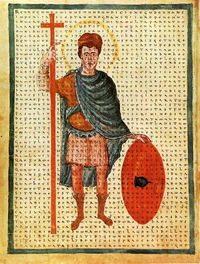
            AKA: Louis I "the Fair" Holy Roman Emperor, Louis the Debonaire Holy Roman Emperor, Louis the Pious Holy Roman Emperor
           Born: 16 Apr 778 - <Villa Cassinogilum (Chasseneuil-du-Poitou), (Poitou-Charentes)>, Aquitaine (France)
     Christened:
           Died: 20 Jun 840 - Ingelheim Kaiserpfalz, (Ingelheim am Rhein, Rhineland-Palatinate, Germany)
         Buried:
         Father: Charlemagne King of France, Emperor of Rom (0747-0814) 5 6 7 8
         Mother: Hildegard of Vinzgouw (Abt 0758-0783) 9 10 11 12
Marriage: Between 794 and 795 - Garonne, France
Other Spouse: Judith of Bavaria (Abt 0798-0843) 13 14 15 - Feb 819
Events
• King of Aquitaine: 781-817.
• King of the Franks: 814-840.
• Holy Roman Emperor: 814-840.
Wife Ermengarde of Hesbaye 16 17 18
            AKA: Irmengarde of Hesbaye
           Born: Abt 778 - <Hesbaye (Belgium)>
     Christened:
           Died: 3 Oct 818 - Angers, (Maine-et-Loire), Anjou, France
         Buried:
         Father: Ingram Count of Hesbaye (Abt 0752-      ) 17 19
         Mother: Hedwig of Bavaria (      -      )
Children
1 M Lothair I Holy Roman Emperor 20 21 22 23
            AKA: Lothaire I Holy Roman Emperor
           Born: 795 - Altdorf, Bavaria, (Germany)
     Christened:
           Died: 29 Sep 855 - Monastery of Prüm, Westeifel, Prussia (Germany)
         Buried:  - Monastery of Prüm, Westeifel, Prussia (Germany)
         Spouse: Ermengarde of Tours (Abt 0805-0851) 23 24
           Marr: 15 Oct 821 - Diedenhofen (Thionville), Allemania, (Moselle, France)
2 M Pepin I of Aquitaine 25
           Born: 797
     Christened:
           Died: 13 Dec 838
         Buried:
3 F Adelaide
           Born: Abt 799
     Christened:
           Died:
         Buried:
4 F Rotrude 26
           Born: Abt 800 - <(France)>
     Christened:
           Died:
         Buried:
         Spouse: Count Gerard of Auvergne (      -0841) 27
           Marr: Abt 814
5 F Hildegard
            AKA: Matilda
           Born: Abt 802
     Christened:
           Died:
         Buried:
6 M Louis II King of Germany
           Born: Abt 805
     Christened:
           Died: 8 Sep 876 - Frankfurt, Germany
         Buried:
Spouse: Emma de Andech (Abt 0805- )
Death Notes: Husband - Louis I Holy Roman Emperor and King of the Franks
Near Mainz
Research Notes: Husband - Louis I Holy Roman Emperor and King of the Franks
Holy Roman Emperor 814-840 First wife of Louis I. Some source says he was buried at Saint-Sauveur, but he was actually buried at the monastery in Prüm.
Source: familysearch.org (Kevin Bradford) Events
• King of Italy: 817-855.
• Holy Roman Emperor: 840-855.
Some source says he was buried at Saint-Sauveur, but he was actually buried at the monastery in Prüm.
From http://wc.rootsweb.com/cgi-bin/igm.cgi?op=GET&db=:3174654&id=I593871901 : Source: http://wc.rootsweb.com/cgi-bin/igm.cgi?op=GET&db=:3174654&id=I593871902 FamilySearch has b. abt 835 in Alsace-Lorraine.
Events
• Living: 1021-1043.
Ancestral Roots has b. abt 955, but if he married Ogiva in 951, something is in error. FamilySearch has d. 29 Aug 0997/1015. Source: Ancestral Roots of Certain American Colonists Who Came to America before 1700 by Frederick Lewis Weis and Walter Lee Sheppard, Jr, ed. by William R. Beall & Kaleen E. Beall, Baltimore, 2008, Line 50-20. This source has b. abt 955, but if he married Ogiva in 951, something is in error.
May have been born in Champagne.
Source: Ancestral Roots of Certain American Colonists Who Came to America before 1700 by Frederick Lewis Weis and Walter Lee Sheppard, Jr, ed. by William R. Beall & Kaleen E. Beall, Baltimore, 2008, Line 50-20 (Herbert III). "[Possibly] wid. of Milon II, of Tonnerre, dau. of Reinald, Count of Bar-sur-Seine. (ES III.1/49, III.4/730; West Winter, VIII.4 doubts that Ermengarde was of Bar, or was wid. of Milon; ES III.4.681 shows Ingeltrudis, m. Milon, Count of Tonnerre, as a questionable dau. of Englebert I of Brienne)." 1. Weis, Frederick Lewis and Walter Lee Sheppard, Jr; William R. Beall and Kaleen E. Beall, eds, Ancestral Roots of Certain American Colonists Who Came to America before 1700 (8th ed. Baltimore: Genealogical Publishing Company, 2008.), Line 140-14, 148-14.
2. Wikipedia.org, Louis the Pious.
3. Wikipedia.org, Chasseneuil-du-Poitou.
4. http://wc.rootsweb.ancestry.com/cgi-bin/igm.cgi. Rec. Date: 25 Aug 2001, http://wc.rootsweb.com/cgi-bin/igm.cgi?op=GET&db=:3174654&id=I593871724.
5. Weis, Frederick Lewis and Walter Lee Sheppard, Jr; William R. Beall and Kaleen E. Beall, eds, Ancestral Roots of Certain American Colonists Who Came to America before 1700 (8th ed. Baltimore: Genealogical Publishing Company, 2008.), 50-13, 140-13, 190-13.
6. Wikipedia.org, Charlemagne.
7. Wikipedia.org, Rhenish Hesse.
8. http://www.familysearch.org, Compact Disc #94 Pin #91438 (submitted by Samuel Taylor "Sam" Geer).
9. Weis, Frederick Lewis and Walter Lee Sheppard, Jr; William R. Beall and Kaleen E. Beall, eds, Ancestral Roots of Certain American Colonists Who Came to America before 1700 (8th ed. Baltimore: Genealogical Publishing Company, 2008.), Line 182-5, 140-13 (Charlemagne), 148-13 (Charlemagne), 190-13 (Charlemagne).
10. Wikipedia.org, Hildegard of Vinzgouw.
11. http://www.familysearch.org, (Kevin Bradford).
12. http://www.familysearch.org, Compact Disc #94 Pin #91440 (submitted by Samuel Taylor "Sam" Geer).
13. Weis, Frederick Lewis and Walter Lee Sheppard, Jr; William R. Beall and Kaleen E. Beall, eds, Ancestral Roots of Certain American Colonists Who Came to America before 1700 (8th ed. Baltimore: Genealogical Publishing Company, 2008.), Line 140-14 (Louis I), 148-14 (Louis I).
14. http://wc.rootsweb.ancestry.com/cgi-bin/igm.cgi. Rec. Date: 25 Aug 2001, http://wc.rootsweb.com/cgi-bin/igm.cgi?op=GET&db=:3174654&id=I593871879.
15. Wikipedia.org, Judith of Bavaria (795-843).
16. Wikipedia.org, Ermengarde of Hesbaye.
17. Weis, Frederick Lewis and Walter Lee Sheppard, Jr; William R. Beall and Kaleen E. Beall, eds, Ancestral Roots of Certain American Colonists Who Came to America before 1700 (8th ed. Baltimore: Genealogical Publishing Company, 2008.), Line 140-14 (Louis I).
18. Website - Genealogy, http://www.smokykin.com/ged/f001/f98/a0019865.htm.
19. Wikipedia.org, Ingerman of Hesbaye.
20. Weis, Frederick Lewis and Walter Lee Sheppard, Jr; William R. Beall and Kaleen E. Beall, eds, Ancestral Roots of Certain American Colonists Who Came to America before 1700 (8th ed. Baltimore: Genealogical Publishing Company, 2008.), Line 140-15.
21. Website - Genealogy, http://www.smokykin.com/ged/f001/f98/a0019866.htm.
22. Wikipedia.org, Lothair I.
23. http://www.familysearch.org, Cit. Date: 6 Aug 2009.
24. Wikipedia.org, Ermengarde of Tours.
25. Wikipedia.org, Pepin I of Aquitaine, Ermengarde of Hesbaye.
26. Weis, Frederick Lewis and Walter Lee Sheppard, Jr; William R. Beall and Kaleen E. Beall, eds, Ancestral Roots of Certain American Colonists Who Came to America before 1700 (8th ed. Baltimore: Genealogical Publishing Company, 2008.), Line 144A-15.
27. Weis, Frederick Lewis and Walter Lee Sheppard, Jr; William R. Beall and Kaleen E. Beall, eds, Ancestral Roots of Certain American Colonists Who Came to America before 1700 (8th ed. Baltimore: Genealogical Publishing Company, 2008.), Line 144A-15 (Rotrude).
28. Weis, Frederick Lewis and Walter Lee Sheppard, Jr; William R. Beall and Kaleen E. Beall, eds, Ancestral Roots of Certain American Colonists Who Came to America before 1700 (8th ed. Baltimore: Genealogical Publishing Company, 2008.), Line 107-24 (Ermengarde de Nevers).
29. http://www.familysearch.org, Cit. Date: 4 Aug 2009.
30. Weis, Frederick Lewis and Walter Lee Sheppard, Jr; William R. Beall and Kaleen E. Beall, eds, Ancestral Roots of Certain American Colonists Who Came to America before 1700 (8th ed. Baltimore: Genealogical Publishing Company, 2008.), Line 138-24 (Ermengarde de Nevers).
31. Weis, Frederick Lewis and Walter Lee Sheppard, Jr; William R. Beall and Kaleen E. Beall, eds, Ancestral Roots of Certain American Colonists Who Came to America before 1700 (8th ed. Baltimore: Genealogical Publishing Company, 2008.), Line 107-24.
32. Weis, Frederick Lewis and Walter Lee Sheppard, Jr; William R. Beall and Kaleen E. Beall, eds, Ancestral Roots of Certain American Colonists Who Came to America before 1700 (8th ed. Baltimore: Genealogical Publishing Company, 2008.), Line 107-23.
33. Weis, Frederick Lewis and Walter Lee Sheppard, Jr; William R. Beall and Kaleen E. Beall, eds, Ancestral Roots of Certain American Colonists Who Came to America before 1700 (8th ed. Baltimore: Genealogical Publishing Company, 2008.), Line 107-23 (Renaud II).
34. Weis, Frederick Lewis and Walter Lee Sheppard, Jr; William R. Beall and Kaleen E. Beall, eds, Ancestral Roots of Certain American Colonists Who Came to America before 1700 (8th ed. Baltimore: Genealogical Publishing Company, 2008.), Line 107-25.
35. Weis, Frederick Lewis and Walter Lee Sheppard, Jr; William R. Beall and Kaleen E. Beall, eds, Ancestral Roots of Certain American Colonists Who Came to America before 1700 (8th ed. Baltimore: Genealogical Publishing Company, 2008.), Line 138-25 (Renaud de Courtenay).
36. Website:, http://cybergata.com/roots/2930.htm.
37. http://wc.rootsweb.ancestry.com/cgi-bin/igm.cgi. Rec. Date: 25 Aug 2001, http://wc.rootsweb.com/cgi-bin/igm.cgi?op=GET&db=:3174654&id=I593875848.
38. Website:, http://cybergata.com/roots/4355.htm. Cit. Date: 29 Jun 2013.
39. Website:, http://cybergata.com/roots/2937.htm. Cit. Date: 29 Jun 2013.
40. http://wc.rootsweb.ancestry.com/cgi-bin/igm.cgi. Rec. Date: 25 Aug 2001, http://wc.rootsweb.com/cgi-bin/igm.cgi?op=GET&db=:3174654&id=I593875360.
41. http://wc.rootsweb.ancestry.com/cgi-bin/igm.cgi. Rec. Date: 25 Aug 2001, http://wc.rootsweb.com/cgi-bin/igm.cgi?op=GET&db=:3174654&id=I593875361.
42. http://wc.rootsweb.ancestry.com/cgi-bin/igm.cgi. Rec. Date: 25 Aug 2001, http://wc.rootsweb.com/cgi-bin/igm.cgi?op=GET&db=:3174654&id=I593871933.
43. Wikipedia.org, Robert of Vermandois.
44. Weis, Frederick Lewis and Walter Lee Sheppard, Jr; William R. Beall and Kaleen E. Beall, eds, Ancestral Roots of Certain American Colonists Who Came to America before 1700 (8th ed. Baltimore: Genealogical Publishing Company, 2008.), Line 118-19.
45. http://wc.rootsweb.ancestry.com/cgi-bin/igm.cgi. Rec. Date: 25 Aug 2001, http://wc.rootsweb.com/cgi-bin/igm.cgi?op=GET&db=:3174654&id=I593871886.
46. http://wc.rootsweb.ancestry.com/cgi-bin/igm.cgi. Rec. Date: 25 Aug 2001, http://wc.rootsweb.com/cgi-bin/igm.cgi?op=GET&db=:3174654&id=I593876193.
47. Weis, Frederick Lewis and Walter Lee Sheppard, Jr; William R. Beall and Kaleen E. Beall, eds, Ancestral Roots of Certain American Colonists Who Came to America before 1700 (8th ed. Baltimore: Genealogical Publishing Company, 2008.), Line 140-15 (Lothair I).
48. Website - Genealogy, http://www.smokykin.com/ged/f002/f06/a0020602.htm.
49. Weis, Frederick Lewis and Walter Lee Sheppard, Jr; William R. Beall and Kaleen E. Beall, eds, Ancestral Roots of Certain American Colonists Who Came to America before 1700 (8th ed. Baltimore: Genealogical Publishing Company, 2008.), Line 145-16.
50. http://wc.rootsweb.ancestry.com/cgi-bin/igm.cgi. Rec. Date: 25 Aug 2001, http://wc.rootsweb.com/cgi-bin/igm.cgi?op=GET&db=:3174654&id=I593872025.
51. Weis, Frederick Lewis and Walter Lee Sheppard, Jr; William R. Beall and Kaleen E. Beall, eds, Ancestral Roots of Certain American Colonists Who Came to America before 1700 (8th ed. Baltimore: Genealogical Publishing Company, 2008.), 140-16.
52. Weis, Frederick Lewis and Walter Lee Sheppard, Jr; William R. Beall and Kaleen E. Beall, eds, Ancestral Roots of Certain American Colonists Who Came to America before 1700 (8th ed. Baltimore: Genealogical Publishing Company, 2008.), Line 240-16, 140-16 (Helletrude).
53. Website - Genealogy, http://www.smokykin.com/ged/f002/f05/a0020578.htm.
54. http://www.familysearch.org, Cit. Date: 24 Jul 2009.
55. Weis, Frederick Lewis and Walter Lee Sheppard, Jr; William R. Beall and Kaleen E. Beall, eds, Ancestral Roots of Certain American Colonists Who Came to America before 1700 (8th ed. Baltimore: Genealogical Publishing Company, 2008.), Line 50-20.
56. Weis, Frederick Lewis and Walter Lee Sheppard, Jr; William R. Beall and Kaleen E. Beall, eds, Ancestral Roots of Certain American Colonists Who Came to America before 1700 (8th ed. Baltimore: Genealogical Publishing Company, 2008.), Line 50-19, 140-19 (Gerberga), 142-19 (Gerberga).
57. Wikipedia.org, Adalbert I, Count of Vermandois.
58. Weis, Frederick Lewis and Walter Lee Sheppard, Jr; William R. Beall and Kaleen E. Beall, eds, Ancestral Roots of Certain American Colonists Who Came to America before 1700 (8th ed. Baltimore: Genealogical Publishing Company, 2008.), Line 140-19, 50-20 (Herbert III).
59. Weis, Frederick Lewis and Walter Lee Sheppard, Jr; William R. Beall and Kaleen E. Beall, eds, Ancestral Roots of Certain American Colonists Who Came to America before 1700 (8th ed. Baltimore: Genealogical Publishing Company, 2008.), Line 50-20 (Herbert III), 140-20 (Herbert III).
60. http://www.familysearch.org, Cit. Date: 23 Jul 2009.
61. Weis, Frederick Lewis and Walter Lee Sheppard, Jr; William R. Beall and Kaleen E. Beall, eds, Ancestral Roots of Certain American Colonists Who Came to America before 1700 (8th ed. Baltimore: Genealogical Publishing Company, 2008.), Line 140-20 (Herbert III).
62. Weis, Frederick Lewis and Walter Lee Sheppard, Jr; William R. Beall and Kaleen E. Beall, eds, Ancestral Roots of Certain American Colonists Who Came to America before 1700 (8th ed. Baltimore: Genealogical Publishing Company, 2008.), Line 50-21, 140-21.
63. Weis, Frederick Lewis and Walter Lee Sheppard, Jr; William R. Beall and Kaleen E. Beall, eds, Ancestral Roots of Certain American Colonists Who Came to America before 1700 (8th ed. Baltimore: Genealogical Publishing Company, 2008.), Line 140-21 (Otho).
64. Weis, Frederick Lewis and Walter Lee Sheppard, Jr; William R. Beall and Kaleen E. Beall, eds, Ancestral Roots of Certain American Colonists Who Came to America before 1700 (8th ed. Baltimore: Genealogical Publishing Company, 2008.), Line 107-22.
65. Weis, Frederick Lewis and Walter Lee Sheppard, Jr; William R. Beall and Kaleen E. Beall, eds, Ancestral Roots of Certain American Colonists Who Came to America before 1700 (8th ed. Baltimore: Genealogical Publishing Company, 2008.), Line 107-21 (Adèle of France).
66. Weis, Frederick Lewis and Walter Lee Sheppard, Jr; William R. Beall and Kaleen E. Beall, eds, Ancestral Roots of Certain American Colonists Who Came to America before 1700 (8th ed. Baltimore: Genealogical Publishing Company, 2008.), Line 107-21.
67. Weis, Frederick Lewis and Walter Lee Sheppard, Jr; William R. Beall and Kaleen E. Beall, eds, Ancestral Roots of Certain American Colonists Who Came to America before 1700 (8th ed. Baltimore: Genealogical Publishing Company, 2008.), Line 107-22 (William I).
68. http://www.familysearch.org, Cit. Date: 20 Jul 2009.
69. Weis, Frederick Lewis and Walter Lee Sheppard, Jr; William R. Beall and Kaleen E. Beall, eds, Ancestral Roots of Certain American Colonists Who Came to America before 1700 (8th ed. Baltimore: Genealogical Publishing Company, 2008.), Line 162-21.
70. Wikipedia.org, Baldwin IV, Count of Flanders. Cit. Date: 13 Sep 2009.
71. Weis, Frederick Lewis and Walter Lee Sheppard, Jr; William R. Beall and Kaleen E. Beall, eds, Ancestral Roots of Certain American Colonists Who Came to America before 1700 (8th ed. Baltimore: Genealogical Publishing Company, 2008.), Line 162-21 (Baldwin IV)).
72. http://wc.rootsweb.ancestry.com/cgi-bin/igm.cgi. Rec. Date: 25 Aug 2001, http://wc.rootsweb.com/cgi-bin/igm.cgi?op=GET&db=:3174654&id=I593876418.
73. http://www.familysearch.org, Cit. Date: 8 Aug 2009.
74. http://www.familysearch.org, Compact Disc #125 Pin #875489 Maitland Dirk Brower.
75. http://www.familysearch.org, Compact Disc #125 Pin #879338 Maitland Dirk Brower.
76. http://www.familysearch.org, Compact Disc #125 Pin #887106 Maitland Dirk Brower.
77. http://www.familysearch.org, Compact Disc #125 Pin #895721 Maitland Dirk Brower.
King of the Franks, Crowned Holy Roman Emperor at Rheims 816-840. Louis began the partitioning of his father's empire.
-------------
From Wikipedia - Louis the Pious :
Louis the Pious (also known as Louis I, Louis the Fair, and Louis the Debonaire, German : Ludwig der Fromme, French : Louis le Pieux or Louis le Débonnaire, Italian : Luigi il Pio or Ludovico il Pio, Spanish : Luis el Piadoso or Ludovico Pío) (778 - 20 June 840 ) was Holy Roman Emperor and King of the Franks from 814 to his death in 840 .
Birth and Rule in Aquitaine
Louis was born while his father Charlemagne was on campaign in Spain, at the Carolingian villa of Cassinogilum, according to Einhard and the anonymous chronicler called Astronomus ; the place is usually identified with Chasseneuil , near Poitiers.[1] He was the third son of Charlemagne by his wife Hildegard .
Louis was crowned king of Aquitaine as a child in 781 and sent there with regents and a court. Charlemagne constituted the sub-kingdom in order to secure the border of his kingdom after his devastating defeat at the hands of Basques in Roncesvalles in (778).
In 794, Charlemagne settled four former Gallo-Roman villas on Louis, in the thought that he would take in each in turn as winter residence: Doué-la-Fontaine in today's Anjou , Ebreuil in Allier , Angeac-Charente , and the disputed Cassinogilum. Charlemagne's intention was to see all his sons brought up as natives of their given territories, wearing the national costume of the region and ruling by the local customs. Thus were the children sent to their respective realms at so young an age. Each kingdom had its importance in keeping some frontier, Louis's was the Spanish March . In 797 , Barcelona , the greatest city of the Marca, fell to the Franks when Zeid, its governor, rebelled against Córdoba and, failing, handed it to them. The Umayyad authority recaptured it in 799 . However, Louis marched the entire army of his kingdom, including Gascons with their duke Sancho I of Gascony , Provençals under Leibulf , and Goths under Bera , over the Pyrenees and besieged it for two years, wintering there from 800 to 801 , when it capitulated. The sons were not given independence from central authority, however, and Charlemagne ingrained in them the concepts of empire and unity by sending them on military expeditions far from their home bases. Louis campaigned in the Mezzogiorno against the Beneventans at least once.
Louis was one of Charlemagne's three legitimate sons to survive infancy, and, according to Frankish custom, Louis had expected to share his inheritance with his brothers, Charles the Younger , King of Neustria , and Pepin , King of Italy . In the Divisio Regnorum of 806 , Charlemagne had slated Charles the Younger as his successor as emperor and chief king, ruling over the Frankish heartland of Neustria and Austrasia , while giving Pepin the Iron Crown of Lombardy , which Charlemagne possessed by conquest. To Louis's kingdom of Aquitaine, he added Septimania , Provence , and part of Burgundy .
But in the event, Charlemagne's other legitimate sons died - Pepin in 810 and Charles in 811 - and Louis alone remained to be crowned co-emperor with Charlemagne in 813 . On his father's death in 814 , he inherited the entire Frankish kingdom and all its possessions (with the sole exception of Italy, which remained within Louis's empire, but under the direct rule of Bernard , Pepin's son).
Emperor
He was in his villa of Doué-la-Fontaine , Anjou , when he received news of his father's passing. Hurrying to Aachen , he crowned himself and was proclaimed by the nobles with shouts of Vivat Imperator Ludovicus.
In his first coinage type, minted from the start of his reign, he imitated his father Charlemagne's portrait coinage, giving an image of imperial power and prestige in an echo of Roman glory [2]. He quickly enacted a "moral purge", in which he sent all of his unmarried sisters to nunneries, forgoing their diplomatic use as hostage brides in favour of the security of avoiding the entanglements that powerful brothers-in-law might bring. He spared his illegitimate half-brothers and tonsured his father's cousins, Adalard and Wala, son of Bernard , shutting them up in Noirmoutier and Corbie , respectively, despite the latter's initial loyalty.
His chief councillors were Bernat, margrave of Septimania , and Ebbo , whom, born a serf, Louis would raise to the archbishopric of Rheims but who would ungratefully betray him later. He retained some of his father's ministers, such as Elisachar , abbot of St Maximin near Trier , and Hildebold, Archbishop of Cologne . Later he replaced Elisachar with Hildwin, abbot of many monasteries.
He also used Benedict of Aniane (the Second Benedict), a Septimanian Visigoth and monastic founder, to help him reform the Frankish church. One of Benedict's primary reforms was to ensure that all religious houses in Louis' realm adhered to the Rule of St Benedict , named for its creator, the First Benedict, Benedict of Nursia (480 -550 ).
In 816 , Pope Stephen V , who had succeeded Leo III , visited Rheims and again crowned Louis. The Emperor thereby strengthened the papacy by recognising the importance of the pope in imperial coronations.
Ordinatio imperii
On Maundy Thursday 817 , Louis and his court were crossing a wooden gallery from the cathedral to the palace in Aachen when the gallery collapsed, killing many. Louis, having barely survived and feeling the imminent danger of death, began planning for his succession; three months later he issued an Ordinatio Imperii, an imperial decree that laid out plans for an orderly succession. In 815 , he had already given his two eldest sons a share in the government, when he had sent his elder sons Lothair and Pepin to govern Bavaria and Aquitaine respectively, though without the royal titles. Now, he proceeded to divide the empire among his three sons and his nephew Bernard of Italy :
If one of the subordinate kings died, he was to be succeeded by his sons. If he died childless, Lothar would inherit his kingdom. In the event of Lothar dying without sons, one of Louis the Pious' younger sons would be chosen to replace him by "the people". Above all, the Empire would not be divided: the Emperor would rule supreme over the subordinate kings, whose obedience to him was mandatory.
With this settlement, Louis tried to combine his sense for the Empire's unity, supported by the clergy, while at the same time providing positions for all of his sons. Instead of treating his sons equally in status and land, he elevated his first-born son Lothair above his younger brothers and gave him the largest part of the Empire as his share.
Bernard's rebellion and Louis's penance
The ordinatio imperii of Aachen left Bernard of Italy in an uncertain and subordinate position as king of Italy, and he began plotting to declare independence upon hearing of it. Louis immediately directed his army towards Italy, and betook himself to Chalon-sur-Saône . Intimidated by the emperor's swift action, Bernard met his uncle at Chalon, under invitation, and surrendered. He was taken to Aix-la-Chapelle by Louis, who there had him tried and condemned to death for treason. Louis had the sentence commuted to blinding, which was duly carried out; Bernard did not survive the ordeal, however, dying after two days of agony. Others also suffered: Theodulf of Orleans , in eclipse since the death of Charlemagne, was accused of having supported the rebellion, and was thrown into a monastic prison, where he died soon after - poisoned, it was rumoured.[3] The fate of his nephew deeply marked Louis's conscience for the rest of his life.
In 822, as a deeply religious man, Louis performed penance for causing Bernard's death, at his palace of Attigny near Vouziers in the Ardennes , before Pope Paschal I , and a council of ecclesiastics and nobles of the realm that had been convened for the reconciliation of Louis with his three younger half-brothers, Hugo whom he soon made abbot of St-Quentin, Drogo whom he soon made Bishop of Metz , and Theodoric. This act of contrition, partly in emulation of Theodosius I , had the effect of greatly reducing his prestige as a Frankish ruler, for he also recited a list of minor offences about which no secular ruler of the time would have taken any notice. He also made the egregious error of releasing Wala and Adalard from their monastic confinements, placing the former in a position of power in the court of Lothair and the latter in a position in his own house.
Frontier wars
At the start of Louis's reign, the many tribes - Danes , Obotrites , Slovenes , Bretons , Basques - which inhabited his frontierlands were still in awe of the Frankish emperor's power and dared not stir up any trouble. In 816, however, the Sorbs rebelled and were quickly followed by Slavomir, chief of the Obotrites, who was captured and abandoned by his own people, being replaced by Ceadrag in 818. Soon, Ceadrag too had turned against the Franks and allied with the Danes, who were to become the greatest menace of the Franks in a short time.
A greater Slavic menace was gathering on the southeast. There, Ljudevit Posavski , duke of Pannonia , was harassing the border at the Drava and Sava rivers. The margrave of Friuli , Cadolah , was sent out against him, but he died on campaign and, in 820, his margarvate was invaded by Slovenes. In 821, an alliance was made with Borna , duke of the Dalmatia , and Ljudevit was brought to heel. Peace continued until 827, when the younger Louis had to deal with a Bulgar horde descending on Pannonia.
On the far southern edge of his great realm, Louis had to control the Lombard princes of Benevento whom Charlemagne had never subjugated. He extracted promises from Princes Grimoald IV and Sico , but to no effect.
On the southwestern frontier, problems commenced early when, in 815, Séguin , duke of Gascony , revolted. He was defeated and replaced by Lupus III , who was dispossessed in 818 by the emperor. In 820 an assembly at Quierzy-sur-Oise decided to send an expedition against the Cordoban caliphate. The counts in charge of the army, Hugh , count of Tours , and Matfrid , count of Orléans , were slow in acting and the expedition came to naught.
First civil war
In 818, as Louis was returning from a campaign to Brittany , he was greeted by news of the death of his wife, Ermengarde . Ermengarde was the daughter of Ingerman , the duke of Hesbaye. Louis had been close to his wife, who had been involved in policymaking. It was rumoured that she had played a part in her nephew's death and Louis himself believed her own death was divine retribution for that event. It took many months for his courtiers and advisors to convince him to remarry, but eventually he did, in 820, to Judith , daughter of Welf , count of Altdorf . In 823 Judith gave birth to a son, who was named Charles .
The birth of this son damaged the Partition of Aachen, as Louis's attempts to provide for his fourth son met with stiff resistance from his older sons, and the last two decades of his reign were marked by civil war.
At Worms in 829, Louis gave Charles Alemannia with the title of king or duke (historians differ on this), thus enraging his son and co-emperor Lothair,[4] whose promised share was thereby diminished. An insurrection was soon at hand. With the urging of the vengeful Wala and the cooperation of his brothers, Lothair accused Judith of having committed adultery with Bernard of Septimania, even suggesting Bernard to be the true father of Charles. Ebbo and Hildwin abandoned the emperor at that point, Bernard having risen to greater heights than either of them. Agobard , Archbishop of Lyon , and Jesse , bishop of Amiens , too, opposed the redivision of the empire and lent their episcopal prestige to the rebels.
In 830, at Wala's insistence that Bernard of Septimania was plotting against him, Pepin of Aquitaine led an army of Gascons , with the support of the Neustrian magnates, all the way to Paris . At Verberie , Louis the German joined him. At that time, the emperor returned from another campaign in Brittany to find his empire at war with itself. He marched as far as Compiègne , an ancient royal town, before being surrounded by Pepin's forces and captured. Judith was incarcerated at Poitiers and Bernard fled to Barcelona.
Then Lothair finally set out with a large Lombard army, but Louis had promised his sons Louis the German and Pepin of Aquitaine greater shares of the inheritance, prompting them to shift loyalties in favour of their father. When Lothair tried to call a general council of the realm in Nijmegen , in the heart of Austrasia , the Austrasians and Rhinelanders came with a following of armed retainers, and the disloyal sons were forced to free their father and bow at his feet (831). Lothair was pardoned, but disgraced and banished to Italy. Pepin returned to Aquitaine and Judith - after being forced to humiliate herself with a solemn oath of innocence - to Louis's court. Only Wala was severely dealt with, making his way to a secluded monastery on the shores of Lake Geneva . Though Hilduin , abbot of Saint Denis , was exiled to Paderborn and Elisachar and Matfrid were deprived of their honours north of the Alps; they did not lose their freedom.
Second civil war
The next revolt occurred a mere two years later (832). The disaffected Pepin was summoned to his father's court, where he was so poorly received he left against his father's orders. Immediately, fearing that Pepin would be stirred up to revolt by his nobles and desiring to reform his morals, Louis the Pious summoned all his forces to meet in Aquitaine in preparation of an uprising, but Louis the German garnered an army of Slav allies and conquered Swabia before the emperor could react. Once again the elder Louis divided his vast realm. At Jonac , he declared Charles king of Aquitaine and deprived Pepin (he was less harsh with the younger Louis), restoring the whole rest of the empire to Lothair, not yet involved in the civil war. Lothair was, however, interested in usurping his father's authority. His ministers had been in contact with Pepin and may have convinced him and Louis the German to rebel, promising him Alemannia, the kingdom of Charles.
Soon Lothair, with the support of Pope Gregory IV , whom he had confirmed in office without his father's support, joined the revolt in 833. While Louis was at Worms gathering a new force, Lothair marched north. Louis marched south. The armies met on the plains of the Rothfeld. There, Gregory met the emperor and may have tried to sow dissension amongst his ranks. Soon much of Louis's army had evaporated before his eyes, and he ordered his few remaining followers to go, because "it would be a pity if any man lost his life or limb on my account." The resigned emperor was taken to Saint Médard at Soissons , his son Charles to Prüm , and the queen to Tortona . The despicable show of disloyalty and disingenuousness earned the site the name Field of Lies, or Lügenfeld, or Campus Mendacii, ubi plurimorum fidelitas exstincta est[5]
On November 13 , 833 , Ebbo of Rheims presided over a synod in the Church of Saint Mary in Soissons which deposed Louis and forced him to publicly confess many crimes, none of which he had, in fact, committed. In return, Lothair gave Ebbo the Abbey of Saint Vaast. Men like Rabanus Maurus , Louis' younger half-brothers Drogo and Hugh, and Emma, Judith's sister and Louis the German's new wife, worked on the younger Louis to make peace with his father, for the sake of unity of the empire. The humiliation to which Louis was then subjected at Notre Dame in Compiègne turned the loyal barons of Austrasia and Saxony against Lothair, and the usurper fled to Burgundy , skirmishing with loyalists near Châlons-sur-Saône . Louis was restored the next year, on 1 March 834 .
On Lothair's return to Italy, Wala, Jesse, and Matfrid, formerly count of Orléans, died of a pestilence and, on 2 February 835 , the Synod of Thionville deposed Ebbo, Agobard, Bernard , Bishop of Vienne , and Bartholomew , Archbishop of Narbonne . Lothair himself fell ill; events had turned completely in Louis favour once again.
In 836, however, the family made peace and Louis restored Pepin and Louis, deprived Lothair of all save Italy, and gave it to Charles in a new division, given at the diet of Crémieux . At about that time, the Vikings terrorised and sacked Utrecht and Antwerp . In 837, they went up the Rhine as far as Nijmegen, and their king, Rorik , demanded the wergild of some of his followers killed on previous expeditions before Louis the Pious mustered a massive force and marched against them. They fled, but it would not be the last time they harried the northern coasts. In 838, they even claimed sovereignty over Frisia , but a treaty was confirmed between them and the Franks in 839. Louis the Pious ordered the construction of a North Sea fleet and the sending of missi dominici into Frisia to establish Frankish sovereignty there.
Third civil war
In 837, Louis crowned Charles king over all of Alemannia and Burgundy and gave him a portion of his brother Louis's land. Louis the German promptly rose in revolt, and the emperor redivided his realm again at Quierzy-sur-Oise , giving all of the young king of Bavaria's lands, save Bavaria itself, to Charles. Emperor Louis did not stop there, however. His devotion to Charles knew no bounds. When Pepin died in 838, Louis declared Charles the new king of Aquitaine. The nobles, however, elected Pepin's son Pepin II . When Louis threatened invasion, the third great civil war of his reign broke out. In the spring of 839, Louis the German invaded Swabia, Pepin II and his Gascon subjects fought all the way to the Loire , and the Danes returned to ravage the Frisian coast (sacking Dorstad for a second time).
Lothair, for the first time in a long time, allied with his father and pledged support at Worms in exchange for a redivision of the inheritance. By a final placitum issued there, Louis gave Bavaria to Louis the German and disinherited Pepin II, leaving the entire remainder of the empire to be divided roughly into an eastern part and a western. Lothair was given the choice of which partition he would inherit and he chose the eastern, including Italy, leaving the western for Charles. The emperor quickly subjugated Aquitaine and had Charles recognised by the nobles and clergy at Clermont-en-Auvergne in 840. Louis then, in a final flash of glory, rushed into Bavaria and forced the younger Louis into the Ostmark . The empire now settled as he had declared it at Worms, he returned in July to Frankfurt am Main , where he disbanded the army. The final civil war of his reign was over.
Death
Louis fell ill soon after his final victorious campaigns and went to his summer hunting lodge on an island in the Rhine, by his palace at Ingelheim . On 20 June 840 , he died, in the presence of many bishops and clerics and in the arms of his half-brother Drogo, though Charles and Judith were absent in Poitiers. Soon dispute plunged the surviving brothers into a civil war that was only settled in 843 by the Treaty of Verdun , which split the Frankish realm into three parts, to become the kernels of France and Germany , with Burgundy and the Low Countries between them. The dispute over the kingship of Aquitaine was not fully settled until 860.
Louis the Pious, along with his half-brother Drogo, were buried in Saint Pierre aux Nonnains Basilica in Metz .
Marriage and issue
By his first wife, Ermengarde of Hesbaye (married ca 794-98), he had three sons and three daughters:
By his second wife, Judith of Bavaria , he had a daughter and a son:
By Theodelinde of Sens[citation needed ], he had two illegitimate children:
-------
From Wikipedia - Chasseneuil-du-Poitou :
The town, then simply the villa Cassinogilum, was a royal residence of first the Merovingian , and then Carolingian dynasties in France.[8] Louis the Pious , later King of Aquitaine and King of the Franks was born in the villa on 16 April 778 , when his mother, Hildegard of Vinzgouw was staying in the villa whilst his father Charlemagne was on campaign in Spain .
Research Notes: Wife - Ermengarde of Hesbaye
Source: http://wc.rootsweb.com/cgi-bin/igm.cgi?op=GET&db=:3174654&id=I593871904 has b. abt 774
From Wikipedia - Ermengarde of Hesbaye :
Ermengarde, or Irmengarde of Hesbaye (c. 778 - 818 ) was the daughter of Ingram , count of Hesbaye and Hedwig of Bavaria. She was a Frank . Her family is known as the Robertians
Ermengarde married in 794 /795 Louis the Pious , king of Aquitania , king of Franks , king of Italy, ruler of the Holy Roman Empire .
She had six children :
She died at Angers , France on 3 October 818 . Louis was married to Judith a few years later and became father of Charles the Bald .
Burial Notes: Child - Lothair I Holy Roman Emperor
Husband Milo Sire de Courtenay 28 29
            AKA: Miles Sire de Courtenay, Miles de Courtenay, Milo de Courtenay
           Born: Abt 1075 - <Courtenay, (Loiret)>, France
     Christened:
           Died: After 1127
         Buried:  - Abbey of Fontaine-Jean, Saint-Maurice-sur-Aveyron, (Loiret), France
         Father: Jocelin de Courtenay (Abt 1034-      ) 29
         Mother: Isabel de Montlhéry (Abt 1038-      ) 29 30
Marriage: Abt 1095 - France
Wife Ermengarde de Nevers 29 31
           Born: Abt 1073 - <Courtenay, (Loiret)>, France
     Christened:
           Died: 1095 - France
         Buried:
         Father: Renaud II de Nevers Count of Nevers and Auxerre (Abt 1047-1089) 29 32
         Mother: Ida de Forez (Abt 1051-1085) 29 33
Children
1 M Renaud de Courtenay Sire de Courtenay 29 34
           Born: Abt 1125 - <Courtenay, (Loiret)>, France
     Christened:
           Died: Abt 1190
         Buried:
Spouse: Helvis du Donjon and Corbeil ( - ) 29 35
Birth Notes: Husband - Milo Sire de Courtenay
Husband Giselbert Count of Burgundy and Chalons 36
            AKA: Giselbert Duc de Bourgogne
           Born: Abt 892 - France
     Christened:
           Died: After 8 Apr 956 - Paris, (Île-de-France), France
         Buried:
         Father: Manasses Comté de Dijon, de Challons-sur-Seine (Abt 0866-0919) 37 38
         Mother: Ermengarde Princesse de Provence (0935-      ) 39
Marriage:
Wife Ermengarde of Burgundy
           Born: Abt 894 - Burgundy, (France)
     Christened:
           Died:
         Buried:
         Father: Richard Duke of Burgundy (Abt 0866-0921) 40
         Mother: Adelaide (Abt 0868-      ) 41
Children
1 F Adélaide de Bourgogne 11 42
            AKA: Adelaide of Burgundy
           Born: Abt 918 - Burgundy, (France)
     Christened:
           Died: 19 Aug 967
         Buried:
         Spouse: Robert of Vermandois, Count of Trois and Meaux (Abt 0920-0967/0968) 11 43 44 45
           Marr: by 950
Research Notes: Husband - Giselbert Count of Burgundy and Chalons
and
http://wc.rootsweb.com/cgi-bin/igm.cgi?op=GET&db=:3174654&id=I593873472
Husband Lothair I Holy Roman Emperor 20 21 22 23
            AKA: Lothaire I Holy Roman Emperor
           Born: 795 - Altdorf, Bavaria, (Germany)
     Christened:
           Died: 29 Sep 855 - Monastery of Prüm, Westeifel, Prussia (Germany)
         Buried:  - Monastery of Prüm, Westeifel, Prussia (Germany)
         Father: Louis I Holy Roman Emperor and King of the Franks (0778-0840) 1 2 3 4
         Mother: Ermengarde of Hesbaye (Abt 0778-0818) 16 17 18
Marriage: 15 Oct 821 - Diedenhofen (Thionville), Allemania, (Moselle, France)
Wife Ermengarde of Tours 23 24
            AKA: Irmingard von Tours
           Born: Abt 805 - Orléans, Orléanais, (Loiret), France
     Christened:
           Died: 20 Mar 851
         Buried:  - Abbaye d'Erstein, Strasbourg, Alsace, (France)
         Father: Hugues II Count of Alsace, Count of Tours (Abt 0779-      ) 23 47
         Mother: Ava Countess of Alsace (Abt 0769-      ) 48
Children
1 M Lothair II King of Lorraine 23 49
            AKA: Lothaire II King of Lorraine
           Born: 827 - <(Lorraine, France)>
     Christened:
           Died: 8 Aug 869 - Plaisance [Piacenza], (Piacenza, Italy)
         Buried:
         Spouse: Waldrade (Abt 0837-Abt 0868) 23 50
           Marr: 862
2 F Helletrude of Lorraine 51
            AKA: Ermengarde of Lorraine
           Born: Abt 830 - <Middle Francia (Lorraine, France)>
     Christened:
           Died:
         Buried:
         Spouse: Giselbert Count of Darnau (Abt 0830-Abt 0892) 52 53
           Marr: 846
Burial Notes: Husband - Lothair I Holy Roman Emperor
Research Notes: Husband - Lothair I Holy Roman Emperor
King of the Franks, Holy Roman Emperor 840-855. Lothair received most of Burgundy and many German and French port cities upon the breakup of his grandfather's empire by his father, Louis. Upon his father's death, Lothair attepted to sieze the entire empire, but was defeated by his brothers Louis and Charles at the battle of Fontenoy in 841. He remained Emperor until his death in 855.
From Wikipedia - Lothair I :
Lothair I (German : Lothar, French : Lothaire, Italian : Lotario) (795 - 29 September 855 ), king of Italy (818 - 855) and crowned Carolingian King of (Northern) Italy, Emperor of the Romans and (nominally) was Emperor of the Franks (840 - 855).
Lothair was the eldest son of the Carolingian emperor Louis the Pious and his wife Ermengarde of Hesbaye , daughter of Ingerman , duke of Hesbaye . He led his full-brothers Pippin I of Aquitaine and Louis the German in revolt against their father on several occasions, in protest against his attempts to make their half-brother Charles the Bald a co-heir to the Frankish domains. Upon the death of the father, Charles and Louis joined forces against Lothair in a three year civil war (840-843), the struggles between the brothers leading directly to the break up of the great Frankish Empire assembled by their grandfather Charlemagne , and would lay the foundation for the development of modern France and Germany.
Little is known of his early life, which was probably passed at the court of his grandfather Charlemagne . Shortly after the accession of his father, he was sent to govern Bavaria. He first comes to historical attention in 817, when Louis the Pious drew up his Ordinatio Imperii. In this, Louis designated Lothair as his principal heir, to whom his younger brothers Pippin of Aquitaine and Louis the German, as well as his cousin Bernard of Italy , would be subject after the death of their father; he would also inherit their lands if they were to die childless. Lothair was then crowned joint emperor by his father at Aix-la-Chapelle . At the same time, Aquitaine and Bavaria were granted to his brothers Pippin and Louis respectively as subsidiary kingdoms. Following the murder of Bernard, King of Italy, by Louis the Pious, Lothair also received the Kingdom of Italy. In 821, he married Ermengarde (d. 851), daughter of Hugh , count of Tours . In 822, he assumed the government of Italy , and at Easter, 5 April 823 , he was crowned emperor again by Pope Paschal I , this time at Rome .
In November 824, he promulgated a statute concerning the relations of pope and emperor which reserved the supreme power to the secular potentate, and he afterwards issued various ordinances for the good government of Italy.
On his return to his father's court his stepmother Judith won his consent to her plan for securing a kingdom for her son Charles , a scheme which was carried out in 829, when the young prince was given Alemannia as king. Lothair, however, soon changed his attitude and spent the succeeding decade in constant strife over the division of the Empire with his father. He was alternately master of the Empire, and banished and confined to Italy, at one time taking up arms in alliance with his brothers and at another fighting against them, whilst the bounds of his appointed kingdom were in turn extended and reduced.
The first rebellion began in 830. All three brothers fought their father, whom they deposed. In 831, he was reinstated and he deprived Lothair of his imperial title and gave Italy to the young Charles. The second rebellion was instigated by Angilbert II, Archbishop of Milan , in 833, and again Louis was deposed and reinstated the next year (834). Lothair, through the loyalty of the Lombards and later reconciliations, retained Italy and the imperial position through all remaining divisions of the Empire by his father.
When Louis the Pious was dying in 840, he sent the imperial insignia to Lothair, who, disregarding the various partitions, claimed the whole of the Empire. Negotiations with his brother Louis the German and his half-brother Charles, both of whom armed to resist this claim, were followed by an alliance of the younger brothers against Lothair. A decisive battle was fought at Fontenay-en-Puisaye on 25 June 841 , when, in spite of his and his allied nephew Pepin II of Aquitaine 's personal gallantry, Lothair was defeated and fled to Aachen. With fresh troops he began a war of plunder, but the forces of his brothers were too strong for him, and taking with him such treasure as he could collect, he abandoned to them his capital. He met with the leaders of the Stellinga in Speyer and promised them his support in return for theirs, but Louis and then the native Saxon nobility put down the Stellinga in the next years.
Peace negotiations began, and in June 842 the brothers met on an island in the Saône , and agreed to an arrangement which developed, after much difficulty and delay, into the Treaty of Verdun signed in August 843. By this, Lothair received the imperial title as well as northern Italy and a long stretch of territory from the North Sea to the Mediterranean , essentially along the valleys of the Rhine and the Rhone . He soon left Italy to his eldest son, Louis , and remained in his new kingdom, engaging in alternate quarrels and reconciliations with his brothers and in futile efforts to defend his lands from the attacks of the Northmen (as Vikings were known in Frankish writings) and the Saracens .
In 855, he became seriously ill and, despairing of recovery, renounced the throne, divided his lands between his three sons, and on September 23 , entered the monastery of Prüm , where he died six days later. He was buried at Prüm, where his remains were found in 1860.
His kingdom was divided among his three sons - the eldest, Louis II , received Italy and the title of Emperor; the second, Lothair II , received Lotharingia ; while the youngest, Charles , received Provence .
Family
He married Ermengarde of Tours , who died in 851. The last of his nine children are illegitimate.
Research Notes: Wife - Ermengarde of Tours
From Wikipedia - Ermengarde of Tours :
Ermengarde of Tours (German : Irmingard von Tours) (died 20 March 851) was the wife of Emperor Lothair I of the Franks. Her father was Hugh of Tours , a member of the Etichonen family, which claimed descent from the Merovingian Kings. In the middle of October 821 in Diedenhofen (Thionville), she married the Carolingian Emperor Lothair I (795-855).
In 849, two years before her death, she made a donation to the abbey Erstein in the Elsass, in which she lies also buried.
Lothar and Irmingard had nine children:
Birth Notes: Child - Lothair II King of Lorraine
Death Notes: Child - Lothair II King of Lorraine
Husband Herbert III Count of Vermandois 54 55
           Born: Between 942 and 953
     Christened:
           Died: 993
         Buried:
         Father: Albert I "the Pious" Count of Vermandois (Abt 0920-0988) 56 57
         Mother: Gerberga of Lorraine (Abt 0935-0978) 58
Marriage: by 987
Other Spouse: Ogiva of England (0902-After 0955) - 951
Wife Ermengarde 59 60
           Born: Abt 946 - Burgundy, (France)
     Christened:
           Died: After 1042
         Buried:
         Father: Reinald Count of Bar (Abt 0920-      ) 60 61
         Mother:
Children
1 M Otto of Vermandois 60 62
            AKA: Eudes Count of Vermandois, Otho Count of Vermandois
           Born: Abt 1000 - <Vermandois, (Aisne), Picardy, France>
     Christened:
           Died: 25 May 1045 - France
         Buried:
Spouse: Parvie ( - ) 63
Birth Notes: Husband - Herbert III Count of Vermandois
FamilySearch has b. between 942 and 953
Death Notes: Husband - Herbert III Count of Vermandois
Ancestral Roots has d. 993
Research Notes: Husband - Herbert III Count of Vermandois
Birth Notes: Wife - Ermengarde
Research Notes: Wife - Ermengarde
Notes: Marriage
Husband William I Count of Nevers 64
           Born: Abt 1030 - <Nevers, (Nievre)>, Burgundy (France)
     Christened:
           Died: 20 Jun 1100
         Buried:
         Father: Renaud I Count of Nevers (      -1040) 65
         Mother: Adèle of France, Countess of Auxerre (Abt 1003-Abt 1063) 66
Marriage: 1045
Wife Ermengarde 67
           Born:
     Christened:
           Died:
         Buried:
         Father: Renaud Count of Tonnerre (      -      ) 67
         Mother:
Children
1 M Renaud II de Nevers Count of Nevers and Auxerre 29 32
            AKA: Renaud Comte de Nevers
           Born: Abt 1047 - <Nevers, (Nievre)>, Burgundy (France)
     Christened:
           Died: 5 Aug 1089
         Buried:
Spouse: Ida de Forez (Abt 1051-1085) 29 33
Husband Adalbert de Gand 68
           Born: Abt 1004 - Gand (Ghent), Flanders (Belgium)
     Christened:
           Died:
         Buried:
         Father: Arnoul Count of Gand (Abt 0984-      ) 68
         Mother: Lietgarde de Cleves (Abt 0987-      ) 68
Marriage: Abt 1021 - Gand, East Vlaanderen, (Belgium)
Wife Ermengarde of Flanders 68
           Born: Abt 1005 - <Flanders (Belgium or France)>
     Christened:
           Died:
         Buried:
         Father: Baldwin IV "the Bearded" Count of Valenciennes & Count of Flanders (0980-1035/1036) 11 69 70
         Mother: Ogive de Luxembourg (Abt 0995-1030/1036) 11 71
Children
1 M Ralph de Gand 68
           Born: Abt 1022 - Gand (Ghent), Flanders (Belgium)
     Christened:
           Died:
         Buried:
         Spouse: Gisele (Abt 1028-      ) 68
           Marr: Abt 1047 - <Flanders (Belgium)>
Husband Manasses Comté de Dijon, de Challons-sur-Seine 37 38
            AKA: Manassas Count of Chalons
           Born: Abt 866 - France
     Christened:
           Died: 919
         Buried:
         Father: Theodore Count of Chalons (Abt 0840-      ) 72
         Mother:
Marriage:
Wife Ermengarde Princesse de Provence 39
           Born: 12 Apr 935
     Christened:
           Died:
         Buried:
         Father: Boso Roi de Provence (Abt 0840-Abt 0887) 39
         Mother:
Children
1 M Giselbert Count of Burgundy and Chalons 36
            AKA: Giselbert Duc de Bourgogne
           Born: Abt 892 - France
     Christened:
           Died: After 8 Apr 956 - Paris, (Île-de-France), France
         Buried:
Spouse: Ermengarde of Burgundy (Abt 0894- )
Husband Raimund Borrel I Count of Barcelona 73
            AKA: Raimund Borrel I, Count of Barcelona
           Born: Abt 972 - <Barcelona, Barcelona, Aragon>, Spain
     Christened:
           Died: 25 Feb 1018
         Buried:
         Father: Borrell II Count of Barcelona (Abt 0946-0992) 73
         Mother: Luitgarde de Toulouse (Abt 0952-After 0977) 73
Marriage: 20 Jan 992
Wife Ermensinde de Carcassonne 73
           Born: Abt 975 - Carcassonne, (Aude), France
     Christened:
           Died:
         Buried:
         Father: Roger I Count of Carcassonne (Abt 0935-1012) 73
         Mother: Adelaide (Abt 0949-      ) 73
Children
1 M Raimund Berenger I, Count of Barcelona 73
            AKA: Ramon Berenger I Count of Barcelona
           Born: 1005 - <Barcelona, Aragon>, Spain
     Christened:
           Died: 26 May 1035
         Buried:  - Santa Maria, Ripoll, Gerona, Spain
         Spouse: Sancha Sanchez de Castile (Abt 1006-1026) 73
           Marr: 1021 - Spain
Husband Raimund Borrel de Barcelona 74
           Born: 972 - Barcelona, Barcelona, Aragón, Spain
     Christened:
           Died: 25 Feb 1018
         Buried:
Marriage: 1001 - Normandy, France
Wife Ermensinde de Carcassonne 75
           Born: Abt 975 - Carcassonne, (Aude), Languedoc, France
     Christened:
           Died: 1 Mar 1058
         Buried:
Children
1 F Godehilda Borrel 76
            AKA: Godehilda Borrell
           Born: Abt 971 - Barcelona, Barcelona, Aragón, Spain
     Christened:
           Died:
         Buried:
         Spouse: Nigel de Saint Sauveur (Abt 0969-1045) 77
           Marr: Abt 991 - St. Sauveur-le-Vicomte, (Manche), Normandy, France
Sources