Husband Baldwin V de Lille, Count of Flanders 1 2 3
            AKA: Baldwin V of Flanders
           Born: 1012
     Christened:
           Died: 1 Sep 1067 - Lille, (Nord), Flanders (France)
         Buried:
         Father: Baldwin IV "the Bearded" Count of Valenciennes & Count of Flanders (0980-1035/1036) 2 4 5
         Mother: Ogive de Luxembourg (Abt 0995-1030/1036) 2 6
Marriage: 1028 - Amiens, (Somme), Picardy, France
Events
• Count of Flanders: 1035-1067.
Wife Adele Capet Princess of France 7 8
            AKA: Adèle of France, Countess of Contentin, Adele "the Holy" of Messines, Aelis of France, Countess of Contentin
           Born: Abt 1009
     Christened:
           Died: Abt 8 Jan 1079 - Messines Monastery, Messines (Mesen), West Flanders, (Belgium)
         Buried:
         Father: Robert II "the Pious" King of France (0972-1031) 9 10
         Mother: Constance of Provence (Abt 0986-1032) 11 12
Other Spouse: Richard III Duke of Normandy (Abt 0997-1028) 13 - 10 Jan 1027
Children
1 M Robert I Count of Flanders 14 15
            AKA: Robert "the Friesian"
           Born: Between 1029 and 1035
     Christened:
           Died: 13 Oct 1093 - Kassel, Hesse, (Germany)
         Buried:
         Spouse: Gertrude of Saxony (Abt 1030-1113) 16 17
           Marr: 1063
2 F Matilda of Flanders 18 19
            AKA: Maud of Flanders
           Born: Abt 1032 - Flanders (France)
     Christened:
           Died: 2 Nov 1083 - Caen, (Calvados), Normandy, France
         Buried:  - Abbaye aux Dames, Caen, (Calvados), Normandy, France
         Spouse: William the Conqueror Duke of Normandy, King of England (Abt 1028-1087) 20 21
           Marr: 1053 - Cathédral de Notre Dame, < >, Normandy, France
Research Notes: Husband - Baldwin V de Lille, Count of Flanders
Second husband of Adele de France Second daughter of Robert the Pious and Constance of Arles. May have been married in Paris.
Wikipedia has b. 1033.
May have died on 3 Oct 1093.
Ancestral Roots gives both abt. 1031 and 1032.
Ancestral Roots gives 1 Nov 1083 and 2 Nov 1083.
Events
• Residence: 1754, Stone Arabia, Albany (Montgomery), New York, (United States).
Dutch. Source: From http://cybergata.com/roots/1267.htm : Source: A Genealogical and Heraldic Dictionary of the Landed Gentry of Great Britain & Ireland" by John Burke & John Bernard Burke, vol. I (London, 1847), p. 656.
Events
• King of Salian Franks: at Dispargum and later Tournai, 426-447.
Legendary. May not have been a real person, and, if a real person, may not have been the father of Merovech. Events
• King of the Salian Franks: at Tournai, 458-481.
From Wikipedia - Childeric I : First husband was Bisinus, the King of Thuringia. Baptized by Saint Remi, Bishop of Rheims.
From Wikipedia - Wacho : First husband was Bisinus, the King of Thuringia. From Wikipedia - Dardanus : From Wikipedia - Batea (mythology) : 1. Weis, Frederick Lewis and Walter Lee Sheppard, Jr; William R. Beall and Kaleen E. Beall, eds, Ancestral Roots of Certain American Colonists Who Came to America before 1700 (8th ed. Baltimore: Genealogical Publishing Company, 2008.), Line 162-22, 128-22 (Adele of France).
2. http://www.familysearch.org, (Kevin Bradford).
3. Wikipedia.org, Baldwin V, Count of Flanders. Cit. Date: 14 Sep 2009.
4. Weis, Frederick Lewis and Walter Lee Sheppard, Jr; William R. Beall and Kaleen E. Beall, eds, Ancestral Roots of Certain American Colonists Who Came to America before 1700 (8th ed. Baltimore: Genealogical Publishing Company, 2008.), Line 162-21.
5. Wikipedia.org, Baldwin IV, Count of Flanders. Cit. Date: 13 Sep 2009.
6. Weis, Frederick Lewis and Walter Lee Sheppard, Jr; William R. Beall and Kaleen E. Beall, eds, Ancestral Roots of Certain American Colonists Who Came to America before 1700 (8th ed. Baltimore: Genealogical Publishing Company, 2008.), Line 162-21 (Baldwin IV)).
7. Weis, Frederick Lewis and Walter Lee Sheppard, Jr; William R. Beall and Kaleen E. Beall, eds, Ancestral Roots of Certain American Colonists Who Came to America before 1700 (8th ed. Baltimore: Genealogical Publishing Company, 2008.), Line 128-22, 162-22 (Baldwin V).
8. Wikipedia.org, Adela of France, Countess of Flanders. Cit. Date: 14 Sep 2009.
9. Weis, Frederick Lewis and Walter Lee Sheppard, Jr; William R. Beall and Kaleen E. Beall, eds, Ancestral Roots of Certain American Colonists Who Came to America before 1700 (8th ed. Baltimore: Genealogical Publishing Company, 2008.), Line 101-21.
10. Wikipedia.org, Robert II of France.
11. Weis, Frederick Lewis and Walter Lee Sheppard, Jr; William R. Beall and Kaleen E. Beall, eds, Ancestral Roots of Certain American Colonists Who Came to America before 1700 (8th ed. Baltimore: Genealogical Publishing Company, 2008.), Line 141A-21, 101-21 (Robert II).
12. Wikipedia.org, Constance of Arles.
13. Weis, Frederick Lewis and Walter Lee Sheppard, Jr; William R. Beall and Kaleen E. Beall, eds, Ancestral Roots of Certain American Colonists Who Came to America before 1700 (8th ed. Baltimore: Genealogical Publishing Company, 2008.), Line 132A-23, 166-22.
14. Weis, Frederick Lewis and Walter Lee Sheppard, Jr; William R. Beall and Kaleen E. Beall, eds, Ancestral Roots of Certain American Colonists Who Came to America before 1700 (8th ed. Baltimore: Genealogical Publishing Company, 2008.), Line 164-23.
15. Wikipedia.org, Robert I, Count of Flanders. Cit. Date: 14 Sep 2009.
16. Weis, Frederick Lewis and Walter Lee Sheppard, Jr; William R. Beall and Kaleen E. Beall, eds, Ancestral Roots of Certain American Colonists Who Came to America before 1700 (8th ed. Baltimore: Genealogical Publishing Company, 2008.), Line 164-23 (Robert I).
17. Wikipedia.org, Gertrude of Saxony.
18. Weis, Frederick Lewis and Walter Lee Sheppard, Jr; William R. Beall and Kaleen E. Beall, eds, Ancestral Roots of Certain American Colonists Who Came to America before 1700 (8th ed. Baltimore: Genealogical Publishing Company, 2008.), Line 162-23, 169-23.
19. Wikipedia.org, Matilda of Flanders. Cit. Date: 15 Sep 2009.
20. Weis, Frederick Lewis and Walter Lee Sheppard, Jr; William R. Beall and Kaleen E. Beall, eds, Ancestral Roots of Certain American Colonists Who Came to America before 1700 (8th ed. Baltimore: Genealogical Publishing Company, 2008.), Line 121-24, 169-23 (Maud of Flanders).
21. Website - Genealogy, thepeerage.com.
22. http://www.familysearch.org, Compact Disc #94 Pin #317960 (submitted by Samuel Taylor "Sam" Geer).
23. http://www.familysearch.org, Compact Disc #94 Pin #319830 (submitted by Samuel Taylor "Sam" Geer).
24. http://www.familysearch.org, Compact Disc #94 Pin #105692 (submitted by Samuel Taylor "Sam" Geer).
25. http://wc.rootsweb.ancestry.com/cgi-bin/igm.cgi. Rec. Date: 25 Aug 2001, http://wc.rootsweb.com/cgi-bin/igm.cgi?op=GET&db=:3174654&id=I593873342.
26. Wikipedia.org, Basina, Queen of Thuringia.
27. http://www.familysearch.org, Compact Disc #94 Pin #99018 (submitted by Samuel Taylor "Sam" Geer).
28. http://wc.rootsweb.ancestry.com/cgi-bin/igm.cgi. Rec. Date: 25 Aug 2001, http://wc.rootsweb.com/cgi-bin/igm.cgi?op=GET&db=:3174654&id=I593873341.
29. Wikipedia.org, Childeric I.
30. http://www.familysearch.org, Compact Disc #94 Pin #99024 (submitted by Samuel Taylor "Sam" Geer).
31. Wikipedia.org, Wacho.
32. Wereley, Bill, Eden's Tree Genealogy: Home of the Wereley-Savey Family Tree (http://www.edenstree.com/), http://www.edenstree.com/html/fam/fam01091.html. Cit. Date: 3 Dec 2005.
33. Website - Genealogy, http://worldconnect.rootsweb.com/cgi-bin/igm.cgi?op=GET&db=:2591631&id=I530982716 (Rosemary Benson). Cit. Date: 9 Jul 2002.
34. Wereley, Bill, Eden's Tree Genealogy: Home of the Wereley-Savey Family Tree (http://www.edenstree.com/), http://www.edenstree.com/html/fam/fam00069.html. Cit. Date: 3 Dec 2005.
35. Wereley, Bill, Eden's Tree Genealogy: Home of the Wereley-Savey Family Tree (http://www.edenstree.com/), http://www.edenstree.com/html/fam/fam01322.html. Cit. Date: 3 Dec 2005.
36. Wereley, Bill, Eden's Tree Genealogy: Home of the Wereley-Savey Family Tree (http://www.edenstree.com/), http://www.edenstree.com/html/fam/fam01213.html. Cit. Date: 3 Dec 2005.
37. Website:, http://cybergata.com/roots/1267.htm. Cit. Date: 29 Jun 2013.
38. Website:, http://cybergata.com/roots/4744.htm. Cit. Date: 29 Jun 2013.
39. Website:, http://cybergata.com/roots/2298.htm. Cit. Date: 29 Jun 2013.
40. Wikipedia.org, Clodio.
41. http://wc.rootsweb.ancestry.com/cgi-bin/igm.cgi. Rec. Date: 25 Aug 2001, http://wc.rootsweb.com/cgi-bin/igm.cgi?op=GET&db=:3174654&id=I593873344.
42. http://www.familysearch.org, Compact Disc #94 Pin #99020 (submitted by Samuel Taylor "Sam" Geer).
43. http://www.familysearch.org, Compact Disc #94 Pin #99021 (submitted by Samuel Taylor "Sam" Geer).
44. http://wc.rootsweb.ancestry.com/cgi-bin/igm.cgi. Rec. Date: 25 Aug 2001, http://wc.rootsweb.com/cgi-bin/igm.cgi?op=GET&db=:3174654&id=I593873345.
45. Wikipedia.org, Pharamond.
46. http://wc.rootsweb.ancestry.com/cgi-bin/igm.cgi. Rec. Date: 25 Aug 2001, http://wc.rootsweb.com/cgi-bin/igm.cgi?op=GET&db=:3174654&id=I593875190.
47. http://www.familysearch.org, Compact Disc #94 Pin #105872 (submitted by Samuel Taylor "Sam" Geer).
48. http://www.familysearch.org, Compact Disc #94 Pin #140415 (submitted by Samuel Taylor "Sam" Geer).
49. http://wc.rootsweb.ancestry.com/cgi-bin/igm.cgi. Rec. Date: 25 Aug 2001, http://wc.rootsweb.com/cgi-bin/igm.cgi?op=GET&db=:3174654&id=I593875434.
50. http://www.familysearch.org, Compact Disc #94 Pin #140414 (submitted by Samuel Taylor "Sam" Geer).
51. http://www.familysearch.org, Compact Disc #94 Pin #140409 (submitted by Samuel Taylor "Sam" Geer).
52. Wikipedia.org, Galla Placidia.
53. http://www.familysearch.org, Compact Disc #94 Pin #99019 (submitted by Samuel Taylor "Sam" Geer).
54. http://wc.rootsweb.ancestry.com/cgi-bin/igm.cgi. Rec. Date: 25 Aug 2001, http://wc.rootsweb.com/cgi-bin/igm.cgi?op=GET&db=:3174654&id=I593873343.
55. http://wc.rootsweb.ancestry.com/cgi-bin/igm.cgi. Rec. Date: 25 Aug 2001, http://wc.rootsweb.com/cgi-bin/igm.cgi?op=GET&db=:3174654&id=I593875433.
56. http://www.familysearch.org, Compact Disc #94 Pin #317959 (submitted by Samuel Taylor "Sam" Geer).
57. http://www.familysearch.org, Compact Disc #94 Pin #140482.
58. http://www.familysearch.org, Compact Disc #94 Pin #105822 (submitted by Samuel Taylor "Sam" Geer).
59. http://www.familysearch.org, Compact Disc #94 Pin #105823 (submitted by Samuel Taylor "Sam" Geer).
60. Wikipedia.org, Theodoric the Great.
61. http://www.familysearch.org, Compact Disc #94 Pin #99017 (submitted by Samuel Taylor "Sam" Geer).
62. http://wc.rootsweb.ancestry.com/cgi-bin/igm.cgi. Rec. Date: 25 Aug 2001, http://wc.rootsweb.com/cgi-bin/igm.cgi?op=GET&db=:3174654&id=I593873339.
63. Wikipedia.org, Clovis I; List of Frankish kings.
64. Weis, Frederick Lewis and Walter Lee Sheppard, Jr; William R. Beall and Kaleen E. Beall, eds, Ancestral Roots of Certain American Colonists Who Came to America before 1700 (8th ed. Baltimore: Genealogical Publishing Company, 2008.), Line 240A-3 (Clovis I).
65. Wikipedia.org, Clotilde.
66. http://www.familysearch.org, Compact Disc #94 Pin #105696 (submitted by Samuel Taylor "Sam" Geer).
67. http://wc.rootsweb.ancestry.com/cgi-bin/igm.cgi. Rec. Date: 25 Aug 2001, http://wc.rootsweb.com/cgi-bin/igm.cgi?op=GET&db=:3174654&id=I593873340.
68. http://www.familysearch.org, Compact Disc #94 Pin #316385 (submitted by Samuel Taylor "Sam" Geer).
69. Wikipedia.org, Erichthonius of Dardania.
70. http://www.familysearch.org, Compact Disc #94 Pin #98996 (submitted by Samuel Taylor "Sam" Geer).
71. Weis, Frederick Lewis and Walter Lee Sheppard, Jr; William R. Beall and Kaleen E. Beall, eds, Ancestral Roots of Certain American Colonists Who Came to America before 1700 (8th ed. Baltimore: Genealogical Publishing Company, 2008.), Line 24A-8.
72. Weis, Frederick Lewis and Walter Lee Sheppard, Jr; William R. Beall and Kaleen E. Beall, eds, Ancestral Roots of Certain American Colonists Who Came to America before 1700 (8th ed. Baltimore: Genealogical Publishing Company, 2008.), Line 240A-7.
73. Wikipedia.org, Dagobert I.
74. http://wc.rootsweb.ancestry.com/cgi-bin/igm.cgi. Rec. Date: 25 Aug 2001, http://wc.rootsweb.com/cgi-bin/igm.cgi?op=GET&db=:3174654&id=I593873572.
75. Weis, Frederick Lewis and Walter Lee Sheppard, Jr; William R. Beall and Kaleen E. Beall, eds, Ancestral Roots of Certain American Colonists Who Came to America before 1700 (8th ed. Baltimore: Genealogical Publishing Company, 2008.), Line 240A-7 (Dagobert I).
76. Weis, Frederick Lewis and Walter Lee Sheppard, Jr; William R. Beall and Kaleen E. Beall, eds, Ancestral Roots of Certain American Colonists Who Came to America before 1700 (8th ed. Baltimore: Genealogical Publishing Company, 2008.), Line 240A-8 (Clovis II).
77. Weis, Frederick Lewis and Walter Lee Sheppard, Jr; William R. Beall and Kaleen E. Beall, eds, Ancestral Roots of Certain American Colonists Who Came to America before 1700 (8th ed. Baltimore: Genealogical Publishing Company, 2008.), Line 240A-9.
From Wikipedia - Baldwin V, Count of Flanders :
Baldwin V of Flanders (died 1 September 1067) was Count of Flanders from 1035 until his death.
He was the son of Baldwin IV, Count of Flanders , who died in 1035.
History
In 1028 Baldwin married Adèle of France in Amiens, daughter of King Robert II of France ; at her instigation he rebelled against his father but in 1030 peace was sworn and the old count continued to rule until his death.
During a long war (1046-1056) as an ally of Godfrey the Bearded , Duke of Lorraine , against the Holy Roman Emperor Henry III , he initially lost Valenciennes to Hermann of Hainaut . However, when the latter died in 1051 Baldwin married his son Baldwin VI to Herman's widow Richildis and arranged that the sons of her first marriage were disinherited, thus de facto uniting the County of Hainaut with Flanders. Upon the death of Henry III this marriage was acknowledged by treaty by Agnes de Poitou , mother and regent of Henry IV .
From 1060 to 1067 Baldwin was the co-Regent with Anne of Kiev for his nephew-by-marriage Philip I of France , indicating the importance he had acquired in international politics.
Family
Baldwin and Adèle had five children:
Research Notes: Wife - Adele Capet Princess of France
From Wikipedia - Adela of France, Countess of Flanders :
Adela Capet, Adèle of France or Adela of Flanders[1], known also as Adela the Holy or Adela of Messines; (1009 - 8 January 1079 , Messines ) was the second daughter of Robert II (the Pious), and Constance of Arles . As dowry to her future husband, she received from her father the title of Countess of Corbie.
Her family
She was a member of the House of Capet , the rulers of France. As the wife of Baldwin V , she was Countess of Flanders from 1036 to 1067.
She married first 1027 Richard III Duke of Normandy (997 † 1027). They never had children.
As a widow, she remarried in 1028 in Paris to Baldwin V of Flanders (1012 † 1067). Their children were:
Political influence
Adèle's influence lay mainly in her family connections. On the death of her brother, Henry I of France, the guardianship of his seven-year-old son Philip I fell jointly on his widow, Ann of Kiev , and on his brother-in-law, Adela's husband, so that from 1060 to 1067, they were Regents of France.
Church influence
Adèle had an especially great interest in Baldwin V's church-reform politics and was behind her husband's founding of several collegiate churches . Directly or indirectly, she was responsible for establishing the Colleges of Aire (1049), Lille (1050) and Harelbeke (1064) as well as the abbeys of Messines (1057) and Ename (1063). After Baldwin's death in 1067, she went to Rome, took the nun's veil from the hands of Pope Alexander II and retreated to the Benedictine convent of Messines, near Ypres . There she died, being buried at the same monastery. Her commemoration day is 8 September.
Notes: Marriage
Birth Notes: Child - Robert I Count of Flanders
Death Notes: Child - Robert I Count of Flanders
Birth Notes: Child - Matilda of Flanders
Death Notes: Child - Matilda of Flanders
Husband Banin of Thuringia 22
            AKA: Choldwig I of Thuringia
           Born:
     Christened:
           Died:
         Buried:
Marriage:
Wife Basina of Saxony 23
           Born:
     Christened:
           Died:
         Buried:
Children
1 F Basina Andovera of Thuringia 24 25 26
            AKA: Basina of Thuringia, Besina of Thuringia
           Born: Abt 438 - Thuringia, (Germany)
     Christened:
           Died: Abt 480
         Buried:
Spouse: Childeric I King of the Salian Franks (Between 0436/0437-0482) 27 28 29
Spouse: Bisinus King of the Thuringii (Abt 0440- ) 30 31
Husband Hans Jerg Wehrli 32
           Born:
     Christened:
           Died:
         Buried:
Marriage:
Wife Barbara
           Born:
     Christened:
           Died:
         Buried:
Children
1 M Peter Wereley (U.E.L.) 33 34

            AKA: Peter Wardle, Peter Wearly, Pieter Wehrli, Peter <H.> Werley (U.E.L.)
           Born: 1753
     Christened:
           Died: After 1789
         Buried:
         Spouse: Maria Schmitt (      -      ) 34
           Marr: Abt 1773 - <New York, United States>
2 F Eva Gertraut Wehrli 35
           Born: 15 Mar 1754 - <Stone Arabia>, Albany (Montgomery), New York, (United States)
     Christened:
           Died:
         Buried:
Spouse: Mosis Ward ( - ) 35
3 F Gertruy Wehrli 36
           Born:
     Christened:
           Died:
         Buried:
Research Notes: Husband - Hans Jerg Wehrli
From http://www.edenstree.com/:
In speculative view, the roots of our branch of the Wereley family extend back to the Palatine Migrations from Germany. Some Palatine immigrants came directly from the Palatinate through Rotterdam; others journeyed farther through Holland and England, then on to the Colonies. They moved to avoid heavy taxation and harsh conditions in their homeland, and by 1750, an estimated 70-80,000 Germans had emigrated. Most sought land grants promised by William Penn and entered the Colonies through the port of Philadelphia. However, land grants were limited in number, and soon ran out, causing many immigrants to move on to the upstate NY area for farmland. Others entered through the ports of New England and New Amsterdam, traveling to the upper Hudson River Valley area to work in the Naval Stores Project, producing pitch for the Royal Naval Fleet, but they were less well documented. Only Philadelphia kept good records of immigrants and ships' passenger lists; other ports kept sparse records if any at all. It was not until 1820 that ports were required to keep records, making non-Philadelphia immigration before that time difficult to track. With the coming of the Revolution, many Palatines who fought against the rebels split off and traveled to Canada, principally to Stormont and surrounding counties in then Canada West, now called Ontario, and pledged loyalty to the Crown. This entitled many to UE land patents from the Crown in return for their support. The history of the Palatine migration is well documented, and visiting the links at the left will provide an evening's worth of good reading for the history buffs among us. Our purpose here is not necessarily to study the movements of the people geographically - but to examine their movements genetically.
Several principal male lines of the Wereley family and their probable progenitor are of particular interest: Hans Jerg Wehrli and his wife Barbara are recorded in 1754 in the Albany NY area with new-born daughter Eva Gertraut and son Pieter, born in 1753 according to KRRNY records. Pieter married Maria Schmitt (Smith) about 1773. Their son Peter begat the The Peter (Psalter) Werley line. Son George Werley Sr. sired George G. Werely Jr. b. 1808, and likely Jacob b. 1811 and Martin Wereley, b. 1815, each of whom founded long lines. Pieter and Maria also apparently begat John Wereley, b. 1778, who established the Schoharie line which stayed in the Schoharie region when the others emigrated to Canada. The John "Hansie" Werely, b. Abt. 1800 line through a branch yet to be discovered.. "Hansie" appears to have moved to Canada and wed Barbara Ann Werley - Peter "Psalter" Werley's daughter. The "Hansie" line later merged with the Martin Wereley line with the union of Hansie's son, Harvey and Martin's daughter, Henrietta Wereley. The various spellings are not typo's - the name began as Wehrli but mutated and was listed in official and anecdotal records variously as Werley, Wereley, Werely, Werlee, Werlie, Wearly, Warely, Warly, and on, often within the same family - same generation. To further stir the witch's brew, genealogists over the ages have innocently and understandably homogenized the name into one or two spellings. John (Schoharie) Wereley's will spells the name multiple ways in the same document! His own daughter likewise waffles between spellings.
Research Notes: Wife - Barbara
http://www.edenstree.com/html/fam/fam00069.html
Husband Bardolph Lord of Ravenswath 37
           Born:  - Bretagne [Brittany], (France)
     Christened:
           Died: After 1100 - Ravensworth, Richmond, North Riding, Yorkshire, England
         Buried:
         Father: Eudes Comté de Bretagne (Abt 1008-1079) 38
         Mother:
Marriage:
Wife
           Born:
     Christened:
           Died:
         Buried:
Children
1 M Acarius Fitz Bardolph of Rafenswad 39
            AKA: Akaris of Ravensworth
           Born:  - Ravensworth, Richmond, North Riding, Yorkshire, England
     Christened:
           Died: 1161 - Ravensworth, Richmond, North Riding, Yorkshire, England
         Buried:
Research Notes: Husband - Bardolph Lord of Ravenswath
Background Information. 967
Bardolph, Lord of Ravenswath and other manors in Richamondshire, was a great landowner in Yorkshire, who gave a carucate of land and the churches of Patrick Brampton and Ravenswath in pure alms to the Abbey of St. Mary's at York. In his old age, when weary of the world and its trouble, he became a monk and retired to the Abbey, of which he had been a benefactor. He was succeeded by his son and hair, Akaris, or Acarius Fitz Bardolph.
~ Irish Pedigrees: Or, the Origin and Stem of the Irish Nation, p. 104
• Background Information. 780
Eschecol, or Ascough, was granted after 1086 by Alan, earl of Richmond, to Bardolf, his brother, father of Akaris, ancestor of the Barons Fitz Hugh of Ravensworth.
~ The Norman People and Their Existing Descendants in the British Dominions and the United States of America, p. 144
Husband Baron of Kymmer-yn-Edeirnion
           Born:
     Christened:
           Died:
         Buried:
Marriage:
Wife
           Born:
     Christened:
           Died:
         Buried:
Children
1 F Mali
           Born:
     Christened:
           Died:
         Buried:
Spouse: Iorwerth Vychan ap Ieuaf of Llwynon, co. Denbig ( - )
Research Notes: Husband - Baron of Kymmer-yn-Edeirnion
Husband Clodio King of the Salic Franks [Legendary] 40 41 42
            AKA: Clodion King of the Salic Franks, Clodius King of the Salic Franks
           Born: Abt 395 - <Gallia Belgica (France or Belgium)>
     Christened:
           Died: 447
         Buried:
         Father: Pharamond King of the Franks [Legendary] (Abt 0369-Abt 0428) 43 44 45
         Mother: Argotta Princess of the Salian Franks (Abt 0376-      ) 46 47
Marriage:
Wife Basina de Thuringia 48 49
           Born: 398 - Thuringia, (Germany)
     Christened:
           Died: Abt 414 - France
         Buried:
         Father: Alaric I de Thuringia (      -      ) 50
         Mother: Galla Placidia of Cauca (Abt 0388-0450) 51 52
Children
1 M Merovech King of the Salic Franks [Legendary] 53 54
            AKA: Meerwig, Merovée King of the Salian Franks
           Born: Abt 411 - Gallia Belgica (Belgium)
     Christened:
           Died: Abt 457
         Buried:
Spouse: Verica (Abt 0413- ) 55 56
2 M Sigimerus I d'Auverigne 57
           Born: Abt 414
     Christened:
           Died:
         Buried:
Research Notes: Husband - Clodio King of the Salic Franks [Legendary]
King of Salic Franks, named after the Franks near the Sale river in Belgium.
From Wikipedia -List of Frankish kings :
Clodio , possible son of Pharamond, King at Dispargum and later Tournai (426 - 447)
From Wikipedia - Clodio :
Chlodio[1] was a king of the Salian Franks from the Merovingian dynasty . He was known as a Long-Haired King and lived at a place on the Thuringian border called Dispargum . From there he invaded the Roman Empire in 428 and settled in Northern Gaul , where already other groups of Salians were settled. Although he was attacked by Romans he was able to maintain his position and 3 years later in 431 he extended his kingdom down south to the Somme River . In 448 , 20 years after his reign began Chlodio was defeated at an unidentified place called Vicus Helena by Flavius Aëtius , the commander of the Roman Army in Gaul.
Like all Merovingian kings Chlodio had long hair as a ritual custom. His successor may have been Merovech , after whom the dynasty was named 'Merovingian'. One legend has it that his father was Pharamond . The sources on Chlodio's history are Gregory of Tours and Sidonius Apollinaris .
Sources
Husband Childeric I King of the Salian Franks 27 28 29
           Born: Between 436 and 437 - Westphalia, Alemannia (Germany)
     Christened:
           Died: 26 Nov 482 - Tournai, (Hainaut), Frankish Kingdom (Belgium)
         Buried:  - Tournai, (Hainaut), Frankish Kingdom (Belgium)
         Father: Merovech King of the Salic Franks [Legendary] (Abt 0411-Abt 0457) 53 54
         Mother: Verica (Abt 0413-      ) 55 56
Marriage:
Wife Basina Andovera of Thuringia 24 25 26
            AKA: Basina of Thuringia, Besina of Thuringia
           Born: Abt 438 - Thuringia, (Germany)
     Christened:
           Died: Abt 480
         Buried:
         Father: Banin of Thuringia (      -      ) 22
         Mother: Basina of Saxony (      -      ) 23
Other Spouse: Bisinus King of the Thuringii (Abt 0440- ) 30 31
Children
1 F Audefleda Meroving Princess of the Franks 58
           Born: Abt 452 - Westphalia, Alemania (Germany)
     Christened:
           Died: 30 Apr 535 - Ravenna, (Italy)
         Buried:
         Spouse: Theodoric King of the Ostrogoths (Abt 0454-0526) 59 60
           Marr: 493
2 M Clovis I King of the Franks 61 62 63
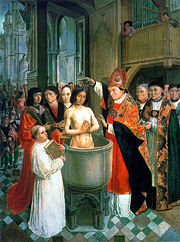
            AKA: Chlodovech King of the Franks, Chlodovechus King of the Franks, Clovis I, King of the Franks
           Born: Abt 466 - Gallia Belgica (Belgium)
     Christened: 496 - Cathédrale de Rheims, Rheims, (Marne), France
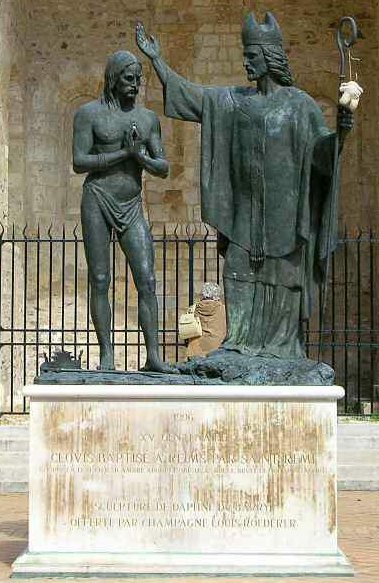
Died: 27 Nov 511 - Paris, Île-de-France, Frankish Kingdom (France)

Buried: - Basilica of Saint-Denis, Paris, Île-de-France, (France)
         Spouse: Clotilde Queen of the Franks (0475-0545) 64 65 66 67
           Marr: 493
Research Notes: Husband - Childeric I King of the Salian Franks
Childeric I (c. 437 - c. 481 ) was the Merovingian king of the Salian Franks from 457 until his death, and the father of Clovis .
He succeeded his father Merovech (Latinised as Meroveus or Merovius) as king, traditionally in 457 or 458 . With his Frankish warband he was established with his capital at Tournai , on lands which he had received as a foederatus of the Romans , and for some time he kept the peace with his allies.
In about 463 in Orléans , in conjunction with the Roman General Aegidius , who was based in Soissons , he defeated the Visigoths , who hoped to extend their dominion along the banks of the Loire River. After the death of Aegidius, he first assisted Comes ("count") Paul of Angers , together with a mixed band of Gallo-Romans and Franks, in defeating the Goths and taking booty. Odoacer reached Angers but Childeric arrived the next day and a battle ensued. Count Paul was killed and Childeric took the city. Childeric, having delivered Angers, followed a Saxon warband to the islands on the Atlantic mouth of the Loire, and massacred them there. In a change of alliances, he also joined forces with Odoacer , according to Gregory of Tours , to stop a band of the Alamanni who wished to invade Italy .
The stories of his expulsion by the Franks, whose women he was taking; of his eight-year stay in Thuringia with King Basin and his wife Basina; of his return when a faithful servant advised him that he could safely do so by sending to him half of a piece of gold which he had broken with him; and of the arrival in Tournai of Queen Basina , whom he married come from Gregory of Tours' Libri Historiarum (Book ii.12).
He died in 481 and was buried in Tournai , leaving a son Clovis , afterwards king of the Franks.
Research Notes: Wife - Basina Andovera of Thuringia
From Wikipedia - Basina, Queen of Thuringia :
Basina was queen of Thuringia in the middle of the fifth century. She left her husband king Bisinus and went to Roman Gaul . She herself took the initiative to ask for the hand of Childeric I , king of the Franks , and married him. For as she herself said, "I want to have the most powerful man in the world, even if I have to cross the ocean for him". This remark of her may have been related to Childeric's successful invasion of the Roman Empire and his attempt to settle a Frankish kingdom on Roman soil.
Basina's name is probably Low Franconian for 'female boss'. She is the mother of the man who is remembered as the founder of the Frankish realm and modern France. She (not her husband Childeric) named her son Chlodovech, but he is better remembered under his Latinized name Clovis I . The simple fact that Chlodovech's name comes from Basina is remarkable since it was a common practice for the Franks to name a son after a member of the family of the male-line of ancestors.
Through the ages historians have been intrigued by the story of Basina since she obviously acted as a player and not as bystander - which is not uncommon for the women of the Franks, but highly uncommon for the Italians.
Christening Notes: Child - Clovis I King of the Franks
Husband Bisinus King of the Thuringii 30 31
            AKA: Basin, Basinus King of the Thuringii
           Born: Abt 440 - <Thuringia (Germany)>
     Christened:
           Died:  - <Thuringia (Germany)>
         Buried:
Marriage:
Wife Basina Andovera of Thuringia 24 25 26
            AKA: Basina of Thuringia, Besina of Thuringia
           Born: Abt 438 - Thuringia, (Germany)
     Christened:
           Died: Abt 480
         Buried:
         Father: Banin of Thuringia (      -      ) 22
         Mother: Basina of Saxony (      -      ) 23
Other Spouse: Childeric I King of the Salian Franks (Between 0436/0437-0482) 27 28 29
Children
1 M Berthar King of the Thuringians 68
           Born: Abt 470 - Thuringia, Germany
     Christened:
           Died: Abt 530
         Buried:
Research Notes: Husband - Bisinus King of the Thuringii
Bisinus, Basinus, Besinus, or Bisin (Lombardic : Pisen) was the king of the Thuringii (fl. c. 460 - 506/510).
According to Gregory of Tours , he supplied refuge from Childeric I , the Frankish king who was exiled by his own people. His wife, Basina , left him for Childeric and the two returned to Tournai together, after eight years.
The historical Bisinus bears some resemblance to the Bisinus of Gregory, but the details are different. Bisinus was the leader of a Thuringian confederation on the Rhine and his wife was a Lombard named Menia. He left three sons, Baderic , Herminafred , and Berthachar , who inherited the throne from him. His daughter Radegund married the Lombard king Wacho .
Research Notes: Wife - Basina Andovera of Thuringia
From Wikipedia - Basina, Queen of Thuringia :
Basina was queen of Thuringia in the middle of the fifth century. She left her husband king Bisinus and went to Roman Gaul . She herself took the initiative to ask for the hand of Childeric I , king of the Franks , and married him. For as she herself said, "I want to have the most powerful man in the world, even if I have to cross the ocean for him". This remark of her may have been related to Childeric's successful invasion of the Roman Empire and his attempt to settle a Frankish kingdom on Roman soil.
Basina's name is probably Low Franconian for 'female boss'. She is the mother of the man who is remembered as the founder of the Frankish realm and modern France. She (not her husband Childeric) named her son Chlodovech, but he is better remembered under his Latinized name Clovis I . The simple fact that Chlodovech's name comes from Basina is remarkable since it was a common practice for the Franks to name a son after a member of the family of the male-line of ancestors.
Through the ages historians have been intrigued by the story of Basina since she obviously acted as a player and not as bystander - which is not uncommon for the women of the Franks, but highly uncommon for the Italians.
Husband Private (details suppressed for this person)
           Born:
     Christened:
           Died:
         Buried:
Marriage:
Wife Private (details suppressed for this person)
           Born:
     Christened:
           Died:
         Buried:
         Father: Teucer King of Teucria [Mythological] (      -      )
         Mother:
Children
1 M Erichthonius King of Dardania [Mythological] 69 70
           Born:
     Christened:
           Died: 1368 B.C.
         Buried:
Spouse: Private
Research Notes: Husband - Dardanus King of Dardania [Mythological]
In Greek mythology , Dardanus (Greek : English translation : "burned up", from the verb (dardapto) to wear, to slay, to burn up)[1] was a son of Zeus and Electra , daughter of Atlas , and founder of the city of Dardania on Mount Ida in the Troad .
Dionysius of Halicarnassus (1.61-62) states that Dardanus' original home was in Arcadia where Dardanus and his elder brother Iasus (elsewhere more commonly called Iasion ) reigned as kings following Atlas. Dardanus married Chryse daughter of Pallas by whom he fathered two sons: Idaeus and Dymas . When a great flood occurred, the survivors, who were living on mountains that had now become islands, split into two groups: one group remained and took Deimas as king while the other sailed away, eventually settling in the island of Samothrace . There Iasus (Iasion) was slain by Zeus for lying with Demeter . Dardanus and his people found the land poor and so most of them set sail for Asia.
However another account by Virgil in his Aeneid (3.163f), has Aeneas in a dream learn from his ancestral Penates that "Dardanus and Father Iasius" and the Penates themselves originally came from Hesperia which was afterward renamed as Italy . This tradition holds that Dardanus was a Tyrrhenian prince, and that his mother Electra was married to Corythus, king of Tarquinia (Aeneid 7.195-242; 8. 596 ss. ; 9. 10; Servio, ad Vergilium, Aeneidos, 9.10).
Other accounts make no mention of Arcadia or Hesperia, though they sometimes mention a flood and speak of Dardanus sailing on a hide-raft (as part of the flood story?) from Samothrace to the Troad near Abydos . All accounts agree that Dardanus came to the Troad from Samothrace and was there welcomed by King Teucer and that Dardanus married Batea the daughter of Teucer. (Dionysius mentions that Dardanus' first wife Chryse had died.) Dardanus received land on Mount Ida from his father-in-law. There Dardanus founded the city of Dardania .
Dardanus' children by Batea were Ilus , Erichthonius and Idaea . According to Dionysius of Halicarnassus (1.50.3), Dardanus also had a son named Zacynthus by Bataea and this Zacynthus was the first settler on the island afterwards called Zacynthus . Dionysius also says (1.61.4) that Dardanus's son Idaeus gave his name to the Idaean mountains, that is Mount Ida , where Idaeus built a temple to the Mother of the Gods (that is to Cybele ) and instituted mysteries and ceremonies still observed in Phrygia in Dionysius's time. There are operas on the subject of Dardanus by Jean-Philippe Rameau (1739), Carl Stamitz (1770) and Antonio Sacchini (1784).
One last claim identifies Dardanus with a biblical Darda who is said to be a son of Zerah. The subject is debatable due to Zerah's name being similar to that of Zeus's and his wife, Hera. According to the Old Testament , Zerah was Pharez's twin brother, the former had his whereabouts unknown whereas the former bore Juda, founder of the tribe that bears same name.
Research Notes: Wife - Batea of the Teucri [Mythological]
Batea (or Bateia) was a figure in Greek mythology said to be the daughter or (less commonly) the aunt of King Teucer , ruler of a tribe known as the Teucrians (Teucri). The Teucrians inhabited the area of northwest Asia Minor later called the Troad (Troas), and the term is sometimes used as another name for the Trojans . Batea married King Dardanus , son of Zeus and Electra , whom Teucer named as his heir. Batea gave her name to a hill in the Troad, mentioned in the Iliad . By Dardanus, Batea was the mother of Ilus , Erichthonius , Zacynthus , and Idaea . Greek mythology also recounts Arisbe , a daughter of Teucer, as the wife of Dardanus so Arisbe and Batea are usually assumed to be the same person.
Husband Clovis II 71
           Born: 634
     Christened:
           Died: 657
         Buried:
         Father: Dagobert I King of Austrasia, King of the Franks (Abt 0603-0639) 72 73 74
         Mother: Nanthilde (0610-0642) 75
Marriage:
Wife Bathilde 76
           Born: 626
     Christened:
           Died: Between 680 and 685
         Buried:
Children
1 M Thierry III 77
           Born: 654
     Christened:
           Died: 691
         Buried:
Spouse: Clotilde (0650-0699) 77
Sources